The Kumbh Mela is a Hindu pilgrimage festival in which millions of people bathe in a sacred river at moments that tradition marks as especially powerful. The name joins kumbha, the Sanskrit word for a pot or pitcher, with mela, a gathering or fair, and it is often rendered as the “festival of the sacred pitcher.” The gathering rotates among four cities in northern and central India: Prayagraj (formerly Allahabad), Haridwar, Nashik with Trimbakeshwar, and Ujjain. Participants and scholars alike describe it as one of the largest religious gatherings anywhere, and in 2017 UNESCO placed it on the Representative List of the Intangible Cultural Heritage of Humanity. Within the wider world of Hinduism, it sits among the great pilgrimage observances, alongside local temple festivals and the daily worship described in the article on the Hindu temple.
A common first impression is that the Kumbh Mela is a single annual event in a single place. It is neither. The festival moves from river to river, and each site has its own rhythm, its own sacred geography and its own local customs. The timing of each gathering is set by an astrological rule that links the positions of Jupiter, the Sun and the Moon to the story of a pot of immortal nectar. Because Jupiter takes roughly twelve years to circle the Sun, a full gathering returns to the same city about once every twelve years, and because the four cities are staggered, one of them hosts a major gathering roughly every three years. Smaller “half” gatherings, annual Magh melas and other observances fill the intervals, and popular usage of these labels is not always consistent.
What actually happens at a Kumbh Mela is more specific than the image of a crowd on a riverbank suggests. Pilgrims take ritual baths, known as snana, on days that the calendar designates as especially auspicious. Orders of ascetics called akharas arrive in ceremonial processions and bathe in a fixed sequence. Sadhus (renunciants), householders and devotees camp in a temporary city, listen to sermons and recitations, share food, give charity and consult the hereditary priests who keep pilgrim records. Some pilgrims stay for a month or longer in a discipline called kalpavas. For participants, the bath is not recreation but an act of purification and devotion, understood within a tradition that links sacred rivers to the removal of sin, the honoring of ancestors and, ultimately, to liberation.
This article explains the festival on its own terms and in historical context. It covers the four sites and the rivers that define them, the traditional narrative of the churning of the ocean, the calendar logic and the terminology of Ardh, Purna and Maha gatherings, what the historical record does and does not show, the ritual of bathing, the akharas and their roles, the camps, the safety questions that large crowds raise, and the way attendance figures should be read. It is written as of October 2026, when the next Kumbh at Nashik and Trimbakeshwar is scheduled to open on October 31, 2026. Dates and figures are given only where a named source supports them, and attendance numbers are always presented as claims by the bodies that announced them.
The Kumbh Mela at a Glance: Meaning, Four Sites, and Core Vocabulary
This section gives a compact orientation before the later sections take up each theme in depth. It explains what the name means, sets out the four locations in a single table, describes who attends and in what roles, and introduces the terms that recur throughout the festival.
What the Name Means and What the Festival Is
Kumbh, mela, and the sacred pot
In Sanskrit, kumbha means a pot, jar or pitcher. The word has several overlapping uses in the festival. It names the vessel of immortal nectar (amrita) in the traditional story of the churning of the ocean, which is told in the Puranas, the large body of Hindu narrative and instructional texts. It is also the traditional name of the zodiac sign Aquarius, one of the signs whose relationship to Jupiter and the Sun enters the astrological reckoning for Haridwar. A third use appears in temple practice, where a pot filled with water is a central ritual object, as in the consecration rites discussed in the article on the Hindu temple. The word mela means an assembly, fair or meeting. Britannica renders the compound as the “festival of the sacred pitcher,” and that translation is the standard English gloss.
The name is older than the modern festival in some places and younger in others. Reference works note that early sources on the great bathing gatherings at Prayaga, the old name of the Prayagraj confluence, describe large assemblies and the sanctity of the place without using the word Kumbh for them. The scholarly discussion of that history appears in a later section. For now, it is enough to note that the name carries a story, a calendar and a place all at once, and that different sites and different centuries have emphasized different parts of that bundle.
A festival of bathing, not a single rite
It is tempting to treat the Kumbh Mela as one ceremony, but it is better understood as a season of observances arranged around a few peak days. The core act is the ritual bath in the river on a designated day. Around that act gather processions of ascetic orders, evening river worship, recitation and teaching, the distribution of food and gifts, and a month of disciplined residence on the riverbank for those who undertake kalpavas. No single scripture prescribes the whole. Rather, the festival draws on Puranic accounts of sacred places, on the calendar rules that astrologers and religious authorities apply, and on customs that monastic orders, pilgrim priests and local communities have developed over centuries.
UNESCO’s description of the festival puts it in similar terms. It calls the gathering the largest peaceful congregation of pilgrims on earth, says that participants bathe in a sacred river, and notes that the event brings together astronomy, astrology, spirituality, rituals and social customs. It adds that participants come from every background and that the bearers of the tradition belong chiefly to akharas, ashrams and religious organizations, or live on alms. That emphasis on practice and on communities of transmission is useful, because it frames the Kumbh Mela as a living tradition carried by specific people rather than as an abstract spectacle.
The Four Sites at a Glance
The four sites share a pattern: each is on a river regarded as sacred, each has long-established bathing places and temples, and each is tied by tradition to one of the drops of nectar. Beyond that pattern they differ in scale, in season and in local custom. The table below summarizes the essentials, and the sections that follow explain the geography, the calendar and the history behind it.
| Site (state) | River | Principal bathing and sacred places | Season of the main gathering (traditional) | Recent and upcoming gatherings |
|---|---|---|---|---|
| Prayagraj, formerly Allahabad (Uttar Pradesh) | Confluence (Sangam) of the Ganga and Yamuna, with the unseen Sarasvati | Triveni Sangam; ghats along both rivers; the monastic camps on the floodplain | Magha (roughly January to February) | Maha Kumbh held January 13 to February 26, 2025; an annual Magh Mela is held in the intervening years |
| Haridwar (Uttarakhand) | Ganga, where it leaves the Himalayan foothills | Har ki Pauri and the Brahma Kund; ghats along the Ganga | Chaitra (roughly March to April) | Ardh Kumbh scheduled January 14 to April 20, 2027, with ten announced bathing dates |
| Nashik and Trimbakeshwar (Maharashtra) | Godavari | Ramkund at Nashik; Kushavarta at the Trimbakeshwar temple | Bhadrapada (roughly August to September); often called Simhastha | Opens with flag hoisting on October 31, 2026; main bathing days announced for August and September 2027 |
| Ujjain (Madhya Pradesh) | Shipra (Kshipra) | Ghats on the Shipra, including Ram Ghat; the Mahakaleshwar temple | Vaishakha (roughly April to May); also called Simhastha | Last held in 2016; next reported as scheduled for 2028 |
Prayagraj and Haridwar: the Ganga sites
Prayagraj and Haridwar are both on the Ganga, the river that Hindus honor as the goddess Ganga and that appears in nearly every Hindu account of sacred geography. Haridwar lies where the river emerges from the Himalayan foothills onto the plain, a position that gives its name a double meaning in tradition: some devotees read it as “gateway of Hari” (Vishnu) and others as “gateway of Hara” (Shiva). Prayagraj lies farther downstream, at the meeting of the Ganga and the Yamuna, where tradition adds a third, invisible river, the Sarasvati. Reference works describe both sites as hosting full and half gatherings, which is why they appear more often in the cycle than Nashik and Ujjain.
Nashik and Ujjain: the Godavari and Shipra sites
Nashik and Ujjain are tied to different river systems. Nashik, on the Godavari in Maharashtra, shares its Kumbh with the nearby town of Trimbakeshwar, where the Godavari is said to rise and where an important Shiva temple stands. Ujjain, on the Shipra in Madhya Pradesh, is one of the old sacred cities of central India and the home of the Mahakaleshwar temple. Both gatherings are widely called Simhastha, a name that refers to Jupiter’s presence in the sign of Leo (Simha). The festival at these two cities has its own character, shaped by the Marathi- and Hindi-speaking regions in which they lie and by local priestly families, and the later section on the four sites takes up the details.
Who Takes Part
Pilgrims, kalpavasis and householders
The great majority of those who attend are ordinary pilgrims: families who travel by train, bus or on foot for a day or a few days, bathe, make offerings, receive a priest’s blessing and return home. Many come once in a lifetime. UNESCO notes that people attend irrespective of caste, creed or gender. A smaller group, the kalpavasis, commit to living at the riverside for the month of Magh, observing a disciplined routine of bathing, simple food, worship and listening to teaching. Their presence gives the Prayagraj gathering in particular a rhythm that is quieter and more sustained than the crowds of the peak bathing days.
Ascetics, orders and teachers
The second group is made up of ascetics and teachers. Sadhus come from many traditions, including orders devoted to Shiva, to Vishnu and to other lineages, and they are organized for the festival chiefly through the akharas, the monastic bodies explained in detail in a later section. Alongside them are individual gurus with their own followers, teachers who give daily discourse and the heads of ashrams. UNESCO identifies the teacher and student relationship among sadhus in ashrams and akharas as the most important method of passing on and safeguarding knowledge about the festival. Many Hindus also travel to the Kumbh specifically for darshan, the auspicious sight, of renowned ascetics.
Visitors, researchers, and others
A third group includes merchants, volunteers, government and police personnel, journalists, scholars and tourists. Their presence is part of the modern festival, and the scale of the temporary city makes their numbers significant. Researchers, including a Harvard team that studied the 2013 gathering at Allahabad, have treated the mela as a subject for the study of religion, urban planning and public health at once. Visitors who are not Hindus are generally able to observe the festival, but they should approach it as a religious occasion: respectful dress, care around bathing areas and requests before photographing people at worship are the norm, as discussed in the later section on logistics.
Core Vocabulary of the Festival
Terms for places and bathing
Several Sanskrit and Hindi terms recur. A tirtha is a sacred crossing place, typically on a river, where the human and the divine realms are thought to meet. Snana means bathing, and snan is the common Hindi form used in the names of bathing days. The Sangam is a confluence, and at Prayagraj it means specifically the meeting of the rivers. A ghat is a set of steps or a landing leading to the water. Triveni, “three braids,” names the confluence of the three rivers at Prayagraj. These words appear in the official programs of each gathering and in the speech of pilgrims.
Terms for people and institutions
A sadhu is a renunciant or holy person, and sannyasi is a person who has taken formal renunciation. An akhara is a monastic order or camp, and its leaders include mahants and mahamandaleshwars. Naga sadhus are ascetics of the Shaiva orders who live without ordinary clothing or with minimal clothing. A tirtha purohit, sometimes called a panda or, at Prayagraj, a Prayagwal, is a hereditary priest who guides pilgrims and records their visits. These roles are described more fully in the sections on the akharas and on the camps. The terms for the cycles themselves, Ardh, Purna and Maha, are treated in the calendar section because their usage has changed and is not always consistent.
Sacred Rivers and Pilgrimage Geography
The Kumbh Mela is a festival of rivers before it is anything else, and the geography of each site explains much of its character. This section explains the idea of the tirtha, describes the four river settings, and looks at how seasonal floods and water quality shape the festival.
The Idea of the Tirtha
Why rivers and fords are sacred
The Sanskrit word tirtha means a ford or crossing, and in Hindu usage it extends to any place where a pilgrim can cross from the ordinary into the sacred. Most tirthas are on water: rivers, confluences, lakes and the sea. The idea of crossing has a layered meaning in Hindu thought. A ford is a practical passage from one bank to the other, and a tirtha is also understood as a passage from bondage toward liberation, a theme explored in the articles on moksha and on samsara and rebirth. UNESCO’s description records the devotional belief that bathing in the sacred river frees a person from sin and from the cycle of birth and death.
A tirtha differs from a temple in an important way. A temple is a built house for a deity, with an image and a regular program of worship, whereas a tirtha is a place whose sanctity is attached to the landscape itself and is activated by acts such as bathing, giving and remembrance. The two overlap constantly, since nearly every major tirtha has temples along its banks, as the article on the Hindu temple explains. At the Kumbh, the temples of Haridwar, Trimbakeshwar and Ujjain play their part, but the center of the festival is the river bank.

Ganga as goddess and river
The Ganga holds a unique place in this geography. Hindu tradition honors the river as a goddess, Ganga, who according to Puranic accounts descended from heaven and was received in the matted locks of Shiva to soften the force of her fall. Devotees address her as mother, and the water carried home in sealed containers (often called Gangajal) is used in household worship and at moments of death and passage. The Yamuna, associated with Krishna and with the goddess Yamuna, and the Godavari, often called the Ganga of the south, receive similar honor, as does the Shipra at Ujjain. The tradition does not hold that only one river is holy but that rivers in general are channels of divine presence, with some sites especially concentrated.
Water in Vedic and Puranic texts
Praise of rivers is old in Sanskrit literature. Hymns in the Rigveda invoke the waters and name rivers, and later epic and Puranic texts expand that tradition into long lists of pilgrimage places with the merit that visiting each one confers. The Mahabharata contains one such list in its pilgrimage section, and the Puranas, including the Matsya Purana, add extended praise of Prayaga. These texts are discussed in the section on traditional accounts. For the reader of the Kumbh, the point is that the idea of the sacred river is far older than the festival, and the festival is one expression of a much longer pilgrimage culture. The foundational scriptures are surveyed in the article on the Vedas and Upanishads.
Four Rivers, Four Landscapes
Each site has its own setting. The table below summarizes the river geography, and the paragraphs that follow add the local detail.
| Site | River setting | Key sacred places | Associated traditions | Notes on the landscape |
|---|---|---|---|---|
| Prayagraj | Meeting of the Ganga and Yamuna; Sarasvati said to join unseen | Triveni Sangam; the fort area and its ancient banyan tree known as the Akshayavat; riverside ghats | Prayaga as the “place of sacrifice” in Puranic tradition; month-long kalpavas in Magha | Broad floodplain that is under water in the monsoon and becomes the mela ground in winter |
| Haridwar | The Ganga as it enters the plains from the Himalayan foothills | Har ki Pauri; Brahma Kund; hill shrines above the town | Gateway to the Himalayan pilgrimage routes; a place for rites for ancestors | A narrow, built-up riverfront with canals and ghats |
| Nashik and Trimbakeshwar | The Godavari, with its source near Trimbakeshwar | Ramkund at Nashik; Kushavarta at Trimbakeshwar; Panchavati area | Godavari as the “southern Ganga”; links to the Ramayana story at Panchavati; Trimbakeshwar as a Shiva site | A river town with temples, ghats and a long history of separate Shaiva and Vaishnava bathing places |
| Ujjain | The Shipra (Kshipra) | Ram Ghat and other ghats; Mahakaleshwar temple | One of the seven old sacred cities in Hindu tradition; Shiva as Mahakala | An old city whose riverfront ghats and surrounding open ground are prepared for the gathering |
Prayagraj: where the Ganga, Yamuna and Sarasvati meet
Prayagraj sits at the point where the pale Ganga and the darker Yamuna join, a visible meeting that tradition has long treated as the meeting of three rivers. The third river, Sarasvati, is not visible. Hindu tradition identifies it with a river celebrated in the Rigveda, and its unseen presence at the Sangam is a matter of faith and of poetic meaning rather than observation. The name Prayaga is usually explained as meaning a place of great sacrifice, since tradition says that the creator deity Brahma performed an offering there. For pilgrims, the Sangam is the climactic location of the Prayagraj gathering, and the bathing days concentrate at the point where the waters meet.
Haridwar: the Ganga leaves the mountains
At Haridwar the Ganga leaves the hills and spreads over the plain, and the town has long served as the gateway for pilgrimage routes into the Himalayas. The central bathing place is Har ki Pauri, the “steps of Hari,” with the adjacent Brahma Kund, and the evening river worship (arti) held there draws large crowds even outside the Kumbh. A canal diverts part of the river through the town, so that the water at the ghats is managed by the state in ways that are specific to Haridwar. Reference works note that Haridwar’s link to the Kumbh is tied to Jupiter’s presence in Aquarius, the sign named for the pot.
Nashik and Trimbakeshwar: the Godavari
The Godavari is the longest river of peninsular India, and Hindu tradition calls it the Ganga of the south. Its source is at Trimbakeshwar, about 30 kilometers from Nashik, where a Shiva temple stands near the sacred pool called Kushavarta. At Nashik, the central bathing place is Ramkund, and the surrounding Panchavati area is associated in tradition with Rama, Sita and Lakshmana during their forest exile. The two places have long been treated separately in the festival, a point connected to old disputes among ascetic orders and discussed in the section on history.
Ujjain: the Shipra
Ujjain is among the seven cities that Hindu tradition lists as granting liberation, and it is the home of Mahakaleshwar, a form of Shiva worshiped there as lord of time. The Shipra, which flows past the city, is the river of the gathering. The festival there is called Simhastha, and reference works describe the main bathing day as falling on the full moon of Vaishakha. The ghats of the Shipra and the open ground prepared around them form the setting for the processions and encampments of the akharas.
Seasons, Floods and the Changing Riverbank
Why the mela landscape changes each time
A feature that surprises many visitors is that the ground on which the largest gatherings take place is, for much of the year, part of the river. At Prayagraj the floodplain around the Sangam is covered by monsoon waters and then reappears as sand, and the administration lays out the mela city on it each time. A Harvard Gazette report on the university’s study of the 2013 gathering describes a city that appears and then is dismantled within months, and notes that the site is inaccessible for months before the festival because monsoon floods claim it. The result is that the exact shape of the riverbank, and therefore the locations of the bathing places, changes between gatherings.
Water quality and public debate
Water quality is part of the public conversation about the festival. During the 2025 Maha Kumbh, a Central Pollution Control Board report was cited in the press as recording high levels of fecal bacteria and total coliform at some bathing points, and Uttar Pradesh Chief Minister Yogi Adityanath rejected the claims and said the water was fit for bathing and for ritual sipping. Both positions were reported, and the dispute reflects a broader debate in India over the health of its rivers. For pilgrims, the religious understanding is that the Ganga is purifying by nature, while public-health researchers and officials debate measurement and standards. A reader should treat the question as open and consult current official water-quality reports for any specific gathering.
Traditional Accounts: The Churning of the Ocean and the Prayaga Tradition
The Kumbh Mela rests on two kinds of traditional authority. One is a story about a pot of nectar and four drops, which gives the festival its name and its four sites. The other is a long tradition of praise for Prayaga and for bathing in sacred rivers, found in the epics and the Puranas. This section sets out both, says what the texts actually contain, and notes where scholars distinguish the story told by devotees from the textual evidence.
The Churning of the Ocean
The story as the Puranas tell it
The churning of the ocean of milk (samudra-manthana) is one of the best-known narratives in Hindu literature, told with variations in the Mahabharata, the Vishnu Purana, the Bhagavata Purana and other texts. In the familiar outline, the gods (devas) had lost strength and fortune after a curse, and on the advice of Vishnu they agreed to work with their rivals, the asuras or demons, to churn the cosmic ocean in search of amrita, the nectar of immortality. They used Mount Mandara as the churning rod and the serpent Vasuki as the rope, and Vishnu, in the form of a tortoise, supported the mountain on his back. Many treasures rose from the ocean, among them the goddess Lakshmi, and finally the divine physician Dhanvantari appeared carrying a vessel of nectar.
The Vishnu Purana, in the English translation by Horace Hayman Wilson published in 1840, describes this moment in its chapter on the legend of Lakshmi:
Dhanwantari, robed in white, and bearing in his hand the cup of Amrita, next came forth
Vishnu Purana, trans. H. H. Wilson (1840), Book I, Chapter IX
In the same chapter, as Wilson renders it, the gods drink the ambrosia, and Vishnu assumes a female form to bewilder the demons and recover the nectar. Later tradition and popular retelling name that form Mohini, though the Wilson text does not use the name in the passages consulted for this article. The story is a narrative of cooperation, rivalry and divine intervention, and in the Vishnu Purana it serves chiefly to explain how Indra and the gods regained their prosperity after a curse.
Why the pot matters: nectar, drops and twelve days
The link between this story and the Kumbh Mela comes through a further tradition about the pot itself. According to the version associated with the festival, the gods and demons contended over the vessel of nectar for twelve divine days, and while it was being carried away, drops fell at four places on earth. William Sax, writing in the Encyclopedia of Religion, summarizes the tradition as including eight divine places and four earthly ones, with the Moon, Sun, Jupiter and Saturn each guarding the pot at a crucial moment. Because one divine day is said to equal a human year, the twelve days of struggle correspond to twelve human years, and that equation is the traditional explanation for the twelve-year cycle.
Britannica states the belief in similar terms: at the climax of each gathering, the rivers at the four sites are believed to become the nectar, offering benefit to pilgrims. In this understanding, the bath at a Kumbh is not merely a bath in a holy river. It is a bath at a time and place when the river is said to share in the power of the original nectar. That belief makes the astrological timing of the festival religiously essential rather than merely customary.
Prayaga in the Texts
Prayaga in the Mahabharata
Alongside the nectar story, a separate textual tradition praises Prayaga and bathing at confluences. The Mahabharata, in its section on pilgrimage places in the Vana Parva (the Book of the Forest), gives a long list of tirthas and the merit of visiting each one. In the nineteenth-century English translation by Kisari Mohan Ganguli, the text says of Prayaga:
He that bathes in that confluence celebrated over the world, acquires all the merits of the Rajasuya and the horse-sacrifices.
Mahabharata, Vana Parva, Section LXXXV, trans. Kisari Mohan Ganguli (1883–96)
The Rajasuya and the horse sacrifice (ashvamedha) were among the most elaborate and costly royal rituals of Vedic tradition, so the claim is that a simple bath at the right place can yield the spiritual benefit of the grandest sacrifices. This idea, that pilgrimage and bathing can stand in for or equal costly ritual, is a theme across the pilgrimage literature, and it helps to explain why tirthas drew pilgrims from every social level. The same passage describes Prayaga as the place where gods, sages and the rivers themselves dwell. The text does not, however, use the word Kumbh, and it does not describe a mela on the scale of the modern festival.
Prayaga Mahatmya and the Puranas
Later Sanskrit literature develops the praise of Prayaga into a genre. Reference works note that the Matsya Purana devotes a block of chapters to Prayaga and its merit, and that separate mahatmya texts, praise literature devoted to a single holy place, were composed for Prayaga in the late first millennium CE and after. These texts specify rules for bathing at the confluence, for the gifts that should follow, and for the month of Magha, when bathing is said to be especially potent. Sax observes that the main textual support for the Kumbh in later Sanskrit tradition appears in recensions of the Skanda Purana, which are late and inconsistent among themselves, and that no single authoritative scripture sanctions the fair.
Vedic echoes and disputed references
Some devotional writing traces the festival to the Vedas. Sax notes that a reference in the Atharvaveda is disputed and that undated supplementary (khila) verses attached to the Rigveda show familiarity with the sites and the relevant conjunctions. Scholars treat these as suggestive rather than decisive, since the supplementary verses cannot be dated precisely and their wording does not describe the modern festival. The general picture is that the sanctity of the confluence is attested early and in many sources, while the specific institution of a periodic great fair under the name Kumbh is attested later.
How Scholars Read the Traditional Accounts
Sax on the open question of origins
Scholars who study the Kumbh Mela generally separate the devotional account of its origin from the textual and historical record. Sax, in his Encyclopedia of Religion entry, called the festival’s origin an open and almost uninvestigated question when he wrote, and noted that no single scripture prescribes it. That caution is a good starting point for readers: it does not diminish the festival’s religious meaning for participants, but it shows that the history requires evidence of a different sort from the Puranic narrative.
The nectar story and the four sites
A second point concerns the link between the churning story and the four sites. The standard narratives of the churning in the Mahabharata and Puranas describe the nectar and its recovery, but the identification of four specific earthly places as the landing points of the drops appears in later tradition. Some scholars, including Giorgio Bonazzoli in his study of Prayaga based on Sanskrit sources, have argued that the association is a later layer, and reference works summarizing the scholarship note that Nashik’s link to the nectar story in particular appears to be recent. Devotees and monastic orders understand the association differently: for them the four drops are the established explanation of why the festival is held where it is. Both statements can stand together, one as a claim about textual history and the other as a living religious understanding.
Faith, narrative and history together
The more useful way to hold these accounts is to see each as answering a different question. The churning story answers the question of meaning: why these rivers, at these moments, are believed to carry power. The Mahabharata and Puranic praise of Prayaga answers the question of long-standing sanctity: that bathing at confluences was already an honored practice. The historical record, treated in a later section, answers the question of institutional development: when and how a recurring great gathering came to be organized, regulated and named. A balanced account of the Kumbh Mela needs all three, and none replaces the others.
Calendar Logic: Jupiter, the Sun, the Moon, and the Rotating Cycle
The Kumbh Mela does not follow the civil calendar or a simple lunar date. Its timing combines the positions of three heavenly bodies with the lunar fortnights and solar transits of the traditional Hindu calendar. This section explains the rule at a high level, sets out the terminology of Ardh, Purna and Maha gatherings, and says how to read published dates responsibly.
The Astrological Rule in Outline
Jupiter, the Sun and the Moon
Britannica summarizes the rule by saying that each site’s timing depends on specific positions of the Sun, Moon and Jupiter, and that the holiest moment occurs when those positions align. In the tradition’s own reckoning, Jupiter (Brihaspati, the teacher of the gods) is the slow clock, the Sun marks the solar month, and the Moon marks the lunar day, with new moon and full moon days preferred for the major baths. Each site has its own combination, tied to the story of the place where the nectar fell. The table below follows reference-work summaries of the conditions and should be read as a description of traditional rules, not as a prediction tool.
| Site | Principal traditional condition (Jupiter and Sun) | Alternative condition noted | Season of main bathing |
|---|---|---|---|
| Haridwar | Jupiter in Aquarius (Kumbha) with the Sun in Aries | Not generally given | Chaitra, about March to April |
| Prayagraj | Jupiter in Aries with the Sun and Moon in Capricorn | Jupiter in Taurus with the Sun in Capricorn | Magha, about January to February |
| Nashik and Trimbakeshwar | Jupiter and Sun in Leo (Simha) | Jupiter, Sun and Moon in Cancer at a new moon | Bhadrapada, about August to September |
| Ujjain | Jupiter in Leo with the Sun in Aries | Jupiter, Sun and Moon in Libra at a new moon in Kartika | Vaishakha, about April to May |
The wording differs between sources, and traditions of timing do not agree in every detail. Sax notes that some traditions hold that the conjunction can fall in the eleventh year and that scholars now broadly agree on the appropriate times for the present cycle. The table therefore records the commonly summarized rule, and anyone who needs the date of a specific gathering should rely on the announcement of the authorities who set it.
Why the cycle is about twelve years
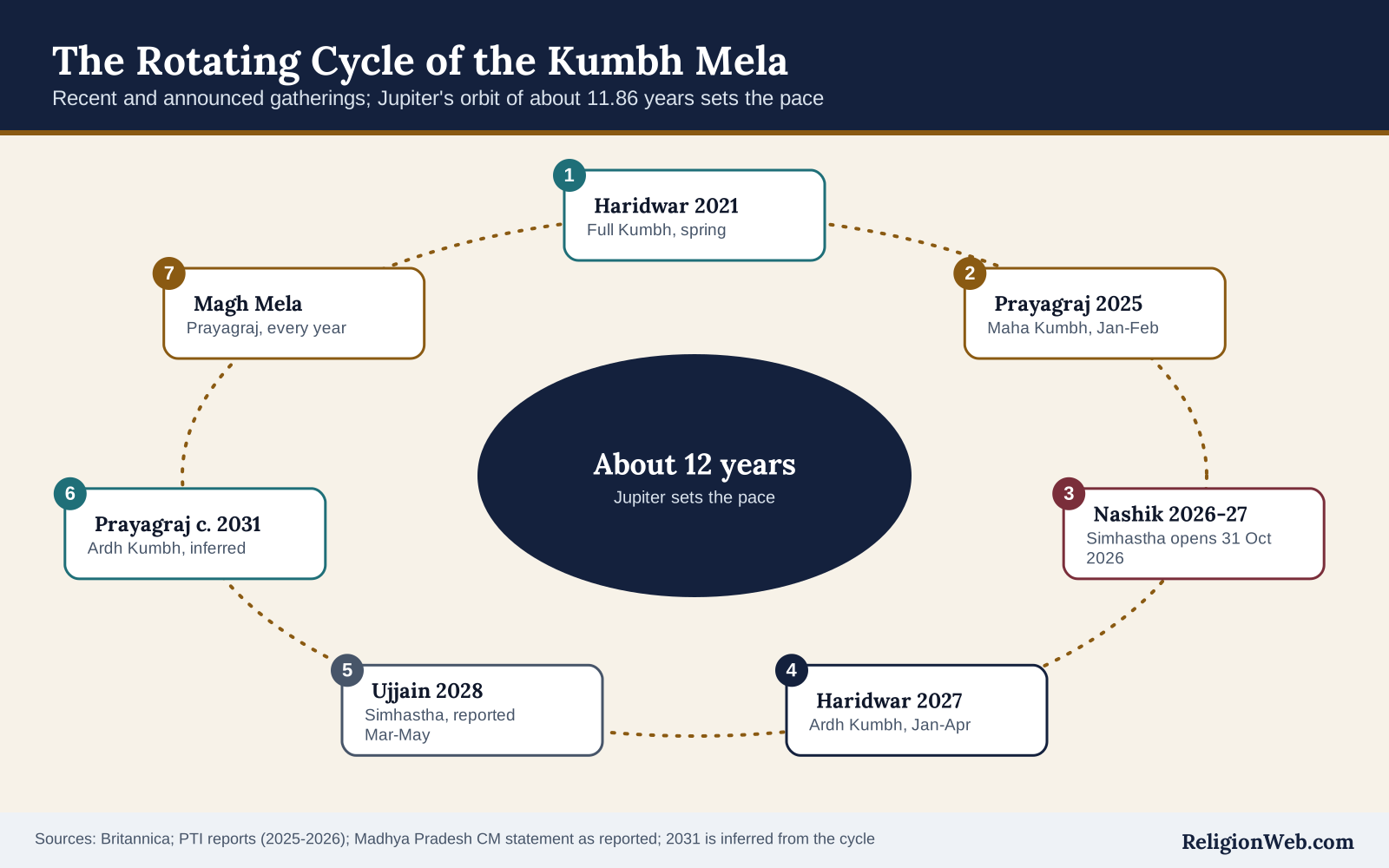
Jupiter takes about 11.86 years to complete one orbit of the Sun, and its apparent movement through the zodiac signs, about one sign each year, sets the pace of the cycle. A given site, tied to a given sign, therefore comes around about every twelve years. Because the orbit is slightly shorter than twelve years, an adjustment is needed from time to time, and reference works note that the gathering at a site can fall after eleven years about once in a century. This is a plain consequence of the astronomy, and it explains why the traditional count of twelve years is approximate rather than exact.
Why a gathering occurs somewhere about every three years
Because the four sites correspond to different positions of Jupiter, their twelve-year cycles are staggered. Prayagraj follows Haridwar by about three years in the usual sequence, and Nashik and Ujjain follow in turn, with the result that some site hosts a major gathering about every three years. Britannica’s summary table expresses this as a Kumbh Mela about every three years across the four cities. The pattern is only roughly even, since the astronomical positions do not fall at precisely equal intervals, and the recent sequence of Prayagraj in 2025, Nashik in 2026–27, Haridwar in 2027 and Ujjain in 2028 illustrates how the schedule clusters.
Terminology: Ardh, Purna, Maha and Magh
Popular usage of the terms for the different gatherings is inconsistent, which is a frequent source of confusion in news reports. The table below sets out the usual meanings, with notes on where usage varies.
| Term | Usual meaning | Interval and place | Notes on usage |
|---|---|---|---|
| Kumbh Mela | The general name of the festival; also used for a gathering at any of the four sites | A gathering somewhere about every three years | In 2019, Uttar Pradesh authorities announced that the six-year gathering at Prayagraj would be called Kumbh, according to reference-work accounts |
| Purna Kumbh | “Full” Kumbh, the complete twelve-year gathering at a site | About every 12 years at each site | The 2025 gathering at Prayagraj was officially styled Maha Kumbh |
| Ardh Kumbh | “Half” Kumbh, held between full gatherings | About every 6 years at Haridwar and Prayagraj | Haridwar’s 2027 gathering is described by the state as an Ardh Kumbh |
| Maha Kumbh | “Great” Kumbh; used both for the 12-year Prayagraj gathering and, in popular claims, for a rarer alignment | Said in popular accounts to recur every 144 years (twelve 12-year cycles) at Prayagraj | Britannica lists it as every 144 years; official usage in 2025 applied it to the 12-year gathering |
| Simhastha | The name for the Nashik and Ujjain gatherings, from Simha, Leo | About every 12 years at each of the two sites | Used in official titles such as Nashik-Trimbakeshwar Simhastha |
| Magh Mela | An annual month-long fair at the Prayagraj confluence in the month of Magha | Every year at Prayagraj, including between Kumbh gatherings | Contains the kalpavas observance; larger in Kumbh years |
Ardh Kumbh and Purna Kumbh
The word purna means full, and ardha means half. A Purna Kumbh is the full gathering that comes round to a site about every twelve years, and an Ardh Kumbh falls about six years after it. Britannica lists the half gathering at Haridwar and Prayagraj only, and Sax notes the same two sites. Nashik and Ujjain are generally treated as holding the twelve-year Simhastha without a half gathering in the same sense. The practical result is that Haridwar and Prayagraj see a major gathering every six years, which is why they often appear in the news.
Maha Kumbh: a term with more than one use
The term Maha Kumbh, “great Kumbh,” has been used in two ways. In popular claims, it names a rarer alignment said to come once in 144 years, which is twelve twelve-year cycles, and which was widely invoked in publicity for the 2025 gathering at Prayagraj. Britannica records the 144-year figure. In official practice, according to reference-work accounts, Uttar Pradesh authorities announced in 2019 that the six-yearly Ardh Kumbh would be called Kumbh and the twelve-yearly gathering would be called Maha Kumbh. These two uses are not the same, and a reader who sees “Maha Kumbh” in a headline should check which sense is intended. The 144-year count is a popular reckoning, and this article has not found a classical text that prescribes it.
Magh Mela and Kalpavas
The Magh Mela is the annual fair held at the Prayagraj confluence in the month of Magha, when pilgrims gather for baths and for kalpavas. In Kumbh years it is larger, and in other years it still draws large crowds. Understanding the Magh Mela clarifies the structure of the Prayagraj Kumbh: the great gathering is built on a yearly foundation, and the month-long residence of the kalpavasis is the thread that runs through every year. The annual fair is the older institution in the Prayagraj record, a point taken up in the history section.
Reading Dates Responsibly
Lunar days, Sankranti and the bathing calendar
The bathing days of a Kumbh are named for the Hindu calendar rather than for civil dates. They include solar transits such as Makar Sankranti, when the Sun enters Capricorn, and lunar days such as Mauni Amavasya (the new moon day of silence in Magha), Basant Panchami, Magha Purnima (the full moon of Magha) and Mahashivratri, the night of Shiva. Because the Hindu calendar is lunisolar, the civil dates of these days move from year to year, and each gathering publishes its own list. At the 2025 Prayagraj gathering, for example, the mela ran from Paush Purnima on January 13 to Mahashivratri on February 26, according to press reports of the Uttar Pradesh government’s announcements.
Why published dates can differ
Dates for future gatherings are announced by state governments, mela authorities and religious bodies, and they can change. A reader may find slightly different lists for the same gathering in different outlets, because of differences in how astrologers compute a lunar day, because of revisions after the first announcement, or because a news report and an official notice describe different events (the opening flag ceremony, the first bath, the last bath). The practical rule is to treat any date more than a few months ahead as provisional and to use the most recent official notice.
What is currently announced
As of October 21, 2026, the dates below have been reported by named sources. The Nashik-Trimbakeshwar Simhastha is scheduled to open with a flag-hoisting ceremony (dhwajarohan) on October 31, 2026, according to a Press Trust of India report of the Maharashtra government’s announcement in June 2025, which also gave three Amrit Snan dates for 2027: August 2, August 31, and September 11 (September 12 at Trimbakeshwar). For Haridwar, a Press Trust of India report of April 2026 attributed to the mela administration a list of ten bathing dates between January 14 and April 20, 2027. These are provisional, and the later section on the four sites gives the list with its attribution. Readers planning travel should check the current official notice.
History: From Ancient Prayaga to the UNESCO Listing
The history of the Kumbh Mela is easier to describe in pieces than as a single line. The sanctity of the confluence at Prayaga is attested very early, large bathing assemblies are described in the first millennium CE, and the name Kumbh Mela, the four-site system and the modern administration of the festival belong to later centuries. This section follows the evidence in order and marks where scholars disagree.
Early Evidence for Bathing at Prayaga
Texts from the early centuries
The oldest references concern bathing, not a festival. The Mahabharata, as noted above, praises the confluence at Prayaga and promises great merit to those who bathe there. An early Buddhist text confirms that the practice was widely known. In the Majjhima Nikaya, a collection of discourses in the Pali canon, the sutta called “The Simile of the Cloth” records a conversation between the Buddha and a brahmin who bathes in rivers for purification. The Buddha, replying in verse, lists a set of well-known bathing places and says that bathing in them does not by itself cleanse a person who has done wrong. In the English translation by Bhikkhu Sujato, the verse reads:
The Bāhukā and the Adhikakkā, at Gayā and the Sundarikā too, Sarasvatī and Payāga, and the Bāhumatī River: a fool can constantly plunge into them but it won’t purify their dark deeds.
Majjhima Nikaya 7 (The Simile of the Cloth), trans. Bhikkhu Sujato, SuttaCentral (CC0), verses 20.2–20.7
In the Buddhist reading, the verse is a teaching about the primacy of ethical purification over ritual washing, and it is not an endorsement of the bathing practice. For a historian of the Kumbh, however, the passage is useful for a different reason: it shows that Payaga (Prayaga) and the Sarasvati were counted among established bathing places in the community that the sutta addresses, at a date well before the Puranic praise of Prayaga. The text is part of the scriptural record of a different religious tradition and it is cited here only as historical evidence of a shared pilgrimage landscape, not as a comparison of teachings.
Xuanzang in the seventh century
The best-known early account of a great assembly at the confluence comes from the Chinese Buddhist pilgrim Xuanzang, who traveled in India between 629 and 645 CE and whose record is dated by many scholars to about 644 CE. Britannica notes that he described the gathering, and recorded the donations of King Harsha at the Prayaga confluence, including a large assembly held every five years. Many writers have treated this as the earliest account of what became the Kumbh Mela. Other scholars are more cautious. Sax writes that Xuanzang visited Prayaga in the seventh century but that there is no evidence he saw a mela in the later sense. Ariel Glucklich has argued that Xuanzang presented Hindu practice from a Buddhist viewpoint, and Kama Maclean has suggested that the event he described may have been a Buddhist festival held every five years. These readings differ, and the reasonable conclusion is that the account is important evidence of a large charitable and ritual assembly at Prayaga in the seventh century while remaining uncertain evidence of the Kumbh as such.
Medieval and Mughal sources
From the late first millennium CE, Prayaga appears in the praise literature (the mahatmyas) and in the Puranas, and in the sixteenth century in Persian and vernacular sources. The Ramcharitmanas of Tulsidas, composed in the sixteenth century, mentions an annual fair at Prayaga, and the Ain-i-Akbari, compiled around 1590 for the Mughal emperor Akbar, calls Prayag the “king of shrines,” according to reference-work summaries. A late seventeenth-century Persian history, the Khulasat-ut-Tawarikh, is cited in the scholarship as using the name Kumbh Mela only for Haridwar, while describing a Magh fair at Prayag and a Trimbak fair when Jupiter entered Leo. If those readings are accurate, the Prayagraj gathering was known as the Magh fair long before it was called a Kumbh. Kama Maclean has argued that the Kumbh at Allahabad is much more recent than the Magh Mela, and James Mallinson has dated bathing gatherings at Prayaga to at least the middle of the first millennium CE.
Orders, Rivalries and the Order of Precedence
Shankara and the tradition of the orders
The ascetic orders that now organize the processions have their own account of the festival’s origins. Britannica records the tradition that the eighth-century philosopher Shankara began regular gatherings of learned ascetics, and the orders commonly trace their lineage to him through the Dashanami system of ten monastic names. Historians treat the attribution with caution. The reference literature notes that there is no historical literary evidence connecting Shankara to the Kumbh, and that the link between the Dashanami orders and the monasteries Shankara is said to have founded remained nominal in historical practice. The tradition remains meaningful for the orders themselves, whose sense of identity depends on lineage, and it illustrates how an institution’s own account of its origin can differ from the account that historians can document.
Clashes over bathing order
Perhaps the most vivid part of the historical record concerns disputes over who should bathe first. Britannica notes that there were bloody disputes over bathing precedence and that the government now enforces a set order. The reference literature records several episodes. A clash at Haridwar in 1760 between Shaiva Gosains and Vaishnava Bairagis is reported to have caused hundreds of deaths. At Nashik in 1789 a copperplate inscription from the Maratha Peshwa’s administration is cited as claiming that 12,000 ascetics died in a clash, a figure that should be treated as a claim in a source of the period rather than a count. A clash at Haridwar in 1796 between rival ascetic groups is reported to have caused about 500 deaths, though accounts differ on which groups were involved. Sax, writing in the Encyclopedia of Religion, notes that rival monastic orders fought bloody battles over bathing rights as late as 1807. Casualty figures for these early episodes come from partial and sometimes partisan records and should be read with care.
Rules of precedence under the Peshwas and the British
Rulers and administrators responded to these conflicts by fixing rules. After the 1789 episode, the Peshwa is reported to have moved the Vaishnava bathing place to Ramkund at Nashik, leaving the Shaiva orders at Trimbakeshwar, and later at Ujjain the orders were assigned opposite sides of the Shipra. Reference accounts of Ujjain note that British forces were deployed in 1850 and a barrier was built in the river to keep the groups apart, with the Shaiva group bathing in the morning before the larger Vaishnava group arrived. At the British-administered fairs, an order of bathing for each akhara was set, and the arrangement that the akharas now follow was agreed by mutual consent under British rule, according to press accounts of the Maha Kumbh. The present arrangement is therefore the product of negotiation and administration as well as tradition.
The Colonial Period and the Modern Mela
Regulation, taxes and the Prayag priests
British administrators in northern India took an interest in the fairs for reasons of revenue, order and public health. Kama Maclean’s study Pilgrimage and Power: The Kumbh Mela in Allahabad, 1765–1954 examines how colonial officials, the hereditary Prayagwal priests and the ascetic orders negotiated over control of the fair across nearly two centuries. The colonial state at times taxed pilgrims, regulated trade and attempted to control the akharas, and the priests and orders at times used the new administrative apparatus to their advantage. This part of the record is important because it shows that the modern festival was shaped by administrative decisions as well as by devotion, and that it has been a site of negotiation among religious and political interests for a long time.
The 1954 Kumbh and the Akhara Parishad
The Kumbh at Allahabad in 1954, held shortly after independence, ended in a disaster. Britannica records that about 1,000 people died in a stampede, one of the deadliest in the festival’s history, though casualty estimates for the event vary among sources. Reference accounts of the Akhil Bharatiya Akhara Parishad state that the body was formed in 1954 after the stampede to unite the akharas and to improve the management of later gatherings, and the Parishad now determines the sequence of the akharas’ ceremonial baths in coordination with the administration. The date and cause of the founding are given here as reported by those reference accounts.
Independence, state management and UNESCO
After 1947 the state governments took over the organization of the fairs, building the bridges, roads, sanitation and security arrangements that make a temporary city possible. In 2017, UNESCO inscribed the Kumbh Mela on the Representative List of the Intangible Cultural Heritage of Humanity at the request of India. Its description emphasizes the knowledge carried by the akharas, ashrams and religious organizations and the transmission from teacher to student. Since then, the gatherings have been officially promoted at a larger scale, with the 2025 Maha Kumbh presented by its organizers as the largest gathering in history, a claim discussed in the section on attendance.
| Date | Event or source | Kind of evidence | Note on interpretation |
|---|---|---|---|
| Early centuries (undated) | Bathing at Prayaga praised in the Mahabharata and listed among bathing places in the Pali canon | Epic and canonical texts | Attests the sanctity of the confluence, not a periodic mela |
| About 644 CE | Xuanzang describes an assembly and royal donations at Prayaga | Travel account | Scholars debate whether this describes a Hindu or Buddhist festival and whether it is a forerunner of the Kumbh |
| Late first millennium CE | Prayaga Mahatmya and Puranic praise of Prayaga | Sanskrit praise literature | Develops rules for bathing and gifts, especially in Magha |
| About 1590 | Ain-i-Akbari calls Prayag the “king of shrines” | Mughal court record | Evidence of large annual crowds, as reported in reference summaries |
| 1695–1699 | Khulasat-ut-Tawarikh uses the name Kumbh Mela for Haridwar | Persian history | Cited in scholarship as evidence that the name was first tied to Haridwar |
| 1760, 1789, 1796 | Clashes between ascetic orders at Haridwar and Nashik | Inscriptions and later accounts | Casualty figures are uncertain and partisan |
| 1954 | Stampede at Allahabad; Akhara Parishad formed | Press and reference accounts | Britannica gives about 1,000 deaths; estimates vary |
| 2017 | UNESCO inscription on the Representative List | Official decision | Recognizes the festival as living cultural heritage |
| 2025 | Maha Kumbh at Prayagraj, January 13 to February 26 | Government announcements | Attendance figures are official claims |
The Temporary City: Logistics, Crowds, and Safety
A Kumbh Mela is a place as well as an event. For a few weeks, a patch of river floodplain becomes one of the most densely populated places in the region, and the planning of that place has become a subject of study in its own right. This section explains how the temporary city is built, how pilgrims travel and find help, and what the record shows about crowd safety and health.
A City That Appears and Disappears
Planning a mela
Each gathering has a dedicated administration, usually called the Mela Authority, which lays out the grounds in advance. Official planning figures for the 2025 Maha Kumbh, reported in October 2023, described a tent city of about 4,000 hectares divided into 25 sectors, compared with 3,200 hectares for the 2019 gathering, with 30 pontoon bridges, about 1.45 lakh (145,000) toilets and 10,000 sanitation workers. These are planning figures announced by officials ahead of the event, and they show the scale of the preparation more than the final result. Planning also includes electricity, drinking water, health posts, police stations, fire services and lost-and-found centers.
Camps and sectors
Within the mela grounds, different groups occupy different areas. The akharas have their own sector, where their camps (chhavni) are laid out around a sacred fire and a flag. Religious organizations and teachers set up pandals, large tents where sermons and recitations are held and where meals are served. Kalpavasis live in huts and tents along the riverbank. Government offices, markets, hospitals and temporary police stations are placed among them, connected by pontoon bridges and roads of metal plates laid over sand.
What Harvard’s researchers saw
About fifty Harvard faculty, students and researchers attended the 2013 gathering at Allahabad and studied it as a religious experience and as a case of urban planning, public health, administration, security and commerce. Their work produced a book, Kumbh Mela: Mapping the Ephemeral Megacity, and an exhibition. Their reports are useful because they treat the festival as both a pilgrimage and a feat of improvised infrastructure, and the same events can be read from both angles.
Getting There and Staying There
Travel, lodging and the pilgrim’s routine
Most pilgrims arrive by rail or road, and many come on short trips timed to a bathing day. Railway and bus services are expanded for each gathering, and the administration sets up reception points, parking areas and routes that separate arriving and departing crowds. Lodging ranges from free shelters and guesthouses (dharamshalas) run by religious trusts, to camp accommodation sold by the mela authority, to hotels in the city. Many families bring their own food, bedding and water containers. For a one-day visitor, the day typically means walking a long distance, waiting in a queue, bathing, offering prayers and returning without stopping long.
Hereditary priests and pilgrim records
Pilgrims who wish to perform rites with a priest consult a tirtha purohit, also called a panda, whose family has traditionally served pilgrims from a particular region. These priests keep long registers recording the names and family lines of visitors, and a pilgrim may be asked to find the priest who serves their home district. At Prayagraj they are the Prayagwals. The priests guide the pilgrim through the sequence of vow, bath, offering and gift, and they receive the customary donation. They also keep the records that allow families to confirm a past visit.
Etiquette for visitors
Visitors, including those who are not Hindu, will find the festival open but should approach it as a religious occasion. Dress modestly and be prepared to remove shoes near shrines and bathing areas. Ask before photographing people who are bathing or at worship, and ask permission before photographing sadhus, some of whom ask for an offering in return for a portrait. Follow the instructions of volunteers and police, particularly about where to walk. Volunteer-run lost-and-found camps, which Britannica notes sometimes use computerized records, help reunite separated pilgrims, and families often agree on a meeting place in advance.
Crowds, Health and Safety
Crowd disasters in the record
Honest description of the festival has to include its dangers. Britannica lists several fatal incidents: a stampede at Allahabad in 1954 with about 1,000 deaths; one at Nashik in 2003 in which at least 39 pilgrims died, reportedly during a scramble for coins thrown by sadhus; one at Haridwar in 2010 with seven deaths; and a crush at the Allahabad railway station in 2013 with 36 deaths. At the 2025 Maha Kumbh, a crowd surge near the Sangam in the early hours of January 29, the day of Mauni Amavasya, killed 30 people and injured about 60 according to Uttar Pradesh police, as reported by the Tribune; the chief minister announced a three-member judicial commission, and opposition politicians accused the government of concealing the toll. The akharas postponed their baths that morning and went to the Sangam in the afternoon after the pressure at the ghats eased. These events are not unique to the Kumbh Mela, since they occur wherever very large crowds move through narrow routes, but they are the main reason the administration places so much emphasis on crowd control.
Technology and crowd management
Modern gatherings use cameras, drones and control rooms to watch the flow of people. A police officer quoted in press coverage of the 2025 gathering described using artificial intelligence to track the flow of people and crowd density at the entrances and adding the figures together, cross-checked against railway and bus data. Press accounts give different numbers of cameras, and the figures should be treated as officials’ statements. One-way routes, barricades, holding areas and staggered arrival times are the main practical tools. Pilgrims can help by following the directions given and by avoiding the central ghats at the peak hour of the main bathing days when they have a choice.
Cold, water and personal health
Bathing days in the Prayagraj and Haridwar season fall in the cold months, and a plunge in cold river water can be dangerous for older people, young children, and anyone with heart or breathing conditions. Long walks, crowded transport, limited sanitation and exposure to winter weather add further strain. Religious practice does not replace medical advice: a person who has a health condition should consult a doctor before traveling, should not undertake long fasts or immersions against medical guidance, and should use the medical posts that every large mela provides. In practice, pilgrims who are frail or unwell often pour or sprinkle river water over themselves instead of immersing, and the choice is left to the individual and the family; no teaching cited in this article requires a full plunge regardless of health.
Snana: Sacred Bathing at the Kumbh Mela
Bathing is the center of the festival, and it is the practice most often misunderstood by outsiders. This section explains what the bath means within Hindu tradition, how a pilgrim typically carries it out, and how the bathing days and the akharas’ ceremonial baths are arranged. The descriptions of individual steps reflect common practice reported for the festival, and local priests and families vary the details.
What Bathing Means
Snana, tirtha-snana and purification
In Hindu life, bathing (snana) is the ordinary preparation for prayer and worship, performed before the household shrine each morning, and it is also the act that readies a person to enter a temple. A bath in a tirtha, called tirtha-snana, takes that ordinary act to a place the tradition considers charged with power. The purpose is purification in a religious sense: the removal of ritual impurity and, in the traditional understanding, of sin or its consequences. The water is regarded as a medium and not as a mere cleansing agent. For that reason, participants distinguish the Kumbh bath sharply from swimming or washing, a point taken up again in the section on misconceptions.
Merit, sin and liberation
The traditional benefits are described in several registers. UNESCO records the belief that bathing in the sacred river frees devotees from sin and from the cycle of birth and death, which links the bath to the Hindu ideas of rebirth (samsara) and release (moksha). The Mahabharata passage quoted earlier speaks of merit equal to great sacrifices, which is a statement about the accumulation of merit. Pilgrims themselves speak in plainer terms: of cleansing, of having done a duty, of having received blessing, or of having honored parents and ancestors. The theology of how a bath relates to karma is debated within Hindu thought, and the article on karma in Hinduism explains why many teachers insist that moral effort and devotion, and not water alone, bring liberation.
Ancestors and the family
For many families, the Kumbh bath is also an act for the dead. Pilgrims commonly offer water and sesame to their ancestors (tarpana) and some perform rites of offering rice balls (pinda), practices associated with the sacred sites of the Ganga as a whole. The bath may be taken on behalf of a family member who is ill or who could not come. Families often travel together across generations, with the eldest member leading, and the bath is understood as a duty fulfilled for the whole household. These family aspects explain why the numbers are large even among people who do not otherwise take part in organized religious activity.
How a Bath Unfolds
| Practice | What participants do | Meaning in the tradition | Who and when |
|---|---|---|---|
| Snana (bathing) | Enter the river and immerse, often three times, while reciting the name of the river or a mantra | Purification; removal of sin; sharing in the power attributed to the river at the auspicious time | All pilgrims, especially on designated bathing days |
| Sankalpa (vow) | State the intention of the bath, often with a priest, naming the place, the day and the purpose | Dedicates the act to a purpose, such as purification or the benefit of ancestors | Pilgrims who work with a priest |
| Arti (lamp worship) | Wave lamps to the river in the evening with hymns | Honors the river as goddess | Held daily at the ghats; reported by Britannica as a key ritual |
| Deep daan (lamp offering) | Set small lamps afloat on the water at dusk | Offering of light to the river | Especially on the most auspicious days, per Britannica |
| Daan (giving) | Give food, clothing, money or other gifts to priests, ascetics and the poor | Merit through generosity; completes the pilgrimage | After the bath; at the end of kalpavas |
| Tarpana and pinda offerings | Offer water, sesame or rice balls for ancestors | Care for the departed | Families, often with a tirtha purohit |
| Yajna (fire offering) | Make offerings into a sacred fire with Vedic chanting | Ritual offering carried out by priests and ascetic communities | In camps, per Britannica |
| Kalpavas | Live at the riverside for the month of Magha, bathing and worshiping | Sustained discipline and detachment | Kalpavasis at Prayagraj |
Before the dip
Most pilgrims prepare before entering the water. They arrive at the bank early, often well before dawn on a peak day, and they leave their belongings with a companion. Many apply a mark of sandalwood or ash and carry flowers, a small lamp or a vessel for collecting river water. A pilgrim who works with a priest begins with the sankalpa, a spoken statement of intention naming the place and the occasion. Others make a silent vow. Modest dress is expected, and in the crowded ghats of the peak days, women often change in screened areas that the administration provides.
In the water
The immersion itself is brief. A pilgrim enters the river, often facing the rising sun, and dips fully, commonly three times, while calling on the river or reciting a mantra. Many offer water to the Sun in cupped hands and pour a little for the ancestors. Some stay in the water for a few moments of prayer. In the initiation ceremonies of ascetics, the number of dips can be larger: press accounts of the 2025 gathering described aspirants to the Naga order taking 108 dips as part of their initiation. The pace is dictated by the crowd, and lines move steadily along the ghat to give everyone a turn.
After the bath
After bathing, pilgrims dry and dress, and then complete the visit with other acts. They may offer worship (puja) at the water’s edge, give gifts to priests or the needy, collect river water in containers to take home, and visit nearby temples or camps to receive the blessing of a teacher. Families often share a meal at the ghat or in a camp. Many then begin the journey home on the same day. The sequence of vow, bath, offering and gift follows the general structure of Hindu worship that the article on puja explains, adapted to the river setting.
Bathing Days and the Akharas’ Ceremonial Baths
Amrit Snan and Shahi Snan
The central event of each gathering is the ceremonial bath of the akharas on the principal bathing days. Britannica calls it the Shahi Snan, the Royal Bath, and describes it as the festival’s peak, led by the akharas. For the 2025 Maha Kumbh, the official name was changed. In October 2024, Akhil Bharatiya Akhara Parishad president Ravindra Puri told the Press Trust of India that the body had proposed renaming the Urdu-derived terms Shahi Snan and Peshwai to Rajsi Snan and Chhavni Pravesh, and by January 2025 press reports on the first bath used Amrit Snan (nectar bath) and Chhavni Pravesh. Haridwar’s announced list for 2027 likewise designates three of its ten bathing days as Amrit Snans. The renaming is part of a wider public debate about vocabulary and religious identity, and both names remain in use in reports and in common speech.
Order and timing of the akharas
On these days the thirteen akharas bathe in a fixed order. At the 2025 Maha Kumbh, the first Amrit Snan took place on January 14, Makar Sankranti, and the administration had set the sequence and the time for each akhara in advance. According to a Press Trust of India report, the order was agreed by the akharas by mutual consent many Kumbhs earlier, under British rule, to reduce chaos, and the Uttar Pradesh government allowed about two and a half hours per akhara. A UNI report on the first day listed the Mahanirvani and Atal akharas as the first group, followed by Niranjani and Anand, the Juna, Avahan and Agni akharas, the three Vairagi akharas in the afternoon, and the Kinnar Akhara. Ordinary pilgrims generally bathe at other ghats or after the akharas, and the system is designed to keep the crowd flowing.
The major bathing days
The bathing days are named for calendar occasions, and the largest are those on which the akharas bathe. At the 2025 gathering at Prayagraj, press accounts named Paush Purnima (January 13) as the opening day and Makar Sankranti (January 14) as the first Amrit Snan, with Mauni Amavasya (January 29), Basant Panchami, Magha Purnima (February 12) and Mahashivratri (February 26) among the other principal days. Mauni Amavasya, when many pilgrims observe silence until after the bath, is regarded as the most important of these, and it was the day of the 2025 stampede described earlier. The sequence is similar at other sites, adapted to the local calendar.
Akharas, Sadhus, and the Religious Orders
No part of the Kumbh Mela is as visually striking, or as often misunderstood, as the procession of the akharas. These are monastic and ascetic institutions with their own histories, leaders, rules and rivalries, and they are the principal bearers of the festival tradition, according to UNESCO. This section describes what an akhara is, who the sadhus are and how an ascetic is initiated, and what roles the orders assign to their members.
What an Akhara Is
The word and the institution
The word akhara comes from a Hindi word for a wrestling arena or training ground, and Britannica notes that akharas were historically centers of learning and of defense that protected the faith and its sacred sites. Some ascetic orders developed a martial side in the early modern period, as reference works on warrior ascetics record, and the use of weapons and the formation of regiments is one reason the term was adopted. Today an akhara is best described as a monastic corporation: a body of renunciants under a hierarchy of leaders, with property, camps, banners and a set of customs, which sends contingents to the gatherings.
The thirteen recognized akharas
The Akhil Bharatiya Akhara Parishad recognizes thirteen akharas, in four groups. Seven belong to the Shaiva Dashanami tradition: the Juna (also called Panchdashnam Juna), Niranjani, Atal, Avahan, Anand, Mahanirvani and Agni (Panchagni) akharas. Three belong to the Vairagi or Vaishnava tradition: the Nirmohi, Digambar and Nirvani akharas, whose members honor Vishnu in forms such as Rama and Hanuman, as discussed in the article on Vaishnavism. Two belong to the Udasin tradition, the Bara (Bada) Udasin and Naya Udasin akharas, which trace their lineage to Sri Chand, a son of Guru Nanak, according to reference accounts. One, the Nirmal Panchayati Akhara, follows the Nirmala tradition, which has historical ties to Sikh history. The Shaiva akharas are explained against the background of Shaivism and of Shiva, whom many of their members honor as the supreme ascetic. Press lists sometimes show fourteen names or give different spellings, because some akharas are known by more than one title.
The Akhara Parishad
The Akhil Bharatiya Akhara Parishad is the federation of the recognized akharas. Reference accounts state that it was formed in 1954 after the Allahabad stampede, and that it works with the administration on facilities for saints and pilgrims at the four gatherings and helps determine the order of the ceremonial baths. Its president as of the 2025 Maha Kumbh, according to press reports, was Ravindra Puri. The Parishad is also a voice in public debates: in October 2024 it announced that it would seek rules about who may run food stalls at the mela, a proposal that this article presents as an announcement by the body, not as an established regulation.
Sadhus, Nagas and Ascetic Life
The Dashanami sannyasis
The Shaiva akharas draw their members from the Dashanami order, the “ten names,” a monastic structure in which renunciants take one of ten surnames: Giri, Puri, Bharati, Vana, Aranya, Sagara, Ashrama, Sarasvati, Tirtha or Parvata. Tradition attributes the order to Shankara, and the akharas’ own account of their lineage rests on that attribution. Historians observe that the evidence for a founding by Shankara is not documented in literary sources and that the Dashanami organization took shape over centuries. The orders’ spiritual practice includes meditation, yoga (see the article on yoga in Hinduism), recitation, austerity and, for some, the tending of a sacred fire (dhuni) around which the community gathers.
Naga initiation
The Naga sadhus are the ascetics most associated with the festival, and they are the members of the Shaiva akharas who live without ordinary clothing or with very little. They are initiated at the Kumbh itself in a multi-day sequence. A press account of the 2025 Maha Kumbh at the Juna Akhara described a 24-hour penance under the akhara’s flag with a fast from food and water, a procession to the Ganga led by the akhara’s kotwal, 108 dips, tonsure, a victory offering (vijay havan) and the renunciation initiation (sannyas diksha) led by the acharya mahamandaleshwar, followed by a final rite in which the old ties are severed. Another report said that initiates perform their own funeral offering (pind daan), symbolically ending their family and social ties. The details of these rites are reported by journalists and are not drawn from the akharas’ own published manuals, so they should be taken as a description of what was reported rather than a definitive liturgy.
Vairagis, Udasins and Nirmalas
The non-Shaiva akharas have their own practices. The Vairagi akharas, centered on devotion to Vishnu in forms such as Rama, include ascetics who traditionally lived by wandering and by devotional singing, and they bathe at the festival in their own contingents. The Udasin and Nirmal akharas have a distinctive lineage that links Hindu ascetic traditions to those that developed around Sikh teachers, and their members follow rules of renunciation of their own. Britannica notes that each akhara cultivates its own emphasis, with some known for discourse, some for training, some for kirtan (devotional singing) and some for the scale of their processions.
Women ascetics and the Kinnar Akhara
Women ascetics (sadhvis) take part in the festival, and press reports of recent gatherings have described women renunciants receiving initiation and holding titles within some akharas, although arrangements are reported to differ among the orders and this article has not verified them in detail. The Kinnar Akhara, an akhara of transgender ascetics, attracted wide attention. Britannica describes it as promoting inclusion, and a UNI report on the 2025 gathering noted that it joined the first Amrit Snan procession, led by Acharya Mahamandaleshwar Laxmi Narayan Tripathi. Reference accounts state that it is not counted among the thirteen recognized akharas and is associated with the Juna Akhara, and the matter of its status illustrates that the akhara system continues to evolve and be debated within the tradition.
Roles Within an Akhara
| Role | Who holds it | Function | Note |
|---|---|---|---|
| Acharya Mahamandaleshwar | Senior spiritual head of an akhara, such as Awadheshanand Giri of the Juna Akhara in 2025 press reports | Leads the renunciation initiation (sannyas diksha) of new ascetics | Title and duties vary among akharas |
| Mahamandaleshwar | Senior teacher-ascetics who head sections of the akhara and have large followings | Give discourse and lead camps | Reported in general descriptions; details vary by akhara |
| Mahant (Shri Mahant) | Leaders of local monastic centers within the akhara | Manage property, followers and relations with the Parishad | Examples in press reports include Mahant Mahendranand of the Niranjani Akhara |
| Kotwal | An officer, in the Shaiva akharas always a Naga ascetic according to an akhara mahant quoted in a 2025 report | Maintains discipline in the camp and can impose penalties | Offices called kotwali serve as the akhara’s own police posts |
| Council under the flag (panch) | A council of senior members meeting under the akhara’s religious flag (dharma dhwaja) | Hears serious accusations and decides by consensus | Akharas generally avoid external courts for internal matters, per the report |
| Naga sadhu | Initiated Shaiva ascetics | Lead the processions, keep the sacred fire, and bathe first | Initiated at Kumbh gatherings |
Spiritual leaders and administrators
Akharas combine religious and administrative offices. The acharya mahamandaleshwar presides over the order’s religious life, including the sannyas initiation, while mahants manage the monastic property and the day-to-day running of the camps. The titles and the exact division of duties differ from akhara to akhara, and sources describing them often use the vocabulary of one particular order. A reader should therefore treat the table as a description of the pattern reported for recent gatherings, not as a uniform constitution.
Discipline and internal justice
A 2025 report in a daily newspaper on the discipline of the akharas described a system of internal governance in the Shaiva Dashanami akharas, with a kotwali (a station) and a kotwal (an officer) who keep order in the camps, and a council that hears serious cases under the akhara’s flag. Penalties reported included unusual tasks such as distributing chewing sticks to all members or a week of camp cleaning for minor offenses, and expulsion for serious offenses. A mahant quoted in the report said the penalties are intended to correct behavior and are mostly religious rather than financial. These are accounts by members and by a single newspaper, but they match the general picture of the akharas as self-governing communities.
The camp, the fire and the flag
At the festival, each akhara sets up a camp (chhavni) in the mela grounds. The camp is organized around symbols of identity: the flag (dharma dhwaja), the sacred fire of the Shaiva orders, and the seat of the leader. Food, shelter and teaching are provided to resident ascetics and to visitors, and the camps serve as the centers of ritual activity between bathing days. The arrival of an akhara at its camp is itself a ceremonial event, the procession described in the next section.
Processions, Camps, Sermons, and Charity
Beyond the bath, the Kumbh Mela is a month of public religious life: processions that announce the arrival of the orders, camps that function as temporary monasteries, sermons and recitations in the pandals, and organized giving and feeding. This section describes those activities and the month-long discipline of kalpavas, using the accounts of recent gatherings.
Processions and the Entry into the Camps
Peshwai and Chhavni Pravesh
The opening procession of the akharas, traditionally called the peshwai (a Persian-derived word meaning a ceremonial welcome), marks the arrival of each order at the mela. Britannica describes it as a ceremonial entry of the akharas on elephants, horses and chariots that opens the festival. In 2024 the Akhara Parishad proposed replacing the term with Chhavni Pravesh, “entry into the camp,” and that name was used in press coverage of the 2025 gathering. In the procession, the akhara’s leaders ride in decorated vehicles, the banners and the sacred flag are carried, ascetics walk with their staffs and tridents, and drummers, bands and devotees follow. The route usually ends at the akhara’s camp, where the flag is raised and the sacred fire is lit.
The procession on a bathing day
A second procession takes place on the day of the ceremonial bath, when the akhara travels from its camp to the river. A UNI report of the first Amrit Snan in January 2025 noted that Naga sadhus rode horses and walked in the procession before the bath, and that each akhara had been told in advance its departure time and the time at which it would reach the ghat. The procession is both a religious act and a display of the order’s identity, and it draws large crowds along the route, who offer flowers and seek blessings.
Banners, music and symbols
The images and objects carried in the procession carry meaning for the orders. Banners bear the names and emblems of the akhara, flags mark the lineage, and the trident (trishula) is a symbol of Shiva among the Shaiva orders. The ash, matted hair, saffron robes and rudraksha beads that distinguish different ascetics are signs of vows and lineage, and visitors who understand them as such are less likely to treat the processions as mere spectacle.
Camps, Sermons and Teaching
Pandals and discourse
The camps of the orders and of independent teachers include pandals, large tents where sermons, recitations and devotional singing take place from early morning to late evening. A teacher may give a discourse (pravachan) on a scriptural text, a storyteller may recite and explain an epic or Purana (katha), and a group may hold communal singing (kirtan or bhajan). Visitors move between pandals according to their tradition and taste. The programs bring the textual side of the tradition, the Upanishads, the Gita and the Puranas surveyed in the articles on the Vedas and Upanishads and on the Bhagavad Gita, into the pilgrimage setting.
Teacher and student
UNESCO identifies the teacher and student relationship of sadhus in ashrams and akharas as the most important method of passing on and safeguarding knowledge about the Kumbh Mela. The festival is where that relationship is most visible. Disciples travel to be with their teachers, new disciples seek a teacher and take initiation, and senior ascetics instruct younger ones in scripture, ritual and discipline. For many participants, the opportunity to meet a respected teacher is as important as the bath itself.
What visitors can learn
Visitors with no initiation can attend public discourses and take part in communal singing, and most camps welcome guests for a meal. A visitor may ask questions of a teacher or a member of a camp, with respect and with attention to the setting. It is common to bring a small offering of fruit or money when visiting an ascetic. The educational side of the festival makes it a significant place for the study of Hindu thought as practiced.
Kalpavas: A Month at the Sangam
The month of Magha
Kalpavas is the practice of living at the riverbank for the month of Magha, which is held at Prayagraj each year as part of the Magh Mela and is especially valued in Kumbh years. Press reports of the 2025 gathering describe the period as running from Paush Purnima to Magh Purnima, which that year were January 13 and February 12. A priest quoted in a Pioneer report said that kalpavas literally means living by the Sangam for a fixed time. A Sentinel report noted that the Padma Purana is cited for a month-long observance on the banks of the Sangam, while some devotees begin on Paush Ekadashi and end on Magha Dwadashi, and that some observe shorter periods of three, five or eleven days. Press estimates in 2025 put the number of kalpavasis at more than one million, a figure that comes from officials and should be treated as an estimate.
Daily routine and vows
The discipline reported for kalpavasis includes bathing in the Ganga several times a day, taking simple meals, avoiding intoxicants and other vices, and spending the day in worship, chanting, meditation and listening to teaching. Devotees live in huts or tents, plant barley near their dwellings and tend a small fire or lamp. The reports describe the period as one of fasting, self-restraint and satsang, the company of the wise, and they note that completing twelve years of kalpavas during a Maha Kumbh is considered especially rewarding. Details vary among households and teachers, and the reports do not give a single schedule.
Ending the kalpavas
A Sentinel report on the 2025 close of kalpavas described its conclusion on Magha Purnima. Participants bathe at the Sangam, worship with their tirtha purohits, and make a gift to them according to their means, then listen to the Satyanarayan Katha and perform a fire offering at their huts. The barley sown at the start is immersed in the river, and a tulsi plant is taken home as a blessing. The sequence returns the participant to household life with a symbolic marker of the month’s discipline.
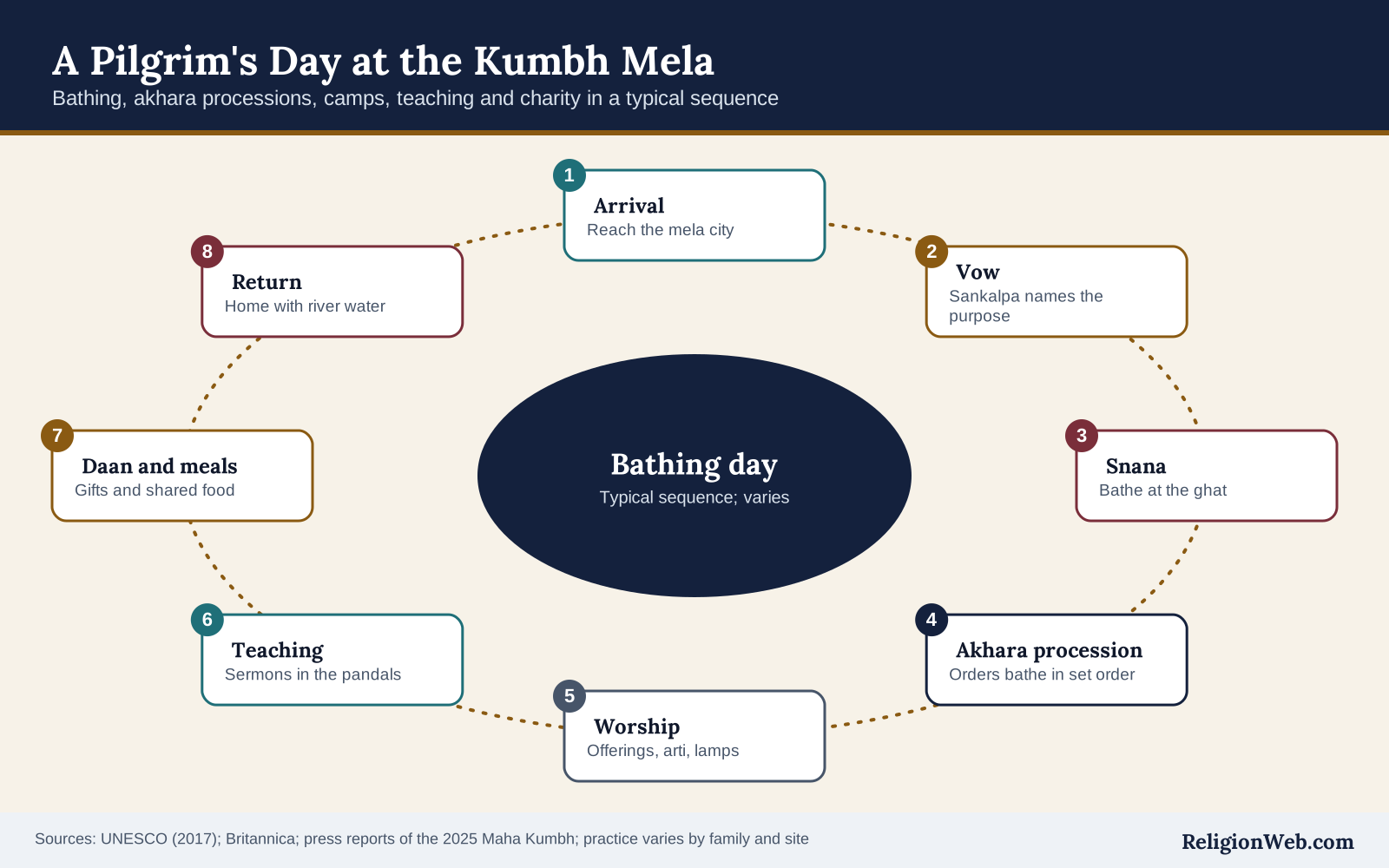
Charity, Food and Service
Daan: the practice of giving
Giving (daan) is an integral part of pilgrimage in Hindu tradition. Pilgrims give to priests, to ascetics and to the poor, and gifts may include food, clothing, grain, cows in symbolic form, or money. At Prayaga the tradition of giving is old: Xuanzang’s account, as summarized by Britannica, records King Harsha’s donations at the confluence, and the charity of such assemblies is one of the features that scholars discuss when they ask what the seventh-century gathering was. In modern practice, giving is understood as completing the bath and as a source of merit.
Free food and shared meals
Shared meals are central. Akharas, ashrams, religious trusts and individual donors run kitchens that serve free food to pilgrims, and the practice is called a bhandara when it is organized as a feast. Meals are simple, usually vegetarian, and served to all who come. Feeding the hungry is understood as service (seva), and it is closely tied to the virtue of hospitality toward guests, which Hindu tradition honors in the saying that the guest is like a god.
Volunteers and lost-and-found camps
A large number of volunteers help at the mela, from members of religious organizations who guide pilgrims to medical teams and sanitation workers. Britannica notes the volunteer-run lost-and-found camps that help reunite pilgrims separated in the crowd, some of which focus on women and children. The ethic of service is part of how participants understand the festival. For them, the work of keeping the pilgrimage orderly is also an act of devotion.
The Four Sites in Practice: Prayagraj, Haridwar, Nashik, and Ujjain
Each of the four sites has its own history, season and character. This section turns from the general pattern to the particular, describing each place, what is distinctive about its gathering, and what is currently announced. The dates given are those reported by the named sources as of October 21, 2026, and they may change.
Prayagraj
The Sangam and the Prayagraj gathering
Prayagraj is the largest of the four gatherings and the only one with an annual fair built into its calendar. The Sangam is the center, and the akharas, the kalpavasis and the pilgrim priests all converge on the floodplain. The city was long known as Allahabad, a name of the Mughal period, and it was renamed Prayagraj in 2018; reference works on earlier gatherings therefore use the older name. The 2013 Kumbh, the 2019 Ardh Kumbh and the 2025 Maha Kumbh were held here in sequence. Britannica reports that the 2019 event drew more than 200 million people, including about 50 million on its most auspicious day.
The 2025 Maha Kumbh and what comes next
The 2025 Maha Kumbh ran from January 13 to February 26, with Amrit Snan days on Makar Sankranti (January 14), Mauni Amavasya (January 29) and Basant Panchami (February 3). Uttar Pradesh authorities announced a total of 66.21 crore (662.1 million) participants in the sacred bath, a figure examined in the next section. The festival also included the 2025 stampede and the water-quality debate described earlier. By the rule of the six-year interval, the next Ardh Kumbh gathering at Prayagraj would fall about 2031, but that is an inference from the cycle, and no date has been announced in the sources consulted. In the meantime, the Magh Mela continues each year.
Haridwar
Har ki Pauri and the spring gathering
Haridwar’s gatherings center on Har ki Pauri and the Brahma Kund, and the festival takes place in the spring, in the month of Chaitra. Uttarakhand Chief Minister Pushkar Singh Dhami was reported by the Press Trust of India in November 2025 as saying that the 2027 Ardh Kumbh would be celebrated as grandly as a full Kumbh. The most recent full gathering at Haridwar was held in 2021, which, by the usual reckoning, came eleven years after the one in 2010 and is an instance of the eleven-year adjustment described earlier.
The announced 2027 bathing dates
According to a Press Trust of India report of April 2026, the Haridwar mela administration announced ten bathing dates for the 2027 Ardh Kumbh, listed below, of which three were designated Amrit Snans. The list is as reported and may be revised.
| Date (2027) | Occasion | Designation reported |
|---|---|---|
| January 14 | Makar Sankranti | Bathing day |
| February 6 | Mauni Amavasya | Bathing day |
| February 11 | Basant Panchami | Bathing day |
| February 20 | Magh Purnima | Bathing day |
| March 6 | Mahashivratri | Amrit Snan |
| March 8 | Phalguna Amavasya | Amrit Snan |
| April 7 | Nav Samvatsar (new year) | Bathing day |
| April 14 | Mesh Sankranti | Amrit Snan |
| April 15 | No name reported | Bathing day |
| April 20 | Chaitra Purnima | Final bathing day |
Nashik and Trimbakeshwar
Two bathing places, one gathering
The Nashik-Trimbakeshwar Simhastha is the next of the four gatherings. Its bathing places are the Ramkund in Nashik and the Kushavarta at Trimbakeshwar, and the two sites have had separate bathing arrangements for the ascetic orders since at least the late eighteenth century. According to reference accounts, until 1789 the fair was held only at Trimbak, and after a clash that year the Peshwa moved the Vaishnava orders’ bathing to Ramkund, while the Shaiva orders still regard Trimbak as the proper site. The 2003 gathering is remembered for a stampede in which, according to Britannica, at least 39 pilgrims died. Reference accounts also report a gathering from July to September 2015.
The announced 2026–2027 schedule
A Press Trust of India report of June 2025 said that the Maharashtra government had announced that the Simhastha would begin on October 31, 2026 with flag hoisting at Trimbakeshwar and Ramkund, and that the three Amrit Snan dates would be August 2, August 31 and September 11, 2027 at Nashik, with the last also held at Trimbakeshwar on September 12. The same report gave July 24, 2028 as the date the flag would be lowered, while another reference account lists the period as ending on July 24, 2027, so the closing date should be checked against the current official notice. Because the opening is only days away at the time of writing, readers should consult the latest announcement from the Maharashtra authorities.
Ujjain
The Shipra and Mahakaleshwar
Ujjain’s Simhastha takes place on the Shipra and draws on the city’s status as one of the seven sacred cities and as the seat of the Mahakaleshwar Jyotirlinga, a Shiva shrine. Reference accounts say the main bathing day falls on the full moon of Vaishakha. The 1850 arrangement in which a barrier in the river separated the Shaiva and Vaishnava groups is an example of how administrators handled the old rivalry between the orders.
The 2016 gathering and the 2028 plans
The 2016 Simhastha ran from April 22 to May 21, and a Madhya Pradesh minister claimed that nearly 75 million people visited during that month, according to an Indian Express report cited in reference accounts; it is an official claim and not an independent count. For 2028, Chief Minister Mohan Yadav was reported in the press to have said that the gathering is scheduled to run from March 27 to May 27, 2028. The same report quoted two different projections of attendance, which suggests a typographical error, so no projection is given here. The Madhya Pradesh government has also announced large infrastructure spending, and those plans were still evolving when this article was written.
The Kumbh Mela Today: Scale, Governance, and Public Debate
The Kumbh Mela is a living institution, and it is discussed in newspapers, parliaments and academic journals as well as in temples. This section looks at how attendance figures are produced and why they should be read with care, at the roles of UNESCO, the state and the religious bodies, and at some of the public debates that surround recent gatherings. It is written to inform and not to take sides in any of them.
Reading Attendance Figures
What organizers have claimed
Attendance numbers are among the most quoted facts about the festival, and they are almost always claims by the bodies that organize it. The table below sets out several that have appeared, with their sources, and each should be understood as an official or published claim and not as an independently audited count.
| Gathering | Figure claimed | Who stated it and how reported | Period or day covered |
|---|---|---|---|
| Ujjain Simhastha, 2016 | Nearly 75 million visitors | A Madhya Pradesh minister, as reported by the Indian Express and cited in reference accounts | April 22 to May 21, 2016 |
| Prayagraj Ardh Kumbh, 2019 | More than 200 million people, about 50 million on the most auspicious day | Britannica, summarizing the reported figures | The full 2019 gathering |
| Prayagraj, 2019 (as later cited) | 25 crore (250 million) | Cited by officials in 2023 planning for the next gathering, as reported by the news agency IANS | The 2019 gathering |
| Prayagraj Maha Kumbh, first Amrit Snan, 2025 | More than 3.5 crore (35 million) bathers | Uttar Pradesh Chief Minister Yogi Adityanath, as reported by UNI | January 14, 2025 |
| Prayagraj Maha Kumbh, interim, 2025 | 64.77 crore (647.7 million) visits | The Uttar Pradesh government, as reported by the Tribune | January 13 to the date of the report |
| Prayagraj Maha Kumbh, final, 2025 | 66.21 crore (662.1 million) participants | Announced by the Uttar Pradesh Chief Minister on the last day, as reported by the Morung Express | January 13 to February 26, 2025 |
Why the numbers are not directly comparable
Several things make these figures hard to compare. The periods differ: a one-month fair and a 45-day festival cannot be set side by side without adjustment. The definitions differ: some figures count people who bathed, some count visitors to the city, and some count visits, which means a person who bathed on three days may be counted more than once, although the sources consulted do not say how repeat visitors were handled. The methods differ too. A police officer quoted about the 2025 gathering said that the system used AI to track the flow of people and crowd density at various entrances, adding them up and interpolating, and cross-checking against railway and bus data, and he added that in some camera angles complete bodies could not be seen and heads or torsos were counted. Opposition parties questioned the 2025 footfall figures, and the source reporting the claim did not name an independent body that verified it. None of this shows that the numbers are wrong, but it means the claim of a record is a claim by the organizers. The comparison to other events, such as other religious gatherings in the world, rests on the same kinds of uncertain methods elsewhere.
How to cite figures responsibly
A responsible account states the claimant, the period and the nature of the count. For example: “Uttar Pradesh authorities announced that 66.21 crore people took part in the sacred bath during the 45 days of the 2025 Maha Kumbh.” That sentence reports what was announced, by whom, and over what span. It is more accurate than saying that 660 million people attended, because it does not claim more than the source does. The same standard applies to projections made before an event, which often prove higher or lower than the later claims.
UNESCO, the State, and the Religious Bodies
Intangible cultural heritage
UNESCO inscribed the Kumbh Mela on its Representative List of the Intangible Cultural Heritage of Humanity in 2017, listing India as the submitting state. The inscription recognizes a living practice, not a monument, and its description stresses that the festival brings together astronomy, astrology, spirituality, ritual and social custom, and that its knowledge is passed on through manuscripts, oral tradition and the teacher and student relationship. The listing page states the gathering’s frequency as every four years, a simplification of the rotating cycle explained earlier, and readers should use the cycle described in this article for planning.
Government and religious institutions
The practical operation of the festival is a partnership. State governments and the mela authorities build and run the infrastructure, police the crowds, and set the official schedule. The akharas, the pilgrim priests and the religious organizations decide the religious details: the days of the baths, the sequence of the akharas and the rites themselves. In the aftermath of the 2025 stampede, Chief Minister Adityanath said the akharas agreed to bathe only once the crowd pressure at the ghats eased, and announced that there would be no VIP protocol at the mela from then on. The arrangement shows how closely religious and administrative decisions are intertwined.
Economy, tourism and publicity
Large gatherings bring significant economic activity to the host cities, including trade, transport, construction and tourism, and governments promote them accordingly. This promotion shapes the language used about the festival, such as claims of records and the use of the term “global.” Readers who want to understand the festival as a religious institution should distinguish between promotion and description, and should look to the practices, the orders and the pilgrims for the substance of the tradition.
Debates Within and Around the Festival
Water, environment and public health
The condition of the rivers is the most persistent public issue. The Ganga and Yamuna are heavily used and, in places, heavily polluted, and every large bathing event brings the question of water quality into the news. The 2025 dispute between a Central Pollution Control Board report cited in the press and the chief minister’s statement about the water illustrates the point. For devotees, the sacredness of the river is not in question, while public-health experts and environmental groups ask what measures would make mass bathing safer. Both concerns are legitimate, and they are addressed through different kinds of evidence.
Who is included, and who sets the rules
Questions of inclusion appear in several forms. UNESCO describes attendance as open irrespective of caste, creed or gender, and the Kinnar Akhara’s participation in the 2025 Amrit Snan is cited by Britannica as promoting acceptance. At the same time, in October 2024 the Akhara Parishad announced that it would seek rules limiting food stalls to members of the “Sanatani” community, a proposal that is a matter of public debate about religious identity and commerce. The Parishad’s positions are those of a religious body, and the question of how far a festival of this size should regulate participation is contested in Indian public life. This article reports the announcements without endorsing or opposing them.
Crowd safety and equal access
After each tragedy, public discussion turns to the design of the ghats, the control of access, and who receives priority. The announcement of no VIP protocol after the 2025 stampede, and the judicial commission that the chief minister appointed, reflect that discussion, as do the continuing attempts to use technology and to build wider routes. The experience also underlies the old rules of precedence among the akharas, which began as a way to avoid conflict at the ghats. Safety planning is therefore not a modern add-on to the festival but a recurring theme in its history.
Common Misconceptions About the Kumbh Mela
Several widely held ideas about the Kumbh Mela are partly right and partly misleading. The four below are the ones that most often cause confusion.
Misconception 1: The Kumbh Mela is one annual event held in a single city
Where the misunderstanding comes from
The confusion arises because news coverage tends to focus on whichever gathering is current, usually the largest one at Prayagraj, and because the Magh Mela at Prayagraj does happen every year. A reader who sees a Kumbh headline in January may assume that the same event recurs every January in the same city. Terms such as Maha Kumbh and Ardh Kumbh add to the confusion, since they are used with different meanings in popular and official speech.
The festival’s name does not help, since the word Kumbh appears in names of observances that are not periodic at all. A rite of the Hindu temple called Kumbhabhishekam, for instance, uses the same word for a pot and has nothing to do with the river festival. A reader who meets the word in two contexts may reasonably wonder whether they are connected, and the answer is that they share a vocabulary, not a calendar.
What the evidence and tradition actually show
The Kumbh Mela rotates among four sites, each tied by tradition to a river and to a position of Jupiter, the Sun and the Moon. A full gathering returns to a given site about every twelve years, a half gathering falls about six years later at Prayagraj and Haridwar, and some site hosts a major gathering about every three years. The Magh Mela at Prayagraj is an annual fair and is a different institution from the Kumbh, although it is held on the same ground and is larger in Kumbh years. Reference works such as Britannica and the Encyclopedia of Religion describe this structure, and the table of terms earlier in this article sets out the usages.
Local calendars reinforce the point. Pilgrims at Haridwar speak of the spring bathing days of Chaitra, pilgrims at Prayagraj of the cold month of Magha, and pilgrims at Nashik and Ujjain of the Simhastha in the months when Jupiter stands in Leo. Each community refers to its own gathering by the season, the river and the saints who come, and the sense of belonging to a rotation is something most participants learn through repeated attendance rather than from a chart. For many families, the Kumbh they attend is the one that falls in their own lifetime and region, and travel to another site is a deliberate pilgrimage rather than a routine.
The right short answer is therefore that the Kumbh Mela is a periodic pilgrimage that moves, with each place holding its own gatherings on its own cycle. The fact that the cycle cannot be reduced to a single date or a single city is part of what defines it.
Misconception 2: Every attendance number quoted for the Kumbh Mela is directly comparable
Where the misunderstanding comes from
Headlines favor simple numbers and records, and the numbers are announced in confident round figures: 66.21 crore, 75 million, 50 million in a day. A reader who sees these figures in separate reports naturally assumes that they measure the same thing in the same way, and that a larger number means a larger event. Comparisons with the populations of countries add to the impression of precision.
Publicity contributes as well. Organizers and governments have an interest in presenting the festival as unprecedented, and journalists repeat the figures that are announced. The announcement of the 2025 total by the chief minister, for example, was described as setting a global record, though the article reporting it quoted him calling it unprecedented in world history and named no independent body that verified a record.
What the evidence and tradition actually show
The published figures differ in period, definition and method, as the previous section explains. Some count bathers on a single day, some count people over the whole festival, and some count visits. The methods range from estimates based on area and density to camera systems with human counting of heads or torsos and cross-checks with railway and bus data. Opposition parties questioned the 2025 figures, and the sources consulted do not describe an independent audit.
A further complication is that gatherings differ in their physical setting. A mela laid out over thousands of hectares of floodplain, with dozens of bridges and entry points, produces a different counting problem from a riverfront town in which the main bathing ghats are a few hundred meters long. The same word, attendance, therefore covers measurements of very different kinds, and a careful reader will ask whether a number refers to the whole site, to a single ghat, or to a single day.
That does not mean the gatherings are small. By any measure the festival draws very large numbers, and Britannica describes the Kumbh Mela as the world’s largest public gathering. It means that a precise ranking between years, or between the Kumbh and other events, rests on claims that should be attributed. The most accurate way to describe the scale is to say who counted, over what period, and by what method, and to avoid presenting any single number as settled.
Misconception 3: Sacred bathing at the Kumbh Mela is simply recreational swimming
Where the misunderstanding comes from
To an outside observer, a very large number of people entering a river at once can look like a mass swim, especially in photographs and videos that show laughter, splashing and crowds in the water. Tourist and media coverage sometimes describes the event as a “dip” in ways that separate the act from the beliefs behind it. Bathing is also a pleasant activity in many cultures, so the assumption is natural.
Another source of the misunderstanding is that Hinduism has no single required liturgy for the bath. There is no one prayer or priestly formula that every participant recites, so the rite can look informal to a visitor expecting a service.
What the evidence and tradition actually show
Within Hindu tradition, the bath is a ritual act of purification and devotion, performed at a time and place that are considered charged with power. UNESCO records the belief that bathing in the sacred river frees devotees from sin and from the cycle of birth and death. Participants prepare with a vow, face a particular direction, immerse in a set manner, often offer water to the Sun and to ancestors, and follow the bath with prayer, offerings and gifts. For ascetics, the ceremonial baths are rites of their orders, carried out in a fixed sequence under their own leaders, and for kalpavasis the bath is repeated several times a day for a month as part of a discipline.
Hindu teachers also draw a line between external and inner cleansing. Many traditions of reflection on pilgrimage hold that the bath serves to prepare the mind for devotion, charity and self-restraint, and that a pilgrim who bathes without changing conduct has received little. This internal critique, found within Hindu teaching itself, is a further reason to avoid describing the bath as recreation or as a magical act: participants and teachers are generally aware that the rite asks something of the person who undertakes it.
It is also true that the experience can be joyful, and that many participants are cheerful and sociable. Joy and reverence are not opposites in Hindu worship. The distinction that matters is between the intention and meaning of the act, which is religious, and its outward form, which is simple immersion in water. A visitor who recognizes the first will understand why the bath is treated with seriousness.
Misconception 4: The Kumbh Mela is an unbroken ancient festival prescribed in a single scripture
Where the misunderstanding comes from
Popular accounts, including promotional material, often say that the Kumbh Mela has been held without interruption for thousands of years since the time of the churning of the ocean, or that it is commanded in the Vedas. These statements are repeated because the sanctity of Prayaga is old, because the churning story is familiar, and because a festival of this prestige seems to need an ancient pedigree.
The ascetic orders themselves add a tradition that Shankara began the gatherings in the eighth century. This is a meaningful part of their identity and appears in Britannica’s summary of the festival’s history, which makes it easy to read as established fact.
What the evidence and tradition actually show
The historical record is more layered. The sanctity of the confluence at Prayaga is attested early, in the epics and in the Pali canon, and Xuanzang describes a large assembly there in the seventh century. But Sax, in the Encyclopedia of Religion, notes that no single authoritative scripture sanctions the fair and that its origin is an open question, and scholars report that the name Kumbh Mela was applied to Haridwar in seventeenth-century sources before it was applied to Prayaga. The link between the churning story and the four sites is generally described as a later development, and the attribution to Shankara is not supported by historical literary evidence, though it is sincerely held by the orders.
These points do not make the festival less authentic. They show that the Kumbh Mela is the product of a long process in which ancient reverence for rivers, Puranic narrative, astrological calculation, monastic organization and state administration each contributed. A living tradition can be old in its roots and recent in its form, and describing it in that way is more accurate and more respectful than either denying its antiquity or overstating it.
Frequently Asked Questions About the Kumbh Mela
These answers draw on the fuller discussion above. Where a question depends on dates or on current announcements, the answer states its date and source and advises checking the latest official notice.
Questions about meaning and structure
What does Kumbh Mela mean?
Kumbh Mela means “festival of the pitcher.” Kumbha is the Sanskrit word for a pot, and mela means a fair or gathering. The pot is the vessel of nectar in the traditional story of the churning of the ocean, and the same word is the name of the zodiac sign Aquarius. In practice the name refers to a rotating pilgrimage centered on ritual bathing in sacred rivers.
The word is used for several different gatherings, and so a headline that says Kumbh Mela may refer to a half gathering, a full gathering or a Magh fair. The table of terms in the calendar section explains these usages.
Why is it held in four cities?
According to the traditional account, drops of the nectar of immortality fell at four places on earth when the pot was carried away during the struggle between gods and demons, and those places became the sites of the festival: Prayagraj, Haridwar, Nashik and Ujjain. Each is on a sacred river, and each is tied to a different position of Jupiter, the Sun and the Moon. Scholars add that the identification of the four sites with the story developed over time, so the answer has both a devotional and a historical side.
How often is it held?
A full gathering returns to each site about every twelve years, a half gathering is held about six years after a full one at Prayagraj and Haridwar, and because the four sites are staggered, some site hosts a major gathering about every three years. Prayagraj also holds an annual Magh Mela. The intervals are approximate and follow the astrological rule, not a fixed civil schedule.
Questions about practice
Do you have to be Hindu to attend?
UNESCO describes the gathering as one that people attend irrespective of caste, creed or gender, and visitors from many backgrounds, including researchers and tourists, attend each gathering. The festival is nonetheless a religious occasion, and visitors are expected to behave respectfully. Certain temples and ritual spaces within the mela area may have their own rules about entry, and these are best learned from local volunteers and signs.
Participation in the bath and rites is a matter for those who consider themselves Hindu or who feel drawn to the practice. A visitor who wishes only to observe can walk the grounds, attend public discourses and share a meal at a camp that welcomes guests, without taking part in the ceremonies.
What is the difference between Amrit Snan and Shahi Snan?
They name the same ceremonial bath of the akharas. Shahi Snan, “royal bath,” is the older name and is still used by Britannica and in much general writing. For the 2025 Maha Kumbh, official and press usage shifted to Amrit Snan, “nectar bath,” following a decision reported to have been made by the Akhil Bharatiya Akhara Parishad. The announced bathing days for Haridwar in 2027 also use Amrit Snan for three of the ten dates.
Who are the Naga sadhus?
Naga sadhus are ascetics of the Shaiva akharas who have taken a formal vow of renunciation and live without ordinary clothing or with very little. They are initiated at Kumbh gatherings in a sequence of fasting, bathing, tonsure and rites that sever ties to family and society, as reported for the 2025 gathering. They lead the processions and are among the first to enter the water on the ceremonial bathing days. Their appearance reflects vows and lineage, and they are honored in the tradition as ascetics devoted to Shiva.
Questions about planning and safety
When is the next Kumbh Mela?
As of October 21, 2026, the next is the Nashik-Trimbakeshwar Simhastha, scheduled to open with a flag-hoisting ceremony on October 31, 2026, with Amrit Snan dates of August 2, August 31 and September 11, 2027 announced in a June 2025 report. The Haridwar Ardh Kumbh is scheduled from January 14 to April 20, 2027, and the Ujjain Simhastha has been reported as scheduled for March 27 to May 27, 2028. These dates are provisional and should be checked against current official notices before any travel is planned.
Is it safe to attend?
Millions of people attend safely, but very large crowds carry real risks, and the festival has a record of crowd disasters, including one at the 2025 Maha Kumbh that killed 30 people according to Uttar Pradesh police. Visitors can reduce risk by following official instructions, avoiding the most crowded hours of the principal bathing days when possible, agreeing on a meeting point with companions, and caring for their health in cold or heat. A person with a medical condition should seek a doctor’s advice before traveling, since religious practice does not replace medical care.
What should a visitor wear and bring?
Modest, comfortable clothing and sturdy footwear that is easy to remove are sensible, with layers for cold mornings in the winter gatherings and sun protection in spring. Bring water, a small bag, identification, a charged phone and a card with a companion’s contact details. Avoid carrying valuables into crowds. Ask before taking photographs of people bathing or at worship, and follow the instructions of volunteers and police.
Conclusion: What the Kumbh Mela Shows
The Kumbh Mela is best understood as a convergence of three things: a belief about rivers and nectar, a calendar worked out from the movements of Jupiter, the Sun and the Moon, and a set of institutions that carry the practice from one gathering to the next. This closing section draws the threads together and points to related articles.
What the history shows
A festival with several layers
The sanctity of the confluence at Prayaga is attested early, in epic and canonical texts, and a large assembly was described there in the seventh century. The name Kumbh Mela, the link to the four sites and the astrological scheme took shape in later centuries, and the modern festival has been shaped by monastic orders, the Mughal and Maratha rulers, colonial administrators and the independent Indian state. A reader who keeps these layers distinct will not need to choose between a devotional account of the festival and a historical one, since each answers a different question.
Faith and administration together
Today the festival depends on the cooperation of religious bodies and state agencies, and it exposes the strengths and strains of that cooperation: remarkable feats of temporary construction, honest disputes about numbers and water, and recurring crowd tragedies. For participants, what matters is the bath, the company of teachers and fellow pilgrims, and the sense of taking part in something older than any single institution.
How to keep exploring
Related topics on ReligionWeb
The broader tradition is introduced in the article on Hinduism, and the ideas of duty and right action that underlie pilgrimage are discussed in the article on dharma. Other festivals with their own calendars and customs include Navaratri, Holi and Krishna Janmashtami, and the figures behind many of the traditions that gather at the Kumbh are explored in the articles on Shiva, Krishna, Durga and Ganesha.
Keeping dates current
Dates and figures for the Kumbh Mela change as authorities revise their schedules, and this article records the position as of October 21, 2026. Readers planning to attend should consult the current notices of the state governments and mela authorities, and anyone citing attendance numbers should name the claimant and the period, as the section on attendance figures recommends. The article is intended to be revised before each major gathering.
Sources
The table below lists the principal external sources behind this article. Facts, dates and figures were checked against these and related primary, institutional and academic materials.
| # | Source | Publisher and type | Used for | Link |
|---|---|---|---|---|
| 1 | Kumbh Mela (Representative List, 2017) | UNESCO Intangible Cultural Heritage · Institutional | 2017 inscription; description of bathing, bearers and transmission; irrespective of caste, creed or gender | ich.unesco.org |
| 2 | Kumbh Mela | Encyclopaedia Britannica · Encyclopedia | Myth, cycle terms, Xuanzang, akharas, Shahi Snan, safety incidents, 2019 attendance | britannica.com |
| 3 | Kumbha Mela (William S. Sax), Encyclopedia of Religion | Encyclopedia.com (Gale) · Academic reference | Churning tradition, sites, timing, uncertain origins, bathing disputes, no single scripture | encyclopedia.com |
| 4 | Vishnu Purana, Book I, Chapter IX (H. H. Wilson translation) | Internet Sacred Text Archive · Primary text | Quoted passage on Dhanvantari and the cup of amrita; churning narrative | sacred-texts.com |
| 5 | Mahabharata, Vana Parva, Section LXXXV (K. M. Ganguli translation) | Internet Sacred Text Archive · Primary text | Quoted passage on bathing at the Prayaga confluence | sacred-texts.com |
| 6 | Majjhima Nikaya 7, The Simile of the Cloth (Bhikkhu Sujato translation) | SuttaCentral (CC0) · Primary text | Quoted verse naming Payaga and Sarasvati among bathing places | suttacentral.net |
| 7 | Nashik-Trimbakeshwar Simhastha to begin on Oct 31 (PTI) | The Week · News agency report | Nashik opening date (Oct 31, 2026) and announced 2027 Amrit Snan dates | theweek.in |
| 8 | Dates announced for bathing festivals during Ardh Kumbh Mela in Haridwar (PTI) | The Week · News agency report | Ten announced bathing dates for the 2027 Haridwar Ardh Kumbh | theweek.in |
| 9 | Maha Kumbh stampede: 30 dead, 60 injured, say UP police | The Tribune · News report | January 29, 2025 crowd surge, official toll, judicial commission, akhara baths deferred | tribuneindia.com |
| 10 | A powerful convergence (Harvard Gazette) | Harvard University · Academic institution report | Harvard study of the 2013 mela; temporary city of six materials; flood-claimed site | news.harvard.edu |
Last fact-check date: 2026-10-21.