Hinduism is the modern name for a large family of religious traditions that took shape in the Indian subcontinent and are practiced today by roughly 1.2 billion people, about 95 percent of them in India (Pew Research Center, 2020 data). It has no single human founder, no single creed, no central body that decides doctrine for everyone, and no one book that all Hindus accept in the same way. What holds it together is a shared inheritance: the Vedas as a reference point for most traditions, a vocabulary of dharma, karma, samsara and moksha, the honoring of the divine through images, fire, sound and pilgrimage, and a dense web of temples, teachers, festivals and family customs that are passed on across generations.
Many Hindus describe their own tradition as Sanatana Dharma, usually translated “eternal law” or “eternal way,” while others simply say Hindu dharma or name their own lineage and the deity they love most. The largest devotional streams center on Vishnu and his incarnations (Vaishnavism), on Shiva (Shaivism) and on the Goddess in her many forms (Shaktism). A fourth stream, Smartism, grounds itself in the classical law books and the worship of several deities together. These labels are an organizing framework used by scholars and by many practitioners. They are not church-like denominations with membership rolls, and a single household may honor deities from more than one stream.
The picture becomes more complicated as soon as one asks where “Hinduism” begins. Its oldest surviving literature, the Rigveda, is usually dated between roughly 1500 and 1000 BCE and was transmitted orally for centuries before it was written down. Philosophical inquiry in the Upanishads, the epics Mahabharata and Ramayana, the Puranas, temple worship and medieval devotional movements each added layers without simply replacing what came before. The English word “Hinduism” itself is much younger, and scholars still debate what it describes and how far back the thing it describes can be traced.
This article is a reference guide to that whole landscape. It explains the term and the numbers, the major texts and ideas, the historical development from the Indus Valley to the present, the deities and devotional traditions, daily and festival practice, pilgrimage, life-cycle rites, temples, ethics, caste and law, and the modern global community. Throughout, it separates what historians can document from what traditions teach, and it names the tradition or school behind each claim, because “Hindus believe” is almost never a complete sentence.
Hinduism at a Glance: Definition, Terms, and Numbers
What the Word “Hinduism” Means
From a River Name to a Religious Label
The word “Hindu” began as a geographic term, not a religious one. It descends from Sindhu, the Sanskrit name of the Indus River and, by extension, of the lands along it. In Old Persian the form appears in the inscriptions of Darius I (reigned 522 to 486 BCE), where “Hindu” is listed among the lands of his empire; Encyclopaedia Iranica notes that the name was presumably taken from the river. Greek writers rendered the same name as Indos, which is the ancestor of the English word “India.” For centuries the term described a place and its people, whatever gods they worshiped.
A religious sense developed slowly. Britannica notes that by the sixteenth century people in India were using “Hindu” to distinguish themselves from the Turks, as the Muslim rulers of much of the north were then often called, and that this distinction gradually became more religious than ethnic or geographic. Even then, the word did not name a unified system of doctrine. A person called Hindu might be a devotee of Vishnu, a worshiper of the Goddess, a follower of a philosophical school that questioned the existence of a creator, or a householder whose practice consisted mostly of local rites for village deities.
A Nineteenth-Century English Word and the Scholarly Debate
The abstract noun “Hinduism” is more recent still. Britannica states that it was coined by British writers in the first decades of the nineteenth century. That date has fueled a long scholarly argument. Some historians, including Vasudha Dalmia, Robert Frykenberg and Heinrich von Stietencron, have argued in different ways that colonial administrators, missionaries and Orientalist scholars helped assemble “Hinduism” as a single, bounded religion, modeled on the way Europeans understood Christianity. Others, including Romila Thapar and Dermot Killingley, accept part of that argument while giving a more qualified historical account, and J. Laine has stressed the role of Indians themselves in shaping the idea.
In a widely cited 1999 article in Comparative Studies in Society and History, “Who Invented Hinduism?”, the historian David Lorenzen examined this constructionist position and argued that earlier usages, including a sense of shared religious identity that formed gradually through medieval encounters with Islam, deserve more weight than a strictly colonial account allows. The short version is that nobody doubts that the word is modern and that the colonial period reshaped how Hindu traditions were counted, codified and presented. What remains debated is how much shared identity existed before that, and whether “Hinduism” is a useful scholarly category or a convenient shorthand. Most Hindus today use the word without discomfort, and it appears in Indian law, in censuses and in everyday speech.
Sanatana Dharma and Other Names Hindus Use
Sanatana Dharma is the best-known name used from within the tradition. The adjective sanatana means “perennial” or “eternal,” and the phrase turns up in classical Sanskrit literature, including the law book attributed to Manu (verse 4.138), long before it became a name for a religion. In the nineteenth century it was revived in a new role. Traditionalist organizations such as the Sanatana Dharma Rakshini Sabha, formed in Calcutta in 1873, used it to defend inherited ritual and social practice against both Christian missionaries and Hindu reform movements like the Brahmo Samaj and the Arya Samaj. Britannica notes that the term emphasizes timeless elements of the tradition rather than local variation.
Today the phrase carries more than one meaning. For many Hindus it is simply a dignified synonym for their religion, and the Sanskrit name has an internal logic: dharma is order, duty and truth, and sanatana signals that it is not the property of any one century. It also appears in public debate. In September 2023 the Tamil Nadu minister Udhayanidhi Stalin said at a conference in Chennai that Sanatana Dharma, which he identified with caste hierarchy, should be eradicated; he later said he meant the caste-based social order and not a call for violence against Hindus. Many Hindu leaders and organizations objected strongly, while others, including Hindu critics of caste, argued that the real issue was the social practices rather than the faith. The episode shows that the name is both a religious self-description and a contested political symbol. Other terms in use include Vaidika Dharma (“Vedic religion”), favored by groups such as the Arya Samaj that place the Vedas above all later texts.
Where Hinduism Is Practiced and by How Many
Numbers and Geography
Pew Research Center’s 2025 study of the global religious landscape counts nearly 1.2 billion Hindus in 2020, up about 12 percent from a little under 1.1 billion in 2010, which is roughly the same pace as world population growth, so the Hindu share of humanity stayed close to 15 percent. Pew places Hindus as the fourth-largest religious category after Christians, Muslims and the religiously unaffiliated. About 95 percent of all Hindus live in India, where they made up roughly 79 percent of the population in Pew’s 2020 estimate. India’s 2011 census, the most recent to publish religion data, recorded 79.8 percent, or about 966 million people.
Nepal is the only other country with a Hindu majority: Pew puts the share at 81 percent, and the national census of 2021 counted 23.7 million Hindus, or 81.19 percent. Mauritius is the next-largest case, with Hindus the largest single group at about 48 percent (620,000 people). Beyond South Asia, large communities live in the United States (about 3.0 million in Pew’s 2020 count), the United Kingdom (about 1.1 million) and the United Arab Emirates (about 1.1 million), as well as in Southeast Asia, East and South Africa, the Caribbean and Fiji. Hindu communities in Indonesia, especially on Bali, preserve distinctive local forms of the tradition, which are discussed later in the article.
A Family of Traditions Without a Founder or Central Authority
No historical person is regarded as the founder of Hinduism. Individual traditions within it do trace themselves to teachers, such as Ramanuja for the Sri Vaishnava community or Basava for the Lingayats, but none of these figures defines the whole. Authority is distributed. The Vedas are accepted as a source of sacred knowledge by most traditions, though not in the same way and not with the same practical weight. Teachers (gurus) and lineages (sampradayas) transmit practice and interpretation. Monastic centers (mathas), temple trusts, ascetic orders and, in modern times, courts and legislatures all exercise authority over specific questions without any of them speaking for every Hindu.
This structure helps explain why Hindu practice is often described in terms of what people do rather than a creed they sign. Pew’s 2019 to 2020 survey of nearly 30,000 adults in India found that 77 percent of Hindus said they believe in karma, 81 percent in the purifying power of the Ganges, 59 percent said they pray daily and 72 percent said they keep a tulsi (holy basil) plant at home. At the same time, 99 percent of those raised Hindu still identified as Hindu as adults. Shared practice and shared reference points create a recognizable community, even where doctrines differ sharply, for example between traditions that teach a personal God and philosophical schools that teach non-dual identity of the self with ultimate reality.
Hinduism in Brief: Key Facts and Terms
The Essentials in One Table
The table below collects the basic orientation facts used throughout the article. Dates for texts and teachers are approximate or traditional unless stated, and the later sections explain the scholarly debates behind them.
| Topic | Summary |
|---|---|
| Self-descriptions | Sanatana Dharma (“eternal dharma”), Hindu dharma, Vaidika Dharma; many people identify first by deity or lineage (Vaishnava, Shaiva, Shakta, Smarta) |
| Region of origin | The Indian subcontinent; earliest literature composed in the northwest and the Ganges plain |
| Founder and central authority | None; authority is shared among texts, teachers, lineages, monasteries, temple institutions and, in modern states, law |
| Oldest literature | Rigveda, usually dated c. 1500 to 1000 BCE, transmitted orally before being written down |
| Major text families | Vedas and Upanishads; Mahabharata (including the Bhagavad Gita) and Ramayana; Dharmashastras; Puranas; Agamas and Tantras; devotional poetry in many languages |
| Central concepts | Brahman, atman, dharma, karma, samsara, moksha, bhakti, jnana, yoga |
| Main devotional streams | Vaishnavism, Shaivism, Shaktism, Smartism (an editorial framework, not denominations) |
| Characteristic practices | Puja and darshan, mantra and chanting, fire rites, festivals, pilgrimage, life-cycle rites (samskaras), yoga and meditation, vegetarianism for many |
| Population (Pew, 2020) | Nearly 1.2 billion; about 95 percent in India; Nepal about 81 percent Hindu |
| Calendar | Lunisolar regional calendars; festival dates move against the Gregorian calendar |
Reading Sanskrit Terms and Dates in This Article
Sanskrit and other South Asian terms appear in italics on first use and are explained in plain English; diacritics are mostly dropped, so that Shiva stands for Śiva and Krishna for Kṛṣṇa, which is also how readers will search for them. Plural forms follow English habit (Upanishads, Puranas, mathas). Dates are given in BCE and CE. Where a date is traditional rather than established, the text says so, and where scholars disagree, the range is stated. Lunar dates are explained as calendar rules, and a specific calendar date appears only where an official source confirms it. When the text says that a tradition teaches or holds something, the claim describes that tradition, and it should not be read as a statement about every Hindu.
Sacred Texts, Canon, and Authority in Hinduism
Shruti and Smriti: Two Kinds of Authority
The Vedas: Four Collections and Their Layers
Hindu tradition divides its sacred literature into shruti, “what is heard,” and smriti, “what is remembered.” Shruti is the Veda. Orthodox Brahmanical theology holds that the Veda is not the composition of any human author but was “heard” by ancient seers (rishis) and is eternal in its sound-form, a position developed most fully by the Mimamsa school. The Veda is not a single book. It consists of four collections (samhitas): the Rigveda of hymns, the Samaveda of melodies drawn mostly from the Rigveda, the Yajurveda of sacrificial formulas in prose and verse, and the Atharvaveda of hymns, charms and healing rites that entered the recognized group somewhat later. Each collection has attached layers of commentary: the Brahmanas, which explain ritual; the Aranyakas, or “forest texts”; and the Upanishads, which turn to the nature of the self and reality.
The Rigveda contains 1,028 hymns arranged in ten books, composed in an early form of Sanskrit in the region of the Punjab; Britannica gives a date of about 1500 BCE and notes that the first and last books are later than the middle ones. Most hymns praise deities such as Indra, Agni, Soma, Varuna and the Ashvins, and they were composed to accompany offerings made in a fire. The text was preserved orally and, according to Britannica, written down about 300 BCE; the earliest surviving manuscripts are medieval. Oral preservation was not casual memorization. Reciters used elaborate techniques, including recitation of each word in isolation and in interlocking patterns, to fix every syllable and pitch accent. UNESCO inscribed the tradition of Vedic chanting on its Representative List of the Intangible Cultural Heritage of Humanity in 2008, and its documentation reports that of more than a thousand recitation branches reportedly once in existence, only a small number survive, some of them considered at risk.
The Rigveda is also more varied than its reputation as a book of sacrificial hymns suggests. A small number of its late hymns ask the most basic questions about existence. The best known is the creation hymn at 10.129, which begins by describing a time when there was neither non-existence nor existence, and ends with a question that its author does not claim to answer.
He, the first origin of this creation, whether he formed it all or did not form it, Whose eye controls this world in highest heaven, he verily knows it, or perhaps he knows not.
Rigveda 10.129.7, Ralph T. H. Griffith, The Hymns of the Rigveda (public-domain translation)
Different readers have taken this ending differently. Some Hindu theologians in the Vedanta traditions read it as pointing to a supreme overseer who alone knows the origin of the world. Modern scholars often describe it as an unusually open-ended moment in early Indian thought, in which the poet allows that even the highest witness might not know. Both readings are attested, and the Sanskrit is compact enough to permit them. What the hymn shows beyond dispute is that questions about origins, doubt and the limits of knowledge were part of the Vedic tradition from an early stage.
The Upanishads and the “End of the Veda”
The Upanishads are philosophical and contemplative texts, mostly in dialogue form, that Hindu tradition places at the end of each Veda. This is why they are called Vedanta, “the end of the Veda,” a phrase that also names the school of philosophy built on them. The earliest, such as the Brihadaranyaka and the Chandogya, are in prose and are generally dated by scholars to roughly the seventh to the fifth century BCE or somewhat later; others, such as the Katha, Shvetashvatara and Maitri, are in verse or mixed form and later. More than two hundred texts bear the name. A traditional list known as the Muktika canon names 108, but classical commentators concentrated on about ten “principal” Upanishads, on which Shankara is traditionally credited with commentaries.
Their themes include the identity of the individual self (atman) with the ultimate reality (brahman), the cycle of rebirth, the role of knowledge in liberation, and meditation on the syllable Om. The Upanishads do not present a uniform system. Some passages teach that the self and brahman are one; others describe a relationship between a worshiper and a divine being. This internal variety is the reason later schools of Vedanta could each claim the same texts while drawing different conclusions, a subject taken up in the section on philosophical schools.
Smriti: Epics, Law Books, Puranas, and Ritual Manuals
Smriti covers a wide range of authoritative but human-authored literature. The most widely known members are the two Sanskrit epics, the Dharmashastra law books, the Puranas, and the ritual and temple manuals known as Agamas and Tantras. Smriti is in principle subordinate to shruti, but in lived religion the relationship runs the other way. Most Hindus encounter the sacred through stories, songs and temple rites that come from smriti and its vernacular descendants, while the Vedic hymns are chanted at weddings, funerals and consecrations by specialists. The following subsections look at each type in turn.
Epics, Law Books, and Puranas
The Mahabharata and the Bhagavad Gita
The Mahabharata, traditionally attributed to the sage Vyasa, is a vast epic in eighteen books (parvans) about the rivalry between two branches of the Bharata dynasty, the Pandavas and the Kauravas, culminating in the war at Kurukshetra. Its length is roughly ten times that of the Iliad and the Odyssey combined. Scholars believe it grew over several centuries, with the oldest layers perhaps going back to about 400 BCE and a near-final form reached by about the fourth century CE. A critical edition prepared at the Bhandarkar Oriental Research Institute in Pune, begun under general editor V. S. Sukthankar from 1925 and completed in 1966, reconstructs the earliest recoverable text from manuscripts across the subcontinent. The epic calls itself both a story and a text about dharma, and it contains long discussions of kingship, ethics and liberation as well as narrative.
The Bhagavad Gita, “Song of the Lord,” sits in the sixth book. In its eighteen chapters, about seven hundred verses in the commonly used recension, the warrior Arjuna hesitates on the eve of battle and his charioteer Krishna, whom the tradition identifies as an incarnation of Vishnu, responds with teaching on duty, knowledge, devotion and the nature of the self. Scholars generally place its composition somewhere in the centuries around the turn of the era. Within the Vedanta tradition it forms one of the three foundational texts, together with the Upanishads and the Brahma Sutras, called the prasthanatraya; Shankara, Ramanuja, Madhva and Abhinavagupta each wrote commentaries on it, and modern readers from Bal Gangadhar Tilak to Mohandas Gandhi to Sarvepalli Radhakrishnan have drawn different lessons from the same verses. Its three major paths, action without attachment to results (karma yoga), knowledge (jnana yoga) and devotion (bhakti yoga), are discussed in the section on beliefs.
The Ramayana and Its Many Retellings
The Ramayana is traditionally ascribed to the poet Valmiki and consists of seven books recounting the life of Rama, prince of Ayodhya, his exile, the abduction of his wife Sita by the king Ravana, the war that follows and Rama’s return. Most historians place the core of the Sanskrit text in the last centuries BCE, with additions afterward. What makes the story culturally central is the number of languages and regions in which it has been retold: Kamban’s Tamil version, traditionally dated to the twelfth century, Tulsidas’s Hindi Ramcharitmanas in the late sixteenth century, and versions in Thai, Javanese, Khmer and many other traditions. For millions of Hindus, particularly in northern India, Tulsidas’s work is better known and more often recited than the Sanskrit original. Rama is regarded in Vaishnava tradition as an incarnation of Vishnu, and Sita is honored as an ideal of fidelity and strength; some contemporary readers and many regional retellings question or reinterpret aspects of the story, especially the treatment of Sita.
Dharmashastra, Puranas, Agamas, and Tantras
The Dharmashastra literature codifies rules of conduct, ritual, inheritance and penance. Its early layers are the Dharmasutras, attributed to authors such as Apastamba, Gautama, Baudhayana and Vasishtha and composed roughly between the middle of the first millennium BCE and the beginning of the common era. The best-known verse work in this class is the Manusmriti (the “Laws of Manu”), dated by scholars to roughly the second century BCE to the second or third century CE. It is a normative text about an ideal social order, with strong hierarchical provisions on class and gender. Historians disagree about how far it ever governed real life, and Hindu thinkers have long disagreed about its authority, as later sections explain. Colonial courts treated Dharmashastra as the source of “Hindu law” from the late eighteenth century, which magnified its practical influence.
The Puranas (“ancient accounts”) are encyclopedic collections of mythology, genealogy, cosmology, ritual instruction, sacred geography and devotion. Tradition names eighteen major Puranas and many minor ones. They are the main literary source for the stories of Vishnu’s avatars, Shiva’s family, and the Goddess; the Bhagavata Purana, which centers on Krishna and is usually dated to about the ninth or tenth century CE in South India, and the Devi Mahatmya, a seven-hundred-verse hymn to the Goddess within the Markandeya Purana, are two of the most influential. The Agamas (Shaiva and Vaishnava) and Tantras (Shaiva, Shakta and others) are manuals on temple construction, image consecration, daily worship, initiation and meditation. Many temples in South India are still run according to an Agama, and priests of those temples are trained in a specific textual tradition such as the Vaikhanasa or Pancharatra for Vishnu temples.
| Text or family | Approximate date | Main language | Content and use |
|---|---|---|---|
| Rigveda | c. 1500 to 1000 BCE (composed orally) | Vedic Sanskrit | 1,028 hymns in ten books to Indra, Agni, Soma and others; recited at major rites |
| Other Vedas (Sama, Yajur, Atharva) and Brahmanas | c. 1200 to 500 BCE | Vedic Sanskrit | Chants, sacrificial formulas, healing and household rites; ritual explanation |
| Principal Upanishads | Earliest c. 7th to 5th century BCE, others later | Sanskrit | Self and reality, rebirth, liberation; basis of Vedanta schools |
| Mahabharata (with Bhagavad Gita) | c. 400 BCE to 400 CE (growth over centuries) | Sanskrit | Dynastic epic, ethics and statecraft; the Gita as a dialogue on duty, knowledge and devotion |
| Ramayana | Core in the last centuries BCE, later additions | Sanskrit, with retellings in many languages | Story of Rama and Sita; basis of recitation and dramatic performance |
| Dharmashastra (including Manusmriti) | Roughly 500 BCE to 300 CE | Sanskrit | Rules of conduct, law, penance; used in colonial and later Hindu personal law |
| Puranas | Roughly 300 to 1500 CE (layers) | Sanskrit, then vernacular versions | Stories of deities, cosmology, pilgrimage geography; central to devotional life |
| Agamas and Tantras | Roughly 600 to 1200 CE and later | Sanskrit, Tamil commentaries | Temple ritual, image consecration, initiation, mantra practice |
| Devotional poetry | 6th century CE onward | Tamil, Kannada, Hindi, Bengali, Marathi and others | Alvar and Nayanar hymns, Kabir, Mirabai, Tukaram, Tulsidas; sung in homes and temples |
How Authority Works in Practice
Texts in the Home, the Temple, and the Local Language
In daily life, authority is more often oral and local than scriptural. Few Hindus read the Vedas, which in many communities were historically recited only by Brahmin men who had undergone initiation, though modern teachers and organizations have broadened access. What most Hindus know are verses, hymns and stories in their own languages: the Hanuman Chalisa, the thousand names of Vishnu, the songs of the Tamil Alvars and Nayanars, the Devi Mahatmya as recited in the Chandi Path, the abhangs of Marathi poet-saints like Tukaram. The Tamil hymns of the twelve Alvars were gathered in the Nalayira Divya Prabandham (the “Four Thousand Sacred Verses”) and are chanted in Sri Vaishnava temples with the same dignity as Sanskrit scripture.
Performance also transmits scripture. Recitation of the Ramayana, dramatized each autumn in the Ramlila tradition that UNESCO inscribed on its Representative List in 2008, and public discourses on the Bhagavata Purana (saptahas) are ways in which texts enter ordinary life without being read from a page. Pilgrimage guides, temple legends (sthalapuranas) and the sung narratives of itinerant bards extend this world further. Texts are experienced as sound and presence, and many traditions treat the physical book, a recitation or a mantra as itself an object of reverence.
Disputed Boundaries: Who Counts as Authoritative
Questions about the limits of the canon are old and unresolved. The Arya Samaj, founded by Dayananda Saraswati in Bombay in April 1875, holds the Vedas to be infallible and rejects the Puranas and image worship. Lingayats (Virashaivas), who follow the twelfth-century teacher Basava, reject birth-based hierarchy and much Vedic ritual in the worship of Shiva. Tantric traditions assign decisive authority to initiated teachers and their scriptures, which some orthodox Brahmanical groups have regarded cautiously. Shankara’s Advaita school accepts the Upanishads as the final means of knowledge, while Vaishnava traditions give particular weight to the Pancharatra texts or the Tamil hymns. Even the Dharmashastras are contested: some Hindu reformers, including B. R. Ambedkar, who presided over a public burning of the Manusmriti at Mahad in December 1927, rejected its social teaching outright, while others treat it as one voice among many whose rules were never uniformly applied.
For this reason it is more accurate to say that Hindus share a field of authorities than that they share a canon. A traditional teacher may cite the Upanishads against ritual literalism, a Vaishnava poet may cite the Bhagavata Purana against caste exclusivity, and a lawyer may cite the Dharmashastra in a family-law case. Each is working inside a recognized tradition, and the community has historically absorbed such differences through debate, practice and regional custom rather than through councils or formal definitions.

Core Beliefs and Philosophy: Brahman, Atman, Dharma, Karma, and Moksha
Reality, the Self, and the Divine
Brahman and Atman
The most influential philosophical vocabulary in Hindu thought comes from the Upanishads. Brahman names the ultimate reality, the ground from which the world arises and by which it is sustained. Atman names the self, understood not as personality or body but as the innermost conscious principle in each living being. The central question the early Upanishads pursue is how these two are related. A famous teaching in the Chandogya Upanishad, spoken by the sage Uddalaka Aruni to his son Shvetaketu, presents the answer through a series of illustrations, such as salt dissolved in water, and then states the conclusion in a refrain.
Now that which is that subtile essence (the root of all), in it all that exists has its self. It is the True. It is the Self, and thou, O Svetaketu, art it.
Chandogya Upanishad 6.8.7, trans. F. Max Müller, The Upanishads, Part 1 (Sacred Books of the East, vol. 1)
The Sanskrit refrain, tat tvam asi (“that you are”), became one of the “great sayings” (mahavakyas) of the Vedanta tradition, but it has been interpreted in different ways inside that tradition. Shankara and the Advaita (“non-dual”) school read it as teaching that the individual self is, at its deepest level, identical with Brahman, and that the appearance of difference rests on ignorance (avidya). Ramanuja and the Vishishtadvaita (“qualified non-dual”) school read it as teaching that the self is inseparably dependent on Brahman, which is a personal God, as a body is on its inner ruler. Madhva’s Dvaita (“dualist”) school holds that God and the soul remain eternally distinct and reads the passage as teaching the soul’s dependence on God rather than identity. Each of these is an interpretation within Vedanta, and each has its own lineage of teachers and monasteries.
One and Many: Ishvara, Deities, and the Question of “Polytheism”
Western categories such as monotheism and polytheism fit Hindu traditions awkwardly. Many Hindus worship a particular form of God as supreme, whether Vishnu, Shiva, the Goddess, Ganesha or another, and understand the other deities as aspects, manifestations or attendants of that one. Others, especially in the Advaita tradition, treat the highest reality as without attributes (nirguna Brahman) and regard personal deities (saguna forms, or Ishvara, the “Lord”) as real and valuable ways of relating to it. Some philosophical schools do not give God a creative role at all: the Samkhya school describes reality as the interplay of spirit and matter without a creator, and the Mimamsa school concentrated on the efficacy of ritual action. Both were still counted as orthodox because they accepted the Veda’s authority.
The early Vedic tradition already shows this tension between plurality and unity. In a hymn from the first book of the Rigveda, a riddle about the sun and cosmic order includes a line that later Hindu thinkers have quoted constantly.
They call him Indra, Mitra, Varuṇa, Agni, and he is heavenly nobly-winged Garutmān. To what is One, sages give many a title they call it Agni, Yama, Mātariśvan.
Rigveda 1.164.46, Ralph T. H. Griffith, The Hymns of the Rigveda (public-domain translation)
The Sanskrit line ekam sat viprā bahudhā vadanti, “the real is one, the sages speak of it in many ways,” is widely cited in modern Hindu writing as a statement of pluralism, and many teachers use it to explain why Hindus can honor many deities without contradiction. Historians of the Vedas note that the hymn is a riddling composition and that Vedic religion had its own distinct patterns of devotion to individual gods; they caution against reading later Vedanta back into it. Both observations are fair. The line is old, and it was taken up in later centuries as a central expression of how the tradition handles diversity within unity. In scholarly vocabulary, the situation has been described with terms such as henotheism (devotion to one deity at a time as supreme), monism and panentheism, but none of them captures every tradition.
Creation, Time, and the Cosmic Cycles
Classical Hindu cosmology is cyclical. The universe is understood to be created, sustained and dissolved repeatedly, over spans of time so large that individual human lives are almost invisible in them. In the Puranic scheme, time is divided into four ages (yugas): Krita (or Satya), Treta, Dvapara and Kali, each shorter and more morally troubled than the one before, together forming a “great age” (mahayuga) of 4,320,000 years. A thousand such cycles make a day of the creator Brahma, and the largest cycles stretch to billions of human years. Traditional astronomical texts count the present Kali Yuga from a date corresponding to 3102 BCE. These figures are part of a symbolic and calendrical system rather than a historical chronology, and they are not required beliefs in the way that a creed might be.
The doctrine of cycles shapes how many Hindus think about history, decline and renewal. It also frames the idea of divine descent (avatara) in Vaishnava thought: when order falters, the divine takes form to restore it. Other traditions tell of creation differently. Shaiva and Shakta texts describe the cosmos as the play or expression of Shiva and Shakti, while the Rigveda’s own creation hymn leaves the question open. Hindu cosmologies thus offer several accounts rather than one authorized narrative, a point that matters when interpreting any single story as “the Hindu view.”
Dharma, Karma, Samsara, and Moksha
Dharma: Duty, Order, and Law
Dharma is the most important and least translatable word in the vocabulary. It comes from a Sanskrit root meaning “to hold” or “to support” and can mean cosmic order, moral law, social duty, religious obligation, the right way of living, or the teaching of a tradition. In classical thought, dharma operates at two levels. Universal duties (sadharana dharma), such as truthfulness, non-injury, self-restraint and compassion, apply to everyone. Specific duties (svadharma) depend on a person’s stage of life, family and, in the traditional Brahmanical scheme, class (varna) and role. The Bhagavad Gita’s argument to Arjuna draws on the second idea, and a reader will find that classical authorities and modern Hindu thinkers disagree sharply about how far duty should be defined by birth.
Dharma is also one of four traditional aims of human life (purusharthas): dharma (righteous conduct), artha (material security and public life), kama (pleasure, love and aesthetic enjoyment) and moksha (liberation). The scheme acknowledges that a good life involves wealth and desire as well as renunciation, provided they remain within the bounds of dharma. Classical texts such as the Arthashastra and the Kamasutra belong to this tradition of treating artha and kama as legitimate subjects of serious study.
Karma and Samsara: Action, Consequence, and Rebirth
Karma literally means “action.” In the Vedic ritual setting it meant sacrificial action; in the Upanishads and later texts it came to mean the moral causation that links what a being does with what the being becomes. Intentional actions leave effects, and those effects shape future experience, within this life and across lives. Samsara, “wandering,” is the beginningless cycle of birth, death and rebirth in which beings take human, animal, divine or other forms according to their accumulated karma. The idea appears in the Upanishads and was shared with, and developed by, the Buddhist and Jain traditions, which is why Buddhism and Jainism use many of the same terms with their own meanings.
Belief in karma is widespread but not uniform. Pew’s 2019 to 2020 survey of India found that 77 percent of Hindus said they believe in karma. Within the tradition the doctrine is understood in different ways: as an impersonal moral law; as administered by God, who can show grace and change its outcome, as many devotional traditions teach; or, in Advaita, as operating only at the level of apparent individuality. Hindu thinkers have long warned against two misuses of the idea: treating karma as simple fatalism, since the doctrine stresses that present effort shapes the future, and using it to blame the poor or the oppressed for their suffering. Swami Vivekananda argued that the doctrine should move people toward effort and compassion rather than resignation, while B. R. Ambedkar criticized the way it was used to legitimize inequality in caste society.
Moksha: Liberation and Its Different Meanings
Moksha (or mukti), “release,” is liberation from the cycle of rebirth and, in most traditions, the final goal of human life. What it consists of depends on the school. In Advaita Vedanta it is the direct realization of one’s identity with Brahman, which can occur while still alive (jivanmukti). In the Sri Vaishnava tradition it is eternal loving service to Vishnu in his heavenly abode, understood as a state in which the soul remains distinct from God. Shaiva Siddhanta describes the soul’s release from bonds through Shiva’s grace and the soul’s permanent sharing in Shiva’s likeness and presence. The Samkhya and Yoga schools describe isolation (kaivalya) of consciousness from matter. Some devotional traditions, notably the Gaudiya Vaishnava community following Chaitanya, treat pure love for Krishna (prema) as a higher goal than liberation itself.
These are not simply different names for the same goal, and the differences are a major topic of classical debate. A fair summary is that most Hindu traditions share a conviction that ordinary life is shaped by ignorance and attachment, that a deeper reality or divine presence is accessible, and that human effort and divine grace both play a role. How they weigh effort and grace, and what they say the end looks like, is where schools, lineages and personal piety diverge.
Paths and Stages of Life
Action Without Clinging: Karma Yoga
The Bhagavad Gita presents the best-known Hindu account of how to live in the world without being bound by it. After Arjuna’s crisis of conscience, Krishna teaches that withdrawing from action is neither possible nor desirable, and that the right approach is to act according to one’s duty while releasing attachment to the results. Edwin Arnold’s nineteenth-century verse translation renders the key verses this way.
But thou, want not! ask not! Find full reward
Of doing right in right! Let right deeds be
Thy motive, not the fruit which comes from them.Bhagavad Gita, Chapter II, Sir Edwin Arnold, The Song Celestial (1885; public domain)
This is the Gita’s teaching of karma yoga, usually understood as disciplined action offered to God or performed without clinging to its fruits. Shankara’s commentary reads it as a preparation for knowledge, because selfless action purifies the mind. Ramanuja and many devotional commentators read it as service offered to the Lord. In the twentieth century Mohandas Gandhi read it as a call to selfless service in public life, and Bal Gangadhar Tilak emphasized its call to active duty. The verse does not mean indifference to outcomes in a practical sense; it concerns the inner stance of the actor.
Knowledge, Devotion, and Meditation
Alongside action, the Gita develops jnana yoga, the path of discriminating knowledge of the self, and bhakti yoga, the path of loving devotion to God. The chapters on devotion, especially Chapters 9 and 12, state that those who worship with love are dear to Krishna, and they give bhakti a central place in later Vaishnava theology. Classical Yoga, systematized in the Yoga Sutras attributed to Patanjali and dated by scholars to somewhere between the second century BCE and the fifth century CE, with many favoring about 400 CE, describes an eight-limbed discipline (ashtanga) of ethical restraints, observances, posture, breath regulation, withdrawal of the senses, concentration, meditation and absorption (samadhi), with the aim of stilling the fluctuations of the mind. The Gita and the Yoga Sutras use the word yoga differently, which is one reason the word has such wide application today.
Hindu teachers have often described these paths as complementary and suited to different temperaments, with the same person combining them at different times. Tradition also recognizes that the paths have different emphases. Advaita teachers place knowledge as the direct cause of liberation, while many devotional lineages hold that bhakti, or grace received through surrender (prapatti), is the means. These differences are internal debates and not signs of a lack of seriousness about practice.
The Four Stages of Life and the Four Aims
Classical texts also describe a sequence of life stages (ashramas): student life (brahmacharya), householder life (grihastha), forest-dwelling or gradual withdrawal (vanaprastha) and renunciation (sannyasa). The ideal is a structured movement from learning to family responsibility to disengagement. As with caste duties, this is a normative model rather than a description of how most people lived, and its application has historically depended on gender, class and region. Householder life has often been treated as the foundation of the other three, since householders support students, ascetics and temples. Renunciants, in turn, hold a respected place in Hindu life: sadhus and sannyasis are visible at pilgrimage sites and festivals, and several major ascetic orders trace their organization to the teachers of the medieval period.
| Term | Basic meaning | Variation across traditions |
|---|---|---|
| Brahman | Ultimate reality, the ground of the world | Without attributes in Advaita; a personal Lord in Vaishnava, Shaiva and Shakta theologies |
| Atman | The inner self or soul | Identical with Brahman (Advaita); dependent on and distinct from God (Vishishtadvaita, Dvaita) |
| Dharma | Order, duty, righteousness, teaching | Universal duties (sadharana) and specific duties (svadharma); contested role of birth |
| Karma | Action and its moral consequences | Impersonal law, or administered and softened by divine grace |
| Samsara | The cycle of birth, death and rebirth | Shared with Buddhist and Jain thought; each tradition defines the cycle differently |
| Moksha | Liberation from samsara | Identity with Brahman, eternal service, union through grace, or isolation of consciousness |
| Bhakti | Loving devotion to God | Central in Vaishnava, Shaiva and Shakta traditions; a support for knowledge in classical Advaita |
| Maya | Creative power of the divine, or apparent appearance | Illusion-like superimposition in Advaita; real divine power or play in many devotional schools |
| Murti | Sacred image in which a deity is present | Embodiment of the deity after consecration in temple traditions; rejected as worship object by the Arya Samaj |
| Guru | Teacher who transmits knowledge or initiation | Central in most lineages; initiation (diksha) required in Tantric and many devotional traditions |
Origins and Historical Development of Hinduism
Before the Vedas: The Indus Valley and the Limits of the Evidence
Indus Cities and What Can Be Said About Their Religion
The earliest large urban culture of the subcontinent, the Indus or Harappan civilization, flourished in its mature phase from roughly 2600 to 1900 BCE across what is now Pakistan and northwestern India, with major sites at Harappa, Mohenjo-daro, Dholavira and Rakhigarhi. Its people left carefully planned cities, standardized weights, seals carved with animals and short inscriptions, and a script that has never been deciphered. Without readable texts, any account of Indus religion rests on interpretation of objects. Excavators have pointed to a large water tank at Mohenjo-daro (the “Great Bath”), terracotta figurines, and a seal showing a seated figure with a horned headdress surrounded by animals. In 1931 the archaeologist John Marshall suggested this figure was an early form of Shiva, and the idea has remained popular.
Most specialists now treat such identifications with caution. Marshall’s proposals were made soon after the civilization had been identified, and the same evidence supports several readings. It is reasonable to say that the Indus people probably had ritual bathing practices, symbolism involving animals and trees, and a religious life of some kind; it is not possible to show that specific Hindu deities or rites descend directly from them. Historians therefore describe the relation between Indus religion and later Hinduism as an open question rather than a settled inheritance, and caution applies equally to claims made by enthusiasts of any position.
Vedic Sanskrit, Migration, and What Genetics Adds
Sanskrit belongs to the Indo-Iranian branch of the Indo-European language family, and the Rigveda shows close linguistic and cultural links with the oldest Iranian text, the Avesta, including a shared word for a ritual drink (soma in Sanskrit, haoma in Avestan) and similar divine names and ritual vocabulary. This shared heritage is a central reason the study of Zoroastrianism and early Vedic religion is often undertaken together. Historical linguists have long concluded that Indo-Aryan speakers entered South Asia from the northwest during the second millennium BCE. The nineteenth-century idea of a sudden “Aryan invasion” by a distinct race has been abandoned by mainstream scholars, in part because the word arya in Vedic texts denotes a cultural and ritual identity rather than a biological one.
Ancient DNA research has added detail. A 2019 study in Science by Vagheesh Narasimhan, David Reich and colleagues reported genome-wide data from 523 ancient individuals. It concluded that most ancestry in modern South Asians comes from two sources: populations of the Indus period and its aftermath, whose ancestry is related to early hunter-gatherers of Iran and Southeast Asia, and steppe pastoralists whose ancestry spread through Central Asia starting about 4,000 years ago, a timing that fits the arrival of Indo-Iranian languages. A separate 2019 study in Cell, led by Vasant Shinde, reported that a woman buried at Rakhigarhi in the Indus period lacked steppe ancestry. Both findings are consistent with a gradual process of migration and mixing, and scholars continue to debate its scale, speed and cultural mechanism. The history of the people does not map neatly onto the history of religious ideas.
Vedic Religion and the Turn Inward (c. 1500 to 500 BCE)
Fire, Sacrifice, and Priestly Specialists
Vedic religion centered on offerings made into a fire, accompanied by chanted hymns. The offerings, which included clarified butter, grain, animals in some rites and the pressed juice of the soma plant, were directed to deities such as Agni (the fire itself), Indra (a warrior-king of the gods), Varuna (guardian of cosmic order), Mitra, the Ashvins and the dawn goddess Ushas. Rituals ranged from daily household offerings to large public sacrifices sponsored by chiefs or kings and performed by teams of priests. Each priestly role was linked to one of the Vedas, which is part of why the four collections were maintained separately. Ritual exactness was seen as essential, and the Brahmanas that explain the sacrifices describe them as a way to maintain the cosmos itself.
By about 1000 BCE the center of gravity of this culture shifted eastward from the Punjab to the Ganges plain, where larger polities began to form. The surviving texts show that Vedic religion was never static. Late Rigvedic hymns, such as the creation hymn quoted earlier, already ask about the one source behind the many gods, and the Brahmanas and Aranyakas increasingly treat ritual as a vehicle of inner meaning. This shift of emphasis prepared the ground for the Upanishads.
Renouncers, the Upanishads, and the Shramana Movements
From about the sixth century BCE, cities, trade and new kingdoms in the Ganges basin accompanied an unusual flowering of religious experiment. Wandering renouncers (shramanas) left household life to seek liberation through meditation, austerity and philosophical inquiry. Some, such as the early Upanishadic teachers, remained within the Vedic fold, advancing the idea that the sacrificial fire could be internalized and that knowledge of the self was the highest goal. Others rejected the authority of the Veda altogether. Among them were the teachers who founded the communities now known as Buddhism and Jainism, and materialist thinkers (the Charvaka or Lokayata school) who denied rebirth and the afterlife.
It is useful to be precise here. Buddhism and Jainism are independent religions with their own founders, scriptures and communities, and they define themselves on their own terms. They arose in the same intellectual environment as the Upanishads, and share terms such as karma, samsara and ahimsa, but this shared environment does not make them part of Hinduism. The relationship between Brahmanical and non-Brahmanical movements in this period is better understood as a debate within a common landscape than as a series of branches from a single tree.
Epics, Law Books, and Temples (c. 300 BCE to 600 CE)
Empires, Devotion, and New Forms of Worship
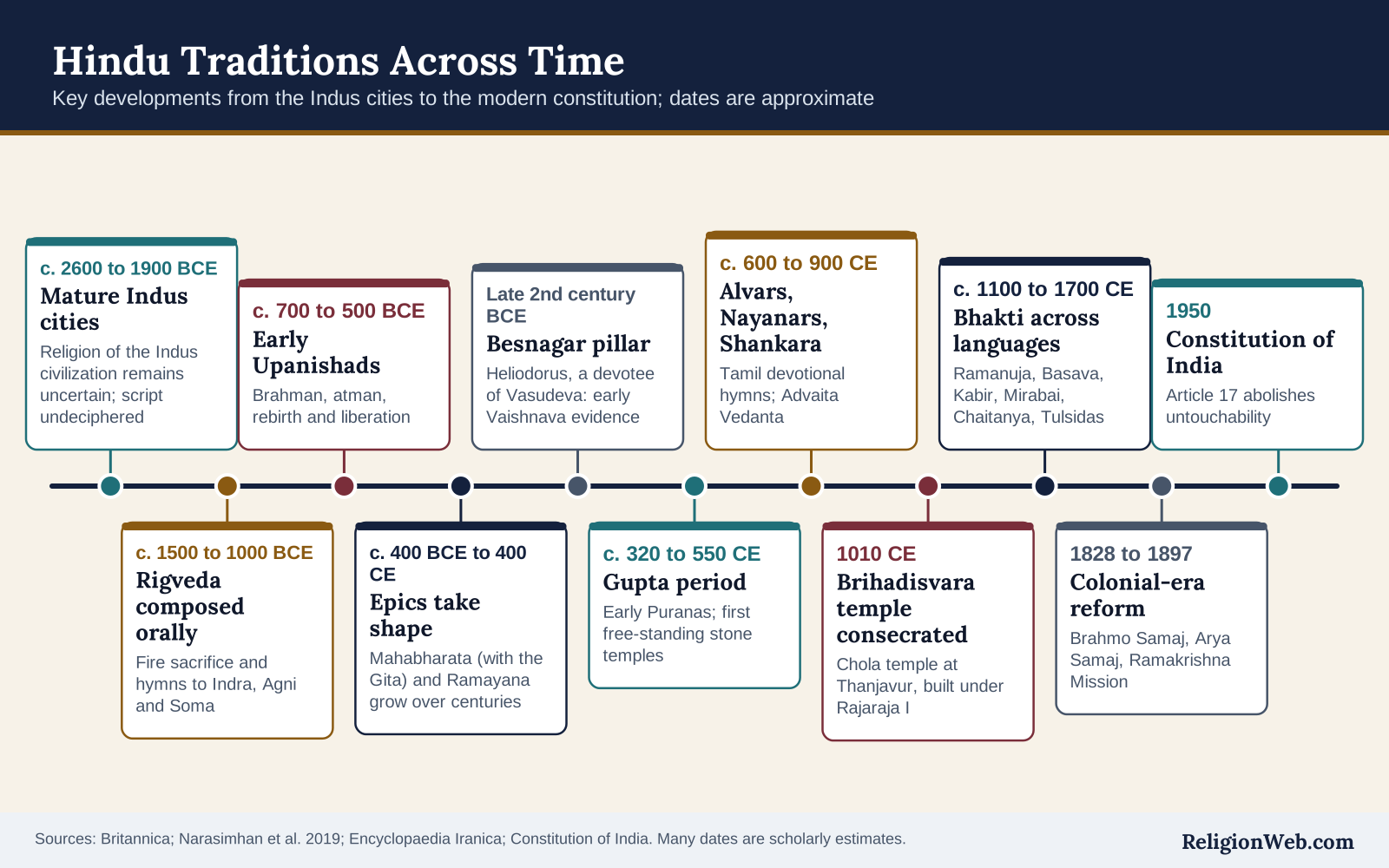
The centuries around the turn of the era brought the consolidation of the epics, the Dharmashastras and the earliest Puranas, together with a growing emphasis on personal devotion to a chosen god. Inscriptions and coins give some of the earliest datable evidence. A stone column at Besnagar, near Vidisha in central India, was set up toward the end of the second century BCE by Heliodorus, an envoy of the Indo-Greek king Antialcidas, who describes himself as a devotee (bhagavata) of the god Vasudeva, a name associated with Krishna and Vishnu. This is among the oldest inscriptional evidence of what later became Vaishnavism. Coins from the Kushan empire a few centuries later show a deity with a bull whom scholars commonly identify as Shiva, which gives parallel evidence for early Shaivism.
Under the Gupta dynasty (about 320 to 550 CE), royal patronage supported Sanskrit literature, scholarship and Brahmanical institutions, while also supporting Buddhist and Jain communities. Many scholars consider this period the time when the Puranic worldview, with its focus on a pantheon of great gods and goddesses and on pilgrimage and image worship, took shape as a recognizable religious system. The same centuries saw the first accounts of the Goddess as a supreme power, as in the Devi Mahatmya, which anticipates Shaktism.
Temples and Sacred Images
Free-standing stone temples became common in the Gupta period. The Dashavatara temple at Deogarh, from about 500 CE, and the cave sculptures at Udayagiri are among the early surviving examples of Vishnu worship in monumental form. Later regional dynasties built increasingly ambitious temples: the Pallavas at Mamallapuram in the seventh century, the Chalukyas and Rashtrakutas in the Deccan, and the Cholas, whose king Rajaraja I consecrated the Brihadisvara temple at Thanjavur in 1010 CE. Temple worship, based on the Agamas, became a primary public form of Hindu religion, supported by land grants, guilds and royal patronage. It also carried tradition beyond the subcontinent. Hindu states and temples appeared in Southeast Asia, including the ninth-century Prambanan complex in Java and Angkor Wat in Cambodia, built in the early twelfth century as a temple to Vishnu and later used as a Buddhist site.
Devotion, Philosophy, and Regional Traditions (c. 600 to 1700 CE)
Tamil Saints and Sanskrit Philosophers
Between roughly the sixth and ninth centuries, poet-saints in the Tamil country composed ecstatic hymns in Tamil to Vishnu (the twelve Alvars) and Shiva (the sixty-three Nayanars). Their poetry, sung in temples to this day, helped establish the idea that devotion to a personal god is open to people regardless of birth, and that vernacular language is as appropriate as Sanskrit for sacred speech. In the same period Sanskrit philosophers built great systems of Vedanta. Shankara, traditionally dated 788 to 820 CE though many scholars place him in the eighth century more broadly, wrote commentaries that established Advaita as a major school. Ramanuja, traditionally dated to the eleventh and early twelfth centuries, gave Vaishnava devotion a rigorous philosophical foundation, and Madhva, in the thirteenth century, did the same for a dualist theology. Abhinavagupta, in Kashmir around the year 1000, wrote one of the most sophisticated syntheses of Shaiva philosophy, aesthetics and ritual.
Devotion Across Languages and Under Changing Rulers
From the twelfth century onward, bhakti movements spread across the subcontinent in regional languages. Basava in Karnataka, Jnaneshwar and Tukaram in Maharashtra, Kabir and Ravidas in the Gangetic plain, Mirabai in Rajasthan, Chaitanya in Bengal, Tulsidas in the Hindi region and Annamacharya in the Telugu country are among the best known. Many of them criticized birth-based hierarchy and ritual formalism, and some, like Kabir, spoke from or across the boundaries between Hindu and Muslim devotional worlds. The Sikh community that formed around Guru Nanak (1469 to 1539) emerged in this milieu and became a distinct religion, as described on the Sikhism page.
The same period saw the establishment of Muslim rule across much of northern India, from the Delhi Sultanate (from 1206) to the Mughal empire (1526 to 1857), alongside powerful Hindu states such as Vijayanagara in the south (1336 to about 1646) and the Maratha polity. The record is varied and should be read by period, ruler and place. Some rulers destroyed temples as acts of political or religious assertion; others endowed them. The Mughal emperor Akbar abolished the pilgrim tax and the jizya tax on non-Muslims in the 1560s, whereas Aurangzeb reimposed the jizya in 1679 and ordered the destruction of some temples while confirming grants to others. Historians continue to debate the scale and motives of these actions, and historians caution against attributing such actions to the religion of Islam as such or to Muslims collectively. Hindu devotional and artistic life continued to develop throughout, in dialogue with Persian and Islamic culture.
The Colonial Encounter and Modern Hinduism (1757 to Today)
Orientalism, Law, and Reform
British rule over large parts of India, beginning in Bengal after the battle of Plassey in 1757, transformed how Hinduism was studied, governed and understood. William Jones founded the Asiatic Society in Calcutta in 1784; Charles Wilkins published the first English translation of the Bhagavad Gita in 1785; and Friedrich Max Müller edited the fifty-volume Sacred Books of the East (1879 to 1910). Colonial courts, beginning with Warren Hastings’s judicial plan of 1772, decided Hindu personal-law cases by consulting Sanskrit legal texts and Brahmin legal experts, which, in the view of many historians, gave the Dharmashastra a rigidity it had not had in practice. From the 1870s the census classified the population by religion and caste. Missionary criticism of Hindu practices, as well as Orientalist admiration for Sanskrit literature, shaped the climate in which Indian reformers worked.
Hindu responses were varied. Rammohan Roy founded the Brahmo Sabha in 1828, promoting Upanishadic monotheism and opposing image worship and the practice of widow-burning (sati), which the British governor-general Lord William Bentinck banned in Bengal in 1829. Dayananda Saraswati founded the Arya Samaj in 1875. Ramakrishna Paramahamsa of Bengal taught devotion to the Goddess and the validity of many paths, and his disciple Swami Vivekananda addressed the World’s Parliament of Religions in Chicago on September 11, 1893, and founded the Ramakrishna Mission in 1897. Ishwar Chandra Vidyasagar campaigned for the Widow Remarriage Act of 1856. Others, such as the Sanatana Dharma sabhas, defended inherited practice. These movements, which are often called Hindu reform or revival, are part of the reason modern Hinduism has a stronger identity as a single religion than it had before the nineteenth century.
Independence, Law, and Diaspora
India became independent in 1947, and its constitution came into force on January 26, 1950. The new state declared itself secular, abolished untouchability in Article 17, and in the 1950s reformed Hindu personal law through the Hindu Marriage Act (1955) and related acts on succession, adoption and guardianship. At the same time, Hindu communities had spread around the world. Indian indentured laborers, recruited from 1834 until the system ended in 1917, carried Hindu practice to Mauritius, Trinidad, Guyana, Suriname, Fiji and South Africa, where temples and devotional communities took root. After the United States passed the Immigration and Nationality Act of 1965 and similar changes occurred in Canada and Britain, professionals from India established temples across North America and Europe. Newer movements such as the International Society for Krishna Consciousness, founded in New York in 1966 by A. C. Bhaktivedanta Swami Prabhupada, also attracted converts. The next sections trace the practice of this long inheritance in more detail.
| Period | Key developments | Evidence |
|---|---|---|
| c. 2600 to 1900 BCE | Mature Indus cities; religion of this civilization remains uncertain | Archaeology; undeciphered script |
| c. 1500 to 1000 BCE | Rigvedic hymns and fire sacrifice; Indo-Aryan languages established in the northwest | Rigveda; linguistics; ancient DNA |
| c. 1000 to 500 BCE | Brahmanas, Aranyakas, early Upanishads; shift to the Ganges plain | Vedic texts |
| c. 600 to 300 BCE | Shramana movements, rise of Buddhism and Jainism, Upanishadic inquiry | Early Buddhist, Jain and Upanishadic texts |
| c. 300 BCE to 300 CE | Epics take shape; Dharmasutras and Manusmriti; devotion to Vasudeva and Shiva attested | Mahabharata, Ramayana; Besnagar pillar; coins |
| c. 320 to 550 CE | Gupta period; early Puranas; first free-standing temples | Texts; temples at Deogarh and Udayagiri |
| c. 600 to 1000 CE | Alvars and Nayanars; Shankara; Agamas and Tantras; Southeast Asian Hindu kingdoms | Tamil hymns; Sanskrit commentaries; temples |
| c. 1000 to 1700 CE | Ramanuja, Madhva, Basava; bhakti poets across regions; Muslim rule alongside Hindu states | Poetry in vernaculars; inscriptions; chronicles |
| 1757 to 1947 | Colonial rule; Orientalist scholarship, census, reform movements, nationalism | Archives; periodicals; legal records |
| 1947 to today | Independent India and Nepal; Hindu personal-law reform; global diaspora; new movements | Constitutions; statutes; censuses |
Hindu Deities, Devotional Traditions, and Philosophical Schools
The Major Devotional Traditions
Vaishnavism, Shaivism, Shaktism, and Smartism as an Organizing Framework
Scholars and many Hindus group devotional life around the deity understood as supreme. Vaishnavism centers on Vishnu and his incarnations, especially Rama and Krishna. Shaivism centers on Shiva. Shaktism centers on the Goddess as the supreme power (Shakti). Smartism, associated with Brahmins who follow the smriti texts, honors several deities together. This fourfold scheme is a useful guide, but it is a modern editorial framework, not a set of denominations with fixed boundaries. A Tamil Brahmin family might follow Smarta practice at home, worship at a Vishnu temple on festival days and honor the Goddess during Navaratri. Beneath the major streams are hundreds of lineages and local traditions, and each of the three main streams has a page of its own on ReligionWeb.
The table below gives a compact overview. Its rows describe central emphases, not exclusive memberships, and the dates and counts of texts and teachers vary in the scholarly literature.
| Tradition | Central focus | Characteristic texts | Notable lineages and communities |
|---|---|---|---|
| Vaishnavism | Vishnu and his avatars (notably Rama and Krishna); loving devotion (bhakti) and surrender (prapatti) | Bhagavad Gita, Pancharatra Agamas, Bhagavata Purana, Ramayana, Alvar hymns | Sri Vaishnavas (Ramanuja), Madhva, Nimbarka, Vallabha, Gaudiya (Chaitanya), Ramanandi, Swaminarayan |
| Shaivism | Shiva as Lord, worshiped in the linga and in anthropomorphic forms; yoga and grace | Shaiva Agamas, Tevaram, Shiva Purana, Kashmir Shaiva texts | Shaiva Siddhanta, Kashmir Shaivism, Pashupata, Lingayat (Virashaiva), Nath yogis |
| Shaktism | The Goddess as ultimate reality and active power (Durga, Kali, Lalita, Lakshmi and others) | Devi Mahatmya, Devi Bhagavata Purana, Shakta Tantras | Sri Vidya, Kali traditions in Bengal and Assam, regional Devi temples |
| Smartism | Worship of five deities (Shiva, Vishnu, Devi, Ganesha, Surya) alongside the study of Vedanta | Dharmashastra, Puranas, Upanishads with Advaita commentary | Smarta Brahmins associated with Shankara’s monastic centers, especially in South India and Maharashtra |
| Ganapatya, Kaumara and Saura currents | Ganesha, Murugan (Kartikeya) and Surya as supreme or especially honored deities | Ganesha Purana, Tamil Murugan literature, Surya hymns | Regional temples and festivals, especially in Maharashtra and Tamil Nadu |
| Regional and village traditions | Local goddesses and heroes, guardian deities, family and clan deities | Oral narratives, ritual specialists, temple legends | Found in nearly every region; often integrated into the wider Hindu pantheon |
Vishnu and the Idea of Avatars
Vishnu is the preserver in the classical triad of creator, preserver and destroyer, though most devotional traditions regard their own deity as the source of all three functions. Vaishnava tradition teaches that Vishnu descends into the world (avatara, literally “descent”) when order is threatened. The best-known list of ten includes the fish Matsya, the tortoise Kurma, the boar Varaha, the man-lion Narasimha, the dwarf Vamana, Parashurama, Rama, Krishna, the Buddha in many Puranic lists, and the future figure Kalki. Other lists vary, and some traditions place Balarama in the Buddha’s position. Hindu authors who include the Buddha in the list do so within their own theology; Buddhist communities do not understand the Buddha in this way. The Bhagavad Gita gives the classic explanation of why a god would descend, in Krishna’s own words.
When Righteousness
Declines, O Bharata! when Wickedness
Is strong, I rise, from age to age, and take
Visible shape, and move a man with men,
Succouring the good, thrusting the evil back,
And setting Virtue on her seat again.Bhagavad Gita, Chapter IV, Sir Edwin Arnold, The Song Celestial (1885; public domain)
Vaishnava communities read this as a statement of divine love for the world and a promise of divine presence. In the Advaita tradition, avatars are understood as forms through which the unqualified Brahman becomes accessible to devotion. Ramanuja read Krishna’s body as divine and not made of ordinary matter. The doctrine is thus not a single theory of incarnation; it is a family of ideas that Vaishnava sampradayas explain differently, as the page on Vaishnavism describes in more detail. Rama and Krishna are by far the most widely worshiped avatars: Rama as the model of righteous kingship and fidelity, Krishna as divine child, cowherd lover and charioteer-teacher.
Shiva, the Goddess, and Their Families
Shiva is worshiped as the great ascetic on Mount Kailasa, as lord of dance (Nataraja), as the formless pillar of light in the linga and as the husband of Parvati and father of Ganesha and Murugan. In philosophical Shaivism he is the supreme reality whose power produces, maintains and withdraws the universe. The Shaiva world is large and varied. Shaiva Siddhanta, strong in Tamil country, treats the soul as eternally distinct and freed by Shiva’s grace; Kashmir Shaivism, systematized by Abhinavagupta, teaches a non-dual view in which the world is a real manifestation of consciousness; the Lingayats of Karnataka, following Basava, wear a small linga on the body, reject birth-based hierarchy and give the personal linga a central place alongside temple worship. Wandering ascetics of the Pashupata and Nath orders form further currents.
The Goddess is honored as Durga, who slays the buffalo demon in the Devi Mahatmya; as Kali, fierce and liberating; as Lakshmi, source of prosperity; as Sarasvati, patron of learning and the arts; and as local village mothers whose temples may have no Sanskrit link. In Shakta theology she is not subordinate to a male god but the ultimate reality itself, with Shiva sometimes understood as inactive without her. Her worship ranges from household devotion to the elaborate Tantric rituals of the Sri Vidya tradition. Goddess festivals such as Navaratri and Durga Puja are among the largest religious events in India, as the section on festivals describes.
Ganesha, Hanuman, Murugan, and Regional and Village Deities
Many of the deities most visible in Hindu daily life do not fit neatly into one stream. Ganesha, the elephant-headed son of Shiva and Parvati, is invoked at the beginning of rites, journeys and new ventures as the remover of obstacles, and is honored by Hindus of all major traditions. Hanuman, the devoted monkey ally of Rama, is a model of strength and service whose temples and wrestling grounds are found in nearly every Indian town. Murugan (Kartikeya, Skanda), the youthful god of war and wisdom, is especially beloved in Tamil Nadu and in Tamil communities abroad.
Alongside these are the deities of particular places: Venkateshvara at Tirupati, Jagannath at Puri, Vitthal at Pandharpur, Ayyappan at Sabarimala and Khandoba in Maharashtra. At the village level, goddesses such as Mariamman in Tamil Nadu and Yellamma in Karnataka protect against disease and misfortune and are worshiped with offerings that may differ greatly from Brahmanical temple ritual, in some places including animal sacrifice. Anthropological studies of village religion in South Asia, from the mid-twentieth century onward, have documented how such local deities are linked over time with Puranic figures and incorporated into the wider tradition, while retaining their own priests, festivals and stories. The result is a pantheon with no fixed census.
Philosophical Schools and Systems
The Six Classical Darshanas
Hindu thought also developed systematic philosophy, traditionally organized into six “viewpoints” (darshanas) that accept the authority of the Veda in principle: Nyaya (logic and epistemology), Vaisheshika (atomistic natural philosophy), Samkhya (the analysis of spirit and matter), Yoga (the discipline of meditative practice, closely tied to Samkhya), Purva Mimamsa (the interpretation of Vedic ritual) and Vedanta (also called Uttara Mimamsa). The orthodox schools are called astika, a term indicating acceptance of Vedic authority; schools that reject it, including Buddhism, Jainism and the Charvaka, are called nastika. This classification is a medieval doxographic convention rather than a statement of historical origins, and the boundaries between schools were more fluid than the neat list suggests.
In practice, Vedanta became the dominant intellectual framework. Nyaya contributed rigorous methods of debate and inference that other schools adopted, and Samkhya supplied the vocabulary of three qualities (gunas: sattva, rajas, tamas) that appears in the Gita and the Puranas. Mimamsa’s emphasis on the eternal authority of the Veda influenced orthodox legal and ritual thought for centuries. Hindu temples, universities and monastic schools continue to teach these systems, and traditional debate (shastrartha) remains a living art in centers such as Varanasi and Kanchipuram.
The Schools of Vedanta
Vedanta rests on three sources, the Upanishads, the Brahma Sutras (attributed to Badarayana and usually dated to around the fifth century CE or somewhat earlier) and the Bhagavad Gita. Because the Brahma Sutras are extremely terse, each school produced its own commentary, and the differences among these commentaries define the schools. Advaita, associated with Shankara, teaches that Brahman is the only ultimate reality and that the world’s multiplicity is a superimposition. Vishishtadvaita, associated with Ramanuja, teaches that souls and matter are real but form the body of God. Dvaita, associated with Madhva, teaches five eternal distinctions, including that between God and the soul. Other schools include Nimbarka’s Dvaitadvaita (difference and non-difference), Vallabha’s Shuddhadvaita (pure non-dualism) and the Gaudiya Vaishnava teaching of “inconceivable difference and non-difference” (achintya-bhedabheda), associated with Chaitanya’s followers.
These systems are not merely academic. They shape monastic training, temple practice, preaching styles and what devotees say they hope for. An Advaita monk in a Shankara matha and a Sri Vaishnava priest in a Ramanuja temple use the same Sanskrit texts but may describe the goal of life in different terms, and both traditions have produced saints, poets and social reformers.
Modern Movements, Teachers, and Monastic Centers
Reform, Revival, and New Sampradayas
Several movements founded in the last two centuries have become major institutions. The Brahmo Samaj and the Arya Samaj, noted earlier, sought to reform ritual and society. The Ramakrishna Mission, established by Vivekananda in 1897, combines Vedanta teaching with schools, hospitals and disaster relief. The Swaminarayan tradition, which traces itself to Sahajanand Swami (1781 to 1830) in Gujarat, has grown into a global network of temples; one branch, the BAPS organization, built the Akshardham complex in New Delhi, which opened in 2005. The International Society for Krishna Consciousness (ISKCON), a Gaudiya Vaishnava movement founded in 1966, has communities and temples across five continents. These groups differ widely in doctrine, authority and practice, and some are small while others number in the millions.
Ascetic Orders, Mathas, and Gurus
Hindu institutional life depends heavily on monastic and ascetic organizations. Tradition credits Shankara with founding four monastic centers at Sringeri in the south, Dwarka in the west, Puri in the east and Jyotirmath in the north, each headed by a Shankaracharya; historians note that the details of their early history are debated. Ascetic orders of the Dashanami sannyasis, the Ramanandi Vaishnavas, the Shaiva Nath yogis and others organize themselves into akharas, whose processions are central to the Kumbh Mela. Gurus, both within these orders and independent, provide individual guidance, initiation and community leadership. Because there is no central authority to certify teachers, followers rely on lineage, reputation and personal experience, and public controversies about particular gurus have arisen in several traditions. Hindu communities themselves debate how to assess such claims.
Worship, Prayer, Yoga, and Pilgrimage in Hindu Practice
Puja and Darshan: Worship at Home and in the Temple
The Household Shrine and the Daily Routine
For most Hindus, worship begins at home. Many households keep a shrine, which may be a small shelf with pictures and small images, a dedicated room, or a niche in a kitchen, and a family member, often a woman in the household but not exclusively, offers a lamp, flowers, incense and a short prayer after bathing in the morning. A shrine usually contains the family’s chosen deity (ishta devata), often alongside images of Ganesha, a family or lineage deity (kuladevata) and a revered teacher. Pew’s 2019 to 2020 survey in India found that 59 percent of Hindus said they pray daily and 72 percent keep a tulsi plant, which many families water and circle each morning as a sacred form of the goddess Tulasi. Meals begin with a short prayer or an offering of food to the deity first. In many families, particularly among Brahmins and those who follow Vedic-derived rites, morning and evening twilight prayers (sandhyavandana) are performed with water, mantras and a set sequence of gestures.
Daily worship is shaped by vows (vratas) and by the rhythm of the week: Mondays are associated with Shiva, Tuesdays and Saturdays with Hanuman, Thursdays with Vishnu or a guru, Fridays with the Goddess, though practice varies by region and family. The aim of such practice is not simply obligation. In devotional traditions it expresses a relationship, in which the household treats the deity as an honored guest or as a member of the family who must be greeted, fed and put to rest.
The Anatomy of Puja
Puja, the central act of Hindu worship, is a ritual of hospitality offered to a deity. Its structure follows the courtesy shown to a respected guest. A puja might begin with a statement of intention (sankalpa) and the invocation of the deity, followed by offerings of a seat and water for rinsing feet and hands, a bath or sprinkling (abhisheka), clothing and ornaments, sandalwood paste, flowers, incense, a lamp, a food offering (naivedya) and the waving of lamps before the image (arati), often with bells and songs. Worshipers then circle the shrine clockwise (pradakshina) and bow or prostrate. The traditional list of offerings is variable: texts mention five, ten, sixteen or even sixty-four services (upacharas), and a simple home puja may include only a few. The food, once offered, is returned to worshipers as prasada, understood as the deity’s blessing.
Underlying all this is the idea of darshan, “seeing”: a worshiper both sees the deity and is seen by it, and the exchange of gaze is itself a blessing. Hindu theology explains the sacred image (murti) in several ways. In the Agama tradition, a priest invites the deity to dwell in the image through a consecration rite (pranapratishtha), after which the image is treated as a living presence. Sri Vaishnava theology speaks of the “image form” (archa) as one of the ways in which Vishnu is present in the world. For Advaita thinkers, an image offers a concrete focus for a mind that cannot yet contemplate the formless. Not every Hindu community uses images: the Arya Samaj rejects them, and the Lingayats venerate a personal linga rather than a figurative statue. Scholars therefore avoid the word “idol worship” as a description, because the practice is better described as the veneration of an image as a form of the divine.
Temple Worship and Its Specialists
Hindu temples are houses of the deity rather than congregational halls. Worshipers come individually or as families, at any time during open hours, to see the deity, offer flowers or coconuts, receive prasada and circle the sanctum. Pew’s survey in India found that 14 percent of Hindus visit a temple daily, a figure that reflects both the importance of the temple and the prominence of home worship. Priests (archakas or pujaris) perform the daily services on the deity’s behalf, following a ritual schedule that, in Agama-governed temples, covers the waking, bathing, feeding and resting of the deity several times each day. On festival days, temples hold special services, and the images may be carried in procession through the streets on chariots or palanquins so that the community can see them. The deity is thus both a resident and a public figure.
Mantra, Music, and Sacred Fire
Mantra, Japa, and Om
A mantra is a sacred utterance, a verse, a name or a syllable, believed to have power through sound and repetition. The syllable Om (Aum) is the best known and is chanted at the beginning and end of Vedic recitation and in many forms of meditation. The short Mandukya Upanishad, in twelve verses, interprets it as comprising four parts that correspond to waking, dreaming and deep sleep, and to a fourth state beyond them, which the text identifies with the self. Another widely recited mantra is the Gayatri, a verse from the Rigveda (3.62.10) addressed to Savitr, the sun as impeller, that asks for the inspiration of the mind. Traditionally it is taught to boys at the sacred-thread ceremony and recited at dawn, though in modern times many communities, including women’s groups and the Arya Samaj, teach it more widely.
Japa, the silent or murmured repetition of a mantra, is often counted on a string of 108 beads. Vaishnavas repeat names of Vishnu or Krishna; Shaivas recite the five-syllable mantra of Shiva; Shaktas repeat mantras of the Goddess, usually received through initiation from a teacher. The theory behind mantra recitation differs. In some traditions the meaning is essential; in others the sound itself is the active principle. Either way, the practice is close to prayer for many Hindus and a form of meditation for others.
Bhajan, Kirtan, and Devotional Music
Music is a principal vehicle of devotion. Bhajan and kirtan are devotional songs, often sung by a group in a call-and-response pattern with drums, harmonium and cymbals. Their texts come from poet-saints such as Mirabai, Surdas, Kabir, Tukaram and Annamacharya, and from the Tamil Alvar and Nayanar hymns. Classical music in the Carnatic tradition developed around devotional compositions by Tyagaraja, Muthuswami Dikshitar and Syama Sastri in the late eighteenth and early nineteenth centuries, and the Hindustani tradition has its own devotional genres. In many places, hours of singing form a regular community event, linking home, temple and neighborhood.
Fire Rites and the Vedic Inheritance
Fire (agni) remains central in rites inherited from the Vedic period. A homa or havan is a fire offering in which ghee, grains and other substances are placed in a consecrated fire while mantras are recited. It is used at weddings, at the beginning of new ventures, at the consecration of homes and temples, and in memorial and healing rites. Traditional Vedic ritual specialists in Kerala and elsewhere continue to perform complex fire sacrifices, though these are now rare. In theology, Agni is the messenger who carries offerings to the gods, and the presence of fire at a wedding or a funeral marks the event as part of a cosmic order.
Yoga, Diet, and Daily Discipline
Yoga in Hindu Tradition and in the Modern World
In Hindu tradition, yoga is a family of disciplines for training the mind and body toward liberation or union with the divine, not primarily an exercise system. The classical sources are the Bhagavad Gita and Patanjali’s Yoga Sutras, discussed earlier. Later Shaiva and Nath traditions developed hatha yoga, which uses postures, breath control and cleansing practices; its best-known surviving manual, the Hatha Yoga Pradipika of Svatmarama, dates to about the fifteenth century. Swami Vivekananda introduced a rationalized presentation of yoga to Western audiences in his lectures in New York in the 1890s, published as Raja Yoga in 1896.
Modern postural yoga, practiced by many millions worldwide, is a more recent development. Scholars, including Mark Singleton in Yoga Body (2010), have argued that its familiar forms took shape in the early twentieth century through exchanges between Indian teachers such as Tirumalai Krishnamacharya and global physical-culture movements, while drawing on older hatha practice. Others emphasize greater continuity with earlier traditions. Many practitioners treat yoga as a secular fitness or wellness activity, and many Hindus regard it as part of a religious path. Breath and postural practices are often taken up for health, but they are not a substitute for medical or mental-health care, and traditional teachers stress training under a qualified guide.
Vegetarianism, Fasting, and Purity
Dietary practice varies widely. The principle of non-injury (ahimsa) has encouraged vegetarianism for many Hindus, especially in Gujarat, Rajasthan, parts of the south and among many Brahmin and Vaishnava communities. Pew’s survey in India found that 44 percent of Hindus described themselves as vegetarian and another 33 percent said they avoid certain kinds of meat. Many Hindu communities in Bengal, Kerala, Goa and the northeast eat fish or meat, and sacrificial offerings of animals are made in some Shakta and village-deity temples. The cow is widely revered as a symbol of nurturing and non-violence, and avoidance of beef is common among Hindus, a custom that is embedded in modern Indian politics and law as well as religion.
Fasting (upavasa) is another widespread practice. Hindus may fast on particular days of the lunar month, such as the eleventh (ekadashi), on weekdays sacred to a deity, or during festivals such as Navaratri and Mahashivaratri. Fasts range from complete abstinence to eating only fruit, milk and certain grains. Rules concerning ritual purity, including bathing before worship and removing shoes before entering a shrine or temple, express the idea that the encounter with the divine calls for care in body and mind. Many traditions exempt children, the elderly, the ill and pregnant women from strict fasting, and medical advice should guide anyone with a health condition.
Pilgrimage: Tirtha Yatra
Sacred Geography and the Idea of the Tirtha
Pilgrimage is among the most characteristic Hindu practices. The Sanskrit word tirtha means a “ford” or “crossing place,” and implies a spot where the human and divine worlds meet; it is most often a river bank, a confluence, a mountain, a temple or a city. The whole subcontinent is mapped as sacred geography. The seven sacred cities (Sapta Puri) are traditionally given as Ayodhya, Mathura, Haridwar, Varanasi (Kashi), Kanchipuram, Ujjain and Dwarka. The “four abodes” (Char Dham) of Badrinath, Dwarka, Puri and Rameswaram mark the four directions, and the Himalayan Char Dham circuit in Uttarakhand links Yamunotri, Gangotri, Kedarnath and Badrinath. Shaiva tradition names twelve jyotirlingas, or “lingas of light”; the Sri Vaishnava tradition honors 108 Divya Desams; and Shakta tradition recognizes sacred sites (Shakti Pithas) associated with the Goddess, traditionally counted as 51 though lists vary.
Rivers are central. Pew’s survey found that 81 percent of Hindus in India believe in the purifying power of the Ganges, and 65 percent said they had been purified by bathing in a holy body of water. Pilgrims perform ritual bathing (snana), have darshan of the temple deity, make offerings and in many cases carry out rites for deceased ancestors, as at Gaya and Varanasi. Hereditary pilgrim priests (tirtha purohits or pandas) have traditionally kept family records and guided pilgrims for generations. Circumambulation (parikrama) of a sacred hill, city or river, such as Govardhan near Mathura or the Narmada, combines devotion with physical endurance. Pilgrimage has long been undertaken on foot, as in the annual wari to Pandharpur in Maharashtra, in which devotees of Vitthal walk for weeks singing the songs of the poet-saints.
The Kumbh Mela: Calendar Logic and Practice
The Kumbh Mela is a pilgrimage of exceptional scale. It rotates among four sites on sacred rivers: Haridwar on the Ganges, Prayagraj (Allahabad) at the confluence of the Ganges, Yamuna and the mythical Sarasvati, Ujjain on the Shipra and Nashik on the Godavari. UNESCO inscribed it in 2017 on the Representative List of the Intangible Cultural Heritage of Humanity, describing it as a congregation of ascetics, saints, pilgrims and visitors, and recording that knowledge about the festival is passed on through teacher-student relationships in ashrams and akharas. The legend behind it, told in the Puranas, concerns the churning of the cosmic ocean by gods and demons for the nectar of immortality (amrita); in the struggle over the pot (kumbha) that held it, drops are said to have fallen at the four sites.
The timing follows planetary positions in the traditional sidereal calendar. Official Kumbh sources state that the sites are linked to specific positions of Jupiter and the Sun: for example, Haridwar when Jupiter is in Aquarius and the Sun in Aries, Prayagraj when Jupiter is in Taurus and the Sun in Capricorn during the month of Magha, and Ujjain and Nashik when Jupiter is in Leo. Several variants are recorded for the same sites, and almanac practice varies. The principal event at each site is a series of mass bathing days at astrologically favorable moments, with processions of ascetic orders (akharas) bathing first on the days traditionally known as the royal bath (shahi snan); in 2025 Maharashtra’s chief minister accepted a proposal from Nashik’s sadhus to call these days amrit snan, the “nectar bath,” at the coming Nashik festival. The most recent full festival, the Maha Kumbh at Prayagraj, ran from January 13 to February 26, 2025, and the next at Nashik-Trimbakeshwar is scheduled to open on October 31, 2026. Official attendance figures run into the hundreds of millions but rest on counting methods that outside observers treat with caution, and crowd crushes have caused deaths at or near several festivals, including in 1954, 2003, 2010, 2013 and 2025, which is why safety planning is now a central part of the administration. Historian Kama Maclean has traced how the Allahabad festival was shaped between 1765 and 1954 by pilgrims, ascetics, priests and the colonial state.
Holy Days, Festivals, and the Hindu Calendar
How Hindu Calendars Work
Lunar Months, Lunar Days, and the Almanac
Most Hindu festivals follow a lunisolar calendar, which keeps lunar months but adjusts them to the solar year. Each month is divided into a bright fortnight (shukla paksha), from new moon to full moon, and a dark fortnight (krishna paksha), from full moon to new moon. A day in this system is a tithi, a lunar day defined by the angular distance between the Sun and the Moon, and there are thirty in a month. Tithis do not match civil days. They begin and end at any time of day, and their length varies, so the almanac (panchanga, “five limbs,” listing tithi, weekday, lunar mansion, a yoga and a karana) determines which civil day carries a particular observance. Because twelve lunar months are about eleven days shorter than a solar year, an extra month (adhika masa) is inserted roughly every two and a half to three years, so that festivals remain in their seasons. The year 2026 included such an extra month, in the spring, which is one reason festivals in the autumn of that year fall relatively late on the Gregorian calendar.
A small number of observances follow the Sun instead. Makar Sankranti, the day on which the Sun enters the sign of Capricorn in the traditional sidereal reckoning, falls on about January 14 or 15 each year. Regional calendars add further layers. Months begin at the new moon in the amanta system used in much of western and southern India and at the full moon in the purnimanta system used in much of the north, which is why the same day can carry different month names in different regions. Eras also differ: the Vikram era, dating from 57 BCE, is used in much of the north and west, and the Shaka era, dating from 78 CE, is used in the Indian national calendar adopted for official purposes in 1957 and in many regional almanacs. India’s civil life runs on the Gregorian calendar, and the Government of India’s holiday list for 2026 gives Diwali as Sunday, November 8, which it also records as day 17 of Kartika in the national Shaka calendar.
Why Dates Vary by Region and Tradition
Festival dates can differ by a day or more between communities. The rules for deciding which day a tithi “belongs to” depend on the time of day at which it prevails, whether the observance takes place in the morning, at midday or at night, and on the location of the observer, since sunrise and moonrise differ across a subcontinent. Some traditions follow additional rules. For instance, many Smarta and Vaishnava communities keep the eleventh-day fast (ekadashi) on different days when the tithi overlaps two civil days, because Vaishnava practice prefers a day free of the preceding tithi. Panchanga makers in different regions also use different astronomical calculation methods, some based on traditional texts and some on modern ephemerides.
For readers, the practical point is that published dates should be confirmed with a local temple, a regional almanac or an official holiday list. The distinctions in this article between obligatory, recommended and customary practice also matter: classical texts divide rites into daily duties (nitya), occasional rites tied to an event or date (naimittika) and optional rites performed to obtain a particular result (kamya). Few festivals are obligatory in a strict sense for all Hindus. Most are received as customs that families and communities follow with varying intensity.
Major Festivals: Meaning, Practice, and Regional Variation
Navaratri, Durga Puja, and Dussehra
Navaratri, the “nine nights” of the bright fortnight of the month of Ashvina (September to October), is among the most widely observed festivals. It honors the Goddess in her forms as Durga, Lakshmi and Sarasvati, and its practice varies greatly by region. In Gujarat, nights are filled with circle dances (garba and dandiya) around a lamp or image of the Goddess; in parts of South India, families arrange tiered displays of dolls (golu or bommai kolu); in Bengal, the festival becomes Durga Puja, a public celebration in which sculpted images of the Goddess slaying the buffalo demon Mahishasura are installed in pavilions, worshiped for several days and immersed in rivers. UNESCO inscribed Durga Puja in Kolkata on its Representative List in 2021. Many devotees fast or follow a restricted diet during the nine days.
The tenth day, Vijayadashami or Dussehra, has different emphases depending on the tradition. In much of northern and central India it marks Rama’s victory over Ravana, and the tradition of Ramlila performances, inscribed by UNESCO in 2008, culminates with the burning of effigies of Ravana. In other regions it commemorates the Goddess’s victory over Mahishasura or the beginning of new learning, and in Mysore it is associated with a royal procession. The same festival thus tells different stories in different places, and all of them focus on the victory of dharma over disorder.
Diwali, the Festival of Lights
Diwali (Deepavali, “row of lamps”) takes place on and around the new-moon night of the month of Ashvina in the purnimanta system, or Kartika in the amanta system, in October or November. It usually spans five days. These include Dhanteras, a day for buying metal utensils and gold; a day before the main night associated in many regions with Krishna’s defeat of the demon Narakasura; the main night, when families light rows of clay lamps, clean and decorate their homes and worship Lakshmi, the goddess of prosperity, and often Ganesha; a day in some regions for Govardhan Puja or the new year in Gujarat; and a day honoring the bond between brothers and sisters (Bhai Dooj). In Bengal the new-moon night is devoted to Kali Puja, and in parts of the north the return of Rama to Ayodhya after exile is the dominant story.
The festival has regional stories rather than a single origin, a point that scholars of religion emphasize. Diwali is also kept by Jains, who mark the liberation of Mahavira, and by Sikhs, who observe Bandi Chhor Divas for different historical reasons, as the pages on Jainism and Sikhism explain. Within Hindu practice, Diwali is a time of family gatherings, gifts, sweets and the settling of accounts. It is also a festival of public lights and fireworks, and local authorities in many Indian cities issue advisories because of air-quality concerns during the days that follow.
Spring, Shiva, and Rama: Holi, Mahashivaratri, and Rama Navami
Holi falls at the full moon of Phalguna (February to March). On the evening before, communities light bonfires (Holika Dahan) commemorating the story in the Puranas of Prahlada, who was protected from the demoness Holika because of his devotion to Vishnu. On the next day, people throw colored powder and water, a custom associated with the playful love of Krishna and Radha, especially in Mathura and Vrindavan. Holi is also a spring and harvest festival, and in many places it temporarily relaxes social hierarchy and formality.
Mahashivaratri, the “great night of Shiva,” is observed on the fourteenth lunar day of the dark fortnight of Magha (Phalguna in the amanta count), in February or March. Devotees keep a fast and an all-night vigil, bathe the linga with water, milk, honey and other substances and chant the mantra of Shiva. Rama Navami celebrates the birth of Rama on the ninth day of the bright fortnight of Chaitra (March to April), with recitation of the Ramayana, processions and the reading of the story at temples. Both are widely kept, though intensity of observance varies by tradition and by family.
Harvest, Family, and Regional Festivals
Many significant festivals follow the agricultural year or the cycle of family life. Makar Sankranti is celebrated across India with different names: Pongal in Tamil Nadu, where families boil the first rice of the harvest in a pot until it overflows; Lohri in Punjab; Magh Bihu in Assam. Onam in Kerala, in the month of Chingam, welcomes the legendary king Mahabali with floral designs and a feast. Raksha Bandhan, on the full moon of Shravana, is a day on which sisters tie a thread on brothers’ wrists as a sign of affection and protection. Janmashtami, on the eighth day of the dark fortnight of Bhadrapada (Shravana in the amanta count), celebrates the birth of Krishna at midnight, with fasting, devotional singing and, in Maharashtra, human pyramids to break a pot of curd.
Ganesh Chaturthi, on the fourth day of the bright fortnight of Bhadrapada, honors Ganesha for ten days. Households install clay images at home, and in Maharashtra and elsewhere large community images are installed in public pavilions, a form of public celebration that Bal Gangadhar Tilak helped to promote in Pune in the 1890s. The images are immersed in water at the end; in recent years many communities and municipalities have encouraged clay images and artificial immersion tanks to reduce pollution. The Rath Yatra at Puri, held on the second day of the bright fortnight of Ashadha (June to July), carries the images of Jagannath, Balabhadra and Subhadra in massive wooden chariots to a second temple, in an event that draws huge crowds of pilgrims.
| Festival | Calendar rule | Typical season | Main practices | Meaning |
|---|---|---|---|---|
| Makar Sankranti and Pongal | Solar: Sun enters Capricorn (about January 14 to 15) | January | Ritual bathing, kite flying, boiling of the first rice (Pongal) | Harvest, return of the sun northward |
| Mahashivaratri | Dark fortnight, 14th lunar day, Magha (amanta: Phalguna) | February to March | Fast, night vigil, abhisheka of the linga | Devotion to Shiva |
| Holi | Full moon of Phalguna | February to March | Bonfire, colored powder, sweets | Prahlada’s story; Krishna and Radha; spring |
| Rama Navami | Bright fortnight, 9th lunar day, Chaitra | March to April | Recitation of the Ramayana, processions | Birth of Rama |
| Rath Yatra (Puri) | Bright fortnight, 2nd lunar day, Ashadha | June to July | Chariot procession of Jagannath, Balabhadra and Subhadra | Journey of the deity to meet the people |
| Raksha Bandhan | Full moon of Shravana | August | Sisters tie a thread (rakhi) on brothers’ wrists | Protection and affection |
| Janmashtami | Dark fortnight, 8th lunar day, Bhadrapada (amanta: Shravana) | August to September | Fast to midnight, songs, decorated cradle | Birth of Krishna |
| Ganesh Chaturthi | Bright fortnight, 4th lunar day, Bhadrapada | August to September | Installing and immersing Ganesha images | Ganesha as remover of obstacles |
| Navaratri and Dussehra | Bright fortnight of Ashvina, nine nights and the 10th day | September to October | Fasting, garba, Durga Puja, Ramlila | The Goddess’s victory; Rama’s victory over Ravana |
| Diwali | New-moon night of Ashvina (purnimanta) or Kartika (amanta) | October to November | Lamps, Lakshmi worship, sweets, gifts | Light over darkness; regional stories of Rama, Krishna, Lakshmi and Kali |
Temples, Sacred Symbols, and Life-Cycle Rites
Temples and Sacred Spaces
Layout, Styles, and Purpose of the Hindu Temple
A Hindu temple (mandir or kovil) is conceived as the dwelling place of a deity and, in some texts, as a symbolic body or a model of the cosmos. At its heart is a small, dark inner sanctum (garbhagriha, “womb chamber”) that holds the main image or linga. Above it rises a tower, called a shikhara in the northern style and a vimana in the southern one. In front lie one or more pillared halls (mandapas) for worshipers, music and dance. Texts on temple building, including the Agamas and the Vastu Shastra manuals, prescribe proportions, orientation and the geometric diagram (vastupurusha mandala) on which the plan rests. Architectural historians describe two major regional modes: the Nagara style of the north, with curved towers, and the Dravida style of the south, with stepped pyramidal towers and monumental gateways (gopurams), with a mixed Deccan style between them.
The scale ranges from roadside shrines to cities-within-walls. The Brihadisvara temple at Thanjavur, consecrated in 1010 CE, is part of the Great Living Chola Temples on UNESCO’s World Heritage List, and Pashupatinath in Kathmandu is a major Shaiva center in Nepal. Not all sacred space is built. A tree, a stone, a river confluence or a hilltop may serve as a site of worship, and many village shrines consist of a small platform and a few stones. For Hindus, sacredness often attaches to the place itself, and the temple is a way of honoring and organizing something already present there.
Symbols and Material Culture
Hindu devotion is rich in objects and signs. The syllable Om is written and chanted. The lotus stands for purity and the unfolding of consciousness; the conch (shankha) is blown at the opening of worship; the lamp (diya) signals the presence of light. Sectarian marks on the forehead (tilak) often identify a tradition: a U-shaped mark in sandalwood or clay for Vaishnavas, three horizontal lines of ash (vibhuti) for Shaivas and a red kumkum dot for many devotees of the Goddess. Prayer beads differ as well, with rudraksha seeds worn by many Shaivas and basil-wood beads by many Vaishnavas. Women’s marks, including the red powder in the parting of the hair (sindoor), the bindi and the marriage necklace, vary by region and community. Floor designs (rangoli in the north and kolam in Tamil Nadu) welcome deities at thresholds.
The swastika (Sanskrit svastika, “conducive to well-being”) is a widely used auspicious sign in Hindu homes, at weddings and at the start of ventures, and it is used in Buddhist and Jain contexts as well. Its use long predates its adoption in Germany in the 1920s as the hooked cross of the Nazi party, and Hindu organizations in Europe and North America have worked to explain the distinction to the public. Other symbols are specific to a deity: the trident of Shiva, the discus and conch of Vishnu, the lion or tiger of Durga, the peacock of Murugan. Material culture also includes the sacred thread worn by initiated men in some communities, ritual vessels, bells and, in homes, lamp stands and small images.
Temple Access, Custom, and Law
Temples are also arenas where custom, caste and law meet. For much of history, many temples excluded people classed as “untouchable” and some excluded women of certain ages or non-Hindus. Twentieth-century movements challenged these rules. The Vaikom Satyagraha of 1924 to 1925 in Kerala campaigned for access to roads near a temple, and on November 12, 1936, the Maharaja of Travancore, Chithira Thirunal Balarama Varma, issued the Temple Entry Proclamation opening state-controlled temples to all Hindus. Article 17 of India’s constitution later abolished untouchability. Some temples still limit entry to Hindus; the Jagannath temple at Puri is a well-known example. Other questions remain contested, such as the exclusion of women of menstruating age from the Sabarimala temple in Kerala, a custom connected to the celibate form of the deity Ayyappan. In September 2018 the Supreme Court of India held that the exclusion violated constitutional guarantees, and the broader legal questions it raised about religious freedom and denominational rights were referred to a larger bench that was scheduled to begin hearing the review in April 2026. The status of the case should be checked in current sources.
Life-Cycle Rites (Samskaras)
The Samskaras: Purpose and Number
The samskaras are rites of passage that mark and, in the tradition’s understanding, “refine” a person at important stages of life, from conception to death. The Grihya Sutras, which describe household rites, and the Dharmashastras give differing lists; the Gautama Dharmasutra counts forty, while later digests popularized a list of sixteen. Which rites a family observes depends on region, caste or community, tradition and personal preference. Some samskaras are now rarely performed in full or are combined, and in modern urban life many Hindus keep only the rites of naming, marriage and death. The samskaras are performed by a family priest, with mantras from Vedic or later sources, and typically involve a fire, water, rice and flowers, and the participation of relatives.
| Rite | Typical timing | Main features | Meaning |
|---|---|---|---|
| Namakarana (naming) | Around the 11th or 12th day after birth, varying by community | Name chosen with reference to an almanac and family tradition; blessings | Entry of the child into family and community |
| Annaprashana (first solid food) | About six months | First rice offered to the child, often after worship | Nourishment as a gift of the divine |
| Chudakarana (first haircut) | First to third year, often at a temple | Shaving of the head, sometimes with a topknot left | Purification, offering to the deity |
| Upanayana (sacred thread) | Traditionally ages eight to twelve for boys of the three twice-born varnas | Gayatri mantra taught, thread invested, symbolic study begins | “Second birth” and entry into Vedic study |
| Vivaha (marriage) | Adulthood; auspicious date chosen by almanac | Fire witnesses vows; seven steps (saptapadi); regional customs such as tying a necklace or applying sindoor | Union of two families and the householder stage |
| Antyeshti (funeral) | Usually within a day of death | Cremation on a pyre, offerings and mantras; ashes immersed in a river | Last offering and help for the departed on their journey |
| Shraddha (ancestor rites) | After the funeral period, yearly and in the fortnight of the ancestors | Offerings of rice balls (pinda) and water, feeding of priests and the poor | Care for ancestors and continuity of family |
Childhood and Initiation
Many childhood rites mark the child’s first experiences: the first outing, the first solid food, the first haircut and the beginning of learning. The sacred-thread ceremony (upanayana) is the best-known initiation. Traditionally it was performed for boys of the three “twice-born” classes (Brahmin, Kshatriya, Vaishya), and in practice it has been most strongly maintained in Brahmin families. The initiate receives a cotton thread worn over the left shoulder and learns the Gayatri mantra from a teacher. The question of who may be initiated has changed. The Arya Samaj, and a number of families and reform communities, now initiate girls as well as boys, and many Hindu communities have never observed the rite at all.
Marriage
Marriage (vivaha) is the main rite of the householder stage and a major social event, with elaborate regional variation. In many traditions, a fire serves as witness; the couple walk around it or take seven steps together (saptapadi), exchanging promises of fidelity, support and prosperity; and the groom places a sacred necklace or red powder on the bride. The Hindu Marriage Act of 1955 states that where the seven steps form part of the customary rites, the marriage is complete on the taking of the seventh step. Indian law, which governs marriage for Hindus in India, also prohibits dowry (the Dowry Prohibition Act of 1961) and child marriage (the Prohibition of Child Marriage Act of 2006), though both problems persist. In the diaspora, many couples hold a Hindu ceremony alongside a civil one.
Death, Cremation, and the Ancestors
The funeral (antyeshti, “final offering”) is regarded as the last of the samskaras. In most Hindu communities the body is cremated, usually within a day of death, on a pyre lit by the chief mourner, traditionally the eldest son, or at an electric crematorium. Mantras are recited, and the ashes are collected and immersed in a sacred river such as the Ganges. Infants, some ascetics and members of certain communities are buried instead. A period of mourning follows, ranging from about ten to thirteen days or more depending on community, during which the family observes dietary restrictions and offers rice balls (pinda) understood to nourish the departed on the transition to the ancestors. Annual memorial rites and the offerings made during the fortnight of the ancestors in the month of Bhadrapada (Pitru Paksha) continue this care. Families also read from texts such as the Garuda Purana, and many believe, in line with the doctrine of samsara, that the soul is reborn according to its karma. Many families today draw on counselors, hospice care and health professionals alongside priests and community elders.

Community, Ethics, Caste, and Law in Hindu Life
Ethics and Social Values
Non-Violence, Truth, and the Ethics of Duty
Hindu ethics draw on several sources at once: the universal virtues listed in the Upanishads and the Yoga Sutras, the duty-centered reasoning of the Dharmashastras, and the moral dilemmas dramatized in the epics. Non-injury (ahimsa), truthfulness (satya), self-restraint, generosity and compassion appear in nearly every list. The Mahabharata contains the phrase ahimsa paramo dharmah, “non-violence is the highest duty,” yet the same epic is also a story of a war that the heroes do not manage to avoid, and the Gita’s argument to Arjuna has been read by some as justifying duty-bound fighting and by others as allegory for the inner struggle. Mohandas Gandhi, who drew on the Gita, the Jain tradition he knew in Gujarat and other sources, made ahimsa the basis of mass political action in the twentieth century. These readings do not cancel one another; they show that Hindu ethics are argued rather than dictated.
Service (seva) and giving (dana) are central practical values. Hospitality to guests, feeding the hungry in temples and at pilgrimage sites, and support for schools and hospitals through religious institutions are widespread. The Ramakrishna Mission’s emphasis on serving humanity as a way of serving God, an idea articulated by Vivekananda, is one modern example, and community kitchens and endowments at temples are older ones.
Family, Gender, and Women’s Roles
The family is the center of Hindu religious life, and the household, with its shrine, festivals and rites, is where much practice is passed on. The classical ideal of the joint family, in which several generations live together, has weakened with urbanization, but family obligations still shape rites, marriages and funerals. The place of women is complex. The Goddess is honored as the supreme power in Shaktism, and women saints are among the most beloved figures in devotional history, including Andal in the Tamil Vaishnava tradition, Akka Mahadevi among the Virashaivas and Mirabai in northern India. In the twentieth century, women such as Anandamayi Ma and Mata Amritanandamayi became widely followed teachers.
At the same time, classical law texts imposed severe restrictions on women, and practices such as widow-burning, child marriage and dowry have caused real harm. Reformers within the tradition, from Rammohan Roy and Ishwar Chandra Vidyasagar to the framers of the Hindu Code legislation of the 1950s, worked to change them. The Hindu Succession (Amendment) Act of 2005 gave daughters equal rights in ancestral property. Debates continue about women’s access to priesthood, temple spaces and leadership, and a number of women now work as priests at weddings and other rites in Maharashtra and elsewhere.
Caste: Varna, Jati, and a Contested History
Varna and Jati: Two Different Systems
The word “caste” is used for two related but distinct things. Varna is a theoretical fourfold scheme of social classes: priests and scholars (Brahmins), rulers and warriors (Kshatriyas), merchants and farmers (Vaishyas) and servants (Shudras), with those outside the scheme later called untouchable or, in today’s constitutional language, Scheduled Castes. The scheme appears in the Rigveda’s Purusha Sukta (10.90), in which the classes arise from the body of a primeval person in a sacrifice. Britannica notes that this hymn is probably a late addition and that it is not known how closely the scheme matched social reality. Jati, by contrast, is the local, practical system: thousands of endogamous groups, each linked to hereditary occupations and ranked in ways that differ from region to region.
Hindu texts differ on what determines varna. The Bhagavad Gita (4.13) says, in paraphrase, that Krishna created the fourfold order in accordance with the distribution of qualities and actions, which some commentators read as describing aptitude and work, and others as describing hereditary groups. The Manusmriti and other Dharmashastras assign duties and privileges by birth. Many reformers and teachers, past and present, hold that birth-based hierarchy contradicts the spirit of the Upanishads, while some traditionalists defend an idealized varna order. It would be wrong to say that “Hinduism teaches” a single position, and equally wrong to deny that textual authority was long used to justify exclusion and discrimination.
Debates About Origins and Colonial Change
Historians disagree about how caste developed and how much colonial rule changed it. The French anthropologist Louis Dumont, in Homo Hierarchicus (1966), described caste as a religious system organized around the ranking of purity and pollution. Nicholas Dirks, in Castes of Mind (2001), argued that British administration, especially the census and ethnographic surveys, turned flexible local identities into fixed, ranked categories. Susan Bayly and other historians have countered that caste was already a powerful and politically active reality in the eighteenth century, though colonial practice intensified and systematized it. Most scholars hold that both pre-colonial hierarchy and colonial classification mattered. The census of 1901 under Herbert Risley, for example, attempted to rank castes by social precedence and generated protests and petitions from communities that sought a higher place.
Britannica adds that the older view of varna as a racial division is misleading, since the evidence suggests varna referred to ritual and social role, not skin color. Caste also appears outside India: in Nepal the 1854 legal code of Jung Bahadur Rana gave caste legal force, caste-based legal distinctions were removed by the 1963 code, and a 2011 law criminalized caste-based discrimination and untouchability. Caste-like divisions exist among Muslim, Christian, Sikh and Buddhist communities in South Asia as well, and they are not limited to Hindus.
Reform, Resistance, and Law
Criticism of caste has deep roots within Hindu devotional movements, in the poetry of Basava, Kabir and Ravidas, and among the Alvars and Nayanars. In the modern period, Jyotirao Phule founded the Satyashodhak Samaj in 1873 to challenge Brahmin dominance, and E. V. Ramasamy (Periyar) began the Self-Respect Movement in 1925. B. R. Ambedkar, born into a Mahar family regarded as untouchable, became the leading political voice for Dalits (a term many Dalit communities use for themselves). In 1936 he wrote Annihilation of Caste, which argued that caste could not be reformed without challenging the authority of the Hindu scriptures that sanctioned it. He negotiated the Poona Pact with Gandhi in 1932, chaired the committee that drafted India’s constitution, and on October 14, 1956, converted to Buddhism at Nagpur together with hundreds of thousands of followers. Gandhi, for his part, worked to end untouchability, which he condemned as a blot on Hinduism, while holding more conservative views of varna than Ambedkar; the two men’s disagreement remains an important topic of debate.
The Constitution of India, which came into force in 1950, abolishes untouchability in Article 17 and makes enforcing any disability arising from it an offense. Later laws include the Protection of Civil Rights Act (1955, strengthened in 1976) and the Scheduled Castes and Scheduled Tribes (Prevention of Atrocities) Act of 1989. Reserved seats and posts exist for Scheduled Castes and Scheduled Tribes, who made up about 16.6 and 8.6 percent of the population in the 2011 census. Caste discrimination persists in marriage, housing, employment and violence in many regions, and it is a continuing subject of legal action, scholarship and community organizing, including by Hindus. No single view of caste speaks for all Hindus, and the history is best treated precisely by region, period and community.
Hindu Law, Institutions, and the State
Personal Law in India
In independent India, family matters such as marriage, divorce, adoption and succession are governed by the personal law of the religious community, and for Hindus this is the codified statutory law of the 1950s: the Hindu Marriage Act (1955) and the Succession, Minority and Guardianship, and Adoptions and Maintenance Acts (1956). The legal definition of “Hindu” in the Marriage Act is broad. It covers Hindus in any of their forms, including Virashaivas, Lingayats and followers of the Brahmo, Prarthana and Arya Samaj movements, as well as Buddhists, Jains and Sikhs, and, as a residual category, anyone domiciled in India who is not Muslim, Christian, Parsi or Jewish. This is a legal definition for the purpose of applying a statute and not a theological claim, and many Sikh, Buddhist and Jain leaders have objected to being classed as Hindus, even for legal purposes. Whether India should adopt a uniform civil code replacing religion-based personal laws remains a matter of political and legal debate.
Temples, Trusts, and State Administration
Many large Hindu temples in India are administered by state governments through endowment departments or statutory boards, a system with roots in colonial regulation of temple funds and in state laws passed after independence. Supporters say this ensures accountability and public access; critics, including many Hindu organizations, argue that it gives the state a degree of control over religious institutions that is not applied to other religions and call for more community control. Other temples are run by private trusts, hereditary families or monastic orders. In the diaspora, temples are usually managed by community associations or charities under local law, and their governance has become a matter of public debate in several countries.
Hinduism Today: Global Presence, Diaspora, and Public Debates
Population, Geography, and the Diaspora
South Asia and Beyond
The demographic center of Hinduism remains the Indian subcontinent. Pew Research Center’s 2025 analysis counts nearly 1.2 billion Hindus worldwide in 2020, about 95 percent of them in India and 99 percent in the Asia-Pacific region. The Hindu share of the population slipped slightly, but by less than five percentage points, in India, Nepal, Pakistan and Bangladesh between 2010 and 2020. Hindus are a substantial minority in Bangladesh, Sri Lanka and Pakistan, where they are concentrated in the province of Sindh. In Indonesia, Hindus are a small share of the national population but a large majority on the island of Bali, where a distinct tradition of Hindu worship, known locally as Agama Hindu Dharma and combining Shaiva-influenced temple ritual with Balinese art and local deities, has been practiced for centuries. The data year throughout this section is 2020 unless stated, and Pew’s counts rely on census and survey sources that differ in quality from country to country.
Diaspora Communities and New Institutions
Outside South Asia, Pew found that growth in the Hindu population between 2010 and 2020 was fastest in North America (up 55 percent to 3.6 million) and in the Middle East and North Africa (up 62 percent to 3.2 million), driven largely by migration to the United States and the Gulf states. In 2020, the largest Hindu populations beyond India and Nepal included the United States with about 3.0 million, the United Kingdom with 1.1 million, and the United Arab Emirates with 1.1 million; Mauritius, with about 620,000 Hindus or 48 percent of the population, is a country where Hindus are the largest single religious group. Older communities descended from indentured laborers are strong in Fiji, Trinidad and Tobago, Guyana, Suriname and South Africa, while more recent communities have grown from professional and student migration.
Diaspora Hinduism has developed its own institutions: temples built in a mix of traditional and local styles, weekend schools for children, student societies, and umbrella organizations. Communities often adapt practice to new settings, for example by making temples function more like congregational centers, holding programs in English, or organizing festivals on weekends. Hindu chaplains now serve on some university campuses and in hospitals and the military. Second- and third-generation Hindus raised abroad often describe their religion in terms of values and family tradition and sometimes draw on both Indian and local resources.
Political Hinduism and Plural Voices
Hindutva and Hindu Nationalism: Definitions and Events
“Hindu nationalism” and Hindutva refer to political movements and ideology, which need to be distinguished from the Hindu religion as such. The term Hindutva was set out by Vinayak Damodar Savarkar in a text first published in 1923, which defined a Hindu as a person who regards the land between the Indus and the seas as both fatherland and holy land, and so tied religious and national identity together. The Rashtriya Swayamsevak Sangh (RSS) was founded in 1925 by Keshav Baliram Hedgewar as a Hindu nationalist volunteer organization, and the Bharatiya Janata Party (BJP), which is associated with Hindutva, was formally established in 1980. Supporters of this politics describe it as an assertion of cultural identity and civilizational pride after a long period in which they believe Hindu interests were neglected. Critics, including a number of Hindu scholars and religious leaders, describe it as an ethno-nationalist ideology that treats religious minorities as outsiders and departs from the pluralism of Hindu tradition. Britannica characterizes Hindutva as a right-wing ethno-nationalist political ideology.
A few events illustrate how these arguments have played out and should be described precisely. On December 6, 1992, the Babri Masjid in Ayodhya was demolished by crowds of volunteers (kar sevaks) affiliated with the Vishwa Hindu Parishad and allied organizations, after a decades-long dispute over whether it stood on the birthplace of Rama; violence between communities followed in several cities. On November 9, 2019, a five-judge bench of India’s Supreme Court, in M. Siddiq v. Mahant Suresh Das, awarded the disputed site to the deity Shri Ram Virajman, the plaintiff in one of the title suits, and directed the state to provide an alternative site for a mosque. A temple to Rama was consecrated at Ayodhya on January 22, 2024. Supporters see these developments as the resolution of a long grievance, while others, including many Muslims and some Hindus, point to the demolition and its aftermath as harmful to India’s secular constitutional order. Scholars of the movement, among them Christophe Jaffrelot and Thomas Blom Hansen, have written extensively on its organization and history.
Pluralist, Reformist, and Minority Hindu Voices
Public discourse about Hinduism is not limited to nationalism. Many Hindu thinkers and organizations have emphasized pluralism, from Ramakrishna’s teaching that different paths lead to the same God to Gandhi’s insistence that his Hinduism included respect for all religions and Sarvepalli Radhakrishnan’s presentation of Hindu philosophy as a universal outlook. Dalit Hindus, Adivasi (tribal) communities with their own religious traditions and some Hindu women’s movements make different claims on the tradition’s meaning. Hindu environmental initiatives have campaigned over the pollution of sacred rivers and the ecological effects of festivals, including efforts to clean the Ganges and to replace non-biodegradable immersion materials.
Hindu communities have also faced violence and discrimination in some places, and it is appropriate to record that too, with attention to specific events. In October 2021, during Durga Puja in Bangladesh, mobs attacked temples, festival pavilions and Hindu homes in several districts after a social-media post alleged that a Quran had been desecrated at a pavilion in Comilla; Human Rights Watch reported at least seven deaths and more than a hundred injuries and criticized the authorities for repeated failure to prosecute violence against minorities. Responsibility in such incidents lies with identifiable perpetrators and institutions, not with any religious community as a whole, a principle that applies equally to the actors named in the previous paragraphs.
Common Misconceptions About Hinduism
Misconception 1: Hinduism has a single founder and a single holy book
Where the misunderstanding comes from
People who learn about religions through their founders, such as Moses, Jesus, the Buddha or Muhammad, naturally look for a counterpart in Hinduism and for a text that plays the role of a single scripture. The Bhagavad Gita is often presented in translations and classrooms as “the Hindu Bible,” and sages such as Vyasa, Shankara or Vivekananda are sometimes described as founders. The word “Hinduism” itself, a nineteenth-century English coinage that suggests a single system, encourages the expectation of unity.
Introductory books and the media sometimes reinforce the idea by citing one text or one figure as representative. Within India, too, nationalist and reformist movements of the nineteenth and twentieth centuries have promoted the Gita or the Vedas as a common center for Hindu identity, which adds to the impression that such a center always existed.
What the evidence and tradition actually show
No historical person is recognized as the founder of Hinduism, and Hindu tradition does not describe itself that way. The Vedas are regarded as eternal, not as the work of a human author, and the epics and Puranas are attributed to sages, such as Vyasa, who are regarded as compilers or transmitters rather than founders. Many specific traditions do point to teachers: Ramanuja for the Sri Vaishnava community, Basava for the Lingayats, Chaitanya for Gaudiya Vaishnavism, Dayananda Saraswati for the Arya Samaj, and Sahajanand Swami for the Swaminarayan tradition. Each of these is the founder or reformer of a lineage, not of Hinduism as a whole.
The Gita is among the most widely read Hindu texts and one of the three foundational texts of Vedanta, but no scripture holds the role of a universal canon. Many Hindus have never read it in full. They know the Ramayana through local retellings, the Devi Mahatmya through temple recitation, or regional poetry in their own language. The best summary is that Hinduism has many authoritative sources and many teachers but no founder, which explains both its diversity and the difficulty of defining it in a sentence.
Misconception 2: All Hindus worship the same deities in the same way, or worship “millions of gods”
Where the misunderstanding comes from
The sight of temples crowded with images, the numerous names of gods and goddesses, and the often-cited figure of “330 million gods” have led many outside observers to conclude that Hindus are polytheists who worship a vast and undifferentiated crowd of deities. Others reach the opposite conclusion, that Hinduism is really monotheism with decorative extras. Both views often rest on the assumption that Hindu belief must fit one of two Western categories, and on the assumption that the tradition has a uniform pattern of worship.
The number itself comes from a Sanskrit word, koti, which can mean both “ten million” and “category” or “type,” and from the Vedic tradition of enumerating thirty-three gods. A famous dialogue in the Brihadaranyaka Upanishad has the sage Yajnavalkya reduce a large count of gods successively to thirty-three, to six, to three and finally to one, a passage that is often read as pointing to the unity beneath plurality.
What the evidence and tradition actually show
Hindu practice is better described as a field of particular devotions than as a single pantheon. A Vaishnava worshiper may regard Vishnu as the supreme being and the other deities as subordinate; a Shaiva may do the same for Shiva; a Shakta for the Goddess; a Smarta may worship five deities in a daily rite; an Advaita philosopher may regard all deities as expressions of a single, attributeless Brahman. These positions coexist and sometimes argue with one another. The Rigveda verse quoted earlier, saying that the real is one and sages call it by many names, is often invoked as an expression of this plurality, though historians remind us that it should be read in its Vedic context.
Practice varies just as much. Hindu worshipers in a Tamil temple, a Himalayan village shrine, a Bengali Durga Puja pavilion and a Gujarati Swaminarayan temple may share a vocabulary yet have very different rituals, foods, music and clergy. Pew’s survey in India found, for example, that 59 percent of Hindus say they pray daily and 14 percent visit a temple daily, which means that most people worship primarily at home. To say “Hindus worship” any single thing in any single way is to flatten a tradition that is better understood by naming the region, lineage and deity in question.
Misconception 3: Caste is a single, unchanged religious rule found everywhere in Hinduism
Where the misunderstanding comes from
Popular accounts often describe a rigid, divinely sanctioned four-part hierarchy, frozen since the Vedas, imposed on all Hindus everywhere. Such accounts draw on the Purusha Sukta and the Manusmriti, on the nineteenth-century Orientalist habit of reading Sanskrit law texts as descriptions of society, and on the colonial census, which classified and ranked castes as fixed categories. The word “caste” itself covers two different things, varna and jati, which are frequently conflated.
Another source of confusion is that caste discrimination is real and continues to cause suffering, which leads some to assume that it must be a doctrinally required feature of Hindu belief. Others, in response, deny that caste has any religious basis at all. Both positions simplify a more complicated history.
What the evidence and tradition actually show
Scholars agree that the varna scheme appears in early Sanskrit texts and that texts like the Manusmriti assign duties and privileges by birth. They also agree that jati, the practical system of local groups, is far more complex than a four-part model, varies by region, and has changed over time. Historians disagree about how much colonial administration altered it, as Nicholas Dirks and Susan Bayly do, but most accept that pre-colonial hierarchy was real and that it was also negotiated, contested and in some places fluid. Caste also exists among South Asian Muslims, Christians and Sikhs, and it has been challenged from within Hindu traditions by bhakti poets, by reformers such as Phule and Periyar, and by Ambedkar, whose critique led him to leave Hinduism in 1956.
Hindus themselves take many positions. Some defend a version of varna as a social ideal, some hold that birth-based hierarchy contradicts the highest teachings of their tradition, and many have lived and worked among caste distinctions without reflecting on their origin. The law of India prohibits untouchability, and statutes and courts address discrimination, yet it persists in many places. A precise account therefore avoids saying that “Hinduism requires caste” or that “caste has nothing to do with Hinduism,” and instead describes which texts, communities, regions and periods are under discussion.
Misconception 4: Hindus worship idols as if the stone itself were God
Where the misunderstanding comes from
The word “idol” comes from a vocabulary of critique, in which images of gods are false substitutes for the true God. Applied to Hindu murtis, it has often been used by outsiders, including missionaries in the colonial period, to imply that worshipers confuse the material object with the divine. Some Hindu reformers, such as the Brahmo Samaj and Arya Samaj, also argued against image worship, which lent further currency to the idea within India.
The impression is strengthened by outward behavior: Hindus bathe, clothe, feed and fan their images, and for an observer unfamiliar with the theology this may look like a belief that the object is a living being.
What the evidence and tradition actually show
Hindu theologians have long explained image worship in more subtle terms. In the Agama and Pancharatra traditions, the deity is invited to be present in a consecrated image, and the image becomes a means by which a transcendent God can be approached and honored by finite human beings. Sri Vaishnava teaching names this image-form as one of Vishnu’s modes of presence. Advaita thinkers regard images as supports for contemplation that point toward a reality beyond all forms. Even the Upanishads, which speak of the formless Brahman, also prescribe meditative worship (upasana) on symbols such as Om, and the distinction between the formless and the formed aspects of the divine is a standard topic of Vedanta.
It is accurate to say that Hindus perform worship of images, but it is not accurate to say that Hindus believe the material object is the whole of God. Worshipers often say they are seeing the deity (darshan) and not a statue. Communities that avoid figurative images, including the Arya Samaj and the Brahmo Samaj, and the widespread worship of Shiva in the aniconic linga, show that the tradition has long contained both iconic and aniconic ways of honoring the divine.
Misconception 5: Karma means fate, so Hindus simply accept their lot
Where the misunderstanding comes from
Karma has entered everyday English as a synonym for destiny or cosmic payback, as in “that’s karma.” Popular accounts of Hinduism often present it as the explanation for why people are born into different circumstances and suggest that it teaches resignation. Some historical uses of the doctrine, in which the poor or low-ranked were told that their situation reflected past actions, have lent weight to this impression, and critics of caste have rightly pointed to such uses.
What the evidence and tradition actually show
In Hindu philosophy, karma literally means action, and the doctrine is about the moral consequences of intentional action. It places responsibility on the present agent: what a person does now shapes what follows. The Bhagavad Gita, one of the most influential Hindu texts, argues against passivity and calls for active, selfless engagement in the world. Many devotional traditions teach that God’s grace can transform karma’s results, and Advaita teaches that knowledge ends the cycle that karma sustains. Pew found that 77 percent of Hindus in India say they believe in karma, but that belief takes many forms, from impersonal moral law to divine justice.
Hindu thinkers have also opposed the use of karma to excuse injustice. Vivekananda taught that the doctrine should inspire compassion and effort, Ambedkar denounced the social uses of the doctrine, Gandhi campaigned against untouchability, and modern Hindu reform movements have built hospitals, schools and relief organizations on the principle of service. Whatever one makes of the doctrine philosophically, it is not equivalent to fatalism, and it does not justify neglect of those who suffer.
Frequently Asked Questions About Hinduism
Questions About the Name and Origins
Is Hinduism the oldest religion in the world?
The answer depends on what is being measured. The earliest surviving Hindu literature, the Rigveda, is usually dated to roughly 1500 to 1000 BCE, and some practices described in later texts have been continuous for a very long time. But Hinduism has no founding date, the tradition has changed substantially over three millennia, and historians generally avoid ranking religions by age because “religion” and “continuity” can be defined in different ways. Archaeology shows organized religious life in many parts of the world long before the Vedas, and the identity of the Hindu tradition as a single entity is a matter of scholarly debate, as the first section explains.
Is Hinduism a religion, a culture, or both?
Hindus and scholars give different answers. Many Hindus regard Sanatana Dharma as a religious tradition with its own scriptures, rituals and teachers. Others emphasize that it is also a civilizational heritage, with shared festivals, arts, languages and family customs, which can be experienced by people at varying levels of belief. Indian law uses “Hindu” as a legal category with a broad and partly residual definition, and Indian censuses count religion as self-identification. The short version is that Hinduism includes religious belief and practice but also overlaps with regional and family culture, and people hold different ideas about where the boundary lies.
What is the difference between “Hindu” and “Indian”?
“Indian” is a national identity, and “Hindu” is a religious one. Roughly four in five people in India are Hindu, but India is also home to very large Muslim, Christian, Sikh, Buddhist and Jain communities, along with followers of other traditions. Nepal has a Hindu majority, and there are Hindu communities in many countries. Treating the two terms as interchangeable leads to confusion, and it is a point that Hindu thinkers and scholars of all views stress.
Questions About Belief and Practice
Do Hindus believe in reincarnation?
Most Hindu traditions teach rebirth (punarjanma), the idea that the soul is reborn in new bodies according to its karma until it attains liberation. The doctrine appears in the Upanishads and is part of the Gita’s teaching, and many Hindus hold it as a matter of course. Traditions differ about its details: whether the soul can be reborn as an animal, how rebirth relates to grace, and what happens to the soul at liberation. Some philosophical schools, such as the materialist Charvaka, rejected it, and some modern Hindus treat it as symbolic or do not emphasize it.
Can someone join Hinduism if they were not born into it?
The answer varies by tradition and by context. Historically, Hindu identity was often tied to family, community and region, and there was no central body to admit newcomers. Some movements, such as ISKCON, the Ramakrishna Mission and a number of Shaiva and Vaishnava lineages, give formal initiation to people from any background, while the Arya Samaj has had rites for admitting people for over a century. Many Hindus welcome sincere interest, while others hold that Hindu identity is inherited. In India, personal law and census practice handle the question of who is a Hindu in their own ways. A person interested in a particular practice, such as meditation or devotional singing, can engage with it without any formal step.
What is the role of a guru?
A guru (“heavy one” or “one who dispels darkness,” in the traditional etymologies) is a teacher who transmits knowledge, practice or initiation. In many lineages the relationship with a guru is considered essential to spiritual progress, and the Upanishads describe the student approaching a teacher with offerings in hand. Gurus vary from village priests and family teachers to heads of monastic orders and modern teachers with global followings. Because no central authority certifies them, Hindu traditions advise students to examine a teacher’s lineage, character and conduct, and public disputes about particular teachers occur in Hindu communities as elsewhere.
Questions About Visiting and Observing
What should visitors know before entering a Hindu temple?
Practice varies by temple, so signs and local guidance come first. Shoes are removed before entering, often at a designated place, and modest dress is expected. Many temples ask that photography be avoided in the inner sanctum. Visitors usually walk clockwise around the shrine, may be offered a small portion of blessed food or water to receive with the right hand, and may leave a small offering if they wish. Some temples limit entry to Hindus or have rules about dress or timing; the Jagannath temple at Puri is a well-known example, and visitors should ask rather than assume. Visitors who are not worshiping are generally welcomed when they behave respectfully and quietly.
When is Diwali in 2026, and why does the date change?
According to the Government of India’s official holiday list, Diwali in 2026 falls on Sunday, November 8. The date changes because Diwali is tied to the new-moon night in the lunisolar calendar, and the lunar months do not match the Gregorian year. An extra lunar month inserted in 2026, in the spring, pushes festivals of the autumn later than in some other years. Communities in different regions may keep related rites a day apart, and local temples and almanacs should be consulted for the timing of specific observances.
Conclusion: Understanding Hinduism Through Its Many Voices
What the History Shows
A Tradition Built by Accumulation
The most reliable way to understand Hinduism is as a long historical accumulation rather than a single design. Vedic hymns and fire rites, Upanishadic inquiry into the self, the ethical debates of the epics, the legal reasoning of the Dharmashastras, temple worship and the Puranic stories of Vishnu, Shiva and the Goddess, medieval devotional poetry in a dozen languages, colonial-era reform and the global movements of the last century each added something without erasing what came before. That is why a single text, teacher or practice never represents the whole, and why careful accounts name the region, lineage and period.
Unity Without Uniformity
What Hindus share is real but loosely woven: a vocabulary of dharma, karma, samsara and moksha, reverence for the Vedas in most traditions, honoring of the divine through image, sound, fire and pilgrimage, and a calendar of festivals and rites that mark the year and the life of a family. What they do not share is a creed, an institution or a single answer to questions about God, the soul, caste or the place of the Veda. The traditions centered on Vishnu, Shiva and the Goddess each have their own histories and theologies, and the debates among them, and within them, are part of the tradition itself.
How to Keep Exploring
Reading the Sources with Context
Readers who want to go further can begin with translations of the Upanishads and the Bhagavad Gita, with a reliable introduction that places each text in its period, and with the commentaries of different schools to see how the same verses are read. Dedicated pages on ReligionWeb explain the traditions of Vishnu, Shiva and the Goddess in more depth, and pages on Sikhism, Jainism and Buddhism describe religions that emerged in the same South Asian landscape and that understand themselves on their own terms.
Learning from Living Communities
Because Hinduism is as much practiced as read, much of its meaning is learned in homes, temples, festivals and pilgrimage places, through the teaching of elders and priests and the songs sung by families. Visitors to a temple or a festival, and students of the religion, are best served by asking local communities how they understand their own practices and by remembering that the answer may differ from the next temple down the road. That diversity of voices, grounded in a shared inheritance, is the most accurate description of the tradition that this article can offer.
Sources
The table below lists the principal external sources behind this article. Facts, dates and figures were checked against these and related primary, institutional and academic materials.
| # | Source | Publisher and type | Used for | Link |
|---|---|---|---|---|
| 1 | The Song Celestial; Or, Bhagavad-Gîtâ (from the Mahâbhârata), trans. Sir Edwin Arnold (1885) | Project Gutenberg (eBook #2388) · Primary text (public-domain translation) | Quotations from Gita Chapters II and IV; verse-translation edition named in the text | gutenberg.org |
| 2 | The Upanishads, Part 1 (Sacred Books of the East, vol. 1), trans. F. Max Müller: Chandogya Upanishad VI, 8 | Internet Sacred Text Archive · Primary text (public-domain translation) | Quotation of Chandogya Upanishad 6.8.7 (tat tvam asi passage) | sacred-texts.com |
| 3 | The Rig Veda, trans. Ralph T. H. Griffith (hymns 1.164 and 10.129) | Internet Sacred Text Archive · Primary text (public-domain translation) | Quotations of Rigveda 1.164.46 and 10.129.7 | sacred-texts.com |
| 4 | How the Global Religious Landscape Changed From 2010 to 2020: Hindu Population Change | Pew Research Center (June 9, 2025) · Demographic data | 2020 Hindu population, regional and country figures (India, Nepal, Mauritius, US, UK, UAE) | pewresearch.org |
| 5 | Religion in India: Tolerance and Segregation | Pew Research Center (June 29, 2021) · Demographic data | 2019 to 2020 survey figures on karma, Ganges, prayer, tulsi, diet, temple visits | pewresearch.org |
| 6 | Hinduism | Encyclopaedia Britannica · Encyclopedia | Term ‘Hindu’ and ‘Hinduism’, periodization, Sanatana Dharma usage | britannica.com |
| 7 | Caste (social differentiation) | Encyclopaedia Britannica · Encyclopedia | Varna and jati, Purusha Sukta, origin debates, caste and Indian law | britannica.com |
| 8 | Kumbh Mela (Representative List of the Intangible Cultural Heritage of Humanity, 2017) | UNESCO · Institutional | Kumbh Mela sites, inscription year and transmission through akharas and ashrams | ich.unesco.org |
| 9 | Who Invented Hinduism? (D. N. Lorenzen, Comparative Studies in Society and History 41:4, 1999) | Cambridge University Press · Academic article | Scholarly debate over the origin of the category ‘Hinduism’ | cambridge.org |
| 10 | Ayodhya Title Dispute (M Siddiq v Mahant Suresh Das) | Supreme Court Observer · Legal reference | Dates, bench, outcome and background of the November 9, 2019 Ayodhya judgment | scobserver.in |
Last fact-check date: 2026-10-21.