Buddhism is a family of religious traditions, ethical disciplines, and philosophical schools that trace themselves to the teaching of Siddhartha Gautama, a teacher who lived in the Gangetic plain of northeastern India and who is known as the Buddha, “the Awakened One.” Buddhists take refuge in three things, called the Three Jewels: the Buddha, the teaching (dharma, in Pali dhamma), and the community of practitioners (the sangha). Across the many forms Buddhism has taken, the shared starting point is a diagnosis of the human condition as marked by dissatisfaction and impermanence, together with a path of ethical conduct, mental training, and understanding that, in the traditions’ own language, leads to the end of suffering.
The tradition began in the Ganges basin, probably in the fifth century BCE, though historians still debate the exact dates of the Buddha’s life. From there it spread across the Indian subcontinent and then, over roughly two thousand years, through Central Asia, China, Korea, Japan, Tibet, Mongolia, Sri Lanka, and mainland and maritime Southeast Asia. It later all but disappeared from the land of its birth before reviving there in the twentieth century. Today it is commonly described in three broad streams: Theravada Buddhism, which is dominant in Sri Lanka and mainland Southeast Asia; Mahayana Buddhism, which shaped most of East Asia; and Vajrayana Buddhism, the tantric tradition associated above all with Tibet, the Himalayas, and Mongolia.
This article is a reference chapter on Buddhism as a whole. It separates what the traditions themselves teach from what historians can reconstruct, and it names the school or region whenever practice or doctrine differs. It covers the life of the Buddha and the dating debate, the Four Noble Truths and the Eightfold Path, karma, rebirth, and nirvana, the major canons, monastic and lay life, meditation, chanting, and merit-making, the festival calendar, sacred places and art, the modern spread of Buddhism, and the misunderstandings that most often surround it. The aim is accuracy and context rather than advocacy: descriptions of belief are attributed to the traditions that hold them.
Buddhism at a Glance: Definition, Origins, Geography, and Vocabulary
What Buddhism Is and How It Is Understood
A definition from within the traditions
Buddhists usually describe their religion not as a belief system to be accepted but as a teaching to be tested and practiced. The older Pali texts call it the Dhamma and Vinaya, “the teaching and the discipline.” Later Sanskrit literature speaks of the Buddhadharma, and in East Asian languages the common names mean “the teaching of the Buddha” (Fojiao in Chinese, Bukkyo in Japanese). The English word “Buddhism” is a European coinage of the early nineteenth century, and many Buddhists use it only for convenience in English.
At its core, the tradition holds that ordinary life is shaped by craving and ignorance, that this produces repeated suffering across a cycle of rebirth called samsara, and that the cycle can be ended by cultivating ethics, concentration, and wisdom. The Buddha is understood not as a creator or a savior who rescues believers by decree, but as a teacher who discovered the path and showed it to others. That description is accurate for the earliest texts and for Theravada, but it is only part of the picture. In many Mahayana and Vajrayana settings, Buddhas and bodhisattvas are also invoked in prayer as compassionate beings who aid those who call on them, and those relationships are central to practice.
How scholars classify Buddhism
Scholars of religion generally treat Buddhism as a religion in the broad sense: it has a community, ritual life, a body of scripture, institutions, and teachings about the ultimate meaning of existence. It is also often called non-theistic, because the major traditions do not posit a creator god as the source of the world or the giver of salvation. Gods (devas) do appear in Buddhist cosmology, but they are understood as beings within the cycle of rebirth, not as its masters. This is why descriptions such as “a philosophy rather than a religion” appear so often in popular writing, and why that framing is incomplete. Temples, monasteries, funerary rites, pilgrimage, relic veneration, and devotional chanting are as much a part of Buddhism as meditation is.
A further point of classification concerns the word “Buddhism” itself, which can cover very different things: a monastic order in Thailand, a lay devotional movement in Japan, a Tibetan system of tantric initiation, and a secular meditation course in a North American hospital. Historians therefore tend to speak of “Buddhisms” in the plural when they want to stress that the family resemblance is real but the internal variety is wide.
Origins, Geography, and Numbers
Where and when Buddhism began
Buddhism arose in the region of the middle Ganges, in the kingdoms of Magadha and Kosala and the neighboring Shakya territory in what is now northern India and southern Nepal. The Buddha’s life is placed by most historians in the fifth century BCE, with a range of other proposals discussed later in this article. His contemporaries included many wandering ascetics and teachers, known collectively as the shramanas, whose movements debated rebirth, action, and liberation. The Buddha’s teaching grew within that world, and it shares a number of ideas, including samsara and karma, with other Indian traditions such as Jainism and the religious currents that later came to be grouped as Hinduism, while giving them distinctive interpretations.
Where Buddhists live today
The Pew Research Center’s 2025 study of global religious change estimated that there were about 324 million Buddhists worldwide in 2020, or 4.1 percent of the world’s population. That was a decline of roughly 19 million from 2010, and Buddhists were the only major religious group that had fewer members in 2020 than a decade earlier. Pew attributes the drop mainly to religious switching, to the age structure of Buddhist populations, and to the fact that Buddhists are concentrated in countries, including China and Japan, whose share of world population is shrinking. About 98 percent of Buddhists live in the Asia-Pacific region. Seven countries have Buddhist majorities (Cambodia, Thailand, Myanmar, Bhutan, Sri Lanka, Laos, and Mongolia), and together they hold 47 percent of the world’s Buddhists.
These figures carry a caveat that applies to every count of Buddhists. In China, Japan, and Korea, many people take part in Buddhist funerals, temple visits, or festivals while also following local ritual customs, and they may not describe themselves as Buddhist in a survey. In Japan, a household may be affiliated with a Buddhist temple for family funerals and ancestral rites without any sustained personal practice. Different survey methods therefore produce very different totals, and demographers treat Buddhist counts as less precise than many others.
| Topic | Summary |
|---|---|
| Central figure | Siddhartha Gautama (Pali Siddhattha Gotama), called the Buddha or Shakyamuni, “sage of the Shakyas” |
| Dates of the Buddha | Debated; traditional Theravada chronology 623 to 543 BCE; many modern historians place his death within a few decades of 400 BCE |
| Region of origin | Middle Ganges plain: Magadha, Kosala, and the Shakya territory (present-day northern India and southern Nepal) |
| Central refuge | The Three Jewels: Buddha, dharma (teaching), sangha (community) |
| Core teachings | Four Noble Truths, Noble Eightfold Path, impermanence, non-self, dependent origination, karma, rebirth, nirvana |
| Major traditions | Theravada, Mahayana, Vajrayana (some scholars treat Vajrayana as part of Mahayana) |
| Principal canons | Pali Tipitaka; Chinese Buddhist canon; Tibetan Kangyur and Tengyur |
| Population (Pew, 2020) | About 324 million, 4.1 percent of the world; 98 percent in the Asia-Pacific region |
| Religious specialists | Monks (bhikkhus, bhikshus) and nuns (bhikkhunis, bhikshunis), lay teachers, tantric masters, priests, and meditation teachers, depending on tradition |
| Best-known observance | Vesak (Visakha Puja), the full-moon day marking the Buddha’s birth, awakening, and death in Theravada tradition |
Core Vocabulary for Reading About Buddhism
The Three Jewels and the three marks
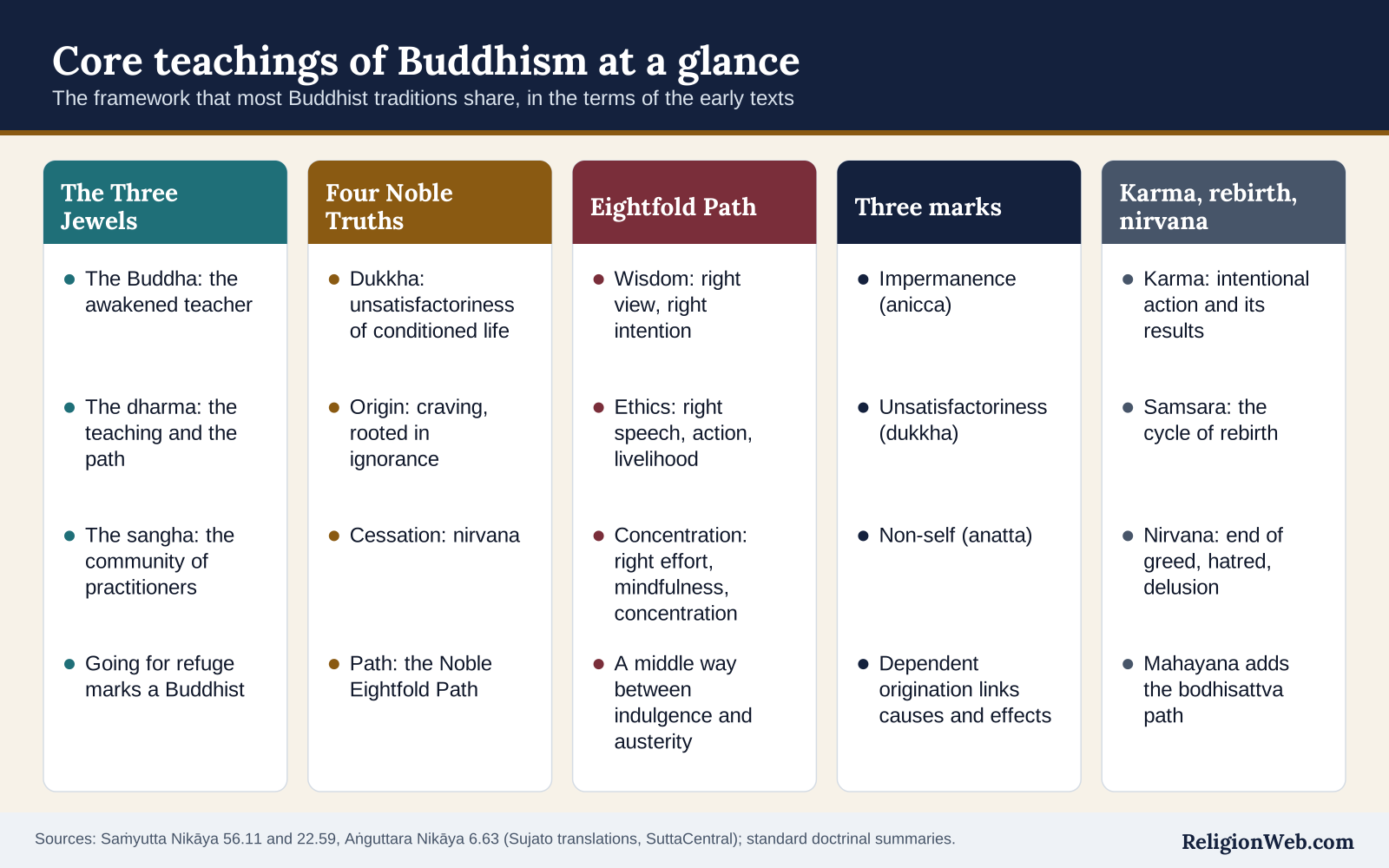
A few words recur in almost every Buddhist context. The Three Jewels (Buddha, dharma, sangha) are the objects of refuge, and “going for refuge” is the act that marks a person as a Buddhist in most traditions. The three marks of existence are the characteristics the early texts say belong to all conditioned things: impermanence (anicca in Pali, anitya in Sanskrit), unsatisfactoriness or suffering (dukkha), and non-self (anatta, anatman), the teaching that no permanent, independent self can be found in the changing flow of body and mind. These terms are explained in the teachings section below.
Two further words are worth keeping in mind from the start. Samsara is the beginningless round of birth, death, and rebirth driven by craving and karma. Nirvana (Pali nibbana) means “extinguishing” or “blowing out,” the ending of greed, hatred, and delusion, and with it the ending of rebirth. Whether and how nirvana is described in positive terms differs between traditions, and that question receives its own treatment later.
Terms that change by language and school
The first generation of Buddhist literature was composed in Middle Indo-Aryan languages, of which Pali is the one best preserved as a complete canon. Mahayana and later Indian literature used Sanskrit and hybrid forms, and the transmission to China, Tibet, and elsewhere added more vocabularies. As a result, the same idea may have two or three standard names. English writing often picks one set for convenience, and this article uses Pali forms when discussing the early texts and Theravada, and Sanskrit forms when discussing Mahayana and Vajrayana, with the other form given where it helps.
| English gloss | Pali | Sanskrit | Basic meaning |
|---|---|---|---|
| Teaching | dhamma | dharma | The Buddha’s teaching; also “phenomena” or “truth” in some contexts |
| Intentional action | kamma | karma | Deliberate action of body, speech, and mind and its results |
| Cycle of rebirth | samsara | samsara | Repeated birth and death conditioned by craving and ignorance |
| Liberation | nibbana | nirvana | Extinguishing of greed, hatred, and delusion; end of rebirth |
| Discourse | sutta | sutra | A text recording the Buddha’s teaching or a teaching in his name |
| Monastic discipline | vinaya | vinaya | Rules and procedures for the monastic community |
| Wisdom | pañña | prajña | Insight into the nature of things, one of the three trainings |
| Worthy one | arahant | arhat | One who has ended defilements and rebirth by following the Buddha’s path |
| Bodhisattva (awakening being) | bodhisatta | bodhisattva | One on the path to full Buddhahood, in Mahayana an ideal for all practitioners |
| Loving-kindness | metta | maitri | Goodwill toward all beings, one of the four boundless states |
The Buddha: Life, Dating, and the Early Community
What the Sources Say About the Buddha’s Life
The traditional biography
Buddhist tradition tells the life of the Buddha as a story with a clear arc. According to the Pali commentarial literature and to Sanskrit biographies such as the Buddhacarita attributed to Ashvaghosha (usually dated to about the first or second century CE), Siddhartha Gautama was born at Lumbini to the Shakya clan, whose chief, Shuddhodana, is traditionally called a king. His mother, Maya, is said to have died soon after his birth. He grew up in comfort, married, and had a son named Rahula. At about the age of twenty-nine he encountered, in the well-known narrative of the “four sights,” an aged person, a sick person, a corpse, and a wandering renunciant, and resolved to leave home in search of an end to suffering.
After studying with two meditation teachers, whom the Pali texts name as Alara Kalama and Uddaka Ramaputta, and after years of severe ascetic practice, he is said to have abandoned self-mortification in favor of a middle course. Seated beneath a fig tree (the bodhi tree) at the place now called Bodh Gaya, he reached awakening (bodhi) at about the age of thirty-five. He then walked to the Deer Park at Isipatana near Varanasi, today’s Sarnath, and delivered the first sermon to five former companions. For some forty-five years he taught across the kingdoms of the middle Ganges, founded an order of monks and later nuns, and attracted lay supporters. He died at about eighty near Kushinagar, an event Buddhists call his parinirvana, or “final nirvana.”
What historians can establish
Most historians accept that a teacher of this kind lived, taught, and founded a community in the region of Magadha and Kosala, and that he was associated with the Shakya people. The strongest early physical evidence is an inscription on a pillar at Lumbini, set up by the Mauryan emperor Ashoka and traditionally dated to 249 BCE, which states that the Buddha was born there; UNESCO cites it in its World Heritage listing of the site, inscribed in 1997. Beyond such points, caution is needed. The surviving biographies were composed centuries after the Buddha’s death, and many scenes in them, such as the four sights, a birth accompanied by miracles, or the temptations by the figure of Mara, serve to express doctrinal meaning. Even the four sights appear in the early Pali discourses attached to an earlier Buddha, Vipassi, before later authors applied them to Gautama.
The Stanford Encyclopedia of Philosophy summarizes the problem plainly: knowledge of the Buddha’s teaching comes through texts not written down until several centuries after his death, in languages other than the one he probably spoke, and the surviving collections disagree in important respects. Scholars such as Richard Gombrich and Eviatar Shulman are more optimistic that a core of early teaching can be recovered, while others hold that the textual record reflects the concerns of later communities. This article follows the common scholarly practice of describing what the texts attribute to the Buddha, while noting where history and tradition diverge.
| Event | Traditional account | Historical standing |
|---|---|---|
| Birth | At Lumbini, to the Shakya chief Shuddhodana and Maya | Lumbini named as birthplace in Ashoka’s pillar inscription (traditionally 249 BCE); details of the birth narrative are later |
| Going forth | At about 29, after the four sights, leaving family and palace | Early discourses confirm a renunciation; the four-sights story is a later elaboration |
| Awakening | At about 35, at Bodh Gaya beneath the bodhi tree | Place and event are universally affirmed by tradition; the present Mahabodhi Temple is of the fifth or sixth century CE, on an earlier site |
| First sermon | To five ascetics at Isipatana (Sarnath) near Varanasi | Reported in several canons; the text of the sermon was shaped over time |
| Teaching career | About 45 years, with rainy-season residences in Magadha and Kosala | Broadly accepted; the length is traditional |
| Death | At about 80, at Kushinagar; relics divided among eight claimants | Age of 80 is attested across sources; the date remains debated |
When Did the Buddha Live? The Dating Debate
The traditional chronology and its variants
No Indian source of the period records a calendar date for the Buddha, so every date is inferred. The Theravada chronicles of Sri Lanka, the Dipavamsa and Mahavamsa, state that the Buddha died 218 years before the consecration of Ashoka. Combined with the chronicles’ lists of kings, this figure produces a death in 544 or 543 BCE and a birth around 623 BCE, although the chronicles’ absolute dating of Ashoka runs about sixty years earlier than the Greek synchronisms allow. That reckoning is the basis of the Buddhist Era used in Sri Lanka, Myanmar, and Thailand, where the civil calendar year corresponding to 2026 CE is 2569. Sanskrit sources preserved in East Asia, by contrast, give a figure of about a hundred years between the death and Ashoka, and other Buddhist lineages in India and China offered still other counts.
Modern historians did not accept the 218-year figure at face value. Ashoka’s edicts name several Hellenistic kings, including Antiochus II of Syria and Ptolemy II of Egypt, whose reign dates are known from Greek and Near Eastern sources. These synchronisms place Ashoka’s accession at around 268 BCE. Adding the Sri Lankan figure of 218 years yields a Buddha who died around 486 or 483 BCE, which became the “corrected long chronology” used by many twentieth-century handbooks, with a lifespan of about 563 to 483 BCE.
The shorter chronology and where the debate stands
In 1988 a symposium at the University of Göttingen, organized by Heinz Bechert and later published in several volumes, reviewed the evidence afresh. Many participants concluded that the Buddha’s death should be placed considerably later than the corrected long chronology, within a few decades of 400 BCE. Richard Gombrich, for example, argues from the lineage of teachers in the Sri Lankan chronicles that the figure of 218 years is an error and that the death is most likely about 404 BCE. L. S. Cousins, reviewing the Göttingen papers, concluded that the evidence favored a “median” chronology and a death near 400 BCE. The Stanford Encyclopedia notes that many scholars now hold that he died around 405 BCE. Peter Harvey’s textbook on Buddhism presents both the older range of roughly 566 to 486 BCE and Gombrich’s later estimate, and it notes that Indian sources recorded no precise dates.
The short version, then, is that the traditional Theravada dates of 623 to 543 BCE remain the official dates in several Buddhist countries, the corrected long chronology of roughly 563 to 483 BCE still appears in many reference works, and a large share of specialists now prefer a death date within a few decades of 400 BCE. What all these positions share is a Buddha who lived in the fifth century BCE or thereabouts, in an India before the Mauryan empire. Anyone relying on a single date should treat it as a convention rather than a settled fact.
The Early Community Around the Buddha
The first disciples and the founding of the sangha
The early discourses present the sangha as growing in stages. The five ascetics who heard the first sermon, led by Kondanna (Kaundinya), became the first monks. Within a short time the Buddha was joined by young men from Varanasi, by the former ascetics Sariputta and Moggallana, who became his chief disciples, and by others such as Mahakassapa and Ananda, his long-time attendant. King Bimbisara of Magadha is remembered as an early patron who donated a bamboo grove near Rajagaha for the community’s use, and the merchant Anathapindika is remembered for the donation of the Jeta Grove monastery near Savatthi. Even if the details of such stories were polished by later narrators, they reflect a real pattern: Buddhist monasticism developed with the support of lay donors and rulers, and the practice of residing in fixed monasteries during the rainy season began early.
Women, laypeople, and the order of nuns
Lay followers, men and women, formed the second wing of the early community. Pali sources recount that the Buddha taught laypeople about generosity, ethics, and the benefits of good conduct, and name prominent lay disciples including Anathapindika and the laywoman Visakha. The order of nuns (bhikkhuni sangha) was established, according to the Vinaya, after Mahapajapati Gotami, the Buddha’s aunt and foster mother, requested ordination. The accounts in the Pali and other Vinaya collections report that the Buddha agreed after Ananda’s intercession, on the condition that the nuns accept additional rules. Scholars differ about the historical development of these stories and about what they imply for the status of women in early Buddhism. Within Buddhist communities, they remain central to modern debates about women’s ordination, discussed below.
The Buddha’s death and the division of relics
The Mahaparinibbana Sutta, the long discourse in the Pali Digha Nikaya that recounts the Buddha’s last journey, tells how he fell ill after a meal at the house of Cunda the smith, continued to Kushinagar, gave final instructions to Ananda and the monks, and died. The text presents his last words to the monks as an exhortation to diligence.
Come now, mendicants, I say to you all: ‘Conditions fall apart. Persist with diligence.’
Dīgha Nikāya 16 (Great Discourse on the Final Extinguishment), translated by Bhikkhu Sujato (SuttaCentral, CC0), segment 6.7
Theravada and other traditions read the saying as a summary of the whole teaching: since all conditioned things pass away, effort in practice should not be postponed. The text then describes how the body was cremated and the relics divided among eight claimants, each of whom built a monument. Later tradition, especially the Ashokan legends, says that Ashoka redistributed the relics to many stupas. The importance of this account for Buddhist practice is hard to overstate: the veneration of relics and of stupas, and the custom of pilgrimage to the sites of birth, awakening, first sermon, and death, are rooted in this episode.
Historical Development: From a Gangetic Movement to an Asian Religion
Early Buddhism, Ashoka, and the Schools in India
Councils, schisms, and the early schools
Buddhist tradition says that soon after the Buddha’s death a gathering of senior monks at Rajagaha recited the teaching and the monastic rules, and that a second assembly at Vesali, about a century later, dealt with disputed points of monastic discipline. Historians regard the second council as probably historical and the first as at least reflecting an early effort to fix a shared body of teaching, but the details and even the number of councils differ between the Theravada, Sarvastivada, and other accounts. What is clear is that within a few centuries the community had divided into a number of nikayas, or monastic fraternities, usually described in later sources as “the eighteen schools.” The cause of the first splits is uncertain. Many modern scholars think disagreements over monastic discipline were the main trigger, although some Sthavira sources cite doctrinal disputes. The traditional narrative of a clean break between the Mahasanghika and the Sthavira groups is generally treated as a simplification of a slower process.
Only three of these early ordination lineages survive today. The Theravada, which descends from the Sthavira line by way of the Sri Lankan Mahavihara, is the monastic tradition of Sri Lanka and mainland Southeast Asia. The Dharmaguptaka lineage governs monastic ordination in most of East Asia, and the Mulasarvastivada lineage governs it in Tibetan Buddhism. This is a point worth keeping clear: the names of the early schools describe monastic law, which is separate from the later philosophical movements of Mahayana, which developed within these early communities.
Ashoka and the first expansion
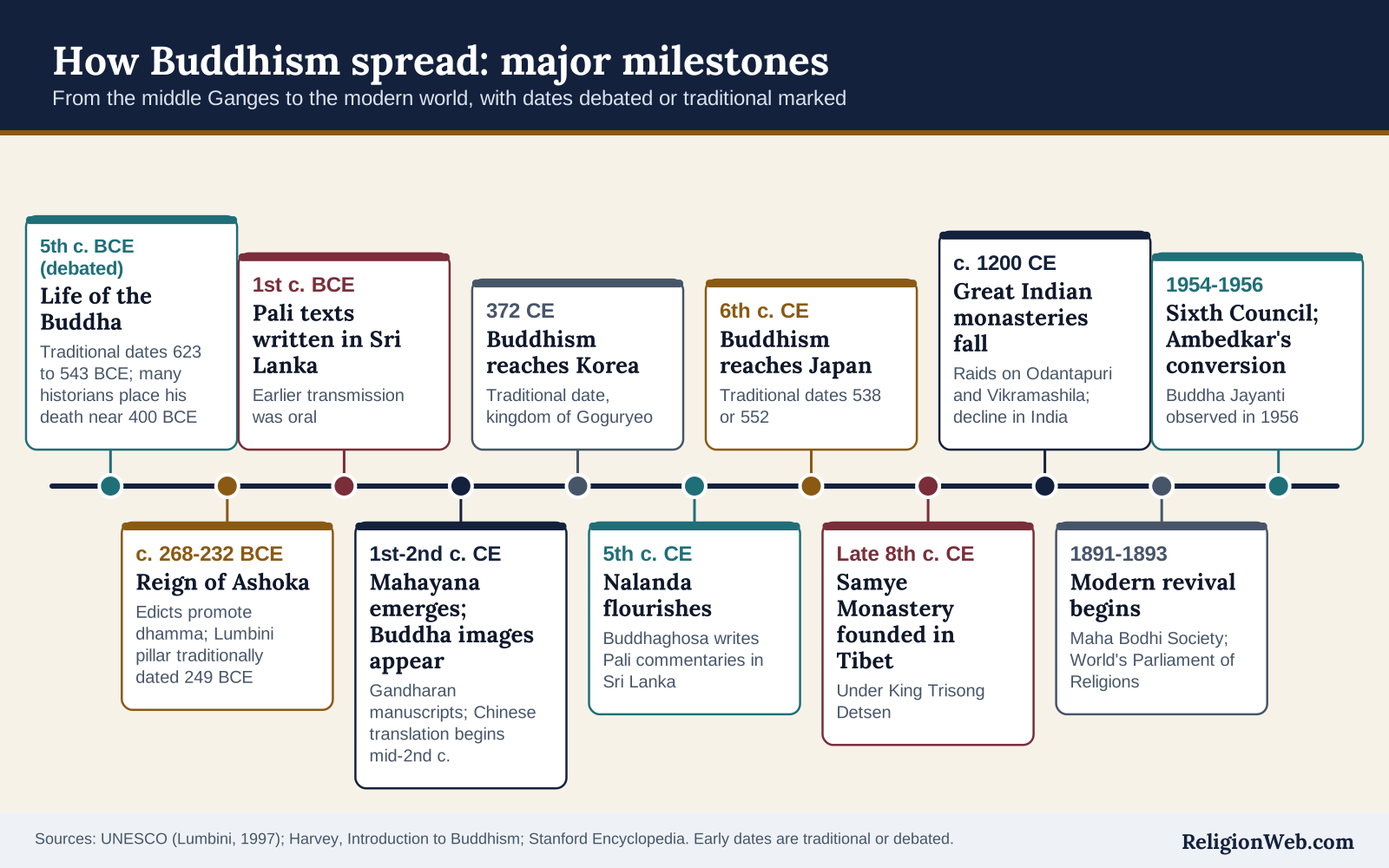
The Mauryan emperor Ashoka, who reigned from about 268 to 232 BCE, is the first Buddhist ruler for whom firm documentary evidence exists. His rock and pillar edicts, inscribed across the subcontinent, record his remorse over the suffering caused by his conquest of Kalinga, his commitment to a public ethic called dhamma, and his description of himself as a lay follower (upasaka) of the Buddha. The edicts refer to dhamma largely as a moral program of non-violence, tolerance, generosity, and respect for parents, teachers, and religious communities of all kinds, and they do not describe a state church. Scholars debate whether his adoption of Buddhism came before or after the Kalinga war and how much Buddhist doctrine lay behind his policy. The Sri Lankan chronicles add a rich tradition: a third council at Pataliputra, the dispatch of missionaries to nine regions, and the mission of his son Mahinda and daughter Sanghamitta to Sri Lanka. These accounts are not confirmed in the edicts, and they are best treated as traditional history that is plausible in outline.
Whatever the exact role of Ashoka, Buddhism grew in the centuries after his reign. Monastic complexes appeared near trade routes, and royal and merchant donors funded stupas such as those at Sanchi and Bharhut. In the northwest, in the region of Gandhara, Buddhism met Greek, Persian, and Central Asian cultures and left behind the oldest surviving Buddhist manuscripts, birch-bark scrolls in the Gandhari language and Kharosthi script dating from about the first century BCE to the third century CE. Buddha images in human form appear in Gandhara and Mathura around the first and second centuries CE, after a long earlier period in which the Buddha was indicated by symbols such as an empty throne, a footprint, or a wheel.
The rise of Mahayana and Vajrayana in India
The movement known as the Mahayana, the “Great Vehicle,” emerged in India during the centuries around the turn of the Common Era. Its earliest textual traces include the Perfection of Wisdom sutras, whose first versions many scholars date to the first century BCE, and the earliest Mahayana texts known in translation are Chinese renderings made in the later second century CE. Inscriptions suggest that Mahayana was for a long time a minority current inside existing monastic communities rather than a separate institution, and it grew in influence over time. Major thinkers followed, including Nagarjuna (around the second or third century CE), who founded the Madhyamaka tradition of emptiness, and Asanga and Vasubandhu (around the fourth or fifth century CE), who are associated with the Yogacara tradition. The great monastic university of Nalanda, in what is now Bihar, flourished from about the fifth century CE until around 1200 and became a center of study for monks from across Asia.
From roughly the seventh century onward, a body of texts and practices called tantra, which prescribed rituals involving mantras, visualization, mandalas, and initiation, developed within Indian Buddhism alongside parallel developments in other Indian traditions. These materials shaped the Vajrayana, the “Diamond” or “Thunderbolt Vehicle,” and they were carried to Tibet, Nepal, China, Japan, and Indonesia. Indian tantric practice is associated with legendary figures called mahasiddhas, and with monastic centers such as Nalanda and Vikramashila, where tantric study was combined with the study of philosophy.
Buddhism Across Asia
Sri Lanka and Southeast Asia
According to the Sri Lankan chronicles, Buddhism reached the island in the third century BCE, in the reign of King Devanampiya Tissa, and the Mahavihara monastery in Anuradhapura became the home of the Theravada tradition. The Pali texts were written down in Sri Lanka in the first century BCE, and in the fifth century CE the scholar Buddhaghosa compiled the standard Pali commentaries there. From Sri Lanka and from earlier contacts with India, Buddhism spread to Southeast Asia. Pyu and Mon communities in what is now Myanmar and Thailand adopted forms of Buddhism in the first millennium CE, while Mahayana and tantric Buddhism flourished at places such as Borobudur on Java in the ninth century. The Theravada form became dominant in Myanmar under the kingdom centered on Bagan in the eleventh century, and during the thirteenth and fourteenth centuries monastic lineages linked to Sri Lanka took root in what are now Thailand, Laos, and Cambodia.
Central Asia, China, Korea, Vietnam, and Japan
Buddhism moved along the Silk Road through oasis kingdoms such as Khotan and Kucha and reached China by the first century CE. Later tradition dates the arrival to a dream of Emperor Ming of the Han dynasty, but historians point to merchant communities and gradual diffusion. The first documented translators were foreign monks, among them the Parthian An Shigao, active in Luoyang from around the middle of the second century CE, and Lokaksema, who translated Mahayana texts in the 170s and 180s. Translators such as Kumarajiva (traditionally 344 to 413) and the pilgrim Xuanzang, who traveled to India between 629 and 645 and returned with hundreds of manuscripts, built the Chinese canon. Chinese Buddhists created distinctive schools, including Tiantai, Huayan, Pure Land, and Chan, and the Tang dynasty (618 to 907) was a high point of Buddhist institutions, until the state-led suppression of 845 curtailed monastic wealth.
Buddhism entered Korea from China at the end of the fourth century, in 372 CE according to tradition for the kingdom of Goguryeo, and reached Japan in the sixth century CE, with the Japanese chronicles giving 552 and other sources 538. In Japan the Nara and Heian periods saw the rise of state-supported temples and of the esoteric Tendai and Shingon schools, while the Kamakura period (1185 to 1333) brought the new movements associated with Honen and Shinran (Pure Land), Eisai and Dogen (Zen), and Nichiren. Buddhism reached Vietnam by sea and by land from the early centuries CE, and the Vietnamese Thien tradition parallels Chan and Zen. In all these societies Buddhism interacted with indigenous traditions, including the Confucian ethical order, Daoist practice, the ancestral and deity worship of Chinese folk religion, and the kami worship of Shinto. The relationships were sometimes cooperative and sometimes competitive, and they changed from century to century.
Tibet, Mongolia, and the Himalayas
Buddhism reached Tibet during the seventh century CE under the Yarlung kings, and royal support under Trisong Detsen in the later eighth century established the first monastery at Samye. Tibetan tradition holds that the Indian masters Shantarakshita and Padmasambhava took part in this work. After a period of fragmentation, a “second dissemination” beginning in the late tenth and eleventh centuries brought new translations, the arrival of the Indian teacher Atisha in 1042, and the formation of the Kagyu, Sakya, and Kadam lineages, followed in the fifteenth century by the Gelug school of Tsongkhapa. Alongside these developed the Nyingma school, which looks to the earlier translation period. Mongol rulers of the Yuan dynasty became patrons of Sakya lamas in the thirteenth century, and in 1578 the Mongol leader Altan Khan conferred the title Dalai Lama on the Gelug hierarch Sonam Gyatso. The Fifth Dalai Lama established the Ganden Phodrang government in 1642. Tibetan forms of Buddhism also spread to Mongolia, Buryatia, Kalmykia, Bhutan, Sikkim, Ladakh, and Nepal.
Decline in India, Colonial Disruption, and Revival
Why Buddhism faded in India
Buddhism declined in the Indian subcontinent over many centuries, and scholars still debate the causes. Monastic institutions depended on royal and merchant patronage, and the fragmentation of the Gupta empire after the sixth century and changing regional politics reduced support in some areas. Devotional movements within the Brahmanical and Hindu traditions gained a broad popular base, and some historians, among them Johannes Bronkhorst, argue that Buddhism’s own adoption of ritual and institutional forms blurred its distinctiveness. Military campaigns also played a role. Turkic forces raided Buddhist sites in northern India in the late twelfth century, and the destruction of Odantapuri around 1197 and the attack on Vikramashila around 1200 are recorded. Some historians give these raids a major place in the story, while others, such as Giovanni Verardi, argue that internal political and religious changes mattered more. Buddhism survived in pockets, including Bengal, Kashmir, and the Himalayan regions, and it flourished elsewhere in Asia.
Colonialism, reform, and revival in the nineteenth and twentieth centuries
In the nineteenth century, European scholars rediscovered Buddhist texts in Sanskrit, Pali, Chinese, and Tibetan, the Pali Text Society was founded by T. W. Rhys Davids in 1881, and educated Asians began to present Buddhism in modern terms, emphasizing reason, ethics, and meditation. The Sinhalese reformer Anagarika Dharmapala founded the Maha Bodhi Society in 1891 to restore Buddhist control of the Mahabodhi Temple at Bodh Gaya, and he and the Japanese Zen teacher Soyen Shaku both took part in the World’s Parliament of Religions in Chicago in 1893. In 1954 to 1956 Myanmar hosted a Sixth Council (Chattha Sangayana) to recite and edit the Pali canon, and in 1956 Sri Lanka and other countries observed the 2,500th anniversary of the Buddha’s death in the Theravada reckoning, known as Buddha Jayanti.
The twentieth century was also a period of severe disruption. Buddhist institutions were curtailed under communist governments in China, Mongolia, and Cambodia, with devastating consequences for monasteries, monks, and libraries, and in 1959 the Fourteenth Dalai Lama went into exile in India after the Tibetan uprising, followed by many thousands of Tibetans. Meanwhile, Buddhism spread to Europe and the Americas through Asian immigrants, missionaries, and Western converts. The modern movements are discussed later in this article.
| Approximate date | Development | Note |
|---|---|---|
| Fifth century BCE (debated) | Life and teaching of the Buddha in the middle Ganges region | Traditional dates 623 to 543 BCE; many historians place the death within a few decades of 400 BCE |
| Around 268 to 232 BCE | Reign of Ashoka; edicts promote dhamma | Lumbini pillar inscription traditionally dated 249 BCE |
| First century BCE | Pali texts written down in Sri Lanka | Tradition places this under King Vattagamani; earlier transmission was oral |
| First to second centuries CE | Gandharan manuscripts; first Buddha images in human form | Oldest surviving Buddhist manuscripts, in Gandhari on birch bark |
| Mid second century CE | First documented translations into Chinese | An Shigao and Lokaksema in Luoyang |
| 372 CE | Buddhism formally introduced in the Korean kingdom of Goguryeo | Traditional date; Buddhism reached other Korean kingdoms soon after |
| Fifth century CE | Nalanda becomes a major monastic university; Buddhaghosa writes Pali commentaries | Nalanda flourished until around 1200 |
| Sixth century CE | Buddhism reaches Japan | Traditional dates 538 or 552 |
| Eighth century CE | Samye Monastery established in Tibet | Under King Trisong Detsen; later tradition credits Padmasambhava and Shantarakshita |
| 845 CE | State suppression of Buddhist institutions in Tang China | Monastic wealth and numbers sharply reduced |
| Around 1197 to 1200 | Raids on Odantapuri and Vikramashila in northern India | Signal the end of the great Indian monastic universities |
| 1578 | Title Dalai Lama conferred by Altan Khan | Applied to Sonam Gyatso, the third in the later numbering |
| 1891 to 1893 | Maha Bodhi Society founded; Buddhist delegates attend World’s Parliament of Religions | Marks the start of modern global Buddhism |
| 1954 to 1956 | Sixth Buddhist Council in Yangon; Buddha Jayanti; Ambedkar’s conversion | Modern revival in South and Southeast Asia |
Core Teachings: The Four Noble Truths, the Eightfold Path, Karma, Rebirth, and Nirvana
The Four Noble Truths and the Middle Way
The first sermon and the middle way
Buddhists across traditions regard the four noble truths as the framework of the Buddha’s teaching. In the Pali canon they are laid out in the discourse traditionally called “Setting the Wheel of Dhamma in Motion” (Dhammacakkappavattana Sutta), which presents the sermon given to the five ascetics at Isipatana. It begins not with the truths themselves but with a warning about two ways of life that the Buddha is said to have rejected after trying both.
Mendicants, these two extremes should not be cultivated by one gone forth. What two? Indulgence in sensual pleasures, which is low, crude, ordinary, ignoble, and pointless. And indulgence in self-mortification, which is painful, ignoble, and pointless.
Saṁyutta Nikāya 56.11, translated by Bhikkhu Sujato (SuttaCentral, CC0), segment 2
The discourse goes on to present the “middle way,” identified with the noble eightfold path, as the course that avoids both. In the Theravada tradition this passage is understood as the founding statement of the path: a practice that is neither hedonistic nor severely ascetic. Mahayana traditions also honor the middle way, though many interpret the term more broadly, and in the Madhyamaka school the “middle” refers to a philosophical position between claims that things exist inherently and claims that nothing exists at all.
The four truths explained
The first truth is dukkha, usually translated as “suffering” but better understood as the pervasive unsatisfactoriness of conditioned existence. The text lists birth, aging, illness, death, association with what is disliked, separation from what is liked, and not getting what one wants, and it summarizes them as “the five grasping aggregates.” Later commentators distinguish ordinary pain, the suffering of change (pleasant experiences end), and the suffering inherent in all conditioned things. The second truth is the origin of suffering, identified as craving (tanha): craving for sensual pleasures, craving for continued existence, and craving for non-existence. The third truth is cessation, the fading away of that craving without remainder, which is nirvana. The fourth truth is the path leading to cessation.
A feature of the sermon that is often overlooked is its structure. Each truth is said to carry a task: suffering is to be fully understood, its origin is to be abandoned, its cessation is to be realized, and the path is to be developed. The Buddha is also reported to have said that he claimed full awakening only when his knowledge of the truths was “fully purified in these three rounds and twelve aspects,” meaning the truth itself, the task, and the accomplishment of the task, for each of the four. The framework is thus not a list of doctrines to be believed but a program to be carried out, and this practical framing is often described as a medical one: diagnosis, cause, prognosis, and treatment.
The Noble Eightfold Path
Eight factors in three trainings
The fourth noble truth is the noble eightfold path, which the tradition groups into three trainings. The training in ethics (sila) comprises right speech, right action, and right livelihood. The training in concentration (samadhi) comprises right effort, right mindfulness, and right concentration. The training in wisdom (panna, prajña) comprises right view and right intention. English translations vary: the SuttaCentral translation quoted above renders the factors as “right view, right purpose, right speech, right action, right livelihood, right effort, right mindfulness, and right immersion,” where other translators say “intention” and “concentration.” Buddhist teachers stress that the path is not a ladder of eight steps taken in sequence. The factors support one another and are developed together, though in practice many teachers present ethical restraint as the foundation for meditation, and meditation as the ground for lasting insight.
How the path is applied by monastics and laypeople
For monks and nuns, the path is lived through the monastic rule, daily meditation, study, and often seclusion. For laypeople, the early texts give a more graduated program that begins with generosity (dana), moves to ethical conduct (the five precepts), and then to meditation and understanding, with the expectation that most lay practitioners will pursue the first two more actively than the third. This division is more a matter of emphasis than of exclusion, since laypeople can and do meditate, and monastics also give and receive gifts. The path as a whole is intended to lead to the end of suffering in this life or in a future one, and in Mahayana traditions it is expanded to include the practices of a bodhisattva, who vows to attain Buddhahood for the benefit of all beings.
| Element | Pali and Sanskrit terms | Meaning | Task or training |
|---|---|---|---|
| First truth | dukkha / duhkha | Unsatisfactoriness and suffering of conditioned existence | To be fully understood |
| Second truth | samudaya / samudaya | Origin of suffering in craving | To be abandoned |
| Third truth | nirodha / nirodha | Cessation of suffering; nirvana | To be realized |
| Fourth truth | magga / marga | The path leading to cessation | To be developed |
| Right view and right intention | samma-ditthi, samma-sankappa | Understanding the truths; intentions of renunciation, goodwill, and harmlessness | Wisdom (panna) |
| Right speech, action, and livelihood | samma-vaca, kammanta, ajiva | Truthful and kind speech; non-harming action; earning a living without harm | Ethics (sila) |
| Right effort, mindfulness, and concentration | samma-vayama, sati, samadhi | Cultivating wholesome states; sustained awareness; unified, calm mind | Concentration (samadhi) |
Impermanence, Non-Self, and Dependent Origination
The three marks and the five aggregates
The early texts say that all conditioned things share three marks: they are impermanent (anicca), they are unsatisfactory when clung to (dukkha), and they are not-self (anatta). The teaching of not-self is among the most distinctive and most misunderstood features of the tradition. In the second discourse attributed to the Buddha, the Anattalakkhana Sutta (Saṁyutta Nikāya 22.59), the person is analyzed into five aggregates (khandhas): material form, feeling, perception, volitional formations, and consciousness. The Buddha asks the five ascetics whether each aggregate is permanent or impermanent, whether what is impermanent can be regarded as “mine, I am this, this is my self,” and concludes that none of the five should be taken as a self. In paraphrase, the text argues that if form were a self it would not lead to affliction and one could command it to be otherwise, and it ends with the disciples becoming disenchanted and freed.
What this means is an interpretive question that has occupied Buddhist thinkers for two millennia. Theravada commentators generally read the teaching as denying any permanent, independent self in the five aggregates while affirming that conventional persons exist and that karma bears results. Some early schools, such as the Pudgalavada, held that a “person” is neither identical to nor separate from the aggregates, and they were criticized by other schools for it. Mahayana philosophers extended the analysis, arguing that not only persons but all phenomena are empty of inherent existence, a view called shunyata. The early texts also record occasions on which the Buddha remained silent when asked whether there is a self, and interpreters differ on what that silence means. The practical point in every case is that clinging to a fixed sense of self is held to be a root of suffering.
Dependent origination
The teaching of dependent origination (paticca-samuppada) describes how suffering arises and ceases through conditioned causes. Its most common form lists twelve links: ignorance conditions volitional formations, which condition consciousness, name-and-form, the six sense bases, contact, feeling, craving, clinging, becoming, birth, and finally aging and death. Read forward, the chain explains how a life of craving perpetuates itself and leads to rebirth. Read backward, it shows how removing ignorance halts the sequence. Buddhist schools differ in how they read the links, for example whether they span three lifetimes, as in many Theravada and Tibetan accounts, or can also be read as describing moment-to-moment processes of mind. The principle is often summarized in a short formula: when this exists, that comes to be; when this ceases, that ceases. In the Mahayana tradition, dependent origination became the basis for the doctrine of emptiness, since a thing that exists only in dependence on causes and conditions has no independent nature.
Karma, Rebirth, and Nirvana
Karma as intentional action
Karma (Pali kamma) means “action,” and in Buddhist usage it refers specifically to deliberate action. In the Pali discourse called “Penetrative” the Buddha is recorded as defining the term himself.
It is intention that I call deeds. For after making a choice one acts by way of body, speech, and mind.
Aṅguttara Nikāya 6.63, translated by Bhikkhu Sujato (SuttaCentral, CC0), segment 33
This definition places the moral weight on intention rather than on ritual or external events. Wholesome intentions rooted in generosity, goodwill, and understanding are said to lead to happiness, and unwholesome intentions rooted in greed, hatred, and delusion are said to lead to suffering, in this life or in later ones. Karma in the early texts is not a fixed fate. The tradition says that results depend on many factors, that they can be mitigated or altered by later actions, and that not every experience is the result of past karma. A discourse often cited in this connection, the Sivaka Sutta (Saṁyutta Nikāya 36.21), lists bodily disorders, climate, careless behavior, and external attack alongside karma as causes of painful feeling. For that reason, Buddhist teaching does not treat illness or misfortune as a punishment, and the traditions do not present karma as a substitute for medical care.
Rebirth, realms of existence, and cosmology
Most Buddhist traditions teach that beings are reborn after death in one of several realms of existence, determined by karma and mental state. The most common scheme lists six realms: hell beings, hungry ghosts, animals, humans, demigods (asuras), and gods (devas). Theravada commentaries describe thirty-one planes of existence, and Tibetan Buddhism depicts the six realms in the wheel of life. Because the doctrine of non-self denies a permanent soul, Buddhist thinkers explain rebirth as a causal continuity, often compared to a flame passed from one lamp to another. Some schools, including those of Tibetan Buddhism, speak of an intermediate state (antarabhava, bardo) between death and rebirth, while the Theravada commentarial tradition generally rejects one. Many modern Buddhists, especially in Western convert communities and among modernist reformers, interpret rebirth in psychological or metaphorical terms. That is a minority position in the historic traditions of Asia.
Nirvana
Nirvana (Pali nibbana), literally “extinguishing,” is the goal of the path in most Buddhist traditions. The early texts describe it first through negation: the end of greed, hatred, and delusion, the end of craving, freedom from birth and death. A short discourse in the Itivuttaka distinguishes two modes.
The ending of greed, hate, and delusion in them is called the element of extinguishment with residue.
Itivuttaka 44, translated by Bhikkhu Sujato (SuttaCentral, CC0), segment 3
The passage speaks of an arahant who has ended the defilements but still lives and experiences pleasure and pain; in the second mode, “with no residue,” the arahant has died and no new rebirth follows. Theravada traditions treat nibbana as an unconditioned reality that is the opposite of the conditioned world, and they generally refuse to describe it beyond such terms as “the deathless,” “peace,” and “the unconditioned.” Mahayana authors, drawing on Madhyamaka thought, often argue that nirvana and samsara are not ultimately different in nature, as both are empty of inherent existence, and they teach that bodhisattvas postpone full entry into final nirvana, or reach a “non-abiding nirvana,” in order to help others. Pure Land traditions teach rebirth in the Pure Land of Amitabha as a favorable setting to attain awakening, not as the goal itself. In none of these accounts is nirvana a place of reward in the sense of a heaven, a point discussed later in this article.
Doctrinal Developments in Mahayana and Vajrayana
The bodhisattva ideal and the perfections
Mahayana literature places the bodhisattva at the center of the path. A bodhisattva is a being who generates the aspiration for full Buddhahood (bodhicitta) for the benefit of all beings and who practices the six perfections: generosity, ethical conduct, patience, effort, meditation, and wisdom. Theravada tradition also recognizes bodhisattvas, in the sense of Buddhas-to-be such as Gautama before his awakening, and it lists ten perfections (paramis), but it does not generally present the bodhisattva path as the model for all practitioners. The Mahayana sutras also describe celestial bodhisattvas such as Avalokiteshvara, Manjushri, and Samantabhadra, who are invoked in prayer and regarded as compassionate helpers.
Buddha-nature, the three bodies, and tantric transformation
Mahayana thinkers also developed teachings on the nature of Buddhahood. The doctrine of the three bodies (trikaya) distinguishes the Dharma body, the ultimate nature of reality, from the enjoyment body and the manifestation body through which a Buddha appears in the world. The teaching of buddha-nature (tathagatagarbha) holds that all beings have the potential for awakening, and East Asian and Tibetan traditions interpret it in different ways, some stressing a positive ground of awakening and others reading it as emptiness itself. In the Vajrayana, practitioners use mantra, visualization of deities, and ritual initiation as methods that are said to transform ordinary experience into the awakened state, often within a single lifetime. These practices are taught under the guidance of a qualified teacher (lama or guru), and they are explained at greater length on the Vajrayana Buddhism page.
Testing the Teaching: Skepticism, Dialogue, and Unanswered Questions
The Kalama Sutta and the invitation to verify
One of the best-known passages in the Pali canon is addressed to the Kalamas of Kesamutta, who were uncertain which of the competing teachers visiting their town to trust. The Buddha tells them not to rely on tradition, textual authority, reasoning alone, or the standing of a teacher, and instead to examine what leads to harm and what leads to welfare.
But when you know for yourselves: ‘These things are unskillful, blameworthy, criticized by sensible people, and when you undertake them, they lead to harm and suffering’, then you should give them up.
Aṅguttara Nikāya 3.65, translated by Bhikkhu Sujato (SuttaCentral, CC0), segment 4
The passage is sometimes cited as proof that Buddhism asks for no faith or that the Buddha taught each person to follow their own judgment about everything. The context is narrower. The Buddha is shown testing the Kalamas’ moral intuitions about greed, hatred, and delusion, and then confirming that these states lead to harm. Elsewhere the texts describe the role of confidence (saddha) in a trusted teacher, and the tradition holds that the path is ultimately verified in experience. Many modern Buddhist teachers read the passage as a call for ethical discernment, while some scholars caution that it should not be isolated from the rest of the canon.
Questions the Buddha set aside and the raft that is left behind
The canon also contains discourses in which the Buddha declines to answer certain metaphysical questions, such as whether the world is eternal or whether a Buddha exists after death. In the Culamalunkya Sutta (Majjhima Nikaya 63) he compares a man wounded by a poisoned arrow who refuses treatment until he learns the name of the archer; the point is that the teaching concerns the end of suffering, not speculation. The Alagaddupama Sutta (Majjhima Nikaya 22) compares the teaching to a raft that is used to cross a river and is then set down, which tradition reads as a warning against clinging even to the teachings themselves. These passages help explain why Buddhist schools have debated many matters, but have tended to measure doctrine by its usefulness for liberation.
Sacred Texts, Canons, and Scriptural Authority
The Pali Canon (Tipitaka)
Structure: the three baskets
Buddhism has no single scripture comparable to a single book. Instead, each major tradition preserves a large collection of texts called a canon, and the collections overlap in content but differ in language, arrangement, and authority. The canon of the Theravada tradition is the Pali Tipitaka, “the three baskets.” The Vinaya Pitaka contains the monastic rules and the stories of their origin. The Sutta Pitaka contains the discourses attributed to the Buddha and his leading disciples and is divided into five collections (nikayas): the Digha Nikaya of thirty-four long discourses, the Majjhima Nikaya of 152 medium-length discourses, the Samyutta Nikaya of thousands of short discourses grouped by topic, the Anguttara Nikaya of discourses arranged by numbered sets, and the Khuddaka Nikaya, a miscellany that includes the Dhammapada, the Sutta Nipata, the Jataka stories of the Buddha’s past lives, and verses of early monks and nuns. The Abhidhamma Pitaka consists of seven scholastic treatises that classify mental and physical phenomena systematically.
Scholars generally regard the first four nikayas as among the oldest layers of Buddhist literature, with parallel versions preserved in Chinese as the Agamas. Parallels between the Pali and Chinese collections allow historians to identify material shared across early schools, which they often treat as the oldest stratum available. Some other portions, especially parts of the Khuddaka Nikaya and the Abhidhamma, are generally judged later. The Pali canon is also the source of the translations quoted in this article, which come from the English renderings by Bhikkhu Sujato published on SuttaCentral and dedicated to the public domain.
Oral transmission, writing, and editions
The early texts were transmitted orally by communities of monks who recited them in groups, and tradition says they were first committed to writing in Sri Lanka in the first century BCE, at a time of political turmoil. In the fifth century CE, Buddhaghosa wrote the commentaries that remain the standard guides to the canon in Theravada countries. Modern printed editions include the Pali Text Society editions in Roman script, produced between 1877 and 1927, the Thai edition of 1925 to 1935, and the Burmese-script edition produced for the Sixth Council in 1954 to 1956 in forty volumes. In Theravada communities the canon is chanted, studied, and consulted in the original language, and monks in Myanmar, Thailand, and Sri Lanka often memorize substantial portions.
The Chinese and Tibetan Canons
The Chinese Buddhist canon
The Chinese canon is a vast collection assembled from translations made from Sanskrit, Prakrit, and Central Asian languages over roughly a thousand years, beginning with An Shigao in the second century CE. It contains early discourses in the Agama collections, many Mahayana sutras, the Vinaya of the Dharmaguptaka and other schools, Abhidharma treatises, Indian philosophical commentaries, tantric materials, and a large body of original Chinese works, including commentaries and records of masters. The first printed canon, the Kaibao canon, was produced in Sichuan between 971 and 983 using about 130,000 woodblocks. The Korean Tripitaka Koreana, carved in the thirteenth century on 81,258 woodblocks that are still kept at Haeinsa temple in South Korea, was a later monument of the same tradition. The modern standard edition, the Taisho Tripitaka, was compiled in Japan and published between 1924 and 1934. Its main section runs to 55 volumes with 2,184 texts, and the full set, with supplements, comprises 100 volumes.
The Tibetan Kangyur and Tengyur
The Tibetan canon has two parts. The Kangyur (“translation of the word”) collects texts regarded as the words of the Buddha, including Vinaya, sutras, and tantras, in roughly a hundred volumes, depending on the edition. The Tengyur (“translation of the treatises”) collects commentaries and Indian treatises by authors such as Nagarjuna, Asanga, and Vasubandhu, and fills over two hundred volumes. The canon was organized in the fourteenth century by the scholar Buton Rinchen Drub, and woodblock editions were later printed at several centers, including Derge in eastern Tibet in the 1730s. The arrangement distinguishes the Buddha’s word from later commentary, and the Tibetan translations are valued by scholars for their precision, since many Indian originals survive only in this form.
| Canon | Language | Associated tradition | Structure and notes |
|---|---|---|---|
| Pali Tipitaka | Pali | Theravada (Sri Lanka, Myanmar, Thailand, Laos, Cambodia) | Vinaya, Sutta (five nikayas), Abhidhamma; written down in the first century BCE by tradition; standard commentaries by Buddhaghosa |
| Chinese Buddhist canon | Classical Chinese | East Asian Mahayana, with some Vajrayana material | Agamas, Mahayana sutras, Vinaya, Abhidharma, commentaries; Taisho edition has 2,184 texts in its main 55 volumes |
| Tibetan Kangyur and Tengyur | Classical Tibetan | Tibetan Buddhism (Vajrayana and Mahayana) | Kangyur: words of the Buddha, about a hundred volumes; Tengyur: Indian commentaries and treatises, over two hundred volumes |
| Gandharan manuscripts | Gandhari in Kharosthi script | Early Buddhist communities of the northwest (Dharmaguptaka association proposed) | Birch-bark scrolls from about the first century BCE to the third century CE; the oldest known Buddhist manuscripts |
| Sanskrit manuscript collections | Sanskrit | Indian Mahayana and Vajrayana | Preserved mainly in Nepal; essential for comparing the Chinese and Tibetan translations |
Mahayana Sutras and Questions of Authority
Key Mahayana scriptures
Within the vast canons, certain Mahayana scriptures carry special weight in particular traditions. The Perfection of Wisdom (Prajnaparamita) sutras, which include the short Heart Sutra and the Diamond Sutra, expound emptiness and the bodhisattva path, and the Heart Sutra is chanted daily in many East Asian temples. The Lotus Sutra proclaims a single vehicle leading all beings to Buddhahood and is central to the Tiantai and Tendai schools and to Nichiren Buddhism. The Pure Land sutras describe the Buddha Amitabha and his western paradise, and they are the foundation of Pure Land devotion in China, Korea, Vietnam, and Japan. Other influential texts include the Vimalakirti Sutra, a story about a wise layman, the Avatamsaka (Flower Garland) Sutra, the Lankavatara Sutra, and the Platform Sutra, a text associated with the Chan master Huineng. For more on these works and their schools, see the article on Mahayana Buddhism.
Whose words count as the Buddha’s?
The question of authority is not simple. Theravada tradition treats the Pali canon as the closed collection of the Buddha’s teaching and holds that the Mahayana sutras are later compositions. Mahayana tradition, in contrast, affirms that its sutras are buddhavacana, the word of the Buddha, understood as teachings given on higher levels of understanding, taught to advanced disciples, or revealed through the Buddha’s inspiration. Historians date the Mahayana sutras to the centuries around and after the turn of the Common Era, and they do not regard them as the record of a historical sermon. In practice, many Buddhist communities treat texts as authoritative less through any formal canon than through lineage, liturgical use, and the interpretation of teachers. Texts are chanted, copied, enshrined, and sometimes venerated as objects in their own right, as well as studied.
Why Buddhist Texts Survive in Several Classical Languages
From Indian originals to Pali, Chinese, and Tibetan
A reader meeting Buddhist literature for the first time is often surprised to find that its major collections are in different languages, none of which is the language the Buddha spoke. The reasons are historical. Early Buddhist teaching was carried in several Middle Indo-Aryan dialects, and Pali became the language of the Sri Lankan Theravada canon. As Buddhism spread beyond India, communities translated the texts into the languages of their new homes. Chinese translations were made between the second and eleventh centuries, and Tibetan translations between the seventh and fifteenth centuries. Because Buddhism later disappeared from most of India, and because Indian monasteries and their libraries were lost or destroyed, many Indian works survive only in these translations. Others, particularly Mahayana and tantric texts, survive in Sanskrit manuscripts that were preserved in Nepal, where Newar Buddhist communities kept copying them for centuries.
Rediscovered manuscripts and modern scholarship
The recovery of Buddhist manuscripts continues. In the 1820s the British diplomat Brian Hodgson identified Sanskrit Buddhist manuscripts in Nepal and sent copies to scholars in Europe, which transformed the study of Mahayana literature. The Gandharan birch-bark scrolls, acquired by the British Library in 1994, date from about the first century CE and include a Dhammapada and early discourses, offering a window on Buddhist texts before the canons took their present shape. Digital projects now make Pali, Chinese, Tibetan, and Sanskrit corpora searchable, and comparative work among them is one of the main ways that historians reconstruct the development of early teachings. The practical lesson for readers is that where a modern book says “the Buddha taught,” a scholar will often want to know in which canon, in which language, and in which period the passage appears.
Major Traditions and Internal Diversity
The Three Main Streams
Theravada: the way of the elders
Theravada, “the teaching of the elders,” is the tradition of Sri Lanka, Myanmar, Thailand, Laos, and Cambodia, and it has communities in Bangladesh, Nepal, Vietnam, and Malaysia, and among diaspora populations. It takes the Pali canon as its scripture and the arahant, the practitioner who has reached nirvana by following the Buddha’s path, as its central ideal. Its monastic life follows the Pali Vinaya, and its meditative traditions center on calm (samatha) and insight (vipassana) practices. Theravada countries have a long record of royal and state support for the sangha, and many have formal hierarchies. Within Theravada there are several monastic orders and reform movements, such as the Dhammayut order founded in Thailand in the nineteenth century, the Thai Forest tradition, which stresses meditation in remote settings, and the Burmese vipassana lineages that became internationally influential in the twentieth century. A longer account appears in the article on Theravada Buddhism.
Mahayana: the great vehicle
Mahayana, the “great vehicle,” is the dominant tradition in China, Taiwan, Korea, Vietnam, and Japan. It teaches that the highest aim is to become a Buddha for the sake of all beings, through the way of the bodhisattva, and it draws on the Mahayana sutras and Indian treatises. It is not a single institution. East Asian Mahayana includes the Chan, Seon, Thien, and Zen schools, which emphasize meditation and direct training under a teacher, Pure Land schools, which focus on devotion to Amitabha, the Tiantai and Tendai schools based on the Lotus Sutra, the Huayan and Kegon schools based on the Flower Garland Sutra, and Nichiren Buddhism. Most East Asian monastics are ordained in the Dharmaguptaka Vinaya. A full account is in the article on Mahayana Buddhism.
Vajrayana: the diamond vehicle
Vajrayana, the “diamond” or “thunderbolt” vehicle, also called Mantrayana or Tantric Buddhism, is the dominant form in Tibet, Bhutan, Mongolia, and the Himalayan regions of Nepal, India, and Russia, and is also found in the esoteric Japanese schools of Shingon and Tendai. Its distinctive methods include initiation by a teacher, mantra recitation, visualization of deities, mandalas, and ritual with symbolic implements such as the vajra and bell. The four principal Tibetan lineages are the Nyingma, Kagyu, Sakya, and Gelug; the Dalai Lama is the leading figure of the Gelug school, and the Dalai Lamas headed the Tibetan government from 1642 until the 1950s. In July 2025 the Fourteenth Dalai Lama issued a statement affirming that the institution will continue and that the Gaden Phodrang Trust has sole authority to recognize his reincarnation, a position the Chinese government rejects. The topic is covered in more detail in the article on Vajrayana Buddhism.
How Buddhists and Scholars Classify the Traditions
Is Vajrayana part of Mahayana?
The three-part scheme used in this article is convenient, but it is not the only way to classify Buddhism. Tibetan scholastic traditions usually distinguish two vehicles, the Hearer and Solitary Realizer vehicle and the Mahayana, and then divide the Mahayana into the sutra path (Paramitayana) and the tantra path (Vajrayana or Mantrayana). In that view the Vajrayana is a part of the Mahayana, not a separate stream. Many academic scholars follow this logic and treat tantric Buddhism as a development within Mahayana, while many reference works, and the self-understanding of tantric practitioners in several traditions, present it as a third vehicle with its own scriptures, rituals, and lineages. Neither classification is wrong, and the choice depends on whether the stress is placed on doctrine, on method, or on institutional history. The article on Vajrayana discusses the issue directly.
Early schools, “Hinayana,” and respectful terminology
Older Western books often used the term “Hinayana,” “the lesser vehicle,” for non-Mahayana Buddhism. The word was a polemical label in some Mahayana texts and is considered pejorative by Theravada Buddhists, who do not accept it as a description of their tradition. Contemporary scholars generally avoid it. Instead, they speak of “early Buddhist schools” or “nikaya Buddhism” for the monastic fraternities of ancient India, and of Theravada for the one such school that survives as a living tradition. It is also a mistake to equate Theravada with the earliest Buddhism: it is a historical tradition with its own commentaries, councils, and reforms, and it descends from one of the early schools, as other traditions descend from others.
New Movements and Reinterpretations
Lay-led and reform movements
Many modern Buddhist movements are led by laypeople or combine lay and monastic leadership. In Japan, Soka Gakkai, a lay organization based on Nichiren’s teaching, grew into a large movement after the Second World War and now has branches in many countries. In Taiwan, the Tzu Chi Foundation, founded by the nun Cheng Yen in 1966, and Fo Guang Shan, founded by the monk Hsing Yun in 1967, developed large networks of humanitarian service and education, a form often called Humanistic Buddhism. In Britain and the West, Triratna, founded in 1967 as the Friends of the Western Buddhist Order, is among many new Buddhist organizations that combine lay and ordained members. Meditation centers in the vipassana, Zen, and Tibetan traditions have also spread widely outside Asia. These organizations differ in doctrine and practice, and some have been the subject of scholarly and public debate, but they illustrate the adaptability of the tradition.
Navayana: Ambedkarite Buddhism
In October 1956 the Indian jurist and political leader B. R. Ambedkar, who was born into a community then classed as “untouchable,” converted to Buddhism at Nagpur in a public ceremony. Hundreds of thousands of followers joined him over the next days, and the movement he began has continued to grow, especially in Maharashtra. Ambedkar called his interpretation Navayana, “the new vehicle.” He held that the Buddha’s teaching was above all a moral and social philosophy for the end of suffering and inequality, and he reinterpreted a number of traditional doctrines, including karma and rebirth. His book The Buddha and His Dhamma, published after his death in 1956, is a central text for many followers. Adherents see their Buddhism as a recovery of the Buddha’s original social message; many Buddhists and scholars outside the movement regard it as a distinct modern interpretation, and the question of how it relates to older Buddhist teaching remains debated. Pew Research Center’s 2019 to 2020 survey of India found that nearly all Indian Buddhists identified with historically marginalized caste categories, including 89 percent who described themselves as Dalits, and that about one-third of Indian Buddhists said they do not believe in God. Dhamma Chakra Pravartan Day, observed on 14 October, commemorates the conversion.
| Tradition | Main regions | Central ideal | Characteristic practices and texts |
|---|---|---|---|
| Theravada | Sri Lanka, Myanmar, Thailand, Laos, Cambodia | Arahant; the Buddha as teacher | Pali canon; almsgiving, monastic discipline, vipassana and samatha meditation, paritta chanting |
| Chan, Seon, Thien, and Zen | China, Korea, Vietnam, Japan | Bodhisattva; direct awakening | Seated meditation, koan study, work practice; sutras such as the Heart and Platform Sutras |
| Pure Land | China, Korea, Vietnam, Japan | Rebirth in Amitabha’s Pure Land | Recitation of Amitabha’s name (nianfo, nembutsu); Pure Land sutras |
| Tiantai, Tendai, and Nichiren | China, Japan, diaspora | Universal Buddhahood in the Lotus Sutra | Lotus Sutra study and chanting; in Nichiren traditions, recitation of the title of the sutra (daimoku) |
| Tibetan Vajrayana | Tibet, Bhutan, Mongolia, Himalayas, Russia | Bodhisattva; Buddhahood through tantric methods | Initiation, deity yoga, mantra, monastic debate; Kangyur and Tengyur |
| Japanese esoteric schools | Japan | Buddhahood in this body | Mantra, mandala, and ritual of Shingon and Tendai; Mahavairocana Sutra |
| Navayana (Ambedkarite) | India, especially Maharashtra | Social equality and moral practice | Twenty-two vows, public conversion ceremonies; The Buddha and His Dhamma |
Buddhist Practice: Refuge, Merit, Chanting, Meditation, and Ritual
Going for Refuge, Taking Precepts, and Making Merit
Taking refuge and the five precepts
What makes a person a Buddhist, in most traditions, is the act of going for refuge to the Buddha, the dharma, and the sangha. In Theravada countries the formula is recited in Pali, usually three times and line by line after a monk or senior teacher, declaring that the speaker goes to the Buddha, to the Dhamma, and to the Sangha for refuge. Laypeople then typically undertake the five precepts, which are commitments to refrain from killing living beings, taking what is not given, sexual misconduct, false speech, and intoxicating drinks and drugs that cloud the mind. The Pali texts describe the precepts as training rules that a person takes on voluntarily, rather than commandments backed by a divine authority, and the rationale is both ethical, because actions harm others, and meditative, because a restrained life makes a steady mind possible.
The ritual setting varies. In Thailand and Myanmar the precepts are taken at temples on festival days and at the start of most merit-making events. On uposatha days, the lunar observance days discussed below, devout laypeople may take eight precepts, which replace the rule on sexual misconduct with complete celibacy and add abstaining from eating after noon, from entertainments and adornment, and from luxurious beds. Novice monks and nuns keep ten. Mahayana traditions add bodhisattva precepts, which in East Asia are often drawn from the Brahmajala Sutra, and Tibetan Buddhism recognizes three sets of vows (individual liberation, bodhisattva, and tantric) that a practitioner may hold at once.
Merit, generosity, and almsgiving
Generosity (dana) is the first practice taught to laypeople, and it is closely linked with the idea of merit (Pali punna). Merit is understood as the wholesome karmic potential produced by good deeds, especially giving, ethical conduct, and meditation. In Theravada societies the most visible form of merit-making is the giving of food and requisites to monks. Monks in the alms-round tradition walk through villages in the early morning with bowls, and laypeople kneel and place rice and other food in them; in Laos, the alms round in Luang Prabang has become widely known to visitors. Laypeople also donate robes, medicine, and building materials, sponsor temple ceremonies, and offer gifts to the sangha as a whole. After a death, relatives often make offerings and dedicate the merit to the deceased, a practice grounded in early texts and extended in later commentaries.
Merit-making is sometimes described by outsiders as an attempt to buy a better rebirth. Buddhist teachers typically reject that reading and stress that the quality of the intention matters more than the size of the gift. Giving is also understood as a way to weaken attachment and cultivate goodwill. In other traditions the pattern differs but the principle holds. Tibetan Buddhists offer butter lamps and prostrate before shrines, East Asian Buddhists offer incense, fruit, and flowers, and in all traditions the support of monastic communities by lay donors is a basic social bond.
Devotion, Chanting, and Daily Observance
Shrines, offerings, and bowing
The simplest form of devotion is the household shrine, which may hold an image of the Buddha, a photograph of a teacher, and offerings. Typical offerings are flowers, light, incense, and water or food, and teachers give them symbolic meaning: flowers wither, a reminder of impermanence; a lamp represents the light of wisdom; incense signifies the fragrance of virtue. Bowing and prostration, performed three times in many traditions, express honor to the Three Jewels, and Buddhists do not usually describe the act as worship of a god. In Tibetan practice, full-length prostrations are a major devotional exercise, and walking clockwise around stupas, temples, and sacred mountains (circumambulation) is a widespread act of respect in all Buddhist cultures. Prayer wheels, which contain mantras written on scrolls, are spun by Tibetan, Mongolian, and Himalayan Buddhists, who regard the turning as an act of recitation.
Chanting and recitation
Chanting is central to Buddhist ritual life, and its forms vary widely. Theravada monastic communities chant in Pali each morning and evening, and laypeople join them on observance days. A particular category, called paritta (“protection”), consists of short discourses, such as the Karaniya Metta Sutta on loving-kindness, the Mangala Sutta on blessings, and the Ratana Sutta on the Three Jewels, which monks chant at ceremonies for new houses, births, illnesses, and funerals. Theravada tradition understands the efficacy of paritta partly through the ethical force of truthful statements and partly through the goodwill of the chanters, and practitioners differ on how literally they interpret protection.
In East Asia, devotional chanting includes the Heart Sutra, the recitation of the name of Amitabha Buddha (nianfo in Chinese, nembutsu in Japanese), and, in Nichiren traditions, the chanting of the phrase Nam-myoho-renge-kyo, the title of the Lotus Sutra. In Tibetan Buddhism, the six-syllable mantra of Avalokiteshvara, Om mani padme hum, is among the most widely recited, often counted on a string of beads (mala). The tradition holds that mantra practice purifies and focuses the mind, expresses devotion, and in tantric contexts forms part of the identification with a deity. Chanting thus performs several functions at once, including memory, merit, protection, and meditation, and Buddhists emphasize different ones in different settings.
Meditation Traditions
Calm, insight, and loving-kindness in the early texts and Theravada
The early texts describe two complementary aspects of meditative training: calm (samatha), which brings stability and concentration of mind, and insight (vipassana), which examines experience as impermanent, unsatisfactory, and not-self. The classic text on mindfulness, the Satipatthana Sutta, describes four foundations: mindfulness of the body (including the breath), of feelings, of the mind, and of mental phenomena. The development of loving-kindness (metta) is another basic practice, grounded in a short poem in the Pali Sutta Nipata, the Discourse on Love, which many Theravada Buddhists recite.
Even as a mother would protect with her life
her child, her only child,
so too for all creatures
unfold a boundless heart.Sutta Nipāta 1.8 (Discourse on Love), translated by Bhikkhu Sujato (SuttaCentral, CC0), segment 7
This verse is the central image of the metta practice, in which the practitioner directs goodwill first to oneself, then to loved ones, neutral persons, difficult people, and finally all beings. Traditional teaching holds that this cultivated goodwill is one of four “immeasurables” or divine abidings, together with compassion, sympathetic joy, and equanimity. In the twentieth century, Burmese teachers such as Mahasi Sayadaw promoted systematic vipassana instruction for laypeople, and the approach spread through Thailand, Sri Lanka, and the West.
Zen, Pure Land, and Tibetan approaches
In Zen, seated meditation (zazen) is the central practice. The Soto school emphasizes “just sitting” (shikantaza), while the Rinzai school also uses koans, which are short teaching stories or questions given by a teacher to be contemplated. Zen training often includes periods of intensive retreat (sesshin), walking meditation, and work in the temple. In Pure Land Buddhism the recollection of Amitabha through the recitation of his name is understood as a practice of meditation and devotion. Tibetan Buddhism includes calm abiding and analytical meditation, as well as the Vajrayana practices of deity visualization, guru devotion, and preliminary practices, often including many thousands of prostrations and mantra repetitions, undertaken with a teacher. In Tibetan monastic colleges, dialectical debate is also a method of study.
Who meditates, and how often
It is common in popular writing to assume that Buddhists meditate daily, but the historical picture is more varied. In many Theravada societies, meditation was long regarded as a specialty of monks, especially forest monks, while laypeople focused on generosity, precepts, chanting, and temple festivals; lay meditation movements emerged strongly in the twentieth century. In East Asia, many lay Buddhists practice chanting, offerings, and memorial services without a regular sitting practice, while the Zen and Tibetan traditions place a heavy weight on meditation for those committed to it. The result is that daily meditation is a regular feature of monastic and dedicated lay life, and a more occasional one for many others. Meditation is also not a replacement for medical or psychological care, and teachers and researchers note that intensive retreats can sometimes intensify distress for people with certain conditions, which is why many centers advise screening and the support of qualified teachers.
Rites of Passage and Funerary Practice
Birth, marriage, and the blessing of homes
Buddhism has fewer prescribed life-cycle ceremonies than some religions, and customs depend heavily on the surrounding culture. In Theravada countries monks do not usually officiate at weddings, which are civil or family events, though couples often visit a temple to receive blessings and monks may chant paritta afterward. Newborns may be brought to the temple for blessing, and young men commonly undertake temporary ordination as a novice or monk, in Thailand and Myanmar, as a way to gain merit for their parents and to receive training. House blessings, with monks chanting and sprinkling consecrated water, are common across Theravada Asia. In Japan, weddings in Buddhist style are available, and in Tibetan communities astrologers and lamas advise on auspicious dates.
Death, funerals, and remembrance of ancestors
Death is the occasion on which Buddhist clergy are most often engaged. In Theravada communities, monks are invited to chant at the funeral and at memorial gatherings on the seventh day, the hundredth day, and the anniversary, and the family dedicates merit to the deceased. In Tibetan Buddhism, lamas may read from the Book of the Dead (the Bardo Thodol) to guide the consciousness through the intermediate state, and funerary customs vary by region. In Japan the funeral and memorial rites are the main point of contact between most households and a Buddhist temple, so much so that scholars speak of “funeral Buddhism,” and the deceased receive a Buddhist posthumous name. In China, Korea, and Vietnam, Buddhist memorial rites coexist with ancestor veneration of the kind described in the articles on Chinese folk religion and Confucianism. Buddhist teaching on impermanence and the possibility of consoling the dead through merit offers a theological frame for these rites.
Monastic and Lay Life: Community, Ethics, and Daily Life
The Monastic Sangha
Ordination, discipline, and the daily rhythm
In its narrowest sense, the sangha means the community of ordained monks and nuns, who live under a monastic code called the Vinaya. A man or woman who wishes to join usually begins as a novice (samanera or samaneri), who keeps ten precepts, and may receive full ordination from the age of twenty. The full code of the Pali Vinaya, which Theravada monastics follow, contains 227 rules for monks and 311 for nuns. East Asian monastics follow the Dharmaguptaka Vinaya, and Tibetan monastics follow the Mulasarvastivada Vinaya, which differ in detail but share the same structure. Four offenses, namely sexual intercourse, theft, the killing of a human being, and falsely claiming spiritual attainments, entail permanent expulsion. Monks and nuns traditionally own few possessions, wear robes of the colors associated with their lineage, and spend the three months of the rainy season in a fixed residence, a practice that began in the Buddha’s lifetime.
The daily rhythm varies by tradition. In a Theravada monastery, monks rise before dawn, chant, and go on an alms round or receive food from lay donors, after which they eat their one or two meals before noon. The rest of the day is given to study, meditation, teaching, and work in the monastery. In East Asian monasteries the day is organized by bells and drums around chanting, meditation, communal meals, and manual labor, and in Tibetan monasteries it includes assemblies for liturgy, debate, and study of the great treatises. In some Buddhist societies, ordination is also temporary: many young men in Thailand, Myanmar, Laos, and Cambodia spend weeks or months in a monastery before returning to lay life. The expectation of lifelong celibacy is not universal. Japanese Buddhist priests have been permitted to marry since the Meiji period, and Pure Land (Jodo Shinshu) priests married much earlier, and some Tibetan lineages include non-celibate practitioners.
Nuns and the bhikkhuni question
The status of fully ordained women is among the most discussed issues in contemporary Buddhism. According to the Vinaya, the order of nuns was founded in the Buddha’s lifetime, and the Dharmaguptaka lineage of nuns has continued without interruption in China, Taiwan, Korea, and Vietnam. The Theravada nuns’ lineage is believed to have died out in Sri Lanka in the eleventh century CE and in Myanmar in the thirteenth century, and no Tibetan lineage of fully ordained nuns was ever transmitted from India. In 1996, eleven Sri Lankan women received full ordination in India with the support of Korean nuns and monks, and many more have followed, though governing bodies of the Thai and Burmese sangha have not officially recognized the ordinations. Women who live as renunciants with eight or ten precepts, such as the mae chi of Thailand, the thilashin of Myanmar, and the dasa sil mata of Sri Lanka, remain numerous. Advocates of full ordination argue that the Vinaya allows it and that the lineage can be restored, while others in Theravada hold that the conditions for valid ordination can no longer be met. The Fourteenth Dalai Lama has said he supports full ordination for Tibetan nuns, and a large ordination ceremony took place in Bhutan in 2022.
Lay Ethics and Livelihood
The five precepts, family life, and right livelihood
Most Buddhists are laypeople, and the early texts give them extensive guidance. The Sigalovada Sutta in the Pali canon outlines the mutual duties of parents and children, teachers and students, husbands and wives, friends, employers and employees, and laypeople and monastics. The five precepts supply the core ethical commitments, and the factor of right livelihood in the eightfold path names occupations that a Buddhist should avoid. According to a discourse in the Anguttara Nikaya, these include trade in weapons, in living beings, in meat, in intoxicants, and in poison. The teaching on wealth is balanced: the texts praise earning a living honestly, saving, and sharing, and they warn against the harm that greed and gambling cause. Buddhist ethical thought is organized around the notion of skillful (kusala) and unskillful action, judged by their roots in greed, hatred, and delusion, or in generosity, goodwill, and understanding, and it places weight on intention and consequence rather than on a list of prohibitions alone.
Compassion, nonviolence, diet, and war
Non-harming (ahimsa) is a central ethical value, and Buddhist cultures have linked it to compassion toward animals and to concern for social harmony. The practical consequences vary. The Pali Vinaya allows monks to eat meat that they have not seen, heard, or suspected was killed on their account, and it records the Buddha rejecting a proposal that monks be required to be vegetarian. Several Mahayana sutras argue strongly for vegetarianism, and monastic vegetarianism became the norm in Chinese, Korean, and Vietnamese monasteries, a custom often traced to the promotion of the practice by Emperor Wu of Liang in the early sixth century. Tibetan Buddhists traditionally eat meat in a high-altitude environment with limited crops, although many lamas encourage vegetarianism. It is therefore inaccurate to say that all Buddhists are vegetarians.
Buddhist societies, like all societies, have also known war and political violence, and Buddhist institutions have at times legitimized rulers and armies. In recent decades, some Buddhist monks and organizations have played a part in nationalist movements, for example the Bodu Bala Sena in Sri Lanka and the Ma Ba Tha in Myanmar, which promoted campaigns against Muslim minorities in the 2010s. Other monks and lay Buddhists criticized these campaigns by appeal to the teaching of non-harm, and scholars stress that such conflicts involve nationalism, state power, and politics as well as religious identity. Alongside these developments, the movement called Engaged Buddhism, associated with figures such as the Vietnamese monk Thich Nhat Hanh, who died in 2022, the Dalai Lama, and Ambedkar, applies Buddhist ethics to peace work, social justice, and the environment.
Buddhism, Local Religion, and Society
Buddhism alongside spirits, deities, and ancestral custom
In nearly every country where it has taken root, Buddhism coexists with older or parallel religious practices. In Myanmar, many people honor a group of spirits called nats, with a shrine tradition centered on thirty-seven principal figures, and in Thailand, households maintain spirit houses for the guardian spirits of the land. In Japan, Buddhism and the worship of kami in Shinto were closely intertwined for over a thousand years, until the government separated them in the early Meiji period, and many Japanese households maintain both a Buddhist altar and a Shinto shelf. In China, Buddhist figures such as Guanyin appear alongside Daoist and local deities in temples that blend traditions. Scholars use terms such as “syncretism” or “religious pluralism” to describe these patterns, and Buddhist teachers sometimes distinguish between the teachings aimed at liberation and the ritual practices that address worldly concerns such as health, prosperity, and protection.
Monasteries, education, and the state
Monasteries have long served as centers of education, scribal work, art, and, in some places, medicine and social welfare. In Thailand, Myanmar, Laos, and Cambodia, temples were traditionally the village schools, and in Sri Lanka the monastic colleges (pirivenas) trained generations of scholars. Many Buddhist-majority countries have formal systems that link the sangha to the state. Thailand has a Supreme Sangha Council and a Supreme Patriarch appointed by the king, Myanmar has a State Sangha Maha Nayaka Committee established in 1980, and Sri Lanka has several monastic chapters, including the Siam, Amarapura, and Ramanna Nikayas. In Bhutan, the constitution names Buddhism as the spiritual heritage of the country. These arrangements show a recurring feature of Buddhist history, the mutual dependence of the sangha and political authority. They have also given rise to debates in many countries about state control, monastic autonomy, and the role of monks in politics.
Holy Days and the Buddhist Calendar
How Buddhist Calendars Work
Lunar and lunisolar reckoning
There is no single Buddhist calendar. Most observances follow the phases of the moon, and each tradition applies local calendar rules. Theravada communities mark four observance days (uposatha) in each lunar month: the new moon, the full moon, and the two quarter-moon days. Many laypeople keep only the full-moon and new-moon days, and in Sri Lanka each full-moon day, called a Poya, is a public holiday. On uposatha days monks gather to recite the monastic code (Patimokkha), and devout laypeople visit the temple, take eight precepts, listen to teachings, and meditate. The rule has roots in the Buddha’s time, since the early Vinaya describes the days as occasions for assembly and recitation, and it also reflects older Indian observance days.
The calendars used by Buddhist countries are lunisolar. A lunar month averages about twenty-nine and a half days, so twelve months fall short of the solar year by about eleven days, and an extra month is inserted in some years to keep the lunar calendar aligned with the seasons. East Asian festivals follow the lunar calendar of that region, with some Japanese observances fixed on solar dates, and Tibetan festivals follow the Tibetan lunisolar calendar. Years are often counted from the Buddha’s death in a Buddhist Era, which in Thailand is 543 years ahead of the Common Era, so that 2026 CE corresponds to 2569 BE.
Why dates differ between countries and years
Because of these rules, the same festival falls on different Gregorian dates each year, and sometimes on different dates in different countries. The year 2026 offers a clear example. Two full moons occurred in May, on the 1st and at the end of the month. Sri Lanka’s official calendar first listed May 1 as Vesak Poya, but the chief prelates of the island’s Buddhist chapters asked that the festival be observed instead on the second full moon, because the lunar mansion called Visakha, from which Vesak takes its name, falls on that day. The government agreed, and the State Vesak Festival was held on May 30, 2026. The episode shows that Buddhist festival dates are fixed by a combination of lunar phase, the position of the moon among the stars, and local scholarly and religious authority. Anyone planning to attend a festival should check the date with the host temple.
Major Observances Through the Year
Vesak (Visakha Puja): birth, awakening, and death
Vesak, known in Pali as Visakha Puja and in Sri Lanka as Vesak Poya, is the most widely observed Buddhist festival. In Theravada tradition it falls on the full-moon day of the month of Vesakha, in April or May, and commemorates three events that tradition places on the same day of different years: the Buddha’s birth, his awakening, and his death. The United Nations General Assembly adopted a resolution on 15 December 1999 recognizing the Day of Vesak at UN headquarters and other UN offices, which gave the festival an international standing beyond Buddhist countries. A typical day in Thailand or Sri Lanka begins with a visit to the temple, where laypeople take the precepts, offer food and flowers, and listen to a sermon. In the evening, communities hold lantern processions and walk in circumambulation around the temple holding candles, flowers, and incense. Sri Lankan towns display illuminated pavilions depicting the Jataka stories, and volunteers set up free-food stalls called dansalas. Indonesian Buddhists make a procession to Borobudur for the festival, which they call Waisak.
Many East Asian Buddhist communities observe the Buddha’s birth separately from his awakening and death. In China, Korea, and Vietnam the Buddha’s birthday is observed on the eighth day of the fourth lunar month, and in Japan on April 8 in the festival called Hanamatsuri, “flower festival.” Participants pour sweet tea or scented water over a small statue of the infant Buddha, a ritual that recalls the bathing of the child after his birth in the traditional biography. In Korea, lantern festivals take place, and the lanterns hung in temples for weeks beforehand are a recognized part of the celebration.
Asalha Puja, the rains retreat, and Kathina
Asalha Puja, “Dhamma Day,” falls on the full moon of the eighth lunar month, usually in July, and commemorates the first sermon at Sarnath and the formation of the sangha with the conversion of the five ascetics. On the following day in Theravada countries begins the three-month rains retreat (vassa; Thai Khao Phansa), when monks stay in one residence. Laypeople often take on added resolutions during these months, such as giving up alcohol or tobacco, and in Thailand towns hold candle-carving processions, as in Ubon Ratchathani. The retreat ends at the full moon of the eleventh lunar month, usually in October, with a ceremony called Pavarana, when monks invite one another’s criticism. In the following month laypeople present robes to the monastic community at the Kathina ceremony, an offering understood to bring especially great merit, since it supports monks who have just completed the retreat. In Myanmar, the end of the retreat is celebrated as the Thadingyut festival of lights.
Magha Puja and the monthly rhythm
Magha Puja, observed on the full moon of the third lunar month, usually in February or March, is celebrated in Thailand, Cambodia, Laos, and Sri Lanka, where it is called Navam Poya. According to Pali tradition, it commemorates an occasion on which 1,250 arahants gathered spontaneously to hear the Buddha, who summarized the teaching in a short exhortation. Observances include a candlelit procession around the main hall, chanting, and a sermon. Besides these major dates, the monthly uposatha days give Buddhists in Theravada countries a regular occasion for observance, and they serve as a rhythm that holds a community together.
Mahayana observances in East Asia
Mahayana traditions mark the main events of the Buddha’s life as separate days. Bodhi Day, known in Japan as Rohatsu, commemorates the awakening on December 8 in Zen communities, where monks hold an intensive meditation retreat in the preceding week, and in Chinese tradition the eighth day of the twelfth lunar month is the occasion of the Laba festival, when temples serve a porridge. Nirvana Day, observed on February 15 in Japan and on the fifteenth day of the second lunar month in Chinese tradition, commemorates the Buddha’s death with services and readings. Ullambana, observed in Chinese tradition on the fifteenth day of the seventh lunar month, and Obon in Japan, in July or August depending on the region, are festivals for deceased ancestors, in which relatives offer food to monks and dedicate the merit to the dead. They are linked to the story of Moggallana (Maudgalyayana) and his mother, recorded in the Ullambana Sutra, a text of probable Chinese origin. Guanyin’s birthday, celebrated in Chinese communities on the nineteenth day of the second lunar month, is a popular devotional day.
Tibetan and Himalayan festivals
Tibetan Buddhists celebrate Losar, the new year, in the first lunar month, usually in February or March, with offerings, prayers, family visits, and ritual dances at monasteries. The Great Prayer Festival (Monlam), founded in Lhasa by Tsongkhapa in 1409 and now observed in many monasteries, follows Losar. The four great festival days, called Düchen, include Saga Dawa Düchen on the full moon of the fourth Tibetan month, which commemorates the Buddha’s birth, awakening, and parinirvana; Chokhor Düchen on the fourth day of the sixth month, which recalls the first sermon; and Lhabab Düchen on the twenty-second day of the ninth month, which recalls the Buddha’s descent from the heaven of the thirty-three gods. In Bhutan, Ladakh, and Nepal, masked dances (cham) performed at annual festivals illustrate teachings and ward off obstacles.
| Observance | Tradition and region | Calendar rule | What it marks |
|---|---|---|---|
| Uposatha | Theravada countries | New moon, full moon, and quarter moons each lunar month | Monastic recitation of the Patimokkha; lay observance of eight precepts |
| Magha Puja (Navam Poya) | Thailand, Cambodia, Laos, Sri Lanka | Full moon of the third lunar month | Gathering of 1,250 arahants and the Buddha’s summary of the teaching |
| Vesak (Visakha Puja) | Theravada countries; Indonesia (Waisak) | Full moon of Vesakha, April or May; local authorities fix the day | Birth, awakening, and death of the Buddha |
| Asalha Puja and Khao Phansa | Theravada countries | Full moon of the eighth lunar month, then the next day | First sermon; start of the rains retreat |
| Pavarana and Kathina | Theravada countries | Full moon of the eleventh lunar month; Kathina within the following month | End of the rains retreat; offering of robes to the sangha |
| Buddha’s Birthday | China, Korea, Vietnam; Japan (Hanamatsuri) | Eighth day of the fourth lunar month; April 8 in Japan | Birth of the Buddha; bathing of the infant statue |
| Bodhi Day (Rohatsu) | Zen and other East Asian communities | December 8 or eighth day of the twelfth lunar month | The Buddha’s awakening; intensive retreat |
| Nirvana Day | East Asian Mahayana | February 15 or fifteenth day of the second lunar month | The Buddha’s death (parinirvana) |
| Ullambana and Obon | China, Japan, Vietnam, Korea | Around the fifteenth day of the seventh lunar month; Japan mid-July or mid-August | Offerings for ancestors and dedication of merit |
| Losar and Monlam | Tibet, Bhutan, Mongolia, Himalayas | First lunar month of the Tibetan calendar | New year; Great Prayer Festival |
| Saga Dawa Düchen | Tibetan Buddhism | Full moon of the fourth Tibetan month | Birth, awakening, and parinirvana of the Buddha |
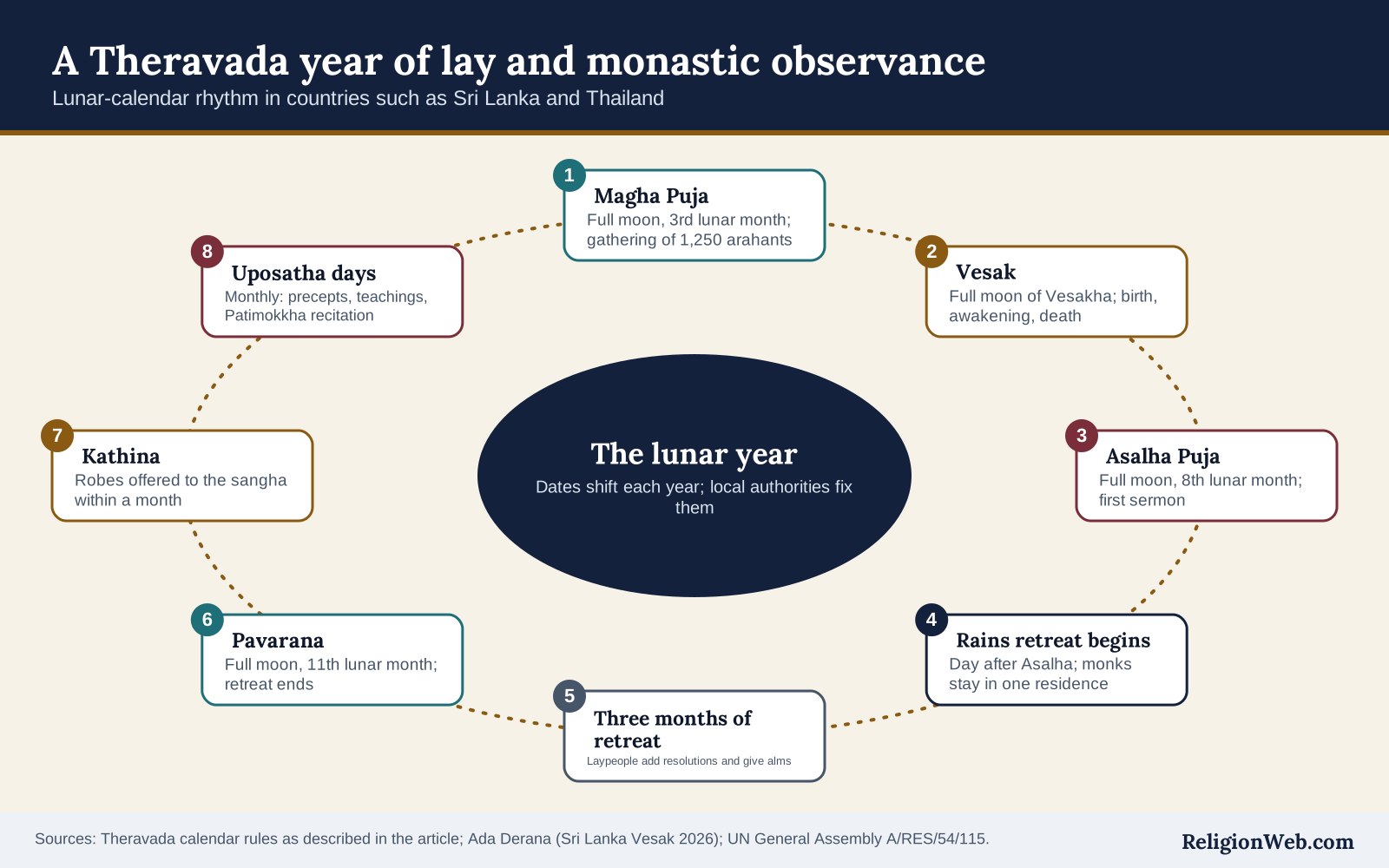
Sacred Places, Symbols, and Art
Pilgrimage Sites and Sacred Architecture
The four great places and other pilgrimage sites
In the Mahaparinibbana Sutta, the Buddha identifies four places that a faithful person may visit with reverence: the sites of his birth, awakening, first sermon, and death. They are Lumbini in southern Nepal, Bodh Gaya in Bihar, Sarnath near Varanasi, and Kushinagar in Uttar Pradesh. The Lumbini site, inscribed by UNESCO in 1997, includes the pillar set up by Ashoka and brick monasteries and stupas dating from the third century BCE onward. The Mahabodhi Temple at Bodh Gaya, inscribed in 2002, has a brick temple of the fifth or sixth century CE on a site associated with Ashoka’s first shrine, with a bodhi tree regarded as a descendant of the original. Many other places are sacred to particular traditions. They include the Temple of the Tooth in Kandy, Sri Lanka, the Shwedagon Pagoda in Yangon, the plain of Bagan, the Jokhang and Potala in Lhasa, Mount Wutai in China, Mount Koya in Japan, and the eighty-eight temples of the Shikoku pilgrimage.
Stupas, temples, and monastic compounds
The stupa, a solid mound that enshrines relics or sacred objects, is the oldest form of Buddhist monument, and it developed into the Sri Lankan dagoba, the Thai and Burmese chedi and zedi, the Tibetan chorten, and the East Asian pagoda. A Buddhist temple complex may include a shrine hall with a Buddha image, a hall for ordination, a library, living quarters, and a bell or drum tower. The great monuments include Borobudur, a ninth-century structure in Java that serves as a three-dimensional teaching in stone, and the cave temples of Ajanta in India, Longmen and Dunhuang in China, and the Great Buddha hall of Todaiji in Nara, Japan, dedicated in the eighth century. The Taliban government’s destruction of the two giant sixth-century Buddhas of Bamiyan in Afghanistan in March 2001 drew worldwide attention to the vulnerability of such heritage.
Symbols, Images, and Art
Early symbols: the wheel, the lotus, the tree, and the footprint
For several centuries after the Buddha’s death, Buddhist art did not depict him in human form and used symbols instead. The wheel of the teaching (dharmachakra), whose eight spokes are often taken to represent the eightfold path, evokes the first sermon. The lotus, which grows from mud and rises clean above the water, is a symbol of purity and awakening. The bodhi tree, an empty throne, and footprints marked with auspicious signs stand for the Buddha’s presence. Tibetan Buddhism recognizes a set of eight auspicious symbols, which include the parasol, the pair of golden fish, the treasure vase, the lotus, the conch, the endless knot, the victory banner, and the wheel.
Images of the Buddha and bodhisattvas
Images of the Buddha in human form appeared in Gandhara and Mathura around the first and second centuries CE, and from there the style spread and adapted across Asia. The hand gestures (mudras) and postures of the figures carry meaning. The seated figure with one hand touching the ground refers to the moment of awakening, when the Buddha called the earth to witness; hands in a teaching gesture refer to the first sermon; a raised hand signals fearlessness; and a reclining figure depicts the Buddha’s final passing. Images are not regarded as gods, but they are venerated as representations of the awakened state, and in many traditions a consecration ritual invites the presence of the Buddha’s qualities. Some familiar figures are not the historical Buddha. The laughing, round-bellied monk common in Chinese shops and restaurants is Budai, a monk of the tenth century CE who came to be identified with the future Buddha Maitreya, and Guanyin and Tara are bodhisattva figures venerated for compassion.
Buddhism Today: Global Presence and Modern Movements
Population and Geography
Where Buddhists live: the 2020 picture
The most recent comprehensive global estimate comes from the Pew Research Center, which published its study of religious change between 2010 and 2020 in June 2025. It counted 324 million Buddhists in 2020, about 4.1 percent of the world’s population, a drop of roughly 19 million from 2010. Pew found that 98 percent of Buddhists live in the Asia-Pacific region and that the seven Buddhist-majority countries of Cambodia, Thailand, Myanmar, Bhutan, Sri Lanka, Laos, and Mongolia contain 47 percent of all Buddhists. The remainder live mostly in countries where Buddhism is a large minority or a major cultural tradition, including China, Japan, Vietnam, South Korea, and Taiwan, as well as in India, Nepal, and Malaysia. Pew’s main explanation for the decline is that for every person who became Buddhist, about 1.8 people left, along with the concentration of Buddhists in shrinking or aging populations. In South Korea, for example, Pew reported a seven-point decline in the Buddhist share of the population.
These numbers should be read with some care. They count people who identify as Buddhist, which may leave out those who take part in Buddhist rites while identifying with no religion or another label. For China in particular, estimates vary widely depending on how surveys define Buddhist identity, since many people there visit temples without declaring a religious affiliation. The figures also capture a single moment, and the effect of switching differs by country: some Buddhist communities, such as the Ambedkarite movement in India, grew through conversion in the twentieth century, while others, such as those in Japan and South Korea, experienced decline in religious identification.
Buddhism in the West and in diaspora communities
Buddhism has been present in the Americas and Europe for more than a century, through immigrant communities from Asia, such as Chinese and Japanese Americans, and later through Vietnamese, Cambodian, Lao, Thai, Sri Lankan, and Tibetan refugees and migrants. Alongside these communities, European and American converts have formed their own meditation centers and lay organizations, beginning with the post-war interest in Zen and expanding with the arrival of Tibetan lamas after 1959 and of Theravada teachers in the 1970s. Today, large cities in North America, Europe, and Australia have temples serving specific ethnic communities, such as Thai or Sri Lankan monasteries, alongside convert-led centers in the Zen, vipassana, and Tibetan traditions, and the two worlds overlap only partly. Scholars sometimes describe this as a distinction between “ethnic” and “convert” Buddhism, though many individuals and institutions cross the line.
Modern Movements and Institutions
Mindfulness and the secular meditation movement
One of the most visible modern developments is the spread of mindfulness practice in secular settings. In 1979 Jon Kabat-Zinn founded a stress-reduction clinic at the University of Massachusetts Medical Center, which developed into the eight-week Mindfulness-Based Stress Reduction program, drawing on his training in Zen and vipassana. The approach spread into hospitals, schools, workplaces, and apps. Opinions among Buddhists and scholars are divided. Some welcome it as a beneficial and skillful presentation of Buddhist methods. Others, such as the scholar Ronald Purser, who helped popularize the phrase “McMindfulness,” argue that detaching mindfulness from its ethical and philosophical context can make it a tool for adapting people to stressful systems. Clinical research on mindfulness-based programs has shown benefits for some conditions, and also mixed results and some adverse experiences, so these programs are best understood as adjuncts to, not replacements for, professional health care.
Revival, regulation, and politics in Asia
In Asia, the late twentieth and early twenty-first centuries saw both revival and tension. Buddhist institutions have been rebuilt in Cambodia after the Khmer Rouge period of 1975 to 1979, in Mongolia after the anti-religious campaigns of the 1930s, and in China and Vietnam under state regulation. In Myanmar, monks took part in the large protests of 2007. Tibetan Buddhism has a large exile community centered on Dharamshala in India, and the Dalai Lama received the Nobel Peace Prize in 1989. The question of the succession of the Dalai Lama is a matter of public dispute between the Tibetan exile leadership, which holds that the Gaden Phodrang Trust has sole authority to recognize the next incarnation, and the Chinese government, which rejects that position. At the same time, Buddhist-majority societies such as Thailand, Sri Lanka, and Bhutan continue to give the sangha a prominent place in public life.
Challenges and Debates
Authority, accountability, and teacher misconduct
Buddhist communities in Asia and the West have faced difficult questions about the conduct of teachers. Since the 2010s, allegations of sexual, physical, and psychological abuse against prominent teachers in several Tibetan, Zen, and other communities have led to independent investigations, resignations, and the adoption of ethical codes and grievance procedures. The Buddhist tradition has long emphasized the Vinaya as a framework of accountability, but modern lay and convert organizations have often lacked comparable structures, and the tradition of strong devotion to a teacher in some lineages has been a subject of reflection. Many teachers and scholars within Buddhism have argued that devotion should be balanced with critical examination of a teacher’s conduct, a theme with support in the Kalama Sutta and other texts.
Demographic change and new media
Across Asia, Buddhist institutions are adapting to urbanization, aging, and falling birth rates. In Japan, rural temples dependent on funeral income face closure as villages shrink, while some urban temples experiment with new forms of outreach. In Thailand and Sri Lanka, monks use social media to teach and raise funds, and online platforms offer digital libraries of the Pali, Chinese, and Tibetan canons. Younger Buddhists in diaspora communities often seek a form of practice that connects heritage with contemporary life, and the search is producing new ritual and educational forms. How these changes will affect the numbers recorded by future surveys is not yet known.
Common Misconceptions About Buddhism
Misconception 1: Buddhism is simply atheism
Where the misunderstanding comes from
The idea has understandable roots. The major Buddhist traditions do not teach a creator god who made the world and judges souls, and the Buddha is presented as a human teacher who found the path to liberation by his own efforts rather than a deity who grants salvation. Popular writing in English has often described Buddhism as “a philosophy, not a religion,” and some Western practitioners describe themselves as atheist Buddhists. Survey data lend some support: Pew Research Center’s 2019 to 2020 survey of India found that about one-third of Indian Buddhists said they do not believe in God.
History also played a part. In the nineteenth century, European scholars who approached religion mainly as belief in a creator often reported that Buddhism had no God, and they drew very different conclusions from that finding: some admired it as a rational ethic, and others dismissed it as incomplete. Asian Buddhist reformers in the colonial period, engaged in public debates with missionaries and with scientific rationalists, sometimes emphasized the non-theistic and rational side of their teaching in reply, and that emphasis entered popular books.
What the evidence and tradition actually show
“Atheism” in the modern Western sense is a position within a debate about whether a supreme God exists, whereas Buddhist traditions are not organized around that question. Many scholars describe them as non-theistic. Buddhist cosmology includes gods (devas) and even a high deity, Brahma, who in one early discourse mistakenly believes himself to be the creator, and the texts present such beings as part of the cycle of rebirth, not as sources of liberation. Mahayana and Vajrayana traditions go further in devotion: believers pray to Amitabha, Avalokiteshvara, Tara, and many other awakened beings, and invoke protectors. The most accurate description is that Buddhism lacks a creator God as the foundation of its teaching while including a wide range of beings, rites, and devotional relationships that make it a religion in the full sense. Individual Buddhists hold a range of views, including secular and atheist ones, and these should be distinguished from the historical traditions.
Everyday practice shows the same pattern. In Sri Lanka, many Buddhist temple compounds include shrines to gods such as Vishnu or Skanda, in Thailand and Myanmar laypeople also honor local guardian spirits, and in Tibetan communities protector deities are invoked in ritual. Buddhists generally regard such beings as powerful but unawakened, able to offer worldly help while unable to grant liberation, which only the Buddha’s path is said to provide.
Misconception 2: All Buddhists meditate every day
Where the misunderstanding comes from
Meditation is the aspect of Buddhism most visible in the West, where it has been taught since the 1960s and 1970s through retreat centers, books, and secular mindfulness programs. Images of seated monks and Zen halls reinforce the impression that meditation is the center of the religion for every follower. Because the best-known English-language Buddhist teachers are often meditation teachers, the meditative path can appear to be the whole tradition.
What the evidence and tradition actually show
Buddhists are a vast and varied group, and for many of them the daily practice consists of offerings, chanting, observing precepts, visiting temples, and supporting monks and nuns. In large parts of Theravada Asia, systematic lay meditation became a mass movement mainly in the twentieth century, after reformers such as Mahasi Sayadaw taught it to laypeople. In East Asian Pure Land communities, the central practice is recitation of Amitabha’s name. Tibetan lay Buddhists commonly practice prostration, circumambulation, and mantra recitation, while the long meditative retreats are the domain of monastics and trained practitioners. In Japan, most households meet Buddhism chiefly through funerals and memorial rites, while intensive Zen training is undertaken by priests and a smaller number of lay practitioners. Even among the committed, the amount of meditation varies from a few minutes a day to months of intensive retreat. Meditation is important to Buddhism, as the eightfold path shows, but it is practiced to very different degrees and in different forms, and a person who does not meditate daily is not thereby a lesser Buddhist.
Misconception 3: Nirvana is just another word for heaven
Where the misunderstanding comes from
Nirvana is often described in English with words like “bliss,” “paradise,” or “ultimate peace,” and in everyday speech it is used for any state of perfect contentment. Readers who learn that Buddhists believe in rebirth in various realms, including heavens, may reasonably assume that nirvana is the best of them. The existence of Pure Land traditions, which speak of rebirth in a western paradise, strengthens the assumption.
What the evidence and tradition actually show
In the Pali texts the heavens are realms within samsara. They are pleasant and long-lived, but beings in them are still subject to impermanence, and when their merit is exhausted they pass away and are reborn elsewhere. Nirvana, by contrast, is described as the extinguishing of greed, hatred, and delusion and the end of the cycle of rebirth. The Itivuttaka passage quoted earlier distinguishes a mode of nirvana that is realized in life from one that follows death, and neither is a place that a person enters like a country. The Buddhist traditions also reject the idea that nirvana is annihilation, and the texts speak of it as the unconditioned and the deathless. In Pure Land Buddhism, Amitabha’s Pure Land is understood as a realm especially favorable to awakening where the practitioner can attain Buddhahood, and not as the final aim in itself. Nirvana is therefore best understood as a liberation from the cycle that includes the heavens, not as the highest heaven.
A related misreading runs in the opposite direction. Nineteenth-century European commentators debated at length whether nirvana meant annihilation, and the idea that it is simply nothingness remains common. Buddhist sources reject both extremes: the texts deny that liberation is eternal survival of a self and deny that it is a mere ending, which is why they prefer negative and apophatic language such as the deathless, the unconditioned, and the cessation of suffering. Interpreters in the Theravada, Madhyamaka, and other traditions give different accounts of what can be said about it, and these accounts should be attributed to their schools.
Misconception 4: Buddhism is pessimistic because it says life is suffering
Where the misunderstanding comes from
The first noble truth is often summarized in English as “life is suffering,” a phrase that sounds bleak and has led some writers to call Buddhism a pessimistic or life-denying religion. The translation of dukkha as “suffering” is a convenient shorthand, and it can conceal the fact that the Pali word covers a wide range of unsatisfactory experience, from physical pain to the subtle unease of impermanence.
What the evidence and tradition actually show
The four noble truths are structured as a diagnosis followed by a cure, and three of the four concern the end of suffering and the way to it. The Pali texts speak freely of happiness, joy, and serenity, and they list joy as one of the factors of awakening. In a discourse of the Majjhima Nikaya, the Buddha says, in paraphrase, that what he teaches is suffering and the cessation of suffering. Buddhist communities celebrate many festivals with lanterns, music, and shared meals, and Buddhist teachers regularly stress contentment and compassion as qualities to cultivate. A fairer description is that Buddhism takes the difficulties of existence seriously and offers a practical path for addressing them, which many Buddhists describe as optimistic about human possibility.
The pessimistic image also has a history of its own. Some nineteenth-century European philosophers, among them Arthur Schopenhauer, read Buddhism through their own views of the world and found in it a confirmation of pessimism, and the image persisted in popular writing. The Pali discourses themselves portray the path as bringing gladness, confidence, and tranquility, and the Mahayana tradition stresses the joy of the bodhisattva who works for the welfare of others.
Misconception 5: Karma means fate, or that suffering is a punishment for past wrongs
Where the misunderstanding comes from
In everyday English, “karma” has come to mean a kind of cosmic payback, as in the saying that what goes around comes around, or an inescapable destiny. The idea has also been used in some societies to explain social position or misfortune as the deserved result of earlier lives, and some observers have taken this as the Buddhist view. Because rebirth and karma are taught together, it is easy to assume that every pleasure and pain a person experiences is the fixed result of earlier actions.
What the evidence and tradition actually show
The Pali texts define karma as intention, as the quotation above shows, and they treat it as one cause among many. The Sivaka Sutta lists climate, bodily disorders, and accidents alongside karma as sources of painful feeling, and the Buddha criticizes in another discourse (Anguttara Nikaya 3.61) the doctrine that everything a person experiences is caused by past action, since such a view would make effort in the present pointless. Karmic results are described as varying with circumstances and as open to change through present conduct. For these reasons Buddhist teachers commonly say that karma gives no grounds for blaming the sick or the poor, and they present compassion and practical help as the proper response to another person’s suffering. Karma is also not a medical theory, and Buddhist teaching does not offer it as a substitute for treatment. The doctrine functions mainly as an ethical principle that actions shaped by intention matter and have consequences.
Frequently Asked Questions About Buddhism
Questions About the Buddha and His Teaching
Who was the Buddha, and is he regarded as a god?
The Buddha was Siddhartha Gautama, a teacher from the Shakya clan who lived in northeastern India in the fifth century BCE or thereabouts. “Buddha” is a title meaning “awakened one,” and Buddhist traditions teach that there have been other Buddhas before him and that more will appear in the future, such as Maitreya. In Theravada, the Buddha is revered as a unique teacher and an example, not as a god, and he is not asked to intervene in worldly affairs. In Mahayana and Vajrayana traditions, many Buddhas and bodhisattvas are venerated as compassionate beings who respond to prayer. Gautama himself is not a creator, and no Buddhist tradition regards him as the maker of the world.
How do Theravada, Mahayana, and Vajrayana differ?
The differences are of emphasis, scripture, and method more than of basic aim. Theravada draws on the Pali canon and takes the arahant as its ideal. Mahayana draws on additional sutras and treats the bodhisattva path of compassion for all beings as the norm, and Vajrayana adds tantric methods, such as initiation, mantra, and deity visualization, that are said to speed the path. They share the Three Jewels, the four noble truths, and the ethical precepts, and the lines between them are not always sharp, as shown by the fact that some scholars classify Vajrayana within Mahayana. The articles on Theravada, Mahayana, and Vajrayana Buddhism describe each in depth.
What do Buddhists believe happens after death?
Most Buddhist traditions teach that beings are reborn according to their karma until they attain nirvana, which ends the cycle. Because there is no permanent soul in this view, what continues is a stream of causally connected mental and physical events, not an unchanging self. Pure Land Buddhists hope for rebirth in Amitabha’s realm, and Tibetan Buddhists describe an intermediate state with its own guidance. Some modern Buddhists interpret rebirth metaphorically, and the historic traditions of Asia generally take it literally.
Questions About Practice
How does someone become a Buddhist?
In most traditions a person becomes a Buddhist by taking refuge in the Buddha, the dharma, and the sangha, often in a short ceremony led by a monk, nun, or teacher, and by undertaking the five precepts. No conversion rite is required in the way some religions require one, and many people in Asia are Buddhist by family and community from birth. Some Tibetan and East Asian lineages offer additional initiations or lay ordinations for those who wish to deepen their commitment. A person who wants to learn is generally advised to find a qualified teacher and a community, because the traditions place weight on guidance and on ethical practice as well as on meditation techniques.
Do Buddhists have a holy book?
There is no single book. The Pali Tipitaka is the canon of Theravada, the Chinese canon and the Tibetan Kangyur and Tengyur serve Mahayana and Vajrayana traditions, and individual works such as the Dhammapada, the Heart Sutra, the Lotus Sutra, and the Platform Sutra are widely read in different communities. Many Buddhists learn the teachings less through direct reading than through chanting, sermons, and teachers’ explanations. The section on canons above explains the major collections.
Why do Buddhists bow to statues and make offerings?
Buddhists generally say that they honor what the image represents, namely the qualities of the awakened state, and not the object itself. Bowing expresses respect and humility, and offerings of flowers, light, and incense are symbolic acts of generosity that also remind the practitioner of impermanence and wisdom. In devotional traditions, such as Pure Land and Tibetan Buddhism, prayer to Buddhas and bodhisattvas is also understood as relationship with compassionate beings. Practices vary, and what is a profound gesture in one setting may be a matter of custom in another.
Questions About Buddhism Today
How many Buddhists are there, and where do they live?
Pew Research Center estimated 324 million Buddhists in 2020, about 4.1 percent of the world’s population, and 98 percent of them lived in the Asia-Pacific region. Other estimates differ because of the difficulty of counting people who participate in Buddhist practices without declaring a single religious identity, especially in China. The article’s section on global presence gives the details and the caveats.
Can a person practice Buddhism alongside other traditions?
In much of East Asia, participation in Buddhist rites alongside ancestor veneration, Confucian ethics, Daoist practices, or Shinto shrines is common and is not considered contradictory by most participants. In Southeast Asia, spirit shrines coexist with temple Buddhism. Buddhist teachers differ in their views on exclusive commitment, and some Western Buddhist communities encourage people to adopt Buddhist practice while remaining within their religion of origin, while others expect a distinct commitment. Individuals are best advised to consult the teacher or community they join.
When is Vesak, and how can a visitor take part?
Vesak follows the lunar calendar and falls on the full-moon day in April or May in Theravada countries, with some local variation set by religious authorities, as the example of Sri Lanka in 2026 shows. Visitors to a temple on that day are usually welcome, and they should dress modestly, remove shoes before entering shrine halls, and follow the lead of local worshipers. Because the date is fixed locally, it is wise to ask the temple for the date in a given year.
Conclusion: What the History of Buddhism Shows
What the Record Shows
A teaching that traveled and changed
The history of Buddhism is the history of a teaching that moved across languages, empires, and cultures while keeping a recognizable core: refuge in the Buddha, the dharma, and the sangha, and a path of ethics, meditation, and wisdom aimed at the end of suffering. As it moved, it took on new institutions and ideas, from the Pali canon of Sri Lanka and the bodhisattva ideals of the Mahayana to the tantric lineages of Tibet and the lay movements of modern Asia. The dating of the founder, the formation of the canons, and the relation between the traditions are matters on which scholars and Buddhists still differ, and this article has tried to mark where tradition and historical reconstruction diverge.
A living and changing tradition
Buddhism today is a tradition of more than three hundred million people, practiced in monasteries, village temples, family shrines, meditation halls, and online communities. It faces questions about women’s ordination, teacher accountability, nationalism, political control, and the secularization of meditation, as well as declining religious identification in some of its historic homelands. The tradition’s long record of adaptation is one reason many observers expect it to continue to change rather than disappear.
How to Keep Exploring
Related traditions in India and East Asia
Readers interested in the Indian setting in which Buddhism arose can turn to the articles on Hinduism and Jainism. For the East Asian cultural settings in which Mahayana Buddhism developed, the articles on Daoism, Confucianism, Shinto, and Chinese folk religion offer further context.
Reading the texts and meeting the communities
The best way to understand Buddhism is through its own sources and living communities: the early discourses in a reliable translation, the sermons and commentaries of respected teachers in each tradition, and, where possible, visits to local temples and meditation centers that welcome guests. The most helpful approach is to read with the question of which school, region, and period a statement describes, since a claim that is accurate for one form of Buddhism may not hold for another.
Sources
The table below lists the principal external sources behind this article. Facts, dates and figures were checked against these and related primary, institutional and academic materials.
| # | Source | Publisher and type | Used for | Link |
|---|---|---|---|---|
| 1 | Bilara Data: SuttaCentral translations by Bhikkhu Sujato (LICENSE.md, CC0) and the texts SN 56.11, SN 22.59, AN 6.63, AN 3.65, Iti 44, Snp 1.8, DN 16 | SuttaCentral (Bilara Data repository) · Primary text | CC0 licensing of Sujato’s translations; source of all quoted early Buddhist discourses | raw.githubusercontent.com |
| 2 | How the Global Religious Landscape Changed From 2010 to 2020 | Pew Research Center · Demographic data | 324 million Buddhists (4.1%) in 2020; 98% in Asia-Pacific; seven majority countries hold 47% | pewresearch.org |
| 3 | Religion in India: Tolerance and Segregation | Pew Research Center · Demographic data | Indian Buddhists: 89% Dalit; about one-third do not believe in God (2019-20 survey) | pewresearch.org |
| 4 | Buddha (Mark Siderits) | Stanford Encyclopedia of Philosophy · Academic reference | Dating of the Buddha; limits of early textual sources; scholarly disagreement on recovering his teaching | plato.stanford.edu |
| 5 | An Introduction to Buddhism: The Buddha and His Indian Context (Peter Harvey) | Cambridge University Press · Academic reference | Long and short chronologies; Ashoka synchronism; Gombrich’s proposed date of about 404 BCE | cambridge.org |
| 6 | Lumbini, the Birthplace of the Lord Buddha (World Heritage List, ref. 666) | UNESCO World Heritage Centre · Institutional | Ashoka pillar inscription (249 BCE); inscription in 1997; early pilgrimage architecture | whc.unesco.org |
| 7 | International recognition of the Day of Vesak at the United Nations Headquarters and other United Nations offices (A/RES/54/115) | United Nations Digital Library · Institutional | General Assembly resolution of 15 December 1999 recognizing the Day of Vesak | digitallibrary.un.org |
| 8 | State Vesak Festival to be held on May 30 – Minister | Ada Derana (Sri Lanka) · News report | 2026 Vesak date decision in Sri Lanka: May 30, after the two-full-moon question | adaderana.lk |
| 9 | A Short History of Sanskrit Buddhist Manuscripts | Digital Sanskrit Buddhist Canon project (University of the West) · Academic reference | Survival of Sanskrit manuscripts in Nepal; Chinese (2nd-11th c.) and Tibetan (7th-15th c.) translations | dsbcproject.org |
| 10 | Tibetan Translation History and Methodology | Samye Institute · Academic reference | Early ninth-century standardization of Tibetan translation; Mahavyutpatti glossary of over 9,500 terms | samyeinstitute.org |
Last fact-check date: 2026-10-21.