Mahayana Buddhism, the “Great Vehicle,” is the form of Buddhism that took root across China, Korea, Vietnam, and Japan and that is organized around the bodhisattva ideal: the aspiration to reach full awakening, or Buddhahood, for the sake of all beings. Its practitioners describe it as a path that joins compassion (karuna) with wisdom (prajna), and its scriptures, the Mahayana sutras, speak of emptiness, of countless Buddhas and bodhisattvas, and of the possibility that every being can eventually awaken. The name refers to a movement and a body of literature rather than to a single church, and it has never had a central authority.
Historians trace the movement to India in the centuries around the beginning of the Common Era, where it grew gradually inside existing monastic communities and among lay supporters. From India it traveled along the Silk Road and sea routes into Central Asia and China, and from China into Korea, Vietnam, and Japan. In those countries it became the religion of imperial courts, village temples, and family funerals, and it produced distinct schools: Chan (Zen), Pure Land, Tiantai, Huayan, and the Nichiren traditions, among others. Mahayana ideas also entered Tibet and the Himalayas, where they are interwoven with the tantric methods described in the article on Vajrayana Buddhism.
This article presents Mahayana Buddhism on its own terms. It explains how the tradition describes the bodhisattva path and the perfections, how Madhyamaka and Yogacara thinkers understood emptiness and mind, and how the major sutras fit together. It then looks at the schools of East Asia, at monastic and lay practice, at meditation, chanting, and devotion, and at the festival year. Where scholars and traditions disagree, for example about when particular sutras were composed or how emptiness should be interpreted, the disagreement is stated openly and attributed.
The tradition is one branch of the larger Buddhist family. Readers who want the life of the Buddha and the teachings shared by all Buddhists, such as the Four Noble Truths and the Eightfold Path, will find them in the hub article on what Buddhism is, and the tradition most often named alongside this one is covered in the article on Theravada Buddhism. Here the focus stays on what Mahayana Buddhists themselves teach, practice, and celebrate, and on what historians can say about how that world developed.
Mahayana Buddhism at a Glance: Meaning, Geography, Adherents, and Vocabulary
What Mahayana Means and What It Includes
The name “Great Vehicle” and how it is used
The Sanskrit word mahayana combines maha, “great,” with yana, “vehicle” or “way.” The term appears within the Perfection of Wisdom sutras and the Lotus Sutra themselves, where it describes a path wide enough to carry all beings across the sea of rebirth (samsara) to Buddhahood. Because the term was coined by those who held the ideal, it carries a self-description: the vehicle is “great” because its aim is the full awakening of a Buddha for the benefit of everyone, not only the liberation of the individual practitioner. In Chinese the name is Dasheng, in Japanese Daijo, in Korean Daeseung, and in Vietnamese Dai Thua.
Modern writers use “Mahayana” in several overlapping ways. In the narrowest sense it names the sutra-based path of the bodhisattva. In a broader sense it names the Buddhism of East Asia, and in the broadest sense scholars and many Tibetan teachers include Vajrayana as a branch of the Mahayana, since tantric practitioners also take the bodhisattva vow. This article uses the term mainly for the first two senses and refers readers to the separate article on Vajrayana for tantric methods. It is also worth knowing that a related word, “Hinayana” (“lesser vehicle”), appeared in some Mahayana texts as a critique, and Theravada Buddhists regard it as pejorative; modern scholarship generally avoids it.
What defines Mahayana: ideas rather than a single institution
Mahayana is better described as a family of shared commitments than as an organization. Its practitioners generally hold that the highest aim is Buddhahood, not only the state of an arhat who has ended rebirth; that the compassionate bodhisattva is the model for the path; that the Mahayana sutras, though they appear in the historical record after the early discourses, are authentic expressions of the Buddha’s awakening; and that all phenomena are empty of fixed, independent existence. Beyond these commitments the schools diverge widely, which is why a Zen meditation hall, a Pure Land temple chanting the name of Amitabha, and a Nichiren congregation reciting the title of the Lotus Sutra can all be called Mahayana.
Institutionally, Mahayana monastics did not create a separate monastic code in India. Chinese pilgrims of the fifth to seventh centuries CE reported that monks who followed the bodhisattva path and monks who did not often lived in the same monasteries and followed the same rules of discipline (Vinaya). East Asian monastics today follow a Vinaya inherited from early Indian schools, most commonly the Dharmaguptaka code in China, Korea, and Vietnam, supplemented by bodhisattva precepts. That detail matters for understanding the Mahayana, because the bodhisattva ideal was a layer of aspiration and practice added to monastic life, not a replacement for it.
Where Mahayana Is Practiced and by How Many
The East Asian heartland and the Pew data
The core Mahayana countries are China, Taiwan, Japan, South Korea, North Korea, and Vietnam, along with Singapore and communities across Southeast Asia that trace their Buddhism to Chinese migration. Mahayana teachings are also central to Buddhism in Tibet, Mongolia, Bhutan, and the Himalayan regions, where they are practiced within the Vajrayana framework. In North America, Europe, and Australia, Mahayana schools arrived with Asian immigrants and, from the late nineteenth century, with Western converts, and Zen, Pure Land, Tiantai-influenced, and Nichiren groups are all represented.
Precise numbers are difficult. The Pew Research Center’s 2025 report, which compares 2010 and 2020, estimated that there were about 324 million Buddhists worldwide in 2020, down from 343 million in 2010, and that 98 percent of them lived in the Asia-Pacific region. Pew’s survey-based counts do not divide Buddhists by school. In China, Pew estimated roughly 53 million Buddhists in 2020, about 4 percent of the population, a count that reflects self-identification and that many scholars caution understates the large number of people who burn incense in Buddhist temples or hold Buddhist funerals without calling themselves Buddhists. Because of overlap with Chinese folk religion, Daoism, and Confucian ritual and ethics, many people in East Asia take part in Buddhist practice as one strand of a wider religious life.
Mahayana in the modern diaspora
Outside Asia, Mahayana communities reflect both migration and conversion. Chinese, Vietnamese, Korean, and Japanese temples serve immigrant communities in the United States, Canada, France, and Australia, while Zen centers, Pure Land temples of Japanese heritage such as the Buddhist Churches of America, and convert-led sanghas draw members from other backgrounds. Pew’s 2025 estimates put North America’s Buddhist population at about 5.0 million in 2020, and Europe’s at about 2.5 million, both growing from small bases.
Key Vocabulary for Reading About Mahayana
Terms of the path
A handful of terms recur in nearly every Mahayana text. A bodhisattva is a being who has generated bodhicitta, “the mind of awakening,” the resolve to attain Buddhahood in order to free all beings. The perfections (paramita, literally “gone to the other shore”) are the practices of the path, usually listed as six: generosity, ethical discipline, patience, effort, meditative concentration, and wisdom. Prajna, “wisdom” or “discernment,” is the insight into emptiness that completes the other five. Upaya, “skillful means,” is the ability to teach and act in ways that suit the needs of each being, and karuna, “compassion,” is the wish that all beings be free of suffering.
Terms of the teaching
On the doctrinal side, sunyata (“emptiness”) names the absence of intrinsic, independent nature in all things; tathagatagarbha (“womb” or “embryo of the Tathagata,” often rendered buddha-nature) names the potential for Buddhahood present in beings; and trikaya (“three bodies”) describes the dharma body, enjoyment body, and manifestation body of a Buddha. The word buddhavacana means “word of the Buddha,” the standard by which a text is accepted as scripture. These terms are explained more fully in the sections that follow, and the table below gathers the basic facts of the tradition in one place.
| Feature | Summary |
|---|---|
| Name and meaning | Mahayana, “Great Vehicle” (Chinese Dasheng, Japanese Daijo, Korean Daeseung, Vietnamese Dai Thua) |
| Approximate origin | India, in the centuries around the start of the Common Era; developed gradually within existing monastic and lay communities |
| Central ideal | The bodhisattva, who aspires to full Buddhahood for the benefit of all beings |
| Characteristic teachings | Emptiness (sunyata), the six perfections, skillful means, buddha-nature, the three bodies of a Buddha |
| Key scriptures | Perfection of Wisdom, Lotus, Vimalakirti, Avatamsaka, and Pure Land sutras; Indian treatises by Nagarjuna, Asanga, and Vasubandhu |
| Main canons | Chinese canon (Taisho edition in modern print) and, for Tibetan traditions, the Kangyur and Tengyur |
| Main regions | China, Taiwan, Korea, Japan, Vietnam, and overseas communities; Mahayana teachings also underlie Tibetan and Mongolian Buddhism |
| Major East Asian schools | Chan, Seon, Thien, and Zen; Pure Land; Tiantai and Tendai; Huayan, Hwaeom, and Kegon; Nichiren traditions; esoteric schools such as Shingon |
| Monastic code | Early Indian Vinaya (in East Asia mainly the Dharmaguptaka code) plus bodhisattva precepts; Japanese clergy are largely married |

Origins and Historical Development of Mahayana Buddhism
Beginnings in India
A gradual movement, not a founding event
Unlike the first communities gathered around the Buddha, Mahayana has no founder and no single starting date. Historians describe it as a movement that emerged over several centuries. Reference works such as Britannica date its emergence to around the first century CE, and many specialists see roots in the first century BCE, with the movement becoming institutionally visible much later. Mahayana tradition itself holds that the sutras were taught by the historical Buddha, sometimes to bodhisattvas and celestial audiences rather than to the monks of the early assemblies, and some accounts say they were entrusted to the care of beings who would preserve them until the world was ready. Scholars, working from manuscripts, translations, and inscriptions, instead date the texts to the period when they first appear in the record and treat them as compositions of Indian Buddhist communities.
The older picture of Mahayana as a lay or popular revolt against monastic Buddhism has been largely set aside. Many of the earliest Mahayana texts show close familiarity with monastic life and Abhidharma analysis, and several of them praise forest-dwelling ascetic practice. The movement appears to have formed among groups of monks and nuns, and the lay supporters around them, who emphasized the bodhisattva path and the long career toward Buddhahood. The movement drew on a vocabulary shared with the wider Indian religious world, including the ideas of karma and rebirth that are also discussed in the article on Hinduism. Because there are few datable inscriptions before about the fourth or fifth century CE, how large these groups were in the first centuries remains disputed.
Early texts, translation, and the evidence of travelers
The most secure early evidence comes from translation. In the later second century CE the Kushan-era monk Lokaksema, an Indo-Scythian from Gandhara, worked in the Chinese capital Luoyang and translated early Mahayana texts, including the Perfection of Wisdom in 8,000 lines and a meditation sutra on the visualization of the Buddhas of the present. Those translations show that a developed Mahayana literature existed in northwestern India and Central Asia by the second century. Manuscripts in the Gandhari language, written on birch bark in the Kharosthi script and discovered in recent decades, include early Mahayana material and give historians a view of the literature before it was standardized in Sanskrit.
A second body of evidence comes from Chinese pilgrims to India. Faxian (who traveled between roughly 399 and 412 CE), Xuanzang (629 to 645), and Yijing (671 to 695) wrote of monasteries where Mahayana and non-Mahayana monks lived side by side, and Yijing observed that they were distinguished by their study of the bodhisattva texts and practices, not by differing discipline. These reports are why many historians picture Mahayana in India as a current within a shared monastic world, becoming dominant in some regions and monasteries over time.
Madhyamaka, Yogacara, and the great monastic universities
By the second and third centuries CE Mahayana had philosophers. Nagarjuna, who is usually placed in the second or third century CE, wrote the Mulamadhyamakakarika, the “Fundamental Verses on the Middle Way,” which became the foundation of the Madhyamaka school. Asanga and his brother Vasubandhu, active in the fourth and fifth centuries, systematized the Yogacara approach, which analyzes experience as the activity of consciousness. Their works were studied at Nalanda, a monastic university in what is now Bihar that flourished from about the fifth century CE and drew students from China, Korea, Tibet, and Southeast Asia until its decline in the twelfth century. These thinkers and their ideas are discussed in the section on Mahayana philosophy.
Mahayana also moved outward from India by sea and through the oases of Central Asia. Kingdoms such as Khotan and Kucha became centers of Mahayana study and translation, and the Chinese monk Yijing, who traveled by sea, reported in the late seventh century that the island kingdom of Srivijaya, on Sumatra, was a place where Chinese monks could prepare for study in India. The Sailendra dynasty of Java later sponsored the monument of Borobudur. These routes explain why Mahayana left a lasting mark in Southeast Asia before most of the region turned to other forms of Buddhism and, in places, to Islam, and why its art and texts turn up in regions far from its East Asian heartland.
Across the Silk Road to China
Translators and the first centuries
Buddhism reached China by the first century CE, probably through merchant and monastic communities on the Silk Road, but the large-scale appropriation of Mahayana came through translation. After Lokaksema, the Central Asian translator Kumarajiva (active in Chang’an from 401 CE) and his team produced fluent Chinese versions of the Lotus Sutra, the Vimalakirti Sutra, and the Madhyamaka treatises, and Buddhabhadra completed a translation of the Avatamsaka Sutra in the early fifth century. These renderings gave Chinese readers texts that were literary achievements in their own right, and they established vocabulary, such as the Chinese words for emptiness and the Buddha-path, that all later schools used.
The first Chinese Buddhists often interpreted new concepts through the language of Daoism, a method called “matching concepts” (geyi), and as translation improved the Buddhist vocabulary became more precise. Buddhism also had to answer Confucian critics who held that renouncing family life and refusing to bow to the ruler violated filial duty and political order. The resulting debates shaped the character of Chinese Buddhism, which developed strong traditions of filial piety, ancestor remembrance, and cooperation with the state.
The Sui and Tang flowering
The Sui (581 to 618) and Tang (618 to 907) dynasties are often called the classical age of Chinese Buddhism. In this period the major schools took shape: Tiantai under Zhiyi (538 to 597), Huayan under Fazang (643 to 712), the Faxiang (Yogacara) school around the pilgrim-translator Xuanzang, Pure Land devotion under teachers such as Shandao (613 to 681), and Chan, whose later lineage histories trace it back to the Indian monk Bodhidharma. Tang emperors and empresses supported temples and translation bureaus, and Chang’an was one of the great Buddhist cities of Asia. The period closed with a major suppression of monasteries in 845 under Emperor Wuzong, after which institutions that had relied on imperial patronage were hit hard. Chan and Pure Land, which depended less on large libraries and estates, are commonly said to have recovered more easily, and they dominated Chinese Buddhism from the Song dynasty (960 to 1279) onward.
Korea, Vietnam, and Japan
Korea and Vietnam
Buddhism entered the Korean peninsula in the fourth century CE, traditionally in 372 in Goguryeo and 384 in Baekje, and was adopted at the Silla court in the sixth century. Korean thinkers made lasting contributions: Wonhyo (617 to 686) wrote commentaries that sought to harmonize competing schools, Uisang (625 to 702) brought Huayan teaching to Korea as Hwaeom, and Jinul (1158 to 1210) shaped the Seon (Zen) tradition, whose modern institutional heir is the Jogye Order. In Vietnam, Buddhism arrived in the early centuries CE by both land and sea routes, and the Vietnamese forms of Chan, called Thien, together with Pure Land devotion, came to characterize the dominant tradition there.
Japan: from Nara to the Kamakura reforms
Buddhism reached Japan from the Korean kingdom of Baekje in the sixth century, traditionally dated to 552 or, in another reckoning, 538. Prince Shotoku (574 to 622) promoted it at court, and in the Nara period (710 to 794) the state sponsored large temples, including Todai-ji, whose giant bronze Buddha was consecrated in 752. In the Heian period (794 to 1185) Saicho (767 to 822) established Tendai, based on the Lotus Sutra, on Mount Hiei, and Kukai (774 to 835) established the esoteric Shingon school at Mount Koya. The Kamakura period (1185 to 1333) produced the founders of the schools now best known: Honen and Shinran in Pure Land, Eisai and Dogen in Zen, and Nichiren. Many of them began their careers as Tendai monks at Mount Hiei, and each simplified practice to a form accessible to a wider population.
Suppression, Reform, and Modern Change
Political pressure and recovery in East Asia
In the modern period Mahayana institutions faced major pressures. The Korean Joseon dynasty, founded in 1392, favored Neo-Confucianism and restricted monasteries. In Japan, the early Meiji government separated Buddhism from Shinto in 1868 and set off a wave of anti-Buddhist destruction before the policy eased, and an 1872 decree removed legal bans on clergy marrying and eating meat. In China, the Cultural Revolution of 1966 to 1976 closed or damaged temples, and since the 1980s many have been reopened and restored under state supervision through the Buddhist Association of China, founded in 1953. Taiwan, by contrast, saw rapid growth of Buddhist organizations in the later twentieth century.
Humanistic Buddhism and global spread
Reformers responded by reorienting Buddhism toward education, social work, and engagement with modern life. The Chinese monk Taixu (1890 to 1947) championed a “Buddhism for the human realm” that influenced later Taiwanese organizations such as Fo Guang Shan and Tzu Chi. Zen teachers carried meditation teaching to Europe and North America in the twentieth century, and the Vietnamese monk Thich Nhat Hanh (1926 to 2022) brought a Thien-based approach to mindfulness to wide Western audiences from his base at Plum Village in France. Today the Mahayana world is a transnational network of temples, universities, charities, and online communities.
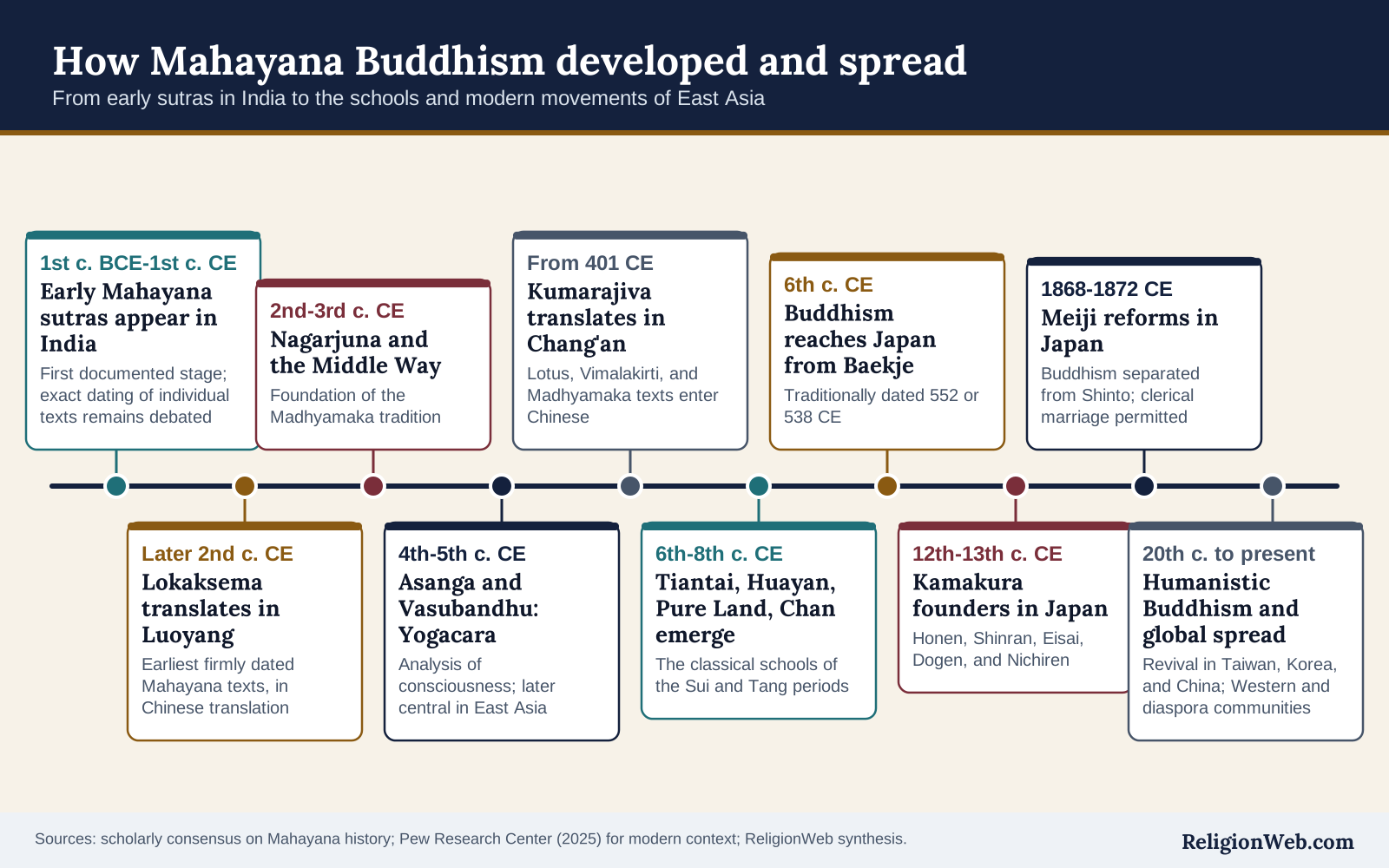
| Approximate date | Event | Significance |
|---|---|---|
| 1st century BCE to 1st century CE | Early Perfection of Wisdom literature and other Mahayana sutras appear in India | Scholars treat this as the first documented stage of Mahayana literature; the exact dating remains debated |
| Later 2nd century CE | Lokaksema translates early Mahayana sutras in Luoyang | Earliest firmly dated Mahayana texts, in Chinese translation |
| 2nd to 3rd century CE | Nagarjuna composes the Mulamadhyamakakarika | Foundation of the Madhyamaka tradition |
| 4th to 5th century CE | Asanga and Vasubandhu systematize Yogacara | Analysis of consciousness; later influential in China, Korea, Japan, and Tibet |
| From 401 CE | Kumarajiva translates in Chang’an | Lotus, Vimalakirti, and Madhyamaka texts become part of the Chinese canon |
| 6th to 8th century CE | Tiantai, Huayan, Pure Land, and Chan take shape in China | The classical schools of East Asian Buddhism emerge in the Sui and Tang periods |
| 552 or 538 CE (traditional) | Buddhism reaches Japan from Baekje | Beginning of court sponsorship and the Nara temples |
| 12th to 13th century CE | Honen, Shinran, Eisai, Dogen, and Nichiren found new Japanese schools | Kamakura reforms; Pure Land, Zen, and Nichiren traditions |
| 1868 to 1872 CE | Meiji separation of Shinto and Buddhism; clerical marriage permitted | Reshaped Japanese Buddhist institutions and clerical life |
| Late 20th century to present | Humanistic Buddhism, global diaspora, and revival in Taiwan, Korea, and China | Mahayana institutions expand across continents |
The Bodhisattva Path: Compassion, Wisdom, and Skillful Means
The Bodhisattva Ideal
Bodhicitta: the resolve to awaken for others
A bodhisattva (“awakening being”) is, in Mahayana teaching, someone who has made a vow to become a fully awakened Buddha in order to help all beings escape suffering. The decisive moment is the arising of bodhicitta, the “mind of awakening,” which Mahayana writers describe as having two aspects: the aspiration to attain Buddhahood for others, and the active commitment to practice the path that leads there. The idea builds on a much older Buddhist notion of the bodhisattva as the Buddha-to-be, as in the stories of the Buddha’s former lives, but the Mahayana widened it into a path open to every practitioner, monastic or lay, and made it the standard of the whole tradition.
The vow is not understood as a promise to postpone one’s own liberation out of sacrifice alone. The sutras teach that the practitioner’s own awakening and the welfare of others are inseparable, since awakening requires the dissolving of self-centered grasping, and compassion is how that dissolving is lived. Bodhisattvas are often described as vowing not to enter final nirvana until all beings are freed. Mahayana texts differ on how literally to read this, and many commentators read it as a statement about the scope of compassion rather than a literal delay.
The vow in the words of Shantideva
One of the best-known expressions of the vow comes from Shantideva, an eighth-century Indian monk associated with the monastery of Nalanda, in his poem the Bodhicaryavatara (“Entering the Bodhisattva’s Way of Life”). In the chapter on taking the thought of enlightenment he writes:
I would be a protector of the unprotected, a guide of wayfarers, a ship, a dyke, and a bridge for them who seek the further Shore
Shantideva, Bodhicaryavatara (The Path of Light), trans. L. D. Barnett, 1909, chapter III
The verse is typical of how Mahayana literature expresses compassion: through images of rescue and crossing, the “further shore” being a common image of nirvana. Tibetan and East Asian traditions both treat Shantideva’s poem as a handbook for training the mind, and it is recited and taught widely, though in this translation the language belongs to the early twentieth century. The poem also stresses that the vow is taken in the presence of the Buddhas and then lived, through patience, effort, meditation, and the wisdom of emptiness.
Who can be a bodhisattva
In Mahayana usage the word covers several kinds of beings. It includes ordinary practitioners who have taken the vow; advanced bodhisattvas who have attained high stages of realization; and celestial bodhisattvas such as Avalokiteshvara, Manjushri, and Ksitigarbha, who are revered as embodiments of compassion, wisdom, and vow-power and who are approached in prayer. East Asian traditions also apply the word to historical teachers and, in a looser sense, to laypeople who work for others with a selfless spirit. Reading the word in this broad way explains why a temple altar, a sutra, and a hospital run by a Buddhist charity can all be seen as bodhisattva activity.
The role of women in this literature is treated differently in different texts. The Vimalakirti Sutra includes a goddess who challenges the monk Sariputra about attachment to gender, and the twelfth chapter of the Lotus Sutra tells of a young daughter of a dragon king who attains awakening before the assembly, though the sutra has her first take a male form. Interpreters have read these passages in different ways: some see an affirmation that awakening is open to women, and others see a limiting framework that reflects the assumptions of the period. Modern Buddhist women teachers and scholars in Taiwan, Korea, Japan, and the West have taken up the question, and it remains a living subject of discussion within the tradition.
The Perfections and the Stages of the Path
The six perfections
The bodhisattva path is organized around the paramitas, the “perfections” or “transcendent practices.” The standard list of six is generosity (dana), ethical discipline (sila), patience (ksanti), vigorous effort (virya), meditative concentration (dhyana), and wisdom (prajna). Generosity covers gifts of material help, teaching, and fearlessness; ethical discipline involves refraining from harm and, in Mahayana ethics, actively doing good; patience means enduring hardship and the faults of others without anger; effort is sustained joyful perseverance; concentration is the mental stability developed in meditation; and wisdom is insight into the emptiness of self and phenomena. In the texts, wisdom is the guide that keeps the other five from turning into attachment, which is why the Perfection of Wisdom sutras treat it as the “mother” of Buddhas.
Some sources expand the list to ten by adding skillful means, vow, power, and primordial wisdom. The Pali tradition has its own list of ten perfections (parami) that overlaps with this one, and the concept has a shared origin in the early Jataka stories. What distinguishes the Mahayana presentation is the insistence that each perfection be practiced for the benefit of all beings and without conceiving of giver, gift, and recipient as separate, intrinsically real things.
Stages of the path and the long career to Buddhahood
Mahayana literature describes the bodhisattva path as a long progression, traditionally calculated in countless lifetimes. The Dasabhumika (Ten Stages) section of the Avatamsaka Sutra lays out ten stages (bhumi), from the joyful stage on which the bodhisattva first sees emptiness directly, through stages of purified ethics and deepening patience, to the final stages in which the bodhisattva acts with the powers of a Buddha. Other texts add earlier phases of accumulation and preparation, and different schools count and name the stages differently. For ordinary practitioners the stages are less a map to be climbed than a way of understanding that the path is long and that merit, insight, and compassion grow together.
Skillful Means and Compassion in Action
Upaya: teaching to suit the listener
Skillful means, in Sanskrit upaya or upaya-kausalya, is the bodhisattva’s ability to adapt teaching and action to the needs of each being. It is a central theme of the Lotus Sutra, which declares that the Buddha taught different paths, such as those of the hearers and the solitary realizers, as provisional teachings leading to a single goal. The sutra’s second chapter says:
By means of one sole vehicle, to wit, the Buddha-vehicle, Sâriputra, do I teach creatures the law;
Lotus Sutra (Saddharma-Pundarika), trans. H. Kern, Sacred Books of the East vol. 21, 1884, chapter II
The Tiantai and Tendai schools, and Nichiren after them, read this passage as the declaration that all the earlier teachings were preliminary and that the Lotus Sutra reveals the single path to Buddhahood for all beings. Other Mahayana traditions have interpreted the “one vehicle” differently. In Tang China, the Faxiang school, following Yogacara teaching, maintained that beings differ in their basic capacities and so read the passage as skillful means directed at those who need encouragement, while Tiantai and Huayan teachers held that every being can reach Buddhahood. The disagreement was a long and productive one inside East Asian Mahayana, and neither side regarded it as a break with the tradition.
The sutra illustrates skillful means with parables. In the best known, a father lures his children out of a burning house by promising toys they want, and then gives them something greater; the sutra uses the story to argue that a teacher who uses an acceptable means to achieve a saving end does not lie. Interpreters have always read this as a parable about teaching and not as a license for deception, a point drawn out by commentators from Zhiyi onward.
Dedicating merit and remaining in the world
Bodhisattva practice includes the dedication of merit (parinamana): at the end of a practice session, a recitation, or a ritual, practitioners direct whatever benefit they have generated toward the awakening of all beings or toward specific people, such as the deceased. East Asian funeral and memorial rites rely on this idea. The same vision of compassion lies behind the veneration of bodhisattvas who are said to remain close to the suffering, such as Ksitigarbha (Chinese Dizang, Japanese Jizo), who vowed to rescue beings from the hells, and Avalokiteshvara, who is said to hear the cries of the world. Their images stand at crossroads, cemeteries, and temple halls across East Asia.
Emptiness, Mind, and Buddha-Nature: Mahayana Philosophy
The Perfection of Wisdom and Madhyamaka
Emptiness in the Perfection of Wisdom sutras
The Prajnaparamita (“Perfection of Wisdom”) sutras, the earliest major body of Mahayana literature, teach that all phenomena, including the self, the aggregates, and even the Buddha’s teachings, lack intrinsic nature and are therefore “empty” (sunya). The shortest and most widely recited statement of this teaching is the Heart Sutra, in which the bodhisattva Avalokiteshvara addresses the monk Sariputra. In Max Müller’s translation of the Sanskrit text, he says:
‘O Sâriputra,’ he said, ‘form here is emptiness, and emptiness indeed is form. Emptiness is not different from form, form is not different from emptiness.
Heart Sutra (Smaller Pragñâ-pâramitâ-hridaya-sûtra), trans. F. Max Müller, Sacred Books of the East vol. 49, 1894
In Madhyamaka and in the general Mahayana reading, “form” stands for the first of the five aggregates, the material body, and the statement extends to all aggregates: there is nothing that exists independently of causes and conditions. Emptiness is therefore not a claim that nothing exists, but that nothing has an unchanging essence. Traditional commentators stress that emptiness is meant to be a liberating insight, since realizing it dissolves the clinging that produces suffering. The sutra goes on to say that for a bodhisattva with this insight there is no fear, a theme that explains why the text is chanted for comfort and protection in many East Asian settings.
Nagarjuna and the Middle Way
Nagarjuna, who lived roughly between 150 and 250 CE and probably worked mainly in southern India, gave this teaching systematic philosophical form in the Mulamadhyamakakarika. His central claim is that things arise in dependence on causes, conditions, and conceptual designation, and so they lack “own-being” (svabhava); to say they are empty is just to say they are dependently arisen. This is the “middle way” between asserting that things exist inherently and asserting that they do not exist at all. Nagarjuna’s school, Madhyamaka (“Middle Way”), also teaches two truths: the conventional truth, in which ordinary things, persons, and moral cause and effect are real and effective, and the ultimate truth, which is their emptiness. Emptiness itself is said to be empty, so that it is not a new absolute to cling to.
Later Madhyamaka thinkers differed over method. Bhaviveka (sixth century) held that Madhyamikas could use independent arguments, while Candrakirti (seventh century) argued that they should only draw out the contradictions in their opponents’ positions; Tibetan scholars later labeled these approaches Svatantrika and Prasangika. In East Asia, Kumarajiva’s translations seeded the Sanlun (“Three Treatises”) school of Jizang (549 to 623), and Madhyamaka reasoning shaped Tiantai’s doctrine of the three truths. Modern scholars debate whether Nagarjuna’s position amounts to nihilism, a reading that most now reject, a philosophy that denies any ultimate foundation for things, or a corrective to the habit of projecting fixed essences onto experience, and no single interpretation is accepted by all.
Yogacara: The Study of Mind
Consciousness, the storehouse, and the three natures
Yogacara (“Practice of Yoga”) developed in the fourth and fifth centuries CE through the works of Asanga, Vasubandhu, and others, and it focuses on the analysis of experience. Its texts, including the Samdhinirmocana Sutra, Vasubandhu’s Twenty Verses and Thirty Verses, and Asanga’s Mahayanasamgraha, argue that what we take as an external world is shaped by the activity of consciousness. They describe eight forms of consciousness, including a “storehouse consciousness” (alaya-vijnana) that carries the karmic seeds of past actions and ties continuity of experience across lifetimes. They also teach three “natures” of things: the imagined, the dependent, and the perfected, the last being the dependent nature once it is seen free of imagined subject-object division.
Yogacara is often summarized as “mind-only” (cittamatra) or “representation-only” (vijnaptimatra), and in popular writing it is called idealism. Scholars debate this label. Some read Yogacara as a metaphysical idealism, others as a phenomenology or a therapeutic account of how habits of perception are overturned in meditation. Yogacara teachers themselves treated the doctrine primarily as a guide to practice, and its terms remain central in meditation manuals.
Xuanzang and the Faxiang school
The Chinese pilgrim Xuanzang studied Yogacara at Nalanda in the seventh century and, after returning to China in 645, led a translation bureau that rendered a large body of Yogacara and Abhidharma texts. His Cheng weishi lun (“Treatise on the Establishment of Consciousness-Only”), completed in 659, is a synthesis of commentaries on Vasubandhu’s Thirty Verses, and his disciple Kuiji (632 to 682) developed it into the Faxiang or Weishi school. Faxiang flourished briefly in the Tang and was carried to Japan as Hosso, where it remains one of the oldest schools. Its vocabulary spread more widely, entering Chan and Huayan thought and later Japanese Zen discussion of the mind.
Buddha-Nature and the Three Bodies
Tathagatagarbha and the potential for awakening
The doctrine of buddha-nature, or tathagatagarbha, appears in sutras such as the Tathagatagarbha Sutra, the Srimaladevi Sutra, and the Mahayana Mahaparinirvana Sutra, and in the treatise Ratnagotravibhaga. It holds, in the words of the traditions, that all beings possess the potential for awakening, which is obscured by defilements but not destroyed. Interpretations vary. Some traditions read buddha-nature as a positive ground or luminous mind that is present in everyone, a view associated with the Chinese text Awakening of Faith in the Mahayana (sixth century), which East Asian tradition attributed to the Indian poet Asvaghosa but which many modern scholars think was composed in China. Others, including many Tibetan and Madhyamaka-oriented teachers, read buddha-nature as the emptiness of the mind itself.
The doctrine has also been criticized from within Buddhism. In Japan in the 1980s and 1990s, the scholars Hakamaya Noriaki and Matsumoto Shiro argued, under the label “Critical Buddhism,” that doctrines of an underlying ground of awakening are inconsistent with dependent origination. Their view has been debated, and in practice the idea that all beings can awaken remains a cornerstone of East Asian Mahayana, since it underlies the Chan teaching of seeing one’s own nature and the Pure Land vision that even ordinary beings can be saved.
The three bodies of a Buddha
Mahayana theology of Buddhahood is summarized in the doctrine of the three bodies (trikaya). The dharma body (dharmakaya) is the Buddha’s ultimate nature, identical with reality as it is; the enjoyment body (sambhogakaya) is the radiant form in which a Buddha teaches advanced bodhisattvas in a pure land; and the manifestation body (nirmanakaya) is the form that appears in the world, such as the historical Shakyamuni. The Lotus Sutra’s sixteenth chapter conveys a related idea, presenting the Buddha’s life span as immeasurably long and his apparent death as a skillful means. This doctrine allows Mahayana to affirm both the historical Buddha and the existence of countless Buddhas in other world systems, such as Amitabha, without contradiction.
| Concept | Sanskrit term | Meaning in Mahayana usage | Where emphasized |
|---|---|---|---|
| Mind of awakening | Bodhicitta | The resolve to attain Buddhahood to free all beings | All Mahayana traditions |
| Six perfections | Paramita | Generosity, ethics, patience, effort, concentration, wisdom | Perfection of Wisdom sutras; Shantideva |
| Emptiness | Sunyata | Absence of intrinsic, independent nature in all phenomena | Prajnaparamita; Madhyamaka |
| Two truths | Samvrti and paramartha | Conventional reality and ultimate reality (emptiness) | Madhyamaka; Tiantai’s three truths |
| Skillful means | Upaya | Adapting teaching and action to the listener’s needs | Lotus Sutra; Vimalakirti Sutra |
| One vehicle | Ekayana | The teaching that all paths lead to Buddhahood | Lotus Sutra; Tiantai, Tendai, Nichiren |
| Storehouse consciousness | Alaya-vijnana | The base consciousness carrying karmic seeds | Yogacara; Faxiang, Hosso |
| Buddha-nature | Tathagatagarbha | The potential for Buddhahood in all beings | Chan, Zen, Huayan, Tiantai, Tibetan traditions |
| Three bodies | Trikaya | Dharma body, enjoyment body, manifestation body | Yogacara; Pure Land and Tantric thought |
| Merit transfer | Parinamana | Dedicating the merit of practice to others’ awakening | Funeral, memorial, and daily liturgy |
Mahayana Sutras and Canons
What Makes a Text a Mahayana Sutra
Claims of authority: the word of the Buddha
Mahayana sutras open in the same way as the early discourses, with the formula “Thus have I heard,” and present themselves as teachings of the Buddha. Their settings, however, are often far grander than the early texts: the Buddha sits on Vulture Peak or in cosmic realms before assemblies of millions of bodhisattvas, and lights stream from his body to illuminate countless worlds. Mahayana writers defended these texts as buddhavacana in several ways. Some said the Buddha taught them to advanced bodhisattvas who were not present when the early discourses were recited. Others said that the sutras arose through the Buddha’s inspiration, spoken through disciples, or that they were revealed in meditation. A well-known tradition holds that Nagarjuna recovered the Perfection of Wisdom from the realm of the nagas, where it had been kept until humans were ready for it; the story is a narrative of authority, not a historical report.
Not all Buddhists have accepted these claims. In the early centuries some monastic communities rejected the new sutras, and the issue remains a point of difference between Mahayana and Theravada understandings of the canon, which is explained in the article on Theravada Buddhism. Mahayana apologists responded with a practical test, which appears in several texts: a teaching is authentic if it accords with the Dharma, that is, if it leads to the reduction of craving, hatred, and delusion and to the realization of emptiness and compassion.
Dating, growth, and texts composed in China
Historians date most Mahayana sutras by the evidence of their earliest translations and manuscripts. The Perfection of Wisdom literature seems to have begun with a shorter core, the Ashtasahasrika (8,000 lines), which expanded over centuries into versions of 18,000, 25,000, and 100,000 lines and was later condensed into short texts such as the Diamond Sutra and the Heart Sutra. The Lotus Sutra seems to have grown in layers, with its verse portions generally judged older than its prose, and most scholars place its main body in the first or second century CE. Other sutras, including the Avatamsaka, were compiled from originally independent texts. This means that Mahayana sutras did not all appear at the same time, a point revisited in the section on misconceptions.
Some important scriptures were composed in China rather than translated from Indian originals. The Platform Sutra of the Sixth Patriarch, associated with the Chan teacher Huineng, the Brahmajala Sutra (the source of the bodhisattva precepts used in East Asia), and the Awakening of Faith in the Mahayana belong to this group. Chinese catalogers called such texts “doubtful” or “spurious,” but they are authoritative in practice, a reminder that in East Asian Buddhism a scripture’s authority comes as much from use and lineage as from an Indian pedigree.
Mahayana sutras are also treated as objects of reverence. The Lotus Sutra itself teaches that the place where it is taught, kept, or read deserves the honor given to a shrine, and in East Asia sutra volumes are enshrined on altars, carried in processions, copied as acts of devotion, and recited for the benefit of the dead. This ritual use sits alongside study and does not replace it: the same monk who chants a sutra for a funeral may also teach its doctrine to students.
Principal Sutras and Their Roles
Wisdom, universal Buddhahood, and the layman Vimalakirti
The Perfection of Wisdom sutras are the foundation of Mahayana teaching on emptiness. The Diamond Sutra (Vajracchedika) presents a dialogue between the Buddha and the elder Subhuti, in which the bodhisattva is taught to liberate countless beings while seeing that no being is ultimately liberated. The Heart Sutra, only a page or so long in Chinese, is recited daily in Chan, Zen, Seon, and Thien monasteries, among others. The Lotus Sutra, with its teaching of the single vehicle, the eternal life span of the Buddha, and the universal access to Buddhahood, became the central scripture of Tiantai, Tendai, and Nichiren traditions and was loved far beyond them, in part for its parables. The Vimalakirti Sutra tells of a wise layman who outdebates the great bodhisattvas and monks and teaches non-duality; it has been particularly valued in China, Korea, and Japan as evidence that profound realization is not limited to monastics.
The Flower Garland, Pure Land, and Lankavatara texts
The Avatamsaka (Flower Garland) Sutra presents a vast cosmic vision, with the Buddha Vairocana’s body pervading infinite worlds; its closing chapter follows the pilgrim Sudhana as he visits fifty-three teachers, including laypeople, children, and courtesans. The Pure Land sutras, the Larger and Smaller Sukhavativyuha and the Contemplation Sutra, describe the Buddha Amitabha, his vows, and his western realm of Sukhavati, the foundation of Pure Land devotion. The Lankavatara Sutra, which combines Yogacara and buddha-nature themes, is traditionally linked to early Chan. The Mahayana Mahaparinirvana Sutra is an important source for the doctrine of buddha-nature. A selection of these works and their uses appears in the table below.
| Sutra | Core teaching | Chief traditions that rely on it | Characteristic use |
|---|---|---|---|
| Perfection of Wisdom (Prajnaparamita) sutras, including the Diamond and Heart Sutras | Emptiness; the bodhisattva path; the perfection of wisdom | Chan, Zen, Seon, Thien, Tibetan traditions, and most East Asian monasteries | Daily chanting; study; copying of the text as devotion |
| Lotus Sutra (Saddharmapundarika) | One vehicle; skillful means; the eternal Buddha; universal Buddhahood | Tiantai, Tendai, Nichiren traditions | Study, meditation, chanting its title, recitation of chapters |
| Vimalakirti Sutra | Non-duality; lay realization; skillful means | Chan, Zen, and lay Buddhist movements | Study; used to illustrate lay bodhisattva practice |
| Avatamsaka (Flower Garland) Sutra | Interpenetration of all phenomena; the bodhisattva stages; the pilgrimage of Sudhana | Huayan, Hwaeom, Kegon | Study; ritual recitation; temple art |
| Pure Land sutras (Larger and Smaller Sukhavativyuha; Contemplation Sutra) | Amitabha’s vows, the western Pure Land, and rebirth there | Chinese, Korean, and Vietnamese Pure Land; Jodo Shu and Jodo Shinshu | Recitation of the Buddha’s name; funerals and memorial rites |
| Lankavatara Sutra | Mind-only themes; buddha-nature; the storehouse consciousness | Early Chan, Yogacara schools | Study; philosophical reference |
| Mahaparinirvana Sutra (Mahayana) | Buddha-nature present in all beings; the permanence of the Buddha | East Asian schools and Tibetan traditions | Study; sectarian doctrine of buddha-nature |
| Platform Sutra | The sudden awakening of Huineng; seeing one’s own nature | Chan, Seon, and Zen | Study; lineage teaching; a text composed in China |
Canons, Languages, and Manuscripts
The Chinese canon and its editions
East Asian Mahayana relies on the Chinese Buddhist canon, a collection of translations and Chinese compositions assembled over about a thousand years. Early woodblock editions in the tenth and eleventh centuries made the entire canon accessible to temples across East Asia, and the Korean Tripitaka Koreana, carved in the thirteenth century and preserved at Haeinsa in South Korea, is a celebrated example of the printing tradition. The modern standard edition is the Taisho Tripitaka, produced in Japan between 1924 and 1934, and digital versions are now widely used by scholars and practitioners. Each school draws on the canon selectively: Zen teachers favor the Perfection of Wisdom sutras and records of the masters, while Pure Land communities focus on three sutras.
Other canons contribute to the Mahayana textual world. The Tibetan Kangyur and Tengyur preserve many Mahayana sutras and treatises that are lost in Sanskrit, and are the principal sources for Madhyamaka and Yogacara philosophy as it was studied in Tibet. Sanskrit manuscripts of Mahayana works, preserved in Nepal and found in Central Asia, allow comparison with the translations.
Dunhuang and the Diamond Sutra of 868
Some of the most important evidence for how Mahayana texts were used comes from the sealed library cave at Dunhuang, in northwestern China, opened to modern attention in 1900. Among its thousands of manuscripts is a copy of the Diamond Sutra printed on 11 May 868 CE, now in the British Library, whose colophon records that it was “reverently made for universal free distribution” by a man named Wang Jie on behalf of his parents. It is generally described as the oldest dated printed book to survive. The statement on the scroll reflects the Mahayana idea of merit: producing and distributing a sutra is itself a bodhisattva practice, and the merit is dedicated to others.
Buddhas and Bodhisattvas of Devotion
Celestial Bodhisattvas
Avalokiteshvara, Guanyin, and Kannon
Avalokiteshvara (“the lord who looks down”) is the bodhisattva of compassion. Mahayana sutras, especially the twenty-fifth chapter of the Lotus Sutra, describe him as responding to cries for help by taking whatever form is needed. In China the figure was depicted in male form in early centuries, and from around the Tang and Song periods increasingly in female form as Guanyin (“one who perceives the sounds of the world”), a development accompanied by popular legends such as that of the princess Miaoshan. Guanyin became one of the most beloved figures of Chinese religion, often shared with Chinese folk religion, and the figure is called Kannon in Japan, Gwanseeum in Korea, and Quan Am in Vietnam. In Tibetan Buddhism he is Chenrezig, and the Dalai Lamas are traditionally understood as his emanations.
Manjushri, Samantabhadra, Ksitigarbha, and Maitreya
Manjushri represents wisdom and is shown with a sword that cuts through ignorance; Samantabhadra represents practice and vows and is often depicted riding a white elephant; and Ksitigarbha, known as Dizang in Chinese and Jizo in Japanese, is the bodhisattva who vows to rescue beings from the hells and is the protector of travelers and, in Japan, of children. In Chinese Buddhism four sacred mountains are associated with four bodhisattvas: Wutai with Manjushri, Emei with Samantabhadra, Putuo with Guanyin, and Jiuhua with Ksitigarbha. Maitreya, the future Buddha now residing in the Tushita heaven, is honored across Asia, and in China a tenth-century monk named Budai, depicted as a smiling figure with a sack, came to be regarded as a manifestation of Maitreya.
Buddhas of Other Worlds
Amitabha and the Medicine Buddha
The Buddha Amitabha (“Infinite Light,” also called Amitayus, “Infinite Life”) rules the Pure Land of Sukhavati in the west, a realm created by his vows in which beings can practice for awakening without obstacles. He is the object of the devotion of Pure Land Buddhism, and his image is often flanked by Avalokiteshvara and the bodhisattva Mahasthamaprapta. Bhaisajyaguru, the Medicine Buddha, presides over the eastern Pure Land of lapis lazuli and is invoked for healing of body and mind; in Japan and China he is honored in temples and in rites that seek relief from illness. In all cases the tradition asks the practitioner to rely on these Buddhas as aids to practice, not as replacements for it, and temples commonly encourage medical care alongside devotion.
Vairocana and Shakyamuni
Vairocana is the cosmic Buddha of the Avatamsaka Sutra and of the esoteric schools, whose body is understood as the universe itself. The great bronze Buddha of Todai-ji in Nara, consecrated in 752, is a Vairocana figure, as is the colossal statue at the Fengxian temple at Longmen in China, completed in the late seventh century. Shakyamuni, the historical Buddha, remains central in Mahayana, honored as a manifestation of the eternal truth. Many East Asian temple halls place a trio of Shakyamuni flanked by two bodhisattvas, a visual summary of the tradition’s two commitments: the historical founder and the compassionate and wise helpers who carry his work.
Major Mahayana Schools and Traditions in East Asia
Meditation Schools: Chan, Seon, Thien, and Zen
Chan in China
Chan (from the Sanskrit dhyana, “meditation”) is the school that emphasizes direct training of the mind under a teacher, “a special transmission outside the scriptures” in its own slogan, even though its teachers lived within the sutra and monastic world. Chan lineage histories trace the school to the Indian monk Bodhidharma, who is said to have come to China around the turn of the sixth century, and through Huike, Sengcan, Daoxin, and Hongren to Huineng (638 to 713), the Sixth Patriarch. Historians regard the early patriarchal lineage as a construction of the Tang and Song periods, written by communities that were creating a distinctive identity, and they emphasize that actual Chan practice grew from the meditation traditions of East Asian monasteries. The Platform Sutra, which presents Huineng’s autobiography and teaching on seeing one’s own nature, played a major role in that identity, and the “sudden” teaching it advanced was promoted in the eighth century by the monk Shenhui.
The classical age of Chan was the late Tang and Song periods. Teachers such as Mazu Daoyi (709 to 788) and Baizhang Huaihai (720 to 814) built a monastic style that valued work, communal discipline, and encounter dialogues, and later schools were known as the Five Houses. Two of them became the main surviving lineages: Linji (named for Linji Yixuan, died 866) and Caodong (traced to Dongshan Liangjie and Caoshan Benji). In the twelfth century Dahui Zonggao (1089 to 1163) taught meditation on a “critical phrase” (huatou) drawn from a koan, while Hongzhi Zhengjue (1091 to 1157) taught silent illumination, a quiet sitting without an object of concentration. Koan collections, such as the Blue Cliff Record and the Gateless Gate, preserve exchanges between masters and students.
Zen, Seon, and Thien beyond China
Chan reached Korea early, and the Korean form, Seon, was systematized by Jinul (1158 to 1210), who combined meditation with sutra study and taught “sudden awakening followed by gradual cultivation.” Seon’s chief institution is the Jogye Order. In Japan, the Linji line became Rinzai Zen after Eisai (1141 to 1215), and the Caodong line became Soto Zen through Dogen (1200 to 1253), who founded Eihei-ji monastery in 1244. Rinzai teachers tend to rely on koan study, particularly as reformed by Hakuin (1686 to 1768), while Soto teachers emphasize shikantaza (“just sitting”). The Obaku school was added in the seventeenth century by Chinese monks. In Vietnam, Thien teachers blended Chan with Pure Land devotion, and the tradition reached an international audience through Thich Nhat Hanh.
Devotional Traditions: Pure Land and Nichiren
Pure Land from Huiyuan to Shinran
Pure Land Buddhism centers on rebirth in the realm of the Buddha Amitabha, described in the Pure Land sutras. In the Larger Sukhavativyuha, a monk named Dharmakara makes forty-eight vows (the number varies in different versions) before becoming the Buddha Amitabha, among them a vow that beings who sincerely call on him will be born in his land. In one of the Chinese versions, attributed to Sanghavarman and traditionally dated 252 CE, the vow is rendered in a note to Müller’s volume as follows:
When I have obtained Buddhahood, if those beings who are in the ten quarters should believe in me with serene thoughts, and should wish to be born in my country, and should have say ten times thought of me (or repeated my name),–if they should not be born there, may I not obtain the perfect knowledge;
Larger Sukhavati-vyuha, note on the 18th vow in Sanghavarman’s Chinese version, trans. Bunyiu Nanjio, in Buddhist Mahayana Texts, Sacred Books of the East vol. 49, 1894
The vow in the text goes on to exclude those who have committed the five grave offenses and slandered the Dharma, a limit that later commentators discussed at length. Devotion to Amitabha was organized in China by Huiyuan (334 to 416), who gathered a community on Mount Lu in 402, and by Tanluan, Daochuo, and Shandao (613 to 681), who emphasized oral recitation of the Buddha’s name. In Japan, Honen (1133 to 1212) taught that the exclusive recitation of the nembutsu is the practice chosen by Amitabha’s vow, and his disciple Shinran (1173 to 1263) taught that even the recitation is an expression of trust in Amitabha’s power, not an effort of the practitioner. The tradition that grew from Shinran, Jodo Shinshu, has married clergy and large lay communities, and Shinran described himself as neither monk nor layman.
Nichiren Buddhism and the Lotus Sutra
Nichiren (1222 to 1282), a Japanese priest trained in the Tendai tradition, taught that the Lotus Sutra is the supreme teaching and that its essence is contained in its title, which practitioners chant as Nam-myoho-renge-kyo (the daimoku). He declared this practice in 1253 and, in the Rissho Ankoku Ron of 1260, urged the government to uphold the Lotus Sutra for the security of the nation. His criticism of other schools brought him exile and danger. Nichiren-based groups today include the clerical Nichiren Shu, Nichiren Shoshu, and lay movements such as Rissho Koseikai (founded 1938) and Soka Gakkai, founded in 1930 and an independent organization since its break with Nichiren Shoshu in 1991. They differ on authority, ritual objects, and the interpretation of Nichiren’s teaching, and are best described in their own terms.
Doctrinal Schools: Tiantai, Huayan, and Faxiang
Tiantai and Tendai
Tiantai, named for the mountain in Zhejiang where its master Zhiyi (538 to 597) taught, is both a scriptural and a meditative school. Zhiyi organized the Buddha’s teachings into a hierarchy that places the Lotus Sutra at its summit, and in his Mohe zhiguan (“Great Calming and Insight”) he set out a program of meditation that joins stillness (zhi) and insight (guan). He taught a threefold truth, in which things are empty, provisionally existent, and both at once as the middle, and the principle that a single moment of thought contains “three thousand realms.” Saicho brought the school to Japan as Tendai and founded Enryaku-ji on Mount Hiei, which became the mother institution of many later Japanese schools. Tendai integrates meditation, esoteric ritual, and the Lotus Sutra, and its curriculum was the starting point for Honen, Shinran, Dogen, and Nichiren.
Huayan, Hwaeom, Kegon, and Faxiang
Huayan, the “Flower Garland” school, took the Avatamsaka Sutra as its basis. Its patriarchs Dushun, Zhiyan, Fazang, and Chengguan described the universe as a network in which each thing contains and reflects all others, an image often illustrated by Indra’s net of jewels, and Fazang explained it to the empress Wu Zetian using a golden lion. The school flourished in the Tang and, as Hwaeom, shaped Korean thinking through Uisang, and as Kegon in Japan it was supported by the court at Todai-ji. The Faxiang school, discussed earlier, taught that beings differ in their spiritual capacities. The Sanlun school, which followed Nagarjuna’s treatises, was influential but did not endure as a separate institution; its logic was absorbed by Tiantai and Chan.
These schools should not be pictured as separate churches with fixed membership. The classic lists of Chinese schools were drawn up later, partly by Japanese historians of doctrine, and in the Tang and Song periods a monk would commonly study the Vinaya, a Yogacara treatise, and a Huayan commentary while practicing Chan meditation. Doctrinal schools like Tiantai and Huayan supplied the intellectual frameworks, while Chan and Pure Land supplied the most widely used forms of practice, and the two functions often overlapped inside one monastery.
Esoteric Schools and Combined Practice
Shingon and the esoteric current in Tendai
Esoteric Buddhism (Mikkyo in Japanese) uses mantra, mudra, and mandala practices that Mahayana writers associate with tantric texts such as the Mahavairocana Sutra. It reached China in the eighth century through translators such as Amoghavajra (705 to 774), and Kukai, who studied in Chang’an under Huiguo, brought it to Japan, founding the Shingon school at Mount Koya in 816. Within Tendai, monks such as Ennin developed a parallel esoteric tradition. These schools overlap with the concerns of the article on Vajrayana Buddhism, with which they share ritual ideas but not a lineage, since Japanese Shingon descends from Tang China, not from Tibet.
Combining practices and local religion
In everyday East Asian Buddhism, schools are less sealed than their names suggest. In China, Song and Ming teachers such as Yongming Yanshou (904 to 975) and Yunqi Zhuhong (1535 to 1615) taught the joint practice of Chan meditation and recitation of the Buddha’s name, and many monasteries today follow this combination. In Japan, the same temple may be administered by a Zen or Pure Land lineage while using rites developed in Tendai. Mahayana temples also coexisted with local deities and ancestors: in Japan, the practice called shinbutsu shugo joined kami veneration and Buddhist worship until their formal separation in 1868, a topic explained in the article on Shinto.
| School | Names and regions | Key figures | Main emphasis | Characteristic practice |
|---|---|---|---|---|
| Chan | Chan (China), Seon (Korea), Thien (Vietnam), Zen (Japan) | Huineng, Linji Yixuan, Dogen, Jinul | Direct realization of mind; awakening through meditation and teacher-student dialogue | Seated meditation, koan or huatou, retreats |
| Pure Land | Jingtu (China), Jeongto (Korea), Jodo (Japan), Tinh Do (Vietnam) | Huiyuan, Shandao, Honen, Shinran | Rebirth in Amitabha’s Pure Land through his vows | Reciting Amitabha’s name (nianfo, nembutsu) |
| Tiantai | Tiantai (China), Cheontae (Korea), Tendai (Japan) | Zhiyi, Zhanran, Saicho | The Lotus Sutra; threefold truth; calming and insight | Meditation, repentance rites, study |
| Huayan | Huayan (China), Hwaeom (Korea), Kegon (Japan) | Dushun, Fazang, Uisang | Mutual interpenetration of all phenomena | Study, contemplation, ritual recitation |
| Faxiang | Faxiang or Weishi (China), Hosso (Japan) | Xuanzang, Kuiji | Analysis of consciousness; Yogacara teaching | Scholastic study, analysis of mind |
| Nichiren traditions | Japan and international communities | Nichiren | The Lotus Sutra as supreme teaching | Chanting Nam-myoho-renge-kyo; chanting before the Gohonzon |
| Esoteric schools | Zhenyan (China), Shingon (Japan), Tendai esoteric lines | Amoghavajra, Kukai, Ennin | Realization of Buddhahood through ritual and visualization | Mantra, mudra, mandala practice |
Monastic and Lay Practice in Mahayana Communities
Monastic Life in East Asia
Vinaya, ordination, and bodhisattva precepts
Mahayana did not replace monasticism; it reinterpreted it. Monks and nuns in China, Korea, and Vietnam follow the Dharmaguptaka Vinaya, a monastic code translated into Chinese in the early fifth century, and ordain in a ceremony that adds the bodhisattva precepts to the monastic vows. The principal source of those precepts is the Brahmajala Sutra, a text composed in China that lists ten major and forty-eight minor bodhisattva rules, including vows to avoid killing, to practice generosity, and not to praise oneself while disparaging others. Because the code for fully ordained nuns was transmitted to China in the fifth century, East Asian traditions preserve a continuous lineage of women’s ordination that is often cited in current discussions of nuns’ ordination in other Buddhist countries.
Japan took a different path. Saicho argued for an ordination on the bodhisattva precepts alone, and his proposal was approved shortly after his death in 822. Over the centuries the Vinaya discipline lost its hold, and in 1872 the government removed legal bans on clergy marrying and eating meat. Today most Japanese temple priests are married and the priesthood is often hereditary, while Zen training monasteries maintain celibate discipline for periods of training. Korean Seon monasteries, led by the Jogye Order, have celibate monks and nuns, and Taiwanese and Vietnamese communities have large orders of nuns, whose leadership in education and charity is a notable feature of modern Mahayana life.
The monastic day and Chan communal rules
Daily life in a Mahayana monastery follows a rhythm of chanting, meditation, study, work, and meals. In the Chan tradition the model is credited to Baizhang Huaihai, whose “rules of purity” made communal labor part of practice, and a famous saying attributed to him states that a day without work is a day without eating. The original rules are lost, but later codes, such as the Chanyuan qinggui of 1103, preserved the form. A typical day begins before dawn with a morning service, in which the community chants sutras and dharanis such as the Heart Sutra, followed by meditation, a meal eaten in silence, study or work, and an evening service. Meals in most Chinese, Korean, and Vietnamese monasteries are vegetarian. In Japanese Zen monasteries trainees eat from nested bowls (oryoki) according to a formal sequence, and the practice of work (samu) is part of training.
Lay Practice and Family Life
Lay precepts, vegetarian days, and ethics
Laypeople are central to Mahayana. They take refuge in the Buddha, Dharma, and Sangha and receive the five lay precepts: no killing, stealing, sexual misconduct, false speech, or intoxicants. Many also take the lay bodhisattva precepts in a ceremony led by a monastic teacher. Vegetarianism has a long history in Chinese Buddhism; it was strongly promoted for monastics by Emperor Wu of Liang (reigned 502 to 549), who was himself a devout Buddhist, and lay Buddhists commonly keep vegetarian days, such as the first and fifteenth of the lunar month, or longer periods. Practice varies sharply by country, since vegetarian eating is a norm in Chinese and Vietnamese monasteries but not in Japan, where clergy and laity generally eat meat and fish.
Mahayana ethics rests on the bodhisattva’s intention to benefit others. In Taiwan, the Buddhist organizations Tzu Chi and Fo Guang Shan run hospitals, schools, and disaster relief, and the Sanskrit-derived idea of compassion in action is a common reason people volunteer for them. Mahayana teaching on ethics also stresses that rules must be applied with attention to intention and context, a principle sometimes called “skillful means in ethics”; it is balanced by the insistence that skillful means is never an excuse for harm.
Funerals, ancestors, and women’s roles
For most lay households in East Asia the temple’s most visible role is in death and remembrance. In Japan, families are often affiliated with a local temple that conducts funerals and memorial services, a pattern that grew from the registration system of the Edo period and is sometimes called “funeral Buddhism” by critics and scholars. In China, Korea, and Vietnam, memorial services take place at set intervals after death, notably every seventh day for forty-nine days, the period tradition describes as the intermediate state before rebirth. Dedicating merit to the deceased reflects the bodhisattva ideal and fits with the ancestor remembrance found in Confucian family ethics. Women hold roles as nuns, lay teachers, temple supporters, and in new movements; their participation varies by country and school.
Meditation, Chanting, Devotion, and Ritual in Mahayana Practice
Meditation Practices
Zazen and the Chan hall
Seated meditation in the Zen tradition, called zazen, is practiced in a hall where participants sit facing a wall or in rows facing one another, on cushions, with legs crossed in the full or half lotus, kneeling on a bench, or on a chair. The spine is upright, the hands are held in a mudra with the thumbs lightly touching, and the eyes are lowered. Beginners often count breaths; others follow the breath, or, in the Soto tradition, practice shikantaza, “just sitting,” without a specific object. Periods of sitting are alternated with slow walking meditation (kinhin), and intensive retreats called sesshin involve many hours a day of sitting for several days. In Rinzai practice, students meet privately with a teacher to present their understanding of a koan.
The purpose of the practice is not stated the same way everywhere. Rinzai teachers speak of kensho, a breakthrough into seeing one’s own nature, while Dogen taught that practice and awakening are not separate, so that sitting itself expresses the buddha-nature present from the start. Intensive meditation can be demanding, and teachers commonly advise that people with serious mental-health conditions consult a qualified clinician before long retreats; meditation is taught as a spiritual discipline and not as a replacement for medical or psychological care.
Calming and insight, visualization, and contemplation
Other meditation systems are less widely known in the West but are central in their own settings. The Tiantai system of calming and insight (zhiguan) includes four kinds of samadhi, one of which, the constantly walking samadhi, involves circumambulating an image while reciting the name of Amitabha for ninety days. The Contemplation Sutra teaches sixteen contemplations of Amitabha’s realm, beginning with the setting sun and ending with the Buddha himself, and this visualization practice shaped the art of Pure Land paintings. In Shingon, practitioners meditate on a luminous moon disc or on the Sanskrit letter A. All these approaches use mind-training in service of the bodhisattva ideal.
Chanting and Devotion
Reciting the Buddha’s name
The simplest and most widespread devotional practice is nianfo in Chinese, nembutsu in Japanese, the recitation of the name of Amitabha: Amituofo in Chinese, Namu Amida Butsu in Japanese, Namo A Di Da Phat in Vietnamese. Practitioners may recite alone while counting on a string of 108 beads, in a group led by a monastic, or in multi-day retreats. The reasons given vary by tradition. In Chinese Pure Land, the recitation focuses the mind and accumulates merit toward rebirth in Sukhavati at death; in Honen’s teaching it is the practice chosen by Amitabha’s vow; and in Shinran’s teaching it is an expression of gratitude for a salvation already assured by Amitabha’s power. Pure Land art often shows Amitabha descending with attendants to welcome the dying.
A visit to a Chinese or Taiwanese temple shows how devotion is carried out by ordinary families. Visitors typically light incense outside the main hall, hold it with both hands, bow three times toward the principal image, and place the incense in a large burner; they may then make offerings of fruit or flowers, kneel on cushions, and recite the Buddha’s name or a short prayer for a sick relative, a student taking an examination, or a deceased parent. Monastics are available to lead services and to answer questions. No exclusive membership is expected, and the same family may visit a temple of Guanyin, a Daoist shrine, and a clan ancestral hall in a single week, a pattern that reflects the overlapping religious world described in the article on Chinese folk religion.
Sutra chanting, daimoku, and the daily service
Chanting sutras is a form of both study and offering. Zen temples chant the Heart Sutra and other texts daily, usually in the Chinese reading of the characters as pronounced in Japanese, Korean, or Vietnamese. Nichiren practitioners perform gongyo morning and evening, reciting portions of the Lotus Sutra and chanting the daimoku before the Gohonzon, a written mandala that serves as the focus of devotion. Chinese temples hold morning and evening services that include the Shurangama Mantra and the Great Compassion Mantra. Copying sutras by hand is another devotional discipline. Participants also offer incense, flowers, lights, water, and food, and bow or prostrate, as expressions of respect and of letting go of pride.
Repentance, Merit, and Memorial Rites
Repentance and the receiving of precepts
Mahayana communities place particular emphasis on repentance (Chinese chan, Japanese sange), the open acknowledgment of harmful actions followed by a resolve to avoid them. Chinese temples have performed repentance rituals based on sutras since at least the sixth century, including the Great Compassion Repentance, and Japanese temples hold regular ceremonies of reciting the precepts. In Zen, lay practitioners may take part in a ceremony of receiving the precepts (jukai) and sew or receive a small garment called a rakusu. These ceremonies are voluntary expressions of commitment and carry meaning in the context of the bodhisattva vow.
Merit, release of life, and feeding the hungry ghosts
A set of practices focuses on merit and compassion for suffering beings. In the practice of releasing life (fangsheng), laypeople free captive animals such as fish or birds, a custom justified by the precept against killing; conservationists note that careless releases can harm ecosystems, and some Buddhist teachers now urge more careful forms of the practice. The Water-Land Dharma Service (Shuilu fahui) and the Yankou ritual in Chinese Buddhism make offerings of food and teaching to beings in all realms, including hungry ghosts and the dead. These rites are based on the Ullambana tradition of the monk Maudgalyayana, who, in the story, helped his mother, reborn among the hungry ghosts, through offerings made to the monastic community, and they underlie the festival described in the next section.
| Practice | Main traditions | How it is done | Meaning |
|---|---|---|---|
| Zazen and shikantaza | Zen, Seon, Chan | Seated meditation on a cushion; counting or following the breath, or “just sitting” | Realizing buddha-nature; practice as awakening itself |
| Koan and huatou study | Rinzai, Seon, Chan | Contemplating a phrase or story; meeting a teacher to present one’s insight | Breaking through conceptual thinking to direct insight |
| Nianfo and nembutsu | Pure Land traditions | Reciting Amitabha’s name, alone or in groups, often with 108 beads | Rebirth in Sukhavati; trust in Amitabha’s vow |
| Daimoku and gongyo | Nichiren traditions | Chanting Nam-myoho-renge-kyo and Lotus Sutra chapters before the Gohonzon | Entering the Lotus Sutra’s teaching in daily life |
| Sutra chanting and copying | All East Asian schools | Daily recitation of the Heart Sutra and other texts; copying sutras by hand | Study, offering, and merit |
| Repentance rituals | Chinese, Korean, and Japanese temples | Acknowledging faults before the Buddhas and resolving to restrain them | Purifying obstacles to practice |
| Release of life and ghost-feeding rites | Chinese, Taiwanese, Vietnamese communities | Freeing animals; offering food and teaching to hungry ghosts | Compassion and merit dedicated to others |
| Pilgrimage | Japanese, Chinese, and Korean practice | Visiting temple circuits such as the Shikoku route or the four sacred mountains | Devotion to bodhisattvas; a journey of merit and renewal |
Festivals and the Mahayana Calendar
How the Calendar Works
Lunar dating and fixed dates in Japan
Most Mahayana observances in China, Korea, and Vietnam are dated by the lunisolar calendar, which tracks the months by the moon and adds leap months to stay aligned with the seasons. A festival that falls on the eighth day of the fourth lunar month therefore moves across the Gregorian calendar from year to year, typically falling between late April and early June. In Japan the modern practice is different: since the nineteenth century, many Buddhist observances have been moved to fixed Gregorian dates, so that the Buddha’s birthday is celebrated on April 8 and other festivals tied to the solar calendar. The dates for any specific year should be checked with a lunisolar calendar or with local temples, since communities sometimes differ on the same observance.
Retreat seasons and monthly observance days
Mahayana monasteries keep a summer retreat (in Chinese, jie xia), when monastics remain in residence for about ninety days, from the middle of the fourth lunar month to the middle of the seventh month, and Zen monasteries hold similar training periods, called ango, in summer and winter. Lay Buddhists in Chinese and Vietnamese communities often observe the first and fifteenth days of each lunar month with temple visits and vegetarian meals. The monthly rhythm gives the calendar a regular pulse alongside the major annual festivals.
Principal Observances
The Buddha’s birthday, enlightenment, and parinirvana
The Buddha’s birthday is celebrated in China and Korea on the eighth day of the fourth lunar month, in Vietnam, where it is aligned with Vesak, on the full moon of the same month, and in Japan on April 8 as Hanamatsuri, the “flower festival.” The central rite is the bathing of the Buddha: a small statue of the infant Buddha, standing in a basin and pointing up and down, is bathed by pouring fragrant water or, in Japan, sweet tea (amacha) over it, recalling the tradition of the celestial rains at his birth. In Korea the occasion is marked by a lotus lantern festival, whose lantern-lighting festival has been inscribed on UNESCO’s list of intangible cultural heritage. The Buddha’s awakening is commemorated in Chinese tradition on the eighth day of the twelfth lunar month (Laba), when monasteries serve a porridge of grains and fruits, and in Japan on December 8 as Rohatsu, when Zen monasteries hold intensive sitting retreats. The Buddha’s parinirvana is marked in the second lunar month in China and on February 15 in Japan.
Preparations for the birthday begin weeks ahead. Korean temples hang strings of lotus lanterns across their courtyards, families write the names of loved ones on lantern tags, and a lantern parade passes through city streets in the days before the holiday. In Taiwan the observance has in recent decades often been combined with Mother’s Day in May, and many temples hold bathing ceremonies in which children and adults file past the infant Buddha to pour water over it. At Chinese New Year, large numbers of people also visit temples to offer the first incense of the year and to pray for family health, which makes the opening weeks of the lunar year another peak of temple life.
Guanyin days, Ullambana and Obon, and the equinox weeks
Three days are dedicated to Guanyin in Chinese tradition: the nineteenth of the second month for her birthday, the nineteenth of the sixth month for her enlightenment, and the nineteenth of the ninth month for her ordination. Temples dedicated to her are crowded on these days. The Ullambana festival, on the fifteenth day of the seventh lunar month, is the time when monastic communities and families make offerings for deceased ancestors and hungry ghosts; in Japan this became Obon, observed in mid-July or mid-August depending on the region, with lanterns, dances, and visits to graves. In spring and autumn, the weeks around the equinox are the Japanese Higan, “the other shore,” a period for visiting graves and reflecting on the perfections that lead across the sea of rebirth. On December 31, many Japanese temples ring a bell 108 times, a custom said to correspond to 108 kinds of worldly desire.
| Observance | Date rule | What it commemorates | Typical practice |
|---|---|---|---|
| Buddha’s birthday | 8th day of the 4th lunar month (China, Korea); full moon of the 4th month (Vietnam); April 8 (Japan) | The birth of Shakyamuni | Bathing the Buddha statue; lantern processions in Korea; sweet tea in Japan |
| Parinirvana Day | Second lunar month in China; February 15 in Japan | The Buddha’s passing into final nirvana | Sutra recitation, sermons, displays of paintings of the scene |
| Guanyin days | 19th day of the 2nd, 6th, and 9th lunar months | Guanyin’s birth, enlightenment, and ordination | Temple visits, offerings, recitation of the Lotus Sutra’s Guanyin chapter |
| Ullambana and Obon | 15th day of the 7th lunar month; mid-July or mid-August in Japan | Offerings for ancestors and the suffering dead | Offerings to monastics, lantern dances, grave visits |
| Higan | Seven days around the spring and autumn equinoxes (Japan) | The “other shore” of awakening and the ancestors | Grave visits, temple services, memorial offerings |
| Laba and Rohatsu | 8th day of the 12th lunar month (China); December 8 (Japan) | The Buddha’s awakening | Laba porridge; intensive Zen retreats |
| Summer retreat and ango | About 90 days, mid-4th to mid-7th lunar month; Japanese seasons vary | The monastic rains retreat tradition | Residence in monasteries, intensive study and meditation |

Sacred Places, Art, and Material Culture
Temples and Pilgrimage Landscapes
Temple halls, pagodas, and monastery plans
A traditional Chinese Buddhist monastery is laid out along a central axis, with a gate hall, the hall of the Heavenly Kings, the main hall housing Shakyamuni (often flanked by two bodhisattvas or by Amitabha and the Medicine Buddha), and a dharma hall for teaching, with drum and bell towers at the sides. Pagodas, which developed from the Indian stupa, hold relics or sutras and stand as landmarks in towns and mountains. Japanese temples follow related plans, with variations that reflect their schools: Zen compounds have a meditation hall, a hall for the founder, and gardens, while Pure Land temples emphasize the hall of Amitabha. In every case the temple is a place for offering and chanting, and also a community center where weddings, funerals, classes, and festivals take place.
Sacred mountains, caves, and pilgrimage circuits
Mahayana pilgrimage is closely tied to bodhisattvas. The four sacred mountains of Chinese Buddhism (Wutai, Emei, Putuo, and Jiuhua) are visited by pilgrims seeking the blessing of Manjushri, Samantabhadra, Guanyin, and Ksitigarbha. In Japan, pilgrims walk the Shikoku route of eighty-eight temples associated with Kukai and the Saigoku circuit of thirty-three temples dedicated to Kannon, and Mount Koya is the center of Shingon. The Mogao caves near Dunhuang, with their painted walls and the library cave, and the Bulguksa temple and Seokguram grotto in Korea are among the Mahayana sites inscribed on UNESCO’s World Heritage List. In Indonesia the monument of Borobudur, built in the eighth and ninth centuries, presents the path of the bodhisattva in stone reliefs, including the story of Sudhana from the Avatamsaka Sutra.
Images, Symbols, and Sacred Objects
Iconography and the language of gesture
Mahayana art is rich in iconography that can be read like a text. The lotus, rising unstained from mud, stands for awakening that arises in the midst of worldly life. Hand gestures (mudras) signal teaching, meditation, fearlessness, or generosity; a halo and a raised cranial protuberance mark a Buddha; and a bodhisattva is usually shown with a crown and jewelry to show that he or she remains engaged with the world. Guanyin may carry a willow branch and a vase of pure water or appear with a thousand arms, each with an eye in the palm, to express the capacity to help. In Chan and Zen culture a distinct visual language of ink painting, calligraphy, and the brush circle (enso) developed, conveying the tradition’s focus on direct expression.
Sutras, beads, bells, and the wooden fish
A set of objects accompanies practice. Sutra volumes are treated as sacred and wrapped in cloth; strings of 108 beads are used to count recitations; bells, gongs, and the hollow wooden fish (muyu), struck during chanting to set the rhythm, structure the sound of a temple service. Altars hold images, candles, incense burners, flowers, and offerings of fruit or water. These objects are not understood as magical in themselves but as supports for attention and expressions of respect, and devotion to them follows the broader Buddhist principle that practitioners take refuge in the Buddha, the teaching, and the community.
Mahayana Buddhism Today: Global Presence and Contemporary Movements
Population and Geography
What the 2020 data show and what they leave out
The best recent cross-national data come from the Pew Research Center’s 2025 report on global religious change from 2010 to 2020. It estimated that the number of Buddhists fell from about 343 million in 2010 to about 324 million in 2020, the only major religious group to shrink in that decade, with most of the decline in East Asia: China’s estimated count fell by about 23 million to 53 million, South Korea’s Buddhist share fell by about seven points to 19 percent, and Japan’s count dropped by about 7 million. Pew counts Buddhists as a group and does not separate Mahayana from Theravada or Vajrayana, so these figures describe the region in which Mahayana dominates and not the tradition alone.
Survey counts also reflect how people answer a question about religious identity. Many people in East Asia do not claim a religion even when they visit temples, hold Buddhist funerals, or keep a household altar, so declines in self-identification are not the same as declines in participation. Researchers studying those countries therefore treat the data as one measure among several, and the broader context is discussed in the articles on Chinese folk religion and on Buddhism as a whole.
Institutions in a changing society
The institutional picture is varied. In Taiwan, large organizations such as Fo Guang Shan, founded in 1967 by the monk Hsing Yun, Tzu Chi, founded in 1966 by the nun Cheng Yen, and Dharma Drum Mountain, associated with the monk Sheng Yen, run universities, hospitals, and media. In China, temples reopened since the 1980s operate under the supervision of the Buddhist Association of China. In South Korea the Jogye Order runs a “templestay” program that lets visitors experience monastic life, and in Japan many rural temples face financial strain as populations age and the traditional ties between families and temples weaken.
In North America, the first Japanese Buddhist mission was established in San Francisco in 1899, and it later became the Buddhist Churches of America, a Jodo Shinshu organization. The San Francisco Zen Center, founded in 1962 by the Soto Zen teacher Shunryu Suzuki, became one of the best-known convert-led centers, and Chinese, Korean, and Vietnamese temples have since grown across the continent. These communities often work in several languages and serve both immigrant families and converts.
Contemporary Movements and Debates
Engaged and Humanistic Buddhism
One of the most visible modern developments is the movement known as Humanistic Buddhism or Engaged Buddhism, which applies bodhisattva ideals to education, health care, peace work, and disaster relief. Taixu’s early twentieth-century call for a Buddhism of the human realm was taken up by teachers in Taiwan, and Thich Nhat Hanh is widely credited with coining the phrase “engaged Buddhism” during the Vietnam War, drawing on the Thien tradition and the idea of the bodhisattva. Lay movements such as Soka Gakkai and Rissho Koseikai have also been important, especially in Japan, where they offer community, study, and social programs alongside chanting.
Authority, gender, and meditation outside tradition
Mahayana communities face the same questions as other religious institutions. Women’s roles are widening, with nuns serving as leaders and teachers in Taiwan, Korea, and the West, though debates continue in parts of Japan and elsewhere about equal treatment. Zen centers in North America and Europe, like many religious groups, have confronted cases of teacher misconduct and have responded with ethics codes and grievance procedures. At the same time, secular mindfulness programs draw on meditation methods that originated in Buddhist traditions, and some practitioners and scholars debate whether detaching them from the ethical and devotional frame of the bodhisattva path preserves or alters their meaning.
Common Misconceptions About Mahayana Buddhism
Misconception 1: Mahayana is one single school
Where the misunderstanding comes from
The name “Mahayana” appears in textbooks as a single heading, usually set beside two others, and the grammar of the label suggests a unified body, like a denomination. Popular media add to the impression by using the word “Zen” for almost anything Buddhist in East Asia. Because Mahayana has been described as the “Buddhism of China, Korea, Vietnam, and Japan,” readers often assume that the Buddhism of those countries is a single thing with a single set of beliefs and rituals.
A second source of confusion is a difference in how the word is used. Some modern writers apply it to a philosophical and ethical ideal, the bodhisattva path, while others apply it to a geographic and historical region. A reader who meets the term in both senses may reasonably conclude that it names one organization.
What the evidence and tradition actually show
Mahayana is a family of schools, lineages, and devotional movements that share an orientation but differ in scripture, practice, and institutional form. A Soto Zen monastery that devotes its day to seated meditation, a Jodo Shinshu temple whose members recite the nembutsu, a Tiantai community organized around the Lotus Sutra, and a Nichiren congregation chanting before the Gohonzon all consider themselves Mahayana, yet they stress different texts and methods and have their own histories. Even within one country the schools have distinct leadership, ordination lines, and teaching authority.
The family is also tied together by shared references. Most of these schools chant the Heart Sutra, honor Guanyin or Kannon, and teach the bodhisattva vow, and their members often take part in one another’s festivals. Scholars therefore describe the tradition both as a unity of ideals and as a set of separate institutions. Neither description alone is accurate, and a careful reader names the school whenever a specific practice or doctrine is at issue.
Traditional Chinese lists of schools, such as the “eight schools” of Tiantai, Huayan, Chan, Pure Land, Faxiang, Sanlun, Vinaya, and esoteric Buddhism, are themselves later systematizations. In practice many Chinese monasteries identify as Chan while training monks in Pure Land recitation, Vinaya study, and Tiantai or Huayan doctrine. The variety is therefore not only between schools but inside single temples.
Misconception 2: The bodhisattva ideal makes monastic life unimportant
Where the misunderstanding comes from
Mahayana literature praises lay bodhisattvas such as Vimalakirti and criticizes monks who are proud of their status. The Lotus Sutra and other texts teach that Buddhahood is open to all, and some Japanese schools, such as Jodo Shinshu, have married clergy and emphasize that ordinary people can be saved through trust in Amitabha. These facts are sometimes summarized in popular writing as the claim that Mahayana is essentially a lay religion that has little need for monks and nuns.
The impression is strengthened by the modern prominence of lay practice, which includes lay Zen students, volunteers in organizations like Tzu Chi, and members of lay movements like Soka Gakkai. Observers from outside may reasonably conclude that monastic life has little role in the tradition.
What the evidence and tradition actually show
Historically, the bodhisattva ideal developed inside monasteries, and monastic communities have been its principal carriers. Chinese pilgrims in India found Mahayana monks living by the same Vinaya as other monks, and in East Asia the great translation bureaus, schools, and canons were created by monastic communities. The Brahmajala Sutra and other texts set out detailed bodhisattva precepts for monks and nuns, and Chan, Seon, and Zen teachers have maintained rigorous monastic training halls for more than a thousand years. Monastics also officiate at funerals, lead retreats, preserve libraries, and run schools and hospitals.
The picture is nonetheless varied. In Japan most temple priests are married, and the sharp line between ordained and lay is blurred, while in China, Korea, Vietnam, and Taiwan celibate monks and nuns remain central and influential. The bodhisattva ideal broadened the meaning of Buddhist practice by affirming that lay life can be a place of realization, but it did not abolish the monastic path, and most schools continue to honor both.
It is also worth noting that some Mahayana writers did criticize monastic institutions that had become wealthy or complacent, as reformers in every religious tradition have done. Their criticism was directed at how monastic life was lived, not at its value, and the same texts that criticize pride in status also give detailed instructions for monastic discipline.
Misconception 3: All Mahayana sutras appeared at the same time
Where the misunderstanding comes from
Mahayana sutras are usually introduced together, in lists and surveys, and they share a narrative frame: each begins with “Thus have I heard” and is set in a scene with the Buddha. Traditional accounts treat them as teachings of the historical Buddha, so it is natural to assume that they form a single body of texts from a single moment. Popular histories sometimes add that Mahayana appeared “suddenly” a few centuries after the Buddha, which can suggest one event.
The assumption is reinforced by the way some traditions present their canons. Chinese catalogues arrange texts by theme and by translation, not by date of composition, and a student who opens a modern edition sees all the sutras side by side.
What the evidence and tradition actually show
Scholars find a long process of composition. Early Perfection of Wisdom texts are generally dated to around the first century BCE or CE, and they were expanded over several centuries; the Lotus Sutra and the Pure Land sutras are thought to have been composed in the first and second centuries CE; the Avatamsaka Sutra incorporates texts of different dates; and the Lankavatara and the Tathagatagarbha sutras appear later still. Several widely used works, such as the Platform Sutra and the Brahmajala Sutra, were composed in China. Dating each text remains a matter of scholarly debate, and the evidence consists of translations, manuscript fragments, and citations in other works.
Within the tradition, the explanation is different but compatible with this layered picture. Mahayana teachers have held that the sutras express one awakening but were taught at different times, to different audiences, and with different emphases. The Tiantai school systematized this idea into its classification of the Buddha’s teachings in five periods. Historians and Buddhists therefore agree that the sutras are not all identical in time or purpose, though they interpret the reasons differently.
For readers, the practical consequence is that a statement beginning “the Mahayana sutras say” should be checked against the particular sutra, its translation, and the school that reads it, since texts as different as the Heart Sutra, the Lotus Sutra, and the Platform Sutra come from different centuries, regions, and communities.
Misconception 4: Emptiness means that nothing exists
Where the misunderstanding comes from
The English word “emptiness” suggests a void, and passages such as the Heart Sutra’s list of things absent in emptiness, which includes the senses, the Four Noble Truths, and even attainment, can sound like a denial of reality. Some early Western interpreters of Buddhism read the teaching as nihilism, and the same impression has survived in popular summaries that equate emptiness with nothingness.
A second source is that the term is used at different levels. In sutras it is a meditative insight, in philosophy it is an argument about essence, and in art and culture it is a mood of simplicity. When these levels are blended, “emptiness” can sound like a claim that the world is unreal.
What the evidence and tradition actually show
In Madhyamaka, the school most closely associated with the term, emptiness means that things lack intrinsic, independent nature, not that they do not exist. Nagarjuna identified emptiness with dependent origination: because things arise in dependence on conditions, they are empty of fixed essence, and because they are empty they can change, function, and be affected by action. Ordinary reality, including ethics and the effects of karma, remains valid at the conventional level, and the tradition explicitly warns against taking emptiness as annihilation. The Heart Sutra itself says that form is emptiness and emptiness is form, which affirms their inseparability.
Other schools understand the teaching differently. Yogacara describes experience as the activity of consciousness, and the buddha-nature texts speak of a luminous potential in all beings, so each uses the vocabulary of emptiness in its own way. These readings can differ, and their differences have been debated for centuries inside the tradition. None of them, however, teaches that nothing exists in any sense.
In practice, emptiness is taught as a source of freedom and compassion. Teachers use it to loosen fixed ideas about the self, about enemies, and about success and failure, and the Perfection of Wisdom sutras present it as inseparable from the bodhisattva’s work for others. A bodhisattva who saw emptiness as nothingness would have no reason to act, so the tradition insists that wisdom and compassion are two aspects of one path, a point that the Mahayana scriptures repeat in many forms.
Frequently Asked Questions About Mahayana Buddhism
Questions About Meaning and Origins
What does Mahayana mean, and who founded it?
Mahayana is Sanskrit for “Great Vehicle,” a name used in its own scriptures for the path of the bodhisattva that leads to full Buddhahood for the benefit of all beings. Mahayana has no single founder. Buddhists in the tradition hold that the sutras record the teaching of the historical Buddha, Siddhartha Gautama, given at different levels of understanding, while historians describe the movement as developing in India over several centuries around the beginning of the Common Era.
Specific schools do have named founders or systematizers: Nagarjuna for Madhyamaka, Asanga and Vasubandhu for Yogacara, Zhiyi for Tiantai, Honen and Shinran for Japanese Pure Land, Dogen for Soto Zen, and Nichiren for the tradition that bears his name. That is why it is more accurate to speak of the founders of schools than of a founder of Mahayana as a whole.
Is Zen the same as Mahayana Buddhism?
No. Zen is one school within Mahayana, the Japanese form of Chan, which emphasizes seated meditation and direct training under a teacher. Mahayana also includes Pure Land, Tiantai, Huayan, Nichiren, and other schools that do not center on meditation in the same way. Because Zen has been widely popular outside Asia, it is sometimes taken to represent the whole tradition, but most Mahayana Buddhists in East Asia belong to or are influenced by other lineages, and many temples blend several practices.
Zen is, however, a clear example of Mahayana ideas in action. It chants the Heart Sutra, takes the bodhisattva vow, and teaches that buddha-nature is present in all beings.
Questions About Teachings
What is the difference between a bodhisattva and a Buddha?
In Mahayana teaching a bodhisattva is a being who has resolved to attain Buddhahood for the sake of all beings and is on the path to that goal, while a Buddha is one who has completed the path and attained full awakening. The categories overlap in practice: advanced bodhisattvas such as Avalokiteshvara are regarded as having realized deep wisdom and compassion and as acting with great power, and in some traditions they are said to be Buddhas who appear as bodhisattvas.
The distinction matters for devotion. Buddhas such as Amitabha are invoked for rebirth in their pure lands, while bodhisattvas such as Guanyin are called upon for help in the world. Practitioners themselves, in the Mahayana view, are bodhisattvas in training from the moment they take the vow.
Do Mahayana Buddhists believe in God or gods?
Mahayana teaching does not describe a creator god who rules the world or grants salvation. Gods (devas) appear in Buddhist cosmology as long-lived beings within the cycle of rebirth, and local deities are honored in many East Asian communities alongside the Buddhas. Buddhas and bodhisattvas are venerated, invoked, and relied on for aid, but the tradition explains their help in terms of compassion and vows and not of creation or rule.
How individuals understand this varies. Some regard the Buddhas and bodhisattvas as real beings who respond to prayer, while others, especially in Zen, view them as expressions of awakened qualities within the mind. Both views are found within the tradition.
Questions About Practice
How do Mahayana Buddhists pray or worship?
Practice depends on the school. Many Mahayana Buddhists make offerings of incense, flowers, and light before images, bow, chant sutras, and recite the name of a Buddha such as Amitabha or the title of a sutra, as Nichiren Buddhists do with the Lotus Sutra. Others devote most of their practice to seated meditation. Prayer is often accompanied by the dedication of merit to others.
Lay practice generally takes place at home altars and local temples, with special visits on festival days and at times of illness or bereavement. The hub article on Buddhism describes practices common to all traditions.
Do Mahayana Buddhists have to be vegetarian?
There is no universal requirement. Chinese, Taiwanese, and Vietnamese monastics are generally vegetarian, following rules drawn from Mahayana sutras that discourage eating meat, and many lay Buddhists keep vegetarian days or adopt vegetarianism for life. In Japan, by contrast, most monks and laypeople eat meat and fish, and Zen temple cuisine (shojin ryori) is vegetarian by custom in the temple but not required of the laity.
Korean Buddhist monastics are also traditionally vegetarian. In every case the practice is understood as an expression of compassion and the first precept, and teachers commonly stress that attitude matters more than a rigid rule.
Conclusion: The Great Vehicle in Historical Perspective
What the History Shows
A movement that grew inside a shared tradition
Mahayana Buddhism began as a current of aspiration within the wider Buddhist world, gathering strength through new sutras, philosophical schools, and devotional movements. It held that the purpose of the Buddha’s teaching is the full awakening of every being, and it expressed that conviction in the bodhisattva vow, the perfections, and the emphasis on compassion joined to wisdom. Its development was gradual, uneven, and shaped by monastic communities, which remained central to it.
A tradition that changed as it traveled
In East Asia, Mahayana took forms that no Indian teacher could have foreseen: the meditation halls of Chan, the recitation of the Buddha’s name in Pure Land, the Lotus Sutra devotion of Tiantai and Nichiren, and the philosophical systems of Huayan and Faxiang. Each of these absorbed local customs, including family and ancestor ritual, and each remains active. The tradition is therefore best understood as both a unity of ideals and a set of living schools, each with its own history.
How to Keep Exploring
Reading the sutras in context
Readers who wish to go further can begin with short texts such as the Heart Sutra and the Diamond Sutra, then read the Lotus Sutra and the Vimalakirti Sutra, ideally in a recent annotated translation. Because the meaning of a sutra depends on how a school reads it, it helps to pair each text with a commentary from the tradition that uses it. Visiting a local temple or meditation center can add a perspective that books cannot, provided one observes its etiquette.
Related articles on ReligionWeb.com
Mahayana Buddhism sits within the larger story told in the article on Buddhism. The other main streams are described in the articles on Theravada Buddhism and Vajrayana Buddhism, and the East Asian setting in which Mahayana developed is explained further in the articles on Daoism and Confucianism.
Sources
The table below lists the principal external sources behind this article. Facts, dates and figures were checked against these and related primary, institutional and academic materials.
| # | Source | Publisher and type | Used for | Link |
|---|---|---|---|---|
| 1 | The Smaller Pragñâ-pâramitâ-hridaya-sûtra (Heart Sutra), trans. F. Max Müller, in Buddhist Mahâyâna Texts (Sacred Books of the East, vol. 49, 1894) | Internet Sacred Text Archive · Primary text | Quoted Heart Sutra passage on form and emptiness; Avalokitesvara addressing Sariputra | sacred-texts.com |
| 2 | Note on the Larger Sukhâvatî-vyûha, trans. Bunyiu Nanjio, in Buddhist Mahâyâna Texts (Sacred Books of the East, vol. 49, 1894) | Internet Sacred Text Archive · Primary text | Quoted Pure Land vow (18th vow in Sanghavarman’s Chinese version, 252 CE) | sacred-texts.com |
| 3 | The Saddharma-pundarika, or the Lotus of the True Law, trans. H. Kern (Sacred Books of the East, vol. 21, 1884), chapter 2 | 500 Yojanas (PDF reproduction of the 1884 translation) · Primary text | Quoted Lotus Sutra passage on the one vehicle (chapter II) | 500yojanas.org |
| 4 | The Path of Light (Bodhicharyavatara of Santideva), trans. L. D. Barnett, 1909, chapter III | Internet Sacred Text Archive · Primary text | Quoted bodhisattva vow of Shantideva (chapter III, Taking the Thought of Enlightenment) | sacred-texts.com |
| 5 | Countries with the most Buddhists and global Buddhist population change, 2010-2020 (in How the Global Religious Landscape Changed From 2010 to 2020) | Pew Research Center · Demographic data | 324 million Buddhists in 2020; China, Japan, South Korea changes; regional shares (data 2010 and 2020) | pewresearch.org |
| 6 | The world’s earliest dated printed book: The Diamond Sutra, 868 CE | University of Oxford (Cabinet) · Academic reference | Diamond Sutra of 11 May 868: Wang Jie colophon, Dunhuang find in 1900, British Library holding | cabinet.ox.ac.uk |
| 7 | Nagarjuna (entry, Stanford Encyclopedia of Philosophy) | Stanford Encyclopedia of Philosophy · Academic reference | Nagarjuna’s dates (c. 150-250 CE), Mulamadhyamakakarika, emptiness as lack of svabhava, scholarly debates | plato.stanford.edu |
| 8 | Mahayana (summary article) | Encyclopaedia Britannica · Encyclopedia | Emergence of Mahayana in the first century CE; bodhisattva ideal; schools such as Zen, Pure Land, Tiantai | britannica.com |
| 9 | The Heart Sutra: A Chinese Apocryphal Text? (Jan Nattier), Journal of the International Association of Buddhist Studies 15(2), 1992 | Journal of the International Association of Buddhist Studies (hosted copy at silkqin.com) · Academic reference | Fun Fact: scholarly argument that the Heart Sutra was composed in China from the Large Prajnaparamita | silkqin.com |
| 10 | Lokakṣema (biographical entry) | Tsadra Foundation (Buddhist Commons) · Academic reference | Lokaksema, a Kushan-era monk in Luoyang in the later 2nd century CE, translated early Mahayana sutras | commons.tsadra.org |
Last fact-check date: 2026-10-21.