
Conservative Judaism is a modern movement within Judaism that holds together two commitments many people assume pull in opposite directions: loyalty to halakha, the body of Jewish religious law, and the use of historical scholarship to understand how that law and the texts behind it developed. In Israel and in most countries outside North America the movement is called Masorti Judaism, from the Hebrew word for “traditional,” and its international body describes itself as the official international movement of Masorti/Conservative Judaism. The two names refer to one movement, and this article describes it on its own terms.
The movement’s intellectual roots lie in the 1840s, when the German rabbi Zecharias Frankel (1801–1875) argued for what he called Positive-Historical Judaism: a Judaism that accepts critical historical research and allows some change, yet keeps traditional practice and treats the Jewish people as a continuing community instead of a set of private beliefs. Its institutional roots lie in New York, where the Jewish Theological Seminary (JTS) was founded in 1886 and reorganized in 1902 under Solomon Schechter, and where the United Synagogue was founded in 1913 as the congregational partner of the seminary. Today the movement has hundreds of congregations in North America, an expanding network of Masorti communities in Israel, Europe and Latin America, and rabbinical schools in New York, Jerusalem, Buenos Aires and Potsdam.
What sets the movement apart is less a single creed than a way of reaching decisions. A Committee on Jewish Law and Standards issues rulings through a defined process, each local rabbi serves as the decisor for his or her own community, and the movement’s 1988 statement of principles, Emet Ve-Emunah (“Truth and Faith”), states that it is not a catechism or a test of faith. Conservative and Masorti Jews hold a range of views about God, revelation and the origin of the commandments, and they practice at many levels of observance. A reliable account has to describe that range without turning it into a single doctrine.
The sections that follow cover the movement’s names and vocabulary, its history from nineteenth-century Germany to the present, its beliefs, its approach to halakha, its use of the Torah and rabbinic literature, its institutions, its worship, holidays and life-cycle practice, and its communities around the world. Other Jewish movements have their own accounts on this site, including Orthodox Judaism and Reform Judaism, and they appear here only where history requires. Figures carry their years, because the movement’s size and practices have changed considerably over the last half century.
Conservative (Masorti) Judaism at a Glance: Names, Core Ideas and Numbers
What the Movement Is and What It Is Called
A movement within rabbinic Judaism
Conservative Judaism understands itself as a continuation of the rabbinic Judaism that took shape after the destruction of the Second Temple, with the Torah, the Mishnah and the Talmud as its foundation and halakha as the framework of Jewish life. Its statement of principles describes halakha as indispensable and as an ongoing process rooted in both ancient tradition and contemporary practice. Outside observers, including the Pew Research Center, classify it as one of the modern Jewish denominations, a word Pew uses interchangeably with “branch,” “stream” and “movement.” Members more often speak of a tradition they are conserving and carrying forward than of a denomination they belong to.
Conservative, Masorti and Positive-Historical
“Conservative” was originally a word about relationship to change. In nineteenth-century Germany and then in America it described people who wished to conserve Jewish law and custom while accepting some modernization, and it has nothing to do with the political meaning of the word in party politics. “Masorti” is the Hebrew term for “traditional,” from masoret, “tradition,” and it is the name used by the movement in Israel and in most other countries. “Positive-Historical Judaism” was Frankel’s label for his own school: “positive” in the sense of affirming the given tradition and its commandments, and “historical” in the sense of studying them as products of a developing history. Reference works treat Frankel as the movement’s intellectual founder.
The Core Ideas in Brief
Tradition and change
The movement’s best-known motto is “tradition and change.” Emet Ve-Emunah argues that halakha has always changed, usually through new interpretation of existing precedent and sometimes through new rabbinic ordinances, and that the sanctity of halakha attaches to the body of law as a whole instead of to every individual rule. It also says that change is not sought for its own sake, that the burden of proof lies with whoever proposes it, and that individuals may not alter the law on their own: only rabbinic leaders who understand its content, aims and methods are authorized to do so.
A coalition, not a catechism
Britannica describes the movement as a theological coalition and not a uniform set of beliefs, and its own founding document agrees. The 1988 statement lays out several views of revelation held by members and two broad conceptions of God, and it says that it does not require every Conservative Jew to accept each position. The result is a movement united by a shared commitment to halakha, to Hebrew and the study of Jewish texts, to the Jewish people and to Zionism, with considerable freedom in how each person understands the theology behind those commitments.
| Feature | Summary |
|---|---|
| Also known as | Masorti Judaism (Israel, Europe, Latin America and elsewhere); Positive-Historical Judaism for its nineteenth-century intellectual school |
| Intellectual founder | Zecharias Frankel (1801–1875), who withdrew from a rabbinical conference in Frankfurt in 1845 over the place of Hebrew in prayer and led the Breslau seminary from 1854 |
| Main institutions | Jewish Theological Seminary (1886); Rabbinical Assembly (alumni organized 1901, renamed 1918); United Synagogue of Conservative Judaism (1913); Masorti Olami (international) |
| Approach to law | Halakha is binding and has developed historically; the Committee on Jewish Law and Standards issues rulings and each local rabbi is the decisor for the community |
| Statement of principles | Emet Ve-Emunah (1988), which presents several views and says it is not a test of faith |
| United States, 2020 | 17 percent of Jewish adults identified as Conservative (Pew); median age of 62 |
| North American congregations | Nearly 600 in the United States, Canada and Mexico, in seven districts (United Synagogue’s own description) |
| Israel | Masorti movement (Tenua Masortit) with more than 70 communities, groups and minyanim by its own count |
Where the Movement Is Found and How Large It Is
North America
The movement was strongest in the United States in the middle of the twentieth century. The Encyclopedia of Religion entry by Pamela S. Nadell reports that United Synagogue congregations numbered 832 in 1971, when about 42 percent of American Jews who chose a denomination identified as Conservative, and that the number of synagogues had fallen to about 760 by 2003. In the Pew Research Center’s 2020 survey, 17 percent of Jewish adults in the United States identified as Conservative, essentially unchanged from 18 percent in 2013, though Pew cautions that the survey methods differed. Pew also found that Conservative Jews had the highest median age of the major groups, 62, and that only 8 percent of Jews under 30 identified with the movement. The United Synagogue today describes a network of nearly 600 congregations in the United States, Canada and Mexico.
Israel and the wider world
Outside North America the movement is generally smaller but growing in several regions. Masorti Olami, its international body based in Jerusalem, reports about 140 communities serving more than 70,000 people on five continents, and does not specify whether that figure includes North America or Israel. The Masorti movement in Israel describes more than 70 communities, groups and minyanim. Latin America, Europe, Ukraine, Australia, India and southern Africa all have Masorti communities, described in the section on the movement worldwide. All of these numbers are self-reported by the movement’s institutions or drawn from surveys of self-identification, and they should be read as estimates.
Reading the Numbers Carefully
Identity, affiliation and membership
Counts of the movement’s size depend on what is being counted. Pew’s 17 percent for 2020 is a measure of self-identification: it is the share of Jewish adults who, when asked which branch of Judaism they identify with, answer Conservative, whether or not they belong to a synagogue. Counts of registered congregants or member households, such as the 1971 figures Nadell reports for the United Synagogue, measure something narrower, and counts of congregations measure something else again. A person may identify as Conservative while belonging to no congregation, and a household may belong to a Conservative synagogue because of its location, its school or its rabbi while describing its own identity in other terms. For these reasons, the numbers cited in this article are not directly comparable across years or sources.
Attachment to Israel and to Jewish life
Pew’s 2020 survey also gives a picture of how Conservative Jews relate to the wider Jewish world. Most were at least somewhat attached to Israel, and 77 percent said they had a lot or some in common with Jews in Israel. The report describes Conservative Jews as less observant than the movement’s standards in practices such as keeping kosher and attending services regularly, while many take part in Jewish cultural and communal activities. The picture fits the movement’s own stress on the Jewish people as a community of memory and obligation, though it also shows the distance that the movement’s leaders have long acknowledged between the standards they teach and the practice of many members.
Origins: From Positive-Historical Judaism in Germany to the Seminary in New York
Positive-Historical Judaism in Germany
Emancipation, reform and the scholarly study of Judaism
The movement began as one response to a question that Central European Jews faced in the early nineteenth century. As states granted Jews civil rights and Jewish students entered universities, rabbis and lay people asked how a tradition shaped by centuries of rabbinic law should relate to modern citizenship, modern languages and modern scholarship. Some leaders proposed substantial reform of liturgy and practice, others defended the inherited forms unchanged, and a third group sought a path that took historical research seriously without giving up the commandments. Rabbinical conferences held in Germany in the mid-1840s, at Braunschweig in 1844, Frankfurt in 1845 and Breslau in 1846, were the settings in which those positions were stated and tested against one another.
Zecharias Frankel, Frankfurt 1845 and the Breslau seminary
Zecharias Frankel was born in Prague on September 30, 1801, and became chief rabbi of Dresden in 1836. The Encyclopedia of Religion records that in 1845, at the Frankfurt rabbinical conference, he seceded from a move to drop Hebrew from nearly all prayers, and that he advocated what he called positive-historical Judaism. Britannica summarizes his position: he accepted scientific and historical research and some liturgical change, but held that Jewish religion is closely tied to Jewish culture and national identity and therefore would not treat customs as nonessential. In 1854 Frankel became the first head of the Jüdisch-Theologisches Seminar in Breslau, which trained about 250 rabbis before the Nazi authorities closed it in 1938. His scholarship included Darke ha-Mishnah (1859), a study of the Mishnah’s sources and method. He died in Breslau on February 13, 1875.
The Jewish Theological Seminary and the Move to America
Founding the seminary, 1886 to 1887
The Jewish Theological Seminary in New York was established in 1886, according to the seminary’s own account, through the efforts of the rabbis Sabato Morais and H. Pereira Mendes and lay leaders from Sephardic congregations in Philadelphia and New York. It held its first class of ten students in 1887 in the vestry of the Spanish-Portuguese Synagogue, and its stated mission was to preserve the knowledge and practice of historical Judaism. Nadell notes that the founding followed the Pittsburgh Platform of 1885, a statement by American Reform rabbis, and that the early seminary graduated only seventeen rabbis and cantors between 1894 and 1902. She adds that Morais might more properly be labeled Orthodox, and that the boundary between what became Conservative Judaism and modernizing Orthodoxy remained poorly defined into the 1920s.
Schechter, “Catholic Israel” and the United Synagogue
The seminary became the center of a movement after 1902, when it was reorganized and Solomon Schechter came from the University of Cambridge to lead it. Schechter was born in Focșani, Romania, on December 7, 1847, and had won renown for examining the manuscripts of the Cairo Genizah, a storeroom of medieval Jewish documents, in 1896. As president he hired the Talmud scholar Louis Ginzberg, made the seminary a postgraduate rabbinical school, and moved the seminary to Morningside Heights, where it still stands. His best-known idea, “Catholic Israel,” holds that the living practice and consensus of the Jewish people as a whole is a source of authority, so that continuity matters as much as any single text or scholar; “catholic” here means universal, with no connection to the Catholic Church. He also founded the United Synagogue of America in 1913, which began with about two dozen congregations, and he died on November 19, 1915. The alumni of the seminary had meanwhile organized in 1901 what became, in 1918, the Rabbinical Assembly.
Growth, Debate and Change: The Movement from 1915 to the Present
Institutions and Growth in the Twentieth Century
From a seminary to a national movement
After Schechter’s death in 1915 the seminary passed to Cyrus Adler, and the movement’s institutions multiplied around it. The Women’s League for Conservative Judaism was founded in 1918, the Rabbinical Assembly formed a Committee on Jewish Law in 1927 under the chairmanship of Louis Ginzberg, and the seminary’s Morningside Heights campus, which includes the Jewish Museum, opened in 1930. The United Synagogue counted 229 congregations in 1929 and 365 in 1949, and under the presidency and later chancellorship of Louis Finkelstein, who led the seminary from 1940 until 1972, it set out to make Conservative Judaism a leading force in American Jewish life. The University of Judaism opened in Los Angeles in 1947, Camp Ramah and other educational programs were sponsored by the seminary by 1948, and United Synagogue Youth began in 1951. The number of Conservative day schools stood at 14 in 1958 and passed 70 by 2003.
The peak came in the early 1970s. Nadell reports that the United Synagogue had 832 congregations in 1971, representing about 350,000 families and about 1.5 million members, and that 42 percent of American Jews who chose a denomination identified as Conservative. Those figures reflect a particular moment in American Jewish history, when many families were building large synagogue centers with schools, youth programs and social halls attached. The synagogue center, a model Mordecai Kaplan pioneered at the Jewish Center in New York in 1917, became the movement’s characteristic institution.
Three teachers: Kaplan, Heschel and Lieberman
Several faculty members at the seminary shaped the movement’s thinking well beyond the classroom. Mordecai Kaplan (1881–1983) taught at the seminary from 1909 until 1963 and argued in Judaism as a Civilization (1934) that Judaism should be understood as the evolving religious civilization of the Jewish people. He rejected a supernatural conception of God, and in 1922 he held the first bat mitzvah ceremony in America for his daughter Judith. His followers eventually formed the Reconstructionist movement, which opened its own rabbinical college in 1968 and is a separate movement with its own history.
Abraham Joshua Heschel (1907–1972), born in Warsaw, held the chair in Jewish ethics and mysticism at the seminary from 1945 until his death on December 23, 1972. His books The Sabbath (1951), God in Search of Man (1956) and The Prophets (1962) presented a theology of divine concern and human response, and the Encyclopedia of Religion notes that his phrase “Most Moved Mover” influenced many rabbis who held to a supernatural God and to revelation. Heschel was also prominent in the civil rights protests of the 1960s. Saul Lieberman, the great scholar of the Talmud and related literature who taught at the seminary, represents a different kind of influence: a cautious guardian of halakhic norms, associated with a clause added to the marriage contract in the 1950s to prevent women from becoming agunot, or “chained wives” unable to remarry. He was, according to the Jewish Women’s Archive, a determined opponent of ordaining women.
Debates That Shaped the Movement
The Sabbath, the car and the suburban synagogue
The best-known early decision of the Committee on Jewish Law and Standards, the name the body received after its reorganization in 1948, concerned travel to synagogue. In 1950 a majority of the committee ruled that driving to synagogue on the Sabbath was permissible so that Jews who lived at a distance could attend services, while a minority dissented. Reference summaries add that the committee also held in 1950 that using electricity is not kindling a fire in the sense prohibited on the Sabbath. The decision is often cited as an example of the movement’s method, because it combined a legal argument with a judgment about what would keep Jews in contact with communal worship, and it also shows the committee’s practice of publishing a minority opinion beside the majority. Many Conservative rabbis nonetheless encourage walking to the synagogue as the preferred practice.
Women’s roles, from 1972 to 1985
On March 14, 1972, a group of young women calling themselves Ezrat Nashim presented a manifesto, “Jewish Women Call for Change,” at the Rabbinical Assembly convention. Its demands included being counted in a minyan, the quorum for communal prayer, serving as witnesses in Jewish law, initiating divorce, and entering rabbinical and cantorial schools. The movement moved in stages. Reference works record that the Committee on Jewish Law and Standards allowed women to be counted in a minyan in the early 1970s, with dates from 1972 to 1974 given in different accounts, and that by 1995 to 1996 an estimated 83 percent of congregations counted women in the quorum. A commission divided eleven to three in favor of admitting women to rabbinical study in December 1978, but the seminary faculty tabled the question in 1979. In October 1983 the faculty voted to admit women to the rabbinical school, Amy Eilberg was ordained on May 12, 1985, and the Cantorial School began admitting women in 1987. Opponents of the change formed a separate body, the Union for Traditional Judaism.
Gay and lesbian Jews, 1992 to 2012
In 1992 the committee issued a statement welcoming gay and lesbian Jews as members of the community but declining to recognize committed relationships or to permit their ordination. After retreats in 2004 and 2005 and a request from lay leadership, the committee voted on December 6, 2006, on several responsa. Two directly opposed papers each received thirteen votes, well above the six needed to make a paper an official position. One, by Joel Roth, reaffirmed the comprehensive prohibition and called for celibacy; the other, by Elliot Dorff, Daniel Nevins and Avram Reisner, argued that human dignity (kvod habriot) allows the suspension of rabbinic-level prohibitions for gay and lesbian Jews, while leaving in place the biblical prohibition understood as applying to a specific act. The result was that openly gay and lesbian Jews became eligible for rabbinic ordination and congregations could choose to hire gay and lesbian clergy, though none was required to. In June 2012 the committee approved, thirteen to none with one abstention, a paper outlining two possible wedding ceremonies for same-sex couples, which it did not classify as kiddushin, the traditional legal term for marriage. The sequence is a good illustration of how the movement handles disagreement: it allows two positions to stand and leaves the decision to local rabbis.
The Movement Today
Demographic change and institutional renewal
The movement faces the same demographic questions as other American Jewish communities, and Pew’s 2020 data show them clearly. Only 41 percent of people raised Conservative still identified as Conservative as adults, though 93 percent remained Jewish, and of those who left, about 30 percent identified as Reform and 15 percent with no branch. Conservative Jews were on average older than members of other groups, with a median age of 62. The United Synagogue has responded with new programs and with a published set of standards for congregational practice, while the seminary and the Rabbinical Assembly have broadened their work internationally. Outside North America the trend is different: Masorti communities in Latin America, Europe and Israel have been founded or grown in recent decades.
Open questions, including interfaith families
Among the questions under active discussion is how congregations should welcome families in which one partner is not Jewish. Pew found in 2020 that 47 percent of married non-Orthodox Jews had a non-Jewish spouse. The movement’s rabbis have long taught the importance of Jews marrying Jews and maintain the traditional rule that a person is Jewish if born to a Jewish mother or converted according to halakha. In recent years the movement’s bodies have debated what roles non-Jewish partners may take in synagogue life and how rabbis should respond to interfaith weddings. Because these policies are being revised at both the national and congregational level, readers should consult the current statements of the Rabbinical Assembly, the United Synagogue and the local congregation.
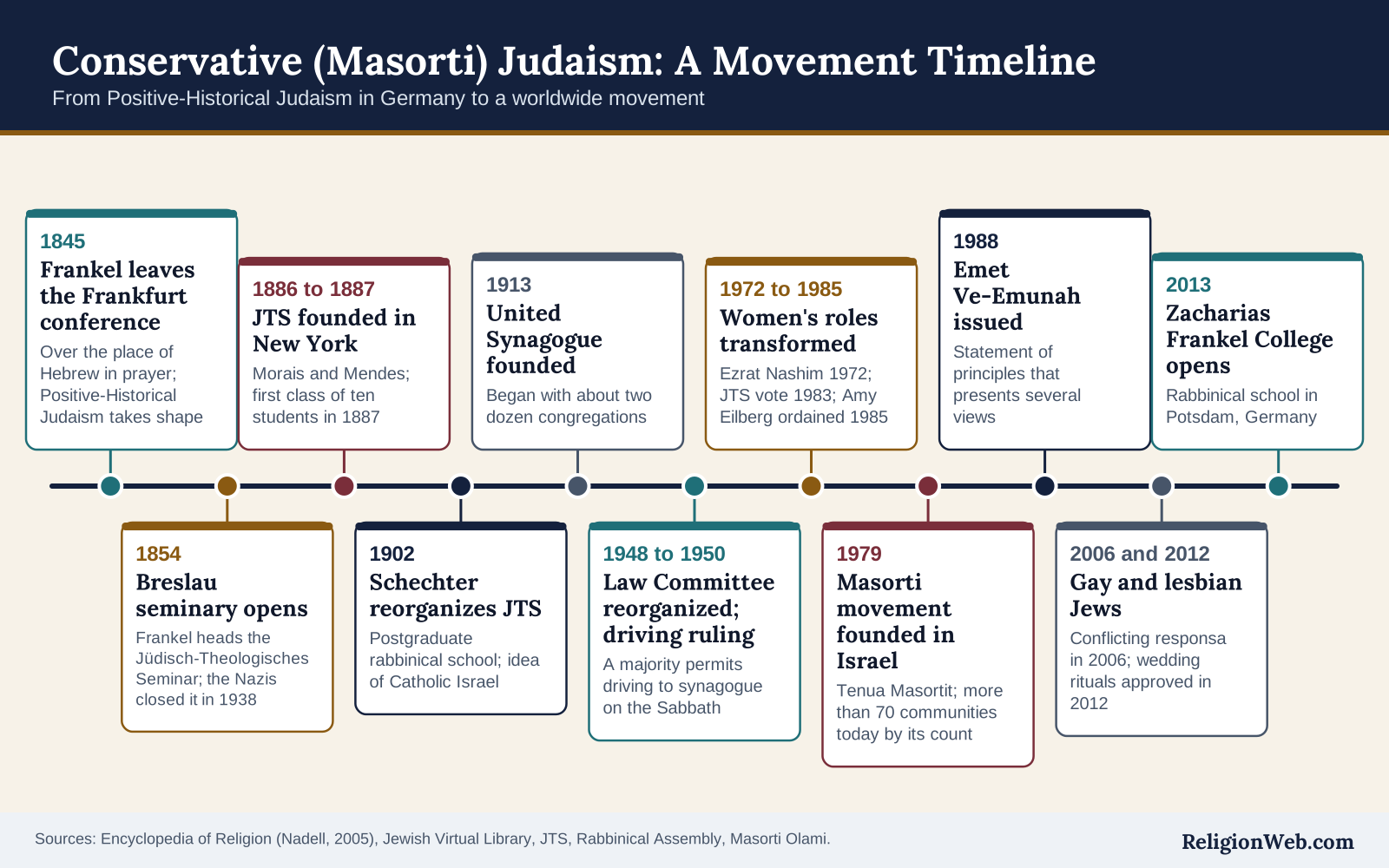
| Date | Event |
|---|---|
| 1845 | Zecharias Frankel withdraws from the Frankfurt rabbinical conference over the place of Hebrew in prayer |
| 1854 | Frankel becomes the first head of the Jüdisch-Theologisches Seminar in Breslau |
| 1886 to 1887 | Jewish Theological Seminary founded in New York; first class of ten students in 1887 |
| 1902 | Seminary reorganized under Solomon Schechter |
| 1913 | United Synagogue of America founded |
| 1927 to 1948 | Committee on Jewish Law established (1927) and reorganized as the Committee on Jewish Law and Standards (1948) |
| 1950 | Majority ruling permits driving to synagogue on the Sabbath |
| 1957 and 1962 | World Council of Synagogues founded (1957); Seminario Rabínico Latinoamericano opens in Buenos Aires (1962) |
| 1971 | United Synagogue reaches 832 congregations |
| 1972 | Ezrat Nashim presents its manifesto at the Rabbinical Assembly convention |
| 1979 | Masorti movement founded in Israel |
| 1983 and 1985 | Seminary faculty votes to admit women (1983); Amy Eilberg ordained (1985) |
| 1988 | Emet Ve-Emunah issued as a statement of principles |
| 2006 and 2012 | Committee adopts conflicting responsa on homosexuality (2006) and approves same-sex wedding rituals (2012) |
Beliefs: God, Revelation, Covenant and the Commandments
God and Revelation
Conceptions of God
According to Emet Ve-Emunah, belief in God is central and indispensable to Jewish life, but the document does not prescribe one way of conceiving God. It describes two broad understandings that coexist within the movement: God as a supernatural being who exists, creates and commands, and God as a presence found in the shared tradition of the Jewish people and in the search for meaning and justice. It says that both affirm the continuing power of the traditional language of prayer, including its images of God as sovereign, and it rejects any image of a capricious or amoral God as inconsistent with Jewish tradition. In practice many congregants, like many members of other movements, are more certain about the practices of Jewish life than about the metaphysics behind them.
Revelation: four views within the movement
The statement of principles treats revelation as an external source of truth that is transmitted through human beings, and it rejects both relativism and literalism. It describes Sinai as the single greatest event of revelation but not the only one, since revelation continues through the prophets, the sages of the Mishnah and Talmud, and the later codes and responsa. Four views are set out as held within the movement. The first understands revelation as a personal encounter with God in which propositional content, including the commandments themselves, is directly communicated. The second sees it as an ineffable encounter that human beings then formulate into norms. The third regards it as the ongoing discovery of truths through nature and history, and the fourth as a continuing process and not a single event. The document calls the diversity of perception a blessing that enriches Jewish life, and it makes no attempt to rank the views.
Covenant, Commandments and the Jewish People
The covenant and the idea of election
Jewish tradition describes a covenant between God and Israel, and the Torah records the people’s acceptance of it. In the account in Exodus, after Moses reads the book of the covenant to the people, they reply:
All that the LORD hath spoken will we do, and obey.
Exodus 24:7 (the people’s reply), The Holy Scriptures: A New Translation (JPS 1917)
Jewish commentators have long treated this verse as a model of commitment that precedes full understanding, and the movement’s statement of principles speaks in a similar spirit of the covenant as a relationship carried by the entire people across generations. It describes the “election of Israel” and the “covenant of Israel” as two sides of the same coin and says that election means responsibility and not privilege, citing the prophets’ rejection of any claim of superiority. It also notes that Jewish tradition recognizes earlier covenants with Adam and Noah, so that the covenant at Sinai is understood as one stage in a wider story of divine relation with humanity.
Why the commandments bind
The central question for any movement committed to halakha is why the commandments obligate. Emet Ve-Emunah answers that its members understand the divine basis of halakha in different ways, and that for many the conviction that halakha is rooted in divine command is the primary reason for obeying it. It adds that the sanctity of halakha attaches to the system as a whole, not to each rule. Other members place more weight on the commandments as the shared discipline through which the Jewish people has preserved its identity and sanctified time, a view close to Schechter’s idea of Catholic Israel, in which the practice of the community is itself a source of authority. All of these positions agree, the document says, that halakha is indispensable for authentic Jewish life.
Israel, Zionism and the World to Come
The Jewish people and the State of Israel
The movement has been associated with Zionism since Schechter’s time, a position that led some of the seminary’s board members to object in the early twentieth century. Emet Ve-Emunah states that the movement staunchly supports the Zionist ideal, and the movement is a member of the World Zionist Organization. The statement describes Israel and the Diaspora as complementary centers of Jewish life, encourages immigration to Israel as a commandment, and describes Israel as both a democratic state and a distinctively Jewish one, a balance it calls a continuing challenge. It also argues against religious coercion, urging that personal-status matters such as marriage and divorce be open to civil options and that rabbis of every movement be permitted to officiate. Masorti communities in Israel build on this stance, as described in the section on the movement worldwide.
Messianic hope and the world to come
On questions about the end of days, the movement’s statement acknowledges that members read traditional teachings about the messianic age and the afterlife either figuratively or literally. Its prayer books reflect the same latitude. The 1985 edition of Siddur Sim Shalom, the standard prayer book of North American Conservative congregations for about twenty-five years, offered alternatives to passages about animal sacrifices in the Temple, and some editions reformulate the hope for the rebuilding of the Temple in terms of national and religious renewal. Conservative and Masorti Jews therefore recite the traditional liturgy while holding a range of personal views about what its eschatological language means, a pattern familiar across the Jewish world.
Torah, Talmud and Rabbinic Literature: The Sources and How They Are Studied
The Texts of Conservative Jewish Study
The Written Torah and the Oral Torah
Conservative and Masorti Jews share with the rest of the Jewish world the basic canon of rabbinic Judaism. The Hebrew Bible, called the Tanakh, consists of the Torah (the five books of Moses), the Prophets and the Writings, and the Torah is read aloud in the synagogue in an annual cycle of weekly portions. Alongside it stands what the rabbis called the Oral Torah, the body of teaching that was eventually written down in the Mishnah, a collection of legal rulings compiled around 200 CE, and in the two Talmuds, the Palestinian or Jerusalem Talmud and the larger Babylonian Talmud, which record centuries of discussion of the Mishnah. A general account of these works appears in the article on Judaism. What distinguishes the movement is less the list of books than the way they are read: as a layered literature produced by identifiable communities in identifiable periods, and yet as a single conversation across time.
Codes, commentaries and responsa
Beyond the Talmud, halakha was organized in medieval and early modern codes, above all the Shulhan Arukh of Joseph Karo, published in the sixteenth century, and elaborated in a long literature of responsa, written answers to specific legal questions. Conservative halakhic writing draws on all of these layers, and it follows the Shulhan Arukh’s structure when it organizes its own rulings. The Committee on Jewish Law and Standards sorts its responsa into the four traditional divisions: Orah Hayyim (prayer, synagogue, Sabbath and holidays), Yoreh Deah (dietary laws, conversion, mourning and family purity), Even HaEzer (marriage, divorce and personal relationships) and Hoshen Mishpat (financial and civil matters). A modern Conservative responsum typically cites the Talmud and the classical codes, adds the opinions of recent authorities, and then states and defends a conclusion, much as a rabbinic responsum would have done for centuries.
Reading Scripture Historically
Scholarship at the center of rabbinical training
Historical scholarship is not an optional extra in this movement but part of its founding idea. Frankel’s Darke ha-Mishnah traced the sources and methods of the Mishnah, Schechter’s work on the manuscripts of the Cairo Genizah recovered medieval texts, including a Hebrew fragment of the book of Ben Sira, and the seminary’s faculty, including Ginzberg and Lieberman, became known for the critical study of rabbinic literature. Emet Ve-Emunah treats modern scholarship as a settled part of the movement’s outlook, stating that the tradition developed historically and continues to develop, and it names the seminary’s faculty and other institutions of higher learning as sources of religious guidance. Rabbinical students therefore study the Talmud in Hebrew and Aramaic with traditional methods alongside the history of the text, its manuscripts and the world in which it was composed.
Different views of how the Torah came to be
How historical scholarship bears on belief about the Torah’s origin is a question on which members of the movement differ, and the movement’s own statement says so. Some hold that the commandments were communicated directly at Sinai, others that the Torah records a human response to a divine encounter, and others that revelation unfolded over time. Scholars working within the movement have also produced study Bibles and commentaries for congregational use, such as Etz Hayim: A Torah Commentary, published by the Jewish Publication Society in 2001, which sets traditional rabbinic comment beside the findings of modern scholarship. The common ground is that the Torah remains the central text of Jewish life and that study of it, in whatever method, is a religious act.
Halakha in Conservative Judaism: Authority, Method and Decision-Making
How the Movement Understands Halakhic Authority
The Torah’s own warrant for interpretation
The movement begins from the observation that the Torah itself contains two instructions that must be held together. One forbids altering the commandments:
Ye shall not add unto the word which I command you, neither shall ye diminish from it, that ye may keep the commandments of the LORD your God which I command you.
Deuteronomy 4:2, The Holy Scriptures: A New Translation (JPS 1917)
The other establishes a judicial authority to decide cases the written text does not settle:
If there arise a matter too hard for thee in judgment, between blood and blood, between plea and plea, …
Deuteronomy 17:8 (opening), The Holy Scriptures: A New Translation (JPS 1917)
The passage goes on to direct Israelites to bring such cases to the judges of the time and to act “According to the law which they shall teach thee,” without turning aside “to the right hand, nor to the left” (Deuteronomy 17:11, JPS 1917). Rabbinic Judaism has traditionally read these verses as the foundation of the authority of the sages: the written commandments may not be added to as though the addition were part of the Torah itself, yet the courts and teachers of each generation are charged with applying and explaining them. Emet Ve-Emunah adopts this frame when it notes that the early rabbis knew they were instituting change and justified it by pointing to the Torah’s mandate for judicial activity, which they read broadly. From the standpoint of the movement, a living halakha is therefore not a departure from the Torah but a response to a command within it.
Catholic Israel, precedent and the burden of proof
Two principles shape how that authority is used. The first is Schechter’s idea of Catholic Israel, which treats the continuing practice of the Jewish people as a source of law alongside the written sources. The second is a presumption in favor of the past. The statement of principles says that change is necessary but is not to be sought for its own sake, that the default is preservation, and that the burden of proof falls on anyone who proposes an alteration. It lists the kinds of reasons that can justify change: bringing the law into line with the actual practice of observant Jews, responding to technological, social, economic or political realities, improving material conditions, improving relations among Jews and with the wider society, preventing injustice, and deepening piety and moral standards. It also observes that in some cases, such as the education of girls and the creation of the festival of Simhat Torah, practice changed first and law followed.
The Committee on Jewish Law and Standards
Membership and procedure
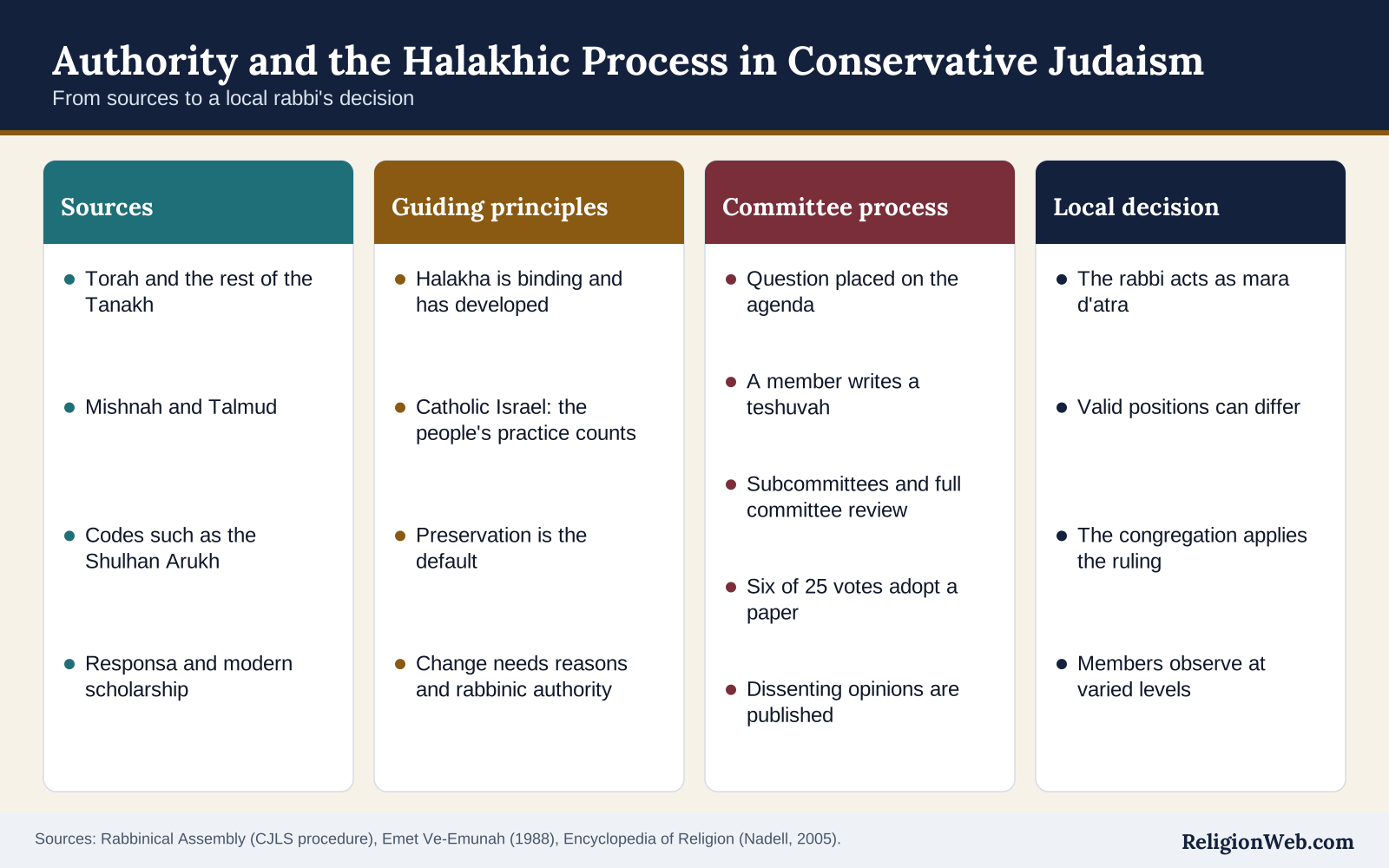
The central legal body of the movement is the Committee on Jewish Law and Standards, which sets halakhic policy for the Rabbinical Assembly and for the movement as a whole. It has 25 voting members, all rabbis, together with five non-voting lay representatives of the United Synagogue and one non-voting cantor from the Cantors Assembly. A question is placed on the agenda and answered in a teshuvah, or responsum, written by an individual member. Subcommittees review the draft, and the full committee hears it, usually at two separate meetings. A paper is adopted as an official position when at least six members vote in its favor, a threshold lower than a majority of the committee, which in practice allows more than one position to stand, as the votes of 2006 showed, and members may attach concurring or dissenting opinions, which do not carry official status. The committee’s database holds more than 350 responsa, and since 2018 an annual International Seminar for Halakhic Study has invited congregations and schools around the world to study one ruling together.
The local rabbi as mara d’atra
The committee’s rulings do not replace the judgment of the local rabbi. Each rabbi is the mara d’atra, an Aramaic phrase for the halakhic authority of a particular place, and the committee’s own description says that rabbis may consider its positions but make their own decisions as conditions warrant. Emet Ve-Emunah likewise places a congregation’s religious authority in its rabbi, based on ordination and the congregation’s choice, while stating that the parameters set by the committee and by the Rabbinical Assembly’s conventions bind its rabbis and that variations within those parameters are legitimate. The practical result is that two Conservative synagogues may follow different customs on a given question, each with a responsum behind it. For a person asking how to observe a particular law, the committee’s published teshuvah is an explanation of options, and the local rabbi gives the decision.
| Stage | Who acts | What happens |
|---|---|---|
| Question raised | A rabbi, congregation or movement body | The question is submitted to the Committee on Jewish Law and Standards and placed on its agenda |
| Responsum written | An individual committee member | A teshuvah cites the Talmud, codes and later authorities and states a conclusion |
| Review | Subcommittees and the full committee | The draft is discussed, usually at two meetings, and may be revised |
| Vote | 25 voting rabbis | Six affirmative votes adopt a paper; legislation by takkanah appears to require a larger majority, thirteen, as in the 2006 deliberations |
| Publication | Rabbinical Assembly | Approved papers become official positions; concurring and dissenting opinions are attached but are not official |
| Local decision | The mara d’atra | The local rabbi weighs the ruling and decides for the community within the movement’s parameters |
The Law in Practice: Examples From the Four Divisions
Prayer, Sabbath and holidays
Questions of worship and the calendar fall under Orah Hayyim, and the movement’s best-known rulings come from this division. The 1950 decision on travel to synagogue has already been described, and the same body of rulings treated the use of electricity differently from the kindling of fire. Reference summaries report that in 1955 the committee held the old bar on women receiving Torah honors to be no longer relevant, and the early 1970s brought the decision to count women in the minyan. More recent examples show that the committee still revisits settled questions: in 2015 it eased the Passover restriction on kitniyot, and in 2023, according to the Rabbinical Assembly and press reports, the committee published competing opinions on whether driving an electric car on the Sabbath is permitted, so that rabbis could follow the opinion they found most persuasive. The last example is typical of the system, because it produces a range of defensible answers and does not impose one.
Food, conversion and mourning
The division of Yoreh Deah covers dietary laws, conversion, mourning and family purity. Reference summaries record that in 1972 the committee ruled hard cheese kosher even where animal rennet was used in its production, a ruling that rests on an old debate about how far the process transforms the ingredient. The movement maintains the traditional requirements for conversion described elsewhere in this article, and its rabbis teach the customary stages of mourning, with the difference that women are counted in the minyan for mourners’ prayers in egalitarian congregations. As in the other divisions, the movement’s published teshuvot supply the arguments that a rabbi can consult when deciding how to advise a family.
Marriage, divorce and personal status
The division of Even HaEzer concerns marriage, divorce and relations between people, and it has been the setting for some of the movement’s most careful legal work. A reference summary reports that in 1952 the committee permitted a kohen, a descendant of the priests, to marry a divorced woman on condition that he give up certain priestly privileges. The marriage-contract clause of the 1950s, associated with Saul Lieberman, aimed to protect women from becoming agunot. The 2006 and 2012 decisions on gay and lesbian Jews belong to this division as well. The fourth division, Hoshen Mishpat, covers financial and civil responsibility, and its rulings on business ethics and communal responsibility receive less public attention than rulings on ritual.
Tools of Change and Internal Debate
Interpretation, permission and legislation
The statement of principles recognizes more than one route to change. Some members prefer to solve problems within existing halakhic norms, finding in the sources a precedent or a lenient opinion that fits the case. Others are willing to amend the law through formal legislation, or takkanah. Others will change a practice only where the halakhic literature itself supports the change. Examples already described show the range: the 1950 ruling on travel to synagogue was an argued permission that relied on the sources and on a judgment about communal need, while the marriage-contract clause of the 1950s was an added legal device meant to protect women from being left unable to remarry. The committee’s 2015 decision to permit kitniyot, the legumes and grains that some Ashkenazi communities avoid on Passover, is another example of the committee revisiting a custom of long standing.
Disagreement within and about the system
The system produces open disagreement by design, since dissenting and concurring opinions are published with the majority position. Members of the movement debate whether it moves too quickly or too slowly, whether its rulings are applied consistently in congregations, and whether the gap between its stated standards and the actual practice of many members is too wide. Reference works note that some critics within the movement have pointed to that gap, and that after the vote on women’s ordination in 1983 a group of opponents formed the Union for Traditional Judaism. Authorities in other halakhic communities also disagree with particular Conservative rulings, as halakhic communities have disagreed with one another throughout history. What the Conservative system offers is a transparent procedure: a question, a written argument from the sources, a recorded vote, and a local decision.
Institutions and Terminology: Seminaries, Associations and the Language of the Movement
Institutions in North America
The Jewish Theological Seminary
The Jewish Theological Seminary, at 3080 Broadway in New York, remains the movement’s best-known institution. It describes its original mission as preserving the knowledge and practice of historical Judaism, and today it comprises the Rabbinical School, the H. L. Miller Cantorial School and College of Jewish Music, the William Davidson Graduate School of Jewish Education, the Gershon Kekst Graduate School, the Albert A. List College of Jewish Studies, and a high school program, together with research institutes, a major library and, through its affiliation, The Jewish Museum. Its faculty members teach and publish in Talmud, Bible, Jewish history, philosophy, liturgy and ethics, and its graduates serve as rabbis, cantors, educators and scholars in many countries. A second North American rabbinical school, the Ziegler School of Rabbinic Studies at American Jewish University in Los Angeles, grew out of the University of Judaism that the movement opened in 1947.
The Rabbinical Assembly, the United Synagogue and affiliated bodies
Three organizations carry most of the movement’s institutional life in North America. The Rabbinical Assembly, which traces its origin to the seminary’s alumni in 1901 and was renamed in 1918, is the global association of Conservative and Masorti rabbis and the body that houses the Committee on Jewish Law and Standards. The United Synagogue of Conservative Judaism, founded in 1913 as the United Synagogue of America, describes itself as a religious association that strengthens synagogues and counts nearly 600 congregations in the United States, Canada and Mexico, organized in seven districts. The Cantors Assembly represents the movement’s cantors. Around these bodies stand the Women’s League for Conservative Judaism, founded in 1918, United Synagogue Youth, the Ramah camps, and the Solomon Schechter day schools named for the seminary’s reorganizer, all of which serve as the educational and social network through which members meet the movement beyond the Sabbath service.
Institutions in Israel and Around the World
Masorti Olami and its regional federations
The movement’s international body is Masorti Olami (“Worldwide Masorti”), based in Jerusalem and registered as a nonprofit in the United States and Israel. Reference works trace it to the World Council of Synagogues, founded in New York in 1957 by the United Synagogue and communities from several countries. Masorti Olami describes itself as the official international movement of Masorti/Conservative Judaism and reports about 140 communities on five continents. Regional federations organize the work locally: the Masorti movement in Israel (Tenua Masortit) dates from 1979, Masorti Europe from 2006, and Masorti Amlat in Latin America from 2007. The federations share a commitment to halakha and a set of educational ties, though practice differs from country to country.
Rabbinical schools beyond New York
Because a movement that relies on trained decisors needs seminaries close to its communities, several rabbinical schools operate outside New York. The Schechter Rabbinical Seminary in Jerusalem, part of the Schechter Institute of Jewish Studies, is the movement’s seminary in Israel. The Seminario Rabínico Latinoamericano in Buenos Aires was founded in 1962 by Rabbi Marshall Meyer and trains rabbis for Latin America, and the Zacharias Frankel College opened in Potsdam, Germany, in 2013, offering a five-year course in English in association with the University of Potsdam. The names carry history: the Frankel College revives, in the country where Frankel’s own Breslau seminary was closed in 1938, the name of the founder of the school of thought that the movement claims as its ancestor.
| Institution | Founded or established | Role |
|---|---|---|
| Jewish Theological Seminary (New York) | 1886; first class 1887 | Rabbinical, cantorial, graduate and undergraduate education; research and publishing |
| Rabbinical Assembly | 1901 as alumni group; renamed 1918 | Global association of Conservative and Masorti rabbis; houses the Committee on Jewish Law and Standards |
| United Synagogue of Conservative Judaism | 1913 | Association of congregations in the United States, Canada and Mexico |
| Masorti Olami | World Council of Synagogues, 1957 | International body for Masorti/Conservative communities, based in Jerusalem |
| Masorti movement in Israel | 1979 | Congregations, educational programs and advocacy for pluralism in Israel |
| Seminario Rabínico Latinoamericano | 1962 | Rabbinical seminary in Buenos Aires serving Latin America |
| Zacharias Frankel College | 2013 | Rabbinical school in Potsdam, Germany, serving Europe |
Publications, Scholarship and Public Voice
Prayer books, commentaries and journals
The movement’s institutions publish a steady stream of materials for study and worship. In addition to the prayer books described in the section on worship, the Jewish Publication Society published Etz Hayim: A Torah Commentary in 2001, a volume edited by Rabbi David Lieber with Harold Kushner, Jules Harlow and Chaim Potok and used in many Conservative synagogues. The Rabbinical Assembly publishes the responsa of the Committee on Jewish Law and Standards, and the seminary’s faculty publish scholarly editions, histories and commentaries through university presses and Jewish publishers. A journal titled Conservative Judaism has long carried essays on theology, law and practice, and a special issue in 1999 argued that a shared theological vision for the movement was neither possible nor desirable, a position consistent with the pluralism of its 1988 statement.
The movement’s public voice
The movement also speaks on public questions. Its commitment to Zionism is expressed through its membership in the World Zionist Organization, and its leaders have taken part in interfaith and civil rights work, as Abraham Joshua Heschel did in the 1960s. Reference summaries report that in 2016 the Rabbinical Assembly passed a resolution supporting the rights of transgender people. Statements of this kind come from the movement’s rabbis and lay organizations as bodies, and individual members differ in their views, as the movement’s founding documents acknowledge. They are better understood as expressions of the way those institutions read Jewish tradition than as a political platform.
Key Terms and Names
The vocabulary of law and authority
Several Hebrew and Aramaic terms recur in any discussion of the movement. Halakha means Jewish religious law, literally “the path” or “the way of walking.” A teshuvah is a responsum, and the plural teshuvot names the literature of such answers. A takkanah is a rabbinic enactment or ordinance, and mara d’atra is the local halakhic authority. “Positive-Historical” names Frankel’s school, and “Catholic Israel” names Schechter’s principle that the practice of the whole Jewish people carries authority. Each is explained where it first appears in this article, and the table below collects them for reference.
The vocabulary of community and practice
A minyan is the quorum of ten required for certain parts of communal prayer, and a congregation is called a kehillah, with the plural kehillot used by the United Synagogue in its own materials. “Egalitarian” describes services and rituals in which women and men take the same roles. “Masorti” itself has three uses that should be kept apart. It is the name of the movement outside North America. In Israel it is also the ordinary word for Jews who describe themselves as traditional, neither strictly religious (dati) nor secular (hiloni), and who in the Pew Research Center’s 2014 to 2015 survey made up 29 percent of Israeli Jews, most of whom are not members of the movement. And the plural masortim refers to those traditional Israelis, as distinct from members of Masorti congregations.
| Term | Meaning |
|---|---|
| Halakha | Jewish religious law, binding in the movement’s understanding and developing through history |
| Teshuvah (plural teshuvot) | A responsum, or written legal answer to a specific question |
| Takkanah | A rabbinic enactment or ordinance that changes or adds to the law |
| Mara d’atra | The local halakhic authority, usually the congregation’s rabbi |
| Positive-Historical Judaism | Frankel’s nineteenth-century school, affirming tradition while studying it historically |
| Catholic Israel | Schechter’s term for the consensus and practice of the Jewish people as a source of authority |
| Minyan | A quorum of ten adults for communal prayer, counting women in most Conservative congregations |
| Masorti | “Traditional”; the name of the movement outside North America and, separately, of traditional Israelis |
The Movement Around the World: Masorti Communities and Regional Diversity
Israel
The Masorti movement in Israel
The Masorti movement in Israel, known in Hebrew as Tenua Masortit, was founded in 1979 and describes itself on its own website as an Israeli-led initiative of the Conservative movement. Its congregations, which the movement counts at more than 70 communities, groups and minyanim, range from long-established synagogues in the large cities to small prayer groups and a kibbutz. The Encyclopedia of Religion reported about fifty congregations in 2003, along with educational institutions, youth programs and programs for new immigrants. The movement’s institutions include the Schechter Institute of Jewish Studies in Jerusalem, whose rabbinical seminary trains the movement’s Israeli rabbis, and it is a member of the global movement through Masorti Olami, which has its headquarters in Jerusalem.
The movement’s position in Israeli law is constrained. The Encyclopedia of Religion notes that early in the state’s history Israel gave full jurisdiction over marriage, divorce and burial to the Orthodox rabbinate, which does not recognize rabbis ordained outside Orthodox settings, and the movement’s own FAQ observes that state funding for religious institutions is limited to Orthodox ones. Masorti leaders therefore advocate for civil options in personal status matters, as the statement of principles recommends, and for egalitarian prayer arrangements at the Western Wall. Supporters and opponents of these proposals within Israeli society hold strong views, and the debate involves law, politics and religion at once. The approaches of the other movements to these questions are described in the articles on Orthodox Judaism and Reform Judaism.
Masorti as an Israeli religious identity
The word masorti in Israel is also an everyday category for Jews who regard themselves as traditional. The Pew Research Center’s survey of Israeli society, conducted between October 2014 and May 2015, found that 29 percent of Israeli Jews, or 23 percent of all Israeli adults, were Masorti in this sense, the second-largest group after the 49 percent who called themselves secular (hiloni). Pew described them as occupying a broad middle ground between Orthodoxy and secularism and as the most internally diverse of the four groups. Among them, 21 percent said they prayed daily, 31 percent said they never prayed, and 53 percent said they traveled by car, bus or train on the Sabbath, while 41 percent said they did not. These Israelis are traditional in their sense of identity and practice, but the survey does not describe them as members of the Masorti movement, and most are not. The two uses of the word overlap in meaning but not in membership.
Europe, Latin America and Beyond
Britain and continental Europe
In Britain, the Masorti movement grew out of a controversy over the Orthodox rabbi Louis Jacobs, who was denied the chance to continue as minister at the New West End Synagogue. Members who left with him founded the New London Synagogue in St John’s Wood in 1964, and a federation of like-minded synagogues, the Assembly of Masorti Synagogues, was formed in 1985 and took the name Masorti Judaism in 2012. A 2016 report of the Board of Deputies of British Jews, as cited by a Jewish genealogical reference site, put Masorti at 3.3 percent of synagogue membership in the United Kingdom, a share that had more than doubled in six years. On the continent, the movement revived in Germany in 1995 when Rabbi Bea Wyler took up a post in Oldenburg and Braunschweig, Masorti e.V. was established in Berlin in 2002, and Masorti Europe was founded in 2006. Masorti communities now exist in France, Spain, Ukraine and other countries, and the Zacharias Frankel College in Potsdam trains rabbis for them.
Latin America, Australia, India and Africa
Latin America is the movement’s largest region outside North America and Israel. The Seminario Rabínico Latinoamericano, founded in Buenos Aires in 1962 by Rabbi Marshall Meyer, trained a generation of rabbis for the continent, and the regional federation Masorti Amlat, founded in 2007, is reported to include about 85 congregations, many of them in Argentina. Australia has two congregations, Emanuel Synagogue in Sydney and Kehillat Nitzan in Melbourne, and communities in India are found in cities such as Mumbai and New Delhi. In Africa the movement includes a congregation in Johannesburg and relationships with the Abayudaya, a Jewish community of Uganda and Kenya numbering roughly 2,500 people. These regional details come from the movement’s own and secondary summaries, and local congregations vary widely in size, practice and relations with other Jewish groups in their countries.
| Region | Organization and date | Notes |
|---|---|---|
| North America | United Synagogue of Conservative Judaism, 1913 | Nearly 600 congregations in the United States, Canada and Mexico; 17 percent of US Jewish adults identified as Conservative in 2020 |
| Israel | Tenua Masortit, 1979 | More than 70 communities, groups and minyanim; Schechter Institute and rabbinical seminary in Jerusalem |
| United Kingdom | New London Synagogue, 1964; Assembly of Masorti Synagogues, 1985; Masorti Judaism, 2012 | About 15 active congregations in a reference listing; 3.3 percent of synagogue membership in 2016 |
| Germany and Europe | Masorti e.V., 2002; Masorti Europe, 2006 | Revival in Germany from 1995; Zacharias Frankel College in Potsdam since 2013 |
| Latin America | Seminario Rabínico Latinoamericano, 1962; Masorti Amlat, 2007 | About 85 congregations, the largest region outside North America and Israel |
| Australia, India and southern Africa | Individual congregations affiliated with Masorti Olami | Sydney, Melbourne, Mumbai, New Delhi, Johannesburg and relationships with the Abayudaya of Uganda |
Worship in the Conservative Synagogue: Prayer, Torah Reading and Community
The Structure and Language of Services
Daily, Sabbath and festival prayer
Worship in a Conservative or Masorti synagogue follows the structure of traditional Jewish liturgy. There are three daily services, the morning Shacharit, the afternoon Minchah and the evening Maariv, with a central silent prayer, the Amidah, and the declaration of faith known as the Shema. On Friday evening the Sabbath is welcomed with a service called Kabbalat Shabbat, followed by the evening prayer and, in homes, by the blessing over wine and bread. On Saturday morning the service includes the reading of the Torah and a concluding additional service, Musaf, and the Sabbath ends in the evening with Havdalah. Most of the liturgy is in Hebrew with English or another local language beside it, and the preference for Hebrew reflects the position Frankel took at Frankfurt in 1845. Many congregations conduct the main services with a rabbi, a cantor and a leading role for lay members.
Prayer books and careful revision
The movement has published its own prayer books, and they show how it handles change in the liturgy. The Sabbath and Festival Prayer Book of 1946 is described in reference works as the first clearly Conservative liturgy. Siddur Sim Shalom, edited by Rabbi Jules Harlow and published in 1985 by the Rabbinical Assembly and the United Synagogue, became the standard prayer book in North American Conservative synagogues for about twenty-five years. It offered alternatives to passages about animal sacrifices in the Temple, added optional personal prayers, and revised morning blessings that had thanked God for not making the worshiper a woman, a slave or a non-Jew. A 1998 edition offered Amidah alternatives that let the leader include the matriarchs alongside the patriarchs and used gender-sensitive English such as “Sovereign” for “King.” The High Holiday prayer book Mahzor Lev Shalem appeared in 2010 and Siddur Lev Shalem for Sabbath and festivals in 2016. In each case the liturgy retains the traditional Hebrew text while adjusting translation, commentary and options.
Torah Reading and Egalitarian Practice
The Torah service
The reading of the Torah is the center of the Sabbath morning service. The scroll is taken from the ark, carried through the congregation and read by a trained reader from a handwritten scroll, with individuals called up for blessings before and after each section, an honor called an aliyah. On the Sabbath morning there are seven such honors, with the first traditionally given to a descendant of the priests (a kohen) and the second to a descendant of the Levites, and the rest to other members of the congregation or guests. Some congregations read the whole weekly portion each Sabbath in a one-year cycle, while others, with the approval of the Rabbinical Assembly, read about one third of each portion in a three-year, or triennial, cycle that shortens the reading and leaves room for study and discussion. Readings from the Prophets, the haftarah, and a sermon or teaching by the rabbi or a lay member follow.
Women’s participation and the minyan
Most Conservative congregations in North America today are egalitarian, meaning that women and men sit together and are called to the Torah, lead prayers and count in the minyan on equal terms. By 1995 to 1996 an estimated 83 percent of congregations counted women in the quorum, as the section on the movement’s history describes, and one New Jersey congregation’s published policy, for example, states that men and women participate equally in ritual life, that women lead services and serve on the board, and that women are encouraged to wear the tallit, the prayer shawl, while both men and women may lay tefillin, the phylacteries worn at weekday morning prayer. Practice still varies. Some congregations are more traditional in particular details, some Masorti communities in other countries follow local custom, and individual members differ in their own observance. In Israel, the Masorti movement promotes an egalitarian approach to Jewish life and maintains a program for egalitarian prayer at the Western Wall.
Music, the Cantor and the Sermon
The cantor and the music of the service
The cantor, in Hebrew hazzan, leads the congregation in chanting the prayers, and the movement trains cantors through the H. L. Miller Cantorial School and College of Jewish Music at the Jewish Theological Seminary. The Cantors Assembly represents them, and a cantor from that body sits on the Committee on Jewish Law and Standards as a non-voting member. The seminary opened its cantorial school to women in 1987, two years after the first woman was ordained as a rabbi. In many congregations the cantor, the rabbi and lay prayer leaders share the work of the service, and the melodies that members know range from traditional chants for the Sabbath and festivals to newer compositions in English and Hebrew.
Teaching from the pulpit and in the study hall
A sermon or short teaching (d’var Torah) on the weekly portion usually accompanies the Sabbath morning service, and many congregations add adult education sessions, Torah study before or after services, and classes on Hebrew and prayer. These activities reflect the movement’s conviction that worship and learning belong together and that a congregation is, among other things, a school. For a visitor, one good way to understand the movement is to attend a study session as well as a service, because it is in discussion of a text that the combination of traditional reading and historical awareness becomes most visible.
Shabbat, Holidays and the Jewish Year in Conservative Practice
Shabbat, Food and Daily Observance
How Shabbat is kept
Shabbat, the seventh day, is the weekly center of Conservative Jewish observance, and its structure is the one shared across the Jewish world. It begins at sundown on Friday, when candles are lit in the home, and continues with a festive meal that opens with Kiddush, the blessing over wine, and two loaves of bread, usually braided challah. Saturday brings the morning service with the reading of the Torah, a midday meal, an afternoon service and, after nightfall, the short ceremony of Havdalah that marks the transition to the ordinary week. The tradition understands the day as a commemoration of creation and a rest from the kinds of work that the rabbis catalogued in thirty-nine categories, and the observance is meant to be a time for prayer, study, family and rest. Conservative halakha accepts the classical framework, and Britannica notes that Conservative Jews insist on the sacredness of the day.
How the day is observed in detail depends on the household and the rabbi. The committee’s 1950 ruling permits driving to synagogue so that attendance is possible, and many rabbis encourage walking where distance allows. Reference summaries say the committee also held that using electricity is not the same as kindling a fire. Some congregations ask members to refrain from using electronic devices on Shabbat, and a ruling on electric cars in 2023, which as reported offered conflicting opinions, illustrates how the committee continues to revisit the question. In the Encyclopedia of Religion’s survey data for 1990, 23 percent of self-identified Conservative Jews regularly lit Sabbath candles, which shows how much distance there can be between a movement’s standards and individual practice.
Kashrut and daily commitments
The dietary laws, kashrut, are likewise treated as binding by the movement’s rabbis, who classify them under Yoreh Deah, and Britannica notes that the laws are observed with modifications where necessary. In the past the committee has issued rulings on matters such as hard cheese made with animal rennet, which a ruling of 1972 held to be kosher, and in 2015 the committee approved a ruling that eased the Passover restriction on kitniyot, the legumes and grains that some Ashkenazi communities avoid. The same Encyclopedia of Religion figures report that under 15 percent of self-identified Conservative Jews kept kosher in 1990. Many congregations keep a kosher kitchen for communal meals even where members’ practice at home varies. Daily commitments also include prayer, blessings before and after meals, a mezuzah on the doorpost and, for those who observe it, the wearing of a tallit and tefillin at weekday morning prayer.
The Festivals and Fasts
The High Holy Days and the pilgrim festivals
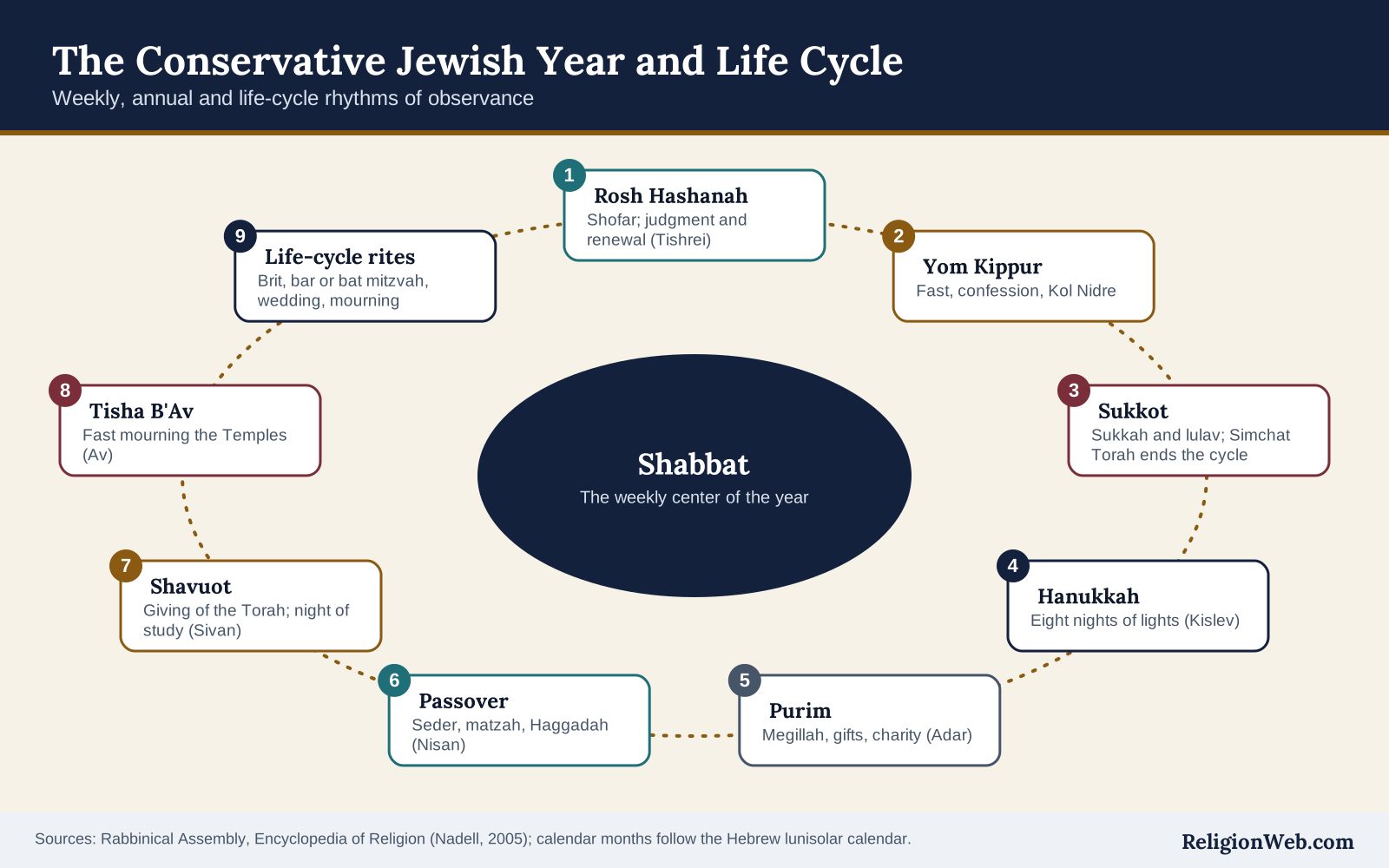
The Jewish calendar is lunisolar, with months that begin at the new moon and an added month in seven years of every nineteen, and the dates of festivals therefore move across the civil calendar; the article on Judaism explains the rules in detail. The year opens with Rosh Hashanah on the first of Tishrei, a two-day observance marked by the blowing of the shofar, a ram’s horn, and by prayers on judgment and renewal. On the tenth of Tishrei comes Yom Kippur, the Day of Atonement, a day of fasting from sunset to nightfall, prayer, confession and repentance (teshuvah) that includes the Kol Nidre service on the eve and the concluding Neilah service. The fast is an obligation for healthy adults and is set aside where it would endanger health; people with medical conditions should consult both a physician and a rabbi. Sukkot, beginning on the fifteenth of Tishrei, is observed by eating in a booth, the sukkah, and by waving the lulav and etrog, and the festival season closes with Shemini Atzeret and Simchat Torah, when the yearly cycle of readings is completed and begun again amid dancing with the scrolls.
Pesach (Passover), beginning on the fifteenth of Nisan, retells the exodus from Egypt at the seder meal, where the story is read from a Haggadah, matzah replaces leavened bread and symbolic foods mark the narrative. Shavuot, seven weeks later, commemorates the giving of the Torah, and it is common to study through the night. In the Diaspora, many Conservative congregations follow the traditional observance of a second day of most festivals, a custom that began when distant communities could not know with certainty on which day the new month had been declared in Jerusalem, while in Israel only one day is observed. Individual congregations differ on the point, and members should check local custom.
Hanukkah, Purim, fasts and modern commemorations
Several observances recall particular events in Jewish history. Hanukkah, on the twenty-fifth of Kislev, lasts eight days and is marked by lighting the candles of a menorah and adding one each night; it commemorates the rededication of the Temple in Jerusalem after the Maccabean revolt of the second century BCE, and rabbinic tradition adds the story of a small supply of oil that lasted eight days. Purim, on the fourteenth of Adar, is the festive holiday on which the Book of Esther is read aloud, gifts are exchanged and the poor receive charity. The fast of Tisha B’Av, the ninth of Av, mourns the destruction of the First and Second Temples and is observed with the reading of the Book of Lamentations. The movement also observes modern commemorations, and its statement of principles mentions the liturgical recognition of the rebirth of Israel on Yom Ha’atzmaut, Israel’s Independence Day, together with Yom HaShoah, the day of remembrance for the six million Jews murdered in the Holocaust, and Yom HaZikaron, Israel’s day for fallen soldiers. Prayer books and supplementary materials provide readings and prayers for each.
Life-Cycle Rites: Birth, Coming of Age, Marriage, Conversion and Mourning
Birth, Naming and Coming of Age
Circumcision and naming daughters
A Jewish boy is traditionally circumcised on the eighth day after birth in a ceremony called brit milah, the “covenant of circumcision,” performed by a trained circumciser (mohel) and accompanied by blessings and the naming of the child. For daughters, naming ceremonies expressing the same welcome into the covenant have become widespread in North America, called by names such as simchat bat or brit bat, and the Jewish Women’s Archive credits groups like Ezrat Nashim with helping the growth of such ceremonies across American denominations. Like much of Jewish practice, these rites have a communal side: the child is welcomed before family and friends, and the parents publicly express their intention to raise the child within the Jewish people.
Bar and bat mitzvah
At about the age of twelve or thirteen, a Jewish child takes on the obligations of the commandments, becoming a bar mitzvah (for boys) or bat mitzvah (for girls), a status that arises automatically with age and does not depend on a ceremony. In practice, families mark the occasion by having the young person read from the Torah or the haftarah, lead part of the service, or give a short teaching. Mordecai Kaplan held the first bat mitzvah in America for his daughter Judith in 1922, and in Conservative congregations today girls and boys generally participate in equivalent ceremonies, often at twelve or thirteen, preceded by years of study of Hebrew, prayer and Torah. The ceremony is a milestone, but the tradition places the greater weight on what follows: a life of learning and obligation.
Marriage, Conversion and Mourning
Weddings and divorce
A traditional Jewish wedding takes place under a canopy, the chuppah, and includes the signing of the marriage contract, the ketubah, the betrothal blessing and seven wedding blessings, the exchange of rings and the breaking of a glass. The ketubah is a legal document, and the Conservative movement is known for a clause added to it in the 1950s, associated with Saul Lieberman, to guard against the situation of an agunah, a woman whose husband refuses or is unable to grant a Jewish divorce, the get. Divorce is handled by a rabbinic court, the beit din. As noted earlier, the Committee on Jewish Law and Standards in 2012 approved two possible wedding rituals for same-sex couples without classifying them as kiddushin, and the movement’s rabbis have traditionally taught that Jews should marry Jews, a position now under discussion, as described above.
Conversion to Judaism
Conversion in Conservative practice follows the traditional pattern: a period of study, acceptance of the commandments, examination by a rabbinic court of three (beit din), immersion in a ritual bath (mikveh) and, for men, circumcision. The movement follows the rule that a person is Jewish if born to a Jewish mother or properly converted. Conversion also raises recognition questions between movements, since each has its own standards, and the statement of principles calls for finding ways to reach a unified approach to conversion and divorce.
Death and mourning
Jewish tradition treats the body with great respect, and it prescribes prompt burial, the ritual preparation of the body by a burial society (chevra kadisha) and a graduated structure of mourning. The week after burial, shiva, is spent at home with visits from the community, and the mourner’s Kaddish prayer is recited in the presence of a minyan during the following eleven months and on each anniversary of death, the yahrzeit. In egalitarian Conservative congregations women count in the minyan and may recite Kaddish on equal terms. The statement of principles notes the tradition’s blessing of the righteous Judge and the Kaddish as aids to mourners. Grief that becomes overwhelming is a matter for physicians and counselors as well as for clergy and community.
| Occasion | Core practice | Notes on Conservative and Masorti custom |
|---|---|---|
| Shabbat | Candles, Kiddush, services with Torah reading, Havdalah | Driving to synagogue permitted by a 1950 majority ruling; level of home observance varies |
| Daily prayer | Morning, afternoon and evening services | Women count in the minyan in most congregations; Hebrew with translation |
| Rosh Hashanah and Yom Kippur | Shofar, fasting, confession, extended liturgy | High Holiday prayer book Mahzor Lev Shalem (2010); fast set aside for health reasons |
| Sukkot and Simchat Torah | Sukkah, lulav and etrog; completing the Torah cycle | Simchat Torah cited as a case where practice changed before law |
| Passover | Seder, matzah, Haggadah | Committee ruling easing the kitniyot restriction in 2015 |
| Brit milah and naming | Circumcision on the eighth day; naming ceremonies | Naming ceremonies for girls widespread |
| Bar and bat mitzvah | Torah reading and leading prayer at about age 12 or 13 | Equivalent ceremonies for girls and boys; first American bat mitzvah in 1922 |
| Marriage | Chuppah, ketubah, seven blessings, glass | Ketubah clause of the 1950s; 2012 same-sex wedding rituals; endogamy taught |
| Conversion | Study, beit din, mikveh, circumcision for men | Matrilineal descent maintained |
| Mourning | Burial, shiva, Kaddish, yahrzeit | Women count in the minyan and recite Kaddish |
Sacred Spaces, Symbols and Material Culture
The Synagogue Building and Its Furnishings
Layout and ritual objects
A synagogue, in Hebrew beit knesset, “house of assembly,” is first of all a place for prayer, study and communal gathering, and it has no priesthood or sacrifice in the manner of the ancient Temple. The sanctuary is oriented toward Jerusalem, and its focal point is the Torah ark (aron kodesh), a cabinet that holds the handwritten parchment scrolls of the Torah, usually covered with decorated mantles and crowned with silver ornaments. A lamp called the ner tamid, the “eternal light,” burns above the ark, and a raised reader’s platform, the bimah, is the place from which the Torah is read. A scroll is written by a trained scribe, a sofer, and is treated with great care: a worn or damaged scroll is not discarded but buried. In Conservative synagogues, men and women normally sit together.
The synagogue as a center of community life
The movement is known for the synagogue center, a model in which the building houses not only the sanctuary but also a school, a social hall, a library, a youth lounge and rooms for adult study. Mordecai Kaplan’s Jewish Center, founded in New York in 1917, is cited in the Encyclopedia of Religion as the prototype. Many Conservative congregations run religious schools that meet on weekday afternoons and Sundays, and the movement has also sponsored full-time day schools, with the Solomon Schechter schools the best known. Smaller Masorti communities elsewhere adapt the model to local conditions, and in Israel the movement counts small prayer groups and minyanim alongside established synagogues.
Ritual Dress and Objects of the Home
Dress at prayer
Certain garments are associated with worship. A head covering, the kippah or yarmulke, is worn by men in Conservative synagogues and, in many congregations, by women as well. The prayer shawl, the tallit, has fringes (tzitzit) tied in accordance with the commandment in the Torah, and tefillin, small leather boxes containing scriptural passages, are bound on the arm and head at weekday morning prayer. Women in Conservative congregations increasingly wear the tallit and tefillin, and one congregation’s published policy, as noted above, encourages women to wear a tallit. These garments connect the worshiper with the commandments they represent, and the preference for particular styles varies among individuals and communities.
Objects of the home and the year
Many of the most familiar Jewish objects belong to the home rather than the synagogue. A mezuzah, a small case containing a scroll with passages from the Torah, is fixed to the doorposts. Shabbat is marked with candlesticks, a Kiddush cup and challah, the seder with a seder plate, a Haggadah and matzah, Sukkot with a sukkah and a lulav and etrog, and Hanukkah with a menorah. At the seminary, The Jewish Museum, with which JTS is affiliated, holds a collection of ritual art and historical objects. For most members, however, the sacred space is the table at which the family keeps Shabbat or a seder, and the objects are valued less as ornaments than as vehicles for blessing.
Community, Ethics and Daily Life
Ethical Teaching and Social Responsibility
Commandments between people and God and between people
The movement shares the Jewish tradition’s view that ethics and ritual belong together. Its statement of principles speaks of election as a matter of responsibility and not privilege, citing the prophets’ rejection of claims of superiority, and its congregations typically carry out charitable giving (tzedakah), visits to the sick, support for mourners and hospitality as regular parts of communal life. Heschel, who was at the forefront of protests for civil rights and against the Vietnam War in the 1960s and early 1970s, is often cited as an example of how the seminary’s thinkers connected prophetic teaching to public action.
Medicine, life and the limits of religious advice
Like all Jewish authorities, Conservative rabbis teach that preserving life takes precedence over nearly all commandments, a principle called pikuach nefesh. The committee’s responsa on medical ethics, end-of-life care and related questions are written by rabbis for rabbis, and they explain the options within halakha without replacing medical or legal advice. A person facing serious illness, a legal problem or a mental health crisis is expected to consult a physician, lawyer or counselor, and a rabbi can help by interpreting the tradition and supporting the person through the decision.
Education, Family and Belonging
Learning as a lifelong commitment
Education is among the movement’s central commitments. The seminary and the Schechter institutions train scholars and clergy, congregations offer classes in Hebrew, prayer and text, the Ramah camps give young people immersion in Hebrew and Jewish practice, and United Synagogue Youth organizes teen programs. The International Seminar for Halakhic Study, begun in 2018, extends the same idea to lay members by inviting congregations to study a single ruling together. Hebrew language and the study of classical texts are emphasized, and the statement of principles insists that Jewish identity cannot be replaced by Israeli identity or by the ability to speak Hebrew alone.
Families, diversity and inclusion
Questions of family and belonging are at the center of present-day discussion. Pew’s 2020 age data show a membership older than that of other groups, and congregations seek to welcome single people, interfaith families, converts, Jews of color and gay and lesbian members alongside long-standing members. Policies differ by congregation and are evolving, and readers who want to know what a particular synagogue offers should consult its published statements and its rabbi.
Common Misconceptions About Conservative Judaism
Misconception 1: “Conservative” Judaism refers to conservative politics
Where the misunderstanding comes from
In everyday English, “conservative” is mostly a political word, and many people reasonably assume that a religious movement carrying the name takes a position on elections, taxes or social policy. The assumption is reinforced in the United States, where public discussion of religion often lines up with party politics.
The misunderstanding also gains strength from the fact that the word has changed meaning since the nineteenth century. When the term entered Jewish usage, it described a position on religious change, and reference works note that the label was at first defined in relation to Reform, as a name for those who wished to conserve traditional law and practice.
What the evidence and tradition actually show
In the movement’s own usage, “conservative” means conserving the tradition: its law, its language, its calendar and its ties to the Jewish people. Membership is defined by religious affiliation, and Pew counts someone as Conservative by self-identification with the movement as a branch of Judaism, not by party or ideology. The statement of principles takes positions on Zionism, on religious freedom in Israel and on other matters affecting Jewish life, but it states plainly that it is not a test of faith, and nothing in it asks members to share a party affiliation.
The institutions’ public statements illustrate the same point. When the movement’s bodies speak on public questions, they generally ground their positions in Jewish texts and in the movement’s principles, for example on the State of Israel, on religious pluralism or on civil rights, and not in the platform of any political party. A reader who wants to know what a particular congregation or rabbi thinks about a public question should ask them directly, because the movement’s name does not answer it.
The Hebrew name makes the point directly. Masorti means “traditional,” and the movement calls itself by that word in Israel and most other countries precisely to say that it preserves a tradition, with no political meaning intended.
Misconception 2: Masorti and Conservative Judaism are unrelated movements
Where the misunderstanding comes from
The same movement goes by two names, and the names do not travel together. A traveler from the United States meets Conservative synagogues at home and Masorti ones in Jerusalem, London or Buenos Aires, and may assume that two separate movements are involved. The confusion is compounded by the fact that in Israel the word masorti is also used for the large group of Israelis who describe themselves as traditional but who belong to no movement.
Reference works add a further wrinkle, since some commentators have warned against equating the Israeli traditional population with the movement, and scholars who study Israeli society use the word in the sociological sense. The two meanings are easy to run together.
What the evidence and tradition actually show
The movement’s international body states that it is the official international movement of Masorti/Conservative Judaism, and the Masorti movement in Israel describes itself as an Israeli-led initiative of the Conservative movement. The Rabbinical Assembly is the global association of Conservative and Masorti rabbis, and the same Jewish Theological Seminary and Schechter institutions train the rabbis who serve in both North American and Masorti congregations. The movement in each country has its own organization and its own history. Masorti Judaism in Britain, for example, began in 1964 with a controversy involving Rabbi Louis Jacobs, not with an American initiative, and is today part of the wider Masorti network in Europe.
A practical way to keep the terms straight is to ask what is being described. If the subject is a synagogue, a rabbinical school or a body of law, “Masorti” and “Conservative” are alternative names for the same movement. If the subject is the religious self-description of Israelis in a survey, “masorti” names a broad cultural and religious middle ground.
The Pew Research Center’s finding that 29 percent of Israeli Jews are Masorti therefore describes a style of identity and practice, and it is not a count of the movement’s members. Both facts are true, and the two should not be confused with one another.
Misconception 3: Conservative Judaism has no serious framework for halakhic decision-making
Where the misunderstanding comes from
Surveys show that many Conservative Jews do not observe the dietary laws or the Sabbath in the traditional manner, and visitors to synagogues see variety in practice from one congregation to another. A reasonable observer may conclude that the movement has no rules, or that its rulings are made up as it goes along. The fact that the committee publishes conflicting opinions on certain questions can seem to support that conclusion.
The perception is also influenced by the movement’s highly visible changes, such as the ordination of women, which can look like a change of policy by preference more than a reasoned legal ruling.
What the evidence and tradition actually show
The movement has a defined legal process. The Committee on Jewish Law and Standards has 25 voting rabbis, its responsa are written from the Talmud, the codes and later authorities, they are organized under the four divisions of the Shulhan Arukh, and its database contains more than 350 of them. A paper becomes an official position when it receives at least six votes, and dissenting opinions are published with the decision. The local rabbi acts as mara d’atra and makes the final decision for the congregation. The statement of principles sets out a presumption in favor of the past and names the kinds of reasons that can justify change. The Encyclopedia of Religion also notes that, from 1927 on, the Rabbinical Assembly’s committees have been balanced between the movement’s wings.
The system also shows how the movement understands the relationship between law and community. A responsum is an argument offered to a community of practitioners and is not a decree, and the six-vote threshold, the publication of dissents and the authority of local rabbis all express the view that halakha develops through reasoned disagreement among informed people. Whether that approach works well in practice is a matter on which members differ, but the approach itself is deliberate and documented.
The criticism has substance, and it comes from several directions. Some members and scholars have said that the gap between the movement’s standards and its members’ practice is wide, that conflicting opinions can leave rabbis and laity without clear direction, and that some rulings go too far or not far enough. Other halakhic authorities disagree with particular rulings. These are arguments about how well the system works, and they presuppose that a system exists.
Misconception 4: Because it uses critical scholarship, Conservative Judaism does not regard the Torah as divine
Where the misunderstanding comes from
Conservative rabbinical training includes the historical and literary study of the Bible and the Talmud, and historical study sometimes leads to conclusions about how texts were composed that differ from traditional accounts. People who see the two together often conclude that the movement rejects the idea of divine revelation. The association is reinforced by the history of Mordecai Kaplan, who taught at the seminary for decades and whose naturalistic theology was influential, though his followers later formed the separate Reconstructionist movement.
It is also reinforced by the fact that members of the movement are free to hold varying views, so that someone will always be found to state a position that seems to confirm the stereotype.
What the evidence and tradition actually show
The movement’s statement of principles affirms revelation as an external source of truth and rejects relativism and literalism. It calls Sinai the single greatest event of revelation, and it describes four views held within the movement, ranging from the view that God communicated the commandments directly to the view that revelation is an ongoing process. The Torah remains the central text, the commandments are binding in the movement’s understanding, and many members hold that halakha rests on divine command. Others understand God as a presence found in shared tradition and in the search for meaning and justice, which Emet Ve-Emunah describes as one of two broad conceptions within the movement. The accurate description is therefore a spectrum of belief held together by a common commitment to the system of commandments and to the study of the texts.
Misconception 5: Conservative Judaism exists only in the United States and is uniform
Where the misunderstanding comes from
The movement’s largest institutions are in New York, its membership figures are best known for the United States, and in popular discussion it is often described as an American denomination. Descriptions of American Jewish life frequently group Jews into three or four branches, which leaves the impression that the movement is purely American. A second impression, that every Conservative congregation behaves alike, comes from treating the movement’s official standards as if they described all members.
What the evidence and tradition actually show
The movement’s roots lie in Germany, where Zecharias Frankel developed Positive-Historical Judaism, and today it has organized communities on five continents. The Masorti movement in Israel counts more than 70 communities, groups and minyanim, Masorti Europe was founded in 2006, Masorti Amlat in 2007, the Seminario Rabínico Latinoamericano in Buenos Aires has trained rabbis since 1962, and Masorti Olami reports about 140 communities. Practice varies within every region: some congregations count women in the minyan and invite them to lead services, while others differ in details, and members may observe the Sabbath and kashrut at very different levels. The movement itself acknowledges this variety by presenting its statement of principles as a description of a coalition of positions, not as a uniform creed.
Frequently Asked Questions About Conservative Judaism
Questions About Identity and Belief
What do Conservative Jews believe?
Conservative and Masorti Jews share the central beliefs of rabbinic Judaism: one God, a covenant between God and the Jewish people, the sanctity of the Torah and the continuing obligation of the commandments as interpreted by the rabbis. The movement’s statement of principles allows a range of views on how God is understood, how revelation occurred and how the commandments are grounded, and it states that it is not a test of faith. For a broader introduction to these beliefs, see the article on Judaism.
What members emphasize in common is practice and study: observing the Sabbath and holidays, praying in Hebrew, studying the texts historically and traditionally, and supporting the Jewish people and the State of Israel. Individual members may hold more or less traditional beliefs while sharing in that communal life.
Who counts as Jewish in Conservative Judaism?
The movement follows the traditional rule that a person is Jewish if born to a Jewish mother or converted in accordance with halakha. Conversion is supervised by a rabbinic court and includes study, acceptance of the commandments, immersion in a ritual bath and, for men, circumcision. Jewish identity is not lost by lapses of belief or practice.
Different Jewish movements have different standards on certain questions of status, and a person whose status is recognized in one community may encounter questions in another, a matter the statement of principles addresses when it calls for a unified approach to conversion and divorce. Individuals with a specific question should speak to a rabbi.
Questions About Law and Practice
Do Conservative Jews keep the Sabbath and kosher?
The movement’s rabbis teach that both are binding, but members’ practice varies widely. Many keep a kosher kitchen or follow some of the dietary laws, many attend services on the Sabbath, and some observe both fully. Survey data from 1990 found that under 15 percent of self-identified Conservative Jews kept kosher and that 23 percent regularly lit Sabbath candles, and Pew’s 2020 report describes Conservative Jews as less observant than the movement’s standards in practices such as keeping kosher and attending services regularly.
The committee permits driving to synagogue on the Sabbath, in a ruling made in 1950, and many rabbis encourage walking.
Can women be rabbis and lead services?
Yes. The Jewish Theological Seminary faculty voted in October 1983 to admit women to the rabbinical school, and Amy Eilberg was ordained on May 12, 1985. The cantorial school began admitting women in 1987. Most Conservative congregations in North America count women in the minyan and invite them to read from the Torah and lead services.
Some Masorti communities outside North America follow somewhat different customs, depending on local history. The Masorti movement in Israel promotes an egalitarian approach to Jewish life.
Who decides Conservative Jewish law?
The Committee on Jewish Law and Standards sets the movement’s halakhic policy through responsa adopted by at least six of its 25 voting rabbis. The local rabbi, as mara d’atra, decides how to apply the rulings in a community. Neither the committee nor the rabbi acts alone: each ruling explains its reasoning from the sources, and dissenting views are published.
The Vaad Halakhah of the Rabbinical Assembly of Israel publishes its own responsa for Israeli communities.
What is the relationship between the movement and Israel?
The movement supports Zionism and is a member of the World Zionist Organization. Its statement of principles describes Israel and the Diaspora as complementary centers of Jewish life and encourages immigration to Israel as a commandment. In Israel the movement operates as the Masorti movement, with congregations, a rabbinical seminary, youth programs and advocacy for religious pluralism.
The movement also takes part in debates within Israel over marriage, conversion and prayer at the Western Wall, where it argues for civil options and for equal standing for rabbis of all movements. Israelis hold a wide range of views on these questions.
Questions About Institutions and Visiting
Where do Conservative and Masorti rabbis train?
The best-known school is the Jewish Theological Seminary in New York, and the Ziegler School of Rabbinic Studies in Los Angeles also trains rabbis in North America. In Israel the Schechter Rabbinical Seminary in Jerusalem is the movement’s seminary, the Seminario Rabínico Latinoamericano in Buenos Aires serves Latin America, and the Zacharias Frankel College in Potsdam serves Europe. Graduates join the Rabbinical Assembly.
How can someone visit or learn more?
Most congregations welcome visitors and publish their service times. A visitor can expect to find the traditional liturgy in Hebrew with translation, and may be asked to wear a head covering in the sanctuary, and may want to ask in advance about customs concerning photography and electronic devices on the Sabbath. People who wish to learn more can contact the United Synagogue or Masorti Olami, which lists communities, or can consult a local rabbi.
Conclusion: Understanding Conservative (Masorti) Judaism on Its Own Terms
What the History Shows
A movement defined by method
The history of Conservative Judaism shows a movement that defines itself less by a creed than by a method. Zecharias Frankel, Solomon Schechter and the generations of teachers who followed them asked how a tradition governed by law could study its own past honestly and still treat that law as binding. The answers were institutional as much as intellectual: a seminary where texts are studied critically and prayerfully, a committee that issues reasoned rulings, rabbis who decide for their own communities, and a statement of principles that describes disagreements openly.
Continuing questions
The movement faces real questions about membership, about the place of interfaith families, about the gap between standards and practice and about its future in North America, even as communities are growing in Latin America, Europe and Israel. How it answers them will depend on the same process it has used since the nineteenth century: argument from the sources, a public vote and a local decision. Each of the other Jewish movements has its own history, described in the articles on Orthodox Judaism and Reform Judaism.
How to Keep Exploring
Primary and institutional sources
Readers who want to go further can start with the movement’s statement of principles, Emet Ve-Emunah, which presents the range of its theology in its own words, and with the Rabbinical Assembly’s database of responsa. The websites of the Jewish Theological Seminary, the United Synagogue, Masorti Olami and the national Masorti movements describe current programs, and the Pew Research Center’s reports on American Jews and on Israeli society offer survey data.
Related articles
For the wider setting, the article on Judaism covers the tradition’s texts, history, calendar and practice, and the articles on Orthodox Judaism and Reform Judaism describe those movements on their own terms.
Sources
The table below lists the principal external sources behind this article. Facts, dates and figures were checked against these and related primary, institutional and academic materials.
| # | Source | Publisher and type | Used for | Link |
|---|---|---|---|---|
| 1 | The Holy Scriptures: A New Translation (JPS 1917), Deuteronomy 30:14 (also Exodus 24:7, Deuteronomy 4:2 and 17:8-11, as hosted on Sefaria) | Jewish Publication Society / Sefaria · Primary text | Edition and public-domain status of the scriptural quotations (Ex. 24:7; Deut. 4:2, 17:8, 17:11) | sefaria.org |
| 2 | Jewish Americans in 2020 | Pew Research Center · Demographic data | 17 percent Conservative (2020), median age 62, retention, attachment to Israel, intermarriage (survey 2020) | pewresearch.org |
| 3 | Israel’s Religiously Divided Society | Pew Research Center · Demographic data | Masorti (traditional) identity among Israeli Jews, 29 percent; Sabbath travel and prayer (fieldwork 2014-2015) | pewresearch.org |
| 4 | Committee on Jewish Law and Standards | Rabbinical Assembly · Institutional | Committee membership, six-vote threshold, mara d’atra, four divisions of law, teshuvot database | rabbinicalassembly.org |
| 5 | Emet Ve-Emunah: Statement of Principles of Conservative Judaism (1988) | Leadership Council of Conservative Judaism (hosted by the Berman Jewish Policy Archive) · Institutional | Views of God, revelation and halakha; approach to change; Zionism; pluralism within the movement | bjpa.org |
| 6 | Masorti Olami: official international movement of Masorti/Conservative Judaism | Masorti Olami · Institutional | Self-description, use of Masorti and Conservative as one movement, 140 communities on five continents | masortiolami.org |
| 7 | History of JTS | Jewish Theological Seminary · Institutional | Founding in 1886, first class in 1887, founders, mission and present schools | jtsa.edu |
| 8 | Conservative Judaism (Encyclopedia of Religion, 2nd ed., by Pamela S. Nadell) | Encyclopedia.com / Macmillan Reference USA · Academic reference | Frankel, Schechter, JTS and United Synagogue history, membership figures, women’s ordination, Israel | encyclopedia.com |
| 9 | History of Conservative Judaism | Jewish Virtual Library · Reference timeline | Dated timeline: 1950 driving ruling, 1983 and 1985 women, 1987, 1988, 1992 and committee history | jewishvirtuallibrary.org |
| 10 | Masorti Worldwide | Masorti e.V. (Germany) · Institutional | Regional dates: Israel 1979, Europe 2006, Latin America 2007, Buenos Aires seminary 1962, Germany 1995 | masorti.de |
Last fact-check date: 2026-10-21.
