

Reform Judaism is a movement of modern Judaism that began in Germany in the early nineteenth century and understands Jewish tradition as a living, developing relationship between God and the Jewish people rather than a closed legal code. Its communities hold that Judaism has always changed and should keep changing, that ethical obligation stands at the center of Jewish life, and that each Jew, guided by study and by the counsel of rabbis, is called to decide thoughtfully how to observe. Outside North America the movement is more often called Liberal or Progressive Judaism, and the three names point to a single family of congregations. Reform Judaism is one of the major modern movements within the wider tradition described in the Judaism overview.
Its place in contemporary Jewish life is large in some countries and modest in others. In the Pew Research Center’s 2020 survey of Jewish Americans, 37 percent of Jewish adults in the United States identified with the Reform label, more than any other denominational choice, while 32 percent said they belong to no particular branch. The World Union for Progressive Judaism describes a global network of about 1.8 million members in more than 1,250 congregations in over 50 countries. Those figures come from the movement’s own account, and they rest on definitions of membership that differ from one country to another.
Reform Judaism is sometimes described by outsiders as a single idea, such as the rejection of ritual or the adoption of Christian forms. The record is more varied. The first Reform congregations of the 1810s and 1820s introduced sermons in German, choirs and organs, and shorter services. Reform statements of principle in 1885, 1937, 1976 and 1999 then gave very different weight to ceremony, Hebrew, Zionism and the commandments. A reader who meets a Reform synagogue today may find a service with guitar music and mostly Hebrew prayer, or a service with an organ and mostly English, and both belong to the movement’s history.
This article describes Reform Judaism on its own terms. It follows the movement from its origins in Europe through its growth in North America and its spread across the world, then turns to belief, the authority of Torah and Jewish law, leadership, worship, the festivals, life-cycle rites, ethics, institutions and the contemporary questions the movement is debating. Dates are given as BCE and CE, and the terms “Reform,” “Liberal” and “Progressive” are explained at the start so that they can be used precisely afterward.
Reform Judaism at a Glance: Definition, Names and Vocabulary
What Reform Judaism Is
A movement of modern Judaism
Reform Jews describe their movement through three words that appear in its major statements: God, Torah and Israel. The Central Conference of American Rabbis (CCAR), the movement’s rabbinic body in North America, adopted a “Statement of Principles for Reform Judaism” at Pittsburgh in May 1999 that affirms the reality and oneness of God, calls Torah the foundation of Jewish life and God’s ongoing revelation, and commits the movement to the Jewish people and to the State of Israel. The same document welcomes a variety of beliefs and practices within the movement, which is part of how Reform Judaism understands itself.
Three convictions run through the movement’s history. The first is that Jewish religious life has developed over time and may continue to develop in response to new knowledge and new circumstances. The second is that the prophetic call for justice is as central to Judaism as ritual. The third is that individual Jews, and not only rabbinic authorities, share responsibility for shaping their observance. How these ideas were applied has changed between generations, and the sections on belief, Jewish law and worship follow that change in detail.
Reform, Liberal and Progressive: the names
“Reform” is the usual name in the United States and Canada for the movement that grew from German Reform, and the name that British congregations used for one of their two main bodies until 2026. In continental Europe and in much of the English-speaking world outside North America, the preferred name has long been “Liberal.” “Progressive” became the shared umbrella name when the international union was founded in London in 1926, as a compromise between the Americans’ “Reform” and the “Liberal” used by German, French and British communities. In Israel the movement operates as the Israel Movement for Progressive Judaism, known in Hebrew as Yahadut Mitkademet, a name chosen in part because “reform” carried unwelcome associations there.
Capitalization matters in English. “Reform Judaism” names the movement and its institutions, while “reform” in lower case can mean any change, as in the reform of a prayer service. Britain adds a further layer: Liberal Judaism and the Movement for Reform Judaism were separate bodies for decades, and they merged on January 1, 2026 as the Movement for Progressive Judaism. The article returns to that development in the section on regions.
Basic Facts and the Size of the Movement
Core facts
| Feature | Summary |
|---|---|
| Origin | Germany, early nineteenth century; first Reform services in Seesen (1810) and the Hamburg Temple (opened 1818) |
| Other names | Liberal Judaism, Progressive Judaism; Yahadut Mitkademet in Israel |
| Key early figures | Israel Jacobson, Abraham Geiger, Samuel Holdheim; in the United States Isaac Mayer Wise, David Einhorn and Kaufmann Kohler |
| Self-description | Affirms God, Torah and Israel; welcomes diversity of belief and practice (Statement of Principles, 1999) |
| Approach to Jewish law | Torah as ongoing revelation; mitzvot as sacred obligations approached through study, dialogue and informed choice |
| Worship | Hebrew and the local language; sermons, music and prayer books produced by the CCAR; practice varies by congregation |
| Leadership | Rabbis and cantors, women and men equally; women ordained as rabbis from 1972 in the United States |
| Main institutions | Union for Reform Judaism, Central Conference of American Rabbis, Hebrew Union College-Jewish Institute of Religion, World Union for Progressive Judaism |
| Size | 37 percent of Jewish American adults (Pew, 2020); about 1.8 million members in over 50 countries (World Union, current) |
How large is the movement, and how reliable are the numbers?
Counting Reform Jews requires a decision about what to count. Pew’s figure of 37 percent of Jewish adults in the United States measures self-identification, not membership in a congregation. Many people who say they are Reform do not belong to a synagogue, and some who belong to a Reform synagogue describe themselves otherwise. The Union for Reform Judaism describes itself as leading the largest Jewish movement in North America, and Encyclopaedia Britannica reported more than 900 affiliated congregations in the early twenty-first century, several of them outside the United States.
The World Union’s figures of 1.8 million members, more than 1,250 congregations and over 50 countries combine communities of very different sizes, from large North American congregations to small groups in the former Soviet Union. They are best read as the movement’s own statement of its reach. Pew also found, in 2020, that 66 percent of Americans raised Reform still identify as Reform as adults, while about 14 percent now report no denominational affiliation and 12 percent no longer identify as Jewish. Retention data of this kind are part of the context for the movement’s attention to education, outreach and welcome.
Essential Vocabulary
Terms of belief and practice
A handful of Hebrew and English terms recur in any account of Reform Judaism. Mitzvah (plural mitzvot) means a commandment or sacred obligation, and halakha is the traditional system of Jewish law that organizes the mitzvot. Tikkun olam, “repair of the world,” names the duty to work for justice and peace and is central to Reform self-understanding. Autonomy and informed choice are the English terms that the movement’s 1976 statement made famous: they describe the expectation that a Jew will study the tradition and then decide, in conscience, what to take on.
Progressive revelation is the idea that revelation did not end at Sinai but continues as human moral understanding grows. Classical Reform is the term for the movement’s nineteenth- and early twentieth-century form, especially in the United States, which stressed ethics and minimized ceremony. A platform or statement of principles is an official declaration of the movement’s thinking at a particular moment, and the CCAR describes its platforms as documents that capture “the state of Reform Jewish thought at different key moments.” Responsa are written answers by rabbis to questions of practice, and the CCAR’s Responsa Committee issues them for Reform Jews.
Terms for institutions and roles
A rabbi is a trained teacher and religious leader, and a cantor (hazzan) is a specialist in sacred music who also teaches and counsels. Reform congregations are often called temples as well as synagogues; the reasons for that usage are discussed under sacred spaces. The Union for Reform Judaism (URJ) is the association of Reform congregations in North America, the CCAR is the rabbinic association, and Hebrew Union College-Jewish Institute of Religion (HUC-JIR) is the seminary that trains rabbis, cantors and educators. The World Union for Progressive Judaism (WUPJ) links Reform, Liberal and Progressive communities internationally. Two other movements that arose in response to the same modern questions, Orthodox Judaism and Conservative Judaism, have their own vocabulary and are described in their own articles.
Origins in Modern Europe: Emancipation, Reform and the First Congregations
Emancipation and the Enlightenment Setting
From community autonomy to citizenship
For many centuries Jews in Europe lived in self-governing communities under their own law, with limited access to the surrounding society. The French Revolution changed that situation by declaring Jews citizens, and Napoleonic rule carried emancipation into parts of Germany and beyond. Citizenship brought new opportunities in education, commerce and public life, and it also raised a practical question that earlier generations had not faced: how could a Jew be fully part of German or French society while remaining a Jew in religious life? In the years after Napoleon’s defeat in 1815, several German states curtailed Jewish rights again, and some Jews converted to Christianity to keep access to professions and public office.
Early reformers hoped to offer a third path, a Judaism that could be defended before the educated public and that would hold its own members. Their initial proposals were modest by later standards: a shorter service, a sermon in the language people spoke, decorum in the sanctuary, and music that audiences could follow. Behind these changes stood a larger argument that has remained the movement’s signature. If Judaism had adapted before, in the Babylonian exile, in Hellenistic cities and in the rabbinic academies, then adaptation was part of its tradition and not a departure from it.
Scholarship and the study of Jewish history
The same decades saw the rise of the Wissenschaft des Judentums, the “science of Judaism,” in which scholars such as Leopold Zunz proposed that Jews study their own literature and history with the methods of the modern university. This scholarship supplied Reform thinkers with evidence. If liturgy, law and belief had a history, then they could be understood as products of particular periods, and the question of which parts should continue could be asked openly. Abraham Geiger, who was born in Frankfurt in 1810 and later served as a rabbi in Wiesbaden, Breslau, Frankfurt and Berlin, became the movement’s leading scholar-theologian. His major work, Urschrift und Übersetzungen der Bibel (1857), argued that Jewish religious consciousness grew and changed, and that the successive texts and translations of the Bible show that development.
Jacobson, Seesen and the Hamburg Temple
The Seesen school and the first services (1810)
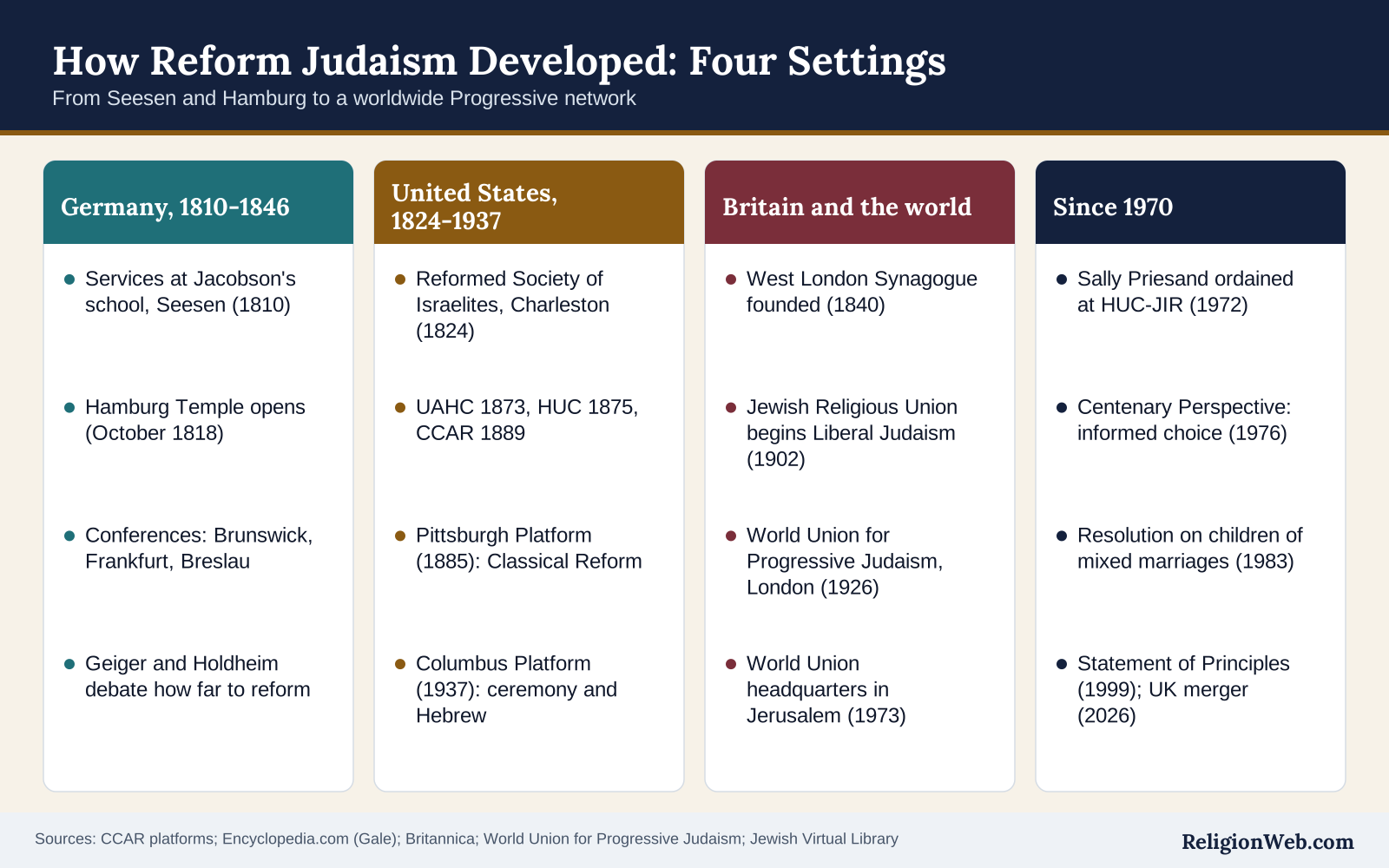
Israel Jacobson (1768-1828), a businessman and lay reformer, founded a school in Seesen, in the territory of Brunswick, in 1801. In 1810 he arranged what are usually called the first Reform services in a prayer hall attached to the school. The services were attended by adults and children, used a liturgy in German rather than Hebrew, and added an organ and choir. Men and women sat together, sermons were delivered in German, and the prayers omitted references to a personal messiah and to the restoration of Israel. Jacobson is also credited with creating confirmation, a graduation-style ceremony for teenagers that is described in the section on life-cycle rites.
Seesen was a school-based experiment, but it set out a template of reforms that others would develop: the vernacular, music, an educational emphasis and a revised theology of redemption. Many historians treat 1810 as the symbolic beginning of Reform Judaism, and the movement itself has often counted its history from that year.
The New Israelite Temple Association in Hamburg (1817-1818)
In Hamburg a group of families formed the New Israelite Temple Society on December 11, 1817, with 65 families joining at the start, and they opened their first synagogue on October 18, 1818, in a rented building in the Neustadt district. Eduard Kley and Gotthold Salomon served as its first preachers. The society’s prayer book, Seder ha-Avodah, is regarded as the first comprehensive Reform liturgy. It kept much of the traditional Hebrew service but dropped or altered prayers that called for a return to Zion and the restoration of the sacrificial system, and it added German sermons.
The Hamburg Temple provoked strong reactions. Rabbis across Europe condemned its founders, and in 1819 the Hamburg Senate refused to recognize it as a separate congregation, so the Temple Society continued as an association within the existing Jewish community. The second Temple building was inaugurated in 1844 and a third in 1931. The congregation was closed by the Nazi authorities after the pogrom of November 1938, and it was re-established in 2004.
Geiger, Holdheim and the German Rabbinical Conferences
Three conferences, 1844 to 1846
As more rabbis embraced reform, the question of how far to go became a matter for collective discussion. Ludwig Philippson called a rabbinical conference that met in Brunswick in 1844, with about twenty-five rabbis, among them Geiger and Samuel Holdheim. It passed no substantial resolutions. A larger meeting in Frankfurt on July 28, 1845, drew about thirty-one rabbis and discussed prayers for the restoration of sacrifices, the triennial Torah reading cycle and the use of the organ. Zacharias Frankel withdrew from the Frankfurt conference after being outvoted on the place of Hebrew in prayer, and the break is often seen as the origin of the historical school to lead that later developed into Conservative Judaism. A third conference in Breslau in 1846 abolished the second day of the holidays and reduced many mourning customs.
Holdheim, Geiger and the limits of change
Samuel Holdheim took the most radical positions of the period. At Breslau he proposed moving Sabbath observance to the civil day of rest, Sunday, and his colleagues rejected the Sunday proposal and approved only minor changes to Sabbath practice. Geiger presented the main tenets of Reform at all three conferences: simplified ritual and a liturgy in the vernacular, the prophetic teachings as the unchanging core of Judaism, and a reduced emphasis on a return to the Land of Israel, all argued from historical study. Most German Reform rabbis remained far more traditional in practice than the rhetoric of the most radical voices suggests, and the range of opinion among them anticipated the later diversity of the movement.
Reform in Britain
The West London Synagogue (1840)
British Reform began a generation after Hamburg. On April 15, 1840, members of London’s Bevis Marks and Great Synagogue communities met at the Bedford Hotel to form a prayer group, and the West London Synagogue of British Jews was founded that year. It became the seed of a distinct Reform stream within Anglo-Jewish life. Reform congregations spread to Manchester in 1858 and Bradford in 1872, and in 1942 representatives of six synagogues met in Manchester to establish a federation that was renamed several times and eventually became the Movement for Reform Judaism.
Liberal Judaism and the Jewish Religious Union (1902)
A second British stream arose in 1902 with the Jewish Religious Union, founded by Lily Montagu and the scholar Claude Montefiore, which led to the movement now called Liberal Judaism. Liberal Judaism remained a separate body from the Reform synagogues for more than a century, until the two merged in 2026. Montefiore and Montagu also became founders of the international union, and their influence reached beyond Britain: Montagu sent invitations to the 1926 London gathering that created the World Union for Progressive Judaism, and Montefiore became its first president.
Reform Judaism in North America and the Wider World: A Historical Chronology
Reform in the United States to 1900
From Charleston to Cincinnati
The first organized attempt at reform in the United States came in Charleston, South Carolina, in 1824. Members of Congregation Beth Elohim petitioned for a shorter service with prayers in English, and when the request was rejected, a group of them founded the Reformed Society of Israelites on November 21, 1824. The society published one of the earliest American Reform prayer books and disbanded in 1833. Large-scale Reform came with the immigration of Central European Jews from the 1830s, when the Jewish population of the country grew from about 3,000 in 1820 to roughly 15,000 in 1840 and 150,000 in 1860. Congregations with an explicit reforming program appeared, among them Har Sinai in Baltimore in 1842 and Emanu-El in New York in 1845.
Scholarly reference works emphasize that American Reform developed largely from conditions in the United States and was not simply imported from Germany. In worship, many congregations adopted robed preachers, organs, hymnals and family pews, forms already familiar from the Protestant churches around them, and some became hard to tell apart from those churches in outward style.
Wise, Einhorn and the building of institutions
Isaac Mayer Wise, who arrived from Bohemia in 1846, served in Albany before moving to Cincinnati in 1854. There he founded the newspaper The Israelite and compiled a prayer book, Minhag America (1857), meant to unite American congregations. Wise’s gift was institutional. He helped found the Union of American Hebrew Congregations (UAHC) in July 1873 with thirty-four congregations, Hebrew Union College in Cincinnati in 1875, and the Central Conference of American Rabbis in 1889. These three bodies, now the URJ, HUC-JIR and CCAR, remain the pillars of the movement in North America.
David Einhorn, a rabbi trained in Europe, criticized Wise’s pragmatism and argued for a more consistent theological position. Their disagreement is often retold as a debate between theological consistency and responsiveness to social change, and it recurs in later Reform arguments about how closely institutions should follow a single statement of principle.
The Pittsburgh Platform and Classical Reform
In November 1885, rabbis met in Pittsburgh at a conference convened by Kaufmann Kohler and chaired by Wise, and they adopted a “Declaration of Principles” that became known as the Pittsburgh Platform. In eight points it described Judaism as a progressive religion in harmony with reason, treated the Bible as a record of the Jewish people’s moral vocation, and declared that the Mosaic legislation had been designed for life in ancient Palestine. The platform treated the laws of diet, priestly purity and dress as foreign to the modern mind, rejected the hope of a return to Palestine and the restoration of a Jewish state, and described the Jews as a religious community and no longer a nation. It also described Christianity and Islam as religions that had grown out of Judaism and carried belief in one God to many peoples.
Historians call the form of Reform that this platform expressed “Classical Reform.” It stressed ethics and universal values and minimized ceremony, and in some congregations it brought English prayers, an organ and, in a few, a main Sabbath service on Sunday. In 1909 the CCAR adopted a resolution opposing mixed marriages, and that position was later restated and debated, as the section on life-cycle rites explains. The platform remained the core statement of American Reform until the Columbus Platform of 1937.
Return to Tradition and Postwar Growth
The Columbus Platform (1937)
Rising antisemitism in Europe and the changing makeup of Reform congregations, as Eastern European Jews joined them, shifted the movement’s emphasis in the early twentieth century. In 1937 the CCAR adopted “The Guiding Principles of Reform Judaism,” called the Columbus Platform. It presented Judaism as the historical religious experience of the Jewish people, affirmed ongoing revelation and the progressive development of Torah, and described a Jewish life centered on the home, the synagogue and the school. It also affirmed the observance of Shabbat and festivals, customs and ceremonies of inspirational value, and the use of Hebrew together with the vernacular in worship and instruction. On Palestine, it supported rebuilding a Jewish homeland as a refuge for the oppressed and a center of Jewish culture and spiritual life.
Suburban growth and the 1970s and 1980s
After the Second World War, American Jews moved to suburbs and joined congregations in large numbers. Congregations in the UAHC grew from 265 in 1940 to 520 in 1955, and the union’s headquarters moved to New York under Maurice Eisendrath. HUC merged with the Jewish Institute of Religion, founded in New York in 1922 by Rabbi Stephen S. Wise, in 1950. Under Alexander Schindler, who led the UAHC from 1973, the movement increased its attention to social action and outreach, and its member congregations grew from about 400 in 1973 to about 875 in 1995.
The late twentieth century brought several decisions that shaped the movement’s present identity. The CCAR’s 1976 San Francisco statement, “Reform Judaism: A Centenary Perspective,” set out the doctrine of informed choice. In 1972 Sally Priesand was ordained at HUC-JIR as the first woman rabbi ordained by a rabbinical seminary in the United States. The CCAR’s resolution of March 15, 1983 recognized the children of one Jewish parent, mother or father, as presumptively Jewish when appropriate public acts of Jewish identification follow. In 1999 the CCAR adopted a new “Statement of Principles” at Pittsburgh, discussed in the section on Jewish law and tradition.
Progressive Judaism Becomes a World Movement
The World Union for Progressive Judaism
More than one hundred people attended the first meeting in London in July 1926 that led to the World Union for Progressive Judaism. Claude Montefiore was its first president and Lily Montagu its honorary secretary, and Rabbi Israel Mattuck joined them in inviting representatives of existing communities. The first formal conference followed in Berlin in 1928, and the movement’s administrative offices later moved to New York. In 1973 the international headquarters moved to Jerusalem, and in 1976 the World Union became the first international Jewish religious organization to affiliate with the World Zionist Organization and the Jewish Agency for Israel. Netzer Olami, its global youth movement, was founded in 1979.
Catastrophe and rebuilding in Europe
The Nazi regime destroyed Jewish communities across Europe, including Liberal and Reform congregations in Germany, where the movement had begun. The Hamburg Temple was closed after the pogrom of November 1938, and the Hochschule für die Wissenschaft des Judentums in Berlin, where Geiger had taught and where liberal rabbis trained, was closed in 1942. Regina Jonas, ordained in 1935 by Liberal rabbis in Germany as the first woman to receive rabbinic ordination, was deported to Theresienstadt on November 6, 1942, and to Auschwitz on October 12, 1944, where she was probably killed the same day.
Rebuilding took decades. The Abraham Geiger College, founded in 1999 at the University of Potsdam, held an ordination on September 14, 2006, in Dresden’s Neue Synagogue: the first ordination of rabbis in Germany since 1942. In 1983 the World Union created a department to support Progressive communities in the former Soviet Union, and it now counts more than forty congregations across Russia, Ukraine, Belarus and the Baltic states.
Key Dates and Patterns
A chronology of the movement
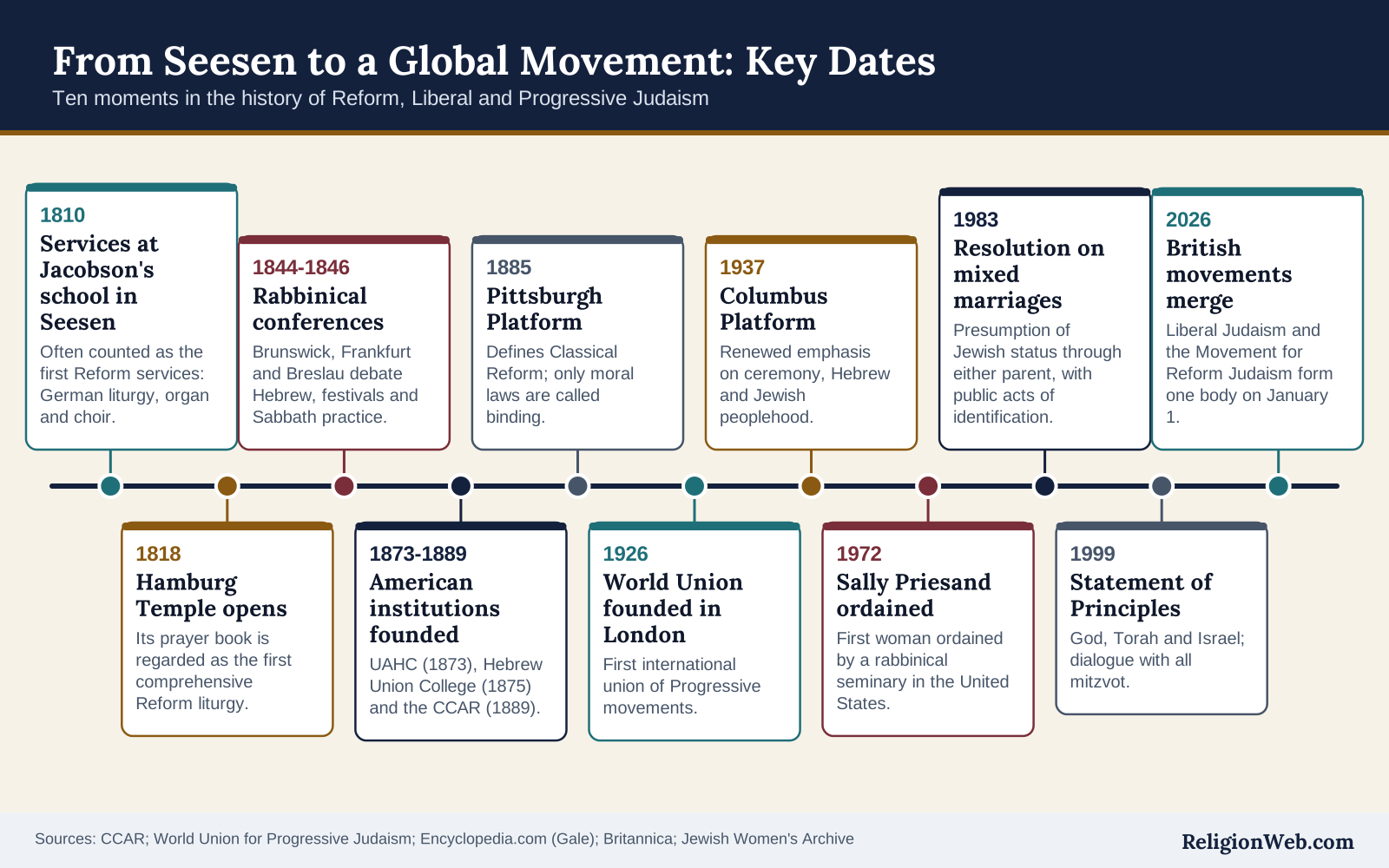
| Date | Event | Significance |
|---|---|---|
| 1810 | Services at Israel Jacobson’s school in Seesen | Often counted as the first Reform services: German liturgy, organ and choir |
| 1818 | Hamburg Temple opens (October 18) | Home of the first comprehensive Reform prayer book |
| 1824 | Reformed Society of Israelites, Charleston | First organized American attempt at reform; disbanded 1833 |
| 1840 | West London Synagogue founded | Beginning of British Reform |
| 1844-1846 | Rabbinical conferences at Brunswick, Frankfurt and Breslau | Debates on Hebrew, festivals and Sabbath practice |
| 1873-1889 | UAHC (1873), Hebrew Union College (1875), CCAR (1889) | Isaac Mayer Wise builds the American institutions |
| 1885 | Pittsburgh Platform | Defines Classical Reform; only moral laws binding |
| 1902 | Jewish Religious Union, London | Origin of British Liberal Judaism |
| 1926 | World Union for Progressive Judaism founded in London | First international union; Berlin conference in 1928 |
| 1935 | Regina Jonas ordained in Germany | First woman ordained as a rabbi |
| 1937 | Columbus Platform | Renewed emphasis on ceremony, Hebrew and Jewish peoplehood |
| 1972 | Sally Priesand ordained at HUC-JIR | First woman rabbi ordained by a United States seminary |
| 1976 | Centenary Perspective | Autonomy and informed choice become watchwords |
| 1983 | CCAR resolution on children of mixed marriages | Presumption of Jewish status through either parent, with public acts of identification |
| 1999 | Statement of Principles, Pittsburgh | God, Torah and Israel; invitation to study and renewed attention to mitzvot |
| 2006 | Rabbinic ordination in Dresden | First in Germany since 1942 |
| 2021 | Israeli Supreme Court ruling (March 1) | Citizenship for people who convert in Israel under non-Orthodox auspices |
| 2026 | Movement for Progressive Judaism formed in Britain (January 1) | Merger of Liberal Judaism and the Movement for Reform Judaism |
Patterns across two centuries
Read as a whole, the timeline suggests three overlapping phases. In the nineteenth century, reformers in Germany and the United States concentrated on language, music, decorum and the revision of beliefs about messiah and return to Zion. In the first half of the twentieth century, the movement widened its attention to Jewish peoplehood and Hebrew, partly in response to antisemitism and the Holocaust and partly because new immigrants shaped its congregations. Since the 1970s it has concentrated on equality, inclusion, outreach and the renewal of ritual practice. The movement did not move in a straight line, and many congregations hold elements of all three phases in the same building.
Core Beliefs and Theology: God, Covenant, Revelation and Mission
God and Humanity
One God, understood in varied ways
Reform Judaism affirms the reality and oneness of God, and it does so in language intended to include a range of understandings. The 1999 Statement of Principles states that Reform Jews encounter God in moments of awe, justice and love, and respond through prayer, study and the performance of mitzvot. The 1976 Centenary Perspective says that Reform Jews ground their lives in the reality of God while remaining open to new understandings of the divine. The 1937 Columbus Platform describes God as one and living, active in the world yet beyond time and space. The documents leave room for individual Reform Jews to hold views ranging from belief in a personal God who hears prayer to a more philosophical sense of divine presence in creation and in the moral order.
The image of God, the soul and responsibility
The 1999 principles teach that every human being is created in the divine image, which makes human life sacred and calls for reverence toward creation and responsibility to protect it. The Columbus Platform adds that human beings have immortal spirits and are God’s co-workers in the moral development of the world. On the question of life after death, Reform thinkers have long emphasized the immortality of the soul. The Pittsburgh Platform rejected the doctrines of bodily resurrection and of Gehenna and Eden as eternal places of punishment and reward, and the 1999 statement expresses a more general faith that the human spirit is eternal.
Encountering God: prayer, study and mitzvot
The 1999 principles describe the ways Reform Jews respond to the sense of God’s presence. They pray, they study, and they perform mitzvot, which the statement divides into those between a person and God (bein adam la-Makom) and those between one person and another (bein adam la-chaveiro). The structure indicates that, in Reform understanding, religious life has an inner and an outer side that cannot be separated: prayer and study prepare a person for ethical action, and ethical action gives prayer its meaning. The statement also expresses a hope that God and humanity will ultimately prevail over the forces of cruelty and division.
Covenant, Revelation and Torah
The covenant between God and the Jewish people
The 1999 principles describe a b’rit, a covenant, between God and the Jewish people, and they allow for varied understandings of Creation, Revelation and Redemption within it. Covenant here means a relationship that carries obligation: Jews are called to respond to God through study, prayer and mitzvot, those between a person and God and those between one person and another. The covenant is also the basis for Jewish peoplehood, a theme that the Columbus Platform and the 1999 statement both emphasize in affirming the unity of the whole Jewish community, klal Yisrael.
Progressive revelation
The characteristic Reform doctrine of revelation holds that it is ongoing. The Columbus Platform says that Torah, written and oral, reflects Israel’s growing understanding of God and moral law, and that each generation adapts Torah to its needs. The commentary on the 1999 principles describes Torah as an ongoing relationship between God and the Jewish people, a dialogue and not a fixed code, whose truths are plural. Reform thought has generally not understood the Torah as dictated word for word at Sinai, and it accepts critical scholarship about the composition of the Hebrew Bible. Other movements understand revelation differently, and their views are set out in the articles on Orthodox Judaism and Conservative Judaism.
Redemption, Mission and the Repair of the World
The messianic age
Reform Judaism has traditionally spoken of a messianic age and not of a personal messiah who restores a kingdom and sacrificial worship. The Seesen liturgy of 1810 omitted references to a personal messiah, and the Pittsburgh Platform described the modern era as drawing near to the realization of the messianic hope for a world of truth, justice and peace. The 1999 principles call on Jews to work as partners with God for a world of peace and justice and toward the messianic age. The hope is thus placed in human moral effort joined to divine purpose, and it is a standing reason for ethical action.
The mission of Israel and tikkun olam
Nineteenth-century Reform leaders spoke of the “mission of Israel,” the idea that the Jewish people’s purpose is to bear witness to God and to moral truth among the nations. The Columbus Platform restated the idea as bearing witness to the Divine and working with all people for justice, truth and peace. In its documents the mission is moral witness and cooperation, not a call to recruit others. In recent decades the language of tikkun olam, repairing the world, has become the more common way to express the same conviction, and the 1999 statement lists specific commitments: pursuing justice, narrowing the gap between rich and poor, opposing discrimination and oppression, welcoming strangers, protecting the environment and freeing people in bondage.
The Jewish People and the Land of Israel
Peoplehood and responsibility to the whole community
Reform Judaism holds that Jewish identity is both religious and communal. The Columbus Platform of 1937 described Judaism as the soul and the Jewish people as its body, bound together by shared history and above all by faith. The 1999 principles describe the Jewish people as a community that aspires to holiness, is linked across time and place, and is committed to ahavat Yisrael, love of the Jewish people, and klal Yisrael, the whole Jewish community. They affirm mutual responsibility among all Jews and welcome converts, interfaith families and people of every age and family form into the community.
Israel, Zionism and the Diaspora
The movement’s position on the national dimension of Jewish life changed more than almost any other. The Pittsburgh Platform of 1885 declared that Jews were no longer a nation and rejected a return to Palestine. The Columbus Platform of 1937 supported rebuilding a Jewish homeland, the Centenary Perspective of 1976 called the State of Israel vital to Jewish life, and the 1999 principles commit the movement to the State of Israel, celebrate its achievements, encourage aliyah and call for a vision of Israel that guarantees full civil, human and religious rights for all its residents and works toward lasting peace.
The 1999 statement also describes Israel and the Diaspora as interdependent: Diaspora Jews are urged to learn Hebrew and visit Israel, and Israeli Jews are said to have something to learn from Diaspora religious life. Institutional ties followed the change in outlook. Maurice Eisendrath argued for an Israeli Reform movement as early as 1953, the World Union held its first biennial conference in Israel in 1968, and the Israel Movement for Progressive Judaism was incorporated in 1971. The movement promotes pluralism in Israel, where Reform and other non-Orthodox movements seek equal recognition.
Torah, Tradition and Jewish Law: Authority and Informed Choice
Torah, Tanakh and the Rabbinic Library in Reform Life
The Hebrew Bible as a living text
Reform Jews share with other Jews the scriptures known as the Tanakh, whose structure of Torah, Prophets and Writings is described in the Judaism article. What distinguishes the Reform approach is the way those texts are read. The 1976 Centenary Perspective teaches that Torah arises from the relationship between God and the Jewish people, that its study is a religious duty, and that its creation continues in each generation. The 1999 principles call Torah the foundation of Jewish life and an expression of God’s eternal love, and they urge lifelong learning at home, in the synagogue and wherever Jews gather.
In practice this means that a Reform congregation reads the Torah scroll in worship and also studies it with the tools of historical and literary scholarship, an approach the movement has accepted since the nineteenth century. Such study asks how a passage was likely composed, how later generations understood it, and what moral claim it makes on readers now. The commentary on the 1999 principles stresses the importance of Hebrew, the “holy language,” because learning it helps readers unlock the holiness in classical texts, and the principles themselves affirm the study of Hebrew as a way to engage sacred texts more closely.
The Talmud, codes and responsa
The Talmud, the medieval commentaries and the codes of law are also part of the Reform library. Reform rabbis study them as a record of Jewish religious thought and as sources for decision making, and in the nineteenth century the new scholarship of Jewish history made them objects of critical inquiry. In keeping with its understanding of revelation as ongoing, Reform teaching does not treat the traditional codes as binding in themselves. As one reference work summarizes the position, halakha guides but does not bind.
The CCAR’s Responsa Committee answers questions about Jewish practice from rabbis and congregants, and its responsa are collected in volumes such as the American Reform Responsa series. These texts often cite Talmudic, medieval and modern sources, weigh them, and reach a conclusion offered as guidance. The CCAR’s own website cautions, of older responsa on officiating at intermarriages, that they are historical documents that do not necessarily reflect current CCAR policy, a reminder that the movement’s practice continues to develop.
Halakha, Autonomy and Informed Choice
From “only moral laws” to informed choice
The Pittsburgh Platform of 1885 addressed Jewish law directly. It treated the Mosaic legislation as a system for training the people during its national life in ancient Palestine, and it declared that only the moral laws were binding in modern times.
We recognize in the Mosaic legislation a system of training the Jewish people for its mission during its national life in Palestine, and today we accept as binding only its moral laws, and maintain only such ceremonies as elevate and sanctify our lives
Pittsburgh Platform (Declaration of Principles), 1885, point 3, as reproduced in the Jewish Virtual Library
In the context of Classical Reform, this sentence distinguished moral commandments, binding on all, from ritual commandments, which were retained only when they inspired. Later generations judged the line differently. The Columbus Platform of 1937 affirmed the preservation of the Sabbath, festivals, customs and ceremonies of inspirational value, and the 1976 Centenary Perspective turned to autonomy: observance is shaped by the individual, guided by commitment and knowledge, and Jewish obligation begins with the informed will of each person. “Informed choice” thus expresses a demand as well as a freedom, because the choice is expected to follow serious study.
Dialogue with the mitzvot in the 1999 principles
The 1999 Statement of Principles shifted the emphasis toward dialogue. It commits Reform Jews to studying the full range of mitzvot and to observing those that apply to them as individuals and communities, noting that some have long been kept in Reform life while others, ancient and modern, call for renewed attention. The commentary adds that a Reform Jew may respond to a given mitzvah in one of three ways: by taking it on, by setting it aside for further dialogue, or by declining it, and that nothing is compelled.
The reasons the movement gives for observing a mitzvah are expressed in terms of response and holiness. Observance, the commentary says, answers God’s call, brings holiness (k’dushah) into daily life, connects a person to the Jewish past and future, and can free time from the pressures of calendar and clock. This understanding stands apart from the traditional view that halakha is binding as law, and it is a point on which the movements of Judaism differ, as the articles on Orthodox Judaism and Conservative Judaism explain from their own perspectives.
The Platforms of Reform Judaism
The five statements
| Statement | Year and place | Principal emphases |
|---|---|---|
| Declaration of Principles (Pittsburgh Platform) | 1885, Pittsburgh conference | Judaism as a progressive religion; only moral laws binding; rejection of a return to Palestine and of a Jewish state |
| The Guiding Principles of Reform Judaism (Columbus Platform) | 1937 | Ongoing revelation; home, synagogue and school; Sabbath, festivals and Hebrew; support for a Jewish homeland |
| Reform Judaism: A Centenary Perspective | 1976, San Francisco | Diversity within unity; individual autonomy and informed choice; the State of Israel as vital to Jewish life |
| Reform Judaism and Zionism: A Centenary Platform (Miami Platform) | 1997 | Reform commitment to Zionism and to Israel |
| A Statement of Principles for Reform Judaism | 1999, Pittsburgh convention | God, Torah and Israel; dialogue with all mitzvot; tikkun olam; inclusion; Progressive Judaism in Israel and worldwide |
What the platforms are, and what they are not
The CCAR describes its platforms as documents capturing the state of Reform Jewish thought at key moments in its history, and that description is a guide to how they function. They are not creeds that a person must affirm to be a Reform Jew or to join a congregation. Each responded to a particular situation: the Pittsburgh conference to the confidence of nineteenth-century American Reform, the Columbus Platform to the rise of antisemitism and to renewed attention to peoplehood, and the Centenary Perspective to the movement’s one-hundredth year.
The 1997 Miami Platform on Zionism, listed separately by the CCAR, and the 1999 text show how far the movement’s position on the national dimension of Jewish life changed between 1885 and the late twentieth century. The platforms speak to religious commitment and not to a political program, and the section on belief treats the movement’s changing view of Israel in more detail.
Rabbis, Cantors and Leaders: Founders and Central Figures
Founders and Builders of the Movement
The European founders
Israel Jacobson (1768-1828) is remembered as the lay reformer who opened a school and a prayer hall at Seesen and created the ceremony of confirmation. Abraham Geiger (1810-1874) was the movement’s leading scholar: he edited the Wissenschaftliche Zeitschrift für jüdische Theologie from 1835, served as rabbi in Wiesbaden, Breslau, Frankfurt and Berlin, and argued from the history of Jewish texts that religious consciousness evolves. Samuel Holdheim represented the radical wing, and his proposal at Breslau to move the Sabbath to Sunday was rejected by the rabbis at the conference. Leopold Zunz, though not a rabbi of the movement, helped to supply its intellectual foundation by urging Jews to study their history.
These men differed on many points, and their disagreements gave Reform a habit of debate. Holdheim’s Sunday proposal was rejected at Breslau, and Frankel withdrew from the Frankfurt conference over the place of Hebrew. What they shared was a conviction that Jewish tradition could be examined historically without losing its authority as a source of moral and religious meaning.
The American builders
In the United States, Isaac Mayer Wise was the organizer and Kaufmann Kohler the theologian. Wise brought the Union of American Hebrew Congregations, Hebrew Union College and the CCAR into existence between 1873 and 1889, and Kohler convened the 1885 Pittsburgh Conference and is regarded as the principal author of its platform. David Einhorn defended a more consistent and radical theology. In the twentieth century Stephen S. Wise founded the Jewish Institute of Religion in New York, Maurice Eisendrath led the UAHC in its postwar growth, Nelson Glueck led the merged HUC-JIR, and Alexander Schindler expanded the movement’s social action and outreach. Rabbi Rick Jacobs leads the Union for Reform Judaism as its president today.
Women and Inclusion in Leadership
The first women rabbis and cantors
The ordination of women is one of the most visible changes in Reform leadership. Regina Jonas was ordained in Germany in 1935 after Rabbi Max Dienemann of the Liberal Rabbis’ Conference agreed to her ordination, and her 1930 thesis was the first known attempt to find a halakhic basis for women’s ordination. Her story was largely forgotten after the Holocaust and recovered only after archives in East Germany opened. Sally Priesand’s ordination at HUC-JIR in 1972 was the first ordination of a woman by a rabbinical seminary in the United States, and Barbara Ostfield Horowitz was invested as the first woman cantor in 1975. In 1994 Laura Geller became the first woman senior rabbi of a major metropolitan synagogue, at Temple Emanuel in Beverly Hills.
Inclusion across gender and sexual orientation
The 1999 principles commit the movement to the full equality of women and men in Jewish life and describe a community open to people of all ages, family forms and sexual orientations, to converts, and to intermarried families building Jewish homes. The CCAR has adopted resolutions on related questions over several decades, including a 1990 committee report that accepted homosexual relationships as being of spiritual value and, in February 2023, a resolution advocating for transgender people. Congregations apply these commitments in different ways, and the movement acknowledges that views and practices continue to develop.
Rabbis, Cantors and Lay Leaders Today
Training and roles
Rabbis in the movement are trained mainly at Hebrew Union College-Jewish Institute of Religion, which describes itself as the largest graduate and professional school for Jewish leadership in the world, with campuses in Cincinnati, Los Angeles, New York and Jerusalem. It offers a rabbinical program that includes a virtual pathway and an Israel rabbinical program, as well as cantorial training at the Debbie Friedman School of Sacred Music and programs in Jewish education and nonprofit management. In Europe, the Abraham Geiger College in Potsdam has trained Progressive rabbis since its founding in 1999. A rabbi in a Reform congregation typically leads worship, teaches, counsels and officiates at life-cycle events, and a cantor leads sung prayer and often teaches the congregation’s children.
Authority without a central hierarchy
Reform Judaism has no single authority that issues binding rulings for the whole movement. The URJ is governed by a North American Board of up to 150 members-at-large together with executive officers, and it serves congregations that govern themselves. The CCAR issues resolutions and responsa for its member rabbis. Consistent with the principle of informed choice, these documents guide but do not compel, and individual rabbis and congregations apply them in light of their own communities. This structure explains much of the diversity described later in this article.
Worship, Liturgy and the Prayer Service
How a Reform Service Is Shaped
The weekly rhythm and the order of prayer
Reform Jews gather for communal prayer at Shabbat services, on the festivals and High Holy Days, and at other points in the week and year that vary by congregation. Friday evening has long been the main service in many Reform congregations, and Saturday morning services, often built around the reading of the Torah and the bar or bat mitzvah of a young congregant, are common as well. The services draw on the same ancient building blocks that structure Jewish prayer elsewhere: the Shema, the blessings that surround it, the Amidah (the standing prayer) and the reading of Torah. The Reform siddur Mishkan T’filah follows this traditional order while offering alternative readings and meditations for each section, so that a congregation can shape a service for its own character.
The content of the service has been revised over time in line with Reform theology. Prayers for the restoration of animal sacrifices and for the return of the Jews to Zion were removed or reinterpreted in the first Reform prayer books, and the traditional hope for a personal messiah gave way to a messianic age. Prayers have also been expanded to include the matriarchs alongside the patriarchs and to use gender-inclusive language for God and for the community, a change visible in the movement’s most recent prayer books.
Torah reading and preaching
Two elements have been central to Reform worship from its beginnings. The first is the reading of the Torah scroll, from which a portion is read and discussed on Shabbat and on festivals. Reform congregations have differed on how much to read, a question already on the agenda of the Frankfurt conference of 1845, where a triennial cycle was discussed. The second is the sermon in the language of the congregation. Gotthold Salomon’s German sermons at the Hamburg Temple were published in 1820, and preaching in the vernacular, once a distinctive Reform feature, later spread to many traditional communities as well. In Reform congregations today, the rabbi’s sermon, a discussion of the Torah portion or a congregant’s reflection typically gives the service its teaching moment.
Language, music and clothing
Reform services combine Hebrew and the language of the congregation, and the balance differs from place to place and from generation to generation. Men and women sit together and take equal part, and music is a central feature. Many congregations use an organ, a choir or a cantor, others prefer guitar and informal singing, and the repertoire ranges from nineteenth-century choral settings to contemporary folk-style melodies. The Debbie Friedman School of Sacred Music at HUC-JIR is named for a composer whose songs became widely sung in North American congregations.
Dress and ritual objects are matters of choice. The kippah (head covering) was once discouraged in Reform sanctuaries and is now a common sight, and the movement’s position is that wearing one is a personal decision. Women and men may both choose to wear it, and the choice of a tallit (prayer shawl) is likewise left to the individual.
From Hamburg to Mishkan T’filah: The Prayer Books
A chronology of the liturgy
| Prayer book | Date | Characteristics |
|---|---|---|
| Seder ha-Avodah (Hamburg Temple) | Early 19th century; second edition 1841 | First comprehensive Reform liturgy; changed or removed prayers for the return to Zion and the restoration of sacrifices |
| Minhag America (Isaac Mayer Wise) | 1857 | First siddur edited for American worshipers; intended to unite congregations |
| Union Prayer Book | Adopted in the 1890s | Standard prayer book of Classical Reform, with mostly English prayer |
| Gates of Prayer and Gates of Repentance | 1975 and 1978 | Replaced the Union Prayer Book; restored more Hebrew and traditional elements |
| Mishkan T’filah | 2007 | CCAR siddur with Hebrew, English and transliteration, and alternative readings for each prayer |
| Mishkan HaNefesh | 2015 | High Holy Day prayer book with gender-inclusive language |
What the changes in the prayer books show
The sequence of prayer books records the movement’s changing priorities. The earliest ones aimed to make worship intelligible and to bring the content of prayer into line with the theology of emancipation. The Union Prayer Book of the Classical Reform period gave a larger share of the service to English. Gates of Prayer (1975) and Gates of Repentance (1978) replaced it and restored more Hebrew and traditional elements, and Mishkan T’filah (2007) added transliteration and more Hebrew still, adding transliteration so that worshipers who do not read Hebrew fluently can take part alongside those who do.
The later books were produced by the CCAR, and the process of revision has been deliberate. Mishkan T’filah, for example, was sent in galley proofs to about 300 congregations for three years of field testing. The result is a prayer book for a movement that does not require uniform practice, offering choices within a recognizable framework.
Why Worship Changed, and How It Is Changing Now
Understanding, decorum and equality
The early reformers gave several reasons for changing the service. They wanted worshipers to understand what they prayed, which led to sermons and prayers in the vernacular. They wanted a dignified atmosphere in which the congregation took part, which led to choirs, a regular order of service and decorum. They also reconsidered the content of prayer in light of their beliefs about messiah, return to Zion and sacrifice. Later reforms added gender equality to this list: mixed seating came first, then the full participation of women in leading worship and reading from the Torah, then gender-inclusive liturgical language.
Recovering Hebrew and ritual
From the 1930s onward the movement turned toward the recovery of traditional forms. The Columbus Platform of 1937 called for the use of Hebrew alongside the vernacular, and prayer books after the Second World War increased the share of Hebrew. The 1999 principles state that the study of Hebrew is a way to engage sacred texts more closely and encourage lifelong learning. In many congregations the move toward more Hebrew and ritual took the form of choices: communities adopted what they found meaningful and left aside what they did not, a pattern consistent with the principle of informed choice.
Shabbat, Holidays and the Jewish Calendar
The Calendar and the Reform Year
How the calendar works and why festival days differ
Reform Jews use the Hebrew calendar, a lunisolar calendar whose months follow the moon and whose years are kept in step with the seasons by an added month in certain years. The rules and the Hebrew year-numbering are explained in the Judaism overview. Because the Hebrew months are lunar, the Gregorian dates of the festivals move from year to year, and a specific date needs a calendar for the year in question.
One difference in Reform practice concerns the length of some festivals. In the ancient calendar the start of each month was set by witnesses who saw the new moon, and distant communities, unsure of the date, kept two days to be safe. The “second festival day” spread through traditional Diaspora communities. Beginning in the nineteenth century, the Reform movement returned to the biblical standard of a single day for each festival; most Reform congregations in North America keep Rosh Hashanah for one day, while some keep two to recover traditional practice or show solidarity with Jews in Israel and elsewhere, which the movement treats as an example of its pluralism. Passover lasts seven days for most Reform Jews worldwide.
The year at a glance
| Occasion | When | Common observance in Reform communities | Meaning |
|---|---|---|---|
| Shabbat | Weekly, Friday sundown to Saturday night | Candles, kiddush, challah, worship, rest and study; havdalah at the close | Creation and rest; a day of delight |
| Rosh Hashanah | 1 Tishrei | One day in most North American congregations; shofar, round challah, apples and honey | New year; reflection and renewal |
| Yom Kippur | 10 Tishrei | Fasting, Kol Nidre and day-long worship | Atonement and reconciliation |
| Sukkot | 15 Tishrei | Building and eating in a sukkah; festival worship | Harvest and the wilderness years |
| Passover | 15 Nisan | Seder with the Haggadah; matzah; seven days | Liberation from slavery |
| Shavuot | Seven weeks after Passover | Confirmation; all-night study; dairy foods | Giving of the Torah at Sinai |
| Hanukkah | 25 Kislev | Eight nights of candle lighting; charity and giving | Rededication of the Temple |
| Purim | 14 Adar | Reading of the Book of Esther; gifts of food and charity | Deliverance of the Jews of Persia |
Shabbat in Reform Life
Friday evening at home and in the synagogue
Shabbat runs from sundown on Friday until Saturday evening, and the Torah’s account of God resting after creation is its foundation. Reform households that observe it typically light two candles and say the blessing, recite the kiddush over wine or grape juice, bless braided challah bread, and share a meal. Many congregations hold a Friday evening service, sometimes before the meal and sometimes after it, and many livestream their services. The 1999 principles name Shabbat among the ways Reform Jews bring holiness into daily life.
Saturday, rest and the question of work
On Saturday, Reform Jews attend a morning service where the weekly Torah portion is read and discussed, rest from the pressures of the workweek, or study with family and friends. The ceremony of havdalah, “separation,” ends Shabbat with wine, spices and a braided candle. The traditional prohibitions on work, which the rabbis organized into thirty-nine categories, are not treated as binding in Reform teaching, and rest is understood in terms of purpose: to turn from labor toward family, prayer, learning and the enjoyment of creation. Individual Reform Jews decide for themselves, with study and rabbinic counsel, what restful Shabbat observance looks like in their lives, and practice ranges widely.
The High Holy Days and the Pilgrimage Festivals
Rosh Hashanah and Yom Kippur
The High Holy Days, or Days of Awe, are a high point of the year in congregational life. Rosh Hashanah on 1 Tishrei begins the Jewish year, and the shofar, a ram’s horn, is customarily sounded throughout the month of Elul and the High Holy Day season. Families share round challah and apples dipped in honey for a sweet new year. Ten days later comes Yom Kippur, the Day of Atonement, devoted to reconciliation with other people, with oneself and with God. The movement teaches that those who have wronged others must first seek their forgiveness, and then turn to God; the liturgy asks God to forgive, pardon and grant atonement. Observers fast on Yom Kippur, and those who cannot fast, for reasons of health or other need, are directed to other ways of observing the day. The Kol Nidre melody that opens the evening service is of unknown origin. Reform congregations use the prayer book Mishkan HaNefesh, published in 2015.
Sukkot, Passover and Shavuot
Three pilgrimage festivals structure the year. Sukkot, beginning on 15 Tishrei, recalls the wilderness years and the harvest, and it is observed by building and eating in a temporary booth, the sukkah. Passover, beginning on 15 Nisan, commemorates the exodus from Egypt. The centerpiece is the seder, a home service and meal organized by the Haggadah, in which matzah is eaten and all leavened foods are avoided throughout the festival. Reform Haggadot often add readings on contemporary freedom, such as a supplement affirming support for immigrants and refugees.
Shavuot, seven weeks after Passover, celebrates the giving of the Torah at Sinai. In Reform congregations it is the occasion for Confirmation, a ceremony for teenagers described in the section on life-cycle rites, and many communities hold an evening of study called Tikkun Leil Shavuot. Blintzes and other dairy foods are popular on the holiday. Reform Judaism emphasizes the connection between the Torah’s revelation and the active choice to participate in Jewish life.
Later Festivals and Modern Commemorations
Hanukkah and Purim
Hanukkah, “dedication,” begins on 25 Kislev and lasts eight days. It commemorates the Maccabees’ victory over the Seleucid army and the rededication of the Temple in Jerusalem in 165 BCE. One candle is added each night to a nine-branched lamp, the hanukkiyah, using the helper candle (shamash) to light the others, and families eat oil-fried foods such as latkes and sufganiyot. Reform observance adds an emphasis on charitable giving and the repair of the world. Purim, on 14 Adar, recalls the deliverance of the Jews of Persia in the Book of Esther, which is read aloud in the synagogue, and it is marked with gifts of food to friends and donations to the poor.
Days of remembrance
The twentieth century added days of remembrance and celebration to the calendar. Yom HaShoah, on 27 Nisan, remembers the six million Jews murdered in the Holocaust and is observed in Israel and in Jewish communities abroad, including many Reform congregations. Reflecting the movement’s commitment to the State of Israel, which the Centenary Perspective and the 1999 principles describe as central to Jewish life, many Reform congregations also mark Israel’s Independence Day. These observances show how the calendar remains open to new additions, an example of the movement’s view that tradition continues to develop.
Life-Cycle Rites: Birth, Coming of Age, Conversion, Marriage and Mourning
Birth, Naming and Coming of Age
Brit milah and the welcoming of daughters
Reform Jews welcome children into the covenant through rites that follow the Jewish tradition and add forms created in the last two centuries. For a baby boy, brit milah, circumcision on the eighth day, is traditionally a parent’s obligation, accompanied by a blessing and the giving of a Hebrew name. Some radical voices in nineteenth-century Germany argued against it, but in the United States it remained a central rite. Today Reform families commonly choose a mohel or mohelet, a practitioner trained in the ritual; in the movement these are physicians certified by the Reform B’rit Milah Board, and a rabbi or parent may lead the ceremony.
For a baby girl, Reform communities created a parallel ceremony called b’rit bat or b’rit chayim, held on the eighth day or later and usually at home. The parents recite blessings of welcome, everyone says the Shehecheyanu blessing for reaching this moment, the baby receives her Hebrew name, the Priestly Blessing is said, and a cup of wine or juice is shared, followed by a festive meal. The ceremony reflects the movement’s commitment to treating the entry of daughters into the covenant with the same celebration as that of sons.
Bar and bat mitzvah and Confirmation
At about the age of thirteen, young Jews take on the responsibilities of the commandments in the ceremony of bar mitzvah for boys and bat mitzvah for girls. The first bat mitzvah in the United States, that of Judith Kaplan, took place on March 18, 1922, in New York, and the ceremony became commonplace only in the 1970s. Reform, Reconstructionist and Conservative communities now give girls and women the same religious rights and obligations as boys and men. In Reform congregations the preparation usually involves years of study of Hebrew, prayer and Torah, and the celebration includes reading from the Torah or haftarah in a service.
Confirmation is a ceremony that Reform Judaism created. Most scholars credit Israel Jacobson, who around 1810 devised it as a graduation ceremony for a group of thirteen-year-old boys, regarding bar mitzvah as outdated. A program for girls began in Berlin in 1817, boys and girls were confirmed together for the first time in 1822, and in 1831 Rabbi Samuel Egers moved the ceremony to Shavuot. The first recorded confirmation in North America took place in 1846 at Anshe Chesed in New York, and the CCAR recommended it as a movement-wide practice in 1927. Today it is usually held in the tenth grade, and participants publicly affirm their commitment to the Jewish people, often after a year of study and social action. Many congregations also hold adult confirmation, a practice that dates from the 1970s.
Conversion, Marriage and Family
Conversion and Jewish status
Reform rabbis welcome people who wish to join the Jewish people by conversion. The process typically involves study with a rabbi and participation in Jewish life, and liberal rabbis usually ask for a commitment to perform selected commandments, not the full acceptance of every commandment that traditional rabbis require. The Reform movement does not require adult circumcision for male converts, although it is increasingly seen as an important part of full membership, and a symbolic drop of blood (tipat dam) is possible for converts already circumcised. Candidates usually immerse in a mikveh. Standards vary by country and by community, and not every Jewish community recognizes every conversion, so a candidate is advised to confirm that a conversion meets the standards of the community in which they plan to live.
The question of who is Jewish also arises for the children of mixed marriages. The CCAR’s resolution of March 15, 1983 held that the child of any mixed marriage, whether the Jewish parent is the mother or the father, is presumed to be Jewish, provided that the presumption is established through appropriate and timely public and formal acts of identification with the Jewish faith and people. The acts it lists include entering the covenant, taking a Hebrew name, studying Torah, bar or bat mitzvah and Confirmation. The traditional halakhic position traces Jewish status through the mother, and the 1983 resolution acknowledges that difference.
Marriage, intermarriage and same-gender couples
A Reform wedding usually takes place under a chuppah, the wedding canopy, with a marriage document (ketubah), the exchange of rings, the seven blessings and the breaking of a glass, and women and men take equal roles. The CCAR said in 1973 that it opposed rabbinic participation in ceremonies solemnizing a mixed marriage, while acknowledging that its members held divergent interpretations of Jewish tradition. Since then, the position of individual Reform rabbis has moved. A 2017 survey commissioned by InterfaithFamily and reported in 2018, which reached nearly a quarter of the movement’s roughly 2,200 rabbis, found that 84 percent officiate at intermarriages, with many requiring a commitment to a Jewish home or the raising of Jewish children, and only about a quarter co-officiating with clergy of another religion. Because the survey was commissioned by an advocacy organization and has a limited sample, it is best read as indicative.
The movement’s outreach to interfaith families dates from Alexander Schindler’s 1978 call in Houston, and the 1999 principles describe a community open to intermarried families who are building Jewish homes. In 2000 the CCAR sanctioned rabbinic officiation at same-gender weddings, according to standard accounts, and the 1999 statement had already described a community that welcomes people of all sexual orientations. In Israel, where the Orthodox Chief Rabbinate controls marriage and divorce, Reform and other non-Orthodox rabbis cannot perform legally binding weddings, and couples often marry abroad. A Supreme Court ruling of March 1, 2021, required the state to grant citizenship to people who convert to Judaism in Israel under non-Orthodox auspices, while leaving the marriage restrictions in place.
Death and Mourning
Funeral and burial
Reform funerals follow the broad outline of Jewish custom. A service at a synagogue, funeral home or graveside includes psalms, a eulogy (hesped) and the prayer El Malei Rachamim, and at the grave the Mourners’ Kaddish is recited and attendees place earth on the casket. Burial is traditionally held soon after death, funerals are not held on Shabbat or on most festivals, and the casket is simple. In Reform services men and women may both serve as pallbearers. The movement treats burial in the earth as the traditional ideal and encourages it where possible. Some Reform Jews choose cremation, which generally departs from tradition though Jewish law contains no explicit prohibition, and some Reform rabbis decline to lead memorial services for those who were cremated.
Mourning and remembrance
Mourning customs structure the weeks and months after a death. Close relatives are mourners (avelim): a parent, child, spouse or sibling. They observe shiva, the week of mourning at home after the funeral, and recite the Mourners’ Kaddish daily for eleven months and on each yahrzeit, the anniversary of the death. The Breslau conference of 1846 reduced many mourning customs, and the extent to which families keep shiva in full today varies. The Mourners’ Kaddish praises God and does not mention death, and saying it with a community is an important source of support for mourners.
Life-Cycle Rites at a Glance
The rites in sequence
| Rite | Typical timing | Common practice in Reform communities |
|---|---|---|
| Brit milah | Eighth day | Mohel or mohelet certified by the movement; Hebrew name given |
| B’rit bat or b’rit chayim | Eighth day or later | Home ceremony with blessings, naming and shared cup of wine or juice |
| Bar or bat mitzvah | About age 13 | Years of study; Torah or haftarah reading in a service |
| Confirmation | Tenth grade, around Shavuot | Group ceremony affirming commitment; adult confirmation also offered |
| Conversion | After a period of study | Study with a rabbi, rabbinic court, immersion; requirements vary |
| Wedding | Any day except Shabbat and festivals | Chuppah, ketubah and blessings; rabbis vary on mixed marriages |
| Funeral and mourning | Soon after death; shiva seven days; Kaddish eleven months | Earth burial encouraged; cremation chosen by some; flexible shiva |
Variation among congregations
The table describes common patterns and not rules. Reform congregations set their own policies on the age and form of coming-of-age ceremonies, on whether a rabbinic court takes part in conversion, on which weddings their rabbis will perform, and on how families observe mourning. A family who joins a Reform congregation will find that the rabbi and the community can explain local custom, and that the movement’s principle of informed choice means the explanation is usually accompanied by an invitation to learn the reasons behind each rite.
Ethics, Social Justice and Daily Jewish Life
Prophetic Ethics and Social Action
The prophetic voice in Reform thought
From the earliest Reform thinkers to the present, the Hebrew prophets have been read as the center of Judaism’s moral teaching. Geiger spoke of the prophetic teachings as the core of Judaism that does not change, and the Columbus Platform states that religion and morality form one inseparable unity. Two prophetic passages illustrate that emphasis, here in a public-domain English rendering.
It hath been told thee, O man, what is good, And what the LORD doth require of thee: Only to do justly, and to love mercy, and to walk humbly with thy God.
Micah 6:8, The Holy Scriptures: A New Translation (Jewish Publication Society, 1917)
But let justice well up as waters, And righteousness as a mighty stream.
Amos 5:24, The Holy Scriptures: A New Translation (Jewish Publication Society, 1917)
The Reform emphasis on ethical obligation draws strongly on passages like these. Micah’s verse answers a question about what offerings a person should bring before God, and it can be read as saying that what God requires of the community is justice, mercy and humility in public and private life, and not ritual alone. Amos pictures justice as a force as constant as flowing water. Jewish interpretation as a whole honors both prophets, and Reform thought gives their demands a central place in its account of what it means to live as a Jew.
Tikkun olam in practice
The Columbus Platform called for the application of Jewish teaching to economic life, the protection of children and workers, and the pursuit of peace. In the later twentieth century, Alexander Schindler’s leadership of the UAHC made social action more prominent, and the movement’s Religious Action Center in Washington, D.C. serves as the Union for Reform Judaism’s legislative and political outreach arm. The CCAR continues to adopt public resolutions: recent titles include statements on book bans (March 2024), reproductive and sexual health care (April 2024), defending American democracy (December 2024), diversity, equity and inclusion (February 2025), and immigration and due process (April 2026). Reform bodies take public positions on contested political questions, and Jews inside and outside the movement hold differing views about such positions. They are mentioned here to show how the movement understands its ethical mission, not to endorse any policy.
Interfaith dialogue and the wider community
Reform documents consistently describe Jewish ethical obligation as reaching beyond the Jewish community. The Pittsburgh Platform of 1885 extended its fellowship to all who work for a just world, the Columbus Platform called on Jews to work with all people toward justice, truth and peace, and the 1999 principles name interfaith dialogue among the pursuits of tikkun olam. Interfaith relations developed in a wider setting, including the Second Vatican Council’s declaration Nostra Aetate in 1965, which is described in the article on Catholic Christianity, and Reform congregations take part in dialogue with their neighbors of many religions in ways that vary with local circumstances.
Home, Food and Family Life
Kashrut and daily practice
The dietary laws of kashrut were among the practices the Pittsburgh Platform of 1885 rejected, and Reform tradition has since treated eating as a matter of informed choice. The Pew Research Center reports that Reform Jews are less likely than Orthodox Jews to keep kosher. Some Reform households keep kosher at home or avoid certain foods, some adopt other ethical considerations in eating, and many keep no formal dietary rules. Daily practice may include blessings before meals, a mezuzah on the doorpost, and Jewish study, again shaped by individual choice.
Family, education and community
The 1999 principles commit the movement to strengthening Jewish families through learning and observance and to making the synagogue central to communal life. Congregations run religious schools, adult learning, social action committees, and programs for children and teenagers; the URJ supports summer camps and a youth movement, NFTY, and the World Union sponsors Netzer Olami for young people worldwide. Pew found a median age of 53 among Reform Jews in 2020, with relatively high levels of education and higher rates of intermarriage than among Orthodox Jews, a profile consistent with the movement’s emphasis on welcoming families of every composition. Community, in the Reform understanding, is built through shared worship, study and service.
Institutions, Regions and Contemporary Diversity
Institutions of the Movement
North American institutions
Reform institutions in North America are linked but independent. The Union for Reform Judaism, founded in 1873 as the Union of American Hebrew Congregations and renamed in 2003, is the association of congregations and is headquartered in New York; it describes itself as leading the largest Jewish movement in North America. The Central Conference of American Rabbis, founded in 1889, is the association of Reform rabbis, and it publishes the movement’s prayer books, issues responsa and adopts resolutions. Hebrew Union College-Jewish Institute of Religion trains rabbis, cantors, educators and nonprofit leaders. Britannica lists five auxiliary organizations that grew alongside the union, including the National Federation of Temple Sisterhoods (1913), now Women of Reform Judaism, and the Temple Brotherhoods (1923), now Men of Reform Judaism.
The World Union today
The World Union links Reform, Liberal, Progressive and Reconstructionist movements internationally. Its headquarters have been in Jerusalem since 1973, and its programs include the global youth movement Netzer Olami, young-adult groups, gap-year programs in Israel, support for rabbinic seminaries and a Torah scroll exchange. Phyllis Dorey has been its president since 2023, and Rabbi Sergio Bergman its executive director since 2020. The World Union describes its network as numbering about 1.8 million people in more than 1,250 congregations in over 50 countries.
| Institution or region | Founded or established | Role or notable features |
|---|---|---|
| Union for Reform Judaism (North America) | 1873; renamed 2003 | Association of congregations; headquartered in New York |
| Central Conference of American Rabbis | 1889 | Rabbinic association; platforms, prayer books, responsa and resolutions |
| Hebrew Union College-Jewish Institute of Religion | 1875; merged with the Jewish Institute of Religion 1950 | Campuses in Cincinnati, Los Angeles, New York and Jerusalem |
| World Union for Progressive Judaism | 1926, London | International network headquartered in Jerusalem since 1973 |
| Movement for Progressive Judaism (Britain and Ireland) | January 1, 2026 | Merger of Liberal Judaism (1902) and the Movement for Reform Judaism |
| Abraham Geiger College (Germany) | 1999, Potsdam | First rabbinic ordination in Germany since 1942 held in 2006 |
| Israel Movement for Progressive Judaism | Incorporated 1971 | Congregations and education in Israel; Hebrew name Yahadut Mitkademet |
| Former Soviet Union | Department created 1983 | More than forty Progressive congregations in Russia, Ukraine, Belarus and the Baltic states |
Regions Around the World
The United States and Canada
North America is the movement’s center of population. Pew found in 2020 that Reform was the most common denominational label among Jewish adults in the United States, at 37 percent, and that about two-thirds of those raised Reform continue to identify as Reform. The Union for Reform Judaism has reported roughly 800 to 900 member congregations in recent decades, with the exact total varying by year and by the way congregations are counted. Congregations range from large urban and suburban communities with several rabbis and a cantor to small congregations served by a part-time rabbi or a lay leader.
Britain and Europe
The British movements have a long history, with the West London Synagogue founded in 1840 and Liberal Judaism in 1902. On January 1, 2026, Liberal Judaism and the Movement for Reform Judaism merged to form the Movement for Progressive Judaism, which serves communities across Britain and Ireland. In Germany, where the movement began, Liberal and Reform Judaism had to be rebuilt after the Holocaust, and the Abraham Geiger College in Potsdam, named for the nineteenth-century rabbi, has trained rabbis since 1999 and ordained three rabbis in Dresden in 2006. The World Union supports Progressive congregations from the Baltic states through Russia and Ukraine, and in 1983 it created a department dedicated to the former Soviet Union.
Israel and other regions
The Israel Movement for Progressive Judaism was incorporated under Israeli law in 1971 and has grown since: its 2025 annual report states that it has more than doubled in size over the last twenty years. The Israeli state recognizes the Orthodox Chief Rabbinate as the authority over marriage and divorce, so Reform rabbis cannot perform legally binding weddings there, a situation that continues to be contested in the courts and in public debate. The Supreme Court ruling of March 1, 2021, extended citizenship to people who convert in Israel under non-Orthodox auspices. HUC-JIR has operated a campus in Jerusalem since 1963 and offers rabbinical programs in Israel. Progressive communities also exist in Latin America, South Africa, Australia and elsewhere, and the World Union counts members in more than fifty countries.
Contemporary Diversity and Open Questions
A range of congregational styles
Diversity is the most useful single word for the movement today. Some congregations preserve the style of Classical Reform, with an organ, a choir, mostly English prayer and a formal service. Others give more room to Hebrew and to participatory singing, sometimes with guitar and informal settings. Some observe the festivals with single days, while others keep two days of Rosh Hashanah. A congregation’s character reflects its region, its rabbi, its history and its members, and the movement’s platforms invite this pluralism by speaking of diversity within unity.
Questions the movement is discussing
Several questions are active in Reform communities and institutions. One is engagement and affiliation: Pew’s finding that 66 percent of people raised Reform still identify as Reform, with others describing themselves as having no branch or no longer Jewish, shapes discussions of outreach and education. A second is intermarriage and the welcome of interfaith families, where rabbis’ practices differ, as described above. A third is Israel and the Diaspora, where the commitments of the 1999 principles to the State of Israel and to pluralism in Israel sit alongside a range of opinions among Reform Jews on specific policies. A fourth is how to extend inclusion and equality in practice, in worship, leadership and community life. These questions have no single answer, and Reform bodies continue to address them through resolutions, study and dialogue.
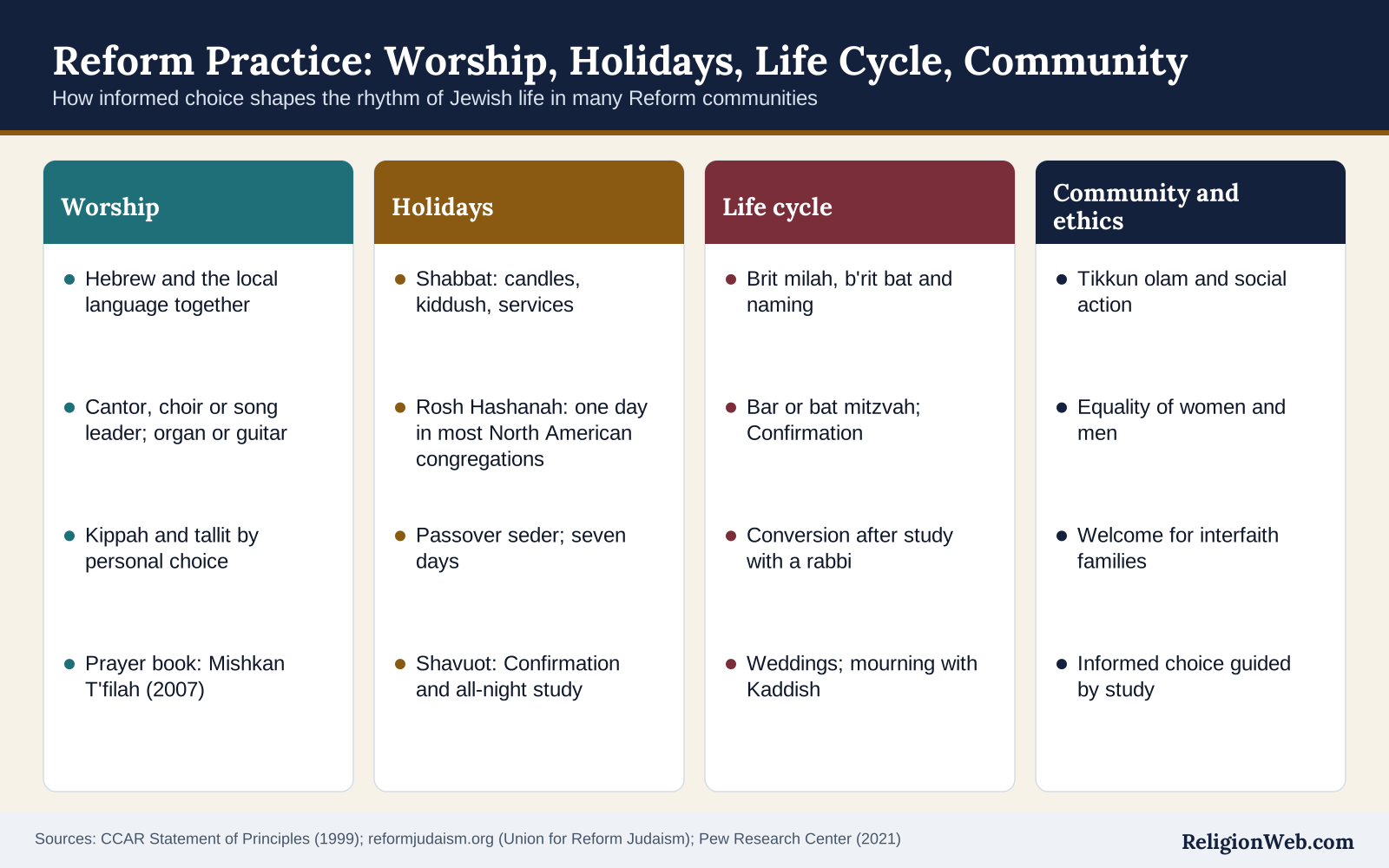
Sacred Spaces, Symbols and Material Culture
The Temple and the Synagogue
Why many Reform congregations use the word “temple”
Many Reform congregations call their buildings temples, a usage that goes back to the Hamburg Temple of 1818. The name is commonly understood to reflect the early movement’s conviction that the congregation’s own house of worship, and not a hoped-for restored sanctuary in Jerusalem, is the place of Jewish worship. The Pittsburgh Platform of 1885 explicitly rejected a return to Palestine and the restoration of sacrificial worship, and prayers for the rebuilding of the Temple were removed or reinterpreted in Reform prayer books. Later generations have differed on the term, and many Reform congregations now prefer the word “synagogue,” Greek in origin and meaning “assembly,” or the Hebrew beit knesset, “house of gathering.”
Architecture and layout
Nineteenth-century Reform sanctuaries often featured an organ and choir, a raised pulpit and family pews, a plan close to that of the Protestant churches nearby, so that some congregations resembled them in outward style. A Reform sanctuary nonetheless contains the same essential elements as any synagogue: an ark housing the Torah scrolls, an eternal light (ner tamid) and a reading platform (bimah) from which the Torah is read. In Reform sanctuaries men and women sit together. The sanctuary may be used for worship, study, weddings and lectures, and many buildings include a social hall, classrooms and a chapel.
Symbols and Ritual Objects
Shared symbols and objects
Reform Jews use the ritual objects common to Jewish life: the Torah scroll, the shofar, the Hanukkah menorah, the kiddush cup, the Shabbat candlesticks, the mezuzah, the Passover seder plate and the tallit. The six-pointed Star of David and the menorah are widely used as emblems on buildings, books and ritual items. Their meanings are discussed in the Judaism article, and Reform practice generally adopts them as shared Jewish inheritance and not as distinctively Reform symbols. The World Union lists a Torah scroll exchange among its programs.
Books, music and the arts
For a movement that places great weight on study and worship, books and music carry special significance as material culture. The prayer books, the Haggadot, the High Holy Day machzor and the Torah commentaries in common use are objects through which the movement’s theology becomes visible, and the history of these books traces the movement’s change. Music is the other great medium: cantors, choirs and congregational singing are a defining part of the sensory experience of Reform worship, and the Debbie Friedman School of Sacred Music at HUC-JIR trains cantors for congregations across North America.
Common Misconceptions About Reform Judaism
Misconception 1: Reform Judaism rejects all Jewish tradition
Where the misunderstanding comes from
The impression has real roots. The Pittsburgh Platform of 1885 stated that only the moral laws of the Mosaic legislation were binding, and it described the dietary and purity laws as foreign to modern thought. Early Reform in Germany and the United States also removed prayers for a rebuilt Temple and for the restoration of sacrifices, introduced organs and sermons in the local language, and in some places moved the main service to Sunday. Textbooks that summarize the movement through that single platform leave the impression of a movement defined by what it discarded.
The word “reform” adds to the confusion. In ordinary English it suggests correcting something that was faulty, and so a listener may assume that Reform Jews regard the older tradition as an error. The movement’s own explanation is different, and it is stated in documents that most summaries leave out.
What the evidence and tradition actually show
Reform Judaism understands itself as a continuation of Jewish tradition and not a departure from it. Its core argument is historical: Judaism has changed in every era, from the prophets to the rabbis to the medieval codes, and the task of each generation is to continue that development responsibly. The Columbus Platform of 1937 affirmed the Sabbath, festivals, customs and ceremonies, Hebrew alongside the vernacular in worship and instruction, and a life centered on the home, the synagogue and the school, and the 1999 Statement of Principles calls Torah the foundation of Jewish life, commits Reform Jews to studying the full range of mitzvot, and affirms the study of Hebrew. Reform prayer books are built on the ancient order of Jewish prayer.
It is accurate that Reform Judaism does not treat halakha as binding in the way that traditional communities do, and that is a real difference of understanding about authority and revelation. The movements that hold halakha to be binding, such as Orthodox Judaism, explain their reasoning in their own terms. In Reform thought the tradition is a living conversation and the individual is expected to take part in it with knowledge, which is why “rejects all tradition” is an inaccurate description of a movement whose institutions devote so much effort to Torah study, Hebrew and the observance of the Jewish year.
Misconception 2: Reform communities have no ritual life
Where the misunderstanding comes from
Classical Reform in the late nineteenth and early twentieth centuries did minimize ceremony, and its congregations placed ethics at the center. Visitors to a congregation that keeps that style may see few outward markers such as head coverings or Hebrew chant, and the principle of informed choice means that individual households make different decisions about observance. Surveys also show that fewer Reform Jews than Orthodox Jews keep kosher or attend services regularly, and such comparisons are sometimes heard as evidence that Reform Jews do not practice.
What the evidence and tradition actually show
Reform communities have a full ritual calendar. They worship on Shabbat and holidays, blow the shofar, observe Yom Kippur with fasting and day-long services, hold seders at Passover, light Hanukkah candles, celebrate Shavuot with confirmation and study, and mark birth, coming of age, marriage and death with Jewish rites. The movement has also created rites of its own, among them confirmation, the b’rit bat ceremony for daughters and new liturgies for moments of passage, and it has drawn on tradition to revive practices such as the kippah. The 1999 principles call Shabbat, the festivals, days of remembrance and life-cycle rites ways to bring holiness into daily life.
What differs is the way obligation is understood and the range of observance. A Reform Jew might keep many practices, a few, or select them over time, and a congregation might offer anything from a formal service with an organ to a Hebrew-rich service with guitar. A description of Reform practice as “optional” captures the framework of informed choice but misses the expectation that choices follow study and are made seriously. Pew’s survey data on Reform Jews describe a population with varied degrees of engagement, not an absence of Jewish practice.
Misconception 3: Reform Judaism is practiced identically worldwide
Where the misunderstanding comes from
The movement’s English-language presence is dominated by American institutions, and a reader who knows the Union for Reform Judaism and the CCAR may assume that those bodies set norms for Reform, Liberal and Progressive Jews everywhere. The shared name “Reform” also suggests a single structure. In fact the movement developed in several places with different names, histories and legal settings, and it still has no central authority.
What the evidence and tradition actually show
The names alone show the variety: Reform in North America, Liberal in much of Europe, Progressive as the international umbrella, and Yahadut Mitkademet in Israel. Britain had two separate movements, Liberal Judaism and the Movement for Reform Judaism, until their merger as the Movement for Progressive Judaism on January 1, 2026. Congregations differ in the amount of Hebrew they use, in whether they keep one day or two days of Rosh Hashanah, in the music of the service, and in how they approach conversion and mixed marriage. In Israel, the Orthodox Chief Rabbinate’s control of marriage shapes what Reform rabbis can do in ways that have no parallel in North America.
The World Union for Progressive Judaism, founded in 1926, exists to link these communities, not to unify their practice. It describes its membership as spanning more than fifty countries and brings together Reform, Liberal, Progressive and Reconstructionist movements. The correct picture is a family of movements with a common history and shared commitments to ethical obligation, informed choice and equality, and with considerable variety in practice from one place to another.
Misconception 4: Reform Judaism today is still the Judaism of the 1885 Pittsburgh Platform
Where the misunderstanding comes from
The Pittsburgh Platform is the most frequently quoted Reform document, and it is easy to find in print and online. Its language about Jews as a religious community and no longer a nation, its rejection of a return to Palestine, and its assessment of ritual are striking, and they appear in many summaries of Reform thought as if they were current. Classical Reform congregations that still observe a nineteenth-century style reinforce that impression for some observers.
What the evidence and tradition actually show
The CCAR has adopted four further major statements since 1885, and several of them reverse or modify the platform’s positions. The Columbus Platform of 1937 supported rebuilding Palestine as a Jewish homeland and affirmed ceremony and Hebrew. The Miami Platform of 1997 addressed Zionism, and the 1999 principles commit the movement to the State of Israel, encourage aliyah, and describe the Jewish people as a community committed to ahavat Yisrael, love of the Jewish people. They also describe a deeper engagement with mitzvot and with Hebrew than the 1885 text did.
The movement’s own commentary describes the platforms as documents capturing the state of Reform Jewish thought at different key moments. Reading the 1885 text as the current position is like reading a founding statement from the 1880s as a description of any institution in the twenty-first century. The historical Pittsburgh text remains important, because it shows what Classical Reform believed and how far later generations moved, but it is a stage in the movement’s development and not its current teaching.
Misconception 5: Reform Judaism is a cultural or ethical identity without real theology
Where the misunderstanding comes from
Reform Judaism has long placed ethical action at the center of its public voice, and its social-justice work is often what outsiders see first. Many members also describe their Jewishness through family, history, food, community and cultural activity, and Pew’s 2020 survey notes that Reform Jews take part in Jewish cultural activities and are at least somewhat attached to Israel. When a movement is known mainly for its ethics and its inclusiveness, it is easy to conclude that belief in God and the content of prayer matter little to it.
The confusion is sometimes deepened by the existence of other approaches to Jewish life, such as Humanistic Judaism, which celebrates Jewish culture and history without reference to belief in God. That movement is distinct from Reform, but the two are occasionally merged in casual conversation.
What the evidence and tradition actually show
Reform Judaism’s own statements are explicitly theological. The Columbus Platform opens its account of Judaism with the one living God, active in the world and beyond time and space; the Centenary Perspective grounds Reform life in the reality of God; and the 1999 principles affirm the reality and oneness of God, describe a covenant between God and the Jewish people, and speak of encountering God in awe, justice, love and everyday life. Worship in Reform congregations addresses God directly, and the prayer books discussed above take prayer, study and the performance of mitzvot as the characteristic ways of responding to the divine.
It is accurate that Reform members hold a spectrum of views about God and that the movement’s documents are written to include that range. The movement’s statements make room for a range of belief, and its institutions nevertheless teach, pray and train clergy within a framework of belief in God, Torah and Israel, and a description of the movement as purely cultural or ethical leaves out the commitments that its platforms place at the center.
Frequently Asked Questions About Reform Judaism
Questions About Belief and Identity
Do Reform Jews believe in God?
Reform Judaism affirms the reality and oneness of God, as the 1999 Statement of Principles states, and it allows for different understandings of the divine presence. Individual members range from those who pray to a personal God to those who think of God in more philosophical terms, and the movement’s platforms were drafted to include that range. Congregations generally welcome questions and study as part of Jewish life.
Who counts as Jewish in Reform Judaism?
Reform Judaism recognizes as Jewish a person born to a Jewish mother or father who is raised and identifies as Jewish through appropriate public acts, following the CCAR resolution of March 15, 1983, and it recognizes people who join the Jewish people through conversion. Other communities use different criteria, notably descent through the mother, so a person’s status may be understood differently in different settings. Anyone with a question about their own status is advised to speak with a rabbi in the community they plan to join.
Is Reform Judaism the same as Liberal or Progressive Judaism?
They are closely related movements with different names and histories. Reform is the usual name in North America, Liberal is used widely in Europe, and Progressive is the umbrella name used by the World Union for Progressive Judaism, founded in 1926. Britain’s Liberal and Reform bodies merged on January 1, 2026, to form the Movement for Progressive Judaism. They share a common origin in nineteenth-century Germany and common commitments, while local traditions differ.
Questions About Practice and Community
What happens at a Reform service, and can visitors attend?
A Reform service combines Hebrew and the local language, includes music led by a cantor, choir or song leader, and features Torah reading and a sermon or discussion. Men and women sit and participate together. Many congregations welcome visitors, publish their service times and offer programs for people who are not members, including virtual High Holy Day services. Anyone attending a first service can ask a greeter or the rabbi about local customs, such as whether kippot and tallitot are worn.
Do Reform Jews keep Shabbat and kosher?
Practice varies. The movement treats both Shabbat and dietary law as matters on which individuals decide with study and guidance. Some Reform Jews light candles and attend services each week, some keep a kosher home, and others adopt only some practices or none. Pew reports that Reform Jews are less likely than Orthodox Jews to keep kosher. Reform teaching encourages members to engage with these mitzvot seriously rather than to dismiss them.
How is a Reform rabbi trained, and can women serve?
Reform rabbis study at Hebrew Union College-Jewish Institute of Religion in North America, at the Abraham Geiger College in Potsdam in Germany, and at other Progressive seminaries elsewhere. They are ordained after years of study of Hebrew, the Bible, Talmud, theology, history and pastoral skills. Women have been ordained since 1972 in the United States, following the earlier ordination of Regina Jonas in Germany in 1935, and they serve in every role in the movement, including as senior rabbis and cantors.
Conclusion: A Tradition That Understands Itself as Living
What the History Shows
Continuity and change
The history of Reform Judaism is a history of two connected impulses: to preserve Jewish identity and to adapt Jewish life to new conditions. In the first generation, in Seesen and Hamburg, that meant a different language, music and understanding of prayer. In the American nineteenth century it produced Classical Reform, with its emphasis on ethics and universal mission. In the twentieth century and since, it has meant a renewed interest in Hebrew, ritual and peoplehood, together with the ordination of women, the inclusion of interfaith families and a stronger commitment to Israel.
Diversity and shared commitments
The movement’s strengths and its tensions come from the same source, the principle that each Jew should study and decide. That principle has produced a pluralism in which congregations on different continents differ markedly in practice, while the platforms from 1885 to 1999 express a shared belief in God, in Torah as an evolving relationship, in the Jewish people and in the duty to repair the world.
How to Keep Exploring
Related topics on ReligionWeb.com
Readers who want the wider context can turn to the Judaism article for the history, texts and calendar that Reform shares with other Jews, and to the articles on Orthodox Judaism and Conservative Judaism for the other modern movements, each described in its own terms.
Learning from the movement itself
The most direct way to understand any living tradition is to hear it described by its members. The CCAR publishes its platforms and resolutions, the Union for Reform Judaism and the World Union maintain directories of congregations, and many congregations welcome visitors to services and adult education. The sources listed at the end of this article give the documents and data on which it is based.
Sources
The table below lists the principal external sources behind this article. Facts, dates and figures were checked against these and related primary, institutional and academic materials.
| # | Source | Publisher and type | Used for | Link |
|---|---|---|---|---|
| 1 | The Holy Scriptures: A New Translation (JPS 1917), Micah 6:8 (also Amos 5:24 and Isaiah 56:7; public domain edition as hosted on Sefaria) | Jewish Publication Society / Sefaria · Primary text | Edition and public-domain status of the Micah 6:8 and Amos 5:24 quotations | sefaria.org |
| 2 | Jewish Americans in 2020 | Pew Research Center · Demographic data | Share of US Jewish adults who are Reform (37%), retention, median age and practice comparisons (2020 survey) | pewresearch.org |
| 3 | A Statement of Principles for Reform Judaism (1999), with the CCAR Commentary on the Principles | Central Conference of American Rabbis · Institutional | Reform self-description on God, Torah, mitzvot, Israel, inclusion and tikkun olam; commentary on informed choice | ccarnet.org |
| 4 | Reform Judaism: A Centenary Perspective (1976), with the CCAR platforms page, the Columbus Platform (1937) and the 1983 resolution on mixed marriages | Central Conference of American Rabbis · Institutional | Autonomy and informed choice; platform titles and years; 1937 and 1983 positions | ccarnet.org |
| 5 | The Pittsburgh Platform (1885) | Jewish Virtual Library (American-Israeli Cooperative Enterprise; Encyclopaedia Judaica source note) · Primary text | Text and context of the 1885 Declaration of Principles, including the quoted sentence on binding moral laws | jewishvirtuallibrary.org |
| 6 | Reform Judaism | Encyclopedia.com (Gale) · Encyclopedia | German and American history, Charleston to Cincinnati, institutions, growth figures, women rabbis, liturgy, Israel | encyclopedia.com |
| 7 | Union for Reform Judaism (also consulted: Britannica entries on Abraham Geiger and Israel Jacobson) | Encyclopaedia Britannica · Encyclopedia | UAHC founding 1873, HUC 1875, 1950 merger, 2003 rename, auxiliaries, number of congregations | britannica.com |
| 8 | History of the World Union for Progressive Judaism | World Union for Progressive Judaism · Institutional | WUPJ founding in 1926, Jerusalem headquarters, institutions and self-reported membership | wupj.org |
| 9 | Regina Jonas (Jewish Women’s Archive Encyclopedia) | Jewish Women’s Archive · Academic reference | 1935 ordination of Regina Jonas, her thesis, deportation and death | jwa.org |
| 10 | What Is Confirmation? (also consulted: Reform pages on Rosh Hashanah, Passover, Shavuot, Hanukkah, brit milah, cremation and the kippah) | Union for Reform Judaism (reformjudaism.org) · Institutional | Confirmation history, and Reform holiday and life-cycle practices described in the article | reformjudaism.org |
Last fact-check date: 2026-10-21.
