Jainism is an Indian religion whose adherents, known as Jains, understand the path to spiritual freedom as the progressive purification of the soul through non-injury (ahimsa), self-restraint, and right understanding. Jains hold that every living being has a soul (jiva), that the universe is uncreated and has no divine author, and that each soul is bound by its own actions (karma) until it frees itself and attains liberation (moksha). The teachers who rediscover and proclaim this path in each great age are called Tirthankaras, a Sanskrit word often translated “ford-makers” because they open a crossing over the ocean of rebirth. The most recent of them in the present age is Mahavira, whom Jains revere as the twenty-fourth Tirthankara.
Historically, Jainism took shape in the middle Ganges plain of eastern India, in the region of Magadha and Videha (today largely Bihar), among the wandering ascetic communities known collectively as the shramanas. Jain tradition traces its teaching back through countless earlier ages to a first Tirthankara, Rishabhanatha, while historians can reach firm ground with Mahavira, a contemporary of the Buddha, and more tentatively with his predecessor Parshvanatha. The Buddhist and Hindu traditions that grew up in the same landscape are covered in the ReligionWeb articles on Buddhism and Hinduism; this article concentrates on the Jain tradition in its own terms, and on how scholars read its history.
Jains are a small community in numerical terms. India’s 2011 census recorded about 4.45 million Jains, roughly 0.4 percent of the population, concentrated in Maharashtra, Rajasthan, Gujarat, Madhya Pradesh, and Karnataka, with smaller communities in East Africa, Britain, and North America. Yet the tradition has an outsized presence in Indian intellectual, artistic, and commercial history: in its manuscripts and marble temples, in a philosophy of many-sided truth known as anekantavada, in a vegetarian ethic that shaped regional food culture, and in the example of ascetics who carry nothing and walk everywhere barefoot.
Two distinctions matter from the start. First, the Jain community is not a single institution. The two main traditions, the Digambara (“sky-clad”) and the Shvetambara (“white-clad”), share a core of doctrine and ethics but differ on scripture, monastic dress, the question of whether women can attain liberation in their present birth, and some details of Mahavira’s life. Second, this article separates what Jain sources teach, what Jains believe about their own past, and what historians can document. Where those layers differ, the text says so, and it names the tradition or scholar that holds each view.
Jainism at a Glance: Definition, Geography, and Key Ideas
What Jainism Is
How Jains describe their own path
Jains most often call their religion Jain Dharma, “the teaching of the Jinas.” The word Jina means “conqueror” and refers to a human being who has conquered the inner enemies of anger, pride, deceit, and greed, along with the attachments that tie a soul to rebirth. “Jain” (also spelled Jaina) simply means a follower of the Jinas. Older texts use another name, Nirgrantha or “free from bonds,” for the ascetics of the community, and Buddhist texts in Pali refer to the Jain leader of Mahavira’s time as the Nigantha Nataputta, the “Nigantha of the Nata clan.”
In their own understanding, Jains do not belong to a religion founded by one person at one moment. They hold that the truth about the soul and the world is eternal, and that in every half-cycle of cosmic time twenty-four Tirthankaras appear, each rediscovering the path of liberation, each teaching it afresh when earlier teaching has faded. Mahavira is therefore revered as a restorer and teacher of this path, not as the author of a new religion. Reverence goes also to the liberated souls (siddhas), to the teachers who guide the community (acharyas), to scholar-monks (upadhyayas), and to all ascetics (sadhus and sadhvis). Together these five categories form the focus of the community’s central prayer, the Navkar Mantra.
How scholars classify Jainism
Scholars of religion classify Jainism as an Indian ascetic tradition that developed independently of, and in dialogue with, the Brahmanical and Buddhist traditions of ancient South Asia. Many describe it as non-theistic in the sense that it has no creator god, no divine judge, and no deity who grants salvation; some scholars prefer the term “transtheistic” to indicate that gods (devas) exist in Jain cosmology but have no creative or redemptive role. Heavenly beings are themselves souls subject to karma and rebirth, and they are not the ultimate refuge.
Paul Dundas’s The Jains, the standard English-language survey, presents the tradition as a continuous ascetic and lay community with its own canon, philosophy, art, and law. That framing matters because older European scholarship sometimes treated Jainism as a derivative of Buddhism. The German scholar Hermann Jacobi, who translated several Jain sutras in the 1880s and 1890s, argued against that view and concluded that Jainism had an independent origin. Modern historians generally follow him on this point.
| Topic | Summary |
|---|---|
| Self-designation | Jain Dharma; followers are Jains or Jainas, from Jina, “conqueror” |
| Region of origin | Middle Ganges plain (Magadha and Videha, modern Bihar), within the wider shramana ascetic movement |
| Central figures | Twenty-four Tirthankaras of the present half-cycle; historically documented figures are Mahavira and, more tentatively, Parshvanatha |
| Goal | Liberation (moksha) of the soul from the cycle of rebirth through the destruction of karma |
| Path | Right faith, right knowledge, and right conduct, often with right austerity as a fourth element |
| Ethical foundations | Ahimsa (non-injury), anekantavada (many-sidedness), aparigraha (non-possession) |
| Main traditions | Digambara and Shvetambara, each with further subdivisions |
| Principal scriptural languages | Ardhamagadhi and other Prakrits, Sanskrit; later texts also in regional languages |
| Population in India | About 4.45 million in the 2011 census (about 0.4 percent of the population); 0.4 percent in the Pew Research Center survey of 2019 to 2020 |
| Main regions | Maharashtra, Rajasthan, Gujarat, Madhya Pradesh, and Karnataka; diaspora communities worldwide |
Where Jains Live and How Many There Are
India: census figures and regional concentrations
The 2011 census of India, the most recent completed count of religious affiliation, recorded about 4.45 million Jains, or about 0.37 percent of the national population. The largest numbers live in Maharashtra (about 1.4 million), followed by Rajasthan, Gujarat, Madhya Pradesh, and Karnataka. Within cities the share can be much higher than the national figure; the Pew Research Center reported in 2021 that about 4 percent of Mumbai’s population identifies as Jain. Jain families are found in nearly every Indian state and union territory, and the long history of trade has carried Jain merchants and craftspeople into small towns across the subcontinent.
Two caveats apply to these numbers. Census figures count self-identification, not practice, and say nothing about whether a person is Digambara or Shvetambara, so no official breakdown of sect exists. And a national census is only one measure: some Jain organizations have argued that Jains are undercounted, and the Jain share of the national population slipped from 0.40 percent in 2001 to about 0.37 percent in 2011. In the 2001 census Jains had the highest literacy rate of any major religious group in India, at 94.1 percent. Pew’s 2019 to 2020 survey of India found that 34 percent of Jain adults hold at least a college degree. Pew’s Jain sample was small (109 respondents), so its percentages for Jains carry a wide margin of error.
Jain communities beyond India
Outside India, Jains are a small diaspora. The Pew Research Center’s 2012 report on the global religious landscape, relying on the World Religion Database, estimated fewer than 250,000 Jains outside India, with significant communities in Kenya, the United States, Canada, and the United Kingdom. Many diaspora families trace their origins to Gujarat and Rajasthan. Early in the twentieth century, Gujarati Jains settled in coastal East Africa and later in Kenya, and later political turmoil there prompted a second migration to Britain, Canada, and the United States. Pew’s 2025 study of global religious change does not report Jains as a separate category, grouping them among the “other religions” because of their relatively small size and the limits of national census data, so there is no reliable current worldwide figure. This article therefore cites the Indian census for India and treats overseas numbers as estimates.
The Ethical Core in Brief
Ahimsa, anekantavada, and aparigraha
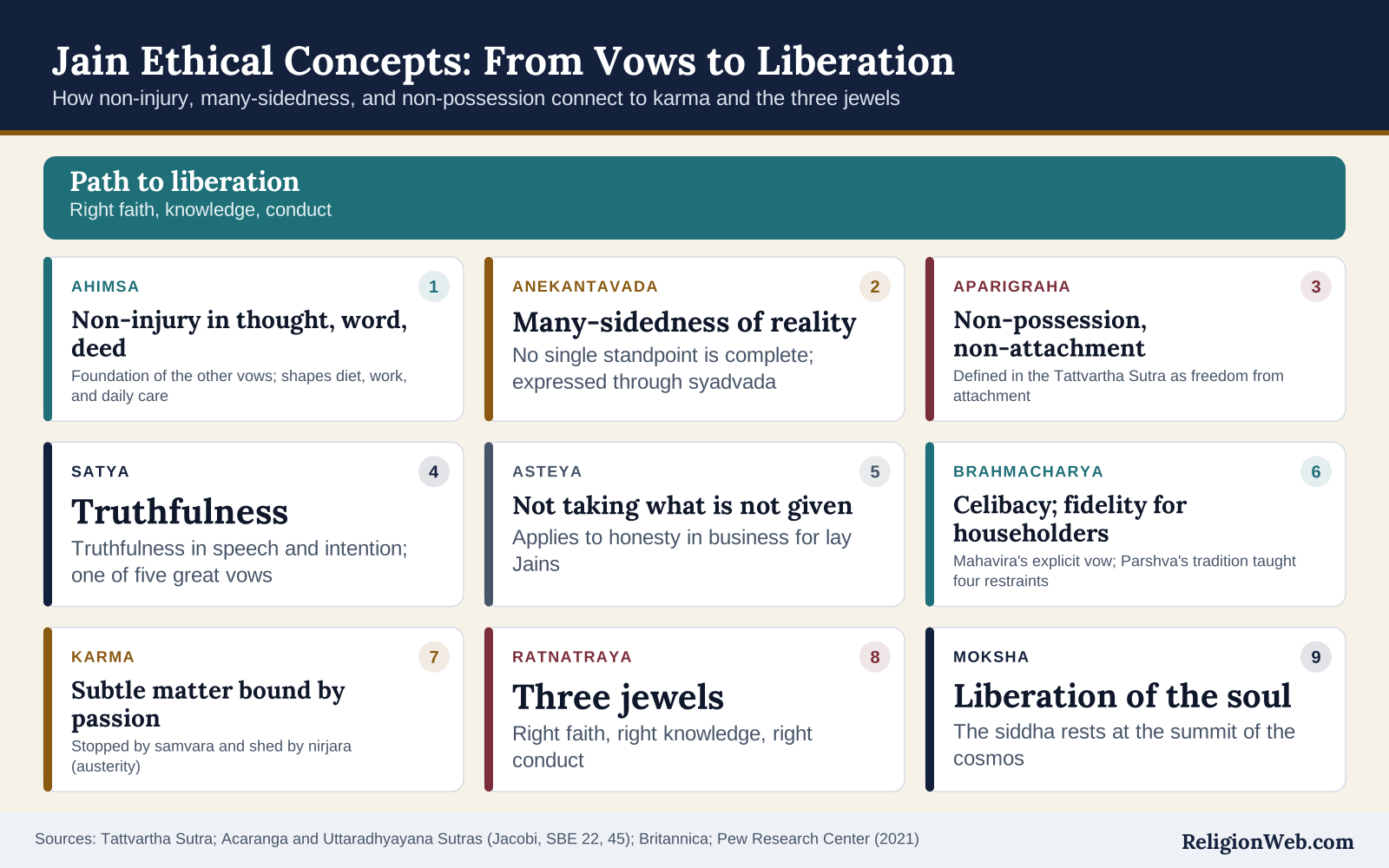
Three principles are often presented as the pillars of Jain thought. Ahimsa means non-injury: the commitment to avoid harming any living being through thought, word, or deed. Anekantavada, literally “the doctrine of the non-one-sided,” teaches that reality has many aspects and that no single statement, made from a single standpoint, captures it completely. Aparigraha, non-possession or non-attachment, applies to material goods but also to opinions, relationships, and emotional clinging. Each is treated in detail later in this article, with attention to how monks and nuns practice them in an absolute form and how householders practice them in a limited form suited to family and working life.
These principles are not independent slogans. In the Jain analysis, injury arises from passion and carelessness, passion arises from attachment, and attachment is sustained by the belief that one’s own standpoint is the only valid one. The three ideas therefore support each other, and Jain teachers often describe them as a single discipline of body, speech, and mind. Later sections show how the framework connects to the doctrine of karma, which explains why the rules are exacting and why ordinary acts such as cooking, traveling, or doing business are given careful attention.
Soul, karma, and liberation
The goal of the path is to separate the soul from karmic matter. In Jain teaching, karma is not simply a moral ledger or an impersonal law: it is a subtle material substance that flows into the soul through activity and clings to it under the influence of passions, dimming the soul’s natural capacities for infinite knowledge, perception, power, and bliss. Liberation occurs when all karma has been shed. The liberated soul, a siddha, rises to the summit of the cosmos and remains there in an unchanging state of perfect knowledge and peace. Jains do not believe a god bestows this result, nor can a Tirthankara or any other being confer it; teachers can show the way, but each soul must walk it.
Because karma is understood as a consequence of the soul’s own actions, the path to freedom is first of all a path of conduct and understanding, supported by meditation, study, and austerity. Jain practice therefore covers a wide range: the lifelong vows of monks and nuns, the vows and daily duties of lay people, temple worship that honors the liberated teachers without asking them for favors, fasting and dietary discipline, and the cycle of festivals that gives communal shape to the year. The sections that follow take these in turn, beginning with how Jains and historians reconstruct the origins of the tradition.
Origins and Historical Development of Jainism
The Jain Account of Antiquity
Cosmic time and the Tirthankaras of each age
Jain tradition does not begin its story with a founder. It begins with time itself. According to Jain cosmology, time has no beginning and no end, and it turns like a wheel through two alternating half-cycles. In the ascending half-cycle (utsarpini) conditions of life, morality, and human capacity gradually improve; in the descending half-cycle (avasarpini) they gradually decline. Each half-cycle is divided into six phases, called aras. In each half-cycle, twenty-four Tirthankaras appear during the intermediate phases, when human beings are capable of grasping the path to liberation and the teaching of the previous Tirthankara has been lost or has faded.
Jains believe that we live in the descending half-cycle, now in its fifth phase, which began shortly after the liberation of Mahavira and is traditionally said to last 21,000 years. Because this phase is considered a period of spiritual decline, tradition holds that no one in the present age can attain liberation directly from this world, and that no new Tirthankara will arise until the next ascending cycle. Jains understand the teaching of the twenty-four to be the same in essence, even though its forms of expression differ; the sutras attribute to every Tirthankara the same core instruction about non-injury and the path to freedom.
Rishabhanatha and the earliest teachings
The first Tirthankara of the present half-cycle is Rishabhanatha, also called Adinatha, “the first lord.” Jain narratives place him at the end of the age when humans lived without agriculture or government, supported by wish-fulfilling trees. As these trees failed, Rishabhanatha is said to have taught people the arts that sustain a society: farming, cooking, craft, writing, and governance. Having ruled as a king, he renounced his kingdom, practiced austerities, and attained omniscience. His son Bahubali, a figure of special devotion among Digambaras, is remembered for standing in meditation so long that vines grew up his legs, an image that is the basis of the monumental statue at Shravanabelagola in Karnataka.
These accounts are found in the Jain canon and in later narrative compilations, notably Jinasena’s Adipurana in the Digambara tradition and the Sanskrit biographical epic of the twelfth-century Shvetambara scholar Hemachandra. They are sacred history for Jains, and they carry doctrinal weight: they explain the origin of social order, assign the earliest teachings to the earliest age, and establish a pattern of renunciation to which later accounts refer. Historians do not treat them as documentation of events, because they offer no independent evidence and place Rishabhanatha’s life in periods measured in unimaginable spans. They are better approached as the tradition’s own account of why its teaching is timeless.
What Historians Can Establish
Parshvanatha and the Nirgrantha community
For the twenty-two Tirthankaras before Parshvanatha, historians have no independent evidence. With Parshvanatha, the twenty-third, the picture changes slightly. Jain tradition places him about 250 years before Mahavira, and many modern scholars regard him as a probable historical teacher of the eighth or seventh century BCE, although the sources are all later. Hermann Jacobi, in his introduction to the translation of the Jain sutras, suggested tentatively that the community of ascetics later led by Mahavira may already have been in existence in the time of the Buddha as a sect founded by Parshva, and that Mahavira should be seen as the reformer of an older church, not its founder.
The Jain canon itself preserves a memory of this transition. In the Uttaradhyayana Sutra, an ascetic named Keshi, a follower of Parshva, meets Gautama, the chief disciple of Mahavira, and asks how two laws with the same aim can differ, since the law of Parshva recognizes four vows while that of Vardhamana (Mahavira’s given name) enjoins five. In Jain tradition the four vows of Parshva are non-injury, truthfulness, not taking what is not given, and non-possession, and Mahavira made celibacy an explicit fifth vow. Gautama answers that the difference reflects the capacity of the people being taught.
The first saints were simple but slow of understanding, the last saints prevaricating and slow of understanding, those between the two simple and wise; hence there are two forms of the Law.
Uttarâdhyayana Sûtra, Lecture 23 (Kêsi and Gautama), verse 26, tr. Hermann Jacobi, Sacred Books of the East vol. 45 (1895)
Historians read the episode as a literary memory of two ascetic communities, one older and one newer, that merged under Mahavira’s leadership, with the text itself explaining the difference as a matter of pedagogy and not of doctrine. A Buddhist text, the Samannaphala Sutta of the Pali canon, independently has King Ajatasattu report that Nigantha Nataputta described the Nigantha as restrained with a “fourfold restraint,” a phrase that scholars have often connected with the four-fold discipline that Jain texts attribute to Parshva’s tradition (the Buddhist presentation of its content differs from the Jain one). Readers interested in the Pali canon can follow the context in the article on Theravada Buddhism.
Mahavira in the shramana world of Magadha
Mahavira is the first Jain teacher on whom independent sources agree. Early Buddhist texts refer to him as Nigantha Nataputta, the leader of the Niganthas and a rival teacher of the Buddha, and they place his activity around Rajagriha, Vaishali, and Shravasti in the eastern Gangetic region. The Buddhist sources also record that he died at Pava, a place that Jain tradition identifies with Pavapuri in Bihar. The Jain accounts of his life agree on the broad outline: he was born into a ruling Kshatriya family of the Jnatrika clan near Vaishali, left home as an adult, practiced austerities for twelve years, attained omniscience, and spent about thirty years teaching before his death.
The world in which he taught was crowded with ascetic movements, collectively called shramana traditions, that questioned the authority of Vedic ritual and the priestly class and sought liberation through personal discipline and knowledge. Scholars such as Johannes Bronkhorst have described this milieu as “Greater Magadha,” a cultural region with its own religious ideas about rebirth and karma. Alongside the Buddha and Mahavira stood teachers such as Makkhali Gosala, the leader of the Ajivikas, a movement that disappeared in the medieval period. Within that setting, Mahavira’s community became distinctive for its stress on non-injury toward all forms of life, including plants and microscopic beings, and for its demanding ascetic discipline.
The dates of his life are a matter of real disagreement. The Shvetambara tradition counts 599 BCE as his birth and 527 BCE as his liberation at age seventy-two, and the Jain era known as the Vira Nirvana Samvat is counted from 527 BCE. Digambara reckonings differ by some years. Many modern historians believe the traditional dates are too early, in part because revised chronologies of the Buddha, whom most sources treat as a contemporary, place the Buddha’s death near 400 BCE. On this reasoning Mahavira’s death falls in the fifth century BCE, and Paul Dundas, for example, has proposed a date around 425 BCE or a few years later. The precise years remain uncertain, and Jains continue to use the traditional chronology for religious purposes.
The question of Indus Valley connections
Some writers, including the German Indologist Heinrich Zimmer and the Indian historian Vilas Sangave, have suggested that seals from the Indus Valley civilization showing figures in apparently meditative postures reflect a very early form of Jain-like ascetic practice, and the philosopher Sarvepalli Radhakrishnan thought that Jain thought might predate the Vedas. Mainstream historians treat these proposals as hypotheses, not findings, because the Indus script is undeciphered and the seals offer no explicit link to any later religion. Jain tradition does not depend on them, and responsible historical accounts note that the earliest verifiable evidence for the Jain community comes from the first millennium BCE.
From Ancient Sangha to Medieval Jain World
The Maurya period and the story of Bhadrabahu
Both major Jain traditions remember an ascetic leader named Bhadrabahu as the last person to possess complete knowledge of the oldest scriptures. A well-known Digambara account, preserved in later texts and in inscriptions at Shravanabelagola in Karnataka, says that Bhadrabahu foresaw a twelve-year famine in Magadha and led a large group of monks to the south, and that the Maurya emperor Chandragupta renounced his throne to follow him. In this account the monks who stayed in the north under Sthulabhadra began to wear white cloth, and the later division between the Digambara and Shvetambara traditions began.
Historians approach the story with caution. The inscriptions that link Bhadrabahu and Chandragupta date centuries after the events they describe, the fullest biography of Bhadrabahu is a late medieval text, and the two sects tell different versions of the schism. The migration of Jain ascetics to the south in the early centuries BCE is well supported by inscriptions and caves in Tamil Nadu and Karnataka, but whether the famine, Bhadrabahu, and Chandragupta were connected is not demonstrated. In the third century BCE the emperor Ashoka’s edicts, which survive, name the Niganthas among the religious communities he supported, giving an early non-Jain reference to the Jain order in an inscription.
Mathura, Kalinga, and the early inscriptions
Archaeology provides the earliest solid evidence of Jain worship and community organization. At Kankali Tila in Mathura, excavations in the nineteenth century uncovered a Jain stupa and a large number of sculptures, inscriptions, and carved tablets of homage (ayagapatas) dating from about the second century BCE through the early centuries CE. Many were donated by lay people, men and women, and the inscriptions use group names for monastic lineages that match those listed in the Shvetambara Kalpa Sutra, which suggests an organized order of monks, nuns, laymen, and laywomen. Some of the Tirthankara images are naked while some monks are shown with a piece of cloth over the forearm, which is one reason many scholars think the sectarian division had not yet hardened.
On the east coast, the Hathigumpha inscription at Udayagiri near Bhubaneswar, a seventeen-line record of King Kharavela of Kalinga, begins with a salutation to the Arhats and to all the Siddhas, the same two groups honored in the first lines of the Navkar Mantra. It records the king’s gifts to ascetics and mentions the recovery of something called the “Kalinga Jina,” which some scholars read as a Jain image and others read differently. Scholars dispute its precise date, usually placing it between the second century BCE and the first century CE, and they disagree on several readings of its damaged lines. Together, Mathura and Udayagiri show a Jain community that was geographically widespread, supported by rulers and merchants, and already building monuments in the last centuries before the Common Era.
Scriptural councils and the Digambara and Shvetambara traditions
Over the first millennium CE, the community’s memory of its scriptures became a point of division. Shvetambara tradition describes gatherings of monks at Pataliputra, Mathura, and finally Valabhi in Gujarat, at which the surviving teachings were recited and then written down; the Valabhi redaction under Devardhigani is traditionally dated to 454 or 466 CE. The Digambaras hold that the earliest scriptures, the Angas and the Purvas, gradually disappeared, and they treat as authoritative a different body of texts, beginning with the Shatkhandagama and the works of Kundakunda. The Shvetambara account of the origin of the Digambara group names a monk called Shivabhuti and a date six centuries after Mahavira; the Digambara account names the famine migration.
Scholars such as Padmanabh Jaini and Paul Dundas conclude that the split was not a single event but a gradual hardening over several centuries, as differences in monastic dress, ideas about women, and the status of texts accumulated. By roughly the fifth century CE the two communities had distinct canons, distinct images, and distinct histories. The sections on texts and on the main traditions below discuss the resulting differences in detail.
Courts, merchants, and monuments in the medieval period
Between roughly the sixth and fourteenth centuries, Jain scholars, ministers, and patrons shaped the intellectual and architectural landscape of western and southern India. In the Deccan and Karnataka, the Western Ganga rulers and their ministers sponsored Jain monuments, among them the colossal statue of Gommateshvara (Bahubali) at Shravanabelagola, traditionally consecrated in 981 CE under the minister Chavundaraya. In the eighth and ninth centuries Digambara scholars such as Virasena and Jinasena produced vast commentaries and narrative works. In Gujarat and Rajasthan, ministers of the Chaulukya and Vaghela courts financed the marble temples at Mount Abu, among them the Vimala Vasahi (traditionally dated to 1031) and the Luna Vasahi (1230), and the Shvetambara monk Hemachandra, who lived from about 1088 to about 1172 and wrote on grammar, poetics, philosophy, and the lives of the Tirthankaras, advised the Chaulukya kings.
The period was not one of uninterrupted patronage. In the Deccan, Jain communities lost royal favor as devotional movements within Shaivism and Vaishnavism gained court support, a shift that historians date largely between the eleventh and thirteenth centuries and that is discussed in the ReligionWeb articles on Shaivism and Vaishnavism. In the north, Jain texts and inscriptions record both temples destroyed during military campaigns, including at Shatrunjaya in the early fourteenth century, and temples rebuilt and endowed under later rulers. Under the Mughal emperors, relations were mixed. Jain sources describe the Shvetambara monk Hiravijaya, who met Akbar around 1582, as persuading the emperor to issue decrees restricting animal slaughter on Jain festival days and to abolish taxes on Jain pilgrimage sites. Much of the detail comes from Jain poems written by Hiravijaya’s disciples, so historians treat the detail with some care, though the broad pattern of Jain influence at the Mughal court is not in doubt.
Reform, renewal, and recognition since the eighteenth century
The eighteenth century saw new reform movements within the Shvetambara community. The Sthanakavasi, who reject image worship, emerged in the seventeenth century from the earlier reform initiated by a Gujarati layman named Lonka Shah in the fifteenth century, and the Terapanth, founded by the monk Acharya Bhikshu in 1760, split from the Sthanakavasi over questions of monastic discipline. In the Digambara community, a movement centered at Agra in the seventeenth century challenged the authority of the clerical bhattarakas and gave rise to the Terapanthi tradition among Digambaras.
Colonial-era scholarship made the Jain scriptures accessible to Western readers and led to the first printed editions and translations, among them Jacobi’s volumes in the Sacred Books of the East. Jain thinkers also took part in public life. Virchand Gandhi represented Jainism at the World’s Parliament of Religions in Chicago in 1893, and the layman and poet Shrimad Rajchandra (1867 to 1901) became a spiritual guide to Mohandas Gandhi, who later acknowledged the importance of Jain ideas of non-injury in his own thought. In 1974 and 1975, Jains of all traditions marked the 2,500th anniversary of Mahavira’s liberation by the traditional count and adopted a common emblem. In January 2014 the Government of India granted Jains national minority status. The chronology below gathers the main dates and shows which are traditional and which are scholarly.
| Date | Event or figure | Basis and caution |
|---|---|---|
| Beyond historical dating | Rishabhanatha, first Tirthankara of the present half-cycle | Jain sacred history; no independent evidence |
| Traditionally about 250 years before Mahavira; many scholars say 8th to 7th century BCE | Parshvanatha, 23rd Tirthankara | Probably historical; all sources are later; Jacobi viewed him as founder of the older Nirgrantha church |
| Traditionally 599 to 527 BCE; many historians say 5th century BCE | Mahavira, 24th Tirthankara | Historical; dates disputed by several decades |
| 3rd century BCE | Ashoka’s edicts mention the Niganthas; Bhadrabahu and Chandragupta tradition | Edict reference is firm; the Bhadrabahu story is attested only in later sources |
| 2nd century BCE to 1st century CE | Hathigumpha inscription of Kharavela; Kankali Tila at Mathura | Inscriptional and archaeological; dating of Hathigumpha debated |
| 2nd to 5th century CE | Tattvartha Sutra of Umasvati; Digambara Shatkhandagama and works of Kundakunda | Authors and exact dates uncertain |
| 454 or 466 CE | Valabhi redaction of the Shvetambara canon under Devardhigani | Traditional date; two figures given |
| 981 CE | Consecration of the Gommateshvara statue at Shravanabelagola | Date commonly given; some sources say about 983 |
| 11th to 13th century | Dilwara temples at Mount Abu; Hemachandra (c. 1088 to c. 1172) | Temple dates from inscriptions and tradition; Hemachandra’s years vary slightly by source |
| 1760 | Founding of the Shvetambara Terapanth by Acharya Bhikshu | Documented within the Terapanth tradition |
| 1893 and 1974 to 1975 | Virchand Gandhi in Chicago; 2,500th Nirvana anniversary and common Jain emblem | Documented modern events |
Mahavira and the Tirthankaras: Founders, Teachers, and Central Figures
Mahavira: The Life According to Jain Sources
Birth, family, and renunciation
All Jain accounts of Mahavira’s life are traditional narratives compiled well after his death, and the Shvetambara and Digambara communities differ on several details. Both agree that he was born with the name Vardhamana (“one who grows”) to King Siddhartha and Queen Trishala of the Jnatrika clan, a Kshatriya family, at Kundagrama near Vaishali in what is now Bihar. Some pilgrimage traditions, including Digambara ones, instead identify his birthplace with Kundalpur in Bihar’s Nalanda district, and the exact site remains a matter of tradition. Jains celebrate his birth on the thirteenth day of the bright half of the month of Chaitra, the festival of Mahavir Jayanti. The Shvetambara scripture known as the Kalpa Sutra adds that his mother saw fourteen auspicious dreams at his conception; Digambara tradition counts sixteen. The Kalpa Sutra also relates, and the Digambaras do not accept, that the embryo was first conceived by a Brahmin woman and transferred to Trishala’s womb by a divine messenger.
The two traditions diverge again on the question of marriage. Shvetambara sources say Vardhamana married a woman named Yashoda and had a daughter; Digambara sources say he refused marriage and lived as a celibate. Both agree that he waited until his parents had died before renouncing, and that he left at around the age of thirty. He plucked out his hair, gave away or discarded his possessions, and took up the life of a wandering ascetic. The earliest sustained description of his years of wandering is found in the final lecture of the first book of the Acaranga Sutra, which Hermann Jacobi titled “the Pillow of Righteousness”; it describes him enduring cold, hunger, insects, and abuse from villagers, and moving on without complaint.
Omniscience, teaching, and the fourfold community
After about twelve and a half years of austerity, Jain tradition says, Mahavira attained kevala jnana, omniscience, beneath a sal tree on the bank of the Rijupalika river near Jrimbhikagrama. From that moment he was an arihant, a liberated teacher still living in a body, and he began to teach. Shvetambara sources describe him traveling for some thirty years through the eastern Gangetic kingdoms; Digambara sources emphasize that his teaching came forth in a divine sound heard by all in his assembly, and they commemorate the day of his first public discourse, at Rajagriha, as Vira Shasana Jayanti.
The tradition says Mahavira’s closest disciples were eleven ganadharas, chief disciples, led by Indrabhuti Gautama, a learned Brahmin who became a monk. These disciples organized his teaching into the twelve Angas, according to the Shvetambara account. He is also remembered for building the fourfold community (sangha) of monks (sadhus), nuns (sadhvis), laymen (shravakas), and laywomen (shravikas), an arrangement that survives in all Jain traditions. Women, as nuns and as lay donors, appear in the early inscriptions from Mathura, which suggests that the fourfold structure was a living reality in the early centuries CE and not only an ideal in the texts.
The nirvana of Mahavira
Jains believe that Mahavira died, and attained final liberation as a siddha, at Pava (today Pawapuri) in Bihar, in the town of a king named Hastipala, at the age of seventy-two. The Kalpa Sutra says this happened in the fourth month of the rainy season, in the dark fortnight of Kartika, on the fifteenth day. The night of his liberation is observed as the Jain festival of Diwali, described in the section on holy days below. Many Jains also hold that his chief disciple Indrabhuti Gautama attained omniscience that same night, and that leadership of the community passed to Sudharman, the disciple through whom the Shvetambara canon says the teaching was transmitted. Jambuswami, a disciple of Sudharman, is remembered as the last person in the present age to attain liberation.
The Twenty-Four Tirthankaras
What a Tirthankara is, and what a Tirthankara is not
The word Tirthankara combines tirtha, a ford or crossing, and kara, maker. A Tirthankara is a human being who has attained omniscience and, in addition, founds or restores the four-fold community that carries the teaching forward. All Tirthankaras are also called jinas and arihants, but not every arihant is a Tirthankara. Jain texts describe five auspicious events in the life of each Tirthankara (the panch kalyanak): conception, birth, renunciation, omniscience, and liberation. These events are the basis of temple ceremonies of consecration, and of festivals such as Mahavir Jayanti.
After omniscience, Jain tradition says, a divine assembly hall called the samavasarana is erected, with three circular tiers, where humans, animals, and heavenly beings listen to the Tirthankara. Jains revere these teachers deeply, but they do not understand them as creators, rulers, or granters of grace. A Tirthankara who has become a siddha has left the world entirely and cannot intervene in it. Prayers and offerings to the Tirthankaras are therefore acts of honor, remembrance, and aspiration rather than petitions, a point that explains why the central Jain prayer contains no request for any benefit.
Notable Tirthankaras and their traditions
Each Tirthankara has a standard set of iconographic features and a body of narrative. Rishabhanatha, the first, is associated with the beginnings of civilization and is the focus of the Palitana pilgrimage hill. Shantinatha, the sixteenth, is revered as a source of peace and is said to have been a universal emperor before renouncing. Mallinatha, the nineteenth, is the subject of one of the clearest differences between the major traditions: Shvetambaras hold that Malli was a woman, a princess of Mithila, and cite her as proof that women can reach the highest spiritual rank, while Digambaras hold that all Tirthankaras are male, and call the nineteenth Mallinatha.
Neminatha, the twenty-second, is described in Jain literature as a cousin of Krishna. According to the story in the Uttaradhyayana Sutra and in later narratives, he was to be married to a princess named Rajimati, but when he heard the cries of animals gathered for the wedding feast, he ordered them released and renounced the world instead; Rajimati later became a nun. The connection with Krishna is of interest to scholars of the broader Indian devotional traditions, including those covered in the article on Vaishnavism, and Kushan-period images from Mathura already show Neminatha with Krishna and Balarama. Parshvanatha, the twenty-third, is among the most widely worshiped; his images are recognized by a canopy of serpent hoods.
| Tirthankara (number) | Emblem | Place of liberation (traditional) | Distinctive tradition |
|---|---|---|---|
| Rishabhanatha, also Adinatha (1) | Bull | Mount Ashtapada (identified with Kailash) | First teacher of the age; associated with the origins of agriculture, crafts, and governance; father of Bahubali |
| Vasupujya (12) | Buffalo | Champapuri, Bihar | One of four Tirthankaras who did not attain liberation at Sammed Shikhar |
| Shantinatha (16) | Deer | Sammed Shikhar, Jharkhand | Remembered as an emperor who renounced; invoked in rites for peace |
| Mallinatha (19) | Water pot (kalasha) | Sammed Shikhar, Jharkhand | Shvetambaras: a woman, Malli; Digambaras: a man, Mallinatha |
| Neminatha, also Arishtanemi (22) | Conch | Mount Girnar, Gujarat | Cousin of Krishna in Jain narrative; renounced after hearing animals prepared for his wedding feast |
| Parshvanatha (23) | Serpent | Sammed Shikhar, Jharkhand | Probable historical teacher; four-fold restraint; serpent-hood canopy in images |
| Mahavira, also Vardhamana (24) | Lion | Pavapuri, Bihar | Most recent Tirthankara; five great vows; basis of the Vira Nirvana era |
Emblems, images, and differences between the traditions
Each of the twenty-four Tirthankaras has a distinguishing emblem (lanchhana), shown below the image, which allows worshipers to recognize figures that otherwise look almost identical. The emblems include a bull for Rishabhanatha, a deer for Shantinatha, a conch for Neminatha, a serpent for Parshvanatha, and a lion for Mahavira. Some emblems differ between traditions: the tenth Tirthankara, Shitalanatha, is marked by a wishing tree in Digambara usage and by the shrivatsa symbol among Shvetambaras, and the fourteenth, Anantanatha, by a porcupine or a falcon depending on the source.
Images themselves follow different conventions. Digambara temples house unclothed, unadorned images, usually with downcast eyes, in seated or standing meditation. Shvetambara images are typically seated, and are adorned with temporary ornaments, jewelry, and decoration. Tradition holds that twenty of the twenty-four Tirthankaras attained liberation at Sammed Shikhar in Jharkhand, one of the principal pilgrimage places of Jainism, and that Rishabhanatha, Vasupujya, Neminatha, and Mahavira attained liberation elsewhere.
Other Revered Teachers and Figures
Disciples, successors, and the transmission of knowledge
After Mahavira, leadership of the community passed through a lineage of teachers, and the tradition identifies particular stages in the decline of knowledge. Shvetambara and Digambara sources both name Bhadrabahu as the last of the shruta-kevalins, those who knew the whole scriptural tradition. Sthulabhadra, who in Shvetambara tradition succeeded him, retained only part of the oldest corpus, and the knowledge of the Purvas, the oldest scriptures, is said to have declined and eventually been lost. The Kalpa Sutra preserves a list of these early teachers (sthaviras), which scholars have compared with the lineage names in Mathura inscriptions.
Scholars, poets, and reformers
Several later figures are revered as teachers and are cited throughout this article. Umasvati (or Umasvami), who wrote the Sanskrit Tattvartha Sutra sometime between the second and fifth centuries CE, is accepted by both major traditions. Kundakunda, whose dates are uncertain but who is placed by many scholars around the second century CE or later, is the most revered of Digambara authors. Siddhasena Divakara and Samantabhadra developed the philosophy of many-sidedness, Haribhadra (eighth century) wrote across many genres including a survey of Indian philosophies, and Hemachandra (twelfth century) systematized lay and monastic ethics in his Yogashastra. In the modern period, Acharya Bhikshu, founder of the Shvetambara Terapanth, and Shrimad Rajchandra, a layman admired by many Jains and by Mohandas Gandhi, are among the most influential. The roster of teachers is long, but it shares a consistent feature: reverence is directed to the knowledge and conduct of the person, not to a claim of special divine status.
Core Beliefs and Philosophy: Soul, Karma, Cosmos, and Liberation
The Nature of Reality
Jiva and ajiva: souls and everything else
Jain philosophy begins from a distinction between the living and the non-living. The living is the soul, jiva; everything else is ajiva. Classical Jain texts, notably the Tattvartha Sutra, enumerate six eternal substances (dravyas): souls; matter (pudgala); the principle that makes motion possible (dharma, in a technical sense unrelated to religion); the principle that makes rest possible (adharma, likewise a technical term); space (akasha); and time (kala). None of these was created, and none will be destroyed. The cosmos is therefore an eternal system in which substances change their forms but not their basic nature, a principle that Jain thinkers express by saying that every substance has both permanence and modes of change.
The soul is conscious by nature and, in its pure state, possesses infinite knowledge, perception, power, and bliss. Embodied souls expand or contract to fill the body they inhabit; there is not one universal soul, but an infinite number of individual souls, each with its own history of actions and rebirths. Jain texts classify living beings by the number of senses they possess, from one to five. One-sensed beings, which have only touch, include not only plants but, in Jain teaching, bodies of earth, water, fire, and air, and the earliest layer of the canon, in the first book of the Acaranga Sutra, instructs monks to recognize life in each of these. At the lowest level are microscopic beings called nigodas, which share a body in vast numbers. The classification explains the unusual scope of Jain ethics: any act that damages a living body, however simple, entails some injury, and injury to beings with more senses is considered more serious.
An uncreated cosmos and the realms of rebirth
Jains describe the universe as eternal and uncreated, structured in space as a vast figure sometimes compared to a standing human form. The upper realms hold the heavens of gods, the middle realm contains the continents where humans and animals live, and the lower realms hold the hells. At the very top is the abode of the liberated, Siddhashila, shown in Jain art as a crescent. There is no creator god who made this system, and no god who administers it. Heavenly and hellish beings are souls whose karma has placed them there for long but finite spans.
Rebirth, in this account, takes place in four broad states of existence (gatis): the heavenly, the human, the animal and plant, and the hellish. Human birth is held to be uniquely valuable because only humans can practice the full discipline that leads to liberation. Jain teachers describe the soul’s cycle of births (samsara) as without beginning for any individual soul that is not yet liberated, and they distinguish between souls capable of liberation (bhavya) and, in some formulations, those that never will attain it. The doctrine of time-cycles introduced earlier belongs here too: the long rhythm of rising and falling ages supplies the setting in which Tirthankaras appear.
Karma and the Path to Liberation
How karma works
Jain teaching about karma is distinctive for treating karma as a subtle physical substance. Particles of karmic matter, which pervade the universe, flow toward the soul whenever it acts through body, speech, or mind. This influx is called asrava. Whether the particles stick depends on the soul’s passions: anger, pride, deceit, and greed bind karma to the soul like dust to an oiled surface, a process called bandha. Material karma (dravya karma) and the soul’s emotional and mental states (bhava karma) condition each other, which is why changing one’s inner attitudes is not a secondary matter but the heart of the path.
Texts such as the Tattvartha Sutra classify karma into eight kinds. Four are “destructive” because they obscure the soul’s own qualities: those that veil knowledge, those that veil perception, delusion-producing karma, and obstructive karma. Four are “non-destructive” because they determine the conditions of an embodied life: karma that fixes the kind of body and birth, the span of life, social standing, and the experience of pleasure and pain. Each bound portion of karma has its own nature, duration, intensity, and quantity, and it may ripen, be shed, or be altered in some circumstances. Jains distinguish merit-producing (punya) from demerit-producing (papa) karma but regard both as bondage: even a golden chain is a chain. In this system no god metes out reward or punishment. Karma operates as an impersonal process, and each soul bears the full responsibility for its own state.
Stopping and shedding karma
The path to freedom is described as two complementary activities. Samvara is the stopping of new influx, accomplished through self-restraint, vigilance, ethical observance, and meditation. Nirjara is the shedding of karma already bound, accomplished chiefly through austerity (tapas), including fasting, study, service, confession, and meditation. Jain texts list six outer austerities, which concern food, bodily comfort, and solitude, and six inner ones, which concern repentance, humility, service to others, study, relinquishing attachment to the body, and concentration. Austerity in this sense is meant to be practiced with understanding and without anger or pride; mere bodily hardship, Jain teachers repeatedly say, does not purify a soul that is still full of passion.
The long process of spiritual development is mapped as fourteen stages of purification, called gunasthanas. The first is the state of a soul with wrong belief. The fourth is the first glimpse of right faith. The fifth marks the lay person who observes the partial vows, and the sixth and seventh mark the ascetic who has taken the full vows. The thirteenth is the state of the embodied omniscient teacher, and the fourteenth is the brief state at the moment of death when the remaining karma falls away and the soul is freed. The scheme is not a doctrine of instant conversion: it presents spiritual progress as gradual, with falls as well as ascents, and with moral conduct and understanding developing together.
The three jewels: right faith, right knowledge, right conduct
The opening aphorism of the Tattvartha Sutra, accepted by Digambaras and Shvetambaras alike, states that right faith, right knowledge, and right conduct together are the path to liberation. Together they are known as the three jewels (ratnatraya), and many texts add right austerity as a fourth element. Right faith (samyag-darshana) does not mean belief on authority alone; it means a firm and correct conviction in the nature of soul, non-soul, karma, and liberation, and a trust in the teachers who have realized them. Right knowledge includes five kinds: knowledge through the senses and mind, knowledge from scripture, direct clairvoyant knowledge, direct knowledge of others’ minds, and omniscience. Right conduct is the observance of the vows. The canonical Uttaradhyayana Sutra states the dependence of each stage on the previous one in a way that has been quoted by Jain teachers for centuries.
Without (right) faith there is no (right) knowledge, without (right) knowledge there is no virtuous conduct, without virtues there is no deliverance, and without deliverance there is no perfection.
Uttarâdhyayana Sûtra, Lecture 28 (The Road to Final Deliverance), verse 30, tr. Hermann Jacobi, Sacred Books of the East vol. 45 (1895)
Commentators in both traditions read this as a sequence of conditions, not as a ranking of virtues: conduct that is not informed by knowledge turns into mechanical ritual, while knowledge that never becomes conduct leaves the soul bound. The word “perfection” in Jacobi’s translation renders the Jain idea of the perfected state of the liberated soul. Because the three jewels must work together, Jain teachers have often criticized both pure ritualism and pure intellectualism as one-sided, a criticism that connects to the principle of many-sidedness discussed below.
What liberation means
Liberation (moksha) is the complete separation of the soul from karmic matter. A person who has destroyed the four destructive karmas attains omniscience and becomes an arihant, a teacher who continues to live in a body until the remaining karma runs out. At death the soul becomes a siddha and rises to the top of the universe, where it remains forever. The siddha does not merge into a universal reality and does not become a god who governs the world; it is a perfected individual soul in a state of infinite knowledge and bliss, without body, desire, or action. Jain tradition holds that all souls have this capacity, although not all will actualize it. In the present age, according to both major traditions, liberation can no longer be reached directly from this part of the world, and the aim of a devout life is to prepare for it, in part by hoping for a rebirth in conditions, such as the continent of Mahavideha in Jain cosmology, where liberation remains possible.
| Teaching | Term | Core meaning | How it shows up in practice |
|---|---|---|---|
| The soul | Jiva | Every living being has an eternal, conscious soul with the capacity for liberation | Care for all beings, including very small and one-sensed ones |
| Karma | Karma | Subtle matter bound to the soul by activity and passion; no divine judge | Attention to intention, speech, and conduct; confession and repentance |
| Non-injury | Ahimsa | Avoid harming any living being in thought, word, or deed | Vegetarian diet, careful food preparation, protective practices of monastics |
| Many-sidedness | Anekantavada | Reality is complex; any single standpoint is partial | Qualified statements, intellectual humility, structured debate |
| Non-possession | Aparigraha | Possession is attachment; limit goods, desires, and clinging | Monastic poverty; lay limits on wealth; charity |
| Three jewels | Ratnatraya | Right faith, right knowledge, and right conduct together lead to liberation | Study, devotion, vows, and meditation as a single discipline |
| Liberation | Moksha | Complete separation of the soul from karma; the soul rises to the top of the universe | The aim behind vows, fasting, and, at life’s end, the vow of sallekhana |
Ahimsa, Anekantavada, and Aparigraha in Depth
Ahimsa: what non-injury requires
Of the three principles, ahimsa is the most widely associated with Jainism, and its foundation is in the oldest strata of the canon. In the Acaranga Sutra, ahimsa is presented not as one teaching among several but as the teaching of all enlightened beings of every age.
The Arhats and Bhagavats of the past, present, and future, all say thus, speak thus, declare thus, explain thus: all breathing, existing, living, sentient creatures should not be slain, nor treated with violence, nor abused, nor tormented, nor driven away.
Âkârâṅga Sûtra, Book I, Lecture 4 (Righteousness), Lesson 1, section 1, tr. Hermann Jacobi, Sacred Books of the East vol. 22 (1884)
The passage that follows in Jacobi’s translation calls this “the pure, unchangeable, eternal law.” A natural reading, common in Jain exposition, takes the statement as universal in two senses. It applies to all beings regardless of rank, and it applies in all ages, a point that underlines Jain belief in the continuity of the Tirthankaras’ teaching. Later texts refine the definition. The Tattvartha Sutra defines injury (himsa) as the severing of life-forces through carelessness or passion, so that harm is determined not by the outer event alone but by the inner state with which an act is done. A careful person whose footstep accidentally crushes an insect is not guilty of injury in the full sense, while a careless person who happens to cause no physical harm has still injured himself, because careless passion binds the soul to karma.
Jain ethicists recognize that no embodied person can avoid all harm, and they therefore distinguish kinds and degrees of violence. For householders, four kinds are often listed: intentional injury, as in hunting or butchery, which must be given up completely; injury unavoidable in running a household, such as cooking and cleaning; injury arising from earning a living, such as farming or manufacture; and defensive injury, such as protecting oneself or others from attackers. The last three are to be minimized and must not be driven by anger, greed, pride, or deceit. Monks and nuns, who no longer maintain households or occupations, take a stricter vow. Because injury to beings with more senses is considered graver, the Jain diet excludes meat, fish, and eggs. Ahimsa also extends beyond physical acts. A harsh word, a manipulative promise, and a thought of contempt count as forms of violence.
Anekantavada, syadvada, and the nayas
Anekantavada holds that any real thing has infinitely many aspects, and that any statement describes only one. Jain philosophers developed this into a method of speech called syadvada, the doctrine of “perhaps” or “in some respect” (syat). A thing may be said to exist in respect of its own substance, place, time, and nature, and not to exist in respect of those of something else; in the classical scheme, seven kinds of statement (saptabhangi) combine affirmation, denial, and inexpressibility, each qualified by syat. The related theory of standpoints (nayas) distinguishes the ways in which a thing can legitimately be viewed, for instance as an enduring substance or as a momentary mode. Only the omniscient perceive reality entire; everyone else sees from a standpoint. A parable of blind men touching different parts of an elephant, used in Jain philosophical texts of the medieval period such as Mallisena’s Syadvadamanjari, illustrates how partial views mistaken for the whole become error.
The doctrine took shape across centuries. Thinkers such as Siddhasena Divakara, Samantabhadra, Akalanka, and Haribhadra developed it in dialogue and sometimes sharp argument with Buddhist and Brahmanical philosophers, and it drew criticism in turn: the Advaita Vedanta thinker Shankara, whose school is discussed in the article on Hinduism, argued that a doctrine allowing contradictory predicates could not ground reliable knowledge, and Buddhist logicians such as Dharmakirti and Shantarakshita, whose philosophical world is introduced in the article on Mahayana Buddhism, made similar objections. Jain thinkers, including Akalanka, engaged these criticisms in detail.
Modern writers often present anekantavada as a charter of religious tolerance or “intellectual non-violence.” Gandhi, writing in 1926, spoke appreciatively of it, and many contemporary Jains and some scholars of Jainism value it as a model of intellectual humility. Other scholars, among them Paul Dundas and John Cort, caution that this reading is a modern emphasis. Medieval Jain authors used anekantavada as a tool of rigorous argument, often to show why rival philosophies were one-sided, and they did not suppose all religious claims equally true. Both readings are therefore found in scholarship and in the community, and the present article treats them as different emphases and not as a settled conclusion.
Aparigraha: non-possession as a discipline of attachment
The third principle, aparigraha, is the vow not to hold on to possessions. Its definition in the Tattvartha Sutra is revealing: possession (parigraha) is attachment, the sense that something is “mine.” On this view a monk with a begging bowl may be more attached than a king who sits lightly on his throne, and the vow concerns the inner grasp as much as outer ownership. Jain teachers traditionally list both external possessions (land, goods, money, grain, domestic animals, dwellings) and internal ones (such as false belief, anger, pride, deceit, greed, and various attachments) as forms of possession to be relinquished.
For monks and nuns, aparigraha means owning almost nothing: in the Digambara tradition, nothing at all beyond a peacock-feather whisk, a water pot, and a few scriptures; in the Shvetambara tradition, a few plain white garments, an alms bowl, a woolen broom, and other minimal items. For householders it means setting limits on wealth and consumption, giving regularly in charity, and cultivating contentment. The ideal is not poverty for its own sake but freedom. Jain communities have a long tradition of lay philanthropy: funding temples, schools, hospitals, and shelters for animals, in part because giving away what one has gathered is understood as a way of loosening attachment.
Sacred Texts, Canon, and Authority in Jainism
The Shvetambara Canon
The Agamas: Angas, Upangas, and related groups
Jains call their oldest scriptures the Agamas, “that which has come down,” or the Siddhanta. According to Shvetambara tradition, Mahavira’s teaching was arranged by his chief disciples into twelve Angas (“limbs”), and these were transmitted orally for centuries before being written down. Of the twelve, the twelfth (the Drishtivada, which contained the ancient Purvas) is held to be lost, so eleven Angas survive. Around them developed further groups: twelve Upangas (“subsidiary limbs”), four Mulasutras (“root texts,” chiefly for beginning monks), six Chedasutras on monastic discipline, two appendix texts (Culikasutras), and a miscellany called the Prakirnakas, usually counted as ten. The total of forty-five is the canon accepted by the Murtipujaka Shvetambaras, the image-worshiping majority. The Sthanakavasi and Terapanthi traditions accept thirty-two of these texts and do not treat the remainder as authoritative.
The language of this literature is Ardhamagadhi, a Prakrit, meaning a vernacular of the eastern Gangetic region and not Sanskrit, the language of the Vedic and later Brahmanical tradition. That linguistic choice reflects the tradition’s own account of how Mahavira taught: in the speech of ordinary people so that all could understand. Scholars agree that the canon is a layered collection. The oldest parts, in particular portions of the first book of the Acaranga and portions of the Sutrakritanga and the Uttaradhyayana, are generally regarded as the earliest, although dating is difficult and estimates range from the fourth or third century BCE for early material to considerably later for the Sutrakritanga in its present form. Jacobi himself judged that the redaction made at Valabhi in the fifth century CE under Devardhigani was a redaction of books that largely existed earlier.
Key texts and what they contain
The Acaranga Sutra, “On Conduct,” is the first Anga and the primary source for early Jain monastic ethics. Its first book, in a terse and archaic style, teaches the reality of life in earth, water, fire, air, and plants, and gives the earliest account of Mahavira’s wanderings, while its second book contains detailed rules for begging food, walking, speech, and the possession of clothing and bowls. The Sutrakritanga presents Jain teaching in contrast to other contemporary doctrines, which is why it is of special interest to historians of the shramana period. The Bhagavati Sutra, a vast collection of questions put by Gautama and others to Mahavira, covers cosmology, karma, and biography. The Uttaradhyayana Sutra, “The Later Readings,” is a collection of verse sermons, parables, and dialogues; Shvetambara tradition ascribes it to Mahavira’s last discourse, while critical scholars regard it as an anthology compiled over time. One of its best-known passages is in the tenth lecture, which addresses Gautama.
As the fallow leaf of the tree falls to the ground, when its days are gone, even so the life of men (will come to its close); Gautama, be careful all the while!
Uttarâdhyayana Sûtra, Lecture 10 (The Leaf of the Tree), verse 1, tr. Hermann Jacobi, Sacred Books of the East vol. 45 (1895)
The refrain is repeated through the lecture, and the lecture as a whole is often read in Shvetambara settings as a reminder of impermanence and of the urgency of practice; Gautama, the great disciple, is addressed as everyone’s representative. The Kalpa Sutra is a short text that forms part of a Chedasutra, the Dashashrutaskandha. It contains the lives of the Jinas, especially Mahavira, Parshvanatha, Neminatha, and Rishabhanatha, a list of the early lineage of teachers, and rules for the monsoon retreat. It is recited by monastics during the festival of Paryushana, and is also one of the most frequently illustrated Jain manuscripts.
The Digambara Texts
The Shatkhandagama and the Kasayapahuda
Digambaras hold that the Angas and Purvas were gradually lost, beginning not long after Mahavira, so that no ascetic of the first or second century CE retained the whole. They therefore do not recognize the Shvetambara canon as authentic, although many Digambara scholars study individual Agama texts as historical sources. Instead, they treat as foundational a body of texts that preserve what remained of the Purva tradition. Two of the oldest are the Shatkhandagama, “the scripture in six parts,” ascribed to the ascetics Pushpadanta and Bhutabali, and the Kasayapahuda, “treatise on the passions,” attributed to Gunadhara. Both are in Prakrit and are generally dated by scholars to around the second century CE or somewhat later; they are concerned with the technical classification of the soul, karma, and the stages of spiritual development.
These works are known largely through a monumental set of commentaries composed by Virasena and Jinasena in the eighth and ninth centuries, among them the Dhavala and Jayadhavala. The manuscripts of the Dhavala preserved for centuries at the Jain monastery of Moodabidri in Karnataka were not widely accessible until the twentieth century, when they were edited and printed. For Digambaras, access to these works has meant access to the most authoritative tradition of scholastic Jain doctrine, and it shaped the distinct Digambara approach to karma theory.
Kundakunda and the four expositions
The most revered Digambara author is Kundakunda, whose dates are uncertain: proposals range from about the first century CE to as late as the eighth, and many scholars place him in the second century or somewhat later. His Prakrit works include the Samayasara, “Essence of the Self,” which draws a sharp line between the pure soul and the activities of body and karma; the Pravachanasara on the monastic path; the Niyamasara; and the Panchastikaya, a treatise on the five extended substances. Later Digambara teachers, including a lay movement associated with the twentieth-century teacher Kanji Swami, drew heavily on the Samayasara.
Digambara literature is also organized in four categories or “expositions” (anuyogas): the narrative (lives of the Tirthankaras and other great persons), the cosmological and calendrical, the conduct of monks and laity, and the nature of substances. This scheme provides a map of the learning that a Digambara scholar is expected to master and also explains why narrative poems such as Jinasena’s Adipurana have scriptural status for many Digambaras, unlike purely literary works.
Shared Works, Later Literature, and Authority
The Tattvartha Sutra and the philosophical tradition
One text is accepted by all branches of Jainism: the Tattvartha Sutra of Umasvati (also written Umasvami). Composed in Sanskrit in ten chapters, probably between the second and fifth centuries CE, it presents the whole of Jain doctrine in aphoristic form, from knowledge and the nature of the soul to cosmology, karma, vows, and liberation. Shvetambaras and Digambaras differ over the number and wording of a few sutras and over whether the author wrote a commentary on his own work, but both treat the text as authoritative, and more than twenty-five commentaries exist, among them Pujyapada’s Sarvarthasiddhi and Akalanka’s Rajavartika in the Digambara line. Later philosophical works by Siddhasena Divakara, Samantabhadra, Haribhadra, and Hemachandra continued the tradition of systematic argument in Sanskrit.
Narratives, hymns, and the manuscript tradition
Jain literature is not limited to doctrinal treatises. The tradition produced narrative cycles on the lives of the Tirthankaras and other great persons (puranas and charitras), works in Prakrit, Sanskrit, Apabhramsha, and regional languages including Kannada, Tamil, Gujarati, and Hindi, grammars, dictionaries, mathematical treatises, and devotional hymns. Jain scholars and patrons maintained manuscript libraries (bhandaras), some of which, like those in Jaisalmer and Patan, hold manuscripts from the medieval period. Illustrated copies of the Kalpa Sutra, made for lay patrons from about the fifteenth century onward, are among the best-known examples of Jain book art, with pages painted with mineral pigments and sometimes gold.
| Group of texts | Examples | Accepted by | Notes |
|---|---|---|---|
| Angas (twelve; eleven extant) | Acaranga, Sutrakritanga, Bhagavati, Antagadadasao | All Shvetambaras (Murtipujaka, Sthanakavasi, Terapanthi) | Digambaras hold that the Angas and Purvas were lost |
| Upangas, Mulasutras, Chedasutras, Culikasutras, Prakirnakas | Uttaradhyayana, Dashavaikalika, Kalpa Sutra (in the Dashashrutaskandha), Nandi, Anuyogadvara | Murtipujaka count 45 texts; Sthanakavasi and Terapanthi count 32 | Mostly in Ardhamagadhi Prakrit; Chedasutras concern monastic discipline |
| Shatkhandagama and Kasayapahuda with commentaries | Dhavala and Jayadhavala of Virasena and Jinasena | Digambaras | Technical works on soul, karma, and stages of purification; Prakrit |
| Works of Kundakunda | Samayasara, Pravachanasara, Niyamasara, Panchastikaya | Digambaras | Central to Digambara spirituality and to Kanji Swami’s movement |
| Tattvartha Sutra and commentaries | Sarvarthasiddhi, Rajavartika, Bhashya | All Jain traditions | Sanskrit digest of doctrine in ten chapters |
| Narrative and devotional literature | Adipurana, Trishashtishalakapurushacharitra, hymns and stotras | Varies by tradition | Source of many popular stories of the Tirthankaras |
How authority works: teachers, texts, and the community
Jainism has no single head and no body with universal authority. The ultimate authority is the omniscience of the Jinas, and scriptures are authoritative because they transmit what the Jinas taught. In practice, authority resides in a combination of scripture, the teachings of respected acharyas, and the conduct of the monastic community. In the Shvetambara Terapanth, the monastic order obeys a single acharya; in other traditions, authority is distributed among lineages of teachers (gachchhas and sanghas) and the lay community. Because the oldest scriptures are believed to be partly lost, and because the two main traditions disagree on what survives, Jain teachers commonly say that a teaching must agree with the essential principles of non-injury, karma, and the path, whatever its source.
Scripture itself receives veneration. On Jnana Panchami, the fifth day of the bright half of Kartika, many Jains display and honor their scriptures, and manuscript copying has long been regarded as an act of merit. In the twentieth century, monks and scholars of several traditions undertook critical editions of the Agamas, and the Terapanth in particular supported a large editing project under Acharya Tulsi and Acharya Mahapragya. As with the historical questions raised earlier, the community’s own understanding of its texts and the findings of modern philology run in parallel: Jains read the canon as the preserved word of the Jinas, and historians read it as a layered body of texts that reached its present form over many centuries.

Branches, Traditions, and Internal Diversity
The Two Major Traditions
Digambara: the “sky-clad” tradition
The Digambara tradition takes its name from the monastic practice that gives it its distinctive appearance: digambara means “sky-clad,” and fully ordained male monks (munis) wear no clothing. Digambaras understand this as the logical completion of the vow of non-possession, since a garment is a possession and an object of attachment, and they see it as the practice of the Tirthankaras themselves. A Digambara monk eats a single meal each day, standing, from cupped hands, with food given by a layperson who has prepared it according to strict rules. He sleeps on bare ground, pulls out his hair by hand, and carries only a whisk of fallen peacock feathers (picchi), a water gourd (kamandalu), and scriptures. Digambara nuns, called aryikas, wear a plain white sari and take the great vows in a figurative or provisional sense (upacara), because the Digambara tradition holds that full renunciation requires the absence of clothing, which is not permitted to women.
Digambaras hold that a woman cannot attain liberation directly in her present birth and must first be reborn as a man; that omniscient beings do not take food; and that all the Tirthankaras, including Mallinatha, were male. They trace their scriptural authority to the Shatkhandagama, the works of Kundakunda, and the commentarial literature rather than the Shvetambara Agamas. Digambara communities are concentrated in Karnataka, Maharashtra, Madhya Pradesh, Rajasthan, and parts of Uttar Pradesh, Bihar, and Tamil Nadu. Scholars of Jainism such as Padmanabh Jaini, Nalini Balbir, and Kristi Wiley have criticized the doctrine about women’s liberation as lacking support in early scripture, while Digambara teachers defend it as consistent with their understanding of monastic conduct. Within the wider Jain community, this remains an open subject of debate.
Shvetambara: the “white-clad” tradition
The Shvetambara tradition takes its name from the white clothing worn by its monks and nuns. Shvetambaras consider themselves the continuation of the original community and hold that clothing is permitted to ascetics, provided it is simple, seamless, and not an object of attachment. A Shvetambara monastic carries a woolen broom (rajoharana), an alms bowl, and a few garments, and receives food by visiting households (gochari), taking small portions so that no household is burdened. The tradition holds that women can attain liberation in their present birth, that Mallinatha was a woman, that kevalins take food, and that the canonical Agamas, compiled at Valabhi and elsewhere, preserve Mahavira’s teaching. In Shvetambara orders nuns generally outnumber monks, sometimes by a wide margin.
Shvetambara communities predominate in Gujarat and in much of Rajasthan, and also include large merchant communities in Maharashtra, Mumbai, Chennai, and Kolkata. Shvetambaras are generally thought to be the larger of the two main traditions, but no census records sect, so numerical claims are estimates. The Shvetambara tradition is itself divided into three main branches, discussed below, according to their stance on image worship and on organization.
Where the two traditions agree and differ
It is easy to overstate the differences. Digambaras and Shvetambaras share the doctrines of the soul, karma, and liberation, the framework of twenty-four Tirthankaras, the five great vows, the three jewels, and the authority of the Tattvartha Sutra. They share pilgrimage places, festivals, many hymns, and most of their ethical practice, including vegetarianism and fasting. Their disagreements, which are real and have sometimes led to disputes over the management of shared holy places, concern five main areas: the clothing of ascetics, the canon, whether women can reach liberation in their present birth, whether omniscient beings eat, and a number of details of Mahavira’s life, such as whether he married, whether the embryo was transferred, and how many dreams his mother saw.
These differences do not amount to different religions in the eyes of Jains, and members of both traditions commonly worship at the same sites. Scholars, following Jaini and Dundas, read them as the outcome of a long process in which communities of ascetics developed different answers to the same questions about how fully to renounce. The table below summarizes the principal divisions and subdivisions; sizes are not given because no reliable count of sects exists.
Subdivisions within the Shvetambara Tradition
Murtipujaka: the image-worshiping majority
The Murtipujaka (“image-worshiping”), also called Deravasi or Mandirmargi (“temple-dwelling” or “temple-path”), are the largest and oldest Shvetambara group. They worship in temples, perform elaborate rituals of offering and bathing before images of the Tirthankaras, and accept the full canon of forty-five texts. Their monastic orders are organized into lineages called gachchhas. Of many historical gachchhas a few remain, among them the Tapa Gachchha, which is the largest, the Kharatara Gachchha, the Anchal (Achal) Gachchha, and the Parshvachandra Gachchha; they differ in details of ritual, the calendar, and lineage, but not in basic doctrine.
Sthanakavasi: the tradition without images
The Sthanakavasi emerged from a reform movement that opposed image worship. Its roots are traced to Lonka Shah, a fifteenth-century scribe in Gujarat who argued from the scriptures that image worship had no canonical basis. A monk named Lavji of Surat is often credited with founding the monastic tradition in the seventeenth century. Sthanakavasi means “dweller in halls”: they perform religious duties in a plain hall (sthanak) and not in a temple. They accept thirty-two Agamas, practice meditation and recitation of the Navkar Mantra without images, and their monastics wear the mouth-cloth (muhapatti) continuously. The tradition is strongest in Gujarat, Rajasthan, Punjab, and Maharashtra.
Terapanth: a single acharya and a reform of discipline
The Shvetambara Terapanth was founded in 1760 at Bagadi in Marwar by Acharya Bhikshu, a Sthanakavasi monk who left that order to restore what he saw as the strict canonical rules of monastic conduct. The name is traditionally explained in two ways: as a reference to the thirteen rules of the order (five great vows, five regulations of careful conduct, and three controls), and, in Bhikshu’s own reinterpretation of the word, as “your path,” the Lord’s path. The Terapanth, like the Sthanakavasi, does not worship images. It is distinctive for its centralized organization: all monks and nuns obey a single acharya who chooses his successor. The ninth acharya, Tulsi, started the Anuvrat movement in 1949, a program of small vows for lay people and non-Jains alike; his successor Mahapragya developed the meditation system called Preksha Dhyana. The present, eleventh acharya, Mahashraman, took office in 2010 and led a walking campaign for non-violence, the Ahimsa Yatra, that began in 2014 and ended in 2022. The order also includes a distinctive rank, the samanis and samans, who hold a status between monastics and lay followers and have taught outside India.
Digambara Subdivisions and Reform Movements
Bispanth and Terapanth among the Digambaras
The Digambara community also divides along lines that have to do with temple practice and with authority. Through much of the second millennium, Digambara religious life in many regions was organized around bhattarakas, clerical heads who lived in monasteries, wore clothing in some contexts, administered temple property, and served as the community’s ritual leaders at a time when naked monks were rare in many regions. In the seventeenth century, an intellectual movement centered in Agra criticized the bhattarakas’ authority. Those who rejected it became known as the Terapanthis, and those who maintained the earlier forms became the Bispanthis. Bispanthis include devotion to certain protective deities (yakshas and yakshis) and perform the lamp ritual of aarti, while Terapanthis do not. The name Terapanth thus appears in both Shvetambara and Digambara contexts, but the two groups are historically unrelated.
Taranpanth, Kanji Swami, and other movements
Several smaller movements add to the picture. The Taranpanth, which began in the fifteenth or sixteenth century, venerates scriptures rather than images, and is concentrated in central India. In the twentieth century, Kanji Swami (1890 to 1980), a former Sthanakavasi monk, founded a lay-centered movement, based at Songadh in Gujarat, that draws on Kundakunda’s Samayasara and on the writings of Shrimad Rajchandra, emphasizing the inner awareness of the soul over external ritual; most of its followers identify as Digambara. Shrimad Rajchandra himself is revered by his followers in several organizations as a guide whose path does not fall squarely into either of the two main traditions.
Historians also mention the Yapaniya, a tradition attested in southern India from roughly the fifth century that is recorded as combining Digambara-like nudity with acceptance of women’s liberation and of some of the Agamas. It later disappeared. The existence of such a group is evidence of how fluid the boundaries between the main traditions were in earlier centuries.
| Tradition | Subdivision | Approximate origin | Image worship | Distinctive features |
|---|---|---|---|---|
| Shvetambara (“white-clad”) | Murtipujaka (Deravasi, Mandirmargi) | Continuous with early tradition | Yes | Forty-five Agamas; gachchhas such as Tapa and Kharatara; extensive temple ritual |
| Shvetambara | Sthanakavasi | Reform from 15th century; monastic tradition from 17th century | No | Thirty-two Agamas; mouth-cloth worn continuously; prayer in halls |
| Shvetambara | Terapanth | 1760, Acharya Bhikshu | No | Single acharya; thirteen rules; Anuvrat movement; Preksha Dhyana |
| Digambara (“sky-clad”) | Bispanth | Continuous tradition; named in contrast to Terapanth | Yes | Role for bhattarakas; worship of protective deities and aarti |
| Digambara | Terapanth (Digambara) | Reform from 17th century, Agra | Yes | Rejected bhattaraka authority; no worship of protective deities; unrelated to Shvetambara Terapanth |
| Digambara | Taranpanth | 15th or 16th century | No; scriptures venerated | Concentrated in central India |
| Digambara-leaning lay movement | Kanji Swami Panth | 20th century, Songadh | Mostly yes | Focus on Kundakunda and the inner experience of the soul |
Ascetic Life and Lay Vows
The Monastic Path
Initiation and the five great vows
Jain monks and nuns are at the center of the tradition’s self-understanding, because they live the discipline in its most complete form. A person enters the order through a rite of initiation, called diksha. In Shvetambara practice, the candidate typically gives away possessions, sometimes in a public procession and with donations to charity, receives a woolen broom (rajoharana) as the sign of entry, puts on monastic dress, and has the hair pulled out by hand. The Sthanakavasi and Terapanth orders require the permission of the candidate’s family. A Digambara initiation involves, for men, giving up clothing in stages and, for all candidates, taking vows before an acharya. Initiates are expected to have studied the teaching and to understand the demands of the life they are entering.
The initiate takes five great vows (mahavratas), which are the same in every Jain tradition: complete non-injury (ahimsa) toward all living beings; truthfulness (satya); not taking anything not freely given (asteya); celibacy (brahmacharya); and non-possession (aparigraha). As mentioned earlier, the Jain scriptures say that Parshvanatha taught four restraints and that Mahavira made celibacy an explicit fifth. The vows are taken in a strict form, covering thought, speech, and action, whether done oneself, caused through others, or approved of. A Digambara monk is traditionally described as observing twenty-eight primary attributes (mula gunas), which include the five great vows, five forms of carefulness in conduct, control of the five senses, the six essential daily duties, and seven further practices such as plucking out the hair, not bathing, sleeping on the ground, and eating one meal a day standing.
Daily life of monks and nuns
The conduct of Jain monastics is organized around five kinds of carefulness (samitis) and three kinds of restraint (guptis). The carefulness covers walking, speaking, seeking food, handling objects, and disposing of waste, each done so as to avoid harming living things. A monastic walks only in daylight, looking at the ground a few paces ahead, and does not walk through cultivated fields or on wet ground where small beings may be crushed. The restraints cover the control of mind, speech, and body. Monks and nuns do not own property, do not cook, do not use vehicles, and traditionally travel barefoot for about eight months of the year, giving talks to lay people who gather where they stop.
For the four months of the rainy season (chaturmas), monastics remain in one place, because insects and plants flourish and wandering would cause avoidable harm. This is also the time of the most intense community life, with daily sermons, the festival of Paryushana, and many fasts. Monastics rise before dawn and divide the day between study, meditation, ritual duties such as pratikramana (confession and repentance, performed morning and evening), and the collection of alms. Shvetambara monks and nuns take their food by visiting households, accepting only what has not been prepared specially for them, and taking a little from many homes. They eat only in daylight. A Digambara monk eats once a day, standing, using his hands as the vessel, in a house where the donor has prepared food according to prescribed rules. The tradition regards the householder who offers food as earning great merit, and for this reason the occasion of giving alms to a monk is a high point of lay religious life.
Tools of non-injury: the broom, the whisk, and the mouth-cloth
Several small implements express the Jain ascetic’s care for living things. Shvetambara monks and nuns carry a broom of woolen threads, the rajoharana (also called ogho), and use it to sweep a space gently before sitting or lying down. Digambara monks and nuns carry the picchi, a soft whisk of peacock feathers. Members of the Sthanakavasi and Terapanth traditions wear the muhapatti, a square of white cloth worn over the mouth; Murtipujaka monastics typically use it when speaking, especially when reading or teaching scripture. Jain texts and teachers give more than one reason for the mouth-cloth. It is meant to prevent saliva from falling on sacred books and images, to express restraint in speech, and, in the view of many Jains, to reduce the chance of harming small airborne creatures. Some scholarly accounts note that the protection of tiny beings is, for many, a benefit of the practice rather than its original purpose.
The Lay Path
The twelve vows of the householder
Jainism has always been a religion of the lay community as much as of monks and nuns. Laymen (shravakas, “listeners”) and laywomen (shravikas) are full members of the fourfold community, and their conduct is governed by twelve vows that apply the monastic ideals in a limited, practical form. Five are the anuvratas, the “small vows”: non-injury in a form compatible with household life, which means avoiding intentional harm and minimizing necessary harm; truthfulness; not stealing; sexual restraint, understood as fidelity within marriage; and a self-imposed limit on possessions. Three more are the gunavratas, or “strengthening vows,” which limit the range of one’s activity, one’s consumption, and one’s pointless harm. Four are the shikshavratas, or “disciplinary vows,” which are regular practices such as fixed periods of meditation (samayika), fasting on set days, and giving to monks and nuns. Lists differ slightly between the Digambara and Shvetambara traditions, and some texts add the vow of sallekhana, described below, as a concluding practice.
The twelve vows form a program in which an adult may advance gradually. A layperson does not need to take all of them at once, and many take them in stages, through a vow-taking ceremony before a monastic or teacher. The vows in practice shape ordinary choices: they affect diet, what occupations are considered acceptable, how much wealth is accumulated, and how one treats others. Jain families have traditionally avoided livelihoods that involve large-scale injury, such as butchery, hunting, or the manufacture of weapons, and the community has been strongly represented in trade, banking, jewelry, and education.
Daily duties and lay observance
The ideal lay day is organized around six essential duties (avashyakas): equanimity practice (samayika), praise of the twenty-four Tirthankaras, salutation to monks and nuns, confession and repentance (pratikramana), bodily stillness in meditation (kayotsarga), and a resolution to renounce something for a fixed period (pratyakhyana). Samayika, in which one sits in silence for about forty-eight minutes (a standard period, called a muhurta) and reflects, recites prayers, or reads scripture, is often performed daily or on set days. Pratikramana can be performed in a more elaborate form on special days. Alongside these, lay people are encouraged to visit a temple or sit in a prayer hall, to recite the Navkar Mantra, to study scripture, to practice some form of self-restraint, and to give charity.
Traditional Jain ethics lists four kinds of gift: food, medicine, knowledge, and protection from fear. Together they have shaped a large charitable network: free kitchens, dispensaries, schools, libraries, and shelters for animals and birds. The giving of food to monks and nuns, when it is done properly, is held in particularly high regard. Giving is understood as both a social good and a discipline of non-attachment, as the discussion of aparigraha above indicates.
Sallekhana: the vow at the end of life
The Jain tradition includes a practice for the end of life called sallekhana (Digambara usage) or santhara (Shvetambara and common usage), in which a person who is near death, or whose body can no longer support the religious life, gradually reduces food and drink and spends the final period in prayer, forgiveness, and detachment. Jain texts including the Acaranga Sutra and the Tattvartha Sutra discuss the practice, and it is described as appropriate in situations such as old age, incurable illness, or famine. Teachers hold that it should be undertaken openly, with the knowledge of family and under the guidance of a spiritual teacher, and in a state free from anger, despair, or desire for death. Jain teachers distinguish it sharply from suicide, which they define as an act driven by passion, and they hold that a person who takes the vow is not seeking death but meeting it with equanimity.
The practice has also become a matter of public debate in India. In August 2015, the Rajasthan High Court in Nikhil Soni v. Union of India ruled that santhara was a form of suicide punishable under the Indian Penal Code and was not an essential religious practice; the ruling prompted large protests by Jains, and the Supreme Court stayed it later that month. Scholars and commentators disagree about the proper legal and ethical analysis, and some critics worry about pressure on the elderly and the ill. Jain teaching presents the vow as a voluntary, carefully supervised religious act undertaken by a person at the natural end of life, and not as a response to depression or a way of avoiding medical care. Anyone struggling with thoughts of ending their life should contact local emergency services or a crisis line, and decisions about care at the end of life are properly made with medical professionals as well as spiritual advisers. A recent and widely reported instance was the death in February 2024 of the Digambara acharya Vidyasagar, who is reported to have taken the vow in his last days.
Worship, Prayer, and Temple Practice
Prayer and Devotion in a Tradition Without a Creator
The Navkar Mantra
The central prayer of Jainism is the Navkar Mantra (also called Namokar or Panch Namaskar). Its core is five salutations, in Prakrit: Namo arihantanam, “homage to the arihants”; Namo siddhanam, “homage to the siddhas”; Namo ayariyanam, “homage to the acharyas”; Namo uvajjhayanam, “homage to the upadhyayas”; and Namo loe savva-sahunam, “homage to all the sadhus in the world.” These five categories of beings, called the Panch Parameshthi (“five supreme ones”), include the embodied omniscient teachers, the liberated souls, the leaders of the monastic community, the scholar-teachers, and all monks and nuns. The mantra names no person, including Mahavira, and asks for nothing. In Jain understanding it honors qualities, not individuals, and the reciter bows to the stage of spiritual attainment that he or she hopes to reach.
The prayer is recited at the start of nearly every Jain ritual, at morning and evening, at times of danger, and at the approach of death. Many Jains repeat it silently on a rosary of 108 beads. The opening salutation has an unusually early documentary history: the Hathigumpha inscription in Odisha begins with a salutation to the Arhats and the Siddhas, and scholars have noted that the five-part form appears in the canon later. Versions differ slightly between traditions in spelling and in the four concluding lines that praise the mantra, which the scholar M. A. Dhaky argued are not older than about the sixth century CE.
Devotion without petition
Because the Tirthankaras and siddhas have left worldly existence and do not intervene in it, Jain worship is not a request for favors. Its purpose is to remind the worshiper of the goal, to cultivate qualities such as detachment and gratitude, and to generate good karma by right devotion. In practice, this principle coexists with a wide range of devotional customs. Jains sing hymns (stavans and stotras) in praise of the Jinas, among them the Sanskrit Bhaktamara Stotra, which is recited in both major traditions; they also recite verses in regional languages, and they may seek the assistance of guardian deities (yakshas and yakshis) attached to the Tirthankaras, whose images appear in many temples. Jain teachers differ on the role of such deities, and some Jain traditions give them no place in worship.
Temples and Image Worship
Jain temples and what happens inside
The Murtipujaka Shvetambaras and most Digambaras worship in temples. These are called derasar in Gujarat and basadi in Karnataka, and they range from small domestic shrines to elaborate marble complexes. At the heart of the temple is a sanctum with the image of a Tirthankara, called the mulnayak. Visitors prepare themselves by bathing and wearing clean clothes, often unstitched cloth in the Murtipujaka tradition; leather, silk, and animal products are not allowed inside, and food and water are not taken in. Jains remove their shoes, and in many temples they ring a bell at the entrance. As they enter, they say nissihi, a Prakrit word meaning “I give up,” as a statement that they leave worldly business behind.
The image is the focus of reverence but not an object of petition or a manifestation of a deity. Jains understand an image as a representation of the ideal of the liberated teacher, much as a portrait of a beloved teacher evokes the teacher without containing the person. A worshiper may begin by circling the image three times to honor the three jewels, then bow and stand in silent meditation. This act, known as darshan, is the simplest form of temple worship, and many lay Jains visit the temple daily for darshan alone.
The eightfold worship and the sequence of a visit
Fuller worship (puja) is traditionally described as having eight parts, performed with eight substances. In the Shvetambara order they are water, sandalwood paste, flowers, incense, a lamp, unbroken rice, sweets, and fruit; Digambara usage lists the same substances in a slightly different order. Each stands for a spiritual aim. Water represents the washing away of karma, sandalwood the cooling of the passions, flowers the blossoming of virtue, incense the fragrance of right conduct, the lamp the light of knowledge, rice a place at the summit of the cosmos where rebirth does not recur, sweets the hope of freedom from craving, and fruit the fruit of liberation. In Murtipujaka practice, the worshiper touches the image with sandalwood paste and flowers (anga puja), then makes offerings before it (agra puja) and finally offers praise and meditation (bhava puja), the last of which is the goal of the other two. Offerings are made with care to avoid waste and unnecessary harm, for example by using small quantities and by keeping flowers and other items clean.
Evening worship culminates in the waving of a lamp before the image, the aarti, followed by the mangal divo or “auspicious lamp,” in which the worshiper passes a lamp before the image while singing praise. In Digambara temples the ritual bathing of the image, abhisheka, is a prominent form of worship. At Shravanabelagola, the head-anointing ceremony (mahamastakabhisheka) of the statue of Gommateshvara, held about every twelve years, uses milk, saffron, ghee, and sugarcane juice among other substances; the most recent ceremony was held in February 2018, and the next is expected in 2030. Many Jain temples also hold an annual ceremony in which a new flag is raised on the spire.
Consecration and the five auspicious events
When a new Tirthankara image is installed, it becomes an object of worship only after a long consecration ceremony known as pratishtha, or panch kalyanak pratishtha. The ceremony reenacts the five auspicious events in the life of a Tirthankara: conception, birth, renunciation, omniscience, and liberation. During the rite, which can last for several days and involves chanting by monks or priests, the image is invested with the qualities of the Jina through the application of a special mantra, a rite often called anjana shalaka, by which the image is made fit for worship. Many consecrations involve a procession and a celebration of the birth of the Tirthankara, in which Indra, the king of the heavens, is said to bathe the newborn on Mount Meru; in lay temple practice, the snatra puja repeats that bathing before major undertakings and on festival days.
Worship Without Images, and Meditation
Aniconic traditions: Sthanakavasi, Terapanth, and Taranpanth
For the Sthanakavasi and Terapanth Shvetambaras, who reject image worship, religious life centers on monastic teaching and lay vows. Laypeople gather in a prayer hall for sermons, recite the Navkar Mantra, perform samayika and pratikramana, and honor monks and nuns by bowing and by offering food. They argue that the canonical scriptures they accept do not prescribe temples or image worship, and that devotion should be directed to the qualities of the Jinas, not to representations. The Taranpanth among Digambaras offers a different version of the same principle by placing scripture at the center of the place of worship. Jains of other traditions sometimes disagree with these positions, but Jain teachers on all sides generally affirm that outward ritual is valuable only if it supports the cultivation of detachment.
Meditation and contemplation
Meditation (dhyana) is an old Jain discipline. Texts classify it into four kinds: two harmful (dwelling in sorrow and in cruel or violent thoughts) and two beneficial (reflection on the teaching and, at the highest level, pure concentration on the soul). Practices include kayotsarga, standing or sitting still while letting go of attachment to the body, and the twelve contemplations (anupreksha or bhavana), which take up themes such as impermanence, the absence of any lasting refuge in worldly things, the solitude of the soul, and the way karma flows. In the twentieth century, the Terapanth leader Acharya Mahapragya developed Preksha Dhyana, a system of meditation combining perception of breath and body, relaxation, and contemplation, which is taught at camps and in schools in India and elsewhere. Daily meditation by lay people most commonly takes the form of samayika, the forty-eight-minute period of equanimity.
Fasting, Food, and Everyday Discipline
Fasting in Jain Practice
The range of fasts
Fasting is one of the six outer austerities and, in Jain thought, a way of shedding karma and loosening attachment to the body. The vocabulary of Jain fasting is large. Many lay people keep ekasana (one meal a day) or biyasana (two meals) on particular days, and the daily vow not to eat or drink after sunset is widely kept. A full fast (upavasa) is a day without food, usually with boiled water permitted between sunrise and sunset; stricter forms (chauvihar upavasa) allow no water. Ayambil is a single meal of plain, boiled, unspiced food, without dairy, oil, or sweet, sour, or spicy flavors. Longer fasts include the eight-day attham and the month-long masakshaman, which are undertaken by a small number of devotees, often during the Paryushana festival, with the support of family and community. The most famous long observance is varshitap, the “year-long austerity,” in which a person fasts on alternate days for about thirteen months; it commemorates the fast of Rishabhanatha and is concluded on Akshaya Tritiya.
Jain teachers insist on two cautions that apply to all of this. First, fasting must be voluntary and informed. Texts warn against fasting that is driven by pride, competition, or anger, and Jain tradition does not hold that an unwell person should fast; those who are ill, elderly, pregnant, or caring for infants are not expected to take on severe fasts, and a person with a medical condition should take medical advice before beginning one. Second, fasting is judged by its effect on the mind. A fast that does not diminish passion is, in the classic comparison, only hunger.
Fasting as shared and personal practice
Fasts are usually undertaken within a community. Before taking a fast, a lay person makes a formal resolution (pachchakhan) before a monastic or a senior member of the community, and the end of a long fast is often marked with a public ceremony (parana), at which relatives and friends gather. Women undertake long fasts more frequently than men in many communities, and the sight of a person returning from a month-long fast to a family procession is a familiar one in Gujarat and Rajasthan. The community’s response to fasting is typically supportive, offering songs, visits, and the opportunity to give donations in the faster’s name. Some scholars of South Asian religion have also observed that fasting provides women with a recognized path to religious prestige and community leadership, a point on which observers hold different views.
Food Rules and Their Reasoning
What observant Jains eat and avoid
Observant Jains follow a vegetarian diet that goes further than the common South Asian vegetarian pattern. Meat, fish, and eggs are excluded, and so is alcohol. Honey is avoided because collecting it harms bees. Many Jains do not eat root vegetables such as potatoes, onions, garlic, carrots, and radishes, because pulling up the root kills the entire plant and because such vegetables are considered to hold vast numbers of tiny lives. Mushrooms, fungi, and in some households certain other items such as cauliflower and brinjal are avoided, and foods that have fermented overnight are restricted. Dairy products are generally accepted in the traditional diet, although some Jains, particularly in the diaspora, now eat vegan out of concern about the dairy industry.
The timing and preparation of food are also regulated. Water is filtered through cloth, and observant Jains often drink boiled water, which is believed to remain free of tiny life forms for longer. Eating after sunset is avoided because insects and microbes are thought to be more abundant, because cooking in darkness is more likely to harm them, and because of the discipline of limiting appetite. Pew Research Center’s 2019 to 2020 survey of India found that 92 percent of Jain adults identify as vegetarian and that 67 percent also abstain from root vegetables such as garlic and onions. These are high figures, but they also show that observance varies: about a third of Jains in the survey did not report avoiding root vegetables.
The reasoning behind the rules
The food rules follow directly from the doctrine of the soul. Because every injury binds karma, and because injury to beings with more senses is considered graver, the ideal diet minimizes total harm and avoids harming the most developed forms. This reasoning explains the exclusion of meat, fish, and eggs. For plants, the key idea is that a plant from which only a fruit or leaf is taken is harmed less than one that is uprooted, and root vegetables are said to belong to a category of life forms (anantkaya) in which infinite souls share a body. The practice of avoiding food at night and of filtering and boiling water extends mindfulness to the smallest beings.
Jains themselves do not claim that the rules are scientific proofs, and their practice is guided by caution in the face of life that cannot be seen. Some Jains emphasize the health or environmental benefits of the diet, others focus on the moral discipline it develops. The rules also create a shared culture. Many Jain communities share recipes and ingredients adapted to the restrictions, and Jain restaurants and kitchens are known in cities with large Jain populations. The restrictions can pose difficulties for travelers and for Jains who live in places without Jain communities, who adapt the rules in different ways.
Holy Days and the Jain Calendar
How the Jain Calendar Works
Lunar months, fortnights, and tithis
Jain observances follow the lunisolar calendar used across much of India, in which months begin and end with the moon but are adjusted to keep the year in step with the seasons. Each month has two fortnights: the bright half (shukla paksha), from new moon to full moon, and the dark half (krishna paksha), from full moon to new moon. Days within a fortnight are not the 24-hour days of the Gregorian calendar but lunar days called tithis, which vary in length and are reckoned from sunrise. A festival is therefore fixed to a month, a fortnight, and a tithi, for example “the thirteenth tithi of the bright half of Chaitra,” and its Gregorian date changes from year to year.
Two further points explain the variation. A lunar year is about eleven days shorter than a solar year, so an intercalary month is added roughly every three years, and the festivals shift accordingly. And because a tithi can begin and end at any time of day, its position relative to a sunrise depends on where the calendar is computed. In 2026, for example, Mahavir Jayanti was observed on March 31 in India, according to Indian calendar publications, while a calendar computed for Ohio listed the thirteenth tithi of Chaitra on March 30. Month names also depend on region and on how the month is counted. In the system used in northern India and in many Jain scriptures, a month ends at the full moon, so the dark fortnight before Diwali belongs to Kartika; in the system used in Gujarat and Maharashtra, a month ends at the new moon, and the very same fortnight belongs to Ashvin. Jain sources can therefore describe the same night in either way. The result is that the calendars followed by different traditions and lineages can differ by a day, and sometimes more, for the same festival.
The Vira Nirvana era and the Jain new year
Many Jains also reckon years in the Vira Nirvana Samvat, an era counted from Mahavira’s liberation, traditionally dated to 527 BCE. The Jain year begins on the day after Diwali, the first day of the bright half of Kartika in the Gujarati reckoning, and traditionally marks the opening of a new account book for Jain merchants. By this count the year that begins after Diwali in November 2026 is 2553. Jain publications also use the Vikram Samvat, an era used across northern and western India. Because scholars question the traditional date for Mahavira’s death, the Vira Nirvana count is a community convention, not a claim that historians accept.
Paryushana and Das Lakshana
Shvetambara Paryushana
Paryushana is the most important Jain festival. The word is explained as “abiding” or “coming together,” a reference to the rainy-season retreat in which monks and nuns stay in one place. It falls late in the rainy season, in the month of Bhadrapada. For Shvetambaras it lasts eight days, and its final day is Samvatsari, the day of the annual pratikramana. In most Murtipujaka practice Samvatsari falls on the fourth tithi of the bright half of Bhadrapada, and in some lineages it is observed on the fifth, which is why the dates sometimes differ by a day. In 2026 the Shvetambara festival ran from September 8 to September 15, with Samvatsari on the final day, according to published Jain calendars.
During Paryushana many lay people attend lectures daily, fast, avoid green vegetables on the main days, and spend more time in temples or prayer halls. Monks and nuns recite the Kalpa Sutra, with its account of Mahavira’s birth read on one of the days, and in many communities a procession and display of the fourteen dreams of Trishala draws large crowds. Fasts range from a single day to eight days or more, and some people fast for a month. The final day centers on the pratikramana, a confession of faults, followed by the request for forgiveness. Fasting is voluntary, and elderly, ill, and young people are not expected to undertake long fasts.
Digambara Das Lakshana
Digambaras observe a ten-day festival, Das Lakshana Parva (Dasha Lakshana), usually beginning on the fifth day of the bright half of Bhadrapada and ending on the fourteenth. Each day is dedicated to one of ten virtues or “marks” of dharma: supreme forgiveness, humility, straightforwardness, purity, truthfulness, self-restraint, austerity, renunciation, non-attachment, and celibacy. These ten are drawn from the Tattvartha Sutra, and on each day the community reads and hears an explanation of the virtue of the day. Worship in the temple and daily fasts are common, and the festival ends in many places with a procession on the fourteenth day, followed by a day of forgiveness. In 2026, published Digambara calendars list the festival as beginning on September 16, the day after Shvetambara Samvatsari, and ending around September 25.
Forgiveness: Michchhami Dukkadam and Kshamavani
The festival season is also a season of reconciliation. On Samvatsari and at the end of Das Lakshana, Jains greet one another with Michchhami Dukkadam (in Digambara usage, Uttam Kshama or Kshamavani), a Prakrit phrase usually understood to mean that any wrong done in thought, word, or deed, knowingly or unknowingly, may be considered undone. Families visit relatives, send messages to friends, and sometimes telephone people with whom they have quarreled. A classic verse recited in the pratikramana says, in paraphrase, that one forgives all living beings, asks all beings to forgive in return, and has friendship toward all and enmity toward none. The practice is meant to include non-Jains as well as Jains, and it extends to all living beings. In practice, the greeting is a ritual and does not erase serious wrongs, which Jain teaching says call for real amends.
Festivals Tied to the Tirthankaras
Mahavir Jayanti
Mahavir Jayanti (also called Mahavir Janma Kalyanak) celebrates the birth of Mahavira on the thirteenth tithi of the bright half of Chaitra, in March or April. In 2026 it was observed in India on March 31. Temples are decorated, and the image of Mahavira is bathed with ceremony (abhisheka). In many cities a chariot procession (rath yatra) carries an image through the streets with hymns, and monks and nuns give sermons on his life. Many Jains give to charity, and some communities sponsor ahimsa walks or distributions of food and medicine. The Shvetambara and Digambara traditions mark the day in the same way, although they tell different stories of the dreams and the conception, as noted above.
Diwali: the liberation of Mahavira
For Jains, Diwali, which falls on the new-moon night of Kartika, is the anniversary of Mahavira’s nirvana. According to the Kalpa Sutra, he died at Pava, in the town of King Hastipala, on the fifteenth day of the dark fortnight of Kartika, and the same text records the response of the assembled kings that Jains traditionally regard as the origin of the lamp-lighting of the festival.
on the day of new moon, instituted an illumination on the Poshadha, which was a fasting day; for they said: ‘Since the light of intelligence is gone, let us make an illumination of material matter!’
Kalpa Sûtra (Life of Mahâvîra), section 128, tr. Hermann Jacobi, Sacred Books of the East vol. 22 (1884)
The passage refers to eighteen allied kings of Kashi and Kosala, the nine Mallakis and nine Lichchhavis, who were present. Jain tradition understands the lamps as a symbol of the knowledge that Mahavira had embodied and the commitment to keep it alive. Observance includes fasting (many Shvetambaras keep a two-day fast), reciting the Uttaradhyayana Sutra, which is regarded as containing Mahavira’s last teaching, and pilgrimage to Pawapuri in Bihar. Tradition also holds that Indrabhuti Gautama attained omniscience on the same night, and many Jains observe the following day as the start of the new year, beginning with the opening of new account books. In temples, devotees offer a sweet ball (nirvana laddu) in the morning ceremony. In 2026 the main Diwali day, Lakshmi Puja in most Indian calendars, falls on November 8. Many Jains avoid fireworks as inconsistent with non-injury.
The festival is shared with neighbors who celebrate Diwali for other reasons, and Jain households often join in lighting lamps and exchanging sweets while keeping their own meaning for the day. The specific Jain observances are devotion to Mahavira and the memory of his teaching, and are distinct from the meanings given to the festival in other traditions, which are covered in the article on Hinduism.
Akshaya Tritiya, Oli, and other observances
Several other days have a firm place in the Jain year. Akshaya Tritiya, on the third tithi of the bright half of Vaishakha, commemorates the end of the long fast of Rishabhanatha, who is said to have received sugarcane juice from King Shreyamsa at Hastinapur after a prolonged period without food. Those completing the year-long varshitap end their fast with sugarcane juice on this day, often at Palitana. Jnana Panchami, on the fifth day of the bright half of Kartika, is dedicated to the veneration of knowledge and scriptures. At Palitana, the pilgrimage season on Shatrunjaya opens after the rainy season on the full moon of Kartika, when the temples on the hill reopen.
Twice a year, in the months of Chaitra and Ashvin, Shvetambara Jains observe Oli, a nine-day period of the plain boiled meals known as ayambil, dedicated to the nine categories of spiritual attainment: the five supreme beings, and right faith, knowledge, conduct, and austerity. Digambaras observe Ashtahnika, an eight-day festival, three times a year, devoted to the worship of the divine shrines of the continent of Nandishvara in Jain cosmology. The fortnight also has its recurring days, including the fifth, eighth, and fourteenth tithis, when more devout Jains fast or limit their diet. The table below lists the most important observances with their calendar rule.
| Observance | Calendar rule | Main practices | Who observes it |
|---|---|---|---|
| Paryushana (eight days) | Ends on the fourth or fifth tithi of the bright half of Bhadrapada (Samvatsari); 2026: September 8 to 15 | Lectures, fasting, Kalpa Sutra recitation, pratikramana, forgiveness greetings | Shvetambara traditions |
| Das Lakshana (ten days) | Fifth to fourteenth tithi of the bright half of Bhadrapada; 2026: about September 16 to 25 | Daily study of ten virtues, worship, fasting, day of forgiveness | Digambara traditions |
| Mahavir Jayanti | Thirteenth tithi of the bright half of Chaitra; 2026: March 31 in India | Abhisheka, processions, sermons, charity | All traditions |
| Diwali (Mahavira’s nirvana) | New-moon night of Kartika; 2026: main day November 8 | Fasting, recitation of Uttaradhyayana, lamps, nirvana laddu, new year the next day | All traditions |
| Akshaya Tritiya and varshitap | Third tithi of the bright half of Vaishakha | Ending of year-long alternate-day fast with sugarcane juice | Mainly Shvetambara |
| Jnana Panchami | Fifth tithi of the bright half of Kartika | Display and veneration of scriptures | Many traditions |
| Oli (ayambil) | Nine days in Chaitra and Ashvin | Single plain meals, recitation of the nine categories | Shvetambara traditions |
| Ashtahnika | Final eight days before the full moon of Ashadha, Kartika, and Phalguna | Worship of the divine shrines of Nandishvara | Digambara traditions |
| Kartik Purnima at Palitana | Full moon of Kartika | Opening of the pilgrimage season on Shatrunjaya | Mainly Shvetambara Murtipujaka |
| Chaturmas | Four months of the rainy season | Monastic residence in one place; sermons; more fasting | Monastics, with lay participation |

Sacred Places, Pilgrimage, Symbols, and Art
Pilgrimage and Holy Places
The idea of the tirtha
The word tirtha, “ford,” is used for the Tirthankara and also for a pilgrimage place, a site where the crossing of the ocean of rebirth is felt to be near. In Jain thought, a place becomes holy because of what happened there: the birth, renunciation, omniscience, or liberation of a Tirthankara or other great teacher, the presence of a miraculous image, or the continuing devotion of generations of pilgrims. The rationale is not that the land confers grace, but that the memory of liberated souls clarifies the aim of the path and that walking, fasting, and simple living on pilgrimage are themselves forms of ascetic practice. Pilgrimages are traditionally made on foot, and a wealthy patron sometimes organizes a group pilgrimage (sangh), providing food and lodging for all participants.
Pilgrimage practice in the two main traditions is similar, but their favorite places differ. The hills of Palitana and Girnar in Gujarat are central to Shvetambara devotion, while Shravanabelagola in Karnataka and the temples of the Deccan are especially important to Digambaras. Shikharji, in Jharkhand, is revered by both. Nearly all Jain pilgrimage places are on hills or mountains and are reached by long climbs, which suits an ascetic ideal of leaving the plain of worldly life behind.
Major sites
Sammed Shikhar (Shikharji), on Parasnath Hill in Jharkhand, is the place where twenty of the twenty-four Tirthankaras are believed to have attained liberation. About thirty shrines stand on its ridges, each marking the footprints of a Tirthankara, and pilgrims make a circuit of roughly 27 kilometers. Palitana, in Gujarat, sits at the foot of Shatrunjaya hill, which has nearly nine hundred shrines on its ridges and over 3,500 steps to the summit; the main temple is dedicated to Rishabhanatha. No one remains on the hill overnight, so pilgrims descend before evening. Shravanabelagola in Karnataka is the site of the monumental Gommateshvara statue, about 57 feet high, carved from a single granite block, and of the hill of Chandragiri with early inscriptions and shrines associated with Bhadrabahu and Chandragupta. Pawapuri in Bihar marks the place of Mahavira’s liberation, where a white marble temple stands in the middle of a lotus pond. Mount Abu in Rajasthan has the marble Dilwara temples, and Ranakpur, farther northeast in the Aravalli hills, has a vast fifteenth-century temple dedicated to Rishabhanatha with more than 1,400 carved pillars.
| Place | Location | Association | Notes |
|---|---|---|---|
| Sammed Shikhar (Shikharji) | Parasnath Hill, Giridih district, Jharkhand | Liberation of twenty Tirthankaras, including Parshvanatha | About 1,365 meters high; shrines with footprints of Tirthankaras; revered by Digambaras and Shvetambaras |
| Palitana (Shatrunjaya) | Bhavnagar district, Gujarat | Rishabhanatha; major Shvetambara pilgrimage | Nearly 900 shrines; no overnight stay on the hill; pilgrimage season opens at Kartika full moon |
| Girnar | Near Junagadh, Gujarat | Liberation of Neminatha | Hill with temples; important for both traditions |
| Pawapuri | Nalanda district, Bihar | Liberation of Mahavira | Lotus-pond water temple; focus of Diwali pilgrimage |
| Shravanabelagola | Hassan district, Karnataka | Gommateshvara (Bahubali); Bhadrabahu tradition | 57-foot statue, traditionally consecrated in 981 CE; head-anointing ceremony about every twelve years |
| Dilwara temples | Mount Abu, Rajasthan | Shvetambara temples to Rishabhanatha, Neminatha, Parshvanatha, Mahavira | White marble; Vimala Vasahi (c. 1031) and Luna Vasahi (1230) |
| Ranakpur | Pali district, Rajasthan | Chaumukha temple to Rishabhanatha | Fifteenth century; patron Dharna Shah; 1,444 pillars |
Contemporary questions at pilgrimage places
Pilgrimage places are living institutions, and the management and use of them can raise public questions. In late 2022, Jains across India held protests after the state government of Jharkhand listed Parasnath Hill as a tourist destination, and Jain organizations argued that tourism development would compromise the sanctity of a place of worship and ascetic practice. In January 2023 the central government stayed all tourism-related activities on the hill. Jain communities have also been involved in disputes about the management of shared places and, at times, about access to temples, matters that have occasionally gone to court. These issues are described here as part of the contemporary life of the tradition, and they are being resolved through law and negotiation, so the current status of any individual dispute should be checked in recent sources.
Architecture, Art, and Symbols
Temples, caves, and monumental images
Jain building spans two thousand years. The earliest monuments are caves and stupas, among them the caves of Udayagiri and Khandagiri in Odisha and the stupa at Kankali Tila in Mathura. Later builders raised free-standing temples in stone, from the early medieval cave temples of the Deccan and the basadis of Karnataka to the white-marble sanctuaries of western India. The Dilwara temples at Mount Abu, built between the eleventh and thirteenth centuries, are famed for their carved ceilings and pillars. Jain temples often show a distinctive four-faced image (chaumukha) facing the four directions, and the sculpture in them, from lotus ceilings to figures of musicians and dancers, shows that Jain patrons did not hesitate to employ the full repertoire of Indian ornament even for temples to ascetic teachers.
Monumental statues of ascetics standing in meditation are a particular feature of Jain art, especially in the south. The statue of Gommateshvara, or Bahubali, at Shravanabelagola was carved in the late tenth century, and similar colossal images stand at other sites in Karnataka. The images emphasize stillness and detachment, and in Digambara art the figure’s nudity is a deliberate sign of the renunciation of all possessions.
Manuscripts and painting
Jain communities were major patrons of book arts. Monks and lay donors commissioned copies of the scriptures, and manuscripts were stored in libraries (bhandaras), where they were protected, and sometimes reread and recopied, for centuries. Illustrated copies of the Kalpa Sutra, with scenes of the life of Mahavira and the other Jinas, are among the best-known examples of Jain painting. They were made on palm leaf and later on paper in Gujarat, Rajasthan, and elsewhere, often with brilliant mineral pigments and, in the most lavish copies, gold. The practice of commissioning and donating a manuscript was regarded as a work of merit, and it contributed to the survival of a great body of literature in Prakrit and Sanskrit.
The Jain emblem and flag
In 1975, on the 2,500th anniversary of Mahavira’s liberation by the traditional count, Jains of all major traditions agreed on a common emblem. It combines several symbols: a hand with a wheel on the palm, representing non-injury and the cycle of rebirth, with twenty-four spokes for the twenty-four Tirthankaras; a four-armed swastika above it, standing for the four states of existence; three dots above the swastika for right faith, right knowledge, and right conduct; and a crescent with a dot, symbolizing the abode of the liberated. Beneath is the motto Parasparopagraho jivanam, “souls render service to one another,” or “all life is bound together by mutual support.” The Jain flag has five colors, white, red, yellow, green, and dark blue, representing the five supreme beings and the five great vows.
The swastika and other auspicious signs
The swastika has been used in India for thousands of years as a sign of good fortune, and in Jain tradition it is the emblem of the seventh Tirthankara, Suparshvanatha, and one of the eight auspicious signs (ashtamangala) that appear on temple thresholds, ritual trays, and manuscripts; the lists of eight differ between Digambara and Shvetambara usage. Because the same shape was adopted in twentieth-century Europe in a violent and hateful context, Jain communities in the West have sometimes explained its meaning in public displays or, in some North American groups, replaced it with the syllable Aum on emblems. Rice patterns made with the swastika and the other signs, drawn before the image in temples, are a common act of worship.
Community, Ethics, and Everyday Life
Ethics Beyond Ritual
Livelihood, trade, and philanthropy
Jain ethics reach into the working life. Jain tradition holds that some occupations involve unavoidable large-scale injury, such as hunting, butchery, and the making of weapons, and discourages them, while trade, banking, scholarship, medicine, and many crafts have been regarded as appropriate. Over the centuries many Jains have worked in commerce, and the community’s presence in the trading and financial networks of western India has been well documented. Jain teaching on business conduct emphasizes honesty, limits on accumulation, and a duty to give. Pew Research Center’s survey found Jains concentrated in the top wealth groups of Indian society and with the highest levels of formal education, but the community includes farmers, craftspeople, teachers, and poorer families too, and generalizations about the wealth of the community should be made carefully.
Charity in the Jain tradition is expressed in the four gifts of food, medicine, knowledge, and fearlessness (protection). Jain trusts have built hospitals, schools, libraries, and shelters, including animal shelters known as panjrapoles, which have a long history in Gujarat and Rajasthan. In Old Delhi, a hospital for birds stands near the Red Fort and is associated with a Digambara Jain temple, treating chiefly pigeons with broken wings. These institutions are an application of ahimsa to the daily environment, and they illustrate how the abstract principle of non-injury takes concrete institutional form.
Family and life-cycle customs
Jain life-cycle practice is shaped by the broader regional cultures in which Jains live, and by Jain rules of non-injury. Weddings usually follow regional customs adapted to Jain practice, with prayers to the Tirthankaras and rites led by a Jain ritual specialist, and the details vary by region and tradition. Funerals are normally cremations. Deaths are marked by prayers, recitation of the Navkar Mantra, and charity. Many Jain children attend a weekend religious school (pathshala), and young Jains may take simple vows such as avoiding food after sunset. In many families the rules of diet are the most visible daily sign of Jain identity, and they are taught from childhood.
Contemporary Questions
Women in the community
Women play a central part in Jain religious life, but the tradition is not uniform. In Shvetambara orders nuns generally outnumber monks, and women in many communities lead the practice of long fasts and organize festivals. Shvetambara doctrine holds that women can attain liberation in their present birth, whereas Digambara doctrine holds that they cannot and must first be reborn as men. Within the Digambara tradition nuns have a recognized and respected role, but are ranked below monks in some aspects of ritual and doctrine. Scholars and community members debate these differences, and some Jain women have asked for changes in practice and in leadership. Any discussion of the topic should therefore distinguish doctrine, institutional practice, and the diverse views of Jain women themselves.
Ecology and the Jain Declaration on Nature
Many contemporary Jains present ahimsa as the basis of an environmental ethic. The Jain Declaration on Nature, dated April 19, 1990, and drawn up by Jain scholars, was presented to Prince Philip at Buckingham Palace in his capacity as president of the World Wide Fund for Nature International; the occasion marked the entry of Jainism into WWF’s network on religion and conservation. The declaration draws on the principle that all life is interdependent, and on the vow of limiting consumption. Jain organizations have since taken part in environmental campaigns, vegetarian advocacy, and animal protection work, and the Terapanth’s walking ahimsa campaign led by Acharya Mahashraman covered more than 50,000 kilometers across India, Nepal, and Bhutan between 2014 and 2022.
Legal identity and recognition in India
The status of Jains within Indian law has been a recurring question. The Constitution of India, in an explanation to Article 25, states that references to Hindus in a particular clause include persons professing the Sikh, Jain, or Buddhist religion, and the Hindu Marriage Act of 1955 applies to Jains; many Jains regard these as administrative conveniences that do not describe Jain religious identity, and have long asked for recognition as a distinct religion. In January 2014 the Government of India extended national minority status to Jains under the National Commission for Minorities Act. Jain individuals and organizations differ in their views of how best to describe the relationship between Jain identity and the wider Indian society, and this article does not take a position on those political questions.
Jainism in the Modern World
Numbers and Regions
India in the early twenty-first century
India remains the home of the great majority of Jains. The Pew Research Center, in a survey of 29,999 adults conducted from late 2019 to early 2020 and published in 2021, found that 0.4 percent of India’s population identifies as Jain, the smallest of the country’s six major religious groups, which Pew lists as Hindus, Muslims, Christians, Sikhs, Buddhists, and Jains. Details of those other communities appear in the ReligionWeb articles on Islam, Christianity, and Sikhism, among others. The survey, which weighted its data to the 2011 census, found Jains to be concentrated in western India, with Maharashtra the single largest region, and reported that 92 percent of Jains describe themselves as vegetarian. Because its sample included only 109 Jains, those findings are best read as approximate indications and not as precise measurements. The census remains the only complete count. India’s next census, whose population-enumeration phase, scheduled for February 2027, will again record religion, should supply the first new official count of Jains since 2011.
Diaspora communities and institutions
Jain communities outside India grew through migration in the twentieth century. Gujarati Jains settled in East Africa early in the century, others moved to Britain and its colonies, and the United States community began in earnest after the immigration law changes of 1965; later turmoil in East Africa prompted a second migration to Britain, Canada, and the United States. The Federation of Jain Associations in North America (JAINA), conceived in 1981 and formalized in 1983, links more than seventy local centers and temples of all traditions. Temples in North America and Britain are often built in a style that echoes western Indian marble architecture, and a pilgrimage center at Siddhachalam in New Jersey is described as the first Jain pilgrimage place outside India. Estimates of diaspora numbers vary and no census counts them reliably; Pew’s 2012 report, relying on the World Religion Database, estimated fewer than 250,000 outside India.
Diaspora Jains face distinct questions: how to maintain vegetarian diets in settings where they are uncommon, how to teach children about the tradition across sectarian lines, how to adapt monastic rules that forbid vehicles and set limits on foreign travel, and how to support a tradition without a resident monastic community. Some Terapanth samanis and a few other teachers travel abroad, and many diaspora centers bring together Digambara, Shvetambara, and other families in a shared congregation, a form of Jain community life that has few exact precedents in India. Online resources, summer camps, and youth groups are among the new institutions that have developed.
Institutions, Scholarship, and Open Questions
Education and academic study
Jain learning is supported both by the community and by universities. In India, departments of Jainology and Prakrit exist at several universities, and the National Institute of Prakrit Studies and Research at Shravanabelagola is devoted to the languages of the Jain canon. Outside India, the center for Jaina studies at SOAS University of London, which publishes a newsletter and organizes conferences, is among the academic institutions where Jain history, philosophy, and manuscripts are studied, and several North American universities host courses and endowed programs in Jain studies. Scholars working in these settings include members of the Jain community and non-Jains, and their work has widened the available translations, critical editions, and historical studies.
Questions the community continues to debate
The Jain community is not of one mind about how best to carry its tradition into the future, and several questions remain open. Jains discuss how monastic rules that were framed for a walking society apply in an age of highways, electricity, and digital communication; how to teach Prakrit and Sanskrit texts to children who speak English, Gujarati, Kannada, or Hindi at home; how to balance cooperation among Digambara, Shvetambara, and other traditions with respect for their differences; and how to protect pilgrimage places while allowing public access. Contributors to these debates speak from within the tradition’s principles of non-injury, many-sidedness, and non-possession, which they interpret in different ways, and this article reports them without taking sides.
Common Misconceptions About Jainism
Misconception 1: All Jains are monks or nuns
Where the misunderstanding comes from
Jainism is internationally known through its ascetics: naked Digambara monks walking barefoot along highways, white-clad Shvetambara nuns sweeping the path in front of them, ascetics wearing mouth-cloths. Photographs and news stories tend to feature these figures, and the Jain emphasis on renunciation, together with the strictness of the monastic vows, can give the impression that the religion is the way of life of a monastic elite or that to be a Jain one must be an ascetic. Writers who describe Jain ethics by describing only the great vows of the monastic can reinforce the impression, because they leave the vows of householders out of the picture.
What the evidence and tradition actually show
Jain tradition from its earliest records has described a fourfold community of monks, nuns, laymen, and laywomen, and the laity has always been much the largest part. The 2011 census of India recorded about 4.45 million Jains, and monks and nuns make up only a very small fraction of that number. Laypeople take their own vows, as the section on lay vows above describes, and they hold the practical responsibility of sustaining the community: they support monastics with food and shelter, build and maintain temples, copy and preserve manuscripts, and teach children. The early inscriptions from Mathura record donations by lay men and women, and the Jain community’s long engagement in trade, banking, scholarship, and public life reflects a tradition that has never required everyone to renounce.
The monastic ideal nonetheless has a special status. Jain teaching holds that complete liberation requires complete renunciation, and monks and nuns are honored as the people who live that ideal. But the lay path is presented as a legitimate and respected stage of spiritual progress, with its own vows, daily duties, and rewards, and many Jain texts treat lay and monastic practice as two forms of one path.
Misconception 2: Ahimsa means simple passivity
Where the misunderstanding comes from
The word “nonviolence” in English can suggest the mere absence of action, and popular images of Jain practice, such as an ascetic gently brushing an insect from his path or a layperson straining water, can seem to confirm that ahimsa is about restraint and withdrawal. In the twentieth century, Mohandas Gandhi’s political use of the term also led some commentators to treat ahimsa as a method of resistance that was either entirely passive or entirely political. Both associations oversimplify the Jain concept, which developed in a quite different setting.
What the evidence and tradition actually show
In Jain thought ahimsa is an active and demanding discipline of attention. Jain texts define injury not as an external event but as harm done through carelessness or passion, so the practice of ahimsa requires constant vigilance over one’s movements, speech, intentions, and consumption. The practice of watching where one steps, filtering water, planning meals, and choosing occupations is not passivity, and its logical extension is the Jain network of shelters for animals, hospitals, and charitable foundations. The Terapanth monk-led Ahimsa Yatra, a walking campaign that covered tens of thousands of kilometers, is an example of the way the principle is expressed as public action.
Jain ethics is also not a doctrine of pacifism for every person in every situation. Jain texts recognize that householders cannot avoid all harm, and they distinguish defensive violence, which is permitted to a householder in protecting persons from attackers, from intentional harm, which must be given up. Jain kings and ministers, among them the minister and commander Chavundaraya who sponsored the Gommateshvara statue, served in the military and government. The scope of the allowance for defensive force has been debated within the tradition, and the vows of monks and nuns, who have no defensive role, are stricter. The accurate summary is that ahimsa is a graded and intentional discipline, not an instruction to accept every wrong.
Misconception 3: Jain practice consists only of extreme fasting
Where the misunderstanding comes from
News stories about Jains rarely concern ordinary devotion. They concern a month-long fast, a teenager completing an extended fast with a public celebration, or the vow of sallekhana at the end of life, because these are dramatic and visible. The Paryushana festival is also widely known for the fasting that accompanies it. From these reports, an outside reader can easily conclude that severe austerity is the heart of Jain religious life, or that Jains compete in self-denial.
What the evidence and tradition actually show
Fasting is one of twelve forms of austerity in the classical Jain list, six outer and six inner, and the inner ones, which include confession, humility, service, study, letting go of attachment to the body, and meditation, are regarded as the more advanced. Jain religious life as a whole includes daily devotion, the reading of scripture, the observance of the twelve lay vows, charitable giving, the study of philosophy and ethics, and participation in festivals and pilgrimage. Many Jains observe only a modest level of fasting, such as eating before sunset or keeping a single-meal day on certain tithis, and many in any community do not undertake long fasts at all.
The tradition itself warns against fasting for the wrong reasons. A fast that is driven by pride, comparison, or anger does not shed karma in the Jain analysis, and teachers have long insisted that the value of an austerity lies in the restraint of the passions it produces. Jain texts and teachers do not expect those who are ill, elderly, or very young to fast severely, and anyone considering a long fast, within or outside Jainism, should take medical advice first.
Misconception 4: Jainism is simply an offshoot of another Indian religion
Where the misunderstanding comes from
Jainism shares a great deal of vocabulary with other Indian traditions: karma, rebirth, liberation, ascetic discipline, and non-injury. Mahavira lived at about the same time and in the same region as the Buddha, and the Buddhist texts refer to him as a rival teacher. Nineteenth-century European scholars, who first met Jainism through limited sources, sometimes concluded on this basis that it was a branch or imitation of Buddhism, or that it derived from the Brahmanical tradition. Popular discussion today still sometimes repeats these assumptions, particularly when the traditions are described only by their similarities.
What the evidence and tradition actually show
Scholars who studied the Jain sources more closely reached a different conclusion. Hermann Jacobi, who edited and translated key Jain texts, argued in the 1880s that Jainism had an independent origin and its own development, pointing to differences in doctrine, biography, and practice, and observing that common ideas such as karma and rebirth were widespread in the ascetic and Brahmanical thought of the period. Modern historians generally agree that Mahavira belonged to an older ascetic community that traced itself to Parshvanatha, and that Jain, Buddhist, Ajivika, and other teachers worked within a shared religious environment in the Ganges plain, often called the shramana milieu, in which ideas were exchanged and debated.
The Jain tradition’s own account is that the teaching is eternal and has been given many times; historians do not need to accept that claim to recognize that the Jain community has its own continuous line of teachers, texts, rituals, and institutions. Mutual influence between Indian traditions, including in philosophy, is well documented and was a feature of intellectual life, but scholarship describes it as exchange among independent traditions and not as derivation of one from another. For the Hindu and Buddhist perspectives on this shared period, readers can consult the ReligionWeb articles on Hinduism and Buddhism.
Misconception 5: Anekantavada means Jains regard all religions as equally true
Where the misunderstanding comes from
Anekantavada, the doctrine of many-sidedness, is often presented in modern books and speeches as a philosophy of tolerance, sometimes called “intellectual non-violence,” and the Jain parable of the blind men and the elephant is quoted to suggest that every religion grasps part of one truth. Gandhi’s appreciation of the doctrine and the modern interfaith movement have strengthened this presentation. The phrase “all paths lead to the same goal” is then attributed to Jainism as if it were a standard Jain teaching.
What the evidence and tradition actually show
The picture in the sources is more nuanced. As a philosophical doctrine, anekantavada holds that any single statement about a complex reality is partial and conditional, and that only an omniscient being knows the whole. Medieval Jain thinkers used it as a tool of rigorous argument, and they often used it to show that rival doctrines were one-sided, as the logic of Siddhasena, Samantabhadra, Akalanka, and Mallisena demonstrates. Scholars such as Paul Dundas and John Cort therefore caution that reading the doctrine as a charter of religious pluralism is a modern emphasis and does not describe how most Jain authors used it. Jain teachers did not teach that all religious views are equally true; they taught that every view is partial and that the Jina’s teaching, rooted in omniscience, gives the most complete account.
At the same time, many Jains today do draw ethical and interfaith lessons from anekantavada, such as the importance of listening, of qualifying one’s own statements, and of respecting others’ perspectives, and some modern scholars regard this as a legitimate development of the idea. The accurate position is that both the technical and the ethical readings are present in Jain thought, and that the idea of many-sidedness is better described as a discipline of humility about one’s own standpoint than as a statement about the truth of other religions.
Frequently Asked Questions About Jainism
Questions About Origins and Beliefs
Who founded Jainism?
Jainism has no single founder in the sense that Jains understand their own tradition. Jains hold that the teaching is eternal and that twenty-four Tirthankaras restore it in each half of the cosmic cycle. Mahavira is revered as the twenty-fourth and most recent of the current age, and the historical figure on whom outside sources agree.
Historians therefore describe Mahavira as the central teacher or organizer of the historical Jain community, who lived in the Ganges plain in the sixth or fifth century BCE, and who is thought to have reformed an older ascetic community associated with Parshvanatha. Whether he is called a founder depends on whether one is speaking from within the tradition or as a historian.
Do Jains believe in God?
Jains do not believe in a creator or ruler of the universe. The cosmos is eternal, and souls are bound by their own karma, not by divine decision. Gods exist in Jain cosmology as heavenly beings, but they are souls in the cycle of rebirth, not saviors.
What Jains revere are the liberated souls (siddhas) and the teachers who have attained omniscience (arihants, including the Tirthankaras), who are models of what every soul can become. Devotion to them is not petition for help, though the practice of worship varies by tradition, and some Jains also honor guardian deities.
What happens after death in Jain teaching?
Jain teaching holds that at death the soul, carrying its karma, is reborn in one of four realms: heavenly, human, animal and plant, or hellish. The realm and circumstances of rebirth depend on the soul’s accumulated karma. The cycle continues until the soul sheds all karma through right faith, right knowledge, and right conduct.
A soul that is liberated does not return. It rises to the top of the cosmos as a siddha and remains in a state of perfect knowledge and bliss. Jain tradition says that liberation is open to any soul in principle, though the Digambara and Shvetambara traditions differ on whether a woman can attain it directly in her present birth.
Questions About Practice and Daily Life
What do Jains eat, and why?
Observant Jains are lacto-vegetarian. They avoid meat, fish, eggs, and often honey, and many avoid root vegetables, mushrooms, and foods that ferment overnight. Many also avoid eating after sunset. Pew Research Center’s 2019 to 2020 survey of India found that 92 percent of Jains describe themselves as vegetarian.
The reasoning is that every act of eating involves some harm to living things, so one should choose foods that cause the least. Not all Jains follow every rule, and the strictness of practice varies by family, region, and tradition.
Do all Jains fast?
Most Jains observe some form of fasting or dietary restraint during the year, especially during Paryushana or Das Lakshana, but the intensity varies enormously. Many keep modest observances, such as skipping an evening meal, while a smaller number undertake fasts of eight days or a month.
Jain teaching presents fasting as voluntary and as only one of many austerities. People who are ill, elderly, pregnant, or very young are not expected to take on severe fasts, and medical advice is appropriate for anyone considering a long one.
What is the difference between Digambara and Shvetambara Jains?
Both traditions share the core teaching, the Tirthankaras, the five vows, and the authority of the Tattvartha Sutra. They differ mainly in four areas: Digambara monks go without clothing while Shvetambara monastics wear white; Shvetambaras accept a canon of Agamas that Digambaras regard as lost; Digambaras hold that women cannot attain liberation in their present birth while Shvetambaras say they can; and the two traditions tell some episodes of Mahavira’s life differently.
Each tradition also has subdivisions, such as the image-worshiping Murtipujaka and the Sthanakavasi and Terapanth among Shvetambaras. Jains of all these groups commonly share pilgrimage places and festivals.
Questions About the Community Today
How many Jains are there, and where do they live?
India’s 2011 census recorded about 4.45 million Jains, around 0.4 percent of the population, mostly in Maharashtra, Rajasthan, Gujarat, Madhya Pradesh, and Karnataka. Outside India there are smaller communities in East Africa, the United Kingdom, Canada, and the United States.
No census counts Jains worldwide, and estimates for the diaspora vary. Pew Research Center’s 2025 study of global religious change groups Jains with other small religions, so there is no up-to-date global figure from that source.
Can non-Jains visit Jain temples?
Many Jain temples, especially historic and architecturally famous ones such as Dilwara and Ranakpur, welcome visitors, usually during set hours. Visitors are normally asked to dress modestly, remove shoes, and avoid leather items and food inside. Some shrines and parts of temples have additional rules, which are posted or explained by temple staff.
Respectful behavior includes following the posted rules, not touching images unless invited to do so, and asking before taking photographs. Pilgrimage hills such as Palitana require climbing and have rules about staying overnight.
Where can readers learn more?
Good starting points are Paul Dundas’s survey The Jains and Padmanabh Jaini’s The Jaina Path of Purification, for general history and doctrine, along with Hermann Jacobi’s translations of the Acaranga, Kalpa, and Uttaradhyayana sutras in the Sacred Books of the East for early scripture. Jain organizations and monastic teachers publish their own translations and introductions, and these present the tradition as its members understand it.
For the broader Indian context, the ReligionWeb articles on Hinduism and Buddhism describe the traditions that shared the region and period in which Jainism took shape.
Conclusion: What Jain History and Practice Show
What the History Shows
A tradition of discipline sustained by a community
Jainism has persisted for more than two thousand years, since at least the time of Mahavira and probably earlier, as a community of ascetics and householders bound by a shared discipline. Its central commitments, non-injury, many-sidedness, and non-possession, have been constant while the community adapted to changing patronage, regions, and technologies, from the cave inscriptions of Mathura and Kalinga to marble temples, illustrated manuscripts, and diaspora centers.
Unity and difference within the tradition
The tradition’s internal diversity is part of its history and not a departure from it. The Digambara and Shvetambara traditions, and their subdivisions, preserve different canons and practices while sharing a common doctrine and many holy places. Understanding Jainism accurately means holding both facts together and attributing each belief and practice to the community that holds it.
How to Keep Exploring
Reading the sources and the scholarship
Readers can approach the tradition through its scriptures and philosophy, beginning with the Tattvartha Sutra and the Jacobi translations, and through the scholarship of historians who distinguish the tradition’s own account from documented history. Dates and attributions in the field are still debated, so a careful reader will note when a source speaks for the tradition and when it speaks for the historian.
Learning with respect
Those who wish to learn directly can visit a temple during public hours, attend a public lecture during Paryushana, or speak with members of a local Jain center. Jains generally welcome sincere interest, and the best questions are the ones that ask how a practice is understood by the people who observe it.
Sources
The table below lists the principal external sources behind this article. Facts, dates and figures were checked against these and related primary, institutional and academic materials.
| # | Source | Publisher and type | Used for | Link |
|---|---|---|---|---|
| 1 | Jaina Sutras, Part I (Akaranga Sutra and Kalpa Sutra), tr. Hermann Jacobi, Sacred Books of the East vol. 22 (1884) | Sacred Texts Archive (sacred-texts.com) · Primary text | Quotations from Acaranga 1.4.1 and Kalpa Sutra section 128; Jacobi’s introduction on Parshva and Mahavira | sacred-texts.com |
| 2 | Jaina Sutras, Part II (Uttaradhyayana and Sutrakritanga), tr. Hermann Jacobi, Sacred Books of the East vol. 45 (1895) | Sacred Texts Archive (sacred-texts.com) · Primary text | Quotations from Uttaradhyayana lectures 10, 23, and 28 | sacred-texts.com |
| 3 | Jainism (encyclopedia entry) | Encyclopaedia Britannica · Encyclopedia | General definition and framing of Jainism, ahimsa, and the Digambara and Shvetambara traditions | britannica.com |
| 4 | 6 facts about Jains in India | Pew Research Center (2021) · Demographic data | Pew India survey 2019 to 2020: 0.4% Jain, 109 Jain respondents, 92% vegetarian, education | pewresearch.org |
| 5 | Religious Composition of India, Appendix A: counts of people by religion and state (Census of India 2011) | Pew Research Center (2021) · Demographic data | 2011 census counts of Jains: about 4.45 million nationally; state figures | legacy.pewresearch.org |
| 6 | Global Religious Landscape: Other Religions | Pew Research Center (2012) · Demographic data | Estimate of fewer than 250,000 Jains outside India; main diaspora countries | pewresearch.org |
| 7 | How the Global Religious Landscape Changed From 2010 to 2020: Other Religions | Pew Research Center (2025) · Demographic data | Jains not reported separately in the 2025 global study | pewresearch.org |
| 8 | Peacock-Feather Broom (Mayura-Picchi): Jaina Tool for Non-Violence, by Prem Suman Jain (SOAS Centre of Jaina Studies Newsletter) | SOAS University of London, Centre of Jaina Studies · Academic reference | Fun Fact: qualities of the peacock-feather whisk in Prakrit texts; Shvetambara rajoharana | herenow4u.net |
| 9 | 1990 The Jain Declaration on Nature | Institute of Jainology · Institutional | Date and presentation of the Jain Declaration on Nature to Prince Philip (WWF) | jainology.org |
| 10 | Mahavir Jayanti 2026 (31 March 2026) | Drishti IAS · Calendar reference | Observed date of Mahavir Jayanti in India in 2026; Chaitra Shukla Trayodashi rule | drishtiias.com |
Last fact-check date: 2026-10-21.