Islam is a monotheistic religion that took shape in seventh-century Arabia and is practiced today by roughly two billion Muslims, about one person in four on Earth. The Arabic word islam means submission or surrender to God (Allah in Arabic), and a Muslim is someone who makes that submission. Muslims understand their faith as the final stage of a message that God sent through a line of prophets from Adam to Muhammad, and they regard the Qur’an, recited by Muhammad between about 610 and 632 CE, as God’s own speech in Arabic.
Although Islam began in the Hijaz, the western region of the Arabian Peninsula, it is not centered on any single country or language. Pew Research Center’s 2025 study, which describes the situation in 2020, found that nearly six in ten Muslims live in the Asia-Pacific region and that Indonesia alone has roughly 240 million Muslims. Prayer, fasting, charity, pilgrimage, and the affirmation that there is no god but God and that Muhammad is God’s messenger form the shared core of practice, yet the way these are understood and lived varies widely from Dakar to Jakarta to Detroit.
That variety has a long history. The largest community, Sunni Islam, and the second largest, Shia Islam, took distinct shapes in the first Islamic centuries over questions of leadership and religious authority. Ibadi Muslims, who are most closely associated with Oman, the devotional and intellectual tradition of Sufism that runs through several communities, and the many Muslims who describe themselves simply as Muslim without a sectarian label add further dimensions. Each of these has its own articles of reference on ReligionWeb.com, and this chapter provides the common frame within which they are best understood.
This article moves from definition and history to belief, scripture, worship, the calendar, internal diversity, daily life, and the contemporary world. It separates what historians can say about early Islam, what Muslims believe on the basis of the Qur’an and the Prophet’s example, what the schools of law and theology teach, and what practice looks like in different places. Where Muslim communities disagree, the disagreement is described, with the community named, rather than resolved.
Islam at a Glance: Definition, Meaning, and Essential Facts
What the word Islam means and who counts as a Muslim
The Arabic root and what it signals
The word islam comes from the Arabic root s-l-m, which carries ideas of peace, safety, wholeness, and handing something over. The same root gives salam, “peace,” the word used in the standard Muslim greeting as-salamu alaykum, “peace be upon you.” In religious usage islam is the verbal noun for entrusting oneself wholly to God, and muslim is the corresponding active participle. Muslims therefore usually translate the name of their religion as “submission to God” or “surrender to God’s will,” meaning an act of trust and obedience rather than servility.
The Qur’an itself uses the vocabulary in a wider sense than a historical label for the community founded in the seventh century. Earlier prophets such as Abraham are described in the Qur’an as having submitted to God, and Muslim commentators have long read the term as covering the single submission to God that, in their understanding, all prophets taught. This is a point of Islamic doctrine, not a claim of historical sociology, and it explains why Muslims often speak of Islam as the original, primordial religion that Muhammad restored rather than as something he began.
Muslims generally reject the older Western label “Mohammedan” or “Mohammedanism.” The term implies that Muslims worship Muhammad, whereas Muslim teaching holds that Muhammad was a human being and a messenger, and that worship belongs to God alone. Reference works now use “Islam” and “Muslim” almost without exception, and this article does as well.
Belonging, identity, and the question of who is a Muslim
By the most widely accepted legal definition, a person becomes a Muslim by sincerely declaring the shahada, the testimony that there is no god but God and that Muhammad is the messenger of God. In practice, belonging has several layers. Some Muslims are observant in every particular, some are observant in a few ways, and many people who were raised in Muslim families identify as Muslim culturally, historically, or by family tie while practicing little. Social scientists, Muslim communities, and national governments each draw the boundary in different places, and the categories used by a census are not the categories used by a theologian.
Disagreement about boundaries is a feature of Muslim history rather than a recent development. Classical jurists generally cautioned against declaring another professing Muslim an unbeliever, a practice called takfir, and a gathering of scholars in Amman in 2005 formally restated that caution for the modern world (the later sections on branches and authority return to it). At the same time, particular movements, among them the Ahmadiyya, are regarded as Muslim by their members and as outside Islam by many other Muslim authorities. This chapter describes such cases by giving the community’s self-description first and the external classification second.
Where, when, and how widely Islam is practiced
Origins in the Hijaz and early spread
Islamic tradition dates the beginning of revelation to about 610 CE, when Muhammad, a merchant of the Quraysh tribe of Mecca, received what Muslims understand as the first words of the Qur’an. In 622 CE he and his followers migrated to the oasis town of Yathrib, soon called Medina, an event known as the hijra that Muslims later chose as the starting point of their calendar. By the time of his death in 632 CE, most of the Arabian Peninsula had accepted his leadership. Within about a century, Muslim-led armies and administrations extended from Spain and North Africa in the west to Central Asia and the Indus Valley in the east. Conversion of the populations living in those regions was gradual, however, and took centuries in many places.
From the early centuries onward, Islam also spread through trade, scholarship, Sufi networks, and migration along the Indian Ocean, the trans-Saharan caravan routes, and the Silk Roads. As a result, the geographic center of the Muslim population is today far to the east of Mecca, in South and Southeast Asia, while sizeable communities exist in sub-Saharan Africa, Europe, and the Americas.
Population and distribution
Pew Research Center, in a report published on June 9, 2025, estimated that Muslims made up 25.6 percent of the world’s population in 2020, up about 1.8 percentage points from 2010. The number of Muslims rose by 347 million over the decade, from roughly 1.7 billion to 2.0 billion, which Pew describes as more than the growth of all other religious groups combined. A major reason is age structure: 33 percent of Muslims worldwide were under 15 in 2020, the highest share of any large religious group. Pew counted 53 places where Muslims are the majority.
The distribution surprises many readers. Pew puts 59 percent of Muslims in the Asia-Pacific region, about 18 percent in sub-Saharan Africa, and about one in five in the Middle East and North Africa, a region that includes non-Arab Iran and Turkey. A third of the world’s Muslims live in just three countries: Indonesia, Pakistan, and India. Only about one in five lives in the Middle East and North Africa, the wider region where Islam began, a point the section on common misconceptions takes up in detail.
| Topic | Summary |
|---|---|
| Name and meaning | Islam, Arabic for submission or surrender to God; an adherent is a Muslim |
| Place and period of origin | The Hijaz (western Arabia), beginning with revelations to Muhammad traditionally dated from about 610 CE; Mecca and Medina |
| Central figure | Muhammad (c. 570 to 632 CE), regarded by Muslims as the final prophet and messenger of God |
| Central scripture | The Qur’an: 114 chapters (surahs), recited and memorized in Arabic; supplemented by the hadith reports of the Prophet’s words and example |
| Core belief | The oneness of God (tawhid), prophecy, revealed scripture, angels, the Last Day, and divine decree |
| Core practices | The Five Pillars: the declaration of faith, ritual prayer, almsgiving (zakat), fasting in Ramadan, and pilgrimage to Mecca if able |
| Major branches | Sunni (about 87 to 90 percent in Pew’s 2009 estimate), Shia (10 to 13 percent), and Ibadi; large numbers also identify simply as Muslim |
| Calendar | Lunar Hijri calendar of 12 months, 354 or 355 days, counted from the migration of 622 CE; the current year, 1448 AH, began in mid-June 2026 |
| Population (2020) | About 2.0 billion people, 25.6 percent of the world (Pew Research Center, 2025) |
| Largest Muslim populations | Indonesia (about 240 million), Pakistan, India (213 million), with a third of all Muslims in those three countries |
Essential vocabulary for reading about Islam
Terms for belief and practice
A small group of Arabic terms recurs in almost every discussion of Islam, and learning them early prevents confusion. Tawhid names the oneness and uniqueness of God and is the center of Islamic theology. Iman means faith or belief, while ibada means acts of worship, and taqwa, often translated “God-consciousness” or “piety,” names the awareness of God that the Qur’an repeatedly says should guide a believer’s conduct. Salat is the formal prayer, du’a is personal supplication, and dhikr is the remembrance of God through repeated phrases, a practice especially associated with Sufi communities but not limited to them.
Several of these words are sometimes rendered into English in ways that mislead. “Prayer” covers both salat and du’a, though Muslims treat them as different acts. “Law” can mean sharia, the divine path as Muslims understand it, or fiqh, the human effort of jurists to work out what that path requires in particular cases. The distinction is central to later sections, and so are the terms halal (permitted) and haram (forbidden), which belong to a graded scale of legal and ethical judgments rather than a simple two-way sort.
Terms for texts, law, and learning
The Qur’an is the scripture. The hadith (plural ahadith) are reports of what Muhammad said, did, or approved, transmitted through chains of narrators, and the sunna is the exemplary practice of the Prophet that the hadith are understood to preserve. Tafsir is the interpretation of the Qur’an. Ulama (singular alim) are the learned, a term for religious scholars, and mufti is a jurist who issues a non-binding legal opinion, a fatwa. Ijtihad is independent legal reasoning, and taqlid is following the established reasoning of a qualified authority. The table below gathers the most frequently used terms.
| Term | Basic meaning | Where it matters |
|---|---|---|
| Allah | God; the Arabic word, used by Arabic-speaking Muslims and by Arabic-speaking people of other faiths | Beliefs, the Qur’an |
| Tawhid | The oneness and uniqueness of God | Theology |
| Nabi / Rasul | Prophet / messenger, one sent with a divine message | Prophecy, Muhammad |
| Qur’an | “Recitation”; the scripture revealed to Muhammad | Texts and worship |
| Hadith, sunna | Reports of the Prophet’s words and acts; his model practice | Law, ethics, devotion |
| Sharia, fiqh | The divine path; the jurists’ human understanding of it | Law and ethics |
| Salat, zakat, sawm, hajj | Ritual prayer, almsgiving, fasting, pilgrimage | The Five Pillars |
| Ummah | The worldwide community of Muslims | Community and identity |
| Imam | The prayer leader in a mosque; in Shia usage also the divinely guided successors of Muhammad | Worship, branches |
| Caliph (khalifa) | Successor of the Prophet as leader of the community | History, Sunni and Shia views |
Origins and Historical Development of Islam
Arabia before Islam and the world around it
Arabia and the Hijaz in the sixth century
The Arabian Peninsula of the sixth century CE was a land of oases, caravan routes, and kinship-based tribes, and most of what is known about its religious life comes from later Arabic sources, early poetry, inscriptions, and the Qur’an itself. In the Hijaz, the town of Mecca was ruled by merchants of the Quraysh tribe and was built around a sanctuary, the Kaaba, which drew pilgrims and traders to annual gatherings. Islamic tradition holds that the Kaaba was originally raised by Abraham and his son Ishmael, and that over time it came to house the images of many tribal deities. Medieval Muslim writers describe this period as the jahiliyya, usually rendered “the time of ignorance,” a theological judgment on the era before the Qur’an rather than a neutral description of Arab culture, which had sophisticated poetry, law, and commerce.
Religious life in Arabia was not uniform. Many tribes honored local deities and sacred places, while some individuals, whom the Islamic tradition calls hanifs, are remembered as seekers who rejected idol worship and looked toward the God of Abraham. Jewish communities lived in Yathrib (later Medina) and in oases to its north, and Christian communities were present in Najran and elsewhere. Historians continue to debate how deeply these monotheist currents had shaped Meccan thought before Muhammad, and the sources are not abundant enough to settle the question.
Empires, communities, and trade routes
Arabia sat between two great powers, the Byzantine Empire (the eastern Roman Empire) to the northwest and the Sasanian Empire of Iran, whose state religion was Zoroastrianism, to the northeast. Both courts had Arab client rulers on the desert margins, and the two empires fought an exhausting war between 602 and 628 CE that left both weakened. South of Arabia, the Christian kingdom of Aksum in Ethiopia and the Himyarite kingdom of Yemen, whose king in the 520s had adopted Judaism, were part of the same regional network.
Historians therefore read the emergence of Islam as an event within Late Antiquity, a period in which Jewish, Christian, and Zoroastrian communities were all shaping questions of scripture, law, and community. The Qur’an engages with figures and stories familiar from Jewish and Christian tradition, including Adam, Noah, Abraham, Moses, Mary, and Jesus, while presenting them according to its own account. Muslims understand this as a sign of a single divine message reaffirmed, and historians treat it as evidence of the shared world in which the Qur’an was first heard.
Muhammad’s mission, 610 to 632 CE
Mecca: revelation, preaching, and opposition
Almost everything biographical about Muhammad comes from the Qur’an, hadith, and the early biographies (sira) written down a century or more after his death, the earliest influential one being Ibn Ishaq’s, composed around 767 CE and preserved through later editors such as Ibn Hisham and al-Tabari. For that reason, historians treat precise dates as approximate and add words such as “traditionally.” The consensus account runs as follows. Muhammad ibn Abd Allah was born in Mecca around 570 CE into the Banu Hashim clan of the Quraysh, was orphaned young, and was raised by his grandfather and then by his uncle Abu Talib. He worked in the caravan trade and, around 595, married Khadija, a merchant. According to tradition, in 610 CE, during a retreat in a cave on Mount Hira outside Mecca, he received the first revelation, which Muslims understand to have been delivered by the angel Gabriel (Jibril).
For several years Muhammad shared his message among close relatives and friends. Khadija, his cousin Ali, his friend Abu Bakr, and his adopted son Zayd are traditionally listed among the earliest to believe. Around 613 he began preaching publicly. The message called for worship of God alone, accountability on the Last Day, and care for the poor, orphans, and slaves, and it criticized the worship of idols and the commercial elite’s disregard for the vulnerable. Opposition from leading Quraysh families grew, and some believers, probably around 615, took refuge in Christian Ethiopia under the Aksumite ruler. A social boycott of Muhammad’s clan followed. In 619 both Khadija and Abu Talib died, a period remembered as the “Year of Sorrow.” Muhammad then looked for allies outside Mecca, and in 621 and 622 men from Yathrib pledged to protect him at a place called Aqaba.
Medina: the community and the end of Muhammad’s life
In 622 CE, Muhammad and his followers migrated to Yathrib. The hijra, “emigration,” became the epoch of the Muslim calendar because it marked the founding of a community under Muhammad’s leadership rather than the private conviction of a persecuted minority. In Medina, a charter commonly called the Constitution of Medina, whose date and unity are debated by historians, set out the relations among the emigrants (muhajirun), the Medinan supporters (ansar), and the city’s other groups, including Jewish tribes. A mosque was built that also served as a house, a court, and a gathering place. According to tradition, the direction of prayer was changed from Jerusalem to the Kaaba in about 624.
The next decade combined diplomacy, warfare, and the revelation of many of the Qur’an’s longer legal and communal passages. The traditional accounts record the Battle of Badr in 624, Uhud in 625, the siege of Medina (the Battle of the Trench) in 627, and the Treaty of Hudaybiyyah in 628, which set terms for pilgrimage to Mecca. Mecca came under Muhammad’s control in 630, with comparatively little fighting according to those accounts, and the Kaaba was cleared of its images and rededicated to the worship of one God. Muhammad led a final pilgrimage in 632 and died in Medina that year, traditionally dated to June 8. He had left no explicit, universally agreed arrangement for succession, a fact whose interpretation divides Sunni and Shia Muslims.
The first caliphs and early expansion, 632 to 750
The Rashidun caliphs, 632 to 661
The leaders who followed Muhammad took the title khalifa, “successor” or “deputy,” in English caliph. Sunni Muslims call the first four, Abu Bakr (632 to 634), Umar ibn al-Khattab (634 to 644), Uthman ibn Affan (644 to 656), and Ali ibn Abi Talib (656 to 661), the Rashidun, the “rightly guided.” Abu Bakr held the community together through the wars of apostasy that followed Muhammad’s death, when several Arabian tribes withdrew their allegiance. Under Umar, armies took Syria, Iraq, and Egypt from the Byzantine and Sasanian empires, and the last Sasanian emperor died in 651. Umar is also credited with establishing the administrative framework of the early state and, according to tradition, with introducing the Hijri calendar. Under Uthman, according to tradition, a standard written text of the Qur’an was prepared and copies were sent to the main garrison cities.
Uthman was killed by rebels in 656, and the community entered its first civil war (fitna). Ali’s authority was contested by Aisha, the widow of Muhammad, at the Battle of the Camel in 656 and then by Mu’awiya, the governor of Syria, at Siffin in 657. Ali was assassinated in 661. How these events are judged is a central difference between Sunni and Shia Muslims. Shia Muslims hold that Muhammad designated Ali as his successor at a gathering at Ghadir Khumm and that the community’s early leaders passed him over, while Sunni Muslims generally understand the earlier caliphs as legitimately chosen by consultation and read the Ghadir event as an affirmation of Ali’s standing rather than an appointment. The articles on Sunni Islam and Shia Islam set out each position in the community’s own terms.
The Umayyad caliphate, 661 to 750
Mu’awiya established the Umayyad dynasty, with its capital at Damascus, in 661. The Umayyad period saw rapid territorial growth, with Muslim armies in North Africa, Iberia by 711, Sindh in the Indus Valley in the same year, and Central Asia beyond the Oxus River. It also saw the consolidation of the state: Arabic became the language of administration under Abd al-Malik (685 to 705), Islamic coinage replaced earlier models, and in 691 to 692 the Dome of the Rock was completed in Jerusalem, one of the oldest surviving monuments of Islamic architecture.
It was also a time of controversy. In 680 CE, at Karbala in Iraq, Husayn, a grandson of Muhammad, was killed with a small band of family members and companions by the forces of the Umayyad caliph Yazid. Muslims across traditions regard the event as a tragedy, and for Shia Muslims it is the central commemorative memory, observed on Ashura. Discontent also grew among non-Arab converts, called mawali, who often faced fiscal and social disadvantage relative to Arab Muslims. Because converts from Persian, Berber, Coptic, and other backgrounds increasingly shaped learning and piety, the Muslim community was already becoming more than an Arab enterprise. In 750 a coalition led by the Abbasid family overthrew the Umayyads.
Classical Islamic civilization, 750 to 1258
The Abbasid age of law, theology, and learning
The Abbasid caliphs, descendants of Muhammad’s uncle al-Abbas, moved the center of power east to Iraq. Baghdad, founded in 762 by al-Mansur, became one of the world’s largest cities. The eighth and ninth centuries were the formative period of nearly every major Islamic discipline. The legal schools took shape around figures such as Abu Hanifa (died 767), Malik ibn Anas (died 795), al-Shafi’i (died 820), and Ahmad ibn Hanbal (died 855), and Ja’far al-Sadiq (died 765) is the figure to whom the Twelver Shia legal tradition traces its jurisprudence. Scholars criticized and collected hadith, and the major Sunni collections were compiled in the ninth century. Theologians debated the nature of God’s speech and human responsibility, and Muslim philosophers and scientists worked on Greek, Persian, and Indian texts, many of them translated into Arabic with caliphal and private patronage.
The Abbasid caliphate’s political unity did not last. From the ninth and tenth centuries onward, regional dynasties governed much of the Muslim world in practice, while the caliph in Baghdad kept symbolic and religious standing. The Buyids, a Shia dynasty from Iran, controlled Baghdad from 945, and Sunni Seljuk Turks took it in 1055. That fragmentation coexisted with intellectual and cultural flourishing, because patrons in many cities competed to support scholars, poets, and builders.
Regional courts and centers of learning
In Iberia, an Umayyad prince who had escaped the Abbasid revolution founded a dynasty in Córdoba in 756, and in 929 Abd al-Rahman III declared himself caliph there. In North Africa and Egypt, the Fatimids, an Ismaili Shia dynasty, rose to power in 909, founded Cairo in 969, and had al-Azhar mosque built there between 970 and 972. Al-Azhar later became a leading Sunni center of learning after the Fatimids fell in 1171. In the east, the Samanids at Bukhara patronized Persian as a literary language alongside Arabic, and Seljuk ministers such as Nizam al-Mulk supported the chain of madrasas known as the Nizamiyya, beginning in Baghdad in 1065.
This was also the era of scholars whose work still defines major currents: al-Tabari (died 923) in historical and Qur’anic scholarship, Ibn Sina (Avicenna, died 1037) in medicine and philosophy, al-Ghazali (died 1111) in law, theology, and spirituality, and Ibn Rushd (Averroes, died 1198) in philosophy and law. Over the same period, Crusader principalities were established on the Levantine coast from 1098 and lasted until 1291, and the Mongol campaigns ended the era: in 1258 the Mongol army under Hulagu sacked Baghdad and put an end to the Abbasid caliphate there, though the line was later continued symbolically in Cairo.
Later empires, reform, and the modern era
Mongols, Turks, Persians, and Indians, 1258 to 1800
After 1258 the Muslim world was organized less around a single caliphate than around several powerful states. The Mamluk sultans of Egypt and Syria ruled from Cairo. Mongol rulers of Iran, beginning with Ghazan in 1295, adopted Islam, and in time the Mongol and Turkic successors became its patrons. The Ottomans, who arose in Anatolia around 1300, took Constantinople in 1453 and the Mamluk lands in 1516 and 1517. In Iran, the Safavid dynasty declared Twelver Shia Islam the state religion beginning in 1501, which began a long process by which most Iranians came to be Twelver Shia. In South Asia, the Delhi Sultanate (from 1206) and then the Mughal Empire (from 1526) governed regions in which Muslims were a minority living alongside a large Hindu majority, and Sufi lineages and shrines became major channels of religious life.
Meanwhile, merchants, scholars, and Sufi teachers carried Islam along the trade routes of the Indian Ocean and the Sahara. Muslim communities took root in Southeast Asia from the late thirteenth century, in the Swahili coast of East Africa, and in the kingdoms of West Africa, where the Mali Empire’s ruler Mansa Musa made a famous pilgrimage to Mecca in 1324. In all of these places, Islam took on local forms of language, architecture, music, and custom, a reason for the diversity that marks Muslim practice today.
Colonialism, reform, and the age of nation-states
From the late eighteenth century, European powers took control of large parts of the Muslim world, including Algeria (1830), India under the British Crown (1858), and the Dutch East Indies. Muslim thinkers and movements responded in different ways. Some, like the Deobandi scholars who founded their seminary in 1866, reaffirmed traditional learning with new institutions. Others, such as Jamal al-Din al-Afghani (1838 or 1839 to 1897), Muhammad Abduh (1849 to 1905), and Muhammad Iqbal (1877 to 1938), argued for renewal of thought, and the Salafi movement sought to return to what it regarded as the practice of the earliest generations. Still others formed mass organizations, such as Nahdlatul Ulama in Indonesia (1926), the Muslim Brotherhood in Egypt (1928), and Jamaat-e-Islami in British India (1941).
The Ottoman sultanate was abolished on November 1, 1922, and on March 3, 1924 the Turkish National Assembly abolished the caliphate, ending an institution that had existed in some form since 632. A series of independent states emerged in the twentieth century, among them Pakistan in 1947, and in 1969 representatives of Muslim-majority states founded what is now called the Organization of Islamic Cooperation in Rabat. The Iranian Revolution of 1979 established a state built around Twelver Shia clerical authority. Because modern Muslim societies include secular, nationalist, reformist, traditionalist, mystical, and Islamist currents, “the Muslim world” is best read as a set of societies sharing a heritage and a calendar rather than a single political bloc.
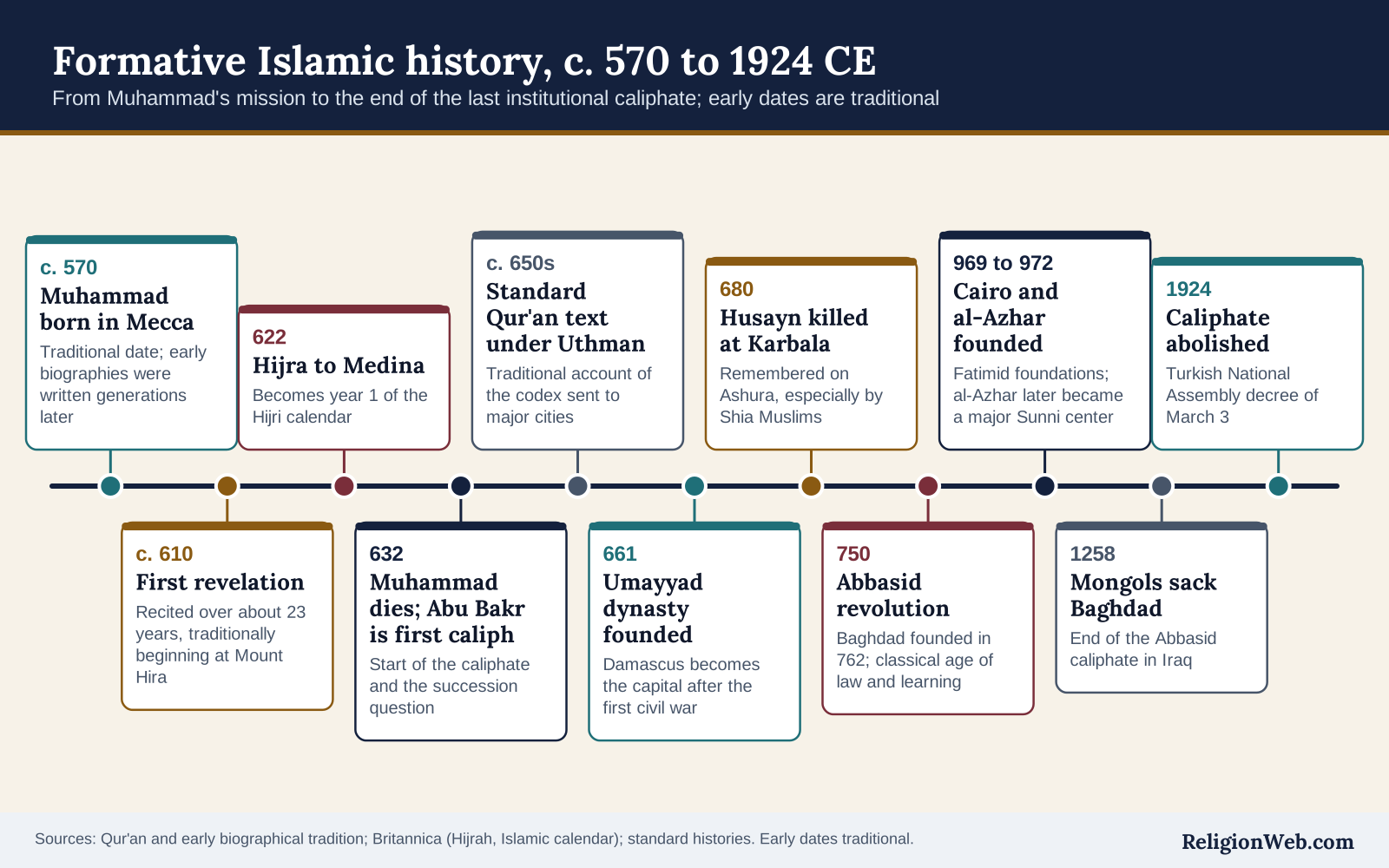
| Date | Event | Why it matters |
|---|---|---|
| c. 570 | Muhammad born in Mecca | Traditional birth date; early biographies were written generations later |
| c. 610 | First revelation at Mount Hira | Muslims understand this as the start of the Qur’an’s revelation over about 23 years |
| 622 | The hijra to Medina | Becomes year 1 of the Hijri calendar (1 AH) |
| 630 | Mecca comes under Muhammad’s control | The Kaaba is rededicated to the worship of God alone |
| 632 | Death of Muhammad; Abu Bakr becomes first caliph | Begins the caliphate and the succession question |
| c. 650s | Standard Qur’anic text prepared under Uthman (traditional account) | Basis of the written Qur’an used across the Muslim world |
| 656 to 661 | First civil war; Ali killed; Umayyad dynasty founded | Roots of the Sunni and Shia distinction |
| 680 | Husayn killed at Karbala | Central memory in Shia devotion and Ashura |
| 691 to 692 | Dome of the Rock completed in Jerusalem | One of the earliest surviving Islamic monuments |
| 711 | Muslim armies enter Iberia and Sindh | Islam established at the western and eastern edges of the early empire |
| 750 and 762 | Abbasid revolution; Baghdad founded | Shifts the center of power to Iraq and opens the classical age |
| 767 to 855 | Deaths of the founders of the four Sunni legal schools and of Ja’far al-Sadiq (765) | Law schools consolidate |
| 870 to 915 | Deaths of the compilers of the six Sunni hadith collections | Hadith canon takes its classic form |
| 969 to 972 | Fatimids found Cairo and al-Azhar | Origin of one of Islam’s oldest teaching institutions |
| 1258 | Mongol sack of Baghdad | End of the Abbasid caliphate in Iraq |
| 1453 to 1526 | Ottoman capture of Constantinople; Safavid state in Iran (1501); Mughal Empire (1526) | Three large early modern Muslim empires |
| 1924 | Caliphate abolished by Turkey’s National Assembly | Ends the last institutional caliphate |
| 1969 | Organization of Islamic Cooperation founded in Rabat | International body of Muslim-majority states |

Islamic Beliefs: Tawhid, Prophecy, Scripture, and the Last Day
Muslim belief is usually summarized as six articles of faith, a list that comes from a well-known hadith in which a stranger asks Muhammad about faith (iman) and he answers: belief in God, God’s angels, God’s books, God’s messengers, the Last Day, and divine decree, both good and bad. The hadith is recorded in the collections of Muslim and al-Bukhari and is treated as a summary of creed by Sunni communities and, in broad outline, by most others. Twelver Shia Muslims organize the same convictions somewhat differently, listing five “roots of religion” (usul al-din): the oneness of God, divine justice, prophecy, the Imamate, and the return on the Last Day. Ibadi Muslims, for their part, share the core of the six articles while differing on questions such as the vision of God in the afterlife.
God and the oneness of God (tawhid)
Tawhid in the Qur’an and in daily speech
The oneness of God, tawhid, is the foundation of Islamic belief, and Muslims understand it to be the message carried by every prophet. The Qur’an’s shortest statement of it is the 112th chapter, al-Ikhlas (“Sincerity” or “Purity of Faith”), which is recited in prayer and memorized by children across the Muslim world.
Say: He is Allah, the One! Allah, the eternally Besought of all! He begetteth not nor was begotten. And there is none comparable unto Him.
Qur’an 112:1-4, Marmaduke Pickthall, The Meaning of the Glorious Koran (1930)
Classical commentators in all the major traditions read these verses as affirming God’s uniqueness and self-sufficiency: God has no partner, no origin, no offspring, and no likeness among creatures. A frequently cited report attributed to Muhammad says that reciting this chapter is equal in worth to a third of the Qur’an, which Muslims often take as a sign of its importance rather than as a rule about recitation. The opposite of tawhid is shirk, “association,” meaning the attribution of divinity or divine prerogatives to anything other than God, and the Qur’an treats it as the gravest wrong. How the boundaries of shirk should be drawn, for example in the visiting of tombs or the asking of saints for intercession, is a matter on which Sunni reformers, traditionalists, Sufis, and Shia communities have disagreed for centuries.
Tawhid also shapes ordinary speech. Muslims begin acts with bismillah, “in the name of God,” say Allahu akbar, “God is greater,” in prayer, and add insha’allah, “if God wills,” when speaking about the future. These phrases are habits of devotion that keep the idea of God’s sovereignty in view in daily life.
God’s names and attributes, and the schools of theology
The Qur’an describes God through many names and attributes, among them the Merciful (al-Rahman), the Compassionate (al-Rahim), the Just, the Forgiving, the Living, the Knowing, and the Powerful. A hadith reports that God has ninety-nine names, and Muslims commonly recite them as a form of devotion, often counting them on prayer beads. The way these attributes relate to God’s unity was one of the first great questions of Islamic theology (kalam).
Several answers emerged in the eighth to tenth centuries. The Mu’tazila stressed God’s absolute unity and justice, and argued that attributes such as knowledge and power should not be understood as separate realities alongside God’s essence. The Ash’ari school, named for Abu al-Hasan al-Ash’ari (died around 935), and the Maturidi school, named for al-Maturidi (died 944), affirmed the attributes as real while denying that they resemble anything in creation. Traditionalist scholars in the line of Ahmad ibn Hanbal, often called the Athari school, insisted on affirming what the Qur’an and hadith say about God without asking “how” and without figurative interpretation. Twelver Shia theology developed in dialogue with Mu’tazili rationalism and gives divine justice a place among its roots of religion. Ibadi theology has its own formulations, and Sufi writers emphasized God’s nearness and the possibility of direct experiential knowledge of God. These are internal differences within a shared affirmation of God’s oneness, not rival creeds.
Prophets, revelation, and angels
Muhammad as the final prophet
Muslims believe that God has sent prophets (anbiya’, singular nabi) to every community, and that some of them, the messengers (rusul, singular rasul), brought scriptures or new laws. Muhammad is regarded as the last of these. The principal scriptural basis for this belief is a verse in the chapter named for the Confederates (al-Ahzab).
Muhammad is not the father of any man among you, but he is the messenger of Allah and the Seal of the Prophets; and Allah is ever Aware of all things.
Qur’an 33:40, Marmaduke Pickthall, The Meaning of the Glorious Koran (1930)
In the mainstream understanding of Sunni, Shia, and Ibadi Muslims, “Seal of the Prophets” (khatam al-nabiyyin) means that prophecy ended with Muhammad, and the doctrine of the finality of prophecy is supported by a number of hadith as well. Later holy persons, from this point of view, may be guided, learned, or saintly, but they are not given new revelation. This reading is the main reason why the Ahmadiyya, whose members interpret the same phrase differently, are regarded by many other Muslim authorities as outside the community, a subject taken up in the section on contested boundaries. For Shia Muslims, the finality of prophecy coexists with the doctrine of the Imams as divinely guided interpreters of the revelation, not recipients of a new one.
Earlier prophets, earlier scriptures, and the unseen world
The Qur’an names around two dozen prophets, among them Adam, Noah (Nuh), Abraham (Ibrahim), Ishmael, Isaac, Jacob, Joseph (Yusuf), Moses (Musa), Aaron, David (Dawud), Solomon (Sulayman), Jonah (Yunus), John (Yahya), and Jesus (Isa), with Mary (Maryam) honored in a chapter of her own. Four revealed books are named: the Torah (Tawrat) given to Moses, the Psalms (Zabur) given to David, the Gospel (Injil) given to Jesus, and the Qur’an given to Muhammad. Muslim scholars have held a range of views about how the earlier scriptures as they exist now relate to what Muslims believe was originally revealed. The Qur’an presents itself as confirming and clarifying earlier revelation, and Muslims are taught to honor all the prophets without distinction.
Belief in the unseen (ghayb) also includes angels, beings made of light who carry out God’s commands. Four are especially prominent in tradition: Jibril (Gabriel), who conveys revelation; Mika’il (Michael); Israfil, who will sound the trumpet on the Last Day; and the angel of death. Two angels are believed to record each person’s deeds. The Qur’an also speaks of jinn, beings made of smokeless fire who possess free will and, like humans, may be believers or unbelievers. Muslim scholars generally treat reports about them as a real but secondary part of belief, and the tradition warns against speculation or practices that claim control over them.
The Last Day, divine decree, and moral responsibility
Death, resurrection, and judgment
Islamic teaching holds that human life is a period of testing that ends in death, an interval of waiting called barzakh, a general resurrection, and a judgment before God on the Day of Resurrection (yawm al-qiyama). On that day, as the Qur’an and hadith describe it, each person receives a record of their deeds, and the outcome is determined by God’s justice and mercy. Paradise (Jannah) and Hell (Jahannam) are described in vivid imagery in the Qur’an. Interpreters have understood these descriptions in different ways, some literally and others as symbols of spiritual realities.
Several questions inside the tradition remain debated: whether the intercession of the Prophet and others will benefit believers who have committed major sins, whether the punishment of hell is eternal for all who enter it, and whether the blessed will see God. Most Sunni theologians affirm a vision of God in paradise, while the Mu’tazila, Twelver Shia theologians, and the Ibadis generally deny a literal sight of God. The Qur’an’s emphasis on divine mercy has led most Muslims to place hope alongside accountability, and the call to repent (tawba) is open until death.
Divine decree and human responsibility
The sixth article of faith, qadar, affirms that nothing happens outside God’s knowledge and will. The relationship between that conviction and human freedom produced one of the most sustained debates in Islamic thought. The early Qadariyya and the Mu’tazila argued that humans create their own acts, so that responsibility is real. Ash’ari theologians developed the idea of “acquisition” (kasb), by which God creates acts and humans acquire them, and the Maturidis accorded a larger role to human choice. Shia theology generally affirms that God is just and that human beings are responsible for what they choose.
In popular piety, belief in qadar is more often a source of patience in hardship and trust in God (tawakkul) than a doctrine of passivity. A frequently quoted saying attributed to the Prophet advises a man to tie his camel first and then trust in God, which preachers use to explain that trust and effort belong together. For this reason, readers should not equate Muslim belief in decree with fatalism.
Faith, practice, and spiritual excellence
Islam, iman, and ihsan in the Hadith of Gabriel
The same hadith that lists the articles of faith distinguishes three dimensions of religion. In it, a stranger in white clothing sits before Muhammad and asks about islam, which Muhammad explains through the five practices; about iman, the inner belief; and about ihsan. In paraphrase, the Prophet describes ihsan as worshiping God as though one saw Him, knowing that even if one does not see Him, He sees the worshiper. At the end Muhammad tells his companions that the stranger was Gabriel, who had come to teach them their religion. Many scholars treat the report as an outline of the whole Islamic curriculum: law (islam), theology (iman), and ethical and spiritual practice (ihsan).
The concept of ihsan, “doing what is beautiful,” is the anchor of much Muslim spirituality. Sufi writers built a literature on the stages of the soul around it, but it is not confined to Sufi circles, and ordinary believers invoke it when they speak of sincerity in worship and excellence in conduct.
Faith, sin, and repentance
How faith relates to deeds and sin was disputed among the first Muslim communities. Some early groups, called Kharijites, held that grave sin removes a person from the community of believers. The Murji’a postponed judgment on such persons to God. The majority position that emerged among Sunni theologians and jurists is that a Muslim who commits a major sin remains a believer, though a sinful one, and remains subject to God’s forgiveness or judgment. This was one reason mainstream scholars discouraged accusations of unbelief against fellow Muslims.
Islamic teaching has no priesthood that grants absolution, and repentance is a matter between the person and God, together with making amends to anyone wronged. Muslims also generally hold that every person is born in a natural state of receptivity to God, the fitra, and so the tradition does not teach that people inherit guilt from Adam. In the Qur’an, Adam is forgiven after he repents, and Muslims regard this as a model of how any person may return to God.
The Qur’an, Hadith, and Sources of Religious Authority
Islamic religious authority is layered. The Qur’an stands first, as the speech of God. The example of Muhammad, preserved in the hadith, explains and applies it. Beyond these two, scholars developed methods of interpretation and law that connect the texts to questions the first generation never faced. Twelver Shia Muslims add the teachings of the Imams as a further source, and Ibadis have their own scholarly tradition. The table below gives a map of these source types before the sections that follow take each in turn.
| Source type | What it is | How it is used | Where communities differ |
|---|---|---|---|
| Qur’an | The recited revelation, 114 chapters | Primary source of belief, worship, and ethics | Different canonical recitations; interpretation differs, but the text is shared |
| Hadith and sunna | Reports of Muhammad’s words, acts, and approvals | Explain and apply the Qur’an; basis of ritual detail | Different canonical collections and criteria |
| Tafsir | Commentary on the Qur’an, verse by verse | Explains language, context, law, and meaning | Traditional, rationalist, legal, Sufi, Shia, and modern approaches |
| Consensus (ijma) | Agreement of qualified scholars on a ruling | Secures settled points of law and belief | Whose consensus counts: Medinan scholars, all jurists, or the Imams |
| Analogy and reason (qiyas, ‘aql) | Reasoned extension of texts to new cases | Handles questions without explicit text | Sunni schools use qiyas; Twelver Shia stress ‘aql |
| Teachings of the Imams | Narrations from the Prophet’s family | Additional source in Twelver and Ismaili thought | Not applied in Sunni law |
The Qur’an: revelation, structure, and recitation
Revelation and structure
Muslims understand the Qur’an (from qur’an, “recitation”) as God’s speech, revealed to Muhammad through Gabriel in pieces over about twenty-three years, from the first revelation around 610 until shortly before his death in 632. Tradition identifies the opening of chapter 96, al-Alaq, as the first revealed passage.
Read: In the name of thy Lord Who createth, Createth man from a clot. Read: And thy Lord is the Most Bounteous, Who teacheth by the pen, Teacheth man that which he knew not.
Qur’an 96:1-5, Marmaduke Pickthall, The Meaning of the Glorious Koran (1930)
Classical commentators draw out the command to “read” or “recite” as the beginning of a religion centered on knowledge, and the mention of the pen as a sign of the importance of learning and writing. The Qur’an is divided into 114 chapters (surahs) of unequal length, arranged mostly from the longest to the shortest after the short opening chapter, al-Fatiha. It contains about 6,200 verses (ayat), and the standard Hafs numbering gives 6,236 excluding the introductory formula. Chapters are traditionally classed as Meccan or Medinan, depending on whether they were revealed before or after the migration; the Meccan chapters emphasize faith, God’s signs, and accountability, and the Medinan ones address community, law, and relations with others. For reading, the text is divided into thirty parts (juz’), so that it can be completed in a month.
Muslims regard Arabic as the language in which the Qur’an was revealed, and the text’s recitation in Arabic is the basis of worship. Translations are generally understood as renderings of its meaning rather than as the Qur’an itself, which is why many are titled “the meaning of” the Qur’an. The art of recitation (tajwid) governs pronunciation and rhythm, and a person who has memorized the whole text is called a hafiz. Most Muslims experience the Qur’an first through hearing, and its sound is a part of its authority.
Compilation, manuscripts, and recitation traditions
According to the traditional account that most Muslims accept, Muhammad’s followers memorized and wrote down the revelation during his life. After the Battle of Yamama in 633 killed many who knew it by heart, Abu Bakr had the text gathered under the supervision of Zayd ibn Thabit, and under Uthman, in about the 650s, a committee produced a standard text from which copies were sent to the main cities. Most historians accept that the text reached essentially its present form within a few decades of Muhammad’s death, while a minority of scholars in Western universities, including John Wansbrough, argued for a longer and more gradual formation. Manuscript discoveries and radiocarbon testing have led many scholars toward the earlier view. Radiocarbon testing at the University of Oxford dated the parchment of the Birmingham Qur’an fragments, which hold portions of chapters 18 to 20, to between 568 and 645 CE at 95.4 percent probability, though this dates the animal skin and not the writing.
The Qur’an has also been passed down in several recitation traditions (qira’at), which differ slightly in vocalization and sometimes in wording but not in the main sense. Ten recitation systems are generally accepted as canonical. The most widely used today is that of Hafs, transmitted from the Kufan reader Asim, and the standard printed Cairo edition of 1924 follows it. The recitation of Warsh is common in North and West Africa. Muslims see the existence of these readings as part of the way the text was given, and not as evidence of competing texts.
Hadith and the Sunna
What hadith are and how they are evaluated
A hadith is a report of the words, actions, or silent approval of Muhammad, and the sunna, his “way,” is the pattern of conduct that the hadith record. The Qur’an instructs believers to obey God and the messenger, and for that reason almost all Muslims treat the Prophet’s example as a necessary complement to the Qur’an. Most rituals, including the exact form of the daily prayer, are known from the hadith and from the continuous practice of the community and not from the Qur’an alone.
Because many reports were circulating within a century of the Prophet’s death, and some were forged for political or sectarian reasons, Muslim scholars developed a critical science. Each report consists of a chain of narrators (isnad) and a text (matn). Scholars examined the reliability, memory, and contemporaneity of each narrator and graded reports as sound (sahih), fair (hasan), or weak (da’if). Many modern historians are more skeptical than the classical scholars about the early dating of particular reports and see a significant amount of later material. Traditional scholars respond that the rigor of isnad criticism and the existence of multiple independent chains are strong safeguards, and the debate between the two approaches is ongoing.
The major collections
Sunni Muslims recognize six canonical collections (al-kutub al-sitta): those of al-Bukhari (died 870) and Muslim ibn al-Hajjaj (died 875), regarded as the most authoritative, followed by Ibn Majah (886), Abu Dawud (889), al-Tirmidhi (892), and al-Nasa’i (915). Twelver Shia Muslims rely on “the Four Books”: al-Kafi by al-Kulayni (died 941), Man la yahduruhu al-faqih by Ibn Babawayh (died 991), and Tahdhib al-ahkam and al-Istibsar by al-Tusi (died 1067), which preserve narrations from the Prophet and the Imams. Ibadis hold in particular esteem a collection attributed to al-Rabi’ ibn Habib. Sunni and Shia collections overlap in some material, but each tradition gives special weight to its own chains of transmission and its own judgments about narrators, including about some of the Prophet’s Companions, which accounts for some of the differences in practice described later.
Interpretation and law: from text to guidance
Tafsir: how the Qur’an is interpreted
The interpretation of the Qur’an, tafsir, began with Muhammad’s own explanations and those of his Companions, and it became a literature in the Abbasid period. Al-Tabari (died 923) produced a vast commentary that gathers earlier transmitted explanations. Other classical works emphasize language and rhetoric, such as that of al-Zamakhshari (died 1144), who was a Mu’tazili, or law, such as al-Qurtubi’s (died 1273), or philosophical and theological reasoning, as in the commentary of Fakhr al-Din al-Razi (died 1210). Sufi commentators draw out inner meanings, and Shia commentators, such as al-Tabarsi in the twelfth century and Muhammad Husayn Tabataba’i in the twentieth, interpret the text in light of the Imams’ teachings. The commentary Ibn Kathir completed in the fourteenth century is popular among traditionalists.
Commentators routinely draw on the “occasions of revelation” (asbab al-nuzul), the circumstances reported for particular verses, and on the Qur’an’s own cross-references. They also discuss abrogation (naskh), the idea that some rulings were replaced by later ones, an idea whose scope scholars have debated. Since the nineteenth century, reformers such as Muhammad Abduh and, in the twentieth century, scholars such as Fazlur Rahman have argued for reading the text in light of its historical setting and moral purposes, while other contemporary scholars insist on the continuity of classical methods. All of these approaches use the same text.
Usul al-fiqh: how Islamic law is derived
The science of the sources of law, usul al-fiqh, was given its classic form beginning with al-Shafi’i (died 820) and developed by later jurists. In the Sunni schools the four main sources are the Qur’an, the sunna, the consensus (ijma) of qualified scholars, and analogical reasoning (qiyas). Some schools also use principles of public interest (maslaha) and juristic preference (istihsan). Twelver Shia jurisprudence uses the Qur’an, the sunna including the Imams’ traditions, consensus, and reason (‘aql) in place of analogy.
The qualified jurist exercises ijtihad, “striving” to reach a ruling, and a person who lacks that expertise follows (taqlid) a scholar or school. In the Twelver Shia tradition, ordinary believers follow a living senior jurist, a marja’. A formal legal opinion, fatwa, is given by a mufti and is advisory unless a court or state adopts it. Muslims also commonly distinguish between sharia, the divine guidance, and fiqh, the fallible human understanding of it, which is the reason different schools can give different valid answers to the same question.
Muhammad and the Central Figures of Islam
Islam does not trace itself to a single founder in the sense of a person who invented a new religion. Muslims understand Muhammad as the last in a chain of prophets and as the messenger through whom the Qur’an was given. Around him stands a circle of people, from his family and Companions to earlier prophets and later teachers, whose lives shape Muslim devotion, law, and community memory. The historical outline of Muhammad’s life appears in the earlier section on origins, and this section concentrates on how he and others are understood within the tradition.
Muhammad in Muslim understanding
Titles, character, and the Prophet as model
Muslims call Muhammad the Messenger of God (rasul Allah) and the Prophet (al-nabi). Tradition records that before his prophetic mission he was known in Mecca as al-Amin, “the trustworthy.” The Qur’an affirms his humanity: he is described as a mortal to whom revelation came, and Muslim teaching rejects the view that he shares in divinity. For this reason, Muslim worship is directed to God alone, while love, respect, and prayers for Muhammad are widespread. A common custom is to follow his name with a blessing, such as “peace and blessings be upon him” (salla Allahu alayhi wa sallam), and many Muslims send blessings upon him as an act of devotion.
A central idea is that Muhammad is the model for human conduct. The Qur’an describes the messenger as a good example for those who hope for God, and so the biography and sayings of the Prophet became sources of guidance on everything from prayer to family relations to the treatment of neighbors, animals, and strangers. Many Muslims learn his sayings in childhood. The model the tradition holds up is one of mercy, honesty, humility, and perseverance, and the Qur’an itself describes him as a mercy to the worlds, a verse commentators have discussed for centuries.
Muslim tradition also treats the Night Journey (isra) and Ascension (mi’raj) as significant. The Qur’an mentions a night journey from the Sacred Mosque in Mecca to the “farthest mosque,” which Muslim tradition identifies with Jerusalem, and hadith elaborate an ascent through the heavens in which, according to many reports, the five daily prayers were prescribed. Interpreters differ on whether the journey was physical, spiritual, or visionary, and on its date.
Biography, memory, and devotion
The written life of the Prophet, the sira, forms a distinct literature that began in the eighth century. Ibn Ishaq’s biography, preserved in the editing of Ibn Hisham, and the works of al-Waqidi and Ibn Sa’d are the earliest large accounts. Another genre, the shama’il, concentrates on his appearance and character. Popular devotion produced poems in praise of the Prophet, among them the thirteenth-century Qasidat al-Burda by al-Busiri, which is recited from West Africa to Southeast Asia, and the broad culture of the Mawlid, the commemoration of his birth, discussed in the section on holy days.
Respect for Muhammad also shapes how he is portrayed. Most Muslim scholars and communities today do not permit visual depictions of him, particularly of his face, and many extend the restriction to other prophets. The rule is not found in the Qur’an itself, but it follows from a legal tradition of avoiding images that might invite veneration, and it coexists with a long history of calligraphic descriptions of the Prophet. Persian, Ottoman, and Central Asian painting did sometimes illustrate his life, often with the face veiled, and Shia popular art in the modern period includes images of the Imams. The result is a range of practice that varies by period, region, and tradition.
Family, Companions, and early community figures
The Prophet’s family and the people of the house
Muhammad’s first wife, Khadija, is remembered as the first person to accept his message and as his steadfast supporter during the difficult Meccan years. After her death he married several other women, and Muslim tradition honors them as the “Mothers of the Believers.” Of these, Aisha bint Abi Bakr, the daughter of the first caliph, became a major scholar of the early community, narrating a large number of hadith, and she is also remembered for her political role at the Battle of the Camel. Muhammad’s daughter Fatima, her husband Ali (who was also Muhammad’s cousin), and their sons Hasan and Husayn are especially venerated as the core of the ahl al-bayt, the “people of the house.”
Both Sunni and Shia Muslims love and bless the ahl al-bayt, and the blessing on Muhammad “and his family” is a part of the ritual prayer for most Muslims. The difference lies in the doctrine of authority. In Shia belief the Imams descended from Ali and Fatima have a unique, divinely guided role as interpreters of faith and law. Sunni Muslims honor the family as a source of blessing and knowledge but do not assign the Imams a role as infallible guides. Details of the Twelver line of Imams, the Ismaili and Zaydi lines, and the observances connected with them are treated in the article on Shia Islam.
The Companions and the first caliphs
The Companions (sahaba) are those who met Muhammad, believed in him, and died as Muslims. They were the first transmitters of the Qur’an and hadith, and their memory is a basis of the tradition. Among them were Abu Bakr, Umar, Uthman, and Ali, as well as men and women from very different backgrounds. Bilal ibn Rabah, an Ethiopian former slave, became the first muezzin who called the faithful to prayer. Salman al-Farisi, from Persia, is remembered for advising the community during the siege of Medina in 627. Suhayb al-Rumi came from the Byzantine world. Their stories are often cited in Muslim teaching to show that the first community was drawn from many peoples.
Sunni Muslims generally hold the Companions in high esteem as a body and count the first four caliphs as the Rashidun. Shia Muslims revere Ali as the Prophet’s rightful successor and are critical of those Companions who, in their view, acted against his claim, a position that many Sunni Muslims strongly reject and that has been a source of tension. Ibadi Muslims have their own assessment of the early caliphs, particularly in regard to events following the death of Uthman. Many Muslim scholars and organizations today call for respectful speech about all the Companions as a way of preserving communal peace.
Earlier prophets and later teachers
Abraham, Moses, Jesus, and Mary in Islamic tradition
The Qur’an gives great space to earlier prophets, and Muslim tradition draws on their stories. Abraham (Ibrahim) is called the “friend of God” (khalil Allah) and is remembered, together with his son Ishmael (Isma’il), as a builder of the Kaaba, which is why many rites of the pilgrimage and the festival of Eid al-Adha commemorate episodes from his family’s story. Moses (Musa) is the prophet mentioned most often by name in the Qur’an, and his confrontation with Pharaoh and his receiving of the law at Sinai are retold in many chapters. Muslims also revere Noah, Joseph, David, Solomon, Job, Jonah, and others.
Jesus (Isa), son of Mary, is honored as a messenger of God and the Messiah (al-Masih). The Qur’an describes his miraculous birth to Mary and his miracles by God’s permission, and a chapter of the Qur’an, Maryam, is named for his mother, the only woman called by name in the Qur’an. In the Qur’anic account, Jesus is a servant and messenger of God and not divine. Muslims differ in reading the Qur’an’s statement about the end of his earthly life, and many Sunni and Shia traditions hold that he will return near the end of time. Within the Muslim community these figures are not used to define other communities but to teach that revelation has been a continuing mercy.
Scholars, saints, and reformers
After the Prophet’s generation, a series of teachers shaped what Muslims believe and practice. The jurists al-Shafi’i, Abu Hanifa, Malik, and Ibn Hanbal founded schools of law, and theologians such as al-Ash’ari and al-Maturidi formed schools of creed. Al-Ghazali (died 1111) sought to unite law, theology, and spiritual discipline in his Revival of the Religious Sciences. Ibn Sina (Avicenna) and Ibn Rushd (Averroes) are among the most influential philosophers. Ibn Taymiyya (1263 to 1328) is cited by many reform-minded traditionalists, and his legacy is disputed in contemporary debates. Women such as Rabi’a al-Adawiyya (died 801) in Basra and Fatima al-Fihri, who according to tradition founded the mosque and learning center in Fez in 859 that grew into al-Qarawiyyin, remain examples of piety and learning.
The mystical tradition honors teachers such as Abd al-Qadir al-Jilani (died 1166), Jalal al-Din Rumi (died 1273), and Ibn Arabi (died 1240), and the Sufi orders that formed around such figures became channels of devotion in many regions. In the modern period, reformers and movement leaders such as Muhammad Abduh, Muhammad Iqbal, Sayyid Ahmad Khan, and Said Nursi have had broad influence. How much authority any later figure has is itself a matter of difference between traditions, since all agree that Muhammad alone is the final prophet.
Worship and the Five Pillars: How and Why Muslims Practice Islam
Muslim practice is organized around five core acts of worship that a well-known hadith, reported by al-Bukhari and Muslim, compares to the pillars on which a structure rests: the testimony of faith, the ritual prayer, almsgiving, fasting in Ramadan, and pilgrimage to Mecca for those who are able. Together they are called the Five Pillars (arkan al-Islam). Within each pillar, jurists distinguish what is obligatory (fard or wajib) from what is recommended (sunna or mustahabb) and from local custom, and these distinctions explain why practice can vary without breaking the common structure. Twelver Shia Muslims recognize the same acts but organize them differently, within a list of ten “branches of religion” (furu’ al-din) that also includes the payment of a religious tax called khums and the duty to enjoin good and forbid wrong.
| Pillar | What it involves | Frequency and obligation | Meaning in Muslim teaching |
|---|---|---|---|
| Shahada (testimony) | Declaring that there is no god but God and that Muhammad is God’s messenger | Once, sincerely, to enter Islam; repeated in prayer | Affirms tawhid and the prophethood of Muhammad |
| Salat (prayer) | Five daily prayers facing Mecca after ritual purification | Daily; obligatory for adults who are able | Remembrance of God, discipline, and community |
| Zakat (almsgiving) | Giving a set share of qualifying wealth, usually 2.5 percent, to eligible recipients | Yearly on wealth above the minimum threshold (nisab) | Purification of wealth and care for the poor |
| Sawm (fasting) | Abstaining from food, drink, and sexual relations from dawn to sunset during Ramadan | Annually for 29 or 30 days; exemptions for illness, travel, and others | God-consciousness, self-restraint, solidarity |
| Hajj (pilgrimage) | A set of rites in and around Mecca, 8 to 13 Dhu al-Hijjah | Once in a lifetime for those with health and means | Obedience to God, humility, and unity of the community |
Shahada: the declaration of faith
Wording, occasions, and meaning
The shahada is a short sentence in Arabic: ashhadu an la ilaha illa Allah, wa ashhadu anna Muhammadan rasul Allah, “I bear witness that there is no god but God, and I bear witness that Muhammad is the messenger of God.” A person who sincerely says it in the presence of witnesses is considered Muslim, and no priest or institution has to approve the act. Muslims hear it in the call to prayer, repeat it in every prayer, and are encouraged to have it on their lips at the end of life. Parents often whisper the call to prayer, including the shahada, into the ear of a newborn child.
The first half affirms the oneness of God and the second establishes Muhammad’s authority as the means through which God’s guidance reaches humanity. In Shia communities, many Muslims add a further phrase to the call to prayer, bearing witness to the guardianship (wilaya) of Ali. Most Shia jurists treat this “third testimony” as a customary or recommended addition that is not itself a part of the call to prayer, and Sunni Muslims do not use it. The core two-part testimony is shared by all.
Variations of emphasis among communities
The shahada is shared across traditions, but communities place it in different devotional settings. Sufi groups chant the first half, la ilaha illa Allah, as a dhikr of remembrance, often in rhythmic repetition. Sunni scholars have long debated what the testimony requires beyond words, including belief of the heart and conduct that does not contradict it, and these debates fed into the early disputes over faith and sin. Contemporary Muslim organizations in non-Muslim-majority countries often supply conversion guidance and certificates, but those practices are administrative customs, not requirements of the faith.
Salat: the five daily prayers
Preparation: purity, direction, and time
The ritual prayer, salat (also spelled salah), is performed five times a day within set windows tied to the sun’s position: fajr before sunrise, dhuhr after midday, asr in the afternoon, maghrib just after sunset, and isha at night. A call to prayer (adhan), delivered by a muezzin from the mosque, announces each time. Before praying, a person must be in a state of ritual purity, achieved through ablution (wudu), which involves washing the hands, mouth, nose, face, arms, wiping the head, and washing the feet. A fuller bath (ghusl) is required after certain events, and where water is unavailable or harmful, dry ablution with clean earth (tayammum) is permitted. Clothing and the place of prayer should be clean and the body covered according to the jurists’ rules.
Muslims face the Kaaba in Mecca, a direction called the qibla. The Qur’an records that the direction was set toward the Sacred Mosque after an earlier orientation toward Jerusalem, and in practice, worshipers use mosque niches, compasses, or smartphone applications to find it. The reasons given for prayer are both devotional and ethical: the Qur’an describes it as remembrance of God and as a safeguard against indecency, and the pattern of five prayers is said to structure the day around God’s presence. Many Muslims describe it as a daily pause in which status differences recede, since rich and poor, young and old stand in the same rows.
The sequence of a prayer unit
Each prayer is made of units called rak’ahs, with two in the dawn prayer, four at midday, four in the afternoon, three at sunset, and four at night in the obligatory form. The worshiper begins with an intention and the words Allahu akbar, “God is greater,” and then stands and recites the opening chapter of the Qur’an, al-Fatiha, followed in the first two units by another passage. The chapter is a prayer in the form of a conversation with God.
In the name of Allah, the Beneficent, the Merciful. Praise be to Allah, Lord of the Worlds, The Beneficent, the Merciful. Master of the Day of Judgment, Thee (alone) we worship; Thee (alone) we ask for help.
Qur’an 1:1-5, Marmaduke Pickthall, The Meaning of the Glorious Koran (1930) (verses 6-7, the plea for guidance on the straight path, are omitted here)
Muslims treat al-Fatiha as the heart of the prayer, and traditional commentators note that its first half praises God and its second half asks for help and guidance. After the recitation the worshiper bows (ruku’), stands again, and then prostrates twice (sujud), forehead, nose, hands, knees, and toes touching the ground, with a short sitting between the two prostrations. At the end of the final unit the worshiper sits, recites the testimony of faith and blessings on the Prophet, and turns the head to the right and left with a greeting of peace (salam). The postures express humility, since the forehead is placed on the ground in front of God.
Friday, congregation, and variations among communities
Prayer may be performed alone, but congregational prayer led by an imam is strongly encouraged, and the Friday midday prayer, jumu’a, is obligatory in congregation for men in most legal schools. It is preceded by a sermon (khutba), and it replaces the regular midday prayer. Women may attend the mosque, and practice differs by region, school, and local custom, with women’s sections, separate rooms, or home prayer being common in different places. Travelers may shorten the four-unit prayers to two, and the sick pray seated or lying down.
Differences among communities are real but small compared with what is shared. Hanafi, Shafi’i, and Hanbali worshipers traditionally fold their hands across the chest, while the classical Maliki tradition and the Twelver Shia commonly let them hang at the sides. Twelver Shia worshipers normally prostrate on natural material such as earth or a small clay tablet, called a turba, and commonly perform the five prayers in three combined sittings, though they hold the same five obligations. Among Sunnis, the Hanafi school generally does not allow combining prayers except at specific points in the pilgrimage, while other schools allow it for travel or necessity. Ibadi worship follows its own legal tradition, with a similar overall form.
Zakat: almsgiving and the purification of wealth
The obligation and its rules
Zakat comes from a root meaning to purify and to grow, and Muslims understand it as a payment that cleanses wealth and strengthens the community’s weakest members. The standard rate on savings and trade assets is one-fortieth, or 2.5 percent, owed once a person’s wealth stays above a threshold (nisab) for a full lunar year. Different rates apply to agricultural produce and livestock. The Qur’an lists eight categories of recipients, including the poor and needy, those who collect the funds, debtors, travelers in need, and those working for God’s cause. In addition, at the end of Ramadan, every household owes zakat al-fitr, a small payment of staple food or its value on behalf of each member, which is meant to be given before the festival prayer so that the poor can celebrate.
Zakat is distinct from sadaqa, voluntary charity, which can be given at any time and in many forms, including a kind word or help with work according to a well-known hadith. Many Muslims also contribute to waqf, charitable endowments that have funded mosques, schools, hospitals, and water supplies since the early centuries.
Interpretation and practice today
Practice varies widely. In Saudi Arabia, Libya, Malaysia, Pakistan, Sudan, and Yemen, governments collect certain forms of zakat, while in many other places individuals give directly to relatives, neighbors, mosques, or charities. Shia Muslims in addition pay khums, one-fifth of annual surplus income, to or through a senior jurist, a payment that has no equivalent in Sunni law. Contemporary scholars discuss how to apply zakat rules to modern assets such as stocks, salaries, and retirement accounts, and the answers differ among jurists and fatwa councils. Many Muslims choose to pay their annual zakat during Ramadan.
Sawm: fasting in Ramadan
Rules and exemptions
Fasting (sawm) in the ninth lunar month, Ramadan, is obligatory for adult Muslims who are healthy and not traveling. From the first light of dawn until sunset, the fasting person abstains from food, drink, smoking, and sexual relations, and tries to avoid quarrels, gossip, and other behavior that the tradition regards as damaging to the fast. The fast begins with a pre-dawn meal, suhur, and ends at sunset with the meal called iftar, often begun with dates and water, following the Prophet’s practice. Most Shia Muslims delay the breaking of the fast until a short time after sunset, when the redness has left the eastern sky, which reflects the Ja’fari legal tradition.
The Qur’an itself makes exemptions: those who are sick or traveling make up the missed days later, and those permanently unable to fast, such as the elderly or chronically ill, may offer food to a person in need in compensation (fidya). Jurists extend exemptions to menstruating women and women in postnatal bleeding, who make up the days later, and discuss the situation of pregnant and nursing women. Children are not required to fast until puberty, though many practice partial fasts. Islamic teaching does not call for fasting that endangers health, and Muslims with medical conditions are encouraged to consult both their physicians and qualified scholars about what the exemptions allow.
Meaning and discipline
The Qur’an states that fasting was prescribed so that believers may attain taqwa, God-consciousness, and it links the month to the revelation of the Qur’an. Muslim writers describe the fast as training in self-restraint, gratitude for ordinary blessings, and empathy with the hungry. Because the fast is known only to God and the person fasting, it is also described as an act of sincerity. The month is a communal experience as much as an individual one: families eat together, mosques fill with evening prayers, and charity increases. The detailed customs of the month, and the festival that ends it, are described in the section on holy days.
Hajj: the pilgrimage to Mecca
The sequence of rites
The hajj takes place on fixed days of the twelfth month, Dhu al-Hijjah, and every adult Muslim with the health and means must perform it once in a lifetime. Pilgrims enter a state of consecration (ihram) at one of the boundary points (miqat) around Mecca, which for men means two unstitched white cloths and for women ordinary modest dress, and they say the talbiya, “Here I am, O God, here I am.” Upon arrival, they circle the Kaaba seven times (tawaf) and walk seven times between the hills of Safa and Marwa (sa’i), which commemorates Hagar’s search for water for her son Ishmael according to Islamic tradition.
On the 8th of Dhu al-Hijjah pilgrims go to Mina, and on the 9th they gather on the plain of Arafat for the “standing” (wuquf) from midday to sunset, a vigil of prayer and supplication regarded as the high point of the pilgrimage. After sunset they travel to Muzdalifah, spend the night there, and collect pebbles. On the 10th, the day of Eid al-Adha, they throw pebbles at a pillar in Mina, offer an animal sacrifice, shave or trim their hair, and return to Mecca for another circling of the Kaaba. They stone further pillars on the following days, and before leaving Mecca perform a farewell circling. The pilgrimage is not an individual act of private devotion alone: millions of people with different languages, cultures, and ages carry out the same movements together.
Meaning, obligation, and the modern pilgrimage
Muslims connect the rites to the story of Abraham, Hagar, and Ishmael, to the Prophet’s Farewell Pilgrimage in 632, and to the Day of Judgment, with Arafat often described as a rehearsal of standing before God. The plain white dress removes marks of wealth and rank. A shorter visit to Mecca outside the hajj season is called umra, and it does not discharge the hajj obligation. The pilgrimage is conditioned on ability, and many Muslims never perform it for reasons of health, cost, or distance, which jurists do not count as a failure.
In the modern period the hajj has become one of the largest regular gatherings of people in the world. According to the Saudi General Authority for Statistics, 1,707,301 pilgrims took part in the 2026 hajj (1447 AH), of whom 1,546,655 came from outside Saudi Arabia and 160,646 were residents of the kingdom. That was about 2 percent more than the 1,673,230 reported for 2025. The Saudi government sets national quotas and requires permits, a system designed to manage safety in crowded sites, and the Day of Arafat in 2026 fell on May 26 according to the Saudi calendar. Such numbers are significant for reasons beyond size, because for most pilgrims the journey is the most important religious event of their lives.
Holy Days and the Islamic Calendar
Muslim ritual time has three rhythms: the five prayers of each day, the congregational prayer of each Friday, and a yearly cycle built on the lunar Hijri calendar. Only two festivals are prescribed as religious holidays in the mainstream legal sources, Eid al-Fitr and Eid al-Adha. Other days, such as Ashura, the Prophet’s birthday, and the nights of Rajab and Sha’ban, are observed widely but with differences in emphasis from one community to another, and some Muslims consider certain of them innovations. The summary below shows the shape of the year before the sections that follow take each observance in turn.
| Observance | Hijri date | What happens | Status and who observes it |
|---|---|---|---|
| Friday congregational prayer (jumu’a) | Weekly | Sermon and two-unit prayer replacing the midday prayer | Obligatory for adult men in most schools; shared by Sunni and Shia |
| Islamic New Year | 1 Muharram | Reflection on the hijra; few set rites | Customary; observed modestly and unevenly |
| Ashura | 10 Muharram | Optional fasting (Sunni); mourning gatherings and processions (Shia) | Recommended fast for many Sunnis; central commemoration for Shia |
| Arba’in | 20 Safar | Visits to Husayn’s shrine in Karbala; commemorative meals | Principally Shia |
| Mawlid | 12 Rabi’ al-Awwal (17th in some Shia usage) | Recitation, poems, sermons, shared food | Widely observed; disputed by some Salafi scholars |
| Isra and Mi’raj | 27 Rajab (by common reckoning) | Night prayers and sermons recalling the Prophet’s night journey | Customary in many regions |
| Mid-Sha’ban | 15 Sha’ban | Night vigil, supplication; birth of the twelfth Imam marked by Twelver Shia | Customary; its status is debated among Sunni scholars |
| Ramadan | 9th month; 29 or 30 days | Daily fast, nightly taraweeh prayers, Qur’an recitation, charity | Obligatory for adults who are able; observed by all traditions |
| Laylat al-Qadr | One night, probably in the last ten of Ramadan | Night prayer and supplication | Highly recommended; the night’s date is not fixed by text |
| Eid al-Fitr | 1 Shawwal | Festival prayer, charity, family visits, festive meals | Prescribed festival; fasting on this day is forbidden |
| Day of Arafah | 9 Dhu al-Hijjah | Pilgrims stand at Arafat; others may fast | High point of hajj; recommended fast for non-pilgrims |
| Eid al-Adha | 10 Dhu al-Hijjah (and following days) | Festival prayer, animal sacrifice, sharing of meat | Prescribed festival; sacrifice emphasized in most schools |
| Ghadir Khumm | 18 Dhu al-Hijjah | Gatherings recalling Muhammad’s address at Ghadir Khumm | Observed by Shia communities |
How the Hijri calendar works
Lunar months and the year count
The Islamic calendar is lunar: its twelve months begin with the first sighting of the new crescent and last 29 or 30 days, so that a year has 354 or 355 days. The months are Muharram, Safar, Rabi’ al-Awwal, Rabi’ al-Thani, Jumada al-Ula, Jumada al-Akhira, Rajab, Sha’ban, Ramadan, Shawwal, Dhu al-Qa’da, and Dhu al-Hijja. Each day begins at sunset, which is why festival eves and the night prayers of Ramadan belong to the day that follows. Years are numbered from the hijra and written “AH” (anno Hegirae). Tradition credits the caliph Umar with introducing the era in the late 630s, setting its first day as the first of Muharram in the year of the migration, which corresponds to July 16, 622, in the Julian calendar. The year 1448 AH began in mid-June 2026.
The Qur’an refers to the moon as a guide to religious time.
They ask thee, (O Muhammad), of new moons, say: They are fixed seasons for mankind and for the pilgrimage.
Qur’an 2:189, Marmaduke Pickthall, The Meaning of the Glorious Koran (1930)
Muslim commentators read this verse as showing that the phases of the moon mark times for worship and ordinary dealings alike, so that fasting, pilgrimage, and the maturity of debts follow an observable sign accessible to everyone. Another passage speaks of twelve months in God’s decree, four of them sacred (traditionally Muharram, Rajab, Dhu al-Qa’da, and Dhu al-Hijja), and the verse after it, according to the commentators, condemns the pre-Islamic practice of postponing a sacred month, a procedure called nasi’. Because Muslims understood the text as forbidding such manipulation, they did not insert extra days or months to keep the calendar aligned with the seasons.
Moon sighting and astronomical calculation
How a month begins is a long-standing question of jurisprudence. Traditional practice, based on hadith, is to look for the thin new crescent on the evening of the 29th day, and if it is not seen, to complete 30 days. Jurists differ on whether a sighting anywhere should bind Muslims everywhere or whether each region should follow its own sky, and on whether astronomical calculation may replace or supplement sighting. Saudi Arabia uses the Umm al-Qura calendar for civil purposes but its Supreme Court calls for moon sighting to fix the start of Ramadan, Shawwal, and Dhu al-Hijja. Turkey’s religious authority and some Muslim councils in Europe and North America rely on calculation, while many others, among them Morocco and Pakistan, rely on official moon-sighting committees, and Indonesia combines sighting with calculation. Some Shia communities follow the decision of their own senior jurists.
The result is that neighboring countries sometimes begin a month on different days. In 2026, Saudi Arabia, the United Arab Emirates, Qatar, Kuwait, and Iraq announced Wednesday, February 18, as the first day of Ramadan 1447, while Oman, Egypt, Turkey, Indonesia, Malaysia, and several Central Asian countries began on Thursday, February 19, and communities in South Asia and Iran waited for local sightings. Saudi Arabia announced that Eid al-Fitr would fall on March 20, 2026, after a 30-day month. This variation is accepted in Muslim legal discussion as a consequence of differing sources of evidence, not as disagreement about the calendar’s reality, and families often join the observance of their local mosque or country.
Ramadan and the two Eids
The month of Ramadan
Ramadan is the month in which, according to the Qur’an, the Qur’an was sent down, and it is the center of the Muslim year. Beyond the daily fast, the evenings are marked by communal meals and the taraweeh prayers, extra night prayers performed in congregation by most Sunni communities, typically with eight or twenty units depending on school and custom, in which a portion of the Qur’an is recited each night so that the whole is completed over the month. Twelver Shia Muslims do not generally hold taraweeh as congregational prayer but observe the month with supplications, night prayers, and recitation of the Qur’an. Many Muslims, in the last ten days, withdraw for retreat in the mosque (i’tikaf), and acts of charity increase throughout the month.
The Qur’an describes a “Night of Power” (Laylat al-Qadr) as better than a thousand months, and the sources place it in the last ten nights of Ramadan without naming the night. Many Sunni communities give special weight to the 27th night, while the odd-numbered nights are widely sought, and Shia communities keep vigil especially on the 19th, 21st, and 23rd nights, which also coincide with the memory of the wounding and death of Ali in the year 661. Foods differ from place to place, from dates and soup in the Arab world to savory pastries in South Asia and sweets in Turkey, but breaking the fast with others, including neighbors and those in need, is a shared emphasis.
Eid al-Fitr: the festival of fast-breaking
The festival that ends Ramadan begins on the first of Shawwal, once the new moon has been sighted or calculated. Fasting on the day is forbidden. Muslims bathe and dress in their best clothes, pay the zakat al-fitr, and go to a congregational prayer, held in a mosque or on open ground, of two units with additional takbirs and a sermon that follows the prayer. They greet one another with Eid Mubarak (“blessed festival”), visit relatives, give gifts or money to children, and share meals. The festival has local names, such as Bayram in Turkey, Lebaran in Indonesia, and Eid in much of South Asia, and customs like visiting graves of family members or holding open houses vary regionally.
Eid al-Adha: the festival of sacrifice
Eid al-Adha falls on the tenth of Dhu al-Hijja, when pilgrims in Mecca perform their sacrifice, and it is observed by Muslims worldwide. It remembers Abraham’s willingness to sacrifice his son at God’s command and God’s provision of a ram instead, an episode recounted in chapter 37 of the Qur’an, which does not name the son. Most scholars identify him as Ishmael, though some early authorities named Isaac. After the festival prayer, those who can afford it slaughter a sheep, goat, cow, or camel, following the rules for humane slaughter, and distribute the meat. Many families divide it among themselves, relatives and friends, and the poor, a custom of dividing into thirds that many jurists commend.
The Day of Arafah, the day before, is recommended as a fast for those who are not on pilgrimage, and recitations of takbir accompany the days that follow. In 2026, Saudi Arabia observed the Day of Arafah on May 26 and Eid al-Adha on May 27, and other countries observed within a day of those dates. For Muslims in cities such as Istanbul, Cairo, Jakarta, and Chicago, the day is also a public holiday or an occasion when schools and workplaces make adjustments.
Other commemorations and regional observances
Muharram, Ashura, and Arba’in
Muharram, the first month, is sacred, and its first day marks the beginning of the Hijri year, usually with only modest observance. The tenth day, Ashura, holds different meanings in different communities. Sunni hadith report that the Prophet found the Jewish community of Medina fasting on that day, that he fasted it as well, and that after the fast of Ramadan was prescribed, the Ashura fast became recommended instead of obligatory. Many Sunnis fast on the ninth and tenth or on the tenth and eleventh, and some Sufi and other communities hold gatherings of remembrance and charity.
For Shia Muslims, Ashura is the day on which Husayn, the Prophet’s grandson, was killed at Karbala in 680 CE, and it begins ten days of mourning. They gather for sermons and poetry that recount the events (majalis), take part in processions, and in some places perform dramatic reenactments called ta’ziyeh. Chest-beating is common, while the more extreme practice of cutting oneself has been discouraged or banned by many senior Shia scholars and several governments. Forty days after Ashura, around the 20th of Safar, Arba’in is marked by walking pilgrimages to Karbala, which are often described as among the largest annual gatherings in the world. See the article on Shia Islam for the theology and history behind these rites.
Mawlid, Isra and Mi’raj, and other nights
The Mawlid, the commemoration of Muhammad’s birth, is observed on the 12th of Rabi’ al-Awwal by most Sunnis and on the 17th by many Twelver Shia. The earliest large public celebration that sources record took place in Erbil in 1207 under Muzaffar al-Din Gökburi, although court ceremonies in Fatimid Cairo had preceded it. Scholars such as al-Suyuti defended the practice as a praiseworthy innovation, and others, including Ibn Taymiyya and many modern Salafi scholars, have rejected it. Today the Mawlid is a public holiday in many Muslim-majority countries, with recitation of poems in Turkey, large parades in Egypt and Indonesia, and gatherings with food and sweets in South Asia, whereas Saudi Arabia does not observe it as a national holiday.
The Isra and Mi’raj on the 27th of Rajab and the night of mid-Sha’ban on the 15th are marked by night prayers and supplication in many Muslim countries, and Sunni scholars differ about how much special weight such nights should receive. Twelver Shia Muslims also celebrate the birth of the twelfth Imam on the 15th of Sha’ban, and on the 18th of Dhu al-Hijja they commemorate Ghadir Khumm. These observances show that the Muslim year is not uniform, and the shared obligations, the five prayers, Friday, Ramadan, and the two Eids, are more central than any of the optional days.
Branches, Schools, and Internal Diversity in Islam
Islam has no single institution comparable to a church, and its diversity has been present since the first centuries. The principal divisions are of three kinds: branches defined chiefly by questions of leadership (Sunni, Shia, Ibadi), schools of law and theology that cross branch lines in some ways, and movements of devotion, revival, and reform. The table gives a first map, which the paragraphs that follow qualify.
| Tradition | Defining emphasis | Law and theology | Main regions |
|---|---|---|---|
| Sunni | Community consensus and the example of the Prophet; the first four caliphs as the “rightly guided” | Four legal schools (Hanafi, Maliki, Shafi’i, Hanbali); Ash’ari, Maturidi, and Athari theology | Worldwide majority; the largest share in South Asia, Southeast Asia, Africa, and the Arab world |
| Twelver Shia | Divinely guided Imams from the family of the Prophet, beginning with Ali | Ja’fari law; rational theology; senior jurists (marja’) followed by laypeople | Iran, Iraq, Azerbaijan, and communities in Lebanon, Pakistan, India, and the Gulf |
| Ismaili Shia | Imams descended from Isma’il; continuing, living Imamate in the Nizari line | Own legal and theological literature; Nizari and Dawoodi Bohra communities | South Asia, East Africa, Central Asia, Syria, and diaspora communities |
| Zaydi Shia | Imams chosen from the family of the Prophet who rise to claim leadership | Zaydi law close in many points to Sunni law; Mu’tazili-influenced theology | Northern Yemen |
| Ibadi | Elected, qualified imams; moderation and rejection of rule by unjust leaders | Distinct Ibadi legal school and theology | Oman, with communities in North Africa and Zanzibar |
| Sufi orders | Spiritual path, remembrance of God, and a chain of teachers | Operate within Sunni and Shia law; not a separate branch | Across all regions, notably West Africa and South Asia |
| Ahmadiyya | Followers of Mirza Ghulam Ahmad (1835 to 1908); identify as Muslims | Hanafi-based practice; distinctive beliefs about the Messiah and prophecy | South Asia, West Africa, Europe, North America |
Sunni, Shia, and Ibadi Muslims
Sunni Islam
Sunni Muslims form the large majority, estimated by Pew Research Center at 87 to 90 percent of Muslims in its 2009 study. The name comes from ahl al-sunna wa-l-jama’a, “the people of the Prophet’s way and the community.” Sunnis hold that leadership of the community passed by consultation and recognition to the first four caliphs, and that after them religious authority rests in the Qur’an, the sunna, and the scholars who interpret them, and not in a hereditary line. There is no formal hierarchy, and authority is exercised through schools of law, scholarly lineages, universities, and state religious bodies. The article on Sunni Islam covers the creed, law, worship, and history of this tradition in detail.
Shia Islam
The name Shia comes from shi’at Ali, “the party of Ali.” Shia Muslims believe that Muhammad designated Ali as the leader of the community and that leadership belongs to a line of Imams from his family. The majority are Twelvers, who recognize twelve Imams and believe the twelfth, Muhammad al-Mahdi, is in concealment and will return. Ismaili Shia communities follow a different line of Imams after the sixth, and among them the Nizari Ismailis are led by a living Imam, the Aga Khan, a position passed in February 2025 to Prince Rahim Al-Hussaini, known as Aga Khan V. The Zaydis, concentrated in Yemen, hold that any qualified descendant of Ali and Fatima may claim the Imamate and do not believe in an infallible, hidden Imam. Pew’s 2009 study estimated that Shia make up 10 to 13 percent of Muslims, with majorities in Iran, Iraq, and Azerbaijan. See What Is Shia Islam? for the doctrine of the Imamate, rituals, and history.
Ibadi Muslims and Muslims who identify without a label
The Ibadi tradition arose in Basra in the late seventh century, traces its early leadership to Jabir ibn Zayd, and takes its name from Abd Allah ibn Ibad. Ibadis hold that the imam should be elected for his piety and knowledge, and they regard their approach as moderate. Modern scholars have often connected the origin of Ibadism to the early Kharijite movement, but Ibadis themselves generally reject that label. Rustamid rulers in what is now Algeria governed an Ibadi state from the eighth century to 909, and the Ibadi community is today most closely associated with Oman, parts of Algeria, Tunisia, and Libya, and Zanzibar. Estimates of their numbers vary and are usually put at a few million.
Many Muslims, perhaps more than outsiders realize, do not identify with a branch or school at all. In Pew Research Center’s 2012 survey of Muslims in dozens of countries, 74 percent in Kazakhstan, 65 percent in Albania, 64 percent in Kyrgyzstan, and 56 percent in Indonesia said they were “just a Muslim,” and the median was half or more in Central Asia and in Southern and Eastern Europe. These answers may reflect histories in which formal sectarian labels carried less weight, such as the Soviet period in Central Asia, as well as a conviction among many Muslims that denominational identity is secondary to being a Muslim. A very small current, the Quranists or Ahl al-Qur’an, rejects the authority of hadith altogether, a position the great majority of Muslim scholars do not accept.
Legal and theological schools
The legal schools (madhhabs)
A school of law, madhhab, is a tradition of reasoning about how to derive rulings from the sources. Sunni Islam has four surviving schools, named after Abu Hanifa (died 767), Malik ibn Anas (died 795), al-Shafi’i (died 820), and Ahmad ibn Hanbal (died 855). Their regional strongholds reflect history: the Hanafi school dominates in Turkey, the Balkans, Central Asia, and South Asia; the Maliki school in North and West Africa; the Shafi’i school in East Africa, Egypt, the Levant, and Southeast Asia; and the Hanbali school on the Arabian Peninsula. Twelver Shia follow the Ja’fari school, which traces back to Ja’far al-Sadiq (died 765), and the Zaydi, Ismaili, and Ibadi traditions have their own law. The now largely extinct Zahiri school, which read the texts literally, still influences scholarly discussion.
Differences among the schools generally concern details of ritual, family law, contracts, and the weight given to different sources, and they have been regarded as legitimate disagreement within a shared framework. A Muslim usually follows the school of their community or region, and many scholars have studied across schools. In 2005, the Amman Message, endorsed by hundreds of scholars from different countries, expressly recognized eight legal schools: the four Sunni schools, two Shia (Ja’fari and Zaydi), the Ibadi, and the Zahiri.
Theological schools and traditions of creed
Alongside law, schools of theology (kalam and creed) took shape. The Mu’tazila, active mainly in the eighth to tenth centuries, emphasized rational argument on divine justice and human freedom, and their ideas remained influential in Zaydi and Twelver Shia thought. The Ash’ari and Maturidi schools became the dominant frameworks of Sunni theology, particularly among Hanafi, Shafi’i, and Maliki communities, and the traditionalist or Athari approach, associated with the Hanbali scholarly line, favors reading the descriptions of God in the texts without elaborate rational interpretation. Contemporary Salafi movements draw on the traditionalist approach, although they are a modern phenomenon with their own history and range, from quietist scholars to political activists.
Sufism and movements of revival and reform
Sufism and the devotional orders
Sufism (tasawwuf) is the mystical and devotional dimension of Islam, with teachers, practices, and ethical ideals aimed at the purification of the heart and closeness to God. From the twelfth century onward, Sufi teachers and their followers formed organized orders (tariqas) such as the Qadiriyya, Naqshbandiyya, Chishtiyya, Shadhiliyya, and Mevlevi (Mawlawiyya) orders. A teacher guides disciples in remembrance (dhikr), sometimes with poetry, music, or movement, and in the cultivation of character. The Pew survey from 2012 found that in 11 of the 15 sub-Saharan African countries surveyed, at least a quarter of Muslims said they belonged to a Sufi order, and 92 percent did in Senegal. Some reformers, including Salafi and some modernist scholars, criticize certain Sufi practices, while many scholars regard Sufism as a legitimate part of Islam.
Revival, reform, and modern movements
The modern period produced many movements, each with its own diagnosis and program. Some emphasize a return to the Qur’an and the practice of the first generations, as did the eighteenth-century reformer Muhammad ibn Abd al-Wahhab (1703 to 1792), whose teachings became associated with the Saudi state. Others emphasize education and tradition, like the Deobandis, who established a seminary in 1866 in India, and the Barelvis, who defend devotional practices connected with the Prophet and saints. Modernist thinkers such as Muhammad Abduh argued for reconciling Islamic thought with modern science and social change. The Tablighi Jamaat, founded in 1926 by Muhammad Ilyas, concentrates on personal renewal, and Islamist movements such as the Muslim Brotherhood (1928) and Jamaat-e-Islami (1941) seek to shape public and political life according to their understandings of Islam, a goal on which Muslims hold sharply different views. Large mass organizations, among them Indonesia’s Nahdlatul Ulama (founded 1926), combine traditional learning with community service.
Contested boundaries and the limits of recognition
The Ahmadiyya community
The Ahmadiyya movement began in 1889 in British India when Mirza Ghulam Ahmad (1835 to 1908) accepted allegiance from his followers. Ahmadis describe themselves as Muslims: they recite the same declaration of faith, accept the Qur’an, pray toward Mecca, and observe the Five Pillars. They also believe that Ghulam Ahmad was the promised Messiah and Mahdi whose coming Muslim tradition anticipated. The largest group, whose leader is called a caliph and is today based in England, regards him as a prophet without a new law who is subordinate to Muhammad, while the smaller Lahore Ahmadiyya movement, formed after a split in 1914, regards him as a renewer rather than a prophet.
Most other Muslim authorities classify the Ahmadiyya differently. Sunni and Shia scholars across many institutions maintain that the Qur’an and hadith make Muhammad the last prophet in every sense, so that belief in a later prophet falls outside Islam. In 1974, Pakistan’s parliament amended the constitution to declare Ahmadis non-Muslims for legal purposes, and in 1984 an ordinance restricted Ahmadis’ public religious expression in Pakistan, which human rights organizations and Ahmadi communities have documented as leading to discrimination and violence. Estimates of the global Ahmadi population range from about 10 to 20 million according to independent sources, while the community claims higher figures, and exact numbers are uncertain.
The Amman Message and the problem of excommunication
Disputes over who belongs to Islam are not limited to the Ahmadiyya, and they have at times been exploited for political ends. In reaction to violence justified by declarations of unbelief, King Abdullah II of Jordan issued a statement in November 2004 asking senior scholars three questions about who is a Muslim, whether declaring other Muslims unbelievers is permitted, and who may issue legal opinions. In July 2005 an assembly of about 200 scholars in Amman agreed on a statement that recognized eight legal schools, forbade declaring unbelief on others who follow those schools and affirm the basics of faith, and set conditions for issuing fatwas. The Organization of the Islamic Conference endorsed it in December 2005, and the Amman Message website lists more than 500 scholars as signatories.
Communities with distinctive histories, such as the Druze, Alawites, and Alevis, are classified differently by different observers, and they describe themselves in their own terms. The Baha’i Faith, which emerged from nineteenth-century Iran and regards itself as an independent religion, is likewise outside the scope of this article’s Muslim denominations. In each case, this site describes the community’s self-identification first and the external classification second, and attributes each to the party that holds it.
Sacred Spaces, Symbols, and Material Culture
Islamic sacred space is defined less by priestly consecration than by use and direction: any clean place can serve for prayer, while certain locations carry special honor because of their history in the Qur’an or the life of the Prophet. The mosque, the shrine, and the written word each express how Muslims think about the sacred, and their forms vary by region and tradition.
Sacred geography
Mecca, Medina, and Jerusalem
Mecca is the holiest city. At its center is the Sacred Mosque (al-Masjid al-Haram), which surrounds the Kaaba, the cube-shaped building toward which Muslims everywhere pray. The Qur’an and Muslim tradition associate its foundation with Abraham and Ishmael. The Kaaba is draped in a black cloth, the kiswa, and holds in one corner the Black Stone, which pilgrims try to kiss or salute as they circle the building, in imitation of the Prophet’s practice and not as an act of worship of the stone. Nearby are the well of Zamzam, whose water pilgrims drink and carry home, and the hills of Safa and Marwa. Non-Muslims are not permitted to enter the sacred precinct of Mecca.
Medina, the city of the hijra, is the second holiest. Its Prophet’s Mosque (al-Masjid al-Nabawi) contains the tomb of Muhammad and those of Abu Bakr and Umar. Jerusalem is honored as the first direction of prayer, as the destination of the Prophet’s night journey according to Muslim tradition, and as the site of the Haram al-Sharif, which includes the al-Aqsa Mosque and the Dome of the Rock completed in 691 to 692. A well-known hadith mentions these three mosques as destinations for which a believer may set out on a devotional journey. Jerusalem is sacred to several communities, and its status is a subject of intense political dispute, which this article does not attempt to resolve.
Shrines, tombs, and visitation
Visiting the tombs of the Prophet’s family, saints, and scholars (ziyara) is a common devotional practice. For Shia Muslims, the principal shrines are in Najaf (Ali), Karbala (Husayn and his brother Abbas), Kadhimiya and Samarra in Iraq, Mashhad (the eighth Imam, Ali al-Rida) and Qom (Fatima al-Ma’suma) in Iran. For many Sunni and Sufi Muslims, shrines such as those of Rumi in Konya, Mu’in al-Din Chishti in Ajmer, and the saints of Fez, Touba in Senegal, and Sehwan Sharif in Pakistan are places of prayer, supplication, and festivals. Pilgrims commonly recite the Qur’an, ask God’s mercy for the dead, and sometimes ask the saint to intercede in prayer.
Not all Muslims share this practice. Reformist and Salafi scholars generally oppose building over graves and fear that requests addressed to the dead may amount to shirk, and in the 1920s the Saudi authorities leveled the domed tombs in the Baqi’ cemetery in Medina in line with this view. Others, including most Sufis and Shia, hold that visitation is permitted and meritorious provided that the prayer is directed to God alone. The visitation of graves is thus a clear case in which Muslim communities draw lines at different places on a shared question.
The mosque and its architecture
Elements of a mosque
The Arabic word masjid means “place of prostration.” A mosque needs no particular architecture, only a clean space aligned with the qibla, and its earliest form was the courtyard house of the Prophet in Medina. Over time, features became common. A niche in the qibla wall, the mihrab, shows the direction of prayer, and a stepped pulpit, the minbar, is used for the Friday sermon. A tower, the minaret, serves as a platform for the call to prayer, now usually broadcast by loudspeaker. Domes, courtyards (sahn), fountains or areas for ablution, and carpeted halls where worshipers stand in rows are common, as is a space set aside for women. Shoes are removed before entering the prayer area.
Regional styles are strikingly varied. The Great Mosque of Kairouan in Tunisia, the Umayyad Mosque of Damascus, and the Mosque-Cathedral of Córdoba developed the hypostyle hall with many columns. Iran made use of the vaulted portal (iwan) and tiled domes, as in Isfahan. Ottoman architects, notably Sinan in the sixteenth century, designed mosques with a great central dome and slender minarets. Mughal builders in South Asia used red sandstone and white marble, while the mud-brick Great Mosque of Djenné in Mali, Javanese mosques with tiered roofs, and the Great Mosque of Xi’an in China, with its pavilion-style halls, show local building traditions adapting to the same function.
Mosque life: community, learning, and welfare
The mosque has always been more than a place for the formal prayers. It houses classes in Qur’an recitation and religious learning, hosts marriages and funerals, collects and distributes charity, and in many places provides meals during Ramadan. The imam leads the congregational prayer and often delivers the Friday sermon, but this is a role of learning and service and not a priesthood, and in principle any qualified Muslim may lead. Mosques are administered by local committees, endowments, or state ministries, depending on the country.
Many mosques welcome visitors from other communities for tours or open days. Visitors are normally asked to remove shoes, dress modestly, and refrain from walking in front of people who are praying. Women’s participation varies, with some mosques offering a separate area or a separate entrance and others restricting attendance by local custom. In North America and Europe, mosques often serve as community centers with youth programs, food pantries, and weekend schools.
Calligraphy, art, and symbols
The art of the written word
Because the Qur’an is revered as recited speech and written text, calligraphy became the preeminent Islamic art. Scripts such as Kufic, naskh, thuluth, and nastaliq were developed for copying the Qur’an and for decorating buildings, ceramics, metalwork, and textiles. The verses on mosque walls and domes are not simply ornament, since they bring the sacred word into the space of worship. Illumination, the gold and color decoration of Qur’an manuscripts, and geometric and floral patterns (often called arabesque) are also central, and they reflect a taste for ordered repetition that Muslim thinkers have sometimes linked to ideas of divine unity.
In religious settings, such as mosques and Qur’an manuscripts, living beings are generally not depicted. Courtly and secular arts in Persian, Ottoman, and Mughal settings, however, include illustrated histories, poetry, and scientific works with human and animal figures. The prohibition on images of the Prophet and the preference for non-figural religious art are thus best understood as attitudes within certain legal and devotional traditions, not as a general ban on all pictures in all times and places.
Symbols and everyday objects
Islam has no single required emblem. The crescent, often with a star, appears on mosques and flags and has become a common symbol of Muslim identity, but neither scripture nor early Muslim practice prescribes it, and its wide use is largely a feature of later Ottoman and modern state symbolism. The name of God, the shahada, and Qur’anic verses in calligraphy are more directly religious motifs. Everyday items include the prayer rug, used to keep the place of prayer clean, and prayer beads (tasbih or misbaha) with 33 or 99 beads, used to count recitations of praise. Some homes display a calligraphic panel or a depiction of the Kaaba as a reminder of the qibla.
Dress is guided by the principle of modesty for both men and women, with wide variation in practice. Many Muslim jurists consider a head covering (hijab in the common English use) to be an obligation for adult women on the basis of Qur’anic verses and hadith, while other Muslim scholars and many Muslim women regard it as recommended or as a matter of local custom, and women’s own choices about dress differ across and within countries. Laws that require or ban covering exist in a number of countries, which has made the practice a subject of intense public controversy. During the hajj, men wear the two-piece white ihram garment, and elsewhere men’s dress may include caps, turbans, robes, or ordinary Western clothing.

Community, Ethics, and Daily Life
Muslim ethics rests on the idea that worship and daily conduct are linked: the acts that express devotion to God include honest trade, care for family, and justice toward others. The community (ummah) is understood as a body whose members have duties to one another, such as visiting the sick, attending funerals, and sharing food, and as part of a larger human family, as the Qur’anic verse addressed to all of humankind about nations and tribes indicates.
O mankind! Lo! We have created you male and female, and have made you nations and tribes that ye may know one another. Lo! the noblest of you, in the sight of Allah, is the best in conduct.
Qur’an 49:13, Marmaduke Pickthall, The Meaning of the Glorious Koran (1930)
Commentators in the classical and modern periods read this verse as setting out two principles: that human diversity is intended, and that moral standing before God depends on conduct and not on lineage, tribe, or wealth. It is often cited in Muslim teaching against racial and ethnic pride and in discussions of the equal standing of Muslims of every background.
Ethics, law, and the idea of sharia
What sharia means in Muslim usage
Sharia originally meant a path to water, and in religious usage it means the way of life that God has laid out for human beings. Most Muslims understand sharia as the divine ideal, found in the Qur’an and the Prophet’s example, and fiqh as the human science of working out its requirements. Most of the content of classical fiqh concerns worship, such as prayer and fasting, and personal conduct, such as marriage, inheritance, and contracts, and relatively little concerns criminal law. Jurists classify every act on a scale of five: obligatory, recommended, permitted, discouraged, or forbidden.
The role of sharia in public life differs widely. Most Muslim-majority states have legal systems that combine codes derived from European models with family law based on fiqh, a few apply classical penal rules in some form, and in minority settings Muslims apply it voluntarily to matters such as marriage, burial, and diet within the limits of the law of the land. The place of sharia in modern states is one of the most debated questions among Muslims themselves, with views ranging from calls for stricter implementation to arguments that its ethical aims can be met within pluralist, constitutional systems. Because “sharia” is used in the media to refer to quite different things, it helps to ask in each case whether the term refers to personal religious practice, to a body of jurisprudence, or to a particular state’s laws.
Objectives and ethical reasoning
Jurists such as al-Ghazali (died 1111) and, later, al-Shatibi (died 1388) described the aims of the law (maqasid al-sharia) as the protection of religion, life, intellect, family or lineage, and property, and modern scholars have proposed adding justice, dignity, and freedom. These purposes are used to reason about new questions, including medical ethics, financial regulation, and environmental stewardship. The principle of necessity allows relaxing a rule when life is at stake. A saying attributed to the Prophet teaches that God has sent down a remedy for every ailment, and Muslim scholars generally encourage seeking medical treatment, and therefore religious practice and professional care are meant to work together, not to replace one another.
Islamic ethics also names a set of virtues: truthfulness (sidq), patience (sabr), gratitude (shukr), justice (‘adl), modesty (haya’), generosity, and kindness to parents, neighbors, orphans, and animals. Muslim moral education is carried by stories of the Prophet and his Companions, by the Qur’an, and by family and community example.
Life-cycle rites and customs
Birth and childhood
Customs surrounding a birth vary, but many families whisper the call to prayer in the newborn’s right ear, place a bit of chewed date on the baby’s palate (tahnik), and choose a name within the first week. On the seventh day many families hold an aqiqa, a recommended sacrifice and shared meal in thanks to God, and the baby’s hair is shaved, with its weight in silver sometimes given as charity. Circumcision of boys (khitan) is widely practiced as a religious custom and regarded as obligatory or strongly recommended by most jurists, though the age and manner vary by region.
Children are usually taught to recite short chapters of the Qur’an and the basics of prayer from an early age, in the home, the mosque, or weekend schools. The age of religious responsibility is generally taken to be puberty, when an adult’s duties of prayer and fasting begin, and many communities mark the first fast or the first complete recitation of the Qur’an with a family celebration.
Marriage and family
Marriage in Islamic law is a contract (nikah) requiring the free consent of both parties, witnesses, and a marriage gift (mahr) from the groom to the bride that remains her property. The ceremony is often brief and may be conducted by an imam, followed by a wedding feast (walima), but the legal essence is the offer and acceptance. Classical law permitted a man up to four wives under conditions of justice, based on a Qur’anic verse, though monogamy is by far the norm, and some countries restrict or prohibit polygyny; Tunisia banned it in 1956. Divorce is possible through several procedures, and a woman may seek an end to the marriage through judicial means or by negotiated release (khul’).
Islamic law gives women the right to own and manage property independently and prescribes fixed shares of inheritance for family members, with daughters receiving a smaller share than sons in most cases, a rule that is explained by classical jurists in terms of the financial responsibilities that the law places on men. Family law is the area in which the classical rules and modern state legislation interact most closely, so practice differs greatly between countries, and modern debates among Muslim scholars and activists address questions of equality, guardianship, and reform.
Death and mourning
When a Muslim dies, the body is washed by relatives or trained volunteers of the same sex, wrapped in a simple white shroud, and prayed over in the funeral prayer (janaza), which is performed standing, without bowing or prostration, with several recitations of “God is greater” and supplications for the deceased. Burial follows as soon as practicable, in a simple grave with the body on its right side facing Mecca. Cremation is not practiced, and embalming is generally avoided. Mourners often say inna lillahi wa inna ilayhi raji’un, “to God we belong and to Him we return,” a phrase from the Qur’an. Relatives and neighbors prepare food for the bereaved family, and visitors offer condolences in the first three days. A widow observes a longer period of mourning of four months and ten days, based on the Qur’an.
Shia communities add gatherings of remembrance and memorial services on specific days after the death. Across traditions, belief in the afterlife shapes the mood of the rites, with an emphasis on patience in grief, prayer for the dead, and charitable acts done on their behalf.
Food, dress, finance, and social conduct
Halal and haram food and drink
The Qur’an prohibits the consumption of pork, blood, carrion, and meat dedicated to anything other than God, and it forbids intoxicating drinks. Permitted meat should come from an animal slaughtered by a Muslim (or, according to many jurists, by a Jew or Christian) with the name of God invoked and a swift cut to the throat that drains the blood. Jurists differ on matters such as seafood, gelatin, and food produced in non-Muslim countries, and a global halal certification industry has grown to serve Muslims in places where food production is industrial. Eating is also governed by manners: beginning with God’s name, eating with the right hand, and sharing food.
The rules express a broader concept of the lawful and good (halal and tayyib), which also applies to earnings and trade. Muslims may be strict or relaxed in their observance, and many are guided by local customs, the opinions of their school, and their circumstances, for example in prisons, hospitals, or military service.
Trade, finance, and charity
Islamic ethics requires honesty in weights and contracts, forbids fraud, and prohibits riba, usually translated as usury or interest on loans. Medieval Muslim merchants developed contracts of partnership and sale that avoided fixed interest, and since the mid-twentieth century, banks and funds offering Islamic financial products, such as profit-sharing arrangements, leasing, and bonds structured as asset ownership (sukuk), have grown in Muslim-majority countries and in financial centers elsewhere. Scholars debate whether particular instruments genuinely differ from conventional lending.
Charity extends beyond the obligatory zakat: voluntary giving, the endowments called waqf, loans without interest, and care for neighbors are consistently praised. Historic waqfs funded hospitals, libraries, soup kitchens, and caravanserais, and modern Muslim charities continue to work in relief, education, and development in many countries.
Scholarship, Authority, and Institutions
The question of who speaks for Islam is frequently asked by people outside the community, and the answer is that no one person or body does. Authority is distributed among scholars, schools, institutions, and states, and Muslims often choose which scholar to follow on the basis of training, school, region, or trust.
Who interprets Islam
Scholars, muftis, and the absence of a central clergy
The learned (ulama) are the scholars of the Qur’an, hadith, law, and theology. Traditionally, they are trained in study circles and schools, and they receive a license (ijaza) from a teacher to transmit a text or to teach, producing chains of scholarly connection that reach back centuries. A mufti issues a fatwa in answer to a question, and a judge (qadi) decides cases. Many countries have a state-appointed grand mufti or a religious affairs authority, such as the Diyanet in Turkey, but its opinions are not binding on all Muslims. Muslim teaching has no ordination that confers special sacramental powers, and an imam in the mosque is a prayer leader and teacher.
Among Twelver Shia Muslims, the structure is more hierarchical. Lay believers choose a senior jurist, a marja’ al-taqlid, and follow his rulings, and religious study is organized in seminaries called hawzas in Najaf and Qom. Ibadis, meanwhile, give the office of mufti a prominent place in Oman. These models illustrate the different forms authority takes inside the community.
Institutions of learning
Several educational institutions are among the oldest still functioning anywhere. Al-Qarawiyyin in Fez began in 859 as a mosque endowed by Fatima al-Fihri. Al-Azhar in Cairo was founded in the early 970s by the Fatimids, converted into a Sunni center of learning after Saladin’s takeover of Egypt in the twelfth century, and re-established as a university in 1961, and its head, the Grand Imam, has been Ahmed el-Tayeb since 2010. The Shia seminaries in Najaf and Qom serve the Twelver community, while the Darul Uloom seminary in Deoband, founded in 1866, has influenced a large South Asian network of madrasas. Modern Islamic universities in Malaysia, Indonesia, Turkey, Saudi Arabia, and elsewhere combine religious sciences with other fields.
Organizations and contemporary scholarship
Councils and international bodies
The Organization of Islamic Cooperation, founded in Rabat in 1969 and now headquartered in Jeddah, has 57 member states and acts as a collective voice on political, economic, and cultural matters. It is an association of governments, not a religious authority, though it has affiliated bodies such as the International Islamic Fiqh Academy. In many countries, fatwa councils, national religious bodies, and large civil-society organizations such as Nahdlatul Ulama and Muhammadiyah in Indonesia provide guidance to their members. In Europe and North America, councils of imams and scholars address the needs of Muslim minorities.
Contemporary scholarship and debate
Islamic studies is now a field in universities across the world, where Muslim and non-Muslim scholars work on the history of the texts, law, philosophy, art, and the social life of Muslim societies. Within Muslim communities, debate continues over how to interpret the sources in light of modern science, gender relations, constitutional government, and bioethics. Women scholars of law and hadith have become more prominent, continuing a long though often neglected history of women as transmitters of knowledge. The internet has widened access to fatwas and lectures, with the result that authority is increasingly contested and individual Muslims can draw on sources from across the world.
Islam in the World Today
Population and regional distribution
Global figures
Pew Research Center’s 2025 study of the 2010 to 2020 decade is among the most comprehensive recent datasets, built from more than 2,700 censuses and surveys covering 201 countries and territories. It estimates that the global Muslim population grew from 1.7 billion to 2.0 billion, reaching 25.6 percent of the world’s people in 2020. The 53 places with a Muslim majority were unchanged from 2010. Pew counts 59 percent of Muslims in the Asia-Pacific region, about 18 percent in sub-Saharan Africa, and roughly one in five in the Middle East and North Africa. Indonesia, with about 240 million Muslims, accounts for around 12 percent of the world total, while India, where Muslims are 15 percent of the population, has 213 million. The ten countries with the largest Muslim populations together hold 65 percent of the world’s Muslims.
Pew attributes the growth largely to demography: Muslims have the youngest age profile of any large religious group, with 33 percent under 15, together with higher fertility. The figures describe 2020, and any projection to later years depends on assumptions about fertility, migration, and religious change.
Regional patterns
In South Asia, Pakistan and Bangladesh have Muslim-majority populations, and India has the world’s largest Muslim minority. Southeast Asia has Indonesia, Malaysia, and Brunei as Muslim-majority states, together with substantial minorities in Thailand, the Philippines, and Myanmar. The Middle East and North Africa are overwhelmingly Muslim, including large non-Arab populations in Iran and Turkey. In sub-Saharan Africa, Muslims make up about a third of the population according to Pew, with strong communities in Nigeria, Ethiopia, Senegal, Mali, and along the East African coast. Central Asia and the Caucasus include several Muslim-majority countries with histories of Soviet-era restrictions on public religion. Europe’s population was 6 percent Muslim in 2020 according to Pew, and North America had about 5.9 million Muslims, 52 percent more than in 2010.
Muslims in diaspora and public life
Muslims in Europe and North America
Muslim communities in Western Europe grew largely through migration from former colonies and labor-recruitment programs after the Second World War, with Turkish communities in Germany, South Asian communities in Britain, and North African communities in France as notable examples. In the Balkans, Muslim communities such as those of Bosnia and Albania have been present since the Ottoman era. In the United States and Canada, Muslim communities include immigrants from South Asia, the Arab world, Africa, and Southeast Asia, as well as African American Muslims, whose history reaches back to enslaved West African Muslims and includes twentieth-century movements that developed in the United States.
These communities build mosques and schools, establish chaplaincies in hospitals and universities, and negotiate questions such as workplace prayer, halal food, and Islamic burial. Muslims in several Western countries have reported discrimination and hostility, a phenomenon often called Islamophobia, which governments and research bodies have documented in the form of hate crimes and employment discrimination. At the same time, Muslim citizens serve as physicians, teachers, legislators, artists, and athletes, and increasing numbers of Muslim scholars and community leaders in these societies work on questions about how to live faithfully as a religious minority.
Education, media, and civic life
Contemporary Muslim societies include a large variety of voices: scholars in traditional seminaries, university professors, entrepreneurs, filmmakers, novelists, television preachers, and online communities. Muslim charities and relief organizations operate internationally, and Muslim-majority countries host annual events such as book fairs, Qur’an recitation competitions, and festivals of calligraphy and music. In a number of countries, women now make up the majority of university students, and women lead scholarly, educational, and social initiatives, although legal and social limits on women’s participation are an active subject of debate within Muslim societies.
No single political or cultural program speaks for all Muslims. The concerns that unite them in prayer and fasting coexist with the differing outlooks of citizens of Indonesia, Nigeria, Turkey, Iran, Britain, and the United States, and statements about “the Muslim world” are most accurate when they specify which country, community, or movement is meant.
Common Misconceptions About Islam
Because Islam is discussed so often in news, politics, and popular culture, a number of simplified ideas about it circulate widely, including among people with good intentions. The four below are among the most common. Each is stated as its holders would state it, traced to its source, and then compared with what Muslim tradition, the historical record, and demographic data show.
Misconception 1: Islam is the same thing as Arab culture, and all Muslims are Arabs
Where the misunderstanding comes from
The association is understandable. The Qur’an was revealed in Arabic, Islam began in the Hijaz, the holiest places are in Saudi Arabia, and the armies and administrators of the first Islamic empire were largely Arab. Arabic is also the language of the daily prayer in every Muslim community, which gives the language a visible, global presence. In news coverage and popular media, stories about the Middle East have often been used as the default picture of Islam, and the words “Arab” and “Muslim” are sometimes used as if they were interchangeable.
What the evidence and tradition actually show
Demographic data point the other way. According to Pew Research Center’s 2025 study, 59 percent of Muslims in 2020 lived in the Asia-Pacific region, and only about one in five in the Middle East and North Africa, a region that also includes Iran and Turkey, whose majorities are not Arab. Indonesia alone has around 240 million Muslims, and a third of all Muslims live in Indonesia, Pakistan, or India. Muslims speak Indonesian, Bengali, Urdu, Persian, Turkish, Hausa, Swahili, Russian, and hundreds of other languages in daily life, and Arabic-speaking people include Christians and other religious communities as well as Muslims. Most Muslims in the world are not native Arabic speakers, even though many learn enough Arabic to recite prayers and passages of the Qur’an.
The Islamic sources also distinguish religion from ethnicity. The Qur’an verse quoted in the section on community states that humankind was made into nations and tribes so that they may know one another and that the noblest in God’s sight is the best in conduct, and the Prophet’s circle included Bilal from Ethiopia, Salman from Persia, and Suhayb from the Byzantine world. Historians add that by the eighth century non-Arab converts, the mawali, were already prominent among scholars and jurists, and that many of the founders of Islamic disciplines, among them al-Bukhari from Bukhara and Abu Hanifa, whose family is usually said to have been of Persian origin, were not ethnic Arabs. Customs often attributed to Islam, such as certain dress or social practices, are frequently regional traditions that Muslim scholars themselves identify as cultural, not religious.
Misconception 2: All Muslims believe and practice in exactly the same way
Where the misunderstanding comes from
Islam has strong visible signs of unity: the same declaration of faith, the same direction of prayer, the same Qur’an, and a single pilgrimage in which people of every country perform identical rites. Observers sometimes conclude that this unity means uniformity. A different shortcut reduces Muslim diversity to a single Sunni and Shia divide, which is a real and important distinction but is only one among many.
What the evidence and tradition actually show
Shared foundations coexist with considerable variety. Sunni, Shia, and Ibadi Muslims differ on the question of leadership after Muhammad and on some aspects of law and ritual, and within each branch are schools of law whose rulings differ on points ranging from the position of the hands in prayer to the details of contracts. Sufi orders, reformist movements, and traditionalist scholars hold differing views on topics such as visiting saints’ tombs and celebrating the Prophet’s birthday. In Pew Research Center’s 2012 survey, 92 percent of Muslims in Senegal said they belonged to a Sufi order, while in Kazakhstan 74 percent said they were “just a Muslim,” and levels of religious observance vary widely both between and within countries.
Observance varies as well. Some Muslims pray five times a day and fast every Ramadan, some observe parts of the practice, and others identify with Islam culturally or historically. Customs of food, music, dress, wedding ceremonies, and festivals differ from Morocco to Malaysia. For these reasons, scholars of Islam prefer to speak of Muslim traditions in the plural, and writers who describe a Muslim practice should specify which community, school, and region they mean.
Misconception 3: Jihad means only “holy war”
Where the misunderstanding comes from
The translation “holy war” became common in European languages centuries ago, and it has been reinforced by news reports in which the word is used by militant groups who claim religious justification for violence. The classical law books do contain a chapter on jihad that deals with armed conflict, which gives the military meaning real textual support. Because most non-Muslim readers meet the word only in connection with violence, the broader range of meaning is easily overlooked.
What the evidence and tradition actually show
The Arabic root j-h-d means to strive or exert effort. The Qur’an uses forms of the word for a range of efforts, including moral perseverance, striving for faith, and, in some contexts, armed struggle, so that the English rendering “holy war” captures only one of its meanings. Classical scholars described several forms, which the medieval jurist Ibn Hazm summarized as jihad of the heart, the tongue, the hand, and the sword. A saying, cited by the eleventh-century scholar al-Khatib al-Baghdadi, describes a return from the “lesser jihad” of fighting to the “greater jihad” of struggle against the self. Hadith critics, including Ibn Hajar al-Asqalani, judged its chain of transmission weak, and some modern scholars therefore reject it, while Sufi writers and others have drawn on its message about inner struggle. Everyday Muslim speech uses the word for striving in general, such as working hard to support a family or to overcome a bad habit.
The classical law of armed jihad is a separate topic, and it contains rules and limits. In classical jurisprudence, it was generally a collective duty declared by legitimate authority, not an individual license, and many jurists limited its justification to defense against aggression and persecution. The jurists forbade killing women, children, the elderly, the sick, monks, and farmers who did not fight, and prohibited mutilation of the dead and wanton destruction of property. Modern Muslim thinkers and organizations differ on the legitimacy and limits of armed struggle, from those who see only defensive war as lawful to militant groups whose attacks on civilians are condemned as violations of these rules by leading scholars, including a former Grand Imam of al-Azhar. Careful writers, therefore, specify whether they mean inner struggle, social effort, classical law, or the claims of a particular movement.
Misconception 4: Sharia is one fixed legal code of punishments
Where the misunderstanding comes from
News reports often use “sharia” when they report on specific penal laws or court rulings in particular countries, and the word is translated simply as “Islamic law.” That presentation implies a single written code, uniformly applied and focused on punishment. It also overlooks the distinction between the divine guidance as Muslims understand it and the human work of interpreting it.
What the evidence and tradition actually show
In Muslim usage, sharia is the path laid out by God, and fiqh is the body of rulings by which jurists have interpreted it over centuries. No single code exists. The Hanafi, Maliki, Shafi’i, Hanbali, Ja’fari, Zaydi, Ibadi, and other schools reach different conclusions on many points, and their disagreements were regarded as legitimate. Most of the classical books of fiqh deal with ritual practice, family matters, inheritance, trade, and ethics, and a comparatively small part is devoted to criminal penalties. Classical jurists set demanding standards of proof for the fixed penalties known as hudud and taught that doubt should prevent their application, so that they were seldom imposed in practice.
In the modern world, the relationship between sharia and state law ranges widely. Most Muslim-majority countries have legal systems based largely on codes of European origin with family law drawn from fiqh, a minority incorporate classical penalties in forms that differ greatly and are contested by many Muslim jurists, and Muslims who live as minorities usually understand sharia as personal religious obligation. Scholars, activists, and political parties within Muslim societies disagree about what role it should play, and those disagreements are part of an ongoing internal conversation, not evidence that Muslims share one program.
Misconception 5: Islam spread only by the sword, and conquest meant forced conversion
Where the misunderstanding comes from
The idea combines a real historical fact with an inference. Within a century of Muhammad’s death, armies led by Muslim commanders had taken control of territories from Iberia to the Indus, and later Muslim dynasties in Anatolia, India, and elsewhere expanded by war. Medieval polemical writing in several languages, later colonial-era histories, and modern political rhetoric then often equated that expansion with mass compulsion to change religion. Today the image is reinforced by headlines about violence committed in the name of Islam, which can make the early centuries look like an earlier version of the same story.
What the evidence and tradition actually show
Historians distinguish the expansion of Muslim political rule from the spread of Islam as a religion. In the conquered lands of Syria, Egypt, Iraq, and Iran, the new rulers generally left existing Christian, Jewish, and Zoroastrian communities in place, and agreements with them typically granted protection and religious autonomy in return for a tax, within a status of “protected” people (dhimma) whose rights and restrictions varied by period and ruler. Conversion proceeded slowly over centuries. The historian Richard Bulliet, tracing the spread of distinctively Muslim names in medieval biographical dictionaries, argued that in Iran a majority of the population became Muslim only around the ninth and tenth centuries, and other scholars have proposed different timelines for other regions. Motives for conversion included belief, marriage, social advancement, tax and legal considerations, and the influence of teachers and neighbors, and there were also times and places of pressure or persecution, such as the forced conversion campaigns under the Almohad dynasty in twelfth-century North Africa and Iberia.
The regions with the largest Muslim populations today illustrate the point. Indonesia, Bangladesh, Pakistan, Nigeria, and the East African coast were not reached by large Arab armies, and historians connect their Islamization mainly to traders, scholars, and Sufi teachers, along with the patronage of local rulers. Within the Islamic sources, the Qur’an states that there is to be no compulsion in religion (2:256), and Muslim jurists have long debated how that verse relates to the law of war and the treatment of those who leave Islam, a contested topic in its own right. A balanced account therefore keeps three things apart: military conquest, which was real; conversion, which was gradual and mixed in motive; and episodes of coercion, which occurred but were not the general mechanism.
Frequently Asked Questions About Islam
Questions about belief and scripture
What does the word Allah mean, and who is Allah in Islam?
Allah is the Arabic word for God. It is used by Arabic-speaking Muslims and also by Arabic-speaking people of other faiths when they speak of God in their own language and scriptures, so it is a word and not a separate name for a different being. In Islamic teaching, God is one, eternal, without partner or offspring, the creator and sustainer of everything, and both utterly transcendent and, as the Qur’an says, closer than a person’s jugular vein. Muslims also know God by ninety-nine names that describe divine attributes such as mercy, justice, and knowledge.
Muslims begin nearly every action with the formula that opens most chapters of the Qur’an, which invokes God as the Merciful and the Compassionate. The emphasis on mercy in that formula is one reason Muslim preachers so often stress it when speaking about how God relates to people.
Is the Qur’an the only source of guidance in Islam?
The Qur’an is the only scripture, but it is not the only source of religious guidance. Almost all Muslims also rely on the sunna, the example of the Prophet preserved in hadith, and on the scholarly traditions of interpretation and law. The hadith are not regarded as scripture, and Muslim scholars grade them for reliability, while the Qur’an is regarded as the speech of God itself. A few small groups, such as the Quranists, reject hadith as a source, a position that most Muslim scholars do not accept.
Muslims also honor the earlier revelations, such as the Torah, Psalms, and Gospel, as books sent by God to earlier prophets, and they regard the Qur’an as confirming the message of those prophets. How the earlier books relate to the texts that other communities use today is a question on which Muslim scholars have expressed various views.
Questions about practice and daily life
How many times a day do Muslims pray, and what if a prayer is missed?
Muslims who observe the obligation pray five times a day within time windows defined by the sun’s position: dawn, midday, afternoon, sunset, and night. Each prayer takes a few minutes, and most Muslims fit them around work and school, often praying at home, in a quiet room at work, or in a mosque. Travelers may shorten the four-unit prayers and, according to many schools, combine two prayers, and those who are ill may pray sitting or lying down.
If someone misses a prayer because of sleep or forgetfulness, the traditional rule is to perform it as soon as they remember, and many jurists also allow later make-up of prayers missed for other reasons, though they teach that deliberate neglect is a serious matter and should be followed by repentance. Muslim individuals vary widely in how consistently they pray, and many are working toward greater regularity.
Who is exempt from fasting in Ramadan?
The Qur’an itself exempts the sick and travelers, who make up the missed days later, and those who are permanently unable to fast, who may feed a person in need instead. Jurists also exempt prepubescent children, women who are menstruating or in postnatal bleeding, and discuss the cases of pregnant and nursing women and of people with demanding work. A Muslim who has a medical condition, takes medication, or has doubts about whether fasting is safe is advised by scholars to consult both a physician and a qualified religious authority, because the religious tradition treats the preservation of life and health as a priority over the fast.
Non-Muslim colleagues, neighbors, and classmates often ask how to be considerate in Ramadan. Muslims generally welcome simple courtesies such as flexibility with meeting times or an invitation to an iftar meal, and most do not expect others to change what they eat.
What should a visitor know about entering a mosque or attending an iftar or Eid gathering?
Visitors are welcome at many mosques, particularly during open houses and at iftar dinners during Ramadan. The usual courtesies are to remove shoes before entering the prayer hall, to dress modestly, and to avoid walking in front of someone who is praying. Women visitors are often asked to cover their hair, and some mosques provide scarves for the purpose. It is not necessary to join the prayer. A visitor may sit quietly at the back, and people will usually explain what is happening if asked.
If invited to an Eid celebration or a Muslim wedding, guests might bring a small gift of sweets or fruit, and should expect that the food will typically be halal and that alcohol will not usually be served. The greeting for the festivals is “Eid Mubarak,” and for other occasions “as-salamu alaykum,” to which the reply is “wa alaykum as-salam.”
Questions about history and diversity
What is the difference between Sunni and Shia Muslims?
The distinction began as a dispute over leadership after Muhammad’s death in 632. Sunni Muslims hold that the community properly chose Abu Bakr and the caliphs who followed, while Shia Muslims hold that Muhammad designated Ali and that leadership belongs to a line of Imams from his family. Over time the divergence also developed in law, ritual, and devotion, for instance in the Shia commemoration of Husayn at Karbala and the different collections of hadith. The two branches share the Qur’an, the Five Pillars (or, for Twelver Shia, the equivalent obligations), the Prophet, and the direction of prayer, and in daily life they differ in some details of worship and practice.
Pew Research Center estimated in 2009 that 87 to 90 percent of Muslims are Sunni and 10 to 13 percent are Shia. The full account of each branch appears in the articles on Sunni Islam and Shia Islam.
When did Islam begin, and who was Muhammad?
Historians date the beginning of Islam to Muhammad’s preaching in Mecca, traditionally from about 610 CE, and to the founding of the community in Medina after the migration of 622 CE. Muhammad was born in Mecca around 570 CE, worked as a merchant, and died in Medina in 632 CE. Muslims understand him as the final messenger in a line of prophets, and as the human being through whom the Qur’an was revealed, and regard Islam as the restoration of the original message of submission to God and not as a new religion.
Because the earliest biographies were written in the century or two after his death, scholars treat many details as traditional and approximate. The broad outline, however, of his mission in Mecca, his migration to Medina, and the rapid growth of the community after his death is accepted by Muslim and non-Muslim historians alike.
How many Muslims are there, and where do most of them live?
Pew Research Center estimated in 2025 that there were about 2.0 billion Muslims in 2020, around 25.6 percent of the world’s population, and that 59 percent of them lived in the Asia-Pacific region. The country with the most Muslims is Indonesia, with about 240 million, followed by Pakistan and India. About one in five lives in the Middle East and North Africa, and about 18 percent in sub-Saharan Africa. Muslims were the fastest-growing major religious group between 2010 and 2020.
Muslim populations are growing in Europe and North America because of migration and births, and in 2020 Muslims made up 6 percent of Europe’s population, with about 5.9 million Muslims in North America, according to the same study.
Conclusion: Islam as a Living and Varied Tradition
What the history and practice show
A shared core with many local forms
Islam began as a message recited in a seventh-century Arabian town and became the faith of about a quarter of humanity. Its core is remarkably stable: the oneness of God, the prophethood of Muhammad, the Qur’an, the five daily prayers, almsgiving, the Ramadan fast, and the pilgrimage to Mecca. Around that core, Muslim communities in Cairo, Karachi, Kano, Kuala Lumpur, and Detroit have built distinct schools of law, theology, art, music, and custom, and they continue to debate the meaning of their sources with one another.
Why careful terms matter
Writing accurately about Islam means paying attention to the difference between the Qur’an and its interpretation, between sharia and fiqh, between a religious teaching and a regional custom, and between the beliefs of Muslims and the policies of states or the actions of individuals and groups. It also means attributing each claim to the tradition that makes it. When such distinctions are kept in view, much of what looks like contradiction turns out to be diversity within a shared framework.
How to keep exploring
Further chapters on ReligionWeb.com
This article is the common frame for three connected chapters. Sunni Islam covers the creed, legal schools, and history of the majority tradition, Shia Islam explains the Imamate, rituals, and branches of the second largest community, and Sufism follows the mystical orders and teachings that run through both. Readers interested in the wider religious landscape of the regions where Islam developed can also turn to the chapters on Judaism and Christianity for the historical settings in which Muslim communities grew.
Reading the texts and meeting the community
For primary sources, a reader may begin with a reliable translation of the Qur’an read alongside a commentary, and then with a selection of hadith from a major collection. Many universities, museums, and mosques also provide public programs, open days, and exhibitions that allow readers to learn about Muslim life directly from Muslims. Because Muslim communities differ, it is often most informative to ask a person or congregation how they themselves practice and understand their faith.
Sources
The table below lists the principal external sources behind this article. Facts, dates and figures were checked against these and related primary, institutional and academic materials.
| # | Source | Publisher and type | Used for | Link |
|---|---|---|---|---|
| 1 | How the Global Religious Landscape Changed From 2010 to 2020 | Pew Research Center · Demographic data | Muslim share (25.6%) and growth 2010-2020; 53 Muslim-majority places; age structure; 59% in Asia-Pacific | pewresearch.org |
| 2 | Muslim population change, 2010-2020 | Pew Research Center · Demographic data | Regional shares, Indonesia and India figures, Europe and North America counts (2020 data) | pewresearch.org |
| 3 | The World’s Muslims: Unity and Diversity, Religious Affiliation | Pew Research Center · Survey data | ‘Just a Muslim’ shares by country; Sufi order membership (survey published 2012) | pewresearch.org |
| 4 | Mapping the Global Muslim Population | Pew Research Center · Demographic data | Sunni (87-90%) and Shia (10-13%) shares; regional distribution in 2009 | pewresearch.org |
| 5 | The Meaning of the Glorious Koran (Pickthall, 1930), Sacred Texts edition | Internet Sacred Text Archive · Primary text | All Qur’an quotations (1:1-5, 2:189, 33:40, 49:13, 96:1-5, 112); public-domain translation | sacred-texts.com |
| 6 | Islamic calendar | Encyclopaedia Britannica · Encyclopedia | 354/355-day year, 32.5-year cycle, 622 CE epoch, introduction of the era under Umar | britannica.com |
| 7 | hadith | Encyclopaedia Britannica · Encyclopedia | Isnad and matn, grading, the six Sunni and four Shia collections with compilers’ death dates | britannica.com |
| 8 | The Amman Message | Amman Message (Royal Aal al-Bayt Institute, Jordan) · Institutional | 2004-2006 statements recognizing eight legal schools and prohibiting takfir between Muslims | ammanmessage.com |
| 9 | Saudi Arabia Says over 1.7 Million Pilgrims Performed this Year’s Hajj | Asharq Al-Awsat · News report on official statistics | Hajj 2026 (1447 AH): 1,707,301 pilgrims per GASTAT; Arafat gathering on May 26, 2026 | english.aawsat.com |
| 10 | Ramadan 2026 in UAE: crescent moon sighting and announcements worldwide | Gulf News · News report | Ramadan 1447 beginning on February 18 or 19, 2026 depending on country | gulfnews.com |
Last fact-check date: 2026-10-21.