The Quran is the scripture of Islam: the book that Muslims receive as the speech of God, revealed in Arabic to the Prophet Muhammad in Mecca and Medina over about twenty-two or twenty-three years in the early seventh century CE. Its Arabic name, al-Qur’an, means “the recitation,” and the meaning is a clue to how the text lives. For the roughly two billion Muslims in the world today (about 25.6 percent of humanity in 2020, according to Pew Research Center), the Quran is something to be heard, spoken, memorized, and prayed long before it is read as a printed volume, and a copy on a shelf is treated with the care due to the word it carries.
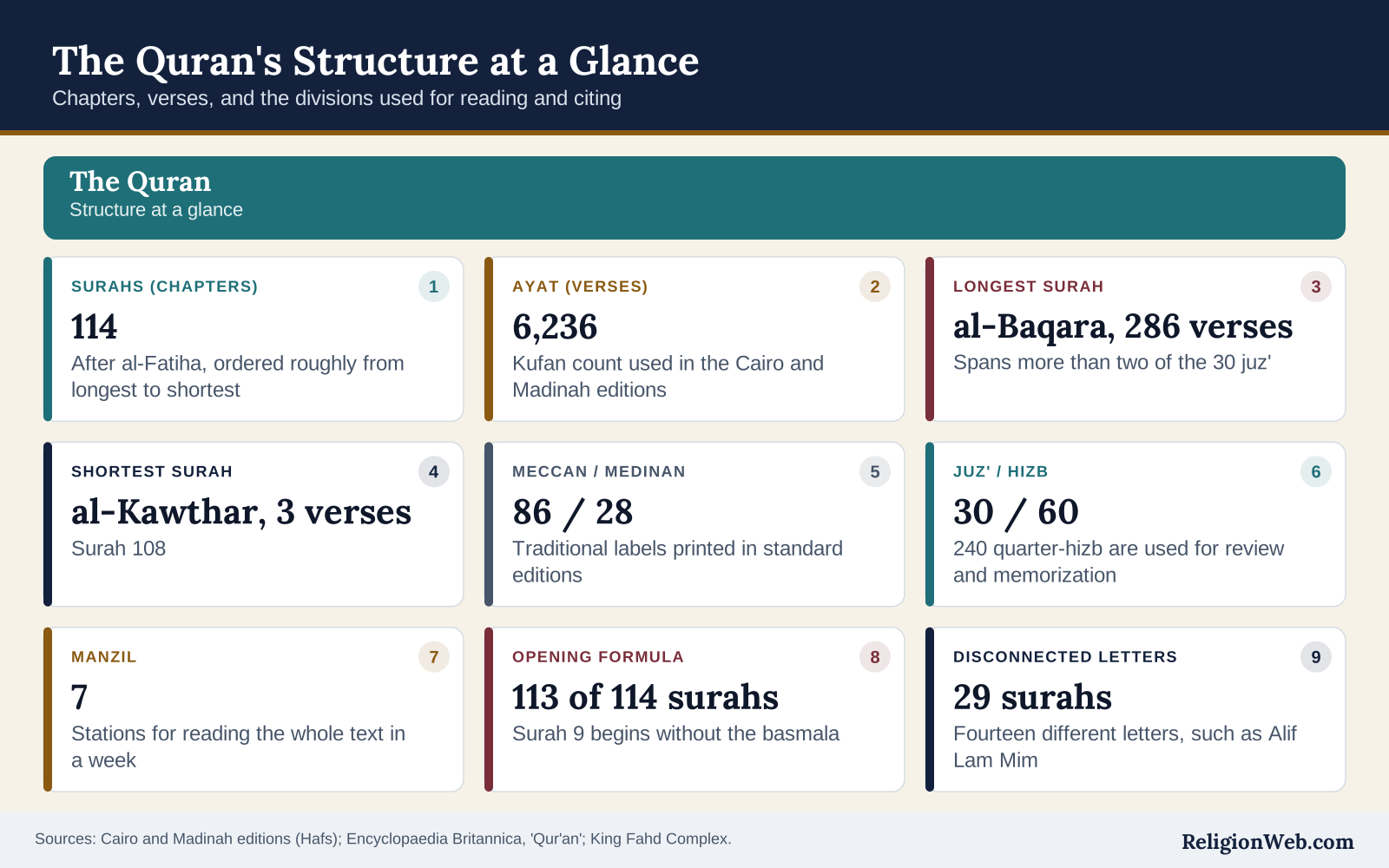
Readers who open the Quran expecting a continuous story are often surprised. It contains 114 chapters, each called a surah, and each chapter is made of verses called ayat (singular ayah, literally “sign”). After the short opening chapter the surahs run roughly from longest to shortest, not in the order of revelation and not in the order of the events of Muhammad’s life. Themes return from chapter to chapter: the oneness of God, the accounts of earlier prophets, the moral obligations of believers, the Day of Judgment, and the beauty of creation. The text speaks in the voice of God, and it addresses its hearers directly, so it reads more like a sustained address than a narrative history.
This article explains the Quran on three levels that are best kept separate. The first is Muslim belief: how Muslims understand revelation, why the Arabic words carry a status that no translation can share, and how the text is honored in worship. The second is historical: how the revelations were remembered and written down, how the early copies were standardized, and what manuscripts and academic scholarship add to the traditional account. The third is practice: recitation, memorization, interpretation, and the many places the Quran enters daily life. Its relationship to the wider faith is introduced in the overview of Islam, and the Prophet through whom it was revealed is the subject of a separate article on Muhammad’s life and role.
Where Muslim communities differ, the differences are named: Sunni, Shia, Ibadi, and Sufi interpreters do not always read a passage the same way, and the schools of recitation are not identical in every detail. Where academic historians and Muslim tradition give different accounts, both are set out with attribution rather than merged into one voice. The aim is a reference that a Muslim reader would recognize as fair to the faith, and that a non-Muslim student can use without needing to share its premises.
The Quran at a Glance: Definition, Basic Facts, and Vocabulary
What the Quran Is in Muslim Understanding
Muslims hold that the Quran is the final revealed scripture, spoken by God and delivered to Muhammad through the angel Gabriel (Jibril) in the Arabic language. The Encyclopaedia Britannica summarizes the Islamic position as holding that the text is a literal transcript of God’s speech, revealed to Muhammad through Gabriel to be recited to his community. That formulation points to two features that shape everything else in this article. The Quran is understood as divine speech, not as the Prophet’s own composition, and it is understood as something to be recited aloud by the community, not only studied silently.
The word and its meanings
The Arabic noun qur’an comes from a root meaning “to read” or “to recite,” and Muslim tradition treats it as a verbal noun: the Quran is the recitation. Britannica glosses the word simply as “Recitation.” A number of Western scholars have also noted a possible link with the Syriac word qeryana, used for a scripture reading in Christian worship, but Muslim tradition derives the word from Arabic, and the question of the word’s earliest sense remains a topic of academic discussion. The English spelling varies: Quran, Qur’an, and the older Koran all refer to the same text, and the apostrophe in the middle marks a glottal stop that is easy to hear in Arabic and almost invisible in English.
The text uses other names for itself. It calls itself al-Furqan, “the Criterion” between right and wrong (25:1), al-Dhikr, “the Reminder” (15:9), and al-Kitab, “the Book,” and these names appear in the scripture’s own descriptions of what it is meant to do. Muslims also speak of the mushaf, the bound physical copy, to distinguish the written object from the revealed speech it contains. The distinction is useful in practice: a printed mushaf can wear out, be replaced, or be translated into a commentary, while the Quran itself, in Muslim belief, is the speech of God and not a thing made of paper and ink.
Speech to be recited, not a biography to be read
Because the Quran addresses its hearers directly, it does not tell Muhammad’s life as a biography does. Muslims learn the sequence of the Prophet’s life from the traditional biographies (sira) and from the reports collected in the hadith literature, and they turn to the Quran for guidance, reminder, law, and prayer. The text mentions Muhammad by name only a handful of times, and it often refers to events obliquely, trusting the first audience to know the circumstances. Later commentators supplied those circumstances, which is one reason the study of interpretation, taken up in a later section, is so developed.
The Basic Facts in Brief
The first table gathers the main facts in one place. Several of these numbers depend on how one counts, and that is explained where it matters.
| Feature | Summary |
|---|---|
| Name | Al-Qur’an, “the recitation”; also called al-Furqan, al-Dhikr, and al-Kitab in the text itself |
| Language | Arabic; Muslims treat the Arabic wording as the Quran proper and translations as renderings of its meanings |
| Chapters and verses | 114 surahs; 6,236 numbered verses in the Kufan counting used by the Cairo and Madinah editions (other counting traditions give slightly different totals) |
| Approximate length | Around 77,000 words, depending on how words are counted |
| Traditional period of revelation | About 610 to 632 CE, in Mecca and then Medina |
| Mode of delivery in Muslim belief | Through the angel Gabriel, in successive portions |
| Gathering and standardization | Collected under Abu Bakr; copied and sent to major cities under Uthman, according to the tradition (about 650 CE) |
| Standard printed text today | Hafs reading, in the 1924 Cairo edition and the Madinah Mushaf that followed it |
| Recited in worship | In every unit of the daily prayer, beginning with the opening chapter, al-Fatiha |
| Companion disciplines | Tajwid (recitation rules), qira’at (readings), tafsir (commentary), fiqh (law), and the hadith sciences |
| Number of Muslims (Pew, 2020) | About 2.0 billion people, 25.6 percent of the world’s population |
Size, divisions, and language
The 6,236-verse figure belongs to the Kufan tradition of dividing the text into verses, which the 1924 Cairo edition adopted and which most printed Qurans follow today. Other counting traditions, named for the cities of Basra, Medina, Mecca, and Syria, divide a few passages differently, so their totals vary slightly. The disagreement is about where one verse ends and another begins, not about the words of the text. One well-known example is whether the opening formula “In the name of God, the Compassionate, the Merciful” counts as the first verse of the opening chapter; the Kufan and Meccan traditions say it does, and the others do not. Word counts vary for similar reasons, because Arabic attaches small words to the words that follow them and different counters make different choices.
The language is Arabic of the early seventh century, the Arabic of western Arabia, which later became the model for what is called Classical Arabic. Muslim grammarians based much of their description of Arabic on the Quran, and the text has remained a living standard for the language even for the great majority of Muslims whose mother tongue is something else. According to Pew’s 2020 estimates, about one in five Muslims lives in the Middle East and North Africa, while 59 percent live in the Asia-Pacific region and 18 percent in sub-Saharan Africa. Most Muslims, in other words, encounter the Quran as a text in a language they learn for religious purposes, a fact that explains much of the culture of recitation and memorization described later.
Where and how the Quran is used
The Quran is used in at least five ways that overlap but are not identical. It is recited in the five daily prayers and in the voluntary prayers that Muslims add to them. It is read through, in whole or in part, in a devotional discipline that many families keep, above all in Ramadan. It is memorized, in whole or in part, by Muslims of all ages. It is studied through commentary and in schools and universities. And it is invoked at moments of life such as a birth, a wedding, a funeral, or the start of a journey. Each of these uses has its own customs, and each is described in the sections that follow.
A Working Vocabulary for the Rest of the Article
A short vocabulary will make the later sections easier to follow. Each term is explained again where it first matters, and the structural terms are gathered in a table in the section on how the Quran is organized.
Terms for the text and its parts
A surah is a chapter, an ayah a verse, and a mushaf a physical copy of the whole text. The basmala is the formula “In the name of God, the Compassionate, the Merciful,” which opens all but one surah. A juz’ is one of thirty roughly equal parts, designed so that the text can be read in a month. Rasm is the consonantal skeleton of the written Arabic, which in early copies had few or no dots to distinguish similar letters and no marks for short vowels. Terms of classification include Makkan (Meccan) and Madani (Medinan), which indicate whether a passage is placed before or after Muhammad’s migration to Medina in 622 CE.
Terms for reciting, hearing, and explaining
Tilawa is recitation as an act of devotion, and tajwid is the body of rules for reciting correctly. Qira’at (singular qira’a) are the recognized readings, meaning the variant but accepted ways of pronouncing and vocalizing the same written text. A hafiz (feminine hafiza) is a person who has memorized the entire Quran. Tafsir is commentary or explanation, and ta’wil is a closely related term for interpretation that, depending on the author, may point to a deeper or a final meaning. Asbab al-nuzul are the “occasions of revelation” that commentators cite to explain why a passage was sent down. Finally, i’jaz names the doctrine of the Quran’s inimitability: the belief that its language and content cannot be matched by human speech.
Revelation: How Muslims Understand the Coming Down of the Quran
The Language of Revelation: Wahy, Tanzil, and Gabriel
Islamic theology has a precise vocabulary for what is described in the opening of this article. The general word for divine communication to a prophet is wahy, often translated “revelation” or “inspiration.” The word for the process by which a scripture is sent down is tanzil, “sending down,” and the Quran uses forms of this root for its own origin. Muslim theologians distinguish the wahy that came to Muhammad in the form of the Quran, which is recited and preserved word for word, from other kinds of guidance he is believed to have received, which are reported in hadith and do not carry the same status in worship.
Wahy and the ways God speaks
A passage in the chapter called al-Shura (42:51) is the usual starting point for classical discussions of how God communicates with human beings. In Pickthall’s translation it says that it was not given to any mortal that God should speak to him except by revelation, or from behind a veil, or by sending a messenger to reveal what God wills. Commentators have long treated these as three modes: an inspiration placed directly in the heart, speech heard as if from behind a screen, and a message delivered by an angelic messenger. Muslim tradition places the Quran in the third category, the delivery of the angel Gabriel, although the reports of the Prophet’s experience also describe moments that the early community understood as the first and second modes.
The sources describe the experience of receiving revelation in physical terms. Reports collected in the hadith literature speak of heaviness, of perspiration on a cold day, of a sound like the ringing of a bell. These details are part of the tradition’s account of how the Prophet himself understood the event, and Muslims draw from them a sense of its seriousness. They are not offered as proof to outsiders, and academic historians read them as part of the early community’s memory of Muhammad, rather than as eyewitness records that can be tested.
Gabriel, the heart, and plain Arabic
The Quran itself names the messenger and the language. In the chapter of the Poets (26:192-195) the scripture describes its own origin in these words:
And lo! it is a revelation of the Lord of the Worlds, / Which the True Spirit hath brought down / Upon thy heart, that thou mayst be (one) of the warners, / In plain Arabic speech.
Qur’an 26:192-195, trans. Marmaduke Pickthall (1930); verse breaks shown by slashes
The phrase “the True Spirit” is understood in the mainstream Sunni and Shia exegetical traditions to refer to Gabriel, and Muslims connect it with other passages in which the angel is named as the bearer of revelation. The phrase “upon thy heart” is read as a statement that the message was received with the Prophet’s inner faculty of understanding, and the phrase “in plain Arabic speech” is the basis for the widespread teaching that the Arabic wording, and not only the meaning, is a part of the revelation. That teaching will matter again in the discussion of translation. A related passage in the chapter of Joseph (12:2) says that the Quran was sent down as an Arabic recitation so that its hearers might understand, and Muslim scholars point to it as evidence that the language was chosen for its first audience.
The Beginning of Revelation and the Night of Power
Muslim accounts of how revelation began are drawn from the hadith, above all from a report narrated on the authority of the Prophet’s wife Aisha and preserved in the collection of al-Bukhari (no. 3). The report is the basis for what follows, and it is the shared starting point for Sunni and Shia narratives of the event, even though the two traditions preserve additional details in their own sources.
The cave of Hira and the first command
According to this report, revelation began with true dreams that came to pass as clearly as the break of day. Muhammad then came to love solitude and would retreat for many nights to worship in a cave on Mount Hira, near Mecca. There the angel Gabriel came to him and told him to read. He answered that he could not read, and the angel pressed him three times before he recited the opening verses of the chapter that is now numbered 96. Frightened, he returned to his wife Khadija, who reassured him by recalling his care for his family, for the poor, and for guests. She then took him to her cousin Waraqa ibn Nawfal, an elderly man learned in the earlier scriptures, who recognized in the event the same kind of angelic visit that had come to earlier prophets.
The opening verses of surah 96 are the passage most Muslims name as the first revealed, and the Cairo edition prints them in the chapter called al-‘Alaq, “the clot.” A tradition also preserves other candidates for the first revelation, such as the beginning of surah 74, al-Muddaththir, and Muslim scholars have long discussed how to reconcile the reports. The majority position is that the first verses of surah 96 came first, and that surah 74 followed after a pause. The practical effect of the tradition is that every Muslim learns the same first command, “Recite,” as a kind of summary of the relationship to the book. The story of the Prophet’s life in which this event sits is told in the article on the Prophet Muhammad.
Laylat al-Qadr and the month of Ramadan
Two passages tie the beginning of revelation to a particular time. The chapter called al-Qadr (97) begins by saying that God sent the Quran down on the Night of Power, which it describes as better than a thousand months, a night in which the angels and the Spirit descend by God’s permission and which is peace until the rising of the dawn. The second chapter (2:185) says that the month of Ramadan is the month in which the Quran was sent down as guidance for people and as the Criterion between right and wrong, and that those who are present during the month should fast it. Together the two passages are the scriptural basis for associating the Quran with the fasting month and for treating one of the last ten nights of Ramadan as the likeliest occasion of the Night of Power.
Muslim scholars have long explained the relationship between a single night and a revelation spread over many years in different ways. One widely held view is that the whole Quran was sent down on that night from the preserved heavenly record to the lowest heaven, and that it was then delivered to the Prophet in portions. Another reading holds that the night marks the opening of the revelation to Muhammad. Both readings appear in the classical commentaries, and the practical customs surrounding the night, which are described in the article on Ramadan, do not depend on choosing between them.
The pause and the long unfolding
The report of the first revelation ends with a note that revelation paused for a time, a gap Muslim tradition calls the fatra. The length of the pause is differently reported, and some accounts say it lasted a matter of days while others say it lasted far longer. The pause is often cited as an example of how the Prophet did not control the revelation, since there are periods when he is described as waiting. After it, the revelations came with greater frequency, and they continued, in the traditional reckoning, until shortly before his death in 632 CE.
Gradual Revelation and Its Purposes
The Quran says of itself that it was sent down in stages. The tradition treats this not as an accident but as part of a design, and the Quran addresses it directly in more than one place.
Revealed in portions
The chapter of the Night Journey (17:106) puts it this way:
And (it is) a Qur’an that We have divided, that thou mayst recite it unto mankind at intervals, and We have revealed it by (successive) revelation.
Qur’an 17:106, trans. Marmaduke Pickthall (1930); two adjoining lines of the printed verse joined
A second passage (25:32) reports an objection by the Prophet’s opponents, who ask why the Quran was not sent down all at once, and it answers that the gradual method was meant to strengthen his heart and that the text was arranged in right order. Commentators draw several purposes from these verses: to comfort the Prophet through difficult years, to allow the community to absorb and memorize the message in manageable pieces, to give guidance suited to particular events, and to introduce laws step by step. The reasoning is connected to the traditional view that some of the earliest passages address belief and conscience while the later, Medinan passages address the legal and social life of an established community.
Occasions of revelation
Many verses are linked in the tradition to specific occasions, a body of reports known as asbab al-nuzul. Some of these concern famous episodes, such as a question put to the Prophet or a dispute in the community, while others are brief notes naming a person or incident. Classical commentators such as al-Wahidi (died 1076) compiled works devoted to the subject, and nearly every major commentary draws on them. The reports are valued because they supply the context that the text itself often withholds, but they are also treated cautiously. Scholars evaluate the chain of transmission, and many point out that a statement such as “this verse was revealed concerning X” can mean either that the verse was sent down at the moment of an event or that it applies to a case of that kind. For this reason the genre is used with care, even in traditional scholarship.
Gabriel’s yearly review and the last revelations
The same hadith collection reports, on the authority of Abu Hurayra, that Gabriel used to review the Quran with the Prophet once a year, and twice in the year in which he died (al-Bukhari, no. 4998). Muslims regard this as the origin of the practice of reciting the whole Quran to a teacher and of completing it during Ramadan. The tradition also records accounts about the last revelation, and they do not agree. One report in al-Bukhari (no. 4364), narrated by al-Bara’ ibn ‘Azib, names the last complete surah as surah 9 and the last passage as the closing verse of surah 4. Other accounts, preserved in other collections and works on the sciences of the Quran, name different verses. The existence of several answers is itself a reminder that the tradition preserved competing recollections and has not tried to hide them.
Is the Quran Created? Theological Debates About the Word of God
If the Quran is the speech of God, a question follows that early Muslim theologians debated intensely: is that speech eternal, like God, or was it created at a point in time? The question was not abstract. It touched the relationship between God and the world, the status of the physical text, and, eventually, the power of the state.
The majority position and the Mihna
The doctrine that became standard in Sunni Islam holds that the Quran is the uncreated speech of God. Theologians who developed this position, among them the followers of al-Ash’ari and al-Maturidi, distinguished between God’s eternal speech, which is an attribute of God, and the sounds, letters, and ink through which people recite and write it, which are created. The Mu’tazila, a rationalist school influential in the early Abbasid period, argued the reverse: that God’s speech is created, so that divine unity would not be compromised by positing an eternal attribute alongside God. The caliph al-Ma’mun adopted this view, and from 833 CE his government carried out an inquisition, the Mihna, requiring religious scholars to affirm the createdness of the Quran. The jurist Ahmad ibn Hanbal refused and was imprisoned and flogged, and his resistance made him a hero to later traditionalists. The policy was abandoned under the caliph al-Mutawakkil in the late 840s or about 851, depending on the source, and the “uncreated” view became firmly established among Sunni Muslims.
Shia, Ibadi, and other positions
Other Muslim communities took different positions. Twelver Shia theology developed in conversation with Mu’tazili rationalism and has often described the divine speech as an act of God and therefore created, though Shia scholars differ on how to express the point, and the practical reverence given to the mushaf is the same. Ibadi theologians in Oman and North Africa have also held that the Quran is created in this sense. These are differences of theological definition, not of the text recited, and Muslims of all these traditions use the same Quran in prayer. A reader should be wary of summaries that treat the question as dividing “true” and “false” Muslims. Within each tradition the stress falls on honoring the Quran as God’s word, and the debate concerns how best to describe the relationship between God and the words.
Inimitability: The Quran as Sign and Proof
Muslims also hold that the Quran is a sign confirming the Prophet’s mission. This doctrine, called i’jaz, holds that the language and content of the Quran cannot be matched by any human work.
The challenge verses
The doctrine rests on a group of verses, usually called the challenge verses (tahaddi), that invite doubters to produce something like the Quran. One of them (2:23) asks anyone in doubt about the revelation to produce a chapter of the like and to call on witnesses besides God, if they are truthful. Another (17:88) declares that if humankind and the jinn assembled to produce the like of this Quran, they could not do so, even if they helped one another. Muslim tradition understands the challenge as having been directed first at the Meccans, who prided themselves on their poetry and eloquence, and as having gone unanswered.
How theologians explained inimitability
Classical theologians offered different accounts of what made the Quran inimitable. Some, such as al-Baqillani (died 1013), argued that the Quran’s style breaks the categories of existing Arabic literary forms, so that it is neither poetry nor ordinary prose. Al-Jurjani (died 1078), in a treatise on the subject, located the miracle in the arrangement of words and meaning together, so that the beauty could not be separated from the sense. Others, such as the early Mu’tazili theologian Ibrahim al-Nazzam, located the Quran’s supremacy in its content rather than its style. The debate had a lasting effect: it encouraged generations of scholars to study Arabic grammar and rhetoric in order to appreciate the Quran, and it is one source of the conviction that a translation cannot reproduce the original. Modern academic readers of the Quran, whatever their own beliefs, treat its literary qualities as a legitimate subject of study, and the doctrine of inimitability is understood as a statement of Muslim faith and not as a result that scholarship could confirm or refute.
How the Quran Is Organized: Surahs, Ayahs, and Divisions
Surahs and Ayahs: The Basic Units
The structure of the Quran is the first thing a new reader meets and the last thing many readers fully grasp. The text has no table of contents in the modern sense and no narrative thread. It is arranged in chapters and verses that Muslims know by name and number, and almost every use of the book, from the opening of a prayer to a citation in a legal ruling, depends on the shared reference system described here.
What a surah is and how surahs are named
A surah is a unit of the text that has a fixed beginning and end, a name, and a place in the sequence. There are 114 of them, and they differ enormously in length: the second, al-Baqara (“the Cow”), has 286 verses and spans more than two of the thirty reading parts, while al-Kawthar (“Abundance”), the 108th, has three short verses. Most surahs are known by a word or topic drawn from them. Al-Baqara takes its name from a story about a cow, al-Naml (“the Ant”) from a creature that appears in an episode of Solomon, and Yusuf (“Joseph”) from the prophet whose life fills the chapter. A few are named for a pair of letters that open them, such as Ta Ha and Ya Sin.
The names are not usually thought of as titles chosen by an author, and the sources differ on how they arose. Many are reported in hadith as the names by which the Prophet or his Companions referred to the chapters, and others became standard through use. Some surahs carry more than one name: surah 111 is called both al-Masad and al-Lahab, and surah 41 is known as Fussilat and as Ha Mim Sajda. When Muslims cite the Quran, they give the number of the surah and the verse, as in 2:255, which refers to the 255th verse of the second surah.
Verses and the opening formula
An ayah, which means “sign” or “miracle” as well as “verse,” is a unit of one or several sentences, marked in printed copies with an ornamental symbol and a number. Verses vary from a single word, such as the letter-names that open some surahs, to the long verse of 2:282 on written contracts, which runs for a full page in many editions. The units were passed down in recitation, and the system of counting them is itself part of the transmitted tradition, which is why different cities, as noted earlier, preserved slightly different counts.
All surahs but one begin with the basmala, the words “In the name of God, the Compassionate, the Merciful.” The exception is the ninth, al-Tawba, which opens without it. Muslim commentators have offered reasons for the omission, for example that the chapter begins with a declaration of release from certain treaty obligations and was therefore not introduced with an invocation of mercy, but they also admit that no single explanation is certain. The formula appears in the text within surah 27 (verse 30), where it is part of a letter attributed to Solomon, so the total number of occurrences in the Quran is 114. For the opening chapter, al-Fatiha, the Kufan counting treats the basmala as the first of seven verses, which is the numbering used in this article.
| Term | Meaning | How it is used |
|---|---|---|
| Surah | Chapter; 114 in all | Named and numbered; cited as surah:verse |
| Ayah (plural ayat) | Verse, literally “sign” | Numbered within each surah; 6,236 in the Kufan count |
| Basmala | “In the name of God, the Compassionate, the Merciful” | Opens every surah but the ninth; also occurs inside 27:30 |
| Juz’ | One of 30 roughly equal parts | Allows the whole text to be read in a month; often used in Ramadan |
| Hizb and rub’ al-hizb | Half-juz’ (60 in all) and quarter-hizb (240 in all) | Practical units for review and memorization |
| Manzil | One of seven stations | Allows the text to be read in a week |
| Ruku’ | Section of several verses, marked in many South Asian printings | Used in the prayer and for study |
| Makki and Madani | Placed before or after the migration to Medina in 622 CE | Labeled in the headings of most editions |
| Rasm | The consonantal skeleton of the written text | Fixed in the early copies; vowels and dots were added later |
| Sajda | Verse at which a prostration is made in recitation | Marked in the margin; about 15 in the usual count, with schools differing on a few |
The Order of the Surahs
The surahs follow each other in a sequence that every printed Quran shares. That sequence is the part of the Quran’s structure most often misunderstood by newcomers, and it is the reason that a first reading from the beginning can feel disorienting.
From longest to shortest
After the short opening chapter, the surahs are arranged, with exceptions, from the longest to the shortest. The second, third, fourth, and fifth are among the longest; the closing surahs, from about the hundredth to the hundred-and-fourteenth, are among the shortest. The pattern is only approximate. Some long surahs stand after shorter ones, and the principle that governs the order is not stated in the text. The arrangement means that, as a rule, the early part of the book contains the lengthy legal and communal passages associated with the Medinan period, while the final part contains the short, intense Meccan surahs on God, conscience, and the Last Day.
The tradition regards the order of the verses within each surah as fixed by the Prophet’s own direction, and there is general agreement on this. On the order of the surahs, most Muslim scholars have taught that the Prophet also indicated the sequence, while some early authorities allowed that Companions made decisions about the placement of certain chapters. Reports mention that several Companions kept personal copies with a different sequence of surahs, and these reports are cited by scholars on both sides of the question. For the worshiper the point is practical rather than technical: the sequence in the standard mushaf is the only one in use, and it has been the same in all printed editions.
Why the order is not chronological
Muslims do not usually read the Quran in the order of revelation, and the text itself gives no instruction to do so. The order of the mushaf is understood as the arrangement under which the revelation was finally gathered and recited, much as a collection of letters may be arranged by theme or length rather than by date. The Cairo edition of 1924 adopted a traditional chronological ordering of the surahs, attributed to Ibn Abbas, and scholars use it for reference. Readers who want a reading experience closer to the sequence of revelation can consult such a list, although it is a scholarly reconstruction, and different lists disagree on where to place several chapters.
| Surah | Name and meaning | Verses | Why it is commonly known |
|---|---|---|---|
| 1 | al-Fatiha, “The Opening” | 7 | Recited in every unit of the daily prayer; called “the seven oft-repeated verses” in the tradition |
| 2 | al-Baqara, “The Cow” | 286 | The longest surah; contains the Throne Verse (2:255) and much legal guidance |
| 12 | Yusuf, “Joseph” | 111 | Tells one story from beginning to end; the text calls it the best of narratives (12:3) |
| 18 | al-Kahf, “The Cave” | 110 | Customarily recited on Fridays in many communities |
| 36 | Ya Sin | 83 | Widely recited in homes and at times of bereavement |
| 55 | al-Rahman, “The Merciful” | 78 | Repeats one refrain 31 times, giving the surah a distinctive liturgical rhythm |
| 67 | al-Mulk, “The Kingdom” | 30 | Often recited in the evening or before sleep |
| 97 | al-Qadr, “The Night of Power” | 5 | Read during Ramadan’s last ten nights |
| 108 | al-Kawthar, “Abundance” | 3 | The shortest surah by verse count |
| 112 | al-Ikhlas, “Sincerity” | 4 | A concise statement of God’s oneness, recited in prayer |
| 113 and 114 | al-Falaq and al-Nas | 5 and 6 | Together called al-Mu’awwidhatayn, recited for protection |
Meccan and Medinan Surahs
Almost every edition labels each surah as Meccan or Medinan in a heading. The labels are a way of recording the traditional view of when a chapter was revealed, and they carry a good deal of interpretive weight.
What the labels mean
The standard Muslim definition rests on timing: a passage is Meccan if it was revealed before Muhammad’s migration (hijra) to Medina in 622 CE, and Medinan if it was revealed after, even if the place of revelation was not Medina itself. Some scholars have used other criteria, such as the place where a verse was delivered or the audience it addresses, and the difference accounts for some disagreements about individual verses. In the usual classification printed in the Cairo and Madinah editions, 86 surahs are labeled Meccan and 28 Medinan. The Meccan chapters are mostly short, yet because there are so many of them they still account for the larger share of the verses, by most counts roughly two-thirds or more, while the smaller Medinan group includes several of the longest chapters.
Characteristic features and exceptions
Classical scholars and modern ones agree on a broad contrast. The Meccan surahs are typically short, with brief verses of strong rhythm, frequent oaths, and a focus on God’s oneness, the Last Day, the moral failings of the powerful, and the stories of earlier prophets and the peoples who rejected them. The Medinan surahs are longer, with longer verses, and they address the organized community: rules on worship, family, inheritance, contracts, and warfare, and relations with other communities of the region. The address “O you who believe” is typical of the Medinan passages, while “O people” is more common in the Meccan.
The contrast is not absolute, and the tradition recognizes this. A surah may be labeled Meccan overall and contain Medinan verses, or the reverse, and a few surahs are classified differently in different lists. Scholars debate, for instance, the placement of several chapters among those that the Cairo edition labels Medinan, and the long second surah is usually treated as Medinan even though it contains some passages that reflect Meccan features. Readers are therefore best served by treating the labels as informed classifications and not as dates.
Academic chronologies
European scholarship from the nineteenth century onward attempted to build a more precise chronology on the basis of style and content. The most influential result was the work of Theodor Nöldeke, whose Geschichte des Qorans (first published in 1860) divided the revelations into three Meccan periods and one Medinan period. Britannica notes that this method used verse length as its main criterion on the assumption that verses tended to grow longer over time, and that it therefore placed surahs 2 to 5 at a much later stage. Later scholars, including Angelika Neuwirth and Nicolai Sinai, have refined or revised these schemes, and some have focused on the internal structure and literary development of individual surahs. There is no academic consensus on a complete chronology, and Muslim scholars also compare the traditional lists with one another. For the reader, the safest use of any chronology is as a framework for reading, not as a record.
Other Divisions and Marks in the Printed Text
The text carries further divisions that do not follow the boundaries of surahs. They exist for the purposes of recitation, memorization, and prayer, and they are as much a part of the lived Quran as the chapters themselves.
Juz’, hizb, and manzil
The most widely used division is the juz’, a part of roughly one-thirtieth of the text. Each juz’ is divided into two hizb, and each hizb into four quarters, so that the text has 30 juz’, 60 hizb, and 240 quarter-hizb. Most juz’ are named after their opening words, so that Muslims can speak of “Alif Lam Mim,” the first, or “‘Amma,” the thirtieth. The division is not a division of meaning; a juz’ may begin in the middle of a story or even in the middle of a sentence. It exists so that the text can be read in a month, and in Ramadan many communities complete the reading through the evening tarawih prayers, often at the rate of a juz’ a night. A separate division into seven manzil, or stations, allows the Quran to be read in a week. Quarter-hizb markers are the working units for review in many memorization schools.
Prostration signs, pause marks, and the mysterious letters
Printed copies mark the places where a reciter pauses or does not pause, and they mark verses at which a prostration (sajda) is performed when it is recited or heard. The count of such verses is usually given as fifteen, and the legal schools differ on a few of them. The pause marks are small signs above the line that tell the reciter whether a stop is required, recommended, permitted, or forbidden, and they allow even an inexperienced reader to avoid breaking a sentence in a way that changes its meaning.
Twenty-nine surahs begin with a combination of Arabic letters that are pronounced by name, such as Alif Lam Mim at the start of the second surah or Ya Sin at the start of the thirty-sixth. These muqatta’at, “the disconnected letters,” use fourteen different letters, about half the Arabic alphabet. Muslim tradition has treated them in two main ways. Many commentators say that their meaning is known to God alone, while others have proposed that they are names or abbreviations, or that they draw the hearers’ attention to the nature of the Arabic letters of which the Quran is made. Modern scholars have proposed theories ranging from scribal marks to liturgical signals, and none of them has been generally accepted. The letters are recited aloud in prayer and in tajwid classes as letter-names, and they are among the features that most clearly show that the Quran’s oral form came first.
Compilation, Manuscripts, and the History of the Text
The Traditional Account of Collection
The Muslim account of how the Quran moved from the Prophet’s recitation to a standard written book is preserved above all in two short reports in the collection of al-Bukhari, which are the starting point for nearly every later discussion. The reports are brief, and they are best read slowly, because they show what the early community itself remembered about the process and what it was careful to say.
Writing and memory in the Prophet’s lifetime
The tradition holds that the Quran was both memorized and written down while Muhammad was alive. Companions committed portions to memory and recited them in prayer, and designated scribes wrote passages on whatever materials were at hand, among them palm stalks, flat stones, shoulder bones, and scraps of leather. Zayd ibn Thabit, a young man of Medina, is the best-known of these scribes. The tradition adds that Gabriel reviewed the whole text with the Prophet each year, so that at the end of Muhammad’s life the arrangement of the verses within each surah was settled. What did not exist, according to the reports, was a single bound volume containing every chapter.
That the Prophet’s death in 632 CE came without such a volume is acknowledged in the sources and is one reason the later collection was seen as a matter of care for the community. It is also why the tradition insists on the role of memory. In the Arabian setting of the time, trained memory was a respected skill, and the text was heard and repeated in prayer many times each day, so that no passage was held by only one person.
Abu Bakr and the first gathering
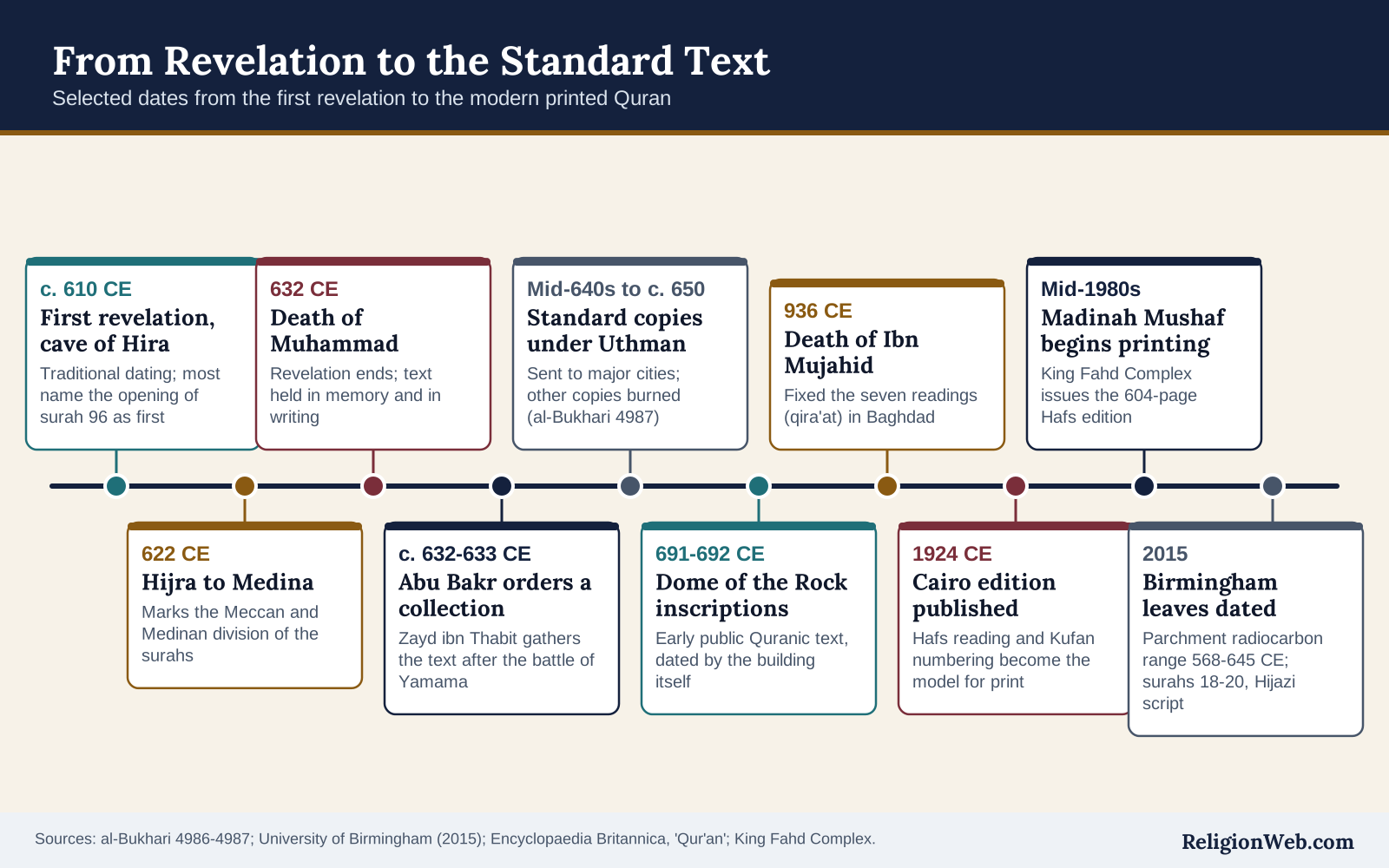
The first step toward a collected text is told in al-Bukhari’s report no. 4986, narrated by Zayd ibn Thabit himself. After the Battle of Yamama, fought in the first year after the Prophet’s death against a rival claimant to prophethood, many of the Companions who had memorized the Quran had been killed. ‘Umar ibn al-Khattab, the future caliph, came to the first caliph, Abu Bakr, and urged him to have the Quran gathered before more reciters were lost. Abu Bakr then called Zayd and asked him to undertake the task. Zayd’s first response, in his own words, was reluctance, because the Prophet had never done this. After discussion he agreed. He collected the text from the written pieces and from the memories of men who knew it, and he found the last verses of surah 9 only with one man, Abu Khuzayma al-Ansari. The sheets that resulted stayed with Abu Bakr until his death, then with ‘Umar, and then with ‘Umar’s daughter Hafsa, the Prophet’s widow.
This report is understood by Sunni scholars as describing the first written collection of the whole text in one place, as a safeguard and not as a new edition. The distinction matters, because Muslims do not describe Abu Bakr as having decided what was Quran, only as having assembled what was already known to be Quran. Shia scholars in general accept that the Quran in use today is complete, but their tradition places the arranging of the text in the Prophet’s own lifetime, and it preserves reports that ‘Ali ibn Abi Talib prepared a copy of his own. Scholars of every tradition discuss how these accounts relate to one another, and no tradition of Muslim scholarship takes the text as in doubt.
Uthman and the standard copies
The second report, al-Bukhari no. 4987, narrated on the authority of Anas ibn Malik, concerns the reign of the third caliph, ‘Uthman ibn ‘Affan (644-656 CE). A Companion named Hudhayfa ibn al-Yaman, returning from campaigns on the northern frontiers, was alarmed by differences in the way soldiers from Syria and Iraq recited, and he urged ‘Uthman to act before the community disagreed over its book. ‘Uthman asked Hafsa for the sheets in her keeping and appointed a committee headed by Zayd ibn Thabit, with three members of the Quraysh tribe, to copy them into volumes. He told the Quraysh members that if they and Zayd differed about any word, they should write it in the dialect of the Quraysh, since the Quran had been sent down in that language. Copies were then sent to the major centers, the originals were returned to Hafsa, and ‘Uthman ordered that other Quranic material, in fragments or complete copies, be burned.
Later authors disagree on the number of copies that were sent. Estimates in the classical sources range from four to eight, with six or seven often given, and Medina, Damascus, Kufa, and Basra are the cities most often named. Some figures, among them ‘Abd Allah ibn Mas’ud in Kufa, are reported to have objected to the destruction of their own copies, and the reports say that he later accepted the standard text. The policy is generally dated to the mid-640s and the first years of the 650s CE, and the standard text produced by it is called the ‘Uthmanic codex (al-mushaf al-‘uthmani). It is the common ancestor, in the Muslim account, of every copy now in use.
Script, Dots, and Vowels: From the Skeleton to the Printed Page
The early copies were not written the way printed Arabic is. Understanding the difference helps to explain how a single written text can be recited in several recognized ways, and why standardization was not a one-step event.
An undotted skeleton
Britannica describes the standardization of ‘Uthman as a standardization of the rasm, the consonantal skeleton of the text “shorn of any auxiliary signs.” In early Arabic writing, several different consonants share the same basic shape and are told apart by dots above or below, and short vowels are not written at all. A reader who knows the language and knows the text can read an undotted manuscript, as a modern reader can read a shorthand, but the skeleton alone leaves some words open to more than one pronunciation. This is one of the reasons the accepted readings, discussed in the next section, are able to differ from each other while all remaining faithful to one written form.
Adding dots and vowel signs
Muslim tradition credits the introduction of reading aids to scholars of the first Islamic centuries. The grammarian Abu al-Aswad al-Du’ali is traditionally credited with early dots to mark vowels, and Khalil ibn Ahmad of Basra (died about 786 CE) with the system of vowel marks that is used in printed copies today. The surviving manuscripts show a more gradual picture. The earliest copies, from the seventh and eighth centuries, have some dots used sparingly and not systematically, and scholars who have studied the practice conclude that scribes often added marks by habit or convention, not to resolve every ambiguity. Fully pointed and vocalized copies became the norm over the following centuries.
Scripts and the art of the copy
The earliest copies are written in a script known as Hijazi, with upright letters that slope slightly to the right. From the eighth century the angular scripts classed as Kufic, usually written on horizontal parchment pages, were widely used, and from the tenth century cursive scripts, among them the style called naskh, increasingly took over. Copyists were highly honored, and Qurans were produced with elaborate illumination in gold, lapis, and other pigments. Britannica’s illustrations include a Syrian Kufic copy of the ninth century and an Ottoman copy in naskh. The beauty of the copy is a form of devotion, and it explains why calligraphy is regarded as a central art of Islamic culture.
What Early Manuscripts Show
Since the twentieth century, scientific dating of parchment and the discovery of large manuscript collections have given scholars new evidence. The results do not settle every question, but they have changed the discussion.
The Birmingham leaves and the Hijazi script
In 2015 the University of Birmingham announced that radiocarbon testing at the University of Oxford had dated two parchment leaves in its Mingana collection to between 568 and 645 CE, with 95.4 percent probability. The leaves contain parts of surahs 18 to 20 in ink in the Hijazi script. Professor David Thomas, who commented for the university, called the result startling and said that the leaves “could well take us back to within a few years of the actual founding of Islam.” The date applies to the animal that supplied the parchment, not to the writing, which must be later, and scholars have debated how much later. Thomas argued for a date before 652 CE, while others, such as the linguist Marijn van Putten, have argued that the text already belongs to the ‘Uthmanic type. The leaves complete a gap in a Paris manuscript, part of the codex known by scholars as Parisino-petropolitanus, which is scattered among several libraries.
The Sanaa palimpsest
In 1972, workers restoring the Great Mosque of Sanaa in Yemen found an enormous store of old manuscripts, among them fragments of a great many early Qurans. One of them, known as Sanaa 1, is a palimpsest, a parchment on which an earlier text was washed away and written over. The upper text matches the standard ‘Uthmanic text. The lower text, which can be read in part with the help of ultraviolet photography, differs in a number of readings and in the order of some surahs. Behnam Sadeghi and Uwe Bergmann, who published a study in 2010, concluded that the parchment of the lower text dates from before 671 CE with high probability, and that it represents a version of the Quran outside the ‘Uthmanic tradition. This is the most striking case of an early variant text. The lower text is nevertheless recognizably the Quran, with the same surahs and largely familiar wording, and scholars continue to debate whether its differences reflect a Companion’s private copy, a parallel line of transmission, or the ordinary variation of early copying.
Famous codices attributed to Uthman
Several large manuscripts are called by the name of ‘Uthman, among them copies preserved in Istanbul’s Topkapi Palace and in Tashkent, the latter long kept in Samarkand. Tradition honors such copies as the caliph’s own, and popular accounts say that some bear stains from his blood, since ‘Uthman was killed in 656 CE. Academic specialists are generally skeptical of the claims. The Topkapi manuscript shows dots and decorative features that point to a later production, according to its specialist students, and radiocarbon testing of the Samarkand manuscript, as reported in published summaries, points to the late eighth or ninth century. These conclusions do not diminish the manuscripts’ importance in the history of the Muslim community, and they show how scientific dating can sit alongside inherited reverence. The Dome of the Rock in Jerusalem, whose inscription gives the date 72 AH (691-692 CE), preserves long Quranic passages in monumental script and is often cited as an early public witness to the text.
Scholarly Debates About Origins and Standardization
Academic historians approach the Quran with the methods they use for any ancient text: comparing manuscripts, dating materials, and analyzing language and content. They do not rule on whether the Quran is divinely revealed, since that is a question of belief that historical method cannot answer. Britannica makes this point directly, and it is a useful frame for the rest of this section.
What most scholars now accept
There is broad agreement among specialists on several points. The Quran is a closed corpus that was, in its essentials, in existence in the seventh century. Britannica states that radiocarbon dating of early manuscripts is “by and large consistent” with the traditional view, and that the received text was probably in existence by about 650 CE. Several scholars, among them van Putten and Michael Cook, have argued that the surviving early manuscripts share a common ancestor, which would suggest an early standardization of the written text. Many historians also regard the style of the text as consistent with the early seventh-century setting that the tradition describes, and note that it contains no clear references to major events after the Prophet’s death.
Where discussion continues
Several issues remain open. One is the degree to which the written text may have been edited or finalized after the Prophet’s death, and Britannica notes that some scholars suggest the standardization of the skeleton might not have been completed until considerably later than the tradition says. A second is the evidential weight of the reports about collection. Western scholarship has become more cautious about reports from outside the Quran, which often cannot be traced earlier than the eighth century or the late seventh. A third is the interpretation of variants: the Sanaa lower text and other early fragments show real differences, and scholars disagree about whether these were private variants, remnants of competing codices, or evidence of an earlier stage of the text. A late-dating thesis proposed by John Wansbrough in the 1970s, which placed the fixing of the Quran two centuries after Muhammad, is now held by only a few scholars, and radiocarbon dating has been one reason for the change.
How faith and historical method relate
Muslim scholars generally hold that the tradition of transmission is reliable and that the text has been preserved as God promised in the verse of the Reminder (15:9), quoted later in this article. They accept manuscript studies as interesting for the history of writing, and many welcome the evidence for an early date. Some academic historians in turn recognize that the oral chain of recitation is a primary form of transmission and not a late supplement to the written text. The fruitful meeting point is a recognition that the Quran was first an oral and then a written text, and that both forms were central from the start. Readers who want to examine the evidence for themselves can use digital projects such as Corpus Coranicum, a research project of the Berlin-Brandenburg Academy of Sciences, which gathers manuscripts, variant readings, and texts from the surrounding cultural setting.
| Date (CE) | Event | Basis for the date |
|---|---|---|
| About 610 | Beginning of revelation in the cave of Hira, near Mecca | Traditional dating from the sira and hadith |
| 622 | Migration (hijra) to Medina; start of the Medinan period | Widely accepted; begins the Islamic calendar |
| 632 | Death of Muhammad; revelation ends | Widely accepted |
| About 632-633 | Collection under Abu Bakr after the Battle of Yamama | Al-Bukhari, no. 4986 (traditional account) |
| Mid-640s to about 650 | Standard copies prepared under ‘Uthman and sent to major cities | Al-Bukhari, no. 4987; Britannica gives about 650 CE as the likely latest date for the received text |
| 568 to 645 (parchment) | Animal skin of the Birmingham leaves, surahs 18 to 20 | Radiocarbon dating at Oxford, announced 2015 |
| Before 671 (parchment) | Lower text of the Sanaa palimpsest | Radiocarbon dating and analysis by Sadeghi and Bergmann (2010) |
| 691 to 692 | Quranic inscriptions in the Dome of the Rock, Jerusalem | Dated by the building’s own inscription |
| Eighth century | Dots and vowel signs spread; Khalil ibn Ahmad (died about 786) credited with the vowel system | Muslim tradition, supported by gradual change in manuscripts |
| 936 | Death of Ibn Mujahid, who fixed the seven readings | Biographical sources |
| 1834 | Gustav Flügel’s printed edition in Leipzig | European academic edition with its own verse numbering |
| 1924 | Cairo edition published under King Fu’ad | Became the model for later printings |
| Mid-1980s | King Fahd Complex in Medina begins printing the Madinah Mushaf | Official Saudi publisher; widely reproduced since |
From Manuscript to Print: The Modern Standard Text
For most of Islamic history, Qurans were copied by hand, and copying remained a respected craft well into the nineteenth century. The shift to print changed how the text was standardized.
The Cairo edition of 1924
The edition that became the model for most printed Qurans today was prepared in Egypt by a committee of scholars from al-Azhar under the patronage of King Fu’ad and was published in Cairo in 1924. It is sometimes called the King Fu’ad Quran or the Amiri edition. It reproduced the Hafs reading, adopted the Kufan system of verse numbering, followed the traditional chronological list for the surahs’ labels, and used the ‘Uthmanic orthography as transmitted by specialists. Researchers have noted that the edition did not apply the traditional rules of spelling uniformly, and some of its decisions were debated, but its authority grew as it was reproduced. A consequence of its success is that printed Qurans in most parts of the world now show a more uniform text than the range of readings in the manuscript tradition.
The Madinah Mushaf
The next major step was the Madinah Mushaf, produced from the mid-1980s by the King Fahd Glorious Quran Printing Complex in Medina, which also prepares audio recordings, translations, and digital editions. Its script was written by the calligrapher Uthman Taha, and its Hafs edition uses a page layout of 604 pages that is widely imitated, so that a memorizer who learns from one copy finds the same verse in the same place on another. A review committee checks each new printing. The complex also publishes editions in other readings, and its official site lists, among others, Warsh, al-Duri, Shu’ba, al-Susi, and Qalun. Researchers who have compared the two editions describe the Madinah Mushaf as close to a copy of the Cairo text, and its availability in print and online has made it the most widely circulated form of the Quran.
Recitation, Readings, and Memorization
Tilawa and Tajwid: The Art of Reciting
Recitation as the Quran’s first form
The Quran’s own name makes recitation primary, and the text speaks of its recitation in the imperative. The opening of the chapter called al-Muzzammil (73), addressed to the Prophet, tells him to keep vigil for much of the night, and verse 4 instructs him:
Or add (a little) thereto – and chant the Qur’an in measure,
Qur’an 73:4, trans. Marmaduke Pickthall (1930)
The Arabic word translated “in measure” is tartil, and Muslim scholars take it to mean a slow, clear, deliberate recitation in which each letter is given its due and the meaning is allowed to register. This verse is the scriptural source of the discipline of tajwid. Another passage (75:16-19) is read as God’s reassurance to the Prophet that he need not hurry his tongue when receiving revelation, because it is for God to gather it and to have it recited, and then to explain it. Britannica notes that ritual chanting with tajwid allowed large congregations to follow the text with relative ease, and that professional reciters, called qurra’, preserved the Quran’s pronunciation and contributed to the development of Arabic grammar.
The rules of tajwid
The word tajwid comes from a root meaning to make something excellent, and technically it means giving every letter its due. The rules cover where each sound is produced in the throat, tongue, lips, and nasal cavity; how long a vowel is held; when a nasal sound is merged into the next word, concealed, or sounded fully; and a small “bounce” given to a few consonants at the end of a syllable. Other rules govern where a reciter may pause and where he or she may not. The tradition holds that these rules were codified as non-Arabs entered Islam in large numbers and errors of pronunciation became a concern, and the early scholar Abu ‘Ubayd al-Qasim ibn Sallam (died 838 CE) is credited with writing them down. Muslim scholars generally classify knowledge of the detailed rules as a communal obligation (fard kifaya) and not an individual one, although every Muslim is expected to recite the opening chapter correctly in prayer, and the effort to do so is itself understood as an act of devotion.
The tradition recognizes several speeds. Slow and measured recitation (tahqiq) is used for teaching, a moderate pace (tadwir) for general use, and a quicker pace (hadr) for rapid review, particularly by memorizers, and in every case the rules are kept. Slow, thoughtful recitation, tartil, is regarded as the basis of the art.
Styles and famous reciters
Two broad styles of public recitation are often distinguished. The plainer style (murattal) is slow and even, suited to study and quiet listening, while the more melodic style (mujawwad) is used in public performances and broadcasts, where a trained reciter draws on melodic modes. Egyptian reciters were especially influential in the twentieth century, when radio and the gramophone carried their voices across the Muslim world. ‘Abd al-Basit ‘Abd al-Samad (1927 to 1988) was appointed a reciter for Egyptian radio in 1951 and toured widely, and Mahmud Khalil al-Husari (1917 to 1980) recorded the complete Quran in a clear teaching style that is still used in schools. Recitation is also a competitive art. National and international contests are held in many countries, and women and children take part in them.
The Recognized Readings (Qira’at)
The Quran can be recited in several ways, all of which are accepted. The difference between the readings is one of the most commonly misunderstood features of the text, because it is easy to confuse recognized readings with competing versions.
Seven ahruf and the ten readings
A hadith in al-Bukhari (no. 4992) tells how ‘Umar ibn al-Khattab heard Hisham ibn Hakim reciting a surah in a way he had never been taught. He brought Hisham to the Prophet, who had both men recite and said that each recitation was correct, adding that the Quran had been sent down in seven ahruf (a word usually translated “modes” or “dialects”) and that one should recite whichever is easiest. What the seven ahruf were is debated. Some scholars understood them as Arabic dialects, others as categories of variation, and others as a general expression of flexibility, and Muslim scholars still disagree about whether ‘Uthman’s codex preserved all of them or a single mode.
The recognized readings, qira’at, are a different matter, though they are often linked with the ahruf. In Baghdad, Ibn Mujahid (859 to 936 CE) selected seven leading readers, from Medina, Mecca, Damascus, Basra, and Kufa, and described their readings in a work entitled The Book of the Seven. Later scholars extended the list to ten with three further readers, and some added four more. Each reader had two principal transmitters, and an acceptable reading must meet three conditions that the later authority Ibn al-Jazari set out: agreement with the ‘Uthmanic skeleton, agreement with Arabic grammar, and an authentic chain of transmission. Readings that fail these tests are classed as irregular and are not used in worship.
Which reading is used where
Most Muslims today recite the reading of ‘Asim of Kufa as transmitted by his student Hafs, and it is the reading of the Cairo and Madinah editions. In North and West Africa the reading of Nafi’ of Medina as transmitted by Warsh is common, and the same reader as transmitted by Qalun is associated with Libya and much of Tunisia. The transmission of Abu ‘Amr through al-Duri is used in Sudan and neighboring regions. Shia Muslims, like Sunnis, recite the Quran most often in the Hafs reading, and the claim that Shia use a different Quran is a misconception that Shia scholars themselves reject. The King Fahd Complex prints and records several readings, which keeps the full range accessible to students.
Do the variants change the meaning?
The differences between readings are mostly small. Many concern pronunciation, such as the length of a vowel. Others concern a vowel or dot that changes a verb from “they do” to “you do” (the example usually cited is 2:85), or a pronoun from “We” to “He.” A small number of variants influence legal discussion, and the best-known example is the grammatical form of one word in 5:6, which affects whether the passage on ablution refers to washing or wiping the feet, a difference that jurists of the different schools have addressed. In general, scholars say the variants do not alter the core message or doctrine. Many Muslim writers see them as a form of enrichment, since a single written word can carry more than one accepted shade of meaning, and the tradition prizes them as part of the Quran’s preservation.
Memorization: Hifz and the Hafiz
What it means to be a hafiz
A person who has memorized the entire Quran is called a hafiz (plural huffaz), or hafiza if a woman. The practice is called hifz, and Muslim tradition treats it as a recurring act of piety that goes back to the Companions. The Quran is said in the chapter of the Moon (54:17) to have been made easy for remembrance, and the verse is repeated as a refrain in that chapter. A well-known report from al-Bukhari (no. 5027), narrated on the authority of ‘Uthman, says that the best among Muslims are those who learn the Quran and teach it. Memorization is not required of every Muslim, but communities treat it as a collective responsibility, and the tradition values the presence of huffaz in every place.
The promise to guard the Reminder
Many Muslims connect the culture of memorization with a verse in the chapter of al-Hijr (15), in which God speaks of the revelation:
Lo! We, even We, reveal the Reminder, and lo! We verily are its Guardian.
Qur’an 15:9, trans. Marmaduke Pickthall (1930)
In the mainstream Sunni and Shia commentarial traditions this verse is understood as a divine promise that the Quran will be protected from loss and alteration, and it is cited in support of the belief that the text has been preserved. Muslim writers often add that the means of preservation include the human chain of memorization, so that the community’s practice of hifz is understood as the way in which the promise has been carried out. Academic historians treat the verse as part of the Quran’s own self-description and consider memory and manuscripts together when they discuss the history of the text.
How memorization is taught
Memorization is usually learned under a teacher in a mosque school, a madrasa, or a dedicated Quran school, and students of every age, boy and girl, take part. Children often begin early, and many adults begin later. The student recites a new portion to the teacher each day, reviews recently learned portions, and revisits older portions on a schedule, since a memorized text must be refreshed constantly. In South Asia, the three tasks are often called the new lesson, the recent lesson, and the old lesson. Many programs rely on the standard 604-page Madinah layout, so that students develop a visual memory of where each verse falls on the page. The time needed varies greatly with the student’s age, hours of study, and circumstances, from a few years to much longer.
The ideal outcome is a chain of authorization. A student who completes the memorization recites the entire text to a teacher and, if he or she passes, may be granted an ijaza, a certificate of permission to teach the reading, which names the teacher, the teacher’s teacher, and so on back to the Prophet. The chain is a visible form of the principle that the Quran is learned from living voices, and it is one of the reasons mere access to a recording or a printed text is not regarded as a substitute for a teacher.
Memorization today
The practice remains strong in the twenty-first century. In Pakistan, Iran, Egypt, Indonesia, Malaysia, Saudi Arabia, and many other countries, there are institutions devoted to hifz, national examinations, and public contests, and in some places the qualification is recognized by the state. Graduates may lead the long evening prayers of Ramadan, in which the whole Quran is recited, or teach in schools. In diaspora communities, weekend and evening programs offer children the same training alongside ordinary schooling. Digital tools such as recordings, apps, and online teachers support the practice, though teachers generally insist that the final check of a student’s recitation must be by a qualified person who can hear mistakes.
Translation: The Meanings of the Quran in Other Languages
Why Muslims Speak of Translating Meanings
The Arabic wording and the meaning
In most Muslim frameworks the Quran, strictly speaking, is the Arabic text that was revealed, and a version in another language is a rendering of its meanings, not the Quran itself. The convention shows in titles: the English version by Marmaduke Pickthall, published in 1930, is called The Meaning of the Glorious Koran, and many Arabic and Urdu titles use the phrase tarjamat ma’ani al-Qur’an, “translation of the meanings of the Quran.” A study of translation in Saudi Arabia by the scholar Mykhaylo Yakubovych (Open Book Publishers, 2024) notes that many Muslims have long held that the Quran cannot truly be translated, a view tied to the doctrine of inimitability, and that most translations describe themselves as translations of meanings.
Three reasons are usually given. The first is theological: the Arabic wording is understood as the form in which God spoke, so that no other language can carry exactly the same status. The second is linguistic: Arabic words often carry several connotations at once, and a translator must choose, while the original lets the hearer keep several in mind. The third is practical, and it concerns the rules of worship. Because the Quran is recited in prayer in Arabic, a translation does not replace the Arabic for that purpose, and a translated volume is not handled with exactly the same rules of etiquette as a mushaf. None of this makes translations unimportant. Muslim scholars have used them for centuries, and the point is only that they are classed as explanations.
Recitation in prayer and explanation outside it
The distinction between recitation and explanation is the heart of the legal position. In the prayer, the opening chapter and the other required recitation are done in Arabic, and the dominant view of Sunni jurists is that a prayer that substitutes a translation is not valid. Yakubovych’s study shows how medieval authorities such as the Hanbali jurist Ibn Qudama prohibited reciting the Quran in other languages and held that prayer was invalid otherwise, while Ibn Taymiyya is read as permitting translation as a form of explanation but not as recitation. Someone who has not yet learned the opening chapter in Arabic is taught to say short phrases of praise until he or she does so. Outside the prayer, translating, teaching, and studying are not only permitted but encouraged, and in the twentieth century the leading scholars of al-Azhar, among them its Shaykh Muhammad al-Maraghi, supported translation of the meanings, and an al-Azhar committee issued rules for translators in 1936.
A Short History of Translation
Early renderings and medieval versions
The tradition records that a Companion of Persian origin, Salman al-Farisi, rendered the opening chapter into Persian for Persian speakers, and this report is often cited in discussions of the permissibility of translation. Full Persian versions appeared between the tenth and twelfth centuries, one of them a Persian rendering of al-Tabari’s commentary commissioned by the Samanid ruler Mansur I (who reigned from 961 to 976). In Europe, Robert of Ketton produced a Latin translation in 1143 at the request of the abbot of Cluny, and it was printed in 1543. These early European versions were produced outside Muslim communities and reflect the aims of those who commissioned them. The first English translation, by Alexander Ross in 1649, was made from a French version, and George Sale’s 1734 translation was the first English version made directly from the Arabic.
Modern English translations
English-speaking Muslims and scholars have produced a series of translations in the twentieth and twenty-first centuries. Pickthall’s version of 1930 aimed at a dignified, literal style, and Abdullah Yusuf Ali’s version of 1934 added extensive notes. Muhammad Asad’s The Message of the Qur’an (1980) offered a more interpretive approach, and M. A. S. Abdel Haleem’s translation (2004) gave a modern idiomatic English. The Saudi-sponsored Noble Quran and the Saheeh International version, both prepared in the late twentieth century, are widely distributed, and The Study Quran (2015), edited by Seyyed Hossein Nasr and colleagues, pairs a translation with a selection of classical commentaries. Each translator reflects an intellectual setting, and the Ahmadi, Sunni, and Shia communities have each produced renderings that follow their own interpretive traditions.
Translation across the world
The Quran is now available in a great many languages. By 1936, translations in 102 languages were known, and the King Fahd Complex today publishes translations of the meanings in dozens of languages, listing recent additions such as Mandinka, Kannada, Kurmanji Kurdish, Lingala, and Oromo on its website. Yakubovych describes how debates about translation took place in India, Egypt, and the late Ottoman world, among them the objection of the Egyptian reformer Rashid Rida to a translation printed in Kazan in 1908. Because the great majority of Muslims do not speak Arabic as a first language, translation and commentary in local languages, from Turkish and Urdu to Indonesian and Swahili, have been central to how the text is understood in daily life.
Reading a Translation Well
Choices that every translator faces
A translator must decide whether to render a word by its root meaning or by its later technical sense, how to treat words with several meanings, and whether to add explanatory words in brackets. The Arabic word ummi, applied to the Prophet, appears in translations as “unlettered,” “illiterate,” or “of the common people,” depending on how the translator weighs competing explanations. Even punctuation is a decision. A passage in the third chapter, discussed in the next section, can be punctuated in two ways, and each choice reflects a view about who knows the explanation of ambiguous verses.
Using a translation alongside the Arabic and a commentary
Readers are best served by choosing a translation that states its method and by using it alongside a commentary, since a rendering without explanation can mislead as easily as it informs. Many Muslim readers use bilingual editions, with Arabic on one side and the translation on the other, and learn the Arabic of the prayers and key passages even when they depend on translation for the rest. Non-Muslim readers benefit from the same practice: a translation is a first step into a text with a long tradition of reading, and the commentaries described next are how that tradition speaks.
Tafsir: How the Quran Is Interpreted
What Tafsir Is and How It Began
From the Prophet to the first commentators
Tafsir, usually translated “commentary” or “exegesis,” is the science of explaining the Quran, and it is also the name of the individual works in which the explanation is written. Muslim tradition holds that the Prophet was the first interpreter, and that after his death the Companions who had heard the revelations and knew their circumstances explained them to others. One of the most frequently cited early authorities is the Prophet’s cousin ‘Abd Allah ibn ‘Abbas, who is remembered as an expert on the meaning of the Quran. Mujahid ibn Jabr (died about 722) is traditionally credited with the first written commentary, although works under his name were compiled later, and the earliest surviving commentary that may cover the whole text is that of Muqatil ibn Sulayman, who died about the middle of the eighth century.
Al-Tabari and the classical commentaries
The great collection of the early tradition is the commentary of Muhammad ibn Jarir al-Tabari (died 923), who gathered the interpretations of earlier authorities and set them side by side, often with his own judgment. Other classical works became standard in their regions and fields. Al-Zamakhshari (died 1144) drew attention to the rhetorical qualities of the Arabic. Fakhr al-Din al-Razi (died about 1210) wrote a vast work that took up philosophical and theological questions, and al-Qurtubi (died 1273) concentrated on legal points. Ibn Kathir (died 1373) followed his teacher Ibn Taymiyya in preferring explanations drawn from the Quran, the Prophet, and the early community. The short commentary known as Tafsir al-Jalalayn, begun by Jalal al-Din al-Mahalli and completed by Jalal al-Din al-Suyuti (1445 to 1505), is used as a school text across the Muslim world.
Methods, Tools, and Kinds of Commentary
Transmitted, reasoned, and spiritual approaches
Muslim scholars classify commentary by its method. Commentary that relies on the Quran itself, on hadith, and on reports from the Companions and their students is called tafsir bi’l-ma’thur, “by transmission.” Commentary that makes use of the commentator’s reasoning, within recognized limits, is called tafsir bi’l-ra’y, “by opinion.” Some scholars, among them Ibn Taymiyya, were suspicious of the second approach when it was unsupported by sources. A third body of commentary, the Sufi tradition, seeks the inner meanings of verses while, in the accepted view, preserving the outward sense. Works such as al-Tustari’s commentary (died 896), al-Sulami’s Haqa’iq al-tafsir (died 1021), and al-Qushayri’s Lata’if al-isharat (died 1072) belong to this stream, which is discussed further in the article on Sufism.
The commentator’s toolkit
A classical commentator draws on several disciplines. Arabic grammar, vocabulary, and rhetoric clarify the wording. The Quran is used to explain itself, with one passage illuminating another. The reports of occasions of revelation, discussed earlier, supply historical context. Hadith, discussed in the article on hadith, supply the Prophet’s own explanations and practice. Commentators also consider abrogation (naskh), the doctrine that in some cases a later ruling replaced an earlier one, although scholars disagree about how many cases there are and about what counts as abrogation as opposed to specification or gradual legislation. The aim is to remain within the range of meanings the Arabic allows and the community has recognized.
Clear and ambiguous verses
The Quran itself raises the question of interpretation. In the third chapter (3:7) it distinguishes between verses that are clear, called the substance of the Book, and others that are allegorical. The passage continues:
None knoweth its explanation save Allah. And those who are of sound instruction say: We believe therein; the whole is from our Lord;
Qur’an 3:7 (part), trans. Marmaduke Pickthall (1930); two adjoining lines joined
Pickthall’s punctuation reflects one of two long-standing readings of the Arabic. In the first, the sentence stops after “Allah,” so that only God knows the ultimate explanation of the ambiguous verses and the well-instructed respond with faith. In the second, the words “those of sound instruction” are joined to the previous clause, so that scholars rooted in knowledge also know it. Both readings have had serious Sunni supporters, and reports attributed to Ibn ‘Abbas are cited for the second. Twelver Shia tradition generally identifies those grounded in knowledge with the Prophet and the Imams. The different punctuation of translations is therefore the visible edge of a real interpretive debate about the limits of human understanding.
Schools and Voices of Interpretation
Sunni, Shia, and other traditions
Each major tradition of Islam has its own body of commentary. In Sunni Islam, al-Tabari, al-Razi, and Ibn Kathir are among the leading names. Shia scholars have produced their own classic commentaries, among them al-Tibyan by al-Tusi (died 1067) and Majma’ al-bayan by al-Tabarsi (died 1153), and the modern Twelver commentary al-Mizan by Muhammad Husayn Tabataba’i (died 1981). The Zaydi school has a tradition of commentary that is often described as the closest to the Sunni, and Isma’ili authors have emphasized an inner or allegorical level of meaning. The background of Shia Islam shapes how verses about the Prophet’s family, authority, and the Day of Judgment are read, and a reader who consults only one tradition’s commentary will not see this range.
Modern commentary and new questions
Modern exegesis is usually dated from Tafsir al-Manar, based on the lectures of Muhammad ‘Abduh (died 1905) and written up by Rashid Rida (died 1935), which stressed that the Quran offers moral guidance for the modern age. Sayyid Qutb (died 1966) wrote a literary and activist commentary, and Abul A’la Mawdudi wrote a widely read one in Urdu. Others have asked how the Quran spoke to its first audience, or how the text relates to the findings of the natural sciences, an approach that scholars call scientific exegesis and that is controversial. In the nineteenth and twentieth centuries commentaries were also written in Turkish, Urdu, and Indonesian, which brought the tradition to wider audiences. Debates continue, and communities differ on how much weight to give the classical reports and how much to give a contemporary reading.
| Discipline | Arabic term | What it studies | Typical sources or figures |
|---|---|---|---|
| Rules of recitation | Tajwid | Pronunciation, lengthening, pauses, and the delivery of each letter | Abu ‘Ubayd al-Qasim ibn Sallam; teachers who certify students |
| Accepted readings | Qira’at | The recognized ways of vocalizing the same written text | Ibn Mujahid (died 936); Ibn al-Jazari; Hafs, Warsh, and others |
| Memorization | Hifz | Learning and retaining the whole text under a teacher | Mosque schools, madrasas, and certificates of authorization |
| Commentary | Tafsir | The meaning of the words, verses, and passages | Al-Tabari, al-Zamakhshari, al-Razi, Ibn Kathir, al-Tusi |
| Occasions of revelation | Asbab al-nuzul | The circumstances linked to particular verses | Al-Wahidi and the major commentaries |
| Abrogation | Naskh | Cases where a later ruling is said to supersede an earlier one | Works of Quranic sciences and legal theory |
| Inimitability | I’jaz | Why the Quran’s language is considered beyond human imitation | Al-Baqillani, al-Jurjani |
| Verses of law | Ayat al-ahkam | The rulings that jurists derive from the text | Legal commentaries and works on the principles of jurisprudence |
Themes and Literary Character of the Quran
The Main Themes
Summaries of the Quran’s content always lose something, because the text does not proceed from topic to topic. Themes recur in different keys across the whole book, and Muslim readers tend to meet them in recitation, a few verses at a time. With that caution, several themes can be named.
God, creation, and human responsibility
The center of the Quran is the oneness of God (tawhid), who is described as creator, sustainer, and judge, and who is merciful and forgiving as well as just. The short chapter 112, known as al-Ikhlas, is treated as a compact statement of this belief. The natural world appears as a field of “signs” (the same word, ayat, that names the verses), and hearers are urged to reflect on rain, night and day, the growth of plants, and their own creation. Human beings are held accountable for their conduct, and the Quran returns often to the Day of Judgment, when each person will be asked about his or her deeds. Britannica notes that the early chapters concentrate on resurrection and judgment, and that the text links disbelief in judgment with the exploitation of the weak, which is why it urges care for orphans and the poor (107:1-3). The response the text asks for is taqwa, a word translated as God-consciousness, reverent wariness, or piety.
Prophets and earlier communities
A great deal of the Quran concerns earlier prophets. The text names about two dozen of them, among them Adam, Noah, Abraham, Moses, Jesus, and Muhammad, and it speaks of Mary (Maryam), the only woman named in the book, in a chapter that bears her name. The stories are told in fragments and from chapter to chapter, with the emphasis falling on what they show about faith, patience, and the consequences of rejecting a messenger. Muslims understand all prophets as bearers of one message, and they believe that earlier scriptures, as originally revealed, came from the same source. Muhammad is named only a few times in the text, and mostly the Quran addresses him without naming him, as “the Messenger” or “the Prophet.”
Law, ethics, and community
The Medinan chapters contain the Quran’s most detailed regulations, concerning matters such as marriage and divorce, inheritance, contracts and debts, charity, and the conduct of war. The Quran is the first source of Islamic law, and jurists in every school begin from it, but it contains relatively few detailed legal rulings compared with the volume of later jurisprudence, which draws also on hadith, consensus, and reasoning. The ethical teaching is more pervasive than the legal: honesty in dealing, kindness to parents and neighbors, generosity, patience, and restraint of anger recur throughout, often in the same passages as statements about God. The relationship between this ethical material and law is explored in the article on the five pillars of Islam, which describes how worship and obligation are built on Quranic commands.
Style and Form
Rhymed prose, oaths, and refrains
The Quran is not poetry in the classical Arabic sense, and its early hearers noted that it was not ordinary prose either. Many passages, especially in the Meccan chapters, use short verses that end in a repeated sound, creating a rhythm that suits chanting. Others use oaths by natural things such as the sun, the night, the fig, and the dawn, and these open several of the shorter surahs. Refrains give some chapters a liturgical shape. In the chapter called al-Rahman (55), a single question, asking which of their Lord’s blessings the hearers would deny, recurs thirty-one times across the chapter’s 78 verses, and in the chapter of the Moon (54) the verse inviting hearers to remember the Quran returns four times. These features are among the reasons the Quran is said to be experienced differently in recitation than on the page.
Narrative, address, and repetition
The voice of the text shifts. God speaks in the first person plural (“We”) and sometimes in the first person singular, and the speaker may also appear in the third person. The text addresses the Prophet, his followers, “people,” and past communities, and sometimes records the speech of others. Stories are rarely told as a continuous narrative. The chapter of Joseph is the notable exception, a single story told in order from the boy’s dream to the reunion of his family, which the text calls the best of narratives (12:3). Repetition, which can strike a first-time reader as redundancy, has a function in oral teaching: it reinforces memory and lets the same account be heard in different contexts. Scholars such as Angelika Neuwirth have studied the compositional patterns of individual surahs, including how they open, develop, and close, and this work has given modern readers a richer sense of why the chapters are shaped as they are.
The Quran in Worship and Daily Life
In the Daily Prayer and the Weekly Gathering
The opening chapter in every unit of prayer
The place where the Quran is used most often is the ritual prayer, salat, which is described in detail in the article on Muslim prayer. In each unit of prayer (rak’a), a worshiper recites the opening chapter, al-Fatiha, and a hadith in al-Bukhari (no. 756), narrated by ‘Ubada ibn al-Samit, reports the Prophet as saying that whoever does not recite the Fatiha in his prayer has no valid prayer. Jurists differ on the precise legal status of the requirement, but the practice of reciting the Fatiha in every unit is universal among Sunni and Shia worshipers. In the first two units of the obligatory prayers, a further passage is recited after the Fatiha, often one of the short chapters from the end of the book, which is one reason these are the best-known surahs for most Muslims. The recitation is aloud in the dawn, sunset, and night prayers when led by an imam, and silent in the noon and afternoon prayers, and the choice of passage is often a matter of the imam’s preference, which makes the prayer an opportunity to hear much of the Quran over time.
The Friday sermon and public recitation
At the Friday congregational prayer, the sermon (khutba) normally contains verses of the Quran, and the imam often builds the address around one passage. In many communities, the chapter of the Cave (18) is read on Friday on the strength of reports about the merit of doing so. Public recitation also marks occasions such as the opening of conferences, the start of school days in some countries, and gatherings at a family’s home, where a reciter is invited and others listen in silence. The Quran itself instructs hearers to listen attentively when it is recited, and this quiet, concentrated listening is part of the etiquette of the practice.
Through the Year: Ramadan, Hajj, and the Festivals
Ramadan and the Night of Power
Ramadan is the month most closely linked with the Quran. Muslims associate it with the revelation of the Quran (2:185) and with the Night of Power (chapter 97), and many people try to complete the whole text during the month. The evening tarawih prayers, performed in congregation after the night prayer, often include a recitation of about one juz’ a night, so that the full Quran is completed over the month, and many mosques invite a hafiz for the purpose. Individuals also read at home, and some aim to complete the text more than once. The hadith that Gabriel reviewed the Quran with the Prophet each year is cited as the model. The month’s customs are set out in the article on Ramadan, and the festival that ends the month is described in the article on Eid al-Fitr.
Pilgrimage and the festivals
The Quran is also connected to the other pillars. Several rules of the pilgrimage are set out in the second and twenty-second chapters, and pilgrims recite the Quran during their journey, though the characteristic pilgrim’s cry of response to God’s call is a separate formula rather than a Quranic text. The Quranic account of Abraham and his son, which Muslims recall at the time of the pilgrimage, is part of the background of the festival described in Eid al-Adha, and the rites themselves are explained in the article on Hajj. The congregational prayers of both festivals include recitation, the sermon, and the call of praise to God (takbir).
At Home and at the Milestones of Life
Birth, marriage, illness, and death
The Quran accompanies the main turning points of a life, though the customs vary by region and school. At marriage, the sermon commonly includes verses on piety and on the bond between spouses. Families often recite passages for the protection of children and homes, and the verse known as the Throne Verse (2:255) and the last three short chapters are especially popular for this purpose. When someone is ill, relatives may recite the Quran over the patient, and a hadith in al-Bukhari (no. 5016) reports that the Prophet himself recited the two protective chapters, al-Falaq and al-Nas, over himself when he was ill, and that Aisha did so for him later. Muslim scholars generally teach that such recitation is a form of supplication and blessing, and not a substitute for medical treatment, which they encourage. At times of bereavement, it is customary in many places to recite Ya Sin or other passages near the deceased or at the grave, though jurists differ on which customs have a basis in the sources.
Etiquette and respect for the written text
Muslims treat a copy of the Quran with special respect. It is usually kept in a clean, high place, not placed on the floor or beneath other objects, and it is opened with the intention of reading. Many Muslims perform ablution before touching the mushaf. The practice is connected to a passage in the chapter of the Event (56):
That (this) is indeed a noble Qur’an / In a Book kept hidden / Which none toucheth save the purified,
Qur’an 56:77-79, trans. Marmaduke Pickthall (1930); verse breaks shown by slashes
The verse is read in different ways. A majority of classical jurists, citing it together with reports from the Prophet, hold that one should not touch the mushaf in a state of ritual impurity. A minority, among them early authorities such as al-Hasan al-Basri and Muhammad ibn Sirin and, later, the jurist Ibn Hazm, take “the Book kept hidden” to refer to the heavenly record that only angels touch, and they see no prohibition on touching the physical copy. Some contemporary scholars who find the minority argument strong still advise ablution as the more cautious course. Questions about phones and tablets, and about the handling of worn pages, are decided by scholars in the same spirit: the text is treated with reverence wherever it is found, and damaged copies are stored or buried respectfully instead of being thrown away.
Calligraphy, Architecture, and Material Culture
The Quran as an art of the written word
Because the Quran is the primary text of Islamic culture, the written Arabic letter became its central art. Verses appear in the inscriptions of mosques, around domes and doorways, on the walls of homes and schools, on the cloth that covers the Kaaba, and on gifts for weddings and graduations. Manuscripts were copied with great skill and decoration, and a calligrapher who copied the whole Quran was highly honored. The Dome of the Rock in Jerusalem, with its Quranic inscription dated to 691 and 692 CE, is among the oldest examples of this use of text in a building.
Phrases from the Quran in everyday speech
Quranic words and phrases run through the speech of Muslims in all languages. The formula bismillah, “in the name of God,” begins meals, journeys, and tasks. The expression in sha’ Allah, “if God wills,” is rooted in a passage in the chapter of the Cave (18:23-24) that tells believers not to say they will do something tomorrow without adding that phrase. Greetings, expressions of thanks, and condolences also draw on Quranic wording, and personal names such as ‘Abd Allah and Maryam come from it. This is the least formal way the Quran enters daily life, and perhaps the most pervasive.
| Occasion | Use of the Quran | Notes on practice |
|---|---|---|
| Daily prayers | Al-Fatiha in every unit of prayer, plus a further passage in the first two units | Recited in Arabic; aloud or silently depending on the prayer |
| Friday congregational prayer | Verses cited in the sermon; recitation in the prayer | Chapter 18 is customarily read in many communities |
| Ramadan nights | Tarawih prayers, often completing the text over the month | Commonly led by a hafiz, at about a juz’ a night |
| Night of Power | Recitation, prayer, and study, especially in the last ten nights | Linked to chapter 97 and 2:185 |
| Eid prayers | Recitation and a sermon, with the takbir | Held in the morning after Ramadan and at the time of the pilgrimage |
| Marriage | Verses recited in the marriage sermon | Customs vary by region and school |
| Illness and protection | Chapters 113 and 114, the Throne Verse, and other passages recited as supplication | Seen as blessing, together with medical care and not in place of it |
| Bereavement | Ya Sin and other passages recited in many regions | Jurists differ on the basis for some customs |
| Study and teaching | Memorization, tajwid classes, commentary, and weekend schools | Taught by certified teachers in mosques, madrasas, and online |
| Everyday speech | Bismillah, in sha’ Allah, and other phrases | Found in every language Muslims speak |
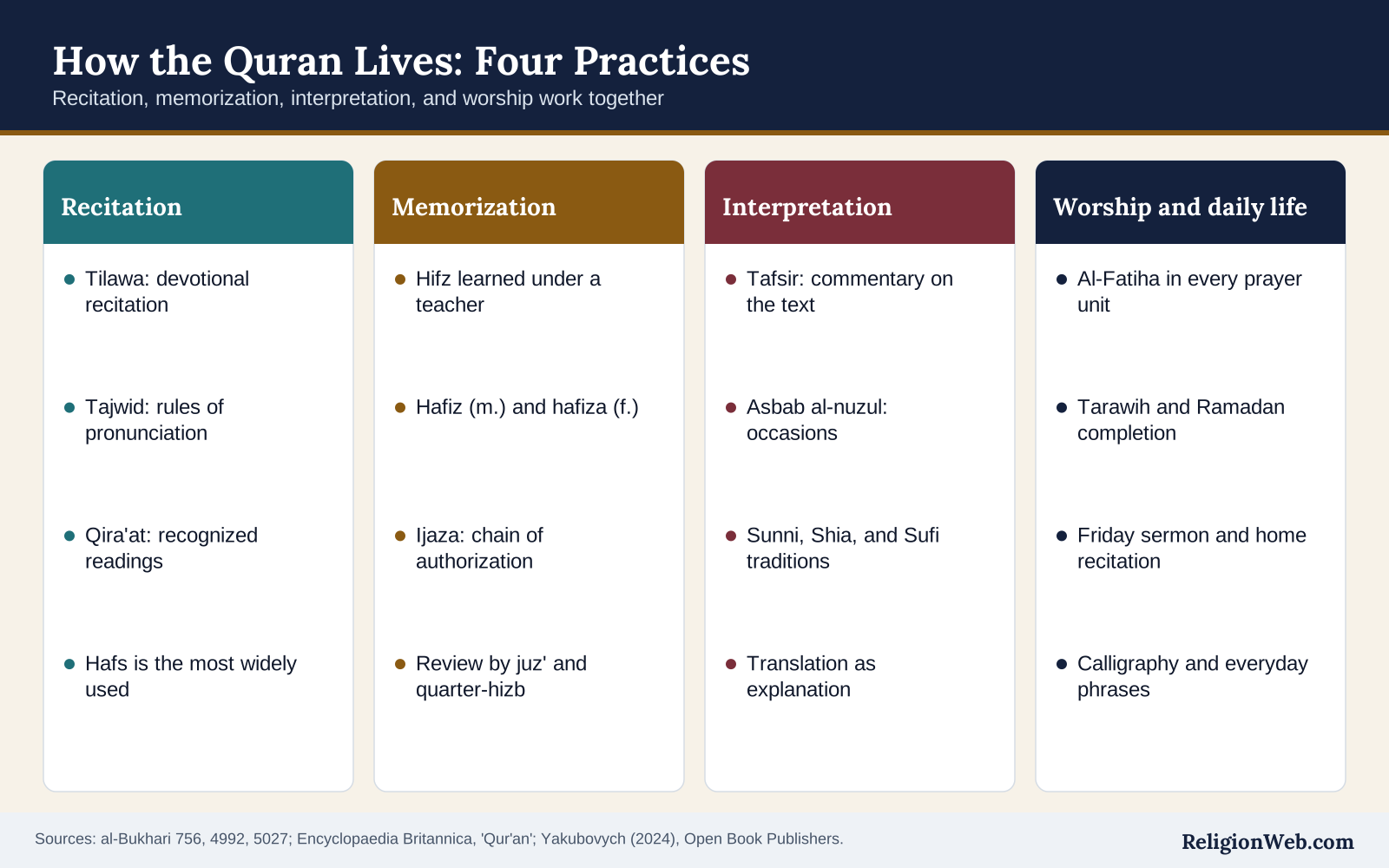
The Quran Across Muslim Communities
One Text, Several Traditions of Reading
The central fact about the Quran in the Muslim world is its unity as a text and the variety of the traditions that interpret it. The same Arabic wording is recited by Sunni, Shia, Ibadi, and Sufi Muslims, and the same chapters are memorized in Lagos and Jakarta, Tehran and Istanbul. The differences lie mainly in how the text is explained, which authorities are heard alongside it, and which devotional customs surround it.
Sunni communities
Sunni Muslims, who form the large majority of Muslims worldwide, treat the Quran as the first source of religious knowledge and the hadith as the second, and they study both through the methods of the four legal schools and the classical commentaries described above. The text in daily use is nearly always the Hafs reading, with Warsh and other readings in parts of Africa. The community’s institutions of learning, from village Quran schools to al-Azhar in Cairo, give the Quran a structure of teaching that connects each reciter to a chain of teachers. The wider history of this tradition is set out in the article on Sunni Islam.
Shia communities
Shia Muslims revere the same Quran and recite it in the same Arabic. Twelver Shia authorities state that the Quran in use is complete and unaltered, and they regard accusations that Shia use a different book as a misunderstanding. Shia tradition emphasizes that the Prophet arranged the Quran in his lifetime, and it preserves reports that ‘Ali ibn Abi Talib prepared his own copy. Interpretation is shaped by the belief that the Imams from the Prophet’s family are authoritative guides to the meaning of the text, and Shia commentators draw on their reported sayings alongside the Quran. The faith’s structure and history are described in the article on Shia Islam.
Other Currents and Movements
Sufi, Ibadi, and Ahmadi approaches
Sufi interpreters look for the inner meanings of verses, in a tradition that goes back to the early commentaries by al-Tustari and al-Sulami. For Sufis, recitation is a path of remembrance, and in some orders the Quran is recited aloud in groups as part of devotional gatherings. Ibadi Muslims, who live mainly in Oman and in a few North African communities, use the same Quran and have their own tradition of commentary and law. Ahmadi Muslims also recite the same text and have produced their own translations and commentaries. They identify as Muslims, while many Sunni and Shia authorities reject that classification, a disagreement that concerns the status of the movement’s founder and not the text of the Quran.
Quran-centered, literalist, and reformist movements
Modern times have seen movements that give the Quran a new emphasis. Small groups sometimes called Quranists hold that the Quran alone is sufficient for religious guidance and reject the authority of hadith, a position that the great majority of Muslim scholars have rejected on the ground that the Quran itself commands obedience to the Prophet and that its rulings on matters such as the details of prayer are clarified by his example. Salafi scholars stress reading the text in the light of the earliest generations. Reformist and modernist thinkers have asked how the Quran’s principles apply to contemporary life, sometimes by studying the historical context of its rulings. These movements disagree sharply among themselves, and each claims to be faithful to the Quran.
| Community or current | Text recited | Interpretive emphasis | Representative works or figures |
|---|---|---|---|
| Sunni | Same Arabic text; Hafs most common, Warsh and others regionally | Quran, hadith, Companions’ reports, and the legal schools | Al-Tabari, al-Razi, Ibn Kathir, al-Qurtubi |
| Twelver Shia | Same Arabic text, usually in the Hafs reading | Guidance of the Imams alongside the Quran; attention to inner meaning | Al-Tusi, al-Tabarsi, Tabataba’i |
| Zaydi and Isma’ili | Same Arabic text | Zaydi commentary close to Sunni method; Isma’ili stress on inner meaning (ta’wil) | Regional and school-specific works |
| Ibadi | Same Arabic text | Independent legal and theological tradition; the Quran regarded as created in some formulations | Ibadi commentators in Oman and North Africa |
| Sufi orders | Same Arabic text | Inner or allusive meanings; recitation as remembrance | Al-Tustari, al-Sulami, al-Qushayri |
| Ahmadi | Same Arabic text | Community commentary and translations; status disputed by many other Muslims | Community publications |
| Quran-centered and reformist currents | Same Arabic text | Quran as sole or primary authority; contextual reading | Varied and often individual |
The Quran in the World Today
Population, Language, and Teaching
Where Muslims live
According to Pew Research Center’s 2025 study of the global religious landscape, which analyzed censuses and surveys with data years 2010 and 2020, Muslims made up 25.6 percent of the world’s population in 2020, about 2.0 billion people, an increase of 347 million over the decade. Fifty-nine percent of Muslims lived in the Asia-Pacific region, about 18 percent in sub-Saharan Africa, and about one in five in the Middle East and North Africa. Indonesia alone had roughly 240 million Muslims, and India 213 million. The Quran is therefore read, heard, and taught mostly by people whose first language is not Arabic, which explains the strength of the institutions of language teaching and memorization.
Arabic as a shared sacred language
For many Muslims, learning to read the Quranic Arabic script is the first step in religious education, long before they can speak Arabic. Children in Pakistan, Nigeria, Malaysia, and Britain alike attend classes in which they learn the letters, the rules of tajwid, and then the short chapters. The script spread with the Quran: Persian, Urdu, Ottoman Turkish, Malay, and several African languages were written in Arabic letters for centuries. Adults who return to the study of Arabic often do so in order to understand the prayer and the Quran directly. The result is a worldwide community that shares a body of Arabic words and recitations, even as it speaks hundreds of different languages in everyday life.
Technology, Publishing, and Study
Printing, audio, and digital access
The King Fahd Glorious Quran Printing Complex in Medina describes its work as serving the Quran through print, audio, and computer technology. Its website provides recitations, translations, and digital editions of the Madinah Mushaf, and it lists a Braille edition dated August 2023. Other publishers and institutions offer searchable texts, mobile applications, and recorded teaching, so that a student in a remote village can follow a lesson online. Teachers and scholars generally support these tools as aids while cautioning that they cannot replace a qualified teacher for tajwid and memorization. The same technologies serve non-Muslim readers who want to consult the text in translation.
Academic study of the Quran
The Quran is also an object of academic study in universities worldwide, carried out by Muslim and non-Muslim scholars alike. Reference works such as the Encyclopaedia of the Qur’an (Brill, edited by Jane Dammen McAuliffe, 2001 to 2006) gather articles on every aspect of the subject, and monographs such as Nicolai Sinai’s The Qur’an: A Historical-Critical Introduction (2017) and Angelika Neuwirth’s work on the literary form of the chapters represent current approaches. Manuscript projects and digital databases make new evidence available to researchers. Within this field, Muslim scholars working in the tradition of classical exegesis and academic historians often ask different questions, and the most careful work in either camp acknowledges the other’s contribution.
Common Misconceptions About the Quran
Misconception 1: The Quran is arranged as a chronological biography of Muhammad
Where the misunderstanding comes from
Many readers come to the Quran expecting a book that begins with a birth, moves through a life, and ends with a death. That expectation is natural, since a good deal of religious literature is organized that way, and the Quran does speak in the voice of a prophetic mission that Muslims know to have had a beginning and an end. Popular accounts of Muhammad’s life also tend to quote the Quran at the points where a passage is said to have been revealed, which can give the impression that the book follows the story. The Quran’s own references to events, such as the battle of Badr (3:123), the battle of Hunayn (9:25), or the confederate siege of Medina that gave its name to the chapter called al-Ahzab, “the Allies,” can add to the impression that the text is a running record.
What the evidence and tradition actually show
The Quran is organized, after the opening chapter, roughly by the length of its chapters, and not by the date of revelation or the order of the Prophet’s life. The sequence of events is known to Muslims from other sources, namely the biographical tradition and the hadith, and the Quran is read alongside those sources. Even within a single chapter, passages of different dates may sit side by side, and the tradition itself notes that the Prophet indicated where each revealed passage belonged. Scholars, both Muslim and academic, have built chronologies of the surahs, but these are reconstructions with real disagreements among them. The Prophet’s name occurs only a few times in the Quran, and most passages address him without naming him. Readers who want the narrative of his life will find it in the article on Muhammad, and those who want the Quran’s own order should treat it as an arrangement for recitation.
The point has a historical side as well. The earliest full biography of the Prophet that survives, the work of Ibn Ishaq as edited by Ibn Hisham (died 833 CE), was compiled well after Muhammad’s death, and it relies on the Quran and on oral reports to fill in the sequence of events. Many historians regard the Quran as the earliest surviving text from the period, but they also note that it supplies few of the narrative details, such as dates, places, and the names of individuals, that a biography would need. That is one reason the biographical tradition and the Quran are studied together and are not mistaken for each other.
Misconception 2: Translations function identically to the Arabic text in all religious contexts
Where the misunderstanding comes from
Readers who use an English edition naturally refer to it as “the Quran,” and booksellers, libraries, and websites often treat the translation as if it were the book itself. In many other fields of reading, a translation is accepted as a substitute for the original, so the habit carries over. Translators sometimes reinforce the impression by choosing a confident title, and the Muslim practice of using translations for study can look to an outsider like a statement that translation and original are the same.
What the evidence and tradition actually show
In most Muslim frameworks the Quran proper is the Arabic wording, and a translation is classed as an explanation of its meanings. This is why translators speak of rendering the “meaning” of the book, and why the ritual prayer is performed with Arabic recitation. A medieval jurist such as Ibn Qudama is reported to have held a prayer invalid if the Quran was recited in another language, and the dominant legal view remains that recitation in worship must be in Arabic. Outside the prayer, translations are widely used and encouraged for study, and leading modern scholars of al-Azhar approved them on conditions. Translations differ among themselves because translators make choices and reflect different traditions, and no single English rendering has the status of the original. Muslim opinion on details, such as the use of translations in sermons, varies by region and school.
The difference shows in everyday practice. In many countries the Friday sermon is delivered largely in the local language, while the Quranic verses within it are recited in Arabic and then explained. Families who read a translation at home usually keep a copy of the Arabic beside it, and a student preparing for the prayer learns the Arabic words by heart even if the meaning is studied in another language. A translation is also, in a sense, a small commentary, because every rendering involves a decision about what a word or phrase means, and for that reason serious readers compare more than one.
Misconception 3: Every surah is the same length or literary form
Where the misunderstanding comes from
The word “chapter” suggests a unit like the chapter of a modern book, of roughly comparable size and shape, and the translation of surah as “chapter” makes the assumption easy. A reader who meets the Quran first in short excerpts, such as the opening chapter or one of the brief closing chapters, may form a picture of the whole from the part. The numbering of verses, which looks uniform on the page, adds to the impression of a regular structure.
What the evidence and tradition actually show
The chapters differ greatly in size and form. The longest, al-Baqara, has 286 verses and is longer than many of the shortest chapters put together, while the shortest, al-Kawthar, has three. Some chapters are made of short rhythmic verses, such as the oaths and warnings of the Meccan period, and others contain long legal passages, such as the Medinan chapters on inheritance and contracts. One chapter, Yusuf, tells a single story in order, while others weave together many themes. The opening chapter, al-Fatiha, is unusual because it is a prayer in the worshiper’s voice, in which the community addresses God, while most of the Quran is in the voice of God addressing human beings. Twenty-nine chapters begin with the disconnected letters, and 113 of the 114 begin with the opening formula. The variety is part of why the Quran is studied by surah and by passage, and not as a uniform series.
Forms also mix within a single chapter. The long second surah moves between rules on fasting, pilgrimage, and finance, accounts of earlier prophets, and short prayers that the believer is invited to say, and many other chapters combine warnings, descriptions of the natural world, and moral instruction in quick succession. A reader who expects each chapter to have one subject, as a chapter of a textbook does, will find the Quran easier to follow once the expectation is dropped and the chapter is read as a sustained address with several movements.
Misconception 4: Different Muslim communities use different versions of the Quran
Where the misunderstanding comes from
The idea has several roots. Some of it comes from the existence of recognized readings, which students of the subject hear about as “the seven readings” or “the ten readings” and may take to be separate texts. Some comes from historical reports about the personal copies of Companions such as Ibn Mas’ud, whose arrangement or wording differed from that of the standard codex, and from the early manuscript evidence of variant texts such as the lower layer of the Sanaa palimpsest. Some comes from polemical writing that has alleged secret or altered Qurans in one community or another, claims that tend to be repeated without reference to the communities’ own statements.
What the evidence and tradition actually show
Sunni, Shia, Ibadi, Sufi, and Ahmadi Muslims recite the same Quran, and the printed text most widely used is the Hafs reading of the Cairo and Madinah editions. The recognized readings are variant ways of vocalizing and, in some cases, pointing the same consonantal skeleton, and they are accepted by the tradition because they meet the tests of agreement with the written codex, with Arabic grammar, and with an authentic chain. They differ in small details, and they do not amount to rival books. Shia scholars state that their text is the same as the Sunni text, and the claim that they hold a different Quran is rejected by them as a misconception. The early variant manuscripts are important to historians, but they were private or regional copies that did not become the standard text. Differences of interpretation, which are real and significant, are a different matter from differences of text.
Misconception 5: The Quran is primarily a legal code
Where the misunderstanding comes from
Public discussion of Islam often centers on law, under the heading of “sharia,” and it is easy to assume that the main scripture is a rulebook in the way a statute book is. The Medinan chapters do contain specific rules, and they receive disproportionate attention because they bear directly on questions of public policy. Readers who see only the verses cited in political or legal debates may form a picture in which the Quran consists mostly of commands and penalties.
What the evidence and tradition actually show
Most of the Quran’s content concerns faith, ethics, the Day of Judgment, God’s attributes, the signs of creation, and the stories of earlier prophets. Rules appear in a relatively small portion of the text, chiefly in the Medinan chapters, and many of those rules are stated in broad terms that jurists elaborate. Islamic law as a body of rulings is the work of jurists who developed it over centuries from the Quran, the example of the Prophet preserved in hadith, scholarly consensus, and reasoning by analogy, and the legal schools differ on many matters. The relationship is explored in the articles on hadith and on the five pillars, which show how the core obligations are drawn from the Quran and practiced in the Prophetic example. Treating the Quran as a legal code overlooks the greater part of its text, and Muslims themselves approach it first as guidance for worship and character.
Even where the text states a rule, its application is a matter of interpretation. Jurists distinguish between general and specific statements, between rulings tied to a circumstance and rulings meant to apply broadly, and between obligations and recommendations, and the schools of law and the Shia and Ibadi traditions have reached different conclusions on some questions. For this reason, statements that begin with “the Quran says” and then describe a modern legal system compress a long process of reasoning, and the better question is usually which tradition of interpretation is being described.
Frequently Asked Questions About the Quran
Questions About Origins and the Text
Who wrote the Quran?
Muslims believe that God is the author of the Quran, whose words were conveyed to Muhammad by the angel Gabriel and recited by him to his followers, who memorized them and had them written down. On this view Muhammad was the messenger and not the composer. Academic historians do not adjudicate the question of divine origin, which is a matter of belief, and they study the text’s language, setting, and history. Both Muslim tradition and academic scholarship agree that the text was transmitted in Muhammad’s community in the early seventh century, and that its recitation and writing began very early.
Has the Quran changed since the time of Muhammad?
Muslims hold that the Quran has been preserved, and they cite the promise in 15:9 and the continuous chain of recitation and teaching. Academic studies take account of manuscripts: radiocarbon dating of early leaves such as the Birmingham fragments is consistent with the traditional picture, and Britannica states that the received text was probably in existence by about 650 CE. Historians also note early variant material such as the lower text of the Sanaa palimpsest, and they continue to discuss how the text was standardized. The most careful statement is that the text now in use is closely continuous with the early written tradition, and that the details of the earliest period remain a subject of research.
How long did it take for the Quran to be revealed?
Muslim tradition gives a period of about twenty-two or twenty-three years, from the first revelation in the cave of Hira to the Prophet’s death in 632 CE, with roughly thirteen years in Mecca and ten in Medina. The exact figures vary slightly between sources because of different counts of the years before and after the migration. The text itself says that it was sent down in portions.
Questions About Reading and Using the Quran
How should a non-Muslim reader approach the Quran?
A good approach is to begin with a translation that states its method, to read alongside a commentary or study edition, and to read a chapter at a time without expecting a continuous story. Starting with the short chapters near the end, or with the chapter of Joseph, can be easier than starting at the second chapter. It helps to remember that Muslims experience the text as recitation, so listening to a recording while following a translation adds a dimension that the page alone lacks. Readers who handle a printed mushaf are welcome to do so respectfully, following the customary etiquette of keeping it clean and off the floor.
Do Muslims have to learn Arabic?
Muslims are required to recite certain Arabic texts in prayer, beginning with the opening chapter and the formulas of worship, so every Muslim learns some Arabic. Beyond that, the extent of learning varies. Many Muslims read the Arabic script and recite the Quran without speaking the language, and they use translation and commentary for meaning. Others study Arabic seriously in order to read the text directly. Because most Muslims are not Arabic speakers, institutions in every region teach the recitation of the Quran as a distinct skill from the spoken language.
How many Muslims have memorized the whole Quran?
There is no single reliable global count, and the figures that circulate are usually reported by country, by school network, or by institution. What can be said is that memorization is a living practice in many countries and that, in the Muslim understanding, a community should always include people who have learned the text by heart. The hafiz and hafiza are respected, and they often lead the long Ramadan prayers.
Questions About Meaning and Interpretation
Who is allowed to interpret the Quran?
In Islamic tradition there is no single office with the power to settle every interpretation, and no council has issued an authoritative commentary for all Muslims. Instead, the tradition regards interpretation as a discipline that requires knowledge of Arabic, of the Quran as a whole, of hadith, and of the earlier commentaries, and it honors scholars who have mastered these. Ordinary Muslims read translations and commentaries and consult teachers, and communities differ in how much weight they give to individual judgment compared with inherited scholarship.
What is the difference between the Quran and the hadith?
For Muslims, the Quran is the speech of God conveyed in its exact words, while the hadith are reports of the words and actions of the Prophet, transmitted by chains of narrators and evaluated for authenticity. Both are sources of guidance, but they differ in status and in the way they are used in worship, since the Quran is recited in prayer and the hadith are not. The two are closely connected in practice, because the hadith explain how the Quran’s commands were carried out, and the subject is explored in the article on hadith.
Why do translations of the Quran differ?
Translations differ because Arabic words often have several meanings and because translators have different aims, from literal accuracy to readability to the inclusion of explanatory notes. They also reflect different interpretive traditions: a Sunni, Shia, Sufi, or Ahmadi translator may choose different words for the same verse. A passage with an ambiguous construction, such as 3:7, can be punctuated in two ways. Comparing two or three translations, with a commentary, is the best way to see the range of possible meanings.
Conclusion: The Quran as Spoken, Written, and Lived
What the History and the Practice Show
A text that began in the voice
The Quran began, in the Muslim understanding, as speech heard and recited, and it remains first of all a text to be said aloud. Its structure of surahs and ayahs, its divisions for reading in a month or a week, its rules of tajwid, and its recognized readings all reflect the priority of the voice. The written text, produced under the early caliphs and now supported by the earliest manuscripts and radiocarbon evidence, carried that voice across space and time, and the printed standard texts of the twentieth century gave it a uniform shape. The two forms have always worked together: the page guides the voice, and the voice keeps the page alive.
Unity and variety in understanding
Muslims everywhere share the same book, and they interpret it through many traditions of commentary, law, and devotion. They differ over the createdness of the Word, the punctuation of 3:7, the touching of the mushaf, and the weight of the classical and modern commentaries, but they recite the same Arabic and honor it in the same way. For readers outside the faith, the Quran is best approached as a living text with a long chain of readers, and as the center of a religious culture that is described more fully in the article on Islam.
How to Keep Exploring
Reading and listening respectfully
A reader can start with a translation that explains its method, a recording by a trained reciter, and a good commentary, and can read a few chapters slowly. It helps to read the Quran in the light of the surrounding practice, for example by reading about the prayer in which it is recited and about Ramadan, the month most closely linked to it. Questions about belief or practice for an individual are best taken to a qualified teacher of the relevant tradition.
Related articles on ReligionWeb
This article is one of a group on Islamic sources and practice. The Prophet through whom the Quran was revealed is the subject of the article on Muhammad, the reports that explain his example are discussed in the article on hadith, and the obligations that the Quran establishes are described in the article on the five pillars of Islam. Together they offer a fuller picture of how the book is understood and lived.
Sources
The table below lists the principal external sources behind this article. Facts, dates and figures were checked against these and related primary, institutional and academic materials.
| # | Source | Publisher and type | Used for | Link |
|---|---|---|---|---|
| 1 | The Meaning of the Glorious Quran (Pickthall, 1930), Sacred Texts edition | Internet Sacred Text Archive · Primary text | All Qur'an quotations (15:9, 26:192-195, 17:106, 73:4, 3:7, 56:77-79); labeled public domain | sacred-texts.com |
| 2 | Qur'an | Encyclopaedia Britannica · Encyclopedia | Compilation and rasm, scholarly debates and dating, Nöldeke periods, tafsir history, themes | britannica.com |
| 3 | Sahih al-Bukhari, Book of the Virtues of the Qur'an (nos. 4986, 4987, 4992, 4998, 5016, 5027, 4364; also nos. 3 and 756) | Sunnah.com · Primary text | Collection under Abu Bakr and Uthman, seven ahruf, Gabriel's review, first revelation, Fatiha in prayer | sunnah.com |
| 4 | Birmingham Qur'an manuscript dated among the oldest in the world | University of Birmingham · Institutional | Radiocarbon range 568-645 CE (95.4%), surahs 18-20, Hijazi script (announced July 2015) | birmingham.ac.uk |
| 5 | How the Global Religious Landscape Changed From 2010 to 2020 | Pew Research Center · Demographic data | Muslims 25.6% of world population in 2020; +347 million since 2010 (published June 9, 2025) | pewresearch.org |
| 6 | Muslim population change, 2010-2020 | Pew Research Center · Demographic data | About 2.0 billion Muslims; regional shares; Indonesia and India figures (2020 data) | pewresearch.org |
| 7 | The Kingdom and the Qur'an: Translating the Holy Book of Islam in Saudi Arabia (Yakubovych, 2024) | Open Book Publishers · Academic monograph | Translation as 'meanings', recitation in Arabic, al-Azhar 1936 rules, Saudi printing history | books.openbookpublishers.com |
| 8 | King Fahd Glorious Quran Printing Complex (official site) | King Fahd Glorious Quran Printing Complex, Medina · Institutional | Madinah Mushaf, readings printed (Hafs, Warsh, al-Duri, Shu'ba, al-Susi, Qalun), Braille edition, translations | qurancomplex.gov.sa |
| 9 | Hafez (Persian poet) | Encyclopaedia Britannica · Encyclopedia | Fun Fact: Hafez (c. 1325-1390) and the meaning of the name as one who has memorized the Quran | britannica.com |
| 10 | The Cairo Edition of the Qur'an 1924: Texts, history and challenges | Institut dominicain d'etudes orientales (IDEO), Cairo · Academic conference page | King Fu'ad's Quran (Cairo 1924); critical views on its orthography and its influence on the Madinah Mushaf | ideo-cairo.org |
Last fact-check date: 2026-10-21.