Christmas is the Christian feast that celebrates the birth of Jesus of Nazareth, whom Christians confess as the Son of God made human. It is kept by the great majority of the world’s Christians, but not on a single day and not in a single way. Most Western churches observe it on December 25, while many Orthodox and Oriental Orthodox churches keep it on January 7 on the civil calendar, and the Armenian Apostolic Church observes the birth of Christ together with Epiphany on January 6. Behind those differences lies a shared conviction: that in the birth of one child in Bethlehem, God entered human history.
The feast is younger than many people assume. The New Testament never states the day or season of Jesus’ birth, and only two of its four Gospels, Matthew and Luke, tell the story of his birth at all. The earliest known evidence of a church feast on December 25 comes from the city of Rome in the 330s CE, roughly three centuries after the events it commemorates. Many of the customs now associated with the season, such as the crib, the carol, the Advent wreath, the decorated tree and the figure of Santa Claus, arrived later still, at different times and in different places. Treating those layers separately is the key to understanding Christmas accurately.
This guide explains Christmas on the terms of the churches that keep it. It begins with the birth narratives in Matthew and Luke and the doctrine of the Incarnation, then traces how the December date was established, how Advent and the Twelve Days frame the season, and how Catholic, Orthodox, Oriental Orthodox, Anglican and Protestant congregations worship. It then follows the histories of familiar customs, distinguishing religious observance from later commercial and civic traditions, and surveys practice in several regions today.
For the wider setting of these beliefs, readers may want to begin with the overview of Christianity and the portrait of Jesus Christ and the sources about him. Where churches differ, the differences are named and attributed rather than blended, because the Christmas season looks quite different in a Roman Catholic cathedral, a Coptic monastery, a Lutheran village church and a Pentecostal congregation.
Christmas at a Glance: Meaning, Names, and Key Terms
Before the history and the customs, it helps to fix what the feast means to those who observe it, what it is called in different languages, and which technical terms recur throughout the season. This section sets out that vocabulary so that later sections can use it precisely.
What Christians Celebrate at Christmas
The birth of Jesus and the doctrine of the Incarnation
At the simplest level, Christmas commemorates the birth of Jesus in Bethlehem, as told in the Gospels of Matthew and Luke. At the level of doctrine, it celebrates what Christians call the Incarnation, from the Latin in carne, “in flesh.” Catholic, Orthodox, Oriental Orthodox, Anglican and most Protestant teaching holds that the eternal Son of God, the second person of the Trinity, took human nature in the womb of Mary and was born as a child. The Gospel of John states this without any birth scene: its prologue says that the Word became flesh and lived among us.
That belief explains why the feast carries such weight even in traditions that attach little importance to the details of the stable or the star. For many Christians the central claim is not that a remarkable baby was born, but that God shared in human life from its beginning. Emphases differ. Eastern Christian hymns dwell on the paradox of the infinite God lying in a cave. Western liturgy and popular devotion often linger on the vulnerability of the infant. Many Protestant sermons concentrate on the Word made flesh and on the gift of salvation. These are differences of accent within one shared affirmation, not rival accounts of what Christmas is.
A festival of the church year, not a reconstructed anniversary
Christians do not usually claim that December 25 is the historical date of Jesus’ birth. Liturgical feasts work differently from birthday anniversaries. When a congregation sings that Christ is born “today,” it is entering a mystery that the church celebrates at a fixed point in its yearly cycle, just as it celebrates the Resurrection at Easter without claiming that Easter morning recurs. The date was chosen by the church for reasons that historians discuss at length, as a later section shows, and the question of the original day is separate from the meaning of the feast.
It also helps to know where Christmas stands in the church year. In Orthodox teaching, as the Greek Orthodox Archdiocese of America describes it, the Nativity is one of the most joyful days of the year but is second to the Resurrection. In the same way, many Western theologians treat Easter as the oldest and most central Christian feast, with Christmas developing later and growing in popular importance, especially in the modern period.
Names and Words for the Feast
Christmas, Nativity, and Noël
The English word “Christmas” derives from the Old English Cristes mæsse, “Christ’s Mass,” recorded in the eleventh century (an entry for 1038 is usually cited). The “Mass” in the name is the Eucharist, the central act of Christian worship, which reflects the fact that the feast was originally marked by a special celebration of Holy Communion; the worship traditions that follow are discussed in the article on the Eucharist, Communion and the Lord’s Supper. Older English also used “Yule,” from an Anglo-Saxon word for the midwinter period, and the word survives in some regional and poetic uses.
Other languages name the feast after the birth itself. “Noël” in French and “Natale” in Italian descend from the Latin natalis, “birth.” Spanish Navidad and Portuguese Natal come from nativitas, the same root as English “Nativity,” which is the formal term for the birth of Christ in theology, liturgy and art. Greek speakers say Christougenna, “Christ’s birth,” and Russian uses Rozhdestvo, “Nativity.” German Weihnachten is a plural phrase usually understood as “holy nights.” The variety of names points to a feast that grew up in many language communities rather than spreading from a single center.
A glossary of terms used throughout the season
The table below collects the terms that appear most often in discussions of Christmas. Some belong to every church, while others, such as Theotokos or Theophany, are used chiefly in Orthodox and Catholic settings.
| Term | Meaning | Where it is used most |
|---|---|---|
| Advent | The season of preparation before Christmas; the word comes from the Latin adventus, “coming” | Catholic, Anglican, Lutheran and many other Protestant churches |
| Nativity | The birth of Jesus; also the name of the feast and of artistic scenes of the birth | All traditions |
| Incarnation | The doctrine that the Son of God took human nature in Jesus | All traditions that accept the ancient creeds |
| Theotokos | “God-bearer,” the title given to Mary and affirmed at the Council of Ephesus in 431 | Orthodox and Catholic churches; also accepted in many Protestant theologies |
| Magi | The “wise men” or “wise men from the east” of Matthew 2, often called the Three Kings in popular tradition | All traditions; prominent at Epiphany |
| Epiphany / Theophany | “Manifestation” or “appearance of God”; January 6, with differing emphases by tradition | Western churches (Epiphany); Eastern churches (Theophany) |
| Christmastide | The season that follows Christmas Day, including the Twelve Days | Catholic, Anglican, Lutheran and others |
| Nativity Fast | The forty-day fast before Christmas kept by Orthodox and some Oriental Orthodox churches | Eastern and Oriental Orthodox churches |
| Crib, crèche, presepe | A model or tableau of the birth scene | Catholic, many Anglican and Lutheran settings; widespread in Latin Europe and the Americas |
The Birth Stories in the New Testament
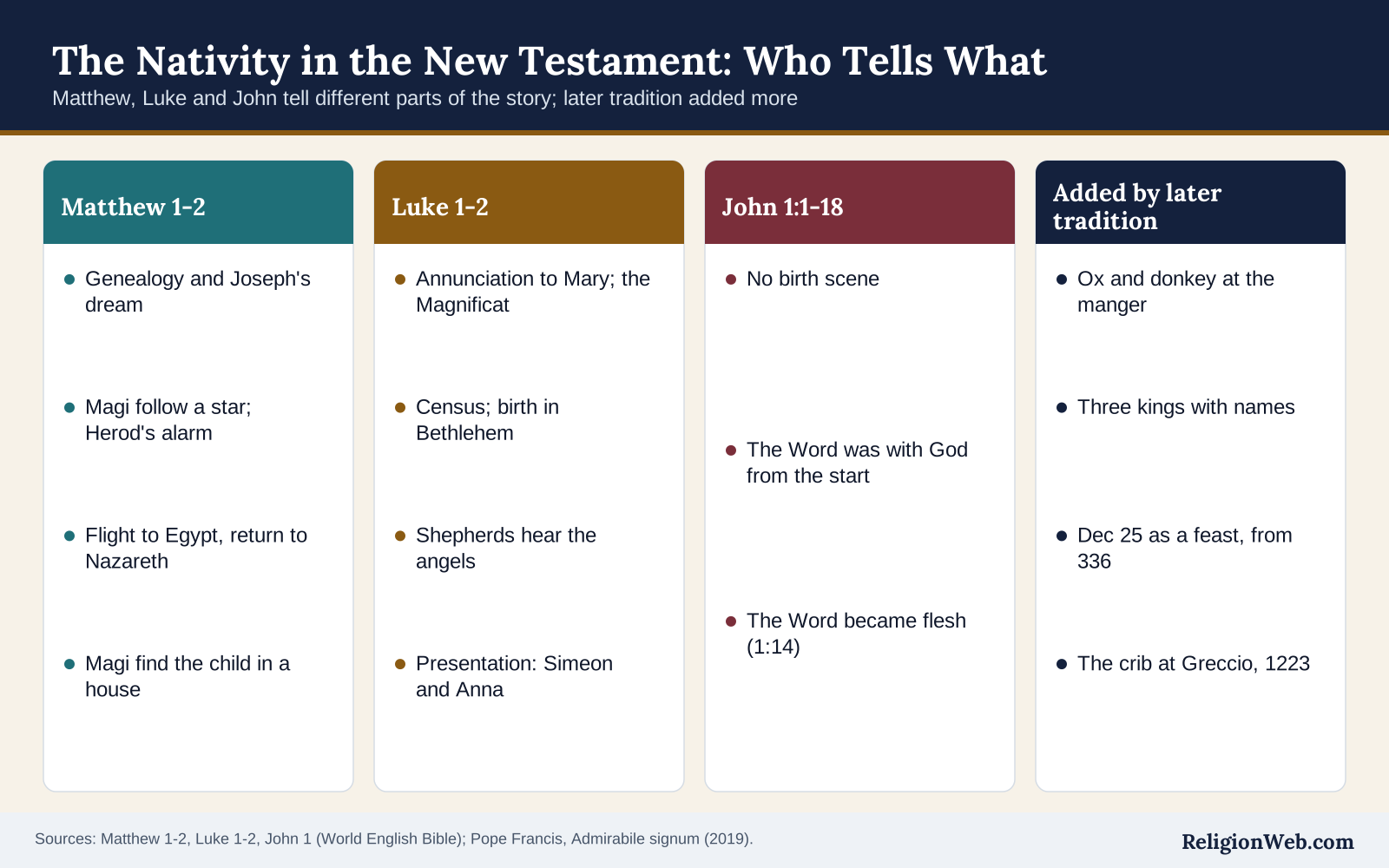
The New Testament contains two independent narratives of the birth of Jesus, one in Matthew 1–2 and one in Luke 1–2. They share a few core claims, including that Jesus was born in Bethlehem during the reign of Herod, that his mother was Mary, that she was betrothed to Joseph, and that the birth was announced by divine revelation. Beyond that, the two accounts select different scenes, characters and emphases. Readers who know the Christmas story as one harmonized narrative are usually combining the two, and it is worth first reading each on its own terms.
Matthew’s Account of the Birth
The genealogy, Joseph’s dream, and the name Emmanuel
Matthew opens with a genealogy that traces Jesus through Abraham and David and groups the generations in three sets of fourteen. The list includes four women besides Mary, an unusual feature in an ancient genealogy, and it presents Jesus as heir to the royal line of David. The story that follows is told largely from Joseph’s point of view. Mary is found to be pregnant before the marriage is completed, and Joseph, described as a righteous man, resolves to end the betrothal quietly. An angel appears to him in a dream, tells him that the child is from the Holy Spirit, and instructs him to name the child Jesus, because he will save his people from their sins.
Matthew then ties the event to Scripture by quoting Isaiah 7:14: the virgin will conceive and bear a son, and he will be called Emmanuel, which Matthew translates as “God with us.” This is the first of several passages in which Matthew explains events in the infancy of Jesus as the fulfillment of prophetic texts. The pattern of “this took place to fulfill what was spoken” runs through the first two chapters and shapes how the Gospel presents Jesus as a new Moses, a new David and a figure of Israel’s own history.
The Magi, Herod, and the flight to Egypt
The second chapter introduces visitors from the east. The passage reads, in the World English Bible, as follows.
Where is he who is born King of the Jews? For we saw his star in the east, and have come to worship him.
Matthew 2:2, World English Bible (public domain)
Matthew calls these visitors magoi, a Greek word for learned men who studied the heavens and interpreted signs, and he never gives their number, names or rank. They arrive in Jerusalem asking where the child is to be found, which troubles King Herod and, Matthew says, the whole city of Jerusalem with him. Herod consults the priests and scribes, who point to Bethlehem, and then asks the Magi to report back. After they find the child, worship him and offer gold, frankincense and myrrh, a dream warns them not to return to Herod. Joseph is likewise warned in a dream and takes Mary and the child to Egypt; Herod orders the killing of boys in Bethlehem, and the family returns after Herod’s death to settle in Nazareth. The Magi’s scene is set in a “house,” not a stable, a detail that becomes important when the two Gospels are combined.
Luke’s Account of the Birth
The Annunciation, the Visitation, and the Magnificat
Luke begins earlier, with the announcement to the priest Zechariah that his wife Elizabeth will bear a son, the future John the Baptist. In the sixth month of Elizabeth’s pregnancy the angel Gabriel appears to Mary in Nazareth and tells her that she will conceive and bear a son named Jesus, who will be called Son of the Most High and will receive the throne of David. Mary asks how this can be, since she has not been with a man, and the angel answers that the Holy Spirit will come upon her. Mary’s reply, that she is the Lord’s servant, is regarded in Christian tradition as a model of faithful acceptance. The scene is celebrated by Catholic, Orthodox and many Anglican churches as the Annunciation on March 25, nine months before December 25.
Mary then visits Elizabeth in the hill country of Judea. In what the tradition calls the Visitation, Elizabeth greets her as “the mother of my Lord,” and Mary responds with a hymn of praise, the Magnificat, which has been sung in Christian worship for many centuries. The Magnificat echoes the song of Hannah in 1 Samuel and speaks of God lifting up the lowly and filling the hungry with good things. Luke’s account is told largely from Mary’s perspective, in contrast to Matthew’s from Joseph’s.
Bethlehem, the shepherds, and the presentation in the Temple
Luke 2 opens with a decree from Caesar Augustus that “all the world” be enrolled, which brings Joseph and Mary from Nazareth to Bethlehem, the city of David. There Mary gives birth to her firstborn son and lays him in a feeding trough, the Greek phatne, usually translated “manger.” An angel then announces the birth to shepherds keeping watch over their flocks by night.
For there is born to you today, in David’s city, a Savior, who is Christ the Lord.
Luke 2:11, World English Bible (public domain)
The shepherds go to Bethlehem, find the child, and tell what they had been told; Luke says that Mary “kept all these sayings, pondering them in her heart.” On the eighth day the child is circumcised and named Jesus, and about forty days after the birth Mary and Joseph bring him to the Temple in Jerusalem, where the elderly Simeon and the prophet Anna recognize him. Luke ends the infancy narrative with the family’s return to Nazareth. The mention of shepherds, humble workers on the edge of society, is read in much Christian preaching as a sign that the good news is for the poor and the overlooked, a theme that runs through Luke’s Gospel.
John, Mark, and the Wider New Testament
The prologue of John’s Gospel
The Gospel of John contains no birth scene, but its opening verses supply the theological frame in which much of Christmas worship is set.
In the beginning was the Word, and the Word was with God, and the Word was God.
John 1:1, World English Bible (public domain); the Word’s becoming flesh is stated in John 1:14
Here the birth of Jesus is described in terms of eternity: the Word, who was with God from the beginning, “became flesh and lived among us” (John 1:14). The prologue is read at the principal Christmas Mass in the Roman Catholic Church and at many Anglican and Lutheran services, so that worshipers hear the Incarnation stated in its most concentrated form. In theological terms, John gives the meaning of the event while Matthew and Luke give its narrative.
Why Mark and Paul say little about the birth
Mark, widely regarded by scholars as the earliest Gospel, begins with the preaching of John the Baptist and says nothing about the birth of Jesus. The letters of Paul, the earliest Christian writings, mention that Jesus was “born of a woman” (Galatians 4:4) but offer no scenes. The silence of these writings is not usually read in the churches as a denial of the birth stories. Scholars generally explain it by the different purposes of the texts: Mark and the Pauline letters concentrate on the ministry, death and resurrection, while Matthew and Luke, written later, supply the beginnings. The relationship among the Gospels is discussed more fully in the overview of the Bible.
Historical Questions Scholars Discuss
Herod, Quirinius, and the year of the birth
Matthew and Luke place the birth in the reign of Herod the Great. Most historians date Herod’s death to 4 BCE, although a minority of scholars argue for 1 BCE, and the year numbering devised in 525 by the monk Dionysius Exiguus did not fix the birth with certainty. Because Herod’s death falls in 4 BCE on the most widely held reckoning, the usual scholarly estimate is that Jesus was born a few years before the year 1 of the modern calendar, though the precise year cannot be established.
Luke adds a further detail: the enrollment ordered by Augustus took place while Quirinius was governor of Syria. Roman and Jewish sources attest a census under Quirinius in 6 CE, which is later than Herod’s reign, and historians disagree about how to relate Luke’s note to that evidence. Some propose an earlier registration or a different reading of Luke’s Greek; others conclude that Luke has compressed or misplaced the chronology. Churches that hold to the inspiration of the Gospels differ on how they harmonize these details, and this article simply notes the question without resolving it.
The manger, the inn, and the cave
English readers often imagine an inn that turned Mary and Joseph away. The Greek word that older translations render “inn,” kataluma, can also mean a guest room, and Luke uses the same word for the guest room in which Jesus eats the Last Supper (Luke 22:11); many scholars therefore suggest that the family was lodged in the lower, shared space of a house where animals were kept. Luke says only that the baby was laid in a feeding trough “because there was no room for them” in the lodging place. He does not mention a stable, an innkeeper, or an ox and donkey.
The cave of the Orthodox Nativity icon has its own history. In the second century the Christian writer Justin Martyr wrote that Joseph, unable to find lodging in the village, took up quarters in a cave near it, and the Church of the Nativity in Bethlehem is built over a cave tradition that goes back to the early centuries. The ox and donkey are generally traced to a Christian reading of Isaiah 1:3 and to later apocryphal writings, and they became fixed in art and in the crib that Francis of Assisi arranged in the thirteenth century. Each detail has a history of its own, and the table below separates what the Gospels say from what later tradition added.
| Element | In the Gospels | Later tradition |
|---|---|---|
| Genealogy and Davidic line | Matthew 1 and Luke 3 give two different lists | Churches have harmonized them in several ways; the differences remain a topic of scholarship |
| Announcement to Mary | Luke 1:26–38 (Gabriel, Nazareth) | Marked as the Annunciation on March 25 in many churches |
| Announcement to Joseph | Matthew 1:18–25 (a dream) | Joseph’s role develops in later devotion and art |
| Journey to Bethlehem | Luke 2:1–5 (the census) | The donkey ride and the search for an inn are later elaborations |
| Place of birth | Bethlehem; a feeding trough (Luke); a house (Matthew 2:11) | A stable in the West; a cave in Eastern icons and in early writers such as Justin Martyr |
| Shepherds and angels | Luke 2:8–20 | Carols and pageants multiply the angels’ songs |
| Magi, star, and gifts | Matthew 2:1–12 (number unstated) | Three kings, named Caspar, Melchior and Balthasar, in medieval tradition |
| Herod and the flight to Egypt | Matthew 2:13–23 | Commemorated on the feast of the Holy Innocents, December 28 in the West |
| Presentation in the Temple | Luke 2:22–38 (Simeon and Anna) | Candlemas, February 2, forty days after Christmas |
What Christmas Means: Incarnation, Mary, and Prophecy
The Gospels tell the birth of Jesus as a story, but the churches have always also read it as a statement about who Jesus is. That reading developed through the New Testament itself, through the creeds of the fourth and fifth centuries, and through the prophetic texts that are read every year at Christmas. Understanding it explains why the same feast can be celebrated with a quiet candlelit service, a night-long liturgy or a children’s pageant.
The Doctrine of the Incarnation
From the prologue of John to the Nicene Creed
The earliest Christian writers already spoke of the Son of God “born of a woman” (Galatians 4:4), and John’s Gospel says that the Word became flesh. The creed formulated at the Council of Nicaea in 325 CE and expanded at Constantinople in 381 gave this belief its classic form. It confesses that the Son is “of one substance” with the Father and that for human beings and for their salvation he came down and was made flesh, being born of the Virgin Mary through the Holy Spirit. The Nicene Creed in this form is used in Catholic, Orthodox, Oriental Orthodox, Anglican and many Protestant liturgies, and in many churches the worshipers kneel or bow at the words that mention the Incarnation on Christmas Day.
For this reason, the birth of Jesus is treated in these churches as a doctrinal event as much as a narrative one. The Christmas texts speak of light entering darkness, of a king who is also a servant, and of God taking the form of the smallest and most dependent of human beings. The doctrine also makes Christmas inseparable from Easter: in the traditional reading, the child in the manger is the same person who is crucified and raised, and several Christmas gifts and hymns, such as the myrrh brought by the Magi, look forward to the Passion.
Ephesus, Chalcedon, and the title Theotokos
Two later councils shaped the language of Christmas worship. At Ephesus in 431 CE, the church affirmed the title Theotokos, “God-bearer” or “Mother of God,” for Mary. The title was meant to protect the claim that the child born in Bethlehem was truly God the Son and not merely a human being who later became divine; it makes a statement about Christ before it makes a statement about Mary. At Chalcedon in 451 CE the council defined that Christ is one person in two natures, divine and human. Catholic, Eastern Orthodox, Anglican and most Protestant churches accept this definition. The Oriental Orthodox churches, which include the Coptic, Ethiopian, Armenian and Syriac Orthodox churches, accepted Ephesus but did not accept the language of Chalcedon, and they describe their own Christology as faithful to the older formula. Their Christmas hymns and liturgies nonetheless proclaim the same birth; their history is covered in the article on Oriental Orthodox Christianity.
Mary and the Virgin Birth
Catholic and Orthodox teaching and devotion
Catholic and Orthodox teaching holds that Jesus was conceived by the Holy Spirit without a human father, and both traditions also hold that Mary remained a virgin throughout her life. The Christmas season gives Mary a prominent place. In the Roman Catholic calendar, January 1, the octave day of Christmas, is the Solemnity of Mary, the Holy Mother of God. Orthodox churches commemorate the Synaxis of the Theotokos on the day after Christmas, giving thanks for the one through whom the birth took place. The icon of the Nativity in the Orthodox tradition shows Mary reclining on a mat beside the child in the cave, with the Magi, shepherds and angels gathered around. The wider Catholic setting is described in the article on Catholic Christianity, and the Orthodox liturgical setting in the article on Eastern Orthodox Christianity.
Protestant and other perspectives
Most Protestant churches, including Lutheran, Reformed, Anglican, Baptist and Pentecostal bodies, affirm the virginal conception of Jesus, usually citing Matthew 1 and Luke 1. They generally differ from Catholic and Orthodox practice in not teaching the perpetual virginity of Mary as a required doctrine and in not offering her devotional prayer, and their Christmas worship concentrates on the child and the Word made flesh rather than on Marian titles. Some modern theologians and biblical scholars within Protestant and Catholic traditions understand the virginal conception primarily as a theological statement about Jesus’ identity rather than a biological report, and others defend it as historical. This is a live internal discussion, and it is best described as a range of positions held within the churches rather than a single position.
Prophecy, Light, and Hope in the Christmas Readings
How Matthew reads Isaiah and Micah
Matthew cites two Hebrew Scripture passages in his birth narrative. The first is Isaiah 7:14, quoted in Matthew 1:23 in a Greek form that renders the Hebrew almah, “young woman,” with the Greek parthenos, “virgin.” The second is Micah 5:2, which names Bethlehem as the origin of a future ruler of Israel, and Matthew 2:5–6 puts it in the mouths of Herod’s scribes. Christians have traditionally read these passages as prophecies of Christ. Within their own setting, the verses speak to eighth-century BCE Judah under King Ahaz and to hope for a future king from David’s line, and Jewish readers interpret them in those contexts. This article takes up the Christian reading because it is the one that shapes Christmas worship.
Isaiah 9 and the shape of the lectionary
The readings chosen for Christmas services show how the church links the birth to the larger story of Scripture. In the Roman Catholic lectionary, the Mass during the Night draws on Isaiah 9, which speaks of a people who walked in darkness seeing a great light and of a child born to us; the passage is read as a statement of the hope of Advent fulfilled. Similar readings are used in Orthodox and Anglican services. The pattern is the same in the great musical settings: Handel’s oratorio Messiah, first performed in Dublin in 1742, assembles Isaiah’s prophecies and the Gospel narrative into a work that many choirs now perform at Christmas, even though the premiere was in spring. The readings turn a story about one family into a story about hope for the world, which is how most Christians hear it.
How December 25 Became the Date of Christmas
The question of why Christmas falls on December 25 is one of the most discussed in the history of Christian worship, and the honest answer is that historians have several explanations and no single decisive document. What can be said with confidence is when the date first appears, how it spread, and which reasons Christian writers themselves gave. The sections that follow keep those three questions apart.
What the Earliest Christians Knew and Did Not Know
A silence in the New Testament
None of the Gospels gives the day, the month or the season of Jesus’ birth. Luke mentions shepherds in the fields at night, which is sometimes taken to rule out a cold December, but the detail does not fix a date and the climate around Bethlehem makes it neither impossible nor decisive. The first Christians seem to have had little interest in birthdays. The earliest communal feasts of the church were the weekly Sunday gathering and the annual celebration of the Passion and Resurrection that grew into Easter. Martyrs, in the following centuries, were commemorated on the day of their death, considered their birth into heaven, a practice that suggests the dominant pattern of devotion was not the birthday.
Early speculation about the date
By about 200 CE some Christian thinkers were asking when Jesus was born, and their answers varied. Clement of Alexandria wrote that some teachers identified the birth with the 25th of the Egyptian month Pachon, which corresponds to May 20, and others with the 24th or 25th of Pharmuthi, in April. Clement does not mention December 25. At about the same period Tertullian, writing in North Africa, calculated that the crucifixion had occurred on March 25 in the Roman solar calendar, a fact that would become central to later reasoning about the birth. A passage in a commentary on the book of Daniel attributed to Hippolytus of Rome, from the early third century, also names December 25, but many scholars doubt that this passage belongs to the original text, and the point is debated.
The First Records of a December Feast
Rome and the almanac of 354
The earliest clear evidence of a church feast of the birth of Christ on December 25 is Roman. A mid-fourth-century almanac, usually called the Chronography of 354 or the Philocalian calendar after its calligrapher, lists in its calendar of martyrs and bishops the entry for the eighth day before the calends of January, which is December 25: natus Christus in Betleem Iudeae, “Christ was born in Bethlehem of Judea.” Historians generally take this as evidence that the feast was being observed in Rome by the mid-330s, and the date 336 is commonly given for the first recorded Roman celebration. The same almanac also lists a festival of the “Unconquered” sun on December 25, an overlap that figures in one of the explanations discussed below.
Constantinople, Antioch, and North Africa
From Rome the December feast moved east and west. It was being celebrated in Constantinople by about 380, when Gregory of Nazianzus preached there a famous sermon on the birth of Christ, which he titled “On the Theophany, or Birthday of Christ.” Its opening lines are among the most quoted in Christian preaching.
Christ is born, glorify Him. Christ from heaven, go out to meet Him. Christ on earth; be exalted.
Gregory of Nazianzus, Oration 38.1, Browne and Swallow translation, Nicene and Post-Nicene Fathers, Series 2, vol. 7 (text as presented at New Advent)
Gregory’s rhythmic summons gathers the Incarnation into three short commands, moving from heaven to earth and from the hearer to the child. The sermon belongs to the period in which the East was adding December 25 to its older January 6 feast. In Antioch, John Chrysostom preached in 386 on a December 25 feast that was still fairly new to the city, which had also marked Christ’s baptism on January 6. In North Africa, Augustine noted around 400 that the Donatist church in North Africa kept December 25 but rejected January 6 as an innovation. By the end of the fourth century December 25 was widely known across the Mediterranean world, though Christians were not unanimous about it, and some regions retained the older January date.
| Approximate date | Source or event | What it shows |
|---|---|---|
| c. 200 CE | Clement of Alexandria, Stromata | Several proposed birth dates in April and May; no mention of December 25 |
| c. 200 CE | Tertullian, Against the Jews | The crucifixion placed on March 25 in the solar calendar |
| Early 3rd century | Commentary on Daniel attributed to Hippolytus | A December 25 date, but the passage’s authenticity is disputed |
| 274 CE | Emperor Aurelian promotes the worship of the Unconquered Sun | A Roman solar festival later listed on December 25 |
| 336 CE | Roman observance recorded in the Philocalian calendar | The earliest recorded church feast on December 25 |
| c. 380 CE | Gregory of Nazianzus in Constantinople | The feast is established in the Eastern capital |
| 386 CE | John Chrysostom in Antioch | The city previously marked Christ’s baptism on January 6; December 25 is introduced |
| c. 400 CE | Augustine on the Donatists | Dispute over whether January 6 is an innovation shows both dates in use |
| 567 CE | Council of Tours | Western bishops treat the days from Christmas to Epiphany as a festive season |
Two Scholarly Explanations
The calculation hypothesis
One explanation, associated with the French scholar Louis Duchesne in the early twentieth century and developed later by the liturgical historian Thomas Talley, argues that Christians arrived at December 25 by calculation. Early Christians widely held that Jesus was conceived and crucified on the same calendar day, an idea that fits the ancient intuition that great figures lived complete years. Tertullian dated the crucifixion to March 25, and an anonymous fourth-century North African treatise on solstices and equinoxes assigns both the conception and the Passion to that date. Nine months after March 25 is December 25. Augustine reasoned along the same lines in his work On the Trinity. The East shows a parallel pattern: Epiphanius of Salamis associated April 6 with the conception, which leads to January 6 for the birth. On this reading, December 25 and January 6 are two products of the same method applied to two different calendars.
The history-of-religions hypothesis
A second explanation proposes that Christians chose December 25 to coincide with, or to replace, a Roman festival, namely the worship of the Unconquered Sun (Sol Invictus) that Emperor Aurelian promoted in 274 CE. The idea appears first in a twelfth-century marginal note on a manuscript of the Syriac writer Dionysius bar-Salibi, and it was taken up by scholars of the eighteenth and nineteenth centuries. Supporters point to the coincidence of date and to the use of solar imagery for Christ by writers such as Ambrose of Milan. Critics reply that no early Christian writer says the date was chosen for this reason, that the Christian date appears before the age of Constantine, when Christians were wary of joining public Roman festivals, and that fourth-century Christians treated the solar imagery as a symbol, not a source. Many historians now treat the two explanations as compatible. A date reached by calculation could have been welcomed because it fell near the solstice, and solstice symbolism could have enriched a date already in use. The precise origin of the choice remains uncertain.
January 6, Two Calendars, and the Year of Birth
Epiphany and the Armenian Church
In the East, the older winter feast was Epiphany on January 6. Clement of Alexandria mentions a group in Egypt that kept the baptism of Jesus on a day corresponding to January 6 or 10, and the Roman historian Ammianus Marcellinus mentions the feast in 361. For a time, January 6 may have celebrated the manifestation of Christ in a broad sense, with the birth, the visit of the Magi and the baptism treated as aspects of one revelation. The Armenian Apostolic Church kept this older pattern. It observes the Holy Birth and Theophany together on January 6, with a Divine Liturgy followed by the Blessing of Water. The Armenian practice is, in this sense, not a late variant but a witness to an earlier stage of the church’s calendar.
Julian and Gregorian calendars today
Today the date of Christmas depends mainly on the calendar a church uses. The Julian calendar, introduced by Julius Caesar in 46 BCE, slightly overestimates the length of the solar year, so over centuries it drifts. Pope Gregory XIII introduced the Gregorian reform in 1582 to correct this, and most of the world adopted it. Several Orthodox churches kept the Julian calendar for the liturgical year, and between 1900 and 2099 it runs thirteen days behind the civil calendar, so that December 25 on the Julian calendar falls on January 7. The Russian, Serbian, Georgian and Jerusalem patriarchates, along with the Coptic, Ethiopian and Eritrean churches, follow the older calendar for Christmas. Other Orthodox churches, including those of Constantinople, Greece, Romania and Bulgaria, adopted a Revised Julian calendar for fixed feasts in the twentieth century and keep Christmas on December 25. In 2023 the Orthodox Church of Ukraine approved a move of its fixed feasts to the Revised Julian calendar, with parishes allowed a transition period. Because the difference is one of calendar and not of belief, a church that celebrates on January 7 is observing December 25 by its own reckoning.
The year of birth and the Christian era
The same period that fixed the December date also fixed the numbering of years. In 525 CE the monk Dionysius Exiguus stated that the current year was 525 years from the Incarnation of Jesus Christ, introducing the numbering of years that later became the common era. He used it in a table for calculating the date of Easter and did not claim to have determined the birth year with precision, and later historians, looking at the reign of Herod, concluded that Jesus was probably born a few years earlier than the system implies. The two questions, the day and the year, are therefore independent, and the church’s liturgical calendar has never depended on either.
The Christmas Calendar: Advent, Christmastide, and Epiphany
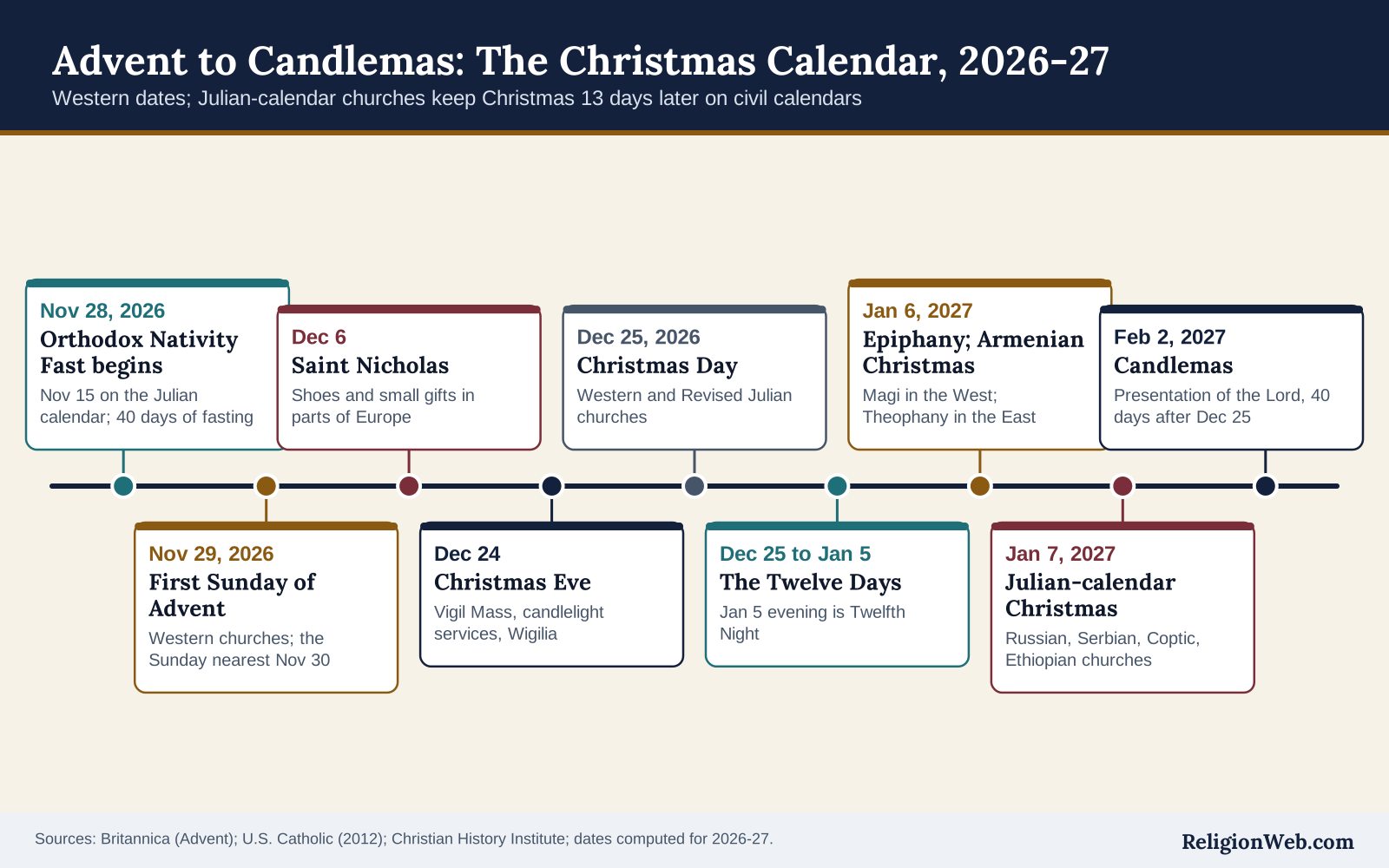
Christmas is better understood as a season than as a single day. In the Western church year it forms one of two great cycles, with Advent, Christmas and Epiphany on one side and Lent, Easter and Pentecost on the other. In the East it is anchored by the Nativity Fast and by the long feast that runs to Theophany. Each tradition prepares, celebrates and closes the season in its own way, and the dates differ by calendar, as the previous section explained.
Advent in the Western Churches
Origins in Gaul and Rome
Advent, from the Latin adventus, “coming,” is the period of preparation for Christmas. Historians agree that it developed later than Christmas and Epiphany and that it grew up independently in different places. The first sure evidence of a preparatory season is from Gaul in the fifth century, where Bishop Perpetuus of Tours directed that believers fast three days each week from the feast of St. Martin on November 11 until Christmas. Some scholars link this to an older period of preparation for baptism at Epiphany. A council meeting at Tours in 567 also refers to an Advent season of fasting.
The Roman pattern was different in tone. The early Roman evidence consists of sets of Sunday Mass prayers and readings that look forward to Christmas, and the season was at first festive rather than severe, though it later took on penitential features such as violet vestments and, in the Roman Mass, the omission of the Gloria. Advent lasted from four to six weeks for centuries. By the eleventh century most of the Western church followed the Roman length of four Sundays, though the Ambrosian rite of Milan still keeps six. Because it prepares for the coming of Christ both at Bethlehem and at the end of history, the season has a double meaning that distinguishes it from a simple countdown, and its penitential side recalls the practices described in the article on Lent.
Wreaths, colors, and themes
The best-known household custom of Advent is the wreath. Its modern form is credited to Johann Hinrich Wichern, a Lutheran pastor who directed the Rauhes Haus, a home for poor children in Hamburg. In 1839 he mounted candles on a wooden wheel, small ones for weekdays and larger ones for Sundays, so that children could count the days to Christmas. The custom spread among German Protestants, was gradually reduced to four or five candles, and was adopted by Catholics in Germany in the 1920s and then in North America in the 1930s.
The liturgical colors vary. Roman Catholic churches traditionally use violet, with rose on Gaudete Sunday, the third Sunday, whose name comes from the Latin gaudete, “rejoice.” Many Protestant churches use blue or purple. The four candles are often associated with hope, peace, joy and love, though the names and order differ among denominations. In the last week before Christmas, Western churches sing the “O Antiphons,” a series of short chants beginning with O that address Christ under titles taken from the prophets, such as Wisdom, Lord and Emmanuel. The nearly universal themes of the season are waiting, repentance and hope.
The Nativity Fast in Eastern and Oriental Churches
The Orthodox Nativity Fast
Eastern Orthodox churches observe a Nativity Fast of forty days. For churches using the Julian calendar, it runs from November 15 to December 24 on that calendar, which in the current century corresponds to November 28 through January 6 on the civil calendar; churches using the Revised Julian calendar keep it from November 15 to December 24 on the civil calendar. The discipline is generally to abstain from meat, dairy products and eggs, and many Orthodox also avoid fish, olive oil and wine on stricter days, with different local practices and with exemptions for children, the elderly, pregnant and nursing women, and the ill. Orthodox writers stress that the fast is meant to prepare the heart through prayer, almsgiving and reconciliation and not to be a mechanical test, and they warn against judging the fasting of others.
The fast intensifies as the feast approaches. The Forefeast of the Nativity begins on December 20 with daily hymns that anticipate the birth, and on Christmas Eve, known as Paramony, believers traditionally eat no solid food until the first star appears. The feast itself is a day on which fasting is forbidden. Fasting practices are spiritual disciplines and do not replace medical care, and the Orthodox themselves treat illness and need as grounds for adjusting them; anyone with a health condition should consult a doctor about fasting.
Coptic, Ethiopian, and Armenian practice
The Oriental Orthodox churches keep their own versions. The Coptic Orthodox Church observes a Nativity Fast before 29 Koiak, the Coptic date that corresponds to December 25 on the Julian calendar and to January 7 on the civil calendar. The fast is described as covering forty days, with three days added in the tenth century, so that it begins on 16 Hathor (November 25) and ends on January 6, Christmas Eve. The diet is mainly vegan, with fish allowed on some days. The Ethiopian Orthodox Tewahedo Church keeps a similar fast, known as Tsome Nebiyat, the Fast of the Prophets, which begins around November 25 and is described in Ethiopian sources as 43 days, and its monastic and lay members refrain from meat, dairy and eggs. The Armenian Apostolic Church holds its feast of the Birth and Theophany on January 6, preceded by preparation in the days before. Details of these fasts differ by diocese and by source, and the figures above reflect the usual patterns, not a single rule.
From Christmas Eve to Twelfth Night
Christmas Eve and Christmas Day
In the church’s liturgical reckoning, which follows the biblical phrase “evening and morning,” a day begins at sundown, so the evening of December 24 already belongs to the feast. Christmas Eve observances therefore have a real liturgical standing, not only a social one. In many Western parishes the principal services are held on Christmas Eve, from family candlelight services in Protestant and Anglican churches to the Catholic Masses of the vigil and the night. In Poland, the Christmas Eve meal, known as Wigilia, traditionally begins when the first star is sighted and has no meat; the family shares a blessed wafer, the opłatek, with wishes for the coming year, and many then attend the Pasterka, the midnight Mass. Ukrainian families, Orthodox and Greek Catholic, keep a comparable meatless Holy Supper on the eve, on December 24 or January 6 depending on the calendar.
On Christmas Day itself the Western churches hold their most solemn celebration of the Eucharist, and in the Orthodox world the Divine Liturgy of St. John Chrysostom follows the festal services of the eve. Many Christians spend the day with family and make a point of sharing a meal with neighbors or with people who would otherwise be alone, a practice grounded in the traditional emphasis on hospitality and charity at the season.
The days after Christmas
The days that follow Christmas Day are not an anticlimax in the church calendar. In the Western calendar, the three days after Christmas commemorate figures closely tied to the nativity story: Stephen, regarded as the first Christian martyr, on December 26; the apostle and evangelist John on December 27; and the Holy Innocents, the children killed at Herod’s command in Matthew’s account, on December 28. These feasts were attached to the season from around the year 400. The Sunday within the octave is observed in the Roman calendar as the feast of the Holy Family, and January 1, the octave day, is the Solemnity of Mary, the Holy Mother of God. The Orthodox churches observe the Synaxis of the Theotokos the day after Christmas and keep the feast of the Circumcision of Christ and of Saint Basil on January 1 on their own calendar. The cumulative effect is to keep the church’s attention on the birth for several days.
Epiphany, Theophany, and the Close of the Season
Epiphany in the Western churches
January 6, Epiphany, from the Greek epipháneia, “manifestation,” completes the Christmas season in the West. The Western churches emphasize the visit of the Magi, understood as the manifestation of Christ to the Gentiles. In Spain and Latin America, the day is the Día de los Reyes, the Day of the Kings, when children traditionally receive gifts, and families share a ring-shaped Rosca de Reyes cake in which a small figure of the Christ child is hidden. In Italy, the old woman Befana brings gifts. Many families chalk the initials C, M and B, for the traditional names of the three kings and also for the Latin Christus mansionem benedicat, “may Christ bless this house,” over their doors together with the year. In most Catholic dioceses of the United States the observance is transferred to the Sunday between January 2 and 8, so in 2027 it falls on January 3 instead of Wednesday, January 6.
Theophany in the Eastern churches
In the Eastern tradition the January 6 feast is called Theophany, “appearance of God,” and focuses on the baptism of Jesus in the Jordan River, when, according to the Gospels, the Spirit descended and a voice from heaven spoke. Its central rite is the Great Blessing of Waters. In Greece, Bulgaria and North Macedonia, a priest throws a cross into a river, sea or lake, and young men dive to retrieve it. In Ethiopia and Eritrea, the corresponding feast is Timkat, in which replicas of the Ark of the Covenant, called tabots, are carried in procession. The Armenian Church celebrates the Birth and Theophany together with a Blessing of Water. The baptismal themes are explained in the article on Baptism. Churches on the Julian calendar keep the feast on January 19 on the civil calendar.
The Baptism of the Lord, Candlemas, and the end of the season
The end of the Christmas season is not marked uniformly. In the Roman Catholic calendar Christmastide ends with the feast of the Baptism of the Lord, observed on the Sunday after Epiphany, which in 2027 falls on January 10. Lutheran and Anglican churches generally count Christmastide as December 25 to January 5 and follow it with Epiphanytide. Candlemas, February 2, the Feast of the Presentation of Jesus in the Temple, falls forty days after December 25, and it follows Luke’s account of Mary and Joseph bringing the child to Jerusalem; in some European households and parishes the crib and decorations remain in place until that day, and the blessing of candles on that day gives the feast its name. The table below summarizes the sequence for 2026 and 2027, computed from the rules in this section.
| Date | Observance | Tradition and notes |
|---|---|---|
| November 28, 2026 | Nativity Fast begins on the Julian calendar (November 15) | Orthodox churches using the Julian calendar; the Coptic and Ethiopian fasts begin about November 25 |
| November 29, 2026 | First Sunday of Advent | Western churches; the Sunday nearest November 30 |
| December 6 | Saint Nicholas | Western churches and many Eastern churches on their own calendars |
| December 13, 2026 | Gaudete Sunday (third Sunday of Advent) | Roman Catholic, Anglican and Lutheran use of rose |
| December 24 | Christmas Eve | Vigil Mass, family services, Wigilia; Paramony in Eastern churches using the new calendar |
| December 25, 2026 (Friday) | Christmas Day | Western churches and Orthodox churches using the Revised Julian calendar |
| December 26–28 | Stephen, John, and the Holy Innocents | Western calendar |
| January 1, 2027 | Solemnity of Mary, Mother of God | Roman Catholic; a civil New Year in most countries |
| January 3 or 6, 2027 | Epiphany | January 3 in most United States Catholic dioceses; January 6 in many other places |
| January 6–7, 2027 | Armenian Christmas and Theophany; Orthodox, Coptic and Ethiopian Christmas on January 7 | Julian calendar churches |
| January 10, 2027 | Baptism of the Lord | Roman Catholic end of Christmastide |
| February 2, 2027 | Presentation of the Lord (Candlemas) | Forty days after December 25 |
Worship at Christmas: Liturgy, Music, and the Nativity Scene
For most churches, the heart of Christmas is not a custom but an act of worship. The services differ widely in form, length and mood, from a Roman Catholic Mass sung at midnight to an Ethiopian vigil that runs through the night, but nearly all of them combine readings from Scripture, hymns, prayer and the celebration of Holy Communion. The sections below describe the main patterns by tradition and then turn to the music and the nativity scene that have become part of nearly every Christian Christmas.
Christmas Liturgies in the Western Churches
The four Masses of the Roman Catholic Church
The Roman Catholic liturgy provides four Masses for Christmas, each with its own prayers and readings, which together unfold the meaning of the feast. The Vigil Mass, celebrated on the afternoon or evening of December 24, still looks ahead, and its Gospel is the genealogy and the account of Joseph’s dream from Matthew 1. The Mass during the Night, often called Midnight Mass, announces the birth itself with Luke’s account of the angels and the shepherds. The Mass at Dawn continues Luke’s narrative as the shepherds hurry to find Mary and Joseph and then spread the news. The Mass during the Day turns to the prologue of John, with its theology of the Word made flesh.
The progression moves from waiting to arrival and from the story to its meaning. At Christmas, the hymn “Glory to God in the highest,” which is omitted during Advent, returns to the Mass, echoing the angels’ song in Luke 2. Worshipers kneel or bow during the lines of the Creed that speak of the Incarnation. Many parishes celebrate only one or two of the four Masses, but the full set of texts is available in the missal, and the sequence is often read as a short course in Christmas theology. The Eucharist at the center of each Mass is described further in the article on the Eucharist.
Anglican, Lutheran, and other Protestant services
Anglican churches typically hold a Midnight Eucharist or a Christmas morning service alongside a family service, and many hold a service of Nine Lessons and Carols. The form began in 1880 at Truro Cathedral in Cornwall, where Bishop Edward White Benson arranged it in part to draw people from the pubs of the town into church on Christmas Eve. It became world famous after 1918, when Eric Milner-White, the dean of King’s College, Cambridge, adapted it in the aftermath of the First World War. The BBC began broadcasting the King’s service by radio in 1928. It consists of nine short readings, from the fall in Genesis through the prophets to the Gospel of John, interspersed with carols and anthems, and it opens with a solo treble singing the first verse of “Once in Royal David’s City.” The tradition belongs to the Anglican world but is now widely borrowed by other churches.
Lutheran, Reformed, Methodist, Baptist and other Protestant congregations usually hold a candlelight service on Christmas Eve, with readings from Luke 2, familiar carols, and often a sermon on the Incarnation. At the close of a candlelight service, the congregation commonly lights small candles and sings “Silent Night,” a ritual meant to recall the light that John’s Gospel says shines in the darkness. Protestant attitudes toward the day have varied historically, as a later section shows, and the range of present practice is described in the article on Protestant Christianity. In some free churches the main Christmas worship takes place on the Sunday before the day, with a shorter Christmas Eve service as an addition.
Christmas Liturgies in the Eastern and Oriental Churches
The Orthodox services of the Nativity
In the Eastern Orthodox churches, the festal services begin on Christmas Eve with the Royal Hours, a sequence of psalms, hymns and readings that is traditionally said to be named for the emperor’s attendance at the service in Constantinople. In the evening comes either Great Compline, with its refrain “God is with us,” or a Vesperal Liturgy of St. Basil, depending on the day of the week and local custom, followed on the feast day by Orthros, the morning service, and the Divine Liturgy of St. John Chrysostom. The hymns of the feast are the work of named hymnographers from the early and Byzantine centuries, among them Anatolius, Sophronius, Andrew of Jerusalem, John of Damascus, Cosmas of Maiuma and Germanus of Constantinople, and the Orthodox churches still sing them.
The Orthodox icon of the Nativity is part of the liturgy in the sense that it too is a theological statement. It shows a dark cave in a mountain at the center, in which the infant lies wrapped in swaddling clothes in a manger, with Mary reclining beside him, the shepherds and angels to one side and the Magi following the star on the other. The cave is often understood as an image of the darkness of the world into which the light enters, and the details draw on Luke, Matthew and early Christian tradition together.
Coptic, Ethiopian, and Armenian celebrations
The Coptic Orthodox Church celebrates Christmas on January 7 on the civil calendar, and Christmas Eve is marked by a long liturgy that runs through the night of January 6 and into Christmas morning, after the long fast has ended. Egypt has recognized Christmas as a national holiday since 2003. In the Ethiopian Orthodox Tewahedo Church, the feast, called Genna, also falls on January 7. Worshipers attend an overnight service, wear a thin white cotton garment, the netela, and join a long procession around the church; pilgrims travel to the rock-hewn churches of Lalibela. A village game of the same name, resembling field hockey, is played on Christmas Day and is traditionally said to recall the shepherds watching their flocks.
The Armenian Apostolic Church observes the Holy Birth and Theophany on January 6 with a Divine Liturgy followed by the Blessing of Water, in which the cross is dipped in water and holy oil, Muron, is poured into it. These practices show the older unity of the winter feast of the manifestation of Christ, and the article on Oriental Orthodox Christianity gives the broader context of these churches.
Carols and Sacred Music
From early hymns to medieval and Reformation carols
Music is among the oldest elements of Christmas worship. The Eastern churches inherited a body of hymns for the Nativity composed in Greek and Syriac, while the Western church developed Latin hymns and, from the later Middle Ages, vernacular songs. The English word “carol” originally meant a song for a ring dance, with a refrain, and the Christmas carols of the fifteenth century combined that popular form with religious subjects. At the Reformation, Martin Luther, who valued music highly, wrote the children’s carol “Vom Himmel hoch” in the 1530s, and Lutheran congregations began singing hymns in German at Christmas. In the eighteenth century Charles Wesley’s hymn, which begins “Hark! how all the welkin rings,” was revised into “Hark! the herald angels sing” and became a staple of English-language Christmas worship.
“Silent Night” and the modern carol service
Few carols have spread as widely as “Silent Night” (Stille Nacht). Its words were written by the young priest Joseph Mohr, and the melody was composed by the schoolmaster and church musician Franz Xaver Gruber. The carol was first sung on Christmas Eve 1818 at the Church of St. Nicholas in Oberndorf near Salzburg, in Austria, with guitar accompaniment, possibly because the church organ was not usable. It spread through traveling singers and print, and John Freeman Young, an Episcopal priest in New York, published the best-known English translation in 1859. UNESCO recognized it as intangible cultural heritage in 2011. Alongside it, the Nine Lessons and Carols service established the modern English-speaking pattern of the carol as a form of worship, not entertainment.
The Nativity Scene
Francis of Assisi at Greccio
The tradition of the nativity scene, called the crib, crèche or presepe, is usually traced to Francis of Assisi. According to the apostolic letter Admirabile signum, issued by Pope Francis in 2019, the saint stopped at Greccio, near Rieti, in 1223, after the pope had confirmed his Rule. The caves around the village reminded him of Bethlehem, which he had visited. About two weeks before Christmas he asked a local man named John to help him prepare a living scene of the birth. On Christmas night, friars and people from neighboring farms gathered with flowers and torches, and Francis found a manger filled with hay and an ox and a donkey standing beside it. A priest celebrated the Eucharist over the manger. There were no statues; the scene was made by the people present, and Francis’s biographer Thomas of Celano reported that everyone went home full of joy. The first nativity scene was thus not a display but an act of worship.
What the scene is meant to teach
The later crib, made first by Franciscans and then by families, parishes and artists across Europe and Latin America, became one of the most widespread forms of Christmas devotion. In Admirabile signum, Pope Francis described its figures as a catechism in miniature: the starry sky points to God’s closeness in darkness, ruins signify a fallen world that Christ renews, and the poor and ordinary people, among them the blacksmith, the baker and the children, show that everyday life can be holy. The three kings with gold, frankincense and myrrh are interpreted in Catholic tradition as honoring his kingship, divinity and humanity, which would face death. Some Protestant churches have historically been wary of statues and keep to the biblical narrative in their pageants, while Orthodox churches use the Nativity icon, not a three-dimensional scene, as their central image. The table below sets the main worship customs side by side.
| Tradition | Characteristic service or custom | What happens | Meaning emphasized |
|---|---|---|---|
| Roman Catholic | Four Masses: Vigil, Night, Dawn, Day | Readings move from Matthew 1 to Luke 2 to John 1; the Gloria returns | From waiting to arrival to the Incarnation |
| Anglican | Nine Lessons and Carols; Midnight Eucharist | Nine readings from Genesis to John with carols between them | The whole story of promise and fulfillment |
| Lutheran, Reformed, and other Protestant | Christmas Eve candlelight service | Luke 2 is read; candles are lit during “Silent Night” | The light that shines in the darkness |
| Eastern Orthodox | Royal Hours, Vesperal Liturgy, Divine Liturgy | Hymns by Byzantine hymnographers; the Nativity icon is venerated | God’s presence in the cave of the world |
| Coptic and Ethiopian | Overnight liturgy and procession on the eve | The fast ends at the feast; Ethiopian worshipers wear white | Joy after a long preparation |
| Armenian Apostolic | Divine Liturgy and Blessing of Water on January 6 | The cross is dipped in water; Muron is poured in | Birth and baptism as one manifestation |
| Latin and Filipino Catholic | Posadas and Simbang Gabi before Christmas | Processions seeking lodging, or nine dawn Masses, December 16–24 | Mary and Joseph’s journey; patient preparation |
Symbols, Gifts, and Customs: Religious Observance and Later Traditions
Many familiar Christmas objects and habits are not mentioned in the Bible and did not exist in the early church. They developed over centuries, often in particular regions, and some began as household or civic customs before churches adopted them. Separating the layers helps explain what each custom means to the people who keep it, and which are religious acts and which are cultural ones.
Trees, Lights, and Greenery
The history of the Christmas tree
The decorated Christmas tree is a custom of German-speaking Europe that spread slowly outward. Evergreens have long been used in winter households as a symbol of life, and a medieval Christmas play staged the story of Adam and Eve with a “paradise tree” hung with apples. The earliest reliable evidence of a decorated fir inside a building comes from the Upper Rhine and northern German cities in the sixteenth century, including a guild chronicle from Bremen in 1570, and a description of trees ornamented with paper roses, apples and wafers in Strasbourg in 1605. Candles on the tree are documented by about 1660 at the court in Hanover. The custom spread first among Protestant families and only later became common in Catholic homes; in Britain it became fashionable in the 1840s after the royal family adopted it.
Churches have given the tree a religious interpretation, as a sign of the eternal life brought by Christ or as a reminder of the tree of paradise, but the connection is later than the custom and not universal. Historians also discuss whether pre-Christian winter greenery played a role; the evidence for a direct line is thin, and the safest summary is that evergreens were a seasonal symbol that Christians in one region combined with their own imagery. No church requires a tree or treats it as part of its liturgy; it remains a household and civic custom whose place varies widely from country to country.
Candles, stars, and lanterns
Light is the dominant image of the season, and it is rooted in the readings: the prophet’s people in darkness who see a great light, the star of Bethlehem in Matthew, and John’s statement that the light shines in the darkness. Candles in windows, processions with lanterns, and stars on rooftops all belong to this family of customs. In the Philippines, the star-shaped lantern called the parol represents the star that the Magi followed and is carried or hung during Simbang Gabi, the series of nine dawn Masses held from December 16 to 24. The Advent wreath and the candlelit service described earlier belong to the same pattern.
Saint Nicholas, Santa Claus, and Gift-Giving
Nicholas of Myra
The ancestor of Santa Claus is a bishop. Nicholas was bishop of Myra, in what is now southern Turkey, in the fourth century, and the traditional date of his death is December 6. Little can be established about his life, and no writings of his survive, but a church was built in his honor in Myra within two centuries and devotion to him spread widely. In 1087 sailors from Bari in Italy took most of his relics from Myra; they remain in the basilica of San Nicola in Bari. The best-known story, in which he secretly provides gold for the dowries of three poor sisters, first appears in a ninth-century Life and is regarded as legend, but it explains why he became the patron of children and of secret giving. The feast of Saint Nicholas on December 6 falls in Advent, and in many European countries children set out shoes on the night before to receive small gifts.
From Sinterklaas and the Christkind to Santa Claus
Gift-giving on Saint Nicholas Day was carried from the Low Countries to New Amsterdam by Dutch settlers, where the figure of Sinterklaas gradually blended with other traditions into the American Santa Claus. The poem “A Visit from St. Nicholas,” traditionally attributed to Clement Clarke Moore and first published in 1823, helped shape the modern figure. In parts of Protestant Germany, the gift-bringer became the Christ child, the Christkind, and gifts moved from December 6 to Christmas Eve. In Spain and Latin America, gifts are traditionally given on January 6 by the Magi. The Christian meaning attached to giving is usually traced to the gifts of the Magi and to the idea of sharing in God’s own generosity. Santa Claus himself is a cultural figure, and Christian attitudes toward him range from easy acceptance to caution.
Cards, Feasts, and the Modern Holiday
Suspicion, revival, and the Victorian Christmas
Christmas was not welcomed everywhere. The English Parliament, controlled by Puritans, banned the celebration in 1647, calling it a festival with no biblical warrant, and the ban was lifted with the restoration of the monarchy in 1660. In Massachusetts, the colony fined people for observing the day from 1659 until the law was repealed in 1681. The Church of Scotland discouraged Christmas observance, and in the United States Congress did not declare Christmas a federal holiday until 1870. Against this background, the nineteenth century brought a revival of the feast as a family festival. Charles Dickens’s A Christmas Carol, published in 1843, emphasized goodwill and charity, and in the same year Sir Henry Cole commissioned the first commercial Christmas card in London.
Religious, civic, and commercial layers
Three kinds of Christmas customs now overlap, and it is useful to distinguish them. Religious customs are those that belong to worship and devotion, such as Advent, the Masses and services, the Nativity Fast, the crib and the carols. Civic customs are those that belong to public life, such as the holiday itself, public lights, markets and community events. Commercial customs are those connected with retail, advertising and entertainment, which have grown especially strong since the nineteenth century. People of other faiths and of no faith take part in civic and commercial customs, and many Christians take part in all three. Many pastors and church bodies encourage believers to keep Advent and the twelve days as counterweights to a retail calendar that begins in autumn and ends on December 25.
| Symbol or custom | Religious meaning | Historical development |
|---|---|---|
| Star of Bethlehem | Guides the Magi in Matthew 2; sign of divine guidance | In the Gospel; later the star on trees, rooftops and the Filipino parol |
| Nativity scene (crib) | Brings the Gospel story into view | Francis of Assisi at Greccio, 1223; spread as the presepe and in homes |
| Advent wreath | Waiting, with a candle for each week | Wichern in Hamburg, 1839; Catholic adoption in Germany in the 1920s |
| Christmas tree | Eternal life; the tree of paradise | Documented in the Upper Rhine and northern Germany from the 1500s; candles by about 1660; royal adoption in Britain in the 1840s |
| Gold, frankincense, myrrh | Kingship, divinity, and mortality in Catholic tradition | Matthew 2; later given names and numbers in the Middle Ages |
| Saint Nicholas and Santa Claus | Charity and secret giving | Bishop of Myra, fourth century; Dutch Sinterklaas; American Santa Claus in the 1800s |
| Carols and hymns | Praise at the birth | Eastern hymns; Latin hymns; carols from the 1400s; “Silent Night” in 1818 |
| Christmas cards | Greetings of goodwill | First commercial card by Sir Henry Cole, London, 1843 |
Christmas Around the World and Today
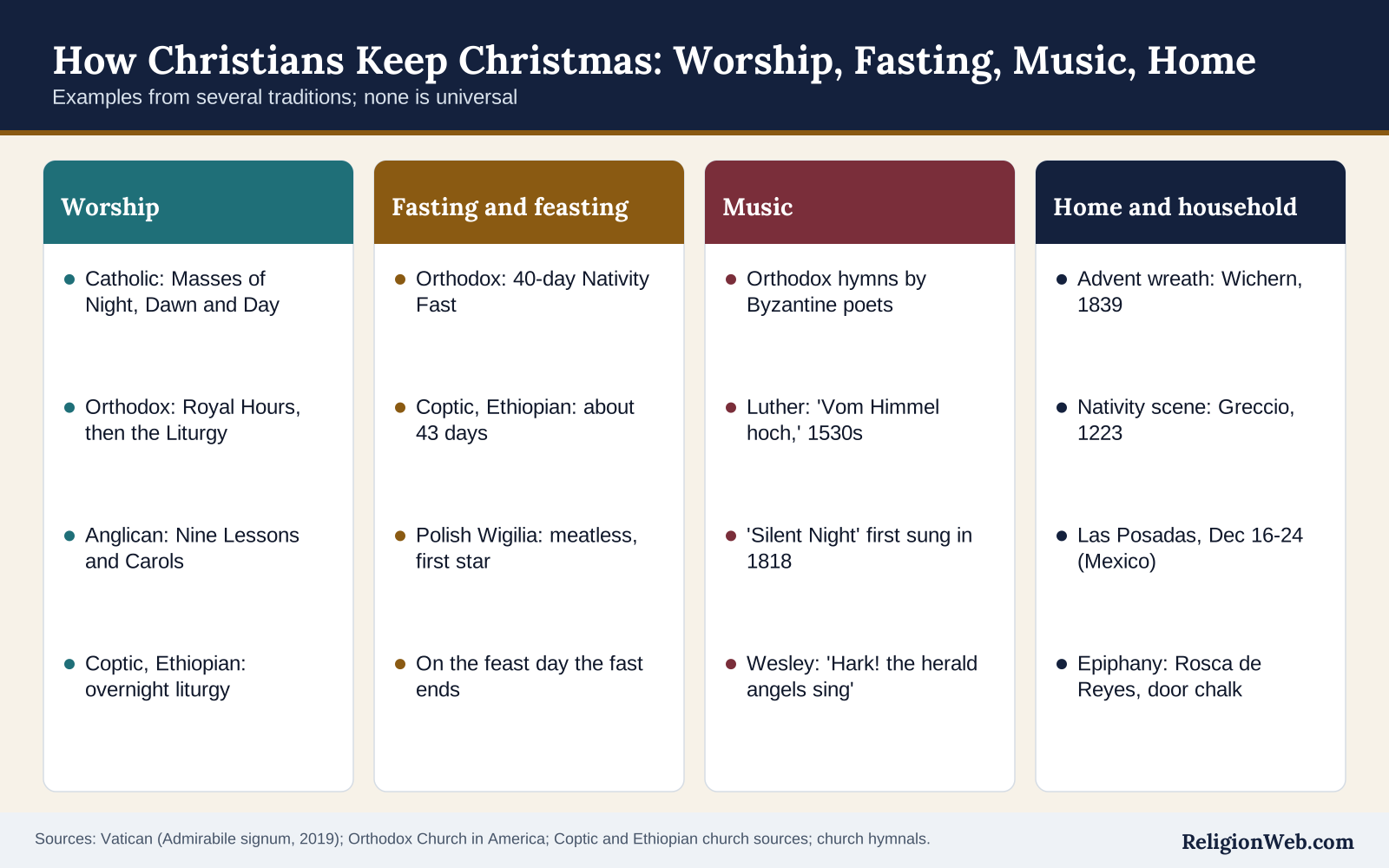
Christmas is celebrated by Christians on every inhabited continent, and its forms reflect local languages, foods, music and history. The picture below is necessarily selective. It offers examples of distinct regional customs and then turns to how observance looks today, including the Christians who choose not to keep the feast.
Regional Christian Traditions
Europe and the Mediterranean
In Poland the Christmas Eve supper, Wigilia, begins when the first star appears, with a meatless menu and the sharing of the blessed wafer; folk customs such as hay under the tablecloth or an empty place at the table for an unexpected guest are widespread but are regional, not required. In Ukraine the Holy Supper of twelve dishes, often including a dish of wheat called kutia, belongs to Orthodox and Greek Catholic families alike. Italian churches and homes are known for elaborate cribs, and January 6 brings the Befana tradition. In Greece and other Orthodox lands, the winter season culminates in the Epiphany blessing of the waters. In Germany and Austria, the Advent season has its own customs, such as Saint Nicholas Day on December 6, and the decorated tree is a feature of Christmas Eve. In Britain, carol services, midnight Eucharists and the Christmas Day broadcast are part of the season for people of many beliefs.
The Americas and the Philippines
In Mexico, Guatemala and other Latin American countries, Las Posadas is a nine-day novena from December 16 to 24 in which neighbors, led by two people playing Mary and Joseph, go from house to house asking for lodging and are refused until the last night, when they are welcomed in with prayers, carols, a piñata and a shared meal. The observance traces to Augustinian friars at Acolman near Mexico City in the sixteenth century. The Philippines have a related custom, Simbang Gabi, nine Masses held before dawn from December 16 to 24, introduced by Spanish friars in the sixteenth century to suit farmers and fishermen who began their working day at dawn; in the Philippines it is sometimes known by the Spanish name Misa de Gallo, “Mass of the Rooster.” Latin American communities in the United States, including the Filipino diaspora, continue both customs, sometimes holding the dawn Masses in the evening because of winter weather. In the United States and Canada as a whole, the Christmas Eve service, the church pageant and the family meal are the common pattern across denominations.
Africa, the Middle East, and Asia
In Ethiopia, the celebration of Genna follows the long Fast of the Prophets and an all-night liturgy, and the festival draws pilgrims to Lalibela. Egyptian Copts celebrate on January 7 after their Nativity Fast, and the day has been a national holiday in Egypt since 2003. In Armenia and the Armenian diaspora, Christmas and Theophany are kept together on January 6. In Bethlehem itself, the Church of the Nativity sees three celebrations, since Latin Catholics and Protestants observe December 25, Orthodox churches that keep the Julian calendar observe January 7, and the Armenian Patriarchate observes its feast on January 19 on the civil calendar. Across sub-Saharan Africa and Asia, Christian communities of many denominations celebrate with services in local languages, choir music and communal meals, and the particular customs vary too widely for a single description.
| Region | Tradition | Religious element | Notes |
|---|---|---|---|
| Poland | Wigilia supper on December 24 | Blessed wafer (opłatek), meatless meal, midnight Mass (Pasterka) | Hay and the empty place are regional folk customs |
| Ukraine | Holy Supper with twelve dishes, including kutia | Orthodox and Greek Catholic households | Observed on December 24 or January 6 depending on the church’s calendar |
| Italy | Nativity scenes (presepe) and the Befana on January 6 | Crib traced to Francis of Assisi’s Greccio of 1223 | Cribs are displayed in homes, churches and public squares |
| Spain and Latin America | Midnight Mass and the Day of the Kings, January 6 | The Magi’s gifts; Rosca de Reyes | Gifts are traditionally given on January 6 in many homes |
| Mexico and Central America | Las Posadas, December 16–24 | Mary and Joseph’s search for lodging, prayers and carols | Originated with sixteenth-century Augustinian friars |
| Philippines | Simbang Gabi, nine dawn Masses | Preparation for the birth; the parol star lantern | Introduced by Spanish friars; adapted by diaspora parishes |
| Ethiopia and Eritrea | Genna on 29 Tahsas, usually January 7 | Overnight liturgy, procession, white garments | Follows a roughly 43-day fast |
| Egypt | Coptic Christmas on January 7 | Overnight Christmas Eve liturgy after the Nativity Fast | A national holiday since 2003 |
| Armenia | Birth and Theophany on January 6 | Divine Liturgy and Blessing of Water | Older winter feast kept as one celebration |
| Greece | Christmas on December 25; Theophany on January 6 | Great Blessing of Waters; cross thrown into water | Fixed feasts follow the Revised Julian calendar |
Christmas Today
How widely and in what spirit it is observed
Christmas is both a religious and a social phenomenon, and surveys show how the two overlap. Pew Research Center estimated in 2020 that there were about 2.3 billion Christians worldwide, or 28.8 percent of the global population, and the great majority of them keep some form of Christmas. In the United States, a Pew survey conducted in late 2017 found that about nine in ten adults said they celebrated Christmas, and 55 percent said they celebrated it as a religious holiday, including 46 percent who saw it as more religious than cultural and 9 percent who saw it as both. The comparable figure in 2013 was 59 percent. These numbers describe American adults in particular years; they show that the holiday is widely shared, that a large majority of Christians keep it as a religious feast, and that a significant share of those who celebrate it do so mainly as a cultural or family tradition.
Christians who do not observe Christmas
Not all Christians keep the feast. Jehovah’s Witnesses do not observe Christmas, and the same is true of several other groups that decline for theological reasons, including the Iglesia ni Cristo, the True Jesus Church, some Churches of Christ and some Church of God bodies. Their stated reasons differ by group, but commonly include the view that the Bible neither commands a celebration of Jesus’ birth nor gives its date, and a wish to avoid customs they consider to have non-Christian origins. Some Reformed and Puritan communities historically took a similar position, as the bans of the seventeenth century show. Other Christians keep the feast itself but set aside particular customs, such as Santa Claus or the tree. These are positions held within Christianity, and the other churches do not generally question the sincerity of those who hold them.
Hospitality, charity, and care in the season
The theology of the Incarnation has shaped a long Christian emphasis on hospitality and charity at Christmas. Many parishes organize meals for people who are alone, collect food and gifts for families in need, and visit the sick and the housebound. The season can also be difficult for people who are grieving, estranged from family, or struggling with depression, and churches of many traditions provide pastoral support. Prayer and worship can be a source of comfort in such circumstances, but they are not a substitute for medical or mental-health care; anyone in distress should contact a doctor, a counselor or a local crisis service as well as a faith community.
Common Misconceptions About Christmas
Because Christmas combines scripture, church history and popular culture, several widely repeated claims about it are partly right and partly mistaken. The four below are among the most common, and each is stated as fairly as possible before the evidence is set out.
Misconception 1: The Bible says Jesus was born on December 25
Where the misunderstanding comes from
Christmas is celebrated on a fixed date with songs and cards that speak of “the birthday of Jesus,” and it is natural to assume that the date comes from the Gospels. Nativity plays and carols, which draw on Luke and Matthew, reinforce the impression, and the Western calendar rarely says that the date is a church decision. People who learn that December 25 is not in the Bible sometimes conclude that it must therefore have been invented to replace something else, which is a further simplification.
What the evidence and tradition actually show
No book of the New Testament gives a day or month for the birth of Jesus. The earliest Christian writers who raised the question offered different answers, and the first record of a church feast on December 25 comes from Rome in the 330s. Historians then offer two main explanations, a calculation from the date of the conception and Passion and a possible link to Roman solar festivals, and they disagree on how to weigh them. Churches themselves do not treat the date as a historical claim: Armenian Christians celebrate the birth on January 6, and Orthodox churches on the Julian calendar celebrate on what the civil calendar calls January 7. The date is a liturgical choice, and the meaning of the feast does not depend on proving it.
Misconception 2: The Twelve Days of Christmas end on Christmas Day
Where the misunderstanding comes from
In much of the modern world, the Christmas season begins in November and ends abruptly on the evening of December 25, when decorations come down and stores turn to sales. Advent calendars and countdowns also teach the habit of treating Christmas Day as a finish line. The popular carol “The Twelve Days of Christmas” is also often sung as though the twelve days ended on Christmas Day.
What the evidence and tradition actually show
In the church calendar the opposite is true. Advent is the period of waiting, and Christmas Day is the first of the twelve days of celebration, which run until the eve of Epiphany. The carol, whose earliest known printed text appears in a children’s book of 1780, Mirth Without Mischief, was probably a memory-and-forfeit game for Twelfth Night before it was ever sung. The popular claim that its gifts are a hidden catechism for persecuted Catholics first appeared in the 1990s and has no documentary support. The doctrines it supposedly encodes were shared by most Christians in any case. Christmastide in the Roman Catholic calendar continues until the feast of the Baptism of the Lord, and some households keep their cribs until Candlemas on February 2.
Misconception 3: All Christmas customs appeared together in the early church
Where the misunderstanding comes from
Christmas as it is now celebrated seems all of a piece: a tree, a crib, carols, a gift-bringer, a family meal and a church service. Films, greeting cards and seasonal marketing present it as an ancient and unchanging tradition. A contrary claim, that every custom was simply taken over from earlier festivals, rests on a similar assumption that the whole package arrived at once, from a single source.
What the evidence and tradition actually show
The customs have different dates and different homes. The church feast appears in Rome in the 330s. Advent as a season of preparation emerges in Gaul and Rome in the fifth and sixth centuries. The first nativity scene was arranged by Francis of Assisi at Greccio in 1223. Decorated trees are documented in German-speaking Europe from the sixteenth century, the Advent wreath was devised by Johann Hinrich Wichern in 1839, the commercial Christmas card by Henry Cole in 1843, and the Nine Lessons and Carols service in 1880 and 1918. The figure of Santa Claus developed from the veneration of Saint Nicholas over many centuries. For some customs, such as greenery or feasting at midwinter, historians discuss possible earlier roots, but the evidence is usually thin and the debate is unresolved. The honest summary is that Christmas is a layered tradition built up over about seventeen centuries, with Eastern and Western churches adding different layers.
Misconception 4: Three kings visited the manger on the night Jesus was born
Where the misunderstanding comes from
Nativity scenes, Christmas cards and carols such as “We Three Kings” place the shepherds and the Magi side by side at the manger, with a star overhead. Because Matthew and Luke each tell only part of the story, the usual way of telling it merges them into a single scene on one night. The Magi’s gifts also suggested to later readers a count of three, and their rank and names were added in the Middle Ages.
What the evidence and tradition actually show
Matthew says that Magi from the east came to Jerusalem looking for a child born king of the Jews. He does not say they were kings, does not give their number or names, and describes the family in a house when they arrive. The traditional number of three is generally explained as an inference from the three gifts, and the names Caspar, Melchior and Balthasar come from later tradition. Matthew also says that Herod had boys of two years and under killed in Bethlehem, a detail that readers have long taken to imply that some time had passed. For this reason the Western church celebrates the Magi on Epiphany, January 6, and not on Christmas night, while the Orthodox Nativity icon places the Magi in the scene as part of its theological summary. None of this diminishes the story; it simply distinguishes what Matthew says from what the tradition added.
Frequently Asked Questions About Christmas
Questions About Meaning and Dates
Why do Christians celebrate Christmas?
Christians celebrate Christmas to mark the birth of Jesus and to affirm the belief that God took human nature in him. In Catholic, Orthodox and most Protestant teaching, this is the doctrine of the Incarnation, which the churches express in the creeds and in the worship of the season.
The feast is not a command found in the New Testament. It developed in the fourth century and became a central celebration of the church year, along with Easter, over the following centuries.
Why do some churches celebrate Christmas on January 6 or 7?
The difference is a matter of calendar. Churches that keep the Julian calendar, among them the Russian, Serbian, Georgian, Coptic and Ethiopian churches, observe December 25 on that calendar, which is January 7 on the civil calendar in this century. The Armenian Apostolic Church keeps the older tradition of celebrating the birth and the baptism of Christ together on January 6.
These churches are not claiming a different birth date. They are marking the same feast by a different reckoning.
Questions About Practice and the Season
What is Midnight Mass or a Christmas Eve service?
Midnight Mass is the Catholic Mass during the Night, one of four Christmas Masses, and many Anglican and Lutheran churches hold a late Christmas Eve Eucharist as well. Earlier Christmas Eve services, often with candles and carols, are common in Protestant congregations.
Like any Christian service, they include prayers such as the Lord’s Prayer, readings from Scripture and, in many churches, Holy Communion.
Do Christians fast before Christmas?
Orthodox churches keep a Nativity Fast of forty days, and the Coptic and Ethiopian churches keep fasts of about 43 days. Western churches traditionally treated Advent as a penitential season, but today most observe it chiefly through prayer, colors and customs, with fasting left to individuals. Fasting rules include exemptions for children, the ill and the pregnant, and a doctor should be consulted about any significant change in diet.
When does the Christmas season end?
It depends on the church. Many Anglican and Lutheran churches count the twelve days from December 25 to January 5 and then enter Epiphanytide. The Roman Catholic calendar ends Christmastide with the Baptism of the Lord, and Candlemas on February 2 closes the cycle in the wider Christmas tradition. Orthodox churches hold the feast of Theophany on January 6 on their own calendars.
Questions About Customs
Where do the tree, Santa Claus, and gift-giving come from?
The tree is a German-speaking custom documented from the sixteenth century. Santa Claus developed from the veneration of Saint Nicholas, bishop of Myra, and from Dutch and American traditions in the nineteenth century. Gift-giving connects to the Magi’s gifts and to Saint Nicholas Day, and in some countries it takes place on January 6 instead of December 25.
None of these customs is required by the churches, and each has its own history.
Is Christmas a religious or a cultural holiday?
It is both. For Christians it is a religious feast, and in a 2017 Pew survey a little over half of all American adults said they celebrated it as a religious holiday. For many other people it is a family and civic holiday in which the religious meaning is secondary or absent. The two uses coexist, and this article has focused on the first.
Conclusion: Understanding Christmas as Scripture, Doctrine, and Season
What the History Shows
A feast that grew in stages
The record shows a feast with a clear center and a long, uneven growth. The center is the claim, found in Matthew, Luke and John and developed in the creeds, that the birth of Jesus is the beginning of God’s presence among human beings. Around that center the churches built a date, first recorded at Rome in the 330s, a season of preparation in Advent or the Nativity Fast, a festive season through Epiphany, and, much later, the crib, the carol service, the wreath and the tree. Keeping those stages apart prevents two common errors: treating every custom as ancient, and treating the whole feast as a late invention without a theological purpose.
One belief in many forms
The same birth is celebrated on December 25, January 6 and January 7, in a cathedral at midnight, in a Lalibela courtyard at dawn, at a dining table in Warsaw or Manila, and in a quiet Protestant sanctuary lit by candles. The differences reflect calendars, languages and histories more than disagreement about what is being celebrated. Where the churches really do differ, as on the place of Mary or on the role of images, the differences have been stated as differences of teaching, without ranking one over another.
How to Keep Exploring
Related topics on ReligionWeb.com
Readers who want the wider context can move in several directions. The article on Jesus Christ examines the evidence for his life and the beliefs about him, and the article on Christianity sets out the history and branches of the churches that keep the feast. The article on Easter covers the other great cycle of the church year, and the article on the Bible explains how the Gospels were written and collected.
Reading the sources directly
The most direct way to understand the feast is to read the texts it uses. Luke 1–2, Matthew 1–2 and John 1:1–18 can be read in an hour, and in a good study edition they are supplemented by notes that explain the Greek, the Old Testament quotations and the scholarly debates. Early sermons such as Gregory of Nazianzus’s Oration 38 are available in public-domain translations, and the service books of the Catholic, Orthodox, Anglican and other churches show how the same texts are used in worship.
Sources
The table below lists the principal external sources behind this article. Facts, dates and figures were checked against these and related primary, institutional and academic materials.
| # | Source | Publisher and type | Used for | Link |
|---|---|---|---|---|
| 1 | Luke 2, Matthew 2 and John 1 (World English Bible) | Bible Gateway (World English Bible, public domain) · Primary text | Quoted Gospel passages; the birth narratives of Matthew and Luke | biblegateway.com |
| 2 | Gregory of Nazianzus, Oration 38: On the Theophany, or Birthday of Christ (NPNF 2, vol. 7, Browne and Swallow) | New Advent · Primary text | Quoted fourth-century sermon from Constantinople | newadvent.org |
| 3 | How December 25 Became Christmas (Andrew McGowan) | Biblical Archaeology Society · Academic reference | Early dates for the birth; calculation and history-of-religions hypotheses | biblicalarchaeology.org |
| 4 | The First Christmas Celebration | History Today · Academic reference | Roman feast of 336; spread to Constantinople (380) and Antioch (386) | historytoday.com |
| 5 | Admirabile signum: Apostolic Letter on the Meaning and Importance of the Nativity Scene (Pope Francis, 2019) | Holy See (Vatican) · Institutional | Francis of Assisi at Greccio (1223); symbolism of crib figures and the Magi's gifts | vatican.va |
| 6 | Who Invented Advent? (Victoria M. Tufano) | U.S. Catholic · Institutional | Development of Advent in Gaul and Rome; Perpetuus of Tours; length of the season | uscatholic.org |
| 7 | Advent | Encyclopaedia Britannica · Encyclopedia | Advent wreath, liturgical colors, Eastern Nativity Fast, Council of Tours (567) | britannica.com |
| 8 | The Nativity of Our Lord God and Savior Jesus Christ | Orthodox Church in America · Institutional | Orthodox Nativity feast, hymnographers, icon, and eve fast | oca.org |
| 9 | How the Global Religious Landscape Changed From 2010 to 2020 | Pew Research Center · Demographic data | About 2.3 billion Christians worldwide in 2020 (28.8% of the global population) | pewresearch.org |
| 10 | Americans Say Religious Aspects of Christmas Are Declining in Public Life (2017) | Pew Research Center · Demographic data | U.S. adults who celebrate Christmas and who see it as religious (survey of Nov 29-Dec 4, 2017) | pewresearch.org |
Last fact-check date: 2026-10-21.