
Anglicanism is the form of Christianity that grew out of the Church of England and is now carried by the Anglican Communion, a worldwide fellowship of 42 self-governing member churches present in more than 165 countries. The Communion’s own figure for its membership is about 85 million people, though counting methods differ from province to province. Anglicans describe their church as both catholic and reformed: catholic in keeping the ancient creeds and the ministry of bishops, priests, and deacons, and reformed in giving Scripture a decisive place and in worshiping in the language of ordinary people. That outlook took shape in sixteenth-century England, when the crown, Parliament, and church leaders such as Thomas Cranmer ended papal jurisdiction over the English church and gave it a prayer book in English.
Where Anglicanism sits on the map of Christianity depends on who is drawing it. Demographers and many reference works place Anglicans within Protestant Christianity, because the English church emerged from the Reformation. Many Anglicans accept that description, while others, especially in the Anglo-Catholic tradition, stress continuity with the pre-Reformation church and prefer to speak of a tradition that is both Catholic and Reformed. This article reports both descriptions and does not choose between them. For the wider story of the faith, see the hub article on Christianity.
What follows is a reference chapter on Anglicanism on its own terms. It traces the English Reformation, the spread of Anglican churches through trade, empire, and mission, and the formation of a Communion held together by shared worship and personal bonds of fellowship more than by a central authority. It explains how Anglicans understand Scripture, tradition, and reason, how the Book of Common Prayer works, what happens in a parish church on an ordinary Sunday, how the church year is kept, and why Anglicans have disagreed with one another, sometimes sharply, in recent decades. It closes with common misunderstandings and a set of frequently asked questions.
Anglicanism at a Glance: Definition, Origins, Geography, and Vocabulary
What Anglicanism Is and How the Name Arose
A working definition
Anglicanism is the faith, worship, and church order shared by the Church of England and the churches in communion with it. Its marks, as Anglicans themselves usually list them, are the Bible read as Scripture, the Apostles’ and Nicene creeds, the sacraments of baptism and the Eucharist, and a ministry of bishops, priests, and deacons. To these they add a way of praying shaped by the Book of Common Prayer, the book of services first issued in 1549 and revised several times since. A person is an Anglican in the ordinary sense if baptized in, or belonging to, a church of the Anglican Communion, and Episcopalians in the United States and Scotland are Anglicans in this sense, since the Episcopal Church and the Scottish Episcopal Church are member churches of the Communion.
The word “Anglican” and its history
The word comes from the medieval Latin Ecclesia Anglicana, “the English Church,” a phrase already used in the Magna Carta of 1215. For centuries it simply named the church of England as a district of western Christendom. “Anglicanism” and “Anglican Communion” are later coinages, used with their present meaning from the nineteenth century, when churches in North America, Africa, Asia, and Australia that traced their origin to the Church of England needed a common name. The term never implied that the church belongs only to the English. Today the majority of Anglicans live outside England, and more than half, by the Communion’s own estimate, live in Africa.
Self-description and outside classification
Anglican documents tend to describe the church by what it holds rather than by a founder or a confession of faith. The Church of England’s own statements say that it professes the faith uniquely revealed in the Holy Scriptures and set forth in the catholic creeds, and that it sees itself as both Catholic and Reformed. Outside observers sort it differently. Pew Research Center and most denominational surveys count Anglicans as a Protestant family, in a deliberately broad sense, while church historians often call the English settlement of the sixteenth century a middle course, the via media, between the reforming movements on the European continent and the medieval inheritance. Anglican writers have used that phrase with enthusiasm and with caution, since the road between two positions can be drawn in many places. Neither description is wrong, and the pages below use each where it fits the context.
Where Anglicans Live and How Many There Are
A Communion of 42 member churches
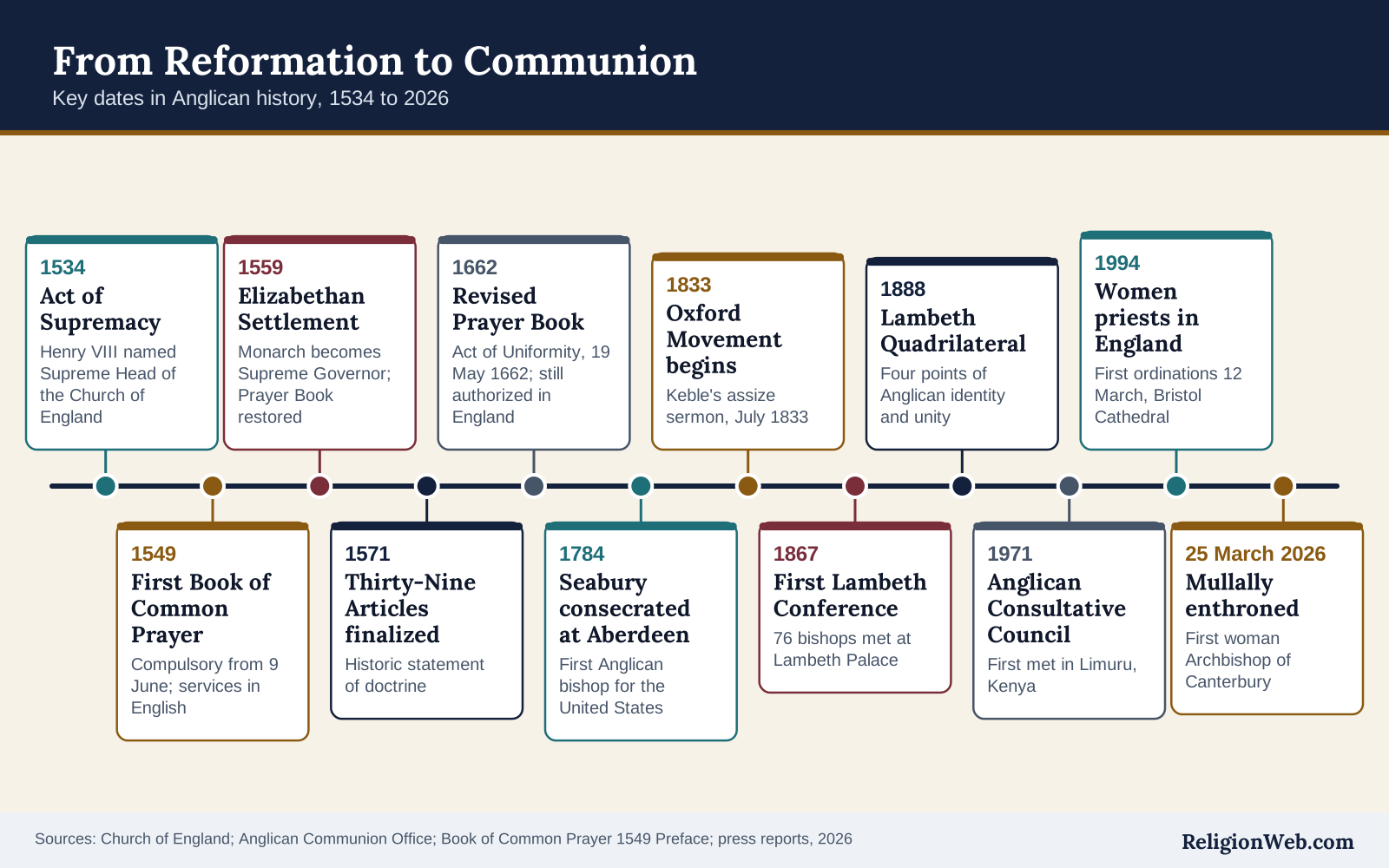
The Anglican Communion Office describes the Communion as 42 autonomous member churches, often called provinces, together with five extra-provincial areas that relate directly to the Archbishop of Canterbury. Its directory lists Anglican presence in more than 165 countries. Each member church governs itself through its own synod or convention, chooses its own bishops, and decides its own doctrine and worship within a common inheritance. The largest churches by reported membership include the Church of England and the Anglican churches of Nigeria, Uganda, Kenya, Australia, South India, Southern Africa, and South Sudan, as well as the Episcopal Church in the United States, which reports about 1.5 million members. Other churches are small, such as those in parts of Europe and the Middle East, where Anglican congregations number a few thousand.
Reading the numbers with care
The figure of about 85 million is widely repeated, but it is an estimate. Churches count baptized members, regular attenders, or self-identified affiliates, and the three measures can differ by an order of magnitude. The Church of England, for example, reports a very large body of baptized and occasional participants but a much smaller group of regular worshipers: preliminary returns for 2025, covering about 80 percent of churches, put the worshiping community at about 1.02 million and average weekly attendance at about 707,000, still below the 2019 levels of 1.11 million and 854,000 but rising for several years running (Church Times, May 2026). In Africa, church-reported figures for Nigeria and Uganda run into the tens of millions, while survey-based estimates are often lower, and researchers caution that national surveys sometimes confuse Anglicans with other Protestants. This article therefore gives ranges and names the source and year wherever it uses a number.
Key Terms and Quick Reference
Quick facts
The table below gathers the basic facts that the rest of the article explains. It describes Anglicanism as its own churches present themselves and cites figures from the Anglican Communion Office, the Church of England, and the 2026 attendance report.
| Topic | Summary |
|---|---|
| Self-description | A church both Catholic and Reformed, holding the catholic creeds and the Holy Scriptures as the faith “uniquely revealed” to the church |
| Origin | Sixteenth-century England: break with papal jurisdiction in 1534, first Book of Common Prayer in 1549, Elizabethan settlement in 1559 |
| Global structure | The Anglican Communion: 42 autonomous member churches and 5 extra-provincial areas, in more than 165 countries |
| Membership | About 85 million by the Communion’s own estimate; other estimates run higher; counting methods differ |
| Spiritual focus of unity | The Archbishop of Canterbury, who has no authority to direct other provinces; since 25 March 2026, Sarah Mullally |
| Core texts | The Bible, the Apostles’ and Nicene creeds, the Book of Common Prayer, the Thirty-Nine Articles (in many provinces), national prayer books and service books |
| Sacraments | Two “sacraments of the gospel,” baptism and the Eucharist; five further rites (confirmation, ordination, marriage, reconciliation, anointing of the sick) that most provinces treat as sacramental in a lesser sense |
| Ministry | Bishops, priests, and deacons; in most provinces women serve as deacons and priests, and in many as bishops |
| Church of England today | 42 dioceses; the King is Supreme Governor; 2025 preliminary worshiping community about 1.02 million |
| Characteristic worship | The Eucharist and the Daily Office (Morning and Evening Prayer), shaped by the Prayer Book and its modern successors |
Vocabulary
Anglican usage has its own vocabulary, some of it borrowed from English law and local church life. A province is a self-governing member church of the Communion, or a region within a larger church, and a primate is the senior bishop of a province. A diocese is the area under a bishop, divided into parishes that each have a priest called a rector, vicar, or priest-in-charge. A collect (stressed on the first syllable) is a short prayer that gathers the theme of a day. The table below defines the terms that recur throughout this article.
| Term | Meaning |
|---|---|
| Province | A self-governing member church of the Anglican Communion, or a regional grouping of dioceses, headed by a primate or archbishop |
| Diocese | The area and community under a bishop, made up of parishes |
| Synod or convention | The governing assembly of a province or diocese, usually with houses of bishops, clergy, and laity |
| Eucharist, Holy Communion, Lord’s Supper | The central act of worship in which bread and wine are shared; different names reflect different emphases within Anglicanism |
| Daily Office | The set services of Morning Prayer (Matins) and Evening Prayer (Evensong), with Compline at night |
| Collect | A short, structured prayer assigned to a Sunday or holy day |
| Churchmanship | A parish’s or person’s style of belief and worship, commonly described as Anglo-Catholic, Evangelical, broad church, or central |
| Via media | “Middle way,” a phrase Anglicans use, with varying degrees of caution, for the English settlement between reforming and medieval positions |
| Establishment | The legal connection of the Church of England to the state, in which the monarch is Supreme Governor and bishops sit in the House of Lords |
| Instruments of Communion | The four bodies that give the Communion shared focus: the Archbishop of Canterbury, the Lambeth Conference, the Anglican Consultative Council, and the Primates’ Meeting |
Origins: The English Reformation and the Making of an Anglican Church
Christianity in England Before the Reformation
The early English church
Christianity reached Roman Britain well before the English kingdoms took shape, and Celtic missionaries such as Aidan, who founded the monastery at Lindisfarne in the 630s, carried the faith through the north. The Church of England counts its formal history from 597, when Pope Gregory I sent a mission led by Augustine, who became the first Archbishop of Canterbury. The Synod of Whitby in 664, called by King Oswiu of Northumbria, chose the Roman method of calculating Easter over the Celtic one and drew the English church into closer association with the churches of the continent. By the end of the Middle Ages, England had two ecclesiastical provinces, Canterbury and York, a network of dioceses and parishes, great monasteries, and a rich devotional life centered on the Mass, the saints, and pilgrimage.
Regional “uses” and the Latin liturgy
Before the Reformation, worship was conducted in Latin, and there was no single English service book. The Preface to the first Book of Common Prayer, written under Cranmer’s direction in 1549, describes the situation it hoped to end: it names the local uses of Salisbury, Hereford, Bangor, York, and Lincoln, each with its own order of service. The Preface also complains that the old pattern of reading nearly the whole Bible each year had been lost, and that rules for finding the right service had grown so complicated that they confused those who used them. Whether that portrait is entirely fair has been debated by historians, and those who favor continuity with the medieval church point to the survival of the structure of prayer. Even so, the Preface states the program that gave Anglican worship its early character: one book, in English, centered on Scripture.
The Break with Rome Under Henry VIII (1527–1547)
The annulment and the Acts of Parliament
The immediate cause of the break was dynastic and legal. In 1527 Henry VIII asked Pope Clement VII to annul his marriage to Catherine of Aragon, which had produced a daughter but no surviving son, and the pope refused. Over the next years, a Parliament known as the Reformation Parliament (1529–1536) passed laws that removed papal jurisdiction from England. The Act in Restraint of Appeals of 1533 declared that England was an empire able to settle its own legal cases without appeal to Rome. Thomas Cranmer, consecrated Archbishop of Canterbury in March 1533, ruled on 23 May of that year that the king’s first marriage was invalid. The Act of Supremacy of 1534 named the king Supreme Head of the Church of England, and a Treasons Act the same year made denial of that title punishable as treason. Among those executed for refusing to accept it in 1535 were John Fisher, bishop of Rochester, and Thomas More.
What changed and what stayed the same
Historians stress that the 1530s were less a doctrinal revolution than a transfer of authority. Henry dissolved the monasteries between 1536 and 1540, which redistributed an enormous amount of land and ended a form of religious life that had been part of English society for centuries. A Bible in English, the Great Bible, was placed in churches from 1539, and Cranmer wrote a preface for it. Yet the king also reaffirmed traditional teaching on the Mass and priestly celibacy in the Six Articles of 1539, and the bishops, the creeds, and much of the old ceremonial remained. The English church at Henry’s death in 1547 was therefore independent of Rome, led by a monarch, and partly reformed, but it had no new confession of faith and no English liturgy beyond a few experiments such as a vernacular litany in 1544.
Edward VI, Mary I, and the Elizabethan Settlement (1547–1603)
The prayer books of Edward VI
Under the boy king Edward VI (reigned 1547–1553), the reforming party led by Cranmer and others moved quickly. The first Book of Common Prayer, authorized by the Act of Uniformity of 1549, became compulsory on 9 June of that year, Whitsunday. It gave England a single set of services in English for Morning and Evening Prayer, the Communion, baptism, marriage, burial, and the other rites of the church. A second, more thoroughly reformed book followed in 1552, required for use from 1 November, and the Forty-Two Articles of Religion were published in May 1553 as a statement of doctrine. The Articles later became the basis of the Thirty-Nine Articles. Cranmer’s own prose, in the collects and in the services of Communion, marriage, and burial, is the main reason the Prayer Book has been read for its language as well as used for prayer.
Mary I and the return to papal obedience
When Edward died in 1553, his half-sister Mary I, a committed Catholic, restored papal obedience and the Latin Mass, and in 1555 revived the medieval statutes that made holding doctrines condemned by the church, the offense then called heresy, punishable by death. By the usual reckoning, nearly three hundred people were burned during her reign, among them bishops and clergy who had led the reform. Cranmer was arrested in September 1553 and tried in the same year. After a series of recantations signed under pressure, he withdrew them in his last sermon and was burned at Oxford on 21 March 1556, his last words reported as “Lord Jesus, receive my spirit.” Later generations of Anglicans have honored him and his fellow martyrs, and the Marian burnings left a deep memory in English religious life. Roman Catholics, for their part, remember the executions of priests and lay people under Elizabeth I and her successors. Both memories belong to the history.
The Elizabethan Settlement
Mary died in November 1558, and the new queen, Elizabeth I, had Parliament pass two acts in 1559. The Act of Supremacy again ended papal jurisdiction and made the monarch Supreme Governor, not Supreme Head, of the Church of England, a change of wording that eased the consciences of those who held that only Christ is head of the church or who doubted that a woman could hold the title. The Act of Uniformity restored a revised Prayer Book based on the 1552 text. Its most famous change was in the words of distribution at Communion, which joined the 1549 sentence about the body of Christ given for the communicant to the 1552 invitation to take and eat in remembrance, so that Christians of different convictions about the presence of Christ could use the same words in good conscience. The Thirty-Nine Articles were finalized in 1571. Taken together, these measures are called the Elizabethan Settlement, and they fixed the shape of the Church of England for the next century.
Crown, Conflict, and Restoration (1603–1700)
Scripture, order, and the theologians
The generation after the Settlement produced the first great defenses of the English church. Richard Hooker (about 1554–1600), a priest and scholar, wrote Of the Laws of Ecclesiastical Polity, published in parts in the 1590s, to argue that the church’s forms of worship and government could be defended by Scripture, reason, and the experience of the early church, and that they need not be abandoned as unscriptural. His method, in which Scripture holds the first place and reason is the instrument for reading it, remains one of the most cited sources for the Anglican approach to authority. In 1611, under James I, the Authorized (King James) Version of the Bible appeared, a translation prepared by scholars of the Church of England that would shape English speech and Anglican worship for centuries.
Civil war, the Interregnum, and the 1662 Prayer Book
Tensions between Puritans, who wanted further reform of worship and church government, and defenders of the established order grew through the early seventeenth century and fed into the English Civil War, which began in 1642. In 1646, after the Royalist defeat, episcopacy was formally abolished, and in the following years Parliament replaced the Prayer Book with a Directory of Public Worship. The Restoration of the monarchy in 1660 brought back the bishops, and the Act of Uniformity of 19 May 1662 authorized a revised Book of Common Prayer to take effect on St. Bartholomew’s Day that year. Roughly two thousand clergy who could not accept the new requirements left their posts. The 1662 Prayer Book, with its Preface describing a middle way between rigid and lax attitudes toward ceremony, remains the doctrinal and liturgical reference point of the Church of England and many of its daughter churches.
Core Beliefs and Sources of Authority in Anglican Thought
Scripture, Tradition, and Reason
The place of Scripture
Anglican teaching gives the Bible a primary and decisive place. Article VI of the Thirty-Nine Articles of Religion, finalized in 1571, teaches that Holy Scripture contains everything necessary for salvation, and that nothing which is not read in Scripture or provable from it may be required of anyone as an article of faith. Church of England clergy today declare their assent to a statement that the church “professes the faith uniquely revealed in the Holy Scriptures and set forth in the catholic creeds.” In practice, Anglican worship is saturated with the Bible. The Episcopal Church notes that Scripture makes up about 70 percent of its Book of Common Prayer, in readings, psalms, canticles, and the many sentences and phrases woven into the prayers. The Old Testament, which Anglicans read in the Christian arrangement, includes the Psalms, which have been sung or said in Anglican services since the first Prayer Book and which connect Anglican worship to the Hebrew scriptures that Judaism also reads in its own tradition.
Tradition and the early church
Anglicans do not treat Scripture as standing alone. They read it within the life of the church and in light of the church’s early history. The Articles accept the three creeds, Apostles’, Nicene, and Athanasian, as able to be proved by Scripture, and the first four ecumenical councils of the Christian Roman Empire hold a special place in many Anglican accounts of doctrine. Article XXXIV, which concerns traditions and ceremonies, says in paraphrase that church customs need not be identical in every place, since they have always varied and may be changed according to the diversity of countries, times, and manners, so long as nothing is ordained against God’s Word. That principle explains a good deal about the Communion: it allows different provinces to worship differently while holding the same creeds, and it supplies the language in which Anglicans discuss when local variation is healthy and when it threatens unity.
Reason and the “three-legged stool”
Popular summaries describe Anglican authority as a “three-legged stool” of Scripture, tradition, and reason. The image is a modern shorthand. Richard Hooker, to whom it is usually traced, does not use it in this form in the Laws of Ecclesiastical Polity, and one recent reading of his work argues that the link is tenuous. Hooker does set out an order. Scripture receives first credit and obedience where it plainly teaches. Reason is the necessary instrument for interpreting Scripture and drawing conclusions from it. The voice of the church over time then carries weight, so that a person who held a view contrary to the whole church’s understanding of Scripture should have good reason. Many Anglicans value the stool image because it expresses the conviction that faith is not hostile to thought and that no single source works alone. Others note that the image can mislead, since it suggests three equal supports when the older formularies treat Scripture as the norm by which the others are tested.
The Creeds and Core Doctrine
The Trinity and the Incarnation
On the central questions of Christian doctrine, Anglican churches affirm what they regard as the common faith of the early church. They confess one God in three persons, Father, Son, and Holy Spirit, and they confess that the Son became human in Jesus of Nazareth, who was crucified and, as the creeds say, rose from the dead on the third day. The Nicene Creed, completed at the Council of Constantinople in 381 and developed from the creed of the Council of Nicaea in 325, is said at the Eucharist on Sundays and principal feasts, and the Apostles’ Creed, an older baptismal summary of faith, is said at Morning and Evening Prayer and in baptism. The first five Articles of Religion state the teaching on the Trinity and the person of Christ in terms that hold in common with the other Western Christian traditions described in the articles on Catholic Christianity and Protestant Christianity.
Grace, faith, and salvation
On salvation, the Articles teach that people are accounted righteous before God by the merit of Christ received through faith, not by their own works, language that reflects the Reformation context of the sixteenth century. They also teach that good works follow as the fruit of faith. How these teachings are emphasized differs among Anglicans. Evangelical Anglicans stress the personal response of faith and the preaching of the gospel. Anglo-Catholic Anglicans stress the sacraments as the means by which God’s grace is given and the church as the community of salvation. Broad church Anglicans often emphasize the goodness of creation, the dignity of every person as made in God’s image, and the church’s mission of justice and reconciliation. All three can draw on the same Prayer Book, which is one reason it has held a diverse body together.
The church, the communion of saints, and the last things
Article XIX describes the visible church as a congregation of faithful people in which the pure word of God is preached and the sacraments are duly ministered. Anglicans also confess in the creeds their belief in “the holy catholic church” and “the communion of saints,” meaning that the church includes the living and the departed. Practice about the departed varies. Many parishes keep All Saints’ Day and All Souls’ commemoration with prayers of thanksgiving for the saints and for the faithful departed, while some Evangelical congregations limit themselves to thanksgiving. The burial service has long spoken of a sure and certain hope of resurrection to eternal life, and the funeral rites of the national prayer books are shaped by that hope.
The Sacraments in Anglican Teaching
Two sacraments of the gospel
Article XXV defines sacraments as more than badges of Christian profession: they are sure witnesses and effective signs of grace, by which God works invisibly in the believer, and says that Christ ordained two of them in the gospel: baptism and the Supper of the Lord. The Prayer Book Catechism describes a sacrament in the traditional phrase of an outward and visible sign of an inward and spiritual grace. Baptism, with water in the name of the Father, the Son, and the Holy Spirit, is understood as entry into the Christian community, and the Eucharist as the central act in which the church remembers Christ’s death and resurrection and receives bread and wine. The Episcopal Church describes baptism as a necessary sacrament, required for ordination, and the Eucharist as the other sacrament given by Christ.
Five other rites
The same Article names five other rites that were “commonly called sacraments”: confirmation, penance or reconciliation, holy orders, matrimony, and extreme unction or anointing of the sick. It says they are not sacraments of the gospel in the same way, since they have no visible sign or ceremony ordained by Christ. Anglican churches nonetheless celebrate all five. Confirmation is the rite in which a bishop lays hands on a baptized person who affirms the baptismal promises. Ordination of bishops, priests, and deacons is a solemn liturgy. Marriage is solemnized with vows before God and the congregation. Reconciliation of a penitent, sometimes called confession, is available in most provinces and is regularly used in the Anglo-Catholic tradition. Anointing of the sick is practiced with prayer and the laying on of hands, often alongside medical care and never as a substitute for it.
Christ’s presence in the Eucharist
The Articles reject the teaching that the substance of the bread and wine is changed, and also reject the idea that the Supper is only a sign of love among Christians. They describe it as a sharing in the body and blood of Christ that is received in a heavenly and spiritual manner, by faith. Within that framework, Anglican theologians have held a range of positions. Some Evangelicals speak of a spiritual presence received by faith. Some Anglo-Catholics teach a real presence of Christ in the consecrated elements, while calling the manner of that presence a mystery. A long-standing view called receptionism holds that those who receive worthily and in faith receive Christ’s body and blood. The Elizabethan wording of 1559, which allowed worshipers to say the same words with different understandings, set a pattern the Communion has kept: unity in the rite, with latitude in interpreting it.
The Chicago-Lambeth Quadrilateral and the Question of Unity
The four points
In 1886 the House of Bishops of the Protestant Episcopal Church in the United States, meeting in Chicago, set out four points as a basis for discussion of Christian reunion, and the 1888 Lambeth Conference adopted them in a slightly altered form. The Anglican Communion Office presents them today as a touchstone for Anglican identity. In summary: the Holy Scriptures of the Old and New Testaments as containing all things necessary to salvation; the Apostles’ Creed as the baptismal symbol and the Nicene Creed as the sufficient statement of the Christian faith; the two sacraments ordained by Christ, baptism and the Supper of the Lord, ministered with Christ’s words of institution; and “the Historic Episcopate, locally adapted in the methods of its administration” to the needs of the peoples called into the Church. The bishops did not claim that these four exhausted the faith. They offered them as the minimum on which Anglicans could ask other churches to talk.
Why unity matters in Anglican thought
The concern for unity reflects a New Testament theme that Anglicans often cite. The letter to the Ephesians exhorts its readers to maintain the unity of the Spirit and sets out a series of “ones”:
There is one body and one Spirit, even as you also were called in one hope of your calling, one Lord, one faith, one baptism, one God and Father of all, who is over all and through all and in us all.
Letter to the Ephesians 4:4–6, World English Bible (Classic edition, public domain)
Anglicans read this passage as describing a unity given by God that Christians are called to live out visibly. It has motivated Anglican participation in the ecumenical movement. The Communion has agreements of full communion with the Old Catholic churches of the Union of Utrecht (the Bonn Agreement, 1931), with the Lutheran churches of the Porvoo Communion in northern Europe, with the Malankara Mar Thoma Syrian Church in India, with the Philippine Independent Church, and with several Lutheran and Moravian churches in North America. It has also conducted long dialogues with the Roman Catholic Church through the Anglican-Roman Catholic International Commission, which began work in 1970 after the 1966 meeting of Archbishop Michael Ramsey and Pope Paul VI, and with Orthodox churches described in the article on Eastern Orthodox Christianity. The goal of visible unity has proved easier to state than to reach, and the Communion’s own internal divisions, described below, have tested it.
The Book of Common Prayer and Anglican Liturgical Sources
What the Book of Common Prayer Contains
The parts of the book
The Book of Common Prayer is not one service but a whole library of worship bound together. The 1662 edition, still the authorized book of the Church of England, opens with a Preface and rules for the church year, followed by the orders for Morning and Evening Prayer, the Litany, and the collects, epistles, and gospels appointed for each Sunday and holy day. It continues with the Order for the Administration of the Lord’s Supper, or Holy Communion, and then the occasional services: public and private baptism, the catechism, confirmation, the solemnization of matrimony, the visitation of the sick, and the burial of the dead. The Psalter, arranged for monthly reading, follows, and the Ordinal for the ordination of bishops, priests, and deacons completes the main body. Editions in the Church of England also print the Thirty-Nine Articles. The word “common” in the title has its older sense of shared: the same prayers are meant for all the people of a realm, said aloud by the congregation and not left to the clergy alone.
The principles behind the book
The 1549 Preface describes the aims of the book more clearly than later summaries. Its argument is that the church’s public prayer had become obscure and had drifted from the intention of the ancient fathers. It says that they so arranged the matter “that all the whole Bible (or the greatest parte thereof) should be read over once in the yeare,” a program the Prayer Book restored by assigning Old Testament and New Testament readings to Morning and Evening Prayer through the year. It also insists that “al thinges shalbe read and song in the churche, in the Englishe tongue,” so that the people may understand. And it ends with the sentence that gave the book its uniform character.
Now from hencefurth, all the whole realme shall have but one use.
The Book of Common Prayer, 1549, Preface (spelling as in the original printing)
“Use” here means a recognized order of service, the way worship is done. In place of the Salisbury, Hereford, Bangor, York, and Lincoln uses, the realm would have one book. The principle of a single shared pattern of prayer, in the language of the people and centered on Scripture, is the core of the Prayer Book idea, and it has influenced Anglican worship wherever the tradition has gone, even in provinces that no longer use the 1662 text.
From 1549 to the Present: Editions and Revisions
The English prayer books, 1549 to 1662
The English book appeared in four main forms in its first century and a half: 1549, 1552, 1559, and 1662, with a smaller revision in 1604. Each was shaped by politics as well as theology. The 1549 book retained features of the old Mass in its Communion service, the 1552 book removed many of them in a more thoroughly reformed direction, the 1559 book was a deliberate compromise, and the 1662 book restored the monarchy’s church after the Interregnum with modest changes. Since 1662 the book has been the legal standard of the Church of England. Its Psalter uses the translation of Miles Coverdale, which came into English worship through the Great Bible and has been read and sung by many generations, and its collects, many of them translated or adapted by Cranmer, are still prayed in the Church of England and in daughter churches around the world.
National prayer books around the Communion
As Anglican churches became independent, each produced its own book. The Episcopal Church in the United States adopted its first Prayer Book in 1789, drawing on the Scottish liturgy that Samuel Seabury had studied before his consecration in Aberdeen in 1784, and later issued revised books, the most recent comprehensive revision being that of 1979. The Church of England’s own alternatives are the Alternative Service Book of 1980 and Common Worship, launched on the first Sunday of Advent in 2000, which is the most commonly used set of services in the Church of England today although the 1662 book officially remains its normative liturgy. Other provinces have their own books, among them the Anglican Church of Canada, A New Zealand Prayer Book, and A Prayer Book for Australia, and in many African and Asian provinces the services are translated into local languages and adapted in music and ceremony. The family resemblance remains: Word and Table, Morning and Evening Prayer, the creeds, the collects, and the church year.
Language, tradition, and debate over revision
Debates over revision are not new. Each major revision of the Prayer Book has been argued about, and modern rites have prompted discussion about whether contemporary English can carry the same dignity as the language of the sixteenth and seventeenth centuries. In 2004 the president of the Prayer Book Society called the preceding four decades of revisions “liturgical anarchy.” Defenders of the new forms answer that the original purpose of the Prayer Book was understanding, which requires language that people actually speak. The compromise in many parishes is to offer both: a Sunday service from Common Worship and a said or sung Evensong from the Prayer Book. In the United Kingdom the authorized 1662 text is held as Crown property in perpetuity, with printing rights exercised by Cambridge University Press, which is one reason this article quotes from the earlier public-domain editions.
Major Doctrinal and Liturgical Sources
The documents Anglicans cite
Anglicanism has no single confession of faith comparable to some other Reformation traditions. Its doctrine is found instead in a set of texts that different provinces weigh differently. In the Church of England these include the Bible, the creeds, and what are called the historic formularies: the Thirty-Nine Articles, the Book of Common Prayer, and the Ordinal. Other provinces name different texts. The table below lists the sources most often cited and what each does.
| Source | Date | Role in Anglican life |
|---|---|---|
| The Bible (Old and New Testaments) | Ancient | Primary authority; read in Morning and Evening Prayer, the Eucharist, and the Daily Office; the Articles treat it as containing all things necessary to salvation |
| Apostles’, Nicene, and Athanasian creeds | Early church | Statements of faith recited in baptism, the Daily Office, and the Eucharist; the Athanasian Creed is printed in the 1662 book but used rarely today |
| Book of Common Prayer | 1549; 1552; 1559; 1662 | The central liturgical and doctrinal text of the Church of England; the model for national prayer books |
| Thirty-Nine Articles of Religion | 1571 (from the Forty-Two Articles of 1553) | Historic statement of doctrine; binding to different degrees in different provinces |
| Books of Homilies | 1547; 1563 | Sermons authorized for reading in parishes; referenced in the Articles |
| Ordinal | 1550; revised with the Prayer Book | Rites for ordaining bishops, priests, and deacons |
| Hooker, Laws of Ecclesiastical Polity | 1590s | Not a formulary but a foundational argument for Scripture, reason, and tradition |
| Chicago-Lambeth Quadrilateral | 1886; 1888 | Four points of Anglican identity and the basis for ecumenical dialogue |
| National prayer books | 1789 onward | American (1789, 1928, 1979), Canadian, Australian, New Zealand, and others |
| Common Worship | 2000 onward | Modern services in the Church of England, alongside the 1662 book |
| Jerusalem Declaration | 2008 | Doctrinal statement of the Global Fellowship of Confessing Anglicans, accepted by its members and not by the Communion as a whole |
How the sources relate
The sources work together and not in competition. The creeds and the Bible are the foundation. The Prayer Book and Ordinal embody the church’s understanding of them in worship. The Articles, written in the mid-sixteenth century, answer questions that were pressing then, such as the authority of Scripture, justification, and the sacraments. In the Church of England, clergy assent to them as historic witnesses; in the Episcopal Church they are printed among the Prayer Book’s historical documents. Documents of the modern Communion, from the Lambeth Quadrilateral to the resolutions of the Lambeth Conference, supply guidance but do not bind provinces unless the provinces themselves adopt them. That arrangement leaves room for diversity and invites argument, since there is no central court to settle disputes about what the sources require.
From Church of England to Anglican Communion: Growth, Mission, and Realignment
Settlement, Mission, and the Spread of Anglican Churches (1662–1860)
An established church overseas
For the first century after the Restoration, Anglicanism was an English phenomenon that traveled with English people. Chaplains accompanied traders, soldiers, and settlers to the Americas, the Caribbean, India, and later Australia, and services from the Prayer Book were held in new colonies from the beginning of English settlement. Two voluntary societies, the Society for Promoting Christian Knowledge, founded in 1698, and the Society for the Propagation of the Gospel, founded in 1701, supported clergy and schools overseas. Churches in these places looked to the Bishop of London for oversight, since there were few colonial bishops, and the arrangement left ordinary members in places such as Virginia and Barbados with a church shaped by English law and custom but at a great distance from its bishops.
American independence and the Scottish consecration
The American Revolution forced a decision. Clergy of the Church of England in the new United States could not, as American citizens, take the oath of allegiance to the king that English consecration required. Samuel Seabury, elected bishop by the clergy of Connecticut, turned to the Scottish Episcopal Church, whose bishops were not bound by that oath, and was consecrated at Aberdeen on 14 November 1784 by three Scottish bishops. The Church of England in turn gained legislation permitting the consecration of bishops for churches outside the British dominions, and American bishops were consecrated in England afterward. In 1789 the Episcopal Church held its first General Convention under a constitution with a House of Bishops and a House of Deputies, and adopted its own Prayer Book. This pattern, an independent church in a new nation sharing the same orders and worship, became the model for the Communion.
Evangelical revival and the missionary century
The eighteenth-century Evangelical revival, associated with John and Charles Wesley within the Church of England before Methodism emerged as a separate movement, and with Anglican Evangelicals such as the Clapham circle, produced a surge of missionary enthusiasm. The Church Missionary Society, founded in 1799, sent missionaries to West Africa, India, and later East Africa and China. Colonial bishoprics multiplied in the nineteenth century, beginning with Calcutta in 1814. A turning point came in 1864 when Samuel Ajayi Crowther, a Yoruba man who had been enslaved as a child, educated in Sierra Leone, and ordained, was consecrated in Canterbury as the first African bishop of the Anglican tradition. His consecration pointed to the day when Anglican churches in Africa and Asia would be led by their own people. That day came in stages over the next century.
The Oxford Movement, the Lambeth Conferences, and the Making of a Communion (1833–1930)
The Oxford Movement
In July 1833 John Keble preached an assize sermon at Oxford on what he called national apostasy, protesting the government’s reorganization of the Irish church. That sermon is often taken as the start of the Oxford Movement, led by Keble, Edward Pusey, and John Henry Newman, who published the Tracts for the Times and gave the movement the name Tractarianism. They argued that the Church of England was a branch of the catholic church with its own apostolic ministry and sacramental life, not merely a department of the state. Newman’s Tract 90 argued that the Thirty-Nine Articles could be read in harmony with the teaching of the Council of Trent; he became a Roman Catholic in 1845, as did several others. Many remained in the Church of England, and their influence reshaped it: religious communities were revived, the Eucharist became central to Sunday worship in many parishes, vestments and other ceremonial returned, and clergy worked in industrial slums. Hymns Ancient and Modern, first published in 1861, became a popular fruit of the movement.
The first Lambeth Conference and the Quadrilateral
As the number of overseas bishops grew, questions arose that no single province could settle, including a dispute in South Africa over the teaching of Bishop John Colenso of Natal. At the request of the Canadian bishops, Archbishop Charles Longley invited all Anglican bishops to meet at Lambeth Palace in September 1867. Seventy-six attended, and several bishops, including the Archbishop of York, declined. The conference passed resolutions without binding force, and from this beginning grew the Lambeth Conference, now held about every ten years. At the 1888 conference the bishops adopted the Quadrilateral and, in 1920, issued an Appeal to All Christian People that invited other churches to seek visible unity. Over these decades the word “Communion” came into use for a fellowship in which each church governed itself while remaining in communion with the see of Canterbury.
Disestablishment and independence in the British Isles
The structure of the churches in the British Isles also changed. The Church of Ireland was disestablished with effect from 1 January 1871, ending its legal status as a state church, and the Church in Wales was separated from the Church of England in 1920. The Scottish Episcopal Church, which had lost its legal privileges after the Revolution of 1689 and survived penal laws in the eighteenth century, had long been independent of the state. These developments showed that the Anglican identity did not depend on being established, and they influenced how churches overseas understood their own freedom.
Independence, Indigenous Leadership, and New Questions (1930–2022)
Leadership beyond England
In the twentieth century, as European empires ended, Anglican churches in Africa, Asia, and the Pacific became fully self-governing, with their own archbishops, synods, and prayer books. The Anglican Consultative Council, with bishops, clergy, and lay people from each province, first met in Kenya in 1971, and the Primates’ Meeting, a gathering of the senior bishops of the provinces, began in 1978. Churches in Africa grew rapidly, helped by lay evangelism and revival movements, and by the end of the century the weight of the Communion had shifted from the Northern to the Southern Hemisphere. Leaders such as Desmond Tutu, Archbishop of Cape Town from 1986 to 1996, became known worldwide for their witness against apartheid. The majority of Anglicans today live in Africa, and the Anglican Communion’s own estimate is that more than half of them do.
Women in ordained ministry
The ordination of women was one of the most significant developments of the century. Florence Li Tim-Oi, a deacon serving a congregation in Macau, was ordained a priest on 25 January 1944 by Bishop Ronald Hall of Hong Kong, in a wartime emergency when no priest could reach her congregation. In the United States, eleven women were ordained in Philadelphia in 1974 in a service the church at first declared irregular, and the General Convention of 1976 voted to make women eligible for all ordained ministries. Barbara Harris became the first woman bishop in the Anglican Communion in 1989. The Church of England ordained its first women priests on 12 March 1994, and after a long debate in General Synod, Libby Lane was consecrated Bishop of Stockport in January 2015. Provinces differ: the Lambeth Conferences of 1978 and 1988 recognized each province’s right to decide, and as a result some provinces ordain women as deacons, priests, and bishops, some as deacons and priests only, and a few not at all. Some Anglicans, including many Anglo-Catholics and some Evangelicals, hold on theological grounds that only men may be ordained priests or bishops, and the Church of England has made formal provision for them.
Debates over marriage and sexuality
Since the late twentieth century, the churches of the Communion have disagreed about how to understand same-sex relationships and whether the church may bless them or ordain people in them. The Lambeth Conference of 1998 passed Resolution I.10, which described homosexual practice as incompatible with Scripture and advised against the blessing of same-sex unions and the ordination of people in them, while also calling for a listening process. The resolution passed by a wide margin and was welcomed by many bishops in Africa and Asia and criticized by others, particularly in North America and parts of Europe. In 2003 the Episcopal Church consecrated Gene Robinson, a priest in a same-sex relationship, as Bishop of New Hampshire, and the repercussions continued for years. Different Anglicans have drawn on Scripture, tradition, and reason in reaching different conclusions, and the section on the Communion today describes the institutional consequences.
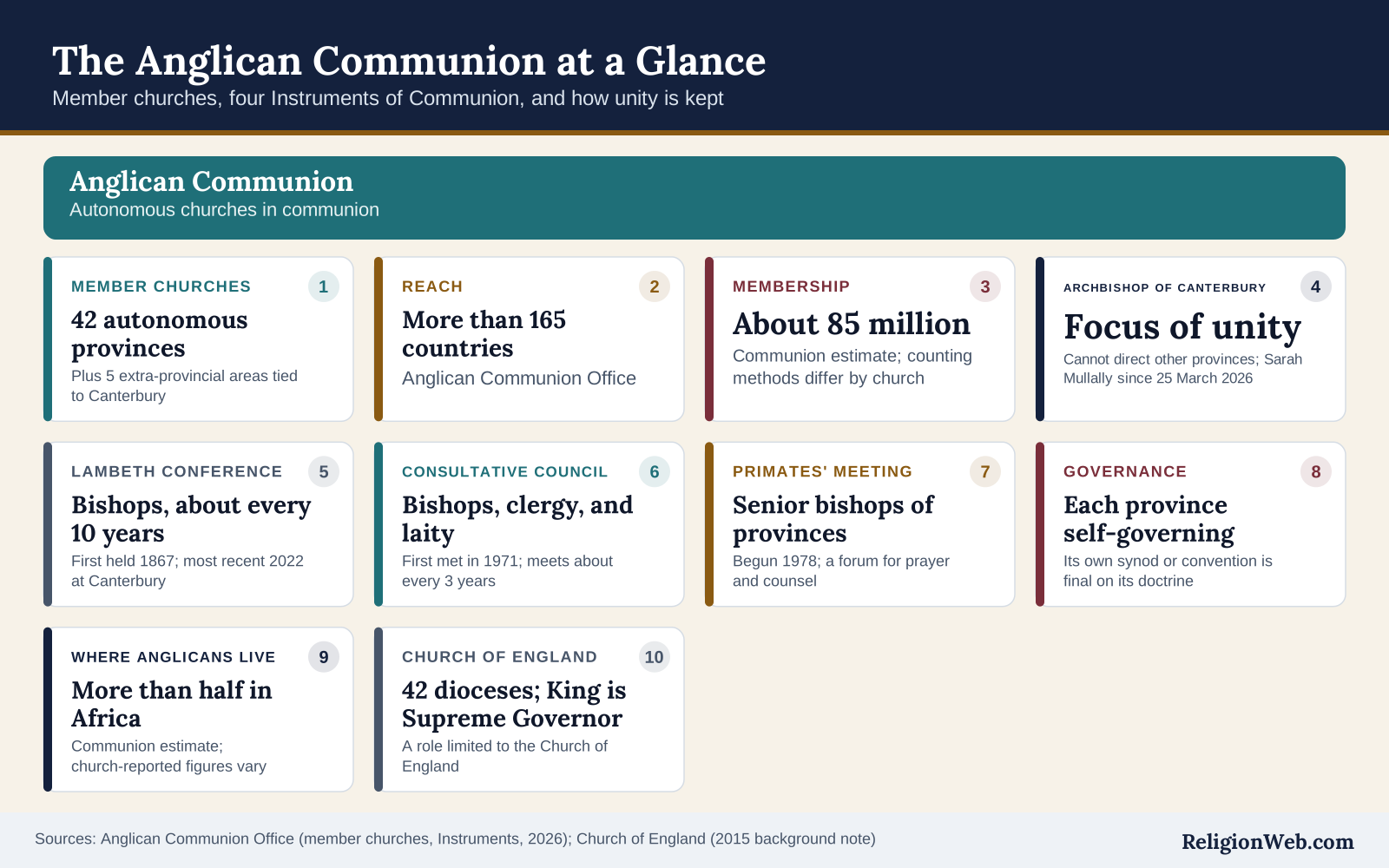
A Timeline of Anglican History
Key dates from the Reformation to the present
The table lists the main dated events described so far, from the English Reformation to the twenty-first century. Dates for modern events come from the Church of England, the Anglican Communion Office, and press reports of 2026.
| Date | Event | Significance |
|---|---|---|
| 1534 | Act of Supremacy names Henry VIII Supreme Head of the Church of England | Ends papal jurisdiction in England |
| 1549 | First Book of Common Prayer, compulsory from 9 June | One English-language service book for the realm |
| 1559 | Acts of Supremacy and Uniformity under Elizabeth I | Monarch becomes Supreme Governor; revised Prayer Book restored |
| 1571 | Thirty-Nine Articles finalized | Historic doctrinal statement of the English church |
| 1611 | Authorized (King James) Version of the Bible | Standard English Bible of the Church of England for centuries |
| 1662 | Act of Uniformity and revised Prayer Book | Remains the authorized liturgy of the Church of England |
| 1784 | Samuel Seabury consecrated at Aberdeen | First Anglican bishop for the United States |
| 1833 | Keble’s assize sermon; Oxford Movement begins | Revival of catholic aspects of Anglican worship and thought |
| 1867 | First Lambeth Conference | Beginning of regular gatherings of Anglican bishops |
| 1888 | Lambeth adopts the Quadrilateral | Four points of Anglican identity and ecumenical basis |
| 1971 | Anglican Consultative Council meets | First Communion body to include laity |
| 1976 / 1994 | Episcopal Church (1976) and Church of England (1994) open priesthood to women | Part of a wider shift in ordained ministry |
| 1998 | Lambeth Resolution I.10 on human sexuality | Source of continuing debate |
| 2003 | Gene Robinson consecrated Bishop of New Hampshire | Intensifies disagreement across the Communion |
| 2008 | First Gafcon gathering in Jerusalem | Beginning of the Global Fellowship of Confessing Anglicans |
| 2015 | Libby Lane consecrated bishop | First woman bishop in the Church of England |
| 2022 | Lambeth Conference at Canterbury | First since 2008; issued “calls” in place of resolutions |
| 2026 | Sarah Mullally enthroned at Canterbury on 25 March; Gafcon meets in Abuja in March | First woman Archbishop of Canterbury; further realignment |
Reading the timeline
Two patterns run through the table. The first is a movement from a national church to an international fellowship, with each stage, from Seabury’s consecration to the first Lambeth Conference, adding a layer of independence without cutting the bonds of worship. The second is the repeated need to find ways of living with disagreement. The Reformation produced a church that included Protestants and traditionalists, the Oxford Movement brought out a catholic party, and the twentieth century added debates about ordination and sexuality. Anglicans have never solved the problem once and for all, and the shape of the Communion today is partly the record of attempts to do so.
The Anglican Communion Today: Provinces, Instruments of Communion, and Governance
How the Communion Is Held Together
Autonomy and communion
The Anglican Communion is not a single church under a single leader. The Anglican Communion Office states that each member church is self-governing and makes its own decisions, and that its own synod or convention is the final authority on its doctrine. The Communion describes itself as a family of churches in communion with the see of Canterbury, bound by shared worship, shared history, and what Anglicans often call “bonds of affection.” There is no equivalent to a curia or a central court. The Archbishop of Canterbury is the focus of unity, “first among equals” among the primates, and cannot direct member churches on what they must do. This arrangement has advantages, since it allows each church to speak in its own culture and language, and a corresponding weakness: when churches disagree deeply, the Communion has only persuasion and relationships to work with.
The four Instruments of Communion
Four bodies, called the Instruments of Communion, give the Communion its shared focus. The first is the Archbishop of Canterbury, the spiritual head and focus of unity, who convenes the others. The second is the Lambeth Conference, an international gathering of bishops held about every ten years, with the first in 1867; in 2022 about 660 bishops met at Canterbury and issued “calls” for provinces to consider, in place of resolutions. The third is the Anglican Consultative Council, which includes bishops, clergy, and lay people from each province, first met in 1971, and meets about every three years; the Communion describes it as its most representative body. The fourth is the Primates’ Meeting, begun in 1978, a forum for prayer, Bible study, and counsel among the senior bishops. Their resolutions are recommendations that member churches must ratify to take effect.
Provinces and Regions
A tour of the provinces
The Communion’s 42 provinces vary enormously in size, language, and culture. The Church of England remains the historic mother church, but the Church of Nigeria, the Church of Uganda, and the Anglican Church of Kenya are among those whose reported memberships run into the millions. In North America, the Episcopal Church and the Anglican Church of Canada are mid-sized churches in secular societies. In Australia, New Zealand, and the Pacific, provinces include churches with Indigenous leadership and prayer books in Maori and other languages. In India, Pakistan, and Bangladesh, Anglicans are part of united churches that joined with other Protestant traditions. A few provinces serve small minorities in places such as Japan, Jerusalem, Iran, and Egypt. The table lists a selection and gives brief, careful notes; figures for membership differ by method and are not given here.
| Province | Region | Notes |
|---|---|---|
| Church of England | England, with the Isle of Man and a diocese in Europe | Historic mother church; 42 dioceses; established; the King is Supreme Governor; General Synod |
| Episcopal Church | United States and other countries and territories | Reports about 1.5 million members; General Convention of bishops and deputies; Prayer Book of 1979 |
| Anglican Church of Canada | Canada | Self-governing since the nineteenth century; General Synod; in full communion with the Evangelical Lutheran Church in Canada |
| Anglican Church of Australia | Australia | Large and varied, with strong Evangelical and Anglo-Catholic dioceses; General Synod |
| Church of Nigeria | Nigeria | One of the largest provinces by reported membership; member of Gafcon; host of the 2026 Abuja gathering |
| Church of Uganda | Uganda | Large province shaped by nineteenth-century martyrs and the East African Revival |
| Anglican Church of Southern Africa | South Africa, Lesotho, Namibia, Eswatini, St Helena | Led by Desmond Tutu as archbishop (1986 to 1996) in the late apartheid era |
| Church in Wales | Wales | Separated from the Church of England in 1920; self-governing |
| Scottish Episcopal Church | Scotland | Historic source of the bishops who consecrated Seabury in 1784 |
| Church of Ireland | Republic of Ireland and Northern Ireland | Disestablished in 1871 |
| Church of South India and Church of North India | India and Sri Lanka | United churches formed in 1947 and 1970 from Anglican and other Protestant traditions |
| Province of Jerusalem and the Middle East | Israel, Palestine, Jordan, Lebanon, Syria, Iran, Egypt | Small communities in a region of ancient Christian presence and several faiths |
Extra-provincial and united churches
Alongside the provinces, five extra-provincial areas relate directly to the Archbishop of Canterbury: the Anglican Church of Bermuda, the Church of Ceylon in Sri Lanka, the Parish of the Falkland Islands, the Lusitanian Church in Portugal, and the Spanish Reformed Episcopal Church. The united churches of South Asia, formed by the union of Anglican, Methodist, Presbyterian, and other communities, count as members of the Communion while also being in the wider Christian families that joined them. The Communion is also in full communion with several other churches, which makes its boundaries more porous than a simple list of provinces suggests.
Governance and the Crown
The Church of England: archbishops, synod, and monarch
The Church of England is led by the Archbishops of Canterbury and York, with 106 other bishops, and has 42 dioceses grouped in two provinces: Canterbury covers the southern two-thirds of England and York the northern third. The General Synod, made up of houses of bishops, clergy, and laity, with about 470 voting members as of a 2015 Church of England note, meets at least twice a year and makes the church’s law, which Parliament must approve in the form of a measure. The monarch is Supreme Governor of the Church of England and, on the advice of the Prime Minister, appoints archbishops, bishops, and cathedral deans, drawing on nominations from a church commission. Twenty-six bishops, the two archbishops and 24 others, sit in the House of Lords as Lords Spiritual. This legal connection between church and state is called establishment, and the monarch’s role is specific to the Church of England.
Governance elsewhere in the Communion
In other provinces, governance follows the same broad pattern of bishops, clergy, and laity sharing authority but with local variations. The Episcopal Church is governed by a General Convention with a House of Bishops and a House of Deputies, and both houses must agree to pass a resolution. Its Presiding Bishop, Sean Rowe, elected in 2024, is its chief pastor and primate. Provinces such as Canada, Australia, Nigeria, and Kenya have their own synods and primates or archbishops. The British monarch has no role in any of them. The Church in Wales and the Church of Ireland are disestablished, and the Scottish Episcopal Church is not the national church of Scotland. Parishes in every province usually have a lay-led council, called a parochial church council in England and a vestry in the Episcopal Church, which shares responsibility for finance and buildings with the clergy.
Division and Realignment Since 2003
What the disagreements concern
The disagreements of the past two decades concern several linked questions: how to interpret Scripture on sexuality and marriage, how far a province may act on its own in matters of doctrine and discipline, and what the Communion can ask of its members. Those who favor traditional teaching on marriage hold that the 1998 Lambeth resolution remains the Communion’s position and that provinces which depart from it have broken communion. Others, including the Episcopal Church and the Scottish Episcopal Church, which solemnize same-sex marriages, and the Anglican Church of Canada, where many dioceses permit them, argue that their decisions arise from a developing understanding of Scripture and the dignity of every person, and that the Communion’s autonomy allows for it. The Church of England maintains that marriage is between one man and one woman, but in 2023 introduced the Prayers of Love and Faith, which can be used in regular services to bless same-sex couples. In February 2026 the General Synod approved a motion ending the Living in Love and Faith program and confirming that separate, standalone services would require formal authorization, and it created a new working group to continue the work.
Gafcon, Global South, and the Anglican Church in North America
Conservative leaders organized the Global Anglican Future Conference in Jerusalem in 2008, which issued the Jerusalem Declaration and developed into the Global Fellowship of Confessing Anglicans (Gafcon). It overlaps with the Global South Fellowship of Anglican Churches. The Anglican Church in North America, formed in 2009 by congregations and dioceses that left the Episcopal Church and the Anglican Church of Canada, is a Gafcon member but is not itself a member church of the Communion. In February 2023, ten provinces in the Global South network said that they were in “impaired communion” with the Church of England and no longer recognized the Archbishop of Canterbury as first among equals. In March 2026, after a gathering in Abuja attended, according to press reports, by 347 bishops and 121 other leaders from 27 provinces, Gafcon renamed itself the Global Anglican Communion, constituted a Global Anglican Council, and elected Archbishop Laurent Mbanda of Rwanda as chairman. Its leaders speak of “principled disengagement” from the Instruments of Communion centered in Canterbury, and say that they are not leaving the Communion but seeking to restore it as a fellowship of autonomous provinces. Gafcon estimates that it represents up to 85 percent of practicing Anglicans, a figure other observers dispute; independent research in 2015 and 2016 put Gafcon-aligned provinces at about 45 percent of practicing Anglicans.
The new Archbishop and the road ahead
Sarah Mullally, formerly Bishop of London and before that a nurse and England’s Chief Nursing Officer, was announced in October 2025 as the next Archbishop of Canterbury and was enthroned at Canterbury Cathedral on 25 March 2026, the feast of the Annunciation, as the 106th archbishop and the first woman to hold the office. She succeeded Justin Welby, who resigned in November 2024 after criticism of how the church handled a case of abuse. The enthronement was attended by about 2,000 guests, including members of the royal family and leaders of other churches and faiths. The Communion’s formal bodies and Gafcon have taken different paths since, and it is too soon to say what the Communion will look like a decade from now. What can be said is that the Communion has repeatedly changed its shape, from an English church to a colonial one to a global one, and that its members still share the same creeds and Prayer Book inheritance.
Worship, Sacraments, and Parish Life: How and Why Anglicans Pray
The Sunday Eucharist
What happens in the service
On most Sundays the main act of worship in an Anglican parish is the Eucharist, also called Holy Communion, the Lord’s Supper, or the Mass, depending on the parish and its tradition. The shape is recognizable across the Communion, even where words and music differ. The congregation gathers, usually with a hymn and a greeting from the priest, and prays a collect for the day. Readings follow from the Old Testament, a psalm, an epistle from the New Testament, and the Gospel, which is often read from the middle of the church with the people standing. A sermon explains the readings, the congregation says the Nicene Creed, and the people pray for the church, the world, and those in need. In many forms of the service the people then confess their sins and receive absolution, and exchange a sign of peace.
The second half of the service is built around the Great Thanksgiving. Bread and wine are brought to the altar or communion table, and the priest, standing before the people, leads a prayer of thanksgiving that includes the narrative of the Last Supper and the congregation’s own acclamations, including the Sanctus (“Holy, holy, holy”). The Lord’s Prayer is said, the bread is broken, and the people come forward to receive the bread and wine, either kneeling at an altar rail or standing. After a prayer of thanks, the priest gives a blessing and a deacon or priest dismisses the people to go out in peace. The service lasts about an hour in a typical parish, and may be spoken, sung, or a mixture. Where a bishop presides in a cathedral, it will be longer and more elaborate, with more music and ceremony.
Why the service takes this shape
Anglican liturgists have traditionally described the Eucharist as a service of Word and Table, and they find its roots in the earliest Christian worship. The book of Acts gives a summary of the first Christians’ common life.
They continued steadfastly in the apostles’ teaching and fellowship, in the breaking of bread, and prayer.
Acts of the Apostles 2:42, World English Bible (Classic edition, public domain)
Anglicans read this verse as a description of teaching, fellowship, the shared meal, and prayer, the four things that the Sunday liturgy still joins together. The central action of the meal is rooted in the account of the Last Supper, which the priest recites in the Eucharistic prayer. The Gospel of Luke tells how Jesus took bread, gave thanks, and broke it, saying, “This is my body which is given for you,” and added a charge that the church has understood as commanding the continuing celebration of the meal:
Do this in memory of me.
Gospel of Luke 22:19, World English Bible (Classic edition, public domain)
The Prayer Book tradition emphasizes remembrance, thanksgiving, and the receiving of Christ by faith, and the Articles insist that the elements are not to be reserved or adored. Anglo-Catholic parishes put more weight on the sacrament as the real presence of Christ and often adore the reserved sacrament, while Evangelical parishes concentrate on the Word preached and on receiving in faith. Both see themselves as faithful to the same liturgy, which is one reason it has endured.
Variations in practice
Style varies widely. In a “high church” parish, the priest wears a chasuble, incense may be used, a bell is rung at the consecration, and a choir sings parts of the service in Latin or English. In a “low church” or Evangelical parish, the service may be more informal, with a band, contemporary songs, and the priest in a simple alb or even in everyday clothes. Many provinces have two authorized forms: the Episcopal Church’s 1979 book includes Rite One in traditional Prayer Book language and Rite Two in contemporary English, and the Church of England’s Common Worship has Order One in contemporary language and Order Two, which follows the sequence of the Prayer Book service. Most provinces welcome all baptized Christians to receive communion; a few ask that communicants be confirmed. Children are welcomed to communion in many provinces, often after preparation, a practice more recent than the older expectation that confirmation come first.
The Daily Office and Choral Evensong
Morning Prayer and Evening Prayer
Alongside the Eucharist, the Prayer Book gave Anglicans a pattern of daily prayer drawn from the monastic hours of the medieval church and shortened into two services, Morning Prayer (Matins) and Evening Prayer (Evensong). The Prayer Book required the clergy to say them daily and invited the people to join. Each follows a similar order: opening sentences from Scripture, a confession, versicles and responses, one or two psalms, a reading from the Old Testament, a canticle such as the Te Deum or Benedictus at Morning Prayer and the Magnificat or Nunc dimittis at Evening Prayer, a reading from the New Testament, a creed, the Lord’s Prayer, and a series of collects. A late-evening service called Compline is also used in many places. The Daily Office is the most widely shared Anglican prayer outside the Eucharist, and it can be said by anyone, alone or in a group, without a priest. The Psalter, divided for monthly reading in the 1662 book, was designed so that the whole of the Psalms would be prayed through a month, and the lectionary was designed so that most of the Bible would be read through a year.
Evensong, cathedral music, and carols
Evensong sung by a choir is one of the best-known Anglican forms of worship, especially in English cathedrals and college chapels. The choir sings the psalm to Anglican chant, a form of harmonized psalm-tone, and the canticles to settings by composers from Thomas Tallis and William Byrd to those of the present day. Another well-known service is A Festival of Nine Lessons and Carols, first held at King’s College, Cambridge, on Christmas Eve 1918 by the Dean, Eric Milner-White, adapted from an order of service used by Edward White Benson in Truro in 1880, and broadcast since 1928. It combines nine readings from Genesis to the Gospel of John with carols, opening with “Once in royal David’s city.” The service has been imitated in parishes and cathedrals around the world and is not a prescribed Prayer Book service but an example of the creativity that the Anglican framework permits.
Baptism, Confirmation, Marriage, and Funerals
Baptism and confirmation
Baptism is the entry point to the Christian community. In nearly all Anglican provinces, infants and adults are baptized with water in the name of the Father, the Son, and the Holy Spirit. In infant baptism, parents and godparents make promises on the child’s behalf, rejecting evil and professing the faith, and the congregation promises to support them. The Episcopal Church’s Baptismal Covenant, in its 1979 Prayer Book, sets out the promises of the Apostles’ Creed in question form along with promises to continue in the apostles’ teaching and fellowship, to seek and serve Christ in all persons, and to strive for justice and peace. Confirmation is the rite in which a bishop lays hands on a baptized person who has been prepared to affirm the baptismal faith for themselves, often in the teenage years, and in the Church of England it has traditionally been the gateway to adult membership. In many provinces, baptized children now receive communion before confirmation. Anyone who has been baptized with water in the name of the Trinity in another Christian church is not baptized again.
Marriage, reconciliation, and anointing
Anglican marriage is a public service in which the couple exchange vows before God, the congregation, and the priest, who pronounces a blessing. In England, a marriage solemnized in a Church of England church is legally valid without a separate civil ceremony, a feature of the established church. Provinces differ on whom the church may marry: the Church of England solemnizes marriages only between a man and a woman, while the Episcopal Church and some other provinces also solemnize same-sex marriages. Reconciliation of a penitent is available by private appointment, though it is not required of everyone. The anointing of the sick is offered in church, at home, or in hospital with prayer and the laying on of hands, and it accompanies medical treatment and does not replace it.
Funerals and commemoration of the dead
The funeral service is held in church or at a graveside or crematorium. In the traditional form it includes the reading of Scripture, psalms, the Lord’s Prayer, a short address, and the committal, in which the body is committed to the ground or the ashes to their resting place with words that speak of a sure and certain hope of resurrection. Many Anglican funerals are celebrations of the Eucharist, especially in the Anglo-Catholic tradition, which may offer prayers for the departed. Evangelical parishes keep the focus on the comfort of the bereaved and the hope of resurrection. In November, many parishes hold a service of remembrance on or near All Souls’ Day, in which the names of the departed are read.
| Rite or service | What happens | Who takes part | Notes |
|---|---|---|---|
| Eucharist (Holy Communion) | Readings, sermon, creed, prayers, Great Thanksgiving, sharing of bread and wine | Priest presiding, congregation, deacon and lay ministers | Principal Sunday service in most parishes; style ranges from simple to highly ceremonial |
| Morning and Evening Prayer | Psalms, Scripture readings, canticles, creed, and collects | Clergy and laity, sometimes a choir | Daily Office from the Prayer Book; may be sung as Evensong |
| Baptism | Water with the Trinitarian formula; promises by candidates or sponsors | Candidate, parents and godparents, priest or bishop, congregation | Infants and adults; the sacrament of initiation |
| Confirmation | Bishop lays hands on baptized person who renews baptismal promises | Bishop, candidates, congregation | One of the five rites other than the two sacraments of the gospel |
| Marriage | Vows, exchange of rings, blessing | Couple, priest, witnesses | Provinces differ on same-sex couples |
| Reconciliation | Confession of sins and absolution | Penitent and priest | Optional; commonly used in Anglo-Catholic parishes |
| Anointing of the sick | Prayer, laying on of hands, anointing with oil | Priest, sometimes lay ministers, the sick person and family | Accompanies medical care and is not a substitute for it |
| Ordination | Bishop lays hands on deacons, priests, or bishops | Bishop, candidates, congregation | The Ordinal governs the rite |
| Funeral | Scripture, psalms, prayers, committal | Priest, family, congregation | May include a Eucharist; practice about prayer for the departed varies |
Parish Life, Buildings, and Music
The parish church and the cathedral
The parish is the basic unit of Anglican life: a geographic area with a church, a priest, and a community. In England, the Church of England had, by a 2015 Church of England note, 12,557 parishes and 15,712 open churches, just over a quarter of them in the highest category of listed historic buildings. Many are medieval, and the village church often sits at the center of the community, as a place of worship and of local memory. Inside are features that have meanings: a font for baptism near the entrance, a nave for the congregation, a chancel with choir stalls, a pulpit and lectern for preaching and reading, and an altar or communion table. Cathedrals, the seat of the bishop, are larger and often maintain daily services with a choir. Churches outside England vary from simple brick buildings to large modern structures, to buildings shared with other churches.
Lay and ordained roles
Parish life depends on lay people as well as clergy. Churchwardens, who in England are officers of the bishop, care for the church’s property and good order. A parochial church council in England and a vestry in the Episcopal Church share responsibility for finance and mission. Lay readers or licensed lay ministers lead services and preach in many provinces. Servers, choir members, sidespeople who welcome the congregation, flower arrangers, and volunteers who lead youth groups and community work make up the rest. The priest, called rector, vicar, or priest-in-charge, presides at the sacraments, preaches, and cares for the people. Deacons are responsible for service and for assisting at the liturgy. Hymnody is a major element; Hymns Ancient and Modern (1861) and later collections shape what Anglicans sing, and in many provinces, hymns and songs in local languages are central to worship.
The Church Year and Holy Days
How the Anglican Year Is Organized
Sundays and seasons
Anglicans keep the Western Christian year, which begins with Advent, the four Sundays before Christmas. Advent Sunday in 2026 falls on 29 November, and Christmas Day on a Friday, 25 December. The seasons follow in order: Advent, Christmas, Epiphany, a stretch of Ordinary Time, Lent, Holy Week, Easter, Pentecost, and then Ordinary Time again until Advent. Every Sunday is a celebration of the resurrection, while taking on the character of its season. In the Church of England’s Common Worship rules, the liturgical colors are purple in Advent and Lent, white at Christmas and Easter, red for Holy Week and Pentecost, and green in Ordinary Time. Lent weekdays and every Friday are days of discipline and self-denial, as are the eves of the principal feasts. Other provinces use similar colors with some variation in the details.
Ranking of days
Common Worship ranks observances in categories. Principal Feasts are the highest: Christmas Day, the Epiphany, the Presentation of Christ in the Temple (Candlemas), the Annunciation, Easter Day, Ascension Day, Pentecost, Trinity Sunday, and All Saints’ Day. Principal Holy Days are Ash Wednesday, Maundy Thursday, and Good Friday. Festivals, such as the days of the apostles Peter and Paul, the Transfiguration, Michael and All Angels, and Christ the King, have full provision for Holy Communion and the Daily Office. Lesser Festivals are kept at the discretion of each church and commemorate saints and notable Christians. Commemorations are remembered in the intercessions only. The Episcopal Church and other provinces have their own calendars, such as the Episcopal book of Lesser Feasts and Fasts, which includes people from many centuries and cultures.
Why dates move
Christmas and most saints’ days are on fixed dates in the solar calendar. Easter and the days that depend on it move because the date of Easter is calculated from the cycle of the moon. In the Western churches, Anglicans among them, Easter falls on the first Sunday after the first full moon on or after 21 March, calculated by a fixed ecclesiastical table. Ash Wednesday falls 46 days before Easter, and Ascension Day 39 days after, on a Thursday. Pentecost is the seventh Sunday after Easter. In 2026, Easter fell on 5 April; in 2027 it falls on 28 March, with Ash Wednesday on 10 February. Western Christians use the Gregorian calendar for Easter, while most Orthodox churches use the Julian reckoning, so the dates often differ, as explained in the article on Eastern Orthodox Christianity.
The Seasons in Practice
Advent and Christmas
Advent is a season of preparation and expectation. Many churches light the candles of an Advent wreath, one more each Sunday, read prophecies of the Messiah, and sing hymns of longing. Parishes often hold a carol service in the weeks before Christmas, and on Christmas Eve many hold a late-evening Eucharist, sometimes called Midnight Mass, to welcome Christmas Day. Christmas celebrates the birth of Jesus and the doctrine of the Incarnation, that God became human. The Church of England reported that in 2025 attendance on Christmas Eve and Christmas Day was about 1.96 million, still below the 2019 figure of 2.33 million. The Epiphany on 6 January recalls the visit of the magi, and the season ends on 2 February with the Presentation of Christ in the Temple, called Candlemas, when candles are blessed.
Lent, Holy Week, and Easter
Lent, the forty days before Easter not counting Sundays, begins on Ash Wednesday. In many Anglican churches the priest marks the forehead of each person with ashes in the sign of a cross, saying words that remind the person of mortality and the call to repentance. Lent is a time for prayer, fasting or other self-denial, and works of charity, undertaken as personal and parish discipline. Holy Week begins on Palm Sunday, when worshipers carry palms and read the story of the Passion. On Maundy Thursday many parishes commemorate the Last Supper with a Eucharist, and in many the priest washes the feet of members of the congregation, following the account in the Gospel of John. Good Friday is marked by a service of readings, prayers, and silence, often at the hour associated with the crucifixion. The Easter Vigil on Saturday evening, which many Anglican churches now keep, begins in darkness with a new fire and the Easter candle, and celebrates the resurrection with the first Eucharist of Easter. Easter Day is the principal feast, and the season lasts fifty days until Pentecost.
Pentecost, Trinity, and Ordinary Time
Ascension Day, a Thursday forty days after Easter, commemorates the departure of the risen Christ, and the three days before it are traditionally Rogation Days, when prayers are offered for the fruits of the earth and human labor. Pentecost, also called Whit Sunday, commemorates the coming of the Holy Spirit on the disciples, and the following Sunday, Trinity Sunday, celebrates the doctrine of the Trinity. The long season that follows has Sundays “after Trinity” in the Prayer Book tradition and green vestments in Common Worship. Harvest festival, Remembrance Sunday in November, All Saints’ Day on 1 November, and Christ the King at the end of the year fill the autumn, closing the cycle before Advent begins again.
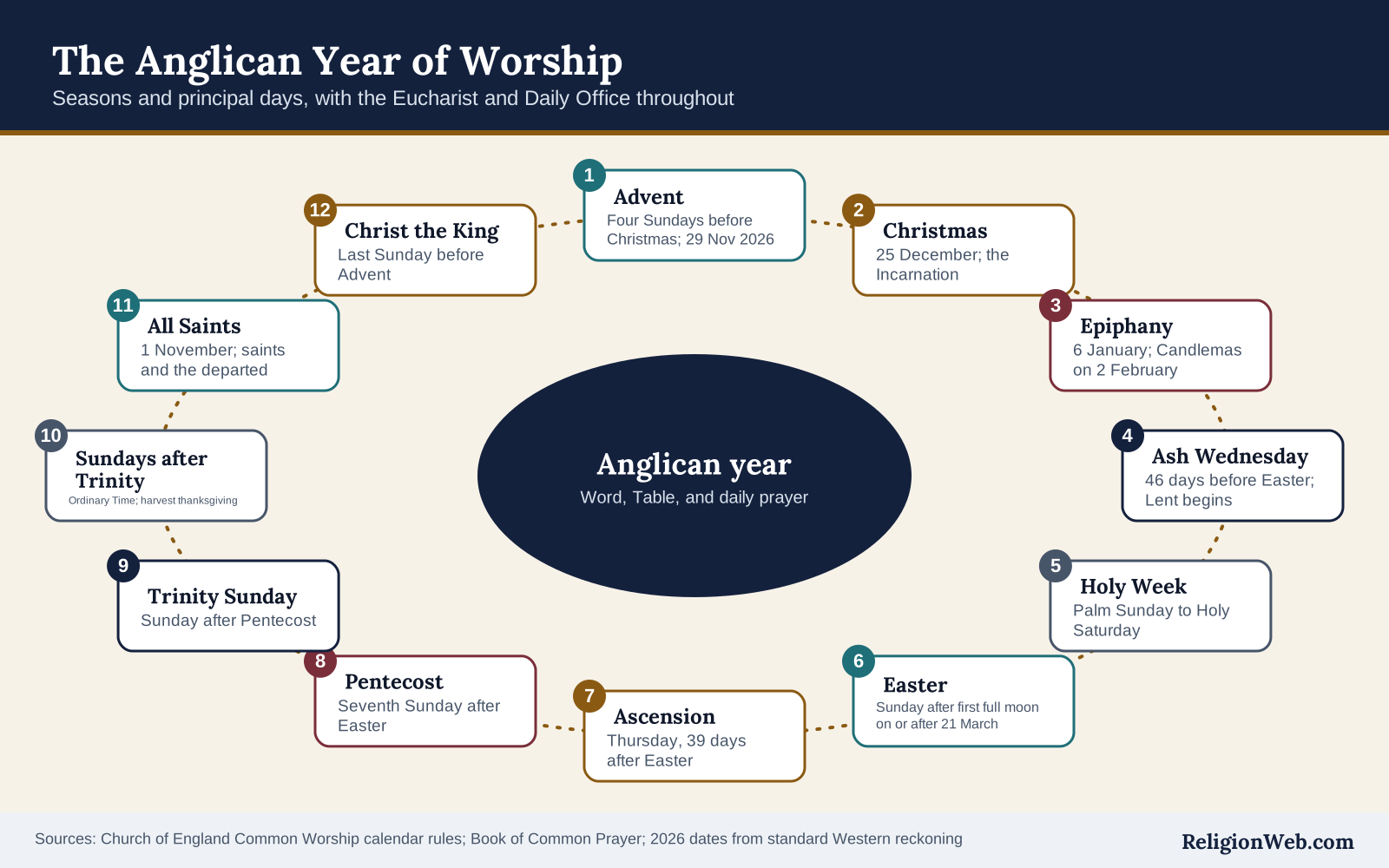
Saints, Holy Days, and Local Calendars
A calendar of principal days
The table below gives the main days in the Anglican year, the rule that sets the date, and what is observed. Specific dates for 2026 and 2027 are included where they follow from the fixed rules.
| Day or season | Date rule | What is observed |
|---|---|---|
| Advent | Four Sundays before Christmas; begins 29 November 2026 | Preparation, Advent wreath, readings of prophecy; purple |
| Christmas Day | 25 December (Friday in 2026) | Birth of Jesus; Eucharist at midnight or morning; white |
| Epiphany | 6 January | Visit of the magi; manifestation of Christ |
| Presentation (Candlemas) | 2 February | Jesus presented in the Temple; candles blessed; ends the Christmas season |
| Ash Wednesday | 46 days before Easter (10 February 2027) | Start of Lent; ashes; repentance |
| Holy Week | Palm Sunday to Holy Saturday | Palms, Last Supper, crucifixion, vigil |
| Easter Day | First Sunday after the first full moon on or after 21 March (5 April 2026; 28 March 2027) | Resurrection; most important feast; white |
| Ascension Day | Thursday, 39 days after Easter | Departure of the risen Christ |
| Pentecost (Whit Sunday) | Seventh Sunday after Easter | Gift of the Holy Spirit; red |
| Trinity Sunday | Sunday after Pentecost | Doctrine of the Trinity |
| All Saints’ Day | 1 November (may be kept on a nearby Sunday) | Thanksgiving for all saints; often with All Souls on 2 November |
Saints and local calendars
Anglicans honor saints as examples of Christian life and as members of the communion of saints, but practice varies. The Articles reject the invocation of saints as it was practiced in the medieval church, and many Anglicans thank God for the saints without addressing prayers to them, while some in the Anglo-Catholic tradition ask for their prayers. Each province adds its own commemorations. Uganda keeps Martyrs’ Day on 3 June in memory of Christians killed in the 1880s, while the Episcopal Church’s calendar commemorates figures from different periods of church history and the Church of England remembers Anglo-Saxon saints such as Aidan, Bede, and Augustine of Canterbury. The calendar thus functions as a living record of how each province understands its history.
Churchmanship, Ministry, and Community Life
Streams of Churchmanship
Anglo-Catholic
Anglicans use the word churchmanship for a style of belief and worship, and the three main streams each trace their lineage to a different period of Anglican history. Anglo-Catholicism, sometimes called high church, descends from the Oxford Movement of the 1830s and from earlier “high church” traditions in the seventeenth century. Its parishes emphasize the church as a sacramental community with an unbroken apostolic ministry, the Eucharist as the center of worship, and the beauty of liturgy. Typical features include vestments, incense, bells, candles, a reserved sacrament, devotion to the Virgin Mary and the saints, and regular use of sacramental confession. Anglo-Catholics often prefer to describe their church as Catholic and Reformed, with the stress on the first word, and many parishes in this tradition are known for their music, their work in poor neighborhoods, and their religious communities.
Evangelical
Evangelical Anglicans trace their heritage to the Reformation and the eighteenth-century revival. They stress the authority of Scripture, the preaching of the gospel, salvation through faith in Christ, and personal response, often called conversion. Their worship is typically centered on the Word, with a sermon of some length, simple vestments, and, in many parishes, contemporary music alongside traditional hymns. Evangelical Anglicans have been prominent in missionary work, in the growth of the church in Africa, and in the formation of the Gafcon movement, although Evangelicals disagree among themselves on many issues, including the ordination of women. Many describe their church as a Reformed church that has kept the ancient ministry of bishops, priests, and deacons.
Broad church, central, and charismatic streams
The “broad church” or liberal stream, traced to nineteenth-century thinkers who sought to relate faith to modern learning, stresses reason, inclusion, social justice, and the development of doctrine in response to new knowledge. The “central” or mainstream tradition, which describes many English parishes, takes elements from each stream without strong commitment to any, using a Sunday Eucharist with moderate ceremony and a sermon. Since the 1960s the charismatic renewal has shaped parts of the church across all streams, adding emphasis on the gifts of the Holy Spirit, healing prayer, and informal worship. These categories are tools for description, not permanent boxes. A single congregation may include people of every stream, and a priest trained in one tradition may adopt practices from another. The table sets out the main emphases.
| Stream | Historic roots | Typical emphases | Typical worship |
|---|---|---|---|
| Anglo-Catholic (high church) | Seventeenth-century high church tradition; Oxford Movement (1833 onward) | Apostolic ministry, sacraments, continuity with the early church, devotion to saints | Sung Eucharist, vestments, incense, reserved sacrament, confession |
| Evangelical (low church) | Reformation; eighteenth-century revival | Authority of Scripture, preaching, personal faith, mission | Sermon-centered services, informal or contemporary music, simple dress |
| Broad church (liberal) | Nineteenth-century reconsideration of faith and learning | Reason, inclusion, social justice, development of doctrine | Varied; often traditional music with thoughtful preaching |
| Central | The Prayer Book mainstream | Balance of Word and sacrament, parish life | Sunday Eucharist with moderate ceremony, Prayer Book or Common Worship |
| Charismatic | Renewal movements since the 1960s | Gifts of the Holy Spirit, healing prayer, personal experience | Extended praise, informal prayer, laying on of hands |
Ministry: Bishops, Priests, and Deacons
The threefold ministry and the historic episcopate
Anglicans keep the threefold ministry of bishops, priests, and deacons, which the Preface to the Ordinal presents as the pattern in Christ’s church from the apostles’ time on, and they call the bishops’ office the historic episcopate. Bishops are consecrated by other bishops, stand in succession from earlier bishops, oversee a diocese, and confirm and ordain. Priests, also called presbyters, preside at the Eucharist, preach, absolve, and bless, and care for a parish. Deacons assist in worship and have a ministry of service to the poor and the community; some serve for life as deacons, and others are ordained priests after a time. Anglicans differ on the weight of apostolic succession: Anglo-Catholics often hold that bishops in historic succession are necessary to the full being of the church, while many Evangelicals regard it as a valuable form of order that is not essential to the church’s existence. The Quadrilateral’s phrase “locally adapted” was meant to hold both views.
Religious communities and lay ministry
Religious communities of women and men, which disappeared from England at the Reformation, were revived from the 1840s, and Anglican orders of monks, nuns, and friars now exist in many countries. They follow a rule of prayer and service, and some work in hospitals, schools, and retreat houses. Lay people also have formal roles. Lay readers, licensed lay ministers, and catechists lead worship and teach, and in some provinces, such as those in Africa, they are essential to the life of large parishes and rural areas where a priest may be responsible for dozens of congregations. The Anglican insistence on lay participation in synods, as full members of church governance, is one of the features it shares with some other Protestant churches and distinguishes it from a purely clerical model.
Community, Ethics, and Relations with Others
Ethics, service, and public life
Anglican teaching on ethics draws on Scripture, the creeds, the moral tradition of the church, and reasoned reflection on experience. Provinces apply them to different issues in different contexts. The Anglican Consultative Council developed a statement known as the Five Marks of Mission in the 1980s and 1990s, which describes the church’s mission as proclaiming the good news, teaching and baptizing new believers, responding to human need through loving service, seeking to transform unjust structures, and caring for creation. Church-run schools, hospitals, and relief agencies are common across the Communion. In England, the Church of England’s schools, cathedrals, and chaplaincies in prisons, hospitals, and the armed forces are part of its public presence, and Anglican leaders have often addressed political questions from the House of Lords and elsewhere.
Relations with other churches and faiths
Anglicans have been active participants in the ecumenical movement, and many Anglican churches are members of the World Council of Churches. They have formal agreements of full communion with several churches, and have conducted long dialogues with others, as described earlier. In many parts of the Communion, Anglicans live alongside people of other religions and sometimes as small minorities. In Nigeria, Pakistan, Egypt, and the Holy Land, for instance, Anglicans share their society with large Muslim populations, and many take part in interfaith initiatives; for background on that faith, see the article on Islam. The presence of religious leaders from other traditions at the 2026 enthronement of the Archbishop of Canterbury was one visible sign of these relationships. The Communion’s institutions are not agreed on every question of public ethics, and the section above on the Communion today describes the disputes that have strained them, but the churches continue to work together in disaster relief, education, and health care.
Common Misconceptions About Anglicanism
Misconception 1: Anglicanism is only the Church of England
Where the misunderstanding comes from
The word “Anglican” looks like the word “English,” and the Church of England is the best-known Anglican church, with a cathedral at Canterbury, a place in the national life, and a prominent role in royal weddings, funerals, and coronations. News coverage of the Archbishop of Canterbury often presents him or her as the leader of “the Anglican Church,” and the shorthand can suggest a single body headquartered in England.
What the evidence and tradition actually show
The Church of England is one of 42 member churches in the Anglican Communion, which the Anglican Communion Office says is present in more than 165 countries. Most Anglicans live outside England, and the Communion’s own estimate is that more than half are in Africa. The Church of Nigeria, the Church of Uganda, and the Anglican Church of Kenya report memberships in the millions, while the Church of England’s preliminary 2025 count of its worshiping community was about 1.02 million. The Episcopal Church in the United States, the Scottish Episcopal Church, the Church of South India, and the Anglican Church of Southern Africa are all full members of the Communion, each governed by its own synod. The Archbishop of Canterbury is a focus of unity for all of them but has no authority to direct their affairs. Accurately, then, Anglicanism is the broader tradition of which the Church of England is the historic mother church.
Misconception 2: The British monarch governs all Anglicans worldwide
Where the misunderstanding comes from
Since 1534 the English monarch has had a formal role in the Church of England, and since 1559 the title has been Supreme Governor. The king or queen is often described in popular writing as “head of the Church of England” or, loosely, “head of the Anglican Church,” and the monarch’s coronation, which is a church service conducted by the Archbishop of Canterbury, adds to the impression. Because the Communion’s roots are in England, it is easy to assume the structure of authority came along.
What the evidence and tradition actually show
The monarch’s role belongs to the Church of England alone. The King is Supreme Governor of that church and, on the advice of the Prime Minister, appoints its archbishops, bishops, and cathedral deans, though in practice the church’s own commission proposes names, and the General Synod makes the church’s law. No other province has the monarch as governor. The Episcopal Church in the United States has been independent since the 1780s, and the Church of Ireland and the Church in Wales have been separate from the state since 1871 and 1920. Churches in Canada, Australia, Nigeria, Kenya, and elsewhere elect their own bishops and make their own rules, even in countries where the British monarch is also head of state. Historically, too, the Elizabethan title “Supreme Governor” was chosen partly to ease objections that only Christ is head of the church, and the Articles of Religion state that the crown’s authority is the government of the realm and does not include preaching or administering the sacraments. Within the Communion, the nearest thing to a common figure is the Archbishop of Canterbury, who has no jurisdiction beyond his or her own province.
Even in England, the monarch’s formal role is exercised largely through Parliament and the advice of ministers, while the church’s own bodies, including the General Synod and the House of Bishops, draft its legislation and shape its worship and teaching. The title “head of the Church of England” is therefore best read as a statement about the legal relation between church and crown, and not as a claim that the monarch directs Anglican belief or worship.
Misconception 3: Anglican worship is identical in every province and parish
Where the misunderstanding comes from
The Book of Common Prayer is famous for its unity: “all the whole realme shall have but one use,” in its own words. Many people know Anglican worship from a single setting, such as a cathedral Evensong, a royal occasion, or a television broadcast of a Christmas carol service, and assume that this is what all Anglican worship looks like. The phrase “common prayer” itself suggests uniformity.
What the evidence and tradition actually show
Anglican worship shares a structure and a body of texts, but the details vary widely. The Church of England uses the 1662 Prayer Book and Common Worship; the Episcopal Church uses the 1979 book with its two rites; other provinces have their own prayer books and many of them are translated into local languages. Within a single province, one parish may use incense and Latin chant, another a band and informal prayers, and a third a short said Eucharist in a village church with a handful of worshipers. The Thirty-Nine Articles themselves say in paraphrase that ceremonies need not be everywhere alike, since they have always varied by country, time, and custom, provided nothing is ordained against God’s Word. The common elements are Scripture, the creeds, the Eucharist, the Daily Office, the church year, and an ordered pattern of prayer. Everything else is open to local adaptation, which is why a visitor from one province may find the worship in another both familiar and surprising.
Language and music add to the variety. Prayer books and service books have been translated into many languages, and the sound of worship ranges from the choir of an English cathedral singing Anglican chant to the lively congregational singing and choirs of many African parishes, and in some places dance. A person who attends an early-morning said Communion in a rural English church and a large Sunday service in an urban parish elsewhere will recognize the same outline of readings, creed, prayers, and sharing of bread and wine, expressed in very different ways.
Misconception 4: Anglicanism was invented so that Henry VIII could remarry
Where the misunderstanding comes from
The immediate trigger of the break with Rome was Henry VIII’s request, from 1527, for an annulment of his marriage to Catherine of Aragon, and the pope’s refusal. Popular histories, television dramas, and school lessons often compress the English Reformation into that single episode, and the story is memorable because it combines court politics and personal drama. The fact that Henry’s break with Rome was the first step also makes the shortcut tempting.
What the evidence and tradition actually show
Historians treat the annulment as the occasion and not the whole cause. Henry’s break in 1533 and 1534 was legal and political, and the doctrine of the English church changed little in his lifetime; he reaffirmed traditional teaching on the Mass and clerical celibacy in 1539. The Anglican identity took shape afterward, through Cranmer’s liturgical work under Edward VI, the Elizabethan Settlement of 1559, the Thirty-Nine Articles of 1571, and the work of theologians such as Richard Hooker. Reforming ideas about Scripture, preaching, and the English Bible were already circulating in England and Europe, and historians debate how widely they had spread before the 1530s: some emphasize the vitality of traditional religion in the parishes, and others stress the appeal of reform. The Church of England has always claimed continuity with the earlier English church, the Ecclesia Anglicana, and not a new foundation in the sixteenth century. A fair summary is that the annulment crisis opened the door, and a long process of political, theological, and social change determined what lay behind it.
Misconception 5: Anglicans have no fixed beliefs, and anything goes
Where the misunderstanding comes from
Anglicans often describe their church as comprehensive, meaning that it holds together people of different convictions, and they speak of a middle way. Public disagreements over ordination, marriage, and sexuality, and the absence of a single teaching office or a confession of faith, can make the church look as if it believes whatever its members happen to think. Jokes about vague Anglican sermons and polite doctrine reinforce the picture.
What the evidence and tradition actually show
Anglican churches hold a defined body of doctrine, found in the Bible, the Apostles’, Nicene, and Athanasian creeds, the Book of Common Prayer and Ordinal, and in many provinces the Thirty-Nine Articles. Clergy make declarations of assent to these standards at ordination, and each province’s synod can define or change its own teaching by established procedures. The Quadrilateral of 1886 and 1888 lists four points that Anglicans regard as essential for unity: Scripture, the creeds, the two sacraments of baptism and the Eucharist, and the historic episcopate. The common saying that Anglican belief is found in its prayer reflects the conviction that what the church prays states what it believes. The sharpest arguments inside the Communion, which have led to separations, show that its members care about doctrine and discipline, not that they lack any. What is distinctive is that Anglicans have no central authority to settle disputed questions for everyone, so the arguments go on in public.
The Latin phrase lex orandi, lex credendi, “the law of praying is the law of believing,” is often used by Anglicans to explain why the Prayer Book matters doctrinally. In the Church of England, clergy declare their assent to the historic formularies when they are ordained or take up a new post, and the creeds are said aloud every Sunday by the whole congregation. That is a very different picture from a church with no commitments, even if the boundaries of permitted opinion are drawn more loosely than in some other traditions.
Frequently Asked Questions About Anglicanism
Questions about identity and origins
Is Anglicanism Protestant or Catholic?
Anglicans answer this in more than one way. The Church of England describes itself as both Catholic and Reformed, holding the catholic creeds and the historic ministry of bishops, priests, and deacons while affirming the Reformation emphasis on Scripture and worship in the people’s language. Reference works and surveys generally class Anglicans among Protestant Christianity, and Anglo-Catholics emphasize continuity with the medieval church, which is the theme of the article on Catholic Christianity. The honest summary is that the label depends on which features one stresses, and Anglicans have never agreed to a single formula.
What is the difference between “Anglican” and “Episcopal”?
“Anglican” names the whole family of churches descended from the Church of England and in communion with the Archbishop of Canterbury. “Episcopal” comes from the Greek episkopos, “overseer” or bishop, and describes a church governed by bishops. The Episcopal Church in the United States and the Scottish Episcopal Church use the word in their names, and both are members of the Anglican Communion. The Episcopal Church is therefore an Anglican church, and its members are Anglicans. Some churches with bishops, such as the Catholic and Orthodox churches, are also episcopal in government but are not part of the Anglican Communion.
Questions about belief and worship
Is the Book of Common Prayer still used?
Yes. The 1662 Book of Common Prayer remains the authorized and normative liturgy of the Church of England, though Common Worship, launched in 2000, is the most commonly used set of services today. Many parishes use the Prayer Book for early Sunday Communion, Evensong, weddings, and funerals. Other provinces have their own books, such as the Episcopal Church’s 1979 Prayer Book, which are descended from the English book and share its structure and many of its prayers. Its phrases, from the 1549 marriage vow to the burial committal, have also passed into English speech.
Do Anglicans pray to saints or to Mary?
It depends on the tradition. The Articles reject the medieval practice of invoking saints, and most Anglicans, particularly Evangelicals, address their prayers to God alone and give thanks for the saints as examples. Anglo-Catholics often ask the prayers of Mary and the saints, as many Christians do, and observe feasts of the Virgin Mary such as the Annunciation, kept on 25 March. The Annunciation is a Principal Feast in the Church of England, and the Magnificat, her song in the Gospel of Luke, is a standard canticle at Evening Prayer.
Questions about the Communion today
Who leads the Anglican Communion?
No one person governs it. The Archbishop of Canterbury is its spiritual head and focus of unity, a role held since 25 March 2026 by Sarah Mullally, the first woman to hold the office. Three other bodies, the Lambeth Conference of bishops, the Anglican Consultative Council, and the Primates’ Meeting, share the work of consultation. Each of the 42 member churches governs itself. Some churches, grouped around the Global Fellowship of Confessing Anglicans, have said that they will no longer take part in the Canterbury-centered bodies, and they describe themselves as continuing the Communion in a different form.
How many Anglicans are there?
The Communion’s own estimate is about 85 million in more than 165 countries, but other estimates are higher, and church-reported figures count baptized members differently from surveys that count regular attenders. The Church of England’s preliminary 2025 figures reported a worshiping community of about 1.02 million and average weekly attendance of about 707,000. Church-reported memberships in Nigeria and Uganda are in the tens of millions, though researchers caution that such figures are hard to verify. Any single number should therefore be read with its source and year in mind.
Conclusion: Anglicanism as Shared Prayer and Contested Boundaries
What the history shows
A tradition formed by prayer
Anglicanism began as a political and religious settlement in sixteenth-century England and became a worldwide family of churches because it carried a way of worship. The Book of Common Prayer, its Scripture-filled services, its collects, and its pattern of Word and Table gave a scattered group of churches a recognizable character. Anglicans have held that how the church prays shapes what it believes, and the long continuity of the Eucharist, the Daily Office, and the church year is the strongest thread through four and a half centuries.
A Communion still changing
The structures that held the Communion together, the Archbishop of Canterbury, the Lambeth Conference, the Anglican Consultative Council, and the Primates’ Meeting, depend on consent, and consent has become harder to secure. The ordination of women, the blessing of same-sex couples, and the authority of Scripture have all divided Anglicans, and a new realignment is under way. The faith that the churches confess in the creeds is not in dispute between the groups. What is contested is how far unity requires agreement in practice, and who has authority to say. Readers should expect further change.
How to keep exploring
Reading and listening
The best introduction to Anglican worship is to read the earlier editions of the Book of Common Prayer in a public-domain edition, to compare them with a modern service book, and, if possible, to attend a Eucharist and a choral Evensong. Hooker’s Laws of Ecclesiastical Polity and the Thirty-Nine Articles show the sixteenth-century arguments, and the Anglican Communion Office publishes the Communion’s own account of its structures.
Related articles on this site
For the larger context, see the hub article on Christianity and the article on Protestant Christianity. Other Christian traditions that share the creeds and the sacramental life described here are covered in the articles on Catholic Christianity, Eastern Orthodox Christianity, and Oriental Orthodox Christianity.
Sources
The table below lists the principal external sources behind this article. Facts, dates and figures were checked against these and related primary, institutional and academic materials.
| # | Source | Publisher and type | Used for | Link |
|---|---|---|---|---|
| 1 | Anglican Communion member churches (42 member churches, extra-provincial areas, over 165 countries) | Anglican Communion Office · Institutional | 42 autonomous member churches, five extra-provincial areas, presence in over 165 countries | anglicancommunion.org |
| 2 | The Chicago-Lambeth Quadrilateral | Anglican Communion Office · Institutional | Four points of 1886 and 1888; wording on the historic episcopate quoted | anglicancommunion.org |
| 3 | Instruments of Communion | Anglican Communion Office · Institutional | Archbishop of Canterbury, Lambeth Conference, Anglican Consultative Council, Primates’ Meeting (1978) | anglicancommunion.org |
| 4 | The Church of England: a background note (2015 data) | Church of England · Institutional | Parishes, dioceses, General Synod, Lords Spiritual, Declaration of Assent wording | churchofengland.org |
| 5 | The Book of Common Prayer, 1549: Preface | Society of Archbishop Justus (justus.anglican.org) · Primary text | Public-domain 1549 Preface: the ‘one use’ quotation, regional uses, Bible reading, English tongue | justus.anglican.org |
| 6 | The Book of Common Prayer, 1549: The Forme of Solemnizacion of Matrimonie | Society of Archbishop Justus (justus.anglican.org) · Primary text | Public-domain 1549 marriage vow quoted in the Fun Fact | justus.anglican.org |
| 7 | World English Bible (Classic edition): Acts 2, Luke 22, Ephesians 4 | eBible.org · Primary text | Public-domain Bible text for Acts 2:42, Luke 22:19, and Ephesians 4:4-6 | ebible.org |
| 8 | Church of England attendance grows steadily for fifth year in a row (2025 preliminary figures) | Church Times · News report | 2025 worshiping community, weekly attendance, and Christmas figures for the Church of England | churchtimes.co.uk |
| 9 | For the first time, the Church of England gets a woman leader (Mullally installation, 25 March 2026) | NPR · News report | Date and place of the enthronement; first woman; 106th archbishop; Welby’s resignation | npr.org |
| 10 | Gafcon renames its group, elects leaders (Abuja, March 2026) | MinistryWatch · News report | Gafcon’s March 2026 Abuja decisions: Global Anglican Council, leaders, ‘principled disengagement’ | ministrywatch.com |
Last fact-check date: 2026-10-21.
