Protestant Christianity is the broad family of Christian churches and movements that descend from the sixteenth-century Reformation in Western Europe, together with the revivals and missionary movements that grew out of it. Its churches differ widely in worship, organization, and doctrine, but most share three convictions: that the Bible is the final standard for Christian teaching, that people are put right with God by grace received through faith rather than earned by merit, and that every believer has direct access to God and a calling to serve. Lutheran, Reformed and Presbyterian, Anabaptist and Mennonite, Methodist, Baptist, and Pentecostal churches are the best-known branches, and thousands of independent congregations stand beside them. Pew Research Center, using a deliberately broad definition, estimated about 801 million Protestants in 2010, roughly 37 percent of all Christians.
Protestantism is one of the major divisions of Christianity, the religion centered on Jesus of Nazareth, and its story cannot be separated from the Western church in which it began. The name comes from a formal protest made by German princes and city delegates at the Diet of Speyer in 1529. The people involved first called themselves evangelical, from the Greek euangelion, “good news.” Today most Protestants identify themselves by a denominational name or simply as Christians, and no council, pope, or central office speaks for all of them.
Because the word covers so much ground, this article describes the family on its own terms, tradition by tradition, and names the church family whenever teaching or practice differs. It follows the story from the late medieval church through Martin Luther, Huldrych Zwingli, John Calvin, the Anabaptists, and the English reformers, then through Pietism, Methodism, the evangelical revivals, global missions, and the rise of Pentecostal and independent churches. Along the way it explains how Protestants read Scripture, preach, baptize, share the Lord’s Supper, keep the church year, and govern their congregations.
Neighboring traditions have their own articles on this site. Anglicanism is counted within Protestantism by Pew and by many scholars, while many Anglicans describe their church as both catholic and reformed. The larger families of Catholic Christianity, Eastern Orthodox Christianity, and Oriental Orthodox Christianity are treated there in full, so they appear here only as historical background.
Protestant Christianity at a Glance: Definition, Name, Geography, and Vocabulary
What “Protestant” Means
A working definition
In its widest use, the label describes Christians whose churches originated in the sixteenth-century movements that reformed the medieval Western church, and the later churches that grew from those movements. Historians commonly distinguish two streams of that first century. The “magisterial” Reformation, associated with Luther and Calvin, worked through princes and town councils to reshape whole communities, and it produced the Lutheran and Reformed churches. The “radical” Reformation of the Anabaptists held that the church should be a voluntary gathering of baptized adult believers, separate from civil government. Later movements, among them the Baptists, Methodists, and Pentecostals, drew on both streams and on their own revivals.
Three convictions recur across most of these churches, even though each tradition states them differently. The first is the supreme authority of Scripture over church teaching. The second is justification, God’s act of declaring sinners righteous, through grace received by faith and not through merit. The third is the “priesthood of all believers,” the teaching that every baptized Christian can approach God directly and has a vocation, or calling, in the world. These convictions are descriptions of what Protestant churches teach, not a test that every member would phrase in the same way.
Self-description, boundaries, and borderline cases
Protestant communities rarely begin with the word “Protestant.” Lutheran churches in Germany and Scandinavia still use evangelical in their official names, Reformed churches speak of being “reformed according to the Word of God,” and many Baptist, Pentecostal, and independent congregations describe themselves simply as the church of Jesus Christ in a particular place. The term is chiefly an outside and scholarly category, though many members accept it and some churches embrace it warmly.
The edges of the category are drawn differently by different observers. Pew Research Center counts three groups under its broad “Protestant” heading: historic Protestants (churches that began in or were reshaped by the Reformation, plus later denominations such as the Methodists), Anglicans, and independent Christians, which includes independent denominations in sub-Saharan Africa, unregistered churches in China, and nondenominational churches in the United States. Anglicans have their own tradition and article, and they often stress their continuity with the early church alongside their Reformation heritage. The Church of Jesus Christ of Latter-day Saints and Jehovah’s Witnesses identify as Christian but do not describe themselves as Protestant, and they are classified separately by Pew. Unitarian churches, which grew partly from the radical Reformation, are generally not counted as Protestant by Trinitarian churches because they do not confess the Trinity, though they are part of the same historical story.
How Many Protestants Are There, and Where?
The global picture
The most widely cited recent breakdown of Christian traditions by Pew Research Center dates from 2010 and was published in 2011. It counted about 801 million Protestants, as broadly defined, or 37 percent of the world’s Christians. Protestants were spread across several continents: about 37 percent of them lived in sub-Saharan Africa, 33 percent in the Americas, 17 percent in the Asia-Pacific region, and 13 percent in Europe, with fewer than 1 percent in the Middle East and North Africa. Protestants formed a majority of the population in 49 countries, and the ten countries with the most Protestants held 61 percent of the world total, only two of which were in Europe.
That geography surprises many readers, because Protestantism began in Germany and Switzerland. Over five centuries missions, migration, and local leadership moved its center of gravity southward and eastward. In Pew’s 2020 data on all Christians, sub-Saharan Africa already held 30.7 percent of the world’s Christians, more than Europe’s 22.3 percent. The 2025 Pew report that gives these figures does not separate Protestants from other Christians, so the 2010 breakdown remains the latest comparable global estimate in that series.
Why the numbers need careful reading
Counting Protestants is harder than it sounds. Pew’s total includes Anglicans and a large “independent” group, and definitions that leave those groups out would give a smaller figure. Pentecostal and charismatic Christians, who belong to many church families and also to Catholic and Orthodox churches, were estimated at about 279 million Pentecostals and 305 million charismatics in 2010, together about 27 percent of all Christians. Evangelicals, estimated at more than 285 million, overlap with those counts, so the figures should never be added together.
The United States offers a more recent national snapshot. Pew’s 2023–24 Religious Landscape Study, a survey of more than 35,000 adults, found about 23 percent of Americans identifying as evangelical Protestants, 11 percent as mainline Protestants, and 5 percent as members of historically Black Protestant churches, roughly four in ten adults in all. These categories describe broad patterns of belief and church history, not formal denominations, and a person’s own label may differ from a researcher’s.
| Feature | Summary |
|---|---|
| Origin | Western Europe, sixteenth-century Reformation; traditionally dated from Martin Luther’s Ninety-five Theses, 31 October 1517 |
| Name | From the protestatio made at the Diet of Speyer in April 1529; earlier self-designation “evangelical” |
| Core convictions | Authority of Scripture, justification by grace through faith, priesthood of all believers |
| Bible | Sixty-six books in most Protestant editions: 39 in the Old Testament and 27 in the New Testament |
| Central rites | Baptism and the Lord’s Supper, called sacraments by some churches and ordinances by others |
| Church order | Episcopal, presbyterian, congregational, and connectional patterns, plus independent networks |
| Major families | Lutheran, Reformed and Presbyterian, Anabaptist, Methodist, Baptist, Pentecostal, and many independent churches |
| Size | About 801 million, or 37 percent of Christians (Pew, 2010 data, broad definition including Anglicans and independents) |
| Where Protestants live (2010) | Sub-Saharan Africa 37 percent, Americas 33 percent, Asia-Pacific 17 percent, Europe 13 percent |
Key Terms for Reading About Protestant Churches
Words about faith and salvation
A handful of terms appear in almost every Protestant discussion of belief. Grace means God’s unearned favor. Justification is the act by which God accepts sinners as righteous for Christ’s sake, and sanctification is the lifelong process of growing in holiness that Protestants generally say follows it. Gospel means the message of salvation in Jesus Christ. Confession has two senses: the admission of sins in prayer, and a formal written statement of a church’s teaching, such as the Augsburg Confession of 1530 or the Westminster Confession of Faith of the 1640s. Creed refers to the short ancient statements, chiefly the Apostles’ Creed and the Nicene Creed, that most Protestant churches affirm as summaries of Christian faith.
Latin phrases from the Reformation remain in use. Sola scriptura (“Scripture alone”) expresses the primacy of the Bible. Sola fide (“faith alone”) and sola gratia (“grace alone”) describe salvation. A group of five such phrases, adding solus Christus (“Christ alone”) and soli Deo gloria (“glory to God alone”), is often called the five solae. Historians note that the Reformers never gathered all five into one list. That set took shape in the twentieth century, so it is best read as a later summary of Reformation themes.
Words about church life and structure
Several terms describe how Protestant church life is organized. A denomination is a named family of congregations sharing a tradition, and a congregation is a local community that gathers for worship. Pastor and minister are the usual words for ordained leaders, and the word priest is used by some Lutheran and Anglican churches but avoided in many others. Larger bodies have their own names: a synod or presbytery in Lutheran and Presbyterian churches, a conference in Methodist ones, and a convention or association among Baptists.
Two further labels need care. Sacrament and ordinance both name rites that Christ is understood to have commanded, chiefly baptism and the Lord’s Supper, but the first suggests that God acts through the rite, while the second stresses obedience and testimony; later sections show how churches divide on this. Mainline usually refers to long-established, historically large churches in the United States, such as the United Methodist, Presbyterian, Lutheran, and Episcopal churches, while evangelical describes a broad transdenominational movement with its own emphases, explained below. The two overlap in some places and not in others.

Origins: The Reformation and the Birth of Protestantism (1517 to 1648)
The Western Church Before the Reformation
Calls for reform and new tools of learning
The Reformation did not begin from nothing. For more than a century before 1517, preachers and scholars in Western Europe had argued about church wealth, clerical discipline, and the authority of popes and councils. John Wycliffe in England (died 1384) and Jan Hus in Bohemia, who was executed at the Council of Constance in 1415, urged the use of Scripture as a standard for the church, and their followers survived in groups such as the Bohemian Hussites. Humanist scholars, most famously Erasmus of Rotterdam, returned to Greek and Hebrew sources, and Erasmus’s printed Greek New Testament of 1516 gave later reformers a text to work from.
The printing press, in use in Germany from the mid-fifteenth century, changed how quickly such ideas traveled. Pamphlets, sermons, and vernacular Bibles could be produced in thousands of copies, and the Reformation was among the first religious movements to spread through print on a large scale. Historians generally see these developments as conditions that made the sixteenth-century crisis possible, not as proof that it was inevitable.
Indulgences and the Ninety-five Theses
The immediate spark was a dispute over indulgences, the medieval practice by which the church granted remission of temporal penalties for sin, often in exchange for prayer or a donation. In 1517 a preacher named Johann Tetzel was promoting an indulgence in German lands, with proceeds shared between the rebuilding of St. Peter’s in Rome and Archbishop Albert of Brandenburg. Martin Luther (1483 to 1546), a monk and professor of Bible at the University of Wittenberg, was troubled by the idea that forgiveness could be bought. He drew up ninety-five propositions for academic debate and, on 31 October 1517, sent them to Archbishop Albert. Printed copies soon circulated widely.
The traditional story holds that Luther nailed the theses to the door of the Castle Church in Wittenberg on that day. Historians debate the account, since the earliest sources for it date from after Luther’s death, but the documented fact is the letter to Albert. Either way, 31 October 1517 is remembered by Lutheran and many other Protestant communities as the symbolic beginning of the Reformation. The theses were a call for debate, not yet a break with the church. They questioned what indulgences could accomplish and, behind that, what the gospel promised to sinners.
Luther and the German Reformation
From Wittenberg to Worms
The controversy grew quickly. At the Leipzig Disputation of 1519, Luther debated the theologian Johann Eck and was led to say that councils and popes could err, a position that put him on the road to open conflict. In 1520 he published three major works in German and Latin on the reform of the church, the sacraments, and the freedom of the Christian. A papal bull of June 1520 condemned forty-one of his propositions, and he was excommunicated in January 1521. Summoned to the imperial Diet at Worms in April 1521, Luther declined to recant unless he was shown wrong from Scripture or clear reason. The emperor, Charles V, issued the Edict of Worms in May declaring him an outlaw.
Luther’s protector, Elector Frederick the Wise of Saxony, arranged for him to be taken to the Wartburg castle, where he spent about ten months in hiding. There he translated the New Testament into German; it appeared in September 1522, and he completed the whole Bible in 1534. In 1525 he married Katharina von Bora, a former nun, and their household became a model for the Protestant parsonage. His core teaching was that sinners are justified by faith in Christ, a gift received and not a reward, and that Scripture, not tradition or papal decree, has final authority in the church.
Princes, cities, and the Lutheran confession
The Reformation became a political event because German territories were ruled by princes and free cities that could choose their own religious policy. The Peasants’ War of 1524 to 1525, a large uprising in southern and central Germany, drew on reforming language, and Luther’s harsh public response in favor of the princes remains one of the most criticized episodes of his career. Reform meanwhile spread through Saxony, Hesse, and many imperial cities, where visitations of parishes and new church orders established Lutheran worship and preaching.
At the Diet of Augsburg in 1530, Luther’s colleague Philip Melanchthon (1497 to 1560) presented a statement of Lutheran teaching to Charles V, the Augsburg Confession, which became the founding confession of the Lutheran churches. In 1531 Protestant rulers formed the Schmalkaldic League for mutual defense. After years of tension and a brief war in 1546 and 1547, the Peace of Augsburg of 25 September 1555 allowed each ruler in the Holy Roman Empire to choose between the Catholic and Lutheran confessions for his territory. Subjects who disagreed could emigrate. The settlement did not include Reformed or Anabaptist communities.
The Swiss, Reformed, and Radical Reformations
Zwingli, Calvin, and the Reformed churches
In Zurich, the priest Huldrych Zwingli (1484 to 1531) began preaching through the Gospels in 1519. With the support of the city council, Zurich removed images from its churches, reformed the Mass, and in 1525 replaced it with a simple communion service. Zwingli and Luther met at Marburg in October 1529 and agreed on most points but not on how Christ is present in the Lord’s Supper. Zwingli was killed in battle at Kappel in 1531, and his successor Heinrich Bullinger guided the Zurich church for more than four decades.
John Calvin (1509 to 1564), a French humanist and lawyer by training, published the first edition of his Institutes of the Christian Religion in 1536 and was drawn into the reform of Geneva. After an exile in Strasbourg he returned to Geneva in 1541 and spent the rest of his life shaping its church order, preaching, and teaching. The Geneva Academy, founded in 1559, trained ministers who carried Reformed teaching to France, the Netherlands, Scotland, Hungary, and beyond. The Scottish Parliament adopted a Reformed Confession of Faith in 1560 under the leadership of John Knox, and the Heidelberg Catechism of 1563 became a standard for Reformed churches in Germany and the Netherlands. Geneva also had its failures, notably the execution of the anti-Trinitarian writer Michael Servetus in 1553, an act that drew criticism even then and is widely regretted today.
Anabaptists and the radical Reformation
A third stream began in Zurich among former followers of Zwingli who concluded that infant baptism had no basis in the New Testament. On 21 January 1525, Conrad Grebel baptized George Blaurock as a believer, and the others present were baptized in turn. Their opponents called them Anabaptists, “re-baptizers,” a name they rejected because they considered infant baptism no true baptism. In 1527 Swiss Brethren leaders adopted the Schleitheim Confession, which described a church of committed believers who would not take oaths or bear the sword.
The Anabaptists were persecuted by Catholic, Lutheran, and Reformed authorities alike, and many were executed; the Martyrs Mirror, a Dutch collection first published in 1660, records the stories of those who died. A violent episode at Münster in 1534 and 1535, in which a radical group seized the city, was condemned by most Anabaptists and used by their opponents to discredit the whole movement. Leaders such as Menno Simons (about 1496 to 1561) in the Netherlands gathered peaceful communities whose heirs include today’s Mennonites, while the Hutterites, named for Jakob Hutter, who led them in the 1530s, practiced shared property, and the Amish emerged later, in 1693, under Jakob Ammann.
England, Scotland, and the Wars of Religion
The English and Scottish reformations
The English Reformation began as a political break with Rome under Henry VIII, whose Act of Supremacy of 1534 declared the king head of the Church of England. Under Edward VI, Thomas Cranmer produced the first Book of Common Prayer in 1549, and Elizabeth I’s settlement of 1559 established a church that kept bishops and liturgy while adopting Protestant doctrine. That story, and the worldwide Anglican Communion that grew from it, is told on the Anglicanism page. Within England, the Puritans pressed for further reform of worship and church government, and their heirs would later help found Presbyterian, Congregationalist, and Baptist churches in Britain and America.
In Scotland the church took a Presbyterian form, governed by elders and assemblies rather than bishops. The Westminster Assembly, which met in London from 1643, produced the Westminster Confession of Faith in 1646, along with catechisms and a directory for worship, and these documents still serve as doctrinal standards for many Presbyterian churches around the world.
Confessional Europe and the settlement of 1648
By the late sixteenth century, Europe’s churches had settled into distinct confessions: Lutheran across much of northern Germany and Scandinavia, Reformed in Switzerland, the Netherlands, Scotland, and parts of Germany and Hungary, Anglican in England, and Catholic elsewhere, with Catholic reform advancing through the Council of Trent between 1545 and 1563. Disputes within Protestantism were also sharp. The Synod of Dort in the Netherlands, held in 1618 and 1619, rejected the teaching of Jacobus Arminius on election and free will, and it produced the Canons of Dort that are still a standard for many Reformed churches.
Religious and political rivalries erupted in the Thirty Years’ War, which devastated central Europe from 1618 to 1648. The Peace of Westphalia of 1648 confirmed the Augsburg settlement and extended recognition to the Reformed churches, though not to Anabaptists. It did not end religious conflict in Europe, but it set a framework in which three major Christian confessions could coexist in law, and it prepared the way for the later emergence of freedom-of-conscience arguments.
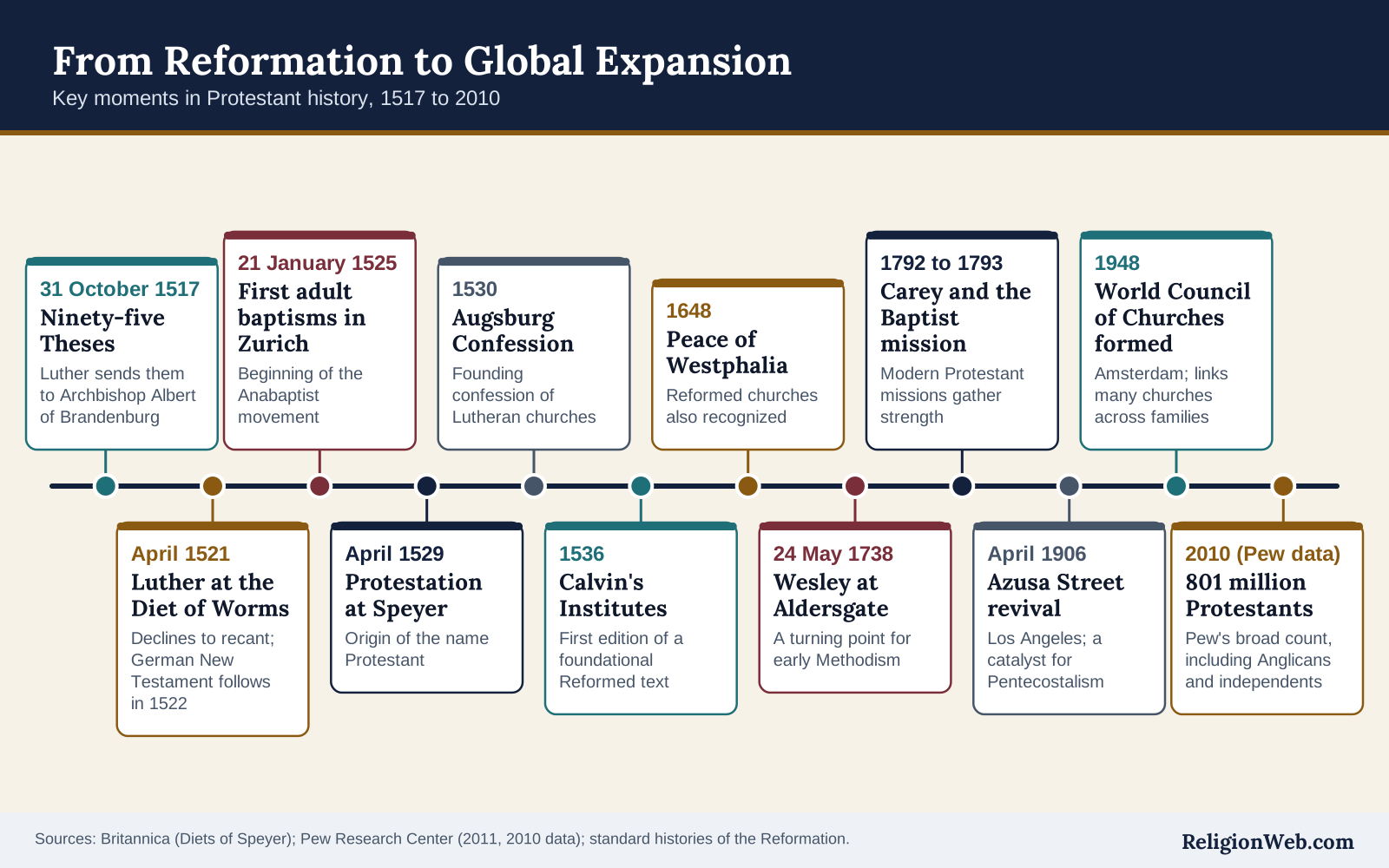
| Date | Event | Significance |
|---|---|---|
| 31 October 1517 | Luther sends the Ninety-five Theses to Archbishop Albert of Brandenburg | Traditional starting point of the Reformation |
| 1519 | Leipzig Disputation; Zwingli begins preaching in Zurich | Debate widens over authority of councils and popes; Swiss reform begins |
| April 1521 | Luther at the Diet of Worms | Refuses to recant; declared an outlaw by the Edict of Worms |
| 1522 | Luther’s German New Testament | Vernacular Scripture becomes central to Protestant life |
| 21 January 1525 | First adult baptisms in Zurich | Beginning of the Anabaptist movement |
| April 1529 | Protestation at the Diet of Speyer | Origin of the name “Protestant” |
| 1530 | Augsburg Confession presented | Founding confession of Lutheran churches |
| 1534 | English Act of Supremacy; Luther’s complete German Bible | Royal supremacy in England; German scripture standard |
| 1536 | First edition of Calvin’s Institutes | Foundational Reformed theology text |
| 1555 | Peace of Augsburg | Lutheran and Catholic rulers recognized in the empire |
| 1560 | Scottish Reformation under John Knox | Presbyterian church order in Scotland |
| 1618 to 1619 | Synod of Dort | Reformed response to Arminian teaching |
| 1648 | Peace of Westphalia | Reformed churches recognized; end of Thirty Years’ War |
Later Developments: Pietism, Revivals, Missions, and Global Growth (1648 to Present)
Renewal Movements in Europe and Britain
Puritanism and Pietism
Once the confessional churches were established, many Protestants began to ask whether doctrine alone was enough. English and Scottish Puritans of the seventeenth century stressed personal conversion, disciplined Bible reading, and moral seriousness, and they carried these ideals to New England, where Harvard College was founded in 1636 partly to train ministers. In German lands, the Lutheran pastor Philipp Jakob Spener published Pia Desideria (“Pious Wishes”) in 1675, calling for small gatherings for Bible study, a more active role for laypeople, and faith expressed in daily life. His movement, Pietism, produced schools, orphanages, and mission work at Halle, and it shaped the Moravian Church, whose community at Herrnhut on Count Nikolaus Ludwig von Zinzendorf’s estate was established in 1722.
The Moravians began sending missionaries to the Caribbean and elsewhere in 1732, among the first sustained Protestant missions. Pietism’s emphasis on a living, personal faith, expressed through hymns, testimony, and charity, influenced Methodism, the evangelical revivals, and the later Pentecostal movement, as well as Lutheran piety in Scandinavia and North America.
John Wesley and early Methodism
John Wesley (1703 to 1791), an Anglican priest, led a small group of students at Oxford that critics nicknamed the “Holy Club,” from which the word Methodist came. On 24 May 1738, at a meeting on Aldersgate Street in London, he heard a reading of Luther’s preface to the Letter to the Romans and wrote that his heart was “strangely warmed” and that he trusted Christ alone for salvation. Wesley began preaching outdoors in 1739 when pulpits were closed to him, and he organized converts into societies and weekly class meetings for prayer, mutual accountability, and charity.
Wesley remained a priest of the Church of England until his death, but the movement he led grew into a separate church. In 1784 he ordained leaders for his American followers, and the Methodist Episcopal Church was organized in the United States. Methodism spread through hymnody (his brother Charles wrote thousands of hymns), field preaching, and a strong emphasis on sanctification, discussed below.
Revivals and the Rise of Evangelicalism
The Great Awakenings
In the 1730s and 1740s, a wave of revivals swept the British Isles and the American colonies, often called the Great Awakening. Jonathan Edwards (1703 to 1758) preached to growing congregations in Northampton, Massachusetts, in 1734 and 1735, and the English preacher George Whitefield drew crowds of thousands in outdoor meetings across the colonies from 1739. The Second Great Awakening, from about the 1790s into the 1840s, brought camp meetings such as the one at Cane Ridge, Kentucky, in 1801, rapid growth for Baptist and Methodist churches, and new movements that sought a return to the New Testament church, including the Stone-Campbell churches known as Disciples of Christ and Churches of Christ.
These revivals also reshaped African American Christianity. Richard Allen, a freed Black preacher in Philadelphia, led the organization of the African Methodist Episcopal Church in 1816 after Black Methodists faced discrimination in white-led congregations, and Black Baptist and Methodist churches became centers of worship, education, and organization for enslaved and free communities.
What “evangelical” means
The historian David Bebbington proposed four marks that describe evangelicalism across denominations: conversionism (the need for a personal turning to Christ), biblicism (high regard for the Bible), crucicentrism (a focus on Christ’s death on the cross), and activism (sharing the faith and doing good). Evangelicals are found in Baptist, Methodist, Presbyterian, Pentecostal, Lutheran, and Anglican churches, and in nondenominational ones. Estimates of their number vary with the definition: Pew counted more than 285 million in 2010, while organizations that use broader criteria report several hundred million more.
Evangelicalism should not be equated with a political position. Evangelical Christians differ in their views on public life, and in some countries evangelical churches are small minorities. Mainline churches have their own, often more liberal or moderate, theological currents, though many contain evangelical members and movements.
Missions, Ecumenism, and Pentecostal Growth
Missionary expansion and local leadership
The modern Protestant missionary movement gathered strength in the late eighteenth century. In 1792 the English Baptist William Carey (1761 to 1834) published a pamphlet urging Christians to take the gospel abroad, helped found the Baptist Missionary Society, and sailed to India in 1793. Bible societies, mission boards, and schools followed across Asia, Africa, and the Pacific, and missionaries translated Scripture into hundreds of languages. The movement was entangled with European empires, and historians and Christians alike debate how far missionaries served, resisted, or benefited from colonial rule; some missionaries defended local peoples against abuses, while others accepted the assumptions of their era.
The World Missionary Conference in Edinburgh in 1910 became a landmark for cooperation among Protestant missions, and it helped give rise to the ecumenical movement. After the Second World War, leadership shifted to churches in Africa, Asia, and Latin America, which now send their own missionaries. The World Council of Churches, formed at Amsterdam in 1948, brought many Protestant, Anglican, and Orthodox churches into a standing fellowship.
Twentieth-century controversies and Pentecostal growth
In the early twentieth century, American and British Protestants argued over modern scholarship and science, and over the proper role of churches in a changing society. Some embraced historical study of the Bible and the Social Gospel, which stressed justice and reform; others, who came to be called fundamentalists, defended traditional doctrines such as biblical inerrancy. In Germany, the Barmen Declaration of May 1934, largely drafted by the Reformed theologian Karl Barth, was adopted by Protestants in the Confessing Church to reject the claim that the state could be a source of divine revelation alongside Christ.
The most dramatic growth came from Pentecostalism. Early Pentecostal groups, such as those around Charles Parham in Topeka, Kansas, in 1901, taught that the gifts of the Holy Spirit seen in the New Testament, including speaking in tongues and healing, are available today. The Azusa Street revival in Los Angeles, which began in April 1906 under the African American preacher William J. Seymour, drew racially mixed crowds and sent missionaries to dozens of countries. Pew estimated about 279 million Pentecostals and 305 million charismatics worldwide in 2010, and Pentecostal and charismatic Christians are now found on every inhabited continent, with especially large communities in Latin America, sub-Saharan Africa, and parts of Asia.
Core Beliefs: Grace, Faith, Christ, and the Church
Beliefs Held in Common with Other Christians
The Trinity and the person of Christ
Protestant doctrine builds on the same ancient foundation as the rest of Christianity. The great majority of Protestant churches affirm the Apostles’ Creed and the Nicene Creed, and the early confessions of the Reformation explicitly accept the teaching of the first ecumenical councils: that God is one in being and three in persons, Father, Son, and Holy Spirit, and that Jesus Christ is fully God and fully human. Lutheran and Reformed confessions repeat these teachings in their own words, and Methodist, Baptist, and Pentecostal statements of faith do the same, whether or not the creeds themselves are recited in worship.
Some Protestant-descended groups avoid fixed creeds altogether on principle, preferring to rest on Scripture, and some groups with roots in the radical Reformation, such as the Unitarians, reject Trinitarian doctrine. Most Trinitarian churches do not count such groups among Protestants for that reason, while the groups themselves see themselves as heirs of the Reformation tradition of conscience and biblical study.
Sin, the cross, and resurrection
Protestants teach that human beings are in need of salvation because of sin, and that in the death and resurrection of Jesus Christ God reconciled the world to himself. How that atonement is explained varies. Lutheran and Reformed writers often stress that Christ bore the penalty of sin in the place of sinners, while others emphasize Christ’s victory over evil, his example of self-giving love, or all three together. Resurrection is celebrated on Easter, and the hope of eternal life with God, in which the dead are raised at Christ’s return, is a standard Protestant teaching, with differences of view among churches over how to understand end-time passages in Scripture.
Those differences are often grouped under the word millennium, from the thousand-year reign described in the Book of Revelation. Amillennial readers, common among Lutherans and many Reformed Christians, take the thousand years as a symbol of the present age of Christ’s reign. Postmillennial readers, influential among eighteenth- and nineteenth-century Puritan and revival writers, expect an era of gospel influence before Christ returns. Premillennial readers expect his return before the thousand years, and a form called dispensational premillennialism, popularized in the United States by the Scofield Reference Bible of 1909, is widely held among evangelicals and Pentecostals. These are internal Protestant debates on which churches have not required agreement.
Justification by Faith and the Meaning of Grace
Justification in Scripture and in the Reformers
The doctrine at the center of the Reformation was justification by faith. Luther found it expressed in the letters of the apostle Paul, above all in the Letter to the Romans, where Paul writes:
We maintain therefore that a man is justified by faith apart from the works of the law.
Romans 3:28, World English Bible (public domain)
Lutheran teaching understands this to mean that God declares sinners righteous because of Christ’s righteousness, which is counted to them when they trust him, and that good works follow as the fruit of faith rather than its cause. Article IV of the Augsburg Confession of 1530 states that people cannot be justified before God by their own strength, merits, or works, but are freely justified for Christ’s sake through faith. Reformed theologians, including Calvin, taught the same central point, with their own emphasis on union with Christ and the work of the Holy Spirit.
Grace as gift
Another passage often cited in Protestant teaching comes from the Letter to the Ephesians:
for by grace you have been saved through faith, and that not of yourselves; it is the gift of God, not of works, that no one would boast.
Ephesians 2:8-9, World English Bible (public domain)
Protestants read these verses as saying that salvation is a gift, not an achievement. That does not make Christian conduct unimportant: Lutheran, Reformed, and Wesleyan writers all insist that faith produces love of neighbor, obedience, and service. The Reformation debate was about the ground of acceptance with God, not about whether holy living matters. The same passage in Ephesians goes on to speak of “good works” that God prepared beforehand for believers to walk in.
Free Will, Election, and the Christian Life
Predestination and its alternatives
Protestants have long disagreed on how divine grace and human choice relate. Calvin and the Reformed confessions taught that God, before the foundation of the world, elected some people to salvation by his sovereign mercy alone, and that the elect are kept in faith by his power; the Canons of Dort in 1619 set this out in detail against the Arminian view that God elects those whom he foresees will believe. Wesley and the Methodists taught that God’s grace precedes human response and is offered to all, and that people may accept or resist it. Lutheran teaching holds that salvation is entirely God’s work, while the Lutheran confessions generally decline to teach that God predestines anyone to damnation, and they point instead to God’s promise in baptism and the Word. Baptists have included both Calvinist and Arminian streams since the seventeenth century.
Sanctification and Christian vocation
Most Protestants teach that justification is followed by a lifelong process of growth in holiness, sanctification, carried out by the Holy Spirit. Lutherans often describe the Christian as at once righteous in God’s sight and still a sinner, while Wesleyan and Holiness traditions teach that believers can be made “perfect in love” in this life, and Pentecostals often describe a further experience of baptism in the Holy Spirit. These differences affect how each church thinks about repentance, worship, and moral discipline.
Protestants also developed a strong doctrine of vocation, from the Latin vocatio, “calling.” Luther taught that ordinary work, family life, and civic duty are ways of serving God and neighbor, not lesser paths than religious life. That outlook shaped Protestant attitudes toward education, work, marriage, and public responsibility, though sociologists continue to debate how far Max Weber’s famous argument linking Protestant ethics to modern capitalism holds up.
The Church and the Priesthood of All Believers
What the “priesthood of all believers” teaches
Protestant understandings of the church rest on the claim that all baptized Christians share in Christ’s priesthood. The idea draws on a New Testament verse addressed to the whole community of believers:
But you are a chosen race, a royal priesthood, a holy nation, a people for God’s own possession, that you may proclaim the excellence of him who called you out of darkness into his marvelous light.
1 Peter 2:9, World English Bible (public domain)
Luther used the verse in 1520 to argue that no separate class of Christians holds a spiritual rank above the rest, and that every believer may pray, read Scripture, and bear witness. This does not mean that Protestant churches have no clergy. Lutheran, Reformed, Methodist, and many other churches ordain ministers for preaching and the administration of the sacraments or ordinances, and see this as a particular office within the priesthood of all. Quaker and some free-church groups go furthest in minimizing formal ministry.
Marks of the church
Article VII of the Augsburg Confession describes the church as the assembly of believers in which the gospel is purely taught and the sacraments rightly administered, and many Protestant traditions have used that formula as a test of a true church. Reformed confessions often add church discipline as a third mark. Protestant writers also distinguish the visible church, with its congregations and institutions, from the invisible church, the whole company of those whom God knows to be his, a distinction that allows Protestants to recognize Christians in many church bodies while maintaining their own.
Scripture, Canon, and Church Order: Where Authority Rests
The Bible in Protestant Life
What “Scripture alone” means
For Protestants the Bible is the written Word of God and the norm by which teaching and church practice are tested. The Latin slogan sola scriptura summarizes the Reformation conviction that Scripture holds final authority in the church. A passage in the second letter to Timothy is commonly cited in support:
Every Scripture is God-breathed and profitable for teaching, for reproof, for correction, and for instruction in righteousness, that each person who belongs to God may be complete, thoroughly equipped for every good work.
2 Timothy 3:16-17, World English Bible (public domain)
The slogan is easily misunderstood. The Reformers did not reject the early creeds, the writings of the church fathers, or the guidance of the church. They held that these are subordinate to Scripture and must be judged by it. Lutheran confessional writings call the Bible the ruling norm and the confessions a norm that is itself ruled by Scripture, and Reformed churches speak of confessions as subordinate standards. Methodists, following a framework later labeled the Wesleyan quadrilateral, test teaching by Scripture while also weighing tradition, reason, and Christian experience. Baptists and many other free churches emphasize each congregation’s responsibility to read and interpret Scripture under the Holy Spirit, with church leaders and fellow believers as guides.
Translation, literacy, and interpretation
Protestant churches have been closely tied to Bible translation. Luther’s German New Testament of 1522 and complete Bible of 1534 set a standard for the German language, and William Tyndale’s English New Testament of 1526, printed on the European continent and smuggled into England, shaped later English versions. Tyndale was executed in 1536 for his translation work. The Geneva Bible of 1560 was widely read in Protestant households, and the King James Version of 1611 became the dominant English Bible for centuries. Missionary translators later produced Scripture in hundreds of languages, and the aim of putting the Bible into every believer’s hands encouraged literacy and schooling.
Protestants differ in how they interpret the Bible. Many evangelical and Pentecostal churches affirm that Scripture is inerrant or infallible, though they define those terms in different ways; the Chicago Statement on Biblical Inerrancy of 1978 is one influential formulation. Mainline Protestant churches generally use historical and literary study alongside theological reading, and they differ among themselves on questions such as the age of the earth, the authorship of biblical books, and the meaning of ethical teachings. These disagreements are internal debates about interpretation rather than disputes about whether the Bible is authoritative.
The Protestant Canon
Sixty-six books
The standard Protestant Bible contains sixty-six books: thirty-nine in the Old Testament and twenty-seven in the New Testament. The Old Testament follows the contents of the Hebrew Bible, the Tanakh of Judaism, though arranged in a different order and with some books divided. The New Testament consists of the four Gospels, the Acts of the Apostles, twenty-one letters, and the Book of Revelation. The Reformers appealed to the Hebrew canon for the Old Testament, following the example of the scholar Jerome and other early writers, and they accepted the New Testament as it had been received since the fourth century.
| Division | Books | Contents |
|---|---|---|
| Old Testament: Law | 5 | Genesis through Deuteronomy; creation, the patriarchs, the exodus, and the covenant at Sinai |
| Old Testament: History | 12 | Joshua through Esther; Israel in the land, the monarchy, exile, and return |
| Old Testament: Poetry and wisdom | 5 | Job, Psalms, Proverbs, Ecclesiastes, Song of Songs |
| Old Testament: Prophets | 17 | Isaiah through Malachi; the major and minor prophets |
| New Testament: Gospels and Acts | 5 | Matthew, Mark, Luke, John, and Acts; the life of Jesus and the early church |
| New Testament: Letters | 21 | Letters of Paul and other apostles to churches and individuals, from Romans to Jude |
| New Testament: Revelation | 1 | Visionary book concerning the end of the age |
| Additional books | 0 in the canon | The Apocrypha: included between the testaments in some Lutheran, Anglican, and other editions, but not treated as canonical |
Disputed and additional books
Questions about the edges of the canon appeared early in the Reformation. Luther placed the Letter to the Hebrews, the Letter of James, the Letter of Jude, and the Book of Revelation at the end of his New Testament of 1522, reflecting doubts that some early Christians had also expressed, though later Lutheran churches accepted all twenty-seven books without distinction. In his German Bible of 1534, Luther printed the books found in the Greek Old Testament but not in the Hebrew Bible in a separate section, with a note that they were not equal to Scripture but useful and good to read.
Later Protestant churches handled these books in different ways. The Church of England’s Thirty-Nine Articles say they may be read for example of life but not used to establish doctrine, while the Westminster Confession of Faith states that they are not inspired and have no authority in the church. From the nineteenth century, many Protestant editions of the Bible dropped them entirely, which is why most Protestant Bibles today contain only the sixty-six books. The Catholic and Orthodox churches received a larger Old Testament, as described on the Catholic Christianity and Eastern Orthodox Christianity pages.
Church Order and Authority
Episcopal, presbyterian, and congregational patterns
Protestants have never agreed on a single form of church government, and each pattern is defended from Scripture and history. Some churches are governed by bishops, others by elders, others by the whole congregation, and many combine elements. Scholars usually describe three classic types: episcopal, in which bishops oversee clergy and regions; presbyterian, in which elders meet in graded assemblies; and congregational, in which authority rests with the local church. Methodists and some Lutherans add a fourth, connectional or synodical type, in which congregations are bound together by conferences or synods.
| Pattern | Where authority rests | Typical examples | Notes |
|---|---|---|---|
| Episcopal | Bishops oversee clergy and dioceses | Nordic Lutheran churches, Anglican churches, United Methodist bishops | Bishops are understood differently: some churches see them as a historic office, others as an administrative role |
| Presbyterian | Elders (presbyters) in sessions, presbyteries, synods, and general assemblies | Church of Scotland, Presbyterian and Reformed churches | Ministers and elders share authority; assemblies make binding decisions |
| Congregational | The local congregation governs itself | Baptist churches, Congregational churches, many Pentecostal and independent churches | Cooperation through associations and conventions is voluntary |
| Connectional or synodical | Conferences or synods link congregations | Methodist churches, many Lutheran bodies in the United States | Congregations and clergy belong to a wider body that sets standards and appoints or ordains ministers |
| Independent networks | Pastors, elders, or founders of a church or network | Nondenominational and many charismatic churches | Accountability may be informal, which can make oversight uneven |
Clergy, laity, women’s ministry, and the state
Ordination is understood as a calling confirmed by the church, usually after theological training, and most Protestant churches have both ministers and lay officers such as elders and deacons. Practices on the ordination of women have varied. Antoinette Brown was ordained by a Congregational church in 1853, though her denomination did not then recognize it; the Methodist Church in the United States granted women full clergy rights in 1956; the Church of Sweden ordained its first women pastors in 1960; and the Assemblies of God began ordaining women in 1927. Other Protestant bodies, such as the Southern Baptist Convention and the Lutheran Church–Missouri Synod, hold that pastoral office is reserved for men, and they ground this in their reading of Scripture.
Relations with the state also vary. For centuries Lutheran and Reformed churches in Europe were established or state-supported churches, and some remain national churches today, such as the Church of Denmark. In Sweden, church and state were separated in 2000, and Norway formally ended its state church in 2012. In the United States, Protestant churches are voluntary associations, and some groups, notably the Baptists and Anabaptists, long argued for religious liberty and a free church independent of the state.
Reformers, Pastors, and Teachers: Central Figures
Sixteenth-Century Reformers
Luther, Melanchthon, and the Wittenberg circle
No Protestant figure has been studied more than Martin Luther. He was a monk, university professor, preacher, hymn writer, and prolific author whose German Bible, catechisms, and sermons shaped Lutheran church life. His collaborator Philip Melanchthon, a scholar of Greek, wrote the Augsburg Confession and helped establish Protestant education in Germany. The Small Catechism that Luther published in 1529 remains a teaching text for Lutheran families and congregations.
Luther’s legacy includes painful chapters. In 1543 he published On the Jews and Their Lies, a work of violent invective that called for harsh measures against Jews. Lutheran bodies have since repudiated these writings: in 1994 the Evangelical Lutheran Church in America formally rejected them, and other Lutheran churches have issued similar statements.
Zwingli, Calvin, Menno Simons, and Knox
Huldrych Zwingli led the Reformation in Zurich and set the pattern for Reformed worship centered on the preaching of the Word. John Calvin systematized Reformed theology and, through his Institutes, commentaries, and sermons, taught an entire generation of ministers. Menno Simons gave leadership and a pastoral voice to the peaceful Anabaptists of the Low Countries, and John Knox helped build the Reformed Church of Scotland. Others, including Heinrich Bullinger, Martin Bucer, and Thomas Cranmer, played large roles in particular regions.
Leaders of Later Movements
Revival, mission, and holiness
John Wesley and his brother Charles shaped Methodist teaching, organization, and hymnody. Jonathan Edwards, a New England pastor and theologian, combined rigorous Reformed theology with accounts of revival. William Carey became a symbol of the modern missionary movement, and William J. Seymour of Los Angeles is remembered as a central figure in the early history of Pentecostalism. Women such as Catherine Booth, co-founder of the Salvation Army, and many unnamed evangelists, teachers, and missionaries also built Protestant communities.
Twentieth-century witnesses
Karl Barth, a Swiss Reformed theologian, was the principal drafter of the Barmen Declaration of 1934. Dietrich Bonhoeffer, a Lutheran pastor and theologian, took part in the Confessing Church’s resistance to Nazi policies and was executed in April 1945. Martin Luther King Jr., a Baptist minister, drew on the language of the Bible and the Black church tradition in leading the American civil rights movement until his assassination in 1968. Protestant leaders in Africa, Asia, and Latin America, whose names are less widely known outside their regions, have shaped the faith of most Protestants alive today.
| Figure | Dates | Tradition or role | Best known for |
|---|---|---|---|
| Martin Luther | 1483 to 1546 | Lutheran Reformation | Ninety-five Theses, German Bible, teaching on justification by faith |
| Huldrych Zwingli | 1484 to 1531 | Swiss Reformation | Reform of Zurich; emphasis on preaching and a symbolic reading of the Lord’s Supper |
| Menno Simons | about 1496 to 1561 | Anabaptist leader | Gathering of peaceful believers’ churches in the Low Countries |
| John Calvin | 1509 to 1564 | Reformed theology | Institutes of the Christian Religion; church order in Geneva |
| John Wesley | 1703 to 1791 | Methodism | Societies, field preaching, teaching on holiness |
| Jonathan Edwards | 1703 to 1758 | Congregational and Reformed | Theologian of the Great Awakening |
| William Carey | 1761 to 1834 | Baptist missions | Pioneer in India; Baptist Missionary Society |
| William J. Seymour | 1870 to 1922 | Pentecostalism | Azusa Street revival, Los Angeles, 1906 |
| Dietrich Bonhoeffer | 1906 to 1945 | Lutheran pastor | Confessing Church; written work on discipleship and community |
Worship, Preaching, Sacraments, and Ordinances: How and Why Protestants Gather
The Shape of Sunday Worship
Word, prayer, and song
Protestant worship is organized around the reading and preaching of Scripture, and the principal weekly service takes place on Sunday, the day Christians commemorate as the day of Jesus’s resurrection. A typical service includes a call to worship or opening hymn, prayers of praise, confession, and intercession, readings from the Old and New Testaments, a sermon, congregational singing, an offering for the church and its charities, and a blessing. The sermon is often the longest single element, and ministers usually preach from a passage of Scripture explaining its meaning for the congregation’s daily life. In the Reformation churches the service was placed in the local language so that everyone present could follow it.
Beyond this common outline, Protestant services vary widely. Lutheran congregations follow a structured liturgy, often called the Divine Service, with set prayers, a historic lectionary of Bible readings, and the Lord’s Supper in many congregations every Sunday. Reformed and Presbyterian worship centers on the sermon and the singing of psalms and hymns, with prayers often offered in the minister’s words and the Lord’s Supper celebrated less often. Baptist and many nondenominational churches arrange the service around music, prayer, and a sermon, sometimes ending with an invitation to commit or recommit one’s life to Christ. Pentecostal services place weight on extended, spontaneous prayer, testimony, singing, and what participants regard as the gifts of the Holy Spirit, including prophecy, tongues, and prayers for healing. The Quakers (the Religious Society of Friends) practice silent, unprogrammed worship in which anyone may speak as moved by the Spirit.
Why preaching and singing matter
The emphasis on preaching follows from the belief that faith comes through hearing the gospel, and that the Word of God is active when it is proclaimed. For the Reformers, a church without regular preaching of Scripture was missing its main means of grace. Hymnody grew out of the same conviction that all believers share in worship. Luther wrote hymns in German, including the well-known “A Mighty Fortress Is Our God,” and encouraged the people to sing. Calvin’s Geneva produced a metrical Psalter, completed in 1562, so that the congregation could sing the Psalms in French. Johann Sebastian Bach (1685 to 1750), a Lutheran, composed Passions and some two hundred surviving church cantatas for worship, and Charles Wesley’s hymns carried Methodist theology into daily use.
Many traditions also practice a broader rhythm of gathering: Sunday school for religious education, midweek prayer meetings, small groups in homes, and special services for revival or mission. For Reformed Protestants in particular, the Lord’s Day has been traditionally observed as a day of rest as well as worship, while other traditions have understood Sunday principally as a time for worship, fellowship, and service.
Baptism: Infants and Believers
Infant baptism and confirmation
Almost all Protestants practice baptism, citing the command of the risen Christ at the end of the Gospel of Matthew:
Go and make disciples of all nations, baptizing them in the name of the Father and of the Son and of the Holy Spirit,
Matthew 28:19, World English Bible (public domain)
Lutheran, Reformed, Methodist, and many other churches baptize infants, understanding baptism as God’s gift and promise to the child, received on the basis of faith that the family and church profess on the child’s behalf. Lutherans teach that baptism creates and strengthens faith, and Reformed Protestants see it as a sign and seal of God’s covenant with believers and their children. Water is applied by sprinkling, pouring, or immersion, and parents, sponsors, and the congregation make vows to raise the child in the faith. Many of these churches later offer confirmation, a rite in which young people affirm the faith for themselves, usually in their early teens, and are admitted to the Lord’s Supper or full membership.
Believer’s baptism
Anabaptists, Baptists, Pentecostals, and many independent churches practice believer’s baptism, which is administered only to those who can profess faith in Christ for themselves. They point to New Testament accounts in which baptism follows repentance and faith. Many practice baptism by full immersion in water, which they understand to symbolize burial and resurrection with Christ, and the service often includes a personal testimony. Baptists and others in this tradition generally call baptism an ordinance, a rite commanded by Christ that publicly marks a believer’s commitment, while Lutheran and Reformed churches generally call it a sacrament. People baptized as infants who later join a believer-baptist church are typically baptized again, which the churches regard as the first true baptism. The Salvation Army and the Quakers do not use outward water baptism at all, holding that the spiritual reality is inward.
The Lord’s Supper
What happens in the service
The second rite shared by nearly all Protestant churches is the Lord’s Supper, also called Holy Communion or the Eucharist. It is based on the account in the New Testament of Jesus sharing bread and wine with his disciples on the night before his death and telling them to repeat it in his memory. In a typical service, the minister reads the words of institution, prays over the bread and the cup, and distributes them to the congregation. People may come forward to receive, kneel at a rail, or receive the elements in their pews. The elements are usually bread or wafers and wine; many churches in the temperance traditions, especially in North America, use unfermented grape juice, and some provide both options.
Churches differ on who may receive. Some Lutheran bodies restrict communion to members in agreement with the church’s teaching, while Methodist and many other churches practice an open table for all who seek to follow Christ. Frequency also varies: weekly or monthly in many Lutheran and Methodist churches, quarterly among many Reformed and Baptist congregations, and in some free churches less often.
Different understandings of Christ’s presence
Disagreement over how Christ is present in the Lord’s Supper was one of the first divisions within the Reformation, culminating in the unresolved Marburg Colloquy of 1529. Lutheran teaching holds that Christ’s body and blood are truly present “in, with, and under” the bread and wine, received by all communicants. Calvin and the Reformed churches teach that Christ is truly present to believers through the Holy Spirit, who lifts them to share in him, without the bread and wine changing. Zwingli stressed that the Supper is above all a remembrance and a pledge of loyalty, and that view is held by many Baptists and other free churches, who call the Supper an ordinance. Methodists, following Wesley, speak of the Supper as a means of grace in which Christ is spiritually present without defining the manner. Today many Protestant churches emphasize the shared elements of these views rather than the differences, and the Leuenberg Agreement of 1973 brought many European Lutheran, Reformed, and United churches into church fellowship.
Prayer, Pastoral Care, and Life-Cycle Rites
Personal prayer, healing, and care
Protestant life includes daily Bible reading and prayer, practiced individually and in families. Luther’s Small Catechism includes morning and evening prayers and a pattern for family devotion, and the Lord’s Prayer is used across denominations. Methodist class meetings and later small groups in many churches gave believers regular spaces to pray and support one another. Lutheran churches also retain private confession and absolution, in which a pastor announces forgiveness in Christ’s name. Pastors and lay visitors accompany people in illness, grief, and crisis, and many congregations run food banks, counseling services, and hospitals.
In Pentecostal, charismatic, and some Holiness churches, prayer for healing, sometimes with anointing with oil and the laying on of hands, is a regular part of worship. In most Protestant communities, such prayer is offered alongside medical care and not in place of it, and many churches maintain hospitals, clinics, and nursing ministries. A small number of groups have discouraged some medical treatments, and health authorities advise that people with a serious or urgent medical or mental-health concern should consult a qualified professional, regardless of what their religious community teaches.
Marriage, funerals, and ordination
Most Protestant churches regard marriage as a covenant instituted by God for the good of couples, families, and society, but not as a sacrament, because they recognize only baptism and the Lord’s Supper (and sometimes absolution) as instituted by Christ. Weddings usually include Scripture readings, vows, and a blessing by a minister, with local variations in music, dress, and custom. Funerals focus on thanksgiving for the person’s life, hymns, Scripture, and the hope of resurrection; practices differ on whether prayers are offered for the dead, which is common in some Lutheran and Anglican settings and generally avoided in Reformed and free-church traditions, which stress comfort for the living and trust in God’s mercy.
Ordination, the setting apart of ministers by prayer and laying on of hands, is performed by bishops, presbyteries, congregations, or church councils depending on the church. It is generally not regarded as a sacrament but as the church’s confirmation of a call. Other rites include the installation of elders and deacons, the blessing of homes and mission workers, and, in many congregations, public testimony by new converts.
| Tradition | Typical Sunday worship | Baptism | Lord’s Supper | Distinctive community practices |
|---|---|---|---|---|
| Lutheran | Liturgical Divine Service with readings, sermon, and hymns | Infants and adults; seen as God’s gift | Christ’s body and blood present “in, with, and under” the elements | Catechism instruction, confirmation, private confession |
| Reformed and Presbyterian | Sermon-centered, with psalms and hymns | Infants and adults; sign of the covenant | Spiritual presence of Christ through the Holy Spirit | Elders and discipline; catechism teaching |
| Anabaptist and Mennonite | Plain gathering, a cappella singing, Scripture study | Believers only, often by pouring or sprinkling | Memorial and covenant meal, sometimes with foot washing | Nonresistance, mutual aid, church discipline |
| Methodist | Hymns, Scripture, sermon, and prayers | Infants and adults | Means of grace; open table in many churches | Small groups, accountability, social service |
| Baptist | Music, prayer, sermon, often an invitation | Believers by immersion | Ordinance of remembrance | Autonomous congregations, associations, missions |
| Pentecostal | Extended praise, testimony, prayer for healing, spiritual gifts | Believers, usually by immersion | Ordinance of remembrance | Prayer for baptism in the Holy Spirit; evangelism |
| Quaker and Salvation Army | Silent meeting (Quaker); open-air and hall meetings (Salvation Army) | No outward water baptism | No outward communion | Peace testimony, charity and social work |
Holy Days and the Protestant Year
The Church Year in Protestant Practice
Sunday and the logic of the calendar
The basic unit of Protestant time is the week, with Sunday as the Lord’s Day. Many churches also follow a church year built around Christ’s life, starting with Advent in late November or early December. Easter is the principal feast, and its date moves because Western churches calculate it as the first Sunday after the first full moon on or after 21 March in a calendar reckoning. Easter therefore falls between 22 March and 25 April; in 2026 it is on 5 April, and in 2027 on 28 March. Other observances, such as Ash Wednesday, Good Friday, Ascension, and Pentecost, are counted from Easter, while Christmas is fixed on 25 December.
How traditions differ
Protestants have not agreed on how many days to observe. Lutheran, Methodist, and Anglican churches have kept most of the traditional year with modifications. Reformed churches in the sixteenth and seventeenth centuries tended to reduce holy days to the Lord’s Day, arguing that Scripture requires no others; the Westminster Directory for Worship of 1645 discouraged them, and in 1659 the Massachusetts Bay Colony fined people for observing Christmas, a law repealed in 1681. Today most Presbyterian and Reformed churches mark Christmas and Easter, and many have adopted Advent and Lent, while some Baptist, Pentecostal, and independent churches keep Christmas and Easter without following a full liturgical calendar. The Quakers do not observe holy days, holding that all days belong to God.
From Advent to Pentecost
Advent, Christmas, and Epiphany
Advent, the four Sundays before Christmas, is a season of preparation focused on the coming of Christ, often marked in homes and churches with an Advent wreath and a candle lit each week. In 2026, Advent begins on 29 November. Christmas on 25 December commemorates the birth of Jesus with services of carols and Scripture readings from the Gospels of Matthew and Luke; the date was chosen by the early church and is not recorded in the New Testament. Epiphany on 6 January recalls the visit of the magi, and in some congregations the following Sunday recalls the baptism of Jesus.
Lent, Holy Week, Easter, and Pentecost
Lent, the forty days before Easter, was reinstated or kept by Lutheran and Methodist churches and has been widely adopted by other Protestants as a time of prayer, repentance, and generosity. It begins on Ash Wednesday, which falls on 18 February in 2026 and 10 February in 2027. Individuals may choose to fast from certain foods or habits or take on a practice of charity. Holy Week begins with Palm Sunday and includes Maundy Thursday services, which recall the Last Supper and often include communion or foot washing, and Good Friday services that focus on the crucifixion. Easter celebrates the resurrection with sunrise services, which the Moravians popularized from 1732, and festive worship. Ascension Day is 40 days after Easter and Pentecost 50 days after, marking the coming of the Holy Spirit as described in the Acts of the Apostles. Pentecostal churches give the Spirit’s work special attention throughout the year.
Distinctively Protestant Observances
Reformation Day and Reformation Sunday
Lutheran and many Reformed churches commemorate the Reformation on 31 October, remembering Luther’s Ninety-five Theses, or on the Sunday on or before that date, which in 2026 is 25 October. Congregations sing Luther’s hymns, hear sermons on justification by faith, and often use red as a liturgical color. Reformation Day is a public holiday in several German states. The five hundredth anniversary in 2017 was marked in many places by shared commemorations that joined thanksgiving for the Reformation’s gifts with regret for the divisions that followed.
Aldersgate Day, Watch Night, and local customs
Methodist churches mark Aldersgate Day on 24 May, recalling John Wesley’s experience of 1738. Watch Night services on the evening of 31 December, practiced by Methodists and many other Protestants, are a time of prayer and renewal as the year ends. In many African American congregations the service is also remembered as a vigil that recalls the night of 31 December 1862, when the Emancipation Proclamation was awaited. Other customs include harvest thanksgivings and congregational anniversaries.
| Observance | Rule or timing | 2026 date | Commonly observed by |
|---|---|---|---|
| Advent begins | Fourth Sunday before Christmas | 29 November | Lutheran, Methodist, Reformed, and many others |
| Christmas | Fixed date, 25 December | 25 December | Nearly all Protestant churches |
| Epiphany | Fixed date, 6 January | 6 January | Lutheran, Methodist, and others |
| Ash Wednesday | 46 days before Easter | 18 February | Lutheran, Methodist, and many others |
| Good Friday | Friday before Easter | 3 April | Nearly all Protestant churches |
| Easter | First Sunday after the first full moon on or after 21 March | 5 April | All Protestant churches except groups that keep no holy days |
| Ascension | 40 days after Easter | 14 May | Lutheran, Methodist, Reformed, and others |
| Pentecost | 50 days after Easter | 24 May | Most Protestant churches; central for Pentecostals |
| Reformation Day | Fixed date, 31 October | 31 October (Reformation Sunday 25 October) | Lutheran, Reformed, and many others |
Major Denominational Families: Lutheran, Reformed, Anabaptist, Methodist, Baptist, Pentecostal, and Others
Churches of the Magisterial Reformation
Lutheran churches
Lutheran churches look to Martin Luther’s teaching and to the Book of Concord of 1580, which collects the Augsburg Confession, Luther’s catechisms, and other confessional writings. They are known for emphasis on justification by faith, the distinction between law and gospel, the real presence of Christ in the Lord’s Supper, and liturgical worship. The Lutheran World Federation, founded at Lund, Sweden, in 1947 and based in Geneva, reports a communion of roughly 150 member churches in 99 countries, with more than 77 million Christians. Lutherans are most numerous in Germany, the Nordic countries, the United States, and a growing number of churches in Africa and Asia, such as those in Tanzania, Ethiopia, and Indonesia. Church organization differs: Nordic and Baltic churches have bishops, while many North American bodies are governed by synods, and the Lutheran Church–Missouri Synod and the Evangelical Lutheran Church in America differ on questions such as biblical interpretation and ministry.
Reformed, Presbyterian, and Congregational churches
Reformed churches trace their teaching to Zwingli, Bullinger, Calvin, and their successors, and they confess documents such as the Heidelberg Catechism, the Canons of Dort, and the Westminster Standards. Their emphases include the sovereignty of God, the covenant, the authority of Scripture, and orderly worship. Presbyterian churches are those that follow the presbyterian form of government, while Congregational churches, which grew out of English Puritanism, place authority in the local congregation. The World Communion of Reformed Churches, formed in 2010 by a merger of two earlier bodies, describes itself as a fellowship of about 230 churches in 108 countries, representing roughly 80 million Reformed Christians. Large Reformed and Presbyterian communities are found in South Korea, Indonesia, Nigeria, the Netherlands, Hungary, Scotland, Switzerland, and the United States.
Free-Church and Revival Traditions
Anabaptist, Mennonite, Amish, Hutterite, and Brethren churches
The Anabaptist heritage includes several groups that differ in how they live out a shared vision of voluntary, believers-only churches. Mennonites, named for Menno Simons, run from highly modern congregations to more traditional communities; the Amish, who separated from other Swiss Brethren in 1693, are known for their plain dress and use of horse-drawn transport in many communities; the Hutterites live in communal farming colonies in North America; and the Church of the Brethren, which began in Schwarzenau, Germany, in 1708, grew from Radical Pietism with Anabaptist influences. Most hold to nonresistance, serious commitment to mutual aid, and baptism of believers only. Mennonite World Conference counts well over a million baptized members in its member churches, and the largest numbers now live in Africa, Asia, and Latin America rather than in Europe.
Baptist and Methodist churches
Baptists emerged among English Separatists in the early seventeenth century. John Smyth and Thomas Helwys led early congregations in Amsterdam and London between 1609 and 1612, and Roger Williams helped found the first Baptist church in the American colonies at Providence in the late 1630s. Baptists stress believer’s baptism by immersion, the authority of Scripture, the independence of local churches, and religious liberty. The Baptist World Alliance, founded in 1905, reports 283 member conventions and unions in 138 countries and territories, with some 53 million baptized believers and 180,000 churches. The Southern Baptist Convention, formed in 1845, reported about 12.7 million members in 2024 and is the largest Protestant body in the United States.
Methodist churches follow Wesley’s teaching on grace and holiness and are typically organized in a connectional system of conferences. They include the United Methodist Church, the African Methodist Episcopal Church, and the many Methodist churches of Africa, Asia, Europe, and Latin America. The World Methodist Council states that its member churches represent about 80 million people, including members and others who attend. Recent years have brought division in the United Methodist Church: several thousand congregations in the United States left between 2019 and 2023 over disagreements about human sexuality and church authority, and some of them formed the Global Methodist Church in 2022.
Pentecostal, Holiness, and Independent Churches
Holiness and Pentecostal churches
The Holiness movement, an outgrowth of nineteenth-century Methodism, taught that believers could experience a deeper work of grace leading to holy living, and Pentecostalism added the expectation that the Holy Spirit’s gifts continue today. Major Pentecostal bodies include the Assemblies of God, organized in 1914, and the Church of God in Christ, an African American Pentecostal church founded in 1907, as well as many national churches in Brazil, Nigeria, South Korea, and elsewhere. Pentecostals differ on points such as the necessity of speaking in tongues, the role of women in leadership, and teaching on the Trinity. Churches that share Pentecostal practices but remain within other denominations are described as charismatic, and the movement has also influenced Catholic and Orthodox believers in many countries.
African, Asian, and nondenominational churches
A large share of Protestant growth in the past century has occurred in churches founded by local leaders rather than foreign missions. African-initiated churches, such as the Kimbanguist Church in Congo, which grew from the ministry of Simon Kimbangu in 1921, the Aladura churches of West Africa, and the Redeemed Christian Church of God, which began in Nigeria in 1952, combine biblical preaching with healing, prophecy, and African music and languages. In China, Protestants gather in churches registered under the Three-Self Patriotic Movement, established in 1954, and in unregistered “house churches.” In the United States and elsewhere, nondenominational and independent congregations are numerous and diverse, including local churches of a few dozen people and large urban churches with thousands of attendees.
Other Protestant Families and Church Unions
Quakers, Adventists, the Salvation Army, and others
Many Protestant bodies do not fit neatly into larger families. The Religious Society of Friends (Quakers), founded in England by George Fox in the 1650s, emphasizes the “inner light” of Christ, and its unprogrammed meetings gather in silent worship without ordained clergy, though some Friends’ churches, notably in Kenya and parts of the United States, have pastors and planned services. The Seventh-day Adventist Church, organized in 1863, keeps Saturday as the Sabbath and has a global mission and health network. The Salvation Army, begun by William and Catherine Booth in London in 1865, is both a church and a large charitable organization. The Moravian Church, descended from the fifteenth-century Bohemian reform movement, was renewed at Herrnhut in 1722, and the Stone-Campbell movement produced the Disciples of Christ and Churches of Christ. Anglican churches are counted as Protestant by many scholars and surveys, though the Anglican Communion has its own identity, discussed in a separate article.
United churches and world fellowships
Alongside the proliferation of denominations, there has been a steady movement toward union. Lutheran and Reformed congregations were joined in the Prussian Union of 1817, and later the Evangelical Church in Germany became a federation of Lutheran, Reformed, and united churches. The Church of South India (1947), the United Church of Canada (1925), the Uniting Church in Australia (1977), and the Church of North India (1970) were formed by unions of Presbyterians, Methodists, Congregationalists, and others. Worldwide fellowships such as the Lutheran World Federation, the World Communion of Reformed Churches, the Baptist World Alliance, and the World Methodist Council link churches within a family, while the World Council of Churches, founded in 1948, links churches across families.
| Family | Origins | Distinctive emphases | Typical church order | Notable regions |
|---|---|---|---|---|
| Lutheran | Wittenberg, 1517 onward | Justification by faith; law and gospel; real presence in the Lord’s Supper; liturgy | Episcopal or synodical | Germany, Nordic countries, United States, Africa, Indonesia |
| Reformed and Presbyterian | Zurich and Geneva, 1520s to 1560s | Sovereignty of God; covenant; Word-centered worship | Presbyterian | Switzerland, Netherlands, Scotland, Hungary, Korea, Indonesia, Nigeria |
| Anabaptist and Mennonite | Zurich, 1525 | Believer’s baptism; nonresistance; mutual aid | Congregational | North America, Africa, Asia, Latin America |
| Baptist | English Separatists, 1609 to 1612 | Believer’s baptism by immersion; local church autonomy; religious liberty | Congregational | United States, Nigeria, India, Brazil, Myanmar |
| Methodist | England, 1730s | Grace for all; holiness; small groups; hymnody | Connectional | United States, Britain, Africa, Asia |
| Holiness and Pentecostal | United States, 1800s to 1906 | Holiness; baptism in the Holy Spirit; spiritual gifts | Varied, mostly congregational or connectional | Latin America, sub-Saharan Africa, Asia, United States |
| Quaker | England, 1650s | Inner light; silent worship; peace testimony | Meeting-based | United States, Kenya, Britain, Latin America |
| Seventh-day Adventist | United States, 1863 | Saturday Sabbath; Christ’s return; health ministry | Representative, worldwide conference system | Africa, Latin America, Asia, United States |
| Independent and nondenominational | Twentieth century onward | Local leadership; variable theology; often charismatic or evangelical | Independent or networked | United States, Africa, China, Latin America |
Sacred Spaces, Music, and Material Culture
Church Buildings and Their Furnishings
Altars, pulpits, and baptismal fonts
Protestants do not usually describe a building as sacred in itself; the church is first the gathered people of God. Even so, church buildings tend to reflect what each tradition emphasizes. Lutheran churches often retain altars, crosses, candles, and stained glass, and the great Wittenberg altarpiece, begun by Lucas Cranach the Elder and finished by his son in 1547, shows how the Reformation reshaped sacred art around preaching and the sacraments. Reformed churches placed the pulpit at the center and removed images, a policy begun in Zurich in 1524 and in the Netherlands marked by the image-breaking riots of 1566.
Meetinghouses, baptistries, and modern auditoriums
Quaker meetinghouses and Anabaptist meeting places are deliberately plain, with benches facing one another or a modest platform. Baptist churches include a baptistry, a pool for immersion, often placed behind or beneath the pulpit. Many Pentecostal and nondenominational congregations meet in converted storefronts, schools, or large auditoriums equipped for music and video. In each case, the arrangement of space makes a statement about where the community looks for the presence of God: the altar, the pulpit, the table, the pool, or the gathered body of believers.
Symbols, Music, and Visual Culture
Crosses and denominational emblems
The cross is the central Christian symbol, and most Protestant churches display an empty cross as a sign of the resurrection, though many Lutheran churches also use the crucifix. Other emblems are specific to traditions. The Luther rose, a cross within a heart within a white rose, was designed as Luther’s seal in 1530 and is widely used by Lutherans. The burning bush, with the Latin motto meaning “yet it was not consumed,” is a symbol of the Church of Scotland and other Presbyterian churches. The cross and flame of the United Methodist Church dates from the 1968 union that formed that denomination.
Hymnals, Bibles, and music
Books are among the most important Protestant objects. Hymnals, from Luther’s early collections to Wesley’s hymn books to modern songbooks, carry theology in memorable form, and large family Bibles with pages for recording births, marriages, and deaths long served as household treasures. Music ranges from the chorales and organ works of Bach to the unaccompanied singing of Mennonite congregations, African American spirituals and gospel music, and contemporary praise bands. These forms show how Protestant worship adapts to cultures while keeping an emphasis on congregational participation.
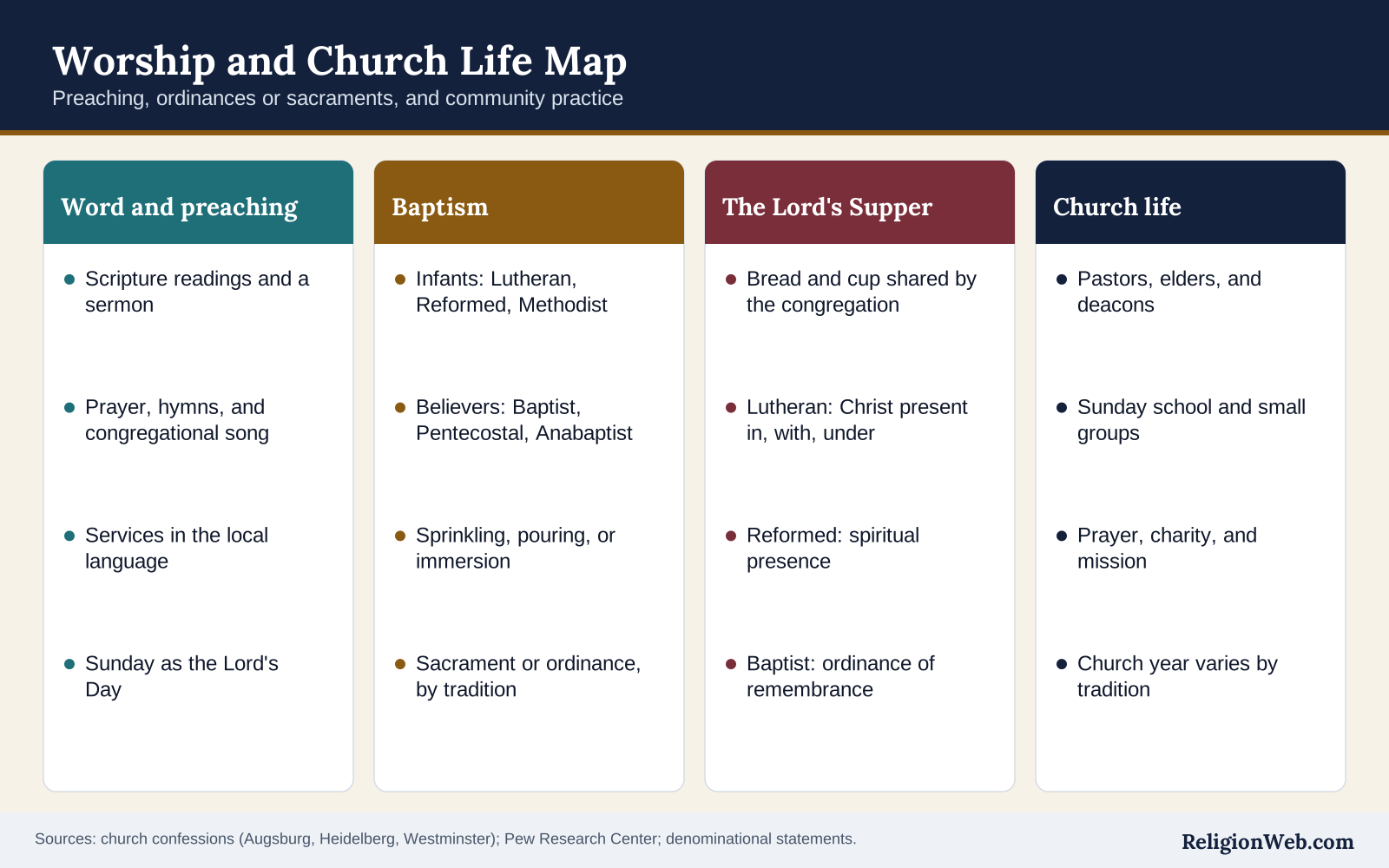
Community, Ethics, and Daily Life
Congregations and Everyday Practice
The congregation as a community
For most Protestants the local congregation is the main setting of religious life. People join by baptism, profession of faith, or transfer from another church, and members take part in worship, committees, volunteer work, and funding the church through regular offerings; some give a tithe, a tenth of their income, though not all traditions teach it as a rule. Ministers lead worship and teaching, elders and deacons or church councils share leadership and care for those in need, and lay people lead Bible studies, choirs, youth programs, and mission projects. Sunday school, begun in Gloucester, England, by Robert Raikes in 1780 to teach reading and the Bible to working children, spread throughout the Protestant world and remains a model for religious education in many churches.
Congregations also provide ordinary friendship and practical help, from meals for new parents to visits for the sick and transportation for older members. Because Protestant churches are voluntary associations, members can and do move among congregations and denominations, and the sense of belonging often depends as much on the local community as on the denomination.
Work, rest, and family life
The doctrine of vocation encouraged Protestants to see work, marriage, parenting, and citizenship as callings from God. Many families observe daily prayer at meals and bedtime, read Scripture at home, and attend worship weekly. Sunday has been observed as a day of rest in many Protestant societies, though practice has loosened over time. Temperance movements in the nineteenth century led many churches, particularly Methodist, Baptist, and Holiness churches, to encourage abstaining from alcohol, and some still do so, while Lutheran, Reformed, and other churches generally permit moderate use. Some groups, such as the Amish and Old Order Mennonites, maintain distinct dress and limited use of technology as expressions of humility and community.
Ethics, Education, and Public Life
Moral teaching and internal disagreement
Protestant ethics draw on the Ten Commandments, the Sermon on the Mount, and the apostolic letters, and they are summarized by Jesus’s command to love God and neighbor. Beyond this common base, churches differ widely. The historic peace churches, including the Mennonites, Quakers, and Church of the Brethren, teach nonviolence, while Lutheran, Reformed, and other churches have taught that war can be just under certain conditions. Protestants disagree about divorce and remarriage, the roles of women in ministry, the use of alcohol, and questions of sexuality, marriage, and bioethics; some denominations issue detailed social statements, while congregational bodies leave such questions to local churches. Describing these disagreements as internal debates, not as signs of indifference, helps to explain why a single Protestant “position” on a moral issue rarely exists.
Education, charity, and social movements
Because the Reformers wanted every believer to read Scripture, Protestant churches founded schools and universities, from Wittenberg and the Geneva Academy to Harvard in 1636 and, later, hundreds of colleges and mission schools in Africa and Asia. Protestants also founded hospitals, orphanages, and relief agencies. Quakers protested slavery in Pennsylvania as early as 1688, and evangelical Protestants such as William Wilberforce in Britain helped win the abolition of the slave trade in 1807. The Bible was also invoked to defend slavery: in 1845 Baptists in the American South formed the Southern Baptist Convention after a dispute over whether slaveholders could be missionaries. In the twentieth century, Protestant churches and leaders were central both to the American civil rights movement and to resistance to National Socialism through the Confessing Church, though in both settings many church members and leaders also resisted change or stayed silent.
Protestants also shared in religious violence and intolerance during the age of confessional conflict, as did Catholics: Protestant authorities executed Anabaptists and others, while Protestant minorities such as the Huguenots in France were killed or forced into exile by royal and local actors, notably after the St. Bartholomew’s Day massacre of 1572 and the revocation of the Edict of Nantes in 1685. Historians today assign responsibility to specific rulers, courts, and movements, not to whole churches. Several Protestant bodies have issued statements of repentance, among them the Lutheran World Federation, which asked forgiveness of Mennonites for Lutheran persecution of Anabaptists in 2010, and the Evangelical Lutheran Church in America, which rejected Luther’s anti-Jewish writings in 1994.
Protestantism Today: Global Presence, Ecumenism, and Contemporary Questions
Where Protestants Live and Worship Today
A faith that moved south
Using Pew Research Center’s broad definition, about 801 million people were Protestants in 2010, and they lived in every region. Pew’s 2020 estimate for all Christians, 2.3 billion or 28.8 percent of the world population, shows continued growth in numbers but a decline in share, and sub-Saharan Africa now holds the largest portion of all Christians. In 2010 Protestants formed a majority of the population in 49 countries, spread across several regions. The fastest growth in recent decades has come from Pentecostal, charismatic, and independent churches in Africa, Latin America, and Asia, where services are often held in local languages and missions are sent from the churches there to Europe and North America.
Europe and North America
In Europe, historic Lutheran and Reformed national churches still have large nominal membership, but attendance has declined. Pew found that Christians were less than half of the population in the United Kingdom (49 percent), France (46 percent), and Australia (47 percent) in 2020. In the United States, the Christian share of adults fell from 78.3 percent in 2010 to 64.0 percent in 2020 by Pew’s estimates, and the 2023 to 2024 Religious Landscape Study found about four in ten adults identifying as Protestant, with evangelical Protestants outnumbering mainline Protestants by about two to one. Mainline denominations have lost members over decades, while many nondenominational churches have grown, and immigrant congregations have added new Protestant communities.
Protestant Life in Different Regions
Korea, Nigeria, and Brazil
Protestant practice looks quite different from one region to another. In South Korea, Protestant missions began in the 1880s, and the Pyongyang revival of 1907 became a founding memory for Korean churches; many congregations still hold early-morning prayer meetings on weekdays as well as Sunday worship, and Presbyterian and Pentecostal churches are especially prominent. In Nigeria, Anglican, Baptist, Methodist, and many Pentecostal churches share a landscape in which night vigils, long worship services, and large conventions are common, and the Redeemed Christian Church of God has planted congregations across the world. In Brazil, Pentecostalism took root early, and the Assemblies of God was established there in 1911 by two Swedish-born missionaries in the city of Belém.
Northern Europe and North America
In northern Europe, Lutheran and Reformed churches are often “folk churches” that most citizens joined at baptism and still turn to for confirmation, weddings, and funerals, even where weekly attendance is low. In Germany, church members pay a tax collected through the state, while in Sweden and Norway the state church link has ended. In North America, Protestant life is organized through voluntary congregations, denominations, and parachurch organizations; African American churches carry their own traditions of spirituals, gospel music, preaching, and community leadership. Immigrant congregations, including Korean, Nigerian, and Latin American churches in North America and Europe, now add to the older Protestant landscape in cities across the West.
Ecumenism and Contemporary Questions
Cooperation among churches
Many Protestant churches have sought closer cooperation, both among themselves and with other Christian traditions. The World Council of Churches was formed in 1948, and national councils of churches work on shared concerns. In 1999 the Lutheran World Federation and the Catholic Church signed a Joint Declaration on the Doctrine of Justification, stating a shared understanding of basic truths about salvation; the World Methodist Council adopted it in 2006 and the World Communion of Reformed Churches in 2017. Such agreements do not remove all differences, but they show how some of the oldest disagreements of the Reformation era have been reexamined.
Debates within Protestant churches
Contemporary Protestant churches are also working through internal questions. These include how to interpret the Bible in light of modern scholarship, the ordination of women, the blessing of same-sex marriages, the relationship between faith and politics, migration, racial reconciliation, and the place of online worship and digital media. In several denominations, disagreements have led to division or the formation of new bodies, as in the United Methodist Church and in some Lutheran and Presbyterian bodies. Others have pursued conversation and structures that allow churches to hold different views. These debates reflect the Protestant conviction that Scripture and conscience must be examined in each generation, together with the practical reality that the Protestant family has no central authority to settle them.
Common Misconceptions About Protestant Christianity
Misconception 1: Protestantism is a single denomination or church
Where the misunderstanding comes from
Everyday speech often treats “the Protestant church” as if it were one institution, parallel to a single hierarchical church. Census forms, news reports, and older textbooks reinforce this by grouping many bodies under one heading. Older historical writing adds to the effect, since the “Protestant churches” of the sixteenth century were a handful of state churches, and the later multiplication of denominations is often left out of the short version. The habit is understandable, because Protestants share a common origin in the Reformation and some common teachings, and because outsiders see a variety of churches with similar buildings and Bibles.
What the evidence and tradition actually show
Protestantism is a family of traditions, not an organization. There is no pope, council, or headquarters that governs all Protestants, and each denomination decides its own teaching and leadership. Lutheran churches, Reformed churches, Baptist conventions, Methodist conferences, Pentecostal fellowships, and independent congregations each have their own histories, confessions, and structures. Voluntary bodies such as the Lutheran World Federation, the World Communion of Reformed Churches, and the Baptist World Alliance link churches within a family, and the World Council of Churches links many across families, but membership is by choice and these bodies do not rule on doctrine for their members.
Popular claims about the exact number of Protestant denominations, which sometimes run to tens of thousands, depend heavily on how a researcher counts. Some tallies count each national branch of a worldwide church, or each independent congregation, as a separate denomination. The better conclusion is that the number is very large and that definitions drive the total.
Even the broad categories used in American surveys, evangelical, mainline, and historically Black Protestant, are research groupings and not organizations. A Lutheran congregation in the Evangelical Lutheran Church in America and one in the Lutheran Church–Missouri Synod belong to the same confessional family yet to separate church bodies with different positions on ministry and interpretation. The shorthand “Protestant church” is therefore best read as a pointer to a historical family, with the particular denomination named whenever precision matters.
Misconception 2: All Protestants reject liturgy and tradition
Where the misunderstanding comes from
The Reformation slogan “Scripture alone,” along with the plain style of many Reformed, Baptist, and evangelical services, leads some people to assume that Protestants have no set forms of worship and no respect for the church’s past. Media images of spontaneous, informal services and of Puritan austerity strengthen that impression. A few Protestant groups, such as the Quakers and some Baptist and independent churches, do avoid fixed liturgies and written creeds, and they are the most visible. Reform movements in the sixteenth and seventeenth centuries also did remove practices they considered unscriptural, such as images in Zurich and, among English Puritans, vestments and some holy days, which gave the impression that rejecting forms was the Protestant norm.
What the evidence and tradition actually show
Many Protestant churches follow structured liturgies. The Lutheran Divine Service, the Methodist order of worship, and the service books of the Reformed and Presbyterian traditions all use set prayers, readings, and responses, and many follow a lectionary and the church year. Lutheran and Reformed churches affirm the ancient creeds and quote the church fathers, and Calvin cited Augustine throughout his Institutes. Luther issued a German Mass in 1526 that kept the shape of the historic service in the people’s language, Calvin wrote a liturgy for Geneva, and Thomas Cranmer’s Book of Common Prayer gave English-speaking Christians a fully written order of worship. The Reformers distinguished between the authority of Scripture and the respect owed to tradition: they held that tradition is a valuable guide but must be tested against the Bible, a position sometimes contrasted with the rarer view that all inherited forms should be discarded.
Even churches that avoid written liturgies develop recognizable patterns of worship, including characteristic songs, prayers, and sermon forms handed on from generation to generation. Protestants have rich inherited traditions of catechisms, hymnals, and confessions. What differs among Protestants is how much weight tradition carries and which forms are considered required, permitted, or best avoided.
The churches that choose plain worship do so for reasons they present as theological. Reformed Protestants who follow the regulative principle hold that worship should include only what Scripture commands. Quakers wait in silence because they expect the Spirit to speak directly, and many Baptists favor spontaneity because they want worship to come from the congregation’s own faith and not from a prescribed text. These are deliberate choices within the Protestant family, not signs that its churches are indifferent to the forms of worship or the memory of the church.
Misconception 3: All Protestant churches hold identical views on sacraments and church government
Where the misunderstanding comes from
A short summary of Protestantism often says that it recognizes two sacraments, baptism and the Lord’s Supper, and has no priesthood or hierarchy. Because those summaries are true of many churches, they get repeated as if they applied to all. People also meet one local Protestant church and assume that its practices represent the whole family. Shared hymns and Bible translations can make differences in teaching less obvious to visitors than they are to members.
What the evidence and tradition actually show
Protestant churches agree broadly that baptism and the Lord’s Supper were instituted by Christ, but they differ on what happens in them and on what to call them. Lutherans teach that Christ’s body and blood are truly present in the Supper, Reformed Protestants teach a spiritual presence, and many Baptists regard it as a memorial and an act of obedience. Some baptize infants, others only believers, and the Quakers and Salvation Army observe neither rite in outward form. Some Lutheran bodies also recognize absolution as a sacrament, and the vocabulary of “sacrament” or “ordinance” itself is contested.
The same variety appears in church government. Churches with bishops, such as the Nordic Lutheran churches and the Methodist episcopal churches, sit alongside presbyterian systems governed by elders and congregational systems in which each church governs itself. Practices on ordination, the role of women, and the relation of church and state also differ. What can safely be said is that most Protestant churches share certain convictions and diverge on these questions, and that each must be understood on its own terms.
The differences were recognized from the beginning. The Marburg Colloquy of 1529 showed that two leaders who agreed on fourteen of fifteen articles still disagreed about the Lord’s Supper, and later churches formed around each position. Today many Protestant churches formally recognize one another’s baptisms and, in places such as the European churches of the Leuenberg fellowship, share communion, while believer-baptist churches ask for baptism on profession of faith. Such arrangements express both the shared inheritance and the real differences that remain.
Misconception 4: The Reformation began and ended with Martin Luther, and “Protestant” simply means someone who protests against another church
Where the misunderstanding comes from
The traditional date of 31 October 1517 and the dramatic image of Luther at Wittenberg make for a clear story, and Luther’s influence was enormous. The modern English meaning of “protest” as objection or complaint then suggests that the movement was defined by what it opposed. Anniversary commemorations, such as those marking 500 years since 1517, naturally focus attention on one man and one date. Some popular accounts also give the impression that Protestant churches were created from nothing by sixteenth-century individuals.
What the evidence and tradition actually show
Historians speak of several Reformations. Zwingli began preaching reform in Zurich in 1519 largely independently of Luther, Calvin’s work in Geneva developed a distinct Reformed tradition, the Anabaptists emerged from the Zurich circle in 1525, and the English Reformation followed its own political and religious path. Earlier figures such as Wycliffe and Hus had called for reform generations before. Luther himself was uneasy about his followers being named after him, and many Reformers saw themselves as restoring the church to its biblical foundations rather than founding a new one.
The name Protestant arose from the formal declaration at Speyer in 1529, and in the sixteenth-century Latin sense the word carried the meaning of testifying or declaring as well as objecting. Protestant churches also affirm continuity with earlier Christianity. They confess the Apostles’ Creed and the Nicene Creed, honor the early church councils on the Trinity and the person of Christ, and read the church fathers, so their sense of history begins well before the sixteenth century. The Reformation is therefore understood by most Protestants as a renewal within a longer story, not as the beginning of the church.
Most Protestants today define their churches by what they affirm: the gospel, the authority of Scripture, and the life of worship and service, with the early creeds as shared ground. Protest against particular practices was part of how the churches began, but it is not how most Protestants describe themselves now.
Frequently Asked Questions About Protestant Christianity
Questions About Identity and Origins
Is “Protestant” the same as “evangelical”?
No, although the two overlap. “Protestant” names a historical family of churches that descend from the Reformation, while “evangelical” describes a movement and a set of emphases, such as personal conversion, high regard for the Bible, focus on the cross, and active sharing of the faith. Many Protestants are evangelicals, but many belong to mainline or historically Black churches that do not use the label, and in German and Scandinavian usage “evangelical” is simply the traditional name of Lutheran and Reformed churches. Some evangelicals, especially in charismatic and independent churches, do not use the label “Protestant” for themselves.
Why are there so many Protestant denominations?
The reasons are historical and structural. Protestantism has no central authority to settle disagreements, and the principle that every believer should read and interpret Scripture encouraged groups to form around different readings. Migration, language, national boundaries, and revival movements produced further churches, and missions planted churches that later became self-governing. At the same time, churches have repeatedly merged or entered fellowship, as in the Church of South India and the Leuenberg Agreement, so the story is one of both division and union.
Are Anglicans and Methodists considered Protestants?
It depends on who is asked. Pew Research Center and many scholars count both as Protestant. Methodist churches generally accept the description. Many Anglicans describe their church as both catholic and reformed and may use the Protestant label in some settings and avoid it in others; this is discussed in more detail on the Anglicanism page.
Questions About Belief and Practice
Do Protestants have priests?
Protestant churches have ordained ministers, called pastors, ministers, or in some traditions priests, who lead worship, preach, and give pastoral care. Most Protestants do not understand ministers as a separate priestly class standing between believers and God, because they hold that all believers share in Christ’s priesthood. Some Lutheran, Anglican, and other churches use the word priest in a sense consistent with that teaching, while Baptist, Presbyterian, and many other churches use pastor or minister to avoid confusion.
What role do Mary and the saints have in Protestant faith?
Protestants honor Mary as the mother of Jesus and as an example of faith, and Lutheran and Anglican churches commemorate her in the church year. Most Protestants direct prayer to God alone, through Christ, and do not ask saints to intercede, because they read the New Testament as teaching that Christ is the one mediator. Reformation churches continue to remember apostles, martyrs, and reformers as examples of faith, with differing degrees of formal observance.
What can a visitor expect at a Protestant service?
Visitors are generally welcome and no special knowledge is needed. Expect singing, prayers, readings from the Bible, and a sermon of 20 to 40 minutes, often followed by an offering to which guests are not expected to contribute. Dress ranges from formal to casual depending on the congregation. If communion is served, churches usually explain who may participate, and visitors can simply remain seated if they prefer. Many churches provide a printed order of service or a screen to guide the congregation.
Conclusion: A Family Held Together by Conviction, Not by Command
What the History Shows
From reform movement to global family
Protestant Christianity began in the sixteenth century as a set of attempts to reform the Western church according to Scripture and to the gospel of grace. It quickly became a plural family, shaped by princes and city councils, preachers and printers, radical congregations, revivals, and missionaries. Over five hundred years its center of gravity has moved from Wittenberg, Zurich, and Geneva to Lagos, Seoul, São Paulo, and many other cities.
Unity and difference today
Protestants share a deep respect for the Bible, trust in God’s grace, and belief in the calling of every Christian, yet they differ about sacraments, church government, worship, and ethics. Understanding the tradition means accepting that it has no single voice, and that each church family has its own history and reasons for what it does.
How to Keep Exploring
Related traditions on this site
For wider context, see the overview of Christianity, and the companion pages on Anglicanism, Catholic Christianity, Eastern Orthodox Christianity, and Oriental Orthodox Christianity.
Reading the sources
Readers who want to go further can turn to primary documents such as the Augsburg Confession, the Heidelberg Catechism, the Westminster Confession of Faith, and the Schleitheim Confession, and to demographic studies by Pew Research Center. Visiting a congregation in a tradition one does not know is another way to see how the same Bible and the same Reformation inheritance can take many forms.
Sources
The table below lists the principal external sources behind this article. Facts, dates and figures were checked against these and related primary, institutional and academic materials.
| # | Source | Publisher and type | Used for | Link |
|---|---|---|---|---|
| 1 | World English Bible (Classic): Romans 3, Ephesians 2, 2 Timothy 3, 1 Peter 2, Matthew 28 | eBible.org · Primary text | Public-domain Bible text for all five scripture quotations (WEB Classic) | ebible.org |
| 2 | Global Christianity: Traditions and Regions | Pew Research Center · Demographic data | 801 million Protestants (2010 data), 37% of Christians; regions; broad definition | pewresearch.org |
| 3 | Global Christianity: Movements and Denominations | Pew Research Center · Demographic data | Pentecostal (279 million) and charismatic (305 million) estimates; evangelical estimate (2010) | pewresearch.org |
| 4 | How the Global Religious Landscape Changed From 2010 to 2020 | Pew Research Center · Demographic data | 2.3 billion Christians in 2020; regional shares; country-level Christian shares | pewresearch.org |
| 5 | Religious Landscape Study: Protestant Christians | Pew Research Center · Demographic data | 2023-24 U.S. shares: evangelical 23%, mainline 11%, historically Black 5% | pewresearch.org |
| 6 | Diets of Speyer | Encyclopaedia Britannica · Encyclopedia | 1526 and 1529 Diets; six princes and fourteen cities; origin of the name Protestant | britannica.com |
| 7 | Protestant (etymology) | Online Etymology Dictionary (Douglas Harper) · Reference | Latin protestari (‘declare publicly, testify’); spread of the name after Speyer | etymonline.com |
| 8 | The Augsburg Confession (1530), Article IV, Bente and Dau translation in the Triglot Concordia (1921) | Project Wittenberg, Concordia Theological Seminary · Primary text | Lutheran confessional teaching on justification (paraphrased); public-domain edition | projectwittenberg.org |
| 9 | Lutheran World Federation: About | Lutheran World Federation · Institutional | About 150 member churches, 99 countries, over 77 million Lutherans; founded 1947 at Lund | lutheranworld.org |
| 10 | Baptist World Alliance: Member Unions | Baptist World Alliance · Institutional | 283 member unions, 138 countries, 53 million baptized believers, 180,000 churches | baptistworld.org |
Last fact-check date: 2026-10-21.