
Lutheranism is the Christian tradition that grew out of the reforming work of Martin Luther (1483–1546) in the German lands of the early sixteenth century, and that states its faith in the Augsburg Confession of 1530 and the other writings gathered in the Book of Concord of 1580. It belongs to the wider family of Protestant Christianity, which itself sits within Christianity as a whole, yet Lutherans have always described themselves less as a new religion than as a church committed to a particular reading of the Gospel. At the center of that reading is a single claim: people are made right with God by grace, received through faith in Jesus Christ, and not by anything they accomplish themselves.
The tradition is now global rather than German. In its 2023 statistical survey, published in 2024, the Lutheran World Federation (LWF) counted about 78.4 million members in 150 member churches, with roughly as many in Africa as in Europe and a growing share in Asia. Some large Lutheran bodies, including the Lutheran Church–Missouri Synod in the United States, are not LWF members, so the worldwide total is higher than the federation’s figure. Lutheran churches run from the national church of Sweden, with millions of baptized members, to small congregations in cities where Lutherans are a minority of a minority.
This article follows Lutheranism from its sources to its present forms. It covers the Reformation story and Luther’s role in it, the confessional documents that define the tradition, the doctrines of justification, law and gospel, and the means of grace, the shape of Lutheran worship and its two sacraments of baptism and Holy Communion, the ministry and the different ways Lutheran churches are governed, the church year, and the main church bodies around the world. Lutheran churches differ on a number of questions, from the ordination of women to the practice of Communion, and where they do, the differences are named and attributed rather than smoothed over.
Lutheranism at a Glance: Definition, Identity, and Vocabulary
What Lutheranism Is and How Lutherans Describe Themselves
The name and its history
The word “Lutheran” began as a label applied from outside. Opponents of Martin Luther used it in the 1510s and 1520s to describe his supporters, and Luther himself objected to the practice, preferring that his followers be called Christians or “evangelical,” meaning people of the Gospel (Greek euangelion, “good news”). The adjective “evangelical” stuck in the German lands, where the main Protestant churches are still called evangelisch, and it survives in the formal names of many Lutheran bodies such as the Evangelical Lutheran Church in America. The shorter name “Lutheran” gradually became the standard English term and is now used by the churches themselves.
The people the label described were first of all members of existing church communities in cities and territories such as Saxony, Hesse, Nuremberg, and Strasbourg, which introduced reforms in worship and preaching under the protection of local rulers. They did not set out to found a separate denomination, and the name of the tradition therefore points to a founder less than to a movement that took shape around a confession of faith.
Lutheran self-understanding
Lutheran churches generally describe themselves as part of the one holy catholic and apostolic church confessed in the ancient creeds, in the lowercase sense of “universal.” The Augsburg Confession itself argues that its teachings depart from no article of faith held by the church catholic, and Lutheran theologians have long insisted that the Reformation was an effort at renewal inside the Western church rather than a rejection of it. Some Lutherans today use the phrase “evangelical catholic” for this emphasis on continuity, while others prefer to stress the break with late medieval practice. Both emphases appear in Lutheran churches and both claim the Confessions as support.
Scholars of religion classify Lutheranism as one of the “magisterial” branches of the Reformation, meaning those that worked with civil authorities and retained infant baptism and a settled ministry, in contrast to the more radical movements of the same century. Britannica describes it as the second-largest family of Protestant churches after the Baptists, although such rankings depend on how groups are counted and where the lines between families are drawn. The editorial classification on this site places Lutheranism within Protestant Christianity, which is also how Lutherans themselves are usually described by other Christians.
The Tradition in Brief
Five emphases that organize Lutheran life
Five convictions recur across nearly all Lutheran churches, however they differ elsewhere. The first is justification by grace through faith, the teaching that God declares sinners righteous for Christ’s sake. The second is the authority of Scripture as the norm for teaching, read with Christ at its center. The third is the “means of grace,” the conviction that God works through the spoken Word and the sacraments to create and sustain faith. The fourth is the distinction between Law and Gospel, a way of hearing Scripture as both a word that judges and a word that promises. The fifth is the doctrine of vocation, the idea that ordinary work, family life, and civic responsibility are places where Christians serve their neighbors.
These emphases are unpacked in later sections, but the table below gathers the basic profile of the tradition in one place for readers who want orientation first.
| Feature | Summary |
|---|---|
| Origin | Reformation in the Holy Roman Empire, beginning with Martin Luther’s public call for debate on indulgences in 1517 |
| Key confessional texts | Augsburg Confession (1530), Luther’s Small and Large Catechisms (1529), other texts collected in the Book of Concord (1580) |
| Central teaching | Justification by grace through faith in Christ; Law and Gospel; Word and sacrament as means of grace |
| Sources of authority | Scripture as the norm; the ancient creeds and the Lutheran Confessions as authoritative interpretations (the weight given to the Confessions varies by church) |
| Sacraments | Baptism and Holy Communion in all Lutheran churches; many also treat confession and absolution as a sacramental rite |
| Worship | Usually a liturgical “Divine Service” with readings, sermon, hymns, and Communion, with wide variation in style |
| Ministry and structure | Ordained pastors; bishops in the Nordic and many other churches; synodical and congregational forms in North America |
| Worldwide size | About 78.4 million members in LWF churches (2023 data); additional Lutherans belong to non-member bodies |
Where Lutherans live and how they are counted
Lutheranism has historic strongholds in Germany, the Nordic countries, and the Baltic region, and large later communities in the United States and Canada. Over the last century its center of gravity has shifted toward Africa and Asia, where churches founded through missionary work have become much larger than their European parents. In the LWF’s 2023 figures, Africa accounted for roughly 39 percent of member-church membership and Europe roughly 39 percent, with Asia at about 18 percent. The largest single member church was the Ethiopian Evangelical Church Mekane Yesus, with about 12 million members.
These numbers come from the churches themselves and reflect different ways of counting. State-connected or national churches in Europe often count everyone baptized into the church, while some North American bodies count baptized members on congregational rolls, and mission-born churches in Africa and Asia count members according to their own practices. For that reason, comparisons of raw totals between churches are informative but not exact.
Essential Vocabulary
Terms that appear throughout this article
Lutheranism has a compact technical vocabulary, much of it inherited from Latin and German. Some of these terms are everyday words with a particular sense in Lutheran theology, and the table below defines the ones used most often in this article. Fuller explanations appear in the sections on beliefs, worship, and ministry.
| Term | Meaning in Lutheran usage |
|---|---|
| Justification | God’s act of declaring sinners righteous for the sake of Christ, received by faith and not earned by works |
| Law and Gospel | Two kinds of divine speech: the Law commands and exposes sin, the Gospel promises forgiveness in Christ |
| Means of grace | The Word of God and the sacraments, through which Lutherans believe God gives faith and forgiveness |
| Real presence | The teaching that Christ’s body and blood are truly present “in, with, and under” the bread and wine of Communion |
| Priesthood of all believers | The teaching that all baptized Christians share in Christ’s priesthood, which is distinct from the public office of the ordained pastor |
| Vocation | The calling to serve God and neighbor in everyday roles such as parent, worker, citizen |
| Divine Service | The main Sunday liturgy, from German Gottesdienst; it centers on God’s service to the congregation in Word and sacrament |
| Chorale | A congregational hymn in the Lutheran tradition, usually with a strong, singable melody |
| Synod | A church body or assembly, from Greek words for “walking together”; the term is common in North America |
“Evangelical,” “Protestant,” and “catholic” in Lutheran usage
Three words often cause confusion. In Lutheran use, “evangelical” refers to the Gospel and usually describes the whole Lutheran tradition, as in the German evangelisch. It is not identical to the modern American category of “evangelical Christianity,” a broader movement with its own history that includes Baptist, Pentecostal, and many nondenominational churches. “Protestant” goes back to the “protestation” made by Lutheran princes and cities at the Diet of Speyer in 1529, and Lutherans accept the word while noting that it names a protest as well as a positive confession.
The word “catholic,” written without a capital, means universal, and in that sense Lutherans recite it in the Creed every Sunday: “one holy catholic and apostolic church.” Readers who want to see how the Roman Catholic communion describes itself will find that in the article on Catholic Christianity. Other Protestant families that took shape in the Reformation and after, including Reformed Christianity, Anglicanism, Methodism, and Seventh-day Adventism, each have their own histories and self-descriptions and are treated on their own pages.
Origins: Martin Luther and the Reformation, 1483–1530
The World Luther Was Born Into
The late medieval church and the call for reform
The Reformation did not begin in a vacuum. By the late fifteenth century the Western church, headed by the pope in Rome and organized through bishops, monasteries, and universities, shaped almost every aspect of life across Latin Christendom. It also faced widespread criticism from inside. Reform movements associated with John Wycliffe in England and Jan Hus in Bohemia had already challenged clerical privilege and the authority of the papacy. Humanist scholars such as Desiderius Erasmus were editing the Greek New Testament and urging a return to the sources. Many lay people and clergy alike complained about the cost of church offices, the wealth of some bishops, and the uneven education of parish priests.
Two further conditions made reform possible. The printing press, in use in Germany since about 1450, let short tracts and sermons spread in days rather than months. And the Holy Roman Empire was a patchwork of territories ruled by electors, princes, and free cities, so a reforming theologian who gained a protector in one territory could not easily be silenced by a single central power. Both facts mattered for Luther, whose ideas were printed and debated far beyond Wittenberg within a few years.
Luther’s early life and monastic formation
Martin Luther was born on November 10, 1483, in Eisleben in Saxony, the son of Hans Luder, a copper miner and smelter who rose into a modest prosperity. He studied at Latin schools in Mansfeld, Magdeburg, and Eisenach and entered the University of Erfurt in 1501, where he was expected to study law. In July 1505, according to the traditional account, a violent thunderstorm near Stotternheim led him to vow to become a monk, and he entered the Augustinian Hermits’ house in Erfurt. He was ordained a priest in 1507 and, at the direction of his superior Johann von Staupitz, moved to the University of Wittenberg, where he received a doctorate in theology in 1512 and became a professor of Bible.
Luther’s own later writings describe years of anxiety over whether he could ever satisfy the righteousness of God. He recalled that a new reading of Romans 1:17, in which “the righteous shall live by faith,” came to him as a gift of mercy rather than a standard of judgment. Historians continue to debate when this turning point occurred, with proposed dates ranging from about 1514 to 1519, and whether it was a single event or a gradual change. What is clear is that by 1517 his lectures on the Psalms, Romans, and Galatians already contained the central themes of his later theology.
From the Indulgence Controversy to the Diet of Worms
The Ninety-Five Theses, 1517
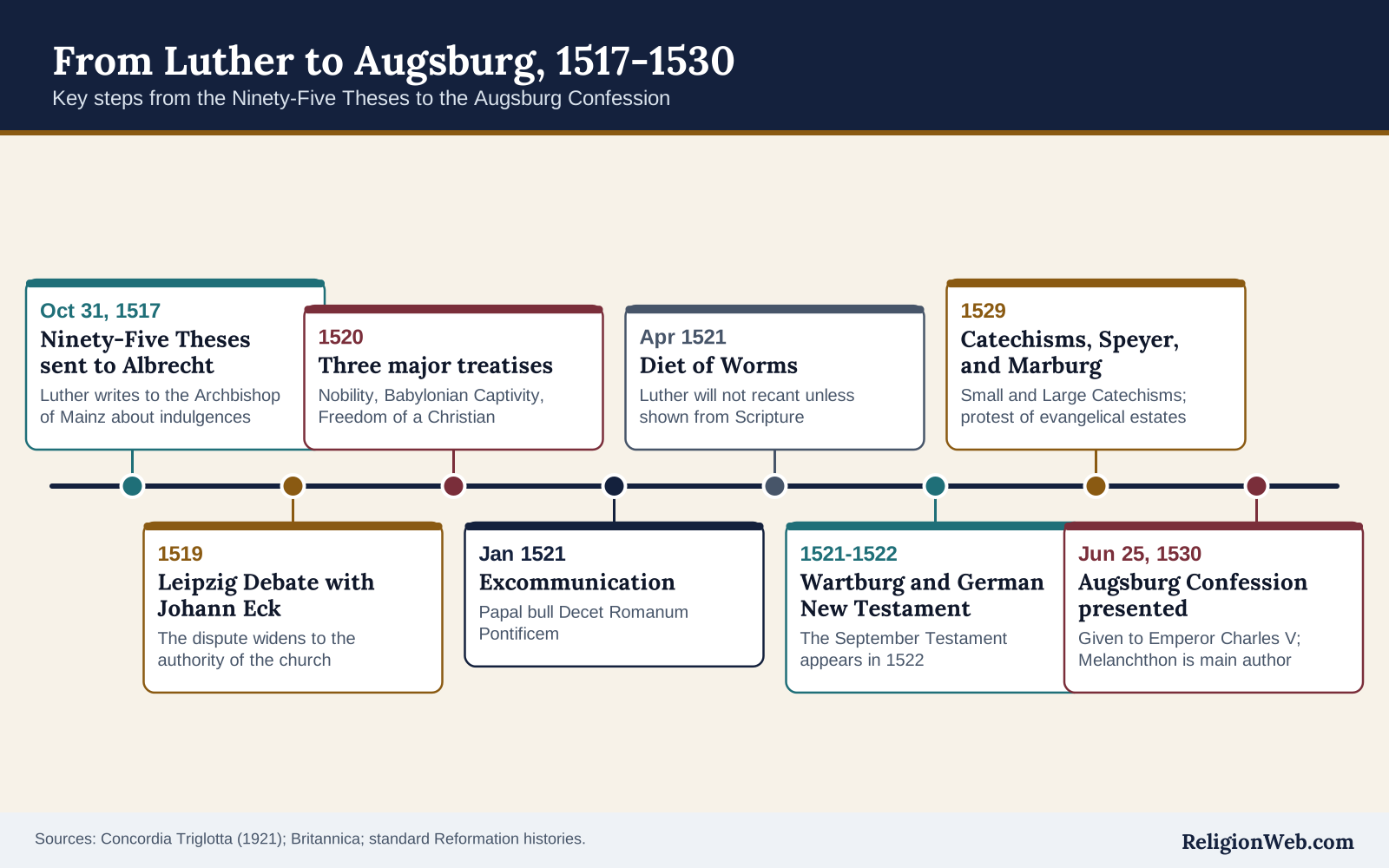
The immediate spark was a campaign to sell indulgences in German territories in 1517. An indulgence was a certificate, issued under the pope’s authority, that remitted a portion of the temporal penalties of sin, and the Dominican preacher Johann Tetzel was promoting one to help finance the building of St. Peter’s Basilica and to help Archbishop Albrecht of Mainz repay a debt incurred in obtaining his offices. Luther was disturbed by what he heard of the preaching and by what he saw as a danger to the souls of his parishioners. On October 31, 1517, he wrote to Albrecht and enclosed a set of Latin propositions for academic debate, now known as the Ninety-Five Theses or Disputation on the Power and Efficacy of Indulgences.
The familiar story that Luther nailed the Theses to the door of the Castle Church in Wittenberg rests largely on a later account by his colleague Philipp Melanchthon, and historians are divided on whether and how the posting occurred. The letter to Albrecht is firmly documented, and the Theses were quickly translated into German and printed, reaching readers across the empire within weeks. In their text, Luther did not yet reject the papacy; he argued that true repentance is a lifelong disposition and that the pope would surely not approve of preachers who made salvation seem purchasable. The debate that followed quickly widened from indulgences to the authority of the church itself.
Debates, writings, and condemnation, 1518–1521
Over the next three years the conflict escalated. In April 1518 Luther presented theological theses at an Augustinian gathering in Heidelberg, setting out a “theology of the cross” that contrasted human ideas of glory with God’s presence in suffering. In October 1518 he appeared before the papal legate Cardinal Cajetan in Augsburg and declined to retract. At the Leipzig Debate of 1519, his opponent Johann Eck pressed him until he admitted that some teachings of the Council of Constance, which had condemned Hus, were erroneous. It was in this period that opponents began to call Luther’s supporters “Lutherans.”
In 1520 Luther published three major works: To the Christian Nobility of the German Nation, calling on rulers to reform the church; The Babylonian Captivity of the Church, a critique of the church’s sacramental system; and The Freedom of a Christian, a short summary of his teaching on faith and love. In June 1520 Pope Leo X issued the bull Exsurge Domine, which listed statements attributed to Luther and threatened excommunication. Luther burned a copy in December 1520, and in January 1521 the bull Decet Romanum Pontificem formally excommunicated him. Catholic authorities understood these steps as a defense of church unity and sacramental order; Luther understood them as the church’s leadership refusing to hear the Gospel. That difference in perspective is part of why the break took shape slowly and not through a single decision.
The Diet of Worms and the Wartburg
In April 1521 Luther appeared before the Imperial Diet at Worms, with the young Emperor Charles V presiding, and was asked whether he would recant his books. After a day to consider, he answered that he could not do so unless persuaded by the testimony of Scripture or by clear reason, since his conscience was bound to the Word of God. The famous words “Here I stand; I can do no other” appear only in later printed versions of the speech, and many historians regard them as probably not spoken exactly in that form; contemporary accounts record instead a closing appeal for God’s help. The Edict of Worms, issued in May, placed Luther under the imperial ban.
On his return journey Luther was taken into protective custody by agents of his prince, Elector Frederick the Wise of Saxony, and lodged at the Wartburg castle near Eisenach, where he lived for about ten months in disguise as “Junker Jörg.” There he translated the New Testament from Greek into German in roughly eleven weeks, and it was published in September 1522. The “September Testament” became a landmark in the German language and a model for Lutheran emphasis on Scripture in the language of the people.
Wittenberg and the Shaping of a Church, 1522–1530
Order, disorder, and the Peasants’ War
While Luther was away, colleagues in Wittenberg, notably Andreas Karlstadt, moved quickly to change worship, remove images from churches, and abolish the Mass. Riots followed, and in March 1522 Luther returned against the elector’s wishes and preached eight “Invocavit sermons” urging patience and arguing that reforms should be made through preaching and persuasion before they were enforced. This preference for gradual change, in which abuses are corrected without needlessly discarding inherited forms, shaped Lutheran worship for centuries. It is one reason Lutheran liturgy remained closer to the medieval Mass than that of many other Reformation churches.
A far larger crisis came with the Peasants’ War of 1524–1525, a series of uprisings across southern and central Germany whose participants drew on evangelical language to press social and economic demands. Luther first published the Admonition to Peace, which criticized both rulers and rebels, and then, as violence spread, the harsh pamphlet Against the Murderous and Robbing Hordes of the Peasants. The latter has been judged by many historians, including many Lutheran historians, as a grave failure of judgment, and it contributed to a lasting distrust of the Lutheran movement among rural populations. In June 1525 Luther married Katharina von Bora, a former nun who had left her convent, and the household they formed became a pattern for Lutheran parsonage life. In the same year he published On the Bondage of the Will, answering Erasmus on the freedom of the human will in matters of salvation.
Catechisms, visitations, and the road to Augsburg
Reform also required the ordinary work of building church life. When visitors inspected parishes in electoral Saxony in 1528, they found pastors and people poorly instructed. Luther responded by writing the Large Catechism for pastors and the Small Catechism for households, both published in 1529. The Small Catechism explains the Ten Commandments, the Apostles’ Creed, the Lord’s Prayer, baptism, confession, and Communion in short questions and answers meant to be taught by a parent to a child. It remains the most widely used Lutheran teaching text.
The same year brought political and theological tests. At the Diet of Speyer in April 1529, evangelical princes and cities lodged a formal “protestation” against a decision to restrict the reforms, which is the origin of the word “Protestant.” In October 1529 Luther met the Swiss reformer Huldrych Zwingli and others at Marburg, at the invitation of Landgrave Philip of Hesse, and the two sides agreed on most points but could not agree on how Christ is present in the Lord’s Supper. Out of this context came the next great document of the movement, the confession presented to the emperor the following summer.
| Date | Event | Significance for Lutheranism |
|---|---|---|
| Nov. 10, 1483 | Martin Luther born in Eisleben | Birth of the Wittenberg reformer |
| 1505–1512 | Enters Augustinian house in Erfurt; ordained 1507; doctorate in theology at Wittenberg 1512 | Formation as monk, priest, and professor of Bible |
| Oct. 31, 1517 | Luther sends the Ninety-Five Theses to Archbishop Albrecht | Traditional starting point of the Reformation |
| 1519 | Leipzig Debate with Johann Eck | Debate widens from indulgences to church authority |
| 1520 | Three major treatises; bull Exsurge Domine | Core teachings set out in print |
| Jan. 1521 | Excommunication by Decet Romanum Pontificem | Formal break with papal authority |
| Apr. 1521 | Diet of Worms; Luther refuses to recant | Conscience bound to Scripture; imperial ban follows |
| 1521–1522 | Wartburg exile; New Testament in German (Sept. 1522) | Foundation of vernacular Scripture in Lutheran life |
| 1525 | Peasants’ War; Luther’s marriage; Bondage of the Will | Political crisis and a new model of clergy household |
| 1529 | Small and Large Catechisms; Protestation at Speyer; Marburg Colloquy | Teaching texts, the name “Protestant,” and disagreement over the Supper |
| June 25, 1530 | Augsburg Confession presented to Emperor Charles V | Foundational Lutheran confession |
Confession, Conflict, and Consolidation, 1530–1580 and After
The Augsburg Confession and the Political Settlement
The Diet of 1530 and the Confession
Emperor Charles V summoned the Imperial Diet to Augsburg in 1530, hoping to heal the religious divisions in the empire. The evangelical estates were asked to explain their teachings, and the task of drafting fell mainly to Philipp Melanchthon, a gifted humanist scholar who taught at Wittenberg. Luther, still under the imperial ban, waited at Coburg castle, in contact by letter. On June 25, 1530, the Confession was presented to the emperor by seven evangelical princes and two imperial free cities, in both German and Latin.
The Augsburg Confession has twenty-eight articles. The first twenty-one set out what the churches teach, from God and original sin to justification, the church, the sacraments, and civil government. The last seven address practices the reformers considered abuses, such as withholding the cup from the laity, required clerical celibacy, and compulsory enumeration of sins in confession. Its tone is deliberately conciliatory, and it was written to show that the reform was a matter of the Gospel and not rebellion. Catholic theologians presented a formal Confutation, and Melanchthon replied with the Apology of the Augsburg Confession in 1531. In 1540 he issued a revised edition, the Variata, whose wording on the Lord’s Supper was acceptable to other Reformation churches, while Lutheran churches that subscribe to the Book of Concord treat the unaltered 1530 text as authoritative.
The Schmalkaldic League and the Peace of Augsburg
Because the Edict of Worms had not been repealed and the emperor wanted unity, evangelical princes formed a defensive alliance, the Schmalkaldic League, in 1531. Open warfare came only after Luther’s death on February 18, 1546, in Eisleben, where he had traveled to mediate a family dispute among nobles. In the Schmalkaldic War of 1546–1547 imperial forces defeated the League, and a provisional settlement, the Augsburg Interim of 1548, tried to impose Catholic practice with limited concessions. It was widely resisted.
The conflict ended with the Peace of Augsburg of 1555, which allowed each imperial territory to follow either Roman Catholic worship or the Augsburg Confession, with the ruler’s choice determining that of the territory. A later Latin slogan, cuius regio, eius religio (“whose realm, his religion”), summarized this arrangement. The settlement gave Lutheran churches legal standing in the empire for the first time, though it excluded Reformed and Anabaptist groups, and it tied Lutheranism closely to territorial rulers in a way that shaped its church structures for centuries.
Disputes After Luther and the Formula of Concord
Quarrels among Luther’s heirs
Luther’s death left a movement without its dominant voice, and the generation that followed divided over how to apply his teaching. The Interim of 1548 provoked an argument over “adiaphora,” matters of indifference such as ceremonies, between Melanchthon’s circle, who were willing to compromise on them, and critics led by Matthias Flacius, who held that concessions made under pressure compromised the Gospel. Other disputes followed: whether good works are necessary for salvation, how to describe the role of the law in a Christian’s life, how the human will cooperates in conversion, and how Christ is present in Communion. Historians often use the labels “Gnesio-Lutherans” (“genuine” Lutherans) and “Philippists” for the two broad camps.
These controversies were serious because they touched the heart of the movement’s claims, and they were also complicated by politics, as rulers favored different theologians. The years after 1555 are sometimes called the age of confessionalization, when territories sharpened their own doctrinal identities and wrote them into church orders. Britannica describes the Book of Concord as the end of a roughly thirty-year effort to heal divisions among Lutherans after Luther’s death.
The Formula of Concord and the Book of Concord
The effort to restore agreement culminated in the Formula of Concord, completed in 1577 and written mainly by Jakob Andreae and Martin Chemnitz with other theologians. It addressed each major dispute in turn, in a shorter Epitome and a longer Solid Declaration. Its authors affirmed that the Bible is the only norm of teaching and described the Augsburg Confession, the Apology, the Smalcald Articles, and Luther’s catechisms as faithful summaries of what the Bible teaches.
In 1580, on the fiftieth anniversary of the Augsburg Confession, these documents were published together, with the three ancient creeds, as the Book of Concord. Britannica reports that its preface was signed by fifty-one electors, bishops, princes, and nobles and by representatives of thirty-five imperial cities. Not every Lutheran territory or church adopted the whole collection, and in several Nordic and German churches the Augsburg Confession alone became the principal document. Even so, the Book of Concord became the standard reference for confessional Lutheranism, and the next major section of this article examines its contents.
Orthodoxy, Pietism, and the Modern Age
Lutheran orthodoxy and Pietism
The seventeenth century saw a systematic elaboration of Lutheran doctrine, often called Lutheran orthodoxy, carried out by scholars such as Johann Gerhard in the university faculties of Germany. It produced large works of dogmatics, careful definitions of the Confessions, and a culture of learned preaching. This was also the era of the Thirty Years’ War (1618–1648), which devastated much of Germany and left many congregations with a deep sense of both loss and dependence on God, a mood that is audible in the hymns of Paul Gerhardt and the chorales of the period.
Pietism arose as a movement of renewal within Lutheran churches in the later seventeenth century. Philipp Jakob Spener’s Pia Desideria (1675) called for small group Bible study, a more practical piety, and the active involvement of lay people, and August Hermann Francke built the orphanages, schools, and missionary institutions at Halle that became influential across Europe. Pietists sometimes clashed with orthodox colleagues who feared that heartfelt experience might overshadow doctrine, but the two currents also shaped each other, and many later Lutheran traditions carry both. The Halle institutions sent some of the earliest Protestant missionaries to India and North America.
Enlightenment, union churches, and confessional revival
The Enlightenment brought rationalist critiques of revealed religion and the rise of historical study of the Bible, and German Protestant faculties became leading centers of that scholarship. In 1817 King Frederick William III of Prussia sponsored a union of Lutheran and Reformed congregations in his territories, an act that many Lutherans embraced and others regarded as an imposition on the Confessions. A group known as the Old Lutherans resisted, and some emigrated to Australia and the United States, helping to shape Lutheranism there.
The nineteenth century also saw confessional revival and lay renewal movements. In Germany, pastors such as Wilhelm Löhe and theologians in Erlangen and Leipzig returned to the Book of Concord as a living guide. In the Nordic countries, lay movements associated with Hans Nielsen Hauge in Norway, N. F. S. Grundtvig in Denmark, and Lars Levi Laestadius in Sweden and Finland shaped distinctive local forms of Lutheran piety. These movements are one reason that the tradition cannot be understood as a single inherited system handed down from Luther. It has been repeatedly reinterpreted in different settings.
Lutheranism Spreads: Nordic Churches, Migration, and Mission
Northern and Eastern Europe
The Nordic national churches
The Reformation reached Scandinavia through rulers who saw both religious and political reasons to reorganize the church. In Sweden, King Gustav I Vasa moved the church under royal authority at the Diet of Västerås in 1527. In Denmark–Norway, King Christian III established a Lutheran church order in 1536–1537 with the help of Johannes Bugenhagen, the Wittenberg pastor who had helped Luther organize church life. Iceland, then under Danish rule, followed. In Finland, then part of the Swedish realm, the reformer Michael Agricola published a Finnish New Testament in 1548, a work that is regarded as foundational for written Finnish.
Several of these churches have remained the religious home of large parts of their nations. The Church of Sweden, with about 5.5 million members in the LWF’s 2023 figures, ceased to be a state church in 2000. The Church of Norway lost its constitutional status as the state church through amendments of 2012 and a further reform in 2017. The Evangelical Lutheran Church of Denmark is still the established “people’s church” under the constitution, with about 4.2 million members, and the Evangelical Lutheran Church of Finland holds a special national status alongside the Finnish Orthodox Church. Church membership in these countries does not necessarily mean regular attendance; surveys regularly show that a smaller share of members worship weekly than belong to the church.
The Baltic, Central, and Eastern European churches
Lutheranism also took root in the Baltic cities and countryside, where it shaped the written languages of Estonia and Latvia through the translation of Scripture and catechisms, and in communities of the Carpathian basin and the former Habsburg lands. Transylvanian Saxons, Slovak and Hungarian Lutherans, and Polish Lutheran communities in the Cieszyn region are among the historical groups that held to the Augsburg Confession as minority churches, often amid pressures from larger Catholic or Orthodox majorities.
The twentieth century was difficult for many of these churches. Under communist rule after 1945, several lost property, schools, and public standing, and some leaders were imprisoned. After 1989, the churches rebuilt, though in many places with fewer members than before. Today central and eastern European Lutheran churches are small by comparison with those of Africa or the Nordic countries; the LWF’s 2023 figures put the Central Eastern European region at about 1.1 million members.
Migration and Mission
Lutheranism in North America
Swedish settlers on the Delaware River established Lutheran worship in the 1630s, and German immigrants founded congregations in Pennsylvania and New York across the eighteenth century. Henry Melchior Mühlenberg, who arrived in 1742 and helped organize the first Lutheran synod in North America, is often called the patriarch of American Lutheranism. The nineteenth century brought much larger waves: Germans, Swedes, Norwegians, Danes, Finns, and others founded church bodies on the prairies and in cities, often keeping their languages for generations.
A key episode was the emigration of several hundred Saxon Lutherans to Missouri in 1838–1839, who wanted the freedom to practice a confessional Lutheranism that they felt was under pressure in their homeland. Under the leadership of C. F. W. Walther, they helped found in 1847 the body that became the Lutheran Church–Missouri Synod, with a strong emphasis on confessional subscription and parish schools. Other bodies followed, including the Wisconsin Evangelical Lutheran Synod in 1850. Across the twentieth century, a series of mergers among the more moderate synods led in 1988 to the formation of the Evangelical Lutheran Church in America, the largest Lutheran church in the United States.
Missions in Africa, Asia, and the Pacific
Lutheran missionary work began early. In 1706 Bartholomaeus Ziegenbalg and Heinrich Plütschau, sent by the Danish–Halle mission, reached Tranquebar on the south coast of India, where they founded one of the earliest Protestant missions in Asia. In the nineteenth century, mission societies in Germany and Scandinavia, including those at Leipzig, Berlin, Hermannsburg, and the Norwegian Missionary Society, sent workers to Africa, Indonesia, India, and Papua New Guinea. Their work resulted in some of the largest Lutheran churches in the world today, among them the Ethiopian Evangelical Church Mekane Yesus, the Evangelical Lutheran Church in Tanzania, the Protestant Christian Batak Church (HKBP) in Indonesia, and the Malagasy Lutheran Church in Madagascar.
The mission period took place in the context of European colonial expansion, and historians and Lutheran churches alike have examined the complicated relationship between mission and empire. What is clear is that once established, these churches developed their own leadership, languages, music, and forms of piety, and became independent member churches of the LWF. Many of them are now sending missionaries and teachers of their own.
The Twentieth Century and the Rise of a Global Communion
The German church struggle and its aftermath
In Germany the rise of the National Socialist regime in 1933 tested the Protestant churches. A group calling itself the “German Christians” sought to align the church with the regime and its racial ideology, and in 1934 pastors and church leaders from Lutheran, Reformed, and United traditions met at Barmen to adopt a declaration that rejected any claim that the church could take other “lords” besides Christ. The resulting Confessing Church was a minority, and responses across Lutheran churches varied widely, from active resistance to acceptance of the regime to silence. The pastor and theologian Dietrich Bonhoeffer, a Lutheran, was arrested in 1943 and executed at Flossenbürg concentration camp in April 1945 for his part in resistance activities.
After the war, German church leaders issued a statement of guilt, and Lutheran theologians reexamined traditional teachings, including the Two Kingdoms doctrine and the church’s relation to the state, in light of what had happened. The reexamination of Luther’s writings on Jews, discussed later in this article, is part of the same reflection.
The Lutheran World Federation and the shift southward
The Lutheran World Federation was founded in 1947 at Lund, Sweden, as an association of churches that had been scattered and strained by war. It began as an agency for relief and reconstruction, helping refugees and rebuilding churches in Europe, and it grew into a communion of churches with common statements on doctrine, mission, and service. Today it includes churches on every inhabited continent.
The most important demographic change of the past century is the movement of Lutheran numbers southward. In the LWF’s 2023 figures, member churches in Africa total about 30.8 million, more than the roughly 30.2 million in Europe, and Asian churches total about 13.8 million. This shift has changed what the tradition looks like in practice: songs, languages, ministries, and priorities increasingly reflect African and Asian contexts, including the Pentecostal and charismatic currents discussed in the section on church bodies.
Core Beliefs: Grace, Faith, Law and Gospel, and the Church
Justification by Grace Through Faith
What the doctrine says
Lutherans have long called justification the article on which the church stands or falls, and the Augsburg Confession states it plainly in its fourth article. The Triglot translation of 1921 renders the opening as follows.
Also they teach that men cannot be justified before God by their own strength, merits, or works, but are freely justified for Christ’s sake, through faith, when they believe that they are received into favor, and that their sins are forgiven for Christ’s sake, who, by His death, has made satisfaction for our sins.
Augsburg Confession, Article IV, in Concordia Triglotta (trans. F. Bente and W. H. T. Dau, Concordia Publishing House, 1921)
The article cites Romans 3 and 4, and the key biblical sentence for Lutherans has long been Romans 3:28.
We maintain therefore that a man is justified by faith apart from the works of the law.
Romans 3:28, World English Bible (Classic edition, public domain)
In his 1522 German New Testament Luther rendered this verse with the word allein, “alone,” so that a person is justified “by faith alone,” and he defended that wording in a later open letter on translation as bringing out the sense of Paul’s argument. The word is not in the Greek text, and the choice has been debated by scholars and translators ever since. Lutherans generally explain it as a faithful interpretation of Paul’s contrast between faith and works of law, and the classic Lutheran summary is that sinners are justified by grace alone, through faith alone, on account of Christ alone.
Faith, good works, and the new life
In Lutheran teaching, faith is not just agreement with propositions. It is trust (the Latin term is fiducia) in Christ’s promise, and it is itself understood as a gift of the Holy Spirit through Word and sacrament, not a human achievement. Good works are not the cause of salvation but its fruit, and Article VI of the Augsburg Confession says that faith should bring forth good fruits and that good works ought to be done for God’s sake. A common Lutheran saying is that justification is by faith alone, but faith is never alone, because it is active in love toward the neighbor.
Lutherans also speak of the Christian as simul iustus et peccator, “at the same time righteous and sinner.” The believer is counted righteous because of Christ while still struggling with sin, and repentance is therefore a continuing part of Christian life, not a single event. This is one reason Lutheran worship begins with a confession of sins and an announcement of forgiveness. Sanctification, the growth in holiness and love, is understood as real, but the believer’s confidence is placed in Christ and not in progress.
Law and Gospel
Two kinds of divine word
One of the most characteristic features of Lutheran theology is the distinction between Law and Gospel. The Law, in this vocabulary, is everything in Scripture that commands, forbids, and exposes human failure. The Gospel is the promise of forgiveness, life, and salvation in Christ, given freely. Lutheran theologians teach that both are the word of God, but they do different things: the Law shows sin and, in the Lutheran understanding, cannot save, while the Gospel gives what the Law demands. Preaching is judged partly by whether it speaks both words to the right people in the right way.
Traditional Lutheran teaching distinguishes uses of the Law. In its civil use, the Law restrains evil in society. In its theological use, it exposes sin and drives people to Christ. A third use, discussed in Article VI of the Formula of Concord, is as a guide for Christian living, though Lutherans have debated how to understand this third use, with some stressing that believers need no coercive law and others stressing the guidance the commandments provide. The distinction between Law and Gospel shapes how Lutherans preach, how they read Scripture, and how they approach pastoral care.
The theology of the cross
Luther’s Heidelberg theses of 1518 contrasted a “theologian of glory,” who looks for God in power and visible success, with a “theologian of the cross,” who finds God revealed in weakness, suffering, and the crucified Christ. The point is that Christians are directed to the cross as the place where God has chosen to be known, and not to speculation about God’s hidden majesty. This theme has shaped Lutheran approaches to suffering, to the mixed experience of the church in history, and to the insistence that Christ, not human achievement, is the center of Scripture.
Within the tradition the theology of the cross has been developed in different directions, from the pastoral comfort of the Small Catechism to twentieth-century readings by theologians who stress God’s solidarity with victims. It is a theme that resonates in Lutheran hymns about Good Friday and in the plain, unadorned style of Lutheran preaching on the cross.
God, Christ, and the Human Person
The Trinity and the person of Christ
Lutheran churches affirm the ancient creeds of the undivided church, namely the Apostles’, Nicene, and Athanasian Creeds, and the first article of the Augsburg Confession confesses one God in three persons. Readers who want the history of that doctrine can consult the article on the Trinity. On the person of Christ, the Lutheran Confessions teach that Jesus Christ is truly God and truly human in one person. The Formula of Concord develops the “communication of attributes,” the idea that what is true of each nature can be said of the whole person, a position that underlies the Lutheran teaching on Christ’s presence in Holy Communion.
The center of Lutheran piety is Christ crucified and risen for sinners. Hymns, sermons, and the church year all return to that focus, and the standard test for a Lutheran reading of any passage is whether it points to Christ. This is sometimes called the “Christological” principle and reflects Luther’s insistence that Christ is the Lord of Scripture and the true subject of the whole Bible.
Sin, the will, and salvation
The Augsburg Confession teaches that since Adam’s fall all people are born with original sin, a condition of being without fear of God and trust in God, and that this condition cannot be overcome by human effort. The Lutheran Confessions distinguish human freedom in everyday matters, where people can choose to work, build, and keep civil order, from the human will in relation to salvation, which they describe as bound and dependent on God. Faith itself is understood as the work of the Holy Spirit through the Gospel and not as a result of human decision, a point developed at length in Luther’s Bondage of the Will and in Article II of the Formula of Concord.
On predestination, the Formula of Concord teaches that those who are saved have been chosen in Christ and that God desires all to be saved. It does not teach that God decrees anyone’s damnation, and later Lutheran theologians have debated how exactly to relate election to the preaching of the Gospel. Lutheran statements on the last things center on the resurrection of the body, the return of Christ, and the life everlasting that the creeds confess, and tend to avoid detailed timetables.
Church, Ministry, and Vocation
The church as the assembly of believers
The seventh article of the Augsburg Confession defines the church in terms of what happens when it gathers.
The Church is the congregation of saints, in which the Gospel is rightly taught and the Sacraments are rightly administered.
Augsburg Confession, Article VII, in Concordia Triglotta (trans. F. Bente and W. H. T. Dau, 1921)
This definition does not describe a particular institution or hierarchy. Lutheran teaching holds that the church exists wherever the Word is preached and the sacraments are given, and that its members are made one by faith in Christ. Visible church bodies are therefore valued but not identified with the church in the fullest sense. The Reformation teaching known as the priesthood of all believers affirms that every baptized person has direct access to God through Christ and a calling to serve the neighbor. It is not understood to mean that every person holds the public office of preaching and administering the sacraments; Articles V and XIV of the Augsburg Confession say that this office requires a regular call.
Vocation and the two kingdoms
Luther taught that God is at work in all of life and not just in the church, and that ordinary occupations such as farming, parenting, governing, and teaching are callings, or vocations, through which God cares for creation. This view undermined the medieval assumption that monks and priests lived on a higher spiritual plane than other Christians. It also gave Lutheran piety a strong emphasis on faithful work and on service in the household and the community.
Related is the “doctrine of two kingdoms,” or two governances, in which God rules the world through the Gospel in the church and through law, reason, and civil authority in society. In its original sense it meant that the Gospel is not a political program and that temporal authorities have their own proper tasks. The doctrine has been criticized, especially for how it was applied in some modern settings, and has been reinterpreted by Lutheran ethicists who emphasize the responsibility of Christians to critique injustice. Its history is a good example of how Lutheran ideas have been revisited as circumstances changed.
Scripture, the Confessions, and Authority in Lutheran Churches
The Bible in Lutheran Teaching
Scripture as the norm of teaching
For Lutherans, the Bible is the written Word of God and the sole norm by which all teaching is to be judged. The Formula of Concord states this principle at the outset: the prophetic and apostolic writings of the Old and New Testaments are the only rule and standard, and every other writing, including the Confessions themselves, is to be measured by them. Lutheran theologians often put this by saying that Scripture is the “norm that norms” (norma normans), while the creeds and Confessions are “norms that are normed” (norma normata). The phrase sola scriptura, “Scripture alone,” summarizes this teaching, although the later Reformation slogan was never a Lutheran confessional formula in itself.
Luther prepared a German Bible whose New Testament appeared in 1522 and whose complete text, with the Old Testament translated from Hebrew, was published in 1534. His translation arranged the New Testament so that Hebrews, James, Jude, and Revelation stood at the end, set apart because of historical questions about their authorship and doubts about how clearly they proclaim Christ, a judgment later Lutheran churches did not adopt as a rule. He also placed the books known as the Apocrypha, or deuterocanonical books, between the testaments as writings “useful and good to read” but not equal to Scripture. Lutheran churches today accept the same 27 New Testament books as other Christians; the treatment of the Apocrypha varies, and some Lutheran lectionaries and Bibles include them. The article on the Bible explains canon and translation more fully.
How Lutherans read Scripture
Lutheran interpretation rests on a few principles. Scripture is read in its plain, grammatical sense, with attention to its historical setting, and it is read as a whole with Christ at its center. The Law and Gospel distinction guides application: a passage is heard as a word that judges or as a word that promises, and often as both. Because the Bible is understood as the means by which the Holy Spirit creates faith, regular reading, memorizing of the Small Catechism, and preaching on assigned readings are central to Lutheran life.
Beyond these principles, there are real differences among Lutheran bodies on how to describe the Bible’s authority and how to use historical-critical scholarship. The Lutheran Church–Missouri Synod, the Wisconsin Evangelical Lutheran Synod, and some other confessional bodies teach that Scripture is inerrant and reject interpretive methods that treat it as only a human document. The Evangelical Lutheran Church in America calls the Scriptures the inspired Word of God and the authoritative source and norm of its faith, while accepting the use of historical-critical methods in its seminaries. Many European Lutheran faculties have helped to develop those methods. These are internal debates and they follow the same lines in many other Christian traditions.
The Book of Concord
What the collection contains
The Book of Concord of 1580 gathers the ancient creeds and the major confessional writings of the sixteenth century. Not every Lutheran church accepts all of them with the same force, but nearly every Lutheran church recognizes the Augsburg Confession and the Small Catechism as foundational. The documents differ in genre: some are statements of faith, some are teaching tools, some are polemical or defensive in setting, and one is a detailed resolution of internal disputes. The table below summarizes them.
| Document | Date | Main author | Purpose |
|---|---|---|---|
| Apostles’, Nicene, and Athanasian Creeds | Ancient church | Early church | Ecumenical statements of Trinitarian and Christological faith |
| Augsburg Confession | 1530 | Philipp Melanchthon | Confession of the evangelical churches presented to Emperor Charles V |
| Apology of the Augsburg Confession | 1531 | Philipp Melanchthon | Detailed defense and expansion of the Confession |
| Smalcald Articles | 1536–1537 | Martin Luther | Statement of essential teachings prepared for a possible church council |
| Treatise on the Power and Primacy of the Pope | 1537 | Philipp Melanchthon | Statement on church authority and the office of bishops |
| Small Catechism | 1529 | Martin Luther | Short summary of Christian teaching for households |
| Large Catechism | 1529 | Martin Luther | Longer exposition of the same topics for pastors and teachers |
| Formula of Concord (Epitome and Solid Declaration) | 1577 | Jakob Andreae, Martin Chemnitz, and others | Resolution of disputes among Lutherans after Luther’s death |
What it means to subscribe
Churches that adopt the Confessions do so in different ways, and the difference is a standing topic in Lutheran discussion. A traditional Latin pair of terms expresses it: to subscribe quia (“because”) means to hold that the Confessions are correct because they agree with Scripture, while quatenus (“insofar as”) means to hold them only to the extent that they agree. Churches such as the Lutheran Church–Missouri Synod and the Wisconsin Synod teach unconditional subscription to all the documents of the Book of Concord. Others, including the Evangelical Lutheran Church in America, accept the Augsburg Confession as a true witness to the Gospel and the other documents as valid interpretations of it, which leaves more room for development.
In Northern Europe the pattern is different again. Many Nordic churches bind their ministers to the Augsburg Confession and the ancient creeds, with the Small Catechism as a key text, but have not adopted every document in the Book of Concord as formally binding. A reader meeting the phrase “Lutheran Confessions” should therefore ask which documents a given church means and what weight it assigns to them.
Authority, Fellowship, and Disagreement
Conscience, teaching, and the call to ministry
Lutheranism does not have a single teaching office comparable to a pope or a central council. Authority is distributed among Scripture, the Confessions, ordained pastors who are called to preach and teach, and assemblies of the church. In the Nordic and German churches, bishops and church leadership exercise oversight within constitutional frameworks, and in North America synodical assemblies and congregational meetings play major roles. At the same time, the tradition has always honored the individual conscience bound to the Word, a conviction going back to Luther’s stand at Worms. The result is a tradition that expects pastoral care and doctrinal discipline but also has historically allowed local variation.
Church fellowship and its limits
The Augsburg Confession says that agreement in the teaching of the Gospel and the administration of the sacraments is enough for the true unity of the church, and that human traditions need not be the same everywhere.
And to the true unity of the Church it is enough to agree concerning the doctrine of the Gospel and the administration of the Sacraments. Nor is it necessary that human traditions, that is, rites or ceremonies, instituted by men, should be everywhere alike.
Augsburg Confession, Article VII, in Concordia Triglotta (trans. F. Bente and W. H. T. Dau, 1921)
Lutheran bodies interpret this standard differently. The Lutheran Church–Missouri Synod understands it to require full doctrinal agreement before churches share altar and pulpit fellowship, meaning the joint celebration of Communion and the exchange of pastors. The Evangelical Lutheran Church in America has entered into full communion agreements with several other church bodies on the basis of agreement on the Gospel and the sacraments, accepting differences in other matters. This difference is not about whether the Augsburg Confession matters; it is about how the standard it sets is to be applied.

Worship: The Divine Service, Preaching, Prayer, and Music
Luther’s Reform of the Liturgy
Keeping the Mass and changing its emphasis
Luther did not abolish the medieval Mass. He revised it. In 1523 he published a Latin order, the Formula Missae, which kept the traditional shape of the service but removed the prayers of the Canon that spoke of the Mass as a sacrifice offered to God, and he restored Communion in both kinds, bread and wine, for the laity. In 1526 he followed with the German Mass, a vernacular order with congregational hymns replacing many Latin chants. He insisted that neither order be imposed as a law and that churches could vary in ceremonies as long as the Gospel was preached and the sacraments were given according to Christ’s institution.
The Augsburg Confession describes this approach in its article on the Mass.
Falsely are our churches accused of abolishing the Mass; for the Mass is retained among us, and celebrated with the highest reverence. Nearly all the usual ceremonies are also preserved, save that the parts sung in Latin are interspersed here and there with German hymns, which have been added to teach the people.
Augsburg Confession, Article XXIV, in Concordia Triglotta (trans. F. Bente and W. H. T. Dau, 1921)
Because the Reformation unfolded city by city, regional church orders (Kirchenordnungen) shaped local practice. Nuremberg, Saxony, Sweden, and Denmark each developed their own services, and the diversity of Lutheran liturgy today has roots in those early decisions.
The structure of the Divine Service
The principal Sunday service in most Lutheran churches is called the Divine Service (Gottesdienst), and its pattern follows the ancient Western Mass in outline. The service typically opens with an invocation of the Trinity, a confession of sins, and a declaration of forgiveness. It continues with an entrance hymn or psalm (the Introit), the Kyrie (“Lord, have mercy”), a hymn of praise, and a prayer of the day known as the collect. The Liturgy of the Word follows, with readings from the Old Testament, an Epistle, and the Gospel, a psalm or response between them, a hymn, and the sermon. The congregation then recites the Apostles’ or Nicene Creed, offers the Prayer of the Church for the needs of the world, and gives an offering.
When Holy Communion is celebrated, the service continues with the preface, the Sanctus (“Holy, holy, holy”), the Words of Institution, the Lord’s Prayer, the Agnus Dei (“Lamb of God”), and the distribution of bread and wine. A thanksgiving and the Aaronic benediction from Numbers 6 close the service. Lutherans often describe the shape of the service as an exchange: in the first half God speaks through the Word, and in the second God gives Christ’s body and blood, while the congregation responds in prayer, praise, and confession throughout. Services without Communion, often called services of the Word, follow the same outline but omit the sacramental portion, and in many congregations Communion is celebrated weekly while in others it is celebrated on certain Sundays.
Preaching and Prayer
The sermon and the lectionary
Preaching holds a prominent place because Lutherans teach that the spoken Word is a means through which God gives faith. The sermon is expected to proclaim both Law and Gospel in connection with the day’s readings and to end by pointing the hearers to Christ’s promises. Lutheran preaching is customarily based on a lectionary, an assigned cycle of readings that moves through the church year. Churches in the historic Lutheran tradition used a one-year cycle of Epistle and Gospel texts inherited from the medieval church, and in the twentieth century many churches adopted a three-year cycle. The Evangelical Lutheran Church in America follows the Revised Common Lectionary used by many Christian communities, while the Lutheran Church–Missouri Synod’s hymnal offers both a one-year and a three-year series.
The reading of Scripture in worship is meant to be heard as God’s own address to the congregation, and in many churches the congregation stands for the Gospel reading. The sermon is therefore seen less as a lecture or an inspirational talk than as the continuation of that address, though styles of preaching range from the formal and doctrinal to the conversational.
Daily prayer and the Prayer of the Church
Prayer in Lutheran life moves between the corporate and the household. In the Divine Service the Prayer of the Church gathers intercessions for the church, the nation, the sick, and the departed, and the congregation prays the Lord’s Prayer together. Luther gave the Lord’s Prayer a central place in his catechisms, and the Lord’s Prayer is recited in Lutheran services, at home, and at the bedside.
The Small Catechism provides morning and evening prayers in which the believer makes the sign of the cross, invokes the Trinity, and commends the day or night to God, and also short blessings for before and after meals. Many Lutheran churches also hold daily prayer services drawn from the monastic hours, especially Matins (morning prayer), Vespers (evening prayer), and Compline (night prayer). These services are most common in cathedral and monastic settings, but they are used in parishes and in the homes of those who follow a daily office. Lutherans pray to God, and in the Confessions the saints are honored as examples but are not invoked.
Music and the Congregation
Luther and the singing church
Few features distinguish Lutheran worship so clearly as the singing of the congregation. According to the Lutheran World Federation, before the Reformation congregations did not generally sing sacred songs in their own language during services, and the Latin chant of the Mass was reserved for clergy and choirs. Luther, who prized music, wanted the people to sing in German, and in 1523 he wrote to his friend Georg Spalatin to ask for a gifted poet to help create psalm-based hymns for them. Within a year, the first Lutheran hymnals appeared: the Achtliederbuch, printed in Nuremberg around the turn of 1523 and 1524 with four songs by Luther, and Johann Walter’s Geistliches Gesangbüchlein (1524) in Wittenberg, which contained forty-three hymns and a foreword by Luther.
The first song in the Achtliederbuch was Luther’s “Dear Christians, One and All, Rejoice,” a hymn in ten stanzas that recounts, in the first person, the human plight and God’s rescue in Christ. In other words, the earliest Lutheran hymn already taught justification. Luther is usually credited with roughly three dozen hymns and hymn translations, including “A Mighty Fortress Is Our God,” a paraphrase of Psalm 46, “From Heaven Above to Earth I Come,” written for children at Christmas, and “Christ Jesus Lay in Death’s Strong Bands,” a new setting of the medieval Easter tradition. His reasoning was pastoral and theological: singing lets everyone, and not only clergy, proclaim the Gospel to one another, and he ranked music next to theology among God’s gifts.
Chorale, Bach, and the range of musical styles
The chorale, a strong congregational melody set to a hymn text, became the basic musical form of Lutheran worship. Composers, church musicians, and choirs developed it over the following centuries, and it reached its most famous expression in the work of Johann Sebastian Bach (1685–1750), a Lutheran who served as cantor at the St. Thomas Church in Leipzig from 1723. Bach composed cantatas for the Sundays and festivals of the church year, wrote organ settings of chorales, and composed the St. Matthew Passion for Holy Week, music that continues to be heard both in worship and in concert halls.
Lutheran musical life today is far wider than the European classical tradition. African Lutheran churches are known for choirs and for vibrant congregational singing in local languages, North American churches have introduced gospel, folk, and contemporary styles, and the Nordic churches maintain strong choral traditions. A few congregations favor informal services with praise bands, while others continue to sing the full liturgy from a printed hymnal with organ accompaniment. All of these exist within the Lutheran family.
Space, Vestments, and Symbols
Church buildings and furnishings
Lutheran church architecture reflects the view that the Word and sacraments are central. The altar, pulpit, and baptismal font are usually the visible focal points, often arranged so that all three are in view of the congregation. Unlike some other Reformation churches, Lutheran churches generally kept crucifixes, altarpieces, stained glass, and candles, because Luther regarded images as matters of freedom that could serve teaching. Famous examples include the altarpiece in the Wittenberg town church, painted by Lucas Cranach the Elder and his workshop. In Nordic coastal churches, votive ship models hang in the nave, a custom with local roots.
Buildings vary widely, from medieval cathedrals such as those in Uppsala and Roskilde, to simple wooden churches in rural Africa and Asia, to modern buildings in the United States. Many Lutheran congregations in Europe worship in structures built before the Reformation and adapted for Lutheran use.
Vestments, gestures, and the Luther Rose
Clergy vestments differ by region and by church body. In many churches the pastor wears an alb and stole, with a chasuble at Communion, while in some German and Danish churches a black gown with a white collar or ruff is traditional, and in many North American congregations a plain clerical collar or gown is worn. The color of the stole and altar cloths changes with the season of the church year. Gestures such as making the sign of the cross, bowing, or kneeling are used by many Lutherans as expressions of devotion, though they are optional rather than required.
The best-known Lutheran symbol is the Luther Rose, a design Luther described in a letter of 1530: a black cross on a red heart, set within a white rose on a sky-blue field, encircled by a golden ring. He explained that the cross shows that faith in the crucified Christ brings joy, that the white rose stands for the joy and peace of faith, and that the blue field points to heavenly joy. Many Lutheran churches, schools, and publishers use the Rose as an emblem.
Sacraments and Rites: Baptism, Holy Communion, and Other Rites
What a Sacrament Is in Lutheran Teaching
Word, visible element, and promise
Medieval Western theology counted seven sacraments. Luther first reduced the list in his 1520 treatise The Babylonian Captivity of the Church, and the Lutheran Confessions came to treat two rites as sacraments in the fullest sense: Baptism and the Lord’s Supper. In the Lutheran understanding, a sacrament is a rite instituted by Christ in which God attaches a promise of forgiveness to a visible element, water in Baptism and bread and wine in the Supper. The Apology of the Augsburg Confession adds that absolution, the spoken declaration of forgiveness, could also be called a sacrament since it has Christ’s command and promise, even though it has no visible element, and Lutherans have historically spoken of it either way.
Other rites, such as ordination, marriage, and confirmation, are valued and often celebrated with great solemnity, but they are not usually called sacraments by Lutherans because they lack a specific promise of forgiveness attached to a divine command. This is a matter of definition more than of reverence. Lutheran liturgies for weddings, funerals, and ordinations are full and serious acts of worship.
The means of grace
Lutherans group the Word of God and the sacraments under the heading “means of grace,” the instruments through which God gives forgiveness and creates faith. This teaching, set out in Articles V and XIII of the Augsburg Confession, holds that the sacraments are effective because of God’s promise and not because of the worthiness of the minister or the strength of the recipient’s faith. At the same time, the sacraments are received by faith, and Lutheran theologians insist that they are not magic.
The concept helps to explain the shape of Lutheran worship. If God works through the preached Word and the sacraments, then these must stand at the center of the congregation’s gathering. It also explains why Lutheran churches resist any teaching that locates the believer’s assurance in inner feelings or experiences. Assurance, in the Lutheran view, rests on the external promise that God has attached to Word and sacrament.
Baptism
What Baptism is and what it does
Lutherans teach that Baptism is not simply a symbol of an earlier conversion. The Small Catechism, in a paraphrase of the Robert E. Smith translation published by Project Wittenberg, describes Baptism as water combined with God’s command and Word, and says that through it God gives forgiveness of sins, rescue from death and the devil, and eternal salvation to all who believe the promise. What matters is the Word that accompanies the water, not the quantity or temperature of the water. Lutheran theology describes Baptism as God’s act, the beginning of a new life of faith in which the baptized person is joined to Christ’s death and resurrection, as Paul writes in Romans 6.
The Augsburg Confession teaches that Baptism is necessary for salvation as the ordinary means God has given and that children are to be baptized. Infant baptism is the norm in Lutheran churches, on the understanding that the promise is for the whole household and that God can create faith in children. Lutherans do not always explain exactly how infant faith works, and different theologians have given different accounts. Churches in the Baptist tradition baptize on a personal profession of faith, a practice with its own history and rationale. The wider topic is treated in the article on Christian baptism.
The rite and its customs
A Lutheran baptism is normally held in a regular worship service so that the congregation can welcome the new member. The pastor invokes the Trinity, asks the parents and sponsors (godparents) to promise to nurture the child in the faith, and offers prayers that recall the flood and the Red Sea as signs of salvation through water. The pastor then pours water over the candidate’s head three times, in the name of the Father, the Son, and the Holy Spirit, makes the sign of the cross, and lays hands on the person with a prayer for the Holy Spirit. A white garment and a lighted candle are given in many churches as signs of new life.
Adults who are baptized, such as converts or those who were not baptized as children, receive instruction before the rite. In an emergency any Christian can baptize with water and the Trinitarian words, and the church then confirms the baptism publicly afterward. Many Lutherans treat Baptism as a daily reality as well as a past event, remembering it at the start of the Divine Service, in the sign of the cross, and in the call to return daily to God’s promise. The Lutheran tradition generally recognizes baptisms performed with water in the name of the Trinity by other Christian communities.
Holy Communion
The real presence
The Lord’s Supper, also called Holy Communion, the Eucharist, or the Sacrament of the Altar, is the other central sacrament. The Augsburg Confession states the basic Lutheran teaching in its tenth article.
Of the Supper of the Lord they teach that the Body and Blood of Christ are truly present, and are distributed to those who eat the Supper of the Lord; and they reject those that teach otherwise.
Augsburg Confession, Article X, in Concordia Triglotta (trans. F. Bente and W. H. T. Dau, 1921)
Lutherans have developed this teaching with the phrase that Christ’s body and blood are present “in, with, and under” the bread and wine. The bread and wine remain bread and wine, and Christ’s body and blood are truly given to the communicants by virtue of his promise, which is why Lutheran churches speak of a “sacramental union” and do not teach that the elements are changed into another substance. The term “consubstantiation” is sometimes applied to the Lutheran view by outsiders, but Lutheran theologians generally reject the label as inaccurate. The benefit of the sacrament, according to the Small Catechism, is forgiveness of sins, life, and salvation, given “for you.” More background on this sacrament across traditions appears in the article on the Eucharist or Lord’s Supper.
The final clause of Article X, which rejects those who teach otherwise, reflects the sixteenth-century disagreement with Zwingli and others at Marburg in 1529. It was a condemnation of specific views of the time, and in the twentieth century Lutheran and Reformed churches in Europe re-examined those condemnations in the Leuenberg Agreement of 1973, which led many of them to declare church fellowship. This history is continued in the section on ecumenical relations.
Practice and variation
Lutheran practice of Communion varies by region and church body. In many churches, Communion is celebrated every Sunday, a practice that Lutheran liturgical renewal promoted; in others it is celebrated on the first and third Sundays or monthly. Communicants typically come forward to kneel or stand at the altar rail and receive a wafer or bread and wine from a chalice or individual cups. Congregations commonly make provisions for people who cannot take alcohol, including grape juice, and for those who cannot come forward. As a rule, Lutheran churches teach that communicants receive both bread and wine, in line with the Reformation recovery of the cup for the laity.
The question of who may receive Communion is handled differently. The Lutheran Church–Missouri Synod and several other confessional churches practice what is often called close communion, inviting those who are members of their own congregations or of churches in fellowship with them after instruction and self-examination. The Evangelical Lutheran Church in America and many other Lutheran churches welcome all baptized Christians to the table. Age for first Communion also varies, with some churches communing children after catechetical instruction and others at an earlier age. Visitors who are unsure of local practice should ask the pastor or read the invitation printed in the worship folder.
Confession, Confirmation, and Other Rites
Confession and absolution
The Lutheran Confessions retain private confession and absolution, in which a person confesses sins to a pastor and receives the declaration of forgiveness. Article XI of the Augsburg Confession says that private absolution should be retained, and Luther’s Small Catechism contains a short order for confession and for the Office of the Keys, the authority given to the church to forgive and retain sins. The Confessions do not require that every sin be enumerated, as medieval practice had at times demanded, and they present absolution as the declaration of Christ’s own forgiveness rather than a human judgment.
In most parishes today, confession takes the form of a corporate confession and absolution at the beginning of the Divine Service. Individual confession remains available and is more common in some Nordic, German, and confessional North American congregations, and pastors are bound by confidentiality about what is confessed. Many Lutherans make use of it before major feasts, in times of distress, or when a particular sin weighs on the conscience.
Confirmation, marriage, funerals, and care for the sick
Confirmation arose in the sixteenth century as a way to complete a young person’s catechetical instruction. Lutheran churches do not regard it as a sacrament. Typically in the early teenage years, the confirmand affirms the baptismal covenant, answers questions on the Small Catechism, and often receives the blessing of the pastor with the laying on of hands. In many churches it marks the point of adult responsibility in the congregation, and in some places it is the occasion of first Communion.
Luther described marriage as an earthly estate created by God for all people, not a sacrament, but Lutheran churches bless weddings in worship with Scripture, vows, and prayers. Funeral services center on the resurrection hope, with a commendation of the deceased to God, readings, hymns, and the committal at the grave, and they are meant to bear witness to the Gospel in the face of death. Pastoral care of the sick includes prayer, the laying on of hands, anointing with oil in many churches, and Communion at the bedside or in hospitals and care homes.
| Rite | What happens | Lutheran understanding | Common variation |
|---|---|---|---|
| Divine Service | Confession, readings, sermon, creed, prayers, hymns, and usually Communion | God serves the congregation through Word and sacrament; the people respond in faith and praise | Weekly or less frequent Communion; formal or informal style |
| Baptism | Water applied in the name of the Trinity, usually by pouring, with prayers and the sign of the cross | A sacrament in which God forgives sins and gives new life by his promise | Mostly infants; adults after instruction; immersion is rare |
| Holy Communion | Bread and wine given after the Words of Institution | Christ’s body and blood truly present; forgiveness, life, and salvation given | Open or close communion; weekly or occasional; wafer or bread; wine or juice for some |
| Confession and absolution | Confession of sins and declaration of forgiveness | Christ’s own forgiveness spoken through the pastor; sometimes called a sacrament | Usually corporate; private confession is offered |
| Confirmation | Catechetical instruction followed by public affirmation of baptismal faith | A rite of the church, not a sacrament | Age, timing, and first Communion practice vary |
| Marriage | Vows, blessing, and prayer in the church | An earthly estate blessed by God | Legal and civil frameworks differ by country |
| Funeral | Readings, prayers, commendation, and committal | Proclaims the Gospel of resurrection and comforts mourners | Burial or cremation per local custom |
| Ordination | Laying on of hands and prayer for those called to the ministry of Word and sacrament | Public call to the pastoral office | By a bishop, president, or synod official, depending on the church |
Clergy, Church Structures, and Governance
The Ordained Ministry
The pastoral office
Lutheran churches distinguish between the priesthood that all baptized believers share and the particular public office of Word and sacrament. Articles V and XIV of the Augsburg Confession state that no one should publicly teach or administer the sacraments in the church unless properly called. Pastors are ordained by prayer and the laying on of hands after theological education, typically at a seminary, and are called to a parish or other ministry by a congregation or a church authority. Their tasks include preaching, teaching, administering Baptism and Communion, hearing confession, and offering pastoral care.
Unlike the clergy of the medieval Western church, Lutheran pastors may marry, a practice that began in the 1520s and was defended in the Augsburg Confession. The Lutheran parsonage, modeled on the household of Martin and Katharina Luther, has been important in the culture of the tradition. Alongside pastors, many Lutheran churches have deacons or deaconesses who serve in education, social work, and music, as well as lay readers, cantors, and elected church councils.
Women’s ordination and the question of succession
The ordination of women is one of the clearest internal differences among Lutherans. The Church of Sweden began ordaining women in 1960, and the predecessor bodies of the Evangelical Lutheran Church in America did so from 1970; most LWF member churches in Europe and North America now ordain women, as do many in Africa and Asia. Others, including the Lutheran Church–Missouri Synod and the Wisconsin Evangelical Lutheran Synod, do not ordain women, reading passages such as 1 Corinthians 14 and 1 Timothy 2 as restricting the pastoral office to men. This is a question on which Lutheran churches agree about the authority of Scripture and the Confessions yet differ in how to apply them.
A related question is apostolic succession, the historical continuity of bishops from the apostles. The Church of Sweden and the Church of Finland understand themselves to have preserved an unbroken succession of bishops, though the Swedish claim has been debated by historians. Other Lutheran churches teach that the church’s continuity lies in the preaching of the Gospel and the right administration of the sacraments, as the Confessions say, and do not make episcopal succession a mark of the church.
How Lutheran Churches Are Governed
National, regional, and episcopal churches
There is no single Lutheran government. In the Nordic countries, the churches are national bodies led by bishops, with an archbishop of Uppsala as the senior bishop in Sweden, an archbishop of Turku in Finland, diocesan bishops in Denmark and Norway, and with synods or assemblies that include lay members. In Germany the Protestant churches are organized by region as Landeskirchen, each with its own constitution, headed by a bishop or church president and federated with Reformed and United churches in the Evangelical Church in Germany (EKD). The roots of this regional structure go back to the sixteenth century, when princes exercised church oversight as “emergency bishops” when the Catholic bishops declined to lead the reforms.
In Africa and Asia, the churches that emerged from missions have developed their own structures, often with bishops, presidents, or presiding bishops elected by synods. The Protestant Christian Batak Church in Indonesia, for example, is led by an official with the title Ephorus. These forms show how Lutheran polity has adapted: the Confessions require the right preaching of the Gospel and administration of the sacraments, but they do not prescribe one system of church government.
Synodical and congregational patterns in North America
In the United States and Canada, Lutheran church bodies are voluntary associations created by immigrants without state support. The Lutheran Church–Missouri Synod is organized with strong congregational ownership: congregations call their own pastors and hold property, join the synod voluntarily, and send delegates to conventions that elect a president and adopt policy. The Wisconsin Evangelical Lutheran Synod and many smaller bodies follow similar patterns.
The Evangelical Lutheran Church in America describes itself as having three “expressions” that are interdependent: congregations, regional synods, each led by an elected bishop, and the churchwide organization led by a presiding bishop. Delegates, including both clergy and lay members, meet in assemblies to decide policy. The Evangelical Lutheran Church in Canada has a similar structure. For readers moving between regions, the practical point is that the term “bishop,” or “president,” can mean quite different things depending on the church, and the best guide to local structure is that church’s own constitution.
The Church Year, Festivals, and Devotional Life
The Rhythm of the Church Year
From Advent to Epiphany
Lutheran churches keep the church year inherited from the medieval West, with adjustments by the reformers. The year begins with Advent, the four Sundays before Christmas, a season of preparation that looks both to Christ’s birth and to his promised return. Churches mark it with the lighting of candles on an Advent wreath, an observance popularly credited to the Lutheran pastor Johann Hinrich Wichern in Hamburg in 1839, and with altar colors of blue or purple. Christmas Eve and Christmas Day, discussed in the article on Christmas, are among the best-attended services of the year in many Lutheran countries, especially in Germany and the Nordic lands, where Christmas Eve candlelight services are widely observed.
The Christmas season runs to Epiphany on January 6, which commemorates the visit of the magi and the revelation of Christ to the nations. The Sundays after Epiphany begin with the Baptism of Our Lord and end with the Transfiguration, which stands as a hinge between the revelation of Christ’s glory and the journey to the cross. In the Lutheran tradition these seasons are a way of retelling the Gospel year by year, so that the whole story of Christ is heard in the congregation in the course of twelve months.
Lent, Holy Week, Easter, and Pentecost
Lent, a season of repentance and preparation of about forty days not counting Sundays, begins on Ash Wednesday in most Lutheran churches today. Lutherans do not regard fasting as a means of earning favor with God, but many value it as discipline, and churches often hold midweek services with readings from the Passion. The article on Lent describes the season across Christian traditions. Holy Week includes Palm Sunday, Maundy Thursday with its Communion and, in many churches, the stripping of the altar, Good Friday with a reading of the Passion narrative, and in a growing number of churches the Easter Vigil on Saturday night with the lighting of the Paschal candle and baptisms.
Easter celebrates the resurrection of Christ and is the principal festival of the year; its date is set by a rule used in the Western churches, on the first Sunday after the first full moon on or after the spring equinox as the church calendar defines it, so it moves each year. See Easter for the full account. Fifty days later Lutherans observe Pentecost with red altar colors, commemorating the gift of the Holy Spirit, and the following Sunday is Trinity Sunday. The long season after Pentecost, marked by green, follows the teaching of Christ and the life of the church until the year closes in late November with the Last Sunday of the church year, often called Christ the King Sunday.
| Season or day | Typical timing | Common color | Focus and customs |
|---|---|---|---|
| Advent | Four Sundays before Christmas | Blue or purple | Preparation; Advent wreath; readings on Christ’s coming |
| Christmas | December 25 and following days | White | Birth of Christ; Christmas Eve candlelight services |
| Epiphany | January 6 and the Sundays after | White, then green | Revelation of Christ; Baptism of Our Lord; Transfiguration |
| Lent | Ash Wednesday to Holy Saturday | Purple | Repentance and preparation; midweek services |
| Holy Week and Easter | Palm Sunday to Easter Sunday (date set by lunar rule) | Scarlet or black, then white | Passion, Communion on Maundy Thursday, Good Friday, Vigil, resurrection |
| Pentecost | Fifty days after Easter | Red | Gift of the Holy Spirit; Trinity Sunday follows |
| Time after Pentecost | Late spring to late November | Green | Teaching of Jesus; the life of the church; harvest observances |
| Reformation Day | October 31 or the nearest Sunday | Red | Remembrance of the Reformation; “A Mighty Fortress” |
| All Saints | November 1 or the nearest Sunday | White | Remembrance of the faithful departed; reading of names |
Lutheran Festivals and Commemorations
Reformation Day and All Saints
October 31 is observed as Reformation Day, with the Sunday before it often kept as Reformation Sunday. Services of the day recall the ninety-five theses and the confessional heritage of the church, use the color red, and feature Luther’s hymn “A Mighty Fortress Is Our God.” In several German states the day is a public holiday. Reformation anniversaries have often been occasions for debate and reflection, and the 2017 observance of five hundred years since 1517 included joint commemorations with other Christian communities, a development noted in the section on ecumenical relations.
All Saints’ Day on November 1 gives thanks for all who have died in the faith. In many Lutheran congregations, the names of members who have died in the past year are read, and a candle is lit for each. In Sweden and Finland, families customarily visit cemeteries and place candles on graves at this time of year, creating a scene that is widely noted by visitors. The festival reminds worshipers that the church includes the living and the dead in Christ.
Saints, Mary, and other commemorations
Lutheran calendars include commemorations of Christians of the past, such as apostles, martyrs, teachers, and reformers. The Augsburg Confession gives the rationale in its twenty-first article: saints are to be remembered so that faith is strengthened by their example, and so that the believer may imitate their faith and good works according to calling. The Confessions do not teach the invocation of saints, because they hold that Christ alone is the mediator. The article on saints in Christianity places this approach in the wider picture.
Lutherans honor the Virgin Mary as the mother of Jesus, and Luther himself preached and wrote on her with warmth, including a commentary on the Magnificat in 1521. Festivals connected with her, such as the Annunciation and the Visitation, are kept in many Lutheran calendars. Other widely observed days include Michael and All Angels, St. Lucia’s Day on December 13 in Sweden, where processions of children in white robes with candles are a well-known part of Advent, and local days of thanksgiving at harvest time.
Devotional and Household Life
The home, the catechism, and Scripture
Luther intended the Small Catechism to be taught in the home, and its subtitle in some editions describes it as a plain way for the head of a household to teach it to his family. Each section ends with the question “What does this mean?” and invites a short, memorable answer. For centuries children learned the Commandments, the Creed, and the Lord’s Prayer by heart, and many Lutherans still treat catechetical instruction as a basic part of church membership. Table prayers, bedtime prayers, and the singing of hymns at home were once the usual expression of Lutheran family devotion, and they remain so in many households.
Personal Bible reading is encouraged, often following a daily lectionary or devotional booklet that connects with the Sunday readings. Practices differ widely: some Lutherans use daily prayer books, some sing a hymn at the beginning of the day, and some rely mostly on Sunday worship. Because the tradition does not require a particular devotional program, the household life of a Lutheran in Minnesota may be quite different from that of a Lutheran in Ethiopia or Finland.
Prayer communities and monastic echoes
Luther himself left his Augustinian cloister and rejected monastic vows as a path to salvation, a position set out in Article XXVII of the Augsburg Confession. That did not end all forms of religious community among Lutherans. Some former monasteries in Germany, such as Loccum, were converted into Lutheran institutions that continue under an abbot, and in the twentieth century communities such as the Evangelical Michaelsbruderschaft, founded in Germany in 1931, revived common prayer and the daily office. Readers interested in the history of monastic life can consult the article on Christian monasticism.
These communities are small compared with the size of Lutheran churches, but they illustrate a recurring pattern: the tradition has repeatedly rediscovered forms of prayer and common life that its founders had set aside, and recast them as expressions of vocation and service to the wider church rather than as a higher spiritual state.
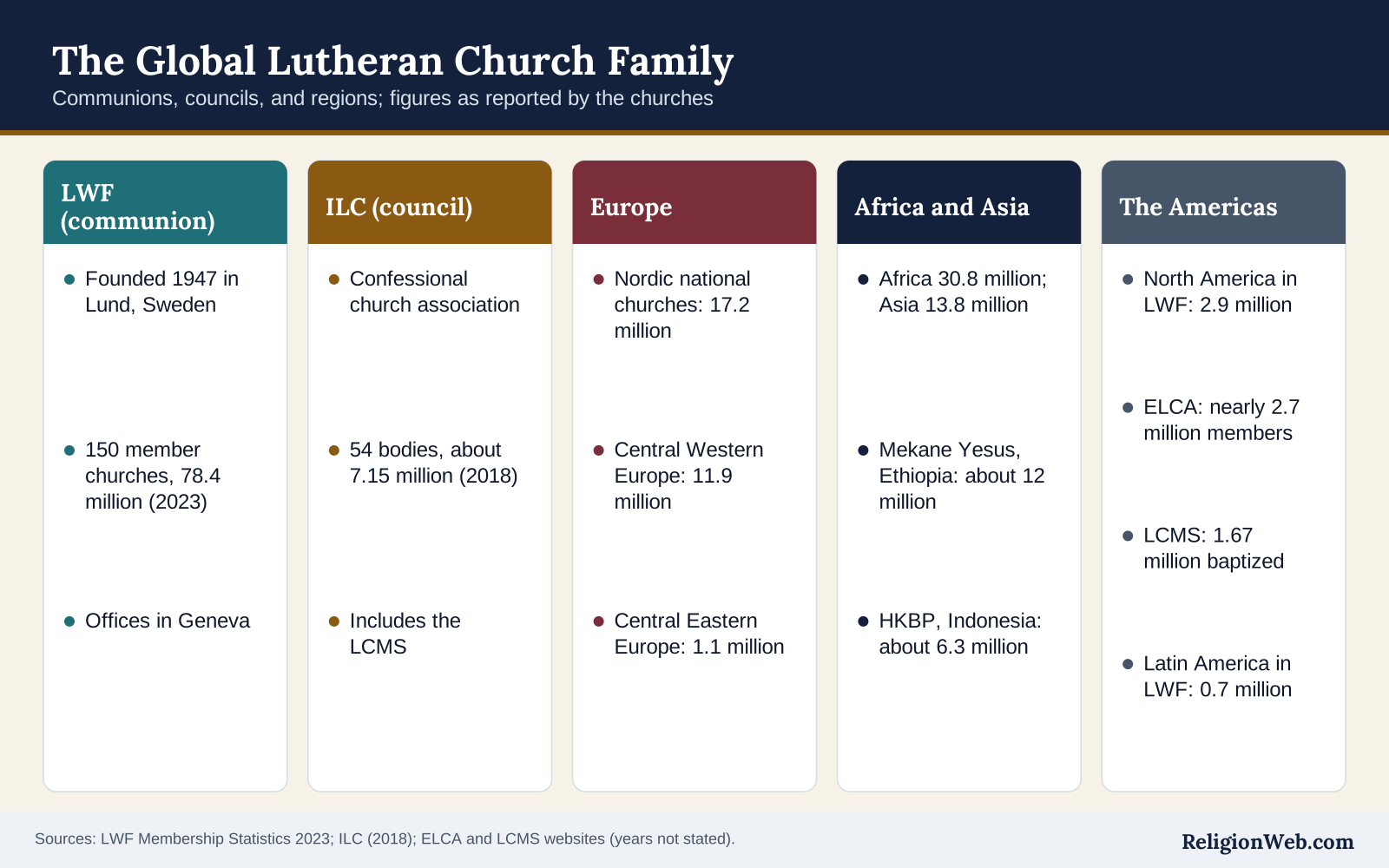
Lutheran Churches Around the World: Communions and Church Bodies
Global Communions and Councils
The Lutheran World Federation
The Lutheran World Federation, founded in 1947 in Lund, Sweden, is the largest worldwide association of Lutheran churches. Its headquarters are in Geneva, and it works through a general assembly of delegates from member churches, an elected council, and a staff that handles theology, ecumenical relations, humanitarian aid, and development. The LWF describes itself as a communion of churches, meaning that its members recognize one another’s ministries and share pulpit and altar fellowship.
The federation’s 2023 statistics, published in 2024, report 78,431,111 members in 150 member churches, including two associate members, along with ten recognized churches and congregations and two recognized councils. Its website states that its churches are found in about a hundred countries. Not all Lutherans are included in these figures, since some churches do not belong to the federation, and the LWF counts members according to the reports of the churches themselves.
The International Lutheran Council and other confessional bodies
A second international body is the International Lutheran Council (ILC), a worldwide association of confessional Lutheran churches that includes the Lutheran Church–Missouri Synod. In 2018, after admitting seventeen new member churches, the ILC reported 54 church bodies representing about 7.15 million Lutherans, so it is considerably smaller than the LWF, though its membership has changed since then. The ILC emphasizes agreement in doctrine among its member churches.
Other international groupings exist as well, such as the Confessional Evangelical Lutheran Conference, which includes the Wisconsin Evangelical Lutheran Synod. Their existence shows that the Lutheran family does not have a single world headquarters or a central authority that can speak for all Lutherans. When reading about Lutherans in news or reference works, it helps to check which body is being described.
Regional Profiles
Europe and the Nordic countries
In the LWF’s 2023 data, Europe accounts for about 30.2 million members: roughly 17.2 million in the Nordic countries, 11.9 million in Central Western Europe, and 1.1 million in Central Eastern Europe. The Nordic churches count large shares of their national populations as members, though the share that attends worship weekly is much smaller, and membership has been declining in several countries. The Church of Sweden (about 5.5 million members) and the Evangelical Lutheran Church in Denmark (about 4.2 million) are the largest European member churches.
In Germany, the Evangelical Church in Germany brings together regional Lutheran, Reformed, and United churches, and Lutheran identity is expressed through such regional churches and through the United Evangelical Lutheran Church of Germany. Smaller Lutheran churches in Eastern Europe often function as minority communities with strong ties to local culture and language.
Africa, Asia, and Latin America
Africa is the region with the most Lutherans in the federation’s membership, with about 30.8 million, and the Ethiopian Evangelical Church Mekane Yesus, with about 12 million members, is the largest single member church. The Evangelical Lutheran Church in Tanzania (about 8.5 million) and the Malagasy Lutheran Church in Madagascar (about 4 million) are also among the largest. Asian member churches total about 13.8 million, led by the Protestant Christian Batak Church in Indonesia (about 6.3 million), and Latin America and the Caribbean count about 720,000.
These churches use local languages and music and, in some places, interact closely with the Pentecostal and charismatic movements around them. Some have incorporated elements of charismatic renewal into their worship, while others have emphasized the sacramental and confessional character of Lutheran life. Readers can find the broader movement described in the article on Pentecostal Christianity.
North America
The Evangelical Lutheran Church in America reports nearly 2.7 million members in more than 8,400 worshiping communities, while the Lutheran Church–Missouri Synod reports about 1.67 million baptized members in 5,841 congregations. The Evangelical Lutheran Church in Canada and the Lutheran Church–Canada, along with the Wisconsin Evangelical Lutheran Synod, the North American Lutheran Church, and Lutheran Congregations in Mission for Christ, are among the other bodies. The LWF’s North American figure of about 2.9 million includes the ELCA and the Canadian member church; the Missouri Synod is not an LWF member.
| Church body | Region | Reported membership | Source and note |
|---|---|---|---|
| Ethiopian Evangelical Church Mekane Yesus | Ethiopia | About 12,000,000 | LWF member church, 2023 survey |
| Evangelical Lutheran Church in Tanzania | Tanzania | About 8,500,000 | LWF member church, 2023 survey |
| Protestant Christian Batak Church (HKBP) | Indonesia | About 6,333,000 | LWF member church, 2023 survey |
| Church of Sweden | Sweden | About 5,484,000 | LWF member church, 2023 survey; national church counting its baptized members |
| Evangelical Lutheran Church in Denmark | Denmark | About 4,236,000 | LWF member church, 2023 survey; established people’s church |
| Malagasy Lutheran Church | Madagascar | About 4,000,000 | LWF member church, 2023 survey |
| Evangelical Lutheran Church in America | United States | Nearly 2,700,000 | Church’s own statement on its website; year not stated |
| Lutheran Church–Missouri Synod | United States | 1,674,315 baptized | Figure on the International Lutheran Council site; year not stated; not an LWF member |
Ecumenical Relations and Reconciliation
Agreements with other churches
Lutheran churches have entered into a series of formal agreements with other Christian bodies, especially since the middle of the twentieth century. The Leuenberg Agreement of 1973 established church fellowship among Lutheran, Reformed, and United churches in Europe, resolving disputes from the sixteenth century about the Lord’s Supper; the later Community of Protestant Churches in Europe grew out of it. The Porvoo Agreement of 1992 brought together many Nordic and Baltic Lutheran churches with Anglican churches in the British Isles, and the 2001 Called to Common Mission agreement joined the ELCA with the Episcopal Church in the United States. More about the Anglican side is found in the article on Anglicanism, and about the Reformed side in the article on Reformed Christianity.
The Joint Declaration on the Doctrine of Justification was signed in October 1999 in Augsburg by representatives of the Lutheran World Federation and the Pontifical Council for Promoting Christian Unity. The LWF describes it as effectively resolving one of the key theological conflicts of the Reformation. The World Methodist Council joined in 2006 at Seoul, the World Communion of Reformed Churches in 2017 at Wittenberg, and the Anglican Consultative Council affirmed its substance in 2016 at Lusaka. The Methodist statement, as the LWF notes, adds aspects of the theology of sanctification, and readers can find the Methodist background in the article on Methodism. A joint Lutheran–Catholic commemoration of the Reformation took place in Lund, Sweden, on October 31, 2016, led by the LWF and the Catholic Church.
Reconciliation with those who were harmed
Lutheran churches have also looked at the harm done by their own forebears. The Augsburg Confession condemned Anabaptist teaching, and in the sixteenth century Lutheran and other authorities took part in the persecution of Anabaptists. In July 2010, at its assembly in Stuttgart, the LWF asked forgiveness of Mennonites for that persecution. Mennonite leaders called the service a beginning and not an ending, and the reconciliation process had begun in 1980, when Mennonite representatives asked how they could celebrate a document that condemned their teachings.
A second area is Jewish–Christian relations. Luther wrote strongly anti-Jewish statements in his later years, including violent recommendations. On April 18, 1994, the Church Council of the Evangelical Lutheran Church in America adopted a declaration to the Jewish community that rejects Luther’s invective and expresses lasting sorrow over its harmful effects, and criticizes antisemites who have used his words to promote hatred of Jews and Judaism. Other Lutheran churches and the LWF have issued their own statements, and historians treat Luther’s writings as one strand in a longer European history of anti-Jewish prejudice that involved many actors and institutions.
Community, Ethics, and Daily Life
Vocation, Family, and Education
Work, family, and community life
Because Lutherans understand ordinary work as a calling, the tradition has sustained a strong sense of duty in the household, the workplace, and civic life. Parents are expected to teach the faith to their children, citizens to serve the common good, and workers to do their jobs well as service to neighbors. This understanding is sometimes summed up by the idea that a farmer or a nurse serves God as truly as a pastor does, though in a different calling. Congregations function as social centers too, with choirs, women’s and men’s groups, youth programs, potluck suppers, and festival celebrations that vary by region and heritage.
Sunday is the weekly day for worship, but Lutheran teaching treats the day as a matter of Christian freedom and good order, not as a legal requirement derived from the Old Testament. The Third Commandment, as explained in the Small Catechism, is understood as a call to hold preaching and God’s Word sacred and to hear it gladly.
Schools, universities, and learning
Luther urged city councils to establish schools and argued that children of both sexes should learn to read so that they could study the Bible. Education has remained a Lutheran concern. Parish schools were a major priority for the Missouri Synod from its founding, Lutheran colleges and universities in the United States such as St. Olaf College and Luther College carry the heritage into higher education, and Lutheran schools in Africa and Asia have provided education to large numbers of students. In Germany and the Nordic countries, theological faculties at state universities train pastors and conduct scholarly work in the Lutheran tradition.
Ethics and Public Life
Care for the neighbor and social ministry
The doctrine of vocation links worship to service, and Lutheran churches have created large networks of social ministry. In the nineteenth century, figures such as Wilhelm Löhe founded deaconess communities that trained women for nursing and social work. In the twentieth and twenty-first centuries, Lutheran organizations have operated hospitals, care homes, refugee programs, and community services, among them the humanitarian work of the LWF and the social ministry organizations of the ELCA and the Missouri Synod. The emphasis on grace is understood to free believers for service without thought of reward.
Contested questions today
Lutheran churches take varying positions on contemporary ethical questions, and the differences sometimes strain relations among them. The ELCA adopts social statements through its assemblies and has taken positions on topics such as the care of creation, economic justice, and human sexuality, including a 2009 decision permitting congregations to call pastors in committed same-gender relationships. The Church of Sweden has also permitted the blessing of same-sex marriages. Many other Lutheran churches, including the Lutheran Church–Missouri Synod, the Wisconsin Synod, and large member churches in Africa and Eastern Europe, hold to traditional teaching on marriage and sexuality. These differences have led to realignments, including the founding of new North American bodies, and they remain a subject of continuing discussion within the LWF.
Common Misconceptions About Lutheranism
Misconception 1: Martin Luther personally created every later Lutheran doctrine
Where the misunderstanding comes from
The name itself invites the assumption. A tradition called “Lutheran” seems to be the teaching of Luther, and popular histories often present the Reformation as the work of one extraordinary man whose every opinion became church doctrine. Luther’s own productivity encourages the idea: his collected works fill dozens of volumes, from sermons and biblical commentaries to table talk recorded by students. Observers who meet Lutherans for the first time may also assume that they follow Luther in the way that members of some other movements follow a founding teacher.
What the evidence and tradition actually show
The documents that define Lutheran teaching are a collective product. Philipp Melanchthon wrote the Augsburg Confession and the Apology, Jakob Andreae and Martin Chemnitz were the principal authors of the Formula of Concord, and the Book of Concord includes the ancient creeds that Lutherans share with other Christians. Only some of Luther’s writings, notably the catechisms and the Smalcald Articles, were included, and the Confessions never name Luther as an authority equal to Scripture. Luther himself objected to the use of his name for the movement.
Lutheran churches also do not adopt everything Luther wrote. His harsh language about the peasants in 1525, his later writings against Jews, and his judgments about some books of the Bible have been criticized or set aside by Lutheran churches, and some bodies have formally repudiated parts of his legacy. Later developments, from Lutheran orthodoxy and Pietism to the Nordic lay movements and the African churches of today, added their own emphases. Luther is honored as a teacher and reformer, but the tradition judges his work by Scripture and the Confessions, not the other way around.
The distinction also appears in how Lutherans cite authorities. A Lutheran preacher or theologian may quote Luther with great affection, but a disagreement about doctrine is settled by appeal to the Bible and the Confessions. Some of the most important developments in the tradition, such as the careful definitions of the Formula of Concord or the nineteenth-century renewal of mission work, came from people who built on Luther without simply repeating him.
Misconception 2: All Lutheran churches are governed identically
Where the misunderstanding comes from
People often meet Lutheranism through one local church or one national body and assume that its structure is typical. In the United States, the experience of the Evangelical Lutheran Church in America or the Missouri Synod can shape expectations, and in Europe, a person may think of Lutheranism only as a national church tied to a state. The fact that all of these bodies use the word “Lutheran” and honor the Augsburg Confession reinforces the sense of a unified institution with a single chain of command.
What the evidence and tradition actually show
There is no Lutheran equivalent of a central office that governs all Lutheran churches. The Lutheran World Federation is a communion of independent member churches, and the International Lutheran Council is a separate association. Within these groups, structures range from the bishop-led national churches of the Nordic countries, to the regional Landeskirchen of Germany, to the synodical and congregational forms of North America, to the presiding bishops and presidents of the churches of Africa and Asia. Even titles differ: a “bishop” in the ELCA leads a regional synod, while an archbishop in Sweden leads a national church.
The Augsburg Confession anticipated this diversity when it said that human traditions and ceremonies need not be everywhere alike, provided the Gospel is rightly taught and the sacraments rightly administered. Variation in polity is thus a feature that the tradition has accepted from its beginning, even as individual church bodies argue about which forms best serve the Gospel.
The relation to the state adds another layer. Some Lutheran churches, such as the Evangelical Lutheran Church of Denmark, are established national churches with a legal status under their constitutions. Others, such as the churches of North America, have always been voluntary associations, and the Church of Sweden has been legally separate from the state since 2000. A visitor who moves from one country to another may therefore find that the same word, “Lutheran,” describes institutions with very different relationships to government, to their members, and to one another.
Misconception 3: Lutheran worship is universally informal or non-liturgical
Where the misunderstanding comes from
Some people picture Protestant worship as a service built around a sermon, with a few hymns and little fixed ritual, and they apply that picture to Lutheran churches. The impression is strengthened by the fact that many Lutheran congregations in North America and elsewhere offer contemporary services with bands and projected lyrics, and by the plain interiors of some churches. Others, seeing only the preaching and the lack of incense or elaborate processions in a particular congregation, conclude that Lutheran worship is free-form.
What the evidence and tradition actually show
The historical pattern runs the other way. Luther kept the structure of the Mass, and the Augsburg Confession affirms that it is celebrated with great reverence and that nearly all customary ceremonies are preserved. Most Lutheran hymnals contain full liturgies, including the Kyrie, the Gloria, the Creed, the Sanctus, and the Agnus Dei, along with the lectionary readings and the church year. Many Lutheran churches in Europe and North America celebrate Communion every Sunday and have a sung liturgy led by pastor and choir.
At the same time, the claim is not entirely wrong, because Lutheran practice is diverse. Some congregations, especially in North America and in mission settings, have chosen informal or contemporary styles, and the Confessions allow this flexibility. The accurate description is that the Lutheran standard is a liturgical Divine Service centered on Word and sacrament, with significant variation in how fully congregations follow it.
Visitors may therefore meet quite different experiences on successive Sundays. One congregation sings a historic liturgy with a cantor and an organ, another uses a printed hymnal with a pared-down order of service, and a third has a worship team and a screen. In each case the Lutheran question is whether the Gospel is preached and the sacraments are given, and the form of the service is a matter on which the Confessions leave room for local judgment.
Misconception 4: Because Lutherans teach salvation by faith alone, good works do not matter to them
Where the misunderstanding comes from
The slogan “faith alone” is easily heard as if it meant “faith without consequences.” In the sixteenth century, critics of the Reformation sometimes argued that such teaching would lead to moral laxity, and the argument has been repeated ever since. Some Lutherans have also spoken carelessly about works, and within the Lutheran movement, early disputes such as the Majoristic and Antinomian controversies arose precisely because people disagreed about how to speak of good works without compromising the Gospel.
What the evidence and tradition actually show
The Lutheran Confessions say explicitly that good works are necessary in the sense that they should and will follow faith. Article VI of the Augsburg Confession teaches that faith should bring forth good fruits and that it is necessary to do good works commanded by God, while denying that such works earn forgiveness. Luther’s treatise The Freedom of a Christian (1520) states the pattern in short form: the Christian is free from the Law as a condition of acceptance and, because of that freedom, becomes a servant of the neighbor in love.
The record of Lutheran churches bears this out. The doctrine of vocation, the emphasis on schools, hospitals, and deaconess work, and the large humanitarian programs of Lutheran bodies show a tradition for which service is a primary expression of faith. What Lutherans deny is not the importance of good works but the idea that works make a person right with God. The distinction is between the ground of salvation, which is Christ, and the fruit of faith, which is love of neighbor.
Misconception 5: The Reformation began when Luther nailed the Ninety-Five Theses to a church door in order to found a new church
Where the misunderstanding comes from
The image of a monk with a hammer is one of the most familiar scenes in Western history, repeated in paintings, films, and school textbooks, and reinforced by the celebration of Reformation Day on October 31. It condenses a complex process into one act of defiance. It also reflects a later view of the Reformation as the founding of Protestant churches, which makes it natural to imagine that Luther was building one from the start.
What the evidence and tradition actually show
The documented event of October 31, 1517, is Luther’s letter to Archbishop Albrecht of Mainz with the Theses enclosed as propositions for academic debate. The story of the nailing depends on a later report by Melanchthon, and historians disagree about whether it occurred as described, although posting academic theses on the Castle Church door would have been an ordinary university custom. What changed history was less the posting than the rapid printing of the Theses in German and Latin.
Luther did not intend in 1517 to found a church. For years he sought a hearing within the existing church, and even at Augsburg in 1530 the evangelical estates presented their Confession as a statement of what the one catholic church teaches. The separate Lutheran churches took shape gradually, through visitations, church orders, the political settlement of 1555, and the confessional work of the later sixteenth century. The Reformation is better understood as a process of years than as a single act on a single day.
Frequently Asked Questions About Lutheranism
Questions About Origins and Identity
Why are Lutherans called Lutherans?
The name comes from Martin Luther, the Wittenberg professor whose call for reform began the movement in 1517. It was first used by opponents in the 1510s and 1520s, and Luther himself disliked it. Over time the churches that confessed the Augsburg Confession accepted the name, though many still use “Evangelical” in their official titles, as the German evangelisch shows.
Are Lutherans Protestants?
Yes, Lutherans are Protestants in the usual sense of the word, and the term itself goes back to the 1529 protest of Lutheran princes and cities at Speyer. Lutherans also describe their churches as part of the one holy catholic church in the sense of the ancient creeds. Both descriptions are used, and which one is emphasized depends on the church and the context. The wider picture is given in the overview of Protestant Christianity elsewhere in this library.
How many Lutherans are there in the world?
The Lutheran World Federation reported about 78.4 million members in its 150 member churches in its 2023 survey, published in 2024. This number does not include some large churches outside the federation, such as the Lutheran Church–Missouri Synod, and each church counts members by its own rules, so the figure is an approximation. About 39 percent of the LWF total is in Africa and about 39 percent in Europe.
Questions About Belief and Worship
What do Lutherans believe about salvation?
Lutherans teach that people are justified, meaning declared righteous before God, by grace through faith in Jesus Christ and not by their own works. Faith is understood as a gift worked by the Holy Spirit through the Gospel and the sacraments, and good works are its fruit. The Augsburg Confession, Article IV, states this teaching in the form most Lutherans recognize.
What happens at a Lutheran worship service?
A typical Sunday service includes a confession of sins and absolution, hymns, readings from the Old Testament, Epistle, and Gospel, a sermon, the Creed, prayers, and often Holy Communion, followed by a blessing. The style ranges from a formal sung liturgy with organ and choir to a more informal service with contemporary music. Visitors are welcome and can usually follow the printed order of service or hymnal.
Can anyone receive Communion in a Lutheran church?
It depends on the church. The Evangelical Lutheran Church in America and many other Lutheran churches welcome all baptized Christians. The Lutheran Church–Missouri Synod and several other bodies practice close communion, which invites members of their own churches or of churches in fellowship with them. Visitors who are unsure should read the invitation in the service folder or ask the pastor before the service.
Do Lutherans pray to Mary and the saints?
Lutherans honor Mary and the saints as examples of faith and thank God for them, but the Lutheran Confessions do not teach the invocation of saints, and Lutherans address their prayers to God. Mary is highly regarded as the mother of Jesus, and many Lutheran calendars include festivals connected with her.
Questions About Church Life
What is the difference between the ELCA and the LCMS?
The Evangelical Lutheran Church in America and the Lutheran Church–Missouri Synod are the two largest Lutheran bodies in the United States, with different histories and policies. The ELCA was formed in 1988 through mergers, ordains women, practices open Communion for the baptized, and is a member of the LWF. The Missouri Synod, founded in 1847, holds a stricter form of confessional subscription, does not ordain women, practices close communion, and belongs to the International Lutheran Council. Both honor the Augsburg Confession and the Small Catechism.
Can Lutheran pastors marry, and can women be pastors?
Lutheran pastors may marry, and the Lutheran parsonage has been an important institution since Luther’s own marriage in 1525. Whether women may be ordained varies. Most LWF member churches in Europe and North America ordain women, as the Church of Sweden has since 1960, while the Missouri Synod and the Wisconsin Synod do not.
What is the Book of Concord?
The Book of Concord, published in 1580, is the collection of Lutheran confessional documents. It contains the three ancient creeds, the Augsburg Confession and its Apology, the Small and Large Catechisms, the Smalcald Articles, the Treatise on the Power and Primacy of the Pope, and the Formula of Concord. Churches differ on how binding each document is, but the collection is the common reference point of confessional Lutheranism.
Conclusion: What Lutheranism Is and How to Keep Exploring
What the History Shows
A tradition built around a confession of the Gospel
Lutheranism began as a debate within the Western church over how people are made right with God, and it became a tradition by writing its answer down. The Augsburg Confession of 1530 and the Book of Concord of 1580 stand at the center of that process, not as a replacement for Scripture and the ancient creeds but as a statement of how Lutherans read them. The emphasis on grace, on Word and sacrament, and on the daily vocation of the baptized gives the tradition a recognizable shape wherever it is found.
A tradition that continues to change
The Lutheran family today is larger in Africa and Asia than the tradition’s European founders could have imagined, and it includes churches that govern themselves, worship, and apply their confessions in different ways. Its history includes painful chapters that Lutheran churches have publicly examined, from the persecution of Anabaptists to Luther’s writings about Jews, and agreements of reconciliation with other Christians. It is better understood as a living tradition that continues to interpret a shared inheritance than as a fixed system.
How to Keep Exploring
Related topics in this reference library
Readers who want to place Lutheranism in context can begin with the articles on Christianity and Protestant Christianity, and then move to the related traditions of Reformed Christianity, Anglicanism, and Methodism, each of which has its own article in this library. Topical articles on baptism, the Eucharist, and the Bible offer background on practices and texts that Lutherans share with other Christians.
Learning from the sources
The most direct way to understand Lutheran teaching is to read its own texts, beginning with the Small Catechism, which takes less than an hour, and the Augsburg Confession. The Lutheran World Federation publishes its membership statistics and ecumenical documents, and individual church bodies publish their constitutions and worship books. Attending a Lutheran service, with the understanding that practice varies, can show how the liturgy, the hymns, and the sermon fit together in an actual congregation.
Sources
The table below lists the principal external sources behind this article. Facts, dates and figures were checked against these and related primary, institutional and academic materials.
| # | Source | Publisher and type | Used for | Link |
|---|---|---|---|---|
| 1 | LWF Membership Statistics 2023 | Lutheran World Federation · Demographic data | Worldwide and regional LWF membership; largest member churches (2023 data, published 2024) | lutheranworld.org |
| 2 | Augsburg Confession, Articles IV, VII, X, XXIV (Concordia Triglotta, 1921) | Project Wittenberg · Primary text | Quoted text of the Augsburg Confession (Bente and Dau translation, public domain) | projectwittenberg.org |
| 3 | Romans 3, World English Bible (Classic) | eBible.org · Primary text | Romans 3:28 quotation | ebible.org |
| 4 | Joint Declaration on the Doctrine of Justification | Lutheran World Federation · Institutional | 1999 signing and later Methodist, Anglican, and Reformed affirmations | lutheranworld.org |
| 5 | Germany: Spreading faith through song | Lutheran World Federation · Institutional | 1524 hymnals, congregational singing, Fun Fact on the single surviving Erfurt copy | lutheranworld.org |
| 6 | Book of Concord | Encyclopaedia Britannica · Encyclopedia | 1580 publication, contents, signatories of the preface, status | britannica.com |
| 7 | Declaration of the Evangelical Lutheran Church in America to the Jewish Community | Jewish Virtual Library · Institutional | April 18, 1994 ELCA declaration on Luther's anti-Jewish writings | jewishvirtuallibrary.org |
| 8 | The Lutheran Church-Missouri Synod (LCMS) | International Lutheran Council · Institutional | LCMS baptized membership and congregations (year not stated on page) | ilcouncil.org |
| 9 | ILC welcomes 17 new member churches representing 4.15 million Lutherans worldwide | International Lutheran Council · Institutional | ILC size in 2018: 54 church bodies, about 7.15 million members | ilcouncil.org |
| 10 | Summary of Congregational Statistics by Synod | Evangelical Lutheran Church in America · Institutional | ELCA description: nearly 2.7 million members in more than 8,400 worshiping communities | resources.elca.org |
Last fact-check date: 2026-10-21.
