The Virgin Mary is the mother of Jesus of Nazareth, a Jewish woman of first-century Galilee whom the Gospels of Matthew and Luke describe as a virgin who conceived through the Holy Spirit. In Christianity she holds a place that no other woman in the Bible approaches, but the way she is honored varies enormously. Catholic and Orthodox Christians sing hymns to her, ask for her prayers, and keep several feast days in her name. Many Protestant Christians honor her as a model of faith and the mother of the Savior, while declining to pray to her at all.
The written evidence for her life is small. She appears by name in the Gospels of Matthew, Mark and Luke, in the Acts of the Apostles, and in a handful of scenes in John, where she is never named but is called “the mother of Jesus.” The apostle Paul mentions only that Jesus was “born to a woman.” Almost everything else that Christians say about Mary, including her parents’ names, her death, her place in heaven and her many titles, comes from reflection on those texts, from later writings, and from centuries of worship. That is why any honest account of her has to separate several layers: what the Bible says, what church councils and teaching authorities have defined, what tradition has handed down without defining, and what individuals practice in private devotion.
The most consequential decision about Mary came in the fifth century, when the Council of Ephesus in 431 CE endorsed the Greek title Theotokos, usually translated “God-bearer” or “Mother of God.” The title was meant to make a statement about the identity of her son, Jesus Christ, and not about her own origins. Later Catholic definitions in 1854 and 1950, the Orthodox celebration of her Dormition, and the Reformation-era rejection of prayer to saints all built on, or reacted to, that older conversation.
This article follows the sources in order. It starts with the New Testament passages, traces how titles and beliefs developed, and then describes Catholic, Orthodox, Oriental Orthodox, Anglican and Protestant approaches on their own terms. It also covers feast days, icons, shrines, common misunderstandings and current developments. Where traditions disagree, the disagreement is named and attributed rather than resolved.
At a Glance: Mary in Christian Faith and Tradition
Who Mary Is in the Christian Tradition
A short definition
In Christian usage, “the Virgin Mary,” “the Blessed Virgin Mary” and “Mary, the mother of Jesus” all name the same person: the woman from Nazareth in Galilee who, according to Matthew and Luke, bore Jesus while still a virgin and who is placed in the Gospel narratives at his birth, at the wedding in Cana, at the crucifixion and, in Acts, among the disciples praying in Jerusalem. Christians regard her as a historical person, although the New Testament gives no dates for her birth or death and offers no description of her appearance or age. Most scholars locate her life in the late first century BCE and first century CE, and Jesus’s birth is usually dated between about 6 and 4 BCE, a range shaped by the reign of Herod the Great.
What Christians believe about her depends on what they believe about Jesus. For those who confess that Jesus is the Son of God made human, as the early councils affirmed, Mary is the woman through whom that incarnation happened, and almost every traditional title for her is a statement about him as well. This is why discussions of Mary in older theology are so often discussions of Christology, the study of who Christ is. The Trinitarian background to that conversation is explored in the article on the Trinity.
Names and spellings
“Mary” comes to English through Latin Maria and Greek Maria or Mariam, both of which render the Hebrew and Aramaic name Miryam, the same name borne by Moses’s sister in the Hebrew Bible. The Greek New Testament uses both Greek forms, and the Gospels mention several other women named Mary, including Mary Magdalene, Mary the wife of Clopas, and Mary the mother of James. Ancient and modern readers have sometimes confused them, which is one reason precise Gospel references matter.
The adjective “Virgin” is not a surname. It is a descriptive title taken from Matthew 1 and Luke 1, where the Greek word parthenos is applied to her. In English the phrase “Blessed Virgin Mary” is common in Catholic and Anglican use, “Theotokos” and “Panagia” (“All-Holy”) in Orthodox use, and “Our Lady” across the Latin West, a medieval courtesy title comparable to “my lady.”
Where Marian Belief and Practice Differ
A spectrum of honor
Christian communities place Mary at different points on a wide spectrum. Roman Catholic teaching honors her as Mother of God, ever-virgin, conceived without original sin, and assumed body and soul into heaven, and invites the faithful to ask for her intercession (see the overview of Catholic Christianity). The Eastern Orthodox and Oriental Orthodox churches also call her Theotokos and ever-virgin, sing to her in almost every service, and keep the Dormition, although they have not defined doctrines in the Catholic manner (see Eastern Orthodox Christianity and Oriental Orthodox Christianity). Anglicans and Lutherans keep some Marian feasts and sing the Magnificat in evening prayer, while many Reformed, Baptist, Pentecostal and evangelical Protestants emphasize that Scripture gives no warrant for prayer to Mary and keep devotional focus on Christ alone (see Protestant Christianity).
These differences are not simply a matter of “more” or “less” devotion. They reflect different views of how Scripture, tradition and church teaching authority relate, different understandings of saints and intercession, and different judgments about what the Bible permits. A fair reading of any community starts with its own description of what it is doing, which is how the sections below proceed.
Four kinds of material
It helps to sort statements about Mary into four kinds. The first is biblical material: what the New Testament texts themselves report. The second is doctrine, meaning teaching that a church treats as binding, such as the Council of Ephesus’s use of Theotokos or the Catholic definitions of 1854 and 1950. The third is tradition, a broad category for accounts and customs that have been handed down without being defined, including the stories of her parents Joachim and Anna and the details of her Dormition. The fourth is private devotion: prayers, pilgrimages and devotional practices that are encouraged or permitted but that no one is required to adopt. Roman Catholic teaching, for instance, treats reported apparitions of Mary as private revelation, so that the faithful are not obliged to believe them even when the Church approves a shrine.
Key Terms at a Glance
Core vocabulary
The table below defines the terms that recur throughout this article. Several of them are routinely confused, especially the Immaculate Conception and the virginal conception, which are different doctrines about different events.
| Term | Meaning | Where it is used |
|---|---|---|
| Theotokos | Greek for “God-bearer,” the one who gave birth to the incarnate Word; often rendered “Mother of God” | Council of Ephesus (431); Orthodox, Catholic, Oriental Orthodox, many Anglican and Lutheran contexts |
| Annunciation | The angel Gabriel’s announcement to Mary that she would bear a son (Luke 1:26-38) | All Christian traditions; feast on March 25 in many calendars |
| Magnificat | Mary’s song of praise in Luke 1:46-55, named from the first word of its Latin text | Evening prayer in Catholic, Anglican, Lutheran and Orthodox worship |
| Virginal conception | The belief that Jesus was conceived without a human father, by the Holy Spirit; often called the “virgin birth” | Affirmed in the historic creeds; taken symbolically or questioned by some modern Christians |
| Ever-virgin (aeiparthenos) | The belief that Mary remained a virgin before, during and after the birth of Jesus | Catholic, Orthodox and Oriental Orthodox teaching; also held historically by many Lutheran, Anglican and Reformed writers |
| Immaculate Conception | Catholic dogma that Mary was preserved from original sin from the first moment of her own conception | Defined by Pope Pius IX in 1854; not an Orthodox dogma |
| Assumption / Dormition | The belief that Mary, at the end of her earthly life, was taken body and soul into heavenly glory; Eastern churches speak of her “falling asleep” | Catholic dogma (1950); Orthodox and Oriental Orthodox feast, celebrated without a defined dogma |
| Intercession | Asking a holy person, living or departed, to pray to God on one’s behalf | Practiced in Catholic and Orthodox life; not practiced in most Protestant churches |
| Rosary | A prayer sequence using beads that joins repeated prayers with meditation on events in the lives of Jesus and Mary | Catholic devotion; used by some Anglicans and Lutherans |
| Akathist | An Eastern hymn, sung standing, in honor of the Theotokos; the name means “not seated” | Orthodox and Eastern Catholic worship, especially in Lent |
Words for honor: worship, veneration and devotion
Christian writers have long distinguished between the adoration owed to God alone and the veneration given to saints and to Mary. The Second Council of Nicaea in 787 drew this line when it defended holy images, and Catholic theology later spoke of latria (adoration of God), dulia (veneration of saints) and hyperdulia (the special veneration given to Mary). Orthodox writers use proskynesis, a bow or act of reverence, for honor given to icons and holy persons, reserving latreia for God. Where this article says that Catholics or Orthodox “venerate” or “honor” Mary, it is following that vocabulary, and where it says “pray to” Mary it means the traditional sense of “ask,” as in the old English phrase “I pray thee.”
Most Protestant traditions do not use these distinctions in worship. Many of them hold that any prayer addressed to a creature risks competing with the sole mediation of Christ, and they decline the practice even while honoring Mary in sermon and hymn. This does not mean they ignore her. It means they locate her in a different relation to the believer.
Mary in the New Testament
The Earliest and Briefest References
Paul: born to a woman
The oldest surviving Christian writings are the letters of Paul, composed in the 50s CE, and they contain only one passing reference to Mary, without naming her. In Galatians 4:4 Paul writes that “God sent out his Son, born to a woman, born under the law” (World English Bible). The point is theological, not biographical: Paul stresses that the Son entered ordinary human life, with a mother and within Jewish law. Paul says nothing in his surviving letters about a virginal conception or about Mary’s later life, and nothing about Joseph either.
Historians read this silence in different ways. Some argue that the virginal conception tradition developed after Paul’s letters, which is possible but cannot be proved. Others note that Paul wrote occasional letters to specific congregations and had no occasion to retell the birth stories, so silence is weak evidence. Christian tradition, for its part, accepts the later Gospel accounts as faithful records of what the community already believed.
Mark: the family at Nazareth
Mark, the earliest Gospel, which most scholars date to about 65 to 75 CE, has no birth narrative. Mary enters in two places. In Mark 3:31-35, “his mother and his brothers came, and standing outside, they sent to him, calling him,” and Jesus answers, “Who are my mother and my brothers?” and concludes that “whoever does the will of God is my brother, my sister, and mother” (World English Bible). A few verses earlier, Mark 3:21 says that his family set out to take charge of him because people were saying he was out of his mind. In Mark 6:3 the people of Nazareth ask, “Isn’t this the carpenter, the son of Mary and brother of James, Joses, Judah, and Simon?” (World English Bible).
These passages are read in contrasting ways. Many Catholic and Orthodox interpreters hold that Jesus’s words do not demote his mother but describe a deeper kinship that includes her, since Luke presents Mary as the model hearer of God’s word. Many Protestant interpreters read Mark as showing that Jesus’s mission set him apart from his family, who at first did not understand it. Both readings take the text seriously; they differ on how Mark’s brief scenes relate to the fuller portraits in Luke and John. Luke’s version of the scene (Luke 8:19-21) omits the remark about the family seizing him.
The Infancy Narratives in Matthew and Luke
Matthew: Joseph, the child and the prophecy
Matthew, usually dated to the 80s CE, tells the birth story mainly from Joseph’s perspective. The genealogy in Matthew 1 ends by naming Joseph as the husband of Mary, of whom Jesus was born, and Matthew then describes Mary as engaged to Joseph and found to be with child through the Holy Spirit. Joseph, “being a righteous man, and not willing to make her a public example,” considers a quiet divorce, until an angel tells him in a dream to take Mary as his wife. Matthew sees in this the fulfillment of a verse from Isaiah: “Behold, the virgin shall be with child, and shall give birth to a son. They shall call his name Immanuel” (Matthew 1:23, World English Bible). He adds that Joseph “didn’t know her sexually until she had given birth to her firstborn son” (Matthew 1:25).
Matthew then relates the visit of the magi, who find the child “with Mary his mother,” the flight into Egypt to escape Herod, and the return to settle in Nazareth. The word Matthew uses for “virgin” is the Greek parthenos, which is also how the Septuagint, the ancient Greek translation of the Hebrew Bible, renders Isaiah 7:14. The Hebrew word in Isaiah is almah, usually translated “young woman” in modern Jewish and many academic translations. Christians read Matthew’s use as expressing a belief in a virginal conception that was understood in the earliest communities, while historians of Isaiah discuss what the verse meant in its original eighth-century BCE setting. Both questions are legitimate, and they do not need to be collapsed into one.
Luke: Annunciation, Visitation and Magnificat
Luke, usually dated to the 80s or 90s CE, gives Mary the fullest role in the New Testament. In Luke 1:26-38 the angel Gabriel is sent to Nazareth, to “a virgin pledged to be married to a man whose name was Joseph, of David’s house. The virgin’s name was Mary” (World English Bible). He greets her, tells her she will conceive and name her son Jesus, and when she asks how this can be, since she is a virgin, he answers that “The Holy Spirit will come on you, and the power of the Most High will overshadow you.” She responds:
Mary said, “Behold, the servant of the Lord; let it be done to me according to your word.”
Luke 1:38, World English Bible (public domain; eBible.org edition)
Christian interpreters across traditions have long read this reply as an act of free consent and trust. Catholic and Orthodox writers have often emphasized its role in the story of salvation, comparing her obedience with the disobedience in Genesis, an idea explored below under the “new Eve.” Protestant readers more often point to it as a model of faith in a word received. The Greek word translated “servant” is doule, a female servant of the Lord, which is why some translations read “handmaid.”
The narrative continues with the Visitation, in which Mary travels to the hill country of Judea to visit her relative Elizabeth, who is pregnant with John the Baptist. Elizabeth calls out, “Blessed are you among women, and blessed is the fruit of your womb! Why am I so favored, that the mother of my Lord should come to me?” (Luke 1:42-43, World English Bible). Mary then utters the song known as the Magnificat, in Luke 1:46-55. Scholars frequently note its echoes of the song of Hannah in 1 Samuel 2. It includes the line that Christian devotion has treated as a charter for Marian honor:
for he has looked at the humble state of his servant. For behold, from now on, all generations will call me blessed.
Luke 1:48, World English Bible (public domain; eBible.org edition)
Catholic, Orthodox, Anglican and Lutheran readers see in this verse the biblical basis for honoring Mary through the centuries. Many Protestants read the same verse as calling Christians to “bless” her by remembering what God did through her, while pointing out that the rest of the song is about God’s mercy and reversal of fortunes. Because the Magnificat is a canticle, a scriptural song, it has been sung daily in Catholic evening prayer, in Anglican evensong, in Lutheran vespers and in Orthodox matins, often by communities that disagree about prayer to Mary.
Luke: birth, presentation and the boy in the Temple
Luke 2 places the birth of Jesus in Bethlehem, where Joseph and Mary have gone for a registration ordered by Caesar Augustus. The text says she “gave birth to her firstborn son,” wrapped him in cloths and laid him in a feeding trough because there was no room in the inn (Luke 2:7). After the shepherds visit, Luke notes that “Mary kept all these sayings, pondering them in her heart” (Luke 2:19). Historians debate the dating of the census Luke mentions, and Luke’s chronology differs in some respects from Matthew’s, but those debates do not change the shape of the scene Christians receive: a young mother in modest circumstances, attentive to events she does not fully understand.
Forty days after the birth, according to Luke 2:22-38, Mary and Joseph bring the child to the Temple in Jerusalem in accordance with the law of Moses on purification and the redemption of the firstborn. The elderly Simeon takes the child in his arms, blesses God, and tells Mary that “a sword will pierce through your own soul, that the thoughts of many hearts may be revealed” (Luke 2:35, World English Bible). Christian tradition, especially in the Catholic Church, has read this as foretelling her sorrow at the crucifixion, and the “Seven Sorrows” devotion grew from it. Luke closes the childhood scenes with the episode of the twelve-year-old Jesus remaining behind in the Temple (Luke 2:41-52), where “his mother kept all these sayings in her heart” (Luke 2:51). Many readers note that Luke’s last image of Mary in this section is again that of a woman reflecting on what she has seen.
Scholars differ on how to classify these infancy narratives. Many historians regard them as theological compositions that draw on early traditions and Old Testament themes, and they argue about how much each detail can be verified. Traditional Christian teaching, in all its major branches, receives them as inspired accounts of real events. For the purposes of this article, it is enough to note that these two chapters of Matthew and two chapters of Luke are the source for nearly everything the later church said about Mary’s earthly life.

Mary in John, Acts and Revelation
Cana: “Whatever he says to you, do it”
The Gospel of John never uses Mary’s name. It calls her “the mother of Jesus” or “his mother,” and she appears at two moments that frame Jesus’s public ministry. The first is the wedding at Cana in Galilee, in John 2:1-11, which John presents as the first of Jesus’s signs. The story unfolds in a few lines:
When the wine ran out, Jesus’ mother said to him, “They have no wine.” Jesus said to her, “Woman, what does that have to do with you and me? My hour has not yet come.” His mother said to the servants, “Whatever he says to you, do it.”
John 2:3-5, World English Bible (public domain; eBible.org edition)
Interpreters have long noticed the unusual address “Woman,” which was not rude in Greek but was uncommon from a son to his mother. Catholic and Orthodox commentators often see Cana as an early example of Mary interceding: she notices a need, brings it to her son, and directs others to obey him. Many Protestant commentators read her last line as the center of the scene, because it models trust in Jesus, and they observe that she asks nothing specific. John also links the phrase “my hour” to the crucifixion, so many scholars read the passage as pointing ahead to the cross, where Mary appears again.
At the cross
The second Johannine scene is at the crucifixion. John 19:25 lists those standing near the cross as “his mother, his mother’s sister, Mary the wife of Clopas, and Mary Magdalene.” The next two verses record Jesus’s words:
Therefore when Jesus saw his mother, and the disciple whom he loved standing there, he said to his mother, “Woman, behold, your son!” Then he said to the disciple, “Behold, your mother!” From that hour, the disciple took her to his own home.
John 19:26-27, World English Bible (public domain; eBible.org edition)
The plainest reading, shared by readers of every tradition, is that Jesus provides for his mother’s care as he dies. Beyond that, interpretations diverge. Catholic teaching, including the Second Vatican Council’s constitution on the Church, has frequently read the scene as also expressing a spiritual motherhood, in which the beloved disciple stands for every believer. Orthodox commentary often takes a similar view in devotional writing. Many Protestant interpreters regard the passage as an act of filial care and caution against building doctrine from it. These are historically long-standing readings, not novelties of one century, and they have coexisted in modern scholarship.
Acts 1:14 and the woman of Revelation 12
Mary’s last appearance in a narrative is brief. After the ascension, Acts 1:14 says that the apostles “continued steadfastly in prayer and supplication, along with the women and Mary the mother of Jesus, and with his brothers” (World English Bible). The verse places her among the first Christian community in Jerusalem before Pentecost. Acts says nothing further about her, and none of the New Testament letters describes her death.
The Book of Revelation describes “a great sign” in heaven: “a woman clothed with the sun, and the moon under her feet, and on her head a crown of twelve stars,” who gives birth to a male child who will rule the nations (Revelation 12:1, 5, World English Bible). Interpreters disagree on whom she represents. Common readings identify her with Israel, the people of God from whom the Messiah came, with the Church, or with Mary, and many commentators hold that the symbol can operate on more than one level. The Roman lectionary uses the passage on the Solemnity of the Assumption, and Marian art has drawn on its imagery of the sun, moon and stars, but the text itself does not name Mary.
Mary in the New Testament at a Glance
The principal passages
| Passage | What the text reports | Common interpretive emphasis |
|---|---|---|
| Galatians 4:4 | The Son was “born to a woman, born under the law” | The real humanity of Christ; earliest Christian reference to Mary |
| Mark 3:31-35; 6:3 | Jesus’s mother and brothers seek him; townspeople name “the son of Mary” and four brothers | Spiritual kinship in Jesus’s teaching; debate about the brothers’ relationship (see Misconception 4) |
| Matthew 1:18-25; 2:11 | Mary is found to be with child by the Holy Spirit; Joseph receives her; magi find the child “with Mary his mother” | Virginal conception and Isaiah 7:14; Joseph’s righteousness |
| Luke 1:26-38 | Gabriel announces the birth of Jesus; Mary consents | The Annunciation; obedience and trust; feast of March 25 |
| Luke 1:39-56 | Visit to Elizabeth; the Magnificat | Blessing of Mary; the biblical basis for Marian canticle and honor |
| Luke 2:1-52 | Birth, presentation in the Temple, Simeon’s words, the boy Jesus in the Temple | Mary’s reflection; Simeon’s sword and the Sorrows tradition |
| John 2:1-12 | The wedding at Cana | Intercession (Catholic, Orthodox); trust and obedience (many Protestants) |
| John 19:25-27 | Jesus entrusts his mother and the beloved disciple to each other | Filial care; spiritual motherhood in Catholic and Orthodox readings |
| Acts 1:14 | Mary among the disciples praying in Jerusalem | Her place in the first Christian community |
| Revelation 12:1-6 | A woman clothed with the sun gives birth to a male child | Read as Israel, the Church, Mary, or several at once |
What the New Testament does not say
Noting the silences is as important as quoting the verses. The New Testament does not give Mary’s age at the Annunciation, her parents’ names, her appearance, the place or manner of her death, or any account of a burial. It does not say she was born without original sin, that she was taken up to heaven, that she should be prayed to, or that she should be called Queen of Heaven. It does not state, in so many words, that she had no further children after Jesus, although Matthew 1:25 is read in that direction by some and in the opposite direction by others.
Christian traditions respond to these silences differently. Catholic and Orthodox teaching holds that Scripture is read within a living tradition, so that practices and beliefs preserved in the church’s worship carry real authority alongside the Bible. Many Protestant traditions hold that doctrine must rest on Scripture alone, a principle called sola scriptura, and so they place weight on what the text states directly. Neither side denies that the New Testament is short on detail. They disagree about what may legitimately fill the gap, which is the subject of the sections that follow.
How Christian Belief About Mary Developed
From the Gospels to the Second Century
The new Eve
The earliest Christian writers outside the New Testament say little about Mary for her own sake. When they mention her, they usually do so to defend a claim about Jesus. Ignatius of Antioch, whose letters are traditionally dated to about 110 CE, refers to the birth of Jesus from Mary as a real event, in order to insist that the Son of God truly became human. Within another half century or so, Justin Martyr and then Irenaeus of Lyon (writing about 180) developed a comparison that would shape Marian thought for centuries: Mary as the “new Eve.” In this reading, Eve’s disobedience in the garden of Genesis finds a counterpart in Mary’s obedient reply at the Annunciation. Irenaeus argued, in paraphrase, that what Eve bound by unbelief Mary loosed by faith.
This comparison was a theological argument about how salvation works, built from the contrast of two women and two trees (the tree of Eden and the cross). It was not a form of devotion, and it was not an argument that Mary is an equal of Christ. Later Catholic and Orthodox teaching drew on it to speak of Mary’s cooperation with God in the incarnation, while Protestant interpreters have more often read the same Fathers as stressing her faith and Christ’s work. The comparison remains a fixed reference point in both approaches.
The Protoevangelium of James and other early writings
The most influential early source about Mary’s life outside the New Testament is the Protoevangelium of James, composed in Greek in the second century and attributed to James, the brother of Jesus. It supplies what the Gospels do not: Mary’s parents, Joachim and Anna, who had been childless; her birth in answer to prayer; her childhood in the Jerusalem Temple; and Joseph’s role as an older guardian chosen to care for her. It also presents Mary as a virgin before, during and after the birth of Jesus, and it explains the “brothers of Jesus” as Joseph’s children by an earlier marriage. The Latin West eventually treated the book with suspicion, and it was listed among apocryphal works, but it never lost its influence on art and liturgy. Feasts of Mary’s birth and her presentation in the Temple, and the names Joachim and Anna in the calendar, all derive from it.
Other early evidence is harder to date. A short Greek prayer beginning “Under your protection,” known in Latin as Sub tuum praesidium, survives on a papyrus fragment held at the John Rylands Library in Manchester. It is often called the oldest known prayer to Mary and has traditionally been dated to the third century, although specialists continue to argue about the date, with some proposing a later one. Accounts of Mary’s death and Dormition, called transitus narratives, survive in Greek, Syriac, Coptic and Latin versions from the fifth century onward. Epiphanius of Salamis, writing in the later fourth century, observed that Scripture gives no certain information about how Mary’s life ended, which shows that the later narratives were not simply inherited from the apostolic age.
Ephesus, Chalcedon and the Theotokos
The dispute of 428 to 431
The title Theotokos was already used by Greek-speaking Christian writers before the fifth century. It became the center of a controversy in 428, when preaching in Constantinople associated with its bishop Nestorius objected to it. Nestorius, trained in the Antiochene tradition of theology, which was careful to keep the divine and human in Christ distinct, preferred the title Christotokos, “Christ-bearer.” His opponent Cyril of Alexandria argued that to deny Mary the title Theotokos was to divide Christ into two persons, one divine and one human, so that the one born at Bethlehem would no longer be the eternal Word himself. The emperor Theodosius II summoned a council to Ephesus.
The council opened on 22 June 431 under Cyril, before the delegation of John of Antioch and the legates of Pope Celestine had arrived. It approved Cyril’s second letter to Nestorius as agreeing with the Council of Nicaea, and it deposed Nestorius. John of Antioch’s party then held a rival meeting. Relations were repaired in 433 by a Formula of Union between Cyril and John. In later church teaching, the Council of Ephesus is regarded as an ecumenical council by Catholic, Orthodox and Oriental Orthodox churches, and its Christological teaching is accepted by most Anglican, Lutheran and Reformed churches. The Assyrian Church of the East has historically not used the title Theotokos in its liturgy and is discussed below.
Chalcedon and the churches that parted
Twenty years later, the Council of Chalcedon (451) set out a definition of faith that confessed one Christ “in two natures” and called Mary the Theotokos in respect of Christ’s humanity. In paraphrase: the same Son who is begotten of the Father before the ages is, in these last days, born of Mary the Virgin, the God-bearer, as to his manhood. The Oriental Orthodox churches, which include the Coptic, Ethiopian, Eritrean, Syriac, Armenian and Malankara traditions, did not accept Chalcedon’s wording, but they affirm Ephesus and revere Mary as Theotokos. The Church of the East, centered in the Persian Empire beyond the reach of Roman rulers, followed a path shaped by the Antiochene school, and it has been called “Nestorian” by outsiders, a label that its members and many modern scholars regard as inaccurate.
In 1994, Pope John Paul II and Mar Dinkha IV, the Catholicos-Patriarch of the Assyrian Church of the East, signed a Common Christological Declaration that recognized each church’s way of speaking about Mary as expressing the same faith in Christ. The Assyrian Church honors her as “Mother of Christ our God and Savior,” while the Catholic Church says “Mother of God.” Reports of this declaration differ somewhat in wording, so the agreement is best described in general terms, as an ecumenical recognition that the two titles are meant to confess the same Christ.
Medieval and Modern Developments
Councils on virginity and the growth of devotion
The adjective “ever-virgin” (aeiparthenos) was used by the Second Council of Constantinople in 553, and the Lateran Synod of 649 under Pope Martin I stressed Mary’s virginity before, in and after the birth of Jesus. In the Greek East, the Second Council of Nicaea (787) defended the veneration of icons, which gave Marian images a secure theological place. From the sixth century onward, hymns such as the Akathist, feasts such as the Dormition and the Nativity of Mary, and a growing literature of homilies made Mary one of the most visible figures in Eastern worship. In the Latin West, the twelfth century brought a flowering of Marian prayer and writing, including Bernard of Clairvaux’s sermons and the antiphon Salve Regina, and religious orders such as the Cistercians, Carmelites and Dominicans built distinct Marian devotions.
One question remained debated for centuries: whether Mary was preserved from original sin at her conception. Thomas Aquinas hesitated on it, while John Duns Scotus, around 1300, argued for it by saying that Christ could redeem Mary in advance. The Franciscans promoted the doctrine and the Dominicans were often cautious. Pope Sixtus IV gave approval to a feast of the Conception in the 1470s, but the question was not settled as dogma until the nineteenth century.
The modern definitions and Vatican II
On 8 December 1854 Pope Pius IX defined the Immaculate Conception as dogma in the apostolic constitution Ineffabilis Deus. On 1 November 1950 Pope Pius XII defined the Assumption in Munificentissimus Deus. Both were solemn papal definitions for the Catholic Church. The Orthodox churches honor Mary, but they did not take part in those definitions and do not treat them as dogma. At the Second Vatican Council, the Catholic bishops chose to place their teaching on Mary within the document on the Church, Lumen Gentium (1964), in chapter eight, rather than issuing a separate text. On 21 November 1964 Paul VI proclaimed Mary “Mother of the Church” at the close of that session. Later documents, including Marialis Cultus (1974) on Marian devotion and John Paul II’s Redemptoris Mater (1987), developed the same approach of locating Marian devotion in relation to Christ and the Church.
Historical Milestones at a Glance
Timeline of key developments
| Date | Development | Significance |
|---|---|---|
| c. 50s CE | Paul writes that the Son was “born to a woman” (Galatians 4:4) | Earliest surviving Christian reference to Mary, unnamed |
| c. 65-100 CE | Gospels of Mark, Matthew, Luke and John (dates approximate) | Principal New Testament narratives about Mary |
| Second century | Mary as “new Eve” (Justin, Irenaeus); Protoevangelium of James | First theological and narrative expansion beyond the Gospels |
| 431 | Council of Ephesus | Endorses Cyril’s letter defending the title Theotokos |
| 451 | Council of Chalcedon | Confesses Christ in two natures; names Mary Theotokos as to his humanity |
| 553 and 649 | Constantinople II; Lateran Synod | “Ever-virgin” used in conciliar language |
| 787 | Second Council of Nicaea | Defends veneration of icons, distinguished from worship |
| 1854 | Immaculate Conception defined | Catholic dogma proclaimed by Pius IX |
| 1950 | Assumption defined | Catholic dogma proclaimed by Pius XII |
| 1964 | Lumen Gentium, chapter eight; “Mother of the Church” | Catholic teaching on Mary placed within teaching on the Church |
| 2018 | Memorial of Mary, Mother of the Church added to the Roman calendar | Observed on the Monday after Pentecost |
| 2024 and 2025 | Vatican norms on alleged apparitions; doctrinal note on Marian titles | Current Catholic guidance; see later sections |
How scholars read the development
Historians of Christianity generally observe that devotion to Mary grew alongside, and often in response to, debates about Christ. The strongest early Marian statements, such as the Theotokos title, protect a claim about Jesus. Over time, hymnody, preaching and popular piety carried that confession into broader reflection on her holiness, her role in salvation and her heavenly care for the church. Catholic and Orthodox theologians describe this as an organic unfolding of what was already contained in the apostolic teaching, a “development of doctrine.” Many Protestant historians describe it instead as a gradual accumulation of devotion beyond the biblical witness. Both descriptions rest on the same dates and sources, and they differ chiefly on whether the later layers are legitimate.
For a reader trying to keep these layers distinct, the dates in the table are a useful guide. The Gospels are the earliest narratives. The second-century writings add stories and typology. The councils from 431 to 787 settle questions about Christ and the veneration of images. The definitions of 1854 and 1950 belong to one communion. The feast days sit between the layers, because their dates were set over centuries by local custom and church authority, and are treated in a later section.
Titles of Mary and What They Mean
Theotokos and Mother of God
What the Greek word says
The title Theotokos is a Greek compound that Christians have rendered in several ways: “God-bearer,” “Birth-giver of God,” or, in Latin, Dei genetrix and Mater Dei, “Mother of God.” In Greek there is also a separate phrase, Meter Theou, “Mother of God,” which is the one abbreviated on icons as ΜΡ ΘΥ. The two Greek expressions are used together in Orthodox worship, and in English the translation “Mother of God” is the most common. Because the English phrase “mother of God” can sound as though it speaks about the origin of divinity, the Greek form is worth keeping in mind. The word is built from theos (“God”) and a form of the verb tiktein, “to give birth.”
For the councils, the question was never whether Mary preceded God or produced his divine nature. They asked a narrower question: of whom do the Gospels say that he was born at Bethlehem? If the child of Mary was truly the eternal Word made flesh, one person with a divine nature and a human nature, then it is accurate to say that Mary bore God the Son in his humanity. If instead the child of Mary was only a human being to whom the Word was later joined, then she bore only a man. Cyril of Alexandria thought that second view broke the unity of Christ, and the Council of Ephesus agreed with him.
What the title does and does not claim
The title does not claim that Mary is divine, that she existed before her son, or that she is the source of his divine nature. Catholic, Orthodox and Oriental Orthodox teaching describe it as a statement about the unity of Christ’s person, and churches that follow the Ephesine tradition, including many Anglican, Lutheran and Reformed communities, treat it the same way. Cyril himself was careful on this point, and Chalcedon repeated that Mary is Theotokos as to Christ’s humanity. The title also does not claim that she created or governs anything, which is a Christian belief about God alone.
Some Christians who are wary of the term object not to its meaning but to its risk of being misheard. Nestorius’s concern was that the word, in popular use, might suggest that Mary gave birth to the divine nature itself. Cyril’s reply was that the context of the faith guards against that, and that a careful reader of Scripture and the creeds would never confuse the two. Christian traditions today largely read the title as Cyril did, and the Assyrian Church of the East’s preference for “Mother of Christ” is understood by its members and by ecumenical partners as a different wording of the same confession.
Other Ancient and Medieval Titles
Virgin, Panagia and Our Lady
“Virgin” is the oldest of Mary’s descriptive titles, taken from the Gospel of Luke and used in every creed that mentions her. Both the Apostles’ Creed and the Nicene Creed name the Virgin Mary in speaking of the incarnation of Jesus, in slightly different wording. In Greek worship, Panagia (“All-Holy”) is a common title of devotion, and Slavic and Arabic-speaking Orthodox communities have their own equivalents. The Latin West developed titles such as Domina and Nostra Domina, “Our Lady,” which became the French Notre-Dame and the Italian Madonna, “my lady.” These words were forms of courtesy before they became names of churches and paintings.
Titles also grew from places. “Our Lady of Guadalupe,” “Our Lady of Lourdes” and “Our Lady of Fatima” do not refer to different Marys but to the same person as she is remembered in connection with a place of reported apparition or a long local devotion. Popular speech sometimes obscures this, and some visitors to Catholic and Orthodox countries assume that distinct local figures are involved. In church teaching, there is one Mary, and the many names are names of devotion.
Queen, Advocate and Mediatrix
Other titles express her perceived relation to the believer. “Queen of Heaven” appears in the Latin Easter antiphon Regina Caeli, and Pope Pius XII established a feast of the Queenship of Mary in 1954, now kept on August 22. The Catechism of the Catholic Church, in paragraph 969, records that “the Blessed Virgin is invoked in the Church under the titles of Advocate, Helper, Benefactress, and Mediatrix,” as the Second Vatican Council’s constitution on the Church had stated. The Catechism goes on to say that Mary’s role does not obscure or diminish the unique mediation of Christ.
Orthodox hymns use some parallel language, such as calling Mary a protectress of the faithful. Protestant churches generally do not use these titles because they hold that Christ alone is mediator (1 Timothy 2:5), and so the vocabulary of advocacy and mediation is one of the clearest places where traditions differ. A fair description is that the same verse is read by Catholics and Orthodox as allowing subordinate, participatory intercession, and by most Protestants as excluding it.
Contested and Recent Titles
Co-redemptrix and the 2025 doctrinal note
Among Catholic titles, “Co-redemptrix” has been the most debated. It refers to Mary’s cooperation with Christ in redemption, and it was promoted by some twentieth-century theologians and petitioners who asked for a dogmatic definition. Popes, including Pius XII and John Paul II, used related vocabulary only occasionally. On 4 November 2025 the Dicastery for the Doctrine of the Faith published the doctrinal note Mater Populi Fidelis (“Mother of the Faithful People”), approved by Pope Leo XIV on 7 October 2025 and signed by Cardinal Víctor Manuel Fernández. According to the Vatican’s own news summary, the note says that it is always inappropriate to use “Co-redemptrix” to define Mary’s cooperation, because the title risks obscuring the unique saving mediation of Christ.
The same note accepted “Mediatrix” only in a limited, subordinate sense, as cooperation, assistance or intercession that adds nothing to Christ’s own mediation, and it urged caution with broader formulations such as “Mediatrix of All Graces.” It affirmed titles such as “Mother of Believers” and “Mother of the Faithful.” The note is recent, and discussion of it among Catholic theologians continues, so readers should treat its reception as ongoing. It does not change Marian dogma. It gives guidance on how some titles should be used.
Mother of the Church and Mother of the faithful
“Mother of the Church” was a title used in medieval and later writing and given formal prominence by Paul VI in 1964. The Catechism treats it in the section on “Mary: Mother of Christ, Mother of the Church,” and quotes Paul VI in calling her “the new Eve, Mother of the Church.” In 2018 the Vatican added a memorial of Mary, Mother of the Church, to the Roman calendar for the Monday after Pentecost, which links the title with the community that received the Spirit in Acts 1 and 2. Catholic theology explains this motherhood as spiritual, flowing from Mary’s motherhood of Christ, the head, and extending to his body. Orthodox hymnody and devotional literature speak of Mary’s protection of the faithful in related terms, without a defined doctrine, and most Protestant churches do not use the title.
Major Titles at a Glance
Summary table of titles
| Title | Meaning or origin | Where it is used |
|---|---|---|
| Theotokos | Greek, “God-bearer”; confesses that the one born of Mary is the incarnate Word | Ephesus (431); Orthodox, Oriental Orthodox, Catholic, and many Anglican, Lutheran and Reformed contexts |
| Mother of God (Meter Theou, Mater Dei) | Greek and Latin equivalents; the usual English rendering of Theotokos | Icons, litanies, Marian prayers across Catholic and Orthodox life |
| Ever-Virgin (Aeiparthenos) | Virgin before, during and after the birth of Jesus | Catholic, Orthodox and Oriental Orthodox teaching; some Lutheran and Anglican traditions |
| Panagia | Greek, “All-Holy” | Greek and Arabic Orthodox devotion |
| Our Lady, Blessed Virgin Mary | Medieval Latin courtesy titles | Catholic, Anglican and Lutheran usage |
| Queen of Heaven | Title in the Regina Caeli antiphon; Queenship feast established 1954 | Catholic liturgy and devotion |
| Advocate, Helper, Benefactress, Mediatrix | Catechism, paragraph 969, citing Vatican II | Catholic teaching, with the limits stated in the 2025 note |
| Mother of the Church | Proclaimed by Paul VI, 1964; memorial added 2018 | Catholic liturgy |
| Co-redemptrix | Proposed title for Mary’s cooperation in redemption | Not official; judged “always inappropriate” in Mater Populi Fidelis (2025) |
| Mother of Christ | Preferred wording in the Assyrian Church of the East | Church of the East; recognized as compatible in the 1994 declaration |
Reading the titles carefully
When a title is quoted in isolation it can sound stronger or weaker than its context warrants. “Queen of Heaven,” for example, is a liturgical title for a creature who is honored because of her relation to Christ the King, and Catholic teaching describes it as participatory. “Mediatrix” in the Catechism is explicitly subordinate. “Mother of God” is first of all a statement about the one she bore. For this reason, historians and theologians who write about Marian titles generally ask three questions: who uses the title, what authority the community gives it, and what exactly it is meant to protect. The answers differ across the table, and that difference is part of the story rather than a flaw in it.

Doctrines and Beliefs About Mary
The Virginal Conception and Mary’s Virginity
The virginal conception in the creeds
The belief that Jesus was conceived by the Holy Spirit without a human father is the most widely shared Christian teaching about Mary. It rests on Matthew 1 and Luke 1 and is stated in the historic creeds. The Catholic, Orthodox, Oriental Orthodox, Anglican, Lutheran and Reformed churches all teach it, as do most Baptist, Pentecostal and evangelical churches, which often treat it as a mark of faithfulness to the Gospels. Some modern Protestant and Anglican theologians interpret the birth narratives symbolically or regard the question as secondary to the resurrection, and their position is a recognized internal debate in those churches, not a mainstream consensus.
The virginal conception concerns the origin of Jesus, while the Immaculate Conception, discussed below, concerns the beginning of Mary’s own life. The two terms are often swapped in popular speech. Church teaching in every tradition that holds the first keeps it distinct from the second.
Ever-virgin and the question of Jesus’s brothers
Catholic, Orthodox and Oriental Orthodox churches teach that Mary remained a virgin throughout her life, and the Catechism of the Catholic Church speaks of her virginity before, in and after the birth. In the Reformation era, Martin Luther and several Reformed and Anglican leaders also spoke of Mary as ever-virgin. Many later Protestant churches did not carry that teaching forward, and today it is held in some Lutheran and Anglican circles and rejected by many evangelical and Baptist communities.
The disagreement concerns how to read the Gospel references to Jesus’s “brothers.” Three explanations have been put forward within Christianity. The oldest, found in the Protoevangelium of James and later held by Epiphanius and the Eastern churches, says they were Joseph’s children by an earlier marriage. Jerome argued in the late fourth century that they were cousins, a view common in the Latin West. A third reading, argued by the fourth-century writer Helvidius and held by many Protestants, takes the words to mean children born to Mary and Joseph after Jesus. The Greek word used, adelphoi, can denote brothers, but it is used more broadly in some contexts, so the text alone does not decide among them.
Holiness and the Immaculate Conception
Catholic teaching on the Immaculate Conception
The Immaculate Conception is the Catholic dogma that Mary, from the first moment of her existence, was preserved from original sin by a special grace given in view of the merits of Christ. It was solemnly defined by Pius IX on 8 December 1854. The Catechism summarizes the teaching in paragraph 966, which describes the “Immaculate Virgin, preserved free from all stain of original sin.” Catholic theologians appeal to Gabriel’s address in Luke 1:28, “highly favored one” in the World English Bible, whose Greek participle kecharitomene they read as indicating a lasting state of grace, and to the “enmity” between the woman and the serpent in Genesis 3:15. They also acknowledge that the doctrine is not stated in Scripture and describe it as a truth that became clearer over time.
The doctrine does not mean that Mary did not need salvation. Catholic teaching holds that she was saved by Christ in a unique way, by being preserved in advance, not by being rescued after the fact. It also does not refer to the conception of Jesus. The solemnity on December 8 celebrates it, and it falls during Advent, which is why the feast is often associated with the season described in the article on Advent.
Orthodox and Protestant approaches to Mary’s holiness
The Orthodox churches venerate Mary as Panagia, “All-Holy,” and the Orthodox Church in America describes her as without personal sin while still in need of Christ’s saving work. They generally do not accept the Immaculate Conception as a defined doctrine. Part of the reason is that Eastern theology tends to speak of the consequence of Adam’s fall as mortality and a weakened human nature, not inherited guilt in the Western Augustinian sense, so the Catholic dogma is framed in terms that Eastern theology does not share. Views among Orthodox theologians on exactly how to describe Mary’s purity vary.
Most Protestant churches teach that Mary, like every human being, was a sinner who needed grace, and they point to her words in Luke 1:47 where she calls God her savior. Protestant reading does not, however, disparage her. The Reformers admired her humility and faith, and many Protestants regard her as the first disciple. The difference lies in the claim that she was preserved from sin, which these churches do not find in the text.
Assumption and Dormition
The Catholic dogma of the Assumption
The Catholic Church teaches that at the end of her earthly life Mary was taken up body and soul into heavenly glory. Pope Pius XII defined this as a dogma on 1 November 1950, in the apostolic constitution Munificentissimus Deus, after consulting the bishops of the world.
In the definition itself, Pius XII declares it a divinely revealed dogma that the Immaculate Mother of God, the ever-Virgin Mary, having completed the course of her earthly life, was assumed body and soul into heavenly glory (Munificentissimus Deus, 1 November 1950, paragraph 44).
The wording deliberately leaves open whether Mary died before being assumed, a question on which Catholic theologians have held both positions. Catholic teaching presents the Assumption as Mary’s early participation in the resurrection that Christians expect at the end of time, and the Catechism, in its summary, describes her as “taken up body and soul into the glory of heaven” and as sharing in her Son’s Resurrection. Its biblical support is indirect, relying on texts such as Revelation 12 and on the idea that Mary’s union with Christ extends to her body. The strongest evidence offered is the long liturgical tradition, which celebrated her falling asleep and glorification from at least the sixth century.
The Orthodox and Oriental Orthodox Dormition
In the Eastern churches the same event is called the Dormition, “falling asleep.” The Orthodox Church in America says the feast commemorates the death, resurrection and glorification of Christ’s mother, and it teaches that Mary died as all people do, through the condition of mortal human nature. It also notes that the feast has no biblical or historical sources in the strict sense and that its teaching is carried by the church’s worship. The Dormition icon shows the apostles gathered around Mary’s bier, with Christ holding a small, swaddled figure that represents her soul.
The Eastern churches do not treat the Dormition as a dogma defined by a single act of papal authority, and they generally prefer to let the feast, the hymns and the icon teach what the church believes. Oriental Orthodox churches, including the Coptic, Ethiopian and Armenian, also keep the feast with distinct local customs. The difference between “Assumption” and “Dormition” is thus partly a difference of emphasis and partly a difference in how doctrine is formulated, a point returned to in the misconceptions section.
Mary and the Church
Intercession and the communion of saints
Catholic and Orthodox Christians believe that those who have died in Christ remain part of the church and can pray for the living, just as the living pray for one another. This is the background for asking Mary to pray for them, and it is treated more fully in the discussion of saints in Christianity. Mary is regarded as holding a special place in that communion because of her relationship to Christ. The Catechism says in paragraph 971 that the Church’s devotion to the Blessed Virgin “is intrinsic to Christian worship,” and then distinguishes it from the adoration given to God alone.
Most Protestant churches draw a different conclusion. They hold that believers pray to God through Christ alone and that Scripture gives no instruction to address prayer to the departed. The Augsburg Confession of 1530, a foundational Lutheran text, accepts honoring the saints by remembering their faith and imitating them, while rejecting the idea that they must be invoked. Such a position may be explained as a disagreement about what prayer is, not a disagreement about whether Mary is holy.
Mary as model of faith
All traditions that honor Mary agree on at least one point: she is a model of faith and attentiveness to God. Luther’s 1521 commentary on the Magnificat praised her humility as a pattern for all believers, and the Second Vatican Council’s constitution described her as a model, or “type,” of the Church in faith and charity. Orthodox homilies on the Annunciation present her consent as the human response that makes the incarnation possible. Many evangelical sermons use Luke 1:38 as a text on obedience to God’s will.
This shared emphasis often gets less attention than the disagreements. Where Christians differ is in what follows from admiring her. For Catholic and Orthodox believers, it leads naturally to asking her prayers and keeping her feasts. For many Protestants, it leads to reading her story and imitating her trust without the further step. The passage in Luke 1:48, “all generations will call me blessed,” is thus honored in several different ways.
Marian Devotion in Catholic Practice
Prayers and Devotions
The Hail Mary and the Angelus
The Hail Mary is the most common Catholic prayer to Mary. Its first part joins the angel’s greeting in Luke 1:28 with Elizabeth’s words in Luke 1:42, and its second part, asking Mary to pray for sinners now and at the hour of death, took shape over the later Middle Ages and was included in the Roman Breviary of 1568. The prayer is recited in Latin, English, Spanish, Polish and hundreds of other languages, and children often learn it before other prayers except the Our Father.
The Angelus recalls the Annunciation and is traditionally prayed at 6 a.m., noon and 6 p.m., when church bells ring. It consists of three short scriptural verses with responses, each followed by a Hail Mary, and it closes with a collect. During the Easter season the Regina Caeli replaces it. The practice grew from the habits of medieval monasteries and the Franciscans, and it was a daily rhythm of village life across Catholic Europe. Its pairing of bell and prayer made the Annunciation part of the working day.
The Rosary
The Rosary is a prayer sequence that is treated here as a related practice rather than a feature of Marian doctrine. In each “decade,” a person recites the Our Father, ten Hail Marys and a doxology, while meditating on one event, or “mystery,” in the lives of Jesus and Mary. The traditional full Rosary has fifteen decades, but most people pray five at a time. The mysteries are grouped as Joyful, Sorrowful and Glorious, and John Paul II added the Luminous mysteries, which concern Jesus’s public ministry, in 2002. The prayers drawn from the Gospel and the meditation on Christ’s life give it a clear Christological focus, and it is widely described as a way of walking through the Gospel story, including the Our Father described in the article on the Lord’s Prayer.
Tradition attributes the Rosary to Saint Dominic, but historians trace the practice more gradually, through the use of bead counts for prayer in medieval monasteries, to the fifteenth-century Dominican promotion by Alan de la Roche and the confraternities. The feast of Our Lady of the Rosary on October 7 recalls the naval victory at Lepanto in 1571. Catholics commonly pray the Rosary individually, in families, in parish groups and on pilgrimage, and some Anglicans and Lutherans have adopted forms of it.
Shrines, Apparitions and Church Discernment
Guadalupe, Lourdes and Fatima
Several of the world’s largest Catholic pilgrimage sites are linked to reported appearances of Mary. Our Lady of Guadalupe in Mexico City commemorates visions reported by Juan Diego, an indigenous convert, in December 1531, and its basilica draws pilgrims on and around December 12. Lourdes in southwestern France recalls the eighteen apparitions that Bernadette Soubirous, a young girl, reported in 1858, and the bishop of Tarbes authorized the devotion in 1862. Fatima in Portugal commemorates the reports of three shepherd children in 1917, and the local bishop approved the devotion in 1930. Each of these cases has its own history, its own sources and its own cultural setting, and each has been the subject of both devotion and critical scholarship.
Catholic teaching treats such reports as private revelation, which may help individuals but does not add to the deposit of faith contained in Scripture and tradition. A Catholic may therefore be devoted to Lourdes or indifferent to it without leaving the faith. Orthodox and Protestant communities do not generally build devotions around such apparitions, although Orthodox Christians have their own traditions of wonder-working icons.
How the Church evaluates apparitions
On 17 May 2024 the Dicastery for the Doctrine of the Faith, with the approval of Pope Francis, published new Norms for Proceeding in the Discernment of Alleged Supernatural Phenomena, which took effect on Pentecost, 19 May 2024. Under them the diocesan bishop investigates and sends his judgment to the Dicastery, which must agree to the conclusion. The Norms list six possible conclusions, from nihil obstat (“nothing stands in the way”), which recognizes signs of the Holy Spirit and encourages pastoral use of the devotion, to a declaration that the phenomenon is not supernatural, which requires concrete proof of fabrication. As a rule the Church no longer declares an event supernatural, and the Norms state that even under a nihil obstat the faithful are not obliged to give an assent of faith to the phenomenon.
This framework replaced earlier procedures and was meant to give bishops clearer steps. It illustrates a general point about Catholic practice. A shrine can be recognized as a place where people pray and find help without any teaching authority requiring belief that Mary appeared there.
Devotion in Religious Life and Parish Life
Orders, confraternities and Marian months
Marian devotion has shaped many religious orders. The Carmelites, whose feast of Our Lady of Mount Carmel falls on July 16, popularized the brown scapular, a small cloth garment worn as a sign of devotion. The Servites developed a devotion to the sorrows of Mary, and the Dominicans promoted the Rosary. Communities of monks and nuns often keep a Marian antiphon at the close of the day, such as the Salve Regina, as discussed in the article on Christian monasticism.
In parishes, devotion often follows the calendar. May and October are traditional Marian months, with May processions, crownings of statues, and Rosary groups. Many Catholic communities also keep First Saturday devotions, which developed from the Fatima reports, and Marian sodalities for students and young adults. These customs vary widely from country to country. A Filipino May flower procession, a Polish roadside shrine and a Mexican December celebration of Guadalupe are different expressions of the same devotion.
Liturgy and popular devotion
Catholic documents distinguish between the liturgy, the official public worship of the Church, and popular devotions such as the Rosary and pilgrimages. The Second Vatican Council asked that devotions be harmonized with the liturgy, and Paul VI’s Marialis Cultus (1974) offered guidance on keeping Marian piety rooted in Scripture and centered on Christ. The distinction allows the Church to celebrate Marian feasts in the liturgy, such as the Annunciation, without prescribing particular private prayers.
Catholic teaching also insists that devotion to Mary is not worship in the sense that adoration of God is worship. The vocabulary of veneration and the doctrine of the Trinity, described in the overview of Catholic Christianity and the article on the Trinity, are meant to guard that boundary. Observers outside the tradition sometimes find the boundary hard to see in the intensity of popular piety, and Marialis Cultus itself warns against exaggeration, both in doctrine and in sentiment. The stated intention remains clear: honor to Mary leads to Christ.
Mary in Orthodox, Oriental Orthodox and Eastern Worship
Hymns and Services for the Theotokos
Theotokia, the Akathist and the Paraklesis
In the Eastern churches devotion to the Theotokos is carried mainly by liturgy, not by a separate set of private devotions. The Orthodox Church in America observes that virtually every Orthodox service contains one or more references to the Virgin Mary. Short hymns to her, called theotokia, close many groups of verses in vespers and matins, and the hymn Axion Estin (“It is truly meet”) honors her as more honorable than the cherubim and more glorious than the seraphim. The point of such texts is usually to confess something about Christ, so that the hymn about the Mother of God rests on the faith in the Incarnation.
Two longer services are especially associated with her. The Akathist hymn, whose name means “not seated” because worshipers stand to hear it, is a long poem of praise with a series of greetings to the Theotokos. It is sung in portions on Friday evenings early in Great Lent and in full at the matins of the fifth Saturday, which many Orthodox call the Saturday of the Akathist, as discussed in the article on Lent. The Paraklesis, a supplicatory canon, is commonly prayed in the evenings of the two-week Dormition fast in August and in times of illness or need. Both services are used in Eastern Catholic churches as well.
Intercession in the Orthodox understanding
A well-known Orthodox refrain is “Most holy Theotokos, save us.” To those outside the tradition it can sound as if Mary is being asked to do what only God does. Orthodox teachers explain that the verb is used in a derivative sense, as in “pray for us and help us,” and that God alone is the source of salvation. The refrain belongs to a wider conviction that the saints in heaven take part in the life of the church and that Mary, as the one closest to Christ, is the foremost intercessor. The Orthodox position stresses that the faithful honor her because of what God did in her, and the hymns repeatedly return to Christ at their close.
These practices are not simply parallel to Catholic ones. The Orthodox do not generally recite a rosary of the Western kind, although a similar practice with a knotted prayer rope uses the Jesus Prayer. They do not formulate doctrines like the Immaculate Conception. Their teaching on Mary is found chiefly in the decisions of the ecumenical councils, in the hymns of the church year and in the icons. This is why Orthodox writers often say that the church “sings” its theology of Mary instead of defining it.
Icons of the Mother of God
Types of Marian icons
Mary is the most frequently depicted figure in Eastern Christian art after Christ. Orthodox iconographers, who speak of “writing” an icon, follow set types that carry specific meanings. In the Hodegetria (“She who shows the way”), Mary points to Christ as the way. In the Eleousa (“tenderness” or “mercy”), mother and child press cheek to cheek. In the Platytera, “wider than the heavens,” found in the apse of many churches, Mary is shown with Christ in a medallion before her. In the Orans, she stands with raised hands in prayer. The letters ΜΡ ΘΥ, an abbreviation of “Mother of God,” appear on most icons of her. The Vladimir icon, a twelfth-century Byzantine panel that came from Constantinople to Kyiv and later Moscow, is among the best-known examples of the Eleousa type.
The theology behind icons was set out at the Second Council of Nicaea in 787, which taught that honor shown to an image passes to the person it represents. An icon of Mary is therefore treated as a window and not as an idol, and the veneration offered to it, by kissing, bowing or lighting a candle, is distinct from the worship given to God. Protestant and Catholic visitors sometimes read the same gestures differently, so it helps to attend to what the practitioners themselves say.
Feast icons and the Dormition
Besides the portrait types, there are feast icons that tell the story of Mary’s life. The Nativity of the Theotokos shows Anna with the newborn Mary, the Entry into the Temple shows the young Mary being received by the priest, and the Annunciation shows Gabriel’s greeting. The Dormition icon is the best known. It shows the apostles gathered around Mary’s bier and, in the center, Christ standing behind the bed and holding a small swaddled figure, her soul, in his arms. The composition reverses the usual image of the Virgin holding the infant Christ. For many Orthodox believers, the icon teaches in one glance that Christ receives his mother as she once received him.
The icon of the Protection (Pokrov) shows Mary spreading her veil over the people of a city. It is especially loved in Slavic countries, where it commemorates a vision traditionally set in tenth-century Constantinople and is kept on October 1. The feast illustrates a pattern found throughout Eastern devotion: a story is told, an image is painted, a hymn is composed, and a date is placed in the church calendar.
Oriental Orthodox and Church of the East Traditions
Coptic, Ethiopian and Armenian devotion
The Oriental Orthodox churches affirm Ephesus and honor Mary as Theotokos, although they historically stood apart from the Council of Chalcedon. The Coptic Orthodox Church of Egypt sings theotokia in its liturgy and keeps a fast before the feast of the Virgin’s assumption in August. The Ethiopian Orthodox Tewahedo Church is known for particularly intense Marian devotion. It has a large collection of narratives called the Miracles of Mary, many churches are dedicated to her, and a fast precedes the August feast. The Armenian Apostolic Church observes the Assumption with a blessing of grapes on the Sunday nearest to August 15. These practices are described here in general terms, because local customs vary by region, diocese and village.
The Syriac tradition has an old poetic connection with Mary. Ephrem the Syrian, in the fourth century, wrote hymns on the Nativity and on the Virgin that remain in the Syriac liturgy. The Malankara churches of India, which belong to the Oriental Orthodox family, keep Marian fasts and feasts that follow the Syriac pattern, and the prayer practices of Kerala preserve Syriac words in everyday speech. The Eastern traditions as a whole emphasize that Mary’s honor is bound up with Christ’s incarnation.
The Assyrian Church of the East
The Assyrian Church of the East, historically centered in Mesopotamia and Persia, traces its origins to early apostolic missions in Mesopotamia and to the Syriac-speaking churches. It honors Mary as the “Mother of Christ our God and Savior” and has traditionally been reluctant to use the word Theotokos in its liturgy, preferring a formula that stresses the two natures of Christ. As noted earlier, the 1994 Common Christological Declaration with the Catholic Church affirmed that the differing formulas intend the same faith. Members of the Assyrian Church honor Mary in prayers, hymns and feasts that are rooted in Syriac liturgy.
The example is useful because it shows that vocabulary can be both important and secondary. The councils of the fifth century fixed words that mattered for the unity of the church of that time, and some communities remained outside those definitions for centuries. Modern dialogue has tried to distinguish what a title says from what its users intend.
Protestant, Anglican and Other Christian Approaches
The Reformation and Mary
Lutheran and Anglican views
The sixteenth-century Reformers did not reject Mary, and the earliest Reformation writings about her are warm. Martin Luther’s Explanation of the Magnificat (1521) treats her as an example of humility who gives glory to God. Luther continued to call her Mother of God and, according to several historians, to affirm her perpetual virginity, and the Lutheran confessions retained the language of the ancient creeds. The Augsburg Confession of 1530 (Article 21), however, rejects the invocation of saints as a requirement and teaches that they should be honored by remembering their faith. Lutheran churches today (see the article on Lutheranism) typically keep feasts such as the Annunciation and the Visitation and sing the Magnificat at evening prayer, while not praying to Mary.
In the Church of England, the Book of Common Prayer retained several Marian days and the Magnificat at evensong, and the Thirty-Nine Articles (Article 22) rejected the invocation of saints as practiced in the late medieval church. The result is a wide range within Anglicanism. Anglo-Catholic parishes may say the Rosary and make pilgrimages to the shrine of Our Lady of Walsingham in Norfolk, where medieval pilgrimage was revived in the twentieth century, while evangelical Anglicans share the Reformed reticence about devotion. Anglican teaching in general accepts the Theotokos title and the virginal conception, and its views on other Marian doctrines vary.
Reformed and Methodist views
Tim Perry, in a 2023 survey of Reformed confessions published by Ad Fontes, finds that early Reformed documents treat Mary as necessary for confessing Christ’s true humanity. Huldrych Zwingli in 1530 spoke of her as an immaculate and perpetual virgin, according to Perry’s reading, and the Second Helvetic Confession of 1566, written by Heinrich Bullinger, calls her ever-virgin while rejecting invocation of saints and images. John Calvin, in a 1552 letter, was reserved about the title “Mother of God,” which he thought could encourage misuse, while accepting its Christological meaning. The Westminster Confession of 1647 mentions the Virgin Mary only in its account of the incarnation. Later Reformed churches therefore tend to speak little of Mary outside Advent and Christmas, and this restraint reflects a theology of Christ’s sole mediation more than a rejection of Mary herself.
The Methodist family, which grew out of Anglicanism in the eighteenth century, honors Mary as the mother of Jesus and a model of faith, and does not pray to her. Several modern writers state that John Wesley himself accepted her perpetual virginity, though this claim should be checked in Wesley’s own writings. For more on that tradition, see the article on Methodism.
Evangelical, Baptist, Pentecostal and Other Communities
Mary in evangelical, Baptist and Pentecostal life
Most Baptist, Pentecostal and non-denominational evangelical congregations hold that doctrine must rest on Scripture alone. Their teaching about Mary therefore stays close to the Gospel texts: she was a young woman of Nazareth, a virgin who conceived by the Holy Spirit, who trusted God’s word and was present at the cross. Her story is told chiefly at Christmas, when Luke 1 and 2 are read and the Annunciation and nativity are acted out in children’s pageants. Prayers are addressed to God, and the practice of asking Mary for her prayers is generally not followed.
The reasons given are theological and historical. These churches point to passages such as 1 Timothy 2:5 on the one mediator, and they say that Scripture does not instruct believers to address Mary. They also see the later Marian dogmas as developments without a biblical basis. At the same time many evangelical writers have urged Protestants to recover a fuller appreciation of Mary as a model of discipleship, and some denominations now include her more regularly in Advent and Christmas observance.
Seventh-day Adventists and Latter-day Saints
Two movements that arose in nineteenth-century America relate to Mary in their own ways. Seventh-day Adventists identify as Protestant Christians and hold the Bible as the sole rule of faith, so their teaching on Mary corresponds to the biblical narrative, and they do not pray to her. The Latter-day Saint tradition understands itself as Christian, while many Nicene churches classify it outside historic orthodox Christianity because of its additional scriptures and different teaching about God. Scholars of religion often describe it as a distinct restorationist movement that arose in the Christian setting of nineteenth-century America. ReligionWeb covers it alongside Christian traditions, without adjudicating the question. In Latter-day Saint scripture, the Book of Mormon names Mary in passages such as Mosiah 3:8 and Alma 7:10 and describes a vision of the virgin of Nazareth in 1 Nephi 11. Latter-day Saints honor Mary as the mother of Jesus and do not pray to her. Both statements are given here as a general description of what these movements teach, and readers who want precision should consult each tradition’s own sources.
Ecumenical Conversations
Anglican-Catholic dialogue on Mary
Dialogue between churches has given Mary a prominent place on the agenda. In May 2005, the Anglican-Roman Catholic International Commission released the agreed statement Mary: Grace and Hope in Christ, completed in Seattle. According to contemporary reports, the commission concluded that the teachings of the Immaculate Conception and the Assumption are consonant with Scripture and need not divide the two churches, while leaving open the question whether Anglicans must hold the dogmas as articles of faith as the Catholic Church defines them. The Vatican welcomed it as a sign of hope, and an evangelical group within the Church of England criticized it. The episode illustrates how Marian questions touch deeper disagreements about authority.
Other dialogues, including Catholic-Orthodox and Lutheran-Catholic discussions, have turned to Mary as a subject where shared early Christian sources can be compared. They suggest that the Theotokos, virginal conception and Magnificat are common ground, while invocation, the 1854 and 1950 definitions and the roles of tradition and authority remain points of continuing difference.
Approaches at a glance
| Tradition | Teaching about Mary | Typical devotional practice |
|---|---|---|
| Roman Catholic | Mother of God; ever-virgin; Immaculate Conception (1854); Assumption (1950); Mother of the Church | Hail Mary, Rosary, Angelus; Marian feasts; asking for her intercession; pilgrimage |
| Eastern Orthodox | Theotokos; ever-virgin; All-Holy; Dormition; no Western dogmatic definitions | Hymns and theotokia, Akathist, Paraklesis, icons, intercession |
| Oriental Orthodox | Theotokos; ever-virgin; Dormition or Assumption feast | Marian fasts and feasts, theotokia, strong local devotion (for example Ethiopian) |
| Assyrian Church of the East | Honored as Mother of Christ our God and Savior; wording of Theotokos not traditionally used | Syriac hymns and feasts; 1994 declaration recognizes shared faith with the Catholic Church |
| Anglican | Theotokos and virginal conception accepted; other teachings vary by province and tradition | Magnificat at evensong, Marian feasts, Walsingham; Rosary in Anglo-Catholic parishes |
| Lutheran | Mother of God in the confessions; honor without a requirement of invocation | Magnificat, Annunciation and Visitation feasts, hymns |
| Reformed and Presbyterian | Christ’s true humanity from the Virgin; strong emphasis on sole mediation of Christ | Advent and Christmas readings; no prayer to Mary |
| Methodist | Honored as mother of Jesus and model of faith | Advent and Christmas observance; no prayer to Mary |
| Baptist, Pentecostal and evangelical | Virgin conception widely affirmed; Mary as a model of obedience; later Marian dogmas not accepted | Christmas pageants, Bible study; no prayer to Mary |
| Seventh-day Adventist and Latter-day Saint | Honored as the mother of Jesus on the basis of their scriptures | No prayer to Mary; focus on Christ and God the Father |
Feast Days and the Marian Calendar
How the Marian Calendar Works
Fixed dates and nine-month logic
Most Marian feasts fall on fixed dates, and many of the dates relate to one another by counting months. The Annunciation on March 25 stands nine months before Christmas on December 25, since Christian tradition places the conception of Jesus at the moment of Gabriel’s announcement. The Nativity of Mary on September 8 stands nine months after the Immaculate Conception on December 8 in the Western calendar, and the Presentation of the Lord on February 2 comes forty days after Christmas, following the purification period described in Luke 2:22. The Visitation falls on May 31 in the Roman calendar, between the Annunciation and the birth of John the Baptist. The reasoning is liturgical rather than a claim that these exact days were recorded in antiquity, and the Gospels give no dates for any of these events.
Because March 25 usually occurs during Lent, its observance requires adjustment. The Roman Catholic calendar transfers the solemnity when it falls in Holy Week or Easter week, and the Orthodox churches keep it on the date, relaxing the Lenten fast on that day to allow fish and wine and oil. The seasons that surround the feast are described in the articles on Christmas and Easter.
Julian and Gregorian dates
Churches that follow the older Julian calendar for fixed feasts, such as the Russian, Serbian and Georgian Orthodox churches, keep Mary’s feasts on the same numbered days, but those days fall later on civil calendars. In the twentieth and twenty-first centuries the offset is thirteen days, so that August 15 on the Julian calendar falls on August 28 civil. Other Orthodox churches, including the Greek Orthodox and Romanian churches, use a revised calendar for fixed feasts, which matches the civil date. A few Marian observances are movable, because they are tied to the date of Easter: for example, the memorial of Mary, Mother of the Church, falls on the Monday after Pentecost, a feast described in the article on Pentecost. These dates change every year, so this article gives the rule and not a specific date.
Major Feasts and Their Meaning
The principal feasts in table form
| Feast | Fixed date | Where observed | What it commemorates |
|---|---|---|---|
| Solemnity of Mary, Mother of God | January 1 | Roman Catholic | Mary’s motherhood of Christ, on the octave of Christmas |
| Synaxis of the Theotokos | December 26 | Orthodox | Honor to the Theotokos on the day after Christmas |
| Presentation of the Lord | February 2 | Catholic, Orthodox, Anglican, Lutheran | Mary and Joseph bring the child to the Temple (Luke 2:22-38); also called Candlemas |
| Annunciation | March 25 | Catholic, Orthodox, Anglican, Lutheran | Gabriel’s announcement to Mary (Luke 1:26-38) |
| Visitation | May 31 (Roman calendar) | Catholic, Anglican, Lutheran; date varies | Mary’s visit to Elizabeth (Luke 1:39-56) |
| Dormition or Assumption | August 15 | Catholic, Orthodox, Oriental Orthodox; Anglican as a Marian day | The end of Mary’s earthly life and her glorification |
| Nativity of Mary | September 8 | Catholic, Orthodox, Anglican | The birth of Mary, known from the Protoevangelium tradition |
| Our Lady of Sorrows | September 15 | Roman Catholic | Mary’s sorrows, linked to Simeon’s words and the cross |
| Protection of the Theotokos | October 1 (Julian) | Slavic Orthodox | The tradition of Mary’s veil spread over the faithful |
| Our Lady of the Rosary | October 7 | Roman Catholic | The Rosary; the date recalls the naval victory at Lepanto in 1571 |
| Presentation of Mary / Entry of the Theotokos | November 21 | Catholic, Orthodox | Mary’s presentation in the Temple as a child, from the Protoevangelium tradition |
| Immaculate Conception | December 8 | Roman Catholic | Mary’s preservation from original sin from the first moment of her existence |
| Conception of the Theotokos | December 9 | Orthodox | The conception of Mary by Joachim and Anna in Orthodox tradition |
| Our Lady of Guadalupe | December 12 | Catholic, especially Mexico and the Americas | Apparitions reported to Juan Diego in 1531 |
Which feasts rest on Scripture and which on tradition
The feasts divide into several groups in terms of their sources. The Annunciation, Visitation and Presentation of the Lord rest on Luke’s narrative. The Solemnity of Mary, Mother of God, comes from Ephesus and the doctrine of the incarnation. The Nativity of Mary, the Entry into the Temple and the Conception by Anna draw on the Protoevangelium of James, a text outside the canon. The Dormition and Assumption rest on the liturgical tradition of the early church and, for Catholics, on the 1950 definition. Feasts like Guadalupe, the Rosary or Our Lady of Sorrows belong to the local and devotional layer of the calendar.
This grouping helps readers who ask whether a given feast is in the Bible. Some are, and some are not. Historical accounts suggest that the earliest Marian feasts were observed in the Christian East by the fifth and sixth centuries, with the Dormition’s August 15 date traditionally associated with the Byzantine emperor Maurice around 600. The Roman church adopted several Eastern feasts in the seventh century, and by the eleventh century four major Marian feasts were also celebrated in England. Dates and early history are discussed with caution because the sources are sparse.
How the Feasts Are Kept
The Assumption and Dormition in practice
August 15 is among the most widely observed days in the Marian year. In many Catholic countries it is a holy day on which Mass attendance is expected, and in some places it is also a public holiday. Customs include the blessing of herbs, flowers and fruit, which is common in Poland, Germany, Austria and parts of Italy, and processions with an image of Mary. On the Greek island of Tinos, the church of Panagia Evangelistria draws pilgrims on August 15, and Orthodox parishes elsewhere hold services with a bier of flowers on which an icon of the Dormition is placed. The Orthodox Church in America notes that some churches bless flowers on this feast.
The Orthodox Dormition fast runs from August 1 to August 14 (on the Julian calendar, which is August 14 to 27 civil). In its strict form, it excludes meat and dairy products and, except on the Transfiguration, fish. The Armenian blessing of grapes, the Coptic and Ethiopian fasts before the feast, and similar customs in other communities are variations on the same preparation. Each tradition provides exemptions for the elderly, the sick, pregnant and nursing women and others, and a pastor or priest typically gives guidance. People with medical conditions should follow the advice of their physician about any fast, since religious practice does not replace medical care.
Christmastide, Candlemas and the winter feasts
The winter feasts of Mary are bound to the Christmas cycle. January 1 in the Roman calendar is the Solemnity of Mary, Mother of God, the eighth day of Christmas, when the Church honors Mary’s motherhood and prays for peace. February 2, Candlemas or the Presentation of the Lord, is observed by Catholic, Orthodox, Anglican and Lutheran churches. Many churches bless candles on this day, and the Orthodox call it the Meeting of the Lord, since Simeon and Anna meet Jesus in the Temple. The Immaculate Conception on December 8 falls during Advent. In Rome the pope customarily goes to the statue of Mary near the Spanish Steps, and in many countries the day opens the Christmas season.
Our Lady of Guadalupe on December 12 draws millions of pilgrims to Mexico City and is observed with music, flowers and all-night vigils in many communities in Mexico and the United States. These feasts are examples of how a Marian observance can be at once a church feast and a cultural event, with food, music and family gatherings tied to the day.
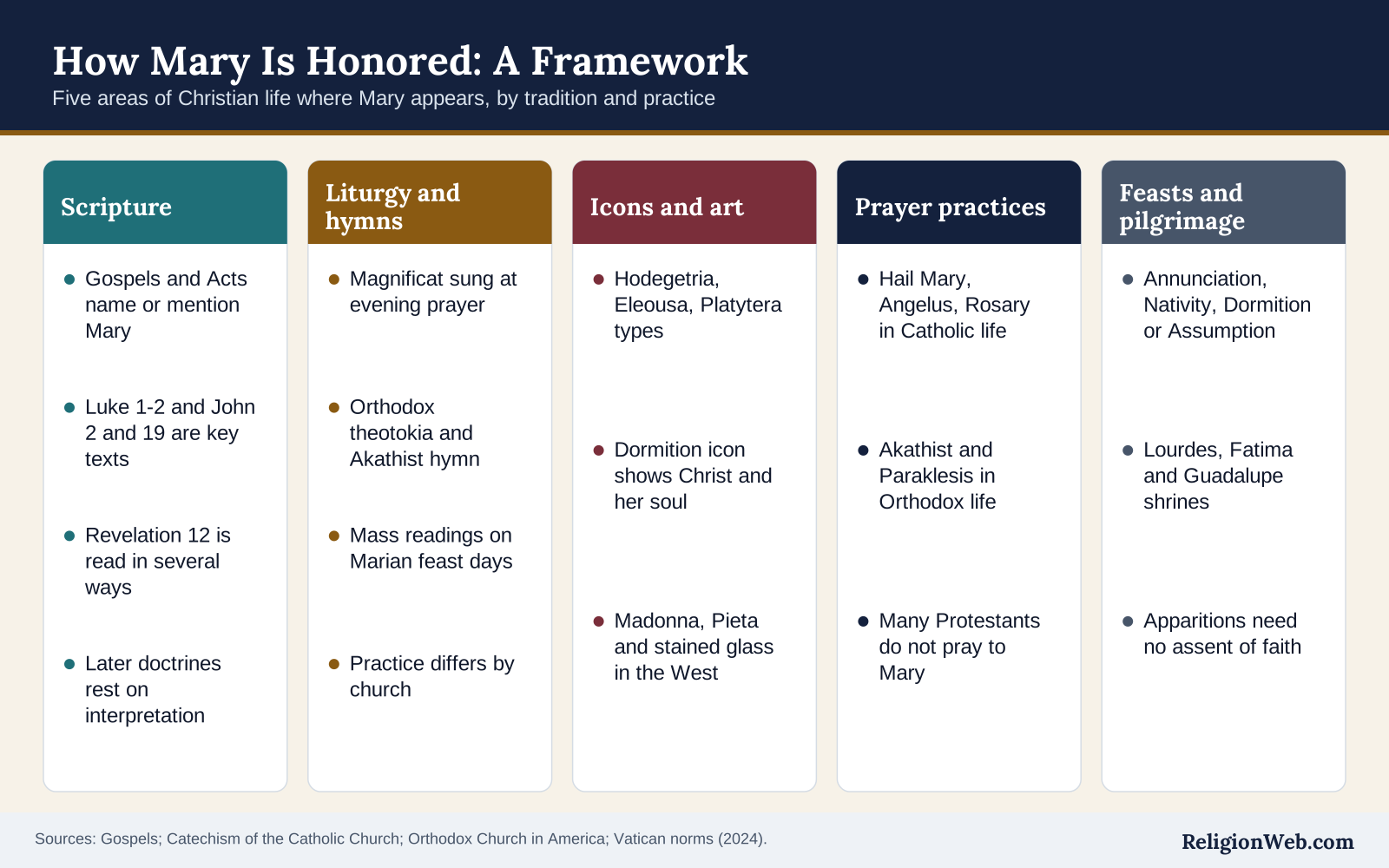
Art, Pilgrimage and Marian Devotion Today
Symbols, Art and Sacred Places
Symbols and images
Western and Eastern art developed a large repertoire of Marian images, each with its own conventions. In Western art Mary is often shown in a blue mantle, a color associated in the Middle Ages with costly pigments, and the lily stands for purity, a use drawn from the Annunciation scenes. A crown of twelve stars and the moon beneath her feet derive from Revelation 12 and appear in many Immaculate Conception images. The Pietà shows Mary holding the body of Jesus, and the Madonna and child is one of the most frequent subjects of European painting. In Eastern art the types described above prevail, along with the Protection icon and the Dormition. Most of these images carry teaching: they are meant to make a doctrine visible to those who could not read.
Churches and sacred places
Churches named for Mary include the cathedrals of Chartres, Paris and Reims, each called Notre-Dame, and the Basilica of Santa Maria Maggiore in Rome, which preserves fifth-century mosaics and is associated with the Marian feast of August 5. The Orthodox world has its own sacred places, among them the cathedral of the Dormition in the Kremlin and the church on Tinos. Visiting these places usually means an invitation to quiet. Visitors are expected to dress modestly and to avoid disturbing worshipers, and many sites welcome non-Christian visitors during hours outside services.
Mary in the Modern World
Numbers and pilgrimage
Reliable counts of Marian devotion do not exist, because no survey measures it directly. The most widely cited demographic baseline is Pew Research Center’s 2025 report on the global religious landscape, which estimated 2.3 billion Christians in 2020, or 28.8 percent of the world’s population. That figure covers all Christians, not only those who honor Mary in the Catholic or Orthodox manner. Pilgrimage data are more specific. The Sanctuary of Lourdes reports about 3.2 million independent pilgrims and visitors in 2024, plus about 410,000 in organized groups, from some eighty nationalities. Such statistics describe sites and not belief, and they differ in how they count visitors.
Recent developments
Recent years have brought notable official activity on Catholic Marian matters. The 2024 Norms on alleged apparitions and the 2025 doctrinal note on Marian titles, both described above, show the Catholic Church clarifying how devotion should be understood without changing its dogmas. In ecumenical life, conversations among Anglicans, Catholics, Lutherans and Orthodox continue to treat Mary as a subject for shared study. In popular culture, Mary’s image remains visible in art, music and public life, and in many societies she is honored by people who are not regular churchgoers.
Common Misconceptions About the Virgin Mary
Misconception 1: All Christians pray to Mary in the same way
Where the misunderstanding comes from
The most visible forms of Marian devotion, such as statues, processions, the Hail Mary and the Rosary, belong to Catholic and Orthodox life, and observers often generalize from them to all of Christianity. The verb “pray” adds to the confusion. In older English it meant “ask,” and Catholic and Orthodox writers still use it in that sense when they speak of praying to Mary or to other saints. In modern usage the same word usually implies worship of God. Popular polemic, as well as ordinary shorthand, has sometimes described Marian devotion as “Mary worship,” and the idea that all Christians either do or do not take part in it persists on both sides.
A further source of confusion is the range inside traditions. A visitor to a Filipino parish in May, a Greek church on August 15 and an Anglican parish at evensong will see quite different things, and each community uses the word “devotion” for its own practice.
What the evidence and tradition actually show
Christian practice falls into at least three patterns. Roman Catholic, Eastern Orthodox and Oriental Orthodox churches ask Mary for her prayers, as they ask other saints, and they distinguish this from the worship due to God alone. The Second Council of Nicaea in 787 made that distinction for icons, and Catholic teaching describes the special honor given to Mary as hyperdulia, which is a higher form of veneration but still different in kind from adoration. Even the forms differ between East and West: the Rosary is a Western pattern of repeated prayers, whereas the Orthodox keep the Akathist and the Paraklesis, which are services of hymns. Anglican practice ranges from no invocation at all to the full Catholic pattern in Anglo-Catholic parishes. Most Lutheran, Reformed, Methodist, Baptist, Pentecostal and evangelical churches direct prayer to God alone, in the name of Christ, and honor Mary by reading and preaching her story.
Within the traditions that do ask for her prayers, intensity varies by individual and by culture. Catholic teaching leaves most Marian devotions to personal choice, and Orthodox believers differ in how often they address the Theotokos. The accurate statement is that traditions differ, that some use the language of petition, and that those who do generally describe it as asking for intercession and not as worship. Whether that description satisfies a given critic is a separate theological argument, and it is one that Christians have been having since the sixteenth century.
Misconception 2: The title Mother of God means Mary is older than God or created God
Where the misunderstanding comes from
Read in everyday English, “Mother of God” can sound like a claim that Mary is the source of divinity, or that she existed before God, or that she is a kind of goddess. Critics of Marian devotion have sometimes read it this way, and some devotional language, taken without its doctrinal setting, can encourage the impression. Nestorius’s objection in 428 was of a similar kind: he feared the word would suggest that the divine nature itself was born of a woman. The Greek compound is less misleading than the English phrase, but few people read Greek.
The question is also affected by the practice of using the title in isolation, as a form of address or a name on a church, without the Christological explanation that the councils attached to it. A name on a cathedral wall carries none of the argument that produced it.
What the evidence and tradition actually show
The councils said the opposite. Cyril’s second letter to Nestorius, which the Council of Ephesus accepted, states that the title does not mean that the nature of the Word or his divinity had its beginning from the Virgin. It means that the Word, the eternal Son, was personally united to a human body and soul that were born of her, so that the one who was born is truly God the Son. The common analogy is that a mother is the mother of a person, not of the person’s soul, so she is called mother of that whole person. The Council of Chalcedon repeated that she is Theotokos with respect to Christ’s humanity.
Catholic, Orthodox and Oriental Orthodox churches affirm this, as do Lutheran confessions and many Anglican and Reformed writers, although John Calvin was uneasy about the title’s potential for misuse. The Assyrian Church of the East uses a different wording but, in the 1994 declaration with the Catholic Church, was recognized as confessing the same faith. The doctrine of the Trinity is the larger teaching that this title is meant to protect.
Misconception 3: Every Marian feast or doctrine appears explicitly in the New Testament
Where the misunderstanding comes from
Believers who treat the Bible as the full source of doctrine sometimes assume that all of their church’s Marian teaching is derived from specific verses. Critics who hold the same assumption conclude that traditions with a developed Marian life must have invented it. Both overlook the way these teachings actually arose. Because the Gospels are relatively short on detail about Mary, devotional literature, liturgy and theological reflection filled in the picture over centuries, and popular summaries of Christian belief often leave out that process.
Another source of confusion is the ease with which proof texts are cited. A verse like Luke 1:28, Genesis 3:15 or Revelation 12 can be quoted for a doctrine, and a reader may assume that the verse says what the doctrine says, when in fact the doctrine reads the verse in a particular tradition of interpretation.
What the evidence and tradition actually show
The New Testament explicitly reports the virginal conception, the Annunciation, the Visitation, the Magnificat, the birth, the presentation, the wedding at Cana, Mary’s presence at the cross and her place among the disciples in Acts 1:14. It does not state the names of her parents, the Immaculate Conception, the Assumption or Dormition, her perpetual virginity in so many words, or the practice of asking for her prayers. Those come from the Protoevangelium of James, from the liturgy and from theological reflection in the centuries after the apostolic age.
The Hail Mary offers a small illustration. Its opening words combine the greetings of Gabriel and Elizabeth from Luke 1, so that part is scriptural in wording. The petition that follows, asking Mary to pray for sinners, took its present form much later, and it is the part that Protestant churches do not use. A single prayer can therefore contain material from more than one layer, which is why it is more accurate to ask of each element where it comes from than to ask whether the whole is biblical.
Catholic, Orthodox and Oriental Orthodox churches hold that tradition is a legitimate way of receiving apostolic teaching, alongside Scripture, and they argue that these beliefs are implied by or consistent with the text. Many Protestant churches hold that anything binding must be taught by Scripture, and they do not accept the later doctrines on that ground. The disagreement is real, but it concerns the authority of tradition. It is not a disagreement about what the New Testament literally says. Historians add that the interpretive choices were made by named people at identifiable moments, which is why this article dates them wherever the sources allow.
Misconception 4: The Immaculate Conception and the virgin birth are the same thing
Where the misunderstanding comes from
The two phrases sound alike, both involve Mary, and the feast of the Immaculate Conception on December 8 falls in Advent, close to Christmas. Many people reasonably conclude that it celebrates Jesus’s conception. The common term “virgin birth” is also imprecise, because the Gospels teach a virginal conception, and ordinary speech blends it with the birth itself.
What the evidence and tradition actually show
They are different teachings about different people. The virginal conception concerns Jesus: that he was conceived by the Holy Spirit without a human father, as Matthew 1 and Luke 1 report. It is affirmed in the historic creeds and in most Christian traditions. The Immaculate Conception concerns Mary: that, according to Catholic dogma defined in 1854, she herself was conceived without the stain of original sin. The Orthodox and most Protestant churches do not hold it as doctrine. The first belief is about how Jesus came into the world, and the second is about how Mary began her life.
Keeping them apart makes much of the rest of this topic clearer, including why the feast is on December 8, nine months before the Nativity of Mary on September 8, and why Orthodox Christians who confess the virginal conception can still say that they do not teach the Immaculate Conception. It also explains why a Protestant who affirms the virginal conception is not thereby committed to any Marian dogma, and why some liberal Protestants who treat the birth narratives symbolically are discussing the first question, not the second.
Frequently Asked Questions About the Virgin Mary
Questions About Mary in the Bible
Who were Mary’s husband and parents?
The New Testament names Joseph as the man to whom Mary was engaged and who is treated as Jesus’s legal father, and it names no parents for Mary. The names Joachim and Anna come from the Protoevangelium of James and were adopted into the calendars of the Catholic and Orthodox churches. Many Christians honor them as grandparents of Jesus, while others point out that the text outside the canon is a later source. Joseph does not appear after the story of the twelve-year-old Jesus, and the Gospels do not say what became of him.
How old was Mary when Jesus was born?
The Gospels do not say. Popular art often shows her as very young, and some historians suggest, from the customs of betrothal in Jewish communities of the period, that she may have been in her teens. This is an inference and not a reported fact, and different scholars handle it with different levels of confidence. Accounts that give a precise age, such as the Protoevangelium’s age for her entry to the Temple, belong to later narrative tradition.
What happened to Mary after the crucifixion?
Acts 1:14 places her with the disciples in Jerusalem, and the New Testament says nothing more. Later traditions place her old age in Jerusalem or, in some accounts, in Ephesus, and they describe her falling asleep and being taken up. Catholic teaching leaves the manner of her end open, and Orthodox teaching speaks of her death and glorification. Historians note that these accounts first appear in writings of the fifth century and later.
Questions About Belief
Is Mary considered divine?
No Christian tradition teaches that Mary is divine. The Council of Ephesus affirmed the title Theotokos to protect the teaching that her son is truly God, and the doctrine of the Trinity names Father, Son and Holy Spirit only. Catholic and Orthodox teaching describe Mary as a human creature of exceptional holiness, and they reserve worship for God. Some Marian titles, read in isolation, can sound more elevated than their stated meaning, which is why the 2025 Vatican note urged care with some of them.
Is Mary a saint?
In Catholic and Orthodox usage Mary is the foremost of the saints, the holiest of the redeemed, and she is given a special honor that no other saint receives. She is included in the calendar of saints in the broad sense of the word, although she was never canonized by a formal process. In Protestant usage “saint” often refers to all believers, and Mary is honored among them as an exemplary member of the church.
Questions About Practice and Feasts
When is Mary’s birthday?
The Gospels give no date, and the traditional date of September 8 comes from the Nativity of Mary, a feast observed in the East from about the seventh century and later throughout the Church. It is a liturgical date, not a historical record. The Catholic and Orthodox calendars both keep it, and it is nine months after the Western feast of the Immaculate Conception.
What is the difference between the Assumption and the Dormition?
The feast falls on the same day, August 15, and recalls the same event in broad terms: the end of Mary’s earthly life and her glorification with Christ. The Catholic Church speaks of the Assumption and defined it as dogma in 1950, leaving open whether she died. The Orthodox and Oriental Orthodox churches speak of the Dormition, state that she died and was raised, and express the belief in worship and icons without a dogmatic definition. The emphasis and the mode of teaching differ more than the central conviction.
Can anyone visit a Marian shrine?
Most major shrines welcome visitors of all backgrounds outside service times. Visitors are usually asked to dress modestly, to keep quiet in prayer areas, to avoid photography during worship and to follow local rules at processions. Orthodox churches may ask visitors to avoid approaching the altar area, and Catholic shrines often have separate times for Mass and for sightseeing. Local signs and staff are the best guide.
Conclusion: Reading Mary Across the Christian Traditions
What the History Shows
A figure understood through her son
The strongest pattern in the history of Marian belief is that it follows Christology. The Gospels present Mary as the mother of Jesus, a believer who consents, ponders and stands at the cross. The councils named her Theotokos to protect the claim that her son is the incarnate Word. Later definitions, hymns and feasts expand that picture in ways that Catholic, Orthodox and Oriental Orthodox churches regard as faithful developments and that many Protestant churches treat with caution. Each position can be described accurately without being resolved here.
Layers that stay distinct
Keeping the layers separate prevents most of the common errors. Biblical statements, conciliar doctrine, papal definitions, inherited tradition and private devotion differ in authority and in who is bound by them. When a statement about Mary is quoted, it helps to ask which layer it belongs to and which tradition holds it. The same method works for the titles, the feasts and the apparitions.
How to Keep Exploring
Related topics on ReligionWeb
Readers who want the Gospel context can turn to the articles on Jesus Christ and the Bible, and those following the Marian seasons can read about Advent and Christmas. The overviews of the major Christian families give the wider setting for the variety described above.
Reading the sources
The shortest route to the primary material is Luke 1 and 2 and John 2 and 19, followed by Cyril’s second letter to Nestorius and the Catechism’s section on Mary. Readers interested in the Orthodox view can attend an Akathist or a Dormition service, and those interested in current Catholic guidance can read the 2024 Norms and the 2025 doctrinal note. Whatever the starting point, the most dependable approach is to read each community in its own words first.
Sources
The table below lists the principal external sources behind this article. Facts, dates and figures were checked against these and related primary, institutional and academic materials.
| # | Source | Publisher and type | Used for | Link |
|---|---|---|---|---|
| 1 | World English Bible (Classic), Luke 1; also Matthew 1, Luke 2, Mark 3 and 6, John 2 and 19, Acts 1, Galatians 4, Revelation 12 | eBible.org · Primary text | All scripture quotations and Gospel passages (public-domain World English Bible) | ebible.org |
| 2 | Catechism of the Catholic Church, Part One, Section Two, Chapter Three, Article 9, Paragraph 6: Mary, Mother of Christ, Mother of the Church | Holy See (vatican.va) · Institutional | Catholic teaching on Mary: titles, devotion, Assumption, Mother of the Church (paras. 963-975) | vatican.va |
| 3 | Munificentissimus Deus (Pius XII, 1 November 1950) | Holy See (vatican.va) · Primary text | Quoted definition of the Assumption (para. 44) and its date | vatican.va |
| 4 | Norms for Proceeding in the Discernment of Alleged Supernatural Phenomena (17 May 2024) | Dicastery for the Doctrine of the Faith, Holy See · Institutional | Six possible conclusions, role of bishop and Dicastery, no obligation of assent to apparitions | vatican.va |
| 5 | Doctrinal Note on Marian titles: Mother of the faithful, not Co-redemptrix (Mater Populi Fidelis, 4 November 2025) | Vatican News · Institutional | Date, approval and content of the 2025 note on Co-redemptrix and Mediatrix | vaticannews.va |
| 6 | Cyril of Alexandria, Letter to Nestorius (second letter), in Nicene and Post-Nicene Fathers, Series II, vol. 14, ed. Philip Schaff | Chinese University of Hong Kong, Centre for Religious Studies (reproducing CCEL/NPNF text) · Primary text | Cyril's explanation of Theotokos before Ephesus (Fun Fact and Christological context) | cuhk.edu.hk |
| 7 | Dormition of the Theotokos (Orthodox Faith, Worship) | Orthodox Church in America · Institutional | Orthodox understanding of the Dormition: death, glorification, sinlessness, flowers blessed | oca.org |
| 8 | How the Global Religious Landscape Changed From 2010 to 2020 (9 June 2025) | Pew Research Center · Demographic data | 2.3 billion Christians, 28.8% of the world population in 2020 | pewresearch.org |
| 9 | Mary in the Reformed Confessions (Tim Perry, 2023) | Ad Fontes Journal · Scholarly commentary | Zwingli, Second Helvetic Confession, Calvin and Westminster on Mary | adfontesjournal.com |
| 10 | Who are the pilgrims of Lourdes? (visitor statistics through 2024) | Sanctuaires Notre-Dame de Lourdes · Institutional | Lourdes visitor figures for 2024; apparitions beginning in 1858 | lourdes-france.org |
Last fact-check date: 2026-10-21.