Easter is the Christian festival of the resurrection of Jesus, kept on a Sunday in spring in the Northern Hemisphere and regarded by nearly every church as the oldest and most important feast of the Christian year. Christians confess that Jesus was crucified under Pontius Pilate, died, was buried, and rose again on the third day. Easter is the day on which that confession is sung at full volume: bells and the word “Alleluia” return after the fasting season of Lent, many churches baptize new members, and congregations greet one another with the ancient words “Christ is risen.” In much of the Christian world the same festival is called Pascha, a name that points back to the Jewish Passover and to the earliest Christian understanding of what the resurrection meant.
Easter belongs to the whole of Christianity, but it is not observed in one way. Catholic, Eastern Orthodox, Oriental Orthodox, Anglican, Lutheran, Reformed, Methodist, Baptist, Pentecostal, and Moravian communities each give the feast a distinct shape, from a candlelit midnight procession to a dawn service in a graveyard. They also do not always agree on the date. In 2025 almost all of the world’s Christians kept Easter on the same day, 20 April, a coincidence that occurs only in some years. In 2026 Western churches celebrated on 5 April, while Orthodox churches kept Pascha on 12 April. The reasons lie in a calendar rule that is more than sixteen centuries old, and this article explains it step by step.
The event at the center of the feast is told in the Gospels and is treated at length in the article on Jesus Christ. Here the focus is on the feast itself: what Christians believe the resurrection means, how Holy Week unfolds from Palm Sunday to Holy Saturday, what happens at the Easter Vigil and on Easter Day, how the date is calculated, and where the familiar customs of eggs, hares, flowers, and festive meals come from. Those customs have their own histories, some well documented and some less certain, and they are best understood alongside, not in place of, the worship from which Easter takes its meaning. Where churches differ, the differences are described with the tradition named.
Easter at a Glance: Meaning, Names, and Place in the Christian Year
What Easter Is and What the Names Mean
What Easter celebrates
Easter commemorates, in Christian belief, the rising of Jesus of Nazareth from the dead on the third day after his crucifixion. The New Testament presents this as the foundation of Christian faith. The apostle Paul, writing in the 50s CE, told the Christians of Corinth that if Christ had not been raised, the preaching and the faith built on it would be empty. For that reason the churches treat Sunday, the day of the resurrection in all four Gospels, as a weekly small Easter, and treat the annual Easter feast as the center from which the rest of the church year is measured.
Easter is therefore a statement of belief as much as a commemoration. The Catholic Church teaches that the resurrection is both a historical event and one that transcends history. Orthodox Christians sing that Christ has trampled down death by death. Protestant traditions emphasize that the resurrection is God’s vindication of Jesus and the pledge of the believer’s own rising. Historians, for their part, study the earliest sources and the rise of the belief, while the question of what happened at the tomb is a matter of faith on which this reference work takes no side. What can be described with confidence is how the belief has shaped worship, art, music, calendars, and daily life for about two thousand years.
Easter, Pascha, and the words behind them
The oldest name for the feast is the Greek Pascha, which came into Greek from Aramaic and ultimately from the Hebrew Pesach, the name of Passover. Most European languages still use a descendant of it: Pâques in French, Pascua in Spanish, Pasqua in Italian, Pasen in Dutch, påsk in Swedish, and Paskha in Russian. English and German are the notable exceptions, with “Easter” and Ostern. The English word comes from Old English Ēastre or Ēastron, and the eighth-century English monk Bede explained it as the name of an Anglo-Saxon spring month. What Bede said, and how far modern scholars accept it, is considered in the section on misconceptions below.
Several other terms recur throughout this article. The Easter Triduum, or Paschal Triduum, is the “three days” of Holy Thursday evening, Good Friday, and Holy Saturday that lead to Easter Sunday. Holy Week is the week that begins on Palm Sunday. Eastertide, also called the Easter season, is the fifty days from Easter to Pentecost. The Easter Vigil is the long night service that opens the feast. Pascha is the Eastern Christian name for the feast and also for the whole paschal mystery of Christ’s death and resurrection, and “paschal” is the adjective that goes with it.
Where Easter Sits in the Christian Year
From Lent through the Triduum to the fifty days
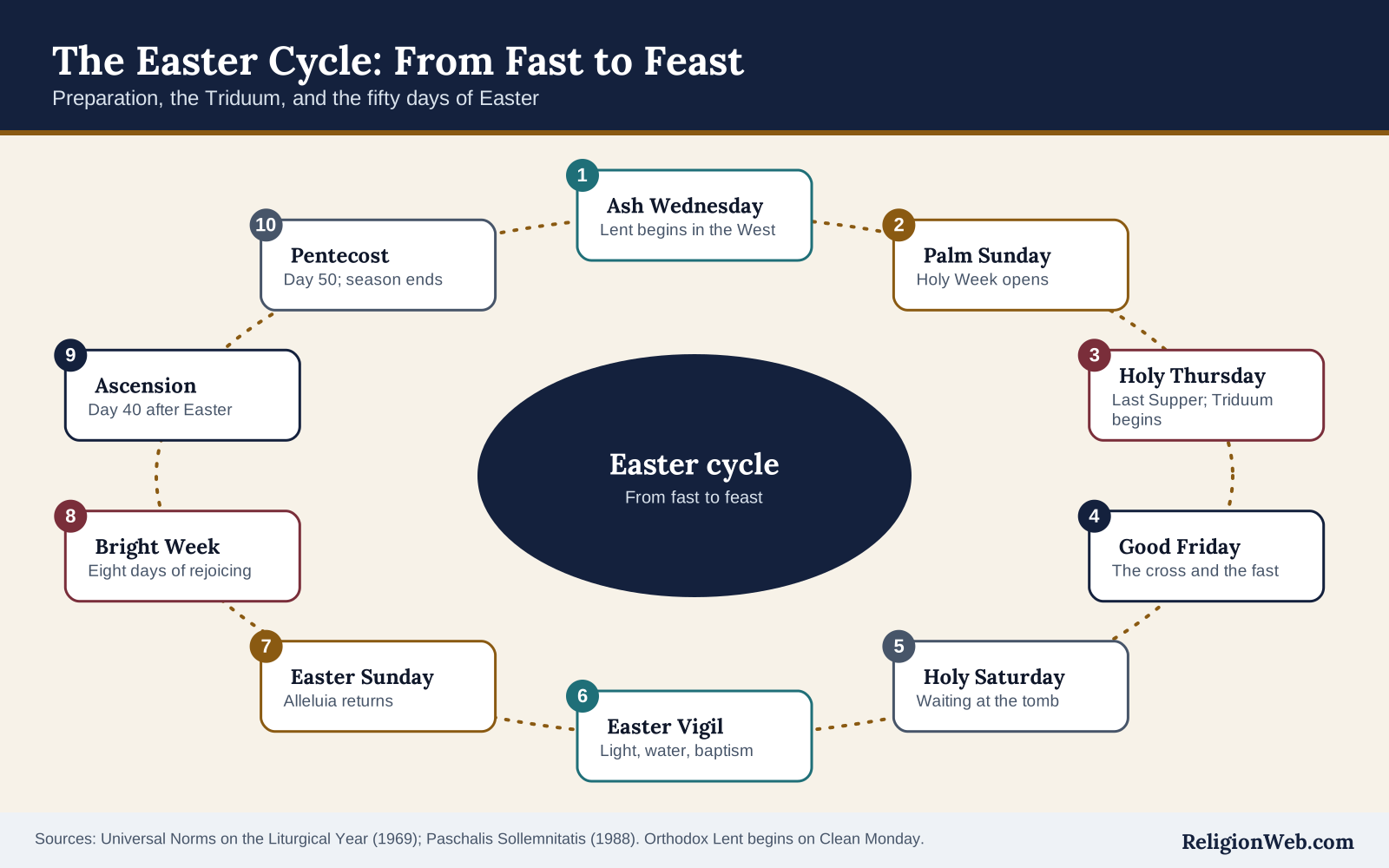
The Christian year is built around two cycles, one around Christmas and one around Easter, and the Easter cycle is the larger and older. It begins with a season of preparation, Lent, which in Western churches lasts forty days from Ash Wednesday and in Orthodox churches begins on Clean Monday, which falls 48 days before Pascha. Holy Week follows. The Triduum then forms a single unfolding liturgy from Thursday evening to Easter night. After Easter come fifty days of rejoicing that end with Pentecost, the feast of the coming of the Holy Spirit, with the Ascension of Jesus remembered on the fortieth day. The Catholic Church’s norms for the liturgical year call these fifty days “one feast day,” and the Alleluia is sung most of all in this season.
The sister feast of Christmas, which celebrates the birth of Jesus, developed later and has a fixed date, 25 December in the West. Easter is the older celebration, with roots in the second century, and its date is calculated afresh each year. Christian liturgical tradition often presents Christmas as a feast that looks forward to Easter, because the Gospels tell the story of the birth in light of the death and resurrection that follow.
A movable feast in a mostly fixed calendar
Easter is called a movable feast because it does not fall on a fixed date. In the Western reckoning it is the first Sunday after the first “ecclesiastical” full moon on or after 21 March, and it can fall as early as 22 March or as late as 25 April. Other observances are dated from it: Ash Wednesday comes forty-six days earlier in the Western count, Ascension forty days later, and Pentecost fifty days later. A single decision in spring therefore sets the schedule for much of the church year. The mechanics of that decision, and the reason Orthodox churches often arrive at a different Sunday, are laid out in the section on the date.
Easter Around the World Today
How many Christians keep the feast
Pew Research Center’s 2025 study of the global religious landscape estimated that there were about 2.3 billion Christians in 2020, or 28.8 percent of the world’s population, down from roughly 30.6 percent in 2010. The study found that sub-Saharan Africa held the largest share of the world’s Christians at 30.7 percent, followed by Latin America and the Caribbean at 24 percent and Europe at 22.3 percent. Easter is observed, in some form, wherever those communities exist, which makes it one of the most widely kept religious festivals in the world, even though levels of observance vary from weekly worshipers who attend every service of Holy Week to people who attend church only once or twice a year.
One feast, many styles of observance
The outward character of Easter differs sharply by region and church. In Spain, brotherhoods carry sculptures of the Passion through the streets from Palm Sunday. In Greece, worshipers carry candles lit from the midnight flame home through the dark. In Ethiopia the Easter liturgy goes on past midnight with drums and ululation after a fifty-five-day fast. In Protestant congregations in North America, a sunrise service on a hillside may be the high point. Each of these has a documented history and a stated meaning, and the sections below describe them one by one without treating any as the standard form.
The Resurrection in Scripture and Christian Belief
What the New Testament Says About the Resurrection
Paul’s early summary
The oldest surviving Christian writings are the letters of Paul, and one of them preserves what Paul presents as a summary of the message he had himself received from earlier believers. In the fifteenth chapter of his first letter to the Corinthians, written in the 50s CE, he reminds his readers of the gospel he had preached to them.
For I delivered to you first of all that which I also received: that Christ died for our sins according to the Scriptures, that he was buried, that he was raised on the third day according to the Scriptures, and that he appeared to Cephas, then to the twelve.
1 Corinthians 15:3–5, World English Bible (Classic edition, public domain)
Historians of early Christianity often point to the wording here, with its language of “delivered” and “received,” as evidence that the formula goes back to the first years of the movement, well before Paul wrote. Cephas is the Aramaic name of Peter. Paul goes on to list further appearances, including to more than five hundred believers at once, to James, and finally to himself, and he argues that without the resurrection the Christian message would be groundless. The passage shows that the belief was not a late addition to the story of Jesus. It is the oldest layer of the written record, and it is already linked to two themes that Easter worship still carries: death “for our sins” and rising “according to the Scriptures.”
The four Gospel accounts
The four Gospels were written later than Paul’s letters and each tells the story of the empty tomb and the appearances in its own way. In Matthew, an angel speaks to the women who have come to the tomb after the Sabbath.
The angel answered the women, “Don’t be afraid, for I know that you seek Jesus, who has been crucified. He is not here, for he has risen, just like he said. Come, see the place where the Lord was lying.”
Matthew 28:5–6, World English Bible (Classic edition, public domain)
Mark, the shortest account, has a young man in white announce the resurrection to the women and ends, in the oldest manuscripts, with their fear at 16:8. Most scholars regard the longer endings found in later manuscripts as additions, and this is one reason Mark’s closing verses are discussed in Bible translations. Luke adds the story of two followers on the road to Emmaus, who recognize Jesus when he takes bread, gives thanks, and breaks it. John centers on Mary Magdalene at the tomb, then on the appearance to the disciples and the encounter with Thomas. The Gospels differ on the number of women, the number and kind of heavenly messengers, and whether the first appearances happen in Jerusalem or in Galilee. Christian readers have taken these differences in different ways: some tradition-minded readers harmonize them into a single sequence, while many historians and some theologians read them as independent witnesses that preserve a shared core with varied detail. For the structure and history of these books, see the article on the Bible.
How Christian Traditions Understand the Resurrection
Catholic and Orthodox teaching
The Catechism of the Catholic Church, in paragraphs 639 and 647, calls the resurrection both a real, historical event, made known through the empty tomb and the appearances, and a transcendent one, since no one witnessed the act itself and no evangelist describes it. Paragraph 640 adds that the empty tomb is not in itself a direct proof, because a missing body could have other explanations; it is described as an essential sign and a first step toward recognition. Paragraph 645 teaches that the risen body of Jesus is truly physical yet no longer subject to the limits of space and time. Catholic teaching connects the resurrection to the believer: it is the source of justification and the pledge of the resurrection of the dead. More background is given in the article on Catholic Christianity.
Eastern Orthodox and Oriental Orthodox Christians stress the resurrection as victory over death and the liberation of humanity. The Paschal hymn declares that Christ has trampled down death by death and given life to those in the tombs. The traditional Orthodox icon of the feast, called the Anastasis, shows Christ standing on the broken gates of Hades and raising Adam and Eve by the hands, a picture of the belief that his descent among the dead freed them as well. These themes are developed in the article on Eastern Orthodox Christianity.
Protestant and other emphases
Protestant traditions generally place the resurrection at the center of the preaching of the gospel and often stress its link to justification, the biblical idea that believers are made right with God. Many evangelical and Pentecostal churches hold that the resurrection of Jesus was a bodily, historical event and treat that conviction as essential. Some modern theologians have argued, in different ways, about how the Gospel language should be read: Rudolf Bultmann in the twentieth century described the resurrection as the rise of Easter faith that is proclaimed in preaching, while Wolfhart Pannenberg and N. T. Wright, among others, defended it as a historical claim open to argument from the sources. These are internal Christian debates, and they sit alongside the broad agreement of the creeds. Historians outside the confessional discussion limit themselves to what the sources show: that belief in the resurrection arose very early and was central to the movement from its beginning. See Protestant Christianity for the wider range of Protestant teaching.
The Passover Background and the Language of Sacrifice
“Christ, our Passover”
All four Gospels place the death of Jesus in Jerusalem at the time of the Jewish festival of Passover, and early Christians understood the resurrection in its light. Paul makes the connection explicit in his first letter to the Corinthians, where he turns the Passover custom of removing leaven from the house into an image of the Christian life.
For indeed Christ, our Passover, has been sacrificed in our place. Therefore let’s keep the feast, not with old yeast, neither with the yeast of malice and wickedness, but with the unleavened bread of sincerity and truth.
1 Corinthians 5:7–8, World English Bible (Classic edition, public domain)
Christian interpreters have read this as a statement that the death and rising of Jesus fulfills what the Passover lamb and the exodus from Egypt pointed toward. This is a Christian reading of Scripture, and it is the reason the Greek word pascha became the name of the Christian feast. The Gospel of John adds the title “Lamb of God,” which later tradition took up in the liturgy. Jewish tradition understands Passover on its own terms, as the remembrance of the liberation from slavery, which is described in the article on Passover.
The Gospel chronologies of the last week
The Gospels do not line up perfectly on the timing. Mark, Matthew, and Luke describe the Last Supper as a Passover meal, followed by the arrest that night and the crucifixion the next day. John, by contrast, says that the Jewish leaders would not enter the governor’s headquarters on the morning of the trial so that they could eat the Passover, and he describes the crucifixion as taking place on the day of preparation for it. On that reading Jesus dies at the hour when the Passover lambs were being slaughtered in the Temple. Scholars have proposed many ways to reconcile the accounts, including different calendars in use at the time, and most proposals for the year of the crucifixion fall on either 30 or 33 CE. The question remains open among historians, and it does not affect how the churches keep the feast, since they follow a liturgical rather than an astronomical count.
Origins and Early History of the Easter Feast
From the Weekly Sunday to the Annual Pascha
The first evidence for an annual feast
The New Testament mentions Christians gathering on the first day of the week, and the book of Revelation speaks of “the Lord’s Day.” The first clear evidence for a yearly Easter celebration, however, comes from the second century. It comes in the context of a disagreement. A letter written by Irenaeus of Lyons late in that century, quoted by the fourth-century historian Eusebius, recalls that around the middle of the century Polycarp of Smyrna and Anicetus of Rome met in Rome, disagreed about the observance, and parted in peace. From roughly the same period comes the homily Peri Pascha (On the Passover), attributed to Melito, bishop of Sardis. It presents Christ as the true Passover lamb. Its harsh language about “Israel” has been debated by scholars, who disagree about whether it reflects local conflict, theological argument, or an inherited pattern of Christian interpretation of the Hebrew Bible.
The dispute over the day
The disagreement was about when to hold the feast. Churches in Asia Minor, later called Quartodecimans (from the Latin for “fourteenth”), kept Pascha on the fourteenth day of the Jewish month of Nisan, the date of Passover, whatever the day of the week. Churches in Rome and elsewhere kept it on the Sunday after, so that the feast always fell on the day of the resurrection. Eusebius reports that when Victor of Rome, in the late second century, pressed the churches of Asia to conform, Polycrates of Ephesus replied that they would keep the custom they had received from the apostles, and that Irenaeus urged Victor to preserve peace. Councils in several regions, according to Eusebius, ruled for Sunday. The tension was not fully resolved until the fourth century, and the Asian practice survived for some time in small communities.
Nicaea and the Fourth-Century Consolidation
What the Council of Nicaea decided in 325
The First Council of Nicaea, held in 325 CE under the emperor Constantine, is widely credited with fixing the date of Easter, but the record is more modest than the popular version. The council’s letter to the church of Alexandria, preserved by the historian Socrates, says that the churches of the East that had kept the feast at the same time as the Jews would henceforth conform to the Romans and to those who had long kept it as they did. Constantine’s own letter to the churches, preserved in Eusebius’s Life of Constantine, urged a common observance for the sake of unity. It also contains sweeping and hostile language about Jews, including the charge of Jewish guilt for the death of Jesus, which the Catholic Church formally repudiated in 1965 in Nostra Aetate and which most Protestant churches have also disavowed. The letter shows how early debates about the calendar became entangled with polemic.
None of the surviving documents lays out the full formula of equinox, full moon, and Sunday. Alden Mosshammer, whose 2008 study of the early computus is summarized in a review in the Bryn Mawr Classical Review, argued that the council seems to have endorsed the equinox rule implicitly without publishing a formal rule, and that it did not adopt the nineteen-year cycle that was later attributed to it. In other words, Nicaea set the principle of one common date, and the detailed method took shape over the following centuries.
Baptism, the vigil, and Holy Week in Jerusalem
By the end of the second century Pascha had become the preferred time for baptism. The North African writer Tertullian, around 200 CE, wrote that the Passover offers a more than usually solemn day for baptism, and the practice of baptizing new Christians during the vigil of Easter has remained central to Catholic, Orthodox, and many Anglican and Lutheran churches. The article on baptism describes the rite itself.
The shape of Holy Week owes much to Jerusalem after the fourth-century church was built there. A pilgrim named Egeria, who visited in the 380s, wrote an account of the services she saw, translated into English by McClure and Feltoe. She describes a Palm Sunday procession down the Mount of Olives with children carrying palm and olive branches, the veneration of the wood of the cross on Good Friday under the watch of deacons, and the Easter vigil with the baptism of the newly prepared. Pilgrims carried these practices home, and many of them became part of the liturgy of Western and Eastern churches alike.
Medieval, Reformation, and Modern Developments
Calendars and customs in the medieval West
The method of calculation spread slowly. In the early Middle Ages, regions of Britain and Ireland followed different tables from Rome, which is why Easter could fall on different Sundays in neighboring communities. The Northumbrian church adopted the Dionysian tables at the Synod of Whitby in 664, and Bede’s work On the Reckoning of Time, completed in 725, eventually made that system the standard across the Latin West. Medieval Christians elaborated the season with processions, dramatic readings of the Gospel, hymns known as sequences, and a wide range of customs around food and blessing, many of which survive in the regional practices described later.
Reformation, revival, and reform
The Reformation produced different responses. Lutheran and Anglican churches kept the church year and Easter with it. Some Reformed and Puritan communities, convinced that Scripture did not command the keeping of holy days other than Sunday, set the festival aside for a time. In the twentieth century a liturgical revival reshaped Easter worship in many churches. In the Catholic Church the Easter Vigil was restored to the night of Holy Saturday in the 1950s, and the Universal Norms on the Liturgical Year of 1969 describe the Triduum as the high point of the whole year. Several Anglican, Lutheran, and Methodist bodies revised their own services along similar lines, and many Protestant congregations adopted sunrise services and Easter cantatas, so that today the range of practice is wider than at any earlier time.
How the Date of Easter Is Calculated and Why It Moves
The Rule Behind the Date
The Western rule in plain terms
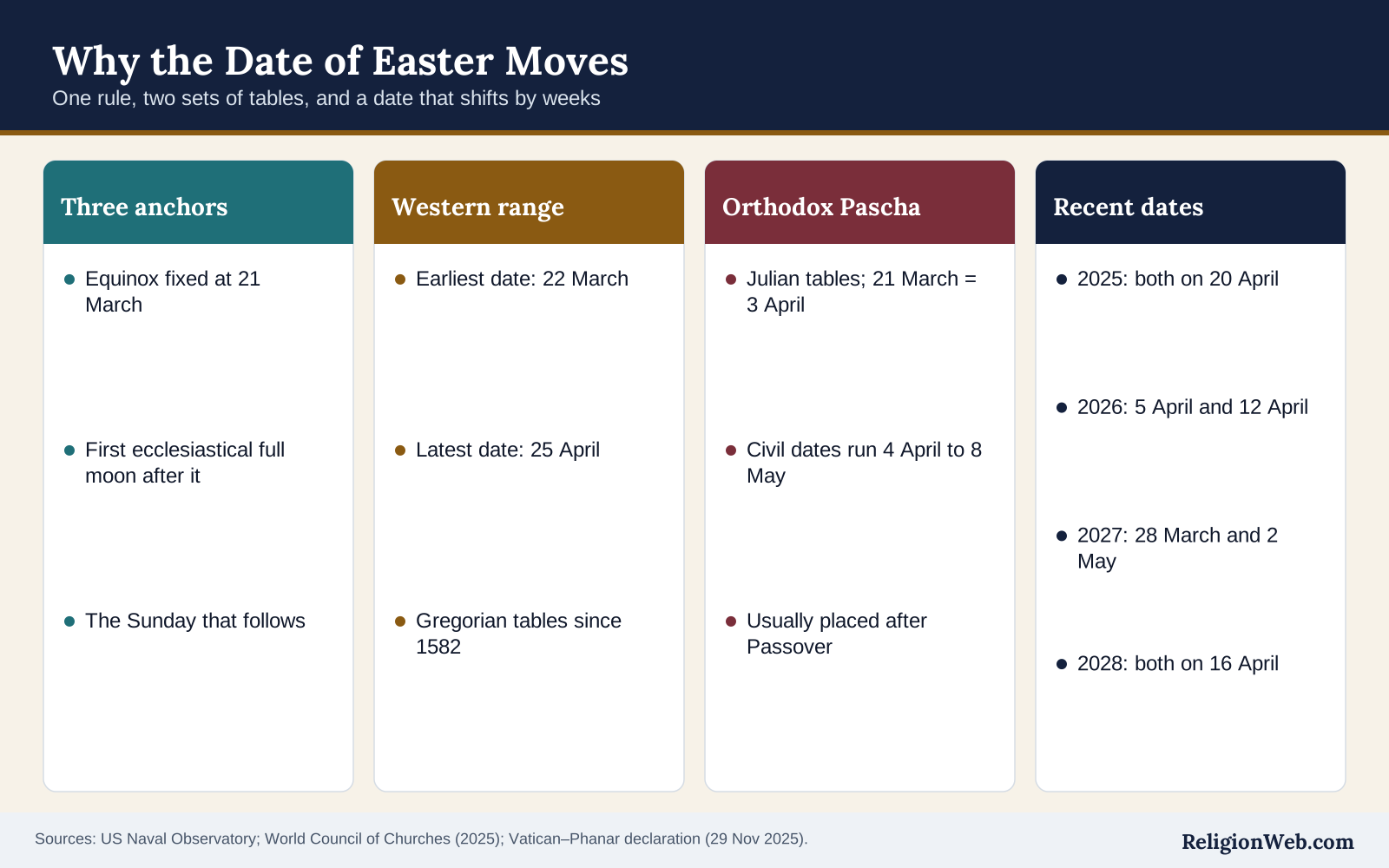
In the Western churches Easter is the first Sunday after the first full moon that falls on or after 21 March. That sentence contains three separate anchors. The first is the spring equinox, which the church treats as fixed on 21 March. The second is the full moon, called the paschal full moon, which is the first full moon on or after that date. The third is Sunday, the day of the week on which Christians hold that the resurrection occurred, so that the feast always falls on it and never on a weekday. Easter is then the Sunday that comes after the paschal full moon. If the full moon falls on a Sunday, Easter is the following Sunday. The result is that Easter can occur no earlier than 22 March and no later than 25 April, as the United States Naval Observatory notes.
There is a reason for tying a Christian feast to the lunar cycle at all. The Gospels set the death of Jesus at Passover, which in the Jewish calendar falls at the full moon of the spring month of Nisan, and the early church therefore looked to the spring full moon as the marker of the paschal season. At the same time the church chose the day of the week by Christian reasoning, fixing the feast on Sunday instead of the fourteenth of Nisan. The compromise produced a date that depends on both the sun, through the equinox, and the moon, through the full moon, and it is why Easter shifts by up to five weeks from one year to the next.
Why the church uses tables rather than the sky
The “full moon” and “equinox” in the rule are not the astronomical events. They are ecclesiastical conventions. The equinox is fixed at 21 March, although the astronomical equinox can fall on 19, 20, or 21 March. The full moon is the fourteenth day of a tabular lunar month, as the Naval Observatory puts it, rather than the moment the moon is actually full. One practical benefit of the arrangement is that the date can be calculated in advance for any year, without observation. Another is that two congregations will not reach different dates because the full moon occurs late in the evening in one place and the next day in another. The method of calculation is called the computus, and the vocabulary that surrounds it is summarized below.
| Term | Meaning | Role in fixing the date |
|---|---|---|
| Computus | Latin for “calculation”; the method of finding the date of Easter and other movable feasts | Allows the date to be calculated in advance for any year |
| Ecclesiastical equinox | A conventional spring equinox, set at 21 March | Marks the earliest day on which the paschal full moon can fall |
| Paschal full moon | The first ecclesiastical full moon on or after 21 March; the fourteenth day of a tabular lunar month | Easter is the Sunday after it |
| Metonic cycle | A cycle of nineteen years that is very close to 235 lunar months | Lunar phases return to nearly the same calendar dates every nineteen years |
| Golden Number | A year’s position in the nineteen-year cycle, found as the remainder of the year divided by 19, plus one | Locates the paschal full moon in the table |
| Epact | The age of the ecclesiastical moon on a fixed date in the year | Used in Western tables to find the paschal full moon |
| Julian calendar | The calendar of Julius Caesar, with a year averaging 365.25 days; 13 days behind the Gregorian calendar from 1900 to 2099 | Basis of the older tables used by most Orthodox churches |
| Gregorian calendar | The 1582 reform, with a year averaging 365.2425 days | Basis of the tables used by Catholic and Protestant churches |
| Passover proviso | Orthodox practice that Pascha must follow the Jewish Passover, linked by the canonist John Zonaras to Apostolic Canon 7 | Occasionally moves Pascha later than the bare Nicene formula |
How the Calculation Developed
Alexandria, Rome, and the nineteen-year cycle
The astronomical groundwork was laid in Alexandria, the great center of ancient mathematics and astronomy. Bishop Anatolius of Laodicea, writing around 277 CE, described a method based on a nineteen-year cycle, and the Alexandrian church developed it into a system with 21 March as the equinox. Rome, meanwhile, used older and less accurate cycles, including an eight-year cycle credited to Hippolytus and an eighty-four-year cycle, which sometimes placed Easter on a different Sunday from Alexandria. Over the fourth and fifth centuries the Alexandrian method became the standard in the Eastern Roman world, and Rome came to adopt it in stages between the sixth and ninth centuries. The result was a shared system, although one built on the Julian calendar.
Dionysius Exiguus and the Christian era
The pivotal figure in the West was Dionysius Exiguus, a monk who completed a table of Easter dates in 525 CE. It continued an Alexandrian table by Cyril, and it put the system in the form that Latin Christendom adopted, converted to the Julian calendar. The Northumbrian church accepted these tables at Whitby in 664 CE, and Bede described the method fully in 725. The same table also gave Western Christians the way of numbering years that is still in use, a story told in the note below.
The Gregorian reform of 1582
The Julian calendar slightly overstates the length of the solar year, and by the sixteenth century the equinox had drifted to about 11 March, so that the fixed date of 21 March no longer matched the sky. The Julian lunar tables had also slipped out of phase with the real moon. In 1582 Pope Gregory XIII issued the bull Inter gravissimas, based on work by Aloysius Lilius and Christopher Clavius, that dropped ten days from the calendar and adjusted the leap-year rule and the lunar tables. In the countries that adopted it at once, Thursday 4 October was followed by Friday 15 October. Catholic countries adopted the new calendar first, Protestant states and Britain followed over the next two centuries, and Orthodox churches did not adopt it for the calculation of Easter, which is the origin of today’s differences.
Why Churches Celebrate on Different Days
Julian tables and the Orthodox Pascha
Most Orthodox churches, and Oriental Orthodox churches such as the Coptic and Ethiopian churches, continue to compute Pascha by the older Julian-based tables. Julian 21 March currently corresponds to 3 April on the civil calendar, and the Julian lunar tables typically place the paschal full moon several days after the astronomical moon, so from 1900 to 2099 the Orthodox Pascha falls between 4 April and 8 May on the civil calendar. The Orthodox also commonly hold that Pascha should come after the Jewish Passover, a rule that the twelfth-century canonist John Zonaras connected to Apostolic Canon 7. In 1923 an Orthodox congress introduced the Revised Julian calendar for fixed feasts, and many churches use it for Christmas and similar dates, but the Pascha calculation was left on the traditional tables. The Orthodox Church of Finland is the main exception, since it keeps the Western date.
Because the two systems use different calendars, different equinox dates, and different tables, they sometimes agree and sometimes do not. In the present century the dates coincide in about three years out of ten, and when they differ the gap is one week, four weeks, or five weeks. More background on Orthodox practice is available in the article on Eastern Orthodox Christianity.
Dates from 2025 to 2030
| Year | Western Easter | Orthodox Pascha | Difference |
|---|---|---|---|
| 2025 | 20 April | 20 April | Same day |
| 2026 | 5 April | 12 April | One week |
| 2027 | 28 March | 2 May | Five weeks |
| 2028 | 16 April | 16 April | Same day |
| 2029 | 1 April | 8 April | One week |
| 2030 | 21 April | 28 April | One week |
As of October 2026, Easter for 2026 has passed, and the next celebrations fall on 28 March 2027 in the West and 2 May 2027 in the Orthodox Church. The five-week gap in 2027 is the largest possible. Readers should confirm the date with their own church, because a few communities follow local rules.
Efforts toward a common date
Churches have long recognized that two dates are a problem for families and congregations that are divided between traditions, and for the witness of the churches. In March 1997 a consultation in Aleppo, Syria, sponsored by the World Council of Churches and the Middle East Council of Churches, proposed that Easter be calculated by exact astronomical observation from the meridian of Jerusalem, keeping the Nicene formula of equinox, full moon, and Sunday. Catholic, Orthodox, and Lutheran leaders have responded positively at times, but the proposal has not been adopted, partly because it would require the Orthodox churches to change their date and partly because some Orthodox object to any date that precedes Passover.
The 1700th anniversary of the Council of Nicaea in 2025 gave the question new attention. The World Council of Churches published a Faith and Order paper, Towards a Common Date for Easter, on 4 April 2025, noting that all Christians would celebrate on one day that year. On 28 November 2025 Pope Leo XIV and Ecumenical Patriarch Bartholomew led an ecumenical prayer at Iznik, the site of ancient Nicaea, and in a joint declaration dated 29 November 2025 they thanked God that the whole Christian world had kept Easter on the same day, and said they wished to continue seeking a way of celebrating the Feast of Feasts together every year. No agreed change has been announced, and the dates of 2026 and 2027 remain as shown in the table.
Lent and the Preparation for Easter
The Forty Days in the West and the East
Lent in Western churches
Easter is preceded by a season of repentance, prayer, almsgiving, and fasting that most churches call Lent. In the Catholic Church the Universal Norms on the Liturgical Year describe Lent as running for forty days from Ash Wednesday, when ashes are distributed, up to but not including the evening Mass of the Lord’s Supper on Holy Thursday. During this time the Alleluia is not sung until the Easter Vigil, and in some Western churches crosses and images are veiled or decorations are kept plain. Anglican, Lutheran, Methodist, and many other Protestant churches also keep Lent, with Ash Wednesday services and special study or mission programs. Sundays are not counted among the forty fasting days in the traditional Western count, which is why Ash Wednesday falls forty-six days before Easter. The full history and practice of the season are in the article on Lent.
Great Lent in the Orthodox and Oriental Orthodox churches
In the Orthodox Church the season is called Great Lent. It begins on Clean Monday, which falls 48 days before Pascha, and the church year during this period is guided by a service book called the Triodion. The forty days of Great Lent are followed by Lazarus Saturday and Palm Sunday and then by Holy Week, which Orthodox Christians treat as a separate and still more intense stage of preparation. The Ethiopian Orthodox Tewahedo Church keeps the longest fast of all, called Abiy Tsom, which lasts fifty-five days. According to a description published by Comboni Missionaries in Ireland, no meat, milk products, or eggs are eaten during it.
Fasting, Giving, and Breaking the Fast
What fasting involves and who is exempt
The rules of fasting differ widely. In the Catholic Church the Paschal Fast is kept on Good Friday and, where appropriate, on Holy Saturday until the Easter Vigil, and the circular letter on the paschal feasts describes Good Friday as a day of fasting and abstinence. Orthodox and Oriental Orthodox Christians traditionally abstain from meat and animal products during the fasts and, on stricter days, from oil and wine as well. Many Protestant communities leave fasting to personal conscience. In every tradition fasting is understood as a spiritual discipline joined to prayer and to giving to the poor, not as an end in itself.
The churches themselves recognize that fasting is not suited to everyone. Children, pregnant and nursing women, the elderly, and the ill are commonly excused or given modified rules, and pastors often advise that those with medical conditions follow the advice of a physician. Religious practice does not replace medical care, and fasting that endangers health is not what any of these traditions asks.
Breaking the fast
The end of the fast is a part of the feast in its own right. In the Orthodox Church the foods avoided during Lent are blessed and eaten only after the Paschal liturgy, often in a meal that begins in the early hours of Sunday morning. In Ethiopia worshipers break the fast after the liturgy ends at around three in the morning with a light drink, and later feast on a spicy chicken stew called doro wat with boiled eggs. In Poland the food for the Easter breakfast is first blessed in baskets on Holy Saturday. The foods differ, but the pattern is the same: abstinence is followed by a common meal that marks the arrival of the resurrection.
Holy Week Day by Day: Palm Sunday to Holy Saturday
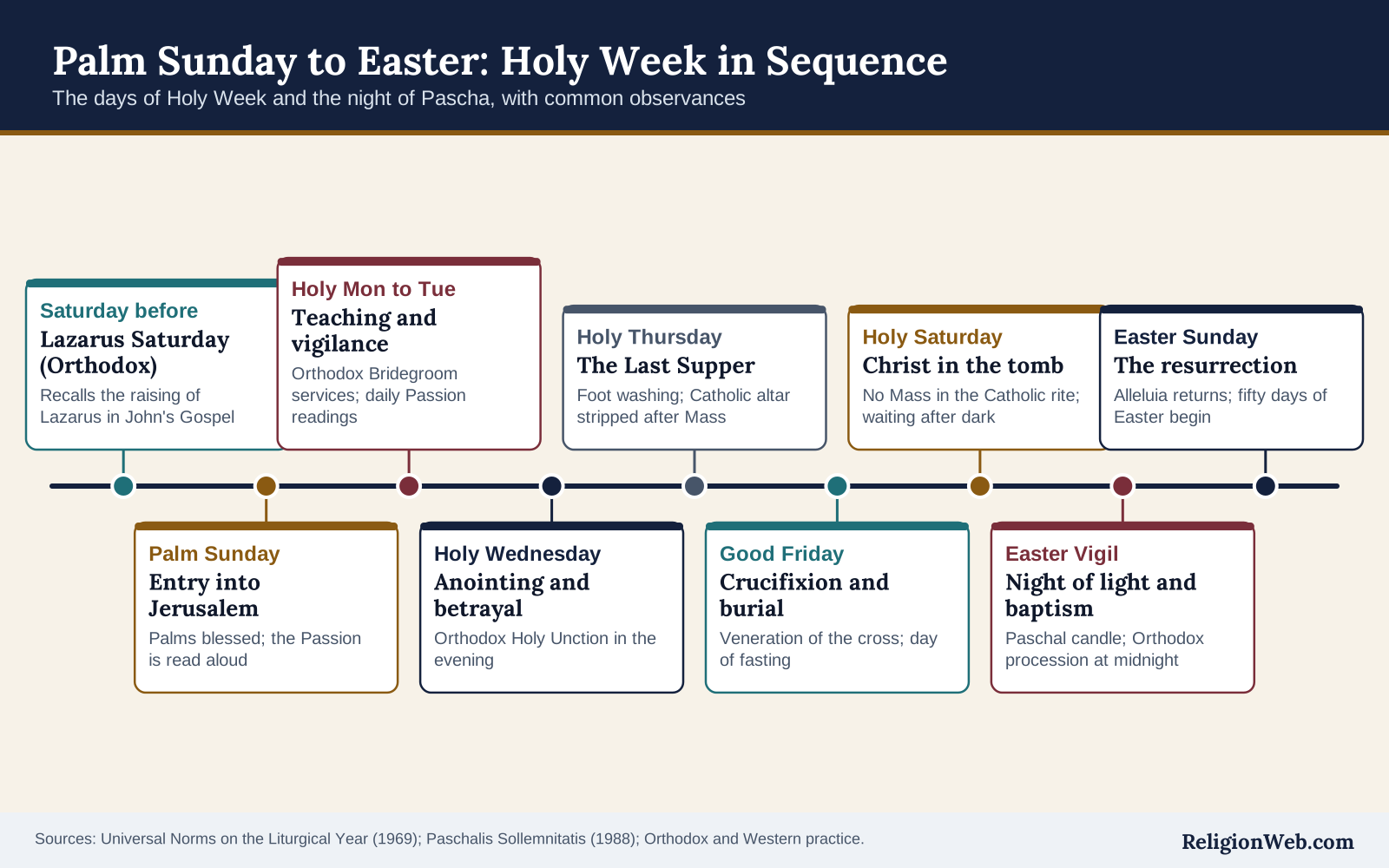
Holy Week, called the Great Week in the Eastern churches, is the week that begins on Palm Sunday and leads to Easter. The Gospels devote a disproportionate share of their length to these days, and the services of the week follow that narrative closely. The table below gives the outline, with the observances of the major traditions placed side by side as a guide to the sequence, not as a complete rubric.
| Day | What it recalls | Common Western observance | Common Eastern observance |
|---|---|---|---|
| Palm Sunday | Jesus’ entry into Jerusalem | Blessing of palms, procession, reading of the Passion | Palms blessed; follows Lazarus Saturday the day before |
| Holy Monday and Tuesday | Teaching in Jerusalem and the parables of vigilance | Daily Mass or prayer; Passion readings | Bridegroom Matins (Joseph and the fig tree; the Ten Virgins) |
| Holy Wednesday | Anointing at Bethany; Judas’ agreement to betray | Tenebrae in some churches; Passion readings | Service of Holy Unction in the evening |
| Holy Thursday | The Last Supper; the washing of the feet | Evening Mass of the Lord’s Supper; foot washing; altar stripped | Vesperal Liturgy; evening service of the Twelve Passion Gospels |
| Good Friday | Trial, crucifixion, and burial | Afternoon liturgy with Passion of John and veneration of the cross | Royal Hours; removal of the body from the cross; Lamentations |
| Holy Saturday | Christ in the tomb | No Mass; prayer at the tomb; vigil after dark | Morning Vesperal Liturgy with readings; Pascha at midnight |
| Easter Sunday | The resurrection | Easter Vigil and Mass of Easter Day | Midnight service of Pascha, followed by the Liturgy |
Palm Sunday to Holy Wednesday
Palm Sunday and the entry into Jerusalem
The week opens with the Gospel story of Jesus entering Jerusalem to the acclamation of the crowd, who spread cloaks and branches before him. Western churches mark the day with the blessing of palms, a procession into the church, and the reading of the full account of the Passion. The Catholic norms give the day the name “Palm Sunday of the Passion of the Lord.” Where palms do not grow, other branches are used, and the blessed palms are often kept in homes until the following year. The ceremony is old: Egeria described a procession from the Mount of Olives in the fourth century in which children, including infants carried by their parents, bore palm and olive branches. The Orthodox churches keep the day on the Sunday after Lazarus Saturday, which remembers the raising of Lazarus in the Gospel of John.
Holy Monday to Holy Wednesday
The first three days of the week recall events the Gospels place in the temple and its surroundings: the teaching in Jerusalem, parables of vigilance, the anointing of Jesus at Bethany, and the agreement of Judas to betray him. In the Catholic tradition, the bishop of each diocese blesses the holy oils and consecrates the chrism at a Chrism Mass held on Holy Thursday morning or earlier in the week. In the Orthodox Church the Bridegroom services take place on the evenings of Palm Sunday, Monday, and Tuesday, and are so named from the parable of the Ten Virgins in Matthew 25, which is read as a call to be ready for the coming of Christ. On Wednesday evening Orthodox parishes hold the Service of Holy Unction, in which the faithful are anointed with blessed oil for the forgiveness of sins and for spiritual and bodily healing.
The Three Days: Holy Thursday, Good Friday, and Holy Saturday
Holy Thursday
Holy Thursday recalls the Last Supper. In the Gospel of John, Jesus washes the feet of the disciples and gives them a new commandment.
A new commandment I give to you, that you love one another. Just as I have loved you, you also love one another.
John 13:34, World English Bible (Classic edition, public domain)
The English word “Maundy” is generally traced to the Latin mandatum, “commandment,” from the opening words of an antiphon sung at the foot washing. In the Catholic Church the Mass of the Lord’s Supper begins the Triduum. During the Gloria the bells are rung and then fall silent until the Easter Vigil, the washing of feet is maintained, and at the end the Blessed Sacrament is carried to a place of reservation, after which the altar is stripped bare. Adoration through the night is encouraged. Further background on the central rite of the evening is in the article on the Eucharist. In the Orthodox Church a Vesperal Liturgy commemorates the Mystical Supper, and the evening brings the service of the Twelve Passion Gospels, in the course of which a cross is carried in procession after the fifth reading. Anglican, Lutheran, Methodist, and other Protestant churches hold Maundy Thursday services with communion, foot washing, or Tenebrae, a service of gradually extinguished candles.
Good Friday
Good Friday remembers the trial before Pilate, the crucifixion, and the burial. It is the one day of the year on which the Catholic Church celebrates no Mass. The afternoon liturgy centers on the reading or chanting of the Passion according to John, a long series of intercessions for the church and the world, and the veneration of the cross, in which each person approaches individually to bow, touch, or kiss it. Communion is distributed from hosts consecrated the day before. Orthodox Christians keep a strict fast and hold the Royal Hours in the morning, the Vespers of the removal of Christ’s body from the cross in the afternoon, at which an embroidered cloth called the Epitaphios, showing the dead Christ, is carried to a bier that represents the tomb, and in the evening the service of Lamentations. Many Protestant churches hold a Good Friday service of readings and silence, and some hold a service of three hours, from noon to three, built around the sayings of Jesus from the cross.
The origin of the English name is uncertain. “Good” is often explained as an older sense of “holy,” and the day is called Great and Holy Friday in the Orthodox churches and Great Friday in several European languages. In many countries Good Friday is a public holiday.
Holy Saturday
Holy Saturday is the day of the tomb and of waiting. The Catholic Church describes it as a time when the church is, as it were, at the Lord’s tomb, meditating on his passion and death and awaiting the resurrection. No Mass is celebrated, and other sacraments are limited to penance and anointing of the sick, apart from the communion given to the dying. In Western tradition the day also recalls the creedal line that Christ “descended to the dead,” understood as his sharing in death in order to open it. Orthodox Christians call the day the Great Sabbath and hold a Vesperal Liturgy in the morning, with Old Testament readings that include the story of Jonah and with laurel leaves strewn through the church, so that the service already anticipates the resurrection. Both traditions hold that the Easter Vigil itself, which begins after dark, belongs to the night of Easter and not to the day of Holy Saturday.
The Easter Vigil, Easter Day, and the Fifty Days
The Vigil and the Night of Pascha
The Easter Vigil in Catholic and other Western churches
The Catholic Church calls the Easter Vigil the “mother of all holy vigils.” The circular letter on the preparation and celebration of the Easter feasts, issued by the Congregation for Divine Worship in 1988, says it must begin after nightfall and end before dawn on Sunday, and it divides the service into four parts: the service of light, the Liturgy of the Word, the baptismal liturgy, and the Eucharist. The service begins in darkness. A fire is kindled, and the large paschal candle, which the letter says must be made of wax, renewed each year, and large enough to evoke Christ as the light of the world, is carried into the church. Its flame is passed to the candles held by everyone present until the building is lit. The deacon or a cantor then sings the Easter Proclamation, the ancient hymn traditionally known by its first Latin word, Exsultet.
The Liturgy of the Word follows. The full order calls for seven readings from the Old Testament, beginning with creation and including the crossing of the Red Sea in Exodus 14, which the letter says must never be omitted, and for two from the New Testament, an epistle and the Gospel of the resurrection. When the Gloria is sung, the bells are rung again. In the baptismal liturgy, catechumens who have been preparing for months receive baptism, confirmation, and first communion, and the rest of the congregation renews its baptismal promises, standing with lighted candles and being sprinkled with water. The Eucharist closes the vigil. The vigil is the traditional setting for baptism, and Tertullian’s remark about the Passover around 200 CE shows how old that association is. Many Anglican, Lutheran, and Methodist churches now hold a similar Great Vigil. The article on baptism describes the sacrament, and the article on the Eucharist describes the meal.
Pascha night in the Orthodox and Oriental Orthodox churches
The Orthodox service of Pascha is also held at night, usually at or near midnight at the end of Holy Saturday, and it follows a sequence familiar to millions. As Fr. Paul Lazor describes it in a widely read account, the Midnight Office begins in a darkened church while the priest takes the shroud, the Epitaphios, from the tomb and places it on the altar. Each person lights a candle from the priest’s candle. Clergy and people, led by the cross, banners, icons, and the Gospel book, circle the church to the sound of bells, then stop before the closed doors, where the Paschal troparion is sung over and over and the greeting “Christ is risen!” and the response “Indeed he is risen!” are exchanged before the doors are opened. Paschal Matins follows at once, and the celebrant reads the Paschal homily attributed to John Chrysostom, which invites everyone, whether they have fasted or not, to the feast. The Divine Liturgy follows, and the foods avoided during Lent are blessed and then eaten.
The Ethiopian Orthodox Church celebrates its own vigil. As a description by Comboni Missionaries relates, on Holy Saturday the altar is draped, the Book of Revelation is read, and clergy sing and dance with traditional instruments. When the resurrection is proclaimed the sanctuary doors are opened and candles are lit, and the congregation answers with drums, clapping, and ululation. The liturgy ends around three in the morning.
Easter Morning and the Fifty Days
Easter Day in Protestant congregations
For many Protestants the principal service is on Easter morning. Churches decorate with flowers and sing hymns of the resurrection, and in many congregations attendance is among the highest of the year. A tradition of holding services at dawn is widespread. It draws on the Gospel accounts that the women found the tomb empty at the first light of Sunday. The Moravian Church has held an annual sunrise service since 1732, in Herrnhut, Germany, where the first service was a night of prayer ending with hymns in the burial ground known as God’s Acre, and the congregation in Winston-Salem, North Carolina, has held one since 1772, according to an Associated Press report. Many other churches now hold services at dawn outdoors, in cemeteries, parks, or on hillsides.
| Tradition | Characteristic Holy Week and Easter worship | Distinctive features |
|---|---|---|
| Roman Catholic | Palm Sunday procession; Triduum from Holy Thursday evening; Easter Vigil with baptisms; Mass of Easter Day | Paschal candle, Exsultet, seven Old Testament readings, no Mass on Good Friday |
| Eastern Orthodox | Bridegroom services; Holy Unction; Twelve Passion Gospels; Lamentations; midnight Pascha service | Procession around the church, “Christ is risen” greeting, blessed foods after the Liturgy |
| Oriental Orthodox (Coptic, Ethiopian, Syriac, and others) | Long Lenten fast, Holy Week services, Easter liturgy in the night or early morning | Ethiopian vigil with drums and dance; fifty-five-day Ethiopian fast |
| Anglican and Lutheran | Palm Sunday, Maundy Thursday, Good Friday, Great Vigil or Easter Day service | Retain much of the Western liturgical pattern, with local variation |
| Reformed, Methodist, and Baptist | Good Friday and Easter Sunday services; some also Palm Sunday and Maundy Thursday | Emphasis on preaching, congregational singing, sunrise services |
| Pentecostal and other evangelical | Easter Sunday worship; Good Friday services in many churches | Contemporary music, Easter dramas, outreach services |
| Moravian | Easter sunrise service beginning in the graveyard | Dawn service held annually since 1732 in Herrnhut |
Eastertide: Bright Week, Ascension, and Pentecost
Easter is not a single day. The Catholic norms call the first eight days of Easter time the Octave and celebrate them as solemnities of the Lord, and they describe the fifty days from Easter to Pentecost as “one feast day” in which the Alleluia is sung most of all. The Orthodox churches call the week after Pascha Bright Week and keep it as one continuous festival. The Ascension of Jesus is observed on the fortieth day after Easter, a Thursday, though in some places it is moved to the following Sunday, and the season closes on the fiftieth day with Pentecost. In the Ethiopian Orthodox Church the Wednesday and Friday fasts are suspended for the fifty days, and the Sunday after Easter marks the start of the main wedding season.
| Observance | Timing | What it marks |
|---|---|---|
| Easter Sunday | Day 1 | The resurrection of Jesus |
| Octave of Easter or Bright Week | Days 1 to 8 | Continuous celebration of the feast |
| Second Sunday of Easter | Day 8 | The appearance to Thomas in the Gospel of John (Thomas Sunday in Orthodox use) |
| Ascension | Day 40, a Thursday | The departure of the risen Jesus, as told in Luke and Acts |
| Pentecost | Day 50, a Sunday | The coming of the Holy Spirit and the close of the Easter season |
Symbols and Customs: Light, Eggs, Hares, and Flowers
The Symbols of the Liturgy
Light, fire, and water
The most important symbols of Easter are those of the liturgy itself. The paschal candle, lit from the new fire at the Vigil and kept near the altar through the fifty days, stands for the risen Christ and is marked, by long Western custom, with a cross, the Greek letters alpha and omega, and the numerals of the current year. Water is the symbol of baptism, and the font is blessed at the Vigil. In many Orthodox communities worshipers carry the flame home from the midnight service in a lit candle. White is the usual liturgical color of Easter in the Western churches, with gold in some, and the return of the Alleluia and the sound of bells after Lent works as a symbol in sound.
The lamb, the cross, and the empty tomb
The lamb is the oldest of the symbols, drawn from the Passover offering and from the title “Lamb of God” in the Gospel of John, and it appears in church art, in the Agnus Dei sung at Mass, and on the table, where lamb has long been a traditional Easter dish. The cross is usually shown empty in Easter decoration, whereas the crucifix, with the figure of Christ, is more common on Good Friday. In Eastern icons the resurrection is shown as the Anastasis, with Christ raising Adam and Eve, or as the women at the empty tomb with the angel. Lilies, which are white and open in spring, are used to decorate churches as a sign of new life. The meanings come from Christian interpretation of the biblical story and are documented in preaching and hymns, though their precise origins vary, as the table below shows.
| Symbol | Meaning in Christian use | Notes on history and variation |
|---|---|---|
| Paschal candle | The risen Christ as the light of the world | Wax, renewed yearly, lit at the Vigil in the Catholic rite; marked with cross, alpha and omega, and the year |
| Lamb | Christ as the Passover lamb, the “Lamb of God” | Linked to 1 Corinthians 5:7 and to John 1:29; lamb is a traditional Easter food in many cultures |
| Empty tomb and the Anastasis icon | Victory over death; the raising of Adam and Eve | Eastern churches depict the Anastasis; Western art often shows Christ stepping from the tomb |
| Egg | New life emerging from a closed shell, read by Christians as the tomb | Egg as a symbol of renewed life is older than Christianity; decorated eggs recorded from the 13th century |
| Red egg | The blood of Christ and the joy of new life | Orthodox custom of dyeing eggs red and having them blessed; devotional explanations differ |
| Hare or rabbit | A children’s custom of spring and abundance | First clearly recorded in Germany in 1682; in Pennsylvania German use by 1757 |
| Lily | Purity and resurrection | Used in church decoration in the West; the specific symbolism is a matter of custom |
| Palm or willow branch | Acclamation of Christ as king on Palm Sunday | Palms, olive, and local branches are used depending on what grows in the region |
Eggs, Hares, and Festive Foods
The Easter egg
Eggs are among the best-known Easter customs. Encyclopaedia Britannica notes that the use of painted and decorated eggs at Easter was first recorded in the thirteenth century, and it explains that the church barred eating eggs during Holy Week, so that eggs laid then were set aside and decorated. Virginia Tech’s Candace Buckner adds that eggs were also limited during Lent and that surplus eggs were boiled and dyed, which helps explain why they were plentiful by Easter. An egg is an ancient symbol of new life, and Christians have read it as an image of the sealed tomb from which life emerged. In Orthodox practice eggs are dyed red and blessed, then cracked against each other in a game, with the greeting “Christ is risen,” that is played in many countries. Several devotional traditions explain the red color, among them stories connected to Mary Magdalene, and these are best understood as pious explanations rather than documented history. In Ukraine and in Ukrainian communities abroad, eggs are decorated with wax-resist patterns and called pysanky.
The Easter hare and the Easter bunny
The Easter bunny is a more recent figure. Stephen Winick, a folklorist at the Library of Congress, writes that Georg Franck von Franckenau’s Latin essay De ovis paschalibus of 1682 is the first clear reference to a German tradition of an Easter hare, which children believed laid colored eggs hidden in the garden. The earliest firm evidence of the custom in Pennsylvania is a pair of drawings by Johann Conrad Gilbert, a German immigrant who arrived in 1757, and German settlers brought the tradition with them. Winick finds no good evidence that the hare descends from a pagan fertility goddess. Rabbits and hares breed prolifically in spring and eggs become abundant at that time of year, an association that people could make by simple observation. Other Easter foods have their own histories: lamb recalls the Passover lamb, and pork became a medieval tradition in parts of Europe because pigs slaughtered in autumn were cured through the winter. Sweet breads decorated with eggs are baked in Italy and in many other countries.
Regional Customs and Variations Around the World
Processions and Public Devotion in Spain and the Philippines
Spain and its Holy Week brotherhoods
In Spain, Holy Week, or Semana Santa, is organized in many cities by lay brotherhoods called cofradías or hermandades. In Seville, writer Meg Weaver reported in National Geographic Travel in 2009, more than 50,000 brotherhood members take part in processions that carry pasos, large floats bearing carved and painted figures of Christ and the Virgin, through the streets between Palm Sunday and Easter morning, some by day and some by candlelight. Participants known as nazarenos wear long robes and the peaked hats called capirotes, and some processions are accompanied by the unaccompanied songs called saetas. According to the same report the celebration has had roughly its present form since the sixteenth century. The report stresses that for many local people the week is a very holy occasion and not only a spectacle.
The Philippines: Salubong, Pabasa, and Senakulo
In the largely Catholic Philippines Holy Week is shaped by a distinctive set of customs. Before dawn on Easter Sunday, in a rite called the Salubong, or “meeting,” two processions start from opposite sides of the parish church, one carrying an image of the risen Christ and the other an image of Mary, and they meet in front of the church before everyone goes in for Easter Mass. During the week families gather to chant the Pasyon, a long Tagalog poem on the life and suffering of Jesus, in a practice called Pabasa, and many communities stage a Passion play called a Senakulo. On Holy Thursday and Good Friday it is customary to make a Visita Iglesia, visiting at least seven churches, a practice associated with the sixteenth-century saint Philip Neri. A small number of devotees also carry out acts of penance such as self-flagellation or ritual crucifixion, which Catholic leaders have publicly discouraged. In April 2017 Archbishop Socrates Villegas, then president of the bishops’ conference, said such bloodshed was unnecessary because Christ’s sacrifice was complete.
Eastern Europe, the Middle East, and Africa
Poland, Greece, and Ukraine
In Poland, families bring small baskets of food to church on Holy Saturday to have them blessed, a custom called święconka, and the blessed food is eaten at the Easter breakfast, which centers on the home. On Easter Monday young people traditionally douse one another with water in the custom known as śmigus-dyngus, which has been practiced for centuries. In Greece the Holy Saturday evening service ends with the First Resurrection and is followed at midnight by the Resurrection service, when the priest lights a candle from the Holy Light of the Sepulchre and the flame is passed from worshiper to worshiper while the congregation sings “Christ is risen.” Red eggs, lamb, and sweet bread belong to the meal that follows. In Ukraine and in Ukrainian communities abroad, intricately decorated pysanky eggs are prepared and often brought to church to be blessed.
Jerusalem and Ethiopia
In Jerusalem, on the Saturday before Orthodox Easter, thousands of pilgrims gather in the Church of the Holy Sepulchre for the ceremony of the Holy Fire. In near-total darkness the Greek Orthodox Patriarch enters the Edicule, the structure over the traditional site of the tomb, and emerges with lit candles, from which the flame is passed through the crowd. Eastern Orthodox Christians understand the light to appear miraculously, and the flame is carried by special flights to Orthodox communities in other countries. Reports describe the ceremony as at least twelve centuries old, though skeptics have questioned it since the Middle Ages. In 1834 a panicked crowd in the dark church caused the deaths of roughly 400 pilgrims. In recent years Israeli authorities have limited the number of participants, citing safety, and church leaders have objected that this disrupts the arrangements known as the Status Quo at Jerusalem’s holy sites.
In Ethiopia, Easter is called Fasika. After the fifty-five-day fast, Holy Week brings the blessing of palms on Palm Sunday, foot washing on Holy Thursday, hourly services on Good Friday, and the night vigil described above. Families break the fast after the liturgy ends in the early hours with a drink of linseed, honey, and water, and then share Easter bread and doro wat, a spicy chicken stew with boiled eggs.
| Region | Custom | What happens |
|---|---|---|
| Seville, Spain | Semana Santa processions | Brotherhoods carry carved pasos through the city from Palm Sunday to Easter morning, with robed nazarenos |
| Philippines | Salubong, Pabasa, Senakulo | Dawn meeting of the images of Christ and Mary; chanting of the Pasyon; Passion plays; visiting seven churches |
| Poland | Święconka and śmigus-dyngus | Baskets of food blessed on Holy Saturday; dousing with water on Easter Monday |
| Greece | Midnight Resurrection service | Candles lit from the Holy Light; red eggs and Easter bread after the liturgy |
| Jerusalem | The Holy Fire | Orthodox ceremony at the Church of the Holy Sepulchre on Holy Saturday |
| Ukraine | Pysanky | Eggs decorated with wax-resist patterns and often blessed in church |
| Ethiopia | Fasika | Fifty-five-day fast, night vigil with drums, then a feast of doro wat |
| United States | Sunrise services and egg hunts | Moravian sunrise service since 1772 in Winston-Salem; Pennsylvania German Easter hare tradition |
Easter in the Modern World
Easter Today: Observance and Public Life
Religious and secular observance
Easter is a public holiday in many countries, usually including Good Friday, Easter Monday, or both, though not a federal holiday in the United States. For many people it is both a religious observance and a family occasion with eggs, meals, and spring decorations, and for some it is only the latter. This is not a recent development, since eggs, feasts, and games have gathered around the feast for many centuries. The religious core is nevertheless clearly distinguishable, in the Triduum services, the baptisms, and the proclamation of the resurrection, and it is the part that the churches themselves emphasize. A description of Easter that treats only its secular customs leaves out what Christians say it is for.
Easter and the wider Christian family
The 2025 prayer at Iznik, on the site of ancient Nicaea, gives a picture of how widely the feast is shared. The Dicastery for Promoting Christian Unity reported that the prayer was led by Pope Leo XIV and Ecumenical Patriarch Bartholomew and attended by representatives of Orthodox patriarchates, several Oriental Orthodox churches, the Anglican Communion, the Lutheran World Federation, the World Communion of Reformed Churches, the World Methodist Council, the Baptist World Alliance, the Pentecostal World Fellowship, the World Evangelical Alliance, and the World Council of Churches. Whatever their differences of date and custom, these communities all keep Easter as the center of the Christian year. The articles on Oriental Orthodox Christianity and Anglicanism show how it is kept in two of them.
Holy Week and Jewish–Christian Relations
A history of harm
Any honest account of Holy Week must record that it has sometimes been a dangerous season for Jews. The Gospel passion narratives were read by many Christian preachers across the centuries as placing collective blame on the Jewish people for the death of Jesus, a charge later called deicide. The Anti-Defamation League’s history of passion plays notes that Holy Week was the time when Jews in Europe were most vulnerable and that some of the worst violence against Jewish neighbors occurred then. For centuries the Latin Good Friday prayer for the Jews described them as perfidis, a word that could mean “unfaithful” or “treacherous.” These facts concern particular preachers, plays, and liturgical texts, and do not describe all Christians or the faith as a whole, but they explain why the churches have treated the reform of Holy Week language as important.
Reform and reconsideration
The reforms began in the middle of the twentieth century. Joanne M. Pierce, a professor of religious studies, reports that Pope John XXIII removed perfidis from the Latin Roman missal in 1959. In 1965 the Second Vatican Council’s declaration Nostra Aetate formally rejected the deicide charge and all forms of antisemitism, and most Protestant churches followed in rejecting it. In 1988 the Committee for Ecumenical and Interreligious Affairs of the United States Catholic bishops issued criteria for the evaluation of dramatizations of the Passion that ask producers to avoid caricatures of Jews and not to set Jews falsely against Jesus. Discussion continues about the wording of particular prayers, especially in the older Latin rite, and about how to read the Passion narratives so that they are not turned against Jewish people. Churches that have undertaken this work present it as a requirement of fidelity to their own teaching, and not as a concession.
Common Misconceptions About Easter
Misconception 1: Easter always falls on the same calendar date
Where the misunderstanding comes from
Christmas falls on 25 December in the Western churches every year, and so do most of the other holidays on a modern calendar, so it is natural to assume that Easter works the same way. The assumption is reinforced by the fact that Easter always falls on a Sunday, which gives it a feeling of regularity, and by the fact that it is always in spring in the Northern Hemisphere. People who grew up with the same church schedule in one country may also have encountered only a narrow range of dates in their own lifetimes.
The confusion is increased by the way the feast is often described in short summaries, which say that Easter is “in March or April” without explaining why. A reader who sees that it was on 20 April in 2025 and 5 April in 2026 may guess that the difference is an error or a local variation, not part of the design.
What the evidence and tradition actually show
Easter is a movable feast whose date is recalculated each year. In the Western churches it is the first Sunday after the first ecclesiastical full moon on or after 21 March, so it can fall on any Sunday from 22 March to 25 April. Between 2025 and 2030 the Western date moves from 20 April to 5 April to 28 March to 16 April to 1 April to 21 April, a spread of more than three weeks. The reason is that the feast is tied both to the solar year, through the equinox, and to the lunar cycle, through the full moon, and these two cycles do not line up in a fixed pattern. Because the date is set by a rule that goes back to the early centuries of the church, it is better understood as a fixed rule that produces a variable date than as a variable custom.
There have been proposals for a fixed Easter. The Second Vatican Council’s constitution on the liturgy, in an appendix, stated that the Council would not object to assigning Easter to a particular Sunday of the Gregorian calendar, provided that the other churches agreed, and the idea has been discussed in ecumenical settings since. No such agreement has been reached, and the date remains movable in all the major traditions.
Misconception 2: Every Easter custom has a single pagan origin
Where the misunderstanding comes from
A popular account holds that Easter is a Christian disguise for the spring festival of a Germanic goddess named Eostre or Ostara, and that eggs, hares, and flowers are borrowed fertility symbols. The account has a real starting point. The English monk Bede, writing in the 720s in On the Reckoning of Time, reports that the Anglo-Saxon month corresponding to April, Eosturmonath, had been named for a goddess called Eostre, in whose honor feasts were held, and that the name had come to be applied to the Christian paschal season. In the nineteenth century the philologist Jacob Grimm reasoned from that passage and from German forms such as Ostern to a continental goddess Ostara. Later popular writing, and more recently online posts, turned the reconstruction into a settled fact and extended it to every Easter custom.
Here “pagan” is used in its common sense of pre-Christian Germanic religion, and many scholars prefer more specific terms such as pre-Christian or Anglo-Saxon. The mix-up arises from running together three separate questions: where the feast comes from, where its English name comes from, and where individual customs come from. Each has a different answer.
What the evidence and tradition actually show
The feast itself is not Germanic. Christian Pascha was already celebrated in the Mediterranean world by the second century, as the Quartodeciman dispute shows, centuries before the Germanic peoples were converted, and its content, the death and resurrection of Jesus at the time of Passover, comes from the Gospels and from Paul’s description of “Christ, our Passover.” The name is a narrower question. Bede is the only ancient source for the goddess Eostre. No other text mentions her, and she has no clear counterpart in Norse or continental Germanic sources. Anthony McRoy has argued in Christianity Today that the month name more likely referred to the season, perhaps meaning something like a month of opening, and he notes that the historian Ronald Hutton observed that Bede offered his explanation as his own and not as established fact. Bede was born in Northumbria and wrote within about a century of the English conversion, so he is not an obviously careless witness, and the existence of a goddess of this name can be neither proven nor ruled out. The question remains debated, and a careful statement is that the name is probably old, that its connection to a goddess rests on one eighth-century witness, and that it says nothing about the origin of the feast.
The customs have separate histories. Britannica records that decorated eggs are first documented in the thirteenth century and that the church barred eating eggs in Holy Week, which gave surplus eggs a place at Easter. The egg is an ancient symbol of new life, but that does not show derivation from a particular religious tradition. The Easter hare is first clearly attested in 1682 in a German essay, and the folklorist Stephen Winick finds no good evidence for a link to a goddess. Some regional spring customs may well carry older seasonal practices, and scholars weigh each on its evidence. The accurate summary is that Easter customs are layered from Christian worship, medieval food rules, regional folk practice, and modern commerce, and that they cannot all be traced to one source.
Misconception 3: All churches calculate Easter in exactly the same way
Where the misunderstanding comes from
Because the Council of Nicaea is often credited with settling the question for all Christians in 325, many people assume that the matter was closed and that all churches use one method. When Orthodox Easter falls on a different day, the usual explanation heard is that “the Orthodox use the old calendar” or that “they are a week behind,” as though the only difference were the choice of calendar. The fact that in some years all Christians celebrate together, as in 2025 and 2028, adds to the impression that there is a single system and that the differences are random.
What the evidence and tradition actually show
The churches share the same basic rule: Easter is the Sunday after the paschal full moon on or after the equinox. They differ in the tables and calendars with which they apply it. Catholic and Protestant churches use the Gregorian calendar, introduced in 1582, with Gregorian lunar tables. Most Orthodox churches compute Pascha from the Julian calendar, in which 21 March currently falls on 3 April, with Julian lunar tables, and many also observe the Passover proviso. The two methods agree in about three years out of ten this century and otherwise differ by one, four, or five weeks. In 2027, for instance, the Western date is 28 March and the Orthodox date is 2 May.
The picture is more complicated than “Julian against Gregorian.” Many Orthodox churches adopted the Revised Julian calendar in 1923 for fixed feasts such as Christmas, yet continue to calculate Pascha on the traditional tables, so a church that keeps Christmas on 25 December may still celebrate Pascha on the Julian-based date. The Orthodox Church of Finland follows the Western date. The Oriental Orthodox churches, such as the Coptic and Ethiopian churches, use the Alexandrian reckoning. The World Council of Churches’ Aleppo proposal of 1997 and the 2025 declaration of Pope Leo XIV and Ecumenical Patriarch Bartholomew are attempts to bridge this divide, not evidence that it does not exist.
Misconception 4: Easter is mainly a secular spring holiday to which Christians added religion
Where the misunderstanding comes from
In many countries the most visible parts of Easter are chocolate, decorated eggs, children’s hunts, spring decorations, and a long weekend. News coverage, shop displays, and school calendars emphasize these, and the dates of the feast often coincide with the first warm weather of the year. For people who do not attend church, it is natural to think that the religious content was added to a seasonal celebration, or that it is a minor layer over a family holiday.
What the evidence and tradition actually show
The historical order runs the other way. The earliest Christian sources, Paul’s first letter to the Corinthians among them, are about the resurrection and about Christ as the Passover. The second-century disputes over the date of Pascha were about the proper day on which to commemorate the death and rising of Jesus. The services of Holy Week took their shape in fourth-century Jerusalem, and the Triduum, the Vigil, and Eastertide were all liturgical creations before any of the familiar secular customs were recorded. Decorated eggs are documented from the thirteenth century and the Easter hare from 1682.
The calendar rule points the same way. Easter is defined by a Sunday and by the paschal full moon, which is a link to Passover and not to the seasons as such. The rule uses the spring equinox of the Northern Hemisphere in every country, so in Australia, South Africa, and Argentina Easter falls in autumn, and it is kept there with the same services as elsewhere. Many Christians enjoy eggs, hares, and family meals as expressions of the joy of the feast, and some churches bless them, while others keep the worship and the customs apart. The accurate picture is that the secular customs are real and widespread, that they sit alongside the worship, and that they did not come first.
Frequently Asked Questions About Easter
Questions About Meaning and History
How is Easter related to Passover?
The Gospels place the death and resurrection of Jesus at the time of the Jewish festival of Passover, and the first Christians, most of whom were Jews, understood these events in light of it. The Greek word pascha comes from the Hebrew Pesach, and Paul called Christ “our Passover.” For the Quartodeciman churches of the second century the link was literal, since they kept the feast on the fourteenth of Nisan. Today the two festivals are separate observances with their own meanings and calendars. Passover is the Jewish remembrance of liberation from slavery in Egypt, described in the article on Passover, and Christians keep Easter as the celebration of the resurrection. In the Western churches the date is calculated by an independent table, and in many Orthodox churches Pascha is placed after Passover as a matter of canonical practice.
Why is Easter celebrated on a Sunday?
All four Gospels say that the empty tomb was discovered on the first day of the week, which is Sunday. Early Christians gathered on that day for worship, and many came to call it the Lord’s Day. When the churches debated the date of Pascha in the second century, those that kept the feast on Sunday argued that it should fall on the day of the resurrection and not on a fixed date of the lunar month. That view prevailed, and it is the reason Easter is always a Sunday in all traditions that keep it.
Is Easter older than Christmas?
Yes, in the sense that there is earlier evidence for it. An annual Pascha is documented in the second century, as the dispute between Asia Minor and Rome shows. The celebration of Christmas on 25 December is not clearly documented before the fourth century. For that reason historians of the liturgy generally treat Easter as the original annual feast of Christianity. The article on Christmas tells the story of that later feast.
Questions About Practice
What do Christians say to one another at Easter?
The traditional greeting among Orthodox Christians is “Christ is risen!” with the reply “Indeed he is risen!” It is used from the Paschal service onward and, in many parishes, throughout the Easter season, in languages ranging from Greek and Church Slavonic to Arabic and English. Many Western Christians use the same words on Easter Day. In both traditions the exchange echoes the Gospel accounts in which the news of the resurrection is passed from one person to another.
Can visitors attend Easter services?
Most congregations welcome visitors to Easter worship, and those unfamiliar with a tradition can follow along by watching the congregation. Services vary in length, and the Easter Vigil and the Orthodox midnight service may last two or three hours or more. Catholic and Orthodox churches have rules about who may receive communion, based on their understanding of the sacrament, and visitors who are not members are usually invited to remain seated or to come forward for a blessing where that is the custom. Asking an usher or the parish office about the local practice is welcomed in most communities.
Questions About the Date
When is Easter in 2027?
In 2027 the Western churches celebrate Easter on 28 March, and the Orthodox churches celebrate Pascha on 2 May, a gap of five weeks. These dates follow from the calculations described above and are consistent with the published tables for the years concerned. Local churches announce their own schedules, and readers planning to attend services should check with the congregation concerned.
Will Easter ever be fixed or shared every year?
No agreement has been reached. The World Council of Churches has encouraged churches to work toward a common date, and the leaders of the Catholic Church and the Ecumenical Patriarchate expressed in November 2025 the hope of celebrating together every year. Any change would require agreement among many independent churches and decisions by their synods, and the history of the question suggests that it will be gradual if it comes. In the meantime, the dates for 2025 and 2028 show that the churches can and do coincide.
Conclusion: Easter as Feast, Fast, and Calendar
What the History Shows
A feast older than its details
Easter is one of the oldest annual celebrations of Christianity, and its history shows how a single conviction, that Jesus had risen, shaped a calendar, a cycle of fasting and feasting, and a body of music, art, and custom. The first evidence for the annual feast is the second-century dispute over its day. The shape of Holy Week owes much to the Jerusalem of the fourth century. The method of computing the date took shape in Alexandria and was refined in Rome, Northumbria, and the Gregorian reform of 1582. Customs such as eggs and hares joined the feast later and have separate histories that should not be confused with the origin of the feast.
A feast shared and divided
Easter is also an example of how Christians can share the same center and differ on the details. The churches agree on the rule of the Sunday after the paschal full moon, but they apply it with different tables, and so they often celebrate on different days. The coincidence of dates in 2025 renewed hopes of common celebration, and the joint declaration of November 2025 shows that the question remains alive among church leaders.
How to Keep Exploring
Related topics on ReligionWeb
Readers who want to continue can start with the article on Lent, which describes the season of preparation, and the article on Pentecost, which describes the feast that closes the Easter season. The Gospel story at the center of the feast is described in the article on Jesus Christ, and the structure of the books that tell it is in the article on the Bible.
Visiting a service respectfully
Anyone who attends an Easter service for the first time will find the experience varies by tradition, from silent processions in Seville to a lively sunrise gathering in a cemetery. Arriving early, following the congregation’s lead on standing and sitting, and asking questions afterward are all appropriate. Easter is the day on which Christians say most clearly what they believe, and an informed visitor will understand it best by listening to how they say it.
Sources
The table below lists the principal external sources behind this article. Facts, dates and figures were checked against these and related primary, institutional and academic materials.
| # | Source | Publisher and type | Used for | Link |
|---|---|---|---|---|
| 1 | World English Bible (Classic edition): Matthew 28, 1 Corinthians 5 and 15, John 13 | eBible.org · Primary text | Public-domain Bible text for the four scripture quotations; other chapters on the same site | ebible.org |
| 2 | Catechism of the Catholic Church, paragraphs 638-658: On the third day he rose from the dead | Holy See (vatican.va) · Institutional | Catholic teaching that the resurrection is historical and transcendent; empty tomb; risen body | vatican.va |
| 3 | Universal Norms on the Liturgical Year and the General Roman Calendar (1969) | Catholic Church; text hosted by CatholicCulture.org · Institutional | Triduum, Easter season, Octave, Ascension, Lent and Palm Sunday norms | catholicculture.org |
| 4 | Paschalis Sollemnitatis: Circular Letter on the Preparation and Celebration of the Easter Feasts (1988) | Congregation for Divine Worship; text hosted by CatholicCulture.org · Institutional | Holy Thursday, Good Friday, Holy Saturday, and Easter Vigil rites in the Roman Rite | catholicculture.org |
| 5 | Date of Easter (Astronomical Applications FAQ) | U.S. Naval Observatory · Institutional | Western rule for Easter; ecclesiastical full moon; range 22 March to 25 April; 1582 reform | aa.usno.navy.mil |
| 6 | WCC publishes Faith and Order paper encouraging churches to work for common celebration of Easter | World Council of Churches · Institutional | 2025 shared date; Nicaea anniversary; 1997 Aleppo consultation; Towards a Common Date for Easter | oikoumene.org |
| 7 | Joint Declaration of Pope Leo XIV and Ecumenical Patriarch Bartholomew, 29 November 2025 | Holy See (vatican.va) · Institutional | Nicaea and the Easter criteria; hope for celebrating Easter together every year | vatican.va |
| 8 | Review of A. A. Mosshammer, The Easter Computus and the Origins of the Christian Era (Oxford, 2008) | Bryn Mawr Classical Review · Academic reference | What Nicaea did and did not fix; Alexandrian cycle; Dionysius Exiguus and the 525 table | bmcr.brynmawr.edu |
| 9 | Dionysius Exiguus, On Easter, or, the Paschal Cycle (translation by Michael Deckers, public domain) | tertullian.org · Primary text | Fun Fact: preface on counting years from the incarnation; table covering AD 532-626 | tertullian.org |
| 10 | How the Global Religious Landscape Changed From 2010 to 2020 | Pew Research Center · Demographic data | About 2.3 billion Christians in 2020 (28.8 percent); regional shares; 2010 comparison | pewresearch.org |
Last fact-check date: 2026-10-21.