
Catholic Christianity is the form of Christian faith and life centered on the Catholic Church, the communion of Christians who are united in faith, sacraments, and governance with the bishop of Rome, the pope, and with the bishops who share his teaching office. With about 1.42 billion baptized members at the end of 2024, according to the Vatican’s own statistical yearbook, it is the largest single Christian body in the world. Catholics describe their Church as the community Jesus gathered around the apostles, with Peter given a special place among them, and as one that has handed on the same faith, the same Scriptures, and the same seven sacraments through successive generations of bishops.
The word “catholic” comes from the Greek katholikos, meaning “according to the whole” or “universal,” and it carries two ideas at once: that the Church is for all peoples, and that it holds the fullness of the faith. Many Christians use the word in lower case in the Creed (“one, holy, catholic, and apostolic Church”) without meaning the Roman communion. In ordinary speech, however, “Catholic” with a capital letter usually points to the Church in communion with Rome. That Church is the subject of this article. It sits within the wider family described in Christianity, alongside the churches covered in Eastern Orthodox Christianity, Oriental Orthodox Christianity, and Protestant Christianity.
Two features shape almost everything else in Catholic life. The first is the principle that divine revelation reaches believers through Scripture and Tradition together, interpreted by a living teaching office, the Magisterium, exercised by the pope and the bishops. The second is the sacramental imagination: the conviction that God acts through physical signs such as water, oil, bread, and wine, and that the Mass, celebrated daily around the world in many languages, is the center of that life. Around these two features have grown religious orders, parish networks, schools, hospitals, pilgrimages, devotions to Mary and the saints, and a calendar that retells the life of Christ every year.
This article explains Catholic Christianity on its own terms. It sets out how Catholics understand themselves, traces the history from the apostolic age to the pontificate of Leo XIV, and describes the beliefs, sacraments, Mass, liturgical year, devotions, and forms of religious life that Catholics practice. It also distinguishes what the Church teaches as doctrine from what is custom, discipline, or devotion, a distinction that clears up several widespread misunderstandings.
Catholic Christianity at a Glance: Definition, Self-Understanding, and Vocabulary
What Catholic Christianity Is and How Catholics Describe It
A working definition
In the sense used here, a Catholic is a baptized person who belongs to the Catholic Church: one of the Churches that recognize the pope as the visible head of the whole Church and share a common faith, the seven sacraments, and the governance of bishops in communion with him. Catholics do not think of this as one denomination among others in the way many Protestant communities describe themselves. Catholic teaching holds that the Church founded by Christ “subsists” in the Catholic Church, a verb chosen by the Second Vatican Council (1962 to 1965) in its constitution on the Church, Lumen Gentium, to affirm that conviction while also acknowledging that real elements of grace and truth exist among other baptized Christians.
That balance deserves emphasis. The Catholic Church has taught since the Council that other baptized Christians are joined to it by a real if imperfect communion, and that the Holy Spirit works through their churches as well. At the same time it maintains that the fullness of the means of salvation is found in its own life. This article reports that self-understanding, with attribution, and does not rank churches against one another.
The meaning of “catholic” and the early history of the name
The adjective katholikos appears in the earliest Christian writing outside the New Testament that survives in quantity. Ignatius of Antioch, a bishop who wrote letters on his journey to Rome and martyrdom, traditionally dated to about 110 CE, used the phrase “the catholic church” to describe the whole body of believers gathered around the bishop. Over the next two centuries the word came to mean the Church spread across the world and faithful to the apostolic teaching, as distinct from smaller groups that taught otherwise. Cyril of Jerusalem, in the fourth century, explained to catechumens that the Church is called catholic because it extends through the whole world and teaches every doctrine needed for salvation.
The Nicene Creed, completed at the councils of Nicaea (325 CE) and Constantinople (381 CE), lists four “marks” of the Church: one, holy, catholic, and apostolic. Catholics read these marks as descriptions of a real, visible community. “One” refers to unity in faith, worship, and governance. “Holy” points to the Church’s source in Christ rather than to the perfection of its members. “Catholic” names its universality and fullness. “Apostolic” means that its teaching and ministry trace back to the apostles through an unbroken succession of bishops, a concept called apostolic succession. Those four words recur through the rest of this article.
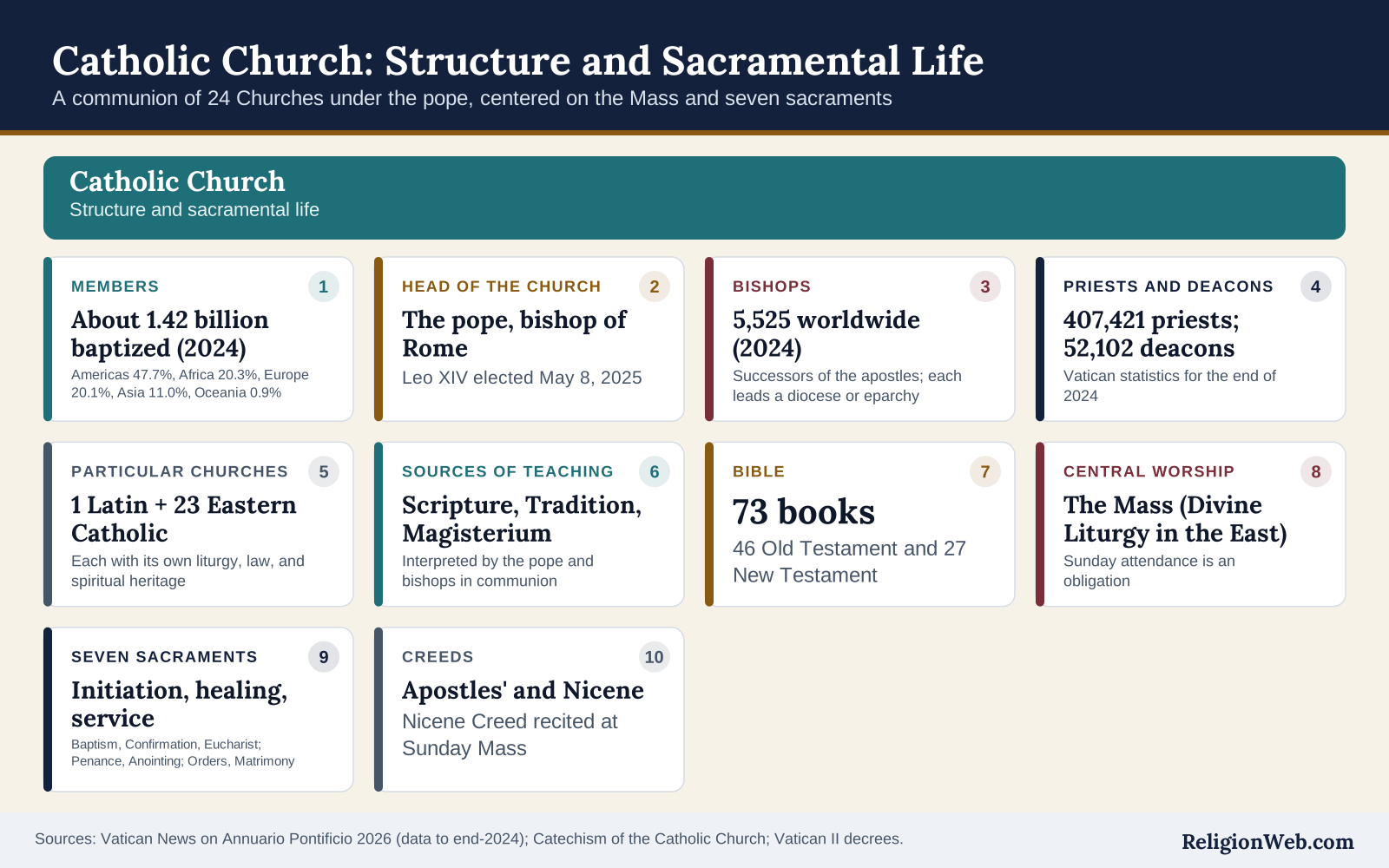
| Feature | Catholic understanding or practice |
|---|---|
| Self-description | The Church founded by Christ on the apostles, which Catholic teaching says subsists in the Catholic Church governed by the successor of Peter and the bishops in communion with him |
| Source of authority | Scripture and Sacred Tradition together, authentically interpreted by the Magisterium (the pope and the bishops in communion with him) |
| Bible | 73 books: 46 in the Old Testament and 27 in the New Testament |
| Creeds | The Apostles’ Creed (baptismal profession) and the Nicene-Constantinopolitan Creed (Sunday Mass) |
| Sacraments | Seven: Baptism, Confirmation, Eucharist, Penance, Anointing of the Sick, Holy Orders, Matrimony |
| Central act of worship | The Mass, or Divine Liturgy in the Eastern Catholic Churches |
| Structure | One Latin Church and 23 Eastern Catholic Churches, each with its own liturgical heritage, under the pope |
| Leadership | The pope (bishop of Rome), bishops, priests, and deacons; religious orders and lay movements share in the Church’s mission |
| Size (end of 2024) | About 1.422 billion baptized Catholics; 5,525 bishops; 407,421 priests; 52,102 permanent deacons (Vatican statistics) |
Where Catholics Live and How Many There Are
Global totals and regions, end of 2024
The Vatican’s Annuario Pontificio 2026 and its statistical companion, the Annuarium Statisticum Ecclesiae for 2024, released in March 2026, report just over 1.422 billion Catholics at the end of 2024, up about 1.14 percent from roughly 1.406 billion a year earlier. The figure counts the baptized, whether or not they attend Mass, which is how churches themselves record membership and differs from survey-based counts of self-identification. The Vatican reports the Catholic share as stable at about 17.8 percent. Because the number rests on parish and diocesan baptismal records, it measures belonging in the Church’s own terms rather than regular practice.
By region, the Vatican puts 47.7 percent of the world’s Catholics in the Americas, 20.3 percent in Africa (more than 288 million people), 20.1 percent in Europe, 11.0 percent in Asia, and 0.9 percent in Oceania. In relative terms, Catholics make up roughly 64 in every 100 inhabitants of the Americas, about 40 in Europe, 26 in Oceania, 20 in Africa, and 3 in Asia. Countries such as Brazil, Mexico, and the Philippines have some of the largest Catholic populations in the world, and Africa is the region where the Catholic population has been growing fastest in recent decades.
Clergy, religious, and lay ministry
The same yearbook counts 5,525 bishops, 407,421 priests, and 52,102 permanent deacons in 2024, a total of 465,048 clerics. It also reports about 589,000 women religious (sisters), some 48,500 religious brothers who are not priests, and about 18,200 members of secular institutes, groups of consecrated laypeople who live and work in ordinary society. Roughly 2.9 million catechists, lay teachers of the faith, serve in parishes worldwide, with nearly 55 percent of them in the Americas.
These numbers show a Church whose daily work is carried out largely by laypeople and women religious, with ordained ministry concentrated in sacramental and pastoral leadership. The count of priests has moved unevenly by region in recent years, with growth in Africa and Asia and decline in much of Europe and North America, which is why the geography of Catholic leadership is shifting along with the geography of membership.
Core Vocabulary for Reading About Catholicism
Words about the Church and its authority
The Magisterium is the Church’s teaching office, exercised by the pope and the bishops in communion with him. The Holy See is the pope’s governing office together with the Roman Curia, the central administration; it is distinct from Vatican City State, the small sovereign territory in Rome. A diocese (or eparchy in an Eastern Church) is a local church led by a bishop; an archdiocese is one led by an archbishop who often oversees a regional province. A parish is a local community within a diocese, led by a pastor. An ecumenical council is a worldwide assembly of bishops whose decrees, confirmed by the pope, bind the whole Church; the Catholic Church counts twenty-one, from Nicaea in 325 to the Second Vatican Council. Canon law is the Church’s system of law, codified for the Latin Church in 1983 and for the Eastern Catholic Churches in 1990.
Words about worship, grace, and holiness
A sacrament is an outward sign instituted by Christ that conveys the grace it signifies. The Eucharist is the sacrament of the body and blood of Christ, and the Mass is the Eucharistic liturgy in the Latin Church. Transubstantiation is the term Catholic theology uses for the change of the bread and wine into Christ’s body and blood while their appearances remain. Grace is God’s free gift of divine life; sin is a free act contrary to God’s will, and the Church distinguishes grave (mortal) from lesser (venial) sins. A saint is a person the Church recognizes as living in heaven in union with God, and canonization is the formal declaration of that recognition. A relic is the body of a saint, a part of it, or an object closely associated with the saint. The liturgical year is the annual cycle of seasons and feasts, from Advent through Ordinary Time, which unfolds the life of Christ and honors Mary and the saints.
Readers will also meet the terms Latin Church and Eastern Catholic Churches. The Latin Church is the largest of the 24 self-governing particular Churches that make up the Catholic Church, using the Roman Rite and a Latin canonical tradition for the most part; the Eastern Catholic Churches use liturgies and laws that developed in Byzantine, Alexandrian, Antiochene, Armenian, and East Syriac settings, and they are in full communion with the pope. A later section describes them in detail.
Origins and Historical Development of the Catholic Church
The Apostolic Age and the Early Church (to about 313 CE)
Peter, Rome, and the first bishops
Catholic history begins with the same events as Christian history as a whole: the ministry of Jesus of Nazareth in Judea and Galilee, his crucifixion in the early 30s CE, and the proclamation by his Jewish followers that God had raised him from the dead. What Catholic tradition adds is an emphasis on a particular line of authority. The Gospel of Matthew presents Jesus naming Simon “Peter” and promising him “the keys of the Kingdom of Heaven,” and Catholic teaching reads that scene, together with the other New Testament portraits of Peter as spokesman and shepherd of the Twelve, as the origin of the office of the pope. Catholic tradition also holds that Peter and Paul were both martyred in Rome in the 60s CE, which is why the bishop of Rome has been seen as Peter’s successor. Historians accept that a Christian community existed in Rome by the middle of the first century, since Paul wrote his Letter to the Romans around the late 50s CE; the details of Peter’s later years there come from early tradition rather than from detailed contemporary records.
Within a generation or two, local churches were led by a single presiding bishop assisted by presbyters (priests) and deacons. A letter from the church of Rome to the church of Corinth, traditionally attributed to Clement and dated to about 96 CE, already speaks of an orderly succession of ministers. In the later second century Irenaeus of Lyons pointed to the lists of bishops in churches founded by apostles, above all Rome, as a guarantee that the faith being taught had not been invented later. Catholic theology treats this as an early statement of apostolic succession, though historians continue to discuss how quickly and uniformly the single-bishop pattern spread.
Growth, persecution, and the shape of local churches
For its first three centuries the Church grew as a minority religion in the Roman Empire, gathering in homes and later in purpose-built halls. Persecution was real but intermittent and local until the middle of the third century, when the emperor Decius ordered general sacrifice around 249 to 250 CE and, later, Diocletian and his colleagues launched the Great Persecution beginning in 303 CE. The memory of the martyrs, whose graves became places of prayer and commemoration, shaped Catholic devotion to the saints from the start. The practice of celebrating the Eucharist on the anniversary of a martyr’s death at the martyr’s tomb is one root of the later custom of placing relics in altars, discussed in a later section.
From Imperial Church to Medieval Christendom (313 to 1054)
Councils, creeds, and the Church Fathers
The conversion of the emperor Constantine and the legal toleration of Christianity in 313 CE changed the Church’s position. Bishops now gathered in councils with imperial support. The Council of Nicaea (325 CE) affirmed that the Son is of one substance with the Father, and the Council of Constantinople (381 CE) completed the creed that Catholics still recite on Sundays. Ephesus (431 CE) affirmed that Mary can be called Theotokos, “God-bearer,” because the child she bore is truly God the Son, and Chalcedon (451 CE) defined that Christ is one person in two natures, divine and human, a definition that Oriental Orthodox churches did not receive; their story is told in Oriental Orthodox Christianity. Catholic teaching holds that a council’s decrees bind the whole Church only when confirmed by the pope, and it counts all these assemblies among its twenty-one ecumenical councils.
The same centuries produced the theologians the Catholic tradition calls the Fathers of the Church. Augustine of Hippo (354 to 430) shaped Western teaching on grace, original sin, and the Church; Jerome translated the Bible into Latin, the version that became known as the Vulgate; Ambrose of Milan, Gregory the Great, and many others were teachers whose preaching and writing are still read in the Church’s Liturgy of the Hours. In the same period Benedict of Nursia gathered monks at Monte Cassino in 529 and wrote a Rule, composed about 530, that became the foundation of Western monasticism.
Bishops of Rome, the Frankish kings, and the Papal States
As the Roman Empire in the West fragmented, bishops took on civic responsibilities, and the bishop of Rome became both a spiritual leader and an important political figure. Gregory the Great, pope from 590 to 604, organized Rome’s relief efforts, wrote influential pastoral works, and sent a mission to England. In 756 the Frankish king Pepin gave the pope territory in central Italy, the basis of the Papal States, which the popes ruled until 1870. On Christmas Day in 800, Pope Leo III crowned the Frankish king Charlemagne as emperor in Rome, linking the papacy and a Western empire in ways that shaped medieval politics. During these centuries missionaries carried Latin Christianity to the Germanic and Slavic peoples of northern and central Europe.
The Medieval Church, Division, and Reformation (1054 to 1648)
Reform, scholasticism, and the mendicant orders
The eleventh and twelfth centuries brought the Gregorian Reform, a campaign led by Pope Gregory VII (1073 to 1085) and others to free church appointments from lay control and to enforce clerical celibacy in the Latin Church. The Fourth Lateran Council (1215) required Catholics to confess serious sins and receive communion at least once a year and used the word “transubstantiated” for the first time in a council’s teaching on the Eucharist. New religious orders, among them the Franciscans from about 1209 and the Dominicans from 1216, took the Gospel into growing towns. Universities in Paris, Bologna, and Oxford trained theologians such as Thomas Aquinas (about 1225 to 1274), whose Summa Theologiae remains a standard reference in Catholic thought.
The same period includes episodes that Catholic historians themselves discuss critically. The military expeditions called the Crusades, first preached by Pope Urban II in 1095, were authorized by popes and brought violence against Jews and Muslims and conflict with Eastern Christians, as in the sack of Constantinople in 1204. Later popes and the Second Vatican Council addressed the Church’s relations with Jews and Muslims in a more conciliatory way, as noted below.
East and West, and the crises of the late Middle Ages
Relations between the churches of Rome and Constantinople had been strained for centuries by questions of papal authority, liturgical practice, and the wording of the creed. In 1054 a papal legate and the patriarch of Constantinople issued mutual excommunications, an event traditionally treated as a watershed even though communion between East and West broke down gradually over generations. The two sides lifted those particular excommunications in 1965. Readers can find the Eastern account in Eastern Orthodox Christianity. Attempts at reunion, such as the Council of Florence in 1439, did not last.
The fourteenth and fifteenth centuries were difficult for the papacy. The popes lived at Avignon in France from 1309 to 1377, and after their return to Rome a contested election in 1378 led to rival claimants to the papacy, a division known as the Western Schism (1378 to 1417) that ended only after the Council of Constance. These crises fed calls for reform of the Church “in head and members,” and prepared the ground for what followed.
The Reformation and Catholic reform
In 1517 Martin Luther, an Augustinian friar and professor at Wittenberg, challenged the preaching of indulgences, and within a few decades a series of reform movements divided Western Christianity. The churches that emerged from them are described in Protestant Christianity, and the English break with Rome in the 1530s is treated in Anglicanism. The Catholic response, often called the Catholic Reformation or Counter-Reformation, took shape at the Council of Trent, which met in three periods between 1545 and 1563. Trent clarified Catholic teaching on Scripture, tradition, justification, and the sacraments, and enacted reforms such as better training for priests. New orders appeared, including the Society of Jesus (the Jesuits), whose companions made their first vows at Montmartre in 1534 and which Pope Paul III approved in 1540. Mystics and reformers such as Teresa of Avila and John of the Cross renewed the Carmelite order, and missionaries including Francis Xavier carried Catholicism to India, Japan, and the Americas.
| Date | Event | Why it matters in Catholic life |
|---|---|---|
| About 30 CE | Crucifixion of Jesus; proclamation of the resurrection | Origin of the Christian community and of the sacramental memory of the Last Supper |
| Late 50s CE | Paul writes to the Christians in Rome | Earliest evidence of the Roman church that later claimed Peter and Paul |
| About 110 CE | Ignatius of Antioch writes of “the catholic church” | Earliest surviving use of the term and early witness to the bishop’s role |
| 313 CE | Imperial toleration of Christianity | Opens the era of public basilicas and imperial councils |
| 325 and 381 CE | Councils of Nicaea and Constantinople | Produce the Nicene-Constantinopolitan Creed recited at Sunday Mass |
| 451 CE | Council of Chalcedon | Defines Christ as one person in two natures |
| About 530 CE | Rule of Benedict | Shapes Western monastic life and the Divine Office |
| 800 CE | Charlemagne crowned emperor by Leo III | Marks the alliance of papacy and Frankish power |
| 1054 | Mutual excommunications between Rome and Constantinople | Symbolic marker of the East-West division, lifted in 1965 |
| 1215 | Fourth Lateran Council | Annual confession and communion; language of transubstantiation |
| 1545 to 1563 | Council of Trent | Doctrinal definitions and disciplinary reforms of the Catholic Reformation |
| 1869 to 1870 | First Vatican Council | Defines papal primacy and the conditions of papal infallibility |
| 1962 to 1965 | Second Vatican Council | Liturgical reform, renewed emphasis on Scripture, ecumenism, and the laity |
| 2025 | Election of Leo XIV (8 May); close of the Jubilee Year in January 2026 | First pope from the United States; continuing global Church |
Modern Catholicism (1648 to the Present)
Revolution, empire, and the modern missions
The eighteenth and nineteenth centuries were turbulent. Pope Clement XIV suppressed the Jesuits in 1773, and the order was restored in 1814. The French Revolution seized Church property and tried to subordinate the clergy to the state; in 1801 Napoleon and the pope agreed a concordat that settled relations. In the nineteenth century Catholic missions expanded across Africa, Asia, and Oceania, often in tandem with European colonial powers. That relationship was complicated. Some missionaries defended Indigenous peoples against exploitation, and others took part in systems that coerced or displaced them. In March 2023 the Vatican issued a statement repudiating the “Doctrine of Discovery,” the legal and theological idea used to justify European claims over Indigenous lands, and acknowledged that it was not part of Catholic teaching.
The First and Second Vatican Councils
Under Pope Pius IX the Church defined the Immaculate Conception of Mary in 1854. The First Vatican Council opened on December 8, 1869, and on July 18, 1870 approved the constitution Pastor Aeternus, which defined the pope’s universal jurisdiction and the conditions under which he teaches infallibly. Italian troops occupied Rome in September 1870, and Pius IX adjourned the council indefinitely in October. In 1929 the Lateran Treaty created Vatican City State as an independent territory.
The Second Vatican Council was announced by Pope John XXIII on January 25, 1959, opened on October 11, 1962, and closed under Pope Paul VI on December 8, 1965. Nearly 2,500 bishops took part in its sessions, along with observers from other Christian communities. It issued sixteen documents: four constitutions, nine decrees, and three declarations. Among other things, they affirmed full and active participation of the laity in the liturgy, allowed greater use of local languages in the Mass, renewed the Church’s attention to Scripture, committed the Church to Christian unity, and, in the declaration Nostra Aetate, taught respect for Judaism, Islam, and other religious traditions, rejecting the charge of collective Jewish responsibility for the death of Christ. The reformed Roman Missal was promulgated in April 1969 and took effect in November of that year.
The papacy and the Church since 1978
John Paul II, pope from 1978 to 2005, oversaw the promulgation of the 1983 Code of Canon Law and the 1992 Catechism of the Catholic Church. Benedict XVI resigned in February 2013, the first pope to do so in about six centuries. Francis, a Jesuit from Argentina, was elected in March 2013; he convened a multi-year Synod on Synodality (2021 to 2024) to consult the whole Church and died in April 2025. On May 8, 2025, the cardinals elected Cardinal Robert Prevost, who took the name Leo XIV, the first pope born in the United States. The Jubilee Year of 2025 closed in January 2026, and the synod process has now moved into a phase of implementation and local review leading to assemblies in 2027 and 2028.
The period has also brought painful reckoning. National inquiries in the United States, Ireland, Australia, France, Germany, and elsewhere documented the sexual abuse of minors by clergy and religious and the failure of many bishops and superiors to act. The Church responded with new reporting requirements and safeguarding structures, including a papal commission for the protection of minors established in 2014, though survivors and many Catholics continue to say that accountability and reform are unfinished. Catholic leaders also continue to address the Church’s role in colonial-era institutions, including residential schools for Indigenous children in Canada, for which Pope Francis apologized during a visit in July 2022.
What Catholics Believe: God, Christ, Grace, and the Last Things
The Triune God and Jesus Christ
One God in three persons
Catholic teaching begins with the Trinity: the conviction that there is one God who exists eternally as three persons, Father, Son, and Holy Spirit, who share one divine nature. This is the faith confessed in the Apostles’ Creed, which Catholics associate with baptism and with the Rosary, and in the longer Nicene-Constantinopolitan Creed prayed at Sunday Mass. The Latin text of that creed says that the Holy Spirit “proceeds from the Father and the Son,” a wording (Filioque, “and the Son”) that entered Western usage in the early Middle Ages. Eastern Catholic Churches may recite the creed in a form without the addition, and the question remains a subject of dialogue with Eastern Orthodox Christians, who are discussed in their own article.
For Catholics the Trinity is not a puzzle added to the faith but its center. The sign of the cross, the opening of the Mass, the formula of baptism, and the closing blessing all invoke the three persons by name. Theologians in the Catholic tradition, from Augustine to Thomas Aquinas to modern writers, have used analogies drawn from memory, understanding, and love, or from relations of origin, to speak about this mystery, while insisting that no analogy captures it. The word “mystery” here does not mean something irrational but something that exceeds what human reason could discover alone.
Incarnation, cross, and resurrection
Catholic teaching holds that the Son of God became human in Jesus of Nazareth, so that Jesus is one divine person who is fully God and fully human, as defined at Ephesus in 431 CE and Chalcedon in 451 CE. Mary, who bore him, is therefore honored as Mother of God. Catholics understand Jesus’ public ministry, his teaching in parables, his healings, and his table fellowship with sinners as the revelation of God’s mercy, and they understand his death on the cross as a sacrifice of love that reconciles humanity with God. They believe, as a matter of faith, that on the third day he rose bodily from the dead and ascended to the Father, and that he will return in glory to judge the living and the dead. Catholic doctrine therefore treats the resurrection as both a historical claim about what happened to Jesus and the foundation of Christian hope, while historians as such can only study the earliest Christian testimony to it.
Human Beings, Sin, and Grace
Creation, original sin, and redemption
According to Catholic teaching, every human being is created in the image of God and endowed with dignity, intellect, and free will. The Church also teaches that the first humans’ disobedience wounded human nature, leaving all people born with a tendency toward sin that Catholic theology calls original sin, a condition inherited rather than a personal fault. Baptism, in Catholic belief, removes original sin and begins a new life in Christ, which is why the Catechism says that infants, who are born with original sin, also need the new birth of baptism and why the Church encourages parents to baptize children soon after birth. Personal sins are free acts contrary to God’s will; Catholic teaching distinguishes grave or mortal sin, which breaks the bond of charity with God, from venial sin, which wounds but does not sever it.
Grace, faith, and good works
Catholic teaching on salvation holds that justification, being made right with God, is a free gift of divine grace, won by Christ and received through faith and baptism, and that faith is meant to grow in love and show itself in works of charity. The Council of Trent (1547) taught that people cooperate with grace freely, but that even this cooperation is itself God’s gift, so that Catholics do not claim to earn salvation. Catholic theology also uses the word “merit” for the value of good actions done in grace, understood as sharing in what Christ has already achieved. The relation between faith and works was a central point of dispute in the sixteenth century. In 1999 the Catholic Church and the Lutheran World Federation signed a Joint Declaration on the Doctrine of Justification, stating that the remaining differences in language and emphasis are not church-dividing, and other communions have since affirmed it.
The Church, the Communion of Saints, and the Last Things
The Church as the Body of Christ
Catholics understand the Church as the People of God, the Body of Christ, and the temple of the Holy Spirit, a community that exists both as a visible institution and as a spiritual communion. The Catechism describes the Church as existing in three states: pilgrims still on earth, the faithful departed who are being purified, and the saints in heaven, all joined in one communion of charity. Death does not break that bond, which is why Catholics pray for the dead and ask the saints for their prayers. Teaching about the saints and Mary appears in a later section.
Death, judgment, purgatory, and eternal life
Catholic teaching holds that each person is judged at death and that at the end of time Christ will return, the dead will be raised, and God will make a new heaven and a new earth. The Church teaches that heaven is the fulfillment of human life in the vision of God, and that hell is the state of definitive self-exclusion from God that results from a free refusal of divine love. Catholic teaching also speaks of purgatory, which the Catechism describes as a final purification of those who die in God’s friendship but are not yet fully holy, a doctrine developed especially at the councils of Florence and Trent and grounded in the practice, attested from the earliest times, of praying for the dead. The Church canonizes saints but has never declared that any particular person is in hell. Prayers for the dead, Masses offered for them, and the observance of All Souls Day on November 2 flow from this belief.
Scripture, Tradition, and Teaching Authority
The Catholic Bible and Sacred Tradition
The 73 books of the Catholic canon
The Catholic Bible contains 73 books: 46 in the Old Testament and 27 in the New Testament, as the Catechism states. The Old Testament includes seven books and parts of two others, Tobit, Judith, Wisdom, Sirach, Baruch, and 1 and 2 Maccabees, along with additions to Esther and Daniel, that Catholics call deuterocanonical (“second canon”) and that are not in the Hebrew Bible. These writings circulated in Greek among Jews before the time of Jesus and were used by many early Christians; the Catholic Church affirmed this list at regional councils in the fourth century and again at the Council of Trent in 1546. The New Testament canon of 27 books is shared by almost all Christians. The wider story of how the Christian Bible took shape is told in the overview of Christianity.
In practice, Catholics meet Scripture mainly at Mass. A three-year Sunday cycle (Years A, B, and C) and a two-year weekday cycle carry the congregation through most of the Bible’s main narrative, with a first reading from the Old Testament, a psalm, a second reading from the New Testament letters, and a Gospel reading on Sundays. Year A of the Sunday cycle began on November 30, 2025 and runs through November 22, 2026, and Year B begins on November 29, 2026, the first Sunday of Advent. Catholics also read Scripture in the Liturgy of the Hours, in group study, and in the practice of lectio divina, a slow, prayerful reading of a short passage.
Scripture and Tradition from one wellspring
Catholic teaching presents Scripture and Sacred Tradition as two ways of handing on one divine revelation. The Second Vatican Council’s constitution on revelation, Dei Verbum, says in paragraph 9 that the two are closely connected and flow “from the same divine wellspring,” tending toward the same end. Scripture is God’s word written under the Holy Spirit’s inspiration, while Tradition is the living transmission of the apostles’ teaching, worship, and life, preserved and explained by their successors, the bishops. The Catechism adds that the Church does not draw its certainty about revelation from Scripture alone and that both are to be received with equal reverence.
Catholic teaching also distinguishes this apostolic Tradition from the many local, theological, liturgical, and devotional traditions that grew up over the centuries. The Catechism says that these are adapted to particular times and places and that, under the guidance of the Magisterium, they may be kept, modified, or set aside. That distinction recurs in the section on misconceptions. The Council also taught that the Magisterium “is not above the word of God, but serves it,” listening to it devoutly, guarding it, and explaining it faithfully.
The Pope, the Bishops, and the Councils
The office of Peter
The Catholic understanding of papal authority rests on a Gospel passage and on the long history of the Roman church. In Matthew’s Gospel, after Simon declares Jesus to be the Messiah, Jesus replies:
I also tell you that you are Peter, and on this rock I will build my assembly, and the gates of Hades will not prevail against it. I will give to you the keys of the Kingdom of Heaven, and whatever you bind on earth will have been bound in heaven; and whatever you release on earth will have been released in heaven.
World English Bible (Classic edition), Matthew 16:18-19
The Greek word translated “assembly” here is ekklesia, the word most translations render “church.” The Catholic tradition reads the passage as establishing Peter as the foundation and chief steward of the community, and sees the bishop of Rome as inheriting that ministry. The Catechism teaches that the pope is the lasting, visible source of unity for the bishops and for the whole body of the faithful, and that by virtue of his office he has full, supreme, and universal power over the Church, which he can always exercise freely. Christians have read the “rock” in several ways over the centuries, including as Peter’s confession of faith or as Christ himself, and Catholic Fathers of the Church also offered more than one reading. The Catholic Church’s teaching since the First Vatican Council in 1870, however, is that this passage supports a lasting office of primacy.
The college of bishops and ecumenical councils
Catholic teaching places the pope within a body, not above it in isolation. Christ formed the Twelve as a college with Peter at its head, and the bishops, as successors of the apostles, form a college with the pope as its head. The Catechism teaches that the college of bishops has no authority apart from its head, and that its highest exercise is in an ecumenical council, which only gains force when the pope confirms or accepts it. Each bishop is the visible principle of unity in his own diocese and shares concern for the whole Church. Neighboring dioceses are grouped into provinces, and bishops of a country or region meet in episcopal conferences and sometimes in synods. Eastern Catholic Churches are governed in a similar fashion by patriarchs, major archbishops, and synods of bishops, as described later.
| Office or body | Who holds it | Main responsibilities |
|---|---|---|
| Pope | Bishop of Rome, elected by cardinals | Supreme pastor of the Church; teaches, governs, and appoints most bishops; head of the college of bishops |
| College of Cardinals | Bishops and priests named by the pope | Advise the pope; those under 80 elect a new pope in conclave |
| Roman Curia | Dicasteries and offices at the Holy See | Assist the pope in governing: doctrine, bishops, liturgy, saints’ causes, charity |
| Bishop | Ordained successor of the apostles | Teaches, sanctifies, and governs a diocese; ordains priests and deacons; confirms |
| Patriarch or major archbishop | Head of an Eastern Catholic Church | Governs an entire Eastern Church with its synod, in communion with the pope |
| Priest (presbyter) | Ordained to assist the bishop | Celebrates Mass and most sacraments; leads a parish as pastor |
| Deacon | Ordained to service | Proclaims the Gospel, preaches, baptizes, witnesses marriages, serves the poor |
| Council or synod | Bishops gathered with the pope | Define doctrine and discipline; synods advise the pope or a patriarch |
| Laity | Baptized members who are not ordained | Live the faith in family and work; serve as catechists, ministers, teachers, and leaders |
What infallibility covers
The doctrine of infallibility is among the most misunderstood in Catholic teaching, and it is narrower than many people assume. The Catechism and the Second Vatican Council’s constitution on the Church say that Christ gave the Church’s pastors the charism of infallibility in matters of faith and morals, and Catholic teaching describes it as exercised in three ways: when the pope, as supreme teacher of all the faithful, issues a definitive act defining a doctrine of faith or morals; when the whole college of bishops, together with the pope, teaches definitively, especially in an ecumenical council; and in the Church’s ordinary and universal teaching when the bishops, dispersed throughout the world yet in communion with the pope, agree that a point of doctrine is to be held definitively. The First Vatican Council in 1870 defined the first of these as applying when the pope speaks “ex cathedra,” that is, in the exercise of his office as shepherd and teacher of all Christians and by his supreme apostolic authority, to define a doctrine to be held by the whole Church.
The Catechism adds that other teaching by bishops in communion with the pope, even when it is not an infallible definition, deserves religious assent of will and intellect, which differs from the assent of faith. This is how Catholics distinguish between what must be believed as divinely revealed and what is authoritative guidance that can be refined over time. Catholic theologians also distinguish the pope’s personal opinions, homilies, interviews, and ordinary administration from his formal teaching office.
From the Vatican to the Parish
The Roman Curia, cardinals, and the election of a pope
The pope governs the universal Church with the help of the Roman Curia, a set of offices that was reorganized in 2022 under the apostolic constitution Praedicate Evangelium and now consists mainly of bodies called dicasteries. The College of Cardinals, whose members are named by the pope, advises him and, when the see falls vacant, elects his successor. Under rules in force since 1996 and amended since, only cardinals under the age of 80 may vote in a conclave, the secret meeting in the Sistine Chapel, and an election requires a two-thirds majority. Black smoke from the chapel chimney signals an inconclusive ballot, and white smoke announces that a pope has been elected.
Dioceses, parishes, and lay participation
For most Catholics the Church is encountered at the local level. A diocese is led by a bishop, who delegates much of the daily work to pastors of parishes and who is advised by a council of priests and, in many dioceses, a pastoral council that includes laypeople. Parishes organize Sunday Mass, sacramental preparation, religious education for children and adults, charitable work, and social life. Canon law, in the Latin Church the code promulgated in 1983, regulates procedures such as the validity of marriages and the appointment of clergy. Laypeople serve as lectors, extraordinary ministers of Holy Communion, music directors, catechists, school teachers, hospital chaplains, and administrators, and in many parts of the world they also lead services of prayer when a priest is not available.
The Seven Sacraments: How and Why Catholics Celebrate Them
What a Sacrament Is in Catholic Teaching
Signs, words, and ministers
In Catholic teaching a sacrament is an outward sign, instituted by Christ and entrusted to the Church, that makes present the grace it signifies. Every sacrament has a visible sign, such as water, oil, bread, or a laying on of hands, and accompanying words that interpret the sign. Scholastic theology named these elements the “matter” and the “form,” and it spoke of an ordained or authorized minister who acts in the name of Christ and the Church. Catholics believe that the sacraments work because Christ is acting through them, not because of the personal holiness of the minister, a principle summarized in the Latin phrase ex opere operato. The recipient’s faith and openness nonetheless matter for the fruitfulness of what is received.
The number seven became fixed in Western theology in the twelfth century and was defined at the councils of Lyon (1274), Florence (1439), and Trent (1547). Catholic teaching holds that all seven come from Christ, though it recognizes that their ritual forms developed over time. Alongside the seven sacraments the Church uses sacramentals, such as holy water, ashes, blessings of homes and objects, medals, and the sign of the cross. These are instituted by the Church, not by Christ, and prepare people to receive the sacraments rather than conferring the same grace themselves.
Three groups, one center
The Catechism arranges the sacraments in three groups. The sacraments of Christian initiation (Baptism, Confirmation, and the Eucharist) begin and nourish Christian life. The sacraments of healing (Penance and the Anointing of the Sick) restore those weakened by sin or illness. The sacraments at the service of communion and mission (Holy Orders and Matrimony) are directed to the good of others. Catholic teaching calls the Eucharist the “sacrament of sacraments,” to which all the others are ordered as to their end. The table below summarizes the sacraments; the sections that follow describe each rite and its meaning.
| Sacrament | Group | Visible sign and words | Ordinary minister | Usually received |
|---|---|---|---|---|
| Baptism | Initiation | Water poured or immersion, with the Trinitarian formula | Bishop, priest, or deacon (any person in an emergency) | Once; as an infant or an adult |
| Confirmation (Chrismation) | Initiation | Anointing with chrism and prayer for the gift of the Holy Spirit | Bishop; priests in the East and at adult initiation | Once; timing differs between Latin and Eastern Churches |
| Eucharist | Initiation | Bread and wine consecrated at Mass | Bishop or priest | Repeatedly; at least annually, ideally every Sunday |
| Penance (Reconciliation) | Healing | Confession of sins, contrition, absolution, and a penance | Bishop or priest | As needed; grave sins at least yearly |
| Anointing of the Sick | Healing | Laying on of hands and anointing with blessed oil | Bishop or priest | In serious illness or frailty; may be repeated |
| Holy Orders | Service | Laying on of hands and prayer of consecration by a bishop | Bishop | Once for each degree: deacon, priest, bishop |
| Matrimony | Service | Exchange of consent between a baptized man and woman, with the Church’s blessing | In Latin Church teaching the spouses; a priest or deacon witnesses | Once while both spouses live |
The Sacraments of Christian Initiation
Baptism: water, the Trinity, and a new life
Baptism is the gateway to the other sacraments and to membership in the Church. The minister pours water on the head, or immerses the person, while saying “I baptize you in the name of the Father, and of the Son, and of the Holy Spirit.” Catholics believe that baptism washes away original sin and all personal sin, gives a share in the divine life, and joins the baptized to Christ’s Body. Because the Church recognizes baptism with water and the Trinitarian formula administered by other Christian churches as valid, converts from those churches are usually not baptized again.
Infant baptism is the most common form worldwide, and the Catechism says it is a long-standing tradition with explicit evidence from the second century. Parents and godparents promise to raise the child in the faith. Adults and older children enter through the catechumenate, a period of instruction and prayer in preparation for baptism, which in the Latin Church is called the Rite of Christian Initiation of Adults and culminates at the Easter Vigil, when all three initiation sacraments are celebrated together. Every year at the same service the whole congregation renews its baptismal promises. In an emergency, any person with the right intention can baptize, and the Church teaches that those who die preparing for baptism, or who sincerely seek God without knowing the Gospel, may be saved.
Confirmation: anointing and the gift of the Spirit
Confirmation completes baptismal grace. The minister lays hands on the candidate, anoints the forehead with chrism (olive oil mixed with balsam, consecrated by the bishop), and prays for the gift of the Holy Spirit. Catholic teaching sees in this rite the continuation of the apostles’ laying on of hands recorded in the Acts of the Apostles, and in the oil a sign of strength and royal and priestly dignity. The Catechism notes that Eastern churches keep baptism and Chrismation together, so that the priest who baptizes also anoints, while the Western church separated them and reserved the completion of baptism to the bishop. In the Latin Church, a bishop usually confirms young people in their early teens, though the age varies by country, and adults who are received into the Church are confirmed at the same celebration as their baptism. In the Eastern Catholic Churches, infants are baptized, chrismated, and given Communion in one service.
The Eucharist as initiation and ongoing nourishment
The Eucharist completes Christian initiation and is received throughout life. Catholic children usually make their First Communion around age seven or eight, after instruction and a first confession. Adults receive Communion at Mass, and Catholics who are seriously ill may receive it at home or in hospital. The next section describes the Mass itself; here it is enough to note that Catholics regard the Eucharist as the “source and summit” of Christian life, a phrase the Catechism draws from the Second Vatican Council’s constitution on the Church.
The Sacraments of Healing
Penance and Reconciliation
The sacrament of Penance, also called Confession or Reconciliation, is the Church’s way of forgiving sins committed after baptism. Catholic tradition grounds it in the Gospel of John, where the risen Jesus appears to his disciples:
Jesus therefore said to them again, “Peace be to you. As the Father has sent me, even so I send you.” When he had said this, he breathed on them, and said to them, “Receive the Holy Spirit! If you forgive anyone’s sins, they have been forgiven them. If you retain anyone’s sins, they have been retained.”
World English Bible (Classic edition), John 20:21-23
Catholic teaching reads this passage as Christ’s commissioning of the apostles, and through them their successors, to forgive sins in his name; the priest acts as Christ’s minister and not on his own authority. The Catechism describes four elements on the penitent’s side: examination of conscience in the light of the Gospel; contrition, sorrow for sin with a resolve not to sin again; confession of sins to a priest; and satisfaction, an act of penance such as prayer, almsgiving, or service meant to repair harm. The priest then prays the words of absolution. Catholics who are aware of grave sin must confess before receiving Communion, and everyone who has reached the age of reason should confess serious sins at least once a year. Confession of lesser sins is not required but is encouraged as a help in forming conscience.
Confession normally takes place privately between the penitent and a priest, in a confessional or a reconciliation room. Parishes often hold communal penance services in Advent and Lent with individual confessions. The Catechism stresses that every priest is bound by the sacramental seal, a complete secrecy about what he has heard in confession, with no exceptions. A priest is expected to act as a physician and guide as well as a judge, with the aim of healing.
Anointing of the Sick
The Anointing of the Sick draws on a New Testament instruction in the Letter of James:
Is any among you sick? Let him call for the elders of the assembly, and let them pray over him, anointing him with oil in the name of the Lord; and the prayer of faith will heal him who is sick, and the Lord will raise him up. If he has committed sins, he will be forgiven.
World English Bible (Classic edition), James 5:14-15
Catholic tradition understands “the elders” (Greek presbyteroi) as priests. For many centuries the rite was called “extreme unction” and was given mainly to the dying; the Second Vatican Council taught that the better name is Anointing of the Sick and that it is not only for those at the point of death. The Catechism says that a person facing a serious illness or the frailty of old age, or about to undergo a major operation, may receive it, and that it can be repeated if the condition worsens or recurs. Only bishops and priests administer it. The priest lays hands on the person, anoints the forehead and hands with oil blessed by the bishop, and prays for strength, peace, and, if God wills, healing. Catholic teaching presents the sacrament as a source of spiritual strength and union with Christ’s suffering, not as a replacement for medical care, and Catholics are encouraged to seek the best available treatment alongside prayer. At the end of life, the dying may receive Communion as Viaticum, “provision for the journey.”
The Sacraments at the Service of Communion and Mission
Holy Orders: bishops, priests, and deacons
Through Holy Orders, men are ordained to serve the Church in one of three degrees: deacon, priest (presbyter), and bishop. Only a bishop ordains, by laying hands on the candidate and praying a prayer of consecration. The Catechism explains that bishops, as successors of the apostles, pass on the gift of the Spirit and that validly ordained bishops within the apostolic succession confer all three degrees. A priest is ordained to celebrate the Mass, hear confessions, anoint the sick, and preach; a deacon is ordained to serve at the altar, proclaim the Gospel, and carry out works of charity, and he may baptize and witness marriages.
Catholic teaching holds that only baptized men are validly ordained, because Jesus chose men as the Twelve and the apostles chose men as their successors, and the Church considers itself bound by this practice. Some Catholics publicly disagree with that teaching and call for women to be ordained deacons or priests, and the question remains debated within the Church. Celibacy is another point of difference between Latin and Eastern traditions. In the Latin Church, priests and bishops are normally celibate, while permanent deacons may be married men. The Eastern Catholic Churches ordain married men as deacons and priests, but choose bishops only from the celibate, a practice the Catechism describes as long legitimate. A man who has been ordained cannot afterward marry, in either tradition.
Matrimony
Catholic teaching holds that marriage between two baptized persons is a sacrament in which the spouses give themselves to each other for life. According to the Catechism, a marriage is created by the free consent of a baptized man and woman who are free to marry, with no coercion or impediment under natural or Church law, and consent is expressed in vows. In Latin Church teaching the spouses themselves are the ministers of the sacrament; the priest or deacon receives their consent in the Church’s name and blesses them, and the Church normally requires this public form, with two witnesses. In Eastern traditions the priest’s blessing is regarded as an essential part of the sacrament.
The Church teaches that a valid, sacramental, consummated marriage cannot be dissolved by any human authority. When a marriage fails, the Church does not grant divorce, but after a tribunal examines a case it may declare that a marriage was never valid, for example because consent was not free or an impediment existed; this declaration of nullity, commonly called an annulment, does not deny that a relationship existed or that children are legitimate. Marriages between a Catholic and a baptized non-Catholic need permission from Church authority, and a marriage with an unbaptized person needs a dispensation, with the Catholic party promising to continue in the faith and to do all they can to have the children baptized and raised Catholic. The Church encourages couples to prepare through parish programs and the example of their families.

The Mass: Structure, Meaning, and Forms of Celebration
How the Mass Is Arranged
The Introductory Rites and the Liturgy of the Word
The Mass is the Catholic celebration of the Eucharist, and in the Latin Church it follows a set order. The Catechism notes that this basic pattern, with Scripture readings, a homily, prayers of intercession, and the offering of bread and wine, was already described by Justin Martyr in Rome around 155 CE and has persisted in the major liturgical families. The Mass opens with the Introductory Rites: an entrance song as the priest, deacon, and ministers process to the altar, the greeting and sign of the cross, a penitential act in which the assembly acknowledges its need for mercy (“Lord, have mercy”), the hymn of praise called the Gloria on most Sundays outside Advent and Lent, and the opening prayer, called the collect.
The Liturgy of the Word follows. On Sundays the assembly hears a reading from the Old Testament (or the Acts of the Apostles in Easter), sings or recites a psalm, listens to a reading from the New Testament letters, stands for the Gospel acclamation, and then stands to hear the Gospel proclaimed by a deacon or priest. Many Catholics trace a small cross on forehead, lips, and heart as the Gospel begins. A homily explains the readings and applies them to daily life. On Sundays and major feasts the congregation then professes the faith in the Nicene Creed, and the Prayer of the Faithful brings petitions for the Church, the world, the needy, and the dead. The Catechism observes that this structure echoes the story of the risen Jesus on the road to Emmaus, who explained the Scriptures to his disciples and then broke bread with them.
The Liturgy of the Eucharist and the Concluding Rites
In the Liturgy of the Eucharist, members of the congregation bring bread and wine to the altar, together with gifts for the poor. The priest offers them with prayers of blessing. The central prayer is the Eucharistic Prayer, which the Catechism describes in a sequence: a preface of thanksgiving to the Father; the Sanctus (“Holy, holy, holy”), in which the assembly joins the praise of the angels and saints; an invocation of the Holy Spirit (the epiclesis) asking that the gifts become the body and blood of Christ; the institution narrative, which recalls Jesus’ words and actions at the Last Supper; the remembrance (anamnesis) of his passion, resurrection, and return; intercessions for the living and the dead, the Church on earth and in heaven; and a final doxology to which the people answer “Amen.”
After the Lord’s Prayer and the sign of peace, the priest breaks the consecrated bread while the assembly sings or says the Agnus Dei (“Lamb of God”). The faithful then come forward to receive Communion, the host in the hand or on the tongue and, in many places on certain occasions, the cup as well. Silence or a hymn follows, and a closing prayer. The Concluding Rites include the final blessing and the dismissal, “Go forth, the Mass is ended,” or similar words. The English word Mass comes from the Latin dismissal missa est, and a Mass in an ordinary parish usually lasts between 45 minutes and an hour.
What Catholics Believe Happens at Mass
Memorial, sacrifice, and Real Presence
Catholic teaching grounds the Mass in the Last Supper, which the Gospel of Luke describes in terms that the Church has treated as its warrant:
He took bread, and when he had given thanks, he broke and gave it to them, saying, “This is my body which is given for you. Do this in memory of me.” Likewise, he took the cup after supper, saying, “This cup is the new covenant in my blood, which is poured out for you.”
World English Bible (Classic edition), Luke 22:19-20
The Catechism teaches that the Eucharist is a memorial of Christ’s Passover and, at the same time, a sacrifice: it makes the one sacrifice of Christ on the cross present, rather than repeating or adding to it, and the Church offers itself in union with Christ. Catholic teaching also holds that Christ is truly, really, and substantially present under the appearances of bread and wine. The Council of Trent used the word transubstantiation for the change of the whole substance of the bread into the body of Christ and of the wine into his blood, while the outward appearances remain. The language comes from medieval philosophy, and the Church treats it as a way of safeguarding the Real Presence, not as a scientific description. The Catechism adds that Christ is wholly present in each species and in each part of it, and that the presence begins at the consecration and lasts as long as the species subsist.
Participation, Sunday obligation, and adoration
Catholics are asked to attend Mass every Sunday and on certain holy days, a duty the Church calls the Sunday obligation. The Second Vatican Council taught that the faithful should take part in the liturgy “fully conscious, and active,” as a right and duty rooted in baptism, which is why the assembly sings, responds, and brings forward the gifts. To receive Communion, Catholics are expected to be in a state of grace, which means that anyone conscious of grave sin should go to confession first, and to observe a fast from food and drink, apart from water and medicine, for one hour beforehand. Because receiving Communion expresses full communion with the Catholic Church, other Christians are ordinarily asked not to receive, and many parishes invite them to come forward for a blessing instead. Practice and pastoral guidance vary from place to place.
The consecrated hosts that remain after Mass are reserved in a tabernacle, marked by a sanctuary lamp, so that Communion can be brought to the sick and so that Catholics can pray before the Blessed Sacrament. The Catechism lists genuflecting, exposition, and processions among the forms of Eucharistic worship, and many parishes offer adoration, in which the host is displayed in a monstrance for silent prayer. The feast of Corpus Christi, the Body and Blood of Christ, honors the Eucharist each year; in 2026 it was observed on June 7 in the United States.
Forms, Languages, and Eastern Liturgies
The Roman Rite today
The Latin Church celebrates the Mass in hundreds of languages. Before the Second Vatican Council the liturgy was celebrated in Latin; the Council’s constitution on the liturgy, Sacrosanctum Concilium, kept Latin as the norm in the Latin rites but allowed local authorities to extend the use of the people’s language, beginning with the readings and common prayers. It also asked that Gregorian chant receive pride of place in the Roman liturgy while not excluding other kinds of sacred music, and it described the pipe organ as the instrument held in highest esteem. The reformed Roman Missal promulgated in 1969 is the basis of the form used in most parishes, called the Ordinary Form. A form of the Roman Rite based on the 1962 Missal, celebrated in Latin, remains in use under conditions set by the Holy See, which were restricted by Pope Francis in 2021 after being widely permitted since 2007. A few other Latin traditions, such as the Ambrosian Rite in Milan and the Mozarabic Rite in Toledo, and the distinct usages of certain religious orders, also survive.
The Divine Liturgy of the Eastern Catholic Churches
The Eastern Catholic Churches celebrate the Eucharist as the Divine Liturgy (or in some traditions the Holy Qurbana or Badarak), using texts and customs that developed independently of Rome. A typical Byzantine Catholic service, as in the Ukrainian Greek Catholic or Melkite Churches, is sung almost entirely, with an icon screen separating the nave from the sanctuary, incense, and leavened bread; many such Churches give Communion to infants and children immediately after baptism and chrismation. The Syro-Malabar Church in India and the Chaldean Church in Iraq use East Syriac liturgies, the Maronite Church uses West Syriac forms, and the Coptic, Armenian, and other Catholic Churches use their own ancient texts. The Second Vatican Council’s decree on the Eastern Churches states that these Churches and the Latin Church are equal in dignity and rights and that the Eastern Churches have a right and duty to govern themselves according to their own traditions.
Mary, the Saints, Relics, and Catholic Devotions
Mary in Catholic Teaching and Devotion
What the Church teaches about Mary
Catholic teaching about Mary rests on four affirmations, each linked to the person of Christ. She is the Mother of God, Theotokos, because the child she bore is the eternal Son of God. She was, Catholics believe, preserved from original sin from the moment of her conception, a doctrine defined by Pope Pius IX as the Immaculate Conception in 1854. She remained a virgin before, during, and after the birth of Jesus, and the Catechism understands the “brothers” of Jesus in the Gospels as close relatives. At the end of her earthly life, Catholics believe, she was taken up body and soul into heavenly glory, a teaching defined by Pope Pius XII in 1950 as the Assumption. The Church also honors Mary as Mother of the Church and as the model of faith and discipleship.
The Gospel of Luke records Mary’s own song, the Magnificat, which Catholics pray every evening in the Liturgy of the Hours and which Catholic tradition reads as a first expression of the Church’s praise:
My soul magnifies the Lord. My spirit has rejoiced in God my Savior, for he has looked at the humble state of his servant. For behold, from now on, all generations will call me blessed.
World English Bible (Classic edition), Luke 1:46-48
The Catechism teaches that Marian devotion is different in kind from the adoration owed to God alone, and that it fosters adoration of the Trinity. Mary’s role as intercessor, sometimes expressed with titles such as Advocate and Mediatrix, is said to depend entirely on the unique mediation of Christ and draw its power from it.
Marian prayers, feasts, and places
Catholics honor Mary with feasts, prayers, and pilgrimages. The Hail Mary joins the angel’s greeting in Luke’s Gospel to a petition for her prayers, and it is the core of the Rosary, a form of meditative prayer in which a person says decades of Hail Marys on a string of beads while meditating on mysteries from the lives of Jesus and Mary. The Catechism calls the Rosary an “epitome of the whole Gospel.” Other practices include the Angelus, a short prayer said at morning, noon, and evening, May devotions, and wearing a medal or scapular. The main Marian days in the liturgical calendar are Mary, Mother of God (January 1), the Annunciation (March 25), the Assumption (August 15), and the Immaculate Conception (December 8). Many Catholics also visit shrines associated with reported apparitions, such as Guadalupe in Mexico, Lourdes in France, and Fatima in Portugal. The Church has recognized some such apparitions as worthy of belief, but it does not require Catholics to accept them.
The Saints and the Communion of Saints
Intercession and imitation
The Catechism teaches that the saints in heaven, being closest to Christ, strengthen the whole Church in holiness and pray to the Father for those on earth, drawing on the merits they have gained through Christ, the one mediator. Honoring the saints, in this view, is more than admiring their example; it joins believers more closely to Christ and to one another in the communion of saints. The Church distinguishes between the adoration owed only to God and the veneration given to saints. In practice, Catholics ask saints to pray for them in the same way they might ask a friend or relative, and the Litany of the Saints is sung at baptisms, ordinations, and the Easter Vigil. Catholics also take saints as patrons of countries, professions, and causes: Francis of Assisi for animals and ecology, Teresa of Avila for those drawn to contemplative prayer, and Thomas Aquinas for students.
Canonization
Becoming a saint is an official process, though Catholic teaching holds that many saints are known only to God. The Church investigates the life of a candidate after death, typically beginning at the diocesan level. A person whose heroic virtue is recognized is called Venerable; beatification, which gives the title Blessed, normally requires one miracle accepted by the Church, or martyrdom; canonization, the declaration that the person is a saint, normally requires a second. The pope declares a canonization, and the Church inscribes the saint in the calendar. Recent examples include Teresa of Calcutta (canonized in 2016) and Oscar Romero (canonized in 2018). The Church teaches that canonization declares that a person is in heaven and may be invoked, not that every action in the person’s life is a model to follow.
Relics and Sacred Objects
Why Catholics venerate relics
A relic is the body of a saint, a part of it, or an object closely associated with a saint, such as clothing. Theologians classify them as first-class (bodily remains), second-class (items the saint owned or used), and third-class (objects touched to a first-class relic). Catholic teaching rests the practice on the conviction that the body shares in the saint’s holiness and will be raised at the end of time, and it distinguishes veneration of the saint from worship, which is due to God alone. Church law requires that relics be authenticated and forbids selling them.
Relics and altars
Relics are associated with the altar itself. Church law directs that the ancient custom of placing relics of martyrs or other saints under a fixed altar be kept, in accordance with the liturgical books. When a bishop dedicates a church, a small sealed container of relics is often placed in or beneath the altar and the dedication is recorded.
Popular Devotions Beyond the Liturgy
Stations of the Cross, the Sacred Heart, and Divine Mercy
Alongside the liturgy, Catholics practice many devotions. The Stations of the Cross, fourteen scenes from Jesus’ condemnation to his burial, are prayed in churches on Fridays in Lent and on Good Friday and recall the pilgrim route in Jerusalem. Devotion to the Sacred Heart of Jesus focuses on divine love and is celebrated on a solemnity in June; in 2026 it was observed on June 12 in the United States. Divine Mercy Sunday, the second Sunday of Easter, was added to the calendar by Pope John Paul II and fell on April 12 in 2026. Catholics also use novenas, nine days of prayer for a particular intention; blessings with holy water; pilgrimages to Rome, Jerusalem, Santiago de Compostela, and local shrines; and Eucharistic adoration.
How the Church relates liturgy and popular piety
The Vatican’s Directory on Popular Piety and the Liturgy sets out the Church’s guidelines. It teaches that the liturgy has priority over other legitimate forms of prayer; that the sacraments are necessary for life in Christ whereas popular devotions are optional; and that devotions should be assessed in light of the Gospel and should harmonize with, not replace or imitate, the liturgy. At the same time it affirms that devotions are valuable expressions of faith in local cultures. This distinction between what is necessary and what is recommended runs through Catholic life and is taken up again among the misconceptions below.
The Liturgical Year and Catholic Holy Days
How the Catholic Year Is Structured
Sunday, the seasons, and the reasons dates move
The Catholic liturgical year retells the life of Christ over twelve months. The Second Vatican Council’s constitution on the liturgy says that the Church unfolds Christ’s saving work across the year, celebrating it every week on the Lord’s Day and once a year at Easter. Sunday is the original feast and the basis of the whole calendar, because Christians gathered on the first day of the week to celebrate the resurrection. For that reason, Catholics are asked to attend Mass every Sunday, and the Council directed that other celebrations should not outrank Sunday unless they are of the greatest importance.
Some feasts have fixed dates, such as Christmas on December 25, and others move. Easter is calculated by a rule that the Western Church has followed since the early Middle Ages: it falls on the first Sunday after the first full moon on or after March 21, using an ecclesiastical reckoning of the moon rather than direct observation. Because the full moon and the day of the week do not line up in a regular pattern, Easter can fall between March 22 and April 25. Ash Wednesday, Ascension, Pentecost, and other observances are counted from Easter and so move with it. In 2026, for example, Easter was April 5, according to the liturgical calendar published by the United States Conference of Catholic Bishops. Some Eastern Catholic Churches follow older calendars, so their dates for fixed feasts and for Easter may differ from those in the Latin Church.
Colors, readings, and the cycles of the year
The liturgical year is divided into seasons, each with its own color for vestments and altar cloths. Violet marks Advent and Lent, white marks Christmas and Easter and feasts of the Lord, Mary, and non-martyr saints, red marks Pentecost and the feasts of martyrs and of the Passion, and green marks Ordinary Time. Rose may be used on the third Sunday of Advent and the fourth Sunday of Lent. The Sunday readings are arranged in a three-year cycle, and the weekday readings in a two-year cycle. The 2026 calendar shows that Year A of the Sunday cycle began on November 30, 2025, and that Year B begins on November 29, 2026.
Advent, Christmas, and Epiphany
Advent: waiting and preparation
Advent, from the Latin for “coming,” opens the Church year on the fourth Sunday before Christmas; the first Sunday of Advent in 2026 is November 29. Its readings turn first to Christ’s return at the end of time and then to the preparation for his birth, with John the Baptist and Mary prominent in the Gospels. Many Catholics light a wreath with four candles, one for each Sunday, and the color shifts from violet to rose on the third Sunday, called Gaudete (“Rejoice”) Sunday. The Immaculate Conception on December 8 falls within Advent. Eastern Catholic Churches observe a similar period of preparation, in some traditions with a fast.
Christmas, Epiphany, and the Baptism of the Lord
Christmas celebrates the birth of Jesus and is a holy day of obligation. Catholics commonly attend Mass at midnight or on Christmas Day, and homes and churches display a nativity scene, a custom popularly associated with Francis of Assisi in the thirteenth century. The date of December 25 is first attested in a Roman calendar of 354 CE. Scholars have proposed two main explanations, one based on early Christian calculations about the date of Jesus’ conception and death, the other on the influence of existing midwinter festivals, and the evidence does not settle the question. The Christmas season continues through Epiphany, which commemorates the visit of the magi and in the United States is transferred to the Sunday between January 2 and 8 (January 4 in 2026), and ends with the Baptism of the Lord on the following Sunday (January 11 in 2026). The Feast of the Holy Family falls on the Sunday within the octave of Christmas (December 27 in 2026).
Lent, the Triduum, and Easter
Ash Wednesday and Lent
Lent is the forty-day season of preparation for Easter. It begins on Ash Wednesday (February 18 in 2026), when the faithful receive ashes on the forehead, a sign of repentance recalling the words that humans are dust and will return to dust. The Council described Lent as having two themes: preparing for baptism, since Lent was historically the final stage of instruction for those to be baptized at Easter, and calling the faithful to penance. Traditional practices are prayer, fasting, and almsgiving. In the United States, Catholics between 18 and 59 fast on Ash Wednesday and Good Friday, meaning one full meal and two smaller meals, and Catholics from age 14 abstain from meat on those days and on the Fridays of Lent. These details vary between countries and for Eastern Catholic Churches, which keep longer and stricter traditional fasts. People who are ill, pregnant, or otherwise unable to fast are excused.
Holy Week, the Triduum, and Easter
Holy Week begins with Palm Sunday, which recalls Jesus’ entry into Jerusalem and includes the reading of the Passion (March 29 in 2026). The Easter Triduum, the three days of the Lord’s passion, death, and resurrection, begins with the evening Mass of the Lord’s Supper on Holy Thursday (April 2 in 2026), which recalls the Last Supper and often includes the washing of feet. On Good Friday (April 3) the Church celebrates the Lord’s Passion without Mass: the Passion according to John is read, the faithful venerate the cross, and Communion is distributed from hosts consecrated earlier. Holy Saturday is a day of quiet waiting. After nightfall the Easter Vigil begins with the blessing of a new fire and the lighting of the Paschal candle, followed by a long series of readings, the singing of the Exsultet, the baptism of catechumens and the reception of converts, and the first Mass of Easter. Easter Sunday (April 5 in 2026) is the Church’s greatest feast.
The Easter season: Ascension, Pentecost, and beyond
Easter is not a single day but a fifty-day season. Divine Mercy Sunday on the second Sunday (April 12 in 2026) is followed by the Ascension, which celebrates Jesus’ return to the Father on the fortieth day. In the United States the Ascension is observed on Thursday in the ecclesiastical provinces of Boston, Hartford, New York, Omaha, and Philadelphia and on the following Sunday elsewhere, which in 2026 meant May 14 and May 17. Pentecost, the fiftieth day (May 24 in 2026), commemorates the descent of the Holy Spirit on the apostles and is often called the birthday of the Church. After Pentecost the solemnities of the Holy Trinity (May 31 in 2026), the Body and Blood of Christ (June 7), and the Sacred Heart (June 12) follow in sequence.
| Season or feast | How the date is set | 2026 date | Color |
|---|---|---|---|
| Advent begins | Fourth Sunday before December 25 | November 29 | Violet |
| Christmas | Fixed: December 25 | Friday, December 25 | White |
| Epiphany (US) | Sunday between January 2 and 8 | January 4 (2026) | White |
| Ash Wednesday | 46 days before Easter | February 18 | Violet |
| Holy Thursday to Easter Vigil | Tied to Easter | April 2 to 4 | White (Good Friday red) |
| Easter Sunday | First Sunday after the first full moon on or after March 21 | April 5 | White |
| Ascension | 40th day of Easter, or the Sunday after in many provinces | May 14 or May 17 | White |
| Pentecost | 50th day of Easter | May 24 | Red |
| Body and Blood of Christ | Sunday after Trinity Sunday in the US | June 7 | White |
| Assumption of Mary | Fixed: August 15 | Saturday, August 15 | White |
| All Saints | Fixed: November 1 | Sunday, November 1 | White |
| Christ the King | Last Sunday of Ordinary Time | November 22 | White |
| Immaculate Conception | Fixed: December 8 | Tuesday, December 8 | White |
Ordinary Time, Saints’ Days, and Holy Days of Obligation
Ordinary Time and the sanctoral cycle
Ordinary Time fills the weeks between the Christmas and Easter seasons and between Pentecost and Advent; the name comes from the Latin word for “counted,” since the Sundays are numbered. It reads through the Gospel of the year in order, and on Sundays it asks the faithful to hear the whole sweep of Jesus’ ministry. Throughout the year, feasts of the saints are layered over the seasons. The Council asked that saints’ feasts not overshadow the feasts of the mysteries of salvation, and that only saints of truly universal importance be celebrated by the whole Church, while local calendars add patrons of a nation, diocese, or order.
Holy days of obligation, All Saints, and All Souls
Besides Sundays, Catholics in the United States are obliged to attend Mass on six holy days: Mary, Mother of God (January 1), the Ascension, the Assumption (August 15), All Saints (November 1), the Immaculate Conception (December 8), and Christmas (December 25). When January 1, August 15, or November 1 falls on a Saturday or Monday, the obligation is lifted that year. In 2026, for example, the Assumption fell on a Saturday and was not a holy day of obligation. Other countries have different lists, and the Immaculate Conception and Christmas are the only holy days of obligation in Hawaii.
All Saints (November 1) honors all those in heaven, known and unknown, and All Souls (November 2) prays for the faithful departed, a day on which Catholics visit graves and have Masses offered for loved ones. In many Latin American countries and in the Philippines, these days bring family gatherings at cemeteries with food, candles, and flowers; in Mexico they are tied to the Day of the Dead, a celebration that many scholars describe as blending Catholic observance with Indigenous traditions. This year All Saints falls on Sunday, November 1, followed by All Souls on Monday, November 2, and the Solemnity of Christ the King closes the year on November 22.

Religious Orders, Consecrated Life, and Lay Movements
Forms of Consecrated Life
Monks, friars, and apostolic congregations
From the third and fourth centuries, some Christians withdrew to the desert or to communal houses to dedicate their lives to prayer and the pursuit of holiness. In the West the most influential model was the community that Benedict of Nursia gathered at Monte Cassino in 529 and the Rule he composed about 530. The Rule organizes the day around the Divine Office, the cycle of prayers sung at fixed hours, together with study and manual work under an abbot. The Benedictines and later the Cistercians founded abbeys that cleared land, copied manuscripts, and ran schools. In the thirteenth century the friars, such as the Franciscans (from about 1209) and the Dominicans (from 1216), lived among the people in growing towns, supporting themselves by begging and preaching.
Later orders and congregations were founded for particular works. The Society of Jesus, whose first companions took vows at Montmartre in 1534 and which was approved by Pope Paul III in 1540, concentrated on education, missions, and scholarship; it was suppressed in 1773 and restored in 1814. Hundreds of congregations of women, among them the Ursulines, the Sisters of Charity, and the Missionaries of Charity founded by Teresa of Calcutta, have founded schools, hospitals, and social ministries across the world. In 2024 the Vatican counted about 589,000 women religious and about 48,500 male religious who are not priests, in addition to the clergy who belong to religious institutes.
Vows, community, and other forms of consecration
Members of religious institutes make public vows of poverty, chastity, and obedience, called the evangelical counsels, and live in community under a rule. The Church distinguishes contemplative communities, which devote themselves chiefly to prayer, from apostolic ones, which engage in teaching, nursing, missions, or social work. Other forms of consecrated life include hermits, consecrated virgins who live in the world, and members of secular institutes, who live the evangelical counsels while holding ordinary jobs. The Vatican reports about 18,200 members of secular institutes. The Church treats consecrated life as a gift to the whole Church and not as a higher class of Christian: it teaches that all baptized people are called to holiness in their own state of life.
Lay Movements, Associations, and Daily Ministry
Lay associations and movements
Lay Catholics have organized a wide range of associations. Older groups include the Society of Saint Vincent de Paul, founded in Paris in 1833 to serve the poor, and the Knights of Columbus, a fraternal order founded in Connecticut in 1882. Newer movements, many of them encouraged after the Second Vatican Council, include Opus Dei, the Focolare Movement, the Community of Sant’Egidio, the Neocatechumenal Way, and Communion and Liberation. These groups combine prayer, study, and service in different proportions, and each has been approved by Church authority. Parishes also host choirs, youth groups, Bible study circles, and charitable committees, and Catholic schools, universities, hospitals, and relief agencies such as Caritas and Catholic Relief Services employ and engage millions of laypeople.
Required, recommended, and optional practices
Catholic life is made up of practices that the Church requires, practices it recommends, and many that are voluntary customs. Telling them apart is essential to understanding what Catholicism actually asks of its members.
| Practice | What it involves | Status in Church teaching |
|---|---|---|
| Sunday Mass | Gathering for the Eucharist on Sundays and holy days | Obligation for Catholics, with exceptions for illness or serious hardship |
| Confession | Confessing serious sins to a priest | Required at least yearly for those aware of grave sin; lesser sins encouraged |
| Fasting and abstinence | Reduced food and no meat on set days of Lent | Required on defined days, with exemptions; other penances may be substituted on other Fridays |
| Liturgy of the Hours | Psalms and readings at morning, evening, and night | Obligatory for clergy and many religious; recommended for laypeople |
| Rosary | Hail Marys on beads with meditation on the mysteries | Optional devotion, widely recommended |
| Eucharistic adoration | Silent prayer before the Blessed Sacrament | Optional devotion |
| Stations of the Cross, novenas, pilgrimages | Prayer on a set path, nine days of prayer, travel to holy places | Optional devotions |
| Religious vows | Poverty, chastity, and obedience in community | A particular vocation, not required of all |
The Latin Church and the Eastern Catholic Churches: Internal Diversity
One Communion, Twenty-Four Particular Churches
The Latin Church and its rites
Catholics sometimes speak as if the Catholic Church were a single, uniform institution with a single liturgical style. In canonical terms it is a communion of 24 self-governing particular Churches, each of which has its own tradition of worship, law, spirituality, and theology. The largest of them, by a wide margin, is the Latin Church, which includes the great majority of Catholics in Europe, the Americas, most of Africa, and much of Asia. Its liturgical heritage is the Roman Rite, along with a few other Western rites such as the Ambrosian Rite of Milan, and it has been governed by a Code of Canon Law promulgated in 1983. Within the Latin Church there is a further range of spiritualities and cultural styles, from the Benedictine and Jesuit traditions to the charismatic renewal movements and the Latin American popular Catholicism of processions and patronal feasts.
The 23 Eastern Catholic Churches
The other 23 Churches are the Eastern Catholic Churches. They are in full communion with the pope and share the Catholic faith and sacraments, while retaining the liturgy, spiritual heritage, and church law of the Eastern Christian world from which they come. Catholic reference works count roughly 18 million Eastern Catholics, a little over one percent of all Catholics, with the largest Churches being the Syro-Malabar Church in India, the Ukrainian Greek Catholic Church, the Maronite Church centered in Lebanon, the Melkite Greek Catholic Church, the Chaldean Catholic Church, and the Armenian Catholic Church. Some entered communion with Rome through agreements in the sixteenth to eighteenth centuries, often after a division within an existing Church, while others, such as the Maronite Church, say they have always remained in communion with Rome.
| Liturgical tradition | Examples of Catholic Churches | Features and regions |
|---|---|---|
| Latin (Roman Rite and others) | The Latin Church | Largest Church; Roman, Ambrosian, and Mozarabic rites; Latin canon law of 1983 |
| Byzantine | Ukrainian, Melkite, Ruthenian, Romanian, Hungarian, and Slovak Greek Catholic Churches | Divine Liturgy of St. John Chrysostom; icons and chant; Eastern Europe, the Middle East, and diaspora |
| Alexandrian | Coptic Catholic, Ethiopian Catholic, and Eritrean Catholic Churches | Egypt and the Horn of Africa; ancient African Christian heritage |
| West Syriac (Antiochene) | Maronite, Syriac Catholic, and Syro-Malankara Churches | Lebanon, Syria, and India; Syriac language in the liturgy |
| East Syriac | Chaldean Catholic and Syro-Malabar Churches | Iraq and Kerala, India; the Syro-Malabar Church is the largest Eastern Catholic Church |
| Armenian | The Armenian Catholic Church | Armenian liturgy and chant; communities in Lebanon, Syria, and the diaspora |
Governance, Law, and Eastern Practice
Patriarchs, synods, and communion with Rome
The Second Vatican Council’s decree on the Eastern Churches, Orientalium Ecclesiarum, set out the principles that govern these relationships. It says that the Church is one Mystical Body made up of distinct Churches and that this variety reflects its unity rather than harming it. It affirms that the Eastern and Latin Churches are equal in dignity and rights, that each should keep its traditions, and that every Catholic should observe the rite of his or her own Church. The decree describes the patriarchate as an ancient institution recognized by the early councils and says that an Eastern patriarch has authority over the bishops, clergy, and faithful of his territory or rite, subject to the primacy of the pope. Patriarchs and their synods are the highest authority in matters of their own Churches, including the creation of eparchies and the nomination of bishops.
Alongside the Latin Code, the Code of Canons of the Eastern Churches, which took effect in 1991, provides the common framework for these Churches, and each Church adds its own particular law. Most Eastern Catholic Churches ordain married men as deacons and priests, as noted earlier, though a few, including the Syro-Malabar, Syro-Malankara, and Coptic Catholic Churches, require celibacy of their priests; bishops are chosen from the celibate or from monastic ranks. In 2014 the Holy See changed its rules to allow married Eastern priests to serve in Latin territories among migrant communities.
History, Latinization, and ecumenical questions
The history of the Eastern Catholic Churches has included episodes of pressure to conform to Latin customs, a process often called Latinization, in which Eastern liturgical practices, vestments, or devotions were adapted toward Western models. Vatican II and later instructions have called for the recovery of authentic Eastern traditions. The existence of Eastern Catholic Churches has also been a sensitive matter in relations with the Orthodox, who are the subject of Eastern Orthodox Christianity and Oriental Orthodox Christianity. A joint Catholic and Orthodox commission meeting at Balamand in Lebanon in 1993 declared that the former practice of seeking unity by drawing Eastern faithful into communion with Rome, sometimes called uniatism, was no longer acceptable as a method, while affirming the right of Eastern Catholic Churches to exist and serve their people. The Eastern Catholic Churches continue to live in war zones and under pressure in Ukraine, Syria, Iraq, and Lebanon, and many of their members have migrated, creating eparchies in North America, Europe, and Australia.
Parish Life, Ethics, and Everyday Catholic Practice
The Parish and the Course of a Catholic Life
Parish, school, and family
The parish is where most Catholics meet their Church. A parish typically includes a church building, a pastor and perhaps one or more associate priests or deacons, a staff of lay employees, and volunteers who run religious education, music, outreach, and administration. Weekly Mass is the center; around it come classes for children preparing for First Communion and Confirmation, adult formation groups, the Rite of Christian Initiation of Adults for converts and others seeking baptism, and ministries to the sick, the grieving, and the poor. Catholic parochial and diocesan schools, and Catholic universities, form another strand of Catholic life, as do home practices such as grace before meals, Advent wreaths, a crucifix or icon at home, and prayer at bedtime. Many Catholic families give children the names of saints and celebrate their feast days.
Life-cycle customs from birth to death
Each stage of life has a rite. A child is baptized, usually within weeks or months of birth in the Latin Church, with parents and godparents making promises on the child’s behalf. First Communion and Confirmation follow in childhood or adolescence, often marked by family celebrations; in some Latin American communities a girl’s fifteenth birthday is marked by a Mass of thanksgiving and a celebration called the quinceañera. Couples who marry in the Church prepare with a priest or deacon or parish team and exchange vows at a Mass or a wedding service. Others enter the priesthood or religious life after years of formation in a seminary or novitiate.
At death, the Church provides a Vigil (a wake), the Funeral Mass, and the Rite of Committal at the grave or crypt, with prayers for the deceased and consolation for the bereaved. The Church prefers burial and permits cremation provided it is not chosen for reasons contrary to Christian belief in the resurrection of the body, and it asks that the ashes be buried or entombed in a sacred place rather than scattered or kept at home. Catholics also remember the dead during November, and families have Masses offered for them on anniversaries.
Moral Teaching and Social Engagement
Conscience, virtues, and the works of mercy
Catholic moral teaching draws on the Ten Commandments, the Sermon on the Mount and the Beatitudes, the writings of the Fathers and medieval theologians, and the natural law, which holds that human reason can discern basic moral truths. It stresses the formation of conscience, the practice of the theological virtues of faith, hope, and charity and the four cardinal virtues of prudence, justice, fortitude, and temperance, and the corporal and spiritual works of mercy, such as feeding the hungry, sheltering the homeless, visiting the sick, instructing the ignorant, and forgiving injuries. The Church holds particular positions on matters such as the sanctity of human life from conception to natural death, the nature of marriage as a lifelong union of a man and a woman, and sexual ethics; those positions are binding as Church teaching, but individual Catholics differ in how closely they follow them, and public debate among Catholics on some questions is common.
Catholic social teaching and charitable work
The body of papal and episcopal documents known as Catholic social teaching began in its modern form with Pope Leo XIII’s encyclical Rerum Novarum (1891), which addressed the conditions of industrial workers. Its central principles are the dignity of every human being, the common good, solidarity, subsidiarity (the idea that decisions should be made at the lowest competent level), and care for the poor, now often called the preferential option for the poor. Recent papal teaching has extended these themes to migration, economic inequality, peace, and care for the environment; Pope Francis’s encyclical Laudato Si’ (2015) is an example. Catholic parishes and organizations, including Caritas, Catholic Relief Services, the Society of Saint Vincent de Paul, and religious orders, run food programs, shelters, schools, clinics, and hospitals worldwide. The Church teaches that spiritual practices such as prayer and the sacraments complement but do not replace medical and psychological care, and Catholic hospitals are expected to provide the best available treatment within Church ethical guidelines.
Catholic Christianity Today: Global Presence and Contemporary Questions
The Catholic Population in the 2020s
Regional patterns
As noted earlier, the Vatican counted about 1.422 billion Catholics at the end of 2024. The Americas hold nearly half of them, but the Catholic population is growing fastest in Africa, which already accounts for more than one-fifth of the total. Europe, once the demographic center of Catholicism, now has about a fifth of Catholics, and it faces falling Mass attendance and aging congregations. Asia has the smallest share relative to its population, about 3 percent of its inhabitants, but includes large communities in the Philippines, India, Vietnam, South Korea, and elsewhere. Pew Research Center’s 2025 global study of religion found that Christians as a whole made up 28.8 percent of the world’s population in 2020, down 1.8 percentage points from 2010, though Christianity’s absolute numbers grew; the study does not report Catholics separately.
Institutions and international presence
The Holy See maintains diplomatic relations with most of the world’s states and has permanent observer status at the United Nations, where it takes part in discussions on development, human rights, and peace. Dioceses and religious orders operate schools and universities from kindergartens to research institutions, and in many countries Church-run schools, hospitals, and charities are a significant part of education and health care. The shift in membership toward the Global South is changing the Church’s leadership: the pope who has served since 2025, Leo XIV, was born in the United States and spent many years as a missionary and bishop in Peru, and his predecessor Francis came from Argentina.
Questions the Church Faces
Synodality, participation, and unity
Pope Francis opened a multi-year process called the Synod on Synodality in October 2021, inviting Catholics at parish, diocesan, national, and continental levels to consult one another before bishops and others met in Rome in October 2023 and October 2024. The synod’s final document, For a Synodal Church: Communion, Participation, Mission, called for greater participation of laypeople, including women, in the Church’s discernment and decision-making, and the Church is now in an implementation phase, with local evaluations in 2027 leading to assemblies in the following year. Debates continue on women’s roles, the governance of the Church, the celebration of the liturgy, and how to respond to people who feel alienated from the Church.
Dialogue, religious freedom, and a changing world
The Church takes part in formal dialogues with other Christian communities and with other religions, a commitment that traces to the Second Vatican Council. In late November 2025, Pope Leo XIV and Ecumenical Patriarch Bartholomew I of Constantinople prayed together near Iznik, the site of ancient Nicaea, to mark the 1,700th anniversary of the first ecumenical council. Catholics in many countries live as minorities, sometimes under pressure, and the Church advocates for religious freedom. In secularizing societies the Church confronts declining practice, a loss of trust following the abuse crisis, and the question of how to speak to younger generations. Its leaders also return often to themes of migration, peace, and the dignity of workers, and they have urged particular care for those affected by war and poverty.
Common Misconceptions About Catholic Christianity
Misconception 1: Papal infallibility means a pope cannot make ordinary mistakes
Where the misunderstanding comes from
The phrase “the pope is infallible” travels easily and loses its qualifications in transit. News stories, jokes, and classroom summaries often compress it into the claim that whatever a pope says or does is correct, or that Catholics must treat every papal remark as beyond question. The word itself, which in everyday English means “incapable of error,” adds to the confusion. The doctrine was also defined in a heated historical moment, at the First Vatican Council in 1870, and has been debated, opposed, and explained ever since, which has left a wide gap between the technical teaching and its popular image.
The confusion is made worse by the habit of mixing up infallibility with impeccability, the idea that a person cannot sin. Catholic teaching claims neither. Popes go to confession, have been criticized by their own bishops, and have made decisions in politics, administration, and Church discipline that later generations judged mistaken.
What the evidence and tradition actually show
Catholic teaching limits infallibility to a narrow set of acts. The Catechism says that the pope is infallible when, as supreme teacher of all the faithful, he issues a definitive act proclaiming a doctrine of faith or morals; the First Vatican Council added that this happens when he speaks “ex cathedra,” that is, in the exercise of his office as shepherd and teacher of all Christians, for the whole Church. Even then, the doctrine concerns the content of faith and morals, reaching only as far as the deposit of revelation itself. It does not cover the pope’s views on science, politics, economics, history, or sports, nor his homilies, interviews, books, travel plans, appointments, or administrative decisions. Catholic theologians generally point to the Marian definitions of 1854 and 1950 as the clearest examples of the exercise of this power, and they note how rarely it has been used.
Infallibility is also not the pope’s alone. The Church teaches that the bishops as a body, together with the pope, share it when they teach a doctrine definitively, as in an ecumenical council. For other papal and episcopal teaching, the Catechism asks the faithful for religious assent, a respectful and serious acceptance that differs from the assent of faith owed to dogma, and that leaves room for development, clarification, and discussion among theologians. The Church has acknowledged errors in how the Galileo case was handled and in other historical episodes, and its popes have apologized for the actions of Church members. None of that contradicts the doctrine, which was never a claim that popes cannot err in the ordinary course of their work.
Misconception 2: Every Catholic practice is identical worldwide
Where the misunderstanding comes from
Many people picture Catholicism as a tightly unified organization with a single liturgy in a single language, because the Latin Mass was for centuries the visible symbol of Catholic unity in the West, because the pope is a recognizable global figure, and because a Catholic traveler can usually find a Mass in an unfamiliar country. The Church’s own emphasis on unity of doctrine and communion encourages the same impression.
Observers who know Catholicism mainly through one country, or through the Latin Church, can easily generalize its habits. A person raised in an American suburban parish and a person raised in a Syro-Malabar village in Kerala may both be fully Catholic and still find each other’s worship unfamiliar.
What the evidence and tradition actually show
Catholic unity is a unity of faith, sacraments, and communion with the pope and the bishops, not of every custom. The Catholic Church comprises 24 particular Churches with their own liturgies, canon law, and spiritual traditions, and the Second Vatican Council taught that this variety reflects unity and that each Church should keep its heritage. The Eastern Catholic Churches ordain married men as priests, give Communion to infants after baptism and chrismation, and celebrate the Divine Liturgy in Ukrainian, Arabic, Syriac, Malayalam, and other languages. In the Latin Church, the Mass is celebrated in local languages with local music, from gospel choirs to Gregorian chant, and the days of obligation, fasting rules, feast days, and customs vary from country to country, as the exceptions for Hawaii and the different dates for the Ascension in the United States show.
The Catechism makes the key distinction explicit. It separates apostolic Tradition from the many theological, disciplinary, liturgical, and devotional traditions that arose in particular times and places, and it says that the latter may be kept, modified, or set aside by the Magisterium. Priestly celibacy in the Latin Church is a good example: it is a discipline of the Latin Church, not a doctrine of the faith, and the Eastern Catholic Churches follow a different practice that the Catechism calls legitimate. What a Catholic must hold everywhere is the faith expressed in the creeds and defined doctrine. What may differ is a great deal else.
Misconception 3: Every Catholic devotion is a required doctrine
Where the misunderstanding comes from
Catholic life is visibly full of devotions: rosaries, scapulars, novenas, processions, medals, shrines, and statues. Some are practiced by millions and are promoted by priests and bishops, and some are associated with reported visions of Mary or other holy figures. To an outsider, and sometimes to Catholics themselves, it is not always obvious which of these practices the Church requires and which it merely permits or encourages. Critics of Catholicism, and some enthusiasts, sometimes treat the most popular devotions as if they were articles of faith.
The confusion also arises from the overlap of language. A feast like the Assumption is both a doctrine and a holy day, and the Rosary is both a prayer and a pattern of reflection on the Gospel. People can reasonably wonder where the line falls.
What the evidence and tradition actually show
The Church draws that line itself. The Vatican’s Directory on Popular Piety and the Liturgy teaches that the liturgy, with its sacraments, takes precedence over other forms of prayer, that the sacraments are necessary for life in Christ whereas popular piety is optional, and that devotions must be measured against the Gospel and renewed where necessary. The Catechism states that private revelations, such as reported apparitions, do not belong to the deposit of faith. Their function is not to improve or complete Christ’s revelation but to help believers live it more fully in a given period, and the Church can recognize them as authentic or worthy of belief without obliging anyone to accept them. A Catholic who has no devotion to a particular apparition, or who does not pray the Rosary, is not thereby failing to believe the Church’s teaching.
Doctrine, discipline, and devotion therefore form three different categories. Doctrines, such as the Trinity, the Real Presence, and the Marian dogmas of the Immaculate Conception and Assumption, are matters of belief. Disciplines, such as the Sunday obligation, Lenten fasting, or celibacy for Latin priests, are binding rules that the Church can adapt. Devotions, such as the Rosary, the Stations of the Cross, Divine Mercy, and pilgrimages, are voluntary ways of praying that Catholics adopt according to temperament, culture, and need.
Misconception 4: Catholics worship Mary, the saints, and statues
Where the misunderstanding comes from
Catholics kneel before statues, light candles in front of images, pray the Hail Mary, and ask the saints for help. Without the surrounding theology, these gestures can look like the worship that monotheists reserve for God alone. Certain titles for Mary, such as “Queen of Heaven” or “Mediatrix,” and exuberant folk practices in some regions add to the impression. The question has also been a point of controversy in Christian history, in debates about images and about the veneration of saints, which has given it a lasting profile.
What the evidence and tradition actually show
Catholic teaching distinguishes between kinds of reverence. Adoration, or worship in the strict sense, is due to God alone: Father, Son, and Holy Spirit. Veneration or honor is given to the saints, and a special degree of honor is given to Mary as Mother of God. The Catechism states that devotion to Mary is different in kind from the adoration given to the Word incarnate and to the Father and the Holy Spirit, and that it fosters that adoration. The Catechism explains that honoring a saint joins believers more closely to Christ, the source of all grace, and that worship properly belongs to Christ as God’s Son. Mary’s intercession depends entirely on the mediation of Christ and draws its power from it.
The Church reached this distinction through long debate. The Second Council of Nicaea in 787, which the Catholic Church counts as the seventh ecumenical council, taught in response to the controversy over icons that images merit honor but that worship belongs only to God. Catholic practice in front of a statue is meant to follow that principle: the image is a reminder and an aid, much as a family photograph is, and the prayer is directed through the saint to God. Catholics would also say that the liturgy itself, in which the Mass is offered to God alone, is the clearest guide to what the Church means by worship.
Frequently Asked Questions About Catholic Christianity
Questions about Names and Beliefs
What is the difference between “Catholic” and “Roman Catholic”?
Both terms refer to the same Church in ordinary usage. “Catholic Church” is the name the Church uses for itself in its official documents, including the Catechism. “Roman Catholic” became common in English from the sixteenth century, partly to distinguish the communion centered on Rome from other Christians who also used the word “catholic” in the Creed, and it remains widespread in everyday speech and some legal contexts.
Some Catholics prefer to avoid “Roman,” because the Church includes 23 Eastern Catholic Churches whose traditions are not Roman, and because the word can suggest that the Church is only a local or national institution. The term “Latin Church” refers specifically to the largest of the 24 particular Churches, which uses the Roman Rite and Latin canon law.
Do Catholics read the Bible, and which books does it contain?
Yes. Catholics hear Scripture at every Mass, and the Church encourages private reading and study. The Catholic Bible has 73 books, 46 in the Old Testament and 27 in the New Testament, including seven books and some additions in Esther and Daniel that are not in the Hebrew Bible. Catholic teaching holds that Scripture is read within the living Tradition of the Church and with the guidance of the Magisterium, and Catholic scholars take part in historical and literary study of the text as well as devotional reading.
How does someone become Catholic?
An unbaptized adult usually joins through the Rite of Christian Initiation of Adults, a process of instruction, prayer, and discernment led by a parish team that typically runs through the year and ends with baptism, confirmation, and first Communion at the Easter Vigil. A person already baptized in another Christian church is received into full communion after instruction, makes a profession of faith, and is confirmed and receives Communion, without being baptized again, provided the earlier baptism was valid. Anyone interested can begin by contacting a local parish.
Questions about Worship and Practice
Can non-Catholics attend Mass, and what should a visitor expect?
Visitors are welcome at Mass. A newcomer will see people stand, sit, and kneel at set moments, hear readings and a homily, and watch the priest consecrate bread and wine. Visitors are not expected to do everything the congregation does. Because receiving Communion expresses communion with the Catholic Church, non-Catholics are normally asked not to receive, and many parishes invite them to come forward with arms crossed for a blessing or simply to remain in the pew in prayer.
People who are curious may arrive a little early to see the building, look at the hymn book or missalette for the order of the service, and check the parish schedule, because Mass times vary. Dress is modest and respectful, and many churches have additional spaces for quiet prayer.
Why do Catholics confess to a priest?
Catholic teaching holds that Christ gave the apostles and their successors authority to forgive sins in his name, as in the passage from John’s Gospel quoted earlier, and that the priest acts as Christ’s minister in the sacrament of Penance. Confession gives a concrete way to name wrongdoing, receive absolution, and make amends. The priest is bound by the seal of confession and may never reveal what he has heard.
What is a holy day of obligation?
A holy day of obligation is a feast other than Sunday on which Catholics are asked to attend Mass and rest from unnecessary work. In the United States the days are Mary, Mother of God (January 1), the Ascension, the Assumption (August 15), All Saints (November 1), the Immaculate Conception (December 8), and Christmas. The list differs from country to country, and the obligation is lifted in certain years when a feast falls on a Saturday or Monday.
Questions about Leadership and Numbers
How is a pope chosen, and who is the current pope?
When a pope dies or resigns, the cardinals under the age of 80 meet in a conclave in the Sistine Chapel and vote by secret ballot until one candidate has a two-thirds majority. The cardinals elected Robert Francis Prevost on May 8, 2025, and he took the name Leo XIV; he is the first pope born in the United States. He succeeded Pope Francis.
Can Catholic priests marry?
It depends on the Church. In the Latin Church, priests are normally celibate, though there are exceptions, such as certain married former clergy from other Christian communities who have been ordained. Many Eastern Catholic Churches ordain married men as priests, but no Catholic bishop is married, and in both East and West a man cannot marry after ordination. Celibacy in the Latin Church is a discipline that the Church could in principle change, not a doctrine, and some Catholics discuss whether it should be modified.
How many Catholics are there in the world?
The Vatican reports just over 1.422 billion baptized Catholics at the end of 2024, about 17.8 percent by its calculation. Nearly half live in the Americas, about a fifth each in Africa and in Europe, and 11 percent in Asia. Church statistics count baptisms, not attendance, so the number of people who actively practice is smaller.
Conclusion: Catholic Christianity on Its Own Terms
What the History and Practice Show
A Church shaped by continuity and change
Catholic Christianity presents itself as a community that has carried one apostolic faith through twenty centuries and many cultures. Its history includes councils that defined belief about Christ and the Trinity, monasteries and universities that preserved learning, the long rupture between East and West, the divisions of the sixteenth century, the global missions of the modern era, and the sweeping changes of the Second Vatican Council. It also includes episodes of failure, such as the entanglement of missions with colonial power and the mishandling of clerical abuse, which the Church itself has acknowledged. Catholics understand the Church as both divine and human, holy in its source and means and always in need of renewal in its members.
A faith lived through sacraments, the Mass, and the year
For Catholics, belief is inseparable from practice. The seven sacraments mark the stages of life from baptism to the anointing of the sick, the Mass gathers the community every Sunday around Scripture and the Eucharist, the liturgical year moves from Advent through Lent and Easter to Ordinary Time, and devotions to Mary and the saints give Catholic life much of its color. What the Church requires, what it recommends, and what are local customs are different questions with different answers, and recognizing the difference is often the key to understanding why Catholic practice looks so different from place to place.
How to Keep Exploring
Related articles on ReligionWeb
To see how the Catholic Church fits in the wider Christian family, begin with Christianity, and then read Eastern Orthodox Christianity, Oriental Orthodox Christianity, Protestant Christianity, and Anglicanism, each of which describes a tradition on its own terms. The Church’s teaching on other religions is set out in Nostra Aetate; the articles on Judaism and Islam offer starting points for those traditions as well.
Primary sources and visits
Readers who want to go further can read the Catechism of the Catholic Church and the documents of the Second Vatican Council on the Vatican’s website, follow the Lectionary readings for a Sunday, and attend a Mass or visit a parish. Many cathedrals, monasteries, and shrines welcome visitors and offer guided tours that explain their art and history. A parish office or diocesan website is the best place to find local schedules for Mass and for the Rite of Christian Initiation of Adults, and anyone facing a serious illness, grief, or crisis should seek medical, mental-health, or emergency help as well as spiritual support.
Sources
The table below lists the principal external sources behind this article. Facts, dates and figures were checked against these and related primary, institutional and academic materials.
| # | Source | Publisher and type | Used for | Link |
|---|---|---|---|---|
| 1 | World English Bible (Classic edition): Matthew 16, Luke 22, John 20, Luke 1, James 5, Revelation 6 | eBible.org · Primary text | Public-domain Bible text for every scriptural quotation (verses copied from the chapter pages) | ebible.org |
| 2 | Catechism of the Catholic Church | Holy See (Vatican) · Institutional | Church teaching on sacraments, Mass, authority and infallibility, Mary, saints, purgatory, canon of 73 books | vatican.va |
| 3 | Dei Verbum: Dogmatic Constitution on Divine Revelation (Vatican II, 1965) | Holy See (Vatican) · Primary text | Scripture and Tradition from one wellspring; the Magisterium serves the word of God | vatican.va |
| 4 | Sacrosanctum Concilium: Constitution on the Sacred Liturgy (Vatican II, 1963) | Holy See (Vatican) · Primary text | Active participation, vernacular, liturgical year, Lent, Sunday, music, sacred art, Anointing of the Sick | vatican.va |
| 5 | Orientalium Ecclesiarum: Decree on the Catholic Eastern Churches (Vatican II, 1964) | Holy See (Vatican) · Primary text | Equal dignity of Latin and Eastern Churches; patriarchates; right to keep own traditions | vatican.va |
| 6 | New data from Annuario Pontificio 2026 shows Catholics growing | Vatican News · Institutional | 1.422 billion Catholics (2024), regional shares, bishops, priests, deacons, religious, catechists | vaticannews.va |
| 7 | Liturgical Calendar for the Dioceses of the United States of America 2026 | United States Conference of Catholic Bishops · Institutional | 2026 dates for Lent, Easter, Ascension, Pentecost, feasts, Advent; lectionary cycles | usccb.org |
| 8 | Canon 1246, 2: Holy Days of Obligation (Complementary Norms) | United States Conference of Catholic Bishops · Institutional | List of US holy days of obligation; Saturday or Monday rule; transfer of the Ascension | usccb.org |
| 9 | Relics (entry by Herbert Thurston, 1911), Catholic Encyclopedia | New Advent (Catholic Encyclopedia) · Academic reference | Early veneration of martyrs’ tombs, the letter on Polycarp, relics in altars, Nicaea II (787) | newadvent.org |
| 10 | Directory on Popular Piety and the Liturgy: Principles and Guidelines | Congregation for Divine Worship, Holy See · Institutional | Primacy of the liturgy; popular devotions as optional and subordinate to the liturgy | vatican.va |
Last fact-check date: 2026-10-21.
