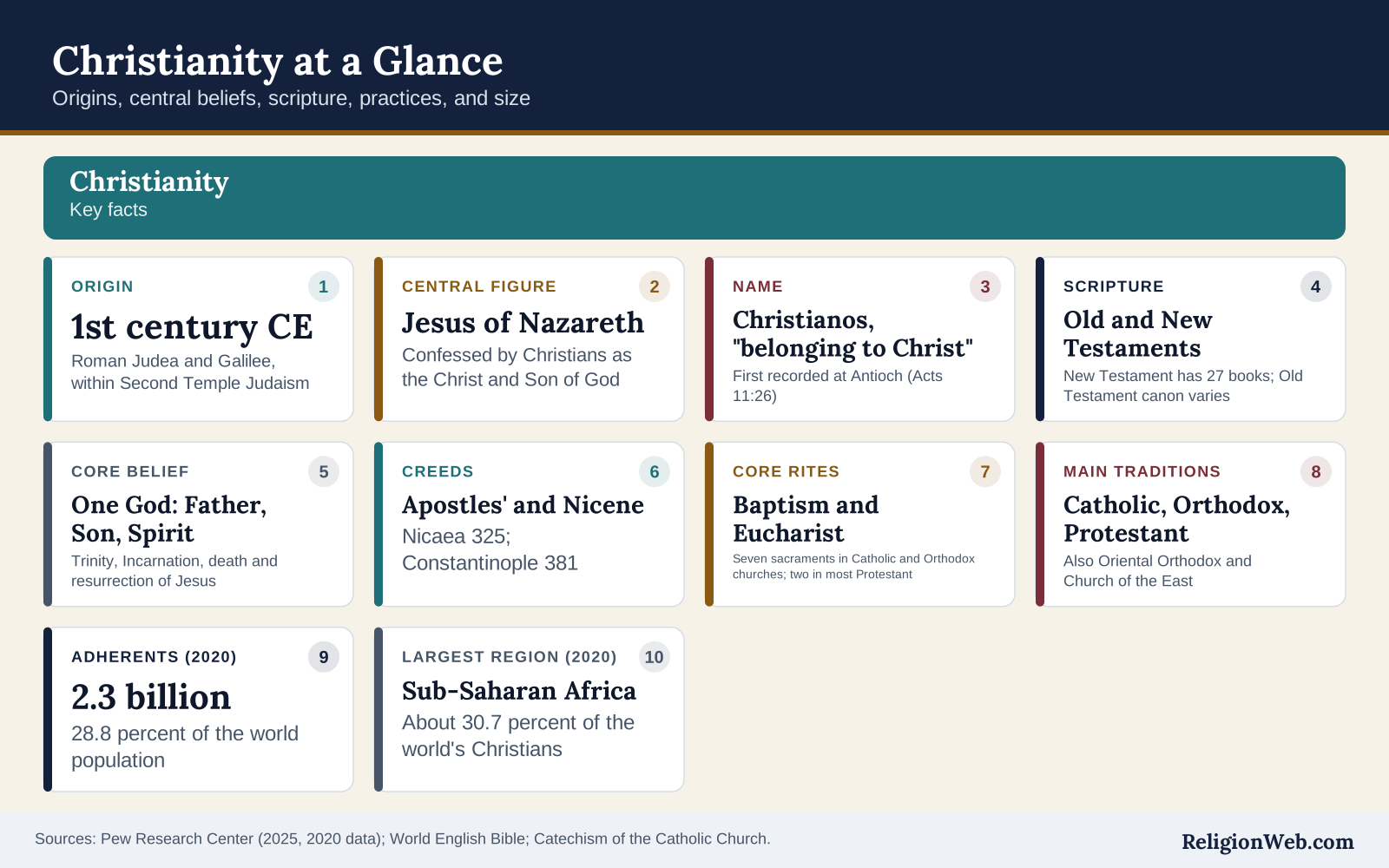
Christianity is a religion centered on Jesus of Nazareth, whom Christians confess as the Christ (the Greek rendering of the Hebrew word mashiach, “Messiah,” meaning “anointed one”), the Son of God, and the savior of humanity. It began in the first century CE among Jewish followers of Jesus in Roman-ruled Galilee and Judea, and it grew over the following two thousand years into a global family of traditions. In 2020 Pew Research Center counted about 2.3 billion Christians, or 28.8 percent of the world’s population, making Christianity the largest religion by number of adherents.
What holds this family together is easier to describe than what divides it. Nearly all Christians affirm that there is one God, that God is made known in Jesus Christ, that Jesus was crucified and, in Christian belief, raised from the dead, and that his followers are joined to him through baptism and a communal life of worship. Most also read the Bible as sacred Scripture and confess the Trinity: the teaching that the one God exists as Father, Son, and Holy Spirit. Beyond that shared core, the picture becomes more complicated. Catholic, Eastern Orthodox, Oriental Orthodox, Protestant, and many independent churches differ on authority, the sacraments, the shape of the Bible, church government, and the calendar, and no single institution speaks for all Christians.
This article treats Christianity as a historian of religion or a museum curator might: it describes what Christians believe in their own words, separates historical evidence from theological conviction, and names the tradition whenever teachings differ. It follows the story from the Jewish world of the first century through the councils of the Roman Empire, the separations of the Middle Ages and Reformation, the missionary expansion of the modern era, and the shift of the Christian population toward Africa, Latin America, and Asia. It also explains how Christians worship, pray, mark the year, and live, and it clears away several common misunderstandings.
Four larger traditions each have their own detailed article on this site: Catholic Christianity, Eastern Orthodox Christianity, Oriental Orthodox Christianity, and Protestant Christianity. This page is the map that places them in relation to one another and to the whole.
Christianity at a Glance: Definition, Origins, Geography, and Vocabulary
What Christianity Is and How It Is Defined
A working definition
In the broadest sense, a Christian is a person who identifies with the movement that traces itself to Jesus of Nazareth and who professes faith in him as Lord and Savior. The English word comes from the Greek Christianos, “belonging to Christ,” a label first attached to the followers of Jesus in the city of Antioch within roughly a decade or two of his death. Christos, in turn, translates the Hebrew mashiach, the anointed figure whom many Jews of the period expected to restore Israel. For Christians, “Christ” is therefore both a title and a claim: Jesus is the anointed one, and his life, death, and resurrection are the center of God’s dealings with the world.
Definitions used by churches tend to be stricter than definitions used by census takers. Many churches describe a Christian as someone who has been baptized in the name of the Father, the Son, and the Holy Spirit and who professes the faith of the church. Surveys, by contrast, usually rely on self-identification. That difference explains why the figure of 2.3 billion, which comes from a demographic study that counts people who identify as Christian, is larger than the number of people who attend services regularly or who are formal members of a congregation.
Self-description and outside classification
Christian communities describe themselves first in their own terms. Catholic teaching holds that the Church founded by Christ subsists in the Catholic Church, governed by the pope and the bishops in communion with him. Eastern Orthodox Christians understand their churches as the continuation of the apostolic church in unbroken faith and worship. Oriental Orthodox churches trace their lineage to the apostles and to the first three ecumenical councils. Protestant churches generally describe themselves as churches reformed according to Scripture, and many independent congregations see themselves simply as the church of Christ in a given place.
Scholars of religion use a wider lens. They count as Christian any community whose members identify with Christ and the Christian tradition, which produces a large and varied field. A few groups sit at the edges of that field and are classified differently by different observers. The Church of Jesus Christ of Latter-day Saints and Jehovah’s Witnesses identify as Christian, and Pew Research Center’s 2011 study counted them in a separate “other Christian” category. Many Nicene churches, which hold the Trinity and the creeds of the fourth century as the test of historic Christian orthodoxy, do not classify them within that tradition because they differ on matters such as the Trinity or the nature of Christ. This article records both positions without ruling between them.
Origins and Spread in Brief
A Jewish movement in the Roman world
Christianity emerged within Second Temple Judaism, the Jewish world of Judea and the Galilee in the centuries around the turn of the era. Jesus, his first disciples, and the earliest leaders of the movement were Jews who read the Hebrew Scriptures, observed Jewish festivals, and expected God to act decisively for Israel. What gave the new movement its distinct shape was the proclamation, beginning in Jerusalem within weeks of Jesus’ crucifixion, that God had raised him from the dead and made him Lord. Within a few decades that message had traveled along Roman roads and sea lanes to Syria, Asia Minor, Greece, Egypt, and Rome, and non-Jews were joining in large numbers. The sections on origins and historical development below take up that story in detail.
From a regional movement to a worldwide religion
The geography of Christianity has changed repeatedly. In the first four centuries the movement was strongest around the eastern Mediterranean, in cities such as Antioch, Alexandria, Ephesus, and Rome, and it reached beyond the Roman frontier into Mesopotamia, Armenia, and Ethiopia. During the Middle Ages the center of gravity divided between the Greek-speaking East and the Latin-speaking West, and Christianity took root among Slavic, Germanic, and Celtic peoples. From the sixteenth century, missionary activity and colonial networks carried it to the Americas, sub-Saharan Africa, South and East Asia, and the Pacific. A century ago a large majority of Christians lived in Europe and North America; today most live elsewhere.
Where Christians Live and How Many There Are
Global totals and the data behind them
The most recent comprehensive estimate comes from Pew Research Center’s 2025 report on the global religious landscape from 2010 to 2020. It found that the number of Christians rose by 122 million over the decade to reach about 2.3 billion, while their share of the world’s population slipped by 1.8 percentage points, to 28.8 percent, because the world’s population grew faster than the Christian population. Christians were a majority in 120 countries and territories in 2020, down from 124 in 2010, and the share of Christians fell below half in places such as the United Kingdom, Australia, France, and Uruguay. The report also found that, among adults who changed religion, Christianity lost far more people than it gained: for every adult who joined Christianity after being raised without a religion, about 3.1 left it. The overall total still grew, in large part because of population growth in regions such as sub-Saharan Africa.
Pew’s 2025 report counts Christians as a single group. For the breakdown into traditions, the most widely cited figures still come from Pew’s 2011 study, which used 2010 data. It estimated that about half of the world’s Christians were Catholic (roughly 1.1 billion), about 37 percent were Protestant under a deliberately broad definition that includes Anglicans and independent churches (about 801 million), about 12 percent were Orthodox (about 260 million), and just over 1 percent belonged to other groups. The Catholic Church publishes its own statistics: the Vatican’s 2026 Annuario Pontificio reported 1.422 billion Catholics in 2024, about 17.8 percent of the world’s population.
A changing map
According to the 2025 Pew report, sub-Saharan Africa now holds the largest share of the world’s Christians, about 30.7 percent, ahead of Latin America and the Caribbean at about 24 percent and Europe at about 22.3 percent. Vatican data show the same movement within Catholicism: in 2024 Africa accounted for 20.3 percent of Catholics and Europe for 20.1 percent, while the Americas held 47.7 percent. Brazil, the Philippines, and the Democratic Republic of the Congo are among the countries with the largest Catholic populations. Orthodox Christianity remains concentrated in Eastern Europe and the former Soviet Union, with major communities in Ethiopia, Egypt, Greece, Romania, and the Middle East. Protestant and independent Christianity is especially large in North America, sub-Saharan Africa, Brazil, and parts of East Asia.
| Topic | Summary |
|---|---|
| Central figure | Jesus of Nazareth, confessed by Christians as the Christ and Son of God; historians describe a Jewish teacher from Galilee executed under the Roman prefect Pontius Pilate |
| Origin | First century CE, in Roman Judea and Galilee, within Second Temple Judaism |
| Name | Greek Christianos, “belonging to Christ,” first recorded at Antioch (Acts 11:26) |
| Scripture | The Bible: an Old Testament (the Jewish Scriptures in Christian arrangement) and a New Testament of 27 books; the exact Old Testament canon differs by tradition |
| Key statements of faith | The Apostles’ Creed and the Nicene-Constantinopolitan Creed, used with different emphasis in different traditions |
| Defining practices | Baptism, the Eucharist or Lord’s Supper, prayer, Sunday worship (for most), and a yearly cycle centered on Easter and Christmas |
| Major traditions | Catholic, Eastern Orthodox, Oriental Orthodox, Church of the East, Protestant (including Anglican), and independent and Pentecostal churches |
| Adherents | About 2.3 billion in 2020, or 28.8 percent of the world’s people (Pew Research Center, 2025) |
| Largest regions | Sub-Saharan Africa (about 30.7 percent of Christians), Latin America and the Caribbean (about 24 percent), Europe (about 22.3 percent), 2020 |
| Leadership | Varies: bishops, priests, and deacons in episcopal churches; pastors, elders, and ministers in many others; the pope in the Catholic Church; patriarchs and synods in Orthodox churches |
Core Vocabulary for Reading About Christianity
Words about God, Christ, and salvation
A handful of technical terms recur in nearly every discussion of Christian belief. Trinity names the teaching that God is one being in three persons, a doctrine developed in the second to fourth centuries and set out in the creeds. Incarnation, from the Latin for “becoming flesh,” refers to the belief that the Son of God became human in Jesus. Gospel means “good news,” and it designates both the message of Jesus and the four New Testament books (Matthew, Mark, Luke, and John) that narrate his life. Salvation and grace refer to what Christians believe God accomplishes for humanity through Christ and to the unearned character of that gift, though traditions differ in how they describe the way grace operates.
Words about the church, worship, and authority
The English word church can mean a building, a local congregation, a denomination, or the whole community of believers, and context decides. The Greek word behind it, ekklesia, means “assembly.” Sacrament, used by Catholic, Anglican, and many Protestant churches, and holy mystery, the usual Eastern term, refer to rites through which Christians believe God’s grace is conveyed; some traditions prefer the word ordinance for rites they regard as commands of Christ rather than channels of grace. Liturgy means a set pattern of public worship. A creed is a formal statement of belief, and the canon is the list of books accepted as Scripture. The table below gathers these terms and a few more.
| Term | Origin of the word | Meaning in Christian use |
|---|---|---|
| Christ | Greek Christos, translating Hebrew mashiach | “Anointed one”; the title Christians give Jesus |
| Trinity | Latin trinitas | One God in three persons: Father, Son, and Holy Spirit |
| Incarnation | Latin in carne, “in flesh” | The belief that the Son of God became human in Jesus |
| Gospel | Greek euangelion, “good news” | The message of Jesus; also the four narratives of his life |
| Church | Greek ekklesia, “assembly” | The community of believers, a congregation, a denomination, or a building |
| Eucharist | Greek eucharistia, “thanksgiving” | The ritual meal of bread and wine; also called Communion, the Lord’s Supper, or the Divine Liturgy |
| Sacrament or mystery | Latin sacramentum; Greek mysterion | A rite understood as a means or sign of divine grace; the number and meaning vary by tradition |
| Creed | Latin credo, “I believe” | A formal summary of faith, such as the Nicene Creed |
| Canon | Greek kanon, “rule” or “measure” | The authoritative list of biblical books |
| Apostolic succession | Greek apostolos, “one sent” | The doctrine that bishops stand in a line of ordination from the apostles |
| Liturgy | Greek leitourgia, “public service” | A prescribed form of public worship |
| Catholic (lowercase) | Greek katholikos, “according to the whole” | Universal; used in the creeds of the whole church, and also the name of a specific communion |
What Christians Believe: God, Christ, Salvation, and the Church
Christian belief is usually summarized in creeds, short statements recited in worship and used to teach new believers. Two are in nearly universal use among churches that employ creeds at all. The Apostles’ Creed, which despite its name was not composed by the apostles, grew out of a baptismal confession used in Rome and reached roughly its present form in the early Middle Ages. The Nicene-Constantinopolitan Creed, commonly called the Nicene Creed, is rooted in the Council of Nicaea of 325 and was finalized at the Council of Constantinople in 381. Where the creeds are silent, Christians often differ, and some traditions, such as the Quakers and many Baptist and Pentecostal congregations, do not use creeds in worship at all. The beliefs described here are the ones that most Christian traditions share, with differences named as they arise.
God as One and Three
One God in three persons
Christians inherit from the Hebrew Scriptures the conviction that there is one God, the creator of heaven and earth, who is just and merciful and who enters into covenant with people. The distinctively Christian teaching is that this one God is eternally Father, Son, and Holy Spirit. The word Trinity does not appear in the Bible, but the New Testament speaks of the three together, most famously in the baptismal commission that closes the Gospel of Matthew.
Go and make disciples of all nations, baptizing them in the name of the Father and of the Son and of the Holy Spirit, teaching them to observe all things that I commanded you.
Gospel of Matthew 28:19–20a, World English Bible (Classic edition, public domain)
Christian theology reads this formula as naming one divine “name” (singular) that is shared by three persons. The Greek and Latin terms later used to express this, ousia or substantia for what the three share and hypostasis or persona for what distinguishes them, were attempts to say that God is neither three gods nor a single person wearing three masks. Christian teaching presents the Trinity as a mystery to be confessed and contemplated, not a puzzle to be fully solved. Each tradition describes God’s nature in its own idiom, but the claim is the same: the God who made the world is the God revealed in Jesus and present through the Spirit.
How the doctrine took shape
The Trinity was not defined in a single moment. The earliest Christians prayed to the Father, confessed Jesus as Lord, and experienced the Spirit in their communities, and for several generations they described these relationships without a technical vocabulary. The Latin writer Tertullian, in the early third century, was among the first to use the word trinitas and to speak of one substance shared by three persons. The decisive controversy came in the early fourth century, when the Alexandrian priest Arius taught that the Son, though supremely exalted, was a created being. The Council of Nicaea rejected that view and affirmed that the Son is homoousios with the Father, a Greek term usually rendered “of the same substance” or “of one being.” The Council of Constantinople in 381 extended the creed’s language about the Holy Spirit, and the Cappadocian Fathers, Basil of Caesarea, Gregory of Nazianzus, and Gregory of Nyssa, gave the doctrine its enduring theological form.
Eastern and Western Christians later parted over a single phrase. The creed as finalized in 381 says that the Holy Spirit proceeds from the Father. Western churches added the Latin word Filioque, meaning “and from the Son,” a phrase that appeared in Spain in the sixth century and was adopted in Rome in the early eleventh. Eastern Orthodox Christians regard the addition as made without the consent of the whole church and as obscuring the Father’s role as the source of divine life; Catholic and most Protestant teaching defends it as a legitimate expression of the same faith. Some groups that identify as Christian, including Unitarian churches, Jehovah’s Witnesses, and Latter-day Saints, do not hold the Nicene doctrine of the Trinity, and the question of whether they fall within historic Christianity is one of the sharper points of classification discussed above.
Jesus Christ: Incarnation, Cross, and Resurrection
The Incarnation
At the center of Christian faith stands the claim that in Jesus of Nazareth God became human. The prologue of the Gospel of John expresses it in terms that shaped centuries of theology.
The Word became flesh and lived among us. We saw his glory, such glory as of the only born Son of the Father, full of grace and truth.
Gospel of John 1:14, World English Bible (Classic edition, public domain)
“The Word” translates the Greek Logos, which John identifies with the one through whom all things were made. The church spent the fourth and fifth centuries working out how Jesus could be fully divine and fully human. The Council of Chalcedon in 451 declared that Christ is one person in two natures, divine and human, which are united without confusion, change, division, or separation. Catholic, Eastern Orthodox, and most Protestant churches accept this definition. The Oriental Orthodox churches did not accept the Chalcedonian formula and instead confess one united nature of the incarnate Word, a position often called miaphysite. Modern dialogues, including joint declarations between the Catholic Church and the Coptic and Syriac Orthodox churches in 1973 and 1984, have concluded that the differences are largely a matter of terminology and not of substance, though the churches remain separate in communion. For Mary’s role in this teaching, see the discussion of Christian figures below; the title Theotokos, “God-bearer,” affirmed at the Council of Ephesus in 431, was meant first of all to safeguard the unity of Christ’s person.
The cross, the resurrection, and the hope of return
Christian teaching holds that Jesus was crucified under Pontius Pilate, died, and was buried, and that on the third day God raised him from the dead. The resurrection is the foundation of the faith: churches mark every Sunday and, above all, the yearly feast of Easter in its honor. What the cross accomplished has been explained in several ways, and no single explanation has been made binding on all Christians. Early Christian writers spoke of Christ’s victory over death and the powers of evil. The medieval theologian Anselm of Canterbury, around 1098, described the cross as the satisfaction of a debt of honor owed to God. Reformation theologians, especially in the Reformed tradition, emphasized Christ bearing the penalty for human sin in place of sinners. Eastern Christianity tends to stress the healing of human nature and its restoration to communion with God. Others emphasize the cross as the supreme demonstration of divine love meant to transform human hearts.
The creeds also confess that Christ ascended to heaven and will come again to judge the living and the dead. Christians differ about the timing and shape of that return, but the expectation gives Christian worship its forward-looking character, expressed in the Eucharist, which in Paul’s words proclaims the Lord’s death “until he comes” (1 Corinthians 11:26, World English Bible).
Humanity, Sin, and Salvation
Creation, human dignity, and sin
Christian anthropology begins with the first chapter of Genesis: human beings are made in the image of God, and creation is good. It continues with the conviction that human life is marked by sin, a turning away from God and from one another that affects individuals, communities, and structures. In the Western tradition, the fifth-century bishop Augustine of Hippo shaped the doctrine of original sin, the teaching that all people inherit a condition of alienation from God that they cannot overcome on their own; Catholic, Lutheran, Reformed, and many other churches build on it in different ways. Eastern Orthodox theologians generally emphasize instead the inheritance of mortality and corruptibility from Adam, while holding that each person remains responsible for his or her own sins. Both emphases agree that human beings need divine help and that Christ provides it.
Grace, faith, and the shape of salvation
How salvation is received is the topic on which Christian traditions differ most visibly. Catholic teaching holds that justification is the gift of God’s grace, received first in baptism and nourished through faith, the sacraments, and works of charity animated by love; the Council of Trent set out this position in 1547. Lutheran churches, following Martin Luther, teach that a person is justified before God by grace through faith alone, with good works following as the fruit of faith. Reformed churches, shaped by John Calvin, add a strong emphasis on God’s sovereignty and election. Methodist and many other evangelical traditions emphasize a personal response to grace and growth in holiness. Eastern Orthodox and Oriental Orthodox churches speak of salvation as theosis or deification, the gradual participation of the human person in the life of God. In 1999 the Catholic Church and the Lutheran World Federation signed a Joint Declaration on the Doctrine of Justification stating that the remaining differences in language and emphasis need not divide the churches, a statement later affirmed by the World Methodist Council and other Christian bodies.
The Holy Spirit, the Church, and the Last Things
The Spirit and the community of faith
Christians understand the Holy Spirit as God present and active in the world, in Scripture, in the sacraments, and in the lives of believers. The New Testament connects the Spirit’s outpouring with the day of Pentecost, when, according to the Book of Acts, the disciples in Jerusalem began to proclaim the gospel in many languages. The church, in Christian belief, is the community gathered and sustained by the Spirit. The Nicene Creed describes it with four marks: one, holy, catholic, and apostolic. How those marks are realized is where traditions diverge. Catholic and Orthodox teaching locates unity and apostolicity in the historic episcopate and in sacramental communion. Protestant churches generally locate them in the preaching of the gospel and the right administration of the sacraments, and many distinguish between a visible church of local congregations and an invisible church known to God alone.
Resurrection, judgment, and eternal life
Christian teaching about the end of life and history centers on hope in the resurrection of the dead and the life of the world to come. Most traditions teach that each person will be judged by God and that the faithful will share in eternal communion with God, often called heaven. Beyond that, the teaching varies. Catholic doctrine includes purgatory, a state of purification for those who die in God’s friendship but are not yet fully ready for heaven. Eastern Orthodox churches pray for the dead but do not adopt the Latin doctrine of purgatory. Most Protestant churches teach that believers enter God’s presence at death without an intermediate purification. On the possibility of final separation from God, mainstream teaching in all major traditions affirms that such a state is possible, while a minority of Christian thinkers across history, from Origen and, in some readings, Gregory of Nyssa to modern theologians, have argued that God’s love will ultimately reconcile all. Christians also hold differing views about a future thousand-year reign of Christ (the millennium) described in the Book of Revelation, an area where interpretation has produced long-standing disagreements, including within Protestantism.
Creeds, confessions, and catechisms
Beliefs are carried in different kinds of documents. The creeds belong to the whole church, or to large parts of it, and are recited in worship: the Nicene Creed in the Eucharistic liturgies of Catholic, Orthodox, Anglican, and Lutheran churches, the Apostles’ Creed in Western baptismal rites and many Protestant services. Protestant churches also produced confessions of faith during and after the Reformation, such as the Lutheran Augsburg Confession of 1530, the Reformed Heidelberg Catechism of 1563, the Thirty-Nine Articles of the Church of England (1571), and the Westminster Confession of 1646, which define the teaching of particular communions. The Catholic Church sets out its teaching in the Catechism of the Catholic Church, promulgated in 1992, while Orthodox churches rely on the creed, the decrees of the seven ecumenical councils, the liturgical texts, and the writings of the Church Fathers. Disputes over the wording of these texts produced some of the most painful divisions in church history, which is why the same few sentences recur in so many Christian conversations about unity.
Origins: Jesus, the Apostles, and the First Christians
Historians can reconstruct the beginnings of Christianity from a small body of evidence: the letters of Paul, the four Gospels, the Book of Acts, a few later Christian writings, and brief references by non-Christian authors. The evidence is rich enough to establish the outline of events and thin enough to leave many questions open. This section separates what most historians conclude from what Christian tradition affirms by faith, and it uses the second category only with attribution.
The World of Jesus
Second Temple Judaism under Roman rule
Jesus lived in the Galilee and Judea during the early first century CE, when the region was ruled from Rome. The Romans had installed Herod the Great as client king, and after his death in 4 BCE his sons governed parts of the territory while Judea itself came under Roman prefects. Pontius Pilate held that office from about 26 to 36 CE, and an inscription found at Caesarea Maritima in 1961 gives him the title “prefect,” the term that Roman writers such as Tacitus rendered as “procurator.” The center of Jewish religious life was the Temple in Jerusalem, served by priests and visited by pilgrims at Passover, Pentecost, and Tabernacles. Alongside it stood the synagogue, the Torah, and a lively range of movements: Pharisees who emphasized careful interpretation of the law, Sadducees associated with the Temple aristocracy, Essenes who withdrew to communities such as the one at Qumran, and popular prophets and teachers.
Many Jews of the period hoped for God to restore Israel, and some expected a messiah, an anointed king or deliverer, although the term was understood in several ways. Jesus and his first followers spoke Aramaic, read the Scriptures in Hebrew and Greek, and saw themselves as part of this world. Understanding that setting is essential, because many Christian terms, from Messiah and kingdom of God to covenant and resurrection, come from it. The tradition that grew from these roots is described at greater length in the article on Judaism.
What historians can say about Jesus
Almost all historians of antiquity accept that Jesus of Nazareth existed, that he was baptized by John the Baptist, that he taught and gathered disciples in the Galilee, and that he was crucified in Jerusalem under Pontius Pilate. Outside the New Testament, the Roman historian Tacitus, writing around 116 CE, reports that “Christus” was executed under Tiberius by Pilate and that his followers were blamed for the great fire at Rome in 64. The Jewish historian Josephus mentions Jesus twice in his Antiquities of the Jews: a disputed passage that most scholars think preserves a Josephan core overlaid with later Christian additions, and a brief reference to James as “the brother of Jesus who was called Christ.” Most scholars place Jesus’ birth between about 6 and 4 BCE and his death in either 30 or 33 CE.
Beyond that outline, historians disagree about how much of the Gospel narratives records events and how much reflects the later faith of the communities that wrote them. The question of historical method is distinct from the question of faith. Christians confess that Jesus is the Son of God and that he rose from the dead; those are theological claims that history, which works with ordinary evidence and probabilities, neither establishes nor excludes. Historians instead ask what the sources show about Jesus’ teaching, about the movement he founded, and about why his followers came to proclaim him as risen.
The Earliest Communities
Jerusalem and the proclamation of the resurrection
The earliest Christian writings are the letters of Paul, written in the 50s CE, and in one of them he quotes a summary of the message that he says he had received from others, probably within a few years of Jesus’ death.
For I delivered to you first of all that which I also received: that Christ died for our sins according to the Scriptures, that he was buried, that he was raised on the third day according to the Scriptures, and that he appeared to Cephas, then to the twelve.
1 Corinthians 15:3–5, World English Bible (Classic edition, public domain)
Many historians regard this passage as one of the oldest surviving Christian formulations. It shows that belief in Jesus’ resurrection, in the sense of appearances to Peter (here called by his Aramaic name Cephas) and the Twelve, was part of the movement from the start. According to the Book of Acts, the community in Jerusalem, led first by Peter and then by James, the brother of Jesus, gathered for prayer and the breaking of bread, shared its goods, and continued to worship in the Temple. Acts records the descent of the Holy Spirit at Pentecost, the speech of Peter, and the growth of the group to include Greek-speaking Jewish believers. The stoning of one of them, Stephen, and the persecution that followed scattered some believers to Judea, Samaria, Phoenicia, Cyprus, and Syria.
Paul and the mission beyond Israel
Paul of Tarsus, a Greek-speaking Jew and a Pharisee who had at first opposed the movement, reports that he encountered the risen Christ and became its most influential missionary. His seven undisputed letters, among them Romans, 1 and 2 Corinthians, Galatians, Philippians, 1 Thessalonians, and Philemon, are the earliest New Testament documents, with 1 Thessalonians usually dated around 50 CE. Paul worked mainly in the cities of Asia Minor and Greece, founding small communities of believers that met in homes, and he insisted that non-Jews could join without first becoming Jewish proselytes.
That question was settled, according to Acts 15 and Paul’s letter to the Galatians, at a meeting in Jerusalem around 48 to 50 CE, where leaders agreed that non-Jewish believers need not undergo circumcision or observe the whole Torah, while keeping certain basic moral and ritual norms. The decision changed the movement’s character: within a generation, most members were no longer Jews. Early writers such as Clement of Rome speak of the deaths of Peter and Paul, and Roman tradition places both in Rome in the 60s CE, probably during the persecution under Nero, though the details rest on later sources.
The Name, the Writings, and the Parting of the Ways
Antioch and the name “Christian”
Syrian Antioch, on the Orontes River in what is now southern Turkey, was the third-largest city of the Roman Empire and the base for the earliest large-scale mission to non-Jews. It was there, according to the Book of Acts, that the believers acquired the name by which the movement is still known.
The disciples were first called Christians in Antioch.
Acts of the Apostles 11:26, World English Bible (Classic edition, public domain)
The verse comes in a passage describing how believers who had left Jerusalem began telling the message to Greek speakers in Antioch, how the Jerusalem church sent Barnabas to encourage them, and how Barnabas brought Paul from Tarsus to teach there for a year. In the setting of Antioch, a cosmopolitan city with a large Jewish population, the new name marked the group as something recognizably distinct, and it is the starting point for the later history of the word.
The writing of the New Testament and other early texts
Christian writing began with letters and moved on to narratives. After Paul’s letters, the Gospel of Mark is usually dated to the years around the destruction of the Temple in 70 CE. Matthew and Luke, which draw on Mark and on another shared source, are commonly dated to the 80s or 90s, and John to the late first century. Luke wrote a second volume, the Acts of the Apostles, and other early writings include letters attributed to Peter, James, John, and Jude and the Book of Revelation. Alongside them circulated texts that did not enter the New Testament, such as the Didache, a short manual of community life, and 1 Clement, a letter from the church in Rome to the church in Corinth, usually dated around 96 CE. The process by which some of these writings came to be treated as Scripture is discussed in the section on the Bible.
The gradual parting of the ways
For several decades, the followers of Jesus were part of Jewish life. The Roman suppression of the Jewish revolt, culminating in the destruction of the Jerusalem Temple in 70 CE, reshaped both Judaism and the Jesus movement, as the Temple ceased to be the center of worship and leadership passed to the rabbinic movement among Jews and to a predominantly non-Jewish church among Christians. Most historians today describe the separation as a process that unfolded unevenly over a century or more, differing from city to city, with some people, such as Jewish followers of Jesus who kept the Torah, living at the boundary for generations. Later hostility between the two communities, including Christian polemic against Jews, is a historical reality that churches have increasingly acknowledged and repudiated in modern times.
Early Christianity: Persecution, Councils, and Expansion (c. 100 to 800 CE)
Between the death of the last apostles and the coronation of Charlemagne in 800, Christianity changed from a small, intermittently suspect movement into the dominant religion of the Roman and Byzantine world, and it simultaneously took root far beyond the empire’s borders. Most of the structures that Christians still use were formed in this period: the threefold ministry of bishop, priest, and deacon, the New Testament canon, the major creeds, monasticism, and the liturgical year.
Growth and Persecution in the Roman Empire
Communities, bishops, and the defense of the faith
In the second and third centuries, Christian communities spread along the trade routes of the Mediterranean, concentrated in cities. They were led by bishops, assisted by presbyters (the origin of the word “priest”) and deacons, a pattern already visible in the letters of Ignatius of Antioch. A Roman governor, Pliny the Younger, wrote to the emperor Trajan around 112 CE about Christians in northern Asia Minor who met on a fixed day before dawn, sang a hymn to Christ, and bound themselves by oath to live honestly. His letter, and Trajan’s reply advising that Christians should not be hunted out but should be punished if they were denounced and refused to honor the Roman gods, shows both how ordinary the new movement could look to an official and how precarious its legal position was.
Christian writers of the period addressed two audiences. Apologists such as Justin Martyr, who was executed in Rome around 165 CE, explained the faith to educated outsiders in the language of Greek philosophy. Teachers such as Irenaeus of Lyons, Tertullian of Carthage, Clement of Alexandria, and Origen of Alexandria also worked to define Christian teaching against competing interpretations, including the movement of Marcion, who rejected the Old Testament, and various Gnostic groups, whose texts, some of them rediscovered at Nag Hammadi in Egypt in 1945, taught that salvation came through secret knowledge. In response, churches stressed the apostolic succession of their bishops, the public “rule of faith” taught at baptism, and an emerging list of authoritative writings.
Persecution and martyrdom
Christians suffered persecution in the Roman world, but its character should be described precisely. For much of the second and third centuries it was local and sporadic, arising from the actions of governors or from outbreaks of popular hostility, and it focused on the refusal of Christians to take part in sacrifices to the gods and to the emperor. The first major action against Christians in Rome followed the great fire of 64 CE under Nero. The first empire-wide measure came under the emperor Decius, who in 249 or 250 ordered all inhabitants to offer sacrifice and obtain a certificate to prove they had done so. The last and most severe wave, the Great Persecution, began under Diocletian in 303, with the destruction of churches, the seizure of Scriptures, and the arrest of clergy, and ended in the Eastern provinces only around 311 to 313.
Those who died for their faith were honored as martyrs, a Greek word meaning “witnesses,” and their burial places became centers of prayer and pilgrimage, which is the origin of the Christian veneration of saints. The persecutions also left internal wounds. When the storm passed, communities debated whether Christians who had handed over Scriptures or offered sacrifice under pressure could be readmitted, a controversy that produced the rigorist movement of Novatian in the third century and the Donatist schism in North Africa in the fourth.
The Imperial Church and the Great Councils
From toleration to favor
The turning point came in the early fourth century. In 311 the emperor Galerius, who had been one of the architects of the Great Persecution, issued an edict of toleration. After Constantine’s victory at the Milvian Bridge in 312, an event that Constantine and the Christian historian Eusebius of Caesarea later interpreted as the work of the Christian God, he and the eastern emperor Licinius agreed in 313 on a policy, known as the Edict of Milan, that granted freedom of worship to Christians and everyone else and restored confiscated church property. Constantine went on to fund church buildings, including the Church of the Holy Sepulchre in Jerusalem, dedicated in 335, and in 330 he dedicated the new capital of Constantinople. He was baptized only shortly before his death in 337.
By the end of the century, Christianity had moved from toleration to preference. In 380 the emperor Theodosius I issued an edict, often called the Edict of Thessalonica, directing his subjects to follow the faith of the bishops of Rome and Alexandria, which in effect made Nicene Christianity the religion of the empire. Historians emphasize that this process took generations and was never simple: many people continued to practice traditional Roman and local religion for a long time, and the relationship between church and imperial power brought both protection and entanglement that Christians have debated ever since.
Councils and the shaping of doctrine
Emperors who wanted stable unity convened councils of bishops to settle disputes. The First Council of Nicaea, held in 325 with some 250 to 300 bishops attending according to most modern estimates, condemned the teaching of Arius, issued the first form of the Nicene Creed, and addressed the date of Easter, with the aim of ending different local practices. The First Council of Constantinople in 381 reaffirmed Nicaea and completed the creed’s statements about the Holy Spirit. The Council of Ephesus in 431 affirmed that Mary can be called Theotokos and condemned the teaching of Nestorius, which many understood to separate Christ’s divine and human natures too sharply. The Council of Chalcedon in 451 defined Christ as one person in two natures.
These decisions did not end the arguments. Each council produced new separations, an outcome treated in more detail in the sections on Oriental Orthodox Christianity and the Church of the East below. The Eastern Orthodox Churches accept seven councils as ecumenical, ending with the Second Council of Nicaea in 787, which upheld the veneration of icons. The Catholic Church counts twenty-one, with the most recent being the Second Vatican Council in the twentieth century. The Oriental Orthodox churches accept the first three, and the Church of the East the first two.
Monasticism and the Church Fathers
As the persecutions ended, some Christians sought a new form of witness in withdrawal from ordinary society. Antony of Egypt, who died in 356 at a very old age, became the model of the desert ascetic, and Pachomius organized monks into communities with a shared rule in the early fourth century. Basil of Caesarea (died 379) wrote influential guidelines for monastic life in the Greek East, while John Cassian carried the desert tradition to Gaul, and Benedict of Nursia produced the Rule that shaped Western monasticism around 530. Monasteries became centers of prayer, hospitality, learning, and copying of manuscripts.
The same centuries produced the writers known as the Fathers of the Church. In the East they include Athanasius of Alexandria, the Cappadocians, and John Chrysostom, bishop of Constantinople, famous for his preaching. In the West, Ambrose of Milan, Jerome, who produced the Latin translation of the Bible known as the Vulgate around 382 to 405, and Augustine of Hippo, whose Confessions and City of God shaped Western theology, are the most influential. Their works remain a shared inheritance across traditions.
Christianity Beyond the Roman Empire
Armenia, Georgia, and Ethiopia
Christianity did not become a Mediterranean religion only. In Armenia, according to tradition, King Tiridates III was converted by Gregory the Illuminator in 301, which would make Armenia the first kingdom to adopt Christianity officially; many modern historians prefer a date around 314, and they describe the spread of the faith as gradual and uneven. The Armenian alphabet, created by Mesrop Mashtots in the early fifth century, was devised in order to translate the Bible, and the translation became a foundation of Armenian literature. Georgian tradition associates the conversion of its kings with the missionary Nino in the fourth century. In East Africa, King Ezana of the kingdom of Aksum accepted Christianity in the fourth century under the influence of the missionary Frumentius, whom Athanasius of Alexandria consecrated as bishop, and the Ethiopian Orthodox Tewahedo Church has remained a central institution of Ethiopian life since.
Syria, Persia, India, and China
In the Syriac-speaking world, Edessa became an early Christian center, and Ephrem the Syrian (died 373) composed hymns that are still sung. East of the Roman frontier, in the Sasanian Persian Empire, Christians organized a church under a catholicos at Seleucia-Ctesiphon. After the Council of Ephesus in 431, this Church of the East did not accept the condemnation of Nestorius, and it gradually became separate from the churches of the Roman Empire. Outsiders often called its members “Nestorians,” a label that the church itself rejects as inaccurate. Over the following centuries its missionaries carried Christianity across Central Asia. A Church of the East bishop named Alopen reached the Tang capital of Chang’an in 635, and a stone monument erected in 781, the Xi’an Stele, records the presence of Christians in China, written in Chinese with Syriac inscriptions. The Thomas Christians of southern India trace their origin to the apostle Thomas, a tradition that cannot be verified historically; there is reliable evidence of an established Christian community on the Malabar coast by the sixth century.
Egypt, Nubia, and North Africa
Alexandria was a leading intellectual center of early Christianity, and the Coptic language church grew rapidly in Egypt, where monasticism flourished. South of Egypt, the Nubian kingdoms of Nobatia, Makuria, and Alodia became Christian in the sixth century, and Makuria survived as a Christian state for several centuries. In North Africa, a strong Latin-speaking church produced Cyprian and Augustine, but it declined after the Arab conquests of the seventh century, while Coptic Christianity persisted in Egypt as a large minority and remains so today.
Christianity from the Middle Ages to the Present
The second half of Christian history is marked by division and by expansion. The medieval centuries saw the separation of the Greek East and Latin West, the conversion of northern and eastern Europe, and the construction of a Christian civilization that also produced conflict. The sixteenth century fractured Western Christianity, and the following centuries carried it across the oceans. The twentieth century brought a new geography and a new commitment to dialogue between churches.
The Medieval Centuries (c. 600 to 1500)
Byzantium, Islam, and the Eastern churches
In the 630s and 640s, Arab armies conquered Syria, Palestine, and Egypt, regions with large Christian populations. Under the rulers who followed, Christians and Jews generally retained their communities, clergy, and worship as protected minorities who paid a special tax and lived under restrictions that varied by time and place; Christian populations in the Middle East and Egypt remained large for centuries, and Coptic, Syriac, Armenian, and other churches have continued there to the present. The article on Islam describes this history from the Muslim side. The Byzantine Empire, centered on Constantinople, lost much of its territory but remained the heart of Greek-speaking Christianity. It endured a long dispute over images (iconoclasm) in the eighth and early ninth centuries, resolved in 843 when the veneration of icons was restored, an event the Orthodox Church commemorates every year on the first Sunday of Lent as the Triumph of Orthodoxy.
Byzantine missionaries took the faith to the Slavs. The brothers Cyril and Methodius, sent to Great Moravia in 863, developed an alphabet for the Slavic languages and translated Scripture and the liturgy. In 988, Prince Vladimir of Kyiv accepted baptism from Constantinople, an event that began the long Christian history of Rus’, the medieval state that is the ancestor of Ukraine, Belarus, and Russia in different ways.
Latin Christendom
In the West, missionaries and monks converted Germanic, Celtic, and later Scandinavian and Slavic peoples. Pope Leo III crowned Charlemagne as emperor on Christmas Day, 800, symbolizing the alliance between the papacy and the Frankish kingdoms. Reforming monastic orders, beginning with Cluny in 910, and the papal reform movement of the eleventh century aimed to free the church from control by lay rulers, setting the stage for conflicts such as the Investiture Controversy. The twelfth and thirteenth centuries saw the first universities, at Bologna, Paris, and Oxford, the construction of Gothic cathedrals, and the founding of mendicant orders, the Franciscans and Dominicans, whose members lived by preaching and begging. Thomas Aquinas (about 1225 to 1274) wrote the Summa Theologiae, a systematic work that became a foundation of Catholic theology.
The same period includes the Crusades, a series of military expeditions authorized by popes beginning in 1095, when Urban II called for aid to Byzantine Christians and for the recovery of Jerusalem. Crusader armies took Jerusalem in 1099 and killed many of its inhabitants. In the Rhineland in 1096, crusading bands massacred Jewish communities, and in 1204 the Fourth Crusade attacked and sacked Constantinople, a Christian city, an act that deepened Eastern resentment for centuries. Modern popes have expressed regret for the sack of Constantinople, and historians stress that the Crusades involved a range of motives, political and economic as well as religious.
The division of East and West
Relations between Greek and Latin Christianity deteriorated gradually. They disagreed about the Filioque, the authority of the bishop of Rome, and other customs and practices, and they were increasingly separated by language and politics. In 1054 a papal legate, Cardinal Humbert, and the Patriarch of Constantinople, Michael Cerularius, exchanged excommunications. Few at the time saw the event as the definitive break that later accounts made it, and the two churches continued to interact. The sack of 1204 and the failure of reunion councils at Lyons (1274) and Florence (1439) turned separation into a settled fact. Constantinople fell to the Ottoman Turks in 1453. In 1965, Pope Paul VI and Patriarch Athenagoras lifted the mutual excommunications of 1054 in simultaneous declarations, though the churches have not restored full communion.
Reformation and Catholic Renewal (1500s to 1648)
Luther, Zwingli, Calvin, and the radical reformers
By the fifteenth century, calls for reform of the Western church were widespread. The Western Schism (1378 to 1417), during which rival claimants held the papacy, had weakened confidence in church leadership. Reformers such as John Wycliffe and Jan Hus had criticized clerical wealth and called for vernacular Scripture, and the printing press, perfected in the 1450s, made texts of all kinds cheaper to circulate. In 1517 Martin Luther, a monk and professor in Wittenberg, circulated Ninety-Five Theses against the sale of indulgences, which were remissions of temporal penalties for sin. Tradition dates this to October 31. Luther’s insistence on justification by faith and the authority of Scripture alone led to his excommunication and to the Diet of Worms in 1521. Reform movements followed in Zurich under Huldrych Zwingli, in Geneva under John Calvin, whose Institutes of the Christian Religion appeared in 1536, and in other cities. Anabaptists, who began baptizing adults in Zurich in 1525, rejected infant baptism and the union of church and state, and were persecuted by both Catholic and Protestant authorities. In England, Henry VIII broke with Rome in 1534 over papal authority, and the English church developed a distinct identity that later became Anglicanism, which has its own article on Anglicanism.
Catholic reform, religious wars, and settlements
The Catholic Church responded by clarifying its teaching and reforming its practices. The Council of Trent (1545 to 1563) restated doctrines on Scripture, the sacraments, and justification and required better education of priests. New orders such as the Society of Jesus, approved in 1540, and new spiritual writers such as Teresa of Avila and Ignatius of Loyola renewed Catholic life and missionary zeal. Religious differences became entangled with dynastic and territorial conflicts: the Peace of Augsburg in 1555 allowed the rulers of the German states to choose between Catholicism and Lutheranism, the French Wars of Religion lasted from 1562 to 1598, and the Thirty Years’ War (1618 to 1648) devastated central Europe before the Peace of Westphalia. The divisions that emerged in these years, among Lutheran, Reformed, Anglican, Anabaptist, and Catholic communities, set the pattern for the forms of Western Christianity described in the article on Protestant Christianity and the article on Catholic Christianity.
Missions, Empire, and Modernity (1500s to 1800s)
Global expansion
The age of exploration carried Christianity across the oceans. Spanish and Portuguese ships brought Catholic priests, among them Franciscans and Jesuits, to Mexico, Peru, Brazil, Goa, Japan, and the Philippines, where the Catholic Church became established in the late sixteenth century. Matteo Ricci, a Jesuit, lived in China from 1583 and became a respected scholar at the imperial court. Russian Orthodox missionaries moved across Siberia and into Alaska in the 1790s. Protestant missions followed in the eighteenth and nineteenth centuries, beginning with the Moravian Church in 1732 and William Carey’s mission to India in 1793. Missionaries translated the Bible into hundreds of languages, and local catechists, teachers, and evangelists often did more than foreign missionaries to establish congregations, so that many African and Asian churches grew through indigenous leadership, sometimes in forms the missionaries had not planned.
Empire, slavery, and the moral questions
Christian history in this period includes episodes that churches have since acknowledged as grievous failures. European colonizers invoked Christianity to justify conquest, and Christians took part in the Atlantic slave trade and defended slavery with biblical arguments. Other Christians led the opposition: Quakers protested slavery in the seventeenth century, evangelical campaigners such as William Wilberforce helped bring about the British abolition of the slave trade in 1807 and of slavery in most of the empire in 1833, and African American churches became central institutions of resistance and community. In the twentieth century, church-run residential schools for Indigenous children in Canada and elsewhere caused lasting harm; Pope Francis apologized in Canada in July 2022, and in March 2023 two Vatican offices issued a statement repudiating the “doctrine of discovery” and affirming that it is not part of Catholic teaching.
Revival, Enlightenment, and the modern challenge
In the eighteenth century, revival movements in Europe and North America, including Pietism in Germany, the Methodist movement led by John and Charles Wesley in England, and the Great Awakenings in the American colonies, stressed personal conversion and emotional devotion. At the same time, Enlightenment thinkers criticized traditional authority, and nineteenth-century scholars applied historical methods to the Bible, a development that some churches welcomed and others resisted. The theory of evolution after 1859 prompted debates that continue among Christians in different forms. The Catholic Church defined papal infallibility at the First Vatican Council in 1870, and Pope Leo XIII’s encyclical Rerum Novarum (1891) began the modern tradition of Catholic social teaching in response to industrial labor conditions.
Christianity Since 1900
Pentecostalism and the shift to the Global South
The twentieth century changed the geography of Christianity. The Pentecostal movement, which emphasizes the gifts of the Holy Spirit such as speaking in tongues and healing, took shape in the early 1900s, with the Azusa Street revival in Los Angeles in 1906 as a key moment, and spread quickly across Latin America, Africa, and Asia. The Center for the Study of Global Christianity estimated, in figures cited by Pew Research Center for 2010, about 279 million Pentecostals and 305 million charismatic Christians in other churches, though the categories overlap. At the same time, the churches of Africa grew from a small base to a majority-Christian presence in many countries, and African initiated churches formed that combine local culture with Christian worship. In East Asia, South Korea became home to many large Protestant churches, and Christianity in China grew in registered and unregistered congregations, although reliable numbers are hard to obtain.
War, totalitarianism, and persecution
The twentieth century was also a time of great suffering for Christians. Beginning in 1915, the Ottoman government deported and killed large numbers of Armenians, Assyrians, and other Christians, events that most scholars of genocide and many governments describe as genocide and that the Turkish state disputes. After the Russian Revolution of 1917, the Soviet state closed churches and killed or imprisoned many clergy and laypeople, and similar campaigns affected Christians in other communist states. In Nazi Germany, the Confessing Church issued the Barmen Declaration in 1934 rejecting state control of the church, and the pastor Dietrich Bonhoeffer was executed in 1945 for his part in the resistance. The Holocaust forced many churches to examine the long history of Christian hostility toward Jews: the Second Vatican Council’s declaration Nostra Aetate in 1965 rejected antisemitism, and many Protestant bodies issued similar statements. Christians also stood on both sides of moral struggles, as with the Dutch Reformed Church’s early theological defense of apartheid in South Africa and the leadership of Archbishop Desmond Tutu and others against it, and the role of Black churches in the American civil rights movement under leaders such as the Baptist minister Martin Luther King Jr.
Ecumenism and the present
Alongside division, the twentieth century produced a movement to restore unity. The World Missionary Conference in Edinburgh in 1910 is often seen as its starting point, and the World Council of Churches was founded in Amsterdam in 1948. Today it counts 356 member churches representing more than 580 million Christians; the Catholic Church is not a member but participates in its work. The Second Vatican Council (1962 to 1965) renewed Catholic worship, permitted the Mass in local languages, and affirmed that other Christian communities possess genuine elements of sanctification and truth. In 1999, Catholics and Lutherans signed the Joint Declaration on justification. The Orthodox world faces its own strains: in January 2019 the Ecumenical Patriarchate granted autocephaly (self-governing status) to the Orthodox Church of Ukraine, a step the Russian Orthodox Church rejects. In late 2025, Pope Leo XIV, elected in May 2025 as the first pope from the United States, traveled to Türkiye for an ecumenical commemoration of the 1,700th anniversary of the Council of Nicaea, with Ecumenical Patriarch Bartholomew I and representatives of other Christian communions.
| Date (CE) | Event | Why it matters |
|---|---|---|
| c. 30 or 33 | Crucifixion of Jesus under Pontius Pilate | The event on which Christian proclamation of the resurrection is based |
| c. 48 to 50 | Jerusalem meeting on non-Jewish believers | Opened the church to non-Jews without full observance of the Torah |
| c. 50 to 100 | Earliest letters, then the Gospels, are written | Origin of the New Testament writings |
| 70 | Destruction of the Jerusalem Temple | Reshaped both Judaism and the Jesus movement |
| 303 to 313 | Great Persecution, then Edict of Milan | From the last empire-wide persecution to legal toleration |
| 325 | Council of Nicaea | First empire-wide council; first form of the Nicene Creed |
| 367 | Athanasius lists the 27 New Testament books | Earliest known list identical to the later New Testament |
| 381 and 451 | Councils of Constantinople and Chalcedon | Completed Trinitarian doctrine; defined Christ’s two natures; produced lasting separations |
| 635 and 781 | Church of the East reaches Tang China; Xi’an Stele erected | Evidence of Christianity across Asia before 800 |
| 800 | Charlemagne crowned emperor in Rome | Symbol of the Latin West’s new political order |
| 1054 | Mutual excommunications of Rome and Constantinople | Traditional date for the East-West division |
| 1517 to 1555 | Luther, Calvin, Henry VIII; Peace of Augsburg | Beginning of the Protestant Reformation and its political settlements |
| 1545 to 1563 | Council of Trent | Catholic clarification of doctrine and reform |
| 1906 | Azusa Street revival | An early center of the Pentecostal movement |
| 1948 | World Council of Churches founded | Institutional expression of the ecumenical movement |
| 1962 to 1965 | Second Vatican Council | Renewal of Catholic worship and ecumenical engagement |
| 2025 | 1,700th anniversary of Nicaea; election of Pope Leo XIV | Recent moments of ecumenical memory and Catholic leadership |

The Christian Bible: Contents, Canon, and Authority
The Bible is the Scripture of the Christian church, read aloud in worship, studied in homes and seminaries, and quoted in every theological argument. The word comes from the Greek ta biblia, “the books,” and the name is accurate: the Bible is a library of writings in Hebrew, Aramaic, and Greek, composed by many authors over roughly a thousand years, and gathered into a single volume only after centuries of use. Christians describe it as inspired by God, but they differ over how inspiration works, which books belong, and how Scripture relates to the church’s tradition.
What the Christian Bible Contains
The Old Testament
The first part of the Christian Bible is the Old Testament, the Scriptures of ancient Israel that Jesus and his first followers read. Christians arrange these writings differently from the Hebrew Bible, or Tanakh, whose three parts are Torah, Prophets, and Writings. The Christian order follows the Greek translation known as the Septuagint, produced by Jewish translators in Alexandria beginning around the third century BCE, and groups the books as law, history, wisdom and poetry, and prophecy, ending with the prophets so as to point forward to the New Testament. Christians read the Old Testament as the story of God’s dealings with Israel and as the background of Christ; Catholic teaching, for instance, states that the books of the Old Testament are divinely inspired and keep their permanent value. Jewish interpretation, described in the article on Judaism, proceeds on its own terms.
The New Testament
The New Testament contains twenty-seven books in the canons of nearly all churches. They include the four Gospels (Matthew, Mark, Luke, and John), which narrate the life, teaching, death, and resurrection of Jesus, and the Acts of the Apostles, a history of the early church. Twenty-one letters follow: thirteen attributed to Paul, the Letter to the Hebrews, and seven shorter letters traditionally attributed to James, Peter, John, and Jude. The collection closes with Revelation, an apocalyptic work. Scholars debate the authorship of several of these books, and the question of which Pauline letters Paul wrote himself is a major topic of modern biblical studies; the traditions that hold the New Testament as Scripture do so for what the books are in the church’s use and not only for who wrote them.
How the Canon Took Shape
The Old Testament in different traditions
The word canon refers to the books accepted as Scripture. Christian traditions do not agree on the full list of Old Testament books. Protestant churches follow the Hebrew canon of thirty-nine books, as divided in Christian Bibles, and regard the additional writings found in the Septuagint as the Apocrypha, useful for reading but not a basis for doctrine. The Catholic Church, whose Catechism counts forty-six Old Testament books and twenty-seven New Testament books, includes the so-called deuterocanonical books, among them Tobit, Judith, Wisdom, Sirach, Baruch, and 1 and 2 Maccabees, and formally affirmed this canon at the Council of Trent in 1546. The Eastern Orthodox Churches use the Septuagint tradition and accept these books and more, including 3 Maccabees, though Orthodox churches have no single pan-Orthodox list: Orthodox writers commonly note that the Eastern church was undecided about some of the extra books from the earliest times, and the 1672 Synod of Jerusalem, which affirmed a larger canon, was a regional gathering and not an ecumenical council. The Ethiopian Orthodox Tewahedo Church has a broader canon still, which includes books such as 1 Enoch and Jubilees, and counts of its books vary depending on how the books are divided.
The New Testament canon
The New Testament canon was formed gradually, through the use of texts in worship and teaching, not by a single decree. By about 180 CE, Irenaeus of Lyons treated the four Gospels as a fixed collection, and Paul’s letters circulated as a group before that. Marcion’s attempt around 144 CE to retain only an edited Luke and ten letters of Paul pressed other Christians to define a wider collection. Lists from the second to fourth centuries, such as the Muratorian fragment, show variation: some churches doubted Hebrews, James, 2 Peter, and Revelation, while some accepted writings later excluded. In his Easter letter of 367 CE, Athanasius of Alexandria listed exactly the twenty-seven books of the later New Testament, and regional synods at Hippo in 393 and Carthage in 397 endorsed the same list for the Latin West. The Syriac Peshitta, by contrast, traditionally had a New Testament of twenty-two books. None of these steps was a vote on whether a text was true; church leaders were identifying the writings that had long been read as bearing apostolic witness.
| Tradition | Old Testament | New Testament | Notes |
|---|---|---|---|
| Protestant churches | 39 books (the Hebrew canon, as arranged in Christian Bibles) | 27 books | Additional books are called the Apocrypha; some Lutheran and Anglican Bibles print them separately |
| Catholic Church | 46 books, including the deuterocanonical books | 27 books | Canon affirmed at Trent (1546); 46 plus 27 gives the commonly cited total of 73 |
| Eastern Orthodox churches | Septuagint-based canon, with several books beyond the Catholic list in some usage | 27 books | No single pan-Orthodox list; the Greek tradition is often tied to the 1672 Synod of Jerusalem |
| Ethiopian Orthodox Tewahedo Church | A broader canon that includes 1 Enoch and Jubilees | 27 books in the usual reckoning, with additional church-order writings in the broader canon | Counts of books vary; this church uses Ge’ez as its liturgical language |
| Syriac tradition (Peshitta) | Septuagint-influenced canon | Traditionally 22 books | Later Syriac usage has added the books missing from the early Peshitta |
Manuscripts, Translation, and Interpretation
Manuscripts and translations
The Old Testament text is known from medieval Hebrew manuscripts, from the Dead Sea Scrolls discovered beginning in 1947, which include fragments of nearly every book from the period around the turn of the era, and from the Septuagint. The New Testament survives in thousands of Greek manuscripts. The oldest scrap, a fragment of the Gospel of John known as Papyrus 52 and held in Manchester, is usually dated to the first half of the second century, though some scholars argue for a wider range. The great fourth-century Bibles, Codex Vaticanus and Codex Sinaiticus, contain most of the New Testament, and Jerome’s Latin Vulgate, finished around 405, became the Bible of Western Europe for a thousand years. Early translations into Syriac, Coptic, Armenian, Georgian, Ge’ez, and Gothic carried Scripture into new languages from the second to the fifth centuries.
Printing changed access again. Johannes Gutenberg printed a Latin Bible around 1455, and Reformation-era translators produced German (Luther’s New Testament, 1522), English (William Tyndale, 1526), and many other vernacular versions. The King James Version of 1611 shaped English-speaking Christianity for centuries. Today the Bible has been translated in whole into hundreds of languages and in part into many more, and Bible translation is a central activity of missionary and church organizations.
How Christians read and use Scripture
Christians agree that the Bible is authoritative but differ on how that authority works. Catholic teaching, expressed in the Second Vatican Council’s constitution Dei Verbum (1965), holds that Scripture and sacred Tradition together form one deposit of God’s word, which is interpreted authoritatively by the church’s teaching office, the Magisterium. Orthodox churches likewise read Scripture within the living Tradition of the church, in the light of the Fathers and the liturgy. Many Protestant churches hold the principle of sola scriptura, “Scripture alone,” as the final norm of doctrine, while recognizing that Scripture must be interpreted in community and that traditions of interpretation matter. Methods vary: patristic and medieval readers often looked for allegorical and typological meanings beyond the literal sense, modern scholars use historical and literary criticism, and some conservative Protestant communities hold that Scripture is without error in all it affirms. In worship, most traditions follow a lectionary, a set cycle of readings, so that over a period of one to three years the congregation hears much of the Bible read aloud.
Central Figures: Jesus, Mary, the Apostles, and the Teachers of the Church
Christian devotion centers on Jesus, but it also honors a wide company of people through whom Christians believe God has worked. Which of them are venerated, invoked in prayer, or simply remembered as exemplary differs by tradition, and that difference is among the clearest practical contrasts between the major churches.
Figures in the New Testament
Jesus Christ in Christian devotion
The New Testament and later Christian writers use many titles for Jesus: Lord, Savior, Son of God, Son of Man, Word, Good Shepherd, and Lamb of God. Each emphasizes a different aspect of what Christians believe about him, and each appears in hymns, icons, and prayers. Christians pray in Jesus’ name and, in the creeds, address him as “Lord” in the sense of sharing in divine rule. The Gospel narratives that form the core of his story, from his baptism by John to the Last Supper, cross, and empty tomb, supply the structure of the liturgical year described later in this article.
Mary, Peter, Paul, and the apostles
Mary, the mother of Jesus, is honored in nearly every tradition as the one chosen to bear him. Catholic and Orthodox teaching call her Theotokos, “God-bearer,” and honor her with feasts and prayers asking for her intercession. Catholic doctrine includes the Immaculate Conception, defined in 1854, and the Assumption of Mary into heaven, defined in 1950. Orthodox churches celebrate the Dormition (“falling asleep”) of Mary but did not define it as a dogma. Lutheran teaching and much Anglican teaching honor Mary as an exemplary believer, while most Reformed and evangelical churches avoid devotion to her and emphasize that prayer is addressed to God alone.
Peter, the leading disciple, and Paul, the apostle to the nations, are honored in all traditions. Catholic teaching holds that Christ gave Peter a unique role and that the bishop of Rome, as his successor, has primacy over the whole church. Orthodox Christians accept a primacy of honor for Rome in the early church but not universal papal jurisdiction. Protestants generally reject a papal office and emphasize Paul’s letters in teaching about faith and grace. Each of the apostles has a feast day in the Catholic, Orthodox, and Anglican calendars.
Teachers, Saints, and Reformers
Fathers, monastics, and saints
The term “saint” has several meanings. In the New Testament, Paul addresses all believers as saints, and many Protestant churches continue that usage. In Catholic, Orthodox, and Oriental Orthodox churches, the term also refers to people whom the church recognizes as having lived with exceptional holiness, who are remembered on particular days and whose prayers are sought. The Catholic Church makes these recognitions through a formal process of beatification and canonization, while Orthodox churches proclaim saints through a “glorification” that often follows local veneration. The Church Fathers, a loose group of influential early writers, hold special authority for Catholic and Orthodox theology, and some, like Augustine and Athanasius, are saints as well as teachers.
Medieval and modern teachers
Later centuries produced figures who shaped particular traditions and who are often read beyond them. The table lists a selection, with the caution that any such list leaves out women and men of equal influence in regions and traditions not represented here.
| Name and dates | Tradition or setting | Significance |
|---|---|---|
| Paul of Tarsus (died c. 60s CE) | Early church | Missionary to non-Jews; author of the earliest New Testament letters |
| Athanasius of Alexandria (c. 296 to 373) | Egypt, Greek East | Defender of Nicene doctrine; listed the 27 New Testament books in 367 |
| Augustine of Hippo (354 to 430) | North Africa, Latin West | Shaped Western teaching on grace, sin, and the church |
| Benedict of Nursia (c. 480 to c. 547) | Italy | Author of the Rule that shaped Western monasticism |
| Francis of Assisi (c. 1181 to 1226) | Medieval Italy | Founder of the Franciscans; model of poverty and care for creation |
| Thomas Aquinas (c. 1225 to 1274) | Medieval Catholic theology | Author of the Summa Theologiae |
| Gregory Palamas (1296 to 1359) | Byzantine Orthodox | Defender of hesychast prayer and the distinction between God’s essence and energies |
| Martin Luther (1483 to 1546) | Reformation | Catalyst of the Reformation; translator of the Bible into German |
| John Calvin (1509 to 1564) | Reformation, Geneva | Systematizer of Reformed theology |
| John Wesley (1703 to 1791) | England; Methodist movement | Preacher and organizer who emphasized holiness and social concern |
| Dietrich Bonhoeffer (1906 to 1945) | German Lutheran | Theologian and pastor executed for resistance to the Nazi regime |
Worship, Prayer, and the Sacraments: How and Why Christians Gather
Christian worship is the shared and personal response to God that Christians understand as their central vocation: to praise, give thanks, confess, listen, and ask. Most Christians gather on Sunday, the first day of the week, which they call the Lord’s Day because they associate it with the resurrection of Jesus. A few communities, such as the Seventh-day Adventists, worship on Saturday, the seventh day, in keeping with their understanding of the Sabbath commandment. Within that common rhythm, the forms of worship range from the incense and chant of an Orthodox cathedral to the silence of a Quaker meeting.
The Shape of Christian Worship
The earliest pattern
The oldest detailed description of a Christian service outside the New Testament comes from Justin Martyr, who around 155 CE explained to the Roman emperor what Christians did on Sunday. According to his First Apology, believers from town and countryside assembled in one place. They listened to the “memoirs of the apostles” (in the Roberts-Donaldson translation) or the writings of the prophets for as long as time permitted. The person presiding then gave a talk urging them to imitate what they had heard, and the whole assembly stood to pray. Bread, wine, and water were brought forward, the president offered prayers and thanksgivings, and the people answered “Amen.” The consecrated elements were shared among those present and carried by deacons to those absent. Those who were able gave offerings, which the president used to help orphans, widows, the sick, prisoners, and strangers. Justin gave two reasons for meeting on Sunday: it was the first day of creation and the day of Jesus’ resurrection.
That sequence, readings and a sermon followed by prayer and a shared meal, with care for the poor attached, is the skeleton of the liturgy in most churches. Many scholars describe the two parts as the liturgy of the Word and the liturgy of the Table, a structure that Catholic, Orthodox, Anglican, and Lutheran worship preserve explicitly.
Liturgical worship: the Mass, the Divine Liturgy, and their relatives
In the Catholic Church, the central act of worship is the Mass. It begins with introductory rites and a penitential prayer, continues with readings from the Old Testament and the New Testament letters, a sung psalm, and always a Gospel, followed by a homily, and on Sundays the Nicene Creed and the prayers of the faithful. The second half, the liturgy of the Eucharist, includes the presentation of bread and wine, the great Eucharistic Prayer, the Lord’s Prayer, the sign of peace, and Communion. Since the Second Vatican Council, the Latin Church celebrates the Mass chiefly in local languages.
The Eastern Orthodox Divine Liturgy, usually that of John Chrysostom, follows a similar two-part form with its own character: it is sung nearly in its entirety, led by priest and deacon with a choir or chanters, filled with incense and icons, and usually celebrated with the congregation standing. Communion is given with leavened bread and wine, together, on a spoon. The Oriental Orthodox churches have their own ancient liturgies in Coptic, Ge’ez, Syriac, and Armenian. Anglican and Lutheran churches retain the Western shape of Word and Table in the vernacular, with the Anglican Book of Common Prayer, first issued in 1549, an important model. Roughly speaking, in all these churches the liturgy is understood as the work of the whole community, and the same texts are used on a given day by every parish in the tradition.
Preaching-centered, free-church, and charismatic worship
In many Protestant churches, particularly in the Reformed, Baptist, Methodist, and evangelical traditions, the sermon is the high point of the service, framed by hymns, scripture reading, and prayers whose wording may be chosen by the pastor. Lord’s Supper services may be held monthly or quarterly rather than weekly. Pentecostal and charismatic worship stresses spontaneous prayer, extended music, and expectation of the Spirit’s gifts, including healing and speaking in tongues. Quakers, who emerged in seventeenth-century England, hold meetings of the traditional kind in silent expectation, without formal sacraments or ordained clergy, and members speak only when moved. Both tradition and technology now affect all of these settings: many congregations livestream services, and music from praise bands is shared across denominational lines.
Sacraments, Mysteries, and Ordinances
Baptism
Baptism is the rite of entry into the Christian community, and nearly every Christian tradition practices it, with water and in the name of the Father, the Son, and the Holy Spirit, in obedience to the command at the end of the Gospel of Matthew. It is understood as washing from sin, new birth, and incorporation into the body of Christ. Catholic, Orthodox, Oriental Orthodox, Lutheran, Anglican, and Reformed churches baptize infants and children, relying on faith of parents and godparents and the faith of the church, while Baptist, Pentecostal, and many other communities baptize only those who can profess faith for themselves, a practice known as believer’s baptism. The mode varies as well: Eastern churches immerse the candidate three times, Western churches typically pour or sprinkle water on the head, and Baptists and others immerse. In Orthodox and other Eastern churches the newly baptized is chrismated, anointed with holy oil, at the same service, and then receives Communion; in the West, confirmation is usually separated from baptism by some years. A few groups, among them the Quakers and the Salvation Army, do not practice water baptism, understanding the baptism of the Spirit as an inward reality.
The Eucharist, or Lord’s Supper
The Eucharist commemorates and, in many traditions, makes present the meal that Jesus shared with his disciples on the night before his death. The earliest written account comes from Paul, who in 1 Corinthians 11 reminds the church at Corinth of the tradition he had received: that Jesus took bread, gave thanks, broke it, and said it was his body for the disciples, and that he took the cup and called it the new covenant in his blood. Paul adds that, whenever believers eat and drink, they proclaim the Lord’s death until he comes. The accounts in the Gospels are similar.
How Christ is understood to be present in the bread and wine is a major point of difference. Catholic teaching holds that the whole substance of the bread and wine is changed into the body and blood of Christ, a change called transubstantiation, and that the Mass is also a sacramental re-presentation of Christ’s sacrifice. Orthodox churches affirm that the bread and wine truly become the body and blood of Christ through the action of the Holy Spirit, but they decline to define the manner. Lutherans teach the real presence of Christ “in, with, and under” the elements. Reformed theology, following Calvin, speaks of a real but spiritual presence received by faith. Zwingli and later Baptist and other communities emphasize the Supper as a memorial and act of thanksgiving. Most Catholic and Orthodox churches limit Communion to their own members in good standing, while many Protestant churches invite all baptized believers.
Other sacred rites
Catholic and Orthodox churches recognize seven sacraments or holy mysteries: baptism, confirmation or chrismation, the Eucharist, reconciliation (confession and absolution), anointing of the sick, marriage, and holy orders. The Anglican Thirty-Nine Articles distinguish two sacraments ordained by Christ, baptism and the Lord’s Supper, from five other rites often counted as sacraments, and most Protestant churches follow a similar principle in recognizing only baptism and the Lord’s Supper, sometimes calling them ordinances. Anointing of the sick, in which a priest anoints a person with oil and prays for healing and strength, is offered alongside medical care and never in place of it; Catholic teaching has consistently encouraged the use of medicine. A few groups that identify as Christian, such as Christian Science, place special emphasis on spiritual healing and have views on medical treatment that most Christian churches do not share, and public health authorities advise that serious illness always warrants professional medical care.
| Rite | Catholic Church | Eastern Orthodox churches | Many Protestant churches |
|---|---|---|---|
| Baptism | Sacrament; infants and adults | Mystery; infants and adults; triple immersion | Sacrament or ordinance; infants in some churches, believers only in others |
| Confirmation or chrismation | Sacrament of confirmation, often in adolescence in the Latin Church | Chrismation immediately after baptism | Confirmation in Lutheran, Anglican, and Methodist churches; not a sacrament in most |
| Eucharist | Transubstantiation; weekly or daily Mass; unleavened bread in the Latin Church | Real presence as a mystery; Divine Liturgy; leavened bread | Real presence (Lutheran), spiritual presence (Reformed), or memorial (many others) |
| Penance and reconciliation | Sacrament of confession to a priest | Confession to a priest, with spiritual direction | Corporate confession in worship; private confession is optional in Lutheran and Anglican practice |
| Anointing of the sick | Sacrament | Holy unction | Prayer and laying on of hands; anointing in some churches |
| Marriage | Sacrament | Mystery with a crowning ceremony | Blessed by the church; a sacrament only in some views |
| Ordination | Sacrament of holy orders | Mystery of ordination | Ordination to ministry; practices vary widely |
Prayer and Devotion
The Lord’s Prayer and set prayers
The prayer most widely used by Christians is the one that, according to the Gospels, Jesus taught his disciples. The World English Bible gives it this way in the Gospel of Matthew.
Our Father in heaven, may your name be kept holy. Let your Kingdom come. Let your will be done on earth as it is in heaven. Give us today our daily bread. Forgive us our debts, as we also forgive our debtors. Bring us not into temptation, but deliver us from the evil one.
Gospel of Matthew 6:9–13, World English Bible (Classic edition, public domain)
Christians recite it in daily prayer and in nearly every liturgy, in languages ranging from Latin and Greek to Swahili and Korean. The wording differs in different translations and traditions: the closing doxology (“For yours is the Kingdom, the power, and the glory forever”) is absent from the oldest manuscripts and is therefore marked as a variant in many Bibles, but Protestant and Orthodox congregations ordinarily include it, and in the Catholic Mass it follows a short prayer by the priest. Other set prayers include the Hail Mary in Catholic devotion, the Trisagion (“Holy God, Holy Mighty, Holy Immortal”) in Eastern Christianity, and the daily prayers of the Book of Common Prayer.
Contemplative and devotional practices
Beyond the liturgy, Christians have developed a wide range of prayer. In the Christian East, the Jesus Prayer (“Lord Jesus Christ, Son of God, have mercy on me, a sinner”) is repeated silently, often with the aid of a knotted prayer rope, as part of a tradition of inner prayer called hesychasm. Western Catholics pray the Rosary, a sequence of prayers organized in groups of ten Hail Marys while meditating on events in the lives of Jesus and Mary, and may pray the Liturgy of the Hours at fixed times of day, as do monastic communities and, in the Orthodox Church, the daily offices. Lectio divina, a slow meditative reading of Scripture, comes from the monastic tradition and is now widely used by Catholics, Anglicans, and Protestants. Many Protestants pray daily with the Bible, in a family or small group setting.
Practices around the saints and holy images also differ. Catholic and Orthodox Christians ask saints, above all Mary, to pray for them, and Eastern Christians venerate icons, understanding the veneration to pass through the image to the person depicted. Most Protestant churches regard direct requests to saints as inconsistent with the Bible’s emphasis on Christ as the only mediator and decline them, but honor the memory of exemplary Christians. Such differences, rather than the shared text of the Lord’s Prayer, are what most visibly distinguish the devotional life of one church from another.
Holy Days and the Christian Year
Christians mark time through a yearly cycle that retells the story of Jesus from expectation to birth, death, resurrection, and the gift of the Spirit, and then moves through the weeks in which the church reflects on his teaching. Alongside this cycle runs a second one, of fixed dates on which churches remember Mary, the apostles, martyrs, and other saints. Catholic, Orthodox, Oriental Orthodox, Anglican, and Lutheran churches follow the cycle closely, with set readings and colors, while many other Protestant churches observe only the major feasts or follow local custom. The degree of obligation differs as well: the Catholic Church designates certain days on which attendance at Mass is required, often called holy days of obligation and varying by country, whereas many Protestant congregations treat holidays as occasions for worship but not as binding rules. In seventeenth-century England and New England, some Reformed Protestants discouraged or even banned Christmas festivities because they found no scriptural warrant for them, a reminder that the calendar itself has been debated.
How the Christian Year Is Reckoned
The rule for Easter and why its date moves
Easter is the oldest and most important Christian feast, and the dates of many other observances are counted from it. It does not fall on a fixed calendar date because it is tied to the lunar calendar of the Jewish Passover, during which, according to the Gospels, Jesus was crucified. After the Council of Nicaea, churches worked toward a common rule: Easter is celebrated on the Sunday after the first full moon of spring, with the detailed calculation refined over the following centuries. Western churches use the Gregorian calendar and a formula in which the “ecclesiastical” full moon on or after March 21 determines the date, so Easter falls between March 22 and April 25. Orthodox churches use the same principle with the older Julian calendar, and they also maintain the traditional practice that Pascha should come after the Jewish Passover. Because the Julian calendar now runs thirteen days behind the Gregorian, the Orthodox date is sometimes the same as the Western date and often one, four, or five weeks later.
In 2026, Easter fell on April 5 in the Western churches and on April 12 for Orthodox Christians, and in 2027 the dates will be March 28 and May 2. Ash Wednesday, the start of Lent in the West, comes forty-six days before Easter and falls on February 10 in 2027. The Western liturgical year begins four Sundays before Christmas, so Advent opens on November 29 in 2026 according to the calendar of the United States Conference of Catholic Bishops. Repeated proposals to agree on a common date for Easter have not been adopted by the Orthodox and Western churches.
Fixed feasts and different calendars
Fixed feasts such as Christmas and the saints’ days stay on the same date each year, but the date depends on which calendar a church uses. Most Western churches use the Gregorian calendar, adopted by the Catholic Church in 1582. In 1923 a congress called by the Ecumenical Patriarch proposed a Revised Julian calendar, which the churches of Constantinople, Greece, Romania, and several others adopted for fixed feasts, so that they now celebrate Christmas on December 25 together with Western Christians. Other Orthodox churches, including the Russian, Serbian, and Georgian churches and the Patriarchate of Jerusalem, have kept the Julian calendar, which places December 25 on January 7 of the Gregorian calendar. The Coptic and Ethiopian churches use their own calendars, which also place Christmas on January 7, and the Armenian Apostolic Church celebrates the Nativity together with Epiphany on January 6, while the Armenian community in Jerusalem, following the Julian calendar, observes it on January 19.
Advent, Christmas, and Epiphany
Advent and the Nativity Fast
Advent, from the Latin for “coming,” is the season of preparation for Christmas. Western churches observe four Sundays, with readings that look both to the birth of Jesus and to his return at the end of time, and many mark them by lighting candles on an Advent wreath, a custom that began among German Lutherans in the nineteenth century. Advent is traditionally a quiet season, with purple or blue paraments in Catholic and Anglican churches. In the Eastern churches the preparation takes the form of a fast: the Nativity Fast of forty days, beginning on November 15 on the Julian calendar, in which observant Orthodox Christians abstain from meat and dairy products on most days.
Christmas: meaning, date, and customs
Christmas celebrates the birth of Jesus in Bethlehem, narrated in the Gospels of Matthew and Luke, which do not give a date. The earliest evidence that Christians in Rome observed December 25 comes from the Chronograph of 354, a Roman calendar compiled for a Christian patron, and the feast spread from there. Scholars have proposed two main explanations for the date. One, associated with the historians Louis Duchesne and Thomas Talley, holds that early Christians calculated the date of Jesus’ conception on March 25, which they linked to the date of the crucifixion, and added nine months. The other, the “history of religions” explanation, suggests that the date was chosen to coincide with or replace Roman winter festivals. Researchers continue to debate both, and neither is certain.
The ways of celebrating Christmas vary widely. Many Catholic, Anglican, and Lutheran churches hold services at midnight or on Christmas Eve, and Orthodox churches hold the Divine Liturgy of the Nativity. The nativity scene, or crèche, traces to a celebration arranged by Francis of Assisi at Greccio, Italy, in 1223. Carols, Christmas trees, and the giving of gifts have varied origins in different regions, and customs such as the visit of St. Nicholas on December 6 in parts of Europe belong to local Christian traditions rather than to universal practice. Christmas also carries a secular and commercial side in many countries that is distinct from its religious observance.
Epiphany, Theophany, and Timkat
Epiphany, from the Greek for “manifestation,” falls on January 6 and commemorates different moments in the manifestation of Christ in different traditions. In the West it focuses on the visit of the Magi, described in Matthew 2, and is called Three Kings Day in many countries; in the Orthodox East the feast is Theophany, the baptism of Jesus in the Jordan, and includes the Great Blessing of Waters, in which a priest blesses a body of water, sometimes with a cross thrown into it for believers to retrieve. In Ethiopia and Eritrea the same feast, called Timkat, is celebrated usually on January 19 (January 20 in some years) with the procession of replicas of the Ark of the Covenant, called tabots, which are carried from churches to a pool or river for a ceremony of renewed baptismal commitment.
Lent, Holy Week, and Easter
Lent and Great Lent
Lent is a forty-day season of prayer, fasting, and almsgiving before Easter, modeled on Jesus’ forty days in the wilderness, and it prepares both new converts for baptism and the whole community for renewal. In Western churches that observe it, Lent begins on Ash Wednesday, when the foreheads of worshipers are marked with ashes to the words of a call to repentance. Catholic regulations today require fasting only on Ash Wednesday and Good Friday and abstinence from meat on the Fridays of Lent, while individual Catholics are encouraged to adopt additional disciplines. Orthodox Great Lent starts on Clean Monday, seven weeks before Pascha, and in the traditional discipline excludes meat, dairy products, and eggs and, on most days, fish, wine, and oil. The Coptic and Ethiopian Orthodox churches keep a longer fast of about fifty-five days. Many Lutheran, Anglican, Methodist, and Presbyterian congregations observe Lent, and a growing number of evangelical churches have adopted it in recent decades. Fasting rules are adapted for children, the elderly, the sick, and pregnant women, and churches generally do not ask anyone to fast when it would endanger health.
Holy Week and the Triduum
Holy Week begins with Palm Sunday, which recalls Jesus’ entry into Jerusalem, and worshipers carry palms or, in some regions, branches of other trees. On Maundy Thursday, the Catholic, Anglican, and some Lutheran churches commemorate the Last Supper, and many wash the feet of members of the congregation in imitation of the act described in John 13. Good Friday is a day of solemn observance, with readings of the Passion, veneration of the cross, and in the Orthodox Church the procession of an embroidered shroud, the epitaphios, representing Christ’s burial. Many Christians walk the Stations of the Cross, a series of fourteen devotions that recall the path to the crucifixion. The three days from Thursday evening to Easter evening are known in the Catholic and Anglican churches as the Triduum. The Easter Vigil, held on the night of Holy Saturday, begins in darkness with the lighting of a new fire and the Paschal candle and is the traditional time for the baptism of new members.
Easter, or Pascha
On Easter Sunday, Christians celebrate the resurrection of Jesus with the central proclamation of their faith. The Orthodox Paschal service begins shortly before midnight, and at its climax the priest announces “Christ is risen!” and the people answer “Truly he is risen!” before sharing a festive meal that ends the Great Fast. Eggs dyed red are given in Greek and Slavic traditions as symbols of new life, and in many other regions Easter customs include sunrise services, special foods, and family gatherings. The Easter season continues for fifty days until Pentecost in the Western calendar, and in the Eastern churches the greeting “Christ is risen” is exchanged throughout that period.
Ascension, Pentecost, and the Saints’ Year
Ascension and Pentecost
Forty days after Easter, the church celebrates Ascension, which recalls Jesus’ departure to heaven according to the opening of the Book of Acts. In 2026 it fell on May 14, and in most of the United States the observance was moved to the following Sunday, as the bishops’ conference allows. Ten days later, on Pentecost, Christians mark the descent of the Holy Spirit upon the disciples in Jerusalem, a day many call the birthday of the church. Red vestments are traditional in the West, and in the Orthodox church the day is observed with a service of kneeling prayers.
Saints’ days, Marian feasts, and regional observances
The remainder of the year contains feasts that vary by tradition. Both Western and Eastern churches celebrate the Annunciation on March 25, the Transfiguration on August 6, and the Dormition or Assumption of Mary on August 15. The Catholic Church observes All Saints on November 1 and All Souls on November 2, and the Orthodox churches celebrate All Saints on the Sunday after Pentecost. Many Lutheran churches mark Reformation Day on October 31. In Ethiopia and Eritrea, Meskel, the feast of the finding of the True Cross, falls on 17 Meskerem in the Ethiopian calendar, in late September of the Gregorian calendar, and is observed with a bonfire the evening before and large public gatherings; UNESCO added it to its list of intangible cultural heritage in 2013. Such local feasts, along with patron saints’ days of towns and parishes, mean that the Christian year is lived in very different ways from Ethiopia to Mexico to the Philippines.
| Observance | Commemorates | Date or rule | Typical observance |
|---|---|---|---|
| Advent | Preparation for the birth of Christ and his return | Four Sundays before December 25 (opens November 29 in 2026); Orthodox Nativity Fast from November 15 (Julian calendar) | Wreath candles, special readings, fasting in Eastern churches |
| Christmas | Birth of Jesus | December 25 (Western and Revised Julian churches); January 7 in the Gregorian calendar for Julian-calendar, Coptic, and Ethiopian churches; January 6 for the Armenian Apostolic Church | Midnight or morning liturgy, nativity scenes, carols, gifts |
| Epiphany or Theophany | Visit of the Magi (West); baptism of Jesus (East) | January 6; Timkat on January 19 in Ethiopia and Eritrea | Blessing of waters, house blessings, processions |
| Ash Wednesday and Lent | Repentance and preparation for Easter | 46 days before Easter (West); Clean Monday seven weeks before Pascha (Orthodox) | Ashes, fasting, almsgiving, extra services |
| Holy Week | Jesus’ entry into Jerusalem, Last Supper, crucifixion | Palm Sunday through Holy Saturday | Palms, foot washing, Stations of the Cross, veneration of the cross |
| Easter or Pascha | Resurrection of Jesus | First Sunday after the ecclesiastical full moon on or after March 21; April 5, 2026 (West) and April 12, 2026 (Orthodox) | Vigil, midnight service, festive meal, paschal greeting |
| Ascension | Jesus’ departure to heaven | 40th day after Easter | Special liturgy; sometimes moved to a Sunday |
| Pentecost | Descent of the Holy Spirit | 50th day after Easter (May 24 in 2026, Western churches) | Red vestments, kneeling prayers, baptisms in some churches |
| Dormition or Assumption of Mary | Mary’s death and entry into heavenly glory | August 15 (varies by calendar) | Liturgy, fasting before the feast in Eastern churches |
| Meskel | Finding of the True Cross, as told in Ethiopian Orthodox tradition | 17 Meskerem in the Ethiopian calendar | Bonfire (demera), prayers, public gathering |
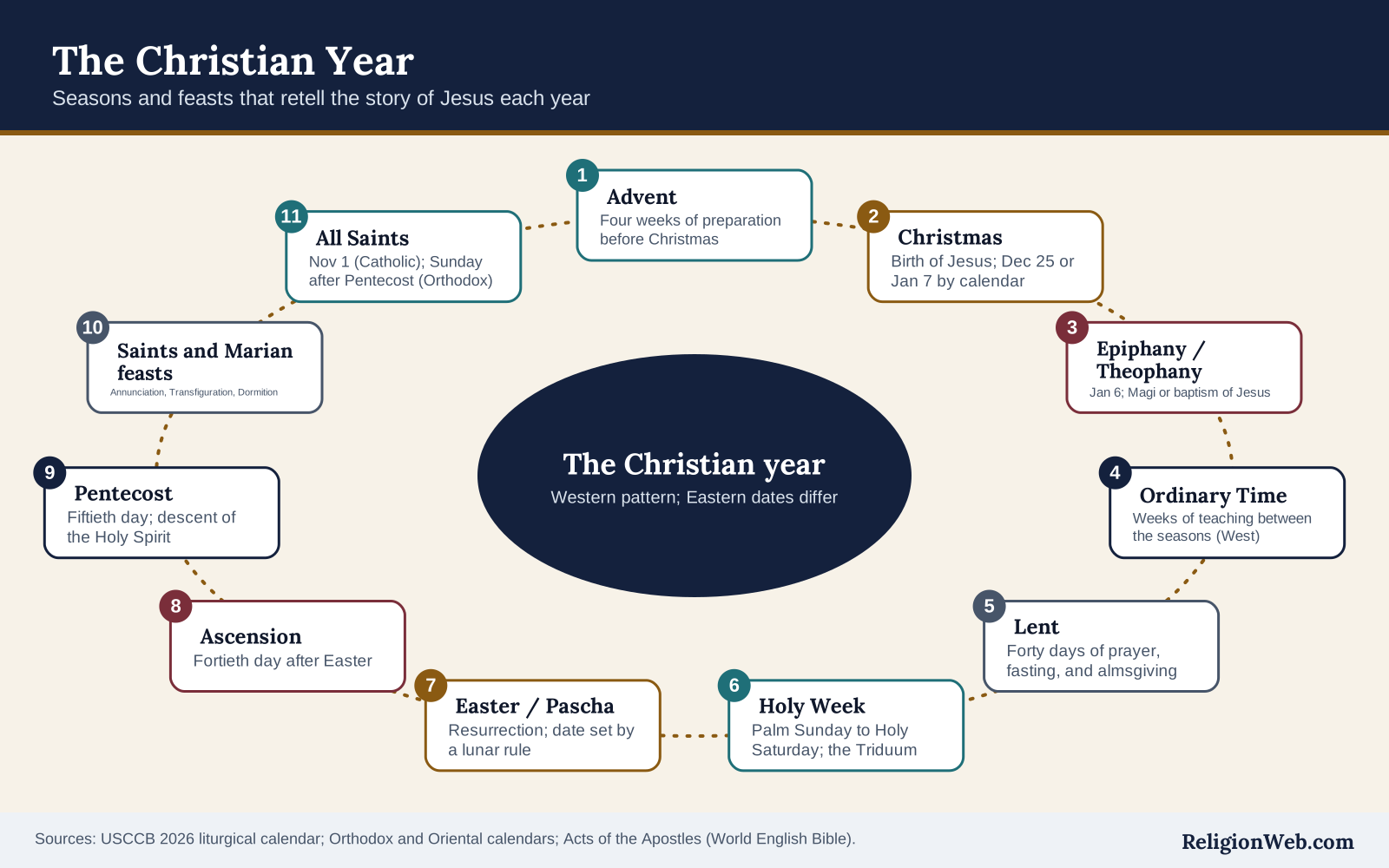
Branches of Christianity: Churches, Traditions, and Internal Diversity
Christianity is not a single organization but a family of churches, some of them very old and some quite new, that recognize one another in varying degrees. The usual way to map the family is by the large traditions that formed over the first sixteen centuries: Catholic, Eastern Orthodox, Oriental Orthodox, the Church of the East, and the Protestant churches that arose from the Reformation, joined today by a rapidly growing set of Pentecostal and independent churches. Each tradition has its own internal diversity, so a statement about “the Orthodox” or “Protestants” is always a generalization. The table gives a first orientation, and the sections that follow describe each family in turn.
The Ancient Communions
The Catholic Church
The Catholic Church is the largest single Christian communion, with 1.422 billion members in 2024 according to the Vatican’s statistical yearbook. It describes itself as the church governed by the bishop of Rome, the pope, and by the bishops in communion with him; the pope since May 2025 has been Leo XIV. The Catholic Church has twenty-four self-governing churches in communion with Rome: the Latin Church, which is by far the largest, and twenty-three Eastern Catholic Churches, such as the Maronite, Ukrainian Greek Catholic, and Syro-Malabar churches, each with its own liturgical tradition and in many cases a married clergy. Catholic life is organized around the seven sacraments, the Mass, devotion to Mary and the saints, and a teaching office exercised by the pope and the bishops. A fuller account is given in the article on Catholic Christianity.
The Eastern Orthodox churches
The Eastern Orthodox churches form a communion of self-governing, or autocephalous, churches that share the same faith and sacraments but have no single head. They include the ancient patriarchates of Constantinople, Alexandria, Antioch, and Jerusalem, and national churches such as the Russian, Serbian, Romanian, Bulgarian, Georgian, and Greek churches. The Ecumenical Patriarch of Constantinople, Bartholomew I since 1991, holds a primacy of honor among them, but does not govern the others. Orthodox Christians understand their church as the continuation of the apostolic church and emphasize the liturgy, the icons, the monastic tradition, and the decisions of the first seven ecumenical councils. According to Pew Research Center’s 2017 study, based on 2010 estimates, Eastern Orthodoxy accounts for about 80 percent of the world’s Orthodox Christians. The article on Eastern Orthodox Christianity goes into detail.
The Oriental Orthodox churches and the Church of the East
Six churches make up the Oriental Orthodox communion: the Coptic Orthodox Church of Egypt, the Ethiopian Orthodox Tewahedo Church, the Eritrean Orthodox Tewahedo Church, the Syriac Orthodox Church, the Armenian Apostolic Church, and the Malankara Orthodox Syrian Church in India. They share the faith of the first three ecumenical councils and describe Christ as one incarnate nature of the divine Word, and they did not accept the Council of Chalcedon. They are in full communion with each other but not with the Eastern Orthodox or Catholic churches, although dialogue has narrowed the doctrinal differences. Pew’s 2017 report estimates that about 20 percent of Orthodox Christians belong to this family, and the Ethiopian Orthodox Tewahedo Church alone accounted for about 36 million people. They are discussed in the article on Oriental Orthodox Christianity. The Church of the East, today represented chiefly by the Assyrian Church of the East and the Ancient Church of the East, traces its roots to the apostolic mission to the east and is distinct from both Orthodox families; the Chaldean Catholic Church, which shares its liturgical heritage, is in communion with Rome.
Protestant, Anglican, and Independent Churches
The churches of the Reformation
Protestant Christianity includes several distinct families that arose in the sixteenth century. The Lutheran churches follow Martin Luther and emphasize justification by faith and the sacraments of baptism and the Lord’s Supper. The Reformed and Presbyterian churches, descended from Zwingli and Calvin, stress God’s sovereignty and are governed by councils of elders. The Anabaptist tradition, which includes Mennonites and the Amish, practices believer’s baptism, nonviolence, and the separation of church and state. The Church of England, which developed its own character after 1534, is the mother church of the Anglican Communion, a worldwide fellowship that claims both Catholic and Reformation heritage; its distinct history is told in the article on Anglicanism. Methodism arose from John Wesley’s eighteenth-century revival. The wider story is covered in the article on Protestant Christianity.
Baptist, evangelical, Pentecostal, and independent churches
The largest growth in recent centuries has come in forms of Protestantism that do not fit neatly into the sixteenth-century families. Baptist churches, which began in the seventeenth century, practice believer’s baptism and govern themselves congregation by congregation. Evangelicalism is a movement that cuts across denominations; the historian David Bebbington defined it by four emphases: conversion, the authority of the Bible, the centrality of the cross, and active efforts to spread the faith. Pentecostal and charismatic churches stress the experience of the Holy Spirit, and independent churches, such as African initiated churches and nondenominational congregations in the United States, have no formal affiliation with a larger body. Pew’s Protestant category in 2010, about 801 million people, was deliberately broad: it covered Anglicans and independent Christians as well as members of the historic Protestant denominations.
Other Groups and the Search for Unity
Movements at the boundaries
Several movements that arose in the nineteenth century hold beliefs that differ from the historic creeds, and they are classified differently by different observers. The Church of Jesus Christ of Latter-day Saints, founded by Joseph Smith in 1830, and Jehovah’s Witnesses, who grew out of the Bible Student movement of the late nineteenth century, describe themselves as Christian and as restoring the original Christian faith. The Seventh-day Adventist Church, organized in 1863, holds the Trinity and is generally treated as part of Protestant Christianity. Christian Science, founded by Mary Baker Eddy in 1879, also identifies as Christian. Many Nicene churches do not regard the first two groups as part of historic Trinitarian Christianity because of differences about the Trinity, the nature of Christ, and sources of authority, and Pew Research Center’s 2011 study placed them in an “other Christian” category. This article records these classifications and does not decide between them.
Ecumenical organizations and dialogue
Alongside separation, there is a long and increasingly serious effort to talk across the lines. The World Council of Churches brings together 356 member churches, mostly Protestant, Anglican, Orthodox, and Oriental Orthodox, with the Catholic Church cooperating but not a member. International dialogues between the Catholic Church and the Orthodox, Oriental Orthodox, Lutheran, Anglican, and Methodist communions have produced agreed statements on baptism, justification, and the nature of Christ. The main barrier to shared Communion is not mutual hostility but different understandings of what the church is and who may preside at the Eucharist, and these questions remain open.
| Tradition | Size and data year | Governance | Distinctive features |
|---|---|---|---|
| Catholic Church | 1.422 billion (2024, Vatican statistics); about half of all Christians in 2010 (Pew) | Pope and bishops; 24 self-governing churches in communion | Seven sacraments, Mass, Marian devotion, papal teaching office |
| Eastern Orthodox churches | About 80 percent of roughly 260 million Orthodox Christians (Pew, 2010 estimates) | Autocephalous churches under bishops and synods; Ecumenical Patriarch holds primacy of honor | Divine Liturgy, icons, married parish priests, monasticism, seven councils |
| Oriental Orthodox churches | About 20 percent of Orthodox Christians (Pew, 2010 estimates) | Six churches led by patriarchs or catholicoi | First three councils only; ancient liturgies in Coptic, Ge’ez, Syriac, Armenian |
| Church of the East | Small communities in the Middle East, India, and diaspora | Patriarchs and bishops | Syriac liturgy; first two councils only; ancient Asian mission |
| Protestant (Pew’s broad sense) | About 801 million, 37 percent of Christians (Pew, 2010) | Varied: episcopal, presbyterian, congregational | Authority of Scripture, justification by faith, two sacraments or ordinances in most churches |
| Anglican Communion | Included in Pew’s Protestant figure | Bishops in national and regional provinces | Book of Common Prayer; Catholic and Reformation heritage |
| Other Christian groups | About 28 million, a little over 1 percent (Pew, 2010) | Varied | Include Latter-day Saints, Jehovah’s Witnesses, and Christian Science; classification disputed |
Sacred Spaces, Symbols, and Christian Material Culture
Christians have always been concerned about where and how to worship, and the buildings, images, and objects they created are among the most visible expressions of belief. The New Testament understands the church as a people, not a building, so Christian architecture grew from practical needs and theological ideas rather than from a prescribed plan.
Church Buildings and Pilgrimage
From house churches to basilicas and cathedrals
The first Christians met in homes. The oldest identified Christian building is a converted house at Dura-Europos, on the Euphrates in modern Syria, adapted for worship in the 230s CE and buried when the city fell to a siege in the following decades. After Constantine, emperors and bishops built large basilicas, rectangular halls adapted from Roman public buildings, such as the original St. Peter’s in Rome and the Church of the Holy Sepulchre in Jerusalem. In the East, the domed form reached its greatest expression in Hagia Sophia in Constantinople, dedicated in 537 under Justinian; it served mostly as a cathedral until 1453, then as a mosque, a museum from 1934, and a mosque again since 2020. In the medieval West, Romanesque and Gothic cathedrals rose over towns with stained glass, pointed arches, and towers. Protestant churches of the Reformation preferred plainer meeting houses where the sermon could be heard, and in Ethiopia the churches of Lalibela were carved down into volcanic rock.
What the interior expresses
Church interiors express theology. In Catholic, Anglican, and Lutheran churches, the altar stands at the center of the sanctuary, usually near the east end, with a lectern for readings, a baptismal font, and in Catholic churches a tabernacle that holds the consecrated bread, marked by a lamp. Orthodox churches are divided between the nave and the sanctuary by an iconostasis, a screen of icons, and are decorated with frescoes or mosaics so that worshipers stand in the midst of the saints. Many Reformed and Baptist churches place the pulpit at the center to underscore preaching, and Quaker meeting houses are deliberately plain. Congregations also differ over seating: pews are standard in the West, while Orthodox churches often have few or none.
Pilgrimage and holy places
Pilgrimage developed early. Jerusalem, with the Church of the Holy Sepulchre, and Bethlehem, with the Church of the Nativity, are central for Christians of all traditions. Rome draws visitors to the tombs of Peter and Paul, Santiago de Compostela in Spain is the destination of the Camino, and Marian shrines such as Lourdes in France and Guadalupe in Mexico attract millions of Catholics each year. Mount Athos in Greece, a self-governing monastic community, is a major center of Orthodox spiritual life and admits only men. Pilgrims commonly pray for the sick at such places, but Catholic teaching and other traditions encourage medical care alongside prayer.
Symbols, Icons, and Sacred Art
The cross and other early symbols
The cross is the universal Christian symbol. Catholic and Orthodox churches typically display a crucifix, a cross with the figure of Christ, while many Protestants prefer an empty cross as a sign of the resurrection. Early Christians also used the fish, ichthys, the Greek word whose letters form an acrostic for “Jesus Christ, God’s Son, Savior”; the Chi-Rho, the first two Greek letters of “Christ”; the dove for the Holy Spirit; the lamb for Christ; and the Greek letters alpha and omega, drawn from the Book of Revelation. Making the sign of the cross is a common gesture of prayer among Catholics, Orthodox, and many Anglicans and Lutherans.
Icons, images, and music
Orthodox and Oriental Orthodox Christians venerate icons, painted images of Christ, Mary, and the saints, which they regard as windows to the holy and not as objects of worship in themselves. The Second Council of Nicaea in 787 affirmed this distinction between veneration and the worship due to God alone. Some Reformation churches removed images from their churches, while Lutheran and Anglican churches retained them. Music is also a sacred art: Gregorian chant in the Latin West, Byzantine chant in the East, the hymns of Luther and Charles Wesley, and the spirituals and gospel music of African American churches are only some of the repertoires through which Christians pray in song.
Community, Clergy, Ethics, and Daily Life
Christian life is lived in congregations and households as much as in sanctuaries. The church is both a worshiping community and a network of people who care for one another, teach children, bury the dead, and, in many places, run schools, hospitals, and charities. How that life is organized depends on each tradition’s understanding of ministry, moral teaching, and the stages of life.
Clergy and Church Governance
Bishops, priests, and deacons
Catholic, Orthodox, Oriental Orthodox, and Anglican churches have a threefold ministry of bishops, priests, and deacons, ordained in what they understand as a line of succession from the apostles. Bishops oversee dioceses and ordain others; priests celebrate the sacraments in parishes; deacons assist in the liturgy and in works of charity. In the Latin Church of the Catholic communion, priests are normally unmarried men who promise celibacy, while Eastern Catholic and Orthodox churches ordain married men as priests and deacons, though bishops are chosen from among celibate clergy or monastics. Monks and nuns, who take vows and live in community, are a central part of Orthodox and Catholic life, and religious orders such as the Benedictines, Franciscans, and Jesuits conduct education, missions, and service.
Pastors, elders, and the priesthood of all believers
Many Protestant churches teach the priesthood of all believers, the idea that every Christian has direct access to God, and they differ in how they order ministry. Presbyterian churches are governed by councils of elders, Congregational and Baptist churches by the local congregation, and Methodist and Lutheran churches by varying arrangements that may include bishops. The question of who may be ordained is answered differently. The Catholic, Orthodox, and Oriental Orthodox churches ordain only men to the priesthood, appealing to the practice of Jesus and the apostles and to the tradition of the church. Many provinces of the Anglican Communion and many Lutheran, Methodist, Presbyterian, and Pentecostal churches ordain women, while some evangelical and Baptist bodies reserve the office of pastor to men.
Ethics and Social Life
Love of God and neighbor
Christian ethics begins with the teaching of Jesus, especially the Sermon on the Mount in the Gospel of Matthew, and with his summary of the law in answer to a question about the greatest commandment.
‘You shall love the Lord your God with all your heart, with all your soul, and with all your mind.’ This is the first and great commandment. A second likewise is this, ‘You shall love your neighbor as yourself.’ The whole law and the prophets depend on these two commandments.
Gospel of Matthew 22:37–40, World English Bible (Classic edition, public domain)
In this passage Jesus joins two commands from the Hebrew Scriptures, found in Deuteronomy and Leviticus, and makes them the key to the rest. Christian moral thought has drawn on them together with the Ten Commandments, the Beatitudes, and Paul’s description of love in his first letter to the Corinthians. Traditions elaborate this in different ways: Catholic moral theology draws on natural law and the virtues, Orthodox ethics emphasizes the healing of the person through prayer, fasting, and the sacraments, and Protestant traditions have often stressed the call to serve in ordinary vocations, such as work and family.
Charity, education, and public life
The practical expression of this ethic has been the care of the poor and sick. In the fourth century, Basil of Caesarea founded a large complex of hospital, shelter, and workshops outside his city, and monasteries and parishes across Europe and the Middle East later maintained hospitals, almshouses, and schools. Churches continue to operate schools, universities, clinics, and relief agencies in many countries. Catholic social teaching, which began with Rerum Novarum in 1891, addresses labor, property, and the common good, while the Russian Orthodox Church issued a statement of its social outlook in 2000, and Protestant movements such as the Social Gospel in North America addressed industrial poverty. Some traditions, including the Mennonites and Quakers, practice pacifism, while others, drawing on Augustine and Aquinas, hold that war can sometimes be justified under strict conditions, a debate that has continued for centuries.
On contemporary questions such as marriage and sexuality, the beginning and end of life, and bioethics, churches give differing answers, and there is often disagreement within denominations as well as between them. The Catholic Church, the Orthodox churches, and many evangelical and Pentecostal churches hold traditional positions on these matters, while some Protestant and Anglican churches have changed their teaching or allowed local discretion. A reference article cannot settle those debates; the point is that they are real and internal to Christianity, and that members of the same church may reach different conclusions.
Life-Cycle Customs
Birth, childhood, and coming of age
The Christian life usually begins with baptism or, in churches that baptize only believers, with a ceremony of thanksgiving and dedication for the newborn. Godparents, who promise to help raise the child in the faith, are important in Catholic, Orthodox, Anglican, and Lutheran practice. The Orthodox church has a tradition of “churching” mothers and infants on the fortieth day, and many Orthodox Christians celebrate their name day, the feast of the saint whose name they bear, more than their birthday. Catholic children usually receive first Communion around age seven, with confirmation in later childhood or adolescence, while many Protestant churches hold confirmation classes in the teenage years. Sunday schools, youth groups, and catechism classes teach children the stories of the Bible and the content of the faith.
Marriage and death
Weddings are performed in church by clergy in most traditions. In Catholic teaching marriage is a sacrament and a permanent union that civil divorce does not dissolve; after examination, however, the Church may declare that a marriage was never validly contracted, a decision known as an annulment, and pastoral care for divorced and remarried Catholics remains a subject of continuing discussion. The Orthodox churches also regard marriage as a sacred mystery, celebrated with the crowning of the couple, but they permit remarriage after divorce under certain conditions as a pastoral concession. Protestant churches generally treat marriage as a divinely instituted but not sacramental covenant, and they vary on divorce and remarriage.
Death is met with prayer and the hope of resurrection. The Catholic funeral begins with a vigil and a funeral Mass, and Catholics pray for the dead, especially on All Souls’ Day. Orthodox Christians hold memorial services at set intervals, traditionally on the third, ninth, and fortieth days after death, and offer koliva, a dish of boiled wheat, as a sign of resurrection. Protestant funerals typically emphasize the sermon, hymns, and committal to the grave. The Catholic Church has allowed cremation since 1963 so long as it is not chosen to deny the resurrection, while the Orthodox churches generally discourage it. Pastors and congregations commonly provide grief support, and they usually encourage those struggling with depression or loss to seek professional help alongside pastoral care.
Christianity Today: Global Presence and Contemporary Questions
Numbers, Regions, and Demographic Trends
The 2020 picture
Pew Research Center’s 2025 report is the most recent comprehensive snapshot of the Christian population, based on 2020 data. It found 2.3 billion Christians, or 28.8 percent of the world, a median age of 30.8 years for Christians against 30.6 for the world as a whole, and Christian majorities in 120 countries and territories. In the United States, the Christian share of the population fell from 78.3 percent in 2010 to 64.0 percent in 2020. Sub-Saharan Africa, with about 30.7 percent of the world’s Christians, now has the largest regional share, ahead of Latin America and the Caribbean and Europe. Mozambique was the one country among those with large changes where the Christian share increased by five points.
Regional portraits
In Africa, Christianity is the majority religion in many countries south of the Sahara and includes mission-founded churches, Pentecostal and charismatic congregations, and African initiated churches. In Latin America, Catholicism remains the largest tradition, with Brazil and Mexico among the largest Catholic populations in the world, alongside fast-growing Pentecostal churches. In Europe, historic churches remain influential but participation has declined, and the Christian share dropped below half in France and the United Kingdom. In Asia, the Philippines has some 93 million Catholics according to Vatican data for 2023, South Korea has a large Protestant presence, India has Christian communities that are a small percentage of its large population but include millions of people, and the size of Christianity in China is disputed because estimates vary widely. In the Middle East, ancient Christian communities of Egypt, Syria, Lebanon, Iraq, and the Holy Land continue, though they have been reduced in many places by emigration and conflict.
Contemporary Questions and Trends
Religious change and the unaffiliated
The most important trend in many wealthy countries is religious disaffiliation. Pew found that the share of people with no religious affiliation rose from 23.3 percent in 2010 to 24.2 percent in 2020 globally, and that for every adult who joined Christianity after being raised without a religion, about 3.1 left it. At the same time, many Christians in Africa, Latin America, and Asia belong to growing communities. The implication is not a simple decline or revival but a redistribution: Christianity is becoming, in aggregate, a faith whose typical adherent is likelier to live in Lagos, Manila, or São Paulo than in London or Chicago.
Religious freedom, conflict, and dialogue
Christians experience religious restrictions and violence in some parts of the world, particularly where they are small minorities, and the specific causes differ from place to place and involve governments, extremist groups, local disputes, and social hostility, so that blanket generalizations are misleading. In other settings, Christian churches are established or politically dominant, and questions about religious freedom for others arise. In many places, churches take part in interfaith councils and humanitarian work with people of other religions, and recent popes, patriarchs, and Protestant leaders have repeatedly called for peace and dialogue. The ecumenical movement, the interfaith encounters of the past century, and ongoing disagreements within and between the churches together define the current moment in Christian history.
Common Misconceptions About Christianity
Because Christianity is so widely known, many people carry firm but incomplete pictures of it. Some come from the way the word “Christian” is used in a particular country, some from fiction and film, and some from earlier scholarship or from arguments between churches. The five below are among the most common. Each is stated as its holders would state it, and each is followed by what the evidence and the traditions themselves show.
Misconception 1: Christianity is one uniform church with a single set of beliefs
Where the misunderstanding comes from
The idea comes naturally from the way Christians speak about themselves. The Nicene Creed describes the church as one, holy, catholic, and apostolic, and the New Testament presents unity as a goal. In everyday English, “the Church” is often used for the Catholic Church, for the largest local denomination, or for the institution of Christianity as a whole, and news coverage frequently reports “what Christians believe” about a topic as if a single voice existed. In some countries one tradition is so dominant that its practices seem to define the religion.
The picture is also encouraged by genuine continuities. Christians across the world read from the same Bible in translation, recite the Lord’s Prayer, and mark Easter, and a visitor to a Catholic Mass in Manila and one in Nairobi will recognize the same liturgy.
What the evidence and tradition actually show
Christianity has been plural almost from the beginning. Paul’s letters already address disputes among early congregations, and after the councils of the fourth and fifth centuries the church divided into communions that still exist: Catholic, Eastern Orthodox, Oriental Orthodox, and the Church of the East, followed by the Protestant families of the sixteenth century and the Pentecostal and independent churches of the twentieth. These groups differ on authority, the number and meaning of the sacraments, the canon of Scripture, the date of Easter, the ordination of women, and many other matters. The World Council of Churches alone has 356 member churches.
The shared core is real, including belief in God as Trinity, the incarnation, the death and resurrection of Jesus, and the practice of baptism, but it coexists with deep and sometimes painful differences. Most traditions understand unity as a gift to be restored, not as a fact that already exists, which is why ecumenical dialogue continues. The articles on Catholic, Eastern Orthodox, Oriental Orthodox, and Protestant Christianity describe the major families on their own terms.
Misconception 2: Christianity began as a European religion
Where the misunderstanding comes from
For well over a thousand years Europe was the center of Christian institutions and learning for the Latin West, and European art often depicted biblical figures in European dress and with European features. Colonial-era missions carried a form of Christianity shaped by European culture to other continents, and in the nineteenth and early twentieth centuries Christians in Europe and North America made up most of the world total. For many people in the English-speaking world, that history has become the default picture.
What the evidence and tradition actually show
Christianity began in the eastern Mediterranean, among Jewish people in Galilee and Judea, and the earliest churches were in Jerusalem, Antioch, Damascus, Ephesus, Corinth, Alexandria, and Rome, all within the Roman Empire’s Asian, African, and European provinces. In the first few centuries, Christians were concentrated in Syria, Asia Minor, Egypt, and North Africa as much as in Italy and Greece. Churches also took root beyond the empire: in Edessa and Persia, in Armenia in the early fourth century, in Aksum in Ethiopia, and, according to Thomas Christian tradition, in southern India, with Church of the East communities reaching Central Asia and China by the seventh century. Large parts of northern and western Europe became Christian only in the following centuries, with Ireland in the fifth, England in the late sixth and seventh, and Scandinavia in the tenth and eleventh.
The demographic evidence points the same way. Pew Research Center found in 2020 that sub-Saharan Africa had the largest share of the world’s Christians, about 30.7 percent, ahead of Latin America and the Caribbean and Europe at about 22.3 percent. The Vatican’s data likewise show that Africa and the Americas together hold more than two-thirds of Catholics. Christianity is better described as a religion that began in West Asia, spread widely across several continents, and has been transformed by each place it has taken root.
Misconception 3: The Bible was written as a single book at one time
Where the misunderstanding comes from
Most people encounter the Bible as one bound volume with a single title, often printed in a uniform style, with chapters and verses numbered in sequence. In popular speech, “the Bible says” can make it sound as though one author wrote it in a single voice. Some presentations in preaching or on social media also treat any verse as interchangeable with any other, which strengthens the impression of uniform composition.
What the evidence and tradition actually show
The word “Bible” comes from the Greek for “the books,” and it describes a library. The Old Testament contains writings in Hebrew and a small amount of Aramaic that took shape over many centuries, including law, historical narrative, poetry, proverbs, and prophecy; the New Testament was written in Greek between roughly 50 and 120 CE by several authors. The books differ in genre and in voice, from the legal codes of Leviticus to the lyric poetry of the Psalms, the letters of Paul, and the apocalyptic visions of Revelation. They were first copied by hand, circulated individually or in small collections, and only later bound together in codices.
The gathering of these writings into a canon was itself a process that unfolded over centuries and that has not produced identical results in every church. Catholic, Protestant, Orthodox, and Ethiopian traditions have different lists of Old Testament books, and the early New Testament lists differed in what they included. Christian traditions see this history as part of the Bible’s character: Catholic and Orthodox teaching holds that the church discerned which writings were inspired, while many Protestants say the books themselves carried their authority. In both views the Bible is a collection, not a single composition.
Misconception 4: The Council of Nicaea chose the books of the Bible and voted Jesus into divinity
Where the misunderstanding comes from
This account has been popularized by novels, documentaries, and some polemical histories, notably the 2003 novel The Da Vinci Code, which presents Nicaea as the moment when the emperor Constantine and a bloc of bishops imposed a divine Christ and a new Bible on a church that had believed otherwise. It draws on real facts: Nicaea was convened by an emperor, it did adopt a creed, and the New Testament canon was settled over a period that includes the fourth century. When those facts are combined and compressed, a plausible but inaccurate story results.
What the evidence and tradition actually show
Ancient accounts and the surviving documents of the council show that its business was the controversy over Arius, the date of Easter, a church schism in Egypt, and matters of church discipline, which it addressed in twenty canons. None of the extant acts, canons, or letters includes a list of biblical books. The council’s creed affirmed that the Son shares the same being as the Father; Arius, who held that the Son was created, was not denying that Jesus should be honored, and Christians had been praying to Christ and singing hymns to him for generations before 325. A letter of Pliny from around 112 CE already reports that Christians in Asia Minor sang a hymn to Christ as though to a god. Most bishops signed the creed, and those who refused were exiled; the numbers show a broad consensus alongside serious dissent, and the controversy continued for decades afterward.
The New Testament canon emerged separately and more slowly, through use in worship and through lists such as the Easter letter of Athanasius in 367, with later regional synods affirming it. Constantine favored Christianity and played a role in convening councils, but historians agree that Christianity had already spread through the empire for three centuries and that its core convictions did not originate with him.
Misconception 5: “Christian” means the same as “Protestant” or “evangelical,” or only one church is truly Christian
Where the misunderstanding comes from
In public discussion, especially in the United States, the word “Christian” is often used for evangelical Protestants in particular, as in surveys and political commentary about “Christian voters.” Meanwhile, many churches have historically made exclusive claims: some Catholics have regarded Protestants as separated from the true church, some Protestants have questioned whether Catholic teaching is faithful to the gospel, and some Orthodox Christians have considered other communions to lack valid sacraments. These strands leave the impression that “Christian” has a single, narrow meaning.
What the evidence and tradition actually show
Historically and demographically, “Christian” is a broad category. By Pew’s 2010 estimates, about half of the world’s Christians were Catholic, about 12 percent were Orthodox, and about 37 percent belonged to Protestant, Anglican, and independent churches, with evangelicals making up only part of that Protestant total. Churches recognize one another to different degrees: the Catholic Church, for example, teaches that baptism with water in the name of the Trinity administered in other churches is valid and that those baptized are in a real, though imperfect, communion with it, and the World Council of Churches brings together Protestant, Anglican, Orthodox, and Oriental Orthodox churches on that basis.
Where the boundary of Christian identity is contested, as with the Latter-day Saints or Jehovah’s Witnesses, the disagreement is between those groups’ own self-understanding and the standards of the creeds as defined by the Nicene churches. In practice, scholars and statisticians use the broad definition of self-identification with Christ, while churches may apply stricter ones to questions of communion and membership. The two usages answer different questions, and keeping them apart avoids a great deal of confusion.
Frequently Asked Questions About Christianity
Questions About Belief and Scripture
What do all Christians have in common?
Nearly all Christians confess that Jesus Christ is Lord, that God is Father, Son, and Holy Spirit, and that Jesus was crucified and rose again. They baptize in the name of the Trinity, honor the Bible as Scripture, and gather for worship that centers on prayer and, in most traditions, a shared meal of bread and wine.
Beyond this core, traditions differ about the authority of the pope, the number of the sacraments, the books of the Old Testament, the role of Mary and the saints, and the structure of ministry. A few groups that identify as Christian, such as Unitarians, do not hold the Nicene doctrine of the Trinity.
What is the Trinity, and do Christians believe in three gods?
Christian teaching holds that there is one God who exists eternally as three persons: the Father, the Son, and the Holy Spirit. The creeds reject the idea of three separate gods as firmly as they reject the idea that God is a single person who merely appears in three roles. The doctrine was worked out between the second and fourth centuries and is regarded by the churches as a mystery to be confessed in worship.
Different traditions explain the relationship of the persons in slightly different ways, most notably over whether the Spirit proceeds from the Father alone (the Orthodox position) or from the Father and the Son (the Western position), but all affirm that the one God is revealed in Jesus.
Questions About Worship and Practice
Why do Christians worship on Sunday?
Sunday is the day on which, according to the Gospels, the tomb of Jesus was found empty. Christians therefore call it the Lord’s Day, and a description of Sunday worship appears in the writings of Justin Martyr around 155 CE. The practice was already established well before Constantine, who in 321 made Sunday a day of rest for most Roman courts and workshops.
A few groups, such as Seventh-day Adventists and some Sabbatarian Baptists, keep Saturday as the day of worship, drawing on the commandment to observe the Sabbath.
Why do some churches baptize infants and others only believers?
Churches that baptize infants, including the Catholic, Orthodox, Lutheran, Anglican, and Reformed traditions, hold that baptism is a gift of God’s grace given before a person can respond, and that the faith of the church and the child’s family supports the child. They point to New Testament accounts of the baptism of entire households.
Baptist, Pentecostal, and many other churches hold that the New Testament pattern is baptism after a personal profession of faith and that immersion expresses death and resurrection with Christ. Both views have been argued from Scripture for nearly five centuries since the Reformation.
Why do Orthodox Christians sometimes celebrate Easter on a different date?
Both Western and Orthodox churches use the same rule, the first Sunday after the first full moon of spring, but they apply it using different calendars. Western churches use the Gregorian calendar and Orthodox churches use the older Julian reckoning for calculating Pascha. In 2026 the Western date was April 5 and the Orthodox date April 12, and in 2027 the dates are March 28 and May 2.
The dates coincide in some years, as in 2025 and 2028, and there have been repeated discussions about a common date, though none has yet been implemented.
Questions About History and Identity
Who founded Christianity?
Christians understand Jesus of Nazareth as the founder of the church and the source of its message. Historians describe a movement that began among his Jewish followers in the first century and was shaped by leaders such as Peter, James, and Paul, who carried the message to non-Jewish communities. Paul’s letters are the earliest Christian writings, and the Gospels were composed one or more generations after Jesus’ death.
The Christian church developed its creeds, canon, and structures over the following centuries through bishops, councils, and theologians, so no single person is credited with creating all of Christianity.
What is the difference between Catholic, Orthodox, and Protestant churches?
All three accept the Nicene Creed’s account of God and Christ, but they differ on authority and practice. Catholics recognize the pope as the successor of Peter and teach through the pope and bishops together. Orthodox Christians have no pope; they are governed by synods of bishops and give special weight to the ecumenical councils. Protestants, in general, hold that Scripture is the supreme authority and do not recognize papal authority.
They also differ over the number of sacraments, devotion to Mary and the saints, clerical celibacy, and the canon of the Old Testament. Each tradition has its own article on this site that describes its teaching in detail.
How many Christians are there, and where do most live?
Pew Research Center estimated about 2.3 billion Christians in 2020, 28.8 percent of the world’s population. The largest regional share, about 30.7 percent, lives in sub-Saharan Africa, followed by Latin America and the Caribbean and by Europe. Catholics number about 1.422 billion according to the Vatican’s 2024 data.
Estimates differ depending on whether a source counts people by self-identification, baptism, or membership, so the figures should be read with the definition in mind.
Conclusion: One Name, Many Traditions
What the History Shows
A movement that has changed shape many times
Christianity began as a small Jewish movement around a teacher crucified under a Roman governor and, according to its own testimony, proclaimed as risen. Within three centuries it had spread across the Roman world; within a thousand years it had divided between East and West, and within five hundred more it had divided again in the West. It has shaped legal systems, universities, hospitals, art, music, and languages, and it has also been involved in conflict, conquest, and exclusion, a history that churches themselves increasingly acknowledge. Its center of gravity has shifted from the Mediterranean to Europe and then to the Global South.
Unity and diversity in the present
Today the 2.3 billion people who identify as Christian share a Scripture, a set of ancient creeds, and the practices of baptism and a shared meal, and they disagree about how to read, order, and apply them. The ecumenical movement of the last century, from Edinburgh in 1910 to the Nicaea commemoration of 2025, reflects the effort of many Christians to hold both facts together.
How to Keep Exploring
Read the sources and the traditions on their own terms
The best way to understand Christianity further is to read the primary texts, beginning with the Gospels and the letters of Paul in a translation of choice, and then to read how particular communities understand and practice them. Readers can continue with the detailed articles on Catholic Christianity, Eastern Orthodox Christianity, Oriental Orthodox Christianity, and Protestant Christianity.
Related subjects on this site
Because Christianity emerged within the Jewish world and has long shared geographies with other traditions, readers may also find the articles on Judaism and Islam useful as independent introductions to those traditions. Visiting a service, where welcome is offered, and asking members of a community how they understand their own practice remain the most direct ways to learn.
Sources
The table below lists the principal external sources behind this article. Facts, dates and figures were checked against these and related primary, institutional and academic materials.
| # | Source | Publisher and type | Used for | Link |
|---|---|---|---|---|
| 1 | World English Bible (Classic edition): Acts 11, 1 Corinthians 11 and 15, John 1, Matthew 6, 22, 28 | eBible.org · Primary text | Public-domain Bible text for all quotations; Acts 11:26 on the name Christian | ebible.org |
| 2 | First Apology (Justin Martyr), ch. 65-67, Roberts-Donaldson translation | Early Christian Writings · Primary text | Earliest detailed description of Sunday worship, baptism, and the Eucharist (c. 155 CE) | earlychristianwritings.com |
| 3 | Catechism of the Catholic Church: The Canon of Scripture (paras. 120-130) | Holy See (Vatican) · Institutional | Catholic canon of 46 Old Testament and 27 New Testament books; use of the Old Testament | vatican.va |
| 4 | How the Global Religious Landscape Changed From 2010 to 2020 | Pew Research Center · Demographic data | 2.3 billion Christians (28.8%) in 2020; regional shares; Christian-majority countries; switching | pewresearch.org |
| 5 | Global Christianity: Traditions and Regions | Pew Research Center · Demographic data | 2010 shares of Catholic, Protestant, Orthodox, and other Christians; Pew’s broad Protestant definition | pewresearch.org |
| 6 | Orthodox Christianity in the 21st Century | Pew Research Center · Demographic data | Orthodox population (2010 estimates); Eastern and Oriental split; Chalcedon; Ethiopian church size | pewresearch.org |
| 7 | New data from Annuario Pontificio 2026 shows Catholics growing | Vatican News · Institutional | 1.422 billion Catholics in 2024 (17.8%); regional shares; bishops and priests | vaticannews.va |
| 8 | 2026 Liturgical Calendar for the United States | United States Conference of Catholic Bishops · Institutional | 2026 dates for Ash Wednesday, Easter, Ascension, Pentecost, Advent, and Christmas | usccb.org |
| 9 | Christian (entry), International Standard Bible Encyclopaedia | International Standard Bible Encyclopedia (online edition) · Academic reference | Three New Testament uses of the name; formation of Christianos; likely coinage by outsiders | internationalstandardbible.com |
| 10 | Relations between the Catholic Church and the Oriental Orthodox Churches | Catholic Near East Welfare Association (CNEWA) · Institutional | The six Oriental Orthodox churches; non-acceptance of Chalcedon; 1973 and 1984 common declarations | cnewa.org |
Last fact-check date: 2026-10-21.