The Bible is the collection of sacred writings that Christians recognize as Scripture, bound together in two parts known as the Old Testament and the New Testament. It is not a single book written by a single author at a single moment. It is a library of books composed in Hebrew, Aramaic, and Greek by many writers over roughly a thousand years or more, then gathered, copied, translated, divided into chapters and verses, and printed in the form most readers now hold. Christians read it as a witness to God’s dealings with Israel and, in the New Testament, to the life, death, and resurrection of Jesus, and they treat it as the foundation of their teaching, worship, and prayer. That role is shared across the many churches described in Christianity, although each tradition understands the Bible’s authority and its relationship to church teaching in its own way.
A direct answer to the question “What is the Bible?” has to include a caution right away: there is no single, universally identical Christian Bible. Protestant Bibles contain 66 books, Catholic Bibles contain 73, Eastern Orthodox Bibles contain somewhat more and vary by church, and the Ethiopian Orthodox Tewahedo Church uses a larger collection still. The New Testament is far more stable, with the same 27 books in almost all Christian communities, but the Old Testament canon, the list of books recognized as Scripture, differs. Translations differ as well, from the Greek Septuagint and the Latin Vulgate to the English of the King James Version and hundreds of modern languages.
The first part of the Christian Bible is also the sacred scripture of Jews, who call it the Tanakh or the Hebrew Bible and who arrange and read it in their own ways. This article describes how Christians organize and use the Bible, and it treats Jewish understanding on its own terms wherever the two overlap. For the Jewish side, see the separate articles on Judaism and the Torah.
What follows is a reference chapter rather than a devotional reflection. It explains the Bible’s structure and literary types, how the books came to be written, how the canon took shape, what manuscripts survive and how the text was transmitted, where chapters and verses came from, how translation works, and how Christians read the Bible in worship, preaching, study, and private devotion. It keeps four things apart as far as possible: what historians and manuscript scholars can document, what Christians traditionally believe about inspiration and authority, what scholars propose when the evidence is thin, and where churches openly disagree. Quotations from the Bible use the World English Bible, a public-domain English translation, and are marked as such.
The Bible at a Glance: Name, Meaning, and Basic Structure
What the Word “Bible” Means
From biblia to a single book
The English word “Bible” comes through Old French and medieval Latin from the Greek biblia, the plural of biblion, which meant “book” or “scroll.” Biblion was itself a diminutive of byblos, a word for papyrus, and that word is linked to the Phoenician port city of Byblos, which exported papyrus to the Greek world. The name therefore began as a plural, “the books,” and it still describes the contents accurately. Over centuries of Latin use, the plural was understood as a feminine singular, and the library became “the Book.”
That origin matters because it corrects a common mental picture. The Bible is not a manual written from beginning to end. Its sixty-six, seventy-three, or more books include narrative histories, collections of law, hymns, proverbs, prophetic speeches, biographies of Jesus, letters to congregations, and visionary literature. Each book has its own setting and purpose. Reading the Bible well, in the view of historians and of most Christian teachers alike, begins with asking what kind of writing is in front of the reader.
Scripture, canon, and authority
Christians usually call the Bible “Scripture,” from the Latin scriptura, “writing,” and they call the official list of books it contains the “canon.” The word comes from the Greek kanōn, which meant a rod, a measuring line, or a rule, and it came to mean the standard by which something is measured and then the authoritative list of books accepted as Holy Scripture. A book is “canonical” when a community recognizes it as belonging to that list. The canon is therefore a boundary as well as a collection, and the places where the boundary falls are one of the main reasons for differences among Christian Bibles.
Authority is a related but separate idea. Nearly all Christians describe the Bible as inspired by God and as a source of teaching about faith and conduct. How that authority works is a matter of long-standing difference: Catholic teaching holds that Scripture and sacred tradition together form one deposit of the faith, interpreted authoritatively by the church’s teaching office; Orthodox churches read Scripture within the living tradition of the church; and many Protestant churches hold that Scripture is the final norm by which all teaching is tested. Later sections of this article return to these positions in detail.
The Bible in Outline
Parts and counts
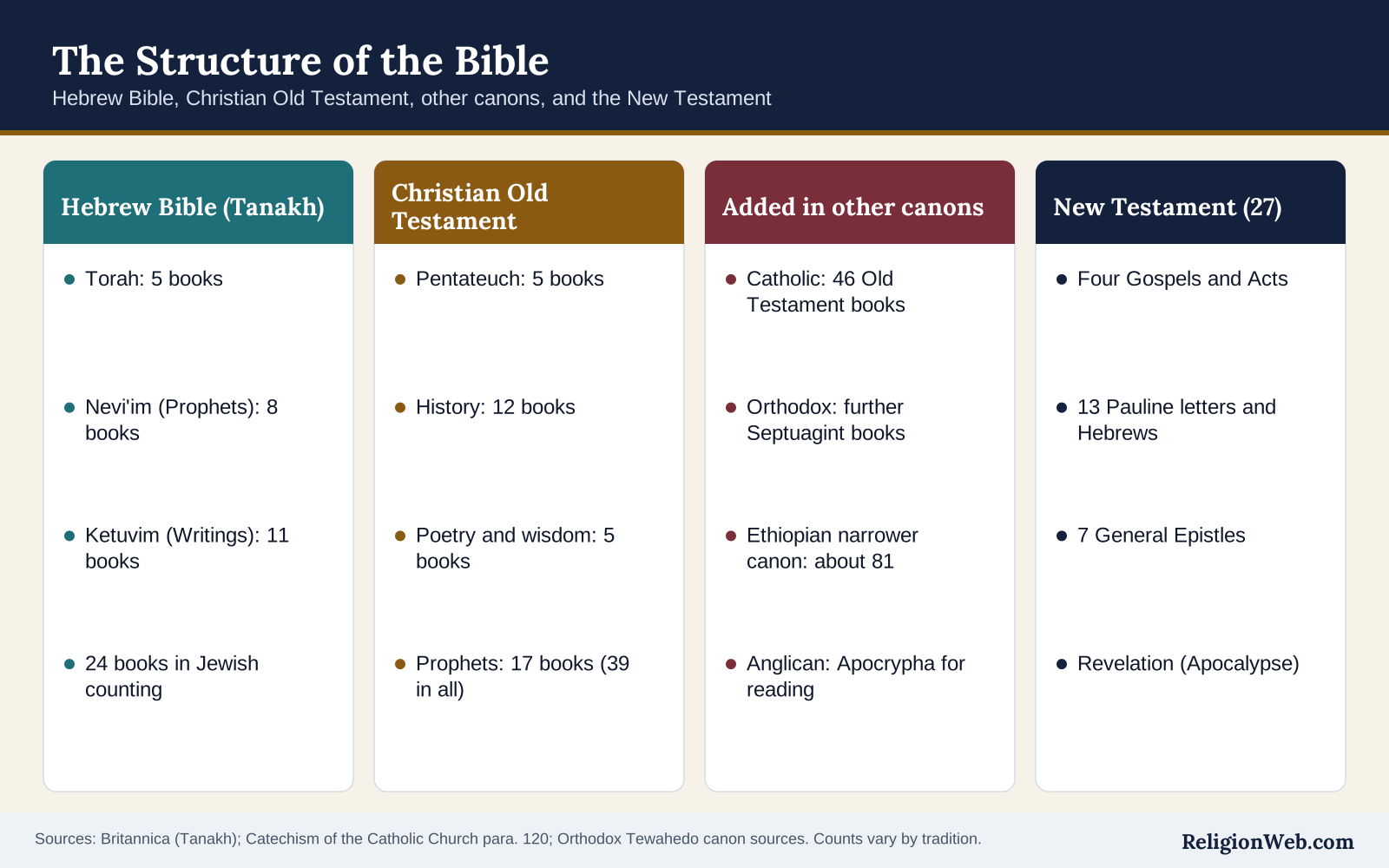
The easiest way to hold the Bible in mind is as two large collections. The first, which Christians call the Old Testament, tells of creation, the call of Abraham, the exodus from Egypt, the law given at Sinai, the kingdoms of Israel and Judah, the exile in Babylon, and the return, and it includes the Psalms and the books of wisdom and prophecy. The second, the New Testament, contains four Gospels, the Acts of the Apostles, twenty-one letters, and the Book of Revelation. The table below summarizes the figures that most reference works use, and it notes where counts depend on the tradition.
| Feature | Summary | Notes |
|---|---|---|
| Meaning of the name | Greek biblia, “books” | Plural in origin, singular in English usage |
| Two parts | Old Testament and New Testament | The Old Testament overlaps with the Jewish Tanakh, but the order and the name differ |
| Books in Protestant Bibles | 66 (39 Old Testament, 27 New Testament) | Old Testament follows the books of the Hebrew Bible, counted and ordered in the Christian way |
| Books in Catholic Bibles | 73 (46 Old Testament, 27 New Testament) | Adds the deuterocanonical books; the Catechism counts 45 Old Testament books if Jeremiah and Lamentations are joined |
| Books in Orthodox Bibles | Varies by church | The Greek Old Testament tradition adds further books to the Catholic list, such as 3 Maccabees and Psalm 151 |
| Books in the Ethiopian Orthodox Tewahedo canon | Commonly cited as 81 in the narrower canon | Includes Enoch and Jubilees; boundaries are discussed within the church |
| Original languages | Hebrew, Aramaic, Greek | Aramaic appears in parts of Daniel and Ezra |
| Period of composition | Roughly 1000 BCE or earlier to the early second century CE | Dates for individual books are debated |
| Oldest major witnesses | Dead Sea Scrolls (Hebrew Bible), papyri and codices (New Testament) | Discussed in the section on manuscripts |
| Translation reach | Full Bible in 795 languages; some Scripture in 4,121 (1 January 2026) | Bible societies’ statistics report for 2025 |
Languages, time span, and authorship in brief
The Old Testament was written mostly in Hebrew, with sections of Aramaic in Daniel and Ezra, and the New Testament was written in Greek, the common language of the eastern Mediterranean in the first century CE. Estimates for the time span vary because scholars date individual books differently. Some poetry in the Old Testament may preserve very early material, while the latest books of the Hebrew Bible reached their present form in the Persian and Hellenistic periods, and the New Testament was composed between the middle of the first century CE and, on most scholarly reckonings, the early second century. Authorship is likewise a layered subject. Traditions name Moses, David, Solomon, Isaiah, Paul, and the evangelists, while historians often describe long processes of composition, editing, and compilation. The section on how the books were written sets out both views.
Why More Than One Christian Bible Exists
A shared core with different edges
Most of the Bible is shared by all Christians. The Torah, the historical books, the Psalms, the major prophets, the four Gospels, Acts, the letters of Paul, and Revelation appear in every mainstream Christian canon. The differences lie at the edges. The Catholic Church includes seven additional Old Testament books and parts of Esther and Daniel that Protestants place in a separate category called the Apocrypha or omit. The Orthodox churches use the wider collection that came to them through the Greek Septuagint, and some Oriental Orthodox churches add still others. The Church of the East historically used a shorter New Testament, following the Syriac Peshitta. These facts are not signs of a modern split alone, since several of them reflect choices made in the fourth and fifth centuries.
The Catholic Church, the Eastern Orthodox churches, the Oriental Orthodox churches, and Protestant churches each have their own detailed articles on this site: Catholic Christianity, Eastern Orthodox Christianity, Oriental Orthodox Christianity, and Protestant Christianity. The section on canon families in this article compares the lists book by book within the Christian family.
How this article names the two parts
Terminology deserves care. Christians call the first part of their Bible the “Old Testament,” using “testament” in the sense of “covenant,” and call the second the “New Testament.” Many Christians understand the phrase as marking fulfillment rather than replacement, and the Catechism of the Catholic Church states that the Old Covenant has never been revoked. Jewish readers do not use “Old Testament” for their scripture, because the name assumes a “New” that is not part of their canon, and they speak of the Tanakh, the Hebrew Bible, or simply the Bible. Academic writing often says “Hebrew Bible” when the aim is to refer to the books in their Jewish form and “Old Testament” when speaking of the Christian arrangement. This article uses “Old Testament” for the Christian part of the Bible, “Hebrew Bible” or “Tanakh” for the Jewish scripture, and the dates BCE and CE throughout.
Inside the Bible: Sections, Genres, and the Two Testaments
The Hebrew Bible and the Old Testament
The Tanakh: Torah, Prophets, and Writings
Jewish tradition arranges its scripture in three parts, and the Hebrew name Tanakh is an acronym built from their names: Torah (“instruction” or “teaching”), Nevi’im (“Prophets”), and Ketuvim (“Writings”). The Torah, also called the Pentateuch or the Five Books of Moses, contains Genesis, Exodus, Leviticus, Numbers, and Deuteronomy. The Nevi’im have eight books: the Former Prophets (Joshua, Judges, Samuel, and Kings) and the Latter Prophets (Isaiah, Jeremiah, Ezekiel, and the Twelve, a single scroll of shorter prophetic books from Hosea to Malachi). The Ketuvim contain Psalms, Proverbs, Job, the Five Megillot or scrolls (Song of Songs, Ruth, Lamentations, Ecclesiastes, and Esther), Daniel, Ezra and Nehemiah counted together, and Chronicles. Counted this way the Tanakh has 24 books, and Jewish tradition gives the first part a special rank, since the Torah is read in its entirety through the cycle of weekly synagogue readings.
The shape of the Tanakh follows a logic that Jewish readers have long recognized. The Torah tells the story from creation to the edge of the promised land and contains the commandments. The Prophets continue the story of Israel in the land and gather the words of the prophets, and the Writings gather songs, wisdom, reflections on suffering, and later histories. The Five Megillot are each associated with a festival or fast in the Jewish liturgical year, which is one reason they are grouped as they are. The Jewish arrangement ends with Chronicles, which retells the history from Adam to the decree of Cyrus that allowed exiles to return to Jerusalem.
The Christian Old Testament: a different order
Christian Bibles contain the same core books but arrange them differently, in a pattern that comes from the Greek Septuagint tradition. Protestant Bibles, which follow the Hebrew Bible’s list of books, divide them into 39 by counting Samuel, Kings, Chronicles, Ezra-Nehemiah, and the Twelve as separate books, and they group them as the Pentateuch (five books), the historical books (Joshua through Esther, twelve books), the books of poetry and wisdom (Job, Psalms, Proverbs, Ecclesiastes, and Song of Songs), and the Prophets (five major prophets and twelve minor prophets). Daniel appears among the prophets rather than the Writings, and Ruth follows Judges because its story is set in the same era. The Christian order ends with the prophet Malachi, and many Christian readers connect that ending with the expectation of the Gospels that follow.
Catholic Bibles place the additional books in the same groups. Tobit and Judith stand with the histories, Wisdom and Sirach with the wisdom books, and Baruch with the prophets, while 1 and 2 Maccabees close the historical books. Orthodox editions arrange the Septuagint books in a similar manner with their own variations. In all these arrangements the Old Testament is a story with a sequence, and that sequence affects how it is read: Christian tradition often reads the Prophets as pointing forward, whereas Jewish tradition places the Prophets and Writings alongside the Torah as commentary and response.
What to call the first part
The names matter because they carry different relationships to the text. Christians who say “Old Testament” typically mean the first part of a Bible that is read as a single whole, and the Catechism of the Catholic Church affirms that the Old Testament is an essential part of Scripture whose books are divinely inspired and whose covenant “has never been revoked.” Jewish readers call the same books by names that do not depend on the New Testament. Historians and biblical scholars working across traditions often choose “Hebrew Bible” as a neutral label, even though it too has limits, since parts of it are in Aramaic and since the Christian Old Testament includes books outside the Hebrew canon. No single term satisfies every reader, and the article on the Torah describes how Jewish tradition reads the five books at the center of the collection.
The New Testament
The Gospels and Acts
The New Testament opens with four accounts of Jesus’ ministry, death, and resurrection, titled Matthew, Mark, Luke, and John. The word “gospel” translates the Greek euangelion, “good news,” and it first named the message Christians proclaimed before it named a type of book. The first three Gospels are called the Synoptic Gospels, from a Greek word meaning “seen together,” because they share much material, arrange it similarly, and can be laid out in parallel columns. Most scholars hold that Mark was written first, probably in the decades around 70 CE, and that Matthew and Luke each drew on Mark and on additional material, while John presents a distinctive account with long discourses and a different sequence of events. Many scholars classify the Gospels as a form of ancient biography, written to proclaim as well as to record. The article on Jesus Christ explains what historians can and cannot say about his life and how Christians understand his identity.
Acts of the Apostles follows the Gospels and tells of the early church from the ascension of Jesus through the mission of Paul, ending with Paul under house arrest in Rome. Tradition and most scholars regard Acts and the Gospel of Luke as two volumes by the same author, which is why Acts opens with a reference to “the first book” addressed to Theophilus, the same person who is named in the Gospel’s prologue. Acts includes the narrative of the Spirit’s arrival at the Jewish festival of Weeks, which Christians celebrate as Pentecost, and the earliest use of the name “Christian” at Antioch.
Letters
Twenty-one of the 27 New Testament books are letters. Thirteen name Paul as their author: Romans, 1 and 2 Corinthians, Galatians, Ephesians, Philippians, Colossians, 1 and 2 Thessalonians, 1 and 2 Timothy, Titus, and Philemon. They are arranged in the New Testament by length, first those to churches and then those to individuals, rather than by date. Most critical scholars regard seven as certainly from Paul (Romans, 1 and 2 Corinthians, Galatians, Philippians, 1 Thessalonians, and Philemon) and divide on the others, with Colossians, Ephesians, and 2 Thessalonians often called disputed and 1 and 2 Timothy and Titus, the Pastoral Epistles, widely considered later works written in Paul’s name. Many Christian traditions maintain Pauline authorship for all thirteen. The anonymous Letter to the Hebrews follows these in most editions. The Council of Trent’s list of 1546 speaks of “fourteen epistles of Paul,” including Hebrews, while many scholars across traditions emphasize that the author of Hebrews is unknown.
The remaining letters are sometimes called the General or Catholic Epistles, where “catholic” means “universal,” because most are addressed to wider audiences than a single congregation. They are James, 1 and 2 Peter, 1, 2, and 3 John, and Jude. Letters throughout the New Testament were written to settle concrete questions, such as how Gentile converts relate to Jewish law, how to conduct worship, and how to live under pressure, so they preserve the earliest discussions of belief and practice in the churches. Because they address particular situations, scholars read them first as occasional writings and then ask how later Christians applied their teaching.
Revelation
The New Testament ends with the Book of Revelation, also called the Apocalypse, from the Greek apokalypsis, “unveiling.” It belongs to a literary type, apocalyptic, in which visions, numbers, and symbols convey a message about the conflict between good and evil and the final purposes of God. It opens with letters to seven churches in Roman Asia Minor, and it was addressed to Christians living under imperial power, often with the experience of suffering. The author names himself John, and Christian tradition has identified him in different ways, while modern scholars debate the question. Churches interpret Revelation in several ways: as a coded commentary on first-century Rome, as a prophecy of events still to come, as a symbolic picture of the whole history of the church, or as a timeless depiction of the struggle between good and evil. Revelation was among the last books to win general acceptance in the Eastern churches, as the section on the canon explains.
Genres and How They Shape Reading
Narrative, law, poetry, and wisdom
Biblical books use many literary types, and reading a passage in the wrong genre produces mistakes as surely as reading a poem as a legal document. Narrative makes up a large share, in the stories of Genesis, the histories of Samuel and Kings, and the Gospels. Law appears in Exodus, Leviticus, Numbers, and Deuteronomy, where commandments are embedded in the story of Israel’s formation. Poetry fills the Psalms, Song of Songs, Lamentations, and much prophecy, and Hebrew poetry depends less on rhyme than on parallelism, in which a second line restates, contrasts, or extends the first. Wisdom literature, found in Proverbs, Job, Ecclesiastes, and in the deuterocanonical books of Wisdom and Sirach, offers practical sayings and extended reflection on suffering and meaning. The table below sets out the main sections and their characteristic forms.
| Section | Representative books | Main literary types | Typical uses in Christian worship and study |
|---|---|---|---|
| Law (Pentateuch, Torah) | Genesis, Exodus, Leviticus, Numbers, Deuteronomy | Narrative of origins, covenant law, genealogies | Readings on creation and the exodus, especially at Easter Vigil and in Lent; the Ten Commandments in catechesis |
| Historical books | Joshua, Judges, Samuel, Kings, Chronicles, Ezra, Nehemiah, Esther | Narrative history, royal chronicles | Sermon series on figures such as David; Old Testament lessons |
| Poetry and wisdom | Psalms, Proverbs, Job, Ecclesiastes, Song of Songs | Hymns, laments, sayings, dialogue, love poetry | Psalms sung or recited at nearly every service; Proverbs and Job in devotion |
| Prophets | Isaiah, Jeremiah, Ezekiel, Daniel, the Twelve | Oracles, visions, sermons, narrative | Advent and Lenten readings; Isaiah often read at Christmas |
| Gospels | Matthew, Mark, Luke, John | Narrative with sayings, parables, miracle stories, passion narratives | The Gospel reading is the high point of the reading in many services |
| Acts | Acts of the Apostles | Narrative history with speeches | Readings in Eastertide and at Pentecost |
| Letters | Romans through Jude | Occasional letters and sermons | Second reading at many Sunday services; basis of much doctrine |
| Apocalypse | Revelation | Visions, letters to churches, hymns | Readings at Easter season and the end of the church year |
Prophecy, parable, apocalypse, and letter
Prophecy in the Bible is mostly proclamation to a people in a specific historical moment, with a message of judgment, warning, or consolation, and sometimes with a vision of the future. Readers who treat it as a calendar of predictions miss that its first audience was the kingdom of Judah or Israel, the exiles in Babylon, or the community that returned from exile. Christians also read many prophetic passages in the light of Jesus, and the Gospels themselves cite the prophets frequently. Parables, short stories told by Jesus to illustrate the kingdom of God, such as the sower and the prodigal son, are a distinctive Gospel form that invites reflection and often ends unresolved. The Lord’s Prayer, preserved in Matthew and Luke in slightly different forms, is a case where the same material appears in two settings, and the article on the Lord’s Prayer examines both.
Recognizing genre also helps in understanding how Christians read for meaning. A psalm of lament is read as prayer, a legal passage as part of a covenant that Christians interpret in different ways, a Gospel parable as teaching, and a letter as pastoral instruction to a community with particular problems. Catholic teaching, in the Second Vatican Council’s constitution Dei Verbum (1965), states that interpreters must pay attention to “literary forms,” since truth is expressed differently in historical, prophetic, and poetic writing, and many Protestant interpreters make a similar point in their own terms. The point is not that genre excludes belief, but that it directs attention to what a given text is doing.
How the Biblical Books Were Written
Oral Tradition, Writers, and Communities
Speech before scrolls
Most of the material in the Bible was spoken before it was written. Prophets delivered oracles aloud and their words were later gathered, the Psalms were sung in worship before they were collected into a book, and stories about Israel’s ancestors were told in families and gatherings long before they reached the narrative form now in Genesis. The same pattern holds in the New Testament. Jesus taught orally, and his sayings and the accounts of his ministry circulated among his followers before anyone wrote them down. The apostle Paul, writing in the 50s CE, reminds the Corinthians of what he had “received” and “delivered” about the death and resurrection of Christ “according to the Scriptures,” which shows a tradition already shaped for teaching and repetition within about two decades of the events it describes.
Scholars who study this process do not treat oral and written composition as opposites. In ancient societies where relatively few people could read, memory and performance carried authority, and writing often served to preserve, support, and expand what had been told. Many biblical books show signs of this layered history: repeated formulas that aid memory, poetry arranged in patterns, and collections that combine older and newer material. Where the evidence is thin, historians say so, and they speak of probabilities rather than certainties about how a given text grew.
Authors, editors, and traditions of authorship
Both Jewish and Christian tradition associate many books with named figures: Moses with the Torah, David with many psalms, Solomon with Proverbs, Ecclesiastes, and Song of Songs, Isaiah and Jeremiah with the books that bear their names, and the evangelists and apostles with the books of the New Testament. Many believers and some scholars continue to hold these attributions, in whole or in part, and churches generally affirm that the human writers were guided by God without specifying how. Other scholars, working with the methods of literary and historical criticism, describe most books as the product of long processes involving several authors, editors, and communities.
The Torah is the best-known case. Traditional Jewish and Christian readings understood it as the work of Moses, while since the nineteenth century many critical scholars have proposed that its present form combines older sources and was edited over centuries, a family of theories known generally as the documentary hypothesis. Its details are debated, and recent scholarship offers several alternatives, so no single model commands full agreement. A similar discussion surrounds the Book of Isaiah, often read as the work of more than one prophetic voice by critical scholars and as a unity in traditional reading, and the Book of Daniel, which the tradition dates to the sixth century BCE and many historians place in its final form around the persecution under the Seleucid king Antiochus IV in the 160s BCE. The point for the reader is that the Bible itself rarely names its authors, and statements about authorship usually rest on tradition, internal clues, or scholarly reconstruction.
How the New Testament Was Assembled
Letters before Gospels
The earliest writings in the New Testament are probably Paul’s letters, since the oldest, 1 Thessalonians, is generally dated around 50 CE, while the Gospels were written later. Paul wrote to communities he had founded or hoped to visit, answering questions about belief, conduct, and church order, and those letters were treasured by the communities that received them. A short sentence in his letter to the Colossians shows how that circulation began. It asks the church to read the letter aloud in its assembly and also to share it with a neighboring congregation:
When this letter has been read among you, cause it to be read also in the assembly of the Laodiceans, and that you also read the letter from Laodicea.
Colossians 4:16, World English Bible (Classic), public domain
The verse reveals practices that later shaped the canon: letters were read in worship, copied, exchanged among churches, and eventually collected. By the second century a collection of Paul’s letters seems to have circulated widely, and a later New Testament letter, 2 Peter, speaks of Paul’s letters as a body of writing that some readers distort, as they do the other Scriptures, which suggests that they were already honored beyond a single church. Ancient Christians did not decide in a single stroke to create a New Testament. They kept reading the writings that proved useful for worship and teaching and the process of recognizing them took generations.
The Gospels’ own statements of purpose
The Gospels were composed after Paul’s earliest letters, and their authors explain themselves in different ways. Luke begins with a formal preface, addressed to a patron named Theophilus, in which he describes his method as one of careful tracing and orderly writing:
it seemed good to me also, having traced the course of all things accurately from the first, to write to you in order, most excellent Theophilus; that you might know the certainty concerning the things in which you were instructed.
Luke 1:3-4, World English Bible (Classic), public domain
Luke’s introduction places his work among earlier accounts and treats it as a deliberate composition for readers who had already been taught. The Gospel of John states its aim near the end of the book, noting that Jesus did many other signs in the presence of his disciples that are not written in this book, and then explaining:
but these are written that you may believe that Jesus is the Christ, the Son of God, and that believing you may have life in his name.
John 20:31, World English Bible (Classic), public domain
The two statements show that the evangelists selected, arranged, and interpreted material for particular purposes. That is why the four Gospels differ in emphasis and order while telling of the same person, and why Christian tradition from an early date preferred to keep four accounts side by side rather than merging them into one. Historians use the same observation to discuss sources, setting, and the transmission of sayings, while believers read the Gospels as faithful testimony. The two approaches ask different questions of the same texts.
Languages, Materials, and Dating
Hebrew, Aramaic, and Greek
The Old Testament is written almost entirely in Biblical Hebrew, with larger Aramaic passages in Ezra (4:8 to 6:18 and 7:12-26) and Daniel (2:4 to 7:28) and a single verse in Jeremiah (10:11). Aramaic was the common language of the Persian empire and later of much of the Near East, and it was probably the everyday language of Jesus and his first followers in Galilee and Judea. Traces of it survive in the Gospel of Mark, which preserves a few of Jesus’ words in the original, such as talitha cum (roughly “little girl, get up”) in Mark 5:41. The New Testament itself is written in Koine Greek, the shared language of the eastern Roman Empire. This means the first Gospel texts already stand one step removed from the language Jesus most likely spoke, and the New Testament authors often quoted the Old Testament in its Greek form, the Septuagint.
Scrolls and the codex
Books of the Bible were first written on scrolls, rolled sheets of papyrus or parchment that were read from one end to the other. A single scroll could hold a book such as Isaiah, but not the whole Hebrew Bible, which is one reason the Bible grew as a collection of separate volumes. Christians adopted the codex, a stack of sheets folded and bound at one side, which is the ancestor of the modern book, earlier and more broadly than the surrounding culture did, and many scholars note that nearly all of the oldest surviving Christian biblical manuscripts are codices. A codex made it easier to find a passage, to carry a set of writings together, and to hold the four Gospels or the letters of Paul in one volume. Binding multiple books into one volume also encouraged people to think about which books belonged inside it, a question the canon would answer.
Dating and its limits
Dating the biblical books involves layers of evidence: references to datable events, the style of the language, the shape of surviving manuscripts, and quotations in other ancient writings. Most scholars place the New Testament writings between roughly 50 CE and the early second century, with Paul’s undisputed letters in the 50s, the Gospel of Mark in the decades around 70, Matthew and Luke later in the first century, and John toward its end, while some books such as 2 Peter are often dated later. For the Old Testament the range is wider and the debates sharper, since books such as Genesis through Kings took shape through long processes of tradition and editing. Readers should expect to find ranges rather than single dates, and an honest reference work reports the limits of what can be known along with the best-supported proposals.
The Biblical Canon: How the Books Were Recognized
What “Canon” Means and How It Formed
A list, a rule, and a process
When Christians speak of the canon, they mean the closed list of books that a church receives as Scripture and that serves as a standard for belief and practice. Two questions run through every discussion of it. The first is historical: when, where, and by whom were particular books accepted, and what evidence survives? The second is theological: what does it mean to say that a church received, recognized, or defined its Scripture? Catholic, Orthodox, and Protestant teaching generally agree that the church recognized books that were already inspired and already functioning as Scripture, rather than conferring authority on them by decree. Historians add that recognition was gradual, uneven across regions, and driven more by use in worship and teaching than by the verdict of any single authority.
That combination explains why the canon looks different depending on where one stands. Some lists were fixed early and widely, such as the four Gospels and the major letters of Paul. Others, such as the Letter of James or the Book of Revelation, were accepted in some regions earlier than in others. And for the Old Testament, the early church inherited a scriptural library whose edges were already differently drawn in different Jewish communities and in Greek-speaking Judaism. The sections that follow take the Old and New Testaments in turn and then compare the main Christian canon families.
Scripture before the canon: the Old Testament as the first Christian Bible
The earliest Christians already had a Bible, which was the scripture of Israel. Jesus and his first followers were Jews who read the Torah, the Prophets, and the Psalms, and the New Testament writers appeal to that scripture constantly. Paul summarizes the message he inherited, that Christ died for sins and was raised on the third day, as being “according to the Scriptures,” meaning the Hebrew scriptures read in Greek or Hebrew, since no New Testament yet existed. The Gospel of Luke describes the risen Jesus reminding his disciples of a three-part pattern in that scripture, which matches the structure of the Tanakh:
He said to them, “This is what I told you while I was still with you, that all things which are written in the law of Moses, the prophets, and the psalms concerning me must be fulfilled.”
Luke 24:44, World English Bible (Classic), public domain
Christians understand this verse as a statement that the whole of the older scripture bears witness to Christ, and it became a foundation for reading the Old Testament typologically, as later sections explain. For the history of the canon, the verse also illustrates that “the law, the prophets, and the psalms” was already a recognizable way to name Israel’s scripture in the first century. What the verse does not do is list the books. The limits of the third category, the “psalms” or Writings, were not drawn identically by every Jewish community, and the first Christians used scripture in Greek translation at least as often as in Hebrew.
The Old Testament Canon
The Jewish collection and the question of when it closed
The Hebrew Bible’s Torah and Prophets were widely authoritative in Jewish communities by the Second Temple period, and the Writings were in more flexible standing. The Jewish historian Josephus, writing around 95 CE, describes a Jewish scriptural collection of 22 books: five of Moses, thirteen of the prophets, and four of hymns and precepts for life. This is usually taken to be another way of counting the same books that later Jewish tradition numbers as 24. The Dead Sea Scrolls, copied between the third century BCE and the first century CE, include biblical manuscripts alongside other writings such as commentaries, hymns, and community rules, which shows a Jewish library that was larger than the later canon and that gave some books authority that were not later included.
For much of the twentieth century a popular account held that rabbis meeting at Yavneh (Jamnia) around 90 CE formally closed the Jewish canon. Most scholars now regard that model as unsupported by the evidence, since the sources describe discussion of particular books rather than a canon-defining council. Scholars such as Marc Zvi Brettler have argued that outside the Torah and the Prophets the boundaries remained fluid in some circles, and others see the Hasmonean period (the second and first centuries BCE) as the time when the collection was substantially settled. The honest summary is that the date and manner of closure remain disputed, though by the late first and second centuries CE the list that became the Hebrew canon was widely recognized in rabbinic circles.
The Septuagint and the larger Greek collection
The Septuagint is the Greek translation of the Hebrew scriptures made for Greek-speaking Jews, beginning, according to the ancient Letter of Aristeas, with a translation of the Torah in Alexandria in the third century BCE and later extended to the other books. The name comes from the story that seventy-two translators produced it, and its abbreviation, LXX, recalls the rounded number seventy. The Septuagint contained translations of the Hebrew books and also several works written in Greek or surviving mainly in Greek, among them Wisdom, Sirach, Tobit, Judith, Baruch, and 1 and 2 Maccabees. Early Christians, many of whom spoke Greek, used the Septuagint heavily, and New Testament writers often quote it.
The Greek manuscripts that preserve the Septuagint, such as the fourth-century Codex Sinaiticus and Codex Vaticanus, were copied by Christians and include several of these additional books, but they do not give a single fixed list, and scholars debate how far the larger collection was regarded as scripture by Greek-speaking Jews themselves. What is clear is that the churches of the Greek and Latin worlds inherited a larger body of Old Testament writings than the Hebrew canon of the rabbis, and that Christian writers treated those books in different ways.
Jerome, Augustine, and the Latin West
The differences became visible in the Latin West. Jerome, who spent years translating the Old Testament from Hebrew in the late fourth century, argued for the “Hebrew truth” (Hebraica veritas) and distinguished the books of the Hebrew canon from the additional ones. His Latin translation, the Vulgate, nonetheless included the additional books, in part because they were already in the Old Latin Bibles that churches were using. Augustine, writing in On Christian Doctrine around 397, listed the larger collection as canonical and considered the Septuagint divinely inspired. North African synods at Hippo in 393 and Carthage in 397 endorsed lists that included these books, and later Roman correspondence in the early fifth century, such as the letter of Pope Innocent I to Exsuperius of Toulouse, gave a similar list.
Scholars caution against reading this as a simple quarrel between two teachers, since both Jerome and Augustine held more nuanced positions than the traditional contrast suggests, and since regional councils had limited reach in any case. Through the Middle Ages, Western Christians generally used the Vulgate with its larger Old Testament, while theologians sometimes distinguished “canonical” books from “ecclesiastical” ones that were read for edification. Those distinctions set the stage for the divisions of the sixteenth century, discussed below.
The New Testament Canon
From Gospels and letters to collections
The New Testament canon developed through the circulation of individual writings. Paul’s letters were collected, the Gospels were read in worship, and churches shared what they valued. Around 130 to 140 CE a teacher named Marcion of Sinope assembled a list consisting of an edited version of Luke and ten letters of Paul, and he rejected the Old Testament altogether. Church leaders opposed him, and the Catholic Church’s Catechism still names the rejection of the Old Testament as Marcionism and refuses it. Whether Marcion’s list prompted the church to define its own or merely reflected a process already under way is debated among historians.
By about 180 CE, Irenaeus of Lyon was arguing that there could be exactly four Gospels, no more and no fewer, and he supported the claim with comparisons to the four winds and the four regions of the world. His reasoning shows how firmly the fourfold Gospel was held in his circles, even if the argument itself is symbolic rather than historical. The Muratorian Fragment, a damaged Latin list of New Testament books, is usually dated to the late second century, though some scholars prefer a fourth-century date. Origen in the early third century was already using most of the books later accepted, while noting that some, such as Hebrews, James, 2 Peter, 2 and 3 John, Jude, and Revelation, were doubted by some.
Disputed books and the fourth-century lists
Around 330 CE the church historian Eusebius of Caesarea sorted writings into groups. In his Church History (3.25) he named as recognized the four Gospels, Acts, the letters of Paul, 1 John, and 1 Peter, and he included Revelation among them only conditionally, noting that opinions about it were divided. He placed James, Jude, 2 Peter, and 2 and 3 John among the disputed books that many accepted, and he rejected writings such as the Acts of Paul, the Shepherd of Hermas, and the Epistle of Barnabas. Works such as the Gospels of Peter, Thomas, and Matthias he considered unfit to be ranked even among the rejected. Eusebius’s survey shows that, a generation before the standard list, most of the 27 books were already broadly accepted and a handful were still debated.
The earliest surviving list that names exactly the 27 books of the New Testament appears in the Festal Letter of Athanasius, bishop of Alexandria, written in 367 CE. He lists the four Gospels, Acts, seven General Epistles, fourteen Pauline letters including Hebrews, and Revelation, and he places books such as the Didache and the Shepherd in a category of writings suitable for instruction of new converts but not canonical. Western regional councils at Hippo in 393 and Carthage in 397 endorsed the same list for North Africa. Revelation continued to receive a more cautious reception in some Eastern churches for centuries, and the classic Syriac Peshitta, which the Church of the East preserved, contains a New Testament of 22 books that omits 2 Peter, 2 and 3 John, Jude, and Revelation.
What councils did and did not do
It is common to hear that a church council “chose” the books of the New Testament. The evidence is less dramatic. Regional synods and bishops’ letters recorded lists that reflected what churches had come to read in worship, and by the end of the fourth century a large majority of churches agreed on the 27. No ecumenical council of the early centuries issued a decree listing the New Testament books. A formal conciliar decree on the canon, with penalties attached for rejecting it, came only at the Council of Trent in 1546, which fixed the Catholic list in response to the Reformation. The article on Christianity places the great councils of the fourth and fifth centuries in context, and the section on misconceptions below addresses the claim about the Council of Nicaea directly.
Canon Families Across Christian Traditions
The Catholic Church: 73 books
The Catholic canon contains 46 Old Testament books and 27 New Testament books, as the Catechism of the Catholic Church lists them in paragraph 120, noting that the Old Testament count is 45 if Jeremiah and Lamentations are counted as one. The Council of Trent affirmed this list on 8 April 1546 in its fourth session, declaring that the books should be received entire, with all their parts, as they had customarily been read in the Catholic Church and as they appear in the old Latin Vulgate. Catholics call the seven books that Protestants set apart (Tobit, Judith, Wisdom, Sirach, Baruch, and 1 and 2 Maccabees, together with additions to Esther and Daniel) the deuterocanonical books, from the Greek for “second canon.” The term itself dates from the sixteenth century. Catholic teaching treats them as fully inspired Scripture, and they are read in the liturgy.
| Tradition | Old Testament | New Testament | Distinctive features |
|---|---|---|---|
| Protestant (most churches) | 39 books, matching the Hebrew canon | 27 books | Additional Greek books are called the Apocrypha and are excluded from the canon by many confessions, such as the Westminster Confession (1647) |
| Lutheran and Anglican | 39 books, with an Apocrypha section in some editions | 27 books | Apocryphal books are read for example of life and instruction but not to establish doctrine (Anglican Article VI, 1563) |
| Catholic | 46 books, including the deuterocanonical books | 27 books | List defined at the Council of Trent, 8 April 1546; Catechism para. 120 |
| Eastern Orthodox | Septuagint-based; adds books such as 1 Esdras, 3 Maccabees, and Psalm 151 to the Catholic list | 27 books | Details differ among Orthodox churches; the term for the additional books in Greek is anagignoskomena, “worthy of being read” |
| Oriental Orthodox: Ethiopian Tewahedo | Commonly cited as 81 books in the narrower canon, including Enoch and Jubilees | 27 books in the narrower canon plus additional church-order writings in the broader canon | The church has no single published canon; counts differ by source |
| Other Oriental Orthodox (Coptic, Armenian, Syriac) | Septuagint-based or Peshitta-based collections with local variations | 27 books in most modern editions | Details vary by church and edition |
| Church of the East | Syriac Peshitta tradition | Classic Peshitta has 22 books, omitting 2 Peter, 2 and 3 John, Jude, and Revelation | Historic canon preserved in Syriac |
The Eastern Orthodox churches
The Eastern Orthodox churches use the Septuagint as the basis of their Old Testament, and they recognize the deuterocanonical books of the Catholic list along with several others. Greek Orthodox editions include 1 Esdras, 3 Maccabees, and Psalm 151, and often print 4 Maccabees as an appendix, while the Prayer of Manasseh appears with the canticles of the church’s worship. The 1672 Synod of Jerusalem, a Greek Orthodox assembly, is commonly cited as affirming the wider canon, though Orthodox churches differ in how they describe the status of these books, and printed Bibles in Greek, Slavonic, and other languages vary in detail. In Orthodox usage the line between canonical and merely edifying books has been less sharply drawn than in Catholic or Protestant definitions, and the New Testament list is the standard 27.
Oriental Orthodox churches and the Church of the East
The Oriental Orthodox churches, which include the Coptic, Ethiopian, Eritrean, Armenian, Syriac, and Malankara churches, preserve ancient collections in Coptic, Ge’ez, Classical Armenian, and Syriac. The Ethiopian Orthodox Tewahedo Church is the best known for a larger canon. Its narrower canon is commonly cited as 81 books, which includes 1 Enoch, Jubilees, and three books of Meqabyan that differ from the Greek Maccabees, and a broader canon with additional church-order texts is described in some sources. Because the church has not published a single authoritative list in a single edition, counts differ from source to source, and anyone citing a figure should say whose count it is. The Church of the East historically used the Syriac Peshitta, whose classic New Testament has 22 books.
Protestant, Lutheran, and Anglican practice
The sixteenth-century Reformers, following the argument of Jerome, returned to the Hebrew canon as the standard for the Old Testament. Martin Luther’s German Bible of 1534 placed the additional books in a separate section headed, in substance, as books not to be esteemed like the Holy Scriptures but useful and good to read. The Church of England’s Thirty-Nine Articles of 1563 state in Article VI that the church reads those books for example of life and instruction but does not apply them to establish doctrine. The Geneva Bible of 1560 and the King James Version of 1611 printed them as an Apocrypha, and the Westminster Confession of 1647 declared them no part of the canon. Many modern Protestant Bibles omit them, while some Anglican, Lutheran, and ecumenical editions still print them. Luther also voiced doubts about Hebrews, James, Jude, and Revelation and placed them at the end of his New Testament, although later Lutheran churches did not follow him in removing them. The Anglican view of the Apocrypha is described further in the article on Anglicanism.
Manuscripts and Transmission: From Scrolls to Critical Editions
The Hebrew Bible Text
Scribes and the Dead Sea Scrolls
No original manuscripts of any biblical book survive. What exists are copies of copies, and the study of how texts were copied, preserved, and sometimes altered is called textual criticism. For the Hebrew Bible, the most important twentieth-century discovery was the Dead Sea Scrolls, found in 1947 when Bedouin shepherds of the Ta’amireh tribe came upon the first scrolls in a cave in the cliffs near Qumran, on the northwestern shore of the Dead Sea. Eventually eleven caves in the area yielded thousands of fragments of parchment and papyrus. The Israel Museum’s Dead Sea Scrolls project reports that the Qumran scrolls date from the third century BCE to the first century CE, that Hebrew is the most common language, that about 15 percent are in Aramaic and a few are in Greek, and that about 230 manuscripts are classed as biblical. Two of the seven scrolls first sold to scholars and dealers were copies of Isaiah.
The scrolls pushed the earliest evidence for the Hebrew Bible back by roughly a thousand years, since before 1947 the oldest complete Hebrew manuscripts dated from the early Middle Ages. They show a text that is, on the whole, remarkably close to the later tradition, and they also reveal variety. Some biblical scrolls agree closely with the later Masoretic Text, others have readings close to the Septuagint or the Samaritan Pentateuch, and a few differ from all of them. Scholars draw different conclusions from that variety, but most agree that in the last centuries BCE the Hebrew text existed in more than one form and that the stable form later preserved by the rabbis emerged from that situation.
The Masoretes and the medieval codices
The Hebrew text that most Jewish and Christian translations follow is the Masoretic Text, named for the Masoretes, scribal scholars who worked mainly in Tiberias and in Babylonia between about the sixth and the tenth centuries CE. Hebrew was written with consonants alone, so the Masoretes added vowel signs, accent marks for chanting, and marginal notes (the Masorah, from the Hebrew word for “tradition”) to preserve the pronunciation and the reading. They counted verses, words, and even letters, and they noted the middle verse and middle word of books so that later copyists could detect errors. Their work explains why printed Hebrew Bibles from the fifteenth century agree so closely with medieval codices.
Two codices are the best-known products of this tradition. The Aleppo Codex was written around 920 CE in Tiberias, with the consonants copied by the scribe Shlomo ben Buya’a and the vowels and Masoretic notes added by Aaron ben Moses ben Asher, and it was long treated as a model text, consulted by Maimonides for his rules on Torah scrolls. About 40 percent of it was lost after the burning of the synagogue in Aleppo in 1947, and the surviving pages are displayed in the Shrine of the Book at the Israel Museum in Jerusalem. The Leningrad Codex, whose colophon dates it to Cairo in 1008 or 1009 CE, is the oldest known complete Hebrew Bible manuscript with the Tiberian vowel system and has been held at the National Library of Russia in Saint Petersburg since 1863. It is the text behind the standard scholarly editions known as Biblia Hebraica, including the Stuttgart edition of 1977 and the Quinta edition now in production.
Other ancient witnesses
Textual critics of the Old Testament compare the Masoretic Text with other ancient witnesses. The Septuagint, translated from Hebrew texts that were sometimes different from the Masoretic tradition, is a major one, and so are the Samaritan Pentateuch, preserved by the Samaritan community, the Aramaic translations known as Targums, the Latin Vulgate, and the Syriac Peshitta. In books such as Jeremiah, the Greek version is notably shorter than the Hebrew, and the Dead Sea Scrolls include a Hebrew fragment that matches the shorter form, which suggests that the Greek translators worked from a Hebrew text that differed from the Masoretic one. For the Old Testament, then, textual criticism is a comparison of several ancient witnesses and not simply a check on one.
The New Testament Text
Papyri, codices, and the manuscript count
The New Testament survives in far more manuscripts than any other work of ancient Greek literature, and most of them come from later centuries. The Institute for New Testament Textual Research at Münster maintains the official register, the Kurzgefasste Liste, which listed about 5,700 entries as of a September 2023 post, or 5,541 when destroyed and presumed-missing manuscripts are excluded. The register includes papyri, manuscripts in capital letters called majuscules or uncials, later manuscripts in cursive script called minuscules, and lectionaries, which are manuscripts arranged for reading in church services. The institute itself calls the total a snapshot that changes as manuscripts are found, redated, or reclassified.
The oldest surviving fragment of a New Testament book is generally taken to be Papyrus 52, held at the John Rylands Library in Manchester. It is a small piece of papyrus about 9 by 6 centimeters, bearing a few verses of John 18 (verses 31 to 33 on one side and 37 and 38 on the other). It was purchased in Egypt in 1920 and published in the 1930s, and its handwriting is generally dated to the first half of the second century, with scholars giving ranges from about 100 to 160 CE. Because dating by handwriting has margins of error, scholars treat it as evidence that the Gospel of John was circulating in Egypt by the middle of the second century and not as a precise date for the text itself.
The great Greek codices of the fourth century are the first witnesses to preserve nearly the whole Christian Bible. Codex Sinaiticus, written in the fourth century and now divided among the British Library, the University of Leipzig, the National Library of Russia, and Saint Catherine’s Monastery in Sinai, once held at least 730 leaves of the Greek Old and New Testaments, along with the Epistle of Barnabas and the Shepherd of Hermas. The German scholar Constantin von Tischendorf first saw part of it at the monastery in 1844 and returned in 1859, when the manuscript was taken to Russia, and the British Museum acquired it in 1933. Additional leaves came to light at Saint Catherine’s in 1975. Codex Vaticanus, also fourth century, is kept in the Vatican Library. Both manuscripts show that the churches that produced them copied a larger set of writings than the final canon, since the Sinaiticus included Barnabas and Hermas after Revelation.
Variants and what they mean
Scribes copying by hand made mistakes and sometimes deliberate changes, so the surviving manuscripts differ. Most differences are minor: spelling, word order, a skipped line, or a substitution of a synonym. A small number affect the meaning of a passage or the presence of an entire section. Two well-known examples are the longer ending of Mark (16:9-20), which is absent from the oldest manuscripts, and the story of the woman accused of adultery (John 7:53 to 8:11), which appears in different places or not at all in early manuscripts. Another is a Trinitarian phrase in 1 John 5:7, found in the Latin tradition and in the printed Greek text used by the translators of the King James Version, but in Greek manuscripts only from about the fourteenth century on, and almost all textual critics regard it as a later addition.
The effect of these facts depends on the reader’s framework. Textual critics aim to reconstruct the earliest attainable form of the text from the surviving evidence, and many scholars think that goal is largely reachable for the New Testament. Christians who hold that Scripture is inspired generally accept this work as a way of recovering the text that God inspired, and most modern translations place significant variants in footnotes. Readers who find a note beside Mark 16:9 are seeing the results of the same process that produced the standard Greek text.
Printing and Critical Editions
Gutenberg, Erasmus, and the Textus Receptus
Printing changed the Bible’s circulation. Johannes Gutenberg completed his Latin Bible around 1455 in Mainz, one of the earliest books printed with movable type in Europe, and about forty copies survive. In 1516 the Dutch humanist Erasmus published his Novum Instrumentum, the first Greek New Testament published in print, built on a small number of late manuscripts that were available to him in Basel. His text and its later revisions by printers such as Robert Estienne and Theodore Beza became the basis of what was later called the Textus Receptus, “received text,” a phrase taken from a 1633 preface by the Leiden printers Bonaventure and Abraham Elzevir. The translators of the King James Version drew on several of these editions, consulting the Latin Vulgate as well.
Modern critical editions
Since the nineteenth century scholars have worked with a much larger set of manuscripts. The Nestle-Aland Novum Testamentum Graece, begun by Eberhard Nestle in 1898, reached its 28th edition in 2012, and the United Bible Societies’ Greek New Testament, now in its fifth edition (2014), presents the same Greek text with an apparatus designed for translators. These editions are eclectic: committees weigh the date, geographic spread, and likely scribal habits of the manuscripts to choose the reading most likely to be earliest. The ongoing Editio Critica Maior reports a much fuller set of variants. For the Old Testament the standard scholarly editions are the Biblia Hebraica Stuttgartensia and its successor Biblia Hebraica Quinta, both based on the Leningrad Codex, and the Göttingen and Cambridge editions of the Septuagint. Different churches and translation committees make different choices among these texts, which is part of why English Bibles vary.
| Date | Witness or event | Why it matters |
|---|---|---|
| 3rd century BCE to 1st century CE | Dead Sea Scrolls (Qumran) | About 230 biblical manuscripts; earliest direct evidence for the Hebrew Bible, showing textual variety |
| From the 3rd century BCE | Septuagint translation | Greek Bible of Jewish communities and the early church; preserves a Hebrew text in some books different from the Masoretic Text |
| Early 2nd century CE (c. 100 to 160) | Papyrus 52 (John 18) | Oldest known New Testament fragment, from a codex |
| 4th century CE | Codex Sinaiticus and Codex Vaticanus | Earliest nearly complete Greek Bibles; Sinaiticus includes Barnabas and the Shepherd |
| 382 to c. 405 CE | Jerome’s Latin translation (Vulgate) | Standard Bible of Western Christianity for over a thousand years |
| 6th to 10th century CE | Work of the Masoretes | Vowel signs, accents, and notes fix the traditional Hebrew text |
| c. 920 CE | Aleppo Codex | Model Masoretic codex; about 40 percent lost after 1947 |
| 1008 or 1009 CE | Leningrad Codex | Oldest complete Hebrew Bible manuscript; basis of modern editions |
| c. 1455 | Gutenberg Bible | First major Bible printed with movable type in Europe |
| 1516 | Erasmus’s Greek New Testament | First published Greek New Testament; source of the Textus Receptus tradition |
| 1898 to 2012 | Nestle-Aland editions, up to the 28th | Standard critical Greek New Testament |
Chapters, Verses, and How to Cite the Bible
How the Divisions Developed
Ancient reading units
The earliest biblical manuscripts had no numbered chapters or verses. Texts were written in continuous lines or columns, and readers found their place by memory, by the opening words of a section, or by markers inside the text. Hebrew manuscripts divided the text into “open” and “closed” paragraphs, marked by spaces, and the Torah was divided into sections for public reading in the synagogue, either over a cycle of about three years in the land of Israel or over a single year in Babylonia, the form that became standard. Greek manuscripts of the New Testament by the fourth century carried topical sections called kephalaia, with headings that helped readers find a subject. A verse of poetry or prose was also a natural unit in Hebrew, since the Masoretic accents mark the end of each verse, but the verses were not given numbers.
These older divisions were guides for reading aloud or for study. They were not addresses. A teacher in the second century who wanted to refer to a passage would name the book and quote its opening words, or describe the story. That is how the Gospels portray scripture being cited, as when Jesus points to the account of the burning bush (Mark 12:26) instead of to a numbered address, a way of locating a text by its content.
Chapters, verses, and the printed Bible
The chapter divisions used today are generally traced to the early thirteenth century and to Stephen Langton, a teacher at the University of Paris who became archbishop of Canterbury and died in 1228. A standard older reference work, the New Schaff-Herzog Encyclopedia of Religious Knowledge, calls his authorship the better opinion, while noting that the Dominican Hugh of Saint-Cher, who compiled a concordance of the Latin Bible in the 1240s, is also named. The chapters entered Latin manuscripts of the Vulgate, spread into manuscripts in other languages, and became general once Bibles were printed.
Verse numbers came later. In the Hebrew Bible, verses had long been marked, but Jewish readers did not use numbers to cite them until the fifteenth century, and early printed Hebrew Bibles marked only every fifth verse with a Hebrew numeral. The Italian Dominican Sanctes Pagninus published a Latin Bible at Lyons in 1528 with numbered verses, though his verses were much longer than modern ones. The verse numbers now found in the New Testament are those of the French printer and scholar Robert Estienne (in Latin, Stephanus), who introduced them in his Greek and Latin New Testament of 1551. His 1555 Latin Bible, printed in Geneva, was the first whole Bible divided into the present verses. The English New Testament published at Geneva in 1557 and the Geneva Bible of 1560 brought the system into English, and the verse divisions passed from there to the Bishops’ Bible of 1568 and the King James Version of 1611.
Reading the Numbers Today
How a citation works
A biblical citation names the book, the chapter, and the verse, separated by a colon. “John 3:16” means the Gospel of John, chapter 3, verse 16, and a range such as “Luke 1:3-4” covers several consecutive verses. This system allows readers around the world to find the same passage in any edition or language, which is a significant convenience for preaching, study, liturgy, and scholarship. Lectionaries, concordances, commentaries, and creeds all rely on it, and for that reason the numbering is among the most stable features of the Bible’s printed form.
The numbers are an editorial layer, though, and they do not always align between traditions. The table below lists some of the places where numbering differs between Hebrew, Greek, and English editions. These differences matter in practice, since a reader following a Jewish commentary, an Orthodox service book, and a Protestant study Bible may find a passage at slightly different addresses.
| Feature | Example | What to know |
|---|---|---|
| Standard citation | John 3:16; Luke 1:3-4 | Book, chapter, colon, verse; a hyphen marks a range |
| Chapter and verse origin | Chapters from the early 1200s; New Testament verses from 1551 | Editorial additions, not part of the original text |
| Psalm numbering | Psalm 23 in Hebrew and Protestant Bibles is Psalm 22 in the Greek and Vulgate numbering | Psalms 9 and 10 are joined in the Septuagint, which shifts many later numbers by one |
| Psalm titles | Psalm headings counted as verses in Hebrew editions | About 60 psalms have verse counts offset by one or two between Jewish and Christian editions |
| Chapter breaks | 1 Chronicles 5:27-41 (Hebrew) is 1 Chronicles 6:1-15 (Christian editions) | Some chapter boundaries fall in different places |
| Readers’ editions | NIV Reader’s Bible, ESV Reader’s Bible, Bibliotheca | Some modern editions omit chapter and verse numbers to read like books |
Why numbers differ between Bibles
The Hebrew, Greek, and Latin traditions have separate histories of division. Psalms offer the best-known example. The Masoretic Text and Protestant translations use one numbering, while the Septuagint and the Vulgate, followed by Orthodox and many traditional Catholic books, join Psalms 9 and 10 into one psalm and so give most psalms from 10 to 146 a Greek number one lower than the Hebrew number, with exceptions near Psalms 114 to 116 and 147. Catholic liturgical books have long used the Greek numbering, and many modern Catholic translations now use the Hebrew numbering with the Greek given in notes. Orthodox and Eastern Catholic translations typically keep the Greek numbering and note the Hebrew. Jewish editions count the heading of a psalm as its first verse, whereas most Christian editions leave the heading unnumbered, which produces offsets in verse numbers across about sixty psalms. A reader consulting a prayer book, a liturgical psalter, or a commentary should check which system the book uses.
What the numbers help and what they hide
Chapter and verse numbers make the Bible easy to search and to quote, but they can also change how it is read. Numbered verses tempt readers to treat each sentence as an independent saying, and chapter breaks sometimes interrupt an argument or a story, as when a break falls in the middle of a Pauline sentence. Pastors and teachers often remind congregations to read the surrounding paragraph. For this reason some publishers have released Bibles in reader’s format that set the text in paragraphs without numbers and place the references at the back, while study Bibles continue to print them because scholars and worshipers rely on them. The numbers are best treated as tools of navigation: indispensable and old enough to be familiar, but not part of what the biblical authors wrote.

Translation: From the Septuagint to Thousands of Languages
Ancient Translations
Greek, Aramaic, and the first Christian versions
Translation is almost as old as the Bible itself. The Septuagint, described earlier, rendered the Hebrew scriptures into Greek for Jewish communities beginning in the third century BCE, and Aramaic translations known as Targums served Jewish congregations whose everyday language was no longer Hebrew. When Christianity spread into the Greek-speaking and Latin-speaking world, the Bible traveled with it in the languages of its new readers. By the second and third centuries, Latin translations of the Gospels and other books, known collectively as the Old Latin versions, circulated in North Africa and Italy, and they differed from one another enough to cause confusion in the churches that used them.
That variety prompted the most influential Latin translation of all. In 382 Pope Damasus asked Jerome, then the leading biblical scholar of his time, to produce a dependable Latin text. Jerome revised the Gospels first, around 383, then translated the Psalms and other books from the Greek Septuagint, and later concluded that the Old Testament should be translated from the Hebrew, a project he completed around 405. The result became known as the Vulgate, from editio vulgata, “common edition.” The Council of Trent in 1546 declared it the authoritative Latin text of the Catholic Church, the Clementine Vulgate of 1592 became the standard printed form, and the Nova Vulgata, issued after the Second Vatican Council and promulgated in 1979, is the current official Latin text.
Syriac, Coptic, Armenian, Ge’ez, and Slavonic
Other early Christian communities translated the Bible into their own languages. The Syriac Peshitta became the Bible of Syriac-speaking churches, including the Church of the East, whose classic New Testament contains 22 books. Translations into Coptic served the Christians of Egypt, and the creation of the Armenian alphabet in the early fifth century, traditionally credited to Mesrop Mashtots, was closely connected with the translation of the Bible into Armenian. Further early versions appeared in Georgian, in Ge’ez for the church of Ethiopia, and in Gothic, and in the ninth century Cyril and Methodius and their pupils began producing Slavonic translations. Each of these versions carries its own textual history and its own canon, which is one of the reasons that Oriental Orthodox and Eastern Orthodox Bibles differ from Western ones. The dates and attributions for several of these versions come from traditional accounts and are debated by specialists.
From Wycliffe to the King James Version
Medieval and Reformation translations
In medieval Western Europe, the Latin Vulgate was the Bible of the church, and translation into spoken languages was limited or controlled. The Wycliffite Bible, translated into Middle English in the later fourteenth century under the influence of the Oxford theologian John Wyclif and his associates, was made from the Vulgate. About 250 manuscripts of it survive, and legislation in 1409 prohibited unlicensed recent translations in England. The sixteenth century brought a wave of vernacular translations from the original languages. Martin Luther, working at the Wartburg castle in the winter of 1521 to 1522, translated the New Testament into German from Erasmus’s Greek text, and it appeared in September 1522; his complete German Bible followed in 1534. William Tyndale began translating the New Testament from Greek into English in 1523, finished it in 1525, and had it printed on the Continent, and copies reached England from 1526 and were banned. He published the Pentateuch in 1530 and was executed at Vilvoorde in 1536 before finishing the Old Testament. His plain, rhythmic English strongly influenced later translations.
The English Bible, 1535 to 1611
Miles Coverdale’s Bible of 1535 was the first complete Bible printed in English. The Geneva Bible of 1560, produced by English exiles in Switzerland, was the first English Bible to translate the whole Old Testament directly from Hebrew, and it was also the first with both chapter and verse divisions in English, along with extensive study notes. Catholic exiles produced the Douay-Rheims version, with the New Testament appearing in 1582 and the Old Testament in 1609 and 1610, translated from the Vulgate. King James I commissioned a new translation at the Hampton Court conference in 1604, and a group of 47 translators produced the King James Version, published in 1611, which used the Bishops’ Bible as its starting point and borrowed heavily from Tyndale. It included the Apocrypha and became the standard English Bible in Protestant lands from the mid-seventeenth century until the early twentieth century.
Modern English and other translations
English-speaking readers today can choose among dozens of translations, which differ in sponsor, philosophy, and the text they follow. The Revised Standard Version (1952), the New Revised Standard Version (1989), and its 2021 update are widely used in universities and mainline Protestant churches. The New International Version (1978) and English Standard Version (2001) are common among evangelical Protestants, the New American Bible (1970) and its 2011 revision are prominent among Catholics in the United States, and the Jerusalem Bible (1966) and its successors are also widely used by Catholics. Jewish readers typically use the Jewish Publication Society translations, whose 1917 version is in the public domain. The table below lists landmark translations, with dates that refer to the first complete publication unless stated.
| Date | Translation | Language and source text | Note |
|---|---|---|---|
| From the 3rd century BCE | Septuagint | Greek, from Hebrew | Bible of Greek-speaking Jews and the early church |
| 382 to c. 405 CE | Vulgate (Jerome) | Latin, from Hebrew and Greek | Official Catholic Latin text through the Clementine (1592) and Nova Vulgata (1979) editions |
| Later 14th century | Wycliffite Bible | Middle English, from the Vulgate | About 250 manuscripts survive |
| 1522 and 1534 | Luther’s New Testament and Bible | German, from Erasmus’s Greek and the Hebrew | Shaped written German |
| 1525 to 1536 | Tyndale’s New Testament and Pentateuch | English, from Greek and Hebrew | Influenced nearly every later English Bible |
| 1535 | Coverdale Bible | English | First complete printed English Bible |
| 1560 | Geneva Bible | English, from Hebrew and Greek | First English Bible with chapters and verses and study notes |
| 1582 and 1609 to 1610 | Douay-Rheims | English, from the Vulgate | Catholic translation |
| 1611 | King James Version | English, by 47 translators | Standard English Bible for about three centuries |
| 1917 | Jewish Publication Society Tanakh | English, from the Masoretic Text | Public domain; later replaced by the New JPS Tanakh |
| 1952 to 2021 | RSV, NRSV, and NRSVue | English, from critical editions | Widely used in academic study |
How Translators Decide
Formal, functional, and paraphrase approaches
Translation is a series of choices, and no English version can reproduce every feature of Hebrew, Aramaic, or Greek. Translators speak of a spectrum. At one end are formal or “word-for-word” translations such as the King James Version, the English Standard Version, and the New Revised Standard Version, which keep closer to the structure and vocabulary of the original and may sound more formal in English. At the other end are functional or “thought-for-thought” translations, which seek to convey the meaning in natural modern idiom, and paraphrases such as The Message, which restate the content with considerable freedom. Between them stand versions such as the New International Version, which balance the two. No approach is free from interpretation, since even the most literal translation chooses among possible senses of a word.
The footnotes of a single verse can illustrate the point. In 2 Timothy 3:16, the World English Bible renders the Greek as “Every Scripture is God-breathed,” and its footnote offers the alternative “Every writing inspired by God is,” because the Greek sentence has no verb for “is” and can be divided in more than one way. Another example is the divine name. The World English Bible used in this article prints the Hebrew name as Yahweh, while many other English Bibles print LORD in small capitals, following Jewish reading practice, which avoids pronouncing the name, and the Septuagint’s use of the Greek Kyrios, “Lord.”
Which text to translate
Translators also have to decide which Hebrew and Greek texts to follow. Most Protestant and Jewish translations of the Old Testament follow the Masoretic Text and consult the Dead Sea Scrolls and the Septuagint where the Hebrew seems difficult. Orthodox translations often use the Septuagint as their base. For the New Testament, modern translators generally follow a critical Greek edition such as the Nestle-Aland or the United Bible Societies text, and some translations, such as the King James Version, follow the older Textus Receptus tradition. Catholic translations since the mid-twentieth century have generally worked from the original languages and not from the Vulgate. Such choices explain why verses that appear in one English Bible may be placed in a footnote or omitted in another.
| Term | Meaning |
|---|---|
| Septuagint (LXX) | The ancient Greek translation of the Hebrew scriptures, with additional books; the Old Testament of many Greek-speaking Christians |
| Masoretic Text (MT) | The traditional Hebrew text of the Hebrew Bible, with vowel signs and accents added by the Masoretes |
| Vulgate | The Latin Bible associated with Jerome, from editio vulgata, “common edition” |
| Textus Receptus | “Received text,” the family of printed Greek New Testaments from Erasmus to the 1600s |
| Targum | An Aramaic translation of the Hebrew scriptures used in Jewish worship |
| Formal equivalence | A translation approach that follows the wording and structure of the source language closely |
| Functional equivalence | A translation approach that aims to convey the meaning in natural idiom of the target language |
| Paraphrase | A free restatement of the meaning, not a close rendering |
| Pericope | A short unit of text, often a story or teaching, read as a section in worship |
| Versification | The system by which a text is divided into numbered verses; it differs among editions |
| Lectionary | A book or schedule of assigned readings for services through the church year |
| Concordance | An alphabetical index of words in the Bible with references |
Bible Translation Today
How many languages have the Bible
Counts of Bible translations come from agencies that track the work, and they differ in definitions and dates. The Bible societies’ translation statistics report for 2025, with figures current on 1 January 2026, counts the full Bible in 795 languages, a New Testament as the most extensive translation in 1,815 more, and portions of Scripture, such as a Gospel or a selection of passages, in a further 1,511. That makes 4,121 languages with some Scripture, which is 55.7 percent of the 7,393 languages the report counts, and the report estimates that about 6.2 billion people have access to the full Bible in a language they speak. In 2025 alone, 13 languages received a first full Bible, 3 received a first New Testament, and 50 received a first set of portions. The Wycliffe Global Alliance, which uses a different count, reported in August 2025 that 544 languages were still waiting for translation to begin.
Why translation continues
Translation is never finished. Languages change, new translations answer new readers, and many languages with spoken but no written tradition require audio or video forms before print. Churches and missions pursue the work for different reasons, and the Second Vatican Council’s constitution Dei Verbum (1965) states that all the faithful should have easy access to Scripture and that the church supports accurate translations into many languages. Protestant traditions have emphasized vernacular translation since the Reformation. Scholars of religion also study these projects as historical and cultural processes, since a translation can shape a language’s written form, vocabulary, and literature, and the history of Bible translation is therefore also a history of language.
How Christians Understand and Interpret the Bible
Authority and Inspiration
What “inspired” means
Christians describe the Bible as inspired, and the New Testament itself provides the most quoted statement of that idea. A letter attributed to Paul and addressed to his coworker Timothy says:
Every Scripture is God-breathed and profitable for teaching, for reproof, for correction, and for instruction in righteousness, that each person who belongs to God may be complete, thoroughly equipped for every good work.
2 Timothy 3:16-17, World English Bible (Classic), public domain
The Greek word translated “God-breathed” is theopneustos, and the sentence in context refers first to the scriptures of Israel that Timothy had known since childhood, since the New Testament as a collection did not yet exist. Later Christian tradition applied the statement to the whole Bible. How inspiration works is explained differently from church to church. Catholic teaching, set out in Dei Verbum (1965, paragraph 11), holds that God is the author of the sacred books and that the human writers used their own abilities as real authors, and that the books teach truth without error for the sake of salvation. Many evangelical Protestants speak of the inerrancy of Scripture, meaning that the Bible is without error in all it affirms, with the precise scope of the claim stated in different ways by different groups. Many mainline Protestants emphasize that Scripture is authoritative as a witness to God’s revelation in Christ, while recognizing it as the work of human writers whose words reflect their times. Eastern Orthodox and Oriental Orthodox Christians generally speak of Scripture as inspired and as belonging to the life of the church, the community in which it was written, read, and interpreted.
Scripture, tradition, and authority
The relationship between Scripture and church teaching is among the main differences among Christians. Catholic teaching holds that sacred Scripture and sacred tradition flow from the same divine source and form one deposit of the faith, to be honored with equal devotion, and that the authoritative interpretation of that deposit belongs to the church’s teaching office, which serves the word of God and does not stand above it. Eastern Orthodox Christians understand Scripture as the heart of the church’s tradition, read in the light of the Fathers, the councils, and the liturgy. Many Protestant churches follow the Reformation principle of sola scriptura, “Scripture alone,” holding that Scripture is the final standard against which all church teaching is tested. That principle does not usually mean that creeds, confessions, and prior interpretation are ignored; Lutheran, Reformed, and Anglican churches all value the ancient creeds and their own confessional documents, while insisting that these are subordinate to Scripture. The Anglican Thirty-Nine Articles say that Scripture contains all things necessary for salvation.
These positions are better understood as emphases within shared convictions than as opposed camps. All three traditions accept the Bible as inspired, all hold that it should be read and preached in worship, and all recognize that Christians read it in communities that have inherited creeds and ways of reading.
Ways of Interpreting Scripture
The literal and the spiritual senses
Interpretation of the Bible is as old as the Bible. Jewish interpreters developed midrash and commentary, and Christian writers from the New Testament onward read scripture for its plain sense and its deeper significance. By late antiquity and the Middle Ages, Christian interpreters commonly spoke of a literal or historical sense and of spiritual senses beyond it. The Catechism of the Catholic Church, in paragraph 115, summarizes this ancient tradition: the literal sense and the spiritual sense, the latter divided into the allegorical (how events point to Christ), the moral (how they instruct conduct), and the anagogical (how they point to the final fulfillment in heaven). A classic medieval example reads the city of Jerusalem in all four ways: as an actual city, as the church, as the soul, and as the heavenly city. Not every Christian tradition uses this vocabulary, but most Christians who read the Bible devotionally move among comparable levels: what a passage says, what it means for Christ and the church, and what it asks of the reader.
Typology and the unity of the two Testaments
A central feature of Christian interpretation is the claim that the two Testaments form a unity. The risen Jesus in Luke 24:44 speaks of “the law of Moses, the prophets, and the psalms” as concerning him, and New Testament writers repeatedly read events and persons of the Old Testament as foreshadowing Christ. This approach is called typology: Adam is a “type” of Christ in Paul’s argument in Romans 5, the exodus prefigures baptism and Easter, and the Passover lamb is read in light of the cross. The Second Vatican Council summarized the idea by saying that the New Testament is hidden in the Old and the Old is made manifest in the New. The conviction explains why Christian lectionaries pair Old Testament readings with Gospel passages, and it is the reason the church refused Marcion’s attempt to discard the Old Testament.
Jewish tradition, which has its own long history of interpretation in the Talmud, midrash, and medieval commentaries, reads these same books within a different frame and does not read them as pointing toward Jesus. Respectful scholarship of both traditions treats the two readings as different communities’ ways of reading shared texts, and the article on the Talmud describes how Jewish study of scripture developed in its own right.
Historical-critical and literary methods
Since the Enlightenment, scholars have also approached the Bible with the tools of history, philology, archaeology, and literary analysis. These historical-critical methods ask about authorship, sources, dating, and the setting in which a text was composed, and they have transformed the academic study of the Bible. Churches have responded in different ways. Many mainline Protestant and Catholic scholars use these methods as a matter of course, and the Catholic Church has endorsed careful attention to literary forms and historical setting, as Dei Verbum paragraph 12 shows, while insisting that interpretation also takes into account the unity of the whole of Scripture and the living tradition of the church. Some conservative Protestant and Orthodox interpreters accept historical study selectively and are wary of conclusions that seem to undermine the text’s authority. The disagreement is less about whether history matters than about how historical conclusions relate to faith.
Debated Questions and Difficult Passages
Violence, law, and slavery in the text
Every long-lived scripture contains passages that its readers find troubling, and the Bible is no exception. The books of Joshua and Judges describe military conquest, Deuteronomy and Leviticus contain laws that Christians do not observe in their original form, and several books assume the existence of slavery. Christian interpreters have responded in a number of ways: by reading difficult texts in light of the life and teaching of Jesus, by placing them in their historical setting, by noting that biblical narratives describe events without always approving them, or by treating the whole Bible as a record of an unfolding moral education. Nineteenth-century debates over slavery in the United States show how widely readings can diverge, since defenders of slavery cited passages that regulated it, while abolitionists appealed to the exodus, the prophets, and the teaching of Jesus, and enslaved Black Christians drew on the story of Israel’s liberation as a source of hope. The same book supported opposite conclusions, and the outcome depended on which interpretive principles were applied.
Creation, science, and church practice
Other debates concern how Scripture relates to modern knowledge and to church order. Some Christians, including many conservative evangelicals, read the opening chapters of Genesis as a historical account of creation in six days. Others, including many Catholic, Orthodox, and mainline Protestant theologians, read them as theological narrative about God, humanity, and the created world, and the Catholic Church does not require a six-day chronology. Churches also differ over questions such as the ordination of women, with some pointing to Pauline passages on women’s roles and others to the leadership of women in the New Testament, such as Phoebe and Priscilla, and to a different understanding of what the church’s tradition requires. These disagreements follow denominational lines in some cases and cut across them in others. A reference work can describe each position accurately, name the churches that hold it, and leave the reader to understand that these are matters on which committed Christians disagree.
The Bible in Worship, Preaching, and Daily Devotion
Scripture in the Liturgy
The Catholic Mass
For most Christians, the Bible is encountered first not as a book on a shelf but as a text read aloud in worship. In the Catholic Mass, the first major part of the service is the Liturgy of the Word. A reader proclaims a first reading, usually from the Old Testament, though during the Easter season it is taken from the Acts of the Apostles. The congregation then sings or recites a responsorial psalm, which is a portion of the Psalter set between readings. A second reading, normally from a New Testament letter or Revelation, follows on Sundays and major feasts. The assembly rises for the Gospel, which is announced with an acclamation of Alleluia (replaced in Lent) and is read by a deacon or priest, often with the Gospel Book carried in procession, and the homily that follows explains the readings and relates them to the life of the congregation.
The Second Vatican Council’s constitution on the liturgy, Sacrosanctum Concilium (1963), asked that the riches of the Bible be opened more fully to the faithful and that over a set number of years a more representative selection of Scripture be read. The result is the Sunday lectionary in a three-year cycle, labeled Years A, B, and C, in which one of the Synoptic Gospels is read semicontinuously each year: Matthew in Year A, Mark in Year B, and Luke in Year C, with John read on many Sundays in Lent and Eastertide and in several weeks of Year B. Dei Verbum (1965, paragraph 21) says the church honors Scripture as it honors the Lord’s body, since both are set before the faithful at the table of the liturgy. The Catechism of the Catholic Church, in paragraph 133, quotes the early teacher Jerome’s saying that ignorance of the Scriptures is ignorance of Christ.
Orthodox and Oriental Orthodox services
In the Divine Liturgy of the Eastern Orthodox churches, the Gospel Book rests on the altar and is carried out in procession at the Little Entrance, early in the service, before the readings. The Epistle reading, called the Apostolos, is introduced by a short sung verse from the Psalms known as a prokeimenon, and the Gospel, chanted by the deacon or priest, is prefaced by a call to attention and followed by the homily. Orthodox services are also dense with Scripture beyond the formal readings. The Psalms are chanted in the Hours, Vespers, and Matins, hymns paraphrase biblical texts, and Old Testament readings appear at Vespers on great feasts and during Lent. The readings follow a fixed yearly calendar, and in the Byzantine pattern the Gospel of John is read in the weeks after Pascha. Coptic, Ethiopian, Armenian, and Syriac churches follow their own lectionaries in Coptic and Arabic, Ge’ez, Classical Armenian, and Syriac, and the Gospel Book is likewise honored with processions, incense, and veneration.
Anglican, Lutheran, Reformed, and Methodist worship
Many Protestant churches with liturgical traditions use the Revised Common Lectionary, published in 1992 by the Consultation on Common Texts, which assigns a first reading, a psalm, a second reading from a New Testament letter, and a Gospel to each Sunday in a three-year cycle also labeled A, B, and C. The cycle on the Vanderbilt Divinity Library’s lectionary website shows Year A running through the church year that began on 30 November 2025. On Sunday, 25 October 2026, the appointed Gospel is Matthew 22:34-46, and the next lectionary year, Year B, begins with the First Sunday of Advent on 29 November 2026, shifting the principal Gospel to Mark. Anglican parishes also use the daily offices of Morning and Evening Prayer, built around the Psalms and two lessons, while Lutheran, Presbyterian, and Methodist congregations pair the lectionary readings with a sermon. The article on Anglicanism explains the Book of Common Prayer’s pattern of daily Scripture reading.
Evangelical, Baptist, Pentecostal, and independent churches
Many evangelical, Baptist, Pentecostal, and independent congregations organize their services around the sermon and do not follow a fixed lectionary. A pastor may preach through a book of the Bible over many weeks, taking a few verses at a time, or select a topic and gather passages around it. Scripture is read aloud, often projected on screens or printed in the bulletin, and congregations frequently bring their own Bibles. Songs and prayers borrow heavily from biblical language, and midweek Bible studies and home groups extend the pattern. Pentecostal and charismatic worship adds an emphasis on the work of the Spirit in prayer and testimony, yet the sermon on a biblical text remains central. Practices differ widely even within these families, and many congregations of Black Protestant churches have a distinctive tradition of preaching that draws on call and response between the preacher and the congregation.
| Tradition | Typical readings | Characteristic features |
|---|---|---|
| Catholic | Old Testament or Acts, responsorial psalm, New Testament letter, Gospel | Three-year Sunday lectionary; Gospel proclaimed by deacon or priest; homily follows |
| Eastern Orthodox | Epistle (Apostolos) and Gospel, with a psalm verse; Psalms and Old Testament readings in other services | Fixed yearly cycle; Gospel Book carried in the Little Entrance and kept on the altar |
| Oriental Orthodox | Epistles, a Gospel, and psalmody in the local liturgical language | Readings in Coptic, Ge’ez, Armenian, or Syriac, often with translation; Gospel Book venerated |
| Anglican, Lutheran, Methodist, Reformed (lectionary churches) | First reading, psalm, second reading, Gospel | Revised Common Lectionary in many churches; sermon central; daily offices in Anglican use |
| Evangelical, Baptist, Pentecostal, independent | One or more passages chosen by the preacher | Sermon often works through a book; extensive congregational Bible study |
Preaching and Teaching
Homily and sermon
Preaching connects the reading to the listeners. In Catholic and Orthodox practice the homily is part of the liturgy itself, and the Catechism (paragraph 132) says that preaching and all Christian instruction, especially the homily, draw their strength from the word of God. In Protestant churches shaped by the Reformation, the sermon was given a central role, and Reformed worship in particular treats preaching as the principal means by which Scripture is applied. Styles vary. Some preachers move through a text verse by verse in what is called expository preaching, others follow the lectionary for the day, and others assemble a topical message from several passages. Whatever the style, the aim in each tradition is for the congregation to hear Scripture explained in light of the church’s teaching and its own circumstances.
Catechesis, Sunday school, and small groups
Teaching takes place outside the main service as well. Catholic and Orthodox parishes prepare children and converts through catechesis, in which creeds, prayers, and Scripture are studied together, and many Protestant churches have long run Sunday schools and adult classes devoted to the Bible. Small groups meeting in homes, campus fellowships, and parish study programs have become a major setting for adult reading, often with a study guide or study Bible that supplies notes on the historical background. Churches also organize Bible reading programs that guide members through the whole text over a year or more. The aim is the same across these formats: to give lay readers the knowledge and confidence to read Scripture for themselves, within a community that can answer questions and discuss its meaning.
Personal and Household Devotion
Daily reading, the Psalms, and lectio divina
Individual Christians read the Bible in many ways. Some follow a daily reading plan that proceeds through the Bible, or the New Testament and Psalms, in a year, others use the daily lectionary of their church, and others read slowly through one book. The Psalms hold a special place in personal prayer, since they provide words for praise, thanks, and lament, and a verse from Psalm 119, the longest chapter in the Bible, has been repeated in Christian devotion for centuries:
Your word is a lamp to my feet,
and a light for my path.Psalm 119:105, World English Bible (Classic), public domain
A contemplative method with roots in monastic tradition is lectio divina, “divine reading,” in which a reader moves slowly through a short passage in four movements usually named reading (lectio), meditation (meditatio), prayer (oratio), and contemplation (contemplatio). The practice is associated especially with Benedictine communities and is now used by Christians of many traditions. Survey data show wide differences in how often Americans read Scripture on their own. The Pew Research Center’s 2023-24 Religious Landscape Study, published in February 2025, found that 22 percent of U.S. adults read Scripture outside religious services at least once a week and that 61 percent seldom or never do, while about half of evangelical Protestants (51 percent) read weekly. Churches generally treat Scripture reading and prayer as sources of guidance and consolation, and pastors commonly encourage people facing illness, grief, or depression to seek medical and professional help alongside spiritual support.
Memory, music, and art
Scripture also lives in songs, images, and memorized texts. Hymns and psalm settings carry biblical language into the memory of people who rarely open a Bible, and composers from Bach to the creators of African American spirituals have set biblical narratives and psalms to music. In Orthodox and Oriental Orthodox churches, icons depict scenes from the Gospels and the Old Testament, and Catholic and Anglican cathedrals have long used stained glass and sculpture for the same purpose. Many Christians memorize verses, and children in Sunday schools and catechism classes learn passages such as the Lord’s Prayer by heart. The article on the Lord’s Prayer shows how one short passage from the Gospels became a text recited in nearly every Christian tradition.
Scripture in Rites, Seasons, and Public Life
Sacraments and rites
Biblical texts shape the central rites of the church. Baptism draws on the accounts of Jesus’ own baptism and on his commission to the disciples to baptize in the name of the Father, the Son, and the Holy Spirit, and the article on Baptism explains how churches understand the rite. The words and actions of the Eucharist or Lord’s Supper rest on the Gospel accounts of the last supper and on Paul’s account in 1 Corinthians, discussed in the article on the Eucharist. Weddings often include readings such as the creation accounts in Genesis or the hymn to love in 1 Corinthians 13, and funerals commonly use Psalm 23 and passages on resurrection. In each case the Bible provides the language through which the community interprets the rite.
Seasons of the church year
The Christian year is organized largely by Scripture. In Advent, the weeks before Christmas, churches read from Isaiah and from the Gospel birth narratives, which the article on Christmas discusses further. Lent, covered in the article on Lent, draws on the stories of Jesus’ temptation, his teaching, and the journey toward Jerusalem. During Holy Week, the passion narratives from the Gospels are read in full, with the account from John traditionally read on Good Friday in many churches, and the Easter readings recount the resurrection, as the article on Easter describes. Readings from Acts accompany the Easter season, and the account of the Spirit’s arrival in Acts 2 is central at Pentecost. The yearly cycle ensures that over time a congregation hears most of the New Testament and a representative part of the Old.
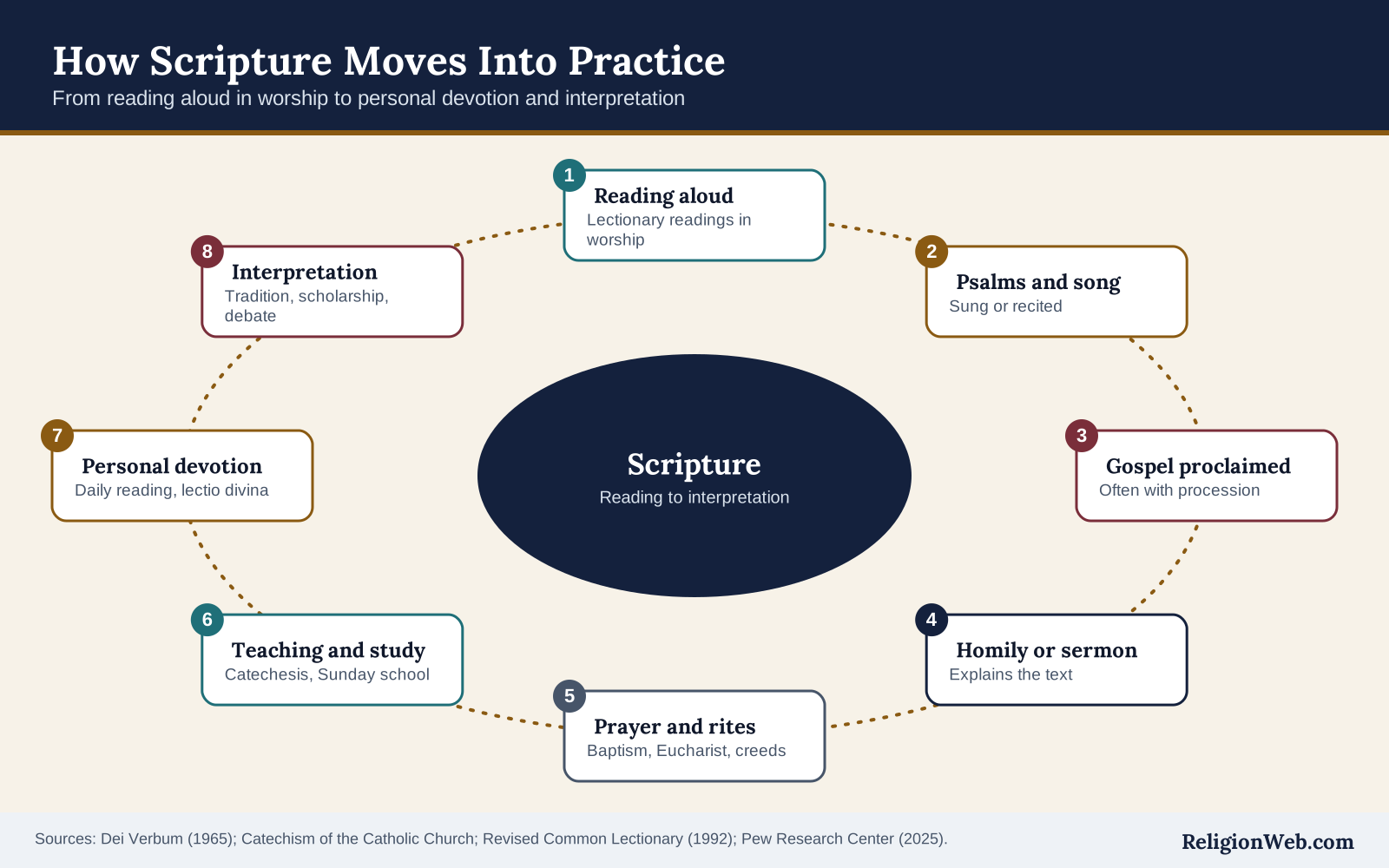
The Bible Today: Global Use, Scholarship, and Public Life
Global Presence and Access
Christians, Scripture, and reading habits
The Bible is read, heard, and studied by a very large number of people, in part because Christianity is the world’s largest religion by number of adherents. The Pew Research Center, in a report published on 9 June 2025, counted about 2.3 billion Christians in 2020, or 28.8 percent of the global population, with 30.7 percent of them living in sub-Saharan Africa. Not all Christians read the Bible in the same way or with the same frequency. In the United States, according to Pew’s 2023-24 Religious Landscape Study, 22 percent of adults read Scripture outside religious services at least weekly, with higher shares among evangelical Protestants (51 percent) and members of historically Black Protestant churches (46 percent). Elsewhere, hearing the Bible read aloud in church remains the main form of contact for many Christians, particularly in communities where printed Bibles are costly or where literacy rates are low.
Print, audio, and digital forms
Access has changed dramatically since the era of hand-copied codices. A reader today can choose between a pocket New Testament, a multivolume scholarly edition, a study Bible with extensive notes, an audio recording, or a smartphone application containing dozens of translations and reading plans. Bible societies and other agencies produce recordings and video adaptations for communities that rely on oral communication, and the translation statistics cited earlier show that some Scripture now exists in more than half of the world’s languages. The availability of text does not guarantee that people have the time, training, or community to read it well, which is why churches continue to invest in teaching and in groups where Scripture can be discussed.
Scholarship and Public Life
Biblical studies as an academic field
The Bible is studied in universities, seminaries, and research institutes as an object of history, language, and literature, as well as a sacred text. Scholars in biblical studies work in textual criticism, ancient languages, archaeology, the history of Israel and the early church, literary analysis, and the history of interpretation. Professional bodies such as the Society of Biblical Literature bring together researchers from Jewish, Catholic, Protestant, Orthodox, and secular backgrounds, and discoveries such as the Dead Sea Scrolls have drawn a broadly international scholarly community. Academic study does not require a shared religious stance, and many scholars hold their own religious commitments while observing the discipline’s norms of evidence. The result is a field in which devotional readers and historians sometimes ask different questions, yet often rely on the same manuscripts and editions.
The Bible in language, law, and culture
The Bible has also shaped language, literature, art, and public life far beyond the churches. The King James Version, in particular, had a marked effect on English literary style, and phrases from it and from Tyndale’s earlier translation became part of everyday English. Painters, composers, poets, and novelists have drawn on biblical stories for centuries, and social movements have repeatedly appealed to biblical themes such as the exodus, the prophets’ calls for justice, and the teaching of Jesus. In some countries, witnesses place a hand on a Bible when taking an oath, although many courts now offer alternatives. A reference article cannot settle debates about the Bible’s proper role in public life, but it can note that these debates are conducted by believers and non-believers alike, and that understanding the book’s contents and history makes them better informed.
Common Misconceptions About the Bible
Misconception 1: The Bible was written as one book at one time
Where the misunderstanding comes from
The word “Bible” is singular in English, the volume on the shelf has a single cover, and popular imagery often shows an author writing at a desk or a book descending from heaven. Those pictures make it natural to assume that the Bible was composed in one sitting, or at least as a single planned project. The Greek origin of the word, biblia, “books,” points the other way, but the plural meaning has long faded from ordinary English.
Some religious teaching can also be misheard on this point. Statements that “God wrote the Bible” are understood by most Christian traditions to refer to divine inspiration working through human authors, and not to a single act of dictation, but the shorthand can leave a different impression.
What the evidence and tradition actually show
The Bible is a library whose books were written in Hebrew, Aramaic, and Greek over a span of centuries, in genres ranging from law and poetry to letters and apocalypse. The Hebrew Bible reached its present form through a long process, and the New Testament books were composed between roughly 50 CE and the early second century. The books were then gathered into collections and lists at different times: Paul’s letters and the four Gospels circulated as groups, and the canon lists of the fourth century were the end of a long process of recognition.
Christian teaching does not depend on a single moment of composition. The Catholic Church’s Dei Verbum says that the human writers were true authors who used their own abilities, and other traditions likewise speak of inspired authors working in particular times and places. Believers and historians therefore agree on the basic fact that the Bible has many authors and a long history, though they differ on how to describe divine action in that process.
Traces of gradual assembly are visible inside the Bible itself. The Psalms are divided into five books, a sign that smaller collections of songs were gathered and joined over time. The Gospel of Luke begins by acknowledging earlier accounts, and Paul’s letters were each written to a particular church at a particular moment, with no thought of belonging to a future volume. Even the Jewish tradition of three divisions, Torah, Prophets, and Writings, reflects a collection that grew in stages and was arranged afterward.
Misconception 2: Every Christian Bible contains exactly the same books
Where the misunderstanding comes from
In much of the English-speaking world, the Bibles sold in most bookstores are Protestant editions with 66 books, and those editions are often simply called “the Bible.” Readers who have encountered only one version may assume that others are the same text in a different cover, or that differences between churches concern interpretation alone. Popular accounts of the canon sometimes add confusion by speaking of Catholics “adding” books or Protestants “removing” them, as though one version were the neutral original.
The terms used for the disputed books are also unfamiliar. “Apocrypha,” “deuterocanonical,” and “anagignoskomena” refer to overlapping sets of writings but carry different judgments about their status, so the same book can be described in ways that sound contradictory.
What the evidence and tradition actually show
The New Testament has the same 27 books in almost every Christian community, but the Old Testament does not. Protestant Bibles follow the Hebrew canon’s list of books, giving 39 Old Testament books. Catholic Bibles contain 46, including seven deuterocanonical books and additions to Esther and Daniel. Eastern Orthodox Bibles use the Septuagint tradition and contain further books, such as 3 Maccabees and Psalm 151. The Ethiopian Orthodox Tewahedo Church uses a still larger collection, commonly cited as 81 books in its narrower canon. The Church of the East historically used a Syriac New Testament of 22 books.
Each tradition regards its own list as faithful to an older inheritance. Catholic and Orthodox churches received the larger Greek collection used in the early church, and the Reformers chose the narrower Hebrew list for the Old Testament. Seen this way, no tradition simply added or removed books, and each can point to ancient precedents for its decision. The canon table earlier in this article sets out the differences.
Even where two traditions list the same book, the text may differ. The Greek versions of Esther and Daniel are longer than the Hebrew, and the Greek Jeremiah is shorter than the Hebrew, as the Dead Sea Scrolls have helped to show. The question is therefore not only which books are in a given Bible but also which form of each book the translators follow, and the careful answer to “What does the Bible contain?” always begins with “In which tradition?”
Misconception 3: The earliest manuscripts had modern chapter and verse numbers
Where the misunderstanding comes from
Almost every modern Bible prints chapter and verse numbers, and sermons, creeds, and quotations rely on them so heavily that they can seem as old as the text. The tendency to quote a single verse as if it came with an address, such as John 3:16, reinforces the impression, as does the common phrase “chapter and verse” for any precise reference.
Some early manuscripts do contain numbering of other kinds, which can add to the confusion. Gospel manuscripts from late antiquity carry section numbers connected with Eusebius’s canon tables, and Hebrew manuscripts have markers for paragraphs and readings, so a reader who sees numerals in an old codex may assume they are the modern ones.
What the evidence and tradition actually show
The earliest biblical manuscripts have no chapter or verse numbers in the modern sense. Chapter divisions are generally credited to Stephen Langton in the early thirteenth century, and the New Testament verse numbers were introduced by Robert Estienne in 1551. Codex Sinaiticus, a fourth-century Bible, includes Eusebian section numbers, but those belong to a different system than the one used today. The Hebrew Bible had verse divisions marked in the text, yet Jewish readers did not number them for citation until the fifteenth century.
Understanding this does not diminish the numbering system, which is a valuable tool. It does mean that a quoted verse should be read in its context, and that biblical authors never wrote a “verse” or a “chapter” in the sense that modern readers use the words. The section on chapters and verses above traces the development in detail.
Earlier readers managed well without the numbers. They located passages by book and by opening words, by the place of a reading in the church year, or by the section numbers that accompanied some Gospel manuscripts, and medieval scholars compiled concordances and indexes of the Latin Bible that eventually made a uniform system of references attractive. Numbering was a convenience that grew out of the needs of teachers, preachers, and printers, and it was never offered as part of the inspired text.
Misconception 4: The Council of Nicaea decided which books belong in the Bible
Where the misunderstanding comes from
The Council of Nicaea in 325 is one of the best-known events in church history, and popular books, films, and websites have attributed many things to it, including the selection of the canon. The emperor Constantine’s involvement in the council, and his later request to the historian Eusebius of Caesarea for fifty copies of the Scriptures for the churches of the new capital, are sometimes combined into a story of an imperial decision about the Bible.
The story also benefits from the human wish for a clear moment of origin. A single council is easier to picture than a gradual process involving many churches, and the end of the process, in lists of the fourth century, can appear to confirm the idea of a decisive turning point.
A related version of the claim says that Nicaea suppressed books that did not suit the imperial church. That version also misplaces the evidence, since the books it has in mind, such as the Gospel of Thomas, were being judged by individual teachers and local churches generations before or after 325, and none of those judgments is attributed to the council in the surviving sources.
What the evidence and tradition actually show
The surviving records of Nicaea show that the bishops dealt with the controversy over Arius and the relation of the Son to the Father, the date of Easter, and matters of church order. They do not contain a list of biblical books. Evidence for the canon points elsewhere: Eusebius, writing around 330, still described some books as disputed, Athanasius of Alexandria gave the first known list of exactly 27 New Testament books in 367, and North African synods at Hippo in 393 and Carthage in 397 endorsed lists for their region. For the Old Testament, the Catholic Church defined its canon at the Council of Trent in 1546, and the Protestant and Orthodox positions were stated in later confessions and synods.
The history of the canon is therefore a story of widespread use, regional lists, and later formal statements. Historians continue to debate details, such as the role of Marcion in prompting the church to define its writings and the dating of the Muratorian Fragment, but they agree that no single council determined the Bible’s contents.
Frequently Asked Questions About the Bible
Questions About the Books and the Canon
How many books are in the Bible?
The answer depends on which Bible is meant. Protestant Bibles contain 66 books (39 in the Old Testament and 27 in the New Testament), Catholic Bibles contain 73 (46 and 27), and Orthodox Bibles contain more in the Old Testament, with the exact number varying by church. The Jewish Tanakh counts 24 books, which correspond to the 39 Protestant Old Testament books because several books are counted together, such as the Twelve Prophets as one scroll. The Ethiopian Orthodox Tewahedo Church’s narrower canon is commonly cited as 81 books.
A reader who wants a single number for a general purpose can say that the Christian Bible has 27 New Testament books in virtually all traditions and an Old Testament of 39 or more, depending on the church.
How do other early Christian writings, such as the Gospel of Thomas, relate to the Bible?
Many early Christian texts were never part of the Bible’s canon. The Gospel of Thomas, a collection of sayings attributed to Jesus, survives in a Coptic manuscript found at Nag Hammadi in Egypt in 1945, and scholars study it as evidence of how some early groups remembered and used Jesus’ sayings. Eusebius, writing around 330, listed gospels attributed to Peter, Thomas, and Matthias among works that churches did not accept. Other writings, such as the Didache and the Shepherd of Hermas, were respected and read by many early churches without being included in the final list of 27 books.
Historians therefore describe a wider body of early Christian literature, of which the New Testament is the part that the churches came to recognize as Scripture. Claims that writings were secretly removed or suppressed generally overlook that churches widely knew these works and chose not to read them as Scripture, and that scholars today study them openly.
Questions About Reliability and Transmission
How reliable is the text of the Bible we have today?
For the New Testament, the large number of manuscripts, many from within a few centuries of the original writings, gives textual critics a broad base of evidence, and many scholars consider that the earliest recoverable form of the text can be reconstructed with considerable confidence. Variants exist, most of them minor, and a handful of passages, such as the longer ending of Mark and the story of the woman in John 7:53 to 8:11, are marked in modern translations because the oldest manuscripts do not contain them. For the Hebrew Bible, the Dead Sea Scrolls showed that the medieval Masoretic Text preserved a text very close to the one read two thousand years ago in many books, while also revealing that other forms circulated.
Questions about reliability have two parts. Textual criticism asks whether the words we have match what the early copyists had, and scholars generally answer with confidence. Historical criticism asks how accurate the events described are, and that depends on the book, the genre, and the reader’s framework, so it cannot be answered with a single verdict.
Is the Bible a translation of a translation?
Modern translations are normally made from the Hebrew, Aramaic, and Greek texts, not from earlier translations, and they rely on critical editions prepared by textual scholars. The idea of a “translation of a translation” comes partly from the historical fact that some earlier versions, such as the Old Latin and the Wycliffite Bible, were made from the Septuagint or the Vulgate. The King James Version and most major English Bibles since the sixteenth century were made from Hebrew and Greek, with the Latin and other versions consulted. Some translations into smaller languages begin from an existing translation in a major language as a practical starting point, but translation agencies aim to check the result against the original texts.
Questions About Reading and Use
Where should a new reader begin?
Readers disagree about the best starting point, and the answer depends on the purpose. Many pastors and teachers suggest beginning with one of the Gospels, often Mark or Luke, to meet the central figure of the New Testament, and then the Psalms and Genesis. Reading from Genesis to Revelation straight through is a worthy goal, but the legal sections of Leviticus and the genealogies can slow a first attempt, and a reading plan that alternates between Old and New Testaments is common. A study Bible with introductions and notes helps with historical background. Readers who belong to a church can also follow the church’s lectionary and discuss what they read with others.
Do Christians read the Bible literally?
Christians read the Bible according to genre, and the word “literally” covers several different things. Almost all Christian traditions distinguish between poetry, parable, history, law, and apocalypse and do not read a psalm as a historical report or a parable as a news story. They differ on how to read particular passages, such as the opening chapters of Genesis or the visions of Revelation. Some conservative Protestant traditions emphasize the plain sense of the text and the historical character of its narratives, while Catholic, Orthodox, and many mainline Protestant interpreters stress the literary form of each passage and the church’s tradition of reading. Surveys cannot be summarized in a single answer, because individuals within every tradition read in their own way.
How should a reader choose a translation?
Choosing depends on the reader’s purpose and tradition. For close study, readers often compare a more formal translation, such as the New Revised Standard Version or the English Standard Version, with a more idiomatic one, such as the New International Version or the Common English Bible. Catholic readers usually choose an edition that includes the deuterocanonical books and has the approval of their bishops’ conference, such as the New American Bible, Revised Edition. Orthodox readers often use the Orthodox Study Bible or another translation based on the Septuagint. Anyone choosing should check which books the edition contains, which text it follows, and whether it includes notes on variants, since these features matter more than the cover or the brand.
Conclusion: What the Bible Is and How to Keep Exploring
What the History Shows
A library with a long history
The Bible is best understood as a library that took shape over many centuries, in several languages and literary forms, and that was recognized as Scripture by communities that used it in worship. It was written by many hands, copied by scribes whose work is now documented in manuscripts from the Dead Sea Scrolls to the great codices, translated into thousands of languages, and divided into chapters and verses only in the Middle Ages and the sixteenth century. Each of these facts is documented, and none of them requires a reader to take a position on inspiration, which Christians affirm and which historians do not adjudicate.
Agreement and difference among Christians
The 27 books of the New Testament form a nearly universal core, and the Gospels, the Psalms, and Paul’s letters are read by Christians everywhere. The Old Testament canon, the translation in use, the relationship between Scripture and tradition, and the ways of interpreting difficult passages differ among Catholic, Orthodox, Oriental Orthodox, Protestant, and Anglican churches. A fair description acknowledges both facts: a shared text at the center of Christian life and a long, honest record of disagreement about its edges and its meaning.
How to Keep Exploring
Related articles on ReligionWeb.com
Readers who want to continue can follow the Bible’s thread into other topics. The article on Jesus Christ examines the Gospels’ central figure, and the articles on the Lord’s Prayer, Baptism, and the Eucharist show how biblical texts shaped Christian prayer and ritual. The articles on Easter, Christmas, Lent, and Pentecost trace biblical readings through the Christian year. The overview article on Christianity places the Bible within the larger history of the church.
Reading with good questions
A useful approach for any reader is to ask three questions of a passage: what kind of writing it is, what its first audience would have understood, and how the tradition being studied has read it. Those questions make room for historians, for believers, and for curious readers who come from neither group, and they apply equally to a psalm, a parable, or a letter. The Bible rewards patient reading, and a clear account of its structure, canon, and transmission is a good basis for that reading.
Sources
The table below lists the principal external sources behind this article. Facts, dates and figures were checked against these and related primary, institutional and academic materials.
| # | Source | Publisher and type | Used for | Link |
|---|---|---|---|---|
| 1 | World English Bible (Classic edition): Psalm 119, Luke 1 and 24, John 20, Colossians 4, 2 Timothy 3 | eBible.org · Primary text | Public-domain text of all six quotations; Yahweh rendering; 2 Timothy 3:16 footnote | ebible.org |
| 2 | Catechism of the Catholic Church: The Canon of Scripture (paras. 120-123); Scripture in the Life of the Church (131-133) | Holy See (Vatican) · Institutional | Catholic canon of 46 + 27 books; Old Covenant not revoked; Marcionism; Bible reading | vatican.va |
| 3 | Dei Verbum: Dogmatic Constitution on Divine Revelation (1965) | Holy See (Vatican) · Institutional | Catholic teaching on Scripture, tradition, inspiration, literary forms, translations, liturgy | vatican.va |
| 4 | Athanasius, Festal Letter 39 (367 CE), in Nicene and Post-Nicene Fathers | New Advent · Primary text | Earliest surviving list naming exactly the 27 New Testament books; books for catechumens | newadvent.org |
| 5 | Chapter and Verse Divisions of the Bible (New Schaff-Herzog Encyclopedia of Religious Knowledge, vol. 2) | Bible Research (bible-researcher.com) · Academic reference | Langton, Hugh of Saint-Cher, Pagninus, Estienne 1551, Geneva 1557/1560, Hebrew verse numbering; Fun Fact | bible-researcher.com |
| 6 | The Dead Sea Scrolls: Introduction and Discovery and Publication | Israel Museum, Jerusalem · Institutional | 1947 discovery, eleven caves, date range, language mix, about 230 biblical manuscripts | deadseascrolls.org.il |
| 7 | Translation Statistics Report 2025 (figures as of 1 January 2026) | Bible societies (hosted by the Swiss Bible Society) · Demographic data | 795 full Bibles, 1,815 New Testaments, 1,511 portions, 4,121 languages with some Scripture | die-bibel.ch |
| 8 | Prayer and Other Religious Practices (2023-24 Religious Landscape Study) | Pew Research Center · Demographic data | 22 percent of U.S. adults read Scripture weekly; 61 percent seldom or never; subgroup shares | pewresearch.org |
| 9 | The Old Testament Canon and Apocrypha | Bible Research (bible-researcher.com) · Academic reference | Trent 1546; Luther 1534, Geneva 1560, Articles 1563, KJV 1611, Westminster 1647 on the Apocrypha; Jerome | bible-researcher.com |
| 10 | Vulgate | Encyclopaedia Britannica · Encyclopedia | Damasus 382, Jerome's translation to c. 405, Trent 1546, Clementine 1592, Nova Vulgata 1979 | britannica.com |
Last fact-check date: 2026-10-21.