The Torah is the foundational text of Judaism and the first of the three divisions of the Hebrew Bible. In its narrowest and most common sense, the word names the five books of Genesis, Exodus, Leviticus, Numbers, and Deuteronomy, which Jewish tradition calls the Five Books of Moses. Those books are copied by hand onto parchment scrolls, kept in an ark at the front of the synagogue, and read aloud in public, portion by portion, across the Jewish year. In a broader sense, the Hebrew word torah means “teaching” or “instruction,” and Jews also use it for the whole of the Hebrew Bible and for the immense body of study, interpretation, and law that grew out of it.
The five books tell a continuous story that runs from the creation of the world through the lives of Abraham, Isaac, Jacob, and Joseph, the enslavement and liberation of the Israelites in Egypt, the covenant at Mount Sinai, and forty years of travel through the wilderness. The story stops on the east side of the Jordan River, with the death of Moses and the Israelites still outside the land of Canaan. Woven through this narrative are collections of commandments, ritual instructions, and a few long poems. Jewish tradition holds that Moses received the Torah from God, and that conviction shapes how the text is copied, read, studied, and honored. Academic historians of ancient Israel, working with different tools and questions, study how and when the books took their final form. This article keeps those two kinds of statement apart and labels each as it goes.
The Torah is also a lived text. Every Monday, Thursday, and Sabbath morning in traditional synagogues, and on festivals and fast days, a scroll is carried from the ark, unrolled on a reading table, and chanted by a trained reader. The annual cycle of weekly portions, called parashiyot, begins and ends at the festival of Simchat Torah, when congregations dance with the scrolls. A young person’s bar or bat mitzvah is often marked by reading from the Torah for the first time, and the scroll itself is treated with a care that has few parallels among the objects of Jewish life.
What follows is a reference guide to the Torah on its own terms: what the word means, what the five books contain, how the Hebrew text has been transmitted, how a scroll is made and used, how the weekly cycle works, how Jewish tradition understands the relationship between the written text and the oral tradition that surrounds it, and how different Jewish communities and modern scholars describe its origins. Dates are given in BCE and CE. Christian Bibles place the same five books at the opening of the Old Testament, which then continues with a differently arranged collection of books, a context the article on the Bible explains; here the focus stays on Jewish usage.
The Torah at a Glance: Meaning, Scope, and Vocabulary
What the Word Torah Means
Teaching rather than law alone
The Hebrew noun torah comes from a root, y-r-h, that in one of its verbal forms means “to teach.” The Encyclopedia of Religion’s entry on the subject, written in part by the scholar Martin S. Jaffee, notes that the root carries several senses elsewhere in Hebrew, including “to throw” and “to water,” but that in the Bible the noun regularly means instruction or guidance. The older Jewish encyclopedic tradition, represented in the same entry by Louis Isaac Rabinowitz, stresses the core sense of “teaching” or “doctrine” and argues that the common translation “law” gives a wrong impression. The word does cover legal material, but it is not limited to it.
The biblical books themselves use the word in a range of ways. Within Leviticus, a torah is a set of instructions on a particular subject, such as the “torah of the meal offering” (Leviticus 6:7), the guilt offering (7:1), or the Nazirite vow (Numbers 6:21). Wisdom literature speaks of a parent’s torah (Proverbs 1:8), and prophets use the term for divine instruction delivered to the people (Isaiah 30:9). In several late books, “the Torah of Moses” (Joshua 1:7; Ezra 7:6) points to a written text that was by then authoritative for the community.
How “law” became the common English translation
When Jewish scholars in Hellenistic Egypt translated the Hebrew scriptures into Greek, beginning with the five books, they rendered torah as nomos, the Greek word for law or custom. Latin followed with lex. The Encyclopedia of Religion entry observes that Greek-speaking Jews came to call the collection ho nomos, “the Law,” and that this choice helped create the long-standing impression that the Torah is mainly a legal code. Many English Bibles still speak of “the Law of Moses” for that reason. The canonical Torah is in fact a narrative with law codes embedded in it, and the narrative frame matters: the commandments are presented as part of a story of covenant, liberation, failure, and renewal, not as a free-standing statute book.
The same translation history gave English another term. “Pentateuch,” from Greek words meaning “five scrolls” or “five-volume work,” is the name used in academic study and in many Christian settings for the same five books. Jewish speakers more often say “the Torah,” “the Five Books of Moses,” or Chumash, from the Hebrew word for five, a name that usually refers to a printed book containing the five books together with translation and commentary.
The Torah in Narrow and Broad Usage
The Five Books of Moses
In everyday religious speech the Torah is the five books, and in the synagogue the word is often shorthand for the scroll itself: people “take out the Torah,” “lift the Torah,” and “stand for the Torah.” The Torah is the first of the three divisions of the Tanakh, the Hebrew Bible, whose name is an acronym for Torah, Nevi’im (Prophets), and Ketuvim (Writings). Britannica notes that Jewish, Roman Catholic, Eastern Orthodox, and Protestant canons all agree on the order of these five books, even though they arrange the books that follow them in different ways.
The book of Deuteronomy supplies the text that Jewish readers most often use to say what the Torah is. At the end of Moses’ opening address to the people, it introduces the great law collection that follows:
And this is the law which Moses set before the children of Israel;
Deuteronomy 4:44, The Holy Scriptures: A New Translation (Jewish Publication Society, 1917)
The Hebrew word translated “law” here is torah. Synagogue practice has taken the verse as a description of the scroll: when the open Torah is lifted before the congregation, worshipers chant a version of it, “This is the Torah that Moses set before the children of Israel,” as they look at the columns of text. The verse, in other words, does double duty. In its original setting it points to the legal discourse that follows; in liturgical use it names the scroll and its reading.
Torah as the whole Bible and as Jewish learning
Jewish usage extends the word well beyond the first five books. Britannica notes that Torah can designate the entire Hebrew Bible, and in the widest sense it means the substance of divine teaching to Israel. Rabbinic tradition distinguishes the Torah she-bi-khetav, the “Written Torah” of the five books, from the Torah she-be-al peh, the “Oral Torah” of explanation, law, and interpretation that the rabbis understood as given alongside it. Later rabbinic literature, from the Mishnah and the two Talmuds to medieval commentaries and legal codes, is thus treated as Torah in the broad sense, as the Encyclopedia of Religion entry explains. A later section returns to this idea and to the Talmud, where much of the Oral Torah was eventually written down.
A further everyday sense shows how living the word remains. A rabbi who offers a short interpretation of the weekly portion gives a dvar Torah, a “word of Torah.” A student who spends a morning in a study hall is said to be “learning Torah,” whether the text before him is the book of Genesis, a page of Talmud, or a modern legal responsum. In Modern Hebrew a thinker’s whole system of ideas can be called his or her torah. The word, in short, can mean a scroll, a book, a library, and a way of learning, and a reader meeting it in a sentence has to ask which of these a speaker has in mind.
Key Terms at a Glance
Words for the text and its forms
A short working vocabulary makes the rest of this article easier to follow. The table gathers the terms used most often, with transliterations that follow common English usage rather than any one academic system. Hebrew words in this article are given in the form most readers will meet in synagogue programs and Jewish publications, and variant spellings are noted where they are widespread.
| Term | Meaning in plain English | How it is used |
|---|---|---|
| Torah | Teaching, instruction | The Five Books of Moses; by extension the Hebrew Bible and Jewish learning as a whole |
| Sefer Torah | Torah scroll | A handwritten parchment scroll of the five books, used for public reading |
| Chumash | “Five” (a book of five parts) | A printed book of the five books, usually with translation, commentary, and haftarah readings |
| Pentateuch | “Five-volume work” (Greek) | Academic and Christian name for the same five books |
| Tanakh | Acronym for Torah, Nevi’im, Ketuvim | The Hebrew Bible as a whole |
| Torah she-bi-khetav | Written Torah | The five books as a fixed text |
| Torah she-be-al peh | Oral Torah | Traditions of interpretation and law taught alongside the written text |
| Parashah (plural parashiyot) | Section, portion | One of the 54 weekly readings; also called sidra |
| Aliyah (plural aliyot) | “Going up” | The honor of being called to the reading table to say the blessings over a section of the Torah |
| Haftarah | “Concluding” reading | A selection from the Prophets read after the Torah on Sabbaths and festivals |
| Sofer | Scribe | A trained specialist who writes Torah scrolls, tefillin, and mezuzot |
| Mitzvah (plural mitzvot) | Commandment | A religious obligation, from the Torah or from rabbinic enactment |
Words for reading, study, and obligation
Several of these terms recur throughout the sections that follow. The reading of the Torah in public is called keriat haTorah, “the reading of the Torah,” and the person who chants it is the ba’al koreh or ba’al keriah, literally the “master of the reading.” Hebrew legal literature divides commandments into those that come “from the Torah,” in Aramaic de-oraita, and those that originate in rabbinic enactment, de-rabbanan, a distinction that explains why traditional Jewish law can describe some observances as biblical in origin and others as the product of later rabbinic decisions. The overall system of Jewish religious law is halakha, from the verb meaning “to walk” or “to go,” and a longer account of it appears in the article on Orthodox Judaism, where halakha is understood as binding in daily life.
Two more terms belong in this opening vocabulary because they mark the line between belief and scholarship. In the tradition, the phrase Torah min ha-shamayim, “Torah from heaven,” expresses the conviction that the Torah’s origin is divine; the Mishnah (Sanhedrin 10:1) already lists the denial of this principle among the beliefs that endanger a person’s share in the world to come. In the university, the same text is studied as a literary and historical artifact, and the terms used there, such as “source,” “redaction,” and “textual witness,” belong to a different kind of inquiry. Both vocabularies are used in this article, and each is introduced by name.
The Five Books of the Torah: Contents, Structure, and Genres
How the Five Books Fit Together
A story that begins with the world and ends at the border
The five books form one long narrative with a recognizable arc. The Encyclopaedia Judaica entry on the Pentateuch divides it into six parts: the primeval history of Genesis 1 to 11, the stories of the patriarchs and matriarchs in Genesis 12 to 50, the Exodus from Egypt, the covenant at Sinai (also called Horeb) with its laws, the years of travel described in Numbers, and Moses’ farewell speeches in Deuteronomy. The sequence is chronological, but the weight is uneven. Genesis covers many generations in fifty chapters. The remaining four books cover roughly one lifetime, from the birth of Moses to his death, and spend most of their length on the events at Sinai, the instructions for worship and holiness, and the renewal of the covenant on the plains of Moab.
The ending is deliberate and much discussed. The Torah does not conclude with the conquest of the land it has been promising since Genesis 12. It closes with Moses looking across the Jordan at territory he will not enter, and with the people poised on the threshold. Some interpreters read this as part of the book’s meaning: the Torah is a text for a people in transit, addressed to a community that must live by its teaching before it has a secure home. The later books of the Prophets pick up the story of entry into the land, but the Torah itself remains a unit, set apart in the synagogue, in the calendar, and in the way it is copied.
Names, chapters, and counts
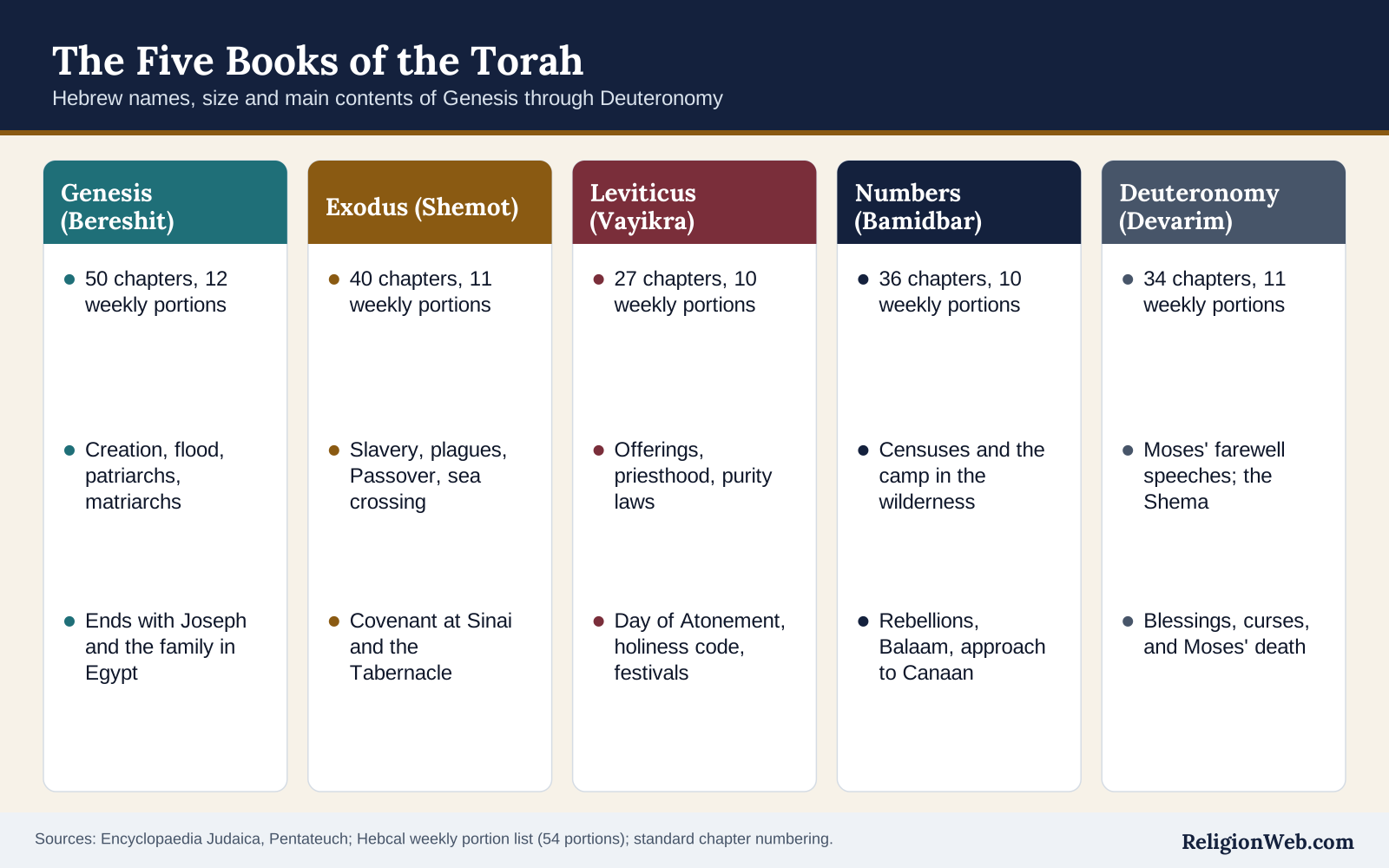
Each book has a Hebrew name taken from its opening word or a key word in its first verse, and an English name that comes through the Greek translation. Bereshit (“In the beginning”) became Genesis, “origin.” Shemot (“Names,” from “These are the names”) became Exodus, “going out.” Vayikra (“And He called”) became Leviticus, a Latin name referring to the Levites and their priestly duties. Bamidbar (“In the wilderness”) became Numbers, because of the censuses. Devarim (“Words”) became Deuteronomy, from a Greek name meaning “second law,” which also reflects the Hebrew tradition’s alternative title for the book, Mishneh Torah, “repetition of the Torah.” The Encyclopaedia Judaica notes that the Septuagint translators supplied the Greek titles Genesis, Exodos, Leviticon, Arithmoi, and Deuteronomion.
The familiar division into chapters and verses is a later convenience. A Torah scroll has neither: it has columns of continuous text, broken by blank spaces that mark the end of one unit and the start of another. The five books together comprise 187 chapters in the numbering used in most printed editions. Counts of verses, words, and letters vary slightly depending on which tradition of counting is used. The scribal tradition reckons 304,805 letters and 5,845 verses, while an electronic count of a standard edition of the Masoretic text yields 304,801 letters and 5,844 verses, a small difference of the kind that scribes and medieval Masoretes knew well. These figures return in the discussion of the scroll, where the exact letter count carries legal weight.
| Book | Hebrew name and meaning | Chapters | Weekly portions | Principal contents |
|---|---|---|---|---|
| Genesis | Bereshit, “In the beginning” | 50 | 12 | Creation, the flood, Abraham and Sarah, Isaac and Rebecca, Jacob and his family, Joseph; ends in Egypt |
| Exodus | Shemot, “Names” | 40 | 11 | Enslavement, Moses, the plagues, Passover, the sea crossing, the covenant at Sinai, the Tabernacle |
| Leviticus | Vayikra, “And He called” | 27 | 10 | Sacrifices, priesthood, purity, the Day of Atonement, the holiness laws, festivals, the jubilee year |
| Numbers | Bamidbar, “In the wilderness” | 36 | 10 | Censuses, the camp, rebellions, spies sent to Canaan, Balaam, preparations to enter the land |
| Deuteronomy | Devarim, “Words” | 34 | 11 | Moses’ farewell speeches, the Shema, repetition of the laws, blessings and curses, the Song of Moses, Moses’ death |
The Five Books One by One
Genesis: beginnings and the ancestral families
Genesis opens with an account of creation in six days followed by a seventh day of rest (Genesis 1:1 to 2:3), the pattern that underlies the Sabbath described in the article on Shabbat, and then a second, more intimate account of the first humans in a garden (from 2:4). Traditional readers often harmonize the two, while academic readers usually treat them as distinct compositions. Stories of the first humans, the flood, and the scattering of peoples at Babel lead to the call of Abraham in chapter 12, where God promises him land, descendants, and blessing. The remaining chapters follow Abraham and Sarah, Isaac and Rebecca, Jacob and his wives Leah and Rachel, and Jacob’s twelve sons, ending with Joseph’s rise in Egypt and the family’s settlement there. Genesis is the book most often read as narrative, but its stories are also the ground of later law: circumcision, for example, is first commanded to Abraham, and the practice of resting on the seventh day is anchored in the creation account.
Exodus: liberation, covenant, and the sanctuary
Exodus begins with the Israelites enslaved in Egypt, the birth and calling of Moses, and the plagues that lead to the escape. The first Passover and the crossing of the sea belong to the early chapters and are the foundation of the festival described in the article on Passover. The text then moves to Sinai, where the people receive the Ten Commandments and a first body of laws, usually called the Covenant Code by scholars (Exodus 21 to 23). The story of the golden calf interrupts the account of the Tabernacle, a portable sanctuary whose construction takes up much of the second half of the book. The pattern is typical of the Torah as a whole: a founding event, then the commands that give the event a lasting form.
Leviticus: holiness and the priestly system
Leviticus is the book most likely to surprise a first-time reader, because it is largely a manual of priestly instruction rather than a story. It describes the offerings brought to the sanctuary, the consecration of Aaron and his sons, the laws of purity and impurity, the ritual of the Day of Atonement (Leviticus 16), and the festival calendar in chapter 23. Chapters 17 to 26 are often called the Holiness Code, the section that includes the command to love one’s neighbor as oneself (Leviticus 19:18) alongside rules on agricultural gifts to the poor, honest weights, and sexual conduct. The jubilee year of chapter 25 envisions a periodic return of land to its families. Rabbinic midrash records a custom of beginning children’s study of the Torah with Leviticus, on the reasoning that the pure should begin with the laws of purity.
Numbers: travel, census, and testing
Numbers takes its Greek name from the two censuses of the people, in chapters 1 and 26, but its center is a journey. The Israelites leave Sinai, arrange their camp around the sanctuary, complain about food and leadership, and send spies into Canaan. Their fearful response to the spies’ report leads, in the story, to a generation spent in the wilderness. The book includes the rebellion of Korah, the story of the seer Balaam who is hired to curse Israel and blesses instead, and the short poetic Priestly Blessing (Numbers 6:24 to 26) that has been used in Jewish worship from antiquity to the present. It closes with the people encamped on the plains of Moab, across the Jordan from Jericho.
Deuteronomy: Moses’ farewell and the covenant renewed
Deuteronomy consists largely of speeches by Moses to the generation about to enter the land. It restates and reshapes earlier commandments, centers worship on a single place chosen by God, includes the declaration known as the Shema (Deuteronomy 6:4), and ends with blessings and curses tied to covenant fidelity. Two poems close the book, the Song of Moses (chapter 32) and the Blessing of Moses on the tribes (chapter 33), and the final chapter reports Moses’ death on Mount Nebo. Deuteronomy also reports that Moses wrote down the teaching and delivered it to the priests (Deuteronomy 31:9), and rabbinic tradition derives the duty to write a Torah scroll from the same chapter, a text discussed in the sections on authorship and on the scroll.
Narrative, Law, and Poetry in One Text
Narrative as the frame of the commandments
The Torah is not a legal code with some stories attached, and it is not a collection of stories with some laws appended. The Encyclopedia of Religion entry observes that the canonical Torah is a narrative that contains law codes. Law is presented as speech: God speaks to Moses, and Moses speaks to the people. Commandments are often given a reason drawn from the story, as when the Sabbath rest in Exodus 20 is linked to creation, and in Deuteronomy 5 to the memory of slavery in Egypt, or when the command to treat the stranger fairly is justified by the reminder that the Israelites were once strangers in Egypt. That narrative setting has shaped Jewish interpretation, which regularly asks both what a commandment requires and what story it recalls.
Law collections and the count of 613
Within the narrative are several recognizable blocks of law. Scholars distinguish the Covenant Code of Exodus 21 to 23, the priestly legislation of Exodus 25 to 31 and Leviticus 1 to 16, the Holiness Code of Leviticus 17 to 26, and the legal speeches of Deuteronomy 12 to 26, each with its own emphases. Jewish tradition reads them together as a single body of commandments and asks how many there are. A well-known rabbinic statement, attributed to Rabbi Simlai in the Babylonian Talmud (Makkot 23b to 24a), says that 613 commandments were given to Moses, 365 prohibitions matching the days of the solar year and 248 positive commandments matching the limbs of the body. Medieval authorities, including Maimonides and Nahmanides, compiled competing lists of the 613, because the Talmud states the total without itemizing it. Some of the commandments are not practicable without the Temple, and many apply only in the land of Israel, so no individual keeps all 613.
Poetry and blessing within the prose
At several high points the prose gives way to poetry. The Song of the Sea (Exodus 15) celebrates the crossing of the sea; the Song of Moses (Deuteronomy 32) is a long poem of covenant accusation and consolation; the Blessing of Moses (Deuteronomy 33) addresses each tribe in turn; and the oracles of Balaam in Numbers 23 and 24 are also in verse. The scribal tradition marks these poems visibly. The Song of the Sea, for example, is written in a distinctive staggered or “brickwork” layout, a pattern already visible in the seventh-century Ashkar-Gilson manuscript fragment, and the Song of Moses is also set apart from simple columns. A reader looking at an open Torah scroll can therefore see, before reading a word, where the text changes character.
The Hebrew Text of the Torah: Language, Manuscripts, and Transmission
The Language and Script of the Torah
Biblical Hebrew and the consonantal text
The Torah is written in Biblical Hebrew, the classical literary language of ancient Israel, with a few words and names from neighboring languages. The Hebrew of the Torah is not identical across the five books, and historians of the language notice differences of vocabulary and style between, for example, the poetry of Exodus 15 and the legal prose of Leviticus. Modern editions print the text in the square Hebrew script that was standard by the Second Temple period and that scribes call the “Assyrian” script, ketav ashurit. A Torah scroll uses this script exclusively, in letter forms that are prescribed in detail. According to Chabad’s guide to scroll-making, printed Hebrew fonts are not valid for a scroll, and every letter must be formed by hand.
A synagogue scroll contains only consonants. It has no vowel signs, no punctuation marks, and none of the accent signs that guide chanting. That fact has practical consequences. A reader preparing a portion has to learn from a printed text where the vowels fall and how the melody goes, and then reproduce both from memory while looking at an unmarked scroll. It also means that the same sequence of letters can sometimes be read in more than one way, which is one reason a reliable oral tradition of reading was considered essential long before vowel signs were invented.
Vowels, accents, and the work of the Masoretes
The vowel signs and cantillation marks that appear in printed Bibles were added by a group of scholars known as the Masoretes. Britannica’s article on the Masoretic text describes their work as beginning around the sixth century CE in the Talmudic academies of Babylonia and Palestine and reaching completion in the tenth century. Their aim was to preserve the received text, not to reinterpret it. They flagged unusual spellings, recorded discrepancies between manuscripts, and counted the verses, words, and letters of each section, noting even which verse, word, and letter stood at the center of a book, so that later alterations could be detected. Of several vocalization systems that were devised, the one developed at Tiberias in Galilee became dominant, and the stress and pause marks they added serve as a guide for public chanting.
The Masoretes also preserved the ancient reading tradition known as ketiv and qeri, “what is written” and “what is read.” In a small number of places, the consonants of the received text are to be read aloud as a different word; the scroll keeps the written form, and the reader pronounces the alternative. The convention shows how seriously the letters were guarded: the scribe copies what stands in the exemplar, even where the tradition reads otherwise.
The Evidence for the Early Text
The earliest written traces and the Dead Sea Scrolls
No manuscript of the Torah survives from the time the books are traditionally said to have been written. Among the earliest known quotations of Torah wording are two tiny silver scrolls found in a burial cave at Ketef Hinnom, southwest of the Old City of Jerusalem. Discovered in 1979, they carry a version of the Priestly Blessing from Numbers 6 and are dated to the late seventh or early sixth century BCE, before the Babylonian exile. They were evidently worn as amulets, so they are not copies of the Torah as such, but they show that wording found in Numbers was already in circulation.
The largest body of early evidence comes from the caves near Qumran, on the northwest shore of the Dead Sea. The scrolls found there date from the third century BCE to the first century CE and include about 230 manuscripts of biblical books, according to the Israel Museum’s Digital Dead Sea Scrolls project, with copies of every book of the Hebrew Bible except Esther. Many of the biblical scrolls resemble the Masoretic text closely. Others differ in wording and spelling, and some contain additions or omissions, which indicates that scribes of that period worked within a more varied textual landscape than later tradition suggests. What the later Masoretic standard represents, in this account, is a text that gradually came to dominate rather than one that had always been the single form.
Ancient translations and the Samaritan Pentateuch
Translations supply a second kind of evidence. The Septuagint, the earliest extant Greek translation of the Hebrew scriptures according to Britannica, was presumably made for the Jewish community in Egypt, and the Encyclopaedia Judaica suggests its translation of the Torah may have been prepared in the first half of the third century BCE for reading in synagogues. In Aramaic-speaking communities, an official translator, the meturgeman, rendered each verse of the public reading into the vernacular as it was read, as the Mishnah (Megillah 4:4 to 10) records; written Aramaic translations, the Targumim, grew out of that practice. Some readings preserved in these translations differ from the Masoretic text and sometimes agree with Qumran manuscripts, so they are used in textual criticism.
The Samaritan community preserves a Pentateuch of its own. The Samaritans, who identify as the “Children of Israel,” base their religious observance on the five books alone and honor Mount Gerizim, near Shechem, rather than Jerusalem as God’s chosen place. Britannica reports that the Samaritan Pentateuch differs from the Masoretic text in some 6,000 variants, a number of which agree with the Septuagint. Many of them are small spelling matters, while a few reflect the community’s theological emphasis on Gerizim. Britannica estimates the Samaritan population at about 800 in the 2010s, after dropping below 200 in the twentieth century, and the community’s Torah scrolls are still written in an archaic Hebrew script.
Medieval Codices and the Oldest Surviving Scrolls
The Aleppo Codex and the Tiberian tradition
The most important medieval witness to the Masoretic text is the Aleppo Codex, a complete Bible in book form produced in Tiberias around 920 CE. The consonantal text was copied by the scribe Shlomo ben Buya’a, and Aaron ben Moses ben Asher, the last prominent member of a family of Tiberian grammarians, verified it and added the vowel signs and Masoretic notes. For centuries it was kept in a synagogue in Aleppo, Syria, and Maimonides was among the authorities who treated it as a standard for the correct text. In 1947, during riots that followed the United Nations partition vote, the synagogue was burned and the codex disappeared for about a decade before resurfacing in Israel in 1958. About 294 of an estimated 487 original pages survive, and the Torah portion is badly affected: the surviving text begins at Deuteronomy 28:17, so most of the Pentateuch is lost. The codex is now kept at the Shrine of the Book at the Israel Museum in Jerusalem.
The Bologna scroll and the En-Gedi fragment
For complete scrolls of the kind read in synagogues, the earliest known example is held in the library of the University of Bologna. An 1889 cataloguer had dated it to the seventeenth century, and it lay unnoticed until 2012, when the professor Mauro Perani reexamined it. Radiocarbon tests at two laboratories gave a date between 1155 and 1225 CE, making it the oldest complete Torah scroll on record, according to the news reports that followed Perani’s announcement in 2013. Its lettering is in the Babylonian, or Oriental, style, and its layout in places matches that of the Aleppo Codex. Scrolls this old are very rare, because worn-out scrolls were traditionally buried or placed in a storeroom called a genizah rather than preserved.
An older fragment, found in 1970 in the ark of the ancient synagogue at En-Gedi, was so badly burned in a fire around 600 CE that it could not be unrolled. In 2015 a team led by Brent Seales of the University of Kentucky used X-ray micro-CT scanning and computational “virtual unwrapping” to read the text without opening it, and the results were published in 2016. The scroll contains the first two chapters of Leviticus. Radiocarbon testing gave a date of about 210 to 390 CE, though one paleographer argued for an earlier date from the letter shapes, and the consonantal text is identical to the Masoretic text, including its paragraph divisions. Scholars often cite such a match, across several centuries of copying, as evidence that scribes preserved the consonantal text with great care.
| Witness | Approximate date | What it is | Why it matters |
|---|---|---|---|
| Ketef Hinnom silver scrolls | Late 7th to early 6th century BCE | Two small silver amulets with the Priestly Blessing (Numbers 6) | Earliest known quotation of wording found in the Torah, from before the exile |
| Dead Sea Scrolls (Qumran) | 3rd century BCE to 1st century CE | About 230 biblical manuscripts, including copies of Torah books | Show both close agreement with the Masoretic text and genuine textual variety |
| Septuagint | Translation of the Torah traditionally placed in the 3rd century BCE | The earliest extant Greek translation of the Hebrew scriptures | Preserves readings that sometimes differ from the Masoretic text |
| Samaritan Pentateuch | Ancient tradition; known in the West from the 17th century | The Torah as preserved by the Samaritan community | About 6,000 variants from the Masoretic text, some shared with the Septuagint |
| En-Gedi scroll | Radiocarbon range about 210 to 390 CE | Burned Leviticus scroll read by virtual unwrapping | Consonantal text matches the Masoretic text |
| Aleppo Codex | About 920 CE | Tiberian Bible codex vocalized by the ben Asher school | Standard for the Masoretic text; Torah portion largely lost after 1947 |
| Bologna Torah scroll | 1155 to 1225 CE (radiocarbon) | A complete synagogue scroll of the five books | Oldest complete Torah scroll on record |
Written Torah and Oral Torah: Interpretation and Study
The Idea of a Written and an Oral Torah
What the rabbinic sources say
Rabbinic Judaism teaches that Moses received two things at Sinai: the written text and an accompanying body of explanation passed on by word of mouth. The opening of the tractate Avot in the Mishnah, a collection of sayings often called Pirkei Avot, sets out the chain of transmission. In a paraphrase of Avot 1:1, Moses received the Torah at Sinai and handed it on to Joshua, who passed it to the elders, then to the prophets, and finally to the Men of the Great Assembly, who advised deliberation in judgment, the training of many students, and the building of a “fence” around the Torah. That chain gives the sages their authority to interpret. It also explains why the traditional word for the written text, Torah she-bi-khetav, comes paired with Torah she-be-al peh, the Oral Torah.
The rabbinic argument for the Oral Torah is practical as much as theological. The Written Torah is often laconic. It commands the Israelites to bind God’s words “as a sign” on the hand and between the eyes (Deuteronomy 6:8, paraphrased), but it does not say what is to be bound, how, or by whom. It forbids “work” on the Sabbath but does not list the activities that count as work. Tradition holds that such details were taught alongside the text, so that the written word was never meant to stand alone. As the Encyclopedia of Religion entry notes, rabbinic sources support the idea in several ways, for example by reading the plural form torot in Genesis 26:5 as a reference to both the written and the oral teaching (Yoma 28b) and by invoking it in Gittin 60b.
Not every Jewish community accepts this account. Karaite Judaism, which arose in the eighth century in Persia, rejects the binding authority of the Talmud and of oral tradition and holds that the Hebrew Bible is the sole source of divine law, as Britannica describes it. Karaites nevertheless developed their own interpretive traditions for applying scripture to daily life, and small communities survive, notably in Israel. Within the rabbinic mainstream, Orthodox, Conservative, and Reform Judaism differ over how the Oral Torah arose and how binding it is, but all give rabbinic interpretation a significant place in understanding the written text.
How the Oral Torah was written down
What began as oral teaching was eventually committed to writing. The Mishnah, a systematic collection of legal rulings by the sages of the first two centuries CE, was edited around 200 CE. Over the following centuries the rabbis of Palestine and Babylonia produced the two Talmuds, the Jerusalem Talmud and the Babylonian Talmud, which preserve extended discussion of the Mishnah and of scripture. Separate collections called midrash gather verse-by-verse interpretation, and the Encyclopaedia Judaica notes that Genesis Rabbah, the oldest aggadic midrash, is dated to roughly 400 to 500 CE. The article on the Talmud follows that literature in detail. For the purposes of the Torah, the key point is that “Oral Torah” names a body of learning whose written form came later, and that its authority in the tradition rests on the claim of continuous transmission, not on the date of its writing.
Methods of Interpretation
Translation, midrash, and the reading of the text
Interpretation was woven into the reading of the Torah from early on. The book of Nehemiah describes a public reading by Ezra the scribe on the first day of the seventh month, in which the Levites helped the assembly understand what was read:
And they read in the book, in the Law of God, distinctly; and they gave the sense, and caused them to understand the reading.
Nehemiah 8:8, The Holy Scriptures: A New Translation (Jewish Publication Society, 1917)
The verse has been taken as a model: reading and explanation belong together. The Aramaic translators of later centuries, the meturgemanim, rendered the Hebrew into the spoken language as they read, and often glossed it. Midrash, from a verb meaning “to seek” or “to inquire,” developed alongside. Scholars distinguish halakhic midrash, which draws legal conclusions from the wording of the Torah, from aggadic midrash, which draws out moral and theological meaning, narrative expansion, and homily. The two are often mixed in a single collection. A rabbinic interpreter might read a repeated word, an unusual spelling, or an apparent redundancy as a signal that the text intends more than it says on the surface.
Peshat, derash, remez, and sod
Medieval commentators developed a vocabulary for the layers of meaning. The acronym PaRDeS, a medieval mnemonic that also means “orchard,” stands for four modes: peshat, the plain or contextual sense; remez, a hint or allusion, including word-play based on letter values; derash, homiletical interpretation; and sod, “secret,” the mystical or esoteric sense. Rashi, the great commentator from Troyes in France (1040 to 1105), combined literal and nonliteral methods in a commentary that has been printed alongside the Torah in nearly every traditional edition; he often chooses between plain reading and midrashic explanation verse by verse. Later scholars such as Abraham Ibn Ezra in the twelfth century paid close attention to grammar and context and sometimes noticed difficulties in the text that modern scholars still discuss. Commentators in the Kabbalistic tradition, who emphasized the sod level, read the Torah as a disclosure of the hidden structure of the divine world.
A well-known verse in Deuteronomy was key to how the rabbis described their own authority. Moses tells the people that the commandment is not remote:
It is not in heaven, that thou shouldest say: ‘Who shall go up for us to heaven, and bring it unto us, and make us to hear it, that we may do it?’
Deuteronomy 30:12, The Holy Scriptures: A New Translation (Jewish Publication Society, 1917)
In its context, the verse says that the teaching is accessible. In a famous story in the tractate Bava Metzia (59b), the sages cite the verse to argue that legal rulings are decided by human interpreters according to the majority and not by supernatural signs, even when a heavenly voice weighs in. The verse thus became the scriptural basis for the idea that, once the Torah was given, its interpretation was entrusted to the sages of each generation. That reading is characteristic of rabbinic Judaism; Karaite and other traditions interpret the matter differently.
Printed editions and translations today
Most people encounter the Torah in a printed Chumash or in translation, and the choice of edition often reflects a community’s outlook. The Mikraot Gedolot, the “Great Bible,” prints the Hebrew text beside the Aramaic translation and several classical commentaries. English-language editions designed for synagogue use include volumes associated with Orthodox publishers, with the Conservative movement (Etz Hayim), and with the Reform movement (The Torah: A Modern Commentary, revised in 2006, and The Torah: A Women’s Commentary, 2008). Translations also range from the Jewish Publication Society versions to the individual rendering and commentary of the scholar Robert Alter. Each edition makes different choices about which commentaries to quote, how to render difficult Hebrew, and how to treat modern scholarship.
| Approach | Period | Method | Representative examples |
|---|---|---|---|
| Translation with explanation | Second Temple period into late antiquity | Rendering the Hebrew into Aramaic, often with interpretive additions | The Targumim; the meturgeman of the Mishnah |
| Halakhic midrash | Early rabbinic period | Deriving legal rulings from the wording of the verses | Collections on Exodus, Leviticus, Numbers, and Deuteronomy |
| Aggadic midrash | Late antiquity | Moral, narrative, and theological expansion of the text | Genesis Rabbah (about 400 to 500 CE) |
| Talmudic discussion | Late antiquity | Analyzing the Mishnah and scripture through argument and precedent | The Jerusalem and Babylonian Talmuds |
| Medieval plain-sense commentary | 11th and 12th centuries | Close attention to grammar, context, and the literal meaning | Rashi (1040 to 1105); Abraham Ibn Ezra |
| Philosophical and mystical readings | Medieval and early modern | Reading the Torah for its philosophical or esoteric depth | Maimonides; Kabbalistic and Hasidic commentary |
| Modern academic study | 19th century to present | Historical, linguistic, literary, and archaeological analysis | Source criticism; the study of manuscripts and ancient Near Eastern parallels |
Study as a Religious Act
Talmud Torah, the commandment to learn
In Jewish tradition studying Torah is not only preparation for practice; it is itself a commandment, talmud Torah. The Mishnah (Peah 1:1) lists the study of Torah among the obligations that have no fixed measure and adds that it is equal to all the others combined, in a passage that Jewish liturgy places near the start of the morning service. The Talmud (Berakhot 8a to 8b) advises that a person should always complete the weekly portion together with the congregation, reading the Hebrew text twice and the Aramaic translation once. Many observant Jews still keep the practice in some form, either by reviewing the portion before Shabbat or by reading it alongside a commentary.
The study culture that grew out of these instructions is one of the distinguishing features of Jewish life. Study is traditionally done aloud, in pairs or groups, and with argument, so that an interpretation is tested against a partner’s objections. Institutions such as the yeshiva, the Jewish school of advanced learning, are built around it. In many communities there is also a custom of studying through the night on the festival of Shavuot, which tradition links to the giving of the Torah at Sinai.
Who studies, and how access is changing
For much of Jewish history, advanced Torah study was primarily the preserve of men, while women and girls often learned through home instruction, translations, and devotional literature. In the past century, formal Torah education for girls and women has expanded across most Jewish movements, and some Orthodox institutions now train women as scholars and legal advisers. The same period has seen the Torah and its commentaries become widely available in translation and online, so that a person with no yeshiva background can compare Rashi with a modern academic commentary in an afternoon. The practical effect is that the old distinction between those who can read the sources and those who cannot has grown less sharp, even as the debate over authority continues. How far the Oral Torah binds modern Jews, and who has the standing to apply it, is a question on which the Jewish movements give different answers, as the closing sections explain.
Who Wrote the Torah? Traditional Views and Scholarly Study
Traditional Understandings of the Torah’s Origin
Torah from heaven and the Mosaic tradition
For the rabbinic tradition, the Torah’s origin is divine, and Moses is its human recipient and scribe. The Mishnah (Sanhedrin 10:1) names the denial that the Torah comes from heaven as a serious departure from the tradition’s core beliefs, and the phrase Torah min ha-shamayim became shorthand for that conviction. The text itself supplies some of the verses on which the claim rests. In Exodus, after receiving laws at Sinai, Moses prepares a record of the covenant and reads it aloud:
And he took the book of the covenant, and read in the hearing of the people;
Exodus 24:7, The Holy Scriptures: A New Translation (Jewish Publication Society, 1917)
Near the end of Deuteronomy, the narrator reports that Moses put his teaching in writing and entrusted it to the religious leadership:
And Moses wrote this law, and delivered it unto the priests the sons of Levi, that bore the ark of the covenant of the LORD,
Deuteronomy 31:9, The Holy Scriptures: A New Translation (Jewish Publication Society, 1917)
These verses speak of a written record of the covenant and of the law, and traditional readers have understood them as pointing to Moses’ authorship of the whole Pentateuch. The medieval philosopher and jurist Maimonides made the claim an explicit article of faith. According to the summary by Daniel Septimus on the My Jewish Learning site, the eighth of his thirteen principles states that the Torah is from heaven and that the Torah we have today is the one God gave to Moses at Sinai, and the ninth states that the Torah will never be abrogated or supplemented. Septimus notes that this presupposes a single unchanged text, the Masoretic text. The principles later entered the prayer book in the form of the hymn Yigdal and the declaration Ani Ma’amin, which many Orthodox congregations recite.
Rabbinic discussion of the last verses
The rabbis also asked how Moses could have written an account of his own death. The Babylonian Talmud (Menachot 30a) records two answers. In the view attributed to Rabbi Yehuda, and in some versions to Rabbi Nehemiah, Moses wrote the Torah up to the verse reporting that he died there, and Joshua wrote the remainder. Rabbi Shimon rejected that view, arguing that the Torah was complete as written and that nothing was added after Moses’ lifetime. In his account God dictated the entire text and Moses repeated each word back, except for the verses about his own death, which God dictated and Moses wrote in tears without repeating them. The passage shows that early rabbinic tradition did not speak with a single voice on the mechanics of authorship while sharing the conviction that the book was Moses’ to receive.
Medieval scholars noticed further difficulties. The Encyclopaedia Judaica notes that Isaac ibn Yashush in the eleventh century and Abraham Ibn Ezra in the twelfth drew attention to passages that seemed to presuppose a later vantage point. They generally defended the traditional view of Mosaic authorship while pointing to the problems, leaving the question open for later readers.
How Jewish Movements Describe Revelation Today
Orthodox Judaism
Orthodox Judaism generally holds to the traditional position in its fullest form: the Torah, both written and oral, was revealed by God to Moses at Sinai, and its commandments are binding on Jews. The article on Orthodox Judaism describes how this conviction shapes daily practice and communal authority. Within Orthodox thought there are differences of emphasis about how revelation operated and how much interpretive latitude scholars have in reading difficult passages, but the movement as a whole treats academic source criticism of the Pentateuch with reserve or rejection, and Orthodox institutions of study place the traditional commentaries at the center.
Conservative and Reform Judaism
The other major movements describe revelation differently. The 1988 statement of principles of Conservative Judaism, Emet ve-Emunah, describes Torah as the product of a “human-divine encounter,” God’s will revealed chiefly to the Jewish people through Moses, the prophets, and the sages, and also to the righteous and wise of all nations. The statement says that it is not a catechism and that more than one position on revelation falls within the movement, and it emphasizes that halakha has never been fixed and has developed over time. The article on Conservative Judaism places that approach within the movement’s history.
Reform Judaism’s 1999 Statement of Principles, adopted by the Central Conference of American Rabbis, calls Torah “God’s ongoing revelation to our people” and the record of the people’s continuing relationship with God. It treats study of Torah, including Hebrew study, as a lifelong commitment that leads to mitzvot, and it affirms a continuing commitment to the commandments, noting that Reform Jews have long observed some of them and that others call for renewed attention in the modern context. Reform thought has long been open to historical study of how the text took shape, and the article on Reform Judaism traces how that view developed. The positions described in this section are statements by movements, and individual Jews within every movement hold a range of views.
Historical-Critical Scholarship
The documentary hypothesis and its successors
Since the eighteenth century, biblical scholars have noticed features of the Pentateuch that seem to suggest composition from several sources: stories told twice, laws that differ from one another, shifts in vocabulary, and two names for God in Genesis. The best-known solution, the documentary hypothesis, proposed that the Pentateuch combines four main documents. In the Encyclopaedia Judaica’s summary these are J, which uses the divine name YHWH, and E, which uses Elohim until the time of Moses, both dated to the divided monarchy; the Priestly source P, concerned with ritual and genealogy; and D, the Deuteronomic source associated with the reform of King Josiah in the seventh century BCE, with a later editor, R, combining them. The nineteenth-century German scholar Julius Wellhausen gave the theory its classic form by placing P in the period after the exile, a view that shaped most later discussion.
The theory has been challenged and refined ever since. The Encyclopaedia Judaica entry notes that the Israeli scholars Yehezkel Kaufmann and Avi Hurvitz argued, on historical and linguistic grounds, that P was earlier than Wellhausen believed, and that some scholars doubt whether E was ever an independent source. A 2021 reference work, The Oxford Handbook of the Pentateuch, edited by Joel Baden and Jeffrey Stackert, is described by Rendsburg as leaning toward a revised, or neo-documentary, model, while other scholars favor supplementary or fragmentary models in which the Pentateuch grew by successive additions to older material. In a review of that handbook in the Journal of the American Oriental Society, the scholar Gary Rendsburg of Rutgers University describes scholars such as Reinhard Kratz and Israel Finkelstein as placing much of the Pentateuchal material in the late monarchic period, and Rainer Albertz as locating the main literary production in the fifth and fourth centuries BCE, in the Persian period. Rendsburg himself argues for earlier dating and greater literary unity.
What is widely held and what remains open
Several points are broadly shared among academic scholars. The Pentateuch is a composite text that was edited and reshaped over a long period. It draws on older materials, including poems and law collections. What remains disputed is nearly everything beyond that: the number of sources, the dates of each layer, when the books reached their final form, the extent to which any layer reflects the period it describes, and the role of the Persian empire in encouraging the collection of Israel’s traditions. Archaeology and the study of ancient Near Eastern texts bear on some of these questions. Questions about whether events such as the Exodus happened as the text narrates are a separate matter on which historians reach different conclusions, and on which believing communities rely on tradition and faith.
Scholarly study and religious conviction operate on different terms, and this article does not ask either to validate the other. A historian can reconstruct how a text came to be without claiming that the community’s belief about its origin is mistaken in the sense that matters to that community. A believing reader can hold that the Torah is divinely given while still reading the work of historians with interest. Many Jewish scholars work in both worlds, and the encounter has produced distinctive responses across the movements: from Orthodox thinkers who reject the premises of source criticism to Conservative and Reform scholars who accept its methods and seek ways to hold them together with a commitment to Torah.
| Perspective | Core claim | Representative sources or voices |
|---|---|---|
| Traditional rabbinic view | The Torah is from heaven and was given to Moses; a chain of tradition links Sinai to the sages | Mishnah Sanhedrin 10:1; Avot 1:1; Maimonides’ eighth principle |
| Rabbinic variations on the last verses | Moses wrote the whole Torah, or Joshua wrote the final eight verses | Menachot 30a (Rabbi Yehuda and Rabbi Shimon) |
| Medieval observations | Some verses seem to reflect a later perspective, but Mosaic authorship stands | Isaac ibn Yashush; Abraham Ibn Ezra |
| Conservative movement | Torah is a “human-divine encounter”; views on revelation vary within the movement | Emet ve-Emunah (1988) |
| Reform movement | Torah is “God’s ongoing revelation to our people” and the record of the people’s relationship with God | Statement of Principles for Reform Judaism (1999) |
| Documentary hypothesis | The Pentateuch combines sources (J, E, P, D) brought together by editors | Wellhausen and successors; summarized in the Encyclopaedia Judaica |
| Later and revised models | Supplementary growth over time; dates ranging from the late monarchy to the Persian period | Kratz, Finkelstein, Albertz, and others as described by Rendsburg |
| Arguments for early dating and unity | Linguistic and literary evidence points to earlier composition and a more unified text | Kaufmann, Hurvitz, Rendsburg |
The Torah Scroll: Scribes, Materials, and Sacred Handling
How a Torah Scroll Is Made
The scribe and the materials
A synagogue Torah scroll, in Hebrew a sefer Torah, is not printed. It is written by hand by a trained scribe, a sofer, whose title comes from a verb meaning “to count” and which the Talmud links to the early scribes’ habit of counting letters. Scribes today learn by apprenticeship and study the relevant laws and, in many cases, are certified by a professional body. Traditionally only adult Jewish men have written Torah scrolls, and most working scribes are Orthodox men, as the My Jewish Learning article by Michal Shekel notes; some women and non-Orthodox scribes now practice the craft as well.
The materials are set by law. The writing surface is parchment prepared from the skin of a kosher animal, which Chabad’s guide to scroll-making explains need not have been ritually slaughtered but must be processed with the intention that it serve a Torah scroll. The ink must be black and durable; historically it was made from the soot of burned oils mixed with tree sap and honey, and modern scribes use gall-nut extract with gum. The pen is a quill, usually from a feather, and iron instruments are avoided, since iron is associated with weapons. The sheets are stitched together with thread made from animal sinew and fixed to two wooden rollers. According to Chabad, a scroll contains between 62 and 84 sheets, and most scrolls stand about two feet high and weigh 20 to 25 pounds, although sizes vary widely. Columns of writing are commonly 42 lines high in modern scrolls, while Yemenite scrolls use 51.
The rules of copying
The scribe may not write from memory. He copies, word by word, from a correct exemplar or a certified guide, and he follows precise rules about the shape of each of the 22 Hebrew letters, the spacing of words, and the open and closed spaces that divide the text into paragraph-like units. Before beginning, it is customary to immerse in a ritual bath, and the scribe declares aloud that he is writing for the sake of the holiness of a Torah scroll, le-shem kedushat sefer Torah; a legal source cited by Rabbi Ari Enkin of the Orthodox Union holds that the declaration is required before writing a Torah and that without it the writing is invalid. Every time he is about to write one of the names of God, the scribe recites a further statement of intent. Before starting work he may test the quill and ink by writing the name “Amalek” and crossing it out, a custom My Jewish Learning records.
No illustration or decoration is permitted: the scroll contains only the text. The special layouts mentioned earlier, such as the staggered arrangement of the Song of the Sea, are part of the required form. The work takes many months, and one widely cited estimate puts a full scroll at about a year and a half. Because of the labor involved, a newly written scroll is a major investment for a congregation, and communities often mark its completion with a celebratory procession and ceremony. Many congregations also invite members to sponsor a letter or a verse, so that the new scroll reflects the whole community.

Errors, Validity, and Repair
Why a single letter matters
A Torah scroll’s validity depends on its text. Peninei Halakha, a modern guide to Jewish law by Rabbi Eliezer Melamed, states that a scroll missing even one letter is invalid for the commandment of public reading, because the Torah is understood as one complete divine idea and any missing letter is a flaw in the whole. The question is argued among authorities: some medieval rabbis permit reading from an invalid scroll when no other is available, but the majority of legal authorities hold that the commandment requires a valid scroll, and that is the practical rule. A summary by Rabbi Menachem Neustadt for the Orthodox Union’s OU Torah describes three degrees of problem. In the most serious, a missing, extra, or erased letter or word that affects the text, the scroll cannot be used until it is corrected. A second degree covers defects that must be fixed but do not require stopping the reading, such as a letter written much larger or smaller than it should be, or a vav or yud added or omitted without changing the meaning or pronunciation of the word. The third covers letters whose form is unclear, which may be settled by showing the letter to a child who knows the alphabet or by asking a rabbi.
How mistakes are handled
The tradition has detailed procedures for different kinds of mistakes. An incorrectly written letter that is not part of a name of God can often be scraped off the parchment and rewritten by a qualified scribe. A fault in the writing of a divine name is more serious, and one account holds that the whole sheet must then be cut out and replaced, with the old sheet buried or stored in a genizah, a repository for worn sacred texts. If a problem is discovered during a public reading, the response depends on its seriousness. For a defect that clearly invalidates the scroll, reading continues from a second scroll at the point where the first left off, and the congregation need not repeat anything. If there is genuine doubt about whether a defect invalidates the scroll, Peninei Halakha says the reading may continue, but the scroll must be repaired promptly afterward.
These rules reflect a distinctive logic. In most printed texts, errors are matters of accuracy that a reader tolerates or corrects. In a scroll, the question is not only whether readers will be misled but whether the object itself qualifies as the Torah for ritual purposes. The scribe’s job is to produce a text that is exactly what the tradition has received, and the community’s job is to preserve it. The Masoretes’ habit of counting letters, mentioned earlier, belongs to the same culture: counting was a form of protection. Ink can also flake with age, and if too many letters fade a scroll can lose its validity, which is why scrolls in regular use are inspected from time to time.
| Feature | Typical requirement | Notes |
|---|---|---|
| Parchment | Skin of a kosher animal, prepared for the purpose | Printed or photocopied pages are not valid |
| Ink and pen | Black ink; a feather quill; no iron instruments | Modern ink is made from gall-nut extract and gum |
| Thread | Sinew from a kosher animal | Stitches join the sheets into one continuous roll |
| Size | 62 to 84 sheets; about two feet high; 20 to 25 pounds | Sizes vary widely, from small travel scrolls to large ones |
| Columns | Commonly 42 lines per column; 51 in Yemenite scrolls | Columns of continuous text, with no chapters or verse numbers |
| Letters | Traditionally counted as 304,805 | A missing or extra letter can invalidate the scroll |
| Script and layout | Square Hebrew script; no vowels, accents, or decoration | Special layouts for the Song of the Sea and the Song of Moses |
| Rollers and dress | Two wooden rollers; mantle or case; crown, breastplate, pointer | Ashkenazi communities usually use a mantle; many Sephardi and Mizrahi communities use a rigid case |
Honoring, Storing, and Retiring a Scroll
Mantles, crowns, pointers, and cases
A scroll is rarely seen bare. According to Chabad, the finishing touches include the wooden handles called atzei chayim, “trees of life,” a sash that binds the scroll closed, a velvet or embroidered mantle, a silver crown, and a silver pointer called a yad, “hand,” often shaped like a hand with an extended finger, that a reader uses to follow the text without touching the parchment. Many Ashkenazi congregations use the mantle and may add a breastplate; Britannica illustrates its article on the Torah with a breastplate from Frankfurt dated 1710 and a chased silver Torah case from 1764. Many Mizrahi and Sephardic communities, as well as Romaniote Jews, keep the scroll in a rigid wooden or metal case, a tik, rather than a cloth mantle.
The ornaments serve more than decoration. The name atzei chayim echoes a verse in the book of Proverbs, which describes wisdom as a tree of life. The crown and breastplate recall the vestments of the priesthood, and My Jewish Learning’s account of the Torah service links the dressing of the scroll to those vestments. The result is that the object is visibly honored even when closed, and the choice of materials and ornament reflects the craft traditions of the many communities that produce them.
Reverence, repair, and retirement
Customs of respect surround the scroll. People stand when it is carried or lifted. They touch it with the fringes of the prayer shawl or the edge of a prayer book and then kiss that object, rather than touching the parchment directly. When a scroll becomes unfit for use because of damage or age, it is not thrown away. Like other texts that contain divine names, it is buried or stored in a genizah, and a scroll found to be flawed is set aside for correction, with its sash tied around the outside as a sign that it is out of use.
The twentieth century added a new chapter to this story. The Memorial Scrolls Trust records that between 1938 and 1945 more than 200,000 Jewish ritual and cultural objects, including about 1,800 Torah and other scrolls, were brought from 118 towns in the Czech lands to the Jewish Museum in Prague. After the war the scrolls were moved to a damp warehouse outside Prague, and in 1964 1,564 Czech Torah and other scrolls were brought to Westminster Synagogue in London, where the Trust was set up as an independent charity to care for them. About 1,400 of them have since been loaned to congregations and institutions around the world, never sold, as living memorials to destroyed communities. Some are read from, some are displayed, and some are used in teaching. For the congregations that hold them, the scrolls link the ordinary act of reading the Torah to the memory of the Jewish towns that no longer exist.
Reading the Torah in the Synagogue: The Torah Service
When and Why the Torah Is Read Aloud
Occasions and the history of public reading
Public reading of the Torah is one of the oldest continuing practices in Jewish worship. The earliest reference, according to the Encyclopaedia Judaica entry on the subject, is the command in Deuteronomy 31:10 to 13 that the teaching be read to the whole people at the end of every seventh year. The book of Nehemiah describes Ezra reading from the book of the Law to men, women, and all who could understand, from early morning until midday on the first day of the seventh month. Talmudic tradition attributes to Moses a reading on Sabbaths, festivals, and new moons, and to Ezra readings on Mondays, Thursdays, and Sabbath afternoons, though the Encyclopaedia Judaica does not treat those attributions as historical in themselves. By the end of the second century CE, the Mishnah (Megillah 3 and 4) records regular readings on Mondays, Thursdays, and Sabbaths, plus special readings for festivals, Hanukkah, Purim, and fast days.
Present practice follows that pattern. In a traditional synagogue the Torah is read on Monday and Thursday mornings, on Sabbath morning and afternoon, on festivals, on Rosh Chodesh (the start of the Hebrew month), and on fast days. A public reading requires a quorum, a minyan, of ten adult Jews in traditional practice. The Peninei Halakha volume on prayer adds that even a community that sets time aside for Torah study should gather to read from the scroll at least every three days, a rule that fits the pattern of weekday readings. The Sabbath morning reading is the longest and most elaborate, and it is the one most people associate with the phrase “Torah service.” The relationship between the readings and the rest of the week is explored in the article on Shabbat.
Who is called to the Torah
The Mishnah (Megillah 4:1 to 2) fixes the number of people who read on each occasion: three on Mondays, Thursdays, and Sabbath afternoons; four on new moons and the intermediate days of festivals; five on festivals; six on Yom Kippur; and seven on Sabbath mornings. On Sabbaths the number may be increased but not reduced. In current Orthodox and many other synagogues, a Sabbath morning has seven aliyot, “ascents,” plus an additional section, the maftir, read by the person who also chants the haftarah. The Encyclopaedia Judaica notes that priests received the first reading, Levites the second, and other Israelites the rest, and that a father and son, or two brothers, are not called consecutively. Today those who are traditionally priests (kohanim) and Levites still receive the first two aliyot in many congregations.
Who may be called is a matter of long discussion. A statement preserved in the Babylonian Talmud (Megillah 23a) says that everyone counts toward the seven who are called, including a minor and a woman, but that a woman should not read from the Torah publicly out of respect for the dignity of the congregation. Orthodox communities usually follow the second part of that ruling, and women are not called to the Torah in most Orthodox synagogues, though some Orthodox groups hold separate women’s prayer services or “partnership” services that adopt different arrangements, with differing reactions among rabbis. Conservative and Reform congregations generally call women to the Torah on the same basis as men. A young person’s first call to the Torah is the center of a bar or bat mitzvah, a ceremony described in the article on the bar or bat mitzvah.
The Torah Service Step by Step
Taking the scroll from the ark
On Sabbath morning the Torah service follows the main morning prayers. Rabbi Daniel Kohn’s description on the My Jewish Learning site traces the sequence. The ark, the aron ha-kodesh (or ekhal in Sephardic congregations), is opened and the congregation stands. Worshipers chant verses of praise, mostly from the Psalms, and a verse from Numbers in which Moses calls on God to rise up when the ark set out in the wilderness, followed by a verse from Isaiah about teaching going forth from Zion. The scroll is lifted from the ark, and the leader holds it up before the congregation to lead the declaration of faith known as the Shema (Deuteronomy 6:4). The scroll is then carried in procession through the sanctuary while the congregation sings, and people reach out to touch it with a prayer book or the fringe of the prayer shawl as it passes. The scroll is brought to the reading table on the bimah, undressed of its crown, breastplate, and mantle, and laid open on a cloth.
The reading, the blessings, and the chant
The reading is divided into sections. For each section, the person called to the Torah, the oleh, says a blessing before the reading and another after it. The text itself is chanted by a reader, the ba’al koreh, in a melodic system based on the cantillation marks added by the Masoretes. Because the scroll has no vowels or marks, the reader has usually prepared from a printed text and must chant from memory what the scroll does not show. A synagogue official, the gabbai, often stands beside the reader to follow along in a printed text and to correct errors. Worshipers follow in their own books. The reader uses the silver pointer so as not to touch the parchment. Prayers for the sick, for new parents, for engaged couples, and for those celebrating bar and bat mitzvah are often recited between the readings, as the My Jewish Learning account notes.
The reading is also meant to be understood. The earliest reports of public reading, as the passage from Nehemiah quoted above shows, pair reading with explanation. In modern congregations, the rabbi’s sermon, the dvar Torah, often plays that role, and many synagogues provide translations or brief summaries. In some communities a lay leader gives a short teaching, and in others the discussion carries over into the meal after services.
Lifting, wrapping, and returning the scroll
At the end of the reading, the scroll is raised so that the congregation can see the writing, a ritual called hagbah, and then rolled closed and dressed, an act called gelilah. As the open columns are shown, worshipers chant the verse that the Hebrew Bible uses to introduce the law, which this article quoted earlier: “This is the Torah that Moses set before the children of Israel.” The NJOP’s account of the service notes that Sephardim lift the scroll before the reading and Ashkenazim after it. The haftarah is then read, with its own blessings, and the scroll is carried back to the ark in the reverse of the original procession. Psalm 29 is sung on the Sabbath, and Psalm 24 on festivals and weekdays, according to Rabbi Kohn’s account, and as the ark closes the congregation sings verses connecting the Torah with the image of a tree of life:
She is a tree of life to them that lay hold upon her, And happy is every one that holdest her fast.
Proverbs 3:18, The Holy Scriptures: A New Translation (Jewish Publication Society, 1917)
In the Proverbs verse, “she” refers to wisdom. Jewish liturgy applies it to the Torah, and the wooden rollers of the scroll, the atzei chayim, take their name from the same image. The service thus moves from the opening of the ark, which Kohn ties to the image of Israel standing at Sinai, to the closing, in which the scroll returns to its place and the community sings of holding fast to it.
Variation Across Communities
Ashkenazi, Sephardi, and Mizrahi customs
The structure of the service is shared across the Jewish world, but the details differ. The Encyclopaedia Judaica notes that Ashkenazi and Sephardi rites use different cantillation melodies, divide some weekly portions differently, and read different haftarot on certain Sabbaths. Sephardi congregations lift the scroll before the reading, while Ashkenazi congregations lift it afterward. Many Sephardi, Mizrahi, and Romaniote communities keep the scroll in a rigid case, a tik, rather than a cloth mantle, and Yemenite scribes write scrolls with 51 lines to the column. Behind these differences lie centuries of local custom, and each community regards its own practice as the faithful continuation of the tradition it received.
Egalitarian participation and shortened readings
Movement differences also shape the service. In egalitarian synagogues women and men are called equally and may serve as readers. Some liberal communities read a shorter portion or follow a triennial cycle, in which one third of each portion is read each year, a practice described in the next section. Orthodox congregations generally read the full portion according to the annual cycle and maintain the separation of men and women. These differences affect who stands on the bimah and how long the service runs, yet they leave the underlying structure of ark, scroll, blessing, chant, and return largely unchanged, which is one reason a visitor from one kind of synagogue can usually follow the service in another.
The Weekly Portion and the Annual Reading Cycle
How the Weekly Cycle Works
Fifty-four portions in a lunisolar year
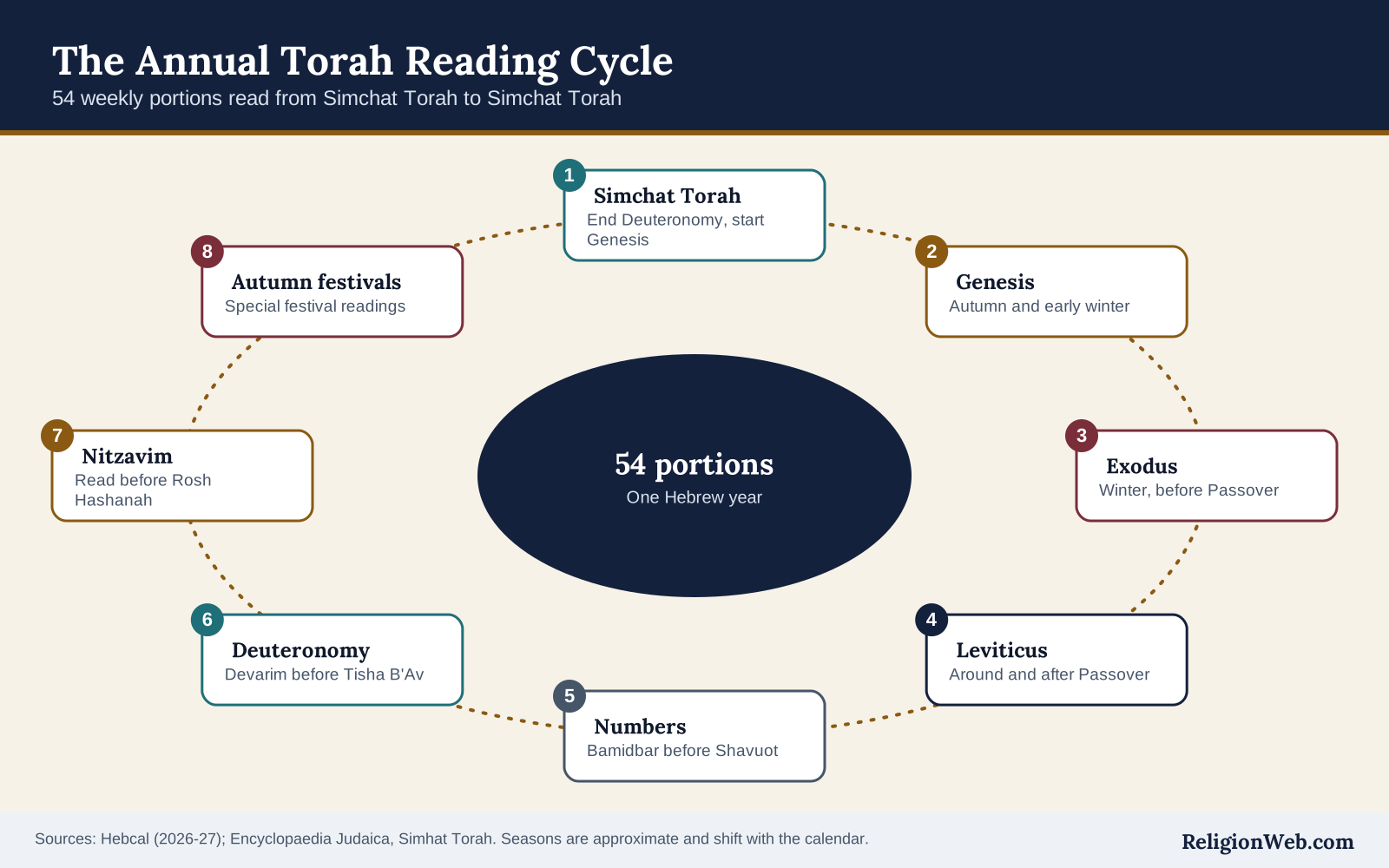
The Torah is divided into 54 weekly sections, each called a parashah (plural parashiyot) or, in Aramaic form, a sidra. Each portion takes its name from its first distinctive word or two, so the first portion of Genesis is Bereshit and the first of Exodus is Shemot. Hebcal, the widely used Jewish calendar service, lists 12 portions in Genesis, 11 in Exodus, 10 in Leviticus, 10 in Numbers, and 11 in Deuteronomy. One portion is read on each Sabbath, and the full sequence is completed within a single Hebrew year, beginning and ending on the festival of Simchat Torah. The Encyclopaedia Judaica identifies this one-year sequence as the system of the Babylonian communities, divided into 54 units.
The reason there are 54 portions but fewer Sabbaths is calendrical. The Jewish year is lunisolar, with ordinary years of 353 to 355 days and leap years of about 383 to 385 days, so the number of Sabbaths available between one Simchat Torah and the next varies. Seven portions are therefore paired in some years: Vayakhel with Pekudei, Tazria with Metzora, Achrei Mot with Kedoshim, Behar with Bechukotai, Chukat with Balak, Matot with Masei, and Nitzavim with Vayeilech. In a year with enough Sabbaths, they are read separately, and the rules for which pairs combine are fixed so that certain portions always fall before certain days of the year. Differences between Israel and the Diaspora can also arise when a one-day-longer Diaspora holiday falls on a Sabbath. As this article is written in October 2026, the portion for the Sabbath of October 24, 2026 is Lech-Lecha, the third portion of Genesis, according to Hebcal.
Books, seasons, and the shape of the year
Because the cycle is anchored to the festivals, each book of the Torah tends to occupy a recognizable stretch of the year. Genesis is read in the autumn and early winter, beginning after Sukkot. Exodus follows in winter and early spring, and the account of the Exodus from Egypt is read in the weeks before Passover. Leviticus usually falls around and after Passover. Numbers is read in late spring and summer, with its first portion, Bamidbar, always read before Shavuot, and Deuteronomy, the book of Moses’ farewell, is read in the late summer, with Devarim read just before the fast of Tisha B’Av and Nitzavim before Rosh Hashanah. These associations are approximate and shift by a few weeks depending on the calendar, but they give the year a narrative arc: the Torah’s story is retold as the seasons turn, and the Sabbath readings often resonate with the season.
Special Readings for Festivals, Fast Days, and Special Sabbaths
Festival readings
On festivals the regular cycle pauses and the reading is chosen to fit the day. The Mishnah (Megillah 3:4 to 6) already lists such readings: the dedication offerings of the tribal leaders in Numbers 7 for Hanukkah, the attack of Amalek in Exodus 17 for Purim, the monthly offerings of Numbers 28 for Rosh Chodesh, the Day of Atonement ritual of Leviticus 16 for Yom Kippur, and a passage on the seventh month in Leviticus 23 for Rosh Hashanah. Present-day calendars have adjusted some choices. According to Hebcal, in 2026 the first day of Rosh Hashanah is accompanied by the story of Isaac’s birth in Genesis 21, the second day by the binding of Isaac in Genesis 22, and both by the festival offerings of Numbers 29:1 to 6. The meanings of these days are covered in the articles on Rosh Hashanah, Yom Kippur, and Hanukkah.
| Occasion | Torah reading | Number of readers (Mishnah rule or usual practice) |
|---|---|---|
| Sabbath morning | The weekly portion, with a concluding maftir and a haftarah | Seven |
| Monday and Thursday mornings; Sabbath afternoon | The opening of the portion for the coming Sabbath | Three |
| Rosh Hashanah (2026) | Genesis 21 (day 1) and Genesis 22 (day 2); Numbers 29:1 to 6 on both days | Five on a festival |
| Yom Kippur (2026) | Leviticus 16 and Numbers 29:7 to 11 in the morning; Leviticus 18 in the afternoon | Six |
| Sukkot, first day (2026) | Leviticus 22:26 to 23:44; Numbers 29:12 to 16 | Five |
| Passover, first day (2027) | Exodus 12:21 to 51; Numbers 28:16 to 25 | Five |
| Shavuot, first day (2027) | Exodus 19:1 to 20:23; Numbers 28:26 to 31 | Five |
| Purim (2027) | Exodus 17:8 to 16 | Three |
| Simchat Torah (2026) | Deuteronomy 33:1 to 34:12; Genesis 1:1 to 2:3; Numbers 29:35 to 30:1 | Five at minimum; many more are customary |
The table shows the logic of the festival readings. Rosh Hashanah, Sukkot, Passover, and Shavuot are each given the narrative or legal passage that defines the day, together with a second reading from Numbers that describes the offerings for it. The Shavuot reading is the account of the revelation at Sinai in Exodus 19 and 20, which ties the festival to the giving of the Torah. The Passover reading is the story of the first Passover in Exodus 12. Dates in this table are from Hebcal and apply to Diaspora observance; in Israel, where festivals are one day shorter, the sequence differs.
Special Sabbaths and Rosh Chodesh
The Mishnah (Megillah 3:4) also provides for special Sabbaths in the weeks before Passover. They are known today as Shekalim, which recalls the half-shekel donation, Zachor, “Remember,” with the passage about Amalek in Deuteronomy 25:17 to 19, Parah, the passage on the red heifer in Numbers 19:1 to 22, and HaChodesh, “The Month,” with the Passover lamb in Exodus 12:1 to 20. On each of these Sabbaths a second scroll is used, and a short section is read from it after the regular portion. On the first day of each Hebrew month, Rosh Chodesh, the passage on the monthly offerings in Numbers 28:11 to 15 is read from the scroll. The effect is a calendar of reading in which the weekly portion, the festivals, and the preparatory Sabbaths overlap and, together, shape the rhythm of the year.
The Triennial Cycle and Its Revivals
Palestinian custom and the Babylonian annual cycle
The one-year cycle was not the only ancient practice. The Babylonian Talmud (Megillah 29b) contains the earliest reference to a fixed cycle, noting that in the West, meaning the land of Israel, the Torah was completed in three years, and the Encyclopaedia Judaica reports that the old division into 153, 155, or 167 sedarim comes from that triennial custom. Rabbi Paul Steinberg’s summary in the Jewish Publication Society’s Celebrating the Jewish Year dates the Palestinian triennial cycle to about the sixth century CE and the Babylonian annual cycle to the early seventh. The traveler Benjamin of Tudela, around 1170, described both customs among Jews in Cairo, and the twelfth-century jurist Maimonides states in his code that the annual cycle had become universal, though the triennial survived in some places. The annual cycle ultimately prevailed everywhere.
Modern triennial proposals
Interest in the triennial cycle returned in the modern period, mainly in liberal communities. Steinberg reports that an attempt to revive it in London in the nineteenth century failed, as did a mid-twentieth-century attempt by some American Conservative congregations, in part because the congregations that adopted it would have celebrated Simchat Torah only every three years and were reading different portions from the rest of the Jewish world. In 1988, the Conservative movement’s Committee on Jewish Law and Standards approved a new triennial cycle that divides each of the 54 portions into thirds, so that the whole Torah is still completed annually while a congregation reads only about a third of each portion each year. Many liberal congregations follow some version of that arrangement or a modified one, while Orthodox communities and congregations in Israel keep the annual cycle with the full weekly portion.
Simchat Torah: Finishing and Starting Again
What happens on Simchat Torah
Simchat Torah, “Rejoicing of the Torah,” marks the end of the annual cycle and its immediate restart. It follows the festival of Sukkot and the eighth-day assembly, Shemini Atzeret. In the Diaspora, Simchat Torah is the second day of Shemini Atzeret, 23 Tishrei, and in 2026 it fell on the evening of October 3 and the day of October 4 according to Hebcal; in Israel the two observances are combined on a single day, October 3. The central celebration takes place at evening services, when the scrolls are taken out of the ark for processions called hakafot, “circuits.” The Encyclopaedia Judaica reports that all the scrolls are removed from the ark and carried around the reading platform seven times, with singing and dancing, in Orthodox and Conservative congregations, and that some communities read from the end of Deuteronomy in the evening service, the only time the Torah is read at night.
In the morning, the last section of Deuteronomy (33:1 to 34:12) is read, followed immediately by the first section of Genesis (1:1 to 2:3). The people called for these readings are honored with titles: the Chatan Torah, “bridegroom of the Torah,” concludes the cycle, and the Chatan Bereshit, “bridegroom of Genesis,” begins the new one. A special call, Kol ha-Ne’arim, “all the children,” brings the children up for an aliyah, usually with a prayer shawl spread over them. Children carry flags, in some communities topped with apples holding candles. The haftarah is the opening of the book of Joshua, which continues the story where the Torah ends.
Why the celebration took its present form
The festival as celebrated today is a post-Talmudic development. The Encyclopaedia Judaica entry explains that the Talmud called the day simply the second day of Shemini Atzeret, and that its distinctive celebrations grew up in the geonic period, as the one-year cycle spread. A ninth-century prayer book, Seder Rav Amram, already mentions the reading from Joshua, and the custom of starting Genesis immediately was explained by the medieval legal code known as the Tur as a way to show that the community is willing to begin the Torah anew as soon as it has finished. The earliest known source for the flags is a 1672 ordinance of Polish Jews in Amsterdam. In the 1960s, Simchat Torah became a mass gathering of Jewish youth in Soviet cities such as Moscow, and Jewish communities elsewhere declared it a day of solidarity with Soviet Jews. The festival thus carries the Torah’s meaning in a joyful and communal form, in which the act of finishing the scroll and starting it again is itself the celebration.
The Torah in Jewish Life, Law, and the Movements Today
The Torah as a Guide for Living
Commandments, ethics, and the shape of a Jewish week
Most of what Jewish tradition calls observance begins in the Torah’s text, whether directly or through the interpretation that surrounds it. The Sabbath is commanded in the Ten Commandments and set within the creation story. The dietary laws of Leviticus 11 and Deuteronomy 14 are the textual basis of kashrut, treated in the article on kosher food rules. The festivals are listed in Leviticus 23 and elsewhere, and the laws of agricultural gifts to the poor, honest business, care for the stranger, and justice in the courts are scattered through the legal collections. The sages of the Talmud taught that the commandments of the Torah number 613, and the tradition treats them not as an arbitrary list but as a structure for sanctifying time, food, speech, family life, and community obligation.
The Torah also supplies the moral vocabulary of Jewish ethics. The command to love one’s neighbor as oneself (Leviticus 19:18), the obligation to leave the corners of a field for the poor, the requirement to return a lost object, and the repeated reminder that the Israelites were once strangers in Egypt all appear in the text and are drawn on in modern Jewish discussions of social justice. The Mishnah (Peah 1:1) groups such deeds with Torah study, observing that the study of Torah is equal to them all. That teaching helps explain why Jewish tradition treats learning and doing as inseparable, and why even people who rarely attend services often describe the Torah as the root of Jewish ethical identity.
Torah texts in objects and rites
Passages from the Torah also travel with Jews through the day. The paragraphs of Deuteronomy beginning with the Shema (6:4 to 9 and 11:13 to 21) are written by a scribe on small parchments placed in the doorpost case called a mezuzah and in the leather boxes of tefillin worn in morning prayer, and the command to attach fringes to the corners of garments comes from Numbers 15. The same scribal rules that govern a scroll apply to these smaller texts, which is why one profession, the sofer, produces all of them. Life-cycle events also use the Torah: a bar or bat mitzvah often includes the young person’s first reading, and many couples are honored with a blessing at the scroll before their wedding. The Torah is thus both a text to be read and a set of words to be carried, worn, and affixed to the home.
The Torah in the Jewish Movements Today
Differing approaches to authority and practice
The central difference between Jewish movements is not whether the Torah matters, but how its authority is understood and how it is applied. Orthodox Judaism holds that the written and oral Torah together are divinely revealed and that halakha is binding. Conservative Judaism, in the language of its 1988 statement, regards halakha as authoritative but developing, and its rabbinical bodies issue rulings that adapt traditional law to new circumstances. Reform Judaism describes Torah as ongoing revelation and leaves much to individual engagement, while encouraging the study of Hebrew and a renewed commitment to mitzvot. The articles on Orthodox Judaism, Conservative Judaism, and Reform Judaism describe each approach in detail. These distinctions affect who may be called to the scroll, which cycle is used, and how disputed passages are read, but all the movements read the Torah in the synagogue and teach it to their children.
Reading difficult passages
Every long-lived community has to decide what to do with passages that trouble its readers, and Jewish tradition has done so in a characteristic way. The sages limited the application of some biblical laws so heavily that they became largely theoretical. They read the “eye for an eye” passage as a rule of monetary compensation, as the Mishnah (Bava Kamma 8:1) works out in detail. They also treated other laws as no longer applicable once the conditions they assumed had ended. Modern readers, from many movements, continue this work with new tools. Some emphasize rabbinic interpretation as the authoritative key, others bring historical or ethical arguments to the text, and still others read difficult passages as evidence of the ancient context from which the Torah emerged. All of them argue within the Jewish habit of reading the same text again and again, which is one reason the weekly cycle is more than a schedule.
The Torah across the Jewish world
The Torah reaches Jews through very different surroundings. In an Israeli school, children learn the Hebrew text in the language it was written in. In a synagogue in a small town on another continent, a visiting rabbi may be the only person who can chant from the scroll. In a university classroom, Jewish students and others read the five books alongside the work of historians of the ancient Near East. Online libraries now offer the Hebrew text and its translations and commentaries to anyone with a connection. Through all of these settings the Torah remains what Jewish tradition says it is: a text that is read in public, studied in private, written by hand, and returned to every year, from the last verses of Deuteronomy back to the first words of Genesis.
Common Misconceptions About the Torah
Misconception 1: The word “Torah” always means one physical scroll
Where the misunderstanding comes from
In synagogue language the scroll and the word are nearly interchangeable. People “take out the Torah,” “stand for the Torah,” and “dance with the Torah,” and a visitor who sees an ornamented parchment scroll carried through a sanctuary may reasonably conclude that this object is what the word names. English adds to the impression by offering only bounded translations, such as “the Law,” “the Pentateuch,” or “the Five Books,” each of which suggests a single closed book.
The impression is reinforced by the fact that the scroll is the form in which the Torah has the highest ritual status. For public worship, only a handwritten scroll counts, and so the scroll has become the visible symbol of the whole tradition.
What the evidence and tradition actually show
The scroll is one important form of the Torah, not the only one. The Encyclopedia of Religion entry shows that the Hebrew word covers a wide range: instructions on a single subject within Leviticus, the written teaching of Moses, the entire Hebrew Bible, and in rabbinic usage the whole body of authoritative teaching, written and oral. A printed Chumash that sits on a synagogue bench is also “Torah” in the sense that it contains the text, although it cannot be used for the public reading. A rabbi’s sermon is a dvar Torah, and a person studying a page of Talmud is “learning Torah” with no scroll in view.
Understanding which sense is meant is therefore part of reading Jewish sources accurately. When a text says that someone “was occupied with Torah,” it normally means study, not the handling of a scroll. When a synagogue notice says that “the Torah will be read at 9:30,” it means a specific scroll and a specific portion. The word moves between these meanings without confusion for people who use it daily, and the best way for an outsider to follow is to ask which one a speaker has in mind.
Misconception 2: The Torah and the Talmud are the same work
Where the misunderstanding comes from
The two words appear together constantly, in phrases such as “Torah and Talmud study,” and both are associated with rabbinic Judaism, rabbinic law, and the yeshiva. In popular summaries and in some polemical writing, the terms are blurred, and the Talmud is sometimes described as an additional or alternative scripture that replaces the Torah in practice. For readers without a background in the subject, nothing in the sound of either word marks the difference.
What the evidence and tradition actually show
They are different works from different periods with different functions. The Torah is the Five Books of Moses, read in the synagogue from the scroll and treated as the foundation text. The Talmud is a vast record of rabbinic discussion that grew up around the Mishnah, a legal collection edited around 200 CE; it exists in two versions, the Jerusalem Talmud and the Babylonian Talmud, which were compiled in late antiquity. It quotes the Torah constantly, usually to ask what a verse means or how a law is derived from it, and it is never read from a scroll in the service. The article on the Talmud describes its structure, from the Mishnah to the Gemara, and its place in Jewish study.
In the rabbinic account, the relationship is that of text and interpretation. The Talmud is understood as the written record of much of the Oral Torah, and its authority within rabbinic Judaism derives from the claim that it transmits and unfolds what was given with the written text. Karaite Judaism, which holds that the Hebrew Bible alone is the source of divine law, rejects that claim. Either way, the Talmud presupposes the Torah and cannot replace it, since its arguments are about the Torah’s wording and meaning.
Misconception 3: A synagogue Torah scroll is an ordinary printed book
Where the misunderstanding comes from
Many people first meet the Torah in a printed form: a study Bible in a library, a Chumash on the bench in front of them in synagogue, or a translation on a phone. Congregants follow the reading in these books, and a visitor who sees worshipers looking down at a printed page while someone chants from a scroll can easily assume the scroll is simply a large, old-fashioned edition of the same text. In photographs, a scroll looks like a decorated roll of paper.
What the evidence and tradition actually show
A synagogue scroll differs from a printed book in material, method, and status. It is written by a trained scribe on prepared animal parchment with a quill and a special ink, in a prescribed script, and sewn together with sinew. Chabad’s account states that printed scrolls are invalid, that every letter must be formed correctly, and that the scribe copies from an exemplar rather than from memory. The scroll has no vowels, no accents, and no chapter or verse numbers, which is why the printed book is so useful to the person following along. The Peninei Halakha volume on prayer explains that the scroll used in public reading must be written for the sake of Heaven, with ink on parchment, in the manner of the original scroll that Moses wrote.
The difference has consequences. A printed Bible with a misprint is a flawed copy. A scroll with a missing letter is, under Jewish law, unfit for the commandment of public reading until corrected. Printed books are valuable and widely used for study and for following along in services, but they do not take the place of the scroll in the central ritual. The two forms serve different purposes and the tradition does not set them against one another.
Misconception 4: The Torah is mainly a rulebook of laws
Where the misunderstanding comes from
The common English translation of torah as “law” suggests a legal code, and the traditional count of 613 commandments adds to that impression. Popular references to “Mosaic law” or “the laws of the Torah” reduce the five books to their legal elements, and the legal passages, especially in Leviticus and Deuteronomy, are the ones most often quoted in public debate. Readers who meet the Torah through such excerpts may never encounter its stories.
What the evidence and tradition actually show
Genesis contains relatively few commandments, and large parts of Exodus and Numbers are narrative: escape, revelation, rebellion, wandering, and burial. Jaffee’s entry in the Encyclopedia of Religion makes the point that the canonical Torah is a narrative that contains law codes, not simply a law code. The older Jewish scholarly tradition, as represented by Rabinowitz in the same entry, argues that “law” gives a wrong impression of a word whose core meaning is teaching. The law collections are presented within a story of covenant, and the commandments often refer to events in that story.
Jewish tradition also treats the narrative parts of the Torah as sources of teaching, not mere background. Rabbinic interpreters used the stories of the patriarchs and matriarchs for ethical reflection, and Jewish law itself draws on narrative details. At the same time, the legal material is real and important, and the rabbinic system of halakha is built on it. The accurate statement is that the Torah combines narrative, law, poetry, and ritual instruction, and that Jewish tradition has always read these elements together.
Misconception 5: All Jews understand the Torah in the same way
Where the misunderstanding comes from
Public discussion of the Torah often presents one account of its origin and authority as though it were the position of the entire Jewish people. A statement such as “Jews believe God dictated the Torah to Moses” is a fair summary of the traditional rabbinic and Orthodox position, and Maimonides’ thirteen principles, which include that claim, are printed in many prayer books. But the sentence is sometimes extended to all Jews, and the very large number of Jews who are secular, culturally Jewish, or affiliated with liberal movements disappears from the picture.
The impression is strengthened by the Torah’s visibility. Because the scroll is read in nearly every synagogue, it can seem that reading the same text means holding the same belief about it.
What the evidence and tradition actually show
Within the rabbinic tradition itself there was never a single account of how the Torah was transmitted. The Talmud preserves the disagreement about the final verses between those who held that Joshua wrote them and Rabbi Shimon, who held that Moses wrote them weeping at God’s dictation. Medieval commentators such as Abraham Ibn Ezra noticed difficulties in the text and still defended its antiquity. In the modern period, Orthodox, Conservative, and Reform bodies have described revelation in different terms, from the Orthodox affirmation of Sinai, to the Conservative “human-divine encounter,” to the Reform “ongoing revelation,” and individual Jews within every movement hold a spectrum of views.
Many Jews who do not hold a doctrine of verbal revelation still treat the Torah as the central text of their heritage, and they take part in its reading, its festivals, and its study. For them the Torah may be a source of ethical teaching, national memory, or literature, or all of these. The statement that “Jews believe” a single thing about the Torah is therefore accurate only when it names the specific community whose position is being described, which is the approach this article has tried to follow.
Frequently Asked Questions About the Torah
Questions About Meaning and Content
How many books are in the Torah, and what are they?
The Torah in its narrow sense has five books: Genesis, Exodus, Leviticus, Numbers, and Deuteronomy, known in Hebrew by their opening words as Bereshit, Shemot, Vayikra, Bamidbar, and Devarim. Together they run from creation to the death of Moses. They are the first of the three parts of the Hebrew Bible, followed by the Prophets and the Writings, and they have the highest liturgical status of any Jewish text.
Is the Torah the same as the Old Testament?
Not exactly. The Torah is the first division of the Jewish Bible, the Tanakh, and consists of the Five Books of Moses. In Christian Bibles the same five books open the Old Testament, which then continues with a larger and differently ordered collection of books. The distinction is one of arrangement and usage, and Jewish and Christian readers have historically read the shared books within different interpretive traditions. The article on the Bible explains the Christian arrangement, while this article follows Jewish usage.
Does “Torah” mean “law”?
The usual English translation is “law,” but the Hebrew word means “teaching” or “instruction,” and specialists in the field regularly caution against the narrower rendering. The Greek translation nomos helped establish the legal sense, yet the Torah contains narrative, poetry, and ritual instruction as well as commandments. In Jewish usage the word can mean the five books, the whole Bible, or the whole body of teaching, depending on context.
Questions About the Scroll and the Reading
Why is the Torah written by hand?
Jewish law requires that the scroll used for public reading be written by hand on parchment by a trained scribe, according to detailed rules, in the manner of the scroll that tradition says Moses wrote. The scribe copies from a correct exemplar, writes with the proper intention, and avoids even a single missing or extra letter, because an error of that kind can make the scroll unfit for reading until it is repaired. Printed books are widely used for study and for following the reading, but the public reading itself calls for the handwritten scroll.
How often is the Torah read in the synagogue?
In traditional practice the Torah is read on Monday and Thursday mornings, on Sabbath morning and afternoon, on festivals, on the first day of each month, and on fast days. The weekly Sabbath readings follow a cycle of 54 portions that is completed in a year, beginning and ending at Simchat Torah. Some liberal congregations follow a triennial cycle in which one-third of each portion is read each year, and the full text is still completed on a longer timescale.
Why do people kiss or touch the Torah?
As a scroll is carried through the sanctuary, worshipers often touch it with the fringe of a prayer shawl or the edge of a prayer book and then kiss that object. The custom expresses honor for the text and avoids direct contact with the parchment, which is also why readers use a pointer. It is a gesture of reverence, not worship, and its form varies from one community to another.
Questions About Authority and Study
Who wrote the Torah?
The answer depends on the framework. Rabbinic and Orthodox tradition holds that God revealed the Torah to Moses, who wrote it, and Maimonides made this an article of faith. Conservative and Reform thinkers describe revelation in other terms, with the Conservative statement Emet ve-Emunah speaking of a “human-divine encounter” and the Reform principles of 1999 of “ongoing revelation.” Academic historians generally view the Pentateuch as a composite text that took shape over a long period, and they disagree about its sources and dates. The section on authorship sets these positions out separately.
Do Jews follow all the laws in the Torah?
No Jewish community keeps all 613 commandments, since many depend on the Temple, the land of Israel, or conditions that no longer exist. Traditional Jewish law distinguishes commandments from the Torah itself from those enacted by the rabbis, and the movements differ about how binding each category is. Orthodox Jews regard halakha as obligatory and apply it in detail, while Conservative and Reform Jews understand the obligations in different ways, as the articles on the Jewish movements explain. Observance among individual Jews varies widely within every group.
Where can a beginner start?
A practical way in is to read a single weekly portion with a reliable translation and a commentary, then attend a service or class where the same portion is read and discussed. Many synagogues and Jewish educational organizations offer introductory sessions, and printed editions with commentary exist for readers of every background. Reading with another person is also in keeping with the tradition, which treats study as a shared and argumentative activity.
Conclusion: The Torah as Text, Scroll, and Teaching
What the History and Practice Show
A text that is read, copied, and renewed
The Torah is at once a literary work, a ritual object, and a body of teaching. As a text, it narrates the origins of the world and of a people and sets out commandments within that story. As a scroll, it is copied by hand under exacting rules and read aloud in an annual cycle that the festival of Simchat Torah closes and reopens. As teaching, it extends beyond the five books into the Oral Torah, the Talmud, and centuries of commentary. These three aspects are bound together in Jewish practice, so that to understand the Torah means attending to the text, the scroll, and the tradition of reading.
Different frameworks, one shared object
Jewish communities and academic scholars describe the Torah’s origins differently, and this article has presented those accounts side by side with attribution. Orthodox tradition speaks of revelation at Sinai, Conservative and Reform movements of an ongoing human-divine encounter, and historians of a composite text shaped over centuries. What is not in dispute is the Torah’s place: it is the most revered text in Jewish life, and its reading continues in synagogues on every continent.
How to Keep Exploring
Related reading on ReligionWeb
Readers who want to follow the Oral Torah can turn to the article on the Talmud. The festival readings are discussed in the articles on Passover and Shabbat, and the wider tradition is described in the main article on Judaism.
Learning from living practice
The Torah is best understood alongside the practice that surrounds it. Visiting a synagogue service where the scroll is read, listening to the chant, and following a portion in translation make clear what the written description can only outline. Most congregations welcome visitors for such services, and many publish the weekly portion in advance.
Sources
The table below lists the principal external sources behind this article. Facts, dates and figures were checked against these and related primary, institutional and academic materials.
| # | Source | Publisher and type | Used for | Link |
|---|---|---|---|---|
| 1 | Torah (Encyclopedia of Religion entries by Martin S. Jaffee and Louis Isaac Rabinowitz) | Encyclopedia.com (Encyclopedia of Religion, 2nd ed., Macmillan/Gale) · Academic reference | Etymology of torah, biblical and rabbinic usage, Written and Oral Torah, nomos | encyclopedia.com |
| 2 | Torah, Reading of (Encyclopaedia Judaica) | Encyclopedia.com (Encyclopaedia Judaica, Macmillan/Gale) · Academic reference | History of public reading, aliyot, triennial and annual cycles, haftarah, Sephardi and Ashkenazi customs | encyclopedia.com |
| 3 | Pentateuch (Encyclopaedia Judaica) | Encyclopedia.com (Encyclopaedia Judaica, Macmillan/Gale) · Academic reference | Book names, structure, Mosaic tradition, documentary hypothesis and later scholarship | encyclopedia.com |
| 4 | Simhat Torah (Encyclopaedia Judaica) | Encyclopedia.com (Encyclopaedia Judaica, Macmillan/Gale) · Academic reference | Origins and customs of Simchat Torah: hakkafot, Hatan Torah, flags, geonic development | encyclopedia.com |
| 5 | The Holy Scriptures: A New Translation (JPS 1917), Deuteronomy 4:44 (public-domain edition as hosted on Sefaria) | Jewish Publication Society / Sefaria · Primary text | Edition and public-domain status of all six Bible quotations (Deut. 4:44, 30:12, 31:9; Ex. 24:7; Neh. 8:8; Prov. 3:18) | sefaria.org |
| 6 | Mishnah Megillah 4:1-2 (William Davidson Edition; also consulted: Mishnah Megillah 3:4-6, Eruvin 13a, Menachot 30a, Megillah 23a, Berakhot 8a, Mishnah Peah 1:1, Pirkei Avot 1:1) | Sefaria / Koren-Steinsaltz; Mishnah Yomit (J. Kulp) · Primary text | Paraphrased rabbinic passages: numbers of readers, special readings, scribal warning, last verses, women and reading | sefaria.org |
| 7 | Peninei Halakha, Prayer: The Torah Scroll (R. Eliezer Melamed) | Har Bracha Institute · Institutional | Validity of a scroll, effect of a missing letter, what to do when an error is found mid-reading, three-day reading rule | ph.yhb.org.il |
| 8 | How Is the Torah Made? | Chabad.org · Institutional | Scroll materials, 62-84 sheets, 304,805 letters, copying rules, scribe's practice, accessories | chabad.org |
| 9 | Torah Portions (Parashat ha-Shavua) and Jewish holiday readings, 2026-2027 | Hebcal · Reference calendar | List of 54 portions, paired portions, Lech-Lecha on Oct. 24, 2026, Simchat Torah 2026 and festival readings | hebcal.com |
| 10 | Masoretic text | Encyclopaedia Britannica · Encyclopedia | Masoretes, vowel and cantillation signs, Tiberian system, counting of letters and verses | britannica.com |
Last fact-check date: 2026-10-21.