
Tefillin are a pair of small black leather boxes, each containing handwritten parchment inscribed with passages from the Book of Exodus and the Book of Deuteronomy, that observant Jews bind to the arm and the head during weekday morning prayer. One box, the arm tefillin (tefillah shel yad), is placed on the upper arm opposite the heart and fastened with a long leather strap that is wound around the arm and hand. The other, the head tefillin (tefillah shel rosh), sits above the forehead and is held by a strap tied at the back of the head. English speakers often call them phylacteries, a word taken from Greek, but the Hebrew term is the one used in Jewish law, liturgy and conversation.
The practice rests on a short biblical command. Deuteronomy 6:8 tells Israel to bind certain words “for a sign upon thy hand” and to let them be “frontlets between thine eyes,” and the rabbinic tradition, reading that command literally, understood it as a physical object worn on the body. The words in question belong to the Torah, the foundational scripture of Judaism, and they include the declaration known as the Shema, “Hear, O Israel.” Tefillin therefore do something unusual among Jewish ritual objects: they carry sacred text and they are worn, so that scripture, prayer and the body come together at a specific moment of the day, usually while a person stands to pray at home or in a synagogue.
Details matter a great deal here. The parchments must be written by a trained scribe under strict rules, the boxes and straps have prescribed shapes and colors, and the order of putting them on is fixed by long-standing custom and law. Traditional halakha (Jewish law) places the obligation on adult men and exempts the Sabbath and festivals, while Conservative, Reform and other communities have approached questions of gender, obligation and regular practice in their own ways. This article explains what tefillin are, what is written inside them, how they are made and worn, how communities differ, and what the practice means, on the tradition’s own terms and with attention to the history that shaped it.
Tefillin at a Glance: Definition, Terms and Basic Practice
What the Word Tefillin Means
The Hebrew name and the English word “phylacteries”
The Hebrew word tefillin is plural; the singular, tefillah, is used for a single box, though in practice most people speak of “putting on tefillin” or “laying tefillin” without distinguishing them. The Encyclopaedia Judaica notes that the word is usually translated “phylacteries” and describes that rendering as peculiarly inappropriate, because the Greek phylakterion means a safeguard or amulet. A different encyclopedia entry traces the English word through late Latin to a Greek verb meaning “to guard.” The Jewish tradition does not present tefillin as a charm for protection in the first instance. It presents them as the fulfillment of a commandment, and the protective associations that later grew around them are treated as secondary by most legal writers.
The origin of the Hebrew word is itself discussed. Because tefillah also means “prayer,” many people assume tefillin are simply “prayer objects,” and the connection is a natural one for a practice done during prayer. The Encyclopaedia Judaica suggests the resemblance may be a homonym, noting a proposed connection to an Aramaic root meaning “attachments” and, in another view, to a root meaning “separate.” Whatever the etymology, tefillin is the term used throughout rabbinic literature and has remained the standard Jewish name ever since.
The biblical words behind the practice
The Torah never uses the word tefillin. It speaks instead of a “sign” (ot) on the hand and of totafot, usually rendered “frontlets,” between the eyes; Exodus 13:9 uses the word zikaron, “memorial,” in place of frontlets. The meaning of totafot is itself obscure, and ancient and modern interpreters have proposed different explanations. The rabbinic reading, that these terms refer to physical objects containing scripture, became the basis of Jewish practice, and it was already assumed by the generation of Jews who wrote the Dead Sea Scrolls, whose caves yielded actual tefillin. Some medieval commentators, among them the twelfth-century Samuel ben Meir (the Rashbam), read the verses figuratively, and Abraham ibn Ezra mentioned that possibility before rejecting it, according to the Encyclopaedia Judaica; the overwhelming weight of Jewish tradition took the verses as literal commands.
The Objects in Brief
The arm tefillin and the head tefillin
Each set of tefillin has three components: the parchment scrolls, the box that holds them, and the strap. The arm tefillin has a single compartment containing one parchment on which all four passages are written in sequence. The head tefillin has four compartments, each holding one passage on its own small parchment, and a raised Hebrew letter shin is molded into each side of the box. Both boxes are black, and both are normally cubical, with a base that carries a channel through which the strap passes. Later sections of this article describe each part in turn; the point here is only that the two boxes are not interchangeable, and that the head tefillin is considered to have a higher degree of sanctity than the arm tefillin, so that an arm box may not deliberately be placed in a head box’s position.
The four passages inside
The scriptural texts are Exodus 13:1-10, Exodus 13:11-16, Deuteronomy 6:4-9 and Deuteronomy 11:13-21. The first two concern the Exodus from Egypt, the festival of unleavened bread and the dedication of the firstborn; the other two are the first two paragraphs of the Shema, the statement of divine unity and the commandment to love God, followed by the passage that links keeping the commandments with the blessings of the land. These are the same passages that Jewish liturgy later arranged around the Shema in daily prayer, with the difference that tefillin include two Exodus passages the Shema does not. The next section of this article, on the biblical sources, treats them one at a time.
Where Tefillin Fit in Jewish Life
Weekday morning prayer
In traditional practice, tefillin are put on in the morning before or during the weekday morning service (Shacharit) and taken off after it, though the commandment can in principle be fulfilled at any time during daylight. They are not worn on the Sabbath, because the Sabbath is itself called a “sign” in the Torah, and they are not worn on major festivals such as Shavuot for a related reason; the legal details are covered in a later section. Many Jews who do not wear tefillin every day nonetheless know the practice well from synagogues, from a bar or bat mitzvah, from family members, or from outreach tables where volunteers invite passersby to put them on.
Quick reference to the main Hebrew vocabulary
The vocabulary of tefillin is compact but specific, and the table below collects the terms that recur in the rest of the article. The spellings are common English transliterations, and plural forms are given where they matter. Sources vary in the way they transliterate several of these words, so the same term may appear with a different spelling in a prayer book, a legal guide or a synagogue handout.
| Term | Meaning | Where it applies |
|---|---|---|
| Tefillin (singular tefillah) | The pair of boxes with their parchments and straps, often translated “phylacteries” | The object as a whole |
| Shel yad | “Of the hand,” the arm tefillin | One parchment with four passages; placed on the upper arm |
| Shel rosh | “Of the head,” the head tefillin | Four compartments, one passage in each; placed above the forehead |
| Batim (singular bayit) | “Houses,” the leather boxes | Cubical boxes holding the parchments |
| Retzuot (singular retzuah) | The leather straps | Black on the outer side; wound on the arm and tied on the head |
| Parshiyot (singular parashah) | The four written passages | The parchment texts inside the boxes |
| Klaf and sofer | Parchment and the trained scribe who writes it | Scribal production and checking |
| Totafot and ot | Biblical words for “frontlets” and “sign” | Deuteronomy 6:8 and 11:18; Exodus 13:9 uses zikaron, “memorial” |
| Kesher | The knot of the head strap, shaped like the Hebrew letter dalet | Rests at the back of the head near the nape |
| Rabbeinu Tam tefillin | A second set with the passages in a different order | Worn by some especially observant Jews after the service |
The Biblical Sources: Four Passages and the Command to Bind
Where the Torah Commands the Sign on Hand and Head
Exodus 13: a sign and a memorial
The earliest of the commands comes in the thirteenth chapter of Exodus, in the aftermath of the departure from Egypt. After instructions about the firstborn and about eating unleavened bread, the text says that the observance will serve as a reminder:
And it shall be for a sign unto thee upon thy hand, and for a memorial between thine eyes
Exodus 13:9, The Holy Scriptures: A New Translation (JPS 1917), via Sefaria
In the narrative setting, the “sign” and “memorial” belong to a larger effort to make the memory of the Exodus permanent and teachable. Verse 16, near the end of the second Exodus passage, returns to the same pairing, and the surrounding verses tie the sign to God’s bringing Israel out of Egypt by strength of hand. Jewish interpreters across the centuries have disagreed about whether the language was meant as a literal object from the start, but the placement of the command within the story of redemption is a major reason that the Exodus passages are written inside the boxes themselves. The Encyclopaedia Judaica adds that Deuteronomy uses the verb “bind,” while Exodus says only that the words “shall be” a sign, and the later legal tradition combined the two formulations.
Deuteronomy 6 and 11: bind them on the hand
Deuteronomy gives the more direct instruction. It appears in the passage that immediately follows the declaration “Hear, O Israel,” where the people are told to love God with the whole heart, to keep these words in mind and to teach them to children. Then the text turns to the body:
And thou shalt bind them for a sign upon thy hand, and they shall be for frontlets between thine eyes.
Deuteronomy 6:8, The Holy Scriptures: A New Translation (JPS 1917), via Sefaria
The next verse commands that the same words be written on the “door-posts” of the house and on its gates, which is the biblical basis of the mezuzah. A very similar sequence closes the second Deuteronomy passage, in chapter 11, where the people are again told to place the words on their heart and soul, to bind them as a sign and frontlets, and to teach and write them. The two Deuteronomy passages therefore connect three things: speech and teaching in the home and on the road, the body as a bearer of the words, and the doorpost as the boundary of the household. Tefillin and mezuzah are treated as parts of a single biblical idea expressed through two objects.

The Four Passages and What Each Contains
The two passages from Exodus
The first passage, Exodus 13:1-10, is known by its opening Hebrew words Kadesh li, “Sanctify to me.” It begins with the dedication of the firstborn, continues with the commandment to remember the day of leaving Egypt and to eat unleavened bread, and ends with the sign on the hand and the memorial between the eyes. The second, Exodus 13:11-16, begins Vehayah ki yeviacha, “And when [the LORD] brings you.” It looks forward to the land of Canaan, requires the offering or redemption of firstborn males, tells parents how to answer a child who asks what the observance means, and repeats the sign and frontlets in its closing verse. The theme of both is the Exodus remembered across generations through law, family conversation and an object.
The two passages from Deuteronomy
The third passage, Deuteronomy 6:4-9, is the first paragraph of the Shema, with its declaration of God’s oneness and the command to love God. The fourth, Deuteronomy 11:13-21, is the second paragraph, often called Vehayah im shamoa, “And if you listen.” It links keeping the commandments with rain, grain and prosperity in the land, warns against turning to other gods, and again calls for teaching, binding and writing. The classic rabbinic reading of the two paragraphs, associated with the way the liturgy arranges them, is that the first expresses accepting the sovereignty of God and the second accepting the obligation of the commandments.
| Order in the Torah | Reference | Traditional opening words | Main themes |
|---|---|---|---|
| First | Exodus 13:1-10 | Kadesh li | Dedication of the firstborn, remembering the Exodus, unleavened bread, the sign on the hand and the memorial between the eyes |
| Second | Exodus 13:11-16 | Vehayah ki yeviacha | Redemption of firstborn, answering a child’s question, God’s strong hand in bringing Israel out of Egypt |
| Third | Deuteronomy 6:4-9 | Shema | The oneness of God, love of God, teaching children, binding on hand and head, writing on doorposts |
| Fourth | Deuteronomy 11:13-21 | Vehayah im shamoa | Reward and consequence tied to keeping the commandments, teaching, binding, writing on doorposts |
The numbering in the table follows the order of the Torah itself, which is also the order used for the arm tefillin and for the head tefillin in the most widely followed custom. The question of whether the two Deuteronomy passages are reversed in some tefillin is a separate and old dispute, discussed in the section on community variations.
How Readers Have Understood the Command
The rabbinic reading: physical objects containing scripture
Rabbinic literature and the legal codes that grew out of it treat the verses as a commandment to make specific objects and to wear them. In the traditional account, the shapes, materials and procedures are part of an oral tradition that goes back to Moses at Sinai; Maimonides built his legal treatment of tefillin on that understanding, and a Chabad.org response to a reader makes the same point. The Talmud treats several central details, such as the square form of the boxes, as rules transmitted from Sinai, and later codes such as the Shulchan Arukh arrange the material into rules of daily practice. Within this framework the “sign” is an actual sign, the “frontlet” is an actual object, and the commitment is carried out through a specific, repeated act.
Historical and comparative explanations
Modern scholars tend to look at the same verses with two questions in mind: what the biblical writers meant by the language, and when the physical objects appeared. One Encyclopedia.com reference entry on phylacteries argues that there is no evidence for the custom before the last few pre-Christian centuries, and suggests that the injunctions may originally have been figurative, comparable to tying a string on a finger as a reminder. The same entry reports that E. A. Speiser linked the biblical words for “sign” and “pendants” to protective practices of the ancient Near East, and that some ordinary people may have treated the objects mainly as amulets, which would help explain the Greek name. Those are scholarly proposals, not the position of the legal tradition. The Encyclopaedia Judaica records that medieval commentators such as Samuel ben Meir (the Rashbam) read the language figuratively, and that Abraham ibn Ezra considered and rejected that reading. The shared point is that the physical practice is attested by the late Second Temple period, and the next section turns to what the evidence shows.
History: From Ancient Evidence to Modern Practice
Early Evidence in the Second Temple Period
What the written sources say
The Hebrew Bible commands the sign and the frontlet but never describes a box, a strap or a parchment, so the physical history of tefillin has to be reconstructed from later evidence. According to the Encyclopaedia Judaica, the Letter of Aristeas, a Hellenistic-period Jewish work, mentions only the arm tefillin, while the first-century historian Josephus (Antiquities 4:213) refers to both the head and the arm. The Gospel of Matthew (23:5) mentions “phylacteries” and criticizes people who make them broad for display; the sentence is a comment on ostentation, and for a historian it also shows that by the first century CE the practice was visible enough to be noticed. A reference entry on phylacteries observes that the criticism is aimed at showiness, not at the practice itself.
Tefillin from the Judean Desert
The most important physical evidence comes from caves near the Dead Sea. Parchments and capsules from Qumran and from Wadi Murabba’at, dating to roughly the time of the late Second Temple period and the following generations, include both arm and head tefillin, with the arm type more common among the fragments. The Encyclopaedia Judaica reports that these finds show both orders of the passages that were later debated, which suggests that more than one tradition existed in the first century. In 1968 the archaeologist Yigael Yadin acquired a head tefillin capsule, probably from Qumran Cave 4, in which the parchments were still tied in their original positions. It included the Decalogue, which also appears together with the first paragraph of the Shema in the second-century Nash Papyrus, and the Mishnah (Tamid 5:1) says the Decalogue was once recited in the Temple but was dropped from the Shema because of sectarian misuse. The same entry cites the scholar S. Goren, who found that the Murabba’at tefillin follow the later halakhic rules, while those from certain Qumran caves reflect practices of a sectarian community, with a different selection of texts.
Taken together, the discoveries show that the commandment was being fulfilled with parchments in the first century CE or earlier, and that the contents were not yet uniform everywhere. By the second century, according to the same article, the contents had become standardized, even though two traditions about the order of the paragraphs continued. That pattern, early diversity followed by a settled core, resembles what scholars see in other areas of Jewish practice of the period, and it is a reason that historians speak of “the formation” of the tefillin tradition and not of a single moment of invention.
Rabbinic Development and Medieval Custom
The Talmudic era
The Mishnah and the Talmud, which are discussed in more detail in the article on the Talmud, treat tefillin as a settled commandment with detailed rules about materials, writing and wearing. They also record that observance was uneven. The Encyclopaedia Judaica notes that in the period after the Hadrianic persecution, when the Roman authorities in the second century CE restricted Jewish practice, Jews did not risk martyrdom for the sake of this particular commandment, and that the sources describe some laxity. The rabbis also preserved traditions that praised the practice. One baraita, an early rabbinic teaching outside the Mishnah, says that Michal, the daughter of King Saul, wore tefillin and that the sages did not object, a text that still enters modern discussions of women’s practice. Another passage in the Talmud (Berakhot 30b, cited by the Encyclopaedia Judaica) associates wearing them with a serious frame of mind.
Medieval and early modern Europe
In the twelfth and thirteenth centuries the picture shifts to Christian Europe. The Encyclopaedia Judaica reports that the practice was widely neglected in France and Spain, and that the French tosafist Jacob Tam, known as Rabbeinu Tam (a grandson of Rashi), cited Talmudic sources to excuse the lapse. Moses of Coucy, a thirteenth-century preacher, reported a widespread return to the commandment in Spain in 1236. Questions that still distinguish communities, such as the order of the passages in the head tefillin and the way the strap is wound, were being argued in these centuries. Kabbalistic literature of later centuries also added meditations and symbolism, and, according to the Encyclopaedia Judaica, some of those customs entered the practice of Sephardi and Hasidic communities. The article on Kabbalah describes that wider mystical tradition.
The Modern Period
Enlightenment, emancipation and the Jewish movements
The nineteenth century brought new questions. As Jews in Western Europe and North America gained civil rights, a number of new movements formed, and each had to decide how to treat traditional commandments. Orthodox Judaism maintained the full legal framework, and the reference entry on phylacteries states that Orthodox Jews still observe the practice while Reform Jews do not as a rule. Conservative Judaism retained the obligation in principle, but extended it to women in many communities in the late twentieth century. Reform Judaism, which in its classical period declined to treat many ritual commandments as binding, has seen a revival of interest in tefillin among individuals in recent decades, so that rabbis and congregants may lay tefillin as a personal choice. The positions of the movements are described in detail in a later section of this article, and the broader history is told in the articles on Conservative Judaism and Reform Judaism.
Outreach campaigns and the contemporary scene
One of the most visible developments of the twentieth century was an outreach campaign. According to Chabad.org, Rabbi Menachem M. Schneerson, the Lubavitcher Rebbe, launched a campaign shortly before the Six-Day War of 1967 encouraging Jewish men and boys to put on tefillin, and the practice of inviting passersby to lay tefillin in public places became characteristic of the Chabad movement. Whether people respond to such invitations as an expression of identity, devotion or curiosity, the result has been that many Jews who do not otherwise attend a synagogue regularly have put on tefillin at least once. Scribes, workshops and online suppliers now produce tefillin for a global market, and there is also an active discussion of authenticity and price, which is the reason that the checking rules described below matter.
| Period | Development | Evidence or source |
|---|---|---|
| Biblical period | Commands to bind a sign on the hand and place a frontlet between the eyes | Exodus 13:9 and 13:16; Deuteronomy 6:8 and 11:18 |
| Hellenistic and late Second Temple periods | Arm tefillin attested; head and arm tefillin mentioned together | Letter of Aristeas; Josephus, Antiquities 4:213 |
| Around the first century CE | Tefillin deposited in the Judean Desert, with varying contents | Qumran and Murabba’at finds; Yadin’s head capsule acquired in 1968 |
| Second century CE | Texts standardized; two traditions of paragraph order persist | Encyclopaedia Judaica |
| Rabbinic period | Detailed rules recorded; some laxity noted | Mishnah and Talmud |
| Twelfth and thirteenth centuries | Neglect in France and Spain; a revival in Spain reported for 1236 | Jacob Tam; Moses of Coucy |
| Twentieth century | Mass outreach campaigns and wider participation by women in some movements | Chabad campaign launched before 1967; Conservative and egalitarian practice |
How Tefillin Are Made: Parchment, Scribe, Boxes and Straps
The Scrolls and the Scribe
Parchment, pen and ink
The essential part of a pair of tefillin is not the leather but the writing. A trained scribe, called a sofer (plural soferim), copies the four passages by hand in black ink with a quill or reed pen onto parchment prepared from the skin of a kosher animal, according to Chabad.org’s guide to tefillin. The Encyclopaedia Judaica adds that the parchment must come from ritually clean animals, preferably calves, and that the passages are written in the square script used for a Torah scroll. In these respects the scrolls inside a box are miniature versions of the Torah scroll read in the synagogue, and the scribal rules for the two share a common legal framework. Each passage is a handwritten text; in the legal tradition a printed or photocopied text does not serve.
Traditional sources teach that a scribe must write each passage with the specific intention of producing a text for the commandment. That requirement, usually called writing lishmah (“for its own sake”), is one reason that the choice of scribe matters and that observant buyers ask about the scribe’s training and reputation. Letters must be properly formed and clearly separate from one another. Chabad.org states that a single extra, missing or incorrectly written letter makes a set invalid, and it describes the legal requirements overall as thousands of details that all have to be correct. The point is not perfectionism for its own sake: the tradition treats the scroll as sacred text that was commanded in a particular form, and the form is part of the commandment.
Arm scroll and head scrolls
The arm tefillin contains one scroll, on which all four passages are written in the order in which they occur in the Torah. The head tefillin contains four separate scrolls, each rolled or folded and placed in its own compartment inside the head box. The Encyclopaedia Judaica explains that the arm tefillin holds all four paragraphs on one parchment, in biblical order, while the head tefillin has them on separate parchments in four compartments. Each compartment holds a single passage. The order in which the four scrolls are arranged in the head box is the subject of the old dispute between Rashi and Rabbeinu Tam, discussed later in this article, and the standard custom follows the order of the Torah. The parchments are sealed inside their compartments, so the text cannot be seen while the tefillin are worn.
The Boxes and Straps
The batim
The boxes, the batim (“houses”), are made of leather, which is shaped, hardened and dyed black. The Encyclopaedia Judaica describes them as square leather boxes painted black, closed at the opening for the parchment by a square leather flap that is stitched shut with twelve stitches made of gut from clean animals. At the back of each box is a hollow extension, called a ma’barta in the encyclopedia’s spelling, through which the strap passes. The head box has a raised Hebrew letter shin on each side, and the Chabad.org guide specifies that one shin has three branches and the other four. A specialist craftsman, sometimes called a batim maker, shapes these letters and the compartments in the head box. Because the box is part of the legal object, its shape, its squareness and its seams are examined along with the parchment when tefillin are checked.
The retzuot
The straps, the retzuot, are also made from the hide of a kosher animal and are black on the outer side. For the arm tefillin, a loop made in the strap forms a noose that can be tightened around the upper arm, and a long free end is later wound around the arm and hand. For the head tefillin, the strap is formed into a circle that is adjusted to the wearer’s head and fastened with a knot that rests at the back of the head. The knot is traditionally shaped like the Hebrew letter dalet, and two loose ends hang down in front, one over each side of the chest. The OU’s practical guide gives minimum lengths for the two hanging ends of the head strap, and it notes that straps become holy through use and should not be treated casually.
| Component | Arm tefillin (shel yad) | Head tefillin (shel rosh) | Main requirement |
|---|---|---|---|
| Parchment scrolls | One parchment with all four passages in the order of the Torah | Four separate parchments, one passage in each compartment | Handwritten by a trained scribe on kosher parchment |
| Box (bayit) | One compartment; smooth, square leather box | Four compartments; square leather box | Black leather, stitched with prepared gut |
| Shin on the box | None | One on each side, with three branches on one side and four on the other | Raised from the leather of the box |
| Strap (retzuah) | Noose at the box; long end wound seven times around the forearm, then on the hand | Adjustable circle with a knot at the back of the head; two ends hang down | Kosher leather, black on the outer side |
| Position when worn | Upper arm opposite the heart, on the weaker arm | Centered above the forehead, on the hairline | See the section on wearing |
| Relative sanctity | Lower | Higher | An arm box should not intentionally be used in place of a head box |
Quality, Price and Choosing a Set
Levels of scribal and craft quality
Tefillin are sold at a wide range of prices, and the difference reflects choices about the leather, the shaping of the boxes and the scribe’s work. The OU’s discussion of checking tefillin mentions the term mehudar for an especially carefully made set. The law requires only that a set be valid, and there is no single standard for how much a buyer should spend. A person who is buying a first pair is typically advised by the tradition to consult a rabbi or an experienced scribe about local custom and about which options suit the community’s practice, since the order of paragraphs and the style of boxes can differ between Ashkenazi, Sephardi and other traditions.
Questions to ask a seller
Because the validity of a set depends on details that a buyer cannot see, the tradition places weight on trust. A purchaser typically asks who wrote the scrolls, whether they have been checked by a qualified expert, whether the set follows a Sephardi, Ashkenazi or Chabad pattern, and how the boxes are sized for the intended wearer. Reliable sellers in each community answer these questions openly. Because sets are now sold online and across borders, buyers are wise to ask for a written statement from the scribe or a qualified checker, and the checking rules described later in this article apply whether a set is new or inherited.
Putting On Tefillin: The Weekday Morning Sequence
Preparation and Setting
When and where tefillin are worn
In traditional practice tefillin are put on at the start of the weekday morning service, either at home before leaving for the synagogue or in the sanctuary itself. Chabad.org gives the span in which the commandment can be fulfilled as sunrise to nightfall, and says that the ideal is to wear them during morning prayers; if that is not practical, the minimum is to recite the Shema while wearing them. The act itself does not depend on a sanctuary, although the sense of the practice is closely tied to the morning service.
A tallit (prayer shawl) is put on first and the tefillin afterward, according to the Encyclopaedia Judaica, so the sequence reflects an order of dress as well as an order of law. The tradition also emphasizes that tefillin are to be worn in a state of respect and clean-mindedness. The Talmud (Berakhot 30b, cited by the Encyclopaedia Judaica) links wearing them with a serious frame of mind, and the legal tradition forbids wearing them in a cemetery, in an unclean place or while sleeping. Some Hasidic men also immerse in a mikveh before morning prayer as a custom of personal purity, though immersion is not required for fulfilling the commandment.
Mental preparation and kabbalistic meditation
Many prayer books include a short passage to be said before putting on tefillin. In some, it is a statement of intention to fulfill the commandment. According to the Encyclopaedia Judaica, Kabbalists devised a longer meditation that associates the arm tefillin with God’s outstretched arm and the head tefillin with the mind, and this text is found in a number of Sephardi and Hasidic prayer books. Others, including many in the Ashkenazi and modern Orthodox world, simply recite the blessing and begin. The difference is not a legal disagreement; it reflects the degree to which a congregation or a person emphasizes mystical interpretation.
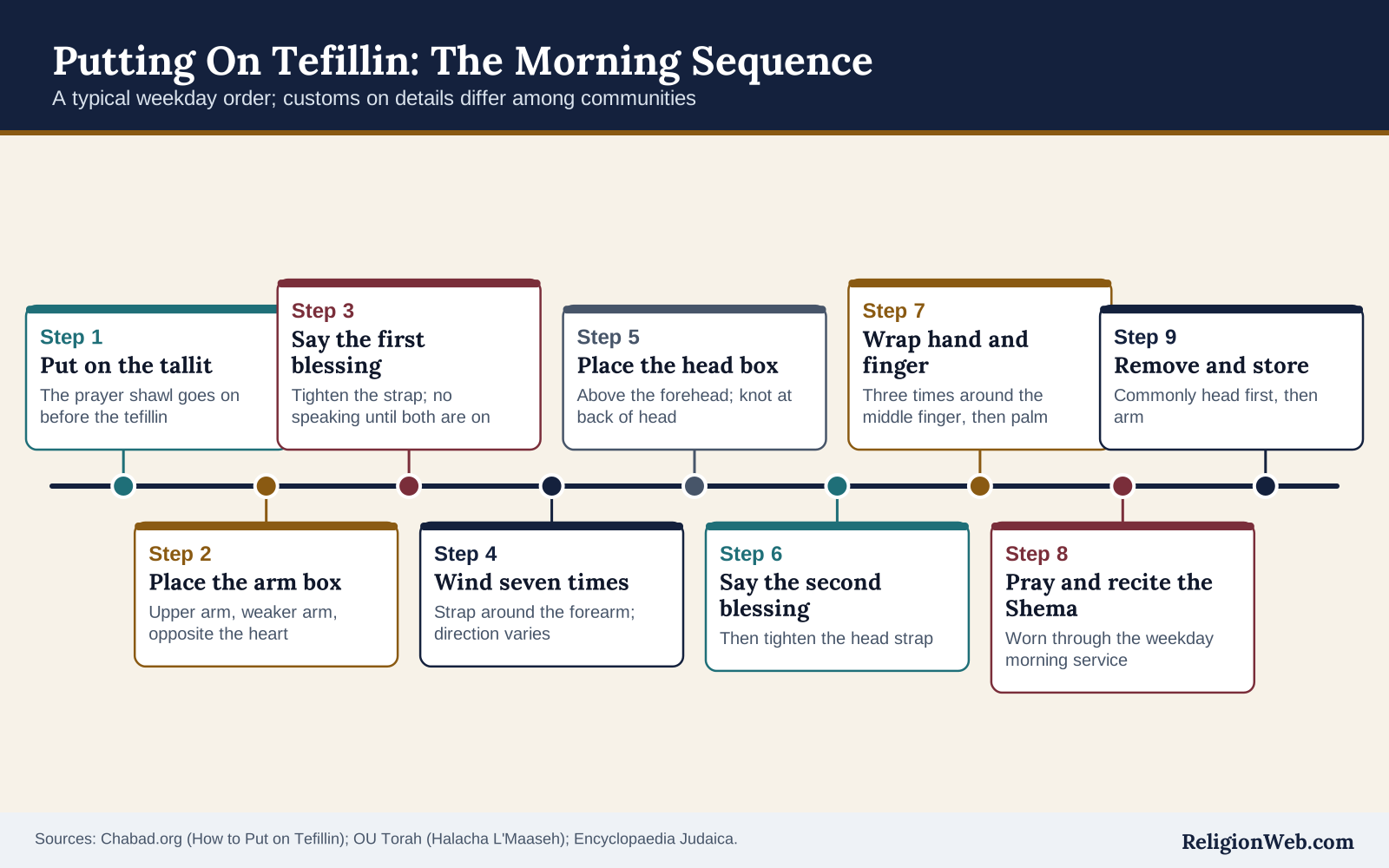
The Order of Putting On
The arm tefillin
The arm tefillin goes on first. It is placed on the weaker arm: the left arm for a right-handed person, and the right arm for a left-handed person. The Encyclopaedia Judaica connects that rule to a reading of Exodus 13:16 and says a left-handed person places it on the right arm. The box is set on the muscle of the upper arm, below the midpoint between the shoulder and the elbow and opposite the heart, with the strap pulled through so that it fits snugly. The blessing is then recited, and the strap is tightened and wound seven times around the forearm between the elbow and the wrist, according to both Chabad.org and the OU’s practical guide. The OU adds that the excess strap is wrapped around the palm and that overlapping straps are permitted if they occur.
The positioning of the box is one of the details that a first-time wearer notices. Chabad.org describes a placement on the biceps “just below the halfway point” between shoulder and elbow, facing the heart. The seven wraps are treated as a minimum in the OU’s account, and additional wraps are acceptable. The direction in which the strap is wound is not the same everywhere and is a visible way of distinguishing communities; it is covered in the section on variations.
The head tefillin and the hand wrapping
The head tefillin goes on next. It is centered above the forehead, on the hairline, directly above the space between the eyes, and the knot rests at the base of the skull. Chabad.org describes it as a “daled-shaped” knot at the back of the head. The OU explains that the head box should be positioned snugly and should not extend farther back than the middle of the head, and that its front edge belongs above the hairline. A second blessing is said, in which, according to the OU’s account, the wearer says the words about the commandment of tefillin as the head box is put into place. The OU’s guide notes that there is a legal doubt about this second blessing, which is why practice around it is discussed at some length in the codes.
Once the head tefillin is in place, the remainder of the arm strap is wound three times around the middle finger and then around the palm, and the end is tucked in. Chabad.org lists a pattern of three wraps around the middle finger, at the base, above the first joint and at the base again, and the OU’s guide adds that it is customary to say, while winding the strap, three verses beginning with the words “I will betroth you.” The Encyclopaedia Judaica identifies those verses as Hosea 2:21-22. The picture is a symbolic one: the wearer binds himself to God in a relation compared to betrothal. The OU’s guide says the strap is shaped into a shin on the palm before the end is tucked in, and the Encyclopaedia Judaica describes other letter shapes in the winding, so the details vary by tradition.
| Step | What the wearer does | Notes and variations |
|---|---|---|
| 1. Preparation | Put on the tallit; recite any customary opening passage | Longer kabbalistic meditations appear in some Sephardi and Hasidic prayer books |
| 2. Arm placement | Set the arm box on the upper arm, opposite the heart, on the weaker arm | Left arm for most right-handed people; right arm for left-handed people |
| 3. First blessing | Recite the blessing on the commandment of laying tefillin, then tighten the strap | Chabad.org advises not speaking until both are in place |
| 4. Forearm wraps | Wind the strap seven times around the forearm toward the wrist | Direction and pattern differ among communities |
| 5. Head placement | Center the head box above the forehead, the knot at the base of the skull | Front edge of the box belongs at or above the hairline |
| 6. Second blessing | Recite the blessing “on the commandment of tefillin” and tighten the head strap | Legal discussion of whether it is required; practice differs |
| 7. Hand wrapping | Wind the strap three times around the middle finger, then around the palm | Verses from Hosea 2 are customarily recited; palm patterns vary |
| 8. Prayer | Pray the morning service; recite the Shema while wearing | If the full service is not possible, the Shema alone is the minimum in Chabad.org’s account |
| 9. Removal | Take off the tefillin after the service and wrap the straps around the boxes | Customs on exact order and handling differ |
Blessings, Prayer and Removal
The blessings and what they say
Two blessings are traditionally associated with the act. The first is said over the arm tefillin and refers to God, who has sanctified Israel through the commandments and commanded them to lay tefillin. The second, said when the head tefillin is placed, refers to the commandment of tefillin. In Chabad.org’s instructions the wearer recites the blessing in Hebrew or in any language the person understands, and then refrains from speaking until both boxes are in place. The OU’s guide adds that one does not answer amen or participate in responses such as the Kaddish or Kedushah between the arm blessing and the head blessing. Where tefillin must be adjusted, the guide says that adjusting does not require a new blessing; if the head box is removed and replaced, both blessings are repeated, and if only the arm box is replaced, only the first. The reason it gives is that a break in attention can interrupt the act.
Praying and the role of the Shema
Wearing tefillin and reciting the Shema are connected in more than an incidental way. The third and fourth passages inside the boxes are the first two paragraphs of the Shema, and the third paragraph of the standard Shema recitation, about the fringes, is not written inside them. The first paragraph of the Shema contains the verse that commands binding the words on the hand and between the eyes, so reciting it while wearing the tefillin creates a direct link between text and object. Chabad.org’s guide states that if one cannot pray the whole service in tefillin, one should at least recite the Shema while wearing them, and it describes covering the eyes with the right hand while reading the first verse. The Shema article on this site explains the text and its liturgical setting in more detail.
Taking them off and handling them with respect
At the end of the service the tefillin are removed, usually the head tefillin first, then the arm, and the straps are wrapped around the boxes and the set is returned to a bag or case. The order is stated in comments on the Chabad.org guide and is a matter of common practice; the underlying principle, stated by the OU, is that the head box has a higher degree of sanctity than the arm box. The legal tradition treats tefillin with the respect due to sacred items. The OU’s guide reports a custom that someone who drops tefillin that are not covered fasts on that day, while no such fast applies if the boxes are in covers, and the Encyclopaedia Judaica gives the same custom in the form of a personal fast. The Talmud, discussed by the same encyclopedia, speaks of tefillin as a fortification against sin, and the habit of treating them carefully is understood as part of that dignity.
Who Wears Tefillin, and When
Obligation, Age and Initiation
Adult men and the age of religious majority
In classical Jewish law, the commandment of tefillin falls on adult men. Chabad.org states that all Jewish males from the age of 13 should wear tefillin on weekday mornings, and the Encyclopaedia Judaica gives the same starting point of 13 years and a day, the age of religious majority for boys. The related ceremony of coming of age is described in the article on bar and bat mitzvah, and the practice of learning to lay tefillin is one of the best-known preparations for it. The encyclopedia notes that boys often begin a few weeks before their birthday in order to learn the sequence, and that some Middle Eastern and North African communities hold a special ceremony of their own when a boy first puts them on.
The same tradition understands the age of 13 not as a magical threshold but as a legal one. A boy who lays tefillin before the date is practicing, and a man who is past it and has not yet started is said to have a duty he has not yet taken up. The Encyclopaedia Judaica reports that the Talmud (Rosh Hashanah 17a) describes someone who refuses the commandment out of defiance as a willful sinner, and that Jacob Tam limited that judgment to cases of defiance and not to simple neglect. In practice most rabbis today treat education, example and invitation as the proper way to bring someone into the practice.
Why the legal tradition places the duty on men
The reason given in classical sources is a general principle about time. A positive commandment that must be fulfilled at a particular time is called a time-bound positive commandment, and the Mishnah (Kiddushin 1:7) exempts women from such commandments; the Shulchan Arukh (Orach Chayim 38:3) applies that principle to tefillin, as the Orthodox legal work Peninei Halakha notes in its discussion of women and tefillin. An exemption in this sense is not a prohibition, and rabbinic literature distinguishes between a person who is not obligated and a person who is forbidden. Traditional authorities have also treated the possibility that women could take on the commandment voluntarily as a distinct question, which is where the history of the discussion becomes more complicated.
Women and Tefillin
The classical discussion
The legal discussion starts with a text noted earlier, a baraita that says Michal, the daughter of King Saul, wore tefillin and the sages did not object. The Encyclopaedia Judaica cites it as the one exception to the rule that only men wore them. Later authorities read the case in different ways. According to Peninei Halakha, the Rema (Moses Isserles, the sixteenth-century glossator of the Shulchan Arukh) writes that if women want to be stringent, one should object, relying on the Kol Bo, which cites the Maharam. The reason given was a concern that women might not keep themselves in the state of cleanliness the commandment requires. Other medieval and early modern authorities, including the Orchot Chayim and the Olat Tamid, disagreed, and the latter argued that Michal’s case shows that the sages did not object to a woman who knew how to guard herself.
The summary in Peninei Halakha, a contemporary Religious Zionist code by Rabbi Eliezer Melamed, concludes that a woman who asks should be told not to wear tefillin, since many authorities say that objection should be raised, but that because of the dissenting authorities, and the view that one need not object to a woman known for her scrupulousness, one should not protest if she does. It adds practical conditions: a woman who wears them should do so privately and not while menstruating, and objection is appropriate if the motive is to boast or to create social conflict. This is one voice, and other Orthodox authorities, including the Mishnah Berurah and the Kaf HaChayim as cited in the same discussion, take a stricter position that discourages the practice. Orthodox communities therefore differ in practice, and some modern Orthodox schools and congregations have adopted more permissive positions than others.
Egalitarian movements
Conservative, Reform, Reconstructionist and other egalitarian communities generally take a different starting point. They count women as full participants in prayer and therefore welcome women who choose to wear tefillin or, in some Conservative communities, expect them to; the reasoning differs between movements. In the Conservative movement the discussion is a legal one conducted through the Committee on Jewish Law and Standards, which has debated women’s obligation in the commandments, while in Reform Judaism the emphasis is on informed personal choice. Practice varies widely within each movement, and a visitor to a Conservative or Reform congregation should expect to see a mixture of people laying tefillin, others who never do, and others who do so only on special occasions. The articles on Conservative Judaism and Reform Judaism describe those frameworks.
Days and Circumstances When Tefillin Are Not Worn
Sabbath, festivals and the intermediate days
Tefillin are worn on weekday mornings, not on the Sabbath or on major festivals. The Encyclopaedia Judaica explains that the Talmud links this to the description of the Sabbath as a sign, so that tefillin, themselves described as a sign, are not needed on a day that is itself the sign, and the same rule is extended to festivals. The result is that the weekly rhythm of Jewish life has a visible beat: tefillin are put on for six mornings, set aside for the Sabbath, and put on again the next morning. The festivals of the year work the same way, and the days when tefillin are omitted include Shavuot and the opening and closing days of Sukkot, as well as Yom Kippur and Rosh Hashanah.
The intermediate days of Passover and Sukkot, called Chol HaMoed, are treated differently in different communities. According to the Encyclopaedia Judaica, in Israel the universal custom is not to wear tefillin on the intermediate days. Outside Israel, the encyclopedia reports that Hasidim do not wear them, while the Mitnagdim, the non-Hasidic Eastern European communities, do. Chabad.org’s guide, a Hasidic source, also states that, according to many authorities, tefillin are not worn on Chol HaMoed. This is one of the clearest examples of a situation in which a single legal question has produced different, well-established customs.
Fast days, mourning and other exceptions
Other circumstances modify the rule. The Encyclopaedia Judaica reports that tefillin are not worn on the morning of Tisha B’Av, the fast commemorating the destruction of the Temples, and that donning is postponed to the afternoon service; some German congregations extended that practice to other fast days. A mourner is exempt between the death and the burial, and a bridegroom on the wedding day, according to the same source, and a person whose body is unclean is also exempt. Tefillin are not worn in a cemetery or an unclean place, or while sleeping. The OU adds an example from practice: a man whose weaker arm is broken does not switch arms, and if the weaker arm later becomes permanently stronger, he changes to the newly weaker arm.
| Situation | Practice | Notes |
|---|---|---|
| Ordinary weekday morning | Worn for the morning service | The commandment can be fulfilled during daylight; morning prayer is the norm |
| Sabbath | Not worn | The Sabbath is itself called a sign |
| Major festivals | Not worn | The same reasoning extends to festivals |
| Intermediate days (Chol HaMoed) | Customs differ | In Israel generally not worn; outside Israel, Hasidic and non-Hasidic customs differ |
| Morning of Tisha B’Av | Postponed to the afternoon service | Some German congregations did the same on other fasts |
| Mourner before burial | Exempt | The exemption ends with the burial |
| Bridegroom on the wedding day | Exempt | Reported by the Encyclopaedia Judaica |
| Cemetery, unclean place, sleep | Not worn | Reflects the respect due to the sacred object |
Care, Checking and Respect for Tefillin
Checking and Repairing a Set
How often a set is checked
Because a single damaged letter can invalidate a set, Jewish law addresses how often tefillin should be inspected by an expert scribe. The OU’s article on checking tefillin summarizes the legal position: a set that has been checked, found valid and used regularly does not need to be checked again, a ruling it traces to the Shulchan Arukh (Orach Chayim 39:10). A set that is worn only occasionally is a different case and calls for periodic checking. An older view in the Sheiltot and the Shimusha Rabba, that all tefillin should be checked twice in every seven years, was not adopted as the rule, according to the same article, but several stricter customs grew up around it: it reports that the sages of France checked yearly, and that some authorities recommend a check each year in the Hebrew month of Elul, a custom that Rabbi Ovadiah Yosef endorsed. Others advise a check twice in seven years. A household that owns a mezuzah will recognize the pattern, since the article on the mezuzah describes a similar schedule for doorpost scrolls.
The result is that practice depends on the community and on the individual’s rabbi. A man who wears his tefillin daily and had them checked when he bought them may well never open them again, while another who wears them occasionally, or who has inherited a set from a relative, is typically advised to bring them to a scribe before relying on them. Scribal checking is not a ritual in itself. It is a quality-control procedure, and the tradition describes it as a way to be sure that a daily commandment is being fulfilled with a valid object.
What can go wrong and who may repair it
The OU article lists the sorts of problems that checkers look for: ink that fades or peels from the parchment, parchment that tears, boxes that warp, and damage from sweat, damp hair, moisture or prolonged exposure to sun. It identifies one case that calls for immediate inspection, when a box opens or falls into water. If a prompt inspection is not possible, the guidance is to wear the tefillin without reciting the blessing until it can be checked. The article also records that the boxes are presumed valid as long as they remain sealed, and that opening and resealing them can itself cause damage, so an expert who knows how to do it correctly should perform the check. The Rema, it notes, ruled that if no expert is available it is better not to open them at all.
It is common for scribes to be able to repair a faded letter or replace a damaged scroll. Whether a particular fault can be repaired, or whether a passage must be rewritten, depends on the nature of the fault and is a question for a qualified scribe. The OU article mentions a case in which the tefillin of a scholar named Emden were found on checking to be missing a letter, which illustrates why even careful and learned owners relied on expert examination.
Respect, Storage and Retirement
The sanctity of tefillin
The law treats a pair of tefillin as an object of sanctity. The OU’s guide explains that the straps become holy through use, that the head box has a higher status than the arm box, and that the two may not deliberately be exchanged. The Encyclopaedia Judaica adds that, like a Torah scroll, tefillin are treated as sacred enough to render the hands “unclean” in the technical sense used in Yadayim 3:3, a rabbinic idiom for texts that are treated with particular reverence, and it records a custom that someone who accidentally drops tefillin fasts for the day. The OU’s version limits that custom to cases in which the boxes were uncovered. Many Jews store tefillin in a bag or case, and sets are sometimes passed down within a family. The aim of these customs is to preserve the dignity of the object and to ensure that something associated with holy text is not left in a place or condition that would degrade it.
Retiring a worn or invalid set
When a pair becomes worn out, or when a check shows that the scrolls are invalid, the tradition does not permit throwing them away with ordinary refuse. A rabbi or scribe is typically consulted for how to handle both the scrolls, which contain the Divine Name, and the leather boxes and straps, which have their own status as accessories of a commandment. Some communities keep retired sacred items in a storage place, called a genizah, and in many places the items are eventually buried in a cemetery. Because customs about disposal differ, the practical answer is to ask a local scribe or rabbi. A set that has become invalid may still be returned to a scribe, who can sometimes salvage the boxes or replace the scrolls so the leather can be used again.
Meaning: Memory, Body, Covenant and Prayer
Traditional Explanations
Remembering the Exodus and the oneness of God
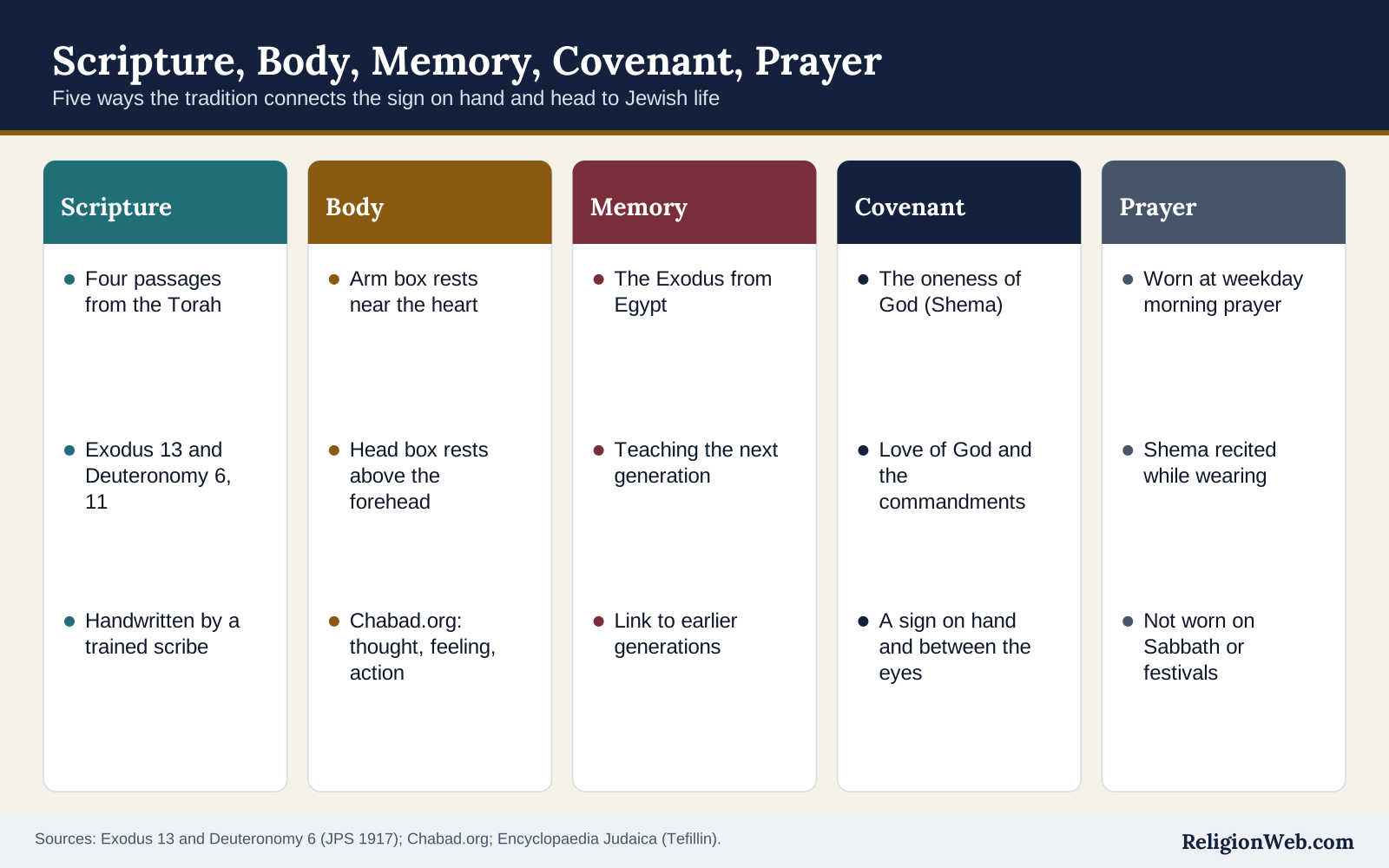
The first layer of meaning comes from what is written inside. Two passages are about the Exodus and the dedication of the firstborn, and two are about the unity of God, the love of God and the responsibilities of covenant. Chabad.org’s overview summarizes the contents of the scrolls as the Unity of God and the Exodus from Egypt. Together they join a memory of redemption with a statement of belief and a promise of consequences, so that the wearer, in effect, carries the central claims of Jewish covenantal theology on the body. The festival of Passover marks the Exodus in the home each spring, and the idea that the same memory is worn on the arm each weekday morning shows how the tradition spreads one event across the year.
Head, heart and hand
A second, widely taught layer concerns the body. Chabad.org’s overview explains that the arm box rests near the heart, the seat of emotions, while the head box sits on the mind, so that thoughts, feelings and actions are bound together in the service of God. The same article explains that the Hebrew word mitzvah is related to a word meaning “connection,” and that tefillin therefore represent attachment. The Talmud, as summarized by the Encyclopaedia Judaica, goes further and says that God wears tefillin, a teaching that raises the observance from a human duty to a sort of mutual bond. Kabbalistic tradition, the same encyclopedia says, linked the arm tefillin with God’s outstretched arm and the head tefillin with the mind. These explanations come from within the tradition, and they differ in emphasis from community to community.
Historical and Modern Perspectives
Scholarly readings
Academic historians approach the meaning of tefillin through the evidence for how they developed. Some reference works propose that the original biblical language was figurative, others that it reflects widespread ancient Near Eastern ideas of protective signs, and others that the practice developed in the late Second Temple period from a literal reading. The Judean Desert finds show that the objects were in use around the first century CE and that several versions of the contents circulated before the standard form was fixed. Scholars do not claim to settle questions of religious meaning, and many historians emphasize that a ritual object can carry both an origin in one setting and a later meaning in another. A practice that may once have had protective associations can be understood by its observant users primarily as a commandment, as a means of prayer or as a daily discipline.
How people describe it today
Contemporary Jews describe the experience of laying tefillin in a variety of ways. Observant men often speak of the routine as a way of beginning the day with attention and discipline. Others, including some women and non-Orthodox Jews who have adopted the practice, describe it in terms of connection to ancestors, to the text or to community. Chabad.org’s overview, for example, says the practice links the wearer with ancestors and descendants who have done the same. The commandment also sits within the cycle of festivals such as Shavuot, which marks the giving of the Torah at Sinai, on which tefillin themselves are set aside. Describing tefillin as only symbolic or only decorative would therefore miss what the tradition says they are: required, handwritten and exacting ritual objects that also mean different things to different wearers.
Variations Among Jewish Communities and Movements
Customs Within Traditional Practice
Ashkenazi, Sephardi, Hasidic and Chabad customs
Within communities that follow halakha, the basic structure of tefillin is shared, but practice differs in details that a careful observer can see. The most visible difference is the direction in which the strap is wound around the forearm. The Encyclopaedia Judaica states that Ashkenazim wind it in one direction while Sephardim, and Hasidim following them, wind in the opposite direction. The encyclopedia also describes the winding on the hand as forming the shape of Hebrew letters, which is one reason the pattern is taught carefully. A beginner who learns from a Sephardi teacher and then prays in an Ashkenazi synagogue may notice the difference at once; neither practice is regarded by the other as wrong.
Other differences concern calendar and custom. In the Diaspora, Hasidic communities do not wear tefillin on the intermediate days of festivals, while non-Hasidic Eastern European communities, the Mitnagdim, do, and in Israel the universal custom is not to wear them, according to the Encyclopaedia Judaica. Communities also differ in the ceremonies surrounding a boy’s first tefillin, which the same encyclopedia says are especially elaborate in some Middle Eastern and North African communities. Chabad, the Hasidic movement discussed earlier, has made tefillin a centerpiece of its public outreach since the late 1960s. Its published instructions describe wrapping the strap three times around the middle finger in a specific pattern, and the practice of inviting passersby to lay tefillin is closely associated with that movement.
Tefillin of Rashi and of Rabbeinu Tam
The most famous disagreement about the objects themselves concerns the order of the four passages in the head tefillin. The Encyclopaedia Judaica explains that, according to Rashi, the passages are arranged in the order in which they appear in the Torah, while Jacob Tam (Rabbeinu Tam), Rashi’s grandson, held that the passage from Deuteronomy 11:13-21 precedes the passage from Deuteronomy 6:4-9. The finds from the Judean Desert include both orders, which the encyclopedia takes to show that both traditions existed in the first century. The standard order today is Rashi’s. The encyclopedia says that a small and shrinking group of especially pious Jews wear a second set arranged according to Rabbeinu Tam, putting it on for the concluding part of the service. Because that second set is a full pair with its own boxes and straps, the custom is both costly and uncommon, and a person who is not part of a community that follows it does not need to take it up.
| Matter | Range of practice | Attribution |
|---|---|---|
| Direction of winding the arm strap | Ashkenazi custom winds in one direction; Sephardi custom, followed by many Hasidim, in the other | Encyclopaedia Judaica |
| Order of passages in the head box | Rashi order is standard; a small group also wears a Rabbeinu Tam set | Encyclopaedia Judaica |
| Intermediate days of festivals | Worn by non-Hasidic Diaspora communities; not worn by Hasidim or in Israel | Encyclopaedia Judaica |
| First tefillin | Often learned weeks before age 13; some Middle Eastern communities hold a ceremony | Encyclopaedia Judaica |
| Participation of women | Orthodox views differ; egalitarian movements welcome women who choose the practice | Peninei Halakha; movement sources |
| Public outreach | Chabad invites passersby to put on tefillin; campaign launched before 1967 | Chabad.org |
| Status as obligation | Obligatory in Orthodox law; treated as a recommended or personal practice in Reform Judaism | Reference entries; movement sources |
Movements and Their Approaches
Orthodox and traditional communities
Orthodox Judaism, whether Modern Orthodox, Haredi (ultra-Orthodox) or Hasidic, treats the commandment as binding on adult men and regulates it through the rulings of the Shulchan Arukh and its commentaries. In the Orthodox world, as the earlier section noted, disagreement is mainly about details of custom and about the question of women’s participation, not about whether the commandment applies. Sephardi and Mizrahi communities, whose legal practice follows the Shulchan Arukh and the rulings of figures such as Rabbi Ovadiah Yosef, share this framework, though their customs on winding, on meditations and on the ceremonies for boys differ in some of the ways described above. Readers who want the broader picture can consult the articles on Orthodox Judaism and on the Jewish tradition as a whole.
Conservative, Reform and other liberal approaches
Conservative Judaism, which describes itself as committed to halakha while accepting historical development, has kept the commandment within its legal framework and encourages the practice, and its congregations are generally egalitarian, so women who choose to wear tefillin are welcome. Practice varies considerably from one congregation to another. Reform Judaism has historically treated ritual commandments as matters of informed individual choice, and a reference entry on phylacteries notes that Reform Jews do not as a rule observe the practice. A number of Reform and other liberal Jews nonetheless lay tefillin by choice, and some congregations offer instruction. Reconstructionist and Jewish Renewal communities likewise leave the decision to the individual and the community. In each of these settings the answer to “Do Jews wear tefillin?” depends on which Jews and which community is meant, which is the same observation that the section on misconceptions makes about every aspect of this subject.
Common Misconceptions About Tefillin
Misconception 1: Tefillin are jewelry or a religious fashion accessory
Where the misunderstanding comes from
To someone who has only seen tefillin in a photograph or in the street, the arm tefillin can resemble a leather bracelet or a watch, and the head tefillin can look like a small black box attached to a headband. Visual impressions of that kind lead many people to treat tefillin as an item of Jewish dress comparable to a necklace or a cap. The English word “phylactery” adds to the confusion, because it is used in ordinary English for a charm or amulet, and some popular accounts present tefillin as a “religious accessory” or as an identity marker that a person might put on for the look of it.
A related source of the impression is the tradition’s own mention of a “sign.” The biblical word for the object worn on the hand is ot, “sign,” and people sometimes take “sign” to mean a badge.
What the evidence and tradition actually show
In Jewish law, tefillin are not ornaments. They are ritual objects made to precise specifications and used for a specific commandment. The scrolls inside are handwritten passages from the Torah, and the boxes and straps are made according to rules about shape, color and materials. The legal tradition regulates not only how they are made but when and how they may be worn: they are put on in a certain order, accompanied by blessings, and removed afterward and they are set aside on the Sabbath and on festivals, which no one would do with an ornament. The Encyclopaedia Judaica notes that wearing them is associated with a serious frame of mind, and it records that the Talmud treats them with a reverence that extends to the hands that touch them.
The tradition has also been critical of display. The Gospel of Matthew (23:5), written in the first century, mentions making phylacteries broad for show, and a reference entry on phylacteries reads that comment as directed at showiness, not at the practice itself. A person who wore tefillin chiefly for appearance would be misusing a sacred object, and a person who wore them purely as a symbol of identity, without observing the rules, would not be fulfilling the commandment in the way the law defines it. It is accurate to say that tefillin also carry meaning for identity and memory, but they are not accessories in the legal tradition and are not treated as such by those who wear them.
Daily use points the same way. Tefillin are put on for prayer and taken off when the service ends, so they are not worn through the day as a visible badge, and the Encyclopaedia Judaica doubts that they were ever worn all day long. They are also stored with care, checked by specialists and handled as sacred, which is not how decorative items are generally treated. Someone who wants to understand the object should start with what it contains and what it is for, and only afterward with how it looks.
Misconception 2: Every Jew wears tefillin every day
Where the misunderstanding comes from
The idea that tefillin are a universal daily practice is understandable. Descriptions of Jewish prayer in textbooks and in popular media often show a man in a prayer shawl and tefillin, and the images become shorthand for “Jewish prayer.” Outreach efforts that invite Jewish men to put on tefillin can leave an impression of wider routine practice than actually exists.
What the evidence and tradition actually show
In traditional law the obligation applies to adult men on weekday mornings. According to Chabad.org, it falls on Jewish males from age 13 on every day except the Sabbath and major holidays, and the Encyclopaedia Judaica adds specific exemptions, including mourners before burial and bridegrooms on their wedding day. In Orthodox communities, weekday morning practice is the norm, though how strictly it is kept varies with age, circumstances and local custom. The tradition itself notes that observance has gone up and down over time: the Encyclopaedia Judaica reports laxity in the talmudic period and again in medieval France and Spain, with a revival in Spain in 1236.
Outside Orthodox communities, daily tefillin practice is considerably less common, and Reform Judaism has not generally treated tefillin as an obligation. A person who is Jewish by family, culture or religion may never have put them on, or may do so only for a bar or bat mitzvah or on a special occasion. Women are exempt in classical law and participate differently across the Orthodox spectrum, as the earlier section described. Those who wish to make a claim about how many Jews wear tefillin should therefore specify which community and which time frame they mean, since no single figure applies to all Jews everywhere.
Misconception 3: All wrapping patterns and participation rules are identical
Where the misunderstanding comes from
Online videos and instructional guides usually present one method as “the” way to put on tefillin. They are typically made by a particular community, such as Chabad, and so show that community’s pattern. A newcomer who has learned one sequence from a friend or a website can reasonably assume that all observant Jews follow it, and an observer who sees a different pattern in another synagogue may suspect a mistake. Similarly, discussions of who may wear tefillin tend to be framed as a yes or no question, as if a single rule were shared by all Jewish groups.
What the evidence and tradition actually show
Within halakhic practice the basic elements are shared, but the details vary. The Encyclopaedia Judaica reports that Ashkenazim and Sephardim wind the arm strap in opposite directions, and that Hasidim follow the Sephardi direction. It records different customs about wearing tefillin on the intermediate days of festivals, and an old dispute about the order of the passages in the head tefillin between Rashi and Rabbeinu Tam. Chabad.org describes its own pattern of wraps around the middle finger. These are customs that rabbis within the tradition recognize as legitimate variants, not signs that one group is correct and the others mistaken.
The practical consequence is that a visitor, or a person learning to lay tefillin, should expect to meet more than one correct way. A synagogue with a mixed membership may include people who wind the strap in different directions, who do or do not wear a second pair after the service, and who follow different customs on the intermediate days of festivals. Each person is generally following the practice of the family or community in which he learned, and the question “Which is right?” is usually better put as “Which custom does this community follow, and why?” Teachers within each tradition tend to answer that question with the names of the authorities they rely on, which is why a learner who asks will usually hear about Rashi, Rabbeinu Tam, the Shulchan Arukh or a particular rabbi.
Participation rules also differ. Orthodox law places the obligation on men, and Orthodox authorities differ on whether and how women may wear tefillin, according to the discussion in Peninei Halakha. Conservative, Reform and other egalitarian communities approach the question differently, some treating it as a matter of obligation and others of choice. Anyone planning to attend a service or to learn the practice is best advised to ask the community in question how it does things, since the answer legitimately varies.
Misconception 4: Tefillin are protective amulets or contain written prayers
Where the misunderstanding comes from
The English word “phylactery” comes from a Greek word meaning “safeguard” or “amulet,” and for some readers the name alone implies a charm. Historical comparisons between tefillin and protective objects of the ancient Near East have appeared in scholarly literature, and one reference entry suggests that some ordinary users may have treated tefillin chiefly as amulets. The Hebrew word tefillah also means “prayer,” which leads some to suppose that the boxes contain prayers written by the community, and that they are the physical form of a prayer, rather than the case for biblical text.
What the evidence and tradition actually show
The scrolls inside tefillin contain four passages from the Torah, not composed prayers or invocations. The Encyclopaedia Judaica calls the translation “phylacteries” peculiarly inappropriate, since tefillin are the fulfillment of a commandment and not a charm. The same article, however, records traditions that speak of protection: it cites the Talmud’s statement that tefillin, among other commandments, act as a fortification against sin (Menachot 43b), and Chabad.org’s overview similarly says that wearing them brings protection to the Jewish people. The accurate picture is that the legal and liturgical framework presents tefillin as a commandment for remembrance and devotion, while some traditional writers also describe spiritual protection as a consequence of observing it. Scholars discuss whether protective ideas shaped the earliest practice, and that question remains open in the literature. For readers, the careful position is that a set of tefillin has never served as a substitute for medical, legal or practical safeguards, and the tradition itself does not teach that it does.
Frequently Asked Questions About Tefillin
Questions About Meaning and Contents
What are tefillin, and what is inside them?
Tefillin are a pair of black leather boxes with leather straps, one worn on the arm and one on the head, each containing handwritten parchment. The parchments carry four passages from the Torah: Exodus 13:1-10, Exodus 13:11-16, Deuteronomy 6:4-9 and Deuteronomy 11:13-21. The arm box holds one parchment with all four passages, and the head box holds four parchments, one in each compartment. They are used in Jewish weekday morning prayer and are understood in the legal tradition as the fulfillment of the biblical command to bind the words as a sign on the hand and as frontlets between the eyes.
Why are there two boxes, one on the arm and one on the head?
The Torah mentions both a sign on the hand and frontlets between the eyes, and the rabbinic tradition read these as two separate objects. Chabad.org gives one of the traditional explanations for the placement: the arm box rests near the heart, the seat of the emotions, and the head box rests on the mind, so that thoughts, feelings and actions are all directed toward the service of God. The two boxes differ in construction as well. The head box has four compartments and a raised shin on each side, while the arm box is a single smooth box, and the law treats the head tefillin as having the higher sanctity.
Questions About Practice
When, and for how long, are tefillin worn?
In traditional practice they are worn on weekday mornings, usually through the morning service, and removed afterward. Chabad.org states that the commandment can be fulfilled any time from sunrise to nightfall, though it is customarily done at morning prayer. If a person cannot pray the full service in tefillin, the tradition’s minimum is to recite the Shema while wearing them. Tefillin are not worn at night or while sleeping, according to the Encyclopaedia Judaica, and the same source doubts that they were ever worn all day long. The length of time therefore follows the length of the service.
Why are tefillin not worn on the Sabbath and festivals?
The Encyclopaedia Judaica explains the rule through the idea of a sign. The Sabbath is itself described as a sign between God and Israel, and the Talmud reasons that the sign of tefillin is therefore not needed on a day that is a sign in its own right. The same reasoning is extended to festivals. As a result, tefillin mark the ordinary weekdays, and the Sabbath and festivals are set apart from them by the absence of the tefillin as well as by their own observances. The question of the intermediate days of festivals has been answered differently by different communities, as the table above shows.
Can a woman wear tefillin?
It depends on the community. In classical Jewish law women are exempt, because tefillin are a time-bound commandment, but exemption is not the same as prohibition. Peninei Halakha summarizes the debate among Orthodox authorities, some of whom say one should object if women wish to take on the practice and others who say one need not. Conservative, Reform and other egalitarian communities generally welcome women who choose to wear tefillin. Anyone who is interested in doing so in a particular synagogue should ask the rabbi or a member of the community what the local practice is, since there is a real range.
Questions About Learning, Buying and Caring for Tefillin
How old must someone be to begin, and how does a person learn?
The age at which the commandment becomes binding on boys is 13 and a day, according to the Encyclopaedia Judaica, and boys commonly begin a few weeks earlier to practice. A family rabbi, a teacher, a cantor or an experienced member of the congregation usually teaches the order of putting on, the blessings and the wrapping, often in a private lesson. Chabad.org and the OU both publish step-by-step guides, though the guides reflect the practice of their own communities, and a learner should ask which customs apply locally. The experience is easiest to learn in person.
How can a buyer know a set is valid, and what happens if it is not?
A valid set depends on handwritten scrolls and correctly made boxes, none of which can be judged by sight. Buyers are therefore advised to purchase from a scribe or a reputable dealer, to ask who wrote the scrolls, and to have a qualified checker inspect the set when buying, when inheriting an old pair or if the boxes have been damaged. The OU’s discussion of checking explains that a set known to be valid and used regularly need not be rechecked, while one used rarely should be checked periodically. If a set is found to be invalid, a scribe can often repair or replace the scrolls, and the person can keep fulfilling the commandment with a valid set in the meantime.
Conclusion: Scripture Worn on the Body
What the History and Practice Show
A commandment carried in handwritten text
Tefillin join three things that are usually kept apart: sacred text, a physical object and the body of the person at prayer. The scrolls inside are handwritten passages from the Torah, the boxes and straps are made according to detailed rules, and the person who puts them on does so as part of the morning’s prayer. The historical evidence shows a practice that was already established in the Second Temple period, was standardized in rabbinic law and has been renewed through outreach and education in the modern era. The tradition understands the act as a commandment first, and layers of meaning, such as memory of the Exodus, dedication of mind and heart, and connection to earlier generations, have grown up around it.
A practice with real internal variety
Anyone approaching the subject for the first time will meet variety at several levels: in the direction of the winding, in the order of the passages in some rare sets, in practice on the intermediate days of festivals, and in the question of who wears tefillin at all. Orthodox, Conservative, Reform and other communities differ on these points, and the differences are not a failure of the tradition to agree on a single form but a record of how a commandment has been interpreted in different times and places. The most helpful summary is that “tefillin” names a shared object and a shared set of biblical passages, while the details of practice belong to communities.
Where to Continue Exploring
Related Jewish texts, objects and practices
The passages inside tefillin are the same ones that appear in the Shema, and the closest companion practice is the mezuzah, which places part of the same text on the doorposts. Other Jewish observances also bring text, objects and daily life together: the scroll read at Purim, the lights of Hanukkah and the dietary framework described in the article on kosher food and kashrut. The overview of Judaism places these practices within the whole tradition.
Questions to take to a teacher
Readers who want to go beyond an overview will find that the most reliable next step is a conversation with a rabbi, scribe or experienced practitioner in the community they care about. Useful questions include which customs that community follows for winding and for the festival intermediate days, whether it uses a second set according to Rabbeinu Tam, how it treats the participation of women and how often it has its sets checked. Because the practice involves handwritten scrolls and fine legal detail, the best answers come from people who make, check and use tefillin.
Sources
The table below lists the principal external sources behind this article. Facts, dates and figures were checked against these and related primary, institutional and academic materials.
| # | Source | Publisher and type | Used for | Link |
|---|---|---|---|---|
| 1 | Deuteronomy 6:8 and Exodus 13:9, The Holy Scriptures: A New Translation (JPS 1917) | Sefaria (Jewish Publication Society, 1917; public domain) · Primary text | Quoted verses Deuteronomy 6:8 and Exodus 13:9 (JPS 1917) | sefaria.org |
| 2 | Tefillin (Encyclopaedia Judaica) | Encyclopedia.com / Encyclopaedia Judaica · Encyclopedia | Terms, history, Qumran finds, Rashi and Rabbeinu Tam, wearing rules, days, age, exemptions, customs | encyclopedia.com |
| 3 | Phylacteries (reference entry) | Encyclopedia.com · Encyclopedia | Etymology of phylactery, scholarly views on origins, Matthew 23:5, Orthodox and Reform practice | encyclopedia.com |
| 4 | Tefillin: An In-Depth Guide | Chabad.org · Institutional (Chabad-Lubavitch) | Four passages, scribal production, shin, who and when, meaning, the 1967 tefillin campaign | chabad.org |
| 5 | How to Put on Tefillin | Chabad.org · Institutional (Chabad-Lubavitch) | Step-by-step Chabad sequence, weaker arm, wraps, blessing and silence, Shema option | chabad.org |
| 6 | Tefilin – part 1 (Halacha L'Maaseh) | OU Torah (Orthodox Union) · Institutional (Orthodox) | Sanctity of head and arm boxes, placement, blessings, interruptions, dropped tefillin, broken arm | api.alldaf.org |
| 7 | Checking Tefillin | OU Torah (Orthodox Union) · Institutional (Orthodox) | Checking schedules and customs, common problems, who may check, Shulchan Arukh sources | api.alldaf.org |
| 8 | Women and Tefilin (Peninei Halakha, Rabbi Eliezer Melamed) | Yeshivat Har Bracha, Peninei Halakha · Halakhic code (Orthodox) | Exemption of women, Rema, Michal, dissenting authorities, practical conclusion | ph.yhb.org.il |
Last fact-check date: 2026-10-21.