The Shema is the best-known declaration in Judaism: a single verse from the Book of Deuteronomy, “Hear, O Israel: the Lord our God, the Lord is one,” together with the passages that follow it in Jewish prayer. The name is the first Hebrew word of the verse, shema, which means “hear” or “listen.” Jews recite the Shema in the morning and the evening services, say it again before going to sleep, teach it to small children, and traditionally hope to say it as their last words. In the course of a single day, then, it can be spoken in a synagogue, in a kitchen, at a bedside and, for many, on the way out of life.
The word “Shema” is used for three different things, and most confusion about the subject comes from running them together. It can mean the opening verse alone (Deuteronomy 6:4). It can mean the three biblical passages that Jewish liturgy groups under that name: Deuteronomy 6:4-9, Deuteronomy 11:13-21 and Numbers 15:37-41. And it can mean the whole liturgical unit in which those passages are set, which includes framing blessings and, in the morning and evening services, leads directly into the central prayer known as the Amidah. This article uses the word in each of these senses and says which one is meant whenever the difference matters.
The Shema also stands near the center of the Jewish ritual objects described elsewhere on this site. Its first paragraph commands that its words be bound on the hand, worn between the eyes and written on the doorposts of the house. Those commands are the biblical basis of tefillin and of the mezuzah, and the third paragraph is the biblical basis of the fringes (tzitzit) on a prayer shawl. The reader who understands the Shema therefore understands why a small scroll sits on a door frame and why leather boxes are worn during weekday morning prayer.
What follows covers the text, its translation, its history from the Second Temple period onward, the blessings and customs that surround it, its place in the daily and yearly cycle, and the different ways Orthodox, Conservative (or Masorti), Reform and other communities read and recite it. Where Jewish authorities differ, the differences are named and attributed rather than resolved. Quotations from Scripture come from the 1917 Jewish Publication Society translation, which is in the public domain, and other sources are paraphrased.
At a Glance: What the Shema Is and Where It Appears
One Word, Three Meanings
The opening verse
In its narrowest sense the Shema is Deuteronomy 6:4, which in Hebrew has only six words: Shema Yisrael, Adonai Eloheinu, Adonai Echad. Within the biblical narrative the verse is part of a speech that Moses gives to the people of Israel before they enter the land, and its grammar addresses them directly, in the singular, as a single “Israel.” Over the centuries the verse took on a life of its own. The Jewish Encyclopedia of 1906 observes that originally only this first verse may have been recited (it cites the Talmud’s discussion of a child learning the Shema in tractate Sukkah, folio 42a), and the entry calls it the confession of belief in one God. Many Jews who say nothing else in Hebrew on a given day will still say this verse.
The three Torah paragraphs
Jewish liturgy treats three passages from the Torah as one recitation. The first, Deuteronomy 6:4-9, is often called by its first Hebrew word after the opening verse, Ve-ahavta (“and you shall love”). The second, Deuteronomy 11:13-21, begins Ve-haya im shamoa (“and it shall come to pass, if you listen”). The third, Numbers 15:37-41, is the passage on fringes, which ends by recalling the Exodus from Egypt. Together they make up what the tradition calls the “three paragraphs” of the Shema. A later section of this article takes each passage in turn.
The larger liturgical unit
In synagogue worship and in private prayer the three paragraphs never stand alone. In the morning two blessings come before them and one after, and in the evening two come before and two after. Because of this frame, a worshiper or a rabbi might say “the Shema and its blessings” when referring to the section of the service as a whole, and the rabbinic term for the act of reciting it is keriat Shema, “the reading of the Shema.” The Mishnah, the early rabbinic law code completed around 200 CE, begins its first tractate with the question of the time at which the evening Shema may be recited, which shows how central the practice had become by that period.
Core Vocabulary of the Shema
Hebrew terms at a glance
A short working vocabulary makes the rest of this article easier to follow. The table gathers the terms that recur most often, with transliterations as commonly printed in English-language prayer books. Spellings vary between communities, and a Hebrew word may be written Shema, Sh’ma or Shma in different books.
| Term | Meaning | Where it appears |
|---|---|---|
| Shema | “Hear” or “listen”; in Hebrew thought, also “heed” or “obey” | First word of Deuteronomy 6:4; name of the whole recitation |
| Echad | “One”; read as unique, single or indivisible, depending on the interpreter | Last word of Deuteronomy 6:4 |
| Keriat Shema | “Reading of the Shema”; the act of reciting it as a religious obligation | Mishnah and Talmud, tractate Berakhot |
| Kabbalat ol malkhut shamayim | “Accepting the yoke of the kingdom of heaven”; the rabbinic way of describing what the first verse accomplishes | Mishnah Berakhot, chapter 2 |
| Kavvanah | Intention, concentration or focus of the heart during prayer | Discussions of how the first verse is said |
| Barukh shem kevod malkhuto le-olam va-ed | “Blessed be the name of His glorious kingdom forever and ever”; the response said after the first verse | Not in the Torah; rabbinic liturgy |
| Tzitzit | Fringes attached to the corners of a garment | Numbers 15:37-41 (third paragraph) |
| Shaharit, Ma’ariv | The morning and evening services in which the Shema is recited | Daily synagogue liturgy |
| Keriat Shema al ha-mitah | “Reciting the Shema on the bed”; the bedtime Shema | Talmud, tractate Berakhot |
How the terms fit together
The terms divide into three groups. Shema, echad and tzitzit belong to the biblical text itself. The responses, blessings and service names (Barukh shem, Shaharit, Ma’ariv) belong to the liturgy that the rabbis of the Mishnaic and Talmudic periods built around those verses. Kabbalat ol malkhut shamayim and kavvanah belong to the interpretive vocabulary through which the tradition explains what the act is for. Keeping these layers apart helps when a custom is described as “from the Torah,” since many familiar practices around the Shema are rabbinic, medieval or later in origin.
Where and When the Shema Appears
In daily prayer
Traditional practice, followed in Orthodox communities and in the liturgies of most other movements, calls for reciting the Shema twice a day with its blessings, once in the evening and once in the morning. The Jewish Encyclopedia explains that the Mishnah took these two recitations for granted as an application of the phrase in Deuteronomy 6:7, “when thou liest down, and when thou risest up.” A third occasion, the Shema said on one’s bed before sleep, developed alongside them and is discussed in a later section.
At moments of transition
Beyond the three daily recitations, the first verse is woven into the life of a community at key moments. Samuel Barth, in an essay for the Jewish Theological Seminary, notes that it appears in the kedushah of the additional (Musaf) service and at the very end of the Yom Kippur closing service, Ne’ilah. Tradition also asks that it be among the last words a person says before death, and parents customarily teach it to a child as one of the first Hebrew sentences the child learns. Each of these uses is taken up in the sections that follow.

The Biblical Text: Three Passages from the Torah
Deuteronomy 6:4-9: Unity, Love and Remembrance
The verse and the command to love
The Shema begins in the middle of Moses’ address to Israel in the Book of Deuteronomy. In the Jewish Publication Society’s 1917 English translation, the opening two verses read:
HEAR, O ISRAEL: THE LORD OUR GOD, THE LORD IS ONE. And thou shalt love the LORD thy God with all thy heart, and with all thy soul, and with all thy might.
Deuteronomy 6:4-5, The Holy Scriptures: A New Translation (JPS 1917), as presented on Sefaria
The capital letters in verse 4 appear in the edition quoted and are not an interpretation added here. The first sentence is a statement about God, and the second a demand placed on the listener. The Hebrew of the second sentence uses the word levav for “heart,” which in biblical idiom is the seat of thought and will as much as of feeling, and nefesh for “soul,” which can also mean “life” or “self.” The rabbis who later commented on the verse took “with all thy might” (me’odecha) to include wealth and possessions, but that reading is a rabbinic extension rather than the plain sense of the phrase.
Words upon the heart, taught to children
The passage continues with instructions for how the words are to be kept alive. Verses 6 and 7 of the same chapter read:
And these words, which I command thee this day, shall be upon thy heart; and thou shalt teach them diligently unto thy children, and shalt talk of them when thou sittest in thy house, and when thou walkest by the way, and when thou liest down, and when thou risest up.
Deuteronomy 6:6-7, The Holy Scriptures: A New Translation (JPS 1917), as presented on Sefaria
These two verses are the textual root of the practice of reciting the Shema in the evening and the morning, and of the custom of teaching it to young children. The Mishnah and Talmud connect the phrases “when thou liest down” and “when thou risest up” with the evening and morning services. As the Jewish Encyclopedia notes, the rabbis disagreed in the first century about whether these phrases described the posture of the reciter (Beit Shammai held that one should recline in the evening and stand in the morning) or simply the time of day (Beit Hillel). The Hillelite view prevailed in later practice.
Signs on the body and the house
The final two verses of the first paragraph turn the words into objects. They read:
And thou shalt bind them for a sign upon thy hand, and they shall be for frontlets between thine eyes. And thou shalt write them upon the door-posts of thy house, and upon thy gates.
Deuteronomy 6:8-9, The Holy Scriptures: A New Translation (JPS 1917), as presented on Sefaria
Rabbinic tradition read the “sign” on the hand and the “frontlets” between the eyes as leather boxes containing scriptural passages, which are the tefillin, and the writing on the doorposts as the mezuzah. Not every reading of these verses throughout Jewish history has been literal in this way. The article on tefillin and the article on the mezuzah take up the history of those practices in detail. For the Shema itself, what matters is that the first paragraph connects speech, memory, family, the body and the home.
Deuteronomy 11:13-21: Listening and Its Consequences
Covenant and consequence
The second paragraph opens, in the same JPS translation, “And it shall come to pass, if ye shall hearken diligently unto My commandments which I command you this day, to love the LORD your God, and to serve Him with all your heart and with all your soul,” and the paragraph continues, in a passage that this article paraphrases, with a promise of rain in its season and a good harvest for those who keep the covenant, and a warning of drought and expulsion from the land if the people turn to other gods. It then repeats the commands to place the words on the heart, teach them to children, bind them as a sign and write them on the doorposts, and ends with a promise of long life on the land.
Why the paragraph is debated
Of the three paragraphs, this one has drawn the most hesitation in modern times. Its linking of obedience with rain and of disobedience with drought struck some modern worshipers, as the Reform scholar Richard Sarason reports, as theologically troubling. The Reform movement’s prayer book history, summarized later in this article, shows how that hesitation shaped the liturgy. Traditional commentators have treated the same passage differently. In the rabbinic reading, it is the paragraph in which a person accepts the obligation to keep the commandments, which is why the Mishnah places it after the first paragraph, which is understood as accepting the “yoke of the kingdom of heaven.” The same pairing of the first two paragraphs recurs in the scrolls of tefillin and mezuzot, a point taken up in the section on those objects.
Numbers 15:37-41: Fringes and Memory
The commandment of tzitzit
The third paragraph does not come from Moses’ farewell speech in Deuteronomy. It comes from the Book of Numbers, in the wilderness narrative. God tells Moses to instruct the Israelites to make fringes on the corners of their garments, with a thread of blue, and the passage gives the purpose of this unusual commandment in terms that are about sight and remembrance. The JPS 1917 translation of verse 39 reads:
And it shall be unto you for a fringe, that ye may look upon it, and remember all the commandments of the LORD, and do them; and that ye go not about after your own heart and your own eyes, after which ye use to go astray;
Numbers 15:39, The Holy Scriptures: A New Translation (JPS 1917), as presented on Sefaria
The Exodus and holiness
The final two verses state the aim of the commandment, “that ye may remember and do all My commandments, and be holy unto your God,” and close with the declaration “I am the LORD your God, who brought you out of the land of Egypt, to be your God: I am the LORD your God” (Numbers 15:40-41, JPS 1917). Traditional explanations point to the Exodus reference as one reason the paragraph is recited in the evening as well as the morning, even though the fringes are worn by day. The Jewish Encyclopedia, in its summary of the paragraph, stresses the same themes: the fringe as a reminder, the warning against following the impulses of the heart, and the remembrance of the Exodus.
The Three Paragraphs in Overview
A table of the textual sections
The table sets the three biblical passages beside each other. It is a summary of content rather than an argument about origin: the second column states what the passage says, and the third column states how rabbinic tradition has tended to read its role within the larger recitation.
| Passage | Hebrew opening | Main content | Traditional role in the recitation |
|---|---|---|---|
| Deuteronomy 6:4-9 | Shema Yisrael / Ve-ahavta | God is one; love God wholly; keep the words on the heart; teach children; bind as a sign; write on doorposts | Acceptance of divine sovereignty and the commandment to love |
| Deuteronomy 11:13-21 | Ve-haya im shamoa | Reward and consequence tied to keeping the covenant; repeats the signs on hand, forehead and doorposts | Acceptance of the obligation to keep the commandments |
| Numbers 15:37-41 | Va-yomer | Fringes on garments as a reminder to remember and do the commandments; the Exodus from Egypt | Remembrance, holiness and the deliverance from Egypt |
| Deuteronomy 6:4 alone | Shema Yisrael | The declaration of unity in six Hebrew words | The core of the recitation; the part said with the greatest concentration |
| Short response after verse 4 | Barukh shem | “Blessed be the name of His glorious kingdom forever and ever” | A liturgical response added by the rabbis, not a biblical verse |
Reading the order of the passages
The Hebrew opening of the third paragraph, Va-yomer, simply means “and He said” and is the first word of Numbers 15:37. Some communities add a short concluding formula at the end of the third paragraph, which is discussed in the section on the number 248. The Numbers passage is recited last even though the Book of Numbers comes before Deuteronomy in the Torah, so the sequence reflects the logic of the liturgy rather than the order of the books.
Translating and Understanding the Opening Verse
Parsing the Hebrew of Deuteronomy 6:4
Four words and no verb
The Hebrew sentence that follows “Hear, O Israel” is only four words long: Adonai Eloheinu Adonai Echad, literally “the Lord, our God, the Lord, one.” Biblical Hebrew does not require a present-tense form of the verb “to be,” so a translator has to decide where to supply one and how to group the four words. Jeffrey Tigay, whose commentary on Deuteronomy for the Jewish Publication Society is widely used, sets out the choices in an essay reprinted by My Jewish Learning. The divine name that Jews do not pronounce aloud, represented in English by “the LORD” in the 1917 translation, appears twice, and the question is whether the second occurrence is a subject, a predicate or part of a repeated title.
How English translations differ
Tigay presents three main ways of reading the sentence. The first treats the clause as “the LORD is our God, the LORD alone,” which makes the verse a statement of exclusive loyalty. The second, closest to the 1917 translation quoted earlier, reads “the LORD our God, the LORD is one,” and takes the verse as a statement about the nature of God. The third reads “the LORD our God is one LORD” and, as he notes, sits between the other two. Tigay himself finds the first reading the most likely on present evidence while stating that the matter is not certain. He also notes an obstacle: the ordinary Hebrew word for “alone” is levad, and the use of echad in that sense is rare, even if a few passages seem to use it so. Tigay identifies the first reading as the one adopted in the later Jewish Publication Society translation (NJPS). The 1917 edition quoted in this article follows the second. Readers who compare English Bibles should check how each edition handles the verse rather than assume.
The choice matters for what the verse is taken to say, and the two main emphases have each been influential. A translation that stresses “alone” fits a setting in which Israel is called to loyalty to one God among the many deities that its neighbors worshiped. A translation that stresses “one” fits the later philosophical and liturgical tradition, in which the verse is taken as an affirmation of unity and uniqueness. The Jewish tradition has generally heard both emphases at once, which is one reason the verse can be rendered in several defensible ways.
What “One” Has Meant in Jewish Thought
Loyalty, uniqueness and unity
Tigay reports that the “alone” reading rests on the interpretations of the medieval commentators Abraham ibn Ezra and Samuel ben Meir (Rashbam), both of whom worked in the twelfth century. On the other side, a long line of later philosophers and theologians read echad as a claim about God’s unity, meaning that God is not composed of parts and has no equal. The medieval philosopher Moses Maimonides is commonly cited as a leading example of this reading, since he made the unity of God one of the central principles of Jewish faith. In this approach, the Shema is not only a rejection of other gods but a statement about what kind of being God is.
Tigay also notes a different scholarly suggestion, from Stephen Geller of the Jewish Theological Seminary, that “one” in this verse implies supremacy of power rather than monotheism in the strict philosophical sense. These interpretations are best understood as parts of a single conversation within Jewish scholarship rather than as rivals, and the traditional prayer book does not choose among them. A worshiper can say the same six Hebrew words with any of these meanings in mind.
Allegiance more than abstraction
Another way of approaching the verse looks at what the tradition says the recitation does. Rabbinic literature describes saying the first verse as taking upon oneself “the yoke of the kingdom of heaven,” a phrase that appears in the second chapter of the Mishnaic tractate Berakhot. The Jewish Encyclopedia describes the first verse in the same terms, as the acceptance of the “yoke of the kingship of God.” The language is political as much as philosophical: a person who says the verse is placing himself or herself under a sovereign. Tigay makes a related point when he observes that rabbinic thought understands the first paragraph as a declaration of allegiance and the second as the acceptance of the duty to perform the commandments.
“Hear”: Listening, Obeying and Being Addressed
A verb of attention and action
The Hebrew verb shama covers the ground of both “hear” and “listen,” and in many biblical contexts it also carries the sense of “heed” or “obey.” The second paragraph, which opens “if you listen” in Hebrew, uses the same verb with the added emphasis of repetition, and the Hebrew behind the JPS phrase “hearken diligently” is literally a doubled form of shama. This helps explain why the tradition treats the Shema as a call to attention and not only as a statement of doctrine. The verse tells Israel to listen, and the rest of the text says what listening should lead to: love, memory, teaching, and practice.
Who is “Israel”?
In the context of Deuteronomy, “Israel” is the assembled people who stand before Moses. The verb is singular, which the tradition has often taken to mean that the people is addressed as a single body, and every Jew who recites the verse takes the place of the original listener. A well-known rabbinic story adds another layer. In tractate Pesachim, folio 56a, as the Jewish Encyclopedia summarizes it, the patriarch Jacob, who is also named Israel, fears on his deathbed that one of his sons may not be faithful, and the sons answer together, “Hear, O Israel, the Lord our God, the Lord is one.” Jacob then replies with the line that became the response after the first verse, “Blessed be the name of His glorious kingdom forever and ever.” The story does not claim to describe a historical event, and the tradition presents it as an illustration of why the response is said. It shows how the rabbis could hear the verse as addressed both to a people and to a father.
History: From Deuteronomy to the Daily Service
Biblical and Second Temple Evidence
The text in its biblical setting
Within Jewish tradition, the whole Book of Deuteronomy is understood as the last speeches of Moses on the plains of Moab. Historians of the Hebrew Bible usually date the composition of the book later, with many placing a substantial edition in the seventh century BCE, and they debate how earlier material was shaped in the process. Both the traditional and the scholarly accounts agree on one point that matters for the Shema: the Hebrew Bible does not describe anyone reciting these passages as a daily act of worship. Samuel Barth, in an essay for the Jewish Theological Seminary, cites the scholar Marc Brettler’s observation that the Shema is not especially prominent within the Hebrew Bible itself, and concludes that nobody knows who first decided it should be recited each day or when.
The Nash Papyrus and the Qumran finds
The earliest direct evidence of the Shema as a text used on its own comes from the Second Temple period. Cambridge University Library holds a small papyrus fragment known as the Nash Papyrus (shelfmark MS Or. 233), dated to the second century BCE and said to come from Egypt. According to the library’s exhibition notes, it contains the Ten Commandments and the Shema, and its version of the Decalogue differs from the one in the Bible. The notes suggest the fragment may come from a phylactery, which is the scholarly name for tefillin, although other uses have also been proposed. Evidence from the Qumran caves near the Dead Sea, discussed in the Encyclopaedia Judaica entry on the mezuzah, shows that scrolls for doorposts and for the body existed in the late Second Temple period and that they did not always contain the selection of passages that later became standard. One small parchment from Cave 8, for example, covers Deuteronomy 10:12 through 11:21, a longer stretch than the two paragraphs of later practice. The Decalogue is also the text that the festival of Shavuot, which marks the giving of the Torah at Sinai, brings to the center of synagogue worship. What these finds show is that the Shema passages were already being copied, selected and worn in the centuries before the rabbinic period, and that their form was still flexible.
The Temple and early reports
The Jewish Encyclopedia points to tractate Tamid of the Mishnah for evidence that the benedictions around the Shema were first used in the Temple service, and it mentions the first-century historian Josephus, who credits Moses himself with the command to recite twice daily, although the encyclopedia notes that another early rabbinic text, the Sifre, differs. These sources reflect how later writers imagined the origin of the practice, and they cannot be read as simple records of Temple procedure. They agree in suggesting that by the first century CE, the recitation was already a recognized act.
The Rabbinic Period
The Mishnah and the Talmud
The Mishnah, edited around 200 CE, begins with the Shema. Its first tractate, Berakhot (“Blessings”), opens with the question of when the evening recitation may begin, and the Babylonian Talmud’s first page (Berakhot 2a), as Barth points out, treats the question as one that presupposes an established practice. The Mishnah records disagreements among early rabbis, for example about the latest time of the evening Shema (several hours into the night, midnight or dawn, depending on the authority), and about whether the verse requires the reciter to recline or stand. The Talmud also supplies the stories and principles that later became customs: Rabbi Judah the Prince (Yehudah HaNasi) covering his eyes, the instruction to teach the verse to a child, and the account of Rabbi Akiva reciting the Shema as he died, which the Jewish Encyclopedia locates in tractate Berakhot, folio 61b.
The blessings and their authorship
Tradition credits the benedictions that surround the Shema to the Men of the Great Assembly, a body that the rabbis placed in the early Second Temple period. The Jewish Encyclopedia notes that the benedictions are counted in the Mishnah (Berakhot 1:4), and it reports a nineteenth-century scholar’s proposal that they derive from the Essenes, a Jewish group of the Second Temple period. Another passage, which the encyclopedia cites from Berakhot 12b, says the rabbis considered adding a further passage to the Shema, the oracle of Balaam in Numbers 23:18-24, and decided against it because the recitation was already long enough. The detail shows that the three-paragraph form was the result of choices made over time.
Medieval and Modern Developments
The first prayer books
The first full written prayer books appear in the early medieval period, and the best known is the siddur of Amram Gaon, a head of a Babylonian academy in the ninth century. Joshua Rabin of My Jewish Learning notes that Amram’s work records a much longer bedtime liturgy than the Talmud requires, which became the basis of the traditional version. Local rites then grew up around the same core. The Ashkenazi, Sephardi and Yemenite rites, among others, differ in the wording of the blessings, in the poetic additions and in the customs of delivery, but all of them keep the three paragraphs and the opening verse at the center.
Modern liturgical change
The modern period added another layer of variation. When liberal congregations in nineteenth-century Germany began to revise the prayer book, the Shema became one of the places where editors had to decide what to keep. The 1819 Hamburg Temple prayer book kept all three paragraphs, according to Richard Sarason, but later Reform books in Berlin and in the United States dropped the second and third. In the twentieth century, Mordecai Kaplan’s Reconstructionist prayer book replaced the second paragraph. Late twentieth-century and twenty-first-century liberal books have more often restored the omitted material as an option. These changes are described in the section on the movements below.
A Timeline of the Shema
Key developments at a glance
The table below arranges the main stages in the history of the Shema in the order described above. Dates are approximate where the evidence is indirect, and the entries on Mosaic authorship and Deuteronomy’s composition represent traditional and scholarly accounts, respectively.
| Period | Development | Evidence or source |
|---|---|---|
| Traditional Mosaic era; scholars often place the main edition of Deuteronomy around the seventh century BCE | Deuteronomy 6:4-9 and 11:13-21 composed or compiled; Numbers 15:37-41 in the wilderness narrative | Hebrew Bible; modern biblical scholarship |
| Second century BCE | The Nash Papyrus pairs the Decalogue with the Shema | Cambridge University Library, MS Or. 233 |
| Late Second Temple period | Mezuzot and tefillin with Shema passages in use; the selections still vary | Qumran finds, as described in the Encyclopaedia Judaica |
| First century CE | Josephus reports twice-daily recitation; houses of Hillel and Shammai debate posture | Josephus, Antiquities; Mishnah (as summarized by the Jewish Encyclopedia) |
| c. 200 CE | Mishnah opens with the laws of the Shema; blessings counted | Mishnah Berakhot 1 |
| Third to sixth centuries CE | Talmudic discussion of times, concentration, bedtime recitation and martyrdom stories | Talmud Bavli, Berakhot |
| Ninth century CE | Siddur of Amram Gaon records an extended order of prayer including the bedtime Shema | Described by Joshua Rabin, My Jewish Learning |
| 1819 to 2000s | Reform and Reconstructionist books omit, replace or restore the second and third paragraphs | Richard Sarason, CCAR Press |
Reading the timeline
The table shows two things at once. The text itself is old, and the evidence for its use in worship becomes clearer from the second century BCE onward. The liturgy around it, on the other hand, was fixed gradually, and its final forms come from the rabbinic and medieval periods. Anyone who wants to say when “the Shema began” therefore has to say which of its meanings is meant: the verse, the three paragraphs or the liturgical frame.
The Blessings That Frame the Shema
The Morning Frame
Two blessings before, one after
In the morning service, the Shema is preceded by two blessings and followed by one. The first, which begins Yotzer or u-vore hoshekh, praises God as the creator of light and darkness. The second is a blessing of God’s love for Israel, which begins Ahavat olam in the form recorded by Maimonides and, in most Ashkenazi prayer books, Ahavah rabbah. After the three paragraphs comes Emet ve-yatziv, a blessing that affirms the truth of what has just been recited and recalls the Exodus from Egypt. These counts are given in the Mishnah (Berakhot 1:4) and are followed by the later rites with only small variations.
How the themes fit together
The commentary that accompanies the English presentation of Maimonides’ laws of the Shema on Torah.org describes the logic of the blessings. The first praises God for the alternation of day and night, and its mention of the opposite element (darkness in the morning, light at night) is commonly read as a response to dualistic views of the world. The love blessing before the Shema belongs with the Shema’s own call to love God and is understood as the blessing said before performing the commandment. The blessing after the Shema, with its theme of the Exodus, leads directly into the Amidah. The structure moves from creation, to revelation and love, to redemption, and then to petition.
The Evening Frame
Two blessings before, two after
The evening service has a similar structure but with a second blessing afterward. The blessing before the Shema, Ma’ariv aravim, praises God who brings on the evening, and the second, Ahavat olam, is a blessing of love and Torah. After the Shema comes Emet ve-emunah, again about redemption, and then Hashkivenu, a prayer that asks God to let the worshipers lie down in peace and rise to life. In the account of the torah.org commentary, this evening addition asks for protection during sleep.
Why two blessings after at night
The Jerusalem Talmud, as the commentary summarizes it, offers two explanations for the pattern of blessings. One concerns equalizing the recitation of day and night. The other connects the total number of blessings to a verse in the Psalms that speaks of praising God seven times a day (Psalm 119:164): three morning blessings and four evening blessings make seven. The commentary cites the two explanations as alternatives. A modern reader may find them less important than the structural point. The Shema is never recited in isolation, and each frame places it in a theological sequence.
Table of the Blessings
Names, order and themes
The table lists the blessings in the order they are said in the traditional rite. Names follow the Maimonidean version for the love blessing, with the common Ashkenazi variant noted. The Hebrew names are the first words of each blessing, which is the usual way Jews refer to them.
| Service | Position | Opening words | Theme |
|---|---|---|---|
| Morning | Before the Shema | Yotzer or | God as creator of light and darkness |
| Morning | Before the Shema | Ahavat olam (Maimonides); Ahavah rabbah (common Ashkenazi) | God’s love for Israel; Torah as a gift |
| Morning | After the Shema | Emet ve-yatziv | The truth of the words; redemption from Egypt |
| Evening | Before the Shema | Ma’ariv aravim | God who brings on the evening |
| Evening | Before the Shema | Ahavat olam | God’s love for Israel and the gift of commandments |
| Evening | After the Shema | Emet ve-emunah | Truth and faithfulness; redemption |
| Evening | After the Shema | Hashkivenu | Request for peaceful sleep and protection |
Reading the table
The morning service therefore has three blessings and the evening four, a total of seven that the rabbis connected to the verse in Psalm 119. Each service moves into the Amidah right after the final blessing. Many printed prayer books arrange the page so that the reader can see this movement, with the blessings in one typeface and the three paragraphs in another.
Reciting the Shema: Morning, Evening and Bedtime
The Morning Shema
When the morning recitation may be said
The Mishnah ties the morning Shema to the light of day. As summarized by the Jewish Encyclopedia, the rabbis of the Mishnah allowed the recitation to begin from daybreak, when one can distinguish colors or recognize another person at a short distance. On the question of the deadline, the sages set the end at the appearance of the sun’s rays, while Rabbi Joshua extended the time to the third hour of the day, on the reasoning that this was the hour when royalty rose. In later Jewish law the longer deadline became the working rule: the recitation should be completed within roughly the first quarter of the daylight hours, though communities and legal authorities calculate that period in different ways.
The morning setting
For many observant Jews, the morning Shema is recited in a setting full of objects. Observant men, and in egalitarian congregations many women as well, wear a prayer shawl with fringes (tallit) at the morning service, and on weekdays many wear tefillin, which are described in the article on tefillin. The third paragraph of the Shema, which speaks of the fringes, is therefore read while the worshiper is wearing the very object it describes. Richard Sarason notes that the Reform prayer book Mishkan T’filah restored the third paragraph as an option for exactly this reason, to be recited in the morning when a tallit is worn. The morning Shema ends with the blessing Emet ve-yatziv, and the worshiper moves from that blessing into the Amidah, the central prayer of the service.
The Evening Shema
Nightfall and the long window
The evening Shema begins at nightfall, which the Jewish Encyclopedia describes as the beginning of the time in which the Mishnah places the recitation. The Mishnah then records an argument about how long the time lasts. Rabbi Eliezer set an early limit a few hours into the night, the majority of the sages said midnight, and Rabban Gamaliel allowed the recitation until the morning star rises, so that a person who forgot could still fulfill the duty late at night. In practice, communities usually recite the evening Shema at the evening service, often soon after nightfall,. The arguments about the deadline are not merely technical. They turn on how the phrase “when thou liest down” should be understood: as the moment when people go to bed, or as the time of night more generally.
Why the Shema is recited at night
It might seem that a prayer about “rising” belongs only to the morning, but the rabbis read the verse as describing two times. The evening recitation also has a theological setting of its own. The evening blessings speak of the cycle of light and darkness, of redemption, and of peaceful rest. In one tradition, summarized by the Jewish Encyclopedia, the Zohar links the evening recitation to the sanctification of the Divine Name before a person lies down. The relationship between the Shema and the night is also the reason the tradition developed a separate bedtime recitation, discussed next. Those interested in the mystical tradition can find a general introduction in the article on Kabbalah.
The Bedtime Shema
What the Talmud requires
The bedtime Shema is called keriat Shema al ha-mitah, “the recitation of the Shema on the bed.” According to the Peninei Halakha, an Orthodox legal guide published by the Har Bracha Yeshiva and attributed to Rabbi Eliezer Melamed, the Talmudic requirement (it cites tractate Berakhot, folio 60b) is to recite the first paragraph of the Shema and then the blessing Ha-mapil, which asks God to bring sleep upon the eyes. The same source notes that the remaining psalms and verses commonly added are customs rather than part of the original enactment. My Jewish Learning, in a short article by Joshua Rabin, adds that the Talmud in tractate Berakhot, folio 13b, records that saying only the first verse fulfills the bedtime obligation, and that this shorter form has become popular.
Longer traditions and their purposes
Over time the bedtime service grew. Rabin describes the extended liturgy printed in many prayer books: an opening passage in which the reciter forgives anyone who caused harm that day, the Shema, parts of the evening blessing Hashkivenu, biblical verses asking for protection, and a closing hymn. Peninei Halakha mentions the custom, traced to Rabbi Joshua ben Levi, of reciting Psalms 91 and 3 before sleep, and notes that kabbalistic custom places Ha-mapil before the Shema rather than after it. The reasons that the sources give are consistent. The Jewish Encyclopedia cites the Talmud’s reading of Psalm 4, “commune with your own heart upon your bed,” as the scriptural basis for reflection at night, and a talmudic saying that the recitation protects a person from harmful forces during sleep. Peninei Halakha says the protection is needed as much by women as by men and that no distinction is made between them in these laws. The rabbis also treated the night as a time of vulnerability and of the soul’s return to God, a view that Rabin reports.
The bedtime Shema is the form that most often reaches young children. Many Jewish families teach a child to say the opening verse at bedtime, sometimes with a short additional prayer. The connection between a bedtime ritual and the verse that tells parents to teach their children “when thou liest down” is straightforward, and the practice shows how a text addressed to an assembled people can be carried into a household.
Daily Recitation Contexts
A table of settings
The table brings together the places where the Shema is recited. It is not a list of legal requirements, and the details differ between communities, so each row simply states what the major sources say.
| Context | What is recited | Basis and notes |
|---|---|---|
| Morning service (Shaharit) | Opening verse, three paragraphs, two blessings before and one after | Mishnah Berakhot 1; deadline is generally the first quarter of the day, calculated differently by different authorities |
| Evening service (Ma’ariv) | Opening verse, three paragraphs, two blessings before and two after | Mishnah Berakhot 1; begins at nightfall; the Mishnah records opinions ranging from several hours to dawn |
| Bedtime | At least the first paragraph and Ha-mapil; many add psalms, forgiveness formula and verses | Talmud, Berakhot (as cited by Peninei Halakha); extended versions in the siddur of Amram Gaon |
| Additional service (Musaf) and end of Yom Kippur | The opening verse only | Within the kedushah of Musaf and at the close of Ne’ilah, as noted by Samuel Barth |
| Teaching a child | The opening verse, learned as one of the first Hebrew sentences | Talmud, Sukkah 42a, as summarized in the Jewish Encyclopedia |
| Near death | The opening verse, as a final declaration | Tradition of the dying person’s confession; martyrdom account of Rabbi Akiva, Berakhot 61b |
Reading the settings together
Taken together, the contexts make a pattern. The three daily recitations follow the phrases of Deuteronomy 6:7. The additional occasions place the opening verse at points of intensity: the sanctification of God in the Musaf service, the closing moments of the Day of Atonement, a child’s first speech, and the end of a life. The same verse that is recited in a full liturgical frame in the daily service is therefore used in short form, as a recognizable phrase, at moments when a longer text would be impractical.

Customs of Voice, Body and Hand
Covering the Eyes
The practice
One of the most recognizable customs of the Shema is the covering of the eyes during the first verse. The worshiper places the right hand over the eyes, or sometimes over the face, while saying Shema Yisrael, Adonai Eloheinu, Adonai Echad. My Jewish Learning describes this as a custom and not a commandment, and says that the right hand is the one used because the left was traditionally reserved for hygiene, so it seemed inappropriate for a declaration of faith. Rabbi Reuven Lauffer of Ohr Somayach cites the Shulchan Arukh, the sixteenth-century code of Jewish law, Orach Chayim 61:5, which gives the reason as avoiding looking at things that might interfere with intention. The custom is widely kept among traditionally observant Jews, although how consistently it is observed varies from one congregation to another.
Where the custom comes from
The earliest source is a story. As Samuel Barth explains, tractate Berakhot (folio 13b) describes Rabbi Yehudah HaNasi passing his hand in front of his face when he accepted the kingdom of heaven during a lesson. The Jewish Encyclopedia gives the same detail, that he put his hand over his eyes and recited the verse silently while absorbed in study. Barth suggests the rabbi may have wished to avoid being distracted by his students. The most common explanation in the later literature is that covering the eyes arouses kavvanah, the focused intention that the verse is supposed to have.
Interpreters have found more in the gesture. Barth notes that Hai Gaon, a leader of the Babylonian academies, thought Rabbi Yehudah could recite with full intention anywhere, and that the hand therefore hid the eyes from the students while he directed his gaze in six directions to mark God’s rule over the world. My Jewish Learning reports another reading, associated with Ezekiel Landau of Prague and the contemporary teacher Yissocher Frand: it is hard to profess complete trust in God while looking at the world’s suffering. Rabbi Lauffer cites the twentieth-century Rabbi Moshe Sherer, who said that closing the eyes lets a person picture the whole Jewish people, and that the hand then turns the thought into action. Barth himself concludes that the gesture is ambiguous: it may protect the inner world from outside distraction, protect the outside world from the inner, or do both.
Voice, Posture and the Response
Saying the first verse with concentration
The first verse is treated as the part of the Shema that demands the most attention. In the Mishnah’s wording, a person who reads it accepts the yoke of the kingdom of heaven, and the rabbis therefore asked that it be said with the heart and not only with the lips. Many prayer leaders say it aloud in unison with the congregation, and many congregants draw out the last syllables of the final word, echad. The Jewish Encyclopedia reports the posture dispute of Beit Shammai and Beit Hillel and notes that the Hillelite view, that the verse describes times and not postures, became the standard.
The whispered response and the Yom Kippur exception
After the first verse the worshiper says, in most rites, Barukh shem kevod malkhuto le-olam va-ed, “Blessed be the name of His glorious kingdom forever and ever.” The phrase does not come from the Torah, and the rabbis explained it through the story of Jacob and his sons. According to the Jewish Encyclopedia’s summary of tractate Pesachim, folio 56a, the sons answered Jacob with the Shema and Jacob replied with this line. Ashkenazi custom is to say it in a low voice all year round, with the exception of Yom Kippur, when it is said aloud; the encyclopedia reports that two medieval authorities, Hai Gaon and Solomon ben Adret, approved of the Ashkenazi custom. The low voice is commonly explained by the fact that the line is not a verse of the Torah, and the Yom Kippur exception by the tradition that on that day worshipers are compared to angels. Readers who want the details of Sephardi and other non-Ashkenazi practice should consult the prayer book of their own community, since this article does not attempt to survey each rite.
Letters, Words and Numbers
The enlarged letters
In many handwritten Torah scrolls, two letters of the opening verse are written larger than the rest: the final letter of the first word (ayin of Shema) and the final letter of the last word (dalet of echad). Rabbi Lauffer cites the nineteenth-century German rabbi Samson Raphael Hirsch for a practical reason for the large dalet: it keeps the word from being misread with a resh, a similar-looking letter that would change “one” into “another” (acher). A second explanation often repeated in popular teaching is that the two enlarged letters together spell ed, “witness,” so that the reciter becomes a witness to God’s unity. That explanation is a homiletical reading and not a scribal rule. Printed prayer books often reproduce the enlarged letters, although practice varies from edition to edition.
The 248 words
The Shema contains a numerical custom that connects the recitation with the human body. According to Peninei Halakha, tradition holds that the Shema should have 248 words, matching the 248 organs of the body in the traditional count. The three paragraphs together contain 245 words, so the prayer leader repeats the final words, Adonai Eloheichem emet (“the Lord your God is true”), to reach 248. A person praying alone lacks those three words, and the sources describe different solutions. Ashkenazim say the formula El melekh ne’eman (“God, faithful King”) before the Shema, and most Sephardim have the individual repeat Adonai Eloheichem emet at the end. The Shulchan Arukh, in the comment of Moses Isserles (the Rema) at section 61, advises particular concentration on the repeated letter vav at the beginning of the blessing Emet ve-yatziv, which allude to three names of God and take the place of the missing words. The numerical symbolism is a matter of custom, not of biblical text. Legal authorities also disagree, as the same source notes, about details such as whether words heard from the leader count when the individual has not yet finished.
Fringes in the hand
A further custom concerns the third paragraph. In many communities, a worshiper who is wearing a tallit gathers the fringes from the four corners in the hand during the Shema, holds them during the third paragraph, and touches or kisses them when the word tzitzit is said. The details differ between rites and between families. The custom makes the paragraph, which is about looking at the fringes and remembering, a physical act, and it is one of the places where the text of the Shema and the objects of Jewish practice meet.
A Table of Customs and Variations
Customs compared within the tradition
The following table lists the customs described above, along with how they differ across communities. All entries concern practice within Judaism, and none of them is a ranking: they describe differences of rite, region and movement.
| Custom or text | Common form | Variation |
|---|---|---|
| Covering the eyes | Right hand over the eyes during the first verse | Observed widely but not universally; described as a custom, with the Shulchan Arukh (Orach Chayim 61:5) as its main legal source |
| Barukh shem response | Said in a low voice after the first verse | Ashkenazi custom is a whisper except on Yom Kippur, when it is said aloud |
| Completing 248 words when praying alone | Three words (“Adonai Eloheichem emet”) added to the 245 | Ashkenazim say El melekh ne’eman beforehand; most Sephardim repeat the words |
| Morning love blessing | Ahavat olam in Maimonides’ version | Ahavah rabbah in most Ashkenazi prayer books |
| Bedtime Ha-mapil | Said after the Shema and the verses | Kabbalistic custom says it before the Shema |
| Second and third paragraphs | Recited in full in traditional rites | Omitted, replaced or optional in some liberal prayer books |
Why variation does not mean disagreement about the core
The table points to a feature of the Shema that surprises people who think of liturgy as fixed. The core text, the six words of Deuteronomy 6:4, is the same everywhere, and almost every community that recites the Shema keeps the three biblical paragraphs. What varies is the setting: the blessings, the whispered line, the hand gestures and the numerology. The variations do not all carry the same legal weight, and a rabbi would distinguish a rule stated in the Talmud from a custom of a particular region or century.
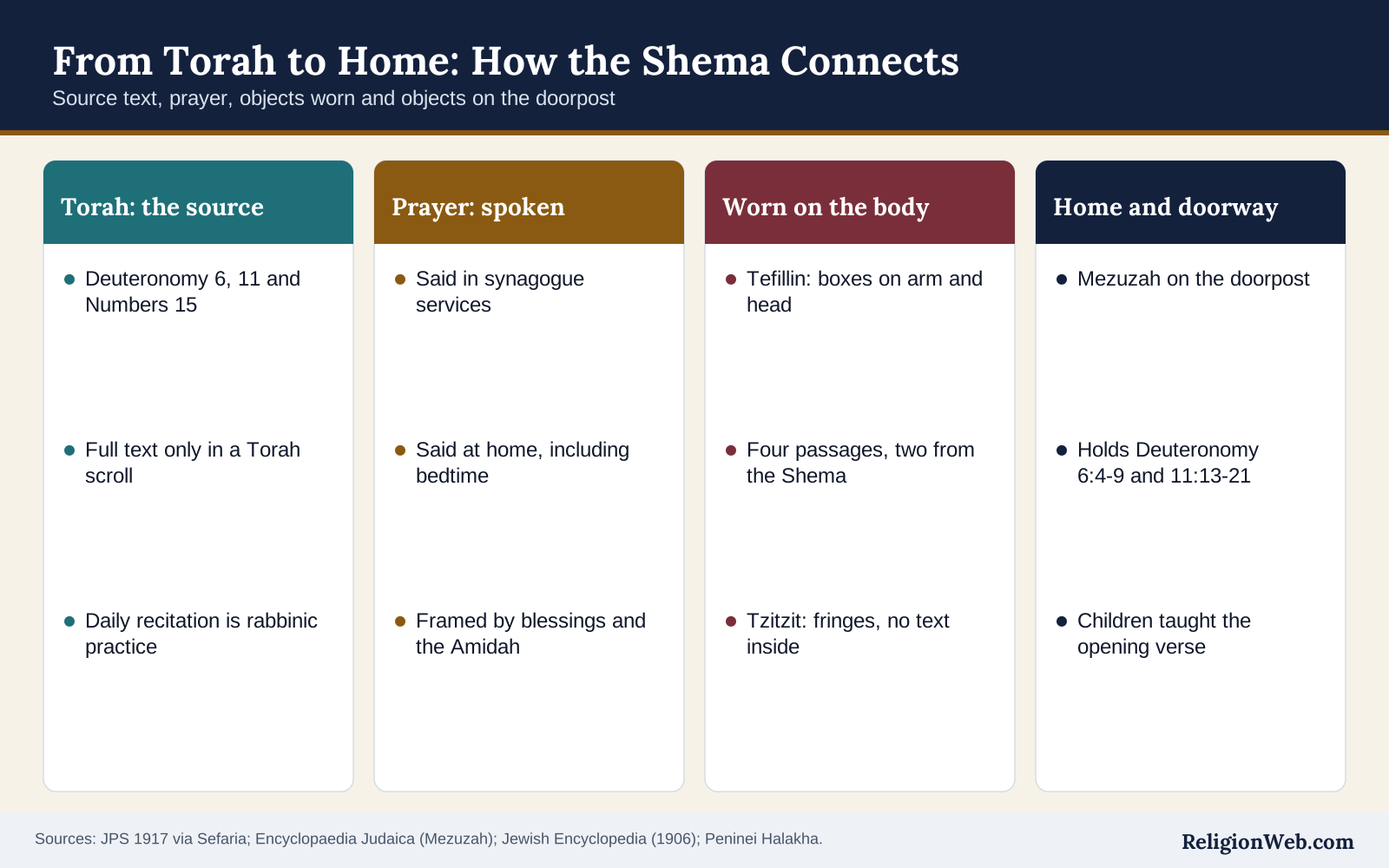
The Shema, Mezuzah, Tefillin and Tzitzit
What Each Object Contains
The mezuzah
A mezuzah is a handwritten scroll that is rolled up, placed in a case and fixed to a doorpost. According to the Encyclopaedia Judaica entry on the subject, the traditional scroll contains the first two paragraphs of the Shema, Deuteronomy 6:4-9 and 11:13-21. The commandment to write the words “upon the door-posts of thy house, and upon thy gates” appears in both of those paragraphs, and the scroll is the means by which the commandment is carried out. The scroll must be written by a trained scribe on prepared parchment, and the case is a protective and decorative addition. The article on the mezuzah covers the scroll, its placement and the rules for checking it in detail. A scroll that is fit for use is called kasher, the same Hebrew root from which the English word “kosher” comes, and the article on kosher food rules traces that root in a different setting.
Tefillin
Tefillin are two leather boxes with straps, one worn on the upper arm and one on the head, and they contain small parchment scrolls. Traditional practice puts four passages of the Torah in them: Exodus 13:1-10 and 13:11-16, which concern the consecration of the firstborn and the Exodus from Egypt, together with the two paragraphs of the Shema that speak of binding the words as a sign, Deuteronomy 6:4-9 and 11:13-21. The four passages all mention the commandment of the sign on the hand or between the eyes, which is why they were chosen. The head box has four compartments, one for each passage, while the arm box holds all four on a single parchment. These are the standard arrangements in the practice described on the page about tefillin, and the details of materials, order and wearing are explained there.
Tzitzit
The third paragraph of the Shema, Numbers 15:37-41, is the source of the commandment of fringes, but tzitzit are not scrolls. They are cords knotted and wound through holes at the corners of a four-cornered garment, and the commandment is fulfilled by the threads themselves. The Shema’s third paragraph is therefore the only one of the three that does not appear inside the traditional mezuzah or tefillin, and it names an object that is not a container for text at all.
Speech, Body and Home
The same verses in three forms
Seen in outline, the first paragraph of the Shema moves in a deliberate order: the words are to be on the heart, then on the tongue (taught and talked about), then on the hand and between the eyes, then on the doorposts. Jewish tradition took each stage literally and developed a form for each. The recitation answers the instruction to talk of the words “when thou liest down, and when thou risest up.” Tefillin answer the instruction to bind them on the hand and between the eyes. The mezuzah answers the instruction to write them on the doorposts. The prayer shawl with its fringes answers the third paragraph’s instruction to look and remember. The recitation, the objects and the home thus form a connected set. A person who recites the Shema in a tallit and tefillin, in a house with a mezuzah on the door, is carrying out different parts of the same passage.
An evolving practice
It would be a mistake to assume that these forms appeared fully formed at once. The Qumran finds mentioned earlier, as described in the Encyclopaedia Judaica entry on the mezuzah, include doorpost parchments with a longer selection of verses than the standard two paragraphs, and the Nash Papyrus, according to Cambridge University Library, may come from a phylactery that paired the Decalogue with the Shema. These pieces of evidence suggest that the practice of writing the words, wearing them and reciting them developed in more than one form before the rabbinic standard emerged. The connection among these practices appears to be older than the rabbinic period, and the rabbis fixed a particular version of it, which later Jewish communities took as the norm.
A Table of Connections
Shema, objects and places
The table sets out how the Shema relates to the objects and places connected with it. It states what each contains or does, where it is used, and which verse is its source.
| Element | Biblical source | Contains or involves | Where it is used |
|---|---|---|---|
| Recitation of the Shema | Deuteronomy 6:7 | Spoken verse and paragraphs, with blessings | Synagogue, home, bedside |
| Mezuzah | Deuteronomy 6:9; 11:20 | Scroll with Deuteronomy 6:4-9 and 11:13-21 | Doorposts of homes and many buildings |
| Tefillin | Deuteronomy 6:8; 11:18 | Four passages: two from Exodus 13 and the first two paragraphs of the Shema | Worn on arm and head at weekday morning prayer |
| Tzitzit | Numbers 15:37-41 | Knotted fringes at the corners of a garment; no text inside | Worn on a prayer shawl or small undergarment |
| Torah scroll | The Five Books of Moses | The full text of the Torah, from which all three paragraphs come | Synagogue ark and reading table |
| Synagogue service | Rabbinic enactment | The frame of blessings and Amidah around the Shema | Morning and evening services |
What the table shows
The last two rows make a point that the first four do not. The Torah scroll and the synagogue are different kinds of things from the other items: the first is the full source text, and the second is the setting in which the recitation is shared. Of the objects associated with the Shema, only the Torah scroll contains the whole Torah, and none of the others claims to. This is the foundation of a common misunderstanding discussed in the section on misconceptions below.
The Shema in the Synagogue, the Home and the Life Cycle
In the Synagogue
The congregational service
In a synagogue, the Shema is the hinge of the morning and evening services. The leader and the congregation recite the first verse together, and the rest of the paragraphs are said by each worshiper at his or her own pace in many communities, in a pattern that varies from one congregation to another. Because the blessings before and after the Shema are said in every service, including those of Shabbat, festivals and the High Holidays, the daily frame stays recognizable throughout the Jewish year. Worshipers at Rosh Hashanah say it in the same position in the service as on any weekday, although the surrounding prayers are expanded for the day.
Musaf and the closing of Yom Kippur
As Samuel Barth notes, the opening verse is also recited during the kedushah of the additional service, in which the congregation proclaims the holiness of God, and at the end of the Ne’ilah service on Yom Kippur. At Ne’ilah the verse comes after a day of fasting and prayer and is followed by the response “Blessed be the name of His glorious kingdom,” which on that day alone Ashkenazi custom says aloud, and by the declaration “The Lord, He is God.” Many congregations also sing the opening verse when the Torah scroll is taken from the ark, a custom whose wording differs from rite to rite. In each of these places the use of the verse is brief, and the effect is to set the central declaration at the high points of the service.
In the Home and at Stages of Life
Teaching a child
The Jewish Encyclopedia reports that, according to the Talmud in tractate Sukkah, folio 42a, a father is to teach his child, as soon as the child can speak, a verse from Deuteronomy (33:4) and the Shema. Many families still follow this custom in some form, so that the opening verse is among a Jewish child’s earliest Hebrew phrases. The link between the verse and education is built into the text, since the first paragraph itself says “thou shalt teach them diligently unto thy children.” The recitation of the Shema in the morning and evening is also part of the religious obligation that Jewish tradition regards as beginning at the age of religious majority, an event marked by the ceremony described in the article on bar and bat mitzvah.
The household at night
The bedtime recitation is the most domestic form of the Shema. A parent sitting with a child, an adult alone at the end of a day, or a patient in a hospital bed may say the same few lines: the opening verse, possibly the first paragraph, and the blessing for sleep. The weekly rhythm in which these daily recitations sit, with its pause every Friday evening, is described in the article on Shabbat.
At the End of Life and in Times of Persecution
The last words
Jewish tradition asks that the Shema be a dying person’s last declaration, and relatives and attendants may recite it with or for a person who is near death. The Jewish Encyclopedia calls it the dying person’s final confession of faith. This custom comes from the rabbinic tradition that the first verse is the fullest expression of loyalty to God, a view that links the deathbed with the daily acceptance of “the yoke of the kingdom of heaven.” Practice differs among families and communities, and the sources do not suggest that the recitation is a replacement for medical or pastoral care; it is a religious act that accompanies them.
The memory of martyrs
The most famous account is that of Rabbi Akiva, a leading rabbi of the second century CE. Tractate Berakhot (61b) tells that, while the Roman authorities were torturing him to death, he recited the Shema and drew out the word echad until his soul departed, and the Jewish Encyclopedia summarizes this account. Over the centuries, the same encyclopedia says, the words “Shema Yisrael” were the last words of Jews who died in persecutions, from the Spanish Inquisition to the Kishinev pogrom of 1903 in the Russian Empire, and it describes the phrase as a kind of password by which Jews recognized one another. Testimonies from the Holocaust, the genocide of European Jews carried out by Nazi Germany and its collaborators, also record the Shema as a last prayer. These memories form part of why the verse is held with particular intensity. Historians identify the perpetrators in each case (the Roman government, the Inquisition, the participants in the Kishinev violence, and the Nazi German state) and do not attribute their acts to any wider group.
The Shema Across Jewish Movements and Communities
Orthodox and Traditional Practice
The full text as a daily obligation
Orthodox Judaism, described in the article on Orthodox Judaism, treats the recitation of the Shema with its three paragraphs and its framing blessings as a daily legal obligation, regulated by the Talmud and the later codes. The Orthodox sources cited in this article, among them the Peninei Halakha series, the Ohr Somayach outreach organization and the Torah.org presentation of Maimonides’ laws, are by organizations and authors who write from within that framework. They agree on the structure of the recitation and discuss details such as the deadlines, the number of words, the use of the right hand and the bedtime additions. They also record differences between Ashkenazi and Sephardi custom, as shown in the table of variations.
Questions about women and the recitation
The Mishnah, in tractate Berakhot, exempts women, slaves and minors from the recitation of the Shema, since it is a commandment bound to a time of day, a principle in Jewish law that exempts women from many time-bound duties. Later Orthodox authorities have discussed how far women are still expected to recite it and in what form, and practice among Orthodox women varies by community and by household. Peninei Halakha states that in the laws of the bedtime Shema there is no difference between men and women, and notes that some authorities hold that women should say both the Shema and the blessing Ha-mapil. In egalitarian congregations, women are counted and participate in the same way as men.
Conservative, Reform and Reconstructionist Practice
Conservative (Masorti) Judaism
Conservative Judaism, called Masorti outside North America and described in the article on Conservative Judaism, generally keeps the traditional text and structure of the Shema in its prayer books. One example is cited by My Jewish Learning: Siddur Sim Shalom prints a shortened bedtime Shema for children that keeps the core Shema lines and the reassurance that God is with the reciter. In many Conservative congregations the three paragraphs are recited as in Orthodox practice, and women and men take equal roles in the service, although individual congregations differ and the movement’s own rabbinical bodies are the authority on any specific question.
Reform Judaism
The Reform tradition, described in the article on Reform Judaism, shows the clearest changes in the text around the Shema. According to Richard Sarason’s account for CCAR Press, the Hamburg prayer book of 1819 kept all three paragraphs. Later radical Reform books, beginning with a Berlin prayer book of 1848 and American books from 1855 onward, including the Union Prayer Book of 1895, dropped the second and third. Sarason reports two reasons for the second paragraph: it repeats much of the first, and its link between obedience and rain seemed theologically difficult to modern readers. The third paragraph was dropped because the tallit and the fringes seemed nonessential, and the ritual commandments they recall were viewed as outdated. A survey by the Central Conference of American Rabbis in the mid-1990s urged that traditional texts, including the Shema paragraphs, be restored. The 2002 trial draft of Mishkan T’filah offered the second paragraph as an option, but the editorial committee and executive committee of the CCAR ultimately kept it out of the final book. The third paragraph was restored as an option for the morning, when the tallit is worn.
Reconstructionist practice
Sarason also reports that Mordecai Kaplan, the founder of Reconstructionist Judaism, dropped the second paragraph in 1945 and substituted Deuteronomy 28:1-6, a passage of blessings. Later Reconstructionist liturgies restored the second paragraph as an option, reading it in ecological terms. The Reconstructionist and Reform examples show that decisions about the Shema have often been decisions about the theology of reward and punishment, the place of ritual commandments, and the boundary between recitation as a statement of belief and recitation as a link to tradition. These movements differ from each other, and each continues to revise its liturgy.
Differences of Rite and Region
Ashkenazi, Sephardi and other rites
Differences of rite are older than the modern movements. The Ashkenazi tradition of Central and Eastern Europe, the Sephardi tradition of the Iberian Peninsula and the Mediterranean, the Yemenite tradition and others each preserve their own wording of the blessings, their own melodies, and their own customs for the whispered response and the completion of the 248 words. Those differences are modest compared to what the rites share. A visitor to a synagogue of an unfamiliar rite will usually find the same three paragraphs in the same order, with the same opening verse, even where the blessings sound unfamiliar.
Practice in Israel and the diaspora
The Shema is recited in the same way in Israel and in the diaspora in its basic structure, although local calendars give different times for nightfall and sunrise. Hebrew is the language of the traditional recitation, but some liberal congregations include English readings or interpretive passages alongside it. Jews who do not attend a synagogue regularly often say the opening verse in private, at bedtime or at moments of gratitude or fear, which is one reason the verse is often described as among the best-known sentences in Jewish liturgy.
Common Misconceptions About the Shema
Misconception 1: The Shema is only one sentence
Where the misunderstanding comes from
The belief is easy to understand. The best-known form of the Shema is a single verse, “Hear, O Israel: the Lord our God, the Lord is one,” and that verse is what appears on posters, in the endings of films and books, and in the Hebrew inscription on many synagogue walls. Children learn that verse first, and a speaker who says “the Shema” in conversation often means exactly those six words. The Jewish Encyclopedia of 1906 adds a historical reason: it reports that the first verse was originally the only part recited, citing the Talmud, so the shorter usage reflects something real about the history of the practice.
What the evidence and tradition actually show
In the liturgy, the Shema has long meant more than the first verse. Rabbinic law and the traditional prayer book treat the recitation as three biblical paragraphs: Deuteronomy 6:4-9, Deuteronomy 11:13-21 and Numbers 15:37-41. Those passages, in turn, sit inside a larger frame of blessings, two before and one after in the morning, two before and two after in the evening, as the Mishnah (Berakhot 1:4) counts them. The bedtime Shema is a separate case. Peninei Halakha reports that the Talmudic requirement is the first paragraph with the blessing for sleep, while Joshua Rabin notes that the Talmud also accepts the first verse alone for bedtime, which has become a popular practice. The accurate statement is that the Shema is a verse, a set of three paragraphs and a liturgical unit, and that the word is used for each in different contexts. Which of these a speaker means usually depends on whether the speaker is a child, a worshiper in synagogue or a scholar of liturgy, and a careful writer states which sense is intended.
The short usage is therefore not wrong so much as incomplete. The opening verse is the part that appears alone in the additional service and at the close of Yom Kippur, as Samuel Barth notes, and it is the part a person is urged to say at death. When a worshiper in the morning service speaks of “saying the Shema,” however, the usual meaning is the full recitation, and a reader who encounters only the single sentence misses the two commands that follow it: to teach the words to children and to bind them as signs. Those commands are the reason the verse is bound up with the mezuzah and tefillin, which would make little sense if the Shema were a one-line slogan.
Misconception 2: The text surrounding the Shema is identical in every rite
Where the misunderstanding comes from
Many people encounter the Shema in one prayer book, usually the one used in their own congregation, and assume that what is printed there is the single standard text. The core verses are indeed constant, and the first verse is the same in every community. The sense of uniformity is also encouraged by a broad modern assumption that traditional liturgy does not change. An observer who sees two congregations reciting the same Hebrew in unison might reasonably infer that nothing differs between them.
What the evidence and tradition actually show
Differences exist at several levels. Among traditional rites, the morning love blessing begins Ahavat olam in the version recorded by Maimonides, while most Ashkenazi prayer books use Ahavah rabbah. Peninei Halakha reports that a person praying alone supplies the missing words needed to reach 248 differently depending on custom: Ashkenazim say El melekh ne’eman beforehand, and most Sephardim repeat Adonai Eloheichem emet. The kabbalistic custom places the bedtime blessing Ha-mapil before the Shema, while the common custom places it afterward. The response after the first verse is said in a low voice in Ashkenazi practice except on Yom Kippur, according to the Jewish Encyclopedia.
Among modern movements, the differences extend to the paragraphs themselves. According to Richard Sarason, the Reform movement’s American prayer books from 1855 through the Union Prayer Book of 1895 omitted the second and third paragraphs, Mordecai Kaplan’s 1945 Reconstructionist book replaced the second paragraph with Deuteronomy 28:1-6, and the Reform prayer book Mishkan T’filah restored the third paragraph as a morning option while keeping the second out. The accurate statement is that the first verse is constant, the three-paragraph core is nearly universal in traditional rites, and the surrounding text varies by rite, region and movement. Any given prayer book is one chosen version of a living liturgy, and a visitor who notices a difference in a neighbor’s book has usually found a rite, a region or a movement, not an error.
Misconception 3: The mezuzah and tefillin contain the entire Torah
Where the misunderstanding comes from
This idea often arises from popular descriptions that call a mezuzah “a tiny Torah” or tefillin “boxes with the Torah inside,” and from the fact that both objects hold handwritten parchment in the same script and by the same kind of scribe as a Torah scroll. Observers who see the care that goes into them may reasonably assume that a great deal of text is inside. The objects are also described in the tradition as expressions of the commandment to keep God’s words near, which can sound as if the entire text were present. A further source of confusion is that the Shema is itself a short passage from a very long book, so the link between the small object and the large book is easy to overstate.
What the evidence and tradition actually show
The objects contain only a few paragraphs. The Encyclopaedia Judaica reports that the traditional mezuzah scroll holds two passages, Deuteronomy 6:4-9 and 11:13-21. Tefillin traditionally hold four passages: Exodus 13:1-10, Exodus 13:11-16, Deuteronomy 6:4-9 and Deuteronomy 11:13-21. Tzitzit hold no text at all. The third paragraph of the Shema appears in neither a mezuzah nor tefillin. Only the Torah scroll, kept in the ark of a synagogue and described in the article on the Torah, contains the full Five Books of Moses. The historical record shows even more variety than the later standard suggests. Even the neat statement above is a later standard and not an original fact. The Qumran mezuzah parchment from Cave 8 covers Deuteronomy 10:12-11:21, which is longer than the two paragraphs of later practice, and the Nash Papyrus pairs the Decalogue with the Shema. The accurate statement is that these objects carry the passages that speak of the sign on the hand, the frontlets and the doorposts, selected because the biblical text itself names those acts.
One further point guards against the opposite error. Because the scrolls hold so little, it is sometimes said that they are merely symbolic. Within Jewish law the text is the essential element: a handwritten scroll with a single faulty letter may be unfit for use, which is why scribes and checkers take the work seriously. The small size of the text and the seriousness of the rules about it belong together, and neither implies that the object stands in for the whole Torah.
Misconception 4: The Shema is a prayer of petition addressed to God
Where the misunderstanding comes from
The Shema is recited in the middle of a worship service, in a prayer book, with blessings, and often in a posture and tone that resemble prayer. It is also called by many Jews a prayer in ordinary speech, and a reader encountering the translation “the Lord our God, the Lord is one” may reasonably take it as a statement spoken toward God, similar to a creed or an act of praise.
What the evidence and tradition actually show
In its biblical setting, the verse is addressed to Israel. Moses tells the people to listen, and the text goes on to command love, teaching and remembrance. The rabbis took the recitation as the acceptance of “the yoke of the kingdom of heaven,” a phrase that, in the Jewish Encyclopedia’s account, belongs to the second chapter of Berakhot, and Jeffrey Tigay describes rabbinic thought as treating the first paragraph as a declaration of allegiance and the second as the acceptance of the commandments. The blessings around it, by contrast, are addressed to God. Jewish tradition classifies the recitation as the fulfillment of a commandment to recite Torah words, and the covering of the eyes and the whispered response around it are customs of attention and respect. The accurate statement is that the Shema is a hybrid: it is recited within prayer and treated with the reverence of prayer, while its own words address the community and speak about God.
This hybrid character helps explain why the recitation is surrounded by customs of attention. If the verse were only a petition, the hand over the eyes and the effort at concentration would matter less. Because it is treated as the moment when a person accepts a sovereignty, the tradition asks for the fullest attention at exactly that moment, and it also explains why the same words can be recited as a daily routine and as a final declaration at the end of life.
Frequently Asked Questions About the Shema
Questions About Meaning and Pronunciation
What does “Shema Yisrael” mean in English?
The two Hebrew words mean “Hear, O Israel” or “Listen, Israel.” The verb is an imperative addressed to the people, and the full verse continues with four Hebrew words that can be rendered “the Lord our God, the Lord is one” or, in another reading that Jeffrey Tigay considers most likely, “the Lord is our God, the Lord alone.”
The rendering chosen by a translator reflects an interpretation of the verse. The 1917 Jewish Publication Society translation used in this article follows the first of those readings, and later translations vary.
How is the word Shema pronounced?
In modern Hebrew, the word is usually pronounced with the stress on the last syllable, roughly “sheh-MAH,” and “Yisrael” as “yees-rah-EL.” In some Ashkenazi communities, older pronunciations of Hebrew differ, and the phrase may be heard as “Shma Yisroel.” These are differences of pronunciation tradition and carry no difference in meaning.
The spelling in English books varies for the same reason: the transliteration reflects the author’s convention. This article uses “Shema” throughout.
Is the Shema a creed or a prayer?
Both descriptions are used, and neither fits fully. Some writers call the first verse the Jewish confession of belief in one God, as the Jewish Encyclopedia does, while the tradition itself describes the recitation as the acceptance of divine sovereignty and as the fulfillment of a commandment. As the discussion of misconceptions above shows, the text is directed to the community, and the surrounding blessings are directed to God.
Because Jewish religious life emphasizes practice as much as doctrine, many Jews who would not describe their beliefs in formal terms still recite the verse as an expression of identity and continuity. The reasons a person says it can differ even when the words are the same.
Questions About Practice
When should the Shema be recited?
Traditionally it is recited twice daily, in the evening and the morning, and many people add a bedtime recitation. The Mishnah allows the evening recitation to begin at nightfall and the morning recitation from daybreak, and the Jewish Encyclopedia summarizes the debates about when each period ends. Modern calendars and synagogue schedules usually give the latest morning time for each day, since it moves with the seasons.
A person who is unsure about timing in a particular case is directed by the tradition to consult a rabbi, because the calculations for dawn, sunrise and nightfall differ between communities.
Why do people cover their eyes during the Shema?
It is a custom of concentration, not a requirement of the verse. It comes from a story in tractate Berakhot about Rabbi Yehudah HaNasi and is recorded in the Shulchan Arukh (Orach Chayim 61:5), and later interpreters have read the gesture as a way to shut out distraction, to focus attention inward, or to picture the whole community. The section on customs above gives the sources.
The gesture is optional in the sense that a person who does not use it has not broken a biblical law, and its observance varies by congregation.
Who recites the Shema, and does it have to be in Hebrew?
Jewish tradition expects adults to recite it, and it is taught to children from an early age. The tradition’s treatment of women differs between movements, as described in the section on movements. In Orthodox practice, the discussion starts from the Mishnah’s exemption of women from time-bound commandments and continues with the opinions of later authorities. In egalitarian communities, everyone is counted equally.
The traditional recitation is in Hebrew, the language of the Torah and of the liturgy, and most prayer books provide a translation alongside it. Whether a recitation in another language fulfills the obligation is a legal question that this article does not attempt to rule on, and a rabbi can give a decision for a particular community.
Questions About Related Objects and Texts
Is the Shema in the Torah?
Yes. Its first two paragraphs come from the Book of Deuteronomy and its third from the Book of Numbers, both part of the Five Books of Moses. The article on the Torah explains how those books are read in synagogue throughout the year. The practice of reciting these particular passages daily, however, comes from rabbinic tradition and is described in the Mishnah and the Talmud, not in the biblical text itself.
This is why Jewish sources distinguish between a verse that is commanded by the Torah and a recitation that is organized by the rabbis. Both layers are part of the living tradition.
What is the difference between the Shema, the mezuzah and tefillin?
The Shema is a spoken recitation. The mezuzah is a scroll on a doorpost, and tefillin are boxes with scrolls worn during morning prayer. All of them draw on the same biblical passages, with the first paragraph of the Shema containing the commandments that they fulfill. The Shema asks that the words be spoken, tefillin that they be bound on the body, and the mezuzah that they be written on the doorposts.
The fuller articles on the mezuzah and tefillin explain the scribal rules and the history of each object.
Does the mystical tradition say anything about the Shema?
It does. Kabbalistic sources give the bedtime recitation special attention, as the Jewish Encyclopedia notes when it mentions the Zohar’s link between the evening recitation and sanctifying the Divine Name before lying down, and kabbalistic custom, as Peninei Halakha reports, places the bedtime blessing before the Shema. The article on Kabbalah introduces that tradition more fully.
These customs are part of the tradition’s own self-understanding and are recognized by many but not all communities.
Conclusion: The Shema in Jewish Life
What the History Shows
A short text with a long frame
The Shema begins as six Hebrew words in a speech attributed to Moses, and across the Second Temple period and the rabbinic age it becomes a daily recitation framed by blessings and embedded in the structure of the service. The Nash Papyrus and the Qumran finds show that the passages were already being copied and worn in the late Second Temple period, and the Mishnah, edited around 200 CE, opens with the question of when to recite it. The modern period has added new questions about which paragraphs belong in the text, and the answers differ among Orthodox, Conservative, Reform and Reconstructionist communities.
What stays constant
Through those changes, the opening verse has kept its place at the center. It is said by the child at bedtime, by the congregation in the morning and evening, by the worshiper at the end of Yom Kippur, and by tradition, at the end of life. Whether read as a statement of loyalty, as a claim about the nature of God, or as an act of attention, it is one of the most widely shared texts across Jewish communities.
How to Keep Exploring
Related articles on this site
Readers who want the broader setting can start with the overview of Judaism. The yearly cycle in which the Shema sits is explored in the articles on Sukkot, Hanukkah and Purim, which describe how the daily liturgy is enriched on special days. The articles on the mezuzah and tefillin follow the objects tied to the Shema through their own scribal and legal details.
Reading the sources and asking a teacher
For the text itself, a bilingual prayer book from one’s own community, together with an English Bible such as the 1917 Jewish Publication Society translation quoted here, is the most direct way to read the passages and their frame. Questions about the proper practice for a particular household or congregation belong to a rabbi or teacher who knows the community, since the sources summarized here describe the range of tradition and not a ruling.
Sources
The table below lists the principal external sources behind this article. Facts, dates and figures were checked against these and related primary, institutional and academic materials.
| # | Source | Publisher and type | Used for | Link |
|---|---|---|---|---|
| 1 | Deuteronomy 6:4-9 and Numbers 15:39-41, The Holy Scriptures: A New Translation (JPS 1917) | Sefaria (Jewish Publication Society, 1917; public domain) · Primary text | Quoted scripture: Deut 6:4-9 and Num 15:39; paraphrase of Deut 11:13-21 and Num 15:37-41 | sefaria.org |
| 2 | Shema' (Jewish Encyclopedia, 1906; K. Kohler and J. D. Eisenstein) | Jewish Encyclopedia (public domain, 1906) · Encyclopedia | Three paragraphs, Mishnah timing, blessings, Barukh shem, bedtime, Akiva, martyrdom, child teaching | jewishencyclopedia.com |
| 3 | The Three Paragraphs of the Sh'ma (Richard Sarason, Ten Minutes of Torah, 2006) | CCAR Press (Central Conference of American Rabbis) · Institutional (Reform) | Reform and Reconstructionist treatment of the second and third paragraphs, 1819 to Mishkan T'filah | ccarpress.org |
| 4 | Peninei Halakha, Prayer: 12 – 248 Words | Har Bracha Yeshiva (Peninei Halakha series, attributed to Rabbi Eliezer Melamed) · Institutional (Orthodox legal guide) | The 248 words, 245 in the text, the leader's repetition and the individual's solutions | ph.yhb.org.il |
| 5 | Peninei Halakha, Women's Prayer, Ch. 19: The Passages of the Bedtime Shema | Har Bracha Yeshiva (Peninei Halakha series) · Institutional (Orthodox legal guide) | Bedtime Shema: first paragraph and Ha-mapil, Psalms 91 and 3, kabbalistic order, women | ph.yhb.org.il |
| 6 | Shema': The 'Secrets' of the Eyes (Samuel Barth) | Jewish Theological Seminary (Torah from JTS) · Academic/educational essay | Covering the eyes: Berakhot 13b, Shulchan Arukh OH 61:5, Hai Gaon, custom not requirement | jtsa.edu |
| 7 | Deuteronomy 6:4 – The Shema (Jeffrey Tigay, from The JPS Torah Commentary: Deuteronomy) | My Jewish Learning / Jewish Publication Society · Academic reference | Translation options for the verse; Ibn Ezra, Rashbam; Geller; allegiance reading | myjewishlearning.com |
| 8 | Nash Papyrus (MS Or. 233), Lines of Thought exhibition | Cambridge University Library · Institutional (library) | Second-century BCE papyrus with the Decalogue and the Shema; possible phylactery | exhibitions.lib.cam.ac.uk |
| 9 | Rambam: Laws of Reading the Shema, Chapter 1, Halakha 6 with commentary | Torah.org · Primary text commentary | Names, count and themes of the blessings before and after the Shema; Mishnah Berakhot 1:4 | torah.org |
| 10 | Shema' (Part 1): What We Know and What We Don't (Samuel Barth, 2014) | Jewish Theological Seminary (Torah from JTS) · Academic/educational essay | Uncertain origins; first verse in Musaf kedushah and Ne'ilah; Berakhot 2a | jtsa.edu |
Last fact-check date: 2026-10-21.