A mikveh (also spelled mikvah; plural mikva’ot or mikvaot) is a Jewish ritual bath, a pool built to specifications set out in Jewish law, in which a person or an object is fully immersed in order to change ritual status. The Hebrew word means a “gathering” of water, and that single idea explains most of what makes a mikveh different from an ordinary bath or swimming pool: what counts is not only that there is water, but where the water came from and how it is held. Immersion in a mikveh (tevilah in Hebrew) is required in traditional Jewish law for conversion, for a married woman’s monthly return from the status of niddah, and for a bride before her wedding according to common custom. It is also used by many men on particular days, by communities for newly acquired dishes and cookware, and, in a growing number of liberal and pluralistic communities, for personal milestones that earlier generations did not mark in this way.
The practice is anchored in the purity laws of the Torah, especially Leviticus 15 and Numbers 19, which describe states of ritual impurity (tumah) and the washing of the body in water as part of returning to purity (taharah). These categories are not about dirt, illness or moral failing. They concern a person’s fitness to approach the sacred space of the Tabernacle and, later, the Temple in Jerusalem. After the Temple’s destruction in 70 CE, the rabbis of the Mishnah and Talmud preserved a narrower set of purity practices, and the mikveh became the main surviving institution of that system. The history of the mikveh is therefore a history of how a Temple-centered body of law was carried into synagogues, homes and communities across many centuries and countries.
Present-day Jewish communities relate to the mikveh in different ways. In Orthodox Judaism it is a fixed part of the legal and communal order, and a community is expected to build one. In Hasidic circles men also immerse regularly as a devotional discipline. Conservative Judaism affirms the mikveh for conversion and has issued rulings that reshape how family purity is observed, while Reform Judaism has treated immersion as a meaningful but generally non-mandatory practice. This article explains what the mikveh is, how it is constructed, what happens during immersion, how the law of family purity and the law of conversion use it, how it appears in the historical and archaeological record, and how different communities understand it today. For the wider setting, see the overview of Judaism.
At a Glance: What a Mikveh Is and What It Does
The Word and Its Vocabulary
Mikveh as “gathering” and as “hope”
The noun mikveh comes from a Hebrew root meaning to collect or gather, and in the Bible it is used with the plain sense of a collection of water. A verse in Leviticus about a cistern or spring uses it that way, and the prophet Isaiah uses it for a reservoir in Jerusalem. The same three-letter root also produces the verb “to hope,” and this second meaning is not an accident of spelling. The prophet Jeremiah addresses God as the “hope of Israel” using the same word, and in the Mishnah (Yoma 8:9) Rabbi Akiva turns the two senses into a single teaching: just as a mikveh purifies the impure, so God purifies Israel. The teaching stands at the very end of the Mishnaic tractate on Yom Kippur, and it is one reason the mikveh carries a spiritual vocabulary beyond its legal one.
Two spellings circulate in English. Mikveh is closer to the Hebrew vowels as most Israeli and academic writers render them, while mikvah is common in North American Orthodox and outreach publications. The plural is mikva’ot or mikvaot in Hebrew-based spelling, and “mikvehs” or “mikvahs” in everyday English. This article uses mikveh and mikva’ot throughout, and uses mikvah only inside names and quotations.
Related terms that appear in any discussion
Several other Hebrew terms recur. Tevilah (also tevillah or tvilah) is the act of immersion itself, and the person who immerses is sometimes called the tovel. Tumah and taharah are conventionally translated “impurity” and “purity,” though both English words mislead, since tumah is neither sin nor uncleanliness in the hygienic sense. Niddah names the status of a menstruating woman, and taharat hamishpachah, literally “purity of the family,” is the modern Orthodox name for the whole body of related practice, often called “family purity” in English. The mikveh attendant, usually a woman who supervises women’s immersions, is called a balanit or, in some communities, simply the “mikveh lady.” A chatzitzah is anything that interposes between the body and the water, and a se’ah is a biblical dry measure that the rabbis used to specify how much water a mikveh must hold. Finally, taharah also names the ritual washing and preparation of a deceased person for burial, which shares its root with the purity vocabulary but is a distinct custom, discussed below.
What a Mikveh Does and Does Not Do
A change of status, not a cleaning
The most important distinction for a first-time reader is between washing and immersion. Jewish law requires a person to be physically clean before entering the mikveh, and that preparation is detailed and thorough. The immersion that follows is something else: a legal and ritual act that changes the person’s status from one category to another. A woman who has finished counting the days required after menstruation is, in the language of the law, brought out of the status of niddah by immersion at the proper time. A convert is brought into the Jewish people. A new pot is brought into use for food in a Jewish kitchen. In none of these cases is the water meant to remove dirt, and in the history of the law there are examples of mikva’ot whose water was stagnant or unattractive yet still fully valid, because ritual validity and hygiene are treated as separate questions.
That is also why the mikveh is not a medical or psychological treatment, even though some contemporary communities describe immersion as healing. Religious immersion does not replace medical care, counseling or legal protection for people recovering from illness, loss or abuse. Where this article describes immersion as a response to such experiences, it describes what particular communities say about the practice, not what it can accomplish clinically.
Who uses a mikveh and how often
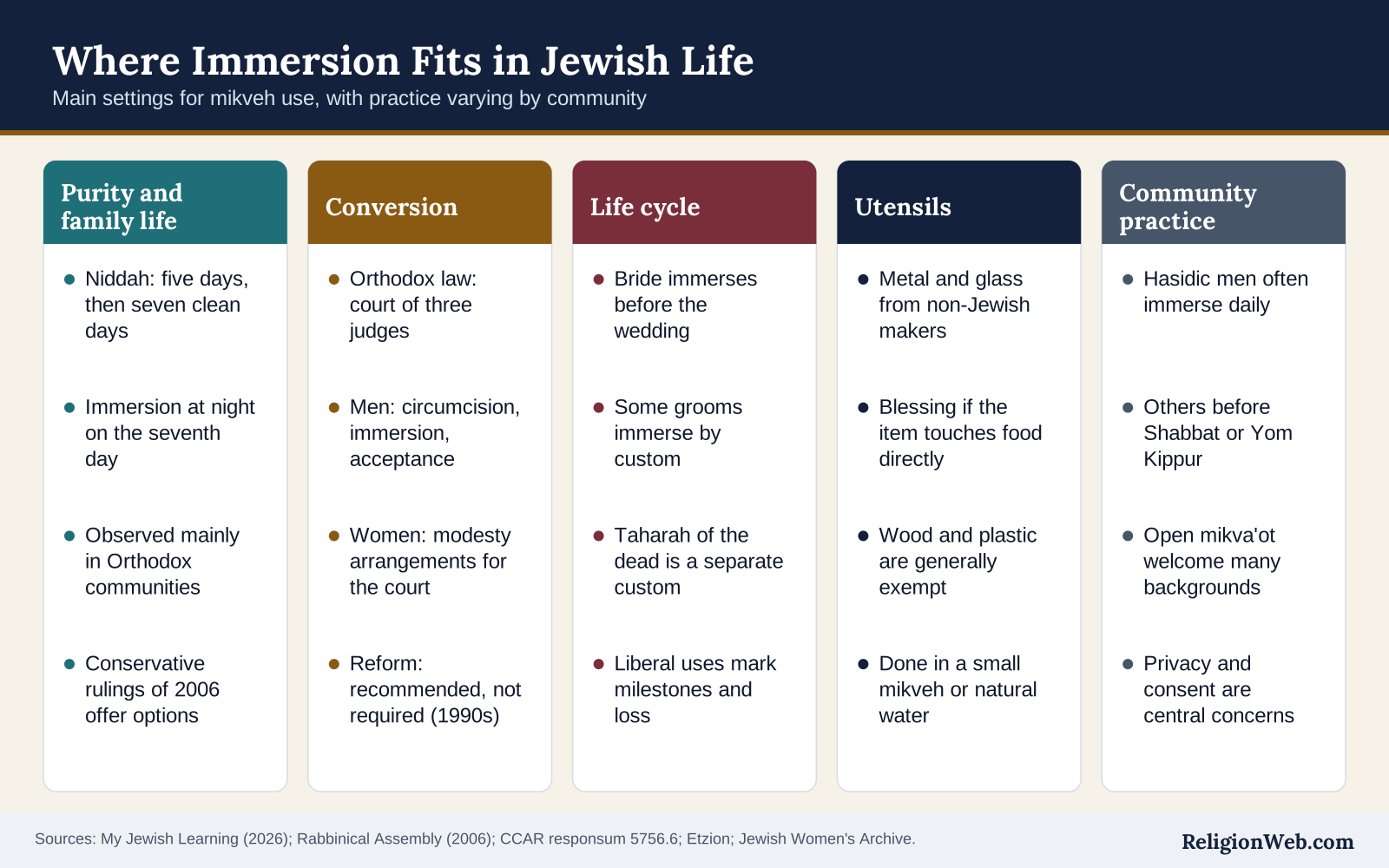
Use varies widely. A small community of observant Jews may have one mikveh serving hundreds of women who each visit monthly, while a larger Orthodox city may have several, including separate facilities for men and a small one for dishes. In many other communities a mikveh is visited mostly by converts and brides, with only an occasional visit for niddah. Among Hasidic men, daily immersion before morning prayer is customary, whereas many other observant men immerse only before Yom Kippur or before Shabbat. In open or community mikva’ot founded in recent decades, people of many backgrounds come for events ranging from a wedding to the end of a year of mourning. The table below summarizes the principal uses and the way each is understood within the tradition that practices it.
| Use | Who immerses | Standing in traditional law | Notes |
|---|---|---|---|
| Niddah (return after menstruation or childbirth) | Married women, in communities that observe family purity | Obligatory in Orthodox law; affirmed with modifications in Conservative responsa | Immersion follows a counted number of days; marital relations resume afterward |
| Conversion (giyur) | Male and female converts | Required by the Talmud and later codes as a final stage of conversion | Performed before a rabbinical court in Orthodox practice; practice varies in other movements |
| Before marriage | Brides; in some communities also grooms | Required of the bride in Orthodox law where she is in the status of niddah; otherwise a widespread custom | Often scheduled shortly before the wedding with a close relative or friend present |
| New dishes and utensils (tevilat kelim) | Metal and glass items acquired from a non-Jewish maker or seller | Required in Orthodox law; limited or not observed in some other movements | Usually done in a small separate pool or a natural body of water |
| Customary immersion by men | Hasidic men daily; others before Shabbat or Yom Kippur | Custom, not an obligation; the older rabbinic requirement for some men was set aside in the Middle Ages | No blessing is recited in these cases |
| Preparing the dead (taharah) | The deceased, handled by a volunteer burial society | Customary, with detailed traditional rules for the washing and pouring of water | A separate custom related to the mikveh in vocabulary and symbolism |
| Life transitions and healing | People of any gender, in liberal and pluralistic communities | Not a legal category; created through new rituals and prayers | Used for milestones, mourning, divorce, illness, and recovery |
Purity and Immersion in the Bible and Rabbinic Law
The Biblical Background
Purity laws in Leviticus and Numbers
The biblical foundation of the mikveh lies in the laws of ritual impurity in the books of Leviticus and Numbers. Leviticus 11 to 15 deals with impurity connected to certain animal carcasses, skin conditions, and bodily discharges, including menstruation, childbirth and seminal emission. Numbers 19 deals with impurity contracted through contact with a corpse and prescribes the water of purification prepared with the ashes of a red heifer. Numbers 31 includes a passage on how objects taken in war, metal ones among them, are to be made fit for use. These texts describe a range of states, most of them temporary, from which a person returned by waiting a set number of days, washing the body and clothing, and in some cases offering a sacrifice. They govern access to the sanctuary and to sacred food. They do not make the impure person a sinner, and in many cases, such as caring for the dead, contact with impurity was itself a religious duty.
A notable feature of these laws is that they rarely mention a purpose-built facility. Scholars writing in the Encyclopaedia Judaica note that none of the relevant passages describes a purification installation, and treat the stepped, plastered mikveh as a later development. What the Torah does mention is water in general: running water, spring water, and water collected in a cistern or pit. The verse below is the one most often cited for the idea that a gathering of water does not become impure the way a vessel can.
Nevertheless a fountain or a cistern wherein is a gathering of water shall be clean; but he who toucheth their carcass shall be unclean.
Leviticus 11:36, The Holy Scriptures: A New Translation (Jewish Publication Society, 1917)
In context, the verse belongs to a passage about what happens when a dead creature falls into containers or sources of water. The verse establishes that a natural source or a cistern holding collected water remains pure even when a carcass lies in it, although whoever touches the carcass becomes impure. Rabbinic law read the phrase “a gathering of water” (mikveh mayim) as the basis for a category of water that cannot be defiled and can, in turn, remove defilement from people and objects. That reading is an interpretive step, and the later rabbinic system built a detailed structure on it. Both elements, the verse and the structure resting on it, are part of how the tradition itself explains the origin of the mikveh.
Washing in the Temple service
Immersion and washing also appear in the priestly service. The high priest’s Yom Kippur ritual in Leviticus 16 specifies that he bathes his body in water and puts on the sacred linen garments. The Mishnah and later rabbinic literature describe the high priest immersing at several points on that day, and they describe immersions required of ordinary pilgrims before they entered the Temple precincts during the three pilgrimage festivals, Passover, Shavuot and Sukkot. A passage in the Tosefta, cited in the Encyclopaedia Judaica, records questions about purity put to the sages at Yavneh by people coming from the town of Assia at the three pilgrimage festivals, an indication that the topic was a practical concern for travelers.
The biblical text uses a verb for washing or bathing the flesh and does not always specify immersion of the whole body, so historians distinguish between what is explicit in the Torah and what the rabbis later understood it to require. In rabbinic tradition, the Oral Torah that accompanies the written text already taught full immersion, and the later system of mikveh construction is an elaboration of that teaching. Scholars of the Second Temple period read the evidence differently, as discussed in the section on archaeology below. This difference between tradition’s own account and historians’ reconstruction is a helpful reminder that both are describing the same practice from different angles.
The Rabbinic System
The tractate Mikvaot
The Mishnah, the early rabbinic law code redacted around 200 CE, devotes an entire tractate to the subject, called Mikvaot (“Ritual Baths”). It is the sixth tractate in the order Tohorot (“Purities”) and has ten chapters, according to the Encyclopaedia Judaica. Neither the Babylonian nor the Jerusalem Talmud has a tractate-length discussion of it, which means that the Mishnah and its companion collection, the Tosefta, are the main sources for the technical rules. The chapters are arranged by subject. The first sets out grades of water and the minimum quantity required. Chapters two to four deal with drawn water and how a pool spoiled by it can be repaired. Chapters five to seven address springs, rivers and seas, the joining of one body of water to another (hashakah), and whether snow and ice can count. Chapter eight distinguishes the mikva’ot of the Land of Israel from those elsewhere, chapter nine deals with obstructions between body and water, and chapter ten with vessels and other objects. Anyone who reads modern construction guides will recognize these topics in the same order.
Chapter one of the tractate is the best-known section because it ranks types of water in six grades. The ranking is not a ranking of religious worth. It is a legal ladder that determines what each kind of water can purify and for which kinds of impurity it suffices.
| Grade | Type of water | What the grade means in practice |
|---|---|---|
| 1 | Ponds (standing collections of water) | The base of the ladder; the tractate sets limits on what such water can do |
| 2 | Ponds that fill in the rainy season | A seasonal body of water, ranked just above an ordinary pond |
| 3 | Pools holding at least forty se’ah | The standard category into which a constructed mikveh falls |
| 4 | Wells with natural groundwater | Water that rises from the ground rather than only collecting from above |
| 5 | Salt water and hot springs | Natural waters that rank above wells in the Mishnah’s ladder |
| 6 | Flowing springs and rivers (“living water”) | The highest grade, called mayim chayyim, “living water” |
Purity after the Temple’s destruction
When the Temple fell in 70 CE, most of the purity laws lost their practical purpose, since they concerned entry to the sanctuary and the eating of sacred food. What remained in daily life was a narrower domain, chiefly the laws connected with menstruation and with conversion, together with the custom of immersing certain objects. A study of the history of the practice published by the Jewish Women’s Archive notes that, before the Temple’s destruction, purity laws were far broader, and that afterward the rabbis kept them mainly in connection with women and menstruation. Rabbinic tradition does not say that the mikveh was devalued by the end of the Temple. Rather, the sources treat the maintenance of a mikveh as among the most important communal obligations. According to the Jewish Women’s Archive, the Talmud tells a community with limited resources to build a mikveh before building a synagogue, a rule that supports the claim, made by many Orthodox authorities, that the mikveh is a basic institution of a Jewish community.
At the same time, the rabbis also developed a distinct line of thought in which immersion carried a spiritual meaning independent of the Temple. The teaching of Rabbi Akiva in Mishnah Yoma 8:9 is the clearest example. By playing on the two meanings of the word mikveh, he presents God as the one who purifies Israel on Yom Kippur just as the mikveh purifies the impure. The two lines of thought, legal and spiritual, run in parallel through the subsequent history of the practice, and most contemporary discussion of the mikveh draws on both.
How a Mikveh Is Built: Water, Ground, and Connection
The Principles of Valid Water
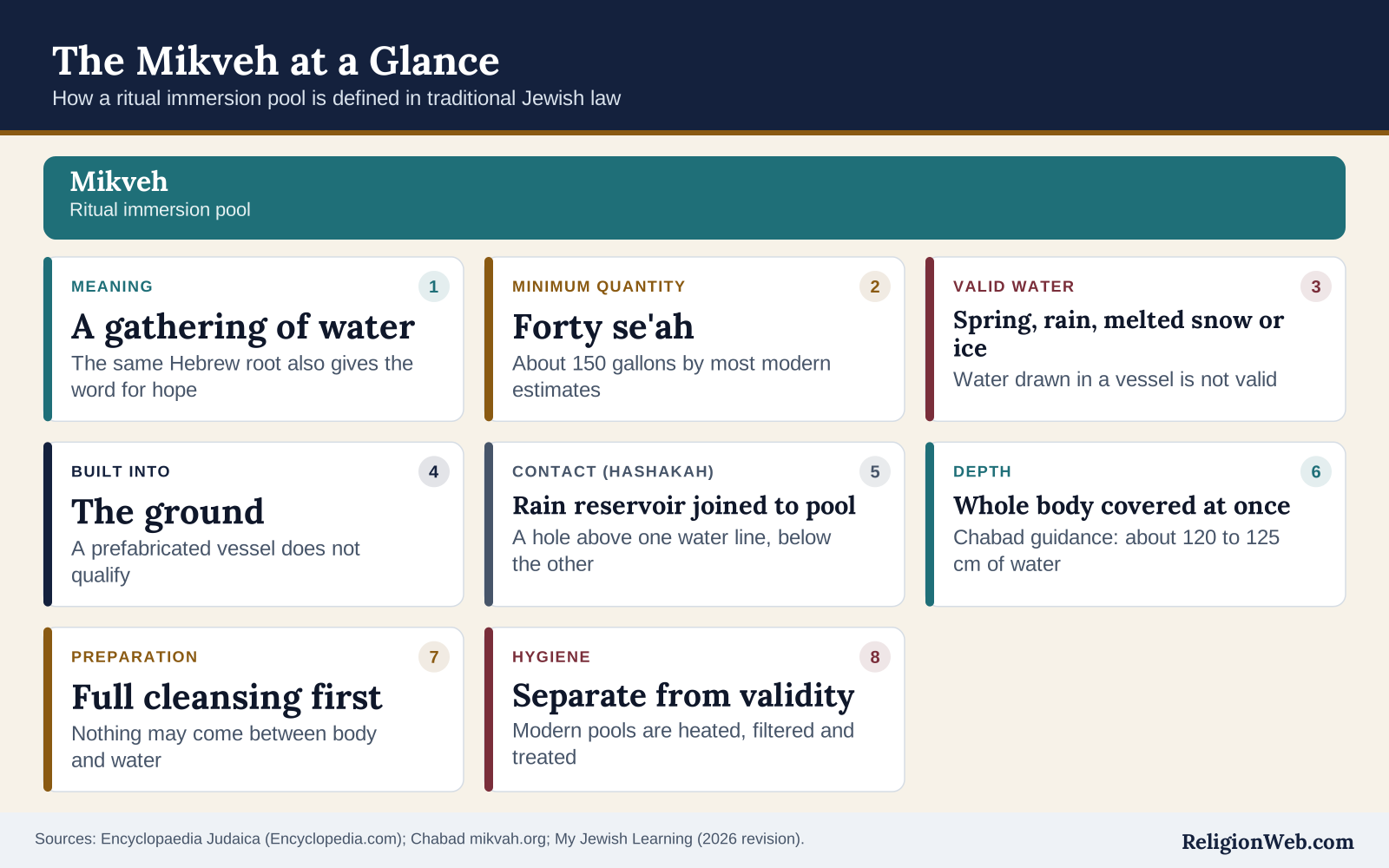
Forty se’ah and the size of the pool
The rabbinic rules for building a mikveh start with a quantity. According to the Encyclopaedia Judaica, the biblical minimum is any gathering of water large enough for a person to immerse in, and the rabbis then fixed a precise measure of forty se’ah, a volume defined as a square cubit in area and three cubits in height. A se’ah is an ancient dry measure, and its modern equivalent depends on how one converts the cubit, which is why published estimates range from about 250 liters to nearly 1,000 liters. My Jewish Learning reports that most contemporary authorities treat forty se’ah as roughly 150 gallons. The Talmud (Eruvin 4b) links the requirement to the size of a human body: the volume is enough to cover the whole of an average man. Because the person must be able to be covered completely, practical builders make the pool deep enough that an adult can submerge without lying on the floor, and Chabad construction guidance describes a water level of roughly 120 to 125 centimeters (about 47 to 49 inches) above the floor in the immersion pool.
The rabbinic rule is therefore a minimum, not a recommendation for the size of a room. Real mikva’ot are larger than the legal minimum, with steps, handrails and space for the attendant to stand. In older European towns they were often dug deep into the ground to reach groundwater, and visitors descended a long staircase to the pool. In modern buildings the pool is usually a tiled basin set into a floor, with a dressing area and bathroom attached.
Natural water and “drawn” water
The second principle concerns the source and handling of the water. The Encyclopaedia Judaica summarizes the rabbinic position this way: only undrawn water is valid for a mikveh. Clear spring water, rainwater, and melted snow or ice qualify, while water that people have drawn in a vessel (mayim she’uvim in the Mishnah’s vocabulary) does not. Below the forty-se’ah minimum, as little as three log of drawn water, a log being a small liquid measure, falling into the pool can invalidate it. Once the pool holds the full forty se’ah of valid water, however, it can be topped up with drawn water without losing validity. A mikveh must also be fixed to the ground: it can be hewn into rock, built of masonry, or set in the earth, but a prefabricated vessel carried to the site is not valid. Pipes that deliver water must likewise be fixed so that they are not counted as vessels.
These rules explain why a bathtub filled from a tap, or a portable pool, is not a mikveh even if the water is clean and the tub is large. They also explain why modern builders need an indirect solution. The tap water that fills a building’s pipes counts as drawn water, but it can become valid by being joined to a body of valid water. The Mishnah’s sixth chapter of Mikvaot addresses exactly this joining, using the term hashakah, “contact.” The next section describes how that principle shapes the layout of a contemporary mikveh.
How Modern Mikva’ot Are Built
A rainwater reservoir joined to the immersion pool
A mikveh that relied entirely on rainwater would be impractical, because the pool would have to be refilled by rain every time it was cleaned. Chabad’s guidance on mikveh construction calls a single rainwater reservoir “impractical and unhygienic” for this reason. The usual solution is to build two or more connected pools, which construction manuals call a bor, a pit or reservoir. One holds rainwater, which must amount to at least forty se’ah. The other is the immersion pool that visitors actually use, and it can be filled with heated, filtered tap water. The two are joined by a hole between them, so that the rainwater and the tap water are in contact. This method is called hashakah.
The location and size of the hole are specified by detailed rules. In the guidance published by Chabad, the opening in the rainwater reservoir must lie above the level of the forty se’ah, while the opening in the immersion pool must be below its water line, so the two bodies of water meet in the opening. The initial contact hole is described as about two average fingers wide, large enough to fit and turn the fingers in it, and a smaller opening is considered sufficient while someone is immersing. The same source lists the drawbacks of this system: the connection can fail if too little water has been added, a stopper that is forgotten can invalidate the pool, and the stored rainwater can become stagnant over time.
Other designs: sowing and a pool above a pool
Builders also use other arrangements. In the system called zeriah (“sowing”), the rainwater reservoir is topped up with tap water, which merges with the rain and becomes valid at once, and the combined water then overflows through a hole into the immersion pool. Because the water is already valid when it reaches the pool, no stopper is needed and the stored water stays fresh, but guidance from Chabad warns that pumping out or mopping the pool can leave residual water behind that invalidates it. A third design, bor al gabei bor (“one pool on top of another”), uses a single deep structure divided by a cement floor. The lower section holds the rainwater and has no drains, and the upper section is the immersion pool. Openings in the divider make the upper pool a continuation of the lower one. The Encyclopaedia Judaica also mentions older arrangements used in Jerusalem, including contact reservoirs and “sowing” reservoirs, and records that modern builders rely on reinforced or porous concrete and floor tiles to prevent leakage. Rabbinic authorities in each community decide which design they accept, and a supervising rabbi usually inspects a new mikveh before it opens.
| Principle | What traditional law requires | How it appears in a modern mikveh |
|---|---|---|
| Minimum quantity | Forty se’ah, a square cubit by three cubits; estimates range from about 250 to 1,000 liters | A pool large enough to hold the minimum plus enough depth to cover an adult |
| Source of water | Undrawn water: spring, rain, melted snow or ice | A rainwater reservoir collects roof or surface runoff |
| Drawn water | Water drawn in a vessel is not valid, though a full pool can be topped up | Tap water enters the pool only through a joined or overflowing connection |
| Fixed to the ground | The pool must be hewn, built or set in the ground, not a movable vessel | A tiled concrete basin built into the floor |
| Contact (hashakah) | Valid water in contact with other water can make it valid | A hole between the rain reservoir and the pool, above one water line and below the other |
| Pipes | Pipes must be fixed so they do not count as vessels | Plumbing is built into the structure and checked by a supervising rabbi |
| Cleanliness | Validity does not depend on hygiene | Heating, filtration and disinfection systems keep the water safe for bathers |
Historical Development and Archaeology of the Mikveh
Evidence from the Second Temple Period
Stepped, plastered pools in Jerusalem and Judea
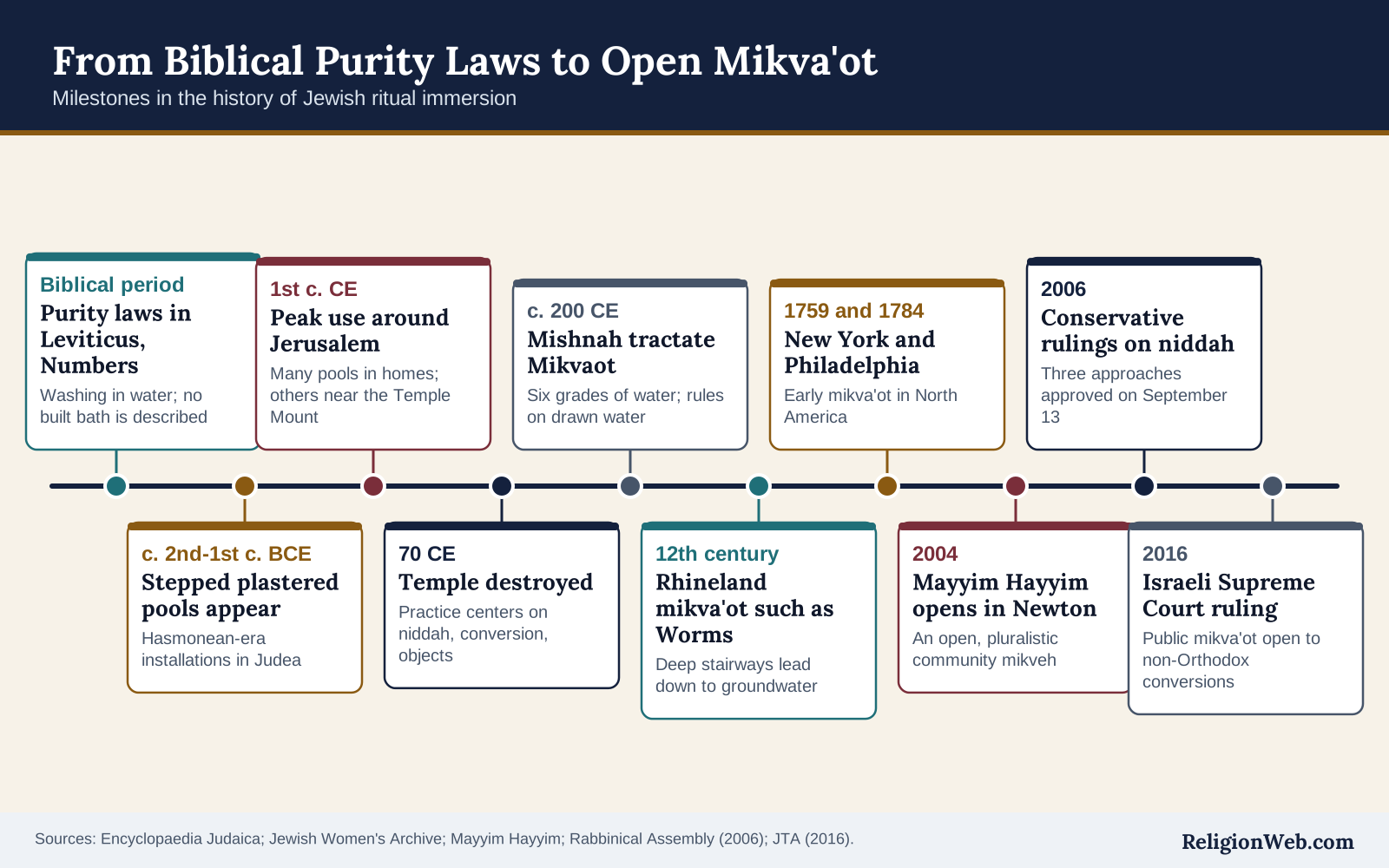
The earliest purpose-built mikva’ot that archaeologists can identify with confidence date from the late Second Temple period. The Encyclopaedia Judaica places the appearance of stepped, plastered pools in the Hasmonean era, around the late second or early first century BCE, with their use peaking in the first century CE, before the destruction of Jerusalem in 70 CE. In Jerusalem, most were found in the basements of private homes, especially in the Upper City, the City of David and the area of Bezetha Hill. Larger installations near the Temple Mount, among them the Bethesda and Siloam pools, are thought by some scholars to have served pilgrims, though that identification is an interpretation of installations that also had other functions.
The typical Second Temple mikveh is a rock-cut or built pool lined with plaster, with steps that run across the full width of the pool. Many have a low partition dividing the stairs into one side for descending and one for coming up, which scholars interpret as a way to keep the impure and the purified from touching. Some have a footbath outside. Hundreds of intact ceramic bowls have been found in mikva’ot at Jericho and Jerusalem, which suggests that some pools were also used to purify vessels. Archaeologists have identified several hundred such installations in Judea and the Galilee, though exact counts vary between studies and have grown as excavation has continued.
Masada, Jericho, Qumran, and debated sites
Some of the best-preserved examples come from fortress and palace sites. The first ancient mikva’ot recognized as such were found at Masada in the early 1960s by Yigael Yadin’s expedition, and further examples were uncovered at Herod’s winter palaces at Jericho and at other Herodian sites. At Masada the pool was far from any spring and was fed with rainwater, so its water was probably stagnant much of the time. That is consistent with the rabbinic principle that ritual validity and cleanliness are different questions.
The water installations at Qumran, near the Dead Sea, remain a subject of scholarly debate. Some researchers, among them the archaeologist Bryant Wood, argued that stepped pools there were ritual baths, noting that the site had far more water capacity than its daily needs required. Earlier excavators, including Roland de Vaux, interpreted some of the same installations differently. The Encyclopaedia Judaica also cautions that the Mishnah’s detailed rules were ideals that were not always followed in practice, and that the spread of home installations may have been driven in part by convenience. For historians, the archaeological record shows widespread, consistent practice, while the exact legal reasoning behind each pool must be inferred.
From Late Antiquity to the Modern Period
Medieval Europe: from the Rhineland to the Mediterranean
After the Roman destruction of Jerusalem the practice continued in Jewish communities in the Land of Israel and in Babylonia, and it spread with Jewish settlement into Europe. The Encyclopaedia Judaica describes a movement from the Land of Israel to Italy and from there to Germany through scholars in Alsace and communities such as Speyer, Worms and Mainz. Surviving medieval mikva’ot include those at Cologne, in use from 1170, at Friedberg, from 1260, at Offenburg, from 1351, and at Andernach, from the fourteenth century. The mikveh in Worms is a monumental structure with 19 steps down to an entrance hall and 11 further steps to the pool. UNESCO inscribed the “ShUM Sites of Speyer, Worms and Mainz” on the World Heritage List in 2021. The listing describes a monumental twelfth-century mikveh in Worms and an underground mikveh at the Speyer Jewry-Court that survives intact.
The Encyclopaedia Judaica adds that in medieval Europe a mikveh sometimes doubled as a bathhouse, because Jews were barred from washing in rivers alongside Christians. This detail shows how a legal institution was shaped by the social conditions of its community. It also reflects the point that, for the sources, a mikveh was a communal necessity on a level with the synagogue and the burial ground.
The Americas and the modern construction
Mikva’ot were established early in North America. The Jewish Women’s Archive notes that one was built in New York in 1759 and another in Philadelphia in 1784, and that New York’s Lower East Side had more than thirty ritual baths in the early twentieth century, when immigration brought large numbers of observant families. During the twentieth century, leaders in several communities complained that many women had stopped observing the laws of niddah, and mikveh use became a minority practice among Jews overall, though one that was maintained intensively by observant communities. In recent decades, new construction has been driven by Orthodox communities, by Hasidic communities, and by pluralistic projects. The Encyclopaedia Judaica notes that modern mikva’ot may include spa-like bathrooms and, in the United States, even salons attached to the facility.
| Period | Evidence | Principal uses and setting |
|---|---|---|
| Biblical period | Leviticus 11, 15 and 16; Numbers 19 and 31 | Washing of body and clothing for purity; immersion in water by priests; no purpose-built installation described |
| Late Second Temple period (about 2nd century BCE to 70 CE) | Stepped, plastered pools at Jerusalem, Masada, Jericho and elsewhere | Household and pilgrim purification; purification of vessels in some pools |
| Mishnaic and Talmudic period (to about 500 CE) | Mishnah tractate Mikvaot; Tosefta; discussions in the Talmud | Codification of water grades, drawn water and contact; conversion and niddah as continuing uses |
| Medieval Europe (about 1100 to 1500) | Cologne, Speyer, Worms, Friedberg, Offenburg and Andernach | Communal installations, sometimes also used as bathhouses |
| Early modern and Hasidic period | Hasidic and kabbalistic teachings on immersion by men | Regular devotional immersion before prayer or Shabbat in some communities |
| Modern period (from the 1700s) | Mikva’ot in New York (1759) and Philadelphia (1784) | Immigrant communities rebuild communal institutions |
| Contemporary period | Pluralistic and “open” community mikva’ot from 2004 | Conversion, niddah, marriage, milestones and healing in liberal communities |
Preparing for and Performing Immersion
Before Entering the Water
Cleansing and the problem of barriers
Immersion begins long before the water. Jewish law requires that nothing stand between the body and the water at the moment of immersion, and the rabbinic term for such an obstruction is chatzitzah, literally “interposition.” Preparation therefore consists of a thorough cleaning of the whole body. My Jewish Learning describes the usual routine: a bath or shower, trimming of nails, brushing of teeth, and the removal of anything that could block contact with the water, such as jewelry, bandages that can be removed, or loose hair that is tangled. Many mikva’ot provide a private preparation room with a bath or shower, a sink and a toilet, together with soap, shampoo, combs and toothbrushes. The preparation is often the longest part of a visit, and some visitors do most of it at home and use the room only briefly.
In Orthodox practice for niddah, the preparation is tied to the calendar. Rabbi Jack Abramowitz, writing for the Orthodox Union’s learning series, explains that on the seventh clean day, while it is still light, the woman washes her whole body with hot water, checks that nothing remains that could form an interposition, and washes and combs her hair so that it is not knotted. This full cleansing, called chafifah, continues until dark, and she immerses right afterward. Questions about whether a particular item, such as a bandage or dental work, counts as a barrier are put to the mikveh attendant or to a rabbi. Opinions differ about how strict to be, and a woman in doubt is advised to ask rather than to guess.
The attendant, privacy, and dignity
In most women’s mikva’ot, an attendant supervises the immersion. My Jewish Learning describes the usual sequence as follows: the visitor is given a towel or robe, signals the attendant by a bell or similar device, and is met at a door that leads directly to the pool. The attendant may offer to check hands, feet or back for stray hair or other barriers, and the visitor may decline. The attendant takes the towel and looks away as the visitor enters the water, then looks only once she is submerged, to confirm that the whole body and all of the hair is under the water and to keep her safe. After the immersion, the attendant returns the towel and may offer a blessing suited to the occasion.
Privacy has long been a concern. In Israel, the organization ITIM petitioned the Supreme Court in July 2015 on behalf of thirteen women who complained of mistreatment by attendants or overly rigorous screening, and who asked that bathers’ privacy be protected. Victims of sexual abuse had asked not to be observed during immersion. A JTA report from June 2016 states that the Chief Rabbinate and the Ministry of Religious Services told the court that an attendant would become optional, so that women could choose to immerse with an attendant, alone or with a friend. The report notes that the Rabbinate still holds that immersion should be attended, and that authorities maintain the attendant’s role is to ensure the immersion is valid under Orthodox law, including full submersion of the hair. The episode shows two values in tension: a woman’s dignity and autonomy, and the community’s concern for the legal validity of the act.
The Immersion Itself
The sequence and the blessing
The physical act is brief. The visitor enters the water and submerges so that the whole body, including all the hair, is covered at once, with nothing held tightly and no part of the body touching the floor or wall in a way that would hold it out of the water. Customs differ on how many times to immerse and when to recite the blessing. My Jewish Learning notes that in Sephardic custom the blessing is recited first and the person then submerges completely for a moment or two, while in Ashkenazic custom the person submerges once, recites the blessing, and then submerges once or twice more. The blessing is the same for converts, brides and women observing niddah: it praises God who sanctifies Jews through the commandments and commands them concerning immersion. Immersions by men for customary reasons do not take a blessing.
Many visitors remain in the water for a time afterward to reflect or pray. Some mikva’ot post texts of the blessing and of additional prayers on a wall, and many liberal and pluralistic mikva’ot offer new prayers composed for specific occasions. Visitors typically pay a fee, which the same source gives as roughly 18 to 36 dollars in North America and which may be higher for conversions, or make a donation toward upkeep. These practical details differ from place to place and from year to year, and visitors are advised to ask a local mikveh ahead of time.
Immersion in rivers, seas, and natural springs
The mikveh is a built installation, but the law does not require a building. The Mishnah ranks flowing springs and rivers highest of all, and the Torah’s own language points in that direction. In the passage on a man with a bodily discharge, the text says that he is to bathe in “living” or running water.
and wash his clothes; and he shall bathe his flesh in running water, and shall be clean.
Leviticus 15:13 (second part of the verse), The Holy Scriptures: A New Translation (Jewish Publication Society, 1917)
The Hebrew phrase translated “running water” is mayim chayyim, literally “living water,” the same category that the Mishnah ranks highest. Rabbinic tradition understood this as authorizing immersion in natural waters of various kinds and, by extension, in the constructed pool whose water is in contact with them. The Tosefta, as noted in the Encyclopaedia Judaica, mentions Rabban Gamaliel and the convert Onkelos bathing in the sea at Ashkelon, a reminder that the sea was a practical option in antiquity. Orthodox sources also treat the sea and natural lakes and rivers as valid for immersion, and some teachers prefer them, subject to cleanliness, safety and modesty. For converts in some Reform settings, a 1995-96 responsum of the Central Conference of American Rabbis (Reform Judaism’s rabbinical body) allows an in-ground swimming pool that meets the halakhic criteria when no mikveh or natural body of water is available, while discouraging the use of a church baptismal pool for reasons of religious syncretism and public perception.
| Stage | What happens | Why it matters |
|---|---|---|
| Scheduling | The visit is set for the legally required time, which for niddah is after nightfall on the seventh clean day | The timing is part of what makes the immersion effective in law |
| Cleansing | Bath or shower, nails trimmed, teeth brushed, hair combed, jewelry removed | Nothing should interpose between the body and the water |
| Check for barriers | The visitor inspects herself, and the attendant may offer to check hands, feet or back | Hair or an adhesive can invalidate the immersion in the view of strict authorities |
| Entering the pool | The attendant looks away until the visitor is in the water | Privacy and modesty are protected |
| Immersion | The whole body, including all hair, is covered at once; the number of immersions follows local custom | Full submersion is the legal act |
| Blessing | Recited before the immersion in Sephardic custom or after the first in Ashkenazic custom | The blessing expresses that immersion is a commandment |
| Reflection and departure | Some visitors stay to pray; the attendant may offer a blessing | Many communities treat the visit as a moment of personal significance |
Family Purity: Niddah and Taharat Hamishpachah
The Source and the Shape of the Law
From Leviticus to the rabbinic count
The laws of niddah are the best-known use of the mikveh. They begin in the Torah, where Leviticus 15 assigns a woman who has a menstrual flow a period of impurity and forbids marital relations during it, and Leviticus 18 and 20 add related prohibitions. The Torah text on menstruation reads as follows in the 1917 Jewish Publication Society translation.
And if a woman have an issue, and her issue in her flesh be blood, she shall be in her impurity seven days
Leviticus 15:19 (opening of the verse), The Holy Scriptures: A New Translation (Jewish Publication Society, 1917)
The verse sets the biblical period at seven days. The rabbis of the Talmud extended the practice, and the result is the system that Orthodox authorities describe today: a minimum of five days of flow, followed by seven “clean” days, after which the woman immerses. The Jewish Women’s Archive summarizes it as a total of at least twelve days of separation. The extension is understood within the tradition as a rabbinic enactment that deliberately builds on the biblical period in order to remove any doubt about when the flow has ended. In the Jewish Women’s Archive’s account, the law of niddah concerns a legal category of ritual purity, not hygiene or health.
What observant couples practice
For couples who observe these laws, the practice is called taharat hamishpachah (“purity of the family”) and, among many Orthodox speakers, simply “family purity.” It affects the marital relationship in a regular, monthly cycle: during the days of separation the couple refrains from sexual relations, and many Orthodox authorities extend the separation to physical contact that could lead to them. After the immersion, relations resume. Orthodox teachers present the cycle as a framework that gives a couple recurring periods of restraint and renewal, and many couples describe it that way. Critics, including some historians of religion and some Jewish feminists, emphasize the burden that falls on women, who carry primary responsibility for the counting. Both views appear in the scholarly literature, and the following sections describe how the law works before turning to the debate.
The Sequence from Onset to Immersion
Counting the days: the hefsek taharah and the seven clean days
The steps are specific. According to the Chabad guidance published at mikvah.org, a woman waits at least five days from the onset of her period, even if the bleeding stops earlier, and then performs the hefsek taharah (“cessation of impurity”): an internal examination with a white cloth shortly before sunset, ideally about twenty minutes before. The cloth shows that the bleeding has ceased, and only the last examination before sunset counts. She then counts seven clean days, beginning on the morning after a successful hefsek. On each of those days she performs two examinations, one after sunrise and one before sunset, and she wears white undergarments and sleeps on a white sheet so that any stain can be seen. If any bleeding or questionable discoloration occurs, the count is interrupted, and she must perform a new hefsek taharah once the bleeding has stopped, without a new five-day wait. A stain of questionable color is shown to a rabbi, and in some communities to a woman trained as a halakhic adviser. The institution of the yoetzet halacha, a woman scholar trained to answer women’s questions on family purity and women’s health, was developed at Nishmat in Jerusalem.
The final stage, the immersion itself, takes place on the night of the seventh day, after nightfall. In the example given by Chabad, if the hefsek takes place on a Thursday, the first clean day is Friday and the seventh is the following Thursday, when she immerses that night. Preparation is as described above. Women who have given birth follow a related sequence with different counting rules, and the details depend on the circumstances. Questions about unusual bleeding, pain or medical conditions belong with a physician first, and the halakhic questions can follow; religious practice does not substitute for medical care.
Resuming marital life and rabbinic guidance
After immersion, the couple may resume marital relations, which is the point at which the status of niddah ends. The subject is private, and communities approach it with reserve. In the Orthodox world, rabbis and halakhic advisers act as consultants in cases of doubt, such as an unclear stain or an irregular cycle, and the questions are typically asked by the woman herself. The law is designed to be observed in a household, not enforced from outside it, and observance depends on the couple’s own commitment and record-keeping.
Variation and Debate
Differences among communities and the Conservative responsa of 2006
The basic structure is shared across traditional communities, but the counting differs in detail. Ashkenazic practice uses a minimum of five days, and the Conservative movement’s 2006 pamphlet notes that some Sephardic authorities count the minimum as four. In the Conservative movement, the Committee on Jewish Law and Standards approved three rulings on September 13, 2006, each offering a different approach. Rabbi Miriam Berkowitz affirmed most traditional observance but allowed the seven clean days to begin counting as soon as the period ends, before the five-day minimum. Rabbi Susan Grossman argued that the stringencies were custom rather than law and permitted intimacy after seven days from the start of the period, provided the bleeding had stopped, and she encouraged the use of the mikveh for other purposes. Rabbi Avram Israel Reisner also allowed immersion after seven days for women with regular periods, while retaining the traditional terminology. Because the committee approves more than one valid opinion, Conservative rabbis and communities choose among them.
Reform and feminist perspectives
Reform Judaism historically did not retain the framework of tumah and taharah. A responsum of the Central Conference of American Rabbis from the mid-1990s notes that Reform does not accept the purity framework, which it links to the Temple service, but it also states that the mikveh is not objectionable to Reform Judaism. The Jewish Women’s Archive reports that some nineteenth-century Reformers called niddah backward, while the Orthodox leader Samson Raphael Hirsch (1808-1888) praised periodic abstinence as spiritually elevating. In his 1930 book The Jewish Way to Married Happiness, the Orthodox rabbi Leo Jung presented family purity as an early form of feminism, a defense that, the same source says, did not persuade most Jewish women. From the 1970s, Jewish feminists debated the laws: some women rejected them as incompatible with equality, while others reclaimed niddah as a ritual that celebrates the cycle of the female body. Rachel Adler argued in the early 1970s that purity should apply equally to men and women, and, after becoming Reform, rejected the laws in the late 1990s as what she called a “slave theology.” Observance of niddah remains a minority practice among Jews overall, but a strongly maintained one within observant communities.
Conversion and Immersion
What the Rabbinic Sources Require
Immersion as a stage of conversion
For Orthodox Judaism and for traditional halakhic reasoning, immersion is a required stage of conversion, known in Hebrew as giyur. Rabbi David Brofsky of Yeshivat Har Etzion summarizes the sources: the Talmud (Yevamot 46b and 47b) describes conversion before a rabbinical court (beit din) of three, and the Shulchan Arukh, the sixteenth-century code of Jewish law, requires the circumcision of male converts, the immersion and the acceptance of the commandments to take place before three qualified judges, during the day. A male convert is not considered Jewish until both circumcision and immersion are complete, according to Yevamot 46b as Brofsky reads it. Authorities differ on technical questions, such as whether a conversion done at night or before fewer judges is valid after the fact, and Brofsky notes that most later authorities follow the more lenient view, while rabbinical courts tend to be more careful about immersion than about circumcision.
The theological meaning that tradition attaches to the act is a rebirth. A convert is regarded as having entered the Jewish people, and traditional teaching often compares a convert to a newborn, with the mikveh as the place where the transition happens. This imagery is common in popular accounts, and it is sometimes linked to the idea of the mikveh as a womb, a theme developed in mystical literature (see the discussion of Kabbalah below). It is an interpretation attached to the ritual and is not part of the technical legal requirements.
Modesty arrangements for female converts
Because the court must be satisfied that the immersion took place, and because a convert must be fully uncovered, the sources address how to protect modesty. The Talmud (Yevamot 47b) describes women seating the convert in the water up to her neck while two scholars stand outside and instruct her about the commandments. Maimonides describes the judges leaving after the woman immerses, so that they do not see her rise from the water. Twentieth-century authorities proposed several arrangements: three women acting as agents of the court, scholars standing at a distance, a robe, or a sheet over the water. In current practice, as Brofsky describes it, the judges commonly enter only after the convert is already in the water and leave soon after she immerses, while women attendants are present.
Conversion Across Movements and in Israel
Different positions on immersion
The movements differ on how they treat immersion in conversion. In Orthodox Judaism it is required. In North American Reform Judaism, the 1893 resolution of the Central Conference of American Rabbis admitting converts without an initiatory rite remains the official position, according to the mid-1990s responsum on a “proper” Reform mikveh. That responsum nonetheless recommends immersion for Reform converts, citing continuity with the Jewish people, solidarity with Progressive Jews in Israel and elsewhere, and Jewish unity, and it states that the choice is not meant to win Orthodox acceptance. That responsum is part of the historical record and may not reflect current policy, so readers should consult the Central Conference of American Rabbis for the present position. Conservative rabbis generally include immersion in conversion, though readers should consult the Rabbinical Assembly’s own sources for the current rules. Pluralistic mikva’ot such as Mayyim Hayyim in Massachusetts report having celebrated their three-thousandth conversion by 2019.
These differences are one reason why the recognition of conversions is a sensitive issue between movements, and why this article does not adjudicate it. The page on Orthodox Judaism describes the rabbinic court system in more detail, and the pages on Reform and Conservative Judaism describe their own approaches to conversion.
The Israeli public mikveh ruling of 2016
A particular legal question arose in Israel, where most public mikva’ot are run by local religious councils under the Ministry of Religious Services. In February 2016 Israel’s Supreme Court ruled that public mikva’ot must admit groups performing non-Orthodox conversions, according to a JTA report, after the justices had proposed a compromise opening three mikva’ot and the ministry refused. The ruling concerned access to the mikveh. The report states that it did not change the position of the Chief Rabbinate, which does not consider non-Orthodox converts Jewish for purposes such as marriage, nor the position of the Population Registry, which recognizes them. The case shows how a ritual facility can become the focus of broader questions about religious authority and civil law.
Other Uses: Weddings, Men’s Immersion, Utensils, and the Dead
Marriage and the Preparation of the Dead
Brides, grooms, and the weeks before a wedding
My Jewish Learning lists three uses that Jewish law requires: conversion, a woman’s immersion before marriage, and immersion for niddah. The pre-wedding immersion is often scheduled in the days before the ceremony, and a close relative or friend commonly accompanies the bride. In Orthodox practice the bride’s immersion is bound up with the family-purity calendar, and the OU’s Rabbi Jack Abramowitz discusses the case of a bride who sees blood shortly before her wedding: if waiting five days would push the wedding past her immersion and postponement is not feasible, she may perform a hefsek taharah at once and begin counting the seven clean days, a route he calls far preferable to holding the wedding while she is in the status of niddah. Some grooms also immerse before the wedding as a custom, and the same source describes this as optional and without a blessing.
Outside Orthodoxy the pre-wedding immersion is more often a chosen ritual than a legal requirement, and a number of liberal rabbis and community mikva’ot encourage couples to visit together or separately, with prayers written for the occasion. The meaning offered for the act varies, from marking a threshold between two states of life to a quiet moment of reflection before a public celebration. Because the visit is private, the details are left to the couple.
Taharah: washing and preparing the deceased
The Hebrew word taharah also names the ritual preparation of a deceased person for burial, performed by a volunteer burial society known as a chevra kadisha. It shares its root with the purity vocabulary of the mikveh but is a separate custom with its own rules. According to a summary by Rabbi Jack Abramowitz for the Orthodox Union, the body is washed carefully with warm water, including the hair, and then water is poured over it in an unbroken flow. The text he summarizes specifies nine kav of water, about 5.5 gallons, and recommends using 24 quarts (six gallons) because the exact volume is disputed. The washers handle the body respectfully and do not turn it face down, which the sources consider disgraceful. The connection to the mikveh lies in the symbolism of purification by water at a threshold of life, and in the care to use water in a prescribed manner. Burial customs differ among communities, and this article describes only the general outline.
Men’s Immersion and Mystical Tradition
Ezra’s ordinance and its later lapse
Immersion by men has an older legal background. The Talmud attributes to Ezra and the Great Assembly a rabbinic decree that a man who had a seminal emission (a baal keri) was to immerse before studying Torah or taking part in prayer. This is a rabbinic enactment and is not stated in the Torah. According to a general reference summary of the rabbinic sources, Maimonides later issued a responsum lifting the decree, on the ground that most of the community had stopped observing it, while still following the stricter practice in his own life, and Joseph Karo’s Shulchan Arukh (sixteenth century) records that the requirement was repealed but that continuing the practice is considered pious. Some Sephardic and Mizrahi communities are said to have kept the practice without interruption. The details of this history are described differently in different sources, and readers who need precision should consult specialist works on the topic.
Hasidic and kabbalistic devotion
Hasidism, the movement that began in eighteenth-century Eastern Europe, revived regular men’s immersion as a spiritual discipline. My Jewish Learning reports that many Hasidic men immerse daily, that others immerse before Shabbat each Friday, and that some communities immerse before Yom Kippur, with these immersions requiring no blessing. Men’s mikva’ot are often casual, usually accept walk-ins, and may hold ten or more people at once. In Orthodox practice more broadly, there is a widespread custom for men to immerse on the day before Yom Kippur, and many also do so before Rosh Hashanah, the three pilgrimage festivals, and Shabbat. These customs are not obligations in the Talmudic sense, and different communities observe different combinations.
The mystical tradition gives these practices a spiritual rationale. An article published by Kabbalah Online, written by Baruch Emanuel Erdstein, calls immersion “perhaps one of the most fundamental keys in divine service, according to the Kabbalah,” citing the nineteenth-century kabbalist Yitzchak Isaac Safrin of Komarno on the value of frequent immersion for spiritual clarity. The same article reports a tradition, introduced with “it is told,” that the founder of Hasidism, the Baal Shem Tov, attributed his mystical achievements to constant immersion. This should be read as a tradition about the Baal Shem Tov and not as a documented statement. The same article says that in Kabbalah prayer, study and meditation are to be delayed until after immersion following marital relations or a seminal emission, that some people immerse several times with specific spiritual intentions, and that some meditate while under the water. For men, immersion before prayer connects the legal idea of purity with the sense of readiness to recite the Shema and the other daily prayers, and to put on tefillin, although the sources discussed here do not make immersion a condition of either.
Utensils and the Home
Tevilat kelim: why new dishes are immersed
The immersion of utensils is the use of the mikveh that most ordinary households encounter. The biblical source is a passage in Numbers 31 about what the Israelites were to do with metal objects taken in battle against Midian.
nevertheless it shall be purified with the water of sprinkling; and all that abideth not the fire ye shall make to go through the water.
Numbers 31:23 (second half of the verse), The Holy Scriptures: A New Translation (Jewish Publication Society, 1917)
The verse deals with the purification of captured objects, and the Talmud (Avodah Zarah 75b) reads the “water” as immersion in a mikveh. Orthodox kashrut authorities, including the Orthodox Union’s kosher division, teach that metal and glass utensils used directly with food that are acquired from a non-Jew require immersion before first use. A blessing is recited for those that come into direct contact with food, and utensils that only touch food before it is edible are immersed without a blessing. My Jewish Learning, in an article by Rabbi Peretz Rodman, explains that immersion is a matter of purification and is not itself a matter of kashrut, even though it is usually discussed alongside the kosher kitchen. In this respect it joins other household practices, such as affixing a mezuzah to the doorpost, which mark a home and its objects as set up for Jewish observance.
Which items, and where practice differs
The materials covered are limited by custom and law. According to the Orthodox Union, wood and plastic utensils do not require immersion, heavy unglazed stoneware generally does not, and glazed fine china is immersed without a blessing. Before immersion, labels, stickers and glue must be removed, the entire item must be submerged at once, and trapped air must be allowed to escape so that water reaches every surface. Larger kitchen appliances raise their own questions and are generally referred to a rabbi. Many mikva’ot have a small separate pool for this purpose, and My Jewish Learning calls it a “kelim mikveh.”
Practice differs among movements. In Orthodox Judaism the law is generally uncontested, and only items made by a Jew and bought directly from a Jewish vendor are exempt. According to Rabbi Rodman, the Conservative movement’s Committee on Jewish Law and Standards upholds the law only in a narrow form, arguing that the sources refer to idolaters and not to all non-Jews, and that corporations are not persons and so are not idolaters even when non-Jewish owned. Liberal movements generally do not follow the practice. Here, as elsewhere in this article, the descriptions are descriptions of what particular communities teach, not an evaluation of which is correct.
The Mikveh Today: Movements, Open Mikva’ot, Gender, and Privacy
How Different Communities Use the Mikveh
Orthodox and Hasidic communities
In Orthodox communities, the mikveh is a piece of communal infrastructure that is built, funded and supervised like a synagogue or a school. A local rabbi or a mikveh committee is responsible for the construction and the inspection, an attendant is trained in the laws, and the facility is open on a regular schedule. Women who observe family purity visit monthly, brides visit before weddings, and converts visit with their rabbinical courts. In Hasidic communities men’s mikva’ot are also busy, particularly on Friday afternoons and before festivals. The facility is normally unadvertised and the visits are private, which is part of why outsiders often have little knowledge of it. The movement pages on Orthodox Judaism describe the legal and communal framework in which this takes place.
Conservative and Reform communities
In Conservative Judaism, the mikveh remains part of the halakhic framework, and a community may build or support one. The 2006 rulings described earlier show the movement’s characteristic approach of offering several valid interpretations within a framework of Jewish law. A Conservative rabbi may recommend immersion for conversion, for brides and, according to the rulings of Rabbi Susan Grossman, for a wider range of life experiences. Reform communities in North America historically did not require immersion and did not accept the purity framework, but some rabbis and members now use the mikveh for conversion and for personal milestones, and a mid-1990s responsum of the Central Conference of American Rabbis called the practice not objectionable and recommended it in the context of conversion. The positions of each movement are explained in more detail in the articles on Conservative Judaism and Reform Judaism.
| Community or setting | Typical uses | Distinctive features |
|---|---|---|
| Orthodox communities | Niddah, conversion, pre-wedding, utensils, customary men’s immersion | Communal construction under rabbinic supervision; trained attendants; laws of family purity observed by committed couples |
| Hasidic communities | Daily or weekly men’s immersion in addition to the above | Men’s mikva’ot with casual access; immersion treated as a devotional discipline |
| Sephardic and Mizrahi practice | The same legal uses; some customs of counting and immersion differ | Blessing before immersion in Sephardic custom; some authorities count a shorter minimum for niddah |
| Conservative (Masorti) communities | Conversion, marriage, niddah for those who observe it, and wider spiritual uses | 2006 rulings give several approved approaches to family purity |
| Reform communities | Conversion and personal milestones for those who choose them | Purity framework not adopted; a mid-1990s responsum recommends mikveh in conversion |
| Open or pluralistic community mikva’ot | Conversion, niddah, weddings, healing and life transitions for people of any background | Welcome people of many movements, genders and abilities; new prayers written for new occasions |
Open and Pluralistic Mikva’ot
Mayyim Hayyim and the open-mikveh model
Since the early 2000s, a number of communities have created mikva’ot designed to welcome Jews of every background. The best known is Mayyim Hayyim (“Living Waters”), which opened on May 14, 2004, in a renovated Victorian house in Newton, Massachusetts. According to its own history page, the author Anita Diamant described the vision in a 2000 essay called “Why I Want a Mikveh,” assembled a founding board in 2001, and hired Aliza Kline as executive director. The mikveh’s founding aim was to offer a place that “encourages the prayers of the heart in Jews of every denomination and description.” Its listed categories of use include marriage, niddah, conversion and affirmation, celebration, healing, life transitions, Shabbat and holidays, and use by men. By 2019 it had counted its 20,000th immersion and its 3,000th conversion.
The Jewish Women’s Archive notes that other inclusive projects have followed, among them ImmerseNYC in Manhattan, envisioned by Rabbi Sara Luria in 2012, and the Queer Mikveh Project in Olympia, Washington, and that pluralistic mikva’ot operate in Boston, Chicago, Los Angeles, Philadelphia and Washington, DC. The open-mikveh model is an organizational one as much as a religious one: it depends on volunteer or trained attendants, on policies of welcome, and on cooperation with rabbis from several movements who use the facility for their own communities’ conversions. It does not claim to replace Orthodox mikva’ot, which operate under their own legal standards.
New rituals for milestones and healing
Liberal and pluralistic communities have added new uses. My Jewish Learning reports that some progressive Jews use the mikveh to mark graduations, becoming b’nai or b’not mitzvah, and birthdays, and for new starts after loss or hardship, including completing a year of mourning or recovering from divorce, assault, abuse or serious illness. The Jewish Women’s Archive adds miscarriage, abortion, fertility or cancer treatment as occasions for which such rituals have been written. New prayers are often composed for these occasions, since the traditional blessing was written for conversion, marriage and niddah. Families who mark a bar or bat mitzvah sometimes include immersion as a quiet private moment.
These uses should be read as expressions of communities’ creativity and spiritual care. They are not medical or psychological treatments, and the people who lead them generally say so. Someone recovering from trauma, a pregnancy loss or an illness is well served by seeing a doctor or counselor as well as by any ritual, and a good mikveh attendant will typically ask about comfort and safety before an immersion.
Gender, Privacy, and Critique
Who the mikveh serves and how it is perceived
The mikveh has long been associated with women because of the family-purity laws, yet men have also used it for centuries, and men’s mikva’ot are part of the infrastructure of many Orthodox cities. The two settings differ in tone: women’s mikva’ot are staffed by attendants who preserve privacy, while men’s mikva’ot are described as casual places that often lack a constant attendant. The perception of the mikveh as a woman’s institution reflects the dominance of niddah and bridal immersion in public discussion, and not a limit in the sources. The Jewish Women’s Archive describes how artists have responded to this: Mierle Laderman Ukeles’s 1986 installation at the Jewish Museum, Helene Aylon’s 2001 work My Bridal Chamber, and the 2001 Mikvah Project by Janice Rubin and Leah Lax, some of them criticizing the practice as patriarchal and others celebrating it as an affirmation of femininity.
Consent, privacy, and dignity
Questions of privacy and consent are central to contemporary discussion. The Israeli petition described earlier arose from women’s complaints about intrusive screening, and from survivors of abuse who did not want to be observed. In many communities attendants are trained to explain every step in advance, to allow visitors to decline an inspection, and to give a person privacy in the water. Pluralistic mikva’ot often make this explicit, and some have policies for people with disabilities and for people of any gender. Different communities strike the balance between the law’s requirement that immersion be complete and the person’s right to control who sees them in different ways, and this tension is likely to remain a live subject of discussion among rabbis, attendants and those who immerse.
Common Misconceptions About the Mikveh
Misconception 1: A mikveh is simply a Jewish swimming pool
Where the misunderstanding comes from
The comparison is understandable. A modern mikveh is often a tiled, heated basin in a clean building, and visitors descend steps into water and submerge. Many communities have also built facilities with spa-style bathrooms, and a visitor who sees only the pool may assume that the difference lies in the atmosphere rather than in the law. The comparison also gains strength from the fact that Jewish law has permitted some constructed pools, and even certain natural bodies of water, to serve as a mikveh when they meet its conditions.
What the evidence and tradition actually show
What defines a mikveh is not the shape of the basin but the status of its water and how it is held. The Encyclopaedia Judaica summarizes the rabbinic rules: the pool must be fixed to the ground and watertight, only undrawn water counts as valid, and a pool below the forty-se’ah minimum can be invalidated by a small quantity of drawn water. A swimming pool filled from a city main with tap water, or a portable tub, does not meet those conditions on its own. A mikveh therefore needs a reservoir of rainwater or another natural source and a lawful connection between that reservoir and the immersion pool, as described earlier.
The purpose also differs. A swimming pool is for exercise or recreation, while a mikveh is for a legal and ritual change of status, preceded by a prescribed cleansing and accompanied, in most cases, by a blessing. The nuance is that a pool is not excluded by its nature. A mid-1990s responsum of the Central Conference of American Rabbis concluded that an in-ground swimming pool can be a proper mikveh for conversion when it satisfies the halakhic criteria and no genuine mikveh or natural body of water is accessible. That conclusion confirms the point: the question is always whether the specific conditions are met, and not whether the object looks like a bath.
Misconception 2: Ritual immersion is only for women
Where the misunderstanding comes from
The public image of the mikveh is dominated by niddah, bridal immersion and the work of women attendants. Books, films and news stories about the mikveh usually concern women, and the family-purity laws are the best-known domain in which a mikveh is required on a regular schedule. Because men’s visits are less often scheduled, less often supervised and rarely discussed in public, many readers conclude that the mikveh is a women’s institution.
What the evidence and tradition actually show
Men have immersed throughout the history of the practice. In the Temple service, the high priest immersed on Yom Kippur according to Leviticus 16 and the Mishnah, and pilgrims were expected to be in a state of purity. Male converts immerse as part of conversion, and the Talmud treats a man’s conversion as incomplete until both circumcision and immersion are done. In later centuries, as noted above, many men followed an ordinance attributed to Ezra on immersion after a seminal emission, and Hasidic communities made men’s immersion a regular devotional discipline. My Jewish Learning notes that many Hasidic men immerse daily, that others immerse before Shabbat, and that grooms sometimes immerse before their weddings. Men’s mikva’ot also exist in many Orthodox cities, often with casual access and no attendant.
It is accurate to say that the laws of niddah apply only to women, and that is the one use of the mikveh that is regular and legally required for a large population. But the mikveh as an institution serves people of all genders, and liberal and pluralistic mikva’ot explicitly welcome men, women and gender-non-conforming Jews alike.
Misconception 3: Every Jewish community uses the mikveh in exactly the same situations
Where the misunderstanding comes from
Outside observers often treat Judaism as a single system, and popular accounts of the mikveh frequently describe Orthodox practice as the practice. Descriptions of niddah or conversion rarely say that the rules apply to particular communities. In addition, the same Hebrew vocabulary appears across movements, which can suggest that the same practices lie behind it.
What the evidence and tradition actually show
The uses of the mikveh vary considerably. In Orthodox Judaism, immersion is required for conversion, for niddah and for a bride, and the immersion of metal and glass utensils is generally uncontested. The Conservative movement’s Committee on Jewish Law and Standards, in three rulings of September 13, 2006, approved different ways of observing niddah, from preserving most traditional counting to permitting immersion after seven days from the start of a period. For utensils, the movement upholds the law in a narrower form than Orthodox authorities, as Rabbi Peretz Rodman reports. Reform Judaism historically did not accept the purity framework and has not required immersion for conversion in North America, although a mid-1990s responsum recommends it. Sephardic and Ashkenazic customs differ on the minimum count of days, on the order of the blessing and the immersion, and on men’s customs.
Practice within each group also varies from person to person. Niddah and regular mikveh attendance are a minority practice among Jews worldwide, according to the Jewish Women’s Archive, and many Jews never visit a mikveh at all, or visit only once at conversion or marriage. A more accurate statement is that the mikveh is a shared institution with shared roots, used in different situations and under different legal and personal frameworks.
Misconception 4: The mikveh implies that the body or a woman is dirty or sinful
Where the misunderstanding comes from
English translations of the Hebrew terms tumah and taharah as “impurity” and “purity” suggest moral or physical uncleanliness. Popular accounts of niddah sometimes describe a woman as “unclean,” and critics, including some historians and Jewish feminists, have argued that the laws stigmatize the female body. The vocabulary of “cleansing” in many mikveh explanations also suggests dirt being washed away.
What the evidence and tradition actually show
Within the tradition, tumah is a ritual category and not a moral one. The biblical laws also treat many forms of impurity as part of normal life, including contact with the dead, which was itself a religious duty. The Jewish Women’s Archive describes niddah as a legal category of ritual purity, not a matter of hygiene. The point is reinforced by the law’s indifference to cleanliness in construction: a stagnant rainwater pool, like the one at Masada, can be fully valid. Rabbi Akiva’s teaching in Mishnah Yoma 8:9 presents immersion as a sign of being purified by God, and Orthodox teachers who write about family purity commonly describe the monthly cycle as a source of renewal rather than shame.
The criticism is also part of the record. Some Jewish feminists have argued that the structure of the laws places a burden on women and that the language of impurity carries negative connotations, and other Jewish women have reclaimed the practice as a celebration of the body. Both positions are held by serious people in different communities, and this article describes them without settling the question.
Frequently Asked Questions About the Mikveh
Questions About Meaning and Purpose
What does the word mikveh mean?
Mikveh comes from a Hebrew root meaning to gather, and it means a gathering or collection of water. The same root gives the verb meaning “to hope,” so the word can also mean hope, as in the biblical name for God as the “hope of Israel.” Rabbi Akiva’s teaching in the Mishnah (Yoma 8:9) plays on both meanings.
In English the word has come to mean the ritual bath as an institution. Hebrew speakers use it for the pool and use tevilah for the act of immersing, and the plural is mikva’ot.
Does immersion in a mikveh forgive sin?
No. In Jewish teaching, ritual impurity and sin are different categories, and the mikveh addresses the former. Forgiveness of sin belongs to repentance, prayer and the observances of Yom Kippur. Rabbi Akiva’s teaching connects the two on a symbolic level by saying that God purifies Israel as a mikveh purifies the impure, but the immersion itself is not an act of atonement. Individuals sometimes immerse before Yom Kippur as a spiritual preparation, and that is a custom, not a requirement.
Questions About Visiting and Using a Mikveh
Can someone visit a mikveh out of curiosity?
Policies differ. My Jewish Learning says that nearly every Jewish community has at least one mikveh. Many Orthodox mikva’ot serve women who are observing niddah and brides, and visitors are generally expected to arrive for a religious purpose and to arrange a time in advance. Pluralistic and open mikva’ot generally welcome people for many kinds of occasions, and some offer tours or educational programs. The sensible approach is to contact the local facility, say why you are asking, and follow its guidance.
Is there a fee, and is the water kept clean?
Many facilities charge a fee, which My Jewish Learning gives as roughly 18 to 36 dollars in North America, higher for conversions, or ask for a donation. The same source says that modern mikva’ot typically connect a rainwater tank to a heated, treated pool of tap water, usually chlorinated, and that nearly all have filtration and disinfection systems. This is possible because the law treats validity and hygiene separately, so a mikveh can be both lawful and safe.
Do men and women use the same mikveh?
Typically they use separate facilities or separate hours. Women’s mikva’ot are generally staffed by an attendant and are private, while men’s mikva’ot are described as casual and often lack a constant attendant. Open mikva’ot welcome people of all genders and set their own policies on scheduling and privacy.
Questions About Law and History
Why can’t a mikveh simply be filled from the tap?
Because in rabbinic law, water that has been drawn in a vessel is not valid for a mikveh, and municipal plumbing counts as drawn water. The rules do not require that tap water be avoided altogether. The solution is to hold a quantity of rainwater in a reservoir built into the ground and to connect that reservoir to the immersion pool, so that the tap water in the pool is joined to valid water through contact. Chabad’s construction guidance describes several versions of this arrangement.
How old is the mikveh?
Washing and bathing in water for purification appear already in the Torah, whose texts historians and tradition date in different ways. The earliest stepped, plastered pools identified by archaeologists date to the Hasmonean period, in the late second or early first century BCE, and their use peaked in the first century CE. Medieval mikva’ot such as the one at Worms survive in Europe, and communities in the Americas built them from the eighteenth century.
Is a mikveh really a higher priority than a synagogue?
The Jewish Women’s Archive reports that the Talmud instructs a community with limited resources to build a mikveh before a synagogue. The teaching belongs to the legal discussions collected in the Talmud. Traditional explanations generally treat it as a rule about priority when funds are limited, since a mikveh is needed for conversions and for the observance of family purity, and not as a statement about the relative spiritual worth of prayer and immersion.
Conclusion: A Legal Institution with a Spiritual Vocabulary
What the History Shows
From Temple purity to communal infrastructure
The mikveh began as part of a Temple-centered system of purity and became, after 70 CE, one of the main institutions through which that system was carried into daily life. The archaeological record from Jerusalem, Masada, Jericho and other sites shows a widespread practice in the late Second Temple period, and medieval Rhineland mikva’ot such as those at Worms and Speyer show how communities invested in them. In traditional Jewish law the mikveh is counted among the basic communal institutions, alongside the synagogue.
One institution, many interpretations
Today the mikveh is understood in more than one way. For Orthodox communities, it is the center of the laws of family purity and conversion. For Hasidic men and kabbalistic writers, it is a discipline of devotion. For Conservative and Reform Jews, it is a tradition to be reclaimed, reinterpreted or recommended, and in open and pluralistic mikva’ot it has become a place for marking milestones and for healing. The Jewish tradition itself holds both the technical and the symbolic in view, as in Rabbi Akiva’s play on the two meanings of the word.
How to Keep Exploring
Related practices and pages
Readers interested in the wider system of Jewish practice can continue with the articles on Shabbat, which many men prepare for by immersion, and on kosher food and kitchens, where the immersion of utensils is one element. For the movements and their approaches to law, see the pages on Orthodox, Conservative and Reform Judaism linked above.
Reading the sources
The primary sources are accessible in translation. Leviticus 11 and 15 and Numbers 19 and 31 are the biblical foundations, and the Mishnah tractate Mikvaot and the discussions of conversion in the Talmud tractate Yevamot are the principal rabbinic ones. Modern translations of the rabbinic texts are often under copyright, and readers should consult reputable editions and rabbinic teachers when they need to apply the law to a particular situation.
Sources
The table below lists the principal external sources behind this article. Facts, dates and figures were checked against these and related primary, institutional and academic materials.
| # | Source | Publisher and type | Used for | Link |
|---|---|---|---|---|
| 1 | Mikveh (Encyclopaedia Judaica entry) | Encyclopedia.com / Encyclopaedia Judaica · Encyclopedia | Definition, water rules, construction, uses, Second Temple archaeology, medieval sites | encyclopedia.com |
| 2 | Leviticus 15:13 and other verses, JPS 1917 (Sefaria API text) | Sefaria · Primary text | Quoted verses Leviticus 11:36, 15:13, 15:19 and Numbers 31:23 in the JPS 1917 translation | sefaria.org |
| 3 | Mikvah Construction | Chabad-Lubavitch (mikvah.org) · Institutional | Modern mikveh designs: contact, sowing, pool above pool; hole and depth measures | mikvah.org |
| 4 | Hefsek Taharah, Seven White Days and Tevilah | Chabad-Lubavitch (mikvah.org) · Institutional | Sequence of niddah counting and night immersion in Chabad practice | mikvah.org |
| 5 | The Mikveh (Shoshanna Lockshin) | My Jewish Learning · Educational explainer | Uses, preparation, attendant, immersion customs, blessing, men's and progressive use | myjewishlearning.com |
| 6 | Tevilat Ha-Ger: Role of the Beit Din and Immersion of Female Converts (Rav David Brofsky) | Yeshivat Har Etzion · Academic/rabbinic study | Conversion immersion in the Talmud and Shulchan Arukh; modesty arrangements | etzion.org.il |
| 7 | A 'Proper' Reform Mikveh (NYP no. 5756.6) | Central Conference of American Rabbis · Institutional | Reform responsum on mikveh for conversion and acceptable bodies of water | ccarnet.org |
| 8 | Teshuvot on Niddah and Mikveh (Berkowitz, Grossman, Reisner), 2006 | Rabbinical Assembly, Committee on Jewish Law and Standards · Institutional | Three Conservative rulings of September 13, 2006 on family purity | rabbinicalassembly.org |
| 9 | Mikveh (Jewish Women's Archive Encyclopedia) | Jewish Women's Archive · Encyclopedia | Niddah history, American mikva'ot, feminist debate, open mikva'ot, art and criticism | jwa.org |
| 10 | Israeli mikvahs must allow non-Orthodox conversions, Supreme Court rules | Jewish Telegraphic Agency · News report | February 2016 Israeli Supreme Court ruling on public mikva'ot | jta.org |
Last fact-check date: 2026-10-21.