A synagogue is a Jewish house of assembly: a building where a community gathers for prayer, public reading of the Torah and study, and where much of the social, educational and charitable life of a congregation takes place. The English word comes from a Greek term meaning “gathering” or “assembly.” In Hebrew the usual name is beit knesset, “house of assembly,” many Ashkenazi Jews say shul, a Yiddish word that means “school,” and some liberal congregations call their buildings temples. Those names are not interchangeable labels for one standard model. Each records a different moment in the history of Judaism and a different idea about what the building is for.
At the front of most synagogues stands a cabinet or niche called the ark (aron kodesh), which holds handwritten scrolls of the Torah, and a reading platform called the bimah serves as the stage for the public reading of those scrolls. Services are held three times a day, with the fullest observance on Shabbat, on festivals and on the High Holy Days. Individuals may pray anywhere, but several of the most important parts of the liturgy are said only with a quorum, a minyan, which traditional law sets at ten adults. The synagogue is, among other things, the place where that quorum reliably exists.
The synagogue is also an institution with a long and uneven history. It is not the Temple in Jerusalem, where priests offered sacrifices until the year 70 CE, and the rabbi who often leads it is a teacher and legal scholar rather than a priest. Orthodox, Conservative (Masorti), Reform, Reconstructionist and independent communities arrange seating, language, music and leadership in different ways, and Jewish communities in Yemen, Poland, Iraq, Spain, India and North America have built very different rooms. This article explains the terminology, the history, the architecture and furnishings, the Torah service and the daily and weekly cycle of prayer, the people who lead and sustain a congregation, the range of movements and regional traditions, and the etiquette a first-time visitor is likely to meet.
At a Glance: What a Synagogue Is and Why It Matters
Definition and Core Functions
A place of assembly, prayer and study
Traditional Jewish sources describe the Jewish house of assembly through three overlapping purposes. It is a house of prayer (beit tefillah), a house of study (beit midrash), and a house of gathering (beit knesset) for communal business, hospitality and mutual aid. The Encyclopaedia Judaica, the standard English reference work on Jewish subjects, defines the synagogue as a place of assembly for worship, education and communal affairs, and that three-part description remains a good starting point for the whole subject. A Friday-night service, an adult class on the weekly Torah portion, a funeral, a wedding, a food drive and a meeting of the board can all happen in the same building within a few days.
These functions did not all arrive together. Worship in the synagogue developed gradually, and after the destruction of the Jerusalem Temple in 70 CE the rabbis of the Mishnah and Talmud placed the prayers of the synagogue at the center of Jewish religious life. The Encyclopaedia Judaica notes that in this period prayer took the place of sacrifice, and it quotes a classical phrase that calls prayer the “service of the heart.” Some rituals once tied to the Temple were carried into the synagogue, while others were deliberately kept out of it because they belonged to the Temple alone. That balance, between borrowing from the sanctuary and refusing to imitate it, shapes much of what follows.
Why the building is important but not indispensable
Jewish law does not say that prayer is valid only in a synagogue. A person may pray at home, at work or on a journey, and in many traditional communities people pray alone when no service is available. What the law does distinguish is public prayer from private prayer. According to Mishnah Megillah 4:3, as rabbinic sources read it, certain acts of public worship, such as the formal call to prayer, the sanctification known as Kedushah, the priestly blessing and the public reading of the Torah and the prophetic portion, are not performed with fewer than ten adults. Rabbinic tradition therefore encourages people to pray with the community in a regular place, and later codes such as the Shulchan Arukh, the sixteenth-century code of Jewish law, treat praying in a synagogue as the preferred way to meet that goal.
The word “preferred” matters. Orthodox, Conservative and Reform authorities hold different views on how binding the communal pattern is, but nearly all of them regard the congregation as the normal setting for Jewish prayer. The Hebrew Bible already imagines a house that is open to everyone. The prophet Isaiah, speaking of foreigners who join themselves to the God of Israel, says in the 1917 Jewish Publication Society translation:
For My house shall be called A house of prayer for all peoples.
Isaiah 56:7, The Holy Scriptures: A New Translation (JPS 1917), via Sefaria (public domain)
Isaiah was speaking of the Temple, not of a synagogue, and nothing in the verse refers to a local congregation. Later Jewish usage nevertheless applied the phrase “house of prayer” to the synagogue, and the Hebrew term beit tefillah remains a familiar name for it. The verse is helpful here because it states an ideal the synagogue is often asked to meet: a place open to the whole people, not just to experts.
Names for the Building
Synagogue, beit knesset and beit midrash
The English “synagogue” reaches us from Greek synagoge through Latin and French. In Greek the word means a bringing together, and it was used of people assembled long before it described a building. Jews in the Greek-speaking Mediterranean world used the word for their congregations and, increasingly, for the places where those congregations met. The Hebrew phrase beit knesset has almost the same literal meaning, “house of assembly,” and appears in the Talmud. A third term, beit midrash, names the study hall. The Encyclopaedia Judaica reports that rabbinic law gives the study hall greater sanctity than the synagogue, because Torah study is the higher activity, and that in practice the two were often the same room or adjacent rooms.
The Greek vocabulary was not uniform. Jewish writers and inscriptions in the ancient diaspora used several Greek terms for such buildings, and some Jewish communities, especially in Egypt, preferred a word meaning “prayer house.” Scholars treat the choice of term as evidence of how a given community understood its building: as a place of assembly, a place of prayer, or a school. Ancient writers such as Philo of Alexandria even speak of synagogues as places of instruction in ancestral law. This ambiguity is part of why no one has been able to point to a single founding moment for the institution, a question taken up in the history section below.
Shul, shtibl, esnoga and temple
Everyday names vary by language and movement. Shul is the Yiddish word for the synagogue and descends from the German word for “school.” It is commonly used by Orthodox, Conservative and many unaffiliated Ashkenazi Jews, and it carries the idea that the synagogue is a place to learn as much as to pray. The Encyclopaedia Judaica adds that immigrant prayer houses in America were commonly called shuls. In Hasidic communities, small prayer rooms are called a shtibl (“little room”) or a klaus, and these informal spaces emerged in the eighteenth century alongside the movement itself. Sephardic congregations have their own vocabulary: the Spanish and Portuguese Jews of Amsterdam and London traditionally called their synagogue the esnoga, a form of the Iberian word for synagogue.
The word “temple” reflects a nineteenth-century reform. In early Reform Judaism, congregations in Germany and the United States named their buildings temples because they no longer prayed for the restoration of the sacrificial Temple in Jerusalem and wanted the local sanctuary to stand as a Temple in miniature for a modern, civic form of Judaism. The Hamburg Temple of 1818, an early landmark of the Reform movement, is the best-known example. Today many Reform congregations and a number of Conservative congregations still use “Temple” in their names, whereas the great majority of Orthodox congregations avoid it, because in traditional usage “the Temple” (Beit HaMikdash) means one building in Jerusalem that has not stood since antiquity. The table below summarizes the main terms.
| Term | Language and origin | Literal sense | Typical use today |
|---|---|---|---|
| Synagogue | English, from Greek synagoge | A gathering or assembly | General English term used across all movements |
| Beit knesset | Hebrew | House of assembly | The standard Hebrew name, used in Israel and in Hebrew texts |
| Beit midrash | Hebrew | House of study | A study hall, whether free-standing, in a yeshiva or inside a synagogue |
| Shul | Yiddish, from German Schule | School | Everyday word among Ashkenazi Jews, especially Orthodox and Conservative |
| Shtibl or klaus | Yiddish | Little room | Small, informal prayer house, closely associated with Hasidic groups |
| Esnoga | Judeo-Spanish and Portuguese | Synagogue | Traditional name among Spanish and Portuguese Jews of Amsterdam and London |
| Temple | English, adopted in the nineteenth century | The Jerusalem sanctuary, applied to a local building | Name of many Reform and some Conservative congregations |
Who Uses a Synagogue and How Many There Are
Members, non-members and visitors
In most parts of the world a synagogue is run as a voluntary association of households. In North America a congregation typically charges annual dues, issues tickets or reserved seats for the High Holy Days, and elects a board and a president, while a salaried rabbi and often a cantor lead services and teaching. In Israel, by contrast, much of what American congregations do, such as marriage registration, burial and Jewish education, is handled by state or independent institutions, so Israeli synagogues are mainly houses of prayer, a point the Encyclopaedia Judaica makes explicitly. In Europe, many communities are organized as a single legally recognized Jewish community with several synagogues under it, as in the long-established arrangement of the United Synagogue in Britain.
Most synagogues also welcome people who are not members. Attendees at a bar or bat mitzvah, a wedding or a funeral are often not regular worshipers, and visitors from other Jewish communities or from outside the Jewish community are common. How freely a stranger will be welcomed, what is expected of them and which parts of the service they may take part in depend on the congregation. Later sections on etiquette and on movement differences take up these questions.
How many synagogues there are
There is no single reliable global count. The Encyclopaedia Judaica gives a snapshot for the United States in 2001: 3,727 synagogues, of which 1,501 were Orthodox, 976 were Reform and 865 were Conservative, with 995 in New York City alone. It also reports that Israel had about 800 synagogues in 1948 and about 6,000 by 1970. These numbers show two things that remain true today. In that year Orthodox synagogues outnumbered the other two groups in the United States, a figure that reflects how many small congregations and prayer rooms exist rather than how many people attend them. And counting synagogues depends on definition: a Hasidic prayer room in a basement, a hospital chapel and a city’s flagship building are all synagogues in some sense. Current figures should be taken from national or movement directories, and any number quoted here should be read with its year.
The sections that follow begin with the physical space, because the objects in it carry much of the religious meaning, and then move through history, the Torah service, the daily and festival cycle, the people who lead, the differences among communities, the wider work of a congregation and the practical etiquette of visiting.
Inside a Synagogue: Layout, Furnishings and Sacred Objects
Orientation and Building Rules
Facing Jerusalem
The single most important rule of orientation comes from the way Jews pray, not from the building. Rabbinic law directs a person who recites the central prayer of every service, the Amidah (“standing” prayer), to face Jerusalem, and in Jerusalem itself to face the Temple Mount. A synagogue is therefore built so that its main wall, the one holding the ark, points toward Jerusalem. The Encyclopaedia Judaica states that synagogues face Jerusalem for this reason. For congregations in Europe and North America this usually means a wall to the east or southeast, which is why the east wall is called the mizrach (“east”) and why a decorative plaque with that name often hangs on the wall that faces toward Jerusalem in homes as well as synagogues. For congregations farther south, in Jerusalem itself, or in places where the bearing to Jerusalem lies in another direction, the wall differs, and some modern buildings depart from the rule when the shape of the site makes it impractical.
The entrance has rules of its own. According to the Encyclopaedia Judaica, an early rabbinic source (the Tosefta) places the entrance on the side nearest Jerusalem, but the later codes recommend the opposite, so that people do not enter facing the ark and then have to turn their backs on it. The same reference notes that a vestibule or entrance hall is preferred, a recommendation connected to a passage in Berakhot 8a. These details can seem small, but they show how the building is shaped by ideas of respect and approach that rabbinic law developed over centuries.
Windows, height and entrance
The rabbinic tradition also asks for windows. The Encyclopaedia Judaica ties the requirement to the book of Daniel, whose hero prays three times a day at an upper-room window opened toward Jerusalem, and it adds that the Shulchan Arukh suggests twelve windows, a standard that is rarely met. A third rule concerns height: the Tosefta (Megillah 4:23) says a synagogue should be the tallest building in its town. Medieval communities that could not build tall under local restrictions sometimes satisfied the principle symbolically by fixing poles to the roof, the same reference reports. Over the centuries many congregations met these rules loosely or not at all, and the existence of a rule is not proof that any given building follows it. The rules mainly show what the rabbis hoped the building would express: openness to prayer, orientation to Jerusalem and a place of honor in the community.

The Ark, the Curtain and the Eternal Light
Aron kodesh and parochet
The ark (aron kodesh, “holy ark,” or in many Sephardic congregations heikhal) is the focus of the room. It is a cabinet, alcove or niche, usually set in the wall that faces Jerusalem and often raised on a few steps, and it contains the Torah scrolls when they are not being read. Its name echoes the Ark of the Covenant, though the two have nothing to do with each other in construction: the biblical Ark held the tablets of the covenant in the Tabernacle and the Temple, whereas the synagogue ark holds scrolls of the Five Books of Moses and, in some places, other texts. Ancient synagogues did not always have a fixed ark. The Encyclopaedia Judaica reports that early arks were portable and were sometimes kept outside the room or in an adjoining space and brought in for the service, and that a permanent ark set into the wall became standard in later periods.
In front of the ark hangs a curtain, the parochet, a word that recalls the curtain that divided parts of the Tabernacle. Curtains are often embroidered or woven, and many congregations change them for the High Holy Days to a white one. Above the ark one commonly finds a representation of the two tablets of the Ten Commandments, often abbreviated by the first letters of each commandment, and an inscription such as “Know before whom you stand.” Lions, crowns and menorahs are common ornamental motifs in many regions. None of these is required by law, so they vary from place to place: a Sephardic ark in Amsterdam, a Polish baroque ark carved of wood and a spare modern ark may all be equally correct in the eyes of the congregations that use them.
When the ark is opened, worshipers customarily stand. The opening of the ark is a formal moment in the service, used for taking out and replacing the scroll, for the most solemn of the High Holy Days prayers and for special prayers during a time of communal distress. It is a mark of respect and not a rite of consecration: nothing inside the ark is believed to change when it is opened, and the ark is not a place where offerings are left. The scrolls are treated with great honor because of what they contain, and the way they are treated says much about the religious value placed on the text.
The ner tamid
Hanging or standing in front of the ark is a lamp called the ner tamid, usually translated “eternal light” or “continual lamp.” The Hebrew phrase appears in the Torah’s instructions for the Tabernacle, where a lamp is to burn continually, and the synagogue lamp is generally understood as a memorial of that sanctuary lamp and as a symbol of the continuing presence of Torah. In earlier centuries it was an oil lamp. Today it is more often electric, though some congregations still maintain a flame. Exact practice varies, and the lamp is a custom rather than a commandment, since the Torah’s lamp belonged to the Tabernacle and the Temple. Even so, it is one of the elements that makes a synagogue recognizable at a glance, and it is a feature shared by Orthodox, Conservative, Reform and other congregations.
The Bimah, Reader’s Desk and Seating
Where the Torah is read
The raised platform from which the Torah is read is called the bimah, a Hebrew word for a platform or high place. Other names are tevah (literally “box” or “chest,” the same word used for Noah’s ark) and, in Sephardic and Middle Eastern communities, almemar, a word the Encyclopaedia Judaica associates with oriental synagogues, whose central almemar sits in the middle of the room with low seating along the walls. The platform carries a table on which the open scroll lies during the reading. The prayer leader typically stands at a smaller lectern called the amud (“pillar” or “stand”), often placed near the ark or on the bimah itself. In the Talmud the person who leads prayer is described as one who “goes down before the ark,” an expression that probably dates from a time when the reader’s desk stood lower than the ark.
Where the bimah stands in the room is one of the clearest differences between traditions. In the older arrangement, the bimah occupies the center, so that all can see and hear the reading, and it is surrounded by seating. The Encyclopaedia Judaica states that this central location was the original one and that placing the bimah at the front of the room, next to the ark, was controversial when it appeared but eventually spread, especially in the United States. Many Sephardic and Mizrahi synagogues, and traditional Polish and Lithuanian buildings, keep the central bimah, while most Reform, Conservative and modern Orthodox synagogues built in the last two centuries place it at the front.
Men’s and women’s seating
Seating is the most visible point of difference among contemporary Jewish communities. In Orthodox congregations, men and women sit apart, separated by a partition called a mechitza or by a balcony. Orthodox authorities generally treat separate seating as a requirement of Jewish law, often pointing to the arrangements made for a festival celebration in the Temple precincts described in Mishnah Sukkah 5:2 and the Talmud’s discussion of it. In Conservative (Masorti) and Reform congregations men and women sit together, and in egalitarian congregations women may lead services, read from the Torah and count in the quorum. Some Orthodox communities now hold “partnership minyanim,” in which women take certain roles within a separated or semi-separated setting, but many Orthodox authorities do not accept these as valid.
The historical record is more complicated than a single rule. The Encyclopaedia Judaica reports that women were regular participants in Hellenistic diaspora synagogues, were not separated from men, and sometimes served as donors and officers. Documents from the Cairo Genizah of the tenth and eleventh centuries show gender separation in Egyptian synagogues together with active participation by women. Separate women’s annexes attached to existing buildings begin to appear in Ashkenazic lands in the twelfth century, and the Spanish and Portuguese synagogues of Amsterdam, built in 1639 and 1675, used balconies for women, a model that spread across Europe. In the other direction, the Hamburg Temple of 1818 built an open women’s gallery meant to bring women into the service, and the synagogue at Newport, Rhode Island, dedicated in 1763, did without grilles or curtains on its gallery. Family pews were introduced in Albany in 1851 and in New York City in 1854. The history shows that the question has been debated within Jewish communities for a long time and that the answers given have varied by place and period.
| Element | Hebrew or traditional name | What it is | Role in worship |
|---|---|---|---|
| Ark | Aron kodesh or heikhal | Cabinet or niche in the wall that faces Jerusalem | Holds the Torah scrolls; opened for the Torah service and special prayers |
| Ark curtain | Parochet | Embroidered or woven curtain in front of the ark | Recalls the Tabernacle curtain; often changed for the High Holy Days |
| Eternal light | Ner tamid | Lamp that is kept burning before the ark | Memorial of the sanctuary lamp; symbol of continuity |
| Reading platform | Bimah, tevah, almemar | Raised platform with a table for the open scroll | Place of the public Torah reading |
| Prayer leader’s stand | Amud | Lectern for the person who leads the prayers | Place from which the cantor or lay leader chants the service |
| Separate seating | Mechitza or women’s gallery | Partition or balcony in Orthodox congregations | Divides men’s and women’s seating where Orthodox practice requires it |
| East wall | Mizrach | The wall that faces Jerusalem | Often the place of honor; marked by a plaque in some buildings |
| Torah scroll | Sefer Torah | Handwritten parchment scroll of the Five Books of Moses | Read aloud on Monday, Thursday, Shabbat, festivals and fast days |
Ritual Objects Worshipers See and Use
Scroll coverings and pointers
A Torah scroll is not displayed bare. In Ashkenazic practice it is wrapped in a cloth binder and dressed in a fabric mantle (me’il), with a breastplate, a crown or a pair of finials (rimonim, “pomegranates”) on the rollers, and a pointer called a yad (“hand”) hangs from it. The pointer exists so that the reader can follow the text without touching the parchment with a bare hand. Sephardic and Middle Eastern communities have long housed the scroll in a rigid cylindrical case, called a tik, which is opened so that the scroll stands upright on the bimah while it is read. These accessories are not strictly required by law, but they are widely regarded as a way of honoring the scroll, and they have been a major field of Jewish craft in silver, textile and wood.
Garments, books and doorposts
Several objects that Jews wear or carry also belong to the synagogue’s visual world. Many adults wear a prayer shawl, the tallit, whose corner fringes recall the commandment about fringes that appears in the third paragraph of the Shema, and many men, and in egalitarian settings many women, wear leather boxes and straps for weekday morning prayer, the tefillin. The head covering, the kippah (Yiddish yarmulke), is the most recognizable sign of a Jewish house of worship in the modern world, although it is a custom that developed over time and is not required by the Torah itself. A copy of the prayer book (siddur), the festival prayer book (machzor) and a printed Five Books of Moses with commentary (chumash) are on seats or shelves, and the entrance doorposts carry a mezuzah, as is traditional on the doors of Jewish homes and public buildings.
Sanctity and the Care of Holy Things
A “little sanctuary” with its own rules
Rabbinic tradition applies a limited version of Temple holiness to the synagogue. The key text is a verse in the book of Ezekiel, spoken to the exiles in Babylon, which the Talmud (Megillah 29a) reads as a reference to synagogues and study houses. In the Jewish Publication Society translation of 1917, God says of the exiles:
Although I have removed them far off among the nations, and although I have scattered them among the countries, yet have I been to them as a little sanctuary in the countries where they are come;
Ezekiel 11:16 (opening clause “Thus saith the Lord GOD” omitted), The Holy Scriptures: A New Translation (JPS 1917), via Sefaria (public domain)
The Hebrew behind “little sanctuary” is mikdash me’at, and the phrase gave later Jewish law a way of speaking about the synagogue as a diminished version of the Temple. Interpreters differ on whether Ezekiel meant buildings at all, since the verse can also be read as saying that God himself would be a refuge, but the rabbinic reading has been influential. As a result, the Shulchan Arukh (Orach Chayim 151, as summarized by the Encyclopaedia Judaica) prohibits frivolity, gossip, eating, sleeping and business inside the synagogue, and it asks that a person leave at a walk. A synagogue cannot be used in ways that lower its sanctity, and a building may not be demolished unless it is replaced or about to collapse. Where a congregation divides, holy objects are shared in proportion to membership.
Worn books and the genizah
A related practice concerns the disposal of texts that bear the name of God or that are otherwise sacred. Worn or invalid Torah scrolls, and printed books that contain sacred texts, are not thrown away. They are buried in a cemetery, or stored in a room or chest called a genizah, a Hebrew word that means “hiding place” or “storage.” The best-known genizah was the one in a synagogue in Fustat, in old Cairo, whose contents were brought to wide scholarly attention in the 1890s and which preserved a very large body of documents from medieval Jewish life, including the records that the Encyclopaedia Judaica draws on for women’s participation in Egyptian synagogues. Smaller congregations today commonly hold an annual or periodic burial of worn sacred texts, and some use an unmarked cabinet in the building.
Origins and Historical Development of the Synagogue
Before the Synagogue: Tabernacle, Temple and Exile
Worship centered on sacrifice
The Hebrew Bible describes a worship life centered first on the Tabernacle, a portable sanctuary, and then on the Temple in Jerusalem. Priests descended from Aaron offered sacrifices there, and the people came on pilgrimage on the great festivals. The First Temple, traditionally dated to the reign of Solomon in the tenth century BCE, was destroyed by Babylon in 586 BCE, and a Second Temple was dedicated in Jerusalem after the return of exiles, with a major rebuilding under Herod in the first century BCE. Rome destroyed that building in 70 CE. Throughout these centuries, the Torah was read and taught in public settings. The book of Nehemiah describes a gathering in Jerusalem in the fifth century BCE at which Ezra the scribe read from the Torah to the assembled people. These scenes are often seen as ancestors of the synagogue’s public reading, but they do not describe a building or an established institution.
Rabbinic tradition, for its part, traced the habit of regular public Torah reading back to Moses. The Encyclopaedia Judaica notes that several ancient sources, among them the Aramaic Targum, the Midrash, the historian Josephus and the Book of Acts, attribute the institution of the synagogue to Moses, and that the Talmud credits Ezra and the “Men of the Great Synagogue” with shaping early prayers. Modern historians treat these attributions as traditional beliefs about authority and continuity, not as evidence about when a building first stood.
Theories about where the synagogue began
Scholars disagree about the origin. The Encyclopaedia Judaica summarizes three main positions: that the synagogue arose in the First Temple period, that it arose in the Babylonian Exile of the sixth century BCE, and that it emerged in the Hellenistic diaspora of the third century BCE and later. The encyclopedia’s author favors the Exile, pointing to the “little sanctuary” verse of Ezekiel quoted earlier, and it cites a talmudic tradition that credited the exiles of King Jehoiachin with a synagogue at Nehardea in Babylonia. An inscribed potsherd from Elath, dated by W. F. Albright to the sixth century BCE and read by one scholar as mentioning “the Synagogue in Jerusalem,” has also been cited, though both its date and its reading are uncertain. Other historians point out that the earliest dated physical evidence is from Egypt in the third century BCE and that nothing securely proves an exilic building. The honest summary is that the institution is older than the earliest firm evidence for it, that no single founding moment is documented, and that scholars continue to debate its roots.
The Second Temple Period: First Firm Evidence
Egypt and the Greek-speaking diaspora
The earliest dated evidence comes from Ptolemaic Egypt. The Encyclopaedia Judaica reports a marble slab from Schedia, near Alexandria, which records a dedication connected to King Ptolemy III Euergetes (reigned 246 to 221 BCE) and Queen Berenice, and a second inscription from Lower Egypt that grants a synagogue the right of asylum. The apocryphal Third Book of Maccabees mentions a synagogue at Ptolemais under Ptolemy IV. Philo of Alexandria, a Jewish philosopher of the first century CE, describes many synagogues in his city. Evidence outside Egypt is also early: the encyclopedia lists a building on the Greek island of Delos in the second century BCE, an inscription at Stobi in Macedonia dated to the first century CE, and a fourth-century synagogue at Ostia, the port of Rome, built over an earlier structure that was probably first-century. In Rome itself, inscriptions attest at least thirteen synagogues.
Judea and the Galilee
In the land of Israel, the clearest early evidence is an inscription from Jerusalem in Greek, from the first century, naming Theodotus, son of Vettenos, as the builder of a synagogue for the reading of the Torah and the teaching of the commandments, together with a hospice for needy strangers. Herodian-era buildings at Masada and Herodium, with stepped benches around the walls, are widely identified as synagogues, and the Encyclopaedia Judaica describes their E-shaped column arrangement. Josephus names synagogues at Tiberias, Dora and Caesarea, and the New Testament writings mention synagogues at Nazareth and Capernaum, a reminder that the synagogue was a normal part of Jewish life in this period. The encyclopedia also records talmudic references to Jerusalem synagogues of the Alexandrians and the Tarsians, and to a synagogue on the Temple Mount itself.
The picture that emerges is one of a decentralized network of local assemblies for reading and explaining the Torah, some in purpose-built halls, some in rooms of private houses, and some run by wealthy donors, who appear in inscriptions as patrons. Women and men, and in some places non-Jews who were interested in the community, took part in different ways, and the buildings did not yet follow a single plan.
After 70 CE: The Rabbinic Synagogue
Prayer takes the place of sacrifice
The destruction of the Second Temple changed the synagogue from one institution among several to the main setting for communal religious life. The Encyclopaedia Judaica notes that prayer came to replace sacrifice, and the rabbis of the Mishnah (completed in the early third century CE) and the Talmud shaped a liturgy of fixed daily and festival prayers that the synagogue carried out. Rabbinic texts offer two explanations for the three daily prayers: one links them to the three patriarchs, and another links them to the daily offerings once made in the Temple. The synagogue developed officials, including an attendant (hazzan ha-keneset), who in time was joined by professional prayer leaders, Torah readers and preachers. The tradition of the “Men of the Great Synagogue” and later regulation of prayer by sages in Israel and Babylonia gave the institution authority, and by the end of the talmudic period it was the institution through which most Jews met the Torah.
Galilee, the Golan and the diaspora in late antiquity
Archaeology of the third to sixth centuries CE shows that Jewish communities in the Roman and Byzantine world invested heavily in monumental synagogues. The Encyclopaedia Judaica identifies more than fifteen “Galilean-type” synagogues of the third and fourth centuries in northern Israel, rectangular halls with their main facade toward Jerusalem, galleries on three sides and no fixed ark. The synagogue at Capernaum, about 360 square meters, is among the largest of them. In later centuries builders experimented with a niche or apse in the Jerusalem-facing wall, as at Eshtemoa, Hammath and Yafi’a, in what scholars call a transitional type.
Decoration could be elaborate. Mosaic floors with the signs of the zodiac, a menorah and ritual objects survive in Israel, among them a fourth-century floor at Hammath Tiberias and a sixth-century one at Beth Alpha. In the Roman world, a large synagogue at Sardis in Asia Minor and the painted synagogue at Dura-Europos in Syria, whose last phase is dated by an inscription to about 244 or 245 CE, show that Jews in the diaspora also decorated their halls with biblical narrative and symbolic imagery. Rabbinic literature does not describe a single approved style. These variations are good evidence that late-antique Jewish communities used the artistic vocabulary of their regions.
Medieval and Early Modern Synagogues
Sephardic and Middle Eastern communities
Under Islamic rule and in medieval Christian Spain, Jewish communities built synagogues in the architectural styles of their regions. The Cairo Genizah, a storeroom attached to a synagogue in Fustat that was filled with documents over several centuries, preserves records of daily life in the Jewish communities of Egypt. More generally, the Encyclopaedia Judaica notes that lost-and-found notices, the results of lawsuits and consolation of mourners were all announced or carried out in the synagogue. In Spain, surviving medieval synagogues in Toledo, such as the one now called Santa Maria la Blanca and the later El Transito, display a fusion of Islamic-influenced ornament and Hebrew inscriptions, and are usually dated to the thirteenth and fourteenth centuries respectively. After the expulsion of Jews from Spain in 1492 and from Portugal a few years later, Sephardic refugees established congregations across the Ottoman Empire and, from the seventeenth century, in Amsterdam and London. The Spanish and Portuguese synagogues of Amsterdam, from 1639 and 1675, set a model of balconied galleries and stately interiors that the Encyclopaedia Judaica says was imitated across Europe.
Ashkenazic communities of Central and Eastern Europe
In the Rhineland, Jewish communities in Speyer, Worms and Mainz formed a close-knit network of medieval communities whose surviving buildings and cemeteries were inscribed on the UNESCO World Heritage List in 2021 as the ShUM sites. Prague’s Old-New Synagogue (Altneuschul), a Gothic hall usually dated to about 1270, is often cited as the oldest synagogue in Europe that is still used for services. Women’s sections, according to the Encyclopaedia Judaica, appear in Ashkenazic synagogues in the twelfth century as annexes added to existing buildings. In Poland and Lithuania, from the sixteenth to the nineteenth century, communities developed a distinctive interior with a central bimah, a richly carved ark, painted walls and, in some regions, wooden buildings. The encyclopedia records that all of Poland’s wooden synagogues were destroyed during the Second World War. In the eighteenth century, the Hasidic movement added the small, informal prayer room, the shtibl, which was often a converted house with no salaried officials.
Modern Reform, Emigration and Destruction
Reform, Orthodox and Conservative buildings
The nineteenth century brought civil emancipation to many Jews in Western and Central Europe and with it a new kind of building. The Encyclopaedia Judaica describes Reform synagogues as purpose-built, elaborate structures with organs, choirs and mixed seating, of which the Hamburg Temple of 1818 is an early example. Orthodox congregations responded by building their own elaborate synagogues, often with women’s galleries, salaried officials and weekday chapels. Moorish Revival, Romanesque and neo-Gothic styles were common, and a number of large urban synagogues of the second half of the nineteenth century, such as Budapest’s Dohány Street Synagogue, are often read as expressions of civic confidence. In North America, the Touro Synagogue in Newport (1763) and the great synagogues of the late nineteenth century stand at two ends of that development. In the twentieth century, Mordecai Kaplan proposed that the American synagogue become a “synagogue center” serving cultural, social and educational needs as well as prayer, an idea that shaped the building programs of many congregations.
The Holocaust and the rebuilding of communities
The destruction of European Jewish life in the Holocaust destroyed synagogues on an enormous scale. The Encyclopaedia Judaica reports that about 280 synagogues in Germany were destroyed in the pogrom of November 1938 known as Kristallnacht, that of Vienna’s 23 synagogues only one survived and was restored in 1964, and that the wooden synagogues of Poland were lost completely. Under Soviet rule, the number of synagogues in the Soviet Union fell from over 400 to about 60 or 65 under Khrushchev, and after the fall of communism a number of buildings were restored by new federations of Jewish communities. In Israel, the Jewish Quarter of the Old City had 58 synagogues before 1948, of which 55 were destroyed during that year’s war, and some were restored after 1967. These details do not capture the human loss, but they show why the surviving synagogues of Europe are treated by many communities as memorials as well as houses of prayer.
| Period | Development | Evidence or example |
|---|---|---|
| Third century BCE | Earliest dated evidence for synagogues in Egypt | Schedia slab honoring Ptolemy III (reigned 246 to 221 BCE) and Berenice |
| Second century BCE | Diaspora building on the island of Delos | Described in the Encyclopaedia Judaica |
| First century BCE to first century CE | Synagogues in Judea and the Galilee | Theodotus inscription in Jerusalem; benches at Masada and Herodium |
| 70 CE | Destruction of the Second Temple | Prayer comes to take the place of sacrifice in rabbinic teaching |
| Third and fourth centuries CE | Galilean-type halls with facades toward Jerusalem | More than fifteen known; Capernaum is among the largest |
| About 244 to 245 CE | Painted synagogue at Dura-Europos | Last phase dated by an inscription |
| Twelfth century | Women’s annexes appear in Ashkenazic buildings | Added to existing synagogues |
| 1639 and 1675 | Spanish and Portuguese synagogues of Amsterdam | Balconies for women; model widely imitated |
| 1763 | Touro Synagogue, Newport, dedicated | Women’s gallery without grilles or curtains |
| 1818 | Hamburg Temple opens | Early Reform building with an open women’s gallery |
| 1938 to 1945 | Destruction of synagogues in Germany and occupied Europe | About 280 destroyed in Germany in November 1938 |
| 2021 | ShUM sites of Speyer, Worms and Mainz inscribed by UNESCO | Medieval synagogue and mikveh sites on the World Heritage List |
The Torah Scroll and the Public Reading
The Scroll in the Synagogue
A handwritten scroll of the Five Books
The object that makes a Jewish assembly into a fully functioning synagogue is the Torah scroll (sefer Torah). It is a handwritten copy of the Five Books of Moses on parchment, written by a trained scribe (sofer) according to detailed rules of script, spacing and layout, and it has no vowels, no punctuation and none of the musical signs found in printed Bibles. Reading it aloud therefore requires preparation. The reader (ba’al koreh, literally “master of the reading”) learns the vowels and the traditional chant, known as cantillation, from a printed text, and then performs from the unmarked scroll. The scroll is distinct from the printed book called the chumash, which members of the congregation follow while the text is read. For a fuller account of the contents, structure and transmission of the text itself, see the article on the Torah.
Because it is the physical expression of the Torah, the scroll is treated with great honor. Congregants stand as it passes, many touch it with the fringe of the prayer shawl or with a prayer book and then kiss the item they touched, and the scroll is never placed on the floor. A scroll that is damaged or invalid is stored, not discarded. The amount of reverence differs among communities, and some liberal congregations place more emphasis on the scroll as a symbol of the people’s relationship with the text than on its status as a holy object. But in virtually every synagogue the scroll’s presence is the thing that gives the room its character.
Why the Torah is read aloud in public
The idea that the Torah should be read to the people, and explained, has a biblical image behind it. The book of Nehemiah describes a great assembly in Jerusalem at which Ezra the scribe read the Torah to men, women and all who could understand. The passage uses a phrase that later readers have treated as the model for the synagogue’s reading. In the 1917 Jewish Publication Society translation it reads:
And they read in the book, in the Law of God, distinctly; and they gave the sense, and caused them to understand the reading.
Nehemiah 8:8, The Holy Scriptures: A New Translation (JPS 1917), via Sefaria (public domain)
Interpreters have long disagreed about what “gave the sense” means. In the classical rabbinic reading associated with the Talmud (Megillah 3a), the phrase refers to translation of the Hebrew into the Aramaic that the people spoke, and the practice of rendering the Torah into Aramaic during the reading, using a text called a targum, is described in the Mishnah. Other interpreters, medieval and modern, have understood the verse to describe the division of the text into sections, the addition of explanation, or a combination of these. Whatever the original sense, the synagogue’s reading has always combined proclaiming the text with explaining it, and the explanation became the sermon, the commentary and the study session.
The Reading Cycle
Weekly portions and the annual cycle
The Torah is divided into 54 weekly portions (parashot; singular parashah), and the standard Jewish practice, rooted in the Babylonian tradition, is to read the whole Torah in a single year, beginning again at the festival of Simchat Torah, the “Rejoicing in the Torah,” which follows Sukkot. The main reading takes place on Shabbat morning, when the weekly portion is read in the congregation and discussed in sermons and classes. Because the Jewish calendar has a leap year, in some years several portions are combined so that the cycle still ends on time. A short passage from the start of the following week’s portion is read at the Shabbat afternoon service.
Public reading is not limited to Shabbat. Rabbinic tradition, which in the Talmud (Bava Kamma 82a) attributes the practice to Ezra, calls for a short reading from the weekly portion on Monday and Thursday mornings, the days when people once came to the market towns from the countryside, so that the people would not go three days without hearing the Torah. Special readings accompany the new moon, the festivals, the fast days, Hanukkah and Purim. Over the course of a year a regular attendee will hear the entire Torah and a sizable part of the prophetic books, and the shape of the Jewish year is partly measured by what is being read.
The triennial cycle and the haftarah
The annual cycle was not the only ancient pattern. The Talmud (Megillah 29b) mentions that in the land of Israel it was customary to complete the Torah over about three years, and fragments from the Cairo Genizah preserve evidence of that older system. Some Conservative (Masorti) and Reform congregations today use a triennial cycle, reading about one third of each weekly portion in a given year, in order to shorten the service and leave room for discussion, while Orthodox congregations nearly all use the annual cycle. Communities that use a triennial cycle usually say so openly and follow published schedules, so that the order remains predictable to visitors.
After the Torah reading on Shabbat and festivals, a passage from the Prophets, the haftarah (“concluding portion”), is read, usually chosen for its thematic connection to the Torah portion or to the season. The reason for this custom is debated. A traditional explanation holds that it began when a ruler once forbade Torah reading and the prophets were read instead, but historians have proposed several other explanations, and the origin remains uncertain. The haftarah also has its own chant, distinct from that of the Torah.
The Torah Service Step by Step
Taking out the scroll
On days when the Torah is read, the service follows a sequence that is highly consistent across Ashkenazic communities and recognizably similar in Sephardic and Mizrahi ones. The ark is opened, the congregation stands, and a short group of biblical verses is chanted. A frequent opening is the verse in Numbers that tells of Moses speaking when the Ark of the Covenant set out. The verses of the Shema, “Hear, O Israel,” are chanted, and the one who carries the scroll takes it in procession through the room, with congregants reaching out to touch it. On the bimah, the scroll is laid on the reading table and its cover is removed.
Sephardic and Mizrahi communities have their own arrangement. The scroll is held in its rigid case, and the case is opened on the bimah so that the scroll stands upright for the reading, while the elevation of the scroll for the congregation to see (hagbahah) occurs before the reading rather than after it, as in the Ashkenazic order. Visitors who follow a service in a book will notice that the prayers in the two traditions are not identical, even though the underlying structure is shared.
Calling people up and returning the scroll
A reading is divided into sections, and each section is assigned to a person who is “called up” (aliyah, literally “going up”) to say a blessing before and after it. The Mishnah (Megillah 4:1 and following) states the minimum number: three people on Monday, Thursday and Shabbat afternoon, four on the new moon, five on a festival, six on Yom Kippur and seven on Shabbat morning. In practice a seventh reader is followed by one who reads a closing passage and chants the haftarah. The honor of the first two aliyot goes, in traditional practice, to a kohen (a male descendant of the priestly family of Aaron) and a levi (a descendant of the tribe of Levi), and the remaining are for Israelites, the rest of the Jewish community. Congregations may call up people to mark a birth, a wedding, a bar or bat mitzvah, an anniversary of a death or a recovery, and the person called often receives a brief blessing for the person or family.
After the reading the scroll is lifted and shown to the congregation, who say a verse from Deuteronomy, and it is then wrapped and dressed (gelilah), the roles of lifting and dressing being honors in themselves. The haftarah is read, a sermon often follows, and prayers are said for the community, for the sick and in many congregations for the government and the State of Israel. The scroll is returned to the ark in procession with a verse from the book of Proverbs, which calls the Torah a “tree of life” to those who hold it. How these steps are arranged, and who may perform them, depends on the community: in Orthodox practice only men are called to the Torah and non-Jews are not, whereas Conservative, Reform, Reconstructionist and other egalitarian congregations call up women and men alike.
| Step | What happens | Notes on variation |
|---|---|---|
| 1. Ark opened | Congregation stands; verses are chanted as the ark is opened | Wording and melodies differ by Ashkenazic, Sephardic and Mizrahi custom |
| 2. Procession | The scroll is carried around the room and congregants touch it | Some congregations do this only on festivals |
| 3. Scroll prepared | The scroll is placed on the bimah and its cover removed | Sephardic scrolls stand upright in a case |
| 4. Aliyot | Individuals are called up; each says a blessing before and after the reading | Seven are the traditional minimum for Shabbat morning; honors are assigned by the gabbai, the lay official who manages them |
| 5. Reading | The reader chants the portion from the unvoweled scroll | Annual or triennial cycle; helpers check the text |
| 6. Hagbah and gelilah | The open scroll is lifted for all to see; then it is dressed | Sephardic communities lift before the reading |
| 7. Haftarah | A passage from the Prophets is chanted | Chosen by the calendar; has its own melody |
| 8. Sermon and prayers | Teaching on the portion; prayers for the community, sick and country | Order and content vary by movement |
| 9. Return | The scroll is carried back to the ark | Accompanied by a verse about the Torah as a tree of life |
Occasions With Special Readings
Bar and bat mitzvah
For many families the first time they enter a synagogue as participants is a bar or bat mitzvah, the ceremony that marks a young person’s entry into the age of religious responsibility. The young person is called to the Torah for the first time as an adult, and often reads part of the weekly portion or the haftarah and gives a short talk on its meaning. The rite grew out of the assumption that every Jewish adult has a share in the reading. In Orthodox congregations a boy is called to the Torah at thirteen, while Conservative, Reform and other egalitarian congregations hold the ceremony for girls as well, and many Orthodox communities mark a girl’s twelfth or thirteenth year with a separate celebration or speech outside the main service.
Festivals that center on the scroll
Several festivals give the scroll an especially prominent role. At Simchat Torah, congregations carry all the scrolls around the room in seven circuits with singing and dancing, read the last portion of Deuteronomy and begin Genesis again, so that the cycle is seen to have no end. On Shavuot, the festival that Jewish tradition associates with the giving of the Torah at Mount Sinai, the Ten Commandments are read, and many communities hold a night of study. Purim is marked by the reading from a scroll of the book of Esther, but that scroll is a separate text, the Megillah, not a Torah scroll. In each case the reading of a text aloud, in public, in the language of the original is what turns a day on the calendar into a shared event.

Prayer Services: The Daily, Weekly and Festival Cycle
The Three Daily Services
Morning, afternoon and evening
Traditional Jewish practice calls for prayer three times a day: Shacharit in the morning, Mincha in the afternoon, and Maariv (also called Arvit) after nightfall. Rabbinic literature gives two accounts of the origin of these services. According to one tradition recorded in the Talmud (Berakhot 26b), the patriarchs Abraham, Isaac and Jacob each established one of the prayers. According to another, the prayers correspond to the daily offerings in the Temple, with the morning and afternoon sacrifices matched by the first two services. The two views are usually presented side by side, not as rivals, and together they reflect the idea that prayer inherited the structure of the sacrificial system without being identical to it. Many synagogues hold the afternoon and evening services back to back so that people can attend both in one trip.
The morning service is the longest of the weekday services. It begins with introductory blessings and psalms, moves to the recitation of the Shema and its surrounding blessings, and then reaches the Amidah, the standing prayer said silently and then, in many congregations, repeated aloud by the leader. On Monday and Thursday mornings the Torah is read, and on Shabbat, festivals and the new moon the service is expanded. Worshipers traditionally wear a prayer shawl, and on weekday mornings men in Orthodox congregations and many men and women in egalitarian ones put on tefillin before the Shema. The afternoon and evening services are shorter. Each of the three services includes the Amidah, and each of them can be completed on its own.
The Shema and the Amidah as the core
Two parts of the liturgy form its backbone. The Shema, a declaration drawn from the Torah that begins “Hear, O Israel,” is recited morning and evening and is surrounded by blessings that frame it; readers can explore its text and meaning in the article on the Shema. The Amidah is a sequence of blessings, nineteen in the weekday form that developed in the rabbinic period, covering praise of God, petitions for knowledge, healing and redemption, and thanksgiving. On Shabbat and festivals the middle petitions are replaced by a single blessing about the holiness of the day. The structure is the same everywhere, but the wording differs among Ashkenazic, Sephardic and Mizrahi prayer books, and liberal movements have adapted passages.
The Minyan and Public Prayer
What requires a quorum of ten
The word minyan, from a Hebrew root meaning “to count,” refers to the quorum of ten adults needed for the formal call to prayer (Barchu), the sanctification known as Kedushah, the public reading of the Torah and the prophetic portion, and the recitation of the Mourner’s Kaddish. The Mishnah (Megillah 4:3) lists such acts of public worship as requiring ten. Where there is no quorum, a person may still pray, and the Amidah and Shema can be said alone, but the parts that depend on community are omitted. For that reason the minyan, much more than the building, is what makes a service a public one, and a synagogue is in practical terms the place where a minyan is dependably available.
Who counts toward the quorum differs. Orthodox authorities count only adult Jewish men. Conservative (Masorti) congregations in North America generally count women as well, following decisions of the movement’s Committee on Jewish Law and Standards in the 1970s, and Reform and Reconstructionist congregations count all adult Jews. The Mourner’s Kaddish illustrates why the question has emotional weight. A person observing a period of mourning for a parent recites it in the presence of a minyan, which means that a mourner is dependent on the community for the chance to say it. Many people first join a synagogue community because of that need.
Who leads the prayer
Jewish prayer is not led by a priest who stands between the people and God. In principle, any competent adult can lead, and the leader, known as the shaliach tzibbur (“emissary of the congregation”), represents the congregation as one of its members. In many synagogues the leaders are lay members who take turns, while larger congregations employ a professional cantor (chazzan), who has special training in the chant. In Orthodox practice the leader must be a man; in egalitarian congregations women and men both serve. The rabbi may teach, preach and guide, but a service can go on without one, which is one reason small prayer rooms with no clergy have been common in many places.
Shabbat in the Synagogue
Friday evening and the welcome of Shabbat
The synagogue week reaches its high point on Shabbat, which begins at sunset on Friday. The Friday evening service starts with Kabbalat Shabbat, “the welcoming of Shabbat,” a sequence of psalms and the hymn Lecha Dodi, “Come, my beloved,” which was composed by the sixteenth-century poet Shlomo Alkabetz in the community of mystics at Safed in the Galilee and is now sung in most Ashkenazic and Sephardic congregations. The congregation customarily rises and turns toward the door for the last verse, to welcome Shabbat as a bride. The connection with the mystical movement of that community is explored in the article on Kabbalah. After the Friday evening Maariv, many congregations recite Kiddush, the blessing over wine that sanctifies the day, and share a meal at a communal table or return home to dine with their families.
Saturday morning, Musaf and the afternoon
Saturday morning is the main Shabbat service and the most heavily attended in most congregations. It includes the standard morning prayers, the Torah service, the haftarah and a sermon or teaching. It is followed by Musaf, the “additional” service, which corresponds to the additional sacrifice once offered on Shabbat in the Temple; some liberal congregations have shortened or omitted it because they no longer pray for the restoration of sacrifice, though practice varies. Many congregations then hold a Kiddush, a light meal or reception in the social hall after the service. Late in the afternoon, the Mincha service and the third Shabbat meal lead into the evening service and the Havdalah ceremony, which marks the end of Shabbat with wine, spices and a braided candle. Whether and how these elements are observed depends again on the movement: in Orthodox and many Conservative communities, Shabbat laws prohibit driving, writing and the use of electricity on the day, so that people walk to the synagogue and no amplified sound or photography is used.
Festivals, High Holy Days and Fasts
Rosh Hashanah and Yom Kippur
The days of greatest synagogue attendance are the High Holy Days. On Rosh Hashanah, the Jewish New Year, the shofar (a ram’s horn) is sounded during the morning service, and a special festival prayer book, the machzor, is used. On Yom Kippur, the Day of Atonement, a 25-hour fast is observed and the congregation spends most of the day in the synagogue, beginning with Kol Nidre in the evening and ending with Neilah, the closing service, at which the ark remains open and the congregation stands. A memorial prayer, Yizkor, is said on Yom Kippur and on the three pilgrim festivals. Many congregations in North America sell or assign seats for the High Holy Days because attendance on those days far exceeds ordinary membership, and this practice has long been a source of both pride and complaint. Those with health conditions are exempt from fasting under traditional Jewish law, and religious practice does not replace the advice of a physician.
Pilgrim festivals, Hanukkah, Purim and fast days
The three pilgrim festivals, Passover, Shavuot and Sukkot, bring special readings and prayers. During Sukkot, congregations hold a daily procession with the palm branch and citron, the lulav and etrog, and many hold services partly in a temporary booth in the courtyard. Hanukkah is marked by lighting the menorah, often in the synagogue as well as at home, with additional prayers of thanksgiving. On Purim, the entire Scroll of Esther is read aloud twice, once in the evening and once in the morning, to a congregation that makes noise at the mention of the villain Haman, and costumes are common. On Tisha B’Av, the ninth day of the month of Av, which commemorates the destruction of the First and Second Temples, the congregation sits low or on the floor, reads the Book of Lamentations and omits normal greetings. More about the holidays can be found in the articles on Passover and Hanukkah.
| Service | Hebrew name | When | Main elements |
|---|---|---|---|
| Morning | Shacharit | Daily, after dawn | Blessings and psalms, Shema, Amidah; Torah reading on Monday, Thursday, Shabbat and festivals |
| Afternoon | Mincha | Daily, in the afternoon | Psalm 145, Amidah; short Torah reading on Shabbat |
| Evening | Maariv or Arvit | Daily, after nightfall | Shema and its blessings, Amidah |
| Welcoming Shabbat | Kabbalat Shabbat | Friday at sunset | Psalms, Lecha Dodi, Friday evening Maariv, Kiddush |
| Additional service | Musaf | Shabbat, new moon and festivals | Additional Amidah that recalls the additional Temple sacrifices |
| Closing of Yom Kippur | Neilah | Late afternoon, Yom Kippur | Final Amidah of the day with the ark open |
| End of Shabbat | Havdalah | Saturday night | Wine, spices and a braided candle |
Language, Music and Liturgy
Nusach and prayer books
Although all traditional services share the same skeleton, the exact text and melodies are called nusach, which means “version” or “formula.” The three main families are Nusach Ashkenaz, the rite of Jews from Central and Eastern Europe, Nusach Sefard, a blend of Ashkenazic wording with Sephardic elements that most Hasidic communities use, and the rites of the Mizrahi and Sephardic communities of the Middle East, North Africa and the Mediterranean. Each major movement also publishes its own prayer books: for instance, the Reform movement’s Union Prayer Book of 1894 and its successors, and the Conservative movement’s Siddur Sim Shalom. These books differ in how much Hebrew they include, whether they offer translation and transliteration, and how they present passages about Temple sacrifice, the restoration of Zion and the role of women.
Music, instruments and silence
Music runs through the service. Orthodox practice traditionally forbids the use of musical instruments on Shabbat and festivals, so prayer is sung by the leader and congregation without accompaniment. In many Reform and some Conservative congregations, organs and choirs are used, a practice the Encyclopaedia Judaica traces to the first Reform synagogues of the nineteenth century. Hasidic communities add wordless melodies, niggunim, as a form of devotion, and cantors in the European tradition developed a repertoire of elaborate solo chant known as chazzanut. Silence also matters: the Amidah is said quietly, and in many communities the room falls still while each person prays individually before the leader repeats the prayer aloud.
Rabbi, Cantor and Lay Leaders: Who Runs a Synagogue
The Rabbi
A teacher and legal authority, not a priest
The word rabbi comes from the Hebrew rav, “great one” or “master,” with the suffix “my,” so that the title means “my teacher.” It was used for the sages of the Mishnah and Talmud, who earned their authority by learning and by being ordained into a succession of teachers, not by descent from a priestly line. In the Middle Ages a community’s rabbi was typically its trained judge and teacher, someone who answered questions of Jewish law, supervised marriage and divorce, and taught. Rabbis in this sense were not necessarily the people who led services, and prayer was often led by someone else. In the nineteenth century, in Germany and later the United States, the role expanded to include preaching in the vernacular, pastoral care, public representation of the community and leadership of services, so that the pulpit rabbi became the central figure of the congregation. Many present-day rabbis spend more of their time on teaching, counseling and administration than on rendering legal decisions.
The difference from a priest is real. In the Hebrew Bible, priests (kohanim) were hereditary members of Aaron’s family who served at the altar and offered sacrifices, and no Jewish authority has claimed that the rabbi inherited that role. A rabbi does not mediate between the congregation and God, does not offer sacrifice or administer sacraments, and is not needed for a Jewish prayer or blessing to be valid. In traditional Orthodox law a marriage is effected by the couple before valid witnesses and a conversion is overseen by a court of three, and a rabbi’s presence is customary and, in civil law, often the legal means of solemnizing a marriage. The rabbi’s authority is the authority of expertise, and it can be limited by the congregation, by the standards of a movement or by the opinion of other rabbis.
Training and ordination across movements
Rabbis are trained and ordained in different ways. Orthodox rabbis typically study in a yeshiva, a school devoted to the Talmud and legal codes, and receive ordination (semikhah) after examination by a senior rabbi or a rabbinical authority. The major non-Orthodox movements established modern seminaries in the nineteenth century: Hebrew Union College in Cincinnati for Reform (1875), the Jewish Theological Seminary in New York for Conservative Judaism (1886), and the Reconstructionist Rabbinical College in Pennsylvania in 1968, each of which grants ordination after a multi-year course of study. In recent decades other independent programs have also ordained rabbis, including those serving pluralistic and community-based synagogues.
The question of women as rabbis has been one of the most visible differences among movements. The Encyclopaedia Judaica reports that the Reform movement in Britain ordained its first woman rabbi in 1975 and that women entered the rabbinate and cantorate in North America from the 1970s. Regina Jonas, who is generally regarded as the first woman ordained as a rabbi, was ordained privately in Germany in 1935; the first in North America, Sally Priesand, was ordained at Hebrew Union College in 1972; and the Conservative movement admitted women to its rabbinical school and ordained them from the mid-1980s. Within Orthodoxy, some institutions train women as religious leaders with titles such as maharat or rabba, but major Orthodox rabbinical bodies have not accepted the ordination of women as rabbis, and the issue remains disputed within Orthodox circles. More on that tradition appears in the article on Orthodox Judaism.
The Cantor and Other Ritual Roles
From attendant to cantor
The cantor, chazzan or hazzan in Hebrew, has a history that shows how roles shifted. In the Mishnah, the hazzan ha-keneset was the synagogue’s attendant or beadle, the permanent official who looked after the building and its scrolls. The Encyclopaedia Judaica records that the professional cantor, the Torah reader and the rabbi or preacher were later additions to this basic staff. Over time the title came to be attached to the prayer leader, and in medieval Europe leading prayer became a skilled vocation. In the nineteenth and twentieth centuries a tradition of virtuoso cantorial performance flourished in Central and Eastern Europe and then in America. Today, cantors in Conservative and Reform congregations are typically trained and invested by movement schools of sacred music, and women have served as cantors in North America since the 1970s.
The reader, the manager and the attendant
Several other roles keep the service going. The ba’al koreh, or Torah reader, has learned the chant of the weekly portion and reads it from the scroll, and a second person stands beside the reader to check the text. The gabbai (plural gabba’im) is a lay official who assigns the honors of the service, such as calling people to the Torah or lifting the scroll, and who keeps the order of the service. The shamash (the “attendant”) or sexton looks after the building, the seating and the books. A ba’al tokea blows the shofar on Rosh Hashanah, and the ba’al tefillah or shaliach tzibbur leads the prayers. In most small and medium congregations these jobs are done by volunteers, which means that a synagogue’s regular worshipers share its work.
| Role | Hebrew term | Typical duties | Variation by community |
|---|---|---|---|
| Rabbi | Rav | Teaching, preaching, legal and pastoral guidance, life-cycle ceremonies | Women ordained in Reform, Reconstructionist and Conservative movements; not accepted by major Orthodox rabbinical bodies |
| Cantor | Chazzan | Chanting the prayers, training readers and children | Women serve as cantors in Reform and Conservative congregations |
| Prayer leader | Shaliach tzibbur | Leads the congregation in prayer | Any competent member; men only in Orthodox practice |
| Torah reader | Ba’al koreh | Chants the weekly portion from the scroll | Often a volunteer; women read in egalitarian congregations |
| Manager of honors | Gabbai | Assigns aliyot and other honors; keeps the order of service | Lay role found in almost all traditional congregations |
| Attendant | Shamash | Maintains the building, books and seating | Salaried or volunteer |
| Priest and Levite | Kohen and Levi | First and second aliyah; priestly blessing in some communities | Hereditary status; weight given differs among movements |
| President and board | Parnas or officers | Budget, staff, membership and building | Elected by members |
Priests, Levites and Israelites in Practice
Kohen and Levi in the Torah service
Jewish tradition preserves the memory of the old priestly families in the synagogue. A kohen is a man who, according to family tradition, descends in the paternal line from Aaron, and a levi is one who descends from the tribe of Levi. In Orthodox and many Conservative synagogues a kohen is called to the Torah first and a levi second. Kohanim traditionally also recite the priestly blessing from the Torah (Numbers 6:24 to 26) on festivals in many Ashkenazic congregations outside Israel, more often in Israel and in some Sephardic communities, and at the ceremony of redeeming a firstborn son, and certain restrictions, such as limits on contact with the dead, apply to them in traditional law. Reform Judaism and some other liberal groups have de-emphasized or set aside these hereditary distinctions, and others retain them as a matter of heritage.
Why the rabbi is still not a kohen
These hereditary roles help explain why Jewish tradition does not treat the rabbi as a priest. Historians often describe the rabbinic movement as one that made learning, rather than birth, the basis of religious authority. A kohen without much learning still receives the first aliyah and may pronounce the blessing, whereas a rabbi without priestly descent holds teaching authority. The two forms of standing therefore operate on different lines: one by birth and one by learning. In today’s synagogue they coexist peacefully, and sometimes in one person, since a rabbi may also be a kohen.
Lay Leadership and Governance
Boards, presidents and committees
Behind the service stand the volunteers and officers who keep the congregation running. In modern North American practice, a synagogue is usually a nonprofit corporation with an elected board and a president. The board sets the budget, hires and evaluates the rabbi and other staff, supervises the building, and sets membership policies. Committees handle the ritual calendar, education, social action, cemetery and finance. Medieval and early modern European communities had similar structures, with elected elders, called parnasim, running the affairs of the community as a legal body. Congregational auxiliaries have long existed: the Encyclopaedia Judaica notes that the Federation of Temple Sisterhoods was formed in 1913, the Women’s League for Conservative Judaism in 1918, and an Orthodox counterpart in 1926.
Burial societies, ushers and security volunteers
Several of the most important tasks in a congregation are done quietly. The chevra kadisha, the “holy society,” is a group of volunteers who prepare the dead for burial in accordance with Jewish law, and in many places it is connected to the synagogue. Ushers and greeters welcome visitors and hand out prayer books. Volunteers also help maintain security: since a number of attacks on synagogues, including the October 2018 shooting at the Tree of Life synagogue in Pittsburgh in which eleven worshipers were killed, many congregations have introduced locked doors, trained greeters, cameras and police coordination. A visitor should expect such measures and cooperate with them, and many congregations ask visitors to call ahead.
Movements and Regional Traditions: How Synagogues Differ
Orthodox, Conservative, Reform and Other Movements
Orthodox and Hasidic synagogues
Orthodox Judaism understands itself as the continuation of the traditional framework of Jewish law, halakha, as developed in the Talmud and later codes, and its synagogues reflect that framework in a consistent way. Men and women sit apart, services are conducted almost entirely in Hebrew with a vernacular sermon, the leaders of prayer and the Torah readers are men, and the observance of Shabbat laws shapes how people arrive, whether they drive or carry items and whether they use electricity or cameras. Within this framework there is great variety. Modern Orthodox congregations tend to be more open to secular education and to wider participation by women in study and communal leadership, whereas Haredi (often called “ultra-Orthodox,” a term many members do not use) communities emphasize separation from broader culture and intensive Torah study. Hasidic communities are centered around a rebbe, a spiritual leader, and meet in a shtibl where prayer may be lengthy and emotionally expressive. The article on Orthodox Judaism explains how these groups relate to one another and to Jewish law.
Conservative (Masorti) synagogues
Conservative Judaism, known as Masorti Judaism outside North America, describes itself as committed to Jewish law and tradition while recognizing that the law develops historically, and its synagogues combine traditional liturgy with change in specific areas. Services are mostly in Hebrew, men and women sit together in nearly all congregations, and in most North American Conservative synagogues women are called to the Torah, lead services and count in the minyan, while some congregations keep a more traditional pattern. The movement’s Committee on Jewish Law and Standards issues rulings on practice, and individual congregations decide within the limits of those rulings. A well-known example is a 1950 ruling by the committee, adopted by majority vote, that permitted driving to the synagogue on Shabbat where distance would otherwise keep a person from attending, a position that sets the movement apart from Orthodox authorities. For more, see the article on Conservative Judaism.
Reform, Reconstructionist and other communities
Reform Judaism, called Liberal or Progressive Judaism in many countries outside North America, began in nineteenth-century Germany, and from its earliest synagogues it emphasized worship in the vernacular alongside Hebrew, organ and choir music, shorter services and mixed seating. Today, the Reform movement emphasizes individual interpretation of tradition and ethical teaching, and many of its congregations use the name Temple, welcome interfaith families to varying degrees and invite women and men to every role. Its approach is discussed in the article on Reform Judaism. Reconstructionist Judaism, which grew from the thought of Mordecai Kaplan, treats Judaism as an evolving civilization and places strong emphasis on communal decision-making. Jewish Renewal draws on Hasidic and mystical traditions in a progressive framework, Humanistic Judaism holds secular services that do not rely on belief in God, and independent lay-led prayer groups, often called minyanim, meet in homes, community centers or rented space and are usually egalitarian. Not all of these groups use the word synagogue, and some deliberately choose other words such as community, havurah (fellowship) or minyan.
| Tradition | Seating | Who leads and reads | Language and music | Typical building or setting |
|---|---|---|---|---|
| Modern Orthodox | Separate, with a partition or balcony | Men lead and read; rabbi is a legal authority | Hebrew with a vernacular sermon; no instruments on Shabbat | Purpose-built hall with a front bimah |
| Haredi and Hasidic | Separate | Men; many Hasidic groups follow a rebbe | Hebrew and Yiddish; wordless melodies | Often a plain shtibl or study hall |
| Conservative (Masorti) | Mixed in most congregations | Men and women in most North American congregations | Mostly Hebrew; instruments only in some settings | Suburban synagogue center with sanctuary and social hall |
| Reform and Liberal | Mixed | Women and men; cantors and rabbis share the pulpit | Hebrew and vernacular; organ or guitar; choirs | Often called a temple; large sanctuary |
| Reconstructionist and Renewal | Mixed | Egalitarian, with strong lay participation | Hebrew and vernacular; participatory singing | Varies; sometimes rented or flexible space |
| Sephardic and Mizrahi | Traditionally separate; central almemar and wall seating in some regions | Men, with lay leadership common | Sephardic and Middle Eastern chant | From grand urban halls to modest prayer rooms |
Regional Architecture and Custom
Sephardic and Mizrahi traditions
Sephardic congregations, whose roots lie in medieval Spain and Portugal, and Mizrahi ones, from the Middle East and North Africa, have distinctive layouts. The Encyclopaedia Judaica notes that in oriental synagogues the seating is low and runs along the walls, with the almemar in the center, and that a chair associated with the prophet Elijah or with Moses may be attached high on a wall. Congregants in these communities commonly lead prayers themselves. In the West, the Spanish and Portuguese synagogue in Amsterdam (1675) and Bevis Marks in London, consecrated in 1701, follow the Amsterdam model of a stately hall with balconied women’s galleries that the encyclopedia says was imitated across Europe. Other historic communities developed their own styles: the island of Djerba in Tunisia, the Cochin community in southern India and the Jewish communities of Yemen and Iraq all produced distinctive buildings, though this article does not attempt a survey of all of them.
Ashkenazic and North American buildings
Ashkenazic synagogue architecture ranges from the Gothic vaults of medieval Prague to the carved wooden prayer halls of Poland and Lithuania and the opulent Moorish Revival synagogues of nineteenth-century Central Europe. In North America, early synagogues such as Touro in Newport (1763) borrowed from colonial public architecture, and later congregations adopted a variety of styles, including Moorish, Romanesque and Classical Revival. In the mid-twentieth century many congregations moved to suburban campuses and built multipurpose buildings combining a sanctuary, school, social hall and offices, an approach consistent with Mordecai Kaplan’s idea of the synagogue center. In recent decades congregations have also moved into converted churches, storefronts and former warehouses, and some new buildings emphasize natural light, flexible seating and accessibility.
Synagogues in Israel
Synagogues in Israel work differently from those in the diaspora. The Encyclopaedia Judaica notes that many functions that American congregations perform, such as education, social services and burial, are handled by state or independent agencies there, so that most Israeli synagogues are houses of prayer. The same reference reports that Israel had about 800 synagogues in 1948 and about 6,000 by 1970, and that Orthodox women’s sections are standard. Alongside the dominant Orthodox and Haredi network there are also Masorti and Reform (Progressive) congregations, which are smaller and which have faced legal and funding disputes with the state over recognition. Neighborhood prayer rooms and congregations organized around particular communities of origin, among them Yemenite, Moroccan, Iraqi, Ashkenazic and Ethiopian, are an important feature of the Israeli landscape.
Synagogue Organizations and Present-Day Patterns
Unions and associations of congregations
Individual congregations are usually independent, but many belong to associations. The Encyclopaedia Judaica lists the Union of Orthodox Jewish Congregations, the United Synagogue (Conservative) and the Union of American Hebrew Congregations (Reform, since renamed the Union for Reform Judaism) as the main American bodies, the World Council of Synagogues for the Conservative movement, and the Union of Synagogues in Israel. In Britain, the United Synagogue is the largest Orthodox body and operates under a chief rabbi, while the Reform and Liberal movements maintain their own federations. These organizations provide prayer books, education, training for staff, advocacy and certification, but they rarely control what a given congregation does week to week, and a local rabbi and board have wide discretion.
Membership, change and uncertainty
Synagogue membership in the twenty-first century is changing. Surveys of American Jews, such as the Pew Research Center’s 2020 study of Jewish Americans, show that the community includes many people who identify as Jewish by religion, culture or family background but who do not belong to a congregation, and that patterns of belonging differ sharply among the movements. Many congregations have responded by lowering dues, offering pay-what-you-can models, experimenting with services for families, interfaith couples and young adults, and streaming services online, a practice that spread widely after 2020. Most Orthodox authorities do not permit streaming on Shabbat and festivals, because those days restrict the use of electronic equipment, so Orthodox congregations that stream do so on weekdays. Communities in Europe and the former Soviet Union face different questions, including how to maintain historic buildings with small populations. The overall picture is of an institution that is both very old and still adjusting to circumstances.
Beyond Prayer: Study, Life Cycle, Charity and Community
Study and Education
The study hall and adult learning
Rabbinic Judaism gives study a place beside prayer. The Encyclopaedia Judaica notes that the study hall, beit midrash, was regarded in law as holier than the synagogue because Torah is studied there, and in many communities the two functions share one building. Classes are the most common form of adult education: a weekly session on the Torah portion, a class on the Talmud (see the article on the Talmud), a study group on the prophets or on the prayer book, or an evening lecture on Jewish history. In traditional circles a page of Talmud a day is studied by individuals around the world on a shared schedule. Some synagogues host a house of study that runs alongside the sanctuary, with its own library and a rotation of people reading aloud and arguing over the text in pairs, a style of learning that is still central in yeshivas.
Study also frames the holiday cycle. Many congregations hold all-night learning sessions on the first night of Shavuot, and Sukkot and Hanukkah are accompanied by discussion groups and lectures. A synagogue that fills its calendar with learning of this kind is following the logic of the older Yiddish word shul, which means school.
Educating children
Most congregations also run programs for young people. They include an afternoon or Sunday school that teaches Hebrew reading, prayer, Jewish history and holidays, a nursery or early childhood program, youth groups and summer camps. Some larger or more traditional communities sponsor full-time day schools in which Jewish and general studies are combined, and Haredi communities typically maintain separate school networks for boys and girls. Preparation for bar or bat mitzvah often occupies a student for a year or more and may be the most intensive encounter with the Hebrew language and the cantillation that many members ever have. The article on bar and bat mitzvah explains the ceremony and its history. Education tends to be a congregation’s largest expense after the building and staff, and it is often what draws young families to join.
Life-Cycle Events
Birth, naming and coming of age
The synagogue is a natural setting for the moments when a family enters the community. A baby boy is traditionally circumcised on the eighth day of life in a ceremony called brit milah, which may be held at home, in a hall or in the synagogue; baby girls are welcomed with naming ceremonies, and in many congregations the infant’s name is announced during the Torah service, when a parent is called to the Torah and a blessing is recited. A child’s first visit to the synagogue, the first reading of Torah and entry into adult obligation are all marked in the congregation. Weekday and Shabbat services are also the setting in which a person may be called to the Torah to mark a birthday, a recovery or the anniversary of a family loss.
Marriage, mourning and memory
Weddings take place in synagogues, in halls, outdoors or at home, depending on custom, and the marriage canopy (chuppah) and the marriage contract (ketubah) are standard features in traditional ceremonies. Funerals are held in the synagogue, in a funeral home or at the cemetery. After a death, close relatives observe a seven-day period of mourning called shiva, and the synagogue often helps by arranging for a quorum to gather at the mourners’ home so that they can say prayers there. During the following eleven months a mourner recites the Kaddish in synagogue services, and each year on the anniversary of the death, the yahrzeit, a memorial candle is lit and the Kaddish is said again. Names of the deceased are often recorded on plaques in the sanctuary. For more on the immersion pool that some congregations maintain nearby, see the article on the mikveh.
Charity, Hospitality and Care
Tzedakah and mutual aid
Charity, tzedakah, is among the central duties of Jewish ethics, and the synagogue has long been a place where it is organized. The Theodotus inscription of first-century Jerusalem, described earlier, mentions a hospice for needy strangers attached to the synagogue, which is among the earliest evidence that the institution cared for travelers. Medieval communities maintained funds for the poor and for the redemption of captives through the synagogue and the communal council. Today’s congregations collect food for local pantries, run clothing drives, visit the sick, provide meals to families in mourning and support social-action projects. Reform Judaism in particular has made social justice, often called tikkun olam (“repair of the world”), a major theme of congregational life, while Orthodox and Hasidic communities typically maintain large networks of charitable societies that operate alongside their prayer houses.
Meals, hospitality and kosher kitchens
Meals are a regular part of synagogue life. A Kiddush after Saturday morning services, a community dinner before a holiday and a meal in the sukkah during Sukkot all bring members together. The Encyclopaedia Judaica notes that talmudic sources prohibit eating in the synagogue sanctuary itself, which is why guest rooms and dining halls were historically built as separate annexes. Congregations that serve food generally follow the rules of Jewish dietary law, described in the article on kashrut, so that all members, including the most observant, can participate. Many invite visitors and newcomers to a Shabbat meal in a member’s home, a practice of hospitality, hachnasat orchim, that is itself a duty in Jewish tradition.
Culture and Community Memory
Social hall, arts and public life
In the twentieth century many synagogues expanded their role as cultural centers, in line with Mordecai Kaplan’s idea of the synagogue center. They host concerts, lectures, film series, book clubs, exercise classes and interfaith events, and many open their doors to community meetings. In earlier centuries the congregation also had a legal and disciplinary role. The Encyclopaedia Judaica notes that the herem, a communal ban, was enforced by barring a person from worship, and that notices of lost property and the results of lawsuits were announced in the synagogue. Contemporary congregations usually have no such authority, and membership is voluntary.
Memorials and heritage
Synagogues keep memory in many ways. Plaques bear the names of donors and of the dead, and a memorial board often lists the dates of yahrzeits. Where Jewish populations have shrunk or vanished, historic synagogues are preserved as museums, memorials or cultural centers, and some are still used for services a few times a year. The UNESCO listing of the ShUM sites of Speyer, Worms and Mainz in 2021 recognizes the medieval Jewish heritage of the Rhineland, and other restored buildings across Central and Eastern Europe serve as places of commemoration. In these contexts a synagogue may be at once a monument, a museum and a living congregation.
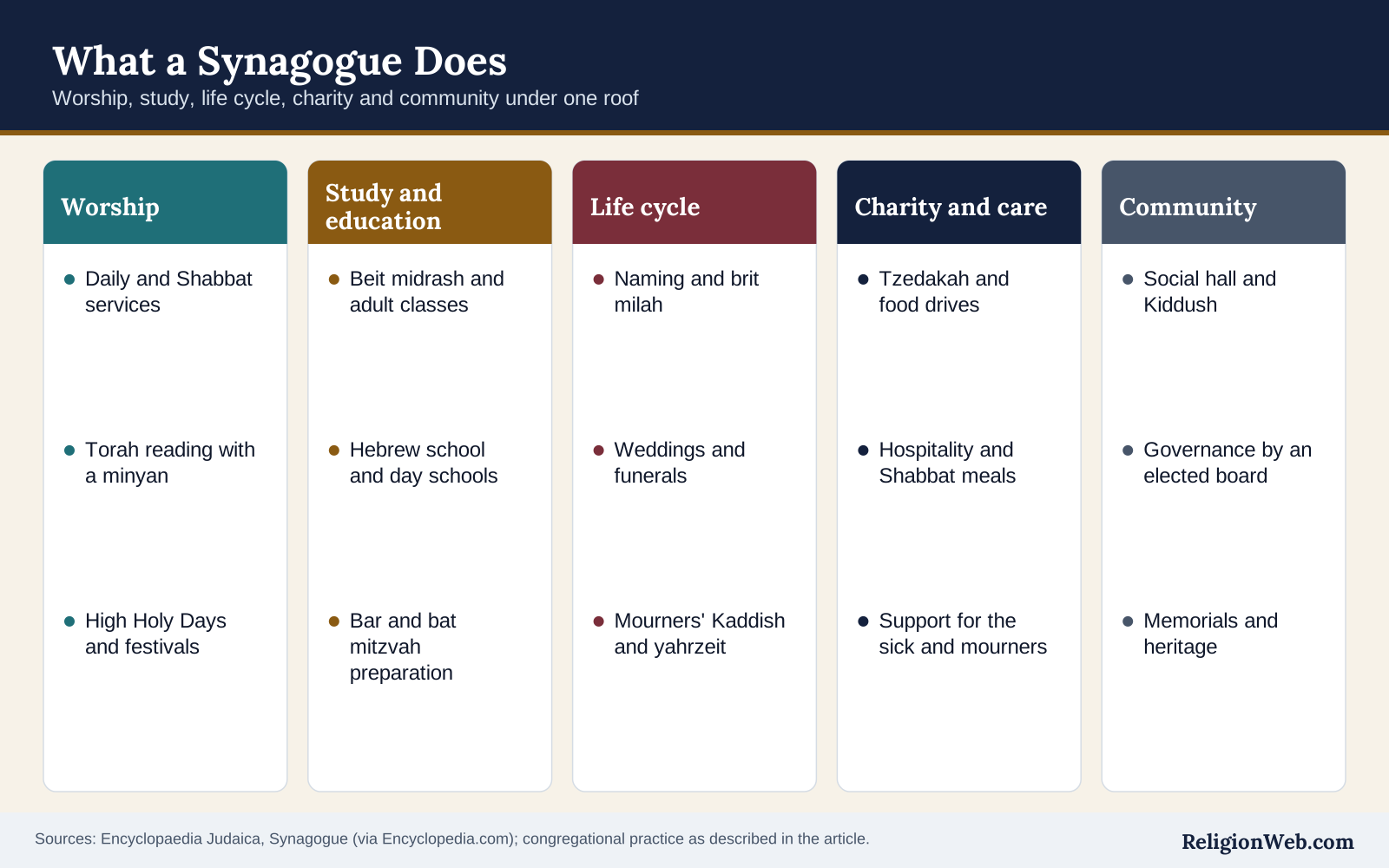
Visiting a Synagogue: Etiquette and Practical Guidance
Before You Go
Contact, timing and security
Most congregations welcome visitors, and many publish service times and a visitors’ guide on their websites. Because rules differ so widely among communities, the best preparation is to contact the synagogue ahead of time, state that you are visiting, and ask about the service, the dress expected, whether a head covering is provided and whether photography is permitted. Many congregations ask that visitors register in advance or show identification at the door, a practice that has grown more common as security has tightened. Arrive a little early so that you have time to be seated and to find the right page in the prayer book. For the High Holy Days, tickets or reservations are often required, and some congregations hold special open services or tours for guests at other times.
It also helps to know how the day is structured. A Friday evening service in many congregations lasts about an hour, and Saturday morning services in traditional communities often run two to three hours. A bar or bat mitzvah is typically a Saturday morning event and is often followed by a lunch. On Shabbat and festivals, members of Orthodox and many Conservative communities do not drive, use electronic devices or handle money, and a visitor who respects those practices on the premises, without fuss, will find the experience smoother. If you plan to drive, ask the synagogue where visitors may park, since some congregations ask guests to leave cars at a distance on those days.
Dress and head coverings
The general rule is modest, neat dress of the sort one might wear to a formal event. In Orthodox congregations, women are generally expected to wear skirts or dresses that cover the knees and tops that cover the shoulders and elbows, and many married women cover their hair; men wear a jacket and trousers. In Conservative, Reform and other liberal congregations, dress is more varied but still dressy. Men, and in many congregations all visitors, are expected to wear a head covering, the kippah or yarmulke, and a basket of them is usually near the door. In some Reform and Reconstructionist congregations a kippah is optional. A tallit is worn by Jewish adults for morning services, and in many traditional congregations by men only, and a visitor who has not been invited to wear one should not do so. If you are unsure, watch what people nearby do or ask a greeter.
During the Service
Sitting, standing and following along
At the start of a service a greeter may hand you a prayer book and a printed chumash. Hebrew books open from what an English reader would call the back, and the page numbers of the service are often announced aloud by the leader. Participants stand for particular sections, such as when the ark is opened, when the Torah scroll is carried, and during certain prayers like the Amidah, and the congregation will indicate when to sit. Visitors are generally expected to follow the posture of those around them. They are not expected to recite anything, and they do not need to bow or kneel. Respectful silence and attention are welcome.
Several actions are best avoided. Do not walk in front of someone who is praying the Amidah, since many worshipers regard the space immediately in front of them as part of their prayer. Do not speak during the Torah reading or the silent prayers. Turn off your phone, and do not photograph, record or write on Shabbat and festivals, when these activities are forbidden in traditional communities. Do not bring food or drink into the sanctuary, and do not touch the Torah scroll with bare hands unless invited to do so, since the parchment is read with a pointer. Children are welcome in most congregations, and many have a children’s service or a quiet room.
Taking part as a guest
How far a visitor may participate depends on the congregation. In an Orthodox synagogue a guest who is not Jewish would not be called to the Torah or counted in the minyan, though everyone may listen and may rise when the congregation does. In a Reform, Reconstructionist or egalitarian Conservative congregation, visitors are sometimes invited to join in a communal song or blessing, and guests at a bar or bat mitzvah may be offered a small role such as opening the ark, although the honor of an aliyah is often reserved for Jews. A visitor who prefers to observe quietly is always welcome to do so. If a visitor is asked to stand or respond in a way that conflicts with their own beliefs, they can simply remain seated, and most communities accept this graciously.
After the Service
Kiddush, greetings and conversation
Many synagogues serve a light meal or refreshments, called a Kiddush, in the social hall after Saturday morning services, and visitors are invited. Wait for the blessings over the wine and bread before eating. The food at synagogue gatherings is usually kosher, and so visitors should not bring their own food. Common greetings are “Shabbat shalom” (“peace of Shabbat”), “Good Shabbos” in Yiddish-influenced usage, and “Chag sameach” (“happy festival”) on holidays. People are generally happy to answer questions, but it is polite to ask about the practice itself, not about members’ personal observance. Because money is not handled on Shabbat in traditional communities, a guest who wishes to make a donation can mail it or give it online afterward instead of offering it on the day.
Weddings, funerals and mourners’ homes
Guests at a wedding in a synagogue may see a marriage canopy, hear the reading of the marriage contract and watch the breaking of a glass at the end, and they should follow the lead of the family on questions of seating and dress. At a funeral, plain dark clothes are usual, the service is brief, and in traditional practice there are no flowers, since the funeral is simple by custom. At a house of mourning during the week of shiva, visitors customarily wait for the mourner to begin the conversation and offer comfort in a quiet manner. When in doubt, ask a friend of the family, a funeral director or the synagogue office, which will be glad to explain.
Common Misconceptions About the Synagogue
Misconception 1: A synagogue functions exactly like a Christian church building
Where the misunderstanding comes from
English speakers often use one set of words for places of worship in general: sanctuary, pulpit, congregation, clergy, choir. Those words are also used in many synagogues, especially in North America, so it is natural to assume that the underlying institutions match. The resemblance is partly real and partly historical. In the nineteenth century, as the Encyclopaedia Judaica describes, Reform synagogues in Germany and the United States were deliberately built with organs, choirs, mixed seating and sermons in the local language, and other movements adopted some of these features for their own reasons. A visitor to a modern suburban synagogue, with its pews, its rows of seats facing a platform and its Sunday school, may reasonably see familiar patterns.
Another source of confusion is the habit of describing the synagogue as the Jewish equivalent of a house of worship that other religions have, which can flatten differences in purpose. Statements of that kind are not wrong, but they leave out what is specific to Jewish history and law.
What the evidence and tradition actually show
The synagogue developed within Jewish history and for Jewish purposes. Its names point to assembly and study. Its central object is a scroll that is read aloud, in a cycle, not an altar. Services follow a structure fixed by the rabbis of the Mishnah and Talmud, with Shabbat observed from Friday evening to Saturday night and festivals set by the Jewish calendar. The building is not strictly required for prayer: an individual may pray anywhere, and a quorum of ten can pray in a home. Many functions in a traditional community, such as teaching Talmud, offering hospitality or arbitrating disputes, belonged to the synagogue and to the study hall for centuries and still do in many places.
Resemblances in architecture and vocabulary should therefore be read as the result of shared surroundings, and as a reflection of how Jewish communities adapted to the societies they lived in, not as evidence of identical function. A congregation in Yemen, one in Poland before 1939 and one in suburban Ohio have each used the same Torah and the same core prayers, but their rooms and rhythms are shaped by different circumstances. No comparison of worth is involved. The point is that the synagogue’s role is best understood from within the Jewish tradition that created it.
Misconception 2: The rabbi is the Jewish equivalent of a priest in every respect
Where the misunderstanding comes from
In North America, the rabbi is the visible leader of a congregation, who officiates at weddings and funerals, gives the sermon, counsels families and represents the community to the public. Civil law and popular usage treat that role as “clergy,” and many newspaper stories refer to a rabbi as a priest or minister. Biblical Hebrew also has a word for priest, kohen, and the Temple in Jerusalem had an active priesthood, so the idea that rabbis succeeded the priests is a natural one.
Translation adds to the blur. English lacks a separate everyday word for a teacher-judge-preacher who is neither a priest nor a minister, and so the nearest available word is used. The Hebrew rav and kohen are not synonyms, and rabbinic literature never treats them as such.
What the evidence and tradition actually show
Jewish tradition distinguishes sharply between the two roles. The priesthood is hereditary, passes through the father from Aaron, and was tied to the sacrificial service of the Tabernacle and the Temple. The rabbinate is a title of learning, earned by study and recognized by teachers, and its authority rests on knowledge of Jewish law. After the Temple was destroyed in 70 CE, priestly functions largely ceased, but descendants of priests kept certain honors and restrictions, such as the first aliyah to the Torah and the priestly blessing. A rabbi who is not a kohen has no priestly duties, and a kohen who is not a rabbi has no teaching authority. Some rabbis are also kohanim.
There is a partial truth in the comparison. Modern pulpit rabbis have taken on pastoral and ceremonial duties, and their role in the community can look similar to that of clergy elsewhere. But a rabbi does not offer sacrifice, does not stand between a person and God, and is not needed for a prayer, blessing or Torah reading to be valid. In many congregations, lay members lead services and read from the scroll, and the Orthodox, Conservative and Reform movements disagree about who may be ordained, but none treats the rabbi as a priest in the biblical sense.
Misconception 3: All synagogues arrange seating and worship identically
Where the misunderstanding comes from
People who have been to one synagogue, or who have seen one in a film, may assume that all are alike. News reports and school textbooks often use a single image, such as a man in a prayer shawl facing an ark, to represent Jewish worship. The shared vocabulary of ark, bimah and Torah scroll reinforces the impression that a single model exists. In some communities, a single movement or style of practice dominates, so a person raised there may not know that others exist.
Photographs and tourist visits can also mislead. A famous historic synagogue, such as a restored baroque hall or a grand nineteenth-century building, shows one regional style at one moment of its history, and a visitor may mistake it for a standard. Because most congregations are small and local, with little public profile, the variety among them is easy to overlook.
What the evidence and tradition actually show
Synagogue practice varies widely, and the differences begin with seating. Orthodox congregations separate men and women, usually by a partition or balcony. Conservative, Reform, Reconstructionist and many independent congregations seat men and women together. The bimah may stand in the center of the room, as in many Sephardic, Mizrahi and traditional Polish buildings, or at the front, near the ark, as in most modern ones. Some congregations use an organ or a choir, while Orthodox congregations do not use instruments on Shabbat. Prayer books differ in wording and in the amount of Hebrew they contain, and some congregations read the Torah on a triennial schedule rather than an annual one.
Differences exist within movements as well. Two Orthodox congregations may differ on the height of a partition, the melody of a prayer or the time at which Saturday morning services begin. Two Reform congregations may differ on whether a kippah is customary. The historical record points the same way: Galilean halls of the fourth century had no fixed ark, medieval Ashkenazic halls added women’s annexes in the twelfth century, and Hasidic prayer rooms of the eighteenth century were small and informal. Variation, in other words, is not a recent departure from a single original model but a normal feature of synagogue history. A visitor who understands this will find it easier to read an unfamiliar room, since each arrangement of seating, bimah and ark expresses a choice made by a particular community at a particular time.
Misconception 4: Only Jews may enter a synagogue
Where the misunderstanding comes from
The impression that outsiders are not welcome comes from several directions. Some parts of Jewish worship are restricted to Jews, such as being counted in the minyan or being called to the Torah in an Orthodox congregation. Security measures at synagogue doors, which have increased in many countries, can make a building look closed. And in a few traditional neighborhoods, a synagogue may be a private prayer room used only by a small group of regulars who do not expect visitors.
History adds a further reason for caution. Jewish communities have often been targets of hostility, and synagogues are among the places where that hostility has been expressed. Congregations that protect their doors do so out of concern for their members, not out of a belief that outsiders have no place in the building.
What the evidence and tradition actually show
In most places, synagogues welcome visitors. The Isaiah verse quoted earlier, which calls the house a place of prayer for all peoples, is sometimes invoked by congregations that hold open services, school visits and interfaith programs. The synagogue’s tradition of hospitality is old: the first-century Theodotus inscription from Jerusalem describes a building for reading and teaching that also had guest quarters for needy travelers from abroad. Today, a visitor is expected to coordinate in advance with the congregation, to dress modestly, to follow the leader’s lead on when to stand and sit, and to respect the practices that apply on Shabbat and holidays. Certain acts are reserved for Jewish participants in many congregations, but attending, listening and learning are generally open.
Some communities, especially smaller Haredi or Hasidic ones, may be more reserved, and a few congregations decline visitors for security reasons. A short call or email ahead of time resolves the question in almost every case. The balance between openness and caution is a live issue for congregations that have faced threats, and visitors are best served by treating security staff as part of the community’s care for those inside.
Frequently Asked Questions About Synagogues
Questions About Names and Origins
What does the word synagogue mean?
“Synagogue” comes from a Greek word meaning “a gathering” or “an assembly,” which passed into English through Latin and French. Its Hebrew counterpart, beit knesset, means “house of assembly.” In both languages the word first described a group of people and then the place where they met, which is why the name emphasizes community and not a particular ritual.
Other names reflect other emphases. Shul recalls the idea of a school, beit midrash names a place of study, and “temple” is used by many Reform and some Conservative congregations. All of them can refer to the same kind of building.
When did the first synagogues appear?
The earliest firm evidence is from the third century BCE in Ptolemaic Egypt, and there is good evidence from the Greek-speaking diaspora and from the land of Israel in the following centuries. Scholars disagree about whether the institution began earlier, possibly in the Babylonian Exile of the sixth century BCE, since the sources do not settle the question. After the destruction of the Second Temple in 70 CE the synagogue became the central setting of communal Jewish worship.
In short, the synagogue is older than the earliest building that can be dated, but its precise origin is uncertain. Anyone who gives a single founding date is simplifying.
Is a synagogue the same as the Temple in Jerusalem?
No. The Temple was a single sanctuary in Jerusalem where priests offered sacrifices, and in the Jewish tradition it is remembered as destroyed in 70 CE. A synagogue is a local assembly place where prayer, Torah reading and study occur, and there can be many in one city. Rabbinic tradition calls the synagogue a “little sanctuary,” borrowing a phrase from Ezekiel, but it limits the comparison and forbids certain Temple rituals from being performed in it.
Some Reform congregations use the word “temple” for their buildings. This is a name, not a claim that sacrifice has been restored, and the sacrificial service is not part of any synagogue.
Questions About Worship and Leadership
Do you need a rabbi to hold a service?
No. Jewish prayer may be led by any competent adult member of the group, and there is no requirement that a rabbi be present. Many small congregations and lay-led groups meet without one, and in Orthodox practice the leader must be a male member of the quorum. A rabbi’s role is to teach, guide and decide questions of practice, not to make prayer valid.
What a service does require, for its public parts, is a quorum of ten adults, the minyan. Who counts toward that number varies by movement.
Why do people read from a scroll instead of a book?
Public reading of the Torah in the synagogue is done from a handwritten parchment scroll because the scroll is the traditional and legally required form for the liturgical reading. A printed book, however useful for study, does not meet the standard in Jewish law for the public reading, and the scroll is treated as an object of special honor. Printed copies are used by the congregation to follow along.
The scroll’s lack of vowels and punctuation means the reader must prepare in advance. That is one reason Torah reading is considered a skill that is taught and honored.
What is a Torah portion and why does it change each week?
The Torah is divided into 54 sections, each of which is read on a particular Shabbat in the annual cycle. The result is that Jews in congregations around the world read the same passage in the same week, which gives the cycle a unifying effect. The cycle begins again after Sukkot, on Simchat Torah, and the schedule depends on the Hebrew calendar.
Many congregations use the weekly portion as the basis of the sermon, a class and a young person’s bar or bat mitzvah speech.
Questions About Visiting and Belonging
Can a non-Jewish person attend services?
In most congregations, yes. Visitors are commonly welcome at Friday evening and Saturday morning services, at life-cycle events by invitation and at open community programs. It is best to contact the synagogue first, as policies on security, dress and participation differ.
Some acts, such as being counted in the minyan or called to the Torah, are reserved for Jews in many congregations, but watching, listening and learning are usually open.
Why do some synagogues have separate seating for men and women?
Orthodox authorities regard separate seating as required by Jewish law, and they arrange it by a partition or a balcony. Conservative, Reform and other egalitarian congregations seat men and women together, and they understand tradition differently. The history is varied: sources describe mixed gatherings in ancient diaspora synagogues, separate annexes in medieval Europe and a gradual return to mixed seating in the nineteenth century in some communities.
Where visitors are unsure, a greeter will show them where to sit. Following the instructions of the congregation is the courteous course.
Do you have to be a member to attend?
No. Membership generally means paying dues, voting in congregational affairs and having a reserved place for the High Holy Days, but anyone may attend a regular service. For the High Holy Days some congregations require tickets from non-members, and others offer free or reduced admission to those who ask. Families who are new to a community can often join a congregation at reduced cost, and most synagogues have a process for those who cannot afford dues.
Contact the synagogue office to learn how it handles visitors and new members. The answers vary from place to place, and the staff expect such questions.
Conclusion: The Synagogue as a House of Assembly
What the History Shows
An institution built by communities, not by decree
The synagogue was not founded at a single moment or by a single authority. It emerged gradually, in different places, as Jewish communities found ways to read, teach and pray together, first beside the Temple and then in its place. Its buildings have been small and large, plain and ornate, Greek in style in Delos, Gothic in Prague, Moorish in Budapest and modern in the American suburbs, and its furnishings, such as the ark, the bimah and the eternal light, have been rearranged as customs changed. What stays constant is the Torah scroll, the minyan and the aim of a shared life of prayer and learning.
Variety within a shared structure
The differences among Orthodox, Conservative, Reform and other congregations are real, and they affect seating, leadership, language and music. They exist alongside a common core of prayers, readings and calendar, so that a Jew from one tradition can often follow the service in another. Understanding the synagogue means keeping both facts in view.
How to Keep Exploring
Related topics on this site
Readers who want to go further can turn to the overview of Judaism, the articles on the Torah and the Shabbat, and the accounts of the festivals that fill the synagogue calendar, from Rosh Hashanah to Yom Kippur and Sukkot. The articles on the mikveh and the mezuzah describe two other physical features of Jewish communal and domestic life.
Visiting in person
The best way to understand a synagogue is to visit one, with permission and in a spirit of respect. A quiet hour at a Friday evening service, a tour led by a volunteer or a public lecture will teach more than any article. The people there are usually pleased to explain what they do and why.
Sources
The table below lists the principal external sources behind this article. Facts, dates and figures were checked against these and related primary, institutional and academic materials.
| # | Source | Publisher and type | Used for | Link |
|---|---|---|---|---|
| 1 | Synagogue (Encyclopaedia Judaica entry) | Encyclopedia.com / Encyclopaedia Judaica (Gale, 2nd ed.) · Encyclopedia | Names, origins debate, early inscriptions, halakhic rules, furnishings, women's seating, modern and Holocaust history | encyclopedia.com |
| 2 | Isaiah 56:7, The Holy Scriptures: A New Translation (JPS 1917) | Sefaria (public domain text) · Primary text | Quoted verse: 'house of prayer for all peoples' (JPS 1917, public domain) | sefaria.org |
| 3 | Ezekiel 11:16, The Holy Scriptures: A New Translation (JPS 1917) | Sefaria (public domain text) · Primary text | Quoted verse: 'a little sanctuary' (JPS 1917, public domain) | sefaria.org |
| 4 | Nehemiah 8:8, The Holy Scriptures: A New Translation (JPS 1917) | Sefaria (public domain text) · Primary text | Quoted verse on Ezra's public reading of the Law (JPS 1917, public domain) | sefaria.org |
Last fact-check date: 2026-10-21.