
Purim is the Jewish holiday that remembers a rescue told in the Book of Esther: a plan, in the Persian Empire, to destroy every Jew in the king’s provinces, and the sudden reversal that spared them. It falls on the fourteenth of the Hebrew month of Adar, usually in late February or March. In Judaism it is classed as a rabbinic festival, which means that its observance rests on the Scroll of Esther itself and on the rulings of the ancient rabbis, not on a command in the Five Books of Moses. It is also one of the most joyful and informal days of the Jewish year.
Four practices stand at the center of the day. Jews hear the whole scroll, called the Megillah, read aloud in the evening and again in the morning. They send gifts of food to friends, known as mishloach manot, and give gifts of money to the poor, known as matanot la-evyonim. They also share a festive meal, the seudat Purim. Around those four duties has grown a body of custom that includes noisemakers, costumes, parodies, plays and hamantaschen, and these customs are what outsiders most often notice.
That visible exuberance sometimes hides how much serious thought the holiday has drawn. The scroll never names God, it contains a violent final act that readers have always had to interpret, and scholars still disagree about when it was written and how the festival began. This article sets out the story, the historical and literary questions, the calendar rules, the laws and customs of the day, and the differences among Jewish communities, describing each point with attribution and distinguishing text, law, custom and scholarly reconstruction.
Purim at a Glance: What the Holiday Marks and How It Is Kept
What Purim Commemorates
A deliverance told in the Book of Esther
The Scroll of Esther, read as sacred scripture in Jewish tradition, tells of a Jewish orphan who becomes queen of Persia, her cousin Mordecai, and a royal minister named Haman who obtains a decree authorizing the killing of “a certain people” on a fixed day. Through Esther’s intervention, the decree is answered by a second edict permitting the Jews to defend themselves, Haman is executed, and Mordecai rises to high office. The scroll then says that Mordecai and Esther wrote to the Jews in every province to keep the fourteenth and fifteenth days of Adar every year. Traditional Jewish teaching holds that the festival began in that way, and Jewish observance has always been framed by the story.
Where the name comes from
“Purim” is the plural of the Hebrew word pur, which the scroll itself explains as “lot.” Esther 3:7 describes Haman casting lots to choose a day for his plan, and Esther 9:26 says the festival takes its name from them. The Encyclopaedia Judaica connects the Hebrew word to an Akkadian term of the same meaning. The name therefore points to chance, and later Jewish writers drew a theological lesson from that: events that look like the roll of a die can, in the view of many Jewish thinkers, be read as moves in a larger design that is not openly visible.
The Four Central Observances
Hearing the scroll, giving to friends, giving to the poor, and feasting
Jewish law counts four duties for Purim day, and most halakhic summaries, from medieval codes to current guides, list them in the same order. The first is the public reading of the Megillah. The next two come from the instruction in Esther 9:22 about “sending portions one to another, and gifts to the poor.” The last is the banquet, which the scroll links with gladness. The table below sets them side by side; later sections explain each in detail, including the minimum amounts, the times and the points on which communities differ.
| Observance | Hebrew name | What it involves | Textual and legal basis |
|---|---|---|---|
| Hearing the scroll | Mikra Megillah | Listening to the entire Book of Esther, once at night and once by day, normally in a synagogue | Rabbinic law (Mishnah and Talmud, tractate Megillah); the scroll calls itself a letter and a record |
| Gifts of food to friends | Mishloach manot | Sending at least two ready-to-eat food items to at least one person on Purim day | Esther 9:19 and 9:22; amounts set by later law |
| Gifts to the poor | Matanot la-evyonim | Giving money or food to at least two poor people | Esther 9:22; amounts set by later law |
| Festive meal | Seudat Purim | A banquet on Purim day, with bread, often with meat and wine, and the added thanksgiving prayer Al HaNissim | Esther 9:22 and 9:17-19, read by the rabbis as requiring feasting |
Joy as a religious value
What sets Purim apart from many other holy days is that joy is the assignment. Jewish tradition has long taught that gladness should increase when the month of Adar begins, and the festival is the point at which that gladness is expected to become visible. The day carries no work prohibition of the kind found on the Sabbath or on the biblical pilgrimage festivals, and fasting is not observed on it. Joy here is not frivolity for its own sake. It is the response to being rescued, and the gifts to friends and to the poor are designed so that the joy is shared widely rather than kept inside one household.
Essential Vocabulary
Terms from the story
A short list of Hebrew words appears throughout any discussion of the holiday. The scroll’s own vocabulary includes the lots (pur), the royal city of Shushan (Susa), and the title Megillah, which simply means “scroll” but has become the name for this scroll above all others. The Encyclopaedia Judaica notes that Esther is the only one of the Five Scrolls to carry the word in its traditional title, and the book also calls itself a “letter” (igeret). The names Haman, Mordecai (Mordekhai), Vashti and Esther, who is also called Hadassah in Esther 2:7, appear in many forms in different languages.
Terms of observance
The vocabulary of practice is mostly Hebrew, with some Yiddish forms in Ashkenazi usage and some Ladino and Arabic forms in other communities. The table gives the terms that appear most often in this article.
| Term | Meaning | Where it appears in practice |
|---|---|---|
| Megillat Esther | The Scroll of Esther, written by a scribe on parchment | Read aloud in the evening and morning of Purim |
| Purim | “Lots,” the plural of pur | The festival’s name, taken from Esther 3:7 and 9:26 |
| Mishloach manot | “Sending of portions” | Gifts of ready-to-eat food, often called shalach manos in Yiddish-influenced speech |
| Matanot la-evyonim | “Gifts to the needy” | Money or food given to poor people on Purim day |
| Seudat Purim | The Purim meal | Held on Purim day, often in the afternoon |
| Ta’anit Esther | The Fast of Esther | A dawn-to-dusk fast on the 13th of Adar |
| Shabbat Zachor | “Sabbath of remembering” | The Sabbath before Purim, with a special Torah reading about Amalek |
| Shushan Purim | Purim of Shushan, the 15th of Adar | Observed instead of the 14th in Jerusalem and other cities walled in Joshua’s time |
| Al HaNissim | “For the miracles” | A prayer of thanks added to the Amidah and the Grace after Meals |
| Gragger (ra’ashan) | A rattle or noisemaker | Used when Haman’s name is read |
The Story of Esther: What the Scroll Tells
The Court of King Ahasuerus
The banquet and the fall of Vashti
The Scroll of Esther opens in the royal capital of Shushan, where King Ahasuerus (the Hebrew form of a Persian royal name rendered Xerxes in Greek) holds a long series of banquets for his officials. At a drinking party he summons Queen Vashti to appear before the guests, and she refuses. On the advice of his counselors, who fear that her example will spread among the wives of the empire, the king removes her from the throne. The Encyclopaedia Judaica entry on the scroll notes that this scene reflects Persian court practice, in which women are said to have left a banquet once the drinking began, though it also points out that such details do not settle whether the story reports actual events.
A Jewish orphan becomes queen
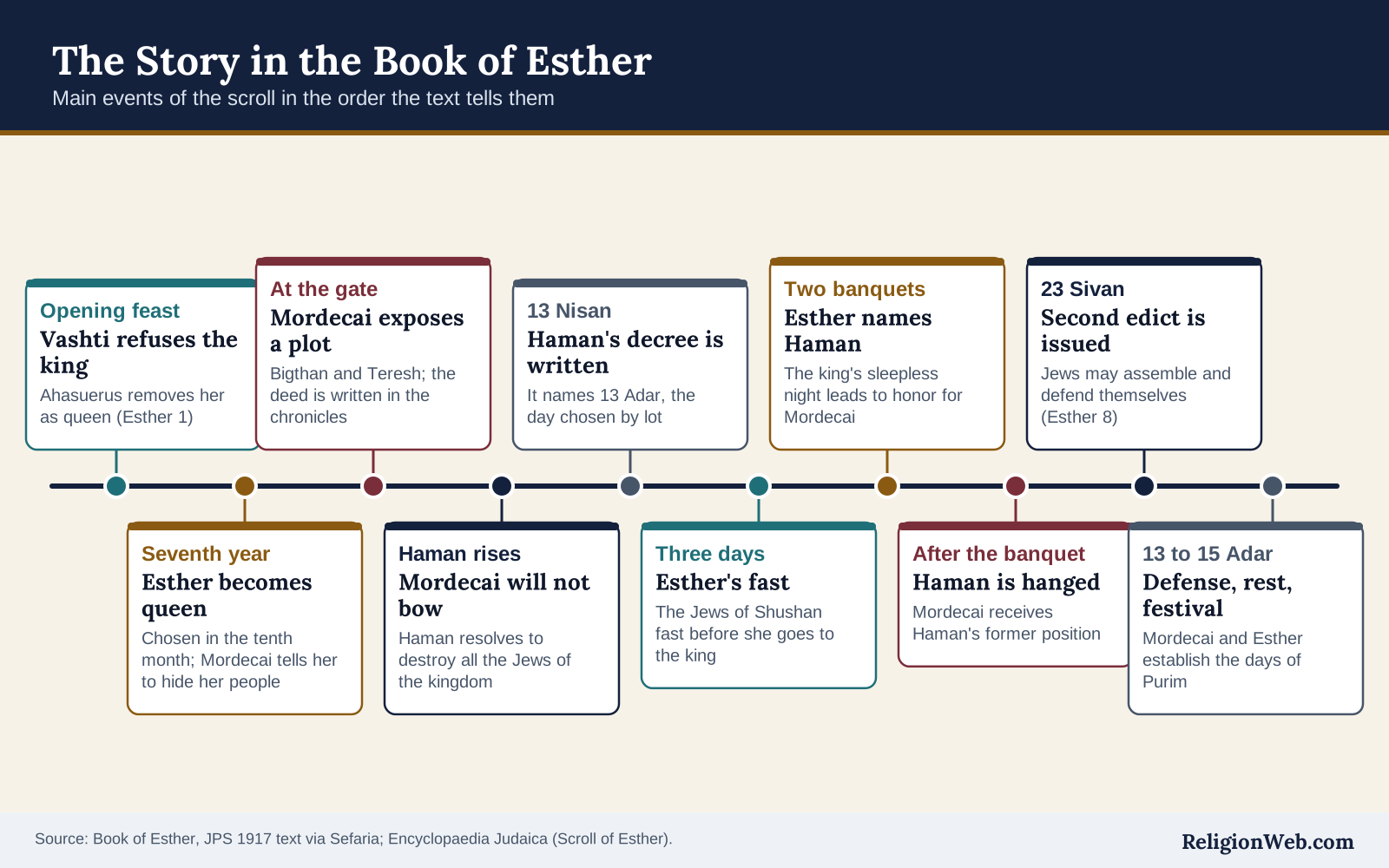
The king’s attendants then gather young women from across the empire. Among them is Esther, also called Hadassah, an orphan raised by her cousin Mordecai, a Benjamite whose family, the scroll says, had been carried from Jerusalem into exile with King Jeconiah (Esther 2:5-7). Following Mordecai’s instruction, Esther does not reveal her people or her family. After a year of preparation she is brought to the king, and in the seventh year of his reign he makes her queen in place of Vashti. Mordecai, who sits at the king’s gate, uncovers a plot by two palace guards, Bigthan and Teresh, and the deed is entered in the royal chronicles. That entry will matter later.
Haman’s Plan and Esther’s Decision
Mordecai will not bow
The king promotes a courtier named Haman, son of Hammedatha the Agagite, above all the other officials, and royal servants at the gate bow to him. Mordecai refuses. The scroll does not explain his reason in so many words, and later interpreters have offered several, among them that Mordecai would not bow to a man identified as an Agagite, a descendant of the people of Amalek whom the Torah commands the Israelites to remember (see the later section on Shabbat Zachor). Learning that Mordecai is a Jew, Haman decides that punishing one man is not enough and resolves to destroy all the Jews of the kingdom.
The lots and the decree
Haman has lots cast, month by month, to choose the day, and the lot falls on the twelfth month, Adar. He then approaches the king with an accusation that has been remembered as a pattern of hostile rhetoric toward minorities:
There is a certain people scattered abroad and dispersed among the peoples in all the provinces of thy kingdom; and their laws are diverse from those of every people; neither keep they the king’s laws; therefore it profiteth not the king to suffer them.
Esther 3:8, The Holy Scriptures: A New Translation, Jewish Publication Society, 1917
Haman offers ten thousand talents of silver for the royal treasuries, the king gives him his signet ring, and scribes are summoned on the thirteenth day of the first month to write the decree. Couriers carry it to every province, ordering the destruction of the Jews on the thirteenth day of Adar. The scroll closes the chapter with a sharp contrast: the king and Haman sit down to drink, while the city of Shushan is bewildered. Many readers, Jewish and non-Jewish, have heard in the verse an example of how a persecutory edict can be presented in the language of order and administration.
Esther’s fast and her decision
Mordecai tells Esther what has been decreed and asks her to approach the king, although entering the royal presence uninvited is dangerous. When she hesitates, he answers with the line that has become the best-known sentence in the book:
For if thou altogether holdest thy peace at this time, then will relief and deliverance arise to the Jews from another place, but thou and thy father’s house will perish; and who knoweth whether thou art not come to royal estate for such a time as this?
Esther 4:14, The Holy Scriptures: A New Translation, Jewish Publication Society, 1917
Esther asks Mordecai to gather the Jews of Shushan to fast for her for three days, “night or day,” and says that she and her maidens will do the same before she goes in to the king: “and if I perish, I perish” (Esther 4:16, JPS 1917). Jewish tradition connects this fast with the later Fast of Esther. Within the text, the line shows a character who moves from concealment to a decision, and many readers have treated it as the hinge of the plot.
Reversal and the Founding of the Festival
The banquets and Haman’s fall
Esther approaches the king, is received, and invites him and Haman to a banquet, then to a second. Between them comes the episode of the sleepless night: unable to sleep, the king has the royal chronicles read to him, learns that Mordecai was never rewarded for exposing the plot, and asks Haman what should be done for a man the king wishes to honor. Haman, assuming the king means him, proposes royal robes, a horse and a public procession. The king orders Haman to do all of this for Mordecai. At the second banquet Esther names Haman as the enemy of her people. Haman is executed, and the king gives Haman’s house to Esther, who places Mordecai in charge of it.
The second edict and the fighting of Adar
Because a decree sealed with the king’s ring could not simply be revoked, the scroll describes a second edict, written on the twenty-third day of Sivan, which allows the Jews of every city to assemble and defend their lives against any armed force that attacks them. Esther 8:11 also speaks of plunder, and its wording about “children and women” is grammatically ambiguous in the Hebrew, which is one reason this verse is discussed so carefully in commentary. Chapter 9 reports that on the thirteenth of Adar the Jews prevailed over those who sought to harm them. In Shushan five hundred men and Haman’s ten sons were killed on that day, and after Esther’s request three hundred more on the fourteenth, while in the provinces the scroll says seventy-five thousand were killed. Three times the text states that the Jews did not take the spoil (Esther 9:10, 15, 16).
Mordecai’s letters and the institution of Purim
Mordecai then writes to all the Jews of the provinces, and Esther joins him in a second letter, to establish an annual observance. The scroll summarizes what he asked of them:
the days wherein the Jews had rest from their enemies, and the month which was turned unto them from sorrow to gladness, and from mourning into a good day; that they should make them days of feasting and gladness, and of sending portions one to another, and gifts to the poor.
Esther 9:22, The Holy Scriptures: A New Translation, Jewish Publication Society, 1917
The final lines of the book are brief and political: Mordecai receives Haman’s former position at court. Within the traditional reading, the instructions of chapter 9 supply the whole charter of the holiday: remembering, rest, gladness, food, and charity. Everything else in the observance of Purim, from the exact times of the readings to the shape of a pastry, developed over the centuries from this passage.
The Book of Esther as Text: Date, Genre, Canon, and Scholarly Questions
Historical Setting and the Question of Historicity
The Persian background
The scroll sets its action in the Persian Empire, and the king it names, Ahasuerus, is identified in the Encyclopaedia Judaica with Xerxes I, who reigned from 486 to 465 BCE. The same entry observes that the author shows close knowledge of Persian court custom, that Mordecai’s name is attested as an ordinary Persian-era personal name (in the form Marduka), and that the capital, Shushan (Susa), was a real royal residence. For those reasons, a number of scholars regard the book as the work of a Jewish author who knew the eastern diaspora well, whatever view they take of whether the events happened as told.
Where scholars disagree
Traditional Jewish teaching treats the scroll as a reliable record of events and as the reason for the festival, and many Orthodox authorities and readers continue to hold that view. Academic scholarship is more divided. The Encyclopaedia Judaica lists difficulties that historians have raised: Herodotus names Xerxes’ queen as Amestris, not Vashti or Esther; no Persian source mentions a Jewish queen; Mordecai, if he had really been deported with Jeconiah, would have been extremely old; and the names Mordecai and Esther resemble those of the Babylonian deities Marduk and Ishtar. Scholars respond in different ways, and Britannica summarizes the situation by saying that there is no agreed historical event behind the story. Some read the book as a court tale or romance, a genre also represented in the stories of Joseph and Daniel, and see its purpose as explaining and celebrating a festival; others defend a historical core. The encyclopedic accounts agree that the question remains open.
Language, Versions, and the Greek Additions
The Hebrew text and the unnamed God
In the Hebrew text, God is never named, and there is no prayer, no mention of sacrifice and no reference to Jerusalem’s temple or to Torah observance. The Encyclopaedia Judaica notes that the Talmud (Megillah 7a) reads divine allusions into the book, and that the Aramaic translations (Targums) and the Greek version make it more explicitly pious. Medieval Jewish thinkers, according to the same encyclopedia, used the silence to argue that God acts behind events rather than through open miracle. A rabbinic wordplay recorded in the Talmud links the name Esther to the Torah’s phrase about God “hiding” his face, and later writers have often used it as a summary of the book’s theology. The Reform movement’s educational page also notes the omission, treating it as part of what makes the book distinctive.
The Greek version and Qumran
The Greek translation of Esther contains six passages that have no counterpart in the Hebrew, including prayers by Mordecai and Esther and the texts of two royal decrees. A colophon at the end of the Greek book says that a certain Lysimachus, son of Ptolemy, of Jerusalem, translated it and that it reached Egypt in the fourth year of a Ptolemy and a Cleopatra, which the Encyclopaedia Judaica identifies as 78 or 77 BCE. That gives a latest possible date for the Hebrew book. Esther is also the one book of the Hebrew Bible of which no copy has been reported among the Dead Sea Scrolls, according to Sidnie White Crawford writing in Biblical Archaeology Review; a related Aramaic text from Qumran (4Q550) is not a copy of Esther. Crawford notes that some have suggested theological reasons for the absence, though the evidence cannot settle the matter.
Esther in the Canon
Esther in the Jewish Bible and the Talmudic debate
In the Jewish Bible, Esther stands among the Writings (Ketuvim) and is one of the Five Scrolls (Hamesh Megillot), each of which is read on a particular occasion of the Jewish year. The Talmud (Megillah 7a), as summarized in the Encyclopaedia Judaica, records a discussion of whether the book was composed through divine inspiration and whether it “defiles the hands,” the rabbinic idiom for a text that belongs to scripture. The objections concerned the missing divine name and the book’s militant tone, and the book was in the end accepted without reservation in rabbinic Judaism. Its authority is reflected in the care taken over the scroll’s preparation and reading, which later sections describe, and in the many commentaries that the Talmud and later literature devoted to it.
Esther in Christian Bibles
The book is also part of the Christian Bible, though in different forms. Protestant Bibles place Esther between Nehemiah and Job and print the Greek additions, if at all, among the Apocrypha. Roman Catholic Bibles place Esther between Judith and Job and treat the additions as part of the canonical text. Britannica adds that the book’s acceptance was questioned among both Jews and Christians. The Encyclopaedia Judaica reports that Christian reception was often cool and that Martin Luther was hostile to the book. These differences concern the shape and standing of the text in other traditions, and they do not alter Esther’s place in Jewish worship.
Origins and History of the Festival
The Earliest Evidence for Purim
The scroll’s own account
The earliest account of the festival is in the book itself. Esther 9:20-32 says that Mordecai wrote down the events and sent letters to the Jews in all the provinces, that the Jews accepted the observance for themselves and their descendants, and that Esther and Mordecai sent a second letter confirming it. Verse 31 refers to “the matters of the fastings and their cry,” a phrase that later tradition connected with the Fast of Esther. The scroll also gives an explanation for two days of celebration: the Jews of the provinces rested on the fourteenth, while the Jews of Shushan fought on both the thirteenth and fourteenth and rested on the fifteenth.
Witnesses outside the book
Outside evidence is sparse and comes late. The Encyclopaedia Judaica states that Jewish literature does not mention Purim before the first century BCE, and it cites 2 Maccabees 15:36, which refers to a “Day of Mordecai” in the Hasmonean period. The Greek colophon, dated to 78 or 77 BCE, shows that a Greek-speaking Jewish community in Egypt had the book and treated it as a festival text. By the second century CE the festival was firmly established, the same encyclopedia says, since a full tractate of the Mishnah, Megillah, deals with its observance and above all with the rules for reading the scroll.
How Scholars Explain the Festival’s Beginnings
Proposals in modern scholarship
The encyclopedias are frank that the origin of Purim has not been settled. The Encyclopaedia Judaica notes the resemblance between Mordecai and Esther and the Babylonian deities Marduk and Ishtar, and records proposals by scholars such as Lewy that the story has a Babylonian background. Elias Bickerman is cited for the view that two independent court-romance plots were combined to explain a festival that already existed. Other scholars have proposed a Hasmonean-era composition, with Haman as a type of a later persecutor. Britannica observes that the festival itself may be older than the book, perhaps going back to the Babylonian exile, and that the story of its origin has a legendary character. These are hypotheses, and none has won general agreement.
The traditional understanding
Within Jewish tradition, Purim began just as the scroll says: Mordecai and Esther called the Jews of the empire to keep the days, and the community accepted them. Rabbinic law treats the observance as having the force of a commitment that Jews took on and that later generations continued. Academic reconstruction and traditional belief are different kinds of statement, and many Jewish scholars work comfortably with both: they study the text as literature and history while living the holiday as a received obligation and a collective memory.
From Late Antiquity to the Modern Era
Rabbinic codification
The rabbis of the Mishnah and Talmud turned the scroll’s brief instructions into a system. Tractate Megillah in the Mishnah, completed around the end of the second century CE, sets out the days on which the scroll may be read and the difference between walled cities and villages. The Babylonian Talmud adds that the scroll was read both at night and by day (Megillah 4a) and records Rava’s famous statement about drinking, discussed later (Megillah 7b). The laws were gathered by Maimonides in his Mishneh Torah and later in the Shulchan Arukh (Orach Chayim 686 to 697), the code that most Jewish communities still consult for the holiday.
Medieval and early modern growth
Many of the customs that people associate with Purim grew in the Middle Ages and afterward. The Encyclopaedia Judaica traces a parody of the Talmud called Massekhet Purim, a “Purim rabbi” who delivered mock sermons, and masquerade under the influence of the Italian carnival. Local communities that survived a threat also created their own commemorations, called special Purims, the best known being those of Narbonne, Cairo and Frankfurt. Some Reform congregations of the nineteenth and twentieth centuries dropped Purim, while others kept it as a day of encouragement, in the same encyclopedia’s account, and modern Israel developed a public carnival tradition of its own.
| Period or date | Development | Basis |
|---|---|---|
| Reign of Ahasuerus (Xerxes I, 486 to 465 BCE) | Setting of the story in the Book of Esther | The scroll; identification of the king per Encyclopaedia Judaica; historicity debated |
| Unknown, by 78/77 BCE at the latest | The Hebrew book exists and is translated into Greek in Egypt | Greek colophon, as reported by the Encyclopaedia Judaica |
| Hasmonean period, second to first century BCE | A “Day of Mordecai” is mentioned in 2 Maccabees 15:36 | Encyclopaedia Judaica |
| By the second century CE | Tractate Megillah of the Mishnah regulates the reading and the dates | Mishnah Megillah; Encyclopaedia Judaica |
| Third to sixth centuries CE | Babylonian Talmud discusses night and day readings, drinking and the canonical status of Esther | Megillah 4a, 7a and 7b |
| Eighth century CE | The Fast of Esther is first recorded | She’iltot of Rav Aha of Shabha, per Encyclopaedia Judaica |
| 1236, 1524, 1616 | Special Purims founded at Narbonne, Cairo and Frankfurt | Encyclopaedia Judaica table of special Purims |
| Early nineteenth century | The name “hamantaschen” comes into use among German Jews | My Jewish Learning account |
Purim in the Jewish Calendar: Adar, the Fast of Esther, Shabbat Zachor, and Shushan Purim
The Date of Purim
Why the fourteenth of Adar moves across the civil calendar
The Jewish calendar is lunisolar: months follow the moon, and an extra month is inserted in leap years so that the festivals stay in their seasons, a pattern that also governs Passover and Rosh Hashanah. Purim is fixed on the fourteenth of Adar, so it always falls about a month before Passover, but that date lands anywhere from late February to late March on the civil calendar. Because a Jewish day begins at nightfall, the festival starts on the evening before. According to Hebcal, Purim in 2026 fell on Tuesday, March 3 (14 Adar 5786), beginning at sundown on Monday, March 2. The next Purim will fall on Tuesday, March 23, 2027 (14 Adar II 5787), beginning at sundown on Monday, March 22.
Purim Katan in leap years
In a Jewish leap year there are two months of Adar, and the festival is kept in the second. The fourteenth of the first Adar is then marked as Purim Katan, “Little Purim,” a minor observance. Hebcal describes it as a “minor Purim celebration during Adar I on leap years,” and lists it for 2027 as beginning at sundown on Saturday, February 20, with the day itself on Sunday, February 21. The scroll is not read on Purim Katan. Customs for the day are modest: in many communities fasting and certain penitential prayers are omitted, and some people add a little to their meal, a practice that goes back to medieval commentary.
The Days Before Purim
Shabbat Zachor and the memory of Amalek
On the Sabbath before Purim, called Shabbat Zachor (“the Sabbath of remembering”), a second scroll is taken out in the synagogue for a Torah reading about the nation of Amalek, which attacked the Israelites on their journey from Egypt. The passage, in Deuteronomy 25, ends with a command that has shaped the whole season:
Therefore it shall be, when the LORD thy God hath given thee rest from all thine enemies round about, in the land which the LORD thy God giveth thee for an inheritance to possess it, that thou shalt blot out the remembrance of Amalek from under heaven; thou shalt not forget.
Deuteronomy 25:19, The Holy Scriptures: A New Translation, Jewish Publication Society, 1917
The link to Purim is the identification of Haman as an “Agagite.” According to the Encyclopaedia Judaica, Jewish tradition connects the title with Agag, the king of Amalek mentioned in 1 Samuel 15, and understands Haman as a descendant of that people. Rabbinic and later commentators have therefore read Haman as the type of an enemy who seeks the annihilation of the Jews. Many interpreters, including a number of modern Jewish thinkers, treat Amalek as a symbol of unprovoked hatred rather than as a living ethnic group, a point taken up in the section on interpretation below.
The Fast of Esther
The day before Purim, the thirteenth of Adar, is the Fast of Esther (Ta’anit Esther), a daylight fast that Hebcal describes as “considered a custom rather than a biblically ordained observance.” The Encyclopaedia Judaica finds its earliest record in the eighth-century She’iltot of Rav Aha of Shabha, which linked the thirteenth of Adar to the gathering in Esther 9:18. It remembers Esther’s three-day fast and the “fastings and their cry” of Esther 9:31. When the thirteenth falls on a Sabbath, the fast moves back to the preceding Thursday. Special penitential prayers (selichot) are added to the usual fast-day service. Pregnant and nursing women are excused, and anyone with a medical condition should follow medical and rabbinic advice, as with any fast. In 2026 the fast fell on Monday, March 2; in 2027 it will fall on Monday, March 22.
Shushan Purim and Walled Cities
What the Mishnah says
The Mishnah (Megillah 1:1) states that the scroll may be read on any of five days in Adar, from the eleventh to the fifteenth, and not before or after. Villages and unwalled towns read it on the fourteenth. Cities that had been surrounded by a wall since the days of Joshua son of Nun read it on the fifteenth. The Talmud (Megillah 2b) grounds this in Esther 9:19, which assigns the fourteenth to unwalled towns, and in the pattern of Shushan, where the Jews rested on the fifteenth. The rule therefore creates two dates for the same festival, and the fifteenth is called Shushan Purim.
Who keeps which day today
In practice, most of the world’s Jewish communities keep Purim on the fourteenth. Jerusalem is the principal city that keeps the fifteenth; the Encyclopaedia Judaica notes that in Israel today Purim is kept on the fifteenth in Jerusalem and on the fourteenth in Tel Aviv. Hebcal adds that Hebron, Safed, Tiberias and some diaspora cities observe both days, a practice that rabbinic discussion generally explains as a response to doubt about a city’s ancient status. In 2027, Jerusalem’s Purim will fall on Wednesday, March 24, while Tel Aviv keeps Tuesday, March 23. In years when the fifteenth lands on the Sabbath, the observances in Jerusalem are spread across three days, a pattern called Purim Meshulash. Anyone traveling should ask a local rabbi which day applies.
| Observance | Hebrew date | Who keeps it | Main features |
|---|---|---|---|
| Purim Katan | 14 Adar I (leap years only) | Jewish communities generally, as a minor day | No reading of the scroll; fasting and some penitential prayers omitted; modest festive touches |
| Shabbat Zachor | The Sabbath before Purim | Synagogue congregations | Special Torah reading about Amalek (Deuteronomy 25:17 to 19) |
| Fast of Esther | 13 Adar (moved to Thursday if it falls on the Sabbath) | Many observant Jews; a custom, not a biblical fast | Dawn-to-dusk fast; selichot added; ends at nightfall, when the evening reading begins |
| Purim | 14 Adar (Adar II in leap years) | Most communities worldwide, including Tel Aviv | Megillah, gifts, charity, feast |
| Shushan Purim | 15 Adar | Jerusalem and other cities walled since Joshua’s time; both days in some doubtful cases | The same observances, one day later |
| Special local Purims | Various: Narbonne and Frankfurt on 20 Adar, Cairo on 28 Adar | The descendants of those communities, in some cases | Local fast, reading of a local scroll, thanksgiving prayers |

Reading the Megillah: Procedure, Meaning, and Customs
When and How the Scroll Is Read
The evening and morning readings
The reading is the center of the holiday. After the evening prayers at nightfall, which include the Shema, the congregation in the synagogue hears the whole scroll. A second reading takes place in the morning, after the weekday morning service, at which men wear tefillin as on any other weekday. According to the Orthodox Union’s guide to Sephardic practice, the night reading may take place from nightfall until dawn and the day reading from sunrise until sunset, and a night reading that was missed cannot be made up. The Talmud (Megillah 4a), as the Encyclopaedia Judaica reports, records that the reading was originally done in the daytime and that a night reading was later added.
The blessings and the scroll itself
Before the reading, the reader recites blessings: one that commands the hearing of the Megillah, one that thanks God for the miracles performed for earlier generations, and the Shehecheyanu, which marks a season of joy. Ashkenazi custom, as Chabad’s Shulchan Aruch HaRav summary describes it, says all three at night and again in the morning. The OU guide notes that Sephardic practice omits the Shehecheyanu at the daytime reading. After the reading come a closing blessing, said where a quorum of ten is present, and a short hymn of praise. The scroll is handwritten by a scribe on parchment, in much the same manner as a Torah scroll or the scrolls inside a mezuzah. Before the reading it is unrolled and folded over, like a letter, because the scroll calls itself a letter (Esther 9:26 and 9:29, as the Encyclopaedia Judaica notes), and it stays folded until the reading is complete.
Voices and Sounds Within the Reading
Haman’s name and the noisemakers
The best-known custom of the reading is the noise made at the mention of Haman. According to the Encyclopaedia Judaica, children use rattles to drown out his name as a way of blotting out the memory of Amalek, drawing on Deuteronomy 25:19 and on the identification of Haman as an Agagite. The rattle, called a gragger in Yiddish-influenced usage and ra’ashan in Hebrew, is the usual instrument; stamping, booing and clapping are also common. Practice varies. Chabad’s summary describes a custom of making noise only where Haman’s name appears with a title or description. The OU’s Sephardic guide says the custom has a proper source but warns that it has grown out of hand and encourages restraint. The encyclopedia notes that some Jews have always frowned on the noise, and in every community the reader pauses so that the next words can be heard, because law requires that each word of the scroll be heard.
Ten sons, redemption verses and cantillation
Other conventions are tied to the text. The Encyclopaedia Judaica reports that four verses of redemption (Esther 2:5, 8:15-16 and 10:3) are read in a louder voice. The names of Haman’s ten sons (Esther 9:7-9) are read in one breath, following the Talmud (Megillah 16b), to show that they were all hanged together. The scroll is chanted to a special melody, with its own cantillation. Chabad’s summary adds a variety of small customs, such as raising the voice at the Hebrew words for “that night,” which open the king’s sleepless night, and rustling the scroll at references to “this letter.” Local melodies and traditions are among the most distinctive features of Purim in different communities.
Who Is Obligated, and the Other Prayers of the Day
Women, children and the question of hearing
In traditional halakha, both men and women are obligated to hear the Megillah, as both the OU and Chabad sources state. A child who has not reached the age of bar or bat mitzvah may be brought to hear it, but a minor’s reading does not discharge an adult’s obligation, according to the OU. A listener must hear every word, which is why the OU guide says that radio does not count, though a microphone in a large hall is accepted. Women-only readings are a recognized practice. On the question of whether a woman may read for a mixed congregation, Orthodox authorities generally take a more restrictive view, while egalitarian communities, such as many Conservative and Reform congregations, do not apply that limit.
The Torah reading and Al HaNissim
On Purim morning, a short passage from the Torah, Exodus 17:8-16, is read in the synagogue. The passage tells of the attack by Amalek, which links the morning reading to the memory of Amalek recalled on the preceding Sabbath. The prayer Al HaNissim (“For the miracles”) is added to the Amidah, the central standing prayer, and to the Grace after Meals; My Jewish Learning notes that it is also added on Hanukkah. On Purim it recounts, in a few lines, Haman’s decree and the deliverance. Because the day is one of joy, fasting is set aside, and in most communities the penitential supplications of an ordinary weekday are omitted as well.
Gifts to Friends, Gifts to the Poor, and the Festive Meal
Mishloach Manot: Gifts of Food
What is sent and how
The custom of mishloach manot, or “sending portions,” is performed on Purim day. According to the OU’s Sephardic guide, the gift consists of two food items, two drinks, or one of each, and it must be delivered to the recipient, who should know who sent it. It cannot be a gift card or an item that is not edible, and it is not sent to minors. The Encyclopaedia Judaica gives the same basic rule of at least two portions of food to one person. Because Purim gifts are food, they follow the rules of kashrut, and the sender should take care that the recipient can eat what is sent. The baskets and packages familiar from the day are a modern elaboration; the obligation itself is met with two simple foods.
Why friends exchange gifts
The scroll gives the instruction in two places. Esther 9:19 describes the villagers’ day as one that included the following custom:
Therefore do the Jews of the villages, that dwell in the unwalled towns, make the fourteenth day of the month Adar a day of gladness and feasting, and a good day, and of sending portions one to another.
Esther 9:19, The Holy Scriptures: A New Translation, Jewish Publication Society, 1917
A common explanation of the gift is that it builds friendship and solidarity and ensures that every household has what it needs for the feast, so that no one is left out of the celebration. The practice also turns the holiday outward: the first step on Purim is to send something to someone else, before one eats one’s own meal. Reform communities, as the Union for Reform Judaism’s Purim page shows, tend to give the custom a social-action emphasis, linking it to broader giving.
Matanot La-Evyonim: Gifts to the Poor
The rules of giving
Gifts to the needy are the second duty drawn from Esther 9:22. The OU’s Sephardic guide states that one gives at least a small coin to each of two poor people, during the day and preferably after the reading, and that either money or food may be given. The Encyclopaedia Judaica states the minimum as a money gift to at least two poor people. Women are obligated as well. The guide recommends giving to individuals rather than institutions, and in practice many communities organize collections that distribute funds to those in need on Purim, so that the obligation can be met even by someone who does not know any poor person directly.
Why charity outranks the feast
Maimonides, in the second chapter of his laws of the scroll of Esther, says that it is better to be generous to the poor than to be lavish in preparing the feast or in sending portions to friends. In his paraphrased wording, no joy is greater than gladdening the hearts of the poor, orphans, widows and converts, the last being people whose entry into the community is marked by immersion in a mikveh. The passage is Mishneh Torah, Laws of the Scroll of Esther and Hanukkah 2:17. The principle has been cited in modern movements: the Union for Reform Judaism states that the true obligations of the holiday are not met unless people help those in need.
Seudat Purim: The Festive Meal
The banquet and its prayers
The Purim feast takes place on Purim day. The OU’s Sephardic guide describes it as a daytime meal with bread, meat if available and wine; the Encyclopaedia Judaica says it is eaten toward evening, and in many homes it begins in the afternoon and continues into the evening. Families and friends gather, and guests are common. In the Grace after Meals, Al HaNissim is added. According to the Encyclopaedia Judaica, boiled beans and peas are sometimes eaten, said to recall the vegetarian diet of Daniel at the Babylonian court. Beyond that, the choice of foods is not fixed in law; any festive food will do.
Drinking, moderation and safety
The best-known and most debated rule concerns wine. The Talmud (Megillah 7b) records Rava’s statement that a person should drink on Purim until he cannot tell the difference between “cursed be Haman” and “blessed be Mordecai.” The Encyclopaedia Judaica notes that some teachers tried to explain the statement away and that others took it literally. Current halakhic guides generally take a measured line. The OU’s Sephardic guide calls drinking somewhat more than usual praiseworthy but warns against drinking to the point of being unable to pray or say Grace after Meals, and recommends that women drink only a little. Some halakhic authorities understand Rava’s words as permission to drink somewhat more than usual and then sleep. Rabbinic authorities exempt or discourage drinking for those for whom it would be harmful, such as people with a medical condition, a history of alcohol problems or a need to drive, and religious practice does not replace medical advice.
Costumes, Foods, Plays, and Humor: The Customs of Purim
Foods of the Day
Hamantaschen and Haman’s ears
The pastry that has become a symbol of the holiday, the triangular filled cookie called hamantaschen, is a custom, not a commandment. My Jewish Learning traces the name to the German mohntaschen, “poppy seed pockets,” pastries popular in late eighteenth-century Germany, which German Jews began calling hamantaschen for Purim in the early nineteenth century, partly through a pun on mohn and Haman. The triangle was later read as Haman’s hat. In Israel the pastry is called oznei Haman, “Haman’s ears,” which the same article links to a midrashic description of Haman’s clipped ears. Another pastry with the same Hebrew name, made of fried dough in syrup or honey, has been a Sephardic Purim food for centuries. Fillings include poppy seed, prune, jam, chocolate and nuts.
Beans, meat and regional dishes
Other foods vary widely by region and family. Besides the boiled beans and peas mentioned in the Encyclopaedia Judaica, Jewish communities in different parts of the world have developed their own festive dishes, breads and sweets, and Purim tables differ from one region to another. The only fixed requirement is a festive meal; what is on the table is a matter of tradition and local taste. The table below gathers the main food, costume and entertainment customs and states where each is documented.
| Custom | What it is | What is known about its origin | Religious standing |
|---|---|---|---|
| Hamantaschen | Triangular filled pastry, often with poppy seed | Named in early nineteenth-century Germany from mohntaschen (My Jewish Learning) | Custom only |
| Oznei Haman (fried dough) | Sephardic pastry soaked in syrup or honey | Made for centuries in Sephardic communities (My Jewish Learning) | Custom only |
| Boiled beans and peas | A simple dish eaten at the feast in some communities | Said to recall Daniel’s diet (Encyclopaedia Judaica) | Custom only |
| Costumes | Dressing as characters from the story or as others | Cited first by Judah Minz, fifteenth-century Italy; debated influence of carnival (Jewish Times; Encyclopaedia Judaica) | Custom, permitted by many authorities within limits |
| Gragger | A rattle used when Haman’s name is read | Explained as blotting out the memory of Amalek (Encyclopaedia Judaica) | Custom, regulated differently by community |
| Purim spiel | A comic play, often about Esther | Recorded in the Encyclopaedia Judaica as a children’s and community tradition | Custom only |
| Purim rabbi and Purim Torah | A mock sermon or mock authority figure | Described as a “lord of misrule” tradition (Encyclopaedia Judaica) | Custom only |
| Adloyada carnival | A public parade, associated with Tel Aviv | Modern Israeli civic tradition (Encyclopaedia Judaica) | Civic and cultural, not a religious duty |
Costumes and Masquerade
How the custom began
The earliest source commonly cited for Purim costumes is Judah Minz, a fifteenth-century Italian rabbi, who argued that costumes, even those of the opposite sex, were permissible because they added to the joy, according to an article by Sasha Rogelberg on the Jewish Times website. The Encyclopaedia Judaica adds that under the influence of the Italian carnival people began to wear fancy dress, that rabbis objected on the basis of Deuteronomy 22:5, which prohibits one sex from wearing the clothing of the other, and that Meir of Padua in the sixteenth century defended the practice as harmless masquerade. Opinions continued to differ: the twentieth-century authority Ovadia Yosef urged avoiding cross-dressing and costumes that might appear immodest. Some scholars suspect borrowing from Christian carnival; the same article quotes Rabbi Shlomo Brody noting that it may also be coincidence.
What the costume is taken to mean
Jewish writers have given costume a theological reading. The story is about concealment: Esther hides her identity, Haman hides his purpose, and God is not named, and masks and disguises echo that theme. A practical meaning is also mentioned: disguise allows a poor person to receive charity without embarrassment. The tradition today is flexible. Children dress as Esther, Mordecai, Ahasuerus or a king, while adults and children also wear superheroes, animals or a silly hat, according to My Jewish Learning. Rabbinic voices such as Ovadia Yosef advise limits on modesty, and the festive latitude of the day does not extend to mocking sacred rites.
Plays, Parody, and Parades
The Purim spiel and the Purim rabbi
Purim has long been a day on which Jewish communities allowed a controlled inversion of the usual order. The Encyclopaedia Judaica describes the Purim rabbi, a “lord of misrule” who delivered mock teaching, and “Purim Torah,” a comic manipulation of sacred texts that it presents as a release from the weight of constant devotion to the law. Children and adults stage Purim plays, retelling the story in comic form. My Jewish Learning adds that the synagogue play often pokes fun at community leaders and members. These customs depend on an audience that knows the sources well, and in the encyclopedia’s account they offer relief from the burden of constant loyalty to the law rather than a rejection of it.
Massekhet Purim and the Adloyada
One of the most unusual products of the holiday is Massekhet Purim, a medieval parody of a Talmudic tractate whose theme, in the Encyclopaedia Judaica’s description, is drinking wine merrily and avoiding water. It belongs to a tradition of learned humor in which people who know the Talmud well play with its form. In modern Israel the same spirit appears in public life. The encyclopedia notes the Adloyada carnival in Tel Aviv as a prominent modern observance; the name is generally taken from Rava’s phrase ad lo yada, “until he does not know.” Public parades and street celebrations take place in many Israeli cities, and their tone is civic and family-oriented more than liturgical.
Purim Across Jewish Communities: Regions, Movements, and Local Purims
Regional and Ethnic Traditions
Ashkenazi customs
Much of what English speakers associate with Purim comes from Ashkenazi Jewish life, the tradition of communities that developed in Central and Eastern Europe. The gragger, the hamantaschen, the comic Purim spiel, the “Purim rabbi” and the parody tractate all appear in the Encyclopaedia Judaica’s account of the holiday’s growth in European Jewish communities, and the Yiddish phrase shalach manos for the gift baskets remains in common use. These customs are an Ashkenazi development layered on a shared legal foundation, and not every Jewish community knows them in the same form.
Sephardi and Mizrahi customs
Sephardi and Mizrahi communities, whose roots lie in Spain, North Africa and the Middle East, follow the same four duties but differ in detail. The OU’s guide to Sephardic practice notes that Sephardim omit the Shehecheyanu at the daytime reading, prefer to read from a scroll with an extra page at the end and a wooden roller, and urge restraint about the noise of Haman. The fried-dough pastry called Haman’s ears is described by My Jewish Learning as a long-standing Sephardic Purim food. The Encyclopaedia Judaica adds that Persian Jews observe the Fast of Esther with particular care. A shrine in Hamadan, Iran, is traditionally identified as the tomb of Esther and Mordecai; that identification is traditional and has been questioned by historians.
Movements and Approaches
Orthodox and Hasidic observance
Orthodox communities generally follow the Shulchan Arukh and its commentaries, and the practices described in earlier sections, including the minimum amounts for gifts, the requirement to hear every word of the scroll, and the restrictions on a woman reading for men, reflect that framework. Hasidic and Kabbalistic literature, according to the Encyclopaedia Judaica, treats Purim as a day of friendship and joy and as a day on which God’s providence works behind the surface of events. Chabad’s practice, preserved in the Shulchan Aruch HaRav, includes particular customs about noise and about the reading of Haman’s sons. Writers in the mystical tradition compare Purim with Yom Kippur, a theme discussed in the next section. Readers who want to explore that stream can find it in the article on Orthodox Judaism and in the overview of Kabbalah.
Conservative, Reform and egalitarian communities
Communities of the Conservative and Reform movements keep Purim with the same central elements, the reading of the scroll, gifts and communal celebration, while applying their own approaches to law and gender. The Union for Reform Judaism describes the megillah reading as “a rowdy affair” and highlights social action, stressing that the holiday’s obligations are not fully met unless people also help those in need. According to the Encyclopaedia Judaica, some Reform congregations in the past dropped Purim altogether, while others kept it as a day of hope. Many congregations in these movements have women read the scroll for mixed audiences, and many hold a carnival for families. Practice varies by congregation, and any statement about a movement should be checked against the local rabbi’s guidance.

Special Local Purims
Communities that marked their own deliverance
Some Jewish communities created a private Purim to mark an escape from a local threat. The Encyclopaedia Judaica’s table of special Purims lists the Purim of Narbonne, founded in 1236 and kept on the twentieth of Adar to remember deliverance from riots; the Purim of Syracuse in Sicily, kept on the seventeenth of Shevat from 1425, after the community was saved from destruction on a charge of treason; the Purim of Cairo, founded in 1524 and kept on the twenty-eighth of Adar; and the Purim of Frankfurt, called Purim Winz or Purim Fettmilch, founded in 1616 and kept on the twentieth of Adar, marking the readmission of expelled Jews and the execution of the agitator Fettmilch.
How these days were observed
The same entry says that special Purims generally followed the pattern of the main festival. A fast like the Fast of Esther sometimes came first, the story was read from a local scroll in the synagogue with thanksgiving prayers, Al HaNissim and sometimes Hallel were added, and the feast and charity to the poor completed the day. They show the way the Purim pattern served as a template: a community that had escaped danger reached for the forms of the story of Esther, since the shape of fear followed by deliverance was already built into the liturgy. Most such days are no longer observed widely, and some survive only in the memory of the families concerned.
Meaning and Interpretation: Hiddenness, Reversal, Amalek, and Hard Questions
Hiddenness and Providence
An unnamed God and a hidden hand
Readers have long noticed that Purim is the festival of a book in which God is not named. For Jewish interpreters this absence has become a theological theme. The Encyclopaedia Judaica notes that medieval thinkers argued that God works behind the scenes, in coincidence and timing, and that Hasidic and Kabbalistic writers treat the festival as a day on which providence is hidden inside ordinary events: a king cannot sleep, a record is read at the right moment, a woman reaches a throne. Costumes and masks, the chief visible symbol of the day, are often read as a ritual form of the same idea, since a mask both hides and reveals.
Lots, chance and the comparison with Yom Kippur
The festival’s name, “lots,” gave rise to a long-lived comparison. The Encyclopaedia Judaica reports that Kabbalistic and Hasidic writers compared the lots cast by Haman with the lots drawn for the two goats on Yom Kippur in Leviticus 16:8, and that the sixteenth-century mystic Isaac Luria is said to have called Yom Kippur “like Purim,” a play on the Hebrew name Yom ha-Kippurim. In that reading, chance is not meaningless; what looks like a random lot can be seen from a higher vantage as part of a purpose. The comparison pairs the most solemn day of the year with its most playful one, and it is one reason the two days are treated as mirror images in some Jewish teaching.
Reversal and Jewish Survival
The structure of reversal in the scroll
The book is built on reversals. Haman prepares a gallows for Mordecai and is hanged on it; he proposes a procession of honor for himself and must lead it for Mordecai; the day appointed for the destruction of the Jews becomes the day on which they defend themselves; and Esther 9:22 summarizes the whole pattern when it says that the month was “turned unto them from sorrow to gladness, and from mourning into a good day.” The pattern of threat followed by celebration gives the story the shape of a comedy in the classical sense, which suits a festival that invites laughter.
Purim as a memory of persecution and survival
Over the centuries Jewish communities have read Haman as a figure of later persecutors. The Reform movement’s educational page says that Haman has come to represent antisemitism, and the festival has often been understood as an affirmation of survival. The Encyclopaedia Judaica also records a Yiddish saying that Purim is “not a festival,” just as a high temperature is not a serious illness, a joke that reflects Purim’s status as a minor day in law but a major one in feeling. It is worth distinguishing the memory from history: the scroll is a literary account whose historical basis is debated, while the persecutions that Jews have actually suffered, including in Persia and Europe, are documented in other sources and were committed by specific rulers and groups, not by any whole people.
Difficult Questions
Amalek and the command to remember
The command to “blot out the remembrance of Amalek” is among the most discussed in Jewish thought. In its literal setting it concerns an ancient people that attacked the Israelites. Many Jewish interpreters, ancient and modern, hold that no present-day nation can be identified as Amalek, and the Mishnah’s tractate Yadayim is sometimes cited for the view that the ancient nations had been mixed up and could no longer be told apart. Others read Amalek as a name for a kind of hatred that seeks the annihilation of others, which each generation must resist, and they take the command as one to remember and oppose such hatred, not to attack any group. The noisemaking at Haman’s name is a symbolic act of this latter kind. Like all topics involving the identification of any people with evil, the subject calls for care, and responsible teachers distinguish between the symbolic reading and any contemporary application.
The violence of chapter nine
The final act of the story, in which the Jews of the empire fight and many of their enemies are killed, troubles many readers. The text presents the fighting as the exercise of a permission to defend against an attack, repeats that the Jews did not take spoil, and records Esther’s request for a second day in Shushan and the hanging of Haman’s ten sons. The Encyclopaedia Judaica records that the objections raised in the Talmud to the book’s inclusion in scripture involved its militant tone. Traditional commentators generally read the account as a defensive victory, while many modern Jewish and non-Jewish readers have asked hard ethical questions about the text. What is not in question is what Jews do on Purim: they read, send, give and feast, and nothing in the four duties of the day calls for violence.
Purim Today: Israel, the Diaspora, and Guidance for Visitors
Purim in Israel and Around the World
Israel and the two days
In Israel, Purim is a visible public festival. Children in costume fill the streets, and the Encyclopaedia Judaica notes the Adloyada carnival in Tel Aviv among the best-known modern observances. Because Jerusalem keeps the fifteenth of Adar, the country effectively celebrates across two days, with Shushan Purim in Jerusalem following the fourteenth in most other cities. Visitors from outside the country should confirm in advance which day their host community keeps.
Synagogues, schools and community centers abroad
Outside Israel, Purim is observed in synagogues, Jewish day schools, community centers and homes. The Union for Reform Judaism’s page notes the festival’s usual features of costume, skits and songs, and it links readers to a discussion of where the Purim carnival came from, a reminder that the school and congregational carnival is itself a modern adaptation. Chabad centers and other outreach groups often hold public readings and distribute mishloach manot widely.
Guidance for Visitors and Neighbors
Attending a reading respectfully
People who are not Jewish, or who are unfamiliar with a congregation, are generally welcome at Purim readings when invited or when the community holds an open event. Visitors can expect noise, costumes and humor at the mention of Haman, and also periods of quiet, since every word of the scroll must be heard. It is wise to ask the host about local custom, to follow the congregation in standing or sitting, and to avoid photographing in the synagogue unless it is clearly allowed. Costumes are normal, and they are taken in good humor when they stay within the community’s norms of respect.
Health, fasting and safety
Several parts of the holiday raise health questions that religious practice does not settle. The Fast of Esther is a minor fast, from which pregnant and nursing women are excused, and anyone with a medical condition should rely on a physician’s advice as well as rabbinic guidance. Drinking at the Purim meal is not required of everyone, and halakhic guides warn against drinking to the point of being unable to pray; people who cannot safely drink alcohol, or who are driving, are not obliged to. Anyone preparing mishloach manot should consider allergies and dietary needs. Concerns for health and safety are themselves consistent with the festival’s stress on caring for others.
Common Misconceptions About Purim
Misconception 1: Purim is only a costume party
Where the misunderstanding comes from
Costumes, parades and carnivals are the most photographed parts of Purim, and public coverage in North America and Israel often shows children in disguise and street celebrations without mentioning anything else. Synagogue and school events add to the impression, since a congregational Purim program may be mostly a play, a carnival and a snack table. For someone who has never attended a reading, a day of costumes and noise can look like the whole of the festival.
The impression is also understandable historically. Costume is a real and widely loved part of the day, and it has been part of Jewish Purim practice for a long time, at least since the fifteenth century, when Judah Minz is cited as an early authority who permitted it. A festival that invites laughter and role reversal naturally attracts attention.
What the evidence and tradition actually show
In Jewish law, costume is a custom, not one of the duties of the day. The obligations drawn from the scroll and from rabbinic law are the hearing of the Megillah, the gifts to friends, the gifts to the poor and the festive meal. The Encyclopaedia Judaica describes the masquerade as a later development under the influence of the Italian carnival, and records that rabbis objected to some forms of it on the basis of Deuteronomy 22:5, while others defended it as harmless. Rabbinic authorities such as Ovadia Yosef advised against costumes that could appear immodest.
The costume tradition also has religious meaning of its own, because it is connected to the themes of concealment in the scroll and to the dignity of the poor who receive gifts. But it sits inside a framework of reading, giving and gratitude. A person who hears the Megillah, sends two foods to a friend, gives to the poor and shares a meal has observed Purim, with or without a costume. Maimonides’ teaching that charity to the poor outweighs the feast and the gifts to friends shows how seriously the tradition ranks those duties above the celebrations around them.
Misconception 2: Hamantaschen are the central religious commandment
Where the misunderstanding comes from
Hamantaschen appear in bakeries, grocery stores and community baking events weeks before Purim, and they are the food most often named in descriptions of the holiday. When one food is so visible and so closely tied to the date, it is easy to assume that eating it is the central act. Recipes, craft projects and school lessons about hamantaschen can reinforce the idea.
What the evidence and tradition actually show
No text of the scroll, the Mishnah or the Talmud requires hamantaschen, and Jewish law does not specify any food for the Purim meal beyond the general call for feasting. My Jewish Learning traces the pastry to German mohntaschen, “poppy seed pockets,” renamed for Purim in the early nineteenth century. In Israel the term oznei Haman is used, and in Sephardic communities the same Hebrew name has long been given to a fried pastry in syrup. The pastry is therefore a regional and relatively recent custom, one among several.
The obligation of mishloach manot can be met with any two ready-to-eat foods, according to the OU’s guide, and the festive meal can be any festive meal. The pastry is best described as a beloved custom: widely shared, meaningful to many families, and not an obligation. Treating it as a commandment would invert the tradition’s own order of importance.
Misconception 3: Every Jewish community observes Purim on exactly the same civil day
Where the misunderstanding comes from
Many people expect a holiday to be fixed on one date, as national holidays often are, and calendars that list Purim on a single day reinforce the idea. Because most Jewish communities keep the fourteenth of Adar, the common experience is of everyone celebrating together. The shift of the date from one year to the next, and the existence of other days, can therefore come as a surprise.
What the evidence and tradition actually show
Purim is fixed on the Hebrew calendar and moves on the civil calendar. According to Hebcal, it fell on Tuesday, March 3 in 2026 and will fall on Tuesday, March 23 in 2027. A Jewish day also begins at nightfall, so the observance starts on the preceding evening. Beyond that, the Mishnah assigns the fifteenth of Adar, not the fourteenth, to cities walled since Joshua’s time, and in practice Jerusalem celebrates Shushan Purim a day after Tel Aviv, while Hebcal notes that Hebron, Safed, Tiberias and some diaspora cities keep both days.
There are further variations. In leap years Purim is kept in the second Adar, with a minor Purim Katan a month earlier. Several communities also created local Purims commemorating their own deliverance, such as those of Narbonne, Cairo and Frankfurt. The accurate statement is that Purim is observed on a fixed Hebrew date with recognized variations, and the date on the civil calendar depends on the year and sometimes on the city.
Misconception 4: Purim celebrates revenge or the killing of enemies
Where the misunderstanding comes from
The scroll ends with a battle, and the holiday includes the noisemaking at Haman’s name and the Torah reading about Amalek. A reader who meets the story only through the last chapters, or through a summary of the noise and the command to blot out a name, can conclude that the festival rejoices in violence. Critics of the story, and occasionally people who invoke it in present-day arguments, have encouraged that reading.
What the evidence and tradition actually show
The scroll’s own account presents the fighting as the use of a permission to defend against a decree of destruction, and it says three times that the Jews did not take the spoil (Esther 9:10, 15, 16). The days it asks the Jews to keep are not days of battle. They are, in the words of Esther 9:22, the days of rest from enemies, turned “from sorrow to gladness,” to be marked with feasting, gifts and charity. None of the four duties of the day involves harming anyone. The Encyclopaedia Judaica adds that the Talmud’s discussion of the book recorded unease about its militant tone, so the difficulty is an old one inside the tradition.
The noisemaking is a symbolic act of erasing a name, and reading the festival as a call to violence misreads what the rituals do. Jewish writers have interpreted Haman and Amalek as figures of hatred that Jews are to remember and resist, not as a license against any people today. The violence in the text is a hard question that readers have discussed seriously, and the historical record of the Jews as a persecuted minority needs to be kept in view when the text is read.
Frequently Asked Questions About Purim
Questions About the Story and Its Meaning
Did the events in the Book of Esther really happen?
It depends on the lens. Traditional Jewish teaching treats the scroll as an accurate account and as the origin of the festival. Academic scholarship is divided: the Encyclopaedia Judaica lists problems such as the absence of Vashti and Esther from Persian and Greek sources, while Britannica states that scholars have no consensus on a historical event behind the story. Some regard the book as a historical novella or court romance; others defend a historical core. The festival’s observance does not depend on settling the question.
Why does the Book of Esther never mention God?
No one knows for certain why. The Hebrew text has no divine name, no prayer and no mention of the temple. Medieval thinkers, as the Encyclopaedia Judaica reports, read the silence as showing that God works behind the scenes, and the Talmud (Megillah 7a) read divine references into the text. The Greek version added prayers and pious framing. The question was also part of the early discussion over whether the book belonged among the Writings.
Why is the holiday called Purim?
The word is the plural of pur, “lot.” Esther 3:7 shows Haman casting lots to choose the day for his plan, and Esther 9:26 says the festival was named after them. The Encyclopaedia Judaica links the Hebrew word to an Akkadian word of the same meaning. The name is a reminder that the day Haman chose by chance became the day of rescue.
Questions About Observance
Do I have to wear a costume?
No. Costume is a custom and not a requirement. Many people who keep the commandments of the day carefully do not dress up, and children’s programs may encourage it. If you do wear a costume, communities generally expect it to fit local norms of modesty and good humor.
When is Purim in 2027?
According to Hebcal, Purim 2027 begins at sundown on Monday, March 22 and is observed on Tuesday, March 23 (14 Adar II 5787). The Fast of Esther is on Monday, March 22, Shushan Purim is Wednesday, March 24, and Purim Katan falls on Sunday, February 21, 2027. Shabbat Zachor, the Sabbath before Purim, is Saturday, March 20. Dates for later years should be checked against a current Jewish calendar.
How much am I supposed to give to charity on Purim?
The minimum, according to the Encyclopaedia Judaica and the OU’s guide, is a gift to at least two poor people, and the OU adds that a small coin to each meets the minimum. Maimonides taught that giving more to the poor is better than a larger feast or more gifts to friends. Many communities collect funds on Purim and distribute them on behalf of donors.
Conclusion: What Purim Shows and Where to Learn More
What the History and Practice Show
Text, law and custom in layers
Purim brings together a short biblical book, a body of rabbinic law and a large collection of customs from different centuries and places. The scroll supplies the story and the outline of the observance, the Mishnah and Talmud supply the structure of the reading and the dates, and later communities added noisemakers, pastries, masquerades and plays. Keeping those layers distinct explains why so many things about the day can be true at once: it is a legal obligation, a literary text, a social event and a family tradition.
Joy as a shared responsibility
The four duties all point outward. The scroll is read in company, the gifts go to friends and the poor, and the meal is shared. In the tradition’s own account, joy is something a community provides for itself and for those who would otherwise lack it. That account does not settle the historical questions about Esther, and it does not need to; it shows what the festival asks of those who keep it.
How to Keep Exploring
Related festivals and texts
Readers can place Purim in the larger Jewish year by looking at the biblical pilgrimage festivals such as Sukkot and Shavuot, which rest on commands in the Torah, and at the rabbinic festivals that followed. The overview of Judaism gives the wider setting of its calendar, law and texts.
Questions to bring to a local community
Customs differ, and the best guide for any year is a local rabbi or community. Useful questions include which day the congregation keeps, when the readings are held, whether there are quiet or accessible readings, how to take part in the gifts to the poor, and what is expected of guests. Asking them is part of the respectful learning that the holiday invites.
Sources
The table below lists the principal external sources behind this article. Facts, dates and figures were checked against these and related primary, institutional and academic materials.
| # | Source | Publisher and type | Used for | Link |
|---|---|---|---|---|
| 1 | Esther and Deuteronomy 25, The Holy Scriptures: A New Translation (JPS 1917) | Sefaria · Primary text | Quoted passages of Esther 3, 4, 9 and Deuteronomy 25:19; facts of the narrative | sefaria.org |
| 2 | Purim (Encyclopaedia Judaica; Encyclopedia of Religion, L. Jacobs) | Encyclopedia.com (Gale) · Academic reference | Name, origin theories, reading customs, gifts, meal, drinking, costumes, plays, Shushan Purim | encyclopedia.com |
| 3 | Scroll of Esther (Encyclopaedia Judaica) | Encyclopedia.com (Gale) · Academic reference | Date proposals, Xerxes, historicity debates, Greek additions, canon debate in the Talmud | encyclopedia.com |
| 4 | Esther, Fast of (Encyclopaedia Judaica) | Encyclopedia.com (Gale) · Academic reference | Origin, date, Thursday rule, selichot and exemptions of the Fast of Esther | encyclopedia.com |
| 5 | Purims, Special (Encyclopaedia Judaica) | Encyclopedia.com (Gale) · Academic reference | Local Purims of Narbonne, Syracuse, Cairo and Frankfurt and how they were observed | encyclopedia.com |
| 6 | Mishnah Megillah 1:1 (William Davidson Edition) | Sefaria · Primary text | Five days of reading, walled cities and villages; basis of Shushan Purim | sefaria.org |
| 7 | Purim: Halacha According to the Sephardic Practice (Rabbi Yonatan Nacson, 2024) | Orthodox Union · Institutional | Blessings, noisemaking, mishloach manot, matanot la-evyonim, meal, Sephardic differences | ou.org |
| 8 | The Laws of Reading Megillah (Shulchan Aruch HaRav summary) | Shulchan Aruch HaRav (Chabad) · Institutional | Times, blessings, folding, ten sons, noisemaking and women's readings | shulchanaruchharav.com |
| 9 | Purim, Shushan Purim, Purim Katan and Ta'anit Esther calendar pages | Hebcal · Calendar data | Dates in 2026 and 2027; cities observing Shushan Purim | hebcal.com |
| 10 | Why Do Jews Eat Hamantaschen on Purim? | My Jewish Learning · Educational explainer | Origin of the name hamantaschen; oznei Haman; Sephardic fried pastry | myjewishlearning.com |
Last fact-check date: 2026-10-21.


