A bar mitzvah (for a boy) or bat mitzvah (for a girl) is the point at which a Jewish child becomes responsible for the commandments, or mitzvot, of Judaism. The Hebrew and Aramaic phrase literally means “son of the commandment” and “daughter of the commandment,” and in traditional Jewish law it describes a person, not a party: someone who is no longer a minor in matters of religious obligation. By the classical ages, that happens at thirteen for boys and twelve for girls, whether or not anyone throws a celebration.
The word is used in two ways, and the difference explains most of the confusion around the subject. In the first sense, “bar mitzvah” names a legal and religious status that arrives automatically with age. In the second, it names the occasion that marks that status, most often a Shabbat morning service in which the young person is called up to the Torah, may chant a passage from the scroll and a reading from the Prophets known as the haftarah, and is then honored at a meal. The status is ancient. The ceremony as most people picture it took shape gradually across the Middle Ages, and the version for girls is largely a development of the past two centuries.
Practice today varies by community. An Orthodox boy typically chants from the scroll before the whole congregation, while an Orthodox girl is more often marked with a speech, a study project or a women-only gathering. In Conservative (Masorti), Reconstructionist and Reform congregations, girls and boys generally take the same roles, and some congregations now use gender-neutral terms. Sephardic, Mizrahi and Italian Jewish communities have their own older customs, and in Israel many families hold a different kind of event altogether.
This article explains what the terms mean, where the ages come from in rabbinic texts, how the ceremony developed, what preparation and the Torah service involve, what changes in practice once a young person is obligated, how celebrations work, and how movements and regions differ. It describes each community on its own terms and notes where authorities disagree.
Bar Mitzvah and Bat Mitzvah at a Glance
What the Terms Mean
The meaning of the words
In “bar mitzvah,” bar is Aramaic for “son” (the Hebrew equivalent is ben), and mitzvah is Hebrew for “commandment.” Bat is the Hebrew word for “daughter.” Idiomatically, the phrase describes someone whom Jewish practice holds responsible for Jewish obligations, so a person can “become a bar mitzvah” or “be a bat mitzvah” in the same way one might be a legal adult. The Reform movement’s educational materials stress this idiomatic sense: the phrase names a person who is no longer treated as a minor under Jewish law.
The phrase has a long textual history. The Talmud uses “bar mitzvah” in the legal sense of a person subject to the commandments (in Bava Metzia 96a, according to the Encyclopaedia Judaica), and the term “bat mitzvah” appears there once, in Bava Kamma 15a. A reference to a ceremony of this kind is not found until much later, and scholars date the earliest such use to the fourteenth or fifteenth century.
Status, ceremony and celebration
It helps to separate three things that are often run together. The status is the legal change: obligation in the commandments, the ability to count toward a prayer quorum in communities that count the person, and responsibility for one’s own conduct. The ceremony is the religious marking of that change, usually a Torah service. The celebration is the meal, party or gathering around it. Traditional law treats the first as automatic, the second as a long-standing custom, and the third as a seudat mitzvah, a festive meal that carries religious value when it is held in the right spirit.
That three-part distinction matters throughout this article. A young person who has never stood on a synagogue platform is, in traditional terms, still a bar or bat mitzvah once the age arrives, and a lavish party without any religious content does not itself confer anything.
Who, When and Where
The usual ages and the Hebrew calendar
The classical rule is thirteen years and a day for a boy and twelve years and a day for a girl, a standard stated by Maimonides in his twelfth-century law code, the Mishneh Torah (Hilkhot Ishut 2:9 to 2:10). The Reform movement’s 1979 responsum on the subject recommends thirteen for both boys and girls, and most non-Orthodox congregations today mark both at thirteen. Age is traditionally counted by the Hebrew calendar, which is lunisolar, so the date of the secular birthday and the Hebrew birthday often differ and the Shabbat assigned to a family can fall at a different time from what a calendar year would suggest.
Because Hebrew dates are used, the Torah portion read at a ceremony is the one assigned to the Shabbat on or after the Hebrew birthday (or an alternative service day chosen by the family and clergy). A short list of calendar cases, such as a child born in the month of Adar in a year with a leap month, is treated in the law codes and discussed in Talmud-based commentary.
Where the ceremony takes place
The most common setting is a synagogue, because the central act is participation in the public reading of the Torah, which traditionally needs a quorum (minyan) and a scroll. In Israel many families travel to the Western Wall, where bar mitzvah ceremonies have been held on a large scale since 1967, and some visit sites such as Masada. Others hold the service at home, at a school, on a trip to a historic Jewish site, or, for adults who are marking the milestone late, in a congregation’s adult b’nei mitzvah program.
Vocabulary for the Rest of the Article
Key terms at a glance
The table below collects the main terms used in the sections that follow. Spellings of Hebrew words vary in English, so alternative forms are given where they are common.
| Term | Language | Basic meaning | How it is used |
|---|---|---|---|
| Bar mitzvah | Aramaic and Hebrew | “Son of the commandment” | A boy who is obligated in the commandments, or the occasion that marks it |
| Bat mitzvah (bas mitzvah) | Hebrew | “Daughter of the commandment” | A girl who is obligated, or the occasion; “bas” is the Ashkenazi pronunciation |
| B’nei mitzvah (b’nai mitzvah); b’not mitzvah | Hebrew | Plural forms | B’nei mitzvah is used for mixed or all-gender groups, b’not for girls only |
| Mitzvah (plural mitzvot) | Hebrew | Commandment | A religious obligation, or in everyday speech a good deed |
| Aliyah (plural aliyot) | Hebrew | “Going up” | The honor of being called to say the blessings at the Torah reading |
| Parashah | Hebrew | Weekly Torah portion | The section of the Torah read on a given Shabbat; the one assigned to the ceremony date |
| Haftarah | Hebrew | “Conclusion” or “taking leave” | The reading from the Prophets that follows the Torah reading on Shabbat and festivals |
| Maftir | Hebrew | One who concludes | The final Torah portion and the person who reads the haftarah |
| Leyning (laining), trope | Yiddish, English | Chanting; cantillation signs | The melodic system used to chant Torah and haftarah, learned from the notations called ta’amei ha-mikra |
| Tefillin | Hebrew | Phylacteries | Black leather boxes with scriptural passages, bound on the head and arm for weekday morning prayer |
| Derashah, dvar Torah | Hebrew | Discourse; “word of Torah” | The short talk on the Torah portion often given by the young person |
| Seudat mitzvah | Hebrew | Meal of obligation or religious occasion | The festive meal that follows or accompanies the ceremony |
| Baruch she-petarani | Hebrew | “Blessed is the One who has freed me” | A blessing a father traditionally says as a son reaches the age of obligation |
Why spellings and plurals vary
No single transliteration is authoritative. “B’nai mitzvah” and “b’nei mitzvah” both occur, with the first more common in North American Reform usage and the second closer to modern Hebrew pronunciation. Some congregations have introduced newer forms, such as “b-mitzvah” or “bet mitzvah,” for young people who do not identify as a boy or a girl, a development discussed in a later section.
Status and Responsibility: Where the Ages Come From
The Textual Roots of Thirteen and Twelve
Age in the Hebrew Bible
The Hebrew Bible does not name thirteen as an age of religious majority. Its clearest age marker for adulthood is twenty, the threshold for the census of men able to serve in the army. The book of Numbers describes the counting of the community “from twenty years old and upward, all that are able to go forth to war in Israel” (Numbers 1:3, JPS 1917 translation). That is a civic and military category, not a religious coming-of-age, and later rabbinic texts distinguish between the age of full legal liability and the age at which a child begins to be obligated in the commandments.
The Bible does, however, give education a prominent place. The Torah instructs that its words be kept in the heart and taught to children, and the commands are repeated in the passage recited in the morning and evening prayers. The Deuteronomy text reads: “And these words, which I command thee this day, shall be upon thy heart; and thou shalt teach them diligently unto thy children, and shalt talk of them when thou sittest in thy house,” in the JPS 1917 translation (Deuteronomy 6:6 to 6:7, which continues beyond this excerpt). Rabbinic tradition read this as laying the groundwork for the system of study that later led up to the age of obligation.
And these words, which I command thee this day, shall be upon thy heart; and thou shalt teach them diligently unto thy children, and shalt talk of them when thou sittest in thy house,
Deuteronomy 6:6-7 (excerpt), The Holy Scriptures: A New Translation, Jewish Publication Society, 1917
The rabbinic stages of life
The best-known rabbinic statement of the age of thirteen is in the Mishnah, the second-century law collection at the base of the Talmud. Tractate Avot (5:21) lists the stages of life, assigning study of Scripture to age five, study of the Mishnah to age ten, and obligation in the commandments to age thirteen, then Talmud study at fifteen. In the Mishnah Yomit translation by Joshua Kulp, which is licensed for reuse, the list reads in part: “At thirteen subject to the commandments; At fifteen the study of Talmud.”
At thirteen subject to the commandments; At fifteen the study of Talmud
Mishnah Avot 5:21, Mishnah Yomit translation by Joshua Kulp (CC-BY)
Medieval commentators read this as a description of a graded educational path rather than a ritual deadline. Rashi’s commentary on the passage, as summarized in the Encyclopaedia Judaica, places the obligations of a person who has reached majority in the category of commandments given to Moses at Sinai. On that reading, the age of thirteen is settled law and not a custom open to local adjustment.
What the Law Says Changes
Obligation, vows and legal capacity
Talmudic and later sources attach several legal consequences to the ages. Tractate Niddah (5:6) says that the vows of a girl of twelve years and a day and a boy of thirteen years and a day are treated as valid, and Kiddushin 16b links the same ages to physical maturity. Once a young person reaches the age, he or she is held to the whole range of commandments, can be counted in certain legal and communal roles, and is responsible for his or her own actions. Traditional sources add that a boy of this age can count toward a minyan, buy and sell, and sit on a court, with specific exceptions noted by authorities such as Maimonides, who rules that a thirteen-year-old’s testimony about real estate is not valid.
The question of whether the age is purely chronological or depends on bodily signs is addressed by Maimonides, who describes in his law code the physical indicators that distinguish a minor from an adult and the way the law presumes them to appear by the stated ages. In practice, the later halakhic literature treats the passing of the thirteenth or twelfth year as sufficient, and this is why a bar or bat mitzvah ceremony is not a test or a decision point.
The father’s blessing and the sense of release
An ancient rabbinic idea ties the age to parental responsibility. In the midrashic collection Genesis Rabbah (63:10), Rabbi Eleazar teaches that a father is responsible for his son’s conduct until thirteen. The midrash adds that after that age the father should say a blessing of thanks for being released from that accountability. The Encyclopaedia Judaica identifies the rabbi as Eleazar ben Simeon of the second century CE. The blessing is known by its opening words, baruch she-petarani, and Rema (Moses Isserles), the sixteenth-century Ashkenazi codifier, records the custom of the father saying it in his gloss on the Shulchan Arukh, the standard code of Jewish law (Orach Chayim 225:2).
Not every authority applies the blessing in the same way. Some Orthodox decisors hold that it does not apply to daughters, since fathers are not obligated to teach their daughters Torah. Others favor saying it at twelve, and some, such as Rabbi Ovadiah Yosef, cite a view that the divine name be omitted when it is said for a daughter. The Reform responsum literature and many liberal congregations generally place less weight on this blessing and may substitute a parents’ blessing or a family reading.
Counting Age by the Hebrew Calendar
Why the Hebrew birthday matters
Because Jewish law counts months and years by the lunisolar calendar, the age of obligation begins on the Hebrew birthday plus one day. A family working out when a child “turns” bar or bat mitzvah typically checks the Hebrew date of birth, then identifies the nearest regular occasion for Torah reading: the following Shabbat morning, or a Monday or Thursday morning, or the first day of a month. That is why neighbors with children born in the same secular month may have celebrations on very different weekends.
Leap years and unusual cases
A month called Adar is doubled in a leap year, and halakhic sources discuss how to count the age of a child born in Adar. The Rema, relying on an earlier authority, holds that a child born in Adar of an ordinary year reaches majority in the second Adar of a leap year, an opinion presented in the discussion of Orach Chayim 55. Other views exist, and rabbis ask families to consult clergy when such a case arises. The same applies to a child born in a leap year, to converts, and to adoptive circumstances, which are discussed later in this article.
| Source or practice | Age mentioned | What it establishes | Note |
|---|---|---|---|
| Numbers 1:3 | Twenty | Eligibility for the census of men able to serve in the army | A civic and military threshold, not the later religious age of obligation |
| Mishnah Avot 5:21 | Thirteen | Obligation in the commandments | Part of a list of stages of life from age five to one hundred |
| Mishnah Niddah 5:6 | Twelve and a day (girls); thirteen and a day (boys) | Vows treated as valid | Used by later authorities to anchor the ages |
| Genesis Rabbah 63:10 | Thirteen | End of a father’s responsibility for a son’s conduct | Basis for the blessing baruch she-petarani |
| Maimonides, Mishneh Torah, Ishut 2:9 to 2:10 | Thirteen and a day; twelve and a day | Defines the ages of adulthood and the signs of maturity | Standard reference for Orthodox and Conservative practice |
| Reform responsum (1979) | Thirteen for both | Recommended age for bar and bat mitzvah in Reform congregations | Notes that traditional practice uses twelve and a day for girls |
| Ben Ish Hai (Baghdad, nineteenth century) | Twelve | Recommends marking a girl’s twelfth birthday | Earliest detailed discussion of a girl’s religious celebration in that tradition |
A reader who wants the broader religious background for these ages may find it useful to return to the hub article on Judaism, which situates the commandments, the Torah and rabbinic law in a larger frame.
How the Ceremony Developed: From Rabbinic Law to the Modern Synagogue
From Legal Status to Public Ritual
What the earliest sources show
For the first several centuries after the Mishnah, there is little evidence of a distinct ceremony. The sources describe a legal threshold and a gradual training of children. The post-Talmudic tractate Soferim, which reports a custom said to belong to Jerusalem, describes children being trained to fast on the Day of Atonement a year or two before they were obligated, and the Mishnah itself states that a minor may read from the Torah in public and translate it for the congregation, although he may not lead the prayers or lift his hands for the priestly blessing (Mishnah Megillah 4:6, here paraphrased). In other words, participation in public worship did not begin at thirteen; what began at thirteen was full obligation.
The same legal framework treats a father’s responsibility as ending at that age, which is the context for the blessing discussed above. Scholars debate how much further to push the roots of a public marking. The Jewish Encyclopedia (1906) records an older argument that the rite became a fixed custom in fourteenth-century Germany and a counter-argument that its origins are older, and some Reform educational materials trace signs of a ceremony as early as the sixth century CE. Most reference works agree that a recognizable public marking of the age, centered on a first aliyah, is documented in the medieval period.
Medieval Ashkenaz and the first descriptions
By the thirteenth and fourteenth centuries, calling a boy up to the Torah on the first occasion after his thirteenth birthday was a recognized marker of adulthood among Ashkenazi (Central and Eastern European) Jews. The Encyclopaedia Judaica notes that the use of the phrase “bar mitzvah” for the occasion, and not just the person, is not attested before the fifteenth century, in the Sefer Hiyyoni of Menahem Hiyyoni. A 1979 Reform responsum cites the fourteenth-century scholar Mordecai ben Hillel for the first mention of a separate ceremony, and adds that not everyone welcomed it.
Two features were already in place by the sixteenth century. One was the festive meal, which the commentary Magen Avraham (on Orach Chayim 225:2) treats as an obligation of the parents. The other was the boy’s learned discourse at that meal, described by Solomon Luria in his sixteenth-century work Yam shel Shelomoh. Sephardic communities called the equivalent talk the tefillin derashah, a name that points to a different center of gravity, as discussed below.
Regional Customs Before the Modern Era
Eastern and Western Europe
The Encyclopaedia Judaica records that in Eastern Europe, observant boys were commonly called up on the Monday or Thursday after their birthday, when the Torah is read on weekdays, while in Western Europe the boy usually read the maftir and the haftarah on the first Shabbat after the birthday. An old Ashkenazi custom in Lithuania and the Land of Israel had the boy read the maftir shortly before he turned thirteen and then receive a regular aliyah on reaching the age, a way of ensuring no one was called up too early. In the Rhineland city of Worms in the seventeenth and eighteenth centuries, boys who had the skill and a good voice led parts of the service.
Sephardic and Moroccan traditions
In Sephardic and many Mizrahi communities, the first laying of tefillin rather than the first aliyah was the main event. The Jewish Encyclopedia describes a Moroccan custom in which a boy of twelve or older memorized a Talmudic tractate and was examined on it, followed by a dinner. At a home service the chief rabbi and the boy’s father then placed the tefillin on him, he delivered a discourse partly in the vernacular, and the congregation blessed him. The boy then collected coins in his tefillin bag and gave them to his teacher, and he read the haftarah on the following Sabbath. The Encyclopaedia Judaica adds that Moroccan Jews recite a special piyyut, a liturgical poem, for the occasion.
Confirmation, Reform and the Modern Ceremony
The rise of confirmation
In nineteenth-century Germany, early Reform leaders came to doubt whether a thirteen-year-old could understand what he was committing to. Confirmation, introduced in Wolfenbüttel in 1807 according to the 1979 Reform responsum, replaced bar mitzvah for a time, took place around the age of sixteen or seventeen, and soon included girls. The Reform scholar Kaufmann Kohler argued that maturity was not reached by thirteen, a view the later responsum rejects. In the United States confirmation eventually became an addition rather than a replacement, often held around the festival of Shavuot, and bar mitzvah returned to Reform practice in the twentieth century.
Reform, Conservative and Orthodox adaptations
The 1979 responsum describes bar and bat mitzvah as “virtually, universally observed” among Reform Jews, noting that the ceremony varies by congregation but includes a Torah reading and, on Shabbat morning, a haftarah. In the Conservative and Reconstructionist movements, bar mitzvah retained a central place and bat mitzvah was gradually added, and in Orthodoxy the boy’s ceremony continued in its older form. These diverging paths are the reason a question like “What happens at a bar mitzvah?” has several correct answers, which the section on movements takes up.
The Development of Ceremonies for Girls
Italy, Baghdad and Alexandria
Girls were historically subject to fewer commandments than boys, and a girl’s coming of age was rarely marked communally. The earliest documented celebrations come from the nineteenth century. The Encyclopaedia Judaica cites a source from Verona, at Passover 1844, referring to a religious initiation for girls, and says the practice spread to cities such as Ancona, Bologna and Rome. In Baghdad, Rabbi Joseph Hayyim (1834-1909), author of the Ben Ish Hai, urged families to mark a girl’s twelfth birthday with new Sabbath clothing and the Shehecheyanu blessing, and in Alexandria in 1907 Rabbi Elijah Hazzan held a synagogue celebration for girls who had completed religious and Jewish history studies.
The United States and the 1922 ceremony
The best-known American milestone is the ceremony for Judith Kaplan, the daughter of Rabbi Mordecai Kaplan, on Saturday, March 18, 1922, at the Society for the Advancement of Judaism (SAJ) in New York, the congregation from which the Reconstructionist movement grew. According to the movement’s own account, she stood before the congregation in front of the platform and read from a printed edition of the Five Books of Moses, a humash, and not from the Torah scroll. In other words, the 1922 event was not identical to a boy’s bar mitzvah, and it did not itself spread quickly. Judith Kaplan Eisenstein later recalled that nothing dramatic followed.
Several details complicate a simple story of “the first bat mitzvah.” The Encyclopaedia Judaica notes that earlier Midwestern American ceremonies are reported from 1907, and the Reform movement’s educational page dates Judith Kaplan’s ceremony to 1921, a year that differs from the Reconstructionist and Encyclopaedia Judaica accounts. The format identical to a boy’s bar mitzvah is first documented in 1940, and the SAJ itself voted in November 1950 to grant women aliyot and count them in a minyan.
Responses within Orthodoxy and Conservative Judaism
Conservative debate over the content of the girls’ ceremony ran through the 1950s and 1960s, and the practice became established in the 1970s and 1980s. Within Orthodoxy, rabbinic opinion divided. Rabbi Moshe Feinstein ruled that a formal bat mitzvah should not be held in the sanctuary, though he allowed a birthday kiddush there and celebrations in a social hall or at home. Rabbi Yechiel Jacob Weinberg recommended a modest home celebration, and the Sephardic authorities Rabbi Ovadiah Yosef and Rabbi Yitzhak Nissim held that a seudat mitzvah should be held on the girl’s birthday. From the 1970s, Orthodox families gained options such as group ceremonies in day schools, celebrations outside prayer services, and separate women’s services with a non-liturgical Torah reading.
| Period or date | Development | Where it is documented |
|---|---|---|
| Second century CE onward | Rabbinic texts connect age thirteen to obligation in the commandments and to the end of a father’s responsibility | Mishnah Avot 5:21; Genesis Rabbah 63:10 |
| Thirteenth to fourteenth centuries | A first Torah call-up becomes the recognized marker among Ashkenazi Jews | Encyclopaedia Judaica; Reform responsum (1979) |
| Fifteenth century | The phrase “bar mitzvah” is used for an occasion, not only for a person | Sefer Hiyyoni, as cited in the Encyclopaedia Judaica |
| Sixteenth century | A festive meal and a learned discourse are customary | Magen Avraham; Solomon Luria |
| 1807 | Confirmation is introduced in Wolfenbüttel and later replaces bar mitzvah in much of German Reform | Reform responsum (1979) |
| 1844 | Earliest documented ceremony for girls in Verona | Encyclopaedia Judaica |
| Nineteenth century | Rabbi Joseph Hayyim of Baghdad recommends marking a girl’s twelfth birthday | Ben Ish Hai, as cited in the Encyclopaedia Judaica |
| March 18, 1922 | Judith Kaplan’s ceremony at the SAJ in New York | Reconstructionist movement account |
| 1940 and after | An egalitarian format matching a boy’s ceremony is documented and spreads after the 1960s | Encyclopaedia Judaica |
| 1970s to 1980s | Bat mitzvah is established in Conservative, Reform and Reconstructionist congregations, and Orthodox options multiply | Encyclopaedia Judaica |
Preparation and Education Before the Ceremony
What Young People Learn
Hebrew reading, prayer and the shape of the service
In most non-Orthodox congregations in North America, preparation begins with the ability to read Hebrew and to follow the morning liturgy, including the prayers that open and close the Torah reading. A family usually meets with a rabbi or cantor, learns which Shabbat or weekday has been set, and receives the assigned Torah portion and haftarah. Many congregations also teach the blessings said before and after an aliyah and the prayers that a young person may lead, such as sections of the Shabbat morning service.
Orthodox and Haredi communities place more weight on years of ongoing study that precede the date, often in a day school or yeshiva, so that the occasion marks a stage in a long curriculum rather than a separate project. The Mishnah’s progression from Scripture to Mishnah to Talmud supplies the model, and a boy’s speech at the celebration is often a Talmudic or halakhic discourse on a topic he has studied.
Learning to chant: trope, leyning and the haftarah
The central technical skill is cantillation. The Torah scroll has no vowels or punctuation, so a reader must know the words, the vowels and the melodic motifs, called trope, that give the text its phrasing. Learning to chant a passage from an unpointed scroll takes months, and haftarah chanting requires a second set of melodies. A rabbi, cantor or tutor typically prepares the young person with recordings, a printed text that shows the vowels and trope marks, and weekly lessons. As Mishnah Megillah 4:6 indicates, there is ancient precedent for a minor reading publicly, and the haftarah itself is traditionally associated with the bar mitzvah boy, according to the Encyclopaedia Judaica.
Responsibility, Study and Service
Speeches, derashot and written reflections
A prepared talk is nearly universal. In Ashkenazi tradition it grew out of the boy’s learned derashah at the meal, and it still follows that pattern in many Orthodox communities. In liberal congregations the young person often gives a dvar Torah during the service, explaining the portion and relating it to personal experience, and the speech frequently thanks parents, teachers and guests. The JOFA guide to Orthodox bat mitzvah options, edited by Jennifer Breger and Lisa Schlaff, describes girls delivering a dvar Torah from the pulpit, completing a siyyum (a ceremony marking the end of a unit of study, such as a Mishnah order or Talmud tractate), and studying the laws of charity before making donations at different levels.
Acts of service and charity
Many congregations expect a project that connects the milestone to community service or charity, sometimes called a mitzvah project. The JOFA guide gives examples of what Orthodox families have done, among them giving a share of gift money to charity, researching an ancestor, adopting a new commandment and performing community service. The Reform responsum of 1979 states that the celebration should lead to continued Jewish education and warns against extravagance that undermines the occasion’s meaning. These expectations reflect a point that educators in several movements make: the milestone is meant to begin a period of adult Jewish learning and not conclude it.
A Typical Preparation Path
Stages and timing
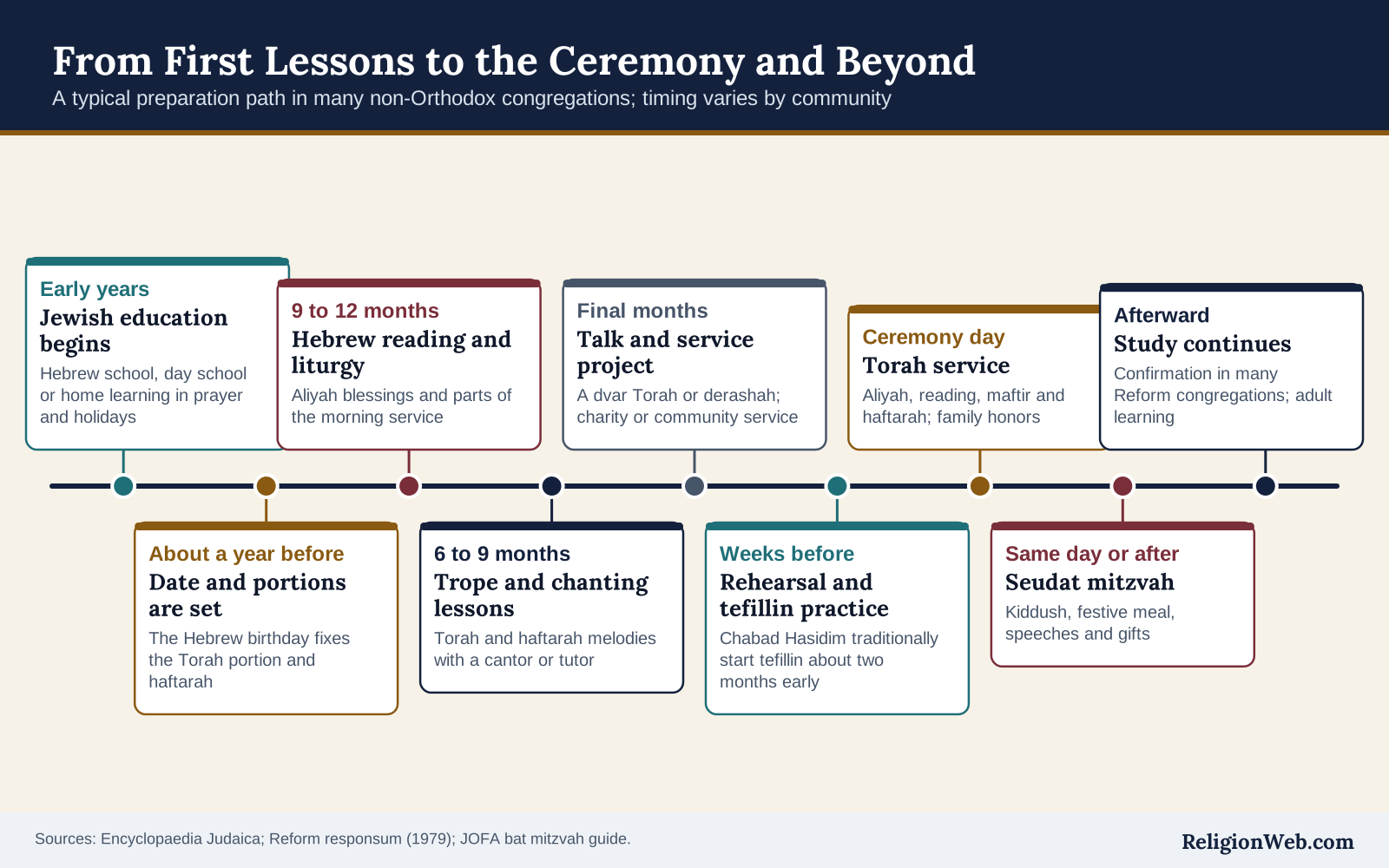
Timelines vary widely, but a typical non-Orthodox path in North America runs for about a year and includes the stages set out in the table. These timings are general patterns, not rules, and families in other communities follow different schedules.
| Stage | Typical timing | What happens | Variation |
|---|---|---|---|
| Early Jewish education | Years before | Hebrew school, day school or home learning in prayer, holidays and Bible | Orthodox and Haredi schools make this continuous study |
| Setting the date and portion | About a year before | Family and clergy fix the Hebrew birthday, the service and the Torah and haftarah portions | Weekday or Shabbat afternoon dates are common for girls in some Orthodox settings |
| Hebrew and liturgy | Several months | Reading fluency; learning the aliyah blessings and parts of the morning service | Liberal congregations may allow English alongside Hebrew |
| Trope and chanting | Six to nine months | Weekly lessons with a cantor, rabbi or tutor on the Torah and haftarah melodies | Some congregations assign only part of the portion |
| Tefillin training | Weeks to months | Practice wrapping and blessings before first use | Customs differ on when to begin; Chabad Hasidim traditionally start about two months early |
| Talk and project | Final months | Writing a dvar Torah or derashah; planning a charitable or service project | Orthodox boys may prepare a Talmudic discourse |
| Rehearsal | Final weeks | Walk-through of the service, including the call-up and the Torah blessings | Family roles are assigned in this stage |
| After the ceremony | Following months | Continued study, and in many Reform congregations, confirmation in the teen years | Adults may begin a program of their own |
The role of families
Parents and relatives take part in preparation too. They may help the young person study, accompany him or her to meetings with clergy, and plan the honors they will receive during the service. Because several family members are often called for aliyot, siblings, grandparents and cousins also learn the blessings, so the process can become a family education in synagogue practice. For families who are new to a congregation, or who are not observant, this stage can be the first extended contact with synagogue life.
Inside the Ceremony: The Torah Service, Aliyah and Haftarah
When and How the Torah Is Read
The days on which the scroll is taken out
The core of a bar or bat mitzvah ceremony is the public reading of the Torah, which is part of the morning service on certain days. The Torah is read on Shabbat morning, on Monday and Thursday mornings, on Shabbat afternoon, on the first of the month (Rosh Chodesh), and on festivals and fast days. The Mishnah (Megillah 4:1 to 4:2) already fixes the number of people called up for each occasion: three on weekdays and Shabbat afternoon, four on Rosh Chodesh and the intermediate days of a festival, five on a festival, six on Yom Kippur and seven on Shabbat. Families who choose Shabbat morning are choosing the longest and most prominent of these readings, which is why it is the typical setting. The article on Shabbat describes the rest of that service.
A weekday ceremony is a legitimate alternative, and it was the common choice in Eastern Europe, where boys were frequently called up on the Monday or Thursday after the birthday. Some families today choose a Monday or Thursday service, a Rosh Chodesh morning, or a festival such as Hanukkah, when the Torah is also read, because a smaller service allows a more intimate setting.
The weekly portion and the annual cycle
The Torah is divided into weekly portions, parashiyot, so that it is read through in a yearly cycle that ends and begins again on the festival of Simchat Torah. The portion assigned to a family depends on the date of the ceremony, not on the child’s preference, though clergy sometimes choose a shorter section within it. In many Conservative congregations the portion is shorter still because of the triennial cycle, a plan that spreads the reading across three years. A January 2026 post by the United Synagogue of Conservative Judaism, drawing on a self-selected survey of 81 affiliated congregations that its author says is not representative of the movement, reports that 68 percent use the triennial cycle and 24 percent read the full portion each week. The same survey reports that 68 percent require traditional cantillation for Torah chanting, a reminder that the skills a young person needs depend heavily on the congregation.
The Aliyah and the Reading
What an aliyah is
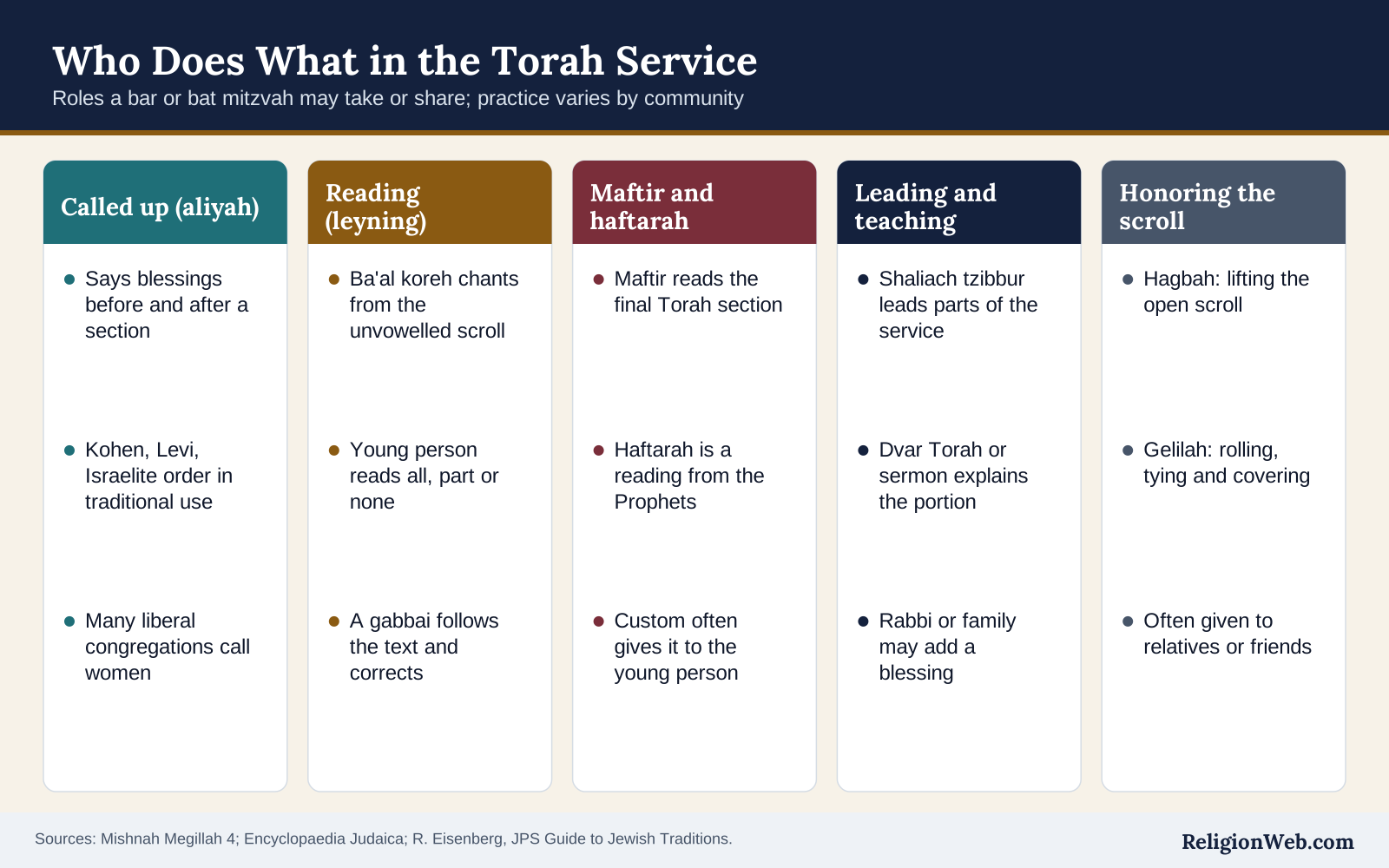
An aliyah, literally “going up,” is the honor of being called to the Torah and reciting the blessings before and after a section is read. As Rabbi Ronald Eisenberg explains in a reference for the Jewish Publication Society, being called up does not mean one will read, and in most synagogues the person called must be Jewish and of bar or bat mitzvah age. In traditional practice the first aliyah goes to a kohen, a member of the priestly line, the second to a levi, a member of the tribe of Levi, and the remaining ones to other Israelites, with a rule that a Kohen or Levite is announced “in place of” the first if none is present. Reform congregations and some liberal Conservative ones have dropped these categories, and many call women as well as men.
At a bar or bat mitzvah, the young person usually receives one of the aliyot, often the one given to the maftir, and family members receive others. Parents, grandparents, siblings and sometimes close friends are honored in turn, so the Torah service gives a family a visible place in the congregation’s worship.
Reading from the scroll
The person who chants the text is called the ba’al koreh (or ba’al kriah), “master of the reading.” At many ceremonies, the young person is the reader for some or all of the portion, with a skilled adult standing nearby to follow along in the scroll and correct errors. Because the scroll has no vowels, a person standing beside the reader, often the gabbai, follows the text and corrects mistakes. The Encyclopaedia Judaica notes that when a boy cannot read, the minimum is for him to recite the blessings before and after the reading.
This variety is important to understand. Some young people chant only a few verses, some chant the whole portion, and some Orthodox girls read from the Torah in a women’s prayer group, where the arrangements differ from those of a full congregational service. What all the versions share is that the young person takes a public place in the text that the community reads together.
Lifting and dressing the scroll
After the reading, the scroll is lifted and shown to the congregation (hagbah) and then rolled, tied and covered (gelilah). According to Eisenberg, Ashkenazi congregations lift the scroll after the reading, while Sephardic congregations do so before it, and the congregation traditionally says “this is the Torah” as it is displayed. Neither act requires a blessing, though both are regarded as significant, and they are often given to relatives or friends as an honor.
The Haftarah and the Rest of the Service
Maftir and haftarah
The reader of the final section of the weekly portion is called the maftir, and that person also reads the haftarah, a selection from the Prophets. The Encyclopaedia Judaica says the haftarah is usually chosen to match the content of the Torah portion, though about a third are set by the calendar, and that on a Sabbath it should contain at least twenty-one verses (Megillah 23a). The origin of the haftarah is unknown. One theory ties it to periods when reading the Torah was banned, and the earliest mentions are in the New Testament (Acts 13:15; Luke 4:17). The same article says that custom usually reserves the haftarah for a bar mitzvah boy, and that the Mishnah allows a minor to be called for maftir.
The book of Nehemiah offers a scriptural image of public reading that later Jewish thought linked to the practice. In its account of a public assembly, the text states that the reading was done with comprehension: “And they read in the book, in the Law of God, distinctly; and they gave the sense, and caused them to understand the reading.” Rabbinic tradition, in the Talmud’s discussion at Megillah 3a, read the verse as describing the reading of the text together with its Aramaic translation and the phrasing and cantillation that make it understood. That emphasis on comprehension is one reason a bar or bat mitzvah ceremony so often includes a dvar Torah and explanation of the portion.
And they read in the book, in the Law of God, distinctly; and they gave the sense, and caused them to understand the reading.
Nehemiah 8:8, The Holy Scriptures: A New Translation, Jewish Publication Society, 1917
Leading prayers, speaking and blessing
Beyond the Torah, a young person may lead parts of the service in a role known as shaliach tzibbur, “the congregation’s messenger.” In Orthodox practice this role is open to males who are obligated, and so a bar mitzvah boy can lead for the first time. In many liberal congregations, a bat mitzvah or bar mitzvah leads a substantial part of the morning service, and some give the sermon. Many synagogues recite a communal prayer for the young person and family, the mi she-berakh, and in some communities the rabbi or the parents give a blessing, or the congregation may sing a song or shower the celebrant with candy, a custom described in the section on celebrations. The roles in a typical service are set out in the table.
| Role | Term | What the person does | Who commonly fills it |
|---|---|---|---|
| Reader | Ba’al koreh (ba’al kriah) | Chants the Torah portion from the scroll | The young person for all or part; or an adult reader |
| Person called up | Oleh (man) or olah (woman) | Says the blessings before and after a section of the reading | The young person, relatives and friends; customs on women vary by community |
| Final reader and haftarah chanter | Maftir | Reads the last section and the haftarah from the Prophets | Often the bar or bat mitzvah |
| Warden or usher | Gabbai | Calls people up and follows the text to check the reading | A member of the congregation |
| Lifting of the scroll | Hagbah | Raises the open scroll for the congregation to see | A relative or friend who is strong enough |
| Rolling and dressing the scroll | Gelilah | Rolls, ties and covers the scroll | A relative or friend |
| Prayer leader | Shaliach tzibbur | Leads parts of the service | The young person, a cantor or a lay leader, depending on the community |
| Teacher and clergy | Rabbi, cantor | Gives a sermon or blessing, and prepares the young person | The congregation’s clergy |
| Family | Parents and relatives | Receive aliyot, say a blessing, or read a prayer | Parents and other relatives |
Tefillin, Prayer, Fasting and Other Changes in Practice
Tefillin and Other Ritual Objects
What tefillin are and when they are worn
Tefillin, sometimes called phylacteries, are two small black leather boxes containing handwritten passages from the Torah, attached to leather straps and bound on the head and the arm during weekday morning prayer. A young person who is obligated is expected to wear them. As the Chabad explainer for guests notes, a bar mitzvah boy and his male guests over thirteen typically wear tefillin at a weekday service, and tefillin are not worn on Shabbat, which is why a Shabbat celebration does not include the ritual itself. The first time a young person lays tefillin is a high point of the preparation in many communities.
When the practice begins
Communities disagree about timing. The Encyclopaedia Judaica reports that Sephardim and some Hasidim hold that tefillin may not be worn before the day after the thirteenth birthday, and that among Sephardim the first laying was part of the celebration, assisted by a scholar or elder. Chabad Hasidim taught a two-month preparation, with the first month practiced without the blessing and the second with it. A girl in a community that does not regard women as obligated in this commandment does not lay tefillin, while in egalitarian communities girls and boys both learn the practice, and some women in Orthodox settings take it on as an individual choice.
Prayer, Fasting and Everyday Observance
Counting in the community and in prayer
After reaching the age of obligation, a young person is counted toward a minyan, the quorum of ten required for certain prayers, in communities that count that person’s gender. In Orthodox practice, this applies to boys and men only, and in Conservative, Reconstructionist and Reform congregations it applies to all. The young person also becomes eligible for the aliyot and the prayer-leading roles described above.
Fasting, festivals and the limits of obligation
On fast days, including Yom Kippur, children are traditionally trained to fast gradually, with younger children often fasting for part of the day, and full fasting begins at the age of obligation. Sources such as the tractate Soferim describe a custom in which children were encouraged to fast one or two years before obligation, and communal practice today usually asks parents to follow their physician’s guidance. Jewish law itself exempts people whose health would be endangered, and it prioritizes preserving life over fasting, so a young person with a medical condition should rely on medical and rabbinic guidance rather than on a fixed rule. The same principle applies to the dietary laws, observed in the framework described in the article on kosher food, and the observance of festivals such as Passover, where the young person now takes a fuller share in the household’s obligations.
Dress, head coverings and the prayer shawl
Dress practices vary. The prayer shawl, the tallit, is worn in morning prayer by men in traditional communities, and customs differ about when a boy starts wearing it, with some beginning at bar mitzvah and others at marriage. In many liberal congregations, head coverings (kippot) are available at the door and wearing one is optional for people of any gender. In many liberal congregations, a bat mitzvah may also wear a tallit and kippah, while in most Orthodox communities these items are worn by males.
Celebrating the Milestone: Meals, Speeches and Gifts
The Seudat Mitzvah and Its Customs
A festive meal with religious meaning
Jewish tradition treats certain celebratory meals as acts of religious significance, and a meal at the age of obligation is among them. The Encyclopaedia Judaica reports that the Magen Avraham, a seventeenth-century commentary on the Shulchan Arukh (Orach Chayim 225:2), holds that parents are expected to give a banquet, and the Reform movement’s educational materials describe the traditional meal as a seudat mitzvah. Its religious character comes from the occasion it honors, the young person’s acceptance of the commandments, and from the words of Torah traditionally spoken at the table. This is the context for the speech that the young person gives, whether a Talmudic discourse or a short dvar Torah.
The usual timing follows the service. On a Shabbat morning ceremony, guests typically gather for a kiddush, a blessing over wine with light food, and often a festive lunch afterward. Receptions on other days, such as a Sunday morning or a weekday evening, usually have no formal prayers; the celebrant, parents and others speak about the milestone while guests eat. In traditional circles the meal also includes a blessing after eating (birkat ha-mazon), and the food observes the laws of kashrut, which in practice means that guests at a venue outside a synagogue may want to confirm that a kosher supervisor is present, as the Chabad guide for visitors points out.
Dancing, greetings and gifts
Many celebrations include dancing, with the celebrant often lifted or danced around in a circle. In Orthodox settings, men and women traditionally dance separately, often to the circle dance called the hora. Guests say mazal tov, “congratulations,” and bring gifts, though a gift is not customarily brought to a Shabbat celebration, so a check or gift card is sent with the reply card or afterward. Some families, following suggestions such as those in the JOFA guide, give a portion of the gift money to charity. In many Ashkenazi congregations, guests also throw soft candies at the celebrant after the Torah reading, usually explained as a wish for a sweet life, a custom whose origin is not well documented in the sources used for this article.
Scale, Cost and Meaning
Debates about extravagance
Concern about the scale of celebrations is not new. The Reform movement’s 1979 responsum urges families to keep their celebrations religious and festive and to oppose extravagant parties that undermine the ceremony’s meaning. The same text calls for the celebration to lead to continued Jewish education, to confirmation and to high school graduation. This is a recurring theme: rabbis and educators across movements have encouraged families to keep the meal modest, to tie the party to charity, and to treat the young person’s study as the main event.
Israel, the Western Wall and group celebrations
In Israel, the Western Wall in Jerusalem is a common location. The Encyclopaedia Judaica notes that since 1967 boys from Israel and abroad have held their ceremonies there, and that a girl’s twelfth birthday in Israel is commonly marked with parties, often as group celebrations in schools; some families visit Rachel’s Tomb, and some girls pray at the Wall with the group Women of the Wall. Other families, in Israel and elsewhere, combine the occasion with a trip to historic sites, a model that gives the milestone a link to Jewish history and geography.
Movements and Communities: How Practice Differs
Orthodox, Haredi and Hasidic Communities
The boy’s ceremony in Orthodox life
In Orthodox Judaism, a boy becomes bar mitzvah at thirteen years and a day regardless of any ceremony. The usual marker is his first aliyah, often accompanied by chanting the maftir and haftarah or reading the weekly portion, laying tefillin, leading parts of the service and giving a speech. Hasidic communities add their own customs, such as the Chabad practice of preparing for tefillin two months ahead. Haredi and many modern Orthodox communities emphasize that the age is a point on a continuum of study, so the focus may be on a talk at a celebration, a siyyum or a public examination, rather than a large public service.
Orthodox options for girls
For girls, Orthodox communities have developed a range of formats. The JOFA guide, edited by Jennifer Breger and Lisa Schlaff, lists a speech in the synagogue after services, a women’s prayer group in which women read from the Torah, group ceremonies in a school, a home celebration, and a siyyum on a text. It also describes the underlying halakhic debate: opponents cite the biblical prohibition on adopting non-Jewish practices (Leviticus 18:3), while Rabbi Yechiel Weinberg answered that the prohibition applies only to pure imitation and that a ceremony designed to build love of the commandments and Jewish pride is a different matter. Rabbi Moshe Feinstein advised against holding the celebration in the sanctuary, and the Encyclopaedia Judaica adds that some format of celebration now exists even in Hasidic and Haredi communities.
Conservative (Masorti) and Reconstructionist Judaism
An egalitarian ceremony
In Conservative Judaism, known outside North America as Masorti, the ceremony for girls and boys has generally been identical since the late twentieth century. The Encyclopaedia Judaica notes that the movement debated the content of the girls’ ceremony in the 1950s and 1960s and that the practice became established in the 1970s and 1980s. The young person usually chants from the Torah and haftarah, leads parts of the service, and gives a talk, and the congregation counts women in the minyan. Conservative synagogues vary in their level of Hebrew requirement and in their rules about cantillation, as the USCJ survey cited earlier suggests.
The Reconstructionist origins
The Reconstructionist movement’s own history is closely tied to the bat mitzvah. Its flagship congregation, the SAJ, was founded on January 19, 1922, and the movement describes Judith Kaplan’s ceremony that March as the first individual bat mitzvah. The movement states that the ceremony became common at the SAJ during the 1920s but that women lacked full ritual equality there until the congregation voted in 1950 to grant them aliyot and count them in the minyan. Today Reconstructionist congregations follow an egalitarian pattern, with the same preparation and roles for all.
Reform and Liberal Judaism
Practice in Reform congregations
In Reform Judaism, the Reform movement’s educational page describes a b’nai mitzvah leading all or part of the service, chanting the blessings over the Torah, reading a section of the portion, chanting the haftarah blessings and haftarah, and delivering a sermon, with the details depending on the congregation. It adds that almost all non-Orthodox congregations now mark the occasion at thirteen, that confirmation often follows in the teen years, and that many congregations offer programs for adults who did not have a ceremony as children. Rabbis and cantors across North America report officiating at b’nai mitzvah services for adults of all ages.
Gender-neutral terms and inclusive language
Some liberal congregations have adapted the terminology for young people who do not identify as a boy or a girl. A 2022 Reform movement blog post by Rabbi Jen Gubitz describes the term “BMitzvah,” and notes that the Central Conference of American Rabbis later adopted “bet mitzvah” in its publications. It lists other local choices, including “perach mitzvah” (Holy Blossom Temple, Toronto), “beit mitzvah” (Central Reform Congregation, St. Louis) and “kabbalat mitzvah,” and it says families are usually given a choice between the traditional terms and a name that fits their child. These terms are not used in Orthodox communities, and their adoption in liberal ones is recent.
Sephardic, Mizrahi and Italian Traditions
Ceremonies centered on tefillin and on groups
Communities with Spanish, North African and Middle Eastern roots developed ceremonies that did not follow the Ashkenazi pattern. The Moroccan custom, described earlier, centered on the first laying of tefillin and an examination. In Baghdad, as noted, a girl’s twelfth birthday could be marked with new clothes and a blessing. In the Italian rite communities of Turin and Milan, the JOFA guide notes, girls enter as a group in white, often with flower crowns, in a ceremony held outside regular services with the ark open, the verses divided among them and the chief rabbi addressing them. The Encyclopaedia Judaica adds that a twelve-year-old girl in Italian communities today is examined around Shavuot or Purim.
How to read these differences
These traditions show that the Ashkenazi synagogue ceremony is one pattern among several. A reader should not treat the Shabbat-morning Torah reading as the universal form of the occasion, and the table below summarizes the main patterns by community. It is a general guide, since individual congregations set their own policies.
| Community | Age usually marked | Typical boys’ ceremony | Typical girls’ ceremony | Notes |
|---|---|---|---|---|
| Orthodox and modern Orthodox | 13 and a day (boys); 12 and a day (girls) | Aliyah, maftir, haftarah or portion; tefillin; speech | Speech, siyyum, women’s prayer group, home or hall celebration; practice varies by rabbi | Women do not usually receive aliyot in the main service |
| Haredi and Hasidic | 13 and a day (boys); 12 for girls | Tefillin and a learned talk, often within a study setting; Chabad starts tefillin preparation about two months early | Often a family or school event; some format exists even here | Emphasis on study over a public performance |
| Sephardic and Mizrahi | 12 or 13; varies | First tefillin is often central; a learned talk and meal | Birthday celebration with blessing; Italian group ceremonies for girls | Moroccan, Baghdadi and Italian customs differ |
| Conservative (Masorti) | 13 for most; some 12 for girls | Torah and haftarah, leading prayers, talk | Same as for boys in most congregations | Established for girls in the 1970s and 1980s |
| Reconstructionist | 13 | Egalitarian: same preparation and roles | Same as for boys | Movement traces the first bat mitzvah to the SAJ in 1922 |
| Reform | 13 for both | Leading service, Torah and haftarah, sermon | Same as for boys | Confirmation often follows; adult programs are common |

Participation Today and Special Circumstances
How Common Is a Bar or Bat Mitzvah?
What the Pew data show
The most detailed recent figures on participation come from the Pew Research Center’s 2020 survey of American Jews, published on May 11, 2021 as Jewish Americans in 2020. Among all respondents raised Jewish or with a Jewish parent, 51 percent said they had a bar or bat mitzvah, a share the report describes as similar to its 2013 survey. The figure was 63 percent among Jews by religion and 23 percent among Jews of no religion. Pew also reports that Jewish men were twice as likely as Jewish women to say they had one, 68 percent compared with 34 percent, and that having a bar or bat mitzvah is far more common among Orthodox and Conservative Jews than among Reform Jews or those who do not identify with a branch.
Reading the numbers carefully
These figures describe adults in the United States, asked about their own childhoods. The gender gap reflects history: many of the women surveyed grew up at a time when ceremonies for girls were uncommon or limited, as the earlier sections explain, and the figures as reported do not distinguish between a full Torah service and other kinds of marking. The data also do not describe Israel, Europe or other regions, where the occasion may take different forms. For that reason, the numbers are best read as a measure of how widely the milestone is observed in one large diaspora community, and not as a measure of Jewish identity in general.
Converts, Adopted Children and Adults
Children who converted or were adopted
When a child has been converted in infancy or early childhood, or was adopted into a Jewish family, the age of obligation raises questions of status. Rabbi Michael Gold, a Conservative rabbi, writes in a My Jewish Learning article that for such children the bar or bat mitzvah can serve as the completion of a conversion done years earlier. His synagogue requires a valid conversion, with a court of three rabbis, a circumcision or symbolic circumcision for boys, and immersion in a ritual bath, and he cites the Talmudic principle (Ketubot 11a) that one may confer a benefit on a person without his consent, noting that the child may protest on reaching majority. Gold says rabbis differ on the details, and that in Reform and Reconstructionist settings a formal conversion is not always required for a child raised as a Jew. Families in this situation should speak with their own rabbi, since the answer depends on the movement.
Adults who did not have a ceremony
Many adults mark the milestone later. The Reform movement’s educational page notes that many congregations offer adult b’nai mitzvah programs, individual or group, and that rabbis and cantors across North America report officiating at services for adults of all ages. The Encyclopaedia Judaica says that adult bat mitzvah ceremonies were common across denominations by the 2000s. For many adults, particularly women who were not offered a ceremony as children, the program is a first extended course in Hebrew, the liturgy and the Torah service, and the preparation described earlier applies to them with adjustments for adult schedules.
Common Misconceptions About Bar and Bat Mitzvah
Misconception 1: The party or the ceremony is what makes someone a bar or bat mitzvah
Where the misunderstanding comes from
In popular culture, the phrase “having a bar mitzvah” refers to an event with an invitation list, a service and a reception, and films and television emphasize the party. In English the noun and the status share one word, so a reader can easily conclude that the event causes the change. In North America, where the occasion is often the largest family celebration of a child’s life, the distinction between status and event is easily lost. Invitations, vendors and planners all speak of “the bar mitzvah” as a date on the calendar, and a family planning one may hear very little about the legal status that the date is meant to acknowledge.
The way the phrase is used in the Jewish sources adds to the confusion. The modern sense of “bar mitzvah” as an occasion is a later development, and today people say “my son had his bar mitzvah on Saturday,” which is natural speech but describes the ceremony, not the legal change.
What the evidence and tradition actually show
In traditional law the status arrives with the age: thirteen and a day for a boy, twelve and a day for a girl, as Maimonides rules. The Reform movement’s educational page states that a boy became a bar mitzvah automatically at thirteen even without a ceremony. The Talmud uses the term for anyone subject to the commandments, centuries before the occasion is documented, and the Encyclopaedia Judaica dates the first use for a celebration to the fifteenth century.
That does not make the ceremony meaningless. For most communities it is the way the congregation acknowledges and welcomes the young person’s adult role, and in liberal movements, which treat the age as a recommendation for the ceremony, the preparation and the ceremony carry much of the weight. The correct statement is that the age confers the status in traditional law and the ceremony publicly marks it.
The same logic explains why rabbis in different movements can disagree about the ceremony without disagreeing about the basic framework. An Orthodox rabbi who counsels a modest celebration for a girl and a Reform rabbi who encourages a full Torah service for the same age are answering a question about how best to mark the change, not about whether it has happened. A reader who attends a ceremony and sees a very different form from the one they expected is therefore seeing a difference of custom, not of definition.
Misconception 2: Every bar or bat mitzvah ceremony includes the same Torah role
Where the misunderstanding comes from
Many people picture one standard scene: a young person on a platform chanting from the scroll for a full portion. That is a common picture because it is the most visible form in North American non-Orthodox synagogues, and it is what films usually show. Guests from one tradition attending a ceremony in another may be surprised at what they see.
Another source of the assumption is the way ceremonies are described in the press and in family conversation. A phrase such as “she read from the Torah” can mean that she chanted a portion from the scroll, that she read a passage from a printed book, or that she recited the blessings at an aliyah, and the listener usually fills in the most familiar version.
Part of the confusion is that the words “read from the Torah” cover several different acts. Being called for an aliyah, chanting the Torah portion, reading the maftir, chanting the haftarah and giving the sermon are distinct roles that may be combined or separated.
What the evidence and tradition actually show
The sources show a spectrum. In Eastern Europe the boy was often called up on a weekday, while in Western Europe he read the maftir and haftarah on Shabbat, and in Sephardic Morocco the first tefillin and a Talmudic examination were central. In many non-Orthodox congregations today the young person chants a portion, the haftarah and parts of the service, while in some Orthodox settings a girl gives a speech or reads from the Torah in a women’s prayer group. A young person who cannot chant can, according to the Encyclopaedia Judaica, recite the blessings before and after the reading.
The common element is a public step into the community’s religious life, and the details depend on the community, the family and the rabbi.
Even the question of which Torah reading is involved can differ. A ceremony on Shabbat morning uses the weekly portion assigned to that date, while a weekday or Rosh Chodesh service uses a shorter reading, and a ceremony held on a festival uses the portion set for that day. The JOFA guide shows families choosing dates that shape the content of the preparation, including one girl whose celebration fell on Purim and another whose date was a fast day, which led her to study the laws of fasting.
Misconception 3: A bar or bat mitzvah is a universal, secular coming-of-age party
Where the misunderstanding comes from
Because the occasion often involves a milestone birthday, a party and gifts, it can seem like a Jewish version of a general rite of passage into adolescence. Some families do in fact hold a mostly social event, and in some secular and cultural Jewish settings the religious content is limited. Writers sometimes use “bar mitzvah” as shorthand for any coming-of-age celebration, which reinforces the impression.
What the evidence and tradition actually show
In Jewish law, the occasion concerns religious obligation: the young person becomes accountable for the commandments, can be counted in certain religious acts, and takes on adult duties such as tefillin and fasting. The Reform responsum of 1979 describes it as an entry into early adult life marked by greater responsibility for the commandments, even if the responsibility assumed may be modest, and it warns against extravagant parties that undermine the ceremony’s meaning. It also notes that the ceremony should lead to continued study.
The occasion is also tied to specific texts and rites: the Torah scroll, the aliyah blessings, the haftarah and the tefillin. A party without these may be a pleasant family event, but in the sources it is not what the term means. At the same time, the religious meaning is understood differently across movements, and some families treat the event mainly as a cultural or family milestone; that is a matter of individual practice, not of the definition.
It is also worth separating the Jewish occasion from the general idea of a rite of passage on the basis of its structure. The obligations attach to a legal category, the ages differ for boys and girls in traditional law, and the occasion is tied to a calendar of readings that the congregation shares, so that a young person in Jerusalem and one in Chicago may read the same portion on the same Shabbat. That shared calendar is a feature of the Jewish liturgical year, not of a personal birthday party. The occasion also looks outward: the preparation, the talk and the service projects described earlier are meant to connect the young person to a community of study and obligation that continues long after the guests have gone home.
Misconception 4: Bat mitzvah was invented in 1922, and girls had no coming-of-age status before that
Where the misunderstanding comes from
The widely told story of Judith Kaplan’s ceremony in New York is often shortened to “the first bat mitzvah,” and from there to the idea that Judaism had no recognition of girls’ adulthood before the twentieth century. The shortened story passes over both the legal tradition and earlier celebrations in other regions.
It also blurs two different questions: when a girl is considered obligated, which the law answers by age, and when a congregation first gave girls a public ritual role, which depended on the community and on rabbinic decisions about women’s participation in the service.
What the evidence and tradition actually show
The legal status of a girl of twelve and a day is as old as the Mishnah and is stated by Maimonides, and the term “bat mitzvah” appears once in the Talmud. Communal celebrations are documented from the nineteenth century in Verona (1844), Baghdad and Alexandria (1907), and Midwestern American ceremonies are reported as early as 1907. What the 1922 SAJ ceremony did was begin the line of development, in an American movement, that eventually led to girls and boys having the same public roles; the Reconstructionist account itself stresses that the event was not a full parallel to a boy’s bar mitzvah and was not immediately imitated. The Reform movement’s page dates the ceremony to 1921, so the exact year is given differently in the literature.
A careful summary, then, is that girls’ coming of age had a legal definition from antiquity, had occasional communal celebration in several regions from the nineteenth century, and acquired a fully parallel public ritual in the non-Orthodox movements in the later twentieth century, with Orthodox communities developing their own forms in the same period.
Frequently Asked Questions About Bar and Bat Mitzvah
Questions About Age and Status
At what age does someone become a bar or bat mitzvah?
In classical Jewish law, a boy becomes a bar mitzvah at thirteen years and a day and a girl becomes a bat mitzvah at twelve years and a day, ages stated by Maimonides in the Mishneh Torah. The ages are counted by the Hebrew calendar. Orthodox and traditional Conservative communities follow the two different ages, while the Reform movement recommends thirteen for both, and most non-Orthodox congregations mark both boys and girls at thirteen. A family that is unsure of the Hebrew date of birth, or has a special circumstance, can ask a rabbi to calculate it.
Does someone need a ceremony to be bar or bat mitzvah?
No. In traditional terms, the status arrives with the age, and the Reform movement’s educational materials say that a boy became a bar mitzvah automatically at thirteen even without a ceremony. The ceremony is a long-standing custom that marks the change publicly, and the celebration is a further layer of custom. A person who never had a service can still hold the status, and adults who did not have a ceremony as children often mark the milestone through an adult program.
Questions About the Service
Does the young person have to read the entire Torah portion?
No. The amount varies by community and by family. Some young people chant the whole weekly portion, some read a few verses, and some are called for an aliyah and recite only the blessings, which the Encyclopaedia Judaica identifies as the minimum when a boy cannot read. Most also chant the haftarah or part of it, and in many congregations they lead sections of the service or give a talk. The decision rests with the rabbi, the cantor and the family, and it reflects the young person’s preparation and the congregation’s expectations.
Can girls and women read from the Torah?
It depends on the community. In Conservative, Reconstructionist and Reform congregations, girls and women chant from the Torah and receive aliyot on the same terms as boys and men. In Orthodox congregations, women do not usually receive aliyot or read in the main service, though many Orthodox girls give a speech, complete a study project, or read from the Torah in a women’s prayer group, according to the JOFA guide. Rabbinic views differ even within Orthodoxy, as the responsa of Rabbi Moshe Feinstein, Rabbi Yechiel Weinberg and Rabbi Ovadiah Yosef show. The question is part of a broader discussion of women’s roles in worship that the articles on Orthodox Judaism and Reform Judaism place in context.
Questions for Guests and Families
What should a guest expect at a bar or bat mitzvah?
At a Shabbat morning service, a guest should expect a long worship service in Hebrew with some English, a Torah reading in which the young person takes part, and a reception afterward. Guests are generally expected to dress modestly, to turn off electronic devices on Shabbat, and, in many congregations, to wear a head covering or stand at certain points. In traditional settings, men and women may sit separately. Gifts are usually not brought to a Shabbat service; the host’s invitation will say how to respond. If a guest is unsure about customs, the synagogue or the family can usually explain what to expect.
Is it only for observant families, and can it be done later in life?
No. In the Pew Research Center’s 2020 survey, 63 percent of American Jews by religion and 23 percent of Jews of no religion said they had a bar or bat mitzvah, so the milestone is widely observed, though unevenly. Many families who observe few other customs hold one, and the Reform movement notes that many congregations offer adult programs for people who did not have a ceremony as children. A person who was not raised in a Jewish home or who converted should speak with a rabbi, because the right path depends on the movement and the person’s circumstances.
Conclusion: What a Bar or Bat Mitzvah Means
What the History Shows
A long-standing status and a changing ceremony
The central point of the subject is the difference between status and ceremony. The age of obligation is rooted in the Mishnah and the Talmud, restated by Maimonides, and counted by the Hebrew calendar. The public ceremony developed from the late Middle Ages and took different forms in Ashkenazi, Sephardic and Mizrahi communities. Girls’ ceremonies appear in Italy, Baghdad, Egypt and the United States in the nineteenth and twentieth centuries, and became standard in the non-Orthodox movements in the later twentieth century, while Orthodox communities developed their own range of options.
One milestone, many forms
Today a bar or bat mitzvah can be a Shabbat morning Torah reading in a large synagogue, a weekday service, a women’s prayer group, a group ceremony, a visit to the Western Wall or an adult class that ends in a service. What these share is the acceptance of responsibility for the commandments, expressed through study, public participation in the community’s worship and acts of service, and acknowledged by family and congregation.
How to Keep Exploring
Related articles on ReligionWeb
For the broader background, the article on Judaism introduces the tradition’s beliefs and history, the article on the Torah explains the scroll and its reading, and the article on the Talmud covers the legal literature behind the ages and obligations. The articles on Shabbat, Yom Kippur and Rosh Hashanah describe other services at which a young person now has new roles.
Learning from your own community
Because practice varies so widely, the most reliable guide for a family or guest is the local rabbi, cantor or educator. A congregation’s policies on who reads, which portion is assigned, how tefillin are introduced and how girls and boys participate are set locally, within the framework of its movement and community. The sources behind this article reflect that range, and readers who want to go further can read the primary texts, the movement responsa and the reference works listed at the end of the article.
Sources
The table below lists the principal external sources behind this article. Facts, dates and figures were checked against these and related primary, institutional and academic materials.
| # | Source | Publisher and type | Used for | Link |
|---|---|---|---|---|
| 1 | Bar Mitzvah, Bat Mitzvah (Encyclopaedia Judaica entry) | Encyclopedia.com (Gale; Encyclopaedia Judaica) · Academic reference | Ages, sources, history of boys' and girls' ceremonies, tefillin, responsa | encyclopedia.com |
| 2 | Bar Miẓwah (Jewish Encyclopedia, 1906) | Jewish Encyclopedia · Encyclopedia | Talmudic basis, medieval authorities, Moroccan custom, the father's blessing | jewishencyclopedia.com |
| 3 | The Holy Scriptures: A New Translation (JPS 1917), Numbers 1:3; Deuteronomy 6:6-7; Nehemiah 8:8 | Sefaria (public domain) · Primary text | Quoted biblical verses | sefaria.org |
| 4 | Pirkei Avot 5:21, Mishnah Yomit by Joshua Kulp (CC-BY); Genesis Rabbah 63:10 | Sefaria · Primary text | Quoted Mishnah on age thirteen; the Genesis Rabbah teaching on a father's responsibility | sefaria.org |
| 5 | Jewish Americans in 2020: Marriage, Families and Children | Pew Research Center · Demographic data | Share of American Jews reporting a bar or bat mitzvah (2020 survey) | pewresearch.org |
| 6 | Origins of Bar/Bat Mitzvah | Reform Judaism (Union for Reform Judaism) · Institutional | Reform account of meaning, age, history, confirmation, adults | reformjudaism.org |
| 7 | Bar and Bat Mitzvah, Responsum No. 33 (American Reform Responsa, 1979) | Central Conference of American Rabbis · Institutional | Reform view: age, confirmation history, extravagance, education | ccarnet.org |
| 8 | Judith's Bat Mitzvah Service: The Launch of Reconstructionist Innovation | Reconstructing Judaism · Institutional | March 18, 1922 ceremony at the SAJ and its aftermath | evolve.reconstructingjudaism.org |
| 9 | Bat Mitzvah Guide (Jennifer Breger and Lisa Schlaff, eds.) | JOFA (Jewish Orthodox Feminist Alliance) · Institutional | Orthodox options and responsa for girls' ceremonies | jofa.org |
| 10 | Aliyah (Ronald L. Eisenberg, The JPS Guide to Jewish Traditions) | My Jewish Learning · Educational reference | Aliyah order, number of aliyot, hagbah and gelilah, priority customs | myjewishlearning.com |
Last fact-check date: 2026-10-21.