Kabbalah is the body of Jewish mystical teaching that tries to explain how the hidden, infinite God relates to the created world, and how human prayer, study and observance of the commandments take part in that relationship. The Hebrew word means “receiving,” and by extension “tradition,” which signals the claim at its center: these teachings are handed down rather than invented. In the form most people mean today, Kabbalah took shape in medieval Provence and Spain, grew into a major current of religious life through the sixteenth-century circle of Safed, and became part of the thought of Hasidic communities and many Sephardic and Mizrahi communities. It is not a separate religion. Within the tradition it is understood as an inner dimension of Judaism, read through the same Torah and anchored in the same world of law, prayer and rabbinic interpretation that the Talmud helped to shape.
The short version of its subject matter is a set of questions that many religious traditions ask in their own ways. If God is without limit and beyond description, how can God also create, command, forgive and dwell among a people? Kabbalists answered with a layered picture of reality. Beyond all names lies Ein Sof, “the Infinite.” Out of that hidden source, divine light is understood to flow through ten dynamic channels or stages called sefirot, and through them the world is sustained. Human actions, on this view, are not private matters: a prayer said with the right intention or a commandment carried out with care can affect the harmony of the divine realm itself.
The word Kabbalah is used in several ways, and the distinctions matter for everything that follows. Historians use it for a specific medieval movement with identifiable books, authors and schools, beginning around 1200. Traditional practitioners often use it for a much older chain of secret teaching that they trace to Sinai, a claim of faith that sits beside, rather than inside, the historian’s chronology. In the twentieth and twenty-first centuries the word has also been attached to popular spiritual products and celebrity trends that have little to do with the texts and communities described here. This article keeps those meanings apart, and it follows the historical development in order, from the visionary literature of late antiquity to the Zohar, Isaac Luria, Hasidism and the present day.
Throughout, the aim is to describe what Kabbalists have taught and practiced on their own terms, to mark where scholars disagree about dates and authorship, and to show how the mystical tradition connects to everyday Jewish life: the daily prayers, the Sabbath, the festivals and the commandments. Readers who want background on the wider religion will find it in the overview of Judaism; this page concentrates on the mystical thread.
Kabbalah at a Glance: Meaning, Scope and Vocabulary
What the Word Kabbalah Means
A word for receiving and handing down
Kabbalah comes from the Hebrew root q-b-l, “to receive.” In rabbinic Hebrew the related noun kabbalah could refer to any received tradition, including the later books of the Hebrew Bible when they were distinguished from the Torah. That older, general sense is why a medieval writer could speak of a “kabbalah” about the calendar or about legal procedure without any mystical meaning at all. The narrower sense, a tradition about the hidden structure of divinity and creation, crystallized later. The Encyclopaedia Judaica places the precise use of the term in the circle around Isaac the Blind in Provence, around 1200, and notes that from the beginning of the fourteenth century the name Kabbalah had nearly displaced the older terms for mystical lore.
Before that, writers spoke of “the work of the chariot” (ma’aseh merkavah) and “the work of creation” (ma’aseh bereshit), phrases drawn from rabbinic discussions of Ezekiel’s vision and the opening chapter of Genesis. Others used “the wisdom of truth” (hokhmat ha-emet), “the hidden wisdom” or simply “the secret” (sod), the last of which also names the deepest of the four classical levels of scriptural reading. The abundance of names is a reminder that Kabbalah was never one unified discipline with a single founding moment.
Kabbalah, esoteric lore and the wider Jewish library
Kabbalah belongs to a larger set of Jewish approaches to the divine that includes philosophy, ethical literature, liturgical poetry and legal reasoning. Many Kabbalists were also jurists, preachers and poets, and they wrote commentaries on the same biblical and rabbinic texts that everyone else studied. Their distinctive contribution was a symbolic language in which a verse of Torah, a line of prayer or a legal rule is read as a window onto processes within God. That symbolic reading sits alongside, and does not cancel, the plain meaning and the legal meaning of the text.
It also helps to separate Kabbalah from related but distinct phenomena. The visionary literature of late antiquity, medieval pietism in Germany, philosophical rationalism in Muslim Spain and the ethical movements of later centuries all overlap with Kabbalah at points, and modern scholars debate how much influence ran in each direction. Treating all Jewish mysticism as one stream, or treating every mention of angels, names or amulets as “Kabbalah,” flattens a history that is more interesting for its variety.
Where and When Kabbalah Developed
Geography of the main centers
The earliest forerunners belong to Roman-era Palestine and later to Babylonia, where the Talmud was compiled. The Rhineland and northern France produced the pietist circle known as Hasidei Ashkenaz in the twelfth and thirteenth centuries. Kabbalah in the strict sense first appears in southern France (Provence and Languedoc), moves quickly into Catalonia, with Gerona as a leading town, and then into Castile, where the Zohar emerged in the late thirteenth century. After the expulsion of Jews from Spain in 1492, the center of gravity shifted to the Ottoman Empire, above all to Safed in the Galilee, and from there to Italy, the Balkans, North Africa, Iraq, Yemen, and eventually Eastern Europe.
In the eighteenth century the mystical tradition took on a new social form in Poland-Lithuania and Ukraine, where Hasidism spread kabbalistic ideas in simplified, devotional language. In modern times Jerusalem, New York and other centers of Jewish learning have been leading sites for both traditional study and academic research. The pattern is therefore one of migration and translation: the same body of ideas is reworked in new languages and settings, from Hebrew and Aramaic to Judeo-Arabic, Ladino, Yiddish and, more recently, English.
A dated timeline in brief
The table below gives a compact chronology. Dates for the earliest texts are uncertain, and the ranges reflect the scholarly sources named in this article, not a consensus; later sections explain the reasons for each uncertainty.
| Period | Development | Why it matters |
|---|---|---|
| Talmudic era (first centuries CE) | Merkabah (chariot) and Hekhalot (palace) literature; the story of the four who “entered the orchard” | Visionary ascent through heavenly realms; Ezekiel 1 as the central text |
| Between the 2nd and 6th centuries CE (Encyclopaedia Judaica; “perhaps the third”) | Sefer Yetzirah (“Book of Creation”) | First use of “sefirot” for ten primordial numbers; creation through letters |
| 12th to 13th centuries | Hasidei Ashkenaz in the Rhineland; Sefer Hasidim; Judah he-Hasid (d. 1217) | Pietism, prayer mysticism and the idea of the divine Glory |
| Around 1200 | Isaac the Blind and his circle in Provence | Earliest precise use of the name Kabbalah; Ein Sof appears as a term |
| Early 13th century (earliest dated manuscript 1298) | Sefer ha-Bahir | Symbolic, parable-rich anthology that influenced later theosophy |
| 13th century | Gerona circle; Nahmanides (1195 to 1270) | Largest body of pre-Zoharic kabbalistic writing |
| About 1271 to 1291 | Writings of Abraham Abulafia | Ecstatic or “prophetic” Kabbalah based on letter meditation |
| About 1270 to 1300 | The Zohar, linked above all with Moses de Leon (d. 1305) | Foundational commentary on the Torah in distinctive Aramaic |
| 1492 | Expulsion of Jews from Spain | Context for the later turn toward redemption themes in Safed |
| 1534 to 1572 | Isaac Luria in Safed; Moses Cordovero (1522 to 1570) | Lurianic Kabbalah: tzimtzum, shevirat ha-kelim, tikkun |
| 1558 to 1560 | First printed Zohar (Mantua and Cremona) | Wider circulation and growing authority |
| 1665 to 1666 | Sabbatai Zevi messianic movement | Crisis that shaped later attitudes to mystical study |
| 1730s to 1760; 1796 | Baal Shem Tov; first printing of the Tanya | Hasidic reception of Kabbalah in popular and intellectual forms |
| 20th and 21st centuries | Academic study; Kabbalah Center (founded in New York in 1965) | Scholarly reassessment and popular, commercial adaptation |
Core Vocabulary
Ten terms that organize the tradition
A handful of Hebrew terms recur throughout Kabbalistic literature. Most are everyday words given technical meanings, and their English renderings are always approximations. The table lists the ones this article will use most often, with the sense in which each is normally used, so that later sections can build on them without constant redefinition.
| Term | Literal sense | Usual meaning in Kabbalah | Where it features most |
|---|---|---|---|
| Ein Sof | “Without end” | God as infinite and beyond all attributes, prior to any self-manifestation | Provence onward; Zohar; Lurianic thought |
| Sefirot (singular sefirah) | Related to “number” or “counting” | Ten stages or aspects through which the infinite becomes active in creation | Sefer Yetzirah; Zohar; Cordovero |
| Shekhinah | “Indwelling” | The divine presence in the world; in many texts the lowest sefirah, Malkhut | Rabbinic literature; Zohar; Kabbalat Shabbat |
| Tzimtzum | “Contraction” | Divine self-withdrawal that makes space for creation | Lurianic Kabbalah; Hasidism |
| Shevirat ha-kelim | “Breaking of the vessels” | Rupture in the process of emanation that leaves sparks of light scattered in the world | Lurianic Kabbalah |
| Tikkun | “Repair” | Restoration of the divine order through prayer, study and commandments | Lurianic Kabbalah; Hasidism |
| Kavvanah (plural kavvanot) | “Intention” | Focused mental direction, in Luria’s school specific meditations tied to words of prayer | Prayer and ritual practice |
| Devekut | “Cleaving” | Attachment to God as a goal of prayer and daily life | Hasidism; earlier kabbalistic ethics |
| Gilgul | “Rolling” or “cycle” | Transmigration of souls through successive lives | Bahir and Zohar; strongly developed in Safed |
| Raza | Aramaic for “secret” | The hidden meaning of Torah, central to the Zohar’s way of reading | Zohar |
How the vocabulary fits together
The first group of terms, Ein Sof, the sefirot and the Shekhinah, describes the structure of divinity as Kabbalists perceive it. The second group, tzimtzum, the breaking of the vessels and tikkun, comes largely from the Lurianic reinterpretation and tells a story about how that structure came to be disrupted and how it can be restored. The third group, kavvanah, devekut and gilgul, belongs to the human side: how a person’s intention, attachment and soul-journey relate to the cosmic drama. Raza, finally, names the interpretive stance behind the whole project: the Torah has a concealed layer, and learning to read it is a form of worship.
No single Kabbalistic school uses all of these terms in the same way. Cordovero, Luria and the Hasidic masters each reshape the vocabulary to fit their own emphases, and some terms, such as gilgul, are debated or avoided by certain authors. Where those differences matter, the sections below name the school or the writer rather than speaking of “Kabbalah” as if it held one voice.
Who Has Studied Kabbalah
Communities and their own self-understanding
Kabbalah has been cultivated by scholars, preachers and pietists in nearly every part of the Jewish world. Many Orthodox communities, Hasidic and non-Hasidic, Sephardic and Ashkenazi, treat it as the inner dimension of Torah and incorporate its customs into the liturgy and the calendar. In these communities the starting assumption is that the tradition goes back through teachers to Sinai, and that the Zohar and the writings of Luria are authoritative expressions of that inheritance. Other Jewish groups relate to it differently, and later sections explain how Conservative, Reform and other modern Jewish movements have approached it, sometimes with suspicion, sometimes with scholarly interest, and in recent decades often with renewed spiritual curiosity.
A university discipline beside the devotional tradition
Alongside the devotional tradition stands a university discipline. Modern critical scholarship on Kabbalah, much of it pioneered by Gershom Scholem in the twentieth century and continued by scholars including Isaiah Tishby, Yehuda Liebes and Moshe Idel, asks historical questions that traditional sources do not: who wrote a given text, from which earlier sources did its ideas come, and how did those ideas change? Academic and traditional views are not always compatible, most visibly on the authorship of the Zohar, and this article presents both with attribution rather than treating either as the single correct account. A reader can respect the devotional claim that the Zohar contains ancient wisdom while also learning what historians have established about the manuscripts, the language and the literary context.
Roots Before the Name: Earlier Jewish Mystical Traditions
Visions of the Throne in Rabbinic Judaism
Ezekiel’s chariot and the rabbinic response
Almost every later Jewish mystical tradition looks back to the opening chapter of the Book of Ezekiel, in which the prophet sees living creatures, wheels, a firmament and a figure seated on a throne. The passage is the foundation of what the rabbis called ma’aseh merkavah, “the work of the chariot.” Its most striking verse describes the scene above the creatures in language that is deliberately indirect, speaking of a “likeness” and an “appearance” rather than of the divine itself.
And above the firmament that was over their heads was the likeness of a throne, as the appearance of a sapphire stone;
Ezekiel 1:26 (first clause), The Holy Scriptures: A New Translation (Jewish Publication Society, 1917), as reproduced on Sefaria
The rabbis of the Mishnah treated such material with caution. According to Mishnah Hagigah 2:1, in paraphrase, the account of creation should not be expounded before more than two people, and the account of the chariot not even before one, unless that person is a sage who understands the subject independently. The ruling does not forbid the subject; it fences it with conditions about the teacher, the audience and the student’s maturity. That pattern of limited, carefully supervised transmission shaped how mystical teaching was handled for the next two thousand years, and it is the root of the later custom that Kabbalah should be approached only after a solid grounding in Torah and Talmud.
The four who entered the orchard
The best-known rabbinic story about mystical danger appears in the Talmud, in tractate Hagigah. It tells of four sages who “entered the orchard” (pardes): Ben Azzai, Ben Zoma, Elisha ben Abuyah and Rabbi Akiva. In the traditional telling, Ben Azzai looked and died, Ben Zoma looked and lost his reason, Elisha ben Abuyah became estranged from the community, and only Akiva, in the Encyclopaedia Judaica’s wording, “entered in peace and left in peace.” Interpreters have read the story as a literal account of heavenly ascent, as a parable about the perils of speculation, or as a warning about the limits of human understanding. What is clear is that the story was repeated by every generation of Jewish mystics as both an invitation and a caution.
The word pardes also became a framework for Bible reading. By the thirteenth century its four letters were used as an acronym for four levels of interpretation: peshat (plain meaning), remez (allusion), derash (homiletical reading) and sod (secret or mystical meaning). Kabbalistic commentary on the Torah generally operates at the level of sod while accepting the other three.
Hekhalot and Merkabah Literature
Texts of heavenly ascent
From roughly the talmudic period onward, a body of Hebrew and Aramaic writings described the soul’s journey through a series of heavenly palaces (hekhalot) to the divine throne. The major works include Hekhalot Rabbati, in which the main speaker is Rabbi Ishmael, and Hekhalot Zutarti, in which the main speaker is Rabbi Akiva. They describe angelic guardians, the recitation of hymns and divine names, and the dangers faced by the ascending visionary. The Encyclopaedia Judaica states that large parts of this literature originated in talmudic times, while noting that the nineteenth-century scholars Zunz, Graetz and Bloch had assigned it to the geonic period, and the precise dating remains discussed among specialists.
Earlier apocalyptic writings, such as the Book of Enoch, are often cited as part of the background because they combine visions of heaven with teachings reserved for a select group. Scholars debate how directly the later Hekhalot texts depend on those writings and to what extent they reflect actual ascent practices as opposed to literary tradition. The question affects how the movement is described: as a form of lived mystical experience or as a text-based imagination of heavenly worship.

The measure of the divine body
One text associated with this milieu, Shi’ur Komah (“the measure of the stature”), gives enormous numerical dimensions for the limbs of a divine figure. It has been among the most controversial documents in Jewish religious history. Some medieval authorities rejected such language as incompatible with the incorporeality of God, while others, including some Kabbalists, read the dimensions as symbolic descriptions of the divine attributes. The episode shows an enduring tension in the tradition between the desire to speak vividly of the divine and the insistence that God has no body. Later discussions of the sefirot return to the same problem and answer it in a similar way, by treating anthropomorphic imagery as a language of symbols.
Sefer Yetzirah, the Book of Creation
Numbers, letters and the act of creation
Sefer Yetzirah is a short, compressed work that describes the world as formed by thirty-two “paths of wisdom”: ten primordial numbers and twenty-two Hebrew letters. It is the source of the term sefirot, which here denotes the ten numbers and not yet the elaborate divine aspects of later theosophy. The English translation by William Wynn Westcott, published in 1887 and now in the public domain, renders an early statement about them as follows.
Ten are the numbers of the ineffable Sephiroth, ten and not nine, ten and not eleven.
Sepher Yetzirah (Book of Creation), tr. W. W. Westcott (1887), chapter 1, section 4, as reproduced by the Internet Sacred Text Archive
The line insists on the exact count, a rhetorical move that later Kabbalists took seriously: the number ten is not arbitrary but marks a complete structure. The same chapter calls the ten “ineffable,” meaning that they cannot be fully expressed in speech, and it also presents language itself as a creative instrument. In Westcott’s rendering of chapter 1, section 6, the ten are described as “whose appearance is like scintillating flames,” a phrase that points to light and fire as images for what is otherwise indescribable. The notion that Hebrew letters are the building blocks of reality has run through Jewish mysticism ever since, from letter-combination meditation to the Zohar’s reading of the Torah as the divine name.
Dating, authorship and later commentary
The Encyclopaedia Judaica dates the work to somewhere between the second and sixth centuries CE, “perhaps in the third century.” Its author is unknown, and the text survives in short and long recensions that differ in wording and arrangement. Medieval readers did not agree on what kind of book it was. Some read it as a work of philosophy or early science, concerned with the structure of the cosmos in terms of number and language, while others, especially in the twelfth and thirteenth centuries, read it as a manual of mystical practice. Judah ben Barzillai’s commentary, dated by the Encyclopaedia Judaica to around 1130, is among the early extended works that engage it. For the Kabbalists of Provence and Spain, Sefer Yetzirah was an ancient authority that supported their claim to continuity with the earliest layers of Jewish tradition.
Pietists and Mystics of the Early Middle Ages
Hasidei Ashkenaz in the Rhineland
The movement known as Hasidei Ashkenaz, “the pietists of Germany,” emerged in the Rhineland and northern France in the eleventh century and reached its height in the second half of the twelfth and in the thirteenth century. Its ethical program is set out in the Sefer Hasidim, attributed to Judah ben Samuel he-Hasid, who died in 1217. Its esoteric side drew on the Merkabah tradition, on speculation about the numerical value of letters and words, and on the idea of the divine Glory (kavod), a created radiance through which the transcendent God is encountered. Other key figures include Samuel ben Kalonymus, Judah ben Kalonymus of Mainz and Eleazar of Worms, who wrote in the early thirteenth century.
These pietists were not Kabbalists in the narrow sense, since the name and the sefirotic system had not yet appeared. Yet their techniques for counting the words of prayer, their emphasis on penitence and humility, and their reading of divine names left a lasting mark on later Kabbalah. The tradition attributes the arrival of their mysteries in Germany to Moses ben Kalonymus, around the year 870, but the Encyclopaedia Judaica calls such traditions doubtful and treats them as legend rather than documented history.
Mysticism in Babylonia, Italy, Spain and Egypt
In the geonic period, between the seventh and eleventh centuries, mystical activity centered on Babylonia, where texts such as Raza Rabba (“The Great Secret”) were composed. The encyclopedia’s assessment is that little genuinely new emerged there. Mystical traditions also reached Italy, where Amittai ben Shephatiah, in the ninth century, wrote poems on Merkabah themes.
Pietism of a different kind developed in Muslim Spain and Egypt. Bahya ibn Paquda’s Duties of the Heart (Hovot ha-Levavot), written in Arabic in eleventh-century Spain, is the classical statement of an inward, ethical devotion that drew on Sufi sources, and it was later translated into Hebrew. In Egypt, around the time of Maimonides and his son Abraham, a pietist movement flourished that drew on similar sources but remained independent of Kabbalah. These currents matter because they show that medieval Jewish spirituality was a conversation among several streams, and that Kabbalah, when it emerged, did not arise in isolation.
Medieval Kabbalah in Provence, Gerona and Castile
The Bahir and the Circle of Isaac the Blind in Provence
Sefer ha-Bahir, the Book of Brightness
The first work often identified as a document of the new Kabbalah is the Sefer ha-Bahir, “the Book of Brightness.” It appeared in the early thirteenth century, and its earliest dated manuscript is from 1298. The earliest copies bear no title, and in the thirteenth century it was widely known as the Midrash of Rabbi Nehunya ben ha-Kanah, because its opening passages present this ancient sage interpreting a biblical phrase about the “bright light” in the Book of Job. The text is an anthology of short interpretations, parables and symbolic images, often involving a king, his sons and a daughter, and it is written in a style that reads as rudimentary when set beside the Zohar.
The Bahir uses the Sefer Yetzirah term for the ten powers but does not yet apply the standard later names systematically, and its picture of the divine is strongly symbolic, with imagery of tree, light and relationship. In Scholem’s classic reading it is also the first kabbalistic work to discuss the transmigration of souls, a point that later scholars treat with more caution. The relation of the Bahir to other early currents is debated. Scholem placed it between the German pietists and the Provençal Kabbalists, whereas later scholarship, as summarized by the encyclopedia, holds that Isaac the Blind and his circle apparently did not know the work, and that his students in Gerona incorporated it only in later writings.
Isaac the Blind and the introduction of Ein Sof
Isaac the Blind, working in Provence around 1200, is regarded as the first major figure for whom the name Kabbalah is used in its specific sense. In his circle and among his disciples appeared the term Ein Sof, “the Infinite,” which designates God in pure essence, apart from any relation to creation. The Encyclopaedia Judaica notes that the term was probably not coined as a technical expression but grew out of phrases meaning “endless,” and that Saadia Gaon’s emphasis on divine infinity may have influenced its adoption. The purpose of the name was to separate the absolute from the sefirot that emanate from it. Since no description or divine name could capture that absolute, the Kabbalists avoided even the names Elohim and the Tetragrammaton when they wanted to speak with precision about God as such.
The Gerona Circle and the Politics of Secrecy
Ezra, Azriel and their colleagues
From Provence, the new teachings passed to Gerona, a small town in Catalonia near Barcelona, where a circle of scholars produced the largest body of kabbalistic writing before the Zohar. The central figures were Rabbi Ezra ben Solomon, called the elder, and Rabbi Azriel, the younger, both disciples of Isaac the Blind. Jonah Gerondi and Jacob ben Sheshet were also important members, as was Asher ben David, whom the Provençal Kabbalists sent to instruct the Gerona group. Azriel in particular systematized kabbalistic symbolism and linked it to religious life, and his use of philosophical vocabulary brought many technical terms into Kabbalah and gave them mystical meanings. Much of the terminology and many basic ideas of later Kabbalah were formulated in Gerona.
Not every member wrote in the same register. Jacob ben Sheshet’s polemical and ethical works, and Jonah Gerondi’s, contain little kabbalistic symbolism, which reminds us that the circle was a scholarly community with varied interests and not a single school with a uniform program.
Nahmanides and the problem of writing the secret
Moses ben Nahman, known as Nahmanides or Ramban (1195 to 1270), was the most famous scholar in Gerona. He was a legal authority and a biblical commentator, and he was also a Kabbalist who placed veiled hints in his commentary on the Torah, flagging them with the phrase “according to the true path.” His reticence reflects a real dilemma. Isaac the Blind wrote a letter to the Gerona scholars asking that kabbalistic teachings be kept secret, observing that “a book which is written cannot be hidden in a cupboard.” According to standard accounts of the episode, the letter led Spanish Kabbalists to write fewer explicitly kabbalistic works and to conceal more of the mystical meaning. Ironically, the effect was to push the tradition into allusion and symbol, and this helped prepare the ground for the Zohar’s extended symbolic narrative style.
Theosophical and Ecstatic Kabbalah
Contemplating the sefirot: the theosophical current
Modern scholars commonly distinguish two broad orientations in thirteenth-century Kabbalah. The first, often called theosophical or theurgical, concentrates on the dynamics within the divine realm: the ten sefirot, their relationships and the ways in which human actions are thought to affect them. This is the approach of the Gerona circle, the Castilian Kabbalists and the Zohar, and it became the dominant current in later centuries. The word theosophy here has its older academic sense of speculative knowledge about the inner life of God, and it should not be confused with the nineteenth- and twentieth-century movement that took the same name.
In Castile, in the decades just before and during the composition of the Zohar, other writers pursued related themes with distinctive emphases, among them Joseph Gikatilla, whose Gates of Light is a standard systematic account of the sefirot and the divine names. The dates and relationships among these figures are the subject of ongoing scholarly work, and this article does not rely on them beyond noting that the Zohar emerged from a lively and competitive environment and not from a vacuum.
Abraham Abulafia and the Kabbalah of names
The second orientation is associated above all with Abraham Abulafia (born about 1240 in Saragossa, with his literary activity spanning roughly 1271 to 1291). He taught what he called “prophetic Kabbalah,” a path toward unitive and revelatory experience built on the combination of Hebrew letters, the pronunciation of divine names, breathing exercises, concentration, and movements of the head and hands. According to the Encyclopaedia Judaica, he paid less attention to the system of ten sefirot than his contemporaries did, and he combined Maimonides’ view of prophecy with his own ideas about language. Some of his techniques derive from Ashkenazi commentaries on Sefer Yetzirah.
His reception was mixed. Around 1285 a dispute with the Barcelona authority Solomon ben Abraham ibn Adret over Abulafia’s prophetic and messianic claims contributed to the exclusion of his Kabbalah from Spanish schools. His works remained unprinted for a long time, yet his ideas reappeared in the thought of later figures, including Moses Cordovero and Hayyim Vital, and some of his treatises were translated in the circle of the Renaissance humanist Pico della Mirandola. Modern scholars, notably Scholem and Moshe Idel, have studied him extensively.
Kabbalah, Philosophy and the Question of Authority
A conversation with medieval rationalism
Medieval Kabbalah developed alongside Jewish philosophy, especially the Aristotelian rationalism of Maimonides, and the two traditions influenced and challenged each other. Maimonides taught that God has no positive attributes that can be affirmed without distortion, a position often called negative theology. Kabbalists found a point of contact in their own concept of Ein Sof, which also cannot be described, yet they added a complementary language of manifestations through which the hidden God becomes accessible. Moses Cordovero, centuries later, explicitly drew on medieval philosophy in presenting God as a transcendent First Cause, while denying positive attributes to the divine essence.
Some thinkers rejected the mystical enterprise, regarding it as innovation or as unwarranted anthropomorphism, and others tried to reconcile it with philosophy. These debates did not end the movement. They gave Kabbalah a consistent sense of needing to defend its claims to antiquity and orthodoxy, a concern that is visible in the Zohar’s elaborate framing of itself as the teaching of a second-century sage.
From closed circles to a literary movement
By the end of the thirteenth century, Kabbalah had changed from a transmission among small circles to a literary movement with an expanding library. The Gerona and Castilian authors, the ecstatic writings of Abulafia and the earlier pietist traditions together formed a body of material from which the Zohar would draw. The following section turns to that work, which became in time the most widely recognized text of the tradition.
The Zohar: Structure, Authorship and Authority
What the Zohar Is
A collection of texts, not a single book
The Zohar, “the Book of Splendor,” is the central work of the kabbalistic library, and it is easily misdescribed as a single volume with a single author. According to the Encyclopaedia Judaica, it is a collection of several books and sections gathered under one title, and printed editions typically have five volumes. Three of these are the main body, called Sefer ha-Zohar al ha-Torah, then Tikkunei ha-Zohar and Zohar Hadash, the last assembled by Abraham ben Eliezer ha-Levi Berukhim. The main body is a mystical commentary on the Torah arranged by the weekly portions that Jewish communities read in the synagogue year, so a reader can follow the Zohar alongside the Torah cycle.
Within that framework are several distinct units. The Idra Rabba and Idra Zuta (“the Greater and Lesser Assembly”) describe gatherings in which the teacher and his companions discuss the structure of the divine form in highly symbolic language. The Sifra di-Tzeni’uta (“Book of Concealment”) is a brief, dense work about the formation of the divine realm. The Midrash ha-Ne’elam (“Hidden Midrash”), the Ra’aya Meheimna (“The Faithful Shepherd”) and the Tikkunim are generally regarded by scholars as later strata, distinguished from the core by differences in language, style and theme.
The narrative frame: Rabbi Shimon and the Companions
What gives the main body its distinctive atmosphere is its frame. The Zohar presents itself as the teaching of Rabbi Shimon bar Yochai, a second-century sage of the Galilee, and his circle of disciples, called the Companions (Hevraya). The Jewish Theological Seminary’s account describes the book as mixing two genres: fragmentary stories of Rabbi Shimon and the Companions traveling through a fictionalized ancient Galilee, and mystical midrash on scripture. Travelers meet on the road, an apparently ordinary traveler turns out to be a hidden sage, and a casual encounter becomes a lesson on a verse. These scenes make the study of mysteries feel like a shared journey, and they give the book an immediacy that purely theoretical treatises lack.
Authorship and Date
Medieval testimony and the figure of Moses de Leon
The traditional account holds that Rabbi Shimon bar Yochai and his circle taught these things in antiquity and that the teachings were later written down. The historical record from the thirteenth century points elsewhere. The Encyclopaedia Judaica reports that Isaac ben Samuel of Acre recorded that the Zohar was published piece by piece by Moses ben Shem Tov de Leon, who died in 1305. De Leon wrote numerous kabbalistic works in Hebrew under his own name and began circulating copies of Zoharic material in the 1280s, living at Guadalajara until about 1290 and later at Avila. A later report adds that his widow was said to have denied that there was an ancient manuscript, claiming that her husband was the author, but historians treat that story as a tradition and not as proof.
De Leon’s Hebrew writings run closely parallel to passages of the Zohar, and this similarity is a central argument of the scholarly consensus that he was the main author or editor. Gershom Scholem, who made the critical study of the Zohar a pillar of modern Jewish studies, dated its composition to between the mid-1270s and the late 1280s and ascribed it chiefly to de Leon. In the Encyclopaedia Judaica’s formulation, no section of the book can be shown to date before 1270, which means that the work was written in the years just before it began to circulate.
Later scholarship: a circle of mystics and layers of composition
More recent scholarship has refined the picture. Yehuda Liebes argued that the Zohar was the product of a circle of mystics rather than a single author, and some scholars see it as a literature that developed in stages, with several kabbalists contributing, perhaps between 1270 and 1330. The later strata, such as the Ra’aya Meheimna and the Tikkunim, imitate the main body’s Aramaic but are weaker in vocabulary and syntax, which supports the view that they were composed by different hands.
The result is that two viewpoints exist side by side. Many Orthodox and Hasidic Jews hold that the Zohar preserves ancient teaching from the circle of Rabbi Shimon bar Yochai, and they treat historical-critical arguments as secondary to the book’s spiritual authority. Academic scholars regard it as a medieval composition that uses an ancient setting as a literary device. Some traditional authorities have also granted that the book contains later additions while still defending its sanctity. Readers should be aware of the difference between a claim about historical authorship, which scholars evaluate through manuscripts and style, and a claim about religious authority, which communities assess through their own criteria of revelation, tradition and the experience of study.
Language and Style
An artificial literary Aramaic
The Zohar’s main body is written in Aramaic, which the Encyclopaedia Judaica describes as an artificial blend of Aramaic idioms, mainly from the Babylonian Talmud and the Targum Onkelos, the Aramaic translation of the Torah traditionally associated with a convert named Onkelos. Spanish influence shows in its vocabulary, idioms and prepositions, and Gershom Scholem concluded that its vocabulary and phrasing suggest a writer whose native language was Hebrew. The Midrash ha-Ne’elam is largely in medieval Hebrew, with philosophical terminology reflecting the intellectual environment of its time.
The style is poetic, allusive and often deliberately obscure. Sentences turn on wordplay, a single verse is interpreted several times, and the narrative moves abruptly from a roadside conversation to a description of the divine world. Part of its appeal is precisely this density: it rewards slow reading and does not resolve into a tidy system. Rather than defining its terms, it surrounds them with images, such as a king, a queen, a garden, a tree, a river of light, until the reader senses the structure by analogy.
Why Aramaic?
Because nearly all other kabbalistic works of the period were written in Hebrew, the language of the Zohar calls for explanation. The Jewish Theological Seminary lists three reasons that have been proposed. The lyrical, image-rich idiom suits mystical theology, the language may have been chosen to give the work an ancient appearance, and its esoteric sound evokes the hidden meaning that Kabbalists prized and the Zohar calls raza, “secret.” These explanations are not mutually exclusive, and none can be proven, but together they show how language functions as part of the message. The Zohar does not only discuss secrets; it sounds like one.
Central Teachings of the Zohar
The Shekhinah and the dynamic within God
The Zohar’s most distinctive theological contribution is its vivid language for relationships among the sefirot. It speaks of masculine and feminine dimensions within the divine, of a union between them and of the Shekhinah, the divine presence, as the feminine aspect that dwells with Israel in exile. The Jewish Theological Seminary notes that the book describes an erotic mythic drama of masculine and feminine dimensions within God and yet still insists on a fundamental divine unity. Kabbalists have always read this imagery as symbolic language for relationships of giving and receiving, justice and compassion, transcendence and immanence, and not as a literal description of gendered beings. The risk of misunderstanding is real, since an uninformed reader may take the imagery for crude anthropomorphism or even for polytheism, an issue taken up in the section on misconceptions.
The same material underlies a central claim about human action. Because the lower worlds mirror the upper, the Zohar teaches that deeds below arouse corresponding movements above, so that prayer, study and obedience can bring blessing into the divine realm and, through it, into the world. This idea of influence on the divine structure, often called theurgy by scholars, is the foundation for the mystical understanding of the commandments discussed later in this article.
Torah as hidden name and living body
A second major theme concerns how to read scripture. The Zohar treats the Torah as having an outer garment, an inner body and a soul, and holds that those who see only the stories of the text miss its real content. In paraphrase, a well-known passage compares the narrative of the Torah to a cloak that conceals the body beneath, and the body to a garment for the soul. The point is not to dismiss the plain sense but to insist that the plain sense points beyond itself. This stance gave generations of preachers and commentators a license to look for mystical meanings in each verse, and it explains the Zohar’s enduring attraction for readers who were also immersed in halakhic study.
Printing, Canonization and Criticism
From manuscript to printed authority
The first printed editions appeared in Italy: Mantua in 1558 to 1560, in three volumes, and Cremona in 1559 to 1560, in one volume. Tikkunei ha-Zohar was printed separately in Mantua in 1558, and Zohar Hadash in Salonika in 1597. The Zohar was subsequently reprinted more than sixty-five times, and Tikkunei ha-Zohar nearly eighty times, in locations as varied as Poland, Russia, Constantinople, Smyrna, Livorno, Jerusalem and Djerba, according to the Encyclopaedia Judaica. Early kabbalists had quoted the Zohar from the 1280s, often without treating it as authoritative. Its sanctity grew after the expulsion from Spain in 1492 and peaked in the sixteenth and seventeenth centuries.
Although it was composed in medieval Spain, the Zohar thus became central to later Jewish mystical study through a combination of its literary power, the work of commentators and the needs of communities searching for meaning after catastrophe. Its adoption in Safed, and then in Hasidism, gave it a place in daily and weekly study in ways that its medieval authors could scarcely have foreseen.
Commentary, critics and modern editions
The book generated an enormous commentary literature. Moses Cordovero’s Or ha-Yakar, Simeon Labi’s Ketem Paz, Shalom Buzaglo’s Mikdash Melekh (Amsterdam, 1750) and the Vilna Gaon’s Yahel Or (Vilna, 1882) are among the best-known. Yehudah Ashlag’s complete edition with commentary appeared in Jerusalem between 1945 and 1958 in twenty-two volumes. In English, Daniel Matt’s translation, the Pritzker Edition, runs to twelve volumes and was completed in 2017.
Questions about the Zohar’s antiquity are also old. Leon Modena in 1639 and Jacob Emden in the eighteenth century questioned the claim that it came from Rabbi Shimon bar Yochai’s time, and the nineteenth-century Italian scholar Samuel David Luzzatto did the same. Their arguments did not remove the book from Jewish life, which shows that for many communities its religious function does not depend on a single answer to the historical question.
Ein Sof and the Ten Sefirot: Kabbalah’s Picture of the Divine
Ein Sof, the Infinite Beyond Description
A name for what cannot be named
At the summit of the kabbalistic picture stands Ein Sof, literally “without end.” The Encyclopaedia Judaica defines it as God “transcendent, in His pure essence,” considered apart from any relation to the created world. Because every other divine name refers to an attribute or a manifestation, Kabbalists reserved Ein Sof for the aspect of God that no name can capture. This is a sophisticated way of saying that the God who is addressed in prayer, who gives the Torah and who judges and forgives is not exhausted by any of those descriptions. The tradition therefore hesitates to speak about Ein Sof at all, and, in many schools, prayer is not addressed to Ein Sof directly but to God as revealed through the sefirot.
The idea draws on older Jewish discussions of divine infinity and incorporeality, and it overlaps with the negative theology of medieval philosophers. Where the philosophers stop at the claim that God cannot be described, Kabbalists go on to describe the process by which the indescribable becomes accessible, using the vocabulary of light, will, emanation and name. The balance of silence and speech is one of the defining features of the whole tradition.
Different Kabbalists, different emphases
Kabbalists have not all drawn the relation between Ein Sof and the sefirot in the same way. According to the Encyclopaedia Judaica, some applied the term Ein Sof to the highest sefirah, Keter, and this caused considerable confusion; another early authority, David ben Judah he-Hasid, taught that the ten supernal sefirot exist within Ein Sof. From about 1300 the term was used with the definite article, and later writers distinguished several “kinds of Ein Sof,” such as the enveloping, the enveloped and the upper Ein Sof. Moses Cordovero presented God as a transcendent First Cause whose essence lacks positive attributes, and the Lurianic school gave the concept a new dynamism by describing a primordial withdrawal of the infinite to make space for creation. These variations illustrate why a reader should speak of “the Kabbalah of Cordovero” or “the Kabbalah of the Zohar,” and not of one fixed doctrine.
The Ten Sefirot
Names, order and traditional associations
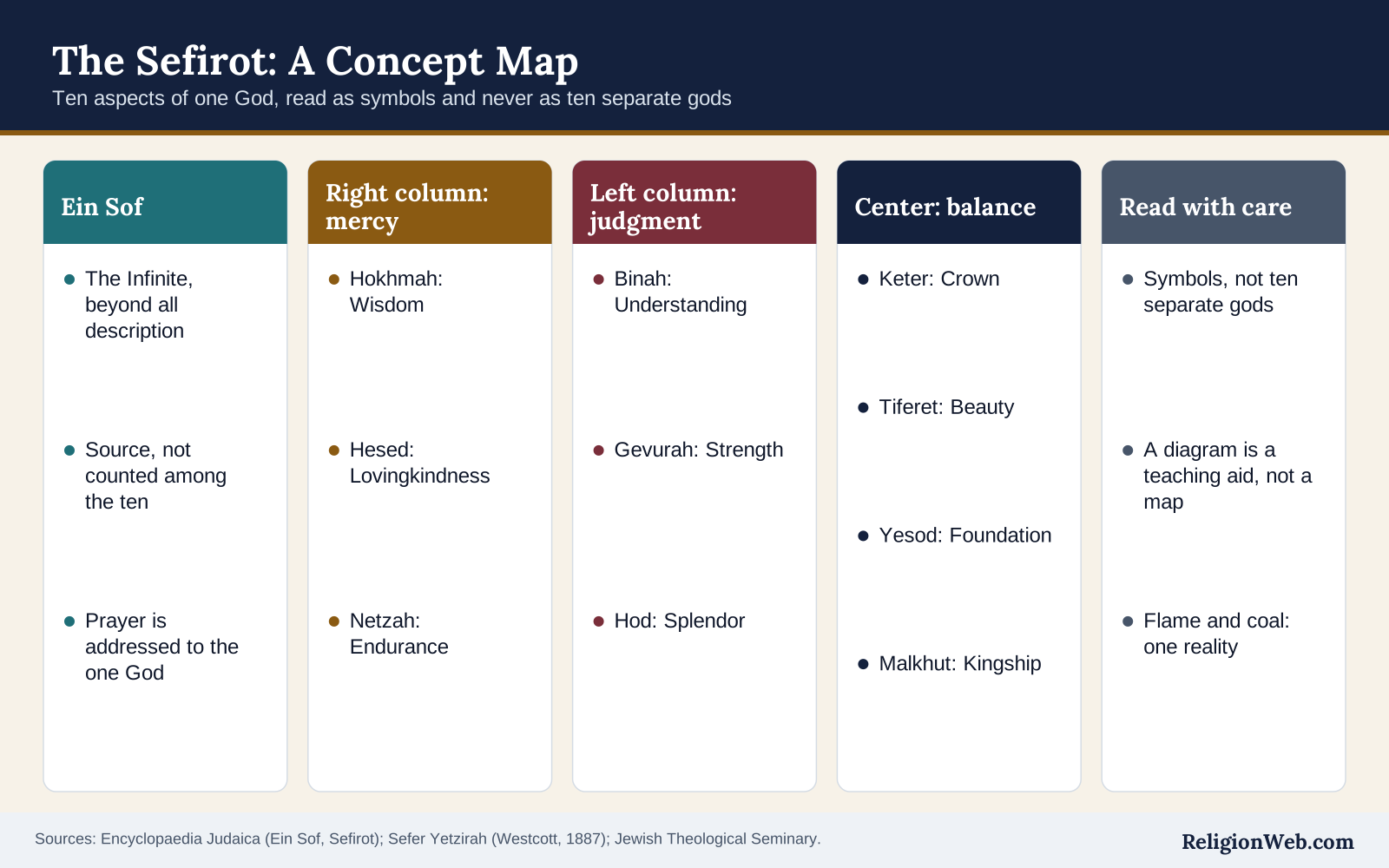
The word sefirot comes from a root meaning “to count” or “to number,” and it was coined by the author of Sefer Yetzirah for the ten primordial numbers. In the medieval tradition it came to designate ten stages of emanation from Ein Sof, understood as the realm of God’s manifestation in various attributes. The sefirot are traditionally listed in a fixed order, and each is associated with biblical figures, divine names, parts of the human body and moral qualities. The table gives the names most commonly used, with English glosses and the associations most often found in Zoharic and later literature. Other texts assign different associations, and the English glosses are approximations, as the next subsection explains.
| Sefirah | Common English gloss | Customary associations | Position on the diagram |
|---|---|---|---|
| Keter | Crown; supreme will | The most hidden stage, nearest to Ein Sof | Top of the central column |
| Hokhmah | Wisdom | First flash of thought; often called “father” | Upper right |
| Binah | Understanding | Development of thought; often called “mother” | Upper left |
| Hesed | Lovingkindness | Giving and generosity; Abraham | Middle right |
| Gevurah (Din) | Strength; judgment | Restraint and discipline; Isaac | Middle left |
| Tiferet | Beauty; harmony | Balance of love and judgment; Jacob; the Written Torah | Center |
| Netzah | Endurance; victory | Persistence; prophecy; Moses | Lower right |
| Hod | Splendor; majesty | Acknowledgment and praise; Aaron | Lower left |
| Yesod | Foundation | Channel that conveys the upper flow downward; Joseph | Lower center |
| Malkhut | Kingship; sovereignty | Receiving and revealing the divine; the Shekhinah; David | Bottom of the central column |
Some writers add a hidden stage called Da’at (“Knowledge”), which is not counted among the ten but is sometimes placed between Hokhmah and Binah, particularly in Hasidic thought. This is one of several places where the diagram is a convention and not a doctrine fixed by the earliest sources.
The tree, the three columns and the human figure
The sefirot are usually pictured as a branching structure, often called the Tree of Life or the sefirotic tree, arranged in three vertical columns. The right column (Hokhmah, Hesed, Netzah) is associated with mercy and expansion, the left (Binah, Gevurah, Hod) with judgment and limitation, and the central column (Keter, Tiferet, Yesod, Malkhut) with balance and mediation. The resulting diagram invites readers to see divine activity as a dynamic interplay of complementary tendencies, in which love without limit would overflow and judgment without love would constrict. In the Zohar, the symmetry is also related to the human form, since the sefirot are said to correspond to the body’s structure, a notion that has often led to misunderstanding when taken literally.
The diagram deserves a note of caution. Pictorial versions of the sefirotic tree developed in manuscripts and printed books over many centuries, and different authors arrange or connect the ten differently. A diagram is a teaching aid, comparable to a map, and it does not claim that the divine has a geometry. Students of Kabbalah traditionally learned the symbolism together with its oral explanation, which is why a drawing in a modern book gives only a limited view.
Translating the Sefirot Carefully
Attributes, emanations, vessels: three ways of speaking
No single English word captures what a sefirah is, and the history of the term shows why. The Encyclopaedia Judaica frames the sefirot as emanations and as manifestations of divine attributes, forming a dynamic unity through which God’s activity is revealed. In the Lurianic scheme, they also function as vessels (kelim) for the divine light. Moses Cordovero put the central question starkly: are the sefirot God’s own substance or merely instruments, vessels, through which God acts? His answer, as the encyclopedia summarizes it, was both: they are emanated from God, and God’s substance is immanent in them, as a soul is in a body.
The choice of English word therefore carries a theological decision. “Attributes” suggests qualities that God possesses, “emanations” suggests a flow outward, “vessels” suggests containers, and “dimensions” or “aspects” suggests different views of one reality. A careful translator will often leave the Hebrew word untranslated and rely on explanation, and a careful reader will remember that every English rendering is a metaphor.
Why the sefirot are not ten gods
The most common misreading takes the sefirot as ten separate divine beings. The tradition rejects that interpretation firmly. The Zohar, according to the Jewish Theological Seminary, presents its sefirotic drama while still insisting on a fundamental divine unity, and the earliest source of the term already ties the ten together. Westcott’s translation of Sefer Yetzirah, chapter 1, section 7, compares the relation between the ten and their source to a flame joined to a burning coal, an image of continuity in which flame and coal are not two separate things. Later Kabbalists used the same family of images: a single flame with many colors, a single light seen through colored glass, a single soul expressed in different faculties.
The setting of this teaching in the Jewish liturgy reinforces the point. The Shema, the central declaration of Jewish prayer, proclaims divine unity, and Kabbalistic prayer is often explicitly framed as an effort to unify the divine aspects, not to multiply them. The following verse is the text that nearly all Jewish communities recite twice daily.
Hear, O Israel: the LORD our God, the LORD is one.
Deuteronomy 6:4, The Holy Scriptures: A New Translation (Jewish Publication Society, 1917), as reproduced on Sefaria
For Kabbalists, the unity of this verse is not undermined by the sefirot but expressed through them. Where critics have accused the tradition of introducing plurality into God, defenders, from the medieval period to the present, have answered that the sefirot are the way in which the one God is revealed, as the many rays of a single sun are not many suns. Not every thinker accepted the answer, and the dispute is part of the history of the tradition, but within Kabbalah itself the language of the ten is understood as the language of one.
Companion Frameworks: Worlds, Souls and Divine Names
The four worlds
Later Kabbalah added further frameworks to the sefirotic system. One of the most widely used is the doctrine of four worlds, descending from the most spiritual to the most material: Atzilut (emanation), Beriah (creation), Yetzirah (formation) and Asiyah (action). Each world contains its own configuration of the ten sefirot, so that the divine pattern recurs at every level of reality. The scheme appears in many sources and is prominent in Hasidic literature, where it is used to organize teachings about prayer, which is often described as an ascent through the worlds, and about the way in which the divine reaches down into everyday life.
The doctrine is a good illustration of how Kabbalah approaches complexity: not by simplifying the picture but by finding repeated patterns within it. The same ten-fold structure can describe a cosmos, a text, a prayer, a person or a day, and the practitioner learns to recognize it in each.
Levels of the soul and the divine name
The tradition also describes the human soul in layers. The three lowest are usually called nefesh, ruah and neshamah, and later writers add two higher levels, hayah and yehidah. In this view, the human being is a microcosm in which the structure of the universe is reproduced, and spiritual development consists of drawing down the higher levels into awareness. The framework underlies much of the Kabbalistic ethic of self-refinement, and it is explicitly adopted by many Hasidic teachers.
Finally, the sefirot are connected to divine names. The four-letter name of God, the Tetragrammaton, is mapped onto the sefirot and the worlds in several schemes, and many Kabbalistic prayers and meditations work with those correspondences. In Jewish practice the name itself is not pronounced as written, so the correspondences are studied and contemplated in writing and in silent kavvanah, not voiced. This restraint is part of what separates traditional Kabbalistic practice from popular claims about “using” divine names.
Safed, Isaac Luria and Lurianic Kabbalah
Safed in the Sixteenth Century
After the expulsion: a mystical town in the Galilee
Safed, a hill town in the Galilee, became an unusual concentration of Jewish scholarship in the sixteenth century. The expulsion of Jews from Spain in 1492 and the displacement that followed brought refugees and scholars to the Ottoman Empire, which controlled the region, and many settled in Safed. A cluster of figures there made it famous. According to the Center for Online Judaic Studies, the town drew a kabbalistic circle in the 1520s and 1530s that included Solomon Alkabets (1505 to 1576), Moses Cordovero (1522 to 1570) and Joseph Karo (1488 to 1575). Karo is best known as the author of the legal code Shulhan Arukh, a reminder that in Safed the worlds of law and mysticism overlapped rather than competing.
Alkabets composed the hymn Lekha Dodi, which is sung in synagogues around the world to welcome the Sabbath and which was a product of this milieu. The sense of exile that followed the expulsion shaped the circle’s concerns: if the Jewish people were scattered, how could that condition be understood in relation to the divine order, and what could be done about it? The mystics of Safed answered with a theology in which exile was a cosmic as well as a historical condition, and in which the repair of both was a shared task.
Moses Cordovero and the systematization of the Zohar
Moses Cordovero (1522 to 1570) was the leading kabbalist in Safed before Luria. His first great systematic work, Pardes Rimmonim (“Orchard of Pomegranates”), was written by about age twenty-seven and printed in Kraków in 1592. It surveys and harmonizes earlier teaching, relying mainly on the Zohar and its related strata, and it takes up the question of what the sefirot are. His shorter ethical treatise Tomer Devorah, printed in Venice in 1589, invites the reader to imitate the divine attributes in his or her own conduct, so that the structure of the sefirot becomes a moral program. It helped found the later genre of kabbalistic ethical literature.
Cordovero’s significance is easy to underestimate because Luria’s fame eclipsed his. Yet he was Luria’s teacher in Safed, and his synthesis defined the options against which the Lurianic school defined itself. Anyone who wishes to see what “classical” Kabbalah looked like before the Lurianic revolution reads him.
Isaac Luria and Hayyim Vital
The life of the Ari
Isaac ben Solomon Luria, known by the acronym Ha-Ari (“the Lion”) or as the Arizal, was born in Jerusalem in 1534 to a family of Ashkenazic and Sephardic background. After his father’s death he was taken to Egypt, where he lived with a wealthy uncle, studied rabbinic law and immersed himself in the Zohar. In late 1569 or early 1570 he moved to Safed and studied with Cordovero, and he soon gathered his own circle. A standard reference entry on Luria counts about thirty-five formal disciples, among whom Hayyim Vital was chief. Luria died in Safed on August 5, 1572, during an epidemic, only about two years after his arrival.
That short career had an outsized effect. Contemporary accounts depict Luria as a teacher who tailored guidance to each disciple’s soul, who taught meditative techniques for spiritual ascent and who led his students in ritual practices in the countryside around Safed. He left behind very little writing of his own, apart from three hymns for the Sabbath meals, so that nearly everything that is known about his system comes from the notes and compositions of students.
Hayyim Vital and the problem of transmission
The chief transmitter was Hayyim Vital, whose large posthumous collection of Luria’s teachings became the foundation of what is called Lurianic Kabbalah. Vital himself worked to establish the legitimacy of the system and of his own role as Luria’s successor. Other disciples also wrote versions of the teachings, and the variants differ in emphasis and detail, so the “Lurianic” system as it is usually taught is already an editorial construction of the students and later editors. Scholars therefore speak of the Lurianic corpus with some care, distinguishing what can be attributed to Luria himself from what comes from the interpretive work of Vital and others.
The way the teachings were circulated, first in manuscript copies and later in print, also shaped their reception. According to the Center for Online Judaic Studies, access to some of the sources in printed books made these ideas more popular among learned Jews, though scholars disagree about how far the full cosmology spread. What did spread widely were the practices and the central story, summarized in the next subsection.
The Lurianic Story of Creation and Repair
Tzimtzum, the divine withdrawal
The most famous Lurianic idea is tzimtzum, “contraction.” In the standard account, before creation Ein Sof filled all reality, so there was no space for anything other than God. To make room for a world, God withdrew or contracted parts of the divine self, leaving an empty space into which a ray of light was then emanated. The notion treats creation as an act of self-limitation: the world exists because the infinite makes room for the finite. Reference works sum it up as God withdrawing into the divine self to make room for creation, though Jewish thinkers have offered strikingly different interpretations of how literally to take the withdrawal.
Disagreement about this question is old. Some interpreters understood tzimtzum as an actual, if mysterious, event within the divine, while others, especially in later centuries, read it as a way of speaking about how a human mind could perceive a world that is truly sustained by an ever-present God. Neither reading was meant to attribute to God a change of place, and the tradition itself warns against such a thought.
Shevirat ha-kelim, the breaking of the vessels
In the next stage, the divine light was channeled into the sefirot, which in this system function as vessels (kelim) for the light. According to the standard Lurianic narrative, as the Center for Online Judaic Studies describes it, the three upper vessels held the light, but the seven lower vessels could not and broke, scattering the light and sending fragments, called kelipot (“shells” or “husks”), into the abyss. This is the “breaking of the vessels,” shevirat ha-kelim. The result is a world in which sparks of divine light are trapped in material things and in which good and evil are intermingled.
The breaking is the tradition’s explanation for why the world is not in the state it ought to be: exile, suffering and moral ambiguity are traced to a rupture in the process of emanation, and not to an arbitrary decision of God. For readers who had experienced the expulsion from Spain, the idea connected the national catastrophe to a cosmic one and gave it a meaning that could be addressed by action.
Tikkun, repair and the human role
The third element is tikkun, “repair” or “restoration.” The sparks are to be gathered and returned to their source, the vessels rebuilt, and the divine order restored. Human beings have a role in this process: in the Lurianic account, the first human was created to complete the repair, and, because the effort failed, the task passes to the Jewish people through the observance of the commandments with proper intention. Each commandment performed with kavvanah is thought to restore a spark, and each transgression to cast one back, until the world is repaired and, in the standard formulation, the Messiah arrives.
Modern English uses “tikkun olam,” “repairing the world,” as a phrase for social action, and the modern usage has its own history that is distinct from the Lurianic one. The Lurianic idea concerns a cosmic process accomplished through prayer, ritual and ethical conduct, while the modern phrase is most often a call to work for justice. Both usages are meaningful, but they should not be confused. The section on misconceptions returns to this point, and the FAQ explains the connection and the difference.
Lurianic Practice and Its Spread
Kavvanot, transmigration and the discipline of the soul
Lurianic Kabbalah was not merely a theory; it was a program of devotion. Students practiced detailed kavvanot, specific meditations on the divine names and sefirot to be directed during the words of prayer and during the performance of commandments. They also engaged in practices of repentance and self-examination, including a midnight lament for the destruction of the Temple (tikkun hatzot), and they developed the doctrine of gilgul, the transmigration of souls, in which souls return to complete tasks left unfinished. Such ideas had earlier precedents but acquired new weight in Safed. Some of these practices were demanding and were intended for a small circle of trained students, not for the general public.
Because the discipline was so intense, later communities adapted it. Within Hasidism and some Sephardic traditions, the long sequences of intentions were simplified or internalized, so that a worshiper might hold a brief intention in mind rather than perform an entire sequence of meditations. This is an example of how Lurianic Kabbalah moved from the study house into wider religious life.
Customs that reached ordinary households
The most lasting effect of the Safed circle may be on practice. The Center for Online Judaic Studies lists several customs associated with the Lurianic revival that became widespread: the welcome of the Sabbath bride in Kabbalat Shabbat, a third meal on the Sabbath, all-night study on the festival of Shavuot, marital closeness on Friday night as part of the sanctification of the Sabbath, and penitential rituals. These customs now appear in communities that would not call themselves kabbalistic, and many worshipers participate in them without knowing their origins. The Sabbath in particular is shaped by the Safed legacy, as later sections show.
Scholars regard Lurianism as the last premodern theological system to gain such widespread acceptance in Judaism. By the middle of the seventeenth century its ideas and practices had spread through much of the Jewish world, and its influence on later Jewish mysticism was profound, long outlasting Safed’s decline as a center of Jewish life. That broad reception also set the stage for the messianic crisis that followed in the 1660s.
Messianic Upheaval, Hasidism and Later Reception
Sabbatai Zevi and the Crisis of the 1660s
Nathan of Gaza and the movement of 1665 and 1666
The mystical ideas of Safed met a historical test in the mid-seventeenth century. Sabbatai Zevi, born in Smyrna (now Izmir) in 1626, was a charismatic figure who had claimed to be the messiah as early as 1648. The movement around him took off in 1665 when Nathan of Gaza, a young kabbalist, proclaimed Zevi’s messianic identity publicly. According to the account in MyJewishLearning, Nathan’s announcement came during Shavuot of that year, and in September 1665 he predicted that Zevi would take the sultan’s crown without war. News of the claims spread rapidly through Jewish communities in the Ottoman Empire and Europe, prompting waves of repentance, fasting and, in some cases, preparations to travel to the Land of Israel.
The Lurianic framework gave the movement its theological shape. If redemption meant gathering scattered sparks of divine light through ritual action, a messiah who appeared to transgress traditional law could be interpreted as one who was descending into the realm of the husks to redeem the sparks hidden there. This explanation helped Zevi’s followers make sense of behavior that other Jews found shocking, and it shows how a mystical idea can have consequences far beyond the study house.
Conversion, aftermath and caution
In 1666 Zevi was arrested in Constantinople and, offered a choice between death and conversion, accepted Islam, taking the name Aziz Mehmed Effendi. He lived until 1676. The collapse of the hopes placed in him was traumatic for many, and most followers experienced a crisis of faith. The movement nevertheless persisted into the early eighteenth century, dividing into moderate and radical branches. A radical offshoot revived in Poland under Jacob Frank, who by 1756 was regarded by his followers as a reincarnation of Zevi.
The episode had lasting effects on how Jewish authorities regarded mystical study. Rabbinic leaders in several communities became wary of unrestricted public teaching of Kabbalah and of any messianic claim linked to it, and the older emphasis on prior mastery of Torah and Talmud was restated with new force. Historians link Shabbateanism to the later Hasidic movement, which in many accounts reacted against its messianic excesses by shifting the emphasis from collective redemption to the inner life of the individual. Gershom Scholem argued more broadly that the Sabbatean crisis contributed to a breakdown of traditional Jewish identity that opened the way to modernity, a thesis that later scholars have debated and refined.
Kabbalah in Italy, the Ottoman Lands and the Mizrahi World
Printing, Italy and the Mediterranean
While Poland and Ukraine produced the dramatic developments of the eighteenth century, Kabbalah continued to flourish around the Mediterranean. Italy was an early center of printing, as the first editions of the Zohar from Mantua and Cremona show, and Italian Jewish scholars participated in both traditional study and humanistic scholarship. One notable eighteenth-century figure was Moses Hayyim Luzzatto (1707 to 1746), an Italian kabbalist and poet whose ethical and mystical writings remain widely studied. His ethical work Mesillat Yesharim is read by many Jews who do not otherwise engage with Kabbalah.
In the Ottoman Empire, North Africa, Iraq and Yemen, Zoharic and Lurianic customs entered the liturgy and the life cycle of Sephardic and Mizrahi communities. Prayer books for these communities incorporate kabbalistic meditations and customs, and the study of the Zohar became a regular practice. In some of these communities, Kabbalah was not a movement of dissent or reform but a continuous part of mainstream religious culture, taught by community rabbis who were also judges and teachers of law. One example is the Baghdadi scholar Yosef Hayyim (1835 to 1909), known by the title of his book Ben Ish Hai, whose homilies blend law and Kabbalah and are widely used in Sephardic and Mizrahi communities.
Law and mysticism in the same hands
One of the most important points about the history of Kabbalah is that many of its leading figures were also masters of Jewish law. Nahmanides, Joseph Karo and the Vilna Gaon are all examples of this union. The practical result is that kabbalistic ideas have often entered Jewish practice through legal sources, in the form of customs recommended by authoritative rabbis, and not through public mystical teaching. This helps explain how a body of esoteric teaching came to shape the daily and weekly rhythm of Jewish communities that never studied it directly.
Hasidism and the Popularization of Mystical Ideas
The Baal Shem Tov, devekut and prayer
Hasidism emerged in the southeastern part of the Polish-Lithuanian Commonwealth in the eighteenth century. Its first prominent figure was Israel ben Eliezer, known as the Baal Shem Tov (“Master of the Good Name”) or the Besht. The Encyclopaedia Judaica describes him as a popular healer who gathered followers at Tolstoye and then at Medzibozh, whose public mission began after a revelation in the 1730s, and who died in 1760. Kabbalah, combined with popular traditions of ecstasy and communal enthusiasm, supplied the movement’s ideological foundation, and its prayer customs largely followed the Sephardic version of Luria’s rite.
Central to Hasidic teaching is devekut, “cleaving” or attachment to God, which was held to be the goal of all worship. Hasidim taught that prayer and the performance of commandments should be carried out in devekut, with joy and sincerity, and that holiness could be found in everyday activities. The first written theoretical formulation of the movement was Toledot Ya’akov Yosef (1780) by Jacob Joseph of Polonnoye. In the following generations, leaders such as Dov Ber of Mezhirech organized the movement around charismatic teachers, called rebbes or tzaddikim, and their courts and followers.
Chabad and the Tanya
Within Hasidism, the school of Shneur Zalman of Lyady, known as Chabad, was the more intellectual and study-centered branch. Its name is an acronym of the sefirot Hokhmah, Binah and Da’at (“wisdom, understanding, knowledge”). Shneur Zalman’s central work, the Tanya, was published in Slavuta in 1796 and presents a systematic psychology of the soul along kabbalistic lines, translating the sefirotic structure into a guide for inner life. It describes an interplay between a divine soul and an animal soul within each person and teaches a path of gradual transformation through contemplation.
The Chabad approach shows how Hasidism translated technical Kabbalah into spiritual guidance. Sefirot, worlds and the divine names are treated less as cosmic diagrams than as a map of the mind and heart, so that study, prayer and daily conduct are all understood as ways of aligning the human with the divine pattern. Other Hasidic groups developed different emphases, from the storytelling of Rabbi Nahman of Breslov to the court-centered devotion of the Polish and Galician rebbes, and no single description covers all of them.
Opposition, Debate and Divergent Readings
The Mitnagdim and the Vilna Gaon
Hasidism’s rapid growth provoked organized opposition. Its critics, called Mitnagdim (“opponents”), were led by Elijah of Vilna, the Vilna Gaon. According to the Encyclopaedia Judaica, they issued bans against the Hasidim in 1772 and again in 1781, Hasidic works were burned and a pamphlet against the movement appeared in 1772. The Mitnagdim worried about the neglect of formal Talmud study, about unfamiliar prayer customs and about charismatic leadership, and the shadow of the Sabbatean affair still lay across the debate. The conflict eased in later decades as both sides faced the pressures of the Haskalah, the movement of Jewish Enlightenment.
It would be a mistake to view this as a conflict between mysticism and its opponents. The Vilna Gaon was himself a Kabbalist and wrote a commentary on the Zohar, Yahel Or, printed in Vilna in 1882. The disagreement was about authority, community leadership and the proper balance between study and ecstatic devotion, and not about whether Kabbalah was legitimate.
How the doctrines diverged
Even where Hasidim and their opponents shared a vocabulary, they sometimes read it differently. Tzimtzum offers an example. Some Hasidic thinkers, especially in Chabad, interpreted the withdrawal as a perspective rather than an event: from God’s standpoint, there is no real separation, and the apparent distance is a concession to the viewpoint of creatures. Others, including a number of Mitnagdic thinkers, insisted on a more literal reading in order to preserve a sense of the reality and independence of the created world and of the commandments. Because the question touches the relation of God and world, it carried implications for practice, and it remains one of the most debated topics in the history of Jewish thought.
The details of these debates are technical, but their importance is simple to state. Kabbalah was never frozen: each generation reshaped its categories to answer new questions, and the major schools of the eighteenth and nineteenth centuries produced distinct, sometimes opposed, readings of a shared inheritance.
Prayer, Commandments and the Mystical Reading of Jewish Practice
Kavvanah and the Meaning of Prayer
Intention, unification and the words of the liturgy
For Kabbalists, prayer is not only a human address to God but an act with consequences in the divine realm. The key term is kavvanah, “intention,” which in its simplest sense means attention and sincerity and in its Lurianic sense means a specific meditation connected to a word or phrase. A worshiper who recites the opening line of the Shema while holding in mind the unity of the sefirot is understood to contribute to that unity. Many Hasidic and Sephardic prayer books include a short declaration before the performance of a commandment, expressing the intention to act for the sake of the unification of God and the divine presence. The formula is a compact statement of the entire kabbalistic approach to practice.
The text at the center of this approach is the Shema, whose first line has already appeared. Kabbalistic commentary notices details of its wording and rhythm, such as the whispered line recited after it in many communities, and treats the prayer as an affirmation that all divine aspects are ultimately one. In synagogue worship (see the discussion of the synagogue), the practice of directing the heart is combined with the fixed text, so that the same words carry both a plain meaning and an inner one.
The Kedushah and the angelic liturgy
The roots of this view of prayer reach back to the throne visions discussed earlier. The Kedushah, the sanctification recited during the repetition of the central prayer in congregational worship, draws on the vision of the prophet Isaiah, in which the angels proclaim God’s holiness.
And one called unto another, and said: Holy, holy, holy, is the LORD of hosts; The whole earth is full of His glory.
Isaiah 6:3, The Holy Scriptures: A New Translation (Jewish Publication Society, 1917), as reproduced on Sefaria
In the mystical reading, which goes back to the Hekhalot literature, the congregation that recites this verse joins the heavenly host in the same praise. The later Kabbalists added that the three-fold “holy” corresponds to three levels of the divine realm, and that the earthly recitation draws the three together. Not every worshiper who recites the Kedushah has this in mind, and the plain meaning of the verse, a proclamation of God’s holiness and presence in all the earth, is sufficient for the prayer. The mystical reading is an added layer, available to those who have been trained to see it.
Kabbalat Shabbat and Lekha Dodi
The best-known liturgical legacy of the Safed circle is Kabbalat Shabbat, the Friday evening service that welcomes the Sabbath. The hymn Lekha Dodi, composed by Solomon Alkabets, greets the Sabbath as a bride and queen, and worshipers traditionally turn toward the entrance at its final verse. In kabbalistic terms the Sabbath is the day on which the Shekhinah, the feminine dimension of the divine, is united with the higher sefirot, and the hymn is a joyous preparation for that union. Many communities sing it to melodies from their own traditions, and it has been set to music by composers in nearly every Jewish community. Readers will find the broader picture of the day in the article on Shabbat.
The Commandments as Repair and Dwelling
Why the commandments matter: the mystical rationale
Kabbalah offers its own answer to a question that Jewish thinkers have asked since antiquity: why does God command what God commands? The rabbinic tradition treats the commandments as binding regardless of whether the reason is known. Kabbalists added that each commandment has a hidden purpose, a reason in the structure of the divine realm, and that the act of fulfilling it has effects there. One scriptural verse often cited for the underlying idea is the divine request for a sanctuary.
And let them make Me a sanctuary, that I may dwell among them.
Exodus 25:8, The Holy Scriptures: A New Translation (Jewish Publication Society, 1917), as reproduced on Sefaria
The verb for “dwell” gives the Shekhinah its name, and Kabbalistic writers read the verse as a statement of the human task: to construct, through acts of holiness, a dwelling in which the divine presence can be at home. In the Lurianic version, the commandments are the instruments by which the sparks are lifted and the vessels repaired, as described above. The commandments, in this light, are neither arbitrary rules nor merely ethical guidelines. They are the means by which people take part in restoring a world they inherited in a damaged state.
This rationale does not replace halakhic reasoning. Kabbalists generally insisted that the law be observed exactly as the legal authorities define it, and mystical intentions are added to the correct performance, not substituted for it. For this reason, kabbalistic customs have often been absorbed into law only after authoritative rabbis approved them, and communities differ about which customs to keep.
Objects and acts: tefillin, mezuzah, immersion and food
Kabbalistic reading attaches to many familiar objects. The tefillin, the leather boxes containing scriptural passages that are bound on the head and arm, are said to represent a connection between mind and heart and the divine; writers assign symbolic meaning to each box, strap and knot, and Hasidic practice often adds a specific intention when winding the strap. The mezuzah, the scroll on the doorpost containing the Shema, bears on its back, by a widespread custom, the divine epithet Shaddai, and Kabbalistic writers see the doorpost scroll as a protective boundary of holiness around the household. These interpretations coexist with the straightforward legal rules for how the objects are made and used.
The mikveh, the pool for ritual immersion, has a specific legal function, for example in the laws of family purity and conversion, and a separate spiritual function in Hasidic and some Sephardic traditions, where immersion before the Sabbath, festivals or the Day of Atonement is a gesture of spiritual preparation. Kabbalistic literature links the waters with renewal and with the divine quality of understanding (Binah), described as a womb from which new spiritual life emerges. The dietary system, discussed in the article on kashrut, receives similar mystical commentary, in which eating is a way of elevating the sparks contained in food, though kosher law itself rests on its own legal sources.
The Jewish Year Through a Mystical Lens
Festivals and their kabbalistic customs
Many Jewish festivals acquired distinctive customs under kabbalistic influence. On Sukkot, the Zoharic custom of the ushpizin, the “guests,” invites seven biblical figures, Abraham, Isaac, Jacob, Moses, Aaron, Joseph and David, into the sukkah on successive nights, each associated with one of the seven lower sefirot. On Shavuot, the practice of staying awake all night to study, known as Tikkun Leil Shavuot, goes back to the Safed circle, which presented it as a way of preparing the bride, the Torah, for her wedding with Israel on the anniversary of Sinai. On Rosh Hashanah and the Day of Atonement, Lurianic sources supplied detailed intentions for the sounding of the shofar, and some communities follow them. A well-known wordplay found in kabbalistic sources reads the Hebrew name of the Day of Atonement, Yom ha-Kippurim, as “a day like Purim,” a reminder of the way the tradition connects the solemn and the joyous. See also the articles on Purim and Hanukkah for the festivals as most communities observe them.
It is important to say that these customs vary. Some communities keep all of them, some keep a few, and some, including a number of modern Orthodox, Conservative and Reform synagogues, adopt specific ones such as Kabbalat Shabbat or the Shavuot night of study without taking on the surrounding theology. The mystical meanings are therefore best understood as one layer of the festival, not as a definition of it.
The Omer, Lag BaOmer and the hillula of Rabbi Shimon
The period of counting between Passover and Shavuot also acquired kabbalistic associations. Each of the seven weeks and each of the seven days within them is linked to one of the seven lower sefirot, so that the counting becomes a structured exercise of self-examination, with day one, for instance, joining lovingkindness within lovingkindness. On the thirty-third day of the Omer, called Lag BaOmer, which falls on 18 Iyar in the Hebrew calendar, many Jews mark the traditional anniversary of the death of Rabbi Shimon bar Yochai, whom tradition regards as the teacher of the Zohar. The occasion, called a hillula (“celebration”), draws pilgrims to his traditional burial place at Meron in northern Israel, with bonfires, singing and, for some boys, a first haircut. The practice reflects the afterlife of the Zohar’s frame story in popular devotion, whatever one concludes about the book’s historical authorship.
A related custom of kabbalistic origin is the Tu BiShvat seder, a meal of fruits and wine held on the fifteenth of Shevat, the “new year of the trees.” According to tradition it began among the kabbalists of Safed, who arranged the fruits and four cups of wine to correspond to the four worlds. Today it is observed in many communities, including ones that emphasize environmental themes, and it shows how a mystical framework can be reinterpreted for new concerns.
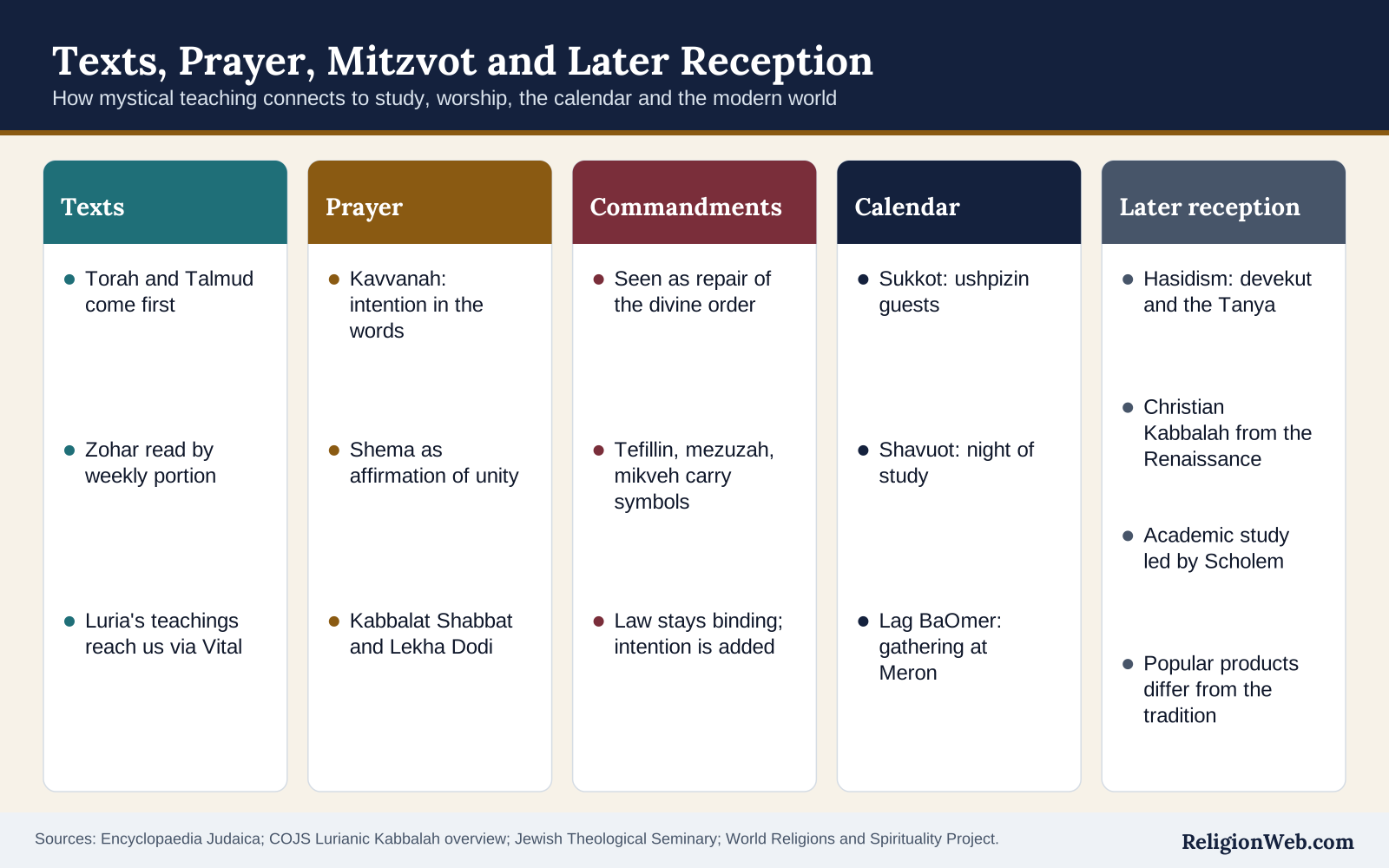
Amulets, Divine Names and the Limits of Practical Kabbalah
What practical Kabbalah means
The term practical Kabbalah (kabbalah ma’asit) refers to the use of divine names, special prayers and written amulets for protective or other purposes. It has existed for centuries and has an extensive manuscript literature, but it is also the area in which rabbinic authorities have been most cautious. Many have restricted or discouraged it, especially when it appears to promise results or to treat sacred names as instruments of power. Mainstream kabbalistic study, including that of the Zohar and of Luria, is concerned primarily with understanding the divine structure and with devotion, and it does not present itself as a technique for producing worldly results.
Health, safety and the boundaries of religious practice
Within communities that use blessings, amulets or specific prayers for protection and healing, those practices are understood as expressions of faith and as additions to, not replacements for, medical care. Jewish law itself requires seeking medical treatment and gives the preservation of life priority over most commandments. Anyone facing a medical or psychological difficulty is best served by qualified professionals, and the religious tradition, correctly understood, supports that conclusion. This point is worth stating plainly because commercial products that borrow kabbalistic vocabulary sometimes make health claims that the historical tradition never did.
Studying Kabbalah: Preparation, Texts and Academic Scholarship
Traditional Preconditions for Study
Grounding in Torah and Talmud first
Traditional guidance on who should study Kabbalah rests on the cautious rabbinic attitude described earlier. The Mishnah’s rule that the account of the chariot be taught only to a sage who understands independently became, over the centuries, a general expectation that mystical study should follow, and not replace, mastery of the Bible and rabbinic literature. The Talmud and its law, the thinking went, supply the discipline and the ethical grounding without which mystical speculation could drift into error or arrogance. Kabbalists themselves repeated this view, and the Sabbatean affair strengthened it.
Several later authorities recommended specific safeguards, among them a minimum age, often given as forty in later rabbinic discussions, and a settled family life. These recommendations were never universal, and Hasidic and Sephardic communities in particular have often taught the Zohar and related texts to younger students and to ordinary adults in public classes. The picture is therefore not of a single rule but of a spectrum, from communities that keep serious study for a trained few to those that treat the weekly reading of the Zohar as a normal part of religious life.
The role of the teacher and the community
Traditionally, Kabbalah was learned from a teacher and within a community of practice. The circles of Gerona, Safed and the Hasidic courts all show the same pattern: a master who knows the texts and the discipline, a small group of disciples, and a gradual induction into both the ideas and the way of life they imply. Books were never regarded as sufficient by themselves, in part because their symbolism is so compressed and in part because the spiritual state of the reader was considered relevant to understanding. This is why traditional teachers often caution against studying kabbalistic books in isolation, and why the Hasidic emphasis on a rebbe or teacher has such a prominent role.
How Kabbalah Is Studied Today
Texts and methods
In traditional settings, study usually begins with ethical and devotional works and moves toward the major texts. For Ashkenazi and Hasidic students, a common sequence includes the Tanya and other Hasidic works before the Zohar; for Sephardic and Mizrahi students, it often includes the Zohar, the writings associated with Luria and the ethical works of Cordovero and Luzzatto. The Zohar is frequently studied by the weekly Torah portion, which keeps it tied to the synagogue calendar, and many communities hold Zohar readings on the Sabbath or on specific commemorations. Study in Hebrew and Aramaic is preferred, though translations in Yiddish, Ladino, Judeo-Arabic and now English and other languages are widely used.
The method is typically slow, repetitive and discussion-based. Students read a passage, consult commentaries, and then relate the symbolism to the liturgy or the weekly portion. The aim is not only to grasp concepts but to bring them into prayer and conduct, so that learning is also a form of worship. In academic classrooms the method differs, as the following subsections explain.
Study and devotional contexts at a glance
The settings where kabbalistic ideas are taught or practiced differ widely, as the table shows. The same text may serve as a manual of devotion in one setting and as a historical source in another.
| Context | Typical setting | Characteristic focus | Who participates |
|---|---|---|---|
| Safed circles of the 16th century | Small groups of disciples around a master | Zohar, Cordovero’s synthesis, Lurianic kavvanot and customs | Scholars and pietists, often also jurists |
| Sephardic and Mizrahi study houses | Community synagogues and study halls | Zohar, Lurianic prayer customs, homiletic literature | Rabbis and lay adults, in many communities |
| Hasidic courts | Rebbe’s court, prayer room, festive table | Devekut, Hasidic teachings, tales, prayer | Followers of a given rebbe, men and women in different roles |
| Chabad study | Classes, study circles, publications | Tanya and Chabad discourses | Students and community members of varied background |
| Lithuanian yeshiva world | Talmudic academies | Talmud first; Kabbalah selectively, in the tradition of the Vilna Gaon | Advanced students, teachers |
| Synagogue liturgy | Friday evening and festival services | Kabbalat Shabbat, Lekha Dodi, Shavuot night study | General congregations across movements |
| University programs | Departments of Jewish studies and religion | Critical analysis of manuscripts, history, symbolism | Scholars and students of any background |
| Contemporary adult education | Classes, online courses, retreats | Introductions to concepts, meditation, translations | Adults of diverse backgrounds, within and beyond Judaism |
The Academic Study of Kabbalah
Gershom Scholem and the founding of the field
The modern scholarly study of Kabbalah is closely identified with Gershom Scholem (1897 to 1982), a German-born scholar who settled in Jerusalem and taught at the Hebrew University. In the nineteenth century, the dominant Jewish scholarship had often dismissed Kabbalah as a late, irrational accretion. Scholem argued instead that it was a central creative current in Jewish religious history, and he set out to reconstruct its development from manuscripts. His Major Trends in Jewish Mysticism, based on lectures delivered in 1938 and published in 1941, and his studies of the Zohar, of Sabbatianism and of the early Kabbalah, defined the field for generations. His conclusion about the Zohar, that Moses de Leon was its principal author, remains the starting point for most discussions even where later scholars have qualified it.
Scholem’s approach also emphasized the historical dynamics of Kabbalah: how it responded to crises and how its symbols were reinterpreted. His interest in the connection between Lurianic ideas and the messianic movement of Sabbatai Zevi, for instance, shaped an influential account of the transition from medieval to modern Judaism.
Debates among scholars today
Later scholars have both built on and challenged Scholem’s work. Isaiah Tishby produced a major anthology and analysis of Zoharic teaching, Yehuda Liebes proposed that the Zohar was written by a circle of mystics, and Moshe Idel argued for greater attention to the experiential and ecstatic dimensions of Kabbalah and for continuities with earlier Jewish tradition. Other scholars have examined gender, language, ritual and the social settings in which texts were written and read. The result is a field in which basic questions, such as the extent of non-Jewish influence on early Kabbalah or the dating of particular layers of the Zohar, remain open.
For readers outside the academy, the existence of these debates is a helpful reminder that there is no single authoritative narrative of Kabbalah. The tradition’s self-image as an unbroken chain of teaching and the historian’s account of development through identifiable authors and eras coexist, and each contributes something to understanding.
Major Texts, Figures and Schools at a Glance
The Principal Texts
From Hekhalot to Hasidic thought
The table gathers the works most often cited in discussions of Kabbalah, arranged roughly in chronological order. Dates are approximate for the earlier works, and in several cases their authorship is disputed; the entries follow the dating given in the reference works cited in this article.
| Text | Date and setting | Type of work | Why it matters |
|---|---|---|---|
| Hekhalot Rabbati and Hekhalot Zutarti | Talmudic or geonic era (debated), Palestine and Babylonia | Visionary ascent literature | Throne vision and heavenly palaces; background to later mysticism |
| Sefer Yetzirah | Between the 2nd and 6th centuries CE | Short cosmological treatise | Ten sefirot and 22 letters as the foundation of creation |
| Sefer Hasidim | 12th to 13th centuries, Rhineland; Judah he-Hasid (d. 1217) | Ethical and pietist guide | Pietism and prayer mysticism of Hasidei Ashkenaz |
| Sefer ha-Bahir | Early 13th century; earliest dated manuscript 1298 | Anthology of symbolic interpretations | Early symbolic language of divine powers |
| The Zohar | Late 13th century, Castile | Mystical commentary on the Torah | Central text of the tradition; basis for later commentary |
| Pardes Rimmonim | Cordovero, Safed; printed Kraków, 1592 | Systematic exposition | Synthesis of pre-Lurianic Kabbalah |
| Tomer Devorah | Cordovero; printed Venice, 1589 | Short ethical treatise | Imitating the divine attributes in conduct |
| Lurianic writings (Hayyim Vital and others) | Late 16th century, Safed; printed later | Collected teachings of Luria | Tzimtzum, breaking of vessels, tikkun |
| Tanya | Shneur Zalman of Lyady; Slavuta, 1796 | Hasidic work of spiritual psychology | Foundation of Chabad thought |
Taken together, the list shows a movement from visionary narrative through cosmological symbolism to systematic theology and finally to devotional psychology, with the Zohar standing at the center as the great narrative and interpretive work.
Reading the list with care
A table cannot convey how these texts relate to the Bible and rabbinic law. Nearly all of them are commentaries, direct or indirect, on the Torah and the liturgy, and they were read alongside, not instead of, those sources. It is also worth noting that the same title may refer to quite different editions, since the Zohar and the Lurianic corpus exist in multiple recensions with variant readings.
Figures and Schools
People who shaped the tradition
No account of Kabbalah is complete without the people who carried it. The table below lists central teachers and movements, again in broad chronological order, with the region and contribution of each. It is not a ranking, and the omission of a name should not be read as a verdict on significance.
| Figure or school | Dates and place | Contribution |
|---|---|---|
| Isaac the Blind and his circle | Around 1200, Provence | Earliest precise use of the name Kabbalah; Ein Sof |
| Ezra, Azriel and the Gerona circle | 13th century, Catalonia | Largest body of pre-Zoharic kabbalistic writing |
| Nahmanides (Moses ben Nahman) | 1195 to 1270, Gerona | Veiled kabbalistic hints in a Torah commentary |
| Abraham Abulafia | Born about 1240; active about 1271 to 1291 | Prophetic Kabbalah and letter meditation |
| Moses de Leon | Died 1305, Castile | Chief author or editor of the Zohar, in most scholarly views |
| Moses Cordovero | 1522 to 1570, Safed | Systematic synthesis; ethics of the sefirot |
| Isaac Luria and Hayyim Vital | Luria 1534 to 1572, Safed | Tzimtzum, breaking of the vessels, tikkun; transmission by Vital |
| Sabbatai Zevi and Nathan of Gaza | Zevi 1626 to 1676; movement 1665 to 1666 | Messianic movement drawing on Lurianic ideas |
| Baal Shem Tov and early Hasidism | Public mission from the 1730s; died 1760 | Devekut and popular mystical devotion |
| Shneur Zalman of Lyady (Chabad) | Tanya published 1796 | Systematic Hasidic psychology of the soul |
| Yehuda Ashlag | 1885 to 1954, Palestine and Israel | Edition and commentary on the Zohar (1945 to 1958); source for later teaching |
| Gershom Scholem | 1897 to 1982, Jerusalem | Founder of the critical academic study |
Schools and their differences
It helps to see these names as belonging to several overlapping currents: the pre-Zoharic circles of Provence and Gerona, the ecstatic current of Abulafia, the theosophy of the Zohar, the Safed schools of Cordovero and Luria, and the Hasidic movements. The currents overlap, quote one another and sometimes dispute. Their relationship is better described as a conversation across centuries than as a sequence of replacements, and a student of any one stream will find the others constantly in the background.
Kabbalah in the Modern World: Traditional Communities, Western Reception and Popular Adaptations
Kabbalah in Traditional and Scholarly Jewish Life
Hasidic, Sephardic, Mizrahi and Israeli settings
In the twentieth and twenty-first centuries the traditional study of Kabbalah has continued in Hasidic courts, in Sephardic and Mizrahi academies, and in institutions in Israel and the Jewish diaspora. Yehuda Ashlag (1885 to 1954), who moved to Palestine in the 1920s, produced a complete edition of the Zohar with his own commentary, published in Jerusalem between 1945 and 1958 in twenty-two volumes, and developed a modern interpretation of Lurianic ideas that has influenced several later teachers. Chabad has made its Hasidic teachings available to a broad audience through classes and publications, and the works of Rav Abraham Isaac Kook (1865 to 1935), the first Ashkenazi chief rabbi of British Mandate Palestine, wove kabbalistic themes into a religious reading of modern Jewish nationalism that remains influential in some Orthodox circles.
No reliable figures exist for how many people study Kabbalah, because participation ranges from the lifelong specialist to the congregant who sings Lekha Dodi each Friday night. What can be said is that kabbalistic customs and language have spread far beyond those who would describe themselves as Kabbalists, and that they are part of the ordinary liturgy of many communities.
Non-Orthodox movements and renewed interest
The nineteenth-century movements that became Reform and Conservative Judaism emerged in an environment that was often suspicious of Kabbalah, in part because they associated it with the Sabbatean crisis and with what they regarded as irrationalism. In the twentieth century that attitude changed. Academic work such as Scholem’s showed the historical importance of the tradition, and rabbis and teachers in the Conservative and Reform movements, along with groups such as Jewish Renewal, began to draw on kabbalistic and Hasidic ideas in liturgy, music and meditation. These adaptations vary widely, from rhetorical borrowings to serious study, and they are best described movement by movement and teacher by teacher.
Christian and Western Esoteric Receptions
Renaissance Christian Kabbalah
Interest in Kabbalah among non-Jews began in the Renaissance. Giovanni Pico della Mirandola, in the 1480s, was among the first Christian scholars to read Hebrew kabbalistic texts, and in his famous list of theses of 1486 he proposed that Kabbalah could support Christian doctrine. Johann Reuchlin’s De arte cabalistica was printed in 1517. Later writers, including Heinrich Cornelius Agrippa (1531 to 1533) and Francesco Giorgi (1545), integrated kabbalistic ideas with Neoplatonism and Hermetic thought, and Christian Hebraists such as Christian Knorr von Rosenroth published a Latin anthology of kabbalistic texts, Kabbala denudata, in 1677 and 1678. This literature is called Christian Kabbalah by historians.
Christian Kabbalah was a separate tradition with its own aims. Its authors read the Hebrew sources through their own theological frameworks and often changed their meaning in the process, and in later centuries some Christian writers criticized Kabbalah as pantheistic or irrational. It is part of the history of European thought, and it should not be confused with Jewish Kabbalah, though it contributed to the Western image of Kabbalah that persists today.
Hermetic Qabalah and modern occultism
In the nineteenth century, occult and esoteric movements in Europe and North America adopted the sefirotic tree and the Hebrew alphabet into systems that also drew on astrology, tarot, ceremonial magic and Hermetic philosophy. The spelling “Qabalah” is sometimes used to distinguish this Western esoteric tradition from the Jewish Kabbalah. These systems use some of the same symbols, but the framework, aims and practices are different: they are not grounded in the Torah, the commandments or the rabbinic community of interpretation, and Jewish Kabbalists do not recognize them as part of their tradition. For a reader encountering the word on a book cover, the distinction is useful. A work about tarot and the tree of life belongs to the history of Western esotericism, and a study of the Zohar belongs to the history of Judaism.
Popular Kabbalah and Its Relationship to the Historical Tradition
The Kabbalah Center and celebrity attention
The best-known popular form of Kabbalah in the contemporary West is associated with the Kabbalah Center. According to the World Religions and Spirituality Project, its history begins with Levi Isaac Krakovsky (1891 to 1966), who founded the Kabbalah Culture Society of America in 1937 and was a student of Yehuda Ashlag. Philip Berg, born Feivel Gruberger in Brooklyn in 1929, founded the National Institute for Research of Kabbalah in New York in 1965; it was renamed the Research Center of Kabbalah in 1970. The organization established a main base in Los Angeles in the mid-1990s, where it attracted celebrities, most prominently Madonna, and gained wide public attention. Philip Berg died in 2013 and leadership passed to Karen Berg.
The Center describes its mission as making the wisdom of Kabbalah available to everyone regardless of background or prior knowledge. Critics have responded in several ways. The same source notes that Jewish authorities and scholars of Jewish mysticism have called its modern teachings inauthentic or superficial, that media coverage has criticized its commercialism, and that Berg was accused of departing from normative Jewish tradition. Admirers describe the organization as a gateway that has introduced many people to spiritual questions. Both perspectives are part of the record, and readers can weigh them for themselves.
Telling popular products from the historical tradition
For readers trying to evaluate what they encounter, a few distinctions help. First, historical Kabbalah is embedded in the study of Torah and the observance of the commandments; popular versions often present it as an independent spiritual technology, detached from Jewish law and community. Second, historical sources do not promise worldly benefits such as wealth or fertility from the possession of objects. Products such as red-string bracelets or bottled “Kabbalah water” belong to modern marketing and not to the medieval or early modern literature, although red thread has older folk associations in some Jewish communities. Third, the technical vocabulary may be borrowed while its meaning is changed: the word tikkun, for example, can mean a cosmic process in the Lurianic texts and a personal improvement project in a self-help book.
None of this means that popular encounters with Kabbalah are without value. Many people have been led by them to serious study, sometimes within Jewish communities and sometimes through academic courses. The point is to know which tradition one is engaging with, and to avoid the assumption that a brand name or a celebrity endorsement represents the whole history.
Common Misconceptions About Kabbalah
Misconception 1: Kabbalah is simply fortune-telling or magic
Where the misunderstanding comes from
The idea that Kabbalah is a form of fortune-telling comes partly from the way the word is used in popular culture, where it is attached to tarot, astrology, horoscopes and talismans. It also has some roots in the tradition itself. Practical Kabbalah, the use of divine names and written amulets for protection, is real and has a long manuscript history, and some medieval texts, like many pre-modern works of other genres, contain material on dreams, physiognomy and the influence of the stars. A reader who encounters such material in isolation, or who meets a commercial product that borrows the name, can easily take it for the whole.
Another source is secrecy. The tradition’s insistence that certain teachings be reserved for prepared students made it sound like a hidden technique for acquiring power. Writers outside the tradition have often taken that mystique at face value, and some entertainers and sellers have encouraged the impression.
What the evidence and tradition actually show
The central texts of Kabbalah, such as the Zohar, the writings of Cordovero and Luria and the Hasidic works, are not concerned with predicting the future. Their subject is the nature of God, the structure of creation, the interpretation of Torah and the meaning of prayer and the commandments. Their goals are devotional and ethical: to understand, to repair and to draw near. Practical Kabbalah is a minor strand, and many leading authorities restricted it or opposed it, especially where it seemed to promise results.
Historians of religion add a further observation. Almost every pre-modern learned tradition included some interest in the stars, in dreams and in the body as signs, and Jewish authors were no exception. What distinguishes the central kabbalistic literature is that these topics do not organize it. A reader who takes the Zohar’s occasional remarks on such matters as its essence is rather like a reader who judges a medieval cathedral by its gargoyles: the detail is real, but it does not explain the building.
The tradition also teaches humility about knowledge of the future. Jewish law forbids certain divinatory practices, and mainstream kabbalistic writers place their emphasis on conduct and intention instead of prediction. Anyone who is looking for a technique to foresee events will not find it in the major texts, and anyone who uses the tradition as a substitute for professional medical, legal or financial advice is departing from what it teaches.
Misconception 2: The sefirot are ten separate gods
Where the misunderstanding comes from
The sefirot are described in vivid imagery: a crown, a father and a mother, a king and a queen, arms, legs and a foundation. They are drawn on diagrams, given names and associated with figures from the Bible. Read literally, the language can sound like a family of divine beings, and this impression has led outside observers to describe Kabbalah as polytheistic. Some historical critics, including rationalist opponents in the medieval and early modern periods, also worried that talk of ten aspects could compromise divine unity, and those arguments are often quoted without the replies that followed.
The translations add to the confusion. Words such as “emanation,” “power” or “aspect” can suggest a thing separate from its source, and popular books sometimes treat the sefirot as a list of cosmic entities that can be addressed independently.
What the evidence and tradition actually show
Within Kabbalah the sefirot are not separate gods and are not objects of worship. Sefer Yetzirah, the earliest source of the term, joins them in a single structure and likens their relationship to that of a flame to a burning coal. The Zohar combines its vivid imagery with a firm insistence on divine unity, as scholars of the text note. Moses Cordovero, asked whether the sefirot are God’s substance or merely tools, replied that they are both: they are emanated from God, and God’s substance is immanent in them, as a soul is in a body. The whole system sits beneath Ein Sof, which is beyond all distinctions, and prayer is addressed to the one God and not to any single sefirah. Many Kabbalists explicitly warned against praying to the sefirot as if they were independent.
It is also worth remembering how the question has been asked within Judaism. The Shema, recited morning and evening, is a daily declaration of divine unity, and kabbalistic prayer books retain it as the heart of the service. A tradition that built its daily worship around that declaration while also teaching ten distinct divine powers would be contradicting itself, and its own teachers, who were deeply committed to the declaration, did not think they were doing so.
The anthropomorphic language is understood as symbol. Kabbalists believed that human language falls short of the divine and that images of the body, family and kingship are the closest available metaphors. Whether those metaphors are successful is a question on which Jewish thinkers have disagreed, but the claim that Kabbalah teaches ten gods does not match what its texts and teachers say about themselves.
Misconception 3: Modern celebrity or pop Kabbalah represents the whole tradition
Where the misunderstanding comes from
Media coverage since the 1990s has made the Kabbalah Center and its celebrity followers the most visible face of Kabbalah for many people. Red-string bracelets, bottled water and short courses with little prerequisite study are easy to photograph and to describe, while the slow work of reading the Zohar in Aramaic is not. A search on the word brings up the popular products first, and a casual reader may conclude that this is what Kabbalah is.
There is also a genuine historical element. Kabbalah has repeatedly been reinterpreted for new audiences, from Christian humanists in the Renaissance to Hasidic preachers in the eighteenth century, and some defenders of the modern popularizers see themselves as the latest in that line.
What the evidence and tradition actually show
The historical tradition is vast, spans more than eight centuries of documented writing, and is embedded in Jewish law, prayer and community. Contemporary pop Kabbalah is a late twentieth-century phenomenon, one among many modern adaptations. The World Religions and Spirituality Project notes that Jewish authorities and scholars regard its teachings as inauthentic or superficial, and that the organization has been criticized for commercialism. Its supporters hold that it offers a legitimate path to a broad audience. Whatever one’s view, it represents one organization’s presentation, not the sum of the historical texts or of the communities that preserve them.
The contrast is easiest to see in practice. A person who joins a Friday evening service at a synagogue where Kabbalat Shabbat is sung is taking part in a custom that grew out of the Safed circle, whether or not anyone present has read a page of kabbalistic literature. A person who buys a bracelet is taking part in something else. Calling both of them “Kabbalah” without further explanation hides the difference between a living religious inheritance and a product category.
Readers who want the historical tradition can approach it through the primary sources in translation, through academic introductions and through Jewish communities and teachers who maintain it as a living practice. The tradition, in short, is much larger and older than its most recent public image.
Misconception 4: Kabbalah is a single, unchanging body of ancient doctrine
Where the misunderstanding comes from
Both traditional and popular presentations often speak of “the Kabbalah” as one system handed down unchanged from Sinai or from Rabbi Shimon bar Yochai. Traditional communities hold this view as a matter of faith, and popular books borrow the language to claim antiquity and authority. The Zohar itself fosters the impression, since it presents second-century sages teaching the ideas of its pages.
A smaller source of confusion is the habit of treating all Jewish mystical texts, from the Hekhalot literature to the Tanya, as installments of the same teaching. The overlap in vocabulary makes this tempting, though the differences are real.
What the evidence and tradition actually show
Within the tradition, the claim of continuity is a statement of belief about revelation and transmission, and it is held sincerely by many communities. Historians reach different conclusions about the documented record. The name Kabbalah in its specific sense appears around 1200, the Zohar’s earliest verifiable circulation dates from the 1280s, Lurianic Kabbalah took shape in the sixteenth century and Hasidic Kabbalah in the eighteenth. At each stage thinkers reworked inherited material in response to new questions, from the encounter with philosophy to the trauma of expulsion to the challenges of modernity.
Recent scholarship has made the picture more interesting rather than less. Studies of manuscripts show how particular passages of the Zohar were copied, adapted and sometimes rewritten, how Lurianic teaching was edited by different disciples, and how Hasidic masters transformed technical terms into guides for inner life. The documented history is a story of creative continuity, in which inherited images are repeatedly given fresh meaning, and this is itself something the tradition’s own authors sometimes recognized when they spoke of a Torah that is renewed in every generation.
These two accounts need not be set against each other. A reader can accept that practitioners understand their tradition as ancient and handed down while also recognizing, with historians, that the tradition developed in identifiable stages. Both perspectives are part of an honest description, and the key is to say which one is speaking.
Frequently Asked Questions About Kabbalah
Questions About Meaning and Origins
What does the word Kabbalah mean?
Kabbalah comes from a Hebrew root meaning “to receive,” and it refers to a tradition that is received from teachers. In rabbinic Hebrew the word could cover any received tradition, while from around 1200 it came to designate the specific body of mystical teaching that developed in Provence, Spain and later Safed. Spelling in English varies, and Kabbalah, Qabbalah, Cabala and Kabala all appear. Many writers now use Kabbalah for the Jewish tradition and reserve the other spellings for Christian or Western esoteric adaptations, though the convention is not universal.
Who wrote the Zohar?
Tradition attributes the main teachings to Rabbi Shimon bar Yochai, a second-century sage, and his circle. Most academic scholars, following Gershom Scholem, hold that the book was written in late thirteenth-century Castile, chiefly by Moses de Leon, who died in 1305. Other scholars, including Yehuda Liebes, argue for a circle of authors. The two views reflect different kinds of claims: one concerns religious authority and transmission, the other concerns the evidence of manuscripts, language and style. Both can be described accurately provided it is clear which is which.
Is Kabbalah as old as the Torah?
Within traditional belief, the inner meaning of the Torah was given at Sinai along with the written text, and Kabbalah is the transmission of that meaning. Historians observe that the earliest documented use of the name in its specific sense comes in the circle of Isaac the Blind around 1200, though they also recognize earlier visionary and cosmological texts such as the Hekhalot literature and Sefer Yetzirah. The question is therefore answered differently depending on whether one speaks as a believer in the chain of tradition or as a historian of texts.
Questions About Concepts
What is Ein Sof?
Ein Sof means “without end” and designates God as infinite and beyond description, considered apart from any relation to creation. It is the source from which the sefirot are said to emanate. Because it cannot be described, Kabbalists generally avoid addressing prayer directly to Ein Sof and speak of it in negative or symbolic terms. The Encyclopaedia Judaica notes that the term appears in kabbalistic literature after 1200.
What is the Tree of Life in Kabbalah?
The Tree of Life is a common name for the diagram of the ten sefirot arranged in three columns. It is a teaching aid that shows how divine qualities such as wisdom, lovingkindness, judgment and beauty are related, and it is not a literal map. Different texts draw and connect the diagram differently, and the same image is also used in Western esoteric systems with different meanings. In Jewish sources, “Tree of Life” also refers to the Torah itself, as sung when the scroll is returned to the ark in many synagogues.
Does Kabbalah teach reincarnation?
Many kabbalistic sources teach gilgul, the transmigration of souls, which was developed extensively in sixteenth-century Safed. In these accounts a soul may return to complete tasks left unfinished or to repair earlier failings. Not all Jewish thinkers accepted the doctrine, and medieval authorities including some philosophers rejected it, so it is better described as a significant strand in kabbalistic teaching than as a universal Jewish belief. Mainstream Jewish teaching also affirms other views about the afterlife, and the topic is treated in more detail in the overview of Judaism.
What does tikkun olam mean?
In Lurianic Kabbalah, tikkun is the repair of a cosmic rupture, accomplished through prayer, intention and observance of the commandments. In modern English, “tikkun olam” is often used for social action and the pursuit of justice, an application with its own history in twentieth-century Jewish thought. The modern usage draws inspiration from the older idea of repair, but the two should not be assumed to mean the same thing. When reading a source, it helps to ask which of the two senses is intended.
Questions About Practice and Access
Do Jews have to study Kabbalah?
No. Study of Kabbalah is not a requirement of Jewish law, and many observant Jews never study it. The core obligations concern Torah study, prayer and the commandments, as described in the articles on the Torah and the Talmud. Kabbalah is for some communities and individuals a path of deepening, while for others it remains in the background. Kabbalistic customs, such as Kabbalat Shabbat, are nonetheless widely practiced.
Is there an age or other requirement for study?
Some later authorities recommended that one wait until about age forty, after establishing a family and a grounding in Torah and Talmud, but this was never universal, and many communities teach Zohar and Hasidic texts to younger people and to a general public. A young person who has become a bar or bat mitzvah is a full adult for purposes of Jewish law, and it is the general principle of preparation and guidance, not a fixed age, that most teachers emphasize.
Can non-Jews study Kabbalah?
Non-Jews have studied Kabbalah since the Renaissance, and academic courses in universities are open to students of any background. Jewish communities differ in how they regard instruction of non-Jews in practical or devotional aspects, and many teachers draw a distinction between academic study of the texts and participation in a Jewish religious practice. A student interested in the topic can begin with scholarly introductions and primary texts in translation, and with the guidance of qualified teachers.
What is the red string?
A red thread or string worn on the wrist is associated in modern popular Kabbalah with protection, and it is widely marketed. It does not play a central role in the major kabbalistic texts, and traditional Jewish authorities differ on its significance, with some regarding it as a folk custom and others as a modern commercial development. It is best understood as a feature of popular culture and not of the historical tradition described in this article.
Conclusion: Kabbalah as a Living Layer of Jewish Tradition
What the Historical Record Shows
A tradition that grew in layers
Kabbalah did not appear all at once. Its roots lie in the throne visions of Ezekiel, the rabbinic caution about the chariot and creation, the Hekhalot texts and Sefer Yetzirah. Its recognizable form emerged in Provence and Gerona around 1200, its most celebrated book appeared in late thirteenth-century Castile, its most influential theological system developed in sixteenth-century Safed, and its most widespread social expression came through Hasidism. At every stage, writers worked with inherited material and altered it in response to new questions and new historical circumstances.
Mysticism woven into law and prayer
The record also shows that Kabbalah was seldom detached from the rest of Jewish life. Its leading figures were legal authorities, preachers and poets, and its customs entered the Sabbath, the festivals and the daily prayers. The mystical understanding of the commandments and the plain reading of them coexist, and for most worshipers the former is an unspoken background to the latter. This integration helps explain why Kabbalah has remained part of the Jewish tradition through centuries of change.
How to Keep Exploring
Reading widely and carefully
Readers who wish to go further can begin with accessible scholarly introductions and then turn to translations of primary texts such as Sefer Yetzirah and selections from the Zohar, bearing in mind that translations of mystical works are interpretive acts. Because the field includes both devotional and academic approaches, it is worth reading examples of each and noticing how they differ. It is also sensible to be cautious about claims that promise quick results, secret powers or complete access to the tradition in a short course.
Related topics on this site
The broader background to this article is found in the overviews of Judaism, the Torah and the Talmud. Those who wish to see how mystical ideas touch practice can read about the Sabbath, the Day of Atonement, Passover and the synagogue, each of which carries traces of the kabbalistic heritage described here.
Sources
The table below lists the principal external sources behind this article. Facts, dates and figures were checked against these and related primary, institutional and academic materials.
| # | Source | Publisher and type | Used for | Link |
|---|---|---|---|---|
| 1 | Kabbalah (Encyclopaedia Judaica) | Encyclopedia.com (Encyclopaedia Judaica, Macmillan) · Academic reference | Merkabah and Hekhalot literature, Sefer Yetzirah dating, Hasidei Ashkenaz, origin of the term Kabbalah | encyclopedia.com |
| 2 | Zohar (Encyclopaedia Judaica) | Jewish Virtual Library · Academic reference | Zohar structure, Aramaic, authorship debate, first printings (Mantua, Cremona), commentary tradition | jewishvirtuallibrary.org |
| 3 | Exploring Kabbalah, Episode 4: The Zohar | Jewish Theological Seminary · Institutional | Reasons for the Zohar's Aramaic, frame story, pseudepigraphy, themes and staged composition | jtsa.edu |
| 4 | Lurianic Kabbalah and Mysticism | Center for Online Judaic Studies (COJS) · Academic reference | Safed circle, Luria and Vital, tzimtzum, breaking of vessels, tikkun, spread of Lurianic customs | cojs.org |
| 5 | Luria, Isaac | Encyclopedia.com (reference entry) · Encyclopedia | Luria's life (1534 to 1572), about thirty-five disciples, reception and scholarly assessment | encyclopedia.com |
| 6 | Hasidism (Encyclopaedia Judaica) | Encyclopedia.com (Encyclopaedia Judaica, Macmillan) · Academic reference | Baal Shem Tov, devekut, Chabad and Tanya (1796), Mitnagdic bans of 1772 and 1781 | encyclopedia.com |
| 7 | Shabbetai Zevi | MyJewishLearning · Educational reference | Sabbatai Zevi, Nathan of Gaza, 1665 to 1666 events, conversion, Frankism, links to Hasidism | myjewishlearning.com |
| 8 | Kabbalah Center Timeline | World Religions and Spirituality Project, Virginia Commonwealth University · Academic reference | Kabbalah Center history (1937, 1965, 1970, 2013) and Jewish scholarly criticism of its teachings | wrldrels.org |
| 9 | Sepher Yetzirah (Book of Creation), tr. W. W. Westcott, 1887 | Internet Sacred Text Archive · Primary text | Quoted Sefer Yetzirah passages (chapter 1, sections 4, 6 and 7) | sacred-texts.com |
| 10 | The Holy Scriptures: A New Translation (JPS 1917), via Sefaria | Sefaria · Primary text | Quoted verses Deuteronomy 6:4, Ezekiel 1:26, Exodus 25:8 and Isaiah 6:3 (JPS 1917) | sefaria.org |
Last fact-check date: 2026-10-21.