Reincarnation in Hinduism is the English name most people use for the teaching that a living being does not come to an end at death but takes up another body, again and again, until it is freed. The Sanskrit framework behind that idea is samsara, the beginningless round of birth, death, and rebirth. Its closest companions are karma, the principle that deliberate action shapes what a person becomes, and atman, the self that many Hindu traditions regard as the lasting subject of the journey. In most of these traditions the aim is not a better rebirth but release from the cycle altogether, a release called moksha.
Across the many streams grouped under the name Hinduism, this teaching is among the most widely shared ideas, yet it was not always there. The oldest Vedic hymns, composed in the second half of the second millennium BCE, speak mainly of ancestors, a world of the fathers, and a heaven won through sacrifice. The first clear and developed statements of rebirth appear in the early Upanishads, which many historians place between roughly the eighth and fifth centuries BCE, and the idea then spreads through the epics, the law books, the Puranas, and the great schools of philosophy. The Vedas and Upanishads are therefore the natural place to begin, and the Bhagavad Gita is the text through which many modern readers first meet the doctrine.
The distinctions matter because the word “reincarnation” can mislead. It suggests that one recognizable personality simply moves into a new body, the way a driver changes cars. Hindu sources describe something more layered. Some schools say that the unchanging self never travels at all, and that what passes from life to life is a subtle body carrying impressions of past action. Others hold that each individual soul is eternal, distinct, and bound to God. Some say the whole cycle is a kind of misperception that ends when it is seen through. The teaching on karma and the path to moksha are woven into every one of these accounts, but they are not woven in the same way.
This article follows the idea in order: the vocabulary, the historical origins, the texts, the working of karma, the question of what exactly is reborn, the Gita’s treatment, the philosophical schools, devotional routes beyond rebirth, funeral and ancestor customs, and the places where popular assumptions drift from the sources. It describes what texts and traditions say, with attribution, and does not ask the reader to accept or reject any of it.
Samsara and Reincarnation at a Glance
Before any history, it helps to fix the terms and the overall picture. A reader who knows what the main Sanskrit words mean, and who understands that they were never intended as exact synonyms for the English phrase “reincarnation,” will find the rest of the subject far easier to follow.
What the Core Terms Mean
Hindu discussion of rebirth rests on a compact vocabulary. A handful of words recur in the Upanishads, the Gita, the philosophical commentaries, and everyday speech, and each carries a precise meaning that English tends to blur.
Samsara: the round of births and deaths
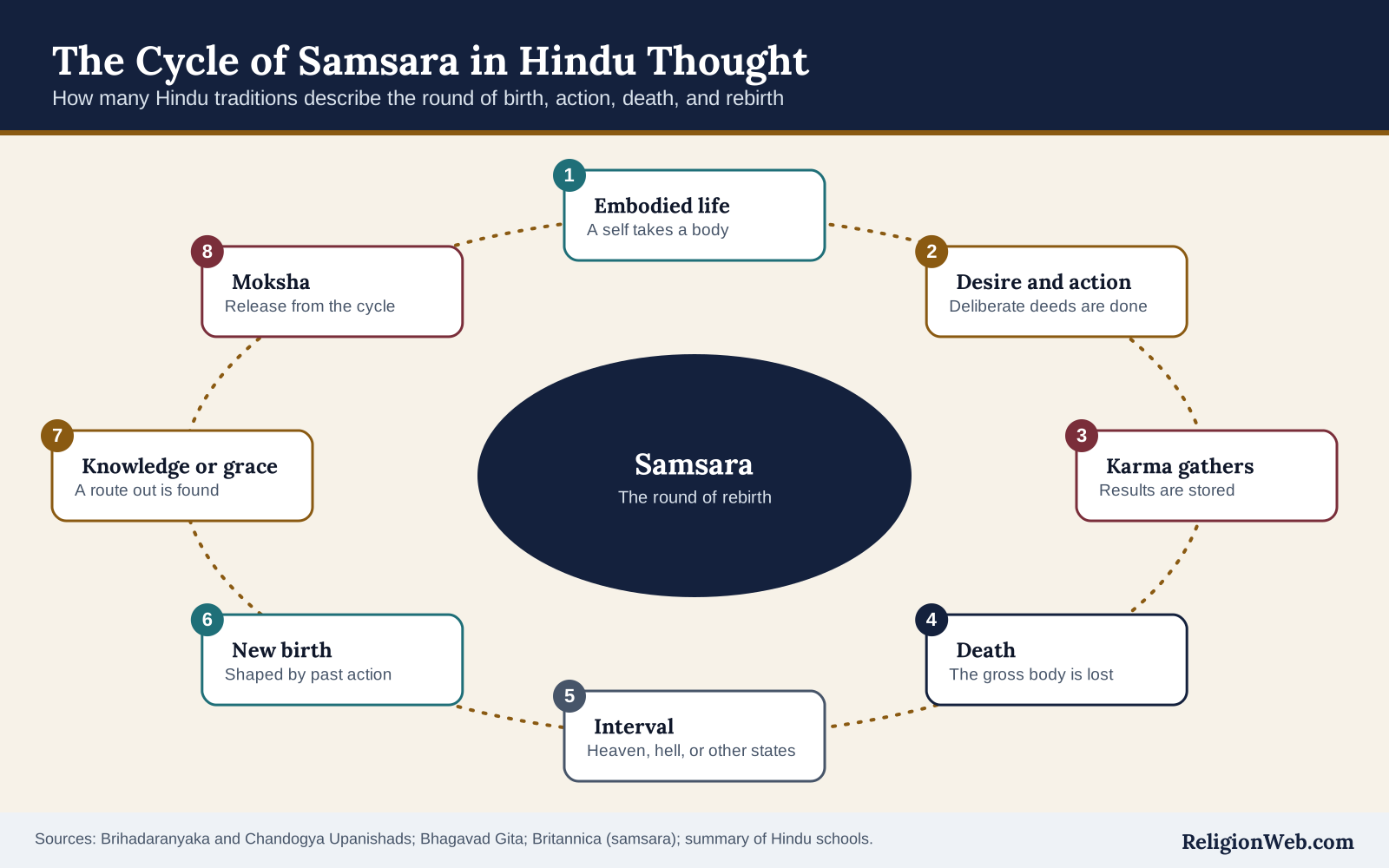
The central word is samsara (Sanskrit saṃsāra). Britannica glosses it as “flowing around,” and the sense in the texts is of passing through a sequence, of wandering on from one state of existence to the next. Samsara does not mean a single event such as being born again. It names the whole process: the continuing succession of lives, in this world and in other realms, within which a being experiences pleasure, pain, achievement, and loss. Most Hindu traditions describe it as without a discoverable first beginning, which means the question “when did the cycle start?” is usually treated as unanswerable or as a sign of the very ignorance the tradition aims to remove.
Samsara is also a value-laden word. Many texts speak of it as a river, an ocean, or a wheel, and the dominant mood is of a condition from which one seeks release. That does not make the world worthless in Hindu thought. Householder life, ritual, art, and family are all affirmed as valid goals within it. It means only that, in the classical view, even the best conditions inside the cycle are impermanent, and that a final freedom lies beyond them.
Rebirth, reincarnation, and transmigration: choosing words carefully
English offers three overlapping words. “Rebirth” is the most neutral and fits the broadest range of Hindu views. “Transmigration” stresses a passage from one body or realm to another, and Britannica lists it, together with “metempsychosis,” as an alternate name for reincarnation. “Reincarnation” is the most popular and the least exact, because its root means “entering flesh again” and so seems to assume that a person-like entity enters a new body. Sanskrit prefers more specific expressions, such as punarjanman (“birth again”), punarbhava (“becoming again”), and punarmrityu (“death again”), as well as the simple pair of janma (birth) and mrityu (death).
The table below collects the terms that appear most often in the rest of the article. Diacritics are given for readers who want to search the literature, and the simplified spellings are used in the running text.
| Term | Transliteration | Basic meaning | Why it matters here |
|---|---|---|---|
| Samsara | saṃsāra | The continuing round of birth, death, and rebirth | The overall condition from which liberation is sought |
| Punarjanman | punarjanman | “Birth again,” rebirth | The most direct Sanskrit word for a further birth |
| Karma | karman | Action, especially deliberate action, and its results | The main explanation for the conditions of a birth |
| Atman | ātman | The self; in many schools the conscious subject of experience | What is understood to persist, or not persist, across lives |
| Jiva | jīva | The individual living being or embodied soul | The self as it appears in bondage within samsara |
| Sukshma sharira | sūkṣma śarīra | The “subtle body” of mind, senses, and impressions | In several schools, what actually carries karma between lives |
| Samskara / vasana | saṃskāra / vāsanā | Latent impressions and tendencies left by past action | The mechanism linking one life’s habits to the next |
| Moksha / mukti | mokṣa / mukti | Liberation, release from the cycle | The traditional goal beyond rebirth |
| Dharma | dharma | Duty, right order, lawful conduct | The standard by which action is judged and a life ordered |
| Devayana / pitriyana | devāyāna / pitṛyāna | “Path of the gods” and “path of the fathers” | The two post-death routes described in the early Upanishads |
The Basic Picture in Hindu Thought
Setting the vocabulary aside, the general outline can be stated in a few sentences, provided it is understood as an outline and not a creed. Most Hindu traditions hold that living beings pass through repeated lives, that the conditions of a life are shaped by earlier action, and that there is a state of freedom from this process. Beyond that point the traditions diverge, sometimes sharply, and the divergences are the subject of much of this article.
A cycle with no first beginning
The standard picture is of a cycle that has no assignable starting point. A being is born, acts, accumulates the results of its actions, dies, and is born again under conditions that reflect those results. Because the sequence is described as beginningless, the traditions generally do not tell a story of an original fall that set it in motion. They ask instead what keeps it going, and the usual answer is a combination of ignorance about the true nature of the self and desire for the things of the world. The Brihadaranyaka Upanishad’s formula, discussed later, is that a person who desires returns for action, while a person without desire is not reborn.
Within the cycle, birth is not limited to the human condition. Hindu texts describe heavens in which beings enjoy the fruits of good action for a long but finite time, hells in which they experience the results of harm, and births among animals and other forms. The human birth is often singled out as a rare opportunity, since it is the form in which moral choice and the search for liberation are most fully possible.
A shared vocabulary, many accounts
The shared vocabulary has led to a common but mistaken impression that Hindu rebirth is one doctrine with one mechanism. It is better described as a family of accounts. Non-dual Vedanta, qualified non-dualism, dualist Vedanta, Samkhya, Yoga, and Nyaya all accept some form of rebirth, and they disagree about what is reborn, what drives the process, and what freedom consists of. Devotional traditions such as Vaishnavism add yet another emphasis, treating the grace of God as decisive for release. The table of philosophical interpretations later in this article sets the main positions side by side, without ranking them.
Scope, Geography, and Present-Day Reach
The teaching is not confined to a single region or period, though its textual home is the Indian subcontinent. It helps to say briefly where it lives today and how this article handles the question of who believes it.
Where these ideas are held
According to the Pew Research Center’s 2025 analysis of change from 2010 to 2020, there were about 1.2 billion Hindus in 2020, roughly 14.9 percent of the world’s population, and about 95 percent of them lived in India. India and Nepal are the world’s two Hindu-majority countries. Diaspora communities in North America, Britain, the Gulf, Southeast Asia, Africa, and the Caribbean carry the same vocabulary of samsara, karma, and moksha, often alongside regional and family customs. Not every one of those people holds every doctrine described below, a point the article returns to with survey data.
How to read the rest of this article
Three conventions run through what follows. First, statements are attributed to a text, a school, or a period wherever possible, because “Hindus believe” almost always overgeneralizes. Second, traditional dates and scholarly dates are kept apart: the traditions often assign great antiquity to their texts, while historians work with ranges. Third, the article describes teaching and does not decide questions of truth. Readers interested in how other Indian traditions use the same vocabulary will find it treated on its own terms, for example in the article on karma and rebirth in Buddhism.
Origins: From Vedic Ritual to Upanishadic Rebirth
The history of the rebirth teaching is a history of changing questions. The oldest texts ask how a person secures a good place among the ancestors and the gods. Later texts ask how that place can be lost, and what follows when it runs out. The answer, by the time of the Upanishads, was a theory of return.
The Vedic Background
The Vedas are the oldest Sanskrit religious texts, and they supply the setting in which later ideas had to find a place. They do not contain a fully formed doctrine of rebirth, but they contain several of the materials from which one could be built.
The Rigveda: ancestors, Yama, and a heaven won by ritual
The Rigveda, composed over several centuries in the second millennium BCE, pictures the dead as joining the fathers (pitaras) in a realm presided over by Yama, who is described in the hymns as the first mortal to die and to find the way. The reward of a well-lived life and correct sacrifice is a place in the heaven of the fathers and gods. Hymns to the dead and funerary verses speak of the eyes returning to the sun and the breath to the wind, imagery of dispersal into the cosmos rather than of a soul entering a new womb. Most historians therefore say that the Rigveda lacks a developed doctrine of rebirth, though a minority of scholars propose that some hymns already contain hints of it. The precise reading of the relevant verses remains debated.
The practical consequence of this world view was a strong concern with ritual. The living nourished the ancestors with offerings, and the dead in turn supported the living. That mutual obligation survives in the ancestor rites discussed in a later section, which suggests that the Vedic picture was never simply replaced by rebirth teaching but was absorbed into it.
The Brahmanas and the problem of “re-death”
The Brahmanas, prose manuals of Vedic ritual composed in the early first millennium BCE, add a new worry. Their interpretation of the sacrifice raises the possibility that even the heavenly life is not permanent, and that a person might die again there. Texts of this class speak of punarmrityu, usually translated “re-death” or “repeated death,” and present correct ritual knowledge as a way to escape it. Encyclopedic surveys of rebirth in Indian religions note that scholars have linked this ritual logic, in which sacrifice earns a heavenly place and must be repeated, to the later idea of a continuing cycle. The step from “heaven runs out” to “one is born again after heaven runs out” is short, even if the texts do not take it immediately.
The Early Upanishads
The decisive statements come in the Brihadaranyaka and Chandogya Upanishads, the two oldest and longest of the principal Upanishads. Here rebirth is described, linked with action, and set against a new goal, knowledge of the self, that offers a way out of the cycle altogether.
The five fires and the two paths
One of the earliest connected accounts is the teaching of the five fires (panchagni-vidya), found in both Upanishads. It describes the dead passing along one of two routes. Those who know the teaching, and those who practice faith and austerity in the forest, travel the path of the gods (devayana) and do not return to the human cycle. Those who live by ritual and charity travel the path of the fathers (pitriyana) to the moon, where they dwell for a time. When that time is spent they descend through space, wind, rain, and food, and enter a womb to be born again. The Chandogya Upanishad adds that small creatures that follow neither path have “a third place.”
The Chandogya presents this teaching as passing from the king Pravahana Jaivali to a Brahmin teacher, the father of the young Shvetaketu, and it says that the knowledge had until then never been held by Brahmins. A long-standing scholarly assumption, noted in recent research, is that warrior-class circles first developed the doctrine of transmigration, citing this story and similar ones in the Brihadaranyaka and Kaushitaki Upanishads. Others treat the narrative as a literary device that signals the novelty of the teaching, not a historical record of its origin.
Yajnavalkya, karma, and the turn toward knowledge
In the Brihadaranyaka Upanishad, the sage Yajnavalkya is asked what happens to a person at death. He takes his questioner aside, and the text reports that they spoke of karma, concluding that a person becomes good by good action and bad by bad action. This is among the first places in which the moral quality of deeds, and not just the correctness of ritual, determines the next life. In that later chapter Yajnavalkya describes the self leaving the body and compares it to a caterpillar moving from one blade of grass to the next. A later chapter of the same Upanishad (4.4) also contains the vision of a person who is free from desire and does not depart at death, because that person is already Brahman. Here the Upanishadic project becomes visible: rebirth is real, it is driven by desire and action, and it can be ended by a particular kind of knowledge.
The Katha Upanishad, probably somewhat later, frames the matter as a young man’s question to Death himself. Nachiketa asks what becomes of a person after dying, and the text compares the mortal who “ripens like corn” and is born again like corn. The Katha is also the source of the verse, quoted later, that some enter the womb and others enter inorganic matter according to their work and knowledge.
Scholarly Debates About Origins
The question of how the rebirth doctrine arose is genuinely open, and modern scholars have proposed several answers. A fair summary reports the main ones without declaring a winner.
Developments from within the Vedic tradition
One family of theories sees rebirth as a development inside the Vedic world. On this view the ritual logic of the Brahmanas, with its worry about repeated death and its interest in the exhaustible rewards of sacrifice, produced the idea of a continuing cycle, which the Upanishads then moralized by linking it to action. This approach emphasizes continuity with the earlier texts, and scholars who hold it point to the five-fire teaching and to the older theme of two paths for the dead.
Influences from beyond the Vedic center
A second family looks to other sources. Some historians, associated in particular with the “Greater Magadha” thesis of Johannes Bronkhorst, argue that rebirth and karma were established ideas in the eastern Gangetic plain, in renouncer circles outside the Brahmanical center, and were taken up by Brahmanical authors later. Others have suggested links with non-Vedic tribal belief, a view that Encyclopedia of Buddhism surveys describe as more controversial. Comparative studies, such as Gananath Obeyesekere’s work on karma, add the observation that rebirth beliefs appear in many societies and that the distinctive Indian step was to tie them to ethical causation. None of these accounts is universally accepted, and they are not mutually exclusive. A cautious reading is that several streams, Vedic ritual thought and the renouncer movements of the middle Ganges among them, converged in the middle of the first millennium BCE.
| Approximate period | Texts or movement | What the sources say about the afterlife |
|---|---|---|
| Second millennium BCE (later half) | Rigveda | Ancestors join Yama and the fathers; heaven earned by sacrifice; no developed rebirth doctrine |
| Early first millennium BCE | Brahmanas | Concern with “re-death” (punarmrityu) and the limits of heavenly reward |
| About 8th to 5th centuries BCE (many scholars) | Early Upanishads: Brihadaranyaka, Chandogya | Five-fire teaching, two paths, karma shaping rebirth, knowledge of the self as the exit |
| Last centuries BCE | Katha, Shvetashvatara, other Upanishads | Rebirth into varied forms according to deeds; growing theistic and yogic framing |
| About 2nd century BCE to 2nd century CE (broad range) | Bhagavad Gita and other parts of the Mahabharata | Embodied self sheds bodies like clothes; devotion and disciplined action as routes beyond return |
| Around the turn of the Common Era onward | Dharma texts, Puranas, philosophical sutras | Detailed schemes of heavens, hells, and births; systematic doctrines of the self |
| 8th century CE onward | Shankara, then Ramanuja, Madhva, and others | Rival and complementary commentarial accounts of soul, karma, and liberation |
The Textual Sources for Rebirth
No single scripture sets out the Hindu doctrine of rebirth from start to finish. The teaching is assembled from passages in many kinds of text, each written for its own purpose and each preserving its own emphasis. Knowing what kind of source is speaking is essential to reading it correctly.
The Upanishads and the Vedic Corpus
The Upanishads form the philosophical end of the Vedic collection, which is why they are also called Vedanta, “the end of the Veda.” They were transmitted orally for generations before being written down, and they are regarded in most Hindu traditions as revealed scripture (shruti). For the history of rebirth they matter more than any other body of text, because they are the first to state the doctrine and the first to argue about it.
The Brihadaranyaka and Chandogya Upanishads
These two long Upanishads supply the core early material: the five-fire teaching, the two paths, the dialogue on karma between Yajnavalkya and his questioner, and the account of the self leaving the body. The Brihadaranyaka links rebirth to desire in a passage that has been quoted by commentators for more than a thousand years. The Chandogya, for its part, states the connection between conduct and birth in a form that later authors repeatedly cite, and which also shows how early the doctrine became entangled with questions of social rank.
Those whose conduct has been good, will quickly attain some good birth, the birth of a Brahmana, or a Kshatriya, or a Vaisya. But those whose conduct has been evil, will quickly attain an evil birth, the birth of a dog, or a hog, or a Kandala.
Chandogya Upanishad 5.10.7, in The Upanishads, Part I, trans. F. Max Müller, Sacred Books of the East, vol. 1 (1879); diacritics omitted
This verse, read in isolation, can sound like a simple ladder of rewards and penalties. Within the Chandogya the verse closes a longer passage in which the real contrast is between those who know the teaching and pass to Brahman by the path of the gods, and those who do not and return. Traditional commentators generally read the verse as describing the results of ritual and moral conduct inside samsara, and they treat it as secondary to the question of liberation. Modern scholars add that the passage reflects the social order of its authors, in which birth in a high-ranking group was assumed to be a reward. Hindu reformers and critics of caste, discussed later, have contested that assumption from within the tradition.
The Katha, Shvetashvatara, and later Upanishads
The later Upanishads widen the picture. The Katha Upanishad places the question in the mouth of Nachiketa, who asks the god of death what remains of a person after dying. The Shvetashvatara Upanishad, which is explicitly theistic, speaks of the embodied self taking on forms according to the qualities of its deeds and also describes God as the one who releases from bondage. Together they show a doctrine moving from ritual speculation toward the two great themes of later Hinduism: meditation and devotion. The Katha’s remarks on forms of birth are quoted in the next major section.
Epics, Law Books, and Puranas
After the Upanishads, rebirth passes into the literature that shaped Hindu ethics and storytelling. These texts are classed as remembered tradition (smriti) in most Hindu systems, with lower authority than revelation but far wider popular reach.
The Mahabharata and the Dharmashastra
The Mahabharata, the great epic within which the Bhagavad Gita sits, repeatedly assumes rebirth and discusses it in several of its philosophical books. The dharma literature, the manuals of law and conduct, links rebirth directly to ethical categories. In the twelfth chapter of the Laws of Manu, a work usually dated to the centuries around the beginning of the Common Era, the author describes how acts of body, speech, and mind lead to different births, and he sorts beings into three levels according to the three gunas, or strands of nature. Those dominated by sattva (clarity) reach the condition of gods, those by rajas (activity) the condition of human beings, and those by tamas (dullness) the condition of animals, with sub-levels within each. The chapter also lists the births that follow grave offenses, including animal and insect forms.
Two cautions apply. The Manu passage is prescriptive literature, designed to support a particular social and ritual order, and its schemes of rank, including its placement of social classes within the categories, reflect that order and have been criticized by many Hindus and non-Hindus alike. It is also one text among many, and not every school treated its detailed lists as binding.
The Puranas and devotional narratives
The Puranas, composed from roughly the first millennium CE onward, make the cycle vivid. They describe Yama as the judge of the dead, the hells and heavens through which beings pass, and a variety of rebirths. The Garuda Purana, in the section often called the Preta Khanda, gives an elaborate account of the soul’s journey after death and is read aloud in some communities during mourning. The Bhagavata Purana tells two stories that Hindu preachers still use to illustrate rebirth. In one, the royal sage Bharata becomes so attached to an orphaned fawn that his last thoughts are of the animal, and he is reborn as a deer before regaining human birth as the ascetic Jada Bharata. In the other, the lapsed Brahmin Ajamila, who has lived carelessly for years, calls out the name of his son Narayana at the moment of death and is saved from Yama’s messengers by the servants of Vishnu. These stories dramatize two ideas treated in the next sections: that attachment shapes the next birth, and that devotion can change the outcome.
| Text or group | Approximate period | Type of text | What it says about rebirth |
|---|---|---|---|
| Rigveda | Second millennium BCE | Hymns | Ancestors and the world of the fathers; no developed doctrine of rebirth |
| Brihadaranyaka Upanishad | Many scholars: 8th to 6th centuries BCE | Philosophical dialogues | Karma, desire, the departing self, two paths, liberation by knowledge |
| Chandogya Upanishad | Similar early range | Philosophical dialogues | Five fires, birth according to conduct, return for those without knowledge |
| Katha and Shvetashvatara Upanishads | Later Upanishadic period | Verse Upanishads | Birth according to deeds and knowledge; meditation and divine grace |
| Bhagavad Gita | Roughly 2nd century BCE to 2nd century CE | Epic dialogue, within the Mahabharata | The embodied self changes bodies; last thoughts; devotion beyond return |
| Laws of Manu (Manava Dharmashastra) | Around the turn of the Common Era | Law and conduct | Rebirth by action and by the three strands; lists of births after offenses |
| Yoga Sutras of Patanjali | Commonly dated to early centuries CE | Philosophical aphorisms | Latent karmic residue; birth, life span, and experience as its results |
| Puranas, including Garuda and Bhagavata | First millennium CE onward | Narrative and devotional compendia | Yama’s court, hells and heavens, stories of rebirth shaped by attachment and devotion |
Reading the Sources Responsibly
A reader who moves quickly from the Upanishads to the law books to the Puranas will notice that the accounts do not always match. That is expected, and understanding why helps avoid the common error of treating these texts as chapters of a single manual.
Teaching, narrative, and rhetoric
Some passages are philosophical arguments, some are ritual rules, and some are stories told to encourage or warn. A vivid list of animal births after a particular offense is typically a rhetorical device meant to convey seriousness, and most Hindu commentators do not take such lists as a mechanical table of cause and effect. The Upanishadic dialogues, by contrast, are working statements of doctrine, and the Gita is a sustained piece of persuasion addressed to a specific person in a specific crisis. Distinguishing these genres is the first step in reading any of them.
Why the texts do not agree
The sources were composed across a thousand years or more, in different regions, by authors with different aims. Priests, ascetics, householders, kings, and devotional poets each emphasized different things. Later commentators then read the older texts through the lens of their own schools, so that the same Upanishadic verse can be interpreted quite differently by a non-dualist, a qualified non-dualist, and a dualist. The result is not a contradiction to be resolved but a record of an argument conducted over many centuries, and the schools discussed in a later section are the main parties to it.
Karma and Rebirth: How Action Shapes Existence
The link between karma and rebirth is the engine of the whole system. Without karma, rebirth would have no direction, and without rebirth, karma would have no long-term field in which to bear fruit. A fuller treatment of action, consequence, and duty is available in the article on karma in Hinduism, and the focus here is on how karma operates across lives.
How the Two Doctrines Fit Together
In the classical Hindu picture, an action leaves behind a result that need not arrive at once. Results may ripen in the same life, in a future one, or in an intermediate state. This delayed structure is what allows karma to explain the conditions of a birth and also what makes it difficult to read from the outside.
Action, result, and the next birth
Many schools distinguish kinds of karma by their status in time. The accumulated store of past action that has not yet borne fruit is called sanchita. The portion that has begun to ripen and has shaped the present body and circumstances is prarabdha, often compared to an arrow already released. The action being done now, which will add to the store, is kriyamana or agami. This three-part scheme is common in later Vedanta and in popular teaching, though it is a systematization and not a formula found in the earliest texts. Its practical value is that it allows for both continuity and agency: present circumstances are inherited, yet present choices still count. In the Yoga Sutras, Patanjali puts the matter in more technical terms, describing a store of karmic residue (karmashaya) rooted in the afflictions of the mind, whose ripening takes the form of birth, length of life, and the quality of experience.
| Element | Role in the system | Typical formulation |
|---|---|---|
| Karma (action) | Generates results that shape later experience and birth | Deliberate action, in thought, speech, and body, leaves effects that ripen over time |
| Desire and ignorance | Drive the continuation of the cycle | Attachment to results and mistaken identification of the self with the body or mind |
| Sanchita, prarabdha, kriyamana | Three phases of karma in time | Stored, presently ripening, and currently being made |
| Atman or jiva | The subject of experience; reborn or only apparently so, depending on the school | Eternal and unchanged in most accounts, with schools differing on its relation to the body and to God |
| Subtle body | Carries impressions across births in several schools | Mind, intellect, senses, and latent tendencies that persist after the gross body dies |
| Rebirth | The manner in which results of action are worked out | Movement among heavens, human life, animal forms, and other conditions |
| Moksha | End of bondage to the cycle | Reached by knowledge, devotion, disciplined action, or grace, depending on tradition |
Intention, desire, and the last thought
Early texts place the weight on desire and intention more than on outward deed. The Brihadaranyaka Upanishad, in the passage where Yajnavalkya describes the self’s departure, says that a person is made of desire, that as the desire so the will, as the will so the deed, and as the deed so the result. The opening of that same verse is quoted here.
Now as a man is like this or like that, according as he acts and according as he behaves, so will he be:–a man of good acts will become good, a man of bad acts, bad. He becomes pure by pure deeds, bad by bad deeds.
Brihadaranyaka Upanishad 4.4.5, in The Upanishads, Part II, trans. F. Max Müller, Sacred Books of the East, vol. 15 (1884)
Commentators on this verse stress that moral quality and inner motive, not merely outward conformity to ritual, determine what a person becomes. The verses that follow add the point that a person attached to an object goes to that object together with the deed, and that someone free from desire, who desires only the self, is not reborn. A related idea, the weight of the final thought at death, appears in the Gita and is examined in the section on that text. Taken together these passages explain why Hindu traditions give so much attention to attitude, remembrance of God, and a calm death.
Between Lives and Across Forms
Questions about where beings go between births and what kinds of births exist have always attracted both philosophical and popular attention. Here the sources are more varied and less systematic than the picture usually presented.
Heavens, hells, and the interval between births
According to the five-fire account, those who follow the path of the fathers spend time in the lunar world before returning. Later texts elaborate this idea into a graded set of heavens, where the fruits of good action are enjoyed, and hells, where the fruits of harmful action are experienced. The Gita states, in paraphrase, that those who reach the world of heaven through Vedic ritual come back to the world of mortals when their merit is exhausted. Neither realm is permanent. Britannica’s summary of the classical picture states that after death the soul goes to a heaven or hell until most of its karma is used up and then enters a new womb. Many traditions regard these states less as punishments imposed by a judge than as the natural working out of actions, though Puranic literature also gives Yama a role as the one who assigns and oversees them.
Human and nonhuman births
The sources agree that human birth is not the only possibility. The Katha Upanishad puts the point briefly.
Some enter the womb in order to have a body, as organic beings, others go into inorganic matter, according to their work and according to their knowledge.
Katha Upanishad 2.5.7 (Second Adhyaya, Fifth Valli, verse 7), in The Upanishads, Part II, trans. F. Max Müller, Sacred Books of the East, vol. 15 (1884)
Later literature fills in the detail. Manu and the Puranas list births as animals, insects, and plants, and devotional tradition repeats the figure of 84 lakh (8.4 million) species-births as a conventional count of the forms through which a being may pass. That number is best read as a traditional expression of vastness and not as a census. Within the sources, human birth is commonly called rare and precious because it is the form best suited to moral choice and to the search for liberation. Contemporary Hindu teachers differ on how literally to take movement between human and animal forms. Some affirm it, some interpret animal birth as a symbolic description of states of mind, and some emphasize that the earliest Upanishads speak chiefly of human rebirth and leave the animal question open.
The Atman: What Is Reborn?
Every account of rebirth must say what, if anything, is reborn. The English word “soul” is often used, but it carries Greek and Christian associations that do not match Sanskrit terms. Hindu traditions give several answers, and these answers explain why discussions of reincarnation in Hinduism so often seem to talk past one another.
The Self in the Upanishads
The Upanishads introduce a notion of self that is not the personality, the mind, or the body. Understanding that notion is the key to everything else in the doctrine, because it sets up the paradox at the center of the subject: a self that is said to be unborn and undying, yet is described as passing through many births.
Atman as witness, not personality
In the early Upanishads the atman is the innermost self, the one who sees without being seen, who knows without being known. The Brihadaranyaka Upanishad describes it through negation, as that which is not this and not that, and the Chandogya Upanishad teaches in a famous sentence that the subtle essence of all things is the self, “that you are.” The self so described does not have a biography. It does not grow up, hold opinions, or have a favorite food. Those belong to the layers that are said to cover it: the body, the breath, the mind, the intellect, and the sense of being a particular person.
This is the first reason that the phrase “the same person comes back” does not fit the Upanishadic view. What persists, if it persists, is not a personality but a witnessing consciousness, and the personality is a temporary construction that varies with each birth.
Why the body and mind are not the self
The Upanishads and later commentators argue in several ways that the self is distinct from its instruments. The body changes and ages, the mind shifts from moment to moment, and yet the sense of being one continuous observer remains. Dreamless sleep, in which the body is still and the mind has stopped, is cited as a state in which the self remains without ordinary experience. Nyaya-Vaisheshika philosophers add a formal argument: desire, cognition, pleasure, and pain are qualities, qualities need a substance in which to inhere, and no material element can serve as that substance, so there must be a non-material self. Different schools thus reach the self by different roads, but most agree that it is not simply the body.
What Travels Between Lives
If the self is unchanging, what carries the effects of karma from one birth to the next? Here the schools offer their most technical answers, and the concept of the subtle body does much of the work.
The subtle body and the carrying of impressions
Samkhya, among the oldest of the systematic philosophies, holds that at death the gross body made of the physical elements is lost, while the rest, from the intellect down to the subtle elements, forms a transmigrating entity usually called the subtle body (linga-sharira or sukshma-sharira). According to the Internet Encyclopedia of Philosophy’s account, written by Ferenc Ruzsa, this subtle body is reborn in a new gross body according to past merit, while the purusha, the conscious self, does not itself transmigrate but only witnesses. The comparison used in Samkhya texts is of an actor changing costumes and roles. Vedanta adopts a similar idea. In the Bhagavad Gita the departing self is said to carry the mind and senses with it, as the wind carries fragrance from its source, an image from the fifteenth chapter that later commentators read as a reference to this subtle body.
What the subtle body carries are samskaras, latent impressions left by experience, and vasanas, the tendencies they create. A person who has long practiced generosity or cruelty carries a corresponding disposition. On this view rebirth is not the transfer of a biography but the continuation of a pattern, and the pattern, when it is working itself out, takes a new body as its field.
Memory, character, and continuity
If impressions carry over, why do most people recall nothing of earlier lives? The traditional answer is that the shock of birth and the veiling power of ignorance cover the memory. The Yoga Sutras treat the recollection of past births as a special attainment that comes through direct perception of the impressions themselves, which implies that it is not ordinary. Sanskrit literature also records the figure of the jatismara, one who remembers an earlier birth, as a recognized but unusual case. Within philosophy, the Nyaya school pictures the self as a bearer of awareness and of retained dispositions, so that character and aptitude, if not episodic memory, can continue.
This is the second reason the common picture of simple transfer is inaccurate. Most Hindu accounts do not claim that the same recognizable individual returns with memories intact. They claim that a continuity exists, whether of the witnessing self, the subtle body, or both, and that it bears the results of action. What the continuity amounts to, and how it relates to personal identity, is exactly what the schools dispute. Readers interested in disciplines intended to quiet the mind and loosen these impressions will find the broader system treated in the article on yoga in Hinduism.

The Bhagavad Gita on Rebirth
For many readers worldwide, the Gita is the first and most influential statement of the Hindu view of the self and its bodies. It is a poem of 700 verses set at the start of a war, and its teaching on rebirth is offered as comfort and as an argument for action. A full introduction to the text appears in the article on the Bhagavad Gita, and the discussion here is limited to what the poem says about rebirth.
The Embodied Self and the Changing Body
The first extended teaching of the Gita answers a crisis. Arjuna, the warrior, is overcome by grief at the prospect of killing kinsmen and teachers. Krishna responds not with a command but with an argument about the nature of the self, and the argument depends entirely on the premise that bodies change and the self does not.
Clothes, bodies, and the grief of Arjuna
In the second chapter Krishna says that, as childhood, youth, and old age come to the embodied self in this body, so does the acquisition of another body, and that the wise person is not deceived by this. He then offers the best-known image of the poem.
As a man, casting off old clothes, puts on others and new ones, so the embodied (self) casting off old bodies, goes to others and new ones.
Bhagavadgita 2.22, in The Bhagavadgita, trans. Kashinath Trimbak Telang, Sacred Books of the East, vol. 8 (1882)
The image does two things. It reduces death from a catastrophe to a change of garment, and it quietly asserts that the wearer is distinct from what is worn. Krishna goes on to say that for one who is born death is certain, and for one who dies birth is certain, so that grief over the unavoidable is misplaced. Classical commentators agree that the passage teaches the self’s indestructibility, though they differ about the relation between that self and God.
Rebirth and the question of duty
The Gita’s consolation has been read in different ways, and an honest account has to say so. Traditional commentators, including Shankara, Ramanuja, and many later teachers, treat the passage as sincere metaphysics offered to prepare Arjuna to act without grief or attachment. Some modern interpreters, including Mohandas Gandhi, read the battlefield as an allegory for the inner struggle of every person and the teaching on the self as a call to disciplined nonviolent action. Others read the war literally and the argument as consoling a warrior in a recognized duty. Whichever frame is adopted, the Gita does not present the doctrine as a license for harm, and it places the emphasis on selfless action, on equanimity, and on reverence for all beings. The teaching is concerned with how to live and act, and the doctrine of the self underlies that concern.
Birth, Death, and Return in the Gita
The poem returns to the subject in later chapters, and its picture becomes fuller. It includes the unusual claim that Krishna himself has had many births, a final-moment principle for the dying, and a vision of how certain worlds are left and returned to.
Krishna’s own births
In the fourth chapter Krishna tells Arjuna that both have passed through many births, and that he knows them all while Arjuna does not. The teaching distinguishes the births of ordinary beings, driven by action and desire, from a divine birth that Krishna describes as taken by his own power. Theistic traditions, especially Vaishnava ones, read the verses as the basis for the doctrine of avatara, a descent undertaken freely and for the protection of order. The distinction clarifies why the birth of Krishna celebrated at Janmashtami is not understood as an instance of the cycle that binds other beings; devotional literature emphasizes that it is a voluntary appearance. The same chapter then connects knowledge of that divine birth with release.
Whoever truly knows thus my divine birth and work, casts off (this) body and is not born again.
Bhagavadgita 4.9, in The Bhagavadgita, trans. Kashinath Trimbak Telang, Sacred Books of the East, vol. 8 (1882)
The Sanskrit contains the phrase punar janma naiti, literally “does not go to birth again.” Vaishnava teachers, such as those in the lineage of Ramanuja, interpret the verse as promising release through devotional knowledge of God. Non-dualist commentators read the “knowing” as the realization of the identity of the self with the divine ground. The verse therefore serves as a shared reference point that each school reads within its own framework. More on the figure of Krishna in the tradition is available in the dedicated article.
Last thoughts, returns, and the yogi who falls short
In the eighth chapter Krishna teaches that the form or state a person remembers at the end of life draws that person toward it.
Also whichever form (of deity) he remembers when he finally leaves this body, to that he goes, O son of Kunti! having been used to ponder on it.
Bhagavadgita 8.6, in The Bhagavadgita, trans. Kashinath Trimbak Telang, Sacred Books of the East, vol. 8 (1882); diacritics omitted
The principle is that a lifetime of attention shapes the final thought, so that the point is less about a last-minute trick than about a lifetime of practice. It echoes the Puranic story of Bharata and the fawn. The same chapter says that all worlds up to the world of Brahma, the creator god’s realm, are subject to return, while the supreme abode, once reached, is not. The ninth chapter adds that those who gain heaven through ritual return to the human world when their merit is spent, describing their pattern as one of “going and coming” (gatagata). The sixth chapter takes up the opposite worry, the person who begins the discipline of yoga and dies before completing it. Krishna answers that such a person is not lost but is reborn in a family of the pure or the wise and recovers the earlier effort, a verse often cited to show that spiritual progress is understood to accumulate across lives.
Interpreting the Gita’s Teaching
Because the Gita is read so widely and has been commented on for over a thousand years, its verses on rebirth have been placed within many frameworks. Two points of interpretation are especially important to understanding how the poem relates to the rest of Hindu thought.
How the major commentators read the self and its bodies
Shankara, writing in the eighth century CE, reads the Gita’s teaching on the self as a statement of non-duality: the self is one with the ultimate reality, and the passage from body to body belongs to the realm of ignorance. Ramanuja, in the eleventh or twelfth century, reads the same verses as describing an eternal individual self that is a mode of God and will serve God in liberation. Madhva, in the thirteenth century, emphasizes the lasting distinction between the self and God. These differences are not minor shadings. They shape what “not born again” means: absorption in a non-dual reality, loving service in the presence of God, or eternal fellowship with a God who remains distinct. The next sections take up these differences directly.
Action without attachment as a way beyond return
The Gita does not recommend renunciation of action as the path out of the cycle. It recommends action performed as duty, without attachment to its fruit, and offered to God. Since the force that binds a being is attachment and desire, not action as such, a person who acts without them is said not to generate new binding karma. This is the teaching known as karma yoga, and it supplies the Gita’s practical answer to the problem of the cycle. Together with the paths of knowledge and devotion that run through the poem, it forms the basis of what later tradition calls the three yogas, a framework discussed in the section on routes to liberation. Readers interested in the Gita’s broader ethics of duty will find them developed in the article on dharma in Hinduism.
Philosophical Schools and Their Interpretations of Rebirth
The classical schools of Indian philosophy did not argue about whether rebirth exists so much as about what it is. Each school builds its account on a theory of the self, a theory of action, and a theory of liberation, and the three fit together differently from one school to the next. The summaries below describe each position on its own terms. They are not ranked, and Hindu teachers have historically moved between them, drawn from several at once, or kept to one tradition for a lifetime.
Vedanta: Three Readings of the Upanishads
Vedanta is the family of schools that comment on the Upanishads, the Brahma Sutras, and the Gita. All three major branches accept rebirth and karma. They disagree about the relation between the individual self and the ultimate reality, and that disagreement changes the meaning of nearly every other term.
Advaita: rebirth as a feature of ignorance
Advaita (non-dual) Vedanta is associated with Shankara, who flourished in the eighth century CE according to the Stanford Encyclopedia of Philosophy. In this view the individual self is, in its true nature, identical with Brahman, the one undivided consciousness. Rebirth belongs to the standpoint of ignorance. The individual (jiva) appears bound because consciousness is identified with a body-mind complex made of what Shankara treats as inert subtle matter, and that identification is beginningless. As long as ignorance lasts, karma accumulates and the subtle body takes new births. Knowledge of the identity of self and Brahman ends the ignorance, and with it the engine of rebirth.
Advaita draws a notable consequence. Because liberation is the recognition of what has always been the case, and not the arrival at a new place, a knower may continue to live in the body for a time. The Stanford Encyclopedia describes such a person as living “according to the ongoing fructification of karma,” and the tradition calls this state liberation in life (jivanmukti). Karma already begun runs its course, but no new binding action is generated, and at death there is no further birth.
Vishishtadvaita and Dvaita: the soul as eternal and distinct
Ramanuja, a Sri Vaishnava teacher traditionally dated to 1017 to 1137 and placed by recent scholarship between 1077 and 1157, according to the Internet Encyclopedia of Philosophy, taught qualified non-dualism (Vishishtadvaita). In his system individual selves are real, plural, and eternal, and they are modes or qualities of the body of Brahman, who is identified with Vishnu as the inner controller. Karma obscures the self’s true nature, and that obscuring is what the tradition calls the “river of transmigratory existence.” Liberation is the full awareness of one’s nature as dependent on and ordered toward God, attained principally through devotion (bhakti), with surrender (prapatti) stressed in later Sri Vaishnava discussion. Sri Vaishnava tradition describes the liberated life as eternal service in God’s presence.
Madhva, listed by the same encyclopedia as living from 1238 to 1317, taught dualism (Dvaita). His system holds that God, souls, and matter are eternally distinct, and that this difference is fivefold. Souls differ in their innate qualities and faults, so that they form a hierarchy. Karma moves each soul toward its destined end, though liberation, according to the encyclopedia’s account, depends entirely on the grace of Vishnu. Some presentations of the system add that souls fall into classes, those fit for liberation, those who remain in the cycle, and those destined for darkness, a point on which Madhva’s interpretation departs from the more common expectation that every soul can in principle be liberated.
Systems Rooted in Analysis and Practice
Alongside Vedanta stand schools that developed from analysis of experience, of knowledge, and of ritual. They share the vocabulary of rebirth but ground it differently, often without reference to God as the central figure.
Samkhya and Yoga: two kinds of reality
Samkhya is a dualism of consciousness and nature. It teaches that there are many irreducibly distinct conscious selves (purushas), one for each individual, and a single unconscious but purposeful nature (prakriti) made of three strands. Liberation (kaivalya) comes from discriminating the two, whereupon the self ceases to identify with nature and is freed permanently from all bodies, gross and subtle. In this system the self itself does not transmigrate; what is reborn is the subtle body, driven by past merit and demerit. The classical Yoga of Patanjali shares much of this framework and adds a practical discipline. In the Yoga Sutras the roots of rebirth are the afflictions of the mind, chiefly ignorance, egoism, attachment, aversion, and clinging to life, and the practices of ethics, posture, breath control, and meditation are designed to weaken them.
Nyaya-Vaisheshika and Mimamsa: reasoning and ritual
Nyaya and Vaisheshika, two allied schools of logic and natural philosophy, argue that the self is a distinct non-material substance that is eternal and bears the qualities of knowledge, desire, and effort. Their conception is the most straightforwardly individual of the classical systems: the self reincarnates, carries its dispositions, and is freed when the cause of rebirth ceases. Early Mimamsa, the school devoted to interpreting Vedic ritual, was chiefly concerned with ritual duty and its rewards in heaven, and its authors did not at first emphasize liberation. Later Mimamsa thinkers took up the question of release and accepted the framework of rebirth. A reader should note that each of these schools took the existence of a self and of rebirth as a starting point and argued over its details.
Devotional, Tantric, and Dissenting Voices
Beyond the classical schools, devotional movements and Tantric traditions shaped the way most Hindus actually encounter these ideas. There were also traditions in classical India that rejected rebirth altogether.
Shaiva, Shakta, and Gaudiya Vaishnava perspectives
Shaiva Siddhanta, a theistic school of South India, describes the soul as bound by three impurities (malas): an innate limitation, the results of karma, and the veiling power of the material world. God, as Shiva, removes them through grace, often conveyed through initiation. Kashmir Shaivism offers a non-dual alternative in which liberation is the recognition of one’s identity with Shiva. Readers can find the wider context in the articles on Shaivism and Shiva. In Shakta traditions, the goddess is understood as the power that both binds beings in the world through illusion and releases them through knowledge, an idea associated with the Devi Mahatmya and explored in the articles on Shaktism and Durga. Gaudiya Vaishnavas, following the Bengali teacher Chaitanya, treat pure love of Krishna as the highest goal and regard liberation from the cycle as secondary to it.
Traditions that deny rebirth
Classical India also knew a materialist current, often called Charvaka or Lokayata, which held that consciousness arises from the body and ends with it. Its views are preserved mainly in the writings of opponents, so historians reconstruct them with caution. It was an acknowledged position in philosophical debate, and its presence is a reminder that rebirth was argued for, not merely assumed. Survey data discussed later show that belief in rebirth is far from uniform among Hindus today, a fact consistent with this long history of debate.
| School | Key teacher or text, with approximate date | What persists across lives | How rebirth is understood | Understanding of liberation |
|---|---|---|---|---|
| Advaita Vedanta | Shankara, 8th century CE | Atman is unchanging and identical with Brahman; the subtle body appears to travel | A feature of ignorance, dissolving with knowledge | Recognition of identity with Brahman; liberation in life is possible |
| Vishishtadvaita | Ramanuja, 11th to 12th centuries CE | An eternal individual self, a mode of Brahman | Karma obscures the self’s nature | Full awareness of one’s nature through devotion; eternal service to God |
| Dvaita Vedanta | Madhva, 13th century CE | Eternally distinct souls | Karma moves each soul toward its end; graded souls | Depends on Vishnu’s grace |
| Samkhya | Classical Samkhya texts, early centuries CE | The subtle body transmigrates; the purusha only witnesses | Subtle body takes new gross bodies by merit | Isolation (kaivalya) from nature |
| Yoga | Yoga Sutras, commonly dated to early centuries CE | The self; a store of karmic residue | Residue ripens as birth, life span, and experience | Cessation of mental fluctuations and afflictions |
| Nyaya-Vaisheshika | Early centuries CE onward | A non-material, eternal self with dispositions | The self takes successive bodies by merit and demerit | Release by correct knowledge, with ethical and yogic discipline |
| Shaiva Siddhanta | Medieval South India | An eternal soul bound by three impurities | Karma and the material world bind the soul | Removal of impurities through Shiva’s grace |
Liberation and Devotion: Routes Beyond Rebirth
If samsara is the problem, the traditions all offer a response to it, and the responses are as various as the diagnoses. It is a mistake to describe Hindu religious life as organized solely around escaping rebirth. Moksha is one of four traditional aims of human life, alongside dharma, artha (material welfare), and kama (pleasure and love), and many Hindus pursue the first three throughout their lives while regarding liberation as a distant or even secondary matter. The broader treatment of this goal appears in the article on moksha.
The Paths to Moksha
The traditional teaching on how to reach liberation is usually presented as three paths, each corresponding to a human capacity and each with a different relation to the cycle of rebirth.
Knowledge, action, and devotion
The path of knowledge (jnana) seeks release through insight into the nature of the self, and it is the path emphasized in Advaita. The path of action (karma) seeks it by performing duty without attachment to results, a teaching drawn above all from the Gita. The path of devotion (bhakti) seeks it through loving relationship with God, and it dominates the popular religion of most regions. Later tradition often adds the path of royal yoga, meditation, associated with Patanjali, though a fuller account of those disciplines belongs to the article on yoga in Hinduism. The paths are not exclusive, and the Gita itself weaves them together.
Liberation while living and at death
Many traditions distinguish two moments of release. The first is liberation in life (jivanmukti), in which a person is free of the sense of bondage though the body continues. The second is liberation at the death of the body (videhamukti), in which no further birth occurs. Not every school accepts the first. Dualist and qualified non-dualist traditions tend to place full release after death, while Advaita and some Shaiva traditions affirm it in life. What the teachings share is the claim that release is not a rare physical feat but a transformation of understanding or relationship that makes further birth unnecessary.
Devotion, Grace, and Other Destinations
For many Hindus the most vivid religious experience is not philosophical analysis but worship. The devotional traditions place God at the center of the story, and they ask a different question about rebirth.
Grace and surrender
The Tamil Alvars and Nayanars, who composed devotional hymns to Vishnu and Shiva respectively from about the sixth century CE, and the many later saint-poets in every region, express a confidence that God’s grace can cut through the chain of karma. The Gita closes with Krishna’s invitation to abandon all duties and take refuge in him alone, with the promise that he will release the devotee from evil. In Vaishnavism this theme became the doctrine of surrender, and in Shaiva traditions it became the doctrine of grace. In practice it is expressed through daily acts of worship, including the offerings, mantra, and lamp that make up the household rite described in the article on puja.
Goals other than release
The devotional traditions also complicate the idea that liberation is the final aim. Some name particular destinations, such as the realm of Vishnu (Vaikuntha) or of Shiva (Kailasa), where devotees dwell in God’s presence. Gaudiya Vaishnavas speak of pure love of Krishna as the highest goal and, in a verse attributed to Chaitanya, ask for devotion in birth after birth rather than for release from birth. Some devotees express a wish to be reborn near a beloved deity, a holy river, or a teacher. These attitudes show that the cycle of birth is not viewed uniformly as a prison. For some devotees it is the field in which loving service can continue, and the point of difference is what one hopes to receive and from whom.
Death, Funerals, and Ancestors
Beliefs about rebirth become concrete at the moment of death. Hindu funeral and ancestor customs are not a direct application of any single philosophical school; they are a long-evolved body of practice that carries the dead from one condition to another and keeps the living in relationship with them. The scope here is limited to the aspects that bear on rebirth, since the full variety of regional and family custom is far larger than any article can cover.
Funeral Rites and the Journey of the Dead
Hindu tradition treats the funeral as the last of the life-cycle rites, or samskaras, and calls it antyeshti, “the last offering.” The details differ by region, caste, sect, and family, so what follows describes common patterns and not a universal procedure.
Cremation and the first days
In most Hindu communities the body is washed, dressed, and carried to the cremation ground, where it is burned. The fire is traditionally lit by the eldest son or another close male relative, though in recent decades daughters and other female relatives have performed the rite in many families. The logic of the fire is that it releases the person from the physical body and, in Vedic imagery, offers the person to the sacrificial flame. Infants, ascetics, and some communities are buried instead; the Lingayat tradition of Karnataka, for example, is known for burial and for a different view of death and pollution than that held in other groups. A period of mourning and ritual impurity follows for the family, commonly lasting between ten and thirteen days, though the duration varies by community.
The mourning period is not simply a time of grief. It is understood in many traditions as the time during which the departed is in a vulnerable intermediate condition, and the rites of the first days are meant to provide the person with a new, subtle body for the journey. Grief itself is deeply human, and anyone bereaved who is struggling with the loss may find counselors, doctors, and community support more helpful than any doctrine, a point that Hindu teachers themselves make.
Pinda offerings, the preta, and the ancestors
During the days after cremation, relatives offer rice balls (pinda) and water. The offerings are understood to nourish the deceased, who is called a preta, a departed spirit not yet settled among the ancestors. At the end of the mourning period, or at a rite held at the first anniversary in some traditions, a ceremony known as sapindikarana joins the deceased with the line of ancestors (pitris). Britannica describes the first annual memorial ceremony as letting the preta join the ancestors in the “assembly of forefathers,” and as supporting the spirit’s journey from lower to higher realms before its reincarnation. In some North Indian communities the Garuda Purana is read aloud during the days of mourning, which exposes mourners to its descriptions of the journey and its warnings about conduct.
| Stage | Common practice | Meaning given in tradition |
|---|---|---|
| At death | Recitation of God’s name or sacred verses; Ganges water or basil leaf placed in the mouth in some families | Turns the mind to God at the decisive moment, in line with the last-thought teaching |
| Cremation | Body washed and dressed, carried to the cremation ground, and burned by a close relative | Releases the person from the physical body |
| First days | Offerings of water and rice balls; mourning household observes ritual impurity | Nourishes the departed and supports the formation of a subtle body |
| Immersion of ashes | Remains collected and often placed in a sacred river | Blessing and purification for the departed; link to holy places |
| Tenth to thirteenth day | Concluding rites, family meal, and in many traditions the joining of the departed with the ancestors | Moves the departed from the intermediate state toward a place among the fathers |
| Annual and seasonal rites | Shraddha offerings on the anniversary and in the ancestors’ fortnight | Maintains the bond between living and dead and honors the ancestors |
Ancestors, Pilgrimage, and the Living
The ancestor rites and the pilgrimages associated with death connect the cycle of rebirth to the geography of India and to the continuing duties of descendants.
Shraddha and the fortnight of the ancestors
Shraddha is the general name for rites of honor and offering to departed ancestors. Britannica describes it as a ceremony in honor of a dead ancestor and a social and religious duty for Hindu men, with exceptions such as some ascetics, performed for the three preceding generations on both the paternal and maternal side. Beyond the individual anniversary, many Hindus honor all their ancestors during a dedicated period, the Pitru Paksha, the fortnight of the fathers. The calendar rule is that it falls in the waning half of a lunar month in the late monsoon and early autumn, commonly the dark fortnight of Bhadrapada or Ashvina depending on whether the regional calendar counts months from the full moon or the new moon, so the Gregorian dates move from year to year. Families offer water, sesame, and rice balls, and may feed Brahmins or the poor in the names of the departed. The tradition grows from the Vedic concern for the fathers described earlier, which explains why a religion focused on liberation still keeps a deep attachment to ancestors.
Rivers, sacred cities, and pilgrimage
Many Hindus carry the ashes of the dead to a sacred river, most famously the Ganga, and some travel to particular holy places for ancestor rites, such as Gaya in Bihar, which is traditionally associated with offerings to the fathers. The city of Varanasi, also called Kashi, has a long-standing reputation as a place where death brings liberation, and a widely told tradition holds that Shiva whispers a liberating mantra to the dying there. Such beliefs are specific to particular traditions and places and should not be generalized. Large gatherings such as the Kumbh Mela combine bathing in sacred waters for purification and merit with remembrance of the dead, and the pilgrim’s act is understood in many families as benefiting the ancestors as well as the living.
Rebirth in Hindu Life, Language, and Modern Debate
Outside philosophy and funeral rites, the idea of rebirth surfaces in the ordinary life of Hindu families and communities, often so lightly that it passes unnoticed. In the modern period it has also been the subject of reform, critique, and cross-cultural exchange, and the picture that emerges is one of widespread familiarity combined with considerable individual variation.
Everyday Expressions of the Idea
For most Hindus, rebirth is not a doctrine studied but a background assumption encountered in speech, story, and ritual. That ordinariness is itself a reason that survey questions about belief produce complicated answers.
Speech, stories, and the family
Common expressions in Hindi, Tamil, Bengali, Marathi, and other languages refer to deeds of a former life when explaining good or bad fortune, or to a bond that has lasted “for seven births.” Wedding blessings and devotional songs speak of union across lifetimes. Parents tell children stories from the epics and Puranas, many of which turn on rebirth, curses, and the consequences of action. Such language is not always a statement of philosophical commitment, any more than saying “fate” commits a speaker of English to a theory of destiny. It nonetheless keeps the framework alive and familiar.
Temples, festivals, and merit
Temple worship and festival observance are ordinarily directed at present needs, such as health, family welfare, and success, along with the devotee’s relationship to God. The idea of merit (punya) that benefits a future birth, or the ancestors, is a frequent subsidiary motive. In a Hindu temple, the sight (darshan) of the deity and the offerings made there are commonly spoken of as acts of merit, and many rites begin with an invocation of Ganesha, the remover of obstacles. The nine nights of Navaratri, devoted to the goddess, remind worshipers of the Devi Mahatmya’s portrayal of the goddess as the one who grants both worldly success and liberation. Observance in these settings is largely devotional and communal, and the technical doctrine of rebirth sits quietly behind it.
Modern Belief, Reform, and Debate
The nineteenth and twentieth centuries brought new interpreters, new audiences, and new criticism, and each reshaped how rebirth is discussed in Hindu communities and beyond.
What recent surveys show
The most detailed recent data come from a Pew Research Center survey of 29,999 adults in India, conducted face to face between November 2019 and March 2020 and published in 2021. It found that 77 percent of Hindus in India said they believe in karma, 47 percent said they believe in moksha, and 40 percent said they believe in reincarnation. The same survey found that an identical 77 percent of Muslims in India said they believe in karma, which suggests that the word has entered Indian public vocabulary well beyond Hindu communities, and that Muslims and Christians in India also reported belief in reincarnation (27 and 29 percent, respectively). These figures should be read carefully. The survey asked in translation about “reincarnation,” the English word discussed above, and a respondent who accepts a specific Sanskrit concept of rebirth might answer differently from one who thinks of the English term as a transfer of personality. The numbers also describe India in 2019 and 2020 and do not extend automatically to Hindus in the diaspora. They do show that the picture of Hinduism as uniformly committed to reincarnation is a simplification.
Reform, caste, and global reception
Modern Hindu thinkers have approached rebirth in different ways. Swami Vivekananda, who addressed the World’s Parliament of Religions in Chicago in 1893, often presented karma and rebirth as rational explanations of inequality and moral growth. Mohandas Gandhi spoke in his writings of his own belief in rebirth. B. R. Ambedkar, the jurist and leader of Dalit movements, argued, among other things, that the use of karma doctrine to justify hereditary rank had helped sustain caste inequality, and many reformers within Hinduism have likewise rejected that use. The Theosophical Society, founded in New York in 1875, drew heavily on Indian ideas and helped introduce words such as karma and reincarnation to Western readers, often in forms that differ from their classical sense. Scholars of religion note that this exchange left its mark on both sides, so that modern popular explanations in India sometimes echo Western reincarnation themes and vice versa.
Common Misconceptions About Reincarnation in Hinduism
Few religious ideas have been summarized in as many slogans as rebirth. Some of the slogans capture something real, and others have drifted far from what the sources say. The four misconceptions below are the ones that appear most often in classroom discussion, popular media, and casual conversation, and each is stated in the form in which people actually hold it. The table gives the short version, and the sections that follow give the reasons.
| Common claim | Why it arises | A closer reading |
|---|---|---|
| The same personality moves into a new body | The English word “reincarnation” and popular past-life stories | Most schools distinguish the self from the personality; impressions, not a biography, carry over |
| Karma is instant punishment that explains every event | Casual use of “karma” for quick payback | Results are delayed and combined with other causes, including effort and the will of God |
| All Hindu schools define the self and rebirth identically | A shared vocabulary and the label “Hinduism” | Schools differ on what is reborn, why, and what freedom means; some critics rejected rebirth |
| Hindus hope above all to be reincarnated | Popular interest in a better next life | In classical teaching the cycle is a condition to be left, though many seek a good birth or devotion in future lives |
| Every Hindu holds the doctrine in the same form | Assumptions about uniform belief | Surveys of Hindus in India show wide variation in the stated belief in reincarnation, karma, and moksha |
Misconception 1: Hindu rebirth means the same unchanging personality simply moves into another body
Where the misunderstanding comes from
The English word “reincarnation” strongly suggests that someone, a particular person with a name and a character, takes on a new body of flesh. That image is reinforced by popular accounts of children who report earlier lives, by films and novels in which a recognizable character returns, and by a literal reading of the Gita’s image of the self changing bodies like clothes. If the wearer of the clothes is imagined as a personality, then rebirth looks like the same individual in a new outfit.
A second source of the idea is the nineteenth-century Western spiritualist and Theosophical use of the word, which often emphasized the survival and development of an individual personality across lives. Those usages are real, but they are not the classical Hindu frames.
What the evidence and tradition actually show
The Upanishadic self is a witnessing consciousness, not a personality, and the Samkhya school holds that the conscious self itself does not transmigrate at all; what travels is the subtle body of mind, intellect, and impressions. In Advaita Vedanta the self is ultimately identical with Brahman and is never reborn in the strict sense, because rebirth belongs to the standpoint of ignorance. Even in schools that hold that an individual self is eternal and plural, such as Ramanuja’s, the character of a given life is formed by the body, mind, and karma of that life, and these are new in each birth.
The traditions do recognize exceptions, notably the jatismara, a person who remembers a previous birth, and they treat these cases as unusual. The Yoga Sutras present recollection of past births as a special attainment. The most accurate summary is that a continuity is claimed, but it is a continuity of a self and of dispositions rather than of a remembered personal story. How closely the continuing element should be identified with a person is exactly the question on which the schools differ.
Misconception 2: Karma is instant punishment that determines every event in a person’s life
Where the misunderstanding comes from
In everyday English, “karma” has become a shorthand for poetic justice, as when a rude driver is stuck in traffic and a bystander says that it was karma. Self-help writing, social media, and some popular teaching present karma as a rapid moral accounting system. Those uses are not the classical meaning, but they have traveled back into discussions of Hinduism and changed how people understand it. A related assumption, held by both outsiders and some insiders, is that because karma exists, every misfortune must be the sufferer’s deserved punishment.
What the evidence and tradition actually show
The word karma means action, and the Hindu sources treat its results as delayed, layered, and mixed with other causes. The Gita lists five factors in any action: the body or seat, the agent, the various instruments, the many kinds of effort, and fate or the divine as the fifth, which already indicates that outcomes are not reduced to a single moral cause. The scheme of stored, ripening, and current karma explains why a person’s present circumstances may reflect actions from long ago and why present choices still matter. In theistic schools, God is understood to be the dispenser of the fruits of action, and in others the process is more impersonal.
Hindu traditions also supply plenty of room for other explanations of events: nature, chance, social conditions, the actions of other people, and the will of God. Teachers across many schools insist that the suffering of another person is a call to compassion and help, not a verdict to be repeated, and reformers have criticized the use of karma to excuse neglect. Treating karma as a mechanical cause of each event, or as a justification for indifference, is therefore a departure from how the main schools reason about it. A fuller account is available in the article on karma in Hinduism.
Misconception 3: Every Hindu school defines the self and rebirth in the same way
Where the misunderstanding comes from
The shared vocabulary of samsara, karma, atman, and moksha invites the assumption that the words mean the same thing everywhere. Introductory books, which have to be brief, often compress the tradition into a single paragraph. The label “Hinduism” itself, a term applied from outside and adopted from the nineteenth century onward, can suggest a unified church with a common creed, which does not exist. There is no single authority, council, or confession that fixes doctrine for all Hindus.
What the evidence and tradition actually show
As the earlier sections show, the schools give different answers to nearly every basic question. Advaita Vedanta says the individual is ultimately identical with Brahman; Ramanuja says the individual is a real, eternal mode of Brahman; Madhva says souls are eternally distinct from God and from each other. Samkhya speaks of many selves and one nature; Nyaya treats the self as a non-material substance with its own dispositions. Devotional movements place God’s grace at the center, while Charvaka materialists denied an afterlife altogether. Liberation itself is understood as recognition, as isolation, as loving service, or as the removal of impurities by divine grace.
It is accurate to say that rebirth and karma are widely shared themes, and it is not accurate to say that Hindus share one mechanism. A responsible description therefore names the school, text, or community in question, and it treats the differences as part of the tradition’s own history of inquiry and not as a failure of consistency.
Misconception 4: Hindus hope above all to be reincarnated, and rebirth is a reward
Where the misunderstanding comes from
In modern popular culture, reincarnation is often imagined as a hopeful promise, another chance at life or a return of loved ones. People who meet the idea in that form can assume that Hindus, too, look forward to it. The assumption is strengthened by the real popularity within Hindu life of hopes for a good next birth, for family continuity, and for merit that benefits future lives.
What the evidence and tradition actually show
In the classical teaching, samsara is a condition from which one seeks release, and even the best births within it are impermanent. The Gita says that all worlds up to the realm of the creator god are subject to return, and the early Upanishads present the cycle as sustained by desire and ignorance. Moksha is therefore named as one of the four aims of life and as the highest in many schools, though the other three aims are treated as legitimate as well.
That said, the picture is not uniform. Popular religion commonly asks for a good rebirth, for wealth and family, or for birth in a favorable setting, and devotional traditions include the wish for loving service to God in many lives. A verse attributed to Chaitanya asks for devotion in birth after birth. Even the language used for the human birth reflects this tension: texts call it rare and hard to obtain precisely because it is the form in which a being can recognize the cycle for what it is and act to leave it, yet that same birth is also valued as the place where family, learning, art, and service are possible. The accurate statement is that the classical systems treat the cycle as something to transcend, while lived religion contains a wide range of hopes, including hopes about the next life, and the tradition does not condemn those hopes. Readers who want to explore the aim of liberation in more depth will find it in the article on moksha.
Frequently Asked Questions About Samsara and Reincarnation in Hinduism
The questions below are among those most often asked by students, travelers, and readers meeting the subject for the first time. Each answer summarizes the discussion above and names the tradition or source it relies on.
Questions About Meaning and Belief
Do all Hindus believe in reincarnation?
No, and the answer depends on what is meant. Rebirth is a widely shared theme in Hindu texts, and the majority of classical schools accept it. Belief among individuals is more varied. In the Pew Research Center’s survey of India conducted in 2019 and 2020, 77 percent of Hindus said they believe in karma, 47 percent said they believe in moksha, and 40 percent said they believe in reincarnation. Those numbers describe stated belief in one country at one time, in response to translated questions.
Hindu identity is also not defined by a creed. A person may participate fully in worship, festivals, and family rites while holding a range of views, or none, on what happens after death. Historically, too, some voices in classical India rejected rebirth altogether.
What is the difference between samsara and reincarnation?
Samsara is the Sanskrit name for the whole cycle of birth, death, and rebirth, understood as a condition that beings are caught in and may leave. “Reincarnation” is an English word, first recorded in the early nineteenth century according to the Etymonline dictionary, that is usually applied to the passage of an individual into a new body. The two overlap, yet they do not mean exactly the same thing.
Samsara includes heavens, hells, and many kinds of birth, and it is tied to karma and to the possibility of liberation. Reincarnation, in popular use, often focuses on the return of a person. Scholars therefore tend to prefer “rebirth” or “transmigration” when describing the Hindu texts.
Is rebirth taught in the Vedas?
The oldest Vedic hymns do not teach a developed doctrine of rebirth. They describe ancestors, the world of the fathers, and a heaven earned by sacrifice. Some scholars see hints of later ideas, and the Brahmanas raise the problem of repeated death. The clear, connected statements come in the early Upanishads, in the teaching of the five fires and in the dialogues on karma. The point is explained at more length in the article on the Vedas and Upanishads.
Questions About Practice and Death
Can a human be reborn as an animal?
Many Hindu texts say yes. The Katha Upanishad speaks of some beings entering the womb and others entering inorganic matter according to their work and knowledge, and the Laws of Manu and the Puranas list animal and insect births as results of particular actions. Hindu teachers today vary in how literally they take such accounts. Some affirm movement among forms, others read animal birth symbolically, and others stress that the early texts concentrate on human rebirth. Whatever the reading, the traditional teaching associates animal birth with a condition of reduced opportunity, not with a loss of the self’s dignity, and it supports ethical concern for living creatures.
Why do Hindus perform rites for the dead?
The funeral rites and ancestor offerings serve several purposes in tradition. They are understood to release the departed from the body, to nourish the person during an intermediate stage, and to integrate the person into the line of ancestors. They also express the duties of descendants and give mourners a structure for grief. The customs vary by region and family, and the rites described in the section on death and ancestors are patterns, not requirements for every community. Bereaved readers may also find that counselors, physicians, and community support are valuable in addition to ritual.
Do Hindus remember past lives?
Classical texts treat memory of earlier births as unusual. The Yoga Sutras describe it as a special attainment, and Sanskrit literature knows the figure of the jatismara. Most Hindus do not claim such memories. Reports of children who speak of previous lives circulate in South Asia and elsewhere, and scholars evaluate them in quite different ways, from serious research programs to skepticism. The article takes no position on those cases and notes only that the philosophical doctrine does not depend on recollection.
Questions About Liberation
How does the cycle end?
Hindu traditions give several answers. In Advaita Vedanta, it ends with the knowledge that the self is identical with Brahman. In Ramanuja’s tradition, it ends through devotion and surrender, with eternal service to God. In Samkhya, it ends in the discrimination of consciousness from nature. In Madhva’s system, it depends on the grace of Vishnu. The Gita offers a path in which disciplined action, knowledge, and devotion work together. The word for the end of the cycle is moksha, and the paths are described in the section on liberation above.
Is it wrong to hope for a good next life?
Hindu tradition does not condemn the wish. The four aims of human life include material welfare and love as legitimate goals, and ordinary worship is full of requests for health, family, and merit. The classical teachers do hold that all conditions within the cycle are temporary and that a higher aim exists. They differ on how strongly to press that claim on householders. Many devotional traditions add that devotion to God, in this life or many, is the most precious thing a being could receive.
Conclusion: Reading Hindu Teaching on Rebirth Carefully
Reincarnation in Hinduism is better understood as a family of teachings than as a single belief. The word names an idea that the Sanskrit sources express through samsara, karma, atman, and moksha, and the history of those terms is a history of questions asked and answered across more than two thousand years.
What the Sources Show
A doctrine that developed over time
The earliest Vedic texts concern ancestors and heaven. The early Upanishads then bring in rebirth, link it to action and desire, and propose knowledge of the self as the way out. The Gita redirects the teaching toward disciplined action and devotion, the law books and Puranas fill in the moral landscape, and the philosophical schools turn the whole into systems. Each stage preserved the earlier ones and added to them, which is why Hindu traditions today still draw on all of these layers.
Many accounts, shared questions
What persists from life to life, what drives the process, and what freedom means are answered differently by Advaita, Vishishtadvaita, Dvaita, Samkhya, Yoga, Nyaya, and the devotional and Tantric traditions. These accounts share a concern with the moral weight of action, the dignity of the self, and the possibility of release. Misreadings usually arise when one account is mistaken for all of them, or when English connotations replace Sanskrit meanings.
Where to Keep Exploring
Texts worth reading
Readers who want to go to the sources can begin with the Brihadaranyaka and Chandogya Upanishads for the earliest statements, the second, fourth, eighth, and ninth chapters of the Gita for the poem’s teaching, and the Yoga Sutras for a concise account of karmic residue. Choosing a modern critical translation with notes is worthwhile, as is comparing more than one commentary on the same verse.
Related topics on ReligionWeb.com
The surrounding articles supply the context that this one only touches. The foundations are in Hinduism as a whole, while the deeper discussions of action and release appear in the articles on karma and moksha. Worship and its meaning are covered in the articles on the Hindu temple and on puja.
Sources
The table below lists the principal external sources behind this article. Facts, dates and figures were checked against these and related primary, institutional and academic materials.
| # | Source | Publisher and type | Used for | Link |
|---|---|---|---|---|
| 1 | The Upanishads, Part II (Katha, Brihadaranyaka), trans. F. Max Müller, Sacred Books of the East vol. 15 | Internet Sacred Text Archive · Primary text | Brihadaranyaka 4.4.5 quotation and rebirth passages; Katha 2.5.7 quotation (public domain, 1884) | sacred-texts.com |
| 2 | The Upanishads, Part I (Chandogya 5.10), trans. F. Max Müller, Sacred Books of the East vol. 1 | Internet Sacred Text Archive · Primary text | Chandogya 5.10.7 quotation, two paths, and the 'third place' (public domain, 1879) | sacred-texts.com |
| 3 | The Bhagavadgita, trans. Kashinath Trimbak Telang, Sacred Books of the East vol. 8 | Internet Sacred Text Archive · Primary text | Gita 2.22, 4.9, and 8.6 quotations; passages paraphrased from chapters 2, 4, 6, 8, and 9 (public domain, 1882) | sacred-texts.com |
| 4 | Samsara | Encyclopaedia Britannica · Encyclopedia | Meaning of samsara ('flowing around'); heaven and hell until karma is used up; moksha as release | britannica.com |
| 5 | Śaṅkara (Neil Dalal) | Stanford Encyclopedia of Philosophy · Academic reference | Advaita view of karma, rebirth, and liberation in life; Shankara's eighth-century dating | plato.stanford.edu |
| 6 | Rāmānuja (Shyam Ranganathan) | Internet Encyclopedia of Philosophy · Academic reference | Qualified non-dualism, soul as mode of Brahman, karma, bhakti and prapatti; Ramanuja's dates | iep.utm.edu |
| 7 | Sāṅkhya (Ferenc Ruzsa) | Internet Encyclopedia of Philosophy · Academic reference | Subtle body as the transmigrating entity; many purushas; kaivalya | iep.utm.edu |
| 8 | Religion in India: Tolerance and Segregation, Religious Beliefs chapter (2021) | Pew Research Center · Demographic data | 77% karma, 47% moksha, 40% reincarnation among Hindus in India; survey of 29,999 adults, Nov 2019-Mar 2020 | pewresearch.org |
| 9 | How the Global Religious Landscape Changed From 2010 to 2020 (2025) | Pew Research Center · Demographic data | About 1.2 billion Hindus in 2020 (14.9% of world); 95% live in India | pewresearch.org |
| 10 | Reincarnation (etymology and first attestation) | Online Etymology Dictionary (Etymonline) · Reference | English 'reincarnation' first recorded 1829; 'transmigration' originally meant exile (Fun Fact) | etymonline.com |
Last fact-check date: 2026-10-21.