Dharma in Hinduism is the Sanskrit idea of what holds things together: the order of the cosmos, the duties that fall to a person in a particular situation, the moral law that makes shared life possible, and, in many texts, the teaching that explains all of these. No single English word covers that range. “Duty,” “law,” “righteousness,” “ethics,” “religion,” and “order” are each accurate in some passages and misleading in others, which is why Hindu authors and English-language scholars alike so often leave the word untranslated.
The idea is old, but it is not static. It appears in the hymns of the Rigveda as a sustaining principle, in the Upanishads as the power that stands above even kings, in the Dharmasutras and Dharmashastra as a literature of conduct, in the epics as a series of agonizing dilemmas, and in the Bhagavad Gita as the question Arjuna cannot answer alone. In the nineteenth and twentieth centuries it moved into colonial courtrooms, reform debates, and national politics, and today it is also the key term in the phrase Sanatana Dharma, which many Hindus use as a name for their own tradition.
This article follows dharma through those settings, one at a time, and keeps the distinctions that matter. A verse in a law book composed two thousand years ago is not the same thing as a family custom, a court ruling, or a sermon, and none of them is “what all Hindus believe.” For the wider picture of the tradition, see the overview of Hinduism; for the companion idea of action and its consequences, see karma in Hinduism. Sanskrit terms are defined where they first appear, and a glossary table follows in the section on core ideas.
Dharma in Hinduism at a Glance: Meaning, Scope, and Vocabulary
What the Word Dharma Means
A Sanskrit noun built on the idea of holding
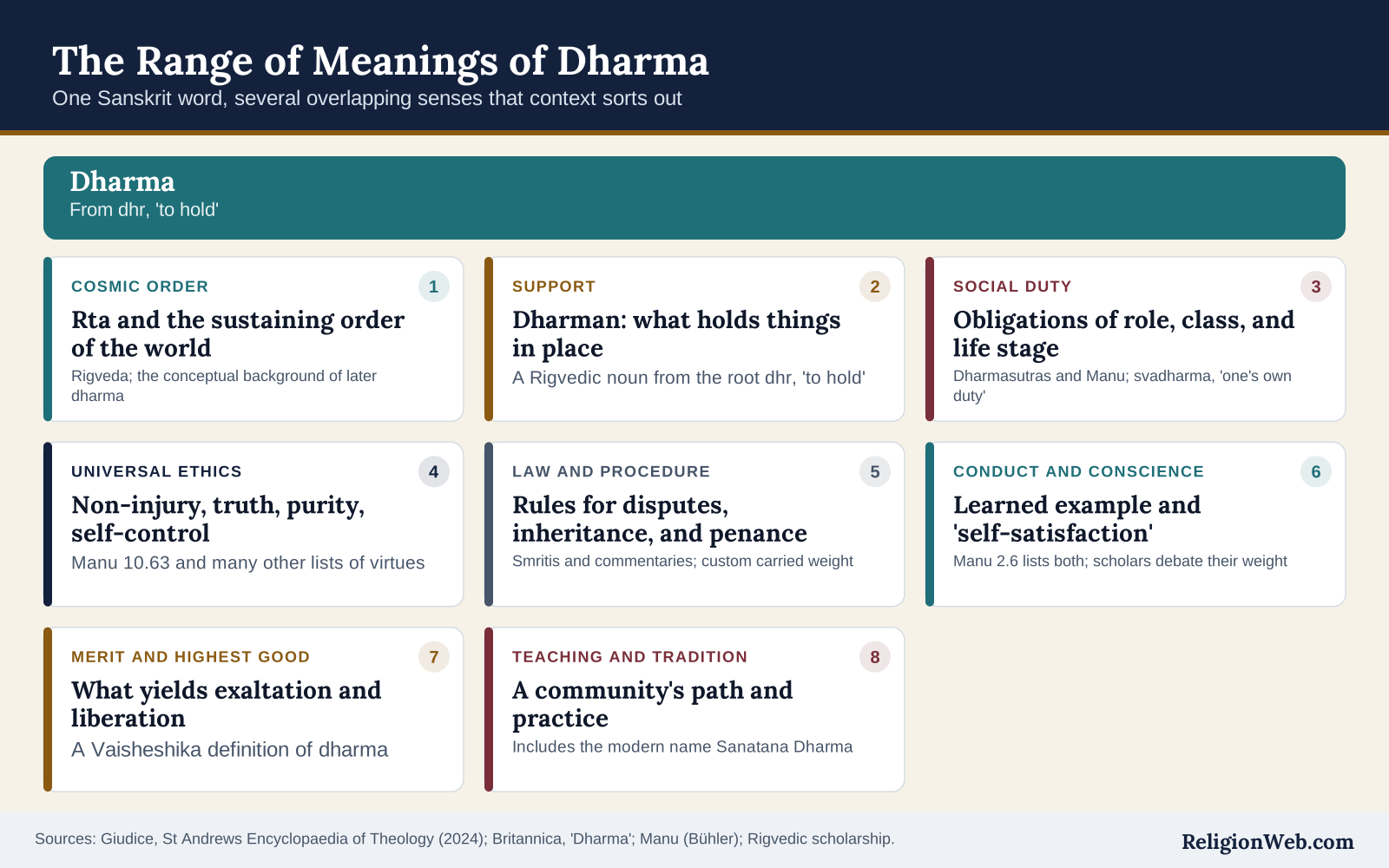
The word dharma comes from the Sanskrit verbal root dhṛ, “to hold, support, or sustain.” The St Andrews Encyclopaedia of Theology article on Dharmashastra by Alessandro Giudice notes that the etymology links the word with holding and sustaining, and through that with the idea of order. Something that is dharma is something that keeps a thing what it is: the heat of fire, the steadiness of earth, the integrity of a family, the justice of a king, the discipline of a student. The same word can therefore describe a rule, a quality, a duty, or a whole body of teaching, depending on what is being held together.
Britannica defines dharma in Hinduism as the religious and moral law governing individual conduct, and counts it among the four traditional ends of human life. It adds that Hindu thought distinguishes a universal duty, sādhāraṇa dharma, covering qualities such as truthfulness, non-injury, and generosity, from the duty tied to a person’s class, status, and stage of life, called svadharma, literally “one’s own dharma.” Those two poles, the shared and the particular, run through almost everything written about the subject.
Why translators keep changing the English word
Giudice lists the English renderings that translators have used: duty, justice, ethics, religious merit, principle, law, and religion. None is wrong everywhere, and none is right everywhere. Even a single translator may switch words from page to page, because the Sanskrit does not switch. Readers who want to understand the idea, and not just a translator’s choice, benefit from learning to recognize the Sanskrit word itself.
The difficulty is not a sign of vagueness. It reflects a concept that joins what English usually separates: the natural and the moral, the legal and the ritual, the public and the personal. In classical Indian thought a king’s justice, a householder’s hospitality, and the regular order of the seasons could all be described as dharma without any sense of category error, because all of them were understood as ways of keeping a larger order in place.
The Main Senses of Dharma
Cosmic order, social order, personal ethics, and teaching
It helps to sort the uses of dharma into four overlapping senses, while remembering that Hindu texts rarely sort them so neatly. The first is cosmic: the way the world is ordered and sustained, a meaning that grows out of the Vedic idea of ṛta. The second is social: the duties attached to roles such as student, householder, king, or priest. The third is ethical: virtues such as truthfulness and non-injury that apply to everyone. The fourth is doctrinal: the teaching, practice, or tradition that a community follows, which is closest to what English speakers mean by “religion.” The table gathers these senses with examples, and later sections take each in turn.
| Sense | Core idea | Typical setting | Closest English words |
|---|---|---|---|
| Cosmic and sustaining order | What upholds the world and keeps things true to their nature | Vedic hymns, Upanishads, Puranic accounts of the ages | Order, principle, foundation |
| Social and role-based duty | Obligations attached to class, stage of life, family, and office | Dharmasutras, Dharmashastra, the epics | Duty, obligation, station |
| Universal ethics | Virtues expected of everyone, such as truthfulness and non-injury | Manu 10.63, Mahabharata teachings, the Gita’s lists of virtues | Virtue, righteousness, goodness |
| Law and legal procedure | Rules for settling disputes, inheritance, marriage, and penance | Smriti texts, medieval commentaries and digests, colonial-era courts | Law, justice, ruling |
| Teaching and tradition | The path a community follows and passes on | Sectarian and modern usage, including “Sanatana Dharma” | Religion, way of practice, tradition |
| Merit and moral worth | Good conduct viewed as producing beneficial results | Mimamsa and Vaisheshika definitions, ordinary speech | Merit, virtue |
How context decides the meaning
When a Sanskrit author writes the word, the surrounding sentence usually tells the reader which sense is active. A dharma that is “eternal” (sanātana) in an ethical verse probably points to a rule of conduct that holds across circumstances. A dharma that differs “for each class” is plainly social. A dharma that “declines” in an age of decay is closer to the cosmic or moral order as a whole. Modern readers who pick one meaning and apply it everywhere tend to misread both the texts and the people who live by them.
Dharma Within the Wider Hindu Tradition
One central idea among several
Dharma is one of several organizing ideas in Hindu thought, and it is closely tied to the others. Karma explains how actions carry consequences; the article on karma covers that in depth. Moksha, release from the cycle of rebirth, is the traditional final goal. Between them stand artha (material welfare and power) and kāma (pleasure and desire), and the classical scheme of four human aims, the puruṣārthas, places dharma as the standard that is supposed to regulate the rest. The various paths to the highest goal, including those described in the article on yoga in Hinduism, generally assume a life of dharma as their foundation.
Who uses the term, and where
Pew Research Center’s 2025 report on global religious change estimates that Hindus numbered nearly 1.2 billion in 2020, up about 12 percent from a little under 1.1 billion in 2010, while holding a roughly stable share of the world’s population. About 95 percent of the world’s Hindus live in India. Dharma, however, is not exclusive to Hindus. The same word, in the Pali form dhamma, is central to Buddhist teaching, and it has distinct technical uses in Jain thought, as Britannica notes. This article deals only with its meanings in Hindu contexts, and with the way Hindu communities have debated those meanings, which they continue to do.
Origins and Development: From Rta to Dharmashastra
Rta and Dharman in the Rigveda
Rta, the order that the gods are said to guard
The oldest layer of Sanskrit literature, the Rigveda, composed orally over several centuries in the second millennium BCE, does not yet use dharma as the great umbrella term it later became. Its governing idea of order is ṛta, the right ordering of the world: the daily return of the dawn, the course of the sun, the flow of rivers, the exactness of the sacrificial rite, and the truthfulness of speech. Gods such as Mitra and Varuna are praised as guardians of ṛta, and Agni, the sacrificial fire, is spoken of as its priest and messenger. To act in accord with ṛta is to take part in a cosmos that works; to violate it is to cause disorder (anṛta), which in the Vedic imagination could affect rain, harvest, and the standing of a community. Many scholars regard ṛta as the conceptual ancestor of dharma, a point that Giudice also makes when he observes that Vedic cosmic order later took on a more personal character, with individuals’ duties understood as helping to preserve it.
Dharman as support or foundation
The noun that eventually gave Sanskrit its word for dharma does occur in the Rigveda, but in a neuter form, dharman, and with a more concrete sense. Vedic specialists, including Joel Brereton in his well-known study of the word, read it as something that supports or holds in place: the props that keep heaven and earth apart, the foundations on which gods establish their work, and, by extension, the settled ordinances that follow from such foundations. The shift from this physical sense of “support” to a moral sense of “that which one must uphold” was gradual. Texts of the later Vedic period begin to use the masculine dharma for ritual duties and for the proper behavior of members of society, and by the time of the Dharmasutras the moral sense had become dominant. The history of the word is therefore a history of broadening, not a replacement of one meaning by another.
Ritual, Upanishadic, and Early Ethical Texts
Law as the power above power: the Brihadaranyaka Upanishad
The Upanishads, philosophical texts attached to the Vedic corpus, contain some of the earliest sustained reflection on dharma as something above even royal authority. The Brihadaranyaka Upanishad, usually counted among the oldest, includes a creation account in which the ruling power is not enough to keep the world in order, and so dharma is brought forth. In Max Müller’s Victorian translation, which renders dharma as “Law”:
He was not strong enough. He created still further the most excellent Law (dharma). Law is the Kshatra (power) of the Kshatra, therefore there is nothing higher than the Law. Thenceforth even a weak man rules a stronger with the help of the Law, as with the help of a king. Thus the Law is what is called the true.
Brihadaranyaka Upanishad 1.4.14, translated by F. Max Müller, Sacred Books of the East vol. 15 (1884)
Within the Vedanta tradition, which reads the Upanishads as authoritative, this passage is generally taken to express two linked ideas. One is that dharma functions as a standard that constrains rulers, since the “weak” can appeal to it against the “strong.” The other is the equation of dharma with truth (satya), a pairing that echoes through later ethical writing. The passage does not, by itself, define what dharma requires; it states what dharma is for.
Three branches and a graduation address
Other Upanishadic passages show dharma being organized into duties and stages of life. The Chandogya Upanishad (2.23.1) speaks of three “branches” of dharma: the first consists of sacrifice, study, and charity; the second of austerity; the third of living as a celibate student in a teacher’s household. All of these, the text says, lead to meritorious worlds, but the person established in Brahman, the ultimate reality, reaches immortality. Scholars often cite this passage as an early sketch of the stages-of-life scheme, and as evidence that Upanishadic authors already ranked householder duty beneath the pursuit of liberation. The ranking is a theological claim of the text, and later schools would interpret it differently, as the section on schools of thought explains.
A different kind of evidence comes from the Taittiriya Upanishad, whose first section records a teacher’s parting instruction to a graduating student. In paraphrase, the student is told to speak the truth, to practice dharma, not to neglect study, and to treat mother, father, teacher, and guest with reverence. It is a short passage, but it shows dharma as a lived ethic taught at a specific moment in a person’s education, and not only as a metaphysical principle.
Dharma Becomes a Literature
Ascetic movements, Ashoka, and the ethicizing of dharma
Around the middle of the first millennium BCE northern India saw the rise of renunciant and ascetic movements, including the communities that gathered around the Buddha and Mahavira, alongside Brahmanical ritual specialists and householders. In Giudice’s account, the Brahmanical focus on dharma as a general moral and social concept was largely shaped by engagement with Buddhism, which had earlier given the word a strongly ethical sense; Brahmanical authors then re-appropriated the term for their own legal and religious literature. That is one scholarly reading, and it is a reminder that “dharma” was a shared Indian word as well as a Hindu one, used in different ways by different communities at the same time.
The emperor Ashoka of the Maurya dynasty, who reigned in the third century BCE, offers a vivid public example. His inscriptions, written in Prakrit as dhamma and in some regions in Greek and Aramaic, present an ethic of non-injury, generosity, truthfulness, and respect for elders and for ascetics of all communities. Historians such as Romila Thapar have emphasized that this royal dhamma was a civic ethic and not the doctrine of a single sect. The Greek text of a bilingual inscription discovered at Kandahar, in present-day Afghanistan, in the twentieth century, gives the concept as eusebeia, usually translated “piety.” The translators of the third century BCE were already facing the problem that modern ones face.
A chronology of the development
The dates for early Indian texts are estimates drawn from language, content, and relationships between works, and scholars give ranges and not fixed years. The table summarizes the commonly accepted order of development; the ranges for the Dharmasutras and later legal works follow Giudice’s overview.
| Period (approximate) | Texts or events | What changes in the idea of dharma |
|---|---|---|
| Second millennium BCE | Rigveda | Ṛta names cosmic order; dharman appears as “support” or “foundation” |
| Early to mid first millennium BCE | Brahmanas and early Upanishads | Dharma linked to ritual order, truth, and kingship; early lists of duties and stages of life |
| Third century BCE | Ashoka’s inscriptions (Prakrit dhamma; Greek eusebeia at Kandahar) | Dharma as public ethic in a multi-religious empire |
| Third century BCE to first century CE | Dharmasutras of Apastamba, Gautama, Baudhayana, and Vasishtha | First systematic manuals of conduct; debate among authorities is preserved |
| Last centuries BCE to early centuries CE | Mahabharata and Ramayana take shape; Bhagavad Gita | Dharma tested through narrative dilemmas; svadharma and devotion joined |
| About second century CE | Manu’s Dharmashastra (Manusmriti) | Verse treatise with one authoritative voice, framed as divinely revealed |
| Late fourth to eighth century CE | Smritis of Yajnavalkya, Narada, Vishnu, and Parashara | Greater emphasis on judicial procedure and penance |
| From about the seventh and twelfth centuries | Commentaries (bhashya) and legal digests (nibandha) | Scholastic reconciliation of texts; regional schools of law |
| 1772 to 1956 CE | Colonial courts, reform debates, and the Hindu Code legislation | Selected texts become personal law, then are replaced by statute |
Core Ideas: Universal Duty, Svadharma, and the Aims of Life
Shared Duties and Personal Duties
Sadharana dharma: duties for everyone
Hindu ethical writing repeatedly returns to a short list of qualities that are expected of every person, whatever their station. The Laws of Manu, in the translation by Georg Bühler published in the Sacred Books of the East, gives one of the best-known formulations:
Abstention from injuring (creatures), veracity, abstention from unlawfully appropriating (the goods of others), purity, and control of the organs, Manu has declared to be the summary of the law for the four castes.
Manusmriti 10.63, translated by Georg Bühler, Sacred Books of the East vol. 25 (1886)
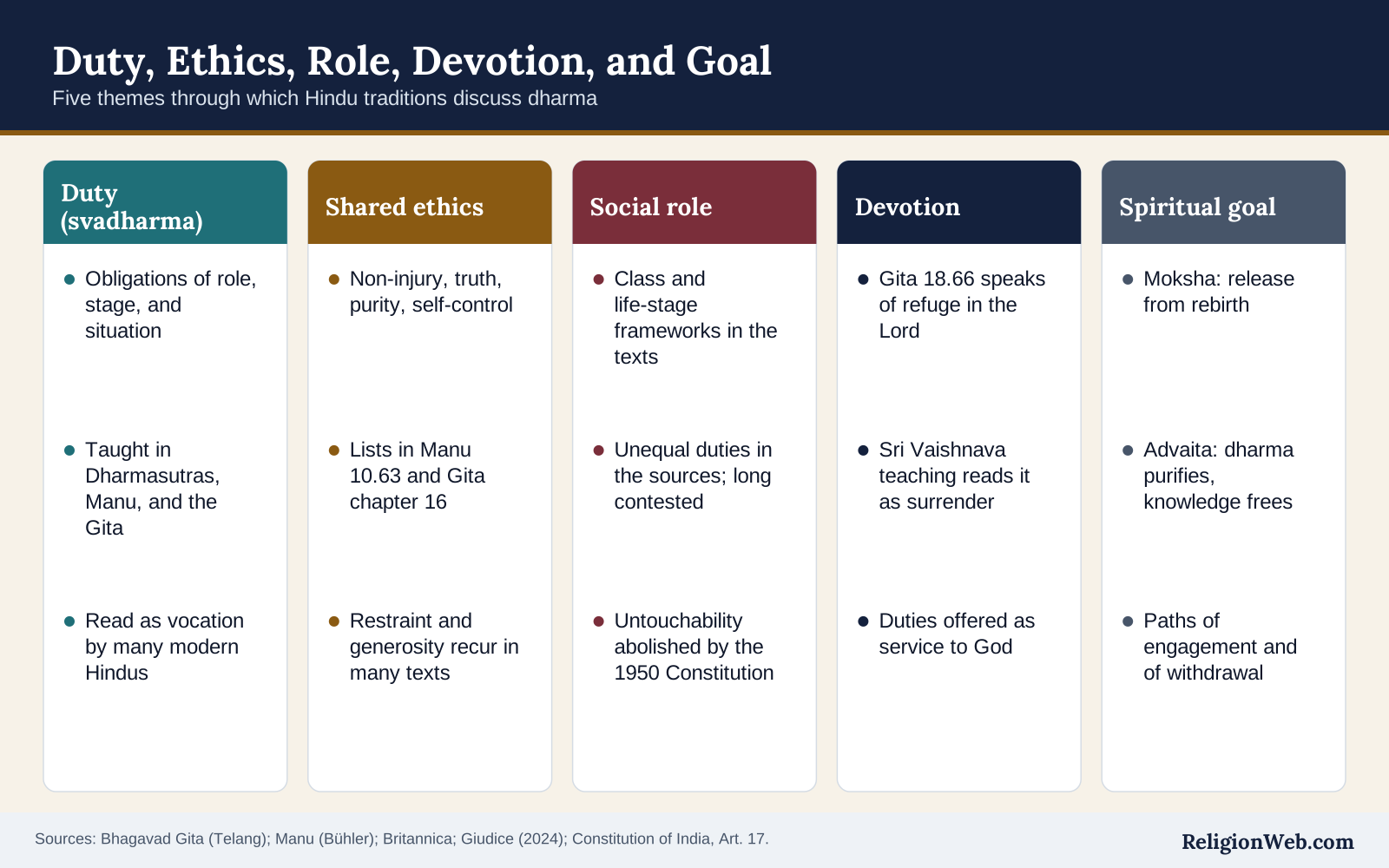
The five qualities named here, non-injury (ahiṃsā), truthfulness (satya), not taking what is not given (asteya), purity (śauca), and control of the senses (indriya-nigraha), appear in many variations in other texts, and several of them echo the restraints and observances of the classical yoga tradition. Within the Dharmashastra tradition, passages like this are usually read as the common core beneath the differentiated duties, which means they are often cited by modern Hindus who want to emphasize that dharma includes an ethics available to all. It is worth remembering that Bühler’s word “castes” translates the Sanskrit varṇa, and that the verse is placed in a chapter that otherwise deals with mixed classes and livelihoods in distress, a reminder that a universal list sits inside a hierarchical text.
Svadharma: one’s own duty
Alongside the shared list stands the concept of svadharma, “one’s own dharma,” the duty that arises from one’s particular birth, stage of life, family role, and occupation. The idea implies that the same act can be right for one person and wrong for another: a soldier’s duty to fight in a just war, a teacher’s duty to teach, a householder’s duty to feed guests, a ruler’s duty to punish wrongdoing. Britannica describes svadharma as the duty tied to class, status, and stage of life. The tension between this and the universal list is a central subject of the epics, and it is the engine of the Bhagavad Gita, discussed in its own section below.
Two cautions are needed. First, the historical texts usually define svadharma through the categories of varṇa (class) and āśrama (stage of life), which carry the hierarchical assumptions of the Brahmanical authors who wrote them. Second, many Hindus today use svadharma in a looser, more personal sense, as the vocation or obligation that fits one’s own temperament and circumstances. The first usage describes a historical legal-religious concept; the second describes a living ethical idea. Both are real, and they should not be confused.
Dharma Among the Four Aims of Life
Dharma, artha, and kama
Classical Sanskrit literature speaks of a threefold set of human aims, the trivarga: dharma (right conduct), artha (wealth, power, and practical success), and kama (pleasure, love, and desire). Texts on statecraft and on erotic and aesthetic culture alike take the three as a frame, and the Kamasutra of Vatsyayana, in paraphrase, ranks dharma above artha and artha above kama when they conflict. The point is not that wealth and pleasure are suspect; the point is that they should be pursued within limits that dharma sets. A famous verse near the end of the Mahabharata expresses frustration on exactly this point: the poet cries out with raised arms that wealth and pleasure come from dharma, and asks why people do not follow it.
Moksha and the two paths of engagement and withdrawal
Moksha, liberation from the cycle of rebirth, was added to the scheme as a fourth aim, giving the puruṣārthas as they are usually presented today. The addition raised a question that Hindu thinkers have debated for two thousand years: does dharma lead toward moksha, or does moksha lie beyond dharma? The philosopher Shankara, usually dated to about the eighth century CE, in the introduction to his commentary on the Bhagavad Gita, drew a distinction between two kinds of dharma. One, of engagement (pravṛtti), supports worldly flourishing and social order; the other, of withdrawal (nivṛtti), supports liberation. Other schools, as described later, place the boundary differently. For all of them, however, the question of how a life of obligation relates to the highest goal is a living one, and it connects directly with the discussion of karma and rebirth.
Dharma That Changes With Circumstance
Emergency dharma and the limits of rules
Dharma texts do not describe a single fixed code for all conditions. They recognize āpad-dharma, the dharma of times of distress, when ordinary rules may be suspended or adjusted in order to preserve life. The tenth chapter of Manu discusses livelihoods that members of the higher classes may take up in hardship, and it cites precedents of sages who survived famine by consuming what would normally be forbidden. The principle behind such provisions is that the rules exist to sustain people and society, and that a rule applied rigidly in a crisis can defeat its own purpose. Scholars of Hindu law have often noted that this flexibility, together with the tradition’s openness to custom, is one reason that dharma literature was not a single uniform legal system.
Age, place, and family: yuga, desha, and kula
Dharma is also said to vary with time, place, and family. The Puranic and epic idea of four ages (yuga) holds that conduct deteriorates in successive eras. Manu says, in its first chapter, that austerity is the chief virtue in the first age, knowledge in the second, sacrifice in the third, and charity alone in the present age. The Bhagavata Purana gives the idea an image: Dharma as a bull that begins with four legs, austerity, purity, compassion, and truth, and has lost most of them by the time the current age begins. Local custom (deśa-dharma) and family tradition (kula-dharma) are further sources of difference. Arjuna invokes kula-dharma at the opening of the Gita, and the tension between family obligation and a larger duty is part of what the poem explores.
| Term | Rough meaning | Where it matters |
|---|---|---|
| Dharma | What upholds: duty, law, ethics, order, teaching | Throughout Hindu texts and speech |
| Adharma | The opposite of dharma: disorder, wrongdoing, injustice | Epics, Gita 4.7, ethical discussion |
| Ṛta | Cosmic and ritual order in the Rigveda | Vedic hymns; background to dharma |
| Sādhāraṇa dharma | Common duties valid for all | Lists such as Manu 10.63 |
| Svadharma | One’s own duty by role, stage, and circumstance | Bhagavad Gita 2.31, 3.35, 18.47 |
| Varṇāśrama-dharma | Duties of social class and stage of life | Dharmasutras, Manu, traditional social theory |
| Āpad-dharma | Rules adjusted for emergencies | Manu 10; Mahabharata, Shanti Parva |
| Rāja-dharma | Duties of kingship and governance | Mahabharata Shanti Parva, treatises on statecraft |
| Puruṣārtha | The aims of human life: dharma, artha, kama, moksha | Classical Hindu ethics and literature |
| Śruti and smṛti | “Heard” revelation and “remembered” tradition | Sources of dharma, authority of texts |
| Sanātana dharma | “Eternal” dharma; also a modern name for the tradition | Manu 4.138; Gita 1.40; modern self-description |
Sacred Texts and the Sources of Dharma
How Tradition Identifies Dharma
The four roots: revelation, tradition, conduct, and conscience
A natural question is how anyone knows what dharma requires. Hindu legal and religious literature gives a structured answer, which it calls the roots or sources of dharma (dharma-mūla). The classic statement appears at the start of Manu’s text, which in Bühler’s translation reads:
The whole Veda is the (first) source of the sacred law, next the tradition and the virtuous conduct of those who know the (Veda further), also the customs of holy men, and (finally) self-satisfaction.
Manusmriti 2.6, translated by Georg Bühler, Sacred Books of the East vol. 25 (1886)
In the tradition’s own terms the four are śruti (the Veda, “what was heard”), smṛti (the remembered tradition, including the Dharmasutras and Dharmashastra), ācāra (the conduct of virtuous, learned people), and ātmatuṣṭi (literally “satisfaction of the self”). Giudice stresses that these are best understood as means of knowing dharma, not as “sources of law” in the modern Western sense, since the tradition does not distinguish law from religion. The fourth root is the most debated. The scholar Robert Lingat questioned whether it belonged in the list at all, Werner Menski and others have given it considerable weight as a recognition of conscience, and Donald Davis reads it as a limited form of personal preference. The passage can therefore be used by traditionalists to underline the authority of the Veda and by modern readers to point to an acknowledged role for individual moral judgment, and both uses have a textual basis.
Why the Veda comes first, and what that means in practice
The ranking of the roots was not fixed from the start. According to Giudice, the Dharmasutra of Apastamba placed established custom first, while later texts put the Veda at the top and Manu added the fourth root. Smriti’s authority is explained as deriving from the Veda: the Mimamsa school of exegesis argued that the human authors of the Dharmasutras were recalling Vedic teaching that is no longer available, so that their rules rest on lost scripture, provided they do not contradict the extant Veda. In practice, this arrangement gave a great deal of weight to the conduct of learned communities, which is part of why regional custom and family tradition remained powerful. It also meant that the work of dharma specialists was largely interpretive, a matter of reconciling texts and applying them to circumstances, and not the enforcement of a single code.
The Dharmasutras and Dharmashastra
Four surviving Dharmasutras
The earliest dedicated manuals of conduct are the Dharmasutras, aphoristic prose texts that survive under the names of Apastamba, Gautama, Baudhayana, and Vasishtha. Giudice dates them, with individual variation, between roughly the third century BCE and the first century CE. They were later attached to the ritual manuals of Vedic schools, though they may have begun as independent works. Their concerns are the student, the householder, the king, inheritance, purification, and penance. They are written by and for Brahmin men, they assume a four-class society with Brahmin priority, and they speak mainly to householders. They also preserve disagreement: a Dharmasutra will often cite other authorities and leave the question open, which tells us the genre was a conversation among specialists and not a decree.
Manu and the later smritis
The Mānava Dharmashastra, better known as the Manusmriti or Laws of Manu, was composed in verse, probably around the second century CE. It innovates by attributing its teaching to the first man and a divine source and by speaking in a single authoritative voice, in contrast to the Dharmasutras’ debates. Its reach was large: it influenced later law-writers, was cited in medieval commentary, and, in the eighteenth century, became one of the first Sanskrit texts translated into English by a colonial official. Bühler’s 1886 translation remains in the public domain, and Patrick Olivelle’s 2005 critical edition and translation for Oxford University Press is the standard scholarly version. Later smritis, including those attributed to Yajnavalkya, Narada, Vishnu, and Parashara, date from about the late fourth to the eighth century CE and devote more attention to courts and procedure. Commentaries on these texts began about the seventh century, and encyclopedic legal digests (nibandha) appeared from about the twelfth. Two of the best-known interpretive works, the Mitakshara on Yajnavalkya and the Dayabhaga, later gave their names to the two principal schools of Hindu inheritance law.
Epics, Puranas, and Other Textual Contexts
The Mahabharata and Ramayana as teaching in story form
For many Hindus the most familiar source of ideas about dharma is not a law book but a story. The Mahabharata describes itself as a work that contains, among other things, instruction in dharma, and its characters spend much of the narrative arguing about what dharma demands. Its twelfth and thirteenth books, the Shanti and Anushasana Parvas, are in effect a long teaching about dharma, spoken by the dying warrior Bhishma to Yudhishthira after the war. The Ramayana presents Rama as a model of keeping one’s word and fulfilling one’s role as son, husband, and king, and it too is full of difficult choices. Because narratives show consequences and conflicts, they allow reflection on cases that sutras and shastras cannot settle in advance.
Puranas, regional texts, and sectarian codes
The Puranas, a large body of texts on cosmology, divine history, rites, pilgrimage, and conduct, took up and extended dharma teaching in forms suited to temple worship and devotion. Later communities issued their own codes. The Shikshapatri, composed in 1826 by Swaminarayan for his followers, is a short Sanskrit text of rules on daily conduct, and many other sects, regional traditions, and householder lineages keep written or oral norms. The picture, then, is one of layered and overlapping sources, with no single canon that every Hindu must follow, a point to keep in mind when reading the table below.
| Textual context | Approximate period | How dharma appears | Main audience or use |
|---|---|---|---|
| Rigveda and other Vedic hymns | Second millennium BCE | Ṛta as cosmic order; dharman as support | Priests and ritual specialists |
| Brahmanas and Upanishads | First half of first millennium BCE | Dharma as ritual order, truth, and kingship; early life-stage schemes | Ritual and philosophical schools |
| Dharmasutras | Third century BCE to first century CE | Concise manuals of conduct and procedure, with debate preserved | Brahmin householders and teachers |
| Manu and later Dharmashastra | About second to eighth centuries CE | Verse treatises on conduct, law, and penance | Learned experts, kings, courts |
| Mahabharata and Ramayana | Last centuries BCE to early centuries CE | Dilemmas, models, long didactic sections | Broad public, performance, storytelling |
| Bhagavad Gita | Last centuries BCE to early centuries CE | Svadharma, action without attachment, devotion | Philosophical and devotional readers |
| Mimamsa and Vaisheshika sutras | Early centuries of the common era, with earlier roots | Definitions of dharma as Vedic injunction or as what yields the highest good | Philosophical schools |
| Puranas and sectarian texts | First millennium CE onward | Dharma tied to devotion, temple practice, and community rules | Devotional communities, temple traditions |
| Commentaries and digests | From about the seventh and twelfth centuries CE | Reconciliation of texts; regional schools of law | Jurists, courts, scholars |
Dharma in the Bhagavad Gita
Arjuna’s Crisis on the Battlefield
Competing duties at Kurukshetra
The Bhagavad Gita, a dialogue of about 700 verses set inside the Mahabharata, turns the problem of dharma into a drama. Arjuna, a warrior of the Pandava family, stands between two armies on the field of Kurukshetra and sees teachers, cousins, and friends on both sides. As a member of the warrior class his duty is to fight in a war undertaken to restore his family’s rightful kingdom, but he is horrified by the killing it will require. He says his mind is confused about dharma and asks his charioteer, Krishna, to tell him decisively what is right. Most historians place the composition of the Gita in the last centuries BCE or the early centuries CE, and Hindus of many traditions treat it as one of their most important texts, though the weight given to it differs by community.
Family dharma and the fear of disorder
Arjuna’s first argument is itself an argument from dharma. In Telang’s translation he says that when a family is destroyed, “the eternal rites of families” are lost, and that disorder spreads when those rites fail. The Sanskrit phrase here pairs kula-dharma, family dharma, with the adjective sanātana, “eternal.” Arjuna is not a skeptic of dharma; he is a believer caught between duties, the ritual and social duties of the family on one side and the warrior’s duty to fight on the other. The Gita’s response does not simply declare one duty to override the other, and that is why the text has been read in so many ways.
Svadharma and Disciplined Action
Better one’s own duty
Krishna’s answer involves several moves, and one of them is the doctrine of svadharma. In Telang’s translation:
One’s own duty, though defective, is better than another’s duty well performed. Death in (performing) one’s own duty is preferable; the (performance of the) duty of others is dangerous.
Bhagavad Gita 3.35, translated by Kashinath Trimbak Telang, Sacred Books of the East vol. 8 (1882)
Traditional commentators have generally read this verse in the context of the class and stage-of-life duties of the Dharmashastra, and chapter 18 of the Gita does speak of duties arising from a person’s innate qualities and class. Modern interpreters divide on what to do with that. Some, including many traditional teachers, retain the link to birth-based class; others argue that the Gita’s own statement, in chapter 4, that the four classes are distributed by “quality and action,” points to vocation and temperament, and a number of twentieth-century reformers read svadharma in that more personal way. Still others stress that the verse’s point is psychological and ethical, a warning against abandoning one’s own responsibilities to imitate others. These are different interpretive frames, and the verse supports more than one of them.
Action without attachment to results
The Gita’s best-known teaching on dharma in action comes in chapter 2, where Krishna tells Arjuna in Telang’s rendering, “Your business is with action alone; not by any means with fruit.” The ideal is often called niṣkāma karma, desireless action: to do what is required without being driven by craving for its rewards and without being paralyzed by fear of its results. Here dharma and the doctrine of karma meet; the connection is developed in the article on karma in Hinduism. The Gita does not say that actions are unimportant. It says that the inner orientation with which duty is performed matters decisively, which allows duty to become a form of spiritual discipline, a point that links the poem to the traditions of yoga.
Dharma, the Divine, and Surrender
Restoring dharma: the doctrine of descent
In chapter 4 Krishna presents himself as the source of the teaching and as a divine being who takes birth to protect dharma. In Telang’s translation:
Whensoever, O descendant of Bharata! piety languishes, and impiety is in the ascendant, I create myself. I am born age after age, for the protection of the good, for the destruction of evil-doers, and the establishment of piety.
Bhagavad Gita 4.7 and 4.8, translated by Kashinath Trimbak Telang, Sacred Books of the East vol. 8 (1882)
Telang translates dharma here as “piety” and its opposite as “impiety,” a choice that shows how far the sense of the word can stretch toward conduct that is aligned with the divine order. For Vaishnava traditions, which regard Krishna as a full manifestation of Vishnu, the verses are a foundation for the doctrine of divine descent, the avatāra; see the article on Vaishnavism for how that doctrine is developed. In this setting dharma is not only a human obligation but a cosmic condition that the divine is said to restore when it fails.
“Abandon all dharmas”: a verse read in different ways
The Gita’s closing teaching complicates the picture. In Telang’s translation, near the end of the poem, Krishna says:
Forsaking all duties, come to me as (your) sole refuge.
Bhagavad Gita 18.66, translated by Kashinath Trimbak Telang, Sacred Books of the East vol. 8 (1882)
This verse has produced some of the most interesting commentary in the Hindu tradition because it appears to say that dharma itself should be let go. Interpretations differ by school. Shankara’s Advaita Vedanta commentary is generally understood to read the verse as pointing beyond ritual and social action to the knowledge of the Self as the final refuge. In Sri Vaishnava teaching, which follows Ramanuja, the verse is the supreme statement of surrender (prapatti) to the Lord, and it is understood to be compatible with continuing to perform one’s duties as service. Many modern readers, including Gandhi, who read the Gita as a call to selfless action, stress that it cannot mean abandoning ethical responsibility, since the same poem insists on action. None of these readings is the “official” Hindu view, and they reflect different theologies of what dharma is for.
Life Stages, Social Roles, and Everyday Duties
The Four Stages of Life
Alternatives first, a sequence later
The classical scheme of the four āśramas, or stages of life, is among the most quoted features of Hindu social thought: the student (brahmacārin), the householder (gṛhastha), the forest dweller (vānaprastha), and the renouncer (saṃnyāsin). Many popular summaries describe them as four phases through which every man ideally passes in turn. The historian of religion Patrick Olivelle, in his study of the institution, argued that this is a later arrangement. In the earlier Dharmasutras, he proposed, the four were understood as alternative ways of living, chosen after the ceremony that ended Vedic study, with no necessary connection to age; one could be a lifelong student or a lifelong renouncer. The sequential model, in which a man of the upper classes passes through all four in succession, is articulated most clearly in Manu, and it reached its classical form by the middle of the first millennium CE.
The difference matters for how the tradition is described. A reader who encounters the stages as a fixed life script is likely to treat it as an ancient, uniform practice. The scholarly picture is of a scheme that was debated, reconciled, and reshaped. Orthodox authorities such as Gautama and Baudhayana argued that only the householder could pay the debts owed to gods, ancestors, and sages, and so privileged that stage. Later authors accepted all four as legitimate and eventually linked them to age. In other words, the texts record argument before they record consensus.
What each stage asks
In the sequential form, the student lives in a teacher’s household after the initiation ceremony (upanayana), learns the Veda and the duties of his class, serves his teacher, and observes restraint. The householder marries, maintains the domestic fire, supports children, elders, guests, and ascetics, and earns a living in a way appropriate to his class. Texts call the householder the support of the other three stages because students and renouncers depend on him for food and ritual provision. The forest dweller withdraws partly from household life, with or without his wife, for austerity and study. The renouncer gives up property, family ties, and ritual fires and lives by alms, in pursuit of liberation.
Few Hindus today organize a lifetime in this sequence, and the formal initiations are observed by only some communities. The vocabulary persists nonetheless. Retirement, pilgrimage in later life, and the decision to take monastic vows are often described in terms of these stages, and renunciant orders, including monastic lineages associated with Shankara’s tradition and newer ones such as the Ramakrishna Mission, carry the fourth stage forward as a living institution. The table summarizes the stages and the class duties described in the next subsection as the historical texts present them. It is a description of what the texts prescribe, and not of how every Hindu has lived.
| Framework | Category | Duties and ideals in the texts | Historical and modern note |
|---|---|---|---|
| Stage of life | Student (brahmacārin) | Study of the Veda, service to the teacher, restraint, begging for food | Early texts treat it as an option; later as a first stage for upper-class males |
| Stage of life | Householder (gṛhastha) | Marriage, domestic rites, livelihood, hospitality, support of dependents | Treated in Manu and elsewhere as the base on which other stages rest |
| Stage of life | Forest dweller (vānaprastha) | Partial withdrawal, austerity, study, simple diet | Rare in practice; often echoed in retirement and pilgrimage |
| Stage of life | Renouncer (saṃnyāsin) | Giving up property and ritual fires; alms, meditation, teaching | Continued in monastic orders and renunciant lineages |
| Class (varṇa) | Brahmin | Study, teaching, officiating at rites, giving and receiving gifts | Authors of most dharma texts; priority asserted in the texts |
| Class (varṇa) | Kshatriya | Protection of the people, governance, giving, sacrifice, study | Rājadharma sections of the epics and Manu apply here |
| Class (varṇa) | Vaishya | Herding, farming, trade, lending, giving, sacrifice, study | Economic roles varied widely by region and period |
| Class (varṇa) | Shudra | Service to the higher classes, as Manu states it | Unequal status and penalties in the texts; widely criticized by reformers |

Class, Birth, and Duty in the Texts
Varna-dharma as the texts prescribe it
The earliest reference to a fourfold division of society is a late hymn of the Rigveda, the Purusha Sukta (10.90), in which the four classes are said to arise from different parts of a cosmic being. The Dharmasutras and Manu then attach duties to each: the Brahmin to study, teach, and officiate at sacrifice; the Kshatriya to protect and govern; the Vaishya to farm, trade, and tend cattle; and the Shudra to serve the others. The texts also attach unequal standing, privileges, and penalties to the classes, with Brahmins at the top of the hierarchy. That feature is not a modern accusation but a plain fact about the sources, and it explains why the same books are cherished by some Hindus and rejected by others.
Two clarifications keep the picture accurate. First, varṇa, a theoretical classification into four categories, is not the same thing as jāti, the thousands of endogamous birth-groups that structured social life in practice and varied by region. Second, the Bhagavad Gita speaks of the four classes as arranged by “quality and action” (guṇa-karma), a phrase that interpreters have read both as justifying birth-based roles and as pointing to aptitude. The texts do not speak with one voice, and the history of their use is a history of selection and reinterpretation.
Critiques, reinterpretations, and reform
Challenges to birth-based hierarchy are old within Hindu life. Devotional poet-saints in many regions, including Basavanna in twelfth-century Karnataka, Kabir, and Ravidas, taught that devotion to God did not depend on birth, and their communities developed ways of worship open to all. In the nineteenth century reformers such as Dayananda Saraswati of the Arya Samaj argued that class should follow merit and not birth. In the twentieth century B. R. Ambedkar, born into a community then classed as untouchable and later the principal architect of India’s constitution, argued in Annihilation of Caste (1936) that the authority of the shastras must be rejected if caste was to be abolished, and in December 1927, at Mahad, he led the public burning of the Manusmriti. The Constitution of India, which came into force in 1950, abolished untouchability in Article 17.
Other Hindus, then and now, have defended the idea of class duties as a functional or spiritual ideal, while criticizing discrimination in practice. Gandhi, for example, called himself a Sanatani Hindu and affirmed a version of varnashrama while campaigning against untouchability, a position that Ambedkar and others disputed. The disagreement is real and continuing. A fair summary is that the historical texts prescribe a hierarchical order, that many Hindu thinkers have contested it from inside the tradition, and that modern Indian law no longer treats it as binding.
Family, Gender, and the Samskaras
Household duties: the five daily offerings and the three debts
For the householder, dharma texts describe a rhythm of daily and seasonal duties. Manu lists five “great sacrifices” to be performed each day: study of the Veda, offerings of water to the ancestors, oblations to the gods, a food offering to all beings, and hospitality to guests. These are not always performed in elaborate form; in many homes the idea survives as feeding a guest, setting aside food for animals, remembering ancestors on particular days, and a short daily worship. Alongside these stand the “three debts” described in Vedic literature: to the gods, to the sages (through study), and to the ancestors (through offspring), which provided the traditional reasoning for why the householder stage was so important. Household worship as it looks today is described in the separate article on puja.
Women’s dharma in the texts and in debate
Dharma texts have much to say about women, and the content is mixed. Manu declares in one place that where women are honored the gods are pleased, and in another that a woman should never be independent but should be under the protection of her father in childhood, her husband in youth, and her sons in widowhood. The ideal of the devoted wife (pativratā) became central in later literature. At the same time, the Upanishads present women teachers and debaters such as Gargi and Maitreyi, and goddess-centered traditions give female power a prominent theological place; Shakta traditions are covered in their own article.
Modern Hindus disagree widely about how to relate to these texts. Some traditional teachers present the older norms as a framework of complementary roles. Many reformers and feminist scholars regard the guardianship provisions as incompatible with equality and point out that statutory reforms, such as the Hindu Succession Act of 1956 and its later amendments, have changed women’s legal position. Others argue for new readings from within the tradition, including women serving as priests and ascetics in several communities. The honest conclusion is that there is no single Hindu position, and that the historical texts are one voice in the conversation.
Life-cycle rites and the marriage ceremony
The saṃskāras, rites of passage, mark the stages of a life: naming and first feeding in infancy, initiation in youth, marriage, and funeral rites. Early texts list as many as forty such rites, and later manuals commonly speak of sixteen. Practice varies widely by region, caste, sect, and family, and many urban families now perform shortened forms. At a Hindu wedding, the couple traditionally walks seven steps (saptapadī) around the sacred fire, taking vows that, in many regional forms, refer to dharma, wealth, and love. India’s Hindu Marriage Act of 1955 gives this tradition legal recognition: a marriage may be solemnized in accordance with the customary rites of either party, and where those rites include the seven steps, the marriage becomes complete and binding when the seventh step is taken. It is a small but telling example of an old dharma-text practice being absorbed into modern statute.
Ethics, Rulership, and Moral Reasoning
Virtue and Restraint
Lists of virtues in the Gita and the epics
Alongside the duties of role and stage, Hindu literature offers catalogues of virtues. The sixteenth chapter of the Gita lists the “divine endowment”: fearlessness, purity of heart, steadiness in knowledge, charity, self-control, sacrifice, study, austerity, honesty, non-violence, truthfulness, freedom from anger, renunciation, and compassion toward beings, among others. The Mahabharata’s teaching sections contain similar lists, and the Manu verse quoted earlier names five core qualities. These catalogues are not identical, and scholars have not tried to reduce them to a single formula. They show a consistent emphasis on restraint of the senses, truthfulness, non-harming, generosity, and discipline of the mind.
Ahimsa and its limits
The ideal of non-harm (ahiṃsā) is a good example of a principle that is both central and qualified. The Mahabharata contains the often-quoted statement that non-violence is the highest dharma, and many Hindu communities, including large Vaishnava traditions, practice vegetarianism on that basis. Yet the same literature accepts warfare as a ruler’s duty, punishment as a function of kingship, and, in the Vedic ritual tradition, animal sacrifice. Hindu thinkers have long debated how these fit together, and the debate continues: some Hindus are strict vegetarians, others eat meat, and views of ritual animal offering differ by tradition and region. Ahimsa has an even more rigorous development in Jain thought, treated in the article on ahimsa in Jainism, which is a separate tradition with its own sources.
Kingship and Law
Rajadharma: the ruler as protector
The duties of rulers form a large part of dharma literature. The Shanti Parva of the Mahabharata, in which Bhishma instructs Yudhishthira, gives extended teaching on the king’s dharma: to protect subjects, to maintain order, to punish wrongdoers with proportion, and to support learning and worship. A recurring image is the “law of the fishes” (matsya-nyāya), in which the strong devour the weak in the absence of a ruler, and the king’s staff of punishment (daṇḍa) is seen as the remedy. The Upanishadic passage quoted earlier, which makes dharma the power above kingship, works as a counterweight: the ruler is the instrument of dharma, not its owner.
Courts, procedure, and the eighteen titles of law
Manu’s eighth chapter organizes civil and criminal matters under eighteen “titles of law,” including debt, deposits, sales, partnership, boundaries, theft, and inheritance. Later authors such as Narada elaborated on procedure, evidence, and the role of witnesses and assemblies. According to Giudice, the pre-modern tradition did not separate law from religion, since both fell under dharma, and classical Hindu law was not a single uniform system but a set of local systems linked by a shared jurisprudence. The role of expert assemblies, drawn from learned and virtuous people, underlines that the tradition’s idea of law was one of consultation and interpretation, with strong roles for custom and for communities to govern their own affairs.
Moral Reasoning When Rules Collide
Dharma is subtle: the Mahabharata’s answer
If one theme unites the Mahabharata, it is that dharma is hard to discern. Characters repeatedly describe it as subtle. When Draupadi is dragged into the assembly after her husband has gambled away his freedom, she asks whether he lost himself before he staked her, and the elders cannot give a clear answer. In the Yaksha episode of the forest book, Yudhishthira is asked what the true path is and replies, in paraphrase, that arguments conflict and scriptures differ, that the truth of dharma lies hidden in a cave, and that the path is the one the great have trodden. The epic does not resolve these tensions. After the war Yudhishthira himself is overwhelmed with grief and doubt, and the long teaching sections that follow are a response to that crisis.
Rama and the difficulty of exemplary dharma
The Ramayana poses its own questions. Rama accepts exile in the forest to honor a promise his father made, even though the people expect him to be crowned, and the poem presents this as an act of devotion to truth and to filial duty. Valmiki’s epic is often said to portray Rama as dharma embodied. Yet the story also contains episodes, especially Rama’s treatment of Sita after her rescue and later banishment, that have prompted debate among traditional commentators, devotional writers, and modern readers over whether a king’s duty and a husband’s duty can be reconciled. Hindus who revere Rama approach these questions differently, and many retellings across languages and regions, from the Tamil Kamban to the Awadhi Tulsidas, have shaped the story in their own ways. For the tradition, the point seems to be that dharma is tested and examined, not applied mechanically.
Schools and Traditions: How Different Communities Read Dharma
Philosophical Schools
Mimamsa: dharma as what the Veda enjoins
The Mimamsa school, whose foundational text is attributed to Jaimini, takes dharma as its subject from the first sentence. In paraphrase, its second aphorism defines dharma as the beneficial thing that is indicated by Vedic injunction (codanā). The definition is revealing. For Mimamsa thinkers such as Shabara and Kumarila, dharma is not discovered by reason or intuition alone but known through the Veda’s commands, above all those about ritual action, and the school developed sophisticated rules of interpretation to determine what those commands require. This is dharma in its most ritual and textual sense. It also supplies the background for the sources-of-dharma discussion, since the claim that the remembered tradition rests on the Veda is a Mimamsa argument.
Vaisheshika: dharma as what leads to the highest good
A different definition appears in the Vaisheshika school, a tradition of natural philosophy that classifies the constituents of reality. Its opening aphorisms, again in paraphrase, say that dharma is that from which exaltation (abhyudaya) and the highest good (niḥśreyasa) are accomplished. This definition links dharma to results, both worldly flourishing and liberation, and is less tied to the injunctions of a particular text. The two definitions show how a single term could organize quite different philosophical projects, one focused on correct action as prescribed, the other on what produces ultimate benefit.
Vedanta and Its Schools
Advaita: dharma as preparation for knowledge
Advaita Vedanta, the non-dualist school associated with Shankara, treats liberation as the knowledge that the self is not different from Brahman. Where does dharma fit? The traditional answer is that dharmic action, performed without attachment to its fruits, purifies the mind and prepares it for knowledge, but cannot itself produce liberation. Shankara’s introduction to his Gita commentary, mentioned earlier, distinguishes the dharma of engagement from that of withdrawal. The Vedanta tradition marks its relation to Mimamsa in its opening line: the Brahma Sutra begins with the words “Now, therefore, the inquiry into Brahman,” and commentators disagree about what the “now” follows. Ramanuja takes it to follow the study of dharma, while Shankara holds that the seeker needs only certain inner qualities, such as discernment and detachment. This does not mean that Advaitins treat ethical and social duties as unimportant. It means that they treat them as stages on the way, and many Advaita teachers have lived and taught as householders and as monks, giving ethical conduct a large place.
Vishishtadvaita and Dvaita: dharma as service and devotion
The Vaishnava Vedanta schools take a more devotional view of the matter. Ramanuja (traditionally dated to the eleventh and twelfth centuries) taught that the individual self is a part of God, dependent on God and meant for service, so that dharma becomes the service of the Lord and surrender (prapatti) is a central path. Madhva (usually placed in the thirteenth century) taught a strict distinction between God and souls and emphasized devotion as the means to grace. In both traditions ordinary duties are performed as an offering to God, and ethical conduct is bound up with worship. These ideas are developed further in the article on Vaishnavism.
Devotional, Sectarian, and Reform Communities
Shaiva, Shakta, and Vaishnava frameworks
Devotional communities often combine the shared vocabulary of dharma with their own sources of authority. Shaiva traditions, covered in the article on Shaivism, rely on scriptures called Agamas that prescribe worship, initiation, and conduct for initiated followers. Shakta traditions, discussed in the article on Shaktism, give a central place to the Goddess and, in some Tantric lineages, to ritual practices that set aside ordinary purity rules within a controlled setting. Vaishnava communities draw on the Gita, the Bhagavata Purana, and the teachings of their own founders. In each case dharma is real and respected, but the immediate authority for daily life is often the community’s own teacher and texts, not the Dharmashastra.
Reform movements and new readings
Since the nineteenth century, reform movements have proposed new ways of reading dharma. The Brahmo Samaj, founded by Ram Mohan Roy in 1828, emphasized the Upanishads and a reformed monotheism. The Arya Samaj, founded by Dayananda Saraswati in 1875, held that the Vedas alone are authoritative, rejected image worship, and argued for class by merit. Swami Vivekananda, who represented Hinduism at the World’s Parliament of Religions in Chicago in 1893, taught that service to human beings is a form of worship, and the Ramakrishna Mission institutionalized that approach. The Swaminarayan tradition, which took shape in Gujarat in the early nineteenth century, combines devotion with a detailed code of conduct. These movements differ among themselves, and a reader should not take any one of them as the voice of “Hinduism.”
Dharma in Practice: Worship, Festivals, and Daily Life
Daily and Domestic Practice
Required, occasional, and optional observances
Dharma texts distinguish between kinds of ritual duty, and the distinction clarifies what is obligation and what is custom. Constant observances (nitya) are the daily duties, such as the twilight prayers (sandhyā) and domestic offerings, which were expected of those initiated into Vedic study. Occasional observances (naimittika) are required by a particular event, such as a birth, a death, or an eclipse. Optional observances (kāmya) are performed for a particular wish, such as health or prosperity. In current practice, how much of this survives depends on the family. Some households maintain the twilight prayers and the recitation of the Gāyatrī mantra by those initiated; many keep a small shrine where a lamp is lit and food is offered each day; others observe only festivals and life-cycle rites. The article on puja describes household and temple worship in detail.
Ancestors, hospitality, and giving
Three further duties of the traditional householder remain widely recognized. The first is remembrance of ancestors, through śrāddha rites with offerings of food and water at the time of death anniversaries and during a fortnight in the autumn. The second is hospitality: the Taittiriya Upanishad’s instruction to treat a guest as a god (atithi devo bhava) is widely quoted in India today. The third is giving (dāna), regarded in the texts as a primary duty and, in the teachings of the present age, the chief one. The everyday word dharamshala, a rest house for pilgrims and travelers often maintained by a charity, comes from dharma and the Sanskrit śālā, “hall,” and shows how the concept of dutiful giving shaped the built landscape.
Festivals That Tell Dharma Stories
Diwali, Dussehra, and the stories of restoration
Several major festivals are linked, in popular understanding, to the victory of dharma over adharma, although the stories behind them differ by region and community. In many parts of North India, Diwali commemorates Rama’s return to Ayodhya after his exile and the defeat of Ravana, while in other regions the same festival is linked with the defeat of the demon Naraka by Krishna or with the worship of Lakshmi, as described in the article on Diwali. The autumn festival described in the article on Navaratri ends in Dussehra, celebrated in much of North India with Ramlila dramas that conclude with the burning of effigies of Ravana, and elsewhere, especially in Bengal, with the worship and immersion of the goddess Durga after her victory over the buffalo demon Mahishasura. UNESCO inscribed the Ramlila, the traditional performance of the Ramayana, on its Representative List of the Intangible Cultural Heritage of Humanity in 2008. The phrase “victory of good over evil” is a common gloss, but each telling carries its own emphasis, and none exhausts the festival’s meaning.
Holi and the story of Prahlada
Holi, discussed in the article on Holi, is associated in many communities with the story of Prahlada, a child devotee of Vishnu, and his aunt Holika, who is burned while Prahlada is saved. The Bhagavata Purana tells the wider story of Prahlada and his father, who persecutes him for his devotion. In this telling, dharma is not obedience to a ruler or a father but fidelity to what a person understands to be right, even against authority. Other communities associate Holi with Krishna’s play with Radha in the Braj region, with spring, or with the harvest. A single festival can hold several meanings at once, and a visitor should not assume that every participant tells the same story.
Colonial Law, Reform, Sanatana Dharma, and Dharma Today
Dharma in Colonial Courts
Hastings, pandits, and Jones’s Manu
When the East India Company took over civil administration in Bengal, its governor Warren Hastings adopted in 1772 a judicial plan under which disputes over matters such as inheritance, marriage, caste, and religious usage among Hindus would be decided according to Hindu law, and among Muslims according to Islamic law. To apply Hindu law the British needed to know what it was, and they relied on Brahmin legal experts, or pandits, attached to the courts. A digest of Sanskrit legal opinions was translated into English, by way of Persian, in 1776, and in 1794 the orientalist and judge William Jones published the first English translation of the Laws of Manu, titled Institutes of Hindu Law. Giudice notes that the pandits served as legal advisers in colonial courts, and the arrangement shaped how the Dharmashastra was understood by outsiders and, in time, by many Indians themselves.
Anglo-Hindu law and its consequences
The result was a body of case law often called Anglo-Hindu law, which treated selected Sanskrit texts and commentaries as sources of binding personal law, mainly for family and inheritance matters. In practice the courts followed the regional schools: the Mitakshara in most of India, and the Dayabhaga in Bengal and Assam. Many historians of law have argued that this process made a flexible, custom-sensitive tradition more rigid, because judges looked for textual authority and gave less weight to the local custom and expert consultation that had shaped practice. Giudice summarizes the outcome in two points: under British rule the Dharmashastra became the basis for Hindu personal law, and its role was later diminished by reform and by the Hindu Code legislation after Indian independence. The long-term lesson is that the idea of a dharma text as a code binding on all Hindus is partly a colonial-era development and not simply an inherited ancient fact.
Reform and the Hindu Code
Reform debates in the nineteenth century
Nineteenth-century Indian reformers argued over dharma in the language of the texts themselves. When the British prohibited the practice of widow burning (satī) in Bengal in 1829, Ram Mohan Roy had argued from scripture that the practice was not required, and a body of conservative Calcutta Hindus formed an association called the Dharma Sabha around 1830 to oppose the ban. In 1856 the Hindu Widows’ Remarriage Act became law after the Bengali scholar Ishwar Chandra Vidyasagar argued from Sanskrit authorities that remarriage was permitted. The Arya Samaj, founded in 1875, made the Vedas its sole authority. These debates show that reform was often an argument about what the sources really said, and that traditionalists and reformers both appealed to dharma.
Independence, the Hindu Code, and the Constitution
After independence, the Constitution of India came into force in 1950, guaranteeing equality before the law and abolishing untouchability. B. R. Ambedkar, as Law Minister, championed a comprehensive Hindu Code Bill that provoked strong opposition in the early years of the republic; its provisions were later enacted in separate statutes in the mid-1950s, including the Hindu Marriage Act of 1955 and the Hindu Succession Act, the Hindu Minority and Guardianship Act, and the Hindu Adoptions and Maintenance Act of 1956. These laws apply statute, not the Dharmashastra, to Hindus, and in the process they preserved some customary practices, such as the seven steps at a wedding, while changing others, such as rules of inheritance and the legal position of women. India still maintains separate personal laws for different religious communities, and the question of how far religious law should govern family life remains an active public debate.
Sanatana Dharma as a Modern Name
The phrase in older texts
The compound sanātana dharma, “eternal dharma,” is old, but it is not at first a name for a religion. Manu 4.138 uses it of a rule of courtesy: say what is true and say what is pleasant, and do not say an unpleasant truth or a pleasant falsehood; this, the verse says, is eternal dharma. In the Bhagavad Gita, as noted earlier, Arjuna speaks of eternal family rites. The historian R. Mahalakshmi, writing in Frontline in 2023, observed that the compound does not appear in the Vedic collections, that an early instance occurs in a Pali verse of the Buddhist canon, and that the Mahabharata uses it many times in general senses such as the justification of conduct. In these usages the word “eternal” qualifies a particular rule or duty, and not a whole religion.
From orthodox association to common self-description
Its use as a name for the Hindu tradition grew in the nineteenth century. Historians, including Mahalakshmi and John Zavos, describe how orthodox Hindus in the colonial period, responding to missionaries and to reformers such as the Brahmo Samaj and the Arya Samaj, organized associations under the banner of Sanatana Dharma. Mahalakshmi notes the Dharma Sabha of Bengal, formed in the early 1830s, and the Central Hindu College founded by Annie Besant, which published a textbook titled Sanatana Dharma in 1903. Zavos argues that in colonial India the term served as a symbol of orthodoxy. Today many Hindus use “Sanatana Dharma” simply as the traditional name for their religion, as a way to speak of it in its own terms and not by the Persian-derived word “Hindu” and the nineteenth-century English term “Hinduism”; others use it to signal a more traditional or orthodox stance; and in India’s public debate the term has been defended, criticized, and contested in recent years, including by those who see it as shorthand for caste hierarchy and by those who reject that reading. A careful writer reports who is using the phrase and in what sense.
| Approach | Representative voices or bodies | How dharma is understood | Treatment of historical codes |
|---|---|---|---|
| Traditionalist and orthodox | Sanatana Dharma associations, monastic centers (maṭhas), many priestly families | Dharma as revealed and inherited order, including class and stage duties | Dharmashastra and custom are authoritative guides, adapted by learned interpretation |
| Reformist and scriptural | Brahmo Samaj, Arya Samaj | Dharma as pure monotheism, ethical conduct, and Vedic or Upanishadic teaching | Later texts and image worship criticized; class by merit rather than birth |
| Ethical and spiritual universalist | Vivekananda, Gandhi, Radhakrishnan, Aurobindo | Dharma as truth, non-violence, selfless service, and spiritual discipline | Gita and Upanishads emphasized; shastric rules read selectively |
| Anti-caste critique | Jotirao Phule, B. R. Ambedkar | Dharma as justice and equality; hierarchy seen as embedded in the texts | Authority of Manu and similar texts rejected; some critics left Hinduism, others reformed from within |
| Devotional and sectarian | Sri Vaishnava, Gaudiya, Virashaiva, Swaminarayan and other communities | Dharma as devotion and as the community’s code of conduct | Own scriptures and teachers weighed alongside or above general codes |
| Cultural-nationalist usage | Organizations of the Hindutva movement and their supporters | Dharma and Sanatana Dharma as civilizational heritage and identity | Heritage affirmed by supporters; critics argue it flattens diversity and politicizes religion |
| Academic and historical study | Indologists, historians of law, scholars such as Olivelle | Dharma as a concept with a history and many contexts | Texts read as products of particular periods, authors, and communities |
| Diaspora and feminist reinterpretation | Temple communities abroad, women’s scholarship and ordained women | Dharma as ethics adapted to plural societies and gender equality | Historical norms on gender reconsidered; ritual roles opened to women |
Dharma Today: Global Presence and Public Life
Numbers and communities
Pew Research Center’s 2025 analysis of 2010 to 2020 data estimates nearly 1.2 billion Hindus worldwide in 2020, about 95 percent of them in India, with a stable share of the world’s population. Outside India, Hindu communities are found in South Asia, Southeast Asia, East and Southern Africa, the Caribbean, Europe, and North America, and temples serve as places for worship, language and religious education, and cultural events. In many diaspora settings, teachers and parents explain dharma in English, often using the vocabulary of ethics and responsibility, and the word has passed into English-language usage, sometimes with meanings that Hindu speakers would not recognize.
Dharma in public symbols and contemporary thought
Dharma also appears in public symbolism in India. The wheel at the center of the national flag, adopted in 1947, is derived from the Ashokan pillar at Sarnath and is often called the dharma chakra, the wheel of dharma; the Supreme Court of India uses the motto yato dharmas tato jayah, “where there is dharma, there is victory,” a phrase from the Mahabharata. In these cases the word is used in a broad sense of righteousness and justice that Indians of many religions share. Contemporary Hindu thinkers apply the concept to questions about professional ethics, environmental responsibility, gender, and pluralism, and they disagree among themselves, as the table above shows. The enduring feature of the tradition is that dharma is a subject of argument as well as an object of respect.
Common Misconceptions About Dharma in Hinduism
Misconception 1: Dharma has one simple English equivalent, such as “duty” or “religion”
Where the misunderstanding comes from
Glossaries, school textbooks, and dictionaries need short answers, and the short answers they give are usually “duty,” “righteousness,” “law,” or “religion.” Each of these is a legitimate translation in some contexts. Nineteenth-century Western scholars often chose “religion” or “law,” reflecting the categories they brought to the material, and Gita translators have chosen “duty,” “righteousness,” “virtue,” or “piety” according to their own theology and era. A reader who meets only one of these choices may reasonably conclude that it is the answer.
Popular speech adds to the confusion. In English, people say that someone is “following their dharma” and mean something like a calling or a vocation, a usage that is partly faithful to svadharma and partly a modern extension. Such shorthand is useful in conversation but conceals the range of the Sanskrit. A student who learns only that dharma means “duty” may be puzzled to find it described as eternal, as a bull on four legs, or as the thing that stands above a king.
What the evidence and tradition actually show
The Sanskrit word has several meanings that coexist and sometimes overlap. In the Brihadaranyaka Upanishad it is a power above the king; in the Dharmasutras it is a body of conduct for people in particular roles; in Manu’s list of common virtues it is an ethic for everyone; in Mimamsa it is what the Veda enjoins; and in modern speech it can mean the whole tradition. Alessandro Giudice’s survey lists duty, justice, ethics, religious merit, principle, law, and religion as renderings, and no one of them covers the whole range.
Ancient readers faced the same problem. The Greek text of Ashoka’s bilingual inscription at Kandahar, from the third century BCE, renders his dhamma as eusebeia, “piety,” while Indian-language versions of his edicts use the native word. The practical conclusion drawn by most scholars is to learn the Sanskrit term, and to read each passage for the sense that its context supports.
The translations quoted in this article show the effect. Max Müller’s Upanishad capitalizes “Law,” Georg Bühler’s Manu speaks of “the sacred law,” and Kashinath Telang’s Gita moves between “duty” and “piety.” These differences come from the books and the translators, not from carelessness, and a reader who compares editions will find more of them.
Misconception 2: Dharma means blindly obeying social rules
Where the misunderstanding comes from
Summaries of dharma often foreground the class system and the rules of the Dharmashastra, and with good reason: the texts do assign unequal duties and penalties, and they were used for centuries to justify social hierarchy. Colonial-era accounts, reformers’ polemics, and some contemporary political rhetoric then compressed this into a picture of dharma as a rigid code of obedience, and the compression has been repeated so often that it sounds like common knowledge. The phrase “do your dharma” in popular speech can also sound like an instruction to accept one’s station.
What the evidence and tradition actually show
The textual record is more argumentative than that picture suggests. The Dharmasutras preserve disagreement among authorities. The list of sources of dharma in Manu includes the conduct of learned and virtuous people and, as a fourth root, a term usually translated “self-satisfaction,” which scholars have read variously as conscience or as a limited role for personal judgment; Giudice notes that Robert Lingat doubted it, that Werner Menski and others gave it weight, and that Donald Davis read it narrowly. The tradition also recognizes emergency dharma, in which ordinary rules may be adjusted.
The epics go further. The Mahabharata repeatedly describes dharma as subtle and shows even its wisest characters unable to settle hard cases. In the Gita Arjuna questions the very duty he is asked to perform, and Krishna’s closing teaching, as commentators have long noticed, invites reflection. Toward the end of the poem he tells Arjuna, in paraphrase, to reflect fully on what has been taught and then act as he chooses. At the same time, it would be wrong to claim that the texts are free of hierarchy or that dharma is merely personal conscience. The honest picture is of a tradition that combines authoritative norms with sustained argument about how to apply them.
Commentators developed their own techniques for this work. A rule could be limited to the circumstances it was written for, harmonized with a rule that appears to conflict with it, or read in light of its purpose, and the sources of dharma themselves include the conduct of those who know the texts and not only the texts. Obedience to a text, in that sense, was never a simple matter of reading it literally.
Misconception 3: All historical dharma texts function as binding law for all Hindus today
Where the misunderstanding comes from
The idea that Hinduism has a “law book” comes partly from a comparison with traditions that have a single legal or scriptural center, and partly from the colonial courts, which treated selected Sanskrit texts as the personal law of Hindus. Headlines about the Manusmriti, which is often cited as if it were a living constitution, reinforce the impression. For some critics, the supposed binding force of such texts is the reason to reject them; for some enthusiasts, it is the reason to defend them. Both sides, in effect, accept a premise about the texts’ legal status that the historical record does not support.
What the evidence and tradition actually show
Historically, there was no single authority that enforced a single code. Giudice describes classical Hindu law as a set of local systems united by a shared jurisprudence, the Dharmashastra, and not as one uniform legal system. Texts disagreed with each other, commentaries reconciled them in different ways, and custom carried great weight. Manu itself was one important voice, not the sole one, and it was never universally applied in the form in which it is written.
In modern India the position is clearer still. Under the Constitution and the statutes of the 1950s, such as the Hindu Marriage Act of 1955 and the Hindu Succession Act of 1956, Hindu family law rests on legislation and judicial decisions, not directly on the Dharmashastra. Giudice concludes that the Dharmashastra remains important mainly as a symbol of Hindu identity and an object of scholarly study, though some Brahmin families still use it as a guide to domestic rites. Millions of Hindus have never read these texts, and many communities follow their own teachers and customs. Calling the Dharmashastra “binding on all Hindus” misdescribes both its history and its present status.
Even in the past, “binding” meant something different from what the word suggests today. The authority of dharma texts worked through kings’ courts, learned assemblies, community councils, and the penances (prāyaścitta) that a person might undertake to restore standing, and it varied by place and group. Today, religious leaders and monastic centers issue guidance to their own followers, but none has authority over all Hindus, which is part of why the question “what do Hindus believe about X” so often has several answers.
Misconception 4: “Sanatana Dharma” has always been the ancient name for the whole of Hinduism
Where the misunderstanding comes from
Many Hindus today use Sanatana Dharma as the natural name for their tradition, and the phrase “eternal dharma” fits the widespread belief that the tradition has no human founder and no beginning in time. Public discussion tends to treat the name and the belief as the same thing, and some speakers assume that the phrase was used for the tradition as a whole from the earliest centuries.
What the evidence and tradition actually show
Two questions need to be separated. The theological claim, that dharma is eternal and that the Vedas are without human authorship, is a belief held by many Hindu traditions and is described as such. The historical question, when the phrase became a name for a religion, has a different answer. The phrase appears in older texts, including Manu 4.138 and the Gita, but there it qualifies a particular rule or set of rites. Historians such as R. Mahalakshmi and John Zavos trace its adoption as a label for the tradition to the nineteenth century, when orthodox Hindus organized associations under that name in response to missionaries and to reform movements.
That history does not make the name illegitimate. Names for traditions commonly arise in specific historical moments, and many Hindus find that “Sanatana Dharma” expresses their self-understanding better than a term that came from outside. It does mean that statements such as “this has always been the name of Hinduism” go beyond the evidence, and that other terms, including Vaidika Dharma, Arya Dharma, and Hindu Dharma, have also been used, often by different groups.
A careful sentence therefore separates the two claims: many Hindus call their tradition Sanatana Dharma and understand its dharma to be eternal, while historians date the wide use of the phrase as a name for the tradition to the modern period. Both statements can be true at once, and neither requires dismissing the other.
Frequently Asked Questions About Dharma in Hinduism
Questions About Meaning and Translation
What does dharma mean in simple terms?
In the simplest terms, dharma is what upholds or sustains. Depending on the passage, it may mean the order of the universe, the duty that belongs to a person’s role, the ethical conduct expected of everyone, the body of law and custom that guides a community, or the teaching a tradition follows. The common thread is the idea of something that holds a thing, a person, or a society together and keeps it true to its purpose.
Is dharma the same as religion?
Not exactly. In modern speech, Hindus often say “Hindu dharma” where English speakers would say “Hinduism” or “the Hindu religion,” so the two overlap. In the older texts, however, dharma covers much more than what English calls religion: it includes law, ethics, social duty, and cosmic order, and it does not assume a separation between religious and secular life. Religion is therefore one of dharma’s translations, and not its definition.
What is adharma?
Adharma is the opposite of dharma: whatever disrupts or violates the right order, whether through injustice, cruelty, deceit, or neglect of duty. In the Gita, Krishna speaks of being born when dharma declines and adharma rises. As with dharma, the exact sense depends on context, and the word can name a specific wrong act or a general condition of disorder.
Questions About Duty and Everyday Life
What is svadharma?
Svadharma means “one’s own dharma,” the duty that arises from a person’s particular circumstances. In classical texts these circumstances are defined by class and stage of life; in modern usage Hindus often apply the term to vocation, family responsibilities, and personal character. The Gita’s teaching that one’s own duty, though imperfect, is better than another’s duty done well is the best-known statement of the idea, and it is interpreted differently by different commentators.
How are dharma and karma related?
Karma refers to action and its consequences; dharma tells a person which actions are right. Acting in accord with dharma is generally held to produce good results and to prepare the way for liberation, while violating it produces harmful ones. The two concepts are therefore linked but not identical. For a full treatment of the second, see the separate article on karma.
Do Hindus today still follow the four stages of life?
Some do, but most do not follow the sequence strictly. The formal initiations of the student stage are observed by some communities, the householder stage is the norm, and the forest-dweller stage survives mainly as a model for retirement and pilgrimage. Renunciation continues in monastic orders. The scheme remains a common way of talking about the course of a life, even where it is not literally practiced.
Questions About Texts and Authority
Who decides what dharma requires?
There is no single authority. Traditionally, learned and virtuous people, family and community custom, teachers within a lineage, and the interpretation of texts all played a role. Today, individuals, families, temple and monastic leaders, reform organizations, and teachers in each tradition make their own judgments, and Indian courts and legislatures decide matters of civil law. This is why one should avoid assuming that any single Hindu voice speaks for the whole.
What does the Bhagavad Gita teach about dharma?
The Gita presents dharma as a duty to be performed with discipline and without craving for its fruits, as something that Krishna says he protects by taking birth in the world, and as a path that culminates in devotion and surrender. Commentators differ on how these elements fit together. The Gita is treated at length in its own article.
Where should a reader begin with the primary texts?
Readers can begin with a good translation of the Bhagavad Gita and a selection of the principal Upanishads, then turn to the Dharmashastra. For Manu, Patrick Olivelle’s Oxford translation (2005) is the standard modern version, and the public-domain Bühler translation is widely available. It is worth reading translators’ introductions and notes, because the choices they make about the word dharma shape what a reader sees.
Conclusion: A Concept That Is Still Being Argued Over
What the History Shows
A word that widened over time
The history of dharma is the history of a word that grew. From the Rigvedic sense of support and the cosmic order of ṛta, it became the duty of a role, the law of a community, an ethic for everyone, and a name for a tradition. Each stage added a meaning without cancelling the earlier ones, which is why a single English equivalent has never worked.
A tradition that argues with itself
What stands out in the sources is not uniformity but debate. The Dharmasutras record disagreement among authorities, the epics show wise characters failing to agree, the Gita is read by schools in different ways, and the modern period has seen reform, critique, and reassertion. Historical social codes were never one timeless practice followed by all Hindus, and treating them as such distorts both the past and the present.
How to Keep Exploring
From the concept to the texts
Readers who want to go further into the sources can turn to the articles on the Bhagavad Gita and on the Vedas and Upanishads, and to the broader overview of Hinduism.
From duty to practice
To see how the idea of duty meets action, consequence, and daily worship, continue with the articles on karma, yoga, and puja. Together they show dharma not as a fixed rulebook but as a living set of questions that Hindu communities continue to ask.
Sources
The table below lists the principal external sources behind this article. Facts, dates and figures were checked against these and related primary, institutional and academic materials.
| # | Source | Publisher and type | Used for | Link |
|---|---|---|---|---|
| 1 | The Bhagavadgita, translated by Kashinath Trimbak Telang (Sacred Books of the East, vol. 8) | Internet Sacred Text Archive (public-domain text) · Primary text (translation) | Quoted Gita 3.35, 4.7-8, 18.66; Telang's renderings of dharma at 1.40, 3.35, 4.7, 18.66 | sacred-texts.com |
| 2 | The Laws of Manu (Bühler's English translation) | Internet Sacred Text Archive (public-domain text) · Primary text (translation) | Quoted Manu 2.6 and 10.63; sources of dharma; common duties | sacred-texts.com |
| 3 | Brihadaranyaka Upanishad I, 4, translated by F. Max Müller (The Upanishads, Part II, Sacred Books of the East, vol. 15) | Internet Sacred Text Archive (public-domain text) · Primary text (translation) | Quoted passage on dharma as the power above kingship (1.4.14) | sacred-texts.com |
| 4 | The Upanishads, Part I (Chandogya Upanishad II, 23), translated by F. Max Müller (Sacred Books of the East, vol. 1) | Internet Sacred Text Archive (public-domain text) · Primary text (translation) | Paraphrase of the three branches of dharma in the Chandogya Upanishad | sacred-texts.com |
| 5 | Law and Religion in Brahmanism: the Dharmasastra (Alessandro Giudice) | St Andrews Encyclopaedia of Theology, University of St Andrews · Academic reference | Meaning of dharma, Dharmasutras and Dharmashastra dating, sources of dharma, colonial law | saet.ac.uk |
| 6 | Dharma (Britannica Editors; revised by Matt Stefon) | Encyclopaedia Britannica · Encyclopedia | Sadharana dharma, svadharma, dharma literature, shared use of the word in other Indian traditions | britannica.com |
| 7 | Hindu population change, in How the Global Religious Landscape Changed From 2010 to 2020 | Pew Research Center (2025) · Demographic data | Nearly 1.2 billion Hindus in 2020; about 95 percent in India; stable global share | pewresearch.org |
| 8 | Book Review: The Asrama System: The History and Hermeneutics of a Religious Institution (Patrick Olivelle, Oxford University Press, 1993) | Pragyata · Academic book review | Olivelle's argument that the four ashramas began as alternatives and later became a sequence | pragyata.com |
| 9 | Sanatana Dharma's Historical Roots Reveal a Complex Journey (R. Mahalakshmi, courtesy Frontline, 2023) | Janata Weekly · Historian's article | Earlier uses of 'sanatana dharma'; nineteenth-century Dharma Sabha; Besant's 1903 textbook | janataweekly.org |
| 10 | Kandahar Bilingual Rock Inscription | Wikipedia · Encyclopedia (secondary; used because no better page could be opened) | Greek rendering of Ashoka's dharma as eusebeia ('piety') at Kandahar, third century BCE | en.wikipedia.org |
Last fact-check date: 2026-10-21.