Navaratri, from the Sanskrit for “nine nights,” is a Hindu festival period devoted chiefly to the worship of the Goddess in her many forms, above all Durga. The best-known observance, Sharad (autumn) Navaratri, falls in the bright half of the lunar month of Ashvina, usually in September or October, and it is followed by a tenth day called Vijayadashami, also known as Dussehra or Dasara. In 2026 the Delhi almanac placed the first night on Sunday, October 11, and Vijayadashami on Tuesday, October 20, so this year’s observance has only just ended.
The name covers a surprising range of practice. In Gujarat, communities dance in circles around a lamp or a goddess image for nine evenings. In Bengal, the same days are Durga Puja, when clay images of the Goddess and her family stand in neighborhood pavilions. In Tamil Nadu and neighboring states, families arrange dolls on tiered steps and invite friends to see them. In much of North India, towns stage the story of Rama and burn effigies of Ravana on the tenth day. These are not rival versions of one correct festival. They are regional and community forms that grew up around a shared calendar slot and a shared reverence for the divine feminine, and the documented history shows them gathering over many centuries.
This article follows the festival the way a participant might. It covers the meaning of the name and the four Navaratris of the year, the texts and stories behind the Goddess’s worship, the nine nights themselves, home and temple ritual, fasting and food, the regional forms, Vijayadashami, and the arts and objects that make the season recognizable. It sits inside the wider tradition described in the overview of Hinduism, and the theology of the Goddess that stands behind it is explained in the article on Shaktism.
Wherever a custom belongs to one region, caste community, sect or family, the text says so, because very little about Navaratri is truly universal. Dates and figures were checked in October 2026, and the year of each data point is given. The spelling “Navaratri” is used throughout; news reports and many search results use “Navratri,” and the two refer to the same festival.
Navaratri at a Glance
What the Name Navaratri Means
Nine nights and a tenth day
The Sanskrit word navaratra or navaratri joins nava, “nine,” with ratri, “night.” The count is of nights, not days, which fits a festival in which evening and night worship, vigils and dancing are central. Encyclopedia.com’s reference entry describes it as a festival of India and Nepal, also called Durgotsava, that honors the Goddess, especially Durga, and notes that the nine nights are followed by a tenth day, Dashara or Vijayadashami, which celebrates victory. Encyclopaedia Britannica similarly describes Navratri as a major festival in honor of the divine feminine, held over nine days in the month of Ashvina and often ending with Dussehra on the tenth.
The nine nights are a count of lunar days, called tithis, and lunar days do not line up neatly with civil days. A tithi can begin or end at any hour, and in some years one is skipped or counted twice by the almanac. As a result, the festival is sometimes observed over eight or ten calendar days, and communities in different cities may begin or end a day apart depending on the local almanac. The tradition itself treats “nine” as the fixed frame and lets the calendar adjust around it.
Related names and spellings
Several names overlap, and they are not perfect synonyms. Navaratri refers to the nine-night period as a whole. Durga Puja is the Bengali and eastern Indian form of the festival centered on public worship of Durga’s image, and it uses a six-day core inside the nine nights. Dussehra, spelled Dasara in Kannada-speaking regions, is the tenth-day celebration whose emphasis varies, from the defeat of Ravana in the north to the victory of Durga or Chamundeshwari in other places. In Nepal the festival is called Dashain, a major family homecoming. The Gujarati term navarat and the Tamil navarathri are simply local pronunciations of the same Sanskrit compound.
The Four Navaratris of the Year
Sharad Navaratri in autumn
Of the several Navaratris, the autumn one is by far the most widely observed, and when people say simply “Navaratri” they almost always mean it. It begins on the first lunar day, pratipada, of the bright fortnight of Ashvina, just after the new moon, and runs through the ninth day, navami. The season has a practical background: it follows the monsoon and arrives as the summer crops are being harvested, and in many agricultural households the festival is bound up with sowing barley or other grain at the start and with thanks for the harvest at the end. Tradition names this one Sharad Navaratri, after sharad, the autumn season.
Vasanta, Magha, and Ashadha Navaratris
Three other nine-night periods fall in the bright halves of other months. Vasanta Navaratri, in the spring month of Chaitra (March to April), is the second most widely kept. It begins around the Hindu lunar new year in many regions and ends with Rama Navami, the birthday of Rama, which is why it has a strong Vaishnava connection in some communities. The Navaratris of Magha (January to February) and Ashadha (June to July) are often called Gupta, or “hidden,” Navaratris. They are observed more quietly by particular practitioners, especially in Shakta and Tantric circles, rather than by the general public. Some regions and traditions observe two Navaratris a year, others all four, and the older Puranic literature is not uniform on the number.
Who Observes Navaratri and Where
Geography and numbers
Navaratri is observed wherever Hindu communities live, but its heartland is the Indian subcontinent. The Pew Research Center’s 2025 report on the global religious landscape counted about 1.2 billion Hindus in 2020, or 14.9 percent of the world’s population, with about 95 percent living in India and 97 percent in India and Nepal combined. No survey counts how many of them keep Navaratri in any particular way, and participation ranges widely. Some people fast for all nine days, some for one or two, some attend only an evening of dance, and some observe the season mainly as a public holiday or a family gathering. Diaspora communities in the United Kingdom, North America, East Africa, the Caribbean, Southeast Asia and Australia hold their own garba nights, Durga Puja pavilions and doll displays.
A festival of households, temples, and neighborhoods
Navaratri takes place in three overlapping settings. At home, a household may set up a small shrine with a water pot and a lamp, recite a hymn to the Goddess morning and evening, and keep a fast. At temples, especially those dedicated to a goddess, there are extra rites and large crowds, and some temples run nightly programs of music and recitation. In neighborhoods and public grounds, communities organize dance, drama, processions and, in Bengal, entire temporary worship halls. A single person can move among all three in the same evening, which helps explain why the festival feels both intimate and public.
Key Terms for Reading About Navaratri
Terms for the Goddess and her stories
A handful of Sanskrit and regional words recur in almost any account of the festival. They are gathered in the table below, and each is explained in context later in the article.
| Term | Meaning | Where it appears |
|---|---|---|
| Devi | “Goddess”; the general Sanskrit word for a female deity or the Goddess as a whole | Throughout; the central object of worship |
| Durga | The warrior form of the Goddess, often shown on a lion or tiger with many arms | Navaratri, Durga Puja, Devi Mahatmya |
| Shakti | Divine power or energy, understood in Shakta traditions as the Goddess herself | Shaktism, the theology behind the festival |
| Mahishasura | The buffalo demon whom the Goddess defeats in the best-known story | Devi Mahatmya, Durga Puja images |
| Ghatasthapana | Installing a ceremonial water pot (ghata or kalasha) on the first day | Home worship across North and West India |
| Garba and dandiya | Circle dances of Gujarat, the second with sticks | Gujarat, Mumbai, diaspora communities |
| Golu or kolu | A display of dolls on tiered steps | Tamil Nadu, Andhra Pradesh, Telangana, Karnataka |
| Vijayadashami | “Victorious tenth”; the day after the ninth night, also called Dussehra | All regions, with different emphases |
Terms for the practices
Several of these words name practices that differ greatly from place to place. Ghatasthapana is the same idea in a Maharashtrian home and a Nepali one, but the objects around the pot and the songs sung over it are not. Golu is a South Indian custom, and a visitor from Gujarat may never have seen one. Keeping that variety in mind from the start prevents the most common error in popular writing about the festival, which is to describe one region’s form as if it were the festival.

Origins, Texts, and Early History of Navaratri
The Earliest Roots of Goddess Worship
A Vedic hymn spoken by the divine feminine
Navaratri as a named festival is not found in the oldest layer of Sanskrit literature, but later Goddess traditions draw on that layer. The best-known example is the hymn Rig Veda 10.125, often called the Devi Sukta, in which a feminine voice speaks in the first person. The hymn is addressed by and to Vac, personified Speech, and it is one of the passages Shakta writers later read as an early declaration of the Goddess’s sovereignty. In Ralph T. H. Griffith’s 1896 translation, she begins her self-description in the third verse:
I am the Queen, the gatherer-up of treasures, most thoughtful, first of those who merit worship.
Rig Veda 10.125, verse 3, trans. Ralph T. H. Griffith (1896, public domain)
The eighth verse extends the claim from kingship to the sustaining of the world:
I breathe a strong breath like the wind and tempest, the while I hold together all existence.
Rig Veda 10.125, verse 8, trans. Ralph T. H. Griffith (1896, public domain)
Readers within the Shakta tradition take the speaker as the Goddess herself, the power that holds the universe together, and later Devi worship often includes recitation of this hymn. Scholars of the Vedas more often describe it as a hymn in which Speech, a cosmic principle in Vedic thought, declares her own greatness, and they are cautious about reading the full Puranic Goddess back into so early a text. Both readings are well established, and the article on the Vedas and Upanishads explains the corpus the hymn belongs to.
From the Devi Mahatmya to the Puranas
The text most closely tied to Navaratri is the Devi Mahatmya, “Glorification of the Goddess,” also called the Durga Saptashati (“seven hundred verses”) or Chandi. It has 13 chapters and 700 verses in classical Sanskrit and was appended to the Markandeya Purana. Linguistic studies suggest a compilation between about 400 and 600 CE, though the stories may have circulated orally before that. Its significance in the history of Hindu thought is that it presents the ultimate reality as feminine: the Goddess is the source of creation and the power that enlivens even the male deities, who in its stories cannot defeat their enemies until their combined energies take the form of a woman.
The text tells three connected episodes. In the first, the Goddess as Mahamaya awakens the god Vishnu so that he can destroy two demons, Madhu and Kaitabha. In the second, the buffalo demon Mahisha takes over the heavens, and the gods’ combined fiery energies form the Goddess Chandika, also called Durga, who defeats his armies and finally kills him. In the third, the demons Shumbha and Nishumbha seize the world of the gods, and the Goddess Ambika, with the dark goddess Kali emerging from her anger, defeats their generals Chanda and Munda and the blood-multiplying demon Raktabija. The second episode, the defeat of Mahishasura, is the story told in most images and recitations of Durga at Navaratri.
Later Puranas and ritual manuals developed Navaratri’s observance more explicitly. The Devi Bhagavata Purana, a Shakta Purana usually dated to the medieval period, includes instructions for a nine-night vow to the Goddess and presents it as a practice Rama himself followed, according to the traditional account. Many households and priests today read the Devi Mahatmya aloud, in whole or in part, during the nine nights, a practice called the Chandi Path or Saptashati Path. Whether the festival’s ritual structure existed in its present form when these texts were composed is uncertain, and historians generally treat the nine-night autumn observance as a gradual consolidation of older seasonal worship, royal ritual and Puranic narrative.
Autumn Worship in Royal and Regional Histories
Vijayanagara’s Mahanavami and Mysuru’s Dasara
Some of the clearest historical evidence for Navaratri as a public festival comes from the royal courts of South India. At Hampi, the capital of the Vijayanagara Empire (founded in 1336, abandoned after 1565), the large three-tiered stone platform known as the Mahanavami Dibba, about 12 meters high, was used by the rulers to watch parades and ceremonies during the nine-day Mahanavami festival, and its carved walls show dancers and musicians. The Portuguese traveler Domingo Paes, who visited during the reign of Krishnadeva Raya (1509 to 1529), reported, in paraphrase, that many feasts were held during the festival and that dancing women from across the kingdom were summoned to attend. Vijayanagara practice is a major reason that scholars link the festival to royal display and to the king’s role as a protector of the realm.
The tradition passed to the Wodeyar rulers of Mysore. According to India’s national cultural portal, the Mysuru Dasara began at Srirangapatna in 1610 under Raja Wodeyar, when the Chamundeshwari image was carried on an elephant in procession from Puragiri to the Ranganathaswamy temple. The capital later moved to Mysuru, and the grand procession, the Jamboo Savari, moved with it. In Karnataka today Dasara is the state festival, and its royal inheritance shows how a goddess festival could also be a statement of political legitimacy.
Bengal’s autumn Durga and the story of Rama’s untimely invocation
In Bengal, the autumn worship of Durga has its own explanatory story. According to a widely told tradition, Rama, preparing for his fight with Ravana, worshiped the Goddess in the autumn, when the gods were traditionally asleep and the usual time for her worship was spring. Because the timing was out of season, the rite is called akal bodhan, “untimely awakening” or “untimely invocation,” and the autumn Durga Puja is sometimes called Sharadiya Durga Puja because of it. Banglapedia records this account, and the Bengali retelling is usually traced to medieval Bengali versions of the Ramayana. It is a regional narrative that gives the autumn festival a Ramayana connection without displacing the Goddess as its center.
Historical evidence for Durga Puja in Bengal is mixed. Banglapedia notes that some scholars credit Kangsanarayan, Raja of Tahirpur, with introducing it during Akbar’s reign (1556 to 1605), others credit Krishnachandra Roy of Nadia with popularizing it, and that several medieval texts suggest the festival existed in Bengal by the tenth century, though elaborate celebrations came later. The community form known as baroyari or sarvajanin (“for everyone”) puja, in which a neighborhood collectively organizes the worship, grew out of this history and is today the form most visitors see in Kolkata.
A Timeline of Navaratri’s Documented History
Reading the timeline carefully
The table below gathers dated and approximately dated points from the sources discussed in this article. It is a guide to the surviving evidence, not a complete history, and several entries rest on traditional or approximate dating.
| Period | Event or source | Why it matters |
|---|---|---|
| Vedic period (date debated) | Rig Veda 10.125, the Devi Sukta, a hymn spoken by a feminine voice | Later Shakta tradition reads it as the Goddess declaring her sovereignty |
| About 400 to 600 CE | Devi Mahatmya compiled and appended to the Markandeya Purana | Gives the central narrative of Durga defeating Mahishasura |
| Medieval period (date debated) | Devi Bhagavata Purana, with Navaratri vow instructions | Links a nine-night vow to Rama in the traditional account |
| 1336 to 1565 CE | Vijayanagara Empire at Hampi; Mahanavami Dibba platform | Shows Navaratri as a royal nine-day festival |
| 1509 to 1529 CE | Domingo Paes observes the festival during Krishnadeva Raya’s reign | Eyewitness record of feasts and court dancers |
| 16th century CE | Tulsidas composes the Ramacharitmanas, basis of North Indian Ramlila | Anchors the Rama-centered tenth day in much of the north |
| 1610 CE | Mysuru Dasara begins at Srirangapatna under Raja Wodeyar | Origin of the royal Dasara procession in Karnataka |
| 1651 CE | Raghunath image brought from Ayodhya to the Kullu Valley | Traditional starting point of Kullu’s distinctive Dussehra |
| 2008, 2021, 2023 | UNESCO inscribes Ramlila, Durga Puja in Kolkata, and Garba of Gujarat | International recognition of three regional forms |
What remains uncertain
Two cautions apply. First, texts and festivals do not always move together: a story in a Sanskrit text does not prove that a public festival existed at the same time, and a festival can be much older than the first surviving description. Second, much of the evidence for the festival’s early history is royal, because kings and courts left inscriptions, buildings and travel accounts, while the domestic and village forms that most people practiced left fewer written traces. The picture of Navaratri that emerges from the sources is therefore weighted toward courts and cities, and household worship in earlier centuries must be inferred from later descriptions and from living practice.
The Goddess and the Stories Behind Navaratri
Durga and the Defeat of Mahishasura
Why the story is told at Navaratri
In the Devi Mahatmya, the buffalo demon Mahisha defeats the gods in a long war and takes the throne of Indra. Many later retellings add that he held a boon making him unkillable by any male being, a detail that explains why the answer had to be a woman, though it is not part of the earliest text. The defeated gods go to Vishnu and Shiva, and their anger streams out of them as light that merges into a single radiant woman. Each god then gives her a weapon: Shiva a trident, Vishnu a discus, and so on, while the Himalaya gives her a lion to ride. She fought Mahisha and his armies, and the narrative of the battle, with its shifting forms as the buffalo demon changes shape, occupies the central chapters of the text. At the end she kills him, and the gods praise her in a hymn.
That story, more than any other, is what Navaratri is understood to celebrate, but it is not told in the same way or with the same emphasis everywhere. In Bengal, the entire festival is shaped around the image of Durga as she is shown in the story’s final moment, with the demon beneath her. In North India, the nine nights are often framed around the Goddess’s different forms or around the nine days of Rama’s preparation for his war, and the killing of Mahishasura may be one of several narratives mentioned. In many South Indian homes the focus is on the Goddess’s victory as a cosmic reordering and on the three goddesses Durga, Lakshmi and Saraswati.
How traditions interpret the victory
Interpretations of the story differ by tradition, and several can coexist in the same household. In Shakta theology, the Goddess is not a helper to the male gods but the ultimate power from which they draw their own strength, and the battle shows that order depends on her. Devotional readings stress her compassion as much as her ferocity: she is a protective mother who destroys what threatens her children. Philosophical readers, including many teachers within the Vedanta and Tantric lineages, take the demons as symbols of inner forces such as ego, delusion or inertia, and the Goddess as the awakening that overcomes them. Historians of religion add that the narrative reflects a period in which goddess worship moved from regional and local traditions into the Sanskrit mainstream. None of these readings cancels the others, and teachers are generally content to hold several of them together.
Navadurga: The Nine Forms of the Goddess
The nine names and their usual order
Many North and West Indian households assign each of the nine nights to one of nine forms of Durga, collectively called the Navadurga. The commonly given sequence is Shailaputri, Brahmacharini, Chandraghanta, Kushmanda, Skandamata, Katyayani, Kalaratri, Mahagauri and Siddhidatri. The names are traditionally traced to a protective hymn, the Devi Kavacha, which is recited with the Devi Mahatmya and lists them in this order. Shailaputri is the “daughter of the mountain,” a form associated with Parvati’s birth as the daughter of the Himalaya. Brahmacharini is the Goddess in her ascetic phase, practicing austerities. Chandraghanta takes her name from the half-moon on her forehead shaped like a bell. Kushmanda is associated with the creation of the universe, and Skandamata is the mother of Skanda, also known as Kartikeya. Katyayani is the warrior form linked to the slaying of Mahishasura, Kalaratri a fierce dark form, Mahagauri a serene, fair form, and Siddhidatri the giver of spiritual accomplishments, or siddhis.
What the nine forms are for
The scheme works as a spiritual itinerary: over nine nights the devotee passes from the Goddess as a young daughter of the mountains through austerity, creation, motherhood, battle and fierce transformation, and arrives at fulfillment. Practitioners recite a hymn or mantra to the form of the day, wear a color associated with it in some regions, and offer particular foods or flowers. The colors assigned to each day change from year to year in some communities and differ between places, so they are better understood as a modern, locally set custom than as a fixed rule. The nine-form scheme is also not universal. Bengal does not organize its festival this way, and South Indian households more often think in terms of Durga, Lakshmi and Saraswati. Where it is used, it gives the nine nights a different devotional character from one to the next.
Durga, Lakshmi, Saraswati, and Other Goddess Traditions
Three nights each for power, wealth, and learning
A second, widely taught scheme divides the nine nights into three groups of three. According to an article on Navaratri golu in Singapore’s BiblioAsia magazine, the first three nights honor Durga, the next three Lakshmi, associated with wealth, and the last three Saraswati, associated with knowledge, wisdom and the arts. The sequence suits the Goddess’s roles as protector, giver of prosperity and source of learning, and it is the frame within which South Indian households, in particular, plan their daily worship, their displays and their visitors. It also helps explain why the final days of Navaratri are linked to books, instruments and tools in many parts of the country.
Other forms of the Goddess in local worship
Behind the pan-Indian scheme lies a great deal of local devotion to particular goddesses. Gujarat’s garba songs praise Amba and Jagdamba, among other names, and UNESCO’s description of Garba notes that dancers may circle an image of the mother goddess Amba. In Karnataka the central figure of Dasara is Chamundeshwari, the presiding goddess of Mysuru’s hill. In the Jammu region and Punjab, vigils called jagrata honor Vaishno Devi, often called Sheranwali Mata, “the mother who rides a lion.” In Bengal, Durga is understood as a daughter who visits her parents’ home, accompanied by four children. In Tamil Nadu the three goddesses are worshiped together. In eastern India, Kali is worshiped at the same season in some communities, a theme that connects to the neighboring festival of Diwali.
| Goddess or form | Where emphasized | Role in the festival |
|---|---|---|
| Durga or Chandika | Throughout; central in Bengal and in the Devi Mahatmya | Warrior form who defeats Mahishasura; main focus of images and recitation |
| Navadurga (nine forms) | North and West India, Nepal | One form honored on each of the nine nights |
| Lakshmi | South India (middle three nights); Diwali connections later | Wealth and well-being; honored in home worship and display |
| Saraswati | South India, Kerala, Karnataka | Learning and arts; books and instruments worshiped near the end |
| Amba or Jagdamba | Gujarat and Maharashtra | Mother goddess at the center of garba songs and dance |
| Chamundeshwari | Karnataka (Mysuru) | Royal and state Dasara; image carried in procession |
| Vaishno Devi or Sheranwali Mata | Jammu, Punjab, Himalayan foothills | Night vigils and pilgrimages |
| Kali | Bengal, Odisha, Assam; Devi Mahatmya’s third episode | Fierce form emerging in the battle; worshiped on nearby new-moon nights |
The Nine Nights Day by Day
A Common Framework for the Nine Nights
Beginning with the pot and the lamp
In North, West and Central India and in Nepal, the first day is Ghatasthapana, the installation of a ceremonial pot. A clean space is prepared, often in the household shrine room. Earth is placed in a shallow dish or container, and barley or another grain is sown in it. A pot of water, called a ghata or kalasha, is placed nearby and decorated with mango leaves and a coconut, a symbol of the Goddess’s presence. A lamp, sometimes an unbroken flame kept lit for nine days, is lit alongside. The grain sprouts over the nine nights, and in some regions the green shoots are later distributed as a blessing, a point where the festival’s agricultural background is visible. The timing of the installation is chosen by the local almanac, because the tradition prefers a particular part of the first day.
How the nights are usually organized
The table below shows the sequence most commonly followed in households that observe the Navadurga pattern. The names of the lunar days are the same everywhere, but the emphasis of each night is a convention rather than a rule, and several parts of the country use quite different schedules.
| Night | Lunar day | Form of the Goddess | Common emphasis |
|---|---|---|---|
| 1 | Pratipada | Shailaputri | Ghatasthapana; lamp lit; barley sown; the Goddess as mountain’s daughter |
| 2 | Dvitiya | Brahmacharini | Austerity and devotion; simple offerings |
| 3 | Tritiya | Chandraghanta | Courage and protection |
| 4 | Chaturthi | Kushmanda | The creative power of the cosmos |
| 5 | Panchami | Skandamata | The Goddess as mother of Skanda |
| 6 | Shashthi | Katyayani | The warrior form; in Bengal, the images are unveiled |
| 7 | Saptami | Kalaratri | Fierce protective form; in Bengal, main worship begins |
| 8 | Ashtami | Mahagauri | Kanya puja in many homes; Sandhi Puja in Bengal |
| 9 | Navami | Siddhidatri | Chandi homa; worship of tools and books; final fast |
| 10 (day) | Dashami | All forms | Vijayadashami: victory celebrations, immersion, Ramlila conclusion |
Variations on the Sequence
Eight, nine, or ten days
Because the festival follows lunar days, the number of civil days is flexible. In some years a tithi is “lost” because it begins and ends between two sunrises, and the festival then runs eight days. In other years one is counted twice, and the festival runs ten. Priests and almanac makers decide which day to treat as which, and different almanacs sometimes disagree. Anyone comparing a household in Delhi with one in Kolkata or Chennai may find them a day apart on a given observance, and this is normal. The tradition holds that the tithi governs, not the date on the wall calendar.
Regional day names and emphases
In Bengal, Assam, Odisha and Tripura, Durga Puja concentrates its public rites in the last five or six days. Mahalaya, on the new-moon day, opens the season, and eyes are painted on the clay images at that time. The sixth day, Shashthi, includes the invocation of the Goddess into the image and the rite of bodhan, with Saptami marked by the worship of the nabapatrika, a bundle of nine plants understood as the Goddess. The eighth and ninth days are the peak, and the tenth day is Dashami, when the images are carried to water. In South India, the emphasis often shifts toward the last three nights and the ninth day, when Saraswati is worshiped and books and instruments are set before the shrine. These frameworks do not contradict one another. They emphasize different parts of a single nine-night span.
Home and Temple Worship During Navaratri
Worship at Home
The daily rhythm of lamp, pot, and prayer
For most observant households, Navaratri worship is a daily discipline built around a small shrine. The family bathes, lights the lamp, and offers flowers, incense, fruit and water to an image or picture of the Goddess and to the water pot installed on the first day. The ritual follows the general pattern of Hindu household worship, puja, which is explained in more detail in the article on puja, offerings, and home practice. Prayers are said in the morning and often again in the evening, and the evening rite ends with aarti, the waving of a lit lamp before the image while a hymn is sung. In many homes, an unbroken lamp, called akhand jyot, is kept burning through the nine days, which means that someone must tend it and add oil or ghee; for that reason the practice is usually undertaken only by those who can ensure continuous care.
The first and last days frame the sequence. On the first day, the pot and the sprouting dish are installed. On the ninth or tenth day, the grain shoots are removed and often given as a blessing, and in parts of Bihar the barley shoots are tied into the hair of men on the tenth day, a custom that varies from place to place. Between those points there is flexibility. A busy household may do a short evening worship, and a very devout one a long morning and evening program with recitations, while another family limits its observance to fasting and a visit to the temple.
Reciting the Devi Mahatmya and other hymns
Recitation is the most characteristic Navaratri practice at home and in temples. Many families read the Devi Mahatmya in full over the nine days, or in a compressed schedule of one, two or three chapters a day, and some assign different chapters to different nights. Others recite related texts: the protective Devi Kavacha, the hymn of a thousand names of the Goddess in forms such as the Lalita Sahasranama, or devotional compositions in regional languages. The Hindi hymn known as the Durga Chalisa is widely sung in the north. Priests are sometimes hired to perform the recitation, and in that case it is called a Chandi Path. In Shakta circles, reciting the text is considered an act of worship in itself, and its verses are often paired with the Goddess’s mantras. The article on Shaktism explains the theology that gives these texts their authority for the communities that use them.
Kanya puja, the honoring of girls
On the eighth or ninth day, many households perform kanya puja, “girl worship,” or kumari puja. Nine young girls, or sometimes more, are invited to the home and honored as embodiments of the Goddess’s nine forms. The details differ by region. In Bengal, according to accounts of the custom, the hosts wash the girls’ feet, apply red dye to the feet and vermilion to the forehead, offer flowers and aarti, and then feed them. Banglapedia describes the Ashtami kumari puja in Bangladesh as one in which a young girl dressed as Durga is worshiped as a living image of the goddess. In Punjab and neighboring regions the rite is called kanjak or kanjakan, and the girls are typically fed a meal of puri, black chickpeas and semolina pudding, then given gifts such as bangles and a red veil. In Bihar the meal is called kumari bhojan. Often a young boy, sometimes called a langur and seen as a companion to the Goddess, is included in the meal. The rite is a way of expressing in a household setting the Shakta view that the Goddess is present in actual women and girls, and many families treat it as the culmination of the fast.
Temple and Community Worship
Homa, public recitation, and temple programs
In temples and community halls, the observance expands. Goddess temples hold special decorations of the image, which may be dressed in a different color or form each day, and extra rounds of worship. A homa, or fire offering, associated with the Goddess is performed in many places, often on the eighth or ninth day, and in Bengal and Odisha the Chandi homa on Navami is part of the standard sequence. Public readings of the Devi Mahatmya, devotional singing and storytelling programs are scheduled through the nine nights. In Maharashtra, traditional performers called Gondhalis sing narrative songs in honor of the Goddess, and in Gujarat and Rajasthan communities gather nightly at the temple or in the open for devotional singing that turns into dance.
Vigils, pilgrimages, and goddess temples
The nine nights are also a season of pilgrimage. Devotees travel to temples of regional goddesses, including Vaishno Devi in the Jammu region, Chamundeshwari at Mysuru, Kolkata’s Kalighat, and the many Goddess temples across the country that are identified in Shakta tradition as sacred seats of the Goddess’s power. In Punjab and Jammu, night-long singing events called jagrata or jagran invite the Goddess into the community through the night. For those who cannot travel, local temples serve as a substitute. The mingling of pilgrimage, family ritual and music in the festival is a large part of why it is remembered as a season rather than as a single rite.
Worship and Fasting at a Glance
Obligation, recommendation, and custom
A useful distinction in studying Navaratri is between what scripture or a text enjoins, what a community recommends, and what a family or region simply does. The Devi Mahatmya and the Puranic vows commend the worship of the Goddess in the autumn season, but no single text sets one binding form for all Hindus, and Hinduism has no central authority that could do so. Fasting is, for most people, a vow or devotional discipline taken voluntarily, not an obligation enforced on the community. The wearing of a particular color each day, the dance forms and the popular songs are customs, many of them recent. The table below classifies the best-known practices accordingly.
| Practice | What participants do | Status and variation |
|---|---|---|
| Ghatasthapana | Install a water pot, sow grain, light a lamp on the first day | Widespread in North, West and Central India and Nepal; absent or different elsewhere |
| Daily puja and aarti | Offer flowers, light and food; sing the evening hymn | Household custom; length varies from minutes to hours |
| Devi Mahatmya recitation | Read the text in full or in portions | Common in Shakta circles and many families; often done by priests |
| Fasting | Eat limited foods, avoid grains and certain ingredients | A personal vow; duration and rules vary by family and community |
| Kanya puja | Honor and feed young girls as forms of the Goddess | Ashtami or Navami; names and details differ by region |
| Garba and dandiya | Dance in circles around a lamp or image | Gujarat and communities with Gujarati roots; spread widely in recent decades |
| Doll display (golu) | Arrange dolls on steps; invite friends and relatives | South India; practiced mainly by families who keep the custom |
| Ayudha puja and Saraswati puja | Honor books, tools, vehicles and instruments | South India, Maharashtra and elsewhere; often Navami or Vijayadashami |
How to read the table
Not every household does everything listed, and many do none of the dance or display practices. The table should be read as a map of what exists, not a checklist. It also describes practices in terms of what participants do, not what any observer should conclude about how seriously they take them. A person who attends a garba night for the music and a person who recites the Devi Mahatmya daily are both within the festival, and communities generally do not draw a line between them.
Fasting and Food During Navaratri
Why People Fast and How
The meanings given to the fast
Fasting, vrata or upavasa in Sanskrit-derived terms, is among the most widespread ways of observing Navaratri. Practitioners give several reasons. Many describe it as an offering to the Goddess and a discipline of self-restraint, in the sense of tapas, which centers the mind on worship. Others emphasize purification of body and household in preparation for the Goddess’s presence, or a vow made for the well-being of family members, success in a task, or recovery from illness. Some also point to the season: Navaratri falls at a turning point between the monsoon and the colder months, and a simplified diet is understood in popular belief as a way of easing that change. These are the explanations people offer within the tradition, and they are not always consistent with each other.
Forms of fasting
There is no single Navaratri fast. Some devotees fast completely for part or all of a day, taking only water. Others take fruit and milk, eat one meal a day, or follow a partial fast that excludes grains. Many observers follow vegetarian rules and avoid meat, eggs, alcohol, onions and garlic, and some avoid wheat and rice. A household might fast on the first and last days only, or on Ashtami alone. Some fast the full nine days. A family that does not fast at all may still avoid meat and alcohol for the period. In practice, the form of fasting depends on a family’s tradition and often on the person’s age, health and employment.
Foods of the Navaratri Fast and Feast
Common ingredients and dishes
In the grain-free form of the fast, common in North and West India, people eat foods considered permissible: fruit, milk and yogurt, potatoes, sweet potatoes, peanuts, and a set of substitute flours and grains. These include buckwheat flour (kuttu), water chestnut flour (singhara), amaranth, barnyard millet (samak rice) and tapioca pearls (sabudana), and meals are seasoned with rock salt, called sendha namak, instead of ordinary salt. Typical dishes include sabudana khichdi, buckwheat flatbreads and potato preparations. These details vary by family, and a dish regarded as permissible in one community may be avoided in another.
Prasad and festive meals
The fast is paired with offerings and shared meals. In North India the Ashtami or Navami meal for girls often includes puri, black chickpeas and semolina halwa, which Britannica’s photographs of a prasad plate also show, and it is the meal that ends the fast for many households. In Telangana, the ninth and final day of Bathukamma, called Saddula Bathukamma, is associated with five rice dishes, such as curd rice, tamarind rice and lemon rice, according to the state’s tourism department. In the south, sweet and savory snacks of lentils or chickpeas are commonly given to visiting guests. In Konkan households, a meal without rice is served to girls, and in Bengal the days of Durga Puja are known for communal feasting and food stalls around the pavilions. The shared theme is that food offered to the Goddess becomes prasad, blessed food, and its distribution is part of the festival’s community side.
Health, Exemptions, and Modern Adaptation
Who is traditionally exempt
Hindu tradition does not require everyone to fast. Customarily, children, the elderly, pregnant and nursing women, and the ill are excused, and a person unable to fast fully may substitute a lighter observance or ask a family member to fast on their behalf. Many teachers stress that the purpose of the fast is devotion, not suffering, and that harm to health defeats it. Households often adapt: a student or office worker may keep one meal a day, or follow the dietary restrictions without a full fast.
A note on health
Religious practice does not replace medical advice. Anyone with diabetes, a heart or kidney condition, a history of eating disorders, or who is pregnant, nursing, or taking regular medication should speak with a doctor before changing their eating pattern, whatever the religious reason. Nine days of a limited diet, long fasts on hot days, and long evenings of vigorous dancing all carry physical demands. The tradition’s own provision for exemptions is a recognition of that, and following it is consistent with the festival’s intent.
Regional Forms of Navaratri Across India and Nepal
One Festival Season, Many Regional Forms
Why the festival varies so widely
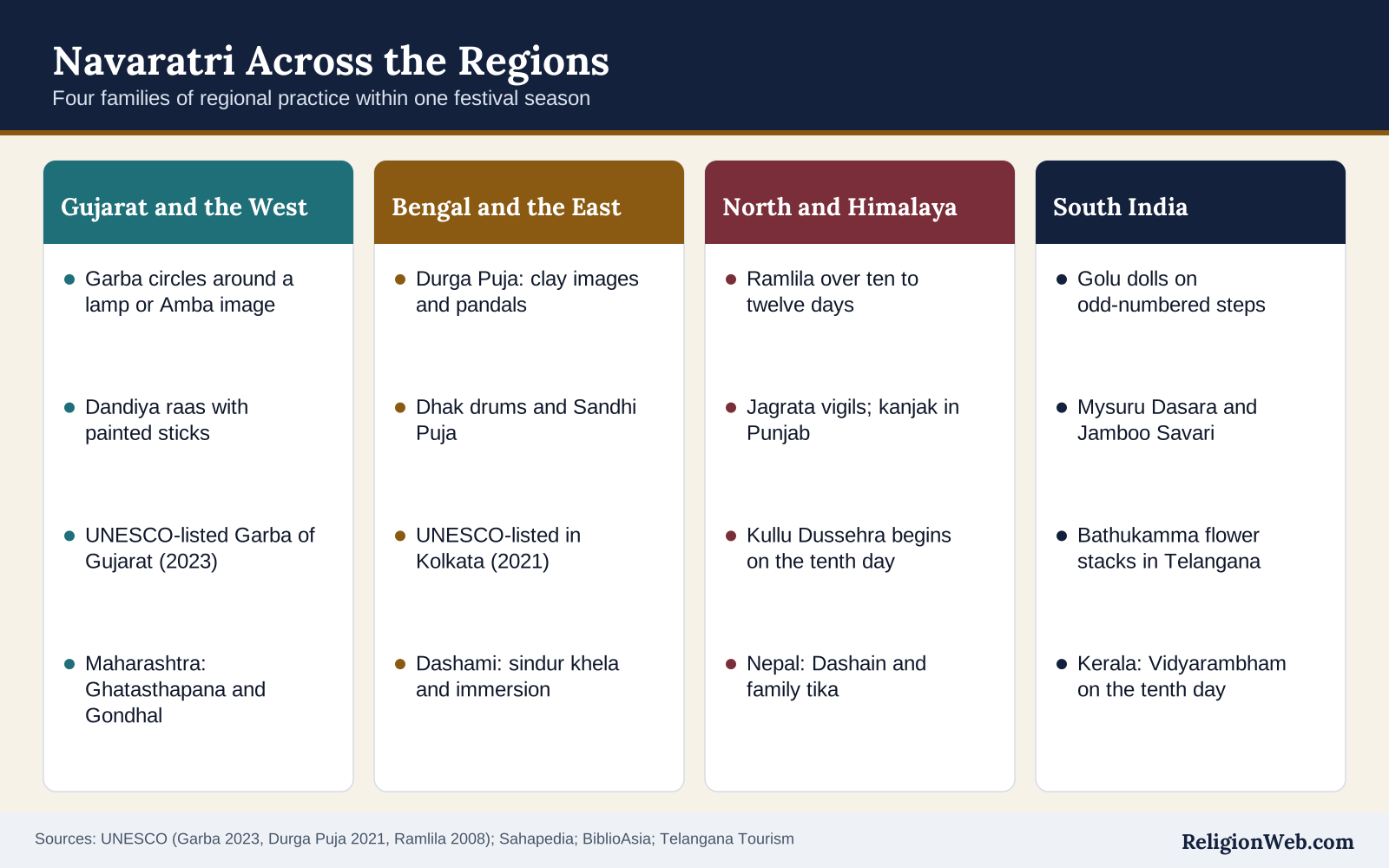
The shared elements of Navaratri are a calendar slot, the Goddess as the focus, and a tenth day of victory. Everything else was shaped by local history. Gujarat’s agricultural communities developed circle dancing, Bengal’s landed families and later neighborhood associations developed public worship of clay images, South Indian courts and households developed doll displays, and North Indian towns built on the Rama story. Language, caste community, sect, royal patronage and urban or rural setting all left marks. The result is a festival whose forms are better understood as related regional traditions than as variations on a single script.
| Region | Name or form | Distinctive practices | Focal figure |
|---|---|---|---|
| Gujarat | Garba and dandiya raas | Nightly circle dances around a lamp or image; songs to the Goddess | Amba, Jagdamba |
| Maharashtra and Konkan | Ghatasthapana, Bhondla, Gondhal | Grain and lamp installation; women’s songs; narrative singing | Ambabai and local goddesses |
| West Bengal, Assam, Odisha, Tripura | Durga Puja | Clay images in pavilions; drumming; Sandhi Puja; immersion | Durga with her family |
| Uttar Pradesh and the Hindi belt | Ramlila and Navaratri vigils | Staged Ramayana over ten to twelve days; Ravana effigies | Rama; Durga in household worship |
| Punjab, Jammu, Himachal | Navratre, jagrata, Kullu Dussehra | Fasting and vigils; Kullu’s procession of local deities | Vaishno Devi; Raghunath |
| Tamil Nadu, Andhra Pradesh, Telangana, Karnataka | Golu, Bommala Koluvu, Bathukamma, Dasara | Tiered doll displays; flower stacks; royal procession | Durga, Lakshmi, Saraswati; Chamundeshwari |
| Kerala | Pooja Vaypu, Vidyarambham | Books and instruments placed before the shrine; first writing of letters | Saraswati |
| Nepal | Dashain | Fifteen-day national festival, family reunions and blessings from elders | Durga |
How to read regional differences
The table lists the best-known form in each area and is not exhaustive. Within any state there are further differences by district, community and household, and a form associated with one region often exists in small pockets elsewhere. Garba, for example, is now danced in Mumbai, Delhi and abroad, and golu displays are found in homes of South Indian families across the world. Some forms are tied to caste or class history in ways that have shifted. The sections below take each region in turn.
Gujarat and Western India
Garba, the circle around the lamp
Garba is the dance most closely identified with Navaratri in popular imagination, and in December 2023 UNESCO inscribed “Garba of Gujarat” on its Representative List of the Intangible Cultural Heritage of Humanity at the 18th session of its committee. UNESCO’s description calls it a ritual and devotional dance performed for the worship of the feminine energy, Shakti. Dancers move in concentric circles around a central object, either an image of the mother goddess Amba or a perforated earthenware pot lit with an oil lamp. The pace begins slowly and builds, UNESCO says, to “a frenzied whirling,” with the dancers moving counterclockwise while singing and clapping. The word is commonly connected to the Sanskrit garbha, meaning “womb” or “interior,” which is also what the lamp-holding pot represents; the pot is understood as the Goddess’s presence and as a symbol of life. Some interpreters read the circle itself as a picture of time and the cycle of existence.
Dandiya raas and the modern garba night
Dandiya raas is a related stick dance in which pairs of dancers strike short painted sticks together in rhythm with the music. It is often performed after the garba portion of an evening, and the two are now commonly combined under the word “garba” or “Navratri night.” Explanations of the sticks vary: some connect the dance to the raas of Krishna and the cowherd women, which is why it carries a Vaishnava association, while others see the sticks as a stylized reenactment of the Goddess’s battle. Both explanations are offered in the tradition. In recent decades garba has also become a large urban entertainment, with ticketed events on open grounds, amplified bands, film music and coordinated costumes. Observers within the community sometimes worry about the balance between devotion and spectacle, while others see the same events as a new form of communal religious expression. UNESCO’s account notes that knowledge of the dance passes down through practice and observation, and also through schools, universities, choreographers and the media.
Maharashtra, Goa, and the Konkan
Maharashtrian households commonly begin with Ghatasthapana, installing a pot with grain and a lamp. Women’s songs and circle dances called bhondla are sung and performed around an image of an elephant in parts of the state, and Gondhalis, a community of hereditary performers, sing narrative songs to the Goddess in the traditional gondhal ritual. Nine colors, one for each day, have become a popular custom for women’s dress in recent years, a good example of a newer practice carried by media and social networks. In Goa and the Konkan, local rites mark the start of the festival and families hold small observances on Ashtami and Navami. On Dasara, many Maharashtrian communities cross the village boundary ritually and exchange leaves of the apta tree as symbolic gold, a custom that connects to the story of the Pandavas and the shami tree, discussed under Vijayadashami below.
Bengal and Eastern India: Durga Puja
From Mahalaya to Dashami
In West Bengal, Assam, Odisha, Tripura and Bangladesh, as well as among Bengali communities worldwide, the nine nights take the form of Durga Puja. UNESCO inscribed “Durga Puja in Kolkata” in 2021, describing an annual festival held in September or October that marks a ten-day worship of the mother goddess Durga. Artisans in small workshops shape the images from unfired clay taken from the Ganga, and worship begins on Mahalaya, when eyes are painted onto the images, as UNESCO puts it, “to bring the goddess to life.” The central image shows Durga with ten arms and a lion, defeating Mahishasura, usually flanked by her children, Lakshmi, Saraswati, Kartikeya and Ganesha. Banglapedia notes that images are made of straw and clay and may have four, eight, sixteen or twenty arms, though ten is usual.
The main days run from Shashthi to Dashami. On the sixth day the Goddess is welcomed and invoked, and on Saptami the nabapatrika, a bundle of plants including a banana plant, is bathed and installed beside the image. The junction of Ashtami and Navami is marked by Sandhi Puja, when a special rite with 108 lamps is performed, and the ninth day sees a fire offering. On Ashtami, kumari puja honors a young girl as the Goddess. On the tenth day, Dashami, married women apply vermilion to the image and to each other in the rite of sindur khela, and the images are carried in procession to the river for immersion. Banglapedia describes how, in Bangladesh, immersion processions to ponds, canals and rivers take place in the evening, followed by the dashohara fair with greetings and new clothes. After the immersion, family and friends exchange greetings and sweets, and the youngest members touch the feet of their elders.
Pandals, artisans, and the public sphere
What most visitors notice in Kolkata is the scale of the temporary pavilions, called pandals. UNESCO’s text speaks of large-scale installations and pavilions in urban areas and says that, among the crowds of visitors, “the divides of class, religion and ethnicities collapse.” The community or baroyari pujas, organized by neighborhood committees, are the center of this public festival, and the best-known pandals are built around themes by teams of designers, with lighting and structures that can take months to prepare. The clay-image makers’ district of Kumortuli in north Kolkata is widely identified with this craft. Drummers play the large dhak, and the dhunuchi incense-burner dance is performed during aarti. The festival also has a strong theme of homecoming: UNESCO describes it as signifying “home-coming,” and families who live far away travel back for the days, in keeping with the idea of Durga as a daughter returning to her parents’ house.
Odisha, Assam, Bihar, and Mithila
Other eastern regions share the Bengali form while keeping their own customs. Odisha and Assam hold Durga Puja with local rites, and in Bihar and the Mithila region a number of distinct practices have been recorded. These include a ritual pot procession and barley sowing at the start of the nine nights, a women’s folk dance called jhijhiya, and the custom of giving a married daughter a bundle of gifts called khoinchh as she leaves. The Bihari festival also includes Kumari Bhojan, a meal for girls. Historically, some Shakta temples in the east offered animals to the Goddess at this season, and in many places this has been replaced by symbolic offerings such as gourds, though the topic remains contested among communities.
North India and the Himalaya
Ramlila and the Rama connection
In much of North India the Navaratri period is dominated by Ramlila, “Rama’s play,” a staged presentation of the Ramayana. UNESCO inscribed the Ramlila on its Representative List in 2008, after proclaiming it in 2005. Its performances follow the Ramacharitmanas, which Tulsidas wrote in the sixteenth century in Hindi so that a wider audience could reach the Sanskrit epic, and they combine singing, narration, recitation and dialogue. Most Ramlilas run for ten to twelve days, but the production at Ramnagar, near Varanasi, can last a full month. Villagers and townspeople take roles and help prepare masks, costumes, effigies and lighting, and the audience is invited to sing and join in the narration. Ramlila reaches its climax on Dussehra with the killing of Ravana. Households in the same towns observe the Goddess’s nine nights at home, so Rama and Durga are honored side by side in the same community, as the articles on Vaishnavism and Shaktism explain from their different traditions.
Punjab, Jammu, Kashmir, and Himachal
In Punjab, Haryana and Jammu the nine nights are called Navratre or Naurate. Many households fast, women make clay images called Sanjhi Mata and fix them to walls, and the nights are marked by jagrata vigils honoring Vaishno Devi. Kashmiri Pandit tradition, as summarized in reference accounts, includes sowing barley at the start, reciting the Bhavani Sahasranama (a hymn of a thousand names of the Goddess), and fairs at the Kheer Bhawani temple and on Hari Parbat. Himachal Pradesh has the most distinctive northern variation in the Kullu Dussehra, which is covered in the Fun Fact below and offers a clear example of a Dussehra that does not follow the Ravana-burning pattern.
Nepal’s Dashain
In Nepal, the same nine nights and tenth day form the basis of Dashain, a national festival that lasts about fifteen days and is widely described as the country’s largest. The first day, Ghatasthapana, resembles the Indian rite, with a sacred pot and sown barley, and the tenth day is marked by tika, a mark of red rice and yogurt placed on the forehead by elders together with the barley shoots, which are called jamara. Families travel long distances to reunite for the occasion. Nepal’s Navadurga tradition and its Hindu and Newar temple practices have their own forms that go beyond the scope of this article.
South India: Golu, Dasara, and Saraswati Worship
Golu in Tamil Nadu and neighboring states
In Tamil Nadu, Andhra Pradesh, Telangana and Karnataka, many families set up a golu, also called kolu or bommai kolu (“court of dolls”). According to Anasuya Soundararajan’s article in BiblioAsia, the dolls are arranged on tiered steps, usually three, five, seven or nine, because odd numbers are considered auspicious. Deity dolls go on the top steps, saints and religious teachers in the middle, and scenes of weddings, processions and village life below, with toys and miniature kitchenware on the bottom step. Wooden pairs of marapachi dolls and Thanjavur bobble-head dolls are traditional, and displays may stage scenes from the Ramayana and Mahabharata or build a miniature park. The custom is believed to date to the Vijayanagara period and was popular with the royal families of Thanjavur and Pudukkottai. Families invite relatives, friends and neighbors to view the display, sing and share food, and each departing woman receives a thamboolam tray of betel leaves, fruit and gifts. On Vijayadashami the marapachi dolls are laid down, which signals the end of the display, and the dolls are put away.
Karnataka’s Mysuru Dasara
Dasara is the state festival of Karnataka, and its center is Mysuru. The Wodeyar kings, who began the festival at Srirangapatna in 1610 and later moved the capital to Mysuru, made it a royal ceremony, one that many historians see as continuing the precedent set at Vijayanagara. The Jamboo Savari, the grand procession on the tenth day, carries the image of Chamundeshwari, the goddess of the hill above the city, through the streets. The Mysuru Palace is lit during the festival, and cultural programs fill the city. In Karnataka today Dasara is the state festival, with programs organized at the state level. Its history, and the way it has changed from royal ritual to state-sponsored celebration, is one of the best-documented stories of how Navaratri adapts to political change.
Kerala: books, instruments, and first letters
In Kerala the final days of Navaratri are devoted to learning. On Ashtami, books and musical instruments are placed on an altar, on Navami they are worshiped, and on Vijayadashami they are formally taken up again. The ritual of placing implements before the Goddess and not using them for three days is called Pooja Vaypu, and the retrieval of the books is Pooja Eduppu. On Vijayadashami, children begin their education in the rite of Vidyarambham, in which an elder guides the child’s finger to write letters in a plate of rice or sand. The same rite exists under other names in the Konkan.
Telangana’s Bathukamma and Andhra’s Bommala Koluvu
Telangana’s Bathukamma is a festival of Hindu women that runs for nine days, during Durga Navaratri, beginning on Mahalaya Amavasya, according to Telangana Tourism. Women stack seasonal flowers in seven layers shaped like a temple tower, carry the stacks, sing and dance around them, and on the last day, called Saddula Bathukamma, immerse them in lakes and ponds. Bathukamma is an official state festival of Telangana. In neighboring Andhra Pradesh, doll displays called Bommala Koluvu are arranged in the same spirit as the Tamil golu. In both flower and doll traditions, women are the main organizers and the main carriers of the custom from one generation to the next.
Vijayadashami and Dussehra: The Tenth Day
The Tenth Day and the Stories It Commemorates
Rama and Ravana in the north
Vijayadashami, “the victorious tenth,” falls on the day after the ninth night. Across much of North and Central India it is Dussehra, the day on which Rama’s victory over the ten-headed demon king Ravana is celebrated. The name Dussehra is commonly explained as joining the Sanskrit words for “ten” and “defeat,” that is, the defeat of the ten-headed Ravana, though other derivations are offered. The festival is the culmination of the Ramlila performances discussed above, which end with the killing of Ravana, and in the evening large effigies of Ravana, his brother Kumbhakarna and his son Indrajit, stuffed with fireworks, are set alight in open grounds before crowds. The burning is usually read in the tradition as the victory of righteousness, dharma, over arrogance and wrongdoing, with Rama as the exemplar of right conduct in the Ramayana.
Durga’s victory and the Pandavas’ weapons
Other communities mark the same day as the Goddess’s victory. In the Bengali form the tenth day is the day she is sent off after defeating Mahishasura, with a mixture of triumph and the sadness of a departing guest. In Karnataka the day is the Dasara procession of Chamundeshwari. A third story, told especially in Maharashtra and in other regions with Kshatriya traditions, links the day to the Mahabharata: during their year of hidden exile the five Pandava brothers are said to have concealed their weapons in a shami tree, and on the tenth day they retrieved them before going on to victory. In that tradition people worship the shami tree and weapons, and exchange its leaves, or the leaves of the apta tree, as tokens of gold. The Bhagavad Gita, set on the eve of that war, is explained in the article on the Bhagavad Gita. The point is not that these accounts compete. Each community understands the day through the story that its own region and tradition tell.
What People Do on Vijayadashami
Effigies, processions, and immersion
The activities of the day differ along the lines of those stories. In the north, families attend the burning of effigies, visit fairs and eat sweets, and the men and boys of some communities wear barley shoots, grown during the nine nights, as a token of the festival. In Bengal and the east, the clay images are taken in processions to a river, pond or the sea and immersed, after the farewell rites in which married women offer sweets and vermilion to the Goddess. Idols are also immersed in many other parts of the country. Afterward, people visit relatives and friends, exchange greetings and embrace, and the elders give blessings. The mood combines celebration and a sense of closing the festival.
Beginning new work, weapons, tools, and books
Vijayadashami is also regarded as an especially auspicious day for new beginnings. In Kerala, children begin formal learning with the rite of Vidyarambham, and the books and instruments that were set before the Goddess on the previous days are taken up again. In many regions the ninth or tenth day is the occasion for Ayudha puja, the worship of tools and implements: warriors worship weapons, musicians their instruments, and farmers, craftspeople and shopkeepers their tools, in recognition of the instruments that sustain a livelihood. Vehicles are washed, decorated and honored in the same spirit in many cities, and the tradition treats the worship as an acknowledgement of the Goddess’s power in everyday work. Businesses and new ventures are frequently opened on this day.
Final-Day Connections at a Glance
The tenth day in different traditions
The table brings together the main forms of the tenth day and the connections that different regions draw between it and the preceding nine nights.
| Tradition or region | What the day commemorates | Typical practices |
|---|---|---|
| North and Central India (Dussehra) | Rama’s victory over Ravana | End of Ramlila; burning of Ravana, Kumbhakarna and Indrajit effigies; fairs |
| Bengal, Assam, Odisha (Bijoya Dashami) | Durga’s victory and her departure to her husband’s home | Immersion of images; sindur khela; sweets and greetings |
| Karnataka (Mysuru Dasara) | The Goddess Chamundeshwari’s victory; royal heritage | Jamboo Savari procession; palace illumination; cultural programs |
| Kerala and the Konkan | Learning and the Goddess as Saraswati | Vidyarambham or Aksharabhyasam; books and instruments retrieved |
| Maharashtra and some Kshatriya traditions | The Pandavas’ retrieval of weapons; the crossing of boundaries | Worship of the shami tree and weapons; exchange of apta leaves |
| Kullu Valley, Himachal Pradesh | Raghunath (Rama) and local deities; begins on this day | Seven-day gathering of local deities and a chariot procession |
| Nepal (Dashain) | The Goddess’s victory; family bonds | Tika and jamara blessings from elders; family gatherings |
The path from Vijayadashami to Diwali
In North India especially, Vijayadashami is understood as the start of a sequence that leads to Diwali, the festival of lights, roughly three weeks later. In 2026, Vijayadashami fell on October 20 in the Delhi almanac, and the main night of Diwali is set for Sunday, November 8, according to the Government of India’s list of central holidays. The connection is calendrical and cultural rather than doctrinal. Households begin cleaning and shopping, and Ramlila’s story of Rama’s return to Ayodhya after his victory is picked up in many regions as the background of Diwali. The two festivals have different gods, stories and ritual structures, and each is treated separately in its own article.
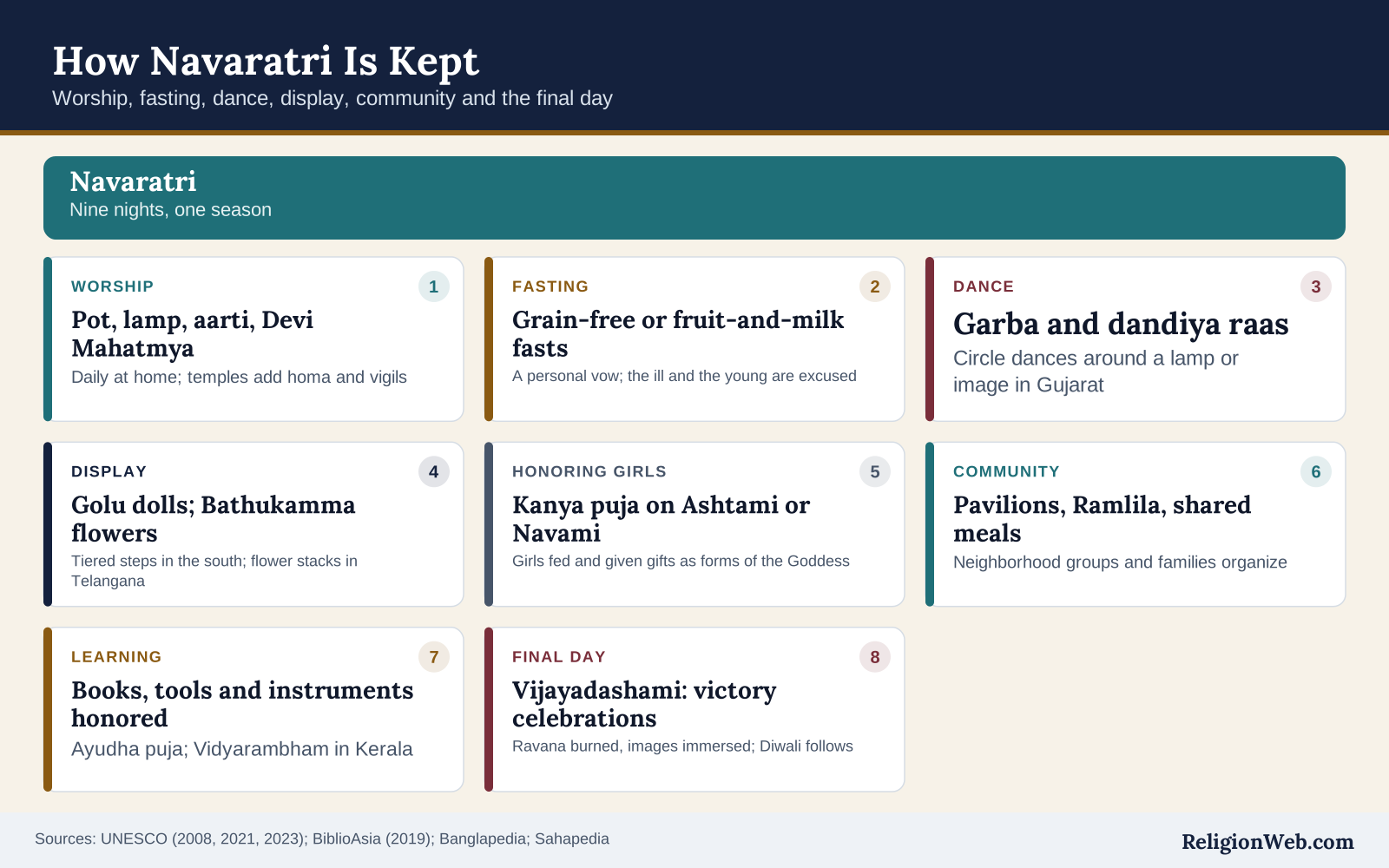
Music, Dance, Art, and Material Culture of Navaratri
Sound, Movement, and Performance
Songs, drums, and recitation
Sound is one of the clearest markers of the season. In Gujarat the songs are in Gujarati and address the Goddess as a mother who is invited into the circle, and the rhythm is carried by clapping and the double-headed dhol drum. In Bengal the large dhak drums set the pace of the five main days, and radio and television recitations of verses from the Devi Mahatmya in the early hours of Mahalaya morning have been a cherished custom in many Bengali households for decades. In Maharashtra, Gondhali singers use string instruments and narrative verse. South Indian homes fill with devotional songs during the evening visits to the golu, and Carnatic music concerts are held in many cities. Wherever it is practiced, recitation of the Goddess’s hymns is a main way the text becomes audible.
Dance and drama
Circle dances, stick dances, the Bengali incense dance and the women’s songs and dances of Telangana and Maharashtra all belong to the festival, and they show how participation is built into its form. Ramlila is the major dramatic tradition of the season, in which a whole town or neighborhood takes part as performers and audience. Dancing is in most places communal and open to all ages, and in the Gujarati garba tradition it is performed by women and men together, in a way that is part of the event’s appeal.
Images, Objects, and Craft
Clay images and temporary pavilions
The festival produces a distinctive material culture of objects made to be used for a few days. The Bengali clay images, with painted eyes and elaborate ornaments, are built over a framework of straw and then immersed, and the pavilions that house them are dismantled. The image-makers of Kumortuli and other craft centers pass their skills down within families and workshops. The ceremonial pot of the first day, the garba pot with its small holes, the flower stacks of Bathukamma and the dolls of the golu are all examples of objects whose making is part of the practice. Many are made at home, and the making is an occasion for gathering and teaching younger members of the family.
Dolls, flowers, tools, and sacred plants
Other objects carry symbolic meaning. Grain shoots stand for fertility and the harvest. The nabapatrika of Bengal, a bundle of nine plants, is the Goddess in plant form. Tools, books and vehicles become objects of worship at the end of the festival. Textiles are also part of it: the red saris of Bengal’s sindur khela, the embroidered garments of garba, and the colors assigned to the days in some communities. For a visitor, the best way to understand the festival’s visual world is to ask a family what each object is for, since most can name a story or a purpose for every item on the shrine.
Navaratri Today: Calendar, Diaspora, and Contemporary Questions
The Calendar Rule and the 2026 Observance
How the date is set
Sharad Navaratri follows the lunisolar Hindu calendar. It begins on the first lunar day of the bright fortnight of Ashvina, after the new moon of the preceding fortnight, and continues through the ninth lunar day, with Vijayadashami on the tenth. A lunisolar calendar adds an extra month periodically so that festivals stay in their seasons, which is why Navaratri can fall in late September in one year and in mid-October in the next. The exact civil dates depend on the almanac, or panchang, a community follows, on the local sunrise, and on how the almanac treats lunar days that begin or end partway through a day. The regional almanacs of Bengal, for example, can set the Durga Puja days differently from the northern ones.
The 2026 dates
For 2026, a calendar based on Drik Panchang data for Delhi and published by Business Today on October 11 gave these dates: Ghatasthapana on Sunday, October 11; Durga Ashtami on Sunday, October 18; Maha Navami on Monday, October 19; and Vijayadashami, or Dussehra, on Tuesday, October 20. The same report noted that the best time for the first-day rite depends on the local almanac and sunrise, and that worshipers should consult the one for their own city. Dates and tithi timings in other cities and in Bengal’s Durga Puja calendar may differ by a day. Because the 2026 observance ended on October 20, readers consulting this article after that date should look for the 2027 almanac, published well in advance by major panchang makers, for the next dates.
Navaratri Beyond South Asia
Diaspora celebrations
Wherever Hindu communities have settled, Navaratri has followed. Temples hold nightly worship and recitations. Community associations, cultural organizations and universities host garba nights in rented halls and gymnasiums, and Bengali associations in cities from London to Houston organize Durga Puja with imported or locally made images. According to BiblioAsia, some Indian families in Singapore have kept the golu tradition since the 1940s or earlier, and temples such as the Sri Mariamman temple put up larger displays, while dolls are sold in Little India. Diaspora versions often adapt: weekend scheduling replaces the lunar-day calendar, dances run in the evening after work, and the images may be immersed in a designated water body or in a symbolic tank, according to local regulations.
A festival for the second and third generation
For young people growing up outside India, Navaratri is often a first point of contact with the Goddess traditions and with a wider community. Parents and grandparents teach songs, steps, recipes and the stories behind them, often by participation rather than formal instruction, and the festival’s open, social character makes it accessible to families who are not otherwise observant. Many events welcome visitors and friends, and cultural centers and schools sometimes use the occasion to explain the festival to neighbors and classmates.
Contemporary Questions and Debates
Environment, immersion, and craft
The immersion of images has raised environmental questions. Traditional images are made of unfired clay and natural pigments, but modern images are sometimes made of plaster of Paris and chemical paints, which dissolve slowly and can pollute rivers and lakes. Pollution-control authorities and courts in several Indian states have issued guidelines on materials and on immersion in artificial tanks, and many committees and artists now promote clay images and natural colors. Supporters of traditional immersion respond that the rite of returning the Goddess to the water is religiously significant, and the debate is often about how to preserve the practice while reducing the harm. Artisans, whose livelihood depends on the festival, are part of the discussion.
Commercialization, safety, and access
As the festival has grown, so have questions about commercial sponsorship, noise, crowd safety and who may participate. Large ticketed garba events and sponsored pandals draw advertising and political attention. Authorities in some places regulate sound levels and closing hours. Late-night dancing and big crowds also raise safety concerns, and in recent years debates have arisen in some places over who may attend particular events, often in the context of wider communal tensions. Communities hold differing views on these matters, and the sources reviewed for this article do not support a single conclusion. The constant in all of them is that a festival of this scale is simultaneously a religious occasion, a social event and a public-order matter.
Common Misconceptions About Navaratri
Misconception 1: Navaratri is celebrated the same way across India
Where the misunderstanding comes from
Popular media tend to choose one image to stand for the festival. For many readers abroad that image is garba, because of its visual appeal and its recent global spread. For others it is the burning of Ravana, which dominates Hindi film and television. Within India, people are often most familiar with the form of their own region and assume it is the standard one. Calendars and greetings that use the single word “Navratri” add to the impression of a single practice with a single name.
What the evidence and tradition actually show
The documented forms are quite different. UNESCO has inscribed three separate regional forms associated with the season: Ramlila in 2008, Durga Puja in Kolkata in 2021, and Garba of Gujarat in 2023, each described on its own terms. Bengal’s Durga Puja centers on public worship of clay images and ends with immersion. Gujarat’s garba centers on circle dances around a lamp. Tamil households set up tiered doll displays, Telangana’s women stack flowers for Bathukamma, and Kullu holds a Dussehra of local deities that begins as other celebrations end. What holds these together is a seasonal frame and reverence for the divine feminine, not a uniform set of practices. Treating the differences as variations on one script misses how the festival works as a family of regional traditions.
The opposite error is also worth avoiding. Regions do share a good deal: the lunar calendar, the primacy of the Goddess, the vocabulary of puja and aarti, the sowing of grain in many northern and western homes, and the closing tenth day. A Gujarati family visiting Kolkata will recognize much of what is happening even if the setting is unfamiliar. The accurate picture is of overlapping families of practice, with a core of shared elements and wide variation at the edges, and with some customs, such as the colors of the days or large ticketed dance nights, spreading from one region to others through film, television and social media.
Misconception 2: Navaratri is only a dance festival
Where the misunderstanding comes from
The global fame of garba and dandiya has made dance the most visible face of the festival. Social media clips, large public events and Bollywood songs push the dance to the front, and participants in diaspora garba nights, which are sometimes primarily social events, may encounter little of the worship behind them. Reports on ticketed events also stress entertainment and fashion.
What the evidence and tradition actually show
Even in Gujarat the dance is devotional in origin and in form. UNESCO describes Garba as a ritual and devotional dance performed for the worship of Shakti, with dancers circling a lamp or an image of Amba, and the songs are hymns to the Goddess. Beyond Gujarat, the festival’s main activities are worship, recitation of the Devi Mahatmya, fasting, pilgrimage, the honoring of girls in kanya puja, and in many places theater, doll displays and learning rituals. A large part of the observance happens at home and is quiet. The dance is real and important, but it is one expression of the festival and not its definition.
Even a garba evening is usually framed by worship. The lamp or image at the center is the focus of the dance, and evenings in many communities begin with an aarti to the Goddess before the dancing starts. The dancing itself is understood by participants as an offering, and the songs ask for the Goddess’s blessing. At the same time, it would be inaccurate to say that every dancer attends for devotional reasons. The same event can be an act of worship for one person and a social evening for another, and communities generally accept both. The misconception lies in treating the second use as the whole of the festival.
Misconception 3: Every community worships the same goddess form on the same night
Where the misunderstanding comes from
Lists of the nine forms of Durga, with a form assigned to each night, circulate widely online and in print, and they are often presented as the festival’s rule. Their orderly format makes them easy to share. Many readers conclude that a universal schedule exists and that anyone who differs is mistaken.
What the evidence and tradition actually show
The Navadurga sequence is a real and respected scheme, especially in North and West India and Nepal, but it is one of several. In parts of South India the nine nights are divided into three groups of three, for Durga, Lakshmi and Saraswati, as described in BiblioAsia. In Bengal the major public worship takes place in the last five or six days, and Durga appears with her four children as one image group. Gujarat’s garba songs praise Amba or Jagdamba. Karnataka honors Chamundeshwari, and Jammu’s vigils center on Vaishno Devi. The colors assigned to the days also vary by community and year. Theologically, Shakta traditions hold that these are many names and forms of one Goddess, which is why different communities can follow different schedules without regarding one another as wrong. The article on Shaktism explains that idea in more detail.
There is also variation within the schemes themselves. Communities that use the Navadurga sequence do not always align each form with the same lunar day, because the almanac’s treatment of the tithis can shift which form falls on which date in a given year. The associated colors and offerings are modern conventions that change from one community to another. A reader who finds two lists that disagree is not necessarily looking at an error; more often the lists belong to different regions or traditions, each of which has its own logic.
Misconception 4: Everyone who observes Navaratri fasts, and the fast means the same thing everywhere
Where the misunderstanding comes from
Articles on Navaratri often include lists of “fasting foods,” which gives the impression that a nine-day fast with fixed rules is part of the festival’s definition. Restaurants and grocery stores advertise special Navaratri menus, and workplaces and friends in many cities adjust their meals during the period, so the fast can seem like a social norm.
What the evidence and tradition actually show
Fasting is common, but it is a personal vow and takes many forms. Some people fast completely for a day, some take only fruit and milk, some eat one meal, and some follow vegetarian rules without fasting. Children, the elderly, pregnant women and the ill are customarily excused. In Bengal’s Durga Puja, the days are marked by communal feasting and food stalls around the pavilions more than by a grain-free fast, although many people fast on particular days. The meanings given to the fast also differ, from devotion and self-discipline to a vow made for a family member. A person who does not fast is not thereby outside the festival.
Teachers in several traditions also warn against making the fast a competition or a source of harm. The disciplines of Navaratri are meant to support devotion, and tradition provides for exemptions precisely so that health is not sacrificed. Observers also keep other forms of discipline in place of food restrictions, such as daily recitation, silence for part of the day, giving food to others, or restraint in speech and entertainment. Seen this way, fasting is one of several ways to mark the nine nights and not a test of participation.
Frequently Asked Questions About Navaratri
Questions About Meaning and Dates
What does Navaratri mean, and how long does it last?
Navaratri means “nine nights” in Sanskrit, and the main autumn festival is observed over nine nights from the first to the ninth lunar day of the bright half of Ashvina, followed by Vijayadashami on the tenth. Because lunar days do not match civil days, the observance can occupy eight to ten calendar days in a given year or place.
The word describes a festival period, not a single ritual. Within it, each community decides how to organize its worship, and some emphasize all nine nights while others concentrate on the first, the eighth or the ninth.
Is Navaratri the same as Durga Puja?
They overlap but are not identical. Durga Puja is the Bengali and eastern Indian form, in which the main public worship of Durga’s image takes place over about five or six days within the nine-night period and ends with immersion on Dashami. Navaratri is the wider term used across India for the nine nights, and in many regions the word refers to household fasting and other practices that do not involve a public image.
Both belong to the same autumn season and honor the Goddess, and in everyday speech people from Bengal often say “Pujo” where people from Gujarat say “Navratri.”
How are the dates decided, and what were the 2026 dates?
The dates follow the lunisolar calendar and are published each year in almanacs. For 2026, the Delhi calendar based on Drik Panchang data gave October 11 as the first day, October 18 for Ashtami, October 19 for Navami and October 20 for Vijayadashami. Other almanacs or cities may differ by a day.
Questions About Practice
What do people do during the nine nights?
The practices depend on region and household. Common ones include installing a water pot and lamp, reciting hymns and the Devi Mahatmya, fasting, visiting temples, honoring young girls, dancing garba, displaying dolls, staging the Ramayana or visiting community pavilions. The first sections of this article describe each practice in its regional setting.
Many people do only some of these, and a family may keep a simple daily worship at home. There is no single required program.
What can people eat while fasting?
In the grain-free fast common in North and West India, people typically eat fruit, milk products, potatoes, and substitutes such as buckwheat flour, water chestnut flour, barnyard millet and tapioca pearls, seasoned with rock salt. Families differ on which foods are acceptable, and others fast with water or fruit only.
Fasting is a personal vow, and those who are ill, pregnant, elderly or very young are customarily excused. Anyone with a medical condition should ask a doctor before changing their diet, whatever the reason.
Can visitors take part in garba or Durga Puja?
Practice varies. Many temples and community associations welcome guests at garba nights and Durga Puja pavilions, and UNESCO’s description of Durga Puja notes crowds in which divides of class, religion and ethnicity are said to collapse. Some events are ticketed or private, and some religious rites within them are for the family or priest.
Visitors are usually advised to follow the organizers’ guidance on dress, footwear and photography, to treat the images and lamps with respect, and to ask when unsure. Local customs differ.
Questions About Vijayadashami and What Follows
Is Dussehra about Rama or about Durga?
Both, depending on the region. In much of North India it commemorates Rama’s victory over Ravana, and in Bengal and some other regions it is the day of Durga’s victory over Mahishasura and her departure. In Karnataka it centers on Chamundeshwari, and in parts of Maharashtra on the Pandavas and their weapons.
The different stories do not conflict in the eyes of those who tell them. They are different ways of marking a tenth day of victory that the whole season builds toward.
How does Navaratri connect to Diwali?
Diwali falls roughly three weeks after Vijayadashami. In 2026 the main night of Diwali was set for November 8, according to the Government of India’s central holiday list. The two festivals have separate rites, but many families see the autumn season as a sequence, and household cleaning and preparation for Diwali often begin once Dussehra has passed.
Readers who want the details of that festival can turn to the article on Diwali, and those interested in another seasonal festival of the Hindu calendar, celebrated in spring, can read about Holi.
Conclusion: What the Nine Nights Show
What the History and Practice Show
A shared frame with many regional forms
Navaratri is best understood as a seasonal frame in which many communities honor the Goddess in their own ways. The Devi Mahatmya supplies a story, the lunar calendar supplies the nine nights, and regional history supplies the rest: Vijayanagara and Mysuru in the south, neighborhood pujas in Bengal, the Ramlila stages of the Hindi belt, the garba circles of Gujarat and the flower stacks of Telangana. Three of these forms have been recognized by UNESCO, and each stands on its own terms.
Continuity and change
The festival has also kept changing. Royal sponsorship gave way to state and neighborhood organization, domestic displays have become public exhibitions, and diaspora communities have rebuilt the festival in new cities. Questions about the environment, commercialization and access are part of its present. What persists across these changes is the combination of worship and community that the sources describe, with the Goddess as the point of reference and the home, the temple and the street as the places where she is honored.
How to Keep Exploring
Related topics on ReligionWeb
Readers who want to place Navaratri in context can start with the overview of Hinduism and the article on Shaktism. Related reading includes the account of puja, the articles on karma and yoga for the ethical and spiritual vocabulary many observers bring to fasting and discipline, and the neighboring Shaiva tradition in Shaivism.
Learning respectfully
The best way to learn about Navaratri is to listen to those who practice it. A family, a temple priest or a community association can explain what a particular object is for, why a song is sung, or how their region’s form differs from the one in a book. Because the festival is so varied, any single account, including this one, is a map of the tradition and not the tradition itself.
Sources
The table below lists the principal external sources behind this article. Facts, dates and figures were checked against these and related primary, institutional and academic materials.
| # | Source | Publisher and type | Used for | Link |
|---|---|---|---|---|
| 1 | Rig-Veda, Book 10, Hymn CXXV (Vac), trans. Ralph T. H. Griffith (1896) | Internet Sacred Text Archive · Primary text | Quoted verses 3 and 8 of the Devi Sukta in Griffith's public-domain translation | sacred-texts.com |
| 2 | Devi Mahatmyam (research starter) | EBSCO · Academic reference | Date (400-600 CE), 13 chapters, 700 verses, three episodes, theology of the Devi | ebsco.com |
| 3 | Garba of Gujarat (Representative List, inscribed 2023) | UNESCO Intangible Cultural Heritage · Institutional | Garba as devotional dance to Shakti; lamp pot or Amba image; counterclockwise circles; transmission | ich.unesco.org |
| 4 | Durga Puja in Kolkata (Representative List, inscribed 2021) | UNESCO Intangible Cultural Heritage · Institutional | Clay images from Ganga clay, Mahalaya eye-painting, pandals, Dashami immersion, homecoming theme | ich.unesco.org |
| 5 | Ramlila, the Traditional Performance of the Ramayana (inscribed 2008) | UNESCO Intangible Cultural Heritage · Institutional | Ramlila basis in the Ramacharitmanas, 10-12 day duration, Ramnagar, communal participation | ich.unesco.org |
| 6 | How the Global Religious Landscape Changed From 2010 to 2020 | Pew Research Center · Demographic data | About 1.2 billion Hindus (14.9% of world) in 2020; about 95% in India, 97% in India and Nepal | pewresearch.org |
| 7 | Navaratri Golu: The Hindu Festival of Dolls, by Anasuya Soundararajan (BiblioAsia, 2019) | National Library Board Singapore · Academic reference | Golu steps, doll placement, three-by-three nights of Durga, Lakshmi, Saraswati; Singapore practice | biblioasia.nlb.gov.sg |
| 8 | Durga Puja | Banglapedia: National Encyclopedia of Bangladesh · Encyclopedia | History debates, akal bodhan, baroyari pujas, kumari puja, Dashami immersion in Bangladesh | en.banglapedia.org |
| 9 | Kullu Dussehra of Himachal Pradesh | Sahapedia · Academic reference | Fun Fact: seven-day Kullu Dussehra, Raghunath image of 1651, about 200 local deities | sahapedia.org |
| 10 | Navratri 2026 full calendar: Durga Ashtami, Maha Navami, Dussehra dates (Drik Panchang data, Delhi) | Business Today · Calendar report | 2026 dates: Oct 11 Ghatasthapana, Oct 18 Ashtami, Oct 19 Navami, Oct 20 Vijayadashami (Delhi) | businesstoday.in |
Last fact-check date: 2026-10-21.