Holi is the Hindu spring festival of fire and color, kept on the full moon of the lunar month of Phalguna, usually in March and sometimes in late February. On the evening before the main day, communities light a bonfire in a rite called Holika Dahan, “the burning of Holika.” On the following day, people smear one another with powdered color, spray tinted water, sing, dance, eat sweets and visit relatives and neighbors. In 2026 the color day fell on Wednesday, March 4, according to the Government of India’s list of central holidays, and the bonfire was lit the evening before.
The short version stops there, but the longer one is more interesting, because Holi is not one event with one explanation. In many homes the bonfire recalls the child Prahlada, who is said to have survived a fire because of his devotion to Vishnu. In the Braj region around Mathura and Vrindavan, the festival is steeped in the playful courtship of Krishna and Radha, and it unfolds over many days in different villages. In parts of southern India the same full moon belongs to Kama, the god of desire, whom Shiva is said to have burned to ash. Scholars add that the festival also carries older seasonal and agricultural themes, such as the end of winter and the first grain of the new harvest. That distinction matters, because a reader who learns only one story will misread many of the customs that follow.
This article follows Holi through its calendar, its documented history, its stories, the bonfire night, the day of color, the Krishna traditions of Braj, regional forms from Bengal to Goa to Manipur, and the foods, songs and customs of visiting. It sits within the wider tradition described in the overview of Hinduism, and its stories belong to the devotional currents explained in the article on Vaishnavism. A later section covers observance outside South Asia, and the final sections address common misunderstandings and frequently asked questions.
Where a custom belongs to one region, community or family, the text says so, and where scholars disagree about origins, the disagreement is stated instead of being settled by a single tidy account. Dates and figures were checked in October 2026, and the year of each data point is given. Some neighboring observances, such as the Sikh gathering of Hola Mohalla, have their own meaning and are described only as cross-references.
Holi at a Glance
What Holi Is and What It Celebrates
A two-part festival of fire and color
Most descriptions of Holi divide it into two linked parts. The first is the evening bonfire, known as Holika Dahan or, in some places, simply Holi or “little Holi” (chhoti Holi). Wood and dried dung cakes are piled in a lane, courtyard or open ground, a priest or household elder performs a short worship, and the pyre is lit around moonrise on the night of the Phalguna full moon. The second part, on the following morning, is the day of color, called Rangwali Holi (“Holi with color”), Dhulandi, Dhuleti or Dhulivandan, depending on the region. Many people who take little interest in the ritual still treat the two parts as one occasion, and the whole cycle usually lasts two days.
The Encyclopedia of Religion, in an entry by the anthropologist Marie-Louise Reiniche, describes Holi as a popular north Indian festival held at the full moon of the lunar month that falls in the late winter and early spring, with preparations sometimes beginning earlier, on the fifth day of the waxing moon of the spring season, when the fire pile is started. That framing is useful because it shows the festival as a seasonal threshold. The bonfire closes the cold months, and the colors welcome the new season and the ripening of the spring crops.
What the festival means to participants
Participants give several overlapping answers when asked what Holi celebrates. Many speak first of the triumph of good over evil, in reference to the Prahlada and Holika story. Devotees of Krishna speak of his youthful play with Radha and the cowherd women of Braj, in which the throwing of color is a form of divine play (lila). Others emphasize community and reconciliation, the custom of setting aside old quarrels and greeting even strangers with “Happy Holi.” A Harvard Divinity School summary prepared in 2016 describes the festival as one in which people visit family and friends, old hurts are set aside, friendships are renewed, and the first new corn of the season is baked and eaten.
Because these meanings coexist, describing Holi as simply a “festival of colors” is accurate but incomplete, and describing it as simply a “Hindu religious festival” is accurate but also incomplete. The sections below take each layer in turn and try to show which community keeps which meaning.
Where Holi Is Observed and by Whom
South Asia and the Nepali hills and plains
Holi is strongest across northern and central India, where it is a major annual occasion for families, neighborhoods, schools and workplaces. Eastern India keeps a closely related spring festival under the name Dol Jatra or Dol Purnima, western and southwestern India have their own forms such as Shimga, Rang Panchami and Shigmo, and the Himalayan state of Uttarakhand has a long season of musical gatherings. In Nepal, reference summaries describe Holi, also called Phagu Purnima, as a national festival, with the southern plains (the Terai, or Madhesh) observing it on the same date as India and the hill regions a day earlier. The regional forms are described in a later section.
The Pew Research Center reported in 2025 that there were about 1.2 billion Hindus in the world in 2020, or 14.9 percent of the global population, and that 95 percent of them lived in India, with India and Nepal together accounting for 97 percent. Those figures describe the Hindu population, not the number of people who play Holi. The festival is also joined by many non-Hindus in South Asia and abroad, a point taken up in the sections on community and on the diaspora.
A festival that travels
Holi has moved wherever South Asian communities have settled. Indentured laborers carried it to the Caribbean in the nineteenth century, where it is known as Phagwa or Phagwah, and it is observed in Guyana, Trinidad and Tobago, Suriname, Fiji, Mauritius and South Africa, among other places. In North America, temples and community organizations hold public Holi events each spring. These diaspora forms usually keep the bonfire, the colors and the songs, while adapting the sequence to weather, local regulations and the fact that many participants are second- or third-generation residents who may see the festival as a family heritage as much as a rite.
Key Terms for Understanding Holi
A short glossary of Holi vocabulary
Holi is described in a cluster of Sanskrit, Hindi and regional words, and the table below defines the ones that appear most often in this article. Spellings vary in English, and diacritics are given where they help with pronunciation.
| Term | Meaning | Where it appears |
|---|---|---|
| Holikā (Holika) | The female figure, usually a demoness and aunt of Prahlada, who is burned in the bonfire story; also the origin of the name Holi in popular understanding | Holika Dahan and its stories |
| Dahan | “Burning”; Holika Dahan means the burning of Holika | The bonfire night |
| Phālguna (Phalguna) | The lunar month, roughly February to March, whose full moon marks Holi | The calendar rule |
| Pūrṇimā (Purnima) | The full-moon day | Timing of the bonfire |
| Gulāl and abīr | Powdered colors, traditionally red and yellow, thrown or smeared on faces and clothes | The day of color |
| Pichkārī | A squirt or syringe used to spray colored water | The day of color |
| Dhulandī / Dhuleti | “Dust” day, a northern name for the color day | North and central India |
| Dol Jātrā | “Swing journey,” the Bengali, Odia and Assamese spring festival centered on Krishna and Radha | Eastern India |
| Horī | Songs sung during the season, especially in Braj Bhasha, about Krishna and Radha | Braj and north Indian music |
| Līlā | Divine play; the sense in which Krishna’s pranks with the cowherd women are understood | Krishna devotion |
Reading the spellings
The English form “Holi” is a transliteration of the Hindi Holī, while the Sanskrit lexicons list the festival as holākā, with variants. A Sanskrit-English dictionary also notes that holāka can mean a half-ripe pulse roasted over a light fire. Some writers connect the festival’s name to that roasting of new grain, a link that fits the custom, described in Reiniche’s entry, of roasting new barley in the fire, although the etymology is not settled. Other proposed derivations exist, and they are discussed here only where they affect the practice.

The Calendar: Lunisolar Timing and Dates
How the Date Is Set
Phalguna and the full moon
Holi follows the Hindu lunisolar calendar, in which months are counted from one new moon or full moon to the next and extra months are inserted from time to time to keep the year aligned with the seasons. Holi is tied to the full moon (purnima) of the month of Phalguna. In the amanta reckoning, used in much of western and southern India, months end on the new moon; in the purnimanta reckoning, used in much of northern India, months end on the full moon. Both systems agree that the festival falls on the same full moon. They differ in how the surrounding days are labeled, so that in the north, Holi is the last full moon of the month of Phalguna and the day after it belongs, in name, to the month of Chaitra, although the new lunar year itself begins about two weeks later.
The key unit is the tithi, or lunar day, which is one thirtieth of the lunar month and can begin and end at any hour of the civil day. Because a tithi may straddle two civil dates, religious almanacs (panchang) specify which evening is correct for the ritual. For Holika Dahan, almanac convention favors the evening when the full-moon tithi is present after sunset and avoids the inauspicious period called Bhadra, a point revisited below.
Why the Gregorian date moves
A lunar year of twelve months is about eleven days shorter than a solar year, so the festival would drift backward through the seasons without the inserted months. The extra month keeps Phalguna in late winter and early spring, which is why Holi always falls between roughly late February and late March in the Gregorian calendar, with the exact date changing from one year to the next. Observers sometimes count the two-day festival from the bonfire evening and sometimes from the color day, so published lists of “the date of Holi” may differ by a day. When this article says Holi fell on a certain date, it means the color day unless it states otherwise.
Holika Dahan and Rangwali Holi Dates
The 2026 dates and why almanacs differ
For 2026, the Government of India’s list of holidays for central offices in Delhi places Holi on Wednesday, March 4, and its list of restricted holidays places Dol Jatra, the eastern form of the festival, on Tuesday, March 3. Indian press reports of the 2026 almanacs gave the same pair of dates for the northern festival, Holika Dahan on the evening of March 3 and color play on March 4. One such report gave the full-moon tithi as beginning at 5:55 p.m. on March 2 and ending at 5:07 p.m. on March 3, which shows how a single tithi can span two days and why local almanacs and temples sometimes disagree by a day. Readers who need an exact muhurat for a specific city should consult a local panchang, because the sunset times that govern the ritual vary by location.
The Government of India’s list also illustrates a second calendar. It labels Holi 2026 as “Phalguna 13.” That label comes from the national civil calendar based on the Saka era, which has fixed solar months and is not the lunar date used for the ritual. When a document quotes a Saka date next to a Gregorian date, it is giving a convenience for administrative purposes, not the tithi.
The 2027 date and how to check future years
For 2027, the Government of India’s gazetted list places Holi on Tuesday, March 23, labeled “Chaitra 02” in the Saka civil calendar, which implies that the bonfire night falls on the evening before. As in 2026, local almanacs may differ by a day. Because the rule is lunar, any later year can be worked out the same way: find the full moon of Phalguna, then look for the evening when that tithi prevails after sunset outside the Bhadra period, and treat the next morning as the day of color.
A Season, Not a Single Day
The run-up from Vasant Panchami
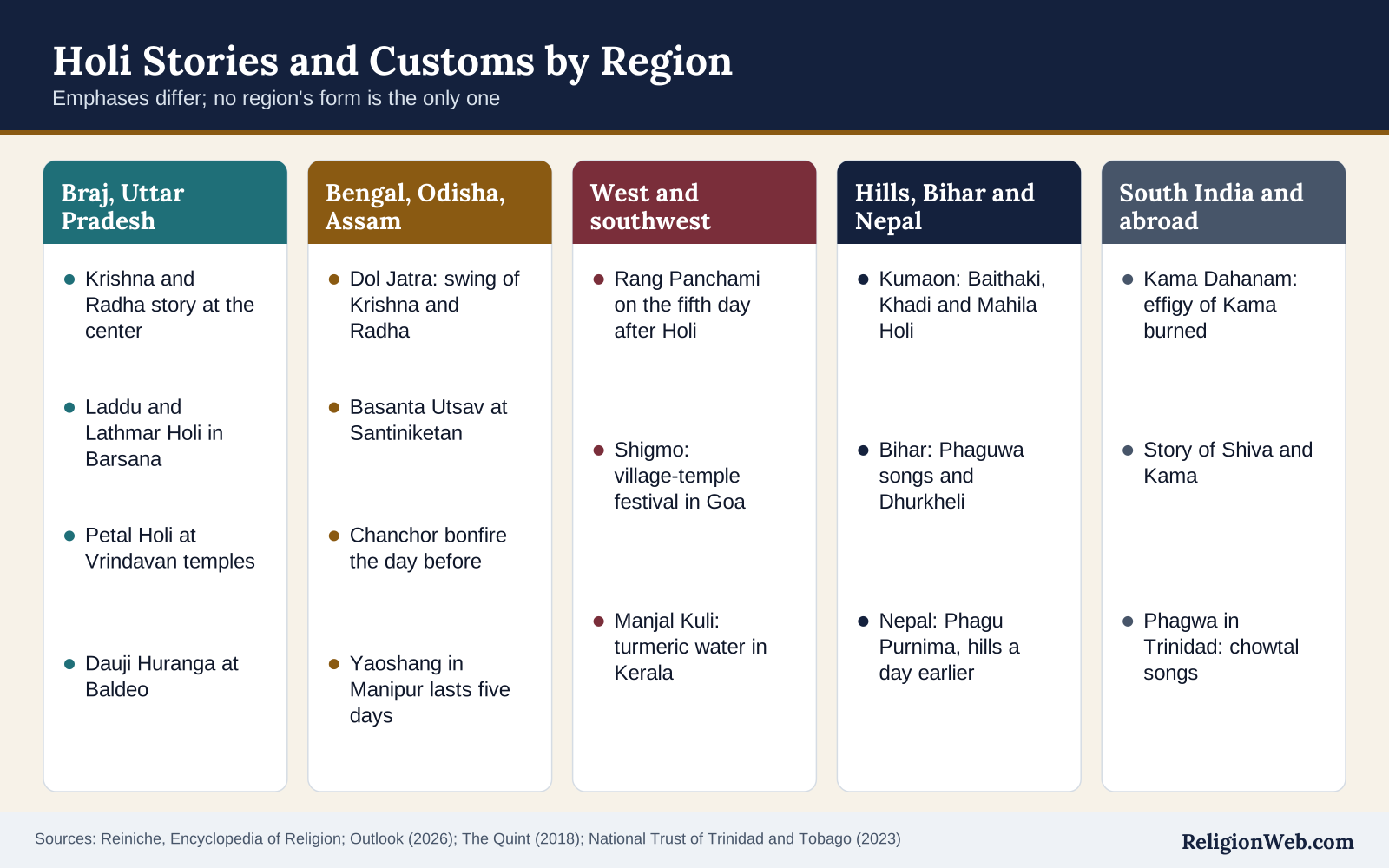
In much of northern India, the Holi season opens about five weeks before the full moon, on Vasant Panchami, the fifth day of the bright half of the month of Magha, which marks the arrival of spring. Reiniche notes that the fire pile may be started at this time, and in Bihar the Bhojpuri and Maithili tradition called Phaguwa runs from Vasant Panchami to the Phalguna full moon, according to a 2026 survey of local Holi traditions in the travel magazine Outlook India. The same survey describes the Kumaoni Holi of Uttarakhand as a music-centered season lasting almost two months, from Vasant Panchami until Holi.
Closer to the full moon, regional events pick up. In Braj, the days before the bonfire are filled with temple and village celebrations that are described in a later section. In Punjab, the Sikh gathering of Hola Mohalla at Anandpur Sahib, which Sikh tradition dates to Guru Gobind Singh in 1701, begins, according to the Tribune of India and to Outlook, on the day after Holi. That event is an observance of the Khalsa in its own right and is treated as a neighboring occasion in this article. Readers can learn about its place in Sikh life in the overview of Sikhism.
After Holi: Rang Panchami and the closing days
The festival does not always end on the color day. In Maharashtra and parts of Madhya Pradesh and Karnataka, Rang Panchami falls on the fifth day (panchami) after Holi and is a second day of color, which according to reference summaries is also called Shimga in Maharashtra. In Braj, the playful ritual of Dauji Ka Huranga at the temple in Baldeo falls on the day after the main color day. The table below sets these markers in sequence for 2026, using published calendars of Indian newspapers and the Government of India list. Dates other than March 3 and 4 come from press calendars and should be treated as approximate for any given village.
| Stage | What happens | Where emphasized | 2026 date |
|---|---|---|---|
| Vasant Panchami | Spring opens; fire pile may be started; Holi songs begin in some regions | North India, Bihar, Kumaon | Late January (varies by almanac) |
| Laddu Holi and Lathmar Holi | Sweets thrown from the temple in Barsana; women of Barsana and then Nandgaon chase visiting men with sticks | Barsana and Nandgaon, Braj | February 24, 25 and 26 |
| Rangbhari Ekadashi | Flower celebrations at Vrindavan temples | Vrindavan | February 27 |
| Holika Dahan | Evening bonfire on the Phalguna full moon | North and central India, Nepal, diaspora | March 3 (evening) |
| Dol Jatra | Swing festival for the images of Krishna and Radha | Bengal, Odisha, Assam | March 3 |
| Rangwali Holi or Dhulandi | Main day of colored powder and water | North and central India, Nepal Terai | March 4 |
| Dauji Ka Huranga | Temple ritual of playful clothes-tearing and color | Baldeo, near Mathura | March 5 |
| Rang Panchami | A second day of color on the fifth day after Holi | Maharashtra, Madhya Pradesh | Fifth day after Holi |
Origins and Historical Development
What the Early Sources Show
Spring festivals and the word holākā
The history of Holi is easier to trace through its vocabulary and its imagery than through a single founding text. Sanskrit-English dictionaries list holākā as a spring festival held as the vernal season approaches, in the ten days before the full moon of Phalguna, and give as its best-known form the throwing of red powder. The same lexicons record a second sense, the full-moon day of Phalguna itself. One dictionary also notes that the related word holāka can denote a religious act performed by people of eastern India, citing the commentary of Śabara on the Mīmāṃsā Sūtra, a work attributed to Jaimini that is part of the early tradition of ritual interpretation. The citation is brief, and the date of Śabara’s commentary is uncertain, so it is best read as evidence that a rite of that name was known to Sanskrit scholars by the early centuries of the Common Era, not as a description of the festival as it is celebrated today.
Classical Sanskrit literature also knows spring festivals under names such as vasantotsava and madanotsava, the festival of spring and the festival of Kama. Several reference summaries mention Harsha’s seventh-century drama Ratnavali as one text that describes a spring celebration with colored powder, and some modern writers identify it with Holi. Specialists are more cautious about equating every ancient spring festival with the one practiced today, because the earlier sources describe courtly or ritual celebrations of the season, and the continuity of name, date and customs has to be argued case by case.
How scholars read the layers
Scholarly accounts tend to describe Holi as a festival of several overlapping layers. The colonial-era folklorist William Crooke treated it as a vernal festival of the Hindus with roots in seasonal rites. Reiniche, in the Encyclopedia of Religion, summarizes later anthropological work and describes the festival as a cycle of destruction and renewal in which the bonfire consumes the old year and its dangers. She notes that scholars read the temporary reversal of status, in which lower-status people may splash higher-status ones who must accept it, as a symbolic remaking of the world, while the anthropologist Lawrence Babb argued in 1975 that the reversal is limited and does not overturn everyday norms. These interpretations describe functions that observers see in the festival. They do not claim to replace what participants say it means, and they differ from one region and community to another.
From Temples and Courts to the Modern Era
Painting, sculpture and court records
From the late medieval period onward, Holi appears in visual evidence. Reference summaries mention a temple sculpture panel at Hampi, the Vijayanagara capital, that shows revelers and what appears to be an early water squirt; sources give it a date in the fifteenth or sixteenth century, so the precise date should be treated with caution. The clearest evidence is in the paintings of the hill courts of the Punjab Hills and Rajasthan. The Victoria and Albert Museum holds a painting from the court at Nurpur in Himachal Pradesh, made around 1770 to 1775, that shows Krishna and Radha amid clouds of red and yellow powder, a Kangra painting of about 1775 to 1780 that shows Krishna, Radha and companions celebrating Holi in a hill landscape, and a Kangra painting dated 1788 in which Radha and her attendants throw red and yellow powder. The same museum’s collection includes a rosewater stand and metal syringe made in Delhi between 1800 and 1870 for spraying scented or colored water.
Holi also entered the culture of the Mughal and successor courts. A survey of Holi in art published in Scroll.in by the historian Sonal, who teaches at Motilal Nehru College in Delhi, says that the festival became part of court life as Mughal and Rajput families were linked by marriage, and that nawabs of Bengal adopted it in the eighteenth century, citing the historian Sushil Chaudhury. The same article describes paintings from Lucknow, Nagaur and Murshidabad that show rulers playing Holi in gardens and pools. A European traveler, Thomas Duer Broughton, whose Letters Written in a Mahratta Camp draws on travels around 1809, described the festival, which he called Hohlee, as a time of general merriment observed by all classes. These sources are secondary or late, but they establish that by the eighteenth century Holi was already a public and court occasion across much of northern and central India.
| Period | Source | What it shows | Caution |
|---|---|---|---|
| Early centuries CE | Sanskrit lexicons citing Śabara’s commentary on the Mīmāṃsā Sūtra | A rite called holāka, associated with eastern India | Date of the commentary uncertain; not a festival description |
| 7th century CE | Harsha, Ratnavali (as cited in reference summaries) | A spring festival with colored powder | Equation with modern Holi is debated |
| 15th to 16th century | Temple sculpture at Hampi | Revelers and an early squirt-like device | Sources differ on the exact date |
| c. 1770 to 1788 | Nurpur and Kangra paintings, Victoria and Albert Museum | Krishna and Radha amid clouds of red and yellow powder | Court art, not a ritual manual |
| 1800 to 1870 | Delhi rosewater stand and syringe, Victoria and Albert Museum | Courtly equipment for spraying scented or colored water | Shows elite practice |
| c. 1809 | T. D. Broughton, Letters Written in a Mahratta Camp | “Hohlee” observed by all classes | Outsider’s account, known here through a secondary article |
Colors, dyes and the modern festival
The colors themselves have a history. The Victoria and Albert Museum notes that traditional Holi powder was mostly yellow and red, the yellow probably ground turmeric and the red made from the dried and crushed petals of the tesu (flame of the forest) flower, which was also used to dye water. The National Capital Poison Center in the United States adds that traditional colors came from natural sources but had short shelf lives and were costly to make in vibrant blues and greens, and that modern powders are usually cornstarch with synthetic dyes. The shift from short-lived natural pigments to cheaper synthetic dyes is therefore one of the most significant changes in the festival’s material culture, and it is the reason that modern safety guidance, discussed later, is part of any responsible description.
The twentieth century also brought new institutional forms. The Basanta Utsav at Visva-Bharati in Santiniketan, credited by news reports to the poet Rabindranath Tagore, recast the spring festival as a cultural event with songs, dance and yellow clothing, and the Sikh gathering of Hola Mohalla grew into one of Punjab’s major annual assemblies. Holi also became a staple of cinema and popular song, and, in the diaspora, a public festival with its own organizers. Each of these developments adds to the festival without replacing the older layers.
The Stories Told at Holi
Prahlada, Holika and the Bonfire
The story as commonly told
The best-known explanation of the bonfire is the story of Prahlada and Holika. In the version given in a 2016 Harvard Divinity School summary, Holika is the sister of the king Hiranyakashipu, who demanded that everyone worship him. When his son Prahlada became a devotee of Narayana, a name of Vishnu, the king ordered Holika to enter a blazing fire holding the boy. Holika believed a boon protected her from fire, but, in this telling, it worked only if she was alone. She died in the flames, and Prahlada was saved because of his devotion. Reiniche’s encyclopedia entry gives a compatible account, in which Holika is a female demon who cannot die by fire because of a boon and sits on the pyre holding Prahlada. A widely repeated variant says that Holika wore a protective cloak that flew from her to the child, and the same Puranic Index says that this folktale has no traceable Puranic source.
Many households retell the story on the bonfire night, and in some places an effigy or image of Holika is placed on the pyre. In Reiniche’s description, Prahlada is sometimes identified with the central pole in the fire. The story’s message in Vaishnava understanding is the protection offered by single-minded devotion to Vishnu. The story is also widely known beyond Vaishnava circles as a moral tale about arrogance and its downfall.
What the Sanskrit texts say
Readers who look for Holika in the Puranas find a more complicated picture than the retelling suggests. The Vishnu Purana, in the chapter that tells how Prahlada survived his father’s attempts to kill him, does describe a fire. In the nineteenth-century English translation by H. H. Wilson, the king orders his attendants to dismiss the elephants and let fire consume the boy, the attendants heap wood around him and kindle a fire, and Prahlada replies:
Father, this fire, though blown up by the winds, burneth me not;
Vishnu Purana, trans. H. H. Wilson, Book I, ch. XVII (the sentence continues)
In the passage consulted for this article, the fire is lit by the king’s attendants and Holika is not named. The Prahlada story is told at greater length in the Bhagavata Purana, where Hiranyakashipu’s death at the hands of the man-lion avatar Narasimha is the narrative’s climax, but the explicit link between Prahlada’s fire and the festival bonfire is made in other texts. The online Puranic Index hosted by Sanskrit Documents lists a verse in the Narada Purana (1.124.78) in connection with the full moon of Phalguna, which prescribes a worship mantra addressed to Holika, describes her as demonic and says that she should be burned with wood and music. The same index cites the Bhavishya Purana (4.132), which tells of a demoness named Dhundha, who had obtained a boon from Brahma that no weapon, season, god or human could kill her, and who was destroyed at the junction of two seasons. This second story is not about Prahlada at all.
The picture that emerges is of a Holika who is known in the Puranic literature, and a Prahlada story that is well known in the Puranas, with the two being joined in the bonfire tradition. Some popular online summaries state that the Vishnu Purana tells the Holika story, but the chapter checked here does not name her. Scholars of the Puranas would describe the festival story as a development layered on an older narrative, and that is why this article refers to the Prahlada and Holika story as a tradition told in many forms and not as a single canonical text.
Krishna, Radha and the Cowherd Women
Color as divine play
For devotees of Krishna, especially in the Braj region where his childhood is traditionally set, Holi is above all a festival of lila, the playful and loving activity of the divine. Reiniche notes that northern and central Hindus see the festival’s excesses as a reenactment of Krishna’s playful and amorous pastimes with the cowherd boys and girls, and she links the festival as a “feast of love” to the Krishna bhakti movements. Her sources include anthropological studies by McKim Marriott (1966) and Lawrence Babb (1975), which are the usual starting points for scholarly discussion of Holi as a feast of love in which ordinary social ranks are temporarily set aside.
The most widely told Krishna story is local. According to an account in Himal Southasian, Krishna complained to his foster mother Yashoda that Radha was fair and he was dark, and Yashoda told him to smear color on Radha’s face. He and the cowherds of his village of Nandgaon went to Radha’s village of Barsana and splashed color on her and her companions, who chased them off with sticks. In Braj this episode is the explanation of the famous Lathmar Holi, described in a later section. In Bengal and Odisha the Krishna narrative takes the form of the swing festival, in which images of Krishna and Radha are placed in a decorated palanquin, according to The Quint’s 2018 account of Dol Yatra.
Painting, poetry and song
Krishna’s Holi has been among the most frequent subjects of devotional art. The Victoria and Albert Museum observes that Krishna was a favored subject in the Rajput courts of the Punjab Hills, whose paintings of the seventeenth and eighteenth centuries are known as Pahari paintings, and that the festival recalls his youthful play with Radha. In music, the genre called hori consists of songs in Braj Bhasha, the literary language of Krishna devotion, about Krishna and Radha at play. Reference summaries describe both a folk form, with dholak and cymbals and call-and-response singing, and a classical form in the dhrupad tradition set to the fourteen-beat dhamar rhythm, often in raga Kafi. The article on the Bhagavad Gita explains the wider devotional teaching about Krishna that these songs presuppose.
Kama, Shiva and the Southern Festival
The burning of desire
In much of southern India, the full moon of Phalguna is associated not with Prahlada but with Kama, the god of desire. According to Reiniche, the festival begins after Shivaratri and runs to the full moon, an effigy of Kama is built, the story is told, participants dance, and the effigy is burned. The story behind it recounts how Kama shot Shiva with his flower arrow to break his meditation, how Shiva burned him with his third eye, and how Shiva briefly became Desire himself and enjoyed union with Parvati. Reiniche stresses that kama is one of the four traditional aims of life, alongside prosperity, religious duty and liberation, and is considered essential to the others.
She also reports regional differences. In Andhra Pradesh the Kama festival retains much of Holi’s frenzy, whereas in Tamil Nadu it usually involves small local groups, sometimes in orthodox Shiva temples. Later reference summaries use the names Kama Dahanam in Telangana and Kamadahana in Karnataka and describe pantomimes and the burning of effigies of Kamadeva in rural Tamil Nadu. For readers who want the background on Shiva’s place in the tradition, the article on Shaivism is the best starting point.
Other figures: Dhundha, Putana and local goddesses
The Harvard Divinity School summary lists the demoness Dhundhi and the infant-killing ogress Putana among the figures to whom the festival is dedicated in some regions, and the name Dhundhi resembles that of the demoness Dhundha in the Bhavishya Purana. These are further instances of a pattern in which a seasonal bonfire is tied to a victory over a dangerous female figure. In some villages the fire is also linked to local deities, and the details are rarely recorded outside regional ethnographies. The table below summarizes the principal narratives and the places where each is most prominent.
| Narrative | Main figures | What it explains | Where emphasized |
|---|---|---|---|
| Prahlada and Holika | Prahlada, Hiranyakashipu, Holika, Vishnu | The bonfire; the power of devotion over arrogance | North and central India, Nepal, diaspora |
| Krishna and Radha | Krishna, Radha, Yashoda, cowherds and cowherd women | Color play, Lathmar Holi, the swing festival, hori songs | Braj, Bengal, Odisha, Assam, Manipur |
| Kama and Shiva | Kama, Shiva, Parvati | The effigy burned on the full moon; desire and its place in life | Telangana, Andhra Pradesh, Karnataka, Tamil Nadu |
| Dhundha or Dhundhi | A demoness; Brahma’s boon | A bonfire marking the junction of two seasons | Cited in the Bhavishya Purana and some regional traditions |
| Seasonal and harvest themes | Fire, new grain, the end of winter | Roasting new barley, divination from the flames, relighting hearths | Rural northern India |
Reading the Stories Together
Layers, not rivals
Taken together, the stories are not competing explanations of which one is true. They are strands woven into a festival that has been kept for many centuries by communities with different deities and different farming calendars. A Vaishnava household in Uttar Pradesh may tell the story of Prahlada on the bonfire night and Krishna’s play the next morning, a Shaiva family in Tamil Nadu may tell the story of Kama, and a Bengali family may focus on the swing of Radha and Krishna. Within a single village these accounts coexist without friction. The practical lesson for a reader is that the question “What does Holi celebrate?” has several correct answers, each tied to a particular community.
Frames of interpretation
Three interpretive frames appear in the literature. Devotional readings, common among Vaishnava communities, take the stories as lessons about bhakti, the loving devotion that protects the devotee. Seasonal and agricultural readings, favored by folklorists and anthropologists, point to the roasting of new grain, the use of the first fires of the year, and the timing at the end of winter. Social readings, drawing on Marriott, Babb and others, examine the license, the inversion of rank and the renewal of relationships. A thoughtful reader can hold all three, since none requires the others to be false. The sections that follow turn from the stories to the practices they accompany.
Holika Dahan: The Bonfire Night
Preparing and Lighting the Fire
Gathering fuel and building the pyre
The bonfire is a communal project. In Reiniche’s description, wood and cow dung are collected for a central pole, and a pot filled with seeds is sometimes buried beneath it. In many neighborhoods the pyre is built days in advance at a crossroads or open ground, and in the hill region of Kumaon, according to reference summaries, the pyre (called chir) is raised about fifteen days earlier in a ceremony known as Cheer Bandhan. Such preparation shows that the Holika fire is not the work of a single household. It is a shared undertaking, and the effort of gathering fuel is part of what the festival is.
The hour is set by the almanac. Almanac convention holds that the fire should be lit after sunset on the evening when the full-moon tithi prevails and outside the period called Bhadra, which is regarded as unfavorable for beginning an auspicious rite. In practice, a family or a neighborhood association often follows the muhurat announced by a local temple or priest, which is why the lighting can happen at slightly different times across a single city.
What happens at the fire
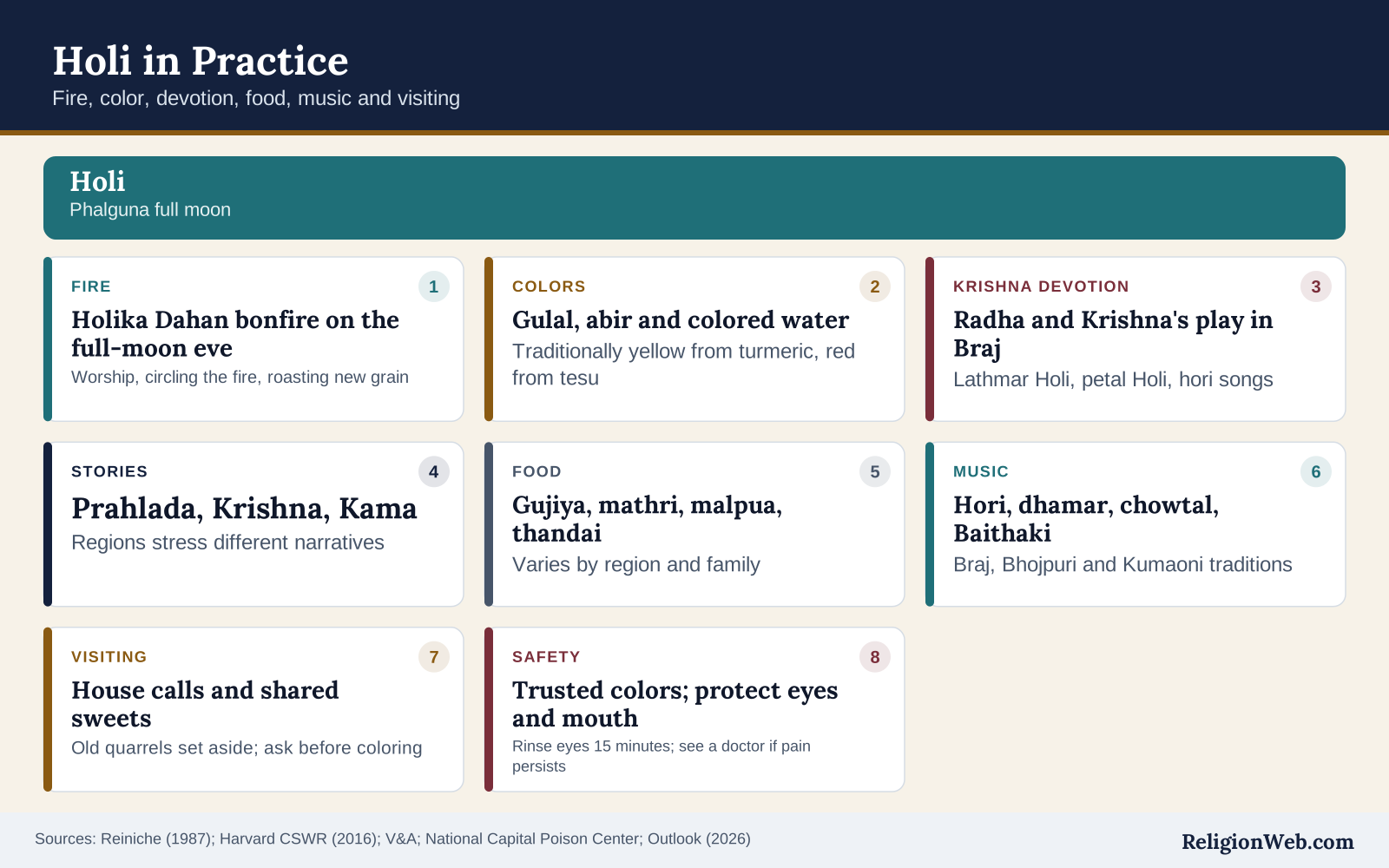
The sequence varies, but its outline is consistent across descriptions. A priest or household elder performs a short worship (puja) of the pyre, which is explained in general terms in the article on Hindu worship, and the Harvard Divinity School summary notes offerings of water and grain before the fire is lit. The Narada Purana, as listed in the Puranic Index, prescribes a mantra addressed to Holika, and in some localities an image of Holika is placed on the pyre. At moonrise the fire is lit, and, according to Reiniche, men and women walk around it, throw in coconuts and roast new barley. The evening is loud, with drums and horns, and people may rub colored powder on one another’s faces, according to the Harvard summary.
Taking something home from the fire is also customary. Reiniche records the practice of carrying embers home to relight domestic fires, and of collecting ashes as a protection against disease. The tradition regards the ash as protective in a religious sense, and it should not be treated as a medical remedy. People with skin conditions, burns or respiratory problems should follow the advice of a physician and not rely on ritual substances.
What the Fire Is Understood to Do
Burning away evil and marking the turn of the year
Participants give several reasons for the fire. The most common is that it commemorates the triumph of good over evil, as in the story of Prahlada, and that it burns away negativity and impurity. Other readings are seasonal: the fire marks the end of winter, and in Reiniche’s account it is also viewed as a funeral pyre that destroys Holika, as a ritual of destruction that precedes renewal, and as a means of reading the harvest, since the direction of the flames or the condition of the buried seeds is said to indicate the year’s crops. None of these readings excludes the others. People who gather at the fire usually do not choose among them, and the physical act of standing around a flame on a cold night with neighbors is a large part of its appeal.
The fire is not the same as the lamps of Diwali, another major Hindu festival that uses fire as a central symbol but is kept in a different season, with different stories and a different mood. Readers who want to see the contrast can read the article on Diwali.
Regional names and variants
The bonfire has many names. Reference summaries give Holika Dahan or chhoti Holi for much of northern India, Sammat Jaarna in Purvanchal and the Nepali Terai, and Chanchor or Nyara Pora in West Bengal, where on the day before Dol Yatra dry branches and leaves are burned. In Telangana and Karnataka the fire is the Kama Dahanam or Kamadahana, which is tied to the story of Shiva and Kama. In Trinidad, according to the National Trust of Trinidad and Tobago, an effigy of Holika is burned as a symbolic cleansing, and the festival is known as Phagwa. In Manipur, a report in the Assam Tribune describes the burning of a straw and bamboo structure at the start of the five-day Yaoshang festival.
Taking Part Safely
Fire and crowds
A large communal fire carries ordinary risks. The practical advice is conventional: keep children and loose clothing away from the flames, do not throw pressurized containers or other unsuitable items into the fire, and never leave a burning pyre unattended. The National Capital Poison Center also warns that some commercial color powders can catch fire or explode near a flame or spark, which is a reason to keep colors away from the bonfire.
Respecting the ritual
For visitors, the fire is a religious rite as well as a social event. Observers are usually welcome, but it is courteous to ask the hosts where to stand and whether photography is acceptable, to follow the lead of those walking around the fire, and not to treat the burning of Holika’s effigy as a spectacle. Where the story is told, it is told as a story of faith, so listeners are not expected to share the belief in order to be present at the fire.
Rangwali Holi: The Day of Color
What People Do on the Day
The course of a typical Holi day
The day after the bonfire is when most people think of Holi. In the Harvard summary, people on the second day throw perfumed or colored water and powder, join exuberant processions, sing songs, make floral decorations and exchange sweets. A typical day in a north Indian town begins with children and young people in old clothes taking powder and water guns into the street, with neighbors, relatives and friends marking one another’s faces and receiving the greeting “Happy Holi!” In many households there is a gentler, more formal part to the day as well. Younger people apply a touch of dry powder to the faces or feet of elders in greeting. By the afternoon, people bathe, change into clean clothes and make visits, where sweets are offered. Evening gatherings often include music and, in some communities, formal singing.
The equipment is simple. Dry powders are called gulal or abir, and colored water is sprayed with a pichkari, the syringe-like squirt. In Nepal, throwing water balloons, called lola, is popular, according to reference summaries. In Trinidad, as the National Trust notes, plastic bottles and water guns are used to spray the colors. Color is applied to faces, hair and clothes, and many people wear white or old clothes on purpose so that the colors show.
Who plays, and under what understandings
Holi is a festival of mixing across the usual lines of age, gender and social standing. Reiniche reports that lower-status people often target higher-status ones, who must accept it, and that in some regions people choose a mock “King of Holi,” sing bawdy songs and drink bhang, a preparation of cannabis with milk and spices. Women in several places beat men with sticks in play, as in Braj. Anthropologists read the festival as a cycle of destruction and renewal. Babb, cited in Reiniche’s entry, argued that the reversal of rank is limited and does not overturn everyday norms.
The license of the day has limits that participants themselves recognize. Playing with color is understood to be among willing participants, and the familiar phrase “bura na mano, Holi hai” (“don’t take offense, it’s Holi”) is used to excuse harmless pranks. It is not a reason to override someone’s refusal, and ordinary courtesy applies: ask before applying color to a person who is not already playing. A gesture that is playful between friends can be unwelcome from a stranger, and that is true of the festival wherever it is kept.
Meaning, Reversal and Reconciliation
Setting aside rank and old quarrels
Participants and scholars both stress the festival’s social function. The Harvard summary says that old hurts are set aside and friendships are renewed. In Reiniche’s account, the festival temporarily suspends the norms that separate people, for example by allowing lower-status people to splash higher-status people, and Hindu tradition provides several ways to describe this: as the playfulness of Krishna’s world, as a seasonal renewal, or as a time when the ordinary hierarchy of the household is set aside for a day. That is why Holi is often described as a festival of forgiveness, even though a lasting reconciliation depends on what people do after the day itself.
Religious and social meaning together
For a family, the day can contain devotion and social play at once. A household might visit a temple in the morning, offer color to the images of Krishna and Radha, and then join a neighborhood gathering in the street. Temple celebrations of Holi, such as those of Vrindavan described in the next section, treat the color as an offering to the deity. In this sense the question of whether Holi is “religious or secular” often depends on the setting: in a temple courtyard the religious frame is explicit, while a college campus celebration may be mainly social. Both are part of the festival, and neither cancels the other.
Colors, Health and the Environment
What the colors are made of
As the earlier discussion of dyes explains, traditional Holi colors were mainly yellow and red, from turmeric and tesu flower petals. The National Capital Poison Center states that modern powders usually have a cornstarch base with synthetic dyes of the kind approved for food, drugs and cosmetics, but that some reported powders contain metal-based or industrial pigments, talc, mica, or even ground glass, and that the ingredients are often not labeled. Some organizations promote herbal colors as an alternative, which are typically more expensive than the commercial kind.
Practical precautions
The National Capital Poison Center, a United States organization, recommends buying colors only from reputable sources and choosing naturally dyed powders when possible. It advises against wearing contact lenses, suggests sunglasses or goggles, a tight-fitting mask over the nose and mouth, and clothing that covers the arms and legs, and recommends washing off powder gently and laundering contaminated clothes. After an eye exposure, it says to rinse with water for fifteen minutes and to seek care right away for severe or persistent pain, vision changes or light sensitivity. Where bhang or alcohol is part of the day, the tradition does not make them a requirement, and their effects are unpredictable. A person who feels unwell after exposure to colors, smoke or intoxicants should seek medical help, since prayer and ritual do not replace medical care.
| Element | What it is | Meanings given | Where emphasized |
|---|---|---|---|
| The pyre | Wood and dung cakes around a central pole, lit on the full-moon night | Burning of Holika; end of winter; burning away of impurity | North and central India, Nepal, diaspora |
| New grain | New barley or other grain roasted in the fire | First fruits of the spring harvest; divination from the flames | Rural northern India |
| Ash and embers | Carried home from the fire | Protection in tradition; relighting domestic hearths | Rural northern India |
| Gulal and abir | Powdered color, traditionally red and yellow | Krishna’s play with Radha; welcome of spring; unity | Everywhere Holi is played |
| Colored water | Sprayed with a pichkari or poured | Play, cooling at the start of the warm season | North and central India, Nepal, Caribbean |
| Flowers | Petals thrown or used in decorations | Offering to Krishna and Radha | Vrindavan temples, Bengal |
| The swing | Decorated palanquin for the images of Krishna and Radha | The youthful Krishna; the spring swing festival | Bengal, Odisha, Assam |
| Sticks and shields | Staves used in play-fighting | Radha’s village driving off Krishna’s cowherds | Barsana and Nandgaon |
Krishna Traditions and Braj Holi
The Braj Landscape and Its Holi
Why Braj has its own festival
Braj Bhoomi is the cultural region of Uttar Pradesh that includes Mathura, traditionally Krishna’s birthplace, Vrindavan, where devotees believe he grew up, Nandgaon, his village, and Barsana, the village of Radha. According to Himal Southasian, color and festivities in the region begin more than a week before Holi is celebrated elsewhere. For devotees, Braj is the stage on which Krishna’s Holi occurred, so celebrating it there is not only commemoration but participation in a living landscape. The wider theology of Krishna worship is explained in the article on Vaishnavism.
A ten-day sequence of local celebrations
Rather than a single day, Braj Holi is a series of village and temple events, strung across about ten days in 2026. The order follows the places of the story: Radha’s village of Barsana first, then Krishna’s village of Nandgaon, then the flower celebrations of the Vrindavan temples, then the Holika Dahan bonfire and the main color day in Mathura and Vrindavan, and finally the Huranga at the Dauji temple in Baldeo. Local temples and priests set the final dates, and some published calendars differed on venues, so the sequence is best read as a guide to the pattern and not as a schedule.
Lathmar Holi, Laddu Holi and the Flower Holi
Barsana and Nandgaon
The best-known event is Lathmar Holi, which is staged on consecutive days in Barsana and Nandgaon. As Himal Southasian describes it, men from Nandgaon, in traditional dress, visit Barsana, where the women drive them away with sticks, lathis, in a reenactment of the legend. Elders from both villages gather at the village temple and sing hori ballads about Krishna and Radha, and on the following days the roles reverse, with Nandgaon women beating men from Barsana. Outlook adds that the men shelter behind shields and that gulal fills the air. A day earlier, at the Radha Rani temple in Barsana, priests shower devotees with laddus, sweets that people catch and toss, in what Outlook describes as an invitation from Radha’s village to Krishna’s Nandgaon.
These events are performances in the sense that the roles are known and the beating is symbolic, but for participants they are also devotion. Residents and pilgrims regard the villages as the actual places of Krishna’s play, and the women who carry the sticks are understood to be taking the part of Radha and her companions. The events have also become major tourist occasions, with crowds and media coverage. Visitors are advised to follow local guidance, since crowded temple courtyards can be physically demanding.
Temple Holi in Vrindavan and Mathura
In Vrindavan and Mathura the emphasis shifts to temple worship. Outlook’s survey of Braj Holi says that at the Banke Bihari temple priests shower devotees with fresh petals during bhajans and aarti, and that Rangbhari Ekadashi marks the ceremonial start of color offerings to Krishna. Flower celebrations are also held at the ISKCON temple and the Radha Raman temple. On the main color day, the same source says, the lanes around Banke Bihari fill with dancing crowds. At Baldeo, about thirty kilometers from Mathura, the Dauji temple holds the ritual of Huranga, in which women playfully tear at the clothes of men while colors are thrown and temple priests and extended families oversee the custom. Some calendars also list a gathering of widows living in Vrindavan; news coverage often presents it as a recent departure from older expectations that widows avoid color, and it is better understood as a modern development than as an ancient temple rite.
Regional Traditions Across South Asia
Eastern and Northeastern India
Dol Jatra and Basanta Utsav in Bengal, Odisha and Assam
In Bengal, Odisha and Assam the full moon of Phalguna is better known as Dol Purnima or Dol Jatra, the “swing journey,” and the festival centers on Krishna and Radha. The Quint, in a 2018 explainer by Ishadrita Lahiri, describes images of Krishna and Radha being placed in decorated palanquins and carried through town while people take turns swinging the palanquin and others sing and dance around it, with powdered color played throughout. A 1996 post on the INDOLOGY scholarly mailing list mentions that in Puri a Jagannatha image is swung in moonlight near the Jagannatha temple. On the day before, as the reference summaries note, dry branches and leaves are burned in West Bengal in a rite called Chanchor or Nyara Pora, which parallels the northern bonfire.
At Santiniketan, the Basanta Utsav at Visva-Bharati, credited by The Quint to the poet Rabindranath Tagore, has become a celebrated cultural form of the festival. Students and teachers wear yellow, join a morning procession called the prabhat pheri, and enjoy Rabindra Sangeet, Baul music, dance and poetry, with colors made from flowers and liquid colors banned. In Purulia district the same account describes a three-day village festival with folk dances such as Chhau and Jhumur and the songs of wandering Bauls, in which tribal communities, including non-Hindu groups, take part.
Manipur’s Yaoshang
In Manipur the Meitei festival of Yaoshang begins on the full moon day of the lunar month Lamta, in February or March, and lasts five days, according to an Assam Tribune report. It includes the ritual burning of a small hut of straw and bamboo and the folk dance thabal chongba, in which boys and girls hold hands, sing and dance in a circle. The same report says the festival commemorates the birthday of the Bengali Vaishnava teacher Chaitanya Mahaprabhu, whom Gaudiya Vaishnava tradition also honors at the Phalguna full moon, a reminder of how Krishna devotion has shaped spring festivals in the northeast. Yaoshang also has Meitei roots of its own, and local sources should be consulted for its full meaning.
Western and Southwestern India
Rang Panchami and Shimga in Maharashtra and central India
In Maharashtra, Madhya Pradesh and Karnataka, the main day of color is often not the day after the bonfire. Rang Panchami falls on the fifth day (panchami) after Holi, according to reference summaries, and it is celebrated by throwing color and splashing colored water. In some places processions carry the image of a deity to a nearby river or pond for immersion, and the festival is linked to Radha and Krishna and, in a second account, to the story of Prahlada. In Maharashtra the festival is also called Shimga.
Shigmo in Goa and Manjal Kuli in Kerala
Goa’s spring festival, Shigmo, shows how regional history shapes a festival. Reference summaries describe two variants: Dhakto Shigmo (“small Shigmo”), celebrated mainly by farmers, laborers and rural people with folk songs and dances, and Vhadlo Shigmo (“big Shigmo”), celebrated by everyone in the village temples, beginning on the Phalguna full moon and lasting five days. On the first day of the second, the village deity is bathed and dressed in saffron robes, followed by a feast. Dances include Talgadi and Gopha, drums called dhol and taso are carried from door to door, and in recent years the state government has supported public parades with floats showing scenes from regional mythology and religion. The split between the two forms corresponds to the regions that were under Portuguese rule for longer.
Along the Kerala coast, according to Outlook, the Konkani and Kudumbi communities observe Manjal Kuli, also called Ukuli, in which participants splash turmeric water on one another as a gesture of purification, and the festival is linked to temple rituals at the Kodungalloor Bhagavathy temple. This is a reminder that the full moon of Phalguna is observed in the far south in forms that look very different from the powder-throwing of the north.
The Hills and Plains of the North
Kumaoni Holi: a season of song
In the Kumaon hills of Uttarakhand, Holi is above all a musical season. The Rural India Online account, a 2017 photo story by Arpita Chakrabarty for the People’s Archive of Rural India, describes Mahila Holi as a women’s gathering in homes and temples, in which women dance in circles and sing songs that honor Radha and Krishna, Ganesha and Shiva, as well as songs that tease one another and mention village gossip. Hosting rotates among hamlets, costs are shared, and food such as pakodas, halwa and tea is served. The same account distinguishes Baithaki Holi, seated musical gatherings in homes with harmonium and tabla, which it says were introduced to Almora around 1850 by the musician Ustad Amanullah Khan, and Khadi Holi, in which participants stand and dance. Other writers connect the Kumaoni tradition with the court of the Chand kings, so the history is not settled.
Phaguwa in Bihar, Hola Mohalla in Punjab and Phagu Purnima in Nepal
In Bihar, the Bhojpuri and Maithili tradition of Phaguwa begins around Holika Dahan, according to Outlook, and includes mud-splashing revelry known as Dhurkheli. In Punjab, the Sikh gathering of Hola Mohalla at Anandpur Sahib is, as the Tribune of India reports, a festival established in 1701 by Guru Gobind Singh to show the martial spirit and preparedness of the Khalsa, with processions, gatka martial arts displays by Nihang Sikhs, kirtan and langar. Sikhs understand this as a distinct observance with its own meaning, and the wider Sikh festival calendar is introduced in the article on Vaisakhi. In Nepal, Holi, or Phagu Purnima, is a national festival, with the Terai observing it on the same date as India and the hill regions a day earlier.
| Region | Local name | Distinctive features |
|---|---|---|
| Braj (Uttar Pradesh) | Holi, Lathmar Holi, Phoolon ki Holi, Huranga | Krishna and Radha story; a ten-day sequence across villages and temples |
| Bengal, Odisha, Assam | Dol Jatra, Dol Purnima, Basanta Utsav | Swing of the deities’ images; yellow clothing and song at Santiniketan; Chanchor bonfire |
| Manipur | Yaoshang | Five days; burning of a straw hut; thabal chongba dance |
| Maharashtra and Madhya Pradesh | Shimga, Rang Panchami | Color on the fifth day after Holi; processions to river or pond |
| Goa and Kerala coast | Shigmo; Manjal Kuli | Village-temple festival and folk parades; turmeric water |
| Kumaon (Uttarakhand) | Baithaki, Khadi and Mahila Holi | Months of song; seated, standing and women’s gatherings |
| Bihar | Phaguwa | Bhojpuri and Maithili songs; mud-splashing Dhurkheli |
| Telangana, Andhra Pradesh, Karnataka, Tamil Nadu | Kama Dahanam, Kamadahana, Kama festival | Effigy of Kama burned; story of Shiva and Kama |
| Punjab | Hola Mohalla (Sikh observance) | Day after Holi; gatka, processions, langar at Anandpur Sahib |
| Nepal | Phagu Purnima | National festival; Terai on India’s date, hills a day earlier |
Foods, Music and Visiting
Foods and Drinks of the Season
Sweets, snacks and new grain
Holi is a festival of food shared across households. Reference summaries list gujiya (a fried pastry with a sweet filling), mathri (a savory flaky biscuit), malpua (a sweet fried pancake), pakoras and the cooling milk drink thandai among the common items, though what is eaten depends heavily on region and family. In Barsana the sweets are laddus thrown from the temple, and in Kumaon the food served at Mahila Holi includes pakodas, halwa and tea. The Harvard Divinity School summary notes the baking and eating of the season’s first new corn, and Reiniche mentions roasting new barley in the fire, which links the table to the harvest.
Some families also observe a day-long fast on the day of the bonfire and eat only after the rite, although this is a household custom that varies, and no single rule applies. Visitors who are unsure should ask their hosts what is being offered and whether it is meant for a specific purpose, since temple food (prasad) is offered to the deity first.
Bhang and its limits
In several regions the drink bhang, made from cannabis with milk and spices, is associated with Holi, and Reiniche lists it among the festival’s customs. It is a custom in some communities and not a requirement of the festival, and many families do not use it. Its effects are unpredictable and sometimes strong, particularly when it is mixed unknowingly into food or sweets, and its legal status differs by place. A person who feels unwell after eating or drinking something at a gathering should seek medical attention, and, as with any intoxicant, it should never be given to someone without their knowledge.
Songs, Dance and Visiting
Hori, dhamar, chowtal and other songs
Music is as central to Holi as color. In Braj the songs called hori are sung in Braj Bhasha and tell of Krishna and Radha at play, and reference summaries describe a classical form in the dhrupad tradition set to the fourteen-beat dhamar rhythm, often in raga Kafi, along with a lighter semi-classical form related to thumri. In Kumaon the Baithaki and Khadi forms are sung with harmonium and tabla or with dholak and cymbals. In Trinidad the traditional songs of Phagwa are called chowtal, which the National Trust of Trinidad and Tobago describes as lively songs, often performed with dancers, in the Bhojpuri dialect spoken by indentured laborers, accompanied by the dholak and manjeera. Each form adapts the festival’s themes of Krishna, spring and teasing to a local language.
Visiting, greeting and hospitality
The social grammar of Holi is visiting. After the morning of play, families go from house to house, exchanging sweets and marking one another’s faces. The Harvard summary describes visits to family, friends and even strangers, with the greeting “Happy Holi!” In Kumaon, according to the PARI account, women visit each house to perform in some villages. The hospitality is meant to extend beyond the family: it is conventional to welcome neighbors of any background, and temples and community organizations abroad often host open Holi events, such as the Utah festival described below. A guest who is not Hindu is generally welcome in the social parts of the festival, and may skip the worship of the fire.
| Category | Examples | Notes |
|---|---|---|
| Sweets and snacks | Gujiya, mathri, malpua, pakoras | Shared with visitors; varies by region and family |
| Drinks | Thandai; bhang in some communities | Bhang is a local custom, not a requirement |
| Offerings and new grain | New corn baked, new barley roasted, laddus in Barsana | Links the festival to the spring harvest |
| Songs | Hori in Braj; chowtal in Trinidad; Baithaki and Khadi in Kumaon | Themes of Krishna, Radha, spring and teasing |
| Instruments | Dholak, manjeera or cymbals, harmonium, tabla | Folk and classical settings differ |
| Dance | Circle dances; Thabal Chongba; Gopha in Goa | Often communal and open to many ages |
| Visiting and greeting | House-to-house visits, “Happy Holi,” color on elders’ faces or feet | Reconciliation and renewed friendship |
Holi Today: Holidays, Diaspora and Public Festivals
Holi as a Public Occasion
Recognition and calendars in India and Nepal
In India, Holi is a gazetted holiday for central government offices in Delhi, while central offices elsewhere treat it as one of twelve optional holidays from which committees choose three, according to the Government of India’s holiday list for 2026, so its status as a day off varies with the employer and the location. Its eastern counterpart, Dol Jatra, appears in the same list as a restricted holiday. In Nepal, reference summaries describe Holi as one of the country’s major nationwide festivals, together with Dashain and Tihar, and report traditional concerts in Kathmandu and Pokhara that are broadcast on television. This public recognition is practical and not doctrinal, since a state calendar says nothing about how an individual family keeps the festival.
Tourism, media and heritage
The famous forms of Holi, especially Lathmar Holi in Barsana, have become tourist events, and Indian newspapers publish annual Braj calendars. Tourism brings income to villages and publicity to local customs, and it also raises questions about crowding and about whether a ritual remains a ritual when staged for visitors. Local residents and temples answer these questions in different ways. In cinema and popular music Holi has long been a set piece, so that many people encounter the festival first through film. It is useful to remember that the film version tends to emphasize the color and the dance and to leave out the bonfire, the temple worship and the regional variation described in the earlier sections.
Holi Beyond South Asia
Phagwa in the Caribbean
The National Trust of Trinidad and Tobago, in a 2023 article by Karishma Nanhu, states that Phagwa, also called Holi, came to the Caribbean through Indian indentured laborers, that it has Hindu significance but that all are welcome to take part, and that participants throw colored powder and liquid, called abeer or gulal, on one another. In Trinidad an effigy of Holika is burned as a symbolic cleansing, one religious explanation draws on the story of Hiranyakashipu and Holika, and the traditional chowtal songs preserve the Bhojpuri speech of the first generations. Reference summaries list the festival also in Guyana, Suriname, Jamaica, Mauritius, Fiji and South Africa, each with its own pattern.
Public festivals in North America
In the United States, the Holi Festival of Colors at the Sri Sri Radha Krishna Temple in Spanish Fork, Utah, is an example of a temple-hosted public festival. The Daily Herald of Utah Valley reported in March 2025 that the temple had hosted its first festival in 1989, that about 10,000 people were expected for the weekend, and that colored chalk was thrown at the top of every hour, with live performances, yoga and vegetarian food, and with drugs, alcohol and meat prohibited. The temple’s founder, Caru Das, presented Holi as honoring Krishna and marking the start of spring, and the event avoids water, unlike celebrations in India, to protect attendees from colds. The festival shows how diaspora communities keep the color and the devotion while adapting the form to local conditions, and similar events are held elsewhere.
Common Misconceptions About Holi
Misconception 1: Holi is only a secular color party with no religious meaning
Where the misunderstanding comes from
The claim is easy to understand. The most widely shared images of Holi show crowds covered in powder, and the festival is open to people of every background in India and abroad. Color-throwing events outside South Asia often borrow the name without the bonfire, the stories or the temple setting. Even in India, the day of color can feel entirely social, since schools, offices and housing complexes organize it as a neighborhood celebration, and many participants who take part never attend a worship. A visitor who sees only a street party can reasonably conclude that there is nothing more to it.
The social character of the festival is real and old. Reiniche’s account describes a day on which ordinary rank is temporarily set aside, and the Harvard Divinity School summary stresses visits, reconciliation and shared food. It would therefore be a mistake to claim that Holi is a purely devotional occasion. The misconception arises when the social side is mistaken for the whole.
What the evidence and tradition actually show
Holi has explicit religious content in most of the forms described in this article. The bonfire is preceded by worship, and a mantra addressed to Holika is listed in the Narada Purana. In Braj, devotees at the Banke Bihari temple treat color as an offering to Krishna, and in Bengal and Odisha the festival is built around the processional swing of the images of Krishna and Radha. The Trinidad National Trust describes Phagwa as having Hindu significance while welcoming everyone, and the Utah temple that hosts a large public festival presents Holi as honoring Krishna and marking the start of spring. The Sikh gathering at Anandpur Sahib, similarly, is an explicitly religious assembly, though its meaning differs from that of the Hindu festival.
A more accurate statement is that Holi is both a religious festival and a broadly shared social one, and the balance depends on the setting. People of other faiths and of none can join in the social celebration, and Hindu families, temples and communities keep the ritual and devotional parts. Describing it as only one or the other leaves out something that participants regard as essential.
A further complication is that the religious frame is not identical for everyone who takes part. A Hindu family may see the morning’s play as an extension of Krishna’s own, while a neighbor of another faith, or a student at a campus event, may be there for friendship and spring. Both are welcome in the social space, and neither has to claim the other’s reasons.
Misconception 2: A single story, that of Prahlada and Holika, explains every Holi celebration
Where the misunderstanding comes from
Short explanations of Holi, in school lessons, news reports and holiday guides, usually give one sentence about good defeating evil and a summary of the bonfire story. This is a natural simplification, because the Prahlada and Holika narrative is among the clearest explanations of the bonfire, and it is told in many households. Because the same story is printed so often, it can look like the festival’s single founding event, with everything else treated as decoration.
Popular summaries sometimes strengthen the impression by attributing the Holika episode to a specific scripture such as the Vishnu Purana, which gives the story the air of a canonical origin.
What the evidence and tradition actually show
The picture in the sources is layered. The Prahlada story is old and well known, but in Wilson’s translation of the Vishnu Purana, the chapter that describes Prahlada in the fire does not name Holika, and the Puranic Index points to different texts: a Narada Purana verse for the worship of Holika and a Bhavishya Purana story of a demoness Dhundha who has nothing to do with Prahlada. The Harvard Divinity School summary lists regional dedications to Kama, to Shiva and Kama, to Dhundhi and Putana, and to Krishna, and Reiniche shows that the South Indian full-moon festival is a festival of Kama with its own story and its own ritual.
Many of the most visible customs, in turn, are not about Holika at all. Lathmar Holi in Barsana and Nandgaon is explained by a local tale of Krishna and Radha, the swing festival of eastern India belongs to Krishna devotion, and Hola Mohalla is a Sikh observance with its own origin. The roasting of new grain and the divination from the flames in northern villages point to a seasonal and agricultural frame. The Prahlada and Holika story is thus one important narrative among several, and what it explains is mostly the bonfire.
Even within the bonfire, the readings are not limited to the story. Reiniche records that the fire is also seen as a funeral pyre that destroys Holika, that Prahlada is sometimes identified with the central pole, and that the flames and buried seeds are used to forecast the harvest. These are ritual interpretations that sit beside the narrative and sometimes shape it, which is another reason that scholars speak of layers and not of a single origin.
Misconception 3: Everyone in India celebrates Holi the same way, or at all
Where the misunderstanding comes from
Holi is often presented abroad as India’s national festival of colors, and films and tourism marketing present a single image of the festival. Within India, the north Indian form has spread through media, migration and urban life, so that many city residents in every region now play with powdered colors on the same day. It is natural to assume that the country as a whole shares one celebration, and that every Hindu household takes part.
Calendars add to the impression. A national holiday list prints one date under the name Holi, and a news report on the festival will usually follow the northern cycle of bonfire and color day. The names, sequences and emphases of other regions rarely appear in such summaries, and readers outside the region seldom learn that a neighboring state is keeping a different festival on the same full moon.
What the evidence and tradition actually show
The regional record shows otherwise. The Government of India’s list for 2026 places Dol Jatra, the eastern form, on March 3, a day before Holi, and Rang Panchami in Maharashtra falls on the fifth day after Holi. The Kumaoni season of song begins around Vasant Panchami and lasts nearly two months, and the Goa festival of Shigmo has two distinct forms. In the south, according to Reiniche, the corresponding full-moon festival centers on Kama and is smaller in scale in Tamil Nadu. Holi is also an optional holiday, not a compulsory one, for central government offices outside Delhi, and whether a family plays with color, visits a temple, keeps a fast, or does none of these is a matter of region, community and household custom.
The better formulation is that a family of related spring festivals is kept around the Phalguna full moon, with the northern Holi as its most widely exported member. Treating the others as imitations of it misreads their history.
Even the date shows the diversity. Because the lunar day can straddle two civil dates, local almanacs may place the bonfire on different evenings, as discussed in the section on the calendar, and the festival’s regional names and sequence vary in the same way.
Misconception 4: Holi colors have always been the bright powders sold today, and anything labeled “natural” is safe
Where the misunderstanding comes from
Images of Holi today show saturated blues, greens, pinks and purples, and the colors are sold in packets in every market during the season, so it is easy to assume they are as old as the festival. Photographs of vivid festival crowds reinforce the idea, and few viewers know that the palette once centered on yellow and red. Marketing language compounds the confusion, since packets labeled “herbal” or “natural” may suggest that harm is impossible.
What the evidence and tradition actually show
The Victoria and Albert Museum notes that traditional Holi powder was mostly yellow and red, with the yellow probably from ground turmeric and the red from crushed tesu petals, and that today’s powder comes in many colors. The National Capital Poison Center adds that traditional natural colors had short shelf lives and were expensive to make in vivid blues and greens, that modern powders are usually cornstarch with synthetic dyes, and that some powders reported in the market contain metal-based or industrial pigments, talc or mica, often without labeling. For that reason it recommends buying from reputable sources, choosing naturally dyed powders when possible, and protecting the eyes, nose and mouth. It is the sourcing and labeling that matter, not the word on the packet, and anyone with irritation that persists after exposure should seek medical care.
The practical point for organizers and families is that safety does not depend on abandoning the festival. Some organizations and communities promote floral and herbal colors, and the petal celebrations at Vrindavan temples show that flowers have their own place in the festival’s imagery.
Frequently Asked Questions About Holi
Questions About Meaning and Origins
What does Holi celebrate?
Different communities give different answers, and all of them are part of the festival. For many families it commemorates the triumph of Prahlada’s devotion over Holika’s fire. For devotees of Krishna it is the play of Krishna and Radha, with color as a form of divine play. In parts of southern India it recalls Shiva’s burning of Kama, and for many farmers it marks the end of winter and the first grain of the season. The sections on the stories and the bonfire explain how these layers fit together.
Is Holi mentioned in the Vedas?
The sources used for this article do not identify Holi, by name, in the hymns of the Vedas, which are introduced in the article on the Vedas and Upanishads. The earliest textual traces discussed above are later: Sanskrit lexicons that list a rite called holāka, a commentary on a ritual text, classical descriptions of spring festivals, and the Puranas, which connect the full moon of Phalguna with Holika. The festival’s roots may be older than its documentation, but that cannot be shown from the evidence consulted here.
Questions About Dates and Participation
When is Holi in 2026 and 2027, and why does the date change?
According to the Government of India’s lists, Holi fell on Wednesday, March 4, 2026, with the bonfire on the preceding evening, and Holi falls on Tuesday, March 23, 2027. The date changes because the festival is tied to the full moon of the lunar month of Phalguna, and the lunar calendar does not align with the Gregorian one. Local almanacs may differ by a day, so readers should consult one for their own city.
Do you have to be Hindu to take part?
The social celebration is open in many places. The National Trust of Trinidad and Tobago states that all are welcome at Phagwa, and the Utah temple hosts a public festival open to all, though it forbids alcohol, drugs and meat on its grounds. The worship at the bonfire and in temples is a Hindu religious act, and non-Hindu guests are usually welcome to observe respectfully. Taking part in the color play means accepting the etiquette of the day, in particular asking before coloring someone who is not already playing.
Questions About Safety and Etiquette
Is it safe to play with Holi colors?
It can be, with precautions. Following the National Capital Poison Center, buy colors from reputable sources, avoid wearing contact lenses, protect the eyes, nose and mouth, wear clothes that cover the skin, and rinse the eyes with water for fifteen minutes after an exposure. People with asthma, skin conditions or eye problems should be especially careful, and severe or persistent symptoms call for prompt medical attention. Keep colors away from open flames.
What should a guest do at a first Holi?
Wear clothes that can be stained, bring a change of clothes and any glasses protection you need, accept sweets from hosts, and follow their lead on where to stand at the fire. If you do not wish to be colored, say so politely at the start, and expect the same courtesy to be offered to others. Many hosts are glad to explain the stories and customs, and asking is the easiest way to learn.
Conclusion: Holi as a Layered Festival
What the Evidence Shows
Many stories around one full moon
Holi is best understood as a festival with layers: a bonfire and a day of color, the story of Prahlada and Holika, the play of Krishna and Radha, the burning of Kama, and older seasonal and harvest rites, all gathered around the full moon of Phalguna. The texts show a story in several versions, not one canonical account, and the early documentary record is thinner than popular summaries suggest, so careful writers speak of traditions where they cannot prove origins.
Many forms across regions
The same full moon is kept as Holi, Dol Jatra, Rang Panchami, Shigmo, Yaoshang, Phaguwa and Phagwa, with Braj, Kumaon and Santiniketan each contributing distinctive forms. The Sikh Hola Mohalla is a separate observance in the same season. For a reader, the practical lesson is to ask which community and which region is meant.
How to Keep Exploring
Related festivals and worship
Readers interested in how Hindu festivals use fire and light can turn to the articles on Diwali and Navaratri, and those interested in the household and temple worship behind the bonfire can read about puja. The broader tradition is introduced in the overview of Hinduism.
Related ideas and texts
The stories of Prahlada and Krishna raise questions of duty and consequence, which are explored in the articles on dharma and karma. The devotional teaching about Krishna that underlies the Braj traditions is introduced in the article on the Bhagavad Gita.
Sources
The table below lists the principal external sources behind this article. Facts, dates and figures were checked against these and related primary, institutional and academic materials.
| # | Source | Publisher and type | Used for | Link |
|---|---|---|---|---|
| 1 | Holī, by Marie-Louise Reiniche, Encyclopedia of Religion (1987) | Encyclopedia.com (Macmillan Reference USA) · Academic reference | Timing, Holika and Prahlada, Krishna, Kama, bonfire customs, status reversal, regional forms | encyclopedia.com |
| 2 | The Vishnu Purana, Book I, Chapter XVII (Prahlada and the fire) | Internet Sacred Text Archive · Primary text | Quoted sentence; fire episode in the Vishnu Purana; Holika not named in this chapter | sacred-texts.com |
| 3 | How the Global Religious Landscape Changed From 2010 to 2020 | Pew Research Center · Demographic data | Hindu population 2020 (about 1.2 billion; 14.9%); 95% in India, 97% in India and Nepal | pewresearch.org |
| 4 | The Festival of Holi (Asia Department blog) | Victoria and Albert Museum · Museum | Nurpur and Kangra paintings; Delhi syringe; traditional turmeric and tesu colors | vam.ac.uk |
| 5 | Holidays to be Observed in Central Government Offices During the Year 2026 | Government of India (DoPT list, as published by GConnect) · Institutional | Holi on March 4, 2026; Dol Jatra March 3; optional-holiday rule outside Delhi | gconnect.in |
| 6 | Are Holi Colors Safe?, by Lindsy Liu, PharmD | National Capital Poison Center (Poison Control) · Health reference | Composition of modern colors; eye and skin risks; precautions and first aid | poison.org |
| 7 | Holi / Holika Dahan, by Melissa Coles (2016) | Center for the Study of World Religions, Harvard Divinity School · Academic reference | Prahlada and Holika narrative; regional dedications; two-day customs; social aspects | cswr.hds.harvard.edu |
| 8 | Puranic Index: Holikā (Narada Purana 1.124.78; Bhavishya Purana 4.132) | Sanskrit Documents · Primary-text index | Puranic references to Holika and Dhundha; no traceable source for the cloak variant | sanskritdocuments.org |
| 9 | Where Holi Lasts 10 Days: The Ultimate Guide to Celebrating in Braj (2026) | Outlook Traveller · Journalism | 2026 Braj sequence: Laddu Holi, Lathmar Holi, Banke Bihari, Huranga | outlooktraveller.com |
| 10 | 5 Things To Know About Phagwa, by Karishma Nanhu (2023) | National Trust of Trinidad and Tobago · Institutional | Phagwa in Trinidad: indentured origins, chowtal songs, Holika effigy, abir | nationaltrust.tt |
Last fact-check date: 2026-10-21.