Puja (pūjā) is the Hindu practice of ceremonial worship in which a deity is honored with a sequence of respectful attentions: a welcome, water, flowers, incense, a lamp, food, and words of praise. It may last less than a minute before a small shrine in a kitchen corner, or it may fill several hours in a temple served by trained priests. Britannica describes puja as ceremonial worship “ranging from brief daily rites in the home to elaborate temple rituals,” and the Oxford scholar John Bowker, in his dictionary entry, calls it “immensely varied acts” of offering and devotion. That variety is the first thing to understand about the subject.
Three ideas hold the many forms together. The deity is received as an honored guest, often as one would receive a king. What is offered is given with devotion rather than because the deity needs it. And what has been offered is usually returned to the worshiper as grace, most visibly as prasad, the blessed food shared at the end. Around these ideas cluster other practices that readers often hear about together: darshan, the exchange of sight between devotee and image; aarti, the waving of lamps; the household shrine; and the temple sanctum.
Puja belongs to the wider Hindu world and is practiced across its devotional streams, including Vaishnavism, Shaivism and Shaktism. It is also, in numbers, among the most widely practiced parts of Hindu life. In a Pew Research Center survey of 29,999 adults across India, conducted face to face between November 2019 and March 2020, about three in four Hindus (76%) said they perform puja at home at least weekly, and roughly half (53%) said they do so at a temple each week.
This article explains what puja is, where it came from, what the offerings mean, how a typical worship sequence unfolds, how murtis, darshan, aarti and prasad fit together, and how practice differs between home and temple, among traditions, and across occasions. It does not present one fixed procedure as universal, because no such procedure exists. Where a particular sequence is described, it is named as one common pattern among several, and where scholars or communities disagree, the disagreement is stated.
Puja at a Glance: Meaning, Vocabulary, and a Typical Sequence
What Puja Means
Defining puja in plain terms
At its simplest, puja is worship performed in front of a focus of devotion, usually an image (murti), but sometimes a picture, a stone, a lamp, a sacred plant, a river or a sacred fire. The worshiper addresses the deity, offers something, and receives something back. Britannica notes that in its simplest form puja can consist of offering flowers or fruit to an image of a deity, while the most elaborate forms include circumambulation, offerings into a sacred fire and, in some traditions, ritual sacrifice. The central act is the same at every scale: a person turns toward the divine with a gesture of honor.
Puja is not the same as congregational prayer in the sense familiar from some other traditions, although worshipers may gather for it. A household member can perform puja alone, a priest can perform it on behalf of a family, and a temple community can attend a puja carried out by the temple’s priests. Some pujas are done for a specific purpose, such as thanks, protection, a new home or a vow fulfilled, while others are simply daily expressions of devotion. Britannica adds that some pujas are performed alone, while others require a ritually qualified person such as a pujari, the temple priest or attendant.
The word and its possible origins
Bowker’s entry gives the meaning of pūjā as “respect, homage, worship,” and both he and Britannica note a proposed Dravidian origin of the word, linked to a term for “flower” (Bowker suggests “perhaps early Dravidian ‘flower’ + ‘offer'”). That suggestion fits the practice, since flowers are among the most common offerings, but it is a scholarly proposal about the word’s history, not a settled fact. The word also appears in Buddhist and Jain contexts, where its practices differ; this article concerns Hindu usage only.
Bowker also records a debate about the practice itself. Citing the Dutch Indologist Jan Gonda, he describes puja in early Hinduism as having replaced the older Vedic sacrifice (yajna) with the “invocation, reception and entertainment of God as a royal guest.” Citing the linguist Suniti Kumar Chatterji, he notes the view that puja developed in a culture outside the Vedic priesthood, was open to all, and used flowers where the Vedic homa involved animal sacrifice. These are scholarly reconstructions with their own critics, and the next section on history returns to them.
The Vocabulary of Worship
Core terms to know
Puja has a precise vocabulary, and the same words recur across languages and regions. The table below gathers the terms used most often in this article. Spellings vary, since the same Sanskrit word may appear as arti, aarti or arati, and as prasad, prasada or prasadam in southern usage.
| Term | Basic meaning | Where it appears in practice |
|---|---|---|
| Pūjā | Ceremonial worship; “respect, homage, worship” (Bowker) | Home shrines, temples, festivals, life-cycle occasions |
| Upacāra | An “attention” or service offered to the deity, such as a seat, water, cloth or light | The sequence of offerings; lists of five, sixteen and more are used |
| Mūrti | Form or embodiment of a deity, an image used in worship (Britannica) | Household shrine, temple sanctum, public festival pavilion |
| Darśana (darshan) | Seeing the deity and being seen by it | Temple visits; standing before the home shrine |
| Āratī (arti, aarti) | Waving of lighted lamps before an image, with song or prayer | Usually near the end of a puja; also a welcome for honored guests |
| Prasāda (prasad) | “Favor” or “grace”; food and water offered to a deity and received back | Shared after worship at home and in the temple |
| Naivedya | The food presented to the deity | Before it is distributed as prasad |
| Abhiṣeka | Ritual bathing of an image with water and other substances | Temples, festivals, and some household practice |
| Pradakṣiṇā | Clockwise circumambulation of an image, shrine or temple | Temple visits; closing of many pujas |
| Homa | Offering into a consecrated fire | Elaborate pujas, consecrations and life-cycle rites |
| Prāṇa-pratiṣṭhā | “Establishing of breath”: the rite that consecrates a new image | Installation of an image in a temple or home |
| Pūjārī, arcaka, purohit | Worship attendant or temple priest; temple priest in Agamic temples; family or ritual priest | Temple service, festivals, household ceremonies |
| Kṣamāpana | Asking pardon for errors in the rite | Closing of many home pujas |
Why spellings and terms vary by region
Hindu communities speak dozens of languages, and ritual terms are shaped by each of them. A Tamil Shaiva temple may speak of archanai where a North Indian household says pooja, and a Gujarati family may call the shared food prasad while a Telugu devotee says prasadam. The Sanskrit core is stable, but local words for the same act are common, and some terms are used only in particular lineages. A reader who meets an unfamiliar term in a temple handout is often meeting a regional or sectarian word for an act described here under another name.
A Typical Puja in Outline
One common sequence
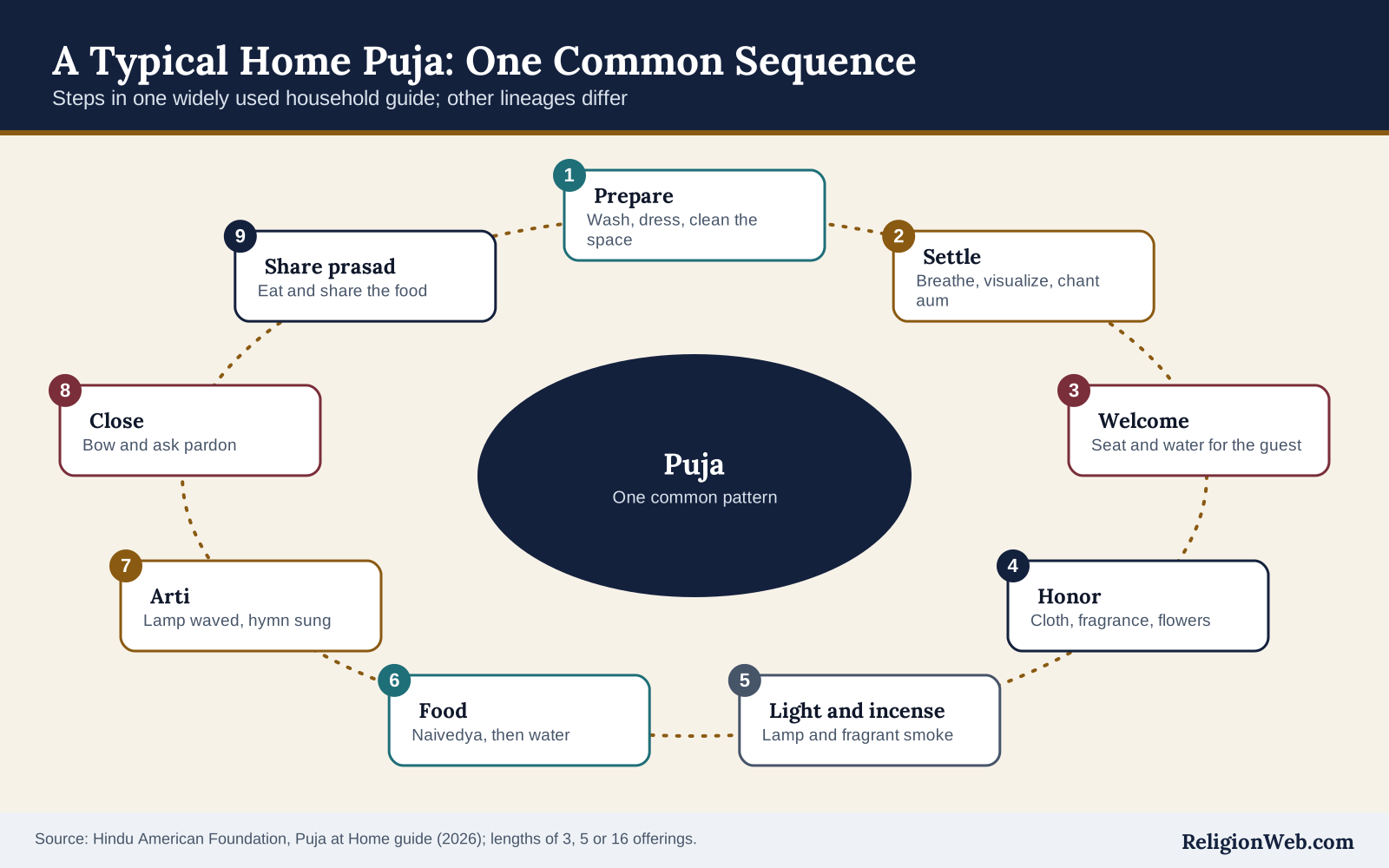
It helps to see an overall shape before looking at details. The Hindu American Foundation, a Hindu community organization, publishes a practical guide for Hindu households in the United States that gives a good example of how contemporary practitioners describe the order. In the guide, worshipers first prepare themselves and the space: they bathe or wash, wear clean clothes, clean the area, and arrange offerings on a tray. They then sit facing the shrine, breathe calmly, visualize the deity and chant aum. Next come the offerings, each dedicated with a mantra. The guide then closes the rite with a bow, a request for forgiveness for any errors, the eating and sharing of prasad, and a respectful way of storing or disposing of the items used.
This is one household pattern, and it comes in three lengths in the same guide: an express form with three offerings, a short form with five, and a thorough form with sixteen. Elaborate temple worship follows its own schedule, often organized around the daily awakening, bathing, dressing, feeding and resting of the deity. Later sections explain both patterns in detail.
Why no single script exists
Puja is taught mostly through families, temples and lineages, and the written manuals behind it come from different bodies of literature. Some follow Vedic and Puranic texts, while the temple traditions rely on the Agamas, ritual treatises that Britannica describes as conveying ritual knowledge, including early codes on temple building, image making and religious procedure. The Hindu American Foundation’s guide itself says its methods follow recommendations from “Vedic, Purāṇic, and Āgamic sources.” A Vaishnava household, a Shaiva temple, a Swaminarayan mandir and a Bengali family worshiping the Goddess may each follow a different manual, with different mantras, offerings and order of events.
That diversity does not make puja arbitrary. Within each lineage the order is usually fixed and carefully taught, and mistakes are taken seriously enough that many sequences end with a request for forgiveness. What it does mean is that no single description can be called “the” puja, and the same word covers a two-minute household lamp-lighting and a consecrated festival rite lasting through a night.
History and Development of Puja
From Vedic Sacrifice to Domestic and Devotional Worship
The Vedic ritual background
The oldest layer of Hindu ritual preserved in texts is the Vedic sacrifice (yajna), described in the Vedas and the ritual commentaries known as the Brahmanas. In it, specialist priests recite hymns and pour offerings such as clarified butter and grain into a consecrated fire, with the fire carrying the gift to the gods. The Vedic corpus and its later philosophical sections, the Upanishads, are described in the article on the Vedas and Upanishads. Elements of this older ritual survive in puja: the sacred fire (homa) still appears in elaborate rites and in many weddings and consecrations, and Vedic hymns are still recited at many pujas. Britannica lists offerings into the sacred fire among the elements of elaborate puja.
The older sacrifice and puja differ in form. Vedic sacrifice centers on the fire, and its offerings are poured into the flames; puja centers on an image or other focus and on the personal relationship of the worshiper with a deity. How the first became the second is debated, as the next paragraphs show.
Domestic rites and the Grihya Sutras
Alongside the large public sacrifices, early Indian literature describes household rites, collected in the manuals known as the Grihya Sutras. These manuals prescribe rites for the domestic fire, for birth, initiation, marriage and death, and for daily offerings. Bowker’s dictionary entry notes that puja is found in the Grihya Sutras with a focus on home rituals, which he says “remain central” to Hindu practice. This is significant because it means that the household, and not only the temple or the priestly specialist, has been a center of ritual from an early date.
The law codes known as the Dharmashastras, such as the Laws of Manu (chapter 3, verses 69 and 70 in the usual numbering), also describe the daily performance of five “great sacrifices” by householders: the study and teaching of the Veda, water and food offerings to the ancestors, the burnt offering to the gods, the bali offering to other beings, and the hospitable reception of guests. These ideas of household service to gods, ancestors and guests are part of the background to the later puja, in which the deity is served like a guest.
Scholarly theories about origins
Scholars have proposed different accounts of how puja arose. Bowker’s entry, drawing on the work of the Dutch Indologist Jan Gonda, reports the view that puja replaced the Vedic yajna in early Hinduism, taking over the pattern of invoking, receiving and entertaining the deity as a royal guest. He also reports the argument of the Bengali linguist Suniti Kumar Chatterji that puja developed in a culture outside the Vedic priesthood, that it was open to all, and that it used flowers, whereas the Vedic homa involved animal sacrifice. The etymology of the word, which Britannica and Bowker connect with a possibly Dravidian word for “flower,” is sometimes cited in support of that second view. These are interpretations, and many scholars consider that puja and sacrifice developed together over a long period, influencing one another, with no single source.
Images, Temples, and the Agamas
The growth of image worship and temples
Evidence for the veneration of images in India stretches back many centuries, but the great age of freestanding stone temples came in the first millennium CE. The specifics of early developments remain a subject of research, and this article avoids precise claims about the first image or temple. What the sources allow is the broad statement that, over the first millennium CE, temples with consecrated images became central institutions of Hindu life in many regions, supported by kings, merchants and communities, and that the worship conducted in them developed the pattern of daily attentions described above.
The Agamas and ritual manuals
The ritual manuals that govern most temple worship are the Agamas, a body of post-Vedic texts, and the related Pancharatra and Vaikhanasa manuals of Vaishnava temples and the Tantras of Shakta communities. Britannica describes the Agama as a “post-Vedic scripture conveying ritual knowledge,” believed to be revealed by a personal deity, and it dates the Shaiva Agamas probably to the eighth century CE. The texts supply, in its words, some of “the earliest codes of temple building” together with image making and religious procedure. BAPS, for instance, describes the consecration of its images as following the Pancharatra Agama. The Agamic tradition shaped what a temple is, who may serve in it and how the image is awakened, bathed and fed.
Devotion, Reform, and Modern Developments
Devotional movements
In the Tamil country, from about the seventh century CE, the Alvar poet-saints devoted to Vishnu and the Nayanar poet-saints devoted to Shiva composed hymns in Tamil, and over the following centuries devotional (bhakti) poets across the subcontinent composed in regional languages praising Vishnu, Shiva and the Goddess. Many of these songs became part of temple and household worship. They deepened the emotional tone of puja and gave it a vocabulary in languages such as Tamil, Kannada, Marathi, Bengali and Hindi. The Gita’s emphasis on devotion, discussed above, was interpreted by many commentators in the bhakti traditions, and the article on yoga in Hinduism places devotion among the classical paths.
Reform movements and debates over images
In the nineteenth century, several Hindu reform movements reconsidered image worship and ritual. The Arya Samaj, founded in 1875 by Dayananda Sarasvati, opposes the worship of images (murtis), according to Britannica, while upholding the efficacy of Vedic oblations to the fire. Other nineteenth-century movements, including the Brahmo Samaj, also criticized aspects of image worship. Against these, many traditions defended puja as a legitimate devotional form, and important figures within the tradition, including the nineteenth-century Bengali priest and devotee of the goddess Kali, Ramakrishna, practiced image worship as a profound path. These debates continue in different forms today and show that the practice has never been a settled consensus.
Migration and the modern temple
Migration in the twentieth century carried puja to East Africa, the Caribbean, Europe, North America and Australasia. In these places, community temples, many of them built in the later twentieth century, brought together Hindus from many regions, and household worship adapted to new homes. The Pluralism Project describes these temples, with images carved in Indian workshops and consecrated in the diaspora. Today puja is also shared online, and printed and digital guides offer short forms for busy households.
| Period | Development | Note |
|---|---|---|
| Vedic period | Fire sacrifice (yajna) with priestly recitation | Described in the Vedas and Brahmanas |
| Later Vedic and sutra period | Household rites collected in the Grihya Sutras | Bowker: puja appears here with a home focus |
| Around the turn of the era and after | Image veneration and temples spread | Details of earliest images are debated |
| By the first millennium CE | Agamic and Pancharatra manuals regulate temple worship | Shaiva Agamas probably 8th century (Britannica) |
| From about the 7th century CE | Alvar and Nayanar poet-saints; later bhakti poets in regional languages | Hymns enter temple and home worship |
| 1875 | Arya Samaj founded | Opposes image worship; upholds Vedic fire oblations (Britannica) |
| 20th century | Diaspora temples and household guides | Express, short and thorough home forms |
| 2015 | Supreme Court ruling on archaka appointments | Agamic rules weighed against constitutional limits |
Why Hindus Perform Puja: Hospitality, Devotion, and the Presence of God
The Deity as an Honored Guest
Hospitality as the model of worship
The most consistent explanation of puja in scholarly and community sources is the image of hospitality. Britannica says that the deity, shown in its image, is “accorded the honor given to a royal guest.” Bowker, quoting Jan Gonda, speaks of the “invocation, reception and entertainment of God as a royal guest.” The Pluralism Project’s account of temple worship says that a priest must be present every day to “offer honor, praise, and hospitality to the Divine guest.” Three independent summaries therefore converge on one picture: the worshiper is the host, the deity the guest, and the sequence of offerings is the sequence of courtesies owed to a visitor of the highest rank.
The hospitality model also explains features that might otherwise seem puzzling. The deity is wakened in the morning and put to bed at night because a house has a daily rhythm. Water is offered first because it is the first thing offered to a traveler. Food is offered, and a request is made to excuse any mistake, because a good host is anxious about the quality of the welcome. Bowker adds a historical suggestion, noting that the worship of deities, devapuja, “may have grown from hospitality toward brahmans,” a link between the courtesy owed to a learned guest and the courtesy owed to God. He presents this as a possibility, not an established origin.
Why the deity needs nothing and still receives gifts
Hindu thinkers have long recognized the objection that a God who made the world needs nothing from it. The answer in devotional literature is that worship is not a supply of needs but an expression of love, and that love seeks forms. A parent who receives a child’s drawing does not need the drawing; the gift matters because of what it carries. In that sense, offering is a relationship, not a payment. The Hindu American Foundation’s guide, written for practicing households, says that puja “sanctifies the home, purifies the mind, and strengthens spiritual connection,” which presents the benefit as falling to the worshiper.
What the Bhagavad Gita Says About Offering
Leaf, flower, fruit, and water
The scriptural text most often cited in discussions of puja is a verse in the ninth chapter of the Bhagavad Gita, spoken by Krishna to Arjuna on the eve of battle. In Telang’s translation it reads:
Whoever with devotion offers me leaf, flower, fruit, water, that, presented with devotion, I accept from him whose self is pure.
Bhagavad Gita 9.26, trans. K. T. Telang, Sacred Books of the East, vol. 8 (1882)
In the bhakti, or devotional, traditions the verse is read as a statement that God is accessible to anyone, rich or poor, learned or unlettered, since the four items named are among the humblest that anyone can find. The emphasis falls on the repeated phrase “with devotion” and on the purity of the giver rather than on the value of the gift. The Gita does not describe the sixteen-part puja, nor a temple, nor an image, and it would be an anachronism to read the verse as a ritual manual. It is better understood as a principle that later worship appeals to, and that devotional communities treat as the center of what offerings mean.
Whatever you do, offer it
The following verse widens the idea beyond ritual. In the same translation:
Whatever you do, O son of Kuntî! whatever you eat, whatever sacrifice you make, whatever you give, whatever penance you perform, do that as offered to me.
Bhagavad Gita 9.27, trans. K. T. Telang, Sacred Books of the East, vol. 8 (1882)
Here ordinary action, including eating, becomes an offering. This is one of the passages that links puja to the Gita’s wider teaching about acting without clinging to results, a theme developed in the articles on karma and dharma. In many Hindu families, this thought is acted out in a small way: a person offers the day’s food to the deity mentally before eating, a practice that Britannica notes also counts as making prasad.
The Image and the Presence of God
How worshipers understand the murti
The Pluralism Project describes the Hindu understanding of an image in terms that deserve quoting at length because they are often misreported. It states that Hindus believe the Supreme Being “has graciously condescended to dwell in the image,” that the image is “a window opening out toward God,” and that the Divine is also present throughout the universe, not only in the image. The rites of consecration are understood to be the occasion on which the presence becomes established in a particular form. After that, the image is treated as a living presence, with the daily care described elsewhere in this article.
The Harvard scholar Diana Eck, in her study of darshan, treats the image as a means by which the divine becomes visible. A review of her book in Education About Asia says it shows “the principle of oneness hidden in the multiplicity of deities.” Britannica’s entry on the murti defines it as the “form or embodiment of a deity,” and lists the Sanskrit synonyms vigraha, “form,” and pratima, “likeness.” These terms emphasize that the image is a form the deity takes for the worshiper, not the whole of the deity.
Disagreement within Hinduism about images
The Hindu tradition has never been unanimous about images. Britannica’s entry on the murti notes “a history of debate” within Hinduism about them, and the tradition includes forms of worship that use no image. The sacred fire of the Vedic ritual, the stone linga of Shiva, the sacred shalagrama stone of Vishnu and the meditative recitation of a name are all valid foci for devotion in some communities. Reform movements of the nineteenth century, discussed below, criticized image worship and gave priority to Vedic rites or to formless devotion. The practice of puja is therefore not defined by images alone, and the image debate is itself part of the tradition.
Purposes of Puja: Devotion, Gratitude, Petition, and Obligation
Daily devotion and thanksgiving
The most common reasons given for puja are gratitude and the wish to keep the household in the presence of the divine. A short morning lamp, a flower, a bow before the shrine at the start of the day, and the offering of food before meals are acts of remembering the source of life and sustenance. The Hindu American Foundation’s guide gives this reasoning in its opening: whether daily or occasional, puja sanctifies the home and strengthens spiritual connection. In households with a family deity or a particular teacher, daily puja is a part of what it means to belong to that family or lineage.
Vows, petitions, and occasions
People also perform puja to mark occasions and to ask for help. Pujas may be performed for a new business, a new home, a child’s naming, the start of a school year or a journey. Some pujas are vowed in return for an answered prayer, and others are a response to illness or difficulty. Hindu traditions place such petitions within the wider framework of devotion, and many teachers advise that asking for help is part of the relationship but not its goal. The idea that a family must perform puja for a specific outcome is rarely stated as a doctrine, but the practice of asking for blessings is common. Puja is a religious practice and not a medical or legal remedy, so anyone facing illness, mental distress or an emergency should seek professional help alongside any observance.
The Sequence of a Puja: Preparation, Invitation, Attentions, and Closing
Preparing the Worshiper and the Space
Cleanliness and purification
Almost every account of puja begins with purity of the person and the place. The Hindu American Foundation’s household guide asks the worshiper to shower, to wash the hands, feet and face before starting, to wear clean clothing, and to clean the area where the shrine stands. In temple practice the standards are usually stricter, and the priests who tend the image follow rules of bathing, dress and diet set down in the manuals of their lineage. The idea is not that dirt offends the deity but that a guest of honor deserves a clean house and a host who comes in a fit state.
What counts as purity differs across communities, and the details can be demanding or relaxed depending on the family, the region and the occasion. Some customs of ritual purity have been questioned by many Hindus today as well as defended by others. The practices a particular family keeps are the customs of that family and region, not requirements stated for all Hindus, and they should not be read as a universal rule.
Intention, calm and the opening mantra
Once the person and the place are ready, many pujas begin with a few moments of settling. In the Hindu American Foundation’s guide the worshiper sits facing the shrine with the offerings arranged on a tray, takes three deep breaths or performs a breathing exercise, visualizes the deity, and chants aum three times. This short phase is called dhyana, meditation, in the guide, and it frames the whole rite as an act of attention rather than a mechanical chore. The breath control and visualization tie puja to the contemplative practices discussed in the article on yoga in Hinduism.
In formal pujas, especially those performed by priests, the opening often includes a spoken statement of intention, called a sankalpa, in which the performer names the deity, the purpose of the worship and the time and place of the rite. The sipping of small measures of water (achamana) and an opening invocation of Ganesha, the deity traditionally honored at the start of an undertaking, are also common in priestly practice. The Hindu American Foundation’s household guide does not describe these steps, which illustrates how much the length and form of the rite can vary.
Invoking the Deity and Offering the Attentions
Welcome: invocation and seat
The central part of a puja is built on the logic of hospitality. The deity is invited, offered a seat, and then served in the way an honored guest would be served at home. When the image has already been consecrated in a temple or a household shrine, the deity is understood to be present already, and the invitation may be symbolic or omitted. When a puja is held for a festival image made for the occasion, as in many Ganesh and Durga celebrations, the deity is invoked into the image at the start and ritually released at the end.
Britannica describes this attitude directly: the image of the deity is accorded the honor given to a royal guest, and the attentions paid to it in a temple begin in the morning when the image is “gently roused from sleep.” The same account lists the attentions of a long temple day: ritual bathing and dressing, three meals, and a closing ceremony that puts the image to bed. A household puja condenses this daily cycle into a short visit.
The sixteen attentions
The best-known framework is the sixteen-part sequence called shodashopachara, in which the worshiper offers sixteen attentions (upacharas) in order. In the version printed in the Hindu American Foundation’s thorough household form, the sixteen are a seat, water for washing the feet, water for the hands, water for sipping, bathing, cloth, fragrance, unbroken rice grains, flowers, incense, a ghee lamp, food (followed by three spoonfuls of water), seasonal fruit, betel leaves and nuts, a monetary offering and a final camphor flame. Each is dedicated with a short mantra of the form “aum shri [name of deity] namah” followed by a phrase naming the offering.
| Order | Attention (upacāra) | What the worshiper does | Meaning commonly given |
|---|---|---|---|
| 1 | Seat (āsana) | Offers a seat or flowers as a seat | A place for the honored guest to rest |
| 2 | Water for the feet (pādya) | Offers a few drops of water | Refreshment after a journey |
| 3 | Water for the hands (arghya) | Offers water with respect | Courtesy of welcome |
| 4 | Water for sipping (ācamanīya) | Offers water to drink | Hospitality before the meal |
| 5 | Bathing (snāna) | Sprinkles water, or bathes the image | Cleansing and honor; the full form is abhiṣeka |
| 6 | Cloth (vastra) | Offers a garment or thread | Clothing the deity as a mark of care |
| 7 | Fragrance (gandha) | Applies sandalwood paste or scent | Beauty, coolness and welcome |
| 8 | Unbroken rice (akṣata) | Offers whole rice grains | Wholeness and auspiciousness |
| 9 | Flowers (puṣpa) | Offers flowers, often with a name mantra | Devotion offered in its simplest form |
| 10 | Incense (dhūpa) | Waves lit incense | Fragrant air as an offering and a purifier |
| 11 | Lamp (dīpa) | Offers a ghee lamp | Light dispelling darkness |
| 12 | Food (naivedya) | Offers a meal, then three spoonfuls of water | A meal for the guest; later returned as prasad |
| 13 | Fruit (phala) | Offers seasonal fruit | A seasonal gift; the first of the harvest |
| 14 | Betel leaves and nuts (tāmbūla) | Offers betel after the meal | Courtesy at the end of a feast |
| 15 | Monetary gift (dakṣiṇā) | Offers a coin or note | A gift of thanks, as to a teacher or priest |
| 16 | Camphor flame (ārati) | Waves a lit camphor flame | Closing honor with light |
The order of the sixteen follows the guide. The Sanskrit names are the standard terms for these attentions, and the last two columns are summaries of common practice and of the logic of hospitality that many practitioners and teachers describe. They are interpretation, not quotation from the guide, and individual manuals explain the symbolism of each step differently.
Why the lists differ
The number sixteen is a convention, not a fixed rule. Hindu ritual manuals describe shorter lists, such as a five-part form of fragrance, flowers, incense, lamp and food, which the Hindu American Foundation guide also offers as its “short” form, and the same guide gives a three-offering “express” form. Longer lists exist too. Some manuals begin the sixteen with an invocation of the deity and end with a bow and ritual dismissal, others add ornaments or a sacred thread, and still others expand the sequence to dozens of services. All of them draw on the same image of a king or honored guest being served.
The order and the mantras also differ. In some traditions each attention is accompanied by a verse of a Vedic hymn, in others by a name of the deity, and in others by Tamil, Telugu or Bengali devotional verses. The upshot is that the table above should be read as a typical structure, not an authoritative script.
Closing the Rite
Aarti and circumambulation
The final lamp of the sequence is the arti. Britannica defines it as the waving of lighted lamps before an image of a god or a person to be honored, and notes that it is one of the most common parts of both temple and private worship. The lamp, fed with ghee or burning camphor, is circled clockwise in front of the image, usually three or more times, while a prayer is recited or a hymn sung. In a household the sequence may end here, with the family standing together and often singing. In a temple the congregation may sing an arti hymn while a priest moves the lamp, and devotees commonly extend their hands toward the flame and then touch them to their eyes or forehead, receiving the blessing of the light.
Many worshipers also walk clockwise around the image, the shrine or the temple, a rite called pradakshina. Britannica lists circumambulation among the standard elements of puja. In a small household shrine, the worshiper may simply turn in place.
Forgiveness, prasad and disposal
After the lamp, the Hindu American Foundation’s guide closes with a mantra said with clasped hands and a bow, followed by kshamapana, a request for forgiveness: “Forgive me for any errors in this ceremony.” The same guide then asks the worshiper to eat and share the prasad, and finally to store the dedicated items respectfully or return them to nature in a way consistent with local ordinances. The request for pardon appears often in Hindu worship and reflects the humility of the host: whatever the care taken, the offering may have been imperfect.
The question of what to do with flowers, leaves and water after the puja has become practical. Offerings that are no longer fresh are traditionally not thrown away carelessly, and many families return them to a plant, a river or the earth. The Hindu American Foundation’s guide specifically recommends natural, ethically sourced materials. A later section on puja today returns to the environmental questions that arise at festival time.
Offerings in Puja and What They Mean
The Principle Behind the Offerings
Devotion over value
The most quoted statement about offerings in the Hindu scriptural tradition is not a list of required items. It is the Bhagavad Gita verse, discussed in the section on why Hindus perform puja, that says a leaf, a flower, a fruit or water offered with devotion is accepted. The verse is widely cited in Vaishnava and other devotional communities as the scriptural charter for puja: four humble items that anyone can find, offered in the right spirit, are enough. It does not claim that other offerings are wrong, and the Gita elsewhere discusses sacrifice, giving and austerity at length. What it underlines is the attitude of the giver, and the verse that follows extends the principle from objects to the whole of life. Readers interested in how the Gita connects offering with action and duty can find the wider context in the article on the Bhagavad Gita.
Offerings as hospitality and as symbol
There are two layers of meaning in nearly every item offered. At the level of hospitality, each is something a host gives a guest: a seat, water, clean cloth, a fragrant paste, food. At the level of symbol, each also stands for something larger. A lamp is light and knowledge, incense is the rising of devotion, water is purification and life, a flower is beauty given freely, food is the whole of one’s sustenance returned to its source. Hindu teachers differ on how much weight to give each layer, and many say that the inner offering of the heart is the real one. What most agree on is that the outer gifts are not bribes. Bowker’s dictionary entry distinguishes puja from sacrifice in just this way, noting that puja is the “invocation, reception and entertainment” of the deity as a royal guest.
Light, Water, Flowers, Incense, and Leaves
Light, water and fragrance
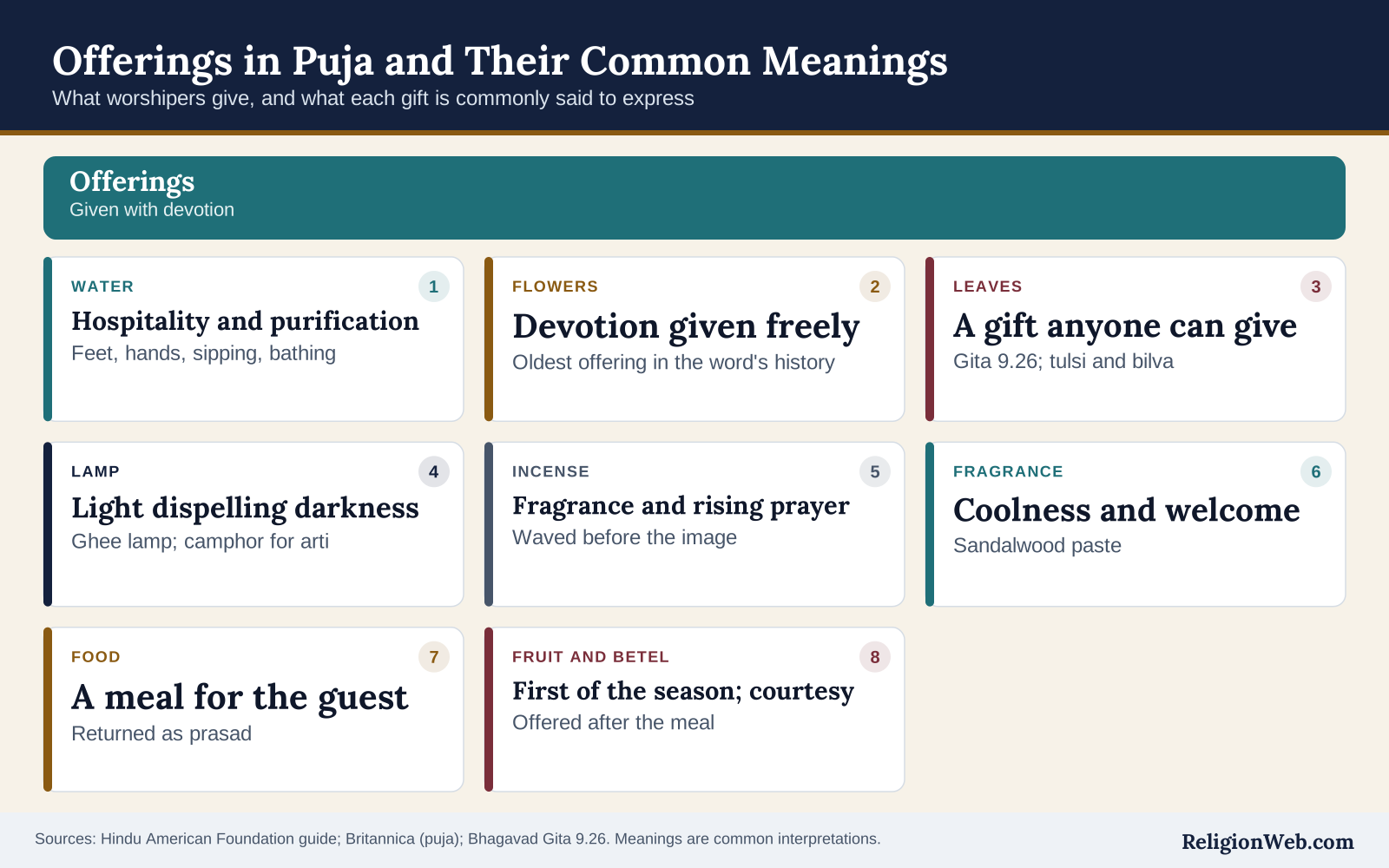
The simplest pujas use only three or five offerings. In the “short” household form published by the Hindu American Foundation, they are fragrance, flowers, incense, a lamp and food. Light is the offering most often made even when nothing else is: a clay or brass lamp with a cotton wick fed with ghee or oil is lit before the shrine in the morning and evening in many homes. Camphor, which burns cleanly without residue, is used for the final arti flame. Water appears several times in the sixteen-part sequence, for the feet, for the hands, for sipping and for bathing, and in many traditions it is poured from a small vessel, since water is the first thing offered to a visitor. Sandalwood paste and other cooling fragrances are offered and also applied to the forehead of worshipers as a mark. Incense adds a fragrant smoke that many practitioners associate with purification of the air and the rise of prayer.
Flowers and sacred leaves
Flowers are the offering most closely tied to the history of the word puja. Britannica relates it to a Dravidian word for flower, and the Gita verse just quoted names the flower among the four basic gifts. Flowers are offered whole or as petals, strung into garlands for the image, or scattered at its feet at the end of a mantra. Many traditions prefer particular flowers for particular deities. The Hindu American Foundation guide also defines patra, “leaf,” as including leaves from sacred plants such as tulasi (holy basil) and bilva. Britannica notes that holy basil is considered sacred in Hinduism, and the Pew Research Center’s India survey found that 72% of Hindus keep it at home; many households water the plant daily and walk around it as a form of worship. Because particular plants are closely tied to particular deities in the traditions, and these ties vary, it is best to ask a local priest rather than assume a universal rule.
Food, Fruit, and Other Gifts
Naivedya: the food offering
The food offered to a deity is called naivedya. The Hindu American Foundation’s guide places it at the center of the sixteen-part sequence, followed by three spoonfuls of water, the equivalent of washing after a meal. In temples, the food is cooked specially, often by trained cooks, and presented to the image several times a day. At home, a household typically offers a portion of what is being cooked, or a few sweets or fruit, before the family eats. Most temple and household naivedya in the Vaishnava and many other traditions is vegetarian, and ingredients are chosen with care. This is not true of every community: Britannica notes that elaborate puja can include sacrifice (bali), and some goddess shrines and village temples have long received animal offerings, a practice that many other Hindus reject and that is regulated or contested in several Indian states.
Fruit, betel and monetary gifts
Fruit follows the cooked food in the sixteen-part sequence, and in simpler pujas it may be the only edible offering. Coconut, banana and seasonal fruit are common, and the choice often follows the local harvest, which is part of the idea: the first of the season is given to the deity. The Hindu American Foundation’s guide includes betel leaves and nuts, traditionally served at the end of a meal, and a monetary offering called dakshina, which it places near the end of the sequence. In the temple, a donation box or a plate beside the priest serves a similar function, and a gift to the priest for performing a rite on one’s behalf is also called dakshina.
Sacred substances in bathing and festival rites
Rites of ritual bathing, abhishekam in the Tamil and Sanskrit usage of the temple, involve pouring liquids over the image. BAPS describes a consecration bath using 108 substances, each in its own pot with its own mantra. In ordinary temple and festival abhishekam, the liquids are typically water, milk, yogurt, honey, ghee and sugar, often mixed as panchamrita, the “five nectars.” The liquid is collected afterward and distributed as holy water. Offerings in festival worship also include special foods tied to the day, which the articles on Diwali and Navaratri describe in their own settings.
| Offering | How it is typically given | Meaning commonly given |
|---|---|---|
| Water | Poured or sprinkled, for feet, hands, sipping and bathing | Hospitality, purification, life |
| Flowers | Offered whole or as petals; garlands for the image | Devotion given freely; the oldest offering in the word’s history |
| Leaves (patra) | Placed before the image, often tulsi or bilva | Humble gift that anyone can give (Gita 9.26) |
| Lamp | Ghee or oil lamp; camphor flame for arti | Light dispelling darkness; honor to the deity |
| Incense | Waved before the image | Fragrance, purification, rising prayer |
| Fragrance (sandalwood paste) | Applied to the image and to worshipers | Coolness, beauty, welcome |
| Unbroken rice | Offered in small amounts | Wholeness, auspiciousness |
| Food (naivedya) | Cooked food or sweets placed before the image, then shared | A meal for the guest; returned as prasad |
| Fruit | Seasonal fruit, coconut, banana | The first of the season, given back |
| Betel leaves and nuts | Offered after the meal | Courtesy at the end of a feast |
| Money (dakṣiṇā) | A coin or note; a gift to the priest | Thanks; support of those who serve |
| Sacred fire (homa) | Ghee and grain offered into a consecrated fire | Link between Vedic ritual and later worship |
Ethical Questions About Offerings
Nonharm and the choice of materials
Offerings are expected to come from honest sources and to cause no unnecessary harm. The Hindu American Foundation’s household guide recommends “natural, ethically-sourced materials,” advises looking for organic, seasonal and non-artificial items, and discourages the use of harmful substances. In India and abroad, concern has grown about plastic wrappers, synthetic dyes, and the large quantity of flowers discarded after festivals. Some temples and municipalities now collect used flowers and convert them into compost, incense or dye, and many families keep a pot for spent offerings.
Gifts that others cannot give
Because offerings are gestures of devotion, the tradition generally holds that poverty is no barrier. The Gita verse quoted above and the many stories in the Puranas of devotees who offered only a leaf or a bit of water reinforce this. In practice, though, major temples run on large budgets, festivals can be costly, and some families feel obliged to match their neighbors. Hindu teachers and reformers from many periods have criticized ostentation in worship, and many families keep their daily puja deliberately simple for this reason.
Murti, Darshan, Aarti, and Prasad: How the Central Ideas Fit Together
The Murti: Image, Consecration, and Daily Care
Making and consecrating an image
A murti is made by craftspeople following traditional proportions, often in stone, metal or wood, and in many communities it is made again each year in clay for festival use. The Harvard Pluralism Project, describing temples in the United States, notes that the stone images enshrined there are usually carved from white marble in Jaipur or black granite in Mahabalipuram. Before consecration, it says, the stone is “still but stone.” Afterward, in the words of the same page, the image is “imbued with the permanent presence of God.”
The rite that effects this change is called prana pratishtha, the “establishing of breath,” and the Pluralism Project describes it together with an “eye-opening” rite. In the eye-opening, the craftsman carves or uncovers the pupils, and a mirror is held before the face so that the image’s first gaze falls on itself instead of on a human being. The BAPS Swaminarayan Sanstha, which follows a Pancharatra Agama manual, describes a longer sequence: the image is touched with sacred grass, immersed in water, laid on grain, bathed with 108 substances, its eyes uncovered with a golden needle, and then invested through mantras and touch with breath, life and the senses. Once the rite is complete, BAPS writes, “the murti is no longer termed murti but instead the deity invoked within the murti.” Different lineages perform different consecration rites, and what the rite accomplishes is explained differently by different teachers, but the basic claim is shared: an image after consecration is not treated as an object.
Daily care of the deity
After consecration, the image must be cared for. The Pluralism Project states that a priest must be present daily to “offer honor, praise, and hospitality to the Divine guest,” whether or not any worshiper is in the temple, with a weekly ritual bath (abhishekam) in addition to the daily rites. The temple day, as Britannica summarizes it, begins with rousing the image from sleep and continues with bathing, dressing, three meals and a closing ceremony of putting the image to bed.
The official schedule of the Tirumala Tirupati Devasthanams, which administers the Sri Venkateswara temple at Tirumala, shows how literally the pattern is kept in a major temple. On the day the schedule was consulted for this article, it listed Suprabhatam, the wake-up hymns, in the small hours of the morning; Thomala Seva, the offering of garlands; and a first Sahasranama Archana, the recitation of the deity’s thousand names, before dawn; and it closed the day with Ekanta Seva, the private night service. Times shift with the season and festivals, and a household’s schedule is much simpler, but the same logic of waking, serving and resting the deity runs through both.
Darshan: Seeing and Being Seen
What darshan means
The Sanskrit word darshana means “seeing.” In worship, it names the act of beholding a sacred image, a holy person or a sacred place and being seen in return. The Harvard scholar Diana Eck, in her book Darsan: Seeing the Divine Image in India, describes it as an exchange of sight, and a review of the book in Education About Asia summarizes her account of “a highly sensual and reciprocal relationship between god and man” in which the eyes are the “vehicles for viewing.” The review adds that, according to Eck, the images were consecrated so that the gods would gaze kindly at people, and that their eyes remain open “to protect the world.”
Darshan is therefore not only a visual experience. In Eck’s account, as the review summarizes it, seeing belongs to the whole process of puja, along with incense, chanting, receiving blessed food and touching the deity or something associated with it. This is why a visit to a temple may be described as “taking darshan” even when no formal puja is performed by the visitor: the encounter itself, with the image in view and the worshiper standing in its gaze, is the act of worship.
How devotees seek darshan
The practice of darshan shapes how temples are laid out and how visitors move through them. The sanctum (garbhagriha, the “womb chamber”) is usually a small, dark room in which the image is set at the end of a line of sight, and curtains may be drawn across it at certain times of the day to give the deity privacy. Worshipers join a line, fold their hands, and when the curtain opens or they arrive at the front, they look at the image’s face. The Pluralism Project reports that visitors to the temple it describes are advised to look first at the image’s reflection in a mirror and only then at its face, a custom connected to the eye-opening rite. Darshan can also be taken of a priest, a teacher or a sacred river, and the same word is used for the audience given by a respected person.
At home, darshan of the household shrine is the first thing many Hindus do on waking, folding their hands before the images before beginning the day. Because the image is always present in the household, it needs no queue.
Aarti: Light Offered, Light Received
The ritual action
Aarti is the rite of lamps. Britannica gives its Sanskrit name as aratrika and defines it as “the waving of lighted lamps before an image of a god or a person to be honored.” The lamp, with a flame fed by ghee or camphor, is circled in front of the image, and Britannica describes the circling as clockwise and repeated three times or more, during the recitation of a prayer, the chanting of a mantra or the singing of a hymn. Its account also notes that arti is used outside temples: in Indian homes it is a customary welcome for specially honored guests and appears in many domestic ceremonies.
The lamp may be a single wick or a multi-tiered lamp with many flames, and it may be accompanied by bells, drums or a conch shell. The hymn sung is typically specific to the deity or the tradition, so that Ganesha, Vishnu, Durga and a village goddess each have their own arti songs, often in the regional language.
What the light means
Aarti has several layers of meaning, depending on who is asked. In its simplest sense, the lamp is a gesture of honor offered to the deity, the last of the attentions in the sixteen-part sequence. In the usual explanation of practitioners, light symbolizes knowledge dispelling darkness and the radiance of the divine. In many temples, the priest brings the flame to the congregation after waving it before the image, and worshipers hold their hands over the flame and bring them to their eyes or forehead. In this movement the light that was offered to the deity returns to the worshiper as a blessing, a pattern that also governs prasad, as the next section shows. The anthropologist C. J. Fuller chose the camphor flame as the title of his well-known study of popular Hinduism, The Camphor Flame (1992).
Prasad: What Returns to the Worshiper
The ritual logic of offering and return
Prasad is the part of the offering that comes back. Britannica defines prasada as food and water offered to a deity during worship, and explains that worshipers believe the deity takes a portion and returns it, “thereby consecrating it.” The efficacy of prasad, it adds, “comes from its having been touched by the deity.” The offering is then distributed and eaten by the worshipers. The Sanskrit word itself, which Britannica glosses as meaning favor or grace, names the attitude: what comes back is a gift from the deity, not a leftover.
The idea of a divinely shared meal is old in Hindu literature. In the Bhagavad Gita, in the translation by Kashinath Trimbak Telang, the passage on sacrifice in the third chapter ends with a sentence about this kind of sharing:
The good, who eat the leavings of a sacrifice, are released from all sins.
Bhagavad Gita 3.13, trans. K. T. Telang, Sacred Books of the East, vol. 8 (1882)
In the Gita’s setting, “sacrifice” means the Vedic offering to the gods, not puja, and the verse sets the person who eats what remains after giving against the person who prepares food for himself alone. Later devotional traditions, including those in the Vaishnava lineages described in the article on Vaishnavism, read this idea into temple and household worship: food first given to God and then eaten is understood as sanctified, and the meal becomes a way of receiving grace. This is a devotional development of the verse’s logic, not its original context, and the Gita itself does not describe puja.
How prasad is shared and received
In practice, prasad is shared at the end of nearly every puja. At home, the food offered to the shrine is taken back, divided among the family and eaten, often after the arti. In a temple, the priest hands out prasad to devotees at the end of worship, usually in the form of fruit, sweets, cooked rice, sugar crystals or consecrated water. Britannica adds that food silently offered to God before a meal with proper prayers counts as prasad, and that the leftover food of a guru is considered prasad by the guru’s followers, because the guru is seen as a living representative of the divine.
Manners around prasad are meant to express respect. Many worshipers receive it with the right hand or both hands cupped, eat it without waste, and avoid discarding any of it. Some temples are known for their prasad, which pilgrims carry home to share with relatives and neighbors who could not make the journey, so that the blessing extends beyond those present.
Home Shrine and Temple: Settings, Roles, and Who May Perform Puja
Worship at Home
The household shrine
Most Hindu homes in India and the diaspora have some place set aside for the sacred. It may be a shelf in a kitchen, a cabinet with doors, a small wooden pavilion with a bell, or a dedicated room. The Hindu American Foundation’s guide advises placing the image on a raised surface, with the worshiper’s seat in front, and says a murti, a picture or a symbol of the Supreme Being may serve as the focus. Households commonly keep images of a family deity (kuladevata) or a deity of personal choice (ishta devata), and often of a teacher or saint, and the collection can grow over generations by inheritance, purchase at pilgrimage sites and gifts.
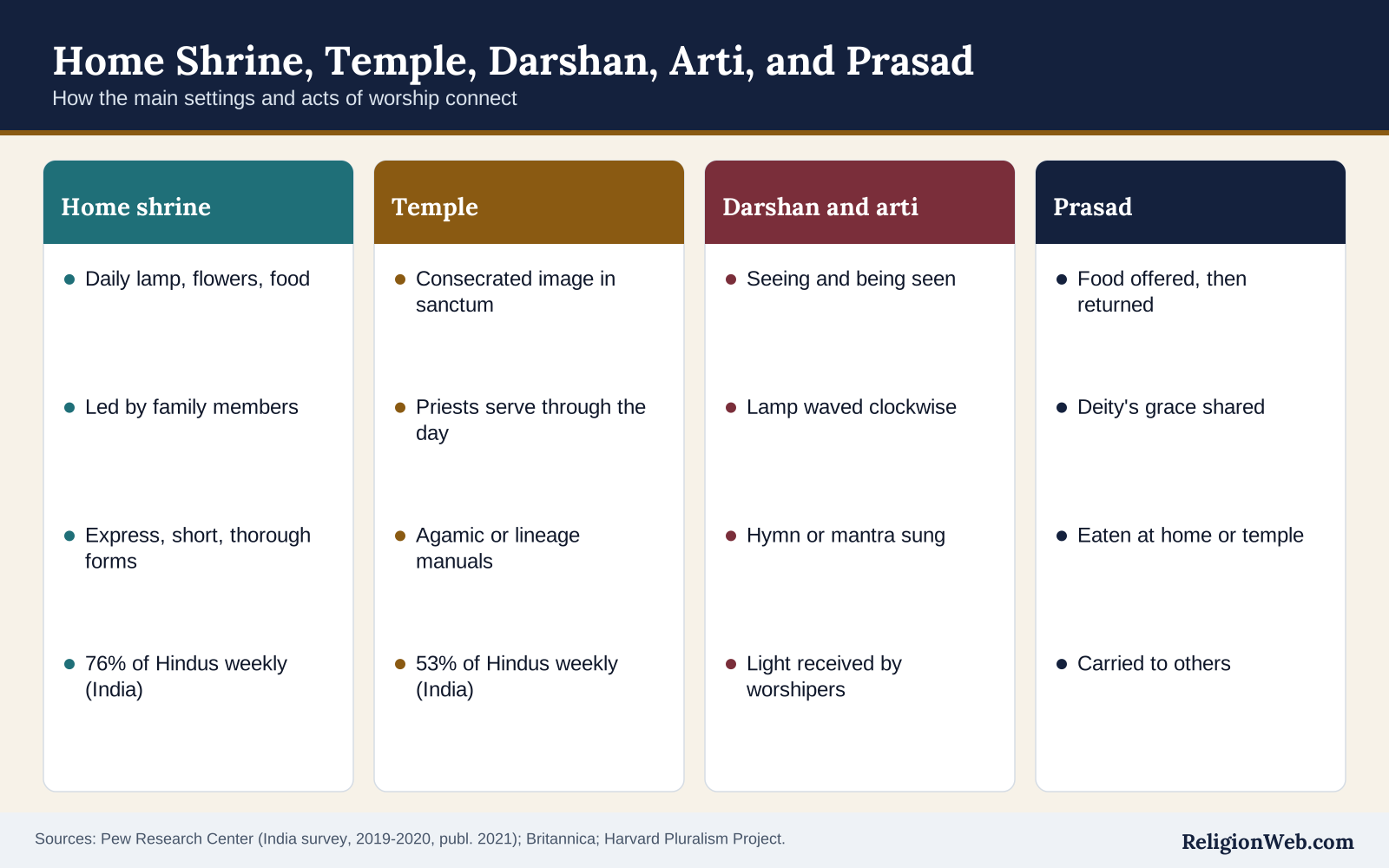
The shrine is tended daily by one or more members of the family. Survey data show how central the home is. The Pew Research Center found in its India survey that 76% of Hindus perform puja at home at least weekly, compared with 53% who do so at a temple each week.
Daily and weekly rhythms
The household rhythm often follows the day. A lamp is lit in the morning and evening; flowers are changed; water or milk is offered; and on certain days of the week or lunar month special worship or fasting is observed, depending on the family’s deity. Women are the main performers in many households. In the same Pew survey, 84% of Hindu women said they perform puja at home at least weekly, compared with 68% of Hindu men, while the gap at temples was much narrower (55% of women and 51% of men weekly). This is a pattern in the data for India in 2019 and 2020, not a universal rule, and practice varies by region, caste, generation and family.
Worship in the Temple
The temple as the deity’s residence
A Hindu temple is traditionally understood less as a meeting hall than as a house for the deity. Britannica notes that the Agamas supply some of the earliest codes of temple building, image making and religious procedure, and the plan of many temples, with the sanctum at the center and the tower above it, follows manuals of this kind. The image in the sanctum is cared for by priests throughout the day, as described earlier, and the temple is the setting for large festival pujas that a household could not perform.
The temple also serves as a community center. In India it may host weddings, naming ceremonies, music performances and the distribution of food. Abroad, temples such as those studied by the Pluralism Project provide classes in language, music and scripture as well as worship, and many are organized by regional or sectarian communities, so that a Tamil temple, a Gujarati Swaminarayan mandir and a Bengali Durga Puja committee may exist in the same city.
What visitors do
A visit to a temple usually follows a loose sequence. The visitor removes shoes, may wash hands and feet, rings a bell on the way in, and walks around the sanctum clockwise. The central act is darshan before the image. Visitors may then ask the priest to perform a short personal worship, often called archana, in which the priest recites the names of the deity along with the visitor’s name and family lineage while offerings brought by the visitor, such as flowers, fruit or a coconut, are presented. The priest returns part of the offering as prasad. Visitors may also donate, light a lamp, attend arti and sit for a while in silence. Temple practice differs widely, and large temples may sell tickets for special services, while a village shrine may have no priest at all.
| Feature | Home shrine | Temple |
|---|---|---|
| Setting | Shelf, cabinet or room; images of family deities and teachers | Sanctum with a consecrated image, often built to Agamic plans |
| Who performs | Family members, often women; a family priest for special occasions | Trained priests or temple attendants; visitors take part through darshan, offerings and arti |
| Typical length | Minutes to an hour; express, short and thorough forms | Cycle of services through the day; major rites may last hours |
| Offerings | Flowers, lamp, incense, a portion of the family’s food | Cooked food prepared in the temple kitchen, abhishekam, garlands, visitors’ gifts |
| Texts and manuals | Family tradition, printed prayer books, household guides, recorded chants | Agamas or other ritual manuals specific to the temple’s lineage |
| Consecration | Images may be consecrated by a priest or simply installed with prayer | Image consecrated by a formal rite (prana pratishtha) |
| Prasad | Taken back, shared with family | Distributed to devotees after services or at the temple’s food hall |
| Weekly practice in India (Pew, 2019 to 2020) | 76% of Hindus perform puja at home weekly | 53% of Hindus perform puja at a temple weekly |
Who Performs Puja: Householders, Priests, and Qualification
Householders and the freedom of devotion
The idea that only priests can perform puja is not borne out by the traditions themselves. Britannica states that some pujas can be done alone while others require a ritually qualified person such as a priest, and Bowker, discussing the Grihya Sutras, notes that domestic pujas remain central to Hindu practice. Home worship is conducted by lay family members, and in the bhakti traditions of devotion, access to God is meant to be open. The Gita verse about the leaf, the flower, the fruit and water is addressed to any devotee. A householder may therefore offer the full range of home puja without a priest, and the great majority of Hindu worship in India and abroad is done in precisely this way.
Priests, lineage, and debate over qualification
For elaborate rites, such as installing an image, performing a fire sacrifice or conducting a wedding, families engage a priest. Priestly service has historically been hereditary in many communities and, in the Brahmin tradition, tied to training in Sanskrit mantras and ritual manuals. In temples governed by the Agamas, the priest is called an archaka, and the Agama of the particular temple prescribes who may serve. This has been the subject of public and legal debate in India. In December 2015 the Supreme Court of India, in Adi Saiva Sivachariyargal Nala Sangam v. State of Tamil Nadu, held that appointments of archakas in Agamic temples must follow the Agama applicable to the temple, subject to constitutional limits, and that a distinction is not unlawful if it is not based on caste or birth, noting that “constitutional legitimacy, naturally, must supersede all religious beliefs or practices.” The ruling did not settle the debate over hereditary priesthood, and Hindu communities hold a range of views on it, from defense of lineage training to calls to open priestly training to people of all backgrounds.
Puja Across Traditions, Regions, and Occasions
Variation by Tradition
Vaishnava, Shaiva, and Shakta worship
The three major devotional streams of Hinduism each shape puja around their central deity. In Vaishnavism, the focus is Vishnu and his forms, including Krishna and Rama, and the sacred tulsi plant is closely associated with this worship. In Vaishnava temples the deity is often served with great attention to the daily cycle of waking, feeding and resting, and many follow ritual manuals called the Pancharatra or Vaikhanasa Agamas. In Shaivism, the principal image is often the linga, an aniconic form of Shiva, and worship centers on its ritual bathing (abhisheka) and on offerings of leaves, flowers and water, following the Shaiva Agamas. In Shaktism, the Goddess is worshiped as Durga, Kali, Lalita and many other forms, with festival pujas such as Durga Puja that involve the creation of an image, its invocation, days of worship and its immersion.
The deities, offerings and mantras differ, but the structure of invocation, attentions, arti and prasad is recognizable across the three. Britannica notes that the term Agama is applied in particular to Shaivite scriptures, probably of the eighth century, and contrasts them with the Vaishnava Samhitas and the Shakta Tantras, which fill a similar role for their communities.
Smarta, Swaminarayan, and other traditions
The Smarta tradition, which follows the Dharmashastra literature and often the philosophy of Advaita Vedanta, is associated with a household practice of honoring five deities, traditionally Ganesha, Surya, Vishnu, Shiva and Devi, with a worshiper free to choose a principal one. The BAPS Swaminarayan Sanstha follows the teachings of Swaminarayan and describes its own consecration rite, with Pancharatra Agama manuals, Vedic mantras, a 108-substance bath and an offering of a mountain of food (annakut) after the installation of the image. The rite, BAPS says, is completed by its guru, who opens the eyes of the image with a golden needle. Other communities, such as the Gaudiya Vaishnavas, emphasize the chanting of the names of Krishna alongside image worship.
Traditions that limit or reject image worship
Not every Hindu community uses images. The Arya Samaj, founded in 1875 by Dayananda Sarasvati, opposes the worship of images and upholds, in Britannica’s words, “the efficacy of Vedic oblations to the fire.” The Lingayats (Virashaivas) of southern India, whom oral tradition credits Basava with founding in the twelfth century, wear a small linga on a cord around the neck. Britannica reports that the community remains “opposed to worship of any image other than the lingam.” Many Arya Samajis and Lingayats regard their practice as authentically Hindu, although whether the Lingayat community is a separate religion has been debated in Karnataka. These examples show that puja in the sense of image worship is widespread but not universal.
| Tradition or occasion | Typical features of worship | Where to read more |
|---|---|---|
| Vaishnava household and temple | Images of Vishnu, Krishna or Rama; tulsi; manuals such as Pancharatra or Vaikhanasa; shared prasad | Vaishnavism |
| Shaiva temple and home | Linga worship, abhisheka, leaves and water; Shaiva Agama manuals | Shaivism |
| Shakta festival | Goddess image invoked, worshiped for days and immersed (Durga Puja, Navaratri) | Shaktism, Navaratri |
| Smarta household | Five deities honored, with one chosen as principal | Hinduism |
| Swaminarayan temple | Consecration under Pancharatra manual; food offerings and arti led by the guru’s tradition | Described above |
| Arya Samaj | No image worship; Vedic fire oblations | Described above |
| Lingayat household | Small linga worn on the body; no other image worshiped | Shaivism |
| Daily home worship | Lamp, flowers, a portion of food; express, short or thorough forms | Described above |
| Diwali | Evening worship of Lakshmi with lamps, sweets and household accounts | Diwali |
| Ganesh Chaturthi | Image of Ganesha anointed and offered food, then immersed in water on the last day | Puja Today, below |
| Life events | Pujas for a new home, a naming, a wedding or a new venture, often with a priest | Home and temple, above |
Variation by Region and Language
Language, music, and local customs
Regional culture colors puja at every point. The hymns sung at arti are in local languages, the foods offered follow the local cuisine, and the deities most honored differ from place to place. A Tamil temple may begin its day with hymns of the Alvar and Nayanar saints, a Bengali neighborhood may build its festival around Durga with drummers and a procession to the river, a Maharashtrian household may welcome a clay Ganesha, and a Gujarati community may hold a night of circle dancing for the Goddess during Navaratri. The Pew Research Center’s survey found that regional differences are visible in the numbers too: Hindus in southern India were much less likely than Hindus nationally to pray daily (30% compared with 59%).
Village and local deities
Beside the pan-Indian gods, many communities worship local deities: village goddesses, guardian spirits, deified heroes and family deities whose shrines are tended by local ritual specialists and whose worship may follow customs outside the Sanskritic manuals. Such worship is also called puja by participants and may include offerings, such as sacrifice, that are not part of the Vaishnava temples. This is the context for Britannica’s remark that elaborate puja can include sacrifice (bali). Scholars of Hinduism treat these local forms as an important part of the tradition, not a deviation from it.
Variation by Occasion
Daily, weekly, and monthly observances
The daily puja is the base. Many families then add weekly worship tied to a deity, with certain weekdays and days of the lunar month associated with particular gods, and observances such as fasts that involve a puja. The details are governed by the family’s tradition and by the almanac, and there are regional differences in which weekday is tied to which deity.
Festivals and life events
Festivals bring the largest pujas. On Diwali, many households worship Lakshmi in the evening, a rite explored in the article on Diwali. During Navaratri, the Goddess is honored for nine nights, as described in the article on Navaratri. At Holi, community rites include a bonfire and a day of color, covered in the article on Holi. Life events call for pujas too: a family may ask a priest to bless a new home or a new business, and weddings, naming ceremonies and funerals include rites that use the same ritual vocabulary of offerings, mantras and fire. For a one-time event, the priest sets the schedule according to the almanac, since the choice of an auspicious time is part of the rite.
Puja Today: Numbers, Diaspora Practice, and Practical Care
Puja in the Contemporary Hindu World
Where puja is practiced: the global picture
Puja is practiced wherever Hindus live. According to the Pew Research Center’s 2025 report on the global religious landscape, the number of Hindus rose from a little under 1.1 billion in 2010 to nearly 1.2 billion in 2020, and 95% of them (about 1.1 billion people) lived in India, where Hindus made up 79% of the population. Nepal’s population was 81% Hindu, and Mauritius was 48% Hindu. Outside Asia, the United States had the largest Hindu population, at 3.0 million, followed by the United Kingdom and the United Arab Emirates at about 1.1 million each. These figures describe religious identity, and they do not measure how often any individual performs puja, which is a separate question.
What surveys say about practice
The best large-scale evidence of practice comes from the Pew Research Center’s India survey, based on face-to-face interviews with 29,999 adults conducted from November 17, 2019, to March 23, 2020, before the first national COVID-19 lockdown. It found that about three in four Hindus (76%) perform puja at home at least weekly, that roughly half (53%) do so at a temple each week, that 72% keep holy basil at home, and that 59% pray daily. Regional differences were notable: Pew reported that Hindus in southern India were much less likely than Hindus nationally to pray daily (30% compared with 59%). Hindu women reported weekly home puja more often than men (84% compared with 68%). These numbers describe India at the end of 2019 and the start of 2020, and practice may have changed since.
For Hindus in the United States, the closest comparable evidence is Pew’s 2022-23 Survey of Asian Americans, reported in October 2023. It found that 79% of Asian American Hindus use an altar, shrine or religious symbol for worship in their home, a share that rose to 89% among those who say religion is very important in their lives. That question concerns the household shrine and not the frequency of puja, so it cannot be compared directly with the India figures.
Puja in the Diaspora and Online
Adapting household practice abroad
Hindu families in North America, Europe, East Africa, the Caribbean and elsewhere have adapted puja to apartments, work schedules and local regulations. The Hindu American Foundation’s guide acknowledges that in the United States “living spaces, schedules, and access to traditional items may differ,” while maintaining that “the heart of pūjā remains unchanged: sincerity, mindful awareness, and devotion.” The three lengths of puja it offers exist for this reason: a family with ten minutes in the morning can complete the express form. Because fire and incense can be restricted in apartments, many households substitute an electric lamp or use less smoke, and substitutes for hard-to-find items are widely accepted. Community temples abroad, many of them built since the 1970s, provide consecrated images and priests, and some also run classes for children in the rites.
Online worship and the question of authenticity
Technology has also changed the practice. Many temples livestream their daily services, and devotees take darshan on a screen. Some temples and private organizations offer to perform puja on a person’s behalf for a fee, booked through a website. Not all such services are legitimate. A notice posted on the website of the Shree Jagannath Temple Administration in Puri during the 2022 Ratha Yatra stated that the administration never accepts any donation or offerings from devotees for online puja, and warned devotees to beware of fraudulent websites offering such services. The practical advice for devotees is to book only through a temple’s own official channels, which usually publish their services and rates. Whether an online darshan or a puja performed by a priest at a distance carries the same religious meaning as in-person worship is a question on which Hindu teachers and communities differ.
Health, Safety, and the Environment
Fire, smoke, and fasting
Practical care belongs with the religious practice. Open flames from lamps and camphor need attention, especially in homes with children, and smoke from incense can bother people with asthma or other breathing conditions; ventilation or lighter incense helps. Many Hindus fast on certain days of the lunar month or before major pujas, and the tradition generally allows exceptions for children, the elderly, pregnant women and the ill. Religious observance is not a substitute for medical care, and anyone with a health condition who wishes to fast should follow the advice of a physician.
Festival images and waste
Ganesh Chaturthi, which Britannica says begins on the fourth day (chaturthi) of the month of Bhadrapada (August to September) and lasts for up to ten days, ends with statues of Ganesha that have been anointed and offered food being brought to water for immersion. Durga Puja ends similarly. The rite expresses the idea that the deity was invited for the festival and is then released. Environmental concern has grown about images made of plaster of Paris and painted with chemical dyes, which do not dissolve easily and can pollute water. Many communities have turned to unpainted clay images, home-scale immersion in a bucket, and symbolic immersion of a small image while the main one is kept or recycled. The Hindu American Foundation’s household guide takes the same approach, recommending that dedicated items be stored or returned to nature in keeping with local ordinances.
Common Misconceptions About Puja
Misconception 1: Every puja follows one universal script
Where the misunderstanding comes from
Many people first meet puja through a printed guide, an online video or a temple handout that presents a single numbered sequence. Such a list is useful for a beginner, and the sixteen-part sequence (shodashopachara) in particular is widely taught. A reader can easily take it for the official form of Hindu worship. Hindu communities themselves sometimes contribute to this impression, since a family or temple will often say, correctly, that “this is how puja is done,” meaning how it is done in that family’s or lineage’s practice.
What the evidence and tradition actually show
Even one practical household guide, the Hindu American Foundation’s, offers three different lengths of puja: an express form with three offerings, a short form with five and a thorough form with sixteen. Temple worship follows other manuals, since Britannica explains that the Agamas supply codes of temple building, image making and religious procedure, and these texts differ among Shaiva, Vaishnava and Shakta traditions. Home practice is shaped by family custom, region and language, and by the choice of a family deity. Bowker’s dictionary calls puja “immensely varied acts.” What stays constant is the structure of respect: a welcome, attentions given to the deity as to an honored guest, an offering of light, and a return of grace.
Writers of introductory material face a real dilemma. A guide that listed every variant would be unusable, so most choose one sequence and say little about the others. Readers who know this are well served by asking which tradition a given description reflects, and by treating any single account, including the ones in this article, as a representative example and not a rule.
The better statement is that puja has recognizable patterns, each with an internal order that is usually taken seriously by those who follow it. There is no single script that Hindus everywhere would recognize as the one correct form, and no central authority that sets one.
Differences also show up in the data on how people describe their own practice. In the Pew Research Center’s India survey, Hindus in the south were much less likely than Hindus nationally to say they pray daily (30% compared with 59%), and the survey found that home puja is more common among women than men (84% compared with 68% weekly). Such figures do not describe a single behavior repeated everywhere. They describe a family of practices that people adapt to their households, regions and stages of life.
Misconception 2: Murtis are simply decorative statues, or objects worshipers mistake for God
Where the misunderstanding comes from
To a visitor who sees a carved figure garlanded and offered food, two conclusions come easily: that the figure is a piece of art, or that the worshiper believes the stone itself is the creator of the universe. Both readings have a long history in outside commentary, and both can be found in older writing in English that used the word “idol” for any religious image. Within Hinduism, too, there has been disagreement about images, and Britannica notes a history of debate on the subject.
What the evidence and tradition actually show
The traditions that use murtis describe them in neither way. The Harvard Pluralism Project explains that, before consecration, the stone is “still but stone,” and that after the rites of eye-opening and the establishing of breath the image is understood to be “imbued with the permanent presence of God.” The same page adds that the Divine is also understood to be present throughout the universe, not only in the image, and calls the image “a window opening out toward God.” Diana Eck, in her study of darshan, treats the image as the means by which the divine and the devotee see one another. BAPS, a Swaminarayan organization, states that once the rites are complete the murti is no longer an image but “the deity invoked within the murti.”
Not all Hindus use images. Some reform movements, discussed in the section on traditions, reject image worship in favor of other forms of devotion, and some philosophical schools treat the image as a support for meditation on a deity or reality that has no form. Others, such as the many worshipers of the Shiva linga, use abstract forms. The accurate summary is that murti worship is common in Hinduism, is explained in several ways, and is rarely, if ever, understood as worship of a mere object. Observers who watch the care given to an image, the bathing, dressing and feeding described in earlier sections, are watching a form of hospitality offered to a presence, which is a different thing from veneration of a statue as art or as a rival to the creator.
It also helps to separate two questions that are often run together. One is whether Hindus believe the divine is present in an image, and the answer from the communities that use images is yes, after consecration and by the deity’s own gracious choice. The other is whether they believe the divine is limited to the image, and the answer in the sources quoted above is no. Eck’s phrase for what the review calls the “principle of oneness hidden in the multiplicity of deities” points the same way: the many forms are understood as ways the one divine reality becomes visible, not as separate objects of attachment.
Misconception 3: Only priests can perform any form of puja
Where the misunderstanding comes from
The most visible puja in public life is performed by priests: the wedding fire, the temple consecration, the festival rite on television. It is easy to conclude that the priest is the necessary agent. Some scholarly traditions of ritual also stress the training required of a priest, and certain temples are strict about who may enter the sanctum.
What the evidence and tradition actually show
Britannica states that some pujas are performed alone while others require a ritually qualified person such as a pujari. Bowker notes that puja appears in the Grihya Sutras with a focus on home rituals, which he says “remain central.” Survey data show how much worship takes place outside priestly hands: the Pew Research Center found that three in four Hindus in India (76%) perform puja at home at least weekly, and that Hindu women are more likely than men to do so (84% compared with 68%). The Hindu American Foundation guide is written for lay people, and a family’s daily worship needs no priest.
There are real distinctions between rites that need a priest and those that do not. Consecrating an image, conducting a fire sacrifice, performing certain life-cycle rites and serving in the sanctum of an Agamic temple are specialized tasks. The extent to which these roles are open to people of all backgrounds is a matter of ongoing public discussion in India, including a 2015 Supreme Court ruling noted earlier. The claim that all puja requires a priest, however, does not describe how Hindus worship.
The Gita verse on the leaf, flower, fruit and water makes no mention of a priest at all. The devotional traditions built on that outlook, including the bhakti movements that spread hymns in regional languages, stress that anyone may approach God directly. Priests are better understood as specialists whom families call upon for particular rites than as gatekeepers to all worship.
Misconception 4: Offerings are payment or bribes to persuade a deity to grant favors
Where the misunderstanding comes from
People who observe worshipers offering food, coins or garlands while asking for a successful exam or a recovery from illness can conclude that the exchange is transactional. Some Hindus do pray for specific favors, and traditions of vows (vrata) involve promises of offerings if a request is granted. A donor who gives a large gift to a temple may also be thanked by name.
What the evidence and tradition actually show
Petitionary worship is real, and Hindu traditions do not deny it. Still, the dominant scriptural and devotional statement about offerings emphasizes devotion rather than price. In the Bhagavad Gita, the deity says he accepts “leaf, flower, fruit, water” offered “with devotion” (9.26), and that whatever one does should be done “as offered to me” (9.27). Bowker describes puja as the invocation, reception and entertainment of God as a royal guest, which is the language of hospitality, not purchase. The return of prasad completes the picture: the worshiper does not buy a favor but shares a meal in which the host, the deity, has been served first. Hindu teachers differ on how far personal requests belong in worship, and the answer varies between traditions and families, but few describe offerings as a payment for services.
Seen from this angle, the sharing of prasad is the clearest evidence against the transactional reading. In the Gita’s verse about “the leavings of a sacrifice,” the person who eats what remains after giving is contrasted with the person who prepares food for himself alone. Whatever one thinks of how later traditions applied that idea, the pattern it describes is one of giving first, receiving afterward, and sharing with others, which is closer to a communal meal than to a purchase.
Frequently Asked Questions About Puja
Questions About Meaning
What is the difference between puja and prayer?
Puja is a form of worship that centers on offerings and hospitality, and prayer in the broad sense of speaking to the divine is one part of it. A person may pray silently without any offering, repeat a mantra (japa), sing a devotional hymn (bhajan) or meditate, and Hindu traditions regard all of these as worship. Puja adds a ritual frame: a focus such as an image, a sequence of attentions and a return of grace in the form of prasad. Many households combine them, so that a short puja is followed by hymns, a few minutes of silence or a recitation from a sacred text.
The distinction is partly one of emphasis, and some traditions blur it. In devotional communities the inner offering of love and attention is often described as the real puja, with the outer sequence as its expression. That is how the Hindu American Foundation’s guide phrases it when it says “sincerity, mindful awareness, and devotion” are what remain unchanged across all forms.
Why make offerings to a deity who needs nothing?
Hindu teachers have answered this question in several ways. One answer is that offerings express the worshiper’s gratitude and love and are valuable to the giver more than the receiver. Another is the logic of hospitality: just as a host serves a guest because the guest is honored, not because the guest is poor, so the devotee serves the deity. A third, found in devotional texts, is that God accepts the offering out of love for the devotee, as the Gita verse 9.26 states in saying that what is offered with devotion is accepted. The return of prasad shows that the exchange is not a one-way transfer: the offering becomes a gift from the deity.
Do Hindus worship many gods?
The answer depends on which tradition is asked. Many Vaishnavas, Shaivas and Shaktas understand one supreme reality as Vishnu, Shiva or the Goddess, with other deities as manifestations, aspects or devoted servants. Smarta communities traditionally honor five deities together. Advaita Vedanta, a school of philosophy, teaches that ultimate reality is one and without qualities, and that the gods are forms through which it can be approached. A fuller treatment of these views appears in the hub article on Hinduism.
Questions About Practice
What does a simple home puja need?
The Hindu American Foundation’s guide suggests a minimum of a clean space, a small tray, an image or picture, and any three of the following: fragrance, flowers, incense, a lamp and food. The worshiper sits facing the shrine, calms the breath, visualizes the deity and chants aum three times, then dedicates each offering with a mantra of the form “aum shri [name] namah.” The rite ends with a bow, a request for pardon, the eating of prasad and a respectful disposal of the items. People with no teacher often begin with a lamp and a flower, which is considered a complete offering in the simplest form.
How long does puja take?
It depends on the form. In the Hindu American Foundation’s guide, the express form takes five to seven minutes, the short form ten to twelve, and the thorough form twenty to thirty. A temple puja for a festival or a consecration may last several hours, and some large rites last through a day or night. A daily household offering may take only the minute needed to light a lamp.
Can someone who is not Hindu visit a temple or watch a puja?
Many temples welcome visitors, especially in India’s cities and in diaspora communities, and visitors usually take darshan, watch the arti and may be offered prasad. Dress is typically modest, shoes are removed, and photography may be restricted near the sanctum. Some temples in India admit only those who profess the Hindu faith, and some sanctums are open only to priests, so it is wise to inquire at the entrance or on the temple’s website. Visitors who are unsure of the etiquette can simply follow what the people ahead of them do.
Questions About Timing and Occasions
When is puja performed?
Many households perform some worship daily, often at dawn and dusk, with special pujas on festival days, on particular weekdays tied to a deity, on the days of the lunar month and at life events such as housewarmings, weddings and the birth of a child. The Hindu American Foundation’s guide describes puja as a practice that may be “daily or occasional,” and each household decides. Festival pujas are described in the articles on Diwali, Navaratri and Holi.
Why do the dates of festival pujas change each year?
Hindu festivals are set by lunar and solar calendars that differ from the Gregorian calendar, and the date of a festival such as Diwali or Navaratri therefore shifts from year to year on the Gregorian calendar. Observance also depends on the tithi, the lunar day, at specific times of day, so that a festival may fall on different days in different regions. For a given year, families usually consult a printed or online almanac (panchang) or follow the announcement of their temple. This article gives no festival dates for 2026 or 2027, since they should be taken from a calendar published by the family’s own tradition.
Conclusion: What Puja Shows About Hindu Worship
What the History and Practice Show
A practice of hospitality and return
Whatever the scale, puja is organized around a simple movement. The worshiper welcomes the deity, serves it as an honored guest with water, light, flowers, incense and food, and then receives something back: the sight of the image in darshan, the flame of the arti, the food of prasad. The sources used in this article describe that movement in different registers. Britannica speaks of a guest accorded the honor given to royalty, Bowker of the invocation, reception and entertainment of God, the Harvard Pluralism Project of “hospitality to the Divine guest,” and the Gita of an offering of leaf, flower, fruit and water accepted from a pure heart.
Variety within a shared structure
The picture that emerges is not one of uniformity. Puja is taught in households, temples and lineages, with three offerings or sixteen, with a priest or without, with Vedic verses, Sanskrit names, or songs in Tamil, Bengali, Gujarati or Marathi. This variety is not a flaw in the tradition but its normal condition, and explains why sweeping statements about “how Hindus worship” usually fail. The accurate statement is that Hindu worship has a few widely shared patterns, held in many local forms, and that what a given family or temple does is best learned from them.
How to Keep Exploring
Related topics on ReligionWeb
Readers who want to place puja in its wider setting can start with the hub article on Hinduism, then move to the traditions that give puja its particular forms, such as Shaivism, Vaishnavism and Shaktism. The ideas behind offering and duty are explored in the articles on dharma and karma, while the early ritual background appears in the article on the Vedas and Upanishads.
Learning from practitioners and communities
Because puja is a lived practice, written descriptions are a beginning and not a replacement for the families, priests and temple communities who carry it. A visit to a temple, an invitation to a festival at a friend’s home or a conversation with a priest will teach details that no general article can. Where a reader intends to perform puja, the best course is to follow the manual of a particular tradition or ask a teacher from it, and to treat any single printed sequence as one of several.
Sources
The table below lists the principal external sources behind this article. Facts, dates and figures were checked against these and related primary, institutional and academic materials.
| # | Source | Publisher and type | Used for | Link |
|---|---|---|---|---|
| 1 | The Bhagavadgita, trans. Kashinath Trimbak Telang (Sacred Books of the East, vol. 8, 1882) | Internet Sacred Text Archive (sacred-texts.com) · Primary text (public-domain translation) | Gita 9.26, 9.27 and 3.13 quotations (chapter pages sbe0811 and sbe0805) | sacred-texts.com |
| 2 | Puja (Hindu ritual) | Encyclopaedia Britannica · Encyclopedia | Definition, range of home and temple worship, honored-guest model, upacharas, pradakshina | britannica.com |
| 3 | Pujā, in The Concise Oxford Dictionary of World Religions (John Bowker, ed.) | Oxford University Press (via Encyclopedia.com) · Academic reference | Etymology, Gonda and Chatterji theories, Grihya Sutras, puja as hospitality | encyclopedia.com |
| 4 | Prasada | Encyclopaedia Britannica · Encyclopedia | Meaning of prasada, offering returned and consecrated, distribution to worshipers | britannica.com |
| 5 | Arti | Encyclopaedia Britannica · Encyclopedia | Definition and performance of arti; use for honored guests | britannica.com |
| 6 | Murti: The Image of God | The Pluralism Project, Harvard University · Academic reference | Consecration of images, presence of God in the image, daily care, darshan | pluralism.org |
| 7 | Murti Pratishtha | BAPS Swaminarayan Sanstha · Institutional | Stages of an image-consecration rite in one tradition | baps.org |
| 8 | Puja at Home: A Practical Guide for Hindu Americans | Hindu American Foundation · Community organization guide | Express, short and thorough home forms; list of sixteen offerings; closing steps | hinduamerican.org |
| 9 | Religious Practices, in Religion in India: Tolerance and Segregation (2021) | Pew Research Center · Demographic data | Share of Hindus performing puja weekly (survey Nov 2019 to Mar 2020) | pewresearch.org |
| 10 | A Sanskrit-English Dictionary (Monier-Williams, 1872), p. 647, entry prasada | Cologne Digital Sanskrit Dictionaries, University of Cologne · Reference (historical dictionary) | Range of senses of prasada (Fun Fact) | sanskrit-lexicon.uni-koeln.de |
Last fact-check date: 2026-10-21.