Vaishnavism is the family of Hindu devotional traditions in which Vishnu, the deity whose name means “the pervader,” is honored as the supreme divine reality, together with the forms in which he is believed to have come into the world as avatars (avatara, “descent”), above all Rama and Krishna. A follower is called a Vaishnava. Within the wider world of Hinduism, Vaishnavism is one of the major streams of devotion, and it has shaped temple architecture, poetry, music, dance, pilgrimage and daily household practice across the subcontinent for more than two thousand years.
At the center of Vaishnava life is bhakti, loving devotion directed to a personal God, and the conviction that God responds with grace. Vaishnavas turn to a shared set of sacred voices: the Vedic hymns to Vishnu, the Bhagavad Gita, the Ramayana and Mahabharata, the Bhagavata Purana, the ritual manuals called Pancharatra and Vaikhanasa Agamas, and the Tamil hymns of the twelve Alvars. They also look to teachers who founded or shaped lineages (sampradayas), such as Ramanuja, Madhva, Vallabha and Chaitanya.
The picture becomes more complicated as soon as one asks what Vaishnavas have in common. Some traditions place Vishnu or Narayana at the summit, with Krishna and Rama as his descents. Others teach that Krishna is the supreme God from whom all other forms flow, and still others center their devotion on Rama, on the Lord of Tirupati, on Jagannath of Puri, or on Vithoba of Pandharpur. These are not rival religions. They are different emphases within a family that has always been plural, and no single institution, creed or book speaks for every Vaishnava.
This article explains Vaishnavism on its own terms: who Vishnu is in Vaishnava understanding, how the tradition developed from Vedic hymns to a global community, what its theologians teach, which texts matter and why, how temple and household worship are carried out, how the festival year runs, and where pilgrims go. It names the sampradaya or region behind each claim, because “Vaishnavas believe” is rarely a complete sentence.
Vaishnavism at a Glance: Definition, Names, and Numbers
What “Vaishnava” and “Vaishnavism” Mean
How Vaishnavas Describe Their Own Path
The word Vaishnava is the Sanskrit adjective “of Vishnu,” used as a noun for a devotee. Many practitioners prefer older or more specific names. Bhagavata means a devotee of Bhagavan, the “Blessed Lord,” a title applied to Vishnu, Krishna and Narayana. Members of particular lineages identify themselves as Sri Vaishnavas, Gaudiya Vaishnavas, Pushtimargis, Ramanandis, Warkaris or Swaminarayan devotees, and in daily life a family often names its tradition before it names the broader category. For many, the most meaningful statement is not “I am a Vaishnava” but “I belong to this teacher’s lineage and serve this form of the Lord.”
Devotees also stress what the path is for. In the Bhagavad Gita, Krishna says that those who offer him love and devotion are dear to him, and later teachers elaborated that idea into different visions of liberation and love. Vaishnavas generally regard the goal as a lasting relationship with Vishnu or Krishna, whether in his heavenly abode Vaikuntha, in the eternal pastimes of Vrindavan, or in loving service that continues after release from rebirth. How that goal is described depends on the school, a point examined in the sections on theology and sampradayas below.
How Scholars Classify It
Scholars of South Asian religion usually treat Vaishnavism, Shaivism and Shaktism as the principal devotional streams of Hinduism, often adding Smartism as a fourth. Encyclopaedia Britannica describes Vaishnavism as one of the major forms of modern Hinduism, centered on devotion to Vishnu and his incarnations, and lists alternative English forms such as Vishnuism. The labels are an organizing framework rather than membership categories. Households often honor deities from more than one stream, and the same temple city can contain shrines of several.
Some scholars also distinguish “Krishnaism” and “Ramaism” as names for traditions that treat Krishna or Rama as the supreme form. Other scholars and many devotees regard that split as artificial, since Krishna and Rama are central to Vaishnavism in nearly every account of it. The usage here follows Britannica: Rama and Krishna are the most popular avatars, and their devotion is a core part of Vaishnava life, not something outside it.
Where Vaishnavism Is Found and How Large It Is
A Pan-Indian Tradition with Strong Regional Centers
Vaishnava communities are found across India and Nepal and in the diaspora, with concentrations that reflect history. Tamil Nadu is the home of the Alvars and the Sri Vaishnava temples of Srirangam and Kanchipuram. Karnataka and the Tulu coast hold the Madhva center at Udupi. The Braj region around Mathura and Vrindavan in Uttar Pradesh is the heartland of Krishna devotion, and Ayodhya is central to Rama devotion. Odisha is identified with Jagannath at Puri, Bengal and Manipur with Gaudiya Vaishnavism, Assam with Sankardeva’s reformed devotion, Maharashtra with the Warkari pilgrimage to Pandharpur, and Gujarat and Rajasthan with Pushtimarg and the Swaminarayan tradition. Kerala has the Guruvayur temple, and the Telugu region has Tirumala.
The result is a tradition that speaks many languages. Sanskrit remains the language of philosophy and much temple ritual, but the living voice of Vaishnava devotion is often vernacular: Tamil in the Alvar hymns, Marathi in the Warkari abhangas, Awadhi in Tulsidas’s Ramcharitmanas, Braj Bhasha in the poems of Surdas, Assamese in Sankardeva’s songs, and Bengali in the biographies of Chaitanya.
Why No Single Head Count Exists
No census asks Hindus whether they are Vaishnava, and the categories do not map neatly onto people’s lives. Pew Research Center estimated that nearly 1.2 billion people were Hindus in 2020, about 95 percent of them in India, but it did not divide that total by sect. Pew’s survey in India (fieldwork from November 2019 to March 2020, with 22,975 Hindu respondents) shows why such a division is difficult. When respondents who believed in God were asked which deity they feel closest to, with up to three choices allowed, 84 percent chose more than one god or said they have many personal gods. Krishna was named by 46 percent of Hindus in the Northeast and 14 percent in the South, while closeness to Rama was strongest in the Central region, at 27 percent.
These figures describe devotional affinity, not sectarian membership, and they cover all Hindus, not only those who call themselves Vaishnava. They do show that Krishna and Rama devotion varies sharply by region. Published estimates of the number of Vaishnavas, which run into the hundreds of millions, rest on assumptions about whom to count, and this article does not rely on any single figure. Where a specific sampradaya reports its own membership, that number is given with attribution.
Key Terms and Quick Facts
Essential Vocabulary
A handful of Sanskrit terms recur throughout the study of Vaishnavism. The table below defines the ones used most often in this article, in plain English, with the context where each matters. Diacritics are omitted for readability, and common alternative spellings are noted.
| Term | Plain-English meaning | Where it matters |
|---|---|---|
| Vishnu / Narayana / Hari | The supreme Lord of Vaishnavism, known by many names | All traditions; Narayana is the favored name in Sri Vaishnavism |
| Avatara | “Descent” of God into the world to restore order | Ten principal descents; Rama and Krishna are the best known |
| Bhakti | Loving devotion to a personal God | The central path in nearly every Vaishnava tradition |
| Prapatti / sharanagati | Surrender to God as refuge | Especially emphasized in Sri Vaishnavism |
| Sampradaya | A lineage of teachers handing down doctrine and practice | Sri, Brahma (Madhva), Rudra (Vallabha), Kumara (Nimbarka) and others |
| Murti / archa | The consecrated image through which God is worshiped | Temple and household worship |
| Darshan | “Seeing” the deity and being seen by the deity | Temple visits and festivals |
| Prasada | Food offered to God and then shared with devotees | Temple kitchens, festivals, home meals |
| Ekadashi | The eleventh lunar day, observed with fasting and worship of Vishnu | Twice a month; about 24 in a year |
| Vaikuntha | The heavenly abode of Vishnu | Sri Vaishnava and Madhva ideas of liberation |
Vaishnavism in a Single Table
The table that follows condenses the main facts of the tradition for orientation. Each entry is developed in the sections that follow, and variation between sampradayas is the rule rather than the exception.
| Feature | Summary |
|---|---|
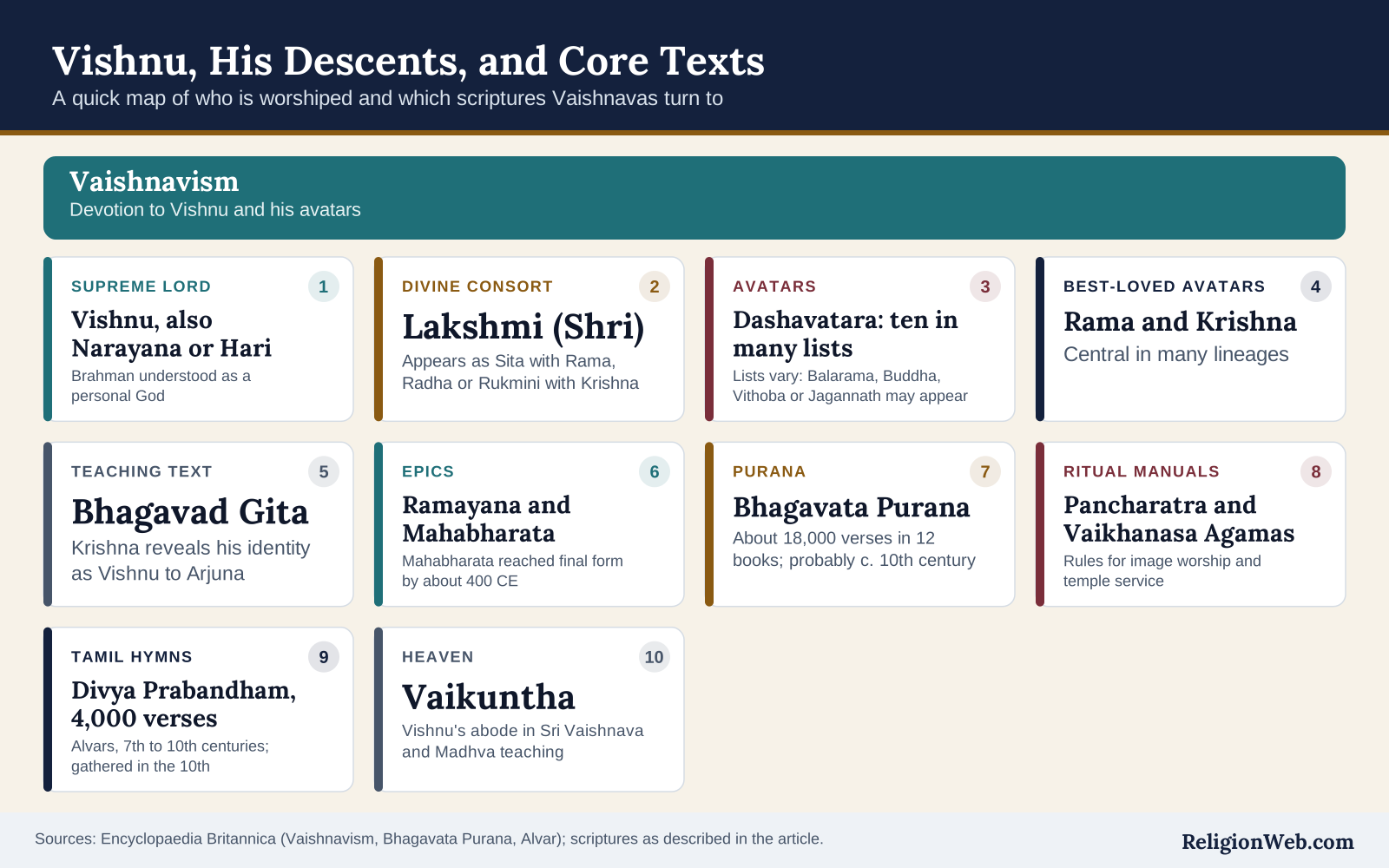
| Central deity | Vishnu, also called Narayana or Hari; in some traditions Krishna or Rama is regarded as the supreme form |
| Principal avatars | Ten primary descents (Dashavatara) in many lists; Rama and Krishna are the most widely worshiped |
| Divine consort | Lakshmi (Shri), appearing as Sita with Rama and as Radha or Rukmini with Krishna |
| Central practice | Bhakti: worship of images, chanting of divine names, singing, pilgrimage, fasting, service |
| Foundational texts | Vedic hymns to Vishnu, Bhagavad Gita, Ramayana, Mahabharata, Puranas (especially the Bhagavata), Pancharatra and Vaikhanasa Agamas, Alvar hymns |
| Major lineages | Sri (Ramanuja), Madhva, Nimbarka, Vallabha (Pushtimarg), Gaudiya (Chaitanya), Ramanandi, Swaminarayan, Warkari, Ekasarana |
| Key regions | Tamil Nadu, Karnataka, Andhra Pradesh, Kerala, Odisha, Bengal, Assam, Braj, Maharashtra, Gujarat, Rajasthan, Nepal, and diaspora communities |
| Characteristic festivals | Ekadashi, Rama Navami, Janmashtami, Ratha Yatra, Vaikuntha Ekadashi, Diwali, Govardhan Puja |
| Authority | Teachers, lineages and temple or monastic institutions; no single governing body |
The absence of a single authority is not a gap in the tradition. It reflects how Vaishnava teaching has been transmitted: from teacher to student, through temple liturgy, and through poetry and song in local languages. Each sampradaya has its own commentaries, its own order of worship, and often its own calendar of observances.
Origins and Historical Development of Vaishnavism
Vedic Roots and the Early Worship of Vishnu and Krishna
Vishnu in the Rigveda
The earliest literary evidence for Vishnu is in the Rigveda, the oldest Vedic collection, whose hymns are usually dated to roughly 1500 to 1000 BCE. Britannica notes that Vishnu was not a major deity in the Vedic period: a few hymns associate him with the Sun and celebrate the three strides by which he is said to have crossed the universe. One of the best known of these hymns, Rigveda 1.154, opens with a proclamation of his deeds.
I WILL declare the mighty deeds of Viṣṇu, of him who measured out the earthly regions, Who propped the highest place of congregation, thrice setting down his footstep, widely striding.
Rigveda 1.154.1, trans. Ralph T. H. Griffith (public-domain translation, as presented by the Internet Sacred Text Archive)
A verse from another hymn speaks of Vishnu’s highest dwelling in similar terms.
The princes evermore behold that loftiest place where Viṣṇu is, Laid as it were an eye in heaven.
Rigveda 1.22.20, trans. Ralph T. H. Griffith (public-domain translation, as presented by the Internet Sacred Text Archive)
Later Vaishnava commentators read these hymns as early testimony to Vishnu’s supreme abode. Sri Vaishnava teachers identify that “highest place” with Vaikuntha. Historians of religion are more cautious. They note that the hymns themselves present Vishnu as one of several deities, often allied with Indra, and they treat the three strides as the source of the later story of Vamana, the dwarf avatar who takes three steps and measures the cosmos. Both readings are historically influential, and the tradition does not require the Rigveda to say what later devotion says.
The Vedic Vishnu did not remain small. In the later Vedic ritual literature, Vishnu is increasingly linked with sacrifice itself, and in the Taittiriya Aranyaka a hymn to Narayana presents that figure as supreme. The slow movement from a minor Vedic deity to the object of a whole devotional tradition is one of the central questions in the history of Vaishnavism.
Narayana, Vasudeva-Krishna and the Bhagavata Community
Scholars generally agree that Vaishnavism did not come from a single source. Most reconstructions describe several streams that merged over the last centuries BCE and the early centuries CE: the Vedic Vishnu, the sage-god Narayana, Vasudeva, venerated by a community called the Bhagavatas, and Krishna, who in the epic is identified with Vasudeva. Later, the cowherd Krishna of Vrindavan, known as Gopala, became prominent in devotional literature. Historians disagree about the order of these developments and the weight of each. Some, such as the Indologist R. G. Bhandarkar, placed the decisive step in the identification of Vishnu with Narayana and Vasudeva-Krishna, while others emphasize the independent growth of Krishna devotion among pastoral communities.
Within the tradition, the story is told differently. Devotees hold that Vishnu or Krishna is eternal and that the revelations of the Vedas, the Pancharatra and the Bhagavata Purana are not human inventions. The two accounts, historical and devotional, answer different questions. One asks how a religious movement spread and changed; the other asks what that movement understands itself to be responding to.
The Heliodorus Pillar at Besnagar
The earliest firmly datable evidence for Bhagavata devotion is a stone column at Besnagar, near Vidisha in central India. An inscription in the Brahmi script records that Heliodorus, son of Dion, from Taxila, an ambassador sent by the Indo-Greek king Antialcidas, erected a Garuda standard in honor of Vasudeva, whom the text calls the “god of gods.” Garuda, the eagle, is Vishnu’s mount. The column is usually dated to the late second century BCE. A shorter inscription lists virtues that lead to heaven: self-restraint, generosity and attentiveness. Alexander Cunningham found the pillar in 1877, but it was covered in red paste from ritual use, and its inscriptions were not read until a cleaning in 1909 to 1910.
Historians differ on what the pillar proves. Some see it as one of the earliest records of a foreigner embracing Vaishnava devotion. Others argue that dedicating a monument to a god of a land one is visiting was a common practice and does not necessarily indicate conversion. What all agree on is that, by the late second century BCE, a Vasudeva-centered devotion existed, with a recognizable symbol, a royal audience, and a sufficiently prestigious site to attract a Greek diplomat.
Epics, Imperial Patronage and the Pancharatra
The Mahabharata, the Gita and the Ramayana
Britannica states that by the time the Mahabharata took its final form, around 400 CE, the avatars were being identified with Vishnu. That epic contains the Bhagavad Gita, in which Krishna reveals his identity as Vishnu to the warrior Arjuna, and a section called the Narayaniya in the Shanti Parva that presents a theology of Narayana and his emanations. Vaishnavas of nearly every lineage treat the Gita as a foundational text, and several founding teachers wrote commentaries on it.
The Ramayana is traditionally ascribed to the poet Valmiki. Many scholars regard its first and last books as later additions and see in them the clearest identification of Rama as an avatar of Vishnu, while the core narrative presents a human hero of exemplary virtue. Vaishnava traditions have generally read the whole text as the story of God come into the world, and Rama became the focus of devotion in lineages such as the Ramanandis, whose largest following is in northern India.
The Pancharatra and Vaikhanasa Traditions
Two ritual systems shaped how Vishnu is worshiped in temples. The Pancharatra, whose name is usually translated “five nights,” teaches that the supreme Narayana manifests in four forms or emanations (vyuhas) called Vasudeva, Samkarshana, Pradyumna and Aniruddha, and it prescribes the installation and worship of images. Tradition counts 108 Pancharatra Samhitas, though more than two hundred titles are listed and many texts are lost. Their composition dates are debated: the movement is generally traced to the last centuries BCE, while the surviving manuals are later. The Vaikhanasa tradition, which takes its name from the sage Vikhanas, is a separate system of temple ritual. Surviving Vaikhanasa sutras date to no earlier than the fourth century CE, and inscriptions from perhaps the eighth century identify Vaikhanasas as temple priests. The two systems coexist in South India, and the great teacher Vedanta Desika respected both.
Gupta-Era Kings, Stone Temples and Vishnu in Southeast Asia
In the fourth and fifth centuries CE, several Gupta rulers took the title parama-bhagavata, “supreme devotee of the Lord,” and patronized Vaishnava images and shrines. An early sixth-century temple at Deogarh in central India is often cited as a surviving expression of this patronage, with narrative panels of Vishnu’s forms. In later centuries, dynasties in the south endowed Vishnu temples as well, including at Tirumala. Vishnu was also adopted by royal courts beyond the subcontinent. The great temple of Angkor Wat in Cambodia, built in the twelfth century under King Suryavarman II, is dedicated to Vishnu, and Vishnu images survive in Thailand, Vietnam and Indonesia. These monuments show that the god’s reach was not confined to a single region or language.
The Alvars, Ramanuja and the Sanskrit-Tamil Synthesis
The Twelve Alvars and Their Tamil Hymns
Between the seventh and tenth centuries, poet-saints of the Tamil country known as the Alvars (“those immersed” in devotion, according to Britannica) wandered from temple to temple singing hymns to Vishnu. Tradition counts twelve, including a woman, Andal, who sang of her longing to marry the Lord, and Nammalvar, whose long poem the Tiruvaymoli is held by Sri Vaishnavas in particular reverence. Their songs were gathered in the tenth century by Nathamuni, a leader of the Sri Vaishnava community, into the Nalayira Divya Prabandham, the “Collection of 4,000 Songs,” and he introduced their regular singing in the Vaishnava temples of South India. The temples the Alvars praised are called Divya Desams, “sacred places,” and number 108 in the tradition.
The Alvars matter historically because they placed intense, personal devotion in the vernacular at the center of religious life, and later tradition called their collection the “Tamil Veda.” Britannica notes the view, supported by some scholars, that the Sanskrit Bhagavata Purana carried the Alvars’ devotion to Krishna into Sanskrit and thereby across India.
Yamunacharya, Ramanuja and Vishishtadvaita
After Nathamuni, the leadership of the Sri Vaishnava community passed to his grandson Yamunacharya (also called Alavandar) and then to Ramanuja, the figure whose name is most closely linked to the tradition’s philosophy. Traditional dates for Ramanuja are 1017 to 1137, which Britannica gives as approximate, while some modern historians propose later dates around 1077 to 1157. Much of his biography comes from later hagiography. He was born at Sriperumbudur in the Tamil country, served at temples in Kanchipuram and Srirangam, and wrote commentaries on the Brahma Sutras (the Sri Bhashya) and the Gita, along with other works. He developed Vishishtadvaita, “qualified non-dualism,” which is explained in the next section, and he is credited with organizing temple worship at Srirangam. Because the sources are mostly devotional, historians treat the details of his journeys, debates and reforms with care.
Medieval Devotion Across India and the Modern Era
The Spread of Bhakti in Many Languages
From the twelfth century onward, Vaishnava devotion expanded across the subcontinent in a series of regional movements. Britannica dates the emergence of devotional Vaishnava literature in Sanskrit and the vernaculars from the tenth through the sixteenth century. Jayadeva composed the Gita Govinda, a lyric poem on Krishna and Radha, in the twelfth century. Madhva, who taught in coastal Karnataka, is dated either 1199 to 1278 or 1238 to 1317 and established the Krishna Matha (monastery and temple) at Udupi. The Warkari tradition of Maharashtra took shape in the thirteenth century around saints such as Jnaneshwar and Namdev. The teacher Ramananda (about 1400 to 1470) is associated with Rama devotion and with teaching in Hindi, though Britannica notes that the documented history of the Ramanandi order does not reach back before the seventeenth century. In the fifteenth and sixteenth centuries, Sankardeva in Assam, Vallabha in the Braj region and Gujarat, and Chaitanya in Bengal each inspired lasting movements, and poets such as Surdas, Mirabai and Tulsidas composed devotional verse that is still sung today.
These movements shared a vocabulary of devotion but differed in theology, language and social outlook. Several of them, including the Ramananda and Sankardeva traditions, are remembered for welcoming devotees across caste lines, a topic taken up in the section on community and ethics. Historians also caution that the label “bhakti movement” can make a diverse set of regional developments sound more unified than it was.
Colonial Encounter, Reform and Global Spread
In the nineteenth century, new organizations grew within Vaishnavism. Sahajanand Swami (1781 to 1830), known as Swaminarayan, built a devotional community in Gujarat that now has several branches, including BAPS. In Bengal, Bhaktivinoda Thakur and later Bhaktisiddhanta Sarasvati worked to revive Gaudiya Vaishnavism. Bhaktisiddhanta’s disciple A. C. Bhaktivedanta Swami Prabhupada founded the International Society for Krishna Consciousness (ISKCON) in New York on July 13, 1966, and its public chanting, temples and festivals introduced many outside India to Krishna devotion. Meanwhile, Indian laborers carried the Ramcharitmanas and Vaishnava temple practice to Fiji, Mauritius, Trinidad, Guyana and South Africa, and later migrants founded temples in Britain, North America and elsewhere.
The table below summarizes the principal dates in this long development. Dates for early figures are approximate, and the sources do not always agree.
| Period | Development | Notes |
|---|---|---|
| c. 1500 to 1000 BCE | Hymns to Vishnu in the Rigveda | Vishnu is a minor deity linked with the Sun and the three strides |
| Late 2nd century BCE | Heliodorus pillar at Besnagar | Earliest datable record of Vasudeva devotion with a Garuda standard |
| Last centuries BCE to c. 400 CE | Epics and early Puranas take shape | Mahabharata reaches its final form around 400 CE |
| 4th to 6th centuries CE | Gupta-era patronage; Vaikhanasa and Pancharatra ritual systems | Rulers use the title parama-bhagavata |
| 7th to 10th centuries | Alvars compose Tamil hymns | Nathamuni gathers the 4,000 verses in the 10th century |
| c. 10th century | Bhagavata Purana composed | Probably in the Tamil region; some scholars propose an earlier date |
| 11th to 12th centuries | Ramanuja teaches at Srirangam; Jayadeva writes the Gita Govinda | Ramanuja’s traditional dates are 1017 to 1137 |
| 13th century | Madhva at Udupi; early Warkari saints | Madhva’s dates are given as 1199 to 1278 or 1238 to 1317 |
| c. 1400 to 1600 | Ramananda, Sankardeva, Vallabha, Chaitanya, Surdas, Mirabai | Regional movements in the vernaculars |
| Late 16th century | Tulsidas composes the Ramcharitmanas | Tradition says he began it in 1574 |
| 1781 to 1830 | Swaminarayan | Founder of the Swaminarayan Sampradaya |
| 1966 | ISKCON founded in New York | Gaudiya Vaishnava mission with temples worldwide |
Core Beliefs and Theology: Vishnu, the Soul, the World, and Grace
Vishnu as the Supreme Reality
One Lord, Many Names and Modes of Presence
Vaishnavism identifies the ultimate reality of the Upanishads, Brahman, with a personal God. Britannica summarizes the Vaishnava position as the view that absolute reality is manifested in Vishnu. The name is traditionally explained as “the one who pervades,” and in the Vaishnava understanding that pervasion is both a statement about God’s power and a promise of closeness: God is present everywhere, so no place or person is beyond reach. Hymns and lists of divine names, including the Vishnu Sahasranama, “the thousand names of Vishnu,” celebrate this fullness through epithets such as Narayana, Hari, Madhava, Keshava and Govinda.
Many Vaishnava teachers speak of God as present in several modes at once. The Pancharatra tradition and Ramanuja describe five: the supreme form in Vaikuntha (para), the four emanations that govern creation (vyuha), the descents into the world (vibhava, the avatars), the indwelling controller within every being (antaryamin), and the sacred image in temple and home (archa). The last is of particular practical importance. A worshiper who stands before a consecrated image in a temple or household shrine is, on this teaching, standing before God made accessible in a form that can be bathed, dressed, fed and sung to. Other schools phrase the doctrine differently, but the idea that the divine is present in an image is widely held across Vaishnava lineages, and it explains the elaborate rhythm of daily temple worship described later in this article.
Lakshmi and the Divine Couple
Vishnu is rarely imagined without his consort. Lakshmi, also called Shri, is the goddess of fortune and grace, and in many Vaishnava traditions she is not simply an attendant but an essential partner in the work of salvation. Britannica notes that Rama is often shown with his consort Sita, and Krishna with Radha or other gopis (cowherd women). Vishnu’s bodily consort is understood to appear in each descent: as Sita with Rama, as Rukmini or Radha with Krishna.
In Sri Vaishnavism, the tradition that follows Ramanuja, Lakshmi has a special theological role as mediator between God and the soul. She is described as the merciful mother who intercedes for the sinner before a Lord who might otherwise be approached with fear. Vedanta Desika, a major Sri Vaishnava theologian, described Lakshmi and Narayana as the divine couple who pervade and transcend the universe, with Lakshmi as supreme mother and Narayana as supreme father. In the Gaudiya tradition, Radha is understood as Krishna’s supreme beloved and as the highest model of love for God. Not every tradition gives the Goddess the same place: the Ekasarana tradition of Assam, for example, does not worship Radha beside Krishna. This variety is one reason the article treats the sampradayas separately.
Soul, World and Liberation: The Vedanta Schools
Qualified Non-Dualism in the Sri Vaishnava Tradition
Vaishnava thinkers have expressed their theology largely through commentaries on the Upanishads, the Brahma Sutras and the Gita, the three texts that define the philosophical school called Vedanta. Ramanuja’s answer is Vishishtadvaita, usually translated “qualified non-dualism.” In this view there are three eternal realities: God (Ishvara), conscious souls (chit) and non-conscious matter (achit). Souls and matter are real, not illusions, but they depend wholly on God, as a body depends on the self that animates it. The world is therefore God’s body, and God is its inner self. Ramanuja read the Upanishadic statements of unity, such as “that thou art,” as affirming this relationship of dependence and inseparability, not an identity that erases the soul. Within Vedanta this reading is one of several. Shankara’s Advaita school, for example, holds that individual distinctions are ultimately a superimposition, and Ramanuja’s commentaries set out his own reading in dialogue with that view. The schools are distinct positions in a long scholarly conversation, and describing one does not rank the others.
According to Sri Vaishnava teaching, liberation (moksha) comes after death and consists of serving God in Vaikuntha, with individuality retained. There is no liberation while living, in contrast to the idea of jivanmukti in Advaita. Devotion (bhakti) is the means, and Ramanuja stresses surrender to God as refuge (sharanagati or prapatti).
Other Vaishnava Philosophies: Dvaita, Bhedabheda and Shuddhadvaita
Other Vaishnava teachers read the same texts differently. Madhva (Dvaita, “dualism”) held that God, souls and matter are eternally distinct and that souls differ from one another. Britannica describes Dvaita as the belief in a basic difference in kind between God and individual souls, and Madhva’s system emphasizes that every soul depends on God for its existence and that liberation depends on God’s grace. Nimbarka taught Dvaitadvaita, “duality in unity,” according to which souls and the world are both distinct from and identical to God. Vallabha’s Shuddhadvaita, “pure non-dualism,” treats the world as a real manifestation of Krishna and not an illusion, and teaches that liberation comes by divine grace, called pushti, a word meaning “nourishment” or “flourishing.” Chaitanya’s followers developed Achintya-bhedabheda, “inconceivable difference and non-difference,” which holds that the relation between God and the world is beyond ordinary logical categories.
These positions are often summarized by the shorthand “monism, dualism and in between.” That is useful as a map but misleading as a verdict. Each school considers itself faithful to the Upanishads and the Gita, and each claims a lineage of teachers. They have debated one another over centuries in a spirit of scholastic argument, and pilgrims from every lineage visit major shared shrines such as Tirumala.
What Is the Goal: Moksha, Service or Love?
Britannica observes that the goal of devotion varies by sect: some seek liberation from the cycle of birth and death, others seek health, prosperity or the well-being of their children, and most hope to spend eternity in Vishnu’s presence after death. Within the theological schools, the answers are more precise. Sri Vaishnavas and Madhvas speak of Vaikuntha, the heaven of Vishnu, as the destination. Gaudiya Vaishnavas, according to their own teachers, regard pure love of God (prema) as the supreme aim, higher than liberation itself. The Ekasarana tradition of Assam treats devotion as the goal and rejects absorption into God (sayujya), but accepts liberation during life as well as after death.
These differences affect practice. Devotees who aim at everlasting service tend to emphasize temple ritual and the study of the commentaries. Those who stress love tend to emphasize kirtan, the chanting of divine names, and the cultivation of emotional relationships with God, which the tradition describes as parent and child, friend, servant or lover.
Bhakti, Grace and Surrender
Devotion as Daily Practice
The word bhakti comes from a root meaning “to share in” or “to be devoted,” and it names loving attachment to a personal God. Vaishnava teachers describe it as an activity as much as a feeling. A widely cited list in the Bhagavata Purana, spoken by the young devotee Prahlada, names nine ways of practicing it: hearing about God, singing his praise, remembering him, serving his feet, worshiping his image, bowing to him, serving him as a servant, befriending him as a friend, and offering oneself entirely to him. Teachers in different lineages emphasize different items on the list. The Bhagavata itself is the source for Gaudiya, Pushtimarg and Ekasarana ideas of devotion, and the Gita offers one of its best-known statements in the ninth chapter.
Whoso shall offer Me in faith and love / A leaf, a flower, a fruit, water poured forth, / That offering I accept, lovingly made / With pious will. Whate’er thou doest, Prince! / Eating or sacrificing, giving gifts, / Praying or fasting, let it all be done / For Me, as Mine.
Bhagavad Gita, Chapter IX, trans. Edwin Arnold, The Song Celestial (1885), public domain via Project Gutenberg (Arnold does not number the verses)
In Vaishnava commentary, this passage is read as a statement that God asks not for wealth, learning or elaborate ritual but for the love in which an offering is made. The commentators of different lineages, including Ramanuja and Madhva, wrote on the Gita, and Vaishnava teachers commonly cite this passage in explaining why the daily offering of food and flowers to the image is not a payment but a gift of affection. The last lines extend that logic: ordinary acts such as eating, giving or fasting become devotion when they are directed to God.
Grace, Surrender and the Debate Over Effort
Within Sri Vaishnavism, the theme of surrender has a long and sometimes sharp internal debate. The two main communities, the Vadakalai (“northern” school, associated with Kanchipuram and Sanskrit scholarship) and the Tenkalai (“southern” school, associated with Srirangam and the Tamil hymns), agree that God is merciful and that surrender is the supreme act. They differ on how much the soul contributes. In the traditional analogies preserved in eighteenth-century Tamil texts, the Tenkalai compare divine rescue to a mother cat carrying her kitten, which does nothing, while the Vadakalai compare it to a baby monkey that must cling to its mother. Historians differ on when the two communities took distinct shape, placing the process between the sixteenth and eighteenth centuries.
Pushtimarg, the tradition of Vallabha, places a similar weight on grace, as its name indicates: the “path of nourishment” holds that the highest devotion is attainable only through God’s favor, and that personal effort or ritual achievement is not essential, according to Britannica. In both cases the shared conviction is that God takes the initiative. A related idea runs through the Alvar hymns, in which the poets describe themselves as chosen by the Lord, and it informs the Vaishnava practice of seeking a teacher through whom the grace is thought to flow.
Karma, Rebirth and Dharma in Vaishnava Thought
Action, Rebirth and the Possibility of Release
Vaishnavism shares with the wider Hindu tradition the ideas of karma (action and its consequences), samsara (the cycle of birth, death and rebirth) and moksha (release). What distinguishes Vaishnava teaching is the place it gives to grace within that framework. The Gita presents karma as binding unless actions are offered to God, and Krishna’s promise to free the devotee from the bondage of action is among the most quoted passages in Vaishnava preaching. In Pew’s 2019 to 2020 survey in India, 77 percent of Hindus said they believe in karma, a figure that applies to Hindus generally, not to Vaishnavas alone. Vaishnava teaching adds that the soul’s real home is with God and that devotion, not mere accumulation of merit, is the way to reach it.
Dharma and the Divine Order
Dharma, the moral and cosmic order that sustains the world, is closely bound to Vishnu’s role. Britannica notes that Vishnu defends traditional righteousness through his avatars, in keeping with the moral law. The Puranas place this defense within a cyclical view of time, divided into four ages (yugas), of which the present age, the Kali Yuga, is traditionally regarded as a time of moral decline. Many Vaishnava teachers regard the chanting of divine names as the most effective practice for this age, a conviction that underlies the kirtan traditions of Chaitanya’s followers and the name-recitation of Tulsidas and the Ramanandis. The next section examines how the doctrine of divine descent works in detail.
Avatars and Devotional Figures: Rama, Krishna, and the Many Forms of the Lord
The Doctrine of Avatara
What “Descent” Means in Vaishnava Teaching
The Sanskrit word avatara means “descent” or “crossing down.” In Vaishnava teaching it names the belief that Vishnu, who is without beginning and beyond birth, takes a form within the world for the sake of its protection. The best-known statement is in the fourth chapter of the Gita, where Krishna says, in paraphrase, that whenever righteousness declines and disorder rises he brings himself forth, age after age, to protect the good and to restore dharma. Britannica summarizes the doctrine in the same terms: Vishnu defends traditional righteousness through his avatars, in keeping with the moral law.
Vaishnava schools explain the descent in different ways, though all agree that the divine form is real and not an appearance. Ramanuja taught that the avatar’s body is made of pure divine substance and is not an ordinary material body, which is why it is called a “descent” and not a birth. Some teachers distinguish between full manifestations and partial ones, and between descents that restore order and those that exist for the sake of divine play (lila). Others, notably the Gaudiya tradition, teach that Krishna is not one avatar among others but the source of all of them, a conviction that rests on a verse in the Bhagavata Purana (1.3.28) which Gaudiya authors read as stating that Krishna is Bhagavan himself. That is a doctrinal claim within one lineage, and other lineages place Vishnu or Narayana at the summit.
The Ten Avatars and Why the Lists Differ
The most familiar list is the Dashavatara, the “ten descents”: Matsya the fish, Kurma the tortoise, Varaha the boar, Narasimha the man-lion, Vamana the dwarf, Parashurama, Rama, Krishna, the Buddha, and Kalki, who is expected at the end of the present age. Britannica notes, however, that the set of ten is not always the same. Several Puranas, including the Agni, Padma, Garuda and Narada Puranas, give the list with the Buddha; some Sri Vaishnava authors and the Tamil text Paripatal are cited for lists that place Balarama, Krishna’s brother, in the eighth place and Krishna in the ninth. Gaudiya Vaishnavas count Balarama and the Buddha, with Krishna treated as the source of all. In Maharashtra, Warkari tradition has the figure of Vithoba take the place of the Buddha, and some Odia works place Jagannath there. Other lists run much longer: the Bhagavata Purana enumerates twenty-two avatars, and Pancharatra texts list thirty-nine. The number ten seems to have been largely settled before the tenth century, and the Buddha appears in several Puranas by about the eighth century.
Because of this variety, it is more accurate to say that the Dashavatara is the best-known version of an open doctrine than a fixed canon. The table below gives the standard ten, with the story each is traditionally associated with, and notes where the lists diverge.
| Avatar | Form | Traditional story in brief | Notes on devotion and variation |
|---|---|---|---|
| Matsya | Fish | Saves the first human and the Vedas from a great flood | Appears in the Matsya and Bhagavata Puranas |
| Kurma | Tortoise | Supports the mountain used to churn the ocean for the nectar of immortality | The churning is retold in many Puranas |
| Varaha | Boar | Lifts the earth from the cosmic waters on his tusks | Temple images in many regions; also a name of a Purana |
| Narasimha | Man-lion | Emerges from a pillar to protect the child devotee Prahlada from his father | Festival of Narasimha Jayanti; shrines across the Deccan |
| Vamana | Dwarf | Asks the king Bali for three steps of land and measures the cosmos | Linked to the Vedic three strides; honored in Kerala at Onam |
| Parashurama | “Rama with the axe” | A sage-warrior who confronts abuse of royal power | Revered in coastal Karnataka and Kerala |
| Rama | Prince of Ayodhya | Exile, the abduction of Sita and the defeat of Ravana | Ramayana, Ramcharitmanas, Rama Navami, Ramlila |
| Krishna | Cowherd, charioteer, teacher | Born at Mathura, raised in Gokula and Vrindavan, counselor of Arjuna | Bhagavata Purana, Gita, Janmashtami; supreme in several lineages |
| Buddha (or Balarama) | Sage (or Krishna’s brother) | Lists vary: many Puranas name the Buddha; others name Balarama | Gaudiya lists include both; Warkari lists name Vithoba |
| Kalki | Warrior on a white horse | Expected at the end of the present age to restore righteousness | The one avatar who has not yet appeared |
Rama and Krishna: The Two Great Devotions
Rama, Sita and Hanuman
Rama is revered as the model of righteous conduct: the obedient son who accepts exile, the faithful husband, the just king. His story is told in Valmiki’s Sanskrit Ramayana and retold in many languages. Britannica calls him one of the most widely worshiped Hindu deities and the epitome of moral righteousness. For Ramanandi Vaishnavas, Rama and Sita together are the supreme reality, and the greeting “Sita-Ram” is an everyday expression of that devotion. Tulsidas’s Ramcharitmanas, composed in Awadhi in the late sixteenth century, brought the story into the speech of ordinary people and remains a text that families recite and sing.
The story is also performed. UNESCO inscribed Ramlila, the traditional performance of the Ramayana, on its Representative List of the Intangible Cultural Heritage of Humanity in 2008, describing a staged sequence of song, narration, recitation and dialogue held during the autumn Dussehra season in hundreds of towns and villages, often drawing on the Ramcharitmanas. In Ayodhya, in Ramnagar near Varanasi and in other places, the performance becomes a community event with villagers taking part. Hanuman, the monkey devotee who serves Rama, is a model of selfless service and a popular figure of strength and protection in his own right. Rama is also the object of devotion in the south, where the Telugu composer Tyagaraja, who lived in the late eighteenth and early nineteenth centuries, devoted most of his songs to him.
Krishna, Radha and the Gopis
Krishna is the avatar with the widest range of roles. In the Mahabharata he is the counselor and charioteer of Arjuna and the teacher of the Gita. In the Bhagavata Purana, whose tenth book makes up about a quarter of the text, he is the child born in a prison at Mathura who is carried across the Yamuna to be raised among cowherds, the mischievous boy of Vrindavan, the flute-player who draws the gopis into the circle dance (rasa lila), and the king of Dwarka. Britannica calls the tenth book the most popular among Vaishnavas and a key source for devotional ritual and art.
Different lineages emphasize different Krishnas. Pushtimarg, the tradition of Vallabha, centers on the youthful Krishna of the Bhagavata and the child form Shrinathji, whom devotees serve like a beloved child in household-like temples. Gaudiya Vaishnavas, following Chaitanya, honor Krishna with Radha, understood as his supreme beloved, and take Vrindavan as the setting of the highest form of devotion. Nimbarka’s tradition also centers on Radha and Krishna. The Warkaris know the Lord as Vithoba of Pandharpur, and the Ekasarana tradition of Assam worships Krishna as Narayana without Radha. All of these are Krishna devotion, and none stands outside Vaishnavism; they are the forms that the tradition has taken in different regions and centuries.
Other Forms of the Lord and Exemplary Devotees
Narasimha, Varaha and Vamana
Some avatars are honored in specific festivals and temples. Narasimha, the man-lion, is associated with protection from fear and is widely worshiped in the Deccan, where many of his temples stand on hills. His story centers on the devotee Prahlada, whose father, the demon king Hiranyakashipu, demands that he be worshiped as God. Varaha, the boar, lifts the earth from the waters, and his images appear in temples and sculptures across India. Vamana is remembered at Onam in Kerala and in the three steps that echo the Rigvedic hymns. In each case, the tradition draws out a moral: God protects the devotee, restores the earth, and reverses the pride of the powerful.
Venkateswara, Ranganatha, Jagannath, Vithoba and Other Local Forms
Beyond the named avatars, Vaishnava devotion is anchored in local forms of the Lord. Venkateswara (also called Balaji, Srinivasa or Govinda) presides at Tirumala in Andhra Pradesh. Ranganatha, Vishnu reclining on the serpent Adishesha, is worshiped at Srirangam on an island in the Kaveri River. Jagannath, “Lord of the World,” is the central deity of Puri in Odisha, worshiped with his brother Balabhadra and sister Subhadra. Vithoba is the Lord of Pandharpur, Guruvayurappan of the Guruvayur temple in Kerala, and Shrinathji of Nathdwara in Rajasthan. Each has its own legends, rituals and festival calendar, yet each is regarded within Vaishnavism as a form of Vishnu or Krishna.
The Jagannath tradition is notable because its sacred images do not follow the usual pattern: they are made of wood, with large round eyes and no limbs, and they are periodically replaced. Most Vaishnavas see Jagannath as a regional form of Krishna, and in Odia Vaishnavism he is the supreme deity. Chaitanya spent the last years of his life at Puri, and Gaudiya Vaishnavas honor the city for that reason. The temple’s chariot festival, the Ratha Yatra, has also given the English language one of its more unusual loanwords.
Prahlada, Dhruva, Ambarisha and the Companions of Vishnu
The Vaishnava imagination is populated by exemplary devotees. The Bhagavata Purana tells of Prahlada, who remains faithful to Vishnu under his father’s threats; of Dhruva, the child who undertakes austerities and receives a place in the sky as the pole star; and of Ambarisha, the king whose devotion is tested on the Ekadashi fast. Garuda, the eagle, serves as Vishnu’s mount and appears on temple pillars and processional vehicles, while the serpent Shesha forms the couch on which Vishnu reclines in the cosmic ocean. Hanuman, discussed above, belongs in this circle as well. These figures serve as models: the child, the king, the animal companion and the servant all become examples of single-minded love.
Sacred Texts, Canon, and Authority in Vaishnavism
Shared Foundations: The Vedas, Upanishads, and the Three Starting Points of Vedanta
The Vedas and the Upanishads
Vaishnava traditions, like most Hindu traditions, regard the Vedas as the oldest revealed authority, and they read the Vedic hymns to Vishnu and Narayana as early testimony to the Lord they worship. The Rigveda hymns quoted earlier, the Narayana Sukta in the Taittiriya Aranyaka and the Upanishads are mined for statements that identify the highest reality as a personal God. The Muktika list of 108 Upanishads, a traditional anthology, includes a group of fourteen Vaishnava Upanishads, such as the Mahanarayana, Gopala Tapani, Nrisimha Tapaniya and Rama Rahasya, of widely varying date. Many of these are medieval, and scholars treat their dating separately from the older Upanishads.
How strictly the Veda binds a particular lineage varies. Sri Vaishnavas emphasize the unity of the Sanskrit Veda and the Tamil hymns, calling the practice “dual Vedanta” (ubhaya Vedanta). Other movements, such as the Ekasarana tradition of Assam, place their primary scriptural weight on the Bhagavata and on devotional songs. The difference is one of emphasis, since all these communities claim to be consistent with the Veda as they interpret it.
The Gita, the Brahma Sutras and the Founding Commentaries
Vedanta rests on three sources: the Upanishads, the Brahma Sutras and the Bhagavad Gita. Each major Vaishnava teacher wrote on this group, and it is largely through such commentaries that a sampradaya states its doctrine. Ramanuja’s Sri Bhashya on the Brahma Sutras and his Gita commentary set out Vishishtadvaita. Madhva, who is credited with thirty-seven works, wrote commentaries on the Upanishads, the Brahma Sutras and the Gita, and his Anuvyakhyana is regarded as his masterpiece. Nimbarka and Vallabha each wrote commentaries establishing their own readings, and the Gaudiya tradition later produced a Brahma Sutra commentary in the eighteenth century by Baladeva Vidyabhushana.
The Gita is the one text that Vaishnavas of almost every lineage hold in common. Britannica notes that the Gita is the text in which Krishna reveals his identity as Vishnu to Arjuna. Because its teaching on devotion in the ninth and twelfth chapters is plainly expressed, it is also the first scripture many people meet, whether through a family copy, a commentary or a public lecture.
Epics and Puranas
The Mahabharata and the Ramayana
The two great Sanskrit epics are the narrative backbone of Vaishnava devotion. The Mahabharata is centered on Krishna as an avatar of the supreme being and contains the Gita, the Narayaniya section on Narayana’s theology, and the most widely recited version of the Vishnu Sahasranama, the thousand names of Vishnu, in its Anushasana Parva, where the dying warrior Bhishma recites them to Yudhishthira. The epic is sometimes called the “fifth Veda.” The Ramayana of Valmiki tells the life of Rama and has been retold in dozens of languages, including Kamban’s Tamil version and Tulsidas’s Awadhi Ramcharitmanas. Commentators on the Sahasranama include Shankara, who read the names as describing Brahman, and the Sri Vaishnava teacher Parasara Bhattar in the twelfth century, who gave a Vishishtadvaita interpretation, which shows how one text can be shared across different schools.
The Bhagavata Purana and Other Vaishnava Puranas
The Puranas are encyclopedic collections of sacred narrative, cosmology, genealogy and ritual. The most important Vaishnava Purana is the Bhagavata Purana. Britannica says it was probably composed about the tenth century, according to most scholars, though some think it originated earlier, possibly in the Gupta period, and most place it in the Tamil region of southern India. It has roughly 18,000 verses in twelve books. Its tenth book, on Krishna’s childhood and youth, makes up about a quarter of the text. The Bhagavata is recited in seven-day sessions called saptahas, and it has shaped the Gaudiya, Pushtimarg and Ekasarana traditions, inspired Jayadeva’s Gita Govinda, and provided scenes for temple walls and for the miniature paintings of Rajasthan and the Himalayan foothills.
Other Vaishnava Puranas include the Vishnu Purana, which Horace Hayman Wilson translated in 1840, as well as the Naradiya, Garuda and Varaha Puranas. The Brahmavaivarta Purana, a later text that exists in a revised form, is a major source for Krishna and Radha devotion. As with all Puranas, these works were revised over centuries, and scholars debate the layers of each.
Agamas, Hymns and Devotional Literature
Pancharatra and Vaikhanasa Manuals
The Agamas are ritual manuals for temple building, image installation and daily worship. For Vaishnavas there are two systems: the Pancharatra Samhitas, including the Sattvata, Paushkara, Jayakhya and Ahirbudhnya, and the Vaikhanasa Agama. Specific temples follow specific manuals. According to the sources, the Jayakhya Samhita is followed at Kanchipuram and the Ishvara Samhita at Melukote, while the Venkateswara temple at Tirumala follows the Vaikhanasa Agama. A worshiper at one temple may therefore see a different order of service from the one in another town, even though both honor Vishnu. The authority of these manuals is practical: they tell the priests what to do.
The Alvar Hymns and Vernacular Classics
The Nalayira Divya Prabandham, the 4,000 Tamil verses of the Alvars, is the core liturgy of the Sri Vaishnava tradition and is sung in the temples of the south. Andal’s thirty-verse Tiruppavai is recited in the winter month of Margazhi (roughly mid-December to mid-January), and at Tirumala it replaces the morning Suprabhatam during that month. Beyond Tamil, each region has its own sacred classics: the Ramcharitmanas in Awadhi, the poems of Surdas and Mirabai in Braj and Rajasthani, the Kirtan Ghoxa of Sankardeva and the Naam Ghoxa of Madhavdev in Assamese, and the abhangas of Tukaram and Eknath in Marathi. Among Gaudiya Vaishnavas, Krishnadasa Kaviraja’s Chaitanya Charitamrita, a Bengali biography and theology of Chaitanya, has a central place. The table below lists the main texts by type.
| Text | Type | Approximate date | Role in Vaishnava life |
|---|---|---|---|
| Rigveda hymns to Vishnu (e.g., 1.154) | Vedic hymns | c. 1500 to 1000 BCE | Earliest praise of Vishnu’s three strides and highest abode |
| Bhagavad Gita | Dialogue within the Mahabharata | Mahabharata reached final form by about 400 CE | Krishna’s teaching on duty, knowledge and devotion; read by every major lineage |
| Ramayana (Valmiki) | Epic | Core in the last centuries BCE, with later additions | Story of Rama; basis of Rama devotion |
| Vishnu Sahasranama | Hymn of 1,000 names | Within the Mahabharata (Anushasana Parva) | Widely recited; commented on by teachers of several schools |
| Pancharatra and Vaikhanasa Agamas | Ritual manuals | Mostly first millennium CE and later | Rules for image worship and temple ritual |
| Nalayira Divya Prabandham | Tamil hymns of the Alvars | 7th to 10th centuries; compiled in the 10th | Core liturgy of Sri Vaishnavism; the “Tamil Veda” |
| Bhagavata Purana | Purana | Probably c. 10th century | Krishna’s life; source for Gaudiya, Pushtimarg and Ekasarana teaching |
| Gita Govinda (Jayadeva) | Sanskrit lyric poem | 12th century | Radha and Krishna; sung at Puri and in dance traditions |
| Ramcharitmanas (Tulsidas) | Awadhi retelling of the Ramayana | Begun 1574 by tradition | Household recitation and Ramlila |
| Chaitanya Charitamrita | Bengali biography and theology | Late 16th to early 17th century | Foundational narrative for Gaudiya Vaishnavas |
How Authority Works in Practice
Teachers, Lineages and the Absence of a Single Canon
Vaishnavism has no closed canon in the way that some religions define one. Instead, authority flows through a teacher-student succession (guru parampara). A sampradaya recognizes a core list of authorities, often beginning with a divine figure, passing through sages and Alvars or acharyas, and reaching the present head of a monastery or temple. In Sri Vaishnavism, monastic centers (mathas) led by teachers with titles such as Jeeyar provide instruction, charity and pilgrim services. In Pushtimarg, leadership descends from Vallabha through his descendants, who bear the title Maharaja. In the Swaminarayan tradition, hereditary acharyas of the Vadtal and Ahmedabad dioceses, set up in 1825, lead one branch, while other branches follow different successions. These systems of authority do not agree with one another, and no body above them can resolve disagreements.
For that reason, a statement such as “Vaishnavas accept the Bhagavata Purana as scripture” must be qualified. Gaudiya and Pushtimarg communities treat it as supremely authoritative. Sri Vaishnavas honor it but place their daily emphasis on the Alvar hymns and Pancharatra rites. A Ramanandi devotee may be more familiar with the Ramcharitmanas than with any Purana.
Oral Transmission, Translation and Access Today
Much of this literature is learned by ear. The Divya Prabandham is sung by trained reciters, the Bhagavata is heard in week-long recitations, and the abhangas of the Warkaris are sung on the road to Pandharpur. Translation has widened access. Twentieth-century publishers and teachers produced editions of the Gita and the Bhagavata in English and other languages, and ISKCON’s founder, Prabhupada, published commentaries aimed at readers in the West. Translations vary in quality and in theological perspective, and many are tied to a particular lineage. Readers who want to understand a tradition from within are well served by choosing a translation that states its sampradaya’s reading of the text.
Major Sampradayas and Traditions of Vaishnavism
How Vaishnava Lineages Are Organized
The Four Classical Sampradayas
A sampradaya is a lineage of teachers who transmit a body of doctrine, a pattern of worship and a community. Tradition recognizes four classical Vaishnava sampradayas, each linked to a divine source and a historical teacher. The Sri Sampradaya traces itself to the goddess Lakshmi (Shri) and to Ramanuja; the Brahma Sampradaya to the creator Brahma and to Madhva; the Rudra Sampradaya to Rudra (Shiva) and, in different lines, to Vishnuswami and Vallabha; and the Kumara Sampradaya to the four Kumaras, the ancient boy sages, and to Nimbarka. This fourfold scheme is traditionally associated with the Padma Purana, and it is a useful reference point because many later teachers positioned themselves in relation to it.
It is also an incomplete picture. Several major traditions do not fit the scheme comfortably, and others fit it by claim rather than by historical record. The Gaudiya tradition associates itself with the Madhva line, a connection that scholars discuss and that Chaitanya himself did not formally declare. The Ramanandis regard themselves as part of the Sri line through Ramananda, a claim that Britannica notes some scholars question. The classical four are therefore best read as a map of theological families rather than a complete list of Vaishnava communities.
Traditions Outside the Fourfold Scheme
Besides the four, there are the Vaikhanasas, a priestly tradition older than most of the lineages; the Warkaris of Maharashtra; the Ekasarana community of Assam; the Swaminarayan movement of Gujarat; and the Haridasas of Karnataka, who spread Madhva’s ideas through songs in Kannada. Local temples and monasteries also maintain their own traditions, centered on a particular image or saint. Britannica notes that many other Vaishnava groups exist across India, often focused on local temples or shrines. The summary table at the end of this section lists the best-documented lineages. It should not be read as a ranking by size or importance.
The South: Sri Vaishnavism, Madhva Vaishnavism and the Haridasas
Sri Vaishnavism
Sri Vaishnavism draws on the Sanskrit Vedanta tradition and the Tamil hymns of the Alvars, and it worships Vishnu as Narayana together with Lakshmi. Its principal institutions are the temples and monasteries of Tamil Nadu, with Srirangam at the center. New members are initiated through a rite called pancha samskara, “the five purifications,” and wear distinctive forehead marks. The community is led by teachers such as the Jeeyars, who head monasteries that offer instruction, charity and services to pilgrims.
The community is divided into two main branches, the Vadakalai and the Tenkalai, whose differences concern the weight placed on Sanskrit or Tamil sources and the role of human effort in surrender, as discussed in the section on theology. The two have traditionally worn slightly different forehead marks, and scholars disagree about which branch was historically more inclusive on questions of caste. Telugu-speaking Sri Vaishnavas of Andhra Pradesh form a single community without this division. Because Sri Vaishnavism is closely tied to major temples, including Srirangam, Tirumala and Kanchipuram, its practice is deeply bound to temple liturgy, the singing of the Prabandham and an annual cycle of festivals.
Madhva Vaishnavism and the Haridasa Tradition
Madhva, whose dates are given as 1199 to 1278 or 1238 to 1317, was born near Udupi on the coast of Karnataka and taught the doctrine of Dvaita. His followers, the Madhvas, have their major center at the Krishna temple and monastery in Udupi, which Madhva is said to have established around 1285. Eight monasteries surround the Udupi temple, and their heads take turns in conducting the temple’s worship in a rotation called the paryaya. The temple kitchens serve thousands of people daily. Britannica reports that Madhva’s adherents branded their shoulders with a multi-armed figure of Vishnu.
The Haridasas, “servants of Hari,” are poet-singers of Karnataka who carried Madhva’s teaching to ordinary people in Kannada songs. Purandara Dasa, a sixteenth-century singer, is the best-known and is honored in the Carnatic music tradition. The Dvaita tradition thus has two registers: a Sanskrit scholarship centered on monasteries and a vernacular devotional poetry sung in homes and concert halls.

North and West: Ramanandis, Nimbarkas, Pushtimarg, Swaminarayan, and Warkaris
The Ramanandi Order
The Ramanandis are the largest Vaishnava monastic order in North India, according to Britannica. They honor Ramananda, who lived about 1400 to 1470 and is remembered for teaching in the vernacular, in Hindi, and, according to hagiography, for eating with students regardless of caste. His traditional disciples include the leatherworker Ravidas and the weaver and poet Kabir, though scholars note that Ramananda is almost never mentioned in the poetry attributed to them. The Ramanandis center their devotion on Rama and Sita, chant Rama’s name, and revere Hanuman. The Ramcharitmanas of Tulsidas, who is counted among them, is their devotional text, though some scholars question whether Tulsidas belongs to this sect alone. Britannica adds that the order’s documented history does not reach back before the seventeenth century, so what is known of Ramananda himself rests largely on later tradition.
The order includes ascetic and householder branches. Its monks participate in the great processions of the Kumbh Mela, and its monasteries and temples are found across the Ganges plain and in Nepal. Verses attributed to poets traditionally linked with Ramananda, such as Kabir and Ravidas, are also included in the Guru Granth Sahib, the scripture of Sikhism, alongside the compositions of the Sikh Gurus, which shows how widely this North Indian devotional poetry circulated.
Nimbarka and Pushtimarg
The Nimbarka Sampradaya, also called the Kumara Sampradaya, teaches Dvaitadvaita and centers its worship on Radha and Krishna. Scholars disagree widely about Nimbarka’s date, proposing anywhere from the sixth or seventh century to the thirteenth. The community has been associated with Vrindavan and with Rajasthan, and its fifteenth-century theologian Harivyasa Devacharya developed the tradition further in Vrindavan.
Pushtimarg, the “path of grace,” was founded by Vallabha, traditionally 1479 to 1530, and shaped by his son Vitthalanatha. Its devotees serve images of the child and youthful Krishna, above all Shrinathji, who according to the community’s tradition revealed himself to Vallabha on Mount Govardhan. The image was moved to Nathdwara in Rajasthan in 1672, and the temple there is now the community’s main shrine. Worship follows a daily schedule of eight viewing periods. The tradition favors family life over renunciation, and its leaders descend from Vallabha through “seven houses” and bear the title Maharaja. Pushtimarg has developed a rich body of music, painted cloth hangings called pichvais and temple cuisine, and it has communities in Gujarat, Rajasthan and the diaspora.
Swaminarayan and Warkari Traditions
Sahajanand Swami (1781 to 1830), born in Chhapaiya in what is now Uttar Pradesh, was initiated as an ascetic by Ramanand Swami in 1800 and led the community after Ramanand’s death in 1801. Followers revere him as Swaminarayan and, in most branches, as a manifestation of the supreme God. The tradition is rooted in Ramanuja’s Vishishtadvaita, its core texts are the Vachanamrut and the Shikshapatri, and it emphasizes vegetarianism, daily worship and service. In 1825 Swaminarayan established two dioceses, Vadtal and Ahmedabad, each led by a hereditary acharya. In the twentieth century, other branches formed over questions of succession, the largest being BAPS (1907). These groups have built large temple complexes in Gujarat, Delhi and abroad.
The Warkari tradition of Maharashtra centers on Vithoba (Vitthal) of Pandharpur, a form of Krishna, and his consort Rakhumai. It took shape in the thirteenth century with saints such as Jnaneshwar and Namdev and later Eknath and Tukaram, who composed abhangas in Marathi. Warkaris reject distinctions of caste, gender and wealth, observe the Ekadashi fast, wear tulsi-wood rosaries, and walk in annual pilgrimages to Pandharpur. Namdev is also remembered beyond Maharashtra: his verses appear in the Guru Granth Sahib.
The East: Gaudiya Vaishnavism, ISKCON and Ekasarana
Gaudiya Vaishnavism and ISKCON
Gaudiya Vaishnavism, also called Chaitanya Vaishnavism, follows Chaitanya, born in Navadvipa in Bengal in the mid-1480s and initiated as an ascetic in 1510. He spent his later years in Puri and died there in the early 1530s; Britannica gives 1485 to 1533 and some other sources 1486 to 1534. He founded no sect and wrote no theological works, according to Britannica, and his followers developed the movement. The Six Goswamis of Vrindavan systematized its theology, and Jiva Goswami’s Sat Sandarbhas is a key work. The tradition worships Radha and Krishna, teaches Achintya-bhedabheda, and gives special place to congregational chanting (sankirtana) of Krishna’s names.
After a decline in the seventeenth and eighteenth centuries, the tradition was revived in the nineteenth and twentieth centuries by Bhaktivinoda Thakur and Bhaktisiddhanta Sarasvati. A. C. Bhaktivedanta Swami Prabhupada, who died in Vrindavan in 1977, founded ISKCON in New York on July 13, 1966. ISKCON has its administrative and spiritual center at Mayapur in West Bengal, and it describes its members as following a daily routine of chanting the Hare Krishna mantra on beads, worshiping images, and observing four regulative principles: a vegetarian diet, no intoxicants, no gambling and no illicit sexual activity. The organization reports more than 800 temples and centers, most of its members being in India, and its Governing Body Commission, created in 1970, oversees its management. ISKCON has also faced difficulties, including leadership disputes after Prabhupada’s death and the movement’s acknowledgment in the 1990s of abuse at some of its boarding schools; these subjects are covered in independent press and scholarship.
Ekasarana Dharma in Assam
Ekasarana Dharma, “the religion of shelter in one,” was founded by Srimanta Sankardeva in Assam in the fifteenth and sixteenth centuries. It centers on devotion to Krishna, understood as Narayana, through hearing and singing his name (shravan and kirtan), and it downplays Vedic ritual. Its institutions are the namghars, village prayer houses, and the sattras, monasteries led by a sattradhikar. The tradition summarizes its teaching in four principles: the divine name, God, the teacher, and the community of devotees. Its central text is Sankardeva’s Assamese rendering of the Bhagavata Purana. The movement has shaped Assamese literature, devotional songs called borgeet, drama, and the Sattriya dance form. After Sankardeva’s death, the community divided into four sub-sects (sanghatis) that differ over matters of ritual and purity.
| Tradition | Founding or defining teacher | Philosophy | Main focus of devotion | Main centers and regions |
|---|---|---|---|---|
| Sri Vaishnavism | Nathamuni, Yamunacharya, Ramanuja | Vishishtadvaita | Narayana with Lakshmi | Srirangam, Kanchipuram, Tirumala; Tamil Nadu and Andhra Pradesh |
| Madhva (Brahma) Sampradaya | Madhva (13th century) | Dvaita | Vishnu, with Krishna at Udupi | Udupi and coastal Karnataka |
| Nimbarka (Kumara) Sampradaya | Nimbarka (date disputed) | Dvaitadvaita | Radha and Krishna | Vrindavan, Rajasthan, Maharashtra |
| Pushtimarg (Rudra) Sampradaya | Vallabha (1479 to 1530) | Shuddhadvaita | Child and youthful Krishna (Shrinathji) | Nathdwara; Gujarat and Rajasthan |
| Gaudiya Vaishnavism | Chaitanya (mid-1480s to early 1530s) | Achintya-bhedabheda | Radha and Krishna | Bengal, Odisha, Vrindavan, Mayapur; ISKCON worldwide |
| Ramanandi Sampradaya | Ramananda (c. 1400 to 1470) | Often Vishishtadvaita | Rama and Sita | Ganges plain, Ayodhya, Nepal |
| Swaminarayan Sampradaya | Sahajanand Swami (1781 to 1830) | Rooted in Vishishtadvaita | Swaminarayan as supreme God | Gujarat, with temples worldwide |
| Warkari Sampradaya | Jnaneshwar, Namdev, Tukaram | Devotional, with no single school | Vithoba of Pandharpur | Maharashtra |
| Ekasarana Dharma | Sankardeva (15th to 16th century) | Devotional monotheism | Krishna as Narayana | Assam |
Worship, Prayer, and Devotional Practice in Vaishnavism
Worship at Home
The Household Shrine and Daily Puja
For many Vaishnava families, worship begins at home. A shelf, niche or small room holds images of Vishnu, Krishna, Rama or the family’s chosen form of the Lord, often with Lakshmi or Sita beside him, and perhaps a picture of the family’s teacher. A typical morning routine, though it varies by lineage and household, runs as follows: bathing, lighting a lamp, offering flowers and incense, reciting verses or names, and presenting a small food offering (naivedya), which the family later eats as prasada. Some households perform an elaborate rite with sixteen conventional services; others offer a flower and a short prayer. Evening worship repeats the lamp and the prayer.
The logic behind this practice is that God is present in the consecrated image and can be treated as a living guest, a king or a child. This is why images are woken, bathed, dressed, fed and put to rest. The practice is not obligatory in every tradition. Obligation, recommendation and custom differ: initiated members of Sri Vaishnava families, for example, may follow a prescribed daily order, while many other devotees follow family custom. Pew’s 2019 to 2020 survey found that 59 percent of Hindus in India said they pray daily, with 30 percent in the South and 68 percent elsewhere, and that 72 percent of Hindus said most Hindus have a tulsi plant in their homes. Those figures describe Hindus as a whole, not Vaishnavas specifically.
Tulsi, the Salagrama and the Forehead Mark
Three objects mark a Vaishnava household. The first is the tulsi (holy basil), a plant regarded as sacred to Vishnu and Krishna. It is watered and circled each day, its leaves are placed on food offerings to the Lord, and its stems are made into prayer beads and necklaces. Tulsi has its own festival, the ceremonial marriage of the plant to Vishnu, described in the section on holy days. The second is the salagrama, a smooth black stone, often a fossil ammonite from the Gandaki River in Nepal, venerated as a natural form of Vishnu and worshiped without a carved image. The third is the forehead mark, the tilaka. Vaishnavas generally wear vertical marks in sandalwood paste or clay, often a U shape. Each sampradaya has its own pattern, and Sri Vaishnavas wear forms that differ between the Vadakalai and Tenkalai communities, so the mark identifies one’s lineage to other devotees.
Temple Worship
Darshan, the Image and the Daily Order of Service
In Vaishnava understanding, the consecrated image (murti, archa) is one of the ways God is present in the world, and temple worship is organized around his care. The central act for visitors is darshan, “seeing” the deity and being seen. Priests follow an order laid down in the Vaikhanasa or Pancharatra manuals. At Tirumala, which follows the Vaikhanasa Agama, the day begins before dawn with the Suprabhatam, a hymn of awakening; it continues with flower offerings, worship with the Lord’s names, and offerings of food at several points in the day, and ends with a service at night to put the image to rest. In the winter month of Margazhi, the Tiruppavai replaces the Suprabhatam. The Pancharatra tradition counts five daily periods of observance, including bathing, gathering materials, offering, study and meditation. In Pushtimarg temples, the day is divided into eight viewing periods that follow the course of Krishna’s day, from waking and dressing to meals and rest.
The tradition explains the logic of this order in terms of hospitality and love. One does not leave a guest unattended or a child unfed. The elaborate dressing (alankara), bathing (abhisheka), music and food are therefore regarded as acts of affection. Ordinary visitors are not required to understand every rite. They stand in line, receive darshan, circle the shrine and accept the offered food and flowers.
Prasada, Temple Kitchens and Offerings
Food offered to the deity and returned to devotees is called prasada, “grace.” In Vaishnava temples this is a significant institution. The Udupi temple’s kitchens feed thousands of people daily. At Tirumala, the Tirupati laddu is the main prasada and carries a geographical indication that permits only the temple administration to make and sell it. At Puri, the Jagannath temple’s offerings are known as mahaprasad. In many temples, free meals are provided for pilgrims, and devotees also make vows to offer their hair, to be weighed against an offering of grain, sweets or coins (thulabharam), or to donate to the temple, depending on local custom. These are expressions of thanks or petition and are not required of every worshiper.
Mantra, Divine Name and Devotional Music
Mantras and the Names of God
The repetition of divine names (japa, nama-smarana) is among the most common Vaishnava practices, often counted on a string of 108 beads. Different lineages favor different formulas. Sri Vaishnavas use the eight-syllable mantra Om Namo Narayanaya, “homage to Narayana,” received in initiation. Many Vaishnavas use the twelve-syllable Om Namo Bhagavate Vasudevaya. Gaudiya Vaishnavas, including ISKCON initiates, chant the Hare Krishna mantra, made up of the names Hare, Krishna and Rama, and ISKCON initiates are expected to chant it sixteen rounds a day on 108 beads. Ramanandis use a Rama mantra, called the taraka mantra, that is whispered into the disciple’s ear at initiation. Recitation of the thousand names of Vishnu, the Vishnu Sahasranama, is also widely practiced.
Why chant? The teachers give different reasons. Some hold that the divine name is not different from God and so contains his presence; some, that the name is the simplest practice in a degenerate age; others, that repetition focuses the mind. Many traditions say that no prior qualification is needed, which makes the name accessible to people of any background. Tulsidas regarded repeating Rama’s name as the chief path to God in the present age, and the Gaudiya tradition teaches the same of Krishna’s names.
Kirtan, Bhajan and Sacred Song
Singing is central to Vaishnava devotion. Kirtan is call-and-response congregational singing, often with drums and cymbals; bhajan is devotional song, sung alone or in groups. Each tradition has its own repertoire. At Srirangam, hereditary reciters called Araiyars sing and dance the Alvar verses in a ritual known as Araiyar Sevai. Pushtimarg temples have a tradition of temple music, and the poets of the Ashtachap group, including Surdas, are revered there. Warkaris sing abhangas on their pilgrimage. In Assam, the borgeet of Sankardeva and Madhavdev are sung in namghars. In Carnatic classical music, the songs of Purandara Dasa and Tyagaraja form part of the core repertoire. The twelfth-century Gita Govinda is also sung and danced in the Odissi tradition and in the Puri temple, where it was introduced into temple liturgy.
The reasoning behind music is theological as well as aesthetic. Vaishnava theology treats emotion as a means of knowing God. Sound and feeling are not distractions from devotion but the way it is lived: the singer expresses love, longing, wonder or humility in the moods the tradition names, such as servant, friend, parent or beloved.
Initiation, Diet and Vows
Initiation and the Role of the Teacher
Many Vaishnava communities mark entry with initiation by a teacher (guru). Sri Vaishnavas are initiated through pancha samskara, a rite of five purifications that includes receiving the mantra. In Pushtimarg, the brahmasambandha mantra is given by a member of Vallabha’s family line. Ramanandi initiation includes the whispered Rama mantra. Gaudiya Vaishnavas regard a formal teacher as essential, though some of their texts also teach that a person who chants Krishna’s name even once may be considered a Vaishnava. Not every Vaishnava is initiated; devotion by family custom is common, and temple visitors participate without any formal membership. The reasons for initiation are given in terms of lineage and grace: the teacher is seen as the channel through which the tradition’s blessing reaches the student.
Diet, Fasting and Service
Vaishnava ethics emphasize non-violence (ahimsa), and many Vaishnava communities are vegetarian. Pew’s Indian survey found that 44 percent of Hindus described themselves as vegetarian and another 33 percent said they avoid certain kinds of meat; those figures cover Hindus generally. Gaudiya Vaishnavas are typically vegetarian and avoid onion and garlic, and ISKCON asks initiates to follow four regulative principles that include a vegetarian diet. Vows and fasts, such as the Ekadashi fast, are described in the next section. Service (seva) is also a core practice: cooking, cleaning the temple, decorating the image, and serving pilgrims are understood as worship.
A bounded note on fasting: Vaishnava traditions describe many levels of fasting, from abstaining from grain to taking only fruit or milk, and practice is adjusted for the old, the young, the pregnant and the ill. Fasting is a religious observance, not a medical treatment, and anyone with a health condition should seek medical advice before undertaking a strict fast.
| Practice | What participants do | Why it is done | Variation |
|---|---|---|---|
| Home puja | Light a lamp, offer flowers and food, recite names or verses | To honor God as a present guest and to sanctify the household | From a brief prayer to an elaborate rite, by family and lineage |
| Tulsi care | Water and circle the plant; use leaves in offerings | Tulsi is regarded as dear to Vishnu and Krishna | Festival of Tulsi Vivaha in the autumn |
| Temple darshan | View the image, circle the shrine, receive prasada | To see and be seen by the Lord | Order of service set by Vaikhanasa, Pancharatra or sampradaya custom |
| Japa and mantra | Repeat a name or mantra on beads | To remember God and, in some teachings, to receive grace | Om Namo Narayanaya, Hare Krishna, Rama taraka mantra |
| Kirtan and bhajan | Sing in groups with instruments | To express love and to make the name audible | Abhangas, borgeet, Prabandham, haveli music |
| Ekadashi fast | Abstain from grain or all food on the eleventh lunar day | To discipline the senses and honor Vishnu | Strict or partial; adjusted for health |
| Pilgrimage | Travel to Tirumala, Vrindavan, Puri, Pandharpur and other places | To meet God in a sacred place and to join the community of devotees | Individual, family, or walking in procession |
| Seva | Cook, clean, decorate or feed pilgrims | To serve the Lord and his devotees | Voluntary in nearly all traditions |
Holy Days, Festivals, and the Vaishnava Calendar
How the Vaishnava Calendar Works
Lunar Days, Months and Why Dates Move
Vaishnava observances follow a lunisolar calendar. The basic unit is the tithi, a lunar day, of which there are fifteen in each half of the month: the bright fortnight (shukla paksha) that grows toward the full moon and the dark fortnight (krishna paksha) that wanes toward the new moon. A festival is therefore defined by a rule, such as “the ninth day of the bright fortnight of Chaitra,” and not by a fixed date in the Gregorian calendar. Because lunar months are shorter than solar ones, the calendar inserts an extra month from time to time to keep the seasons aligned, and the festival moves across a range of about a month in the civil calendar from year to year. Some months have different names in different regions. In the northern purnimanta reckoning the month ends at the full moon, while in the amanta reckoning common in the south and west it ends at the new moon, so the same dark fortnight can fall in different named months. Britannica gives Janmashtami as the eighth day of the dark fortnight of Bhadrapada, and other sources name the same day in Shravana for this reason.
For exact dates in a given year, communities consult a local almanac (panchang), and temples publish their own lists. This article therefore gives the rule for each observance and does not give civil dates, which vary by region and year.
Vaishnava and Smarta Reckoning of Ekadashi
Even within one region, communities can observe the same festival on different days. A tithi does not begin and end with the civil day, so when it overlaps two days, the rules for choosing which day “belongs” to it matter. Vaishnava teachers generally hold that an Ekadashi fast should be kept on a day free of any overlap with the preceding tithi, the tenth, and some Smarta householders follow a different rule. As a result, Vaishnava and Smarta calendars sometimes mark Ekadashi, and festivals that depend on it, a day apart. Such differences are not disputes about doctrine; they are the result of different rules for fitting a lunar count to the solar day.
The Monthly and Seasonal Rhythm
Ekadashi, the Eleventh Day
The most characteristic Vaishnava observance is Ekadashi, the eleventh tithi of each fortnight. There are usually twenty-four in a year, with two more in some years when an extra month is added. It is a day of fasting and worship of Vishnu. The Bhagavata Purana mentions the king Ambarisha as an exemplary devotee who kept it, and another narrative says that Ekadashi arose as a female power from Vishnu’s own being, who defeated a demon, and that Vishnu promised liberation to those who fast on her day. The observance usually runs for three days: a light meal on the day before, a fast on Ekadashi itself, and breaking the fast on the following day (Dwadashi) after sunrise.
The strictness varies. Some devotees abstain even from water, which is the nirjala fast. Others take only water, milk, fruit or a single meal without grain or legumes. Families that cannot fast fully may restrict themselves to grain-free foods. The religious aim is to discipline the senses and to turn attention to God, not to achieve a physical effect. As with any fast, it is not suitable for everyone, and people who are ill, pregnant, elderly or diabetic should follow medical advice and choose a lighter form. Traditional teachers themselves allow such adjustment.
Some Ekadashis are particularly important. Devshayani Ekadashi, in the month of Ashadha, marks the start of the four-month period when Vishnu is said to sleep. Prabodhini Ekadashi, in Kartik, marks his awakening. And Vaikuntha (or Mokshada) Ekadashi, in the month of Margashirsha or Pausha depending on the reckoning, is celebrated when the “gate of Vaikuntha” is opened for worshipers. At Srirangam it is the main event of a twenty-one-day Margazhi festival with the recitation of the Divya Prabandham, and at Tirumala crowds reach 150,000 in a single day when the Vaikuntha gateway around the sanctum is opened for two days, according to published reports.
Chaturmasya, Dhanurmasa and Tulsi Vivaha
The four months between Devshayani and Prabodhini Ekadashi form a season called Chaturmasya, when many Vaishnavas take vows of restraint, such as abstaining from certain foods or from travel, and listen to recitations. In the winter month of Margazhi (Dhanurmasa), roughly mid-December to mid-January, Sri Vaishnava communities sing Andal’s Tiruppavai at dawn. Soon after Prabodhini Ekadashi, in the bright fortnight of Kartik, many households stage Tulsi Vivaha, a wedding of the tulsi plant to an image of Vishnu or Krishna, which marks the start of the wedding season in some regions. These observances are household and neighborhood events and not temple obligations, and their form varies from a simple lamp-lighting to a full ceremony with music and a feast.
Festivals of the Avatars
Rama Navami, Dussehra and Diwali
Rama Navami celebrates Rama’s birth on the ninth day of the bright fortnight of Chaitra, generally in March or April. Devotees fast or eat simply, read or hear the Ramayana and the Ramcharitmanas, visit temples, and join processions. In Ayodhya, many bathe in the Sarayu River before visiting the shrine. In Bhadrachalam in Telangana, a ceremonial wedding of Sita and Rama is part of the observance, and in Karnataka a sweet drink called panaka is distributed free to passersby. Many ISKCON temples and diaspora communities from Durban to Fiji and the Caribbean keep the day as well.
Rama’s story also frames the autumn season. In northern India, the Ramlila performances of the Dussehra season dramatize the war with Ravana and end on the tenth day, Vijayadashami, with the defeat of Ravana. UNESCO describes this season as one that celebrates Rama’s return from exile. Diwali, the festival of lamps, is associated by many Vaishnavas with Rama’s return to Ayodhya and, in other regions and households, with the worship of Lakshmi or the defeat of the demon Narakasura by Krishna. The day after Diwali in many northern communities is Govardhan Puja, when a mountain of food (annakut) is offered in memory of Krishna lifting Mount Govardhan to shelter the cowherds. Britannica lists Holi, Diwali and Govardhan Puja among the festivals linked to the Bhagavata Purana tradition.
Janmashtami and the Festivals of Krishna
Krishna’s birthday, Janmashtami, falls on the eighth day of the dark fortnight, in August or September. Devotees fast, sing, and keep a night vigil until midnight, the hour of the birth, when images of the infant Krishna are bathed, dressed and placed in a cradle. The fast is then broken with sweets and other food. Women draw small footprints leading into the home to welcome him. The festival takes many forms: in Maharashtra, young men form human pyramids to break a pot of buttermilk hung high above (dahi handi), recalling the child Krishna’s stealing of butter; in Mathura and Vrindavan, as well as in Manipur, Assam, Rajasthan and Gujarat, rasa lila dance-dramas are staged; and in Pushtimarg temples the day is marked with special services for the child Krishna. It is a public holiday in Nepal and Bangladesh.
Spring brings another Krishna season. In the Braj region, Holi celebrations begin in advance and last a week or more. At Barsana and Nandgaon the festival includes the playful stick-and-shield game called Lathmar Holi, and at the Banke Bihari temple in Vrindavan, flower petals replace colored powder on one day. In Bengal and Odisha, the same season brings Dol Yatra, in which images of Krishna and Radha are carried in procession and swung. Gaudiya Vaishnavas also mark the full moon of Phalguna as Gaura Purnima, the birthday of Chaitanya.
Festivals of Local Forms and Temple Celebrations
The Ratha Yatra at Puri and Around the World
The Ratha Yatra, the chariot festival of Jagannath, begins on the second day of the bright fortnight of Ashadha, usually in June or July. Its preparations start earlier. On the full moon of Jyeshtha, the Snana Yatra, the three deities are bathed, and afterward they are withdrawn from public view for about two weeks. On the festival day, Jagannath, Balabhadra and Subhadra are brought out and placed on their chariots, which devotees pull along the Bada Danda, the grand avenue, to the Gundicha temple about two miles away. They stay there for a week and return in the Bahuda Yatra. The deities are then adorned in gold in a ceremony called Suna Besha. Very large crowds gather, and, as Britannica notes of the chariot festival in general, taking the deity out in procession lets worshipers outside the temple view the image, which is regarded as auspicious.
The festival has spread well beyond Odisha. ISKCON and other communities hold Ratha Yatra processions in cities around the world, and chariot festivals are held at Vaishnava temples in many parts of India, including Thiruvarur in Tamil Nadu. The form differs from place to place, but each is a public procession in which the image leaves the temple and meets the people.
Brahmotsavam, Vaikuntha Ekadashi and the Wari to Pandharpur
Many large temples hold an annual Brahmotsavam, a multi-day festival in which the processional image is carried each day on a different vehicle (vahana). At Tirumala the Srivari Brahmotsavam is a nine-day festival held in October, and the procession on the Garuda vahana draws the largest crowds. At Srirangam the Brahmotsavam is held in the month of Panguni (March to April) and includes a symbolic annual reunion of Ranganatha and his consort Ranganayaki. The Warkari pilgrimage to Pandharpur culminates on Ashadhi Ekadashi, when processions carry the sandals of saints such as Jnaneshwar and Tukaram on foot to the temple of Vithoba. A second gathering takes place on Kartiki Ekadashi.
| Observance | Calendar rule | What devotees do | Meaning |
|---|---|---|---|
| Ekadashi | Eleventh tithi of each fortnight; about 24 a year | Fast, worship, stay awake or sing; break the fast next day | Discipline of the senses; remembrance of Vishnu |
| Vaikuntha Ekadashi | Ekadashi in Margashirsha or Pausha (Margazhi) | Pass through the “Vaikuntha gate”; hear the Prabandham | Symbolic entry into Vishnu’s heaven |
| Rama Navami | Ninth day of the bright fortnight of Chaitra | Fast, hear the Ramayana, enact the wedding of Sita and Rama | Birth of Rama |
| Janmashtami | Eighth day of the dark fortnight, Shravana or Bhadrapada by reckoning | Midnight vigil, cradle rite, dahi handi, rasa lila | Birth of Krishna |
| Ratha Yatra | Second day of the bright fortnight of Ashadha | Pull the chariots; take darshan outside the temple | Journey of Jagannath to the Gundicha temple |
| Devshayani and Prabodhini Ekadashi | Ashadha and Kartik bright fortnights | Begin and end the Chaturmasya vows | Vishnu’s sleep and awakening |
| Tulsi Vivaha | Bright fortnight of Kartik | Marry the tulsi plant to an image of Vishnu | Honor of tulsi; start of the wedding season in some regions |
| Diwali and Govardhan Puja | New moon of Ashvina or Kartik; the following day | Light lamps; offer a mountain of food | Rama’s return, Lakshmi, Krishna’s protection of the cowherds |
| Holi and Dol Yatra | Full moon of Phalguna | Play with color; swing Krishna and Radha | Krishna and Radha’s spring play |
| Srivari Brahmotsavam | Nine days in October at Tirumala | Watch the deity’s daily procession on different vehicles | Annual festival of Venkateswara |
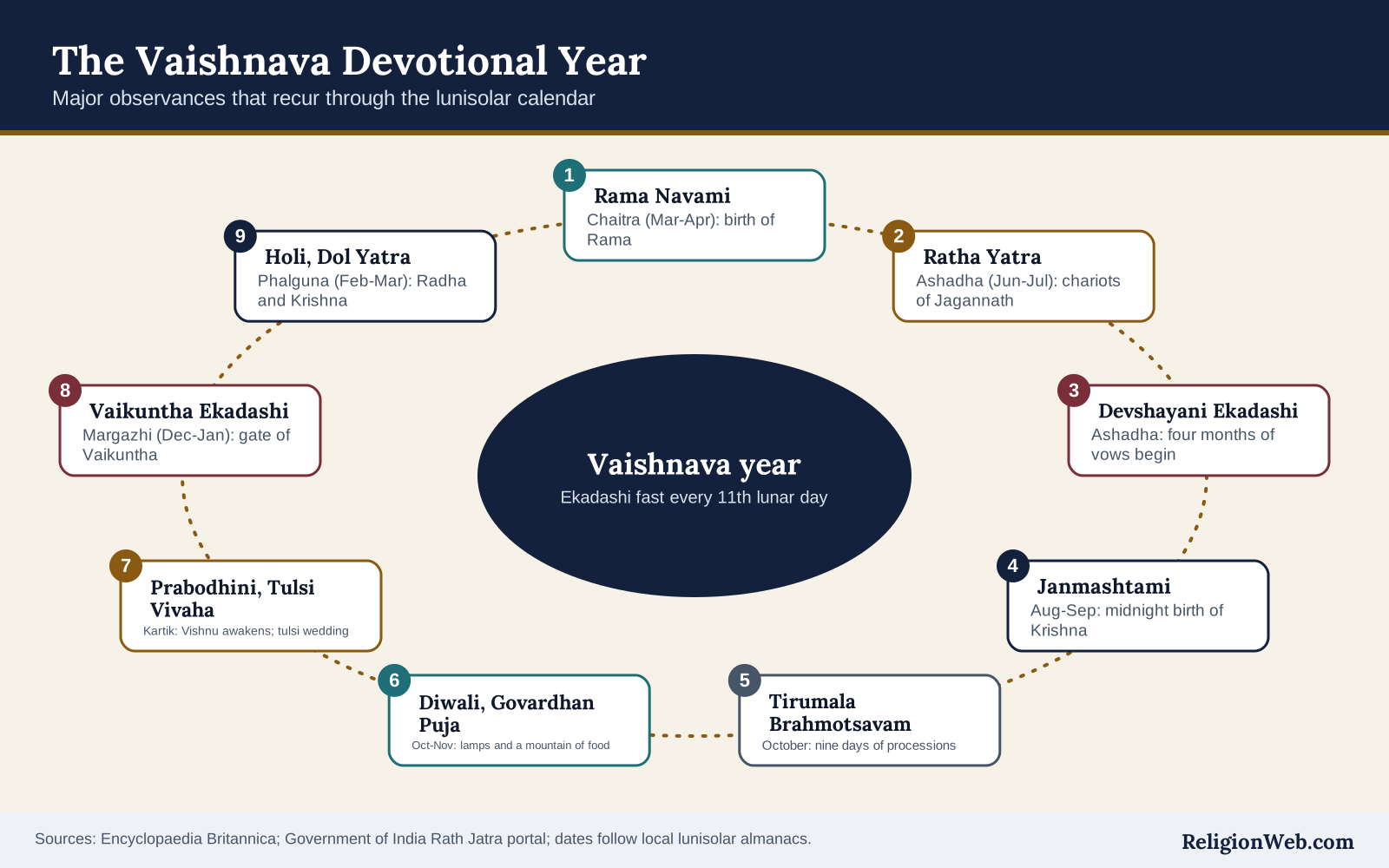
Pilgrimage, Sacred Places, and Material Culture
The Geography of Vaishnava Pilgrimage
The South: Divya Desams, Srirangam, Tirumala and Udupi
The sacred map of South Indian Vaishnavism is defined by the 108 Divya Desams, the temples praised in the Alvars’ hymns. According to the standard list, 105 are in India, mostly in Tamil Nadu (84), with Kerala (11), Uttar Pradesh (4), Uttarakhand (3), Andhra Pradesh (2) and Gujarat (1); one, Muktinath, is in Nepal; and two are celestial, the Milk Ocean and Vaikuntha. The first on the list is the Ranganathaswamy Temple at Srirangam, built on an island between the Kaveri and Kollidam rivers, where Vishnu reclines on the serpent Adishesha. The temple has seven concentric enclosures and twenty-one gopurams, or gateway towers, the tallest being the thirteen-tiered Rajagopuram, about 73 meters (240 feet) high, completed in 1987. All twelve Alvars sang of it, and Ramanuja made it a center of Sri Vaishnavism.
Tirumala, in the hills above Tirupati in Andhra Pradesh, houses the temple of Venkateswara, also called Balaji or Srinivasa, at an elevation of about 853 meters. The temple, which follows the Vaikhanasa Agama, is administered by the Tirumala Tirupati Devasthanams, a body under the Andhra Pradesh government. Press accounts based on temple data cite tens of millions of visitors a year, though such figures vary by source. Farther west, Udupi in Karnataka is the seat of Madhva Vaishnavism, and Guruvayur in Kerala is a major shrine to Krishna. In Maharashtra, Pandharpur is the destination of the Warkari wari.
The North, East and West: Braj, Ayodhya, Puri, Dwarka and Beyond
In the north, the Braj region is the heartland of Krishna devotion. Vrindavan, on the Yamuna about 15 kilometers north of Mathura, has thousands of temples, with about 5,500 reported on one count, and Chaitanya visited it in 1515 to locate the places associated with Krishna’s life. Mathura is traditionally the site of his birth, and the hill of Govardhan is circled on foot by pilgrims. Ayodhya, on the Sarayu River, is the city of Rama. Its Ram Janmabhoomi temple was consecrated on January 22, 2024, after a Supreme Court judgment of November 9, 2019 resolved a long legal dispute over the site, one of the most contested issues in modern Indian public life, which this article does not attempt to adjudicate. Dwarka in Gujarat is linked with Krishna’s kingdom, and Badrinath in the Himalaya is both a Divya Desam and one of the Char Dham. Puri in Odisha, with its Jagannath temple, is the center of Odia Vaishnavism and, for Gaudiya Vaishnavas, the city of Chaitanya’s last years. Mayapur in West Bengal is the headquarters of ISKCON, and Nathdwara in Rajasthan is the main seat of Pushtimarg.
| Place | Region | Deity or association | Significance |
|---|---|---|---|
| Srirangam | Tamil Nadu | Ranganatha reclining on Adishesha | First of the 108 Divya Desams; center of Sri Vaishnavism |
| Tirumala (Tirupati) | Andhra Pradesh | Venkateswara (Balaji, Srinivasa) | Vaikhanasa temple; major annual festivals and the Tirupati laddu |
| Kanchipuram | Tamil Nadu | Varadaraja Perumal | Associated with Ramanuja; a Divya Desam |
| Udupi | Karnataka | Krishna, with eight monasteries | Seat of Madhva Vaishnavism; rotating temple leadership |
| Guruvayur | Kerala | Guruvayurappan (Krishna) | Leading Krishna shrine of Kerala |
| Vrindavan and Mathura | Uttar Pradesh (Braj) | Krishna and Radha | Setting of Krishna’s youth; Holi, Janmashtami, rasa lila |
| Ayodhya | Uttar Pradesh | Rama | Birthplace of Rama in tradition; Rama Navami and Ramlila |
| Puri | Odisha | Jagannath, Balabhadra, Subhadra | Ratha Yatra; Chaitanya’s later home |
| Pandharpur | Maharashtra | Vithoba (Vitthal) | Destination of the Warkari wari on Ashadhi Ekadashi |
| Dwarka and Badrinath | Gujarat; Uttarakhand | Krishna; Badrinarayana | Part of the Char Dham; Divya Desams |
| Nathdwara | Rajasthan | Shrinathji | Main shrine of Pushtimarg, where the image was installed in 1672 |
| Mayapur | West Bengal | Chaitanya, Radha and Krishna | Headquarters of ISKCON; Gaudiya pilgrimage place traditionally identified with Chaitanya’s birthplace |
Temples, Images and Symbols
Temple Architecture and Sacred Images
Vaishnava temples take regional forms, from the gateway towers of the Tamil south to the stone shikhara towers of the north and the Kalinga-style tower at Puri. They share a plan in which a sanctum holds the consecrated image and surrounding spaces host processions, music, kitchens and teaching. Images of Vishnu are shown in several postures: standing, seated, or reclining on Shesha. Britannica describes the standard iconography: a four-armed figure holding the conch (shankha), discus (chakra), mace (gada) and lotus (padma), wearing the Kaustubha jewel and a curl of hair on the chest called the shrivatsa, usually dark in complexion. Lakshmi sits beside him or at his feet, and Garuda is his mount.
The tradition includes images that depart from this model. The wooden figures of Jagannath, Balabhadra and Subhadra at Puri have no limbs and large round eyes, and the salagrama stone is venerated as a natural form of Vishnu without any carving. The Vaishnava understanding is that God accepts the form his devotees offer him. Beyond India, Vishnu images and temples survive in Cambodia, Thailand, Vietnam and Indonesia, which shows how widely the tradition once spread.
Sacred Objects and the Visual Arts
Vaishnava devotion has produced distinctive art. The conch and discus are used as emblems on temple banners and personal ornaments. Britannica notes that scenes from the Bhagavata Purana appear on temple walls and in Rajasthani and Pahari miniature paintings of the seventeenth and eighteenth centuries. Pushtimarg temples use large painted cloth hangings called pichvais behind the image of Shrinathji, changed with the seasons and festivals. Krishna’s flute and peacock feather, Rama’s bow, and Hanuman’s mace are favorite subjects of images, prints and festival decorations. Dance traditions, including Sattriya of Assam and Odissi, present stories drawn from the Bhagavata and the Gita Govinda, and stage forms such as Ramlila and rasa lila bring the epic narratives to village squares.
Community, Ethics, and Daily Life
Ethics and Service
Non-Violence, Humility and Service
Vaishnava ethics are rooted in the conviction that God dwells in all beings. Non-violence (ahimsa) is therefore a leading virtue, and it is the foundation of the vegetarian practice common to many Vaishnava communities. Humility and compassion are repeated themes: the Warkaris stress both, and bow to one another because, as the tradition puts it, God’s presence is in everyone. Service (seva) is considered a spiritual discipline in its own right, whether it takes the form of cooking in a temple kitchen, feeding pilgrims, or caring for the elderly. These ideals are shared across lineages, although each community expresses them in its own rules of conduct, such as the Swaminarayan community’s written code, the Shikshapatri.
Householders and Renunciants
Vaishnavism has room for both domestic and monastic life. Some traditions, such as Pushtimarg, favor family life over renunciation and treat the home and the temple as continuous spaces of service. Others, including the Ramanandi and Gaudiya orders, include monks who have left home. In every case the household is a center of devotion, with a shrine, a tulsi plant and shared meals of prasada. The two paths are not set against each other in teaching, and many devotees move between lay and renunciant roles over a lifetime.
Inclusion, Caste and Reform
Teachers Who Widened Access to Devotion
A recurring theme in Vaishnava history is the claim that devotion is open to everyone. Ramanuja is remembered for opening temple worship and initiation to non-Brahmins, although the details come from later accounts. Ramananda, by Britannica’s account, ate with students regardless of caste and taught in Hindi so that people without Sanskrit could follow, and his traditional disciples include the leatherworker Ravidas and the weaver Kabir. Sankardeva in Assam opposed the caste system, the Warkaris reject distinctions of caste, gender and wealth, and Swaminarayan accepted followers of all castes, which drew criticism from some high-caste Hindus. The Warkari saint Chokhamela and the Tamil Alvar Tiruppan, who are remembered as having been born outside the upper castes, are among the tradition’s honored voices.
Continuing Debates Within the Tradition
The picture is not uniform. Scholars disagree, for example, about whether the Vadakalai or the Tenkalai was historically the more inclusive in matters of caste, and hereditary priesthoods remain important in many temples, including the Vaikhanasa priests of Tirumala and the lineages that lead Pushtimarg. Questions of access and equality have also been addressed in modern law and reform movements across Hindu society, which are covered in the article on Hinduism. Vaishnava communities today include members who emphasize the egalitarian message of their saints and others who emphasize inherited ritual roles, and historians caution against assuming that the ideals voiced by a saint were fully realized in practice.
Women, Music and the Arts in Vaishnava Life
Women Poets and Devotees
Women are prominent among the tradition’s best-loved voices. Andal, the Alvar who sang of her wish to wed the Lord, is the only woman among the twelve, and her Tiruppavai is recited by Sri Vaishnavas each year in Margazhi. Mirabai, a sixteenth-century Rajasthani devotee of Krishna, remains one of the most widely sung poets in northern India. In the home, women often lead the daily worship, tend the tulsi, and prepare the offerings. Formal roles in temple priesthood, by contrast, have mostly been held by men in hereditary lines, though modern practice varies by community.
Music, Dance and Drama as Devotional Work
The devotional arts are a primary way in which Vaishnava teaching reaches ordinary people. Kirtan, bhajan, Carnatic compositions, haveli music, borgeet and abhangas carry theology in song. Ramlila is performed by villagers in hundreds of towns, and UNESCO notes that it brings communities together without distinction of caste, religion or age. These arts are taught within families, temples and monasteries, and many practitioners regard their craft as worship, not entertainment.
Vaishnavism Today: Global Presence, Institutions, and Public Debates
Numbers, Diaspora and Institutions
Where Vaishnavas Live Today
The largest Vaishnava populations are in India and Nepal, where most of the world’s Hindus live. Pew Research Center, in a study published in 2025 on the period from 2010 to 2020, estimated that nearly 1.2 billion people were Hindus in 2020, about 95 percent of them in India and 99 percent in the Asia-Pacific region. Nepal was 81 percent Hindu and Mauritius 48 percent, with about 620,000 Hindus. Outside Asia, Pew counted about 3.0 million Hindus in the United States, 1.1 million in the United Kingdom and 1.1 million in the United Arab Emirates, and it found that the Hindu population of North America had grown by 55 percent to 3.6 million. These figures are for Hindus in general, because Pew does not divide them by sect, and the Vaishnava share of each number is not known.
Vaishnava communities abroad take several forms. Indian laborers who migrated in the nineteenth and early twentieth centuries took the Ramcharitmanas and the festivals of Rama and Krishna with them, and Rama Navami and Janmashtami are observed today in Durban, Mauritius, Fiji, the Caribbean, Malaysia and Singapore. Later migrants have built temples in North America, Britain and Australia, including temples of the Pushtimarg, Sri Vaishnava and Venkateswara traditions. ISKCON draws both people of Indian origin and many others who came to it as adults, and its festivals such as Ratha Yatra are held in many cities around the world.
Temples, Monasteries and Digital Life
The institutions of Vaishnavism are varied. Some great temples are managed by statutory boards: the Tirumala Tirupati Devasthanams, for example, is an autonomous body under the Andhra Pradesh government that administers the Tirumala temple. Others are run by hereditary families, monasteries or religious societies, such as the eight monasteries of Udupi, the Jeeyar mathas of Sri Vaishnavism, the Vallabha family houses of Pushtimarg, and the governing bodies of BAPS and ISKCON. In recent years many temples have added live streaming of services, online booking of offerings and digital archives of hymns. The Ratha Yatra at Puri in 2025 was streamed digitally, and the organizers added crowd-management and environmental measures, according to published reports.
Questions in Public Life
Ayodhya and the Place of Rama in Public Life
For Rama devotees, Ayodhya is the birthplace of their Lord. It has also been the focus of a long and painful public dispute over a site where a mosque, the Babri Masjid, stood until it was demolished in December 1992, an event followed by communal violence. The Supreme Court of India ruled on November 9, 2019 that the land would go to a trust for building a temple and allotted separate land for a mosque, and the Ram temple was consecrated on January 22, 2024. Historians, jurists and political commentators continue to disagree over the history of the site and the meaning of these events, and Muslims and Hindus in India hold a range of views. It is useful to keep two things apart: the devotion to Rama practiced in homes and temples across the subcontinent for centuries, and the political movements that have used Rama’s name in modern campaigns. Individual Vaishnava teachers and devotees hold a range of views on the latter, and the tradition cannot be reduced to either.
Heritage, Governance and Pilgrimage Pressures
Vaishnava places face the pressures common to major pilgrimage sites. Crowd safety at festivals, the environmental effects of mass pilgrimage, the urbanization of Vrindavan, whose forests were largely lost to building, and debates over state control of temples are all subjects of public discussion. Heritage conservation is also an issue: Srirangam is on UNESCO’s tentative list for World Heritage status and received a UNESCO Asia-Pacific heritage award in 2017, and Ramlila was inscribed on UNESCO’s list of intangible heritage in 2008. These recognitions reflect the cultural weight of the tradition beyond the circle of believers. For devotees, they sit alongside a more immediate concern: how to keep alive the recitation, music and craft skills that make the temples living institutions and not only monuments.
Common Misconceptions About Vaishnavism
Misconception 1: All Vaishnavas worship Vishnu in exactly the same form
Where the misunderstanding comes from
The popular picture of Vaishnavism is a single image: a four-armed, blue-skinned Vishnu holding a conch, a discus, a mace and a lotus, standing or reclining on a serpent. Calendar art, television serials and school textbooks use that image so often that it is easy to assume every Vaishnava temple and household centers on it. The word “Vaishnava,” meaning “of Vishnu,” reinforces the assumption that devotees are all directing their worship to the same figure in the same way.
The assumption also comes from the habit of describing religions by their central deity and leaving out the local forms through which that deity is actually approached. A visitor who enters a temple in Puri and one in Pandharpur may be told that both honor Vishnu, and may not realize that the two communities speak of their Lord in very different terms.
What the evidence and tradition actually show
Vaishnava worship is organized around many forms. Sri Vaishnavas worship Narayana with Lakshmi and Ranganatha at Srirangam. Devotees at Tirumala worship Venkateswara, and those at Puri worship Jagannath, whose images have no limbs. Warkaris worship Vithoba, Pushtimarg devotees serve the child Krishna as Shrinathji, Ramanandis worship Rama and Sita, and Gaudiya Vaishnavas worship Radha and Krishna. In Assam, the Ekasarana tradition worships Krishna as Narayana without Radha. The Pancharatra tradition itself teaches that the divine is present in several modes at once, from the supreme form in Vaikuntha to the temple image, so variety is built into the theology and is not an accident of geography.
Pew Research Center’s survey of Hindus in India shows how regional the pattern is. Among Hindus who believe in God and were asked which deity they feel closest to, 46 percent in the Northeast named Krishna, compared with 14 percent in the South, while closeness to Rama was strongest in the Central region. Eighty-four percent chose more than one god or said they have many personal gods. The same principle of internal variety applies to Shaivism and Shaktism, each of which is treated in its own article.
Misconception 2: Krishna and Rama devotion stand outside Vaishnavism
Where the misunderstanding comes from
In everyday speech, people often speak of “Krishna devotees” and “Rama devotees” as though they were different from “Vishnu worshipers.” The Hare Krishna movement, visible in public chanting and in temples abroad, is sometimes described as a separate religion, and Rama devotion is often discussed in the context of modern politics, which can detach it from its devotional setting. Scholars have also used terms such as “Krishnaism” and “Ramaism” to describe traditions that treat Krishna or Rama as supreme, and a reader who meets those terms may take them to name distinct religions.
What the evidence and tradition actually show
Britannica states that Rama and Krishna are the most popular avatars in Vaishnavism, and the Bhagavad Gita presents Krishna revealing his identity as Vishnu to Arjuna. The Ramanandi order is described as Vaishnava, and the Gaudiya tradition, of which ISKCON is a part, is a Vaishnava lineage that takes the Bhagavata Purana as its principal scripture. A great share of Vaishnava literature, from the Bhagavata Purana to the Ramcharitmanas, is devoted to these two figures.
There is a real theological question inside this topic, but it is an internal one. Some traditions teach that Krishna or Rama is a descent of Vishnu; others, notably the Gaudiya tradition, teach that Krishna is the source from whom Vishnu and all the other avatars proceed. These are different answers to the question of who stands at the summit. They are debated among Vaishnavas and do not place anyone outside the family. The labels “Krishnaism” and “Ramaism” are analytical conveniences, and many devotees would not recognize the division they imply.
Misconception 3: One scripture or institution governs every Vaishnava sampradaya
Where the misunderstanding comes from
People who are used to religions with a single book or a central authority sometimes expect to find the same in Vaishnavism. The Bhagavad Gita is often described as “the Hindu Bible,” news reports may speak of “the Vaishnava head” or “the temple board,” and large organizations with a visible global presence, such as ISKCON, can give the impression that they speak for the whole tradition.
What the evidence and tradition actually show
The tradition has no council, creed or supreme head. Each sampradaya has its own authorities. Sri Vaishnavas place special weight on the Divya Prabandham and the commentaries of Ramanuja. Gaudiya Vaishnavas and Pushtimarg devotees take the Bhagavata Purana as supreme. Ramanandis revere the Ramcharitmanas, and the Ekasarana tradition relies on Sankardeva’s Assamese Bhagavata. The Gita is honored by almost all and is read through each lineage’s commentary. Even temple ritual follows different manuals: the Vaikhanasa Agama at Tirumala, the Jayakhya Samhita at Kanchipuram, and the Ishvara Samhita at Melukote, according to published accounts.
Institutions are equally varied and are local in their reach. The Tirumala Tirupati Devasthanams administers one temple. The Jeeyar monasteries serve Sri Vaishnava communities. Pushtimarg is led by descendants of Vallabha, the Swaminarayan tradition has two hereditary dioceses and several independent branches, and the Ekasarana community divided into four sub-sects after Sankardeva’s death. Disagreements are settled by argument, custom and the authority of particular teachers, not by a single body. That is why accurate statements about Vaishnavism name the sampradaya they describe.
Even the Bhagavad Gita, the nearest thing to a shared text, is received through different commentaries. Ramanuja, Madhva and later Gaudiya and Pushtimarg authors each wrote on it, and each draws different conclusions about whether the soul is distinct from God, whether liberation is possible in this life, and what the final goal of devotion is. A sentence that begins “Vaishnavas read the Gita as teaching” therefore needs an immediate follow-up naming the school, and the same is true of statements about ritual, calendar and community rules.
Misconception 4: The ten avatars are a single list that all Vaishnavas accept
Where the misunderstanding comes from
The Dashavatara appears in posters, school books, temple carvings and film. It is presented with the same ten names in the same order, from the fish to Kalki, and it is easy to conclude that this is the official, universal list. A second source of confusion is the habit of reading the sequence as a progression from simpler to more complex beings, which suggests a fixed, ordered scheme.
What the evidence and tradition actually show
The ten-avatar list is the best-known version of an open doctrine and is not a universal canon. Britannica notes that the set of ten is not always the same. Many Puranas list the Buddha in the ninth place; some Sri Vaishnava authors and the Tamil Paripatal are cited for lists that put Balarama eighth and Krishna ninth, with no Buddha; Gaudiya Vaishnavas count both Balarama and the Buddha; Warkari tradition names Vithoba; and some Odia works name Jagannath. The Bhagavata Purana lists twenty-two avatars and Pancharatra texts thirty-nine, and several teachers hold that Vishnu’s descents are countless, with the ten being the principal ones.
Some modern writers have read the sequence as an evolutionary progression, and scholarly summaries mention the Gaudiya reformer Bhaktivinoda Thakur among them, while other Vaishnava teachers reject that reading because they regard Rama and Krishna as full, personal manifestations of God and not stages in a natural process. Both views exist within the tradition, and neither is presented here as the correct one.
Misconception 5: The Jagannath chariot festival is a rite in which devotees are meant to be crushed
Where the misunderstanding comes from
The belief grew from European travel writing and colonial-era commentary. The best-known source is the account of the Franciscan friar Odoric in the early fourteenth century, which described worshipers throwing themselves beneath the wheels of the god’s carriage. Later writers repeated and embellished the story, and the English word “juggernaut,” which came from the god’s name Jagannath, carried the image of a crushing machine far from its origin. Photographs and film of the packed procession at Puri can seem to confirm the impression for viewers who do not know the festival.
What the evidence and tradition actually show
Merriam-Webster describes Odoric’s report as likely an exaggeration or misinterpretation, and some historians argue that any deaths in the past were accidents caused by pressure in very large crowds, not acts the tradition prescribes. Nothing in the festival’s liturgy asks devotees to give up their lives. As the Government of India’s Rath Jatra portal describes it, the chariots are built anew each year by carpenters with hereditary rights and are pulled along the Bada Danda by devotees as an act of service, carrying the deities to the Gundicha temple and back.
The festival’s meaning, within Odia Vaishnavism and in the many Ratha Yatras that ISKCON and other communities now hold elsewhere, is that the Lord comes out of his temple to be seen by everyone. Modern festivals are managed with crowd-control measures, and the safety of participants is a public concern. The living tradition and the colonial caricature are two different things, and only the first is the festival its devotees know.
Frequently Asked Questions About Vaishnavism
Questions About Identity and Belief
Is Vaishnavism a separate religion from Hinduism?
Vaishnavas and scholars alike generally describe Vaishnavism as one of the major streams within Hinduism, not as a separate religion. Britannica calls it one of the major forms of modern Hinduism. Vaishnava traditions share with other Hindu traditions the Vedic heritage, the epics, the vocabulary of dharma, karma and moksha, and a calendar of festivals. Individual devotees may describe themselves first as Vaishnavas, as members of a particular lineage, or simply as Hindus.
The question arises because some Vaishnava organizations, ISKCON in particular, present themselves with their own names and institutions, and because Vaishnavas in the diaspora sometimes meet audiences unfamiliar with the Hindu context. In legal and census contexts in India, Vaishnavas are counted as Hindus, though the question of who counts as a Hindu is itself one that the wider article on Hinduism takes up.
Is Krishna the same as Vishnu?
Most Vaishnavas regard Krishna as an avatar of Vishnu, and Britannica describes him as the eighth incarnation in the standard list. Some traditions go further. Gaudiya Vaishnavas teach that Krishna is the original form of God, from whom Vishnu and the other avatars proceed, and they cite a verse of the Bhagavata Purana for that claim. The Ekasarana tradition worships Krishna as Narayana, and Pushtimarg centers on Krishna as supreme. The difference is one of theological emphasis within a shared tradition.
In daily devotion, many Vaishnavas do not stop to settle the question. A family may honor Vishnu in the temple on Ekadashi and sing to Krishna at Janmashtami, regarding both as the same Lord approached in different forms.
Do Vaishnavas honor other deities?
It depends on the tradition. The Warkaris accept Vishnu’s oneness with Shiva, Shakti and Ganesha, and many Vaishnava households keep images of several deities or visit a range of temples. Pew’s India survey found that 84 percent of Hindus who believe in God named more than one deity or said they have many personal gods, though that figure covers Hindus generally. Other lineages are more exclusive: the Ekasarana tradition teaches devotion to Krishna alone, and some Sri Vaishnava and Gaudiya communities regard Vishnu or Krishna as the single supreme object of worship, while treating other deities with respect as his devotees or servants. Readers who want the perspective of other devotional streams can consult the articles on Shaivism and Shaktism.
Because each community defines the relationship in its own terms, it is best to ask which tradition a person belongs to before assuming anything about their practice.
Questions About Practice
What does the Vaishnava forehead mark mean?
The tilaka is a mark made with sandalwood paste or clay, usually a vertical line or a U shape, that identifies a devotee as belonging to a Vaishnava lineage. Different sampradayas wear different forms, and the Sri Vaishnava Vadakalai and Tenkalai communities distinguish themselves in the way they draw it. Many devotees apply it after their morning bath and prayers, and some explain it as a reminder that the body is a temple of the Lord.
The mark is a custom, not a requirement for all Vaishnavas, and many wear it only on special occasions. Not wearing it says nothing about a person’s devotion.
Do Vaishnavas have to be vegetarian?
Many Vaishnava communities are vegetarian, and some are strict about it. Gaudiya Vaishnavas are typically vegetarian and avoid onion and garlic, ISKCON initiates follow a vegetarian diet as one of four regulative principles, and the Warkari tradition is lacto-vegetarian. Vegetarianism rests on the principle of non-violence and on the practice of offering all food to God before eating. Pew’s survey found that 44 percent of Hindus in India describe themselves as vegetarian and 33 percent avoid certain meats, so the choice is common but not universal among Hindus generally.
Not every person who honors Vishnu or Krishna follows the same diet. Dietary rules differ by lineage, region, family and individual vow, and are a matter of community practice, not a universal doctrine.
How does someone become a Vaishnava?
Many Vaishnavas are born into families that follow a tradition. Others join through initiation by a teacher, which takes different forms: pancha samskara in Sri Vaishnavism, brahmasambandha in Pushtimarg, a whispered Rama mantra among Ramanandis, and initiation into chanting and a set of vows in Gaudiya Vaishnavism and ISKCON. Some Gaudiya teachings hold that a person who chants Krishna’s name even once may be counted as a Vaishnava.
Communities differ on whether outsiders are welcomed. ISKCON, for example, initiates people from any background, while other communities emphasize inherited family and lineage. A person curious about the tradition can attend a public festival, a kirtan evening or a temple service, which many Vaishnava communities open to respectful visitors.
Questions About Texts and Visiting
Which text should a newcomer read first?
The Bhagavad Gita is the most common starting point, because almost every Vaishnava lineage honors it and it is available in many translations. After that, the choice depends on the tradition one wishes to understand. Those interested in Krishna devotion often move to selections from the tenth book of the Bhagavata Purana, those interested in Rama to the Ramayana or the Ramcharitmanas, and those interested in the Tamil tradition to translations of the Alvar hymns.
It helps to read a translation that states the viewpoint of its commentary, and to compare more than one. Translations of the Gita vary widely in tone and interpretation, and a commentary written inside a sampradaya reflects that sampradaya’s reading.
What should a visitor know before visiting a Vaishnava temple?
Customs differ, but visitors are generally expected to dress modestly, remove their shoes before entering, and follow the instructions of temple staff. Photography may be restricted inside the sanctum. Food offered in the temple is prasada, and visitors who are offered it generally accept it with respect. Some temples limit entry to Hindus, as the Jagannath temple at Puri does, and many have special rules during festivals, so it is wise to check locally before traveling.
Large temples such as Tirumala and Srirangam manage heavy crowds with timed tickets and queues. Visiting outside festival days is generally quieter, and smaller local temples often welcome visitors who ask about the deity and the day’s service.
Conclusion: Understanding Vaishnavism Through Its Devotions
What the History Shows
A Tradition That Grew by Absorbing and Translating
The historical record shows a devotion that began as a few Vedic hymns to Vishnu, gathered Narayana, Vasudeva and Krishna into a single religious horizon, and then repeatedly renewed itself in new languages: the Tamil of the Alvars, the Sanskrit of Ramanuja and the Bhagavata, the Hindi and Awadhi of Tulsidas, the Marathi of the Warkaris, the Assamese of Sankardeva and the Bengali of Chaitanya’s biographers. Each renewal carried the same conviction that God is near and responds to love, and each shaped its own teachers, texts and temples. Dates for the earliest stages remain uncertain, and even for the medieval teachers, much of what is known comes from devotional tradition. That uncertainty is part of an honest account.
Unity Without Uniformity
What Vaishnavas share is real: devotion to Vishnu and his descents, reverence for the Gita and the Bhagavata, a practice of image worship, name and song, and a festival year anchored by Ekadashi, Rama Navami, Janmashtami and Ratha Yatra. What they do not share is a single creed or authority. The sampradayas hold different views of God and the soul, and the image of the Lord changes from Tirumala to Vrindavan. Describing Vaishnavism accurately means keeping both facts in view.
How to Keep Exploring
Related Pages on ReligionWeb
For the wider setting, the article on Hinduism covers the shared vocabulary, texts and history. Readers can continue with the pages on Shaivism and Shaktism to see how the other major devotional streams of Hindu life understand and worship the divine, and with the article on Sikhism, whose scripture includes verses by North Indian devotional poets who also appear in Vaishnava literature.
Reading and Visiting with Care
The best way to understand a living tradition is to hear it in its own voice. That can mean reading a lineage’s own commentary on the Gita, listening to a recitation of the Tiruppavai in Margazhi, attending a kirtan or a Ratha Yatra, or visiting a temple with a local guide. Readers should note the sampradaya behind any statement they encounter, remember that a single devotee does not speak for the whole tradition, and treat festivals, fasts and temples with the respect due to places of worship.
Sources
The table below lists the principal external sources behind this article. Facts, dates and figures were checked against these and related primary, institutional and academic materials.
| # | Source | Publisher and type | Used for | Link |
|---|---|---|---|---|
| 1 | The Song Celestial; Or, Bhagavad-Gîtâ (from the Mahâbhârata), trans. Sir Edwin Arnold (1885), Chapter IX | Project Gutenberg (eBook #2388) · Primary text (public-domain translation) | Quotation from Gita Chapter IX (offering of leaf, flower, fruit, water) in Arnold’s translation | gutenberg.org |
| 2 | The Rig Veda, trans. Ralph T. H. Griffith (hymns 1.154 and 1.22 on the same site) | Internet Sacred Text Archive · Primary text (public-domain translation) | Quotations of Rigveda 1.154.1 and 1.22.20; Griffith attribution and public-domain status | sacred-texts.com |
| 3 | Vaishnavism | Encyclopaedia Britannica · Encyclopedia | Definition, avatars, bhakti goals, Srivaishnava, Dvaita, Pushtimarg and Gaudiya schools | britannica.com |
| 4 | Bhagavata-purana | Encyclopaedia Britannica · Encyclopedia | Date, length, Book 10, saptaha recitation, influence on later traditions and art | britannica.com |
| 5 | Alvar | Encyclopaedia Britannica · Encyclopedia | Alvars (7th to 10th century), Tamil hymns, Nathamuni’s collection of 4,000 songs | britannica.com |
| 6 | Ramananda | Encyclopaedia Britannica · Encyclopedia | Ramananda’s dates, vernacular teaching, Ramanandi order and scholarly caveats on its history | britannica.com |
| 7 | How the Global Religious Landscape Changed From 2010 to 2020: Hindu Population Change | Pew Research Center (2025) · Demographic data | 2020 Hindu population and regional and country figures (India, Nepal, Mauritius, US, UK, UAE) | pewresearch.org |
| 8 | Religion in India: Tolerance and Segregation | Pew Research Center (June 29, 2021) · Demographic data | 2019 to 2020 survey: deity closeness, karma, prayer, tulsi, diet, one God with many manifestations | pewresearch.org |
| 9 | Juggernaut | Merriam-Webster Dictionary · Dictionary / etymology | Etymology from Hindi Jagannath; Odoric’s account; assessment that the crushing report was likely exaggerated | merriam-webster.com |
| 10 | Rath Jatra: The Chariots | National Informatics Centre, Government of India (rathjatra.nic.in) · Institutional | Names, wheels and annual construction of the three Puri chariots; hereditary carpenters | rathjatra.nic.in |
Last fact-check date: 2026-10-21.