
Shaivism (Śaivism) is the family of devotional, ritual and philosophical traditions in which Shiva is honored as the supreme reality, or as the highest of the deities, and in which initiation, temple worship, yoga, mantra and pilgrimage are organized around him. It is one of the three major streams of Hinduism, together with Vaishnavism and Shaktism, and it has a long documented history in South Asia and, for many centuries, in Southeast Asia as well. Followers are called Shaivas. Most of them would simply say that they worship Shiva, the “Auspicious One,” under one of his many names and forms.
The word “Shaivism” covers far more than a single belief system. It includes the austere Pashupata ascetics of the early centuries CE, the temple-centered Shaiva Siddhanta of the Tamil country, the non-dual philosophy of Kashmir that culminated in the writings of Abhinavagupta, the Kannada-speaking Virashaiva or Lingayat community that wears a personal linga on the body, and the householders in countless villages who pour water over a Shiva linga on a Monday morning. These groups disagree about the nature of the soul, the role of ritual, the authority of texts and even the proper place of the Vedas. What links them is devotion to Shiva and a shared vocabulary of grace, bondage, liberation and the sacred.
Shiva himself is a deity of striking range. Texts and images present him as the lord of yogis who sits in meditation on Mount Kailasa, as the husband of Parvati and father of Ganesha and Murugan, as the dancer who sustains the cosmos, as the fierce Bhairava, as the compassionate teacher who sits in silence under a banyan tree, and as the formless pillar of light that is worshiped in the linga. The popular description of Shiva as “the destroyer” captures only one part of that picture. In Shaiva theology he is also the one who creates, sustains, conceals and, above all, bestows grace.
This article is a reference guide to Shaivism on its own terms. It explains what the word means and how many people are connected to the tradition, traces its history from the Vedic god Rudra to the temple and monastic world of today, and sets out its theology, scriptures, teachers, worship, ascetic practice, festivals and pilgrimage routes. It also describes the main schools in turn and addresses some common misunderstandings. Throughout, it separates what historians can document from what the traditions themselves teach, and it names the school or period behind each claim, because “Shaivas believe” is rarely a complete sentence.
Shaivism at a Glance: Definition, Terms, and Numbers
What Shaivism Is and What the Word Means
Shiva-Centered Traditions Rather Than a Single Church
Shaivism is best understood as a cluster of related traditions, not as a single organization or creed. No central body decides doctrine for all Shaivas, and no one text is accepted by every group in the same way. Some Shaiva communities rest their authority on the Vedas and the Upanishads, others on the Agamas, which are scriptures that Shaivas regard as revealed by Shiva himself, and others on the devotional poetry of saints composed in Tamil, Kannada or Sanskrit. Some are monistic, teaching that the world and the soul are ultimately Shiva’s own consciousness, while others are dualistic or pluralistic, holding that God, souls and matter are eternally distinct.
Encyclopaedia Britannica defines Shaivism as the organized worship of the Indian god Shiva and as one of the three principal forms of modern Hinduism. Scholars often add that its organized, sectarian form can be traced to the early centuries around the turn of the era and that it grew into a dominant religious force across much of the subcontinent during the early medieval period. Shaivas themselves usually describe their path less in terms of history than in terms of relationship: Shiva is the Lord (pati), the one who frees the soul from the limits that bind it.
Names for Shiva and the Meaning of “Shaiva”
The Sanskrit adjective śaiva simply means “relating to Shiva,” and the word is used both for a follower and for anything connected with the god. “Shiva” means “auspicious” or “kind,” a word that already appears in the Vedic hymns as an adjective for the storm god Rudra before it became the god’s most familiar name. Over time Shiva acquired a long list of titles that carry theology in miniature. Mahadeva is the “great god,” Maheshvara the “great lord,” Shankara the “giver of well-being,” Pashupati the “lord of beings” or “lord of souls,” Nilakantha the “blue-throated one,” and Sadashiva the eternally auspicious form that Shaiva Siddhanta places at the summit of its cosmology.
The plural “Shaivisms” is sometimes used by scholars to remind readers of the diversity. That usage is a convenience, not a claim that the groups are unrelated. Shaiva traditions have borrowed from one another for centuries, used overlapping mantras, and shared temples, pilgrimage sites and festivals, even where their philosophies differ.
Where Shaivism Is Found and How Many People Are Connected to It
Geography Across South and Southeast Asia
Shaivism is present throughout India, with especially deep roots in Tamil Nadu, Karnataka, Kashmir, Maharashtra, Gujarat and the Himalayan belt, and with major pilgrimage places from Kedarnath in the north to Rameswaram in the south. It is prominent among Hindus in Nepal, where the temple of Pashupatinath in Kathmandu is a national and international center of devotion, and it is strong among Tamil Hindus in northern Sri Lanka. Historically it was a powerful religion of royal courts in Cambodia, Champa and Java, and today it survives in the Hindu religion of Bali, where the high priests known as pedanda are, according to the scholar June McDaniel in a 2015 lecture at Oxford, mainly Shaiva.
Diaspora communities have carried Shaiva practice to Malaysia, Singapore, Mauritius, East Africa, Europe, North America and Australia, often through temples that follow Tamil, Sri Lankan Tamil, Kannada, Gujarati or Nepali custom. In these settings the distinctions among regional Shaiva styles can be as visible as they are in India.
What the Numbers Can and Cannot Show
There is no reliable count of Shaivas as a group. The census of India records religion, not sectarian affiliation within Hinduism, and many Hindus honor several deities without any sense of belonging to a named sect. Pew Research Center estimated in 2025, using 2020 data, that there were nearly 1.2 billion Hindus worldwide, about 95 percent of them in India. How many of these would call themselves Shaiva depends on how the word is defined, and any single figure would be a guess.
One useful indicator of Shiva’s place in everyday devotion comes from Pew’s 2021 report on religion in India. Hindus who said they believed in God were asked which deities they felt closest to and could choose up to three from a list of fifteen. Shiva was the most frequent answer, chosen by 44 percent, ahead of Hanuman (35 percent) and Ganesha (32 percent). The question measures a personal preference, the ishta devata or “chosen deity,” and not a formal sectarian identity, but it suggests that Shiva is central to the devotional lives of a large share of Indian Hindus.
Shaivism in Brief: Key Facts and Vocabulary
The Essentials in One Table
The table below gathers the basic facts that the rest of the article explains in detail. Dates are approximate where historians disagree, and a few entries describe what the traditions themselves teach, not what can be independently documented.
| Topic | Summary |
|---|---|
| Central focus | Shiva as supreme Lord, in most schools together with his power (Shakti); worshiped in the linga and in many anthropomorphic forms |
| Meaning of the name | Shaiva: “of Shiva”; Shiva: “auspicious,” an epithet of Rudra in the Vedic hymns |
| Earliest textual roots | Hymns to Rudra in the Rigveda (usually dated c. 1500 to 1000 BCE); the Shvetashvatara Upanishad, which treats Rudra-Shiva as the one God |
| Organized sectarian history | Pashupata ascetics from about the 2nd century BCE to 2nd century CE (scholars differ); initiatory Shaivism from about the 5th century CE; the “Shaiva Age” of royal patronage in the early medieval period |
| Principal scriptures | Vedic Rudra hymns and the Shvetashvatara Upanishad; Shaiva Agamas and Tantras; Puranas such as the Shiva and Linga Puranas; Tamil Tirumurai; Kannada vachanas |
| Major schools | Pashupata, Shaiva Siddhanta, Kashmir Shaivism (Trika, Spanda, Pratyabhijna), Virashaiva (Lingayat), Nath yogis, Shivadvaita |
| Key doctrinal terms | pati (Lord), pashu (soul), pasha (bond), diksha (initiation), anugraha (grace), shivatva (attaining the nature of Shiva) |
| Characteristic marks | Three horizontal lines of sacred ash (tripundra), rudraksha beads, the linga worn on the body among Virashaivas |
| Principal mantra | Namah Shivaya (the “five-syllable” mantra), with Om |
| Major observance | Mahashivaratri, the “great night of Shiva,” in February or March; weekly Monday worship and twice-monthly Pradosha vigils |
| Prominent sacred places | Varanasi, Kedarnath, Chidambaram, Thanjavur, Tiruvannamalai, Srisailam, Amarnath, Pashupatinath, Mount Kailasa |
| Numbers | No sect census; about 44% of believing Hindus in India named Shiva among the deities they feel closest to (Pew, 2021) |
Reading Sanskrit and Tamil Terms in This Article
Sanskrit and Tamil words are given in a simplified spelling without diacritics in most places, for example Shiva for Śiva, linga for liṅga, and Agama for Āgama. Where a scholarly spelling helps a reader search or study further, it appears at the first use of the term. Tamil words such as Tevaram and Tirumurai are given in the common English forms used by scholars and temples.
The dates for early texts and teachers are estimates. Indian literary history often depends on traditions that were transmitted orally before they were written down, so the phrase “traditionally dated to” appears often. When scholars disagree, the article says so. When the tradition itself gives an account of a text’s origin, as in the Shaiva belief that the Agamas were spoken by Shiva, that account is presented as a statement of belief, not as a historical finding.
Origins and Historical Development of Shaivism
From Vedic Rudra to the Shiva of the Epics
Rudra in the Vedic Hymns
The earliest literary ancestor of Shiva is Rudra, a god who appears in a handful of hymns of the Rigveda, the oldest layer of the Vedas and the wider Hindu textual tradition, usually dated between about 1500 and 1000 BCE. Rudra is not a prominent deity in that collection. He is a fierce archer associated with storms, wild places and cattle, a figure who can send disease and death but who is also asked for healing and protection. Encyclopaedia Britannica notes that his name, sometimes glossed “the Howler,” later became an epithet of Shiva, “the Auspicious One.” The mixture of fear and hope in the Vedic hymns is visible in Rigveda hymn 2.33, which, in paraphrase, praises Rudra as the most glorious and powerful of all that is born, asks him to carry the worshipers safely through trouble, and begs him to be gracious to the singer and to turn his weapons away from the people and their herds.
A god of great power whom the poet wishes to approach with respect is typical of the Rudra hymns. Later Vedic literature gave Rudra more attention. In the Yajurveda collections a long litany known as the Shatarudriya, “the hundred names of Rudra,” salutes him in many aspects, from fierce hunter to healer, and it includes the epithets shiva, shambhu and shankara that later became standard names of the god. Shaivas continue to recite this litany, in the form often called the Rudram, in temple and household rites today, and the phrase namah shivaya that anchors the best-known Shaiva mantra is built from material in this tradition.
The Shvetashvatara Upanishad and the One Lord
The decisive step from a Vedic storm god to a supreme deity is usually located in the Shvetashvatara Upanishad, a text whose date is uncertain but which scholars generally place in the last centuries before the common era. Its verses address Rudra as the single ruler of the universe, and later in the text the name Shiva is used for the highest reality. In Max Müller’s 1884 translation, the third chapter says:
For there is one Rudra only, they do not allow a second, who rules all the worlds by his powers.
Shvetashvatara Upanishad 3.2, trans. F. Max Müller, Sacred Books of the East, vol. 15, 1884
Shaiva authors across many centuries read this verse as an early statement of their own conviction that Shiva is the one God. The verse itself does not use that later vocabulary, and interpreters in other schools of Vedanta read the Upanishad through their own frameworks, treating its Lord as Brahman or as the personal God of their tradition. What can be said historically is that the text shows Rudra-Shiva being described in the language of monotheistic devotion at a time when Vedic ritual religion was being reinterpreted from within, and that later Shaiva communities regarded it as one of their most important Vedic witnesses.
Early Images, the Indus Question, and Coins
Evidence outside texts is sparse and often contested. In 1931 the archaeologist John Marshall interpreted a seal from the Indus Valley civilization showing a seated figure with horns, surrounded by animals, as an ancestor of Shiva as lord of beasts. The idea remains popular, but many specialists regard it as unproven, since the Indus script is undeciphered and there is no text to match the image. Firmer evidence appears in the first centuries of the common era. Coins of the Kushan empire, issued in the north-west of the subcontinent, show a deity with a bull whom scholars commonly identify as Shiva, and early sculpture in stone shows the god in both human form and as a linga.
One of the most discussed early images is the linga at Gudimallam in Andhra Pradesh, a polished stone pillar with a standing figure of Shiva carved in relief on the front. Scholars have proposed dates ranging from the third century BCE to the first century CE, and the question has not been settled. The shrine around it was rebuilt and expanded in later centuries, including under the Cholas. Because the images and the texts do not line up neatly, historians generally describe the early history of Shiva worship as a convergence of several streams, Vedic, ascetic, regional and popular, rather than the unfolding of a single line.
Ascetics and Initiatory Shaivism (c. 200 BCE to 600 CE)
The Pashupatas and Their Teacher Lakulisha
Encyclopaedia Britannica calls the Pashupata movement perhaps the earliest Hindu sect to worship Shiva as the supreme deity. Historians differ on its beginnings; some place its rise in the second century BCE and others in the second century CE. The name comes from Pashupati, “lord of beasts,” in which the “beasts” are the souls of devotees, tethered to the world until the Lord releases them. Tradition holds that Shiva himself was the first teacher and that he later appeared on earth as Lakulisha, “lord of the club,” a teacher who is depicted holding a staff. The Pashupata discipline, set out in a sutra text attributed to him, called for smearing the body with ash three times a day, meditation, the repetition of Om, and a staged program of conduct that in its later phases involved deliberately unconventional behavior meant to loosen attachment to reputation and social approval.
Pashupata groups flourished in Gujarat and Rajasthan for many centuries and appear in inscriptions, including some from the Gupta period, and they spread as far as Java and Cambodia. They arose in the same broad ascetic milieu in which Buddhism and Jainism developed their own monastic communities, although the aims and teachings of these traditions are quite distinct from one another.
From the Outer Path to the Path of Mantras
The most influential modern account of how early Shaivism developed is that of Alexis Sanderson of the University of Oxford. In a major 2009 study, “The Saiva Age,” he divides the early Shaiva world into two broad movements. The first is the Atimarga, the “outer path” of ascetics such as the Pashupatas and the Lakulas, who lived apart from ordinary society. The second is the Mantramarga, the “path of mantras,” which emerged from the first from about the fifth century CE. Its adherents received initiation, used mantras and ritual to purify the self, and could include householders and kings as well as ascetics. At the core of the Mantramarga stood the Siddhanta, whose earliest surviving scripture is the Nishvasa corpus, and around it grew other systems devoted to Bhairava and to goddesses.
This framework matters because it explains why later Shaivism looks so different from the early ascetic movements. By the time of the great temple-building dynasties, Shaiva ritual had become something that a king, a priest and a householder could all take part in, and it carried an elaborate theology of grace and initiation.
The Shaiva Age (c. 500 to 1300 CE)
Kings, Temples, and Land Grants
Sanderson argues that for several centuries beginning around the fifth, Shaivism was the most widely adopted of the new initiatory traditions at royal courts. Kings often took the title paramamaheshvara, “supreme devotee of Shiva,” and in many regions Shaiva foundations outnumbered those of other traditions. The pattern extended well beyond India. Shaiva temples were the most numerous among those founded by rulers in the Khmer realm of Cambodia, in the Cham kingdoms of what is now Vietnam, and in Java and Bali, and Sanderson notes the pre-eminence of Shaivism among the Khmers up to the fall of Angkor.
In South India, Chola kings built temples of enormous scale. The Brihadisvara temple at Thanjavur was consecrated in the twenty-fifth regnal year of Rajaraja I, around 1009 to 1010 CE. His son Rajendra I completed a temple for Shiva at Gangaikondacholapuram in 1035, and UNESCO lists these two with the later Airavatesvara temple at Darasuram as the Great Living Chola Temples (inscribed in 1987 and extended in 2004). A Chola inscription records Rajaraja’s introduction of the singing of Shaiva hymns in the Thanjavur temple, linking royal patronage to the devotional poetry described later in this article.
Philosophical Schools in Kashmir and the Tamil Country
The same centuries saw the formation of the great Shaiva philosophical traditions. In Kashmir, a succession of thinkers developed monistic systems. Vasugupta transmitted the Shiva Sutra in the ninth century. Somananda (c. 900 to 950) wrote the Shivadrishti, which the Internet Encyclopedia of Philosophy describes as the first full scholastic philosophy of the Trika tradition. His successor Utpaladeva (c. 925 to 975) founded the Pratyabhijna or “Recognition” school, and Abhinavagupta (c. 975 to 1025) brought these streams together in works such as the Tantraloka, while his pupil Kshemaraja (c. 1000 to 1050) wrote shorter accessible summaries.
In the south, the Tamil hymns of the Nayanars, usually placed between about the sixth and ninth centuries, supplied the devotional core that later Tamil Shaiva Siddhanta would systematize. In the thirteenth century Meykandar, regarded by Britannica as the school’s first systematic philosopher, wrote the Sivajnanabodham, and his work and that of his disciples became the philosophical basis of Tamil Shaiva Siddhanta. The Sanskrit Siddhanta of the Agamas, which is older, continued alongside it, and in medieval Kashmir the Siddhanta also existed next to the monistic schools.
Later Medieval Developments and the Modern Period
Virashaivas, Naths, and Monastic Centers
In the twelfth century, the poet-reformer Basavanna served as a minister at the court of the Kalachuri king Bijjala I (reigned 1156 to 1167) in Karnataka and became a central figure of the movement that gave rise to the Virashaiva or Lingayat community. Britannica notes that oral tradition credits Basava with founding the sect, while Kalachuri inscriptions suggest he revived an existing one. His devotional poems, composed in Kannada and addressed to Shiva as “lord of the meeting rivers,” are among the most admired in the language. In the same general period the Nath yogis, who look to Matsyendranath and Gorakhnath as founding teachers, developed yoga practices that fed into later hatha yoga.
In Tamil Nadu, Shaiva monastic institutions known as adheenams or mathas preserved teaching lineages, patronized scholarship and managed temple worship, and several trace their histories to the late medieval period. During the long centuries of the Vijayanagara and Nayaka kingdoms, patronage shifted, but temple building, festival worship and devotional composition continued.
Colonial Encounter, Revival, and Diaspora
Printing, English-language education and the colonial census changed how Shaivism was understood. Tamil Shaiva scholars of the nineteenth century, including Arumuga Navalar of Jaffna (1822 to 1879), edited and printed the Tevaram and other classics, opened schools and argued for the distinctiveness of Shaiva Siddhanta, which strengthened a self-conscious Shaiva identity in the Tamil-speaking world. Western scholars in the same period began to translate Shaiva texts and to debate their relation to the Vedas and to philosophies such as Advaita Vedanta.
In the twentieth century, migration carried Shaiva practice to many countries, and academic study of Kashmir Shaivism and of the Agamas grew substantially. The political upheavals of the late twentieth century affected the traditional home of the Kashmir schools; the Internet Encyclopedia of Philosophy notes that those traditions survived mainly among Kashmiri Brahmans and that revival efforts have taken place both in India and internationally. Today Shaivism is a living religion with temples, monasteries, scholars and householder communities on several continents.
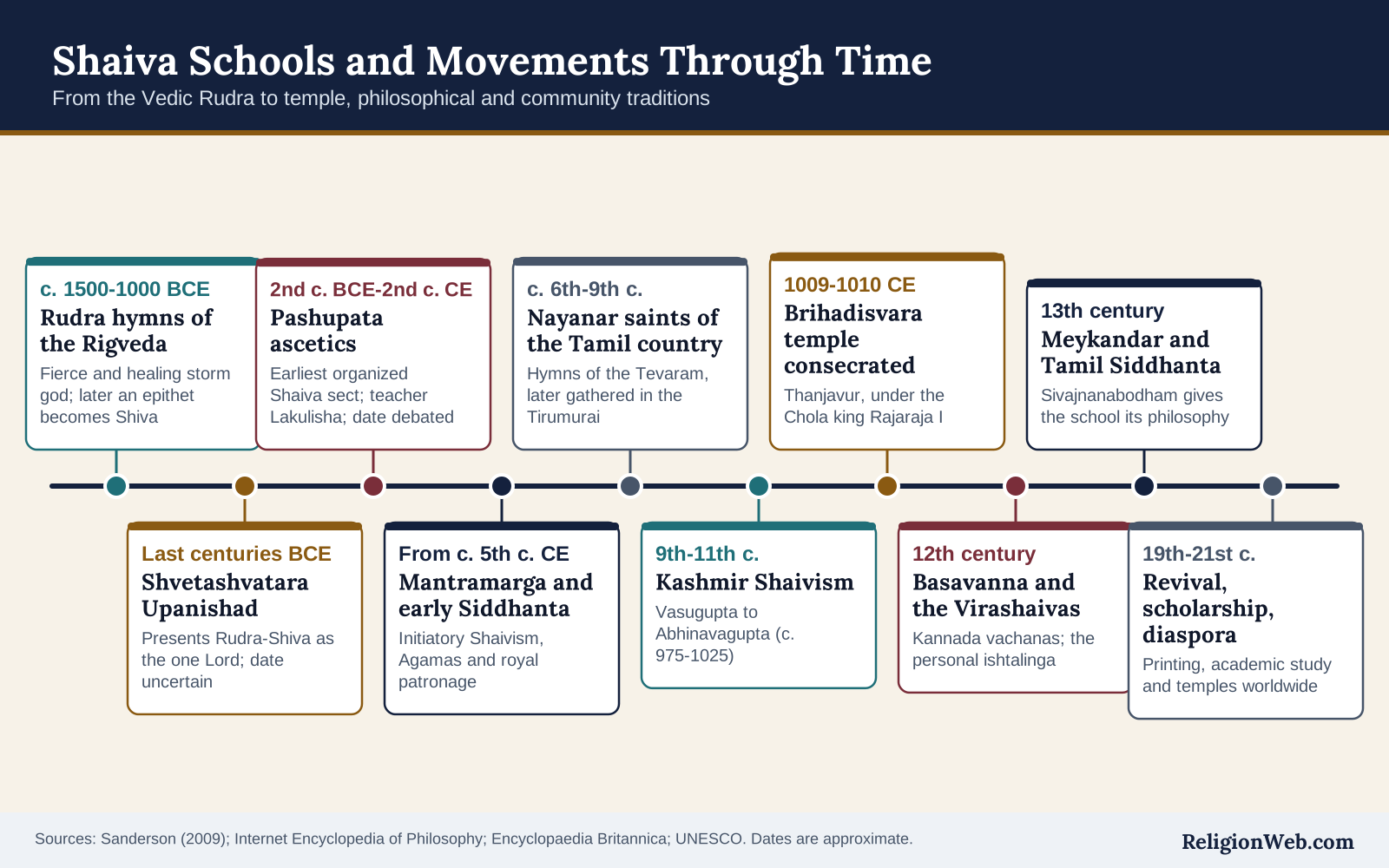
A Chronology of Shaiva Development
The table below summarizes the main stages discussed above. Dates marked “c.” are approximate and many are debated among historians.
| Approximate date | Development | Evidence or source type |
|---|---|---|
| c. 1500 to 1000 BCE | Hymns to Rudra in the Rigveda | Vedic hymns |
| Last centuries BCE (uncertain) | Shvetashvatara Upanishad treats Rudra-Shiva as the one Lord | Upanishadic text; date debated |
| 2nd century BCE to 2nd century CE | Rise of the Pashupata sect and its teacher Lakulisha | Puranic accounts, inscriptions, sutra text; scholars differ on date |
| c. 100 to 400 CE | Shiva imagery on Kushan coins; early sculpture of Shiva and the linga | Coins and sculpture |
| From c. 5th century CE | Mantramarga and the early Siddhanta emerge; Shaiva royal patronage grows | Scriptures such as the Nishvasa corpus; inscriptions |
| c. 6th to 9th centuries | Nayanar saints compose Tamil hymns to Shiva | Tevaram and Tiruvacakam |
| 9th to 11th centuries | Kashmir Shaiva philosophy: Vasugupta, Somananda, Utpaladeva, Abhinavagupta, Kshemaraja | Philosophical treatises |
| 1009 to 1010 CE | Brihadisvara temple at Thanjavur consecrated under Rajaraja I | UNESCO World Heritage documentation |
| 12th century | Basavanna and the Virashaiva movement in Karnataka | Vachanas; Kalachuri-period inscriptions |
| 13th century | Meykandar writes the Sivajnanabodham; Tamil Shaiva Siddhanta takes systematic form | Philosophical text |
| 19th to 20th centuries | Printing, revival, academic study, and diaspora temples | Print culture and institutional records |
Shiva in Shaiva Theology: Roles, Forms, Names, and Symbols
One Lord, Many Roles
The Five Acts: Creation, Preservation, Dissolution, Concealment, and Grace
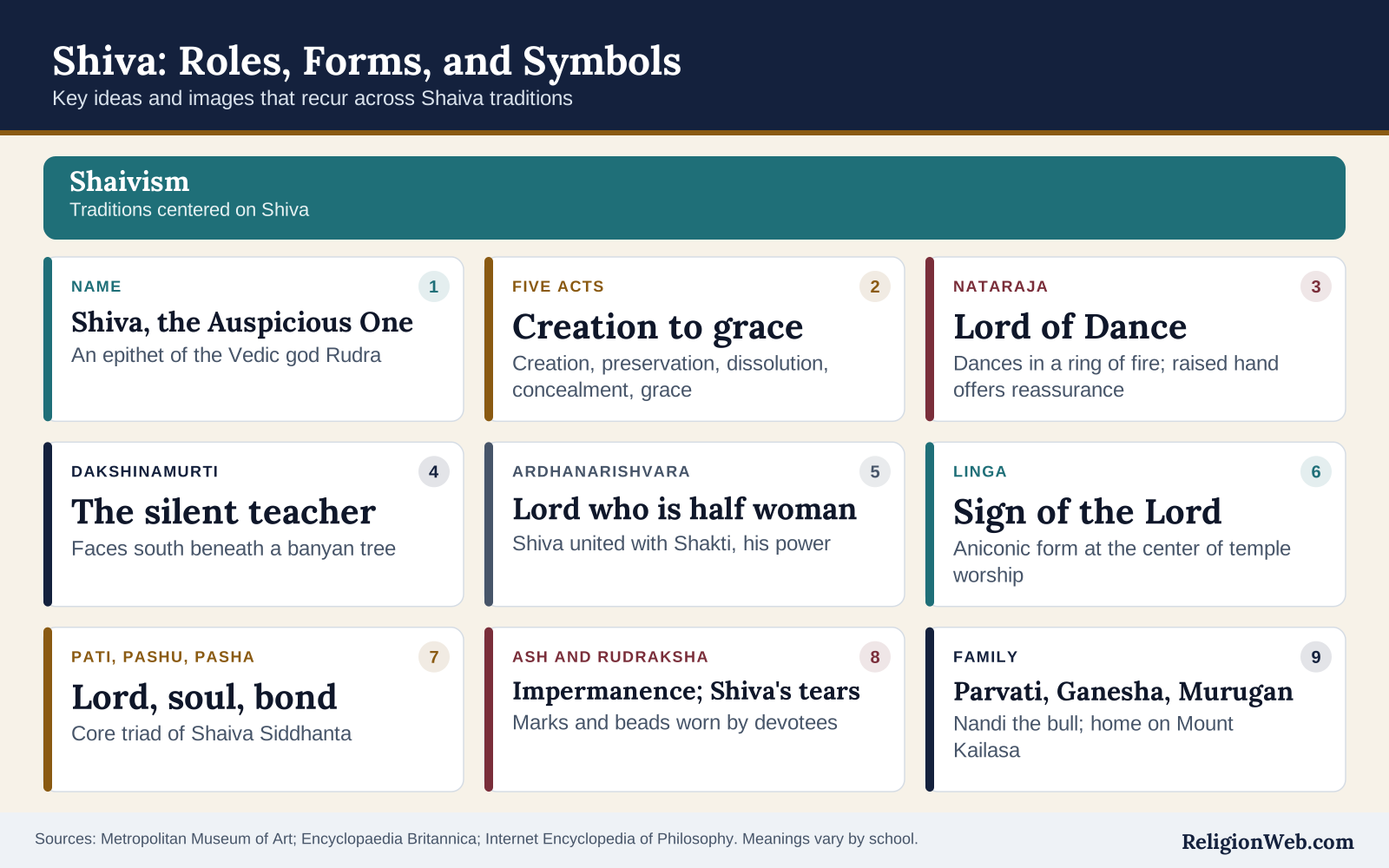
Shaiva Siddhanta and several other Shaiva traditions describe Shiva’s activity in terms of five acts, called panchakritya: emission or creation (srishti), maintenance (sthiti), dissolution (samhara), concealment or veiling (tirobhava), and grace (anugraha). The first three correspond to the familiar triad of making, sustaining and ending the world. The fourth and fifth are distinctively Shaiva and carry the central theological point. Concealment describes how the soul is kept from seeing its own nature, and grace describes how Shiva, in the end, lifts that veil and frees the soul. The Tamil text Unmai Vilakkam, composed in the thirteenth century, is among the works that present the dance of Shiva in terms of these five acts.
The Metropolitan Museum of Art’s catalog entry for a Chola-period bronze of Shiva as Lord of Dance makes the same connection from the visual side, explaining that the image unites Shiva’s roles as creator, preserver and destroyer and expresses the idea of endless cosmic time, while its gestures suggest that devotees can find salvation through faith in him.
Why “Destroyer” Is Only Part of the Picture
Popular books often describe Shiva as “the destroyer” in a triad with Brahma the creator and Vishnu the preserver. That scheme exists in the Puranas and in classical art, and it is part of the tradition. Shaiva theology, however, does not treat dissolution as the whole of Shiva’s nature. In Shaiva sources dissolution is the periodic withdrawal of the world into its source, a pause in which souls rest before a new cycle begins, not an act of malice. Shaiva authors also place Shiva above the triad and teach that he performs all five acts, including those that the triad assigns to other gods.
The name Shiva itself means “auspicious,” and temple worship, pilgrimage and domestic devotion focus on blessings, healing, protection and liberation. Even his fiercest forms are understood as protective. The popular emphasis on destruction owes more to the outline of the Puranic triad, and to its repetition in school textbooks and popular writing, than to the way Shaiva communities describe their own God.
Shiva and Shakti
Nearly every Shaiva tradition pairs Shiva with Shakti, his power or energy, usually imagined as the goddess Parvati, Uma or a more abstract divine consciousness. In temple sculpture the pairing appears as Uma-Maheshvara, Shiva seated with Parvati, and as Ardhanarishvara, the “lord who is half woman,” in which the right half of the body is Shiva’s and the left half the goddess’s. Philosophically, the Kashmir schools teach that Shakti, a power that is also central to Shakta devotion, is not separate from Shiva but is his own freedom and creative power, so that Shiva without Shakti would be like fire without heat. Devotion to the goddess as the supreme reality in her own right is the subject of Shaktism, and many practitioners move between Shaiva and Shakta forms of worship without sensing a break.
Major Forms of Shiva
Nataraja, Dakshinamurti, and Bhikshatana
The best-known anthropomorphic form is Nataraja, Shiva as lord of dance. In the standard bronze image he dances inside a ring of flame, one foot raised and the other on a small figure called Apasmara, who represents ignorance or forgetfulness. His upper right hand holds a small hourglass-shaped drum (damaru), the upper left a flame, the lower right hand is raised in the gesture of reassurance (abhaya), and the lower left points toward the raised foot as a sign of refuge. Dakshinamurti, the “south-facing” form, shows Shiva as the supreme teacher who instructs sages in silence beneath a banyan tree, a form especially honored in South India. Bhikshatana depicts Shiva as a naked wandering mendicant who begs for alms, reflecting the ascetic side of the tradition.
Bhairava and Other Fierce Forms
Bhairava, the “terrible” or “fearsome” one, is Shiva in an awe-inspiring aspect, and he is the central deity of a large body of tantric scriptures. In regional worship Bhairava is often a guardian of a town or temple, and in the Kashmir Shaiva tradition the name refers to the absolute itself, whose nature is limitless awareness. Other forms in the Puranic repertoire include Tripurantaka, who destroys the three cities of the demons with a single arrow, and Gangadhara, who receives the river Ganga on his matted hair so that her fall does not shatter the earth. Each form is tied to a narrative that temples recite at festivals and that artists have carved on walls and gateways.
Family, Companions, and the Mountain Abode
Shiva’s family is central to popular devotion. His wife Parvati, the daughter of the mountain Himavat, is the goddess whose ascetic effort wins him as a husband in a story widely retold on Mahashivaratri. Their sons are Ganesha, the elephant-headed lord of beginnings, and Kartikeya, known in the Tamil country as Murugan, whose worship is a major tradition in its own right. The bull Nandi is Shiva’s mount and the first of his attendants, and most Shiva temples have a Nandi facing the sanctum. Shiva’s home is Mount Kailasa in the Himalayas, which has been a goal of pilgrimage for centuries. Sculpted scenes such as Ravana shaking Mount Kailasa appear in the great rock-cut Kailasa temple at Ellora, which UNESCO describes as the culmination of rock-cut architecture in India.
Symbols and Iconography
Common Emblems and Their Traditional Readings
Shiva’s image carries a recognizable set of attributes, each with traditional interpretations that vary by school and teacher. The trident (trishula) is often explained as the three powers of will, knowledge and action, or as the three qualities of nature. The small drum is the sound from which creation unfolds. The crescent moon in his hair is read as his mastery of time and as a sign of calm. The river Ganga flowing from his head recalls the story of her descent to earth. The third eye on his forehead is the eye of discernment, and in one well-known narrative it burns the god of desire. A serpent around his neck can signify fearlessness, and in yogic readings the energy of awakening. His throat is blue because, in the story of the churning of the ocean, he held the poison that arose from it so that it would not harm the world.
Ash, Rudraksha, and the Ascetic Look
The ascetic side of Shiva’s iconography, with its ash-smeared body, matted hair and tiger-skin seat, finds its parallel in devotees’ practice. Shaivas mark the forehead and arms with three horizontal lines of sacred ash, called tripundra or vibhuti, and many wear or hold strings of rudraksha seeds, which Puranic accounts describe as tears of Shiva. Ash is generally interpreted as a reminder of impermanence and as a sign of purification; in Shaiva ritual texts, ash is also prepared and consecrated in specific ways and applied with mantras. These marks are daily signs of belonging, and they also appear in temple rites and at initiation.
| Concept or symbol | Traditional meaning | Where it appears |
|---|---|---|
| Linga | The “sign” or “mark” of Shiva, worshiped as the formless Lord made present | Temple sanctums, household shrines, Virashaiva ishtalinga |
| Panchakritya (five acts) | Creation, preservation, dissolution, concealment and grace | Shaiva Siddhanta and Kashmir Shaiva theology; Nataraja iconography |
| Pati, pashu, pasha | The Lord, the soul and the bonds that bind it | Pashupata and Shaiva Siddhanta teaching |
| Trishula (trident) | Three powers (will, knowledge, action) or three qualities of nature | Hand of Shiva in images; temple banners |
| Damaru (drum) | The primal sound from which creation unfolds | Nataraja and Bhairava images |
| Crescent moon and Ganga | Mastery of time; grace of the river brought to earth | Matted hair of Shiva in sculpture |
| Third eye | Inner vision and discernment; the eye that burned the god of desire in a Puranic story | Forehead of Shiva in painting and sculpture |
| Bhasma (ash) and rudraksha | Impermanence and purification; seeds associated with Shiva’s tears | Marks and beads worn by devotees and ascetics |
| Nandi | The bull, devotion and the first attendant of Shiva | Facing the sanctum in most Shiva temples |
The Linga: Form, Meaning, and Interpretation
What the Word and the Form Mean
The central object of Shaiva temple worship is the linga (liṅga), a smooth, rounded pillar of stone, usually set in a circular base. The Sanskrit word means “mark,” “sign” or “characteristic,” and Shaiva theologians use it in that sense: the linga is the sign by which the unmanifest Lord becomes present to worshipers. In temple practice the linga is the main form to which water, milk, flowers and light are offered, and it is installed in the innermost sanctum after consecration rites that Shaiva texts describe in detail. A linga may be shaped by human hands, discovered naturally and regarded as self-manifested (svayambhu), or taken from sacred rivers, as are the smooth stones from the Narmada known as banalinga.
The Pillar of Light and the Pedestal
A famous narrative, found in Puranic texts and sculpted on the outer walls of many Shiva temples, tells of the lingodbhava, the “emergence of the linga.” Brahma and Vishnu (the deity at the center of Vaishnavism) quarrel over which of them is supreme, and a limitless column of fire appears before them. Brahma, in the form of a swan, flies upward and Vishnu, as a boar, digs downward, but neither finds the end of the pillar, and Shiva appears from within it. In Shaiva readings the story teaches that the Lord is beyond the reach of the other deities as they are usually understood, and a sculpted panel of the pillar of light is set in the outer wall behind the sanctum in many South Indian temples.
The circular base of the linga is called the pitha or pindika, and Shaiva texts associate it with Shakti or with the goddess. A channel on one side lets the consecrated water drain away, and worshipers treat that water as blessed. Some linga shrines also include a linga with one or more faces of Shiva carved on the surface, called a mukhalinga.
Scholarly and Devotional Interpretations
Interpreters have read the linga in more than one way. Shaiva theology emphasizes that it is an aniconic form, a symbol of the formless and limitless Lord, and Agamic ritual texts name several loci of worship, including the fire, the sacred diagram and the image, alongside the linga. Some historians of religion and art, pointing to early sculptures such as the Gudimallam linga, stress an older association with fertility and generative power, and many scholars hold that the aniconic and the generative meanings coexisted. Shaiva authors generally reject a purely sexual reading, and in temple practice the linga is approached as a sign of God with the same restraint and reverence as any other sacred image. The Virashaiva tradition goes a step further and teaches that the linga is not an image to be visited but a personal symbol of God to be carried on the body, as described later in this article.
Core Beliefs and Philosophy in Shaivism
Themes Shared Across Shaiva Traditions
Shiva as Supreme and Gracious Lord
Despite deep differences in metaphysics, Shaiva traditions share a conviction that Shiva is supreme: the source of the world, the one who sustains it, and the goal toward which the soul moves. He is both transcendent, beyond all description, and immanent, present in the world, in the temple image and in the heart of the devotee. A second common thread is the primacy of grace. Whatever role effort, ritual or knowledge may play, Shaiva authors generally teach that liberation finally depends on the Lord’s gracious act, which is why the fifth of Shiva’s acts, anugraha, holds such a prominent place.
The Soul, Its Bonds, and Liberation
Most Shaiva schools regard the human soul as bound by limitation, though they differ about what exactly binds it and what the soul is. Shaiva Siddhanta, as summarized by Encyclopaedia Britannica, speaks of three principles: the Lord Shiva (pati), the individual soul (pashu) and the bonds that confine the soul to worldly existence (pasha). The bonds are ignorance or primal limitation, the results of past action (karma), and maya, the material stuff from which bodies and worlds are formed. Liberation (moksha) in this framework is to attain “the nature of Shiva” (shivatva), which most schools describe as freedom from rebirth and a state of knowledge, power and bliss that the Lord shares with the soul by grace.
Initiation, Ritual, and Knowledge as Paths
Shaiva traditions often insist that liberation is not achieved by study alone. In the Agamic schools, diksha, a rite of initiation in which a qualified teacher purifies the disciple and, according to the texts, removes the bonds of the soul, is the key event of religious life. Initiation allows the disciple to take part in daily worship, and in some schools it prepares for a final rite that is performed at death. Knowledge (jnana) has its own prestige, especially in Kashmir and in Tamil Siddhanta philosophy, but most Shaiva schools see knowledge, ritual, ethical conduct and devotion as working together.
Shaiva Siddhanta: Three Realities and Four Paths
Pati, Pashu, Pasha
Shaiva Siddhanta, whose name means “the established conclusion of Shaivism,” is the school most closely tied to temple ritual. It teaches that the three realities of Lord, soul and bond are eternal and real. The soul is not identical with Shiva, and the world is not an illusion; it is a real realm in which souls gain the experience that allows them to be freed. Britannica identifies Shiva as the supreme deity of this system and notes that its goal is to gain Shiva’s nature. In the Siddhanta’s cosmology the Lord is served by Shakti, his power, and by the many tiers of reality that Shaiva texts set out in a long list of principles, the tattvas.
The Ladder of Principles
Shaiva cosmology arranges reality as a ladder of thirty-six principles, the tattvas, which extends the older list of twenty-four or twenty-five principles found in the Samkhya philosophy. At the lowest levels lie the elements and the senses, then mind and the material source of nature, and above them the principles that bind the soul, including maya and the limiting factors of time, desire and knowledge. At the summit are the “pure” principles, through which Shiva acts: Shiva and Shakti, then Sadashiva, Ishvara and pure knowledge. The Siddhanta and the Kashmir schools both use a thirty-six-fold scheme, but they interpret it differently, since the Siddhanta treats the Lord as ruling the scheme and also transcending it, while the Kashmir schools treat the whole ladder as the unfolding of one consciousness.
Charya, Kriya, Yoga, and Jnana
The school describes four stages or modes of practice leading to the goal. Charya is external worship and service, such as cleaning a temple or offering flowers. Kriya is ritual worship carried out according to the Agamas, including the initiated worship of the linga. Yoga is meditation on Shiva, and jnana is liberating knowledge. Tamil writers correlate the four with ways of relating to God: the path of the servant (dasa marga) for charya, of the child (satputra marga) for kriya, of the friend (sakha marga) for yoga, and of the true path (san marga) for jnana, so that the stages describe a changing relationship between soul and Lord as well as a set of practices.
The Sanskrit Siddhanta and the Tamil Siddhanta
Two main streams are usually distinguished. The older Sanskrit stream rests on the Agamas and on the work of authors such as the Kashmiri writers Sadyojyoti and Ramakantha and the twelfth-century theologian Aghorashiva, whose ritual manual guides temple priests in South India to this day. The Tamil stream begins with the hymns of the Nayanars and takes systematic form in Meykandar’s thirteenth-century Sivajnanabodham, which Britannica identifies as the first systematic philosophy of the school. Tamil Siddhanta emphasizes that Shiva is inseparable from the soul while the soul remains distinct, a relation that Meykandar’s school expresses with the idea of “non-duality” in a sense quite different from the monism of Kashmir. Writers inside the tradition and modern scholars debate how far the Tamil and Sanskrit streams agree.
Kashmir Shaivism: Consciousness, Freedom, and Recognition
Shiva as Awareness and Shakti as Power
Kashmir Shaivism, a group of monistic tantric traditions that flourished in Kashmir from roughly the late first millennium CE, teaches that ultimate reality is a single, self-luminous consciousness, which it calls Shiva, and that this consciousness has the power to manifest, maintain and withdraw the universe. The Internet Encyclopedia of Philosophy explains that the school grounds its idealism in prakasha, self-validating awareness, together with vimarsha, the recognitive apprehension that is integral to all experience. Shakti is not a second reality but Shiva’s own freedom, the power by which consciousness appears as the many. The world is therefore understood not as an illusion but as a real manifestation of a divine consciousness that is playful and free, a central doctrine of the Kashmir schools that is sometimes called svatantrya, absolute freedom.
Bondage as Forgetting, Liberation as Recognition
The Pratyabhijna or “Recognition” school of Utpaladeva and Abhinavagupta proposes that souls are not outside Shiva but have forgotten their own divine nature. Liberation is not a transformation into something new but the recognition (pratyabhijna) that one has always been Shiva. According to the encyclopedia, the school understands the universe as Shiva’s act of self-recognition connected to the creative power of speech. Philosophically, this is argued with great sophistication, with discussions of memory, perception, language and the nature of the self. Practically, it means that the central work of the practitioner is to cultivate an awareness that is already there.
Spanda and the Three Means
The Spanda tradition, associated with the Spanda Karikas attributed to Vasugupta or his pupil Kallata, interprets Shakti as a subtle “pulsation” of consciousness that can be recognized at the moment between one thought and the next. Teachers of the Trika system classify approaches to liberation according to the effort required: the “means of Shiva” (shambhava upaya), a direct, effortless realization; the “means of Shakti” (shakta upaya), which works through the mind and discernment; and the “individual means” (anava upaya), which uses breath, posture, ritual and mantra. These distinctions are part of how Abhinavagupta organizes his Tantraloka, and they remain central in the teaching of contemporary Kashmir Shaiva lineages. Many Shaivas outside Kashmir hold different views; Shaiva Siddhanta, for instance, teaches that the soul is distinct from Shiva even when it attains his nature.
Shaiva Scriptures, Canon, and Authority
Vedic and Epic Roots
Rudra Hymns and the Shvetashvatara Upanishad
Shaiva traditions generally claim a Vedic inheritance, and the Rudra hymns of the Rigveda and the Shatarudriya litany of the Yajurveda are the oldest texts that Shaivas cite. Among the Upanishads, the Shvetashvatara is the one most closely tied to Shiva. In Max Müller’s 1884 translation, its third chapter includes a verse that has been read by Shaiva teachers as a description of the supreme Lord:
I know that great person (purusha) of sunlike lustre beyond the darkness. A man who knows him truly, passes over death; there is no other path to go.
Shvetashvatara Upanishad 3.8, trans. F. Max Müller, Sacred Books of the East, vol. 15, 1884
Within Shaiva commentarial traditions, the “great person” is Rudra-Shiva, the one Lord praised in the verses just before. Teachers of Vedanta who accept the Upanishad as shruti read the same verse as referring to Brahman or to a personal God without naming a particular deity, and Müller himself argued in his introduction that the text is not necessarily sectarian. This is a good example of how a single passage can serve several traditions and how a quotation is understood only within its interpretive frame.
Epics and Puranas
The Mahabharata and Ramayana both contain accounts of Shiva, as Britannica notes, and the Mahabharata includes long praises of the god. The Puranas that Shaivas treat as especially authoritative include the Shiva Purana, the Linga Purana and the Skanda Purana, which preserve stories such as the pillar of light, the poison of the ocean and the wedding of Shiva and Parvati. These are collections that took shape over many centuries and have no single author; their dates are uncertain and their traditions of transmission vary. For most devotees today they are the source of the narratives that are recited in temples and told in the home during festivals.
Agamas and Tantras
The Siddhanta Agamas
The Agamas are the scriptures that Shaivas consider to have been revealed by Shiva, and they are the specialized manuals of temple worship, initiation and doctrine. The Shaiva Siddhanta tradition counts twenty-eight principal Agamas, with such names as Kamika, Karana and Suprabheda, and each is traditionally organized into four parts on knowledge, ritual, conduct and yoga. Alexis Sanderson identifies the Nishvasa corpus as the earliest surviving scripture of the Siddhanta, with other works such as the Mrigendra, Kirana and Matanga following. Most Agamic temples in South India still base their rites on these texts and their later manuals.
Bhairava and Trika Tantras
Alongside the Siddhanta, other scriptural corpora developed around Bhairava and the goddesses. Sanderson describes the Bhairava scriptures as the Mantrapitha, headed by the Svacchandatantra, and the goddess scriptures as the Vidyapitha, whose works include the Siddhayogeshvarimata, the foundation of the Trika system. The Malinivijayottara became the Trika’s principal authority, and Abhinavagupta expounded the system in his Tantraloka. The Vijnana Bhairava, a short text that lists many methods of meditation and was admired by later teachers, is often cited in Kashmir Shaiva teaching.
How Authority Works
Shaiva communities do not agree about how the Agamas, the Veda and later philosophy relate. Shaiva Siddhanta generally treats both the Veda and the Agamas as proceeding from Shiva, but regards the Agamas as the more direct and complete revelation for its own path. Kashmir authors treat their Tantras as the highest revealed teaching and use philosophical argument to interpret them. The Virashaiva movement, according to Britannica, rejects the authority of the Vedas and of brahmanical ritual, and places the vachanas of the Sharanas and the experience of the devotee at the center. These positions show that “scripture” in Shaivism is not one canon but several, each with its own rules about who may read, recite or teach them.
Devotional and Philosophical Literature
The Tamil Tirumurai
The most celebrated body of devotional poetry is in Tamil. The Tirumurai, “sacred order,” is a collection of twelve books. Its core, the Tevaram, consists of the hymns of three saints, Sambandar, Appar and Sundarar, whom Britannica identifies as the best known of the Nayanars, the Tamil poet-saints of Shiva. According to Britannica, the hymns were compiled in the tenth century by Nambi Andar Nambi and set to Dravidian music for use in temple services. The collection also contains the Tiruvacakam of Manikkavacakar, the Tirumantiram of Tirumular, and the Periya Puranam of Sekkizhar, a twelfth-century account of the lives of sixty-three Shaiva saints. The date of the Tirumantiram is debated and has been placed anywhere from the eighth to the eleventh or twelfth century.
Vachanas, Treatises, and Commentaries
In Karnataka, the Virashaiva Sharanas composed short free-verse poems called vachanas in Kannada. Basavanna, Allama Prabhu and the woman poet Akka Mahadevi are among the best known of these voices. In Kashmir, philosophical works such as the Shivadrishti, the Ishvarapratyabhijnakarika and the Pratyabhijnahridaya, with their commentaries, form a technical literature of very high intellectual standard. In the Tamil Siddhanta, the Sivajnanabodham of Meykandar and a group of related works, often called the Meykanda Shastras, supply the philosophical frame. Together these show that Shaiva literature is multilingual, with major works in Sanskrit, Tamil and Kannada.
| Text or corpus | Language and approximate date | Role in Shaiva tradition |
|---|---|---|
| Rudra hymns of the Rigveda; Shatarudriya | Vedic Sanskrit; Rigveda c. 1500 to 1000 BCE | Earliest praise of Rudra; recited as the Rudram in worship |
| Shvetashvatara Upanishad | Sanskrit; date uncertain | Presents Rudra-Shiva as the one Lord; cited by Shaiva teachers |
| Mahabharata, Shiva Purana, Linga Purana, Skanda Purana | Sanskrit; composed over many centuries | Narratives of Shiva, the linga and pilgrimage places |
| Siddhanta Agamas (Kamika, Mrigendra and others) | Sanskrit; from about the 5th century CE | Revealed manuals of temple ritual, initiation and doctrine |
| Svacchandatantra, Malinivijayottara, Vijnana Bhairava | Sanskrit; early medieval | Bhairava and Trika scriptures used in Kashmir and elsewhere |
| Tirumurai, including the Tevaram and Tiruvacakam | Tamil; hymns c. 6th to 9th centuries, compiled by about the 10th | Devotional canon sung in temples |
| Shiva Sutra, Spanda Karikas, Ishvarapratyabhijnakarika, Tantraloka | Sanskrit; 9th to 11th centuries | Philosophical and ritual texts of Kashmir Shaivism |
| Sivajnanabodham and Meykanda Shastras | Tamil; 13th century onward | Philosophical basis of Tamil Shaiva Siddhanta |
| Vachanas of Basavanna, Allama Prabhu, Akka Mahadevi | Kannada; 12th century | Devotional poetry of the Virashaiva Sharanas |
Teachers, Saints, and Central Figures of Shaivism
Mythic and Legendary Teachers
Shiva as First Teacher
Shaiva traditions generally regard Shiva himself as the original guru, and each school traces its teaching to a divine source. In the Pashupata and Siddhanta traditions, a line of teachers descends from Shiva through intermediate figures, and the line is repeated at initiation, so that the disciple is understood to enter a chain of transmission. In art, Dakshinamurti’s silent teaching of the sages expresses the idea that the highest instruction does not require words, and temples often place his image on the south-facing wall of the sanctum.
Lakulisha and the Pashupata Line
Britannica records that the Vayu and Linga Puranas present Lakulin, also spelled Lakulisha or Nakulisha, as an incarnation of Shiva who entered a dead body in the age of Krishna, and that inscriptions of the tenth and thirteenth centuries mention a teacher of that name whose followers considered him an incarnation of Shiva. Whether a single historical teacher stands behind the name is uncertain. The figure is widely depicted in sculpture holding a club, and temples associated with the Pashupata tradition in Gujarat and Rajasthan preserve his image.
Saints and Philosophers of South India
The Nayanars and Manikkavacakar
Tamil tradition counts sixty-three Nayanars, saints from many walks of life whose stories are told in Sekkizhar’s Periya Puranam. The three who composed the Tevaram, Sambandar, Appar and Sundarar, are honored in temples by bronze images and by festivals of their own. Manikkavacakar, whose Tiruvacakam is among the most beloved Tamil devotional works, is dated by Britannica to a time probably a little later than the three. His poems are intensely personal, full of longing, self-reproach and gratitude, and are still recited in Tamil temples.
Meykandar, Umapati, and the Tamil Siddhanta Teachers
Meykandar of the thirteenth century is regarded as the first systematic philosopher of Tamil Shaiva Siddhanta. His Sivajnanabodham, a short work in twelve aphorisms, was followed by commentaries and treatises from his disciples and from later teachers such as Umapati Sivacarya. The monastic centers known as adheenams in Tamil Nadu continue this teaching lineage today.
Poets and Philosophers of Kashmir and Karnataka
Abhinavagupta and the Kashmir Teachers
Abhinavagupta (c. 975 to 1025) is the towering figure of Kashmir Shaivism. The Internet Encyclopedia of Philosophy calls him Utpaladeva’s disciple’s disciple and notes that he systematized the Trika and wrote on poetics. His writings on poetics and dramaturgy, which interpret the tasting of emotion (rasa) in the light of Shaiva philosophy, continue to be studied in Indian literary theory. In the twentieth century, Kashmir Shaivism was carried to wider audiences by teachers such as Swami Lakshmanjoo (1907 to 1991) and by scholars in India and the West.
Basavanna, Allama Prabhu, and Akka Mahadevi
In twelfth-century Karnataka, the Sharanas, or “those who have taken refuge,” included men and women from many backgrounds. Basavanna, a minister under the Kalachuri king Bijjala I, gave the movement institutional form; Allama Prabhu, a mystic of austere vision, is remembered as a spiritual guide of the community; and Akka Mahadevi, who according to tradition left a royal household to wander in devotion to Shiva, is among the most admired woman poets of the Kannada language. Their short vachanas, often addressed to Shiva under a local name, turn away from ritual display and toward direct love of God.
A Reference List of Major Figures
The table below collects some of the best-known teachers and poets mentioned in this section, with approximate dates. Dates for early figures are traditional or scholarly estimates.
| Figure | Tradition and period | Significance |
|---|---|---|
| Lakulisha | Pashupata; traditionally early centuries CE | Teacher regarded as an incarnation of Shiva; depicted with a club |
| Sambandar, Appar, Sundarar | Tamil Nayanars; roughly 6th to 9th centuries | Composers of the Tevaram, the core of the Tirumurai |
| Manikkavacakar | Tamil; probably somewhat later than the three above | Author of the Tiruvacakam |
| Abhinavagupta | Kashmir; c. 975 to 1025 | Systematizer of the Trika; author of the Tantraloka |
| Utpaladeva | Kashmir; c. 925 to 975 | Founder of the Pratyabhijna philosophy |
| Aghorashiva | South India; 12th century | Author of an influential Siddhanta ritual manual |
| Basavanna | Karnataka; 12th century | Poet and minister; central figure of the Virashaiva movement |
| Akka Mahadevi | Karnataka; 12th century | Woman poet-saint of the Sharanas |
| Meykandar | Tamil country; 13th century | First systematic philosopher of Tamil Shaiva Siddhanta |
| Swami Lakshmanjoo | Kashmir; 1907 to 1991 | Twentieth-century teacher of Kashmir Shaivism |
Worship, Mantra, and Ritual in Shaivism
Temple Worship
The Daily Round in an Agamic Temple
In temples that follow the Agamas, worship is a daily service performed by initiated priests on behalf of the whole community and, in the theology of the tradition, for the welfare of the world. The pattern varies from temple to temple, but a typical day has several services, commonly between four and six. The sanctum is opened and the Lord is awakened with music and lamps. The linga is bathed in a rite of ablution, dressed or adorned with garlands, ash or sandal paste, and offered cooked food (naivedya). Lamps and incense are waved before the deity, hymns and mantras are recited, and the worshipers receive blessed food and ash as prasada. The day closes with a rite in which the Lord is symbolically put to rest.
The priests who perform these services usually belong to hereditary or trained lineages with their own schools of ritual. In Tamil Nadu these include initiated Shaiva priests who follow the Agamas, as well as hereditary priestly families such as the Dikshitars at Chidambaram. Virashaiva communities have their own religious teachers, the jangamas. The question of who may serve as a priest, and who may enter the inner sanctum, has been the subject of social and legal debate in modern India, a topic taken up in the section on community life below.
Abhisheka: The Ritual Bath of the Linga
The most characteristic Shaiva rite is the abhisheka, the pouring of liquids over the linga. In a simple version the worshiper pours water, often with the chanting of the Rudram. In a fuller version the priest offers a sequence of substances, such as milk, curds, ghee, honey, sugar, sandal paste, coconut water and sacred ash, and after each one rinses the linga with water. The liquids are poured in the belief that the Lord is present in the linga and receives them as honored guests. Devotees often join in by bringing offerings, and many temples allow worshipers to witness or fund an abhisheka on their own behalf or for a family event.
Leaves of the bilva tree, whose three-part leaflets are traditionally associated with Shiva, are among the most characteristic offerings, together with flowers, fruits and lamps. Practice varies by region and by temple, and some temples restrict which offerings are allowed, so visitors should follow the guidance of the local priests.
Festivals, Processions, and the Bronze Images
In addition to the fixed linga, many South Indian Shaiva temples own bronze images of Shiva, his family and the Nayanar saints, which are carried through the streets on festival days. Sharada Srinivasan notes that, except for the unusual case of Chidambaram, such metal Nataraja icons are processional images (utsava murti), made to be carried out of the sanctum on festival days. Priests chant prayers during the processions, and the figures are often dressed in cloth and ornaments. The grand annual festival of a Shaiva temple, known in Tamil as brahmotsavam, may last ten days or more, with processions on different vehicles of the god, community meals and recitation of the Tevaram. These public events allow people who cannot enter the sanctum to see the Lord directly, an act of seeing known as darshan.
Worship at Home and Personal Practice
The Household Shrine and Weekly Rhythm
Many Shaiva households keep a small shrine with a linga, a picture of Shiva with Parvati and their children, or a stone from the Narmada River. Daily worship may be as simple as lighting a lamp, offering water or flowers and reciting a few hymns, and it is often performed after the morning bath. Monday is the weekday traditionally associated with Shiva in much of India, and many devotees fast partly or fully on that day, visit a temple, or offer water and bilva leaves to the linga. The fast is a vow (vrata) and is voluntary; practices range from eating one simple meal to abstaining from grain, and families follow their own customs.
Ash, Rudraksha, and Daily Marks
Many Shaivas begin the day by applying ash in three horizontal lines across the forehead and sometimes on the arms and chest. In some communities the application is accompanied by a short mantra. Rudraksha beads serve as a rosary for mantra repetition, and a string of 108 beads, or of 27 or 54 beads, is commonly used. In the Virashaiva community the ishtalinga, a small linga worn on the body, takes the place of the household linga and is worshiped daily. Initiated priests and ascetics may carry additional emblems that mark their lineage.
Mantra: Namah Shivaya and Other Prayers
The most widely used Shaiva mantra is the five-syllable Namah Shivaya, “homage to Shiva,” whose syllables are called the panchakshara. Its phrase namah shivaya appears in the Rudram of the Yajurveda, and with the addition of Om it is the mantra most commonly repeated on a rudraksha rosary. Tamil tradition, which spells the mantra in the order Si-Va-Ya-Na-Ma, ascribes cosmic meaning to each syllable and treats the mantra as the heart of worship. Other widely used texts include the Rudram itself, the Mahamrityunjaya mantra drawn from Rigveda 7.59.12, which is recited for protection and long life, and the Tamil hymns of the Tevaram.
Recitation for protection or healing is a form of prayer, and Shaiva teachers do not present it as a replacement for medical care. People facing illness who also pray may of course do both, and seeking professional medical help is consistent with the religious attitude that human skill is itself a gift.
Initiation and the Structure of Ritual
Diksha: Initiation into the Shaiva Path
In the Mantramarga schools, initiation is the rite that makes a person eligible for Shaiva worship in the full sense. In the Siddhanta, the teacher conducts a ceremony of purification in which the disciple’s bonds are said to be loosened and the person is given a mantra and a ritual identity. Texts describe several grades of initiation, from a rite of entry that authorizes daily worship, to a higher initiation for those who will teach or perform temple ritual, to a final rite that is associated with liberation. The details differ among schools, but all treat the guru as the channel of Shiva’s grace.
Worship for Oneself and for Others
The Siddhanta ritual manuals distinguish two kinds of worship. Atmarthapuja, “worship for oneself,” is the daily rite of an initiated person, in which he or she prepares an inner and outer purity and worships Shiva in a linga or other support. Pararthapuja, “worship for others,” is the public temple ritual performed by priests for the benefit of all. The distinction explains why the Agamic texts deal at length with both private discipline and public ceremonies. Aghorashiva’s twelfth-century manual, mentioned earlier, is a standard guide for both, and it remains in use among temple priests in South India.
Asceticism, Yoga, and Mystical Practice in Shaivism
Ascetic Lineages
Pashupatas and Other Early Ascetics
Ascetic life is central to Shaiva memory, and its earliest organized form is the Pashupata path. Its followers followed a staged discipline that, according to its texts, began with open observances at a temple, moved to a phase in which the ascetic lived unrecognized among ordinary people and behaved in ways meant to provoke scorn, and ended in solitary retreat and final release from suffering. Sanderson describes the wider group of early ascetic movements as the Atimarga and distinguishes them from the later Mantramarga. Within this ascetic world he places the Kapalikas, ascetics who carried a skull-bowl as a sign of penance for a mythic act of Shiva, and whose rites in some texts were transgressive.
The picture of the Kapalikas in older scholarship and in polemical sources is often lurid, and modern historians stress that what we know comes largely from the descriptions of outsiders and from the later tantric texts that adapted their symbols. For this reason their history is better described as an area of ongoing research than as a settled story.
Dashanami Sannyasis, Nagas, and Nath Yogis
Several ascetic orders that are active today honor Shiva. The Dashanami sannyasis, the “ten-named” renunciants described more broadly in the Hinduism overview, are associated by tradition with the philosopher Shankara and are organized in monastic centers and in groups called akharas. Within them, naked or ash-covered ascetics known as Nagas are prominent in the processions of the Kumbh Mela. The Nath yogis, who look to Matsyendranath and Gorakhnath as their founding teachers, are another renunciant tradition devoted to Shiva, with earrings and ash as their emblems and with a body of yogic teaching that helped shape later hatha yoga. Each order has its own rules, lineages and relation to householder society, and members may differ in whether they emphasize non-dual philosophy or devotional worship.
Yoga and Meditation
Yoga as a Path to Shiva
Shiva is called the “lord of yogis,” and Shaiva traditions treat yoga as a path in its own right. Shaiva Siddhanta includes yoga as one of its four stages of practice, in which meditation on Shiva is cultivated alongside worship. Britannica lists yoga, meaning meditation, among the four paths by which the soul approaches Shiva. The Nath tradition developed postures, breath control and cleansing methods that fed into the hatha yoga described in the fifteenth-century Hatha Yoga Pradipika. The scholarship on how far modern posture practice derives from these medieval sources is itself a subject of research and debate.
Kundalini, Mantra, and the Inner Journey
The tantric schools describe the body as a subtle map in which energy, called kundalini, rises along a central channel until the practitioner experiences the identity of Shiva and Shakti. In the Trika framework, practices such as focused awareness on the breath, on sound or on the gap between thoughts are classified according to the level of effort required. Teachers insist on proper initiation and guidance, and traditional texts caution against attempting advanced techniques without a qualified teacher. Anyone who experiences distress from intensive meditation should consult a doctor or a mental health professional in addition to a spiritual teacher.
Renunciation and Householder Life
Ascetic Ideals and Everyday Practice
The ascetic image of Shiva may suggest that Shaiva religion is mostly renunciant, but in practice most Shaivas are householders. Ascetics hold great prestige and are consulted, fed and honored, yet temple festivals, family rites, pilgrimage and weekly fasts are the usual forms of religious life. The Tamil saints included people of many occupations, and the Virashaiva movement explicitly valued work in the world as worship.
Aghora and Public Perception
Aghora, meaning “not terrible,” is the name of one of the five faces of Sadashiva in Shaiva Siddhanta, and it is also the name associated with the Aghori ascetics, a small modern tradition centered on Varanasi whose members practice in cremation grounds. Popular media have often portrayed the Aghoris as typical of Shaivism as a whole. They are not, and most Shaiva communities have no comparable practices.
Holy Days, Festivals, and Pilgrimage in Shaivism
How the Shaiva Calendar Works
Mondays, Pradosha, and Monthly Shivaratri
Shaiva observance follows rhythms of the week, the lunar fortnight and the year. Monday is the day traditionally associated with Shiva in much of India. Twice a month, on the thirteenth lunar day (trayodashi) of each fortnight, devotees keep Pradosha, a vow centered on the twilight hour when, according to tradition, Shiva is especially approachable. Many temples hold a special worship at that time, with the abhisheka of the linga and of the bull Nandi, and many families fast until it is completed. A monthly Shivaratri falls on the fourteenth lunar day of the dark fortnight, and the greatest of these, Mahashivaratri, is the annual high point.
Lunar Dates and Regional Names
Hindu festivals, as the overview of the Hindu religious calendar explains, follow a lunisolar calendar, so their dates on the Gregorian calendar move from year to year. Regional systems also name months differently: some count a lunar month from new moon to new moon (the amanta reckoning common in South India, Maharashtra and Gujarat), and others from full moon to full moon (the purnimanta reckoning common in North India). As a result the same night may carry different month names in different regions, even though everyone observes it together. A reliable almanac (panchang) calculated for the worshiper’s own location is the usual way to know the exact day and hour.
Mahashivaratri, the Great Night of Shiva
When It Falls and What It Commemorates
Mahashivaratri is observed on the fourteenth lunar day of the dark fortnight in the month of Magha by the amanta count, which is the month of Phalguna by the purnimanta count, usually in February or March. The calendar site Drik Panchang lists the festival for 15 February 2026 and for Saturday, 6 March 2027, with the midnight worship (the nishita period) falling after midnight on 7 March in New Delhi in 2027. Since the observance is tied to the night, the date that matters is the one on which the fourteenth lunar day covers the late hours, which can differ slightly by location.
Traditions give several reasons for the festival. One widely told account, which the Drik Panchang page records, holds that this is the night of the wedding of Shiva and Parvati. Another holds that on this night Shiva first appeared as a pillar of light, the linga, an event linked to the midnight hour. A third popular narrative, told in the Puranas, concerns a hunter who spent the night in a tree above a linga and unwittingly dropped bilva leaves on it, and was freed by the Lord’s grace. The festival thus holds together marriage, cosmic manifestation and the power of unintended devotion.
How Devotees Observe the Night
Observance typically begins with a fast, which may be complete or limited to simple foods, and a bath before dawn. Worshipers go to a Shiva temple, bring water, milk and bilva leaves for the linga, and join the night vigil, which is often divided into four watches with worship in each. Chanting of Om Namah Shivaya, recitation of the Rudram, singing of hymns and readings of the Puranic stories fill the night, and many communities stay awake in temples until dawn. Those who fast break the fast the following morning, ideally within the window defined by the almanac. Some Shaivas observe the vigil at home with a household linga.
The festival varies in style. Large temples such as the Mahakaleshwar temple at Ujjain and Pashupatinath in Kathmandu draw crowds of pilgrims, while in Kashmir, Kashmiri Hindus celebrate the festival as Herath, with household rites over several days. Observance is voluntary, and the strictness of fasting depends on tradition, age, health and family custom; people with medical conditions that make fasting unsafe are generally encouraged by their communities to adapt the practice.
Other Shaiva Observances
Arudra Darshan and Karthigai Deepam
In the Tamil country, two festivals have special importance. Arudra Darshan, celebrated in the month of Margazhi (December to January) on the day of the star Ardra, commemorates the cosmic dance of Nataraja and is observed with particular grandeur at Chidambaram. Sharada Srinivasan notes that the Margazhi festival is associated with the Nataraja imagery and, in her tentative proposal, with the star Betelgeuse in Orion. Karthigai Deepam falls in November or December, when a great flame is lit at the summit of the hill Arunachala at Tiruvannamalai, a sacred place associated with Shiva as fire. Both festivals have deep roots in Tamil devotional literature, where the hymns praise the festivals in the temples that host them.
The Month of Shravan, Kanwar, and Other Local Rites
In much of North and Central India, the month of Shravan (July to August) is devoted to Shiva, and Mondays of that month draw large crowds to temples. In the Kanwar pilgrimage, devotees, often walking, carry water from the Ganges in pairs of pots on a pole and pour it over a Shiva linga at a distant temple. In the south, annual festivals such as the annabhishekam, in which a linga is bathed and covered with cooked rice in the autumn, are held in particular temples. Each temple also has its own annual festival, and the many local variations show how closely Shaiva observance is tied to place.
Pilgrimage and Sacred Geography
The Twelve Jyotirlingas
Tradition names twelve jyotirlingas, “lingas of light,” as especially sacred self-manifested forms of Shiva: Somnath in Gujarat, Mallikarjuna at Srisailam in Andhra Pradesh, Mahakaleshwar at Ujjain and Omkareshwar in Madhya Pradesh, Kedarnath in Uttarakhand, Bhimashankar, Trimbakeshwar and Grishneshwar in Maharashtra, Kashi Vishwanath at Varanasi, Rameshwaram in Tamil Nadu, and Vaidyanath and Nageshwar. The last two are claimed by more than one place; Deoghar in Jharkhand and Parli in Maharashtra, for example, each present themselves as Vaidyanath, so pilgrims and temples may follow different traditions. Many pilgrims aim to visit all twelve over a lifetime.
Tamil Shaiva Shrines and the Five Elements
Tamil tradition honors a set of temples known as the Pancha Bhuta Sthalams, each associated with one of the five elements: earth at Kanchipuram, water at Thiruvanaikaval, fire at Tiruvannamalai, air at Kalahasti and space at Chidambaram. Chidambaram has a special place. Srinivasan notes that its Nataraja is housed in the golden-roofed chit sabha, the hall of consciousness, and that it is the only shrine where a metal Nataraja, instead of a linga, is the principal object of worship in the inner sanctum. The Tevaram hymns praise a traditional list of about 275 Shiva temples across the Tamil country, and visiting these places is a recognized form of pilgrimage.
The Himalayas, Varanasi, and Beyond
In the north, Varanasi, the ancient city of Kashi, is regarded as the city of Shiva, and many Shaivas hope to visit or die there. Kedarnath, high in the Himalayas, can be reached only by a trek or helicopter during the warmer months. Amarnath, a cave in Kashmir, houses a natural ice formation that devotees regard as a linga and that, according to a local official description, waxes and wanes with the moon; pilgrims go especially in the month of Shravan. Mount Kailasa in Tibet, regarded as Shiva’s abode, is circled on foot by pilgrims of several religions. In Nepal, the Pashupatinath temple precinct in Kathmandu is part of the Kathmandu Valley World Heritage property, which UNESCO inscribed in 1979. Elephanta Island near Mumbai, with its fifth- to sixth-century rock-cut Shiva sculptures, was inscribed in 1987.
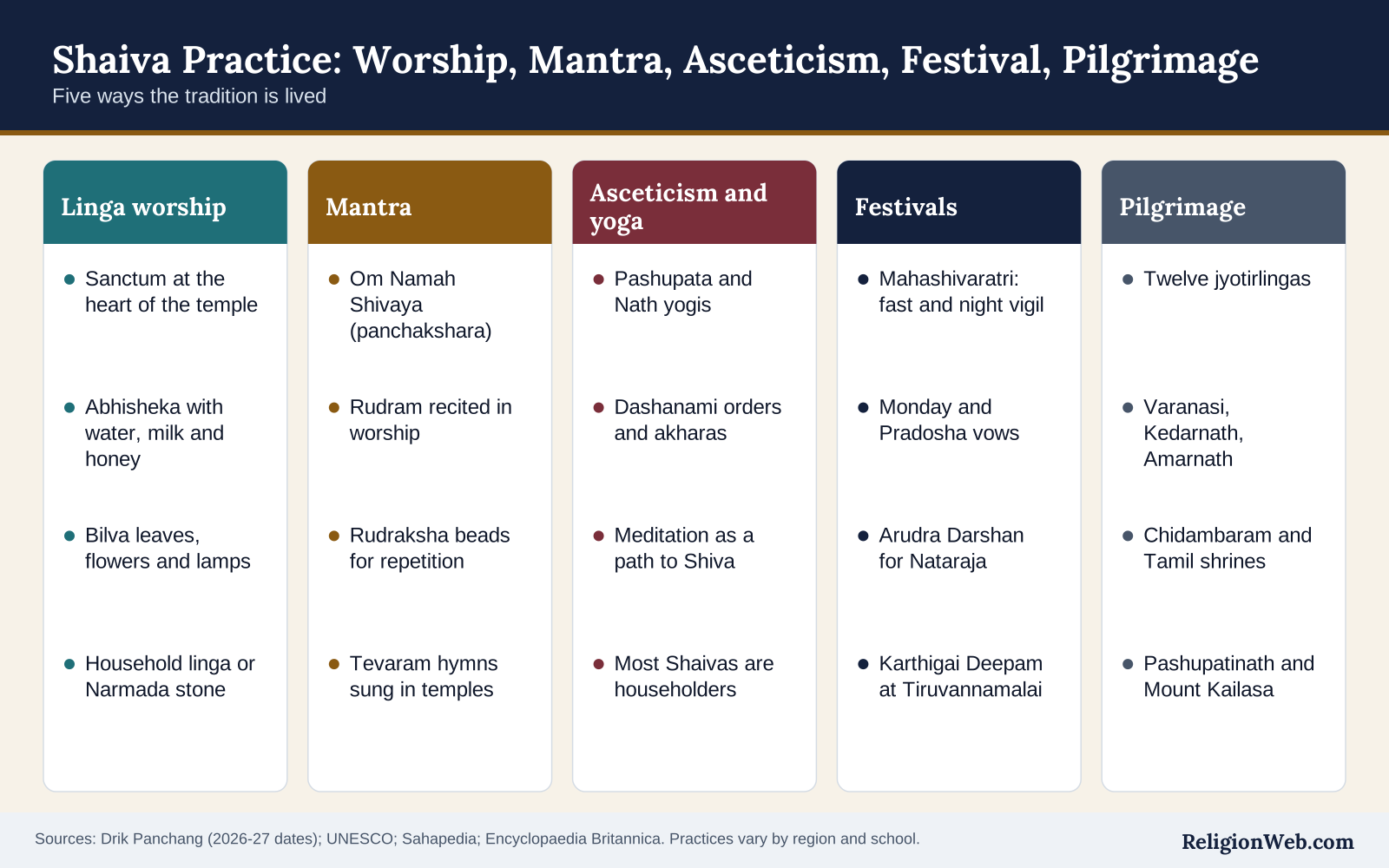
| Practice or observance | Timing or place | What participants do | Meaning in the tradition |
|---|---|---|---|
| Abhisheka of the linga | Daily in temples; special occasions | Pour water, milk, curds, honey and other substances while reciting the Rudram | Honoring the Lord’s presence; receiving grace |
| Monday and Pradosha vows | Weekly; twice a month at twilight | Fast, visit the temple, offer water and bilva leaves | Devotion and discipline; approach to Shiva |
| Mahashivaratri | Dark fortnight of Magha or Phalguna; 15 February 2026, 6 March 2027 | Fast, keep an all-night vigil in four watches, chant Om Namah Shivaya | Wedding of Shiva and Parvati; appearance of the pillar of light |
| Arudra Darshan | Margazhi (December to January), especially Chidambaram | Special worship and procession of Nataraja | Remembering the cosmic dance |
| Karthigai Deepam | Karthigai (November to December), Tiruvannamalai | Lighting a great flame on the hill | Shiva as fire and light |
| Kanwar pilgrimage | Shravan (July to August), North India | Carry Ganges water to a Shiva temple on foot | Offering sacred water to the Lord |
| Jyotirlinga pilgrimage | Twelve sites across India; any season | Visit and worship at each self-manifested linga | Merit and nearness to the Lord |
| Ascetic practice and yoga | Throughout life; in monastic centers and akharas | Meditation, mantra repetition, ash, rule-governed renunciation | Freedom from bondage; union with Shiva |
Branches, Schools, and Internal Diversity in Shaivism
Early Ascetic Movements
Pashupatas and Lakulas
The Pashupata path and its Lakula branch, associated with the teacher Lakulisha, are the earliest identifiable Shaiva movements with their own scriptures and discipline. They emphasized ascetic observance, ash, meditation and the repetition of Om, and they understood the soul’s liberation as a release brought about by Shiva’s grace after a long practice. Their communities were most visible in western and central India, and their influence reached Java and Cambodia. Few Pashupata lineages survive as such today, though their ideas shaped later Shaivism.
Kapalikas, Kalamukhas, and the Question of Evidence
Older reference works describe the Kapalikas and Kalamukhas as extreme offshoots of the Pashupatas. Recent scholarship places them within the wider ascetic world that Alexis Sanderson calls the Atimarga, and it stresses that much of what is said about them rests on hostile or secondary sources. The Kalamukhas appear in medieval South Indian inscriptions as heads of temples and colleges and as recipients of royal grants, a record that fits poorly with the stereotype of marginal extremists. These movements are not active today as distinct groups, and the reader should treat popular descriptions of them with caution.
Schools of the Mantramarga
Shaiva Siddhanta in Its Sanskrit and Tamil Forms
Shaiva Siddhanta is the largest and best-preserved of the Agamic traditions. Its Sanskrit form, centered on the Agamas and their commentaries, governs the rites of many temples in South India. Its Tamil form joins the Agamic ritual with the devotional canon of the Tirumurai and the philosophy of the Meykanda Shastras. Both teach that the Lord, souls and bonds are eternally real, and both give central importance to initiation, temple worship and grace.
Bhairava, Kaula, and Goddess-Centered Currents
Next to the Siddhanta grew traditions focused on Bhairava and the goddesses, collected in the scriptures that Sanderson calls the Mantrapitha and Vidyapitha. Many of these traditions developed ritual and meditation practices that stress the female powers of Shiva, and they overlap with what is called Shaktism. The Kaula lineages, which Sanderson describes as a post-Kapalika form of goddess-centered tradition, illustrate how permeable the boundaries between Shaiva and Shakta streams could be.
Kashmir Shaivism: Trika, Spanda, and Pratyabhijna
Kashmir Shaivism designates a group of monistic traditions of the medieval period, including the Trika (the “triad” of Shiva, Shakti and the individual soul, or of their related modes), the Spanda doctrine and the Pratyabhijna philosophy. Their literature is among the most refined in Sanskrit, and in the late first millennium CE they stood alongside Buddhist and other Shaiva currents in the valley. Today the tradition lives through study circles, lineages of teachers and academic research, as well as in the ritual and philosophical practice of Kashmiri Shaivas.
Regional and Community Traditions
The Virashaivas, or Lingayats, of Karnataka
The Virashaiva or Lingayat community of Karnataka and neighboring states honors Basavanna and the Sharanas of the twelfth century. Each member receives an ishtalinga, a small linga worn on the body, in an initiation rite that includes women and men alike. The tradition teaches a path of six stages (shatsthala) from devotee (bhakta) to union (aikya), and it describes eight protective supports (ashtavarana) and five codes of conduct (panchachara). Its poets valued manual work and service as forms of worship, and the movement criticized birth-based hierarchy.
Britannica notes that Lingayats oppose Brahmanical authority and worship of any image other than the linga, and that in the early twenty-first century some Lingayats sought legal recognition either as a religion separate from Hinduism or as a caste within Hinduism. In March 2018 the Karnataka cabinet asked the central government to grant Lingayats minority-religion status on the recommendation of an expert committee; the central government later said it could not accept the request. Within the community there is real disagreement, and some Veerashaivas understand themselves as Shaiva Hindus who follow Basavanna, while others hold that Lingayatism is a distinct faith. This article presents both positions without deciding between them.
Nath Yogis and Siddha Traditions
The Nath tradition is a network of ascetic lineages devoted to Shiva as Adinath, the “first lord,” and to the yogic teachers Matsyendranath and Gorakhnath. It is known for its yoga, its hymns in regional languages, and its centers of pilgrimage in northern India. Related Siddha traditions in the Tamil country honor poet-yogis who taught liberation through direct experience, and the Tirumantiram is often claimed by them.
Shivadvaita and Other Philosophical Lines
Besides the schools above, Sanskrit commentators developed Vedanta-style readings of Shaiva theology. The best known is Shivadvaita, associated with Srikantha’s commentary on the Brahma Sutras and later with the sixteenth-century polymath Appayya Dikshita, which presents Shiva as the highest Brahman. In Bali, as the scholar June McDaniel observed in a 2015 Oxford lecture, the high priests are mainly Shaiva and identify with Siva through tantric practice, with a smaller number of Buddha-Siva priests. Related currents of Southeast Asian religious history are discussed in the articles on Mahayana Buddhism and Vajrayana Buddhism.
| Tradition | Region and period | Core emphasis | Characteristic texts or practices |
|---|---|---|---|
| Pashupata and Lakula | Western and central India; from about the 2nd century BCE to 2nd century CE, active for centuries | Ascetic discipline; grace of Pashupati | Pashupata Sutra; ash, meditation, Om |
| Shaiva Siddhanta (Sanskrit) | Kashmir and South India; from about the 5th century | Pati, pashu, pasha; grace through initiation | Siddhanta Agamas; temple ritual |
| Tamil Shaiva Siddhanta | Tamil country; devotional hymns from the 6th to 9th centuries, philosophy from the 13th | Eternally distinct Lord, soul and bonds; devotion and service | Tirumurai; Sivajnanabodham; adheenams |
| Kashmir Shaivism | Kashmir; 9th to 11th centuries | Shiva as consciousness; liberation as recognition | Shiva Sutra; Pratyabhijna; Tantraloka |
| Virashaiva (Lingayat) | Karnataka and neighboring states; from the 12th century | Personal linga; equality; six stages to union | Vachanas; ishtalinga; shatsthala |
| Nath yogis | North and West India; medieval period | Yoga and renunciation | Hatha yoga; hymns in regional languages |
| Shivadvaita | South India; medieval to early modern | Shiva as Brahman in a Vedanta frame | Commentaries of Srikantha and Appayya Dikshita |
| Balinese Shaivism | Bali, Indonesia; from the early medieval period | Priestly identification with Siva; temple rites | Pedanda rites, tantric ritual |
Sacred Spaces, Architecture, and Material Culture
Temples and Rock-Cut Shrines
Plan and Meaning of the Shiva Temple
A Shiva temple is organized around the sanctum, the garbhagriha or “womb chamber,” in which the linga stands. Above it rises a tower, the vimana, and in front lie pillared halls where worshipers gather and where Nandi faces the sanctum. In the Tamil country, tall gateway towers (gopuras) mark the entrances. UNESCO notes that the Great Living Chola Temples show the progressive development of Chola architecture, and reports sanctum towers of about 53 meters at Gangaikondacholapuram and about 24 meters at Darasuram. The temples remain living places of worship in which rituals continue daily, weekly and annually.
Elephanta, Ellora, and Prambanan
Some of the most striking Shaiva sites are cut into rock. UNESCO describes the Elephanta caves off Mumbai, dedicated to Shiva and carved around the mid-fifth to sixth century, with a roughly seven-meter Sadashiva sculpture at the entrance, along with reliefs of Nataraja, Ardhanarishvara and Gangadhara. At Ellora, UNESCO calls the Kailasa temple (Cave 16) the largest monolithic temple and the culmination of rock-cut architecture in India. In Indonesia, the Prambanan compound in Java, inscribed on the World Heritage List in 1991, is described by UNESCO as the largest temple compound dedicated to Shiva in the country.
Objects and Art
Bronze Images and Processional Art
The Chola period produced some of the finest Hindu bronzes. The Metropolitan Museum’s Nataraja, a copper alloy figure of the late eleventh century about 68 centimeters high, shows the typical combination of dynamic movement and stability. Such bronzes were made to be carried, dressed and honored in festivals, and temples still hold large collections of them.
Ritual Objects and Marks
Objects of worship include the linga and its base, lamps, bells and vessels for abhisheka, the trident, bilva leaves, rudraksha beads and sacred ash. Each carries a meaning explained earlier in this article, and each is handled with specific rules of purity. In Virashaiva practice, the ishtalinga is kept in a small casket and is treated as the living presence of God, never removed from the body for ordinary purposes.
Community, Ethics, and Daily Life in Shaivism
Ethics and Values
Love, Service, and Non-Violence
Shaiva ethics are expressed less through legal codes than through the examples of saints and the practices of devotion. The Tamil tradition prizes love for God and for all beings, and a line often quoted from the Tirumantiram, anbe sivam, “love is Shiva,” is widely used as a motto, though its original context is more complex. Virashaiva teachers speak of kayaka, work as worship, and dasoha, generous service to the community. Many Shaivas are vegetarian, particularly in Tamil Shaiva Siddhanta and Virashaiva communities, although diet varies by region and family.
Householders, Teachers, and Monastic Houses
Community life is organized around the family, the temple and the teaching lineage. Householders keep vows, observe the calendar and support priests and ascetics. The Tamil adheenams, led by heads of monastic houses, run schools, temples and charities and continue to initiate disciples. Virashaiva monasteries have likewise been important centers of education and welfare in Karnataka.
Social Questions and Debate
Caste, Access, and Reform
Shaiva history includes both hierarchy and challenges to it. The Nayanar saints came from many occupations, and the Virashaiva movement rejected birth-based distinctions in religious status, as Britannica notes. Yet temple roles, hereditary priesthoods and local customs have often reflected the caste hierarchies of their regions. In modern India, disputes over who may serve as a priest in state-administered temples, and how far the Agamas limit appointments, have reached the courts, and communities hold a range of views.
Women in Shaiva Religious Life
Women appear prominently in Shaiva devotion as poets and saints, among them Akka Mahadevi and, in the Tamil tradition, the saint Karaikkal Ammaiyar, and the Virashaiva initiation includes women. In temple priesthood and some monastic settings, roles have mostly been held by men, and contemporary debate about opening those roles continues. Participation in domestic worship, fasting and pilgrimage is widespread among women, who in many households are the principal keepers of daily ritual.
Shaivism Today: Global Presence and Contemporary Life
Population and Geography
India, Nepal, and Sri Lanka
Pew Research Center’s 2025 analysis of 2020 data found nearly 1.2 billion Hindus worldwide, the community described in the article on Hinduism as a whole, about 95 percent of them in India, where Hindus make up 79 percent of the population. Nepal is 81 percent Hindu in the same analysis. These are figures for Hinduism as a whole, and no comparable count exists for Shaivas specifically. What the available evidence does show is Shiva’s importance in devotional life: in Pew’s 2021 report on India, 44 percent of Hindus who believe in God said they feel close to Shiva, more than named any other deity. In southern India, Shaiva identity is strong among Tamil and Kannada speakers; in northern Sri Lanka, Tamil Hindus maintain Shaiva temples; and in Nepal, Pashupatinath draws pilgrims from across South Asia.
Southeast Asia and the Diaspora
Shaiva traditions survive most clearly outside South Asia in Bali, where Hinduism is the majority religion and Shaiva priests carry out the rites that produce the holy water used in many ceremonies. The great Shaiva monuments of Cambodia and Java, such as Prambanan, are now mostly heritage sites. Pew’s figures list the United States with about 3.0 million Hindus, and the United Kingdom and the United Arab Emirates with about 1.1 million each, and in Mauritius Hindus make up 48 percent of the population. In these countries Shaiva temples, often built in Tamil or Sri Lankan Tamil styles, host the same daily worship, festivals and Tevaram singing found in the south of India, and are also centers for language classes, music and community support.
Study, Revival, and Public Life
Scholarship, Teaching, and Lineages
Shaivism is a major field of academic study. Since the late twentieth century, critical editions and translations of the Agamas, the Tantras and the Kashmir treatises have grown in number, and Sanderson’s 2009 study is freely available under an open license. Living teachers continue the Kashmir lineages, the Tamil adheenams and the Virashaiva monasteries. As the Internet Encyclopedia of Philosophy notes, the Kashmir traditions survived mainly among Kashmiri Brahmans and have been the focus of revival efforts in India and abroad.
Contemporary Questions
Present-day Shaiva communities discuss questions that are not purely religious: the preservation of manuscripts and ritual knowledge, the training of priests, the administration of temples by state governments or trusts, the opening of temple roles to people from different backgrounds, and, among Lingayats, the legal meaning of their identity. These debates have many participants, and informed voices from within the Shaiva world disagree about the right answers.
Common Misconceptions About Shaivism
Misconception 1: Shiva is only a destroyer
Where the misunderstanding comes from
Many introductions to Hinduism describe three major gods, Brahma the creator, Vishnu the preserver and Shiva the destroyer, and the tidy pattern is easy to remember. Films, books and merchandise often reinforce it, and Shiva’s fierce forms, with their flames, serpents and cremation-ground settings, make the idea seem natural. The pattern does appear in Puranic and artistic traditions, so the impression is not invented, but it is a partial summary drawn from one conceptual scheme.
A second source of confusion is the English word “destroyer,” which suggests malice or chaos. The Sanskrit term samhara means a gathering or withdrawing of the world into its source, closer to dissolution than to demolition. Early Western writers, who often approached Hindu deities through the lens of a triad and through Christian ideas of God, also found it easier to assign each god a single function, and that habit has persisted in popular accounts.
What the evidence and tradition actually show
In Shaiva Siddhanta and the Kashmir schools, Shiva performs five acts: creation, preservation, dissolution, concealment and grace. Dissolution is only one, and grace is the one on which the tradition places its hope. The Metropolitan Museum’s description of the Nataraja bronze presents the image as uniting Shiva’s roles as creator, preserver and destroyer, and the figure’s raised hand of reassurance offers refuge to the worshiper. The name Shiva means “auspicious,” and the Vedic Rudra whom the tradition regards as an earlier form was asked for healing and protection as well as feared.
Shaiva devotion also makes the point in practice. Pilgrims do not go to Shiva temples to ask for ruin; they go for health, family welfare, protection from fear and, ultimately, release. The Tamil hymns of the Tevaram, sung in temples, speak of Shiva as a refuge and a friend. The Shaiva claim that Shiva stands above the three-god scheme is visible in art as well: the Sadashiva image at Elephanta, which UNESCO describes as depicting three aspects of Shiva as creator, preserver and destroyer, shows one deity as the source of all three.
The accurate statement, therefore, is that dissolution is part of what Shaiva theology says Shiva does, and that in most Shaiva schools it is understood as one phase of a cycle that ends in the liberation of souls.
Misconception 2: All Shaivism is primarily ascetic
Where the misunderstanding comes from
The best-known images of Shiva show an ascetic: ash-covered, matted-haired and seated in meditation on a mountain. The early Pashupata movement, the cremation-ground Aghori ascetics of Varanasi, the naked Naga sadhus at the Kumbh Mela and the Nath yogis all fit that picture and receive more attention in media and travel writing than ordinary temple life does.
What the evidence and tradition actually show
Ascetic traditions are real and prestigious within Shaivism, but they are not its main social form. Sanderson’s account of the early medieval period describes how Shaivism became a religion of kings, temples and householders who took initiation without leaving their families. The Chola temples, the Tevaram singing, the Monday fasts, the Mahashivaratri vigil and the Virashaiva insistence that work and family life are forms of worship all show a tradition centered on household and temple life. Most Shaivas today are householders, and the ascetic ideal informs their religion without defining their daily conduct.
Even the ascetic orders are not a single type. Some, like the Nath yogis, emphasize yogic discipline; others, like the Dashanami sannyasis, combine philosophical study with monastic organization; and the Tamil adheenams are monastic houses whose heads are deeply involved in temple administration, education and charity. Ascetics also depend on lay support and often live near temples and pilgrimage centers. The picture of a lone wanderer on a mountain is one image among many, and it describes a small minority of Shaivas.
Misconception 3: All Shaiva schools teach the same metaphysics and ritual system
Where the misunderstanding comes from
Because the word “Shaivism” names one god, readers often assume it also names one doctrine. Popular summaries tend to merge the ideas of different schools, for example presenting the Kashmir teaching that all is Shiva alongside the Siddhanta teaching of three eternal realities as if they were the same thing.
What the evidence and tradition actually show
The schools differ significantly. The Internet Encyclopedia of Philosophy describes the Kashmir traditions as monistic and idealist and distinguishes them from the dualistic Shaiva Siddhanta that also existed in medieval Kashmir. Britannica notes that modern Shaiva schools range from pluralism, in which souls and matter are real and distinct, to absolute monism. Ritual systems differ too: the Siddhanta relies on the Agamas and temple priesthoods, the Kashmir schools on the Tantras and an inward-looking practice, and the Virashaivas on the personal linga and the vachanas. Shaivas recognize one another through devotion to Shiva, not through agreement on doctrine.
These differences are not only philosophical. A Tamil temple priest following the Kamika Agama, a Kashmiri practitioner trained in the Trika, and a Lingayat who wears the ishtalinga would each describe the path to liberation in different words and prepare for it by different means. Scholars therefore often speak of Shaivisms in the plural. At the same time, the schools have borrowed from one another over centuries, so the lines between them are not rigid, and a fair description avoids both pretending that all Shaivas agree and treating the schools as unrelated. Readers who meet a confident one-sentence summary of “what Shaivas believe” should ask which school, region and period it describes.
Misconception 4: The linga is simply a phallic symbol that Shaivas worship as such
Where the misunderstanding comes from
Early European writers on India often read the linga in an exclusively sexual sense, and that reading entered popular books and has circulated since. Some early linga sculptures, including the one at Gudimallam, are explicit, and the base of the linga is sometimes interpreted as a female symbol, which seems to confirm the reading.
What the evidence and tradition actually show
Scholars of religion acknowledge generative dimensions in the symbolism but caution that this is not how worshipers understand the object. The Sanskrit word linga means “mark” or “sign,” and Shaiva theology presents the linga as the sign of the formless Lord, who is beyond all form. The story of the pillar of light stresses this limitlessness. In temple practice, worshipers approach the linga with offerings of water, leaves and flowers, in an attitude of reverence. Different interpreters emphasize different layers, and a fair account should state that scholarly readings and devotional readings differ without presenting either as the only one.
It is also worth noticing how the tradition itself handles the topic. Shaiva ritual texts treat the installation of a linga as a solemn consecration in which mantras, purification and the presence of the Lord are central. The Virashaiva poets went further and wrote of the linga as a companion carried on the body, to which they spoke in the language of love, loyalty and surrender. Visitors to a Shiva temple will find that the atmosphere is one of quiet devotion, with offerings of water and leaves, and that the object of the worshipers’ attention is the Lord who is present in it.
Misconception 5: Shiva worship is a direct, unchanged continuation of Indus Valley religion
Where the misunderstanding comes from
John Marshall’s 1931 interpretation of an Indus seal as a proto-Shiva has been repeated in textbooks and websites for decades, and the idea that Shaivism is the oldest living religion can be attractive to people who want to affirm a deep Indian heritage. Shiva worship does have ancient features, and the Vedic Rudra is old.
What the evidence and tradition actually show
The Indus script is undeciphered, so there is no text to confirm what the seals meant, and many specialists regard the proto-Shiva identification as unproven. The documented history runs from the Vedic Rudra through the Shvetashvatara Upanishad, Kushan coins and early sculpture, the Pashupata movement and the Mantramarga to the temple Shaivism of the medieval period. Each stage reshaped what came before. It is more accurate to say that Shaivism has deep and complex roots, some of them perhaps pre-Vedic, than to claim an unbroken line from the Indus cities.
Historians also point out that claims of unbroken antiquity are made in several directions. Some people use them to argue that Shaivism is older than the Vedas, and others to argue that it was always part of them. Neither position can be settled by the surviving evidence, which consists of a few seals, a body of Vedic hymns, later texts and sculpture. Shaiva traditions themselves usually make a different kind of claim, that Shiva is eternal and that the Agamas were spoken by him at the beginning of time. That is a statement of faith about the nature of the scriptures, not a historical dating, and a reference article should keep the two kinds of claim apart.
Frequently Asked Questions About Shaivism
Questions About Meaning and Belief
Who is a Shaiva, and does it mean worshiping only Shiva?
A Shaiva is someone who honors Shiva as the supreme deity or as the principal object of devotion. Many Shaivas also honor Parvati, Ganesha, Murugan, Nandi and the Nayanar saints, and those other figures are understood as belonging to Shiva’s family or as manifestations of his power. In practice, a household may include devotion to several deities, so the label describes where the center of devotion lies rather than a rule of exclusion.
There is no formal membership. Some people become Shaivas through initiation into a lineage, while others are Shaivas by family and regional custom.
What does Om Namah Shivaya mean?
The mantra can be rendered “Om, homage to Shiva” or, in a more devotional phrase, “I bow to the auspicious one.” The five syllables na-mah-shi-va-ya are the panchakshara. Different schools interpret the syllables as representing the five elements, the five acts of Shiva or the stages of the soul’s journey. All of these are traditional readings, and none replaces the plain meaning of homage.
Questions About Practice
Why do Shaivas wear ash and rudraksha?
Ash, applied in three horizontal lines, is a sign of Shiva’s devotees. It is explained as a reminder of impermanence and as a sign of purification and surrender. Rudraksha seeds are worn as beads for mantra repetition, and Puranic tradition connects them with the tears of Shiva. Neither is required of every Shaiva, and use varies among communities, but they are widely recognized signs.
What should a visitor know before entering a Shiva temple?
Customs vary, so visitors should observe local signs and follow the guidance of temple staff. In most temples, shoes are removed before entering, modest dress is expected, and some temples have rules on who may enter the inner sanctum or take photographs. Visitors often walk clockwise around the sanctum, and a custom at many Shiva temples avoids stepping over the channel through which the bathing water leaves the linga. Offerings, if made, are usually handed to a priest.
Non-Hindu visitors are welcome in some temples and restricted in others, a matter of local policy that visitors should check in advance.
Questions About the Calendar and Places
When is Mahashivaratri in 2027, and why does the date change?
According to the calendar site Drik Panchang, Mahashivaratri falls on Saturday, 6 March 2027 in New Delhi, with the midnight worship in the early hours of 7 March. The date moves each year on the Gregorian calendar because it is set by the lunar calendar: it is the fourteenth lunar day of the dark fortnight in Magha or Phalguna, depending on how the month is counted. The 2026 festival fell on 15 February. Because local sunrise and moonrise times affect the exact day, worshipers consult an almanac for their own city.
Which places are the most important for Shaiva pilgrimage?
Importance depends on tradition. For many Shaivas, the twelve jyotirlingas, Varanasi, Kedarnath and Amarnath are central. In the Tamil country, Chidambaram, Tiruvannamalai, Thanjavur and the other shrines praised in the Tevaram are especially prominent. Pashupatinath is a leading site in Nepal, Mount Kailasa is regarded as Shiva’s abode, and Virashaivas look to Basavakalyan and Kudalasangama in Karnataka. Each pilgrim’s list reflects family, region and lineage.
Conclusion: Understanding Shaivism Through Its Many Paths
What the History Shows
A Tradition Built Over Many Centuries
Shaivism grew from the Vedic hymns to Rudra, the monotheistic language of the Shvetashvatara Upanishad, the ascetic discipline of the Pashupatas, the initiatory ritual of the Mantramarga, the royal temples of the early medieval period and the poetry of Tamil and Kannada saints. Each stage left its own scriptures, institutions and practices, and later generations kept what they inherited while adding new interpretations. The result is a tradition that is unified by devotion to Shiva and diverse in theology, ritual and social form.
Grace, Form, and the Formless
Across these differences, a few themes recur: the Lord who is beyond form yet present in the linga and the dancing image, the soul bound by limitation and freed by grace, and the belief that worship, knowledge and devotion are all means by which that freedom can be realized. Understanding which of these themes a particular school emphasizes is the best way to read its texts and observe its practice with accuracy.
How to Keep Exploring
Reading the Sources in Context
Readers who wish to go further can start with accessible public-domain translations, such as Max Müller’s version of the Shvetashvatara Upanishad and Ralph Griffith’s Rigveda, and then move to scholarly studies of the Agamas, Kashmir Shaivism and the Tamil canon. Because many modern translations are under copyright, a library is often the best path to them. It helps to ask of any passage which school is reading it and in what period.
Related Articles and Traditions
Shaivism is best understood alongside its wider context. The overview in Hinduism places it among the major streams, and the companion articles on Vaishnavism and Shaktism describe those traditions on their own terms. Visiting a temple with respect, attending a festival or listening to a recitation of the Tevaram can add a dimension that reading alone cannot.
Sources
The table below lists the principal external sources behind this article. Facts, dates and figures were checked against these and related primary, institutional and academic materials.
| # | Source | Publisher and type | Used for | Link |
|---|---|---|---|---|
| 1 | The Upanishads, Part II (SBE 15), trans. F. Max Müller: Svetasvatara Upanishad, Adhyaya III | Internet Sacred Text Archive (sacred-texts.com) · Primary text (public-domain translation) | Quotations of Svetasvatara Upanishad 3.2 and 3.8 (Müller, 1884); Rudra-Shiva as the one Lord | sacred-texts.com |
| 2 | The Saiva Age: The Rise and Dominance of Saivism during the Early Medieval Period, by Alexis Sanderson (2009) | Zenodo (CC BY 4.0), from Genesis and Development of Tantrism, Univ. of Tokyo · Academic scholarship | Atimarga and Mantramarga, Siddhanta, Bhairava and Trika scriptures, royal patronage, Southeast Asia | zenodo.org |
| 3 | Kashmiri Shaiva Philosophy | Internet Encyclopedia of Philosophy · Academic reference | Kashmir Shaivism: figures and dates, doctrines, Trika, Pratyabhijna, Spanda, survival and revival | iep.utm.edu |
| 4 | Shaivism | Encyclopaedia Britannica · Encyclopedia | Definition; Rudra and Shiva; Pashupata; Shaiva Siddhanta (pati, pashu, pasha); spread to Southeast Asia | britannica.com |
| 5 | Shiva as Lord of Dance (Nataraja), Chola period, late 11th century (acc. no. 1987.80.1) | The Metropolitan Museum of Art · Museum catalog | Nataraja date, medium, size and iconography (damaru, fire, abhaya, Apasmara) | metmuseum.org |
| 6 | The Nataraja bronze and Coomaraswamy’s legacy, by Sharada Srinivasan | Sahapedia · Academic essay | Nataraja’s reception, Rodin, Coomaraswamy, Chidambaram, Margazhi festival, CERN statue | sahapedia.org |
| 7 | Great Living Chola Temples (World Heritage List, no. 250) | UNESCO World Heritage Centre · Institutional | Brihadisvara (c. 1009-1010) and Gangaikondacholapuram (1035) temples; inscription dates; living worship | whc.unesco.org |
| 8 | Maha Shivaratri Date and Time | Drik Panchang · Calendar reference | Mahashivaratri on 6 March 2027 (New Delhi); tithi rule; Magha/Phalguna naming | drikpanchang.com |
| 9 | Beliefs About God in India (Religion in India report) | Pew Research Center · Demographic data | 44% of believing Hindus in India feel closest to Shiva (2021 report) | pewresearch.org |
| 10 | Hindu Population Change (How the Global Religious Landscape Changed, 2010-2020) | Pew Research Center · Demographic data | About 1.2 billion Hindus in 2020; about 95% in India; Nepal and diaspora figures | pewresearch.org |
Last fact-check date: 2026-10-21.

