
Shiva is one of the great deities of Hinduism and, for the Shaiva communities that place him at the center of their devotion, the supreme God. His name is a Sanskrit word meaning “auspicious” or “kind,” and the tradition that honors him is among the longest continuous strands of Indian religious life, with temples, hymns, philosophical schools and festivals that reach from the Himalayas to Tamil Nadu, from Nepal and Sri Lanka to Java and Bali. Devotees know him by many names: Mahadeva, the “great god”; Shankara, the “giver of ease”; Pashupati, the “lord of creatures”; Nataraja, the “lord of the dance.”
The popular summary of Shiva as “the destroyer” is true only in a narrow sense. In a widely repeated scheme of Puranic literature, Brahma creates, Vishnu preserves and Shiva dissolves the world at the end of a cosmic age. Shaiva texts, however, usually describe him as the one who also creates, sustains, conceals and, above all, grants grace and liberation. He is the ascetic who sits in meditation on a snowy mountain and the husband of Parvati, the father of two sons, the dancer in a ring of fire, and the formless pillar of light that devotees honor in the linga. Each of these images answers a different question about the divine, and the tradition has held them together for well over two thousand years.
This article is a profile of Shiva as devotees understand him, written with attention to what the surviving texts and artifacts show. It follows his name and iconography, his development from the Vedic god Rudra, the stories told about him, the meaning and worship of the linga, the main Shaiva traditions, daily and festival worship, and pilgrimage. For the wider history of the communities that regard Shiva as supreme, see the companion article on Shaivism; for the general structure of Hindu domestic and temple ritual, see the article on puja. Where evidence is thin, such as the dating of early images, the text says so, and where Shaiva schools differ in doctrine, the differences are described without ranking them.
Shiva at a Glance: Name, Meaning, and Place in Hindu Life
What the Name Shiva Means and Who Is Meant by It
“Auspicious” as a name and as an adjective
In Sanskrit, shiva is first an ordinary adjective meaning “auspicious,” “kindly” or “propitious.” It appears in the Rig Veda as a descriptive word, including in hymns addressed to the stormy god Rudra, long before it became a proper name. The gradual shift from adjective to name is one of the clearest linguistic signs of how a deity of fear and danger came to be approached as a source of blessing. Several of the tradition’s own explanations turn on this point: devotees understand that to call upon the “auspicious one” is to ask for the gentle face of a power that can also be frightening.
The name is therefore often translated differently depending on context. Scholars writing about the earliest texts tend to keep the sense of an epithet, “the kindly one.” Shaiva theologians writing in Sanskrit or Tamil usually take Shiva as the personal name of the supreme reality, sometimes glossed as the one who is pure consciousness and bliss. Both usages are legitimate within their own frames, and a reader who meets “Shiva” in a Vedic hymn should not assume that every later idea is already present there.
One God with many names
Hindu devotional literature gives Shiva a very long list of names. The Shiva Sahasranama, a litany of a thousand names that appears in the Mahabharata and in several Puranas, is the best known, but local temples and communities also have their own titles for the deity of their town: Kashi Vishwanath at Varanasi, Mahakala at Ujjain, Brihadishvara at Thanjavur, Pashupatinath near Kathmandu. Each name points either to a form, a deed, a place, or a quality, and a single devotee may use several of them in the same prayer.
Because of this abundance, it is more accurate to say that Shaiva Hindus honor one God under many names than to say that Shiva has a fixed set of roles. The table later in this section gathers the names a reader is most likely to meet, with the sense that the tradition gives each one.
Shiva within and beyond the Hindu triad
Many readers meet Shiva first as the third member of a triad that also includes Brahma and Vishnu. That arrangement is real in Puranic literature and in a number of famous images, including the three-faced Sadashiva sculpture at Elephanta, but it is not the only way Hindu texts arrange the divine. Vaishnava traditions, centered on Vishnu and his incarnations such as Krishna, understand the supreme being differently, and Shakta traditions honor the goddess, as in the worship of Durga, as the ultimate power. Shaiva traditions place Shiva himself above the triad, so that Brahma and Vishnu act within his creation. These are internal theological differences between communities who share a great many texts and festivals, and this article describes the Shaiva position as the Shaiva position, not as a verdict on the others.
Where and How Shiva Is Honored Today
Numbers and geography
No census asks how many people honor Shiva, because Hindu identity is not divided by census into Shaiva, Vaishnava and Shakta members. The Pew Research Center’s 2025 study of changes between 2010 and 2020 estimated that there were nearly 1.2 billion Hindus in the world in 2020, about 95 percent of them in India, with large communities in Nepal, Bangladesh, Indonesia, Sri Lanka, Pakistan, Malaysia, Mauritius and the diaspora of the United States, the United Kingdom, Canada and the Gulf. Shiva is worshiped by many of these Hindus, whether or not they consider themselves Shaivas by affiliation.
A Pew survey of Indian religion published in 2021 gives a rough sense of his place in popular devotion. When Hindus who believe in God were asked which deities they feel close to, with a list of fifteen deities and room for up to three answers, Shiva was chosen more often than any other, by 44 percent of respondents, ahead of Hanuman and Ganesha. The survey measures closeness to a deity, not formal membership in a sect, but it fits what temple counts, pilgrimage numbers and festival attendance suggest across much of the subcontinent.
Shaivas, Smartas, and everyday devotees
Shiva is honored in at least three overlapping ways. For Shaivas, he is the supreme God, and the tradition has its own initiation, scriptures and temple liturgies, as described in the article on Shaivism. For Smartas, followers of the tradition that draws on the Smriti texts and is often associated with the teacher Shankara, he is one of five deities, along with Ganesha, Vishnu, Surya and the Goddess, any of whom a household may choose as its focus. For many ordinary Hindus, who do not belong to a named sect, Shiva is simply one of the gods with a temple in the neighborhood, a day of the week for visiting, and a great night once a year.
These categories overlap in practice. A family in Maharashtra may keep a small linga at home, visit a Vaishnava temple on a festival day, and treat Ganesha, Shiva’s son, as the first deity to be addressed in any undertaking. What Hindus call devotion to Shiva is seldom exclusive, and the Sanskrit and Tamil terms used by scholars for sects describe communities of practice more than closed memberships.
How scholars and devotees read the sources
Throughout this article, three kinds of statement appear. Some are historical: what a Vedic hymn says, which stone or bronze image survives from which period, what a temple inscription records. Some are the teaching of a particular school, such as the Shaiva Siddhanta of the Tamil country or the non-dual Shaivism of Kashmir. And some are devotional narratives, stories told in the Puranas or in local temple legends, whose meaning for worshipers does not depend on a date. A narrative such as the descent of the Ganga on Shiva’s hair is a story in the Ramayana, the Mahabharata and the Puranas, and it is also a living image on thousands of temple walls, and both facts matter to the way it is understood.
Names and Titles of Shiva: A Reference Table
The most common names, with their traditional meanings
The table below lists names that readers are likely to meet in texts, temples and festival songs. The glosses are the ones Shaiva commentators and general dictionaries give, and they are traditional interpretations, not translations to be pressed too hard. Many names carry more than one sense, and where a gloss is widely debated, the debate is noted in the text of later sections.
| Name | Literal sense | Where the name is emphasized |
|---|---|---|
| Shiva | “auspicious,” “kind” | The standard personal name across Sanskrit and regional literatures |
| Rudra | Traditionally linked to a root meaning “to cry out” or “howl”; some scholars suggest other origins | Vedic hymns, especially Rig Veda 2.33, and the Shatarudriya litany |
| Mahadeva | “great god” | Epics, Puranas, and everyday speech |
| Shankara / Shambhu | “beneficent,” “source of ease” | Litanies and devotional songs; also the name of the teacher Shankara |
| Pashupati | “lord of creatures” or “lord of the bound souls” | Pashupata ascetics and the temple at Pashupatinath in Nepal |
| Nilakantha | “blue-throated” | Stories of the churning of the ocean and the poison |
| Nataraja | “lord of dance” | Chidambaram and Chola-period bronzes |
| Trilochana / Tryambaka | “three-eyed” | The third eye; the Mahamrityunjaya mantra |
| Gangadhara | “bearer of the Ganga” | Narratives and images of the river on his hair |
| Chandrashekhara | “crowned with the moon” | Images with a crescent in the locks |
| Bhairava | “fearsome” or “awe-inspiring” | Tantric Shaivism; guardian shrines in towns |
| Ardhanarishvara | “lord who is half woman” | Sculptures uniting Shiva and the Goddess in one body |
| Dakshinamurti | “south-facing” form | Shiva as silent teacher, especially in South India |
| Vishvanatha | “lord of the universe” | Varanasi (Kashi Vishwanath) |
Names of devotion in regional languages
Regional languages add their own names. In Tamil, devotional poetry speaks of Sivan and Appan, “father.” In Telugu the temple at Srisailam honors him as Mallikarjuna, and in Kannada the twelfth-century Lingayat poet Basava signs his poems with the name Kudalasangamadeva, “lord of the meeting rivers.” In North India the affectionate Bholenath, “the guileless lord,” is common in songs and pilgrimage cries. In Nepal, Pashupatinath is a deity of the nation as well as the sect, and in Bali the god is addressed as Siwa in ritual and literature.
These names are not mere translations. They tie the deity to local geographies, to particular poets and to particular festivals, and they show how a single figure has been adopted by communities speaking Sanskrit, Tamil, Kannada, Telugu, Bengali, Nepali, Kashmiri and Javanese. A reader who wants to place a name quickly can usually do so by asking which language and which temple it belongs to.
Iconography and Symbols of Shiva
The Head and Face: Third Eye, Moon, River, and Matted Hair
The third eye
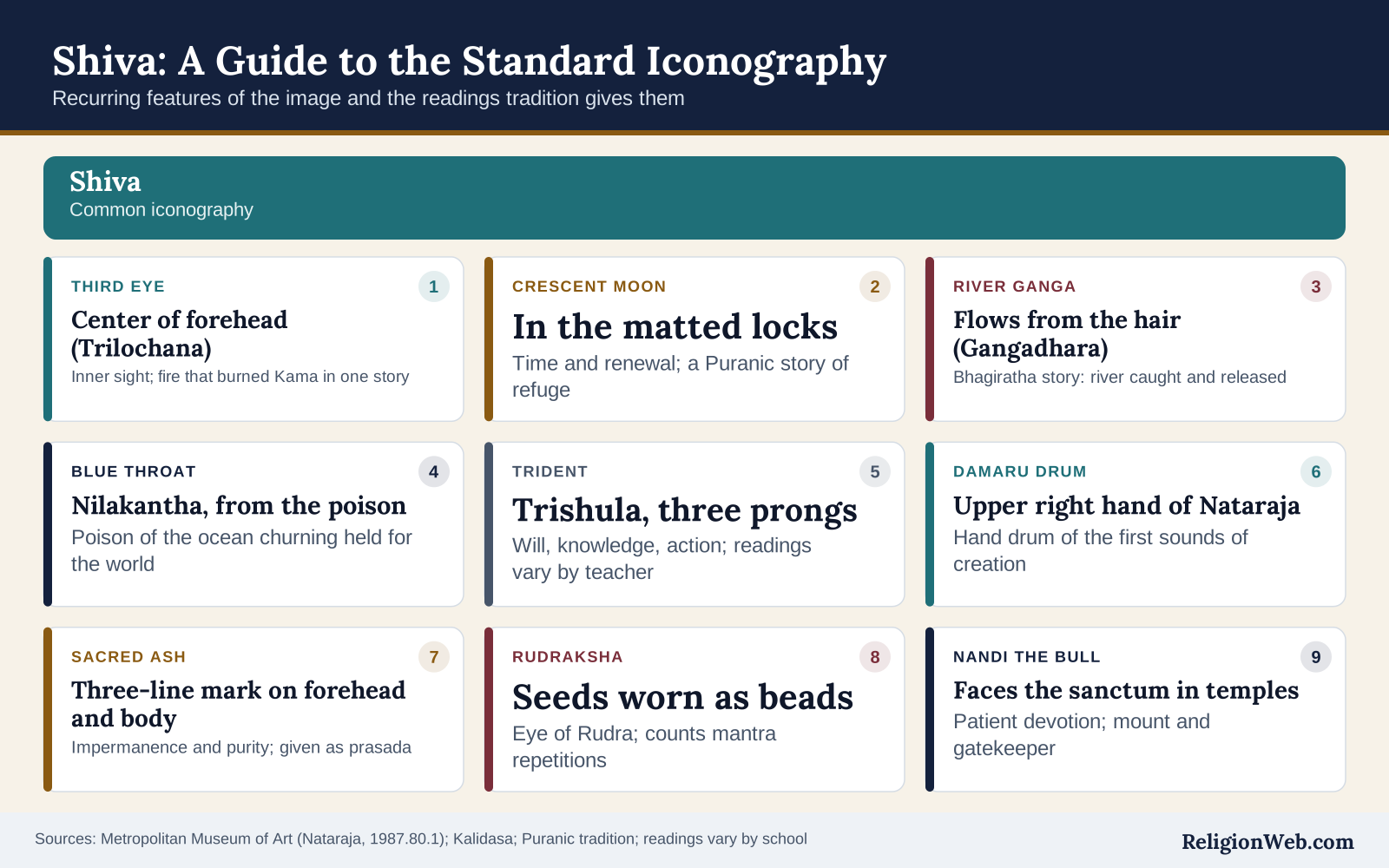
The third eye, set vertically in the center of the forehead, is one of the most recognizable features of Shiva’s image and gives him the title Trilochana, “three-eyed.” The best-known narrative explanation comes from the story of Kama, the god of desire, who aims an arrow at Shiva while he is deep in meditation so that he will fall in love with Parvati. Shiva opens his third eye and Kama is reduced to ash. The poet Kalidasa tells this episode in his Sanskrit court epic Kumarasambhava, usually dated to the Gupta period of the fourth or fifth century CE, and it has been retold in many later versions.
Commentators read the eye in several ways. In some Shaiva readings it is the eye of knowledge or inner sight, which sees what the two outer eyes cannot. Others link the three eyes to sun, moon and fire, or to the three times of past, present and future. These are interpretations offered by teachers and writers, not a single doctrine, and a visitor to a temple may hear different explanations from different priests.
The crescent moon and the river Ganga
The crescent moon set in Shiva’s hair gives him the title Chandrashekhara, “crowned with the moon.” Several explanations circulate. One Puranic account says that the moon god, cursed to waste away, took refuge with Shiva and was allowed to remain as a thin crescent that waxes again. Devotees and writers also read the moon as a sign of cyclical time and renewal, or as a cooling presence on the head of an ascetic whose heat is proverbial. The crescent is normally a thin one, a detail of the image that artists keep through all periods.
The river Ganga flows from the top of Shiva’s matted hair, and the form Gangadhara, “bearer of the Ganga,” depicts the moment. In the story, told in the Ramayana and the Puranas, the king Bhagiratha performs severe austerities so that the heavenly river may descend to purify the ashes of his ancestors. The force of her fall would shatter the earth, so Shiva receives her on his locks and releases her gently. For devotees the image links Shiva to the sacred rivers and to pilgrimage, and a Ganga on the head of the god explains why water from the river is poured over linga images in so many temples.
Matted locks, the blue throat, and ash on the body
Shiva’s hair is dressed in matted locks (jata), the standard sign of an ascetic, and the title Jatadhara, “bearer of matted hair,” is widely used. In the dancing form the locks fly outward with the force of the dance, a feature that the Metropolitan Museum of Art points out in its catalog entry for a Chola-period bronze. In ascetic images the hair is bound in a high knot, and in some temple sculpture it is shown in tiers that carry the moon, the river and sometimes a skull.
The blue throat, Nilakantha, belongs to the story of the churning of the ocean, when the gods and demons together stirred the cosmic sea to obtain the nectar of immortality and the first thing to emerge was a deadly poison called halahala. Shiva drank it to protect the world and held it in his throat, which turned blue. Devotional tradition regards the story as a sign of his willingness to take on the world’s suffering. The Shaiva reading is that the same figure who is frightening in some roles is the one who absorbs danger on others’ behalf.
Held and Worn Objects: Trident, Drum, Ash, and Seeds
The trident and the drum
The trident (trishula) is Shiva’s principal weapon and the object most often planted beside a Shaiva shrine. Readers will find it explained as the three powers of will, knowledge and action, as the three gunas (qualities of nature) in the Samkhya philosophical scheme, or as the three states of waking, dreaming and deep sleep. None of these is the single official meaning, and teachers in different lineages choose among them. What the trident clearly does in the iconography is mark the one who holds it as a being of power who can protect his devotees.
The small hourglass drum, the damaru, is the other characteristic object. The Metropolitan Museum describes it as a hand drum that made the first sounds of creation, and that is a common reading in connection with Shiva as Nataraja. A further tradition, found in later Sanskrit commentary, holds that the fourteen sound-sequences that open the grammar of the ancient linguist Panini, known as the Maheshvara Sutras or Shiva Sutras, came from the beating of this drum. That belief is a traditional account, and historians read the sutras as part of the technical apparatus of Panini’s grammar, a work usually placed around the fifth to fourth century BCE.
Ash, the three-line mark, and rudraksha
Sacred ash, called bhasma or vibhuti, is the typical sign of a Shaiva devotee. Worshipers apply it to the forehead in three horizontal lines, called tripundra, and ascetics smear it across the body. Its traditional meanings include the impermanence of the body, the purity achieved by renunciation, and the burnt residue of ritual fire, and in temple practice the ash given as prasada, the returned portion of an offering, is treated as a blessing that can be carried home. In the iconography of Shiva as the lord of the cremation ground, the ash is also a reminder that he stands beyond the fear of death.
Rudraksha beads are the seeds of the tree Elaeocarpus ganitrus, and the name is traditionally explained as “eye of Rudra.” A Puranic account says the first beads came from Shiva’s tears of compassion. Devotees wear them singly or as a rosary of 108 or 54 beads, and they are used to count repetitions of the mantra Om Namah Shivaya. Beads are classified by the number of natural divisions on the seed, called mukhi or “faces,” and each type is given particular spiritual associations in popular literature, though these classifications are a matter of regional custom.
Snakes, hide, deer, axe, and skull-cup
Shiva is commonly shown with serpents wrapped around his neck and arms. In Shaiva imagery they stand for power over fear and death, and for the energy coiled at the base of the spine in yogic texts. He sits on or wears the skin of a tiger or, in some myths, the hide of an elephant demon, a sign of taming wild force. In several images he holds a small deer in one hand and an axe (parashu) in another. In the fierce form of Bhairava or the wandering mendicant Bhikshatana he carries a skull-cup (kapala), which the tradition explains through narratives about the beheading of Brahma’s fifth head.
These objects form a repertoire of ascetic and cremation-ground imagery, and they were deliberately chosen to set Shiva apart from gods who wear royal ornaments. At the same time, the tradition dresses him as a bridegroom in the wedding scenes that are carved on temple walls and recited on his festival nights. The image of a god who is both naked ascetic and royal husband is not a contradiction in Hindu devotional logic, and later sections return to the point.
Companions, Mountain, and Principal Forms
Nandi, the attendants, and Mount Kailash
The bull Nandi is Shiva’s mount and gatekeeper, and almost every Shiva temple has a sculpture of a seated Nandi facing the sanctum so that he gazes continuously toward the deity. Devotees often whisper requests into the bull’s ear, and the tradition regards Nandi as an ideal devotee: patient, attentive, unmoving. Shiva’s retinue also includes the ganas, an irregular troop of attendants who are sometimes comic, sometimes frightening, and who are led by Ganesha in his role as “lord of the ganas.”
The god’s home is Mount Kailash, a peak of about 6,600 meters in the western Tibetan plateau, which Hindus, Buddhists, Jains and followers of the Bon tradition all revere in their own ways. For Shaiva Hindus it is the abode where Shiva meditates with Parvati. Pilgrims walk around the mountain in a circuit of roughly 52 kilometers, and many consider the walk a form of devotion in itself. Because the mountain lies in Tibet, access depends on permits and Chinese regulations, and temple models of Kailash, as in the great rock-cut Kailasa temple at Ellora in Maharashtra, have served as substitutes for centuries.
Major image types in sculpture and bronze
In Shaiva temples Shiva appears in a limited set of recognized forms, many of them grouped in the agamic texts as murti types. Umamaheshvara shows him seated with Parvati. Ardhanarishvara fuses the two in a single body, with the right side male and the left side female. Dakshinamurti is the silent teacher beneath a banyan tree. Bhikshatana is the beggar. Gangadhara, Tripurantaka and Kalyanasundara illustrate narratives: the river, the three cities, and the wedding. Lingodbhava shows him emerging from the column of light. And Sadashiva, in the rock-cut cave at Elephanta near Mumbai, shows a three-faced bust whose scale impressed visitors long before it entered UNESCO’s World Heritage List.
Not every temple has every form. A temple’s founders, patrons and ritual manuals determine which images stand in the niches around the sanctum, and a visitor can learn a great deal about a regional tradition by asking which forms are prominent. Tamil Shaiva temples emphasize Nataraja and Dakshinamurti; temples of the Himalayan region emphasize Bhairava and the mountain-god; Karnataka’s Lingayat tradition tends to avoid anthropomorphic images in favor of the linga alone.
Symbols and attributes at a glance
The table summarizes the principal attributes and the range of readings that devotees, commentators and scholars give them. Because Shaiva traditions are not centralized, no single list is authoritative, and local temple custom can differ from the summaries below.
| Attribute | Where it appears | Common readings (varying by school and teacher) |
|---|---|---|
| Third eye | Center of forehead | Inner knowledge; fire that burned Kama in Kalidasa’s Kumarasambhava |
| Crescent moon | In the locks | Time and renewal; the moon’s refuge in a Puranic story |
| Ganga | Flowing from the hair | Pilgrimage river caught and released in the Bhagiratha story |
| Blue throat | Neck | Poison from the churning of the ocean held for the world’s sake |
| Trident | Right hand or planted beside a shrine | Will, knowledge, action; three qualities of nature; protection |
| Damaru drum | Upper right hand of Nataraja | Primal sound of creation; tradition ties it to Sanskrit grammar |
| Fire | Upper left hand of Nataraja | Dissolution of the world at the end of a cycle |
| Sacred ash | Forehead, body | Impermanence, purity, renunciation; given as prasada |
| Rudraksha | Neck, wrist, rosary | “Eye of Rudra”; compassion; counting of mantras |
| Serpent | Neck and arms | Mastery of fear; coiled energy in yogic texts |
| Nandi | Facing the sanctum | Patient devotion; vehicle and gatekeeper |
From Rudra to Mahadeva: Shiva in Texts and History
The Vedic Rudra
Hymns to Rudra in the Rig Veda
The earliest layer of Hindu scripture, the Rig Veda, contains only a small number of hymns addressed to Rudra, including 1.114, 2.33 and 7.46. Rudra is not among the principal gods of that collection, but he is memorable as a figure of speed, danger and healing. In Ralph T. H. Griffith’s English translation of 1896, hymn 2.33 begins by asking the “Father of Maruts,” meaning the storm deities, for his bliss, and it goes on to praise him in language of strength:
Chief of all born art thou in glory, Rudra, armed with the thunder, mightiest of the mighty.
Rig Veda 2.33.3, trans. Ralph T. H. Griffith (1896), sacred-texts.com edition
This verse belongs to a hymn that is as much a request for mercy as a hymn of praise. It speaks of a god whose missile and anger the worshiper hopes to avoid:
May Rudra’s missile turn aside and spare us, the great wrath of the impetuous One avoid us.
Rig Veda 2.33.14, trans. Ralph T. H. Griffith (1896), sacred-texts.com edition
Scholars who read the Rig Veda in its historical setting stress the double character of Rudra in these hymns: he is both the archer whose arrows bring sickness and the physician who carries healing remedies. The hymn pleads with him to keep his weapons away from people and cattle. The later epithet shiva, “kindly,” thus fits an older pattern in which a feared power is addressed by a euphemism that invites favor. How much of the later Shiva is already present in Rudra is a question historians debate, and the Vedic hymns themselves do not mention a linga, a consort named Parvati or a dwelling on Kailash.
The Shatarudriya and the Yajurveda
A later stratum of Vedic literature, the Yajurveda, contains a long litany called the Shatarudriya, “the (litany) of the hundred Rudras,” found in the Taittiriya Samhita (chapter 4.5) of the Black Yajurveda and, with variants, in the White Yajurveda. It is also known as the Rudram or Namakam, from its repeated word namah, “homage.” It salutes Rudra in his many aspects, as the lord of thieves and wanderers, of forests and paths, of the healing herbs, and as the one with a thousand arrows. The litany is chanted today at Rudra-abhisheka, the ritual bathing of the Shiva linga, and it is one of the best-known examples of Vedic recitation still used in daily temple worship.
The litany also contains the phrase namah shivaya among its salutations, the root of the famous five-syllable mantra Om Namah Shivaya used in Shaiva devotion, though the exact relationship between the Vedic phrase and the later mantra is explained differently by different scholars. The text shows an important point about development: the Vedic Rudra was addressed through long lists of names that stretch toward totality. This habit of naming, rather than a single story, is what later Shaiva devotion built upon. The overview of the Vedic corpus appears in the article on the Vedas and Upanishads.
Healing, fear, and the shape of a god
Taken together, the Rig Vedic and Yajurvedic texts present Rudra as a god of the margins: of forests, mountains, storms, animals and wandering people. He does not belong to the household fire as Agni does, and he is invoked with caution. That marginal position matters for later Shiva, who dwells on a mountain, sits among animals, and is attended by outcast and unconventional beings. Later Vedic literature calls Rudra the lord of creatures (pashu), and the title Pashupati, “lord of animals,” becomes a central name in the tradition.
It is possible to overstate continuity. The Vedic hymns are a priestly sacrificial poetry, and the worship of Shiva as developed in temples and in initiatory traditions took shape in the centuries after them. Historians therefore speak of a process in which attributes of Rudra were joined to those of other regional gods, ascetic figures and local deities, until a figure appears who was both the Vedic god and something larger.
Upanishads, Epics, and Puranas
The Svetasvatara Upanishad and a single supreme Lord
The Svetasvatara Upanishad is the early philosophical text that most clearly names a personal supreme God in Rudra-Shiva language. It uses the names Rudra, Shiva and Ishana, “the Lord,” and it speaks of a single divine power who rules the world. F. Max Müller’s 1884 translation in the Sacred Books of the East renders one of its best-known statements as follows:
Know then Prakriti (nature) is Mâyâ (art), and the great Lord the Mâyin (maker); the whole world is filled with what are his members.
Svetasvatara Upanishad 4.10, trans. F. Max Müller, Sacred Books of the East vol. 15 (1884), sacred-texts.com edition
Interpretation of the verse divides along familiar lines. Shaiva readers take it as scripture for a supreme Lord who is the maker of the world and who transcends it. Teachers in the non-dual Vedanta tradition, which favors the Upanishads as a source for the identity of self and ultimate reality, read the same text as part of their own project, and some Vaishnava commentators read the divine names in it as names of Vishnu. The historical point is that the Upanishad shows a stage at which Rudra-Shiva could be addressed as the one Lord, and its date is uncertain, with scholars generally placing it in the later first millennium BCE.
Shiva in the Mahabharata and the Ramayana
In the two great Sanskrit epics, Shiva is a major god with a mountain home and a distinct character. The Mahabharata, compiled over several centuries around the turn of the era, tells how the hero Arjuna wins the divine weapon called Pashupata by pleasing Shiva, who first appears as a hunter, the Kirata. It also contains long hymns of praise, including a litany of a thousand names in its Anushasana Parva. The Ramayana tells the story of how Shiva caught the Ganga, and its later parts tell of the demon king Ravana who lifted Mount Kailash and was pressed beneath it until he sang in praise of Shiva.
Epic narrative portrays Shiva with a freedom that the Vedic hymns do not: he is generous to demons as well as gods, and he gives boons that sometimes cause trouble for the cosmos. These stories are among the main sources of the picture of Shiva as unpredictable, and they set up the later Puranic accounts in which his compassion is even more emphatically asserted. The religion of the epics belongs to what is sometimes called the bhakti turn: personal devotion to a chosen deity, at the center of the discussion in the article on the Bhagavad Gita, where Krishna names Shankara among the Rudras as one of his manifestations.
The Puranas and the Agamas
The Puranas, a large body of Sanskrit texts compiled between roughly the early centuries CE and the medieval period, hold most of the narratives about Shiva that appear in popular devotion. The Shiva Purana and the Linga Purana are the two usually described as Shaiva in character, and the Skanda Purana, the longest, contains extensive material on Shiva’s shrines and festivals. Their lists of the eighteen Mahapuranas differ in details, and Shaiva, Vaishnava and Shakta Puranas each present their own deity as supreme without suggesting that the others are false.
Alongside the Puranas, the Shaiva Agamas and Tantras provide ritual manuals, temple-building instructions and philosophical teaching. Alexis Sanderson’s research on what he calls the Shaiva Age shows that from about the fifth century CE onward initiatory Shaivism spread widely, with royal patronage, temple foundations and scriptural traditions that stretch across the subcontinent and into Southeast Asia. The surviving corpus of Shaiva scripture, including the texts later called the Siddhanta Agamas and the Bhairava and Trika tantras, is dealt with in detail in the article on Shaivism.
What Historians Can and Cannot Say About Early Shiva
The Indus seal and the limits of the evidence
A famous seal from the Indus Valley civilization of the third millennium BCE shows a seated, horned figure surrounded by animals. In 1931, the archaeologist John Marshall suggested that it was a proto-Shiva, a “Lord of Beasts,” and the idea has been repeated in popular books ever since. Many specialists regard it as unproven. The Indus script has not been deciphered, no text accompanies the seal, and the Vedic Rudra, the nearest textual ancestor, belongs to a different linguistic and cultural setting. The seal may depict a deity, a ritual practitioner or something else entirely, and it is wiser to describe it as an object that invites comparison than as evidence of Shiva worship.
Devotees may find continuity in such images, and scholars who propose connections between Indus and later Indian imagery are making a cautious case about shared motifs. But the historical record, strictly read, begins with the Rig Veda for the god Rudra and with images and coins of the early centuries BCE and CE for something recognizable as Shiva.
Early images, coins, and the Gudimallam linga
The earliest securely recognizable images of Shiva date from the last centuries BCE and the first centuries CE. The Gudimallam linga in Andhra Pradesh, which shows a standing male figure carved in relief on the shaft of a linga, has been dated by scholars anywhere between the third century BCE and the first century CE, and the debate is not settled. Coins of the Kushan rulers, including those of Wema Kadphises in the first and second centuries CE, show a deity with a trident beside a bull, labeled in Greek script with a name often read as Oesho, whom many scholars identify with Shiva, though the identification is discussed.
From the Gupta period of the fourth to sixth centuries, stone temples and sculpture give a clearer record. The Elephanta cave, with its monumental Sadashiva, is dated by UNESCO to the mid-fifth to sixth century CE. The evidence shows Shiva established as a major deity with a growing set of images across the subcontinent well before the great Chola temples of the early eleventh century.
A timeline of textual and historical milestones
The table gathers principal textual and historical landmarks. Dates are approximate and in several cases debated, and the phrase “c.” marks a conventional or scholarly estimate rather than a fixed date.
| Period (approximate) | Development | Notes on evidence |
|---|---|---|
| Second millennium BCE (conventional range) | Rig Veda hymns to Rudra | Rudra a minor but vivid god; the dating of the Rig Veda is a range, not a point |
| Later Vedic period | Shatarudriya in the Yajurveda | Litany of homage still chanted in Shiva worship |
| Later first millennium BCE (uncertain) | Svetasvatara Upanishad | Rudra-Shiva as the one supreme Lord |
| c. 3rd century BCE to 1st century CE (debated) | Gudimallam linga | Earliest figural linga; date disputed |
| c. 1st to 3rd centuries CE | Kushan coins with a trident-bearing deity and bull | Identification with Shiva widely, not universally, accepted |
| Epic and early Puranic period | Mahabharata and Ramayana narratives; early Puranas | Composite texts compiled over centuries |
| From c. 5th century CE | Initiatory Shaivism and temple foundation spread | Mantramarga phase described by Alexis Sanderson |
| Mid-5th to 6th century CE | Elephanta Sadashiva | UNESCO date range |
| 6th to 9th centuries CE | Tamil Nayanar hymns | Later gathered in the Tevaram collection |
| c. 1009 to 1010 CE | Brihadisvara temple at Thanjavur consecrated | Part of the Great Living Chola Temples on UNESCO’s list |
| 12th century CE | Basava and the Lingayat movement in Karnataka | Vachana poetry and the personal linga |
Stories of Shiva: Major Narrative Themes
Stories of Power, Poison, and Sacrifice
The churning of the ocean and the poison
The story of the poison is told in the Mahabharata, the Ramayana and several Puranas, with variations in detail. The gods and the asuras, beings often rendered “demons” but better understood as rival divine kinsmen, agree to churn the cosmic ocean in search of the nectar of immortality. They use Mount Mandara as the churning rod and the serpent Vasuki as the rope, and in Vaishnava tellings Vishnu in the form of a tortoise supports the mountain from below. Before the nectar comes a poison, halahala, whose fumes threaten all living beings. The gods turn to Shiva, who takes the poison in his hand and swallows it, holding it in his throat.
In many versions, Parvati places a hand on his throat to keep the poison from descending further, and in some devotional retellings the blue mark is a sign of care, not harm. Devotees tell the story on festival days and connect it to the fasting and vigil of Mahashivaratri. For Shaiva theologians it is a vivid statement of the idea that the supreme Lord bears the world’s suffering. For historians of religion it also illustrates how episodes are shared across traditions, since the same churning is a Vaishnava story in other contexts, and each tradition reads its own deity into the center of the event.
The burning of Kama
In Kalidasa’s Kumarasambhava and in Puranic accounts, a demon named Taraka has received a boon that only a son of Shiva can defeat him. Shiva, however, is lost in ascetic meditation after the death of his first wife, and the gods ask Kama, the god of desire, to make him fall in love with Parvati, who is performing austerities nearby. Kama shoots his flowery arrow. Shiva opens his third eye in anger and burns Kama to ashes, and the gods and Kama’s wife Rati beg for mercy. In many tellings Shiva later relents and allows Kama to live on as Ananga, “the bodiless one,” a power that operates without a form.
Readers have interpreted the story as a parable about the difference between desire and love, about the discipline required before marriage, or about the dangers of interrupting a person of spiritual power. In certain regions of southern and western India, communities link the burning of Kama to festivals around the spring full moon, and the article on Holi explains that the festival’s best-known stories are different ones, so the Kama connection should be treated as local tradition, not a pan-Indian rule.
Sati, Daksha’s sacrifice, and the goddess
Another Puranic cycle begins with Sati, a daughter of the patriarch Daksha, who chooses to marry Shiva against her father’s wishes. Daksha later holds a great sacrifice and does not invite his son-in-law. Sati attends anyway, is insulted in public, and gives up her life by yogic fire. Shiva, in grief and fury, produces the fierce being Virabhadra, who disrupts the sacrifice and punishes Daksha. In many versions Shiva restores Daksha to life, often with the head of a goat, and then wanders with Sati’s body, grieving, until her body is dispersed over the earth. The places where her parts are said to have fallen are known as the Shakti Pithas.
The narrative is central to Shakta tradition, which treats the Goddess as a supreme being whose form Sati takes before she is reborn as Parvati, and the article on Shaktism explores the pilgrimage network that grows from it. In Shaiva readings, the story shows that Shiva’s austerity is not indifference: his grief is the grief of a husband, and the cosmos itself is affected by it. The rebirth of Sati as Parvati sets up the cycle of marriage and family stories that follows.
Stories of Marriage, Family, and the Household
Parvati’s austerity and the wedding
Parvati, the daughter of the mountain king Himavat and his wife Mena, is determined to win Shiva as her husband and performs severe austerities in the Himalayas. In Kalidasa’s version, Shiva, disguised as a young ascetic, visits her and criticizes himself in order to test her resolve, and she defends him with spirit before he reveals himself. The wedding that follows is among the most frequently depicted scenes in Shaiva temple sculpture, in the form known as Kalyanasundara. Brahma, Vishnu and the other gods attend, and in widely told versions Shiva arrives with a procession of strange attendants, ghosts and animals, to the dismay of Parvati’s mother.
Many Shaiva Hindus believe that the wedding of Shiva and Parvati is what the night of Mahashivaratri commemorates, and some communities hold temple wedding rites on or around that night. A related story is celebrated at Madurai, where the goddess Meenakshi, a queen in local tradition and a form of Parvati, weds Sundareshvara, a form of Shiva, in a spring festival that draws large crowds. The marriage is thus both a narrative and a model: the ascetic accepts domestic life, and the goddess is both his devotee and his equal.
The sons of Shiva
Two sons are central to the family: Ganesha, the elephant-headed lord of beginnings, and Kartikeya, the warrior known as Skanda, Kumara, Subrahmanya and, in the Tamil country, Murugan. In the Puranic story that links directly to the Taraka narrative, Kartikeya is born from Shiva’s seed to defeat the demon, and in several tellings he is raised by the six Krittika stars. His worship is a major living tradition in South India and Sri Lanka, with its own temples and festivals.
The stories of Ganesha’s birth differ widely between Puranas, and the article on Ganesha sets them out in detail. A frequently repeated version has Parvati create him from the substance of her own body to guard her door, and Shiva, not recognizing the boy, beheads him in a confrontation, after which he is revived with an elephant’s head. Other versions have different narrators and different outcomes. The differences matter because they remind a reader that the Puranas are not a single book, and that Shaiva families tell the story in the form they inherited.
Kailash as a household
Many stories place Shiva and Parvati at home on Mount Kailash with their sons, Nandi and the ganas, in a scene that is both mythic and domestic. They play dice, they quarrel and reconcile, Shiva begs alms while Parvati as Annapurna (“filled with food”) feeds the world, and the family’s animals, a bull, a lion, a peacock, a mouse and a serpent, are sometimes said to live together without conflict. Popular devotional art and film produce this tableau constantly.
Devotees often take the scene as a model of a household held together by affection across differences. The Shaiva theological reading goes further: the god who is lord of ascetics is also the lord of the family, and the world is not a distraction from the divine but its field of play. This is a central point in understanding why Shiva is worshiped by householders and renunciants alike.
Stories of Grace and the Limits of Fate
Markandeya and the defeat of death
The young sage Markandeya was born to a devout couple who had been granted a son with a short life of sixteen years. As the day of his death arrived, the boy embraced the Shiva linga in worship. When Yama, lord of death, threw his noose, it fell around both boy and linga, and Shiva emerged from the linga in anger and struck Yama down. In the Tamil tradition at Tirukkadaiyur, this episode gives Shiva the form Kalantaka, “ender of the Ender,” and Markandeya remains sixteen forever.
The story is widely told in Shaiva temples and is the background of the Mahamrityunjaya mantra, a verse from the Rig Veda (7.59.12) that asks the three-eyed Lord to free the worshiper from death like a ripe cucumber from its stalk. The mantra is recited for health and long life, and in households facing illness. It is a prayer and a tradition of hope, and the tradition itself does not offer it as a substitute for medical care: worshipers usually pray in addition to seeking treatment.
The pillar of fire
In the Shaiva Puranas, including the Shiva Purana and the Linga Purana, Brahma and Vishnu once argued over which of them was greater. A column of fire appeared between them, without beginning or end. Brahma took the form of a swan and flew upward, and Vishnu took the form of a boar and dug downward, each trying to find the limit of the column. Vishnu returned and admitted that he could not find the end. Brahma claimed to have reached the top, with a ketaki flower as his witness, and Shiva appeared from the column in the form known as Lingodbhava, “arisen from the linga.” In the story, Brahma is cursed for the lie, and the ketaki flower is not offered in Shiva worship.
The tale is told as a Shaiva account of the origin of the linga and of Shiva’s place above the triad. It is paralleled in the sacred geography of Tiruvannamalai, where the mountain Arunachala is venerated as the fire linga. Vaishnava texts tell stories in which Vishnu is the supreme being, and this article describes each tradition’s narratives as its own account of the divine rather than adjudicating between them.
Devotees whom Shiva favors
A cluster of narratives stresses devotion over ritual correctness. Kannappa, a hunter at the temple of Kalahasti, finds a linga in the forest and worships it with the only offerings he knows: water carried in his mouth, meat and flowers from his hair. When the linga’s eye seems to bleed, he offers his own eyes. This story, told in the Tamil Periya Puranam of the twelfth century and in later versions in other languages, is held up as a model of love beyond propriety. Other stories in the same tradition concern the sixty-three Tamil saints, the Nayanars, and similar devotees across regions.
The Mahabharata gives another strand of narrative. Arjuna wins the weapon called Pashupata from Shiva after a fight in which Shiva, disguised as a tribal hunter, tests him. The poet Bharavi retells it in his Sanskrit poem Kiratarjuniya in the sixth century. Together these tales give an ethical shape to Shiva’s grace: he honors sincerity, courage and surrender, and he is moved by those who may seem to have no standing.
Narrative themes at a glance
The table below summarizes the stories discussed and several others, with the main source tradition and the theme commonly drawn by commentators.
| Story | Main sources (as commonly cited) | Theme drawn by tradition |
|---|---|---|
| Churning of the ocean and the poison | Mahabharata, Ramayana, Puranas | Bearing the world’s suffering; compassion |
| Burning of Kama | Kalidasa’s Kumarasambhava, Puranas | Discipline, desire, and the third eye |
| Sati and Daksha’s sacrifice | Puranas, Shakta texts | Grief, the Goddess, origin of Shakti Pithas |
| Parvati’s austerity and the wedding | Kalidasa, Shiva Purana | The ascetic accepts household life |
| Descent of the Ganga | Ramayana, Puranas | Control of cosmic force; purification |
| Markandeya and Yama | Puranas; Tamil temple tradition | Devotion overcoming death |
| Lingodbhava pillar of fire | Shiva Purana, Linga Purana | Shiva as infinite and beyond the triad (Shaiva account) |
| Destruction of the three cities | Puranas, epics | The end of three realms of illusion |
| Kirata and Arjuna | Mahabharata, Bharavi | Grace tested by courage |
| Ravana lifts Kailash | Ramayana, Puranas | Pride humbled; praise of Shiva |
| Kannappa | Periya Puranam (Tamil) | Love beyond ritual form |
The Ascetic, the Householder, and the Cosmic Lord
Shiva as Ascetic and Teacher
The great yogi on the mountain
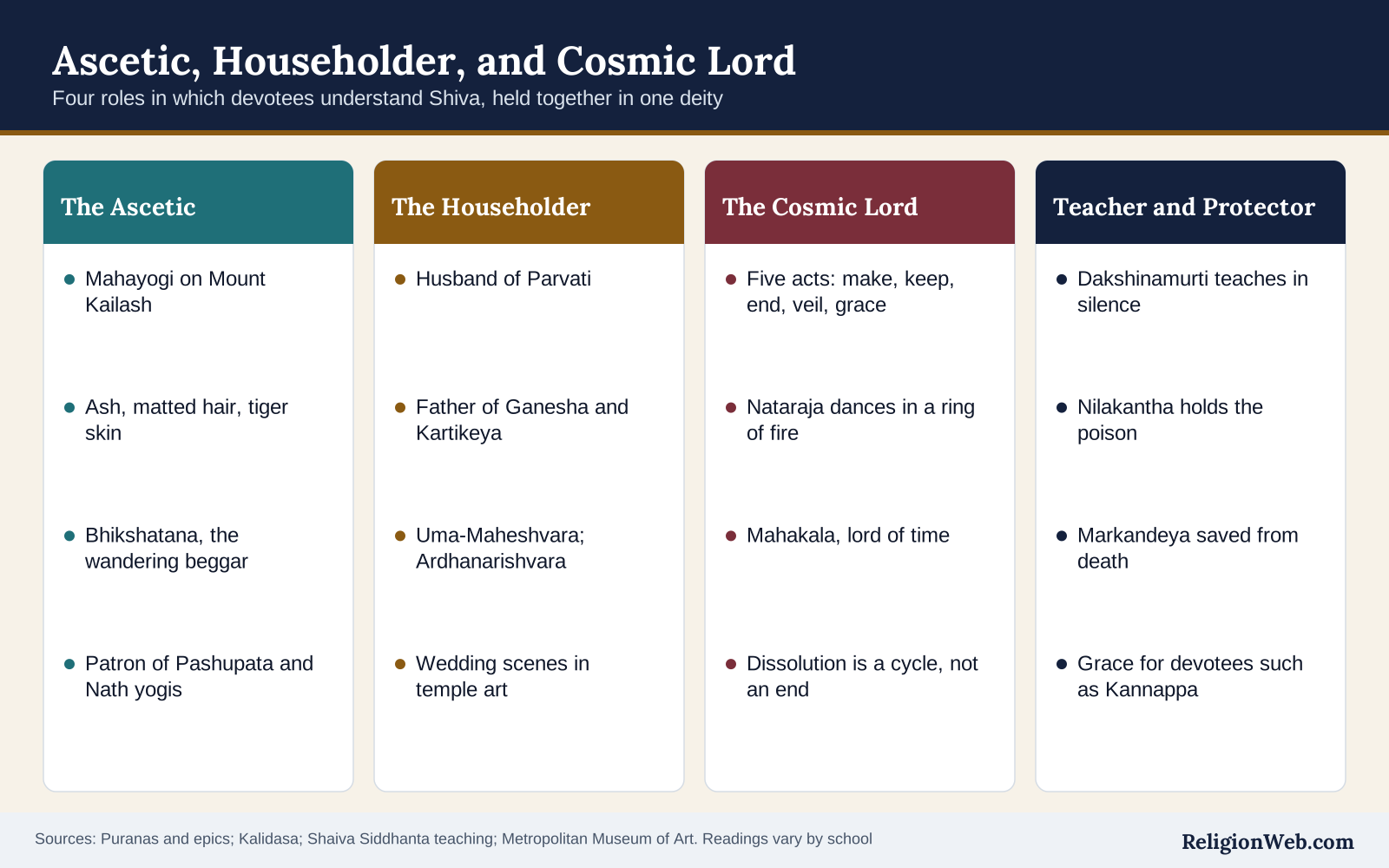
One of the oldest images of Shiva in Hindu devotion is the meditating ascetic, Mahayogi, seated on a tiger skin, his body smeared with ash, his eyes half closed, his hair matted. In this role he is called Yogeshvara, “lord of yoga,” and many Hindu yoga lineages regard him as the original teacher of the discipline. The article on yoga in Hinduism explains that this tradition is one account among several, since the classical Yoga Sutras of Patanjali do not name Shiva as a source and the Hatha Yoga texts, which do honor him as the first teacher, belong to a later medieval period.
This ascetic image has a specific meaning in Shaiva devotion. It is the image of a being who does not need the world and who is therefore free to love it without grasping. The tradition values this detachment as a model for spiritual practice, and the long line of Shaiva renunciants, from the early Pashupata ascetics to the Nath yogis and the Dashanami orders, claim him as their patron. The tradition’s own view is that his asceticism is not an example of pain for its own sake but of the freedom that comes from a mind at rest.
Dakshinamurti, the silent teacher
In the form of Dakshinamurti, usually shown seated beneath a banyan tree and facing south, Shiva teaches the sages in silence. The Sanskrit hymn attributed to the philosopher Shankara, the Dakshinamurti Stotra, praises this image as the one whose silent teaching removes the doubts of the disciples, and the form is especially honored in South Indian temples, where an image of Dakshinamurti is often placed on the south wall of the sanctum. The idea expressed is that the deepest knowledge cannot be fully carried by words.
The image has a practical use as well. Students of music and learning in South India sometimes offer worship to Dakshinamurti on Thursdays, and some temples treat him as the patron of scholars. It is one example of how the ascetic and teaching dimensions of Shiva reach into ordinary life, so that the god of the cremation ground is also the god to whom a student turns before an examination.
The wanderer, the cremation ground, and the skull-bearer
A more unsettling set of images places Shiva at the cremation ground, accompanied by ghosts, dogs and jackals, wearing a garland of skulls. In the form of Bhikshatana, the wandering beggar, he is shown naked and handsome, carrying a begging bowl and attracting the wives of the forest sages who follow him in fascination. Bhairava, the terrifying aspect, appears with a skull-cup, in a posture that recalls the penance for beheading Brahma, a narrative explained in Puranic tellings as the origin of the skull-bearing ascetic.
Scholars read these images as expressing both ascetic ideals and a sacralization of what ordinary society regards as polluting. The Kapalika ascetics of the early medieval period, whose practices are described in Sanskrit satirical plays and in Shaiva scripture, imitated this form of Shiva in ritual, and modern Aghori practitioners in Varanasi claim the same inheritance. These ascetic lineages are a small and unusual part of the tradition, and the great majority of Shaiva worship, in temples and homes, is conducted in a very different and highly ordered register.
Shiva as Householder and Divine Family
Husband and consort: Uma-Maheshvara and Ardhanarishvara
The same Shiva who sits alone on the mountain is also a husband. Images of Uma-Maheshvara show him seated with Parvati leaning against him, one hand around her, sometimes with their child Skanda between them (the group called Somaskanda in Tamil temples). The form of Ardhanarishvara, with the body divided vertically into male and female halves, says in a single image that the god and the goddess are not two separate powers but aspects of one reality. Both forms are among the most common sculptures on the outer walls of Shaiva temples.
In Shaiva theology the pairing is more than a love story. Shiva stands for pure consciousness and Shakti for the power by which consciousness acts, and teachers in Kashmir and in the Tamil country use the pairing to explain how a changeless God can be the source of a changing world. The same insight lies behind the large devotional literature on the Goddess, discussed in the article on Shaktism, and many devotees pass between Shiva temples and Devi temples without a sense of crossing a border.
Fatherhood and the transmission of a lineage
Ganesha and Kartikeya, discussed above, make Shiva a father, and the stories of their births and rivalries are told with considerable warmth and humor. A well-known tale has the two brothers race around the world for the prize of a fruit, with Kartikeya flying on his peacock and Ganesha simply walking around his parents. The story is told in several variants and ends with different outcomes, but its purpose in popular telling is to show a family with distinct personalities.
Family language also shapes devotion. Tamil poet-saints address Shiva as “father” and “mother,” and Telugu and Kannada devotional poetry speaks of him as friend and lover. Householder devotees see in Shiva a figure who does not require them to leave home. A man or woman who works, raises children and meets obligations may still regard Shiva as the center of life, and the Shaiva tradition explicitly recognizes householder initiates alongside renunciants.
How tradition reconciles the two figures
The coexistence of ascetic and householder images has long interested commentators, and Hindu thinkers have offered several explanations. One approach says that Shiva is beyond all opposites, so that apparent contradictions are only the limits of language. Another approach says that the roles correspond to different needs of the devotee: the ascetic image helps those who seek liberation by renunciation, while the family image helps those who seek the good life in the world. A third, common in popular devotion, takes the stories at face value as the character of a god who is unpredictable and generous.
The ideal of balance connects to broader Hindu thought about duty and life stages, treated in the article on dharma in Hinduism. The tradition does not say that everyone should live as Shiva lives. It says that the one who is worshiped holds both renunciation and care for the world, and that a devotee can orient life toward him in either mode.
Shiva as Cosmic Lord: The Five Acts and Nataraja
Creation, preservation, dissolution, concealment, and grace
Shaiva Siddhanta and several other Shaiva schools describe Shiva’s cosmic activity as five acts, called panchakritya in Sanskrit: emission or creation (srishti), maintenance (sthiti), dissolution (samhara), concealment (tirobhava) and grace (anugraha). The first three correspond to the familiar sequence of making, sustaining and ending the world. The fourth and fifth are the distinctive contribution of Shaiva thought: concealment names the way the soul is kept from knowing its own nature, and grace is the act through which Shiva lifts that veil and frees the soul. The Tamil treatise Unmai Vilakkam, composed in the thirteenth century, is among the texts that connect the dancing form of Shiva to this fivefold scheme.
The scheme explains why Shaiva teachers resist the label “destroyer” as a full definition. In the Puranic triad Shiva is assigned the end of the world, and that function is real in the tradition. But in the five-act scheme dissolution is one of five, and the final act is liberation. Seen from this angle, the endings that Shiva brings are the withdrawal of a cycle so that souls may rest and, ultimately, be released.
Nataraja at Chidambaram and in the Chola bronzes
Nataraja, “king of dancers,” is the image in which the five acts are most famously made visible. The Metropolitan Museum of Art’s catalog entry for its Chola-period bronze, dated to the late eleventh century and made of copper alloy, describes the standard iconography: the hand drum in the upper right hand “that made the first sounds of creation,” the fire in the upper left hand that will destroy the universe, the lower right hand in the gesture that allays fear, and the dwarf-like figure under the right foot, who represents illusion leading humanity astray. The flying locks show the energy of the dance. Interpreters connect these elements to the acts: the drum to creation, the hand of reassurance to protection, the fire to dissolution, the foot on the dwarf to concealment and the raised foot to grace.
The center of the Nataraja tradition is the temple at Chidambaram in Tamil Nadu, where Shiva is worshiped in a hall called the Chit Sabha, “hall of consciousness,” and the Dikshitar priests perform the rites. The scholar Sharada Srinivasan notes that Chidambaram is distinctive in having a metal Nataraja at the center of the sanctum in place of the usual stone linga. The temple’s most visited festivals fall in the Tamil months of Margazhi (December to January) and Aani (June to July), and the Arudra Darshan of the Margazhi month, tied to the star Tiruvadirai, draws large crowds. Dates differ each year with the Tamil calendar.
Dissolution, time, and liberation
In Hindu cosmology the world moves through immense cycles of manifestation and withdrawal, and Shiva as Mahakala, “great time,” presides over the dissolution at the end of a cycle. That dissolution is not a final catastrophe but a recurring phase, after which a new creation unfolds. Souls carry their accumulated karma through these cycles in the process of samsara and rebirth, and the Shaiva tradition holds that grace, not only effort, brings a soul out of the cycle.
This is the theological setting for moksha, liberation, in Shaiva schools. Shaiva Siddhanta teaches that the soul is bound by three impurities and freed by Shiva’s grace, so that it becomes like Shiva without losing individual identity. Kashmir Shaivism, by contrast, teaches that the soul is already Shiva and needs only to recognize it. Both are major interpretations within the tradition, and the article on Shaivism explains the schools in more detail. What the shared language of dissolution and grace provides is a vocabulary in which death and endings are not final words.
The Shiva Linga: Form, Meaning, and Interpretation
What the Linga Is and How It Developed
The word, the shape, and the base
The linga (also spelled lingam) is the most common object of worship in Shiva temples. In its usual form it is an upright, rounded stone column set in a circular or square base called the pitha, often with a spout on one side that carries away the liquids poured over it in worship. The word linga in Sanskrit means “mark,” “sign” or “characteristic,” and the Shaiva tradition reads the object as the sign by which the unseen Lord is recognized. It is not a statue in the ordinary sense. Shaiva priests install it through a rite of consecration that invites the presence of the deity, and from that point it is treated as Shiva himself.
Lingas are made in many forms and materials. The self-manifested or svayambhu linga is a natural stone that is believed to have appeared without human making. A banalinga is a smooth egg-shaped stone collected from the Narmada River. Householders make temporary lingas of clay or earth, and ascetics sometimes carry small ones of crystal or metal. The most ornate forms, the mukhalinga, carry one to five carved faces on the shaft. The variety shows that the linga is not one shape imposed uniformly but a type of sacred object with many accepted forms.
The early history of linga worship
Linga images appear in the archaeological record from around the turn of the era. The Gudimallam linga, with a standing figure carved on the shaft, is often cited as the earliest figural example, and later Gupta and post-Gupta sculptures, such as those at Udayagiri and elsewhere, show the faces and forms that became standard. A temple of the Chola period like the Brihadisvara at Thanjavur, consecrated in about 1009 to 1010 CE according to UNESCO, enshrines a very large linga in a tall sanctum, which shows how central this form had become in royal and temple religion by the early eleventh century.
The Puranas associate the linga with the pillar of light described in the previous section, and with the idea that Shiva is without beginning or end. Historians note that the earliest textual evidence for the worship of an upright stone as the form of a god is complex, since sacred stones, pillars and trees were venerated in many regions. What the tradition itself says is that the linga is a revealed form of Shiva, and in that respect the question of origins is a historian’s question and not a devotional one.
Form and formless in Shaiva teaching
Shaiva teachers often describe the linga as a bridge between the formless and the formed. An anthropomorphic image such as Nataraja or Uma-Maheshvara shows Shiva with a body and attributes (sakala, “with parts”). The linga has no limbs, no face and no gestures, and thus points to the aspect of Shiva that is beyond form (nishkala, “without parts”). In many agamic systems, a temple’s central sanctum houses the linga, and the anthropomorphic images appear around it, so that the sequence moves from the formless center to the forms that communicate with devotees.
This teaching is a school position and should be attributed. Shaiva Siddhanta and several other traditions teach it in this way. The Lingayat tradition emphasizes the personal linga, worn on the body, as the form in which God and the devotee meet. The common thread is that the object is not a symbol in the sense of a mere pointer: for those who worship, it is a locus of presence.
How the Linga Is Understood: Traditional Readings and Scholarly Debate
Pillar of light, axis of the world, and the union of Shiva and Shakti
In Shaiva readings, the linga is an image of the infinite. The Lingodbhava story makes it a column of light without beginning or end, and many commentators connect it to the idea of an axis between heaven and earth, around which the cosmos is arranged. The base, in some Shaiva readings, represents Shakti, the power that supports and gives form to the column, so that the whole object represents the union of the two principles rather than one of them alone. Other teachers say the base is the earth or the world that rests on the divine.
Older Tamil Shaiva writing also connects the linga to the idea that the supreme Lord can be approached through a stone, a lamp or a person, since the divine is present in all. A devotee at the temple may say little about theory and simply bathe, adorn and bow to a form that has been honored by countless others before. The reading depends on the community, the school and the individual, and the diversity of reading is part of the tradition.
The question of a phallic reading
A frequent claim, especially in nineteenth-century European writing and in popular discussion today, is that the linga is simply a phallic symbol. The claim is not baseless: the Sanskrit word linga also means the male organ in some contexts, some early images (including parts of the Gudimallam sculpture) are explicitly phallic in form, and some Puranic stories link Shiva to fertility and generation. Modern scholars of Indian religions, including some Hindu scholars, have discussed the relationship between the linga and creative energy, and the topic is treated seriously in the academic literature.
Nonetheless, the idea that this is all the linga means is rejected by Shaiva traditions and by most scholars who study them. In temple liturgy, the linga is not treated as a body part: it is bathed, clothed and offered food as a deity, and the texts speak of it as a sign of transcendence. Where a generative reading appears, it is usually one layer of meaning among others, tied to the idea of Shiva and Shakti as source of the world. The tradition has also protested against reductions, and a respectful account must record both the evidence of the generative dimension and the tradition’s own insistence on the larger meaning.
The personal linga of the Lingayats
The Lingayat or Virashaiva tradition of Karnataka, associated with the twelfth-century poet-reformer Basava, makes the linga a personal possession. Each initiated member receives an ishtalinga, a small linga worn on the body in a casket on a cord and worshiped daily, with the intent that the devotee carry the presence of God at all times. Basava’s vachana poems, short free-verse lyrics in Kannada, speak against hereditary priesthood and ritual hierarchy and emphasize that the linga within the worshiper is more important than a temple.
How the Lingayat community should be classified is itself discussed in public life. Some Lingayats regard themselves as Shaiva Hindus, while others consider their tradition a separate religion, and in 2018 the government of Karnataka recommended minority-religion status for Lingayats, a proposal the central government did not adopt. The case illustrates the point that a linga-centered tradition can have its own identity, which this article notes and does not adjudicate.
How the Linga Is Worshiped
Abhisheka, the bathing of the linga
The central act of linga worship is abhisheka, ritual bathing. In a temple, priests pour water, milk, yogurt, honey, ghee, sugar-water and sometimes coconut water or sandal paste over the linga in sequence, while reciting Vedic or agamic verses such as the Rudram. Between pourings the linga is wiped and then adorned with ash, sandal paste, a garland and leaves of the bilva tree, whose three-part leaf is traditionally offered to Shiva. Lamps are waved, camphor is burned, and the water or milk that has touched the linga is distributed as prasada.
The ritual is performed daily in large temples, and devotees may sponsor special abhishekas on particular days, such as Mondays, the twice-monthly Pradosha twilights, and Mahashivaratri. Details differ by region, by temple custom and by the priestly lineage. Dikshitar priests at Chidambaram, Adi Shaiva priests in many Tamil temples and Smarta Brahmin priests elsewhere follow manuals appropriate to their traditions, and the sequence outlined here is typical rather than universal.
Lingas at home and on the road
Many households keep a small linga, a stone from the Narmada or a metal one, and worship it with water, flowers and a lamp. Some devotees make a linga from clay or sand for a single occasion, worship it with the standard offerings and then immerse it in running water. Pilgrims may carry a small linga for the journey, and ascetics sometimes carry one as their principal object of worship.
The domestic practice follows the general shape of Hindu worship described in the article on puja: invoking the deity, offering a seat, water, flowers, light and food, and concluding with an act of reverence. In the Shaiva domestic tradition, many families practice it daily or on Mondays, and some use only a simple offering of water and a leaf, since the tradition teaches that Shiva is pleased by sincerity more than elaboration.
Sacred geography: self-manifested and elemental lingas
Certain lingas are treated as especially powerful because of the places where they stand. The twelve jyotirlingas, “lingas of light,” form a pilgrimage network across India, with shrines at Somnath, Srisailam, Ujjain, Omkareshwar, Kedarnath, Bhimashankar, Varanasi, Trimbak, Rameshwaram and Grishneshwar, and two further sites, Vaidyanath and Nageshwar, whose location is claimed by more than one place. Five temples in Tamil Nadu and Andhra Pradesh, the Pancha Bhuta Sthalams, are associated with the five elements of earth, water, fire, air and space, with the space element identified with Chidambaram.
These networks are largely the product of the medieval and early modern periods, and they give devotees a map of the sacred land of Shiva. They are discussed again in the section on festivals and pilgrimage, where the practical side of visiting these places is explained.
Shaiva Traditions, Texts, and Regional Forms
Scriptural Families Associated with Shiva
Vedic and Puranic foundations
The textual base of Shiva worship has several strata, as seen above: the Vedic hymns and the Shatarudriya, the Svetasvatara Upanishad, the Mahabharata and Ramayana, and the Puranas. Smarta Hindus, and many others, regard these as authoritative sources whatever their sectarian affiliation. For Shaivas the Puranas supply stories and rules of observance, including the instructions for fasting on Mahashivaratri found in the Shiva Purana and other Puranic collections.
Not every Hindu who honors Shiva is aware of these textual details. Much devotion rests on songs, local temple legends and the transmission of practice in the family. The textual layers are best understood as a scaffold that scholars and priests use, while the experience of most devotees is formed by temple worship and the festivals discussed later.
The Agamas and Tantras
The Agamas are ritual and doctrinal manuals attributed to Shiva himself, who is said to have revealed them. The Shaiva Siddhanta tradition recognizes a body of twenty-eight Siddhanta Agamas that deal with temple building, image making, consecration, daily and festival worship, and initiation. The Bhairava and other Tantras, associated with the Mantramarga tradition described by Alexis Sanderson, include more esoteric rites and philosophies and were important in Kashmir and elsewhere. The Agamas still shape how many temples in South India are built and run.
Because agamic manuals regulate temple practice, a given temple’s rituals follow its own tradition of the Agamas. A priest trained in one agamic lineage might not perform another’s rites, and the difference is part of what scholars mean when they speak of many Shaivisms rather than one.
Devotional poetry and philosophy in regional languages
Some of the most powerful Shaiva literature is poetry in regional languages. In Tamil, the hymns of the three poet-saints Sambandar, Appar and Sundarar, collected as the Tevaram, are sung in temples and treated as scripture alongside the later Tiruvachakam of Manikkavacakar and the Tirumantiram of Tirumular. The twelve-part Tamil Shaiva canon, the Tirumurai, ends with Sekkizhar’s twelfth-century Periya Puranam, the lives of the sixty-three Nayanar saints. In Kannada, Basava, Akka Mahadevi and Allama Prabhu composed vachanas. In Kashmir, the fourteenth-century poet Lalleshwari, also known as Lal Ded, left verses in Kashmiri.
Philosophical writing also flourished. In Tamil Nadu, the Meykandar tradition of the thirteenth century systematized Shaiva Siddhanta. In Kashmir, Abhinavagupta (around the year 1000) and his teachers developed the Trika and Pratyabhijna schools. The article on Shaivism gives a full account of these schools and their histories.
Schools and Communities
Shaiva Siddhanta of the Tamil country
Shaiva Siddhanta, “the established conclusion of Shaivism,” holds that three realities are eternal: pati, the Lord; pashu, the bound soul; and pasha, the bonds that obscure the soul. In this teaching, grace removes the bonds, and the soul then lives in union with Shiva without losing its distinct identity. It is the main philosophy behind Tamil Shaiva temples, with their agamic ritual, their hymn singing and their monasteries (mutts or adheenams) that preserve teaching lineages.
The tradition is closely tied to the Tamil language and to the Chola period of temple building, and it also has a living presence in Sri Lanka and in the Tamil diaspora. The idea of grace as the decisive element in liberation is one of its most distinctive contributions.
Kashmir Shaivism and the Trika
Kashmir Shaivism, flourishing from about the ninth to eleventh centuries, is a non-dual tradition that holds that all reality is the free play of a single consciousness, Shiva, who contracts himself into the appearance of limited beings and expands again. Its important figures include Vasugupta, Somananda, Utpaladeva, Abhinavagupta and Kshemaraja. The tradition emphasizes recognition (pratyabhijna): liberation lies in recognizing one’s own nature as Shiva, not in becoming something new.
Its practice is described as including meditation, mantra and ritual, with an emphasis on the immediate experience of awareness. The tradition survived mainly among Kashmiri Brahmins and has attracted modern scholarly and spiritual interest. It differs philosophically from Shaiva Siddhanta in several ways, and these differences illustrate the internal diversity of Shaivism without implying that one is closer to the truth.
Lingayats, Pashupatas, Naths, and Smarta households
Other communities include the Pashupatas, an early ascetic order that is among the oldest Shaiva groups known from the sources; the Naths, a yogic tradition associated with the teacher Gorakhnath, whose members include ascetics who wear distinctive earrings; and the Dashanami orders, ascetic lineages associated with Shankara’s monastic tradition, whose members include many of the naga sadhus seen at the Kumbh Mela. The Lingayats, discussed above, form a large community in Karnataka and neighboring states.
Alongside these, a great many Hindus belong to the Smarta tradition, which treats Shiva as one of five deities for worship. In Smarta households, the daily puja may include a linga alongside images of the other deities, and Shiva may be the household’s chosen deity. The overlapping of communities is a defining feature of Hindu life.
Regional Forms of Shiva Worship
South India
In Tamil Nadu, Shiva is honored at great temple complexes such as Chidambaram, Madurai, Thanjavur, Gangaikondacholapuram and Tiruvannamalai. UNESCO’s World Heritage listing of the Great Living Chola Temples, first inscribed in 1987 and extended in 2004, recognizes the Brihadisvara temple at Thanjavur and the temples at Gangaikondacholapuram and Darasuram, and it emphasizes that they are still sites of worship. In Andhra Pradesh and Telangana, Srisailam and Kalahasti are major centers, and in Kerala, Shiva temples such as Vadakkunnathan at Thrissur are significant for local ritual traditions.
The southern temples tend to feature tall gateway towers, large halls and daily agamic ritual by hereditary priests. Many are also centers of music and dance, and the Tamil hymns are sung during processions, so that a visit combines worship with an experience of regional culture.
The Himalaya, Kashmir, and Nepal
In the Himalayan region, Shiva is the mountain god. Kedarnath in Uttarakhand, one of the twelve jyotirlingas, is a stone temple approached on foot or by helicopter, and it is open only in the warmer months because of snow. In Kashmir, the cave of Amarnath, with its seasonal ice formation worshiped as a linga, draws a summer pilgrimage. Pashupatinath on the Bagmati River near Kathmandu is among the most important Shiva temples of Nepal, and the Kathmandu Valley is on UNESCO’s World Heritage List.
In Nepal, Shiva has a national religious significance, and the temple complex of Pashupatinath draws visitors from across South Asia, particularly at Mahashivaratri. Practices there mix Hindu and local traditions, and ascetics, called sadhus, gather around the temple during the festival.
Island Southeast Asia and Sri Lanka
Shaivism spread widely across maritime Asia in the first millennium CE. The Prambanan complex in central Java, built in the ninth century and inscribed by UNESCO in 1991, is dedicated primarily to Shiva, Vishnu and Brahma, with the largest temple devoted to Shiva. In Cambodia, the Khmer kingdoms patronized Shaiva temples, including linga sanctuaries, from the pre-Angkorian period onward. In Bali, the Hindu religion known as Agama Hindu Dharma continues to honor Siwa as a central deity, and Balinese priests of the Siwa tradition have a long history of ritual specialization. In Sri Lanka, Tamil Hindus honor Shiva at Koneswaram in Trincomalee and other temples.
These communities show the geographic reach of Shiva devotion and the adaptability of the tradition to local languages and arts. They also help explain why the name Shiva appears in Javanese manuscripts and Khmer inscriptions as well as in Sanskrit and Tamil texts.
Texts and traditions at a glance
The table gathers the main textual and communal traditions that surround Shiva worship. It is a map and not a ranking, and many individuals take part in more than one of these streams.
| Tradition | Region or period | Characteristic texts | Distinctive emphasis |
|---|---|---|---|
| Vedic Rudra worship | Vedic period onward | Rig Veda hymns, Shatarudriya | Homage to Rudra; recitation in temple abhisheka |
| Pashupata | Early centuries CE; spread to Gujarat and Rajasthan | Pashupata Sutra (traditional attribution to Lakulisha) | Ascetic discipline with ash and austerity |
| Shaiva Siddhanta | Tamil Nadu, Sri Lanka | Siddhanta Agamas, Tirumurai, Meykandar’s treatises | Three realities; grace frees the soul |
| Kashmir Shaivism (Trika) | Kashmir, c. 9th to 11th centuries | Shiva Sutras, Abhinavagupta’s works | Non-dual consciousness; recognition |
| Virashaiva (Lingayat) | Karnataka, from 12th century | Vachanas of Basava and others | Personal ishtalinga; critique of hereditary hierarchy |
| Nath and Dashanami ascetics | North and pan-Indian orders | Hatha yoga texts; Shankara-linked monastic texts | Yoga, renunciation, monastic lineages |
| Smarta household worship | Across India | Puranas, smriti manuals | Shiva as one of five deities |
| Shaivism in Southeast Asia | Java, Bali, Cambodia | Local Sanskrit and Old Javanese texts | Royal temples; Siwa tradition in Bali |
Worship of Shiva: Mantra, Offerings, and Daily Devotion
Mantra and Sacred Sound
Om Namah Shivaya
The five-syllable mantra Namah Shivaya, usually preceded by the sacred syllable Om, is the most widely used Shaiva formula. It means roughly “homage to Shiva” or “I bow to the auspicious one.” Shaiva traditions call it the panchakshara, the five-syllable mantra, and Tamil Shaiva writers treat it as the inner core of the whole tradition. Devotees repeat it silently or aloud, count repetitions on a rosary of rudraksha beads, and sing it in processions. Shaiva commentators assign cosmic meanings to each syllable, linking them to the five elements or to the five acts of Shiva, though the specific schemes vary by school.
Its use is open to many people. Hindus of many communities repeat the mantra without formal initiation, while initiated Shaivas receive additional mantras from a guru in a rite of initiation (diksha). The distinction between the mantra for general use and the initiatory mantra matters in Shaiva practice, and it is one reason why the tradition describes itself as having both open and restricted levels of ritual.
The Mahamrityunjaya mantra
The Mahamrityunjaya, “great conquering of death,” is a verse from the Rig Veda (7.59.12) that is also repeated in the Yajurveda. In paraphrase, it asks the three-eyed Lord, who nourishes and increases fragrance, to release the worshiper from death like a ripe cucumber freed from its stalk, and not from immortality. It is recited in times of illness, for protection and for the well-being of family members, and often at the time of a death. The mantra is chanted 108 times in many households and temples.
Tradition treats the mantra as a prayer for health and fearlessness, and it has often been recited alongside, not in place of, medical care. Hindu teachers who speak about it commonly stress that it asks for liberation from the fear of death as much as from physical death. Readers dealing with serious illness will find that the religious practice complements the advice of physicians but does not replace it.
Hymns, songs, and the Rudram
Shiva is praised in a large body of hymns. The Rudram is chanted by trained reciters in the Vedic manner. The Shiva Mahimna Stotra, traditionally attributed to a figure named Pushpadanta, is a Sanskrit hymn of praise widely recited. The Shivashtakam, among many short Sanskrit hymns, is attributed in popular tradition to the philosopher Shankara. The Shiva Tandava Stotra is popularly attributed to Ravana, though the attribution is traditional and cannot be verified. In Tamil Nadu, the Tevaram is sung in temple processions in the traditional melodic modes, and in North India, devotional songs (bhajans) and the evening aarti hymn “Om Jai Shiv Omkara” are sung in homes and temples.
Sound is central to the way these hymns work. Shaiva teachers hold that sacred sound, in the form of mantra, is a manifestation of divine power, and the recitation of the right words in the right way is itself an act of worship. The same principle explains why a hymn may be recited in Sanskrit by listeners who do not understand every word.
Temple Worship and Home Worship
Visiting a Shiva temple
A Shiva temple follows the general pattern of Hindu temple worship described in the article on the Hindu temple. Visitors remove their shoes, may ring a bell, and approach the sanctum for darshan, the exchange of sight between devotee and deity. They greet Nandi, who faces the sanctum, and offer a small gift of fruit, flowers or leaves through the priest. In many Shaiva temples the customary circumambulation around the sanctum is done in a modified pattern, in which the devotee goes halfway around and returns, to avoid crossing the channel that carries the water from the linga. Local customs differ, and visitors can follow the example of others.
Priests perform the daily services at set times, typically from early morning through the evening, with a final service before the sanctum is closed for the night. The most attended services in many places involve abhisheka and the lighting of lamps. A visitor does not need to know the details to participate respectfully: standing quietly, observing and accepting prasada with the right hand are enough.
Home shrines, Mondays, and Pradosha
Many families worship Shiva at home. A household shrine may hold a linga, an image of Shiva with his family, or a picture, and members offer water, flowers and a lamp in the morning or evening. Monday (Somavara, “Moon’s day”) is the weekday associated with Shiva in popular practice, and devotees fast, visit temples or offer water and bilva leaves. Pradosha, the twilight of the thirteenth lunar day in each fortnight, is another widely observed time, when temples hold special abhisheka and worshipers gather around sunset.
These rhythms are customs, and their emphasis varies. Some households observe all of them, some observe only Mahashivaratri, and some honor Shiva only through a daily bow before a picture. In the Smarta household, Shiva worship may be part of a daily five-deity puja, and the article on puja describes the shared structure of such worship.
Offerings and what they mean
The characteristic offerings to Shiva are water, milk, bilva leaves, white flowers, ash and fruit. Bilva (Aegle marmelos, wood apple) has a leaf of three leaflets, which tradition connects to Shiva’s three eyes or trident, and Puranic tradition says it is especially dear to him. Other leaves and flowers are accepted in different regions. According to custom, certain flowers are avoided, such as the ketaki flower in the story of the pillar of fire. In some regions, devotees offer a preparation of cannabis called bhang during Mahashivaratri, a custom attributed to Shiva’s character as an ascetic and treated in local traditions as a sacrament, though many devotees and temples do not follow it and the practice is regulated by law in some places.
The underlying idea is that the offering is a sign of devotion and not payment. Tamil Shaiva sources say that a leaf, a flower or a handful of water offered with love is acceptable. The returned offerings, whether ash, water or fruit, are received as prasada, a gift of grace, and are shared with family and neighbors.
Devotion Beyond Ritual
Song, poetry, and the love of Shiva
Shaiva devotional poetry from the Tamil country, Karnataka, Kashmir and Nepal expresses an intimate relationship with the deity. The Tamil poet-saints address Shiva as parent, friend and beloved, and the Kannada vachana poets use ordinary speech to describe the experience of God. Women poets such as Karaikkal Ammaiyar in Tamil and Akka Mahadevi in Kannada have a distinct place in this tradition, which also challenges the assumption that devotion to Shiva was a male preserve.
The Tamil text Tirumantiram, attributed to Tirumular and traditionally dated within a broad range of the eighth to twelfth centuries, contains the famous teaching that love and Shiva are one, often cited as anbe sivam, “love is Shiva.” The phrase has become popular in modern Tamil culture, and it expresses a theme that recurs across regions: that care for others is a form of service to the divine.
Meditation, yoga, and the inner Shiva
For many Shaiva practitioners, worship of Shiva includes meditation and yoga. In Kashmir Shaivism, practices focus on awareness, the repetition of mantra and recognition of one’s own nature as consciousness. In Nath and Hatha Yoga traditions, Shiva is the first teacher, Adinatha, and the practitioner seeks to awaken energy within the body. Modern teachers also use Shiva as a figure for meditation and have introduced these ideas to wider audiences, as described in the article on yoga in Hinduism.
The inward turn does not replace outward worship, and many practitioners combine both. The Shaiva idea that the body is a temple and the self is the true linga is common in vachana poetry and in yogic texts, and it explains why devotees who never enter a temple can still regard themselves as worshipers of Shiva.
Fasting, health, and the limits of practice
Fasting is a common part of Shiva devotion, especially on Mondays and Mahashivaratri. The forms vary: some devotees abstain from food entirely, others eat only fruit, milk or specific foods, and others fast until the evening. Hindu traditions also provide exemptions and alternatives for children, the elderly, pregnant women, people who are ill and those who must take medicine, and a devotee is encouraged to adjust the fast to the body’s needs.
Anyone with a medical condition should seek advice from a doctor before fasting or undertaking a high-altitude pilgrimage, and nothing in the practice of the tradition is meant to override that. The same applies to the use of bhang or other substances, which can have strong effects and is subject to local law.
Holy Days, Festivals, and Pilgrimage
Mahashivaratri, the Great Night of Shiva
The calendar rule
Mahashivaratri, “the great night of Shiva,” falls on the fourteenth lunar day (chaturdashi) of the dark fortnight in the lunar month called Magha in the amanta calendar used in southern and western India, which is the month called Phalguna in the purnimanta calendar used in much of northern India. In both reckonings it is the same night, usually in February or March. The observance is tied to the night itself, not the day, and the timing is set by the period around midnight, called Nishita Kaal. For that reason the date can differ by a day depending on the location and the almanac. In 2027, the night is expected to begin on 6 March, with the midnight period extending into 7 March, according to the Drik Panchang calendar for New Delhi; local almanacs may differ.
There are also monthly Shivaratri nights, on the corresponding day of every dark fortnight, which some devotees observe. The great night is distinguished as the annual observance of widest participation, and temples across India and Nepal prepare for it for weeks.
What devotees do
The core of the observance is a fast and a night vigil. Devotees bathe in the morning, often at a river or tank, and visit temples, where they offer water and milk, bilva leaves and flowers to the linga. Many keep awake through the night, singing hymns, chanting Om Namah Shivaya and attending the four rites of the night, called the four prahara pujas, each of which involves abhisheka and recitation. At dawn the fast is broken with prasada. Temples at Varanasi, Ujjain, Somnath and in Tamil Nadu hold night-long services, and the temple of Pashupatinath in Kathmandu draws large crowds.
A story often told on the night concerns a hunter who spent a night in a bilva tree, dropped leaves onto a linga below without intending worship, and was nonetheless granted liberation. The tale carries the Shaiva teaching that sincerity and grace matter more than ritual correctness. A second narrative, widely believed, links the night to the marriage of Shiva and Parvati. Both stories are told, and communities emphasize one or the other.
Regional forms
In Kashmir, Kashmiri Pandit communities observe the occasion as Herath, a major festival with its own household rites, including puja to a water pot and walnuts, in the days around the night; the details are specific to that community. In Nepal, Pashupatinath hosts ascetics and pilgrims from India and Nepal, and the festival is a national occasion. In Karnataka and Maharashtra, Lingayat and Smarta communities observe the night with their own customs. In Bali, followers of the Balinese Hindu tradition observe Siwaratri with a night of fasting, vigil and reflection.
In Tamil Nadu, the observance is particularly strong in temples such as Chidambaram and Tiruvannamalai, and in Telangana and Andhra Pradesh at Srisailam and Kalahasti. As in other contexts, the specific content of the vigil depends on the temple and the community, and visitors should not assume that one pattern applies everywhere.
Other Shaiva Observances Through the Year
Weekly, fortnightly, and monthly rhythms
Mondays and Pradosha have already been mentioned. The dark fortnight’s fourteenth day is observed monthly as Masik Shivaratri. In the Telugu region, Mondays in the month of Karthika are especially important; in North India, the Mondays of Shravana (Sawan), the rainy-season month roughly corresponding to July and August, are the most popular. Calendar details differ between amanta and purnimanta reckonings, and almanacs for a particular year give the dates.
The cumulative effect is a rhythm of worship through the year in which a devotee can participate at whatever level is possible: a small daily offering, a weekly fast, or a major pilgrimage. These practices are voluntary, and the tradition describes them as aids to devotion rather than fixed obligations.
Shravana, the Kanwar Yatra, and rainy-season devotion
During Shravana, many devotees in northern India visit Shiva temples on Mondays and pour Ganga water over the linga. The Kanwar Yatra is a pilgrimage in which participants, called kanwariyas, collect water from the Ganga at places such as Haridwar or Gaumukh, carry it in pairs of pots slung from a pole (kanwar), and walk, often barefoot, to pour it on a Shiva linga at a chosen temple. Participation has grown in scale in recent decades, and public authorities in several states arrange traffic and security. The pilgrimage is an example of how a long-standing devotional practice adapts to modern conditions.
The link between the Ganga and Shiva gives the practice its meaning: water from the river that Shiva bore on his head is offered back to him. Some participants undertake it as a vow, and others join as a communal exercise. As with other large pilgrimages, local officials issue guidance each year on routes and conduct.
Arudra Darshan, Karthigai Deepam, and Annabhishekam
In Tamil Nadu, Shaivas observe several distinctive festivals. Arudra Darshan, held in the month of Margazhi when the moon is in the asterism Tiruvadirai (Ardra), honors Nataraja, and at Chidambaram the processional image is brought out and danced in the hall. Karthigai Deepam, in the month of Karthigai, is celebrated with lamps in homes and, at Tiruvannamalai, with a great beacon lit on the summit of the mountain Arunachala, recalling the pillar of fire. Annabhishekam, in the month of Aippasi (October to November), involves bathing the linga with cooked rice, which is then distributed as prasada.
In the wider calendar, Shiva traditions also touch festivals that are not primarily Shaiva. The Shaiva ascetic orders have a prominent role in processions at the Kumbh Mela, and the story of Kama’s burning is linked in some regions to the spring season. The article on Navaratri and the one on Diwali show how Shaiva, Vaishnava and Shakta streams intersect in these celebrations.
Pilgrimage and Sacred Geography
Jyotirlingas and the circuits of the south
The twelve jyotirlingas form the best-known pilgrimage network. Visiting all twelve is a goal that some devotees pursue across years, and the sites include the sea-coast temple of Somnath in Gujarat, Mahakaleshwar in Ujjain, Kashi Vishwanath in Varanasi, and Rameshwaram in Tamil Nadu. In the south, the Pancha Bhuta Sthalams and the Tevaram shrines, which tradition counts at about 275 temples sung by the Nayanars, form their own circuits, and the temples at Thanjavur and Gangaikondacholapuram are visited for both devotion and heritage.
Pilgrimage is understood as a form of darshan on a larger scale: one goes to see and be seen by the deity at a place where the deity is present in a special way. Travel arrangements range from group bus tours to long walks, and temple trusts and state agencies provide lodging and queue systems at the busiest sites.
Himalayan journeys: Kedarnath, Amarnath, and Kailash
Kedarnath, at about 3,500 meters in Uttarakhand, is open only during the warmer months, and the approach is an uphill walk or helicopter flight. Amarnath, a cave in the Kashmir Himalaya at roughly 3,900 meters, is visited in summer, when a natural ice formation in the cave is worshiped as a linga. Mount Kailash and Lake Manasarovar in Tibet are the most distant pilgrimage goal, with a walking circuit of Kailash of roughly 52 kilometers. Hindu, Buddhist, Jain and Bon pilgrims all travel there, and access for Indian pilgrims depends on arrangements between governments that change from year to year.
Altitude, weather and crowding make these journeys physically demanding. Pilgrims are advised by authorities to undergo health screening, to acclimatize gradually and to check current conditions before traveling. The tradition regards the journey as a spiritual discipline, but it does not ask people to endanger their health.
Worship, festivals, and pilgrimage at a glance
The table brings together the principal forms of Shiva observance, with the rule or setting that governs each. It is a summary of widely followed practices, not a rulebook, and local custom varies.
| Observance | When | Typical practice |
|---|---|---|
| Daily temple worship | Several services each day | Abhisheka, lamp offering, darshan, prasada |
| Monday devotion | Weekly | Visit to a temple; fast; water and bilva leaves |
| Pradosha | Twilight of the 13th lunar day, twice a month | Special abhisheka and gathering at dusk |
| Mahashivaratri | 14th lunar day of the dark fortnight, Magha (amanta) or Phalguna (purnimanta); 6 March 2027 in New Delhi per Drik Panchang | Fast, night vigil, four watches of puja, Om Namah Shivaya |
| Shravana Mondays and Kanwar Yatra | Rainy-season month, roughly July and August | Ganga water poured on lingas; long walks in North India |
| Arudra Darshan | Margazhi (December to January), star Tiruvadirai | Honoring Nataraja, notably at Chidambaram |
| Karthigai Deepam | Karthigai month (November to December) | Lamps; the mountain beacon at Tiruvannamalai |
| Jyotirlinga and Pancha Bhuta pilgrimage | Year-round; some sites seasonal | Darshan at twelve lingas; five element temples |
| Kailash circuit, Kedarnath, Amarnath | Summer and early autumn, depending on site | High-altitude pilgrimage; seasonal access |
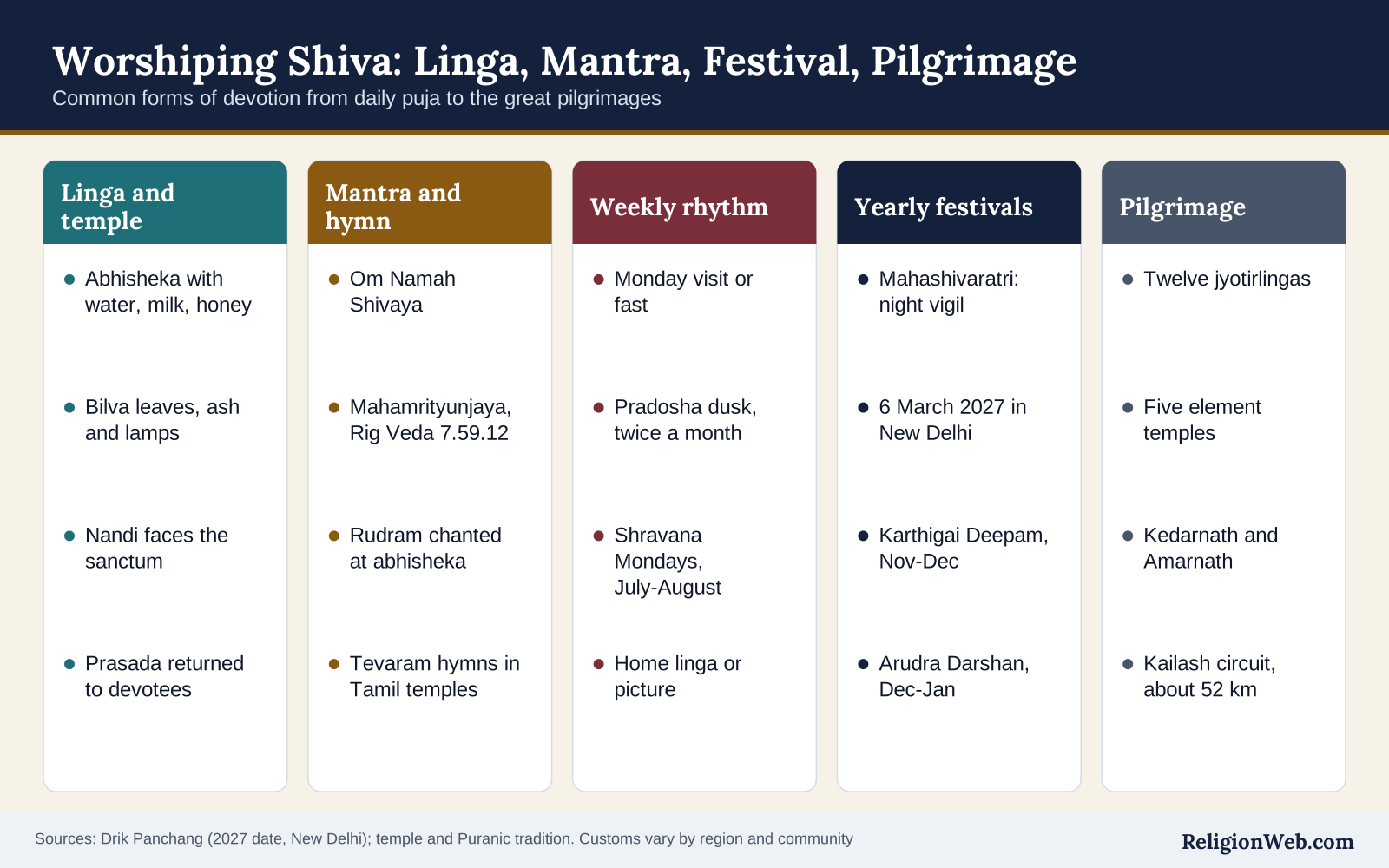
Shiva in the Modern World: Presence, Art, and Public Life
Global Presence of Shiva Devotion
Where Shiva is honored today
Shiva devotion is concentrated in South Asia, where the great majority of the world’s Hindus live, but it is not confined there. Shiva temples and shrines stand across Nepal, Sri Lanka, Bangladesh and Pakistan, and in communities of Indian and Sri Lankan origin in Southeast Asia, Mauritius, Fiji, the Caribbean, East and South Africa, the United Kingdom, Canada, Australia and the United States. In Bali, Siwa is a central deity of a living Hindu tradition. The data year matters here: the figure of nearly 1.2 billion Hindus is the Pew Research Center’s estimate for 2020, published in 2025.
Because census categories rarely distinguish Shaivas from other Hindus, the best evidence for Shiva’s place comes from surveys of devotion, temple numbers, pilgrimage and festival attendance. These all point to Shiva as one of the most widely honored Hindu deities, though they should be read as a pattern and not a headcount.
Diaspora temples and island pilgrimages
Where Hindu communities have settled, they have built temples that often combine several deities, with Shiva shrines inside them, as well as temples dedicated primarily to Shiva. Mahashivaratri is observed in these places with the same fast and night vigil as in India, often adapted to work and school schedules, with the main services held on the nearest evening or weekend. In Mauritius, a lake in the central highlands known as Ganga Talao has become the focus of a large annual Mahashivaratri pilgrimage in which many devotees walk from across the island.
These practices show how a tradition with an elaborate sacred geography in India creates new sacred places overseas. Water from the Ganga is sometimes brought and mixed with local water, and temples are often built to follow the agamic or regional pattern of their founders, so that a visitor to a Shiva temple in a Western city may find the same rituals as in Madurai or Varanasi.
Shiva in Art, Dance, and Public Culture
Nataraja and the performing arts
Nataraja is not only an image in temples but a patron of the performing arts. Classical Indian dancers in the Bharatanatyam tradition often begin their training and performances with an invocation to Nataraja, and many dance schools keep an image of the dancing Shiva in the studio. The Chola bronzes are exhibited in museums around the world, among them the Metropolitan Museum of Art in New York, where they are treated as masterpieces of metalwork and as objects of living devotion. Museum curators and temple communities have sometimes disagreed about the display of sacred images, and the debate reflects a broader question about the place of living religious objects in public collections.
The same image has entered modern thought. Ananda Coomaraswamy’s early twentieth-century essay on the dance of Shiva helped to make the Nataraja an emblem of Indian art, and it remains the most widely reproduced Hindu image in the world. Interpretations that connect it to physics or other modern ideas are modern analogies and not part of Shaiva teaching.
Popular culture and respectful representation
Shiva appears in films, television serials, comics, music, novels and digital media in India and abroad. Some treatments are devotional and some are imaginative retellings. Hindu organizations and individuals have, at times, objected to uses of Shiva’s image in commercial products or satire that they find disrespectful, and these concerns belong to a wider conversation about how the images of a living religion are treated outside its communities.
For readers, the useful distinction is between the figure as devotees understand him and the many reimaginings of that figure in popular culture. A television version of the stories may emphasize drama, while a temple liturgy emphasizes order and reverence. Neither is the whole of Shiva, and the sources described in this article can help a reader tell them apart.
Visiting and Studying with Respect
Visiting a Shiva temple as a guest
Most large Hindu temples welcome visitors, and many welcome visitors of all backgrounds, though some restrict the inner sanctum or the whole temple to Hindus, and the rules are posted at the entrance. Modest dress, removal of shoes, silence or quiet speech, and permission before photography are widely expected. Visitors are not obliged to make offerings or take part in rituals, and may simply observe from the side.
It is courteous to ask a priest or attendant how a particular custom works, and to avoid touching the linga or the offerings unless invited. Festival days bring crowds and security measures, so visitors planning to attend Mahashivaratri or Shravana events should check local arrangements in advance.
Reading about Shiva responsibly
A reader who wants to go further will meet translations and commentaries from several traditions. The older public-domain translations, such as Griffith’s Rig Veda and Müller’s Upanishads, are valuable but reflect the scholarship and wording of their time. For Shaiva philosophy, texts translated and taught by members of the traditions themselves are indispensable, and academic studies by historians of religion add context on dates and development.
Because Shiva appears in so many bodies of literature, it helps to read with attention to genre: a Vedic hymn, a Purana story, a temple manual, a philosophical treatise and a devotional poem each ask different questions of the reader. The general article on Hinduism and the article on Shaivism offer context for each.
Common Misconceptions About Shiva
Misconception 1: Shiva is only a destroyer
Where the misunderstanding comes from
The idea that Shiva is “the destroyer” comes from a real scheme in Hindu literature, in which Brahma creates, Vishnu preserves and Shiva dissolves the world. Popular books, school textbooks and films have repeated this three-part summary because it is compact and easy to remember. It is also reinforced by Shiva’s fierce forms, his association with cremation grounds and his role as Mahakala, the lord of time, who ends a cosmic cycle.
The summary leaves out how devotees describe their own God. A person who learns only that Shiva “destroys” is likely to take him as a figure of fear, which is not how most worshipers approach him.
The shorthand also travels well in translation. English-language reference works have long listed Hindu deities by function, a habit that suits a catalog but fits the Shaiva sources poorly, since those sources describe Shiva as the Lord first and a performer of particular tasks second.
What the evidence and tradition actually show
The triad is one scheme among several, and Shaiva texts typically place Shiva above it as the one who performs all functions. Shaiva Siddhanta and related schools speak of five acts: creation, preservation, dissolution, concealment and grace. In that scheme dissolution is a periodic withdrawal of the world, and grace, the release of souls, is the final act. The very name Shiva means “auspicious,” and temple worship focuses on blessing, protection, healing and liberation.
It is also worth noting that Vaishnava and Shakta traditions place Vishnu or the Goddess at the center of their own accounts. These are different theological positions held by different communities, and none of them reduces Shiva to a single function. The Puranic triad is real, but as a full definition of Shiva it is incomplete.
Temple practice points the same way. Few devotees visit a Shiva temple to ask for destruction. They ask for health, for a marriage, for protection on a journey, for the removal of obstacles or for peace of mind, and the images they see on the walls, such as Dakshinamurti the teacher and Uma-Maheshvara the couple, are not images of ending. The word “destroyer” is best kept as a translation of one function, samhara, and not as a name for the deity.
Misconception 2: The linga has one crude or purely sexual meaning
Where the misunderstanding comes from
Several things lie behind this idea. The Sanskrit word linga can refer to the male organ as well as to a “mark” or “sign.” Some early images, including the carved figure on the Gudimallam linga, have a clearly phallic form. Nineteenth-century European writers, some of whom viewed Hindu worship with hostility, popularized the phallic reading as a way of describing all linga worship, and the claim has been repeated in books and on the internet ever since.
The shape of the object makes the suggestion easy to make for a viewer who knows nothing about the tradition, which is one reason it persists.
Translation adds to the confusion. A reader who looks up the Sanskrit word in a dictionary will find several senses listed together, and without the context of temple liturgy and Shaiva commentary it is easy to pick the one that fits the shape.
What the evidence and tradition actually show
Scholars of religion acknowledge that generative symbolism is one of several layers of meaning in the linga’s history, and some academic discussion treats it seriously. Shaiva tradition, however, reads the object chiefly as a sign of the infinite Lord, as in the story of the pillar of fire, and as a form that is both formed and formless. Priests treat it as a deity who is bathed, dressed and fed, not as an anatomical image, and the base is read as Shakti or as the world resting on the divine.
A fair account therefore says that the generative dimension is part of some readings, that it is not what Shaiva worshipers mean when they bow before the linga, and that the claim that the linga is “really” only one thing misses the diversity of the tradition’s own interpretations.
The Lingayat community offers a useful test case. Its members wear a small linga on the body every day and speak of it as the form of God that stays with them, language that makes no sense if the object were primarily an erotic image. Other readers, such as the Tamil poets who sing of a pillar of fire at Tiruvannamalai, stress light and infinity. Respectful study keeps all of these readings in view.
Misconception 3: All Shaiva traditions use identical theology and ritual
Where the misunderstanding comes from
The single word “Shaivism” gives the impression of a unified religion with one doctrine. Popular summaries often describe Shaivas as people who worship Shiva with ash, the linga and the mantra Om Namah Shivaya, and these outward signs are indeed widely shared. A visitor to two Shiva temples may see similar objects and conclude that the thought behind them is the same.
In addition, Hindu and Western writers alike have sometimes used Shaivism as a catch-all for Shiva-related practice.
The category itself is partly a scholarly convenience. The communities it covers did not all use the word for themselves, and they were separated by language, region, initiation and social setting for most of their history.
What the evidence and tradition actually show
Shaiva schools differ on basic questions. Shaiva Siddhanta teaches three eternal realities, the Lord, the soul and the bonds, and treats the soul as distinct from God even in liberation. Kashmir Shaivism teaches that all reality is the free expression of one consciousness. The Lingayat tradition centers on a personal linga and rejects hereditary priesthood. The Pashupata ascetics followed disciplines unlike those of temple priests, and Smarta households treat Shiva as one of five deities.
Rituals vary as well: agamic temples, Tantric initiation, Vedic recitation and Lingayat home worship follow different manuals. The internal diversity is a long-standing feature of the tradition, and it is best described without ranking the schools.
The diversity has practical consequences. A priest ordained in one agamic lineage may not take part in the rites of another, a Kashmiri teacher and a Tamil teacher may use the same word for different things, and a Lingayat devotee may be uneasy at being described as a Brahmanical Shaiva. Learning which tradition a speaker belongs to is the first step in understanding what is being said about Shiva.
Misconception 4: Only male ascetics worship Shiva
Where the misunderstanding comes from
The famous image of Shiva as a meditating yogi and the visibility of ascetic men during festivals such as Mahashivaratri and the Kumbh Mela lead many observers to associate Shiva worship with renunciant men. Photographs of ash-smeared sadhus are common in the media, and they shape the public impression.
The impression is reinforced by the fact that some ascetic orders have historically been male.
Scholarly accounts of the early Pashupata and Kapalika movements likewise focus on ascetic groups, because the surviving sources were written by and about them. That emphasis can make the ordinary worshiper harder to see.
What the evidence and tradition actually show
Most Shiva worship is carried out by householders, including men, women and children, in temples and homes. The Tamil poet-saint Karaikkal Ammaiyar, the Kannada poet Akka Mahadevi and the Kashmiri poet Lalleshwari are among the most celebrated Shaiva voices, and women take a prominent part in fasts on Mondays and at Mahashivaratri. Survey research on Hindu practice in India has found that women are at least as likely as men to report worship at home.
Popular tradition also says that unmarried women observe Monday fasts in the hope of a husband as good as Shiva, and that married women fast for the well-being of the family, which shows how domestic the devotion often is. Ascetics are a respected but small part of a large devotional community.
Temple life shows the same breadth. Hereditary priests, temple musicians, garland makers, lamp lighters and the families who sponsor daily rites include people of every age and both sexes, and festival crowds are made up chiefly of families. The ascetic image is part of the picture, but it is the part that is easiest to photograph.
Frequently Asked Questions About Shiva
Questions About Identity and Meaning
Who is Shiva in simple terms?
Shiva is a major Hindu deity, regarded by Shaiva Hindus as the supreme God and honored by many other Hindus as one of the principal gods. His name means “auspicious.” He is pictured as an ascetic on a mountain, as a husband and father, as a dancer and as a column of light in the linga, and devotees pray to him for protection, healing, wisdom and liberation.
The simplest accurate summary is that he is a deity with many forms, each expressing a different aspect of how Hindus understand the divine, and that the forms are held together in devotion and not in a single doctrine.
Is Shiva the same as the Vedic Rudra?
Hindu tradition identifies the two, and the Shatarudriya and the Svetasvatara Upanishad use the names together. Historians see Rudra as the earlier figure, a god of storms and wild places in the Rig Veda, and Shiva as the later, larger figure who absorbed Rudra’s attributes along with those of other deities and ascetic ideals. Both views can be held at once: the later tradition honors continuity, and historians trace development.
Is Shiva worshiped by all Hindus?
Not in the same way. Shaivas place Shiva at the center of their worship, while Vaishnavas center on Vishnu and Shaktas on the Goddess. Many Hindus honor several deities, and Smartas worship five. Shiva is nonetheless among the most widely honored deities, and the temples, festivals and pilgrimages described above draw devotees from many communities.
Questions About Symbols and Worship
Why are milk and water poured over the linga?
The pouring is abhisheka, a ritual bath given to a deity as an act of honor and care. Water refreshes and purifies, while milk, yogurt, honey and ghee are offered as precious substances, and the sequence is accompanied by verses such as the Rudram. Devotees also associate the cooling water with the heat of Shiva’s ascetic power and with the Ganga that flows from his hair, though these are devotional readings and not rules.
Why are bilva leaves offered to Shiva?
Tradition holds that the bilva tree is dear to Shiva and that its three-part leaf is especially suitable for him. Devotees link the three leaflets to his three eyes or his trident, and the leaves are offered with water at the linga. The story of the hunter on Mahashivaratri, who dropped bilva leaves on a linga in the night, is often told in explanation. The custom is widely followed but not universal.
Can anyone visit a Shiva temple?
Policies differ. Many Shiva temples welcome visitors of all backgrounds, while some restrict the inner sanctum or the whole temple to Hindus, and some have separate rules on dress, photography and footwear. Notices at the entrance usually explain the rules, and priests are generally willing to answer polite questions. Visitors should dress modestly, remove shoes and follow the lead of worshipers.
Questions About Festivals and Observance
When is Mahashivaratri, and why is it observed at night?
The date follows the lunar calendar: it falls on the fourteenth lunar day of the dark fortnight in Magha (amanta reckoning) or Phalguna (purnimanta), usually in February or March. For 2027, Drik Panchang lists the night beginning on 6 March for New Delhi, with the midnight period running into 7 March. It is observed at night because the observance is called “the night of Shiva,” and devotees understand the vigil as a way of keeping awake to the divine, with four watches of worship.
Calendar details differ by location and almanac, so devotees usually check a local temple or panchang for the year.
Do devotees have to fast for Shiva?
Fasting is a common practice and not a universal requirement. Many devotees fast on Mondays or Mahashivaratri, while others make a smaller offering or attend a temple service. Traditions provide exemptions and gentler forms for the ill, the elderly, children and pregnant women. A person with a medical condition should take advice from a doctor and not rely on religious practice alone.
Conclusion: Understanding Shiva Through Many Images
What the Sources and Traditions Show
A figure built from many strands
The textual record shows a god who begins as the feared and healing Rudra of the Vedic hymns and becomes, over many centuries, Mahadeva, the supreme Lord of the Shaiva scriptures, the ascetic of the mountain, the husband of Parvati and the dancer of Chidambaram. The development was gradual and drew on epic, Puranic, agamic and regional sources. Some questions, such as the relationship between the Indus seal and later images, remain unsettled, and it is better to say so than to claim continuity that the evidence does not support.
Many images, one devotion
The traditions that honor Shiva do not agree on every point of doctrine. Shaiva Siddhanta, Kashmir Shaivism, the Lingayat tradition and Smarta household worship give different answers about the soul and the world. Yet they share a vocabulary of grace, an attachment to the linga and Om Namah Shivaya, and a calendar of nights and pilgrimages. Seeing Shiva as only a destroyer, or the linga as having a single meaning, flattens a tradition that has always preferred many images to one.
How to Keep Exploring
Moving from Shiva to the wider tradition
Readers who want the history and philosophy of the communities that place Shiva at the center can turn to the article on Shaivism, and those interested in the family of deities can read about Ganesha, Durga and Krishna. The shared structure of daily worship appears in the article on puja, and the wider religious setting in the article on Hinduism.
Learning from living practice
The best complement to reading is attention to practice. A visit to a temple on a Monday evening, a conversation with a priest about the meaning of abhisheka, or the experience of hearing the Rudram chanted can show what the texts only describe. Scholars, priests and devotees may give different answers to the same question, and the differences are part of the subject. Approaching Shiva with that openness is closest to the way the tradition itself has been transmitted.
Sources
The table below lists the principal external sources behind this article. Facts, dates and figures were checked against these and related primary, institutional and academic materials.
| # | Source | Publisher and type | Used for | Link |
|---|---|---|---|---|
| 1 | Rig Veda, Book 2, Hymn XXXIII (Rudra), trans. Ralph T. H. Griffith (1896) | Internet Sacred Text Archive (sacred-texts.com) · Primary text (public-domain translation) | Quotations of Rig Veda 2.33.3 and 2.33.14; Rudra as feared and protective | sacred-texts.com |
| 2 | The Upanishads, Part II (SBE 15), trans. F. Max Müller: Svetasvatara Upanishad, Adhyaya IV | Internet Sacred Text Archive (sacred-texts.com) · Primary text (public-domain translation) | Quotation of Svetasvatara Upanishad 4.10 (Müller, 1884); Rudra-Shiva as the one Lord | sacred-texts.com |
| 3 | Shiva as Lord of Dance (Nataraja), Chola period, late 11th century (acc. no. 1987.80.1) | The Metropolitan Museum of Art · Museum catalog | Nataraja date, medium, size and iconography (damaru, fire, abhaya hand, Apasmara, flying locks) | metmuseum.org |
| 4 | The Saiva Age: The Rise and Dominance of Saivism during the Early Medieval Period, by Alexis Sanderson (2009) | Zenodo (CC BY 4.0), from Genesis and Development of Tantrism · Academic scholarship | Atimarga and Mantramarga, Siddhanta and Bhairava scriptures, royal patronage, Southeast Asia | zenodo.org |
| 5 | Shaivism | Encyclopaedia Britannica · Encyclopedia | Rudra and Shiva; Pashupata; Shaiva Siddhanta (pati, pashu, pasha); spread to Southeast Asia | britannica.com |
| 6 | The Nataraja bronze and Coomaraswamy's legacy, by Sharada Srinivasan | Sahapedia · Academic essay | Chidambaram's Chit Sabha, the metal Nataraja in the sanctum, Margazhi and Arudra Darshan | sahapedia.org |
| 7 | Great Living Chola Temples (World Heritage List, no. 250) | UNESCO World Heritage Centre · Institutional | Brihadisvara (c. 1009-1010) and Gangaikondacholapuram temples; living worship | whc.unesco.org |
| 8 | Maha Shivaratri Date and Time | Drik Panchang · Calendar reference | Mahashivaratri on 6 March 2027 (New Delhi); tithi rule and Nishita Kaal | drikpanchang.com |
| 9 | Beliefs About God in India (Religion in India report) | Pew Research Center · Demographic data | 44% of believing Hindus in India feel close to Shiva (2021 report) | pewresearch.org |
| 10 | Hindu Population Change (How the Global Religious Landscape Changed, 2010-2020) | Pew Research Center · Demographic data | About 1.2 billion Hindus in 2020; about 95% in India | pewresearch.org |
Last fact-check date: 2026-10-21.

