Moksha (Sanskrit mokṣa, often spelled moksa) is the Hindu word for liberation: release from samsara, the continuing round of birth, death, and rebirth, and from the ignorance and attachment that most Hindu teachers say keep that round turning. The word comes from a Sanskrit root meaning “to release” or “to set free,” and across the long history of Hinduism it has named the highest aim that ascetics, philosophers, poets, temple priests, and ordinary householders have set before themselves. What that freedom actually is, and how a person arrives at it, is answered in more than one way.
In the non-dualist Vedanta associated with Shankara, moksha is the direct knowledge that the innermost self, the atman, is not different from Brahman, the ultimate reality. In the devotional Vaishnava schools that follow Ramanuja and Madhva, the liberated soul remains distinct from God and lives in grateful dependence on him. Classical Samkhya and Yoga speak of kaivalya, the “isolation” of the conscious self from the material world. Shaiva and Shakta traditions add further vocabularies of grace, initiation, and recognition. These are not competing answers to one exam question. Each belongs to a school with its own texts, arguments, and community of practice, and each is best understood on its own terms.
The same variety shows up in the question of method. Some texts present liberation as the fruit of knowledge, others of selfless action, others of loving devotion and surrender, and many combine these in different proportions. The Bhagavad Gita is the most famous place where the three are laid side by side, while the Upanishads supply the older vocabulary of self and Brahman. This article follows the idea from its earliest textual roots through the classical schools, the devotional movements, and present-day practice.
One more point shapes everything below. Moksha is often pictured as a state that begins only after death, a kind of distant Hindu heaven. Some traditions do teach that final release comes at the end of a life, but others speak of jivanmukti, liberation attained while still living in a body. The difference matters for how the goal is pictured, how it is pursued, and what a liberated person is expected to look like. The sections that follow keep these distinctions visible instead of blending them into one story.
Moksha at a Glance: Meaning, Vocabulary, and Basic Ideas
The Word Moksha and Its Neighbors
The root and the basic meaning
Moksha derives from the Sanskrit root muc (sometimes given as moksh), which carries the sense of letting go, freeing, or releasing. A closely related word, mukti, comes from the same root, and so does mukta, “one who has been freed.” The person who longs for liberation is called a mumukshu, a desiderative form that literally means “one who wants to be released.” Reference works such as the Concise Oxford Dictionary of World Religions define moksha as release from the cycle of death and rebirth, achieved once ignorance (avidya) and desire are overcome.
The imagery built into the root is worth noticing. Something is bound, and something is untied. Schools disagree about what the bond is. In some it is real and has to be cut by practice and grace. In others it is closer to a misperception, and what is needed is not an escape but a correction of vision. That difference, between releasing a prisoner and waking someone from a dream, runs through the whole subject.
Other words for the goal
Moksha is the umbrella term most readers meet first, but Indian philosophical literature has several others, and each carries a nuance. Apavarga (“release” or “exit”) is the usual word in the Nyaya school of logic. Nihshreyasa (“the highest good”) appears in the opening statements of the Vaisheshika and Nyaya traditions. Kaivalya (“aloneness” or “isolation”) is the goal of Samkhya and of Patanjali’s Yoga. The Upanishads often speak of amrita or amritatva, “immortality.” The Gita uses the compound brahma-nirvana, which Kashinath Telang’s 1882 English version renders as the “Brahmic bliss.”
These terms overlap without being identical. A Nyaya author who writes of apavarga has a particular account of the self and of suffering in mind, and a Yoga author who writes of kaivalya has another. Treating them all as synonyms for “enlightenment” or “salvation” loses the detail, which is why this article uses the Sanskrit word and explains it, and then says which school is speaking. Other Indian religions have their own vocabularies of liberation, and those are covered on their own pages; the Hindu terms are discussed here in their own setting.
What Moksha Frees a Person From
Samsara and the cycle of rebirth
Samsara, literally “flowing together” or “wandering on,” is the Hindu term for the beginningless sequence of births and deaths in which a self takes one body after another. Hindu traditions describe many possible destinations within it: human lives, animal lives, heavenly realms, and realms of suffering. The doctrine and its development are treated at length on the page about samsara and reincarnation in Hinduism. For the present subject the key point is that most Hindu schools treat repeated rebirth as the condition from which liberation is wanted, not as a reward or a goal in itself.
The classical schools describe samsara differently. In Advaita Vedanta, as the Internet Encyclopedia of Philosophy summarizes it, ignorance “conceals Brahman and constructs the world,” so the cycle is bound up with a misperception of what the self is. In the theistic Vedanta of Ramanuja and Madhva, souls and the world are real and dependent on God, and samsara is the soul’s entanglement with matter and karma, resolved by turning toward God. In Samkhya, it is the entanglement of the conscious self with nature. Beneath these differences lies a shared premise: the ordinary situation is one of bondage, and there is a way out.
Ignorance, desire, and karma
Most accounts link three causes. Ignorance misidentifies the self, usually with the body, the mind, or a social role. That misidentification breeds desire and aversion. Desire drives action, and the results of action, together with the impressions they leave, shape future births. The Brihadaranyaka Upanishad (4.4.5) states the last link as a principle: in Max Müller’s translation, a person’s future turns on the words “according as he acts,” and “so will he be.” Karma in this sense is not fate but a principle of consequence, discussed on the page about karma in Hinduism.
Because the chain begins with ignorance, many schools hold that knowledge or insight must in some way end it, while others emphasize that only grace can cut a bond the individual cannot untie alone. Teachers who stress action point out that it is not action itself but attachment to its results that binds. These emphases are the subject of the later sections on paths and schools. For now it is enough to see why a single goal can support so many methods: each method targets a different link in the same chain.
Where Moksha Sits Among the Aims of Life
The four purusharthas
Classical Hindu thought speaks of four legitimate aims of human life, the purusharthas: dharma (right conduct and duty), artha (material well-being), kama (pleasure and desire), and moksha. The Concise Oxford Dictionary of World Religions calls moksha the fourth and ultimate of these. The fourfold list is characteristic of the epics and the later legal and philosophical literature, and the aims are usually presented as ordered: dharma governs the pursuit of wealth and pleasure, and moksha is the aim that goes beyond all three. The page on dharma in Hinduism explains how duty frames the other aims.
The ordering does not mean that everyone is expected to pursue moksha first, or to renounce the other aims in order to do so. The tradition explicitly values family life, public service, and the enjoyment of beauty within the bounds of dharma. Moksha stands at the far end of the list because it is regarded as the only aim that is not itself exposed to loss.
A goal for some, a horizon for many
It would be inaccurate to say that every Hindu organizes daily religion around the pursuit of liberation. Much worship, from household shrines to major festivals, asks for health, protection, prosperity, and the welfare of a family, and these are legitimate concerns within the tradition. Moksha tends to appear as a horizon: it shapes funeral rites, pilgrimage, the language of hymns, and the life choices of renunciants and committed devotees, and it is the central question of the philosophical schools.
Seen this way, moksha is neither a niche idea reserved for monks nor a daily preoccupation of every worshiper. It is a shared reference point that different people approach at different distances, and that different schools describe in different ways. The sections that follow begin with the history of the idea and move outward to the texts, the paths, and the schools.
| Term | Sanskrit form | Basic meaning | Where it matters most |
|---|---|---|---|
| Moksha / mukti | mokṣa, mukti | Release, liberation, from the root muc | General word for the goal across many schools |
| Samsara | saṃsāra | The cycle of birth, death, and rebirth | The condition from which release is sought |
| Atman | ātman | The self, the innermost “I” | Identical with Brahman in Advaita; distinct but dependent in Vishishtadvaita and Dvaita |
| Brahman | brahman | Ultimate reality, the ground of the world | Understood as without qualities or as a personal God, depending on the school |
| Avidya | avidyā, ajñāna | Ignorance of the true nature of the self | Named as the root of bondage in Advaita and in Yoga |
| Karma | karman | Action and its consequences | Binds when driven by desire; central to the Gita’s teaching on action |
| Jnana | jñāna | Knowledge, especially of the self and Brahman | The path of knowledge (jnana yoga) |
| Bhakti | bhakti | Devotion, loving participation | The path of devotion in Vaishnava, Shaiva, and Shakta traditions |
| Prapatti | prapatti, śaraṇāgati | Surrender, taking refuge in God | Sri Vaishnava teaching on grace |
| Jivanmukti | jīvanmukti | Liberation while still alive in a body | Advaita, Samkhya, Shaiva, and other traditions |
| Kaivalya | kaivalya | “Isolation” of the conscious self from matter | Classical Samkhya and Patanjali’s Yoga |

Origins and Historical Development of the Idea of Liberation
Vedic Background: Long Life, Ancestors, and Immortality
Hymns, sacrifice, and the hope for a life beyond
The oldest Vedic hymns, those of the Rigveda, are usually dated by historians to the second millennium BCE, with many placing them around 1500 to 1200 BCE. Most are addressed to deities such as Agni, Indra, and Soma within a world of sacrifice, and what they ask for is largely concrete: long life, children, cattle, protection, and victory. They also look beyond death. Worshipers hope to join the ancestors in a world of light, and to share in a kind of immortality (amrita) that belongs to the gods and, in some hymns, may be granted to mortals. More detail on this literature is given on the page about the Vedas and Upanishads.
Most scholars hold that the oldest hymns do not yet contain the doctrine of repeated rebirth, or the idea of release from it, in the form familiar from later Hinduism. That is a statement about texts, not about everything that people in the second millennium BCE may have believed, since the hymns preserve the viewpoint of ritual specialists and cannot speak for the whole society. What they show is a religious horizon in which the best outcome of a good life and correct ritual is a lasting place among the gods and ancestors, not an exit from the world of becoming.
Early worries about repeated death
The ritual commentaries known as the Brahmanas, composed in the early first millennium BCE, show a shift. They are concerned with a fear usually called punarmrityu, “re-death”: the possibility that death overtakes a person again even in the next world, and that ritual knowledge is needed to avoid it. Here, in embryonic form, is the problem that moksha will later answer. Death is no longer simply a threshold to be crossed once; it may recur, and the question of how to stop it becomes urgent.
This development is easy to overstate, and historians treat it with caution. The Brahmanas are ritual manuals, and their remarks on re-death are brief. Still, they help explain why the Upanishads, composed within the same intellectual lineage, could shift the center of gravity from correct sacrifice to correct knowledge of the self without sounding like a break with the Vedic past.
The Upanishadic Turn Toward Knowledge of the Self
Rebirth and release as new questions
The earliest Upanishads, notably the Brihadaranyaka and the Chandogya, are commonly dated by scholars to roughly the seventh to sixth centuries BCE, though these dates are estimates and some place the texts later. In them, teachers and students ask what survives death, what happens to the self, and whether the outcome depends on ritual or on knowledge. Both texts describe, in passages that scholars often compare, two destinations after death. Those who know the truth about the self are said to go by a path leading toward Brahman and not to return, while those who rely on ritual and charitable works go by another path and come back. In this setting, liberation becomes a question of what is known, and final release from rebirth appears as an explicit goal in some of the earliest surviving texts that teach it.
The same texts reflect an equally important development in who is speaking. Teachers such as Yajnavalkya are shown instructing kings, students, and wives, and in the Brihadaranyaka Upanishad Maitreyi asks her husband what she should do with wealth that cannot make her immortal. Such passages treat the search for liberation as a matter for serious dialogue among householders as well as for forest dwellers, a point that returns in the sections on practice.
Renunciant movements of the eastern Gangetic plain
The Upanishads took shape during a period of religious ferment in northern India, when many teachers and communities of renouncers were active in the middle Ganges region. Some of these movements developed into traditions that later became independent religions, and they are covered on their own pages. Historians debate how ideas of rebirth, action, and release moved among these groups, and the surviving evidence does not allow confident claims about who borrowed from whom. What can be said is that the vocabulary of bondage and release became a shared concern of the period, and that the Upanishadic authors answered it in terms of the Vedic inheritance they knew: Brahman, the self, and the knowledge that connects them.
Epics, Law Books, and Classical Systems
Moksha in the Mahabharata
The Sanskrit epic Mahabharata brings moksha into a narrative setting. Its twelfth book, the Shanti Parva, contains a long section traditionally called the Mokshadharma, a collection of teachings, dialogues, and stories on liberation that draws on Samkhya, Yoga, and Vedantic ideas without reducing them to a single system. The Bhagavad Gita, discussed in its own section below, appears in the sixth book of the epic. Together these texts show that, by the last centuries BCE and the early centuries CE, discussion of liberation had spread beyond Vedic schools into a wider, more public literature that included warriors, kings, and householders.
It is in this period that moksha comes to be listed as the fourth purushartha, alongside dharma, artha, and kama. The listing reflects an effort to hold together a world of duty and enjoyment with a vision of freedom beyond them, and the epics and law books are full of attempts to say how the two relate.
Sutras, commentaries, and the rise of the schools
The classical philosophical schools crystallized in short aphoristic texts called sutras, each followed by centuries of commentary. Patanjali’s Yoga Sutra, which most scholars date to roughly the first or second century CE, treats kaivalya as the goal of yoga practice. The Brahma Sutra, attributed to Badarayana, systematizes the teaching of the Upanishads and became the foundation text of Vedanta. The Vedanta commentators who followed, including Shankara in the eighth century CE, Ramanuja in the eleventh or twelfth, and Madhva in the thirteenth, produced the interpretations that still structure debate over the nature of liberation. Their disagreements are the subject of a later section.
Alongside the Sanskrit commentarial tradition, a second stream developed in regional languages: the Tamil hymns of the Alvars and Nayanars, the Kannada poems of Basava and his contemporaries, the Marathi songs of Jnaneshwar and Tukaram, and the Hindi and Punjabi verses of Kabir and Ravidas, among many others. These bhakti movements shaped what liberation meant to millions of people who never read a sutra, and they receive their own section.
| Text or group | Approximate period | Role in the history of moksha |
|---|---|---|
| Rigveda | Second millennium BCE (often c. 1500 to 1200 BCE) | Hopes for long life and immortality among gods and ancestors; no developed doctrine of release from rebirth |
| Brahmanas | Early first millennium BCE | Ritual commentaries; concern with “re-death” (punarmrityu) |
| Early Upanishads (Brihadaranyaka, Chandogya) | Often placed c. 7th to 6th century BCE | Self and Brahman; two paths after death; knowledge as the route to release |
| Verse Upanishads (Katha, Mundaka, Shvetashvatara) | Later than the earliest prose Upanishads | Grace, devotion to a personal Lord, yogic discipline, knowing Brahman |
| Mahabharata, including the Bhagavad Gita | Epic compiled over centuries; the Gita usually placed in the last centuries BCE or early centuries CE | The Mokshadharma section; the Gita’s paths of action, knowledge, and devotion |
| Yoga Sutra of Patanjali | Roughly 1st to 2nd century CE | Eight limbs of yoga; kaivalya as the goal |
| Brahma Sutra of Badarayana | Early centuries CE or later; date debated | Systematizes Upanishadic teaching; basis of Vedanta commentary |
| Shankara’s commentaries | 8th century CE | Advaita reading of Upanishads, Brahma Sutra, and Gita |
| Bhagavata Purana | Often placed c. 9th to 10th century CE | Devotional theology; several forms of liberation within a bhakti framework |
| Tamil hymns of the Alvars and Nayanars | Roughly 6th to 9th century CE | Early regional devotional poetry of Vaishnava and Shaiva traditions |
Moksha in the Upanishads: Atman, Brahman, and the Knowledge That Frees
Atman and Brahman: Self and Ultimate Reality
Who or what is the self?
The Upanishads approach the question of liberation by asking what the self is. The answer they develop distinguishes the changing body, senses, and mind from an inner witness, the atman. Brihadaranyaka teachers describe the self through negation, saying “not this, not this” (neti neti), because every object that can be named belongs to the world and not to the knower. The word Brahman, which in Vedic ritual texts had referred to sacred utterance and its power, becomes in these Upanishads the name for the ultimate ground of all that exists.
The central move is to bring the two terms together. The Chandogya Upanishad (6.8 and following) has the teacher Uddalaka Aruni instruct his son Shvetaketu with the repeated sentence tat tvam asi, usually translated “that you are.” The Brihadaranyaka (1.4.10) has the formulation aham brahmasmi, “I am Brahman.” Traditions that follow the Upanishads agree that these statements are central. They disagree, sometimes sharply, about what the “are” means, and that disagreement produces the different schools of Vedanta described below.
The great statements and how they are read
Later Vedanta tradition gathered four short sentences into a group called the mahavakyas, “great statements”: prajnanam brahma (consciousness is Brahman), aham brahmasmi (I am Brahman), tat tvam asi (that you are), and ayam atma brahma (this self is Brahman). Advaita Vedanta reads them as statements of identity: the individual self, when the veil of ignorance is removed, is recognized as nothing other than Brahman. The Internet Encyclopedia of Philosophy summarizes the Advaita position as holding that the individual self (jiva) and the universal self are identical in reality although they appear different.
Other schools read the same sentences differently. Ramanuja, in the Vishishtadvaita tradition, understands the relation between Brahman and individual selves on the model of a soul and its body: Brahman is the Self of all, and individuals are modes or qualities of Brahman’s body. This lets him affirm the Upanishadic identity of self and Brahman without denying that selves are many. Madhva, in the Dvaita tradition, holds that souls remain forever distinct from God while depending entirely on him. It is worth remembering that none of these readings is a late addition imposed on the texts from outside. Each claims to be the most faithful interpretation of the same body of scripture.
Liberation Passages and Their Interpretation
Knowing Brahman and becoming Brahman
One of the most frequently cited liberation verses in the Upanishads comes from the third Mundaka of the Mundaka Upanishad. It declares in a single sentence that knowing Brahman is itself a form of becoming it.
He who knows that highest Brahman, becomes even Brahman
Mundaka Upanishad 3.2.9, trans. F. Max Müller, The Upanishads, Part II, Sacred Books of the East, vol. 15 (1884)
Advaita Vedanta takes this literally: since the self already is Brahman, knowledge does not produce a new state but removes the ignorance that hid the existing one. In this reading, liberation is not something gained at a later time but the recognition of what has always been the case. Theistic Vedanta schools read the verse differently. The Internet Encyclopedia of Philosophy notes that Ramanuja’s liberated self remains distinct from Brahman and shares only the nature of being a knower, so that “becoming Brahman” means attaining likeness to the Lord and not losing individuality. Both groups take the verse as an authoritative statement; they differ over what it asserts.
Desire, immortality, and the question of “here”
A second group of verses ties liberation to the ending of desire. The Brihadaranyaka Upanishad and the Katha Upanishad each say, in closely parallel wording, that when the desires lodged in the heart come to an end, the mortal becomes immortal and obtains Brahman. The Brihadaranyaka version appears in a passage about the person who leaves the body at death.
When all desires which once entered his heart are undone, then does the mortal become immortal, then he obtains Brahman.
Brihadaranyaka Upanishad 4.4.7, trans. F. Max Müller, The Upanishads, Part II, Sacred Books of the East, vol. 15 (1884)
Commentators in the Advaita tradition draw attention to the Sanskrit adverb in this verse, which can be read as “here,” that is, in this very life, and they use it as evidence that liberation does not have to wait for death. Other interpreters read the same passage as describing the transition at death, since the surrounding verses concern the departure of the self from the body. The verses therefore became one of the main sites for the later discussion of living liberation, taken up in the section on jivanmukti. In a related verse (4.4.6) the same Upanishad says, in Müller’s wording, that for the person who is free of desire “his vital spirits do not depart elsewhere” and, “being Brahman, he goes to Brahman.”
Grace, Devotion, and Discipline in the Verse Upanishads
The Lord who chooses
The Katha, Mundaka, and Shvetashvatara Upanishads, written partly in verse and generally dated later than the great prose Upanishads, introduce a note that the older texts hardly sound. They speak of a Self or Lord who is not merely discovered but who responds. In the Katha Upanishad, the young Nachiketa is offered every pleasure by Yama, the lord of death, and chooses the knowledge of the self instead, in a story that sets out the contrast between what is pleasant and what is truly good. The Shvetashvatara Upanishad, in paraphrase, praises devotion to God and to the teacher, and speaks of the grace of the Creator in revealing the greatness of the self.
Both threads, the impersonal absolute and the gracious Lord, remain in the tradition. Interpreters who emphasize Brahman as pure consciousness without qualities draw mainly on the former. Those who emphasize a personal God draw mainly on the latter, and find support in the Gita and in later devotional literature. The two do not exclude one another in the texts themselves, and many Hindus move between them without feeling a contradiction.
Yoga as an Upanishadic discipline
The same verse Upanishads also describe disciplines of body, breath, and mind as part of the search for liberation. The Katha Upanishad speaks of yoga as a steady holding of the senses, and the Shvetashvatara gives directions for a place, a posture, and the control of breath for meditation. These descriptions are earlier than Patanjali’s systematic eight-limbed scheme, and they show that meditative practice was already seen as a support for knowledge. The page about yoga in Hinduism follows the development of these practices into the classical and modern forms.
The result is a picture of the Upanishads as a layered body of teaching rather than a single doctrine. Knowledge of the self is the center, but the texts surround it with ritual, ethics, devotion, and discipline, and later schools chose to emphasize different parts of the surrounding material. The next section turns to the work that makes that choice explicit: the Bhagavad Gita.
Moksha in the Bhagavad Gita: Action, Knowledge, and Devotion
The Gita’s Setting and Its Idea of Freedom
Arjuna’s crisis and the vocabulary of release
The Bhagavad Gita is a dialogue set on the eve of a great battle in the Mahabharata. The warrior Arjuna, overcome with grief at the prospect of fighting his own relatives, puts down his bow and asks his charioteer, Krishna, what he should do. Krishna’s answer grows into a full account of the self, action, knowledge, devotion, and the goal of human life. Its composition is usually placed by scholars in the last few centuries BCE or the early centuries CE, though dates vary and the question is still debated.
The Gita does not use a single word for its goal. It speaks of release (the verb form behind moksha appears in its closing promise), of brahma-nirvana, of immortality, and of reaching Krishna himself. Because the poem is short and compact, it has been commented on for more than a thousand years by thinkers who read its teaching on liberation very differently. Shankara, Ramanuja, Madhva, and many later teachers each wrote on it, and any statement that “the Gita teaches” one thing about moksha should be taken as a statement about a particular reading.
Karma yoga: acting without clinging to results
The first practical instruction Krishna gives is to act without being bound by the results of action. This is the discipline usually called karma yoga, and the second chapter states it in a verse that has become one of the most quoted in Hindu literature.
Your business is with action alone; not by any means with fruit. Let not the fruit of action be your motive (to action).
Bhagavad Gita 2.47, trans. Kashinath Trimbak Telang, Sacred Books of the East, vol. 8 (1882)
The verse addresses a worry: if all action produces karma and binds one to rebirth, the only way to freedom might seem to be to stop acting. The Gita rejects that conclusion. It holds that the person who acts without craving for results, offering the action to a higher purpose, is not bound by it. Interpreters agree that this is central and differ over its role. Shankara reads karma yoga as a discipline that purifies the mind and prepares it for the knowledge that alone liberates. Ramanuja reads it as an integral part of the devotional path, combined with constant worship of God. Later teachers, including Mohandas Gandhi in the twentieth century, stressed selfless action as a discipline in its own right. The principle belongs to the wider doctrine of action and consequence, which the Gita assumes.
Steady Wisdom and Release While Alive
The person of steady wisdom
The second chapter of the Gita ends with a portrait of the sthitaprajna, the person of steady wisdom, a figure that reference works on living liberation count among the Gita’s descriptions of a liberated person. Krishna describes such a person as someone who has cast off desires, lives without attachment, egoism, or the feeling of “mine,” and finds tranquility. In Telang’s translation, the closing verse (2.72) calls this “the Brahmic state” and says that one who remains in it even at the last moments attains brahma-nirvana, which he renders “the Brahmic bliss.”
The portrait is notable for what it does not require. The steady person is not described as leaving the world, but as living in it with the mind unmoved by pleasure and pain. For many readers this has made the Gita a charter for a form of freedom compatible with ordinary responsibilities, a view that would be strongly emphasized in the modern period. For classical commentators it offered a description of the knower of Brahman as seen from outside: calm, free from fear and anger, and no longer driven by craving.
Release before the body falls away
The fifth chapter contains the verse most often cited by later authors for liberation within a lifetime.
He who even in this world, before his release from the body, is able to bear the agitations produced from desire and wrath, is a devoted man, he is a happy man.
Bhagavad Gita 5.23, trans. Kashinath Trimbak Telang, Sacred Books of the East, vol. 8 (1882)
The wording sets a task “in this world” and “before” release from the body, which suggests that something decisive is achieved before death. Advaita commentators and others who accept jivanmukti point to verses like this one, together with the verses that follow, which describe a yogi whose joy and light are within and who attains brahma-nirvana. Others read the same lines as a call to master desire and anger in this life as the condition for what follows at death. Both readings take the verse seriously; they disagree about whether it describes a completed liberation or a decisive preparation. The disagreement is taken up again in the section on living liberation.
Devotion and Surrender in the Gita
The path of the devoted
In the twelfth chapter Arjuna asks which are better versed in yoga: those who are constantly devoted and worship Krishna, or those who meditate on the unmanifest and imperishable. Krishna replies that those who fix their minds on him with the highest faith are, in Telang’s phrase, “deemed by me to be the most devoted,” and adds that for those whose minds are attached to the unmanifest, “the trouble is much greater.” The passage is a comment on difficulty and method within the Gita’s own teaching, and it has been read in different ways by the commentators.
Vaishnava commentators, such as those in the Ramanuja and Madhva lineages, take the chapter as a direct statement that devotion to a personal Lord is the surest route to the goal. Advaita commentators generally read it as an account of two approaches that differ in difficulty and in the stage of the seeker, not in the final aim. Without choosing between these readings, it can be said what the passage shows: the Gita presents devotion as a fully valid way to reach the highest end, and does so in a text that elsewhere gives great weight to knowledge and to selfless action.
The last verses: refuge and release
The Gita’s closing teaching of Krishna turns on a sentence that has had a very long afterlife in the tradition.
Forsaking all duties, come to me as (your) sole refuge. I will release you from all sins. Be not grieved.
Bhagavad Gita 18.66, trans. Kashinath Trimbak Telang, Sacred Books of the East, vol. 8 (1882)
Sri Vaishnava teachers treat this verse as the Gita’s culminating statement of surrender, and it is among the sources that the tradition cites for prapatti, taking refuge in God. Other commentators take “duties” to refer to anxious dependence on ritual results, or to the sense of being the independent doer of action, and read the verse as an invitation to give up that sense, not to abandon duty as such. A line that offers release in the voice of a deity has also been taken by many devotees as an assurance of grace. The range of readings shows how a single verse can carry the weight of several schools at once.
Paths to Liberation: Knowledge, Devotion, Action, and Meditation
The Three Classic Paths
Jnana: knowledge as the means
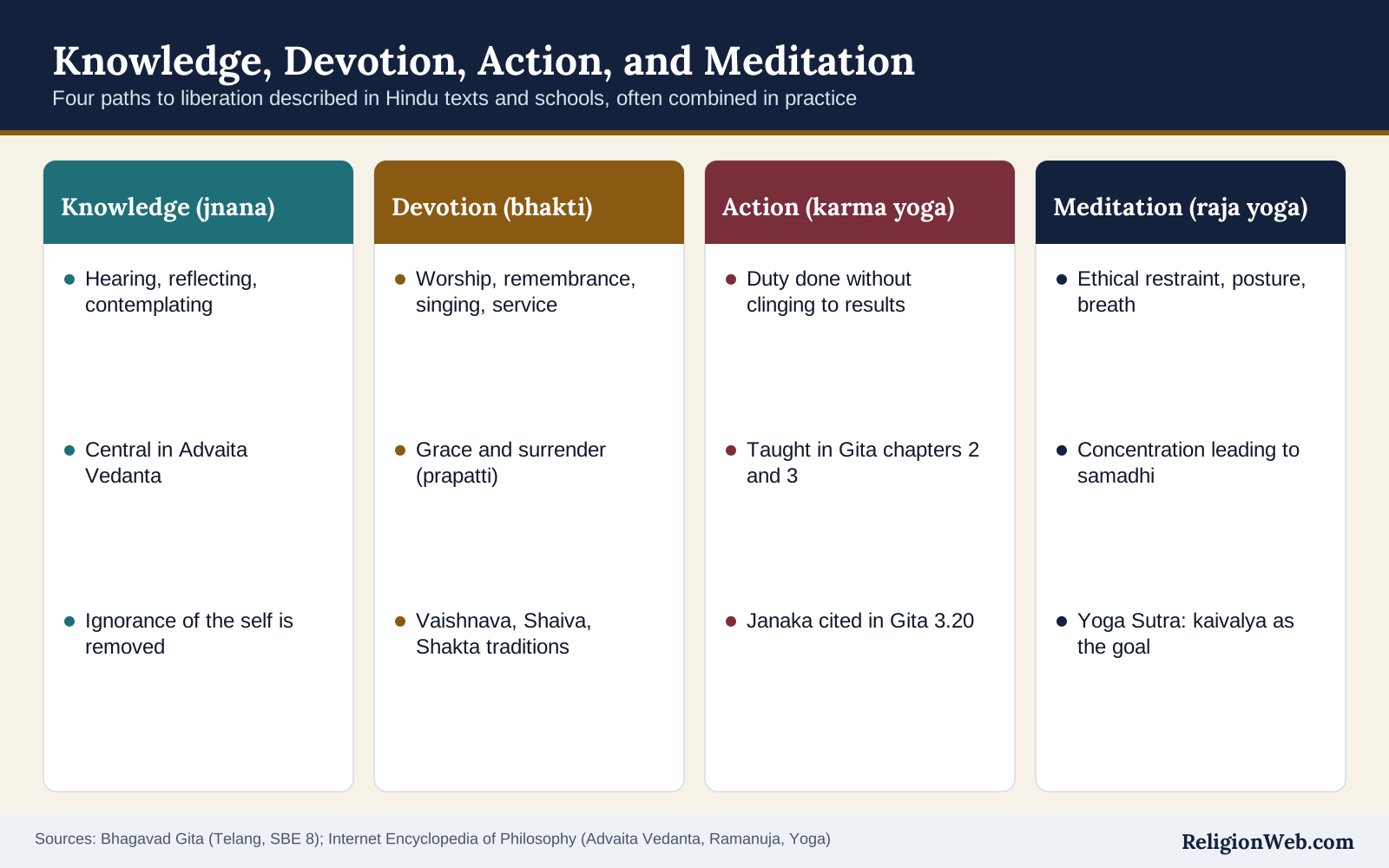
The path of knowledge (jnana marga or jnana yoga) is most closely associated with Advaita Vedanta, where liberation is understood as the removal of ignorance by direct insight into the identity of self and Brahman. The traditional method is a three-stage engagement with the Upanishads under a teacher: hearing the teaching (shravana), reflecting on it until doubts are resolved (manana), and sustained contemplation (nididhyasana) until the insight is steady. Later Advaita authors added a list of preparatory qualities: discrimination between the lasting and the passing, detachment from results, self-control, and a genuine longing for freedom.
The word “knowledge” can mislead an English reader. In this context it does not mean accumulated information or intellectual agreement. It means a transforming recognition that, once it has arisen, is said to be as undeniable as seeing that a rope mistaken for a snake is a rope. The Internet Encyclopedia of Philosophy summarizes the Advaita position in these terms: Shankara holds that “knowledge of Brahman alone is the route to liberation,” and that action serves only to purify the mind. This is a claim specific to Advaita; other schools define the role of knowledge in different ways.
Bhakti: devotion as the means
The path of devotion (bhakti marga or bhakti yoga) places love for God at the center. Its practices include hearing and singing the divine names and stories, remembering and repeating them, worship of images, bowing, service, friendship with God, and complete self-offering. The Bhagavata Purana lists nine such forms of devotion, and the list became a standard summary in Vaishnava devotional literature. Devotion can be expressed through the household shrine, the temple, pilgrimage, and communal singing, and the page on puja describes the daily rites.
Bhakti is not simply an emotional alternative to the intellectual path. In Ramanuja’s thought, according to the Internet Encyclopedia of Philosophy, bhakti is itself a form of knowledge, a direct “seeing” of Brahman whose highest stage is supreme devotion, and theoretical knowledge alone is insufficient. In Advaita, devotion to a personal form of God is widely honored as a support, and many Advaita teachers composed hymns of great beauty, though the school treats final liberation as coming through knowledge. Gaudiya Vaishnava teachers, following Chaitanya (1486 to 1534), regard loving devotion as the aim itself and not only a means to release. The shape of the path depends on the school.
Karma: action as the means
The path of action (karma yoga) comes mostly from the Gita. It asks a person to perform the duties of their station and of the moment, without craving for results and without pride as the doer. The Gita (3.20) points out that the king Janaka and others reached perfection through action, an example offered to show that active life and liberation are compatible. In modern times this strand has fed into traditions of organized service and social work, which describe selfless action as spiritual discipline.
Karma yoga is easily confused with ethical activism in the ordinary sense, but the two differ in intent. The Gita’s concern is the inner stance behind the act, which is why it can be practiced in a battlefield, a household, or a temple kitchen. Schools differ on whether such action liberates directly or purifies the mind for knowledge, a difference taken up below.
How the Paths Combine and Where Schools Differ
Complementary methods in practice
In practice, most Hindus do not choose one path to the exclusion of the others. A person may perform daily worship, observe festivals, support charitable work, read a commentary on the Gita, and sit in meditation. Teachers often describe the paths as suited to different temperaments: the reflective, the emotional, the active, the contemplative. Swami Vivekananda, in the late nineteenth century, popularized this fourfold pattern for an international audience, naming jnana, bhakti, karma, and raja yoga as distinct but converging routes.
The Gita itself supports a flexible view. Its chapters move between action, knowledge, meditation, and devotion without presenting them as strict alternatives, and it praises, in different places, the person who is steady in each. Readers who take the Gita as a unity of teachings tend to emphasize this blending, while those who read it through a school’s commentary tend to emphasize one thread.
The debate over combining knowledge and action
One of the sharpest technical disagreements in the history of Vedanta concerns whether knowledge and ritual or active duty together bring liberation. The Internet Encyclopedia of Philosophy notes that Shankara rejects such a combination (jnana-karma-samuccaya): he holds that knowledge alone liberates, and that action’s only role is to purify the mind and free it from likes and dislikes. Ramanuja, by contrast, integrates action into a devotional path in which worship and selfless duty remain important up to and through the final stage.
This debate is not merely academic. It shaped views of who could pursue liberation and how: whether a householder busy with duties was making progress, whether renunciation was necessary, and what a temple, a ritual, or a charitable act could accomplish. The section on practice returns to these questions.
Meditation, Ethics, and Guidance
Yoga, meditation, and ethical discipline
Meditation appears in nearly every Hindu account of the path. Patanjali’s Yoga Sutra sets out eight limbs, beginning with ethical restraints and observances and proceeding through posture, breath regulation, withdrawal of the senses, concentration, and meditation to absorption (samadhi); the Internet Encyclopedia of Philosophy notes that the final stage of this sequence, in which the self has no object left, is presented as the supreme goal of Yoga. Many Vedanta teachers take over parts of this discipline as a support for knowledge or devotion. Later sections on practice return to how these disciplines are taught.
The ethical component is easy to overlook, and the traditions insist on it. Nonviolence, truthfulness, self-restraint, and generosity are treated as preconditions of the path, not optional extras. A person with great meditative skill but a character full of cruelty or greed would not, by any of these accounts, be moving toward liberation.
The teacher and the lineage
Nearly all schools hold that liberating teaching is transmitted through a living relationship with a guru who stands in a lineage (sampradaya). The guru may teach the meaning of a text, give a mantra or an initiation (diksha), and correct mistakes of practice. In Advaita, the teacher unfolds the meaning of Upanishadic sentences; in Vaishnava and Shaiva traditions, initiation often marks formal entry into the community of devotion.
The emphasis on teachers helps explain the great diversity of Hindu practice, since each lineage preserves its own texts, rituals, and ways of interpretation. It also bears a practical caution. Practices such as fasting, breath control, and intense meditation can affect health, and no tradition presents them as a substitute for medical or mental-health care; sound teachers advise adapting practice to the body, and seeking professional help for any condition that needs it.
| Path | Sanskrit name | Core practice | Main textual basis | Especially emphasized by |
|---|---|---|---|---|
| Knowledge | jnana marga | Hearing, reflection, and contemplation of Upanishadic teaching under a teacher | Upanishads; Brahma Sutra; Gita chapters 2 and 4 | Advaita Vedanta |
| Devotion | bhakti marga | Worship, remembrance, singing, service, self-offering | Gita chapters 9, 12, and 18; Bhagavata Purana; regional hymns | Vaishnava, Shaiva, and Shakta traditions |
| Action | karma yoga | Duty performed without clinging to results | Gita chapters 2 and 3 | Gita commentaries; modern service traditions |
| Meditation and discipline | raja yoga, dhyana yoga | Ethical restraints, posture, breath, concentration, absorption | Yoga Sutra; Gita chapter 6; verse Upanishads | Yoga and Samkhya traditions; many others as support |
| Surrender | prapatti, sharanagati | Taking refuge in God and trusting divine grace | Gita 18.66; Sri Vaishnava texts | Sri Vaishnava tradition |
| Initiation and ritual practice | diksha, sadhana | Mantra, ritual, and meditation received through a lineage | Agamas and Tantras | Shaiva and Shakta traditions |
Bhakti Traditions, Grace, and the Hope of Nearness to God
Poet-Saints and the Spread of Devotional Liberation
The Alvars and Nayanars of the Tamil country
Between roughly the sixth and ninth centuries CE, poet-saints in the Tamil-speaking south composed hymns that established devotion as a central religious language. The Alvars sang of Vishnu and his incarnations, and their verses were later gathered in a collection known as the Divya Prabandham. The Nayanars sang of Shiva, and their hymns form part of the Tamil Shaiva canon. These poems were composed in Tamil, not Sanskrit, and they were sung in temples, which brought them to audiences who did not read the Vedas. Women were among the poets: Andal among the Alvars, and Karaikkal Ammaiyar among the Nayanars.
What did these poets hope for? Their hymns move between longing for the presence of God, gratitude for grace, and expressions of the wish never to be separated again. They are not systematic treatises, and they use many images for the goal: a servant at the Lord’s feet, a lover reunited with the beloved, a devotee dwelling in a divine city. Later theologians, especially in Sri Vaishnavism, drew on this poetry as a source of doctrine, and the Vaishnava tradition honors the hymns as a Tamil counterpart to the Upanishads.
Later devotional movements across India
From the twelfth century onward, devotional movements arose in many regions and languages. Basava, a twelfth-century poet and minister in Karnataka, is a central figure of the community now called Lingayat or Virashaiva, centered on personal worship of Shiva. Jnaneshwar, in thirteenth-century Maharashtra, wrote a commentary on the Gita in Marathi, and Tukaram, in the seventeenth century, composed songs of devotion to Vithoba. Kabir and Ravidas, in northern India, wrote verses that criticized empty ritual and valued the inner presence of God. Mirabai, in the sixteenth century, sang of Krishna in verses still sung in Rajasthan and beyond. In Bengal, Chaitanya (1486 to 1534) inspired a devotional movement centered on Krishna. Lalleshwari in fourteenth-century Kashmir wrote Shaiva mystical verse.
Many of these poets spoke in the language of ordinary people, and several came from craft and merchant families or from communities that Brahmanical norms ranked low. Their verses often questioned the idea that birth determines a person’s access to God. It would be wrong to claim that these movements erased social hierarchy, which in many places persisted, but they widened the circle of those for whom moksha and the nearness of God were thought attainable, and they gave the tradition some of its most cherished literature.
Grace and Surrender
The Self that chooses
A recurring feature of devotional thought is the idea that liberation cannot be earned by effort alone but depends on grace. The theme has roots in the Upanishads. The Mundaka Upanishad puts it in a famous sentence about who can gain the Self.
That Self cannot be gained by the Veda, nor by understanding, nor by much learning. He whom the Self chooses, by him the Self can be gained. The Self chooses him (his body) as his own.
Mundaka Upanishad 3.2.3, trans. F. Max Müller, The Upanishads, Part II, Sacred Books of the East, vol. 15 (1884)
Theistic readers take “the Self” here as the Lord, and the verse as a statement that God’s grace determines who attains him. Advaita readers understand the Self as one’s own nature, and the “choosing” as the Self revealing itself when the mind has been prepared; they see no conflict with the teaching that knowledge liberates. The parenthesis “(his body)” is part of Müller’s translation. All the interpretations agree on one thing: the verse limits the claim of scholarship and effort to guarantee the result.
Two models of grace in Sri Vaishnavism
The Sri Vaishnava tradition, which follows Ramanuja, gave grace a prominent place and developed a doctrine of surrender, prapatti, as a path in its own right. The Internet Encyclopedia of Philosophy notes that the tradition divided into two schools over the question of how grace works. The Northern school holds that God’s grace is conditional on the individual’s effort, so that liberation is a cooperative process. The Southern school holds that grace is given freely, so that a single act of surrender suffices. Traditional teaching illustrates the difference with the image of a young monkey that must cling to its mother and that of a kitten that is simply carried by its mother.
The disagreement shows that “grace” is not a single doctrine. Even within one lineage, theologians argued about how human effort and divine initiative relate. Shaiva theology has its own account of grace, in which God’s power of favor (anugraha) is a central concept and initiation is understood as the moment when that grace becomes operative, and the page on Shaivism describes the traditions more fully.
Forms of Liberation in Devotional Thought
Nearness, likeness, and union
Devotional traditions often distinguish several kinds of fulfillment, and the Bhagavata Purana is a standard source for a list of them. They include dwelling in the same world as God (salokya), nearness to him (samipya), possessing a similar form (sarupya), sharing in his glory (sarshti), and union (sayujya or ekatva). Not every devotional author accepts all five as desirable. Many poets and theologians prefer nearness and service to dissolving into the Lord, and some say they would rather remain a devotee than become God, because love requires two.
The Gaudiya Vaishnava tradition, which follows Chaitanya, describes pure loving devotion, prema, as the supreme goal, and treats liberation from rebirth as a lesser or incidental benefit. This is the tradition’s own ranking of aims and should be read as such. The point for the present subject is that the concept of moksha is not uniformly the highest value even within Hinduism, and devotional schools often reshape it around relationship.
Shaiva and Shakta devotional goals
In the Shaiva traditions, the goal is closeness to or identity with Shiva, described in different ways. In the Shaiva Siddhanta school of the Tamil south, which treats God, souls, and the bonds that hold souls as three real categories, the liberated soul becomes like Shiva without becoming identical with him. In the non-dual Shaivism of Kashmir, associated with thinkers such as Abhinavagupta around the year 1000 CE, liberation is a recognition of one’s own nature as Shiva. These are summaries; each system has its own texts and technical vocabulary. The page on Shiva describes the deity as devotees understand him.
The Shakta traditions center on the Goddess as the supreme power. Their texts and rituals, including the Tantras, often speak of both worldly fulfillment and liberation as attainable, and many describe the goddess as the one who grants release. The pages on Shaktism and on Durga describe these traditions in their own terms.
Living the Question: How Hindus Pursue Moksha in Practice
Stages of Life and the Place of Renunciation
The four life stages
Hindu law books and philosophical texts describe an ideal pattern of four life stages, the ashramas: student (brahmacharya), householder (grihastha), forest-dweller (vanaprastha), and renouncer (sannyasa). In the classical scheme, the last stage is the one most closely associated with the pursuit of moksha, when a person lays down family and property and devotes the remaining years to knowledge or devotion. The scheme is an ideal described mainly for men of the upper classes in the texts, and its actual observance has varied widely with period, region, and community.
Renunciation as an institution is nevertheless real and ongoing. Monastic orders trace their lineages to figures such as Shankara, to whom the tradition credits the foundation of four monastic centers, and renouncers continue to teach, travel, and gather at pilgrimages. They are a visible and honored part of Hindu life. They are not, however, the only people for whom moksha is thought attainable, and the tradition has long said so.
Householders, kings, and poets as seekers
The Upanishads and the epics feature householders who are teachers or seekers: Yajnavalkya, who had two wives and instructed one of them, Maitreyi, in the knowledge of the self, and King Janaka, whom the Gita cites as an example of perfection through action. The poet-saints of the bhakti movements include weavers, farmers, shopkeepers, and women who lived family lives, and the Gita’s own message is that action in the world is compatible with freedom when it is done in the right spirit.
This is why the claim that moksha can be pursued only through monastic renunciation does not describe the tradition accurately. Renunciation is one route, held in great esteem, and in Advaita it is often regarded as the most favorable setting for the final stages of knowledge. It sits beside others, and the question of which suits a given person has been debated within the tradition, not decided once for all.
Daily Worship, Pilgrimage, and Death Rites
Worship, mantra, and study
For most Hindus, the pursuit of moksha, where it is consciously pursued, takes place through ordinary religious life: daily worship at a household shrine, recitation of mantras and hymns, study of texts, and participation in festivals. A common act is the repetition of a divine name or the syllable Om (japa), sometimes counted on a string of beads. Many families begin rites by invoking Ganesha, the remover of obstacles, and the page on puja explains the sequence of offerings and its meaning.
Some observances carry the language of liberation explicitly. In many Vaishnava communities the eleventh lunar day of the bright fortnight of the month of Margashirsha is known as Mokshada Ekadashi, “the eleventh that grants liberation,” and is associated with the commemoration of the Gita. Because it follows the lunisolar calendar, its date on the Gregorian calendar shifts from year to year, and anyone planning to observe it should consult a current panchang, the traditional almanac of the community.
Pilgrimage and holy cities
Pilgrimage is another widespread expression of the desire for release. Hindu tradition honors seven sacred cities traditionally said to grant liberation, including Varanasi (Kashi), Ayodhya, Mathura, Haridwar, Ujjain, Kanchipuram, and Dvaraka, and many devotees hold that to bathe in a sacred river or to die in a holy place is especially auspicious. The great bathing festival described on the page about the Kumbh Mela draws millions of people, who understand the bathing in different ways: as purification, as merit, as devotion, or as a step toward liberation.
The journey to a temple for darshan, the sight of the deity, is a lighter version of the same impulse, and the page on the Hindu temple describes the architecture and rites. In every case the practice is understood by devotees as a movement toward the divine, and its relation to moksha depends on the tradition and on the individual: for some it is explicitly a means of liberation, for others a form of devotion whose fruit is left to God.
Death rites and the hope of release
Hindu funeral rites, known collectively as antyeshti, usually involve cremation, followed by the gathering of ashes and their immersion in a river, and a period of rites for the departed that includes offerings of rice balls in the ancestral rite called shraddha. Families may recite the Gita or the divine name near the dying, and a Vaishnava custom is to place water from the Ganges and a leaf of the sacred basil plant in the mouth. The Gita itself teaches (8.5 and following, in paraphrase) that the thought held at the moment of death is significant.
These rites vary greatly by region, caste, family, and sect, and no single description fits them all. They carry hopes for the departed, such as a good rebirth, a place among the ancestors, or release, according to what the family’s tradition teaches. Funeral practice is therefore one of the places where ideas about moksha and ordinary life meet most visibly.
| Practice | What people do | How it relates to liberation | Variation |
|---|---|---|---|
| Household worship (puja) | Offer flowers, light, and food at a home shrine; recite hymns and names | Daily devotion and remembrance of God; a form of bhakti | Deity, sequence, and language differ by family and sect |
| Mantra repetition (japa) | Repeat a divine name or Om, often counted on beads | Steadies the mind; for devotees, a way of keeping God in mind | Mantra usually received from a teacher in initiation traditions |
| Study of texts | Read or hear the Gita, Upanishads, epics, or devotional poetry | Hearing and reflecting on teaching is the first stage of knowledge | Advaita stresses Upanishadic study; devotional traditions stress hymns and Puranas |
| Pilgrimage | Travel to sacred rivers, holy cities, and temples; bathe and take darshan | Purification, merit, devotion; for some a step toward release | Varanasi, Haridwar, and the Kumbh Mela are well-known sites |
| Renunciation | Leave household life for a life of study, devotion, and teaching | Favored in some schools for the final stage of the path | Many monastic orders, each with its own lineage and rules |
| Funeral and ancestral rites | Cremation, immersion of ashes, and rites for the departed | Express hopes for a good rebirth, a place among the ancestors, or release | Details differ widely by region, community, and family tradition |
Philosophical Schools and Their Views of Liberation
Vedanta: Three Readings of the Upanishads
Advaita Vedanta: liberation as knowledge of non-difference
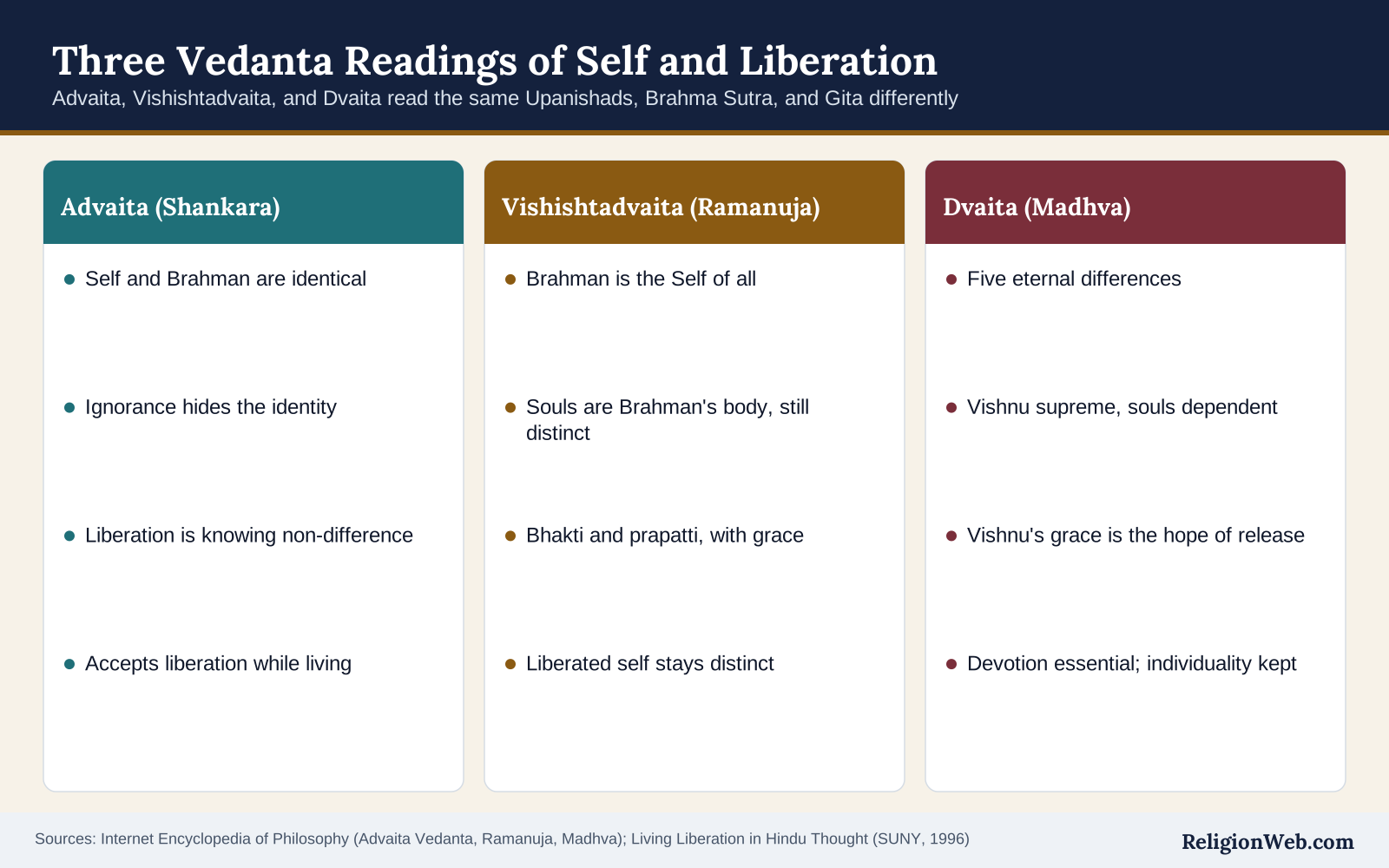
Advaita Vedanta, the “non-dual” school, is traditionally traced through Gaudapada, the author of an early commentary on the Mandukya Upanishad, to Shankara, who is placed by historians in the eighth century CE and is credited with commentaries on the Upanishads, the Brahma Sutra, and the Gita. In this system, Brahman is the only ultimate reality, and the individual self (jiva) is in truth identical with it. The appearance of a world of many separate things, and of a self bound within it, arises from ignorance (avidya) and the creative power of appearance (maya). The Internet Encyclopedia of Philosophy summarizes this by saying that ignorance “conceals Brahman and constructs the world.”
It follows that liberation is not a journey to a new place or a change in the self. It is the removal of a mistaken view. Because the cause of bondage is ignorance, the remedy is knowledge, and Shankara argues that only knowledge, not ritual or action, can end it. Later Advaita authors, including Vacaspati Mishra in the ninth century and Prakashatman in the tenth, developed rival technical accounts of how ignorance works, and Vidyaranya in the fourteenth century is among the later systematizers. The school accepts that devotion to a personal form of God, Ishvara, is valuable as preparation, and many of its teachers were also poets of devotion.
Vishishtadvaita: the qualified unity of Brahman, souls, and world
Ramanuja, whose traditional dates are about 1017 to 1137 CE and whom recent scholarship places at 1077 to 1157, founded the Vishishtadvaita or “qualified non-dual” school. For him Brahman, identified with Vishnu or Narayana, is the Self of all, and individual souls and the material world are real modes or qualities of Brahman, related to him as a body is related to its soul. This allows him to affirm the Upanishadic identity of Brahman and the self without denying that selves are many.
On this reading, liberation is the self’s constant awareness of its true nature as dependent on Brahman, and of Brahman’s nature. The liberated self remains distinct from Brahman. It is not omnipotent, and it shares with Brahman only the quality of being a knower. The route is bhakti, which Ramanuja treats as a kind of knowledge, combined with selfless action; in the Sri Vaishnava tradition that follows him, surrender to God is also central. This school has historically placed the full flowering of liberation after death, in the divine abode of Vishnu, though specialists note that the sources and the later tradition do not speak with a single voice on every point.
Dvaita: the difference between God and souls
Madhva (1238 to 1317) founded the Dvaita or dualist school. He taught that five differences are real and eternal: between God and souls, between God and matter, between souls and matter, between one soul and another, and between one material thing and another. Vishnu, identified with Brahman, is supreme and transcendent, and the soul is inalterably dependent on him. According to the Internet Encyclopedia of Philosophy, Madhva held that gaining Vishnu’s grace is the soul’s only hope of achieving liberation from samsara, and that devotion is an essential part of religious practice.
Souls, in this view, never lose their individuality and never become God. Liberation is a release into the presence of the Lord, with a joy that traditional Dvaita teaching describes as proportionate to the soul’s own nature. What is clear is that Dvaita shares with Vishishtadvaita the conviction that devotion and grace are indispensable, and shares with Advaita the conviction that the Upanishads teach a path out of bondage.
Other Vedanta Traditions and the Non-Vedanta Schools
Further Vedanta traditions
Vedanta is broader than these three systems. Other medieval teachers, including Nimbarka, Vallabha, and Chaitanya’s followers, developed readings in which the relation between God and the soul is described as both difference and non-difference in various forms, and each of these has its own account of liberation, centered in each case on devotion to Krishna. They are commonly grouped under the heading of bhedabheda (“difference and non-difference”) thought, and the Gaudiya school’s own term for its view is the inconceivable difference-in-identity of God and souls.
The many Vedanta schools share a method, which is commentary on three foundational sources, called the prasthanatraya: the Upanishads, the Brahma Sutra, and the Bhagavad Gita. Each school’s identity lies in how it reads these three together. That is why the same verse can be cited by Advaita, Vishishtadvaita, and Dvaita authors in support of three different accounts of liberation, and why none of them is trying to replace the texts but to interpret them.
Samkhya, Yoga, Nyaya-Vaisheshika, and Mimamsa
Several non-Vedanta schools also offer accounts of liberation. In classical Samkhya, as it is usually described, reality consists of two kinds of thing, conscious spirit (purusha) and unconscious nature (prakriti), and bondage arises when the two are mistaken for one another. Liberation, called kaivalya, comes through discriminating knowledge, and the liberated spirit stands alone. Patanjali’s Yoga uses much of the same framework while recognizing a special divine being, Ishvara, as an object of devotion, and its eighth limb, samadhi, culminates in a state where spirit rests in itself.
The Nyaya school of logic and the Vaisheshika school of natural philosophy understand liberation as the final cessation of suffering through right knowledge of the real categories of things; Nyaya texts call it apavarga. The Mimamsa school, which interprets the Vedic ritual texts, originally centered on the correct performance of ritual and on the heavenly rewards it promised, and later authors in the school gave increasing attention to liberation. These summaries rest on standard descriptions of the schools and necessarily compress long internal debates.
How the Disagreements Are Held
Same texts, different readings
It would be easy to read the list of schools as a contest with winners and losers, but the tradition itself treats it as a dialogue among interpreters of a shared inheritance. Each school regards its own reading as faithful to the texts, and each wrote against the others with serious arguments. The result is a tradition in which a student could study the commentaries of several schools and understand what was at stake in each.
The disagreements are real, and they matter for practice. Whether a person seeks to realize an identity or to enter a relationship shapes the kind of worship, study, and discipline considered appropriate. At the same time, the schools share many assumptions: that bondage is real as an experience, that liberation is possible, that a teacher and a text are needed, and that ethical discipline is a precondition.
A living tradition of debate
These schools are not museum pieces. Advaita is taught in monastic centers and universities; the Sri Vaishnava tradition maintains its own institutions and temple liturgies; the Madhva tradition maintains monasteries in Karnataka. Modern teachers and scholars continue to write commentaries and to debate, and many Hindus draw on more than one school, using Advaita’s vocabulary of the self alongside the devotional practices of a particular lineage. For readers, the useful habit is to ask, when a statement about moksha is made, which school, period, and text it comes from.
| School | Key figure or text, with approximate date | Self and ultimate reality | What liberation is | Main means |
|---|---|---|---|---|
| Advaita Vedanta | Shankara, 8th century CE; Gaudapada earlier | The self is identical with Brahman; the world of difference rests on ignorance | Knowledge of non-difference; removal of ignorance; accepted during life (jivanmukti) | Knowledge, with action and devotion as preparation |
| Vishishtadvaita | Ramanuja, traditionally c. 1017 to 1137; recent scholarship 1077 to 1157 | Brahman is the Self of all; souls and world are Brahman’s body; souls remain distinct | Constant awareness of dependence on Brahman; direct vision of God; remains distinct | Bhakti, with selfless action; prapatti |
| Dvaita | Madhva, 1238 to 1317 | Five eternal differences; Vishnu supreme; souls dependent | Release from samsara by Vishnu’s grace; individuality kept | Devotion and grace |
| Samkhya | Samkhya Karika, early centuries CE (date debated) | Many conscious spirits and one unconscious nature | Kaivalya: isolation of spirit through discriminating knowledge | Knowledge of the distinction |
| Yoga | Yoga Sutra of Patanjali, c. 1st to 2nd century CE | Spirit and nature, with a special spirit, Ishvara | Kaivalya, reached through absorption (samadhi) | Eightfold discipline; devotion to Ishvara as an option |
| Nyaya and Vaisheshika | Nyaya Sutra and Vaisheshika Sutra, early centuries CE or earlier (dates debated) | Many selves and real categories of things | Apavarga: final cessation of suffering | Right knowledge of the categories |
| Shaiva Siddhanta | Tamil south; medieval texts | God, souls, and bonds are three real categories | The soul becomes Shiva-like, freed from bonds, through grace | Initiation, worship, knowledge |
| Kashmir Shaivism | Abhinavagupta, c. 1000 CE | All reality is the consciousness of Shiva | Recognition of one’s own nature as Shiva; accepted during life | Recognition, grace, meditation |
Jivanmukti and Other Concepts of Liberation
Liberation While Living
What jivanmukti means
The Sanskrit word jivanmukti joins jivan, “living,” and mukti, “liberation.” A jivanmukta is a person who is regarded as liberated while still in a body. A reference entry on the term states that some Hindu traditions place liberation only at death, but that the knowledge-centered traditions that dominated Indian thought for well over a thousand years held that a person could be freed while alive. The term itself belongs to Hindu formulations.
The Upanishadic texts already supply the imagery. In the Brihadaranyaka Upanishad (4.4.7), the body of the person freed from desire is compared to something left behind: Müller renders it as “the slough of a snake lies on an ant-hill, dead and cast away,” and says that what remains is “Brahman only.” The Gita’s verses on the person of steady wisdom and on bearing desire and anger “before his release from the body” (5.23) are read in the same light. Samkhya describes the liberated person as someone who remains alive after the final knowledge because the karma that has already begun to bear fruit must run its course. Tantric traditions speak of a siddha whose body is transformed by grace and practice.
The body that remains
If liberation is complete, why does the body continue? Advaita and Samkhya answer with the idea of karma already in motion, called prarabdha karma. Knowledge destroys the ignorance behind future bondage, but the results of actions that have already begun to bear fruit run out on their own, as the momentum of a wheel carries it on after the potter’s hand is lifted. The image is a standard one in these traditions. What differs is the inner life of the knower, who no longer identifies with the body and its experiences even while they continue.
A common question concerns conduct. According to the reference entry, a liberated person is understood to be beyond ordinary moral categories but will not act wrongly, since the attachments that drive wrongdoing are gone. Schools disagree on whether such a person continues to perform rituals. Vidyaranya’s Jivanmuktiviveka, a text traditionally attributed to the fourteenth-century Advaita author, treats the topic at length and discusses how the knower’s state differs from mere asceticism.
Disagreement About Living Liberation
Traditions that accept it
Acceptance of jivanmukti is strongest in Advaita Vedanta, where a person who has recognized the identity of self and Brahman is held to be free even before death, and in Samkhya, Yoga, and the Shaiva and Tantric traditions. The scholarly volume Living Liberation in Hindu Thought, published by the State University of New York Press in 1996, examines the concept across Advaita, Samkhya and Yoga, the epics and Puranas, and Shaiva traditions, among others, and shows how the idea took different forms in each.
In practice, devotees in many communities venerate certain teachers as liberated while living. Modern figures such as Ramakrishna in the nineteenth century and Ramana Maharshi in the twentieth are regarded by their followers in this way; that is the followers’ understanding, and historians note it as an instance of how the category functions in living religion.
Traditions that locate full release at death
Other traditions describe the highest liberation as coming at death. The same volume gives chapters to Ramanuja and Madhva, an indication that the question was addressed within the theistic Vedanta schools as well, though the answers differ from those of Advaita. In Sri Vaishnava teaching, as generally described, the self attains its final destination, the abode of Vishnu, at the end of this life, while a devotee may live in earnest devotion and in confident hope before then. The Internet Encyclopedia of Philosophy article on Ramanuja does not discuss jivanmukti, and specialist literature should be consulted for the exact positions.
The disagreement should not be reduced to a simple yes or no. Positions vary with the definition of liberation. If liberation means the dissolving of ignorance, it can be complete in life. If it means entry into a divine abode, it follows death. The schools are often answering different questions, which is part of why they continue to read one another with interest.
Other Concepts of Liberation
Release at death and gradual release
Vedanta also distinguishes liberation at death, called videhamukti (“bodiless liberation”), from the liberation of the living knower. Some traditions further describe a gradual route, krama-mukti, in which a person who worships God in a particular form and does not reach full knowledge in life travels after death to a higher divine realm and attains liberation there. These ideas are developed in the Vedanta commentaries and shape what a given school expects at death.
Divine abodes and the fulfillment of love
In devotional theology the goal is often imagined as a divine abode: Vaikuntha, the realm of Vishnu, in Sri Vaishnava teaching; Kailasa in some Shaiva texts; the heavenly Vrindavan or Goloka in Gaudiya Vaishnava teaching. These are described in the traditions’ own texts and are understood by theologians as realms of nearness to God and not as ordinary heavens, which are regarded as impermanent. The summary in the table below lists the main concepts, with the traditions that use them.
| Concept | Meaning | Associated traditions | Notes |
|---|---|---|---|
| Jivanmukti | Liberation while still living in a body | Advaita Vedanta, Samkhya, Yoga, Shaiva and Tantric traditions | Body continues through karma already in motion (prarabdha) |
| Videhamukti | Liberation at the end of embodied life | Vedanta generally | Often follows jivanmukti in Advaita; the only form in some theistic schools |
| Krama-mukti | Gradual liberation through a higher divine realm | Vedanta commentaries on worship of God with form | For those who do not reach full knowledge in life |
| Kaivalya | Isolation of the conscious self from nature | Samkhya and Yoga | Reached through discriminating knowledge and absorption |
| Apavarga | Final release from suffering | Nyaya and Vaisheshika | Through right knowledge of the categories |
| Salokya, samipya, sarupya, sarshti, sayujya | Living in God’s world, nearness, likeness of form, equal glory, union | Bhagavata Purana and Vaishnava devotional literature | Many devotional authors prefer nearness and service to union |
| Vaikuntha | Eternal service in Vishnu’s abode | Sri Vaishnava teaching | Reached by grace through bhakti and prapatti |
| Prema | Pure loving devotion as the supreme goal | Gaudiya Vaishnavism | The tradition ranks it above liberation from rebirth |
Moksha in the Modern World
Modern Teachers and Reinterpretations
Neo-Vedanta and the reach of Hindu teaching abroad
In the nineteenth and twentieth centuries, Hindu teachers reframed the idea of liberation for new audiences. Ramakrishna Paramahamsa (1836 to 1886), a temple priest near Calcutta, was venerated by his followers as one who had realized God through many paths. His disciple Swami Vivekananda (1863 to 1902) addressed the World’s Parliament of Religions in Chicago in 1893 and founded the Ramakrishna Mission in 1897, presenting an Advaita-inspired Hinduism in which jnana, bhakti, karma, and raja yoga lead to the same realization. Scholars often use the term neo-Vedanta for this movement, and its emphasis on direct experience and on service has influenced how many Hindus and non-Hindus alike have encountered the subject.
Other twentieth-century figures gave the question still other forms. Ramana Maharshi (1879 to 1950), in southern India, taught a method of self-inquiry built around the question “Who am I?”, and is regarded by his followers as a living example of jivanmukti. Sri Aurobindo (1872 to 1950) developed an “integral” yoga that aimed at transformation of life and not at withdrawal from it. Each is understood within a specific community, and each interpreted the older vocabulary in a new setting.
Liberation and social responsibility
A recurring modern question is how the pursuit of liberation relates to responsibility for others. Mohandas Gandhi, in the preface to his autobiography, described the attainment of moksha as the aim that underlay his public work, and he read the Gita as a call to selfless action. Vivekananda and later Ramakrishna Mission monks made service to the poor and sick a form of worship. These readings built on the Gita’s teaching of action without attachment to results, and on the long tradition of householder and devotional paths.
Critics inside and outside the tradition have asked whether language of liberation can be used to excuse neglect of injustice, and reformers have answered by pointing to the ethical content of the tradition itself. The debate is itself a sign that moksha is not a fossilized concept. It is a term Hindus continue to argue about in light of current concerns.
Hindu Communities Today
Numbers and geography
According to the Pew Research Center’s 2025 report on the global religious landscape, about 1.2 billion people were Hindu in 2020, roughly 14.9 percent of the world’s population, a share unchanged since 2010. The report finds that 99 percent of Hindus live in the Asia-Pacific region and that about 95 percent live in India; India and Nepal, the two Hindu-majority countries, together account for 97 percent. These figures describe religious identification, not the strength of any particular belief about liberation, and individual Hindus hold a wide range of views about moksha, rebirth, and the afterlife.
Beyond South Asia, Hindu communities in North America, Europe, Southeast Asia, Africa, and the Caribbean maintain temples, study groups, and festivals, and diaspora teachers and organizations offer instruction in the Gita and the Upanishads. Their members often draw on several of the paths described above, and many of the practices mentioned in this article, from daily puja to funeral rites, are carried out in adapted forms abroad.
Moksha, yoga, and public understanding
For many people outside India, the first contact with ideas of liberation comes through yoga classes, where the emphasis is usually on posture, breath, and relaxation. Teachers within the Hindu traditions differ over how to view this. Some welcome the wider interest, others point out that classical yoga is a path whose stated goal is kaivalya or union with the divine and that the postural form is a small part of it. The page on yoga in Hinduism describes the history of this development.
The result is that moksha is now discussed in settings far from the temples and monasteries where it was elaborated, in academic courses, translation projects, interfaith dialogue, and popular books. The most reliable way to follow the discussion remains the one the tradition itself recommends: read the texts with a teacher or a good commentary, and ask which school’s account is being described.
Common Misconceptions About Moksha
Misconception 1: Moksha is simply the Hindu heaven
Where the misunderstanding comes from
English has few words for the goal of liberation, and “salvation” or “heaven” are the ones that often come to hand when Hindu belief is translated. The Hindu tradition does describe heavenly realms, called svarga or loka, which are populated by gods and by those who have earned a happy rebirth. Popular retellings of the Puranic stories sometimes blend these with moksha, and in devotional teaching the goal is sometimes pictured as a divine abode, so the overlap is understandable.
The confusion is also helped by the fact that some traditions do speak of a place. A Sri Vaishnava devotee may speak of entering Vaikuntha, and a Shaiva devotee of reaching the presence of Shiva, and these look like descriptions of heaven to an outside reader.
What the evidence and tradition actually show
In the classical analysis, heaven and moksha are different in kind. The Gita (9.21, in paraphrase) says that those who enjoy the vast heavenly world return to the world of mortals when their merit is exhausted. A heaven is a reward within samsara and is therefore temporary, while moksha is defined as release from the cycle itself. For Advaita Vedanta, moksha is not a place at all but the realization of what the self always is.
The divine abodes of devotional traditions are described differently from ordinary heavens. In Sri Vaishnava teaching, Vaikuntha is the eternal realm of Vishnu, and those who reach it do not return. The accurate statement, then, is that moksha, in all its forms, means an end to the ordinary round of rebirth, and that schools differ over whether it is a state, a relationship, or a realization, and not whether it is a pleasant afterlife.
It also helps to notice how the traditions use the word for heaven. Texts that promise a rise to a luminous world through ritual and good deeds, such as many Vedic and Puranic passages, are describing something that Hindu philosophers distinguish carefully from release. The distinction is old and widely shared, which is why a Hindu teacher asked whether moksha is heaven will usually answer that heaven is a station on the way, not the end of the road.
Misconception 2: Every tradition defines liberation as merging into Brahman
Where the misunderstanding comes from
The image of a drop of water entering the ocean is one of the most familiar descriptions of Hindu liberation, and it comes from a genuine strand of the tradition, namely Advaita Vedanta, whose teaching that the self is Brahman has been widely translated and discussed. Neo-Vedanta teachers of the nineteenth and twentieth centuries brought this strand to a global audience, and popular books have often presented it as the Hindu view.
The impression is reinforced by the Upanishadic language of becoming Brahman, which is real and which stands near the center of the tradition. But it is only a part of the evidence.
What the evidence and tradition actually show
Even within Vedanta, the answer varies. In Ramanuja’s Vishishtadvaita the liberated self remains distinct from Brahman and shares only the quality of being a knower. In Madhva’s Dvaita, souls never become God and remain dependent on him. In Samkhya and Yoga the goal is kaivalya, the isolation of spirit from nature, which does not involve merging with a supreme reality. In Gaudiya Vaishnavism the goal is loving devotion in which devotee and God remain distinct, and many devotional authors say they would prefer the sweetness of service to dissolving in the Lord.
Even in Advaita, the word “merging” is contested, since the school holds that there is no separate self that could merge. The better description is that, according to Advaita, ignorance of the identity is removed. A fair summary is that union with Brahman is one important Hindu understanding of liberation, central in Advaita, and not the only one.
The practical difference is large. A devotee who expects an eternal relationship with a personal Lord may regard the dissolving of the individual as a loss, while an Advaita teacher regards the sense of being a separate individual as the very thing that is mistaken. Each can quote the Upanishads, and each belongs to a living lineage. Describing the whole tradition by only one of these views misrepresents the other, and flattens the debate that has kept the subject alive.
Quite apart from philosophy, the claim that Hinduism is about a single destination overlooks how most Hindus talk about it. Many speak of surrender to a chosen deity, of service to family and community, or of a good rebirth, and they would not describe their hopes as merging with an impersonal absolute. Their ways of speaking are as much a part of the tradition as the commentaries.
Misconception 3: Moksha can only be sought through monastic renunciation
Where the misunderstanding comes from
The image of the wandering ascetic is vivid, and it is easy to assume that those who seek liberation must leave home. The classical scheme of life stages places renunciation last, and Advaita Vedanta in particular has often treated formal renunciation as the most favorable setting for the final stages of knowledge. Monastic institutions with lineages going back many centuries are prominent in the public view of Hindu religion.
The assumption is also encouraged by an older dharma-literature tradition that restricted formal study of the Vedas by birth and by gender, which made the path of Vedic knowledge seem to belong to a narrow class of male specialists.
What the evidence and tradition actually show
The texts themselves present a wider range. The Gita (3.20) cites the king Janaka as someone who attained perfection through action, and its central teaching is that action in the world is compatible with freedom when it is done without attachment. The Upanishads show householders such as Yajnavalkya as teachers. The devotional movements, from the Alvars and Nayanars to Kabir and Mirabai, included weavers, shopkeepers, and women with households, and their poems often insisted that devotion is open to anyone.
The restrictions on formal Vedic study were real and have been a subject of debate within the tradition, and reform movements and bhakti poets challenged them. The accurate summary is that renunciation is one honored path, favored by some schools for the final stage, and that Hindu tradition has also long affirmed householder, devotional, and service paths as routes to the same goal.
Precision about access also matters for history. Dharma literature that limited Vedic study did so through specific rules written by specific authors in particular periods, and the devotional poets who rejected those limits were also specific people responding to them. Neither the restrictions nor the protests describe all of Hindu history, which is why a careful account names the period, the community, and the text involved.
Misconception 4: Moksha is a reward for accumulating good karma
Where the misunderstanding comes from
Popular discussions of karma often present a ledger of good and bad deeds that determines future outcomes, and it is natural to assume that the highest outcome, moksha, goes to those with the best record. The language of merit (punya) used in everyday religion encourages the idea, as do stories in which a virtuous life is rewarded.
The doctrine as it appears in the texts is more subtle, and the simple ledger is a popularization.
What the evidence and tradition actually show
In most classical schools, good action produces good results within samsara, such as a favorable rebirth or a heavenly stay, and these results are still part of the cycle. Moksha is understood to lie beyond the whole system of action and result. The Gita (2.47) therefore teaches action without attachment to its fruit, and the Mundaka Upanishad declares that the Self cannot be gained by learning alone and is gained by the one whom the Self chooses.
Different schools name different keys: knowledge in Advaita, grace and devotion in the theistic schools, discrimination in Samkhya. Virtue and discipline are everywhere treated as preparation, and they matter greatly, but few traditions say that moksha is earned like a wage. The page on karma in Hinduism explains how the doctrine of action relates to liberation in more detail.
Frequently Asked Questions About Moksha
Questions about meaning and terms
What does moksha mean in simple terms?
Moksha means liberation or release. In Hindu thought it refers to freedom from samsara, the cycle of birth, death, and rebirth, and from the ignorance, desire, and karma that sustain it. Beyond that shared core, schools describe the freedom differently: as knowing that the self is Brahman, as living in loving nearness to God, or as the isolation of the conscious self from nature.
Because the word is used across so many traditions, the most useful short answer is that moksha is the Hindu name for the highest goal of human life, and that the details depend on the school. Anyone reading about it should note which text or lineage is being described.
Is moksha the same as nirvana?
The two words are related in vocabulary and sometimes in setting, but each belongs to a tradition with its own account of the self, suffering, and release, and the traditions are best understood separately. The Bhagavad Gita itself uses the compound brahma-nirvana for the state of one who has attained the Brahmic condition, so the word is not foreign to Hindu texts. Buddhist teaching uses nirvana within a different framework, which is described on the page about nirvana in Buddhism.
For a reader of this article, the practical point is to avoid assuming that the terms are interchangeable. A Hindu school that holds there is a self (atman) and a Brahman will define liberation in terms of them, and what that means is the subject of the sections above.
Questions about paths and practice
Can a householder attain moksha?
Yes, according to the mainstream of Hindu tradition. The Gita presents action performed without attachment as a way to freedom and cites the king Janaka as an example. The Upanishads show householders as teachers, and the devotional poets include people who lived with families and worked at ordinary trades. Some schools, particularly Advaita, regard renunciation as especially favorable for the final stage of knowledge, but this is a view about one path and not a statement that others are closed.
Daily worship, study, ethical conduct, service, and pilgrimage are all understood as ways of moving toward the goal. Which of them a given person emphasizes depends on temperament, family tradition, and teacher.
Is a teacher required?
Most schools say that liberating knowledge or devotion is best learned from a living teacher in a lineage. Advaita holds that the meaning of the Upanishadic sentences is unfolded by a teacher who knows the tradition, and Vaishnava and Shaiva lineages often center on initiation. Bhakti poets often praise the guru in strong terms.
At the same time, many Hindus study the Gita and the Upanishads on their own, and the devotional tradition holds that sincere devotion can arise without formal instruction. Many teachers advise combining private study with guidance, and caution against practices, particularly demanding fasts or breath exercises, undertaken without sound advice or against medical advice.
Questions about the nature of liberation
Can moksha be attained in this life?
Some traditions say yes. Advaita Vedanta, Samkhya, Yoga, and Shaiva and Tantric traditions accept the idea of jivanmukti, liberation while living, and they point to Upanishadic and Gita passages such as Brihadaranyaka 4.4.7 and Gita 5.23. Other traditions, including Sri Vaishnava teaching as generally described, place final release at death while affirming that devotion in this life prepares for it.
The disagreement depends partly on how liberation is defined. If it means the end of ignorance, it can occur in life. If it means entry into a divine abode, it follows death. Both views are held by serious teachers within the tradition.
What happens to the individual self after moksha?
The answer depends on the school. In Advaita Vedanta, the individual self is understood to have always been Brahman, so there is no separate self left to persist or to disappear; what ends is the belief in separateness. In Vishishtadvaita and Dvaita, the liberated self remains an individual in relationship to God. In Samkhya and Yoga, spirit stands alone in its own nature.
Devotional traditions emphasize a continuing relationship of love and service. Because these are teachings about a state that is said to go beyond ordinary experience, the traditions generally describe it through images and negations, and they invite the seeker to find out by practice what language cannot fully convey.
Conclusion: What the Study of Moksha Shows
What the history shows
An idea that developed over time
Moksha is not a single doctrine handed down unchanged. Its roots lie in the Vedic hope for a lasting place among gods and ancestors, in the Brahmanas’ worry about repeated death, and in the Upanishadic conviction that knowledge of the self frees. The epics and the Gita widened the audience, the classical schools systematized the arguments, and the devotional movements carried the idea into regional languages and everyday worship.
That development explains why the same word can describe the realization of non-difference and the loving service of a personal Lord. Each emphasis answers a question that the earlier tradition left open.
An idea held in several ways
The tradition has never settled on one account of what liberation is, whether it can occur in life, or by which path it comes. It has instead sustained a long conversation among schools that read the same texts with different emphases. Understanding any claim about moksha means knowing who makes it, in what period, and from which text.
The same attention helps with the misconceptions that gather around the subject. Moksha is not simply heaven, not always merging into Brahman, not confined to monks, and not a wage for good deeds. Each statement holds for some school, and the tradition is wider than any one of them.
How to keep exploring
Texts and teachers
The most direct way to continue is to read the primary texts with a good commentary. The Upanishads and the Gita are available in many translations, and it helps to read them alongside the commentary of a specific school and to note which school one is following. The page on the Vedas and Upanishads and the page on the Bhagavad Gita offer background on both sources.
Visiting a temple, attending a lecture at a local Hindu center, or speaking with a practitioner can supply what books cannot: a sense of how the ideas live in practice, in a particular community and region.
Related topics on this site
Several other pages place moksha in context. The page on Vaishnavism describes the traditions of devotion to Vishnu, and the page on Krishna Janmashtami describes one of the festivals through which devotion is expressed. The pages on samsara and reincarnation and on Hinduism give the wider background, and the page on dharma explains the ethical frame in which the search for liberation takes place.
Sources
The table below lists the principal external sources behind this article. Facts, dates and figures were checked against these and related primary, institutional and academic materials.
| # | Source | Publisher and type | Used for | Link |
|---|---|---|---|---|
| 1 | The Upanishads, Part II: Brihadaranyaka Upanishad, IV, 4 (trans. F. Max Muller, SBE 15) | Internet Sacred Text Archive (sacred-texts.com) · Primary text | Quoted Brihadaranyaka 4.4.5-7 and the snake-slough image; public-domain translation (1884) | sacred-texts.com |
| 2 | The Upanishads, Part II: Mundaka Upanishad, III, 2 (trans. F. Max Muller, SBE 15) | Internet Sacred Text Archive (sacred-texts.com) · Primary text | Quoted Mundaka 3.2.3 and 3.2.9; public-domain translation (1884) | sacred-texts.com |
| 3 | The Bhagavadgita (trans. Kashinath Trimbak Telang, SBE 8) | Internet Sacred Text Archive (sacred-texts.com) · Primary text | Quoted Gita 2.47, 5.23, 18.66 and short phrases from chapters 2, 5, 12; public-domain translation (1882) | sacred-texts.com |
| 4 | Advaita Vedanta | Internet Encyclopedia of Philosophy · Academic reference | Advaita view of ignorance, knowledge, action, and Shankara's period | iep.utm.edu |
| 5 | Ramanuja (c. 1017 – c. 1137) | Internet Encyclopedia of Philosophy · Academic reference | Ramanuja's dates, soul-body model, bhakti, prapatti, and the two Sri Vaishnava views of grace | iep.utm.edu |
| 6 | Madhva (1238-1317) | Internet Encyclopedia of Philosophy · Academic reference | Madhva's dates, five differences, dependence on Vishnu, grace and devotion | iep.utm.edu |
| 7 | Jivanmukti (reference entry) | Encyclopedia.com · Encyclopedia | Definition of jivanmukti; Samkhya, Advaita, and Tantric views of living liberation | encyclopedia.com |
| 8 | Moksha (Mokṣa) in The Concise Oxford Dictionary of World Religions | Encyclopedia.com / Oxford University Press · Encyclopedia | Definition and root of moksha; moksha as the fourth purushartha | encyclopedia.com |
| 9 | How the Global Religious Landscape Changed From 2010 to 2020 | Pew Research Center (2025) · Demographic data | Hindu population, share, and distribution in 2020 (about 1.2 billion; 14.9 percent; 95 percent in India) | pewresearch.org |
| 10 | Living Liberation in Hindu Thought (table of contents and chapter list) | State University of New York Press (1996) · Academic reference | Range of traditions treating jivanmukti: Advaita, Ramanuja, Madhva, Samkhya and Yoga, Shaiva | sunypress.edu |
Last fact-check date: 2026-10-21.