Karma in Hinduism is the teaching that actions, and above all deliberate actions, have effects that shape the person who performs them. The Sanskrit word karma (in its grammatical stem form, karman) means “action” or “deed,” and from that plain starting point Hindu thinkers built a very large body of reflection on how choices, intentions, and habits carry forward through a lifetime and, in most Hindu traditions, through successive lives. The short version is that karma is first about doing and only second about reward and punishment. The popular English phrase “what goes around comes around” captures one thread of the idea but leaves out most of what Hindu texts actually discuss.
The word has a long history. In the oldest Vedic literature, karma chiefly meant ritual action, the correctly performed offering that sustained the relationship between humans and the gods. Several centuries later, in the early Upanishads, the same word came to name a moral and cosmic force linking a person’s deeds to what happens after death. The Vedas and Upanishads record that shift, and the Bhagavad Gita then reshaped the concept again by asking how a person can act fully in the world without being bound by the results of action. Later philosophers, devotional poets, reformers, and modern teachers each added their own emphasis.
That variety is why the distinctions matter. Hinduism has no single creed, so there is no single doctrine of karma that every Hindu community teaches in the same words. Some schools hold that karma works automatically, like a natural law. Others hold that God administers its results, and still others hold that devotion and divine grace can lift a person beyond karma’s reach. Hindus also differ about how far the idea applies to everyday life, how it relates to caste and social duty, and what finally ends its hold. This article describes those positions in their own terms and names the traditions that hold them.
What follows moves from meaning to mechanics, then to history, scripture, philosophy, devotion, daily practice, and present-day belief. Along the way it connects karma to neighboring concepts covered in more depth elsewhere on this site, including dharma (duty and cosmic order) and yoga (disciplined paths to realization). It closes with common misconceptions and a set of frequently asked questions.
Karma in Hinduism at a Glance
A good first step is to see what the word covers. In Hindu usage, karma can mean a single act, the whole category of human action, the ritual duties prescribed in scripture, the consequence that an act produces, or the accumulated stock of such consequences that a person carries. Context usually tells a reader which sense is meant, and many confusions in English come from treating these senses as one.
What the Word Karma Means
Action, deed, and the root kri
The word karman comes from the Sanskrit verbal root kri, “to do” or “to make.” The same root gives kartri, “the doer,” and kriya, “activity.” Encyclopaedia Britannica’s entry on karma, written by the Indologist Patrick Olivelle, glosses the Sanskrit term simply as “act,” and describes karma in the Indian religions as the universal causal law by which good or bad actions determine the future modes of an individual’s existence. Even that definition holds two ideas together: a deed, and what follows from it. Hindu texts move easily between the two.
Because the root is so ordinary, the word is also used in everyday speech. A craftsperson’s work, a farmer’s labor, a priest’s offering, and a king’s decree are all karma. When Hindu thinkers say that a person cannot stop acting for even a moment, they are using the word in this broad sense, and the point is not yet moral at all.
Three layers: act, consequence, and prescribed duty
It helps to think of three overlapping layers. The first is the act itself, whether physical, spoken, or mental. The second is the consequence, which Sanskrit calls phala, literally “fruit.” The third is the category of prescribed duty, such as daily worship, rites of passage, or the work associated with one’s station in life, which texts also call karma. When a priest in a household shrine performs the morning offering, that is karma in the third sense. When a person later reflects on why a hardship has come, that is an appeal to karma in the second.
Scholars of the subject, including those who wrote the entries in major reference works, generally agree that these layers did not appear all at once. The ritual sense is the oldest. The idea of a morally ordered consequence that travels with a person after death is attested later, and the idea that all action, even ordinary action, binds a person to rebirth is a further development. Later sections trace that order in detail.
Karma Among Hindu Traditions
One word, many theories
There is no Hindu equivalent of a single council that fixed one doctrine. Instead, karma appears in a family of related teachings that different schools stress differently. The ritual school of Mimamsa treats the Vedic rite as a source of unseen merit. The logical school of Nyaya treats merit and demerit as qualities of the self. The school of Advaita Vedanta, associated with Shankara, treats karma as operating within ignorance, which knowledge of the self ends. The devotional schools of Vaishnavism and Shaivism give God a central role in dispensing results or in granting release from them. The sections below take each in turn.
This internal variety does not mean the concept is vague. Most of the schools share a core: actions are real, they leave effects, intention matters, and liberation (moksha) is understood as freedom from the binding power of action. What they dispute is the mechanism, the role of God, and the remedy.
Karma as ethics, cosmology, and path
Karma functions in at least three registers within Hindu life. As ethics, it gives people a reason to take their conduct seriously, because choices shape character and future experience. As cosmology, it helps explain why beings are born in different circumstances and why the cycle of birth, death, and rebirth (samsara) continues. As a spiritual path, it supplies a method: karma yoga, the discipline of acting without clinging to results, which the Gita develops at length and which has remained one of the most influential Hindu ideas of the past century.
| Term | Basic meaning | Role in the discussion of karma |
|---|---|---|
| Karma / karman | Action, deed, rite | The act itself, its consequence, or the prescribed duty, depending on context |
| Phala | “Fruit,” result | The consequence of an action, whether experienced soon or after a long delay |
| Samskara | Impression, formative trace | The mental imprint that action leaves on a person; also the name for life-cycle rites |
| Vasana | Tendency, latent disposition | Habitual inclinations built up by repeated action, carried from one life to the next in many schools |
| Punya and papa | Merit and demerit | The favorable and unfavorable moral residues attributed to actions |
| Adrishta / apurva | “Unseen” force, “new” potency | Technical names in some schools for the unseen link between a deed and its later result |
| Samsara | Cycle of birth, death, and rebirth | The process through which the results of karma are usually said to unfold |
| Dharma | Duty, right order, righteousness | The standard by which actions are judged and the setting in which they occur |
| Nishkama karma | Action without desire for its fruit | The Gita’s ideal of acting while relinquishing attachment to results |
| Moksha | Liberation, release | Freedom from the binding effect of action and from rebirth, as most schools describe the goal |
How Karma Works: Action, Intention, Impressions, and Results
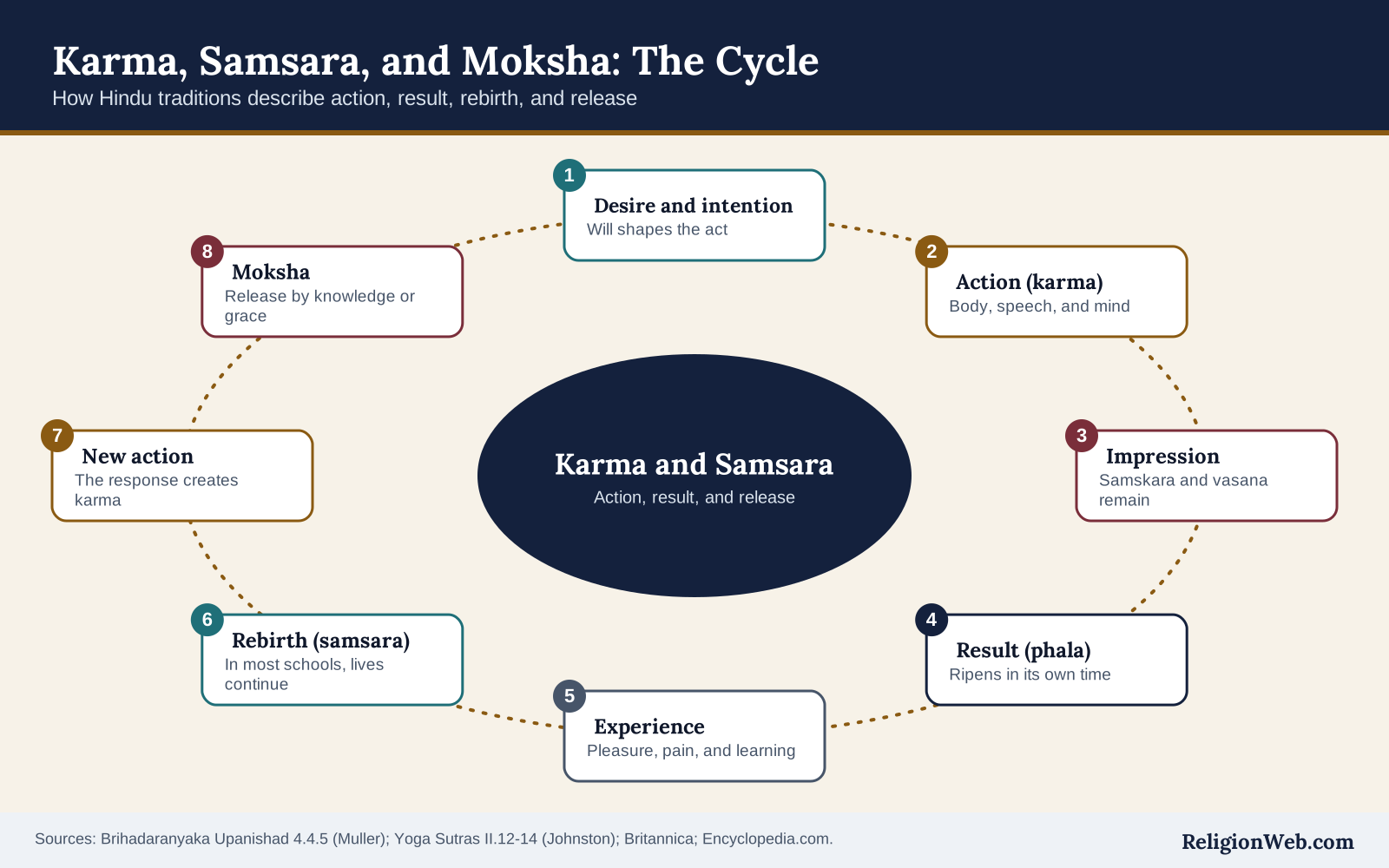
Hindu discussions of karma are less about a cosmic ledger than about the anatomy of action. Texts ask what counts as an act, who or what produces it, why it matters whether the person meant it, and how an effect can be separated from its cause by years or lifetimes. The answers differ by school, but a common vocabulary runs through most of them.
The Anatomy of an Action
Body, speech, and mind
Hindu texts treat action as something done through three channels: the body, speech, and the mind. A violent blow, a lie, and a hateful thought are different kinds of acts, and a tradition of ethical reflection grew up around ranking and refining them. The Bhagavad Gita (18.15) states that whatever action a person undertakes by body, speech, or mind, whether right or wrong, has five contributing factors. The teaching has an important consequence: because thought counts as action, the inner life is not exempt from moral accounting, and an act performed with a clear and generous mind is not the same as the same act performed with a clouded one.
The Laws of Manu, a Sanskrit legal and moral treatise (the Manusmriti), also organizes its closing discussion of rebirth around deeds of mind, speech, and body. Its authors were writing in a legal and priestly milieu, and the framework reflects their concern for orderly conduct. Even so, the threefold division shows how widely the idea was shared: karma is not limited to visible deeds.
Intention, desire, and the doer
The early Upanishads place the origin of action in desire and will, and the Gita adds a more complex picture of agency. In Gita 18.14 Krishna lists five factors behind any action: the physical base or body, the doer, the various instruments, the many kinds of effort, and fifth, daiva. That last word is often translated as “providence” or “the divine,” and commentators have read it as the unseen, as past karma, or as God’s will. Whatever the reading, the verse makes a point easily lost in popular accounts: no result depends on the doer’s deed alone.
The Gita also challenges the sense of ownership that makes us feel like the sole author of what we do. In 3.27 it says that actions are performed by the strands of material nature (gunas), and that a person whose mind is clouded by ego thinks, “I am the doer.” Understanding this is part of what it means, in the Gita’s terms, to act without being bound.
From Deed to Result
Impressions: samskara and vasana
How can an act that has ended produce a result later? Hindu schools answer in several ways, but the most widely shared answer is that action leaves an impression. In summaries of the Upanishadic view, actions leave impressions (samskaras) or tendencies (vasanas) that ripen later, and a subtle body is said to carry them between lives. The Yoga tradition associated with Patanjali develops the idea in psychological terms. As Harold Coward summarizes it in a standard reference work, every time one does an action or thinks a thought, a memory trace or karmic seed is laid down in the unconscious, and such seeds in turn strengthen the habits that produce more action.
This psychological reading explains why Hindu teachers treat karma as something cultivated by practice. Repeated generosity builds a generous character, and repeated anger builds an angry one. The results are partly inner, experienced as dispositions and states of mind, and partly outer, experienced as circumstances. Different schools weigh the two differently, but all of them give the inner side serious weight.
Timing: stored, ripening, and newly made karma
Later Vedanta and Yoga traditions distinguish three conditions of karma. Sanchita karma is the accumulated stock that has not yet begun to bear fruit. Prarabdha karma is the portion that has already begun to ripen and that shapes the present life, including its body, family, and broad circumstances. Agami karma (also called kriyamana) is the new karma being made now, whose results lie ahead. Teachers often illustrate the scheme with an archer: the arrow already loosed cannot be recalled, the arrows in the quiver are stored, and the arrow being fitted to the bow can still be aimed.
The scheme matters for liberation. In the standard Vedanta and Yoga account, when knowledge of the self arises, the stored karma is said to be burned away and new karma no longer binds, yet the ripening portion must run its course while the body lasts. A person who has realized liberation in this life is called a jivanmukta, “liberated while living,” and the traditions describe such a person as continuing to live out the remainder of what has already begun.
Karma, Samsara, Dharma, and Moksha
Karma rarely appears alone in Hindu thought. It belongs to a set of linked ideas, and each of the others narrows what karma can mean. Table 2 summarizes how the concepts relate, and the three short discussions below explain the connections.
Samsara: the setting for results
Samsara, the cycle of birth, death, and rebirth, is the stage on which karma’s results are usually said to play out. A person’s current birth is understood as shaped by earlier action, and present action will shape later experience. The Brihadaranyaka Upanishad (4.4.5–6, discussed below) puts it succinctly: a person who has obtained the end of whatever deed he does here on earth returns from the world of reward to “this world of action.” Most schools hold that samsara has no beginning, which means that no first act stands behind the chain.
Dharma: the standard of judgment
An action cannot be good or bad in a vacuum. Hindu traditions measure it against dharma, the right order of conduct, which includes universal virtues such as truthfulness and non-harm and also duties specific to a person’s stage of life, family, and role. Acts aligned with dharma are generally said to produce merit, while acts that violate it produce demerit. Which duties apply to whom is a matter of long debate, and later sections take up how that debate intersects with caste.
Moksha: release from binding
Moksha, usually translated as liberation, is the goal toward which most Hindu paths point. In most schools, it means release from the cycle of rebirth and from the binding effect of action. Because even good action can keep a person within samsara, many traditions treat merit as insufficient on its own. What ends the cycle is understood differently, as knowledge of the self in Advaita Vedanta, as loving surrender and divine grace in devotional schools, or as disciplined detachment in the yoga of action.
| Concept | What it names | Relationship to karma |
|---|---|---|
| Karma | Action and its consequence | The mechanism connecting what one does to what one becomes and experiences |
| Samsara | The beginningless cycle of birth, death, and rebirth | The process in which karma’s results are usually said to unfold across lives |
| Dharma | Right order, duty, righteousness | The standard by which an action is judged and the framework in which it takes place |
| Atman | The self | In several Vedanta schools, the self is distinct from the body and mind that act; in Advaita it is by nature not an agent |
| Ishvara | God, the Lord | In theistic schools, the one who ensures or dispenses results, or who may grant release from them |
| Moksha | Liberation | Freedom from karma’s binding force and, in most schools, from rebirth |
Origins and Textual Development of the Idea of Karma
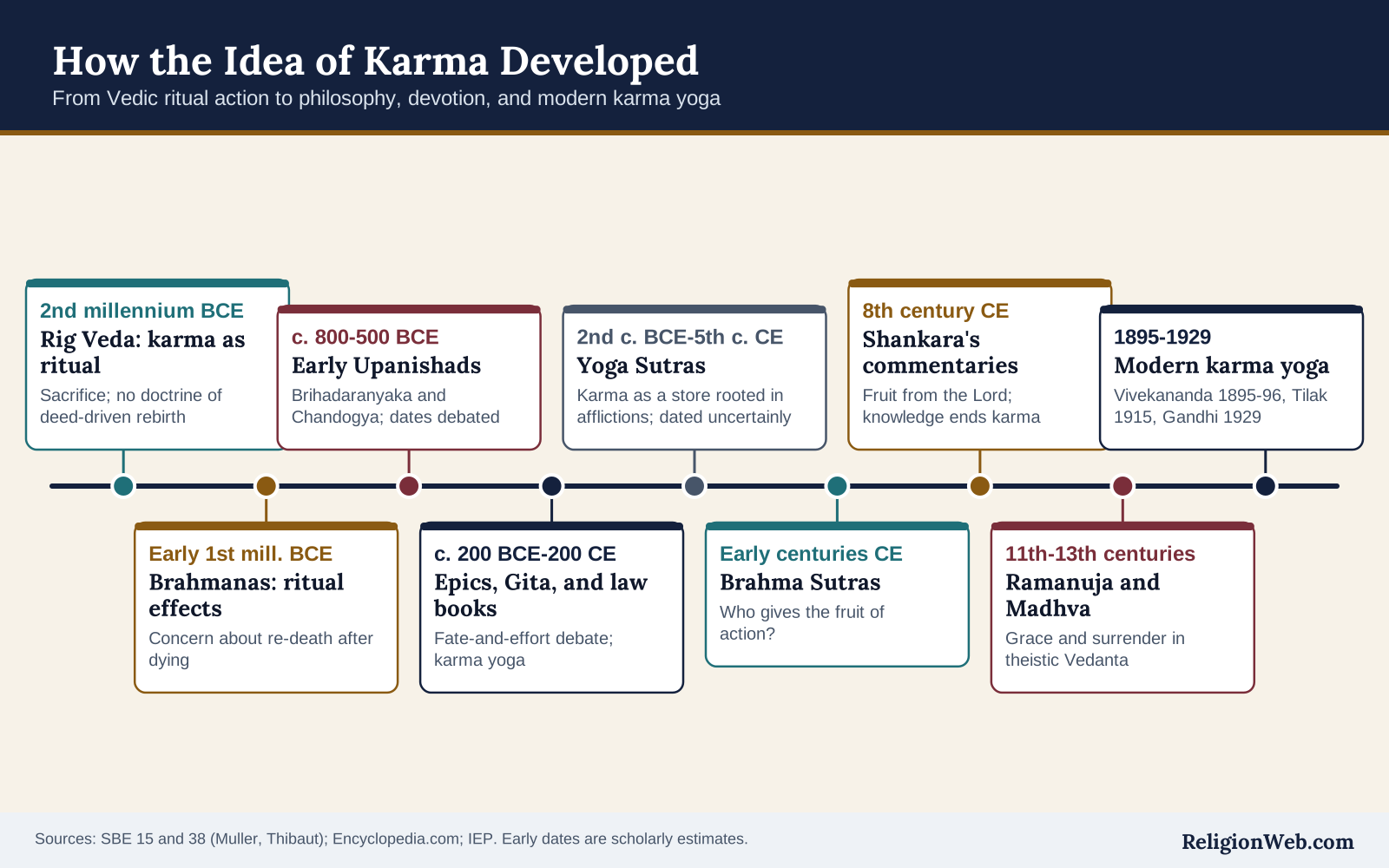
The doctrine did not arrive fully formed. Reading the Hindu texts in roughly chronological order shows a word for ritual action gradually acquiring moral, psychological, and cosmic meanings. Dates for the early texts are scholarly estimates with wide margins, and the order below should be taken as a broad sequence rather than a precise calendar.
Vedic Ritual Action
Karma in the Rig Veda
The Rig Veda, a collection of Sanskrit hymns that scholars generally place somewhere in the second millennium BCE, is the oldest Hindu scripture. Its hymns address gods such as Agni, Indra, and Soma and accompany the ritual offerings through which the community sought rain, prosperity, protection, and a place among the ancestors after death. In this literature, reference works explain, karma means religious action, especially sacrifice. The Rig Veda shows no trace of the later idea of a moral force that drives rebirth. Its picture of the afterlife centers on the world of the ancestors, reached through correct rites and conduct, and not on a cycle of repeated lives.
This ritual sense never disappeared. The very idea that a correctly performed act produces a result, sometimes long after the act itself, was already present in the logic of the sacrifice. Later ritual philosophers would build directly on it, and later reformers would argue about whether ritual action can lead to liberation or only to temporary reward.
The Brahmanas and the problem of repeated death
The Brahmanas, prose manuals composed after the hymns to explain the meaning and sequence of Vedic rites, show ritual specialists becoming more interested in what happens after death. Some passages, often discussed under the term punarmrityu, “re-death,” express concern that a person may die again in the next world and suggest that correct ritual knowledge can prevent this. Summaries in reference works note that the Brahmanas hint at the later doctrine without stating it. They treat rites as powerful and consequential, and they begin to treat the afterlife as something one must work toward, which prepared the ground for later developments.
The Upanishadic Turn
The Upanishads, philosophical dialogues and teachings attached to the Vedic corpus, are where karma in the sense of a general causality of action first appears clearly. One reference work cites the scholar John Bowker’s judgment that only with the Upanishads do we really find karma in this sense. The two oldest and longest, the Brihadaranyaka and the Chandogya, are generally placed in the first half of the first millennium BCE, though exact dates remain debated. The wider story of these texts is told on the Vedas and Upanishads page.
Yajnavalkya and the private conversation
The best known early scene occurs in the Brihadaranyaka Upanishad. At a gathering at the court of King Janaka, a questioner named Artabhaga asks the sage Yajnavalkya what becomes of a person at death, when speech goes to fire, breath to wind, and the body to earth. Yajnavalkya does not answer in public. He asks Artabhaga to take his hand and says that the two alone shall know of this, and the text reports what followed.
Then these two went out and argued, and what they said was karman (work), what they praised was karman, viz. that a man becomes good by good work, and bad by bad work.
Brihadaranyaka Upanishad 3.2.13, trans. F. Max Müller, Sacred Books of the East, vol. 15 (1884)
Within the Hindu tradition this passage is read as a landmark: the answer to a question about death is given in terms of action. The text does not elaborate a system. It marks the moment when karma became part of a private, esoteric teaching about what survives death, and it is the reason Yajnavalkya is usually named among the key figures in the story of the doctrine.
Desire, will, and deed
A fuller statement comes in the fourth chapter of the same Upanishad. Müller’s translation reads the passage as a chain from character to action.
Now as a man is like this or like that, according as he acts and according as he behaves, so will he be:– a man of good acts will become good, a man of bad acts, bad. He becomes pure by pure deeds, bad by bad deeds.
Brihadaranyaka Upanishad 4.4.5, trans. F. Max Müller, Sacred Books of the East, vol. 15 (1884)
The next lines connect action to inner life.
And here they say that a person consists of desires. And as is his desire, so is his will; and as is his will, so is his deed; and whatever deed he does, that he will reap.
Brihadaranyaka Upanishad 4.4.5, trans. F. Max Müller, Sacred Books of the East, vol. 15 (1884)
Classical Vedanta commentators read these lines as an account of how the embodied self, driven by desire, forges its own future, and they draw the conclusion that the remedy lies in changing the desires. The Upanishad itself goes on to describe the person who is free of desire as one whose breath does not depart, because such a person is already Brahman. The chain from desire to will to deed to result is therefore not only a warning. It also marks the point at which the chain can be broken.
Two paths after death
The Chandogya Upanishad (5.10) supplies a different angle. It describes two routes after death: a path of the gods, taken by those who know a certain teaching and practice faith and austerity in the forest, and a path of the fathers, taken by householders who perform sacrifices and charity. Those on the second path, it says, return after a time, and their new birth depends on their conduct. In paraphrase, verse 7 says that people of good conduct quickly enter a good womb, and that people of foul conduct enter a foul one. The text’s examples reflect the social ranking of its time, a point that matters for the discussion of caste later in this article. A parallel passage appears in the Brihadaranyaka (6.2).
Epics, Law Books, and Yoga
Dharmashastra and the epic debate over fate and effort
In the following centuries the idea moved from the Upanishads into legal and narrative literature. The Dharmashastra tradition, texts on duty and law such as the Laws of Manu, uses karma to explain why deeds matter and to ground the idea of expiation (prayashchitta), rites that remove the consequences of wrongdoing. The Mahabharata takes a more exploratory tone. Julian Woods’s study Destiny and Human Initiative in the Mahabharata (SUNY Press, 2001) shows how the epic returns repeatedly to the relationship between daiva, a power beyond human control, and purushakara, human effort, without reducing it to a single formula. Characters argue both sides, and the epic never closes the debate. That openness is one reason the Hindu tradition does not equate karma with fate.
The Yoga Sutras and the store of karma
The Yoga Sutras attributed to Patanjali, a compact text on the discipline of mind whose date is debated (scholars have proposed the period between the second century BCE and the fifth century CE), describe a “store” of karma (karmashaya) rooted in the afflictions of ignorance, ego, attachment, aversion, and fear of death. In Charles Johnston’s early twentieth-century translation, sutra II.12 says that the burden of bondage to sorrow has its root in these hindrances and “will be felt in this life, or in a life not yet manifested.” The next two sutras continue the thought.
13. From this root there grow and ripen the fruits of birth, of the life-span, of all that is tasted in life. 14. These bear fruits of rejoicing, or of affliction, as they are sprung from holy or unholy works.
Yoga Sutras of Patanjali, trans. Charles Johnston (1912), Book II, sutras 13–14
Here karma yields three kinds of result: the kind of birth, the length of life, and the quality of experience within it. The Yoga tradition treats this as a cause-and-effect account that can be interrupted, since the roots can be weakened by practice. It also adds that the works of a person who has attained yogic union do not produce the ordinary mixture of pleasure and pain.
Epic and Purana Narrative
Heavens, hells, and the temporary reward
The Puranas, large Sanskrit compendia that gather genealogies, cosmology, stories of the gods, and instruction on worship and pilgrimage, give the afterlife a vivid geography. Good conduct and ritual merit lead to heavenly realms, wrongdoing leads to realms of suffering, and in the most common accounts neither is permanent. The Gita expresses the same logic when it says (9.21) that those who enjoy the vast heaven return to the world of mortals when their merit is exhausted. The point has a philosophical edge: if even heaven is a temporary reward, then accumulating merit cannot be the final goal, which prepares the ground for the traditions that seek liberation from the cycle itself.
Karma in story: Dasharatha and the hunter’s arrow
The epics also teach through narrative. In the Ramayana, King Dasharatha, hunting at night, mistakes the sound of a boy drawing water for that of an animal and shoots the ascetic’s son Shravana. The boy’s blind parents, grieving, curse the king to die of sorrow for his own son. Years later, when Rama must leave for exile, Dasharatha remembers the curse and dies broken-hearted. Storytellers and commentators often use the episode to illustrate that an act, even one done by mistake, has weight, and that its result may return after many years in a form the doer could not have foreseen. The tale is also a reminder that Hindu stories tend to treat karma through human drama and not through abstract doctrine.
Scholarly Debates About Origins
Did karma and rebirth arise inside the Vedic tradition?
Historians do not agree about where the combined doctrine of karma and rebirth came from. One line of interpretation sees a gradual internal development from Vedic concerns about the afterlife, the effects of ritual, and the fear of re-death. Another, argued most prominently by the Indologist Johannes Bronkhorst in Greater Magadha: Studies in the Culture of Early India (Brill, 2007), holds that the doctrine took shape in a non-Vedic culture of the eastern Gangetic plain and was later taken up by Brahmanical thinkers. Both positions draw on the same sparse evidence, and neither has won general agreement.
From ritual action to moral action
What is not disputed is the transformation of meaning. A word for the sacrifice came to include moral action, and a religion centered on offerings began to speak about the moral shaping of the self. The same period saw wandering renunciants across northern India develop their own teachings on action and liberation, including movements that became distinct traditions with their own doctrines. Hindu thinkers answered by incorporating, reinterpreting, or disputing what they encountered. The Gita, discussed below, represents one of the most successful of those reinterpretations.
| Text or period | Approximate date | What it contributes |
|---|---|---|
| Rig Veda | Second millennium BCE | Karma as ritual action and sacrifice; no doctrine of rebirth driven by deeds |
| Brahmanas | First millennium BCE, early centuries | Close attention to ritual effects; concern about re-death; hints of later doctrine |
| Early Upanishads (Brihadaranyaka, Chandogya) | First half of the first millennium BCE; dates debated | Deeds, desire, and rebirth linked; Yajnavalkya’s teaching; the paths after death |
| Dharmashastra (including the Laws of Manu) | Roughly the last centuries BCE into early centuries CE | Karma used for law, ethics, and expiation |
| Mahabharata and Bhagavad Gita | Roughly the last centuries BCE to early centuries CE | Debate on fate and effort; the Gita’s teaching of action without clinging to results |
| Yoga Sutras | Debated; proposed between the second century BCE and fifth century CE | Karma as a store rooted in afflictions; impressions and habit |
| Brahma Sutras and the Vedanta commentaries | Sutras in early centuries CE; commentaries from about the eighth century CE | Debates on who gives the fruit of action: ritual potency or the Lord |
| Modern reinterpretations | Nineteenth to twenty-first centuries | Karma yoga as service; ethical and psychological readings; global spread of the vocabulary |
Karma in the Bhagavad Gita and the Path of Karma Yoga
No Hindu text has shaped modern understanding of karma more than the Bhagavad Gita. The poem, a dialogue between the warrior Arjuna and his charioteer Krishna on the eve of a great battle, takes up a pressing problem raised by the Upanishadic doctrine: if every act binds a person to its results, how should anyone act at all? The full story of the text, its date, and its commentators is told on the Bhagavad Gita page. Here the focus is on what the poem teaches about action, and on the tradition of karma yoga that grew from it.
What the Gita Adds
Action cannot be avoided
Arjuna’s first instinct is to withdraw. Facing relatives and teachers on the opposing side, he wishes to give up the fight and, in effect, give up the burden of action. Krishna’s reply rejects the premise that abstaining from action is possible. The Gita says (3.5) that no one remains, even for a moment, without acting, since the strands of material nature compel everyone to act. Bodily life is itself activity. The question therefore shifts from whether to act to how to act.
The poem does not treat the answer as obvious. In 4.17 Krishna says that one must understand right action, wrongful action, and inaction, and that the course of action is subtle. The following verses take up the puzzling idea of seeing inaction in action and action in inaction, which commentators interpret as a call to notice the inner stance of the actor, not only the outward deed. A person who is still can be acting in the sense of inwardly clinging, and a person who is busy can be inwardly free.
Acting without claiming the fruit
The best known formulation is verse 2.47, which in Sanskrit begins karmany evadhikaras te, “you have a right to action alone.” Edwin Arnold’s 1885 poetic rendering renders part of the verse this way.
Of doing right in right! Let right deeds be
Thy motive, not the fruit which comes from them.Bhagavad Gita, trans. Edwin Arnold, The Song Celestial (1885), Chapter II (corresponding to 2.47)
The verse is often quoted as “do your duty and don’t care about results,” but readers within the tradition have long insisted on more careful reading. The verse does not tell Arjuna to be indifferent to consequences. It says that the result should not be the motive and that the actor should not cling to the outcome. It also warns, in its final clause, against attachment to inaction. Commentators from Shankara onward understood the teaching as a discipline of inner freedom within action, and they differed about what such freedom ultimately leads to, as the next sections show.
Karma Yoga in Practice
The Gita calls this discipline yoga, a word with a broader meaning than the physical postures many people now associate with it. The yoga in Hinduism page explains the range of meanings, including the Gita’s own definition in 2.48 of yoga as equanimity, even-mindedness in success and failure.
Action as offering
A central theme is that action done as sacrifice does not bind. Gita 3.9 contrasts action performed as a sacrifice, an offering, with action that merely feeds personal desire, and it calls the second kind a source of bondage. In the Gita’s reworking of Vedic vocabulary, the idea of sacrifice (yajna) is widened beyond the fire ritual to include any action offered without self-seeking. Chapter 9 carries the thought further into devotion: whatever a person does, eats, offers, gives, or practices, the Lord says, is to be done as an offering to him, and even a leaf, a flower, a fruit, or water offered with love is accepted. Action then becomes a form of worship, which is why karma yoga and bhakti (devotion) are so closely linked in the Vaishnava reading of the text.
This broadened sacrifice has an important implication for ordinary people. A farmer, a cook, a teacher, or a clerk need not leave the world to practice it. Because the discipline concerns the attitude with which work is done, any legitimate occupation can serve as its field, which is one reason the idea has had such a wide following among householders.
Equanimity and the lotus leaf
The Gita illustrates detached action with an image from nature in Chapter 5. The person who acts in this way, Arnold’s translation says, is like a lotus leaf that water does not wet.
Detaching end from act, with act content,
The world of sense can no more stain his soul
Than waters mar th’ enamelled lotus-leaf.Bhagavad Gita, trans. Edwin Arnold, The Song Celestial (1885), Chapter V (corresponding to 5.10)
The image captures a distinctive feature of the Gita’s teaching. The leaf does not avoid the water. It lies on the pond and rain falls on it all the time, but nothing clings. The practitioner remains in the world, acts with full attention, and does not allow success or failure, praise or blame, to define the self. Krishna’s name for this steadiness is samatva, equanimity, which he equates with yoga itself.
| Idea | Where it appears | Meaning in the tradition |
|---|---|---|
| Action is unavoidable | 3.5 | No embodied being can stop acting, so the question is how to act |
| Right to action, not to its fruit | 2.47 | Perform the task without making the result the motive or clinging to the outcome |
| Yoga as equanimity | 2.48 | Even-mindedness in success and failure is itself the discipline |
| Action as sacrifice | 3.9 | Work offered without self-seeking does not bind; work for desire does |
| Offering to the Lord | 9.26–27 | Everything done, from a leaf offered with love to austerity, becomes devotion |
| Detachment like a lotus leaf | 5.10 | The actor stays in the world yet is untouched by its results |
| Own duty over another’s | 3.35 | One’s own prescribed duty, even imperfectly done, is preferred to another’s duty done well |
| Knowledge as fire | 4.37 | The fire of knowledge is said to reduce all karma to ashes |
Karma Yoga After the Gita
Classical commentators
The great commentators read the Gita’s karma yoga in different ways. Shankara, the eighth-century Advaita philosopher, taught that ritual and selfless action cannot themselves bring liberation, since liberation comes through knowledge, but he endorsed karma yoga as a means of purifying the mind and so preparing a person for knowledge. Ramanuja, the Vaishnava theologian of the eleventh to twelfth centuries, understood bhakti yoga as having two parts: performing one’s duties for their own sake, without regard to results, which is karma yoga, and the constant worship of Brahman. The Internet Encyclopedia of Philosophy’s account of Ramanuja adds that these practices are said to counteract past undesirable actions and foster the humility that keeps a devotee aware of Brahman’s nature.
Modern interpreters
In the late nineteenth and early twentieth centuries, karma yoga became a program for social action. Swami Vivekananda delivered his Karma-Yoga lectures in New York in December 1895 and January 1896, presenting work done unselfishly as a spiritual path open to anyone, and the transcriptions made by the stenographer Joseph Josiah Goodwin became the basis of the book. Bal Gangadhar Tilak, in his Marathi Gita Rahasya (1915), argued that the Gita’s central message is active, desireless work in the world. Mohandas K. Gandhi, who first encountered the Gita in the late 1880s through Arnold’s translation, gave the teaching the name anasakti, “non-attachment,” in his 1929 Gujarati commentary and tied it to nonviolence. Each of these readers drew on the same verses, and each stressed a different side of them.
Philosophical Schools and Their Accounts of Karma
Indian philosophy developed through systematic schools, called darshanas (“viewpoints”), whose members debated one another for more than a thousand years. Almost all of them took karma for granted as part of the world’s structure, and almost all of them asked the same three questions. How can an act that has ended produce a result later? Who or what ensures that the result fits the deed? And what, finally, frees a person from the process? Their answers explain why the claim that “Hindus believe X about karma” is rarely accurate without naming a school.
Indian thought also included positions that rejected the whole framework. The materialist current known as Charvaka or Lokayata, preserved mainly in the reports of its opponents, is described in those sources as denying rebirth and any unseen link between a deed and its later result. Because the sources are polemical and the school’s own writings are largely lost, historians treat the details with caution. Its presence still shows that the doctrine of karma was argued over in classical India and not simply assumed, and the schools discussed below should be read as participants in that argument.
Ritual and Logic: Mimamsa and Nyaya-Vaisheshika
Mimamsa and the unseen potency
The school of Mimamsa, whose founding text is Jaimini’s Mimamsa Sutras, is a philosophy of Vedic interpretation. It holds that dharma is whatever the Veda enjoins, and that Vedic rites produce results because each correctly performed rite generates an unseen potency, called apurva, “something new,” which brings about the result at a later time. The classical debate over this idea is preserved in the Brahma Sutras (3.2.40), where the position is attributed to Jaimini: religious merit, not a god, is what brings about the fruits of actions. In its early period the school was mainly concerned with ritual duty and with the heavenly reward that sacrifice was said to bring, and its later thinkers developed their own positions on liberation.
Nyaya-Vaisheshika and the quality of the self
The logical school of Nyaya and the school of Vaisheshika, which were later combined, treat karma in terms of the self and its qualities. The Internet Encyclopedia of Philosophy lists karmic merit among the qualities unique to selves, alongside desire and cognition, and describes selves as eternal, reincarnating souls. Nyaya thinkers also developed arguments for God, and among them is the claim that karma, being insentient, cannot assign results to the right persons by itself and so requires a conscious guide. This places Nyaya on the same side as the Vedanta theists who made the Lord the dispenser of fruits, although the school reaches the conclusion by its own style of inference.
Samkhya, Yoga, and Advaita Vedanta
Samkhya and Yoga
Samkhya describes a world of matter (prakriti) and many conscious selves (purushas), and it places karma on the side of matter and mind. In the classical Samkhya text, the Samkhyakarika (generally dated to about the fourth or fifth century CE), virtue leads upward, vice leads downward, and knowledge leads to liberation, while the opposite of knowledge leads to bondage. The Yoga school shares this framework and adds a method. As the Yoga Sutras put it, karma’s seeds are rooted in the afflictions, and they can be weakened by practice and finally rendered ineffective. The Yoga Sutras also speak of a special self, Ishvara, who is untouched by affliction, karma, its ripening, and its stored impressions, and who serves as an object of devotion in the system.
Advaita Vedanta and the sense of being the doer
For Advaita Vedanta, the non-dualist school associated with Shankara, the question of karma belongs to the domain of ignorance. The self (atman) is by nature not an agent, and the feeling of being a doer who acts and reaps is a product of mistaking the self for the body and mind. Karma therefore has real force for as long as ignorance lasts, and reference works summarize Shankara’s view as holding that the power of karma depends on ignorance, which knowledge of the self removes.
Shankara’s commentary on the Brahma Sutras (3.2.38) argues that the fruit of action comes from the Lord. The reasoning has a logical shape: an act ends as soon as it is done, so it cannot itself produce a later result, and the unseen potency proposed by Mimamsa is insentient, like wood or metal, and cannot act without an intelligent agent to direct it. The Lord, who knows each person’s merit, assigns the fitting result. This is a position within Advaita’s two-level description of reality, in which God is the highest being from the standpoint of the world of experience. The same commentary tradition, at Brahma Sutra 4.1.13, holds that for the knower of Brahman later sins do not cling and earlier ones are destroyed, since otherwise the beginningless chain of works could never be cut. For one who has realized this in life, the body goes on only until the already-ripened karma is exhausted.
Theistic Vedanta and Shaiva Siddhanta
Ramanuja: God grants fruits and grace
Ramanuja, the founder of Vishishtadvaita (“qualified non-dualism”), held that individual souls and the world are real and distinct from God, though they depend on him as a body depends on a soul. According to the Internet Encyclopedia of Philosophy, he saw the soul’s true nature as obscured by “beginningless past actions” and taught that God does not create the basic qualities of persons but grants them the fruits of their desires. For Ramanuja, liberation requires grace. The later Sri Vaishnava community divided over how grace works: the Northern school held that it responds to the individual’s effort, and the Southern school held that it is dispensed freely. Both made prapatti, formal surrender to God, central to practice.
Madhva: karma, destiny, and grace
Madhva, founder of Dvaita (“dualism”) Vedanta in the thirteenth century, took the most distinctive position of the major Vedanta schools. As the Internet Encyclopedia of Philosophy describes it, he viewed karma as a mechanism that moves each soul toward its own predetermined destiny and not as the cause of differences in social or religious status, a view the encyclopedia calls at odds with traditional Hindu views of karma. For him, attaining Vishnu’s grace is the soul’s only hope of liberation, and that is why devotion is essential. The interpretation of this system is itself a matter of scholarly discussion, but the example shows how far a major Hindu theologian could depart from a simple mechanical account.
Shaiva Siddhanta: fetters and grace
Shaiva Siddhanta, the major theological school of Shaivism, sees the soul as bound by fetters. Encyclopaedia Britannica lists these as ignorance, karma, and the delusory nature of phenomenal reality (maya), and it says that service and good conduct, structured worship, spiritual discipline, and deep learning enable the soul to be freed. The tradition places Shiva as the supreme deity, and Shaiva authors also emphasize his grace as the power that finally releases the soul, though the entry used here does not elaborate on that point. The Shaivism page covers the wider tradition.
| School or tradition | How karma’s results are understood | What ends karma’s hold |
|---|---|---|
| Mimamsa | Rites generate an unseen potency (apurva) that yields the result later | Early emphasis on correct ritual and its rewards; liberation treated more fully by later thinkers |
| Nyaya-Vaisheshika | Merit and demerit are qualities of the self; insentient karma is guided by God | Correct understanding of reality |
| Samkhya and Yoga | Karma leaves seeds and impressions rooted in the afflictions | Discriminating knowledge and disciplined practice that weaken the seeds |
| Advaita Vedanta (Shankara) | Real within ignorance; results are assigned by the Lord | Knowledge of the identity of self and Brahman; already-ripened karma runs its course |
| Vishishtadvaita (Ramanuja) | Past actions obscure the soul’s nature; God grants the fruits of desires | Bhakti, including karma yoga and worship, with surrender and grace |
| Dvaita (Madhva) | A mechanism moving each soul toward its destiny, according to the encyclopedia account | The grace of Vishnu, reached through devotion |
| Shaiva Siddhanta | Karma is one of the fetters, with ignorance and maya | Conduct, worship, discipline, and learning, with Shiva’s grace |
Devotion, Grace, and the Limits of Karma
A strictly mechanical account of karma raises an obvious question for people who pray. If every act produces its result, what can worship accomplish? Hindu devotional traditions have faced this question for centuries, and their answers show that karma was never treated as the last word in a person’s relationship with the divine. Most devotional schools keep karma but place it beneath a higher reality that can answer prayer, forgive, or release.
Grace in the Devotional Traditions
Vaishnava surrender and the Gita’s closing promise
In Vaishnavism, devotion to Vishnu and his forms, including Krishna and Rama, the idea of grace rests partly on the Gita’s closing teaching. In verse 18.66 Krishna tells Arjuna, in paraphrase, to abandon all other duties and take refuge in him alone, and he promises to free Arjuna from all sins. Commentators read the verse differently. Shankara’s tradition understands it as a call to give up actions in favor of knowledge and refuge in the highest reality, while Sri Vaishnava teachers see in it the foundation of prapatti, formal surrender to God. The verse earlier in the chapter (18.61) says that the Lord dwells in the heart of every being and sets all in motion as though they were mounted on a machine, a passage that theistic commentators cite as evidence that karma operates under God’s direction.
Many Vaishnava communities teach, in varying forms, that sincere devotion lessens or dissolves the effects of past action. The Internet Encyclopedia of Philosophy notes that in Ramanuja’s thought the practices of bhakti are said to counteract past undesirable actions, and the Sri Vaishnava split between Northern and Southern schools concerned exactly how grace relates to personal effort. The existence of such a debate is itself instructive. It shows that grace was not understood as an arbitrary exception but as a feature of the divine nature that required careful theological explanation.
Shaiva and Shakta grace
In Shaiva Siddhanta, as described earlier, karma is a fetter that binds the soul along with ignorance and maya, and release comes through worship and discipline under Shiva’s grace. Other Shaiva traditions, including the nondual Shaivism of Kashmir, use different vocabularies, but they also treat divine grace as the decisive factor in liberation. The Shaktism page describes traditions that honor the goddess as the supreme power, and many Shakta devotees likewise seek her favor for protection, prosperity, and release. Accounts differ by community, and the language of grace in the Shakta and Shaiva traditions should be read in each tradition’s own texts and not assumed to match the Vaishnava model.
Karma and Grace Together
Is grace an exception to the law of karma?
Hindu thinkers rarely describe grace as a break in the moral order. In theistic Vedanta, God is the one who administers karma, so divine mercy can enter the system without contradicting it. In Advaita Vedanta, the Lord’s role in assigning results and the ultimate identity of self and Brahman are both affirmed at different levels of discussion. In Madhva’s system, as described earlier, the soul’s liberation depends on Vishnu’s grace in a very strong sense. These positions disagree about the details, but they converge on a shared conclusion: karma explains how the world is ordered, and grace is understood as something that belongs to the nature of the divine rather than to the machinery of cause and effect.
What surrender means in practice
It would be a mistake to read the doctrine of grace as a loophole for wrongdoing. Devotional authors pair surrender with ethical conduct, humility, and service, and the Northern and Southern debate among Sri Vaishnavas turned partly on whether effort is a condition of grace or only its fruit. In practice, devotees describe surrender as a change of attitude toward their own actions. They continue to work, care for family, and meet obligations, but they place the results in the Lord’s hands, which brings the teaching of devotion back to the Gita’s karma yoga and shows how closely the two paths are connected.
Karma in Daily Life, Ritual, and Festival
For most Hindus, karma is not primarily a topic of philosophical debate. It appears in the language people use to talk about their choices, their family history, their luck, and their obligations, and it appears in the rituals through which they seek to act well. This section looks at how the concept shows up in conduct and observance, with the reminder that practice varies by region, community, sect, and household.
Ethics and Conduct
Intentions, duties, and everyday choices
In ordinary use, a belief in karma gives weight to daily decisions. Parents teach children that honesty, kindness, and respect for elders build a good character and bring good outcomes. Adults reflect on whether a business decision, a family quarrel, or an act of forgiveness fits their dharma. Hindu teachers often stress that the quality of intention matters at least as much as the outward act, a theme that runs from the Upanishadic chain of desire, will, and deed to the Gita’s call to act without clinging to the fruit.
The idea also appears in common speech. A person who faces a setback may say, in one of many Indian languages, that this is the result of earlier karma, and a person who is generous may be told that the merit will return. Hindu thinkers warn against using such statements as a shortcut for judging others, as the later discussion of suffering and social debate shows.
In many families the language of karma also meets the traditional science of astrology (jyotisha). A horoscope is commonly described as a map of the karma that has begun to ripen, and priests or astrologers may be consulted about auspicious dates for weddings, the start of ventures, or remedial rites at difficult periods. How seriously people take this varies enormously, from strong reliance to polite skepticism, and Hindu teachers themselves disagree about its value. Those who accept it usually add that the chart describes tendencies and does not remove a person’s responsibility to choose.
Charity, service, and non-harm
Giving (dana), hospitality, and care for the vulnerable are widely understood as meritorious. Non-harm (ahimsa) is a central virtue in many Hindu communities, expressed in practices ranging from vegetarian diets to gentleness in speech. The Gita adds a refinement: charity and service are best done without seeking recognition or reward, since the goal is a purified heart and not a ledger of credits. This gives rise to the modern idea of seva, selfless service, which hospitals, schools, relief organizations, and temple kitchens in India and the diaspora often use to describe their work.
Stages of life and the five daily offerings
Classical Hindu law books organize a life into stages: student, householder, forest dweller, and renunciant. Each stage has its own prescribed duties, and in this sense karma includes the obligations specific to one’s place in life. For the householder, the Laws of Manu describe five daily “great sacrifices” that extend well beyond the fire ritual: study of sacred texts as an offering to sages, rites for ancestors, offerings to the gods, care for living beings, and hospitality to guests. The list shows how ritual karma and ethical karma were joined. Feeding a visitor and reciting a verse stood on the same list of duties, and each was understood as a way of repaying what a person owes to the world.
Ritual and Karma
Puja, offerings, and prasada
Daily worship, or puja, is a form of ritual karma in the oldest sense of the word: a prescribed act performed with care. Devotees offer flowers, light, water, food, and prayers to a deity at a home shrine or temple, and what they receive back is prasada, blessed food or other items returned as grace. The Gita’s teaching that even a leaf, flower, fruit, or water offered with love is accepted gives scriptural support for the practice. Many families also mark the start of work or the first meal of the day with a brief offering, which expresses the idea that action, from cooking to commerce, can be done in the spirit of offering.
Ancestor rites, expiation, and death
Rites for the dead provide another meeting point between ritual and the idea of karma. Funeral rites (antyeshti) and later offerings to ancestors, known as shraddha, are performed in many Hindu families, and in some regions a fortnight each year is devoted to them. These rites reflect the very old Vedic concern for the dead, and they exist alongside the doctrine of rebirth. Hindu theologians have long noted the tension: if each person’s destiny follows from that person’s own deeds, how can rites performed by relatives help the departed? Traditions answer in different ways, some stressing that the rites support the dead on their journey, others understanding them as acts of duty, gratitude, and remembrance by the living. Similar variety applies to prayashchitta, expiation, in which legal and ritual texts prescribe acts such as confession, fasting, or charity to address wrongdoing.
Festival Stories and Moral Imagination
Stories of consequence and protection
Festival narratives often involve choices and their outcomes. During Diwali, many families recall the return of Rama to Ayodhya after exile, a story about duty kept and a promise honored, and they worship Lakshmi in hopes of prosperity. Navaratri honors the goddess Durga, whose victory over the buffalo demon Mahishasura is retold as the triumph of divine power over disorder. At Holi, the story of the devoted Prahlada, who survives the schemes of his father and of the demoness Holika, is told in many regions at the bonfire. Within the tradition these accounts are mainly stories of divine action, devotion, and protection, and not demonstrations of a karmic ledger, though listeners often draw moral lessons about pride, cruelty, loyalty, and faith.
Fasting, bathing, and merit
Many observances involve fasting, bathing in sacred rivers, pilgrimage, or giving, and devotees commonly speak of these as meritorious. A 2019–2020 Pew Research Center survey of Hindus in India found that 81 percent believed in the purifying power of the Ganges River, one of the beliefs the report highlighted among Hindus. Practices of this kind are understood in different ways, from sincere reliance on the sacred power of a place to a more modest sense of mindfulness and community. Fasting, in particular, should be undertaken within the limits of health, and the traditions themselves exempt the ill, the elderly, children, and pregnant women. Religious observance is not a substitute for medical advice.
| Practice | What participants typically do | How it is often understood |
|---|---|---|
| Daily puja | Offer light, flowers, water, food, and prayers at a shrine | Prescribed action performed with devotion; offering returned as prasada |
| Charity (dana) and service (seva) | Give food, money, time, and care | Merit-making that the Gita says should be done without craving reward |
| Fasting and vows | Abstain from certain foods or meals on specified days, within the limits of health | Discipline of body and desire; a form of devotion and sometimes of expiation |
| Pilgrimage and river bathing | Travel to sacred sites and bathe in rivers such as the Ganges | Purification and merit, according to many devotees |
| Ancestor rites (shraddha) | Offer food and water, and recite prayers for departed relatives | Duty, gratitude, and support for the dead; interpretations differ |
| Expiation (prayashchitta) | Perform prescribed acts after wrongdoing, such as fasting or giving | Remedy for the consequences of wrongdoing, in the legal and ritual literature |
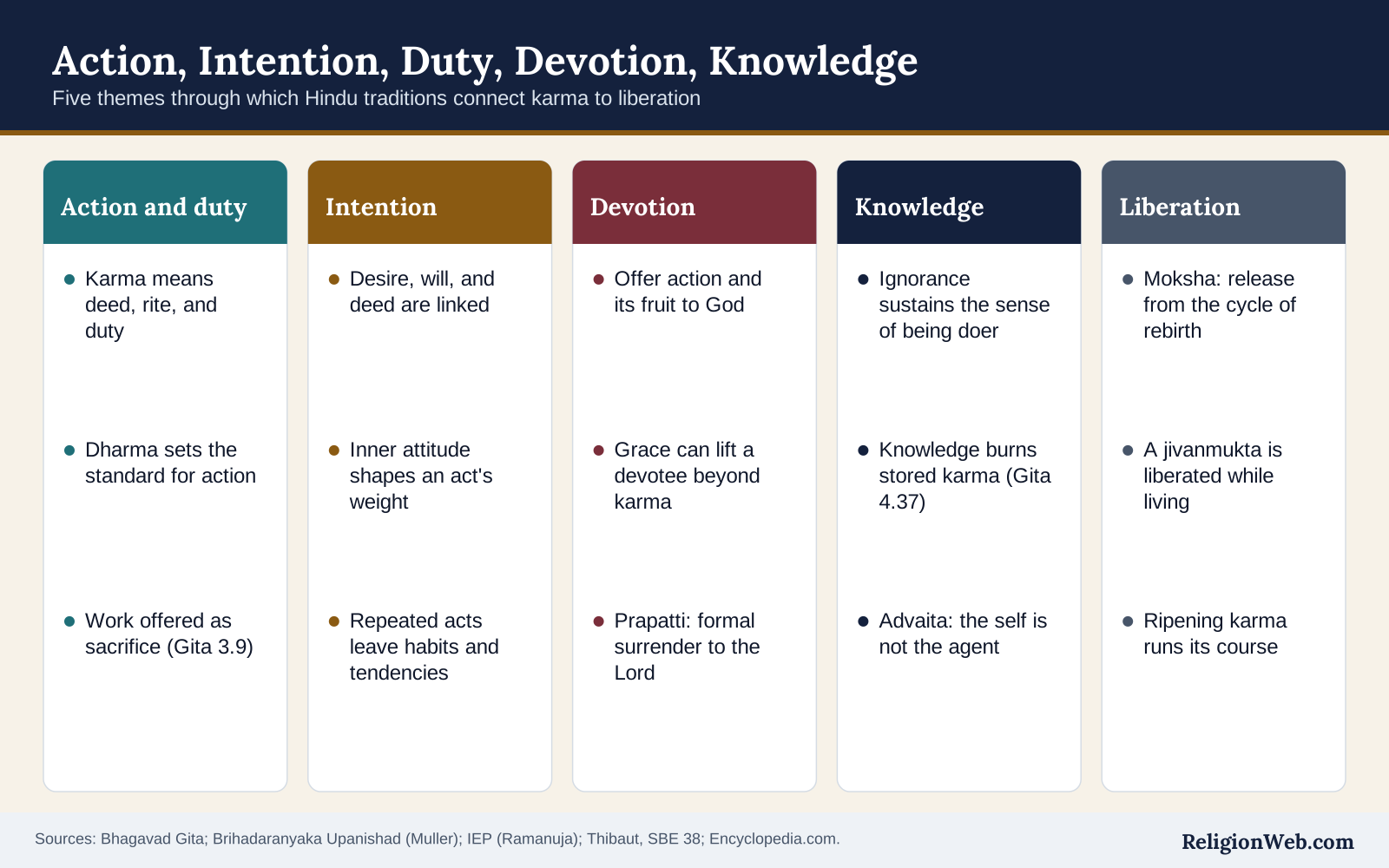
Karma, Suffering, Caste, and Social Debate
Few aspects of the doctrine are as sensitive as its relation to inequality. Because karma offers an explanation for why people are born into different circumstances, it has been invoked to justify social hierarchy, and it has been criticized for exactly that reason. A careful account has to separate what particular texts say, how particular groups have used the idea, and how Hindu thinkers themselves have argued about it. Caste is a social system with its own history and is discussed more fully in connection with Hinduism as a whole. The focus here is on how the language of karma enters the argument.
Karma as an Explanation of Inequality
What classical texts say
Some early texts do link conduct to the social position of the next birth. As noted above, Chandogya Upanishad 5.10.7 says in paraphrase that people of good conduct quickly enter a good womb, naming the birth of a Brahmana, a Kshatriya, or a Vaishya, while people of foul conduct enter a foul one, naming a dog, a pig, or an outcaste. The wording reflects the hierarchy of its time. Legal texts such as the Laws of Manu likewise connect rebirth with the quality of one’s actions. Historians read these passages as evidence that the doctrine of karma developed in societies already organized by ranked social groups, and that its authors drew on and reinforced that ranking.
Not every text uses karma this way. The Gita, for instance, says that those of humble birth and women who take refuge in the Lord also reach the highest goal (9.32), and its opening discussion of karma yoga does not rest on birth. Where a text does apply karma to social status, the application is a claim made by an author or school, and not a necessary consequence of the concept of action and consequence itself.
The argument from fairness
Karma also functioned as a response to the problem of undeserved suffering, a role scholars of religion have long noted. The question was how a good and just God, or a just cosmos, could allow some beings to be born in comfort and others in hardship. In the Brahma Sutras (2.1.34–36), as classical commentators read them, the objection that the Lord would be partial and cruel is answered by the argument that the Lord dispenses results in accordance with beings’ own earlier actions, and that, since samsara has no beginning, no first act of favoritism can be pointed to. This argument shifts responsibility from God to the individual’s history. Its defenders present it as protecting divine justice. Its critics respond that it can be used to blame those who suffer.
Critiques and Reinterpretations
Reformers and critics
Social reformers and Dalit thinkers have argued that the doctrine of karma, in the form in which it was taught to the poor and the low-ranking, functioned as a tool of social control. The jurist and leader B. R. Ambedkar, who was born into a community treated as untouchable, criticized the use of karma and rebirth to legitimize inequality. Mohandas K. Gandhi held a different position. He accepted karma and rebirth as personally meaningful, condemned untouchability as a stain on Hinduism, and defended a reformed understanding of varna. These are disagreements among Indians about how to read and use their own traditions, and they continue in contemporary debates about caste, discrimination, and reservation policy.
Suffering, compassion, and responsibility
Many Hindu teachers today insist that the doctrine gives no one grounds for indifference. The Gita (12.13) praises the person who hates no being and is friendly and compassionate, and the movement for selfless service associated with Vivekananda took the duty to help the suffering as a form of worship. On this view, karma is a way of understanding one’s own agency, not a license to judge another person’s misfortune as deserved. A person who suffers from illness, poverty, or injustice is first of all someone to be helped.
The same caution applies to health. A belief that illness may reflect past action does not replace medical, psychological, or emergency care, and the Hindu tradition has its own long medical heritage in Ayurveda and today runs many hospitals and clinics. Religious language about suffering is meant to give meaning to experience, not to determine treatment.
Karma in Modern Hindu Life
The present-day picture combines inherited concepts with the vocabulary of modern life. Karma remains a living part of Hindu thought and speech, and it has also moved far beyond Hindu communities into English and other languages, often with a changed meaning. Describing both movements helps readers recognize which version of the idea they are encountering.
Belief Today
What Pew found in India
The best large-scale evidence comes from a Pew Research Center survey of 29,999 adults in India, conducted face to face between November 2019 and March 2020 and reported in June 2021. It found that 77 percent of Hindus in India say they believe in karma. By contrast, 40 percent of Hindus said they believe in reincarnation. The gap suggests that many Hindus use the idea of karma as a moral principle about the consequences of action without necessarily affirming a doctrine of rebirth in the form the survey described, although the survey did not test this explanation, and Pew notes that there are many interpretations of how reincarnation occurs. Pew also found comparable levels of belief in karma among Muslims and Jains in India, which reflects how widely the concept circulates in Indian culture. The results apply to India and should not be assumed to describe Hindu communities elsewhere.
Karma in the diaspora and in English
Hindu families in North America, Britain, East Africa, the Caribbean, and elsewhere pass on the idea through home religion, temples, and community education, often in forms adapted to local languages and concerns. At the same time the word has entered English through channels that include nineteenth-century translations, the Theosophical Society, and twentieth-century popular culture. Reference works note that Theosophy taught that good karma could offset bad, presenting karma as a path of self-improvement, a view that differs in important ways from Hindu schools.
Reinterpretation and Misreading
Teachers, psychology, and ethics
Modern Hindu teachers have proposed readings of karma that stress habit, character, and responsibility. Some present it as a psychological law: repeated actions build tendencies that shape future choices. Others focus on the ethical dimension, using karma to argue for kindness and honesty without making claims about rebirth. Still others, particularly within devotional movements, emphasize that karma is overshadowed by grace. These interpretations are best understood as part of the continuing history of the idea and not as departures from some single original form.
Karma in popular culture
In popular English, “karma” often means quick and fitting cosmic payback, the thief who gets robbed, the bully who is humiliated. This usage is lively, and it appears in the title of John Lennon’s 1970 song “Instant Karma!” and in countless jokes. It differs from the Hindu concept in several ways: it treats karma as immediate, as a form of punishment, and as something that happens to others. Hindu texts, as the next section shows, tend to describe karma as slow, as formative of the actor, and as a matter of one’s own conduct and attitude.
Understanding the difference helps readers evaluate claims they encounter online and in conversation. A statement such as “she deserved it, that’s karma” combines the popular idea with a judgment that classical texts did not always support, and the classical debates summarized above show how much thought lay behind the original idea.
Common Misconceptions About Karma in Hinduism
Because karma is among the most widely used Sanskrit words in English, it has also collected some of the most persistent misunderstandings. The four below are common in conversation and online writing. Each is stated as its holders would state it, followed by what Hindu texts and traditions say.
Misconception 1: Karma means fate, and everything that happens is already decided
Where the misunderstanding comes from
The confusion has several sources. In everyday English, people say “it’s my karma” when they mean “it’s my lot,” and the word has been absorbed into talk about destiny. Early Western writers on India often translated karma as fate, and reference works still note that Western scholars have often mistakenly viewed karma and fate as the same concept. Hindu languages have their own words for destiny, such as daiva and prarabdha, and when people use them casually they can sound like the same thing. The notion that one’s birth circumstances were produced by earlier action also gives the impression that life is a script written in advance.
What the evidence and tradition actually show
The Sanskrit word means action, and action is by definition something a person does. The Brihadaranyaka Upanishad (4.4.5) places the origin of the deed in the person’s own desire and will, and the Yoga Sutras teach that the seeds of karma can be weakened by practice. The Mahabharata, as Julian Woods’s study shows, keeps the relationship between destiny (daiva) and human effort (purushakara) open, with characters pressing both sides. In the Gita (18.14) human effort is one of the five factors behind any action. Most schools do say that ripening karma (prarabdha) shapes the starting circumstances of a life, such as body, family, and era, but the response to those circumstances is treated as the person’s own, and it creates new karma. A few theological systems lean toward predestination, and the Internet Encyclopedia of Philosophy describes Madhva’s view in those terms, but such positions are debated inside the tradition and are not the general rule.
The vocabulary of Hindu life points the same way. The classical list of the aims of human life (purusharthas) names dharma, material welfare, pleasure, and liberation, and the Sanskrit word for “human aim” is built on purusha, the person who strives. A tradition that organized its picture of a good life around deliberate human aims was not describing a world in which outcomes were fixed in advance.
Misconception 2: Karma is always an immediate reward or punishment
Where the misunderstanding comes from
Popular media favor the quick payoff: a character cheats and is caught the next day, and viewers call it karma. The English phrase “instant karma” has carried this idea into jokes, memes, and commentary. A moral law that visibly balances accounts also appeals to people who want justice to be quick and certain. Some modern teachers and self-help writers add to the impression by describing karma as a kind of daily feedback system that responds to every thought and deed in short order.
What the evidence and tradition actually show
Classical texts describe a slow process. The Yoga Sutras say that the fruits ripen as birth, life-span, and the character of experience, which is a timescale of whole lifetimes. The Brihadaranyaka Upanishad speaks of a person who, having received the end of whatever deed he does here, returns from the other world to this world of action. Later Vedanta developed the categories of stored, ripening, and newly made karma precisely because results do not arrive on demand. The Gita admits that the course of action is hard to grasp (4.17). Nor is karma only punishment: it is formative, building character and habits, and many traditions say that the best actions are those done without calculating a return. A hardship that comes soon after a misdeed may have many causes, and Hindu thinkers generally resist reading private causes into public events.
The Gita’s own example is instructive. Krishna does not promise Arjuna a fast or visible reward for acting well. He asks him to act without making the result the motive, a request that would make little sense if results followed each deed on a timetable one could watch. The long view also explains why Hindu teachers treat patience as a virtue connected to karma: effects are expected to emerge in their own time, and a person’s task is to attend to the quality of present action.
Misconception 3: Every Hindu school explains karma in the same way
Where the misunderstanding comes from
Introductions to Hinduism often present karma, samsara, dharma, and moksha as a tidy package. For beginners that is useful, and many Hindus themselves speak in these terms. But it can leave the impression that a single agreed theory stands behind the vocabulary. Popular books also tend to merge Hindu ideas with those from other traditions of Asia and with modern Western reinterpretations such as Theosophy, which compounds the blur.
What the evidence and tradition actually show
The schools disagree on basic points. Mimamsa attributes the results of ritual to an unseen potency, while Shankara argues in his commentary on the Brahma Sutras (3.2.38) that such a potency, being insentient, cannot act and that the Lord gives the fruit. Jaimini and Badarayana are reported at 3.2.40 and 3.2.41 as holding opposite views on this very question. Advaita Vedanta treats karma as real within ignorance, Ramanuja makes grace essential, and Madhva’s system gives it a distinctive role, as Table 5 summarizes. Shaiva Siddhanta lists karma as one fetter among others. Hindus also differ about rebirth itself: in the Pew survey, 77 percent of Hindus in India believed in karma, but only 40 percent said they believe in reincarnation. The family resemblance is real, and so are the differences.
A practical consequence follows for readers. When a book or a website says what “Hinduism teaches” about karma, it is worth asking which text, school, or community is speaking and in which period. A Mimamsa ritualist, an Advaita monk, a Sri Vaishnava devotee, and a modern teacher of karma yoga may use the same word and mean noticeably different things, each with real roots in the tradition.
Misconception 4: Karma means that people who suffer must deserve it
Where the misunderstanding comes from
The idea has an obvious logic. If present circumstances come from earlier action, then a person born into poverty or illness seems to have earned it. This reasoning has been used by some people to excuse indifference, and it appears in casual speech when someone says “it’s their karma.” Some historical uses, including appeals to karma in defense of caste hierarchy, lend it an air of authority. Critics of the doctrine have often taken this application as the doctrine’s essence.
What the evidence and tradition actually show
The tradition contains this reasoning, but it also contains strong resources against it. The Gita says that the way of action is subtle and hard to understand (4.17), which implies that no outsider can read another person’s moral history from outward circumstances. It praises the person who hates no being and is friendly and compassionate (12.13). Teachers in the service-oriented movements of the modern period treated helping the suffering as the central duty of a person who takes karma seriously. Reformers and critics, from Ambedkar to modern Hindu scholars, have argued that the doctrine was misused to defend hierarchy. The tradition’s own view, then, is closer to this: karma speaks primarily to one’s own responsibility and not to a verdict on someone else’s misfortune.
The classical sources themselves also mark a limit. The Chandogya passage that ties conduct to birth is one voice in a long conversation, and the Upanishads also teach, in the passages that Vedanta treats as central, a self that is not defined by social rank. Whatever one concludes about the historical use of the doctrine, the accurate statement is that it has been argued both ways by Hindus, and that the more compassionate reading has deep support in the tradition’s own texts.
Frequently Asked Questions About Karma in Hinduism
Questions about meaning
What does karma mean in Hinduism?
Karma means action or deed, and by extension the consequences of action. In Hindu usage it can also mean a prescribed ritual or duty. The best short summary is that karma describes the way what a person does, says, and intends shapes who that person becomes and what that person experiences. Hindu schools differ about how this works, who or what ensures that results follow, and how a person is finally freed from the process.
Is karma the same as reincarnation?
No. Karma is the principle that actions have effects, while reincarnation or rebirth (punarjanma, samsara) is the process in which many Hindu traditions say those effects continue after death. The two ideas are closely linked in the Upanishads and later philosophy, but they are not identical. The Pew survey in India found that 77 percent of Hindus said they believe in karma and 40 percent said they believe in reincarnation, which shows that people can hold the first without affirming the second in the survey’s terms.
What is the difference between karma and dharma?
Dharma is the standard of right conduct and cosmic order, and karma is the action that people perform and the consequence that follows. Put simply, dharma tells a person what ought to be done, and karma names what is actually done and what results from it. Acting in accord with dharma is said to produce favorable karma, while acting against it produces unfavorable karma. The dharma page examines the standard in detail, including how duties differ by role and stage of life.
What is the difference between good karma and bad karma?
Texts speak of merit (punya) and demerit (papa), the favorable and unfavorable residues of action, and they measure actions against dharma. Acts consistent with truthfulness, non-harm, generosity, and duty are generally called good, and acts that harm others or violate duty are called bad. Several schools add that even good karma can keep a person within the cycle of rebirth if it is done for the sake of reward, which is why the Gita’s ideal of acting without clinging to the fruit goes beyond the simple distinction.
Can a person know their own karma?
Hindu traditions generally say that karma cannot be read off directly. The Gita remarks that the course of action is hard to understand (4.17), and teachers usually advise people to judge their own conduct and attitude and not to guess at hidden causes for events. Some families consult astrologers, who treat a birth chart as a guide to tendencies, but even they usually say that it describes inclinations and not fixed outcomes. The practical answer most teachers give is that what a person can know and change is the quality of present action.
Questions about practice
How do Hindus try to improve their karma?
Practices vary by tradition and household. Common ones include honest work, care for family, giving to those in need, non-harm, daily worship, fasting on observance days, pilgrimage, and study of scripture. Followers of karma yoga add the discipline of offering the results of their work. Many teachers caution that the aim should not be to accumulate credit like a bank balance, since the Gita and the Upanishads both point toward a freedom that goes beyond reward.
Can prayer or ritual change karma?
Answers differ. The ritual school of Mimamsa held that correct rites produce their promised results through an unseen potency. Theistic Vedanta and Shaiva traditions teach that God’s grace can lift a devotee beyond karma’s binding force. Advaita Vedanta holds that knowledge, not ritual, ends karma’s hold, although it values worship and selfless action as preparation. Ordinary devotees often combine these ideas without worrying about the differences. Prayer and ritual are understood in this context as spiritual and moral practices, and none of the traditions presents them as replacements for medical, psychological, or legal help when those are needed.
Questions about liberation and society
How does a person become free from karma?
The traditions give three main answers that often appear together. In the path of knowledge, liberation comes through realizing the true nature of the self, after which stored karma is said to be burned away and new karma no longer binds. In the path of devotion, surrender and divine grace release the soul. In the path of action, karma yoga prepares the mind by teaching detachment from results. A person who attains liberation while still living is called a jivanmukta, and most accounts say that the karma already ripening runs its course while the body lasts.
Do all Hindus believe in karma?
Most Hindus do, but not all in the same form. Pew found that 77 percent of Hindus in India said they believe in karma, which is a large majority and not a unanimous one. Some individuals and communities emphasize other themes, such as devotion, ritual, or social practice, and interpret karma loosely. Because Hinduism has no central authority that imposes a single creed, belief and practice vary widely among households and sects.
Does karma justify the caste system?
Hindus disagree. Some early and legal texts connect birth with earlier conduct, and some people have used the doctrine to defend hierarchy. Social reformers, Dalit thinkers, and many modern Hindu teachers reject that use and argue that the doctrine concerns personal responsibility and compassion. Both views belong to the history of the idea, and an informed reader should say who is making which claim and in what period.
Conclusion: Karma as Action, Responsibility, and Release
What the history shows
From ritual act to moral law
The history of karma in Hinduism is a history of widening meaning. A word for the sacrificial deed became a name for the moral shaping of the self, then for a principle that links lives, and finally for a discipline of acting freely in the world. Along the way, the Upanishads, the Gita, the epics, the law books, and the philosophical schools each added something, and no later layer fully replaced the earlier ones.
A concept held in tension
Hindu thought holds several tensions in the idea: automatic law and divine administration, personal responsibility and divine grace, social duty and liberation, effort and surrender. Seeing these tensions clearly is more accurate than reducing karma to a slogan, and it also shows why the concept has lasted and why it continues to be reinterpreted.
How to keep exploring
Related topics on ReligionWeb
Readers who want to continue can start with the Bhagavad Gita and the Vedas and Upanishads, where the primary texts live. The pages on dharma and yoga examine the closest neighboring concepts, and the pages on Vaishnavism, Shaivism, and Shaktism show how devotional traditions treat grace and action.
Reading the texts for yourself
The primary texts discussed here are available in public-domain English translations, including Max Müller’s Upanishads, Edwin Arnold’s Gita, and Charles Johnston’s Yoga Sutras, though older translations use older language and should be read alongside modern scholarly editions. Because translators choose different words for terms such as karma, dharma, and yoga, comparing several translations is a good habit for any serious reader.
Sources
The table below lists the principal external sources behind this article. Facts, dates and figures were checked against these and related primary, institutional and academic materials.
| # | Source | Publisher and type | Used for | Link |
|---|---|---|---|---|
| 1 | The Upanishads, Part II (Brihadaranyaka Upanishad 3.2 and 4.4), trans. F. Max Müller, Sacred Books of the East vol. 15 (1884) | Internet Sacred Text Archive · Primary text (public-domain translation) | Quotations from Brihadaranyaka 3.2.13 and 4.4.5; 4.4.6 return to 'this world of action' | sacred-texts.com |
| 2 | The Song Celestial; Or, Bhagavad-Gita, trans. Sir Edwin Arnold (1885), eBook #2388 | Project Gutenberg · Primary text (public-domain translation) | Quotations corresponding to Gita 2.47 and 5.10 | gutenberg.org |
| 3 | The Yoga Sutras of Patanjali, trans. Charles Johnston (1912), Book II | Internet Sacred Text Archive · Primary text (public-domain translation) | Quotation of Yoga Sutras II.13-14; II.12 on karma felt in this or a coming life | sacred-texts.com |
| 4 | The Vedanta-Sutras with Shankara's Commentary, trans. George Thibaut, Sacred Books of the East vol. 38 (Brahma Sutras 3.2.38) | Internet Sacred Text Archive · Primary text (public-domain translation) | Shankara on the Lord as giver of the fruit of action; critique of apurva (also 3.2.40-41, 4.1.13) | sacred-texts.com |
| 5 | Karma (Patrick Olivelle) | Encyclopaedia Britannica · Encyclopedia | Definition of karma as 'act' and as causal law of rebirth; Yajnavalkya as key figure | britannica.com |
| 6 | Religious Beliefs: Religion in India, Tolerance and Segregation (Pew Research Center, 29 June 2021) | Pew Research Center · Demographic data | 77% of Hindus in India believe in karma, 40% in reincarnation (survey Nov 2019 to Mar 2020) | pewresearch.org |
| 7 | Ramanuja (c. 1017 – c. 1137) | Internet Encyclopedia of Philosophy · Academic reference | Ramanuja on past karma, God granting fruits, grace, prapatti, and bhakti combined with karma yoga | iep.utm.edu |
| 8 | Madhva | Internet Encyclopedia of Philosophy · Academic reference | Madhva's view of karma as a mechanism toward predetermined destiny; Vishnu's grace and liberation | iep.utm.edu |
| 9 | Karaka: Panini's Ashtadhyayi 1.4.49 and 1.4.54 (Sanskrit grammar lessons) | learnsanskrit.org · Educational explainer | Fun Fact: karman as grammatical object (1.4.49) and kartri as agent (1.4.54) | learnsanskrit.org |
| 10 | Karma (entries by Smart, Bowker, Coward, Thursby and others) | Encyclopedia.com (Encyclopedia of Philosophy and other reference works) · Encyclopedia | Rig Vedic ritual sense; Upanishadic causality; samskara/vasana; sanchita, prarabdha, agamin; Theosophical spread | encyclopedia.com |
Last fact-check date: 2026-10-21.