The Bhagavad Gita is a Sanskrit poem of about 700 verses in which the warrior Arjuna, overcome with grief on the eve of a great battle, receives a long answer from his charioteer, Krishna. The title is usually translated “Song of the Lord” or “Song of God”: bhagavan is a title of reverence meaning “the blessed one” or “the lord,” and gita simply means “song” or “sung poem.” Hindus who revere the text understand Krishna’s words as divine teaching, and many regard Krishna as an avatara, a descent, of Vishnu, or as the Supreme Being in person. Historians describe the Gita as a religious and philosophical poem composed in the last centuries before the Common Era or soon after, though the exact date is debated.
The Gita is not a freestanding book in origin. It forms a short section of the sixth of the eighteen books of the Mahabharata, the vast Sanskrit epic about a dynastic war between two branches of a royal family. In the critical edition of the epic it occupies chapters 23 to 40 of the Bhishma Parva; in the widely printed vulgate it is numbered 25 to 42. Readers and editors long ago lifted it out of the epic and gave it eighteen chapters of its own, and in that form it has been recited, memorized, translated, and commented on for well over a thousand years. Its authority in Hinduism is very large, but it is not a single scripture that governs every Hindu tradition, a point this article returns to in detail.
What the poem says depends partly on who is reading it. On the surface it is a dialogue about whether and how to fight a war in which the enemy includes teachers and cousins. Beneath that question, Krishna speaks about the imperishable self, about duty (dharma), about acting without clinging to results (karma yoga), about knowledge of the self (jnana), about loving devotion to God (bhakti), and about liberation from the cycle of birth and death (moksha). Classical commentators such as Shankara, Ramanuja, and Madhva built different philosophical systems on the same verses, and modern readers from Bal Gangadhar Tilak to Mohandas Gandhi have found different central messages in it. Describing those readings accurately, without merging them, is one of the main tasks of this page.
The sections below set out the story and its place in the epic, the date and transmission of the text, a chapter-by-chapter walk through all eighteen chapters, the central teachings, the major traditions of commentary, the ways the Gita is recited and studied, and its reception from the eighteenth century to the present. Related pages cover the broader ideas the Gita draws on, including dharma, karma, and yoga in Hinduism.
The Bhagavad Gita at a Glance
A short orientation helps before the details. The Bhagavad Gita is a conversation reported inside a conversation: the blind king Dhritarashtra asks his minister Sanjaya what is happening at the battlefield, and Sanjaya reports the exchange between Krishna and Arjuna that took place just before the fighting began. The setting is Kurukshetra, a plain in what is now the Indian state of Haryana, and the time is the first day of an eighteen-day war. The dialogue ends when Arjuna says that his confusion is gone and that he will act as Krishna has instructed.
What the Bhagavad Gita Is
The name and its meaning
“Bhagavad Gita” is a compound of bhagavat (here in its combining form bhagavad, “of the Lord”) and gita, “song.” The name is therefore best rendered “the Lord’s song,” and the word “Lord” here refers in the first instance to Krishna as speaker. In Hindu usage the poem is often shortened to “the Gita,” and respectful titles such as Srimad Bhagavad Gita are common in print and speech. The traditional colophon at the end of each chapter calls the work an upanishad, a text of the knowledge of Brahman, a scripture of yoga, and a dialogue between Krishna and Arjuna. That wording shows how the tradition itself classified the poem: as a source of spiritual knowledge on a par with the Upanishads, though its formal status is different, as discussed below.
The dialogue form matters to how the text is read. Arjuna is not a passive recipient: his questions drive the poem. He asks how a person of steady wisdom behaves, why Krishna urges action if knowledge is higher, whether renunciation or disciplined action is better, what happens to someone whose yoga fails, and how God can be known. A number of Hindu teachers have therefore described the Gita as a teaching given to a person in crisis, rather than as a treatise written for a seminar.
A dialogue inside an epic
The Mahabharata tells how the descendants of King Bharata divided into two camps, the Pandavas and the Kauravas, and fought a war at Kurukshetra. The epic runs to roughly 100,000 couplets, and it is often described as roughly ten times the length of the Iliad and Odyssey combined. The Gita is a fraction of one percent of it. The teaching is introduced at a moment of narrative suspense: the armies are drawn up, conch shells have been sounded, and Arjuna asks Krishna to drive his chariot between the two lines. Everything the poem says is shaped by that picture, and the epic story supplies the characters, relationships, and stakes that the poem assumes its audience already knows.
Structure, Language, and Length
Eighteen chapters and about 700 verses
The standard text has eighteen chapters and 700 verses. That is the count of the text on which the commentator Shankara wrote in the eighth century CE, and it remains the usual count in printed editions and in the Mahabharata’s critical edition. The chapters vary widely in length: chapter 12, on devotion, has 20 verses, while chapter 18, the closing summary, has 78. The verse numbering used by scholars and teachers today cites chapter and verse together, so that “2.47” means the forty-seventh verse of the second chapter. Some traditions group the chapters in sets of six, with the first six taken to concern the practice of action and knowledge, the middle six devotion, and the last six the clarification of the earlier teaching, a pattern associated particularly with the Sri Vaishnava reading described later in this article.
Sanskrit verse and the shloka meter
The Gita is composed in Sanskrit, nearly always in the shloka (or anushtubh) meter, in which each verse has four quarter-lines of eight syllables. This is the usual narrative and didactic meter of the Sanskrit epics, and it is well suited to memorization and chanting. A few passages, especially in the eleventh chapter, use longer meters that slow the rhythm and heighten the tone as Arjuna describes his vision. The compact style, with many short compounds, is one reason that the same verse can be translated in strikingly different ways, a topic taken up in the section on interpretation.
Where the Gita Stands in Hindu Thought
Remembered tradition, treated like revelation
Hindu textual authority is traditionally divided into shruti, “what is heard,” meaning the Vedas and Upanishads, and smriti, “what is remembered,” meaning epics, law books, and other later texts; the page on the Vedas and Upanishads explains the distinction. The Gita belongs to smriti because it is part of the Mahabharata. Yet in practice many Hindus treat it with a reverence close to that given to the Upanishads, and the colophon’s description of it as an upanishad reflects this. Some teachers call it the “essence” of the Upanishads, an image found in a meditation verse (Gita dhyana) that many people chant before study: the Upanishads are cows, Krishna is the milker, Arjuna is the calf, and the Gita is the milk. The image conveys how the poem is felt to distill earlier teaching in a form accessible to a wide audience.
One of the three foundations of Vedanta
In the schools of Vedanta, the Gita is one of three authoritative sources, the prasthanatrayi or “triple canon,” alongside the principal Upanishads and the Brahma Sutras. Shankara wrote commentaries on all three, and later founders of Vedanta schools felt obliged to do the same or to engage his readings. This is why the Gita has such a long commentarial history. A teacher who wished to establish a philosophy of the relation between God, the self, and the world had to show how that philosophy accounted for what Krishna says in these eighteen chapters. The authority is therefore specific: it is most formal within Vedanta lineages, and it is looser, though still strong, in devotional movements, reform movements, and household practice.
A reference table for the Gita
| Feature | Summary |
|---|---|
| Name and meaning | Bhagavad Gita, “Song of the Lord” or “Song of God”; often shortened to “the Gita” |
| Setting | The plain of Kurukshetra, on the first day of the war between the Pandavas and the Kauravas |
| Speakers | Krishna and Arjuna in dialogue; reported by Sanjaya to the blind king Dhritarashtra |
| Place in the epic | Bhishma Parva (Book 6) of the Mahabharata: chapters 23 to 40 in the critical edition, 25 to 42 in the vulgate |
| Length | 18 chapters and 700 verses in the standard text |
| Language and meter | Sanskrit, chiefly in the shloka (anushtubh) meter |
| Traditional attribution | Composed or compiled with the Mahabharata by the sage Vyasa |
| Scholarly dating | Debated; many historians place it between about the fifth century BCE and the second century CE |
| Textual status | Smriti, but revered as an upanishad; one of the three canonical sources (prasthanatrayi) of Vedanta |
| Main subjects | The self, duty, action, knowledge, devotion, meditation, the nature of God, the three gunas, liberation |
Two cautions apply to the table. The traditional attribution to Vyasa expresses how the epic is remembered within Hindu tradition; critical scholarship treats the Mahabharata as the product of many hands over centuries, and no historian can name the author of the Gita. And the dating range reflects the range of scholarly estimates rather than a consensus; the section on text history sets out the arguments.

The Mahabharata Setting and the Battlefield Dialogue
To understand why the Gita begins as it does, it helps to know the story that surrounds it. The poem assumes that its audience knows who Arjuna is, why he stands in a chariot between two armies, and why the men facing him are his relatives and teachers. Within the epic, the dialogue is also not told directly. It is part of a report delivered afterward by a courtier who watched the war from a distance by supernatural sight, and that frame shapes the opening and closing verses of the poem.
The Epic Around the Gita
The Mahabharata and the Bhishma Parva
The Mahabharata, “the great story of the Bharatas,” is divided traditionally into eighteen books, each called a parva. Its core plot is the rivalry between the sons of Pandu, called the Pandavas, and the hundred sons of Pandu’s elder brother Dhritarashtra, called the Kauravas, for the throne of the Kuru kingdom. Much of the epic is not about the war at all: it contains stories, philosophical discussions, genealogies, and long instructional sections on law and kingship. The war occupies the middle books. The sixth, the Bhishma Parva, narrates the first ten days, during which the elder statesman Bhishma commands the Kaurava army, and it ends with his fall, pierced with arrows but not yet dead.
The Gita is placed near the start of this book, just before fighting begins. In the critical edition prepared at the Bhandarkar Oriental Research Institute in Pune between 1919 and 1966, it occupies chapters 23 to 40; in the older vulgate text that most printed Gitas follow, the corresponding chapters are numbered 25 to 42. These figures matter chiefly to scholars who need to locate the passage in a particular edition, but they illustrate a larger point: the “eighteen chapters of the Gita” are a convenient extraction from a book that has its own internal numbering.
A report within a report: Dhritarashtra, Sanjaya, and Vyasa
The Mahabharata itself is told through nested frames, with one narrator reciting to another listener, and the war narrative is another example. Dhritarashtra is blind and remains in the palace at Hastinapura. The sage Vyasa, the traditional author of the epic and also the grandfather of both warring families, offers the king the gift of sight so that he can watch the war. According to the epic, Dhritarashtra declines, saying that he does not wish to see his kinsmen killed, but that he would like to hear what happens. Vyasa therefore grants the gift of divine vision to the king’s minister and companion, Sanjaya, who is able to see and hear events at a distance and who will report them.
When the battle’s tenth day ends with Bhishma’s fall, Sanjaya returns to the king with the news, and Dhritarashtra asks him to tell the whole story from the beginning. The Gita is part of Sanjaya’s answer. That is why the first verse of the Gita is spoken by Dhritarashtra, and why the last verses, in which Sanjaya says that he heard this secret teaching directly from Krishna by the grace of Vyasa, return to the frame. The poem asks readers to imagine a conversation overheard, remembered, and retold, not a speech delivered to the world.
The Quarrel That Led to Kurukshetra
Two branches of one royal family
The epic traces the origin of the war to a dispute about succession and justice. Pandu, the younger brother, ruled for a time, but he died young, leaving five sons: Yudhishthira, Bhima, Arjuna, and the twins Nakula and Sahadeva. Dhritarashtra, who had been passed over as king because of his blindness, then ruled on behalf of the children, and his eldest son, Duryodhana, grew up resenting the cousins who might claim the throne. The rivalry hardened through a series of episodes: a divided kingdom, a rigged dice game in which Yudhishthira lost his realm and the Pandavas’ wife Draupadi was publicly humiliated, thirteen years of exile, and an unsuccessful diplomatic mission by Krishna to secure at least five villages for the Pandavas. When Duryodhana refused, war became the epic’s way of showing that the failure of justice has terrible consequences.
The Pandavas are the epic’s protagonists, but it does not present the Kauravas as a faceless enemy, nor does it treat the Pandavas as spotless. Characters on both sides, including Bhishma, Drona, and Karna, act with a mixture of loyalty, honor, and tragic constraint. This moral complexity is part of why Arjuna’s reluctance has such force within the story: he sees faces he knows on both sides of the line. The Gita does not resolve that complexity by denying it. Its first chapter lets Arjuna state the case against fighting at length before Krishna answers.
The armies, the charioteer, and the first day
Krishna is a prince of the Yadava clan and a cousin of the Pandavas through their mother Kunti; Arjuna married Krishna’s sister Subhadra. When both sides sought his support, the epic says, he offered a choice: his large army, or himself alone and unarmed. Duryodhana chose the army, and Arjuna chose Krishna, who agreed to serve as his charioteer and adviser without fighting himself. That detail explains the picture on which the Gita opens, in which the greatest archer of the age sits behind horses guided by a god-like friend. The epic describes the armies in numbers that are meant to impress rather than to be counted: eleven akshauhinis (very large military divisions) for the Kauravas and seven for the Pandavas. The war lasts eighteen days.
The opening scene of the Gita follows a set pattern of epic warfare. The commanders announce their forces, Bhishma sounds his conch, and the other warriors answer, each with a named conch shell: Krishna’s is Panchajanya and Arjuna’s is Devadatta. Arjuna, taking up his bow, asks Krishna to place the chariot between the armies so that he can see who is ready to fight. It is at that moment, with the lines of kinsmen in front of him, that his courage fails. In the sequence of the epic, immediately after the Gita ends, Yudhishthira lays aside his armor and walks across the field to ask Bhishma, Drona, and other elders for their blessings before the war begins, a gesture that shows the same awareness of kinship that so troubles Arjuna.
| Figure | Place in the Mahabharata | Role in the Gita |
|---|---|---|
| Arjuna | Third of the five Pandava brothers; renowned archer | Questioner and recipient of Krishna’s teaching |
| Krishna | Yadava prince and ally of the Pandavas; Arjuna’s charioteer | Speaker of most of the poem; understood by devotees as divine |
| Dhritarashtra | Blind king of the Kurus, father of Duryodhana | Speaks only the opening verse; hears the report |
| Sanjaya | King’s minister, given divine sight by Vyasa | Narrator who reports the dialogue and closes the poem |
| Duryodhana | Eldest Kaurava and leader of the opposing side | Appears in the first chapter naming the commanders |
| Bhishma | Elder of the Kuru house, first Kaurava commander | Sounds the first conch; named by Arjuna among those he must face |
| Drona | Teacher of the princes in arms | Named by Arjuna as a revered teacher on the other side |
| Vyasa | Traditional author of the epic and grandfather of both families | Not in the dialogue; the source of Sanjaya’s vision |
Kurukshetra as a Place and as a Symbol
Kurukshetra today
Kurukshetra, “the field of the Kurus,” is a real district in the state of Haryana, north of Delhi. It was regarded as sacred long before the epic took its final form: Vedic ritual texts already treat the region as a place of sacrifice, and the first verse of the Gita calls it a dharmakshetra, a “field of dharma.” Pilgrims today visit a cluster of sites, including large ritual tanks such as Brahma Sarovar and Sannihit Sarovar, where bathing is considered meritorious, and a spot at Jyotisar that local tradition identifies as the place where Krishna taught Arjuna. The government of Haryana organizes a weeklong International Gita Mahotsav at Kurukshetra, with recitations, lectures, music, and exhibitions, connected to the observance of Gita Jayanti.
Historical, ritual, and allegorical readings of the battlefield
How literally to take the battlefield has been debated for a long time. Traditional reckoning ties the war to the transition into the present age, the Kali yuga, which Indian astronomical tradition counts from 3102 BCE. Historians generally doubt that any single event can be dated so precisely, and they treat the Mahabharata as a long-evolving work whose core memory of a conflict among Kuru-related groups may be much older than its final text, if it preserves such a memory at all. For the Gita, the main point is that the setting is part of a literary design: the physical field of battle has been made into a stage on which the questions of action and renunciation are asked with extreme urgency.
Some readers have taken that design further and read the battlefield as an inner one. Mohandas Gandhi, in the introduction to his Gujarati commentary on the Gita (Anasaktiyoga), dated 1929, wrote that he did not regard the Mahabharata as a historical work in the accepted sense and that, from his early encounter with the Gita in 1888 or 1889, he understood it as describing the duel that perpetually goes on in the hearts of human beings, with physical warfare used to make that inner conflict more vivid. Other modern interpreters, such as Bal Gangadhar Tilak, read the poem as addressing a real obligation to act in the world, and traditional commentators generally take the dialogue as occurring in the narrative as the epic gives it while drawing out lessons for the inner life. These approaches are not mutually exclusive, and many readers use both.
Date, Text, and Transmission of the Bhagavad Gita
The question “when was the Gita written, and by whom?” has two kinds of answers. Hindu tradition says that Krishna spoke the teaching at the start of the war and that Vyasa composed the Mahabharata that preserves it. Historians, working from language, ideas, and the manuscript record, describe a text that took shape in stages. Neither answer cancels the other: one describes how the community remembers the poem’s origin, the other how modern scholarship reconstructs its composition. This section sets out the second kind of answer and then turns to how the text has been edited, counted, and translated.
Dating and Composition
What scholars estimate
Dating the Gita depends on dating the Mahabharata, and the epic grew over many generations. The oldest preserved layers are generally thought to be not much older than about 400 BCE, and the work probably reached something close to its present form by the early Gupta period, around the fourth century CE. Within that long window, the Gita is most often placed in the last two centuries BCE or the first century CE, though serious scholars have argued for dates as early as the fifth or fourth century BCE and as late as the second or third century CE. The disagreement is real, and an honest summary is that the poem was probably composed somewhere between about 400 BCE and 200 CE, with many historians favoring the later part of the first millennium BCE.
The arguments rest on internal evidence. The poem draws on Upanishadic ideas about the self and Brahman, uses the vocabulary of the Samkhya philosophy of nature and spirit, and speaks of yoga as a disciplined practice. It also criticizes a narrowly ritual view of the Vedas in a few verses, and it presents Krishna as a god who is the object of personal devotion. That last feature points to a period when worship of Vasudeva-Krishna had become established. Inscriptional evidence from about the late second century BCE, notably a pillar at Besnagar in central India set up by a Greek ambassador who called himself a devotee of Vasudeva, shows such worship was already practiced in that period. The Gita is usually seen as a literary expression of this movement, though it cannot be dated precisely from it.
One composition or several layers?
Early twentieth-century European scholars, notably Richard Garbe, argued that the Gita as we have it had been enlarged: that a shorter original poem presenting a Samkhya and yoga teaching with devotion to a personal god had been expanded with Upanishadic and Vedantic material. Others proposed different layering schemes. Arguments of this kind were based on perceived tensions in the text, for example between passages that praise action and passages that praise renunciation, or between a God who stands above the world and a God who is the world.
Many later scholars have been more cautious about such reconstructions. They point out that no manuscript evidence supports a shorter version, and they argue that the tensions can be read as deliberate attempts to synthesize several religious currents of the period rather than as seams between independent sources. The Hindu commentators, for their part, assume that the poem is a unity, even if they disagree about what its single message is. Most modern discussion therefore treats the Gita as a composition that may contain some later additions but whose basic design is coherent, while recognizing that the question is not closed.
Manuscripts, Editions, and the Count of Verses
The critical edition and the vulgate
Most Hindu readers use a text that follows the vulgate of the Mahabharata, a version widely printed in the nineteenth century. For scholarly work the benchmark is the critical edition of the epic produced at the Bhandarkar Oriental Research Institute in Pune. The Institute began collating manuscripts in 1919, and the project, completed in 1966, filled about nineteen volumes. The editors compared manuscripts in many scripts from across the subcontinent and chose readings through a set of principles rather than following any one tradition. For the Gita, the critical edition and the vulgate agree to a remarkable degree. Scholars generally find the differences to be small variants of wording, which is one reason the Gita is often described as one of the most stable parts of the epic.
Counting verses: 700 and 745
Most printed Gitas count 700 verses, and many traditions treat that number as fixed. Some printed editions of the Mahabharata, however, contain a verse in the Bhishma Parva that tallies the Gita by speaker, assigning 620 verses to Krishna, 57 to Arjuna, 67 to Sanjaya, and one to Dhritarashtra, for a total of 745. The tally does not match the 700 verses of the standard text, and no authentic manuscript with 745 verses has been found. The swami and scholar Gambhirananda suggested that older manuscripts may once have had more verses; other readers think the figure reflects a different way of counting. The discrepancy is a good example of the unresolved questions that remain even about a text this familiar. In the standard 700-verse text, Krishna speaks the great majority of the verses, Arjuna a much smaller share, and Sanjaya the framing passages.
Scripts, regions, and a recognition by UNESCO
The Gita has been copied in many Indian scripts, among them Devanagari and the now-dormant Sharada script once used in Kashmir. A Kashmir recension of the epic, preserved in manuscripts of that region, shows only minor variations from the others. In April 2025, UNESCO added a “Manuscript Collection of the Bhagavadgita,” submitted by India, to its Memory of the World Register, in a year when it announced 74 new inscriptions and a register total of 570. The inscription is a recognition of documentary heritage, a category that concerns manuscripts and archives, and says nothing about the truth of the text’s religious claims.
From Oral Recitation to Translation
Memorization and the commentarial record
For most of its history the Gita was transmitted by memory as well as by manuscript. Sanskrit verse in the shloka meter is easy to memorize, and recitation of the entire text, or of favored chapters, has long been a form of devotion in itself. Among the earliest complete commentaries that survive is the one attributed to Shankara in the eighth century CE. After Shankara, commentaries multiplied in Sanskrit and, from the thirteenth century, in regional languages as well, a development described in the section on interpretation.
Why translations differ
Translating the Gita is difficult for reasons that are partly linguistic and partly philosophical. Key words such as yoga, dharma, karma, brahman, and buddhi have several meanings, and the Gita sometimes uses one word in more than one sense within a few verses. A translator who follows a particular commentary will tend to render ambiguous terms in the way that commentary requires. The word kala in the eleventh chapter, when Krishna calls himself the destroyer of worlds, is a well-known case: most translators since the eighteenth century have rendered it “Time,” but a minority of renderings, including that of Arthur W. Ryder, whose 1929 translation J. Robert Oppenheimer read, use “Death.” Neither rendering is arbitrary, because in Sanskrit the word carries both senses, and the discussion of chapter 11 below returns to the point.
The Eighteen Chapters of the Bhagavad Gita, One by One
The eighteen chapters do not form a simple outline, and Hindu commentators have divided them in several ways. Still, a reader can follow a general movement: from Arjuna’s collapse (chapter 1) to the first statement of the self and of disciplined action (chapters 2 to 6), then to the nature of God and the way of devotion (chapters 7 to 12), then to a longer analysis of nature, spirit, and the three qualities of matter (chapters 13 to 17), and finally to a summary and a closing appeal (chapter 18). The chapter names below are traditional but vary somewhat among editions and translators, and each chapter is called a “yoga” in the standard titles, a use of the word that is explained in the discussion of the paths of yoga.
| Chapter | Traditional name | Verses | Main themes |
|---|---|---|---|
| 1 | Arjuna Vishada Yoga (Arjuna’s despondency) | 47 | Armies at Kurukshetra; Arjuna’s grief and refusal to fight |
| 2 | Sankhya Yoga (knowledge and discipline) | 72 | The imperishable self; duty; equanimity; the person steady in wisdom |
| 3 | Karma Yoga (discipline of action) | 43 | Why action is necessary; sacrifice; acting for the welfare of the world |
| 4 | Jnana-Karma-Sannyasa Yoga (knowledge and renunciation of action) | 42 | Divine descent; action that does not bind; knowledge as sacrifice |
| 5 | Karma-Sannyasa Yoga (renunciation and action) | 29 | Renunciation and disciplined action; equal vision; peace |
| 6 | Dhyana Yoga (meditation) | 47 | Self-mastery; the meditation seat; the restless mind; the failed yogi |
| 7 | Jnana-Vijnana Yoga (knowledge and realization) | 30 | Krishna’s higher and lower nature; maya; four kinds of devotees |
| 8 | Akshara-Brahma Yoga (the imperishable Brahman) | 28 | Remembrance at death; paths of departing; cosmic cycles |
| 9 | Raja-Vidya-Raja-Guhya Yoga (royal knowledge) | 34 | God pervading the world; simple offerings; open devotion |
| 10 | Vibhuti Yoga (divine manifestations) | 42 | Krishna as the source and the excellence in all things |
| 11 | Vishvarupa-Darshana Yoga (vision of the universal form) | 55 | The cosmic form; Time as destroyer; the return to a gentle form |
| 12 | Bhakti Yoga (devotion) | 20 | Personal and impersonal paths; qualities of the dear devotee |
| 13 | Kshetra-Kshetrajna-Vibhaga Yoga (the field and its knower) | 34 | Body and knower; nature and spirit; marks of knowledge |
| 14 | Gunatraya-Vibhaga Yoga (the three gunas) | 27 | Sattva, rajas, and tamas; going beyond them |
| 15 | Purushottama Yoga (the supreme person) | 20 | The inverted tree; perishable, imperishable, and supreme |
| 16 | Daivasura-Sampad-Vibhaga Yoga (divine and demonic qualities) | 24 | Qualities that liberate and qualities that bind; the authority of scripture |
| 17 | Shraddhatraya-Vibhaga Yoga (the three kinds of faith) | 28 | Faith, food, sacrifice, austerity, and gifts in three types |
| 18 | Moksha-Sannyasa Yoga (liberation and renunciation) | 78 | Summary; duty and perfection; surrender; Arjuna’s decision |
Chapters 1 and 2: The Crisis and the First Answer
Chapter 1: Arjuna’s despondency
The first chapter sets the scene and then gives almost the whole of it to Arjuna’s grief. After Dhritarashtra’s opening question, Sanjaya names the commanders and describes the conches. Arjuna asks Krishna to draw the chariot between the armies, and as he looks at the ranks he sees teachers, uncles, cousins, and friends. His limbs weaken, his mouth dries, his bow slips from his hand, and his skin burns. He argues that he wants neither victory nor kingdom, that killing kin will bring ruin on the family, that the rites for the ancestors will lapse when the men who perform them die, and that society will fall into confusion. At the end he sets down his bow and sits in the chariot, overwhelmed by sorrow. Krishna speaks only a few words in this chapter, and its sustained portrait of moral paralysis gives the rest of the poem its urgency.
Chapter 2: The imperishable self and the steady mind
Chapter 2 is the first long answer, and it contains much of what later chapters will develop. Arjuna declares himself Krishna’s pupil and asks to be taught what is right. Krishna begins with the self: those who are wise do not grieve for the dead or the living, because the embodied self is not born and does not die, and bodies are put on and discarded like garments. He then turns to duty, reminding Arjuna that for a warrior no course is more fitting than a just war, and introduces the discipline of intellect, buddhi yoga, which is the practice of acting without being driven by the desire for results. The central verse, 2.47, says that Arjuna has a claim only to action and never to its fruits. The chapter ends with a long portrait of the person of steady wisdom, who is not shaken by pleasure or pain and has withdrawn the senses from their objects the way a tortoise draws in its limbs.
Chapters 3 to 6: Action, Knowledge, Renunciation, and Meditation
Chapter 3: Why act at all?
Arjuna’s puzzlement drives chapter 3. If knowledge is higher than action, as Krishna seems to say, why does Krishna ask him to do something terrible? Krishna answers that no one can remain without action even for a moment, since nature compels everyone to act, and that the question is not whether to act but how. Action offered as sacrifice, he says, does not bind; action done from craving does. He points to the legendary king Janaka as one who attained perfection through action, and he says that a leader’s conduct sets an example for others and should aim at the welfare of the world. The chapter closes with a warning about desire and anger, called in Krishna’s words the enemy, born of the quality of rajas, and with the instruction to control the senses and the mind to overcome it.
Chapter 4: Knowledge, sacrifice, and divine descent
The fourth chapter begins with a lineage of teaching: Krishna says that he taught this yoga long ago to the sun-god Vivasvan, who passed it to Manu and then to the royal line, until it was lost through the passage of time. This is the context for the doctrine of divine descent, in which Krishna says that he is born whenever dharma declines. The chapter also introduces a wide range of sacrifices, from offering material goods to disciplining the senses to studying scripture, and ranks the sacrifice of knowledge above sacrifices of material things. It declares that nothing purifies like knowledge and advises the seeker to approach teachers with humility and questions. The final verse tells Arjuna to cut his doubt with the sword of knowledge and to rise and act. For the doctrine of avatara in the broader Vishnu-centered tradition, see the page on Vaishnavism.
Chapter 5: Renunciation and the yoga of action
Arjuna now asks directly which of the two is better, the renunciation of action or its disciplined performance. Krishna replies that both lead to the highest good, but that the yoga of action is superior to mere renunciation of action. He describes the true renouncer as one who neither hates nor desires, and he says that the person of knowledge sees one and the same reality in the learned brahmin, the cow, the elephant, the dog, and the outcaste (the text’s word, shvapaka, refers to a person of the lowest social standing). He gives the image of a lotus leaf that remains untouched by water as an example of acting without being stained by action, and he declares that the person who knows him as the friend of all beings attains peace. The chapter prepares the way for the practice of meditation in the next.
Chapter 6: Self-mastery and meditation
Chapter 6 gives the Gita’s most direct instruction on meditation. A person should lift himself by the self and not degrade the self, for the self is both its own friend and its own enemy. The yogi sits in a clean place, on a firm seat, with body, head, and neck steady, the mind gathered and the gaze directed inward. Krishna adds that yoga is not for the person who eats too much or fasts to excess, sleeps too much or too little, and that a lamp in a windless place gives a picture of the still mind. Arjuna admits that the mind seems as hard to hold as the wind, and Krishna answers that it can be steadied by practice and detachment. In reply to Arjuna’s question about the person who tries and fails, Krishna promises that no one who does good meets disaster. The chapter ends with the statement that the best of yogis is the one who worships Krishna with faith.
Chapters 7 to 12: God, Devotion, and the Universal Form
Chapter 7: Higher and lower nature
Chapter 7 opens a new phase. Krishna describes himself as having two natures, a lower one consisting of the elements, mind, and ego, and a higher one that is the living principle sustaining the world. Everything is strung on him like pearls on a thread. His divine power, called maya, built of the three qualities of nature, is hard to cross, though those who take refuge in him cross it. Four kinds of people worship him: the distressed, the seeker of knowledge, the seeker of wealth, and the wise, and the wise person who loves him is the most beloved. Krishna adds that people who worship other deities with faith are in fact approaching him, and that he makes their faith steady, a verse that commentators with different philosophies read in different ways.
Chapter 8: Death, remembrance, and the cosmic cycles
Arjuna begins with a list of technical questions about Brahman, the self, and action, and Krishna answers in brief. The most distinctive teaching of the chapter is that the state of mind at the moment of death shapes the next destination: whoever departs remembering Krishna comes to him. Krishna advises constant practice so that remembrance is natural, and he recommends the syllable om. The chapter also describes the vast cycles in which the world is created and dissolved, the “day” and “night” of Brahma, and two paths by which souls depart, one leading to return and the other not. Teachers often draw on this chapter when they speak about death and remembrance.
Chapter 9: The royal knowledge
Chapter 9 is the most openly devotional teaching so far. Krishna calls it the royal knowledge and royal secret, and he explains that the whole world is pervaded by him in his unmanifest form, yet beings abide in him without his being limited by them. He promises to carry the needs of those who worship him with undivided mind, and he says that he accepts a leaf, a flower, a fruit, or water offered with devotion. He asserts that even someone of very bad conduct who worships him with single-minded devotion is to be regarded as righteous, because he is resolved rightly. The chapter closes with the instruction to fix the mind on Krishna, to be devoted to him, to worship him, and to bow to him. A passage from this chapter appears below in the discussion of devotion.
Chapter 10: Divine manifestations
Arjuna asks to be told how he may think of God in all his forms. Krishna answers by listing manifestations (vibhuti): among the gods he is Vishnu, among lights the sun, among the Vedas the Sama Veda, among rivers the Ganga, among trees the sacred fig, among the senses the mind. In each case he names what is most excellent or central in a category. Then he says that this list is only a sampling and that whatever is glorious or powerful in the world comes from a fragment of his splendor. The chapter functions as a preparation for the next: it turns the reader’s attention from the particular to the whole, from a god among gods to the ground of the world.
Chapter 11: The vision of the universal form
At Arjuna’s request, Krishna gives him a divine eye and reveals his cosmic form, containing all the gods, all beings, and the whole universe in its multiplicity. The vision is described with the language of overwhelming light, a radiance compared to a thousand suns rising at once. Then the vision darkens. Arjuna sees the warriors of both armies rushing into the mouths of the form, and he asks who it is. The answer, given at 11.32, is that Krishna is Time, the destroyer of worlds, and that the warriors are already doomed whether or not Arjuna acts. Arjuna is told to be the instrument. Shaken, he begs to see Krishna’s friendly human form again, and the chapter ends with the teaching that this vision cannot be won by study or sacrifice but only by undivided devotion. A closer reading appears in the section on God, the cosmos, and liberation.
Chapter 12: Devotion and the dear devotee
Chapter 12 is short but widely loved. Arjuna asks whether it is better to worship Krishna as a personal God or to meditate on the imperishable, unmanifest reality. Krishna replies that those who fix their minds on him with faith are the best in yoga, while those who worship the unmanifest also reach him, but with greater difficulty for embodied beings. He then gives a graduated program: fix the mind on me; if you cannot, practice; if you cannot practice, do actions for my sake; if you cannot, renounce the fruits of action. The second half of the chapter describes the devotee Krishna loves: one who hates no being, is friendly and compassionate, free from possessiveness and ego, balanced in pleasure and pain, forgiving, content, and not agitated by the world or agitating it.
Chapters 13 to 18: Nature, the Gunas, and the Final Appeal
Chapter 13: The field and the knower of the field
The thirteenth chapter introduces a more analytic vocabulary. The body, with its senses and mind, is called the field (kshetra), and the one who knows it is the knower of the field (kshetrajna). Krishna says that he is the knower of the field in all fields, and that the knowledge of field and knower is true knowledge. A list of qualities, including humility, nonviolence, patience, uprightness, service of the teacher, and steadiness, is described as knowledge itself. The chapter describes nature (prakriti) and spirit (purusha) as both beginningless, with the experience of pleasure and pain attributed to the spirit’s association with nature. Several routes to realization are named: meditation, Samkhya, the yoga of action, and listening to others.
Chapter 14: The three gunas
The three gunas, the qualities of nature, are sattva (clarity, lightness), rajas (passion, activity), and tamas (inertia, dullness). Krishna explains how each binds the embodied self: sattva through attachment to happiness and knowledge, rajas through attachment to action, tamas through heedlessness and sleep. Each predominates in different people at different times, and each influences what happens after death. The chapter ends with a portrait of the person who has transcended the gunas, who is equal in praise and blame, honor and dishonor, and who is said to be able to attain the state of Brahman through undivided devotion.
Chapter 15: The inverted tree and the supreme person
The fifteenth chapter opens with an image of an eternal fig tree with roots above and branches below, whose leaves are the Vedic hymns. It cannot be understood fully in this world, and it must be cut with the strong ax of detachment. Beyond it lies the state from which there is no return. Krishna then speaks of the self as an eternal portion of himself and of his presence as light in the sun and moon and fire, in all hearts, and as the source of memory and knowledge. The closing verses distinguish three persons: the perishable, the imperishable, and the highest, called Purushottama, beyond both, who pervades and sustains the three worlds. The name Purushottama is a title of Krishna and Vishnu used in many devotional traditions.
Chapter 16: Divine and demonic qualities
Chapter 16 sorts human tendencies into two groups, the “divine endowment” (daivi sampad) leading to liberation and the “demonic endowment” (asuri sampad) leading to bondage. The first list names fearlessness, purity of heart, charity, self-restraint, study, honesty, nonviolence, truthfulness, compassion, gentleness, and absence of envy. The second describes hypocrisy, arrogance, anger, harshness, and a worldview that denies any moral order. These are descriptions of attitudes, and Hindu commentators generally read them as dispositions found in individuals, not as descriptions of ethnic or religious groups. It names three gates to ruin, which are desire, anger, and greed, and it ends by saying that scripture is the standard for knowing what to do and what to avoid.
Chapter 17: The three kinds of faith
Arjuna asks about people who worship with faith but without following the rules of scripture, and Krishna’s reply is that faith (shraddha) is of three kinds according to the gunas. He applies the same threefold analysis to food, sacrifice, austerity, and gifts. The sattvic person favors foods that promote health and long life, sacrifice done as a duty without desire for reward, and gifts given at the right time and place to the right person without expectation of return. Austerity is defined in three registers, of body, of speech, and of mind. The chapter closes by explaining the formula om tat sat, which makes ritual acts valid by consecrating them to the highest reality.
Chapter 18: Liberation, surrender, and Arjuna’s decision
The last and longest chapter gathers earlier threads. It distinguishes renunciation (sannyasa) from relinquishment (tyaga), analyzes the five factors in any action, applies the threefold analysis of the gunas to knowledge, action, the doer, understanding, resolve, and happiness, and returns to the question of duty, saying that each person reaches perfection by devoting his own work to God. Then comes the closing appeal: Krishna says that the lord dwells in the heart of every being, tells Arjuna to take refuge in him with his whole being, and says he has given the most secret knowledge and that Arjuna should reflect and then do as he wishes. The final instruction, 18.66, asks Arjuna to give up all dharmas, take refuge in Krishna alone, and not to grieve, and it has been interpreted in different ways. Arjuna replies that his delusion is gone and that he will act on Krishna’s word. Sanjaya’s closing verses declare that wherever Krishna and Arjuna are, there will be prosperity and victory.

The Central Teachings: Self, Duty, Action, and the Paths of Yoga
The Gita is not a systematic treatise, and its teachings are woven through the dialogue rather than listed in order. Still, a few ideas recur so often that they can be treated as the poem’s main themes: the nature of the self, the meaning of duty, the way to act without being bound by action, and three disciplines, those of knowledge, devotion, and meditation, that lead to liberation. This section describes each theme as the text presents it, and notes briefly where major traditions of interpretation diverge. The fuller account of how different schools read these ideas follows in the section on commentary.
The Self and the Body
The imperishable self
Krishna’s first answer to Arjuna’s grief is about what dies and what does not. The body, he says, is perishable, but the self that inhabits it is not. Hindu tradition calls this self the atman. The second chapter says that it is never born and never dies, that it cannot be cut by weapons, burned by fire, wet by water, or dried by wind. Arnold’s verse translation renders this passage, numbered 2.20 in the standard text, in the following way.
Never the spirit was born; the spirit shall cease to be never;
Never was time it was not; End and Beginning are dreams!
Birthless and deathless and changeless remaineth the spirit for ever;
Death hath not touched it at all, dead though the house of it seems!Bhagavad Gita, trans. Edwin Arnold, The Song Celestial (1885), Chapter II (corresponding to 2.20)
All major commentators accept that the Gita teaches an indestructible self distinct from the body, and that grief for the death of the body rests on a mistake about what a person is. They differ about the self’s relationship to God. In the Advaita Vedanta reading associated with Shankara, the self is ultimately identical with Brahman, the one reality, and the Gita’s insistence on its imperishable nature points to that identity. In the Vishishtadvaita reading of Ramanuja, the self is real and eternal but remains distinct from God, as a part is distinct from the whole of which it is a mode. In Madhva’s Dvaita reading, the difference between the self and God is absolute and eternal. These are interpretations of the same verses, not additions to them, and they are described as such in the commentary section.
Rebirth and the consolation offered to Arjuna
The verses just before and after 2.20 make a second point: that the self passes through successive bodies, as one puts on new clothes and discards worn ones. The Gita assumes rebirth rather than arguing for it at length, and it returns to the idea when it speaks about death, the destination of the yogi who fails, and the effects of the qualities of nature. The idea is not special to the Gita; it is part of the broader Hindu understanding explained on the page on karma, rebirth, and liberation. What is distinctive is its use here: it is offered as a source of consolation and clarity for a person overwhelmed by loss. Krishna does not tell Arjuna that death is unimportant; he says that it is not the final end of the person.
Readers sometimes apply this passage directly to their own grief or depression. The Gita is a religious text and should be read as one, and it is not a clinical resource. People who struggle with severe sadness, hopelessness, or thoughts of self-harm are best served by speaking with a doctor, counselor, or crisis service, whatever their religious views.
Dharma and Duty
What dharma means in the Gita
The word dharma occurs in the first verse of the poem and the last instruction of Krishna, and it carries several meanings along the way. It can mean moral and cosmic order, as when Krishna says in the fourth chapter that he descends when dharma declines. It can mean the specific duty of a person in a particular position, called svadharma, one’s own dharma. And it can mean a path or practice, as in the closing instruction to abandon all dharmas. Because the English word “duty” captures only the second sense, translators sometimes use “law,” “righteousness,” or “religion,” and each choice commits the reader to a certain emphasis. The page on dharma in Hinduism explains the broader concept.
The Gita’s most quoted statement on svadharma appears in the third chapter and is repeated in the eighteenth. Arnold renders the third-chapter statement in blank verse.
Finally, this is better, that one do
His own task as he may, even though he fail,
Than take tasks not his own, though they seem good.
To die performing duty is no ill;
But who seeks other roads shall wander still.Bhagavad Gita, trans. Edwin Arnold, The Song Celestial (1885), Chapter III (corresponding to 3.35)
Within the text, this is advice about the danger of copying another person’s path or abandoning one’s own responsibilities. Commentators have debated what counts as “one’s own.” For some, it is the occupation and social duties of a person’s birth; for others, it is the work that fits one’s nature and capacity. Arjuna is a warrior, and Krishna argues that for him, fighting a just war is a duty he cannot abandon without moral failure. How far that argument applies beyond the battlefield is a question each tradition answers for itself.
Duty, varna, and the debate over birth
Two passages connect svadharma to the fourfold social order of varna. In the fourth chapter Krishna says that he created the four classes according to qualities (guna) and actions (karma), and in the eighteenth he describes the duties of brahmins, kshatriyas, vaishyas, and shudras as arising from their natures. Readers have understood these passages in sharply different ways. Many classical commentators took them as describing a hereditary order in which birth sets one’s duties. Some modern interpreters argue that the phrasing, which refers to qualities and actions, supports a reading in which aptitude and conduct, not birth, define a person’s class. Mohandas Gandhi defended a reformed understanding of varna while condemning untouchability as a corruption, and B. R. Ambedkar, the jurist and leader of Dalit movements, criticized the Gita for what he saw as a religious defense of the hierarchical order he sought to dismantle.
The poem also contains verses that speak of equal vision, which treat the brahmin and the person of the lowest status as the same in the eyes of the wise, and a verse in the ninth chapter says that those the text describes as of low or sinful birth, naming women, merchants, and laborers, can also reach the highest goal by taking refuge in Krishna. Modern readers often find the wording of that verse troubling, even though its point is inclusion. Scholars note that the text holds these positions together without resolving them. A careful reader will therefore keep three things apart: what the poem says, how its commentators have read it, and what social uses were made of it in different periods. The page on Hinduism discusses caste in its wider history.
Karma Yoga: Action Without Clinging to Results
The teaching of 2.47 and what it asks
The best-known sentence of the Gita says that Arjuna has a right to action alone and never to its fruits, and that he should neither make the fruits his motive nor be attached to inaction. Teachers call the teaching nishkama karma, “desireless action,” or karma yoga. It does not tell the person to stop caring about the outcome of their work in the sense of being indifferent to others’ welfare. The text says elsewhere that one should act “for the welfare of the world,” and it values skill: yoga is defined as equanimity (2.48) and as skill in action (2.50). What it asks is that the person’s sense of worth and peace not depend on success or failure, and that action flow from duty and devotion instead of craving.
Interpretations of how this relates to liberation diverge. Shankara, as the Stanford Encyclopedia of Philosophy summarizes, holds that action cannot itself produce liberating knowledge, but he endorses karma yoga in the Gita commentary as a means of purifying the mind, with actions offered to God and results accepted with equanimity. Ramanuja treats karma yoga as an element of the larger discipline of devotion. Bal Gangadhar Tilak, writing in Marathi in the early twentieth century, argued that selfless action is itself the Gita’s central message, with the other yogas subordinate to it. For him this was a teaching for political and social engagement, an interpretation that a number of Indian nationalists found compelling.
Sacrifice, world-welfare, and offering
The Gita reinterprets the old Vedic idea of sacrifice (yajna). In chapter 3 Krishna says that the Creator made beings together with sacrifice, and that a person who enjoys the gifts of the gods without giving back is a thief; he extends the principle to a general rule that action done as a sacrifice does not bind. In chapter 4, he describes the offering as itself the Absolute, the oblation poured in the fire of Brahman by Brahman, a verse that many Hindus recite as a blessing before meals. Chapter 9 turns the idea toward devotion. Arnold’s rendering gives the sense of the central verses, which are numbered 9.26 and 9.27.
Whoso shall offer Me in faith and love
A leaf, a flower, a fruit, water poured forth,
That offering I accept, lovingly made
With pious will. Whate’er thou doest, Prince!
Eating or sacrificing, giving gifts,
Praying or fasting, let it all be done
For Me, as Mine.Bhagavad Gita, trans. Edwin Arnold, The Song Celestial (1885), Chapter IX (corresponding to 9.26-27)
The passage is often cited as the Gita’s justification for simple worship: it is the attitude of the offerer, not the cost of the offering, that Krishna says he accepts. It also connects ordinary actions, such as eating and giving, to devotion by instructing the practitioner to do them as offerings. This is how many Hindus understand the relationship between the Gita and everyday puja: the Gita does not prescribe the steps of worship, but it supplies the reason why a flower and a cup of water can be enough.
Knowledge, Devotion, and Meditation
| Concept | Meaning in the Gita | Where emphasized |
|---|---|---|
| Karma yoga | Disciplined action performed as duty or offering, without clinging to its results | Chapters 2 to 5, 18 |
| Jnana yoga (and Sankhya) | Discriminating knowledge of the self as distinct from the body and nature | Chapters 2, 4, 13 |
| Buddhi yoga | Discipline of resolute intelligence that steadies action and judgment | Chapters 2, 10, and 18 |
| Dhyana yoga | Meditation with a steady seat, controlled senses, and a concentrated mind | Chapter 6 |
| Bhakti yoga | Loving devotion directed to Krishna as the supreme person | Chapters 7 to 9, 11, 12 |
| Sannyasa and tyaga | Renunciation of actions, or relinquishment of attachment to their fruits | Chapters 5 and 18 |
| Yoga in general | Discipline, equanimity, union; used for the goal and for the path | Throughout |
Jnana yoga: knowledge of the self
The Gita values knowledge highly. It says that no purifier equals knowledge (4.38), that the sacrifice of knowledge is better than sacrifices of material goods, and that a person who knows the self is released from the results of action. The thirteenth chapter defines knowledge as a set of qualities and attitudes, including humility, nonviolence, patience, and service of the teacher, and as the recognition that the knower of the field is God. This is knowledge as a transforming discipline, not simply information, and in Advaita Vedanta it is the means of liberation. The page on the Upanishads and Vedanta explains the background of that idea.
Bhakti yoga: devotion to Krishna
From chapter 7 onward the poem presents loving devotion as a path that is open to people of every background and that leads to Krishna himself. Krishna says that he is easily attained by the person who thinks of him constantly, that he looks after the needs of those who worship him with undivided minds, and that the devotee he loves most is the one who is free from hatred and possessiveness. For the Vaishnava traditions, in which Krishna or Vishnu is the supreme God, these chapters are the heart of the Gita, and the poem’s final instruction to surrender is read as a call to exclusive devotion. The wider history of this devotional world is described in the page on Vaishnavism.
Dhyana yoga: meditation, and what “yoga” means in the Gita
The sixth chapter gives practical instructions for meditation: a clean and steady seat, a body held erect and still, a mind withdrawn from distraction, moderation in food and sleep, and persistence. It defines yoga as the severing of contact with suffering (6.23), and it does not describe a system of exercises or postures. The Gita uses the word yoga across a wide range, as “discipline,” “method,” “union,” “skill,” or “equanimity,” and each chapter title says that the chapter’s subject is a yoga. This is quite different from the modern association of the word with physical postures, as explained in the page on yoga in Hinduism, and the misconceptions section returns to the point.
God, the Cosmos, and Liberation in the Gita
As the dialogue proceeds, Krishna’s teaching moves from the ethics of action to the question of who is speaking and what the world is. These chapters, mainly 7 through 15, supply the poem’s theology and cosmology. They are also where the interpretations of the commentators differ most, because the same verses can be read as describing a personal God distinct from the world, a God who is the world, or a single reality seen under different aspects.
Krishna as Teacher, Friend, and God
Who Krishna is in the poem
In the early chapters Krishna appears as Arjuna’s friend and charioteer, speaking with the authority of a wise counselor. The fourth chapter changes the register: Krishna says that he has had many births, that he is unborn and imperishable and yet takes birth through his own power, and that he does so whenever dharma declines. The seventh and ninth chapters add that fools disregard him when he has assumed a human form, not knowing his higher nature. In the tenth, Arjuna himself responds with a hymn, calling Krishna the supreme Brahman and the supreme abode, a statement that the text then confirms through the great vision of the eleventh chapter.
How to describe Krishna’s identity is a point on which traditions part ways. Vaishnava traditions, including the Sri Vaishnava community of Ramanuja and the Gaudiya tradition associated with Chaitanya, hold that Krishna is Vishnu or God himself in personal form, and they read the Gita as a revelation of the supreme person. In the Advaita reading, Krishna speaks as Ishvara, the Lord who is the highest manifestation of Brahman within the world of names and forms, while the ultimate reality beyond all qualities is the same Brahman that the Upanishads describe. Readers who take the battlefield as an allegory of the inner struggle, as Gandhi did, tend to hear Krishna’s voice as the divine within the human heart. The page on Vaishnavism gives the broader theological background.
The universal form and the vision of Time
The eleventh chapter is the dramatic center of the poem. After Arjuna asks to see Krishna’s divine form, Krishna gives him the sight to bear it. What he sees is not comforting. He sees all the worlds and gods and sages within one body, with innumerable mouths and eyes and arms, and the warriors of both armies hurrying into the fiery mouths. When Arjuna, terrified, asks who this is, he receives the answer that begins at verse 32. Arnold’s verse translation gives this passage as follows.
Thou seest Me as Time who kills,
Time who brings all to doom,
The Slayer Time, Ancient of Days, come hither to consume;Bhagavad Gita, trans. Edwin Arnold, The Song Celestial (1885), Chapter XI (corresponding to 11.32)
The Sanskrit word behind “Time” is kala, which means both time and death. Within Hindu tradition the verse is usually understood as teaching that God is the power behind the unfolding and dissolution of everything, so that the outcome of the war is not within Arjuna’s control, and that Arjuna’s task is to act as the “instrument” rather than to imagine himself the sole cause. The following verse tells Arjuna to rise and be merely the instrument (nimittamatra), which many commentators take to free him from the burden of imagining that he alone produces outcomes. The vision does not make him calm; it terrifies him, and he asks Krishna to return to the gentle human form. The chapter thus holds together two experiences of God, as overwhelming and as intimate, and the following chapter on devotion takes up the second.
Nature, Spirit, and the Three Gunas
Prakriti, purusha, and the supreme person
To explain how the world works, the Gita uses and adapts the vocabulary of the Samkhya school of philosophy, in which the universe consists of two ultimate principles: prakriti, nature or matter with its evolving forms, and purusha, the conscious witness. In the seventh chapter Krishna says that his lower nature is divided into eight, the five elements, mind, intellect, and ego, while his higher nature is the living principle that upholds the world. In the thirteenth chapter, prakriti is the doer of action and purusha is the experiencer, and the embodied self suffers because of its association with the qualities of nature. The Gita departs from classical Samkhya by placing God above both. The fifteenth chapter distinguishes the perishable, the imperishable, and the highest person, Purushottama, who pervades and supports both. Commentators agree on this arrangement but interpret the relation between the supreme person and the others differently.
Sattva, rajas, and tamas as a way of reading life
The three gunas are the most widely applied analytic tool in the poem. Chapter 14 introduces them, and chapters 17 and 18 use them to classify almost everything a person does or experiences: faith, food, sacrifice, austerity, charity, knowledge, action, the doer, understanding, resolve, and happiness. In each classification the sattvic form is the clear, lucid, and steady one, the rajasic is driven by desire and restlessness, and the tamasic is dull, heedless, or harmful. The system gives the Gita a moral psychology, a way of understanding why people with the same information act so differently. It also sets a limit on ethical self-confidence, because the gunas are said to belong to nature and not to the self; the ideal of the poem is to rise above all three while still acting.
Rebirth, Liberation, and Surrender
What liberation means in the Gita
The Gita’s goal is variously called moksha, freedom, brahma-nirvana, “the extinction in Brahman,” the supreme abode, and immortality. The second chapter ends by saying that one who lives without craving, possessiveness, or ego reaches the state of being in Brahman and does not become confused again, and that even at the hour of death such a person attains brahma-nirvana. Other passages speak of reaching Krishna’s own abode, from which there is no return. The tradition of commentary draws distinctions here. Advaita thinkers read the final state as the realization of the self’s identity with Brahman, possible even in life. Vaishnava thinkers read it as entrance into God’s presence, in which the liberated self remains distinct and is in eternal relationship with God.
Surrender, grace, and the last word to Arjuna
The poem’s final movement turns from effort to surrender. Krishna tells Arjuna that the lord dwells in the heart of every being, that he should take refuge in him with his whole being, and that by his grace he will reach the supreme peace. He then says that he has given a teaching more secret than any secret and that Arjuna should reflect on it fully and then act as he wishes, a sentence that commentators take as a sign of respect for Arjuna’s freedom. The last instruction, 18.66, to give up all dharmas and take refuge in Krishna alone, with the promise to release Arjuna from all sins, is read as the Gita’s summary by some Vaishnava traditions and understood in other ways by other readers, as the next sections show.
Key Terms in the Gita and How Their Meanings Shift
The Gita uses a small set of Sanskrit words repeatedly, and its meaning changes noticeably depending on how each is understood. Many common disagreements between translations, and between commentators, come down to one of these terms. The table gives the core meaning and the range of senses in the text.
| Term | Basic meaning | Meanings in the Gita and in commentary |
|---|---|---|
| dharma | Order, law, duty, righteousness | Cosmic order (4.7); one’s own duty, svadharma (3.35); a path or practice to be surrendered (18.66) |
| karma | Action; the effect of action | Ritual action, ordinary work, and moral consequence; in “karma yoga,” action offered without attachment |
| yoga | Discipline, joining, method | Equanimity (2.48), skill in action (2.50), meditation (ch. 6), devotion (ch. 12), and the goal itself |
| ātman | Self | The imperishable self in the body (2.20); for Advaita identical with Brahman, for Ramanuja and Madhva distinct from God |
| brahman | The absolute; also the Veda, or the great | The supreme reality, the impersonal or personal ground of all; sometimes nature as the womb of beings (14.3) |
| buddhi | Intelligence, discernment | The resolute intellect of buddhi yoga; the faculty that distinguishes self from nature |
| sannyāsa and tyāga | Renunciation; relinquishment | Giving up actions or giving up attachment to fruits; defined and compared in chapter 18 |
| bhakti | Devotion, participation | Loving, undivided devotion to Krishna (chs. 9, 12); for Ramanuja a direct, loving form of knowledge of God |
| guṇa | Strand, quality | The three qualities of nature: sattva, rajas, tamas (ch. 14) |
| māyā | Power, appearance, illusion | God’s creative power built of the gunas (7.14); read as illusion in Advaita and as real power in Vaishnava schools |
| mokṣa | Liberation | Release from rebirth; brahma-nirvāṇa (2.72); attaining Krishna’s abode |
| śraddhā | Faith, trust | Orientation of the person, classified in three kinds by the gunas (ch. 17) |
Terms for Action, Duty, and Renunciation
Yoga, karma, and dharma
The three most important words in the poem are also the most flexible. Yoga names the discipline, the result, and even the chapter headings; karma can mean ritual, work, or moral consequence; and dharma ranges from cosmic order to personal obligation. A translation that gives one English equivalent throughout will flatten these differences. Careful readers therefore pay attention to the context of each use and, when possible, compare more than one translation or consult the commentaries that explain a given choice.
Sannyasa, tyaga, and nishkama karma
Chapter 18 opens with Arjuna asking for the difference between sannyasa and tyaga, two words usually translated “renunciation.” Krishna answers that some sages mean by the first the giving up of desire-driven acts and by the second the giving up of the fruits of all acts, and he sides with relinquishing the fruits while continuing to act. This is the sense captured by the later phrase nishkama karma, “action without desire,” which is not itself a term of the Gita but is the usual label for its teaching. Monastic Hindu traditions, by contrast, use sannyasa for the formal renunciation of household life, so the same word can describe a vow and an attitude.
Terms That Mark the Boundaries Between Schools
Maya and the nature of the world
Maya, God’s power of manifestation, is read as an illusion that veils the one reality in Advaita and as the real, though difficult, divine power in Vaishnava traditions. The Gita itself says that this power, composed of the three gunas, is hard to cross but that those who take refuge in Krishna cross it, and each school builds a theory of the world on that line. The same verse therefore supports different pictures of whether the world is ultimately real, depending on how maya is understood.
Bhakti and the means of liberation
Bhakti is placed by Ramanuja and Madhva at the center of the path to liberation, and Ramanuja describes it as a loving, direct knowledge of God, while many Advaita commentators regard devotion as a means of purifying the mind and preparing for knowledge. The vocabulary is shared, but the philosophical weight placed on each word differs, which is why the next section looks at the major commentarial traditions one at a time.
How Traditions Interpret the Gita: Commentaries and Schools
The Gita has been commented on for more than a thousand years, and the commentaries are not merely explanations of difficult words. Each is an argument that the poem supports a particular view of God, the self, and the way to liberation. Because the Gita is one of the three canonical sources of Vedanta, every founder of a Vedanta school had reason to show that it agreed with his reading of the Upanishads and the Brahma Sutras. Other traditions, including Kashmir Shaivism, regional devotional movements, and modern reformers, then read the same text again. The summary below is selective, and it describes each approach in its own terms, without ranking them.
| Commentator or tradition | Approximate period | Characteristic reading |
|---|---|---|
| Shankara (Advaita Vedanta) | Eighth century CE | Knowledge of the self’s identity with Brahman liberates; karma yoga purifies the mind |
| Abhinavagupta (Kashmir Shaivism) | About 1000 CE | Shiva-centered non-dual reading in a work called Gitartha-samgraha |
| Ramanuja (Vishishtadvaita) | Eleventh to twelfth century CE | Devotion to Narayana, joined with action and knowledge, is the path; God and selves are distinct but inseparable |
| Madhva (Dvaita) | Thirteenth century CE | Vishnu is supreme and wholly distinct from selves and matter; devotion and divine grace lead to liberation |
| Jnaneshwar (Marathi, Varkari tradition) | 1290 CE | Devotional commentary in Marathi, in an Advaita framework |
| Madhusudana Sarasvati (Advaita) | Sixteenth century CE | Advaita commentary that harmonizes knowledge, devotion, and yoga |
| Gaudiya Vaishnava commentators | Eighteenth century CE onward | Krishna as supreme God; pure devotion is the goal |
| Tilak, Gandhi, Aurobindo, and others | Early twentieth century | Selfless action, nonattachment, or an integral yoga as the central message |
The Classical Vedanta Commentaries
Shankara and the Advaita reading
Shankara, who flourished in the eighth century CE, wrote one of the earliest complete commentaries on the Gita that survives. He belonged to the tradition of Advaita Vedanta, “non-dual” Vedanta, which holds that the only ultimate reality is Brahman and that the individual self is not different from it. In his reading, the central teaching of the Gita is knowledge of the self: liberation comes through understanding one’s identity with Brahman, not through action. Action cannot produce this knowledge, he argues, and it is a cause of bondage unless transformed. He nevertheless endorses karma yoga in the commentary on chapters 2 to 4, understood as acting for the welfare of the world, offering the actions to the Lord, and accepting results with equanimity. For Shankara this discipline purifies the mind and prepares it for knowledge. His position on the final verse is that the giving up of all dharmas means renouncing all actions and taking refuge in the Self, a reading consistent with his emphasis on renunciation and knowledge.
Advaita Vedanta has remained one of the most influential schools in Hindu intellectual life, and many monastic orders trace their teaching to Shankara. Later Advaita commentators such as Madhusudana Sarasvati, who lived in the sixteenth century, wrote detailed works that gave bhakti an exalted place while remaining within the Advaita framework. The Gita is treated in this tradition as an authoritative restatement of Upanishadic teaching.
Ramanuja and the Vishishtadvaita reading
Ramanuja, whose traditional dates are 1017 to 1137, though recent scholarship places him between about 1077 and 1157, was the great teacher of the Sri Vaishnava community in South India. His school, Vishishtadvaita, usually translated “qualified non-dualism,” holds that Brahman is the union of Vishnu (Narayana) and Sri (Lakshmi), the Highest Self, and that individual selves and the material world are real and are in a sense the body of God. The Internet Encyclopedia of Philosophy summarizes his reading of the Gita as presenting bhakti yoga, which combines the performance of one’s duties without attachment to results with constant worship of Brahman. Ramanuja regards pure jnana yoga, meditation on the self alone, as difficult and open to error for embodied beings, whereas karma yoga suits a person’s own nature and abilities.
On the closing instruction to give up all dharmas, Ramanuja offers readings that do not abandon duty: one is giving up the sense of being the independent agent of action, and the other is giving up expiatory rituals meant to cancel sins, since the surrender to God makes them unnecessary. Sri Vaishnava tradition, following a short verse summary of the Gita by Ramanuja’s predecessor Yamuna, also divides the eighteen chapters into three groups of six.
Madhva and the Dvaita reading
Madhva, also called Anandatirtha, lived in the thirteenth century and founded the Dvaita, or dualist, school, which teaches an eternal and fundamental difference between God (Vishnu), individual selves, and matter. He wrote a commentary on the Gita and a work on its overall purport, the Gita Tatparya Nirnaya. For Madhva, the Gita teaches that Vishnu is supreme and independent, that all else depends on him, and that liberation comes through knowledge of this difference and through devotion supported by divine grace. His reading of the Gita’s declarations of identity between the self and Brahman is therefore very different from that of Advaita: he understands them as statements of dependence and similarity rather than sameness. The tradition of Madhva has produced a long line of commentators on his work, and the Gita is among its most studied texts.
Devotional, Shaiva, and Regional Readings
Abhinavagupta and Kashmir Shaivism
The Kashmiri philosopher Abhinavagupta, who lived around the year 1000 CE, wrote a commentary called Gitartha-samgraha, “a summary of the Gita’s meaning,” which reads the poem in the light of Kashmir Shaivism. This is a reminder that the Gita is not the property of any single sectarian tradition. Abhinavagupta’s non-dual philosophy centers on Shiva as the ultimate consciousness, and a recent academic study of his work notes that it organizes the Gita’s teaching around themes such as karma, bhakti, and jnana, and discusses God, liberation, and the Shiva-centered non-dualism (shivadvaya) of his school. His commentary is thus an example of how a Shaiva thinker could accept the Gita as scripture while understanding Krishna’s words in terms of his own tradition. The page on Shaivism introduces that wider philosophy.
Jnaneshwar, Madhusudana Sarasvati, and the devotional-regional tradition
In 1290 CE the young Marathi saint Jnaneshwar completed a long commentary in his own language, Jnaneshwari, composed in roughly 9,000 four-line verses. The Jnaneshwari reads the Gita in an Advaita framework but is devotional in tone and is regarded as one of the earliest major works of Marathi literature. It inspired later saint-poets of the Varkari tradition, including Eknath and Tukaram, and remains a work that many Marathi-speaking Hindus read as a spiritual text in itself. The existence of Gita commentaries in regional languages is important evidence for how the poem became part of local devotional life, outside the circles of Sanskrit scholars. Madhusudana Sarasvati’s Gudhartha-dipika, written in the sixteenth century, represents a different strand: a learned Sanskrit commentary that harmonizes knowledge, devotion, and yoga within an Advaita framework.
Gaudiya Vaishnava readings
The Gaudiya Vaishnava tradition, which follows the Bengali saint Chaitanya (1486 to 1534), holds that Krishna is the supreme God and that loving devotion to him is the highest goal. Gaudiya scholars of the early modern period, including Baladeva Vidyabhusana in the eighteenth century, wrote commentaries on the Gita from this perspective. The best-known modern expression is the translation and commentary by A. C. Bhaktivedanta Swami Prabhupada, the founder of the International Society for Krishna Consciousness (ISKCON), published in English as Bhagavad-gita As It Is. First issued in an abridged form in 1968 and in a fuller edition in 1972, it has been translated into many languages and is widely distributed by the movement. In December 2011 a court in Tomsk, Russia, rejected a prosecutor’s request to classify the Russian edition of the book as extremist material, and an appeal court upheld that ruling in 2012; the judge held that its claims of exclusiveness and its criticism of other beliefs did not amount to calls for extremist action. Prabhupada’s edition follows the Gaudiya interpretation and does not claim to be neutral among schools.
Modern Interpreters
Nationalist-era readers: Tilak, Gandhi, Aurobindo, and Vivekananda
In the late nineteenth and early twentieth centuries the Gita became a central text in Indian debates about reform, nationalism, and ethics. Swami Vivekananda, in lectures given in India, Britain, and the United States in the 1890s, drew on the Gita in presenting a framework of four yogas, those of action, knowledge, devotion, and meditation, a scheme that has been widely repeated since. Bal Gangadhar Tilak wrote his Gita Rahasya in Marathi while imprisoned in Mandalay and published it in 1915; he argued that the central message is nishkama karma yoga, selfless action, and not the renunciation of action. Mohandas Gandhi first read the Gita in Edwin Arnold’s English verse translation in England and spent about forty years, by his own account, trying to live by it. His Gujarati commentary, titled Anasaktiyoga (“the yoga of nonattachment”), reads the poem as teaching detachment and selfless action, and he argued that perfect renunciation is impossible without perfect observance of nonviolence, even while admitting that the Gita was not written to establish it. Sri Aurobindo, in essays first serialized in the journal Arya in the years of the First World War, interpreted the Gita as pointing toward an integral yoga that unites action, knowledge, and devotion.
Academic and global readings
The philosopher and later President of India Sarvepalli Radhakrishnan published a widely used edition with Sanskrit text, translation, and notes in 1948, presenting the Gita as a synthesis of Indian spiritual thought. Beginning in the twentieth century, university scholars in Europe and North America, among them Franklin Edgerton, R. C. Zaehner, J. A. B. van Buitenen, and Barbara Stoler Miller, produced translations that aimed to read the poem as literature and as a document of its period, without assuming any one school’s commentary. Hindu teachers from many movements, such as the Ramakrishna Mission and the Chinmaya Mission, continue to give lectures and publish commentary in English and Indian languages. Taken together, the modern readings show that the Gita is still a living text, argued over by people who differ about what it requires.
Reciting, Studying, and Living With the Gita
For most Hindus the Gita is not only a text to be understood but a text to be used: chanted aloud, memorized, studied with a teacher, sung, preached on, and consulted at moments of decision or loss. No rule requires every Hindu to read it, and there is no fixed liturgy that all communities share. Its role varies. In Vedanta monasteries and study circles it is part of a formal course of learning; in devotional movements it is read daily as an act of devotion; in many households it is a book that is kept on the shrine shelf and opened on important occasions. The practices below are therefore common patterns, not universal requirements.
Recitation and Memorization
Chanting the verses
Recitation (parayana) of the Gita is among the most widespread forms of devotion associated with the text. The verses are chanted in Sanskrit, usually in a simple, steady melody that suits the shloka meter, either by an individual or by a group. Many people begin with a short invocation, the Gita dhyana, a set of meditation verses that honors Krishna, Vyasa, and the Gita itself, and some end with a verse of surrender or peace. Some recite the entire poem in a single sitting on special occasions, a task that takes a few hours at an unhurried pace; others read one chapter a day, or take up selected verses on a weekly basis.
The reasons for recitation are partly devotional and partly contemplative. Hindu tradition holds that hearing and reciting sacred words purifies the mind and brings merit, and praise-texts called Gita Mahatmya, associated with Puranic literature, describe the benefits of reading the Gita, chapter by chapter. Teachers also stress that memorized verses stay with a person in difficult moments, so that a line such as the instruction to act without clinging to results can come to mind unprompted. Mohandas Gandhi is reported to have learned by heart the verses of the second chapter that describe the person of steady wisdom, and he said that the Gita had given him invaluable help in times of gloom.
Study with teachers and commentaries
Systematic study is more varied. In traditional Vedanta, a student reads the Gita with a teacher, verse by verse, together with a commentary such as Shankara’s, and the study may extend over months. Modern Hindu organizations, including the Ramakrishna Mission, the Chinmaya Mission, and ISKCON, run classes, lecture series, and reading groups in India and abroad, usually in the local language. Regional commentarial traditions, such as the reading of the Jnaneshwari among Marathi-speaking Hindus, offer another path into the text in an accessible language.
Inexpensive printed editions have also shaped how people encounter the poem. Gita Press, founded in Gorakhpur in 1923 with the aim of being a Hindu counterpart to a Bible society, had printed about forty million copies of the Gita by the late twentieth century according to Encyclopaedia Britannica, usually with Sanskrit text and Hindi translation and commentary. Such editions placed the text in homes that never owned a manuscript, and they contributed to the sense of the Gita as a book that many Hindus might share, though it is only one of several texts used in practice.
Gita Jayanti and the Pilgrimage to Kurukshetra
Gita Jayanti: the day of the Gita
Gita Jayanti, “the birthday of the Gita,” commemorates the day on which, according to tradition, Krishna spoke the teaching to Arjuna. By the traditional lunar calendar it falls on the eleventh lunar day (ekadashi) of the bright fortnight of the month of Margashirsha, which corresponds to late November or December in the Gregorian calendar. The same day is also called Mokshada Ekadashi, “the ekadashi that grants liberation,” and many Hindus observe it with a fast or a restricted diet, which is a separate custom of the ekadashi rather than anything required by the Gita. Because the date follows the lunar calendar, it shifts from year to year against the Gregorian calendar, and the exact day should be checked in a local almanac (panchang), since the eleventh lunar day can fall on adjacent civil days in different places and traditions.
Observance on Gita Jayanti includes public recitations, lectures, and cultural programs, and many temples and organizations distribute copies of the Gita. Individuals may read the full poem, or the chapter they find most meaningful, at home. In some places, groups of children recite verses together, a way of connecting younger generations to Sanskrit and to the text.
Kurukshetra and the Gita Mahotsav
Kurukshetra in Haryana is the pilgrimage center most closely associated with the Gita. According to the state tourism department, the International Gita Mahotsav is a weeklong event held there, with recitations of verses, dance performances, katha (narrative exposition of sacred stories), devotional songs, dramas, book exhibitions, and free medical camps, organized by bodies including the Kurukshetra Development Board and Haryana Tourism. Visitors also bathe in the sacred tanks of Brahma Sarovar and Sannihit Sarovar. The festival draws on the connection between Gita Jayanti and the site, and it shows how a text can anchor a regional pilgrimage as well as a personal practice.
The Gita in Home and Ritual Life
On the household shrine and in puja
In many homes the Gita is kept on or near the household shrine, alongside images and other devotional books, and it is treated with the respect given to a sacred object: kept clean, not placed on the floor, and often touched to the forehead before reading. Some families offer flowers or incense to the book before reading, much as they would honor an image. This practice follows the general pattern of puja, in which a sacred presence is honored with simple offerings, and it reflects the belief that the Gita is itself a form of Krishna’s speech. Others read it without any ritual preliminaries, treating it as a book of teaching.
Reflection in times of decision and loss
Many Hindus turn to the Gita at turning points: before a major decision, during an illness or death in the family, or at times of moral struggle. Selections such as the second chapter’s teaching about the self, the eighth chapter’s reflections on death, and the closing verses of the eighteenth chapter are common choices, though practices differ by family, region, and lineage. The Gita’s appeal in such moments rests on the fact that it begins with a person in crisis and does not minimize his grief. It treats the crisis as a starting point for understanding, not as something to be denied. It is a spiritual text and not a replacement for medical or psychological care, and people facing serious illness or depression are best served by professional help alongside, not in place of, religious practice.
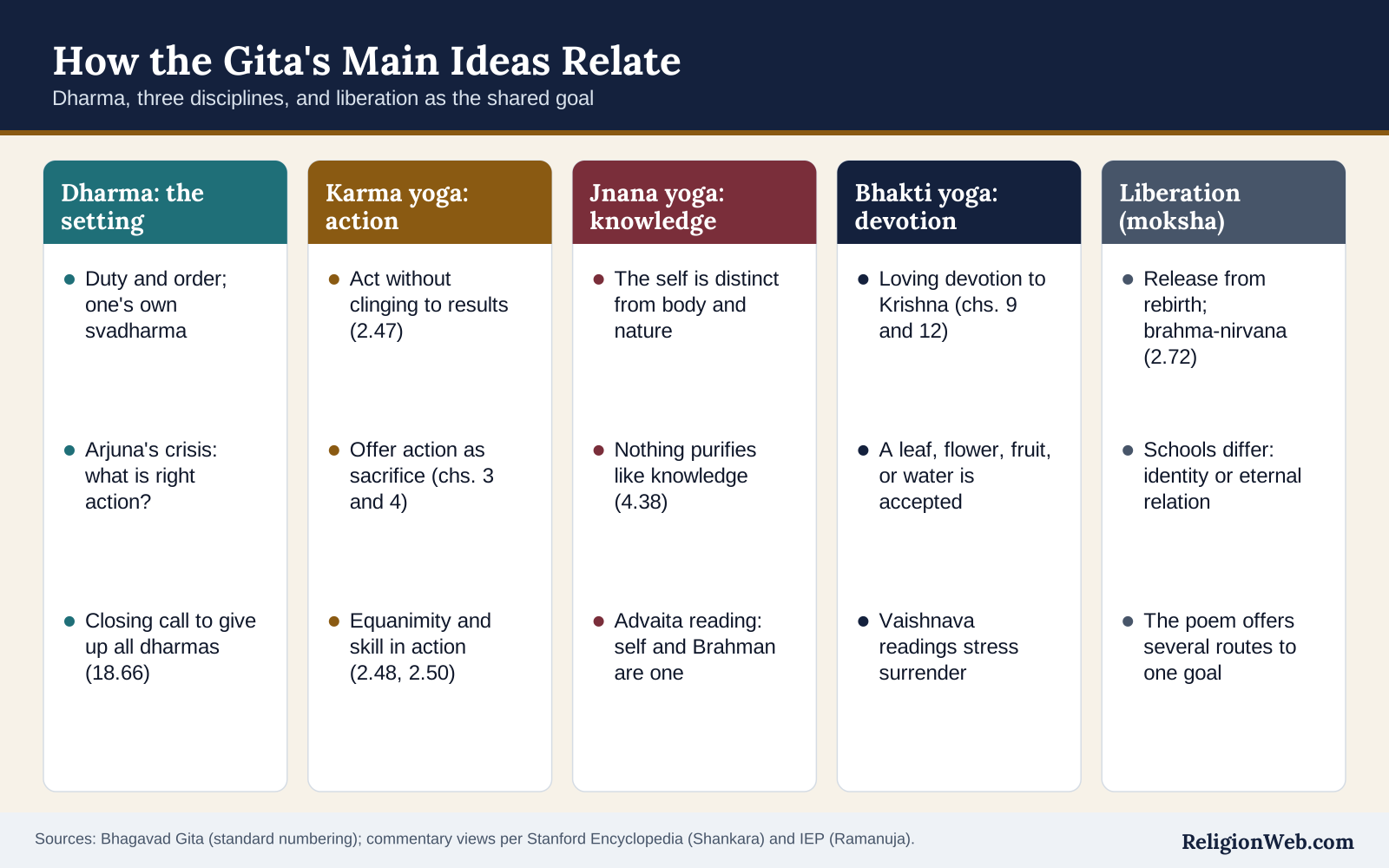
The Gita in the Modern World: Translation, Public Life, and Debate
The Gita has been read in Sanskrit for two thousand years, but its modern global presence begins with a specific event: the publication of an English translation in London in the eighteenth century. From that point, translations and readers multiplied, and the poem entered debates in India about reform, nationalism, and ethics, as well as the intellectual life of Europe and North America. This section follows that history and then turns to the continuing arguments about what the Gita permits and requires.
| Year | Event | Significance |
|---|---|---|
| 1785 | Charles Wilkins’s English translation published in London, with a preface by Warren Hastings | An early English translation of a Sanskrit work, issued under the authority of the East India Company |
| 1885 | Edwin Arnold’s verse translation, The Song Celestial | A widely read poetic version; Gandhi’s first reading of the Gita was in this translation |
| 1915 | Bal Gangadhar Tilak publishes Gita Rahasya in Marathi | Presents selfless action as the Gita’s central message |
| 1923 | Gita Press founded in Gorakhpur | Begins low-cost printing of the Gita and related texts |
| 1929 | Gandhi completes the introduction to Anasaktiyoga | Reads the Gita as a teaching of nonattachment, with the battlefield as an inner conflict |
| 1948 | Radhakrishnan’s edition with translation and notes | A scholarly Vedanta-oriented presentation for English readers |
| 1968 | Prabhupada’s Bhagavad-gita As It Is, abridged edition | Wide distribution of a Gaudiya Vaishnava reading |
| 2011 to 2012 | Tomsk court case on the Russian edition of As It Is | Court rejects the extremism claim; appeal court upholds |
| 2025 | UNESCO inscribes a Bhagavadgita manuscript collection in its Memory of the World Register | International recognition of documentary heritage |
Translators and Readers Beyond India
From Wilkins to Arnold
In 1785 Charles Wilkins, an official of the East India Company who had learned Sanskrit in Bengal, published The Bhagvat-Geeta, or Dialogues of Kreeshna and Arjoon in London. Library records note that it was published under the authority of the East India Company at the particular desire and recommendation of the Governor-General, Warren Hastings, who wrote the preface. That sponsorship reflects the colonial context: British administrators were interested in Sanskrit texts partly to understand the people they governed. For the next century, however, translations were also the work of missionaries, scholars, and Hindu reformers, and each framed the poem differently. Edwin Arnold’s verse version, The Song Celestial (1885), had an unusual reach, and it was the first Gita that Gandhi read, after two brothers he met in England invited him to study the text with them.
Writers, philosophers, and a physicist
Readers outside India took up the Gita in different ways. American writers of the nineteenth century, including Ralph Waldo Emerson and Henry David Thoreau, read it in Wilkins’s version and drew on it in their own work, and in the twentieth century writers such as Aldous Huxley and T. S. Eliot engaged with its ideas. The most widely discussed case is that of the physicist J. Robert Oppenheimer. He studied Sanskrit at Berkeley in 1933 with the scholar Arthur W. Ryder, listed the Gita in 1963 among the ten books that most shaped his philosophy, and said in a 1965 television documentary that a line from the Gita had come to mind when he watched the first atomic test in 1945: “Now I am become Death, the destroyer of worlds.”
The historian James Hijiya, in a study of Oppenheimer’s relationship to the Gita, notes that the physicist attributed the line to Vishnu and followed Ryder’s rendering “Death,” while most translators have translated the Sanskrit word kala as “Time.” Hijiya also traces how the quotation first appeared in print only in later accounts. For readers of the Gita, the context matters: the verse in the eleventh chapter concerns God’s power over time and the cosmos in a vision given to a warrior, and its use as a comment on nuclear weapons was one reader’s association, not a teaching of the poem. The episode shows how a single verse, lifted from its setting, can acquire a meaning very different from its place in the text.
Argument and Public Use in the Twenty-First Century
Does the Gita justify war?
The oldest and most persistent argument about the poem is whether it supports violence. Some readers argue that the text addresses a particular warrior in a particular situation, a war in which the epic presents negotiation as having failed, and that it does not offer a general license to fight. Others, like Gandhi, read the battlefield as an allegory of the inner struggle, and said that perfect renunciation requires perfect nonviolence even though the Gita was not written to establish it. Still others, like Tilak, read the poem as a call to engaged action in the world. Critics, including B. R. Ambedkar, have argued that the Gita’s reasoning, in which the imperishable self cannot truly be killed, can be turned into a justification for killing. These positions persist because each can point to different verses, and because the poem presents its teaching through a story that begins on a battlefield.
Oaths, courts, and public symbols
The Gita also appears in public life well beyond religious settings. In January 2013 Tulsi Gabbard, the first Hindu to serve in the United States Congress, took her oath of office on a copy of the Bhagavad Gita. The Russian court case of 2011 and 2012 over Bhagavad-gita As It Is, described earlier, became a diplomatic issue as well, with the Indian government calling the proposed ban absurd. In 2025 UNESCO’s decision to inscribe a manuscript collection of the Bhagavadgita in its Memory of the World Register brought the text to international attention as documentary heritage. In each case the Gita functioned as a symbol of Hindu identity or Indian culture, a role that can differ from its role in personal devotion, and that different Hindus may regard differently.
Common Misconceptions About the Bhagavad Gita
Because the Gita is so widely quoted, translated, and borrowed, it attracts claims that are repeated more often than they are examined. The four below are among the most common, and each contains something that explains why people believe it.
Misconception 1: The Gita is the single, Bible-like scripture that governs all Hindus
Where the misunderstanding comes from
It is easy to see why the idea arises. The Gita is short, self-contained, available in hundreds of editions, and often introduced in translation as “the Hindu Bible.” Gita Press, the Gorakhpur publisher that has printed tens of millions of copies, was described by Encyclopaedia Britannica as intended to be a Hindu counterpart to a Christian Bible society. Legislatures that have allowed oaths on the Gita, and colonial-era scholars who looked for a single canonical book to explain a tradition they found diffuse, reinforced the impression. The habit of describing religions by a single central book is common in Western discussion, and it does not fit every tradition equally well.
There is also a real basis for the Gita’s prominence. Many Hindu reformers of the nineteenth and twentieth centuries, and many teachers who spoke to international audiences, chose the Gita as the text they commended, because its message is concise and speaks to universal concerns. When a poem is chosen again and again as the introduction to a tradition, outsiders can reasonably infer that it is the tradition’s foundation, even though the choice reflects a particular history of presentation.
What the evidence and tradition actually show
Hindu traditions have no single canon and no central body that defines doctrine. The oldest sacred literature is the Veda, and the Upanishads, epics, law books, and Puranas each carry authority in different communities, as the page on Hinduism explains. Shaiva and Shakta communities rely on their own scriptures, such as the Agamas and Tantras, and regional devotional poetry carries great weight in many traditions. The Gita is highly authoritative in Vedanta, where it is one of the three canonical sources, and it is deeply loved in Vaishnava communities and in many reform movements. But its authority is not uniform, it does not legislate for ritual, law, or diet, and many Hindus know it mainly through selected verses or through teachers.
The poem also does not present itself as the sole source of truth. It describes its own teaching as handed down through a lineage of teachers, from the sun-god to Manu and to the royal sages (4.1 to 4.3), and in the thirteenth chapter it refers to the teaching of the sages in Vedic hymns and in the aphorisms on Brahman, which scholars take to be an allusion to the Brahma Sutras. The Gita presents itself as part of a larger body of teaching, and Hindu tradition has largely treated it that way, as one of several texts that different communities place in different relation to one another.
Misconception 2: Yoga in the Gita means only physical postures
Where the misunderstanding comes from
For most people outside India today, the word “yoga” suggests a class of stretching, breathing, and balance, and that association is understandable. The modern global practice of posture-based yoga is widespread and has often presented itself as the heir of ancient Indian wisdom. A reader who comes to the Gita expecting that meaning, because every chapter title ends in “yoga,” may assume that the poem is a manual of exercises.
Further confusion arises because the Gita is often mentioned in the same breath as Patanjali’s Yoga Sutras, another classical text that uses the word yoga for a very different system, an eightfold discipline aimed at stilling the activity of the mind. Popular books on yoga often blend the two, along with later hatha yoga manuals, into a single story of “yoga” without distinguishing the sources, so that the Gita’s meanings are easily lost.
What the evidence and tradition actually show
The Gita does not describe a system of physical postures. Its chapter on meditation mentions only a clean place, a firm seat, an upright and steady body, a gaze that does not wander, and a disciplined mind, and the word yoga is used across a range of meanings: equanimity in success and failure (2.48), skill in action (2.50), disciplined meditation, devotion, and union with the divine. Chapter titles such as “the yoga of knowledge” or “the yoga of devotion” use the word for a method of spiritual discipline in general. Elaborate systems of postures belong to later hatha yoga literature and to modern developments, which are described on the page on yoga in Hinduism. Anyone who practices physical yoga is not doing something the Gita forbids, but the Gita is not the source of the postures.
The picture is not entirely one-sided. The Gita does mention techniques of breath regulation, as one among several kinds of sacrifice in the fourth chapter and in a description of the meditator in the fifth, and it speaks of fixing the gaze and steadying the senses. These are practices of discipline, not a catalog of poses. The accurate statement is that the Gita’s yoga is a broad ethical, contemplative, and devotional discipline in which bodily steadiness plays a supporting role.
Misconception 3: Every commentator interprets Krishna’s teaching the same way
Where the misunderstanding comes from
Popular summaries often say “the Gita teaches” a single lesson, such as detachment, duty, or devotion, and translations sometimes blend the viewpoint of one commentary into the English without saying so. A beginning reader who picks up one edition can easily assume that its message is the message. The shared vocabulary of the commentators, and the fact that most of them revere the text, adds to the impression of consensus.
Translations that carry a school’s view are not always labeled. Some, such as Prabhupada’s, announce their perspective in the title and in extended purports; others present a Vedantic reading as simply “the translation.” A reader who does not know which tradition stands behind a given English rendering may not realize that another respected rendering says something different.
What the evidence and tradition actually show
The commentarial record shows sustained disagreement on important questions. Shankara reads the Gita as teaching liberating knowledge of the self’s identity with Brahman, with action serving to purify the mind. Ramanuja reads it as teaching devotion to a personal God from whom selves remain distinct. Madhva reads it as affirming an eternal difference between God and selves. Abhinavagupta reads it through Kashmir Shaivism, Jnaneshwar through a devotional Marathi lens, and modern interpreters such as Tilak, Gandhi, and Aurobindo emphasize selfless action, nonattachment, and an integral yoga respectively. Even the closing instruction, 18.66, is read as renunciation of all action, as surrender of agency, as renunciation of expiatory rites, or as exclusive devotion. These differences are not minor details; they reflect different philosophies, and respectful readers describe them as such.
There is common ground as well. All the major commentators treat the Gita as authoritative scripture, accept that the self is distinct from the perishable body, regard detachment from the results of action as a mark of spiritual maturity, and see liberation as the highest human aim. The disagreements concern the relationship between the self and God, the role of action, and the status of the world, and a fair account holds both the agreement and the disagreement in view.
Misconception 4: The Gita is simply a call to go to war
Where the misunderstanding comes from
The setting is a battlefield, the interlocutor is a warrior, and Krishna tells Arjuna to stand up and fight. Quoted without context, lines from the poem can sound like an endorsement of violence. Individual verses have also been used in political arguments and in popular culture, including in discussions of nuclear weapons, in ways that detach them from the dialogue’s frame. Readers meeting the poem through such quotations may take a few lines as the whole.
Arjuna’s own position at the start also invites debate. Some readers sympathize with his refusal and see Krishna’s reply as an argument against a humane instinct; others see Arjuna as a person in a paralysis that Krishna helps him to understand. The text lets both impressions arise, which is part of why the question never settles.
What the evidence and tradition actually show
Within the text, the instruction to fight is addressed to one person in one situation, and it is justified by that person’s duty as a warrior in what the epic presents as a war of last resort. The poem’s main subject is not war but how to act rightly when every option carries a cost, and its lists of admirable qualities include nonviolence, compassion, and freedom from hatred. Readers disagree about how far the argument extends. Some traditional commentators accept that it endorses a warrior’s duty in a just war. Gandhi read the battlefield as an inner struggle and wrote that the Gita was not written to establish nonviolence, though he argued that its ideal of renunciation could not be reached without it. Critics such as Ambedkar have argued that its reasoning can excuse killing. An accurate summary is that the poem has been used to support very different positions on violence, and that its own focus is on motive, duty, and the self, not on a general theory of war.
The epic around the Gita is also sober about war. Before the fighting, it narrates Krishna’s unsuccessful attempt at peace, and after the fighting it turns to the Stri Parva, the book of the women, which is devoted to the laments of the widows and mothers of the dead. The victorious Yudhishthira is described as overwhelmed by remorse. Whatever the Gita says about duty on the battlefield, the story that contains it does not present war as glorious.
Frequently Asked Questions About the Bhagavad Gita
Questions About the Text
How many chapters and verses does the Bhagavad Gita have?
The standard text has 18 chapters and 700 verses. Chapter lengths range from 20 verses (chapters 12 and 15) to 78 (chapter 18). The Gita is a section of the Bhishma Parva, the sixth book of the Mahabharata, where it appears as chapters 23 to 40 in the critical edition and 25 to 42 in the older vulgate numbering.
Some printed editions of the epic contain a tally that adds up to 745 verses, but no manuscript with that many verses has been found, and the figure of 700 is used almost everywhere.
Who wrote the Bhagavad Gita, and when?
Hindu tradition regards the sage Vyasa as the author or compiler of the Mahabharata, and it regards the Gita’s words as spoken by Krishna on the battlefield. Historians cannot identify an individual author. They treat the Gita as an anonymous composition within the growing epic, probably dated between about the fifth century BCE and the second century CE, with many favoring the last centuries BCE. Both statements can be true in their own terms, since one concerns how the community remembers the text and the other how scholars reconstruct its history.
Where did the dialogue take place?
According to the poem, it took place at Kurukshetra, on the first day of the eighteen-day war, between the two armies. Kurukshetra is a real district in Haryana, and Hindu tradition identifies specific places there, including Jyotisar, with the teaching.
Such sites reflect local tradition. Historians do not claim to have identified the exact spot, and the epic describes its setting in literary rather than topographical terms. For most readers, the significance of the place lies in the idea that a conversation about dharma took place in a field already regarded as sacred.
Questions About the Teaching
What is the main message of the Bhagavad Gita?
There is no single answer that every Hindu tradition accepts. Many readers summarize the message as acting according to one’s duty without clinging to the results, offering one’s actions to God. Advaita Vedanta emphasizes knowledge of the self’s identity with Brahman. Vaishnava traditions emphasize loving devotion and surrender to Krishna. Modern interpreters have stressed selfless action, nonattachment, or the unity of the paths. These emphases overlap, and the poem itself speaks of action, knowledge, and devotion as ways to the same goal.
The poem does not present its message as an order to be obeyed without reflection. Before the final instruction, Krishna tells Arjuna to consider the teaching fully and then do as he wishes (18.63), and Arjuna’s last reply is that his confusion is gone and that he will act.
What does the Gita say about karma and dharma?
In the Gita, karma means action and its consequences, and the poem teaches that action done without craving for results does not bind. Dharma means order and duty, including one’s own particular duty, svadharma. For the broader concepts, see the ReligionWeb.com pages on karma in Hinduism and dharma in Hinduism.
The Gita adds a distinctive emphasis to both ideas. It holds that the right response to the pull of consequences is not to abandon action but to change the spirit in which it is done, and that a person’s own duty, even imperfectly performed, is preferable to another’s performed well (3.35).
Is Krishna God in the Gita?
In the poem Krishna speaks as God, saying that he descends into birth whenever dharma declines and that he is the source of all. Vaishnava traditions understand Krishna as Vishnu, or as the supreme God himself, in personal form. Advaita thinkers understand him as the Lord (Ishvara) who is the highest manifestation of the one Brahman. Readers outside these traditions describe the claim as the poem’s own theological assertion, voiced by its central speaker.
Within the epic as a whole, Krishna also appears as a prince, a diplomat, and a charioteer, and the Gita is the place where the text’s claims about his divine nature are stated most directly. The page on Vaishnavism describes how devotion to him developed.
Questions About Reading and Practice
Which translation should a beginner read?
Translations differ in purpose. Verse versions, such as Edwin Arnold’s, convey rhythm and are in the public domain. University translations, such as those by Barbara Stoler Miller or J. A. B. van Buitenen, aim to be faithful to the Sanskrit and to the poem’s period. Translations with commentary, such as those of Radhakrishnan, Swami Gambhirananda, or Prabhupada, present a particular philosophical reading, and are best read knowing which one. Many readers find it helpful to read one plain translation and then one with commentary, and to notice where they differ.
Because single words such as yoga and dharma carry several senses, an edition with notes or a glossary is often more useful than a stylish rendering. The poem is short enough to read in a single afternoon, and many editions print the Sanskrit beside the translation for readers who want to compare.
Do Hindus have to read or recite the Gita?
No rule requires every Hindu to read the Gita. It is a revered and widely used text, but practice varies from regular daily recitation to occasional reading or no direct reading at all. Participation in Hindu life does not depend on it.
In monastic orders and in devotional movements that emphasize daily scripture reading, the Gita is part of a regular discipline. In many families it is a text that people meet through sermons, festivals, or elders. Neither pattern is more authentic than the other.
When is Gita Jayanti?
Gita Jayanti falls on the eleventh lunar day of the bright fortnight of the month of Margashirsha, usually in December. Because it follows the lunar calendar, the Gregorian date changes every year, and the date should be confirmed in a local almanac.
Observance varies, as described earlier in this article: readings, lectures, group recitations, and the festival at Kurukshetra. Some communities pair the day with the fast that is customary on ekadashi, which is a separate custom from the Gita itself.
Conclusion: A Dialogue That Keeps Being Reopened
What the History of the Gita Shows
A teaching embedded in a story
The Bhagavad Gita began as a short, self-contained section inside a vast epic, and the story around it continues to shape its meaning. The reader meets a man who cannot act, a friend who answers him at length, and a blind king who hears about it afterward. Its teaching on the self, duty, action, knowledge, and devotion is presented as the answer to a specific crisis, and that is a large part of why the poem has seemed relevant to so many different people in crisis.
A text read in many ways
Over more than a thousand years, scholars and teachers in different traditions have found different centers in the same eighteen chapters, from the knowledge of Shankara to the devotion of Ramanuja and Madhva, the Shaiva reading of Abhinavagupta, and the active ethics of Tilak and Gandhi. That variety is not a flaw to be corrected. It is the history of a text that Hindus have taken seriously enough to argue about for centuries.
How to Keep Exploring
Reading the Gita with a translation and a commentary
A good way to approach the text is to read a complete translation in one sitting, to get the arc of the dialogue, and then to return to the chapters that matter most with a commentary from a tradition one wants to understand. Noticing where translators and commentators differ often teaches more than any single reading.
Related pages on ReligionWeb.com
The broader context for the Gita appears in the page on Hinduism, in the account of the Vedas and Upanishads from which it draws, and in the pages on yoga, karma, and dharma. The devotional world around Krishna is described in the page on Vaishnavism, and the festival of colors associated with Krishna’s stories is explained on the page for Holi.
Sources
The table below lists the principal external sources behind this article. Facts, dates and figures were checked against these and related primary, institutional and academic materials.
| # | Source | Publisher and type | Used for | Link |
|---|---|---|---|---|
| 1 | The Song Celestial; Or, Bhagavad-Gita (from the Mahabharata), trans. Sir Edwin Arnold (1885), eBook #2388 | Project Gutenberg · Primary text (public-domain translation) | Quotations from Chapters II, III, IX and XI (2.20, 3.35, 9.26-27, 11.32); chapter order and wording | gutenberg.org |
| 2 | Bhagavadgita (Wendy Doniger; last updated September 26, 2026) | Encyclopaedia Britannica · Encyclopedia | Definition: episode of the Mahabharata; dialogue of Arjuna and Krishna, an avatar of Vishnu | britannica.com |
| 3 | Bhagavad Gita: verse-by-verse text and commentary (verses 1.1, 2.50, 4.13, 5.18, 6.23, 9.32, 18.75, 18.78) | JKYog (holy-bhagavad-gita.org), Swami Mukundananda · Primary text (verse locators) | Verse numbers and speakers used for paraphrases; Sanjaya's report by Vyasa's grace (18.75) | holy-bhagavad-gita.org |
| 4 | Shankara | Stanford Encyclopedia of Philosophy · Academic reference | Shankara's date, Gita commentary, view of karma yoga and knowledge; the prasthanatrayi | plato.stanford.edu |
| 5 | Ramanuja (c. 1017 – c. 1137) | Internet Encyclopedia of Philosophy · Academic reference | Ramanuja's dates, bhakti yoga reading of the Gita, interpretation of the closing verse | iep.utm.edu |
| 6 | Introduction to Anasaktiyoga, M. K. Gandhi (Gujarati commentary on the Gita, 1929; English text) | Gandhi's Gujarati commentary, English text hosted by Alastair McIntosh · Primary text (modern commentary) | Gandhi's first reading of the Gita (1888-89), view of the Mahabharata, nonviolence, forty years of study | mail.alastairmcintosh.com |
| 7 | The Gita of J. Robert Oppenheimer (James A. Hijiya), Proceedings of the American Philosophical Society, 2000 | American Philosophical Society (copy on Internet Archive) · Academic article | Oppenheimer's Sanskrit study, Ryder's translation, the 1965 broadcast, history of the quotation | ia802907.us.archive.org |
| 8 | The Bhagvat-Geeta: or, Dialogues of Kreeshna and Arjoon (Charles Wilkins, London: C. Nourse, 1785), library record | The Morgan Library & Museum · Library catalog record | 1785 London edition; East India Company authority; Warren Hastings's preface | themorgan.org |
| 9 | UNESCO Adds Bhagavadgita and Natyashastra to Memory of the World Register | United Nations in India (22 April 2025) · Institutional | 2025 inscription of the Manuscript Collection of the Bhagavadgita; 74 new inscriptions, register total 570 | india.un.org |
| 10 | Gita Press | Encyclopaedia Britannica · Encyclopedia | Founding in Gorakhpur on April 29, 1923; about 40 million copies of the Gita printed by the late twentieth century | britannica.com |
Last fact-check date: 2026-10-21.