Krishna is one of the most widely loved deities in Hinduism, and he is unusual in how many different faces he shows. To his devotees he is the newborn in a prison cell, the mischievous child who steals butter, the young cowherd whose flute draws people out of their homes, the king of Dwarka, and the charioteer who speaks the Bhagavad Gita to Arjuna on the eve of battle. Many Vaishnava traditions, the communities centered on Vishnu and his forms, regard him as an avatara (a descent or “coming down”) of Vishnu. Others teach that he is the original and supreme form of God, from whom Vishnu himself proceeds.
That difference in emphasis is one reason a single answer to “Who is Krishna?” is never quite enough. The texts that describe him belong to different centuries and genres. The Mahabharata presents a statesman and teacher. The Bhagavata Purana, composed many centuries later, lingers over his childhood and youth in the cowherd settlements of Braj. Poets in Tamil, Hindi, Bengali, Marathi, Gujarati, Kannada, Assamese, and Malayalam then built entire devotional literatures on particular moments of those stories. The result is not a contradiction. It is a long conversation among communities who each found a different Krishna to love.
This article follows that conversation in order. It separates what historians can say about the early evidence for Krishna from what devotional tradition teaches, explains the main stories and the theology of bhakti (loving devotion) that grew around them, and describes how Krishna is worshiped today in temples, homes, songs, and festivals. It also explains where major Vaishnava schools, such as those described in the article on Vaishnavism, differ from one another, because that is where most popular misunderstandings begin. Readers interested in the birth festival specifically will find a dedicated treatment in the article on Krishna Janmashtami.
Krishna at a Glance
Who Krishna Is in Hindu Devotion
A deity with several faces
The Sanskrit word krishna means “dark,” “black,” or “dark blue,” and in art his skin is usually painted the color of a rain cloud. In devotional language the same word is a name of God, in the way that other traditions use titles for the divine. Krishna is described as the son of Devaki and Vasudeva of the Yadava (Vrishni) clan, born in Mathura in northern India and raised by the cowherd couple Nanda and Yashoda in the pastoral settlements of Gokula and Vrindavan. He is the younger brother of Balarama, the nephew who ends the reign of his tyrannical uncle Kansa, the founder of a city at Dwarka on the western coast, and the friend and counselor of the Pandava princes in the Mahabharata.
Devotees often sort these roles into three overlapping images. The first is the divine child, Bala Gopala, whose butter thefts and games delight his foster mother and neighbors. The second is the youthful cowherd, Venugopala, who plays the flute on the banks of the Yamuna and is loved above all by the gopis, the women and girls of the cowherd community. The third is the teacher and charioteer, Parthasarathi, who guides Arjuna on the battlefield of Kurukshetra. These three images belong to different parts of the literature and appeal to different moods of devotion, which is why some temples and lineages concentrate almost entirely on one of them.
Krishna and Vishnu: two ways of speaking
Britannica describes Krishna as worshiped both as the eighth avatar of Vishnu and as a supreme god in his own right, and both statements are accurate descriptions of living practice. In the widely used list of ten avatars of Vishnu, Krishna is the eighth, following figures such as Rama and Narasimha. Vaishnava communities that stress the worship of Vishnu or Narayana with his consort Lakshmi, such as the Sri Vaishnava tradition, generally teach that Krishna is a full descent of that one God. Communities centered on Krishna, such as the Gaudiya and Pushtimarg traditions discussed later in this article, teach that Krishna is the source and highest form of the divine. Each tradition explains the relationship through its own reading of the scriptures.
It helps to keep both ways of speaking in view. A Krishna temple in Gujarat, a Vishnu temple in Tamil Nadu that also honors Krishna, and an ISKCON center in Europe may all be looking at the same stories, but they will not always describe the theology in the same words. Later sections describe these differences with attribution so that no single school is presented as the voice of all Hindus.
Names and Titles
What the main names mean
Krishna has hundreds of names, and many of them are compact summaries of a story or a place. The table lists some of the most familiar. Etymologies of Sanskrit names are often debated, and different commentators propose different explanations for a name such as Govinda or Keshava, so the table gives the glosses most commonly offered and notes where they vary.
| Name or title | Common gloss | Associated story or place |
|---|---|---|
| Krishna | “Dark one” or “dark blue” | The general name used in epic, Purana, and song |
| Govinda, Gopala | Protector or keeper of cows; “cowherd” | Life among the herders of Gokula and Vrindavan; Govinda has other proposed explanations |
| Vasudeva, Devakinandana | Son of Vasudeva; delight of Devaki | His birth in Mathura; also the name under which the deity appears in early inscriptions |
| Madhava, Keshava | Descendant of Madhu; “of the beautiful hair” or slayer of the demon Keshi | Used in prayers and temple names across India; glosses differ |
| Hari | “One who takes away” (sorrow, sin) | A name shared with Vishnu; central to the mantra of the Hare Krishna movement |
| Muralidhara, Venugopala | Bearer of the flute | The flute at Vrindavan; popular in painting and dance |
| Giridhari, Govardhanadhari | Bearer of the mountain | The lifting of Govardhan Hill; strong in Braj and Pushtimarg worship |
| Damodara | “With a rope around the belly” | Yashoda binding the child to a mortar; honored in the month of Kartik in several traditions |
| Parthasarathi, Yogeshvara | Arjuna’s charioteer; “lord of yoga” | The Bhagavad Gita and the battle of Kurukshetra |
| Dwarkadhish, Ranchhod | Lord of Dwarka; “one who left the battlefield” | The city of Dwarka in Gujarat; Ranchhod is a Gujarati devotional name |
| Jagannath, Vitthal, Shrinathji | Regional forms with local names | Puri in Odisha, Pandharpur in Maharashtra, Nathdwara in Rajasthan |
Names that point to places and local forms
The last row of the table shows something unusual about Krishna devotion. In several regions, the deity is known under a local name that has its own temple, festival calendar, songs, and food offerings, and many devotees would hardly think to call the local form “Krishna” at all. Jagannath in Odisha is understood by Vaishnavas as Krishna in a wooden form, and Vitthal of Pandharpur is understood by the Varkari tradition of Maharashtra as Krishna or Vishnu standing on a brick. Banke Bihari in Vrindavan, Dwarkadhish in Dwarka, Udupi Krishna in Karnataka, and Guruvayurappan in Kerala are others. Later sections return to several of them. For the moment, it is enough to notice that the name “Krishna” works like an umbrella over a very large number of local devotions.
Where and How Krishna Is Worshiped Today
A pan-Indian figure with regional centers
Krishna is honored throughout India, but the strength and style of devotion vary by region. The Braj region around Mathura and Vrindavan in Uttar Pradesh is the heartland of the childhood and youth stories. Gujarat and Rajasthan are strongly associated with Dwarka, Nathdwara, and the devotional poetry of Narsinh Mehta and Mirabai. Odisha and West Bengal centered devotion on Jagannath and on the teacher Chaitanya, while Assam developed its own Krishna devotion through the saint Sankardeva. In Maharashtra the Varkari pilgrimage tradition centers on Vitthal, and Karnataka and Kerala have the temples of Udupi and Guruvayur. The Pew Research Center’s survey of Indian adults, conducted from late 2019 to early 2020, found regional differences in which deities Hindus said they felt closest to, with Krishna reported at a notably higher level in the Northeast than in the South. The survey asked about personal closeness, not about whether people honor Krishna at all, so the results should not be read as a measure of how many Hindus worship him.
Krishna beyond India
Hinduism had nearly 1.2 billion adherents worldwide in 2020, according to the Pew Research Center’s 2025 report on the global religious landscape, with about 95 percent of them living in India. Krishna devotion accompanied Hindu communities to Southeast Asia, the Caribbean, Africa, Fiji, the United Kingdom, and North America, where temples of several lineages now operate. It has also spread among people who did not grow up Hindu, especially through the International Society for Krishna Consciousness (ISKCON), founded in New York in 1966 by A. C. Bhaktivedanta Swami Prabhupada, which belongs to the Gaudiya Vaishnava lineage. No reliable global count of Krishna devotees exists, because most Hindus who honor Krishna do so alongside other deities, and the census and survey categories do not record that.
Krishna in History and Early Texts
What Historians Can and Cannot Say
The question of a historical Krishna
Devotional tradition treats Krishna’s appearance on earth as an event in sacred history. Traditional chronologies place it at the junction of the third and fourth ages of the world, with some Hindu reckonings counting the present age, the Kali Yuga, from a date corresponding to 3102 BCE. Historians do not use that reckoning, and no inscription, coin, or text from Krishna’s supposed lifetime has been identified. What survives is a body of literature, composed and revised over many centuries, that describes him. Scholars therefore tend to speak about the development of Krishna traditions and not about the biography of a documented individual, and many keep an open mind about whether an early chieftain or teacher of the Vrishni clan stands somewhere behind the later accounts. The evidence does not allow a confident answer either way.
This is an important distinction for a reference article. When this page says “the Mahabharata describes” or “the Bhagavata Purana narrates,” it is reporting what a text says. When it says “devotees understand” or “the tradition teaches,” it is reporting belief. The two are placed side by side because they are both part of the subject, and neither is presented as the voice of the editor.
A composite figure in scholarly reconstruction
A widely cited scholarly reconstruction, associated with early twentieth-century Indologists such as R. G. Bhandarkar and developed by many later writers, proposes that the Krishna of Hindu devotion merges several earlier strands. One strand is Vasudeva, a deity of the Vrishni (Satvata) people who was worshiped with a devotional ritual often called Bhagavata or Pancharatra worship. A second is Krishna, the hero of the Yadava clan and counselor in the epic. A third is the cowherd child and youth of the pastoral stories, often called Gopala. A fourth is the cosmic deity Narayana, who became identified with Vishnu. According to this reconstruction, over time these were joined and identified with Vishnu. Not all scholars accept every step, and Vaishnava teachers generally regard the unity of Krishna as given by revelation, not assembled by history. The reconstruction is best treated as one useful model of how the traditions might have fused, not as established fact.
Earliest Traces in Inscriptions and Texts
Early references to Krishna and Vasudeva
The earliest texts that scholars connect to Krishna are brief. A passage in the Chandogya Upanishad (3.17) mentions a teacher’s student called “Krishna, son of Devaki,” and some historians and many Vaishnava commentators have identified him with the later deity, although the identification is debated and the passage says nothing about divinity. The grammarian Panini, traditionally placed in about the fifth or fourth century BCE, includes a rule in his Ashtadhyayi that scholars read as referring to followers of Vasudeva, and later commentary on it suggests that Vasudeva and Arjuna were objects of devotion. Both references are cited in standard histories of Vaishnavism, but they depend on interpretation, and the reader should treat them as suggestive rather than decisive.
The Heliodorus pillar
The most often cited early inscription is a stone pillar at Besnagar, near Vidisha in central India, usually dated to roughly the second century BCE. Its Prakrit inscription records that Heliodorus, an ambassador from the Indo-Greek king Antialcidas, set up a Garuda column for “Vasudeva, god of gods,” and calls himself a Bhagavata, a devotee of the Lord. The inscription is valuable because it is datable evidence that a Greek-named man from the northwest embraced the worship of Vasudeva well before the Common Era. It does not mention cattle, flutes, or the Gita, so it tells us about an early form of devotion and not about the later childhood stories. Scholars disagree about how closely this Vasudeva corresponds to the Krishna of the epic, and the details of the inscription are best checked in a specialist epigraphic study.
How the Stories Grew: Epic, Harivamsa, and Puranas
From the Mahabharata to the Harivamsa
In the Mahabharata, Krishna is a political leader and ally, a cousin and brother-in-law of the Pandavas (Subhadra, Arjuna’s wife, is his sister), and the person who persuades, warns, and counsels. The epic itself reached its present form over a long period, and scholars commonly place its growth somewhere between the last few centuries BCE and the early centuries CE, with the Gita embedded in the Bhishma Parva, its sixth book. Within the epic, Krishna’s status ranges from respected counselor to the supreme God, depending on the passage, and critical scholars have long debated which layers are older. The childhood stories are largely absent from the main epic text. They appear in the Harivamsa, a long supplement that Britannica describes as a fifth-century CE appendix to the Mahabharata, which narrates Krishna’s birth, his boyhood among the herders, and his life in Dwarka.
The Puranas and the Bhagavata
The Vishnu Purana, whose fifth book recounts Krishna’s life, belongs to the first millennium CE, and its version of the cowherd stories is shorter and less lyrical than the later Bhagavata. The Bhagavata Purana, by the account in Britannica, is generally dated to around the tenth century CE and probably came from the Tamil region, though earlier proposals exist. It has about 18,000 verses in twelve books, and its tenth book, which tells the life of Krishna from birth to Mathura, Dwarka, and the Yadava departure, makes up roughly a quarter of the whole. Its influence on later devotion is hard to overstate: the Gaudiya and Pushtimarg traditions, the poets of Braj, and much of Indian classical dance and miniature painting all draw on its narrative. Section after section of this article refers to it for that reason.
| Text or body of literature | Approximate date (scholarly range) | Krishna in this literature |
|---|---|---|
| Mahabharata, including the Bhagavad Gita | Grew over centuries, roughly the last centuries BCE to early centuries CE | Statesman, ally, and charioteer; teacher of Arjuna; revealed as God in the Gita and other passages |
| Harivamsa | About the fifth century CE per Britannica; parts may be earlier | Birth, boyhood among the herders, conflict with Kansa, Dwarka |
| Vishnu Purana, Book 5 | First millennium CE | A concise Krishna biography, including the childhood and the dance with the gopis |
| Bhagavata Purana, especially Book 10 | Probably about the tenth century CE per Britannica | Detailed childhood, Govardhan, the rasa dance, Mathura, Dwarka, and the departure |
| Alvar hymns, including those of Periyalvar and Andal | Tamil poems of the seventh to tenth centuries | Cradle songs, cowherd imagery, and bridal devotion in Tamil |
| Gita Govinda of Jayadeva | Twelfth century, eastern India | Sanskrit lyric poem centered on the love of Radha and Krishna |
| Poetry of Surdas, Mirabai, Narsinh Mehta, and others | Roughly fifteenth to sixteenth centuries and after | Songs in Braj Bhasha, Rajasthani, and Gujarati on childhood and longing |
| Chaitanya Charitamrita and Gaudiya Sanskrit works | Sixteenth and early seventeenth centuries | Biography of Chaitanya and the theology of Krishna devotion in Bengal |
From Texts to Devotional Movements
The southern hymns and the northern poets
By the time the Bhagavata took its present form, Krishna had been the subject of devotional song in Tamil for several centuries. The Alvars, the twelve Tamil poet-saints of Vaishnavism, composed hymns between roughly the seventh and tenth centuries, and the collection compiled by Nathamuni, the Divya Prabandham, is recited in many south Indian Vaishnava temples. Among them, Periyalvar wrote as a mother singing to the infant Krishna, and Andal, the one woman among the Alvars, wrote as a young woman who wants to marry him. From the twelfth century onward poets such as Jayadeva in the east and, later, Surdas, Mirabai, and Narsinh Mehta in the north and west carried similar themes into Sanskrit, Braj Bhasha, Rajasthani, and Gujarati.
The great teachers and the institutional lineages
The same centuries produced the teachers who organized Krishna devotion into schools of thought: Ramanuja in the south, Madhva in Karnataka, Nimbarka and Vallabha in the north, and Chaitanya in Bengal. The dates of several are still debated, which is why this article gives them only approximately. Their schools, called sampradayas, are described in a later section. What matters here is that Krishna devotion was not simply handed down; it was argued over, systematized, and sung in the vernacular by communities who disagreed about philosophical details while sharing a love of the same stories.
Krishna in the Mahabharata and the Bhagavad Gita
Krishna’s Role in the Epic
Counselor, envoy, and kinsman
In the Mahabharata, the long Sanskrit epic of the rivalry between the Pandava and Kaurava cousins for the throne of Hastinapura, Krishna is neither king of the contested territory nor a member of either family. He is a Yadava ruler from the west who is bound to the Pandavas by kinship and friendship. He attends the marriage of Draupadi, helps the Pandavas found their city at Indraprastha, and stands beside Yudhishthira as an adviser. When war approaches, he goes as an envoy to the Kaurava court to propose a settlement, which is refused. In a well-known episode of the Udyoga Parva, both sides ask for his help and he offers a choice between his large army and himself as an unarmed counselor. Arjuna chooses Krishna, and Duryodhana is happy to take the army. That choice, as the tradition tells it, is the beginning of the charioteer relationship.
The epic presents Krishna in this role as shrewd and sometimes morally uncomfortable. He advises tactics in the war that the Pandavas’ own elders question, and several characters, among them the queen Gandhari after the war, hold him responsible for the scale of the destruction. Scholars and devotional commentators have read these passages in different ways. Some critical scholars see the layers of the epic as preserving an older figure, a clever political actor, onto which the stature of a supreme god was later added. Devotional readers usually take the episodes as part of Krishna’s divine play and his responsibility for the restoration of order, while acknowledging that the epic never makes the moral question easy.
Krishna and the questions the epic leaves open
The Mahabharata is famous for refusing simple answers about duty, and Krishna’s presence is part of that refusal. He is sometimes shown as the voice of dharma, sometimes as the one who bends the rules in order to protect it, and sometimes as the one against whom the characters’ grief is directed. Readers who come to the epic after the Bhagavata Purana, with its tender childhood scenes, often find the Krishna of the Mahabharata surprisingly formal and political. That contrast is a good example of why this article treats texts one at a time. The epic is concerned with law, kingship, and the cost of war. The Bhagavata is concerned with love. Both belong to the same devotional tradition, and each is read with the other in view.
What the Gita Says About Krishna Himself
The speaker who describes himself
The Bhagavad Gita occupies eighteen chapters of the Bhishma Parva and consists of the dialogue between Arjuna and Krishna in the moments before the fighting begins. Its first chapters are about Arjuna’s grief and the question of duty, but from the fourth chapter onward Krishna begins to speak about who he is. In the fourth chapter, in paraphrase, he says that he is unborn and imperishable, that he takes visible form by the power of his own nature whenever dharma declines, and that he does so to protect the good and restore order. Vaishnava teachers of many lineages cite these verses as the scriptural basis for the doctrine of the avatara. In the tenth chapter, Krishna describes himself as the source and inner presence of all beings. In Edwin Arnold’s 1885 translation, he says:
I am the Spirit seated deep in every creature’s heart;
From Me they come; by Me they live; at My word they depart!Bhagavad Gita, trans. Edwin Arnold, The Song Celestial (1885), Chapter X (corresponding to 10.20), Project Gutenberg edition
Arnold writes in the rhyming verse of the Victorian period and does not number verses, but the sense is clear. Krishna presents himself as the indwelling reality of every living being and the source from which the world proceeds. Commentators agree that this is a high claim and differ about its exact meaning. Advaita Vedanta readings associated with Shankara stress that the speaker is Brahman, the one reality, speaking through the person of Krishna. Ramanuja reads the passage as the voice of Vishnu, the personal God who has the world and the souls as his body. Gaudiya commentators read Krishna as God in his original and most intimate form. These readings are described more fully in the dedicated Gita article, which is the right place to follow the philosophical argument chapter by chapter.
The universal form and the gentle human form
The eleventh chapter is the one most often associated with the Gita’s image of Krishna. Arjuna asks to see the divine form, and Krishna grants him a vision of the entire cosmos with innumerable faces and eyes, in which warriors rush into devouring mouths. Arjuna is overcome and asks to be shown the familiar figure again. Arnold renders Krishna’s answer as follows:
Let no more trouble shake thy heart, because thine eyes have seen
My terror with My glory. As I before have been
So will I be again for thee; with lightened heart behold!
Once more I am thy Krishna, the form thou knew’st of old!Bhagavad Gita, trans. Edwin Arnold, The Song Celestial (1885), Chapter XI (corresponding to 11.49-51), Project Gutenberg edition
Arjuna replies, in Arnold’s rendering, that on seeing the “friendly human frame” his mind can think calm thoughts once more. Devotional readers have long drawn a lesson from this exchange. The vision of the universal form shows who Krishna is, but the friend who drives the chariot is the form that Arjuna can love and trust. For communities whose practice centers on the intimate and approachable Krishna, the passage confirms that the human form is not a lesser appearance but the one in which God chooses to be loved. Commentators who emphasize the oneness of the self with Brahman read the same scene as a lesson about the limits of any form to contain the reality that the vision points to. Both readings take the text seriously, and both are held within Hinduism.
How Traditions Read Krishna’s Teaching of Devotion
Bhakti in the twelfth chapter
The twelfth chapter turns from vision to practice. Arjuna asks whether it is better to worship Krishna as a personal Lord or to meditate on the unmanifest, and Krishna replies in terms that Vaishnava teachers cite constantly: those who fix their minds on him with faith are the most perfectly joined to him, though the path of the unmanifest is also acknowledged to be difficult for embodied beings. The chapter then lists the qualities of the devotee whom Krishna loves. Arnold renders part of the description in these lines:
Who hateth nought
Of all which lives, living himself benign,
Compassionate, from arrogance exempt,
Exempt from love of self, unchangeable
By good or ill; patient, contented, firm
In faith, mastering himself, true to his word,
Seeking Me, heart and soul; vowed unto Me,—
That man I love!Bhagavad Gita, trans. Edwin Arnold, The Song Celestial (1885), Chapter XII (corresponding to 12.13-14), Project Gutenberg edition
This description of the ideal devotee centers on character, not on ritual. It describes gentleness toward all living beings, freedom from self-regard, steadiness, and trust. For that reason the passage is often cited when Hindu teachers discuss the ethics of devotion, not only its rituals. Within the tradition, it is also read as a bridge between the Gita’s path of disciplined action and the later devotional movements, which emphasized that the heart’s turn toward God matters more than status or learning. The article on yoga in Hinduism places the Gita’s three paths of action, knowledge, and devotion in the larger history of the word yoga.
Surrender and the closing teaching
In the final chapter, Krishna gives what many Vaishnava traditions regard as the center of the teaching. In paraphrase, verses 18.65 and 18.66 invite Arjuna to fix his mind on Krishna, to worship him and honor him, and to take refuge in him alone, with the assurance that Krishna will free him from all that burdens him. The Sanskrit phrase often translated “abandon all dharmas” has been understood in different ways. Some commentators read it as renouncing the fruits and the sense of ownership in actions. Others read it as a statement of surrender that supersedes every other means. The article on dharma in Hinduism explains why that word resists a single English equivalent. Whatever reading is taken, the verses became a reference point for the doctrines of grace and surrender (prapatti or sharanagati) found in several Vaishnava schools.
The End of Krishna’s Earthly Story
The fall of the Yadava clan
The Mahabharata does not end with the victory of the Pandavas. In the Mausala Parva, thirty-six years after the war according to the epic’s own count, the Yadava clan of Dwarka destroys itself in a quarrel at the pilgrimage place of Prabhasa on the western coast. The epic links the event with a curse, and in later Puranic versions with the earlier curse of Gandhari. Balarama departs, and Krishna sits in the forest. A hunter named Jara mistakes his foot for a deer and wounds it, and Krishna, who forgives him, leaves the world. The epic then describes the sea flooding Dwarka. These are the episodes on which Puranic chronologies base their claim that the Kali Yuga began at about this time.
How devotees understand the departure
Because Krishna is understood by his devotees as unborn and undying, the narrative of his death is read as a withdrawal and not as an end. The Bhagavata Purana, in its eleventh book, gives an extended final teaching to Krishna’s friend Uddhava before he leaves, in which devotion is again set at the center. In many Gaudiya and Pushtimarg communities, the emphasis falls instead on the fact that Krishna never really leaves Vrindavan, where, in their understanding, his youthful play continues eternally. These views are reported here as the beliefs of the communities that hold them. Historians would point only to the composite nature of the texts and the fact that they do not agree on every detail.
Childhood and Youth: The Stories of Gokula and Vrindavan
Birth and the Hidden Childhood
The prison, the crossing, and Gokula
The Harivamsa, the Vishnu Purana, and the Bhagavata Purana tell the story of Krishna’s birth with the same outline. Kansa, the king of Mathura, has been warned that the eighth child of his cousin Devaki will cause his death, and he imprisons Devaki and her husband Vasudeva and kills their children one by one. When the eighth child is born at midnight, Vasudeva carries him through the dark and flooded night across the Yamuna River to the cowherd settlement of Gokula and exchanges him for the newborn daughter of Yashoda and Nanda. In the Bhagavata the girl is Yogamaya, the divine power of illusion, who escapes from Kansa’s hands and warns him that his destroyer lives elsewhere. Several traditions identify this girl with the goddess honored in the Vindhya hills and with forms of the goddess described in the article on Durga, which is one of the places where Vaishnava and Shakta storytelling overlap. The birth narrative and the way it is celebrated each year are described in the article on Janmashtami.
What follows is a childhood in hiding. Nanda and Yashoda raise the child and his elder half-brother Balarama in a community of herders who depend on cattle and have no idea who he is. Devotional tradition values this obscurity. The infinite God, it says, chose to be raised by ordinary people and to be loved as a son before he was worshiped as a lord.
The demons and the early deeds
Kansa sends a series of agents to find and kill the child, and the narratives recount them in an order that varies slightly from text to text. Putana, a demoness disguised as a nurse, comes with poison on her breast and is herself drained of life. Trinavarta appears as a whirlwind, and the cart demon Shakata is kicked apart by the infant. Later, as a boy, Krishna defeats the crane Baka, the serpent Agha, and the horse Keshi, from whose defeat the name Keshava is sometimes explained. The Bhagavata presents these episodes in quick succession and with little suspense because they are not meant to build to a climax. They are signs, retold at every katha or recitation, that the child is protected by what he is.
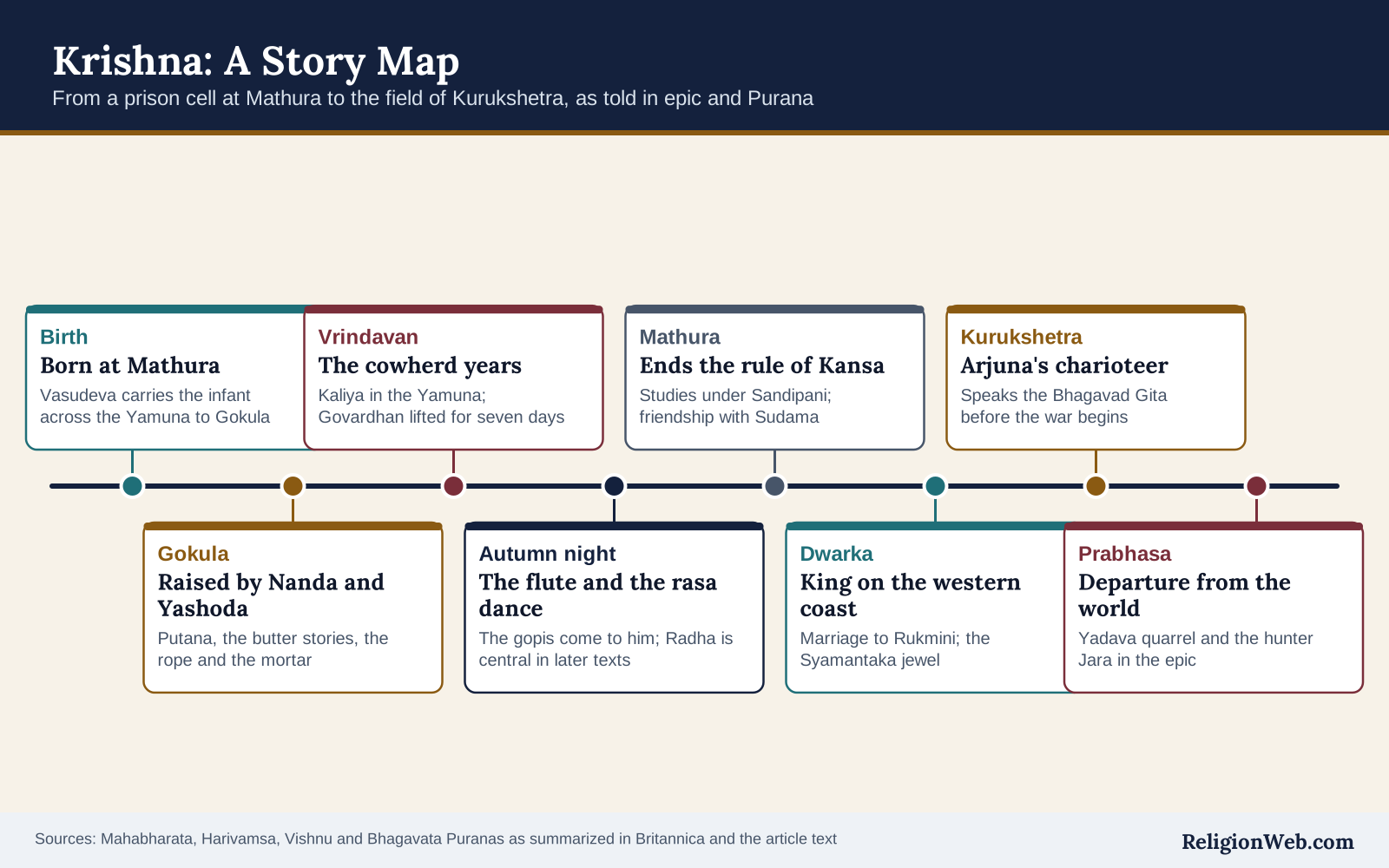
| Phase | Setting | Principal episodes | Chief sources |
|---|---|---|---|
| Birth and escape | Mathura prison, the Yamuna, Gokula | Midnight birth, Vasudeva’s crossing, exchange with Yashoda’s daughter | Harivamsa, Vishnu Purana, Bhagavata Purana, Book 10 |
| Infancy and childhood | Gokula and Vrindavan | Putana, Shakata, butter stealing, the mortar and the rope, Kaliya | Harivamsa, Vishnu Purana, Bhagavata Purana |
| Cowherd youth | Vrindavan, Govardhan, the Yamuna bank | Lifting Govardhan, the flute, the rasa dance with the gopis | Vishnu Purana Book 5; Bhagavata Purana 10.21-33; later poetry |
| Return to Mathura | Mathura | Ending Kansa’s rule, studying under Sandipani, friendship with Sudama | Harivamsa, Vishnu Purana, Bhagavata Purana |
| Dwarka and kingship | Dwarka on the western coast | Marriage to Rukmini and others, the Syamantaka jewel, Naraka | Mahabharata, Harivamsa, Bhagavata Purana |
| Kurukshetra | Hastinapura, Kurukshetra | Envoy to the Kauravas, Arjuna’s charioteer, the Bhagavad Gita | Mahabharata, especially Udyoga and Bhishma Parvas |
| Departure | Prabhasa on the western coast | The Yadava quarrel, the hunter Jara, Krishna’s withdrawal | Mahabharata Mausala Parva; Bhagavata Purana, Book 11 |
Cows, Butter, and Mischief
The butter thief and the rope
Among the best-loved stories are the small ones. The infant Krishna is accused by the neighbors of stealing butter and curd from their pots, and he is caught with a smear of it on his face. In the version known as the Damodara lila in the Bhagavata, Yashoda tries to tie him to a heavy wooden mortar with a rope, but every rope she brings turns out to be a finger-breadth too short, until the child, seeing her exhaustion, allows himself to be bound. Dragging the mortar behind him he passes between two arjuna trees, which fall and release two cursed beings who had been trapped in tree form. The story gives rise to the name Damodara, “rope on the belly.”
Devotional commentators read the scene as a meeting point of the highest and the humblest. The one who is unbound and uncontainable is tied by a mother’s love, and the story is said to show that what binds God is not power or ritual but devotion. This is a typical reading for communities, including those of the Gaudiya and Pushtimarg lineages, for whom the child Krishna is the central object of worship. Devotees who keep a small image of the infant Krishna in their home, often called Laddu Gopal, tend to him daily with food and clothing in a spirit modeled on Yashoda’s care, a practice described in the worship section below.
Kaliya and the Yamuna
A second well-known episode takes place in the Yamuna River, where a many-headed serpent named Kaliya has poisoned the water and killed the cattle that drank from it. Krishna leaps into the river, wrestles Kaliya, and dances on the serpent’s hoods until it submits. Kaliya’s wives plead for their husband, and Krishna sends the family away to another place. The story is among the favorites of dancers and painters, who show Krishna balanced on the hoods with one foot raised. The tradition explains it as the removal of a poison from a river that is itself honored as sacred, and many devotees regard the Yamuna as a goddess.
The hill of Govardhan
The Govardhan episode is a story of competing devotions. According to the Bhagavata and Vishnu Purana, Krishna persuades the cowherds, who customarily offer a sacrifice to the storm god Indra each year, to honor instead the nearby hill of Govardhan that feeds their cattle. Indra, angered, sends torrential rain. Krishna lifts the hill with one hand and holds it over the settlement like an umbrella for seven days, until the storm stops and Indra humbly acknowledges him. In the Bhagavata, the celestial cow Surabhi and Indra then bathe Krishna and give him the name Govinda, which is one of several explanations for the name.
The hill is now one of the most visited places in Braj. Pilgrims walk around it in a circuit called a parikrama, often described as about 21 kilometers, and many Vaishnavas observe Govardhan Puja, also known as Annakut, in which a mountain of food is offered to Krishna. In much of northern India the festival falls on the day after Diwali, and in the Pushtimarg tradition the main image of Shrinathji is understood as Krishna in the act of lifting the hill.
The Flute and the Gopis
The sound of the flute
The flute is the most recognizable sign of the youthful Krishna. In the Bhagavata, the song of the flute is described in several chapters as drawing cattle, birds, deer, rivers, and cowherd women out of their ordinary activity. A well-known set of verses, often called the Venu Gita, has the gopis describe to one another how even the creatures of Vrindavan stand transfixed when Krishna plays. Poets and theologians read the flute in several ways: as the call of God to the soul, as the sweetness that dissolves attachment, and as the sound that cannot be resisted once it is heard. It is not a weapon or a ritual instrument but a simple reed, and devotees see this simplicity as part of its meaning.
The rasa lila
The most discussed episode in the Bhagavata is the rasa lila, the “circle dance” of Krishna with the gopis, narrated in a group of five chapters in Book 10 (chapters 29 to 33) that tradition calls the Rasa Panchadhyayi. On an autumn night, Krishna plays the flute, and the gopis leave their homes and families to come to him. He first tests them by reminding them of their duties, which they decline to accept as an argument against coming. He then dances with them in a circle, miraculously appearing at the side of each woman at once. When pride arises among them he disappears, and they search the forest for him, singing in their anguish, before he returns. The chapters have been the subject of centuries of commentary, painting, dance, and song.
The text itself anticipates a difficulty. Near the end of the section, the king Parikshit asks how Krishna, who came to restore dharma, could embrace other men’s wives. The narrator, the sage Shuka, answers in the next verses that the actions of the powerful do not stain them in the way they stain ordinary people, and he warns that no one should imitate such acts. Vaishnava theologians understand the episode as an expression of the soul’s relationship with God and not as a model of human conduct. They stress that the gopis were not ordinary women and that the dance takes place on a plane where social duty and desire have a different meaning. Outside observers, including some modern scholars and critics, have asked other questions about the text, and those debates are part of its reception history.
Radha and the Gopis in Devotional Traditions
Radha in the texts
Radha has become inseparable from Krishna in much of north Indian and Bengali devotion, and in many temples her image stands beside his. Britannica describes her as a gopi, a cowherd woman, who became Krishna’s beloved during his time in Vrindavan, and as “the dearest” of his consorts. The textual history is more complicated than the images suggest. The Mahabharata, the Harivamsa, and the Vishnu Purana do not present a prominent figure named Radha. The Bhagavata Purana, in the chapters on the rasa dance, describes one gopi whom Krishna takes aside and who is distinguished by his special favor. The text does not give her a name, though many commentators have taken a word play in the verse as an allusion to Radha, from the verb for “worship.” Radha appears by name in some scattered verses in Prakrit and Sanskrit poetry of the first millennium CE, then becomes the central figure of Jayadeva’s twelfth-century Gita Govinda, and later of puranic works that make her the supreme goddess alongside Krishna. The next sections and the misconceptions section return to this point with attribution.
How devotees understand the love of Radha and Krishna
The devotional meaning attached to Radha varies by community. Britannica notes that, in the bhakti movement, Radha is sometimes read as the human soul and Krishna as God. In the Gaudiya tradition, which derives from the Bengali saint Chaitanya, Radha is understood as the highest embodiment of Krishna’s own power of delight, and Chaitanya himself is believed by his followers to be Krishna taking on Radha’s mood. In the tradition associated with Nimbarka, Radha and Krishna are worshiped together as the divine couple. In the Radhavallabha tradition, which arose in the sixteenth century in the Vrindavan region, Radha is the principal focus. In other traditions, including the Sri Vaishnava and Madhva lineages, Radha has little or no theological role, and Krishna is worshiped with his queens or alone. The result is that her prominence is a matter of tradition, region, and period, and it should not be assumed to be uniform.

Bhakti Theology: Krishna, Vishnu, and the Meaning of Divine Play
Avatara, Source, and Supreme Person
Krishna as a descent of Vishnu
The idea of the avatara is stated in the fourth chapter of the Gita and elaborated in the Puranas. The one supreme God, in the Vaishnava understanding, enters the world in specific forms when disorder grows. Lists of descents vary, but a widely circulated list of ten includes the fish, the tortoise, the boar, the man-lion Narasimha, the dwarf Vamana, Parashurama, Rama, Krishna, the Buddha in many lists, and Kalki as the figure expected at the end of the age. Some lists place Balarama before Krishna or replace the Buddha with another figure. In the Sri Vaishnava tradition, shaped by the philosopher Ramanuja, Krishna is understood as a full descent of Narayana or Vishnu, the God who is always accompanied by Lakshmi. In the Madhva tradition, founded by the thirteenth-century teacher Madhva, Krishna is likewise understood as Vishnu, and the temple at Udupi centers on an image of the child Krishna.
Seen from this angle, Krishna is the most approachable of Vishnu’s forms. The avatara does not leave the supreme God behind. It reveals the same God in a nearer, more personal manner, and the texts add that this manner serves a purpose: to show devotees what loving God looks like in human life.
Krishna as the source of all forms
A different emphasis appears in traditions that regard Krishna as the highest form. These traditions often cite a verse in the first book of the Bhagavata Purana (1.3.28) that follows a list of descents. The verse is read in different ways, but the Gaudiya school, among others, takes it to mean that the other descents are portions or empowered representatives, while Krishna is the Lord himself. The Sanskrit term for this status, svayam bhagavan, is central in Gaudiya writing. The Vallabha or Pushtimarg tradition likewise regards Krishna as the supreme person, and the Nimbarka tradition emphasizes the divine couple Radha and Krishna. In ISKCON, which stands in the Gaudiya line, the same teaching is presented to a modern global audience.
These statements should be read as internal doctrinal positions and not as rankings between traditions. A priest who tells a visitor that Krishna is the source of Vishnu and a priest who says that Krishna is Vishnu’s descent are both reading the same scriptures, and each tradition has argued for its reading at length in commentaries. The article on Vaishnavism gives the wider background of Vishnu and the avatars, and the section on sampradayas below sets out each school’s position side by side.
Lila, Rasa, and the Purpose of Divine Play
Why the divine plays
The Sanskrit word lila means play or sport. In Vedanta, the Brahma Sutra includes a line (usually numbered 2.1.33) that treats creation as God’s play, undertaken without need or lack, as a king might play in his garden. Krishna traditions give this idea a face. The deeds of Krishna in Gokula and Vrindavan are not described as labors that accomplish a task but as play that expresses what God is like: delighted, generous, and willing to be bound by love. A philosopher might say that this answers the question of why an unlimited being would take a finite form. The devotional answer is that the form is the point.
That perspective helps explain the different vocabulary used for Krishna’s deeds. They are usually called lilas, not “miracles” or “adventures,” and listening to them, singing them, or reciting them is itself regarded as a form of devotion. In the Bhagavata, hearing and speaking about God’s deeds is described as a means of purification and of attaining the divine. This is why the stories are retold at length and in many forms: the retelling is a practice, not only entertainment.
Moods of devotion and the taste of love
Devotional theologians, especially in the Gaudiya tradition after Chaitanya, classified the relationships a devotee might have with Krishna. In a widely used scheme, associated with the sixteenth-century writer Rupa Goswami, there are five principal moods: peaceful awe (shanta), service (dasya), friendship (sakhya), parental love (vatsalya), and romantic or conjugal love (madhurya). Each mood has its characteristic figures in the stories. Nanda and Yashoda embody parental love, Krishna’s cowherd friends embody friendship, and the gopis embody the most intense longing. The scheme does not rank people. It names the ways a person who loves God might feel, and it lets devotees recognize themselves in the narrative.
Other lineages emphasize different moods. The Pushtimarg tradition places a special weight on the parental mood, which is why the care of a child Krishna is the model for its temple and home service. Poets such as Mirabai wrote in the voice of a bride longing for her beloved, and Surdas wrote with unmatched tenderness about the infant and his mother. The variety of moods explains why a visitor can find in different temples what looks like very different Krishnas, a baby in one place and a young lover in another, and why the devotees do not experience this as a contradiction.
Paths, Grace, and the Goals of Devotion
Bhakti as practice and as goal
The Bhagavata Purana names nine ways of practicing devotion, including hearing, singing, remembering, serving the feet of the Lord, worship, bowing, service, friendship, and offering the self. Hearing and singing the names of God are in practice the most widespread, which is why recitation (katha), song (kirtan), and chanting dominate Krishna worship. For many Vaishnava schools, devotion is more than a means to an end. The Gaudiya tradition teaches that the highest goal is pure love of God (prema), which it ranks above the liberation (moksha) that other paths seek. The Sri Vaishnava and Madhva traditions understand liberation as entry into the presence of God, where the soul serves and enjoys him forever. The article on moksha describes the many Hindu understandings of liberation, and Krishna devotion offers one of the most distinctive.
Grace, surrender, and rebirth
Krishna devotion also involves a particular view of grace. The Sri Vaishnava school teaches prapatti, complete surrender to God, as a path open to all regardless of learning or status. Vallabha’s tradition takes its name, pushti, from the word for the nourishing grace of God, which it teaches cannot be earned. In Gaudiya practice, the repetition of the divine names is held to carry grace within it. These views connect with the Gita’s promise that those who take refuge in Krishna are freed from bondage. They also bear on the question of rebirth. In the Vaishnava understanding, devotion transforms a person’s relation to the cycle of birth and death, which the article on samsara and reincarnation describes in detail. A devotee may speak of leaving samsara not through the force of one’s own effort but through being drawn to God.
Vaishnava Traditions and Regional Forms of Krishna Worship
The Classical Sampradayas and Their Views of Krishna
The Sri and Brahma lineages
A sampradaya is a lineage of teachers and students who transmit a body of teaching and practice. Vaishnava tradition has long spoken of four classical sampradayas, a scheme that Vaishnava writers associate with the Padma Purana, and each has a view of Krishna. The Sri sampradaya traces itself to the Tamil Alvars and the philosopher Ramanuja, whose school is called Vishishtadvaita, qualified non-dualism. Its center is Narayana or Vishnu with Lakshmi, and Krishna is honored as one of his descents, especially through the Alvar hymns and the Gita. The Brahma sampradaya is associated with Madhva, a teacher of the thirteenth century whose Dvaita, or dualist, philosophy teaches an eternal distinction between God and souls. Madhva is traditionally credited with establishing the image of Krishna at Udupi in Karnataka, which remains an important center for the tradition.
The Rudra and Kumara lineages
The Rudra sampradaya is associated in the classical scheme with an early teacher named Vishnuswami, and the Pushtimarg of Vallabha (1479 to 1530 by the usual dating) is generally counted as its principal living form. Vallabha taught a philosophy called Shuddhadvaita, “pure non-dualism,” and a path of grace in which Krishna in his childhood form is the focus of loving service. The Kumara sampradaya is associated with Nimbarka, whose philosophy of difference and non-difference and whose worship of Radha and Krishna together made him an early formulator of the divine couple in Vedanta. The dates of Nimbarka are uncertain, with scholars proposing a range from the early centuries of the second millennium. These four lineages are not the only Krishna communities. Several important movements, described next, grew outside the scheme or claim a more complex connection to it.
| Tradition | Teacher and region | Understanding of Krishna | Characteristic practice |
|---|---|---|---|
| Sri Vaishnava | Ramanuja (traditionally 11th to 12th century); Tamil Nadu and wider south | A full descent of Narayana, who is the supreme God with Lakshmi | Recitation of Alvar hymns; temple service by Agamic rules; surrender (prapatti) |
| Madhva (Brahma) | Madhva (13th century); Karnataka, with Udupi | Vishnu in the form of Krishna, eternally distinct from souls | Daily rites at Udupi in the care of eight monasteries; songs of the Haridasa poets |
| Pushtimarg (Vallabha) | Vallabha (b. 1479); Braj, Rajasthan, Gujarat | Krishna as supreme person, especially in child and cowherd forms | Household and temple seva through the day; eight daily viewings at Nathdwara; seasonal festivals |
| Nimbarka | Nimbarka (dates debated); Braj and Rajasthan | Radha and Krishna together as the divine couple | Joint worship and song; study of Nimbarka’s commentary |
| Gaudiya Vaishnava, including ISKCON | Chaitanya (1486 to 1534); Bengal, Odisha, Vrindavan; global from 1966 | Krishna as svayam bhagavan; Radha as his highest power | Group chanting (sankirtana) of the names; Bhagavata study; image worship |
| Varkari | Jnaneshwar, Namdev, Tukaram and others; Maharashtra | Vitthal of Pandharpur, understood as Krishna or Vishnu | Walking pilgrimage (wari) to Pandharpur; abhang songs |
| Ekasarana Dharma | Sankardeva (15th to 16th century); Assam | Krishna as the one supreme God, honored through listening and song | Community prayer houses (namghar); dance-drama |
Chaitanya, Gaudiya Vaishnavism, and ISKCON
Chaitanya and the Vrindavan Goswamis
The Bengali teacher Chaitanya (usually dated 1486 to 1534) is a central figure in the history of Krishna devotion. According to his biographers, he inspired communities across Bengal and Odisha with ecstatic public singing of the divine names, and he sent his closest students to settle at Vrindavan, a place that had, by his time, partly fallen out of memory as a pilgrimage center. The scholars he commissioned, among them Rupa and Sanatana Goswami, wrote the theology and ritual science of the Gaudiya school, including the taxonomy of devotional moods noted above and a doctrine often called achintya bhedabheda, “inconceivable difference and non-difference,” between God and the soul. Gaudiya Vaishnavas regard Chaitanya as an appearance of Krishna together with Radha. This is a belief of the tradition, and scholars of religion describe the movement historically as a sixteenth-century revival of Krishna devotion centered on song.
ISKCON and the global spread of the Hare Krishna mantra
The International Society for Krishna Consciousness was founded in New York City in 1966 by A. C. Bhaktivedanta Swami Prabhupada, a Gaudiya teacher from Bengal, and has centers on many continents. ISKCON devotees are most visible for public chanting of the sixteen-word mantra “Hare Krishna, Hare Krishna, Krishna Krishna, Hare Hare, Hare Rama, Hare Rama, Rama Rama, Hare Hare,” and for temple worship, vegetarian food offered to the deity and distributed as prasad, and distribution of books. The mantra is much older than the movement. Gaudiya tradition draws on a text called the Kali-Santarana Upanishad, and Chaitanya popularized it as the main practice for the present age. Members of ISKCON follow the Gaudiya understanding of Krishna as the supreme God, and many initiated devotees follow a lifestyle that avoids meat, alcohol and other intoxicants, and gambling. ISKCON’s relation to Indian Hindu communities varies by place, and many Hindus who are not members attend its temples as one of several places of worship.
Regional Devotions Beyond the Four Lineages
Western and southern India
In Maharashtra, the Varkari tradition organizes its devotion around the temple of Vitthal, or Vithoba, at Pandharpur, where the standing image rests his hands on his hips on a brick. Poet-saints such as Jnaneshwar, Namdev, Eknath, and Tukaram wrote songs in Marathi that are still sung on the annual walking pilgrimages. In Gujarat, Dwarka’s Dwarkadhish temple honors the lord of the city, and the poetry of Narsinh Mehta praises Krishna in Gujarati. Rajasthan hosts Nathdwara, home of Shrinathji, the image of Krishna lifting Govardhan that is revered by the Pushtimarg. Karnataka has Udupi, where the Krishna image is served by a rotation of eight monasteries, and the Haridasa poets such as Purandara Dasa composed devotional songs in Kannada. In Kerala, the temple of Guruvayur honors Krishna as a child, and its tradition of music, dance, and the Narayaniyam has made it a major pilgrimage center.
Eastern and northeastern India
In Odisha, the temple of Jagannath at Puri is the center of a regional Vaishnava culture that regards Jagannath as Krishna, with his brother Balabhadra and sister Subhadra. It is also associated with the Ratha Yatra chariot festival described in the wider Vaishnava literature. In Bengal, Gaudiya devotion shaped the music of kirtan and the literature of Vaishnava poetry. In Assam, the saint Sankardeva (traditionally of the fifteenth and sixteenth centuries) founded the Ekasarana Dharma, which teaches devotion to Krishna alone through listening, song, and dramas performed in prayer houses called namghars. In Manipur, Vaishnava devotion of Gaudiya origin inspired the dance form Ras Lila, which depicts the stories of Krishna and the gopis. Each of these traditions has its own songs, foods, festivals, and temple customs, and none is simply a regional variant of another.
Krishna Among Other Deities
Shiva, the Goddess, and the shared world of devotion
Many Hindu families worship Krishna alongside other deities, and the scriptures sometimes present the relationships between them. Several passages of the Mahabharata and Puranas show Krishna honoring Shiva. Shaiva texts, for their part, present Shiva as the supreme God, and Vaishnava and Shaiva communities have different views about the order of divine authority. The Bhagavata Purana includes the episode of Banasura, in which Shiva, the demon’s protector, confronts Krishna before both are reconciled. Some Vaishnava teachers cite a Bhagavata verse that calls Shiva the best of Vaishnavas, while Shaiva traditions have their own readings. These are theological positions, and many households simply keep images of both gods. As already noted, the goddess who appears as Yashoda’s daughter in the birth narrative is identified in some traditions with the goddess honored in Shakta worship.
Ganesha, the Syamantaka jewel, and household practice
In many homes, worship of any deity begins with an invocation of Ganesha, the remover of obstacles, so Krishna’s puja is usually preceded by his. The two figures also meet in the stories. A tradition widely told in western India links the custom of avoiding the sight of the moon on Ganesha Chaturthi to the story of the Syamantaka jewel, in which Krishna was wrongly accused of theft after looking at the moon on that day and cleared himself by finding the jewel. Popular tradition also names Ganesha as the scribe who wrote down the Mahabharata as the sage Vyasa dictated it. That detail is not part of the critical edition of the epic, and it is better described as a traditional story attached to the text than as part of the text itself.
Iconography, Symbols, and the Arts of Krishna
The Forms of Krishna in Image and Devotion
Child, cowherd, king, and charioteer
A visitor moving among Krishna temples quickly learns that the image on the altar may look quite different from one place to the next. In many homes and Pushtimarg and Gaudiya temples the main image is the child Bala Gopala or Laddu Gopal, often a small crawling or seated figure holding a ball of butter. In Braj and Bengal, an image of the adolescent Venugopala stands in a gracefully bent pose (tribhanga, “three bends”), playing the flute, often with Radha at his side. At Nathdwara, Shrinathji is shown as a boy with one raised arm, lifting Govardhan. Dwarkadhish shows the king of Dwarka, and the chariot scene of Krishna and Arjuna, found in temples such as Parthasarathi shrines in the south, shows the charioteer. In Odisha, Jagannath is a distinct wooden figure with large round eyes and no visible limbs, and in Pandharpur Vitthal stands with hands on his hips.
These are not rival images. Each corresponds to a particular text, mood, and community, and it is common for devotees to honor more than one. A family might keep a Laddu Gopal at home, visit a Dwarkadhish shrine on a holiday, and listen to a Gita recitation at a temple. The images are best understood as a family of faces, each opening a different aspect of one person.
Why the same figure appears at different ages
Why does a single deity appear as a baby, a youth, and an adult teacher? The short answer is that the texts present him that way, and that each devotional community treats a different phase as the doorway to the divine. Historians observe that the literature accumulated in layers: the epic charioteer is the earliest in the surviving record, the cowherd youth appears in the Harivamsa and the Puranas, and the poetry of the child expanded in the medieval vernacular traditions. Devotional theology gives a different answer. In the Bhagavata and the Gaudiya writings, Krishna’s forms are all eternal, and a lineage honors the one that speaks to its mood of love. The Gaudiya tradition regards the youthful form as the original, a view not shared by all Vaishnavas. The charioteer, the child, and the cowherd are thus understood as ways in which one person is known, not as three different gods.
Symbols and Their Meanings
The flute, the peacock feather, and the cows
Several objects recur so regularly that they can identify Krishna even in a very small image. The flute, discussed earlier, stands for the call that draws the soul. The peacock feather worn in the hair, which is part of the figure’s appearance in the Braj tradition, is often explained by devotees as a sign of the beauty of the forest setting and of the freedom of a cowherd, though there is no single textual explanation, and several have been offered. The cow and calf recall his role as protector of cattle, which appears in names such as Gopala and Govinda and in the shared reverence for cows in many Hindu communities. The pot of butter belongs to the child. The yellow garment is a mark of Vishnu, and the garland of forest flowers, called the vanamala, belongs to the wanderer in Vrindavan.
Color, clothing, and ornaments
The dark blue or black skin of Krishna is the most noticeable feature of painted images and is usually explained by the name itself. In art it is also compared to the color of a monsoon cloud, which for people of the plains is a sign of life-giving rain. Vishnu’s marks, the conch Panchajanya, the discus Sudarshana, and the jewel Kaustubha, belong to the royal and four-armed forms of Krishna and are less prominent in pastoral images, a visual cue of which register an image is drawing from. Leaves of the tulsi plant, a basil sacred to Vishnu, are the preferred offering in many temples and homes. The table below draws together the main symbols and their associations.
| Symbol or attribute | Source or setting | Meaning commonly given in devotion |
|---|---|---|
| Flute (venu, murali) | Bhagavata Purana stories of Vrindavan | The call of God to the soul; sweetness that dissolves attachment |
| Peacock feather | Braj tradition and painting | Beauty and the forest setting; explanations vary and are not tied to one verse |
| Cow and calf | Cowherd life in Gokula | Protector of cattle; names Gopala and Govinda |
| Butter and curd | Childhood stories | Love between mother and child; the divine child who takes what is offered |
| Yellow garment (pitambara) | Descriptions of Vishnu and Krishna in Puranic literature | Radiance; a sign of Vishnu’s presence |
| Garland of forest flowers (vanamala) | Descriptions of Krishna in Vrindavan | Wanderer of the forest; gift of the gopis |
| Conch, discus, mace, Kaustubha jewel | Vishnu iconography and the royal forms | Divine kingship; the unity of Krishna and Vishnu |
| Tulsi leaf | Vaishnava worship generally | Preferred offering; marks the household as devoted to Vishnu or Krishna |
| Chariot | Mahabharata and the Gita | Guide of the soul; teacher who steers while Arjuna fights |
Krishna in the Arts
Painting and sculpture
Krishna is among the most frequently painted figures in Indian art. Britannica notes that Jayadeva’s Gita Govinda was a favorite source for the Rajasthani and Pahari miniature painters who depicted Radha with Krishna, and it records, for example, a Kota painting of about 1720 showing the pair walking in a flowering grove. Other traditions include the large painted cloths called pichwai, made behind the image of Shrinathji at Nathdwara and changed with the seasons, and the narrative scroll painting of Odisha. Early sculptures of the lifting of Govardhan and of Krishna with cattle survive from the first millennium CE, though specialist studies are needed to date any particular example.
Dance, drama, and music
Many classical Indian performing arts draw on Krishna stories. The Raslila drama of Braj, performed by troupes who enact Krishna’s life, is often cited as a root of Kathak. Odissi dance is closely linked with the Gita Govinda and the Jagannath temple, Manipuri dance with the Ras Lila of Manipur, and Kerala’s Krishnanattam with the temple at Guruvayur. Bharatanatyam and Kuchipudi include songs in which a dancer takes the part of a woman longing for Krishna. In music, the temple tradition known as haveli sangeet in Pushtimarg, the bhajans of Mirabai and Surdas, the abhangs of the Varkaris, and the Carnatic songs of Purandara Dasa and others make Krishna one of the most frequent subjects in Indian devotional music. These arts are not only entertainment; in many places they are offerings.
How Krishna Is Worshiped: Temple, Home, Mantra, and Kirtan
Temple Worship and Darshan
The daily round in a Krishna temple
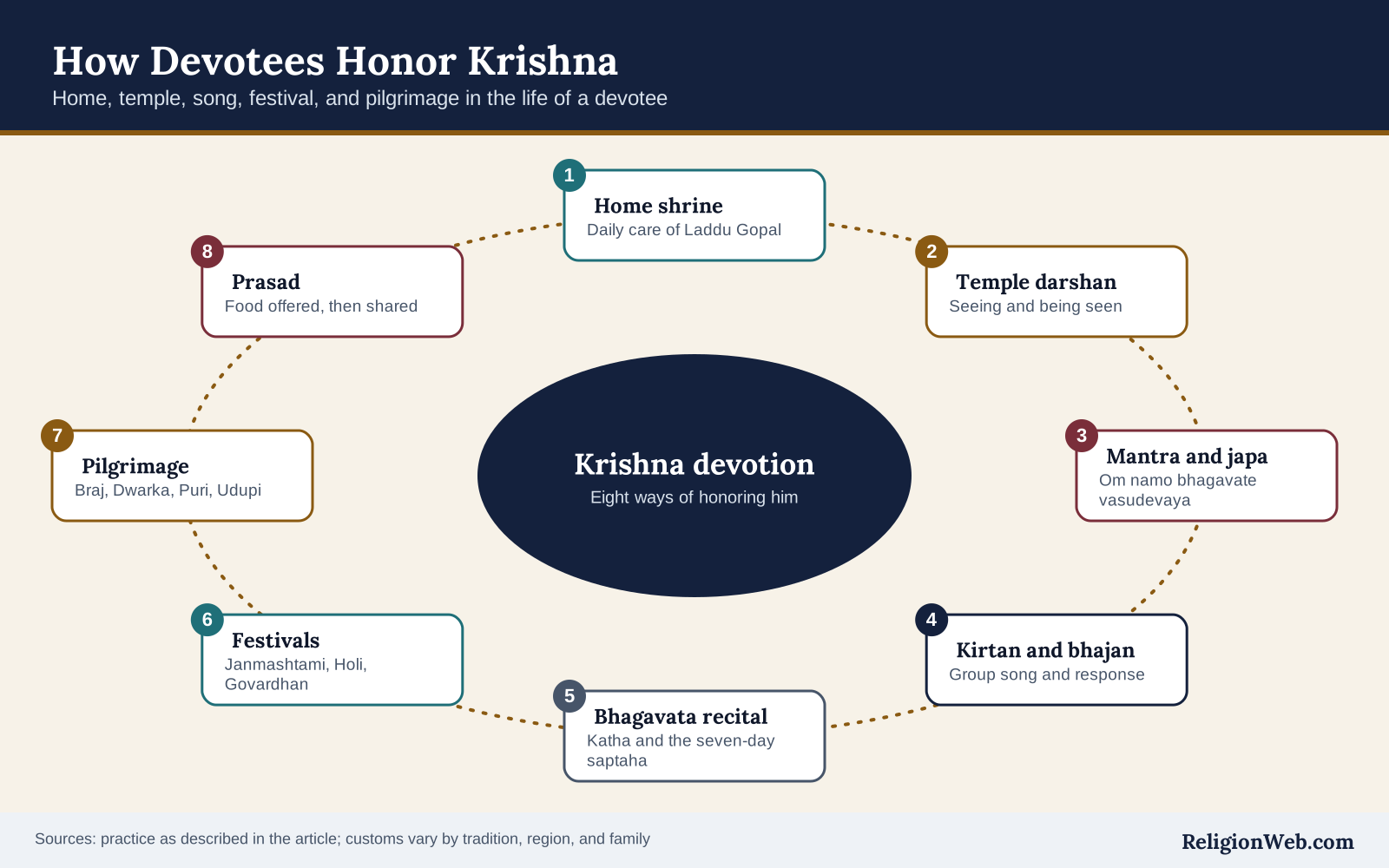
In most Krishna temples the image is treated as a living guest of honor, not as a statue on display, and the day is organized around caring for him. The details differ by lineage, but a typical sequence includes an early-morning awakening of the deity with lamps and songs, bathing and dressing of the image, the placing of ornaments and flowers, and a series of food offerings through the day, with periods of rest in which curtains are drawn. In Pushtimarg temples, including Nathdwara, the schedule is traditionally divided into eight viewing times, called jhankis or darshans, each named for the service performed, from morning awakening to evening lamp and bedtime. Gaudiya and ISKCON temples follow their own schedules, usually beginning before dawn with a morning lamp offering, and include daily recitation from the Bhagavata and Gita. Many temples drape the image in clothing that changes with the season and festival, so that the deity wears light cotton in summer heat and warm cloth in winter. The details of architecture and of the daily service in the larger Hindu temple tradition are described in the article on the Hindu temple.
The logic behind this care is stated plainly by the tradition. In Pushtimarg, the images are served as a child in the household of Nanda. In the Sri Vaishnava and Madhva temples, the rules of worship are drawn from the Agamas, manuals of image worship that regulate the offerings, the hours, and the training of priests. The common thread is that the worshiper is a servant and a host, and that the offering of sound, light, scent, food, and cloth is the service that the deity receives.
Darshan, offerings, and prasad
The central act of temple visiting is darshan, the sight of the deity. The idea is two-way: devotees come to see the image and believe that they are seen by it. Visitors usually bring or buy flowers, tulsi leaves, sweets, or fruit, and give them to a priest, who offers them to the deity. Food offered in this way is returned as prasad, literally “grace,” and eaten by the family or shared with others. In some temples prasad is a modest sweet, and in others, such as the Pushtimarg temples that make the elaborate offering known as Chappan Bhog (“fifty-six items”) on festival days, the offering is a banquet. Practices that are expected of visitors, such as removing shoes, dressing modestly, avoiding leather in some precincts, and refraining from photography, vary by temple. Entry rules also differ: many Krishna temples welcome visitors of any background, while a few, including the Jagannath temple in Puri, have long restricted entry to Hindus, so the temple’s own guidance should be consulted.
Worship at Home
Caring for a household Krishna
Many families, especially in Pushtimarg and Gaudiya communities and in much of northern and western India, keep a small image of the child Krishna at home, called Laddu Gopal, Bala Gopala, or a similar name. The household practice is modeled on the way a mother cares for a child. The image is awakened in the morning, bathed with water and sometimes with milk, curd, honey, ghee, and sugar (panchamrit), dressed in fresh clothes, offered food at set times, and put to rest at night. Some families add a swing in the summer and a blanket in winter. The family may also grow a tulsi plant, which many Hindu homes keep, and offer its leaves, and many place a lamp before the image at dusk. The worship is not a symbolic act: devotees describe the image as the child himself in their keeping, and the practice shapes the rhythm of the household day.
A simple home puja
Home worship can also be much simpler than the household seva of a Laddu Gopal. A common sequence, described more generally in the article on puja, begins with a short invocation of Ganesha, followed by the lighting of a lamp, the offering of incense, a flower or tulsi leaf, and a small portion of food, a short prayer or song, and the waving of a lamp (aarti) before the image. The eaten food becomes prasad. The Gita supports the idea that the form of the offering matters less than the heart behind it: in the ninth chapter (9.26), Krishna says in paraphrase that he accepts a leaf, a flower, a fruit, or water offered with devotion. Families vary in whether they use a fixed text, a song, a silent meditation, or a longer ritual, and no single sequence is required.
Mantra, the Divine Name, and Kirtan
The principal mantras
Two mantras stand out in Krishna devotion. The first is the twelve-syllable formula Om namo bhagavate vasudevaya, “Om, salutations to the Lord Vasudeva,” which is widely used across Vaishnava traditions and is associated in the Bhagavata Purana with the boy-devotee Dhruva. The second is the sixteen-word Hare Krishna mantra, also called the maha-mantra, “Hare Krishna, Hare Krishna, Krishna Krishna, Hare Hare, Hare Rama, Hare Rama, Rama Rama, Hare Hare.” Gaudiya tradition explains “Hare” as the vocative of a name meaning Hari or of the divine power often identified with Radha, and teaches that chanting is the principal means of devotion in the present age. Practitioners repeat the mantra on a string of 108 beads, a practice called japa, or sing it aloud in a group. Other devotees use short names such as “Radhe Radhe” as greetings and “Jai Shri Krishna” as an invocation. Each of these has its own place and tradition, and none is exclusive.
Kirtan, bhajan, and the recitation of the Bhagavata
Singing the names and stories of Krishna is the most visible form of devotion. In kirtan, a leader sings a line and the group answers, often accompanied by a drum (mridanga or dholak), hand cymbals, and a harmonium, with the tempo rising as the singing continues. Public street singing, known as sankirtana, is associated with Chaitanya and later with ISKCON. Bhajan is a general word for devotional songs, including the verses of Mirabai, Surdas, and the Varkari saints, sung in homes and temples. Recitation of the Bhagavata Purana in a seven-day cycle, called a saptaha, is another widespread practice that Britannica notes in its description of the text, and it is often organized for a family or community on an important occasion. Taken together, hearing, singing, and recitation turn the stories into a shared event, which is why the stories can be told again and again without losing their appeal.
Festivals, Pilgrimage, and Krishna Devotion Today
The Festivals of the Krishna Year
Janmashtami and Radhashtami
The Krishna year is organized by the Hindu lunisolar calendar, in which months follow the moon and festivals fall on numbered lunar days (tithis), so their dates shift each year against the Gregorian calendar. The birth festival, Janmashtami, falls on the eighth lunar day of the dark fortnight, in the month called Bhadrapada in the north Indian (purnimanta) reckoning and Shravana in the amanta reckoning, and is celebrated with a fast, a vigil, and a midnight birth ceremony. Communities differ on the exact day, and the dedicated article explains the rules. Radhashtami, the birthday of Radha, is observed in many communities on the eighth lunar day of the bright fortnight that follows, roughly two weeks later, and is especially important in Braj, Barsana, and Gaudiya communities. A reader planning to observe or attend either festival should check a current almanac (panchang) for the local date, since the rules for midnight and for the lunar day differ between traditions.
Govardhan Puja, Holi, Ratha Yatra, and Gita Jayanti
Several other festivals draw on Krishna stories. Govardhan Puja, also called Annakut, commemorates the lifting of the hill and is celebrated in much of northern India on the day after Diwali with a mountain of vegetarian food offered to the deity. Holi in the Braj region is celebrated for weeks and recalls the play of Radha and Krishna, with its best-known customs in Barsana and Nandgaon. The Ratha Yatra of Jagannath at Puri, held in the lunar month of Ashadha, is among the largest chariot processions in the world. Gita Jayanti, observed in the month of Margashirsha on the eleventh day of the bright fortnight, honors the day on which, by tradition, Krishna spoke the Gita. In Gujarat, the autumn nights of Navaratri include circle dances, Garba and Raas, that many participants link to Krishna and the gopis, though the festival itself is dedicated to the goddess. Many Gaudiya communities also observe the month of Kartik, with a daily lamp offering to Krishna in his form as Damodara.
| Festival | Calendar rule | Typical observances | Where especially prominent |
|---|---|---|---|
| Janmashtami | Eighth lunar day of the dark fortnight, Bhadrapada (August to September) | Fast, midnight puja, songs, tableaux, dahi handi in some regions | Mathura, Vrindavan, Maharashtra, Gujarat, Udupi |
| Radhashtami | Eighth lunar day of the bright fortnight following Janmashtami | Worship of Radha, songs, special offerings | Barsana, Vrindavan, Gaudiya temples |
| Govardhan Puja (Annakut) | Day after Diwali in much of the north | Food mountain offered to Krishna, circuit of Govardhan Hill | Braj, Gujarat, Rajasthan |
| Holi in Braj | Spring, around the full moon of Phalguna, with a longer festival season | Songs, colored powder, play recalling Radha and Krishna | Barsana, Nandgaon, Vrindavan, Mathura |
| Ratha Yatra | Second lunar day of the bright fortnight, Ashadha (June to July) | Chariot procession of Jagannath, Balabhadra, and Subhadra | Puri, with processions in many cities worldwide |
| Gita Jayanti | Eleventh lunar day of the bright fortnight, Margashirsha | Recitation and study of the Gita, lectures | Kurukshetra, many temples and schools |
| Kartik observances | The month of Kartik, roughly October to November | Daily lamp offering to Krishna as Damodara, devotional singing | Gaudiya and ISKCON centers, Vrindavan |
Fasting is part of several of these observances, especially on Janmashtami and on Ekadashi, the eleventh lunar day observed by many Vaishnavas. Traditions generally recognize exemptions for children, older adults, pregnant women, and people who are ill, and a person with a medical condition, or who takes regular medication, should consult a doctor before fasting. Religious practice does not replace medical advice.
Pilgrimage to the Places of Krishna
Braj, Dwarka, and Kurukshetra
The most intense pilgrimage geography is Braj, the region around Mathura where tradition places Krishna’s birth and childhood. Mathura is honored as his birthplace, and Vrindavan, a few miles away, as the site of his youthful play. In nearby places, devotees visit Govardhan, Barsana (identified with Radha’s home), and Nandgaon (identified with Nanda’s). Vrindavan has many temples, among them Banke Bihari, and pilgrims make circuits (parikramas) of the sacred landscape on foot. Further west is Dwarka in Gujarat, traditionally the city of Krishna as king and counted by many Hindus as one of the four Char Dham pilgrimage places. To the north is Kurukshetra in Haryana, the traditional site of the Gita, where a large annual festival celebrates the text, and where pilgrims also bathe in sacred tanks in a manner reminiscent of the bathing pilgrimages described in the article on the Kumbh Mela. Puri, Udupi, Guruvayur, Pandharpur, and Nathdwara complete a map that stretches across the subcontinent.
Visiting respectfully and safely
Pilgrimage places in Braj and elsewhere can be crowded, especially during festivals, and the heat in the plains can be severe. Pilgrims are advised by the temples and local authorities to carry water, plan around the midday sun, and check current entry and timing rules, which change often. Visitors of other backgrounds are welcome in many Krishna temples but should follow local dress and conduct guidance, ask before taking photographs, and avoid touching the deity or the offerings unless invited. Practice in each place is shaped by local custom, and a visitor is better served by asking a priest or volunteer than by assuming that a rule from one temple applies in another.
Krishna Devotion in the Modern World
Diaspora, media, and online devotion
Krishna devotion has traveled with Indian migrants and been taken up by many people who did not grow up in it. Temples in North America, Europe, East Africa, the Caribbean, and Southeast Asia run festivals that draw crowds comparable to those of their counterparts in India, and many include classes for children on the Gita and the stories. ISKCON centers, Swaminarayan and Pushtimarg temples, and many independent temples operate programs of festival food, music, and community service. Television serials based on the Mahabharata and the life of Krishna have reached large audiences in India since the late twentieth century, and recorded kirtans, live-streamed aarti, and online discourses now play a large part in the devotional life of people living far from a temple. These developments are recent, and scholars are still studying how they affect practice.
Questions that devotees and scholars debate
Krishna traditions, like the other large traditions of South Asia, are the subject of internal discussion. Teachers and communities debate the role of caste in temple service and access, the commercialization of pilgrimage towns, the environmental condition of the Yamuna River that is sacred to Braj devotees, and the way to interpret the rasa lila for contemporary audiences. Historians and literary scholars raise their own questions about dating, composition, and the relation of devotional movements to social change. These debates are conducted from within as well as outside the tradition, and the descriptions in this article aim to report them without taking sides.
Common Misconceptions About Krishna
Misconception 1: Krishna appears only in the Bhagavad Gita
Where the misunderstanding comes from
The Bhagavad Gita is among the most translated Hindu texts. An English version was printed in London as early as 1785, and Edwin Arnold’s verse rendering followed in 1885, so for generations of readers outside India the Gita was the only doorway to Krishna. A reader who starts with a translation meets a calm, philosophical speaker on a chariot, and it is natural to assume that this is the whole of his story.
Public discussion reinforces the impression. The Gita is quoted in schools, in lectures on ethics and leadership, and in books on stress and decision-making, usually without the surrounding literature. A reader could finish such a book without learning that Krishna has a childhood, a family, a city, and a large repertoire of songs.
What the evidence and tradition actually show
The Gita is a section of about seven hundred verses within the Mahabharata, an epic that tradition describes as having roughly a hundred thousand verses. Krishna appears throughout the rest of the epic as a counselor, envoy, and ally. Beyond the Mahabharata, his birth and childhood are told in the Harivamsa, the Vishnu Purana, and the Bhagavata Purana, and his life is the subject of poetry, song, and drama in nearly every major language of South Asia.
For many devotees the child and the cowherd, not the charioteer, are the center of daily worship, and they may meet Krishna first through a grandparent’s stories, a festival, or a song, long before they study the Gita. The Gita remains important, and the article on the Bhagavad Gita treats it in full, but it is one part of a much larger devotional literature.
Misconception 2: Every Vaishnava school interprets Krishna’s relationship to Vishnu in the same way
Where the misunderstanding comes from
Popular summaries of Hinduism often say simply that Krishna is the eighth avatar of Vishnu, and that is an accurate description of what many Hindus believe. Textbooks, websites, and temple guides repeat the formula because it is short and gives Krishna a clear place in the list of ten avatars. The shorthand leads readers to assume that every Vaishnava community agrees, and that the doctrine is settled.
The opposite assumption also appears. Because ISKCON is the Krishna-centered movement most visible outside India, some observers take its teaching that Krishna is the source of Vishnu as the standard Vaishnava view. Neither generalization fits the range of communities.
What the evidence and tradition actually show
Vaishnava communities state the relationship in different ways, and the differences are a matter of long-standing commentary. The Sri Vaishnava and Madhva traditions generally understand Krishna as a descent of Vishnu or Narayana. The Gaudiya tradition, citing a verse of the Bhagavata Purana, teaches that Krishna is the original Lord from whom Vishnu’s forms proceed. The Pushtimarg of Vallabha treats Krishna as the supreme person, and the Nimbarka tradition places Radha and Krishna together at the center. Britannica’s summary that he is worshiped both as an avatar and as a supreme god in his own right captures the range.
These positions are not usually presented as quarrels. Each rests on a way of reading the same verses, and devotees of one school often visit and sing in the temples of another. They are described here as the teachings of their own communities, and the article on Vaishnavism shows how they fit into the larger family of schools.
Misconception 3: Radha has the same textual prominence in all early sources
Where the misunderstanding comes from
Calendars, paintings, films, and temples often show Radha and Krishna as an inseparable pair, and the pairing feels so natural that readers assume it has always been part of the story. Devotional songs and the popular names “Radha Krishna” and “Radhe Shyam” strengthen the impression, as do the miniature paintings inspired by the Gita Govinda.
In the communities where Radha is central, her eternal presence is a matter of faith, and the question of when her name first appears in texts can feel beside the point. The misunderstanding arises when a statement of devotion is read as a statement about the manuscripts.
What the evidence and tradition actually show
The earliest major accounts of Krishna’s life, the Mahabharata, the Harivamsa, and the Vishnu Purana, do not give Radha a prominent role. The Bhagavata Purana describes a favored gopi without naming her, and commentators have long debated whether a word play in the text points to Radha. She appears by name in scattered poetry of the first millennium CE, then dominates the twelfth-century Gita Govinda, and becomes the supreme goddess in some later Puranas.
Devotional communities such as the Gaudiya, Nimbarka, and Radhavallabha traditions hold that she is eternal and was always present, even where the older texts are silent. Other communities, including the Sri Vaishnava and Madhva, give her little or no role and speak instead of Krishna’s queens, such as Rukmini. Historians describe the growth of her prominence over time, and devotees describe her as a reality that the texts gradually revealed. Both statements can be made without contradiction when the difference between textual history and theology is kept in view.
Misconception 4: The stories of Krishna and the gopis are ordinary romance, or are offered as a model for conduct
Where the misunderstanding comes from
Paintings, films, and songs often portray Krishna and the gopis in the language of romantic love, and readers who meet the stories only in this form may take them as a love story set in a village. A related assumption, held both by critics and by some admirers, is that the stories are offered as a pattern for human behavior. Because the gopis are described as leaving their homes to meet him, the episodes can also appear to conflict with household duty.
Translation adds to the difficulty. The Sanskrit vocabulary of rasa, bhava, and prema has no exact English equivalent, and renderings such as “love” or “passion” can carry connotations that the theological terms do not.
What the evidence and tradition actually show
The Bhagavata Purana itself raises the problem. Near the end of the rasa chapters, the king Parikshit asks how the Lord, who descended to uphold dharma, could embrace other men’s wives, and the sage Shuka replies, in paraphrase, that this is the play of one of unlimited power and that ordinary people should not imitate it. Devotional theologians, including Gaudiya writers, read the gopis as models of a love that gives up everything for God, and they treat the dance as a spiritual event, not as a social model.
Some commentators and modern scholars have approached the episodes through other lenses, including poetic convention, social history, and gender, and a few critics find the stories troubling on their own terms. The main point is that the tradition treats the stories as theology expressed in the language of love, and that the text sets limits on how they may be applied to life.
Frequently Asked Questions About Krishna
Questions about identity and origins
Is Krishna the same as Vishnu?
Most Vaishnava traditions say that Krishna is a form of the one supreme God whom they also call Vishnu or Narayana, but they describe the relationship differently. Sri Vaishnava and Madhva teachers generally speak of Krishna as a descent of Vishnu. Gaudiya and Pushtimarg teachers describe Krishna as the original form from which Vishnu proceeds. Britannica summarizes the situation by saying that Krishna is worshiped both as the eighth avatar of Vishnu and as a supreme god in his own right.
In daily practice, the distinction rarely interrupts worship. Many Hindus pray to Krishna, to Vishnu, and to other deities without seeking a formula for how they fit together, and the schools that do offer a formula each explain it in their own commentaries.
Was Krishna a historical person?
Devotees understand Krishna as having lived on earth, and the Mahabharata and Puranas present events of his life as part of sacred history. Historians cannot confirm this from contemporary records, because none are known, and they study the development of Krishna traditions through texts and inscriptions such as the Besnagar pillar. Some scholars think that an early Yadava or Vrishni leader may lie behind the later accounts, and others emphasize that the figure combines several earlier strands. The question is open on historical grounds and settled on faith grounds, and this article tries to keep the two kinds of statement separate.
Why is Krishna usually shown with blue skin?
The name Krishna means dark or dark blue, and artists have long shown him in the color of a rain cloud or deep water. Devotional writers explain the color as a sign of the infinite, like the sky or the ocean, and as the color of the monsoon that brings life to the plains. Some regional traditions paint him a dark brown or black, and in Odisha Jagannath is traditionally dark. The blue is a convention of art and devotion, not a claim about the skin tone of a person, and different communities depict it differently.
Questions about stories and symbols
Why does Krishna play the flute?
In the Bhagavata Purana, the flute is the instrument of the cowherd youth, and its sound draws the creatures and people of Vrindavan toward him. Theologians read it as the call of God to the soul, which cannot be resisted once heard. Poets and painters also love it for its simplicity: it is a hollow reed that makes music only when breath passes through it, a figure that devotional writers have used for the soul that becomes an instrument of God.
Why do the stories describe the divine child stealing butter?
The butter-stealing stories belong to the childhood in Gokula, and they are among the most popular scenes in Indian art and song. Devotional readers see in them the playfulness of God and the intimacy between the Lord and his devotees, who give him a place in their kitchens and are happy to be “robbed” by him. In some Pushtimarg and Gaudiya teachings, the butter stands for the pure heart, which Krishna takes freely. The stories are not intended as a lesson in theft, and the same texts show Yashoda gently correcting him.
Questions about practice and participation
What does the Hare Krishna mantra mean?
The mantra is made of three names repeated: Hare, Krishna, and Rama. In Gaudiya teaching, “Hare” is a form of address that is read as calling on Hari or on the divine power identified with Radha, “Krishna” is the dark and all-attractive Lord, and “Rama” is a name for the Lord as the source of delight. Others hear the name of Rama of Ayodhya. Devotees describe the practice as calling on God by name, and they add that the meaning matters less than the act of calling.
Do all Hindus worship Krishna?
No. Hinduism includes many traditions, and Krishna is one of its most widely loved deities, not a universal object of worship. Some Hindus focus on Shiva, on the Goddess, on Ganesha, on Rama, or on a family deity, and many honor several. Surveys such as Pew’s 2019 to 2020 study of India show regional differences in which deities people feel close to. The article on Hinduism describes this diversity of practice.
Can someone who is not Hindu visit a Krishna temple or take part in kirtan?
Many Krishna temples welcome visitors of all backgrounds, particularly at festivals, and ISKCON centers hold public programs of singing and vegetarian meals. A few temples limit entry to Hindus or have strict dress rules, so it is wise to read the temple’s guidance or ask in advance. Visitors are generally expected to remove their shoes, dress modestly, and follow the lead of local worshipers. Joining the chanting is usually welcome, and accepting prasad is regarded as a courtesy.
Conclusion: Reading Krishna Across Texts and Traditions
What the Evidence and Tradition Show
One name, many sources
The picture that emerges from the sources is a figure assembled over many centuries and held together by devotion. The earliest datable traces point to a god called Vasudeva and a hero of the Yadava clan. The Mahabharata and the Gita present a counselor who is also, in the Gita’s own words, the source of all beings. The Harivamsa and the Puranas add the child and the cowherd, and the Bhagavata Purana, with the poets who followed it, gave those scenes their lyric power. Each stage added something without erasing what came before.
Differences that remain
Communities who worship Krishna do not always agree on his relation to Vishnu, on the place of Radha, or on whether liberation or pure love is the highest goal. Those disagreements are real, and they are argued in commentaries and sermons with respect for the other side’s sources. A reader who keeps the distinction between textual history, doctrine, and devotional practice in view can understand why a temple in Udupi, a kirtan in Vrindavan, and a pilgrimage walk to Pandharpur can all be called Krishna worship.
How to Keep Exploring
Related reading on ReligionWeb
Readers who want the wider setting can continue with the pages on the Hindu tradition, the Vaishnava family of schools, the Gita, and the birth festival linked earlier in this article. Those interested in temple life can go on to the article on the Hindu temple, and those interested in the neighboring traditions can read about Shiva, Durga, and Ganesha.
Learning from the sources and the communities
The most reliable way to learn about Krishna is to read the texts in good editions, with commentary from within the tradition being studied and from historians who work on it. For living practice, a visit to a temple, a kirtan, or a recitation of the Bhagavata, undertaken with the courtesy suggested above, will show what no article can. Descriptions in this page are drawn from the sources listed at the end, and where traditions differ the page has tried to say which tradition holds which view.
Sources
The table below lists the principal external sources behind this article. Facts, dates and figures were checked against these and related primary, institutional and academic materials.
| # | Source | Publisher and type | Used for | Link |
|---|---|---|---|---|
| 1 | The Song Celestial; or, Bhagavad-Gita (trans. Edwin Arnold, 1885) | Project Gutenberg · Primary text | Quoted Gita passages (Chapters X, XI, XII); public-domain translation | gutenberg.org |
| 2 | Krishna (Hindu deity) | Encyclopaedia Britannica · Encyclopedia | Krishna as eighth avatar of Vishnu and supreme god in his own right; devotional legacy | britannica.com |
| 3 | Radha (Hindu mythology) | Encyclopaedia Britannica · Encyclopedia | Radha as gopi and beloved; soul-and-God reading; Chaitanya; Gita Govinda in painting | britannica.com |
| 4 | Bhagavata purana | Encyclopaedia Britannica · Encyclopedia | Bhagavata date, length, Book 10, saptaha recitation and influence | britannica.com |
| 5 | Harivamsha | Encyclopaedia Britannica · Encyclopedia | Harivamsa as a fifth-century CE appendix to the Mahabharata | britannica.com |
| 6 | Vaishnavism | Encyclopaedia Britannica · Encyclopedia | Avatars, bhakti goals, and the Sri, Madhva, Pushtimarg and Gaudiya schools | britannica.com |
| 7 | Alvar | Encyclopaedia Britannica · Encyclopedia | Tamil Alvar poet-saints, 7th to 10th centuries, and the collected hymns | britannica.com |
| 8 | How the Global Religious Landscape Changed From 2010 to 2020: Hindu Population Change | Pew Research Center · Demographic data | Hindu population of nearly 1.2 billion in 2020, about 95 percent in India | pewresearch.org |
| 9 | Religion in India: Tolerance and Segregation | Pew Research Center · Demographic data | 2019-2020 survey of Hindus: regional differences in closeness to deities, including Krishna | pewresearch.org |
Last fact-check date: 2026-10-21.