Diwali, also written Deepavali, is the Hindu festival of lights: a multi-day observance in October or November in which households and temples fill their spaces with oil lamps, worship the goddess Lakshmi on the new-moon night, share sweets and gifts, and mark the turning of a season and, in many regions, of a year. The name comes from the Sanskrit dīpāvali, “a row of lamps,” and the picture of a doorway lit at night is the one image that nearly every form of the festival shares. In 2026 the main night falls on Sunday, November 8, according to the Government of India’s list of central holidays.
Beyond the lamps, Diwali is less uniform than its popular image suggests. One family recalls Rama’s return to Ayodhya, another recalls Krishna’s defeat of the demon Narakasura. A merchant in Gujarat begins a new financial year, a household in Tamil Nadu bathes before dawn on a day that many others call “little Diwali,” a family in Kolkata worships Kali, and in Nepal the festival, called Tihar, honors crows, dogs and cows on successive days. These are not rival versions of one true festival. They are regional and sectarian forms that grew alongside one another over many centuries, and the festival’s documented history shows them gathering in layers.
This article follows the festival the way a participant might: its names and calendar, the earliest written traces, the five-day pattern and what each day involves, the worship of Lakshmi, the stories told in different regions, the lamps, rangoli, foods and gifts, and the ways Diwali is observed in South Asia and abroad. It sits inside the wider tradition described in the overview of Hinduism, and the household worship at its center is explained in more general terms in the article on puja, or Hindu worship.
Wherever a custom belongs to one region, caste community, sect or family, the text says so. Jain and Sikh observances that fall on the same days have their own meanings and are mentioned only as cross-references, not folded into the Hindu account. Dates and figures were checked in October 2026, and the year of each data point is given.
Diwali at a Glance
What Diwali Is and When It Falls
A festival of lights lasting several days
Diwali is best described as a cluster of linked observances rather than a single ritual. The Encyclopedia of Religion entry by Marie-Louise Reiniche calls it a festival of renewal that marks the end of the rainy season and the harvest of the summer crops, one that works much like a new year, when debts are settled and merchants close their accounts. Lamps, cleaning and decorating the home, new clothes, gifts and sweets belong to almost every version. Beyond that common frame, the days that are kept, the deities and stories emphasized, and even the day regarded as the festival’s peak differ from one region and community to another.
In December 2025, the Intergovernmental Committee of UNESCO’s 2003 Convention inscribed Deepavali on the Representative List of the Intangible Cultural Heritage of Humanity, on a nomination from India. The listing describes it as a light festival celebrated annually by diverse individuals and communities across India, falling on the new moon in October or November, lasting several days, and symbolizing the victory of light over darkness and good over evil. It adds that the practice is passed on mainly within families, with elders teaching children, and that temples, schools and cultural organizations also help transmit it. That official summary is deliberately broad, and the sections below fill in the detail that a short heritage entry leaves out.
Why the date changes every year
Diwali follows the Hindu lunisolar calendar, in which months are counted by the moon and are periodically adjusted to keep festivals in their seasons. The festival is anchored to amavasya, the new-moon day, in the part of the year when the monsoon has ended and the days begin to shorten. Because twelve lunar months are shorter than a solar year, the date moves across the Gregorian calendar and, in the years in which an extra month is inserted, can fall in late October or well into November. In 2025 the main night was observed on October 20 or October 21, depending on the almanac, the kind of split the calendar section explains; the stock exchanges held their ceremonial session on October 21. In 2026 the main night falls on November 8. The calendar rule is explained in its own section below, because it is also the reason that the same day can carry different month names in different regions.
Names for the Festival: Diwali, Deepavali and Others
The meaning of “a row of lamps”
Merriam-Webster traces Diwali to Hindi, through Middle Indo-Aryan, to the Sanskrit dīpāvaliḥ, a compound of dīpa, “lamp,” and āvali, “row.” Deepavali is therefore the form that stays closest to Sanskrit and is the one used first in UNESCO’s listing, while Diwali is the form that reached English and much everyday speech. Neither is more correct than the other, and the festival is called by both within a single conversation or even a single family. A Fun Fact later in this article follows how the word wore down across a thousand years of written evidence.
Other names and local forms
Other labels point to particular layers of the festival. Texts of the first millennium use Dipotsava, “festival of lamps,” and the Kashmiri Nilamata Purana calls the occasion Sukha Suptika, a name usually explained as the “night of pleasant sleep.” In Nepal the festival is Tihar, also called Deepawali and, in the Himalayan Times’ description, Yama Panchak, the “five days of Yama,” after the god of death whose ties to his sister the festival recalls. In Bengal, the new-moon night is above all the night of Kali Puja, dedicated to the goddess Kali, a form of the Divine Mother described in the article on Shaktism. In western India, the day after the main night begins the new year in the Vikrama calendar, and it carries names such as Bestu Varas in Gujarati usage and Nutan Varsh, “new year,” in the vocabulary of BAPS Swaminarayan temples.
Who Observes Diwali and Where
Hindu households, temples and businesses
Diwali is observed primarily by Hindus, and Hindus are a very large and widely distributed community. According to the Pew Research Center’s 2025 report on changes in the global religious landscape between 2010 and 2020, there were nearly 1.2 billion Hindus in 2020, about 95% of them in India, where Hindus made up 79% of the population. Nepal was 81% Hindu, Mauritius 48%, and the largest Hindu populations outside Asia and the Pacific were in the United States (about 3.0 million), the United Kingdom (about 1.1 million) and the United Arab Emirates (about 1.1 million). Those figures count adherents, not participation. They do not show how many people actively observe the festival, and they do not capture the many non-Hindu neighbors, colleagues and school friends who join public celebrations.
The festival is also a public, civic and commercial occasion. Diwali appears on the Government of India’s 2026 list of central holidays, where it is recorded for Sunday, November 8, and where the list notes that some states observe the preceding day, Naraka Chaturdashi, as their Diwali holiday instead. In Nepal, the government has declared a public holiday for the central days of Tihar. Many merchants close their old accounts and open new ones around the same days, and Dhanteras and Diwali are traditional occasions for buying gold, metal utensils and new goods.
Jain and Sikh observances as cross-references
Jains and Sikhs also keep significant observances on or around the same lunar days, with meanings of their own. Britannica notes that Jains mark the nirvana, or final liberation, of Mahavira at this time, a subject treated in the articles on Jainism and Mahavira, and that Sikhs commemorate the return of Guru Hargobind from captivity, usually under the name Bandi Chhor Divas, which belongs to the history told in the article on Sikhism. These are distinct commemorations with their own scriptures, histories and rituals. This article returns to them briefly near its end and otherwise concentrates on the Hindu forms of Diwali.
Origins and Historical Development
What the Early Texts Say
The Kamasutra’s night of the Yakshas and the Puranic prescriptions
Scholars have long tried to trace the festival backward through its written records. P. K. Gode’s 1945 survey in the Annals of the Bhandarkar Oriental Research Institute, as summarized by Noor Anand Chawla in JSTOR Daily, found the oldest likely reference in the Kamasutra (roughly 50 to 400 CE), which mentions a festival called Yaksharatri, the “night of the Yakshas,” that later writers linked to Diwali. Jain scholar Hemachandra, in the twelfth century, equated Yaksharatri with Diwali in his lexicon of non-Sanskrit words, the Desinamamala. Because the equation was made centuries after the Kamasutra, it is best read as a medieval identification, not as proof that the two festivals were originally the same.
The Puranas, the large corpus of Sanskrit texts that preserve stories, rites and regional lore, offer more explicit prescriptions. Silpisikha Baruah’s survey for Sahapedia notes that the Padma Purana (124.4) and the Skanda Purana prescribe lamps on the thirteenth lunar day of the dark half of the month, with the Skanda Purana specifying that they are lit in honor of Yama to avert untimely death. The Bhavishyottara Purana places the lamps on the fourteenth lunar day and prescribes Yama worship, an oil bath, and the worship of Bali and Lakshmi. The Brahma Purana says that on the fourteenth Lakshmi dwells in oil and the Ganges in all waters, and it connects dice play to Shiva and Parvati. The Nilamata Purana, a Kashmiri text that Baruah and Chawla place somewhere between the sixth and eighth centuries CE, describes rows of lamps in temples and shops on the fifteenth day of the dark fortnight, with gambling on the day after.
Gifts, palaces and lamps in early literary works
Court literature adds a more social picture. According to Baruah, the seventh-century play Nagananda, attributed to King Harsha, refers in its fourth act to the exchange of Diwali gifts among family members. The Jain monk Somadeva’s tenth-century Yasastilaka calls the occasion Dipotsava and describes whitewashed palaces, rows of lights, gambling and music in the city. Taken together, these works show a festival that already combined worship, protective rites for the dead, lamp-lighting, feasting and play, though the dates they give vary and the days are counted differently from text to text.
Medieval and Early Modern Records
Al-Biruni’s account of the festival he called Dibali
The most vivid early description by an outside observer comes from al-Biruni, the Khwarazmian scholar who studied Indian religion and astronomy and wrote his account of India in about 1030 CE. In the English translation by Edward C. Sachau, he places the festival on the first of Kartika, the new-moon day, and says it is called Dibali. People bathe, dress festively, exchange betel leaves and areca nuts, visit temples and give alms. He reports his informants’ explanation that on this day Lakshmi, the wife of Vasudeva, releases Bali from his confinement for a day, so the occasion is also called Bali’s principality.
In the night they light a great number of lamps in every place so that the air is perfectly clear.
Alberuni’s India, trans. Edward C. Sachau (London: Kegan Paul, Trench, Trübner, 1910), vol. 2, ch. LXXVI, p. 182
The passage matters for three reasons. It confirms that by the early eleventh century a lamp festival on the Kartika new moon was well enough established in northern India to be explained to readers far from India. It records an explanation centered on Lakshmi and Bali, not on Rama. And it already includes bathing, festive dress, gift giving and charity, which remain central almost a millennium later.
Inscriptions, saints and imperial chronicles
Later records show the festival across other regions. Chawla’s summary of Gode lists an eleventh-century record of Diwali in the Deccan at Kolhapur and a Kannada inscription of 1119 under the Chalukya king Tribhuvanamalla that refers to Dipavali. Baruah notes that the Marathi saint Jnaneshwar, writing in 1290, used “the Diwali festival” as a metaphor in his commentary, which suggests that the festival was familiar to his audience in Maharashtra. In 1590, Abul Fazl’s Ain-i-Akbari compared Diwali to the Muslim night of Shab-i-Barat, and from 1613 European travelers’ accounts, collected in the dictionary Hobson-Jobson, describe “Dewally.” Each of these records adds a place and a date, which is why the table below lists them in order.
| Period | Source | What it records |
|---|---|---|
| c. 50–400 CE | Kamasutra | A festival called Yaksharatri, later linked to Diwali by commentators and lexicographers |
| c. 6th–8th century CE | Nilamata Purana (Kashmir) | Sukha Suptika, with rows of lamps in temples and shops |
| 7th century CE | Nagananda, attributed to Harsha | Exchange of Diwali gifts among family members |
| 10th century CE | Yasastilaka by the Jain monk Somadeva | Dipotsava, with whitewashed palaces, lamps, gambling and music |
| c. 1030 CE | Al-Biruni’s account of India | Dibali on the Kartika new moon, with bathing, gifts, alms and many lamps at night |
| 12th century CE | Hemachandra’s Desinamamala | Yaksharatri equated with Diwali |
| 1119 CE | Kannada inscription under Tribhuvanamalla | A reference to Dipavali in the Deccan |
| 1290 CE | Jnaneshwari (Bhavartha Dipika) | “Diwali festival” used as a metaphor, implying familiarity in Maharashtra |
| 1590 CE | Ain-i-Akbari of Abul Fazl | Diwali compared to the Muslim festival of Shab-i-Barat |
How Scholars Read the Festival’s Layers
Harvest, ancestors and the turning of the year
Reading these records together, several scholars describe Diwali as a festival with more than one root. Reiniche’s encyclopedia entry stresses its character as a seasonal renewal at the end of the monsoon and the harvest of the summer crops, a point that also appears in BAPS’s own explanation of the day after Diwali, which links it both to the Vamana and Bali story and to the end of the monsoon and the bringing in of the harvest. Reiniche also notes that in some regions lamps are lit to guide the departed or to welcome Bali. Gode, as Chawla reports, cited an early twentieth-century writer who described the festival as a seasonal one marking the arrival of colder weather and the preparation of fields for the next crop. These readings do not exclude devotional meanings. They suggest instead that a seasonal and ancestral festival acquired deities and stories over time.
How narrative associations accumulated
The deities and stories attached to the festival are plural, and the surviving records suggest that they accumulated gradually. In the Puranic and medieval texts surveyed above, the explanations offered involve Yama, Bali and Lakshmi, and Shiva and Parvati at play, not Rama. The now widespread association with Rama’s return to Ayodhya after his exile and his victory over Ravana is prominent in later popular tradition and in the modern North Indian imagination, a point taken up in the section on stories. Jawhar Sircar, a former Indian culture secretary, argues in a 2022 essay that Lakshmi’s association with the festival came through Brahmanical assimilation of an older lamp-lighting night, and that the Bengali Kali Puja has origins distinct from the Lakshmi-centered Diwali of most of India, though the two have become intertwined over the centuries. Whether or not one accepts each part of that argument, it illustrates why historians prefer to speak of Diwali’s strands.
Diwali in the Modern Period
Spread through migration
Diwali travels with its observers. Migration from South Asia over the nineteenth and twentieth centuries, first through labor migration to places such as Mauritius, Fiji and the Caribbean and later through professional and family migration to Britain, North America, the Gulf and Southeast Asia, established the festival in new countries. Pew’s 2020 figures show the result: large Hindu communities in the United States, the United Kingdom and the United Arab Emirates, and a Hindu plurality in Mauritius. In these settings the festival often has to be fitted into school terms, workdays and municipal fireworks rules, and families adapt which days they keep and which they collapse into a weekend.
Recognition in the twenty-first century
Public recognition has grown. India put forward Deepavali for UNESCO’s intangible heritage list, and the inscription in 2025 gave the festival international standing as a living tradition. In the United States, New York City’s public schools have closed for Diwali since 2023 under legislation signed in 2022. Stock exchanges in India hold a special one-hour “Muhurat trading” session on the Diwali holiday, which in 2025 took place on October 21 from 1:45 to 2:45 pm IST and marked the start of the Hindu calendar year Samvat 2082. At Ayodhya, the Uttar Pradesh government stages an annual lamp-lighting event, Deepotsav, which in 2025 was reported as its ninth and as a world-record display of more than 2.6 million lamps. These are state, municipal and commercial occasions built around the festival, and they are not the same thing as the household rites described in later sections.
The Calendar: How the Date of Diwali Is Determined
The Lunisolar Logic Behind the Date
Months, fortnights and lunar days
The Hindu calendar counts months by the moon. Each lunar month is divided into two fortnights, or pakshas: the bright fortnight (shukla paksha), when the moon waxes toward fullness, and the dark fortnight (krishna paksha), when it wanes. Each fortnight is divided into fifteen tithis, or lunar days, and a tithi is defined by the moon’s changing angle from the sun, not by sunrise and sunset. A tithi therefore begins and ends at any hour, and it can be shorter or longer than a civil day. This is why a festival tied to a particular tithi may seem to start on one day in one city and the next day in another, and why almanacs, called panchangs, are consulted for the exact timing.
A lunar year of twelve months is about eleven days shorter than a solar year. To keep festivals in their seasons, the calendar inserts an extra month, called an adhika masa, roughly every three years. The result is that Diwali stays within the post-monsoon season but wanders across a window of several weeks in the Gregorian calendar, from mid-October to mid-November.
Why Diwali belongs to the new moon after the monsoon
Diwali is anchored to amavasya, the new-moon day that closes the dark fortnight of the lunar month that straddles October and November. Britannica describes it as covering the last three days of the dark half of Ashvina and the first two days of the bright half of Karttika in the Vikrama calendar. Reiniche’s entry for the Encyclopedia of Religion ties that timing to the end of the rainy season and the harvest of the summer crops, so the festival also marks the approach of the cooler, drier months in northern and western India.
Amanta and Purnimanta: Why Month Names Differ
Two ways of ending a month
Two conventions govern where a lunar month is considered to end. In the amanta system, used in much of western and southern India, a month ends on the new moon. In the purnimanta system, used in much of northern India, a month ends on the full moon. The bright fortnight carries the same month name in both systems, but the dark fortnight does not: the dark fortnight that ends in the Diwali new moon belongs to Ashvina in the amanta scheme and to Kartika in the purnimanta scheme. A Gujarati household and a family in Uttar Pradesh may therefore describe the same night with different month names while observing it on the same civil date. One calendar reference page puts it simply: festival days still fall on the same day, or very closely, but the name of the month may be different.
The difference explains an apparent contradiction in sources. The Padma Purana, as Baruah summarizes it, puts the lamps of the thirteenth day in the dark fortnight of Kartika in the purnimanta reckoning, while the Bhavishyottara Purana places similar rites on the fourteenth day of the dark half of Ashvina. Read side by side, they appear to describe consecutive days of the same dark fortnight, the days now known as Dhanteras and Naraka Chaturdashi, under two month-naming conventions, not two different festivals.
Vikrama, Shaka and the beginning of the year
Calendar eras add another layer. In the Vikrama calendar as used in Gujarat, the new year begins on the first day of the bright fortnight of Kartika, the day after Diwali, which BAPS calls Nutan Varsh and counts as Kartak Sud 1. India’s national calendar, based on the Shaka era, also appears: the Government of India’s holiday list gives November 8, 2026, as “Kartika 17” in that calendar. Elsewhere, the year begins in the spring month of Chaitra, which the same calendar reference notes is the first month in some calendars and not in others. In Nepal, the Newar community’s Nepal Sambat begins on the day of Govardhan Puja, which the Newars call Mha Puja. So to say that Diwali is the Hindu New Year is true for some communities, not for all.
| Term | Meaning | Role in Diwali |
|---|---|---|
| Tithi | A lunar day, defined by the moon’s angle from the sun, not by sunrise | Each of the five days is tied to a tithi, which can span parts of two civil days |
| Paksha | A fortnight: shukla (bright, waxing) or krishna (dark, waning) | The first three days fall in the dark fortnight, the last two in the bright one |
| Amavasya | The new-moon day, ending the dark fortnight | The night of Lakshmi Puja and, in Bengal, Kali Puja |
| Pradosha | The period just after sunset | The window in which amavasya should prevail for the main evening worship |
| Amanta | A month-naming system in which each month ends at the new moon | Makes the Diwali new moon the last day of Ashvina |
| Purnimanta | A month-naming system in which each month ends at the full moon | Makes the same new moon fall in Kartika |
| Ashvina and Kartika | The lunar months around September–October and October–November | The months in which the festival is named, depending on the system |
| Vikrama Samvat | A calendar era used in Gujarat and elsewhere in the north and west | In Gujarat, the new year starts the day after Diwali |
| Adhika masa | An intercalary month added about every three years | Keeps Diwali in the post-monsoon season |
Choosing the Day: The Pradosha Rule and the 2026 Dates
When amavasya must prevail
Drik Panchang, a widely used almanac service, states the rule for the main night plainly: the day of Diwali puja is decided when amavasya prevails during pradosha, the period after sunset. It adds that the most auspicious time is after sunset, and that a muhurat, an auspicious time window, of even one ghati, about 24 minutes, in that period is preferred over any other. When the new-moon tithi overlaps two evenings, or a tithi appears to be skipped, almanacs and local traditions apply further rules, and the result can differ by a day from one region or community to another. A household that follows a priest, a temple or a family almanac will usually keep the date that source gives.
What the 2026 calendar shows
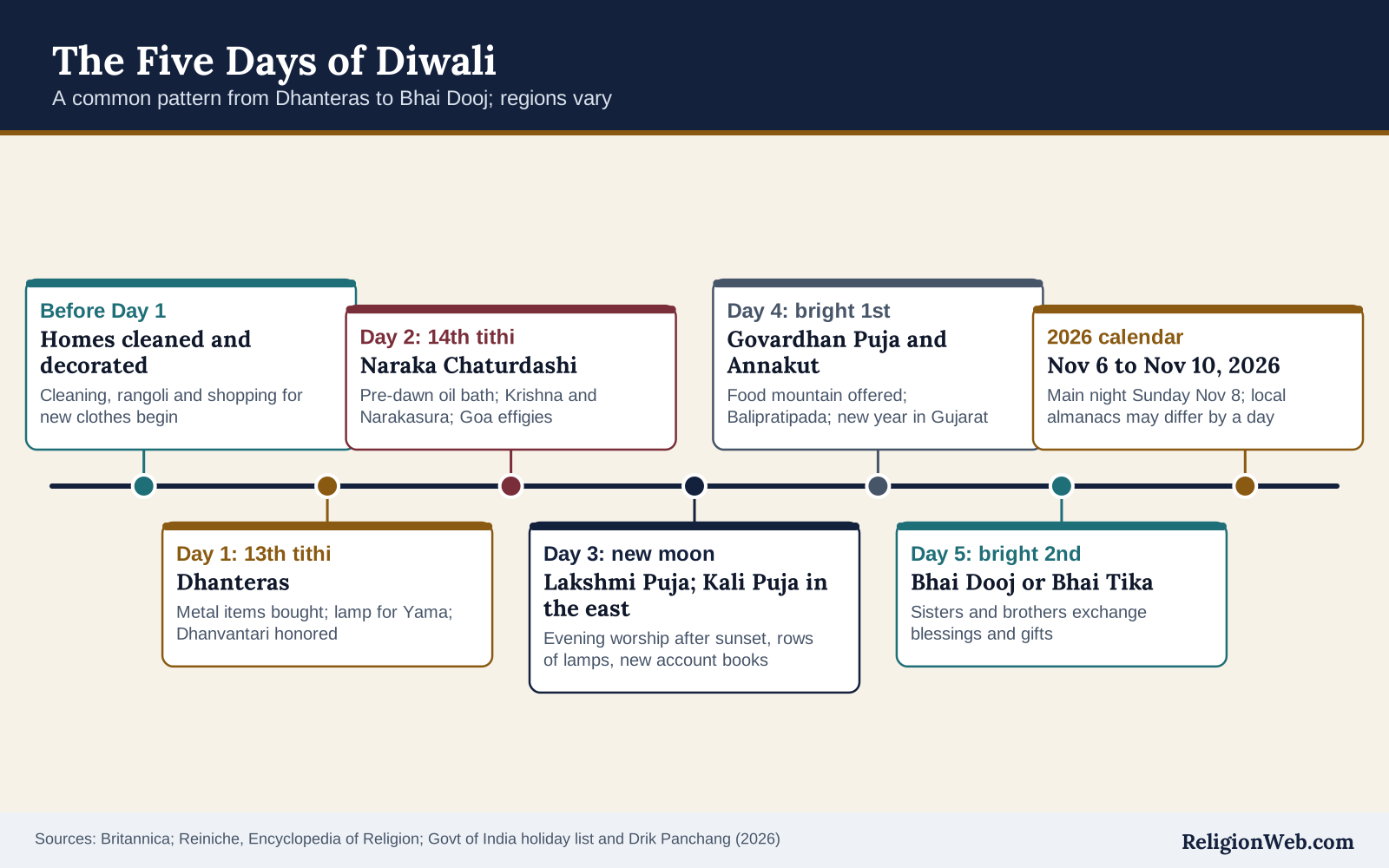
For 2026, the Government of India’s list of central holidays records Diwali on Sunday, November 8. Drik Panchang’s calendar for the festival lists the day of the early-morning oil bath of Naraka Chaturdashi as Saturday, November 7, and Bhai Dooj as Tuesday, November 10. Published festival calendars for 2026 place Dhanteras on Friday, November 6. Drik Panchang’s list also includes Govatsa Dwadashi, a cow-honoring observance, on November 5, which shows that a calendar of Diwali days can stretch to six or more in a year when the tithis do not line up neatly with sunrise. The day of Govardhan Puja and the new year between Diwali and Bhai Dooj is the day most sensitive to such shifts, so readers should check a local almanac for their city rather than rely on a single date.
The Five Days of Diwali
The pattern most often described, and the one Britannica gives, is a five-day festival, beginning on the thirteenth lunar day of the dark fortnight and ending on the second lunar day of the bright fortnight. The table below sets out that pattern. It is a widely shared framework, not a universal rule: some regions emphasize one day far above the rest, a few add days, and the names vary. The sections that follow explain what happens on each day and note where practice departs from the standard sequence.
| Day | Lunar day | Common names | Typical observances | Frequent associations |
|---|---|---|---|---|
| 1 | Thirteenth of the dark fortnight | Dhanteras, Dhanatrayodashi | Cleaning and buying a metal item or utensil; lamp for Yama at the entrance | Dhanvantari, physician of the gods; protection from untimely death |
| 2 | Fourteenth of the dark fortnight | Naraka Chaturdashi, Choti Diwali, Bhoot Chaturdashi (Bengal) | Pre-dawn oil bath; lamps; in places, effigies of Narakasura | Krishna’s defeat of Narakasura; ancestors in Bengal |
| 3 | New-moon day (amavasya) | Lakshmi Puja, Diwali, Kali Puja (Bengal) | Evening worship of Lakshmi, rows of lamps, fireworks; business account rites | Lakshmi; Rama’s return in many northern traditions; Kali in the east |
| 4 | First of the bright fortnight | Govardhan Puja, Annakut, Balipratipada, new year in some regions | Offering a “mountain” of food; cattle honored; new-year greetings | Krishna and Mount Govardhan; Vamana and Bali |
| 5 | Second of the bright fortnight | Bhai Dooj, Yama Dwitiya, Bhai Tika (Nepal) | Sisters invite and bless brothers; gifts exchanged | Yama and his sister Yami |
The Days Before the New Moon
Dhanteras: wealth, health and a lamp for Yama
The first day is Dhanteras, from the Hindi words dhan, “wealth,” and teras, “thirteenth,” or in Sanskrit Dhanatrayodashi. Households clean their homes and shops, and many buy a small metal item, such as a vessel, a coin or a piece of jewelry, as a sign of good fortune for the year. The buying custom is widely described in festival guides, though its history is not well documented in the scholarly sources used here, and it varies by community. The day also has a health association: Dhanvantari, the physician of the gods in Hindu tradition, is honored on it, and India’s Ministry of Ayush once observed Ayurveda Day on Dhanteras to honor Dhanwantari. The Press Information Bureau noted in 2025 that because Dhanteras follows the lunar calendar the date shifted each year, so the government fixed Ayurveda Day at September 23 from 2025 by a gazette notification issued in March of that year.
The darker side of the day is its link to Yama, the god of death. Baruah’s survey cites Puranic prescriptions that lamps be lit on the thirteenth day in honor of Yama to avoid accidental or untimely death, and households that keep the custom place a lamp near the entrance after dusk. The same day thus joins an outward-looking concern with prosperity to a quiet acknowledgment of mortality, a combination that recurs throughout the festival.
Naraka Chaturdashi: the day of the oil bath
The second day, the fourteenth lunar day, is Naraka Chaturdashi, often called Choti Diwali, “little Diwali.” In the story most widely told for the day, Krishna defeats the demon Narakasura, who had imprisoned many women, and the bath before dawn recalls the cleansing and relief that followed. Baruah’s texts add an older ritual logic: the Bhavishyottara Purana prescribes an oil bath with Yama worship on this day, and the Brahma Purana says Lakshmi dwells in oil and the Ganges in all waters on this fourteenth day. For some families the oil bath is therefore called a Ganges bath, a purification as effective as a pilgrimage dip.
Regional practice varies widely. The Tribune reports that in Tamil Nadu, Diwali festivities begin on this day instead of on the new-moon night, with families rising before dawn for an oil bath and prayers, and that some households also keep a fast called nombu. In Goa, paper effigies of Narakasura are burned in the early morning with firecrackers, after which families return for an oil bath and lamps, and women perform an aarti, the waving of a lamp, for the men of the house. In West Bengal the day is Bhoot Chaturdashi, the eve of Kali Puja, when fourteen lamps are lit around the house, especially in dark corners, to guide ancestral spirits and ward off harm. The Government of India’s own holiday list reflects the diversity, noting that in some states this day is observed as the Diwali holiday.
The Central Night and the Days After
Lakshmi Puja on the new-moon night
The third day is the one that most people mean when they say “Diwali.” Britannica calls Lakshmi Puja the third day and the main day of the festival, held on the new moon. Families clean and decorate their homes and businesses to invite Lakshmi in, draw representations of her footprints, light lamps and candles, and visit temples. Because this is the heart of the household observance, it is treated in detail in its own section. In Bengal, Odisha and Assam the same night is the night of Kali Puja, a distinct form of worship described in the section on regional practice.
Govardhan Puja, Annakut and Balipratipada
The fourth day, the first day of the bright fortnight, carries several names and meanings. Reiniche notes that in North India this day honors Mount Govardhana near Mathura, that cattle are worshiped and that offerings are made to cow dung, linking the festival to prosperity and fertility. In the story as BAPS tells it, the villagers of Gokul had offered their harvest to Indra, the rain god, until Krishna urged them to honor Govardhana instead; when Indra sent a flood in anger, Krishna lifted the mountain on his finger and sheltered the villagers for seven days. The offering of Annakut, “mountain of food,” recalls the hill. At BAPS Swaminarayan temples, children and adults prepare thousands of vegetarian dishes and offer them to God while a devotional thal is sung, and the London temple holds the Guinness World Records title for the largest Annakut.
The same day is Balipratipada, linked to the story of Vamana and Bali, and in western India it is the first day of the new year. BAPS describes devotees dressing in their best clothes and going to the temple early for the first aarti of the year, greeting each other with “Nutan Varsha Abhinandan” or “Saal Mubarak,” and praying for success in the coming year. In Nepal the Newar community marks the day as Mha Puja, a worship of oneself, and begins its new year on it.
Bhai Dooj, Yama Dwitiya and Bhai Tika
The fifth day honors the bond between brothers and sisters. In Reiniche’s description, sisters invite their brothers for a meal in exchange for gifts, and the observance is linked to the worship of Yama and his twin sister Yami. The Himalayan Times, describing Tihar in Nepal, says that Yama’s relationship with his sister is honored during the festival, emphasizing love and respect between brothers and sisters, and that on Bhai Tika sisters mark their brothers’ foreheads with tika and brothers do the same for sisters. The day thus closes a festival that began with a lamp for the god of death by turning toward family and the continuity of kin.
When the Count Is Not Five
Compressed, extended and shifted sequences
Reiniche’s entry in the Encyclopedia of Religion describes Diwali as lasting three nights, a reminder that the five-day framework is only one of several ways to count. In Tamil Nadu, as the Tribune notes, the main day is the earlier Naraka Chaturdashi. In Bengal, Kali Puja is a single day and night, as Sircar emphasizes, and Sircar notes that Bengali households have already honored Lakshmi after Durga Puja. In 2026, Drik Panchang’s list starts at Govatsa Dwadashi on November 5 and runs through Bhai Dooj on November 10, because the tithis that normally pair with five civil days do not line up that way. Counting is a matter of the almanac and the community, and families rarely treat a variation as an error.
Tihar in Nepal as a five-day festival
Nepal’s Tihar is the clearest example of a distinct five-day structure. According to the Himalayan Times, the days are Kaag Tihar (crows), Kukur Tihar (dogs), Gai Tihar and Laxmi Puja (cows and the goddess Lakshmi), Govardhan Puja or Mha Puja, and Bhai Tika. Animals that are close to human life and to death, such as crows regarded as messengers and dogs as protectors of the house, receive offerings and garlands before Lakshmi is worshiped, and the Nepali government has declared multi-day public holidays around Laxmi Puja and Bhai Tika, three days in 2018, for example. The structure keeps the festival’s core elements, lamps, Lakshmi, Govardhan and the brother-sister rite, while giving the early days a distinctly Nepali character.

Lakshmi Puja: Worship on the Night of the New Moon
Lakshmi in Hindu Tradition
Who Lakshmi is
Lakshmi is the goddess associated with wealth, good fortune, beauty and abundance. Britannica describes her as typically shown seated on a lotus, dressed in red and gold, with elephants pouring water over her, and notes that she is often worshiped alongside her consort Vishnu and sometimes alongside Kubera, the god of wealth. In Vaishnava tradition, described in the article on Vaishnavism, she is Vishnu’s consort and is said to accompany him in each of his incarnations. The National Geographic Society’s educational material on Diwali adds that the main-day puja honors Lakshmi together with Ganesha and Kubera, a grouping that reflects the popular wish for a successful beginning, wealth, and the means to keep it.
What prosperity means in Hindu thought
It would be easy to read Lakshmi Puja as a simple request for money. The worship is better understood through the older Sanskrit idea of shri, which covers beauty, grace, auspiciousness and flourishing as well as wealth. Classical Hindu thought also names artha, material welfare, as one of four legitimate aims of life, alongside dharma, kama and moksha, and the article on dharma in Hinduism explains why artha is considered proper when pursued within ethical limits. Popular belief also connects good fortune with merit from earlier actions, a subject treated in the article on karma in Hinduism. Within this frame, the festival’s lamps and open doors say that a home prepared with care, cleanliness and generosity is a fitting place for abundance to stay.
The Evening Worship at Home
Preparation: cleaning, threshold and lamps
Preparation begins days earlier. Britannica notes that families clean and decorate homes and businesses to invite Lakshmi in, draw representations of her footprints, and light diyas, candles and fireworks. The National Geographic material adds that people open doors and windows to invite the goddess in. Households whitewash or paint rooms, discard broken or unused things, and prepare the threshold with rangoli and lamps, which are discussed in the section on lamps and decoration. The aim, in the language of many families, is to make the house fit to receive a guest of honor.
The sequence of worship
The evening worship takes place after sunset, in the pradosha window described in the calendar section. A widely followed order, which priests and family elders adapt, begins with invoking Ganesha, the remover of obstacles, then setting up Lakshmi’s image or a picture, often with a water pot, new coins or currency, and sometimes account books. Offerings follow in the sequence familiar from the general account of worship in the article on puja: flowers, incense, lamps, food and water, with a concluding aarti, the waving of a lamp before the image, and the distribution of prasad, the blessed food that is shared. Reiniche’s list of offerings to Lakshmi includes jewels, money, food and new clothes. Britannica’s photographs of the rite show marigold garlands, flowers and lit candles before an image of the goddess. In many settings a hymn traditionally associated with the goddess, the Shri Sukta, is recited, while other households sing a popular aarti in Hindi or a regional language.
The offering need not be elaborate. In the Bhagavad Gita (9.26), Krishna says, in paraphrase, that he accepts with joy a leaf, a flower, a fruit or water offered with devotion. The verse is often read as saying that devotion, not cost, makes an offering acceptable, a theme developed in the article on the Bhagavad Gita.
Obligation, recommendation and custom
No single rulebook binds every Hindu household to a prescribed form of Lakshmi Puja. The timing follows the almanac, and the sequence follows what a family priest, a temple or a household elder has handed down. Some families invite a priest to chant at length. Others perform a short worship with a lamp and a prayer at the family shrine. In some communities, particularly in the east, the same night belongs to Kali instead of Lakshmi, and in Tamil Nadu the Naraka Chaturdashi dawn is the festival’s emphasized moment. Presenting one household’s sequence as “the” Lakshmi Puja would therefore misstate the diversity of practice.
Money, Accounts and Play
Closing the books and opening a new year
Reiniche observes that the festival works like a new year in which debts are settled and merchants close their accounts. In western India, where the new year begins the day after Diwali, traders in many communities worship their ledgers and tools on the new-moon evening and start fresh books, a rite often called chopda pujan. A modern echo appears in India’s financial markets: the stock exchanges hold a ceremonial one-hour “Muhurat” trading session on Diwali, which in 2025 ran from 1:45 to 2:45 pm on October 21 and marked the start of the Hindu calendar year Samvat 2082. The session is symbolic more than strategic, and traders describe it as an auspicious beginning for the year’s first investment.
Dice, cards and the question of gambling
Games of chance have a long attachment to the festival. Reiniche describes gambling with dice as a reenactment of a game the gods played to decide human fate, and Baruah’s survey notes that the Brahma Purana links dice play to Shiva and Parvati, while the Nilamata Purana mentions gambling on the day after the lamps. In many families today, card games with relatives are a leisure custom of the festival evenings. It is a custom, not a requirement of the worship, and it is regulated or prohibited by law in many jurisdictions. Gambling can also do serious financial and psychological harm, and a person who is struggling with it should seek professional help, not treat the festival night as a fresh chance to win back losses.
Stories Told at Diwali
Stories of Vishnu and His Devotees
Rama’s return to Ayodhya
In much of northern India the festival is explained as the welcome given to Rama, who is regarded as an incarnation of Vishnu, when he returned to Ayodhya after fourteen years in exile and his victory over the demon king Ravana. The Ramayana narrates the return, and people light lamps in the story’s spirit to welcome Rama and his wife Sita. National Geographic describes this as the story told in North India, and the scholar Natasha Mikles, writing in The Conversation in 2020, notes that many Hindu families see Diwali as marking Rama’s defeat of Ravana. The early texts surveyed in the origins section explain the lamps through other figures, so when the Rama association became widespread is not firmly documented there. Today it is prominent enough that the Uttar Pradesh government stages its Ayodhya Deepotsav, which in 2025 involved more than 2.6 million lamps, as a public form of the story.
Krishna and Narakasura
A second account, strongest in southern India and the Konkan, ties the festival to Krishna’s defeat of Narakasura, a king who became a tyrant. Mikles states that Krishna killed Narakasura, and the Bhagavata Purana’s tenth book (chapter 59) tells how Krishna, riding Garuda with his wife Satyabhama, defeats Naraka, also called Bhauma and described as the son of the earth goddess, and frees about 16,100 royal women whom Naraka had imprisoned. The day of the oil bath and Goa’s burning of effigies come from this story. National Geographic summarizes the difference by saying North India celebrates Rama’s return, while South India celebrates Krishna’s defeat of Narakasura. Mikles adds that in southern India some families recall Narasimha, Vishnu’s lion-headed form, killing the demon Hiranyakashipu, who had won near-immortality through a boon.
Vamana, Bali and the new year
A third narrative concerns Bali, a generous but powerful demon king whom Vishnu, in his dwarf form Vamana, sent to the netherworld. Reiniche notes that Bali is allowed to return to the surface to bestow wealth. Al-Biruni’s informants told him around 1030 that Lakshmi frees Bali for a day each year, so the festival is called Bali’s principality. BAPS ties Vamana’s request to Bali to the first day of the bright fortnight of Kartika, and National Geographic describes the western Indian version as the day Vishnu sent Bali to rule the netherworld. The story explains why the fourth day, Balipratipada, is regarded as the beginning of the year in western India: a king’s generosity and a deity’s response give the new year its theme of renewal and gratitude.
Goddesses, Death and the Ancestors
Lakshmi and the churning of the ocean
Several accounts focus on Lakshmi herself. Mikles notes that some traditions celebrate Lakshmi’s emergence from the churning of the ocean of milk, an episode in which gods and demons cooperated to produce, among other treasures, the goddess of fortune, and her marriage to Vishnu. The Ministry of Ayush has also described Dhanvantari, the physician of the gods, as honored on Dhanteras. Dhanvantari is associated in Puranic tradition with the same churning, so both the first and the third day of the festival can be read as carrying forward its themes of health and fortune.
Kali, Chandi and the night of the new moon
In eastern India the new-moon night is dedicated to Kali. Sircar writes that Kali Puja falls on the darkest night, lasts a single day and night, and seeks strength instead of wealth, with Shakta worship involving animal sacrifice and blood-red hibiscus flowers in some places. He cites a Skanda Purana account in which the goddess Chandi takes the fierce form of Kali to defeat Raktavija, a demon whose spilled blood would otherwise produce more demons. Contemporary Kali Puja varies from the offering of fruit and flowers at a temple, as in the evening worship with arati, bhajans and flower offerings reported by the Ramakrishna Math in Madurai in 2025, to elaborate festive pandals in West Bengal. The Shakta background is explained in the article on Shaktism.
Yama, Yami and the ancestors
The darker strand is the memory of the dead. Lamps in honor of Yama on the thirteenth day, the oil bath of the fourteenth, the worship of Yama and Yami on the fifth, and the Bengali custom of lighting fourteen lamps for ancestral spirits all belong here. Reiniche adds that in some regions lamps are lit to guide departed ancestors. In this layer, the festival is less a victory narrative than a seasonal opening of the boundary between the living and the dead, handled with care and with an eye toward protection and gratitude.
Reading Many Stories Together
A shared theme of light over darkness
Mikles argues that the varied accounts share a message that good will triumph over demons, injustice and ignorance, and the UNESCO listing uses nearly the same words when it describes the victory of light over darkness and good over evil. That broad moral theme is what lets neighbors with different stories celebrate side by side. It is also a modern synthesis: the individual stories carry specific details, such as a tyrant king, a generous demon, a mountain lifted on a finger and a goddess of fortune, that the general theme smooths over.
| Narrative | Main figures | Where it is most emphasized | Linked day or rite |
|---|---|---|---|
| Rama’s return | Rama, Sita, Lakshmana, Hanuman, Ravana | North India; public lamp-lighting at Ayodhya | Lamps on the new-moon evening |
| Krishna and Narakasura | Krishna, Satyabhama, Narakasura | South India, Goa and the Konkan | Naraka Chaturdashi, the pre-dawn oil bath |
| Vamana and Bali | Vishnu as Vamana, King Bali, Lakshmi | Western India, especially Gujarat | Balipratipada and the new year |
| Lakshmi and the churning of the ocean | Lakshmi, Vishnu, Dhanvantari | Widely, in Lakshmi-centered households | Dhanteras and Lakshmi Puja |
| Kali and Chandi | Kali, Chandi, Raktavija | Bengal and eastern India | Kali Puja on the new-moon night |
| Narasimha | Narasimha, Hiranyakashipu | Some southern Indian families | Remembered in family and temple retelling |
| Govardhan | Krishna, Indra, the villagers of Gokul | Mathura region, Gujarat, Swaminarayan temples, Nepal | Govardhan Puja and Annakut |
| Yama and Yami | Yama, his sister Yami | North India, Nepal | Dhanteras lamp for Yama; Bhai Dooj |
Why one story does not replace the others
Participants usually do not experience these stories as competing. A single family may light lamps for Rama’s return, bathe at dawn for Krishna’s victory over Narakasura, worship Lakshmi in the evening and honor Bali the next morning, without feeling that any one account cancels another. Reiniche’s encyclopedia entry already notes regional variations in the festival’s stories and practices, and the survey of early texts shows the same pattern. The point of reading many stories side by side is to see what each region has emphasized, not to rank them or to choose one as the festival’s true origin. The honest answer to the question “which story is Diwali about?” is that it depends on who is asking and where they live.
Regional and Community Variations Across South Asia
Diwali comes at the end of a sequence of autumn observances. In many places the weeks before it are taken up with Navaratri and Dussehra, when effigies of Ravana are burned in northern towns, and the lamp festival follows roughly twenty days later. The geography of Diwali is therefore partly the geography of what came before it, and the regional forms below differ as much in emphasis as in detail.
North and West India
The Gangetic plain and Ayodhya
In Uttar Pradesh, Delhi and neighboring states, the Rama story is the one most families tell. Homes are cleaned and lit in the evening, Lakshmi and Ganesha are worshiped, and neighbors visit each other with sweets. Ayodhya, the city traditionally identified as Rama’s capital, has become the most visible symbol of the story. The Uttar Pradesh government’s Deepotsav there was reported by All India Radio on October 19, 2025, as its ninth, with 2,617,215 lamps lit at 56 ghats in a Guinness record, and a second record for 2,128 Vedacharyas, priests trained in the Vedic tradition, performing a Maha Aarti on the Saryu banks. Such an event is a state-organized cultural spectacle built on devotional foundations, and the household observances elsewhere in the city and across the region proceed in the quieter, domestic way described earlier.
Near Mathura and Vrindavan, the region associated with the childhood of Krishna, the emphasis shifts to the day after Diwali. Reiniche notes that in North India the second day honors the hill Govardhana near Mathura, with cattle worshiped and offerings made to cow dung, and local temples build their own food offerings in the Annakut tradition.
Gujarat, Rajasthan and Maharashtra
In Gujarat and neighboring western regions, Diwali is bound up with business and the new year. BAPS Swaminarayan temples treat the day after Diwali as Nutan Varsh, the new year, and as the occasion for Annakut, when thousands of vegetarian dishes are prepared and offered. Merchants close accounts and open new ones, an alignment of the religious and commercial calendars that Reiniche notes and that the stock exchanges echo in their Muhurat session. In Maharashtra and Rajasthan, the festival is marked by lamps, rangoli and family visits, and by savory and sweet foods prepared in advance, such as the fried, diamond-shaped shankarpali of Maharashtra and the savory mathri of Rajasthan that are named in a 2024 regional food survey by Homegrown.
South India and the Konkan
Tamil Nadu: Deepavali before dawn
Tamil Nadu offers the clearest example of a region that gives priority to a different day. According to the Tribune, Diwali celebrations there begin on Naraka Chaturdashi and not on the new-moon night. Families rise before dawn, take an oil bath, perform a puja and pray, and some households observe a fast called nombu. The festival thus opens in the dark of early morning, with new clothes, sweets and visits following the bath. The Ramakrishna Math in Madurai has also held a Kali Puja on the Deepavali evening, which suggests that the eastern tradition of worshiping Kali on this night has reached the south through religious institutions.
Goa and the Konkan coast
In Goa, the Narakasura story takes a vivid physical form. The Tribune describes early-morning burnings of paper effigies of the demon, accompanied by firecrackers, after which families return home for an oil bath and lamps, and women perform an aarti for the men of the household. A bitter berry called kareet is often crushed underfoot to symbolize the demon’s defeat. Other southern states have their own local forms, which a regional temple or community almanac will describe better than a general survey can.
East India and Nepal
Bengal and Assam: the night of Kali
In Bengal the new-moon night belongs primarily to Kali. Sircar emphasizes that Bengali Hindus worship Kali on the same night when most of India worships Lakshmi, since Lakshmi has already been honored after Durga Puja, and that the Bengali observance is a single day and night. The eve is Bhoot Chaturdashi, when fourteen lamps are lit around the house to guide ancestral spirits and ward off harm. Britannica’s illustrations of Kali Puja show idols displayed in decorated pandals, temporary festival structures, in West Bengal. As Sircar also notes, the two festivals have become intertwined over the centuries, with Kali and Lakshmi now coexisting during Diwali.
Odisha: calling the ancestors
In Odisha, the Diwali season includes a ritual of calling the ancestors. The Daily Pioneer’s account of the practice, known as Badabadua Daka, describes people holding bunches of jute sticks, called kaunria kathi, setting them alight and chanting to invite their ancestors to leave their heavenly abode and visit earth to bless them. At Puri the ritual runs from morning to late evening on the Bada Danda, the grand road, and it is also performed in villages, with the eldest male member of the family chanting the prayer and others repeating it. It is a local form of the festival’s old concern with the dead, expressed with fire.
Nepal: Tihar and the honoring of animals
Tihar differs from the Indian pattern most distinctively in its first three days. The Himalayan Times explains that crows are worshiped as messengers of death on the first day, dogs as protectors of the house on the second, and cows in the morning of the third, when Lakshmi is worshiped in the evening and homes are lit. On the fourth day a small hillock of cow dung representing Mount Govardhan is worshiped, and the Newar community observes Mha Puja, the worship of oneself, and starts its new year. The fifth day is Bhai Tika. The sequence moves outward from the animals that live closest to the household, to the goddess, the hill, the self and finally the family.
Lamps, Rangoli, Fireworks and Other Symbols
Lamps and Light
The diya and its materials
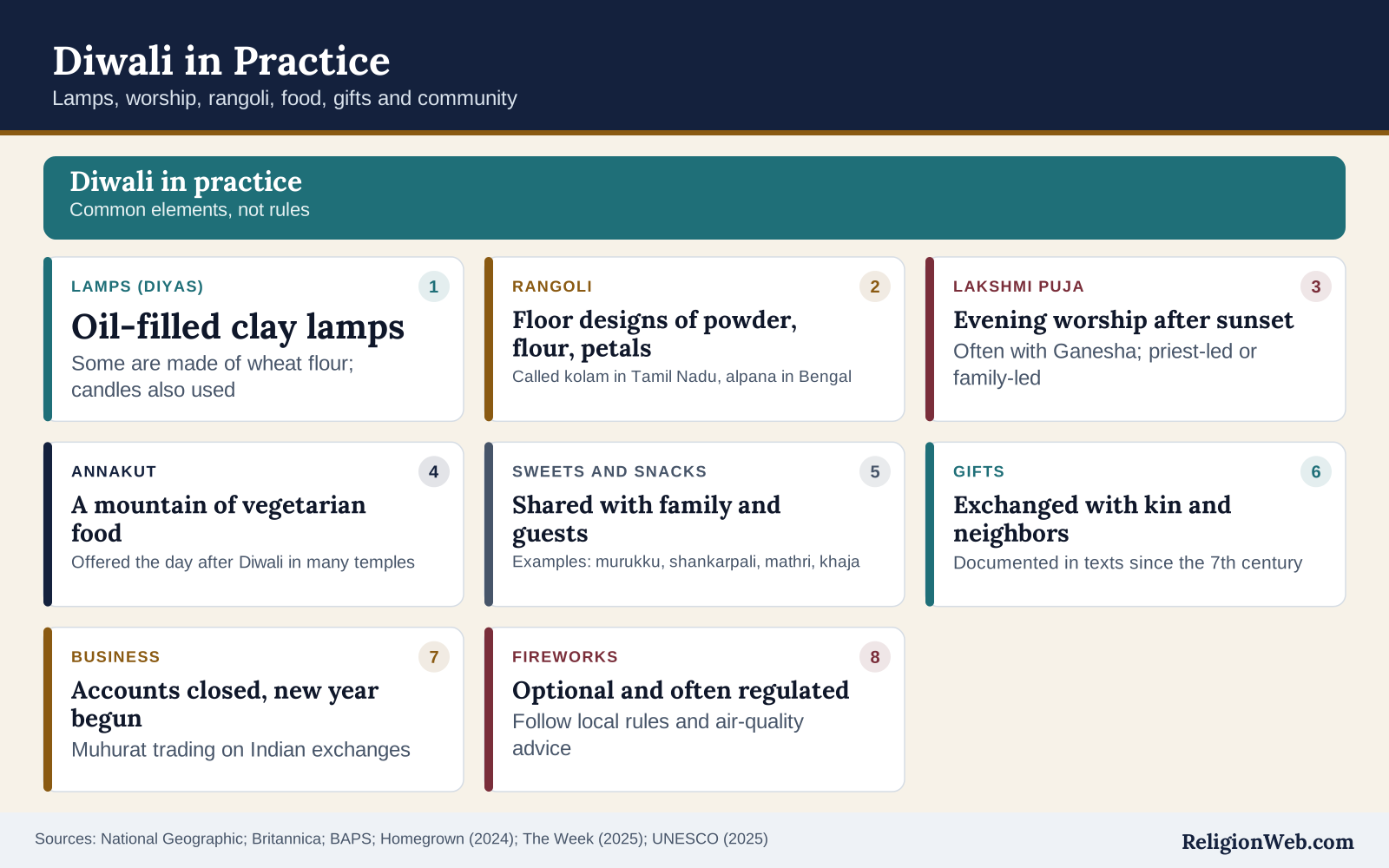
The oil lamp is the festival’s signature object. Britannica describes the traditional diya as an oil-filled clay lamp, and notes that some are made of wheat flour. A cotton wick burns in oil or clarified butter, and households light them at entrances, on windowsills, rooftops, courtyards and around the home shrine. Modern homes may use candles or strings of electric lights as well, which Britannica’s description of Lakshmi Puja also mentions. National Geographic’s educational text explains the lamps as symbolizing inner light that protects against spiritual darkness and as a signal of welcome to Lakshmi. The row of lamps in the festival’s name is, in the first instance, a row of small oil flames along a ledge.
Light, knowledge and the prayer from the Upanishads
The language of darkness and light has a long place in Hindu devotional writing, and one verse from the Brihadaranyaka Upanishad is often quoted in modern discussions of Diwali’s meaning. In its own setting the verse belongs to the ritual of the Soma sacrifice, where it accompanies the ascent of the Pavamana verses. F. Max Müller’s translation in the Sacred Books of the East reads:
Lead me from the unreal to the real! Lead me from darkness to light! Lead me from death to immortality!
Brihadaranyaka Upanishad I, 3, 27 (Müller’s numbering), trans. F. Max Müller, Sacred Books of the East, vol. 15
The verse is not a Diwali text, and the festival’s own records, from the Puranas to al-Biruni, do not cite it. In the Upanishadic and Vedanta traditions the prayer is generally understood as one for knowledge and liberation, not for illumination of the physical world, a context explained in the article on the Vedas and Upanishads. Modern speakers adopt it for Diwali because its imagery matches the lamps, and in doing so they extend an older metaphor to a new setting.
Rangoli and the Decorated Threshold
Rangoli, kolam and alpana
Rangoli are colorful designs made on floors and pavements using powders, sand, flour, rice or flower petals, according to National Geographic. In Tamil Nadu a related floor drawing is called kolam, in Bengal alpana, and in many other regions another local name applies, with patterns often learned within families. The designs include geometric figures, lotuses, lamps and auspicious signs. Because they are laid at the entrance, they serve as a welcome to Lakshmi, and because they are made of ephemeral material, they are not meant to last.
Footprints, garlands and the open door
Britannica notes that families draw representations of Lakshmi’s footprints, and National Geographic notes that people open doors and windows to invite her in. Marigold garlands and mango-leaf strings hang across thresholds in many homes, and a clean, bright entrance is itself part of the worship. The details vary: some households draw footprints in rice flour that lead from the door to the shrine, while others make do with a single drawn symbol. The consistent idea is that the house is a place of welcome.
| Object or practice | What it is | Commonly stated meaning | Variation or caveat |
|---|---|---|---|
| Diya | Oil-filled clay lamp, sometimes made of wheat flour, with a cotton wick | Light over darkness; welcome for Lakshmi; inner light | Candles and electric lights are common substitutes |
| Rangoli, kolam, alpana | Floor designs of colored powder, flour, rice or petals | Welcome and auspiciousness at the threshold | Names, patterns and materials differ by region |
| Lakshmi’s footprints | Drawn or painted footprints leading into the home | The goddess entering the house | Not drawn in every household |
| Image of Lakshmi with Ganesha | Printed picture, metal image or clay figure for the evening puja | Wealth, good beginnings and obstacles removed | Some families add Kubera; Bengal worships Kali on this night |
| Water pot and coins | A pot with water and leaves, new coins or currency set before the image | Abundance and auspicious beginnings | Sequence and items depend on the priest and the family |
| Oil bath | A bath with oil before dawn on the second day | Purification; in some texts, Lakshmi dwells in oil | Central in Tamil Nadu; less so elsewhere |
| Cattle and cow dung | Cows honored; a dung hillock for Govardhan | Fertility, prosperity and the Govardhan story | Prominent in north India and Nepal |
| Firecrackers | Noisemakers and light displays on the main night | Joy; in some accounts, driving off harmful spirits | Restricted by law and local practice in many places |
| Annakut | A “mountain” of food offered to God | Gratitude for the harvest; the Govardhan story | Prepared on a large scale in Swaminarayan and Vaishnava temples |
Fireworks, Sound and Care
Why fireworks accompany the festival
Reiniche notes that setting off firecrackers is thought to drive away evil spirits, and National Geographic lists fireworks among the festivities that follow the Lakshmi Puja. The loud, bright display fits the festival’s mood of celebration and of making the night inhospitable to harm. The earliest records cited in the origins section describe rows of lights, gifts and play and do not mention firecrackers, though that silence alone does not date their arrival.
Air quality, courts and alternatives
Smoke and noise have become public health questions. In October 2025, India’s Supreme Court relaxed a ban on firecrackers in the Delhi region to allow the sale and use of so-called green crackers within limited time slots on the days around Diwali, according to reports by The Week and Deccan Herald. Rules differ from city to city and year to year, so a family should check its local regulations. People with asthma or other respiratory or heart conditions are advised by health authorities to limit exposure to smoke, and children should be supervised around fireworks and open flames. Religious observance does not substitute for medical care, and a burn or breathing difficulty on the night of the festival calls for prompt medical attention. Many families now keep the festival through lamps, rangoli, music and shared meals, which are the oldest and most widely documented elements, and treat fireworks as optional.
Food, Gifts and Community Celebration
Food and Offering
Sweets and savory snacks
Sharing sweets is among the most dependable features of the festival. National Geographic notes sweets and feasts after the Lakshmi puja, and a food survey published by Homegrown in 2024 lists examples such as murukku, a fried coil of rice and lentil flour, in Tamil Nadu; shankarpali in Maharashtra; mathri in Rajasthan; and khaja, a layered fried pastry soaked in syrup, in Bihar. Stuffed fried pastries called gujiya are eaten in northern India and are also associated with Holi. These are examples named in popular guides and not an exhaustive or authoritative map, since every family has recipes of its own. Food that is first offered to the deity and then shared is called prasad, and many households make the same dishes for both purposes.
Annakut and temple food
At Annakut, food becomes the offering itself. BAPS describes devotees preparing vegetarian dishes in the thousands, offering them to God while a thal is sung, and distributing them as blessed food. The scale reflects the Govardhan story, in which the villagers’ harvest offering is redirected to the mountain, and the principle that the first portion of what a community grows and cooks belongs to the divine before it is eaten. The same practice appears in Vaishnava temples, and Britannica notes vegetarian food offered to a statue of Krishna at a Kolkata temple.
| Region or community | Customs reported | Foods often named | Caveat |
|---|---|---|---|
| Tamil Nadu | Pre-dawn oil bath, puja, and a fast called nombu in some households | Murukku | Practices differ by caste community and household |
| Maharashtra | Visits, lamps, rangoli, family gatherings | Shankarpali | Popular lists mix urban and rural, vegetarian and non-vegetarian customs |
| Rajasthan | Lamps, rangoli, merchant rites | Mathri | Savory snacks keep for weeks, which suits visiting |
| Bihar and eastern Uttar Pradesh | Lakshmi Puja, visits, regional sweets | Khaja | The Homegrown survey links khaja to the old Oudh region |
| Gujarat and Swaminarayan temples | New-year greetings, Annakut | Vegetarian dishes in large number | Annakut scale varies by temple |
| Bengal | Kali Puja, fourteen lamps on the eve | Offerings differ by tradition | Shakta worship includes both vegetarian and animal offerings in some places |
| Nepal | Offerings to crows, dogs and cows; Bhai Tika | Garlands and feeding of animals | Newar and other communities observe distinct rites |
Gifts, Clothing and Hospitality
Exchanging gifts and sharing wealth
Gift giving is among the oldest documented features of Diwali. The seventh-century play Nagananda refers, according to Baruah, to Diwali gifts among family members, and al-Biruni noted around 1030 that people exchanged betel leaves and areca nuts, visited temples and gave alms. Reiniche reports that gifts are given to family members and to neighborhood servants, and National Geographic mentions friends and relatives visiting with gifts and good wishes on the fourth day. The offering of gifts to people who work in a household is a reminder that the festival’s language of abundance is also a language of obligation.
New clothes, visits and greetings
New clothes belong to nearly every account, from al-Biruni’s festive dress to Reiniche’s list of offerings. Families visit relatives, and greetings differ by language and community: at BAPS temples devotees greet one another with “Nutan Varsha Abhinandan” or “Saal Mubarak” on the new-year morning, while in many places “Happy Diwali” and “Shubh Deepavali” are heard. Visits can fill several days, which is part of why the festival is hard to confine to a single date.
Community Celebration and Shared Space
Temples, neighborhoods and schools
UNESCO’s listing notes that the festival is passed on mainly within families, with elders teaching children, and that temples, schools, cultural organizations and digital platforms also help transmit it. Temples hold special evening aartis and lamp-lighting, such as the evening Kali Puja at the Ramakrishna Math in Madurai in 2025, which included an arati, bhajans, flower offerings and prasad. Neighborhood associations and schools organize lamp-painting, rangoli contests and performances, and in cities with large South Asian populations, public festivals bring the celebration into town squares.
Shared celebration across communities
Because lamps, sweets and visits are easy to share, Diwali is often the Hindu festival that neighbors and colleagues of other faiths know best. Jains and Sikhs keep their own commemorations on the same days, as noted above, and people of many backgrounds attend public lamp-lighting or accept sweets from a neighbor. Guests are generally welcome at community events. Anyone invited to a home or a temple during the festival does well to follow the household’s lead on removing shoes, covering the head if asked, and accepting prasad, and to ask a host about any custom that is unclear.
Common Misconceptions About Diwali
Misconception 1: Diwali celebrates one identical story everywhere
Where the misunderstanding comes from
Greeting cards, school lessons and news reports often compress the festival into a single sentence: Diwali marks Rama’s return to Ayodhya after defeating Ravana. The shorthand is easy to remember, and it matches what many families in northern India do tell their children. Because English-language media are often produced in or about those regions, the northern story tends to travel furthest and to be taken for the whole.
A second source is the festival’s habit of absorbing its neighbors’ stories. Families that move between regions or marry across communities carry more than one account at once, so that a child may hear Rama’s story at school, Krishna’s from a grandmother, and Lakshmi’s at the puja. The retelling that reaches print is usually the one the writer grew up with, presented as the story.
What the evidence and tradition actually show
The Rama story is a major strand, but it is not the only one, and it does not appear among the oldest explanations in the written record surveyed above. The Puranic and medieval texts surveyed earlier explain the lamps through Yama, Bali, Lakshmi, and Shiva and Parvati at play. National Geographic’s classroom summary tells the pattern as North India honoring Rama, South India honoring Krishna’s defeat of Narakasura, and West India recalling Vishnu’s sending of Bali to the netherworld, and Bengal adds Kali. Jain and Sikh communities mark different events on the same days. UNESCO’s own entry speaks of “diverse individuals and communities.” What unites the accounts is a broad theme of light over darkness, not a shared plot, and a respectful description names the community whose story is being told.
Fairness runs in both directions. It would be a mistake to treat Rama’s return as a recent invention or a minor strand, because for millions of families it is the living center of the festival, and the public lamp-lighting at Ayodhya shows how much weight it carries. The sources support a narrower claim: it is one regional strand among several, and the earliest surviving explanations differ from it. A teacher or writer who says that in much of North India families tell the story of Rama’s return is describing the evidence accurately, and one who says that this is what Diwali means everywhere is not.
Misconception 2: Diwali is a one-day festival in every region
Where the misunderstanding comes from
Calendars list a single date, workplaces close for a single holiday, and conversation uses the word “Diwali” for the main evening. The Government of India’s holiday list, for example, names one day, November 8, for 2026. Someone who knows the festival only from that day can be forgiven for thinking it stops when the lamps burn out.
A second cause is the gap between a public holiday and a religious observance. Employers and schools need one date, so the almanac’s most important day becomes the festival’s whole name in official lists. Observant families, by contrast, begin cleaning and shopping days earlier and go on visiting, eating and giving gifts afterward.
What the evidence and tradition actually show
Almost everywhere the festival extends before and after the main night. Britannica gives a five-day pattern, Reiniche describes three nights, Nepal’s Tihar is a defined five-day cycle, and Drik Panchang’s 2026 list stretches from November 5 to November 10. Regional emphasis also changes the count: in Tamil Nadu the key day is Naraka Chaturdashi, in Bengal the single night of Kali Puja, and in Gujarat the new-year day that follows the main night. The fair statement is that Diwali is usually a multi-day festival whose number of days, and whose peak, depend on region, community and almanac.
The days around the main night have content of their own: the shopping and Yama lamp of Dhanteras, the oil bath, the Annakut offering, the new-year greetings and the brother-sister rites of Bhai Dooj. Treating the festival as a single evening leaves out most of what happens. Readers planning to attend a community event may also find that the most important gathering in their area falls on a day other than the one marked on the national calendar.
Misconception 3: Every family performs Lakshmi Puja in the same way
Where the misunderstanding comes from
Printed guides and apps present Lakshmi Puja as a numbered list of steps with a fixed time, which gives the impression of a single standard rite. Videos of temple or priest-led versions strengthen the impression that this is how everyone does it. The need for a precise muhurat, the auspicious time window, further suggests uniformity.
A third factor is the wish for reassurance. A household performing the rite for the first time, including many in the diaspora who learned it from a parent living far away, naturally looks for one correct procedure so as not to make a mistake. Such guides are useful, and their authors rarely claim that nothing else is valid, but the format of a numbered list can read as a rule.
What the evidence and tradition actually show
The shared elements are a clean home, lamps, an image of Lakshmi, offerings, an aarti and shared food. Around those elements the variation is considerable. Some households engage a priest and recite hymns at length, others perform a short worship at the family shrine, and merchants add worship of account books. In Bengal and parts of the east the central worship that night is of Kali, not Lakshmi, and in Tamil Nadu the dawn of Naraka Chaturdashi carries more weight. Even the date can differ when the new-moon tithi overlaps two evenings, because almanacs apply different tie-breaking rules. The practice is also a matter of family and sectarian custom, not of a single obligation prescribed for all Hindus, and a household that follows its own tradition is not departing from a norm.
The texts a family might consult are not uniform either. The Puranic prescriptions that Baruah surveys differ on which lunar day to use and which figure to honor with lamps. Present-day summaries, such as Britannica’s and National Geographic’s, agree on the core elements but differ in what they add, for example the pairing of Lakshmi with Ganesha and Kubera. A fair summary is that the form of worship is learned from a family or a priest and is correct when it is correct for that household’s tradition.
Misconception 4: Diwali is the Hindu New Year for all Hindus
Where the misunderstanding comes from
Reference works often note that Diwali marks the beginning of the Hindu new year, and in the Vikrama calendar as used in Gujarat and nearby regions that is accurate: BAPS places the new year on the day after Diwali. English-language summaries then carry the statement to all Hindus, as if Hinduism had one calendar.
The Gregorian calendar makes the confusion more likely. Because January 1 is a single date for most of the world, readers expect the Hindu new year to be one date as well, and the sentence that Diwali is the new year sounds like the equivalent.
What the evidence and tradition actually show
Hindus use several calendars. In Gujarat, many merchants and Swaminarayan communities begin the Vikrama year after Diwali, and the stock exchanges in India start a new Samvat on the Diwali session. In Nepal the Newar community begins Nepal Sambat on the fourth day of Tihar. Elsewhere the year opens in the spring month of Chaitra, which is the first month in some calendars. India’s national Shaka calendar has its own cycle. So Diwali is a new year for some Hindu communities, a harvest-season renewal for others, and neither for communities whose year begins in spring.
Where Diwali is the new year, it is a major one, marked by ledgers, new clothes, temple visits and greetings, and BAPS describes the morning as the first aarti of the year. A reader should therefore understand the statement as a description of particular calendars and communities. It is not wrong, and it is not general.
Frequently Asked Questions About Diwali
Questions About Meaning and Dates
What does Diwali mean?
Diwali is the Hindi form of the Sanskrit dīpāvali, “a row of lamps,” according to Merriam-Webster’s etymology. Deepavali is the form closer to the Sanskrit. Both names refer to the lamps lit in rows during the festival, and the name is applied to the whole cluster of days, though in everyday speech it often points to the main new-moon night.
When is Diwali in 2026?
The Government of India’s list of central holidays places Diwali on Sunday, November 8, 2026. The day of the pre-dawn oil bath, Naraka Chaturdashi, is listed by Drik Panchang for Saturday, November 7, and Bhai Dooj for Tuesday, November 10. Dhanteras is listed for Friday, November 6 in published calendars. Local almanacs may differ by a day, so a household should confirm with its own temple or panchang.
Why is Diwali called the festival of lights?
The name reflects the central practice of lighting oil lamps and, now, candles and electric lights in homes, temples and public places. UNESCO’s description speaks of the victory of light over darkness, and National Geographic explains the lamps as a symbol of inner light that protects against spiritual darkness. Al-Biruni’s report from about 1030 already mentions a great number of lamps lit at night, so the association is very old.
Questions About Practice and Participation
Do Jains and Sikhs celebrate Diwali?
Jains and Sikhs observe their own commemorations on or near the same days, with different meanings. Britannica notes that Jains mark the nirvana of Mahavira and Sikhs commemorate the return of Guru Hargobind from captivity, and Sikh observance of the occasion is usually called Bandi Chhor Divas. Because these have their own histories and practices, they are best learned from the communities and from the articles on Jainism and Sikhism, and not read as local variants of a Hindu festival.
Can someone who is not Hindu take part in Diwali celebrations?
Public lamp-lighting, festivals and shared sweets are generally open to all, and hosts commonly welcome guests. The worship at the center of the festival is a devotional act, and a guest does well to follow the household’s lead, for instance on removing shoes, on whether to join the aarti, and on accepting prasad. Invitations to a home or a temple are best treated as invitations to share a family’s or community’s occasion, and questions about any custom are usually welcomed.
What do people say to wish someone a happy Diwali?
“Happy Diwali” is common in English, and “Shubh Deepavali,” roughly “auspicious Deepavali,” is heard in Hindi and other languages. In Gujarati and Swaminarayan settings, BAPS reports greetings such as “Nutan Varsha Abhinandan” and “Saal Mubarak” on the new-year morning. Regional greetings differ, and a simple “Happy Diwali” is welcome in any setting.
Conclusion: A Festival of Layers and Households
What the Record Shows
A festival built in layers
The written record, from the Kamasutra’s night of the Yakshas to al-Biruni’s Dibali and the inscriptions of the Deccan, shows a festival that gathered meanings over many centuries. A seasonal renewal at the end of the monsoon, a time for the dead and for Yama, a night of Lakshmi, a day for Bali and Govardhan, and, in the east, Kali all belong to it. Later stories, notably Rama’s return and Krishna’s defeat of Narakasura, joined these strands, and each region emphasizes some strands over others.
A festival of homes, markets and temples
At the same time, the lived festival is made in specific places: a doorway with rangoli, a ledger opened for a new year, a dawn oil bath in Tamil Nadu, a Kali Puja in Bengal, an Annakut in a Swaminarayan temple, a Bhai Tika in Nepal. Public recognition, from UNESCO’s 2025 inscription to the Government of India’s holiday list and school holidays abroad, has not changed that household scale. It has made the festival visible to neighbors who do not share it.
How to Keep Exploring
Related articles on ReligionWeb.com
Readers who want the wider context can start with the overview of Hinduism and the article on puja, then turn to the pages on Navaratri, which ends about three weeks before Diwali, and Holi, the spring festival of colors. The traditions of Shaivism, which tells the dice story of Shiva and Parvati, and Shaktism, which frames Kali’s worship, show how different currents of devotion meet on the same night.
Reading regional and community sources
Because Diwali differs so much from place to place, the most reliable guide to a particular form is the community that keeps it: a local temple, a family priest, a regional almanac, or an elder who has kept the custom. A general survey can map the range of practice, but it cannot tell any household what its own tradition prescribes, and that is as it should be for a festival that has always been made at home.
Sources
The table below lists the principal external sources behind this article. Facts, dates and figures were checked against these and related primary, institutional and academic materials.
| # | Source | Publisher and type | Used for | Link |
|---|---|---|---|---|
| 1 | Deepavali (Representative List of the Intangible Cultural Heritage of Humanity, 2025) | UNESCO · Institutional | Inscription in 2025; description of the festival and its transmission in families | ich.unesco.org |
| 2 | Diwali (etymology and definition) | Merriam-Webster · Dictionary | Derivation from Sanskrit dipavali, 'row of lamps'; first English use in 1698 | merriam-webster.com |
| 3 | The Festival of Lights (Diwali), by Matt Stefon | Encyclopaedia Britannica · Encyclopedia | Five-day pattern, Ashvina and Karttika timing, Lakshmi, Jain and Sikh associations | britannica.com |
| 4 | Divali (Dipavali), by Marie-Louise Reiniche, Encyclopedia of Religion (1987) | Encyclopedia.com (Macmillan Reference USA) · Academic reference | Seasonal renewal, accounts, Lakshmi, Bali, Naraka, Govardhana, Yama and Yami, regional variation | encyclopedia.com |
| 5 | Alberuni's India, trans. Edward C. Sachau, vol. 2 (1910 edition), p. 182 | Columbia University Libraries (digital text) · Primary text | Quoted lamp sentence; al-Biruni's c. 1030 account of Dibali, Lakshmi and Bali | columbia.edu |
| 6 | The Upanishads, Part II, trans. F. Max Muller, Sacred Books of the East vol. 15 (Brihadaranyaka I, 3) | Internet Sacred Text Archive · Primary text | Quoted prayer 'Lead me from the unreal to the real' (Muller's numbering I, 3, 27) | sacred-texts.com |
| 7 | The Festival of Lights in Various Religious and Literary Texts of South Asia, by Silpisikha Baruah | Sahapedia · Academic reference | Puranic prescriptions, Nilamata Purana, Nagananda, Yasastilaka, Jnaneshwari | sahapedia.org |
| 8 | A History of Diwali, by Noor Anand Chawla (summarizing P. K. Gode, 1945) | JSTOR Daily · Academic reference | Chronology from the Kamasutra to the Ain-i-Akbari; Hemachandra; 1119 inscription | daily.jstor.org |
| 9 | Hindu population change, 2010 to 2020 (How the Global Religious Landscape Changed) | Pew Research Center · Demographic data | Hindu population figures for 2020: about 1.2 billion; country shares | pewresearch.org |
| 10 | New Year and Annakut (Nutan Varsh) | BAPS Swaminarayan Sanstha · Institutional | New year after Diwali, Annakut offering, Govardhan story, greetings | baps.org |
Last fact-check date: 2026-10-21.