The Buddha, a title meaning “the awakened one,” is the name Buddhists give to Siddhārtha Gautama (Pali Siddhattha Gotama), a teacher of the Shakya (Sakya) people who lived in the middle Ganges plain of northern India and whose awakening and decades of teaching are the foundation of Buddhism. In the tradition’s own account, he discovered through his own effort how suffering arises and how it ends, taught that discovery to monks, nuns, and lay people for the rest of his life, and died at about the age of eighty at Kusinārā, an event called parinirvāṇa (Pali parinibbāna), the final passing away. Historians place him in northeastern India, most likely in the fifth century BCE, though the exact dates remain disputed.
No document written in his lifetime survives. What exists is a layered record: discourses, monastic rules, and verses memorized and recited by communities of monks and nuns and committed to writing centuries later; inscriptions from the reign of the Mauryan emperor Ashoka in the third century BCE; archaeological sites; and a long series of biographies composed from roughly the early centuries CE onward. This article keeps those layers apart. It follows the traditional life in sequence, from birth to going forth, awakening, first teaching, ministry, and death, and at each stage says what the oldest texts report and what later narrators added.
It also explains how Buddhists remember the Buddha: through relics and pilgrimage places, through a history of images that began without any human figure at all, and through different understandings of what a buddha is in Theravada, Mahayana, and Vajrayana communities. His teachings are introduced where they arise in the story; fuller treatments appear in the chapters on the Four Noble Truths and the Noble Eightfold Path. Quotations from early discourses come from Bhikkhu Sujato’s translations on SuttaCentral, which are dedicated to the public domain, and quotations from monastic law from Bhikkhu Brahmali’s translations in the same collection.
The Buddha at a Glance: Names, Titles, Setting, and Life in Outline
Names and Titles
Gautama, Siddhārtha, and Shakyamuni
In the oldest discourses the teacher is most often called “the Buddha,” “the Blessed One,” or “Gotama,” which is the Pali form of the family name Gautama. His followers and critics alike address him as “Venerable Gotama” or “the ascetic Gotama.” The personal name Siddhattha in Pali, Siddhārtha in Sanskrit, usually translated “one who has achieved his aim,” does not appear in the early discourses and monastic texts reviewed for this article. It is familiar from later biographies and commentaries, and most modern readers meet it first. That does not make it a fabrication; it means the name belongs to the biographical layer of the tradition rather than to the earliest preaching texts, a distinction worth keeping in mind when reading any popular account.
“Shakyamuni” (Pali Sakyamuni), meaning “the sage of the Shakyas,” names him by his people. The Shakyas were a clan-based community in the foothills of the Himalayas whose members, in the texts, include his father Suddhodana, his mother Māyā, and many of his first relatives to join the monastic order. The title is especially common in Mahayana and East Asian usage, where it separates the historical buddha of our age from the many other buddhas the Mahayana sūtras describe. Ashoka’s pillar at Lumbinī, set up in the third century BCE, already calls the person born there the Shakyamuni Buddha, which makes the epithet one of the oldest attested.
Buddha, Tathāgata, and Bhagavān
“Buddha” is a title, not a personal name. It is the past participle of the Sanskrit and Pali root budh, “to awaken” or “to understand,” and it means one who has awakened. In early Buddhist usage it can be applied to anyone who has discovered the path to liberation without a teacher and then taught it: the long discourse called the Mahāpadāna Sutta, for example, lists six earlier buddhas before Gotama, beginning with Vipassī, who is said to have lived ninety-one eons ago. The usual Pali formula for the qualities of the historical Buddha strings together several epithets: perfected (arahant), fully awakened (sammāsambuddha), accomplished in knowledge and conduct, well-gone (sugata), knower of the world, supreme guide for those fit for training, teacher of gods and humans, awakened, and blessed (bhagavā).
In his own speech the Buddha often refers to himself as the Tathāgata, rendered “the Realized One” in the Sujato translations used here. The word is usually explained as “thus gone” or “thus come,” and the ancient commentaries offer several readings, so translators vary. “Bhagavān” (“Blessed One” or “Lord”) is the respectful form of address used by monks, kings, and visitors alike. The table below gathers the principal terms.
| Term | Language | Meaning | Where it is used |
|---|---|---|---|
| Buddha | Sanskrit, Pali | “Awakened one” | Title applied to him and to other awakened teachers |
| Siddhārtha / Siddhattha | Sanskrit / Pali | “One who has achieved the aim” | Personal name in later biographies and commentaries |
| Gautama / Gotama | Sanskrit / Pali | Family or clan name | Early discourses, spoken by monks, kings, and critics |
| Śākyamuni / Sakyamuni | Sanskrit / Pali | “Sage of the Shakyas” | Common in Mahayana and East Asian usage; on Ashoka’s Lumbinī pillar |
| Tathāgata | Sanskrit, Pali | “Thus gone” or “thus come”; “Realized One” | The Buddha’s way of referring to himself |
| Bhagavān / Bhagavā | Sanskrit / Pali | “Blessed One,” “Lord” | Respectful address and narrative epithet |
| Sammāsambuddha | Pali | “Fully self-awakened one” | Distinguishes a teaching buddha from a disciple who is an arahant |
The Life in Outline
Nine Stages From Birth to Relics
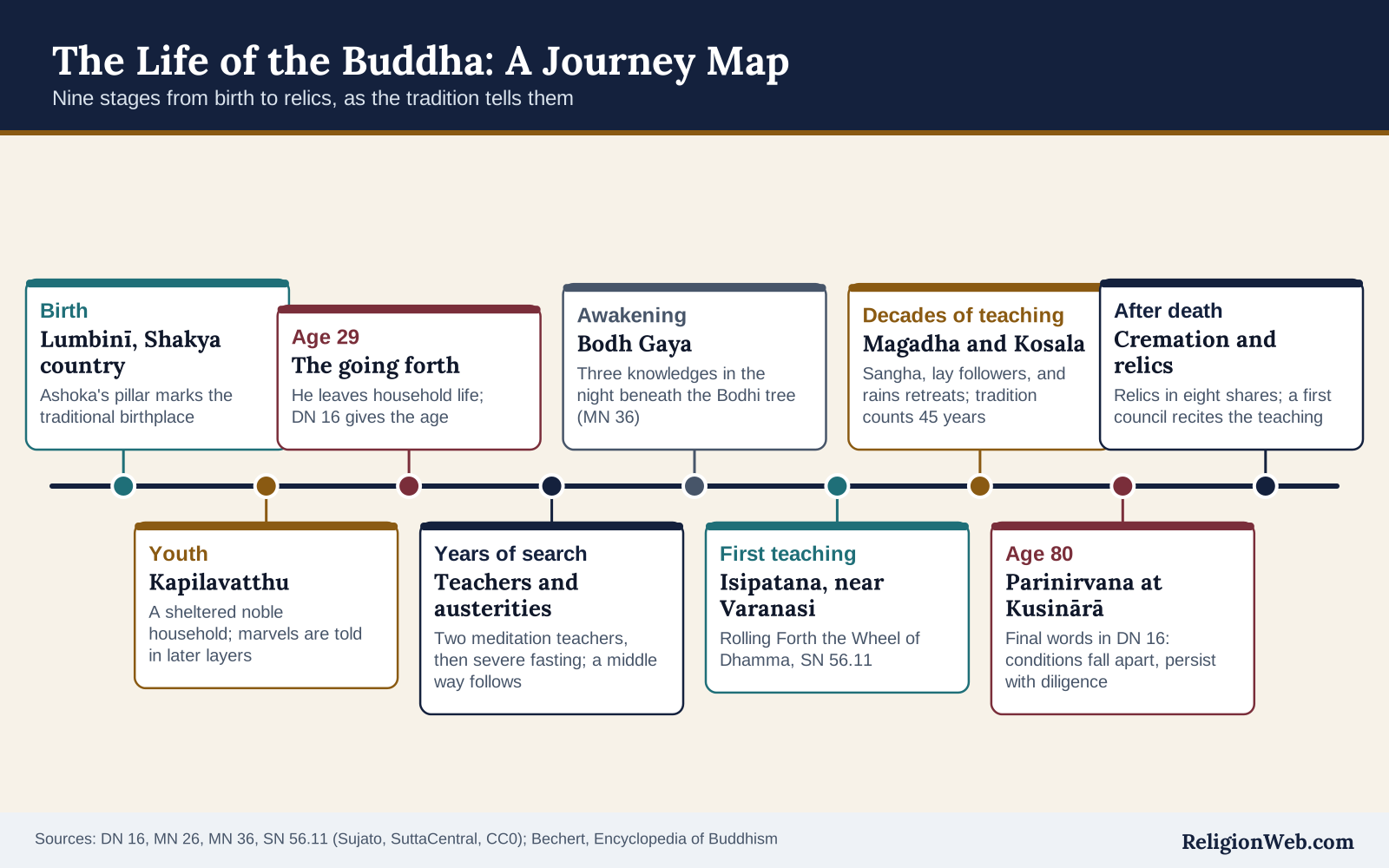
Buddhist literature in many languages tells the life as a sequence of stages, and the early texts supply the skeleton of most of them even where they lack a single continuous biography. The table gives that skeleton with the earliest textual anchor for each stage. Ages marked in the final column are those the early discourses state; ages that come from later commentaries are discussed in the next subsection.
| Stage | Where | What the tradition says | Earliest text to consult |
|---|---|---|---|
| 1. Birth | Lumbinī, Shakya country | Born to Suddhodana and Māyā, who dies soon afterward | Sutta Nipāta 3.11; Majjhima Nikāya 123 |
| 2. Youth and household life | Kapilavatthu | A sheltered upbringing; a son, Rāhula | Aṅguttara Nikāya 3.39; Vinaya, Mahāvagga (Kd 1) |
| 3. Going forth | Leaves home | Renounces at twenty-nine, against his parents’ wishes | Majjhima Nikāya 26; Dīgha Nikāya 16 |
| 4. Search and austerities | Magadha | Studies with two meditation teachers, then fasts severely | Majjhima Nikāya 26 and 36 |
| 5. Awakening | Uruvelā (Bodh Gaya) | Realizes the ending of suffering | Majjhima Nikāya 36; Vinaya, Mahāvagga (Kd 1) |
| 6. First teaching | Isipatana, near Varanasi | Teaches five former companions | Saṃyutta Nikāya 56.11 |
| 7. Years of teaching | Gangetic plain | Founds an order of monks and nuns; lay followers join | Vinaya, Mahāvagga; Aṅguttara Nikāya 8.51 |
| 8. Final passing | Kusinārā | Dies at about eighty after a final illness | Dīgha Nikāya 16 |
| 9. Cremation and relics | Kusinārā | Relics divided among eight claimants | Dīgha Nikāya 16 |
How the Ages and Numbers Are Known
Two ages are stated in the early texts themselves. In the account of the Buddha’s last months, he tells a wanderer named Subhadda that he went forth at twenty-nine and that more than fifty years have passed since then, and elsewhere in the same discourse he says he is eighty years old. Those two statements are consistent with each other, and they are the reason scholars treat “about eighty” as the traditional lifespan. Other figures, such as awakening at age thirty-five, forty-five years of teaching, and six years of striving before awakening, come from the commentarial tradition and later biographies rather than from the discourses themselves, and they should be read as traditional counts, not as measured data.
The same caution applies to the number of rainy-season retreats the Buddha is said to have spent in particular monasteries. Such lists are preserved in the commentaries, but the early discourses give only scattered locations. When a figure in this article is traditional rather than textual, it is labeled as such.
The World He Lived In
Kingdoms, Republics, and Cities of the Middle Ganges
The early texts place the Buddha in a region of the Ganges basin that scholars sometimes call the second urbanization of South Asia, a landscape of walled towns, trade routes, and competing polities. Two large kingdoms, Magadha, whose king Bimbisāra became his lay supporter and whose capital was Rājagaha, and Kosala, with its capital at Sāvatthī, dominate the stories. Alongside them were smaller republics governed by clan assemblies, among them the Shakyas of Kapilavatthu, the Licchavis of Vesālī, the Mallas of Kusinārā and Pāvā, the Koliyans, and the Bulis, all of whom appear in the account of the Buddha’s cremation. Heinz Bechert, writing in the Encyclopedia of Buddhism, notes that the Shakyas “were not kings” but formed a noble class within a republican system; the later description of Suddhodana as a king reflects the way biographers recast the story in royal terms.
That setting shaped how teachings were received. Wealthy merchants such as Anāthapiṇḍika donated monasteries, rulers asked for advice, and householders of every caste could meet the Buddha on his walking tours. The table below lists the places that the early texts connect to the life, with their modern locations. Several locations remain identified by Buddhist tradition and archaeology rather than by inscriptions from the Buddha’s lifetime.
| Place | Modern region | Role in the life | Early textual anchor |
|---|---|---|---|
| Lumbinī | Southern Nepal | Birthplace | Sutta Nipāta 3.11; Ashoka’s pillar inscription |
| Kapilavatthu | Debated: Tilaurakot (Nepal) or Piprahwa-Ganwaria (India) | Shakya town; home and later visits | Dīgha Nikāya 14 and 16; Vinaya, Mahāvagga |
| Uruvelā / Bodh Gaya | Bihar, India | Awakening | Majjhima Nikāya 26 and 36 |
| Isipatana (Sarnath) | Near Varanasi, Uttar Pradesh | First teaching | Saṃyutta Nikāya 56.11 |
| Rājagaha (Rajgir) | Bihar | Capital of Magadha; Bamboo Grove monastery | Vinaya, Mahāvagga (Kd 1) |
| Sāvatthī | Northern Uttar Pradesh | Jeta’s Grove, long residence in Kosala | Majjhima Nikāya 123 and many others |
| Vesālī (Vaishali) | Bihar | Ambapālī’s mango grove; the order of nuns; last rains retreat | Aṅguttara Nikāya 8.51; Saṃyutta Nikāya 47.9 |
| Kusinārā (Kushinagar) | Uttar Pradesh | Final passing and cremation | Dīgha Nikāya 16 |
A Crowded Field of Wandering Teachers
The Buddha did not teach into an empty landscape. The early texts describe a culture of śramaṇas, wandering ascetics and teachers who had left household life to pursue liberation or to debate the nature of the world. The Brahmanical priestly tradition, rooted in the Vedic hymns and ritual (see the article on the Vedas and Upanishads), coexisted with these movements, and the discourses show lively exchanges with brahmins about what makes a person noble. In one such exchange, shortly after awakening, he is asked what makes someone a brahmin, and he answers in terms of inner qualities rather than birth.
The same texts name rival teachers: Pūraṇa Kassapa, Makkhali Gosāla, Ajita of the hair blanket, Pakudha Kaccāyana, Sañjaya Belaṭṭhiputta, and a Jain ascetic of the Ñātika clan, generally identified with Mahavira, the teacher honored in Jainism. The Buddha’s two teachers before awakening, Āḷāra Kālāma and Uddaka son of Rāma, belonged to the world of meditation instruction that the next sections describe. Knowing this setting matters, because the Buddha describes his path as a way that runs between practices already on offer in his time, most famously between sensual indulgence and self-mortification.
Sources and Dating: What Historians Can and Cannot Say
The Earliest Evidence
Oral Collections and Their Parallels
The oldest sources for the Buddha’s life and teaching are collections of discourses (Pali sutta, Sanskrit sūtra) and monastic rules (vinaya) that communities of monks and nuns memorized and recited aloud. Heinz Bechert’s entry on the life of the Buddha in the Encyclopedia of Buddhism identifies these early texts with four ordination lineages: Theravāda, Sarvāstivāda, Mūlasarvāstivāda, and Dharmaguptaka. Only the Theravāda collection, the Pali Canon, survives complete in an Indian language. The others survive mainly in Chinese or Tibetan translation, with fragments in Sanskrit and related languages. When passages in several collections agree, historians gain some confidence that the material predates the separation of the schools. When they differ, scholars weigh each version on its merits.
Bechert’s judgment is that these texts “do not provide coherent biographies of the historical Buddha,” but that they contain biographical and autobiographical material handed down during the first three to five centuries after his death. The Theravada tradition holds that its canon was first committed to writing in Sri Lanka in the first century BCE, as described in the chapter on Theravada Buddhism. Whatever the exact date, the written forms stand centuries after the events, and the long oral period matters for how scholars read details such as numbers, speeches, and miracles.
Inscriptions and Archaeology
The earliest datable physical evidence comes from the reign of Ashoka, the Mauryan emperor who ruled in the third century BCE. His pillar at Lumbinī, which UNESCO dates to 249 BCE, is inscribed in the Brahmi script. According to the standard translations, it records that the king visited the spot, paid homage because the Buddha Shakyamuni was born there, set up a stone pillar, and reduced the taxes owed by the village. The pillar was rediscovered in December 1896. At Bodh Gaya, UNESCO attributes the first temple and the polished sandstone platform known as the Vajrāsana, the “diamond throne” beside the Bodhi tree, to Ashoka, while the present temple dates to the fifth or sixth century CE.
These monuments are valuable because they show how early and how firmly the memory of the places was fixed. They do not, however, record a word the Buddha spoke, and the earliest of them stands roughly a century and a half to two and a half centuries after his death, depending on the chronology adopted. Archaeology can confirm that a place was venerated, that a stupa was built, or that the veneration of relics was practiced, but it cannot by itself verify the details of the biography.
Dating the Buddha
Three Chronologies
For most of the twentieth century, Buddhist and Western scholars worked with three main dates for the Buddha’s death. The Theravada chronicles of Sri Lanka place it in 544 or 543 BCE, and that reckoning underlies the Buddhist Era used for official calendars in Sri Lanka and Thailand. UNESCO’s description of Lumbinī follows the same traditional scheme when it states that the Buddha was born in 623 BCE. A second scheme, the “corrected long chronology,” shortens the Sri Lankan count to place the death around 486 or 487 BCE, and Bechert notes that most Western and Indian scholars favored it for decades. A third, the “short chronology,” puts the death around 368 BCE, relying on Mūlasarvāstivāda texts and on two references in the Sri Lankan chronicle called the Dīpavaṃsa.
Underlying all three is a question about intervals: how many years separated the Buddha’s death from the consecration of Ashoka, a king whose date can be anchored through the Hellenistic rulers named in his edicts. The long chronology accepts the Sri Lankan chronicles’ figure for that interval, while the short chronology relies on other counts. Because the sources use different counting methods, the difference between them is on the scale of more than a century.
Where the Göttingen Symposium Left the Question
In 1988, a symposium in Göttingen, Germany, brought together specialists in Indology, Buddhist studies, and archaeology to reconsider the evidence. According to Bechert, who edited the proceedings, the papers proposed dates for the death ranging from 486 BCE to 261 BCE. Bechert’s own conclusion was that the Buddha died some time between 420 BCE and 350 BCE at about the age of eighty. That finding did not become a universal consensus; it moved the discussion toward a later range, and it gave cautious reference works a reason to say simply “fifth century BCE” or “around 400 BCE” rather than a year.
The dating matters to historians who want to understand the Buddha in relation to Indian politics, trade, and religious change, but it does not alter the order of events in the sources, the age at death, or the way Buddhists practice. Traditions that use the Theravada reckoning continue to count years from 544 or 543 BCE, and the commemoration described in the article on Vesak does not depend on the scholarly debate.
From Discourse to Biography
Autobiographical Fragments in the Early Texts
The early collections do not contain a Gospel-style biography. They offer scattered first-person memories, which the Buddha tells to monks and visitors, and third-person narratives woven into the monastic code. The Noble Quest (Majjhima Nikāya 26) describes the going forth, the two teachers, the awakening in outline, and the first teaching. The Longer Discourse With Saccaka (Majjhima Nikāya 36) recounts the austerities and the three knowledges of the night of awakening. A short discourse on a “delicate lifestyle” (Aṅguttara Nikāya 3.39) describes his youth in comfort. The Incredible and Amazing discourse (Majjhima Nikāya 123) is a set of marvels about his conception and birth, which his attendant Ānanda recites and the Buddha endorses. The City (Saṃyutta Nikāya 12.65) tells how he traced the chain of conditions behind aging and death. The long account of the final months, Dīgha Nikāya 16, is the closest thing to a continuous narrative in the discourses.
The Mahāvagga, the first section of the Vinaya, supplies the nearest approach to a connected story of the period after awakening: the seven weeks at the Bodhi tree, the request to teach, the first disciples, the conversion of Bimbisāra, the arrival of Sāriputta and Moggallāna, and the visit to Kapilavatthu. It was compiled as monastic law, however, and its narrative serves legal purposes such as explaining why a rule exists. Historians read it as valuable evidence for how the community remembered its origins, not as a neutral chronicle.
Later Biographies and What They Add
Continuous biographies appear later. Bechert, citing the Belgian scholar Étienne Lamotte, states that complete biographies seem to have been compiled no earlier than the second century CE. His list includes the Sanskrit poem Buddhacarita by Aśvaghoṣa, the Lalitavistara and Mahāvastu, which are Indian texts with strong Mahayana influence, and the Pali Jātakanidāna (the introduction to the Jataka commentary), dated about the fifth or sixth century CE. These works are literary achievements as well as devotional ones. They supply details that the early discourses do not contain, such as the four sights that prompt the prince’s departure, his farewell to his sleeping family, the groom Channa and the horse Kaṇṭhaka, and the assault of Māra on the night of awakening.
Readers of the biographies therefore meet a story that was shaped by centuries of storytelling, art, and doctrine. The table summarizes the principal narrative traditions and what each contributes.
| Source or tradition | Language | Approximate date | What it contributes |
|---|---|---|---|
| Pali Nikāyas and Vinaya (Theravāda) | Pali | Oral transmission in the first centuries; Theravada tradition says written in the first century BCE | First-person memories, the Mahāvagga narrative, the account of the last months |
| Parallel discourses and Vinayas (Sarvāstivāda, Mūlasarvāstivāda, Dharmaguptaka) | Chinese, Tibetan, Sanskrit fragments | Preserved in translations made in later centuries | Variant versions of the same episodes; tests of what is early |
| Ashoka’s inscriptions and monuments | Prakrit in Brahmi script | Third century BCE | Earliest datable witness to Lumbinī, Bodh Gaya, and relic veneration |
| Buddhacarita | Sanskrit poem by Aśvaghoṣa | Early centuries CE | A literary biography from birth to the first teaching, with the four sights and the departure |
| Lalitavistara and Mahāvastu | Sanskrit and Buddhist hybrid Sanskrit | Early centuries CE, with material of varied age | Expanded and devotional narratives with strong Mahayana influence |
| Jātakanidāna | Pali | About the fifth or sixth century CE | A full Theravada life story that frames the Jataka tales |
Birth and Early Life in the Traditional Account
Family, Clan, and Birthplace
The Shakyas and Kapilavatthu
In the Mahāpadāna Sutta, the Buddha himself says that in his present life his father was King Suddhodana, his mother was Queen Māyā, and the capital was Kapilavatthu (Sanskrit Kapilavastu). Yet Bechert observes that the Shakyas were not kings in the sense of hereditary monarchs but formed a noble class within a republican system, which suggests that later descriptions of a royal palace and a prince’s court reflect the way biographers retold the story in more familiar terms. Both statements can be reported side by side; the discourses use the title “king,” and historians question what the title meant in a clan republic.
The location of Kapilavatthu is itself contested. Two sites are proposed: Tilaurakot in southern Nepal and the area of Piprahwa and Ganwaria in northern India. Each has been excavated, each has supporters, and the question connects scholarship with national heritage and pilgrimage. The question cannot be settled from the early texts, which place the town in the Shakya country without giving coordinates, and this article therefore lists both candidates and does not choose.
Lumbinī and the Place of Birth
The discourse about the seer Asita, in the Sutta Nipāta, states that the child was born “in Lumbinī, a village in the Sakyan land.” Ashoka’s pillar, set up in the third century BCE, fixes the veneration of the site long before any biography was written. UNESCO inscribed Lumbinī as a World Heritage Site in 1997, noting layers of brick structures at the Māyā Devī temple dating from the third century BCE to the present. The sacred precinct includes the pillar, a pool, ancient monasteries, and stupas; the birth itself is commemorated at the festival described in the article on Vesak.
Many biographies add a garden scene in which Queen Māyā gives birth while standing and holding the branch of a tree, and this detail echoes the early discourse’s remark that she gave birth standing up. The early texts, however, do not describe the garden, and the picture familiar from art and festival is the product of later retelling.
Wonders at Birth and the Seer’s Prophecy
The Canonical Account of Marvels
The Incredible and Amazing discourse (Majjhima Nikāya 123) is the earliest connected telling of the Buddha’s birth in the Pali discourses. In it, Ānanda recalls what he heard from the Buddha about “the being intent on awakening,” the future buddha, the term bodhisatta in Pali. The being passes from the heaven of the joyful gods into his mother’s womb with a great light in the world; four guardian deities protect him and his mother; the mother is naturally ethical and free of afflictions; she gives birth after exactly ten months and standing up; gods receive the child before humans do; he emerges clean, and two showers of water, one cool and one warm, bathe the child and his mother. The text adds that the child stands firm on his feet, takes seven strides facing north with a white parasol held over him, surveys the quarters, and proclaims, in Sujato’s rendering, that this is his last rebirth. His mother dies seven days later and is reborn in the heaven of the joyful gods.
Devout Buddhists treat these marvels as part of the extraordinary nature of a being who will become a buddha. Historians of religion read them as the earliest layer of the legendary biography, evidence of how the community already spoke of its founder within a few centuries of his death. The two readings ask different questions, and this article reports both without ranking them. What the passage does show is that the idea of the buddha as a unique, world-shaking figure appears in the canon itself, alongside the sober autobiographical memories discussed in later sections.
Asita’s Prediction and the Child’s Upbringing
The Sutta Nipāta discourse on Nālaka tells of Asita, an ascetic seer who sees the gods rejoicing and learns that a child destined for awakening has been born among the Shakyas. He visits Suddhodana’s home, receives the infant, and predicts that the boy “shall reach the highest awakening” and will turn the wheel of the teaching. Then he weeps, because he expects to die before he can hear it, and he urges his nephew Nālaka to follow the teacher when the news spreads. Scholars regard the narrative verses of this text as probably later than the oldest strata of the Sutta Nipāta, and some see in the story an early attempt to answer the question of why a prince would become a wanderer.
After Māyā’s death, the infant’s care passed to her sister Mahāpajāpati Gotamī. Years later, Ānanda reminds the Buddha that she was his aunt, that she raised him, and that she nursed him at her own breast after his birth mother died. That memory becomes important when Mahāpajāpati asks to go forth and establish an order of nuns, a story told in the section on the early sangha below.
A Sheltered Youth and the Four Sights
The Delicate Life
One of the best-known first-person passages in the discourses is the Buddha’s description of his youth. “My lifestyle was delicate, mendicants, most delicate, extremely delicate,” he says. In his father’s home, lotus ponds were made for him, he used sandalwood from Kāsi, a white parasol was held over him night and day, he had three stilt houses for winter, summer, and the rainy season, and he spent four months in the rains house entertained by musicians, none of them men. Even the servants of his father’s house, he says, ate fine rice with meat. Then, in the middle of that comfort, he reflected that he was himself liable to grow old, fall ill, and die, and that it would be inappropriate to be horrified at the sight of others undergoing those things. He gave up what he calls the three vanities: of youth, of health, and of life.
The passage is notable for what it omits. There is no dramatic encounter with a corpse and no secret flight, only a process of reasoning that moves from ease to insight. The Vinaya adds a few domestic facts. It mentions that his wife, called in the text “the queen, the mother of Rāhula,” and his son Rāhula were living in Kapilavatthu when he returned, years after leaving. Later sources give her various names, which differ by tradition.
Old Age, Sickness, Death, and the Renunciant
The full “four sights” narrative appears in the Mahāpadāna Sutta, but there it is told of an earlier buddha, Prince Vipassī. The prince drives out with his charioteer to a park, sees a man bent with age and asks whether he too is liable to grow old, then on later outings sees a sick man and a corpse, and finally meets a shaven-headed renunciant. Each encounter turns his mind further toward leaving home. Later biographers, among them the authors of the Pali Jātakanidāna and the Sanskrit Buddhacarita, retell the sequence of Siddhārtha, with the king trying to keep unpleasant sights from the prince, and the story has become the best-known part of the life in popular accounts.
Seen from within the tradition, the repetition across buddhas is itself a teaching: each awakened teacher follows the same pattern, because the pattern follows the nature of suffering. Seen historically, the shared pattern suggests that the biographers drew on a stock story of how a buddha is moved to renounce. Both observations help explain why the four sights belong to the later layer of the life of the Buddha, and why the earlier first-person account in the Aṅguttara Nikāya is plainer and more reflective.
The Great Going Forth and the Search for Liberation
Leaving Home at Twenty-Nine
The Account in the Noble Quest
The Buddha’s own earliest account of his departure is brief and unadorned. In the discourse called the Noble Quest (Majjhima Nikāya 26), he distinguishes an ignoble quest, in which a person who is subject to aging, sickness, and death seeks things that are subject to the same fate, such as partners, children, servants, livestock, and gold, from a noble quest, which seeks what is free of birth, aging, sickness, and death. He then describes his own turning point.
‘Why do I, being liable to be reborn, grow old, fall sick, sorrow, die, and become corrupted, seek things that have the same nature? Why don’t I seek that which is free of rebirth, old age, sickness, death, sorrow, and corruption, the supreme sanctuary from the yoke, extinguishment?’
Majjhima Nikāya 26, Bhikkhu Sujato’s translation on SuttaCentral, section 13
In the Buddhist frame, this is the question that defines the whole path. “Extinguishment” translates nibbāna (Sanskrit nirvāṇa), the ending of the fires of greed, hatred, and delusion, a subject treated in the chapter on nirvana in Buddhism. The same discourse then reports the departure in a single sentence: while still young, with black hair, “though my mother and father wished otherwise, weeping with tearful faces,” he shaved his hair and beard, put on ocher robes, and went forth from the household life to homelessness. The text thus preserves, without comment, the grief of his parents. The Vinaya later records his father Suddhodana recalling that grief when he asks that no child be ordained without parental permission, and the rule that results is still part of monastic law.
The Great Departure in Later Narratives
Later biographies turn the going forth into one of the most dramatic scenes in Buddhist literature, often called the Great Departure. In the Pali Jātakanidāna and the Sanskrit Buddhacarita the prince leaves the palace at night, takes a last look at his sleeping wife and newborn son, rides out on the horse Kaṇṭhaka with the groom Channa, crosses a river, cuts off his hair, and sends his horse and ornaments back. These details are loved in sermons, paintings, and temple reliefs from Sri Lanka to Japan, and they convey real doctrinal points: that renunciation costs something, and that it is chosen rather than inherited.
The early discourses do not say how he left, how old his son was, or whether he left by night. The only age stated in the oldest layer is the one he gives to the wanderer Subhadda at the end of his life, twenty-nine. Readers who want to separate history from narrative can treat the going forth itself as the stable core, the departure at twenty-nine against parental wishes, and the night ride as the later elaboration.
Two Teachers and the Limits of Meditative Attainment
Āḷāra Kālāma and Uddaka Rāmaputta
After going forth, the Buddha says, he went in search of “what is skillful, seeking the supreme state of sublime peace.” He approached Āḷāra Kālāma, who taught a meditative attainment called the dimension of nothingness, and he learned the teaching quickly, first by memorizing it and then by realizing it for himself. Āḷāra Kālāma, the text relates, placed him on equal footing and invited him to co-lead the community. The Buddha left anyway, judging that the attainment “doesn’t lead to disillusionment, dispassion, cessation, peace, insight, awakening, and extinguishment,” but only to rebirth in that dimension. He then approached Uddaka son of Rāma, who taught the still subtler attainment called the dimension of neither perception nor non-perception, and the same thing happened: the Buddha realized it, was invited to lead, and left unsatisfied.
The discourse shows a remarkable honesty about these teachers. It does not caricature them or deny their achievements. Later, when the Buddha considers whom to teach first, he thinks of both and learns, by clairvoyance, that Āḷāra Kālāma had died seven days earlier and Uddaka son of Rāma only the night before. “This is a great loss,” he says of each, because they would have understood quickly. The same two names appear, in Sanskrit forms, in the biographies of other Buddhist traditions, which gives scholars reason to think they belong to the older stratum of the story.
What the Episode Means for Buddhist Meditation
The episode explains a feature of Buddhist practice that surprises many readers. The two attainments the Buddha rejected as final, nothingness and neither perception nor non-perception, are not discarded. In the Noble Quest itself, they appear as the seventh and eighth stages in a sequence of meditative states that begins with four absorptions (jhāna) and continues through infinite space and infinite consciousness. The difference is how they are used. In the Buddha’s teaching, deep concentration is a tool that steadies and clarifies the mind, but awakening comes from insight into the way experience arises and ceases, and no state of absorption can supply that by itself. This is the logic behind the two broad lines of practice described in the article on Buddhist meditation: calming (samatha) and insight (vipassanā).
It also has a historical implication. The story presents the Buddha as someone who inherited a living tradition of contemplative technique and went beyond it, rather than as an isolated visionary. That reading fits what modern historians of early India say about the wider culture of śramaṇa teachers, and it is a good example of a point where the tradition’s account and historical scholarship overlap.
Austerities and the Middle Way
Striving Until the Body Failed
The Longer Discourse With Saccaka (Majjhima Nikāya 36) gives the Buddha’s account of the severest phase of his search. He describes pressing his tongue against his palate, restraining his breath, and reducing his food to a handful of bean broth at a time, until, in his own words, his limbs became like the joints of an eighty-year-old or a dying man and the skin of his belly stuck to his backbone. Passers-by debated whether he was black, brown, or merely dingy in complexion. He then reflects that no ascetic of the past, present, or future could have endured more than this, and that nonetheless he had achieved no “superhuman distinction in knowledge and vision worthy of the noble ones.” He asks himself whether there might be another path to awakening.
Commentarial tradition counts six years of such striving, a figure not given in the discourse itself. In that period, according to the text, five ascetics attended him, expecting that he would tell them whatever truth he realized. Artistic images of the emaciated ascetic, especially from Gandhāra, preserve this phase of the story in a form that has become one of the most recognized in Buddhist art. A brief note is appropriate here: the tradition presents severe fasting as a mistaken means, not a model, and nothing in this account is a recommendation for extreme dieting or for treating spiritual goals as a reason to override medical advice.
The Memory Under the Black Plum Tree
The turning point in the same discourse is a memory. The Buddha recalls sitting in the cool shade of a black plum tree (jambu) while his father the Sakyan was working, entering the first absorption, with the rapture and bliss of seclusion. He asks whether that might be the path, and he concludes that this pleasure has nothing to do with sensual desire or unskillful states, so there is no reason to fear it. He then realizes that he cannot reach it with a starved body, and he decides to eat solid food, rice and porridge. When he does, the five ascetics leave in disappointment, saying that he has turned to indulgence.
That sequence is the root of what Buddhists call the middle way, a path between sensual indulgence and self-mortification. The phrase receives its formal statement at the first teaching, discussed below. The point to notice here is that the Buddha does not present it as a compromise worked out in the abstract but as a conclusion drawn from experience: the extremes had been tested, one in the palace and one in the forest, and found to fail.
Awakening at Bodh Gaya
What the Early Texts Report
The Three Knowledges of the Night
The closest thing to a direct account of the night of awakening is in the Longer Discourse With Saccaka. After eating and recovering strength, the Buddha entered and passed through the four absorptions. With his mind, in his words, “purified, bright, flawless, rid of corruptions, pliable, workable, steady, and imperturbable,” he directed it to three knowledges, one for each watch of the night. In the first he recollected his many past lives. In the second, with purified clairvoyance, he saw beings passing away and being reborn according to their deeds. In the third he directed his mind to the ending of the defilements and understood the four truths of suffering, its origin, its cessation, and the practice leading to its cessation, and understood the corresponding truths about the defilements themselves.
Then the text records the moment of liberation: “When it was freed, I knew it was freed. I understood: ‘Rebirth is ended; the spiritual journey has been completed; what had to be done has been done; there is nothing further for this place.’” The structure of this report matters. Rebirth and karma are not background beliefs the Buddha merely absorbed; they are the first two knowledges, objects of his own direct seeing, as the tradition understands it. The ending of the defilements is the third and decisive one. For an explanation of these ideas on their own terms, see the chapters on karma and rebirth and on the Four Noble Truths.
Dependent Origination and the Ancient Path
Not every early text describes awakening in the same terms. The Vinaya’s Mahāvagga, in its account of the Bodhi tree, says that during the three watches of the first night the Buddha reflected on dependent origination in forward and reverse order: ignorance conditions intentional activities, which condition consciousness, name and form, the six sense spheres, contact, feeling, craving, grasping, existence, birth, and aging and death, and with the ending of ignorance the whole sequence ends. A discourse in the Saṃyutta Nikāya, called The City (Saṃyutta Nikāya 12.65), traces the same chain by the question “When what exists is there old age and death?” and concludes with the words, “I have discovered the path to awakening.”
The same discourse adds a simile. A person walking through a forest sees an ancient path, follows it to an ancient city, and tells the king, who rebuilds the city. “In the same way,” the Buddha says, “I saw an ancient path, an ancient route traveled by fully awakened Buddhas in the past.” The image is revealing, because it presents awakening not as the invention of a new religion but as the rediscovery of a path others had walked. Scholars have long discussed which formulation, the four truths or dependent origination, is older. Later commentarial traditions harmonize them as two aspects of one insight, while historians of early Buddhism often treat the variety as a sign that the community explained the same event in several ways.
How Later Biographies Expanded the Night
In later biographies, the night under the tree becomes a drama. A young woman named Sujātā offers a bowl of milk-rice that ends the fast. A grass-cutter provides a seat of kusha grass. Māra, the tempter whose name means “death,” assaults the seated Buddha with armies, storms, and seductive daughters, and the Buddha touches the earth with his right hand to call it as witness to his merit. The gesture, the bhūmisparśa mudra, is among the most widely reproduced images in Buddhist art, and the story appears in the Jātakanidāna, the Lalitavistara, and the Buddhacarita in different forms.
The early discourses mention Māra elsewhere. In the Vinaya, for example, Māra appears when the Buddha sends his first sixty disciples out to teach, and the Buddha tells him he is defeated. But they do not contain the night battle. This does not mean the later accounts are worthless as religious literature. They give images to ideas that the early texts state in prose: that awakening overcomes fear, craving, and the pull of death. It does mean that a careful reader keeps the three levels apart: what the earliest texts say, what the biographies narrate, and what art and ritual have made familiar.
The Tree, the Place, and the Weeks After
Uruvelā, the Nerañjarā, and the Bodhi Tree
The Noble Quest places the Buddha’s striving in the region of Uruvelā in Magadha. He describes arriving at the town of Senā in Uruvelā, seeing “a delightful park, a lovely grove with a flowing river that was clean and charming,” and a village nearby for alms, and deciding that it was good enough for striving. The Vinaya locates the awakening itself at Uruvelā “on the bank of the river Nerañjara at the foot of a Bodhi tree.” In another passage of the Noble Quest, the Buddha meets an ascetic on the road “between Gayā and Bodhgaya,” in Sujato’s rendering, which places the site in the landscape still known by that name.
The Mahabodhi Temple Complex at Bodh Gaya, inscribed on the World Heritage List in 2002, marks the place. UNESCO describes it as one of the four holy sites connected with the life of the Buddha and associates it with the attainment of enlightenment. The present brick temple, about fifty meters high, dates to the fifth or sixth century CE, and UNESCO calls it one of the earliest brick temples still standing in India. Beside it stands a large Bodhi tree, described as a supposed direct descendant of the original, and a polished sandstone platform, the Vajrāsana or diamond throne, that tradition attributes to Ashoka as the spot where the Buddha sat. The word “enlightenment” is a standard English translation of bodhi, though many scholars prefer “awakening” because “enlightenment” carries overtones of the European Enlightenment that have nothing to do with the Indian term.
Seven Weeks in Stillness
The Mahāvagga tells what followed in a sequence of stations, each a week of “experiencing the bliss of freedom.” The Buddha sat for seven days at the Bodhi tree, then at a goatherd’s banyan tree, where a brahmin asked him what makes one a brahmin. At a powderpuff tree an unseasonal storm brought seven days of rain, and the dragon king Mucalinda coiled around the Buddha’s body and spread his hood over his head to shelter him. The scene is a favorite subject of Southeast Asian sculpture. At an ape-flower tree, two merchants, Tapussa and Bhallika, arrived from Ukkalā and offered him crackers and honey. The four great kings of the directions provided crystal bowls to receive the food, because “Buddhas don’t receive with their hands.”
The merchants then went for refuge to the Buddha and the Teaching and asked to be accepted as lay followers for life. The text says that by this double refuge they became the first lay followers in the world. The detail is small, but it matters: in the earliest layer, the Buddhist community begins with lay supporters before there is a monastic order, and the formula of the three refuges, which includes the sangha, was completed only after the first monks gathered around him.
The Decision to Teach
Hesitation and the Request of Brahmā Sahampati
Both the Noble Quest and the Mahāvagga then record a moment that has no counterpart in many traditional views of a founder. The Buddha considers whether to teach at all. What he has discovered, he thinks, is deep, subtle, and hard to see, and people delight in holding on. If he taught it, others might not understand, “which would be wearying and troublesome for me.” His mind inclines to remaining passive. At that point a high divine being, the Divinity Sahampati, fears that the world will be lost, appears before him, kneels, raises his joined palms, and asks him to teach because there are beings “with little dust in their eyes” who will understand.
The Buddha repeats his reluctance twice more and then surveys the world with what the text calls the eye of a buddha. He sees beings of every sort, like blue, pink, and white lotuses in a pond: some submerged, some at the surface, some standing above the water, untouched by it. He replies to Sahampati in verse: “The doors to the freedom from death are open!” The scene explains why the Buddha begins to teach, and the explanation is compassion for those who can understand, not a command from above.
How Buddhists Read the Episode
Within the tradition, the scene is read as a sign of the Buddha’s compassion and as a statement about the difficulty of the path: the truth is not self-evident and must be taught skillfully. It is also a reminder that Buddhist cosmology populates the universe with gods, among them Brahmā, but treats them as beings who are themselves subject to rebirth and in need of a teacher. In Sahampati’s request, a god kneels to a human being who has awakened.
Historians offer further readings. Some see in the narrative a dramatization of the problem of communicating a contemplative insight to an audience. Others see a deliberate claim of authority over the higher gods in a society where Brahmā had a prominent place in Brahmanical thought. These interpretations are scholarly inferences and not statements in the text, and they do not conflict with the devotional reading, which asks a different question. What the sources agree on is the outcome: after a delay of weeks, the Buddha rose from the Bodhi tree and set out for Varanasi to find the five ascetics who had left him.
The First Teaching and the Birth of the Sangha
Isipatana and the Turning of the Wheel
Finding the Five Ascetics
According to the Noble Quest and the Mahāvagga, the Buddha first thought of teaching his old meditation teachers, Āḷāra Kālāma and Uddaka son of Rāma, and learned that both had died. He then thought of the five ascetics who had attended him during his austerities and saw, with his clairvoyant vision, that they were staying in the deer park at Isipatana near Varanasi (Benares). On the road he met an ascetic of the Ājīvaka sect named Upaka, who remarked on his bright complexion and asked who his teacher was. The Buddha answered in verse that he had no teacher, that he was “the perfected one” and “the supreme Teacher,” and that he was going to Kāsi “to roll forth the Wheel of Dhamma.” Upaka said, “If you say so, reverend,” shook his head, and took another road. It is one of the few places in the discourses where an early listener politely declines to be convinced, and the texts leave it that way.
The reception at Isipatana was not much warmer. The five agreed among themselves not to greet him, because he had given up the struggle, but as he approached they could not hold to their plan; one took his bowl and robe, another prepared a seat, another set out water for his feet. They still addressed him by name and as “reverend.” He told them to stop, declared himself a fully awakened Buddha, and offered to teach them. Three times they objected that if austerities had not brought awakening, indulgence could not. The Buddha asked whether they had ever heard him speak like this before, and they admitted they had not. The account concludes that he was able to persuade them. The passage conveys a human detail rarely absent from the early texts: even the first disciples had to be convinced.
What Was Taught: The Wheel of Dhamma
The discourse that records the first teaching is called Rolling Forth the Wheel of Dhamma (Saṃyutta Nikāya 56.11), in the Pali tradition the Dhammacakkappavattana Sutta. It opens by naming two extremes that one who has gone forth should avoid.
“Mendicants, these two extremes should not be cultivated by one gone forth. What two? Indulgence in sensual pleasures, which is low, crude, ordinary, ignoble, and pointless. And indulgence in self-mortification, which is painful, ignoble, and pointless.
Saṃyutta Nikāya 56.11, Bhikkhu Sujato’s translation on SuttaCentral, section 2
The Buddha then presents the middle way as the Noble Eightfold Path, whose eight factors are right view, right purpose, right speech, right action, right livelihood, right effort, right mindfulness, and right immersion in Sujato’s renderings, and he states the four noble truths: suffering, its origin in craving, its cessation, and the path that leads to cessation. Each truth is explained in three “rounds,” the truth itself, the task that goes with it (suffering is to be fully understood, craving to be given up, cessation to be realized, the path to be developed), and the recognition that the task has been done. The text calls these three rounds and twelve aspects, and says the Buddha claimed supreme awakening only when his knowledge was fully purified in all twelve. Fuller explanations appear in the chapters on the Four Noble Truths and the Noble Eightfold Path.
The result, as narrated, is immediate. While the Buddha is speaking, the vision of the Dhamma arises in the senior ascetic Koṇḍañña with the realization, “Everything that is liable to arise is liable to cease.” The Buddha exclaims that Koṇḍañña has understood, and from that moment he is known as Aññāsikoṇḍañña, “Koṇḍañña who understood.” Deities raise a cry through the heavens that the wheel of Dhamma has been rolled forth and cannot be turned back. The wheel image, rolled forth like the wheel of a universal monarch, became one of the central symbols of the tradition and appears on pillars, in sculpture of the deer park, and on flags. In the Vinaya account the next steps follow quickly: Koṇḍañña asks for ordination and receives it with the words “Come, monk,” the other four reach the same insight as the Buddha continues to teach them, and he then gives all five the discourse on not-self, at the end of which the Vinaya says their minds were freed from the corruptions, leaving six perfected ones in the world.
From Five Monks to a Movement
Yasa, the Sixty, and the Instruction to Wander
The Mahāvagga’s narrative moves briskly. Yasa, a rich young man of Benares, wakes one night among his sleeping attendants, finds the scene repellent, and walks out of the house, saying, “Oh the oppression! Oh the affliction!” He meets the Buddha, hears a progressive talk on generosity, ethics, and the drawbacks of sensual pleasures, followed by the four truths, and goes forth. His father, searching for him, becomes the first person to take the triple refuge in the Buddha, the Teaching, and the Sangha as a lay follower, and Yasa’s mother and former wife become the first women to do so. Fifty of Yasa’s friends follow him into the order. At that point the text counts sixty-one perfected ones in the world, including the Buddha.
The Buddha then gives what is often called the first mission instruction, which tradition treats as the beginning of the Buddhist outreach to the wider world. “Go wandering, monks, for the benefit and happiness of humanity, out of compassion for the world, for the good, benefit, and happiness of gods and humans.” Each is to go a different way, and the teaching is to be proclaimed as “good in the beginning, good in the middle, and good in the end.” Māra tries once more to frighten him, and the Buddha answers that he is free from all snares. As the numbers grew, the Vinaya continues, monks began bringing candidates for ordination from distant regions to the Buddha himself, which tired everyone, and he allowed ordination by monks in their own regions through the repetition of the three refuges. That rule, with later refinements, is the basis of the ordination process described in the article on Buddhist monastic life.
A King, Two Friends, and a Monastery
From Benares, the account says, the Buddha returned toward Uruvelā, where he won over a community of one thousand matted-hair fire ascetics led by three brothers, Uruvelā Kassapa, Nadī Kassapa, and Gayā Kassapa. The Vinaya reports many wonders in this episode, including the subduing of a fire-breathing dragon king in the ascetics’ fire hut. At Gayāsīsa (Gayā Head) he gave the teaching that everything is burning, a discourse on the senses and the fires of sensual desire, ill will, and confusion, after which the thousand are said to have been freed from the corruptions. He then went to Rājagaha, where King Bimbisāra of Magadha, accompanied by a very large retinue of householders, heard him speak, took refuge, and invited him to a meal the next day. At that meal Bimbisāra donated his Bamboo Grove park to the order, a gift often cited as the first major monastery.
The same city produced the order’s two most celebrated disciples. The wanderer Sāriputta, struck by the calm bearing of the monk Assaji, asked him for his teacher’s message, and Assaji answered in four lines: of things that arise from a cause, the Buddha has declared the cause and also the ending. Sāriputta immediately grasped the point, “Anything that has a beginning has an end,” and brought his friend Moggallāna (Kolita), and together they brought their followers to the Buddha. The two became his foremost disciples, associated in the tradition with wisdom and with spiritual power respectively, and the fact that they joined from another wandering group illustrates the competitive field in which the early community grew.
Family and the Early Sangha
The Return to Kapilavatthu and Rāhula’s Inheritance
The Mahāvagga records that after a stay at Rājagaha the Buddha walked to Kapilavatthu, in the Shakya country, and stayed in the Banyan Tree Monastery. In the morning he went to Suddhodana’s house. His former wife, the mother of Rāhula, told the boy, “This is your father, Rāhula. Go and ask for your inheritance.” Rāhula approached, said, “Ascetic, your shadow is pleasant,” and followed him, repeating, “Give me my inheritance!” The Buddha told Sāriputta to ordain the boy as a novice, which was done by the shaving of the head, putting on robes, and taking the three refuges.
Soon afterward, Suddhodana came to the Buddha with a request. When the Buddha went forth it had been very painful for him, he said, and the same when Nanda went forth, but with Rāhula it was worse, because “affection for a child cuts deep.” He asked that no child be ordained without the consent of the parents, and the Buddha made that a rule. The episode shows both the personal cost of the monastic ideal for families and how the order’s rules were often responses to specific situations, a pattern that applies to much of the Vinaya.
Mahāpajāpati Gotamī and the Order of Nuns
Another family story explains the founding of the nuns’ order. In the discourse called With Gotamī (Aṅguttara Nikāya 8.51), the Buddha’s aunt and foster mother, Mahāpajāpati Gotamī, asks three times that women be allowed to go forth, and he declines each time. She then cuts her hair, puts on ocher robes, and walks with a group of Shakya women to Vesālī, where she stands weeping at the gate with swollen feet. Ānanda takes up her cause and, after being refused three times, asks whether a woman who has gone forth can realize the fruits of stream-entry, once-return, non-return, and perfection. The Buddha agrees that she can. He then permits her ordination on the condition that she accept eight principles of respect, which she does, saying she will bear them like a garland of flowers.
The text also records a warning, attributed to the Buddha, that the order’s admission of women will shorten the lifespan of the true teaching from a thousand years to five hundred. Modern Buddhists and scholars respond to this passage in different ways. Some traditional communities treat the eight principles as binding and the nuns’ lineage as limited by them. Others, including many Buddhist women’s movements, argue that the principles reflect the social conditions of a later compilation or must be read alongside the same text’s affirmation that women can attain perfection. The historical fact is that an order of nuns existed in the early community, that it is described in the Pali Vinaya and in the other early lineages, and that its status remains a topic of contemporary debate within Buddhist traditions.

Forty-Five Years of Teaching: Method, Themes, and Community Life
A Teacher’s Rhythm and Method
Wandering, Rains Retreat, and the Daily Round
The early texts portray a teacher who spent much of the year walking from town to town in the territory of Magadha, Kosala, and neighboring republics, and who stopped during the rainy season. The Vinaya explains that the rains retreat arose because wanderers moving in the monsoon were criticized for trampling crops and small creatures, and that monks were therefore to stay in one place for the rainy months, a practice still observed in Theravada countries. The texts name favorite residences: the Bamboo Grove at Rājagaha, Jeta’s Grove at Sāvatthī, the Great Wood at Vesālī, and the Banyan Tree Monastery at Kapilavatthu. By tradition the Buddha spent forty-five rainy seasons as a teacher, a count taken from later commentaries.
The daily rhythm that emerges in the discourses is simple. In the morning the Buddha robes, takes his bowl, and goes on an alms round, often with a group of monks; he eats the meal given to him, withdraws in the afternoon into private retreat, and comes out in the late afternoon to speak with those who have gathered. Visitors from every class, among them kings, merchants, brahmins, wanderers, and bereaved parents, appear in the narratives. The Buddha usually speaks informally, answering questions and using similes and analogies drawn from everyday life, such as a lotus pond, a log, an arrow, a raft, or a cart.
Adapting the Teaching to the Listener
One striking feature of the Buddha’s method is its adjustment to the listener. For lay audiences the Vinaya describes a “progressive talk” that begins with generosity, ethics, and the heavenly results of good conduct, moves on to the drawbacks of sensual pleasures and the benefits of renunciation, and reaches the four truths only when the listener’s mind is ready, “supple, without hindrances, joyful, and confident.” To monks, the talk could be technical, tracing the five aggregates or the chain of dependent origination. To a skeptical group in the village of Kesamutta, he gave the advice now known as the Kālāma Sutta (Aṅguttara Nikāya 3.65): do not go by oral tradition, lineage, scriptural authority, logic, or appearances, but test what you are told by whether, when undertaken, it leads to harm and suffering or to welfare and happiness. The Buddha then asks whether greed, hatred, and delusion lead to harm, and the Kālāmas say that they do. The advice is often quoted out of context as a license to believe nothing, but in the discourse it is a test applied to ethical consequences, and it is followed by a positive account of a mind free from ill will.
The Buddha also declined to answer some questions. In the Shorter Discourse With Māluṅkyaputta (Majjhima Nikāya 63), a monk threatens to leave the order unless the Buddha tells him whether the cosmos is eternal, whether the soul and body are the same, and whether a realized one exists after death. The Buddha replies that he never promised to answer those questions, and he compares the monk to a man wounded by a poisoned arrow who refuses treatment until he knows the shooter’s name, caste, and height. What the Buddha has declared, he says, is suffering, its origin, its cessation, and the path. In another discourse, the Simile of the Cobra (Majjhima Nikāya 22), he says that what he describes, both in the past and today, “is suffering and the cessation of suffering,” and he compares the teaching itself to a raft, “for crossing over, not for holding on.”
Core Themes in His Own Words
Suffering, Craving, and Liberation
Most of what the Buddha teaches in the early discourses can be organized around the claim stated in the first sermon: that human life as ordinarily lived is marked by dukkha, a word translated as suffering, unsatisfactoriness, or stress; that it arises from craving; that it can end; and that there is a path. In the discourse on the burning of the senses (Saṃyutta Nikāya 35.28), given at Gayā Head, he says that the eye, sights, and eye consciousness are all burning with the fires of greed, hate, and delusion, and that a learned disciple who sees this grows disillusioned, desire fades, and they are freed. This is a different vocabulary from the four truths but the same basic analysis.
Liberation, in the texts, is described with the image of fire going out: nibbāna, “extinguishment.” It is the end of greed, hatred, and delusion and, in Buddhist understanding, the end of the cycle of rebirth. The article on nirvana in Buddhism treats the term and its interpretations in greater depth, including the debates between and within traditions about how to describe it.
Karma, Rebirth, and Not-Self
Two further themes recur. The first is karma (Pali kamma), which the Buddha defines in terms of intention. “It is intention that I call deeds,” he says in a discourse on the origin and results of actions (Aṅguttara Nikāya 6.63), distinguishing his account from views that treat karma as ritual correctness or as an impersonal fate. Karma operates within a longer cycle of rebirth, sometimes called saṃsāra, which the awakened teacher claims to have seen directly in the first two knowledges of his night of awakening. The article on karma and rebirth in Buddhism explains how traditions interpret these ideas.
The second theme is not-self (anattā), taught in the Vinaya account just after the first sermon: that none of the five aggregates, form, feeling, perception, intentional activities, and consciousness, can be regarded as “mine, I am this, this is my essence,” because each is impermanent and unsatisfactory. How to interpret this teaching has been debated within Buddhism for centuries, with some schools stressing the denial of a permanent self, and others, such as the Mahayana tradition of Buddha-nature, emphasizing awakened potential in all beings. This article does not adjudicate those debates, but it does note the common ground: in all of them, clinging to a fixed self is understood as a root of suffering.
| Moment | Setting | What is taught | Early text |
|---|---|---|---|
| Decision to teach | Uruvelā | Hesitation; Sahampati’s request; “the doors to the freedom from death are open” | Majjhima Nikāya 26; Vinaya, Mahāvagga |
| Rolling forth the Wheel of Dhamma | Isipatana, near Varanasi | The two extremes, the middle way, the four noble truths | Saṃyutta Nikāya 56.11 |
| Discourse on not-self | Isipatana | None of the five aggregates is a self; the five are freed | Vinaya, Mahāvagga |
| The burning of the senses | Gayā Head | All is burning; disillusionment, fading of desire, liberation | Saṃyutta Nikāya 35.28 |
| Advice to the Kālāmas | Kesamutta, Kosala | Test teachings by their ethical results, not by authority alone | Aṅguttara Nikāya 3.65 |
| Unanswered questions | Jeta’s Grove, Sāvatthī | The poisoned arrow; teaching limited to suffering and its end | Majjhima Nikāya 63 |
| To the sick monk Vakkali | Rājagaha | “One who sees the teaching sees me” | Saṃyutta Nikāya 22.87 |
| Last words | Kusinārā | “Conditions fall apart. Persist with diligence.” | Dīgha Nikāya 16 |
Rivals, Critics, and Difficult Episodes
Debates With Other Teachers
The Buddha’s career was not a story of uncontested success. The Longer Discourse With Saccaka (Majjhima Nikāya 36) begins with the debater Saccaka, a son of Jain parents, who has defeated other teachers in argument, among them Pūraṇa Kassapa, Makkhali Gosāla, and the Jain ascetic of the Ñātika clan, and who comes to challenge the Buddha. By the end, he concedes that the Buddha’s complexion brightens under criticism where others grew angry and evasive. The text, of course, is compiled by the Buddha’s own community. It is nevertheless clear from the discourses, from Ashokan inscriptions, and from other Indian sources that Buddhism spread among competing movements, each with its own ethics, doctrines, and patrons.
The Vinaya also preserves self-critical material. It records disputes among monks, offenses committed by individuals, and cases in which a rule was added only after a problem occurred. In that sense the early community kept an unusually detailed account of its own failures, which is why historians use the Vinaya as evidence for the social history of early monasticism.
Devadatta and the Threat of Schism
The most serious internal crisis in the narratives involves Devadatta, a Shakya relative who went forth with other young Shakyas, among them Ānanda and Anuruddha. According to the Vinaya’s chapter on schism, Devadatta obtained supernormal powers but no stage of awakening. He won the patronage of Prince Ajātasattu of Magadha and, according to the text, later sought to damage the Buddha’s standing, with attempts that include sending assassins and releasing an elephant named Nāḷāgiri. The Vinaya also tells of his proposal to introduce five ascetic requirements: that monks live in the wilderness for life, eat only almsfood, wear only rag robes, live at the foot of a tree, and never eat fish or meat.
The Buddha refused to make these compulsory. Those who wished could practice them, but he allowed monks to live near villages, accept invitations to meals, and receive robe-cloth from householders, and he allowed fish and meat that are pure in three respects, meaning that the monk has not seen, heard, or suspected that the animal was killed specifically for him. Devadatta advertised the five points as proof of his own greater austerity and announced a separate observance, and the text calls this a schism. The story is a lasting reminder that the middle way applies to monastic discipline as well as to meditation, and that the early community debated the limits of asceticism almost from the start.
The Last Months: Illness, Final Teachings, and Parinirvana
The Final Journey
From Rājagaha Toward Vesālī
The Great Discourse on the Buddha’s Extinguishment (Dīgha Nikāya 16), known in Pali as the Mahāparinibbāna Sutta, is the longest and most detailed account of the Buddha’s final months, and it is the closest thing in the early texts to a continuous biography. It opens at Rājagaha, on Vulture’s Peak, where King Ajātasattu of Magadha announces his plan to invade the Vajjis, a confederation of clans that included the Licchavis of Vesālī, and sends his minister Vassakāra to hear what the Buddha thinks. The Buddha’s reply is an account of principles that keep a community from decline: gathering often, meeting and acting in harmony, honoring existing custom and elders. He then applies the same list to the order of monks. The sequence illustrates how the discourse blends political and monastic concerns, and how the Buddha’s final journey, northward through Magadha and across the Ganges toward the Vajji country, runs through a landscape of rival states.
At Vesālī the courtesan Ambapālī invites the Buddha and his monks to a meal, and when the Licchavi nobles arrive and invite him to the same meal, he tells them he has already accepted hers. When the rains begin he sends the monks to stay with friends nearby and keeps the retreat at the little village of Beluva, where he falls dangerously ill. He endures the pain with mindfulness and, deciding it would be inappropriate to pass away without taking leave of the order, he suppresses the illness. Afterward, Ānanda says that he had taken comfort in the thought that the Buddha would not die without leaving instructions for the community. The reply, which appears in both the Mahāparinibbāna Sutta and the Saṃyutta Nikāya (47.9), is among his best-known statements. The Realized One has taught without any distinction between secret and public teachings, he has no “closed fist of a tutor,” and he does not think “I shall lead the mendicant Saṅgha.” He is eighty years old, and his body is “kept going as if by a rope” like a decrepit cart. “So Ānanda, live as your own island, your own refuge, with no other refuge. Let the teaching be your island and your refuge, with no other refuge.”
The Decision at the Cāpāla Shrine
Afterward, back in Vesālī, the Buddha tells Ānanda that the city and its shrines are lovely and that anyone who has cultivated the bases of psychic power could live out a lifetime or the remainder of it. He repeats the hint three times. Ānanda, the text says, “didn’t get it,” and does not ask him to remain. Soon afterward Māra the Wicked appears and urges him to pass into final extinguishment now, reminding him of his own vow that he would not do so until he had fully trained monks, nuns, laymen, and laywomen, and until the spiritual path was widespread. The Buddha says that in three months he will be fully extinguished. At that moment, “mindful and aware, surrendered the life force,” and a great earthquake shakes the earth.
Readers have interpreted the scene in several ways. In Theravada commentaries it reflects the Buddha’s mastery over his own life: he chose the time of his death. Other readers emphasize Ānanda’s failure to ask: the Vinaya’s account of the first council lists it among the faults for which the senior monks asked him to make a formal confession, and he answers that his mind was possessed by the Lord of Death. Historians observe that the presence of Māra, earthquakes, and a hint missed by an attendant suggest a narrative shaped to explain why the founder died at eighty, when the tradition holds that a buddha could live much longer. None of these readings is needed to follow the basic facts the text reports: an aged teacher, ill, aware of his approaching death, and concerned that the community should be ready.
Kusinārā: Last Instructions
Cunda’s Meal and the Final Illness
From Vesālī the Buddha and a large group of monks went north, stopping at villages along the way, and at Bhoga City he taught the “four great references.” They are a method for testing a claim that someone has heard a teaching from the Buddha or from a senior community: one should neither accept nor reject it at once, but memorize the words and check whether they fit in the discourses and are consistent with the training, and if they do not, discard them. Later Buddhists have cited the principle in discussing the authority of texts, which makes it a notable passage in a discussion of how the canon was formed. At Pāvā he stayed in the mango grove of Cunda the smith, who invited him to a meal. The Buddha asked that the dish of “pork on the turn,” in Sujato’s rendering, be served to him alone and that the leftovers be buried in a pit. After the meal he fell severely ill with bloody dysentery and decided to continue to Kusinārā.
The Pali compound sūkaramaddava has been translated as soft pork, as a pork dish, and by some interpreters as a kind of mushroom or other food, and the text does not settle the question. It is accordingly safest to say that the Buddha’s final illness followed a meal at Cunda’s house, and that the discourse takes pains to protect Cunda from blame. The Buddha tells Ānanda that if anyone suggests Cunda has suffered a misfortune, he should be told that he is fortunate. There are two almsmeals, the Buddha says, of identical and exceptional fruit: the one eaten before a Realized One awakens, and the one eaten before he is fully extinguished.
Subhadda, the Last Disciple, and the Last Words
Reaching Kusinārā, the Buddha lay down between two sal trees in the grove of the Mallas, with his head to the north, on his right side, “mindful and aware.” The trees burst into flower out of season. He told Ānanda that the true way to honor him is not with flowers or music but by practicing in line with the teaching. He named four places that a faithful person should see and be moved by, and he told Ānanda, who was weeping, not to grieve, because everything born and conditioned must wear out. A wanderer named Subhadda, who had heard that the Buddha would be fully extinguished in the last watch of that very night, asked to see him. Ānanda refused three times, but the Buddha overruled him. He told Subhadda that in any teaching where the noble eightfold path is found, there are true ascetics, and that he had gone forth at twenty-nine and for more than fifty years had been wandering in search of what is skillful. Subhadda asked for ordination and, the text says, became the last personal disciple of the Buddha, soon realizing the goal of the path.
Then the Buddha made his last arrangements, saying that the teaching and training he had given would be the community’s teacher after his death, permitting the community to abolish the lesser and minor rules if it wished, and inviting the monks to ask any final questions. They remained silent three times, and Ānanda said he was confident that not one of them had any doubt. The Buddha’s final words are recorded in a short sentence.
“Come now, mendicants, I say to you all: ‘Conditions fall apart. Persist with diligence.’”
Dīgha Nikāya 16, Bhikkhu Sujato’s translation on SuttaCentral, section 6.7
Then, the text says, he entered the first absorption and rose through the eight levels of meditation to the cessation of perception and feeling, descended again through them, and entered the first absorption again before rising to the fourth, and at that point was fully quenched. The narrator reports that another great earthquake occurred, and four verses are spoken by deities and disciples. Anuruddha’s verse is the most cited: “The liberation of his heart was like the extinguishing of a lamp.” The image is that of a flame that goes out because its fuel is exhausted, and it is related to the Buddhist understanding of nibbāna discussed in the article on nirvana. Buddhists call this event parinirvāṇa to distinguish it from the nirvana the Buddha attained at awakening, when he was still alive.
Funeral and Aftermath
The Cremation at Kusinārā
The funeral, as the Mahāparinibbāna Sutta tells it, followed the pattern of a wheel-turning monarch (cakkavatti), the ideal universal king. The Buddha had told Ānanda that monks should not concern themselves with his funeral rites and that devout householders would arrange them. When the Mallas of Kusinārā asked how to proceed, Ānanda relayed the Buddha’s instruction: the body is to be wrapped in layers of new cloth and cotton, placed in an iron casket of oil, cremated on a pyre of fragrances, and a monument built at a crossroads. For six days the Mallas honored the body with dance, song, music, garlands, and fragrances, and on the seventh, they carried it through the town to the Mallian shrine called Coronation. The pyre did not catch fire until the elder Mahākassapa, arriving from Pāvā with five hundred monks, bowed at the Buddha’s feet. When it burned, the text says, no ash or soot was left, only the relics.
The same text preserves a reminder of the range of human responses at the Buddha’s death. Some monks who had not yet freed themselves from desire wept and rolled on the ground. Others, free of desire, endured, thinking, “Conditions are impermanent. How could it possibly be otherwise?” A different Subhadda, an unrelated man who had gone forth when old, said that they were well rid of the Great Ascetic, who had constantly told them what was allowable and what was not. Mahākassapa’s concern over that remark is, according to the Vinaya, what prompted him to call the first council.
Dividing the Relics and the First Council
As soon as the news spread, the kings and clans of the region sent envoys to the Mallas of Kusinārā to claim a share of the relics, each saying the Buddha was an aristocrat, as they were, or in the brahmin’s case, a revered teacher. The Mallas at first refused, saying that the Buddha had passed away in their territory. The brahmin Doṇa then spoke in verse: “Our Buddha’s teaching was acceptance. It would not be good to fight over a share of the supreme individual’s relics.” He divided the relics into eight portions, which went to King Ajātasattu of Magadha, the Licchavis of Vesālī, the Shakyas of Kapilavatthu, the Bulis of Allakappa, the Koliyans of Rāmagāma, the brahmin of Veṭhadīpa, the Mallas of Pāvā, and the Mallas of Kusinārā. Doṇa kept the urn that had held the relics, and the Moriyas of Pippalivana, arriving late, took the embers. Each recipient built a monument. The narrative implies, in other words, ten monuments: eight for the relics, one for the urn, and one for the embers.
The Vinaya’s chapter on the first council (Kd 21) tells how, after hearing Subhadda’s remark, Mahākassapa proposed that the monks recite the Teaching and the Monastic Law before opposing views could grow strong, and selected 499 perfected ones; Ānanda, who became a perfected one just before the assembly, made the five hundred. Upāli recited the monastic law and Ānanda the discourses, according to the text. The same account says that the council decided against abolishing even the minor training rules, although the Buddha had said the community could do so if it wished, because householders would say that the monks no longer followed their rules now that their teacher was gone. One senior monk, Purāṇa, arrived afterward and declined to accept the recitation, saying that he would remember what he had himself received from the Buddha. Historians debate the historicity and detail of the council, but its role in tradition is clear: it presents the formation of the canon as a communal act of memory immediately after the Buddha’s death, and it explains why Buddhists speak of the teachings as preserved by the sangha.
Relics, Stupas, and Pilgrimage to the Buddha’s Places
What the Early Texts Say About Relics and Pilgrimage
The Four Inspiring Places
The same Great Discourse on the Buddha’s Extinguishment that narrates his death also provides the textual basis for Buddhist pilgrimage. Ānanda tells the Buddha that in the past, after the rains retreat, monks came from many districts to see him, and that after his death there will be no such visits. The Buddha replies that a faithful person should go to see four “inspiring places,” and he names them by the events they commemorate.
Faithful monks, nuns, laymen, and laywomen will come, and think: ‘Here the Realized One was born!’ and ‘Here the Realized One became awakened as a supreme fully awakened Buddha!’ and ‘Here the supreme Wheel of Dhamma was rolled forth by the Realized One!’ and ‘Here the Realized One was fully quenched in the element of extinguishment with no residue!’
Dīgha Nikāya 16, Bhikkhu Sujato’s translation on SuttaCentral, section 5.8
These four events, birth, awakening, first teaching, and final passing, have organized Buddhist pilgrimage ever since. The text adds that anyone who dies while on pilgrimage to these shrines will be reborn in a good place, a heavenly realm. Some scholars read this passage as evidence of a pilgrimage practice that already existed when the discourse was compiled, since it speaks to the loss the community felt after the teacher’s death. For Buddhists, it is a teaching that devotion may be directed to places as well as to ideas, with the aim of inspiring confidence and reflection, in the text’s phrase, in the heart of the pilgrim.
Stupas, Crossroads, and the Division of the Relics
The discourse also instructs how the Buddha’s body should be honored. A monument is to be built at a crossroads, as for a wheel-turning monarch, and when someone there “lifts up garlands or fragrance or powder, or bows, or inspires confidence in their heart, that will be for their lasting welfare and happiness.” Four kinds of people are said to be worthy of a monument: a fully awakened Buddha, an independent buddha, a disciple of a Realized One, and a wheel-turning monarch. Such a monument is the origin of the stupa (Pali thūpa), a solid dome that houses relics and became the signature structure of Buddhist architecture across Asia, from the Indian subcontinent to the pagodas of East Asia.
The relics themselves, as the last section of the Mahāparinibbāna Sutta narrates, were divided into eight portions and then enshrined, with ninth and tenth monuments for the urn and the embers. A verse appended to the discourse adds that seven shares were worshiped in India, one in Rāmagāma by a dragon king, and it mentions teeth venerated in the heaven of the Thirty-three, in Gandhāra, in the realm of the king of Kaliṅga, and by a dragon king. Later Buddhist tradition, especially in the chronicles of Sri Lanka and the Sanskrit Aśokāvadāna, holds that Ashoka opened the original stupas and distributed the relics among thousands of new ones across his empire. These are traditional accounts, not matters that archaeology has confirmed, but they explain why many sites across Asia claim a relic connected to the Buddha.
The Four Great Places Today
Lumbinī and Bodh Gaya
At Lumbinī, in southern Nepal, UNESCO inscribed “Lumbini, the Birthplace of the Lord Buddha” on the World Heritage List in 1997. The property includes the remains of monasteries and stupas, the Māyā Devī temple, and Ashoka’s pillar, and UNESCO notes layers of brick structures at the temple site from the third century BCE to the present. A reservoir known as the Shakya Tank is part of the complex. Buddhist communities from several countries have built monasteries in the surrounding area, which reflects the international character of Buddhist pilgrimage.
At Bodh Gaya in Bihar, the Mahabodhi Temple Complex is the center of devotion to the awakening. UNESCO describes it as one of the four holy sites related to the life of the Buddha and, since 2002, a World Heritage property. The tall brick temple, the large Bodhi tree, the Vajrāsana platform beside it, and the surrounding shrines draw pilgrims and practitioners from many Buddhist traditions. Pilgrims commonly circumambulate the temple and the tree, make offerings, and meditate at the site.
Sarnath and Kushinagar
Sarnath, north of Varanasi in Uttar Pradesh, is the site traditionally identified with the deer park at Isipatana where the Buddha began to teach. Britannica describes the Dhamek Stupa as the structure that marks the place of the first teaching and notes that Ashoka erected a pillar at the site topped with a capital of four lions. That Lion Capital, now displayed in the museum at Sarnath, is the basis for the state emblem of India.
Kushinagar, in eastern Uttar Pradesh, is identified with ancient Kusinārā and the sal grove where the Buddha passed away. Visitors there find a temple that houses a large reclining image of the Buddha lying on his right side, as the text describes, and a stupa associated with the site of the cremation, and Buddhist communities from several countries maintain monasteries nearby. The table lists the principal pilgrimage and commemoration sites, with what visitors can see today.
| Site | Event commemorated | What visitors find | Heritage status or source |
|---|---|---|---|
| Lumbinī, Nepal | Birth | Māyā Devī temple, Ashoka’s pillar, monastery and stupa remains, Shakya Tank | UNESCO World Heritage Site since 1997 |
| Bodh Gaya, India | Awakening | Mahabodhi Temple (5th to 6th century CE), Bodhi tree, Vajrāsana | UNESCO World Heritage Site since 2002 |
| Sarnath, India | First teaching | Dhamek Stupa, remains of monasteries, museum with Ashoka’s Lion Capital | Described by Britannica; the capital is the basis of India’s state emblem |
| Kushinagar, India | Final passing and cremation | Reclining Buddha image, cremation stupa, monasteries of many countries | Identified with Kusinārā in the Pali discourse |
| Piprahwa-Ganwaria, India | Relic deposit, possibly linked to Kapilavatthu | Stupa excavated in 1898; later excavations 1971 to 1977 | Archaeological Survey of India; relics repatriated in 2025 |
| Sacred City of Kandy, Sri Lanka | Veneration of a tooth relic | Temple of the Tooth within a royal city | UNESCO World Heritage Site since 1988 |
Relics and Their Modern Histories
Piprahwa and the Return of the Relics
One of the most discussed relic discoveries is the Piprahwa stupa in Uttar Pradesh, excavated in 1898 by the British engineer William Claxton Peppé, in a place connected by some scholars with ancient Kapilavatthu. According to a 2025 government document of India, the find included bone fragments believed to be the Buddha’s, crystal caskets, gold ornaments, gemstones, and a sandstone coffer, and a Brahmi inscription on one casket links the deposit with the Shakya clan, the Buddha’s own. The same document places the enshrinement around the third century BCE. Later excavations by the Archaeological Survey of India between 1971 and 1977 found steatite caskets with 22 bone relics, now held at the National Museum in New Delhi.
In May 2025 a portion of the gems from the 1898 find was scheduled for sale at an auction in Hong Kong. India’s Ministry of Culture intervened, the sale was halted, and the relics were returned to India on 30 July 2025 through a partnership between the government and the Godrej Industries Group. How the inscription should be read, and what it implies about whose remains were enshrined, is a question for epigraphers, and a survey like this one cannot settle it. What the case shows is that relics are objects of living reverence, historical evidence, and national heritage at once, and that the claims made for any single object differ depending on the community that makes them.
The Tooth Relic and Other Treasures
Other relics have become centers of ritual in their own right. In Sri Lanka, a tooth relic traditionally identified as the Buddha’s is kept in the Temple of the Tooth in Kandy, in the Sacred City of Kandy that UNESCO inscribed on the World Heritage List in 1988. According to Sri Lankan tradition, the relic was brought to the island from Kaliṅga in India, the very region named in the verse appended to the Mahāparinibbāna Sutta, in the fourth century CE, and kings who held it were seen as legitimate rulers. It is displayed in a casket and honored with daily offerings, and a large annual procession in the city, the Esala Perahera, honors the relic with a decorated casket.
Relics differ in kind. Some are bodily remains, called śarīra, which are said in some traditions to include small crystalline bead-like objects formed after cremation. Others are “relics of use,” such as an alms bowl or robe, and “relics of contact,” such as the Bodhi tree and its descendants. Buddhist traditions agree that venerating such objects is a way of honoring the Buddha’s qualities, not a magical transaction, though local custom surrounds relics with stories of miracles. The historian’s role is to ask how and when each tradition arose, and the devotee’s is to treat the relic with respect, and the two can sit side by side.
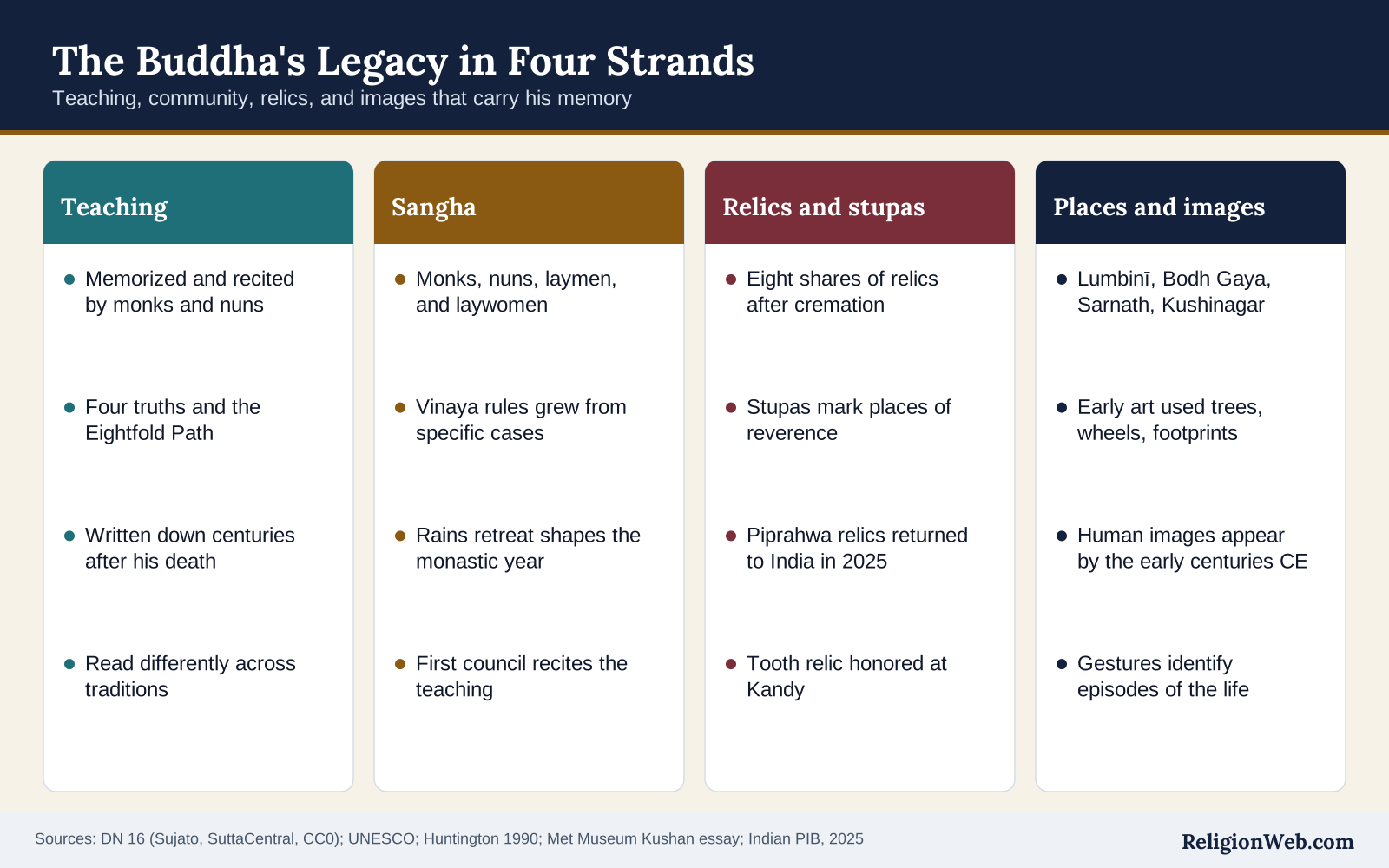
The Buddha in Image, Symbol, and Devotion
From Symbol to Statue
Trees, Wheels, Footprints, and Empty Seats
In the earliest surviving Buddhist art, from sites such as Bharhut, Sāñcī, and Amarāvatī, the Buddha is not shown as a person. Reliefs show a tree with a throne beneath it, a wheel on a pillar, footprints, a stupa, or an empty seat, and worshipers approaching them. The French art historian Alfred Foucher, writing in the early twentieth century, proposed that this reflected a deliberate “aniconism,” an avoidance of images of the Buddha, and he described the absence as a “monstrous abstention,” while admitting that he knew of no text that forbids images. The theory became a standard explanation, and many museum labels still repeat that early Buddhists “would not” portray the Buddha.
The art historian Susan L. Huntington challenged the theory in a 1990 article in Art Journal. She argued that many of the supposedly aniconic reliefs do not depict events from the Buddha’s life with the Buddha missing. They show sacred sites and the lay worship that took place there, usually after the Buddha’s lifetime, and she called these reliefs essentially “portraits” of the sites. An inscription at Bharhut reading “bhagavato Sakamunino bodho,” the bodhi (tree of awakening) of the Blessed One Sakyamuni, labels a tree being worshiped. She also notes that the thirteenth-century Tibetan pilgrim Dharmasvamin describes an empty throne at Bodh Gaya that was worshiped, and in her account the empty throne is a focus of devotion, not a stand-in for a missing figure. Specialists continue to debate how far the symbols should be read as presence, as memorial, or as both, which is why this article reports the question as open.
The First Human Images
The Metropolitan Museum of Art’s essay on the Kushan empire states that some of the first representations of the Buddha in human form date to the Kushan era, an era in which an empire centered on Gandhāra, in what is now Pakistan and Afghanistan, ruled much of northern India and Central Asia. A Gandhāran relief of the birth of the Buddha in the museum’s collection is dated to about the second century CE. The same essay notes that themes from Greek and Roman art were common in the region at first, and that Buddhist imagery later came to dominate. Mathura, which the same essay names as one of the Kushan emperor Kanishka’s two capitals, is widely known for early Buddha images in a distinct style.
Huntington adds an important qualification. The older view put the first Buddha images in the Kushan period, but she observes that sculpted Buddha images earlier than the Kushans have since been identified, and she cites the Bimaran reliquary as a case argued for a first-century BCE date. The precise date and place of the first Buddha image therefore remain debated. What is secure is that by the second or third century CE, standing and seated images were being produced across northern India, and from there the form traveled with monks and merchants along trade routes into Central Asia, China, Korea, Japan, and Southeast Asia, acquiring regional styles at each stage.
Reading an Image of the Buddha
Postures and Hand Gestures
Buddha images follow conventions that identify episodes of the life, and learning them turns a statue into a narrative. A seated figure with hands resting in the lap represents meditation. A seated figure whose right hand reaches down to touch the ground recalls the awakening, when, in later biographies, the Buddha called the earth to witness. A figure with hands before the chest, thumbs and fingers forming a circle, evokes the turning of the Wheel of Dhamma at Isipatana. A raised right palm signifies fearlessness and protection. A figure lying on its right side with the head resting on a hand, as at Kushinagar, is the parinirvana, and it echoes the “lion’s posture” in which the discourses say the Buddha lay down. These associations are standard conventions in Indian and Southeast Asian iconography, and they vary in detail from region to region.
Images vary by community as well. In East Asian temples, a seated Buddha is often flanked by bodhisattvas, which signals a Mahayana setting, while a Theravada shrine in Sri Lanka or Thailand more often centers on a single Buddha. The same historical figure is therefore represented in ways that carry the doctrines of different communities, and a visitor who knows the vocabulary of gestures can read both the story and the tradition that produced the image.
The Thirty-Two Marks of a Great Man
Many features of Buddha images come from a list in the early discourses. The Marks of a Great Man (Dīgha Nikāya 30) describes thirty-two bodily signs, which brahmin experts of the time are said to have recognized in a person destined for greatness. The Mahāpadāna Sutta applies the list to the earlier buddha Vipassī at his birth. Among the marks are a tuft of soft white hair between the eyebrows, a crown of the head like a turban, and wheels on the soles of the feet, “thousand-spoked wheels, with rims and hubs, complete in every detail.” Such signs gave artists a vocabulary: the urna on the forehead, the cranial protuberance (uṣṇīṣa) that appears as a topknot or a flame, and the elongated earlobes that, in the standard explanation, recall the ornaments of a prince who gave them up.
The marks reflect a belief that a buddha’s inner qualities are outwardly visible, and they are treated differently by different communities. For some, they are signs of accumulated merit. For others, they are symbols for qualities such as insight and compassion. In the discourses themselves, the marks serve a narrative purpose, as in the discourse about the brahmin Doṇa, described in the Fun Fact above, who infers from the wheels on a set of footprints that the traveler ahead of him must be extraordinary.
Devotion Without a Creator
Veneration, Offerings, and Refuge
Buddhist devotion centers on the three refuges, the Buddha, the Teaching, and the Sangha, which are recited at the beginning of most services and at ordination, as the Vinaya’s formula shows. Before an image or stupa, devotees typically bow, offer flowers, lamps, and incense, chant verses of praise, and circumambulate the monument with the right side toward it, a gesture that appears in the discourses themselves when Mahākassapa walks around the Buddha’s funeral pyre three times, keeping him on his right. Each offering has a stated meaning: flowers that fade remind the practitioner of impermanence, a lamp stands for wisdom, and incense for the fragrance of virtue. These explanations come from commentarial and popular tradition, and the specifics differ among communities.
Devotion is not understood as worship of a creator or as a request to a deity who rules the universe. In the Theravada understanding, it expresses gratitude and cultivates qualities such as confidence, humility, and mindfulness, as in the recollection of the Buddha quoted earlier. In many Mahayana and Vajrayana settings, devotion can also include prayers to buddhas and bodhisattvas for help and blessing, within doctrines about their compassion and skillful means. These differences are real, and they are best described by naming the tradition in each case.
Respect for Images and the Question of Heritage
Because Buddha images are objects of reverence, many Buddhist cultures observe rules of etiquette around them: they are not placed on the floor, they are not treated as decoration or as personal ornament, and visitors are expected to dress modestly and refrain from posing in disrespectful ways. Monasteries and families often consecrate a new image in a ceremony that varies by tradition. Buddhists in several countries have objected to the commercial use of the Buddha’s image in advertising or novelty items, and some governments regulate how images may be exported or displayed.
Images are also part of the world’s shared heritage and have been threatened by conflict and neglect. The giant standing Buddhas carved into the cliffs of Bāmiyān in Afghanistan, which had stood for well over a thousand years, were destroyed in March 2001 on the orders of the Taliban government, an act widely condemned. The episode shows that the Buddha’s image carries meaning for people far beyond those who practice Buddhism, and it is a case where precise attribution matters: the destruction was a decision of a specific government at a specific time, not a verdict of Afghan society or of any religious community as a whole.
How Buddhist Traditions Understand the Buddha
The Early Buddhist and Theravada Understanding
A Human Teacher Who Is Also Exceptional
In the Pali tradition, preserved in Theravada Buddhism, Gotama is a sammāsambuddha, a fully self-awakened one, who found the path without a teacher and taught it to others. He is a human being in the sense that he was born, aged, fell ill, and died, and the discourses are insistent about this: the Buddha tells his attendant that even the Realized One’s body “is kept going as if by a rope.” But the tradition also treats him as a being without precedent in his own era, one who has abandoned the defilements that cause rebirth. The early texts give a stock set of qualities by which his disciples are to recollect him, and the formula is still chanted in monasteries and homes.
‘That Blessed One is perfected, a fully awakened Buddha, accomplished in knowledge and conduct, holy, knower of the world, supreme guide for those fit for training, teacher of gods and humans, awakened, blessed.’
Aṅguttara Nikāya 6.10, Bhikkhu Sujato’s translation on SuttaCentral, section 2
In the discourse that records this formula, the Buddha explains to Mahānāma the Shakyan that when a noble disciple recollects the Realized One, “their mind is not full of greed, hate, and delusion,” and from that steadiness joy, tranquility, and concentration can grow. Recollection of the Buddha (buddhānussati) is therefore a meditation practice as well as an act of devotion, and the same discourse pairs it with recollection of the teaching, the sangha, one’s own ethical conduct, generosity, and the faith, ethics, and wisdom shown by deities. Theravada teaching holds that the Buddha, after his final nirvana, is no longer present in the world as a being who can respond to requests. Devotion is therefore understood mainly as respect and reflection: Theravada Buddhists offer flowers, light, and incense and recollect his qualities, hoping for benefit in their own conduct and minds, although popular practice in many countries also seeks protection through chanting and blessed objects. See the chapter on Buddhist meditation for how recollection fits into the broader range of practices.
Many Buddhas, Past and Future
The early texts do not present Gotama as the only buddha. The Mahāpadāna Sutta narrates the lives of six earlier buddhas and ends with the sentence in which the Buddha says of his present life that his father was King Suddhodana and his mother was Queen Māyā. Another discourse, The Wheel-Turning Monarch (Dīgha Nikāya 26), foretells a future teacher named Metteyya (Sanskrit Maitreya), who will arise when human life has again lengthened and the Dhamma has been forgotten, and who will teach the same awakened path. Later Theravada literature fills out a long line of earlier buddhas, and Metteyya is a familiar figure in devotional and artistic traditions across Southeast Asia and beyond.
The early texts also recognize the independent buddha (paccekabuddha), who awakens without a teacher but does not establish a teaching, and the Mahāparinibbāna Sutta lists such a person among those worthy of a monument. The point of this multiplicity is doctrinal as well as devotional. In this view, awakening is not a unique miracle belonging to one man in one century but a repeatable discovery of how things are, and the Buddha is its discoverer in our era. The ancient-path simile in the Saṃyutta Nikāya, in which he finds a road traveled by buddhas of the past, belongs to the same conception.
Mahayana and Vajrayana Perspectives
Buddhas Beyond This World
Mahayana Buddhism keeps the historical Śākyamuni at the center of its stories but widens the cosmos in which buddhas appear. Mahayana sūtras describe innumerable buddhas teaching in innumerable world-systems, among them Amitābha, the buddha of the Western Pure Land, who is the focus of devotion in Pure Land traditions across East Asia, and Bhaiṣajyaguru, the buddha of healing. The Lotus Sūtra, one of the most influential Mahayana texts, presents Śākyamuni as having attained awakening incalculable ages ago and as appearing to enter parinirvana as a skillful means for the benefit of beings, an interpretation that has shaped the Tiantai and Nichiren traditions. This is a doctrinal teaching within particular Mahayana schools, and it differs from the Theravada understanding that the Buddha passed finally away at Kusinārā.
Mahayana thought also developed the teaching of the three bodies (trikāya) of a buddha: the truth body (dharmakāya), the enjoyment body (saṃbhogakāya), and the manifestation body (nirmāṇakāya) in which a buddha appears in a particular world. In this scheme, the historical Gautama is the manifestation body of a reality that is not limited to a single lifetime. These ideas connect with the ideal of the bodhisattva, one who vows to become a buddha for the sake of all beings, and with doctrines of buddha-nature, which hold that all beings have the potential for awakening. Japanese, Chinese, Korean, and Vietnamese traditions give these ideas different emphases.
Buddhas as Teachers and Meditational Figures in Vajrayana
In Vajrayana Buddhism, practiced especially in Tibet, Bhutan, Mongolia, and parts of the Himalayas, the historical Buddha remains a revered teacher, and the tradition also works with many buddhas and other awakened figures as the focus of visualization and ritual. Practitioners may identify with a deity in meditation as a way of recognizing their own potential for awakening, a method that depends on initiation from a teacher. Tibetan Buddhists also understand certain lines of teachers within this framework; the Dalai Lamas, for example, are regarded as manifestations of Avalokiteśvara, the bodhisattva of compassion.
The result is that Buddhists in different communities may speak of “the Buddha” in ways that appear very different. A Theravada layperson in Sri Lanka, a Zen practitioner in Japan, a Pure Land devotee in Taiwan, and a Tibetan monastic in India may share the refuge formula, honor the same historical founder, and bow to similar statues, while holding different doctrines about what a buddha is and how a buddha acts in the world. The article on Buddhism explains how those traditions developed.
The Buddha Today: Remembrance, Scholarship, and Global Presence
Remembering the Buddha Through the Year
Vesak and the Three Events
The best-known annual remembrance of the Buddha is Vesak (Visākha Pūjā, Buddha Day), which Theravada communities observe on the full moon of the lunar month of Vesākha, usually in April or May, and which many other communities keep in various forms. In the Theravada understanding, the day marks the birth, the awakening, and the final passing, three events that tradition holds all took place on the same full-moon day in different years. The full-moon rule means the date shifts each year and varies somewhat by country, because lunar calendars and the choice of month differ; the details are covered in the article on Vesak. The United Nations General Assembly recognized the International Day of Vesak in a resolution of 15 December 1999.
Mahayana traditions in East Asia often commemorate the same three events on separate days. In Japan, for example, temples hold a flower festival for the Buddha’s birth in spring, a Rōhatsu retreat for the awakening in early December, and a Nirvana Day service for the parinirvana in February. Practices differ by school and region, and families may follow local customs. Common in many of them is the ritual bathing of a small statue of the infant Buddha, shown standing with one hand raised, an image drawn from the later birth narrative of the seven steps.
The First Sermon and the Rainy Season
Theravada Buddhists also keep Asalha Pūjā, usually in July, which commemorates the first teaching at Isipatana, and this day is commonly followed by the start of the three-month rains retreat described earlier. The two observances together mark the traditional beginning of the Buddhist teaching and of the monastic year. Lay Buddhists often use the period for deeper practice, such as keeping extra precepts, giving, and meditation. The details of such customs belong to local culture as much as to text.
How Many People Look to the Buddha
Buddhist Populations in 2020
The Pew Research Center’s 2025 report on the global religious landscape estimates that there were 324 million Buddhists in the world in 2020, just over 4 percent of the world’s population, down from 343 million in 2010. Buddhists were the only major religious group that shrank in absolute numbers over the decade, according to the report. About 98 percent of Buddhists live in the Asia-Pacific region. Thailand has the largest Buddhist population, about 68 million or 94 percent of its people, followed by China with about 53 million, which is about 4 percent of its population and 23 million fewer than in 2010. Buddhists form a majority in seven countries: Cambodia (97 percent), Thailand (94), Myanmar (89), Bhutan (75), Sri Lanka (70), Laos (64), and Mongolia (51).
Pew notes that counting Buddhists is especially difficult in East Asia, where Buddhism overlaps with folk religion and many people who take part in Buddhist practices do not describe themselves as Buddhist in a census or survey, so the estimates “do not reflect the full influence of Buddhism.” The Buddhist share of Indian population is under 1 percent, about 10 million people, even though India is the land where the Buddha taught. The figures describe people who identify as Buddhist in 2020; they do not measure devotion or practice, and they do not count the many who honor the Buddha alongside other traditions.
Scholarship, Archaeology, and Access to the Texts
The modern study of the Buddha draws on several fields at once. Philologists compare Pali, Sanskrit, Chinese, and Tibetan versions of discourses. Archaeologists excavate sites such as Lumbinī, Bodh Gaya, and Piprahwa. Art historians study the development of images, and historians of religion consider how the figure of the Buddha changed as communities spread across Asia. One consequence of these approaches is a more explicit distinction between layers of the tradition, which this article has followed. Another is greater public access: English translations of the early discourses and monastic rules, such as the Sujato and Brahmali translations quoted here, are now freely available in digital form, which allows any reader to check a passage against the translation instead of relying on a summary.
The result is not a single scholarly portrait. Specialists differ on dates, on the relative age of the two main formulations of the awakening, on how much of the biography is historical, and on how to read the earliest strata of the texts. Buddhist communities, for their part, do not require historians to confirm the life story in order to take refuge in the Buddha, the teaching, and the sangha. The two kinds of inquiry coexist, and each can inform the other.
Common Misconceptions About the Buddha
Misconception 1: “Buddha” is the personal name of the founder of Buddhism, and Siddhartha was his first name
Where the misunderstanding comes from
In English, “the Buddha” is written with a capital letter and used like a proper name, and most popular accounts begin with a prince named Siddhartha. A reader could easily conclude that “Buddha” works as a surname or a given name, with “Siddhartha” and “Gautama” as the rest of it. Textbooks, museum labels, and children’s books reinforce the impression by using “Buddha” as the usual short form for the founder, while the full range of his names and titles is explained only in more specialized sources.
The same habit appears in the way the word travels into other uses. Statues of many different figures are all called “a Buddha,” and in everyday speech the word can describe a seated or serene image without reference to any individual. The title is therefore easy to mistake for a label for one person or one pose, especially when a viewer does not know the tradition’s own vocabulary.
What the evidence and tradition actually show
“Buddha” is a title meaning “awakened one,” and Buddhist texts apply it to more than one person. The Mahāpadāna Sutta narrates the lives of six earlier buddhas before Gotama, and another discourse promises a future Buddha named Metteyya. The founder is therefore “a Buddha” in the same way that someone may be “a king” or “a doctor,” and the definite article in “the Buddha” marks the one who taught in our era. In the Noble Quest, shortly after his awakening, he tells his five former companions to stop addressing him by name and as “reverend,” because “the Realized One is perfected, a fully awakened Buddha.” In the text, then, the title is presented as what he is, not as what he is called.
The personal name is a more delicate matter. In the early discourses and monastic texts reviewed for this article, the family name Gotama (Sanskrit Gautama) is what others call him. The name Siddhattha (Siddhārtha) is familiar from later biographies and commentaries, where it is the name of the young prince. This does not mean the name is invented, and it is the standard one in Buddhist literature from the early centuries CE onward, but it belongs to the biographical layer and not to the discourses. For that reason, historians and Buddhists alike commonly write “the Buddha” or “Gotama” for the teacher and reserve “Siddhārtha” for the period of life before awakening.
Misconception 2: Every detail of the traditional life story is equally certain
Where the misunderstanding comes from
Most people encounter the Buddha’s life as a single smooth story: a prince shielded in a palace, four sights on chariot rides, a night-time escape on a horse, six years of austerities, an assault by Māra, awakening under the Bodhi tree, and a first sermon in a deer park. Films, picture books, temple murals, and sermons usually weave these elements together without saying which come from which source, and the result is a narrative that feels like one document. Because Buddhist traditions revere the Buddha, many people assume that every episode must therefore be a settled historical record. Others conclude, conversely, that a story containing marvels must be entirely unhistorical.
The assumption that the story is uniform is strengthened by the fact that the biographies are beautiful and consistent in tone. The same tradition that transmitted them also preserved the more austere discourses, but most readers meet the polished versions first.
What the evidence and tradition actually show
The sources fall into layers, and the layers carry different weight. At the firmest level are facts on which the oldest texts, the monuments, and scholars broadly agree: that he belonged to the Shakya clan, that he left household life as an adult, that he taught for decades in the middle Ganges region, that he gathered monks, nuns, and lay followers, and that he died at about eighty near Kusinārā. At a second level are episodes found in the early discourses that include legendary elements, such as the marvels at his birth in the Incredible and Amazing discourse, the Sahampati scene, or the missing hint to Ānanda. These are part of how the early community told the story and are valuable evidence for that purpose. At a third level are episodes that appear mainly in later biographies, such as the four sights applied to Siddhārtha, the nighttime ride of the Great Departure, the milk-rice of Sujātā, and the full battle with Māra. Bechert’s judgment, in the Encyclopedia of Buddhism, that complete biographies are no earlier than the second century CE, is the reason scholars handle these with particular care.
Seeing the layers does not require disrespect for any of them. A Buddhist can honor the Great Departure scene for what it teaches about renunciation while recognizing that it is a literary elaboration. A historian can treat the same scene as evidence for how later communities understood the founder. Both are accurate descriptions of what the sources are, and neither claims that the whole life is either proven or disproven.
Misconception 3: Buddhists universally understand the Buddha as a creator god
Where the misunderstanding comes from
Visitors to Buddhist temples see worshipers bowing before large golden statues, offering flowers, lamps, and incense, and chanting in front of an altar. Those actions closely resemble practices that, in other religions, are directed to a deity, and English vocabulary adds to the confusion: reports often say that Buddhists “worship” the Buddha, “pray” to him, or regard him as “a god.” Some Buddhist traditions do invoke buddhas and bodhisattvas for help and blessing, and in some regions Buddhist practice is interwoven with local spirit and deity traditions, so a traveler may witness something that looks like theistic worship.
The Mahayana teaching of eternal or cosmic buddhas, discussed above, can also seem to support the impression, since a buddha who is described as having existed for immeasurable ages is easily compared to a supreme being.
What the evidence and tradition actually show
In the early discourses the Buddha explicitly denies being a god. A brahmin named Doṇa, struck by the wheel-marked footprints he found on the road, asks the Buddha whether he is a god, a centaur, a spirit, or a human being, and the Buddha says he will be none of these. He explains that if he had not given up the defilements he might have become any of them, but he has cut them off at the root.
In the same way, though I was born and grew up in the world, I live having mastered the world, unsullied by the world. Remember me, brahmin, as a Buddha.
Aṅguttara Nikāya 4.36, Bhikkhu Sujato’s translation on SuttaCentral, section 4
In the same discourse he compares himself to a lotus that rises from the water without being wet. Gods, in the Buddhist cosmos, do exist as beings, but they are subject to the cycle of rebirth. In a discourse on the sabbath (Aṅguttara Nikāya 3.38), the Buddha says that Sakka, lord of the gods, “is not exempt from rebirth, old age, and death,” and in the account of the decision to teach, the high divinity Sahampati kneels before the Buddha and begs him to teach. The major Buddhist schools do not teach a creator god, although some Mahayana and Vajrayana texts speak of a primordial or cosmic buddha who is not understood as a creator.
Devotion to the Buddha is therefore understood differently from worship of a creator. In the Theravada understanding it is respect, gratitude, and recollection of his qualities, and in many Mahayana and Vajrayana settings it includes prayers to buddhas and bodhisattvas understood as compassionate awakened beings, not as creators of the universe. Within Buddhist communities there is a range of attitudes, from strictly rationalist readings to deeply devotional practices. The accurate statement is that mainstream Buddhist doctrine does not present the Buddha as a creator god, while recognizing that devotional practice varies by tradition and place.
Misconception 4: The laughing, round-bellied “Buddha” statue shows Siddhartha Gautama
Where the misunderstanding comes from
Cheerful, heavyset figures with a sack and a wide smile are among the most common “Buddha” images in restaurants, shops, and gardens outside Asia, and they are sold under names such as “Laughing Buddha” or “Happy Buddha.” The name suggests that Buddhists revere a jolly, wealthy founder, and it is sometimes contrasted with the thin, serious ascetic in other images of the Buddha, which can lead to the inference that the two figures represent the same man at different moments of his life.
The confusion is understandable, because the English label itself calls the figure a Buddha, and because the statue is displayed in contexts that give no explanation of who it represents.
What the evidence and tradition actually show
The laughing figure is generally identified with Budai (in Japan, Hotei), a figure of Chinese Buddhist and popular tradition associated with a wandering monk said to have lived around the tenth century and regarded in the Chinese tradition as a manifestation of Maitreya, the future buddha. His carrying-sack and cheerful manner became a symbol of contentment and good fortune in Chinese, Japanese, and Korean culture, and his image appears in temples as well as in secular settings. He is not the historical Buddha, and the early texts and images of Gotama do not depict him as stout and laughing. Images of the historical Buddha show a serene, composed figure, as in the standard postures described above, and the lean ascetic of the Gandhāran fasting images belongs to a different moment in the life.
The point is not that the Budai image is improper; it is a legitimate part of East Asian Buddhist and popular culture. It is that the label “Buddha” is being applied loosely, and a viewer who wants to identify an image should look for the vocabulary of marks, postures, and context. A figure with a sack and a broad smile is Budai. A figure with a topknot, long earlobes, and monastic robes, seated in meditation, is far more likely to represent Shakyamuni or another buddha.
Frequently Asked Questions About the Buddha
Questions About His Life
Was the Buddha really a prince?
The early texts call his father Suddhodana a king, and the Buddha himself describes a youth of great comfort, with lotus ponds, imported sandalwood, and a white parasol held over him. Later biographies make him a crown prince in a palace. Heinz Bechert’s entry in the Encyclopedia of Buddhism points out that the Shakyas were not kings in the usual sense but a noble class within a republican system, which suggests that “prince” is a retelling. A cautious summary is that he was born into the Shakya warrior-noble class in a prosperous household.
The distinction matters for how the story is understood. Whether he was the heir to a throne or the son of a leading family, the narrative’s point is the same: he had every worldly advantage and still found it insufficient, and he left it behind.
Did the Buddha have a wife and child?
Yes, according to the Vinaya. When the Buddha returned to Kapilavatthu after his awakening, “the queen, the mother of Rāhula” sent their son to ask for his inheritance, and the Buddha had Sāriputta ordain the boy as a novice. The text does not give the wife’s name in that passage. Later biographies and commentaries supply names, and these differ among traditions, so a reader should treat any single name as belonging to a particular source.
Rāhula’s ordination led to the rule, requested by Suddhodana, that no child be ordained without the consent of the parents. The story shows that the Buddha’s renunciation had real consequences for his family, which the early texts do not hide.
How did the Buddha die, and was it food poisoning?
The Great Discourse on the Buddha’s Extinguishment says that he became severely ill with bloody dysentery after eating a meal at the home of Cunda the smith, and that he nonetheless walked on to Kusinārā, where he lay down between two sal trees and passed away. The dish is called sūkaramaddava, usually translated as something like “pork on the turn,” though some interpreters have proposed a mushroom or other food, and the text does not settle the matter.
It is not possible to make a medical diagnosis from an ancient narrative, and the discourse does not present the illness as Cunda’s fault. The Buddha told Ānanda to reassure Cunda that his meal was among the most meritorious that could be offered. A reader should take the text for what it is, a religious account of a revered teacher’s last days, not a clinical record.
Questions About His Teaching
What did the Buddha teach, in brief?
In the early discourses the Buddha says that what he describes is suffering and the cessation of suffering. The first sermon sets out the middle way between sensual indulgence and self-mortification, and it states the four noble truths: the truth of suffering, its origin in craving, its cessation, and the path that leads to cessation, which is the Noble Eightfold Path. Other early teachings address karma as intention, the impermanence of all conditioned things, the teaching of not-self, and the ethical life of giving, virtue, and meditation.
Fuller accounts are in the chapters on the Four Noble Truths, the Noble Eightfold Path, and the teaching on karma and rebirth. Buddhist traditions differ in emphasis, but nearly all take the four truths as their foundation.
Did the Buddha write anything down, and what language did he speak?
No writing from the Buddha’s time survives, and the early texts describe teaching by speech. His words were memorized, recited in groups, and passed down over generations before being written. The language he spoke is not recorded directly. He taught in the region of Magadha and Kosala, and the Pali language of the Theravada canon is a literary language that developed later, so it should not be assumed to be his exact speech; the chapter on Theravada Buddhism explains how scholars and the tradition think about this question.
The Vinaya includes a story in which the Buddha refuses a request to put his words into a metrical, Sanskrit-like form and tells the monks to learn his teaching in each person’s own language, which tradition and scholars read in different ways. The question therefore remains an interesting one for specialists rather than a settled fact.
What is the difference between a buddha, an arahant, and a bodhisattva?
In the early Pali texts, a buddha is one who discovers the path to liberation without a teacher and teaches it to others, an arahant (“perfected one”) is anyone who has fully completed the path, including the Buddha’s disciples, and a bodhisatta (Sanskrit bodhisattva) is a being intent on awakening, the term the discourses use for Gotama before his awakening. In the Mahayana tradition, the bodhisattva becomes an ideal for all practitioners: one who vows to attain full buddhahood for the sake of all beings.
The chapter on the bodhisattva discusses the vows, the major bodhisattvas, and the way the ideal is practiced in Mahayana communities.
Questions About Places and Dates
When was the Buddha born, and why do the dates differ?
No contemporary record gives a date, and the surviving chronologies are counted from events such as the reign of Ashoka. The Theravada tradition places the death in 544 or 543 BCE, which implies a birth about eighty years earlier, and UNESCO’s description of Lumbinī follows a traditional date of 623 BCE for the birth. Many historians favor a later date, and Bechert concluded that the death took place between about 420 and 350 BCE.
The result is that reference works give different figures, and careful ones say “fifth century BCE.” The disagreement is about the length of the interval between the Buddha’s death and Ashoka’s reign, not about the order of events in the life.
Where can people visit the places connected to the Buddha?
The four places named in the Great Discourse are visited by pilgrims: Lumbinī in southern Nepal, Bodh Gaya in Bihar, Sarnath near Varanasi, and Kushinagar in Uttar Pradesh. UNESCO has inscribed Lumbinī (1997) and the Mahabodhi Temple Complex at Bodh Gaya (2002) on the World Heritage List. Many pilgrims also visit related places such as Rājgir, Śrāvastī, and Vaishali, which are tied to the years of teaching, and some include Sri Lanka’s Kandy for the tooth relic.
Travelers should check current conditions, since heat, monsoon flooding, and local safety advice vary by season and region, and anyone with a health condition should consult a physician before a long pilgrimage on foot or at high temperatures.
When is the Buddha’s birthday observed?
Theravada communities generally observe the birth, awakening, and final passing together at Vesak on the full moon of the lunar month of Vesākha, which falls in April or May. Because the date follows a lunar calendar and countries differ in how they determine it, the day changes each year and can differ by a day or a month from one country to another. East Asian Mahayana traditions often observe the three events on separate days. The article on Vesak explains the calendar rule and the customs in detail.
For a specific date, consult a calendar issued by the relevant national or temple authority for the year in question, since this article gives the rule and not a date.
Conclusion: The Buddha in History and Memory
What the Evidence and the Tradition Show Together
A teacher in the Ganges plain
The sources agree on a core. A man from the Shakya clan left household life as an adult, studied with meditation teachers, tested severe austerity, and then taught what he called the middle way. He gathered a community of monks, nuns, and lay followers across Magadha and Kosala, accepted the support of kings and merchants, faced debate and internal dispute, and died in his eighties at Kusinārā. The place names, the personal names of disciples, and the sequence of events recur across the early collections, in inscriptions and in archaeology, and they constitute the historical outline that scholars accept with different degrees of caution.
A figure remembered in many ways
Around that outline, Buddhist communities have built layers of narrative, ritual, art, and doctrine. The marvels of his birth, the four sights, the battle with Māra, the images that began as trees, wheels, and footprints, the relics divided among eight claimants, and the pilgrimages to four places are all ways of remembering a person whose teaching is understood to be accessible and to lead to freedom. Theravada, Mahayana, and Vajrayana traditions understand the nature of a buddha differently, and an accurate account names the tradition at each point. The historical question and the devotional question are different questions, and each deserves a careful answer.
How to Keep Exploring
Read the earliest texts
The most direct way to meet the Buddha is through the early discourses and monastic rules, now freely available in English. The Noble Quest, the Longer Discourse With Saccaka, the discourse on rolling forth the Wheel of Dhamma, and the Great Discourse on the Buddha’s Extinguishment together tell much of the story in the Buddha’s own voice and in the early community’s. Reading them with the knowledge that they were compiled by his followers, and shaped by memory, gives a sense of how the tradition began.
Continue with related chapters
Readers who want to go further can turn to the parent chapter on Buddhism, the explanations of the Four Noble Truths and Noble Eightfold Path, the account of Buddhist monastic life, and the description of Vesak. Each approaches the same figure from a different direction, and each names the tradition whose views it describes.
Sources
The table below lists the principal external sources behind this article. Facts, dates and figures were checked against these and related primary, institutional and academic materials.
| # | Source | Publisher and type | Used for | Link |
|---|---|---|---|---|
| 1 | Dīgha Nikāya 16, Mahāparinibbāna Sutta (Great Discourse on the Buddha's Extinguishment), translated by Bhikkhu Sujato | SuttaCentral (Bilara Data repository), CC0 · Primary text | Last journey, parinirvana, funeral, relic division; DN 16 quotes. Other suttas quoted use the same repository | raw.githubusercontent.com |
| 2 | Vinaya Mahāvagga, Khandhaka 1, translated by Bhikkhu Brahmali | SuttaCentral (Bilara Data repository), CC0 · Primary text | Awakening, first teaching, first sangha, Yasa, Kassapas, Bimbisāra; other Kd chapters use the same repository | raw.githubusercontent.com |
| 3 | Buddha, Life of the (entry by Heinz Bechert), Encyclopedia of Buddhism | Encyclopedia.com (Macmillan Reference USA) · Reference work (peer-edited) | Sources for the life, biography layers, chronology debate and the 1988 Göttingen symposium | encyclopedia.com |
| 4 | Lumbini, the Birthplace of the Lord Buddha (World Heritage List, no. 666) | UNESCO World Heritage Centre · Institutional description | Lumbinī inscription year, Ashoka's pillar, Māyā Devī temple, brick structures, site layers | whc.unesco.org |
| 5 | Mahabodhi Temple Complex at Bodh Gaya (World Heritage List, no. 1056) | UNESCO World Heritage Centre · Institutional description | Bodh Gaya inscription year, Bodhi tree, Vajrāsana, Ashokan and later temple history | whc.unesco.org |
| 6 | Sarnath (archaeological site, Uttar Pradesh) | Encyclopaedia Britannica · Reference work | Sarnath as site of the first teaching, Dhamek Stupa, Ashoka's pillar and lion capital | britannica.com |
| 7 | Piprahwa Relics: Key Facts (Government of India document, August 2025) | Press Information Bureau, Government of India · Government document | 1898 Piprahwa excavation, relics and gems, 2025 return to India | static.pib.gov.in |
| 8 | Early Buddhist Art and the Theory of Aniconism, Art Journal 49(4), 1990 (Susan L. Huntington) | Digital Library of Buddhist Studies, National Taiwan University (reprint of the article text) · Peer-reviewed article | Critique of aniconism, early symbols, Bharhut inscription, dating of first Buddha images | dlbs.liberal.ntu.edu.tw |
| 9 | Kushan Empire (ca. Second Century B.C.-Third Century A.D.), Heilbrunn Timeline of Art History | The Metropolitan Museum of Art · Museum essay | Early human images of the Buddha in the Kushan era; Gandhāra and Mathura | metmuseum.org |
| 10 | Buddhist Population Change (Global Religious Landscape, 2025 report) | Pew Research Center · Survey data report | 324 million Buddhists in 2020, regional shares, majority countries | pewresearch.org |
Last fact-check date: 2026-10-21.