The Four Noble Truths are the teaching that early Buddhist texts present as the Buddha’s own summary of what he discovered and what he offered to others: that there is dukkha (a word usually translated “suffering” but wider in range), that it has an origin in craving, that it can come to an end, and that there is a path leading to that ending. The formula takes its familiar shape in the discourse traditionally called the first sermon, which the Pali texts place at the deer park of Isipatana near Varanasi. For nearly every Buddhist tradition, the Four Noble Truths stand close to the center of what it means to follow the teaching of the Buddha.
The statement is short enough to memorize in a minute, and Buddhists have spent twenty-five centuries unpacking it. The earliest texts do not treat it as a set of propositions to be accepted. They attach to each truth a task: dukkha is to be fully understood, its origin abandoned, its cessation realized, and the path developed. Read that way, the teaching is closer to a method of inquiry and training than to a philosophy of gloom, and it explains why the same four lines appear in monastic chanting, in meditation instruction, in scholastic treatises, and in modern books written for general readers.
This article follows the teaching from its textual home to its present uses. It looks at the wording of the first sermon, the meaning of each truth, the four tasks, the links to dependent origination, karma, and nirvana, and the differing emphases of Theravada, Mahayana, and Vajrayana teachers. Quotations come from openly licensed translations of the Pali texts, and where historians or Buddhist schools read a passage differently, the article says so. For the broader tradition in which the teaching sits, see the parent chapter on Buddhism.
The Four Noble Truths at a Glance: Wording, Meaning, and Vocabulary
The Teaching in Brief
The four truths in the Buddha’s own words
In the Pali version of the first sermon (Saṃyutta Nikāya 56.11, the Dhammacakkappavattana Sutta, “Setting in Motion the Wheel of the Teaching”), the Buddha speaks to five ascetics who had been his companions in earlier austerities. After describing the two extremes to avoid and the middle way between them, he gives the four truths in turn. The first concerns dukkha, defined by a list of ordinary human afflictions and then summed up in a technical phrase.
Now this is the noble truth of suffering. Rebirth is suffering; old age is suffering; illness is suffering; death is suffering; being coupled with the disliked is suffering; separation from the liked is suffering; not getting what you wish for is suffering. In brief, the five grasping aggregates are suffering.
Saṃyutta Nikāya 56.11, translated by Bhikkhu Sujato (SuttaCentral, CC0), segments 4.1-4.2
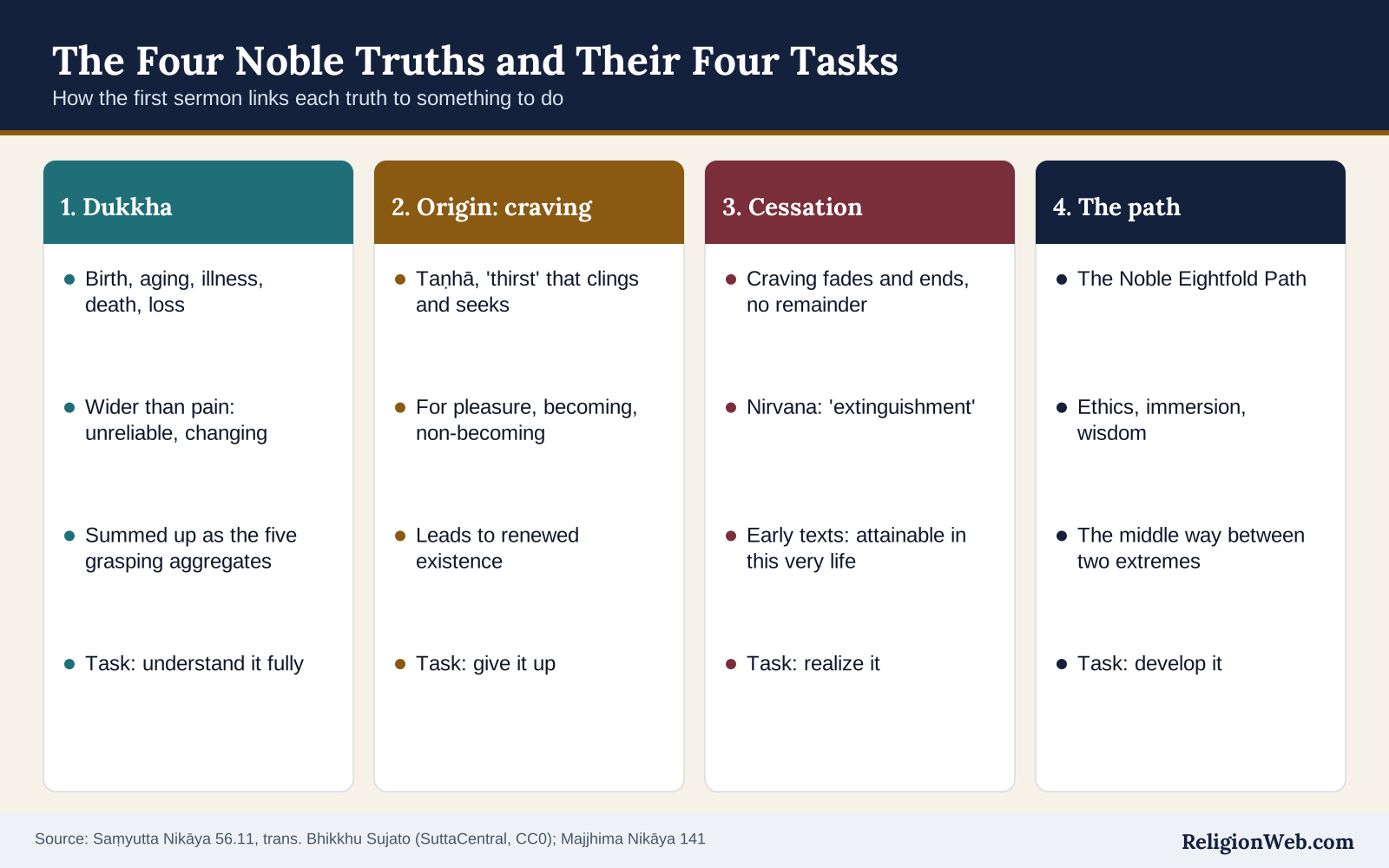
The second truth names craving as the origin, the third names the fading away of that craving as cessation, and the fourth names the Noble Eightfold Path as the way to that cessation. Table 1 sets the four side by side, using the wording of the sermon itself.
| Truth | Pali name | What the sermon says | Question it answers |
|---|---|---|---|
| First | Dukkha ariyasacca | Birth, aging, illness, death, being with what one dislikes, being parted from what one likes, and not getting what one wishes are dukkha; in brief, the five grasping aggregates are dukkha | What is the problem? |
| Second | Dukkha-samudaya ariyasacca | Craving that leads to renewed existence, bound up with delight and passion: craving for sensual pleasures, for existence, and for nonexistence | What gives rise to it? |
| Third | Dukkha-nirodha ariyasacca | The complete fading away and ending of that same craving, with giving up, letting go, and release | Can it end? |
| Fourth | Dukkha-nirodha-gāminī paṭipadā ariyasacca | The noble eightfold path, the middle way between indulgence in sensual pleasure and self-mortification | How is that ending reached? |
Why they are called noble truths
The Pali phrase is ariyasacca, usually rendered “noble truth.” Ariya means “noble” in a spiritual rather than social sense, and sacca can mean “truth” but also “real thing” or “actuality.” Another Pali discourse addresses the question directly. It says the four are “real, not unreal, not otherwise,” and adds, “That’s why they’re called ‘noble truths’” (Saṃyutta Nikāya 56.27, translated by Bhikkhu Sujato). The wording suggests that the Buddha was pointing to features of experience that can be checked, rather than asking for assent to a doctrine.
Scholars have noticed a grammatical ambiguity. The philologist K. R. Norman argued in a later paper that ariya could be read as “of the noble ones,” so that the phrase would mean something like “the realities known by the noble ones,” the people who have seen them for themselves. Both readings are in circulation in English translations, and the difference is small in practice: either way, the point is that the truths are what a person of mature insight sees clearly.
Where the Teaching Sits Within Buddhism
A framework the early texts treat as central
The early texts return to the four truths constantly. In one short discourse the Buddha picks up a handful of leaves in a rosewood grove and says that what he has taught is as little as the leaves in his hand compared with the leaves overhead. What he has chosen to teach, he says, is the four truths, because that is what is “beneficial and relevant to the fundamentals of the spiritual life” (Saṃyutta Nikāya 56.31, Sujato). In another, he says that “In the past, as today, what I describe is suffering and the cessation of suffering” (Majjhima Nikāya 22, Sujato).
Those passages do not claim that everything else the Buddha taught is a footnote. They show how the compilers of the canon framed the center of gravity: the teaching exists to address a problem and to open a way out of it. The remaining chapters of the canon, from ethics and meditation to dependent origination and the nature of the self, can be read as elaborations of one or another of the four truths.
How widely the teaching is shared
Buddhists of the Theravada, Mahayana, and Vajrayana traditions all teach the Four Noble Truths, and the formula appears in the Pali discourses, in Chinese and Sanskrit parallels, and in Tibetan scholastic literature. What differs from school to school is the surrounding interpretation: how the truths relate to emptiness and the bodhisattva path, how complete realization is described, and which commentaries are used to explain them. Later sections trace those differences without treating any one reading as the only legitimate one.
The Pew Research Center estimated in a report published in 2025 that the world had about 324 million Buddhists in 2020, or 4.1 percent of the global population, with about 98 percent of them living in the Asia-Pacific region. Those figures describe the people for whom the teaching is a living inheritance, in monasteries and village temples, in meditation halls, and increasingly in classrooms and online courses. Counts of Buddhists are always approximate, because many people in East Asia take part in Buddhist practice alongside other traditions and may not identify with a single label in a survey.
Key Terms in Pali and Sanskrit
A short glossary of the core vocabulary
Anyone reading about the four truths meets a small cluster of technical words. English renderings vary by translator, so it helps to know the original terms and the range of meanings they cover. Table 2 lists the ones used throughout this article, with the usual Pali spelling first and the Sanskrit form second.
| Term | Pali / Sanskrit | Common English renderings | Note on usage |
|---|---|---|---|
| Dukkha | dukkha / duḥkha | suffering, stress, unsatisfactoriness, pain | Covers physical pain, mental distress, and the unreliability of conditioned things |
| Origin | samudaya / samudaya | origin, arising, cause | The second truth is “the origin of dukkha” |
| Craving | taṇhā / tṛṣṇā | craving, thirst | Literally “thirst”; distinct from wholesome aspiration (chanda) |
| Cessation | nirodha / nirodha | cessation, ending, stopping | The third truth; closely tied to nirvana |
| Path | magga / mārga | path, way, practice | The fourth truth is the “path leading to the cessation of dukkha” |
| Nirvana | nibbāna / nirvāṇa | extinguishment, liberation | Fire imagery: going out when fuel is no longer supplied |
| Clinging | upādāna / upādāna | clinging, grasping, fuel | Appears in “five grasping aggregates” |
| Aggregates | khandha / skandha | aggregates, heaps | Form, feeling, perception, choices, consciousness |
| Ignorance | avijjā / avidyā | ignorance, unknowing | First link in dependent origination |
| Cycle of rebirth | saṃsāra / saṃsāra | wandering on, cyclic existence | The round of repeated birth and death |
Why Pali and Sanskrit forms differ
The same Buddhist word often appears in two forms because the teaching traveled in two literary languages. Pali, the language of the Theravada canon, gives dukkha, nibbāna, dhamma, and kamma. Sanskrit, the language of most Mahayana and Vajrayana treatises, gives duḥkha, nirvāṇa, dharma, and karma. Neither is a mistake. Writers on Theravada Buddhism usually prefer the Pali, writers on Tibetan or East Asian Buddhism usually prefer the Sanskrit, and English readers meet both. This article uses Pali forms when discussing the Pali discourses and Sanskrit forms when discussing Mahayana and Vajrayana sources, and supplies the other form when it helps.
Diacritics matter for accuracy but not for searching: the same word may be typed dukkha, duhkha, or duḥkha. Likewise, “nirvana” and “nibbana” are plain-text forms of nirvāṇa and nibbāna. The Pali word taṇhā, “craving,” is sometimes spelled tanha in English books, and the Pali tradition’s name for the first sermon appears variously as Dhammacakkappavattana, Dhammacakka Sutta, and Dharmacakra Sutra in Sanskrit-based traditions.
The First Sermon: Where the Four Noble Truths Were Taught
Setting and Sources
Isipatana, the five ascetics, and the middle way
According to the Pali tradition, the Buddha taught the Four Noble Truths soon after his awakening, at Isipatana (modern Sarnath, near Varanasi). The Vinaya, the monastic code, says that he asked himself whom to teach first and chose the five ascetics who had supported him during his years of striving. Seeing him approach, they agreed among themselves not to greet him respectfully, since they believed he had given up the effort, but they found themselves unable to keep that agreement. When they objected that he had returned to indulgence, he told them he had not and that he had discovered “the freedom from death” (Vinaya Mahāvagga, Khandhaka 1, translated by Bhikkhu Brahmali).
The sermon opens with the middle way. The Buddha tells them that one who has gone forth should avoid two extremes: devotion to sensual pleasure, which he calls “low, crude, ordinary, ignoble, and pointless,” and devotion to self-mortification, which is “painful, ignoble, and pointless” (Saṃyutta Nikāya 56.11, Sujato). The middle way that avoids both is the Noble Eightfold Path, and only then does he give the four truths. The structure is worth noticing: the path is mentioned first as a lived practice, and then again as the fourth truth.
Versions in the Pali, Chinese, and Sanskrit literatures
The first sermon survives in several recensions. The Pali version appears in the Saṃyutta Nikāya and in the Mahāvagga of the Vinaya, and the wording of the two is close. Parallel versions survive in Chinese translations of discourse collections and monastic codes (including the Saṃyukta-āgama, whose school affiliation scholars still debate) and in the Sanskrit and Tibetan Mūlasarvāstivāda Vinaya. All agree on the setting, the five ascetics, the teaching of the four truths in “three turnings and twelve modes,” and the insight of Koṇḍañña.
They differ in what they include. The comparative studies of the Buddhist monk and scholar Anālayo show that the Chinese Saṃyukta-āgama version (Taishō 99, discourse 379) presents the three turnings without the preliminary account of the two extremes or the explanation of each truth’s content, while the Pali version and the Mūlasarvāstivāda Saṅghabhedavastu include both. Anālayo argues that the shorter Chinese version is probably an excerpt from a fuller account, not a more original shorter form. Whatever one concludes about the original shape, the central message, the four truths with their three turnings, is shared by every surviving version.
The first sermon is only one of the places where the teaching appears. Table 3 lists the early texts that this article draws on most often, with the contribution each makes.
| Text | Collection | What it contributes |
|---|---|---|
| Dhammacakkappavattana Sutta (SN 56.11) | Saṃyutta Nikāya | The first sermon: the middle way, the four truths, three turnings, and twelve aspects |
| Mahāvagga, Khandhaka 1 | Vinaya Piṭaka | The narrative frame: the five ascetics, Koṇḍañña’s ordination, and a parallel version of the sermon |
| The Analysis of the Truths (MN 141) | Majjhima Nikāya | Sāriputta’s definition of each truth and of the eight path factors |
| Discourse on Right View (MN 9) | Majjhima Nikāya | The four-part pattern applied to the links of dependent origination |
| Foundations of Mindfulness (MN 10) | Majjhima Nikāya | The four truths as an object of mindfulness meditation |
| In a Rosewood Forest (SN 56.31) | Saṃyutta Nikāya | Why the Buddha taught these four things and not others |
| Shorter Discourse with Māluṅkyaputta (MN 63) | Majjhima Nikāya | The four truths declared; speculative questions left undeclared |
| Dhammapada 190-191 | Khuddaka Nikāya | Going for refuge as the basis for seeing the four truths |
What Happened After the Teaching
Koṇḍañña’s insight and the first ordination
The Pali account says that while the Buddha was speaking, Koṇḍañña, the eldest of the five, gained the “stainless, immaculate vision of the Dhamma,” summed up in one sentence: “Everything that is liable to arise is liable to cease” (Saṃyutta Nikāya 56.11, Sujato). The Buddha exclaimed that Koṇḍañña had understood, and from then on he was known as Aññāsikoṇḍañña, “Koṇḍañña who understood.” The Vinaya adds that Koṇḍañña asked for the going forth and full ordination, and the Buddha replied, “Come, monk. The Teaching is well-proclaimed. Practice the spiritual life to make a complete end of suffering” (Mahāvagga, Kd 1, Brahmali).
In the Vinaya’s telling, the other four ascetics reached the same insight in turn as the Buddha went on instructing them, and they too were ordained. This is the point at which Buddhist tradition counts the beginning of the monastic community, the Saṅgha. The insight Koṇḍañña gains is not a doctrine about suffering in the abstract. It is a perception about conditions: whatever comes into being is subject to ending, which is the same recognition that makes the third truth intelligible.
The image of the wheel
The sermon’s Pali name, Dhammacakkappavattana, means roughly “the turning (or setting in motion) of the wheel of the Dhamma.” In the sutta itself, the earth gods cry out that the Buddha “has rolled forth the supreme Wheel of Dhamma. And that wheel cannot be rolled back by any ascetic or brahmin or god or Māra or divinity or by anyone in the world.” The wheel became one of the oldest Buddhist symbols. In Buddhist art it often stands for the teaching itself, and in Tibetan temple decoration a wheel flanked by two deer commonly recalls the deer park where the sermon was given.
Scholarly Questions About Origins
Was the formula part of the earliest teaching?
Modern scholars have asked whether the Four Noble Truths belonged to the Buddha’s first teaching or were added to the story of the first sermon later. The French scholar André Bareau argued in 1963 that the truths were absent from some early accounts of the awakening and were a later development, and Johannes Bronkhorst later followed that line. Other scholars, including Lambert Schmithausen and Anālayo, have countered that the early collections complement one another, so that a teaching’s absence from one text, or from one collection such as the Aṅguttara Nikāya’s sets of fours, does not show that it was unknown.
Anālayo’s review of those arguments, which draws on the Pali, Chinese, and Sanskrit versions, concludes that they do not establish that the truths were a late insertion. Other historians remain more cautious, and no consensus satisfies everyone. Readers should be wary of any single confident claim about the “original” teaching, whether it comes from a historian or from a devotional writer.
What historians can and cannot say
The evidence has real limits. The Buddha left no writings, and the earliest texts were transmitted orally for a long time before they were written down. Many historians now place the Buddha’s death within a few decades of 400 BCE, later than older scholarly estimates of about 480 BCE and than the traditional Theravada reckoning of 544 or 543 BCE, but the precise dates remain uncertain. That uncertainty applies to every text attributed to him, including the first sermon.
What historians can say is that by the time the surviving canons were fixed, the Four Noble Truths were already treated as the Buddha’s central teaching by Buddhist communities that had separated from each other and used different languages. Their shared presence across those separate transmissions is itself evidence of antiquity, even if the exact wording of the first sermon as delivered cannot be reconstructed. The tradition’s own account, that these were the words of the Buddha, is a statement of faith and of institutional memory, and the academic account is a statement of what can be shown from comparison; the two answer different questions.
The First Noble Truth: Dukkha and the Problem It Names
What Dukkha Means
Why “suffering” is useful but incomplete
“Suffering” has been the standard English translation of dukkha since the nineteenth century, and it is not wrong, because the first sermon lists birth, aging, sickness, and death alongside sorrow and pain. Many translators and teachers nevertheless say that the word carries too much emotional weight in English and too little range. Dukkha also covers what is unsatisfying, unreliable, or stressful without being agonizing. English renderings in use include “stress” (the monk Ṭhānissaro Bhikkhu), “unsatisfactoriness” (the monk Anālayo, who also suggests that the word might best be left untranslated), “dissatisfaction,” “distress,” and “affliction.” The scholar Richard Gombrich argues that the right choice depends on the context, and Peter Harvey observes that “painful” fits the line “birth is dukkha” best.
The etymology does not settle the matter. A popular explanation derives dukkha from du-, “bad,” and kha, “axle hole,” so that it would mean a wheel that fits badly on its axle and gives a bumpy ride. That story is widely repeated in modern books, but it is not secure. The Sanskrit scholar Monier-Williams doubted it in 1899 and suggested a derivation from duḥ-stha, “standing badly,” and Anālayo has accepted that suggestion. The responsible summary is that the word’s origin is uncertain, and that its meaning in the texts has to be read from how it is used.
The list in the first sermon
The first sermon defines dukkha by example. Birth, old age, illness, and death are named first, then two relational forms (being joined with what one dislikes and separated from what one likes), then frustrated wishing, and finally the summary: “In brief, the five grasping aggregates are suffering.” The Majjhima Nikāya sets out a fuller analysis attributed to Sāriputta, one of the Buddha’s leading disciples (Majjhima Nikāya 141, “The Analysis of the Truths”). It defines each item in turn, adding sorrow, lamentation, physical pain, mental sadness, and distress, and it explains frustrated wishing in a way that is easy to recognize: beings liable to be reborn wish that they were not, “But you can’t get that by wishing” (Sujato’s translation).
The list is deliberately ordinary. It begins with things any person can verify and then moves to the more abstract formula of the aggregates. The movement from the obvious to the structural is typical of how the texts teach: the first truth does not ask a reader to accept that life is bad, but to look at the conditions of living and recognize a pattern.
Three Ways the Texts Describe Dukkha
Pain, change, and conditioned existence
Two short discourses in the Saṃyutta Nikāya give a threefold analysis that later commentators use constantly. Sāriputta tells a wanderer that there are three forms of suffering: “The suffering inherent in painful feeling; the suffering inherent in conditions; and the suffering inherent in perishing” (Saṃyutta Nikāya 38.14, Sujato). The Pali terms are dukkha-dukkhatā (the dukkha of pain), saṅkhāra-dukkhatā (the dukkha of conditioned things), and vipariṇāma-dukkhatā (the dukkha of change). The first is physical or mental pain. The second is the unreliability of anything put together from causes, which can never be a stable source of lasting satisfaction. The third is the way that pleasant things end, so that even a happy experience carries within it the fact of its passing.
A parallel discourse says that the noble eightfold path should be developed for the direct knowledge and complete understanding of these three forms (Saṃyutta Nikāya 45.165). That link matters. It shows that the second and third forms are not exaggerations of ordinary sadness, but a description of the structure of conditioned experience, and that the path is offered as a response to the structure.
The five grasping aggregates
The phrase “the five grasping aggregates” (pañcupādānakkhandhā) is the sermon’s technical summary of dukkha. The Buddha analyzes a person into five aggregates (khandhā): form, which includes the body, then feeling, perception, choices or mental formations (saṅkhārā), and consciousness. When these are the object of clinging, they are “grasping aggregates.” The relation between grasping and the aggregates is stated in a discourse in which the nun Dhammadinnā answers a layman’s question: grasping is not identical to the aggregates, nor is it something other than them. “The desire and greed for the five grasping aggregates is the grasping there” (Majjhima Nikāya 44, Sujato).
The point is subtle but practical. The aggregates themselves are not described as evil, and the body and mind are not to be despised. Dukkha lies in the way a person identifies with, depends on, and tries to secure these changing processes. Theravada commentators read the formula as a claim about all conditioned existence within saṃsāra, while Mahayana teachers connect it to the teaching of emptiness; both understand the first truth as an analysis of how a person takes up experience, and not simply as a list of unpleasant events.
Dukkha in Lived Experience
Feeling, reaction, and the second arrow
A discourse in the Saṃyutta Nikāya uses an image that has become one of the best-known illustrations of the first truth. An unlearned ordinary person and a learned noble disciple both feel pleasant, painful, and neutral feelings. The difference lies in the response.
It’s like a person who is struck with an arrow, only to be struck with a second arrow. That person experiences the feeling of two arrows.
Saṃyutta Nikāya 36.6, translated by Bhikkhu Sujato (SuttaCentral, CC0), segments 1.8-1.10
The first arrow is the physical pain. The second is the mental reaction of resisting it, lamenting it, or looking for relief in sensual pleasure. The learned disciple, the discourse says, experiences one feeling, “physical, not mental.” The verses at the end of the discourse make clear that the point is not numbness: “A wise and learned person does not not feel the feeling of pleasure and pain.” The first truth is therefore not the claim that pain exists, which no one disputes, but the claim that a large share of the suffering in a human life comes from how feeling is received.
Happiness is not denied
Readers who meet the first truth for the first time sometimes conclude that Buddhism denies the reality of joy. The texts do not say this. The Pali word sukha, “happiness” or “ease,” is used throughout the canon, including for the enjoyment of a good life, and the Dhammapada exclaims, “Happy, the arising of Buddhas! Happy, the teaching of Dhamma! Happy is the harmony of the Saṅgha” (Dhammapada 194, Sujato). The same Majjhima Nikāya discourse that defines the Eightfold Path describes the meditative absorptions in terms of “rapture and bliss.”
The Second Noble Truth: Craving as the Origin of Dukkha
Craving in the First Sermon
The wording of the second truth
The second truth is called the origin (samudaya) of dukkha, and the sermon identifies the origin as taṇhā, “craving,” literally “thirst.”
Now this is the noble truth of the origin of suffering. It’s the craving that leads to future lives, mixed up with relishing and greed, taking pleasure there wherever it alights. That is, craving for sensual pleasures, craving for continued existence, and craving for nonexistence.
Saṃyutta Nikāya 56.11, translated by Bhikkhu Sujato (SuttaCentral, CC0), segments 4.3-4.5
Three features of the wording deserve attention. The craving in question “leads to future lives” (ponobbhavikā), which ties the second truth to the Buddhist understanding of rebirth. It is “mixed up with relishing and greed,” meaning that craving comes with pleasure in its objects and a strong pull toward them. And it takes pleasure “wherever it alights,” which describes a craving that attaches to whatever object presents itself, rather than to one particular desire. Notice also that the sermon speaks of the craving that leads to renewed existence, not of every wish a person has.
Three kinds of craving
The sermon divides craving into three: kāma-taṇhā (craving for sensual pleasures), bhava-taṇhā (craving for continued existence or becoming), and vibhava-taṇhā (craving for nonexistence or non-becoming). The first is the easiest to understand: the pull toward pleasant sights, sounds, tastes, and touch. The second is the wish to continue, to become something, to secure an identity and a future. The third is the wish to be rid of something, which can include the desire to escape unpleasant feeling or to be annihilated.
Interpretation of the second and third forms varies. Pali commentarial tradition associates bhava-taṇhā with the view that the self continues forever and vibhava-taṇhā with the view that the self is cut off at death, so that the two craving types mirror two opposite wrong views. Many modern teachers read vibhava-taṇhā more psychologically, as aversion, the push to get away from what is unwanted. The two readings are compatible, and they agree on the main point: craving takes pleasure-seeking, becoming, and escaping as its forms, and none of them lets the mind rest.
Craving, Clinging, and Ignorance
Where craving sits in dependent origination
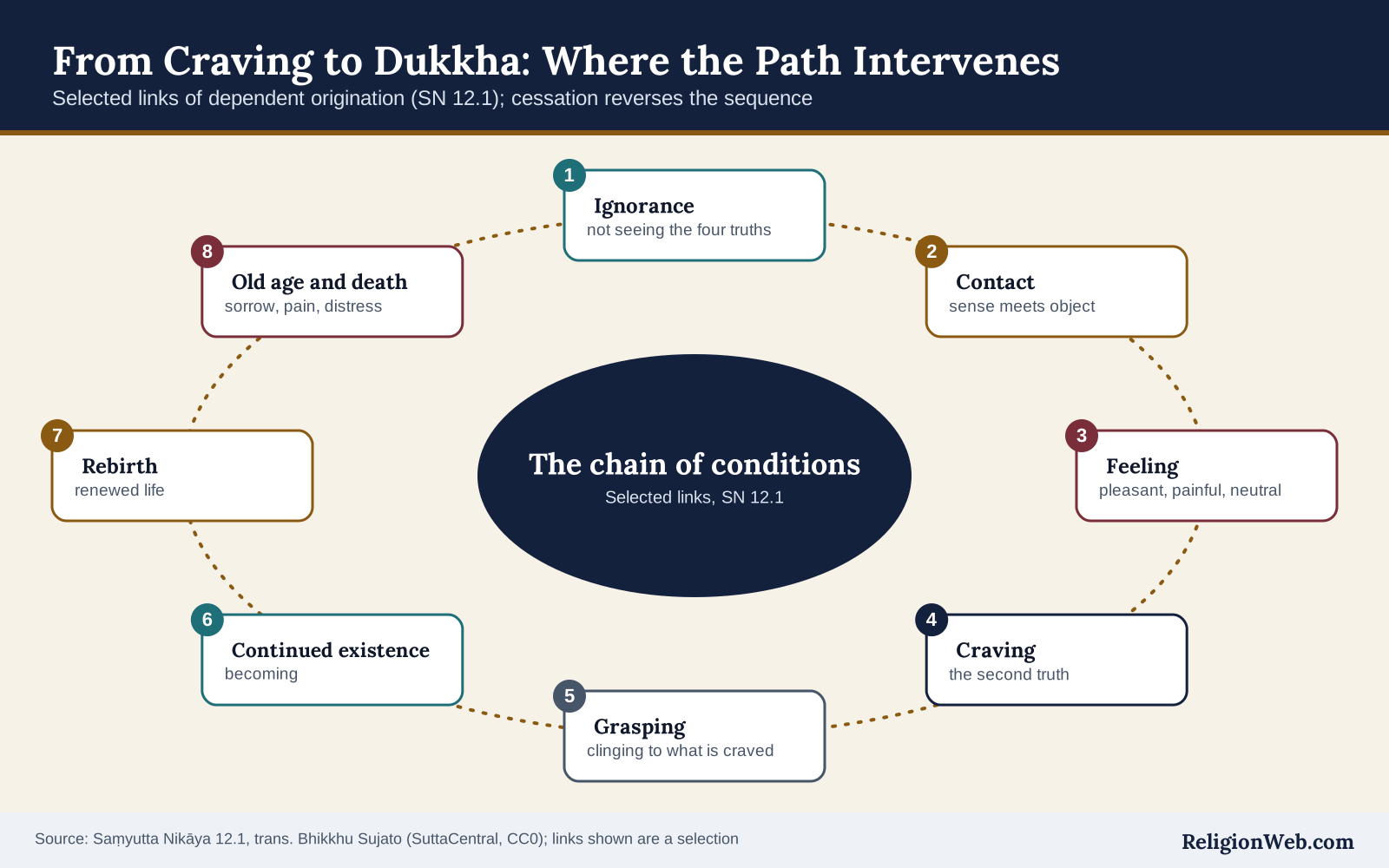
The second truth is the compressed form of a longer analysis of conditions called dependent origination (paṭicca-samuppāda). In its standard twelve-link form, the Buddha says that ignorance is a requirement for choices, choices for consciousness, and so on through the six sense fields, contact, and feeling. “Feeling is a requirement for craving. Craving is a requirement for grasping. Grasping is a requirement for continued existence” (Saṃyutta Nikāya 12.1, Sujato), and the chain continues to rebirth, old age and death, and “this entire mass of suffering.” When ignorance fades away, the sequence reverses and “this entire mass of suffering ceases.”
Seen against that background, craving is the link at which a person has a choice. Feeling arises from contact with the senses, and that is not under voluntary control. Whether craving follows the feeling is not automatic, and a trained mind can experience a pleasant or unpleasant sensation without the reaching and resisting that follows. The relationship is developed further in the article on karma and rebirth in Buddhism, and the Majjhima Nikāya discourse on Right View (MN 9) applies the same four-fold template, origin, cessation, and path, to every link of the chain.
Craving and wholesome desire
If craving is the origin of dukkha, a natural question is whether a Buddhist is supposed to want nothing. The texts answer no, and they do so by distinguishing taṇhā from chanda, wholesome “enthusiasm” or “aspiration.” In a discourse in the Saṃyutta Nikāya, a brahmin objects to the elder Ānanda that the aim of the holy life is to give up desire, yet the path to that aim requires desire, which would make the path endless. Ānanda replies with an example. A person may have a desire to walk to a park, and when the person arrives, the corresponding desire fades. In the same way, an awakened monk formerly had the desire to attain perfection, “but when they attained perfection the corresponding desire faded away” (Saṃyutta Nikāya 51.15, Sujato).
The exchange shows that the tradition regards some desire as a tool: the wish to practice, to be kind, and to wake up, which drives the path and which is set down when it has done its work. What the second truth targets is the compulsive thirst that binds a person to repeated unsatisfying outcomes. English “desire” covers both, and that overlap is the source of one of the most common misreadings of the second truth.
How Teachers Explain the Cause
Ignorance and the sense of self
Craving is not described as the final cause. In the chain of dependent origination, craving rests on feeling, and the whole sequence rests on ignorance (avijjā). The Majjhima Nikāya’s analysis of right view says that a noble disciple who understands suffering, its origin, its cessation, and the path has “given up ignorance and given rise to knowledge” and so will “make an end of suffering in this very life” (Majjhima Nikāya 9, Sujato). In the same passage the underlying tendencies to greed and aversion, and the conceit “I am,” are named as the habits that are abandoned. In the Theravada reading, craving and ignorance are therefore two aspects of one dynamic: not seeing clearly how things are, and wanting accordingly.
Mahayana and Vajrayana teachers generally accept this analysis and express it with their own vocabulary. They speak of grasping at a self and of grasping at things as having an independent existence, and they distinguish two levels of obscuration to be removed on the way to buddhahood. These formulations belong to later scholastic and philosophical traditions rather than to the first sermon, and they are discussed further in the section on traditions below.
Intention, action, and the limits of karma
Craving is a mental event that drives action, and action in the Buddhist account has consequences. The Pali tradition identifies intention (cetanā) as the core of karma, so that deliberate acts shaped by greed, hatred, or delusion lead to further suffering, while acts shaped by generosity, kindness, and understanding lead toward well-being and eventually toward release. For the doctrine in detail, see karma and rebirth in Buddhism.
It would be a mistake, though, to read the second truth as saying that every painful experience is a punishment for past deeds. When a wanderer named Sīvaka asked the Buddha about the view that everything a person experiences is due to past action, the Buddha replied that some feelings stem from bile, phlegm, wind, changes in weather, carelessness, or exertion, and only some are the result of past deeds. Those who claim that everything is karma, he said, “go beyond personal experience” (Saṃyutta Nikāya 36.21, Sujato). That passage is a useful corrective to a very common assumption, and it sits comfortably with the Buddhist monastic tradition of caring for the sick, which later sections discuss.
The Third Noble Truth: Cessation and What It Refers To
What Cessation Refers To
Nirodha: the fading away and ending of craving
The third truth takes the cause named in the second and says it can stop. In the first sermon the Buddha puts it this way.
Now this is the noble truth of the cessation of suffering. It’s the fading away and cessation of that very same craving no residue left behind; giving it away, letting it go, releasing it, and not clinging to it.
Saṃyutta Nikāya 56.11, translated by Bhikkhu Sujato (SuttaCentral, CC0), segments 4.6-4.7
The Pali line packs several terms together: asesa-virāga-nirodha (the fading away and cessation without remainder), cāga (giving up), paṭinissagga (relinquishing), mutti (release), and anālaya (not dwelling, not clinging). Each looks at the same event from a different side. Virāga, “fading,” is also the word used for dispassion, and it suggests a gradual loss of the pull rather than a violent suppression. Nirodha, “cessation,” states the ending. The remaining terms describe it as an act of letting go. The third truth is therefore stated as the cessation of craving, and the cessation of dukkha follows because craving was its origin.
Nirvana in broad terms
Buddhist tradition names the realization of this cessation nibbāna in Pali and nirvāṇa in Sanskrit, a word associated with the image of a flame that goes out. Sāriputta gives the shortest definition in the early texts: “the ending of greed, hate, and delusion is called extinguishment” (Saṃyutta Nikāya 38.1, Sujato). The Buddha is also recorded as saying, “There is, mendicants, freedom from rebirth, freedom from what has been produced, made, and conditioned” (Udāna 8.3, Sujato), a line often cited to show that the early texts treat nibbāna as something real and distinct from the conditioned world, even though they say little about what it is like.
This article treats nirvana in broad terms only, because the subject has its own chapter: what nirvana means in Buddhism. The relevant point here is that the third truth is not a promise of a place or an afterlife. It is the claim that the thirst behind dukkha can fade completely, and that those who have seen this for themselves can describe how it happens and show others the way.
Interpreting Cessation
Cessation in this life and at death
The early texts frame the goal as attainable within a lifetime. In the Vinaya account of the first sermon, the Buddha promises the five that if they practice as instructed, “in this very life you will soon realize with your own insight the supreme goal of the spiritual life” (Mahāvagga, Kd 1, Brahmali). The Theravada tradition distinguishes stages on the way. In its standard account, a stream-enterer has seen the truths directly and has abandoned the first fetters, a once-returner and a non-returner have weakened and then removed further ones, and an arahant, “worthy one,” has uprooted craving completely. Koṇḍañña’s “stainless vision” at the end of the first sermon is understood in this reading as stream-entry.
Theravada commentators also distinguish nibbāna realized during life, in which the arahant still has a body and mind, from nibbāna at the moment of death, when no further rebirth follows (the distinction is usually traced to the Itivuttaka’s description of two nibbāna elements, with and without a remainder). Mahayana traditions describe the goal differently, with a stronger emphasis on the bodhisattva who delays final rest in order to help others, and Vajrayana traditions add practices said to accelerate the process. All of them place the realization of cessation at the center of what practice is for.
Why cessation is not annihilation
From the earliest period, critics heard the third truth as a teaching of annihilation. The Buddha addresses the charge in a discourse in the Majjhima Nikāya: some ascetics and brahmins, he says, misrepresent him as an “exterminator” who “advocates the annihilation, eradication, and nonexistence of an existing being.” His reply is brief: “In the past, as today, what I describe is suffering and the cessation of suffering” (Majjhima Nikāya 22, Sujato). The cessation in question is the ending of craving and its consequences, not the destruction of a self that was previously there, because the early analysis denies that a permanent self is found among the aggregates in the first place.
The texts are also careful about what they do not say. In the Cūḷamāluṅkya Sutta, the monk Māluṅkyaputta demands answers to questions such as whether a realized one exists after death. The Buddha declines to answer, on the ground that such views are not “beneficial or relevant to the fundamentals of the spiritual life,” and says that what he has declared is the four truths (Majjhima Nikāya 63, Sujato). The same silence has shaped later debates. Traditions have described the state after death in different ways, but each of them treats the question as secondary to the practical task of ending craving.
Cessation and Everyday Expectations
Partial letting go and gradual progress
For most lay Buddhists and for many monastics, the third truth is not an experience they claim to have completed. It works as a direction. The path’s early fruits are described in the texts and by teachers as a lessening of reactivity: less anger, less compulsive wanting, more steadiness in the face of loss. The Dhammapada describes a disciple of the Buddha as one who “delights in the ending of craving” (Dhammapada 187, Sujato), which suggests that the ending itself, and not only the escape from pain, can be a source of joy.
A note on well-being and professional care
The third truth speaks about the ending of dukkha as a spiritual goal. It does not offer a diagnosis, and it is not a substitute for medical or psychological treatment. People living with depression, trauma, anxiety, or a serious illness need qualified care, and meditation teachers in many traditions say plainly that intensive practice can be difficult for people in acute distress. If you are in crisis or thinking of harming yourself, contact local emergency services or a crisis line.
The Buddhist texts themselves point in the same direction. In the Vinaya, the Buddha finds a monk lying ill with dysentery whom no one is nursing, washes him himself with Ānanda’s help, and then tells the assembled monks, “Whoever would nurse me should nurse one who is sick” (Mahāvagga, Kd 8, Brahmali). Care for the sick is treated as part of the practice, and the Pali Canon never presents the path as a replacement for medicine.
The Fourth Noble Truth: The Path Leading to Cessation
The Eightfold Path as the Fourth Truth
Eight factors in three trainings
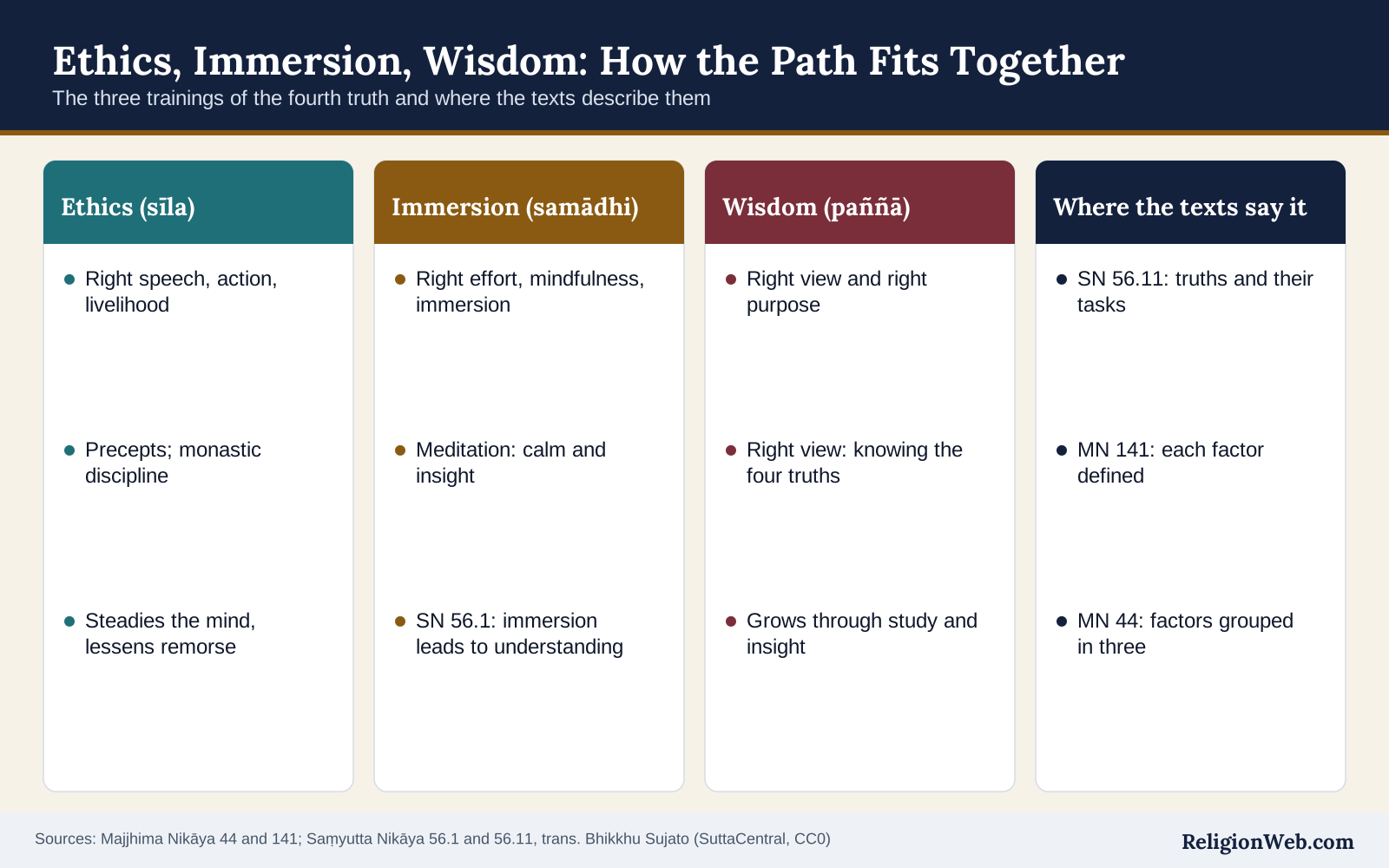
The fourth truth is the Noble Eightfold Path (ariya aṭṭhaṅgika magga). In the Majjhima Nikāya, the nun Dhammadinnā explains that the path is grouped into three “spectrums of practice”: right speech, right action, and right livelihood belong to ethics; right effort, right mindfulness, and right immersion belong to immersion (samādhi, meditative concentration); and right view and right purpose belong to wisdom (Majjhima Nikāya 44, Sujato). Table 4 sets out the factors, their groupings, and what the Majjhima Nikāya’s analysis says each involves. The full treatment is in the article on the Noble Eightfold Path.
| Factor | Pali | Training | What Majjhima Nikāya 141 says | Typical practice |
|---|---|---|---|---|
| Right view | sammā-diṭṭhi | Wisdom | Knowing suffering, its origin, its cessation, and the path | Study, reflection, teachers’ guidance |
| Right purpose | sammā-saṅkappa | Wisdom | Purposes of renunciation, good will, and harmlessness | Examining motives; cultivating kindness |
| Right speech | sammā-vācā | Ethics | Refraining from lying, backbiting, harsh speech, and talking nonsense | Truthful, gentle, useful speech |
| Right action | sammā-kammanta | Ethics | Refraining from killing living creatures, stealing, and sexual misconduct | Keeping the precepts |
| Right livelihood | sammā-ājīva | Ethics | Giving up wrong livelihood and earning a living by right livelihood | Work that does not rely on harm |
| Right effort | sammā-vāyāma | Immersion | Preventing and abandoning unskillful states; arousing and maintaining skillful ones | Daily mental discipline |
| Right mindfulness | sammā-sati | Immersion | Observing body, feelings, mind, and principles | Mindfulness meditation |
| Right immersion | sammā-samādhi | Immersion | The four absorptions (jhāna) | Concentration practice |
The middle way between extremes
The sermon introduces the path as a middle way (majjhimā paṭipadā) between indulgence in sensual pleasure and self-mortification. The Buddha’s own biography, as the tradition tells it, forms the background: a prince’s comfort, then years of extreme asceticism, then the discovery that neither led to freedom. The path is not a compromise halfway between luxury and hardship. It is a different kind of effort, described in the sermon as one that “gives vision and knowledge, and leads to peace, direct knowledge, awakening, and extinguishment” (Saṃyutta Nikāya 56.11, Sujato).
The phrase “middle way” is also used in later Buddhist philosophy in a different sense. The Madhyamaka tradition of Nāgārjuna speaks of a middle way between eternalism and nihilism in how phenomena are understood. The two uses are related by their rejection of extremes, but they refer to different things: in the first sermon the extremes are modes of conduct, and in Madhyamaka they are views about existence. Context makes clear which is meant.
Right View and the Circle of the Teaching
Right view is knowing the four truths
One of the most striking features of the early analysis is that the first factor of the fourth truth is knowledge of the four truths themselves. Sāriputta defines right view as “Knowing about suffering, the origin of suffering, the cessation of suffering, and the practice that leads to the cessation of suffering” (Majjhima Nikāya 141, Sujato). The teaching therefore forms a circle. A person begins with a provisional understanding of the truths, perhaps from reading or hearing a talk; that understanding supports ethical conduct and meditation; and those in turn refine the understanding until it becomes direct knowledge.
The circularity is not a flaw. It reflects the way learning to do something skilled works: a rough idea guides practice, and practice corrects the idea. The Buddhist texts call the early form of right view something one can have from hearing, and the mature form something one has seen for oneself. The first sermon’s own phrase “three turnings” describes a movement from the first kind of knowledge to the second, which the next section examines.
Ethics, immersion, and wisdom support one another
The path’s three trainings are not stages to be completed one after another and left behind. They reinforce each other. Ethical conduct steadies the mind and lessens remorse, a steadier mind can see more clearly, and clearer seeing makes ethical choices easier. In a short discourse recorded in the Aṅguttara Nikāya the Buddha says that he and his listeners had wandered in rebirth for a very long time “due to not understanding and not penetrating four things”: noble ethics, immersion, wisdom, and freedom (Aṅguttara Nikāya 4.1, Sujato). Having understood them, he says, craving for continued existence has been cut off.
This integration is why Buddhist practice looks different in different settings and yet follows the same logic. A lay person keeping the five precepts, a monk reciting the monastic code, a meditator on retreat, and a student of the scriptures are each working on one or more strands of the same path. The article on Buddhist meditation describes the immersion strand in more detail, and the article on Buddhist monastic life describes how the ethical strand is organized in the monastic community.
Four Truths, Four Tasks: Understand, Abandon, Realize, Develop
Three Turnings and Twelve Aspects
The structure of the central passage
After stating the four truths, the first sermon repeats them in a pattern that is easy to miss on a first reading because the text abbreviates it with ellipses. Each truth is taken up three times. First comes the recognition of what it is (“This is the noble truth of suffering”). Second comes the task that goes with it (“This noble truth of suffering should be completely understood”). Third comes the completion of the task (“This noble truth of suffering has been completely understood”). After each, the Buddha says that “vision, knowledge, wisdom, realization, and light” arose in him regarding teachings “not learned before from another.” The four truths and three rounds produce the twelve aspects of the Pali formula.
‘This noble truth of suffering should be completely understood.’ Such was the vision that arose in me …
‘This noble truth of the practice that leads to the cessation of suffering should be developed.’ Such was the vision that arose in me …
Saṃyutta Nikāya 56.11, translated by Bhikkhu Sujato (SuttaCentral, CC0), segments 5.2 and 8.2
The four tasks that result are summarized in Table 5. The first truth is to be understood, the second abandoned, the third realized, and the fourth developed. A parallel discourse in the same collection (Saṃyutta Nikāya 56.12) gives the identical pattern as the experience of all the Realized Ones, which suggests that the compilers regarded the sequence as typical of every buddha and not as a one-time event.
| Truth | Task | Pali (to be done) | Pali (done) | What the task involves |
|---|---|---|---|---|
| Dukkha | To be completely understood | pariññeyya | pariññāta | Seeing clearly what dukkha is, without denying or inflating it |
| Origin (craving) | To be given up | pahātabba | pahīna | Letting go of the thirst that drives repeated unsatisfactory becoming |
| Cessation | To be realized | sacchikātabba | sacchikata | Directly witnessing the ending of craving and dukkha |
| Path | To be developed | bhāvetabba | bhāvita | Cultivating ethics, meditation, and wisdom over time |
The Pali grammar of the tasks
The task forms in the Pali text are gerundives, verbal adjectives of obligation or fitness: pariññeyya, pahātabba, sacchikātabba, and bhāvetabba, each meaning roughly “to be fully known,” “to be abandoned,” “to be realized (made evident to oneself),” and “to be developed.” The completion forms are past participles: pariññāta, pahīna, sacchikata, and bhāvita. The grammar signals the shift between the second and third turnings, from what must be done to what has been done.
Translators render the verbs differently, and the differences show how rich the vocabulary is. Where Sujato has the cessation “realized,” Bhikkhu Brahmali’s translation of the same passage in the Vinaya has it “fully experienced,” and the Vinaya’s version says the path “should be fully developed.” The Pali verb sacchikaroti is built on a word for “before the eyes,” so that it means to make something evident to oneself, which is why the English “realize” is often used in both senses, “come to understand” and “make real.” The fourth verb, bhāveti, comes from the same root as bhāvanā, the standard Pali word for meditation, which is why “development” and “meditation” are close neighbors in Buddhist usage.
How Each Task Works
Understanding dukkha and abandoning craving
The pairing of tasks with truths is not arbitrary. Dukkha is to be understood rather than abandoned, because trying to eliminate pain directly is the very reaction the second arrow illustrates. A person understands dukkha by examining it closely, in its three forms and in the five aggregates, until the mind no longer flinches. Understanding of this kind is called pariññā, and the tradition describes it as a kind of full knowing that has an effect, in that it loosens what it examines.
Craving, by contrast, is the thing to abandon. In the early texts, abandoning is not a matter of suppression or willpower alone. It happens as understanding deepens: when a person sees clearly what craving is and what it costs, the grasping weakens by itself, as a hand lets go of something hot. The second task depends on the first, which is why the Buddha asks the monks to understand the truths before saying that anything is to be given up. Teachers sometimes sum up the relationship in a sentence: understand the problem fully, and its cause can be released.
Realizing cessation and developing the path
The third and fourth tasks are of a different kind. Cessation is realized, not manufactured, because it is the ending of something rather than the creation of something. The path, by contrast, is the thing that a practitioner actively builds. The texts do not offer a technique that forces cessation. They offer a path to be developed, and they say that as it ripens, cessation comes into view. When Sāriputta is asked whether there is a practice for realizing nibbāna, he points to the Eightfold Path (Saṃyutta Nikāya 38.1).
The tradition therefore speaks of effort in two registers. There is the careful, sustained cultivation of the path, which is a matter of will and skill, and there is the moment of realization, which is described more as a release than as an achievement. Understanding that distinction helps explain why Buddhist teachers emphasize patience, regularity, and a relaxed seriousness rather than striving for dramatic breakthroughs.
Tasks, Not a Creed
How the tasks change the way the teaching reads
If one reads the four truths as four statements of belief, the teaching can sound like a pessimistic worldview: life is suffering, desire causes it, stop desiring. Seen as four tasks, it reads as a program with a verifiable aim. The structure of the sermon invites a person to test the claims in practice. Elsewhere, the Buddha makes the connection with meditation explicit: “Mendicants, develop immersion. A mendicant who has immersion truly understands” (Saṃyutta Nikāya 56.1, Sujato), and what such a monastic understands is “This is suffering,” “This is the origin of suffering,” and so on.
The Satipaṭṭhāna Sutta (Majjhima Nikāya 10) lists the four truths among the objects of mindfulness: a practitioner meditates by observing principles with respect to the four noble truths, understanding “This is suffering” and the rest as they actually occur in experience. In this setting the truths are not doctrines recalled from memory but patterns noticed in the present moment, which is how the tasks of understanding and abandoning are carried out in daily practice.
The tasks and the Buddha’s claim to awakening
The tasks also bear on how the tradition understands awakening itself. In the Theravada reading, the arahant is a person who has completed all four: dukkha fully understood, craving abandoned, cessation realized, and the path fully developed. The sermon is therefore both an instruction and a definition, since it describes what the Buddha did and what any later disciple is expected to do. The same Pali pattern is repeated for the Realized Ones in general, so awakening is presented as a pattern of completion that is open to others, not as an unrepeatable event.
Dependent Origination, Karma, and Nirvana: How the Four Truths Connect to Other Core Teachings
Dependent Origination as the Mechanism
The four truths as a template for analysis
The pattern of the four truths turns out to be a method that can be applied to anything. The Majjhima Nikāya’s discourse on Right View (MN 9) is a talk by Sāriputta in which a noble disciple understands in turn many different things, among them the skillful and the unskillful, “fuel” (a word often translated “nutriment”), suffering, old age and death, rebirth, continued existence, grasping, craving, feeling, contact, and ignorance. For each, the disciple understands the thing itself, its origin, its cessation, and the practice that leads to its cessation. Old age and death, for example, originate from rebirth and cease when rebirth ceases, and craving originates from feeling. Sections of the discourse conclude that such a disciple has “given up ignorance and given rise to knowledge” and so will “make an end of suffering in this very life.”
The same four-part form thus shows up in many contexts. It works the way a physician’s examination works, naming a condition, tracing its cause, judging whether it can be removed, and prescribing a course of action. Buddhist teachers have long compared the Buddha’s method to medicine for just this reason, and the comparison appears in commentaries and later literature as a way to explain why the truths come in this order: diagnosis, cause, prognosis, treatment.
Two directions of one chain
The twelve links of dependent origination can be read as an expansion of the first two truths and of the third and fourth. The forward sequence from ignorance through choices, consciousness, name and form, the six sense fields, contact, feeling, craving, grasping, continued existence, and rebirth to old age and death shows how dukkha arises (first and second truths). The reverse sequence, in which each link ceases when its condition ceases, shows how dukkha ends (third truth), and the path is what brings about the interruption (fourth truth). Saṃyutta Nikāya 12.1 states both directions in sequence, ending with the words “That is how this entire mass of suffering ceases.”
Karma, Rebirth, and Not-Self
Rebirth in the sermon and in modern readings
The first sermon takes rebirth for granted. The craving of the second truth “leads to future lives,” and the Buddha concludes by saying, “My freedom is unshakable; this is my last rebirth; now there’ll be no more future lives” (Saṃyutta Nikāya 56.11, Sujato). Traditional Buddhist communities across Asia understand this literally: beings are reborn in accordance with their actions until craving is exhausted, and the goal of practice is to end that round. The article on karma and rebirth in Buddhism sets out how the traditions describe it.
Some modern Buddhists, especially in Western and secular-oriented circles, read rebirth differently or leave it aside, treating the four truths as a framework for understanding and easing suffering in this life. The British teacher Stephen Batchelor is the best-known advocate of this approach. Many teachers in the traditional lineages respond that rebirth is integral to the teaching and cannot be removed without changing what the third truth means. This article records both positions without adjudicating between them.
Not-self and the first truth
The first truth connects to the teaching of not-self (anattā) through the five aggregates. Verses in the Dhammapada link the three characteristics: “All conditions are impermanent,” “All conditions are suffering,” and “All things are not-self,” and each is followed by the line, “when this is seen with wisdom, one grows disillusioned with suffering: this is the path to purity” (Dhammapada 277-279, Sujato). Impermanence makes conditioned things unreliable, unreliability makes clinging to them painful, and the sense of an unchanging self cannot be found among them.
According to the Vinaya, the Buddha’s next discourse to the five ascetics, after the first sermon, was on not-self (the Anattalakkhaṇa Sutta, Saṃyutta Nikāya 22.59). The sequence is traditionally read as moving from the problem and its remedy to a closer analysis of the person who suffers. In the Theravada understanding, the realization that no permanent self is found among the aggregates is what makes the letting go of the second truth possible, because there is nothing left to defend.
Interpretations Across Buddhist Traditions
Theravada and Early Scholastic Readings
Theravada commentary and the Visuddhimagga
In the Theravada tradition, the Four Noble Truths are the framework for insight practice and the standard description of what is seen at the first moment of awakening. The fifth-century CE commentator Buddhaghosa, whose Visuddhimagga (“Path of Purification”) remains the tradition’s major manual, devotes a chapter to the truths. The commentarial position, as Theravada teachers usually present it, is that a person who attains the path penetrates all four truths in a single moment of insight: with nibbāna as its object, the path-knowledge simultaneously fully understands dukkha, abandons the origin, realizes cessation, and develops the path. That reading takes the four tasks of the first sermon as four functions of one event.
This account also explains why Theravada commentators treat the third truth as the one the path-moment directly knows, and the other three as accomplished at the same time through that knowing. Readers who want the broader context for these ideas can turn to the article on Theravada Buddhism, which describes the Pali commentarial tradition in detail.
The sixteen aspects in Abhidharma literature
Scholastic traditions that developed the Abhidharma, the systematic analysis of mind and phenomena, expanded each truth into four “aspects.” This scheme of sixteen aspects (ākāra) appears in Sarvāstivāda sources such as Vasubandhu’s Abhidharmakośa, a fourth- or fifth-century CE Sanskrit treatise, and in Tibetan scholasticism, where it is studied as part of the path of preparation. For the first truth, the four aspects are impermanence, suffering, emptiness, and selflessness. The remaining groups describe the second truth as a cause and origin, the third as cessation, peace, and definite emergence, and the fourth as a path that is a way out. Each aspect is a way of seeing the truth, a mental stance to be cultivated in meditation.
The Abhidharma schools also disagreed with Theravada about the manner of realization. The Sarvāstivāda tradition describes a gradual penetration of the truths through a sequence of moments of “acceptance” and “knowledge” in the path of seeing, in which each truth is seen in turn, while the Theravada commentators describe a single moment. Such disagreements are discussed in the scholastic literature of the different schools, and they show that already in antiquity Buddhist scholars were working out in detail how the sermon’s tasks are fulfilled.
Mahayana and Vajrayana Readings
Emptiness and the four truths
Mahayana literature introduces the teaching of emptiness (śūnyatā), the claim that phenomena lack independent, intrinsic existence. The Heart Sutra, a short Prajñāpāramitā text chanted in many East Asian and Tibetan settings, says in the voice of the bodhisattva Avalokiteśvara that in emptiness there is no suffering, no origin, no cessation, and no path. Read in isolation, the line sounds like a rejection of the Four Noble Truths. Mahayana commentators do not read it that way. They take it as a statement that, from the standpoint of ultimate truth, even the truths are empty of inherent existence, which does not deny their function in the conventional practice of liberation.
Nāgārjuna, the second- or third-century CE founder of the Madhyamaka school, takes up this question directly in the twenty-fourth chapter of his Mūlamadhyamakakārikā, a chapter often called the examination of the noble truths. He imagines an objector who says that emptiness destroys the four truths, and answers that it is only because things are empty and dependently arisen that suffering, its origin, cessation, and the path can operate at all. In verse 40 he says that whoever sees dependent origination sees suffering, its origin, its cessation, and the path. The Chinese Tiantai master Zhiyi (538-597 CE) took a different approach and described four kinds of four truths, ranging from a conditioned, arising-and-ceasing form to an unconditioned one, so that the same four are understood at progressively deeper levels.
Bodhisattva practice and the four great vows
Mahayana traditions extend the aim of the Four Noble Truths from one’s own liberation to the liberation of all beings. A bodhisattva takes on the work of understanding and relieving dukkha in others, and that compassionate orientation gives the truths a broader social meaning. The article on the bodhisattva ideal and the overview of Mahayana Buddhism describe this orientation in more detail.
The vows chanted in many East Asian Zen and Chan temples, the Four Great Vows, are sometimes explained as the four truths turned into aspirations: to save the countless beings (dukkha), to end the inexhaustible afflictions (origin), to enter the boundless gates of the teaching (path), and to attain the unsurpassable way of awakening (cessation). Tradition connects the correspondence to Zhiyi, though the vows are widely used outside the Tiantai school and are interpreted in different ways.
Tibetan, East Asian, and Modern Teachers
Lamrim, Zen, and Plum Village
Tibetan Buddhism, a form of Vajrayana Buddhism, organizes much of its teaching in the lamrim (“stages of the path”) literature, which presents the Four Noble Truths as the basis for the motivation to seek liberation. Teachers such as the fourteenth Dalai Lama have often presented the truths as the foundation on which Mahayana compassion and tantric practice are built, and the festival of Chökhor Düchen commemorates the first sermon in the Tibetan calendar.
In the Vietnamese Zen tradition associated with Thích Nhất Hạnh, the truths are taught in a vocabulary of mindful daily life. His book The Heart of the Buddha’s Teaching (1998) renders the four as ill-being, the making of ill-being, well-being, and the path, and presents the third truth as a present possibility rather than a distant goal. Chan and Zen traditions more broadly place less emphasis on the formula as an organizing frame of instruction than Theravada does, but it appears in their chanting, in their vows, and in teachings of individual masters.
Modern and secular interpretations
Twentieth-century writers introduced the four truths to new audiences. Walpola Rahula’s What the Buddha Taught (1959), a widely read Theravada introduction, translated dukkha as “suffering” while explaining that it includes imperfection, impermanence, and insubstantiality, and argued that Buddhism is neither optimistic nor pessimistic but concerned with seeing things as they are. Bhikkhu Bodhi’s translations and writings, and Ṭhānissaro Bhikkhu’s essays on the truths as categories of experience to be used rather than doctrines to be believed, have shaped English-language understanding of the Pali texts.
Stephen Batchelor, a former monk and teacher, has proposed a secular reading in which the four truths are tasks of embracing life’s difficulty, letting go of reactive craving, seeing the cessation of that reactivity, and cultivating a path of practice. Scholars of Buddhist modernism, notably David McMahan in The Making of Buddhist Modernism (2008), observe that such presentations reflect the modern encounter with science, psychology, and Western philosophy as much as the ancient texts. Each of these interpretations has its defenders and critics inside Buddhist communities, and none is presented here as the correct one.
How Buddhists Apply the Four Noble Truths Today
Meditation, Study, and Chanting
Insight meditation and the truths in daily attention
In Theravada and related insight traditions, meditation on the truths is not a separate exercise. A practitioner observes bodily sensations, feelings, states of mind, and mental patterns, and recognizes in them the features that the truths describe: where there is tension or dissatisfaction, where craving or aversion arises, where it fades, and what mental states support or hinder that fading. Early discourses connect this directly. One tells the monastics to meditate in retreat because “A mendicant in retreat truly understands” the four truths (Saṃyutta Nikāya 56.2, Sujato), and the Satipaṭṭhāna Sutta includes the four truths among the objects of mindfulness.
That use of the truths is flexible. A person caught in irritation might ask: what is the dukkha here? What is the craving, the wish for things to be otherwise? What happens when the craving is seen and let go, and what practices help? The questions follow the structure of the sermon. The article on Buddhist meditation explains the forms of practice, from calming (samatha) to insight (vipassanā), that are used to carry this out.
Chanting and commemoration of the first sermon
The first sermon is chanted in Theravada ceremonies, and it is commemorated each year on a day named for it. In Theravada countries this is Āsāḷha Pūjā (Asalha Puja, also called Dhammacakka Day), held on the full moon of the lunar month of Āsāḷha, which usually falls in July, though the date moves with the lunisolar calendar and can fall later in years with an extra month. In Thailand it is a public holiday called Asalha Bucha, and it is followed the next day by the start of the three-month rains retreat (Vassa) for monastics. In Sri Lanka the corresponding full-moon day is Esala Poya. The Tibetan tradition marks the occasion at Chökhor Düchen, which falls in the sixth Tibetan month.
Observances usually include offerings at temples, listening to or chanting the sutta, candle-lit circumambulation of the main shrine in the evening, and lay people taking additional precepts for the day. The commemorations pair naturally with the festival that marks the Buddha’s awakening, covered in the article on Vesak. Exact customs vary by country, temple, and lineage, and they should not be taken as one universal form.
Ethics, Community, and Monastic Life
Lay practice: refuge, precepts, and generosity
For lay Buddhists, the Four Noble Truths are usually met through the practices of going for refuge, keeping the precepts, and giving. A verse in the Dhammapada connects them: “One gone for refuge to the Buddha, to his teaching and to the Saṅgha, sees the four noble truths with right understanding” (Dhammapada 190-191, Sujato). Taking refuge is therefore described not as a ritual of allegiance but as a step toward seeing the truths. Keeping the five precepts supports right action and right speech, and generosity weakens clinging, both of which belong to the path.
Monastic life and the purpose of going forth
For monastics, the truths state the purpose of the whole way of life. A discourse in the Saṃyutta Nikāya says that “whatever gentlemen” in the past, future, or present “rightly go forth from the lay life to homelessness, all of them do so in order to truly comprehend the four noble truths” (Saṃyutta Nikāya 56.3, Sujato). The Vinaya’s account of Koṇḍañña’s ordination makes the same link, with the Buddha urging him to practice the spiritual life “to make a complete end of suffering.”
The rules of monastic discipline, daily routine of almsround, study and meditation, and community life are organized to support the path, particularly its ethical and meditative aspects. The article on Buddhist monastic life describes how ordination, the Vinaya, and the daily schedule serve that purpose. Monastic life is not the only way to follow the path, but the tradition regards it as designed to make the tasks of the truths easier to carry out.
Reading the Teaching Well: Common Pitfalls
Frequent misreadings and how the texts correct them
Because the formula is so short, it invites quick summaries that lose important qualifications. Table 6 collects frequent misreadings that are separate from the larger misconceptions treated later in this article, with a note on what causes each and what the texts say.
| Pitfall | Why it arises | What the texts indicate |
|---|---|---|
| Treating dukkha as only physical or emotional pain | “Suffering” is the default English translation | Dukkha also covers conditioned unreliability and the pain of change (SN 38.14) |
| Reading the truths as four beliefs to accept | Summaries present them as statements | The sermon attaches a task to each truth (SN 56.11) |
| Assuming all suffering results from past karma | Popular accounts of karma as total causation | The Buddha lists other causes of painful feeling (SN 36.21) |
| Assuming that the second truth condemns all wishes | “Desire” translates several Pali words | Wholesome aspiration (chanda) supports the path (SN 51.15) |
| Equating cessation with nothingness | The ending of craving sounds like an ending of the person | The Buddha rejects the charge of annihilation (MN 22) |
| Treating the path as optional self-improvement | The Eightfold Path appears in lists of advice | It is the fourth truth, to be developed to realize cessation (SN 56.11) |
Using the truths in modern contexts
The language of the truths has entered modern secular settings. Programs of mindfulness-based stress reduction, developed from the late 1970s by Jon Kabat-Zinn and others, draw on Buddhist meditation practice, and psychologists and counselors sometimes refer to the Buddhist analysis of craving and reactivity. Buddhist teachers have mixed views on such adaptations. Some welcome a wider audience for practices that relieve distress, while others caution that removing the ethical context of the path and the goal of liberation changes what is being taught.
Religious readings of dukkha are not clinical statements. A person experiencing depression, grief that does not ease, anxiety, or a medical illness should seek qualified help alongside whatever contemplative practice they follow, and the Buddhist texts themselves treat the care of the sick as a moral duty. Describing the Buddhist view accurately means keeping the two registers distinct: the first sermon speaks about the human condition as a whole and about a path of liberation, not about the diagnosis or treatment of particular disorders.
Common Misconceptions About the Four Noble Truths
Misconception 1: Buddhism teaches that life is nothing but misery
Where the misunderstanding comes from
The most common one-line summary of the first truth is “life is suffering,” and that sentence, repeated in textbooks and popular articles, sounds like a claim that existence is wretched. Nineteenth-century European readers sometimes took Buddhism to be a philosophy of pessimism, in part because they met it alongside the philosophy of Arthur Schopenhauer, who admired some Buddhist ideas and framed them in a gloomy light. The English word “suffering” does much of the damage on its own, because it suggests agony, while the Pali dukkha has a wider range.
A second source is selective reading. The first sermon’s list of birth, aging, illness, and death is dramatic, and without the surrounding context it can seem to be the whole of the Buddha’s view. Readers who stop at the first truth do not reach the third and fourth, which are the reason the first is stated at all.
What the evidence and tradition actually show
The early texts say clearly that happiness exists and is valued. The Dhammapada has a whole chapter on happiness (sukha), including the line “extinguishment is the ultimate happiness” (Dhammapada 203, Sujato), and the same collection calls the arising of Buddhas, the teaching, and the harmony of the community happy (Dhammapada 194). Meditative absorption is described as “rapture and bliss” in the same discourse that defines the Eightfold Path (Majjhima Nikāya 141, Sujato). The first truth does not deny these; it says that conditioned experiences are unreliable and that attachment to them produces distress.
The teaching is also framed as a response to a problem, not as a worldview about the value of existence. Walpola Rahula wrote in 1959 that Buddhism is neither optimistic nor pessimistic but concerned with seeing things as they are, which is a fair summary of the position. The Buddhist tradition has produced a great deal of art, music, hospitality, and festival life, and its teachers regularly speak of joy, gratitude, and equanimity. Dukkha is a diagnosis made in order to show a way out, and the sermon ends with the claim that the way is open.
Misconception 2: Craving means every desire without distinction
Where the misunderstanding comes from
Popular summaries often say that “desire is the cause of suffering.” Since English “desire” covers wanting a glass of water, wanting a friend to recover, and wanting to be free, the summary seems to ask Buddhists to want nothing at all. Critics have pointed out that this would be self-defeating: the wish to end desire is itself a desire. That objection is old. It is the argument that the brahmin Uṇṇābha puts to Ānanda in the Pali discourse mentioned earlier, and the fact that the texts record it shows that early listeners saw the problem as well.
The confusion is deepened by the fact that Pali has many words that English translators render as “desire.” Taṇhā, chanda, and others have different meanings, and different translators choose different English words for them.
What the evidence and tradition actually show
The second truth speaks of taṇhā, “thirst,” and describes it precisely: craving that leads to renewed existence, accompanied by relishing and greed (Saṃyutta Nikāya 56.11). The texts recognize another kind of wanting, chanda, aspiration or enthusiasm, which can be wholesome and which is part of how the path is walked. In the exchange with Uṇṇābha, Ānanda says that desire for the goal fades when the goal is reached, as the desire to walk to a park fades on arrival (Saṃyutta Nikāya 51.15). Wholesome wishes for kindness, generosity, and awakening are encouraged throughout the canon, and the Mahayana bodhisattva ideal rests on the aspiration to free all beings.
The aim of the second task is therefore narrower than the slogan suggests. It is to abandon the compulsive grasping that treats pleasant things as necessary for happiness and unpleasant things as intolerable. A person can want to cook a meal, care for a child, and finish a project, while still learning to hold the wanting more lightly. How completely that holding-lightly can be achieved is a matter of degree, and Buddhist traditions differ on what the final stage looks like. They agree that the target is craving and not the whole range of human motivation.
Modern teachers often put the distinction as the difference between caring and clinging. A parent who works to feed a child, a doctor who tries to heal a patient, and a monastic who strives for awakening are all motivated by wishes, and none of that is what the second truth condemns. What it points to is the demand that experience be other than it is, which turns every unmet wish into a second arrow. The texts do not ask a person to stop caring about others or to cultivate indifference. In Pali discussions of the divine abidings, goodwill and compassion are cultivated deliberately and are counted among the qualities that the path develops.
Misconception 3: The Four Noble Truths are purely pessimistic philosophy rather than a practice framework
Where the misunderstanding comes from
If the four truths are read as four sentences, the first sentence is the most vivid and the most quotable, and a reader may conclude that the teaching is a description of the world’s defects. Textbook treatments that list the truths in a few lines, without the tasks and without the path, reinforce that impression. Comparisons with systems of speculative philosophy, which also begin with a view of the human condition, add to it.
The impression is also supported by the fact that the Four Noble Truths are often taught in introductory settings as the “Buddhist philosophy of suffering,” detached from the practice settings in which they are normally used. In a classroom, they become a topic to analyze. In a monastery or meditation hall, they are a program to carry out.
What the evidence and tradition actually show
The first sermon itself is structured as a practical formula. Each truth carries a task, and the fourth truth is a course of training with specific components: ethical conduct, mental cultivation, and wisdom (Saṃyutta Nikāya 56.11; Majjhima Nikāya 44). The Buddha says that he teaches the four truths because they are “beneficial and relevant to the fundamentals of the spiritual life” and lead to “disillusionment, dispassion, cessation, peace, insight, awakening, and extinguishment” (Saṃyutta Nikāya 56.31). In the same discourse he sets aside other questions because they do not lead there.
In the Cūḷamāluṅkya Sutta, a monk who wants metaphysical answers is told that insisting on them is like a man struck by a poisoned arrow who refuses to let a surgeon treat him until he learns who shot him. The Buddha’s response, in the text, is to point him back to the four truths. That is the language of someone describing a method, not a worldview. Other early discourses tie the truths to meditation in the same way, saying that a monastic who develops immersion or who meditates in retreat “truly understands” them (Saṃyutta Nikāya 56.1 and 56.2). Whatever else the teaching is, it is presented as something to be practiced. Buddhist philosophers have certainly built large systems on the truths, but the early texts treat them as something to be done as well as understood.
Misconception 4: Cessation means annihilation, or that an awakened person feels nothing
Where the misunderstanding comes from
Words such as “cessation,” “extinguishment,” and “the ending of craving” can sound like descriptions of destruction. Early critics said exactly this, and the idea has persisted in popular accounts that portray nirvana as oblivion and the awakened person as emotionless. The impression is helped by translations of vibhava-taṇhā as “craving for nonexistence,” which can be read as if the teaching itself were about nonexistence.
It is also helped by a misunderstanding of detachment, which is easily heard as indifference. If a person lets go of craving, the reasoning goes, they must stop caring about anything.
What the evidence and tradition actually show
The Buddha rejected the annihilationist charge in the Pali discourses. Answering ascetics who said he taught the “annihilation, eradication, and nonexistence of an existing being,” he replied that what he describes is “suffering and the cessation of suffering” (Majjhima Nikāya 22, Sujato). What ends is craving and the suffering it produces. As noted earlier, the early texts say little about what an awakened person experiences, and they decline to answer questions about what happens after death in the form the questioners ask (Majjhima Nikāya 63).
As for feeling, the discourse on the two arrows says that the learned disciple still feels pleasant and painful feeling and does not react to it with resistance or craving (Saṃyutta Nikāya 36.6). The tradition’s accounts of the Buddha and of arahants show them teaching, traveling, advising, and caring for the sick for decades. In the Mahayana, compassion is placed at the center of the ideal. Whatever one makes of the metaphysical claims, the texts do not describe awakening as numbness.
Frequently Asked Questions About the Four Noble Truths
Questions About Meaning
What are the Four Noble Truths in simple terms?
The Four Noble Truths say that there is dukkha, the unsatisfactoriness and pain built into conditioned life; that dukkha has an origin in craving, the thirst that clings to pleasure, existence, and escape; that dukkha can end when craving fades away completely; and that there is a path, the Noble Eightfold Path, that leads to that ending. In the early texts each comes with a task: understand the first, abandon the second, realize the third, and develop the fourth.
Is dukkha best translated as suffering or dissatisfaction?
There is no single correct translation, and translators disagree. “Suffering” is the longest-established choice and fits the sermon’s list of birth, illness, and death. “Stress,” “unsatisfactoriness,” and “dissatisfaction” capture the wider sense of a mind that cannot find lasting rest in changing things. Some teachers prefer to leave the word untranslated so that readers learn its range from the texts.
Why are the truths called noble?
The Pali word is ariya, which applies to the Buddha’s teaching, to the path, and to the people who have seen the truths directly, the “noble ones.” One Pali discourse explains that the four are called noble truths because they are “real, not unreal, not otherwise” (Saṃyutta Nikāya 56.27). Some scholars, among them K. R. Norman, have suggested that the phrase can also be read as “truths of the noble ones.”
Questions About Practice and Belief
Do Buddhists have to believe in rebirth to follow the Four Noble Truths?
Traditional Buddhist communities in Asia understand rebirth as part of the teaching, and the first sermon speaks of craving that leads to future lives and of the Buddha’s “last rebirth.” In those traditions the third truth is the end of rebirth as well as of suffering.
Some modern teachers, particularly in secular Buddhist circles, treat rebirth as optional or interpret it as a metaphor for moment-to-moment becoming, and they apply the truths to life as it is lived now. Many traditional teachers regard that as a significant change to the teaching. The question is open within Buddhism, and this article presents both views without choosing between them.
How do the Four Noble Truths relate to the Eightfold Path?
The Eightfold Path is the fourth of the four truths and also the middle way the Buddha introduces before stating them. The path is the practical content of the teaching: ethical conduct, meditation, and wisdom. Right view, the first factor, is defined as knowing the four truths, so the path both begins with and leads to the understanding that the truths describe.
In practice, the truths set the goal and the diagnosis, and the path supplies the training.
Can the Four Noble Truths be studied without becoming Buddhist?
Yes. The teaching has been studied by historians, philosophers, psychologists, and general readers for well over a century, and many people find the analysis of craving and reactivity useful without adopting Buddhist identity or belief. Buddhist teachers differ about whether the truths can be separated from the wider path of ethics and liberation, as noted above in the discussion of modern contexts.
Readers who wish to understand the teaching on its own terms will do best to begin with the first sermon and the Majjhima Nikāya’s analysis of the truths (MN 141), and to remember that practice is part of the framework. Study of the teaching does not replace professional care for medical or psychological difficulties.
Questions About History and Observance
When and where did the Buddha teach the Four Noble Truths?
According to the Pali tradition, he taught them soon after his awakening at the deer park of Isipatana, modern Sarnath near Varanasi, to the five ascetics who had been his companions. Historians cannot fix the date exactly, since the Buddha’s own dates are uncertain; many place his death within a few decades of 400 BCE.
The four truths are taught elsewhere in the canon too. Sāriputta analyzes them in detail at the same deer park in Majjhima Nikāya 141, and the Saṃyutta Nikāya contains a whole section on them (the Sacca-saṃyutta, SN 56).
How is the first sermon remembered each year?
Theravada Buddhists observe Āsāḷha Pūjā, or Asalha Puja, on the full moon of the lunar month of Āsāḷha, usually in July, with temple visits, offerings, chanting of the sutta, and evening circumambulation. The date moves because the calendar is lunisolar, so it is best checked against the current year’s calendar of a local temple or national authority. Tibetan Buddhists mark the occasion at Chökhor Düchen, and the Buddha’s awakening and death are remembered at Vesak.
Practices vary by country and lineage, and not every Buddhist community gives the day the same weight.
Are the Four Noble Truths found in every Buddhist tradition?
They are taught in Theravada, Mahayana, and Vajrayana traditions, though not always in the same way or with the same prominence. Theravada gives them the most central place in its presentation of the path. Mahayana and Vajrayana schools teach them as foundational and then read them in light of emptiness and the bodhisattva path, as the section on traditions explains.
Conclusion: What the Four Noble Truths Show
What the Texts and History Show
A short teaching with a practical structure
The earliest sources present the Four Noble Truths as the Buddha’s account of what he understood and what he offered: a diagnosis, a cause, a possibility of ending, and a path. The sermon attaches a task to each, and its closing claim ties the Buddha’s awakening to the completion of those tasks. Read in that way, the teaching is a method as much as a doctrine, and it is consistent with the many contexts in which Buddhists use it, from meditation instruction to monastic purpose to chanting on the day that remembers the first sermon.
The wording of the first sermon also repays careful reading. Dukkha is wider than pain, craving is not every wish, cessation is not annihilation, and the path is not optional advice. Each of these points corrects a common simplification, and each is supported by the early texts themselves.
Differences that remain
Buddhist traditions agree on the shape of the teaching and differ on much of its interpretation: whether realization is gradual or simultaneous, how emptiness bears on the truths, how rebirth should be understood, and how far the formula can be separated from the wider path. Historians, too, differ about how the formula took shape. A responsible account lists these differences, not as defects but as signs of a teaching that has been studied for twenty-five centuries.
How to Keep Exploring
Related chapters on ReligionWeb
Readers who want to continue can follow the teaching in several directions. The fourth truth is developed in the Noble Eightfold Path, the third in nirvana in Buddhism, and the second in karma and rebirth. Practice is described in Buddhist meditation, and the life of the teacher who gave the first sermon is in the chapter on the Buddha.
For the school-by-school background, see Theravada Buddhism and Mahayana Buddhism, and for the overall setting, return to Buddhism.
Reading the primary texts
The most direct way to learn the teaching is to read it in translation. The first sermon (Saṃyutta Nikāya 56.11) is short enough to read in a few minutes, and Majjhima Nikāya 141 supplies Sāriputta’s detailed analysis. Openly licensed English translations by Bhikkhu Sujato and Bhikkhu Brahmali are available through SuttaCentral, and several other translators, including Bhikkhu Bodhi and Ṭhānissaro Bhikkhu, offer alternative renderings that differ in their choices for words like dukkha. Reading two translations side by side is a good way to see how much the vocabulary matters.
As with any scripture, the texts are best read with attention to who is speaking, to whom, and in what tradition they are being interpreted. Teachers within each lineage can help, and the differences among them are part of the subject.
Sources
The table below lists the principal external sources behind this article. Facts, dates and figures were checked against these and related primary, institutional and academic materials.
| # | Source | Publisher and type | Used for | Link |
|---|---|---|---|---|
| 1 | Saṃyutta Nikāya 56.11, Dhammacakkappavattana Sutta (Rolling Forth the Wheel of Dhamma), translated by Bhikkhu Sujato; with Pali root text | SuttaCentral (Bilara Data repository), CC0 · Primary text | Wording of the four truths, three turnings and twelve aspects, middle way, Koṇḍañña; quoted passages | raw.githubusercontent.com |
| 2 | Vinaya Mahāvagga, Khandhaka 1, translated by Bhikkhu Brahmali | SuttaCentral (Bilara Data repository), CC0 · Primary text | Narrative of the first sermon, the five ascetics, first ordination; also Khandhaka 8 (nursing the sick) | raw.githubusercontent.com |
| 3 | Majjhima Nikāya 141, The Analysis of the Truths, translated by Bhikkhu Sujato | SuttaCentral (Bilara Data repository), CC0 · Primary text | Sāriputta's definitions of the four truths and the eight path factors; right view as knowing the truths | raw.githubusercontent.com |
| 4 | Saṃyutta Nikāya 36.6, An Arrow, translated by Bhikkhu Sujato | SuttaCentral (Bilara Data repository), CC0 · Primary text | The two arrows passage on pain and reaction; quoted | raw.githubusercontent.com |
| 5 | Saṃyutta Nikāya 56.31, In a Rosewood Forest, translated by Bhikkhu Sujato | SuttaCentral (Bilara Data repository), CC0 · Primary text | Why the Buddha taught the four truths: beneficial and relevant to the fundamentals of the spiritual life | raw.githubusercontent.com |
| 6 | Majjhima Nikāya 22, The Simile of the Snake, translated by Bhikkhu Sujato | SuttaCentral (Bilara Data repository), CC0 · Primary text | 'Suffering and the cessation of suffering'; the annihilationism charge and the Buddha's reply | raw.githubusercontent.com |
| 7 | Bilara Data LICENSE: CC0 dedication of all SuttaCentral-supported translations | SuttaCentral (Bilara Data repository) · Licensing statement | Reuse status of the Sujato and Brahmali translations quoted; also covers MN 9, 10, 44, 63, SN 12.1, 38.1, 38.14, 51.15, Dhp | raw.githubusercontent.com |
| 8 | How the Global Religious Landscape Changed From 2010 to 2020 | Pew Research Center · Demographic data | About 324 million Buddhists (4.1% of world population) in 2020; about 98% in Asia-Pacific | pewresearch.org |
| 9 | Saṁyukta-āgama Studies: comparison of SN 56.11 with SĀ 379 and other versions (summarizing Anālayo) | dhamma.gift (Early Buddhist Texts study site), citing Anālayo, Dharma Drum Publishing · Academic reference | Versions of the first sermon; Anālayo's view on shorter Chinese version; Bareau, Schmithausen, Bronkhorst debate | find.dhamma.gift |
| 10 | Duḥkha (encyclopedia article on the term, its etymology and translations) | Wikipedia (secondary; used because no better accessible source was reachable) · Encyclopedia | Range of English renderings of dukkha; uncertainty about the 'axle hole' etymology | en.wikipedia.org |
Last fact-check date: 2026-10-21.