The Noble Eightfold Path is the Buddha’s practical answer to the problem of suffering. It is a set of eight connected forms of training, covering understanding, ethical conduct, and mental discipline, which Buddhist texts present as the way leading to the end of dukkha, the unsatisfactoriness and pain that mark ordinary existence. In the framework of the Four Noble Truths, it is the fourth truth: the practice that leads to the cessation of suffering. Its eight members are right view, right intention, right speech, right action, right livelihood, right effort, right mindfulness, and right concentration.
According to the early discourses, the Buddha first taught the path in his opening sermon at the Deer Park at Isipatana, near Varanasi, to five ascetics who, according to tradition, had been his former companions. Modern historians place the Buddha’s life in roughly the fifth century BCE, though the exact dates are debated, and they do not claim to know the exact wording of that first teaching. The major Buddhist canons nevertheless preserve the Eightfold Path as part of the core of the Buddha’s message. The path appears in Buddhism in every major region and school, from Sri Lanka and Thailand to Japan, Tibet, and the West, though each tradition places its own emphasis on it.
Several distinctions matter before the details begin. The word “path” does not mean eight stages to be completed in strict order, a point the early texts make in more than one way. The English word “right” translates a Pali term with a wider sense than moral correctness. And the path is a training in understanding, conduct, and mind together, not a list of meditation techniques and not a code of rules. This article explains each of the eight factors in the words of the early discourses, shows how they group into ethical conduct, concentration, and wisdom, compares the main translation choices, describes how monastics and lay Buddhists apply the path, and sets out how different Buddhist traditions read it.
The Noble Eightfold Path at a Glance: Meaning, Terms, and Origins
What the Name Means
Noble, Eightfold, and Path
The standard Pali phrase is ariyo aṭṭhaṅgiko maggo, which appears in exactly this form in the Buddha’s formal analysis of the path in the Saṃyutta Nikāya. Magga means “path” or “way,” and the word is also used in the early texts for the road a traveler follows. Aṭṭha is “eight,” and aṅga is a limb, component, or factor, so “eightfold” is better understood as “having eight factors” than as “eight separate paths.” The image is of one road with eight inseparable aspects, in the way a body has limbs without being a collection of unrelated parts.
The word ariya, “noble,” needs a short explanation. In the early texts it describes the Buddha’s teaching and also the people who have seen the truths for themselves, who are called “noble ones” (ariyas). It is not a class or caste label: in the early texts the word is applied to people on the basis of their understanding and conduct, not their birth. Sanskrit Buddhist texts give the phrase as āryāṣṭāṅgika-mārga. In East Asian Buddhism the path is known in Chinese as bā zhèng dào (八正道) and in Japanese as hasshōdō, both meaning roughly “the eight right paths.”
Why Translators Say “Right”
Every factor in the standard list begins with the Pali word sammā, which English translators have rendered since the nineteenth century as “right.” The choice is convenient and memorable, but it can mislead. In Pali, sammā has the sense of “properly,” “completely,” or “perfectly,” and the early texts treat it as the opposite of micchā, “wrong.” The same discourses that teach the noble eightfold path describe a mirror-image wrong eightfold path, built from wrong view, wrong purpose, wrong speech, and so on, and say that this wrong path is simply what is meant by the absence of the spiritual path. The word “right” therefore marks a direction: whether a given view, intention, or act points toward release from suffering or away from it.
That is why this article, like many modern books, sometimes uses the Pali word and sometimes an English equivalent. A later section on translation choices shows how Bhikkhu Bodhi, Bhikkhu Sujato, Walpola Rahula, and other translators have rendered individual factors, because the differences are more than stylistic.
The Eight Factors in Brief
The List and Its Standard Grouping
The early discourses give the list in the same order wherever the path is analyzed in full, and later teachers have grouped the eight factors into three sets. Table 1 gives the list with the Pali terms, the meaning each receives in the early texts, and the training to which it belongs. The English wording follows common usage, with the rendering used in Bhikkhu Sujato’s translations given in parentheses where it differs.
| Factor | Pali term | Core meaning in the early discourses | Training group |
|---|---|---|---|
| 1. Right view | sammā-diṭṭhi | Knowing suffering, its origin, its cessation, and the practice that leads to its cessation | Wisdom |
| 2. Right intention (right purpose) | sammā-saṅkappa | Purposes of renunciation, good will, and harmlessness | Wisdom |
| 3. Right speech | sammā-vācā | Refraining from false, divisive, harsh, and pointless speech | Ethical conduct |
| 4. Right action | sammā-kammanta | Refraining from killing living creatures, stealing, and sexual misconduct | Ethical conduct |
| 5. Right livelihood | sammā-ājīva | Giving up wrong livelihood and earning a living by right livelihood | Ethical conduct |
| 6. Right effort | sammā-vāyāma | Striving to prevent and abandon unskillful qualities and to arouse and maintain skillful ones | Concentration (mental discipline) |
| 7. Right mindfulness | sammā-sati | Observing body, feelings, mind, and principles, keen, aware, and mindful | Concentration (mental discipline) |
| 8. Right concentration (right immersion) | sammā-samādhi | Unification of mind, described through the four absorptions (jhāna) | Concentration (mental discipline) |
The table reflects the arrangement that the early texts themselves give. In the Cūḷavedalla Sutta (Majjhima Nikāya 44), the nun Dhammadinnā explains to the lay follower Visākha that the noble eightfold path is included in three “spectrums” or aggregates of practice, which the tradition names ethics (sīla), concentration or immersion (samādhi), and wisdom (paññā). Later sections look at each grouping, at the reasons the list is given in this order, and at the ways the texts qualify any idea of a strict sequence.
Where the Path Sits in Buddhist Teaching
The Eightfold Path is the fourth of the Four Noble Truths, the formula with which the Buddha is said to have set forth his understanding of suffering. The first truth identifies suffering, the second its origin in craving, the third its cessation, and the fourth the path leading to that cessation. The sequence is often compared to a medical diagnosis, with the path as the prescribed course of treatment. The comparison is a common teaching device, though it is not the language of the first sermon itself. The Four Noble Truths article covers the first three truths in depth, while this article concentrates on the fourth.
The path is also bound up with other central teachings: with the Buddha’s call for a “middle way” between indulgence and self-denial, with the doctrine of intentional action and its results (karma and rebirth), and with the goal of liberation, nirvana (Pali nibbāna). A later section sets out these relationships in a table. Readers who want the full picture of the religion, including the life of the founder, the canons, and the major traditions, will find it in the main article on Buddhism.
The First Sermon at Isipatana
The Two Extremes and the Middle Way
The best-known setting for the Eightfold Path is the Buddha’s first discourse, preserved in Pali as the Saṃyutta Nikāya 56.11 and widely known as the Dhammacakkappavattana Sutta. In the translation of Bhikkhu Sujato, whose title for the discourse is “Rolling Forth the Wheel of Dhamma,” the Buddha tells the group of five mendicants that there are two extremes to avoid, indulgence in sensual pleasures and indulgence in self-mortification, and then identifies the course between them:
And what is that middle way of practice? It is simply this noble eightfold path, that is: right view, right purpose, right speech, right action, right livelihood, right effort, right mindfulness, and right immersion.
Saṃyutta Nikāya 56.11, “Rolling Forth the Wheel of Dhamma,” tr. Bhikkhu Sujato (SuttaCentral, CC0), segments 3.1 to 3.3
The “middle way” here is not a compromise halfway between austerity and comfort. In the account of the Buddha’s life preserved by the tradition, he had lived as a prince in comfort and then, after leaving home, as an ascetic who practiced severe self-denial before concluding that neither brought release. The path is presented as the practice that grew out of that discovery. Bhikkhu Bodhi, the American-born Theravada monk and translator, writes that the path is called the middle way because it does not sit midway between the extremes but transcends both by avoiding the errors that each involves.
Why the Path Is the Fourth Truth
In the same discourse the Buddha goes on to state the four noble truths and to say that each carries a task: suffering is to be fully understood, its origin abandoned, its cessation realized, and the path developed. The discourse thus treats the path as something to be cultivated, not merely believed. The other truths are assigned to understanding, abandoning, and realizing; only the fourth is assigned to development. The Eightfold Path is the one noble truth in which the practitioner is asked to do something over time.
The setting of this discourse is also a reason the path became a symbol. The text describes the proclamation of the teaching as the setting in motion of the “Wheel of Dhamma,” and an image of the wheel has stood for the teaching, and later for the path, ever since. The final section of this article returns to the history of that symbol and to what it can and cannot be said to represent.
The Path Across the Early Collections
Where the Path Recurs in the Pali Canon
The first sermon is only one among many places where the path appears. One whole chapter of the Saṃyutta Nikāya, the “Connected Discourses,” is devoted to it: the forty-fifth, the Magga Saṃyutta, gathers short discourses on the path that repeat the same eight factors in different contexts and set the right factors beside their wrong counterparts. The Majjhima Nikāya contains the Saccavibhaṅga Sutta (Majjhima Nikāya 141, “The Analysis of the Truths”), in which the Buddha’s chief disciple Sāriputta analyzes each of the four truths and each path factor in the same wording as the Saṃyutta passage. The Dīgha Nikāya includes the path in its long account of mindfulness meditation (Dīgha Nikāya 22), and the account of the Buddha’s final days (Dīgha Nikāya 16) lists it last among the seven sets of practices that he says he taught from his own direct knowledge and urges the monks to memorize and cultivate. Later tradition counts these seven sets as thirty-seven “wings” or aids to awakening.
The verse collection known as the Dhammapada praises the path in its twentieth chapter, called “The Path.” One verse, in Sujato’s translation, says that the Realized Ones merely show the way and that practitioners must do the work themselves. This is the tradition’s own summary of what the path asks of those who take it up, and it is a reminder that the Buddhist texts present the path as an invitation to practice, not as an object of devotion or of faith alone.
You yourselves must do the work, the Realized Ones just show the way.
Dhammapada 276, tr. Bhikkhu Sujato (SuttaCentral, CC0), lines 1 and 2
What Historians Say About the Path’s Formation
Scholars of early Buddhism read the discourses as texts that were transmitted orally for generations before being written down, so they do not take every wording as the Buddha’s own. The eight-factor formula is nevertheless one of the most widely attested items in the early literature. It appears throughout the Pali discourses and in parallel texts preserved in Chinese translation from the canons of other early schools, which agree with the Pali on the eight factors even where their wording differs. Historians generally take this broad agreement as evidence that the formula is old, while accepting that its precise form could have developed over time.
Some scholars, including the Indologist Tilmann Vetter in The Ideas and Meditative Practices of Early Buddhism (1988), have argued that the earliest teaching may have centered on a simpler practice of meditative absorption and that the full eight-factor formula was a later systematization. This is a scholarly hypothesis about the development of the texts, not a position within any Buddhist tradition, and other historians weigh the evidence differently. Buddhist traditions themselves hold that the Buddha taught the path as it is preserved. The present article follows the texts as they stand in the canons and notes where traditions read them differently.
| Text | Collection | What it contributes |
|---|---|---|
| SN 56.11 (First Sermon) | Saṃyutta Nikāya | Presents the path as the middle way between sensual indulgence and self-mortification and as the fourth noble truth |
| SN 45.8 (Analysis) | Saṃyutta Nikāya | The standard definition of each of the eight factors |
| MN 141 (Analysis of the Truths) | Majjhima Nikāya | Sāriputta’s analysis of the four truths, with the path defined in the same terms |
| MN 44 (Shorter Elaboration) | Majjhima Nikāya | Groups the eight factors into ethics, immersion, and wisdom |
| MN 117 (The Great Forty) | Majjhima Nikāya | Distinguishes two kinds of right view and shows the factors supporting one another |
| DN 22 (Longer Discourse on Mindfulness) | Dīgha Nikāya | Places the path inside the exposition of the four truths |
| Dhammapada 273 to 289 | Khuddaka Nikāya | Verse chapter that praises the path and urges practice |
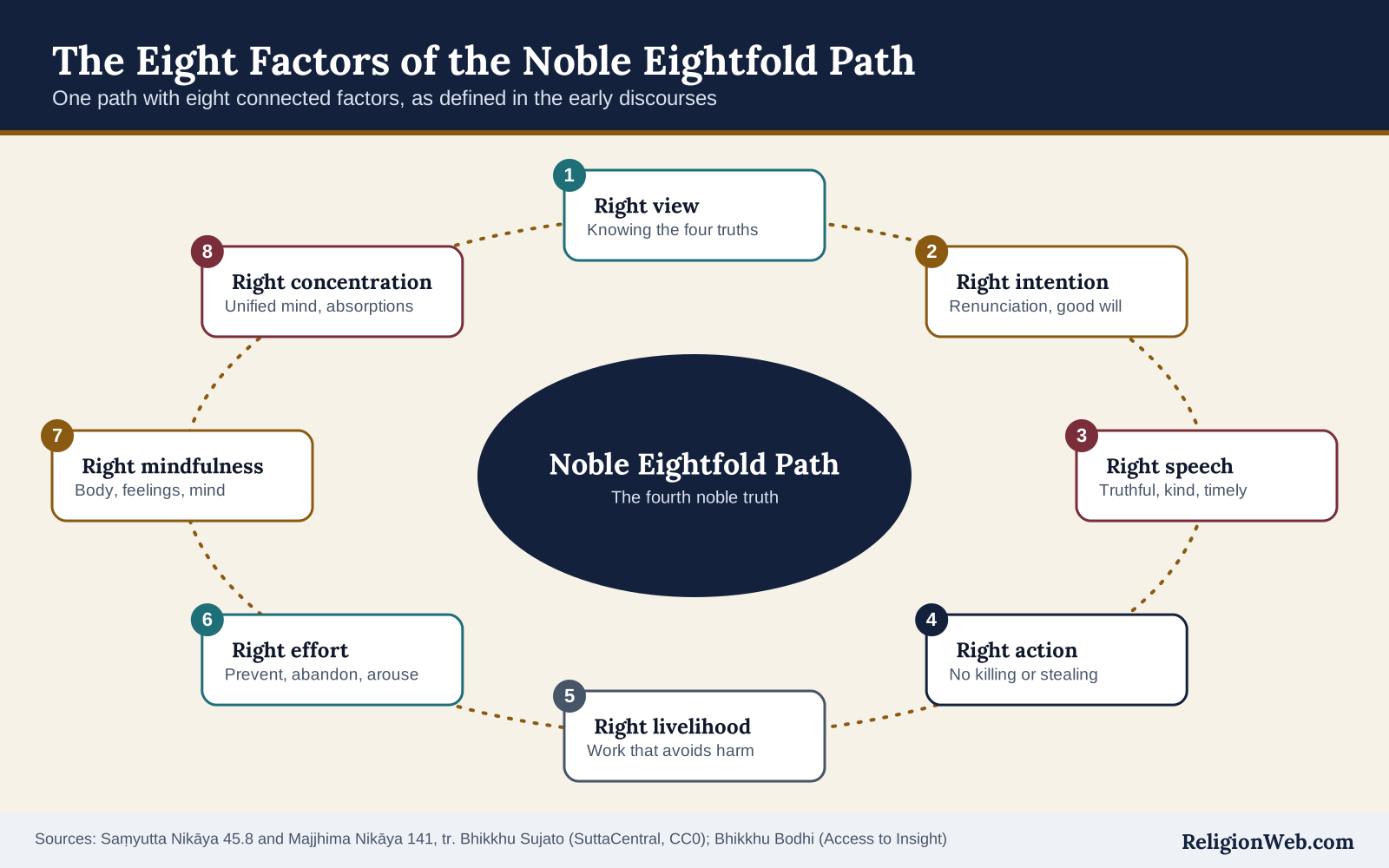
Wisdom: Right View and Right Intention
Right View (Sammā-diṭṭhi)
The Definition in the Discourses
The standard definition of right view is short and tightly tied to the structure of the Four Noble Truths. In the Saṃyutta Nikāya the Buddha defines it as knowing about suffering, the origin of suffering, the cessation of suffering, and the practice that leads to the cessation of suffering. Right view, in this sense, is the understanding contained in the four truths themselves. Because the fourth truth is the path, the definition has a notable circularity: right view is knowledge of the path that includes right view. Buddhist teachers do not treat this as a flaw. It means that the path begins in a provisional understanding and ends in a complete one, with each stage of practice deepening the same insight.
The Theravada tradition adds a more detailed account in its commentaries and in the Abhidhamma, where right view is identified with wisdom (paññā) itself, the faculty that sees things as they are. In this reading, the “knowledge” of the four truths is not belief in a doctrine but direct penetration of how suffering arises and ceases. For ordinary practitioners, though, right view begins as a working conviction, built from study, reflection, and trust in teachers, that the Buddha’s analysis is worth testing in experience.
Two Kinds of Right View
One of the most useful passages for understanding this factor is the Mahācattārīsaka Sutta, “The Great Forty” (Majjhima Nikāya 117). There the Buddha says that right view is twofold. The first kind is accompanied by defilements and “partakes of good deeds.” It consists in seeing that there is meaning in giving, that good and bad deeds have results, that there is an afterlife, and that there are ascetics and brahmins who practice rightly and can describe what lies beyond. This is the opposite of the wrong view that denies the moral significance of action. The second kind of right view is “noble, undefiled, transcendent, a factor of the path.” The text identifies it with wisdom as a faculty and as a power, and with the awakening factor of the investigation of principles, in a person who has actually entered the noble path.
Traditional commentators and modern teachers such as Bhikkhu Bodhi call the first kind mundane right view and the second supramundane right view. The distinction explains something that can otherwise seem puzzling: a layperson who accepts the moral law of karma and works to live accordingly has right view in the first sense, and this view is respected and encouraged in Buddhist communities, even though it is not yet the full liberating insight. The two are connected, because the first prepares the ground for the second. Readers interested in how the Buddhist tradition understands intentional action and its results can find that background in the article on karma and rebirth in Buddhism.
Right Intention (Sammā-saṅkappa)
Renunciation, Good Will, and Harmlessness
The second factor is defined in the discourses as having purposes of renunciation, good will, and harmlessness. Each is paired with the quality it opposes: renunciation counters sensual desire, good will counters ill will, and harmlessness counters cruelty. These three are the positive form of a pattern of thought the Buddha is said to have noticed in himself before his awakening. In the Dvedhāvitakka Sutta, “Two Kinds of Thought” (Majjhima Nikāya 19), he recounts that he divided his thoughts into two classes, sensual, malicious, and cruel thoughts on one side and thoughts of renunciation, good will, and harmlessness on the other. When a thought of the first kind arose, he reflected that it led to harming himself, harming others, or both, that it obstructed wisdom, and that it did not lead to extinguishment; thus reflecting, he saw the thought fade.
The same discourse offers a psychological observation that explains why intention is placed so near the start of the path. The Buddha says that whatever a monk frequently thinks about and considers becomes the inclination of his mind. A person who dwells often on sensual thoughts inclines toward sensuality, and a person who dwells on thoughts of good will inclines toward good will. The factor is therefore about shaping the direction of the mind over time, not about suppressing individual thoughts as they arise.
“Renunciation” (nekkhamma) deserves care. In its fullest sense it means leaving household life for the monastic path, but the early texts and later teachers also apply it to lay life as letting go, generosity, and a lessening of craving for sensual pleasure. It does not mean contempt for the body or for the world. Bodhi describes right intention as giving the practitioner a sense of direction, just as right view provides perspective, and the pairing of the two is the basis for treating them together as the wisdom group of the path.
Why “Intention” and Not Only “Thought”
Translators differ on this factor’s name, and the choice reflects a real question about what it covers. The Pali saṅkappa is often rendered “thought” or “resolve,” while Bhikkhu Bodhi prefers “intention” and Bhikkhu Sujato uses “purpose.” In the Great Forty the noble form of the factor is described in language drawn from the analysis of thought itself: the thinking, the placing of the mind, the planting and embedding of the mind, and what the text calls the “verbal process.” This supports the translation “thought,” in the sense of directed, purposeful thinking.
Bodhi notes, however, that “thought” in this context refers to the purposive side of the mind, not to idle reflection or conceptual thinking in general. Right intention is about what the mind is set toward. This links the factor to the Buddha’s remark, recorded in the Numerical Discourses (Aṅguttara Nikāya 6.63), that intention (cetanā) is what he calls karma. The path begins with orienting the will, and the later factors of conduct and mental training put that orientation into practice. A related article on nirvana in Buddhism explains the goal toward which, in the tradition’s own terms, the intention of renunciation finally points.
Ethical Conduct: Right Speech, Right Action, and Right Livelihood
Right Speech (Sammā-vācā)
The Four Abstentions
Right speech is defined negatively in the Saṃyutta analysis as refraining from speech that is false, backbiting, harsh, or nonsensical. Another discourse, the Great Forty, gives the same four as lying, divisive speech, harsh speech, and talking nonsense. The “Fruits of the Ascetic Life” (Dīgha Nikāya 2) spells out the positive side of each. The person who gives up lying speaks the truth and is honest and dependable; the person who gives up divisive speech reconciles those who are divided and delights in harmony; the person who gives up harsh speech speaks in a way that is pleasing and polite; and the person who gives up idle talk speaks at the right time, truthfully, and to some purpose.
The fourfold analysis shows that right speech covers more than honesty. It includes the effect of words on relationships and on the speaker’s own mind. Speech that divides a community, that wounds, or that wastes time is classed as unskillful even if it is literally true. This helps to explain why the factor is held to be difficult to practice in daily life and why it is often the first one that modern readers choose to apply.
Speech in Everyday Life
The early texts give practical tests for speech. In the Ambalaṭṭhika-Rāhulovāda Sutta (Majjhima Nikāya 61), the Buddha speaks to his son Rāhula, who according to tradition was then a young novice, and links truthfulness to the whole of the ascetic life. He says that when someone is not ashamed to tell a deliberate lie, there is no bad deed they would not do, and he gives Rāhula a rule that has become a common teaching for children and adults alike:
So you should train like this: ‘I will not tell a lie, even for a joke.’
Majjhima Nikāya 61, “Advice to Rāhula at Ambalaṭṭhika,” tr. Bhikkhu Sujato (SuttaCentral, CC0), segment 7.10
Another discourse, in the Numerical Discourses (Aṅguttara Nikāya 5.198), lists five qualities of well-spoken words: they are timely, true, gentle, beneficial, and loving. A passage in the Abhaya Sutta (Majjhima Nikāya 58) adds a distinction that is easy to overlook. The Buddha explains that he does not say what is untrue and pointless, and does not say what is true but harmful, but that he knows the right time to say what is true, correct, and beneficial, whether or not others like to hear it. The point is that right speech is not the same as agreeableness. It allows for unwelcome truths when they are beneficial and well timed.
Right Action (Sammā-kammanta)
Three Abstentions and the Five Precepts
Right action is defined as refraining from killing living creatures, stealing, and a third item that the two main discourse wordings give differently. The Saṃyutta Nikāya analysis words it as refraining from “unchastity,” while the Great Forty and the Analysis of the Truths (Majjhima Nikāya 141) word it as refraining from “sexual misconduct.” The Theravada tradition has generally read the first wording as the standard for monastics, for whom celibacy is part of the rule of life, and the second as the standard for laypeople, who are asked to avoid harmful and exploitative sexual conduct.
Right speech and right action together correspond to four of the Five Precepts (pañca sīla) that lay Buddhists commonly undertake: abstaining from killing, stealing, sexual misconduct, and lying. The fifth precept, abstaining from intoxicants, is not listed under right action in these definitions. A discourse addressed to the layman Dīghajāṇu (Aṅguttara Nikāya 8.54) describes the “accomplishment in ethics” of a householder in five items: not killing, stealing, committing sexual misconduct, lying, or consuming beer, wine, and liquor. In practice the Five Precepts are the lay form of the ethical training, and they are explained in more detail in the discussion of lay practice in the article on Theravada Buddhism.
The Reasoning Behind the Rules
The precepts are not presented in the texts as commandments from an external authority. The Buddha’s advice to Rāhula in the same discourse describes a method of self-examination applied before, during, and after any action of body, speech, or mind: ask whether the act leads to harming oneself, others, or both, and whether it is skillful or unskillful in its results. If it would cause harm, one should not do it; if it would not, one may. After the act, if one finds it was harmful, one should confess it to the teacher or a wise companion and resolve to restrain oneself in future. The rule is a practical ethics of reflection, with harm and benefit as the criteria.
The ethical concern is also bound to the larger goal of the path. In the account of the gradual training given in the Dīgha Nikāya, ethical restraint comes first because it brings, in the text’s words, a blameless happiness within, and that inner ease is the ground for the concentration that follows. Ethics here is not a precondition to be fulfilled once and put aside. It is the base on which the other trainings are built, and it deepens as the practitioner’s understanding grows.
Right Livelihood (Sammā-ājīva)
What the Early Texts Say
The definition in the Saṃyutta Nikāya is the briefest of the eight: a noble disciple gives up wrong livelihood and earns a living by right livelihood. The content is supplied elsewhere. For monastics, the Great Forty lists wrong livelihood as fawning, flattery, hinting, and belittling, and using material things to chase after other material things. The Dīgha Nikāya adds a long list of practices from which the monk abstains, including divining omens, casting spells, and making predictions to earn support. Monastic right livelihood centers on living from alms and from what laypeople offer freely, without scheming or pretense.
For laypeople, the clearest statement is a short discourse in the Numerical Discourses (Aṅguttara Nikāya 5.177), which says that a lay follower should not engage in five trades: trade in weapons, living creatures, meat, intoxicants, and poisons. The list is specific and short, and the tradition has always had to apply it to occupations the texts could not have foreseen. The teaching to Dīghajāṇu mentioned above treats worldly work more positively. It lists farming, trade, herding, archery, government service, and the professions as the ways a householder earns a living, and it praises initiative, protection of wealth, good friends, and balanced finances.
Questions Livelihood Raises Today
Modern Buddhists apply the factor in different ways, and thoughtful teachers differ about where its limits fall. Some read it narrowly, as a list of forbidden trades. Others read it as a broader principle: that a person’s work should not depend on harming, deceiving, or exploiting others, and should ideally allow time and energy for practice. Contemporary discussions of ethical investment, of the arms trade, of animal agriculture, and of work conditions have all drawn on the factor, and conclusions vary by community and by individual circumstances.
The factor is also practical about the pressures of lay life. Right livelihood is not an instruction to renounce earning a living, and the Buddha gives Dīghajāṇu, who describes himself as a householder who enjoys sensual pleasures, guidance for welfare in this life and lives to come. It asks for the harder and more ordinary thing, which is attention to how income is earned and to the effect of work on oneself and on others. Readers who want to see how monastics organize their own livelihood within the discipline of the Vinaya can turn to the article on Buddhist monastic life.
Mental Discipline: Right Effort, Right Mindfulness, and Right Concentration
Right Effort (Sammā-vāyāma)
The Four Efforts
Right effort is defined in the discourses by a formula repeated four times. The practitioner generates enthusiasm, tries, makes an effort, exerts the mind, and strives, first so that unskillful qualities that have not yet arisen do not arise, then so that unskillful qualities that have arisen are given up, then so that skillful qualities that have not yet arisen come into being, and finally so that skillful qualities that have arisen remain, are not lost, and increase until they are fully developed. Later tradition calls these the four right efforts, or the four efforts to restrain, to give up, to develop, and to preserve.
A short discourse in the Numerical Discourses (Aṅguttara Nikāya 4.14) fills each in with practical content. Restraint means guarding the sense faculties, so that on seeing a sight or hearing a sound one does not get caught up in its “features and details” and let covetousness and displeasure take over. Giving up means refusing to tolerate sensual, malicious, or cruel thoughts that have arisen. Developing means cultivating the seven awakening factors: mindfulness, investigation of principles, energy, rapture, tranquility, immersion, and equanimity. Preserving means maintaining a meditation subject that supports concentration, and the text names as examples the perceptions of a skeleton or of a corpse in various stages of decay, contemplations of the body’s impermanence that the Pali tradition counts among its standard meditation subjects.
Effort Without Strain
The word “effort” can suggest force, and the early texts take care to distinguish the energy they recommend from strain. The best-known illustration is the story of Soṇa in the Numerical Discourses (Aṅguttara Nikāya 6.55). Soṇa, a monk of a wealthy family, is practicing very energetically but is frustrated at his lack of progress, and he considers returning to lay life. According to the narrative, the Buddha reminds him that, as a layman, he had played the harp well. A harp with strings tuned too tight, or too slack, does not sound right; it plays well only when the tension is even. In the same way, the Buddha tells him, energy that is too forceful leads to restlessness and energy that is too slack leads to laziness, so he should balance energy with serenity. Soṇa follows this advice and, the text says, soon realizes the culmination of the path.
This account is often used in contemporary teaching to explain why right effort is closely tied to right mindfulness and concentration. The effort has to be sustained but not harsh. For lay practitioners trying to keep up a daily meditation or an ethical commitment, the story is read as encouragement to adjust the level of effort to what is sustainable.
Right Mindfulness (Sammā-sati)
The Four Foundations
The early discourses define right mindfulness with a formula that is repeated for each of four areas of attention. In Bhikkhu Sujato’s translation, the first reads:
It’s when a mendicant meditates by observing an aspect of the body—keen, aware, and mindful, rid of covetousness and displeasure for the world.
Saṃyutta Nikāya 45.8, “Analysis,” tr. Bhikkhu Sujato (SuttaCentral, CC0), segment 9.2
The same sentence is then applied to feelings, to the mind, and to “principles” (dhammā), which other translators render as mental qualities or phenomena. These are the four foundations of mindfulness (satipaṭṭhāna). The two fullest accounts are the Satipaṭṭhāna Sutta (Majjhima Nikāya 10) and its longer parallel in the Dīgha Nikāya (22). The practices they describe for the body include mindfulness of breathing, awareness of the postures, clear comprehension of ordinary activity, reflection on the parts of the body, and meditation on the body’s decay after death. For feelings, the practitioner notes whether a feeling is pleasant, painful, or neutral. For the mind, the practitioner notes whether it is, for example, greedy or free of greed. For principles, the practitioner observes the five hindrances, the five aggregates, the sense bases, the seven awakening factors, and finally the four noble truths themselves.
The last of these is a reminder that mindfulness in the early texts is tied to the rest of the path. The longer discourse closes its account of the principles by applying mindfulness to the four noble truths, and the Majjhima Nikāya says the four foundations exist “to purify sentient beings, to get past sorrow and crying, to make an end of pain and sadness, to discover the system, and to realize extinguishment.” Mindfulness is directed toward liberation and not toward relaxation as an end in itself.
What the Word “Mindfulness” Covers
The Pali word sati is related to the verb for remembering, and scholars of early Buddhism have long discussed how memory, attention, and present-moment awareness fit together in its use. In the formula above, mindfulness works alongside two other qualities: being “keen,” or ardent, and being “aware,” with clear comprehension of what is happening. All three are said to operate while the practitioner is “rid of covetousness and displeasure for the world,” which means that mindfulness in this setting has an ethical and emotional tone. It is not simply neutral observation.
Traditions differ in how they teach it. Burmese vipassanā methods stress sustained, moment-by-moment noting of bodily and mental events; Thai forest teachers often combine mindfulness with calm-abiding meditation; and Sōtō Zen emphasizes “just sitting” (shikantaza), in which attention is not directed to any chosen object. The article on Buddhist meditation describes these methods and their sources. A later section of this article takes up the relationship between right mindfulness and the secular mindfulness programs that have become widespread since the late twentieth century.
Right Concentration (Sammā-samādhi)
The Four Absorptions
The definition of right concentration, which Sujato translates as “right immersion,” is the longest of the eight in the standard analysis. It describes four stages of meditative absorption, called jhāna in Pali. In the first, the practitioner is secluded from sensual pleasures and unskillful qualities and experiences rapture and bliss born of seclusion, while still placing the mind and keeping it connected to its object. In the second, that directing of the mind is stilled, and there is inner clarity and a mind at one. In the third, rapture fades and the practitioner meditates with equanimity, mindful and aware, experiencing bliss. In the fourth, pleasure and pain, and the earlier happiness and sadness, have gone, and there is pure equanimity and mindfulness.
The Cūḷavedalla Sutta gives a brief definition that clarifies the purpose of these states. Immersion, Dhammadinnā says there, is the unification of the mind. The four foundations of mindfulness are its bases, the four right efforts are its prerequisites, and the cultivation of these same things is the development of immersion. A separate discourse, the Great Forty, adds that “noble right immersion with its vital conditions” is just the unification of mind supported by the seven other factors. Concentration is thus the culminating factor in the sense that the other seven supply what it depends upon.
Concentration and Insight
Right concentration is not the whole of Buddhist meditation. The tradition distinguishes calm (samatha), the settling and unification of the mind, from insight (vipassanā), the investigation of experience in terms of impermanence, unsatisfactoriness, and not-self. Right mindfulness and right concentration both serve these two, and the tradition holds that liberation requires insight whatever the depth of concentration reached. The early texts describe different people reaching awakening by different routes, and Buddhist schools have debated these routes ever since.
One long-running question within the Theravada world is how deep the absorptions need to be. Some meditation teachers, especially in the forest traditions, hold that right concentration means the full jhāna states described in the discourses; others, especially in the Burmese vipassanā tradition, teach that a lighter, moment-to-moment concentration is sufficient to support insight. Both appeal to the texts and to the commentarial literature, and neither is the tradition’s single official position. Readers who want more on how these meditative forms are practiced in different schools will find that in the article on Buddhist meditation.

How the Eight Factors Work Together: Three Trainings, Mutual Support, and the Path Moment
The Three Trainings: Ethics, Immersion, and Wisdom
The Early Source for the Grouping
The grouping of the eight factors into three is not a later scholastic invention. It is found in the Cūḷavedalla Sutta, where the lay follower Visākha asks the nun Dhammadinnā whether the three “spectrums” of practice are included in the noble eightfold path or the path in them. Her answer, in Sujato’s translation, sets out the grouping:
Right speech, right action, and right livelihood: these things are included in the spectrum of ethics. Right effort, right mindfulness, and right immersion: these things are included in the spectrum of immersion. Right view and right purpose: these things are included in the spectrum of wisdom.
Majjhima Nikāya 44, “The Shorter Elaboration,” tr. Bhikkhu Sujato (SuttaCentral, CC0), segments 11.3 to 11.5
Immediately before this passage she says that the three are not included in the path, but the path is included in them, which suggests that the threefold scheme is the broader frame. The tradition also speaks of three “trainings” (sikkhā): the training in higher ethics, in the higher mind, and in higher wisdom. A discourse in the Numerical Discourses (Aṅguttara Nikāya 3.88) says that the more than one hundred and fifty training rules recited each fortnight by the monastic community are all included in these three trainings.
How the Three Groups Support One Another
The usual order in which the three trainings are taught is ethics, then concentration, then wisdom. This order is spelled out in the “Fruits of the Ascetic Life” (Dīgha Nikāya 2), which presents the gradual training of a monastic as a progression from ethical restraint, through sense restraint, mindfulness, contentment, the abandoning of the hindrances, and the four absorptions, to the various kinds of knowledge that culminate in the ending of the defilements. In the tradition’s own framing, ethics brings a blameless happiness, concentration steadies the mind, and wisdom sees through the delusion that sustains craving.
The path factors do not map onto that progression one to one, however. Wisdom comes first in the list, because a preliminary form of right view and right intention is what motivates a person to take up the training at all. Bodhi explains that the same two factors return in a more refined form as the climax of practice, when wisdom directly opposes ignorance. The wisdom group thus appears at both the beginning and the end of the path.
| Training group | Pali term | Factors included | What it develops |
|---|---|---|---|
| Ethical conduct | sīla | Right speech, right action, right livelihood | Harmlessness and trustworthiness in words, deeds, and work; freedom from remorse |
| Concentration (mental discipline) | samādhi | Right effort, right mindfulness, right concentration | A steady, clear, unified mind, supported by sustained and balanced effort |
| Wisdom | paññā | Right view, right intention | Understanding of the four truths and a mind inclined toward renunciation, good will, and harmlessness |
| Three trainings (monastic frame) | sikkhā | Higher ethics, higher mind, higher wisdom | The scheme that the early texts say includes all the monastic training rules |
Not a Ladder: Mutual Support and the Order of the Factors
Why Right View Comes First
The Great Forty is the best single text for seeing how the factors support one another. Its opening pattern repeats for each factor. The Buddha says that “right view comes first,” and explains that one practices a factor by understanding wrong and right forms of it as such: when you recognize wrong speech as wrong speech and right speech as right speech, that is right view operating. Then he adds that one makes an effort to give up the wrong and embrace the right, and that is right effort, and one does this mindfully, and that is right mindfulness. These three, he says, “keep running and circling around” each of the other factors. Right view, right effort, and right mindfulness are therefore present throughout the practice of each other factor, not only at the start.
The same discourse also gives a causal sequence in which each factor is the condition for the next. A short discourse on ignorance in the Saṃyutta Nikāya sets out a similar chain: ignorance produces wrong view, wrong view produces wrong purpose, and so on through all eight wrong factors, while knowledge produces right view, and right view produces right purpose, down to right mindfulness producing right immersion. This describes how a developed path emerges from understanding, and it is a statement about causes and conditions, not a rule about when to start practicing what.
Components, Not Steps
Modern teachers across Buddhist traditions are consistent on this point. Bhikkhu Bodhi writes that the factors are not steps to be followed in sequence but components of a path, like strands of a cable, and that all eight can be present at once, each supporting the others, though some sequence is unavoidable at first. Walpola Rahula, the Sri Lankan monk and scholar, says that the factors should be developed more or less together, according to each person’s capacity, because they are all linked and each helps the cultivation of the others.
The early texts back this up in other ways. A discourse that names good friends as the “whole” of the spiritual life (Saṃyutta Nikāya 45.2) says that a monk with good friends can expect to develop the path, and it describes the development of each factor as relying on seclusion, fading away, and cessation, and ripening as letting go. Another (Saṃyutta Nikāya 45.28) shows the seven earlier factors as the “vital conditions” for the eighth. Neither text describes a checklist. The path is an interlocking set of capacities, strengthened together.
The Trainee and the Perfected One
Eight Factors and Ten
One of the more striking passages in the Great Forty concerns what happens when the path reaches its goal. The Buddha extends the series with two further items, right knowledge and right freedom, and says that the person still in training has eight factors while the person who has completed the path, the arahant or “perfected one,” has ten.
Right view produces right purpose. Right purpose produces right speech. Right speech produces right action. Right action produces right livelihood. Right livelihood produces right effort. Right effort produces right mindfulness. Right mindfulness produces right immersion. Right immersion produces right knowledge. Right knowledge produces right freedom. So the trainee has eight factors, while the perfected one has ten factors.
Majjhima Nikāya 117, “The Great Forty,” tr. Bhikkhu Sujato (SuttaCentral, CC0), segments 34.3 and 34.4
The passage places the Eightfold Path in the context of the Buddhist account of liberation. The eight factors make up the training. In the Theravada reading, right knowledge is the realization, in the person who completes the path, that the defilements have ended, and right freedom is the release itself. The goal described in the tradition as nirvana is not itself one of the factors: the path is conditioned, as the nun Dhammadinnā says in the Cūḷavedalla Sutta, and the Theravada tradition describes nirvana as unconditioned.
Mirrors on the Wrong Side
The Great Forty concludes that there are twenty items on the side of the skillful and twenty on the side of the unskillful, which is how the discourse gets its name. It then states, in a phrase repeated in the first sermon, that the exposition “has been rolled forth” and “cannot be rolled back.” The discourse treats the wrong path as a real counterpart to the right one: wrong view leads to wrong intention, wrong speech, and the rest, in the same way as right view leads to their right forms. For readers new to the path, this mirror pattern is an aid. It shows what each factor means by showing what it excludes, and it indicates that the same causal logic that carries a person toward liberation can carry them away from it.
Translation Choices: Why English Versions of the Path Differ
How Major Translators Render the Factors
Intention, Purpose, Resolve, and Thought
Anyone who reads more than one book on the path will notice that the eight factors do not always carry the same names. Five of them are stable across nearly all English translations: right speech, right action, right livelihood, right effort, and right mindfulness. The other three vary. Pali diṭṭhi is usually “view,” though Walpola Rahula preferred “understanding,” and the Plum Village community of Thich Nhat Hanh also uses “right understanding,” “right insight,” and “right wisdom” as alternative names for the same factor. The word “view” has the advantage of matching the Pali sense of a perspective or standpoint, which may be right or wrong; “understanding” stresses the cognitive achievement.
The second factor shows the widest range. Bhikkhu Bodhi renders saṅkappa as “intention” and notes that it is sometimes translated “thought.” Rahula used “thought,” Plum Village uses “right thinking,” Bhikkhu Sujato chose “purpose,” and the American monk Thanissaro Bhikkhu has written about it as “right resolve.” These are all attempts to capture a word that covers what a person is inclined toward, resolves upon, and keeps turning over in the mind. No single English word does all of this, and each translator privileges a different side of the meaning. The disagreement is usually presented by translators as one of emphasis and not one of doctrine.
Concentration, Immersion, and Unification
The eighth factor, samādhi, shows a different problem. The most common translation is “concentration,” used by Bodhi, Rahula, and Plum Village, and it is also the name most readers will meet in books on meditation. Sujato translates the same word as “immersion,” and a Tibetan-tradition glossary at the Berzin Archives renders it “absorbed concentration.” The choice reflects what the translator wants to emphasize. “Concentration” suggests the narrowing and holding of attention; “immersion” and “absorbed concentration” suggest being taken into the object and the settled, unified state that results. The early texts themselves define the term in terms of unity: in the Cūḷavedalla Sutta, Dhammadinnā says that the unification of the mind is immersion.
Behind these choices lies a broader point about translation of Buddhist technical terms. The Pali samādhi is often explained as a “putting together” or collecting of the mind, and the same word is used in the texts for the faculty and for the resulting states. An English word that suits one use may be awkward in another, which is one reason that many authors keep the Pali alongside the English.
| Pali term | Bodhi (Access to Insight) | Sujato (SuttaCentral) | Rahula (What the Buddha Taught) | Plum Village | Berzin Archives (Tibetan tradition) |
|---|---|---|---|---|---|
| sammā-diṭṭhi | right view | right view | right understanding | right view (also right understanding) | right view |
| sammā-saṅkappa | right intention (also right thought) | right purpose | right thought | right thinking | right thought |
| sammā-vācā | right speech | right speech | right speech | right speech | right speech |
| sammā-kammanta | right action | right action | right action | right action | right boundary of action |
| sammā-ājīva | right livelihood | right livelihood | right livelihood | right livelihood | right livelihood |
| sammā-vāyāma | right effort | right effort | right effort | right diligence | right effort |
| sammā-sati | right mindfulness | right mindfulness | right mindfulness | right mindfulness | right mindfulness |
| sammā-samādhi | right concentration | right immersion | right concentration | right concentration | right absorbed concentration |
Terms That Travel Across Languages
Sanskrit and East Asian Equivalents
The path has equivalents in every major language of Buddhism. In Sanskrit it is the āryāṣṭāṅgamārga, and the factors take the Sanskrit forms samyag-dṛṣṭi (right view), samyak-saṃkalpa, samyag-vāc, samyak-karmānta, samyag-ājīva, samyag-vyāyāma, samyak-smṛti, and samyak-samādhi. In Tibetan the path is known as ‘phags lam yan lag brgyad, “the eight branches of the noble path.” In Chinese the factors are commonly written 正見, 正思惟, 正語, 正業, 正命, 正精進, 正念, and 正定, with the character 正 (zhèng) carrying the meaning of “right,” “correct,” or “upright.” Chinese names for the factors passed into Korean, Japanese, and Vietnamese Buddhism with local pronunciations.
Some of these renderings add shades of meaning. The Chinese 正命 for right livelihood reads literally as “right life,” and 正精進 for right effort carries the sense of “right vigorous progress.” The Sanskrit smṛti, like the Pali sati, is derived from the root meaning “to remember.” Such details show that a translation is never only a substitution of words, and that the understanding of each factor in a living tradition is shaped by the language in which it is chanted and taught.
Reading Translations With Care
For readers working with English alone, a few habits help. Check the name of the factor in the Pali or Sanskrit when a passage depends on it. Notice whether a translator uses “right” in the sense of “correct” or “skillful,” and whether the author is writing from within a particular tradition. Compare how a given book renders “concentration” or “immersion” with how the same author describes the practice, since the word may point to a very different experience depending on the school. And remember that a book of popular teachings may rephrase the factors to suit its audience, as Plum Village’s “right diligence” for effort does.
The word “right” has been standard in English translations since the nineteenth century, and later translators have worked both with and against it. The convention helps to explain why the Eightfold Path is sometimes described as a moral code, although the early discourses treat ethics as only one of three trainings, as the section on misconceptions explains.
The Wheel and the Path: Symbol, Chant, and Commemoration
The Dharma Wheel and Its Spokes
From the Royal Wheel to the Wheel of Dhamma
The Buddha’s first sermon is described in the Pali texts as setting the Wheel of Dhamma in motion, and the image comes from an older source. Indian kingship had its own wheel: the ideal universal ruler, the wheel-turning monarch (cakkavatti), is said to receive a heavenly wheel-treasure that rolls before him and subdues the land without violence. The Pali discourses on King Mahāsudassana and on the wheel-turning monarch borrow this image of sovereignty and apply it to the Buddha, whose “wheel,” in the language of the first sermon, “cannot be rolled back by any ascetic or brahmin or god or Māra or divinity or by anyone in the world.” Buddhist art first showed the teaching as a wheel, often on a pillar or throne, in the early centuries when the Buddha himself was typically not shown in human form. The Ashokan pillar at Sarnath, near the Deer Park of the first sermon, carries a wheel in its capital.
Eight Spokes and Their Meanings
Today the eight-spoked wheel is the most widely recognized emblem of Buddhism, and it is commonly explained as a picture of the Eightfold Path, with each spoke standing for one factor. Shravasti Dhammika notes that modern commentators also assign meanings to the other parts, reading the rim as movement or progress and the hub as unity. These readings are teaching devices of later origin, not statements found in the early discourses, though they are widely used. In Tibetan Buddhism the eight-spoked wheel is one of the eight auspicious symbols, and it is often shown flanked by two deer, recalling the Deer Park. In many Buddhist countries it appears in temple decoration, on banners, and on ritual objects.
Chanting and Commemoration
Chanting the First Sermon
The discourse that sets forth the path in the Buddha’s first sermon is one of the best-known texts in Theravada Buddhism and is among the discourses that monks regularly chant in Pali in Theravada monasteries. Lay people often hear it recited rather than read it, so that many know its opening, which warns against the two extremes, without having studied the text in translation. In this way the path is carried in sound and ritual as well as in study. Mahayana communities honor the same event in their own scriptures and liturgies, and the Sanskrit tradition preserves its own version of the first sermon.
Asalha Puja and the Start of the Rains Retreat
The first sermon has its own day in the Theravada calendar. Asalha Puja, called Asanha Bucha in Thailand, falls on the full moon of the eighth lunar month, which usually comes in July or early August, and it honors the first sermon and the first ordination, when Koṇḍañña, the one who understood the teaching, asked to join the community. The Dhammathai site describes the customs of the day in Thailand as visiting temples, making merit, listening to the Dhamma, offering food to monks and novices, keeping the Five Precepts, and holding an evening candlelit procession around the temple’s ordination hall. Some lay people take on the eight precepts and spend the day or longer at the temple in white clothing. In Thailand the following day marks the start of the three-month rains retreat, when monks remain in their monasteries.
The path is also connected to the broader Buddhist festival cycle through Vesak, which commemorates the birth, awakening, and final passing of the Buddha. The awakening is understood as the discovery of the path that the first sermon then announced. The dates of these observances follow lunar calendars and vary from country to country, so the exact day in any year depends on the local calendar rather than on a single international rule.
Where the Path Fits Among Other Buddhist Teachings
The Path and the Four Noble Truths
How the Path Addresses Craving
The second noble truth identifies craving (taṇhā) as the origin of suffering. In the first sermon the Buddha describes it as the craving that leads to future lives, mixed up with relishing and greed, and divides it into craving for sensual pleasures, for continued existence, and for nonexistence. The third truth declares that suffering ends with the fading away and cessation of that same craving, with nothing left behind. The fourth truth, the path, is the practice that brings this about, and each factor can be read as working on a different part of the problem. Right view loosens the misunderstanding that feeds craving, right intention turns the will away from sensual desire, ill will, and cruelty, right effort and mindfulness train attention, and concentration steadies the mind enough for insight to do its work.
Such correlations are interpretive and are drawn by teachers, not set out in the first sermon as a table. The point they illustrate is that the path is not a separate topic added to the diagnosis. It is the portion of the teaching that addresses what a person can do about the condition the first three truths describe. A fuller treatment of dukkha, craving, and cessation belongs to the article on the Four Noble Truths.
Why the Truths and the Path Are Hard to Separate
Because right view is defined as knowledge of the four truths, and the fourth truth is the path of which right view is the first member, the two teachings contain each other. A person begins with a limited understanding of the truths, practices the path accordingly, and finds that the understanding deepens and revises itself. The early texts recognize this when they describe the truths as having three “turns” and twelve aspects: that each truth must be known, then dealt with by the appropriate task, and then confirmed as having been done. The path is the truth assigned to development, and development is not a single event. It continues until the practitioner can say, in the Buddha’s words from the first sermon, that the freedom is unshakable and there will be no more future lives.
The Path, Karma, and Liberation
Deeds That Lead to the Ending of Deeds
The relationship between the path and the Buddhist teaching on karma is stated in a short discourse in the Numerical Discourses titled “The Noble Path” (Aṅguttara Nikāya 4.237). The Buddha there declares four kinds of deeds: dark deeds with dark results, bright deeds with bright results, a mixture of the two, and a fourth kind, “neither dark nor bright deeds with neither dark nor bright results, which lead to the ending of deeds.” He then identifies this fourth kind with the eight factors of the path, from right view to right immersion.
This is one of the most compact statements of how the tradition understands the path. Ordinary ethical action produces results that keep the cycle of rebirth turning, even when the results are pleasant. The practice of the path, by contrast, is the kind of action that unwinds the cycle. It does not mean that the path is a set of morally neutral acts; right speech and right action remain ethical. It means that, as practiced with insight, the eight factors lead out of the process of accumulation rather than feeding it. The article on karma and rebirth sets this in the wider framework of intention, rebirth, and liberation.
Fruits of the Path
The Buddhist tradition holds that the path has stages of realization. In a short discourse on the ascetic life, the Buddha says that the ascetic life is simply the noble eightfold path and that its fruits are stream-entry, once-return, non-return, and perfection (Saṃyutta Nikāya 45.35). These four stages are described in the Theravada tradition as successive breakings of the fetters that bind a person to the cycle of rebirth, and the person at the fourth stage is the arahant or perfected one. Nirvana, the goal that these stages approach, is explained in the article on that topic, and the stages are described in more detail in the article on Theravada Buddhism.
A verse chapter in the Dhammapada puts the insight at the center of the path in three parallel verses. When it is seen with wisdom that all conditions are impermanent, that all conditions are suffering, and that all things are not-self, the verse says, one grows disillusioned with suffering, and “this is the path to purity.” These are the three marks of existence, and the verses show how closely the path is tied to insight into them (Dhammapada 277 to 279).
The Path Among the Aids to Awakening
The Seven Sets
In the account of the Buddha’s final days, he names the things he has taught from his own direct knowledge and urges the monks to memorize and cultivate: the four kinds of mindfulness meditation, the four right efforts, the four bases of psychic power, the five faculties, the five powers, the seven awakening factors, and the noble eightfold path. Later Buddhist writers counted the items in these seven sets, which add up to thirty-seven, and called them the “wings” or aids to awakening (bodhipakkhiyā dhammā). The Eightfold Path stands last in the list and contributes eight of the thirty-seven items. The Berzin Archives’ Tibetan-tradition glossary also treats the eight branches as one set within the thirty-seven factors, and describes a scheme in which they serve four functions: cutting off, bringing understanding, generating confidence in others, and acting as antidotes.
How the Sets Overlap
The sets overlap, and the overlap shows how the early tradition thought about practice. The four right efforts are an expansion of the sixth path factor, and the four mindfulness meditations are an expansion of the seventh. The seven awakening factors include mindfulness, energy, and immersion, which share their names with path factors. Different teachers and traditions have organized instruction around different sets. The Eightfold Path is the one that includes ethics and wisdom as well as meditation, which helps explain why it is so often used as an overview of the whole training.
| Teaching | Connection to the path | Where to read more |
|---|---|---|
| Four Noble Truths | The path is the fourth truth, the practice that leads to the cessation of suffering; right view is knowledge of all four truths | Four Noble Truths |
| The middle way | The first sermon identifies the path as the middle way between sensual indulgence and self-mortification | The Buddha |
| Karma and rebirth | Intentional action shapes results; AN 4.237 describes the path as deeds that lead to the ending of deeds | Karma and rebirth |
| Nirvana | The goal toward which the path leads; its four fruits mark stages of realization | Nirvana |
| Meditation | Right effort, mindfulness, and concentration form the meditative core of the path | Buddhist meditation |
| Monastic discipline | The Vinaya gives the ethical frame (speech, action, livelihood) for monastic practice | Buddhist monastic life |
| Bodhisattva path | Mahayana teaching places the early path within the aspiration to awaken for the benefit of all beings | Bodhisattva |
Applying the Path in Monastic and Lay Life
Monastic Applications
The Vinaya as the Frame for Ethics
For monks and nuns, the ethical factors of the path are given concrete shape by the Vinaya, the monastic discipline. Right action takes the form of rules against the gravest offenses, which include sexual intercourse, theft, killing a human being, and falsely claiming spiritual attainments, and right speech is expressed in rules against lying, slander, and abusive speech. Right livelihood is largely settled by the monastic way of life itself, which depends on alms and offerings, and the Dīgha Nikāya’s long list of practices that a monk avoids, including divination and charms, spells out the “wrong livelihood” of the renunciant. The structure of the monastic order, the fortnightly recitation of the code, and the practice of confession give the ethics of the path an institutional form. The article on Buddhist monastic life describes this system in detail.
Daily Rhythm: Alms, Study, and Meditation
The day in a monastery varies by country and lineage, but it generally follows a pattern in which each part of the path has its place. Morning chanting and the alms round, in traditions that practice it, express generosity and right livelihood; study of the texts and listening to teachers feed right view; and periods of sitting and walking meditation, often long ones during retreat seasons such as the rains retreat, develop right effort, mindfulness, and concentration. In forest monasteries the schedule may be spare, with long hours given to meditation. In town monasteries, teaching, ceremonies, and service to the lay community take more of the day. Despite these differences, the monastic life is understood in Buddhist tradition as an arrangement in which the whole path can be practiced with fewer obstacles.
Lay Applications
Precepts, Generosity, and Work
Buddhist teaching is clear that the path is not reserved for monastics. A short discourse in the Saṃyutta Nikāya (45.24) has the Buddha saying that he praises right practice for both laypeople and renunciates, and that through right practice both succeed in the system of the skillful teaching. For lay Buddhists the ethical factors are usually practiced through the Five Precepts, which many take in a short ceremony at a temple or at home, and on observance days (uposatha) some take the eight precepts for the day. Generosity (dāna), the support of monastics and the community, and kindness in daily dealings are central to lay practice and express right intention.
Work is addressed directly. The five trades that a lay follower should avoid, trade in weapons, living creatures, meat, intoxicants, and poisons, mark the clearest line in the discourses. Beyond that, the teaching to Dīghajāṇu praises honest effort, saving, and prudence in spending, and warns against gambling, drinking, and bad companions as drains on wealth. The Sigālovāda Sutta (Dīgha Nikāya 31), a discourse to a young householder, goes further by describing mutual duties between parents and children, teachers and pupils, husband and wife, friends, employers and workers, and laypeople and renunciants. Its social assumptions reflect the world of ancient India, but its central idea, that ethical life is lived in relationships, is one that lay Buddhists continue to apply.
Family, Friends, and Daily Routine
Lay practice of the other factors usually takes a modest form: some minutes of sitting meditation, a brief chant or reflection in the morning or evening, an effort to speak truthfully and kindly, and attention to how one reacts when angry. Many lay people attend a temple or meditation center regularly, join a retreat for a day or longer, and study with a teacher. The Buddha is recorded as telling his attendant Ānanda that good friends are the whole of the spiritual life, and the discourse adds that a monk with good friends can expect to develop the noble eightfold path (Saṃyutta Nikāya 45.2). In practice, the company of other practitioners, teachers, and a community is often as important to lay practice as any technique.
Practice, Health, and Good Judgment
Meditation and Mental Health
The path concerns mental discipline, and for that reason it is worth being clear about its limits. Meditation, ethical practice, and Buddhist teaching can be a support for well-being, and many people find them so, but they are not a substitute for medical or psychological treatment. Some people find intensive meditation distressing, particularly during long retreats or if they carry a history of trauma, severe anxiety, depression, or other serious mental illness, and teachers commonly recommend that such practitioners consult a qualified clinician as well as an experienced meditation teacher before undertaking intensive practice. Anyone in crisis or experiencing thoughts of self-harm should contact emergency services or a mental health professional promptly instead of relying on meditation or religious counsel alone.
Choosing Teachers and Communities
Because the path is a practice that develops over many years, the quality of guidance matters. The early tradition itself places weight on good friends and teachers, and many modern Buddhist communities have had to address cases of misconduct by teachers. Prospective students are often advised to take their time, to ask questions about a teacher’s training and lineage, to see how a community handles complaints, and to remember that the Buddha, in the Kālāma discourse (Aṅguttara Nikāya 3.65), is recorded as advising listeners to test teachings against their own experience and the judgment of the wise rather than accept them on authority alone.
| Factor | Monastic application | Lay application |
|---|---|---|
| Right view | Study of the discourses, listening to teachers, reflection on the four truths | Dhamma talks, reading, and testing the teaching against experience |
| Right intention | Renunciation of household life; cultivating good will and harmlessness | Generosity, good-will meditation, and attention to motives |
| Right speech | Vinaya rules against lying, slander, and abusive speech; careful teaching | Truthful, kind, timely speech; avoiding gossip and harsh words |
| Right action | Celibacy and the rules against killing and stealing | The Five Precepts; the eight precepts on observance days |
| Right livelihood | Living from alms; avoiding divination and scheming | Avoiding the five trades; honest work and balanced finances |
| Right effort | Daily discipline and sustained practice, balanced as in the story of Soṇa | A regular, sustainable routine of ethical and meditative practice |
| Right mindfulness | Mindfulness of breathing, posture, and daily activity throughout the day | Brief sits, mindful routines, and retreats with a teacher |
| Right concentration | Extended retreats and meditation toward the absorptions | Calm-abiding practice under guidance, as time and temperament allow |

How Buddhist Traditions Interpret the Path
Theravada Approaches
The Path as the Central Framework
In Theravada Buddhism, the school that preserves the Pali Canon and is dominant in Sri Lanka, Myanmar, Thailand, Cambodia, and Laos, the Eightfold Path is a central framework of the teaching. The tradition distinguishes between a mundane path, practiced by ordinary people through good conduct, study, and meditation, and a supramundane path, which is the moment of insight in which a person first sees nirvana and becomes a stream-enterer, and the three later moments that follow. Theravada Abhidhamma and commentarial literature analyze these supramundane moments as occasions on which all eight factors are present together, a point that fits the early texts’ picture of the factors as mutually supporting rather than sequential.
Bhikkhu Bodhi, whose book on the path remains a standard Theravada introduction in English, explains the distinction between mundane and supramundane right view and presents the eight factors as components of one path that can be present together. Within the Theravada world the path is also the shared language of teachers from different lineages. Teachers from the Sri Lankan, Burmese, and Thai traditions differ on methods, yet they commonly use the same eightfold structure to explain what any method is for.
Meditation Lineages and Their Emphases
The meditation factors of the path have been interpreted differently by different Theravada lineages. Burmese vipassanā methods that spread in the twentieth century emphasize sustained noting of present experience as the route to insight. The scholar Robert Sharf of the University of California, Berkeley, has traced the “bare attention” approach that underlies much modern mindfulness teaching to Burmese Buddhist reform movements of the first half of the twentieth century, and argues that it stands in some tension with traditional Theravada doctrine and meditation. Thai forest teachers, by contrast, are known for combining mindfulness with calm and with absorption. These differences concern emphasis, and they are among the reasons that instructions on “right mindfulness” or “right concentration” can differ from one retreat center to another.
Mahayana and Vajrayana Perspectives
The Path Within the Bodhisattva Ideal
Mahayana Buddhism, which developed in India in the early centuries of the Common Era and became dominant in East Asia, preserves the Four Noble Truths and the Eightfold Path as part of the Buddha’s teaching, but it places them within a larger aspiration: the path of the bodhisattva, who vows to attain full awakening for the sake of all beings. The characteristic Mahayana list of practices is the six perfections of generosity, ethics, patience, effort, meditation, and wisdom. These overlap with the eight factors, since ethics, effort, meditation, and wisdom are common to both, but they are not a rewriting of the Eightfold Path, and Mahayana teachers have offered several accounts of how the two lists relate.
The Mahayana scriptures also include texts, such as the Heart Sutra, that seem to deny the four truths and the path altogether by declaring, in its standard Chinese version, that in emptiness there is no suffering, origination, cessation, or path. Mahayana commentators generally read such statements as speaking from the standpoint of ultimate truth, where nothing has inherent existence, and not as a rejection of the path in the conventional sense, which remains the means by which practitioners reach the awakening the text describes. The distinction between the two levels of truth is a basic feature of Mahayana philosophy and is discussed in the article on Mahayana Buddhism.
East Asian and Tibetan Presentations
In East Asia, the eight factors are known through Chinese translations of the early discourses and through later treatises, and they appear in Zen, Pure Land, and other settings as part of the common Buddhist heritage. Contemporary teachers have also presented the path in modern idioms. The Plum Village tradition of the Vietnamese Zen teacher Thich Nhat Hanh, for instance, teaches the factors as right view, right thinking, right speech, right action, right livelihood, right diligence, right mindfulness, and right concentration, and offers practical forms such as mindful breathing and “deep listening” that apply them to daily life.
In Vajrayana Buddhism, which is practiced in Tibet, Mongolia, Bhutan, and the Himalayan regions, the eight branches of the noble path are taught within the framework of the three higher trainings of ethical discipline, concentration, and discriminating awareness, and as one of the sets within the thirty-seven factors leading to awakening. Tibetan teachers commonly describe the more elaborate practices of tantra as building on this foundation and not as replacing it. Presentations vary by school and by teacher, but the three trainings and the thirty-seven factors are frequent reference points.
Modern and Secular Readings
Engaged Buddhism and Social Ethics
In the twentieth century, a number of Buddhist teachers and movements began to apply the ethical factors of the path to questions of social and political life. The term “engaged Buddhism,” associated with Thich Nhat Hanh and developed in Vietnam during the war years, describes practice that brings mindfulness and compassion into work for peace, social justice, and care of the environment. For such teachers, right speech can mean honest public discourse and “deep listening” in conflict, right action can mean nonviolent protest and service, and right livelihood can be extended to questions about the employers and industries on which a person’s income depends. Other Buddhists regard the path as primarily a practice of personal transformation, and the extent of social engagement that it entails remains a matter of discussion within Buddhist communities.
Secular and Therapeutic Adaptations
The best-known modern adaptation of one factor of the path is the family of secular mindfulness programs. The program called Mindfulness-Based Stress Reduction was developed in 1979 by Jon Kabat-Zinn at what is now UMass Memorial Medical Center, and its institutional home describes mindfulness as awareness practiced on purpose, in the present moment, and non-judgmentally. Such programs use a secular vocabulary and are designed for clinical and general settings. They draw on meditation practices that have Buddhist roots but are taught without the ethical and doctrinal framework of the full path, a difference that matters for the misconception discussed next. Teachers and scholars both inside and outside Buddhism hold varied views of how well the adaptation preserves the original meaning, and several are cited in the section that follows.
Common Misconceptions About the Noble Eightfold Path
Misconception 1: The Eightfold Path must be completed one step at a time, in numerical order
Where the misunderstanding comes from
The list is numbered, the English word “path” suggests a route that one walks from a beginning to an end, and many popular books and websites describe the factors as “steps.” The early discourses themselves present the eight in a fixed order, the same order every time, and one of them, the Saṃyutta Nikāya discourse on ignorance, describes a chain in which right view gives rise to right purpose, right purpose to right speech, and so on to right immersion. It is natural to take such a list as a checklist: master the first item, then move to the second.
Some traditional teaching patterns also reinforce the idea of sequence. Many teachers recommend that a beginner establish basic ethical conduct before undertaking intensive meditation, and the early texts describe a gradual training in which ethics comes first, then concentration, then wisdom. Taken together, these patterns can leave the impression that the eight factors are to be cleared in turn.
What the evidence and tradition actually show
The same texts that give the sequence also qualify it. The Great Forty (Majjhima Nikāya 117) says of each factor in turn that right view comes first, but then states that right view, right effort, and right mindfulness “keep running and circling around” every one of the others. That is a picture of factors operating together, with understanding, effort, and awareness present throughout. Another passage describes the seven earlier factors as the vital conditions and prerequisites of right immersion, so that the later factors are built from the earlier ones. The emphasis is on mutual support.
Modern teachers across the Theravada tradition say the same. Bhikkhu Bodhi describes the factors as components, like the strands of a cable, that can be present together and each support the others, though he acknowledges that some sequence is unavoidable at first, since a person must have a rough sense of direction before beginning. Walpola Rahula writes that they should be developed more or less together, according to each person’s capacity. The gradual training and the chain of conditions describe how qualities mature and condition one another, and they are not instructions to put one factor aside before starting another. The sensible reading is that one can begin anywhere, work on several factors at once, and expect each to strengthen the rest.
Misconception 2: Right mindfulness is identical to modern secular mindfulness
Where the misunderstanding comes from
The word “mindfulness” has become so common in health care, education, business, and consumer apps that many people encounter it first as a stress-reduction technique and assume it is simply the Buddhist teaching with the religion removed. The best-known program, Mindfulness-Based Stress Reduction, was developed by Jon Kabat-Zinn in 1979, and the institution that runs it describes mindfulness as awareness practiced on purpose, in the present moment, and non-judgmentally. That description resembles accounts of the Buddhist practice, and the programs are widely acknowledged to draw on Buddhist meditation, so the identification seems natural.
What the evidence and tradition actually show
In the early discourses, right mindfulness is one of eight factors that support one another, and its meaning is set by the context. The standard formula describes a practitioner who observes the body, feelings, mind, and principles while “keen, aware, and mindful, rid of covetousness and displeasure for the world.” It operates alongside right effort, with ethics as a base and with right view as the guide, and it is directed toward the goal of the path, the ending of suffering and rebirth. The longer discourse on mindfulness ends its account of observing principles with the four noble truths. Secular programs, as they are usually taught, leave out this doctrinal frame and aim at purposes such as reducing stress, improving attention, and supporting health.
Scholars and Buddhist teachers hold a range of views about the relationship. Robert Sharf of the University of California, Berkeley, has argued that the “bare attention” approach that underlies much present-day mindfulness teaching is a modern development with roots in twentieth-century Burmese reform movements, and that it is in tension with traditional Theravada doctrine and meditation. Critics such as Ronald Purser, in his book McMindfulness (2019), have argued that mindfulness stripped of its ethical context can become a tool for helping people adapt to stressful institutions instead of changing them. Others, including some Buddhist teachers, regard secular mindfulness as a skillful and welcome way to share a beneficial practice with people who would not otherwise encounter it, and note that some programs include practices such as loving-kindness. The fair summary is that secular mindfulness and right mindfulness overlap in technique but differ in context and aim, and that people disagree about how much that difference matters.
Misconception 3: The path consists only of meditation
Where the misunderstanding comes from
In many countries Buddhism became widely known through meditation: books on mindfulness, retreat centers, and apps. A reader who meets the Eightfold Path in that setting may reasonably conclude that its eight factors are eight aspects of meditation. The English names do not always help, since “right effort,” “right mindfulness,” and “right concentration” all sound like parts of a contemplative technique, and the phrase “walking the path” is often used loosely for any spiritual practice.
What the evidence and tradition actually show
Only three of the eight factors, right effort, right mindfulness, and right concentration, are classed in the early texts as the meditative group. Right speech, right action, and right livelihood make up the ethical group, and right view and right intention make up the group of wisdom. The Cūḷavedalla Sutta states the grouping explicitly, and the Buddha’s description of the gradual training in the Dīgha Nikāya puts ethical conduct before concentration. The tradition would not recognize a path consisting of meditation alone. A discourse in the Saṃyutta Nikāya defines noble right immersion as the unification of mind that has the other seven factors as its prerequisites, and the early texts also speak of “wrong mindfulness” and “wrong immersion,” which shows that mindfulness and concentration are right only as part of the whole.
Lived Buddhism confirms this breadth. In Theravada countries, much lay religious life centers on giving, the precepts, chanting, listening to teaching, and supporting monastics, and formal meditation is often a smaller part of lay practice, though this varies widely by community. Monastics spend much of their time on Vinaya observance, study, and teaching. Meditation is essential to the path, and for many people it is the most vivid part, but it is one strand among several. A related note is that meditation itself is wider than the third group: the practices described in the discourses include loving-kindness, reflection on death, and the contemplation of impermanence, treated at more length in the article on Buddhist meditation.
Misconception 4: “Right” means the path is a rigid code of correct and incorrect behavior
Where the misunderstanding comes from
The standard English translation “right” carries strong associations with moral rules, and the paired “wrong” factors in the discourses seem to complete a picture of a system with right and wrong answers. Readers familiar with other lists of moral requirements may assume that the path works the same way, with the precepts as commandments and failures as sins. The stress on “right view” can also suggest that correct belief is a condition of entry.
What the evidence and tradition actually show
The Pali sammā has a broader sense than moral correctness, and the early discourses use a vocabulary of skillful and unskillful qualities, of what leads to harm and suffering and what leads to welfare and happiness. The Buddha’s advice to Rāhula about checking an action before, during, and after it, by asking whether it leads to harm for oneself, others, or both, is a method of reflection and not a rulebook. The Five Precepts are described as training rules that a person undertakes, and the Buddha is recorded as saying that a mendicant who has fulfilled ethics, immersion, and wisdom may break some lesser rules and be restored, and that the training rules are “not barren.” A person who falls short is expected to acknowledge it and resolve to do better.
Right view is likewise not a creed that must be signed before practice begins. The Great Forty describes a mundane right view, which accepts that actions have results and that giving has meaning, as a working conviction that supports good conduct, and distinguishes it from the noble right view that comes with direct insight. On this account, understanding grows with practice. The early texts treat the movement from the first kind of view to the second as the point of the path, not as a test applied at its door.
The tradition also recognizes real differences in how the factors are applied. Communities differ on questions such as whether to eat meat: Theravada monastics who live on alms have generally followed rules about what may be accepted, while East Asian Mahayana monastic communities developed vegetarian traditions. Teachers differ on the scope of right livelihood. These differences do not show that the path is arbitrary. They show that a path based on intention and the avoidance of harm requires judgment, and that traditions have reached different conclusions in different circumstances.
Frequently Asked Questions About the Noble Eightfold Path
Questions About Meaning and Structure
What is the Noble Eightfold Path in simple terms?
It is the Buddha’s teaching on how to live and train in order to end suffering, set out as eight connected factors: right view, right intention, right speech, right action, right livelihood, right effort, right mindfulness, and right concentration. The early texts group them into three trainings. Wisdom covers understanding and intention, ethical conduct covers speech, action, and livelihood, and mental discipline covers effort, mindfulness, and concentration.
In the framework of the Four Noble Truths, the path is the fourth truth, the practice that leads to the cessation of suffering. Buddhists do not usually treat it as a set of beliefs to accept. They treat it as a way of training to be tested and developed over time.
Is the Eightfold Path the same as the Five Precepts?
No, though the two overlap. The Five Precepts are training rules that lay Buddhists commonly undertake: to abstain from killing, stealing, sexual misconduct, false speech, and intoxicants. The first four correspond closely to right action and right speech. The path is much broader, since it also includes right view and intention, right livelihood, and the three meditative factors. The precepts can be understood as the lay form of the ethical portion of the path.
Questions About Practice
Do you have to be Buddhist to follow the Eightfold Path?
The path is taught within Buddhism, and the traditional way of becoming a Buddhist is to take refuge in the Buddha, the Dhamma (teaching), and the Sangha (community). In practice, many people who do not identify as Buddhist draw on parts of the path, such as ethical reflection or meditation. Buddhist teachers tend to welcome interest, and many say that the practice speaks for itself, though they differ on how far the path can be separated from its doctrinal and communal setting.
Readers who want to understand the tradition in its own terms can begin with the overview in the article on Buddhism and the account of the founder in the article on the Buddha.
Which factor should a beginner start with?
There is no single answer, which is a consequence of the fact that the factors support one another. Many teachers suggest a combination: taking up the basic ethical commitments of the precepts, learning the teaching through study, and beginning a simple meditation practice, ideally with a qualified teacher. Because right view, right effort, and right mindfulness are said to accompany every other factor, working on any one of them is already working on the others. Teachers in the Theravada tradition often emphasize the role of good friends and community, a point made in the early discourses.
How long does it take to complete the path?
Buddhist texts and traditions give no single answer. The Theravada tradition describes progress in stages over a lifetime, and many traditions speak of it as spanning many lifetimes. One discourse, the Longer Discourse on Mindfulness Meditation (Dīgha Nikāya 22), states that anyone who develops the four foundations of mindfulness in the way it describes for seven years can expect one of two results, awakening in this life or non-return, and it goes on to reduce the period step by step to seven days. This is the text’s own claim about the potency of the practice, and it should not be read as a schedule. Individual experience varies widely.
Is the path only for monks and nuns?
No. The Buddha is recorded as saying that he praises right practice for both laypeople and renunciates (Saṃyutta Nikāya 45.24). Monastic life is understood as an arrangement that reduces obstacles to practice, and lay life has its own opportunities in generosity, family ethics, and work. The article on Buddhist monastic life describes the monastic side in detail.
Questions About Texts and Traditions
Where is the Eightfold Path taught in the Buddhist scriptures?
It appears throughout the early discourses. The first sermon (Saṃyutta Nikāya 56.11) presents it as the middle way, the standard analysis is in Saṃyutta Nikāya 45.8, and Majjhima Nikāya 141 and Dīgha Nikāya 22 give it within the exposition of the four truths. The Great Forty (Majjhima Nikāya 117) and the Cūḷavedalla Sutta (Majjhima Nikāya 44) are the main sources for how the factors relate to one another. English translations of these texts are freely available on SuttaCentral.
Do all Buddhist traditions teach the Eightfold Path?
The major traditions all preserve it as part of the shared teaching, but they use it differently. Theravada treats it as the central framework of practice. Mahayana and Vajrayana teachers include it within broader paths that stress the bodhisattva ideal and, in Vajrayana, tantric methods. Some Mahayana texts speak from the standpoint of emptiness in ways that seem to set the path aside, and commentators read these as statements about ultimate truth and not as rejection of practice.
Conclusion: What the Eightfold Path Asks and Where to Read Further
What the Early Texts Show
A Path of Three Trainings Practiced Together
The early discourses present the Noble Eightfold Path as a training in wisdom, ethical conduct, and mental discipline that develops all at once. Right view and right intention give direction, right speech, action, and livelihood shape a life that does little harm, and right effort, mindfulness, and concentration steady and clarify the mind. The factors condition one another, so that no one is mastered once and left behind.
A Teaching for Householders and Renunciants
The path is also a teaching with a wide range of applications. Monastics apply it through the Vinaya and long hours of meditation; lay Buddhists apply it through the precepts, generosity, honest work, and daily reflection. Traditions read it in different ways, and modern secular uses draw on one factor while leaving out the rest.
How to Keep Exploring
Reading the Texts and Their Traditions
Readers who wish to go further can start with the primary texts named in this article, which are available in several English translations, and with introductions by Bhikkhu Bodhi and Walpola Rahula. Reading a passage in more than one translation, and noting the Pali term, is a good way to see what the choice of English words adds or removes.
Related Articles on ReligionWeb
The article on the Four Noble Truths covers the teaching that frames the path, while Buddhist meditation describes the practices of the three meditative factors in more detail. Karma and rebirth and nirvana explain the doctrinal setting and the goal, and Vesak describes the festival that commemorates the Buddha’s awakening.
Sources
The table below lists the principal external sources behind this article. Facts, dates and figures were checked against these and related primary, institutional and academic materials.
| # | Source | Publisher and type | Used for | Link |
|---|---|---|---|---|
| 1 | Bilara Data: SuttaCentral translations by Bhikkhu Sujato (LICENSE.md, CC0) and the texts SN 45.8, SN 56.11, MN 44, MN 117, MN 141, DN 22, AN 4.237 and others | SuttaCentral (Bilara Data repository) · Primary text | CC0 licensing; source of all quoted and paraphrased discourse passages | raw.githubusercontent.com |
| 2 | The Noble Eightfold Path: The Way to the End of Suffering (Bhikkhu Bodhi) | Access to Insight / Buddhist Publication Society · Academic reference | Three divisions, mundane and supramundane right view, factors as components, translation choices | accesstoinsight.org |
| 3 | The Noble Eightfold Path (Walpola Rahula, from What the Buddha Taught) | Tricycle: The Buddhist Review · Academic reference | Rahula's renderings of the factors; factors developed more or less together | tricycle.org |
| 4 | The Wheel of the Dhamma, Eight Spokes or Many? (Shravasti Dhammika) | Pariyatti Journal · Academic reference | Spoke counts on ancient wheels; Sarnath wheel; modern meanings of rim, hub, and spokes | pariyatti.org |
| 5 | Ritual object symbolizing the Wheel of the Law (Dharmachakra), Japan, Kamakura period, accession 2015.300.296 | The Metropolitan Museum of Art · Institutional | Late 13th-century Japanese wheel whose eight spokes represent the path (Fun Fact) | metmuseum.org |
| 6 | Is mindfulness Buddhist? (and why it matters) (Robert H. Sharf), Transcultural Psychiatry 52(4) | SAGE Publications · Academic reference | Bare attention and its twentieth-century Burmese roots; tension with traditional Theravada | journals.sagepub.com |
| 7 | Center for Mindfulness (Mindfulness-Based Stress Reduction, developed 1979) | UMass Memorial Health · Institutional | MBSR origin in 1979 and the program's description of mindfulness | ummhealth.org |
| 8 | Eightfold noble path (glossary) | Study Buddhism (Berzin Archives) · Academic reference | Tibetan name and renderings; eight branches within the three trainings and thirty-seven factors | studybuddhism.com |
| 9 | The Noble Eightfold Path (Episode 87), The Way Out Is In | Plum Village · Institutional | Plum Village names for the eight factors (right thinking, right diligence) | plumvillage.org |
| 10 | Asalha Bucha Day | Dhammathai.org · Educational explainer | Asalha Bucha: full moon of the eighth lunar month, first sermon, customs in Thailand | dhammathai.org |
Last fact-check date: 2026-10-21.