
Tibetan Buddhism is the form of Buddhism that took root on the Tibetan plateau from the seventh century CE onward and later spread across the Himalayas, Mongolia, and parts of Russia and China. Within the wider family described in the article on Buddhism, it is the tradition that preserves the Indian Mahayana path of the bodhisattva together with the tantric methods of Vajrayana, a large body of monastic learning, and one of the most extensive canons ever translated from one language into another. Tibetans usually call it simply chos, “the Dharma,” and call themselves nangpa, “insiders,” meaning people who look for refuge within the Buddha’s teaching.
Several features set the tradition apart in the public mind. It has four major schools, Nyingma, Kagyu, Sakya, and Gelug, each with its own lineages, monasteries, and teaching emphasis. It recognizes certain teachers as conscious rebirths, called tulkus, the best known being the line of Dalai Lamas described in the article on the Dalai Lama. It treats the relationship between a student and a qualified teacher, the lama, as the doorway to its advanced practices. And it uses mantra, visualization, and ritual objects such as prayer wheels, flags, and mandalas, which draw visitors’ attention even when their meaning is not explained.
This article is a branch hub. It places Tibetan Buddhism within the larger tantric stream explained in Vajrayana Buddhism, but it concentrates on what is distinctively Tibetan: how Buddhism reached Tibet from India, how the four schools and their institutions grew, what monks, nuns, lamas, and lay families actually do, how the canon is organized, and where the tradition lives today in India, Nepal, Bhutan, Mongolia, the Tibetan homeland, and the diaspora. Narrower subjects, such as the mandala, the prayer wheel, and the Dalai Lama, have their own articles and are summarized here only as far as the story requires.
A note on method. Tibetan Buddhism is a family of living lineages, and descriptions of belief here are attributed to the school or text that holds them. Historical statements rest on dated sources where dates exist, and the many early events that rely on later Tibetan histories are marked as traditional accounts. Some tantric practices are restricted to initiated students, so this article names them and explains their purpose without giving instructions. Questions of Tibetan politics are mentioned only where they bear directly on religious institutions, and the positions of the parties are attributed to them.
Tibetan Buddhism at a Glance: Names, Geography, and Core Vocabulary
What the Name Covers
Names Tibetans and scholars use
“Tibetan Buddhism” is an English label of convenience. Within the tradition the usual terms are chos (Dharma) and sangye chos, “the Buddha’s Dharma.” Scholars often add a modifier to separate it from other Buddhist traditions: they speak of Himalayan Buddhism when the focus is on Ladakh, Sikkim, Bhutan, and Nepal, and of Tibetan Buddhism when the focus is on the Tibetan cultural world as a whole, which includes the plateau, Mongolia, and the Buddhist republics of Russia. The word “Lamaism,” common in older European writing, is now rejected by Tibetans and by most scholars. It implied that the tradition was a separate religion centered on the worship of lamas, when Tibetans understand themselves to follow the same Buddha and the same basic teachings as other Buddhists.
It also helps to know how the tradition places itself. Tibetan teachers describe their path as Mahayana, the “Great Vehicle” aimed at awakening for the benefit of all beings, with Vajrayana as its method of rapid transformation. That self-description appears in the article on Mahayana Buddhism, whose scriptures and bodhisattva ideal Tibetan schools share, and in the broader treatment of Vajrayana, whose tantric methods they preserve in the largest living form.
How it differs in structure from a single church
Tibetan Buddhism has no single administrative head, creed, or council that speaks for every school. Authority runs through lineages: chains of teachers who pass on texts, oral instructions, and initiations, and through monastic seats that hold their own estates and traditions. A large monastery, such as Drepung or Sakya, historically functioned like a small institution of learning with its own land, trade, and ritual calendar. The results are a tradition with strong internal coherence of doctrine and an unusually decentralized organization, a point that becomes important when later sections turn to the Dalai Lama, the Karmapa, and the heads of the four schools.
Where Tibetan Buddhism Is Practiced
The Tibetan plateau and the Himalayan belt
The historical heartland is the Tibetan plateau, divided in Tibetan usage into three regions: U-Tsang in the center and west, Kham in the east, and Amdo in the northeast. In the People’s Republic of China, Tibetans live in the Tibet Autonomous Region and in neighboring parts of Qinghai, Sichuan, Gansu, and Yunnan. The 2020 Chinese census, as reported in summaries of its results, counted about 7.06 million Tibetans in the country, of whom roughly 3.1 million lived in the Tibet Autonomous Region. Beyond the plateau, Tibetan Buddhism is the established tradition of Bhutan, of the Himalayan districts of Nepal, and of Ladakh, Sikkim, Lahaul and Spiti, and Arunachal Pradesh in India.
Within the broader picture of Buddhism, the Pew Research Center’s 2025 report on the global religious landscape estimated 324 million Buddhists worldwide in 2020, about 4.1 percent of humanity, and named Mongolia and Bhutan among the seven Buddhist-majority countries. Pew does not separate Tibetan Buddhists from other Buddhists in that count, and no reliable single figure for the tradition exists, because census categories differ and religious practice in China is not measured in comparable ways.
Mongolia, Russia, and the diaspora
From the thirteenth century onward, and especially after the sixteenth, Mongol peoples adopted Tibetan Buddhism, and it remains the main Buddhist tradition of Mongolia and of the Russian regions of Buryatia, Tuva, and Kalmykia. After 1959, when the Fourteenth Dalai Lama and tens of thousands of Tibetans went into exile, the tradition also became a worldwide religion, with monasteries re-established in India and Nepal and teaching centers across Europe, North America, Australia, and East Asia. The Central Tibetan Administration’s 2009 survey registered about 128,000 Tibetans in exile, most of them in India, and later estimates differ, which is covered in the section on the modern tradition.
Core Vocabulary at a Glance
Terms used throughout this article
A short working vocabulary makes the rest of the article easier to follow. The Three Jewels, Buddha, Dharma, and Sangha, are the objects of refuge for all Buddhists. Bodhicitta is the aspiration to attain awakening for the sake of all beings. Lama is a title for a spiritual teacher, and rinpoche, “precious one,” is an honorific often given to recognized tulkus and revered teachers. A tulku is a teacher recognized as the intentional rebirth of an earlier master. Geshe is the highest scholastic degree of the Gelug school, and khenpo is a corresponding title in other schools. Tantra refers both to a class of scriptures and to the methods they teach, and empowerment (wang) is the ritual authorization that opens a practice.
| Feature | Summary |
|---|---|
| Self-description | The Buddha’s Dharma (chos); Mahayana path with Vajrayana methods |
| Historical heartland | Tibetan plateau (U-Tsang, Kham, Amdo), extended to the Himalayas and Mongolia |
| First royal adoption | Seventh to ninth centuries CE, under the Tibetan empire |
| Four major schools | Nyingma, Kagyu, Sakya, Gelug |
| Scriptural collections | Kangyur (translated words of the Buddha) and Tengyur (translated treatises) |
| Teacher institution | Lamas and tulkus, including the Dalai Lamas and Panchen Lamas |
| Signature practices | Refuge, bodhicitta, mantra, deity yoga, debate, pilgrimage, ritual offerings |
| Major centers today | Tibetan regions of China, Bhutan, Himalayan India and Nepal, Mongolia, Dharamsala, diaspora monasteries |
Why Sanskrit and Tibetan terms both appear
Many Tibetan terms are translations of Sanskrit ones, produced under a systematic program of the early ninth century. Sangye renders buddha, jangchub sem renders bodhicitta, and tongpa nyi renders shunyata, “emptiness.” Where a Tibetan form is the one used in practice, as with lama or tulku, this article uses the Tibetan word and gives the Sanskrit parallel when one exists. Names are given in simplified phonetic spelling, with the formal Wylie transliteration omitted because it does not match pronunciation.
Origins and Historical Development: From India to the Tibetan Plateau
Indian Roots and the Roads to Tibet
What Tibet inherited from Indian Buddhism
Tibetan Buddhism is best understood as the continuation of late Indian Buddhism in a new language and landscape. When the Tibetan kings began to sponsor Buddhism in the seventh and eighth centuries CE, the great monastic universities of northern India, such as Nalanda, were flourishing, and Indian teachers were developing the Madhyamaka philosophy of emptiness, the Yogacara analysis of mind, a sophisticated logic and epistemology, and the tantric systems explained in the article on Vajrayana Buddhism. Tibetans took in all of these, along with the monastic code, the Vinaya, and the bodhisattva path described in the article on the bodhisattva. Because the Indian monastic universities declined and were abandoned between the twelfth and thirteenth centuries, the Tibetan tradition later came to be valued by its own members as the place where this late Indian synthesis was kept alive in study, debate, and practice.
That inheritance explains much of the tradition’s character. Tibetan schools still treat the Indian authors Nagarjuna, Asanga, Vasubandhu, Dharmakirti, Shantideva, and Atisha as their ancestors, and their curricula are built around Indian treatises, read with Tibetan commentaries. The Tibetans did not simply copy what they received. They organized it into graded paths of study, produced original commentaries, and created institutions to support it, which is why scholars treat Tibetan Buddhism as both a preserver of Indian Buddhism and a tradition with its own history.
Contact before the royal adoption
Buddhism was not wholly unknown in Tibet before the seventh century. The Tibetan empire of the seventh to ninth centuries expanded into Central Asia, where oasis kingdoms along the Silk Road had followed Buddhism for centuries, and its rulers also dealt with Nepal, India, and Tang China, all of which had Buddhist institutions. Later Tibetan histories add a traditional account of an earlier arrival: a king receiving sacred objects and texts that fell onto his palace roof, which tradition dates to the fifth century or earlier. Historians treat this as a legend about origins rather than a documented event, and they place the real beginning of Buddhism’s institutional presence in the period of the kings described below.
The Royal Period: Seventh to Ninth Centuries
Songtsen Gampo, the Tibetan script, and the Jokhang
Tibetan tradition credits King Songtsen Gampo, who reigned from about 618 to 649 CE, with founding the Tibetan state’s alliance with Buddhism. According to the later histories, he sent a minister, Thonmi Sambhota, to India to develop a writing system for Tibetan based on an Indian script, and he married a Nepalese princess, Bhrikuti, and a Chinese princess, Wencheng, each of whom is said to have brought a sacred image of the Buddha. The Jokhang temple in Lhasa, which UNESCO places among sites founded in the seventh century, is traditionally linked to these events. Scholars generally accept that a written Tibetan language emerged under Songtsen Gampo’s rule, while the details of the royal marriages and the founding stories come from histories compiled centuries later.
The creation of a script mattered far beyond administration. It made it possible to translate Indian Buddhist texts into Tibetan, which became the vehicle for the entire later tradition. Within a few generations, Tibetan had developed a technical vocabulary for Buddhist philosophy, and it remains the language in which Tibetan schools teach, debate, and chant.
Trisong Detsen, Samye, and the first translation program
The turning point came under King Trisong Detsen, who reigned from 755 to 797. He invited the Indian scholar Shantarakshita, an abbot of the Nalanda tradition, to establish a monastery and a regular monastic community. According to the Treasury of Lives, Samye was probably completed around 775 and inaugurated around 779, although other sources give different dates. Tibetan tradition adds that Padmasambhava, an Indian tantric master, was invited to subdue local spirits that obstructed the building, an episode that gives him a central place in the Nyingma school’s memory. The temple complex was arranged as a model of the Buddhist cosmos, with a central temple representing Mount Meru surrounded by smaller shrines.
Under royal sponsorship Indian pandits and Tibetan translators began to render Buddhist works into Tibetan. A Tibetan tradition holds that a great debate took place at Samye around 797 between Kamalashila, an Indian master, and Moheyan, a Chinese teacher of the Chan school, whose approach is known in Japan as Zen Buddhism. Tibetan and Chinese sources record that the Indian position prevailed, but modern scholars disagree about how the event unfolded and whether it was a single meeting. What is certain is that the Tibetan court ultimately chose the Indian model of gradual study and practice as the framework for monastic training.
Fragmentation, Revival, and the Second Diffusion
The end of the empire and the Langdarma tradition
The Tibetan empire fragmented after the death of King Langdarma, who ruled from 841 to 842 and was assassinated. Tibetan sources accuse him of persecuting Buddhist monks and monasteries, and they credit a monk, Lhalung Pelgyi Dorje, with ending his rule. Modern historians have questioned how severe the persecution was, and some, including Jens Schlieter and Zuiho Yamaguchi, have argued that the later histories exaggerated it to give the story a moral shape. What the sources agree on is that royal patronage ended, and that in the decades that followed Tibet divided into regional domains.
Buddhist practice did not disappear. Tibetan tradition calls the earlier period the “first diffusion” (ngadar), and much of what Nyingma tradition transmits, including the teachings of the great translators and masters of the royal period, continued through family lineages, tantric practitioners, and communities in central, eastern, and northeastern Tibet during these centuries. The revival that followed was therefore a renewal drawn from several sources rather than a refounding from nothing.
The New Translations and the later diffusion
From the late tenth century, rulers in western Tibet and masters in the center invited new teachers from India and sent Tibetans there to study. Tibetan tradition calls this the “later diffusion” (chidar), and the scriptures and lineages brought in at this time are called the New Translations, or Sarma. Among the key figures was the Indian teacher Atisha, born in 982, who arrived in western Tibet in 1042 at the invitation of a local king and died in 1054. His student Dromton founded the Kadam school, which emphasized an ordered path of study and practice and later shaped the Gelug lamrim tradition. Other Tibetan masters traveled to India for tantric transmissions, among them Marpa, whose line led to the Kagyu school, and Drokmi, whose line led to the Sakya school. Sakya Monastery itself was founded in 1073 by Khon Konchok Gyelpo.
The New Translations produced a division that is still used in Tibetan self-description: the Nyingma, or “ancient” school, traces its teachings to the royal period, while the schools of the later diffusion, Kagyu, Sakya, and the Kadam and its successor the Gelug, are grouped as Sarma, or “new.” The distinction concerns lineage and scripture, not a ranking of validity, and the schools have long regarded each other’s teachings as legitimate parts of the same Dharma.

Mongol Patronage, Sakya Rule, and the Rise of the Gelug
Sakya and the Mongol empire
In the thirteenth century the rise of the Mongol empire created a new political context for Tibetan Buddhism. The Mongol prince Godan summoned the Sakya leader Sakya Pandita, and in 1253 his nephew Phagpa met the future emperor Qubilai Khan. The relationship that followed is described in Tibetan histories as one of “patron and priest”: Qubilai offered protection and support, and Phagpa offered religious instruction and ritual services, becoming the empire’s Imperial Preceptor. With Mongol backing, the Khon family of Sakya governed much of Tibet until the Pakmodru dynasty rose in the middle of the fourteenth century. The pattern of a Tibetan teacher serving a non-Tibetan ruler recurred for centuries, and it explains the long association between Tibetan Buddhism and the courts of Mongolia and, later, the Qing empire.
Buddhist scholarship also flourished during these centuries. Around the fourteenth century the Tibetan scholar Buton Rinchen Drub organized the canon into the Kangyur and Tengyur collections described later in this article, which shaped the printed editions of the following centuries.
Tsongkhapa, the Dalai Lama title, and the Ganden Phodrang
The Gelug school grew from the reform movement of Tsongkhapa, a scholar-monk who lived from 1357 to 1419. According to Encyclopaedia Britannica, he founded Ganden Monastery in 1409, and his disciples founded Drepung in 1416 and Sera in 1419. In 1578 the Mongol leader Altan Khan conferred the title Dalai Lama, “Ocean Lama,” on the Gelug hierarch Sonam Gyatso, who was recognized as the third in the line, and in 1642 the Mongol chief Guushi Khan intervened in a civil conflict in Tibet in the Gelug’s favor. The Fifth Dalai Lama then took power in the government known as the Ganden Phodrang, and from the mid-seventeenth century the Dalai Lamas were both the leading Gelug teachers and the heads of the Tibetan state in central Tibet. That political role, which lasted until 1959, is the background of many modern debates, and it is discussed in the section on the Dalai Lama and Panchen Lama.
| Date (CE) | Event | Why it matters |
|---|---|---|
| c. 618 to 649 | Reign of Songtsen Gampo | Tibetan writing emerges; Jokhang tradition begins |
| 755 to 797 | Reign of Trisong Detsen | State sponsors Buddhism, invites Indian masters |
| c. 775 to 779 | Samye completed and inaugurated | First monastic complex in Tibet |
| c. 797 | Traditional date of the Samye debate | Indian gradualist path adopted for monastic training |
| 841 to 842 | Reign and assassination of Langdarma | End of royal patronage; era of fragmentation begins |
| 1042 | Atisha arrives in western Tibet | Start of the Kadam school and of the later diffusion’s best-known phase |
| 1073 | Sakya Monastery founded | Khon family lineage becomes the Sakya school |
| 1253 | Phagpa meets Qubilai Khan | Patron-and-priest tie between Sakya and the Mongols |
| 1409 | Ganden Monastery founded | Gelug school established |
| 1578 | Altan Khan gives the title Dalai Lama | Gelug alliance with the Mongols formalized |
| 1642 | Guushi Khan intervenes; Ganden Phodrang takes shape | Dalai Lamas lead the central Tibetan government |
The Twentieth Century and the Present Shape of the Tradition
1950 to 1959 and the exile
The recent history of Tibetan Buddhism cannot be separated from the political events of the twentieth century. According to the official biography of the Dalai Lama, the Fourteenth Dalai Lama, born in 1935, assumed political power in 1950, and in 1959, after Chinese troops suppressed an uprising in Lhasa, he fled to India, where he has lived since. More than 100,000 Tibetans followed him over the next years, as noted by the Pluralism Project at Harvard. The People’s Republic of China describes its actions in Tibet as the end of a feudal system and the beginning of modernization, while the Tibetan exile community and many governments and rights organizations describe them as occupation and cultural repression. This article does not adjudicate those positions, and it records instead the religious consequences that all sides acknowledge: a large part of Tibet’s monastic institutions was closed or damaged during the 1950s and 1960s, especially during the Cultural Revolution, and many were later rebuilt under state supervision in Tibet and by the exile community in India.
Rebuilding in exile and in Tibet
In exile, the schools re-established their major seats in India, Nepal, and Bhutan, and Dharamsala became the home of the Dalai Lama and of the exile government. In Tibet and the neighboring provinces, monasteries have reopened under Chinese regulation, which includes limits on monastic numbers, state-approved leaders, and a requirement that the recognition of high tulkus be approved by the state. Observers inside and outside China differ on how much religious freedom exists, and the section on the modern tradition covers the competing accounts. The history sets the stage for the next sections: the teachings that every school shares, the canon on which they draw, and the four schools themselves.
Core Teachings: Refuge, Bodhicitta, Emptiness, and the Path
The Shared Buddhist Foundation
The Four Truths, karma, and rebirth in Tibetan teaching
Tibetan Buddhist teaching begins where all Buddhist teaching begins, with the Buddha’s diagnosis of suffering and his path to its end, as set out in the Four Noble Truths. Tibetan teachers typically introduce this foundation through a set of reflections often called the “four thoughts that turn the mind”: the rarity and value of a human life with the opportunity to practice, the certainty of death and impermanence, the working of cause and effect, and the unsatisfactory nature of cyclic existence. These reflections are not abstract doctrine. They are the first subjects that students are asked to contemplate, and they set the moral and emotional tone for the more elaborate practices that follow.
Within this framework, karma means intentional action and its results, and rebirth means the continuation of a stream of consciousness from one life to the next without a permanent, unchanging self. These ideas are treated in detail in the article on karma and rebirth in Buddhism. Tibetan teachers explain them through the Indian Abhidharma and Madhyamaka literature, and they place them at the center of everyday ethics: because actions leave dispositions that shape later experience, careful attention to one’s own conduct is treated as practical, not merely moral.
Refuge, vows, and the graded path
Formal entry into the tradition is through taking refuge in the Buddha, the Dharma, and the Sangha, often in the presence of a teacher. In Tibetan practice a fourth object, the lama, is sometimes added in the context of tantric practice, in the sense that the teacher is the person through whom the Three Jewels are encountered. Lay Buddhists also commonly take lay precepts, which parallel the five precepts shared across Buddhist traditions, while monks and nuns take the monastic vows described later. Tibetan literature organizes the teachings as a gradual path. The Kadam tradition and then the Gelug school’s lamrim, or “stages of the path,” arrange them in order for a person of modest, intermediate, and great spiritual capacity, so that practices such as renunciation and compassion are in place before advanced meditation is attempted. Other schools have comparable structures, such as the Kagyu “Jewel Ornament of Liberation” tradition and the Nyingma “Words of My Perfect Teacher” tradition, which present the same material in somewhat different arrangements.
The Mahayana Path in Tibetan Form
Bodhicitta and the work of Shantideva
The center of the Mahayana path, as Tibetan schools teach it, is bodhicitta: the intention to reach full awakening in order to free all beings from suffering. The eighth-century Indian monk Shantideva wrote the most widely studied Tibetan-tradition poem on the subject, the Bodhicaryavatara, or “Entering the Conduct of Awakening.” Every Tibetan school teaches it, and the Fourteenth Dalai Lama has taught it many times. In the 1909 English version by L. D. Barnett, which is in the public domain, the third chapter has the aspiring bodhisattva state these resolutions:
As the earth and other elements are for the various service of the countless creatures dwelling in the whole of space, so may I in various wise support the whole sphere of life lodged in space, until all be at peace.
Shantideva, Bodhicaryavatara, trans. L. D. Barnett as The Path of Light (New York: Dutton, 1909), chapter 3
May I be a balm to the sick, their healer and servitor, until sickness come never again…
Shantideva, Bodhicaryavatara, trans. L. D. Barnett as The Path of Light (New York: Dutton, 1909), chapter 3 (quoted in part)
Tibetan commentators read these lines as the formal vow of the bodhisattva: a promise to serve others for as long as there are beings who suffer, expressed in images of the elements and of a nurse. The Gelug school and others teach two systems for developing the aspiration, one that begins by recalling the kindness of one’s mother and other beings in past lives and a second, drawn from Shantideva’s eighth chapter, that trains in equalizing and exchanging oneself with others. Those practices are described as gradual trainings, not as feelings that arise on demand, and they are the root of the compassion practices that appear in the article on loving-kindness meditation.
Emptiness and the interpretation of Madhyamaka
The philosophical center of the tradition is emptiness, or shunyata: the teaching that phenomena lack independent, inherent existence and exist only in dependence on causes, parts, and conceptual designation. Tibetan schools derive the teaching from the Perfection of Wisdom sutras and from Nagarjuna’s Madhyamaka, and they use the “two truths,” conventional and ultimate, to explain how the world can be both dependently real in everyday experience and empty of intrinsic nature. How this should be understood is a matter of long-running scholarly debate within the tradition, and the schools differ in a way worth stating carefully. The Gelug school, following Tsongkhapa, holds that the Prasangika Madhyamaka reading of Nagarjuna, as developed by Chandrakirti, is the definitive one. The Jonang tradition, associated with Dolpopa, teaches a view of “emptiness of other” (shentong) that distinguishes the emptiness of the conventional from the awakened nature, a position that critics inside Tibet have disputed and that has been defended by others, including some Kagyu and Nyingma teachers. Nyingma scholars such as Longchenpa and Mipham offered their own syntheses. Students are expected to study these views and to debate them, not to accept one as obvious.
Death, the Intermediate State, and Rebirth
The bardo teachings
Tibetan Buddhism is widely associated with teachings on death and the intermediate state between death and rebirth, known as the bardo. The best-known text is the Bardo Thodol, “Liberation Through Hearing in the Intermediate State,” often called the Tibetan Book of the Dead in English. It belongs to the Nyingma terma tradition, which holds that texts concealed by Padmasambhava were later revealed by a “treasure revealer.” Tibetan tradition attributes this text to Karma Lingpa in the fourteenth century. It is read aloud near the body of the deceased in some communities, as a guide for the consciousness through the stages said to follow death, and it also serves as a teaching on the nature of mind for the living.
Tibetan teachers speak of several bardos in a broader sense, including the bardo of this life, of dying, of the nature of reality, and of becoming. The tradition does not treat the teaching as a prediction to be proved or refuted by outsiders. It treats it as a framework for preparing for death while alive, through meditation, ethical conduct, and the cultivation of compassion. People facing serious illness or bereavement are, as in any tradition, best served by medical and psychological care alongside any religious support.
Karma and rebirth as a frame for ethics and ritual
Because Tibetan Buddhism teaches that beings have been reborn countless times, it asks practitioners to treat every being as a potential former relative, and it makes this the root of compassion. The same frame explains why Tibetan families sponsor prayers and rituals for the dead, usually for a period of forty-nine days after death, why monks are invited to perform them, and why the merit generated by prayers, prostrations, and gifts is dedicated “for the benefit of all beings.” It also explains the recognition of tulkus, discussed in a later section: if rebirth is real and a master has the ability to direct it, then his or her continuation is a matter of religious principle, and not simply of inheritance.
The Tibetan Canon: Kangyur, Tengyur, and the Writings of the Schools
The Structure of the Canon
Kangyur and Tengyur
The Tibetan canon is divided into two great collections. The Kangyur, “Translation of the Word,” gathers texts that Tibetan tradition regards as the teachings of the Buddha, in the sense of sutras he is said to have spoken, monastic rules, and tantras taught by awakened beings. The Tengyur, “Translation of the Treatises,” collects the works of later Indian masters: commentaries, philosophical treatises, hymns, and manuals, and also Indian works on logic, grammar, medicine, poetry, and the arts. Together they are often called the Tibetan Buddhist canon, although the contents of each collection vary slightly by edition.
The scale is difficult to convey. The translation organization 84000 gives the size of the entire canon as about 231,800 pages of classical Tibetan, with roughly 70,000 pages in the Kangyur, and describes the Kangyur as containing 1,169 texts from India. It reports that the Tengyur includes about 3,400 titles on roughly 161,800 pages, translated into Tibetan between the ninth and fourteenth centuries. Counts of texts and volumes differ by edition and by method of counting. The Rubin Museum, describing the Derge printing house, gives 122 volumes for the Kangyur and 224 for the Tengyur, while other editions divide the material differently.
| Collection | Main divisions | Typical contents |
|---|---|---|
| Kangyur (translated word) | Vinaya | Monastic discipline for monks and nuns |
| Kangyur | Prajnaparamita | Perfection of Wisdom sutras, including the Heart Sutra and the Diamond Sutra |
| Kangyur | Other Mahayana sutras | Sutras on the bodhisattva path, the Buddha’s life, and the nature of mind |
| Kangyur | Tantra | Texts for deity yoga, mantra, and ritual, in the Sarma systems |
| Tengyur (translated treatises) | Hymns and commentaries on sutra | Works by Nagarjuna, Asanga, Vasubandhu, Shantideva, and others |
| Tengyur | Commentaries on tantra | Manuals by Indian masters for tantric practice |
| Tengyur | Sciences and arts | Logic, grammar, medicine, poetics, and crafts |
The separate place of tantra and Nyingma collections
The Kangyur includes tantras translated in the later diffusion, and Tibetan editions arrange them by class. Nyingma tradition also keeps a further body of tantras from the early translations, collected in the Nyingma Gyubum, “Collected Tantras of the Ancients,” which was compiled in the fifteenth century and which various editions have placed outside the standard Kangyur. Other texts, especially those revealed as terma, have their own collections within particular schools. This means that the Kangyur and Tengyur are the shared foundation for Tibetan Buddhism, but each school also has authoritative texts of its own.
How the Canon Was Made
Translators, pandits, and the loss of Indian originals
The canon was made by teams in which an Indian pandit explained the Sanskrit text and a Tibetan translator, a lotsawa, rendered it into Tibetan, and the results were checked against the original. The royal translators of the late eighth and ninth centuries compiled glossaries so that technical terms would be rendered consistently. During the later diffusion, translators such as Rinchen Zangpo and many others produced “New Translations,” and later editors revised and arranged the results. Because the Indian monasteries that held the manuscripts declined, 84000 notes that many of the original Indian texts in the Tengyur have since been lost, which means that Tibetan is, in many cases, the principal surviving form of a work.
A well-known example is Chandrakirti’s Madhyamakavatara, “Entering the Middle Way,” a central text for Tibetan Madhyamaka. Scholars say its Sanskrit original is not preserved in full, and so the Tibetan version is the main basis for study of the work. For historians of Indian Buddhism, this is a good reason to treat the Tibetan canon as a source for India as well as for Tibet. Some Sanskrit manuscripts also survive in Nepal and other collections, and scholars compare them with the Tibetan and Chinese translations.
Editions and printing
Scholars distinguish several Kangyur and Tengyur editions, including the Narthang, Peking, Lhasa, and Derge editions, which differ in what they include, how they divide volumes, and how they treat variant readings. The Derge edition was produced at the Derge Parkhang in eastern Tibet. The Treasury of Lives records that it was established in 1729 by King Tenpa Tsering, and that its blocks include the Kangyur edited by Situ Panchen Chokyi Jungne and the Tengyur edited by Zhuchen Tsultrim Rinchen. The Derge edition has been influential among scholars because of its editorial care.
Tibetan Authors, Terma, and Reading Practice
Commentary, collected works, and treasure texts
Beyond the canon, Tibetan Buddhism has an enormous literature of its own. Masters of each school wrote commentaries on Indian treatises, manuals for meditation, histories, biographies, songs of realization, ritual texts, and philosophical works, and their students gathered them into “collected works.” Tsongkhapa’s Lamrim Chenmo, Sakya Pandita’s treatises on logic and ethics, Gampopa’s Jewel Ornament of Liberation, and Longchenpa’s Dzogchen writings are among the best known. The poetry of Milarepa, a Kagyu yogi of the eleventh and twelfth centuries, circulates as sung verse as well as written text.
The terma tradition adds another category. Nyingma teachers hold that Padmasambhava and others concealed teachings in the earth, in rocks, or in the mind itself, to be revealed at the right time by a “treasure revealer,” or terton. The Treasury of Lives records that such revelations have been produced since at least the twelfth century. Other schools have received terma too, and the tradition recognizes ways to examine them, such as study of their language, doctrine, and the revealer’s teacher, but the topic is one on which historians and practitioners ask different questions: the former about when and how the text was composed, the latter about its function in a lineage.
Oral transmission and the canon as a sacred object
In Tibetan practice, reading a text is not only a private act. A teacher grants lung, “reading transmission,” by reading the text aloud to a student, and tantric texts require empowerment as well. Monasteries sponsor recitations of the entire Kangyur, divided among monks who read in parallel, and families may commission the recitation for a person who has died. The loose-leaf Tibetan book, or pecha, is wrapped in cloth and kept on a high shelf as an object of veneration, and many Tibetan households place scripture above the level of the head. Digital translation work, led by 84000, now publishes English versions of canonical texts, with the organization estimating that about 5 percent of the canon had been translated in 2009 and about 12 percent a decade or so later.
The Four Major Schools: Nyingma, Kagyu, Sakya, and Gelug
The Ancient and the Oral Lineage: Nyingma and Kagyu
Nyingma: the school of the early translations
The Nyingma, “Ancient” school, is the oldest of the four and traces its teachings to the translations and masters of the royal period, above all Padmasambhava, Vimalamitra, and the translator Vairocana. Its members describe the full range of Buddhist teaching as nine vehicles, ending in the three inner tantras of Mahayoga, Anuyoga, and Atiyoga, the last of which is also called Dzogchen, “the Great Perfection.” According to the Treasury of Lives, Dzogchen is the school’s primary teaching, a tantric system that other traditions have adopted to varying degrees. Nyingma transmission is of two kinds: the kama, or “long” lineage of the early translations, and the terma, the revealed treasures discussed earlier.
The school has historically had no single centralized hierarchy. Its institutional strength lies in what are called the six mother monasteries, Dorje Drak and Mindroling in central Tibet, and Katok, Pelyul, Dzogchen, and Zhechen in Kham, and in the households of lay ngakpa practitioners who preserve ritual traditions. Major thinkers include Longchenpa in the fourteenth century and Mipham in the nineteenth. In Bhutan and Sikkim, Nyingma lineages are especially prominent, and in exile the school rebuilt its monasteries in India and Nepal.
Kagyu: the lineage of oral instruction
The Kagyu, “Oral Lineage” school, traces its origin to the Indian yogis Tilopa and Naropa and to the Tibetan translator Marpa, who brought their teachings to Tibet in the eleventh century. Marpa’s student Milarepa became the most beloved figure in the school’s literature, a yogi who composed songs of realization in the mountains. Milarepa’s student Gampopa (1079 to 1153), a physician who had been a Kadam monk, combined the Kadam path of study and monastic discipline with the Mahamudra meditation inherited from Marpa. According to a Treasury of Lives account, the lineage that grew from Gampopa, the Dakpo Kagyu, has four major branches: the Karma Kagyu from Dusum Khyenpa (1110 to 1193), the Tselpa from Zhang Yudrakpa (1123 to 1193), the Barom from Darma Wangchuk, and the Pakmodru from Pakmodrupa Dorje Gyelpo (1110 to 1170), whose own students founded the eight minor lineages, including the Drikung and the Drukpa.
The Karmapa line is the best known institution of the school. Dusum Khyenpa founded Tsurphu Monastery in 1189, and after his death his rebirth was sought and recognized, in what the Treasury of Lives calls one of the first or possibly the first tulku lineages. The Drukpa Kagyu became the main school of Bhutan after the seventeenth century. In recent decades the Karma Kagyu has had two recognized claimants to the position of Seventeenth Karmapa, Ogyen Trinley Dorje and Trinley Thaye Dorje, each with his own followers and institutions. This article does not decide between them, and the dispute is noted because it shows how recognition depends on the networks that accept it.
The Hereditary and the Scholastic Lineage: Sakya and Gelug
Sakya: the Khon family and the path with the result
The Sakya school takes its name from the gray earth of the place where Khon Konchok Gyelpo founded Sakya Monastery in 1073. The Treasury of Lives describes how his son, Sachen Kunga Nyingpo, combined the family’s inherited tantric lineages with new teachings, including the Lamdre, “Path and Result,” a system based on the Hevajra tantra that passed from the Indian master Virupa to the translator Drokmi and then to the Khon family. The school is distinctive in that its leadership has passed mainly within one family: the head, the Sakya Trizin, comes from the Khon lineage, and the married household has traditionally coexisted with monastic institutions.
Sakya scholars were prominent in the thirteenth century. Sakya Pandita wrote on logic, ethics, and the relation between Buddhist and non-Buddhist knowledge, and his nephew Phagpa served as the Mongol emperor’s Imperial Preceptor, as described above. The school later divided into branches, including the Ngor and Tsar traditions, which preserved separate transmissions of the Lamdre. Sakya institutions are strong in Tsang, in parts of Kham, and in exile in India and Nepal, and the school has a notable presence in the West through teaching centers.
Gelug: the school of monastic scholarship
The Gelug, “Virtuous” school, grew from the teaching of Tsongkhapa in the early fifteenth century. Its distinguishing marks are strict monastic discipline, an elaborate scholastic curriculum, and the systematic combination of sutra study with tantric practice only after a long foundation. The three great monasteries around Lhasa, Ganden, Drepung, and Sera, were the school’s largest centers, and Tashilhunpo near Shigatse became the seat of the Panchen Lamas. The Dalai Lamas are the best known Gelug figures, but the school’s own formal leader is the Ganden Tripa, “Throne Holder of Ganden,” a position that is neither hereditary nor based on rebirth and is held by a senior scholar-monk appointed within the school.
Gelug monasteries became the model of large-scale monastic education. Their students learn a core curriculum organized around five subjects, discussed later in the section on monastic education, and they are known for formal debate. Because the Dalai Lamas have been Gelug teachers, the school is often assumed to speak for all of Tibetan Buddhism. That assumption is common, and the section on misconceptions explains why it should be corrected.
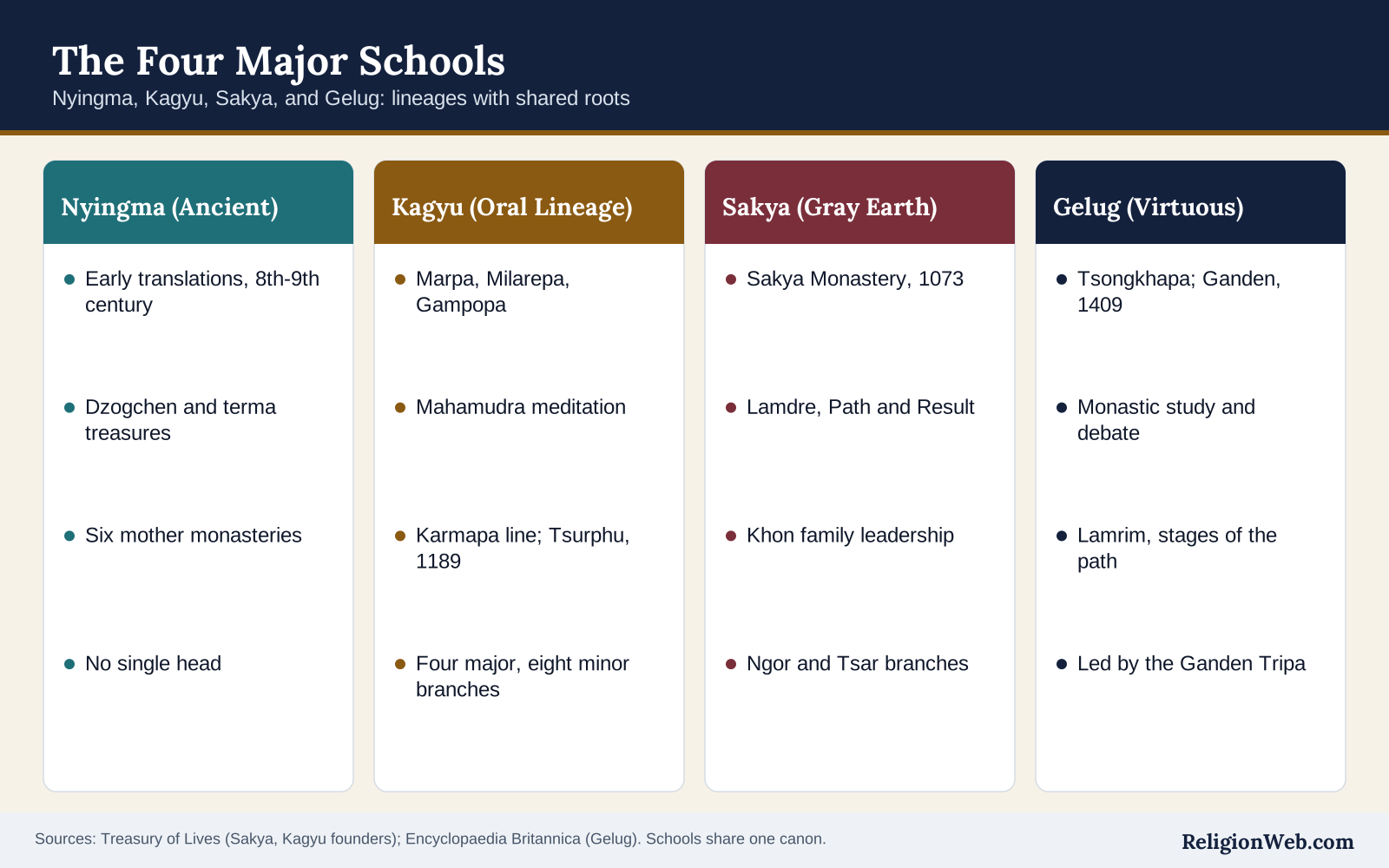
| School | Meaning of the name | Traditional origins | Key emphases and institutions |
|---|---|---|---|
| Nyingma | “Ancient” | Teachings of the royal period; Padmasambhava; Samye | Dzogchen, terma, six mother monasteries, lay ngakpa traditions |
| Kagyu | “Oral Lineage” | Marpa, Milarepa, Gampopa, eleventh and twelfth centuries | Mahamudra, Six Yogas of Naropa, Karmapa line, Tsurphu |
| Sakya | “Gray Earth” | Khon Konchok Gyelpo, 1073 | Lamdre, hereditary Khon leadership, Ngor and Tsar branches |
| Gelug | “Virtuous” | Tsongkhapa; Ganden founded in 1409 | Monastic scholarship, lamrim, debate, Ganden Tripa, Dalai and Panchen Lamas |
Other Lineages, Rime, and the Question of Bon
Kadam, Jonang, and the nonsectarian movement
The four major schools do not exhaust Tibetan Buddhism. The Kadam school, begun by Dromton after Atisha, merged into the Gelug in the view of most Tibetan historians, and the Jonang, associated with Dolpopa in the fourteenth century and known for its teaching of emptiness of other, continued as a distinct tradition in northeastern Tibet and is now counted by some Tibetans as a fifth lineage. Smaller transmissions, such as Shangpa Kagyu, Bodong, and Zhije, survive within the larger schools. Tibetan historians use several overlapping classifications, and the four-school scheme is a convenient modern summary rather than an old administrative fact.
The Rime movement of nineteenth-century Kham, often translated as “nonsectarian” or “unbounded,” was a scholarly effort to preserve and study transmissions from every school. Its main figures were Jamgon Kongtrul Lodro Thaye (1813 to 1899) and Jamyang Khyentse Wangpo (1820 to 1892), who collected rare teachings and gave initiations across school lines. The movement’s legacy is visible today in the way many contemporary teachers receive and teach from more than one lineage.
Bon as a separate tradition with its own history
Bon needs to be treated apart from Tibetan Buddhism. In its own account, Bon is the older indigenous religion of Tibet, founded by Tonpa Shenrab Miwo and linked to the ancient kingdom of Zhang Zhung. It has its own scriptural collections, teachers, and monasteries, including Menri Monastery in India, and the organized form known as Yungdrung Bon has a doctrinal structure that resembles Buddhism in several respects. Reference works commonly describe Bon as the leading spiritual tradition of Tibet before the arrival of Buddhism and note that later Bon has been strongly shaped by Tibetan Buddhism, especially by the Nyingma school.
Historians stress that the pre-Buddhist religion of the Tibetan empire is known only in fragments, and that Bon as an organized tradition took the shape it has today over the course of the later centuries, in dialogue with Buddhism. The two traditions share regions, festivals, and many ritual forms, yet they differ in teachers, texts, and doctrine, and followers of each regard theirs as distinct. For that reason this article treats Bon only as historical context. The Tibetan scholarly classification sometimes lists Bon among Tibet’s major religious traditions, beside Nyingma and the Sarma schools, but this does not make it a Buddhist school.
Lamas, Tulkus, and Religious Roles in Tibetan Buddhism
Teachers, Titles, and Ways of Living the Dharma
Lama, rinpoche, geshe, and khenpo
Tibetan Buddhist titles are easy to confuse because they describe different things. Lama is the Tibetan counterpart of the Sanskrit guru, a teacher who gives instruction and, in the tantric context, empowerment. It is a role, not a rank, and it is used for monks, nuns, and lay people alike, though in some communities it is mainly applied to qualified teachers. Rinpoche, “precious one,” is an honorific for a tulku or for an especially revered teacher. Geshe is a scholarly degree awarded in the Gelug school after many years of study, and khenpo is the corresponding degree and also the title of an abbot in other schools. Tripa means “throne holder,” and Je is an honorific used for teachers such as Je Tsongkhapa.
The central point is that status in Tibetan Buddhism is based on a mixture of ordination, training, lineage, and recognition, which do not always coincide. A fully ordained monk may be a young student with no teaching authority, while a lay yogi may be a lama with a large following, and a tulku may be recognized in childhood long before he or she has completed any training.
Monks, nuns, yogis, and householders
The tradition recognizes several paths of life. Fully ordained monks (gelong) and nuns (gelongma) follow the Vinaya of the Mulasarvastivada school, which Tibet adopted. Novices (getsul, getsulma) hold fewer vows. The ngakpa and ngakma of the Nyingma and other traditions are lay or non-celibate tantric practitioners who often wear their hair long and white robes, and who preserve ritual and healing practices in village settings. The naljorpa, or yogi, lives in retreat. Families who sponsor rituals, support monasteries, and recite mantras make up the great majority of practitioners. A lay person who has taken the basic lay vows is called a genyen, and these precepts are described in the article on the five precepts.
| Role or title | Meaning | Typical functions |
|---|---|---|
| Lama | Teacher (counterpart of guru) | Gives instruction, transmission, and empowerment |
| Tulku / rinpoche | Recognized rebirth of a master / “precious one” | Leads a lineage or monastery; teaches |
| Geshe / khenpo | Scholarly degree / abbot or learned teacher | Teaches philosophy and debate; leads monastic education |
| Gelong, gelongma | Fully ordained monk, nun | Observe the full Vinaya; study, ritual, retreat |
| Getsul, getsulma | Novice monk, nun | Train in the basic vows and study |
| Ngakpa, ngakma | Non-monastic tantric practitioner | Perform rituals in villages; maintain family lineages |
| Naljorpa | Yogi, retreat practitioner | Long retreat and meditation |
| Lay practitioner | Householder who has taken refuge | Prayer, offerings, support of monasteries, pilgrimage |
The Tulku System
Recognition and its stated principles
A tulku is a teacher recognized as the intentional rebirth of a previous master, and in this belief the earlier teacher is thought to have chosen to take rebirth in order to continue benefiting beings. The practice is associated with the Karma Kagyu school. According to the Treasury of Lives, the first Karmapa, Dusum Khyenpa, left a letter detailing his rebirth, and a later teacher identified Karma Pakshi (1204 to 1283) as his reincarnation, which scholars consider among the first tulku lineages. The practice spread to other schools, and it became the main way in which large monasteries ensured that leadership continued across generations.
The procedures vary but usually involve several stages. A senior lama, a regent, or a committee of monks consults the dying master’s written instructions and any statements about his rebirth, and examines dreams, visions, and the advice of oracles or divination specialists. Candidates, usually small children, are then tested by being asked to identify objects from the previous life, and the community weighs the evidence. Tibetan teachers describe these tests as ways of confirming a recognition, not as proofs that can convince a skeptic, and critics within the tradition have noted that recognition can be influenced by family connections and politics.
Controversy, state regulation, and the public debate
Because recognized tulkus inherit monasteries, estates, and followers, the system has always had a political side. Some Tibetan teachers have openly questioned whether it should continue in its present form, and a few have pointed out that realized teachers in the Indian tradition were not recognized as rebirths at all. Others hold that the institution is essential for the lineages it supports. The Chinese government regulates the process. Under State Religious Affairs Bureau Order No. 5, issued in 2007 and effective from September 1 of that year, the recognition of a reincarnation requires the approval of government bodies, and the order specifies lot-drawing from the golden urn where it was historically used. The government states that the measures protect religious belief and regulate religious affairs. The Dalai Lama and many outside observers hold that state control over recognition is contrary to religious practice, a position stated explicitly in his 2025 statement discussed in the next section.
Women in the Tradition
Nuns, ordination, and scholarly degrees
Women have taken part in Tibetan Buddhism as nuns, yoginis, teachers, and lay practitioners throughout its history, and the tradition honors female figures such as Machig Labdron, a Tibetan woman teacher of the eleventh and twelfth centuries, and the Indian dakinis. For centuries, however, the opportunities for women to receive advanced scholastic training were far fewer than those for men. In the Tibetan monastic lineage, the full ordination of nuns is a long-debated question, because the Mulasarvastivada order of fully ordained nuns was not transmitted to Tibet, and the Dalai Lama has encouraged scholars to study whether it can be established. In a notable change, the title of geshema was awarded to twenty nuns in December 2016 at Drepung Loseling Monastery in Mundgod, India, after a program that opened Gelug scholastic degrees to women.
Teachers, ethics, and examining a guru
Tibetan texts instruct students to examine a prospective teacher carefully before committing to him or her, and they describe the qualities of a teacher, including learning, compassion, and discipline. The close relationship between teacher and student that tantric practice depends on can be abused, and cases of misconduct by teachers have been reported in Tibetan Buddhist communities in Asia and the West in recent decades. Many lineages and centers have since adopted codes of ethics and grievance procedures. The tradition’s own teaching holds that a student should not follow a teacher who acts against the Dharma, and that devotion does not require silence about harm.
The Dalai Lama, the Panchen Lama, and the Heads of the Schools
The Dalai Lama in Context
The office, its meaning, and its history
The Dalai Lama is the best known Tibetan Buddhist figure in the world, and it helps to place him accurately. Tibetan Buddhists regard the Dalai Lamas as manifestations of Avalokiteshvara, called Chenrezig in Tibetan, the bodhisattva of compassion, a belief stated on the Dalai Lama’s official website. The title was conferred in 1578 by Altan Khan on the Gelug hierarch Sonam Gyatso, and the earlier teachers of his line were counted as the first and second Dalai Lamas afterward. The Fifth Dalai Lama and his regents consolidated the Ganden Phodrang government in the seventeenth century, which gave the office its combined role as the Gelug school’s most prominent teacher and, for three centuries, the head of the central Tibetan state. The full story is told in the article on the Dalai Lama, and the points that matter here are the limits of the office within Tibetan Buddhism as a whole.
The Dalai Lama is the leading figure of the Gelug school, not its formal head, a role held by the Ganden Tripa, and he is not the head of the Nyingma, Kagyu, or Sakya lineages, each of which has its own teachers, monasteries, and recognized heads. Many Tibetans from all schools revere him as a spiritual guide and as a symbol of Tibetan identity, and he has often received teachings from masters of other schools and has encouraged cooperation among them.
The Fourteenth Dalai Lama and the 2025 statement
According to his official biography, the Fourteenth Dalai Lama, Tenzin Gyatso, was born on July 6, 1935, in the hamlet of Taktser in Amdo, and was recognized at the age of two as the reincarnation of the Thirteenth. He assumed political authority in 1950 and went into exile in India in 1959. In his address to the European Parliament in Strasbourg on June 15, 1988, he proposed negotiations leading to a self-governing democratic Tibet in association with China, an approach later known as the Middle Way. He received the Nobel Peace Prize in 1989. On March 14, 2011, he asked the Tibetan parliament in exile to relieve him of his political responsibilities, and he signed the transfer of political authority to an elected leadership on May 29, 2011, so that the roles of spiritual teacher and political leader are separated in the exile community.
The question of succession has drawn international attention. In a 2011 statement, the Dalai Lama said that the people concerned should decide whether the institution should continue, and in a statement released on July 2, 2025, he affirmed that “the institution of the Dalai Lama will continue.” He assigned the sole responsibility for recognizing a future reincarnation to the Gaden Phodrang Trust, the Office of His Holiness, and stated that no one else has the authority to interfere in the matter. Chinese officials, as reported at the time, rejected this position and insisted that the central government must approve any successor. The statement leaves the actual procedures to the tradition’s established methods, and the competing claims will become a practical matter only when the question arises. Readers who want the current position should consult the official sources of both sides, since this article reports the position as of the July 2025 statement and does not cover any later development.
The Panchen Lama and the Other Great Lineage Holders
The Panchen Lama and Tashilhunpo
The Panchen Lama is traditionally the second-ranking Gelug incarnation after the Dalai Lama, associated with Tashilhunpo Monastery near Shigatse, and regarded as a manifestation of Amitabha, the Buddha of Infinite Light. The two lines have historically recognized each other’s reincarnations, which gave the offices a close connection. The tenth Panchen Lama died in 1989, and the question of his rebirth became a matter of political conflict.
In May 1995, the Dalai Lama announced that a six-year-old boy, Gedhun Choekyi Nyima, was the eleventh Panchen Lama. According to Human Rights Watch, the Chinese authorities forcibly disappeared him on May 17 that year, and they installed another boy, Gyaltsen Norbu, in his place; Chinese authorities have said that Gedhun Choekyi Nyima is living normally and does not wish to be disturbed, a claim that outside observers have not been able to verify. The People’s Republic of China regards Gyaltsen Norbu as the legitimate Panchen Lama, recognized by the golden urn process, and many Tibetans do not accept him. These are the positions of the parties, and they show why recognition cannot be separated from authority in this case.
The Karmapa, the Sakya Trizin, and other heads
Other schools have their own leaders. The Karmapa heads the Karma Kagyu branch of the Kagyu school, which has several other independent branches such as the Drikung and the Drukpa, each with its own head. The Sakya Trizin leads the Sakya school. The Nyingma tradition has long had no single head, with authority resting in its mother monasteries and in the teachers of its lineages. In Bhutan, the Je Khenpo is the chief abbot of the central monastic body. This variety is part of why the Dalai Lama’s 2025 statement says that the Gaden Phodrang Trust should consult the heads of the Tibetan Buddhist traditions: the consultation reflects the fact that each school has its own senior leaders.
Monasteries and Monastic Education in Tibetan Buddhism
The Monastery as an Institution
Layout, offices, and the great seats
A Tibetan monastery (gonpa) is a religious community, a school, a ritual center, and often a large landholder, built around an assembly hall (dukhang) where the monks gather to chant and pray. The abbot (khenpo or khen rinpoche) holds spiritual and administrative responsibility. Other officers include the disciplinarian (gekö), who enforces monastic rules, and the chant master (umdze), who leads the liturgy. Large monasteries traditionally had subdivisions for monks from different regions, and teachers’ residences, called labrang, administered the estates of high lamas. The structure of Samye, with a central temple modeled on Mount Meru, served as a symbolic template for later complexes. For a general account of monastic ordination and the Vinaya, see the article on Buddhist monastic life.
The most famous centers were the Gelug seats near Lhasa, Ganden (1409), Drepung (1416), and Sera (1419), together with Tashilhunpo at Shigatse. Others include Sakya in Tsang, Tsurphu of the Karmapas, Mindroling and Dorje Drak of the Nyingma, and Katok and Dzogchen in Kham. After 1959, the major Gelug institutions were re-created in India. Drepung Loseling Monastery in Mundgod, Karnataka, for example, is the site where twenty nuns were awarded the geshema degree in 2016. In Tibet, many monasteries have been rebuilt and reopened under Chinese regulation, and in Bhutan and Ladakh the monastic communities have remained continuous.
Vows and what monastic life asks
Boys and girls may enter a monastery or nunnery in childhood, usually with family consent, and receive novice vows after an initial period of study. Full ordination follows at the age of twenty or older. According to Tibetan tradition, a fully ordained monk observes 253 vows in the Mulasarvastivada Vinaya, while a novice observes the ten novice vows. The core commitments are celibacy, abstaining from taking life, stealing, and false speech, and avoiding intoxicants, with detailed rules about food, dress, money, and relations with lay people. Tibetan monks and nuns typically combine these vows with the bodhisattva vow and, for many, tantric commitments, so a single person may hold three sets of vows at once.
Not everyone who enters stays. Monastic life can end in a formal return to lay life, which Tibetan tradition treats as a recognized choice and not as a disgrace. The tradition also recognizes short-term ordination and retreat, and lay people often spend periods in monasteries.
Training, Study, and Debate
The five great subjects
The Gelug monastic curriculum, which has influenced other schools, is organized around five great subjects: the Perfection of Wisdom (prajnaparamita), Madhyamaka philosophy of the middle way, Pramana, which covers logic and epistemology, Abhidharma, the analysis of mind and phenomena, and Vinaya, monastic discipline. Students begin with elementary logic and works on the “collected topics,” and move on to the main treatises, which are read together with Tibetan commentaries. Other schools have comparable programs, using the commentaries of their own masters, and the Nyingma and Kagyu monastic colleges (shedra) also emphasize study of Indian treatises, along with Tibetan works specific to their lineages.
The highest Gelug degree, the geshe lharampa, takes about fifteen to twenty years of study, according to common accounts. Its completion involves public examination and debate, usually in the presence of senior scholars. Other schools confer the title khenpo at the end of a similar program, often lasting nine years in contemporary Nyingma and Kagyu colleges.
Debate as a method of learning
Debate is the most visible feature of Tibetan monastic education and is often misread by visitors. Students in a debate courtyard stand in pairs or groups, with one student asking questions and another defending a position. The questioner claps and extends a hand when posing a challenge, which is a gesture to emphasize the point, and the defender must respond with reasoned argument from the texts. The method is rooted in the Indian tradition of logic and epistemology associated with Dharmakirti, and it trains monks to test their understanding against opposition. The dramatic gestures are part of the form and do not signal hostility, because the exercise is regarded as a cooperative way of sharpening wisdom. The same practice has been adapted for nuns, and debate has become a central part of the geshema program.
Daily Life, Livelihood, and Lay Support
The monastic day
The daily routine in a large monastery combines group liturgy, personal prayer, study, debate, and work. Monks usually rise before dawn for morning prayers and gather in the assembly hall for chanting with tea and a simple meal, and the day alternates between study sessions, debate in the afternoon and evening, and further prayers. Monasteries observe a monthly cycle of rituals, including confession and renewal of vows on the days of the new and full moon, and special ritual periods such as the summer retreat. Many of these liturgies are dedicated to specific deities and are performed on behalf of the community. Younger students serve older teachers, and household chores are shared.
Patronage, ritual services, and change
Monasteries have traditionally been supported by gifts from lay families, royal and noble patrons, and income from land. Families request prayers, divination, healing rituals, and funerary services, and they offer food, butter, money, and labor in return. This relationship of exchange, in which lay people earn merit by giving and monks earn support by teaching and praying, is explained in the article on Buddhist monastic life and is common to many Buddhist cultures. In Tibet today, monasteries are subject to state registration and limits on the number of monks, and some have been affected by tourism. In exile, they depend on donations from Tibetan communities and international supporters. Observers inside and outside China differ in their accounts of how closely monasteries are supervised, and this article cites those positions without ranking them.
Tantra, Initiation, and Meditation in the Tibetan Schools
The Gateway: Teacher, Empowerment, and Preparation
Empowerment, transmission, and instruction
Tantric practice in Tibetan Buddhism opens through three kinds of authorization, each with its own Tibetan name. An empowerment (wang) is a ritual in which a lama introduces the student to a particular deity’s mandala and gives permission to practice that deity. A reading transmission (lung) is the oral reading of a text. An instruction (tri) is the explanation of how to practice. Tibetan teachers insist that the three work together, and that the lineage of the teacher, extending in an unbroken line back to the Indian or Tibetan master who first received the practice, guarantees that the method has not been altered. The student accepts commitments, called samaya, that include maintaining a respectful relationship with the teacher and keeping the practice. The wider explanation of these ideas is in the article on Vajrayana Buddhism.
Many empowerments are given in large public gatherings, sometimes of thousands of people, with the Dalai Lama or another senior lama presiding, and in such cases the teacher often explains that the participants receive a blessing and an introduction and need not undertake the full practice. Other empowerments are given only to students who have prepared, and the advanced practices that follow are taught privately. This article describes the public outline of these practices and does not give the restricted details, which the lineages reserve for authorized students.
Preliminary practices and retreat
Before advanced practice, many Kagyu, Sakya, and Nyingma students undertake the ngondro, the “preliminaries.” A common form involves prostrations with refuge, recitation of the hundred-syllable mantra of Vajrasattva, the offering of a mandala made of heaped rice or other materials, and guru yoga, with each section accompanied by recitation counted in the hundreds of thousands. Gelug students emphasize study and practice of the lamrim, supplemented by comparable purification and accumulation practices. A traditional program of three years and three months of closed retreat, associated especially with Kagyu and Nyingma centers, gives practitioners a period to focus on these methods under a teacher’s guidance. Retreat is intended as a protected time for training, and it is not suited to everyone, so teachers advise students on whether and when to attempt it.
Methods of Visualization and Sound
Deity yoga and the mandala
Deity yoga is the central method of Vajrayana. In a typical session, the practitioner takes refuge and generates bodhicitta, visualizes a deity such as Avalokiteshvara, Tara, Manjushri, or a wrathful protector in a detailed form, recites the deity’s mantra, and finally dissolves the visualization into emptiness. Tibetan teachers explain that the deity is understood as an expression of awakened qualities, such as compassion or wisdom, and not as an outside being to be appeased. The practice is meant to familiarize the mind with its own potential for awakening. The visualized environment of the deity is the mandala, a symbolic palace, which is also depicted in paintings, built in colored sand, or offered in heaped form. The article on the Buddhist mandala covers its structure, symbolism, and construction in detail.
Mantra, recitation, and the mala
A mantra is a sequence of sounds, often in Sanskrit, associated with a deity or with awakened qualities. The most widely recited in Tibetan communities is om mani padme hum, the six-syllable mantra of Avalokiteshvara, which appears on prayer wheels, flags, carved stones, and the lips of pilgrims. Tibetan teachers differ on how to explain its meaning. Some give a literal gloss, “the jewel in the lotus,” and others read each syllable as relating to a stage of the path, but they agree that the recitation is accompanied by intention and visualization. A string of 108 beads, the mala, is used to count repetitions. Mantra is not regarded as a spell that works automatically, and teachers describe it as a support for concentration and compassion whose effect depends on motivation. The mechanical repetition of mantras through prayer wheels is explained in the next section.
Meditation on the Nature of Mind
Calm abiding and insight
Tibetan meditation instruction draws on the shared Buddhist pair of calm abiding (shine, Sanskrit shamatha) and insight (lhaktong, Sanskrit vipashyana). Calm abiding develops a stable, undistracted mind, often through focus on an object such as a breath, an image of the Buddha, or a point of space. Insight uses analysis or direct observation to see the lack of inherent existence of the self and phenomena. Gelug teaching presents this pair as part of the lamrim, and the other schools teach comparable sequences. The general background is in the article on Buddhist meditation, which also covers practice in other Buddhist traditions.
Mahamudra and Dzogchen
Two systems focus on the nature of mind itself. Mahamudra, “the Great Seal,” is especially associated with the Kagyu school, which traces its teachings to Tilopa, Naropa, Marpa, and Gampopa, and which is also taught in Sakya and Gelug forms. Dzogchen, “the Great Perfection,” is especially associated with the Nyingma school, and also with the Bon tradition’s own Dzogchen teachings. Both are described by their teachers as methods that introduce the student directly to the natural condition of mind, often after preliminary practices, and both are taught from a teacher to a prepared student. Because of their reputation for directness, they are sometimes presented in popular books as easy, but Tibetan teachers emphasize years of preparation and guidance.
| Practice | What it involves | Purpose in the tradition | Typical setting |
|---|---|---|---|
| Refuge and bodhicitta | Reciting formulas of refuge and the aspiration to awaken for all beings | Entry to the path; motivation for practice | Daily prayer, start of every teaching |
| Prostration | Full-length or half bows, often with refuge recitation | Purification, humility, accumulation of merit | Temples, pilgrimage, ngondro |
| Mantra recitation | Repeating sacred syllables with a mala | Concentration; connection to a deity’s qualities | Home, monastery, pilgrimage |
| Deity yoga | Visualizing a deity and its mandala, then dissolving it into emptiness | Transforming self-image; developing awakened qualities | Initiated practitioners; monastic ritual |
| Calm abiding and insight | Focused attention, then analysis of the nature of self and phenomena | Stable mind and wisdom | Retreat, teaching centers |
| Mahamudra and Dzogchen | Direct meditation on the nature of mind | Recognition of awareness itself | Advanced students with a teacher |
| Debate | Structured questioning on philosophy | Clarifying understanding | Monastic colleges |
Worship and Everyday Practice: Altars, Flags, Wheels, and Rites of Passage
Offerings and Liturgy in Home and Temple
The altar and its offerings
Many Tibetan homes have a shrine room or altar with images of the Buddha, a teacher, or a favorite deity, and a row of bowls containing offerings. The standard set is seven bowls of clean water, which stand for the offerings of drinking water, washing water, flowers, incense, light, perfumed water, and food, and the water is poured out and refreshed each morning. Lay families add butter lamps, incense, and food, and fill the bowls with saffron-colored water or grain on festival days. In temples and monasteries, butter lamps burn before images throughout the day. Visitors to the Jokhang in Lhasa, for example, often bring butter to add to the lamps. Tibetan teachers explain these offerings as training in generosity and as a way of focusing attention on the qualities of awakening, and not as a payment to the Buddha, who needs nothing.
Monastic and household prayers combine several elements: taking refuge, generating bodhicitta, reciting a main text or mantra, and dedicating the merit to all beings. This pattern of beginning with refuge and bodhicitta and ending with dedication is nearly universal and appears in liturgies for all four schools.
Group ritual in the monastery
A formal monastic ritual, called a puja, is performed by the assembled community. Monks chant in low voices from texts, often led by the chant master, and accompany the recitation with instruments: long horns (dungchen) that can be several meters in length, cymbals, drums, bells, and oboe-like horns (gyaling). The chanting style, with its deep sustained tones, is one of the most recognizable features of Tibetan Buddhist practice. The ritual may be a regular cycle of prayers, a ceremony for a particular deity, a feast offering (tsok) in which food is offered and shared, or a prayer sponsored by a family for a specific purpose, such as long life, recovery from illness, or the benefit of a person who has died. Offerings include ritual cakes (torma) shaped from barley flour and butter. Tibetan sources explain rituals directed to protector deities as expressions of the commitment to protect the Dharma and its practitioners. Such rituals are not a substitute for medical care, and families commonly seek both ritual and medical help.
Sacred Objects in Public Space
Prayer flags and the wind horse
Prayer flags are one of the most widely recognized symbols of the Tibetan cultural world. They are rectangular pieces of cloth or paper printed with mantras, prayers, and images, hung on lines, roofs, bridges, and mountain passes. A common flag, the lungta, “wind horse,” shows a horse carrying the three jewels on its back, surrounded by mantras. The flags are traditionally printed in five colors, blue, white, red, green, and yellow, which Tibetan tradition associates with the five elements of space, air, fire, water, and earth. The printed words are not understood as messages dispatched to a deity. Rather, people hang them in the belief that the wind spreads the blessings of the prayers to all beings. Old flags are not meant to be discarded carelessly. They are left to fade in the weather, and worn ones are often burned respectfully or placed in an elevated spot, because they carry sacred syllables.
Prayer wheels, mani stones, and stupas
A prayer wheel (mani khorlo) is a cylinder containing rolled mantras, usually om mani padme hum, that is turned clockwise by hand, by water, by wind, or by the heat of butter lamps. The practice is explained as a way of accumulating merit and of speaking the mantra through the body, and it is described fully in the article on the Buddhist prayer wheel. Pilgrims walk around temples and sacred sites in a clockwise direction, spinning the wheels along the way. Mani stones are slabs or boulders carved with mantras, accumulated in long walls near villages and passes, and carvers add to them as an act of devotion.
The stupa, called chorten in Tibetan, is a reliquary monument that symbolizes the awakened mind, with a base, dome, spire, and crowning ornaments associated with stages of the path or the elements. Chortens appear at monasteries, at the entrance to villages, and along roads, and some, such as the great stupas at Boudhanath in Kathmandu and Swayambhu, are major centers of pilgrimage. UNESCO lists both as part of the Kathmandu Valley World Heritage property, inscribed in 1979, which it describes as reflecting a blend of Buddhism, Hinduism, and other traditions.
Life, Death, and Ethical Practice
Naming, blessing, and funerary practice
Tibetan families often turn to a lama or an astrologer for a child’s name, a blessing, or an auspicious date for a wedding or a journey. The most elaborate rites are connected with death. Because Tibetan Buddhists hold that consciousness continues after death, families invite monks to recite prayers at the bedside, and in some communities texts such as the Bardo Thodol are read. For a period of forty-nine days after the death, which tradition associates with the interval before rebirth, the family sponsors prayers and offerings each week. The method of disposing of the body varies by region and resources. In many places cremation is used, and burial in water or the earth also occurs. In some high regions of the Tibetan plateau, a rite known as sky burial, in which the body is offered to birds, has long been practiced, and Tibetan communities explain it as an act of generosity as well as a response to a land with little fuel. Visitors who attend should follow local guidance and not photograph without permission.
Merit, compassion, and caring for living beings
Tibetan ethics are grounded in the bodhisattva ideal and the Vinaya. Lay people take refuge and keep the basic precepts, as outlined in the five precepts, and they try to cultivate generosity, patience, and compassion. Practices of merit include giving to monasteries and to the poor, sponsoring the printing of texts, circumambulating holy sites, and reciting prayers on behalf of others. A practice called life release (tsethar) involves saving animals destined for slaughter and setting them free, which Tibetan communities regard as an act of compassion and a way of lengthening life. Teachers, including the Dalai Lama, have encouraged vegetarianism, although many Tibetans traditionally eat meat in a climate where farming is limited, and monastic practice varies by region and school. The ethical teaching is that intention shapes the moral weight of an action, and Tibetan teachers place compassion at the center of it.
The Tibetan Calendar, Festivals, and Pilgrimage
The Calendar and the Great Observance Days
How the Tibetan calendar works
The traditional Tibetan calendar is lunisolar. Months begin with the new moon and are counted by lunar days, and extra months are added periodically so that the year stays aligned with the seasons. Tibetan tradition links the calendar to astrological texts connected with the Kalachakra tradition and counts years in sixty-year cycles, with each year named for an element and an animal. Because the lunar day count follows the moon and is adjusted by local astronomical calculation, the date of a Tibetan observance in the Gregorian calendar changes from year to year, and Tibetan communities in different regions, and different calendar traditions, sometimes observe a festival on different days. For that reason this article gives the calendar rule for each observance and not a fixed date. Anyone planning to attend a festival should check the current almanac published by a monastery or Tibetan institution.
The tradition teaches that the results of virtuous and harmful actions are multiplied on special days, which is why many lay people increase their prayers, circumambulation, and charitable acts on them. Teachers present this as an encouragement to practice and not as a rule of fate.
Losar and the four great days
Losar, the Tibetan New Year, begins on the first day of the first lunar month, usually in February or March in the Gregorian calendar. Families clean their homes, prepare special foods such as the barley-based guthuk soup of the preceding evening, set up altars with offerings, visit monasteries, and exchange greetings and gifts over several days. Monasteries perform rituals to clear away the obstacles of the old year. The first fortnight of the year is also the time of the Monlam, the Great Prayer Festival.
Four special days, called duchen, are traditionally observed as major occasions. Chotrul Duchen, on the fifteenth day of the first month, recalls the Buddha’s display of miracles. Saga Dawa Duchen, on the fifteenth day of the fourth month, commemorates the Buddha’s birth, awakening, and passing into final nirvana, which Tibetan tradition keeps on a single day and which is linked to the observances described in the article on Vesak. Chokhor Duchen, on the fourth day of the sixth month, marks the Buddha’s first teaching at Sarnath. Lhabab Duchen, on the twenty-second day of the ninth month, recalls his descent from the heaven of the thirty-three gods after teaching his mother. The common practices of these days are fasting from certain foods, offerings, prostration, and circumambulation.
| Observance | Calendar rule | What it commemorates | Typical practices |
|---|---|---|---|
| Losar | First day of the first lunar month | Tibetan New Year | Cleaning, offerings, family visits, monastery rituals |
| Monlam Chenmo | First fortnight of the first month | Great Prayer Festival, tradition founded by Tsongkhapa in 1409 | Mass prayer, teachings, processions |
| Chotrul Duchen | Fifteenth day of the first month | The Buddha’s display of miracles | Merit-making, offerings, lamp lighting |
| Saga Dawa Duchen | Fifteenth day of the fourth month | Buddha’s birth, awakening, and final nirvana | Circumambulation, fasting, giving |
| Chokhor Duchen | Fourth day of the sixth month | First teaching at Sarnath | Teachings, pilgrimage, offerings |
| Lhabab Duchen | Twenty-second day of the ninth month | Descent from the heaven of the thirty-three gods | Prayer, prostration, charity |
Monastery Festivals and Sacred Dance
The Monlam Prayer Festival
The Monlam Chenmo, “Great Prayer,” is a gathering of monks who recite prayers for world peace and the flourishing of the Dharma. Tradition holds that Tsongkhapa began it in Lhasa in 1409, the same year he founded Ganden, and the gathering became a central event of the Gelug calendar, with thousands of monks from the three great monasteries assembling at the Jokhang. After the 1959 exile, Monlam services continued in India, notably at Bodh Gaya, where monks from many traditions gather. In Tibet its public form has been restricted in various periods, and accounts of how it is conducted today differ, so they are not summarized here.
Cham dances and regional festivals
Many monasteries stage cham, masked dance rituals performed by monks in costumes and brocade robes, often on the anniversary of an important event or at the turn of the year. The dances are ritual and not entertainment. They depict the subduing of obstacles, the actions of protector deities, and teachings on impermanence, and they are believed to give blessings to those who watch. In Bhutan, the festival called tsechu, held on the tenth day of a lunar month in honor of Padmasambhava, is a prominent public celebration, and in Mongolia the equivalent Tsam dance was suppressed in the twentieth century and has since been revived at some monasteries. Some festivals unfurl enormous appliqué paintings, called thongdrol, which are believed to liberate on sight. These events are open to the public and often draw many visitors, so they are also major community and cultural events.
Pilgrimage and Sacred Geography
Circumambulation and sacred landscape
Pilgrimage (nekor, “going around a holy place”) is one of the most common forms of Tibetan devotion. The core practice is circumambulation, or kora, walking clockwise around a temple, stupa, mountain, or lake, with prayers, mantras, and often the spinning of a prayer wheel. Some pilgrims perform full-length prostrations along the entire route. In Lhasa, pilgrims circle the Jokhang along the Barkhor, and the Potala Palace, the Jokhang, and the Norbulingka are listed together by UNESCO, which inscribed the Potala in 1994, the Jokhang in 2000, and the Norbulingka in 2001. Mount Kailash in western Tibet is regarded by Buddhists as the abode of Chakrasamvara and by several other traditions as sacred, and the circuit of the mountain, roughly 50 kilometers, is made by pilgrims from different communities.
Journeys to Indian and Himalayan sites
Tibetan pilgrims have long visited the sites of the Buddha’s life in India and Nepal: Lumbini, the traditional birthplace, Bodh Gaya, the place of awakening, Sarnath, the site of the first teaching, and Kushinagar, the place of his final nirvana. Tibetans in exile can visit these sites more easily than before, and Bodh Gaya has become a central gathering place for Tibetan teachings and festivals. Within the Himalayas, pilgrims also visit Swayambhu and Boudhanath in Kathmandu, as well as caves, monasteries, and relics associated with great masters such as Padmasambhava and Milarepa. Pilgrimage is understood as a way to purify obstacles, accumulate merit, and receive blessings, and it is often undertaken to mark a death, a recovery, or an intention for the next life. Pilgrims at high altitude should treat health risks seriously, since altitude sickness and cold are real dangers, and religious merit does not replace medical advice.

Tibetan Buddhism Today: Homeland, Exile, and Global Communities
The Tibetan Regions and the Himalayan World
Monasteries and regulation in China
In the Tibetan regions of the People’s Republic of China, Tibetan Buddhism is practiced in rebuilt monasteries, in homes, and on pilgrimage routes, within a framework of state regulation. The government recognizes Buddhism as one of five officially permitted religions and requires monasteries to register, manage them through official Buddhist associations, and limits the recognition of high tulkus, as described earlier. The Chinese government states that it protects freedom of religious belief and has invested in the restoration of monasteries. Exile organizations, many foreign governments, and human rights groups say that restrictions on monastic numbers, education, and expression of religious loyalty are severe, and they point to such cases as the reported demolition of housing at the large Larung Gar monastic community in Sichuan in 2016 and 2017. These are positions on which the sides disagree, and an encyclopedic article cannot settle them. What is clear from all sides is that religious life continues among Tibetans in these regions, shaped by the regulations, and that independent verification of conditions is difficult.
Elsewhere in the Himalayas the tradition is more stable and has state support. Bhutan’s constitution names Buddhism, in its Drukpa Kagyu and Nyingma forms, as the spiritual heritage of the country, and the monastic body is led by the Je Khenpo. In India, Tibetan Buddhism is the tradition of Ladakh, Sikkim, Lahaul and Spiti, Tawang in Arunachal Pradesh, and the Tibetan settlements. In Nepal, Tibetan Buddhist communities live in the high Himalayan districts such as Mustang and Solukhumbu and in Kathmandu around the great stupas.
Mongolia and the Russian republics
Mongolia is a historical center of Tibetan Buddhism, and the Pew Research Center’s 2025 report counts it among the seven Buddhist-majority countries of the world. The tradition was largely suppressed in the 1930s under the communist government, with monasteries closed and many monks killed or forced to disband, and it revived after 1990. Gandan Monastery in Ulaanbaatar is the best known center. In Russia, Tibetan Buddhism is a traditional religion of the republics of Buryatia, Tuva, and Kalmykia, where communities rebuilt temples after the Soviet period. In each of these regions the tradition has adapted to local languages, customs, and circumstances, and the link to Tibetan teachers in India has grown since the 1990s.
The Exile Community and Its Institutions
Dharamsala, the Central Tibetan Administration, and rebuilt monasteries
After 1959, India offered land and support for Tibetan settlements, and the Dalai Lama established his residence in Dharamsala in the north. The Central Tibetan Administration there, with an elected parliament and leader, serves as the government in exile. The Central Tibetan Administration’s 2009 survey registered about 127,935 Tibetans in exile, including 94,203 in India, 13,514 in Nepal, and 1,298 in Bhutan, and later estimates give different figures, with some reports of a decline in India’s Tibetan population as people emigrated to Western countries. The settlements, such as Bylakuppe and Mundgod in Karnataka, include large rebuilt monasteries that educate thousands of monks and nuns, and all four schools have their principal exile seats in India or Nepal. For the community, the monasteries preserve not only religious teaching but also the Tibetan language and arts.
Preserving the canon and the tradition
Exile institutions have devoted themselves to preserving texts, art, and teaching. Libraries and archives gather manuscripts and printed books, monasteries print editions of the canon, and organizations such as 84000 are translating the Kangyur and Tengyur into English and other languages. According to its press release, 84000 aims to complete the Kangyur by 2035 and the Tengyur by 2110, and has translated about 12 percent of the whole canon. These projects continue a pattern that began in the eighth century, when kings sponsored the first translations from Sanskrit into Tibetan, and now translate in the other direction, from Tibetan into the languages of the modern world.
Global Centers and Contemporary Questions
Tibetan Buddhism in the West and in Asia
Since the 1960s, Tibetan teachers have established centers in Europe, North America, Australia, and Asia, such as Samye Ling in Scotland (1967) and numerous Dharma centers affiliated with all four schools. Tibetan Buddhism has also attracted academic interest, and universities offer degrees in Tibetan studies. The movement has produced popular books, public teachings, and the Dalai Lama’s international tours. Many students in these centers are converts or people with a casual interest, and they approach Tibetan Buddhism through meditation classes, lectures, and retreats. Because many of these centers sit alongside other Buddhist communities, they form a part of the Buddhist presence described in the article on Buddhism more broadly.
Questions the tradition faces
Tibetan Buddhist communities face several questions, some of which are matters of lively discussion among teachers and students. These include how to preserve the monastic system in exile while younger Tibetans are drawn toward education and careers elsewhere, how to prepare for the succession of senior lamas, how to train and empower women teachers, how to address misconduct and abuse of power, and how to share meditation methods without reducing them to relaxation techniques. They also include the relations between the schools, which have grown more cooperative in exile, and between religious and national identity. The tradition has responded in various ways, from new curricula to new ethical codes, and these developments are still unfolding.
Common Misconceptions About Tibetan Buddhism
Misconception 1: Tibetan Buddhism Is a Single School with One Teaching and One Leader
Where the misunderstanding comes from
Public images of Tibetan Buddhism tend to be dominated by a few recognizable symbols: maroon robes, the Dalai Lama, prayer flags, and the tradition’s most famous books. The result is a picture of a single, uniform church. Popular writing sometimes compounds this by using “Tibetan Buddhism” to mean the Gelug school only, because the Gelug has been politically prominent in Lhasa and its most famous leader is the Dalai Lama. Older European writers also called the whole tradition “Lamaism,” which presented it as a single system with a single hierarchy.
What the evidence and tradition actually show
Tibetan Buddhism is a family of lineages. The four main schools, Nyingma, Kagyu, Sakya, and Gelug, differ in their histories, the texts they emphasize, the practices they place first, the structure of their institutions, and the ways they interpret certain philosophical questions, such as the nature of emptiness. Within the schools there are further branches: the Kagyu has four major and eight minor lineages, the Sakya has the Ngor and Tsar branches, and the Nyingma has its mother monasteries and its terma lineages. At the same time, all of these traditions share the Indian Mahayana foundation, the same canon of Kangyur and Tengyur, and a common understanding of the path of refuge, bodhicitta, and tantric practice, and in the nineteenth century the Rime movement worked to preserve all of them together. The fair statement is that the schools are distinct traditions of one broad religious culture, each with its own authorities, and that teachers regularly receive transmissions from more than one.
Tibetan scholars themselves use more than one scheme for sorting the traditions. A common one divides Buddhism into the Nyingma, or Old Translation school, and the Sarma, or New Translation schools, which include the Kagyu, Sakya, Kadam, and Gelug. The familiar “four schools” count is a convenient summary, and some Tibetans add the Jonang as a fifth lineage. That flexibility is another sign that the tradition is better described as a network of related lineages than as a single organization.
Misconception 2: The Dalai Lama Is the Head of Every Tibetan Buddhist Lineage
Where the misunderstanding comes from
The Dalai Lama’s global fame, his Nobel Peace Prize, and his decades of leadership of the exile community make him the face of Tibetan Buddhism for most people outside Asia. Media accounts often call him the “head of Tibetan Buddhism,” a phrase that suggests a single central hierarchy and does not describe Tibetan institutions well. In addition, from the seventeenth century to 1959 the Dalai Lamas headed the government of central Tibet, which suggested to outside observers that they must be the head of the religion as well.
What the evidence and tradition actually show
The Dalai Lama is the leading teacher of the Gelug school, whose formal head is the Ganden Tripa. He is not the administrative head of the Nyingma, Kagyu, or Sakya schools. The Karmapa leads the Karma Kagyu, the Sakya Trizin leads the Sakya, and the Nyingma has no single head. The Dalai Lama’s own 2025 statement on the continuation of his institution says that the Gaden Phodrang Trust should consult the heads of the Tibetan Buddhist traditions when a successor is sought, which presupposes that such heads exist. The consultation is an advisory step, and the same statement places the responsibility for recognition with the Trust. Many Tibetans of all schools revere him as a teacher and as a symbol of the people, and he has often taught across school lines, but reverence is not the same as institutional authority. The article on the Dalai Lama gives the fuller picture of his role.
Misconception 3: Tibetan Ritual Consists Only of Exotic or Secret Practices
Where the misunderstanding comes from
Tibetan Buddhism includes practices that look unfamiliar to outsiders, such as wrathful deities, ritual horns, skull-shaped bowls, and visualization of divine beings. The tantric tradition also reserves certain teachings for initiated students, and writers have sometimes read “restricted” as “occult” or “sensational.” Travel writing, films, and some books in the nineteenth and twentieth centuries presented the tradition as a land of magic and hidden wisdom, and that image of mystery has remained popular, sometimes in advertising and wellness marketing.
What the evidence and tradition actually show
Most Tibetan religious activity is public, ordinary, and moral in character. It consists of taking refuge, reciting prayers, making offerings, turning prayer wheels, circling temples, listening to teachings, supporting monasteries, and reflecting on impermanence and kindness. The great majority of lay practitioners never receive advanced tantric teachings, and the monastic curriculum is overwhelmingly devoted to philosophy, logic, ethics, and monastic discipline. Where practices are restricted, the Tibetan reason is pedagogical: they depend on preparation, a qualified teacher, and a commitment that students are asked to understand before they begin, and teachers argue that without that context the methods can be misunderstood or harmful. A typical week for a lay family might include morning offerings at the household altar, mantra recitation while walking or working, a visit to a temple on a special day, and a donation to a monastery, which is ordinary devotional life. Even the wrathful imagery is interpreted by the schools as an expression of compassion and as a symbol of the mind’s transformation, not an endorsement of violence. This article describes the public forms of these practices and the reasons for restriction without giving restricted instructions. The wider tantric background is in the article on Vajrayana Buddhism.
Misconception 4: Tibetan Buddhism Is the Same as Bon, or Is Simply Buddhism Mixed with Older Local Religion
Where the misunderstanding comes from
Tibetan Buddhism took shape in a society that had a previous religious culture, and it absorbed local ritual forms: mountain deities, offerings to local spirits, and rites of purification. Tibetan histories describe Padmasambhava’s subduing of local spirits, which some modern writers read as the conversion of an earlier, non-Buddhist religion into Buddhism. Others say that Tibetan Buddhism is Bon with a Buddhist surface, or the reverse. The word Bon is also used in several ways, for the pre-Buddhist religious practices of the empire, for the organized Bon tradition, and, in some older sources, for non-Buddhist Tibetan religion in general, which adds to the confusion.
What the evidence and tradition actually show
Tibetan Buddhist schools trace their doctrine, ethics, and ritual to Indian Buddhist sources. They did incorporate local deities as protectors and local sacred geography into pilgrimage and festival culture, as Buddhist traditions elsewhere have done, and historians study the interaction between Buddhism and the earlier religion as a process of exchange. Bon, meanwhile, is a distinct tradition with its own account of its founder Tonpa Shenrab, its own scriptures, monasteries, and teachers, and its own view of its history. The organized form known as Yungdrung Bon shares many features with Buddhism and has been influenced by it, but its followers regard it as a separate religion. The honest summary is that the two traditions have a long shared history in the same landscape, with borrowing in both directions, and that neither is a disguised version of the other. Scholars who work on the early period add that the surviving sources are limited and often written centuries later by communities with their own commitments, which is a reason for caution about any single account of who borrowed what.
Misconception 5: Before 1950, Tibet Was a Peaceful Society Concerned Only with Spiritual Life
Where the misunderstanding comes from
The image of Tibet as a hidden, timeless land devoted wholly to contemplation, sometimes summed up as “Shangri-La,” was shaped by early twentieth-century fiction, travel writing, and later films, and it was reinforced by the genuine importance of monasteries and religious life in Tibetan society. The image has often been adopted for sympathetic reasons, to honor a culture that suffered great losses after 1950, yet it makes Tibetan history seem simpler than it was.
What the evidence and tradition actually show
Tibetan Buddhist institutions were deeply involved in politics, economics, and regional rivalry. Tibet had a powerful empire in the seventh to ninth centuries, followed by a period of fragmentation, then by rule through the Sakya under Mongol patronage, the Pakmodru dynasty, and the Ganden Phodrang government led by the Dalai Lamas. Large monasteries held land and trade interests, tulkus inherited estates, and schools and noble families competed for patrons. The Gelug’s rise in the seventeenth century involved the military intervention of the Mongol leader Guushi Khan in 1642, as described in Encyclopaedia Britannica. Historians of Tibet study this record in order to understand a complex society whose monasteries were at once schools, courts of appeal, and landowners, and the record also shows how a religious tradition can be both a moral path and a social institution. Recognizing this does not reduce the tradition’s teaching on compassion, which its members treat as a goal to be practiced and not a description of how every institution behaved.
Frequently Asked Questions About Tibetan Buddhism
Questions About Origins and Schools
When and how did Buddhism reach Tibet?
Buddhist influence reached the Tibetan plateau gradually, but the decisive period began in the seventh century under King Songtsen Gampo and continued in the eighth century under Trisong Detsen, who sponsored the building of Samye Monastery and the first major translations from Sanskrit. After a period of political fragmentation in the ninth century, a second wave of Indian teachers, among them Atisha, who arrived in 1042, and of Tibetan translators renewed the tradition. Many details of the earliest period come from later Tibetan histories, so scholars describe them as tradition and not as documented fact.
What are the main differences among the four schools?
The schools share the same Buddha, the same canon, and the same basic teaching, and they differ in lineage and emphasis. The Nyingma stresses the early translations, the terma tradition, and Dzogchen. The Kagyu emphasizes meditation lineages, Mahamudra, and the Karmapa line. The Sakya preserves the Lamdre system and has been led by the Khon family. The Gelug stresses monastic scholarship, debate, and the graded path of the lamrim. These are differences of emphasis, with overlapping practices, and not a ranking of the schools.
Is Tibetan Buddhism the same as Vajrayana?
The two are closely related but not identical. Vajrayana is the tantric stream of Buddhism that also exists in Japan as Shingon and Tendai and among the Newar Buddhists of Nepal, while Tibetan Buddhism is a broader cultural and religious tradition that includes monastic study, the Mahayana path, and Vajrayana methods. Tibetan teachers themselves consider tantra part of the Mahayana. For the full explanation of tantric ideas, see the article on Vajrayana Buddhism.
Questions About Teachers and Institutions
Who chooses the next Dalai Lama?
According to the Fourteenth Dalai Lama’s statement of July 2, 2025, the Gaden Phodrang Trust holds sole responsibility for recognizing his reincarnation and is to consult the heads of the Tibetan Buddhist traditions and the Dharma protectors linked to the Dalai Lama lineage. The Chinese government rejects this position and asserts its own authority over the process. The question has not arisen in practice, and the article on the Dalai Lama discusses the history of previous recognitions.
What is a tulku, and does every lama have one?
A tulku is a teacher recognized as the rebirth of a previous master. Not every lama is a tulku. Many teachers are respected for their learning, practice, and character without any claim of previous lives, and many monks and nuns study, teach, and lead monasteries without that status. Tulkus are significant in the tradition because they provide continuity for important monasteries and teaching lineages.
Can women become nuns and scholars in Tibetan Buddhism?
Women have long been nuns, yoginis, and teachers, and Tibetan nunneries train thousands of women. Full ordination for nuns in the Tibetan lineage is a matter of continuing discussion because the original lineage was not transmitted to Tibet. In December 2016, twenty nuns were awarded the geshema degree at Drepung Loseling Monastery in India, which opened the highest Gelug scholastic degree to women for the first time on a significant scale.
Questions About Practice
What does om mani padme hum mean?
The six syllables are the mantra of Avalokiteshvara, the bodhisattva of compassion, whom Tibetans call Chenrezig. A common literal rendering is “the jewel in the lotus,” and teachers give additional readings that connect each syllable to a stage of the path or to the transformation of a mental state. Tibetan teachers stress that the benefit of the mantra comes through recitation with compassion and attention, not from the sounds alone. The mantra appears on prayer wheels, as described in the article on the prayer wheel.
Do Tibetan Buddhists worship the Buddha or gods?
Tibetan Buddhists take refuge in the Buddha, venerate images, and make offerings to Buddhas, bodhisattvas, and deities, but they do not understand the Buddha as a creator god. The deities of tantric practice are explained as expressions of awakened qualities. Tibetans also recognize local gods and protectors, who are understood as beings within cyclic existence that can be asked for help, and not as objects of ultimate refuge. The verbs “venerate,” “make offerings,” and “take refuge” describe the practice more precisely than “worship.”
How can a beginner learn about Tibetan Buddhism respectfully?
Tibetan teachers generally recommend starting with the shared foundations: refuge, ethics, impermanence, compassion, and calm abiding meditation, taught by a qualified teacher at a center or monastery. Advanced tantric practices are taken up only after proper preparation, and a student should examine a teacher before committing. When visiting a monastery, it is customary to dress modestly, to walk clockwise around shrines, to avoid pointing the feet at images, and to ask before taking photographs. Meditation and ritual can support well-being, and they do not replace medical or psychological care when it is needed.
Conclusion: Tibetan Buddhism as a Carried and Living Tradition
What the History Shows
Transmission, translation, and adaptation
The history of Tibetan Buddhism is a history of transmission. Indian Buddhism, with its philosophy, monastic code, and tantric systems, was brought to the plateau by kings, scholars, translators, and pilgrims, and it was rendered into a language created in part for that purpose. The Kangyur and Tengyur preserve a vast body of Indian Buddhist literature, in many cases in the only form that survives, and the schools that emerged from the work of translation developed their own scholarship, ritual, and institutions. What looks from outside like a single exotic religion is, in this account, a set of lineages with a common Indian ancestry and a distinctly Tibetan development.
Institutions, persons, and unresolved questions
The tradition’s institutions, from large monasteries to tulku lineages, grew out of that history, and they continue to adapt. The Dalai Lama and the other lineage heads, the exile settlements, the rebuilt monasteries in Tibet, the centers in Mongolia and the West, and the translation projects all carry the tradition forward under very different conditions. Questions about succession, state regulation, the role of women, and the ethics of the teacher-student relationship remain open. A reference article cannot resolve them, and the best it can do is state the positions of the parties accurately.
How to Keep Exploring
Related Buddhist traditions on ReligionWeb
Readers who want the wider context can begin with the overview of Buddhism, which describes the shared teachings and the major branches. The article on Theravada Buddhism explains the Pali canon and monastic traditions of South and Southeast Asia, while the East Asian streams of Mahayana are treated in the articles on Pure Land Buddhism, Zen Buddhism, and Nichiren Buddhism. Each tradition has its own scriptures, history, and practice, and each is described on its own terms.
Reading and visiting with care
The most reliable way to learn more is to study primary texts in good translations, to read the work of historians and the tradition’s own teachers, and to visit living communities with an attitude of respect. Translations of canonical works, such as those published by 84000, make a growing share of the Tibetan canon available in English. For meditation practice, a qualified teacher and a community are valuable. For events and travel, the calendar rules in this article show why dates change and why local almanacs are the best guide. Tibetan Buddhism remains, above all, a tradition whose members describe it as a path to be practiced and tested, and learning about it in that spirit is the best way to understand it.
Sources
The table below lists the principal external sources behind this article. Facts, dates and figures were checked against these and related primary, institutional and academic materials.
| # | Source | Publisher and type | Used for | Link |
|---|---|---|---|---|
| 1 | How the Global Religious Landscape Changed From 2010 to 2020 | Pew Research Center · Demographic data | 324 million Buddhists (4.1%) in 2020; seven Buddhist-majority countries incl. Mongolia and Bhutan | pewresearch.org |
| 2 | Statement Affirming the Continuation of the Institution of Dalai Lama (July 2, 2025) | Office of His Holiness the Dalai Lama · Institutional | Continuation of the institution; Gaden Phodrang Trust as sole recognizing authority; consultation of school heads | dalailama.com |
| 3 | Brief Biography of the Dalai Lama | Office of His Holiness the Dalai Lama · Institutional | Birth 1935, 1950 authority, 1959 exile, 1988 Strasbourg proposal, 1989 Nobel, 2011 devolution | dalailama.com |
| 4 | China: Tibet Panchen Lama Forcibly Disappeared 30 Years | Human Rights Watch · Institutional | 1995 Panchen Lama disappearance, Chinese government's stated position, Golden Urn requirement since 2007 | hrw.org |
| 5 | Press Release: World's First English Catalog of the Collected Treatises of the Ancient Buddhist World Now Complete | 84000: Translating the Words of the Buddha · Institutional | Tengyur size (3,400 titles, 161,800 pages), lost Indic originals, translation progress and targets | 84000.co |
| 6 | Derge Parkhang: The Auspicious Treasury of Tibetan Woodcut Printing | Rubin Museum of Art · Institutional | Derge Parkhang: about 300,000 blocks, 1729 founding, how blocks are carved; Kangyur and Tengyur editions | rubinmuseum.org |
| 7 | Samye (institution page) | The Treasury of Lives · Academic reference | Samye completed c. 775, inaugurated 779; Shantarakshita; the Samye debate c. 797 | treasuryoflives.org |
| 8 | Sakya (tradition page) | The Treasury of Lives · Academic reference | Sakya founded 1073; Lamdre; Phagpa, Qubilai Khan and the Imperial Preceptor role; Ngor and Tsar branches | treasuryoflives.org |
| 9 | Treasury of Lives: Kagyu Founders, Part 2 (Gampopa and Barompa) | Tricycle: The Buddhist Review · Academic reference | Gampopa 1079 to 1153; four major Dakpo Kagyu branches and founders' dates | tricycle.org |
| 10 | The Path of Light (Bodhicaryavatara of Shantideva), trans. L. D. Barnett, 1909 | Internet Archive (scan of E. P. Dutton edition) · Primary text | Two quoted passages from chapter 3 of the public-domain 1909 English translation | archive.org |
Last fact-check date: 2026-10-21.
