

Vajrayana Buddhism is the tantric, or esoteric, current of Buddhism. Its name is Sanskrit for the “Diamond Vehicle” or “Thunderbolt Vehicle,” and its practitioners also call it Mantrayana, the “Mantra Vehicle,” or Secret Mantra. It takes the shared Buddhist aim of awakening for the sake of all beings and adds a distinctive set of methods: ritual initiation from a qualified teacher, the recitation of mantras, the visualization of awakened beings, symbolic gestures, and the use of mandalas, which are sacred diagrams of an awakened world. The tradition holds that these methods can bring a practitioner to Buddhahood more swiftly than the gradual path alone, and that they must be learned from a living teacher rather than from books.
The movement took shape in India during the early medieval period, with its major scriptures, called tantras, appearing from roughly the seventh and eighth centuries CE. From India it traveled north into Tibet and the Himalayas, east to China and Japan, and south to Java and Sumatra. Today it is the dominant form of Buddhism in Tibet, Bhutan, Ladakh, Sikkim, and Mongolia, and it also lives on in Japan as Shingon and the esoteric side of Tendai, among the Newar Buddhists of Nepal’s Kathmandu Valley, and in Tibetan Buddhist communities around the world. Within the larger family described in the article on Buddhism, it is usually listed beside Theravada Buddhism and Mahayana Buddhism, though Tibetan scholars themselves count it as a branch of Mahayana.
Vajrayana is easily misread, partly because its imagery is dramatic and partly because some of its practices are deliberately restricted. Wrathful deities, skull cups, and paired male and female figures appear in its art, and outsiders have often taken them literally or sensationally. The tradition’s own explanations are quite different: the deities represent awakened qualities, the wrathful forms express compassion that cuts through ignorance, and the paired figures symbolize the union of wisdom and compassionate method. This article describes what is publicly known and taught about Vajrayana, in the tradition’s own terms and in historical context, without giving instructions for practices that the lineages reserve for initiated students.
The sections that follow cover the meaning of the name, the history from India to Tibet and East Asia, the ideas behind tantric practice, the tantric scriptures and their classes, the role of the teacher and of empowerment, deity yoga, mantra, mudra, and mandala, the four major Tibetan lineages, Vajrayana outside Tibet, monastic and lay life, festivals and pilgrimage, and the tradition today. Descriptions of belief are attributed to the lineages that hold them, because Vajrayana is a family of traditions with real internal variety rather than a single system.
Vajrayana Buddhism at a Glance: Meaning, Names, Geography, and Core Terms
What Vajrayana Means and What It Includes
The name and its alternatives
The Sanskrit word vajra has two main senses, “thunderbolt” and “diamond.” In Vedic and later Indian literature the vajra is the weapon of the god Indra, and in Buddhist use it became a symbol of what cannot be broken or cut, namely the awakened nature of mind. The word yana means “vehicle,” a way of getting from one condition to another. Together they give Vajrayana, which Tibetans render as dorje tekpa. Practitioners use several other names for the same stream: Mantrayana, the vehicle of mantra; Guhyamantra or Secret Mantra (Tibetan sangngak); Tantrayana, the vehicle of the tantras; and Tantric Buddhism. In East Asia the usual term is esoteric Buddhism, called mikkyo in Japanese, “secret teaching,” and mijiao in Chinese.
The word tantra is itself worth a moment. In Sanskrit it can mean a loom, a warp, or a continuous thread, and the Tibetan equivalent gyu carries the sense of “continuum.” Buddhist writers use it in two ways: for a class of scriptures, and for the underlying continuity of mind that is said to run through ordinary life, the path, and awakening. That second sense explains why tantric traditions speak of taking the result as part of the path, for example by imagining oneself as a Buddha in order to grow into the qualities one visualizes. English writers sometimes use “Lamaism” for Tibetan Buddhism. Tibetans and scholars now reject that term because it suggests a separate religion centered on monks, when the tradition regards itself as Buddhism.
How practitioners and scholars classify it
Two classifications are in use, and neither is mistaken. Many reference works and the Japanese esoteric schools treat Vajrayana as a third stream beside the early schools and the Mahayana, with its own scriptures, rituals, and lineages. Tibetan scholastic tradition, by contrast, places Vajrayana inside the Mahayana. In this view there is a vehicle of the hearers and solitary realizers and a Great Vehicle, and the Great Vehicle has two roads: the Perfection Vehicle (Paramitayana), which develops the bodhisattva’s virtues over a long course of training, and the Mantra Vehicle, which adds the techniques of tantra to the same bodhisattva aim. Most academic historians follow the second logic when they emphasize that tantric Buddhism arose within Mahayana communities and kept the Mahayana commitment to compassion and to the emptiness of all phenomena.
This is why the movement is sometimes described as a “method” tradition rather than a different doctrine. Its philosophical views, drawn mostly from the Madhyamaka and Yogacara schools discussed in the article on Mahayana Buddhism, are shared with the wider Mahayana. What differs is the toolkit: the ritual, contemplative, and devotional techniques, and the structure of teacher-to-student transmission through which those techniques are received.
Where Vajrayana Is Found Today
Regions and traditions
Vajrayana Buddhism is the historic religion of the Tibetan plateau and the Himalayan belt, including Bhutan, Ladakh, Zanskar, Spiti, Sikkim, Arunachal Pradesh, and the highland communities of Nepal. It is also the historic religion of Mongolia and of the Buddhist regions of the Russian Federation, namely Buryatia, Tuva, and Kalmykia. In Japan it survives as Shingon, centered on Mount Koya, and as the esoteric teachings preserved within Tendai. In Nepal the Newar Buddhists of the Kathmandu Valley maintain a Sanskrit-based tantric tradition that is carried on by hereditary priests. Since the Tibetan exodus of 1959 and the later opening of Asian societies, Tibetan lineages have established monasteries and centers in India, Europe, North America, Australia, and elsewhere.
These places do not form a single institution. Tibetan Buddhism includes four major lineages, discussed in a later section, plus smaller traditions and the Bon community, whose relation to Buddhism scholars discuss separately. Shingon and Tendai are Japanese institutions with their own histories, clergy, and head temples. Newar Buddhism is a household-based tradition tied to local temple courtyards. What links them is a shared body of Indian tantric literature, a shared vocabulary of mantra, mandala, and initiation, and a historical debt to the Buddhist centers of medieval northern India.
Numbers and what can be counted
No census or major survey counts Vajrayana practitioners as a separate group, so no reliable global figure exists. The Pew Research Center estimated that there were about 324 million Buddhists worldwide in 2020, 4.1 percent of the global population, and identified Mongolia and Bhutan among the world’s seven Buddhist-majority countries; those seven countries together hold 47 percent of all Buddhists. Pew does not divide Buddhists by tradition, however, and many Buddhists in Tibetan, Mongolian, and Himalayan regions live under conditions where religious statistics are limited or politically sensitive. Claims of exact numbers for Tibetan Buddhists or for Vajrayana in general should therefore be treated with caution.
A second caution concerns what “practicing Vajrayana” means. As later sections show, most lay people in Vajrayana societies take part through devotion, mantra recitation, offerings, pilgrimage, and festivals, and only a smaller number receive the full initiations and undertake the advanced meditation that the tradition associates with the tantras. Membership in a Vajrayana culture and engagement in tantric meditation are related but different things.
Body, Speech, and Mind: The Three Doors of Practice
Mudra, mantra, and visualization
A convenient way to grasp what Vajrayana practice does is the traditional scheme of the three doors, which are body, speech, and mind. In a tantric ritual the practitioner engages all three at once. The body takes up a gesture or posture (mudra), the voice recites a sound formula (mantra), and the mind holds a visualized image, often of a deity and its surrounding palace, or mandala. The three are understood as parallel to the body, speech, and mind of a Buddha, so that ordinary activity is gradually brought into line with awakened activity. The next infographic shows how these elements fit together.
Shingon, the Japanese school, calls these the “three mysteries” (sanmitsu) of body, speech, and mind, and Tibetan teachers use the same triad. The correspondence is one of several signs of how closely the Indian sources shaped the different regional traditions. Each region developed its own liturgies, but the architecture of the practice, with gesture, sound, and meditation working together, is shared.

Why the tradition describes itself as “secret”
The word “secret” in Secret Mantra has a specific meaning. Tibetan teachers explain that the methods are not hidden for the sake of mystery. They are reserved because, in the tradition’s view, they can be misunderstood or misused without preparation, and because their effect depends on a prior commitment between student and teacher. A second sense of secrecy is that the deepest meaning of the practices is said to be “secret” because it cannot be fully grasped from a description, in the way that the taste of a food is not conveyed by a recipe. Many aspects of Vajrayana are in fact publicly known. Mantras are printed on flags and spun in prayer wheels, mandalas are displayed in museums, and public ceremonies of blessing are open to large crowds. What is restricted is the detailed procedure of advanced practices, which the lineages teach only to students who have received the relevant transmission. This article follows that boundary and describes the public features without giving instructions.
The table below collects the principal facts about Vajrayana in one place, as a reference for the sections that follow.
| Topic | Summary |
|---|---|
| Name | Sanskrit Vajrayana, “Diamond” or “Thunderbolt Vehicle”; also Mantrayana, Secret Mantra, Tantrayana, and esoteric Buddhism (Japanese mikkyo) |
| Origins | Northern and eastern India; tantric ritual literature develops from about the fifth to eighth centuries CE, with major tantras from the seventh and eighth centuries onward |
| Spread | Tibet and the Himalayas from the seventh and eighth centuries; Tang China in the eighth century; Japan in the early ninth century; Java, Sumatra, and Nepal; Mongolia from the thirteenth century |
| Where it is dominant today | Tibet, Bhutan, Ladakh, Sikkim, Mongolia, Buryatia, Tuva, and Kalmykia; Shingon and Tendai in Japan; Newar Buddhism in Nepal |
| Major Tibetan lineages | Nyingma, Kagyu, Sakya, and Gelug, with smaller traditions such as Jonang; Bon is a distinct tradition |
| Shared aim | Awakening for the benefit of all beings, in the Mahayana bodhisattva framework |
| Distinctive methods | Empowerment by a teacher, deity yoga, mantra, mudra, mandala, and a close teacher-student bond |
| Principal texts | Tantras and their commentaries, preserved in the Tibetan Kangyur and Tengyur, in Nyingma collections, and in the esoteric volumes of the Chinese canon |
Origins and Historical Development: From Indian Tantra to Tibet and East Asia
Indian Beginnings of Buddhist Tantra
Protective formulas and the early esoteric layer
Historians trace the roots of Buddhist tantra to practices that are visible in Mahayana literature well before the great tantras were composed. Short sound formulas called dharani, which were recited for protection, healing, and the retention of teachings, appear in Mahayana sutras, and Chinese translation catalogues record dharani scriptures from the third and fourth centuries CE. Ritual manuals for drawing diagrams, making offerings, and invoking Buddhas and bodhisattvas followed. Later Tibetan classification calls this early material Kriya tantra, the tantra of ritual action, because it concentrates on outer rites performed with purity and care. In this phase the aims were often practical as well as spiritual, including protection, prosperity, and the removal of illness or obstacles, alongside the pursuit of awakening.
The decisive change came with texts that treated the practitioner’s own body and mind as the arena of transformation. From roughly the seventh century, scriptures such as the Mahavairocana Sutra and the Sarvatathagata-tattvasamgraha (usually called the Tattvasamgraha or Vajrasekhara) described how a practitioner could identify with a Buddha through visualization, mantra, and consecration. The first of these was translated into Chinese in 724 and 725 by the Indian monk Shubhakarasimha with the Chinese scholar-monk Yixing, and the second was translated by Amoghavajra in the 740s. Both became foundational for East Asian esoteric Buddhism, and both are dated by the surviving translation records, which makes them some of the best-anchored evidence for the early chronology.
The siddha movement and the later tantras
From the eighth century the center of gravity moved toward a body of literature that Tibetans later grouped as the highest yoga tantras. Works such as the Guhyasamaja Tantra, the Hevajra Tantra, the Cakrasamvara Tantra, and later the Kalacakra Tantra use intense imagery, wrathful deities, and the language of union, and they are associated with a class of wandering yogis and yoginis called siddhas (“accomplished ones”). Tibetan tradition lists eighty-four great siddhas, or mahasiddhas, among them Saraha, Luipa, Virupa, Tilopa, and Naropa, and it preserves their songs of realization and their life stories. These accounts blend biography with teaching and legend, so historians use them cautiously, but the figures stand for a real current of non-monastic and monastic practice in the Buddhist regions of Bengal, Bihar, Kashmir, and Oddiyana, the latter usually identified with the Swat Valley in present-day Pakistan.
The tantras did not develop outside the monasteries. The great Buddhist universities of the Pala dynasty in eastern India, including Nalanda, Vikramashila, and Somapura, taught philosophy alongside tantric study, and Tibetan tradition places teachers such as Naropa at Nalanda and Atisha at Vikramashila, where they combined the two kinds of learning. This pairing of scholastic learning with ritual training would become a defining feature of Tibetan monastic education. Indian Buddhism declined sharply in the late twelfth and early thirteenth centuries, after the loss of royal patronage and the disruption of the eastern monasteries, so that much of the tantric heritage survived only in Tibetan, Nepalese, and East Asian transmission.
How scholars explain the rise of tantra
The origins of tantra are a lively subject in the academic study of Buddhism. Ronald Davidson, in Indian Esoteric Buddhism, argued that tantric ritual took shape in the political world of early medieval India, borrowing the language of kingship: the mandala echoes the circle of subordinate rulers around an overlord, and the consecration of a student echoes the coronation of a king. Alexis Sanderson has shown, from close comparison of texts, that many Buddhist tantras of the later period share ritual structures, vocabulary, and sometimes whole passages with Shaiva tantric scriptures, and he reads this as evidence of borrowing within a shared religious environment. Other scholars stress continuity with earlier Mahayana ideas and with Buddhist meditative traditions. The articles on Shaivism and Shaktism describe the Indian tantric traditions in which those scriptures arose, and Hinduism discusses the wider religious setting. Tibetan and Japanese Buddhists, for their part, trace their tantras to the Buddha himself, who is said to have taught them in forms of his enlightened body suited to particular students; that is a statement of tradition and sits alongside the historical picture rather than contradicting it.
Transmission to Tibet
The first dissemination, seventh to ninth centuries
Buddhism reached the Tibetan plateau during the era of the Yarlung dynasty, when the Tibetan Empire controlled a vast area of Central Asia. Later Tibetan histories credit King Songtsen Gampo, in the mid-seventh century, with introducing writing and Buddhism, and with building temples associated with his Nepalese and Chinese queens. Historians treat this account as partly legendary but accept that Buddhism had royal attention by the seventh and eighth centuries. Under King Trisong Detsen, in the later eighth century, the court sponsored Samye monastery, which was likely completed around 775 and inaugurated in 779, and the first Tibetan monks were ordained there. Tradition names the Indian abbot Shantarakshita and the tantric master Padmasambhava as the leading figures in the effort, and Padmasambhava occupies a central place in the Nyingma lineage as Guru Rinpoche, “the precious teacher.” Translation teams of Indian and Tibetan scholars rendered Sanskrit works into Tibetan using standardized vocabulary.
Tibetan and Chinese sources also place a debate at Samye around 797 about whether awakening is gradual or sudden, between Indian and Chinese teachers. Modern historians regard the event as important in Tibetan memory but disagree on its details, since the earliest documents are fragmentary. The imperial era ended in the 840s, when the Tibetan Empire fragmented after the death of King Langdarma. Tibetan tradition portrays him as a persecutor of the monasteries, while historians point out that contemporary evidence is thin and that Buddhist practice, especially tantric practice among lay yogis, continued in the regions.
The second dissemination and the formation of the lineages
From the late tenth century a new wave of translation and teaching began, which Tibetans call the later or second dissemination. Rinchen Zangpo (958 to 1055) translated and sponsored temples in the western kingdom of Guge, and the king there invited the Indian scholar Atisha, who reached western Tibet in 1042 and taught until his death in 1054. Over the following generations the lineages that are still active took form. Marpa, a householder translator who traveled to India to study with Naropa, taught Milarepa, and Milarepa’s student Gampopa founded the monastic Kagyu tradition. In 1073 Khon Konchok Gyalpo established Sakya monastery, beginning the Sakya lineage of the Khon family. The Nyingma, “the old school,” traces itself to the first dissemination and to the buried treasure texts (terma) said to have been concealed by Padmasambhava and rediscovered by later masters. The Gelug lineage followed in the early fifteenth century. Each tradition is treated in its own section below.
Mongol, Qing, and Ganden Phodrang patronage
Tibetan Buddhism entered the wider politics of Asia in the thirteenth century. The Mongol prince Godan invited the Sakya leader Sakya Pandita to his court in the 1240s, and Kublai Khan later made Sakya Pandita’s nephew Phagpa his imperial preceptor, a relationship that tied Tibetan lamas to the Yuan dynasty. In 1578 the Mongol ruler Altan Khan conferred the title Dalai Lama, “ocean of wisdom,” on the Gelug hierarch Sonam Gyatso, who was counted as the third in the line because two predecessors were recognized retroactively. The Fifth Dalai Lama established the Ganden Phodrang government in Lhasa in 1642, and the Potala Palace was developed as its seat from the 1640s. Manchu emperors of the Qing dynasty patronized Tibetan Buddhism as well, building temples in Beijing and Chengde. Political and religious authority were thus intertwined in Tibet from the seventeenth century until the 1950s, a feature that sets the history of Tibetan Vajrayana apart from the largely monastic and village-based pattern of the Himalayan valleys.
Transmission to East Asia and Maritime Asia
Tang China and the esoteric masters
In the first half of the eighth century three Indian monks reached the Tang capital: Shubhakarasimha in 716, Vajrabodhi in 720, and Vajrabodhi’s student Amoghavajra, who arrived with him and later traveled to Sri Lanka and India for further texts. They translated tantric scriptures, performed rituals for the court, and trained Chinese students, among them the monk Yixing. Chinese esoteric Buddhism, called Zhenyan (“true word”), enjoyed imperial patronage in the eighth and early ninth centuries. After the suppression of Buddhist institutions in the 840s it declined as a separate lineage, though its texts and rituals were absorbed into wider Chinese Buddhist practice. Its main Japanese transmission occurred in the following century through monks who studied in China.
Kukai, Saicho, and Japanese esoteric Buddhism
Kukai (774 to 835) traveled to Tang China in 804, studied at Qinglong temple in Chang’an under the master Huiguo, and returned to Japan in 806 with texts, ritual implements, and mandalas. He founded the Shingon school (“true word,” the Japanese reading of Zhenyan) and in 816 began building a monastic center on Mount Koya, where he died in 835 and where he received the posthumous title Kobo Daishi in 921; he also held a leading role at the court in Kyoto. Saicho (767 to 822), the founder of Tendai on Mount Hiei, studied in China in the same expedition and also brought esoteric teachings, which later Tendai monks developed. Japanese Buddhism thus had two esoteric lineages, one in Shingon and one in Tendai, and the two together shaped courtly ritual, art, and pilgrimage in the Heian period. Both continue today, and Shingon is treated in a later section.
Java, Sumatra, Nepal, and Central Asia
Tantric Buddhism also traveled by sea and over mountain passes. In Java, the Sailendra dynasty supported Mahayana and tantric Buddhism in the eighth and ninth centuries, and the monument of Borobudur is often read in that light. Srivijaya, centered on Sumatra, was a center of Buddhist learning that attracted visitors from China and India, and Atisha is said to have studied in a place the sources call Suvarnadvipa, which scholars identify as perhaps Sumatra, under the teacher Dharmakirti-shri before his journey to Tibet. In Nepal, the Newar Buddhists of the Kathmandu Valley preserved Sanskrit manuscripts and a living tantric priesthood. Along the Silk Road, the oases of Khotan and Dunhuang have yielded tantric manuscripts in several languages, including Tibetan documents from the period when the Tibetan Empire held the region. These routes show that Vajrayana spread through trade, diplomacy, and pilgrimage across several regions at the same time.
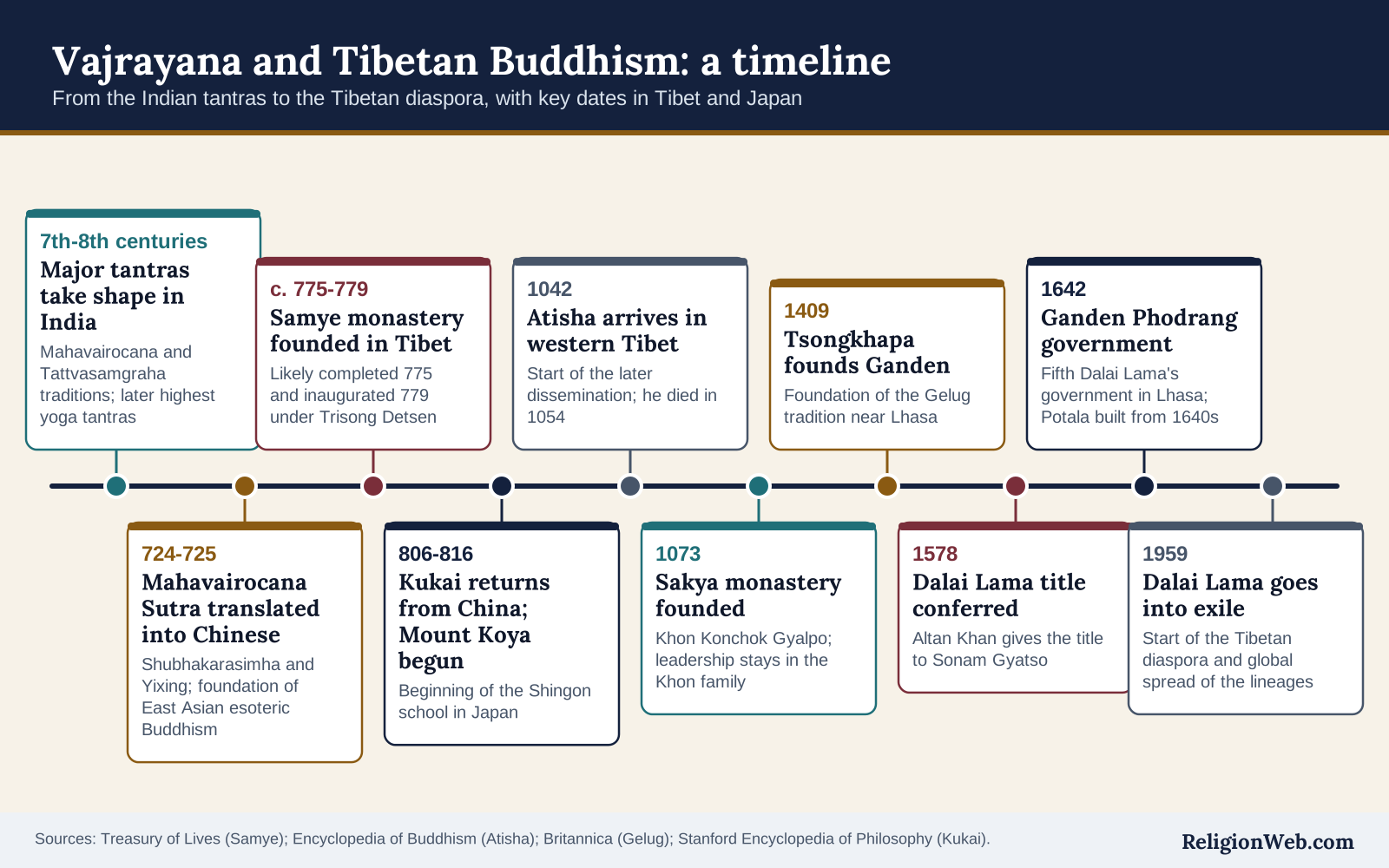
| Date (CE) | Event | Significance |
|---|---|---|
| 3rd to 4th centuries | Dharani scriptures appear in Chinese translation catalogues | Early protective and ritual formulas within Mahayana Buddhism |
| 7th to 8th centuries | Major tantric scriptures take shape in India | Mahavairocana and Tattvasamgraha traditions; later highest yoga tantras |
| 724 to 725 | Mahavairocana Sutra translated into Chinese | Foundational text of East Asian esoteric Buddhism |
| c. 775 to 779 | Samye monastery founded in Tibet | First Buddhist monastery of the Tibetan Empire |
| 806 and 816 | Kukai returns from China; begins building on Mount Koya | Beginning of the Shingon school in Japan |
| 1042 | Atisha arrives in Tibet | Marks the later dissemination and a renewal of monastic discipline |
| 1073 | Sakya monastery founded | Start of the Sakya lineage and of its Mongol-era influence |
| 1409 | Ganden monastery founded by Tsongkhapa | Foundation of the Gelug tradition |
| 1642 | Ganden Phodrang government established by the Fifth Dalai Lama | Joined religious and political authority in Lhasa |
| 1959 | The Fourteenth Dalai Lama goes into exile in India | Start of the Tibetan diaspora and global spread of the lineages |
Core Ideas: Bodhicitta, Emptiness, Transformation, and the Meaning of Tantric Imagery
The Mahayana Ground of Vajrayana Practice
Bodhicitta and the bodhisattva vow
Every Vajrayana lineage begins from the aim that defines the Mahayana, which is bodhicitta, the “awakening mind.” It is the resolve to attain full Buddhahood for the sake of all sentient beings, and it is expressed in the bodhisattva vow. Tibetan teachers insist that tantric technique without this motivation is considered a misuse of the path, and that the motivation, not the exotic setting, is what makes a practice Buddhist. Training in bodhicitta usually precedes tantric initiation and continues alongside it, through reflection on suffering and impermanence, the cultivation of compassion, and the study of texts such as Shantideva’s Bodhicaryavatara, an eighth-century Indian poem on the bodhisattva path that is widely taught in Tibetan monasteries.
This is why Tibetan Buddhism has often been described as a layered system. A person may take refuge and keep precepts, then take the bodhisattva vow, and only after that approach tantric practice through empowerment. The sequence is not a rigid rule in every lineage, and some Nyingma and Kagyu teachings introduce students to direct meditative experience early. Even so, the order of precepts, bodhicitta, and tantra is the one most often laid out in Tibetan manuals of the path, such as Tsongkhapa’s Great Treatise on the Stages of the Path to Enlightenment (Lamrim Chenmo).
Emptiness and the two truths
The philosophical view behind tantric practice is the Mahayana doctrine of emptiness (shunyata). Developed in the writings of Nagarjuna and his commentators, it holds that no phenomenon has an independent, self-existing nature; things exist in dependence on causes, parts, and the mind that labels them. Madhyamaka philosophy distinguishes two levels of truth: conventional truth, in which persons, objects, and actions function in the ordinary world, and ultimate truth, which is emptiness. Tibetan lineages interpret the details of this view differently, and the debates among Gelug, Sakya, Kagyu, Nyingma, and Jonang thinkers were long and sophisticated. All of them nevertheless treat emptiness as the basis on which tantric imagery makes sense.
The link is straightforward in outline. If phenomena are empty of fixed nature, then the sense of being an ordinary, limited self is not a final fact, and it may be transformed by taking up a different way of seeing. Deity yoga, described below, uses this idea: the practitioner visualizes a deity who is, by definition, an appearance without inherent existence, and in doing so trains the mind to experience form as empty and emptiness as form. In the literature this is often called the union of appearance and emptiness, or of clarity and emptiness, and in some tantras the union of bliss and emptiness.
How Tantra Understands Transformation
Taking the result as the path
Tibetan authors contrast two ways of approaching awakening. The causal vehicle, which includes the sutra path, accumulates the causes of Buddhahood such as generosity, ethics, patience, and wisdom, over what texts describe as countless lifetimes. The resultant vehicle of tantra “takes the result as the path,” by rehearsing the qualities of a Buddha from the outset. The practitioner imagines having a Buddha’s body, speech, and mind, and works to train in them. The tradition does not claim that the imagination alone brings awakening; it says that the visualized qualities act as a template that the mind grows into, supported by the teacher’s blessing, the practitioner’s moral discipline, and the realization of emptiness.
This framework explains the standard claim that Vajrayana offers a swifter route, sometimes described as awakening in a single lifetime. Teachers add a warning that is as much a part of the tradition as the promise. A rapid method is only as effective as the preparation behind it, and tantric texts spend considerable space on the qualities of a suitable student, the need to test a teacher, and the commitments that follow initiation. For most practitioners, then, the path is slow in practice, because it rests on years of study, ethical living, and repeated recitation.
Subtle mind, the three bodies, and buddha-nature
Tantric traditions draw on the Mahayana teaching of buddha-nature, the idea that all beings have the potential for awakening, and on the doctrine of the three bodies of a Buddha: the truth body (dharmakaya), the enjoyment body (sambhogakaya), and the emanation body (nirmanakaya). In deity yoga, the three are linked to stages of practice, and the visualized deity corresponds to the enjoyment body, a form of radiant light through which the awakened mind is said to appear to advanced bodhisattvas. The advanced tantras also describe a subtle physiology of channels, winds, and drops, and speak of a most subtle level of mind, often called clear light, that is said to become manifest at death and in deep meditation. Public books by Tibetan teachers explain these ideas in general terms; the detailed techniques that work with them belong to the restricted instructions of the lineages and are not described here.
How Tantric Imagery Is Interpreted
Deities as awakened qualities
Newcomers often ask whether Vajrayana is polytheistic. The question depends on what is meant by “deity.” Tibetan teachers describe the principal figures, called yidam or meditational deities, as manifestations of enlightened qualities rather than as independent gods who govern the world or who can be asked to alter it at will. Avalokiteshvara, called Chenrezig in Tibetan, embodies compassion; Manjushri, wisdom; Vajrapani, power; and Tara, swift and protective compassion. Practitioners pray to these figures, make offerings to them, and recite their mantras, and some Tibetan lay practice has a devotional flavor that resembles the worship of a personal protector. At the same time, the teaching of the philosophical schools is that each figure is ultimately a reflection of the practitioner’s own buddha-nature, and that to treat the deity as a distant external being misses the purpose.
There are also local and protective deities, the dharmapala or Dharma protectors and the spirits of mountains and lakes, who were incorporated into Tibetan Buddhism as it spread. Tibetan sources treat these as beings who have been bound by oath to support the teachings, and who may be either enlightened beings in a fierce form or worldly spirits still subject to karma. Scholars note that the integration of local deities is a long historical process, and the details vary by region and lineage.
Peaceful and wrathful forms, and the imagery of union
Vajrayana art includes peaceful figures and fierce ones with flaming hair, bulging eyes, and garlands of skulls. The fierce forms are described as expressions of compassion acting forcefully against ignorance, hatred, and self-grasping, and the trappings are explained in teachers’ commentaries as symbols: the skulls recall impermanence and the transformation of what is ordinarily feared, and the flames represent the burning away of obstacles. The explanations differ by lineage and by deity. Another recurring image is that of a deity in embrace with a consort, called yab-yum in Tibetan, “father-mother.” Tibetan commentaries read this as a symbol of the union of method, which is compassion, and wisdom, which is the realization of emptiness, and not as a model for ordinary behavior. The question of how such imagery relates to actual practice is a frequent misunderstanding and is addressed in the section on common misconceptions.
Tantric Scriptures, Classes of Tantra, and the Rules of Authorization
The Tantric Canon and Related Literature
Tantras, commentaries, and liturgies
Vajrayana literature includes several layers. At the center are the tantras themselves, scriptures presented as discourses by a Buddha in the form of a deity, often in dialogue with a retinue. Well-known examples include the Guhyasamaja, Hevajra, Cakrasamvara, and Kalacakra tantras, as well as the Mahavairocana and Vajrasekhara in the East Asian tradition. Around the tantras grew a large body of Indian commentary, composed by scholars and siddhas, and a literature of liturgical manuals called sadhana, Sanskrit for “means of accomplishment,” which present the step-by-step structure of a meditation on a particular deity. Most Tibetan canonical tantras survive only in Tibetan, since the Sanskrit originals were lost in India; others survive in Sanskrit manuscripts preserved in Nepal.
The Tibetan canon assigns these texts to specific places. In the Kangyur, the collection of texts regarded as the Buddha’s word, the tantras form their own major division beside the Vinaya and the sutras, and the Tengyur gathers Indian commentaries and sadhanas. The Nyingma lineage maintains an additional collection, the Nyingma Gyubum, “the hundred thousand tantras of the Nyingma,” which was compiled in the fifteenth century and includes works not accepted in the standard canon by the newer schools. In the Chinese canon as standardized in the Taisho edition, the esoteric texts occupy volumes 18 to 21. The structure of the canons, including the relation of the Kangyur and Tengyur to the Chinese collection, is described in the broader article on Buddhism.
Terma: revealed and rediscovered texts
A distinctive feature of the Nyingma tradition, and of Bon, is the category of terma, “treasure,” meaning teachings concealed for later discovery. According to the tradition, Padmasambhava and his consort Yeshe Tsogyal hid teachings in rocks, lakes, and temples, or in the mind-stream of future students, to be found by destined practitioners called tertons (“treasure revealers”) when conditions were right. Prominent tertons include Nyang Ral Nyima Ozer (twelfth century), Guru Chowang (thirteenth century), Pema Lingpa (1450 to 1521) in Bhutan, and, in the nineteenth century, Jamyang Khyentse Wangpo and Chogyur Lingpa. The best-known terma in the West is the Bardo Thodol, “Liberation Through Hearing in the Intermediate State,” which tradition attributes to Padmasambhava and which was revealed by Karma Lingpa in the fourteenth century.
The status of terma is a matter on which perspectives differ. Within the lineages that hold them, terma are authentic transmissions whose legitimacy is tested by the tertons’ character, the match with earlier teaching, and the results of practice. Scholars of Tibetan history observe that the terma tradition provided a way for new material to enter the canon with the authority of antiquity, and that some treasure texts seem to contain older materials while others reflect their revealers’ own times. Both observations can be held together without disputing the religious meaning the texts have for those who use them.
The Classes of Tantra
The four classes in the New Translation schools
Tibetan lineages that follow the translations of the second dissemination, the “New Translation” or Sarma schools (Kagyu, Sakya, and Gelug, and in this respect also Kadam and Jonang), sort the tantras into four classes according to the practitioner’s temperament and the method. Kriya tantra emphasizes outer ritual, purity, and offerings, and treats the deity as a lord to be approached with respect. Charya tantra, sometimes called Upa, balances outer ritual with inner meditation and treats the deity as a friend. Yoga tantra focuses more on meditative identification with the deity. The fourth class, Anuttarayoga or highest yoga tantra, includes the practices on which the later Tibetan lineages place their weight. Within it, Tibetan writers distinguish father tantras, which stress the generation of the deity’s form, mother tantras, which stress the wisdom aspect, and non-dual tantras. Examples include the Guhyasamaja among the fathers and the Cakrasamvara and Hevajra among the mothers, while the Kalacakra is often placed in the non-dual category.
These categories are an organizing scheme developed by Tibetan scholars to make sense of Indian materials, and they are not found in the same form in the East Asian tradition. Shingon, for example, centers on two sets of teaching, the Womb or Matrix realm associated with the Mahavairocana Sutra and the Diamond realm associated with the Vajrasekhara.
The Nyingma nine vehicles and the Great Perfection
The Nyingma tradition uses a different classification, the nine vehicles. The first three, hearers, solitary realizers, and bodhisattvas, correspond to the sutra path. The next three, Kriya, Upa, and Yoga, are the outer tantras. The last three, Mahayoga, Anuyoga, and Atiyoga, are the inner tantras. Atiyoga, the pinnacle in this scheme, is also known as Dzogchen, “the Great Perfection,” a system of teaching about the natural purity and spontaneous presence of the mind. Dzogchen is also taught in the Bon tradition, in a version with its own lineage, and Tibetan Buddhist teachers of other lineages place related instructions within the Mahamudra tradition of the Kagyu. The exact relationships between these streams are the subject of scholarly and lineage debate, which this article does not attempt to resolve.
Who May Receive and Practice What
Empowerment, reading transmission, and explanation
Access to Vajrayana texts and practices depends on a system of transmissions. Tibetan teachers distinguish three kinds. The first is the empowerment (wang, Sanskrit abhisheka), a ritual that authorizes a student to practice a particular deity. The second is the reading transmission (lung), in which a teacher recites a text aloud so that the student receives its lineage of authority. The third is the explanation or instruction (tri), in which a teacher teaches how to practice it. A student who wishes to practice a deity yoga is traditionally expected to have obtained all three, and teachers state that reading a tantra without them is inadvisable.
The rule is not applied identically everywhere. Many public events labeled empowerments are in fact simpler permissions (jenang) or blessings, in which anyone may take part, and teachers may state in advance whether the audience should expect to take on commitments. The tradition also recognizes that a person’s circumstances differ, and teachers adapt the requirements to the student’s training.
Open and restricted teachings
It helps to see the system as a gradient, from teachings that anyone may hear to those taught to a few. The table below sets out a general picture, with the caution that each lineage and each teacher applies the rules in their own way.
| Category | Examples | Typical authorization |
|---|---|---|
| Sutra-level and general teachings | Stages-of-the-path (lamrim) literature, the Bodhicaryavatara, commentaries on emptiness | Open public teaching; a reading transmission is customary |
| Open devotional and blessing practices | The mantra of Avalokiteshvara, prayers to Tara, long-life prayers | Generally open to all; often given in public ceremonies as a permission |
| Outer tantras | Kriya, Charya, and Yoga tantra practices | Empowerment or permission, with fewer commitments |
| Highest yoga tantras | Guhyasamaja, Cakrasamvara, Hevajra, Kalacakra | Full empowerment, tantric vows, preliminary training, and ongoing guidance |
| Great Perfection and Mahamudra instructions | Dzogchen and Mahamudra pith instructions | Direct introduction by a qualified teacher; requirements vary by lineage |
| Treasure (terma) cycles | Revealed liturgies such as those of Pema Lingpa and Jamyang Khyentse Wangpo | Empowerment and transmission from an authorized holder of the cycle |
The gradient is partly practical and partly moral. The practical reason is that tantric methods presuppose training in ethics, compassion, and the view of emptiness. The moral reason is that the tradition understands the empowered student to have entered a relationship of trust and responsibility with a teacher and a lineage, a relationship discussed in the next section.
The Lama, Empowerment, and Samaya: How Vajrayana Transmission Works
The Teacher in Vajrayana
Lama, guru, and rinpoche
In Vajrayana the relationship with a teacher is not an optional support but the channel through which the practices are transmitted. The Sanskrit word guru means a teacher, and its Tibetan counterpart lama is used for qualified teachers, including monks, nuns, and lay practitioners who have completed extensive training. Not every monk is a lama, and the term is also sometimes used as a courtesy. Rinpoche, “precious one,” is an honorific for teachers regarded as reincarnations of earlier masters or as particularly eminent. In Japanese Shingon the teacher is the ajari, from the Sanskrit acarya, and the master who transmits the full teachings holds a recognized rank in a lineage that reaches back to Kukai and, in the school’s account, to the Indian and Chinese masters before him. Among the Newar Buddhists of Nepal, the corresponding figure is the Vajracharya priest.
The tradition explains the teacher’s importance in several ways. The practical reason is that the techniques are subtle, and the student needs someone who has done them to correct errors. The symbolic reason is that the teacher links the student to a lineage, an unbroken chain of masters and students going back to the Buddha or to the enlightened forms from whom the tantras are said to derive. Texts therefore speak of the teacher as embodying the three jewels, and in a prayer form called guru yoga, the student visualizes the teacher as inseparable from the deities, a practice meant to open the mind to the teacher’s realization.
Lineage, tulkus, and the recognition of reincarnate teachers
Tibetan Buddhism developed a distinctive way of handling succession, in which some teachers are recognized as the rebirths of earlier masters. A reincarnate teacher is called a tulku, “emanation body.” The practice is generally traced to the Karmapa lineage, whose first holder, Dusum Khyenpa (1110 to 1193), is regarded as the earliest recognized tulku. It spread to other schools and monasteries, and the Dalai Lama and Panchen Lama lineages of the Gelug are its best-known examples. Recognition typically involves searching for a child, testing the child’s knowledge of the predecessor’s possessions and circumstances, and consulting oracles and teachers, and it can be a matter of institutional authority as well as of faith. In the twentieth and twenty-first centuries, recognition has at times been disputed within a lineage or contested by governments. The Dalai Lama stated in July 2025 that the Gaden Phodrang Trust holds sole authority to recognize his future rebirth, a position the government of the People’s Republic of China rejects.
Not all Vajrayana lineages use reincarnation. The Sakya lineage transmits its leadership within the Khon family, and Newar Vajracharyas and Japanese Shingon priests receive their roles through ordination or family training.
Empowerment: The Public Shape of the Rite
What an empowerment is and how it is structured
An empowerment (wang in Tibetan, abhisheka in Sanskrit, literally “sprinkling” or “anointing”) is a ritual in which a teacher authorizes a student to practice a particular deity or system. The word echoes the Indian royal consecration, in which a king was anointed to rule, and the ritual in a sense inducts the student into the retinue of the deity. Publicly known features can be described in general terms. A mandala is prepared in advance, either as a painted or sand mandala or as a visualized one. The teacher and attendants make offerings and recite liturgy. Students receive blessings through objects such as a vase of consecrated water, a ritual vajra and bell, and sometimes through symbolic items placed on the head or hand. They take refuge, renew the bodhisattva vow, and accept commitments connected with the practice. The ceremony may last a few hours or several days, and in some cases it is spread over multiple sessions.
In the highest yoga tantras the empowerment is traditionally conferred in four stages, usually named the vase, secret, wisdom-knowledge, and word empowerments. Teachers explain them as ripening the student’s body, speech, and mind and then the nature of mind itself, and as introducing the stages of the corresponding meditation. The content of the later stages is regarded as restricted and is conveyed to those who attend the rite, so it is not described here. Shingon has parallel ceremonies. In the “connection” rite (kechien kanjo) a layperson or beginner forms a link with a deity by casting a flower on a mandala, an act open to wide participation, while the full “transmission” rite (denbo kanjo) confers the rank of teacher on priests who have completed training.
Samaya: commitments and vows
Receiving an empowerment brings obligations. Tibetan Buddhism recognizes three levels of vow that a practitioner may hold at once: the vows of individual liberation, such as the monastic precepts or the lay five precepts; the bodhisattva vows; and the tantric commitments, called samaya in Sanskrit and damtsik in Tibetan. The root commitments are described in texts and teachings as involving maintaining respect for the teacher, avoiding actions that damage others, nurturing love and compassion, and not abandoning the view of emptiness or the bodhisattva aim, along with specific pledges attached to each deity. A student who takes them accepts a daily practice, often brief, and the avoidance of behavior that would break the bond.
Tibetan teachers describe the commitments as protective rather than punitive. In their account, breaking a commitment is not an offense against an external judge but a weakening of the practitioner’s own capacity to benefit from the path, and the commitments can be repaired through confession and purification practices such as the recitation of the Vajrasattva mantra. Many teachers also advise students who feel unable to keep commitments not to take them, which is why public ceremonies often state at the outset who may attend.
Devotion, Discernment, and Accountability
What the texts say about guru devotion
Tibetan literature places strong emphasis on devotion to the teacher, and texts such as the Fifty Verses of Guru Devotion and the guru yoga practices of every lineage describe the ideal of regarding one’s teacher as a Buddha. The same literature, however, also lays down a requirement for examination. Texts list the qualities of a suitable teacher, including knowledge of the doctrine, moral discipline, compassion, and experience in practice, and they advise prospective students to observe a teacher for a long period before committing. The standard interpretation by lineage scholars is that the practice of seeing the teacher as a Buddha is a training in perception and gratitude, and that it does not mean that the teacher is infallible or that students should follow instructions that contradict ethics.
Modern debates and safeguards
In recent decades, Vajrayana communities in Asia and in the West have faced public discussion of cases in which teachers misused their authority, including accusations of sexual, physical, and financial abuse. In response, a number of organizations have adopted codes of conduct, independent complaint procedures, and ethics committees, and some teachers have said publicly that students are entitled to question a teacher’s behavior and, where necessary, to report it to the civil authorities. Western Buddhist teachers met the Dalai Lama in Dharamsala in 1993 to discuss the issue, and he and other Tibetan teachers have since repeatedly said that serious misconduct by a teacher should be acknowledged and addressed in public. The debate is ongoing, and communities differ in how far traditional norms of devotion need to be balanced by institutional accountability.
Anyone considering formal study of tantric Buddhism, as with any intensive spiritual path, can reasonably expect to take time to learn about a teacher and the community around them. Meditation and ritual practice are not substitutes for mental-health care, and Tibetan teachers themselves frequently advise people in acute distress to seek professional help.
Deity Yoga, Mantra, Mudra, and Mandala: The Ritual Technologies of Vajrayana
Deity Yoga and the Sadhana
The structure of a deity practice
Deity yoga is the central technique of the Vajrayana. In Tibetan it is called lhai naljor, the “yoga of the deity,” and it consists of meditating on oneself as a particular awakened being, such as Avalokiteshvara, Tara, Manjushri, or Vajrayogini, whose qualities the practitioner wishes to realize. The practice is organized in a liturgy, the sadhana, and the general pattern of a sadhana is public knowledge. It typically begins with taking refuge and generating the aim of awakening for the benefit of all beings. It continues with the visualization of the deity and the deity’s surroundings, offerings and praise, the recitation of the deity’s mantra, a dissolution of the visualization into emptiness, and a final dedication of the merit to all beings. The practice is thus framed at each end by bodhicitta and by the philosophy of emptiness.
Tibetan manuals divide the work of the highest yoga tantras into two phases: the generation stage (kyerim), in which the practitioner trains in the clear visualization of the deity and its palace, and the completion stage (dzogrim), which uses the dissolution of that visualization and other advanced methods to realize the nature of mind. The details of the completion stage belong to restricted instruction. What can be said publicly is that the sequence moves from construction to dissolution, so that nothing in the practice is intended to become a fixed object of attachment.
Divine pride and pure perception
Two terms often puzzle newcomers. “Divine pride” (lhai nga-gyal) is not pride in the ordinary sense. It means a confident sense of being the deity, as a counter to the habit of seeing oneself as limited and flawed, and it is explicitly paired with the recognition that the deity’s form is empty of independent existence. “Pure perception” (dagnang) is the practice of seeing one’s surroundings, the teacher, and other beings as sacred. Teachers present both as disciplines that undermine self-centered ways of thinking, and they warn that these practices are easily misunderstood if taken as a claim of personal superiority. Used well, the tradition says, they reduce arrogance, since the qualities one imagines are not one’s own possessions.
Mantra and Mudra
Mantra as sound, protection, and identity
A mantra is a sacred sound formula, usually in Sanskrit or in a Sanskritized form, that is recited with a particular intention. Tibetan etymology reads the Tibetan term ngak as “protecting the mind,” in the sense that the recitation keeps the mind from drifting into ordinary preoccupations. Mantras may be long, as in the dharani, or short, ending in “seed syllables” such as hum or ah that carry symbolic meanings. The best-known is Om mani padme hum, the six-syllable mantra of Avalokiteshvara, which is carved on stones, printed on prayer flags, and written inside prayer wheels throughout the Tibetan world. Teachers offer different interpretations of its syllables. One traditional reading assigns the six syllables to the six perfections, another to the purification of the six realms of existence, and the Dalai Lama and many other teachers describe the mantra’s meaning in terms of compassion and wisdom, the “jewel” and “lotus” of the phrase. The mantra of Tara, Om tare tuttare ture soha, and the Vajra Guru mantra associated with Padmasambhava are equally common in Tibetan and Himalayan practice. The closing mantra of the Heart Sutra, gate gate paragate parasamgate bodhi svaha, which is recited in both Tibetan and East Asian traditions, is conventionally glossed in paraphrase as “gone, gone, gone beyond, gone altogether beyond, awakening, hail.”
Recitation is counted on a string of 108 beads, called a mala, and practitioners may take on a number of recitations over days or months. In public life, mantras are also spoken or carried in material form, as the wind moves a prayer flag or a wheel turns, and Tibetan practitioners regard these acts as extending the benefit of the recitation to others. Whether and in what sense a spoken mantra “works” is a question that the tradition answers in terms of the practitioner’s motivation, concentration, and the transmission received from a teacher. Mantras that come with a specific empowerment, such as those of the wrathful or highest yoga deities, are not meant to be used casually, and teachers customarily give permission before a student begins their recitation.
Mudra: gesture in practice and image
Mudra, “seal” or “gesture,” refers to symbolic hand positions and body postures used in ritual and shown in sacred art. A familiar example in imagery is the earth-touching gesture of the Buddha at the moment of awakening, the gesture of teaching the dharma with the hands in front of the chest, the gesture of meditation with the hands resting in the lap, the gesture of giving, with the palm out and fingers pointing down, and the gesture of fearlessness, with the palm raised. Ritual practice uses these and a larger repertoire of gestures made during offerings, recitations, and visualizations. In Tibetan liturgy, the combination of hand gestures, bell, and vajra forms part of the ritual, while in Shingon the practitioner’s hands form specific seals for each deity, which are recorded in manuals and taught directly by a teacher.
Mudra also occurs in sacred dance. In the masked cham dances performed at Himalayan monasteries, and in the ritual dances of Newar Buddhism, movements and gestures are coordinated with chanting and instrumental music. Practitioners regard such dances as a form of offering and as a way to subdue negative forces. For a visitor, the dance is also a performance of the teachings in a form that people with no literacy in Buddhist philosophy can follow.
The Mandala
The meaning and architecture of a mandala
The Sanskrit word mandala means “circle” or “disk,” and the Tibetan equivalent kyilkhor means “center and surroundings.” In Vajrayana a mandala is the sacred environment of a deity: a palace seen from above, with a central residence in the middle, four gates at the cardinal points, and concentric circles representing protective barriers. In many Tibetan mandalas the outer rings include a circle of fire, a circle of vajras, and a ring of eight cemetery grounds, each with symbolic meaning, and inside the walls is a lotus on which the central deity stands. Everything in the picture is interpreted as an aspect of awakened mind. The gates stand for the four immeasurables, for example, and the walls for the perfections. A mandala can be two-dimensional, as in a painting or sand construction, or it can be visualized entirely in the mind.
Different traditions use different mandala systems. Shingon is organized around the pair of mandalas of the Womb realm and the Diamond realm, which are hung together in ritual halls and which Kukai brought back from China. The Womb mandala, drawn from the Mahavairocana Sutra, depicts the compassionate, nurturing aspect of the cosmos, with the Buddha Mahavairocana at the center of an eight-petaled lotus. The Diamond mandala, drawn from the Vajrasekhara, is arranged in nine sections and expresses wisdom. Tibetan sources organize mandalas around the deities of specific tantras, such as Kalacakra or Guhyasamaja. For all of these systems, the mandala has a double function: it is the diagram of the practitioner’s awakened world and the map of the ritual’s space.
Sand mandalas and mandala offerings
The most famous mandala form outside Tibet is the sand mandala, called dul-tson kyilkhor in Tibetan, “mandala of colored powder.” In a documented example, monks of Drepung Loseling Monastery built one for the Frist Art Museum in Nashville over five days in February 2017. A chalk-coated cord marked the grid lines, the monks consecrated the work with a vajra, a bell, and a barley grain, and four monks, each at one quadrant, poured colored sand through narrow metal funnels called chak-pur, which are vibrated with a metal rod to release the sand. The work proceeded from the center outward, with meditation on each part of the design, and no glue held the sand in place. Sand mandalas are usually dismantled soon after completion in a closing ceremony, in which the monks sweep up the sand and, in the traditional form, carry it to flowing water or distribute it among the community.
A different use of the mandala is the mandala offering, in which a practitioner arranges rice or grain in layers on a round plate to represent the whole universe and offers it, in imagination, to the teacher and the Buddhas. It is one of the four traditional preliminary practices (ngondro), which also include prostrations with refuge, Vajrasattva purification, and guru yoga, and which in many lineages involve a hundred thousand repetitions of each. The offering is an act of generosity that is meant to loosen attachment, and the same visual form appears in the daily prayers of monks and laypeople.
| Term | Language and meaning | Role in practice |
|---|---|---|
| Vajra and bell | Sanskrit vajra, Tibetan dorje; Sanskrit ghanta, Tibetan drilbu | Paired ritual implements; the vajra is commonly explained as method and the bell as wisdom |
| Mantra | Sanskrit, “instrument of thought”; Tibetan ngak, “protecting the mind” | Sound formula recited to engage speech and the deity’s qualities |
| Mudra | Sanskrit, “seal” or “gesture” | Symbolic gestures in ritual and iconography; the body aspect of practice |
| Mandala | Sanskrit, “circle”; Tibetan kyilkhor, “center and surroundings” | Diagram and visualized palace of a deity; used in empowerment and offering |
| Sadhana | Sanskrit, “means of accomplishment” | Liturgical text that structures a deity practice |
| Yidam | Tibetan, “meditational deity” | The awakened being on whom a practitioner meditates |
| Dharmapala | Sanskrit, “Dharma protector”; Tibetan chokyong | Guardian figures invoked to protect teachings and practitioners |
| Torma | Tibetan ritual cake of barley flour and butter | Offering that symbolizes food, wealth, or the deity’s palace |
| Tsok | Tibetan, “gathering”; Sanskrit ganacakra | Communal feast offering held on specific days, with food, drink, and prayer |
The Major Tibetan Traditions: Nyingma, Kagyu, Sakya, and Gelug
Old and New Translation Lineages
The Nyingma and the Old Translation tradition
The Nyingma, whose name means “the Ancient Ones,” is the tradition that traces itself to the first dissemination of Buddhism under the Tibetan emperors. It honors Padmasambhava, Shantarakshita, and the king Trisong Detsen as its founders, and it values the teachings translated in that period, together with the treasure texts discussed earlier. Its characteristic emphasis is the Great Perfection (Dzogchen), and it has produced philosophers such as Longchenpa (1308 to 1364) and, in the modern period, Jamgon Mipham (1846 to 1912). Unlike the other lineages, the Nyingma did not originally center on one hierarchy or a single founding monastery. It developed through household lamas, hermits, and a network of monasteries, among which six are often called “mother monasteries”: Kathok, Dorje Drak, Mindrolling, Palyul, Shechen, and Dzogchen. A distinctive Nyingma figure is the ngakpa or ngakma, a non-monastic tantric practitioner, traditionally married and often wearing white robes and uncut hair, who performs rituals for communities.
The New Translation lineages of the second dissemination
The other major schools, Kagyu, Sakya, and Gelug, as well as the earlier Kadam, arose in the eleventh to fifteenth centuries on the basis of new translations from Indian originals, and they are known as the Sarma, or “New,” schools. They share the four classes of tantra and a strong interest in Indian Buddhist philosophy and monastic discipline, and they differ chiefly in lineage, in the emphasis they give to particular tantras and philosophical views, and in institutional history. The differences should not be exaggerated. Tibetan teachers of every lineage study the same Indian classics, attend one another’s teachings, and borrow practices, and the lines between the schools are often more porous in practice than a table of names suggests.
The Kagyu, Sakya, and Gelug Lineages
Kagyu: the Oral Lineage and Mahamudra
The Kagyu, “the Oral Transmission lineage,” goes back to the translator Marpa (about 1012 to 1097), his student the yogi Milarepa (about 1052 to 1135), and Milarepa’s student Gampopa (1079 to 1153), who combined the Kadam monastic tradition with Marpa’s tantric lineage. From Gampopa’s students came several branches, among them the Karma Kagyu, the Drikung, and the Drukpa. The Kagyu emphasize Mahamudra, “the great seal,” a system of meditation on the nature of mind, and the six yogas associated with Naropa, which are practiced in retreat under a teacher’s guidance. The Karma Kagyu are led by the Karmapa, regarded as the first tulku lineage. The recognition of the seventeenth Karmapa has been contested, and the community includes followers of two candidates, Ogyen Trinley Dorje and Trinley Thaye Dorje. The Drukpa Kagyu became the state religion of Bhutan in the seventeenth century, and the lineage’s three-year retreat tradition is widely admired.
Sakya: the Khon family and Lamdre
The Sakya school grew from the monastery founded in 1073 by Khon Konchok Gyalpo at a site in southern Tibet whose gray earth gave it the name “pale earth.” Leadership has passed within the Khon family, and the head is called the Sakya Trizin, “holder of the Sakya throne.” The school’s central tantric system is the Lamdre, “the path and its result,” based on the Hevajra Tantra and transmitted from the Indian siddha Virupa through Drogmi Lotsawa. Sakya Pandita (1182 to 1251) was a major scholar whose work on logic and monastic discipline shaped Tibetan intellectual life, and his nephew Phagpa (1235 to 1280) served as imperial preceptor at the court of Kublai Khan. The Ngor and Tsar subschools within the Sakya developed in the fifteenth and sixteenth centuries.
Gelug: the Ganden tradition of Tsongkhapa
The Gelug, “the Virtuous Tradition,” traces itself to Tsongkhapa (1357 to 1419), who founded Ganden monastery near Lhasa in 1409. Tsongkhapa was a scholar who drew on the Kadam heritage and wrote the Lamrim Chenmo, a comprehensive manual for progressing from basic training to tantra, together with treatises on Madhyamaka philosophy and the tantras. Disciples established Drepung (1416), Sera (1419), and later Tashilhunpo (1447). The Gelug stresses monastic discipline and scholastic training, and its curriculum includes the study of perfection of wisdom, Madhyamaka, logic and epistemology, Abhidharma, and Vinaya, learned in part through formal debate. Its principal tantric practices include Guhyasamaja, Cakrasamvara, and Yamantaka. The Dalai Lama is the school’s best-known figure, but its formal head is the Ganden Tripa, the throne holder of Ganden, who holds the position for a term. The Dalai Lama’s wider role is taken up in the section on misconceptions.
Other Traditions and the Nonsectarian Movement
Kadam and Jonang
Two further traditions deserve mention. The Kadam, founded by Atisha’s student Dromton, whose monastery of Reting dates to 1057, was a monastic order that stressed the combination of the bodhisattva path with discipline and emphasized mind-training (lojong) texts. It was later absorbed in large part into the Gelug and other lineages, but its spirit persists in these. The Jonang, associated with the scholar Dolpopa Sherab Gyaltsen (1292 to 1361), is known for a distinctive interpretation of buddha-nature, called “emptiness of other” (shentong), and for its Kalacakra practice. Its monasteries were taken over by other institutions in the seventeenth century, but the tradition survived in eastern Tibet and is now present in exile communities.
The Rime movement
In the nineteenth century, scholars in the Kham region of eastern Tibet, notably Jamgon Kongtrul (1813 to 1899) and Jamyang Khyentse Wangpo (1820 to 1892), led what is called the Rime, or “nonsectarian,” movement. Its purpose was to preserve the teachings and lineages of all the schools, including some that were in decline, and to encourage teachers to study across traditions. Kongtrul compiled enormous collections, including a treasury of revealed teachings and a compendium of Buddhist knowledge. The movement shaped the way many modern Tibetan teachers, especially in Nyingma and Kagyu, work with students from various backgrounds.
Bon and how scholars describe it
Bon is a distinct religious tradition of Tibet with its own monasteries and scriptures. Bonpos, the followers of Bon, trace their religion to Tonpa Shenrab Miwoche, a teacher from the western kingdom of Zhang Zhung, and they regard it as the original religion of Tibet. Academic specialists, including Samten Karmay and Per Kvaerne, describe a more layered history. They note that ritual practices existed on the plateau before Buddhism, but that “Bon” as an organized religious tradition with a canon and monasteries took shape from about the tenth and eleventh centuries, in interaction with Buddhism, and that the two share many practices, including treasure texts and the Great Perfection, along with the vocabulary of monastic life. Followers of Bon, for their part, hold that these shared elements reflect their own older heritage. The Central Tibetan Administration in exile recognizes Bon as one of Tibet’s spiritual traditions. Most scholars treat Bon as a separate religious tradition in conversation with Buddhism, not as a school of Buddhism, and the distinction is important to its adherents.
| Tradition | Origins and founders | Distinctive emphases | Notable institutions |
|---|---|---|---|
| Nyingma | First dissemination; Padmasambhava, Shantarakshita, Trisong Detsen | Dzogchen; terma (treasure) tradition; non-monastic tantric practitioners | Kathok, Dorje Drak, Mindrolling, Palyul, Shechen, Dzogchen |
| Kagyu | Marpa, Milarepa, and Gampopa, eleventh and twelfth centuries | Mahamudra; six yogas of Naropa; retreat tradition | Karma Kagyu, Drikung, Drukpa; Tsurphu, Rumtek |
| Sakya | Khon Konchok Gyalpo, 1073 | Lamdre (path and result); Hevajra; scholarship | Sakya monastery; Ngor and Tsar subschools |
| Gelug | Tsongkhapa, early fifteenth century | Lamrim; monastic curriculum with debate; Guhyasamaja, Cakrasamvara, Yamantaka | Ganden, Drepung, Sera, Tashilhunpo |
| Jonang | Dolpopa, early fourteenth century | Shentong view; Kalacakra | Present in eastern Tibet and exile communities |
| Kadam (historic) | Atisha and Dromton, eleventh century | Bodhisattva training; lojong mind-training; discipline | Reting; teachings continued within later schools |
Vajrayana Beyond Tibet: Himalayan, Mongolian, Newar, and Japanese Traditions
The Himalayan and Inner Asian Regions
Bhutan, Ladakh, Sikkim, and neighboring valleys
The Himalayan belt contains communities that share Tibetan religious language and institutions while having their own histories. In Bhutan, the Drukpa Kagyu became the state tradition after the lama Zhabdrung Ngawang Namgyal (1594 to 1651) arrived from Tibet in 1616 and unified the country under a joint system of religious and civil rule. The Central Monastic Body, headed by the Je Khenpo, remains a major institution, and fortress-monasteries called dzong house both administrative offices and monastic communities. Bhutanese Buddhism also preserves a strong Nyingma presence, notably the treasure-revealer Pema Lingpa (1450 to 1521), whose teachings remain central to local practice. Pew Research Center counts Bhutan among the world’s seven Buddhist-majority countries in its 2020 data.
In Ladakh, in India’s far north, large monasteries such as Hemis, Thiksey, and Lamayuru belong to several lineages and sponsor annual festivals. Sikkim has both Nyingma monasteries, such as Pemayangtse, and Kagyu ones, including Rumtek, the seat of the Karmapa in exile. In Arunachal Pradesh, Tawang monastery, founded in the late seventeenth century, is among the largest monasteries in India. Highland Nepal, Spiti, Lahaul, and Zanskar also keep Tibetan-style monastic life, often in lineages that arrived centuries ago and that continue to train novices locally.
Mongolia, Buryatia, Tuva, and Kalmykia
Mongol rulers encountered Tibetan Buddhism in the thirteenth century through the Sakya lamas, and the religion became the dominant faith of the Mongol peoples after Altan Khan’s patronage in the sixteenth century. The Gelug tradition took the leading role, and Mongolia’s own line of high reincarnate lamas, the Jebtsundamba Khutughtu, began with Zanabazar (1635 to 1723), a sculptor, scholar, and religious leader. Monasteries grew in number until the 1930s, when the socialist government carried out a campaign against religion that destroyed most of the country’s monasteries and caused the deaths or imprisonment of many monks. The Gandan monastery in Ulaanbaatar was permitted to reopen in the 1940s on a limited basis, and after the end of one-party rule in 1990 Buddhist practice revived widely. Pew counts Mongolia among the seven Buddhist-majority countries, though the data do not show how many Mongolians participate in monastic life or in particular tantric practices.
In the Russian Federation, Tibetan-style Buddhism is historic among the Buryats of the Lake Baikal region, in the republic of Tuva, and among the Kalmyks near the Caspian Sea. Russian law lists Buddhism among the country’s traditional religions. These communities also experienced severe repression in the Soviet period, including the closure of monasteries and, for the Kalmyks, deportation in the 1940s, and they have rebuilt temples and educational institutions since the 1990s.
Newar Buddhism in the Kathmandu Valley
Vajracharya priests and the courtyard monasteries
The Newars are the indigenous people of the Kathmandu Valley, and the Buddhist part of their community maintains what scholars regard as one of the oldest continuous tantric traditions. Their Buddhism has no celibate monastic order in the usual sense. Instead, hereditary families of Vajracharya priests and of Shakya, who may be priests or craftspeople, serve as ritual specialists, living as householders in courtyard complexes called baha and bahi that descend from earlier monasteries. Boys of these families go through initiation rituals that make them temporary monks, and the priests conduct the empowerments, fire offerings, and life-cycle rites for the community. The liturgy is in Sanskrit, and the ritual tradition is closer in form to the Indian tantric Buddhism of the Pala period than to the Tibetan systems.
Manuscripts, song-dance, and shared sacred ground
The Newars preserved a large part of the Sanskrit Buddhist literature that was lost elsewhere, a fact noted in the discussion of manuscripts in the article on Buddhism. They also maintain a tradition of ritual songs and dances, the charya, performed by Vajracharya priests as a form of deity practice. The Kathmandu Valley contains great stupas such as Swayambhunath and Boudhanath, which attract Newar, Tibetan, and international pilgrims, and the valley’s monument zones were inscribed on the UNESCO World Heritage List in 1979. Newar Buddhist and Hindu communities live side by side, and some festivals and temples, such as the chariot festival of Machhendranath in Patan, are shared across religious lines. The Hindu side of that shared landscape is described in the article on Hinduism.
Shingon, Tendai, and East Asian Esoteric Buddhism
Shingon, Mount Koya, and the two mandalas
Shingon, as described earlier, was founded by Kukai, known after his death as Kobo Daishi. Its headquarters are on Mount Koya in Wakayama Prefecture, where the monastic complex of Kongobuji and the great cemetery and mausoleum area of Okunoin sit in a forest of cedars. UNESCO inscribed Koyasan as part of the “Sacred Sites and Pilgrimage Routes in the Kii Mountain Range” in 2004. Shingon teaches that awakening can be attained “in this very body” (sokushin jobutsu) through the practice of the three mysteries of body, speech, and mind, centered on the Womb and Diamond mandalas and on the cosmic Buddha Mahavairocana. Its rites include the fire ritual (goma), in which offerings are burned before the image of a deity, and meditation on the syllable “A.” Tradition holds that Kukai did not die in 835 but entered a state of deep meditation at Okunoin, and monks there continue to offer him meals each day. Pilgrims also walk the eighty-eight-temple route on the island of Shikoku, which is associated with Kukai.
Tendai esoteric Buddhism and the mountain traditions
Tendai, founded by Saicho, unites Lotus Sutra teaching with esoteric ritual on Mount Hiei, near Kyoto, and its esoteric branch is sometimes called Taimitsu to distinguish it from the Shingon Tomitsu. Later Tendai monks, including Ennin and Enchin, who traveled to China, extended its esoteric curriculum. Both Shingon and Tendai have been closely connected to the mountain ascetic tradition of Shugendo, in which practitioners undertake rigorous retreats on sacred peaks, and to the long Japanese pattern of joint veneration of buddhas and kami, the deities of Shinto, described in the article on Shinto. This arrangement was officially separated by the government in the early Meiji period, but many temples and shrines still keep close ties.
Other traces of esoteric Buddhism in Asia
Esoteric Buddhism also left traces elsewhere. In China, Tibetan Buddhist lineages flourished at the Yuan and Qing courts, and the Yonghe Temple in Beijing, which was converted into a lamasery in 1744, remains a working Tibetan Buddhist monastery. In Indonesia, Borobudur and other Central Javanese monuments reflect the tantric and Mahayana Buddhism of the Sailendra period. These examples are a reminder that “Vajrayana” is not equivalent to the Tibetan form, a point developed further in the section on common misconceptions.
Monastic and Lay Life in Vajrayana Communities
Monastic Life
Vows, ordination, and the daily rhythm
Tibetan monasticism rests on the Vinaya of the Mulasarvastivada school, the monastic code that Tibet adopted from India. A boy or man may enter as a novice (getsul), taking a set of vows that includes celibacy, and may later take full ordination as a monk (gelong), which in the Tibetan count carries 253 rules. Monks hold these vows together with the bodhisattva vows and, if they receive empowerments, tantric commitments, so that the three sets of vows are held simultaneously. Daily life in a large monastery is organized around shared assemblies in the main prayer hall, where monks recite liturgies, chant texts to the sound of long horns, drums, and cymbals, and make offerings. Offices include the chant master (umdze), the disciplinarian, the treasurer, and the abbot or the senior teacher. Monasteries also carry out rituals requested by lay families, such as funerals, blessings for a new house, and annual protective ceremonies.
Not all Vajrayana monastics belong to the Tibetan system. In Japan, Shingon priests train in the ordination and ritual curriculum of their school, which includes demanding periods of austerity on Mount Koya, and since the Meiji period most Japanese Buddhist priests have been allowed to marry. Among the Newars, the priesthood is hereditary and householder-based. The idea that a Buddhist cleric must always be a celibate monk is a feature of some traditions and not of others.
Education, debate, and retreat
Education in the large Gelug monastic universities of Drepung, Sera, and Ganden, which were re-established in South India after 1959, follows a long curriculum that culminates in the geshe degree, often after fifteen or twenty years of study. A distinctive part of the training is debate, in which one monk poses challenges while another defends a position, with the questioner standing and clapping his hands to punctuate each question. Nyingma, Kagyu, and Sakya monasteries have their own institutes for advanced study, called shedra, whose graduates may receive the title khenpo. Study is combined with practice, since a monk’s training includes memorizing liturgies, learning ritual music, and joining the monastery’s regular retreats.
Retreat is an equally important part of the tradition. The Kagyu and some other lineages organize a three-year, three-month retreat during which small groups of practitioners live in seclusion and complete an extensive course of preliminary and main practices under the supervision of a retreat master. Individual practitioners and hermits spend extended periods in mountain hermitages. These retreats are normally undertaken only after a preparation of study and empowerment, and their content is not published.
Nuns and the place of women
Women have long practiced in Vajrayana as nuns, lay yoginis, teachers, and, in the tradition’s narratives, as enlightened figures such as Yeshe Tsogyal, the consort and student of Padmasambhava, and Machig Labdron, the eleventh- and twelfth-century yogini of the Chod tradition. Nunneries exist throughout the Tibetan world and in the diaspora. A historical difficulty is that the Mulasarvastivada lineage of full ordination for women, the gelongma or bhikshuni ordination, is not considered to have been transmitted to Tibet, so Tibetan nuns have mostly held novice vows. Some Tibetan women have received full ordination through the Dharmaguptaka lineage in East Asian communities, and in June 2022 the Je Khenpo, Bhutan’s senior monastic authority, presided over the full ordination of 144 women at Ramthangkha in Bhutan, an event widely described as the first of its scale in the Tibetan tradition. In December 2016, the Dalai Lama awarded the geshema degree, the women’s form of the geshe, to twenty nuns at Drepung Loseling monastery in Karnataka, the first Tibetan nuns to receive it. Opinions among Tibetan authorities on how to resolve the ordination question have differed, and the discussion is continuing.
Lay and Non-Monastic Practice
Householder yogis and tantric specialists
Vajrayana never limited tantric practice to celibate monastics. The Indian mahasiddhas included householders, laborers, and outcastes in their accounts, and Marpa, the founder of the Kagyu transmission, was a married farmer-translator. Nyingma ngakpa and ngakma carry out village rituals, the Sakya lineage passes through a married family, and in the Kathmandu Valley the Vajracharya priests raise families and serve as tantric ritualists. The tradition does not see celibacy as a precondition for tantric empowerment, though the particular vows a person takes depend on their way of life. For this reason, tantric practice and monastic status are separate questions in Vajrayana.
Everyday lay devotion
For most lay Vajrayana Buddhists, practice is mostly devotional and communal. Households keep a shrine with images of the Buddha, a teacher, and deities, and make daily offerings of water bowls and butter lamps. People recite mantras, usually Om mani padme hum, and count them on a mala. They perform full-length prostrations, circle stupas and monasteries clockwise, spin prayer wheels, hang prayer flags, and add stones inscribed with mantras to mani walls. They sponsor monastic ceremonies, visit lamas for blessings, and seek ritual services at times of illness, travel, or death. Lamas often provide divination and astrology as well, and Tibetan medicine, which draws on both Buddhist ideas and a distinct medical tradition, is taught in its own institutions such as the Men-Tsee-Khang in Dharamsala, where physicians (amchi) train in a curriculum separate from monastic study. Religious rituals and traditional remedies are regarded as complements to professional medical care, not replacements for it, and a person who is seriously ill is well advised to see a physician as well as a lama.
Festivals, Pilgrimage, Sacred Places, and Material Culture
The Tibetan Ritual Year
The calendar and why festival dates move
Tibetan, Bhutanese, and Mongolian festivals follow lunisolar calendars. Each month begins at the new moon and observances fall on numbered lunar days, so the dates on the Gregorian calendar differ from year to year, and an intercalary month is inserted from time to time to keep the system in step with the seasons. The Tibetan calendar draws on Indian astronomical methods associated with the Kalacakra tradition, and it names years by an element and an animal in a sixty-year cycle, the first of which tradition starts in 1027. Regional calendars are not identical, and a monastery’s astrologer may publish its own table of dates. For that reason this article gives the calendar rule for each festival instead of a date, and readers planning to attend should consult the monastery’s current announcement.
Losar, Monlam, and the great commemorative days
The new year, Losar, is celebrated in the first month with cleaning, offerings, family visits, special foods, and ceremonies at monasteries. It is preceded by a ritual at the end of the old year, in some regions called Gutor, in which monasteries perform protective rites and household members clear away the accumulated difficulties of the year. After Losar, many monasteries hold the Great Prayer Festival (Monlam), a period of communal prayer for peace and the flourishing of the teachings, which tradition connects with Tsongkhapa’s founding of the festival in Lhasa in 1409. Four commemorative days called Duchen mark events in the Buddha’s life, including Chotrul Duchen, on the fifteenth day of the first month, associated with a display of miracles, and Saga Dawa Duchen, on the fifteenth day of the fourth month, which commemorates the Buddha’s birth, awakening, and passing. The tradition teaches that the moral effect of virtuous actions performed on these days is multiplied, and many laypeople fast, give alms, and make pilgrimage then.
Masked dances and monastery festivals
Many Himalayan monasteries hold an annual festival with cham, sacred dances performed by monks wearing elaborate costumes and masks. In Bhutan the festival is called tsechu, “tenth day,” because it falls on the tenth day of a lunar month in commemoration of Padmasambhava’s deeds, and in Ladakh the Hemis festival is similarly dedicated to him. The dances portray deities, protectors, and historical figures subduing obstacles, and some include comic characters who entertain the crowd and are sometimes called atsara in Bhutan. For several days, thousands of villagers dress in their best clothes, watch the dances, receive blessings, and meet relatives. At a few festivals, notably in Bhutan, a huge appliqué thangka called a thongdrol is unfurled before dawn, and the viewing is understood to confer blessing. In Mongolia the corresponding tradition is called Tsam, and it was suppressed in the twentieth century and revived after 1990. Each dance is regarded by participants as an offering and a teaching, and in some the performers are understood to embody the deity they portray, so the dances are not treated as mere theater.
Pilgrimage and Sacred Places
Circumambulation and sacred geography
Pilgrimage is a central act of Vajrayana devotion. A basic form is the clockwise circuit, or kora, around a temple, stupa, or mountain, often with a mantra on the lips or with prostrations. In Lhasa, pilgrims walk around the Jokhang temple on the Barkhor circuit and make longer circuits around the city, and the Potala Palace, the Jokhang, and the Norbulingka summer palace form a group on the UNESCO World Heritage List. Mount Kailash in western Tibet, called Kang Rinpoche, “precious snow jewel,” is circled in a walk of about fifty kilometers by Tibetan Buddhists, Hindus, Jains, and followers of Bon, each of whom understands the mountain in their own terms. For many Tibetan Buddhists it is the abode of the deity Cakrasamvara. Other major destinations include Bodh Gaya and Lumbini, which are important to all Buddhists, the stupas of Swayambhunath and Boudhanath in Nepal, Mount Wutai in China, and Mount Koya in Japan for Shingon.
Stupas, monasteries, and sacred architecture
The Tibetan stupa, chorten, “support for offerings,” is a solid structure with a square base, a dome, and a spire, and each part is explained as a symbol of the stages of the path. Chorten contain relics, texts, and consecrated objects, and they are built along roads, at mountain passes, and beside monasteries. Large monasteries are also designed with symbolic intent. Samye monastery, which is believed to represent Mount Meru, the central mountain of the Buddhist cosmos, with a main temple, surrounding temples, and stupas at the corners, is the best-known example. Temples contain a main hall with images of the Buddha and deities, shrines to protectors, libraries of the Kangyur and Tengyur, and residences. In this setting buildings serve as physical forms of the practices the monks conduct.

Material Culture of Vajrayana
Thangka painting and sacred images
A thangka is a painted or embroidered scroll mounted on silk, and it serves as a support for meditation and devotion. Artists paint on prepared cotton with mineral and plant pigments, following proportions set out in iconometric manuals that specify the dimensions of each deity’s body. The image is not primarily decoration. A lama consecrates it with a ritual, often involving the insertion of a mantra, and thereafter the thangka is treated with respect: stored high, kept free of the floor, and never stepped over. Statues are cast in metal or modeled in clay, and in some regions butter sculptures are made as temporary offerings for festivals, later to melt or be discarded, which is another expression of impermanence. Museums display Tibetan, Nepalese, and Japanese esoteric objects in exhibitions, but practitioners ask that sacred images be treated as objects of veneration and not as curiosities.
Prayer flags, prayer wheels, mani stones, and ritual implements
Public objects mark the landscape of Tibetan Buddhist regions. Prayer flags of five colors, printed with mantras and prayers and often showing the “wind horse” (lungta), are hung on high places so that the wind may carry the blessings across the land. Prayer wheels, from hand-held ones to large wheels at temple entrances, hold rolled mantras and are turned clockwise. Mani stones are carved with Om mani padme hum and stacked in walls beside paths. Ritual implements used by monks and lamas include the vajra and bell, a small hand drum (damaru), cymbals, long horns, the ritual vase, and offering bowls. These objects have symbolic meanings, and teachers emphasize that their use requires proper transmission and respect.
| Practice | What participants do | Meaning in the tradition | Who takes part |
|---|---|---|---|
| Empowerment | Receive a deity’s authorization in a ritual with a mandala, offerings, and vows | Introduces the student to the practice and the lineage | Students with a teacher; some public events are open to all |
| Mantra recitation | Repeat a sound formula, counted on a mala or turned in a prayer wheel | Engages speech; protection and focus of mind | Monastics and laypeople |
| Mandala construction | Build a sand or painted mandala, then dissolve it in ceremony | Creates a sacred environment; shows impermanence | Trained monks, with the community as audience |
| Mandala offering | Heap rice on a plate as an offering of the universe | Generosity and accumulation of merit | Practitioners doing preliminary practices |
| Kora and pilgrimage | Circle stupas, temples, and mountains clockwise; travel to holy sites | Veneration, merit, and purification | Laypeople and monastics |
| Losar and Monlam | Offerings, prayers, family gatherings, communal prayer | New year renewal and prayers for the teachings | Whole communities |
| Cham and tsechu | Monks perform masked dances; villagers attend and receive blessing | Offering, teaching, and protection from obstacles | Monks as performers; the public as audience |
Vajrayana Buddhism Today: Exile, Revival, and Global Communities
The Tibetan Diaspora and Global Spread
Rebuilding institutions in exile
After the Fourteenth Dalai Lama left Tibet in 1959, more than 100,000 Tibetans eventually became refugees, many of them in India, Nepal, and Bhutan. The Indian government provided land for settlements, and the exile administration established itself in Dharamsala in northern India. Monastic communities were re-created in South India, where Drepung, Sera, and Ganden reopened in new settlements in Karnataka, and the other lineages rebuilt major monasteries in Himachal Pradesh, Sikkim, Nepal, and elsewhere. Nyingma, Kagyu, Sakya, Gelug, and Bon institutions each established seats in exile, and these schools trained a new generation of monks and nuns far from their original homes. The Dalai Lama’s July 2025 statement on the future of his office, described in the article on Buddhism, is the latest turn in an institutional history that began with exile.
Teachers and centers outside Asia
From the 1960s, Tibetan teachers began to attract students in Europe, North America, and Australia. Early centers included Samye Ling in Scotland, founded in 1967, and the Naropa Institute in Colorado, founded in 1974 by Chogyam Trungpa. Many other centers followed, among them Foundation for the Preservation of the Mahayana Tradition (FPMT) communities and a variety of Nyingma, Kagyu, Sakya, and Gelug groups. Western practitioners now include translators, scholars, and teachers in their own right, and the traditions must adapt to a setting where the lay-and-monastic structure of Tibetan villages is absent. Many centers teach general meditation and ethics widely and restrict tantric initiation to a smaller group of committed students. Japanese Shingon temples also exist in Hawaii and on the American mainland, and Newar Vajracharya priests serve diaspora communities in North America and Europe.
Revival and Constraint in Asia
Tibet, China, and the regulation of religion
In the Tibetan regions of the People’s Republic of China, monasteries were closed or destroyed on a large scale during the 1950s and again in the Cultural Revolution of 1966 to 1976. Since the 1980s many have been rebuilt, with new monks and nuns, and the Chinese state describes its policy as protecting freedom of religious belief within the law. Tibetan exile organizations, journalists, and some international bodies report that monastic numbers, the education of young monks, the recognition of reincarnate lamas, and the possession of images of the Dalai Lama are subject to state controls. The sources are contested, and access for independent observation is limited, so a reader should note who is making a claim. Reports of the removal of residences at the large teaching center of Larung Gar in Sichuan in 2016 and 2017 illustrate the difficulty of verifying events and their causes from outside the region.
Mongolia, Russia, Bhutan, and Japan
Elsewhere, Vajrayana communities face different questions. In Mongolia and the Russian Buddhist regions, monasteries and temples have been rebuilt since the 1990s, but the traditions must rebuild a generation of trained teachers lost to the Soviet-era repression. In Bhutan the state supports the Drukpa Kagyu monastic body and registers other lineages. In Japan, Shingon and Tendai temples contend with falling rural populations and a shrinking number of heirs to family temples, along with demographic changes that affect the funeral and memorial services on which many temples depend. Across all these regions, younger people continue to join monasteries, but also pursue secular education and migration, and temples increasingly reach their communities through websites and social media.
Translation, Technology, and the Question of Adaptation
Making the texts available in modern languages
Translation projects have increased access to the canon. The 84000 initiative, established in 2009, works to translate the Kangyur and Tengyur into English and make the translations freely available, and many monasteries digitize their manuscripts and woodblock prints. Public translations of tantras do not erase the distinction between reading a text and receiving a transmission; most teachers hold that the texts can be studied by scholars while the practices remain bound to the lineage.
Online teaching and the changing role of ritual
Digital technology has changed how teachings reach students. Since the early 2020s, many teachers have taught and led liturgies online, and lamas have debated whether empowerments can be given at a distance. Opinions vary: some lineages accept the practice under conditions, others insist on in-person transmission. The discussion shows a general pattern in modern Vajrayana, in which traditional emphasis on direct transmission meets new patterns of communication, and in which communities continue to decide for themselves how far adaptation should go.
Common Misconceptions About Vajrayana Buddhism
Misconception 1: Vajrayana means only Tibetan Buddhism
Where the misunderstanding comes from
Most people in the English-speaking world first meet Vajrayana through Tibetan teachers, Tibetan art, and the public presence of the Dalai Lama, so the two terms have become nearly interchangeable in everyday speech. Older writing contributed to the confusion by calling Tibetan Buddhism “Lamaism,” a label that treated it as a separate religion and obscured its connection to Indian Buddhism. Reference works that place “Vajrayana” and “Tibetan Buddhism” in the same entry reinforce the association.
There is a historical reason as well. Tibet preserved more of the Indian tantric heritage than any other region, because Indian monasteries declined in the twelfth and thirteenth centuries, and so Tibetan translations and commentaries became the main route by which scholars and practitioners elsewhere could study the tantras. The prominence of the Tibetan sources is a fact of survival and not a claim that Tibet was the only home of the method.
What the evidence and tradition actually show
Vajrayana is a set of methods and texts that has been carried to several societies, and Tibet is one of them. Shingon and the esoteric lines of Tendai in Japan descend from Chinese transmissions of the eighth and ninth centuries, and they work from the Mahavairocana and Vajrasekhara traditions, which are distinct from the Tibetan lineages of highest yoga tantra. The Newar Buddhism of the Kathmandu Valley is a Sanskrit-based tantric tradition with its own priesthood and rites, and Mongolian, Buryat, Tuvan, and Kalmyk Buddhism, though Tibetan in origin, have developed separate institutions and customs. The reverse is also true: Tibetan Buddhism is not only tantra. Its monks study Vinaya, logic, epistemology, and the philosophy of emptiness for many years, and the great majority of its lay practice consists of devotion, mantra recitation, and pilgrimage that is open to everyone.
The Tibetan world itself is not uniform. Bon, as described earlier, is a distinct tradition with its own claims, and within Buddhism the four major lineages emphasize different tantras and meditation systems. The practical conclusion is that “Vajrayana” names a family of related traditions across Asia, while “Tibetan Buddhism” names the largest and best-known regional branch of it, which also includes much that is not specifically tantric.
Misconception 2: Buddhist tantra is simply sexual ritual
Where the misunderstanding comes from
In modern English the word “tantra” has often been used for a style of sexual practice or self-help, an association shaped by nineteenth-century European writing about India and by twentieth-century commercial movements that borrowed the name. Vajrayana art contributes to the impression, because it includes images of deities in union with consorts. Some tantric scriptures also use an intentionally coded vocabulary, sometimes called twilight language, whose meaning is not obvious to a reader without commentary, and which can be read literally by those who do not know the tradition.
Colonial-era writers and missionaries added to the problem by describing tantric imagery as depraved, and some modern popular books treat it as a hidden key to a spiritual-erotic technique. Scholars have since criticized both approaches for reading the texts through the reader’s own assumptions and for ignoring the commentarial tradition that explains them.
What the evidence and tradition actually show
Tantric Buddhism, taken as a whole, is overwhelmingly a matter of ritual, mantra, visualization, ethical commitments, and relationship with a teacher. The paired figures are interpreted by Tibetan commentators as a symbol of the union of compassionate method and the wisdom that realizes emptiness, and the great majority of the practices in the lineages involve no physical act of this kind. Historians of Indian Buddhism have documented that some early siddha communities and some texts did include ritual with sexual symbolism or practice, and scholars differ about how literally those texts were meant. Within the Tibetan traditions, the monastic majority are celibate and treat such practices as visualized or symbolic, and teachers state that any literal form is reserved for a small number of advanced and qualified practitioners under strict guidance, not a topic for public instruction. The commercial “tantra” workshops sold today are not part of any Buddhist lineage.
The more accurate picture is that the language of union and bliss in the tantras works on several levels, which commentators distinguish: an outer level of ritual action, an inner level of meditation on subtle experience, and a secret level that concerns the nature of mind. Which level a given passage addresses, and how the levels relate, is a matter for teachers and scholars to explain with the text in hand. A sensational reading that stops at the surface misses nearly everything the tradition says about why the practices exist.
Misconception 3: Ordinary practitioners automatically perform advanced esoteric practices
Where the misunderstanding comes from
Dramatic descriptions of Vajrayana in books and films suggest that anyone who visits a Tibetan temple or attends a Tibetan teaching is entering a hidden world of secret rites. The reputation of the tradition as “secret” and the fact that large public ceremonies are described as empowerments strengthen the impression that attendance equals initiation into advanced practice.
Popular books also tend to describe the most dramatic practices as if they were the center of the religion, and tourists see ritual objects, masks, and skull imagery that suggest hidden activity. The image of a master and a small circle of initiates is true of some settings, but it is not a description of ordinary religious life.
What the evidence and tradition actually show
Participation in Vajrayana culture and the undertaking of advanced tantric practice are separate things. A layperson who lights butter lamps, turns a prayer wheel, or recites Om mani padme hum is engaging in practices that the tradition makes available to all. Advanced tantric practice, meaning the completion-stage methods and the restricted instructions of the highest yoga tantras, requires a series of conditions: preliminary training, empowerment, acceptance of commitments, a continuing relationship with a teacher, and in many cases retreat. Even a person who has received an empowerment is not thereby doing advanced practice. Many public empowerments are blessings or permissions that carry only light commitments, and teachers sometimes tell attendees to treat them as a blessing if they do not intend to undertake the daily practice. The restricted material is not a casual layer of the religion, and the large majority of Vajrayana Buddhists never engage with it.
It is worth remembering that the tradition also sets its own safeguards on advanced practice. Teachers ask students to complete preliminary practices, to understand the view of emptiness, and to keep ethical discipline first, and they say that a student who skips these steps gains little and may be harmed. For this reason many Tibetan teachers encourage visitors to begin with devotion, study, and basic meditation, and they regard the gradual order as part of the method and not as a barrier to it. A visitor who wishes to take part respectfully can simply join in the open devotions, such as circling a stupa or reciting a mantra, and leave the restricted practices to those whose training has prepared them.
Misconception 4: The Dalai Lama is the single head of every Tibetan Buddhist school
Where the misunderstanding comes from
The Dalai Lama is the most widely recognized Buddhist figure in the world, and media coverage often describes him as the leader of Tibetan Buddhism or of Buddhism in general. The comparison with a single supreme authority is natural for readers used to hierarchical institutions, and the history of the Ganden Phodrang government, in which the Dalai Lama was both a religious and political ruler, adds to the picture.
Added to this is the fact that since 1959 the Dalai Lama has been the best-known spokesperson of the Tibetan exile community, so that statements about Tibet, Tibetan culture, and Tibetan Buddhism are often attributed to him alone, regardless of which lineage or institution is under discussion.
What the evidence and tradition actually show
Tibetan Buddhism has no single head. The Dalai Lama belongs to the Gelug tradition, whose formal head is the Ganden Tripa. The Karma Kagyu are led by the Karmapa, the Sakya by the Sakya Trizin, and the Nyingma has no single supreme figure but a network of lineage holders and monasteries, while Bon has its own leader. His political role ended in 2011 when he devolved his authority to an elected leadership of the exile administration. Vajrayana communities in Japan, Nepal, and Mongolia have their own leaders and institutions and do not follow him administratively. Many Buddhists in all of these traditions respect him as a teacher and moral figure, but respect and administrative authority are different things.
The distinction also matters for reincarnate lineages. Each of the major tulku lines, including the Karmapas and the Panchen Lamas, is recognized through its own tradition and institutions, and questions about the recognition of a Dalai Lama’s successor concern the Gelug lineage and its governing trust, a matter on which the Dalai Lama and the government of the People’s Republic of China have publicly taken opposing positions. Describing him as the head of all Tibetan Buddhists therefore blurs the separate lines of authority that Tibetan communities themselves maintain.
Frequently Asked Questions About Vajrayana Buddhism
Questions About the Name and Place of Vajrayana
What does Vajrayana mean?
Vajrayana is Sanskrit for the “Diamond Vehicle” or “Thunderbolt Vehicle.” The vajra stands for what is indestructible, and the vehicle is the method that carries a practitioner toward awakening. The same stream of Buddhism is also called Mantrayana, Secret Mantra, Tantric Buddhism, and, in East Asia, esoteric Buddhism.
Is Vajrayana a separate religion from Buddhism?
No. Practitioners understand it as Buddhism, resting on the same refuge in the Buddha, the dharma, and the sangha, and on the Mahayana aim of awakening for all beings. Tibetan scholastic tradition counts it as part of the Mahayana, while some reference works list it as a third stream beside the Theravada and Mahayana traditions. Both classifications describe the same body of practice.
Questions About Practice
Do Vajrayana Buddhists worship gods?
Vajrayana Buddhists venerate Buddhas, bodhisattvas, and deities such as Avalokiteshvara and Tara, and they pray to them and make offerings. The tradition’s own explanation is that these beings embody awakened qualities such as compassion and wisdom, and that the practitioner’s goal is to realize those qualities, not to obtain favors from a creator. Lay devotion has a more petitionary tone than the philosophical explanations, and both are part of the lived tradition.
What does Om mani padme hum mean?
It is the mantra of Avalokiteshvara, the bodhisattva of compassion. Translators render the middle words roughly as “jewel” and “lotus,” and teachers give several interpretations of the six syllables, usually linking them to compassion, wisdom, and the transformation of the mind. It is a prayer and a practice, so a literal translation conveys only part of its use.
Can anyone attend an empowerment or study tantra?
Many public teachings and blessing ceremonies are open to everyone, and the teacher usually announces what commitments, if any, attendees take on. Study of the full tantric system, and the advanced practices of the highest yoga tantras, are generally undertaken after preliminary training and with a teacher’s permission. A prospective student can ask the teacher or center what is expected.
Questions About Teachers, Rituals, and Regions
What is a lama?
Lama is the Tibetan word for a spiritual teacher, equivalent to the Sanskrit guru. It is used for those who have completed extensive training and for reincarnate teachers, and it is not a synonym for “monk.” Some lamas are monastics and some are married laypeople.
Why are sand mandalas destroyed?
The mandala is built for a ritual purpose, such as an empowerment, and once that purpose has been served it is dissolved. The dissolution mirrors the visualization practice in which the deity’s palace dissolves into emptiness, and it also demonstrates impermanence. The sand is typically distributed or placed in flowing water.
Is Vajrayana practiced outside Tibet?
Yes. It is practiced in Bhutan, Ladakh, Sikkim, and Mongolia, among the Buryats, Tuvans, and Kalmyks, in the Newar Buddhist community of Nepal, and in Japan through Shingon and Tendai. It is also taught in centers across Europe, the Americas, and Australia.
Conclusion: Method, Lineage, and Living Practice in Vajrayana
What the History Shows
A set of methods within the Buddhist path
The history traced here shows Vajrayana as a Buddhist movement of method, which grew in medieval India within the Mahayana framework of compassion and emptiness and added initiation, mantra, deity practice, and mandalas as ways of transforming the practitioner. Its Tibetan, Himalayan, Mongolian, Newar, and Japanese forms differ in language, institutions, and emphasis.
Transmission as the common thread
What connects these forms is the principle that the practices are received through a living lineage. This principle explains the role of the lama, the structure of empowerment, and the line the tradition draws between public devotion and restricted practice.
How to Keep Exploring
Reading across the Buddhist traditions
Readers who want the wider framework can turn to the article on Buddhism as a whole, which covers the Buddha’s life, the core teachings, and the canons, and to the articles on the Theravada and Mahayana traditions for the philosophical and monastic context from which Vajrayana emerged.
Approaching living practice with care
Anyone visiting a Vajrayana monastery or temple can expect to be welcomed if they observe local customs, such as walking clockwise around sacred objects, not touching images or ritual objects, and asking before photographing a ceremony. Those who wish to study tantra seriously are advised by the tradition itself to take time, to learn about a teacher, and to approach the practices in order.
Sources
The table below lists the principal external sources behind this article. Facts, dates and figures were checked against these and related primary, institutional and academic materials.
| # | Source | Publisher and type | Used for | Link |
|---|---|---|---|---|
| 1 | How the Global Religious Landscape Changed From 2010 to 2020 | Pew Research Center · Demographic data | 324 million Buddhists (4.1%) in 2020; Mongolia and Bhutan among seven Buddhist-majority countries | pewresearch.org |
| 2 | Vajrayana | Encyclopaedia Britannica · Encyclopedia | Names and meanings of Vajrayana, mantra and mandala, and yab-yum as symbolism of unity of opposites | britannica.com |
| 3 | Dge-lugs-pa | Encyclopaedia Britannica · Encyclopedia | Tsongkhapa, Ganden 1409, Drepung 1416, Sera 1419, Dalai Lama title 1578, 1642 Mongol intervention | britannica.com |
| 4 | Atisha (Encyclopedia of Buddhism entry by Gareth Sparham) | Encyclopedia.com · Academic reference | Atisha: arrival in Ngari 1042, death 1054, Kadam, Dromton and Reting, Suvarnadvipa study | encyclopedia.com |
| 5 | Samye (institution page) | The Treasury of Lives · Academic reference | Samye completed c. 775, inaugurated 779; Shantarakshita; Mount Meru layout; debate of Samye c. 797 | treasuryoflives.org |
| 6 | Kukai (Stanford Encyclopedia of Philosophy) | Stanford Encyclopedia of Philosophy · Academic reference | Kukai 774-835, study under Huiguo 804-806, Mount Koya 816, Shingon doctrine, three mysteries, two mandalas | plato.stanford.edu |
| 7 | Ritual in Action: Making a Mandala Sand Painting | Frist Art Museum · Institutional | Drepung Loseling monks’ sand mandala process (chak-pur, five days) and its customary dissolution | fristartmuseum.org |
| 8 | Kathmandu Valley (World Heritage List, ref. 121) | UNESCO World Heritage Centre · Institutional | Inscribed 1979; Swayambhu and Bauddhanath stupas; Newar culture; blending of Buddhism, Hinduism, and Tantrism | whc.unesco.org |
| 9 | Historic Ensemble of the Potala Palace, Lhasa (World Heritage List, ref. 707) | UNESCO World Heritage Centre · Institutional | Potala (1994), Jokhang (2000), and Norbulingka (2001) inscriptions; Jokhang founded in the 7th century | whc.unesco.org |
| 10 | Vajrayana Buddhism | The Pluralism Project, Harvard University · Academic reference | Vajrayana described as developing in the 7th century; mantra, mandala, mudra; 100,000+ Tibetan refugees after 1959 | pluralism.org |
Last fact-check date: 2026-10-21.

