
The Dalai Lama is the title borne by a line of Tibetan Buddhist teachers who belong to the Gelug school and who are regarded by Tibetans as successive manifestations of Avalokiteshvara, the bodhisattva of compassion, known in Tibetan as Chenrezig. The title is both a personal designation and the name of an institution. The present holder, Tenzin Gyatso, is the fourteenth Dalai Lama; he was born on 6 July 1935 and, as of October 2026, is 91 years old. For many people he is the best-known Buddhist teacher in the world, and for Tibetans he is far more than that: a spiritual guide, a symbol of continuity, and the figure around whom exile life has been organized since 1959.
The words themselves carry a small history. “Dalai” is a Mongolian word meaning “ocean,” and “lama” is the Tibetan word for a spiritual teacher. The combination was first bestowed in 1578 by the Mongol ruler Altan Khan on a Gelug abbot named Sonam Gyatso, and the title was then applied backward to two earlier teachers in his line. That is why the numbering of the Dalai Lamas begins with a man who lived and died before anyone called him by the name. The story sits inside Tibetan Buddhism, a family of schools shaped by the tantric methods of Vajrayana Buddhism, and inside the wider world of Buddhism, which has no single global head.
Several distinctions matter for reading almost anything written about the Dalai Lama. The office is religious in origin, yet from 1642 until 1959 it also carried the responsibility of governing Tibet, and in 2011 the fourteenth Dalai Lama formally gave up the political side of that inheritance. The Dalai Lama is a leading figure of the Gelug school, but he is not its formal administrative head and he is not the leader of all Tibetan Buddhists, still less of all Buddhists. And the belief that each Dalai Lama is reborn is a matter of Tibetan Buddhist doctrine about compassion, intention, and the bodhisattva path, not a claim about biological descent.
This article moves from the meaning of the title to its history, the lineage, the belief in Avalokiteshvara, the way a Dalai Lama is recognized and educated, the life of Tenzin Gyatso, and the question of succession. Because the subject is a living person and a live political question, statements about the present are dated and attributed to the parties who made them. Where Tibetan, Chinese, and scholarly accounts differ, the differences are described rather than resolved.
The Dalai Lama at a Glance
What the Title Means
A Mongolian Word and a Tibetan Word
“Dalai Lama” is a hybrid of two languages, and the hybrid is part of its meaning. The first element, dalai, is Mongolian for “ocean.” The second, lama, is Tibetan for a teacher of high standing in the Dharma; it is the Tibetan counterpart of the Sanskrit guru. Taken together, the phrase is usually rendered “Ocean Teacher” or, more freely, “Ocean of Wisdom,” and the image is one of depth and breadth rather than of rank. A Tibetan source maintained by the exile administration states that the word “Dalai” has no other meaning in Tibetan, which fits the view that the title entered Tibetan usage from Mongolian.
The Mongolian word was not chosen at random. The first person to receive the title, Sonam Gyatso, already carried the Tibetan name element gyatso, which also means “ocean.” Reference works on the episode note that the Mongolian term was close in sense to the Tibetan one, so the title can be read as a Mongolian rendering of a name the abbot already bore. The same element appears in the monastic names of every Dalai Lama from the second to the fourteenth, which gives the whole line a kind of verbal signature.
In Tibetan, the Dalai Lama is more often addressed by names that do not use the Mongolian word at all. One is Gyalwa Rinpoche, roughly “Precious Victor,” in which gyalwa translates the Sanskrit jina, a “victor” over the afflictions of the mind. Another popular form of address, Kundun, is usually glossed as “the Presence.” These forms matter because they show that, inside Tibet and the Tibetan exile community, the Dalai Lama is understood first as a revered teacher and only secondarily as the holder of a title that arrived from the steppe.
Spelling, Pronunciation, and Related Titles
In English the title is written as two words, “Dalai Lama,” and a person who holds it is “a Dalai Lama” or “the Dalai Lama,” depending on whether one is speaking of the office or the current holder. Tibetan scholars often write Dalai Bla-ma in transliteration, and the form Ta-le appears in older transcriptions of the Mongolian word. The ordinal numbers, such as “the Fifth Dalai Lama,” are conventions of later historians and of the Tibetan tradition itself, and they were assigned retroactively, as the next sections explain.
It helps to separate the Dalai Lama from several other titles that readers often run together. A tulku is any recognized reincarnate teacher, and there are many hundreds of them across the Tibetan world. A Panchen Lama is the second great Gelug incarnation line, centered on Tashilhunpo Monastery. A geshe is a monastic scholar who has earned a degree after long study. A Ganden Tripa is the appointed throne holder of the Gelug school and not a reincarnation at all. Each of these terms returns later in the article; for now, the point is that the Dalai Lama is one office among several, with a specific history and a specific place in the Gelug school.
Who Holds the Title Today
Tenzin Gyatso, the Fourteenth Dalai Lama
The fourteenth Dalai Lama was born Lhamo Dhondup on 6 July 1935 to a farming family in the hamlet of Taktser in Amdo, in northeastern Tibet. He was recognized at the age of two as the rebirth of the thirteenth Dalai Lama, Thubten Gyatso, and was given the monastic name Tenzin Gyatso. His office describes him as “a simple Buddhist monk,” a phrase he uses of himself in public teaching, while Tibetan tradition understands him as a manifestation of Avalokiteshvara. Both statements are part of the picture, and neither cancels the other. The first describes how he presents himself; the second describes how the institution and its devotees understand what the office is.
He has lived in Dharamsala in northern India since 1960, following his flight from Lhasa in March 1959. In 1989 he received the Nobel Peace Prize, and in 2011 he transferred his political authority to an elected leader of the Tibetan exile government. Those dates, and the events around them, are set out in the life timeline later in this article. As of June 2026, his office announced that he would travel from Dharamsala to Delhi for knee surgery and would then spend an extended period in Ladakh. Readers who want his current schedule or health information should consult his office’s own announcements, since these change from week to week.
What the Office Is and Is Not
The institution of the Dalai Lama is, at its core, a lineage of reincarnate teachers in the Gelug school, tied to the monasteries of Drepung, Sera, and Ganden near Lhasa and later to the government that those monasteries helped to found. It is not a central hierarchy that governs all Buddhists. Buddhism as a whole has never had a single global authority, and Tibetan Buddhism itself divides into schools with their own leaders, monasteries, and lineages.
The table below gives a compact orientation. Each entry is developed in the sections that follow, and the sections that discuss recognition and succession return to the cautions about the present that are flagged here.
| Feature | What it means |
|---|---|
| Title | Mongolian dalai (“ocean”) plus Tibetan lama (“teacher”), first bestowed in 1578 |
| Tibetan forms of address | Gyalwa Rinpoche (“Precious Victor”); Kundun (“the Presence”) |
| School | Gelug, founded on the teachings of Tsongkhapa and the monastery of Ganden (1409) |
| Traditional understanding | An emanation of Avalokiteshvara (Chenrezig), the bodhisattva of compassion |
| Succession | Recognition of a reborn child, not hereditary descent |
| Historic seats | Drepung Monastery, then the Potala Palace in Lhasa; since 1959, Dharamsala, India |
| Political role | Head of the Tibetan government from 1642 to 1959; temporal authority devolved to an elected leader on 29 May 2011 |
| Current holder | Tenzin Gyatso, fourteenth Dalai Lama, born 6 July 1935 |
Origins of the Title: The Gelug School and the Mongol Connection
The Gelug School Behind the Title
Tsongkhapa and the Founding of Ganden
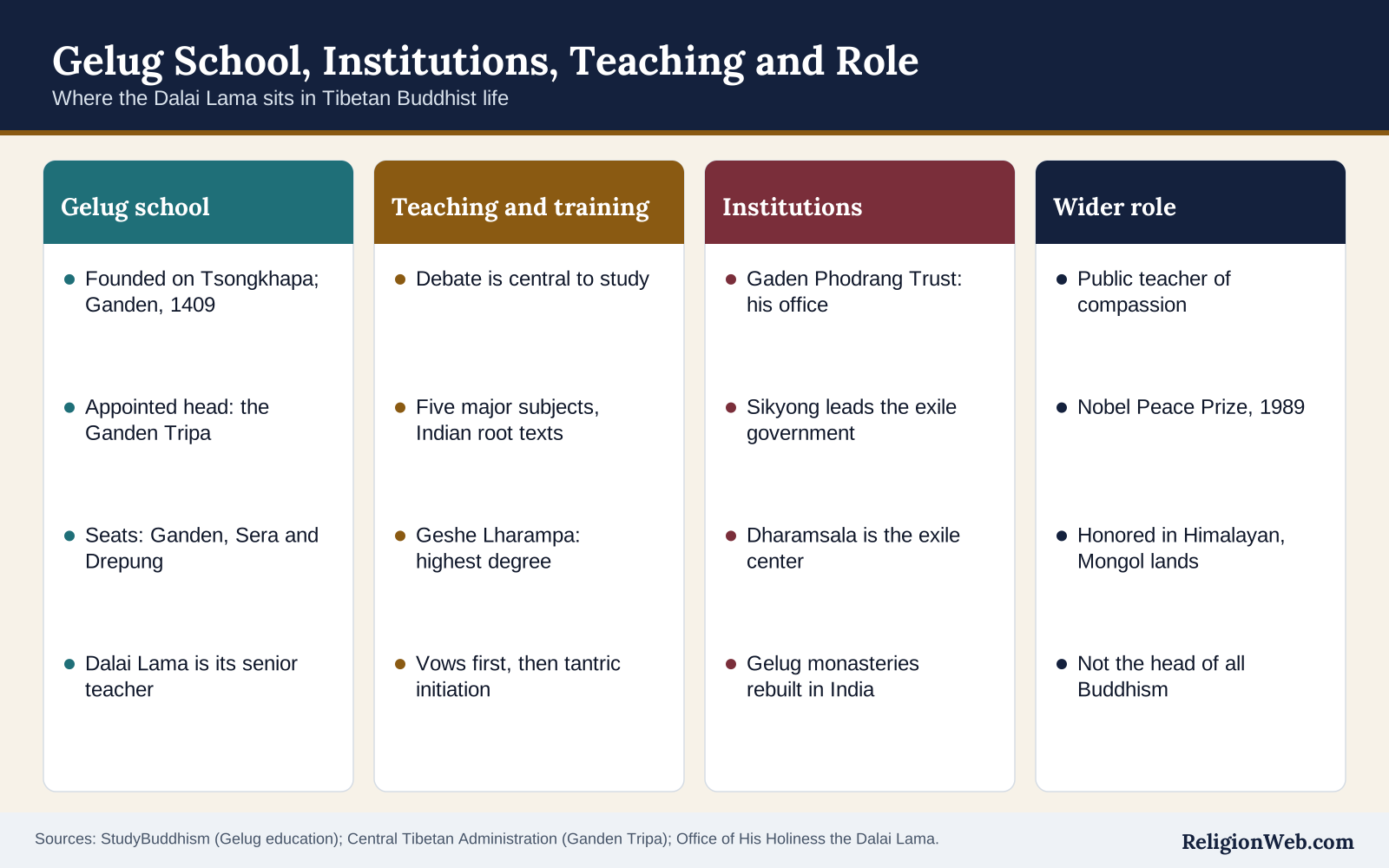
The Gelug school grew from the work of Tsongkhapa (1357-1419), a Tibetan scholar and teacher who emphasized a graded path of study that begins with ethics and monastic discipline and proceeds through philosophy to tantric practice. In 1409 he founded Ganden Monastery near Lhasa, and the name Gelug, often glossed as the “virtuous way” or “tradition of the virtuous,” came to designate the school that developed around his students. The school is also called the “Yellow Hat” order in older Western writing, a reference to ceremonial headgear.
The Gelug curriculum is organized around the lamrim, the “stages of the path,” a structured teaching that leads the student from reflection on the preciousness of human life, through the practices associated with karma and rebirth and the aspiration to awakening, to the study of emptiness. This pattern of gradual training became the intellectual backbone of the three great monastic universities near Lhasa, and it is the pattern that every Dalai Lama has followed in his own education.
The Lineage Before the Title
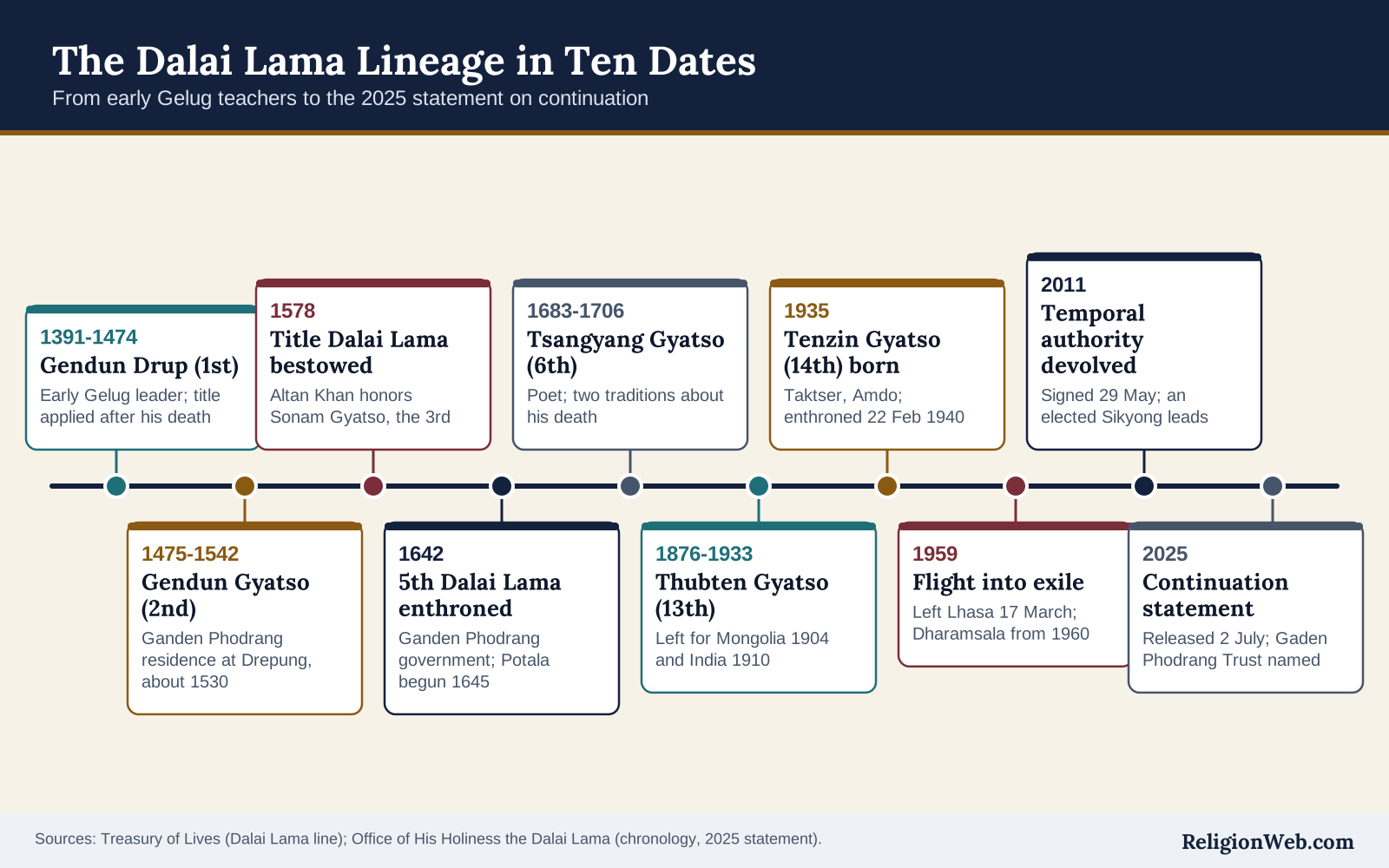
The line of teachers later counted as Dalai Lamas begins with Gendun Drup (1391-1474), a monastic leader of the early Gelug community that formed around Tsongkhapa’s students and the founder of Tashilhunpo Monastery in Shigatse. His successor in the line, Gendun Gyatso (1475-1542), was recognized as his rebirth, and is credited with building a residence called the Ganden Phodrang at Drepung Monastery around 1530. That building gave its name to the government that the Dalai Lamas later headed, as discussed below.
Neither teacher was called Dalai Lama in his own lifetime. They were known as great Gelug abbots and as recognized reincarnations, and the later numbering reflects what Tibetan historians concluded when the title arrived. The Treasury of Lives, a scholarly biographical resource on Himalayan figures, explains the point succinctly: the title given to the third in the line “was posthumously applied to his previous incarnations.”
Altan Khan and Sonam Gyatso, 1578
A Meeting on the Steppe
By the sixteenth century the Mongols had long played a role in Tibetan affairs, and the Tumet Mongol leader Altan Khan was looking for a religious teacher who could lend moral authority to his rule. He invited Sonam Gyatso (1543-1588), then abbot of Drepung Monastery, to his court. A first invitation in 1569 went unanswered, and a second, issued in 1577, led to a meeting in the summer of 1578 in the Kokonor (Qinghai) region on the Tibetan-Mongolian frontier. The exact site and the details of the encounter are given somewhat differently in different accounts.
At the meeting Altan Khan honored the abbot with the title “All-Knowing Vajra-Holder, the Dalai Lama,” according to a standard scholarly summary. The same accounts report that Altan Khan went on to incorporate Buddhist ethics into his laws. Historians describe the exchange as a renewal of a “priest and patron” relationship, an idea with older roots in Tibetan and Mongolian history, in which a ruler protects a religious teacher and the teacher confers legitimacy on the ruler.
Retroactive Numbering of the Line
After 1578 the Gelug monks who followed Sonam Gyatso extended the title backward to the two earlier members of his line. Gendun Drup became the First Dalai Lama and Gendun Gyatso the Second, which made Sonam Gyatso the Third. The practice has an internal logic in Tibetan tradition: if a teacher is the rebirth of a predecessor, then the honor given to the later teacher belongs to the whole stream of rebirths, and it is natural to name the earlier lives in the same way.
The Mongolian connection did not end with a ceremonial exchange. The fourth Dalai Lama, Yonten Gyatso, was born in Mongolia to a chieftain who was a grandson of Altan Khan, a fact that tied the line to the Mongol aristocracy and helped spread Gelug monasteries across the steppe. More than three centuries later, in 1904, the thirteenth Dalai Lama fled to Mongolia when a British expedition advanced on Lhasa. Mongolian Buddhists still count themselves among the communities that look to the Dalai Lama for religious teaching, and the present Dalai Lama has spoken with Mongolian audiences about this long relationship.
The Lineage of the Dalai Lamas
From Gendun Drup to the Fourth Dalai Lama
Scholars and Abbots of the Early Gelug
The first four members of the line were above all monastic leaders and teachers. Gendun Drup (1391-1474) and Gendun Gyatso (1475-1542) belonged to a period in which the Gelug school was still establishing itself against older and better-endowed traditions, and their reputations rested on scholarship, building, and the training of disciples. Gendun Gyatso’s association with Drepung and with the Ganden Phodrang residence there gave the line a home base in the Lhasa region. Sonam Gyatso (1543-1588) then widened the field, carrying Gelug teaching to Mongol audiences and founding or supporting monasteries in eastern Tibet, among them Kumbum, according to the Treasury of Lives.
Because recognition of the second and third members of the line took place before the title existed, their biographies are generally written in two layers. The first is the contemporary account of a respected abbot. The second is the later gloss in which each is also remembered as a Dalai Lama. Readers of Tibetan historical writing will notice that the same person may be called by his personal name in one passage and by his ordinal title in another, and the habit is simply the result of retroactive naming.
Mongol Patrons and the Fourth Rebirth
The recognition of Yonten Gyatso (1589-1616 or 1617; sources differ on the final year) as the fourth Dalai Lama is one of the most politically revealing moments in the early history of the line. He was born in Mongolia to a tribal chieftain who was a grandson of Altan Khan, which brought the Mongol aristocracy directly into the Gelug community. The choice is often read as a sign of how closely Gelug leaders had come to depend on Mongol protection, and it coincided with the rapid spread of Gelug monasteries across the region.
It also illustrates a general feature of the recognition tradition: the incarnation could appear in any place where the Dharma had taken root. A Dalai Lama could be born in central Tibet, in the east, or in Mongolia, and nothing in the doctrine requires a particular region or family. What recognition required was a set of signs, a search, and a confirmation by senior teachers, which later sections describe.
The Fifth Dalai Lama and the Ganden Phodrang
1642 and the Founding of a Government
Ngawang Lobsang Gyatso (1617-1682), known in Tibetan memory as the Great Fifth, is the figure who turned a line of teachers into a government. In the early seventeenth century, Tibet was divided by rivalries among regional rulers and religious schools. With the help of Gushri Khan, a leader of the Khoshut Mongols, the Fifth Dalai Lama was enthroned in 1642 as the spiritual and political leader of Tibet, according to an account published by the exile administration. The government that took shape under him is called the Ganden Phodrang, after the Drepung residence of his predecessor, and it governed Tibet in one form or another from the seventeenth century until the mid-twentieth.
The Fifth Dalai Lama’s relations with other schools were more complex than the picture of a single dominant order might suggest. The Treasury of Lives records Nyingma teachers among his own teachers and students, and it associates him with traditions beyond the Gelug, including the Drukpa Kagyu, Bon, and the Zhije and Chod lineages. Scholars often point to this breadth as one reason the Ganden Phodrang was able to present itself as a government of Tibet rather than of one school only, even though the Gelug monasteries remained its institutional core.
The Potala and the Dalai Lama as Avalokiteshvara
The Fifth Dalai Lama began building the White Palace of the Potala on the Red Hill at Lhasa in 1645, and work continued until 1653. The palace stands on the foundations of a much older building traditionally linked to King Songtsen Gampo in the seventh century, and its name recalls Mount Potalaka, the abode of Avalokiteshvara in Buddhist texts. After the Fifth Dalai Lama’s death in 1682, his regent, Desi Sangye Gyatso, completed the Red Palace in 1694 while keeping the death from becoming public for some time, as the Treasury of Lives notes. The Potala housed the government and served as the winter residence of the Dalai Lamas, with summers spent at the Norbulingka.
The building also gave visual form to a religious claim. As the next major section explains, Tibetan tradition holds that Avalokiteshvara watches over Tibet and takes human form to guide its people, and during and after the Fifth Dalai Lama’s reign the Dalai Lamas were increasingly understood as the pre-eminent embodiments of that bodhisattva’s compassion. The Potala, named for his celestial home, made the association visible in stone at the center of the capital.
The Sixth to the Twelfth Dalai Lamas
A Poet Among the Dalai Lamas
The sixth Dalai Lama, Tsangyang Gyatso (1683-1706), remains one of the most discussed figures in the lineage. According to the Treasury of Lives, he was kept under something close to house arrest for about a decade after his discovery, during a period of heavy political unrest. He is often portrayed as a poet who preferred the life of a layman to the discipline of full monastic ordination, and he is credited with a collection of love songs that Tibetans and others have memorized and sung for centuries. Scholars point out that the attribution of individual poems is not always certain, and that Tibetans read the songs on more than one level, sometimes as romantic poetry and sometimes as spiritual allegory.
His death is the subject of two traditions. One says that he died of a fever in 1706 at Kunganor while being escorted toward Beijing, after his regent Sangye Gyatso was murdered and he was summoned to the Manchu court. Another says that he escaped, lived as a wandering teacher, and died in Alashan in 1746. The existence of both accounts is itself historically informative. It shows that, in the century after the Great Fifth, the Dalai Lama’s person had become a matter of such political and religious importance that a missing or dead holder could generate competing stories.
Short Lives and Regents
The seventh through twelfth Dalai Lamas were born between 1708 and 1856, and their reigns were shaped by regents, by the influence of Manchu officials in Lhasa, and by the political maneuvering of aristocratic families and monasteries. The seventh, Kelzang Gyatso (1708-1757), and the eighth, Jamphel Gyatso (1758-1804), lived long enough to leave a recognizable record of teaching and patronage. By contrast, the ninth (1805-1815), tenth (1816-1837), eleventh (1838-1855 or 1856), and twelfth (1856-1875) Dalai Lamas all died young, none of them living past about twenty-one years, according to the dates given by the Treasury of Lives.
Different observers have explained this run of early deaths in different ways, and the question remains open to historians. What is secure is the pattern of governance it produced. While a Dalai Lama was a child or a young man, power rested with a regent, who was often a high lama of another monastery, and the competition for the regency was one of the most reliable sources of tension within the Ganden Phodrang. The concept of the Dalai Lama as the single center of authority was therefore stronger in theory than in the daily workings of the state.
The Thirteenth Dalai Lama
Travel, Crisis, and Return, 1904 to 1912
Thubten Gyatso, the thirteenth Dalai Lama (1876-1933; one account places his birth in late 1875), is the immediate predecessor of the present holder, and his reign shaped the world into which the fourteenth was born. In about June 1904, as a British mission advanced on Lhasa, he left the capital for Mongolia, accompanied by the Buryat Mongolian Agvan Dorzhiev (spelled Dorjieff in British sources). He visited Beijing in 1908 and returned to Lhasa at the end of 1909, only to flee again when Chinese forces entered the city. He crossed into India on 21 February 1910, reached Darjeeling on 3 March, and lived in Darjeeling and Kalimpong until July 1912, when he returned to Tibet.
These years of travel and exile were formative for a ruler who spent much of his reign balancing the interests of Tibet’s neighbors. A concise biography from the Pitt Rivers Museum’s Tibet Album describes him as an autocrat who personally approved all important orders, and records that after his death a regent, the prime minister, and the Kashag, or council of ministers, gradually took over the direction of affairs.
The 1913 Proclamation and the Years of Reform
In 1913 the thirteenth Dalai Lama issued a five-point proclamation addressed to Tibetan officials and the public. Its first two points concern the protection of the Dharma and its institutions, and others direct officials to act properly, to look after the welfare of the people, and to avoid corporal punishment. Its best-known point describes Tibet as a free country at peace under the Dharma. Tibetans commonly call the text a reaffirmation of Tibetan independence, while the Chinese government does not accept that reading. A commentary published by the International Campaign for Tibet notes that the key Tibetan term, rangwang, literally means “freedom” and has been interpreted in varying ways.
The thirteenth Dalai Lama died in December 1933, and the incarnation of Reting Monastery served as regent until the search for his successor concluded some six years later. That search, described in a later section, produced the present Dalai Lama. In 1932 the thirteenth Dalai Lama had written a political testament, which warned that communism could overtake Tibet unless Tibetans united. Whether one regards it as prophecy or as a shrewd reading of the region’s politics, the testament is often cited in Tibetan accounts of the decades that followed.
| Number | Name | Dates | Notes |
|---|---|---|---|
| 1 | Gendun Drup | 1391-1474 | Early Gelug leader; title applied after his death |
| 2 | Gendun Gyatso | 1475-1542 | Associated with the Ganden Phodrang residence at Drepung (about 1530) |
| 3 | Sonam Gyatso | 1543-1588 | First to receive the title, from Altan Khan in 1578 |
| 4 | Yonten Gyatso | 1589-1616/17 | Born in Mongolia into a family descended from Altan Khan |
| 5 | Ngawang Lobsang Gyatso | 1617-1682 | Enthroned 1642; Potala begun 1645 |
| 6 | Tsangyang Gyatso | 1683-1706 | Poet; two traditions about his death |
| 7 | Kelzang Gyatso | 1708-1757 | Reign shaped by regents and Manchu officials |
| 8 | Jamphel Gyatso | 1758-1804 | Long life by the line’s standards |
| 9 | Lungtok Gyatso | 1805-1815 | Died as a child |
| 10 | Tsultrim Gyatso | 1816-1837 | Died in early adulthood |
| 11 | Khendrup Gyatso | 1838-1855/56 | Died in his late teens; cited in later debates about the Golden Urn |
| 12 | Trinley Gyatso | 1856-1875 | Died at about nineteen |
| 13 | Thubten Gyatso | 1876-1933 | Fled to Mongolia (1904) and India (1910); 1913 proclamation |
| 14 | Tenzin Gyatso | Born 1935 | In exile since 1959; temporal authority devolved 2011 |
Avalokiteshvara and the Tibetan Understanding of Rebirth
Avalokiteshvara in Tibetan Belief
The Bodhisattva of Compassion
To understand why the Dalai Lama is regarded as more than an abbot, one has to begin with Avalokiteshvara, in Tibetan Chenrezig, the bodhisattva who embodies the compassion of all the buddhas. A bodhisattva is a being who has resolved to attain awakening for the sake of others and who, in Mahayana and Vajrayana teaching, may take whatever form helps those in need. Avalokiteshvara is the figure of this ideal, and he has been honored across the Buddhist world, from the Chinese Guanyin to the Japanese Kannon to the Tibetan Chenrezig. The Mahayana scriptures describe him as hearing the cries of the world. In paraphrase, the Lotus Sutra chapter devoted to him says that beings in distress who call on his name will be freed from their troubles, and it lists the many forms he assumes to teach.
According to the Lotsawa House introduction to the bodhisattva, Avalokiteshvara was introduced to Tibet as early as the fifth century, and devotion to him flourished from the late tenth century, notably under the Indian teacher Atisha. Tibetan texts describe him as the special protector of the “Land of Snow,” appearing in many forms to guide and protect its people. His six-syllable mantra, om mani padme hum, is carved on rocks and mani stones across the Tibetan world and is recited in countless household and monastic settings. It is also inscribed inside prayer wheels, so that each turn is understood to release the mantra’s blessing.
Songtsen Gampo, the Dalai Lamas, and the Karmapas
Tibetan tradition holds that Avalokiteshvara has taken human form many times in Tibet. Texts such as the Mani Kabum, which is traditionally attributed to King Songtsen Gampo and was revealed in the twelfth and thirteenth centuries, identify the king himself (about 605-650) as one of the bodhisattva’s emanations. Successive Dalai Lamas and Karmapas were later regarded as living embodiments of his compassion, and Lotsawa House notes that this association was extended gradually rather than being original to the lines.
The Dalai Lama’s identification with Avalokiteshvara is therefore the product of a long development, and it deserves to be described as a Tibetan Buddhist belief rather than as a historical claim in the ordinary sense. Believers understand the Dalai Lama to be a manifestation of the bodhisattva, not a separate being who merely resembles him. Historians of Tibet often observe that the development coincided with the political rise of the Ganden Phodrang, and they discuss how religious and political meanings reinforced each other without necessarily being identical. Both statements can be true: the belief is sincerely held, and it also has a history.
Tulku: Rebirth by Intention
The Vocabulary of Reincarnate Lamas
The Tibetan word for a recognized reincarnate teacher is tulku, a term that translates the Sanskrit nirmanakaya, the “emanation body” in which a buddha or bodhisattva appears in the world. A tulku is not understood as a soul that travels from one body to another in the manner some popular explanations suggest. Rather, in the traditional view, an advanced practitioner who has developed great compassion may choose the circumstances of rebirth in order to continue helping beings. The child who is later found is called a yangsi, or “again-born” one, in some usages.
The practice of recognizing tulkus began in Tibet well before the Dalai Lama line. Historians usually trace it to the Karma Kagyu school in the thirteenth century, and the Karmapa line is commonly cited as the earliest well-documented example. By the time of Gendun Drup, the idea had become part of the way Tibetan Buddhist institutions managed continuity: when a great teacher died, the community looked for his rebirth, and the child’s training allowed the teacher’s work, estates, and disciples to continue.
Rebirth, Intention, and the Bodhisattva Vow
The underlying doctrine draws on the broader Buddhist teaching about karma and rebirth, in which a being’s intentional actions shape the conditions of the next life, and on the Mahayana ideal of the bodhisattva vow. Ordinary beings are carried into rebirth by karma and craving, a process Buddhists call samsara. A bodhisattva who has made the vow to remain for the benefit of others is said to take rebirth deliberately, not helplessly. In Tibetan explanations, this is the principle that makes a tulku different from an ordinary rebirth.
This doctrine does not require believing that the same personality is transferred in every detail, and traditional Buddhist thought generally avoids the idea of a permanent self that passes between lives. The Dalai Lama’s office presents him as “a simple Buddhist monk,” and explanations of the institution stress that the continuity is one of motivation and compassion, not of an unchanging soul. For readers who want the broader background, the articles on nirvana and the Four Noble Truths set out the framework within which these ideas make sense.
How a Dalai Lama Is Recognized
The Traditional Steps of Recognition
Signs, Visions, and Divination
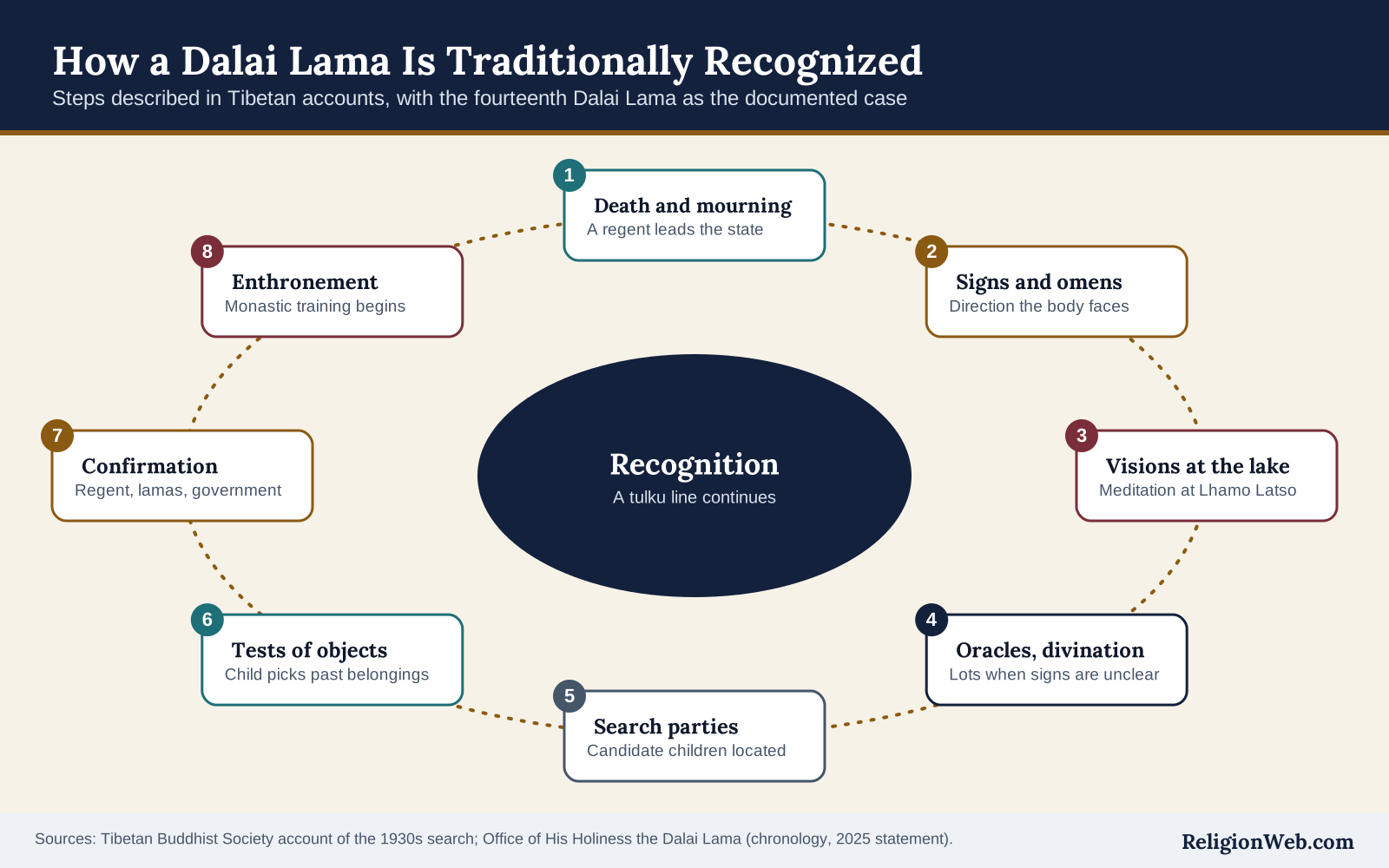
Recognition of a Dalai Lama begins with mourning and with attention to signs. After a Dalai Lama dies, the body is embalmed and enshrined, and Tibetan accounts pay attention to unusual signs, such as the direction in which the head of the body turns. These are read as hints about where the rebirth may be found. The government in Lhasa then appoints a regent to carry on the work of the state while the search proceeds, and senior lamas begin to consult oracles, to perform divination, and to pray for guidance.
A particularly important role is assigned to the sacred lake of Lhamo Latso. In Tibetan practice, a high lama, often the regent, goes into retreat and meditates at the lake, looking for visions in its surface. The visions may be of letters, landscapes, buildings, or other details that point to the birthplace of the child. This is described in the sources as a spiritual practice conducted by a senior lama after prayer and ritual preparation, and its results are treated as one input among several that the search party and the government then evaluate. State oracles, notably the oracle of Nechung Monastery, have also been consulted by the Tibetan government in connection with recognition, according to widely repeated accounts.
Search Parties and the Testing of Candidates
Once there are indications of a region, search parties travel in disguise or with a modest escort and look for children born in the right period who show unusual signs. Parties often travel discreetly, and in the case of the fourteenth Dalai Lama secrecy was considered necessary for reasons described below. When a candidate is found, the searchers conduct a series of tests, the best known of which asks the child to identify objects that belonged to the previous Dalai Lama from among similar ones. The tradition treats the correct recognition of such items as evidence that the child retains a connection to his predecessor.
More than one candidate may emerge. When doubts arise, the tradition provides for additional divination procedures. According to the secretary of the Dalai Lama’s Bureau in New Delhi, one such method uses tsampa dough balls into which names are placed, and it is employed when several candidates are found or when the signs are unclear. He added that when written instructions, signs, or visions point clearly to a specific child, divination is not required. This account comes from a public statement made in 2025 in response to the Chinese government’s position on the Golden Urn, and it should be read as the exile administration’s description of its own tradition.
The Fourteenth Dalai Lama’s Recognition
From Lhamo Latso to the Village of Taktser
The search for the fourteenth Dalai Lama is the best documented in the lineage. According to an account by Margaret Florey for the Tibetan Buddhist Society, a search party set out in September 1936, three years after the thirteenth Dalai Lama’s death. The account reports that the head of the embalmed body was twice found turned from south to northeast. Regent Reting Rinpoche performed a meditation at Lhamo Latso and saw the Tibetan letters Ah, Ka, and Ma, together with a three-storied monastery with a turquoise and gold roof and a house with unusual guttering. The letter Ah was read as Amdo and Ka as Kumbum Monastery.
Three teams were sent into eastern Tibet. The Amdo team of four, led by Kewtsang Rinpoche, carried the thirteenth Dalai Lama’s ritual mirror; the other teams carried his rosary, his hand drum, and his walking stick. After about seven months, the Amdo team reached Kumbum, and then it found the house in Taktser that matched the vision. When Kewtsang Rinpoche visited, wearing the rosary, the small boy pulled at the beads and asked for them. On a second visit the team showed the child the late Dalai Lama’s black rosary, walking stick, three quilts, and hand drum among similar items, and he correctly identified each one.
The Journey to Lhasa and Enthronement
Confirmation depended on the Tibetan government. A coded message was sent to Lhasa, and some months later the government confirmed the identification. Because the region was under the authority of a regional Chinese governor, the party had to negotiate for many months before the family could leave, and the account stresses the need for secrecy. In June 1939 the party set out with the boy and his family, and they were greeted with ceremonies along the road. His office’s chronology records that the party reached Lhasa on 8 October 1939 after a journey of about three months, and that the enthronement took place on 22 February 1940. A second account gives an August date, and the difference may reflect the stages of the approach to the capital.
At the age of four, in his fifth year, the boy was enthroned, and his formal education began soon afterward. The previous Dalai Lama’s regent, Reting Rinpoche, had been the main figure in the search, and the later political careers of the regents who guided the young Dalai Lama’s first years form part of the complicated history of the late 1930s and 1940s. The point for this section is more modest: the case shows what a recognition looks like when documented in some detail. Vision, search, tests, and government confirmation were all present, and each had its own reasoning and its own limits.
Questions About Recognition
The Golden Urn in Qing and Chinese Accounts
One of the most contested procedures is the Golden Urn. The Chinese government describes it as an eighteenth-century practice introduced by Qing authorities and states that its use is required for recognizing high reincarnations. A news report on the 2025 exchange explains that, after the Tibet-Gurkha conflict of 1791 to 1793, Manchu officials proposed using a golden urn to select the Dalai Lama’s reincarnation by lot. China’s Foreign Ministry stated in July 2025 that the process must be followed and that the system was written into Chinese regulations in 2007, together with a clause barring interference by overseas individuals and groups.
The Dalai Lama’s Bureau responded that the Golden Urn is a distorted version of the traditional dough-ball divination, that it was rarely used, and that it was used only once, symbolically, in the selection of the eleventh Dalai Lama. These are two different accounts of the same history, held by two parties with different interests, and an encyclopedic treatment should present them as such. What can be said without taking sides is that the Golden Urn is a lot-drawing method with a specific origin in the eighteenth century, and that Tibetan and Chinese authorities disagree about how it was used and whether it has any religious authority within the tradition.
Who Decides: Tradition, Institution, and State
The question of who decides is not new. In the past, recognition involved the regent, the monastic leadership, oracles, senior lamas, and the Tibetan government, and the political stakes were high enough that competing interests sometimes affected the outcome. The recognition of a Dalai Lama has always involved religious reasoning and practical politics at once. What has changed in the twenty-first century is that the institution now exists in a situation where the Tibetan administration in exile and the government of the People’s Republic of China each claim authority over a future recognition, a subject taken up in the section on succession.
| Concept or step | What it involves | Example or note |
|---|---|---|
| Tulku | A recognized reincarnate teacher, understood to take rebirth by compassionate intention | The Dalai Lama is the most prominent tulku line in Tibetan Buddhism |
| Omens and signs | Observations around the death, such as the direction the embalmed body faces | In 1936 the body of the thirteenth Dalai Lama was reported turned toward the northeast |
| Visions at Lhamo Latso | A senior lama meditates at the lake and reports images or letters | Regent Reting saw the letters Ah, Ka, and Ma and a house with unusual guttering |
| Oracles and divination | Consultation of state oracles, and lot or dough-ball divination when candidates are uncertain | Described by the Dalai Lama’s Bureau as the traditional tie-breaker |
| Search party | Senior monks and officials travel to locate and observe candidate children | Three teams went to eastern Tibet in the 1930s |
| Tests | The child chooses the previous Dalai Lama’s belongings from among similar items | The boy of Taktser identified a rosary, a walking stick, quilts, and a drum |
| Confirmation | Approval by the regent, senior lamas, and the Tibetan government | Government confirmation followed a coded report from Amdo |
| Enthronement and training | Formal installation followed by monastic education | The fourteenth Dalai Lama was enthroned on 22 February 1940 |
Education and Training of a Dalai Lama
The Monastic Curriculum
A Childhood in the Nalanda Tradition
The education of a Dalai Lama is a long program of study conducted by senior tutors, and for the fourteenth it began in 1940, when he was five or six. His office describes the curriculum as following the Nalanda tradition, named for the great monastic university of ancient India whose texts and methods shaped Tibetan Buddhist scholasticism. The major subjects center on Buddhist philosophy, logic, and monastic discipline, while the minor subjects, in the Tibetan scheme, include fields such as poetry and grammar. The emphasis on philosophy is not a decorative detail. In the Gelug view, a teacher who leads others must first have trained his own mind through study and analysis.
A young Dalai Lama also spent much of the day in ritual and prayer, in memorization, and in the household life of the Potala and the Norbulingka. Accounts of his childhood describe a life organized around lessons, with tutors and attendants as the main companions. That setting is part of what makes the later intellectual engagement of the fourteenth Dalai Lama with questions of science, ethics, and interfaith relations notable to many readers: it grew out of a training that was in many ways remote from the modern world.
The Five Major Subjects
The core of Gelug monastic study is a set of five major subjects, each tied to a classic Indian text that is learned, debated, and commented on. A source on the Gelug educational system lists them as the Perfection of Wisdom, studied through Maitreya’s Filigree of Realizations; the Middle Way, through Chandrakirti’s Engaging in Madhyamaka; valid cognition, through Dharmakirti’s Commentary on Valid Cognition; the Abhidharma, through Vasubandhu’s Treasury of Abhidharma; and the monastic code, or Vinaya, through Gunaprabha’s Vinaya Sutra. A full course takes many years. After an eight-year primary program, which since the fourteenth Dalai Lama’s reforms is shared with lay children, a student spends three preliminary years on foundational logic and then eleven years on the main subjects.
The monastic life that surrounds this study is treated in the article on Buddhist monastic life, and the vows involved, which include a commitment to nonviolence and honesty, overlap with the moral commitments described in the article on the five precepts. What distinguishes the Gelug course is its method: the heavy use of structured debate, in which monks test each other’s understanding of the texts, and the expectation that a student will not simply memorize a doctrine but argue for it.
| Subject | Focus | Root text used | Place in the course |
|---|---|---|---|
| Perfection of Wisdom (Prajnaparamita) | Stages and paths of the mind on the way to awakening | Maitreya, Filigree of Realizations | Years 1 to 5 of the main course |
| Middle Way (Madhyamaka) | Emptiness according to the Prasangika view | Chandrakirti, Engaging in Madhyamaka | Years 7 to 9 |
| Valid cognition (Pramana) | Logic, perception, and reasoning | Dharmakirti, Commentary on Valid Cognition | Foundation for debate, with preliminary years on reasoning |
| Abhidharma | Systematic analysis of mind and phenomena | Vasubandhu, Treasury of Abhidharma | Year 10 |
| Vinaya | Monastic discipline and vows | Gunaprabha, Vinaya Sutra | Year 11 |
Debate, Degrees, and Examinations
Debate as a Method of Study
Debate is the distinctive feature of Gelug monasteries. In a typical session, one monk stands as the challenger, asking pointed questions and clapping his hands to punctuate a challenge, while another monk sits and defends a position. The goal is not to win a contest but to expose gaps in understanding and to sharpen the student’s ability to reason about emptiness, compassion, and the path. According to the Gelug education source, morning debate runs for about an hour and a half and evening debate lasts into the night, so that debate is a daily routine rather than an occasional exam.
Debate also connects scholarship to practice. In the Gelug view, a correct understanding of emptiness must be reached by reasoning before it can be deepened by meditation, which is why philosophy and meditation are treated as complementary. The article on Buddhist meditation describes how the analytical style of the Gelug school fits within the wider range of meditative methods used across Buddhist traditions.
The Geshe Lharampa Examination
The highest degree of the Gelug monastic system is the Geshe Lharampa, which is often described as comparable to a doctorate in Buddhist philosophy. It follows six further years of advanced study and requires a formal debate during the Great Prayer Festival, or Monlam Chenmo, before the monks of the three great seats of Ganden, Sera, and Drepung. Under the Tibetan system in Lhasa, this debate took place at the Jokhang Temple.
The fourteenth Dalai Lama sat for his final examination at the Jokhang at the age of 23, during the Monlam festival, and passed with honors, receiving the Geshe Lharampa degree, according to his office. The timing is important. The examination took place in early 1959, only weeks before the uprising of March 1959 and his flight into exile. It means that the future leader of the Tibetan exile community completed the scholastic path of his tradition at almost the last moment before the old institutional world of Lhasa ended.
Vows, Initiations, and Practice
Monastic Ordination
A Dalai Lama is a monk. As a boy he took the vows of a novice, and in 1954 he received full ordination as a gelong from Ling Rinpoche, according to his office’s chronology. The vows are those of the Tibetan monastic code, which follows the Mulasarvastivada Vinaya, and they include celibacy, abstaining from taking life, and a set of rules governing daily behavior. For the individual, monastic discipline is the foundation of the later tantric practice that characterizes the Gelug path.
The monastic identity matters to understanding how the Dalai Lama presents himself. He often describes himself as a monk first, and a person who teaches from that position gives priority to ethical conduct and the cultivation of compassion over any claim of special status. In the exile community the monastic identity also has an institutional dimension, since the Gelug monasteries reestablished in India rely on the same discipline and educational standards.
Initiations and Tantric Practice
The fourteenth Dalai Lama gave his first Kalachakra initiation in the Norbulingka in 1954. The Kalachakra, or “Wheel of Time,” is a major tantric system of the Vajrayana tradition, and its initiation involves a large mandala, a symbolic palace into which students are introduced through a ritual of empowerment. Tantric practice rests on the prior foundations of ethics, study, and the bodhisattva vow, and in the Gelug school it is normally taken up after years of scholastic training.
Public initiations led by the Dalai Lama have drawn very large crowds, many of whom come to receive the blessing of the teaching and of the lama. Teachers in the Tibetan tradition commonly distinguish between general instruction on compassion, which is open to anyone, and the formal empowerment, which is intended for those prepared to undertake the practice. This distinction between open teaching and prepared initiation is typical of Vajrayana Buddhism more widely.
Spiritual Authority and Political Responsibility
The Religious Role of the Dalai Lama
Teacher, Initiator, and Object of Devotion
The religious role of the Dalai Lama has several layers. At the most basic level he is a Buddhist monk and teacher who gives public discourses, confers vows, and gives tantric initiations. At the level of devotion, Tibetans regard him as the embodiment of the compassion of Avalokiteshvara and look to him for blessing, guidance, and a sense of continuity. At the level of institutions, he is the senior figure of the Gelug school and has historically acted as a patron of monasteries across the Tibetan Buddhist world.
These layers should not be confused with a formal power to define doctrine for everyone. Tibetan Buddhism has no central council that fixes belief for all schools, and its doctrines are carried by lineages of teachers, by monastic colleges, and by commentaries on a large body of Indian and Tibetan texts. The Dalai Lama’s authority is that of a teacher with enormous prestige, and it is exercised through teaching, example, and appointment. Respect for him is nearly universal among Tibetan Buddhists, yet the traditions maintain their own leaders and ways of governing themselves.
The Dalai Lama, the Ganden Tripa, and Other Heads
Within the Gelug school itself, the formal head is not the Dalai Lama but the Ganden Tripa, or “Holder of the Ganden Throne,” an office that the exile administration describes as an appointed office and not a reincarnation lineage. The holder changes every seven years or sooner if he dies, and the title alternates between the Sharpa Choje and Jangtse Choje lineages of Ganden Monastery on the basis of academic merit. The Dalai Lama’s role is to confirm the appointment and to announce it. When the 103rd Ganden Tripa died before finishing his term, the Dalai Lama announced his successor, the 104th, according to a report on the exile administration’s website.
The other major schools of Tibetan Buddhism, namely the Nyingma, the Kagyu, and the Sakya, have their own senior figures, such as the Karmapa of the Karma Kagyu and the Sakya Trizin of the Sakya, along with their own monasteries and transmissions. The Bon tradition, which regards itself as a distinct and ancient tradition and which developed in close contact with Buddhism, also has its own leadership. The Fifth Dalai Lama’s openness to Nyingma teachers, noted earlier, is one example of a Dalai Lama acting as a patron across school boundaries. The Panchen Lama is the other great Gelug incarnation, associated with Tashilhunpo Monastery, and Tibetan tradition has long treated the two lines as teachers of one another.
The Political Role Before 1959
Spiritual and Temporal Authority, 1642 to 1959
From the enthronement of the Fifth Dalai Lama in 1642 until the fourteenth Dalai Lama’s flight in 1959, the person of the Dalai Lama was the center of a government that joined religious and political authority. The Ganden Phodrang ruled Tibet in some form for more than three centuries, with the Dalai Lama as the head of state and with the Potala as the administrative center. The exile administration describes the end of this arrangement in 2011 as the end of a 368-year tradition of Dalai Lamas as both spiritual and temporal heads.
It would be misleading to picture the Dalai Lama personally running every function of government throughout this period. Many of the Dalai Lamas were children or young men who lived in the shadow of their regents, and the daily administration was carried by the Kashag, or council of ministers, together with the monastic and lay officials who served under it. The thirteenth Dalai Lama was an unusually active ruler, but his activist style was exceptional, not typical. What the institution supplied was a source of legitimacy, the sense that the government was the instrument of a compassionate incarnation and that its decisions served the Dharma.
The Question of Tibet’s Political Status
The political status of Tibet in the twentieth century is disputed, and this article does not attempt to settle it. Tibetan accounts describe the thirteenth Dalai Lama’s reign as a period of de facto independence, and they cite his 1913 proclamation. The government of the People’s Republic of China holds that Tibet has been part of China since the thirteenth century and describes the events of 1950 and 1951 as a peaceful liberation. Scholars of the period offer a range of interpretations, and the specific questions of sovereignty, suzerainty, and the legal force of the 1951 agreement are matters of continuing academic debate.
What can be said without adjudicating is that the fourteenth Dalai Lama was called to full political responsibility on 17 November 1950, at the age of fifteen, as Chinese forces advanced into eastern Tibet, according to his office’s chronology. He held that responsibility through the negotiations of 1951, the visit to Beijing in 1954 and 1955, the tense years that followed, and the uprising of March 1959. His office states that the 17-Point Agreement of 23 May 1951 was signed in Beijing under duress, and he formally repudiated it at a press conference on 18 April 1959. The Chinese government regards the agreement as valid.
Responsibilities in Exile
Building a Democratic Exile Administration
After arriving in India in 1959 and taking up residence in Dharamsala in 1960, the Dalai Lama and his staff established what is now called the Central Tibetan Administration. In 1963 he presented a draft democratic constitution for Tibet, and the first exile Tibetan parliament was established in Dharamsala that year. In May 1990 the administration was fully democratized, so that the cabinet and parliament became elected bodies. In September 2001 Tibetans in exile directly elected the head of the cabinet, then called the Kalon Tripa, for the first time.
The significance of these steps is that the exile community acquired a system in which the Dalai Lama was no longer the only source of political legitimacy. He and his office have presented the democratization of the exile administration as a deliberate choice. In practical terms it created institutions able to continue independent of any one person, and the transfer of authority in 2011 completed that process.
The 2011 Devolution of Temporal Authority
On 14 March 2011 the Dalai Lama wrote to the Tibetan parliament-in-exile asking to be relieved of his temporal role, which he described as technically still that of head of state. On 29 May 2011 he signed the document formally transferring temporal authority to the elected leader, an event his office describes as ending a 368-year tradition. The elected leader is now called the Sikyong. On 27 May 2026 Penpa Tsering was sworn in for a second term as Sikyong, having won 61 percent of the vote in the preliminary round of the 2026 election, in a ceremony held at Tsuglagkhang in Dharamsala in the presence of the Dalai Lama, according to the Tibet Office.
The result is a division of roles. The Sikyong and the parliament-in-exile handle political and administrative matters for the exile community, and the Dalai Lama serves as a spiritual teacher whose moral authority is widely recognized. The Chinese government does not recognize the Central Tibetan Administration, and it regards the Dalai Lama as a political figure with separatist aims, a characterization that he and his office reject. The Dalai Lama has said that he seeks genuine autonomy for Tibetans within the framework of the People’s Republic of China rather than independence, a position described below as the Middle Way.
| Role | Kind of authority | Period | Present status |
|---|---|---|---|
| Teacher of the Dharma | Religious: public teachings, vows, tantric initiations | Throughout the lineage | Continues; the central public role of Tenzin Gyatso |
| Senior figure of the Gelug school | Religious and institutional: patron of monasteries, confirms the Ganden Tripa | From the sixteenth century | Continues; the Ganden Tripa is the school’s appointed head |
| Embodiment of Avalokiteshvara | Devotional belief held by Tibetan Buddhists | Extended to the line over time, especially from the Fifth Dalai Lama’s era | Continues as a matter of belief and devotion |
| Head of the Ganden Phodrang government | Political: head of state with a regent system and a council of ministers | 1642 to 1959 | Ended with the flight into exile in 1959 |
| Head of the exile administration | Political: leader of the Central Tibetan Administration | 1959 to 2011 | Temporal authority devolved to the elected Sikyong on 29 May 2011 |
| Public advocate for Tibet | Moral and diplomatic: Five-Point Plan (1987), Strasbourg Proposal (1988), Nobel Peace Prize (1989) | From the 1960s | Continues in the Middle Way approach |
| Recognition of the next Dalai Lama | Institutional: assigned to the Gaden Phodrang Trust in the 2025 statement | Future | The government of the People’s Republic of China asserts its own authority |
Tenzin Gyatso: The Fourteenth Dalai Lama
Childhood and Early Rule, 1935 to 1950
A Farming Family in Amdo
The boy who became Tenzin Gyatso was born on 6 July 1935 in Taktser, a small village in the Amdo region of northeastern Tibet, in the Wood-Pig year of the Tibetan calendar. His family were farmers. The recognition story told earlier shows how an ordinary household became the family of a Dalai Lama, and it is one of the best-known features of his biography: he was a small boy from a modest family whose life changed completely when the search party arrived.
The journey to Lhasa and the enthronement of February 1940 began a childhood of extraordinary separation from the world he had known. In the Potala and the Norbulingka, the young Dalai Lama studied with his tutors, learned from Tibetan and Indian scholars, and began, as his office puts it, a curriculum in the Nalanda tradition.
Called to Full Responsibility in 1950
By the autumn of 1950, the political situation had changed sharply. Chinese forces had entered eastern Tibet, and the Tibetan government wanted its young spiritual leader to take up his political role earlier than the normal age of majority. On 17 November 1950 the Dalai Lama assumed full temporal power. On 16 December he left Lhasa for Dromo, near the Indian border, because of the threat from the advancing army. He stayed in Dromo during the first half of 1951.
The 17-Point Agreement was signed in Beijing on 23 May 1951 by representatives of the Tibetan and Chinese governments. The Dalai Lama’s office states that it was signed under duress, while the Chinese government describes it as the basis of a peaceful liberation. The Dalai Lama left Dromo on 24 July 1951 and returned to Lhasa on 17 August 1951. The following eight years were a period of uneasy coexistence, punctuated by uprisings in eastern Tibet and growing tension in the capital.
Crisis and Departure, 1951 to 1959
Beijing, India, and the Pressures of the 1950s
In 1954 the Dalai Lama received full monastic ordination and gave his first Kalachakra initiation. In the same year, from July 1954 to June 1955, he traveled to China for talks and met Mao Zedong and other Chinese leaders. In November 1956 he left Tibet for India to attend the celebrations for the 2,500th anniversary of the Buddha’s parinirvana, called the Buddha Jayanti, and remained in India until March 1957. These years are remembered by Tibetans as a time when he tried to preserve the Tibetan government while living under the terms of an agreement he did not control.
He also continued his studies. The Geshe Lharampa examination, held at the Jokhang during the Great Prayer Festival of early 1959, was therefore the culmination of a scholarly path pursued in an increasingly dangerous environment. Accounts of the period differ in how they describe the causes of the escalation in Lhasa, and the Chinese government characterizes the events as an armed rebellion by an upper-class faction, while Tibetan sources describe a popular uprising. Historians weigh the evidence for each account, and the question remains contested.
The Uprising of March 1959 and the Escape
The Tibetan People’s Uprising began in Lhasa on 10 March 1959. Chinese artillery shells landed outside the Norbulingka Palace on 15 March, and on the night of 17 March the Dalai Lama left the palace in secret. His office describes a journey of fourteen days, at the end of which he entered India on 31 March 1959. On 18 April he held an international press conference at which he repudiated the 17-Point Agreement. He reached Mussoorie on 20 April and stayed there until his move to Dharamsala on 30 April 1960.
After the suppression of the uprising, tens of thousands of Tibetans followed him into exile, and the Indian government made land available for settlements. The Tibetan government was reestablished in exile, and its first task was to help refugees survive. The Potala, which had been the seat of the Dalai Lamas for three centuries, was shelled during the fighting, according to the Treasury of Lives, and was later restored and designated a UNESCO World Heritage Site in 1994.
Exile and Public Life, 1959 to the Present
Dharamsala and the Reestablishment of Tibetan Institutions
Dharamsala, in the Himalayan foothills of Himachal Pradesh, became the seat of the exile administration and the residence of the Dalai Lama. In the decades that followed, Tibetans in exile founded schools, medical institutions, cultural centers, and monasteries, including new houses for the Gelug monasteries of Ganden, Sera, and Drepung in southern India. A commonly cited estimate puts the number of Tibetans living in exile at roughly 128,000, though that figure rests on survey data that are not recent and should be read as an approximation, not a current count.
The Dalai Lama’s first trips abroad since the flight were to Japan and Thailand in 1967, and in 1979 he established the first contact with the Chinese government since going into exile. In these years the exile community balanced two projects: preserving Tibetan culture and religious education that had been disrupted, and seeking a political settlement. The Dalai Lama’s own role was to hold both projects together through teaching and travel.
The Middle Way and the Nobel Peace Prize
On 21 September 1987, in Washington, D.C., the Dalai Lama presented a Five-Point Peace Plan for Tibet, and in June 1988 he elaborated on it in a speech to the European Parliament in Strasbourg. This approach, which later came to be called the Middle Way, seeks self-government for Tibetans within the framework of the People’s Republic of China instead of full independence. The Chinese government has not accepted the proposal, and it has criticized the Dalai Lama as a separatist. The Dalai Lama and the exile administration state that they are not seeking independence.
On 10 December 1989, in Oslo, the Dalai Lama received the Nobel Peace Prize. His office summarizes the award as recognition of his nonviolent struggle for the liberation of Tibet, and notes that he was the first Nobel laureate recognized for concern about global environmental problems. The prize raised his profile enormously and turned him into one of the most recognized religious figures in the world, which in turn shaped how audiences outside the Tibetan community encountered Buddhism.
Teaching and Present Life
A Global Teacher of Compassion
In the decades after 1989, the Dalai Lama continued to give public teachings across Asia, Europe, and North America, and his books on compassion, ethics, and the practice of Buddhism have been widely read. He has described his own commitments as the promotion of human values, the encouragement of religious harmony, and the preservation of Tibetan culture, alongside the Tibetan cause. In his public lectures he often presents compassion as a human capacity that can be trained, and the practices behind that idea connect to the Buddhist cultivation of loving-kindness described in the article on metta meditation.
It is worth noting how he distinguishes his audiences. In large lectures he frequently speaks about ethics that does not depend on any religion. In Buddhist teaching settings he gives commentary on classic texts and tantric initiations for those prepared to receive them. He has also taken part in public conversations with scientists and with leaders of other religious communities, a part of his work that has drawn wide attention. For Tibetans, in all of this, he remains first of all the Dalai Lama, the teacher in whose presence prayers are offered and long life is wished.
The Dalai Lama in 2026
As of 21 October 2026, Tenzin Gyatso is 91 years old. He turned 91 on 6 July 2026. His office announced on 4 June 2026 that he would travel from Dharamsala to Delhi the following day for knee surgery, and that after recovering he planned to travel to Ladakh toward the end of June for an extended stay. The same office is the authoritative source for updates on his health and public schedule, and readers who need current information should check it directly instead of relying on this article or on secondary reports.
The fact that the Dalai Lama is now in his nineties is the backdrop for the public discussion of succession, which is taken up in a later section. It is also a reminder that the institution described in this article is not a historical curiosity. It is a living lineage, and the questions that surround it are questions that Tibetans, scholars, governments, and Buddhists elsewhere are engaged with in the present.
| Date | Event |
|---|---|
| 6 July 1935 | Born in Taktser, Amdo, northeastern Tibet |
| About 1937 | Recognized as the rebirth of the thirteenth Dalai Lama at the age of two |
| 8 October 1939 | Arrives in Lhasa after a journey from Amdo |
| 22 February 1940 | Enthroned; monastic education begins |
| 17 November 1950 | Assumes full temporal authority at the age of fifteen |
| 23 May 1951 | 17-Point Agreement signed in Beijing |
| 1954 | Full monastic ordination; first Kalachakra initiation; travels to China (July 1954 to June 1955) |
| Early 1959 | Passes the Geshe Lharampa examination at the Jokhang |
| 17 March 1959 | Leaves the Norbulingka; enters India on 31 March |
| 30 April 1960 | Arrives in Dharamsala |
| 1963 | Presents a draft democratic constitution |
| 21 September 1987 | Presents the Five-Point Peace Plan in Washington, D.C. |
| 10 December 1989 | Receives the Nobel Peace Prize in Oslo |
| 29 May 2011 | Signs the transfer of temporal authority to the elected leader |
| 2 July 2025 | His office publishes the statement affirming that the institution will continue |
Succession and the Future of the Institution
What the Dalai Lama Has Said
From 1969 to the 2011 Statement
The question of what will happen to the institution after the fourteenth Dalai Lama has been raised by the Dalai Lama himself for more than fifty years. According to the statement he issued in 2025, he had made clear as early as 1969 that the people concerned should decide whether the line of Dalai Lamas should continue. He returned to the subject at a meeting of the heads of Tibetan spiritual traditions on 24 September 2011, a few months after he had given up his political role, and he said then that when he was about ninety he would consult the high lamas of the Tibetan Buddhist traditions, the Tibetan public, and other concerned people in order to re-evaluate whether the institution should continue.
The 2011 statement also assigned a task. Responsibility for recognizing a future Dalai Lama would rest with the Gaden Phodrang Trust, which is the Dalai Lama’s own office, and the Trust was asked to consult the heads of the Tibetan Buddhist traditions and the reliable oath-bound Dharma Protectors linked to the lineage, and to carry out the search and recognition according to past tradition. The term “Dharma Protectors” refers to powerful protective beings whom Tibetan Buddhists regard as bound by oath to defend the teaching. The reference to them in the statement places the future process within the older framework of oracles and consultation described earlier.
The Statement of 2 July 2025
On 2 July 2025, four days before his ninetieth birthday, the Dalai Lama’s office published a statement titled “Statement Affirming the Continuation of the Institution of Dalai Lama.” The text is signed from Dharamsala and carries a date line of 21 May 2025, so the document was written some weeks before its release. In it, he reports that over the previous fourteen years he had received requests from Tibetan spiritual leaders, members of the Tibetan parliament-in-exile, non-governmental organizations, Buddhists in the Himalayan region, Mongolia, and the Russian Buddhist republics, and Buddhists in Asia including mainland China, as well as appeals from Tibetans inside Tibet. His conclusion is stated simply: “In accordance with all these requests, I am affirming that the institution of the Dalai Lama will continue.”
The statement then addresses who will make the decision, in the words of the same text:
I hereby reiterate that the Gaden Phodrang Trust has sole authority to recognize the future reincarnation; no one else has any such authority to interfere in this matter.
Dalai Lama, Statement Affirming the Continuation of the Institution of Dalai Lama, Office of His Holiness the Dalai Lama (dated Dharamsala, 21 May 2025; published 2 July 2025)
Read within the tradition, the passage does two things. It confirms the continuation of the line, which resolves a question that many observers had treated as open. And it assigns the authority to recognize a successor to a specific religious institution, the Gaden Phodrang Trust, rather than to a government or a political body. The text as published does not name a place of birth, an age, or a method beyond the reference to past tradition, so any more specific claims about how the next Dalai Lama will be found should be treated as speculation unless they come from his office.
Other Positions on Succession
The Position of the Chinese Government
The government of the People’s Republic of China rejected the 2025 statement. At a briefing in Beijing on 2 July 2025, as reported in the Indian press, the Foreign Ministry spokeswoman Mao Ning said that the Golden Urn process must be followed in selecting the reincarnation, that the system was written into Chinese regulations in 2007, and that the regulations bar interference by overseas individuals and groups. Beijing’s stated position is that any future Dalai Lama must receive the approval of the central government. The Chinese government’s justification draws on the history of Qing-era procedures and on the principle that religious affairs in China are subject to state regulation.
Those who hold this position treat the matter as one of national sovereignty and of continuity with historical practice, and they present the Golden Urn as a legitimate and established method. It is worth saying that this is a position about the exercise of state authority over religious institutions, and that it differs in kind from the religious reasoning used in the Tibetan tradition. An encyclopedic account does not decide between them, but it should keep the two registers distinct: one is a doctrinal and institutional tradition of recognition, the other is a claim about governmental jurisdiction.
Tibetan Responses
The Dalai Lama’s Bureau responded to the Chinese statement through its secretary, Dhundup Gyalpo, who described the Chinese claims as propaganda. He said that the Golden Urn is a lot-drawing system that distorts the traditional dough-ball divination, that it was used rarely, and that it was used once, symbolically, for the eleventh Dalai Lama. His central point was religious: the recognition of a reincarnation is a matter of Buddhist belief and practice, and the authority to carry it out belongs to the institution that has historically done so.
Views among Tibetans are not monolithic, and independent verification of opinion inside Tibet is difficult. What the Dalai Lama’s statement does show is that he cited appeals from Tibetans inside Tibet among the requests that led him to affirm the institution’s continuation.
Reading the Question Carefully
What Is Known and What Is Not
As of October 2026, the fourteenth Dalai Lama is alive, and no successor has been recognized. The statements described above concern the process that will apply in the future, and nothing in them identifies a candidate. Readers who see news reports about a particular child, region, or method should check whether the source is the Dalai Lama’s office or one of the other parties, and whether the report distinguishes between established facts, speculation, and political commentary.
A few points are fixed by the Dalai Lama’s own statements: the institution will continue, the Gaden Phodrang Trust holds recognition authority in his view, and the process will follow past tradition with consultation of the heads of the Tibetan traditions. Beyond that, the questions of timing and circumstance depend on events that have not happened, and the history of the institution suggests caution. Several earlier recognitions involved lengthy searches, regencies, and debates, and the details of each were shaped by their moment.
The Panchen Lama Precedent
The recognition of the eleventh Panchen Lama in 1995 is often cited by those who anticipate disputes over the Dalai Lama. On 14 May 1995 the Dalai Lama announced that six-year-old Gedhun Choekyi Nyima was the reincarnation of the tenth Panchen Lama. According to the human rights group TCHRD, the boy and his family disappeared three days later, on 17 May 1995. The Chinese government announced on 29 November 1995 that Gyaltsen Norbu, whom it said had been selected through the Golden Urn, was the eleventh Panchen Lama.
Two rival recognitions of this kind are the scenario that many commentators have in mind when they discuss the future of the Dalai Lama line. It is better to describe this as a precedent that informs concern than as a prediction. The Dalai Lama’s 2025 statement, by assigning authority clearly to the Gaden Phodrang Trust and by affirming continuity in advance, can be read as an attempt to set out the Tibetan understanding of the process before the question becomes pressing.
The Dalai Lama in Tibetan Life and the Wider World
Devotion and Practice Among Tibetans
Images, Prayers, and the Meaning of Audience
For Tibetans in exile, devotion to the Dalai Lama is expressed in everyday ways. Many households keep a photograph or image of him on an altar, alongside images of the Buddha and of Avalokiteshvara. Prayers for his long life are recited at monasteries and on festival days, and offerings of long life are made to him at large gatherings. When he gives a public teaching, attendees often describe the act of seeing him, listening, and receiving a blessing as a religious event, not simply a lecture. Devotees may recite the mantra of Avalokiteshvara, om mani padme hum, as part of their personal practice, and the same mantra turns inside prayer wheels along pilgrim paths.
The calendar of Tibetan Buddhism also includes observances that relate to the Buddha’s life, such as the month of Saga Dawa, which commemorates the birth, awakening, and passing away of the Buddha in the same way that Vesak does in other Buddhist regions. For individual practitioners, the Dalai Lama is one teacher among many, while for the community he is a unifying figure whose presence on public occasions carries symbolic weight.
Pilgrimage, Teaching, and the Practice of Compassion
Before 1959 the Potala was a destination for pilgrims from across Tibet and Mongolia. Today the Tsuglagkhang temple complex in Dharamsala, next to the Dalai Lama’s residence, serves a similar role for Tibetans and visitors in exile. Visitors from many countries come to Dharamsala to attend teachings, to see the monastic debates, and to meet the Tibetan community. His office announces teaching schedules, which have included long commentaries on classic Indian and Tibetan texts as well as initiations. These events are the main occasions on which many Buddhists encounter the Dalai Lama in person.
The practice most often associated with him is the cultivation of compassion. In the Tibetan approach, compassion is trained through reflection on the suffering of beings, through meditation that extends concern outward, and through the bodhisattva vow. The visualization of Avalokiteshvara and the recitation of his mantra are central to that practice, and they connect individual devotion to the larger ideal described in the article on the bodhisattva. Many teachers present the Dalai Lama as an example of the compassion that each practitioner is encouraged to develop.
Institutions and Geography
Rebuilding the Gelug Monasteries in Exile
After 1959, Gelug monastics who had trained at Ganden, Sera, and Drepung near Lhasa reestablished their institutions in India, mainly in the south, where new monastic colleges grew up in settlements allotted to Tibetan refugees. These monasteries continue the program of debate and study described earlier, and they have admitted large numbers of new students, including students from the Himalayan regions and from Mongolia. According to the Dalai Lama’s own account of a 2019 teaching, several hundred Mongolian monastic students now study in Tibetan monasteries in exile, and Mongolian scholars have studied in Tibet for centuries.
The educational reforms mentioned earlier, such as the adoption of a shared primary curriculum with lay children and the addition of written, poetry, and history examinations, reflect the Dalai Lama’s concern that monastic education should prepare students for the modern world without losing its distinctive method. The Dalai Lama’s own office, the Gaden Phodrang, continues to function in Dharamsala as the institution through which his religious and personal work is organized.
Mongolia, the Himalayan Region, and Russia
The Dalai Lama’s religious influence extends well beyond the Tibetan exile community. The 2025 statement itself lists Buddhists in the Himalayan region, Mongolia, and the Russian Buddhist republics among the groups who asked that the institution continue. Mongolia has been connected to the lineage since the days of Altan Khan, and the thirteenth Dalai Lama taught there in 1904. In India, Ladakh and other Himalayan regions with Tibetan Buddhist populations look to him as a teacher, and his annual stays in Ladakh have been part of his schedule in recent years.
In the wider world, many people who are not Buddhist attend his lectures or read his books, and he has become a recognized voice on questions of ethics and compassion. Within Buddhism, other communities have their own leaders and institutions, and their relationship to the Dalai Lama is one of regard for a prominent Buddhist teacher, not of allegiance. That distinction is important enough to be treated at length in the section on misconceptions.
A Reader’s Glossary
Terms for the Lineage and Its Recognition
The vocabulary of the Dalai Lama institution mixes Tibetan, Mongolian, and Sanskrit terms. The following table collects those that appear most often in discussions of the lineage and its recognition.
| Term | Meaning | Note |
|---|---|---|
| Dalai | Mongolian for “ocean” | Close in sense to Tibetan gyatso |
| Lama | Tibetan for a spiritual teacher | Counterpart of Sanskrit guru |
| Tulku | A recognized reincarnate teacher | Tibetan rendering of nirmanakaya, the emanation body |
| Yangsi | “Again-born”; the recognized rebirth of a lama | Used for the child after recognition |
| Chenrezig | Tibetan name of Avalokiteshvara | The bodhisattva of compassion |
| Gyalwa Rinpoche | “Precious Victor” | Tibetan title for the Dalai Lama |
| Lhamo Latso | Sacred lake used for visions | Regent Reting consulted it in the 1930s |
| Gaden Phodrang Trust | The Dalai Lama’s office | Assigned recognition authority in 2011 and 2025 statements |
Terms for Government and Education
A second set of terms describes the institutions through which the Dalai Lama has worked, from the monastic university to the exile cabinet.
| Term | Meaning | Note |
|---|---|---|
| Gelug | The school founded on the teachings of Tsongkhapa | Dominant in the Ganden Phodrang government |
| Ganden Tripa | Appointed throne holder of the Gelug school | Serves about seven years; not a reincarnation line |
| Geshe Lharampa | Highest Gelug monastic degree | Earned through debate at the Monlam festival |
| Monlam Chenmo | Great Prayer Festival | Held at the Jokhang in Lhasa before 1959 |
| Kashag | Council of ministers of the Tibetan government | Used in Lhasa and in exile |
| Ganden Phodrang | The government of Tibet, 1642 to 1959 | Named for the Drepung residence |
| Sikyong | Elected political leader of the exile administration | Penpa Tsering, second term from 27 May 2026 |
| Middle Way | Approach seeking autonomy within China | Associated with the 1987 and 1988 proposals |
Common Misconceptions About the Dalai Lama
Misconception 1: The Dalai Lama is the head of all Buddhism worldwide
Where the misunderstanding comes from
The Dalai Lama is so widely recognized outside Asia that many readers meet him as “the Buddhist leader.” News coverage often uses that shorthand, and his Nobel Peace Prize, his books, and his public appearances have made him the face of Buddhism for audiences who have no other point of reference. Comparisons with the leaders of large organized churches reinforce the impression that Buddhism, too, must have a single head, and that the person with the highest profile must hold that role.
The impression also gains strength from the real breadth of his respect. Buddhists of many traditions admire him, and he meets with teachers from other Buddhist communities. Admiration, however, is not the same as jurisdiction, and the two are easily confused by readers who have not encountered the structure of Buddhist institutions.
What the evidence and tradition actually show
Buddhism has never had a single global authority. The Theravada communities of Sri Lanka and Southeast Asia, the Zen schools of Japan and Korea, the Pure Land traditions of East Asia, and Nichiren communities each have their own teachers, monastic orders, and institutional structures. The overview in the article on Buddhism describes this variety, and the figure of the Buddha remains the common point of reference for all of them.
Even within Tibetan Buddhism, the Dalai Lama is not the single head. The Gelug school has the Ganden Tripa as its appointed head, and the other schools have their own senior figures. The Dalai Lama’s influence is real and is largely moral: Tibetans venerate him, other Buddhists respect him, and the wider public listens to him. That prestige is better described as the standing of a teacher recognized across many communities than as the headship of a world religion.
The Dalai Lama himself has generally spoken in this register. He presents himself as one Buddhist monk among many and as a participant in conversations among religious traditions, and many of his public lectures are addressed to general audiences. For readers, the practical test is to ask who ordains a given monk, who appoints a given abbot, and who governs a given monastery. In most Buddhist communities, the answer is a local or national body and not the Dalai Lama.
Misconception 2: Every Tibetan Buddhist belongs to the Dalai Lama’s school
Where the misunderstanding comes from
Because the Dalai Lama was for three centuries the head of the Tibetan government, and because he has been the principal public voice of Tibetans in exile, it is natural to assume that all Tibetan Buddhists follow his school. Older Western writing contributed to this assumption by using the single word “Lamaism” for Tibetan Buddhism as a whole, as though it were a unified church under one hierarch. Scholars today treat the term as outdated, and most Tibetans do not use it.
Media coverage also tends to focus on the Gelug monasteries of Dharamsala and southern India, which are the best-known to visitors, and to leave out the other communities whose centers are elsewhere.
What the evidence and tradition actually show
Tibetan Buddhism is a family of schools, and the principal four, the Nyingma, Kagyu, Sakya, and Gelug, each have their own lineages, monasteries, and heads. Their relationships have included rivalry and cooperation over the centuries. His 2011 statement on the institution was made at a meeting of “the heads of Tibetan spiritual traditions,” a reminder that those traditions have heads of their own. The Karmapa leads the Karma Kagyu lineage, the Sakya Trizin leads the Sakya, and the Nyingma and Bon traditions have their own senior teachers.
The Dalai Lama’s relation to the other schools is one of patronage and exchange more than command. The Fifth Dalai Lama studied with Nyingma teachers, as the Treasury of Lives notes, and the present Dalai Lama has received teachings from masters of several lineages and has been an advocate of mutual respect among them. To be a Tibetan Buddhist is to follow a particular teacher and tradition, and the Dalai Lama is the most prominent teacher of one of them, as well as a figure of broad respect.
Geography adds a further layer. Tibetan Buddhist communities exist across the Himalayan region, in Mongolia, and in parts of Russia, and each has its own history of teachers and monasteries. Those communities often honor the Dalai Lama, yet their ordinary religious life is organized around local monasteries and lineages. The single image of one school under one leader is therefore too simple for the actual diversity of practice.
Misconception 3: The Dalai Lama title is simply inherited biologically
Where the misunderstanding comes from
Most people are familiar with hereditary titles, in which a son succeeds a father or a niece succeeds an uncle. When English-language writing describes the Dalai Lama as a “ruler,” it can suggest that the position must pass in the same way. Phrases such as “the line of Dalai Lamas” or “the dynasty” add to the effect, and the word “reincarnation” is itself often understood as a kind of heredity, as though the same person were simply continuing into a new body.
What the evidence and tradition actually show
The Dalai Lama is a celibate monk, and the office passes by recognition of a child who is believed to be the rebirth of the previous holder. The children found have come from different places and backgrounds. The fourteenth Dalai Lama was born to a farming family in Amdo. The fourth, Yonten Gyatso, was born in Mongolia to a tribal chieftain who was a grandson of Altan Khan. There is no rule that the child must be related to the predecessor, and the doctrine of rebirth does not imply that the successor shares his family.
The belief concerns continuity of compassion and intention, as described earlier, not continuity of blood. Families of recognized tulkus sometimes gained status or influence, and history records disputes in which family interests mattered. But the office itself is not inherited, and the Dalai Lama has been recognized from households of widely different standing.
It also helps to remember what the recognition process is designed to do. The searches described earlier, with their visions, tests, and confirmations, exist because the tradition does not assume that the next Dalai Lama can be predicted from lineage or rank. If succession were hereditary, no search would be needed. The very existence of the search is evidence that the tradition understands the office as dependent on recognition and not on descent.
Misconception 4: Tibetans worship the Dalai Lama as a god-king
Where the misunderstanding comes from
Older European and American writing about Tibet frequently described the Dalai Lama as a “god-king,” a phrase that fused his former role as head of state with the idea that he was a divine ruler. The phrase appeared in travel accounts, newspapers, and popular books, and it persists in some references. It was reinforced by a loose use of the word “god” for any being who is the object of devotion.
What the evidence and tradition actually show
Buddhism does not teach a creator god, and Avalokiteshvara is a bodhisattva, a being on the path to awakening who acts out of compassion, not a creator or a ruler of the universe. Tibetans regard the Dalai Lama as a manifestation of that bodhisattva, and the more accurate verbs for their attitude toward him are “venerate” and “honor.” The Dalai Lama’s office presents him as “a simple Buddhist monk.”
The phrase “god-king” therefore mixes two things that Tibetan sources keep separate: the political office that the Dalai Lama held until 2011, and the religious understanding of his place as a teacher and an emanation of compassion. Neither of those is a claim that he is a deity in the sense of a creator.
The popular image of a ruler who is also divine has a further problem: it overlooks how Tibetan Buddhists talk about bodhisattvas. A bodhisattva is not worshiped as an all-powerful maker of the world but is honored as a being whose compassion is an example and a source of blessing. Veneration of the Dalai Lama belongs to that framework, in which the aim is to cultivate compassion and wisdom oneself, not to submit to a god.
Frequently Asked Questions About the Dalai Lama
Questions About the Title and the Person
What does Dalai Lama mean?
“Dalai” is a Mongolian word meaning “ocean,” and “lama” is the Tibetan word for a spiritual teacher. The title was given in 1578 by Altan Khan to the Gelug abbot Sonam Gyatso, whose own name contained the Tibetan word for ocean, gyatso. It is usually translated as “Ocean Teacher” or “Ocean of Wisdom.”
Tibetans commonly address him as Gyalwa Rinpoche, “Precious Victor,” and many also use the term Kundun, “the Presence.”
Who is the current Dalai Lama and how old is he?
The current Dalai Lama is Tenzin Gyatso, the fourteenth, born on 6 July 1935 in Taktser, Amdo. As of 21 October 2026, he is 91 years old. He has lived in Dharamsala, India, since 1960, and he received the Nobel Peace Prize in 1989.
His office is the authoritative source for news about his health and schedule, and it announced in June 2026 that he would have knee surgery in Delhi before an extended stay in Ladakh.
Is the Dalai Lama a god, a king, or a monk?
He is a Buddhist monk. Tibetan Buddhists regard him as an emanation of the bodhisattva Avalokiteshvara, which is a statement of belief about compassion and not a claim that he is a creator god. From 1642 to 1959 the office also carried the leadership of the Tibetan government, but he transferred temporal authority to an elected leader on 29 May 2011.
Questions About Reincarnation and Succession
How is a new Dalai Lama found?
Traditionally the Tibetan government and senior lamas consult omens, visions, and oracles, send search parties to look for a child, and test the child with objects that belonged to the previous Dalai Lama. The case of the fourteenth Dalai Lama, found in Amdo in the 1930s, is the best-documented example. The process is described in more detail in the section on recognition.
The Dalai Lama’s 2025 statement says that the future process will follow past tradition and will be carried out by the Gaden Phodrang Trust in consultation with the heads of the Tibetan Buddhist traditions.
Will there be a fifteenth Dalai Lama?
In his statement published on 2 July 2025, the fourteenth Dalai Lama said that the institution of the Dalai Lama will continue. He stated that the Gaden Phodrang Trust has sole authority to recognize the future reincarnation. The government of the People’s Republic of China has rejected this position and asserts that the Golden Urn process and central-government approval are required.
As of October 2026 no successor has been identified, because the fourteenth Dalai Lama is living.
Why is the Golden Urn controversial?
The Golden Urn is a lot-drawing procedure that Qing officials proposed after the Tibet-Gurkha conflict of 1791 to 1793. The Chinese government says that it is the required method for recognizing high reincarnations. The Dalai Lama’s Bureau says it is a distortion of the traditional dough-ball divination and was used only once, symbolically, for the eleventh Dalai Lama. The disagreement is about whether the method has any religious standing in the Tibetan tradition and about who has authority to recognize.
Questions About Politics and Exile
Is the Dalai Lama still the political leader of Tibetans?
No. He asked the Tibetan parliament-in-exile on 14 March 2011 to relieve him of his temporal role, and on 29 May 2011 he signed the document transferring temporal authority to the elected leader. The Sikyong, currently Penpa Tsering in a second term from 27 May 2026, now leads the Central Tibetan Administration.
He remains the spiritual teacher whom Tibetans venerate and an influential voice in public life.
What is the Middle Way approach?
The Middle Way is the Dalai Lama’s proposal, developed from the Five-Point Peace Plan of 1987 and the Strasbourg Proposal of 1988, that Tibetans should have genuine self-government within the framework of the People’s Republic of China instead of independence. The Chinese government has not accepted this proposal and has criticized the Dalai Lama as a separatist, an accusation that he and his office reject.
Why did the Dalai Lama leave Tibet?
He fled Lhasa on 17 March 1959, a week after a popular uprising began on 10 March, and he reached India on 31 March. His office describes the uprising as having been brutally suppressed. The Chinese government describes the events as the suppression of an armed rebellion. Tibetan sources and Chinese sources therefore give different accounts of the causes, and the question remains contested among historians.
Conclusion: The Dalai Lama as Title, Lineage, and Living Teacher
What the History Shows
A Title That Joined Two Languages
The Dalai Lama is first of all a title that joined a Mongolian word and a Tibetan one in 1578, and then reached backward to include two earlier teachers. It names a line of Gelug masters who, from the Fifth Dalai Lama’s time, were also the heads of a government centered on the Potala. In Tibetan belief the line is bound up with Avalokiteshvara, the bodhisattva of compassion, and with the tulku practice of rebirth by compassionate intention.
A Religious Office With a Changing Political Role
The political side of the office ended in two stages: the flight of 1959, and the devolution of temporal authority in 2011. Today the Dalai Lama is a monk, a teacher, and the object of deep Tibetan devotion, while the Sikyong and parliament lead the exile administration. The institution’s future is now framed by his 2025 statement, by the competing claims of the Chinese government, and by the plain fact that its present holder is alive.
How to Keep Exploring
Background Reading on ReligionWeb
For the wider setting, the articles on Tibetan Buddhism and Vajrayana Buddhism describe the schools and practices, and the article on the Buddhist mandala explains one of the best-known elements of tantric ritual. The article on the bodhisattva sets out the ideal behind the figure of Avalokiteshvara.
Checking Current Information
Statements about the Dalai Lama’s health, travels, and succession change with events. The most reliable sources are his own office, the Central Tibetan Administration, and, for the Chinese government’s position, its official statements, read alongside independent reporting. This article’s facts about the present are current as of 21 October 2026.
Sources
The table below lists the principal external sources behind this article. Facts, dates and figures were checked against these and related primary, institutional and academic materials.
| # | Source | Publisher and type | Used for | Link |
|---|---|---|---|---|
| 1 | Statement Affirming the Continuation of the Institution of Dalai Lama | Office of His Holiness the Dalai Lama (dalailama.com) · Institutional | Quoted 2025 statement; 1969 and 2011 background; Gaden Phodrang Trust's role | dalailama.com |
| 2 | Brief Biography of the Dalai Lama | Office of His Holiness the Dalai Lama (dalailama.com) · Institutional | Life outline, Geshe Lharampa degree, Nobel Prize, 2011 devolution, self-description | dalailama.com |
| 3 | Chronology of Events | Office of His Holiness the Dalai Lama (dalailama.com) · Institutional | Dated events from 1935 to 2011 in the life timeline | dalailama.com |
| 4 | The Dalai Lama (incarnation line) and Sonam Gyatso entries | The Treasury of Lives (Rubin Museum / Tibetan Buddhist Resource Center) · Academic reference | Names and dates of the fourteen Dalai Lamas; retroactive application of the title | treasuryoflives.org |
| 5 | First Dalai Lama Becomes Buddhist Spiritual Leader (Research Starters) | EBSCO · Encyclopedia | 1578 meeting with Altan Khan, meaning of the title, Gelug background | ebsco.com |
| 6 | The Gelug Monastic Education System | StudyBuddhism (Berzin Archives) · Educational reference | Five major subjects, years of study, debate, Geshe degrees, Monlam examination | studybuddhism.com |
| 7 | Avalokiteshvara: Introduction | Lotsawa House · Academic reference | Avalokiteshvara in Tibet, Songtsen Gampo, Dalai Lamas and Karmapas as emanations, mantra | lotsawahouse.org |
| 8 | The Search for His Holiness the 14th Dalai Lama (Margaret Florey) | Tibetan Buddhist Society · Educational explainer | Lhamo Latso vision, search parties, object tests and journey in the 1930s | tibetanbuddhistsociety.org |
| 9 | Ganden Tripa: appointed head of the Gelug school | Central Tibetan Administration (tibet.net) · Institutional | Ganden Tripa as an appointed office with seven-year term confirmed by the Dalai Lama | tibet.net |
| 10 | Citing Golden Urn rule, Beijing says its approval must; Tibetans call it lie | The Tribune (India) · News report | July 2025 Chinese Foreign Ministry position and the Dalai Lama's Bureau response | tribuneindia.com |
Last fact-check date: 2026-10-21.

