Karma in Buddhism is the teaching that intentional actions of body, speech, and mind have consequences for the person who performs them, and rebirth is the teaching that this chain of cause and effect does not stop at death but continues through successive lives until it is ended by awakening. The Pali word kamma (Sanskrit karma) simply means “action” or “deed.” In Buddhist teaching it refers above all to deliberate, willed action, and the results that ripen from it are called vipāka or phala, “fruit.” The wider round of birth, aging, death, and new birth in which these results unfold is saṃsāra (samsara), a Sanskrit and Pali term for “wandering on.”
What distinguishes the Buddhist account is where it places the weight. In the early discourses that Buddhists trace to the Buddha, the decisive factor is not the outward act alone but the intention behind it, called cetanā. A person who tramples an insect without noticing and a person who sets out to harm it have not done the same deed, and the texts treat the difference as central rather than incidental. This is also why karma and rebirth are not presented in the earliest sources as a system of cosmic bookkeeping. They belong to a path of practice whose aim is to understand why suffering recurs and how it can stop, a question taken up in the Four Noble Truths and in the broader tradition described in What Is Buddhism?
Three points need to be stated at the outset because they are so often blurred in popular usage. First, Buddhist teaching does not equate karma with fate; the Buddha is shown explicitly rejecting the view that everything a person experiences is fixed by past deeds. Second, mainstream Buddhist schools do not teach that a permanent, unchanging soul passes from body to body; they teach that a stream of conditioned processes continues, a claim that must be reconciled with the doctrine of no-self (anattā in Pali, anātman in Sanskrit). Third, Buddhist traditions give different explanations of exactly how that continuity works, and those differences are part of the record rather than a flaw in it.
This article explains what the early sources say about karma and rebirth, how later Buddhist thinkers in the Theravada, Mahayana, and Vajrayana traditions developed those ideas, and how they appear in lived practice, from lay almsgiving to the dedication of merit to the dead. It also addresses the questions people most often ask: whether Buddhist karma is the same as fate, what “reincarnation” means in a tradition that denies a self, and where the goal of liberation, described in What Is Nirvana in Buddhism?, fits into the picture.
Karma and Rebirth in Buddhism at a Glance
Core Definitions: What Karma and Rebirth Mean
Karma (kamma) as intentional action
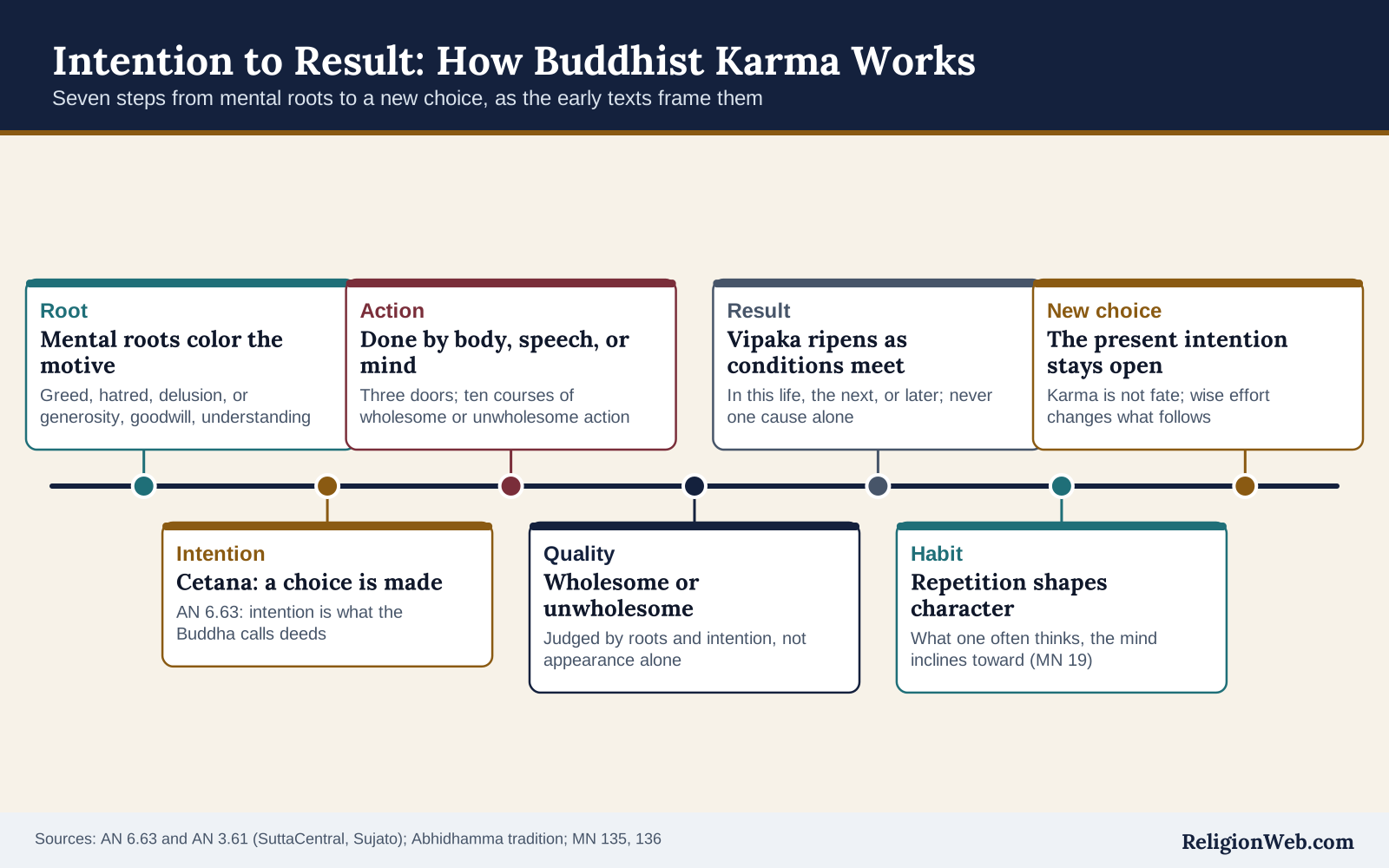
In everyday English, “karma” has become a loose word for luck, cosmic payback, or the sense that good things come back to good people. The Buddhist technical meaning is narrower and more demanding. Karma is volitional action: something done, said, or even only thought with intention. The commonly cited statement comes from the discourse called “Penetrative” (Nibbedhika Sutta, Aṅguttara Nikāya 6.63), where the Buddha is reported to say that it is intention he calls deeds, because after making a choice a person acts through body, speech, and mind. The passage is quoted in full later in this article. Reflex movements, accidents, and natural events are therefore not karma in this sense, even though they may be the result of earlier karma or may simply be the working of other causes.
Because karma is defined by intention, it is a moral category rather than a physical one. Actions are classed as wholesome (kusala) or unwholesome (akusala) according to the mental roots that drive them. The unwholesome roots are greed, hatred, and delusion; the wholesome roots are their absence, usually described as generosity, goodwill, and understanding. Wholesome action tends to lead to happiness and unwholesome action tends to lead to suffering, but the texts describe this as a tendency within a web of many conditions, not as a courtroom with a judge. Nobody assigns the result. The consequence follows from the nature of the act, in the way a seed produces a plant of its own kind.
Rebirth, samsara, and why Buddhists often avoid the word “reincarnation”
Rebirth means that the process of life does not end with the dissolution of the body. Consciousness, craving, and the momentum of past action condition the arising of a new existence, which may be human, animal, or one of several other modes of being that Buddhist cosmology describes. Samsara is the whole beginningless series. The tradition does not claim to know a first point of the cycle; the discourses describe it as having no discoverable beginning. What matters for practice is that the cycle is understood to be marked by dukkha, usually translated “suffering” or “unsatisfactoriness,” and that it can be brought to an end.
Many Buddhist teachers and scholars prefer “rebirth” to “reincarnation” for a specific reason. “Reincarnation” in common English suggests that something, a soul or a self, takes on a new body (a “re-embodiment”). Early Buddhist teaching denies that any such enduring entity exists, so it speaks of a new life arising dependent on the old one, “neither the same nor entirely different,” a formula the later tradition uses repeatedly. The distinction is not universal in Buddhist writing, and English-language Buddhists use both words, but the preference for “rebirth” signals a doctrinal point and not a mere fashion.
| Term (Pali / Sanskrit) | Literal sense | How Buddhist teaching uses it |
|---|---|---|
| kamma / karma | “Action,” “deed” | Intentional action of body, speech, or mind that carries ethical weight and produces results |
| cetanā | “Intention,” “volition,” “choice” | The mental factor that the Buddha identifies as what makes an action karma |
| vipāka / phala | “Ripening,” “fruit” | The result of past action, experienced as pleasant, unpleasant, or mixed conditions |
| kusala and akusala | “Skillful” and “unskillful,” often “wholesome” and “unwholesome” | The ethical quality of an intention, determined by its roots in non-greed, non-hatred, and non-delusion or their opposites |
| puñña / puṇya | “Merit” | Wholesome karma viewed as a store of beneficial potential, cultivated through giving, ethical conduct, and meditation |
| saṃsāra | “Wandering on” | The beginningless round of birth, death, and rebirth conditioned by craving and ignorance |
| punabbhava / punarbhava | “Again-becoming” | Renewed existence; the technical word usually translated “rebirth” |
| anattā / anātman | “Not-self” | The teaching that no permanent, independent self can be found in the five aggregates that make up a person |
| paṭiccasamuppāda / pratītyasamutpāda | “Dependent origination” | The teaching that phenomena, including new lives, arise in dependence on conditions |
| pariṇāmanā / pattidāna | “Turning toward” / “giving of a share” | Dedication or transfer of merit to others, living or dead, in practices described later in this article |
Where These Teachings Sit in the Buddhist System
Karma, rebirth, and the Four Noble Truths
Karma and rebirth are not stand-alone doctrines. They are the working machinery behind the second of the Four Noble Truths, which identifies craving as the origin of suffering, and the third, which states that suffering ends when craving ends. Craving and ignorance fuel the intentional actions that keep the cycle turning; the ending of craving and ignorance is liberation. This is the framework used in the traditional account of the Buddha’s awakening, in which he is said to have gained knowledge of his past lives, then insight into how beings pass away and are reborn according to their actions, and finally the ending of the mental “taints” that bind beings to samsara. Those three knowledges are described in discourses such as Majjhima Nikāya 4 and 36. Whether one reads the account as history, as tradition, or as a symbolic summary of the Buddha’s insight, it shows how closely karma, rebirth, and liberation were bound together in the earliest literature.
The same structure appears in the twelve-link formula of dependent origination, where ignorance conditions volitional formations (saṅkhārā), which condition consciousness, name-and-form, the sense bases, contact, feeling, craving, clinging, becoming, birth, and finally aging and death. The text does not describe a self moving from link to link. It describes conditions giving rise to conditions, a point that matters greatly when the question of “who is reborn” arises.
Karma, rebirth, and the path of practice
The ethical dimension of karma explains why morality (sīla) is the foundation of the Noble Eightfold Path. Right speech, right action, and right livelihood are the practical application of understanding karma in daily life. Meditation then works directly on the intentions and habits that drive action, as discussed in What Is Buddhist Meditation?, and wisdom completes the picture by seeing that even the actor is a process rather than a fixed self. Seen from this angle, karma is neither a threat nor a promise. It is an observation about how intentional living shapes character, experience, and future possibility, offered so that people can choose their actions with care.
How Widely These Ideas Are Held Today
Survey evidence from Buddhist-majority societies
Pew Research Center’s 2025 study of global religious change estimated that there were about 324 million Buddhists in 2020, or 4.1 percent of the world’s population, a decline from about 343 million (4.9 percent) in 2010 as derived from the report’s stated changes. Belief in karma is widespread in Buddhist societies. In its September 2023 report on Buddhism, Islam, and religious pluralism in South and Southeast Asia, Pew Research Center found that roughly three-quarters or more of adults in each of the six countries covered in its section on religious beliefs said they believe karma exists, and that Buddhists and Hindus were especially inclined to think so. Survey wording matters here. A respondent who says “I believe in karma” may be affirming the technical teaching about intentional action and its results, or a looser idea that good and bad behavior eventually bring corresponding outcomes, or something closer to the idea of fate. Surveys can show how common the belief is, but they cannot show which of these senses people have in mind.
Different emphases among monastics and lay people
Anthropologists of Theravada societies have long noted that lay and monastic Buddhists often emphasize different things. In his 1970 study of Burma, Melford Spiro distinguished what he called “nibbanic Buddhism,” aimed at ending rebirth altogether, from “kammatic Buddhism,” aimed at improving one’s next rebirth through merit. He presented these as two orientations within one religion, not as two religions, and later scholars have criticized the sharpness of the contrast while still using it as a way to describe real differences in emphasis. Many lay Buddhists aim at a good rebirth, a stable family, and a supportive social world, while monastics and committed meditators orient themselves toward ending rebirth. Monks and nuns, whose training is described in What Is Buddhist Monastic Life?, are typically supported by lay donors who gain merit by giving, so the two orientations are woven together in everyday practice.
Origins: Karma Ideas Before and During the Buddha’s Time
The Indian Background of Action and Rebirth
Ritual action and the emergence of rebirth ideas
The Sanskrit word karman already existed long before the Buddha. In the early Vedic ritual literature it often meant ritual action, especially sacrifice, and the proper performance of such acts was thought to secure benefits for the sacrificer. Over time, in the texts known as the Upanishads, thinkers began to speak of action in a broader sense that includes ethical conduct and to connect it with what happens to a person after death. A well-known early statement attributed to the sage Yājñavalkya in the Bṛhadāraṇyaka Upanishad holds that a person becomes good through good action and bad through bad action. Scholars generally place the earliest layers of that Upanishad somewhere between the eighth and sixth centuries BCE, though exact dating is uncertain. The background in these texts is explored further in the article on karma in Hinduism, which treats the Hindu understanding on its own terms.
The point for the present article is historical context rather than comparison. The Buddha did not invent the vocabulary of karma or the idea of repeated rebirth; both were already part of the intellectual environment of northeastern India in the middle of the first millennium BCE. What the early Buddhist texts do is take over familiar terms and give them a new emphasis. The Buddha is reported to have moved the center of gravity of karma from ritual performance and from birth status to the quality of a person’s intentions.
The wandering teachers of the Buddha’s era
The Buddha lived in the Ganges plain in roughly the fifth century BCE; the precise dates are debated, with many modern historians favoring a death date near 400 BCE, give or take several decades, and the traditional dates being somewhat earlier. His age was one of intense debate among wandering teachers (śramaṇas) who offered competing explanations of action and its results. The Pali discourse called “The Fruits of the Contemplative Life” (Dīgha Nikāya 2) lists six such teachers, and their views show the range of the conversation. Pūraṇa Kassapa is reported to have denied that good or bad action has any real result. Makkhali Gosāla, associated with the Ājīvika movement, is reported to have taught that beings pass through a fixed course of births and are purified by that process, not by their own effort. Ajita Kesakambalī is reported to have taught that death is annihilation. Nigaṇṭha Nātaputta, the name by which the Jain leader Mahavira appears in Buddhist texts, is reported to have taught a doctrine of restraint; the Jain tradition itself, discussed in What Is Jainism?, has its own account of him and of karma as a subtle substance that binds the soul.
Two features of this record need caution. The descriptions of these rival teachers come from Buddhist sources, so they reflect how the Buddhist tradition remembered them, not how their followers would have put the matter. And the debate was not simply over whether karma existed; it concerned what kind of causation operates in human life, whether effort matters, and whether anything survives death. Against that background, the early Buddhist position can be read as a deliberate middle course: action matters and has results, but results are not fixed in advance.
The Buddha’s Reframing of Karma
Intention at the center
The early discourses define karma through intention, and this shift has several consequences. Unintended harm is not karmically equivalent to deliberate harm. A thought that never turns into speech or action can still have karmic weight, because it is already a volitional act, and the texts treat mental states such as covetousness, ill will, and wrong view as forms of unwholesome action. The ethical center of gravity therefore moves inward, toward the cultivation of the mind, which is why Buddhist ethics and Buddhist meditation are so closely joined in practice.
Intention also provides a practical test. Texts such as the advice to the young monk Rāhula in the Majjhima Nikāya recommend that a person reflect before, during, and after any action to ask whether it will lead to harm for oneself or others, and to refrain if so. That guidance puts karma on a scale where it can be examined moment to moment, in a way that a doctrine of fixed outcomes could not.
The Buddha’s critique of fatalism
One of the clearest statements against a deterministic reading appears in the Aṅguttara Nikāya’s “Sectarian Doctrines” (AN 3.61). It lists three views that the Buddha is shown criticizing: that whatever a person experiences is caused by past action, that everything is caused by the creative act of a supreme god, and that everything happens without any cause or condition. In each case the Buddha is reported to point out the practical consequence: if all experience were already fixed, there would be no reason to make an effort to avoid harm or to do good. The first of the three is especially relevant here, since it is what many people today assume “karma” means.
The Buddha’s alternative is that past action is one cause among many. A discourse to a wanderer named Sīvaka, in the Saṃyutta Nikāya, makes the point explicitly by listing other sources of experience such as disorders of bile, phlegm, and wind, changes in weather, and exertion. That passage is quoted and discussed in the section on misconceptions below. For now the key observation is that the early texts frame karma as important but not all-explaining.
Historical Development After the Buddha
From discourse to doctrine
After the Buddha’s death, the communities that preserved his teaching developed more systematic accounts. The Abhidhamma (Sanskrit Abhidharma) literature, which several early schools compiled over the following centuries, analyzed karma in great technical detail: what kinds of mental states are wholesome, how intention functions in a moment of consciousness, and how results are classified by time and weight. Debates arose among schools over exactly what persists between an action and its result, since the doctrine of no-self ruled out a simple storehouse. The solutions proposed, from the Theravada life-continuum to the Yogācāra “storehouse consciousness,” are described later in the section on continuity.
As Buddhism spread across Asia, the same teachings were absorbed into new cultures and languages. In China, writers such as Huiyuan (334 to 416 CE) argued for the continuity of a “spirit” through rebirth, drawing criticism from thinkers who held that the spirit perished with the body; the debate shows how the Buddhist teaching met existing Chinese ideas about ancestors, ghosts, and the afterlife. In Tibet, the literature on the intermediate state between death and rebirth developed into a distinct body of teaching and ritual. In Southeast Asia, merit-making became central to village and royal religion alike.
Timeline of key developments
| Approximate period | Development | Significance |
|---|---|---|
| Roughly 8th to 6th centuries BCE | Early Upanishadic reflection on action and rebirth in northern India | Provides vocabulary and questions the Buddha’s contemporaries were debating |
| Roughly 5th century BCE (dates debated) | The Buddha teaches in the Ganges plain; core discourses on intention, dependent origination, and no-self are later preserved | Intention (cetanā) becomes the defining feature of Buddhist karma |
| 3rd century BCE onward | Early schools develop Abhidhamma/Abhidharma studies of mind, karma, and results | Technical classifications of wholesome and unwholesome action emerge |
| Roughly 1st century BCE to 1st century CE | The Milindapañha, a dialogue between the monk Nāgasena and a king, uses analogies for continuity without a self | Offers memorable models such as the flame passed from lamp to lamp |
| Roughly 2nd to 3rd centuries CE | Nāgārjuna’s Mūlamadhyamakakārikā examines karma and its results through the lens of emptiness | Mahayana Madhyamaka accounts of how karma functions without inherent existence |
| Roughly 4th to 5th centuries CE | Vasubandhu’s Abhidharmakośa and the Yogācāra school; Buddhaghosa’s Visuddhimagga in Sri Lanka | Sophisticated models of karmic continuity: “seeds,” storehouse consciousness, and the life-continuum |
| Roughly 8th to 14th centuries CE | Tibetan Buddhism develops teachings on the intermediate state (bardo) and its funeral practices | Death and rebirth become a focus of ritual and meditation |
| 20th to 21st centuries | Global spread, modern scholarship, and debates over whether rebirth is essential to Buddhist practice | New interpretations, including secular and psychological readings, appear alongside traditional ones |
Karma as Intentional Action: How the Early Teaching Works
The Definition: Intention, Action, and Result
“It is intention that I call deeds”
The most frequently cited definition of karma in the early Buddhist canon comes from a discourse in the Aṅguttara Nikāya (the “Numbered Discourses”), the Nibbedhika Sutta, often rendered “Penetrative.” In it the Buddha is shown laying out a sequence of topics that a practitioner should understand about karma: its source, its variety, its results, its ending, and the path that leads to its ending. Within that framework he states the definition directly. In the translation by Bhikkhu Sujato, which uses the English word “deeds” for the Pali kamma, the central lines read:
It is intention that I call deeds. For after making a choice one acts by way of body, speech, and mind.
Aṅguttara Nikāya 6.63 (Nibbedhika Sutta), translated by Bhikkhu Sujato, SuttaCentral
Within the Theravada tradition, the standard reading of this statement is that cetanā, “intention” or “volition,” is the factor that turns a movement into a morally significant act. The Abhidhamma and its commentaries classify cetanā as one of the mental factors present in every moment of consciousness, but only some moments of volition are karmically productive in the full sense, namely those that are wholesome or unwholesome. The reading found in the Sarvāstivāda and Sautrāntika Abhidharma literature, as represented by Vasubandhu’s Abhidharmakośa in the fourth or fifth century CE, quotes the same teaching and then distinguishes two things: the volition itself, which is mental karma, and the bodily and verbal action that follows from volition. Both schools therefore agree that intention is primary, even though they analyze the relationship between intention and outward act in different ways.
The passage also makes clear that karma is not confined to dramatic acts. Because action can occur through body, speech, or mind, a habitual thought pattern, a harsh remark, a quiet act of generosity, and a major decision are all treated as karma. The phrase “after making a choice” matters as well: it points to the moment of deliberate decision as the place where a person has some freedom, and where practice can make a difference.
Three doors of action and the ten courses of action
The early texts organize karma into three “doors” through which a person acts: body (kāya), speech (vācā), and mind (mano). Several discourses spell out ten “courses of action” (kammapatha), unwholesome and wholesome, that give practical content to the three doors. The unwholesome ten are killing living beings, taking what is not given, sexual misconduct, false speech, divisive speech, harsh speech, idle chatter, covetousness, ill will, and wrong view. The wholesome ten are their opposites: abstaining from each of these and acting with generosity, goodwill, and right view instead. This list is the template behind the five precepts that lay Buddhists commonly undertake, covered in the discussion of ethics later in this article, and behind the training rules of monastic life.
| Door of action | Unwholesome course (rooted in greed, hatred, or delusion) | Wholesome course (rooted in generosity, goodwill, or understanding) | Result as described in the texts |
|---|---|---|---|
| Body: life | Killing living beings; injuring through cruelty | Protecting life; showing compassion for beings | Unwholesome: a shorter or more troubled life. Wholesome: health and long life (as in the Cūḷakammavibhaṅga Sutta, MN 135) |
| Body: property and relationships | Taking what is not given; sexual misconduct | Respecting others’ belongings and commitments | Unwholesome: loss and distrust. Wholesome: trust and security |
| Speech: truth | Lying; deceiving | Truthfulness and reliability | Unwholesome: being doubted or slandered. Wholesome: being trusted |
| Speech: harmony | Divisive speech; harsh speech; idle chatter | Speech that reconciles, is gentle, and is timely and purposeful | Unwholesome: broken friendships. Wholesome: lasting friendships |
| Mind: desire and ill will | Covetousness; wishing harm on others | Contentment; goodwill | Unwholesome: an agitated, discontented mind. Wholesome: peace and clarity |
| Mind: view | Wrong view, such as denying that actions have results | Right view: understanding that actions have results and that the path leads to freedom | Unwholesome: mistaken conduct built on mistaken belief. Wholesome: the foundation of the path |
The “result” column should be read with care. The pairing of specific deeds with specific outcomes is the kind of general correlation that the texts present in teaching contexts, and the Buddhist schools themselves interpret such lists as indications of tendency rather than guaranteed mechanical outcomes. The Cūḷakammavibhaṅga Sutta (MN 135), for example, answers a young man’s question about why human beings differ so greatly in lifespan, health, appearance, influence, wealth, birth, and understanding, by correlating these differences with kinds of past conduct. Another discourse, the Mahākammavibhaṅga Sutta (MN 136), then complicates the picture by describing people who seem to act badly and fare well, or the reverse, and by insisting that the fruit of action depends on more than the surface of what a person did.
How Results Are Understood
Ripening, weight, and timing
The Abhidhamma tradition, as summarized in the Theravada manual known as the Abhidhammatthasaṅgaha (a compendium traditionally attributed to Anuruddha, in the eleventh or twelfth century CE), classifies karma in several overlapping ways. By timing of ripening, karma may bear fruit in the same life, in the next life, in some later life, or it may be “defunct” (ahosi), meaning that it has lost the opportunity to ripen. By priority, “weighty” karma such as an act with extreme moral consequence ripens first, followed by karma performed near death, then habitual karma, then residual karma. These schemes are the product of later systematic reflection, but they answer a practical question already latent in the discourses: if actions have results, what determines which results appear, and when?
The key idea is that results arise through a convergence of conditions rather than through a single act. A past deed provides a potential, and the potential matures only when circumstances support it. This explains, in the tradition’s own terms, why not every action is followed by an immediately visible consequence, and why the same deed does not yield identical results for different people.
| Basis of classification | Category | Meaning |
|---|---|---|
| Timing of ripening | Diṭṭhadhammavedanīya | Karma whose result is experienced in the same life |
| Timing of ripening | Upapajjavedanīya | Karma whose result is experienced in the next life |
| Timing of ripening | Aparāpariyavedanīya | Karma whose result may be experienced in any later life, whenever conditions allow |
| Timing of ripening | Ahosi | “Defunct” karma that no longer has the opportunity to ripen |
| Priority in ripening | Garuka, āsanna, āciṇṇa, kaṭattā | Weighty karma first, then karma near death, then habitual karma, then residual karma |
| Function | Janaka (productive) | Conditions the rebirth-linking moment and results during a lifetime |
| Function | Upatthambhaka (supportive) | Strengthens the ripening of another karma already in progress |
| Function | Upapīḷaka and upaghātaka | Weakens, obstructs, or cuts off the result of another karma |
Why the same deed can ripen differently
The discourse often called the Salt Crystal (the Loṇaphala or Loṇakapalla Sutta, which appears as Aṅguttara Nikāya 3.101 in Thanissaro Bhikkhu’s translation and is numbered differently in some other editions) makes this point with an analogy. In paraphrase, the Buddha says that if someone were to put a lump of salt into a small cup of water, the water would become undrinkable, whereas the same lump dropped into the river Ganges would make no noticeable difference. In the same way, one small unwholesome deed may cause serious suffering for a person whose character, conduct, and understanding are undeveloped, but be barely felt by a person whose mind and ethical life are well trained. The comparison suggests that the result of an action depends on the whole person who receives it. It also quietly shifts the emphasis from past deeds to present cultivation: a person who develops their mind changes how past action is experienced.
The karma that leads to the end of karma
One discourse in the Aṅguttara Nikāya’s fours (AN 4.232) sorts action into four types: dark action with dark results, bright action with bright results, action that is both dark and bright with mixed results, and action that is neither dark nor bright, with neither kind of result, which leads to the ending of karma. The fourth type is identified with the volition to abandon the other three, and the commentarial tradition connects it with the noble path. The point is subtle but central. If the aim were merely to accumulate good karma, practice would end in a pleasant rebirth. The texts say instead that the ultimate aim is to stop generating the craving-driven action that keeps the cycle going, which is why the Noble Eightfold Path is described as the path leading to the cessation of karma and not only to its improvement.
Karma, Mind, and Habit
Thought shapes character
A recurring theme in the discourses is that repeated intention shapes the mind. In the Majjhima Nikāya, the Buddha describes how whatever a person frequently thinks and reflects upon becomes the inclination of the mind, so that habitual thoughts of ill will make the mind lean toward ill will, and habitual thoughts of goodwill make it lean toward goodwill. This understanding gives karma an immediate, observable dimension. Even a reader who does not accept rebirth can see how repeated choices build tendencies, and the Buddhist traditions that stress practice often begin from that observation. The tradition describes the same process in technical vocabulary as the interplay of volitional formations (saṅkhārā) and consciousness.
The twin verses of the Dhammapada
The Dhammapada, a collection of 423 verses (in the Pali recension) widely read across Buddhist traditions, opens with two verses that tie mind to experience. Max Müller’s 1881 translation renders the second as follows:
All that we are is the result of what we have thought: it is founded on our thoughts, it is made up of our thoughts. If a man speaks or acts with a pure thought, happiness follows him, like a shadow that never leaves him.
Dhammapada 2, translated by F. Max Müller, Sacred Books of the East, vol. 10 (1881)
The first verse is the mirror image: a man who speaks or acts with an evil thought is followed by pain, as the wheel follows the foot of the ox that draws the carriage. The Theravada commentary attached to the Dhammapada gives each verse an illustrative story and reads them as statements about the moral consequence of mental states. Modern readers sometimes take the verses in a purely psychological sense, as a statement that the quality of mind colors lived experience, and the Buddhist traditions themselves do not see a conflict: the verses can be read as a description of how a mind shapes its own world in this life and as a statement about the longer horizon of rebirth. The translation is quoted here from a public-domain edition and reflects the English idiom of the nineteenth century.
Rebirth and Samsara: The Round of Existence
Samsara in the Early Sources
A beginningless round
The early discourses describe samsara as a process without a discoverable starting point. A collection of short discourses in the Saṃyutta Nikāya, the Anamatagga Saṃyutta, repeats the theme with vivid images: the tears a being has shed over countless lives are said to be greater than the water in the four great oceans, and the bones left by one being in the course of rebirths would form a heap as large as a mountain. These images are not geography or history in the usual sense. They are rhetorical devices for conveying that the round of rebirth is long and that suffering within it is deep, so that the listener will feel the urgency of seeking release.
The same texts do not present rebirth as something to be believed on blind trust. The Buddha’s reported claim is that he saw the passing and arising of beings through meditative knowledge on the night of his awakening, and that practitioners with developed concentration might verify the process for themselves. The tradition thus treats the knowledge of rebirth as attainable through meditative insight and not only by faith, although most Buddhists in practice rely on the testimony of the texts and teachers.
What conditions rebirth: craving, ignorance, and clinging
If rebirth is not driven by a soul’s wish to continue, what drives it? The answer in the discourses is craving (taṇhā) and ignorance (avijjā). Ignorance, specifically ignorance of the Four Noble Truths and of the impermanent and selfless nature of experience, gives rise to volitional formations that carry momentum forward. Craving and clinging supply a kind of fuel, and a number of discourses compare the process to a fire that continues as long as it is supplied with fuel. In the Majjhima Nikāya’s Mahātaṇhāsaṅkhaya Sutta (MN 38), a monk named Sāti is rebuked for claiming that it is the same consciousness that runs and wanders on without change; the Buddha answers that consciousness is dependently originated and that apart from conditions there is no origination of consciousness. The same discourse compares consciousness to a fire reckoned by the fuel on which it burns, so that a fire fed by wood is called a wood fire and one fed by grass a grass fire.
The twelve-link chain of dependent origination is the standard way the tradition lays out these conditions. Commentators in the Theravada tradition, notably Buddhaghosa in the fifth century CE, read the chain as extending across three lifetimes, with ignorance and formations in the past life, consciousness through becoming in the present life, and birth and aging-and-death in the future life. Other interpreters, including the twentieth-century Thai monk Buddhadāsa Bhikkhu (1906 to 1993), argued that the chain describes moments within a single life, in which an experience of grasping gives rise to a momentary “birth” of a sense of self. Both readings are held by Buddhists today, and the difference is part of the broader debate about how literally to take the cosmological side of the teaching.
Realms of Rebirth
The cosmology of the realms
Buddhist teaching describes many possible modes of existence for beings. The Theravada tradition commonly speaks of thirty-one planes of existence, grouped into the sense-sphere (including hells, the animal world, a realm of hungry spirits called petas, the human world, and several heavens), the realm of subtle form, and the formless realm. The Mahayana and Vajrayana traditions more often speak of six realms: hell beings, hungry ghosts, animals, humans, asuras (jealous demigods), and gods (devas). The Tibetan “wheel of life” (bhavacakra), painted on the walls of monastery entrances, shows these six realms in a circle held in the grip of a fearsome figure usually identified with impermanence or the lord of death.
| Realm | Characteristic experience | Mental pattern often associated with it | Role in teaching |
|---|---|---|---|
| Gods (devas) | Long life, pleasure, refined enjoyment | Pride and complacency | Illustrates that even pleasant states are impermanent and not final |
| Jealous gods (asuras) | Power and conflict, struggle against higher beings | Jealousy and rivalry | Shows the suffering of constant comparison |
| Humans | A mix of pleasure and pain, with the possibility of reflection | Desire and attachment | Regarded as the most favorable realm for practice |
| Animals | Instinct, fear, limited capacity for reflection | Ignorance and dullness | Used to evoke compassion for non-human life |
| Hungry ghosts (pretas or petas) | Unfulfillable craving and deprivation | Greed and clinging | Basis for rituals that offer food and merit |
| Hell beings | Intense and prolonged suffering | Hatred and aggression | Shows the severe consequences of harmful action |
The correspondences in the middle column are characteristic of Tibetan presentations and are not identical in every tradition. Theravada sources do not generally assign one mental “poison” to each realm, and the Pali tradition’s list of thirty-one planes is organized differently. What the traditions share is a hierarchy of experience in which happiness and suffering are both found in many forms, and in which none of the realms is permanent.
Literal realms or states of mind?
How literally the realms should be taken is an old question inside Buddhism and has no single answer. Traditional teachers in many lineages understand the realms as real places and modes of existence into which beings can be born. Others, including many modern teachers, treat them as descriptions of mental states that a person can pass through within a single day: anger as a kind of hell, craving as a hungry-ghost state, and so on. Many Tibetan teachers explicitly affirm both readings at once. The tradition’s own stance is that the realms are expressions of karma and not locations ruled by a judge, and this applies whether they are read as outer worlds or inner conditions.
A well-known simile in the Majjhima Nikāya (MN 129) emphasizes that human birth is a rare opportunity. It compares the chance of being born as a human being to that of a blind turtle, rising to the surface of a vast ocean once every hundred years, putting its neck through a single yoke floating on the water. The image is the source of the idea of the “precious human rebirth” that appears prominently in Tibetan teaching and elsewhere: a human life, with its combination of suffering and the capacity for insight, is considered an unusually favorable basis for practice.
Liberation From Rebirth
The arahant and the end of becoming
In the early canon, a person who has fully realized the teaching is called an arahant, “worthy one.” The texts use a stock formula for such a person: birth is ended, the holy life has been lived, what had to be done has been done, there is nothing further for this state of being. This does not describe an annihilation of the person. In the tradition’s words, it describes the ending of the craving and ignorance that generate new becoming. The arahant continues to live until the body dies, and what is expected after death is the end of rebirth. The nature of that end is discussed in What Is Nirvana in Buddhism?, and the discourses are notably reserved about describing it in positive terms.
Bodhisattva vows and Pure Land rebirth
The Mahayana tradition added emphases that change how rebirth is viewed. In the bodhisattva ideal, described in What Is a Bodhisattva?, a practitioner vows to continue taking rebirth in order to benefit others, and advanced bodhisattvas are said to take birth by compassionate choice rather than compulsion. Pure Land traditions focus on rebirth in the realm of the buddha Amitābha (Amitāyus), often called Sukhāvatī, a setting thought to be especially conducive to awakening. In both cases the central idea is that rebirth is not simply endured; it can be directed by vows, devotion, and the dedication of merit. The scholarly literature on Mahayana Buddhism describes how these shifts affected ritual, art, and community life across East Asia.

No-Self and Continuity: How Karma Works Without a Soul
The Problem and the Early Answer
Why no-self seems to conflict with rebirth
The most searching question a thoughtful reader can ask about Buddhist rebirth is also the oldest: if there is no enduring self, what is reborn? The teaching of anattā holds that none of the five aggregates that make up a person (material form, feeling, perception, volitional formations, and consciousness) can be identified as a permanent, independent self. The second discourse the Buddha is traditionally said to have taught, the Anattalakkhaṇa Sutta (Saṃyutta Nikāya 22.59), applies this analysis to each aggregate in turn. If that is so, a skeptical listener might say, then the idea of one person reaping the results of another life’s deeds seems either meaningless or unjust. The Pali tradition itself records the objection, and Buddhist thinkers over two thousand years have given different answers.
The earliest answer is to refuse both of the obvious alternatives. A discourse to the ascetic Kassapa in the Saṃyutta Nikāya (SN 12.17) shows the Buddha considering the claim that “the one who acts is the one who experiences,” which he identifies as a form of eternalism, and the claim that “one acts and another experiences,” which he identifies as a form of annihilationism. He teaches instead, the text says, a middle way expressed through dependent origination: when conditions are present, results arise, and when conditions cease, results cease. In this view the continuity between an action and its result is real, but it is the continuity of a causal series, like that between a seed and a fruit, and not the identity of an underlying thing.
Analogies from the Milindapañha
The best-known elaboration of this idea is the Milindapañha, “The Questions of King Milinda,” a dialogue between a Buddhist monk named Nāgasena and a king commonly identified with the Indo-Greek ruler Menander I, who reigned in the second century BCE. The text, which most scholars place between roughly the first century BCE and the first century CE in northwest India, is treated as canonical in Burmese Theravada tradition and is read widely elsewhere. When the king asks who Nāgasena really is, the monk answers that “Nāgasena” is only a name, a designation used for convenience. He then compares this to the word “chariot,” which applies to an arrangement of axle, wheels, frame, and yoke but does not name any single part. In the same way, a person is a conventional designation applied to the five aggregates.
On the question of rebirth, Nāgasena says that the being who is reborn is “neither the same nor another” than the one who died. He gives several analogies. A flame lit from another lamp is not the same flame, yet it would not exist without the first. Milk turns to curd, then butter, then ghee, and it would be wrong to say that the butter is the same as the milk or that it is wholly unrelated. A man who takes the mangoes from a tree planted by another cannot escape responsibility by saying he never took the mangoes the planter sowed, since the fruits came from that planting. These images do not solve every philosophical difficulty, and later Buddhist philosophers criticized and refined them, but they show how the tradition sought to state continuity without identity.
Models of Continuity Across Buddhist Schools
Abhidharma solutions: life-continuum, possession, seeds, and the person
As the Stanford Encyclopedia of Philosophy’s survey of Indian Buddhist philosophy of mind explains, the Abhidharma schools faced a precise problem: if actions are momentary events and there is no agent, how can an act of the past influence the present? Different schools proposed different mechanisms. The Theravada tradition developed the idea of the bhavaṅga, or “life-continuum,” a passive stream of mind that underlies active mental processes and provides continuity of a kind. At death, the final moment of consciousness (cuti) is followed by a “rebirth-linking” moment (paṭisandhi) conditioned by the karma that ripens, and that moment initiates the next life. No entity travels; a process conditions a process.
The Sarvāstivāda school, known for its doctrine that dharmas exist in the past, present, and future, spoke of a dharma called prāpti, “possession” or “appropriation,” which links a person’s stream to the karma and defilements it has acquired. The Sautrāntika school, of which Vasubandhu’s critical treatment in the Abhidharmakośa is the best-known statement, doubted that such an entity was necessary and proposed instead that actions leave behind “seeds” (bīja), latent dispositions in the mental stream that mature under suitable conditions, with the famous comparison to a sprout producing rice. The Pudgalavāda school, usually identified with the Vātsīputrīya lineage, took a more controversial route, proposing that a “person” (pudgala) is neither identical with nor different from the aggregates and carries karma across lives. Other Buddhist schools, and Vasubandhu in the ninth chapter of the Abhidharmakośa, rejected this as a covert self. The Pudgalavāda was nevertheless a substantial movement in India: Chinese pilgrims of the seventh century reported that monks of related schools were numerous.
Mahayana models: storehouse consciousness and emptiness
The Yogācāra school developed the seed model into a theory of a deeper level of consciousness, the ālayavijñāna, usually translated “storehouse consciousness” or “repository consciousness.” Associated with the thinkers Asaṅga and Vasubandhu in the fourth and fifth centuries CE, this stream of consciousness stores the seeds of past action and carries them through death into a new life, while itself changing from moment to moment, so that it is not a permanent self. Vasubandhu’s Treatise on Action (Karmasiddhiprakaraṇa) uses such a storehouse and the idea of “residual impressions” (vāsanā) to explain how earlier acts shape later experience. Critics from other Buddhist schools worried that the storehouse came dangerously close to a soul, and Yogācāra authors responded that it is momentary and conditioned.
The Madhyamaka school, founded in the writings of Nāgārjuna in the second or third century CE, approached the problem differently. Nāgārjuna’s Mūlamadhyamakakārikā has a chapter on the examination of action, in which he argues that action, agent, and result are all empty of inherent existence, and yet that karma functions on the conventional level. The chapter introduces an “imperishable” element that is usually read as a metaphor, comparing the persistence of an action’s potential to a promissory note or a debt that remains owed after the original loan. Later commentators, notably Candrakīrti, developed this reading and made it central to the Prāsaṅgika interpretation of Madhyamaka that is favored in Tibetan Buddhism. On this view, asking for a substantial carrier of karma is itself the mistake, because nothing in the causal process needs to be inherently real for the process to work.
Vajrayana and East Asian developments
Tibetan Buddhism, which draws on Indian Mahayana and tantric sources, speaks of a continuum of mind (sems rgyud in Tibetan, cittasantāna in Sanskrit) that continues through death. Tibetan teachings describe the process of dying as a series of dissolutions of the elements and consciousness, followed by an intermediate state, the bardo, before the next life is taken. A body of literature known in English as the “Tibetan Book of the Dead” (Bardo Thödol) is traditionally attributed to a revealed text of the fourteenth century associated with Karma Lingpa and is read aloud in rituals for the dead. The practice of recognizing reincarnate teachers (tulku) is a distinctive Tibetan institution; traditional accounts trace it to the Karma Kagyu lineage of the Karmapas in the twelfth and thirteenth centuries. These topics are developed in What Is Vajrayana Buddhism?
In East Asia, the doctrine of karma took on a distinctive vocabulary of “cause and effect” (yinguo in Chinese, inga in Japanese) and “retribution” (baoying). Pure Land traditions emphasized rebirth in Amitābha’s Pure Land by faith and recitation of the buddha’s name, while Chan and Zen traditions placed more emphasis on awakening in the present life, even as their temples carried out memorial services for the dead. The result is a spectrum of emphases in which karma and rebirth remain common ground while the practical goals differ.
| Tradition or school | Key concept | How continuity without a self is explained |
|---|---|---|
| Early canon and Theravada | Dependent origination; bhavaṅga; rebirth-linking consciousness (paṭisandhi) | A new life is conditioned by the karma and craving of the previous one; nothing identical passes over, but the series is causally continuous |
| Sarvāstivāda | Prāpti (“possession”) | A distinct dharma binds acquired karma and defilements to a particular stream of mind |
| Sautrāntika | Bīja (“seed”) | Actions plant latent dispositions in the mental stream that mature when conditions allow |
| Pudgalavāda (Vātsīputrīya) | Pudgala (“person”) | A conventional person, neither identical with nor different from the aggregates, bears karma; widely criticized by other schools |
| Yogācāra | Ālayavijñāna (“storehouse consciousness”) | A momentary but continuous base-consciousness holds the seeds of past action across lives |
| Madhyamaka | Emptiness; the “imperishable” (avipraṇāśa) | Karma works on the conventional level through dependent arising, though action, agent, and result lack inherent existence |
| Tibetan Vajrayana | Mind-stream; bardo; tulku | A subtle continuum of mind passes through death and an intermediate state, and in some cases is recognized in a successor |
| East Asian Pure Land and Chan/Zen | Cause and effect; rebirth in a Pure Land; awakening in this life | Karma shapes rebirth, and practice is oriented toward a favorable rebirth or direct awakening, depending on lineage |
Are Rebirth and Karma Essential to Buddhist Practice?
Traditional views
For the great majority of Buddhists throughout history, rebirth and karma have been integral to the tradition. The Buddhist monastic and lay communities of Theravada countries, the Mahayana communities of East Asia, and the Vajrayana communities of the Himalayas all organize ritual life, funerary practice, and ethical teaching around them. The early texts count the view that actions have results, and that there is a world beyond this one, as part of “mundane right view,” which supports lay practice even before one reaches the more refined insight into no-self that is part of “right view” leading to liberation.
Modern debates
In the modern period, some Buddhist writers and teachers, especially in Western settings, have asked whether rebirth is necessary for Buddhist practice. Stephen Batchelor’s “agnostic” or “secular” Buddhism, expressed in books published from the 1990s onward, argues that the Buddha’s central concern was the ending of suffering in this life, and that rebirth is a cultural inheritance from Indian religion that practitioners can set aside. Other scholars and teachers, including monastics in the Theravada, Tibetan, and Zen traditions, reply that rebirth is too deeply woven into the early texts to be removed without distorting the teaching. Scholars such as Richard Gombrich have argued that rebirth is integral to the early teaching on karma and cannot easily be removed from it. This is a live internal discussion, and neither side denies the importance of ethics and meditation; the disagreement is over what counts as essential. Readers who want an introduction to practice from within a wide range of approaches may consult What Is Buddhist Meditation?
Merit, Dedication, and Ritual Practice
Merit in Buddhist Teaching
What “merit” means and how it is made
In Buddhist usage, merit (puñña in Pali, puṇya in Sanskrit) is wholesome karma looked at from the standpoint of its beneficial results: happiness, good fortune, a favorable rebirth, and a mind better able to practice. The Pali discourses name three “bases of meritorious action”: giving (dāna), ethical conduct (sīla), and mental development or meditation (bhāvanā). Later commentarial lists extend these to ten, adding such activities as showing respect, helping with others’ tasks, rejoicing in others’ good deeds, and listening to and teaching the Dhamma. The summary matters because it shows that merit-making is not limited to donations or ceremonies. Keeping the precepts and training the mind count as merit-making just as much as placing food in an almsbowl.
The early texts also draw a distinction between merit that supports continued existence in the round of rebirth and the understanding that leads out of it. In the Mahācattārīsaka Sutta (Majjhima Nikāya 117), right view is described as being of two kinds: one that is still bound up with the mental taints, leading to merit and a favorable rebirth, and one that is noble and free of the taints, which belongs to the path itself. The discourse does not set these in opposition. It presents them as stages along a continuum, and the same distinction underlies Spiro’s description of lay and monastic emphases. A person may sincerely seek merit for this life and the next and may also, over time, develop the insight that finally goes beyond merit.
Giving, the monastic community, and the “field of merit”
Giving has a special place in Buddhist societies because of the relationship between the lay community and the monastic saṅgha. In the Theravada recitation of homage to the monastic community, monks and nuns are called an unsurpassed “field of merit” for the world, meaning that gifts to people who have trained in virtue and meditation are believed to bear especially abundant fruit. The relationship is reciprocal. Laypeople supply food, robes, shelter, and medicine, which the monastic code treats as the basis of monastic livelihood, and monastics offer teaching, chanting, and example, as described in What Is Buddhist Monastic Life?
The texts are careful about how much weight to place on the recipient and how much on the giver. A discourse on the analysis of gifts (Majjhima Nikāya 142) ranks gifts by the virtue of the recipients, from the Buddha and the monastic community down to ordinary people, but it also treats the donor’s purity of mind as a decisive factor. In the lived practice of many Buddhist societies this becomes a consistent emphasis: the best giving is done with a clear, glad, and generous intention before, during, and after the gift, and not with calculation of reward.
Dedication and Transfer of Merit
Sharing merit in the Theravada tradition
Buddhist teaching about whether merit can be shared with others, especially the dead, is one of the most visible places where doctrine and practice meet. Within the Theravada tradition, the practice is called pattidāna, “giving of a share,” and it is paired with anumodanā, “rejoicing in” the good done by another. The classic canonical basis is the Tirokuḍḍa Kaṇḍa, a short text preserved in the Khuddakapāṭha and the Petavatthu. It describes relatives who have been reborn as hungry spirits (petas) standing outside the walls of their former homes at night, unseen and unable to receive ordinary food. The text says that when living relatives give food, drink, and gifts to the monastic community and dedicate the gift to the departed, the departed can rejoice in the act and benefit from it. The tradition does not describe this as a transfer in the sense of moving a substance from one person to another. It describes the dedicated deed as an occasion for the departed to generate wholesome intention of their own by rejoicing in it, and the benefit arises from that rejoicing.
Theravada commentaries and the Milindapañha also add a limit: the benefit is said to reach those who are in the realm of hungry spirits and who are able to know of the gift, not beings in every realm. In practice, communities in Sri Lanka, Thailand, Cambodia, Myanmar, and Laos hold ceremonies at the time of a death and on later anniversaries, in which relatives provide a meal for monks, the monks chant, and the family dedicates the merit. In Thailand and Cambodia a widespread custom is to pour water slowly from a vessel into a bowl or onto the ground while monks chant, expressing the intention of sharing the merit and letting it flow outward. In Sri Lanka, the family of a deceased person commonly holds almsgiving ceremonies at set intervals after the death, with additional ceremonies in the weeks and months that follow. These customs vary by region, and the details here describe general patterns and not a uniform rite.
Dedication in the Mahayana and Vajrayana traditions
In Mahayana and Vajrayana Buddhism, the dedication of merit (pariṇāmanā, literally “turning over”) is built into the form of practice. A chanting service, a meditation session, or a ritual typically ends with a verse in which the participants dedicate whatever merit has been generated to the awakening of all beings. The eighth-century Indian poet Śāntideva devoted a chapter of his Bodhicaryāvatāra (“Guide to the Bodhisattva’s Way of Life”) to such dedication, and the verses are still widely recited. The underlying idea is that merit, when held tightly, can become a source of pride and further attachment, while merit offered freely strengthens compassion. This is one reason the bodhisattva path, discussed in What Is a Bodhisattva?, is closely tied to dedication.
In Pure Land practice in China, Korea, Vietnam, and Japan, practitioners may direct merit specifically toward rebirth in the Pure Land of Amitābha, for themselves and for others. In Tibetan communities, families commonly arrange prayers, offerings, and readings for forty-nine days after a death, based on the traditional teaching that the intermediate state lasts up to seven weeks, and lamas may perform rituals intended to guide the consciousness toward a favorable rebirth. Because the doctrinal explanation varies among schools, the practices can be understood in different ways even within the same community. Some practitioners speak of benefiting the deceased directly, while others emphasize the transformation of the living through compassionate action.
The Ghost Festival and other memorial observances
The most celebrated example of merit dedication for the dead is the festival associated with the story of Maudgalyāyana (Chinese Mulian, Japanese Mokuren), one of the Buddha’s chief disciples. According to the Yulanpen Sutra and related narratives, Maudgalyāyana saw that his deceased mother had been reborn as a hungry ghost and could not eat. The Buddha instructed him to prepare offerings for the monastic community at the end of the annual rains retreat, and the merit of that offering released his mother from suffering. Scholars of Chinese Buddhism, including Stephen Teiser, have argued that this sutra was composed in China rather than translated from an Indian original, and that the festival grew into a major annual observance of memorial ritual from the medieval period. It is celebrated on the fifteenth day of the seventh lunar month in much of East Asia and takes the form of Obon in Japan, where families welcome the spirits of ancestors with lanterns, dances, and offerings.
A closely related observance in Cambodia is Pchum Ben, a fifteen-day period usually falling in September or October, during which people bring food to temples and dedicate the merit to deceased relatives of up to seven generations. The festival expresses the same theme: the living and the dead are bound together in a network of obligation, and merit is the means by which care can cross the boundary. These observances illustrate that rebirth is not only a private doctrine about the individual. It is also the basis for communal rituals of remembrance, and they are among the most vivid expressions of karma in the lives of ordinary families.
| Practice | Where it is common | What participants do | Meaning within the tradition |
|---|---|---|---|
| Morning almsgiving (tak bat in Thailand) | Theravada communities of Southeast Asia | Monks walk with their bowls and lay people offer food, often kneeling and removing shoes | Giving (dāna) to the monastic community; support for monastic life |
| Kathina robe offering | Theravada countries, in the month after the rains retreat ends | Communities present cloth and other requisites to a monastery, often with a procession | A major annual occasion for merit-making and community cohesion |
| Merit dedication with water pouring | Thailand, Cambodia, Laos, and Theravada diaspora communities | Water is poured slowly while monks chant, as donors state the intention of sharing | Sharing merit with the dead and with all beings |
| Merit-making ceremonies (pinkama) and memorial almsgiving | Sri Lanka and other Theravada communities | Families host a meal and chanting, including at set intervals after a death | Merit is dedicated to the departed or to all beings, who may rejoice in it |
| Ghost Festival / Obon / Pchum Ben | East Asia and Cambodia | Families offer food, lights, and chanting for the dead, with offerings to monks | Care for ancestors and for beings suffering as hungry ghosts |
| Release of living beings (fangsheng) | Chinese Mahayana communities and others | Participants free captive animals, often with chanting and refuge recitation | Compassion and protection of life; debated when it harms ecosystems or encourages capture |
| Prostration, circumambulation, and mantra recitation | Tibetan and Himalayan communities | Pilgrims walk around stupas or monasteries, spin prayer wheels, and recite mantras | Accumulating merit and purifying unwholesome karma |
| Dedication verses at the end of practice | Mahayana and Vajrayana schools | Chanters or meditators conclude by offering any merit for the awakening of all beings | Counteracting pride and extending benefit to others |
Merit-Making and Its Critics Within the Tradition
Concerns about commercialization and calculation
Buddhist teachers themselves have long worried that merit-making can become mechanical. If a person gives only in order to receive a larger return, the intention is acquisitive, and the texts suggest that such motivation reduces the fruit. In the twentieth century, reformist teachers such as Buddhadāsa Bhikkhu in Thailand criticized an approach to merit-making that treated rituals as purchases and called for a return to the practice of letting go of selfishness. Similar criticisms have been made in Myanmar, Sri Lanka, and Japan, usually from within the same traditions rather than from outside. Debates also arise over practices such as the release of animals, where the aim is compassion but ecological harm can result, and over the scale of temple building in poor regions.
Merit and the wider path
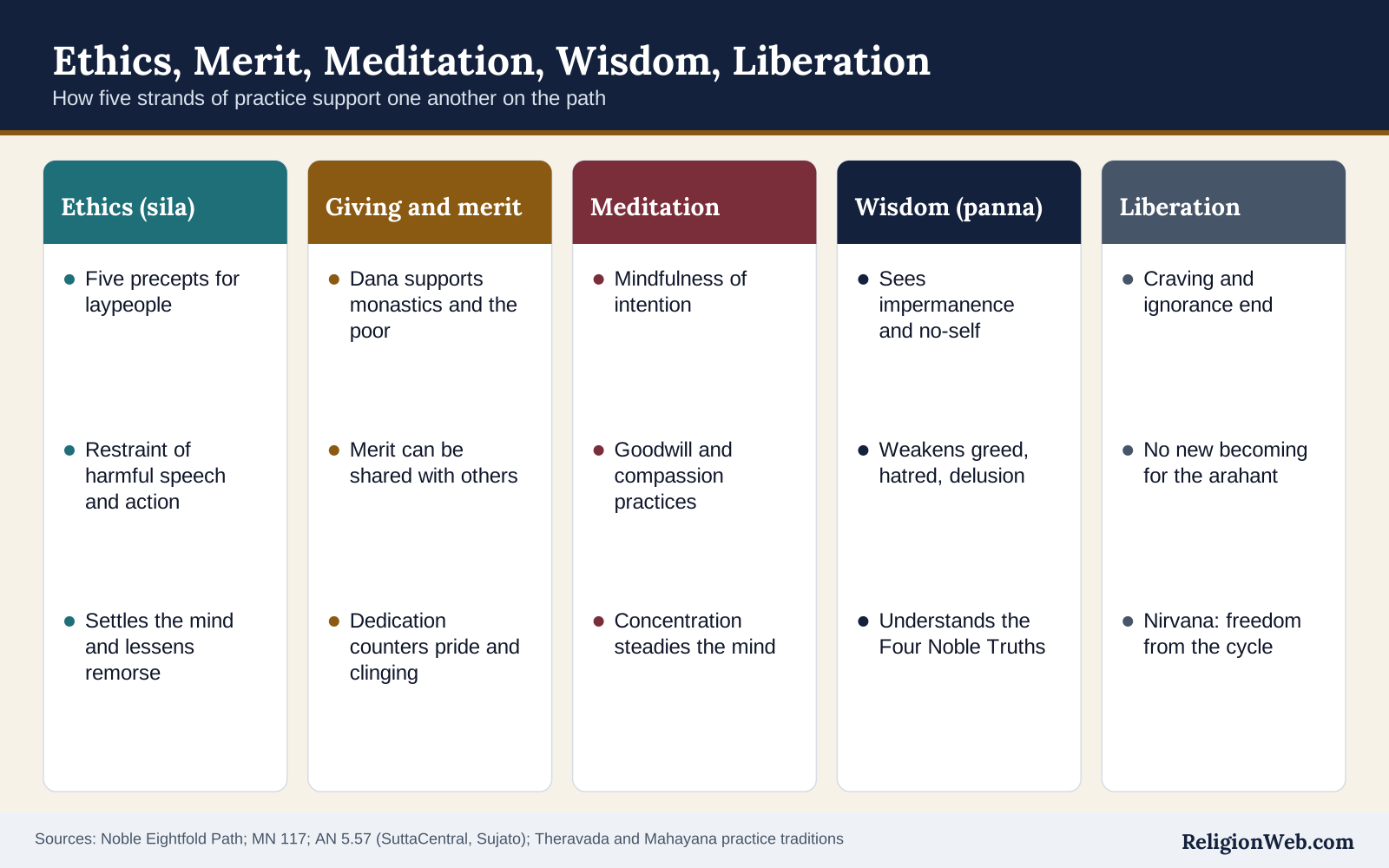
Merit is not the goal of Buddhist practice in the sense that liberation is. The tradition uses merit as a support. Generosity weakens clinging, ethical conduct removes remorse and creates a settled mind, and meditation yields concentration and insight. The Vesak celebration of the Buddha’s birth, awakening, and passing is a good example of an occasion when these strands meet: communities give, take precepts, meditate, and often dedicate the merit to all beings. Merit thus functions as a bridge between ordinary life and the path.
Ethics, Meditation, Wisdom, and the Ending of Karma
Ethical Training and Karma in Daily Life
The five precepts as applied karma
The most common expression of karmic ethics for lay Buddhists is the set of five precepts: to refrain from killing living beings, from taking what is not given, from sexual misconduct, from false speech, and from intoxicants that cloud the mind. These are undertaken as training commitments, not as commandments imposed by an external authority, and they correspond to the unwholesome courses of action described earlier. On days of special observance, such as the full-moon and new-moon days (uposatha) in Theravada countries, committed laypeople may take eight precepts, adding restraints on eating after midday, on entertainment and adornment, and on luxurious beds. Such days are common occasions for visiting monasteries, listening to teachings, and meditating.
Applied karma is not mainly about avoiding grave offenses. It concerns the texture of ordinary choices: speech in a conflict, generosity with time, patience with a difficult relative. The Buddhist ethical tradition judges these through intention, so the same outward action can have different moral weight depending on the motive. This emphasis is why the traditions place so much value on mindfulness of the state of mind in which one acts.
“I am the owner of my deeds”
One of the most widely recited reminders of karmic responsibility comes from a discourse in the Aṅguttara Nikāya often called “Subjects for Regular Reviewing” (AN 5.57). It lists five facts that a person should reflect on often: that one is subject to aging, to illness, to death, to separation from all that is dear, and finally this:
I am the owner of my deeds and heir to my deeds. Deeds are my womb, my relative, and my refuge. I shall be the heir of whatever deeds I do, whether good or bad.
Aṅguttara Nikāya 5.57 (Subjects for Regular Reviewing), translated by Bhikkhu Sujato, SuttaCentral
The Theravada tradition has turned these five reflections into a regular recitation for monastics and lay Buddhists alike, and the passage is often read as a statement of moral responsibility rather than a threat. It does not say that a person is condemned by their deeds. It says that deeds are what one has to work with, in the way a person’s inheritance is. The reflection on “whatever deeds I do, whether good or bad” is directed toward the future as much as the past: it invites the reader to act with care now, since present choices are the part of karma that is still open. The passage should also be read together with the rest of the list, since the first four reflections remind the practitioner that life is brief and fragile, which gives urgency to the fifth.
Meditation, Wisdom, and Liberation
How meditation works on the roots of karma
If karma begins with intention, and intention is driven by greed, hatred, and delusion, then meditation is the tool by which those roots are examined and weakened. Mindfulness makes a person aware of the arising of impulses before they harden into speech or action. Concentration practices such as loving-kindness (mettā), compassion, sympathetic joy, and equanimity, the four “immeasurables” or brahmavihāras, deliberately cultivate wholesome mental states, while insight practices (vipassanā) investigate the impermanent, unsatisfactory, and selfless character of experience. These methods are described in detail in What Is Buddhist Meditation? and in the discussion of the right effort, right mindfulness, and right concentration factors of the Noble Eightfold Path.
Wisdom, stream-entry, and the end of rebirth
In the Theravada account, insight matures through four stages of noble attainment. A stream-enterer (sotāpanna) has overcome the belief in a fixed self, doubt, and attachment to rites as ends in themselves; such a person is said to be assured of awakening within at most seven more lives and never to be reborn in the lower realms. A once-returner (sakadāgāmin) has weakened greed and hatred further, a non-returner (anāgāmin) has eliminated them for the sense world, and an arahant has ended all craving and ignorance. In the Abhidhamma analysis, the intentions of an arahant are “functional” (kiriya) rather than karmically productive: they do not generate new becoming. According to the tradition, past karma may still ripen until death, which is why an arahant can fall ill or suffer injury, but the capacity to generate further rebirth has ended.
The Mahayana and Vajrayana traditions describe a different map, with the ten bodhisattva stages (bhūmis) and the realization of emptiness, and they emphasize that liberation is for the sake of all beings. Yet they share the central claim that wisdom, not ritual or belief alone, brings the cycle to an end. This is the point at which karma and rebirth meet the subject of nirvana: the cycle is described as driven by ignorance and craving, and its cessation is described as the unconditioned freedom taught by the Buddha.
Karma and Rebirth in Modern Buddhist Life
Responsibility Without Blame
The risk of reading suffering as a verdict
Because karma links action to experience, it can be misused as an explanation for other people’s suffering. A person who is poor, disabled, ill, or born into a disadvantaged group is sometimes described in popular speech as “paying for past karma,” and in some societies the idea has been invoked to justify social hierarchy or to discourage questions about unfair treatment. Buddhist writers, monastics, and lay critics have pushed back against this use of the doctrine. The reasoning is straightforward and rooted in the texts: karma is one cause among several, as the discourse to Sīvaka makes clear, and the doctrine is meant to guide one’s own conduct, not to rank other people. Compassion toward those who suffer is itself a central wholesome action, and a doctrine that excused indifference would contradict the ethics it supports.
In the twentieth century, reform movements in several countries made this point forcefully. The Indian jurist and leader B. R. Ambedkar, who led a mass conversion to Buddhism in 1956, read the doctrine of karma narrowly as a teaching about moral action and its effects, and he rejected readings of karma and rebirth that he believed supported caste hierarchy. His interpretation is distinctive and is not accepted by all Buddhists, but it illustrates that the meaning of karma is actively debated. In Thailand and elsewhere, Buddhist women and scholars have also challenged traditional explanations that treat female birth as the result of lesser karma, a question that connects with ongoing debates over the ordination of nuns.
Care for the sick and the limits of karmic explanation
The early sources support a practical stance toward suffering. The monastic code preserves the Buddha’s reported instruction that whoever would attend to him should attend to the sick, and monasteries in many Buddhist countries have long maintained medical care alongside religious life. A person who is ill is not treated as being punished, and Buddhist teaching does not offer karma, meditation, chanting, or merit-making as a replacement for medical or mental-health care. These practices can bring calm, meaning, and community to someone who is ill or grieving, and many Buddhists combine them with professional treatment. Anyone facing a serious medical or psychological problem should seek qualified help, and most Buddhist teachers would give the same advice.
Karma and Rebirth in the Modern World
Reinterpretation, translation, and global spread
As Buddhism has spread through Europe, the Americas, and Australia, teachers have translated karma and rebirth into new idioms. Some emphasize the immediate psychological reading, in which each intention shapes the next moment of experience. Others, including many Tibetan, Theravada, and Japanese teachers working in the West, teach the traditional cosmology while framing it for contemporary audiences as a path of responsibility and compassion. Scholars of Buddhism, working from the text-historical approach, stress that all these readings are historical developments within a long tradition and that none is a simple return to an “original” teaching. For readers, this means that when a modern author says “Buddhism teaches” something about karma, it helps to ask which tradition, which text, and which period is being described.
Death, dying, and funerary practice today
Karma and rebirth become most concrete at the time of death. In many Theravada communities, families encourage a dying person to recall wholesome deeds, listen to chanting, or make a last offering, based on the idea that the final thoughts before death can influence what ripens first. In Tibetan Buddhism, a lama may be called to read from texts on the intermediate state, and families observe the forty-nine-day period with prayers and offerings. Japanese Buddhist funerals and memorial services at set anniversaries continue to be central to temple life, and in many diaspora communities temples serve as the place where these rites are performed in new settings. Hospice workers and chaplains in multicultural societies increasingly learn the basics of these practices so that patients and families can be supported according to their own tradition.
Common Misconceptions About Karma and Rebirth in Buddhism
Misconception 1: Buddhist karma is fate, and what happens to a person is already decided
Where the misunderstanding comes from
The equation of karma with fate is common in English because the word arrived in popular usage through a mixture of translations, spiritual writing, and everyday speech. People hear “it’s my karma” as a way of saying that a bad situation was inevitable and must simply be accepted. The idea also resembles the fatalistic teachings of some ancient Indian schools, such as the Ājīvikas, and it can be found in casual descriptions of Indian religion generally. In some Buddhist societies, ordinary speakers do use the idea fatalistically in times of misfortune, which makes the confusion understandable.
Translation adds to the difficulty. Where English uses a single word, “karma,” for both the action and its fruit, Pali distinguishes the deed (kamma) from its ripening (vipāka), and the shift in emphasis from one to the other can make a teaching about intentional choice sound like a teaching about destiny.
What the evidence and tradition actually show
The early Buddhist texts reject determinism explicitly. In the discourse on sectarian doctrines (Aṅguttara Nikāya 3.61), the Buddha criticizes the view that whatever a person experiences is entirely caused by past deeds, observing that those who held it would have no reason to make an effort to avoid wrongdoing. Karma, as the Buddhist traditions define it, is intentional action, and intention is exactly the factor that remains open to change in the present. The Salt Crystal discourse shows that the same past deed can have a lighter or heavier effect depending on the person’s present virtue and wisdom, and the fourth kind of action described in the Aṅguttara Nikāya leads to the ending of karma itself.
The Buddhist tradition therefore treats karma as a framework for responsibility. A statement such as “I am the owner of my deeds” places weight on agency. Traditions differ in how much weight they give to the influence of past action on present conditions, and popular piety in some places leans toward fatalism, but the doctrine in the texts and in the major schools is that choices matter and that the future is not fixed.
Misconception 2: Buddhism teaches that an unchanging soul reincarnates from life to life
Where the misunderstanding comes from
The word “reincarnation,” which literally suggests a re-embodiment of something that persists, shapes the assumption. Popular presentations of Eastern religion often merge several traditions into one picture in which a soul travels from body to body, and the language of “past lives” and “former selves” reinforces that picture. Even within Buddhist communities, ordinary speech often uses phrases such as “when I was reborn” or “my mother has been reborn as a bird,” which are not technical statements. Another source of confusion is that Buddhist tradition does speak of a being who “is reborn,” and the grammar of English and many Asian languages makes it difficult to speak about the process without a subject.
The Indian background matters too. Other religious traditions of the region do teach a persisting self that passes through successive bodies, and the shared vocabulary of karma and samsara can lead readers to assume that all of them mean the same thing by it. The Buddhist texts were framed partly in answer to such views, which is why the question of what continues is handled so carefully in them.
What the evidence and tradition actually show
The mainstream Buddhist position is that there is no permanent self or soul, and that rebirth is a causal process. A monk named Sāti in Majjhima Nikāya 38 is corrected by the Buddha for holding that it is the same consciousness that runs and wanders on; the Buddha says consciousness arises dependent on conditions and that apart from conditions there is no origination of consciousness. The Milindapañha states the point in the formula that the one reborn is neither the same nor another. The different schools propose different mechanisms for the continuity, from the Theravada life-continuum to the Yogācāra storehouse consciousness, but they share the claim that nothing unchanging passes over.
The picture is nuanced by internal diversity. The Pudgalavāda school affirmed a “person” that was neither identical with nor different from the aggregates, and other Buddhists criticized this as a covert self, as discussed earlier. Some popular and devotional presentations, and some modern teachers, speak in terms that sound more like a continuing self, and the Tibetan system of recognizing reincarnate lamas can appear to give a strong sense of personal continuity. Within each of those traditions, however, the doctrinal explanation still avoids positing a permanent soul. It is more accurate to say that Buddhism offers various accounts of continuity without an enduring self, and that the tension between rebirth and no-self is acknowledged and addressed within the tradition.
Misconception 3: Every event in a person’s life is punishment for past karma
Where the misunderstanding comes from
This idea combines the notion of karma as moral payback with a desire to find meaning in suffering. When something painful happens, it is natural to ask why, and a doctrine of moral cause and effect provides a ready answer. Popular retellings, and some traditional storytelling, strengthen the impression by offering tales in which a particular misfortune is traced to a specific earlier deed. Teachers sometimes use such stories to illustrate the principle of cause and effect, and listeners may generalize from them to a rule that all experiences are the result of past deeds.
Modern wellness culture adds a further layer. Phrases such as “everything happens for a reason” or “you attract what you put out” are sometimes attributed to Buddhism or to karma, although they belong to a different style of thinking. The result is a widespread impression that a Buddhist is supposed to see every misfortune as deserved.
What the evidence and tradition actually show
The Buddha is shown rejecting this generalization in the Sīvaka Sutta (Saṃyutta Nikāya 36.21). A wanderer asks whether everything a person feels is caused by past deeds, and the Buddha replies by listing other origins of feeling, such as disorders of bile, phlegm, and wind, changes of weather, and exertion, before stating:
Some feelings stem from bile disorders. You can know this from your own personal experience, and it is generally deemed to be true. Since this is so, the ascetics and brahmins whose view is that everything an individual person experiences is because of past deeds go beyond personal experience and beyond what is generally deemed to be true.
Saṃyutta Nikāya 36.21 (Sīvaka Sutta), translated by Bhikkhu Sujato, SuttaCentral
The Buddha adds that some feelings are indeed the result of past deeds. The passage thus affirms karma while denying that it explains everything, and the Milindapañha later lists eight causes of painful feeling, among them disorders of the bodily humors, changes of season, careless self-care, the action of other people, and the ripening of past deeds, of which karmic result is only one. Another discourse in the Aṅguttara Nikāya counts the precise workings of the results of action among the four matters that are “unthinkable” (acinteyya), warning that speculation about them leads to distress. The point is that the details of how any particular event arises from particular deeds are not something a person can confidently trace. For this reason, many Buddhist teachers caution against telling a suffering person that they deserve it, since neither the texts nor ordinary experience supports such confidence.
Misconception 4: Karma is a system of cosmic reward and punishment run by a judge
Where the misunderstanding comes from
Many English speakers expect a moral order to involve someone who administers it. Retributive vocabulary reinforces this expectation: Chinese translations often use words meaning “retribution” or “recompense,” and English writers speak of “karmic payback” or “the universe balancing the books.” Buddhist art also contributes, since Tibetan and East Asian temple paintings show scenes of hells and a king of the dead who examines the deceased. A viewer could reasonably conclude that a judge assigns punishments.
The impression is strengthened by the way karma is sometimes taught to children and new learners, with simple stories of good and bad deeds followed by clear rewards and penalties. Such stories are useful teaching devices, but they can leave the impression that someone is keeping the account.
What the evidence and tradition actually show
In the Buddhist teaching, no deity, buddha, or cosmic official hands out the results of karma. The Buddha is not a judge, and the discourses describe results as arising naturally from actions in the way that fruit follows a seed, with the seed’s own nature determining the fruit. The tradition’s own explanation is that karma is an impersonal law of cause and effect. The Buddha’s reported criticism of the doctrine that a creator controls all experience, in the same discourse on sectarian doctrines, applies to this question as well.
The texts do contain dramatic scenes. One discourse in the Majjhima Nikāya (MN 130) describes beings in hell being questioned by Yama, the lord of the dead, about whether they had seen the “divine messengers” of aging, sickness, and death and acted on the warning. Traditional commentators and many modern teachers read such scenes as a way of presenting the moment when beings confront the results of their own deeds, and not as a literal tribunal that imposes a sentence from outside. Other readers take the scenes more literally. In either case, the tradition’s consistent claim is that the underlying cause of suffering is a being’s own unwholesome action, and that the path out of suffering lies in changing that action.
Frequently Asked Questions About Karma and Rebirth in Buddhism
Questions About Meaning and Terms
What is the difference between karma and kamma?
They are the same word in two ancient languages. Karman (usually written “karma” in English) is Sanskrit, and kamma is the Pali form used in the early canon preserved by the Theravada tradition. Both mean “action” or “deed.” Sanskrit-based Mahayana and Vajrayana literature naturally uses karma, while English writing on the Pali discourses sometimes keeps kamma, partly to signal that the Buddhist technical sense is meant.
The difference that matters is not between the two spellings but between the Buddhist concept and the broad English usage that treats karma as luck, destiny, or universal payback. When a Buddhist text speaks of kamma, it means deliberate action and the results that follow from it, within a larger account of craving, ignorance, and release.
Do Buddhists have to believe in rebirth?
There is no creed that all Buddhists must recite, and communities differ in how they treat the question. In the classical Theravada, Mahayana, and Vajrayana traditions, rebirth is part of the standard teaching and underlies ritual, ethics, and the understanding of the goal. Lay Buddhists in Asia typically hold the belief as part of their upbringing, and the Pew Research Center’s findings on karma in South and Southeast Asia reflect how widely it is held.
In Western and modern settings, some practitioners suspend judgment about rebirth or reinterpret it psychologically, and some teachers support this approach, as discussed above. Others hold that it is integral to the teaching. The disagreement is real and ongoing, and the traditions themselves have not resolved it into a single position for every era and place.
Can karma be changed, reduced, or erased?
The early texts say that results are not fixed. They depend on conditions, including a person’s present virtue and understanding, which is the point of the Salt Crystal discourse. A person cannot make a deed not have happened, but can change its effect by developing the mind, acting wholesomely, and, in the monastic setting, by confessing and restraining wrongdoing.
Traditions vary in how they describe this. Many Theravada teachers speak of wholesome action “outweighing” or diluting the effect of unwholesome action and of the final removal of karma’s power through awakening. Tibetan Buddhism includes explicit purification practices, such as meditation and mantra recitation associated with Vajrasattva, and East Asian traditions include repentance rites. These are understood in different ways, but all rest on the premise that intentions can be changed.
Questions About Rebirth, Merit, and Liberation
Do animals have karma, and can a person be reborn as an animal?
In the Buddhist cosmology, animals are among the possible destinations of rebirth, and the texts treat an animal birth as an unfortunate one because it offers limited opportunity for moral and spiritual development. Animals act with some form of volition, so they can in principle generate karma, but the tradition usually does not hold them to the same ethical accountability as humans.
The tradition also stresses that no rebirth is permanent. A being born as an animal can later be born in other realms as conditions change, and a human being has once been, or may become, any other kind of being over the long course of samsara. This is one source of the ethical emphasis on compassion for animals, which is reflected in the first precept against taking life.
Can merit really be shared with the dead?
Buddhist traditions affirm the practice but explain it with care. In Theravada texts, the departed benefit by rejoicing in the gift made in their name, and only certain beings, such as hungry spirits, are said to be able to do so. In Mahayana and Vajrayana traditions, dedication is more broadly understood as an expression of compassion that can benefit the dead, the living, and all beings. Some practitioners understand it as a direct benefit, others as a form of care that transforms the giver.
The strongest common ground is that the practice reflects the interdependence of beings. Whether or not the dead can be reached in the way traditional accounts describe, merit dedication is also a way for survivors to honor their relatives and to turn grief into generosity.
What happens to karma when someone attains nirvana?
According to the Theravada account, a person who has become an arahant no longer generates karma that leads to new becoming, because the craving and ignorance that fuel it have ended. Past karma may still ripen during the remainder of life, and at death there is no further rebirth. The Mahayana traditions emphasize that a buddha’s activity continues spontaneously for the benefit of beings, without clinging to a self, and that bodhisattvas may continue to act in the world out of compassion.
The questions of what nirvana is and how it should be described are addressed in What Is Nirvana in Buddhism? The early texts are reserved on the subject, describing it mainly as the ending of greed, hatred, and delusion and as a freedom from the round of rebirth.
Conclusion: What Karma and Rebirth Mean in Buddhist Thought
What the Sources Show
Intention, not fate
The early Buddhist sources define karma as intentional action and treat it as one cause among others in a person’s experience. This makes it a doctrine about responsibility, character, and the possibility of change, and it explains why the Buddhist traditions connect it so closely with ethics and meditation. The popular equation of karma with destiny or with a cosmic scorekeeper has little support in the texts or the major schools.
Continuity without a permanent soul
Rebirth, in the Buddhist account, is the continuation of a conditioned process rather than the journey of a fixed self. The traditions explain that continuity in different ways, from the life-continuum of the Theravada to the storehouse consciousness of Yogācāra and the emptiness-based reasoning of Madhyamaka, and these differences are part of the historical record. Lived practice, from almsgiving to memorial rites, shows how these ideas shape communities as well as individuals.
How to Keep Exploring
Reading the primary texts and reliable translations
Readers who want to go further can begin with the discourses cited here, such as Aṅguttara Nikāya 6.63, Majjhima Nikāya 38, 135, and 136, and Saṃyutta Nikāya 36.21, which are available in open English translations on SuttaCentral. Comparing more than one translation is helpful, since translators have made different choices about key terms. The school-specific explanations of continuity are most fully developed in the Abhidharma, Yogācāra, and Madhyamaka literature, which are best approached through introductory scholarly works.
Related topics on this site
For the broader setting, see Theravada Buddhism, Mahayana Buddhism, and Vajrayana Buddhism, which describe how each tradition organizes doctrine and practice. The teachings behind karma and rebirth are developed in the Four Noble Truths and the Noble Eightfold Path, and the life of the teacher who proclaimed them is described in Who Was the Buddha?
Sources
The table below lists the principal external sources behind this article. Facts, dates and figures were checked against these and related primary, institutional and academic materials.
| # | Source | Publisher and type | Used for | Link |
|---|---|---|---|---|
| 1 | Aṅguttara Nikāya 6.63 (Nibbedhika Sutta, 'Penetrative'), translated by Bhikkhu Sujato | SuttaCentral (Bilara translation data, CC0) · Primary text | Quoted definition of karma as intention (AN 6.63); Sujato's rendering of kamma as 'deeds' | suttacentral.net |
| 2 | Saṃyutta Nikāya 36.21 (Sīvaka Sutta), translated by Bhikkhu Sujato | SuttaCentral (Bilara translation data, CC0) · Primary text | Quoted passage that not all experience is due to past deeds; other causes of feeling | suttacentral.net |
| 3 | Aṅguttara Nikāya 5.57 (Subjects for Regular Reviewing), translated by Bhikkhu Sujato | SuttaCentral (Bilara translation data, CC0) · Primary text | Quoted reflection 'I am the owner of my deeds' | suttacentral.net |
| 4 | Majjhima Nikāya 38 (Mahātaṇhāsaṅkhaya Sutta), Pali root text | SuttaCentral (Bilara data) · Primary text | Sāti's view of an unchanging consciousness and the reply that consciousness is dependently originated | suttacentral.net |
| 5 | The Dhammapada, Chapter I 'The Twin-Verses', translated by F. Max Müller (Sacred Books of the East, vol. 10, 1881) | Internet Sacred Text Archive (sacred-texts.com) · Primary text | Quoted Dhammapada verse 2 on thought and happiness (public-domain translation) | sacred-texts.com |
| 6 | Mind in Indian Buddhist Philosophy (Christian Coseru) | Stanford Encyclopedia of Philosophy · Academic reference | School models of continuity: bhavanga, prapti, seeds, alayavijnana, pudgalavada; Milindapanha chariot | plato.stanford.edu |
| 7 | Karma (Britannica topic page, quick facts) | Encyclopaedia Britannica · Encyclopedia | Sanskrit karman as 'act' and Pali kamma; karma as ethical dimension of rebirth | britannica.com |
| 8 | Buddhism, Islam and Religious Pluralism in South and Southeast Asia, section 3: Religious beliefs (2023) | Pew Research Center · Demographic data | Roughly three-quarters or more in the surveyed countries say they believe karma exists | pewresearch.org |
| 9 | How the Global Religious Landscape Changed From 2010 to 2020 (2025) | Pew Research Center · Demographic data | About 324 million Buddhists (4.1% of world population) in 2020 | pewresearch.org |
| 10 | AN 5.57 Abhiṇhapaccavekkhitabbaṭhāna Sutta: themes, owners of actions (quoting Bhikkhu Bodhi's translation, Wisdom Publications, 2012) | ReadingFaithfully.org · Translation excerpt | Bodhi's retention of 'kamma' in the same passage (contrast with Sujato's 'deeds' in the Fun Fact) | daily.readingfaithfully.org |
Last fact-check date: 2026-10-21.