Buddhist monastic life is the way of life of ordained Buddhists: monks (bhikkhus in Pali, bhikshus in Sanskrit), nuns (bhikkhunis or bhikshunis), and novices who have “gone forth” from household life into a community called the sangha. They accept a code of discipline known as the Vinaya, live simply, usually remain celibate, and depend on lay supporters for food, robes, shelter, and medicine, while offering teaching, ritual services, and an example of renunciation in return. The institution traces itself to the first disciples of the Buddha in the Ganges plain of northern India, and it has shaped almost every region where Buddhism has taken root.
The phrase “Buddhist monastic life” does not describe a single institution. Monks in Thailand, Sri Lanka, and Myanmar follow the Pali Vinaya, which in the Theravada tradition lists 227 rules for monks and 311 for nuns. Monastics in China, Korea, Taiwan, and Vietnam follow a different Indian code, the Dharmaguptaka Vinaya, and most Tibetan monastics follow yet another, the Mulasarvastivada. In Japan, most temple priests today marry and raise families. Each pattern has its own history, its own daily rhythm, and its own understanding of what a monk or nun is for, and each is described here on its own terms rather than measured against the others.
This article explains what ordination involves, how the Vinaya works, what monastics wear, eat, and do from one day to the next, how monasteries are organized in the Theravada, East Asian Mahayana, and Tibetan Vajrayana traditions, and how monastics and laypeople depend on each other. It also treats the history and contemporary revival of women’s full ordination, the numbers that can responsibly be given today, and several common misunderstandings. Statements of doctrine and practice are attributed to the tradition that holds them, because no single daily schedule or rulebook describes every Buddhist monastery.
Buddhist Monastic Life at a Glance: Meaning, Terms, and Range
What Monastic Life Means in Buddhism
Going forth: leaving household life
The usual Pali expression for becoming a monastic is pabbajja, “going forth,” and the early texts describe a person who “has gone forth into homelessness.” The phrase is not a literal description of life in a monastery, which is a well-defined home of a kind, but of a change of status. A person gives up the roles of householder, spouse, parent, and wage earner, takes on the discipline of the Vinaya, and agrees to live on what others freely give. The Buddhist sources present this as a practical arrangement for pursuing the goal described in the Four Noble Truths, the ending of suffering and its causes, with as few distractions as possible.
The Vinaya itself is matter-of-fact about the reasons. It describes monastic life as a form of training in conduct, concentration, and wisdom, and it treats the rules as supports rather than ends. Lay Buddhists share the same ethical aims in a looser form, through the five precepts, and most Buddhists in the world have never been ordained. Monastic life is therefore best understood as one of two complementary ways of living the Buddhist path: the full-time form, centered on renunciation, and the lay form, centered on family and work, with generosity linking the two.
Monastic and lay practice as parts of one path
Buddhist teachers in every tradition distinguish between the path itself and the way of life in which it is followed. The Noble Eightfold Path applies to everyone, and the early discourses report that householders as well as monastics reached high stages of realization. What ordination changes is the structure of the day. A monk or nun has no job, no household budget, and no family obligations, and the community supplies teachers, a daily schedule, and ethical guardrails.
The aim of that structure is described differently in different traditions. In Theravada teaching, the monastic is often framed as one working toward nirvana (Pali nibbana) through the training in virtue, concentration, and wisdom. In Mahayana teaching, the monastic life is also commonly framed through the ideal of the bodhisattva, who works toward awakening for the benefit of all beings. Neither framing excludes the other in practice, and many monastics describe more modest and immediate goals as well: study, service, a settled mind, or a life of simplicity.
The Many Meanings of Sangha
Sangha as the community of ordained monks and nuns
The Sanskrit and Pali word sangha means “assembly” or “community.” According to H. L. Seneviratne’s entry in the Encyclopedia of Religion, it originally referred to the assemblies of tribal republics in northeastern India around 500 BCE before it came to mean the Buddhist monastic order. In the Vinaya, the word has a precise legal sense. It names the group of fully ordained monastics, or of fully ordained nuns, who must be present in sufficient number for certain formal acts to be valid. The Patimokkha recitation, for example, is addressed to the Sangha gathered in a defined place, and a rehabilitation procedure for a monk who has committed a serious offense requires a Sangha of at least twenty monks.
In this sense there is a monks’ Sangha and a nuns’ Sangha, and one can speak of the Sangha of a particular monastery, region, or country. Disputes over whether a given group is a valid Sangha, for example whether an ordination was performed correctly, have been serious matters in several Buddhist countries, as later sections show.
The noble Sangha and the wider community
The word has a second, wider meaning that does not depend on ordination. When Buddhists “go for refuge” to the Buddha, the Dhamma (teaching), and the Sangha, the third refuge is understood in many traditions as the community of noble disciples, those men and women of any status who have reached a stage of realization, as well as the monastic order that preserves the teaching. Commentarial Theravada literature distinguishes the “noble Sangha” in this sense from the “conventional Sangha” of the ordained, a distinction that explains why a person can take refuge in the Sangha without being a monk or nun.
Early Buddhist sources also describe a fourfold community of monks, nuns, laymen, and laywomen. In everyday modern usage, especially in the West, “sangha” is frequently extended further to mean any Buddhist congregation or meditation group, including entirely lay communities. This article uses the word in its monastic sense unless it says otherwise, and it flags the wider usage where it matters.
Who Counts as Monastic: A Vocabulary of Status
Novices, fully ordained monastics, and trainee nuns
Buddhist traditions recognize several levels of ordination, and the vocabulary is easy to confuse. A novice monk is a samanera (Sanskrit shramanera; Tibetan getsul), and a novice nun is a samaneri. Novices keep a smaller set of rules than the fully ordained, and the early Vinaya sets that number at ten. A fully ordained monk is a bhikkhu (Tibetan gelong) and a fully ordained nun a bhikkhuni (Tibetan gelongma). In the early nuns’ order, a woman also spent two years as a trainee, a sikkhamana, keeping six rules before full ordination.
The Pali term for full ordination is upasampada. Full ordination is lifelong in principle, but the Vinaya allows a monk to give up the training and return to lay life, and in some societies temporary ordination of a few weeks or months is a customary rite of passage. The next sections return to each of these points; Table 1 gathers the central terms in one place.
| Term | Language | Meaning in monastic use |
|---|---|---|
| Sangha | Sanskrit, Pali | The monastic community; in a wider sense the noble disciples, or any Buddhist community |
| Vinaya | Sanskrit, Pali | The monastic discipline: rules, procedures, and the stories that explain them |
| Patimokkha (Pratimoksha) | Pali, Sanskrit | The list of rules recited by monastics every half-month |
| Bhikkhu / bhikkhuni (bhikshu / bhikshuni) | Pali, Sanskrit | A fully ordained monk or nun; the word is traditionally linked to “one who lives on alms” |
| Samanera / samaneri | Pali | A novice monk or nun who keeps ten precepts |
| Pabbajja and upasampada | Pali | “Going forth” (entering the novice state) and full ordination |
| Vassa | Pali | The three-month rains retreat during which monastics stay in one residence |
| Uposatha (posadha) | Pali, Sanskrit | The observance days of the lunar half-month, when the Patimokkha is recited |
| Dana | Pali, Sanskrit | Generosity; gifts of food, robes, and other needs from laypeople to monastics |
Women who keep eight or ten precepts without full ordination
In several Theravada countries women have long lived as renunciants without holding full ordination. In Thailand they are called mae chi, wear white robes, and keep eight or ten precepts. In Myanmar they are thilashin, “possessors of morality,” and wear pink robes. In Sri Lanka they are dasasil mata, “mothers of the ten precepts.” Martine Batchelor’s entry on Buddhist nuns in the Encyclopedia of Religion (2005) gave roughly 30,000 nuns in Myanmar in 2004 and about 10,000 mae chi in Thailand, and she noted that Burmese nuns receive less financial support than monks.
These women are not simply lay devotees, and they are not formally bhikkhunis. Many Theravada authorities hold that the bhikkhuni lineage of their tradition lapsed, a position discussed in the section on nuns. Women who live in this intermediate status are often respected teachers and meditators, and in Thailand some of them later seek full ordination elsewhere. Their existence is one reason that counts of “nuns” vary so widely depending on how the term is defined.
A Day in Outline and the Range of Settings
A sample day as a framework, not a rule
It is useful to have a rough picture of a day before the details. In many monasteries, whatever the tradition, the day begins before dawn with individual or group meditation and a chanted service of bows and recitation. Mornings are given to a meal, often the main or only one, and to work such as cleaning, cooking, and maintenance. Study, teaching, or individual practice fills much of the middle of the day. An evening service and further meditation close it. Observance days, retreats, and festivals interrupt the pattern at intervals through the year.
That outline is a framework, not a schedule that applies everywhere. A Zen training monastery in Japan, a forest monastery in California, and a Tibetan monastic university in India differ in nearly every particular, from wake-up time to the content of the meal to the balance between meditation and debate. Later sections give documented examples of each, and Infographic 1 offers a simple frame for comparing them.

Settings: forest, village temple, city, and monastic university
Seneviratne’s article in the Encyclopedia of Religion describes a long-standing division in South and Southeast Asian Buddhism between forest-dwelling monks, who emphasize meditation, and village or town monks, who emphasize study and service to the lay community. These are two emphases within one institution rather than two religions, and the Pali tradition names them “the bearing of contemplation” and “the bearing of the books.” Many monasteries combine both.
The physical setting varies with the emphasis. A forest monastery may consist of scattered huts, a meditation hall, and a simple kitchen. A village temple in Thailand or Sri Lanka is typically a compound with a shrine hall, an ordination hall, residences, and often a school or a center for community events. In East Asia, large training monasteries sit in mountain settings with halls for meditation, chanting, and communal meals, while urban temples serve lay congregations. In the Tibetan world, the great monastic universities historically housed thousands of monks, with debate courtyards and assembly halls at the center. The sections below take these in turn.
Origins and Historical Development of the Buddhist Sangha
From Wandering Renunciants to Settled Communities
The first disciples and the going forth
The monastic community begins, in the tradition’s own telling, with the earliest followers of the Buddha. The Pali Vinaya, preserved by the Theravada school, narrates that the first five ascetics he taught at Isipatana near Benares became his disciples, and that the young man Yasa, from a wealthy merchant family of the same city, shaved his hair and beard, put on ocher robes, and “gone forth into homelessness.” In the earliest cases the Buddha is reported to have admitted a person simply by saying, “Come, monk.” The Vinaya then records a gradual formalization: the Buddha allowed his disciples to give the going forth and the full ordination through the three refuges, and later replaced that simple method with a formal act of the Sangha involving a motion and three announcements.
Historians treat this narrative as a tradition rather than a contemporary record. The Vinaya texts were compiled and edited over generations, and the surviving collections belong to several schools that preserved their own versions. Dates for the Buddha are themselves uncertain; traditional Theravada chronology places his death in 483 BCE, while many modern historians place it later, around 400 BCE, with a margin of several decades. What can be said with confidence is that organized communities of renunciants, with their own rules and ordination procedures, existed in northern India within a few generations of the Buddha’s lifetime, and that the early texts describe life in these communities in considerable detail.
The rains retreat and the first shelters
One of the best-documented origin stories concerns the rains retreat. According to the Pali Vinaya, the earliest monks wandered throughout the year, including during the monsoon, until laypeople at Rajagaha complained. Their objection, as the text reports it, was that the Sakyan monastics were trampling green grass and harming small creatures, and that “Even birds make a nest in the top of a tree and settle down for the rainy-season.” The Buddha is then reported to have instructed the monks to enter a rainy-season residence, and the text sets the first entry at the day after the full moon of what Bhikkhu Brahmali’s translation renders as July, with a second entry one month later.
Paul K. Nietupski’s article on Buddhist monasticism in the Encyclopedia of Religion (2005) draws a broader conclusion from this evidence. The early followers were largely eremitic and itinerant, and shelters (arama) were arranged for the four months of the monsoon. Nietupski adds that fully developed monasticism likely did not begin within the Buddha’s lifetime but grew out of these seasonal residences. Wealthy patrons donated parks and halls, and the settled monastery gradually became the norm, though the ideal of the wandering or forest-dwelling monk never disappeared.
Councils, Schools, and the Several Vinayas
Why there is more than one Vinaya
The Pali Vinaya’s last two chapters describe how the early community dealt with the death of its founder and with disagreement. The account of the first council, held at Rajagaha according to the text, recounts that Mahakassapa proposed a communal recitation of the Teaching and the Monastic Law, partly because a monk named Subhadda had said that the community was now free of “always being told what’s allowable and what’s not.” The same chapter records a question that would never be fully settled. Ananda reported that the Buddha had said the Sangha could abolish the “minor training rules” after his passing, but he had not asked which rules were minor, and the senior monks offered different answers. In the end Mahakassapa moved that the Sangha neither lay down new rules nor abolish existing ones, partly because laypeople knew what was allowable for monastics.
The next chapter says that one hundred years after the Buddha’s final extinguishment, monks of Vesali proclaimed ten practices allowable, among them gold, silver, and money, and that the elder Yasa of Kakanda opposed them. Nietupski notes that scholars link the division between the Mahasamghika and Sthavira groups to disputes over the Vinaya, with the Mahasamghikas accused of laxity, and he cautions that the details of the councils are uncertain. From these early divisions came a number of schools, each with its own Vinaya. Six complete or substantial Vinayas survive: those of the Theravada, Mulasarvastivada, Sarvastivada, Mahasamghika, Dharmaguptaka, and Mahisasaka schools. The Theravada Vinaya survives in Pali; the Mulasarvastivada survives in Sanskrit fragments, Chinese, and Tibetan; and the others survive in Chinese translations made in the fifth century CE.
Spread to Sri Lanka, Central Asia, China, and Tibet
As Buddhism spread, so did its monastic institutions. Martine Batchelor reports in the Encyclopedia of Religion that the order of nuns reached Sri Lanka in the third century BCE and that many nunneries were founded there. Monasticism traveled along the trade routes of Central Asia into China, Korea, Japan, and Southeast Asia, and Sri Lankan nuns traveled to China by sea in the fifth century CE and founded a nuns’ order that survives and later spread to Korea and Vietnam. In China, the Dharmaguptaka Vinaya became the standard monastic code, and it remains the basis of ordination in China, Taiwan, Korea, and Vietnam.
Tibet received its monastic Vinaya in a different way. According to the Dalai Lama’s published account of ordination in the Tibetan tradition, the Indian abbot Shantarakshita was invited to Tibet by King Trisong Deutsen in the eighth century and founded the first monastic community by ordaining seven Tibetans. Tibetan monastics follow the Mulasarvastivada Vinaya, which was translated into Tibetan in the ninth century. The Tibetan tradition has regarded its lineage of ordination as unbroken since that time, despite periods of political persecution.
Monasteries, States, and Modern Change
Patronage, land, and kings
In nearly every Buddhist society the monastery has depended on rulers and wealthy donors as well as on everyday alms. Seneviratne describes a triangular relationship among sangha, king, and people in South and Southeast Asia. Kings in Sri Lanka, Thailand, and Burma granted land to monasteries and had lay officials administer it, which allowed monks to remain formally propertyless while the institution endured. In return the Sangha lent legitimacy to rulers, who in turn were expected to protect the religion and, at times, to “purify” it by removing monks who had broken the discipline.
The Tibetan example went further. Georges Dreyfus, in the same encyclopedia, reports estimates that up to 20 percent of the population was ordained before 1950 and describes the expansion of monasticism from the seventeenth century as what the historian Melvyn Goldstein called “mass monasticism.” The three great Gelug monasteries of Ganden (founded in 1409 by Tsongkhapa), Drepung, and Sera were at the center of this system. Drepung was said to have more than ten thousand monks, and it held estates worked by tenants.
Persecution, secularization, and revival
Monastic institutions have also been the target of state action. Nietupski notes that Buddhism was persecuted in Tang China (618–907 CE), that monasteries in Song China were integrated into the legal and administrative system, and that the Meiji government of Japan (1868–1912) secularized powerful monasteries. The Meiji authorities also ordered monks to adopt family surnames and allowed them to marry, have children, and eat meat, according to the Princeton University Press description of Jaffe’s study of clerical marriage in modern Japan, and the change eventually reached every Japanese Buddhist denomination.
In Tibet, Batchelor reports that in 1959 there were 618 nunneries with 12,398 nuns, and that many monasteries and nunneries suffered after the Chinese Communist takeover of the 1950s and during the Cultural Revolution (1966–1976). Tibetan monastic institutions were re-established in exile in India, and the Fourteenth Dalai Lama later reformed aspects of monastic education, for example by removing the annual limits on candidates for the higher geshe degrees. Since the late twentieth century, Theravada and Tibetan communities have also seen new debates over women’s full ordination, and Western converts have established monasteries in Europe, North America, and Australia. Table 2 summarizes selected points from this history.
| Period | Development | Source or note |
|---|---|---|
| Fifth to fourth century BCE (dates debated) | First disciples of the Buddha go forth; ordination by the call “Come, monk,” later by the three refuges and a formal act of the Sangha | Pali Vinaya, Mahavagga (Brahmali translation) |
| Soon after the Buddha’s death (traditional account) | First council at Rajagaha; the Sangha decides not to abolish the “minor” rules | Pali Vinaya, Khandhaka 21 |
| About a century later (traditional account) | Dispute at Vesali over ten practices, including gold and silver | Pali Vinaya, Khandhaka 22 |
| Third century BCE | Order of nuns reaches Sri Lanka | Batchelor, Encyclopedia of Religion |
| Fifth century CE | Chinese translations of several Vinayas; Sri Lankan nuns reach China | Encyclopedia of Religion (Vinaya; Buddhist Nuns) |
| Eighth to ninth century CE | Shantarakshita ordains the first Tibetan monks; Mulasarvastivada Vinaya translated into Tibetan | Dalai Lama’s website; Encyclopedia of Religion |
| 1409 | Tsongkhapa founds Ganden, first of the three great Gelug seats | Dreyfus, Encyclopedia of Religion |
| 1868–1912 | Meiji reforms secularize monasteries and permit clerical marriage in Japan | Nietupski; Jaffe (Princeton University Press) |
| 1996 and 1998 | Sri Lankan women receive full ordination at Sarnath and Bodh Gaya | Analayo; Batchelor |
| June 2022 | 144 women receive full ordination in Bhutan in the Tibetan tradition | Religion News Service |
The Vinaya: Monastic Law, Its Structure, and Its Purpose
What the Vinaya Is and How It Is Organized
Patimokkha, explanations, and chapters
The Vinaya is the body of texts that regulates the life of ordained Buddhists, and it has three recognizable layers in the Theravada version. The oldest and shortest layer is the Patimokkha (Sanskrit Pratimoksha), a graded list of rules for monks and a separate one for nuns. The second layer is the “analysis” of the rules, which tells the story of the incident that led to each rule, explains the wording, and states the exceptions. The third layer consists of the khandhakas, or chapters, which deal with procedures and community life: ordination, the observance day, the rains retreat, robes, medicine, lodgings, disputes, and the two councils. In Bhikkhu Brahmali’s numbering on SuttaCentral, the Pali chapters run from Khandhaka 1 to Khandhaka 22.
Other schools organize their Vinayas in a broadly similar way. The Encyclopedia of Religion entry on the Vinaya describes the same Pratimoksha core, a commentary on each rule called the vibhanga, and a series of seventeen to twenty chapters in the Sanskrit-derived collections, with a separate Pratimoksha and commentary for nuns that contains more rules than the monks’ list. It also records that the counts differ by school: the Sarvastivada monks’ list has 263 rules, the longest, and the Mahasamghika list has 218, the shortest. What is unusual about the Vinaya as a legal genre is that it is not a list of commands alone; it is a casebook, with every rule tied to a named occasion.
Rule counts and the families of rules
The Pali Patimokkha for monks is divided into families, each defined by the consequences of breaking the rule. There are four rules entailing expulsion from the community, thirteen entailing suspension, two “undetermined” rules, thirty entailing relinquishment of an object together with confession, ninety-two entailing confession, four entailing acknowledgment, and seventy-five rules of training, followed by seven procedures for settling legal issues. Added together, these make the traditional total of 227. The nuns’ Patimokkha has eight, seventeen, thirty, one hundred sixty-six, eight, and seventy-five rules in the corresponding families, with the same seven procedures, for a total of 311.
The other main Indian codes use different totals. According to the Encyclopedia of Religion, the Dharmaguptaka Vinaya, followed in East Asia, has 250 rules for monks and 348 for nuns, and the Mulasarvastivada Vinaya, followed in Tibet, has 253 and 364. The Dalai Lama’s published account of Tibetan ordination gives the monks’ 253 vows in five classes: four defeats, thirteen remainders, 120 downfalls (thirty forfeiting and ninety simple), four to be confessed individually, and 112 misdeeds. The totals differ because the codes were redacted and counted differently, and not because their ethical content is fundamentally different. Table 3 lists the central concepts.
| Concept | Pali term | What it involves | Example in Brahmali’s translation |
|---|---|---|---|
| Offenses entailing expulsion | parajika | The most serious class; the monastic is “expelled and excluded from the community” | Sexual intercourse; stealing; intentionally killing a human being; falsely claiming a superhuman quality |
| Offenses entailing suspension | sanghadisesa | Probation, a further trial period, and rehabilitation by a Sangha of at least twenty monks | Matchmaking; causing a schism in the Sangha; being difficult to correct |
| Relinquishment and confession | nissaggiya pacittiya | An improperly acquired object is given up, and the offense is confessed | Taking or consenting to gold, silver, or money being deposited for oneself; trading with money |
| Confession | pacittiya | The offense is revealed to another monastic and set right | Eating at the wrong time; eating stored food; eating food that has not been given |
| Rules of training | sekhiya | Seventy-five points of etiquette and conduct | Wearing the sarong evenly all around; being well covered while walking in inhabited areas |
| Formal act of the Sangha | kamma | A procedure with a motion and, usually, announcements, approved by silence | Full ordination by one motion and three announcements |
| Observance day | uposatha | Twice-monthly gathering for the recitation of the Patimokkha | The preliminaries: sweeping, lamps, water, and seats |
| Invitation ceremony | pavarana | Closing ceremony of the rains retreat, inviting correction | “What you have seen, heard, or suspect” |
How Offenses Are Handled
Seriousness, confession, and the observance-day recitation
The Vinaya does not treat all offenses alike. The four most serious are punished by permanent exclusion, and the text states that such a monk “is no longer part of the community of monks.” The thirteen suspension offenses are serious but remediable: the monk undergoes probation for as many days as he concealed the offense, then a trial period of six days, and finally rehabilitation by a Sangha of twenty. Offenses in the lighter families are handled by confession to another monk, sometimes after giving up the object concerned. The practical idea is that concealment is worse than the underlying fault, and that restoring the person to full participation in the community matters as much as marking the wrong.
The observance-day recitation is the regular occasion for this practice. According to the Patimokkha’s own preliminaries, the monks must first perform the duties beforehand, which are sweeping, setting up lamps, water, and seats, and then the preliminary duties of consent, purity, knowing the season, counting the monks, and instruction. The ceremony may be held only when it is the observance day, when all the monks who should be present have arrived, when there are no shared offenses, and when no one who should not be present is there. During the recitation, the reciter invites the assembly to reveal any offense. The text reads:
Anyone who has committed an offense should reveal it. If you haven’t committed any offense, you should remain silent. If you are silent, I will regard you as pure.
Pali Vinaya, Monks’ Patimokkha (SuttaCentral pli-tv-bu-pm), introduction, section 6.5–6.7, trans. Bhikkhu Brahmali (SuttaCentral)
Silence, in this procedure, is a legal statement. The reciter asks three times whether the assembly is pure in regard to each section, and silence each time is recorded as a declaration of purity. The text adds that a monk who remembers an offense during the announcements but does not reveal it is “lying in full awareness,” and that “when it’s revealed, he will be at ease.” The ritual thus combines a legal function with an ethical and psychological one. It is the point in the half-month at which a community re-establishes that it is united and clear of unresolved faults.
Invitation, repair, and communal acts
A second recurring procedure closes the rains retreat. In the pavarana, or invitation ceremony, each monk invites the others to point out faults that they have seen, heard, or suspected, and the Vinaya gives the formula that a junior monk recites to the Sangha:
I invite the Sangha to correct me concerning what you have seen, heard, or suspect. Please correct me, venerables, out of compassion. If I see a fault, I will make amends.
Pali Vinaya, Khandhaka 4 (Invitation), section 1.14, trans. Bhikkhu Brahmali (SuttaCentral)
The formula is repeated three times, from the most senior monk down. Its logic is mutual correction: the Patimokkha itself says, in the rule on being difficult to correct, that the Buddha’s community “has grown” through “mutual correction and mutual clearing of offenses.” The chapter’s opening story explains why the ceremony exists: a group of monks had spent the rains in a vow of silence, the Buddha is reported to have rebuked them, and he forbade such vows and prescribed the invitation in their place. The ceremony therefore depends on speech and on openness to the community, not on withdrawal from it.
The Vinaya also provides for formal acts that decide communal business. A typical procedure, such as full ordination, is carried out as a motion that is announced to the Sangha, followed by announcements, with the assembly asked to remain silent if it approves and to speak up if it does not. The number of monks required depends on the act. The Pali text allows five monks for ordination in border regions and ten in the central Ganges plain, and a Sangha of twenty to rehabilitate a monk after a suspension offense. Because every formal act requires a proper quorum, disputes over the validity of an ordination, of a boundary, or of a Sangha are not merely technical. They can affect who is considered a monk at all.
Why Rules Exist: Purpose, Interpretation, and Adaptation
Rules as responses to incidents
One of the most distinctive features of the Vinaya is that its rules are presented as responses to particular events. In the Pali account of the rains retreat, laypeople complained about monks wandering through the monsoon, monks reported the complaint, and the Buddha laid down the residence. The Vinaya describes the observance-day gatherings in a similar way: a king observed that members of other groups gathered on certain days and suggested that the monks do likewise; the monks sat in silence; the people complained; and the Buddha instructed the monks to give a teaching when they gathered. The repeated pattern of incident, complaint, report, and ruling means that lay opinion plays a recognized part in shaping monastic conduct.
The code also contains a built-in awareness of local variation. When the Buddha is reported to have allowed ordination by a group of five in regions outside the central Ganges plain, the same passage allows, outside that region, sandals with multi-layered soles, unrestricted bathing, and rugs made of sheepskin, goatskin, and deerskin. The principle is explicit: what suits the Gangetic heartland need not suit every climate. At the first council, by contrast, the Sangha is said to have resolved that it would neither lay down new rules nor abolish existing ones, in part because the rules were known to laypeople. The Pali tradition thus holds both a flexible principle and a conservative one, and different communities have emphasized one or the other.
How different traditions read and adapt the Vinaya
Traditions have adapted the Vinaya in different ways. In Tibet, Dreyfus notes in the Encyclopedia of Religion that the Vinaya was largely reduced to a monastic ethical code, while local monastic constitutions (bca’ yig) governed daily life in each institution. In China, Mahayana monastics generally receive the bodhisattva precepts at ordination along with the bhikshu or bhikshuni precepts. Chiu Tzu-Lung’s 2019 study in the Journal of the OCBS, the Oxford journal of Buddhist studies, identifies a conflict between Vinaya rules and the bodhisattva ideal that earlier scholarship had not examined closely, which indicates that the relationship is still debated among Chinese monastics, in Taiwan and on the mainland alike. Chan monasteries developed their own codes of “pure rules” for communal life, which supplemented the Vinaya without replacing it.
In Japan, as noted above, clerical marriage was permitted by the Meiji government and became widespread, which departs from the celibacy that every Indian Vinaya requires. Scholars such as Richard Jaffe argue that this change was not easy for Japanese Buddhists and that the idea of renunciation still carries weight in sectarian teaching even when clergy live much like their parishioners. These examples show that “following the Vinaya” can mean quite different things, and that the answer to whether a given practice is correct depends on which school, which period, and which authority is meant.
Going Forth: Ordination, Novices, and Training
Becoming a Novice
Going forth: the shaved head, the robes, and the refuges
The first step of monastic life is the going forth, pabbajja. In the Pali Vinaya the procedure is described in simple terms. The candidate first shaves off his hair and beard and puts on ocher robes. He arranges his upper robe over one shoulder, pays respect at the feet of the monks, squats on his heels, and raises his joined palms. He is then taught to say the formula of the three refuges, three times in succession. The refrain at the end of the passage states that the going forth and full ordination may be given “through the taking of the three refuges.” The first repetition runs:
I go for refuge to the Buddha, I go for refuge to the Teaching, I go for refuge to the Sangha.
Pali Vinaya, Khandhaka 1 (Great Chapter), section 12.4, trans. Bhikkhu Brahmali (SuttaCentral); the formula is repeated a second and third time
The same threefold refuge is the entry point for lay Buddhists, which underlines the continuity between the lay and monastic states. In the Theravada tradition the going forth produces a novice, a samanera, and the novice then takes ten training rules, which the Vinaya lists as abstaining from killing living beings, from stealing, from sexual activity, from lying, from alcoholic drinks that cause heedlessness, from eating at the wrong time, from dancing, singing, music, and seeing shows, from wearing garlands and using scents and cosmetics, from high and luxurious resting places, and from receiving gold, silver, and money. The first five closely parallel the five precepts of laypeople, with complete abstention from sexual activity in place of the lay rule against sexual misconduct, and the last five are what make a life of simplicity concrete.
A novice does not live independently. He or she is placed under a preceptor and a teacher, who assume responsibility for instruction and conduct. The Vinaya describes the duties of such pupils in detail: preparing a seat for the teacher, going out to meet him and receiving his bowl and robe, following a short way behind him when walking, and helping him with the bath and the care of his dwelling. The relationship is an apprenticeship in the literal sense, and it is the primary channel through which the Vinaya is transmitted as lived practice.
Temporary and short-term ordination
In several Theravada societies the novice state is also a rite of passage, and a stay in the monastery may last only days or weeks. A research blog from the Max Planck Institute for Social Anthropology (Laura Hornig, 2016) describes the Burmese shin byu ceremony, in which boys under twenty, typically at least eight years old and often teenagers, enter the Sangha as novices. Most ceremonies are held in April around the Buddhist New Year or in July, when the rains retreat begins. In the morning the boys are dressed as princes in white silk, jewelry, and a crown, and they ride in a procession that stops at pagodas and spirit shrines. After a sermon and a feast, the boys change into maroon robes, their heads are shaved, and the hair is buried in the ground. The novices usually stay in the monastery for about a week, rising at 5:00 a.m., eating nothing after 11:00 a.m., and joining the monks on the alms round the day after the ceremony.
The author notes that the ceremony is regarded as a major way of accumulating merit, especially for the boy’s mother, and that it can be costly, with families bearing expenses for costumes, robes, a feast, and donations. The Pluralism Project at Harvard University likewise observes that short-term novice ordination is a rite of passage in many Theravada communities and that temporary ordinations are common in Cambodian and Thai communities in the United States. The Vinaya anticipates that not everyone will remain. A monk may give up the training and return to lay life, and the first of the expulsion rules is framed around a monk who has sexual intercourse “without first renouncing the training and revealing his weakness,” which implies that leaving the order openly is a legitimate alternative to breaking a vow.
Full Ordination (Upasampada)
Requirements and the ceremony
Full ordination, upasampada, is the step that makes a person a bhikkhu or bhikkhuni and subjects him or her to the whole Patimokkha. The Pali Vinaya sets a minimum age of twenty, and gives a reason: a younger person, it says, cannot endure cold and heat, hunger and thirst, insects, harsh speech, and severe bodily pain, whereas a person of twenty can. The preceptor, or upajjhaya, must himself be a monk of at least ten years’ seniority who meets a list of qualities, among them knowing the offenses and how they are cleared, and being able to nurse and counsel a student.
The ordination itself is a formal act of the Sangha. The Pali text says it is done “through a legal procedure consisting of one motion and three announcements.” A competent monk informs the Sangha that the candidate wants full ordination with a named preceptor, announces the motion, and then repeats the announcement three times, asking any monk who approves to remain silent and any who does not to speak. Silence is again an act of consent. The Vinaya sets the quorum at ten monks in the central Ganges plain and five in the outlying regions. The story behind the lower number is preserved in the text: in the southern region of Avanti, the monk Mahakaccana could gather a Sangha of ten for the ordination of Sona only after three years, “with much trouble and difficulty,” and the Buddha then permitted a group of five outside the central plain.
Dependence on a teacher and the early years
Newly ordained monks are expected to live “with formal support” from a teacher, a relationship the Vinaya calls dependence. For the Pali tradition the standard period is five years for a competent monk, and the text says that one who is not competent should remain dependent for life. A monk with ten years of seniority may give such support to others, and ten years’ seniority is also the minimum for acting as a preceptor. These arrangements make seniority, counted in rains retreats (vassa) since ordination, the central measure of standing within the community.
At the moment of ordination, the preceptor is instructed to point out the “four supports” on which the monastic life rests. The Vinaya words them as follows, with each support followed in the text by a list of additional allowances:
One gone forth is supported by almsfood. You should persevere with this for life.
… One gone forth is supported by rag robes. You should persevere with this for life.
… One gone forth is supported by the foot of a tree as a resting place. You should persevere with this for life.
Pali Vinaya, Khandhaka 1 (Great Chapter), section 30.4.2, 30.4.5, 30.4.8, trans. Bhikkhu Brahmali (SuttaCentral); a fourth support, medicine of fermented urine, follows
The supports are a statement of the ideal and not a literal description of how most monks now live. Each is immediately paired in the text with allowances: meals for the Sangha, invitational meals, robe-cloth of linen, cotton, silk, wool, or hemp, a dwelling or a cave, and medicines such as ghee, butter, oil, honey, and syrup. Seneviratne notes that Theravada renouncers owned little beyond the four requisites of food, clothing, shelter, and medicine, which is how the supports are usually summarized.
Ordination Across Traditions
Theravada paths: temporary, lifelong, and forest
In Theravada societies, ordination is available to men in a wide range of patterns. Many men are novices for a short time, some are monks for a few months, and others remain for decades or for life. The National Statistical Office of Thailand, citing the country’s Office of National Buddhism, reports that in 2024 Thailand had 44,035 temples, 245,645 monks, and 31,873 novices, not counting the Chinese and Annamese (Vietnamese) Mahayana orders, which the source lists separately as the Chinese and Anamnikaya nikayas. The numbers show that the monastic population is large, but they do not say how long any individual stays.
Women’s options are narrower. Where the Theravada nuns’ lineage is regarded as having lapsed, a woman may become a white-robed mae chi or a Burmese thilashin, as noted above, or she may seek full ordination through the revival movement described later in this article. Men and women who want a more austere life may join a forest monastery, where the four supports are practiced more strictly and the emphasis falls on meditation rather than study or ritual service.
East Asian ordination: the Triple Platform and bodhisattva precepts
In East Asian Mahayana, the full ordination ceremony of monks and nuns is commonly known as the Triple Platform Ordination. According to the Pluralism Project’s description, it has been performed at Hsi Lai Temple in Hacienda Heights, California, and Fo Guang Buddhism, in the Pure Land tradition, has many ordained nuns. Chiu Tzu-Lung’s 2019 study in the Journal of the OCBS, the Oxford journal of Buddhist studies, states that Mahayana monastics usually receive the bodhisattva precepts during this ceremony and that holding these precepts together with the bhikshu or bhikshuni precepts is a distinctive feature of Mahayana monastic practice. A candidate thus takes the novice precepts, the full monastic precepts (250 for a monk and 348 for a nun in the Dharmaguptaka count), and the vows of a bodhisattva in a single sequence of platforms.
Japan took a different course. Most Japanese Buddhist clergy today are not celibate, as the Meiji changes made marriage ordinary, and the Pluralism Project notes that the Jodo Shinshu tradition rejected monasticism altogether and that Zen monks and priests have also married since the nineteenth century. Training to become a Zen teacher still involves intensive monastic practice in a training hall such as Eiheiji. In Korea the Jogye Order, the largest order, is centered on celibate monks and nuns, while a smaller order of married clergy, the Taego Order, was formed in 1970, according to standard accounts of Korean Buddhist history.
Tibetan ordination: novice, gelong, and lineage
The Tibetan system is conceptually close to the Pali one, though it follows the Mulasarvastivada Vinaya. In the Dalai Lama’s account, a novice (getsul or getsulma) takes vows similar to those of the fully ordained, and a fully ordained monk (gelong) holds the 253 vows of the Mulasarvastivada code. The same account emphasizes that Tibetan ordination follows “the prescribed ordination guidelines and procedures” and traces the lineage to Shantarakshita’s first ordinations in the eighth century.
For Tibetan women the picture is different, because full ordination was not transmitted to Tibet. Batchelor writes that Tibetan nuns have taken ten precepts, subdivided into thirty-six, and a later section describes the recent opening of the geshema degree and the 2022 ordinations in Bhutan. Table 4 sets out the stages as they commonly appear across traditions, with the caveat that names and requirements vary by school.
| Stage | Common terms | Typical commitments | Notes by tradition |
|---|---|---|---|
| Lay refuge and precepts | upasaka / upasika (lay follower) | Three refuges; five precepts | Open to all Buddhists; not ordination |
| Going forth | pabbajja; novice (samanera, getsul) | Shaved head, robes, three refuges, ten training rules | In Myanmar and Thailand often temporary and often in boyhood |
| Trainee nun | sikkhamana | Two years training in six rules before full ordination | Stated in the Pali Vinaya for nuns |
| Full ordination | upasampada; bhikkhu, bhikkhuni; gelong, gelongma | The whole Patimokkha: 227 / 311 (Theravada), 250 / 348 (Dharmaguptaka), 253 / 364 (Mulasarvastivada) | Minimum age twenty in the Pali Vinaya; formal act of the Sangha; Triple Platform in East Asian practice |
| Dependence on a teacher | nissaya | Living with formal support for about five years | Pali tradition; practice varies with the monastery |
| Senior monastic | thera; preceptor | Ten years’ seniority to act as preceptor or teacher | Seniority counted in rains retreats |

Robes, Alms, Food, and Possessions
Robes: Cloth, Pattern, and Regional Dress
The three robes and the patchwork pattern
The visible sign of ordination is the robe. The Pali Vinaya’s chapter on robes explains the standard set with a story. At Vesali in midwinter, the Buddha is said to have sat outside at night in a single robe, put on a second at the end of the first part of the night, a third in the middle part, and a fourth near dawn. Reasoning that even sensitive monks could manage with three, he allowed a double-layered outer robe, a single-layered upper robe, and a single-layered sarong. The same chapter records the reason for the patchwork look. While traveling in Magadha the Buddha saw the rice fields laid out in rectangles with long and short boundaries, and asked Ananda whether he could make a robe in that pattern. Ananda did, and the Buddha praised him, saying the robe made of pieces would be “worthless, appropriate for monastics, and undesirable for one’s enemies.”
The chapter on robes also shows how many conditions the code attaches to cloth. It permits the use of rag cloth, regulates how much cloth a monk may own, and sets out how robe-cloth given by laypeople is divided. Laypeople traditionally present cloth at the close of the rains retreat in a ceremony called kathina, discussed later. The Tibetan Nuns Project, an institutional source, notes that the Tibetan lower robe, the shemdap, is a transformation of the original Theravada robe and that it is now simply sewn to look patched, with donated or purchased cloth in place of discarded rags. Even where the rags are gone, the pattern continues to say something about the ideal of the original monk’s dress.
Regional garments and what they mean
Robes changed as Buddhism moved into new climates and cultures. According to the Tibetan Nuns Project, the Tibetan dhonka, a shirt with cap sleeves, was added in the fourteenth century in the time of Tsongkhapa, because the cold climate called for an upper garment. Tibetan monks and nuns generally wear maroon, with yellow worn for confession ceremonies and teachings, and the blue piping on the dhonka is said to commemorate two Chinese monks who helped ordain monks at a time when few remained. The Tibetan word for robes, chos gö, means “religious clothing,” and the same source calls the robe a mark of identity that distinguishes monastics from laypeople.
Elsewhere the dress differs again. In Myanmar, boys at their novitiation ceremony exchange princely finery for a plain maroon robe, which the Max Planck researchers note symbolizes the renunciation of material wealth. Theravada monks in Thailand, Sri Lanka, and Cambodia are widely recognized by orange to brown robes, and East Asian monastics commonly wear a long everyday robe with a patched outer robe for ritual occasions, though the colors and cut vary by country and school. The details of Japanese, Korean, and Vietnamese robes vary a good deal and are best learned from the specific monastery or order concerned.
Alms, Meals, and Food Rules
Receiving food: the alms round and the meal
Food is the second of the four supports, and in the Theravada tradition it is the most visible. The Pali Patimokkha contains a group of rules that govern when, how, and what a monk may eat. Eating fresh or cooked food “at the wrong time” is an offense entailing confession, as is eating stored food, and as is eating food “that has not been given, except for water and tooth cleaners.” The tonics allowable for sick monks (ghee, butter, oil, honey, and syrup) may be kept for at most seven days, and asking for fine foods for oneself when not sick is an offense. The “wrong time” is, in the Theravada reading, the period after midday until the next dawn, and this is why many monasteries have no evening meal.
Abhayagiri Monastery in California, a community in the Thai forest tradition, describes the practice in its published daily schedule: the meal is at about 10:45 a.m., monks receive food in their alms bowls, chant a meal blessing, and eat in silence. It states that monks eat only food that is offered to them and do not eat after midday, and it presents the arrangement as a way of keeping the monastic community and its lay supporters interdependent. Monks there go out on a formal alms round on the weekly observance day. In many Theravada countries monks walk through villages in the early morning to receive offerings from lay people who wait outside their homes, and in other places food is brought to the monastery. In Myanmar, as the Max Planck blog notes, novices join the alms round from the day after their ordination.
Meat, vegetarianism, and regional variation
Whether monastics eat meat is one of the places where the traditions differ most plainly. In the Pali discourse to the physician Jivaka, the Buddha is asked whether he knowingly eats meat prepared for him and replies that meat may not be eaten in three cases, when it is seen, heard, or suspected that it was prepared for the person, and may be eaten in three cases when it is not seen, heard, or suspected. A monk receiving a meal from a householder is, in that reading, not bound to refuse what is placed in his bowl. Many Theravada monastics have understood the rule in this way, and it fits the principle of eating what is given.
East Asian monasteries commonly follow a vegetarian diet. The Korea Herald reported in 2025 that temple dinners in Korea’s templestay programs exclude meat, fish, dairy, garlic, spring onion, chives, and leeks. In the Chinese tradition, monastic vegetarianism is usually associated with the Mahayana scriptures that criticize meat-eating and with the later influence of rulers, though the exact history is complex. Tibetan monastics, living at high altitude with limited vegetables, have often eaten meat, and Tibetan teachers today express a range of views about vegetarianism. Because the Vinaya itself addresses meat only through conditions, what is a requirement in one monastery is a matter of choice or custom in another.
Money, Property, and Simplicity
Rules about gold, silver, and trade
The Vinaya takes a strict view of money. A monk who takes, or has someone take, or consents to gold, silver, or money being deposited for him commits an offense entailing relinquishment and confession, as does trading with money. The novice rules include abstention from receiving gold, silver, and money. The Pali account of the second council shows how seriously the matter was taken. It reports that the monks of Vesali placed a bronze bowl of water among the Sangha on the observance day and asked visiting lay followers for coins, saying, “The Sangha needs requisites,” and that the elder Yasa told the lay followers not to give, because “Gold, silver, and money aren’t allowable for the Sakyan monastics.” The next morning the Vesali monks distributed the money, and Yasa refused his share. The council of seven hundred monks that followed is reported to have decided that this and the other nine practices were not allowable.
The rule obliges the monastic community to find other ways to manage property. Nietupski notes that monks could own donated wealth collectively and that some monasteries had a lay officer who handled finances. Seneviratne describes how royal grants of land to monasteries in Sri Lanka, Thailand, and Burma were administered by lay officials, which he sees as preserving the ideal of monastic poverty. Tibetan monasteries, as Dreyfus shows, held estates and engaged in trade and lending in the pre-1950 period, and the Chan tradition’s communal labor, discussed below, made monasteries economically self-supporting in a different way. In every case there is a tension between personal simplicity and the institution’s need for resources, and monastic communities have managed it differently.
Collective property and the monastery economy
Individual possessions are intentionally limited, and the traditional list of what a monk owns includes a handful of items such as robes, a bowl, a razor, a needle, a water strainer, and a belt, though the exact eight differ somewhat in the sources, and contemporary monastics often hold additional allowable items such as books. A monastery’s buildings, land, and funds belong to the Sangha rather than to any one person. The Vinaya has a formal category of property belonging to the Sangha and rules on how it may be used and divided, such as the distribution of robe-cloth after the rains.
The result is an unusual economic form: a community whose members own almost nothing but whose institution may hold considerable wealth. Dreyfus reports that the Drepung seat was said to hold 185 estates with some twenty thousand subjects. Modern monastic communities handle property with a mixture of lay stewards, boards of trustees, and rules of accounting, and the gap between ideal and practice is a recurring theme even in the earliest sources. The story of the Vesali money suggests that, in the Vinaya’s own view, a monk’s standing with laypeople depends on credible poverty.
The Monastic Day and Year: Chanting, Meditation, Study, and Work
Three Documented Days in Three Traditions
A Thai forest tradition day at Abhayagiri
Abhayagiri Buddhist Monastery in California, a monastery of the Thai forest tradition, publishes a “typical day” that gives a clear picture of one Theravada pattern. Community members wake between 3:00 and 4:30 a.m. in their separate dwellings in the forest, clean up, and practice alone, through sitting or walking meditation, chanting, or study. At about 5:00 a.m. monastics and guests walk down to the Dhamma hall for the morning puja: candles and incense are offered, the community bows to the Buddha, the Dhamma, and the Sangha, chants for fifteen to twenty minutes in English and Pali, meditates together for an hour, chants a short reflection, and bows again, including to the most senior monk present.
Breakfast of porridge follows at 7:00 a.m., and a 7:30 meeting plans a three-hour work period that may involve trail and building maintenance, meal preparation, or office tasks, and ends with a Dhamma reflection by the abbot or a senior teacher. The work period closes at about 10:30. The meal is at 10:45 (11:00 during daylight saving time), when monks receive food in their bowls, chant a blessing, and eat in silence. After washing dishes they return to their dwellings for individual practice. There is evening tea at 5:30 p.m., with senior monks available to answer questions, and an evening puja at 7:00. Saturday evening adds a Dhamma talk. Once a week there is an Observance Day with an alms round, lay precept-taking, a Dhamma talk, and group meditation through the night. The monastery presents this as its schedule, not as the schedule of all Theravada communities.
A Soto Zen training day at Eiheiji
Eiheiji is a major training monastery of the Soto school of Zen, whose founder in Japan was Dogen (1200–1253). An explanatory text issued by Japan’s Ministry of Land, Infrastructure, Transport and Tourism describes the temple as an active training center where trainee monks, called unsui, practice “from dawn to dusk” according to rules set out by Dogen. They rise at about 3:30 a.m. (4:30 in winter) for early zazen, then attend a morning service with sutra chanting in the Dharma Hall. After a simple breakfast, they clean the corridors by hand in the practice called zokin-gake, perform assigned group work, and attend a midday service and short lunch break before afternoon duties. The evening brings a service, dinner, and zazen until 9:00 p.m. Trainees also maintain the grounds, prepare meals, receive visitors, practice ceremonies, and attend lectures on Buddhist teachings.
The contrast with Abhayagiri is instructive. At Eiheiji the individual hut and solitary practice give way to a communal hall, a fixed communal schedule, and a daily round in which cleaning, cooking, and receiving guests are understood as part of the training and not as interruptions to it. The monastery also serves as a place of formation: a Zen priest who goes on to serve a temple, often with a family, may have spent a period in just such a training hall. Eiheiji represents one Japanese pattern and does not stand for every East Asian monastery.
A Tibetan scholastic day: debate and ritual
In the Gelug monastic education system, as the Study Buddhism website describes it, a monk’s day includes debate on set topics, with morning debate from 8:00 to 9:30 and evening debate from 6:00 until at least 10:30. The curriculum spans three years of preliminary subjects, eleven years of main study in perfection of wisdom, Madhyamaka, logic, Abhidharma, and Vinaya, and six years of higher education. The Tibetan Nuns Project reports that candidates for the geshema degree, open to women since 2012, are examined on a seventeen-year course on the Five Great Canonical Texts.
Study is only one part of Tibetan monastic life. Dreyfus describes Tibetan monasteries as “first and foremost ritual communities” in which rituals took precedence over studies, many of them performed at the request of sponsors, and ranging from Vinaya ceremonies to elaborate Tantric practices. A day in a large monastery thus also includes assemblies for chanting, offerings, and ritual services for the lay community. These three days differ in nearly every particular, yet each combines the same four elements: chanting and offerings, meditation, study, and work.
| Activity | What it usually involves | Documented example |
|---|---|---|
| Early rising and solitary practice | Sitting or walking meditation, chanting, or study before the group gathers | Abhayagiri: waking 3:00–4:30 a.m.; Eiheiji: about 3:30 a.m. (4:30 in winter) |
| Morning service | Offerings, bows to the Buddha, Dhamma, and Sangha, and chanting | Abhayagiri: puja at about 5:00 a.m.; Eiheiji: sutra chanting in the Dharma Hall |
| The meal | Food received, a blessing, and eating, often in silence; in Theravada practice none after midday | Abhayagiri: meal at 10:45 a.m.; Eiheiji: breakfast and a short lunch |
| Work | Cleaning, cooking, maintenance, administration, and receiving visitors | Abhayagiri: three-hour work period; Eiheiji: zokin-gake hand cleaning |
| Study and debate | Memorization, lectures, scholastic debate, individual reading | Gelug education: debate 8:00–9:30 a.m. and from 6:00 p.m.; Eiheiji: lectures |
| Evening practice | Chanting, meditation, a Dhamma talk, or an evening class | Abhayagiri: puja at 7:00 p.m.; Eiheiji: zazen until 9:00 p.m. |
| Observance day | Recitation of the Patimokkha in the Vinaya; in some monasteries lay precepts and night practice | Abhayagiri: weekly Observance Day with lay precept-taking and group meditation |
| Annual retreat | Three months in one residence; the invitation ceremony closes it | Pali Vinaya, Khandhakas 3 and 4 |
Chanting, Meditation, Study, and Work as Parts of One Training
Chanting and offerings
Chanting is the collective voice of the monastery. In Theravada settings, the community recites Pali verses of homage to the Buddha, Dhamma, and Sangha, reflections on the requisites, and protective discourses, and it recites them together because the sound, rhythm, and shared attention are understood to steady the mind. In East Asian temples the repertoire includes sutras such as the Heart Sutra, and in Tibetan monasteries liturgies for particular deities and protectors. The Abhayagiri schedule shows the kinds of acts that frame such chanting: offering candles and incense, and bowing to the senior monk present, a gesture of respect that gives concrete form to the importance of seniority.
Chanting also has a service function. Monastics chant for laypeople at funerals, house blessings, and festivals, and they receive support in return. Dreyfus’s description of Tibetan monasteries as ritual communities makes the point most clearly, and it applies in broad outline to monasteries in Sri Lanka, Thailand, Japan, and elsewhere. A daily service is therefore both an act of the community’s own practice and part of its relationship to the surrounding society.
Meditation and study
Meditation is the center of the monastic day in some monasteries and one activity among several in others. Seneviratne’s account of the “two burdens” in South and Southeast Asia explains why: the Sangha divided historically into the bearing of contemplation, centered on personal meditation, and the bearing of the books, centered on scholarship and parish service, with the second gaining weight through the Sangha’s ties to lay society. The article on Buddhist meditation describes the methods themselves; what is notable in a monastic setting is the scheduling and the supervision. Meditation is guided by a teacher, practiced in a group, and woven into a rhythm of rising, eating, and sleeping.
Study has different centers of gravity in different traditions. In Tibetan scholastic institutions it involves years of memorization and debate on the Five Great Texts. In Theravada village monasteries it often involves learning Pali and the Vinaya. In Zen monasteries it involves lectures and the study of Dogen and the sutras alongside long hours of zazen. In all of them, the aim of study is presented as the cultivation of understanding that supports the path, in line with the Noble Eightfold Path‘s emphasis on right view.
Work and care of the community
The Pali Vinaya’s rules shape what kind of work a monk may do. The Patimokkha lists as offenses entailing confession digging the earth or having it dug, and destroying a plant, which, as the tradition has generally read them, means that a Theravada monk does not farm. Monastic communities in those traditions rely on lay supporters for gardening and cooking, and monks devote their own labor to cleaning, maintenance, study, and teaching. The Abhayagiri work period shows a modern form: trail maintenance, meal preparation, and office tasks.
The Chan and Zen tradition developed a different emphasis. It attributes communal labor to the Tang-dynasty master Baizhang Huaihai (720–814), and a saying often repeated in Chan circles holds that a day without work is a day without food. The saying is presented as a story from a record of Baizhang’s sayings, and its early attestation is uncertain, as is the text of the “pure rules” attributed to him, of which no copy is known to survive. Whatever the origin, the principle shapes Zen training today: at Eiheiji, hand cleaning of corridors is a daily practice, and work counts as meditation, generosity, and “continuous practice” in Dogen’s sense, according to one Chan teaching site.
The Monastic Year
Rains retreat, invitation, and robe offering
The annual cycle of Theravada monasteries is organized around the rains retreat, vassa. As described above, the Vinaya sets the first entry on the day after the full moon of what the Brahmali translation renders as July, and it allows monks to leave for up to seven days, but only when invited to do something such as an offering or hearing the teaching, and they must return within the seven days. At the end of the three months the community holds the invitation ceremony, and many then take part in the robe-making ceremony, the kathina. The Vinaya describes it as an allowance: monks who have completed the rainy-season residence may participate in a robe-making ceremony, after which five things are allowable for them, among them going without informing others, eating in a group, and having as much robe-cloth as they need.
In practice, the end of the rains is a major lay festival in many Theravada countries. Laypeople contribute cloth and other requisites in public ceremonies, and the monastery receives gifts for the year ahead. Other traditions have their own seasonal retreats and intensive periods, including seasonal retreats in East Asian Zen and Seon monasteries, though the details are different. The calendar dates move because the retreat is tied to lunar months, and local calendars differ.
Observance days and the half-month rhythm
The second rhythm is the lunar half-month. The Pali Vinaya describes how the Buddha, on the suggestion of King Bimbisara, instructed the monks to gather on the fourteenth, fifteenth, and eighth days of the lunar half-month, and later to give a teaching at those gatherings. The recitation of the Patimokkha became the central content of the observance day, and the Patimokkha’s introduction begins, “Today is the observance day, the fifteenth.” Many modern Theravada monasteries keep observance days at the new and full moon, and some also keep days at the quarter moons.
For lay Buddhists, observance days are often the occasions on which they visit the monastery, take extra precepts, make offerings, and hear a talk. Abhayagiri’s weekly Observance Day, which combines an alms round, lay precept-taking, a Dhamma talk, and meditation through the night, illustrates how a community can preserve the old rhythm in a new setting. The recitation of the monastic code itself is a monastics-only ceremony in the Vinaya, while the surrounding day is open to laypeople at many monasteries.
Monasteries, Offices, and Institutions Across Traditions
Theravada Monasteries in South and Southeast Asia
Village temples, forest monasteries, and the Sangha’s divisions
Theravada Buddhism is the majority religion in Sri Lanka and in much of mainland Southeast Asia. In its 2025 report on the global religious landscape, the Pew Research Center found that Buddhists made up 94 percent of Thailand’s population in 2020 (68 million people), 89 percent in Myanmar, 97 percent in Cambodia, 70 percent in Sri Lanka, and 64 percent in Laos. The monastic institution in these countries is correspondingly large and embedded in daily life. The usual unit is the village or town monastery, a compound that serves as a school, a gathering place for festivals, a site for funerals and merit-making, and a residence for monks and novices. Forest monasteries, which emphasize meditation and a stricter application of the four supports, exist alongside them, and as Seneviratne notes, the tension between the two styles has recurred throughout the history of the Sangha, with forest saints sometimes attracting both lay devotion and political suspicion.
The Sangha is divided internally into nikayas, ordination lineages that recognize their own procedures. In Thailand the two main ones are the Mahanikaya and the Dhammayuttika Nikaya, and the Bhikkhu Analayo of the University of Hamburg has observed that they do not accept each other’s ordinations. The Thai statistics cited above exclude the Chinese and Annamese orders, which belong to Mahayana lineages. Where a nikaya has authority, its decisions affect whether a particular ordination is recognized, which is why the question of nuns’ ordination, discussed below, turns on the powers of such bodies.
Kings, councils, and the question of authority
Authority in the Theravada Sangha has historically been shared between the monastic hierarchy and the state. Seneviratne writes that the Sangha depended on the king for the periodic “purification of the order,” the removal of monks who had broken discipline, and that kings used patronage to legitimize their rule. In the modern period, national Sangha councils in several countries play a comparable role. Tricycle magazine reported in October 2025 that the Sangha Supreme Council of Thailand holds that the Theravada bhikkhuni tradition cannot be revived, because a valid ordination of nuns requires both monks and nuns ordained in the Theravada lineage, and no such nuns remain. Its position illustrates how a formal body can fix the interpretation of the Vinaya for an entire country, and how the interpretations of different bodies can diverge.
Within an individual monastery, offices are simpler. The abbot has overall responsibility for the community and for training; senior monks serve as preceptors and teachers; lay stewards or committees often manage the property and finances. The organization is intended to keep to the Vinaya’s principle that the Sangha decides business by agreed procedures, and that a monk’s seniority is measured by the number of rains retreats since his full ordination, not by office.
East Asian Monasteries and Temples
Chan and Zen training monasteries
In China the monastic code of the Dharmaguptaka Vinaya was supplemented by codes written for particular monasteries, which the Chan tradition calls “pure rules.” Chan tradition attributes the first such code to Baizhang Huaihai, though the early text is lost, and the best-known surviving code is the Chanyuan qinggui, the subject of a study by Yifa that Nietupski lists in his bibliography. Such codes are generally understood to have arranged the monastery into a set of offices and to have specified the daily round, the conduct of meals, and the work of the community, in which all members were expected to share.
Japan inherited much of this system, and Eiheiji and other Zen training monasteries preserve its forms of hall, bell, and daily round. Training in such a monastery is for many Zen priests a stage in their careers, and, as explained earlier, most Japanese priests later serve temples that are often family-run. Jaffe’s study summarized by Princeton University Press describes a gradual acceptance of clerical marriage from the Edo period, a widespread practice by the Second World War, and a persistent tension between ideals of renunciation in sectarian teaching and the lives of clergy who resemble their parishioners. The book also considers what it calls the growing domestication of temple life.
Korea, Taiwan, and Vietnam
In Korea, standard histories date the Jogye Order to 1955, when it was centered on celibate monks, and to 1962 for its official establishment after married monks who had appeared in the colonial period were tolerated; those married monks formed the separate Taego Order in 1970. Its central practice is ganhwa Seon, the investigation of a hwadu or koan under a master. The Korea Herald reported in May 2025 that 158 Korean temples offer templestay programs, of which 13 offer Seon meditation programs, and that temple meals exclude meat, fish, dairy, and strongly flavored alliums. Korean nunneries are large; Batchelor reported about 8,000 nuns in the early 2000s, with a status roughly equal to that of monks.
Taiwan is the clearest example of a place where the nuns’ order flourishes. Batchelor reported about 7,000 nuns in 2004, roughly two-thirds more than the number of monks, and she describes how the nun Zhengyan (born 1937) founded the Ciji Foundation and another nun founded Hua Fan University near Taipei. The Pluralism Project notes that Fo Guang Buddhism has many ordained nuns. These communities follow the Dharmaguptaka Vinaya and have often taken a prominent role in education, health care, and charity. Vietnamese Buddhist communities likewise preserve monastic ordination in the East Asian line, though the details are best taken from the particular order or temple.
Tibetan and Himalayan Monasteries
Monastic seats, offices, and constitutions
The Tibetan monastic system is built around large institutions. Dreyfus names the three Gelug “seats” of Ganden (founded in 1409 by Tsongkhapa), Drepung, and Sera, and describes Drepung as comprising four colleges (Loseling, Gomang, Ngakpa, and Deyang), with Gomang divided into sixteen regional houses and Loseling into twenty-three. A monk typically belonged to the house of his region, which provided housing, support, and a teacher. Offices were distributed among a few officers: the abbot, who directed religious activity and headed the monastery’s council; the disciplinarian; the prayer leader and director of studies; and the house teacher who administered a regional house.
These institutions followed the Mulasarvastivada Vinaya, but daily life was governed by each monastery’s own constitution (bca’ yig), and Dreyfus notes that the Vinaya was largely reduced to an ethical code. The size of the institutions was impressive: some monasteries had as few as four monks, but Drepung was said to have more than ten thousand. Monasteries of other schools, such as the Nyingma, Kagyu, and Sakya, differed in scale and in curriculum.
Ritual communities, incarnate teachers, and exile
Tibetan monasteries are described by Dreyfus as ritual communities before they are schools. They performed rituals for sponsors, held estates, and exchanged ritual services for lay support. The line of recognized reincarnate teachers, the tulkus, became prominent in the fifteenth century, and the Dalai Lamas became the de facto leaders of the Gelug school in the sixteenth. After 1959 the great seats were re-established in India, and the Drepung Loseling community in Mundgod, South India, is one example; the Tibetan Nuns Project reports that the first twenty geshema degrees were awarded at Drepung Monastery in Mundgod on December 22, 2016. Table 6 summarizes the broad institutional patterns discussed here.
| Tradition | Vinaya followed (monks / nuns) | Typical institutions | Documented features |
|---|---|---|---|
| Theravada (Sri Lanka, Thailand, Myanmar, Cambodia, Laos) | Pali Vinaya: 227 / 311 | Village temples; forest monasteries; nikayas | Two “burdens” of meditation and books; royal and national councils; Thailand 2024: 44,035 temples |
| Chan and Zen (China, Japan) | Dharmaguptaka (China); local codes in Japan | Training monasteries; family temples in Japan | Pure rules; communal labor; Eiheiji day from about 3:30 a.m. |
| Korean Seon | Dharmaguptaka | Jogye Order temples; separate Taego Order of married clergy | Celibate order established 1955 and 1962; templestay programs |
| Chinese Pure Land and humanistic Buddhism (Taiwan) | Dharmaguptaka: 250 / 348 | Large order monasteries; universities; charities | Many nuns; Triple Platform ordination |
| Tibetan Gelug | Mulasarvastivada: 253 / 364 | Great seats (Ganden, Drepung, Sera) with colleges and houses | Debate curriculum; local constitutions; geshema degree open since 2012 |
Lay–Monastic Reciprocity: How Laypeople and Monastics Depend on Each Other
What Laypeople Give and What Monastics Give
Material support: dana, requisites, and merit
A monastery cannot be understood without the people who feed it. Because the Vinaya forbids monastics to farm, trade, or handle money, and because the four supports are food, cloth, shelter, and medicine, every monastic depends on gifts. Buddhists call such giving dana, generosity, and in most traditions it is among the principal religious acts of lay life. Seneviratne’s entry in the Encyclopedia of Religion states that supporting the Sangha was considered among the best ways to gain merit (punna), and the relationship is presented as reciprocal: the laity support the Sangha for merit, while the Sangha lends moral authority to laypeople and rulers. For the doctrinal background on how merit is understood, see the article on karma and rebirth in Buddhism.
The reciprocity is spelled out in the Pali discourse to the householder’s son Sigalaka, which describes the duties that bind various kinds of people. In it the Buddha identifies “ascetics and brahmins” as the upper direction, a category generally taken to include Buddhist monastics, and says that a gentleman serves them in five ways: by loving deeds of body, speech, and mind, by not turning them away at the gate, and by providing for their material needs. The text goes on to list what they do in return:
Ascetics and brahmins served by a gentleman in these five ways show sympathy to him in six ways. They keep him from doing bad. They support him in doing good. They think of him with kindly thoughts. They teach him what he does not know. They clarify what he’s already learned. They explain the path to heaven.
Digha Nikaya 31 (Sigalaka Sutta), segments 33.3–33.4, trans. Bhikkhu Sujato (SuttaCentral)
In the usual reading, the “path to heaven” in this passage reflects the early tradition’s emphasis, for laypeople, on a good rebirth and a life of virtue, with liberation as the longer-term goal. Other texts speak more directly of nirvana, and monastic teachers in all traditions have adjusted how they present the matter to different audiences. What the passage preserves is the shape of the exchange: material support flows one way and ethical and spiritual guidance flows the other.
Teaching, ritual, and guidance
The monastic side of the exchange takes many forms. Monastics teach the Dhamma in sermons and classes, lead laypeople in taking precepts, conduct chanting and blessings, and offer counsel. Abhayagiri’s schedule shows a small modern example: on the weekly Observance Day, the community holds lay precept-taking and a Dhamma talk, and on Saturday evenings it holds chanting, meditation, and a talk. In Tibet, Dreyfus reports, monks provided ritual services to laypeople in exchange for support, and monasteries adopted tantric rituals in part to compete with non-ordained practitioners for lay demand. Monastics also run schools, clinics, and charities in many countries, as the Taiwanese examples above indicate.
Festivals bring the two groups together on a larger scale. At Vesak, laypeople visit temples, make offerings, and listen to sermons, and monastics lead the chanting and processions that mark the day. The monastic role is liturgical and teaching-oriented, and the lay role is that of sponsors, participants, and hosts. This division of roles is not rigid, and in some Tibetan and East Asian settings lay specialists also perform rituals, but the broad pattern holds across traditions.
Occasions That Bring the Two Together
Alms rounds, the robe offering, and observance days
Several recurrent occasions make the exchange visible. The daily alms round, or the offering of the meal at the monastery, is the most frequent. The robe offering at the close of the rains retreat is the most festive, and the observance days, when laypeople take extra precepts and sit for an evening or a night, are the most contemplative. The Vinaya itself builds laypeople into the structure of the year. It allows a monk to leave his rains residence for seven days if he is invited to make an offering, hear the teaching, or see the monks, which shows that the retreat was never intended to cut monks off from supporters.
Each occasion has recognizable customs in specific countries: the early-morning walk of orange-robed monks through town streets in Southeast Asia, the public ceremonies at the close of the rains, the lay precept-taking on lunar observance days. The customs differ from region to region, and some are modern adaptations. Because Buddhist calendars follow local lunar reckonings, the dates also differ from country to country and from year to year.
Life-cycle rites and temporary ordination
Monastics are involved in many of the milestones of lay life. In the Burmese shin byu, described earlier, a boy’s novice ordination is a family event and a way to earn merit for his mother; the Max Planck researcher records a teenager’s remark that if his mother organizes “some” ceremonies, “the door to hell is closed for her.” The families bear the cost, and neighbors and relatives often pitch in. In Theravada communities generally, a period of temporary ordination can also mark a young man’s coming of age or earn merit after a loved one’s death, as the Pluralism Project notes.
Funerals and memorial rites are another point of contact. In many Buddhist countries monastics chant at funerals and memorial services, and Jaffe’s study of Japan notes the growing domestication of temple life, in which clergy live much like their parishioners. For many families these rites form a large part of what they mean when they speak of “their” temple.
Tensions, Safeguards, and Changing Boundaries
Dependence, accountability, and lay criticism
The system of mutual dependence contains its own checks. The Pali Vinaya repeatedly shows laypeople complaining about monastic behavior and the Buddha responding with a rule, as in the rains retreat and the observance-day gatherings. The Patimokkha includes a suspension rule for a monk who is “a corrupter of families and badly behaved,” whose conduct has been seen and heard about, and it instructs the monks to tell him to leave the monastery. Seneviratne describes the royal practice of “purifying” the Sangha as another safeguard. These mechanisms recognize that lay support is conditional on credible conduct.
Dependence can also create pressure on laypeople. The Max Planck blog notes that the shin byu is costly, that donations are public, and that this creates social pressure to give, so that poorer families may be unable to hold the ceremony at all. Tibetan monasteries in the pre-1950 period held estates worked by tenants who paid taxes in grain or butter, according to Dreyfus, and some made loans at interest. Observers within and outside Buddhist communities have long debated where respectful support ends and obligation begins. The sources show that the question is old and unsettled.
Lay teachers, married clergy, and shifting boundaries
The line between monastic and lay has never been identical everywhere. The Pluralism Project notes that the Jodo Shinshu tradition in Japan rejected monasticism and that its ministers in Japan and the United States are married householders. Japanese Zen and other priests have married since the nineteenth century, and women in Theravada countries may live as white-robed mae chi or pink-robed thilashin without full ordination. In the modern West, many meditation teachers are laypeople, and communities that call themselves a sangha may include no monastics at all.
These variations are not simply departures from an original norm. They reflect real questions that Buddhists themselves debate: what a monastic is for, whether renunciation requires celibacy and a monastery, and how the roles of teacher, priest, and practitioner should be distributed. Table 7 summarizes the main exchanges.
| Area | What laypeople provide | What monastics provide | Documented example |
|---|---|---|---|
| Food | Alms and meals offered into the bowl | Opportunity to give; example of restraint | Abhayagiri: monks eat only food offered to them |
| Cloth and shelter | Robe-cloth, buildings, land | Use of gifts without ownership; maintenance of the Sangha | Kathina robe-making ceremony; royal land grants in Sri Lanka, Thailand, and Burma |
| Medicine and care | Medicines, nursing, hospital care | Chanting and counsel; the Vinaya’s own provisions for caring for sick monastics | Four supports in the Pali Vinaya |
| Teaching and guidance | Attendance, questions, respect | Sermons, precepts, counsel | Sigalaka Sutta: ascetics “teach him what he does not know” |
| Ritual services | Requests, sponsorship, payment in kind | Chanting, blessings, funerary and memorial rites | Tibetan monasteries as ritual communities (Dreyfus) |
| Life-cycle rites | Family sponsorship, costs, feast | Ordination ceremony; sermons; novice training | Burmese shin byu |
| Accountability | Complaint, withdrawal of support | Rules, confession, expulsion of offenders | Vinaya rule on a corrupter of families; royal purification of the Sangha |
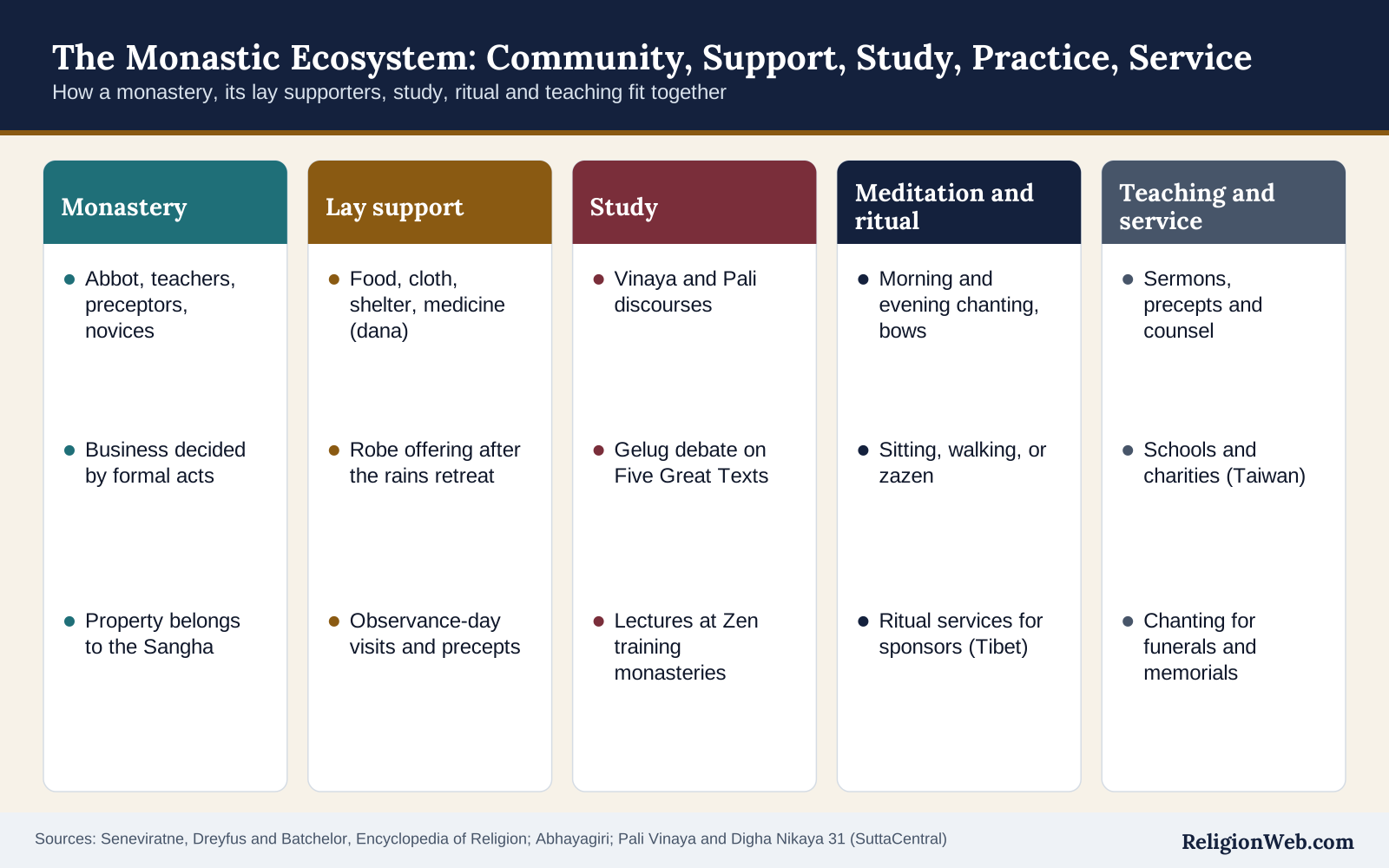
Buddhist Nuns and the Bhikkhuni Question
The Founding of the Nuns’ Order
Mahapajapati, Ananda, and the going forth of women
The Pali Vinaya tells the founding story of the order of nuns in its chapter on nuns. Mahapajapati Gotami, the Buddha’s aunt and foster mother, asked him three times to allow women to go forth, and each time he replied, “Let it be, Gotami, don’t pursue this idea.” She then shaved her hair, put on ocher robes, and walked to Vesali with a number of Sakyan women, arriving, in the text’s words, “sad and tearful, covered in dust, her feet swollen.” Ananda found her at the gatehouse and asked the Buddha three times on her behalf, with the same refusal. On the third try he changed his approach and asked a different question.
“If women were allowed to go forth, would they be capable of realizing the fruit of streamentry, the fruit of once-returning, the fruit of non-returning, and the fruit of perfection?”
“Yes, they would.”
Pali Vinaya, Khandhaka 20 (Nuns), section 1.3.15–16, trans. Bhikkhu Brahmali (SuttaCentral)
The exchange is the doctrinal core of the story. In the Theravada telling, the Buddha affirms that women can attain the same four stages of awakening as men, including the final stage, and Ananda then adds that Mahapajapati has been very helpful to him. The Buddha agrees on one condition: that Mahapajapati accept eight important principles, which would constitute her full ordination. Martine Batchelor notes that two early collections, the Therigatha, with seventy-three poems attributed to early nuns, and the Apadana, with forty biographies, preserve the voices and lives of the first generation of nuns.
The eight principles and how they are read
The Vinaya lists the eight principles as follows. A nun of a hundred years’ standing should bow to a monk ordained that very day. A nun should not spend the rains retreat in a monastery without monks. Every half-month she should ask the monks’ Sangha about the observance day and go to it for instruction. After the rains she should invite correction from both Sanghas. A nun who has committed a serious offense undergoes a half-month trial period before both Sanghas. A trainee who has trained for two years in six rules may seek full ordination from both Sanghas. A nun may not abuse or revile a monk. And nuns may not correct monks, though monks may correct nuns.
The text adds that the Buddha predicted that the true Teaching, which would have lasted a thousand years, would last only five hundred because women had been allowed to go forth. The passage is among the most discussed in Buddhist studies. The monk and scholar Bhikkhu Analayo of the University of Hamburg argued in a 2013 article that this prediction of decline is probably not authentic, noting that early texts treat learned and virtuous nuns as an asset. Traditional readings accept the principles as the Buddha’s own words, and the Vinaya presents them that way. Because the texts are layered and the schools preserved different versions, the question of what belongs to the earliest stratum remains open, and the principles are still discussed in modern debates over the status of nuns.
Where the Nuns’ Lineages Continued and Where They Lapsed
East Asia: a continuous line of nuns
The order of nuns spread with the Sangha. It reached Sri Lanka in the third century BCE, and in the fifth century CE Sri Lankan nuns traveled by sea to China, where they founded a bhikshuni order that survives and later spread to Korea and Vietnam. Analayo likewise notes that the Chinese lineage was brought from Sri Lanka in the early fifth century. This is why the Pluralism Project observes that, in Theravada South Asia, the lineage of women monastics has died out, whereas it has been preserved in some Mahayana traditions of East Asia. The East Asian nuns follow the Dharmaguptaka Vinaya, with 348 rules.
The numbers in Batchelor’s 2005 account show how large the East Asian nuns’ communities are. She reports about 7,000 nuns in Taiwan in 2004, about 8,000 in Korea in the early 2000s, and roughly 2,000 in Japan, living in 1,500 temples, although in Japan full ordination for nuns lapsed soon after Buddhism arrived in the sixth century. Aichi Semmon Nisodo in Nagoya, founded in 1903, is the largest training center for Japanese nuns. She also records 65 biographies of eminent nuns in the Biqiuni zhuan, a collection covering the fourth to sixth centuries in China. These figures are about two decades old and should be read as indicative.
South and Southeast Asia and Tibet: lapse and other paths
In the Theravada countries and Tibet the story is different. Batchelor writes that the Sri Lankan order of nuns died out in the tenth century, while Analayo gives the eleventh, and that it was never reconstituted. In Thailand a decree of 1928 forbade monks to ordain women, a ban that a 2025 Tricycle article also mentions. In Tibet, higher ordination for women was not transmitted when Buddhism arrived, and Tibetan nuns have taken ten precepts. In each place women continued to live as renunciants. Batchelor counts roughly 30,000 thilashin in Myanmar and about 10,000 mae chi in Thailand in 2004, and she reports that in 1959 Tibet had 618 nunneries with 12,398 nuns, many of which suffered after the Chinese Communist takeover and during the Cultural Revolution.
These women are often respected as teachers, meditators, and leaders of their communities. They are also, in the view of those who advocate for full ordination, constrained by a lower status, less financial support, and fewer opportunities for training and teaching. Their situation is why the reintroduction of full ordination has been so contested: it is simultaneously a question of Vinaya law, institutional authority, and the position of women in monastic institutions.
Contemporary Revival and Debate
Sri Lanka, Thailand, and Australia
The modern revival of the Theravada nuns’ order began in the late twentieth century with ordinations that drew on the East Asian line. In 1996, Sri Lankan women received full ordination at Sarnath, India, with the help of Korean Mahayana bhikshunis, as Religion News Service later summarized it. In February 1998 thirty Sri Lankan nuns were fully ordained at Bodh Gaya at an international ceremony organized by Taiwanese monks and nuns, according to Batchelor. Analayo explains that the Bodh Gaya ordination was carried out with Chinese nuns as the officiating preceptors and was followed by a second ordination by Theravada monks, which he suggests could function as a formal act of recognition by the community the nuns wished to join. By 2004 Sri Lanka had about 400 fully ordained nuns and 2,100 ten-precept nuns, dasasil mata, Batchelor reports.
In Thailand the movement is associated with the Kabilsingh family. Voramai Kabilsingh received full ordination in Taiwan in 1971, and her daughter Chatsumarn Kabilsingh, who took the name Dhammananda, received lower ordination in Sri Lanka in 2001 and higher ordination in 2003. The Thai Sangha Supreme Council has not accepted the revival. Tricycle reported in October 2025 that the Council holds that the Theravada bhikkhuni tradition cannot be revived, that around 280 bhikkhunis practice in 33 monasteries nationwide, and that a first Thai Bhikkhuni Sangha seminar was held at Chulalongkorn University on September 27, 2025, with more than 100 bhikkhunis and samaneris from 18 provinces. In Australia, four women were ordained as bhikkhunis at Bodhinyana Monastery near Perth in October 2009, the first such ordination in that country. Analayo concludes that the Vinaya arguments against the validity of ordination in the Dharmaguptaka line are “not compelling,” while acknowledging that traditionalists’ reservations are understandable.
Tibetan Buddhism: the geshema degree and the Bhutan ordinations
Among Tibetan communities the first development was educational. The Tibetan Nuns Project reports that the geshema degree, the monastic doctorate long reserved for monks, was formally opened to women in 2012 after the Department of Religion and Culture of the Tibetan Administration announced it following a meeting of six major nunneries, the Institute of Buddhist Dialectics, and the project itself. On December 22, 2016, the Dalai Lama awarded the degree to twenty nuns at a ceremony at Drepung Monastery in Mundgod, South India, and by November 2022 fifty-three nuns held it. Candidates are examined on a seventeen-year course of study of the Five Great Canonical Texts.
Full ordination is a separate issue. Religion News Service reported in June 2022 that the Je Khenpo, Bhutan’s senior Buddhist authority, ordained 144 women as bhikshunis in the Tibetan tradition at Ramthangkha monastery, most of them Bhutanese. The article explained that women had long lived as nuns but could not take full ordination because the rules required bhikshunis to be ordained by other bhikshunis and none remained in these regions, that a few monks in Bhutan had ordained nuns without bhikshunis present but never on this scale, and that the Dalai Lama has long encouraged bhikshuni ordination. Tibetan opinion on the validity of different ordination procedures has not been uniform, and the sources used here do not establish how the 2022 ordinations have been received across Tibetan Buddhist institutions.
Buddhist Monastic Life Today: Numbers, Change, and Care
Present-Day Numbers and Where Monasticism Is Strongest
Buddhist population context
No source consulted for this article gives a reliable global count of Buddhist monastics, and any figure offered without a stated country and year should be treated cautiously. The best available frame is the size of the Buddhist population. The Pew Research Center, in its 2025 report on the global religious landscape from 2010 to 2020, estimates 324 million Buddhists in 2020, just over 4 percent of the world’s population and down from 343 million in 2010. Pew finds that 98 percent of Buddhists live in the Asia-Pacific region, with the largest numbers in Thailand (68 million, 94 percent of the population) and China (53 million, about 4 percent).
Pew counts people who describe themselves as Buddhist, not people who have been ordained, and the share of any population that holds monastic ordination at a given time is small. Even so, monasticism has an influence far beyond its numbers. A village temple in a Buddhist-majority country may be the center of education, festivals, and funerary rites for hundreds of families. A monastic university in the Tibetan tradition may train a generation of teachers. A single Zen training monastery may shape the practice of priests throughout a school.
Counting monastics: the example of Thailand
Thailand offers an unusually clear set of official figures. The country’s National Statistical Office, drawing on data from the Office of National Buddhism, reports that in 2023 there were 43,522 temples, 256,984 monks, and 33,624 novices, and that in 2024 there were 44,035 temples, 245,645 monks, and 31,873 novices. The figures exclude temples, monks, and novices in the Chinese and Annamese orders. Between the two years the number of monks fell by about 11,000, or roughly 4 percent, and the number of novices by about 1,750, while the count of temples rose.
These are counts of people holding ordination on the date of the survey. They do not include the very large number of men who spend a short time in the robe and then return to lay life, and they do not say why the numbers changed. A single year’s change in two numbers is not evidence of a trend, and the figures say nothing about nuns, since Thai mae chi and the small bhikkhuni community fall outside the official count of monks and novices.
Adaptation, Debate, and Care
Married clergy, global monasteries, and new forms
Present-day monastic life is changing in several directions at once. In Japan, as described above, married clergy have been the norm for more than a century, and Jaffe’s study shows that the change was contested and left lasting tension between the ideal of renunciation and the reality of temple life. In South and Southeast Asia, the question of nuns’ ordination is an active institutional dispute. In the Tibetan world, women now earn the geshema degree and have been fully ordained in Bhutan.
Buddhist monasticism has also taken root outside Asia. Batchelor notes that Western monks ordained Western nuns at Amaravati Temple near London in 1994 and that more than 300 Western nuns followed the Tibetan tradition by 2005. Abhayagiri in California and Bodhinyana in Western Australia belong to the Thai forest tradition’s international branches. Many such monasteries adapt the schedule to local conditions, welcome lay guests for short stays, and include English chanting, as the Abhayagiri schedule shows. In many Western settings the word “sangha” now also names lay communities, which means that the older monastic sense has to be specified more often than it once did.
Retreat, health, and the limits of monastic practice
Monastic life involves real physical and psychological demands: early rising, a restricted diet, long hours of sitting, and in some traditions stretches of silence or retreat. The Vinaya acknowledges this. It contains extensive provisions for medicine and the care of the sick, including allowances for sick monks to take tonics such as ghee, butter, oil, honey, and syrup, descriptions of the qualities of a good attendant for the sick, and a ruling that when a monk dies the Sangha may give his three robes and bowl to those who nursed him. The chapter on robes opens with the account of the physician Jivaka, who treated a king and the Buddha.
Religious teachings on monastic life should not be read as medical advice. Meditation, fasting after noon, retreat, and ordination are religious and spiritual practices, not treatments for illness or for mental-health conditions, and people who are unwell or distressed should consult qualified health professionals before undertaking a demanding retreat or a change of life. The Vinaya’s own attention to nursing and medicine points in the same direction: illness is to be treated, and care of the sick is itself praised in the text.
Common Misconceptions About Buddhist Monastic Life
Misconception 1: All Buddhist monks live in total isolation
Where the misunderstanding comes from
The image of the solitary meditator on a mountain is vivid and not baseless. The early texts praise the forest, the tree root, and the cave, and the Pali Vinaya describes the new monk as one who goes forth “into homelessness.” Traditions of retreat, including long periods of seclusion for focused practice, are real parts of Buddhist life in many countries. Popular media and travel writing, which tend to feature solitary figures and silent halls, reinforce the impression that monastic life means withdrawal from society.
The English word “monk” itself, derived from a term for a person living alone, adds to the confusion. In Buddhist usage the corresponding terms, bhikkhu and bhikshu, are traditionally linked to living on alms, which is a social arrangement by definition: someone has to give.
What the evidence and tradition actually show
The Vinaya is a law for communities. Its central rituals, from the fortnightly recitation of the Patimokkha to ordination and the invitation ceremony, can only be performed by groups, with quorums of five, ten, or twenty monks for different acts. Monks are required to enter the rains retreat in a residence, and the same Pali chapter that sets up the invitation ceremony forbids a vow of silence, because the ceremony depends on speaking and on mutual correction. The rules on food, robes, and lodgings assume daily contact with laypeople, since the four supports come from donors.
The historical record shows a spectrum rather than a single pattern. Nietupski’s article in the Encyclopedia of Religion distinguishes an eremitic ideal from a cenobitic one, and Seneviratne describes the recurring tension in South and Southeast Asia between forest-dwelling and village-dwelling monks. Tibetan monasteries, Dreyfus writes, were first of all ritual communities, serving laypeople on request. Abhayagiri’s daily schedule, with its group puja, work period, shared meal, and weekly lay observance day, shows what a forest-tradition community looks like in practice. Solitary retreat is a legitimate and honored option in several traditions, but even solitary practitioners generally depend on supporters for food and shelter. Total isolation is the exception, not the norm.
Misconception 2: Every monastic rule is identical across all schools
Where the misunderstanding comes from
Popular accounts often speak of “the Buddha’s rules” or “the 227 rules,” as though a single code had been handed down intact and applied everywhere. That impression is encouraged by the structure of the Vinaya itself, which presents every rule as the Buddha’s own ruling in a named place and time, and by the practice of teaching one tradition’s code as a model for all. Readers who first meet monastic life through a Theravada source may reasonably assume that other traditions simply follow the same list.
What the evidence and tradition actually show
Six Vinayas survive, belonging to the Theravada, Mulasarvastivada, Sarvastivada, Mahasamghika, Dharmaguptaka, and Mahisasaka schools, and their monks’ lists run from 218 rules (Mahasamghika) to 263 (Sarvastivada), according to the Encyclopedia of Religion. The three codes in active use give monks 227 (Pali), 250 (Dharmaguptaka), or 253 (Mulasarvastivada) rules, and give nuns 311, 348, or 364. The totals differ partly because the schools redacted and counted rules differently, and they differ in content as well: the Pali Vinaya, for example, treats a meal after midday as an offense, while East Asian monastic practice has its own customs about meals and about vegetarianism.
The differences extend beyond counting. Within the Pali Vinaya, the Buddha is reported to have adapted the rules to the regions outside the central Ganges plain by allowing different sandals, bathing, and rugs. Tibetan monasteries govern daily life through local constitutions, as Dreyfus notes, and Chinese monastics add bodhisattva precepts to the monastic ones. Most Japanese clergy today marry. Despite this, the codes also share a core. The Tibetan code, like the Pali, begins with four serious offenses, called “defeats” in the Dalai Lama’s account and “expulsion” offenses in Brahmali’s translation of the Pali. So the accurate statement is that the schools share a common structure and ethic, and differ in detail, number, and application.
Misconception 3: Buddhist nuns disappeared everywhere
Where the misunderstanding comes from
The belief is partly a result of accurate reporting about one region. The Theravada order of nuns is regarded as having lapsed in Sri Lanka around the tenth or eleventh century, and in Thailand a ban on monks ordaining women dates from 1928. Higher ordination for women was not transmitted to Tibet. Because English-language accounts of Buddhism often start from the Theravada countries, readers can come away thinking that the nuns’ order ended with the Buddha’s generation or was never restored anywhere.
What the evidence and tradition actually show
In East Asia the order of nuns has continued since Sri Lankan nuns founded it in China in the fifth century. Batchelor reported about 7,000 nuns in Taiwan in 2004, roughly two-thirds more than monks, about 8,000 in Korea, and about 2,000 in Japan, where the situation is different because full ordination for nuns lapsed early. The Pluralism Project describes the lineage as preserved in some Mahayana traditions of East Asia and notes that Fo Guang Buddhism has many ordained nuns.
Even where the Theravada lineage lapsed, women continued to live as renunciants, and since 1996 a revival has restored full ordination for some of them. Sri Lanka had about 400 fully ordained nuns by 2004, and Tricycle reported about 280 bhikkhunis in Thailand in 2025, though the Thai Sangha Supreme Council does not accept the revival. In the Tibetan tradition, 144 women received full ordination in Bhutan in June 2022, and women have earned the geshema degree since 2016. The accurate picture is regional: continuous in East Asia, lapsed and contested in the Theravada world, newly opened in the Tibetan world. Statements that nuns “disappeared” are true of particular lineages at particular times, and not of Buddhism as a whole.
Misconception 4: Becoming a monk or nun is a permanent, irreversible commitment
Where the misunderstanding comes from
Monastic ordination is described in many traditions as lifelong, and the Pali Vinaya’s four supports each end with the instruction “You should persevere with this for life.” The Pluralism Project describes the final vows of full ordination as lifelong. Public attention to famous long-term monastics, and to the seriousness with which the expulsion offenses are treated, easily leads to the assumption that there is no way back.
What the evidence and tradition actually show
The ideal is lifelong, but the Vinaya makes a legal provision for leaving. The first expulsion rule applies to a monk who has sexual intercourse “without first renouncing the training and revealing his weakness,” which presupposes that a monk may openly give up the training instead. The Vinaya’s regulations on robe-cloth, in dealing with the property of monks who leave before cloth is distributed, list cases of a monk who “disrobes, dies, admits to being a novice monk, admits to having renounced the training.” Disrobing was evidently a familiar event.
In practice, short-term ordination is a recognized institution. The Max Planck researcher describes Burmese novices who stay for about a week, and the Pluralism Project notes that temporary ordinations are common among Cambodian and Thai communities in the United States and that novice vows may be taken briefly to earn merit. Some acts cannot be undone: a monk who commits an expulsion offense is permanently excluded from the order. But leaving the robe as such is not forbidden or treated as a crime in the texts. Attitudes toward those who disrobe vary by society, and the sources used here do not document them.
Misconception 5: Monks and nuns spend their days only in meditation
Where the misunderstanding comes from
Buddhism is often introduced to Western readers through meditation, and the monastery is imagined as the place where meditation is practiced full time. Photographs of rows of seated monks, books on mindfulness, and the prominence of meditation in popular accounts of the tradition all suggest that sitting is the whole of the job. In several forest and Zen settings meditation is indeed the center of the training, which makes the impression understandable.
What the evidence and tradition actually show
Documented schedules show a mixed day. Abhayagiri’s includes a three-hour work period, a shared meal, chanting, and a Dhamma reflection alongside meditation. Eiheiji’s trainees clean corridors by hand, prepare meals, receive visitors, practice ceremonies, and attend lectures. In Gelug monastic education, a monk spends part of each day in debate and years in memorization and study. Seneviratne’s two “burdens,” contemplation and books, show that scholarship and parish service were recognized monastic vocations in South and Southeast Asia, and Dreyfus portrays Tibetan monasteries as ritual communities that served the lay public.
The same breadth appears in what monastics do for others. Village monasteries in Buddhist-majority countries have long served as schools and as sites for funerals and festivals, and Batchelor’s account of Taiwan associates nuns with a charitable foundation and a university. Meditation is central in the sense that the other activities are meant to support the path, but the documented schedules show that it is rarely the only activity.
Frequently Asked Questions About Buddhist Monastic Life
Questions About Becoming a Monastic
How does someone become a Buddhist monk or nun?
The path is a sequence of stages rather than a single event, and the details depend on the tradition. In the Pali Vinaya a candidate shaves his head, puts on robes, takes the three refuges, and becomes a novice under a preceptor and teacher. Full ordination follows later through a formal act of the Sangha, with a minimum age of twenty in the Pali Vinaya and a preceptor of at least ten years’ standing. East Asian ordination is commonly conducted in the Triple Platform ceremony, which includes bodhisattva precepts, and Tibetan ordination moves from novice vows to the vows of a gelong under the Mulasarvastivada code.
In practice a person usually begins by living near a monastery, visiting, helping, and learning from a teacher, because ordination requires the sponsorship of a preceptor and the agreement of a community. Requirements such as age, health, family consent, and previous training differ from one order to another, so anyone seriously interested should approach a specific monastery or order directly.
Can a person be ordained for a short time?
In many Theravada societies, yes. Temporary ordination is a recognized custom, and the Burmese shin byu is the clearest example: boys enter as novices, often for about a week, wear the maroon robe, and join the alms round. The Pluralism Project notes that temporary ordinations are common in Cambodian and Thai communities in the United States, and that novice vows may be taken briefly to earn merit, for example after a loved one’s death.
The Vinaya makes this possible because it provides for leaving the order openly, by renouncing the training. Not every tradition has an equivalent custom, and the Triple Platform ceremony and Tibetan ordination are generally understood as long-term commitments, though individuals do leave. Short stays at a monastery as a lay guest are a separate option offered by many communities.
Questions About Daily Life and Rules
What do Buddhist monastics eat, and why do some not eat after noon?
Practice varies. In the Theravada tradition monastics eat food that has been offered to them and do not eat after midday, following the Patimokkha rules against eating at the wrong time, eating stored food, and eating food that has not been given. East Asian monasteries commonly serve vegetarian meals, and Korean templestay meals exclude meat, fish, dairy, and strongly flavored alliums. Tibetan monastics have often eaten meat.
Teachers give various reasons for the afternoon fast in the Theravada tradition, and the rule itself is simply that eating at the wrong time is an offense entailing confession. Abhayagiri presents the arrangement as a way of keeping the monastic community and its lay supporters interdependent. Sick monastics are allowed tonics such as ghee, butter, oil, honey, and syrup under the Vinaya.
Can monks and nuns own things or handle money?
In the Pali Vinaya a monk who takes, or consents to gold, silver, or money being deposited for him, or who trades with money, commits an offense entailing relinquishment and confession. Monastics own a small number of personal items, and the monastery’s property belongs to the Sangha. In practice many communities rely on lay stewards, trustees, or committees to manage money and buildings.
How strictly the rule is applied differs by tradition and monastery. Some forest communities avoid money entirely, while other settings use arrangements that keep money in the hands of lay attendants or institutions. The Pali account of the second council shows that the matter was disputed within a century of the Buddha’s death, which is a reminder that the question is old.
Questions About Community and Women
How do monastics and laypeople support each other?
Laypeople provide food, cloth, shelter, and medicine, and in return monastics teach, lead chanting and ritual, give precepts, and offer an example of renunciation. The Sigalaka Sutta in the Pali canon presents this as a reciprocal relationship in which ascetics keep a householder from doing bad, support him in doing good, and teach him what he does not know. Occasions such as the daily alms offering, the robe offering at the end of the rains retreat, and observance-day visits make the exchange visible.
The relationship also contains checks. The Vinaya includes rules for monks who corrupt families, and laypeople’s complaints are shown shaping the rules. Because the relationship rests on trust, communities in every tradition depend on credible conduct by the monastics who receive support.
Can women be fully ordained as Buddhist nuns today?
Yes, in several traditions, though not everywhere. Full ordination for women has been continuous in East Asia, with large communities of nuns in Taiwan and Korea. In the Theravada world the lineage is regarded as having lapsed, and since 1996 a number of women have received full ordination in Sri Lanka and Thailand, though the Sangha Supreme Council of Thailand does not accept the revival. In the Tibetan tradition, 144 women were fully ordained in Bhutan in June 2022.
The answer therefore depends on the tradition and country. Many women live as mae chi, thilashin, or ten-precept nuns without full ordination, and women’s roles as teachers and leaders have expanded in several communities. Readers interested in a particular order should consult that order’s own statements.
Conclusion: What Buddhist Monastic Life Shows
What the History and Practice Show
A shared structure with many forms
Buddhist monastic life is better understood as a family of institutions than as a single one. All of them rest on going forth from household life, on a community that decides its business by agreed procedures, and on a code of discipline that is recited, confessed, and taught. The Pali Vinaya, the Dharmaguptaka and Mulasarvastivada codes, the Chan pure rules, and the Tibetan monastic constitutions apply that structure in very different ways, and the differences in robes, meals, schedules, and celibacy are real.
The sources also show that variation is not a modern corruption. The Vinaya itself records regional allowances, disagreements about minor rules, and a dispute over money within a century of the Buddha’s death. The history of nuns’ lineages, of royal patronage, and of reform in Japan and Tibet shows an institution that has been argued over, adapted, and revived many times.
Rules, community, and exchange with the laity
What gives monastic life its coherence is the combination of discipline and dependence. Monastics give up property, family, and occupation, and receive in return a structure of training, teachers, and a schedule that is meant to support the path described in the Noble Eightfold Path. Laypeople give support and receive teaching, ritual, and an example. Neither side can be fully understood without the other, which is why a monastery is best seen as one part of a wider community and not as a place apart.
How to Keep Exploring
Reading the sources
Readers who want to go further can start with the primary sources. SuttaCentral publishes the Pali Vinaya in Bhikkhu Brahmali’s translation, including the Patimokkha for monks and for nuns and the chapters on ordination, the rains retreat, robes, and the councils, and it also provides the discourses on which this article draws. The Encyclopedia of Religion articles on Buddhist monasticism, the Vinaya, nuns, and the Sangha in South and Southeast Asia and in Tibet give scholarly overviews. For the wider context, see the article on Buddhism and the chapters on the Theravada, Mahayana, and Vajrayana traditions.
Visiting and learning respectfully
Many monasteries welcome visitors, and some publish their schedules and guidelines online. The most reliable way to understand a particular community is to read its own published description, follow its guest etiquette, and ask questions of its members. Because practices differ so much between monasteries, even within one tradition, a visitor should expect to be told what is customary there rather than assume that what is true elsewhere applies.
Sources
The table below lists the principal external sources behind this article. Facts, dates and figures were checked against these and related primary, institutional and academic materials.
| # | Source | Publisher and type | Used for | Link |
|---|---|---|---|---|
| 1 | Bilara Data (SuttaCentral): Pali Vinaya in Bhikkhu Brahmali's translation (Khandhakas 1-8, 20-22; monks' and nuns' Patimokkha) and Digha Nikaya 31, Majjhima Nikaya 55 in Bhikkhu Sujato's translation | SuttaCentral (Bilara Data repository, CC0) · Primary text | Every quoted or paraphrased Vinaya passage and the Sigalaka Sutta; CC0 licensing of the translations | raw.githubusercontent.com |
| 2 | How the Global Religious Landscape Changed From 2010 to 2020: Buddhist population change | Pew Research Center · Demographic data | 324 million Buddhists in 2020; Thailand 68 million; share of Buddhists by country | pewresearch.org |
| 3 | Table 4.1 Temples, Buddhist Monks and Novices by Region and Province: 2023-2024 (Statistical Yearbook Thailand 2025) | National Statistical Office of Thailand (data from the Office of National Buddhism) · Demographic data | Thailand 2024: 44,035 temples, 245,645 monks, 31,873 novices (2023 figures for comparison) | nso.go.th |
| 4 | Monasticism: Buddhist Monasticism (Paul K. Nietupski, 2005) | Encyclopedia of Religion, via Encyclopedia.com · Academic reference | Origins of settled monasteries, councils and schisms, state patronage, Tang, Song and Meiji history | encyclopedia.com |
| 5 | Nuns: Buddhist Nuns (Martine Batchelor, 2005) | Encyclopedia of Religion, via Encyclopedia.com · Academic reference | Rule counts (227/311, 250/348, 253/364); nuns' lineages in East Asia, Theravada countries and Tibet; 2004 figures | encyclopedia.com |
| 6 | Samgha: Samgha and Society in South and Southeast Asia (H. L. Seneviratne, 1987) | Encyclopedia of Religion, via Encyclopedia.com · Academic reference | Meaning of sangha; the two burdens; alms, merit, royal patronage and purification of the order | encyclopedia.com |
| 7 | Samgha: Samgha and Society in Tibet (Georges Dreyfus, 2005) | Encyclopedia of Religion, via Encyclopedia.com · Academic reference | Tibetan monastic offices, Gelug seats, pre-1950 monastic share, ritual services for sponsors | encyclopedia.com |
| 8 | The Revival of the Bhikkhuni Order and the Decline of the Sasana (Bhikkhu Analayo) | University of Hamburg, Numata Center for Buddhist Studies (author's PDF) · Academic reference | Bhikkhuni lineage history, 1996 and 1998 ordinations, dual ordination, validity arguments | buddhismuskunde.uni-hamburg.de |
| 9 | Rooted Like Teak (Amnuaypond Kidpromma), on the Thai bhikkhuni sangha, October 2025 | Tricycle: The Buddhist Review · Journalism (named author) | Thai Sangha Supreme Council position; about 280 Thai bhikkhunis in 2025; 1928 ban; mae chi | tricycle.org |
| 10 | A Typical Day | Abhayagiri Buddhist Monastery · Institutional | Documented Theravada forest-tradition daily schedule, alms, observance day, afternoon fast | abhayagiri.org |
Last fact-check date: 2026-10-21.