Vesak is the Buddhist festival that remembers the birth, awakening, and final passing of the Buddha. Its name comes from Vesākha, the Pali name of a lunar month that falls in the spring of the northern hemisphere, and in most of South and Southeast Asia the observance centers on the full-moon day of that month, usually in May. The same occasion is spelled Wesak in Malaysia, called Buddha Purnima in India, Visakha Puja in Thailand, Waisak in Indonesia, and simply “Buddha’s Birthday” across much of East Asia. Because these communities reckon their months in different ways, the festival does not fall on one civil date. In 2026, Singapore kept Vesak Day on Sunday, May 31, while India’s central government holiday list placed Buddha Purnima on Friday, May 1.
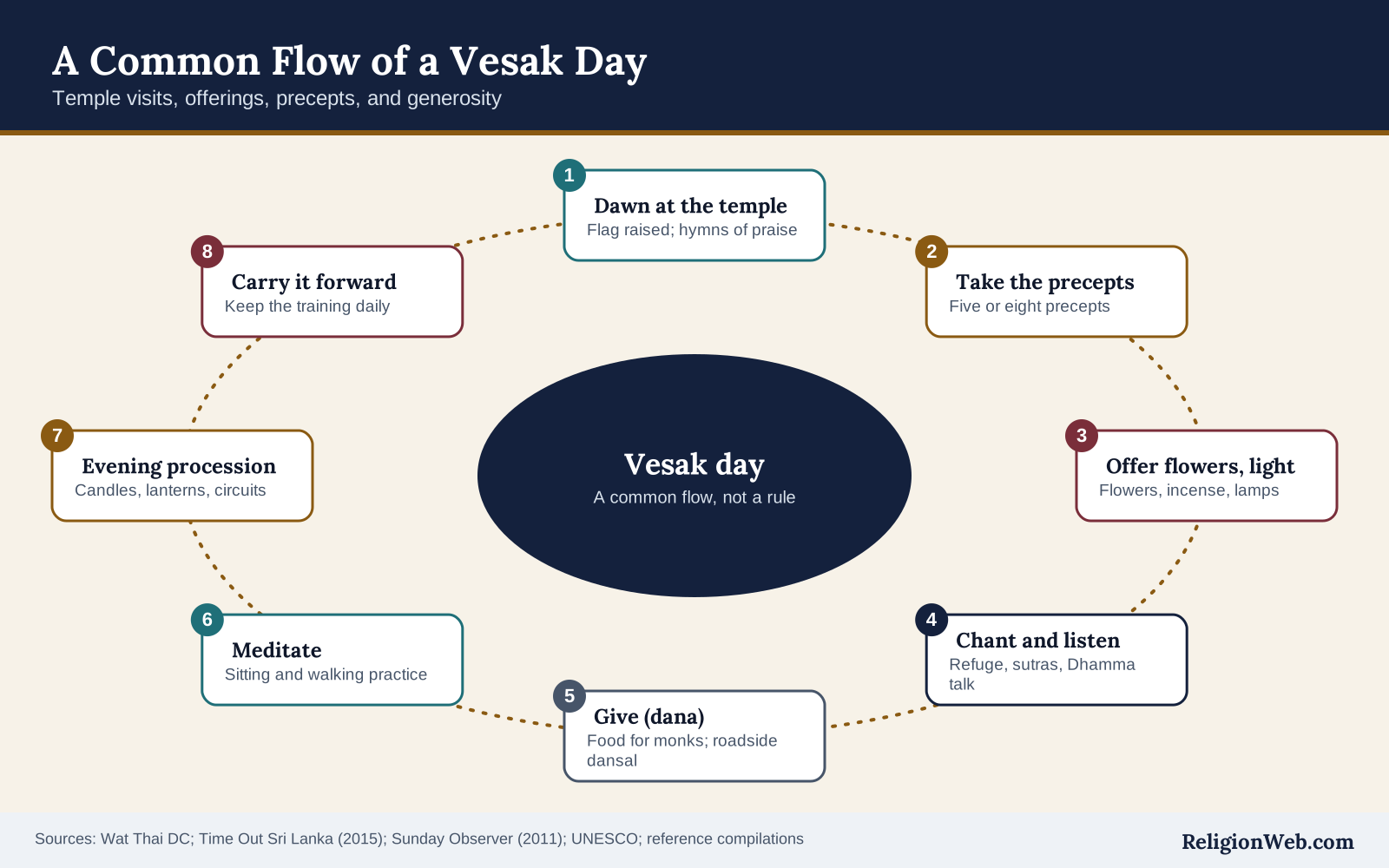
The quick answer to what people do is that they go to the temple. Many rise before dawn, dress in white, offer flowers, incense, candles, and lamps before an image of the Buddha, take or renew the precepts, listen to chanting and a talk on the teaching, and give food or other gifts to monks, nuns, and the needy. Some communities add processions, illuminated displays, and lantern parades; others pour scented water over a small statue of the infant Buddha; some pour water at the foot of a bodhi tree. Almost everywhere the day is framed as an occasion for merit, meaning wholesome action whose good results are understood to ripen over time, and for reflection on the path the Buddha taught.
This article treats Vesak as a living observance with a long history rather than a single rite. It looks at what the festival commemorates and why some traditions join the three great events in one day while others separate them, how the calendars work, what the earliest evidence says, and how the day is kept in Sri Lanka, Thailand, Indonesia, Korea, Japan, the Himalayas, and diaspora communities. For the wider tradition, see the overview of Buddhism; for the life of the central figure, see the biography in Who Was the Buddha?
Wherever a custom belongs to one country, school, or temple, the text says so, and no regional form is presented as the standard one. Dates and figures were checked in October 2026, and the year of each data point is given. Scriptural quotations come from openly licensed translations; where a passage could not be checked against a named edition, it is paraphrased.
Vesak at a Glance
What Vesak Is and Who Observes It
A festival of remembrance and merit
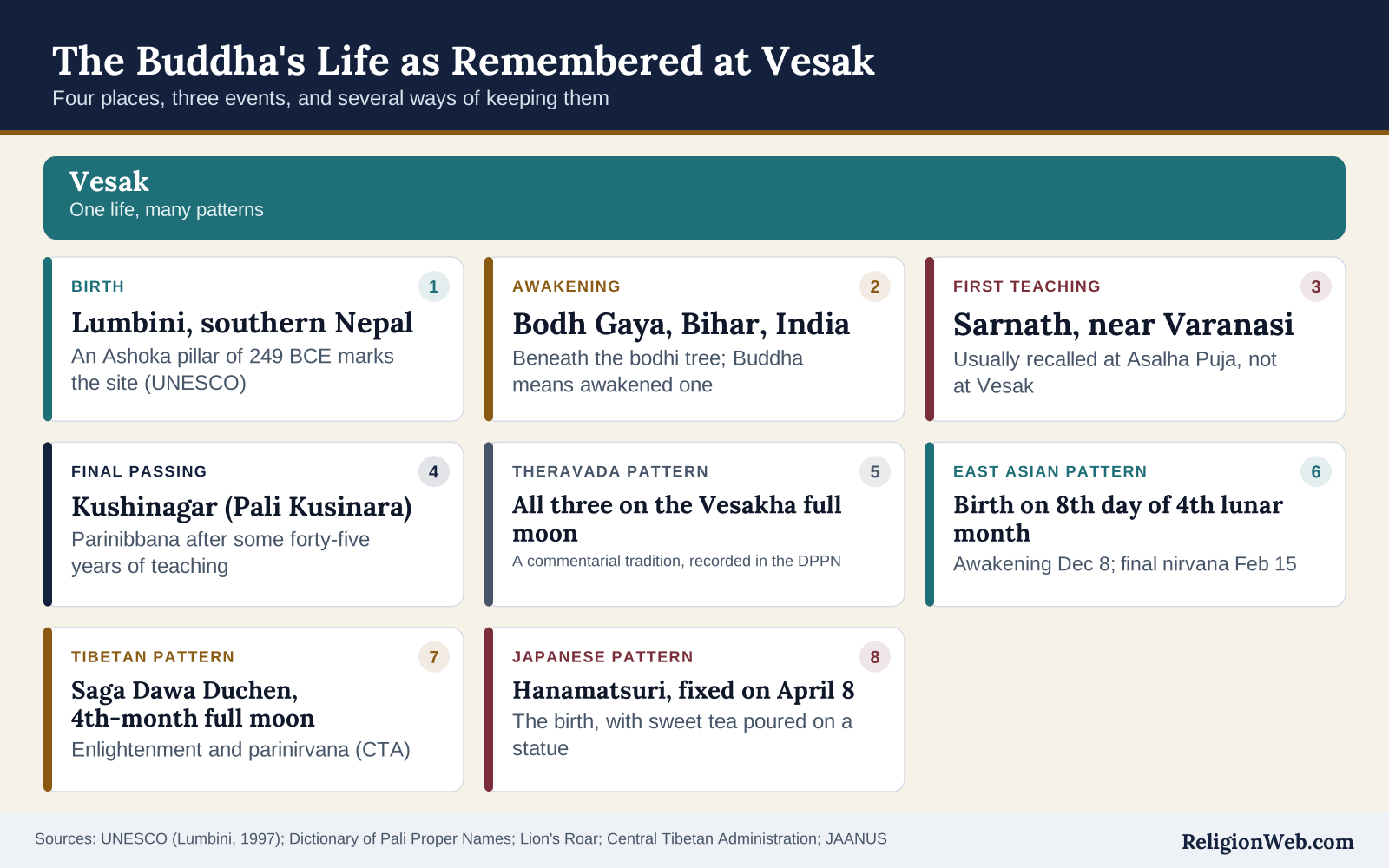
Vesak is best understood as a day of remembrance. Buddhists hold that Siddhartha Gautama, called Shakyamuni (“sage of the Shakyas”) or simply the Buddha, was born in the Lumbini gardens in what is now southern Nepal, attained awakening beneath a tree at Bodh Gaya in northern India, and passed away at Kushinagar after some forty-five years of teaching. Those three events are the backbone of the festival, and Theravada Buddhist tradition holds that all three took place on the full-moon day of the month of Vesākha. Britannica’s entry summarizes the festival in just those terms, as a holiday commemorating the birth, enlightenment, and death of the Buddha, observed above all in Theravada countries and under other names in East Asia.
The remembrance is not only historical. Participants understand the day as an occasion for practicing what the Buddha taught: generosity, ethical restraint, and cultivation of the mind. That is why the most common Vesak activities, such as feeding monks, keeping the precepts, and listening to the teaching, are things a devout Buddhist might do on any full-moon day, only done with more intensity and more company. The sense that wholesome deeds carry greater weight on a holy day is widespread, although the doctrinal explanation varies among schools and is discussed later in the article.
The festival also has a communal face that is hard to miss in Colombo, Bangkok, Singapore, or Seoul. Streets are hung with lamps, volunteers hand out free meals, children learn the stories of the Buddha’s life, and neighbors of other faiths often join the crowds. In several countries the day is a public holiday. Those public dimensions are real and important, but they grow out of temple observance rather than replacing it, a point the section on misconceptions returns to.
A tradition spread across many countries
Buddhism is concentrated in Asia, and Vesak follows it. In its 2025 report on changes between 2010 and 2020, the Pew Research Center counted about 324 million Buddhists worldwide in 2020, or 4.1 percent of the global population, and found that 98 percent of them live in the Asia-Pacific region. Pew also reported that seven Buddhist-majority countries, Cambodia, Thailand, Myanmar, Bhutan, Sri Lanka, Laos, and Mongolia, are home to 47 percent of all Buddhists. Large Buddhist communities in China, Japan, South Korea, Vietnam, and Taiwan keep the Buddha’s birthday under East Asian names and dates, and Buddhist communities in Nepal, India, and Bangladesh keep it as Buddha Purnima or Buddha Jayanti.
Outside Asia, immigrant and convert communities in North America, Europe, and Australia hold Vesak or Buddha’s Birthday services at temples and cultural centers, often combining traditions in a single hall. In some cities a single temple draws worshipers from several national traditions, each bringing a different style of offering, so the diaspora celebration can look quite different from the one a given family remembers at home.
Key Terms Behind the Festival
Words you will meet in this article
Vesak vocabulary mixes Pali, Sanskrit, and local languages, and the same idea often appears under several spellings. The table below gathers the terms used most often in the rest of the article. Pali, the language of the Theravada scriptural canon, is used for most of them because Vesak is most closely associated with Theravada countries, with Sanskrit forms given where they are common in other traditions.
| Term | Language and spelling | Plain-English meaning |
|---|---|---|
| Vesākha | Pali (Sanskrit Vaiśākha) | The lunar month in which the festival falls; the source of the names Vesak, Wesak, and Visakha |
| Pūjā | Pali and Sanskrit | Honoring or offering, especially flowers, incense, and light placed before an image or shrine |
| Sīla | Pali (Sanskrit śīla) | Ethical conduct; in practice the five precepts for lay people, or the eight precepts on observance days |
| Dāna | Pali and Sanskrit | Giving or generosity, especially to monastics and to those in need |
| Puñña | Pali (Sanskrit puṇya) | Merit; the wholesome result understood to follow skillful action |
| Parinibbāna | Pali (Sanskrit parinirvāṇa) | The Buddha’s final passing away, after which no further rebirth is understood to follow |
| Saṅgha | Pali and Sanskrit | The community of monks and nuns, and in a wider sense the whole Buddhist community |
| Uposatha | Pali | A recurring observance day, usually at the full and new moons, when lay people may keep extra precepts |
| Poya | Sinhala | The full-moon day in Sri Lanka, observed as a Buddhist holy day and a public holiday |
| Bodhi tree | English from Sanskrit bodhi, “awakening” | The tree under which the Buddha is said to have awakened, and the descendants of it planted at temples |
How these terms shape the festival
The terms in the table are more than vocabulary because each corresponds to one strand of the day. Pūjā names what happens at the shrine, sīla and the uposatha name the discipline that frames the day, and dāna and puñña name the generosity and the merit that practitioners associate with it. The parinibbāna, finally, is a reminder that the festival mixes joy with solemnity, since Buddhists remember both the Buddha’s arrival and his departure, and Theravada tradition regards the second as the culmination of a life that had already accomplished its purpose.
These words also explain why accounts of Vesak sometimes seem to contradict one another. Observing eight precepts on a Sri Lankan Poya day, walking around an ordination hall with a candle in Thailand, and carrying a lotus lantern through a Korean street are all ways of keeping the same festival, expressed in different regional dialects. The remainder of this article tries to keep the shared core visible while saying clearly which details belong to which community.
The Events Vesak Commemorates
Birth at Lumbini
What the early texts say
The Buddha’s birth is the event most vividly pictured at Vesak, and it is also the one most thickly surrounded by devotional elaboration. Early Buddhist discourses agree that the future Buddha was born into the Shakya clan, a community in the Himalayan foothills, and later biographies name his father as Suddhodana and his mother as Māyā. The Majjhima Nikāya, the “middle-length” collection of the Pali canon, includes a discourse that gathers marvels connected with his last birth. Among them is this account of the newborn:
As soon as he’s born, the being intent on awakening stands firm with his own feet on the ground. Facing north, he takes seven strides with a white parasol held above him, surveys all quarters, and makes this dramatic proclamation: “I am the foremost in the world! I am the eldest in the world! I am the first in the world! This is my last rebirth; now there’ll be no more future lives.”
Majjhima Nikāya 123, trans. Bhikkhu Sujato, SuttaCentral (CC0), segment 20.2
Within the Theravada tradition, this passage is read as a statement about the nature of the being who is born, a bodhisatta in his final existence who will not be reborn again. Commentators have long understood the seven steps and the proclamation as signs that his destiny differed from that of other people, and the image of the child standing, walking, and pointing became the basis of the infant Buddha statues used in bathing rituals. Historians of Buddhism take a different frame, distinguishing a plain core of biography, in which a teacher is born, teaches, and dies, from the later devotional layer in which marvels accumulate. Neither reading is the festival’s “official” one. Practitioners usually hold the narrative and its symbolism together without needing to settle how literally each detail should be taken.
What the inscription and archaeology add
The strongest independent evidence for the birthplace is an inscription. UNESCO’s World Heritage listing for Lumbini, inscribed in 1997, describes a sandstone pillar erected by the Mauryan emperor Ashoka in 249 BCE, carrying an inscription in Brahmi script that attests the Buddha’s birth at the site. In paraphrase, the text says that Ashoka, twenty years after his consecration, came to the spot and honored it, set up a pillar to mark that the Buddha was born there, and reduced the taxes owed by the village of Lummini. UNESCO adds that the site preserves brick structures, monasteries dating from the third century BCE to the fifth century CE, and stupas from the third century BCE to the fifteenth century CE. Lumbini lies in the Terai plains of southern Nepal, and it is a major destination for Vesak pilgrims.
The listing gives the birth date as 623 BCE, which reflects a traditional Theravada chronology. Many historians now place the Buddha’s death around 400 BCE, give or take a few decades, which would put his birth some eighty years earlier, and the precise dates remain debated. Vesak does not depend on that question being settled, because the festival commemorates events as the tradition receives them rather than as an academic reconstruction would date them.
Awakening and Final Passing
Awakening at Bodh Gaya
The second event is the awakening, or enlightenment, that Buddhist sources place beneath a tree on the banks of the Nerañjarā River at the place now called Bodh Gaya. The accounts describe a man, traditionally said to be thirty-five, who had left his family’s wealth, tried austere disciplines, and then sat in meditation until he understood the cause of suffering and the way to its end. His first discourse, delivered to five former companions at Sarnath, is traditionally called the turning of the wheel of Dhamma, and the contents of his awakening are summarized in the Four Noble Truths. The awakening is what makes him a Buddha, a word meaning “awakened one,” and it is the event most closely connected with the goal of nirvana, discussed in the article on nirvana in Buddhism.
For many Buddhists the awakening is the heart of the day. The bodhi tree that grew at the site, and trees reputedly propagated from it, became objects of veneration across Asia, which is why watering a bodhi tree is part of Vesak in some communities.
The final passing at Kushinagar
The third event is the Buddha’s parinibbāna, his death and final release, which tradition places at Kushinagar (Pali Kusinārā) in northern India after he had taught for about forty-five years. The Pali discourse called the Mahāparinibbāna Sutta, the “Great Discourse on the Final Extinguishment,” narrates his last journey, his final instructions to the monks, and his death among a gathering of disciples. In it, the Buddha is reported to name four places that a faithful person may visit and look upon with feeling: where he was born, where he awakened, where he first taught, and where he passed away. Those four sites, Lumbini, Bodh Gaya, Sarnath, and Kushinagar, remain the core of Buddhist pilgrimage, and the first three correspond to the first three of the events recalled at Vesak.
The same discourse is also often cited for the idea that the truest way to honor the Buddha is to practice his teaching, not merely to offer gifts at a shrine. That emphasis shapes how many teachers frame Vesak even when the day is full of lights and flowers: the offerings are real, but the purpose they serve is to turn the mind toward the path described in the Noble Eightfold Path.
One Day or Three?
The tradition of a single full-moon date
The idea that birth, awakening, and final passing all took place on the same full-moon day appears to be a tradition of the commentaries and chronicles, not of the earliest discourses. The Dictionary of Pali Proper Names, a standard reference compiled by G. P. Malalasekera, says that “tradition says” the Buddha’s birth, enlightenment, and death took place on the full-moon day of Vesākha, and it cites commentarial and chronicle sources for the claim, among them the commentary on the Jātaka stories, the commentary on the Buddhavaṃsa, and the Mahāvaṃsa. The discourses of the canon give the places and sequence of these events but, so far as scholars have noted, do not tie all three to one lunar date. That is not a reason to doubt the observance; it simply places the single-date tradition in the later literature that Theravada communities have long treated as authoritative guidance.
The coincidence is also meaningful in its own right. By joining the three events, Theravada tradition presents the Buddha’s life as a complete circle beginning and ending on the same night of the year. In that reading Vesak is the day on which the story of a single life is gathered into one remembrance.
Traditions that celebrate the events on separate days
Not every tradition keeps this arrangement. In East Asia the Buddha’s birth is commemorated on its own date, most often the eighth day of the fourth lunar month, while the awakening and the passing away have their own days. Lion’s Roar, a Buddhist magazine, lists Bodhi Day, observed on December 8 and called Rohatsu in Japanese Zen, as the commemoration of the Buddha’s awakening, and Parinirvana Day on February 15 for his final nirvana, both noted primarily among Mahayana Buddhists. In the Tibetan tradition, the Central Tibetan Administration describes Saga Dawa Düchen, on the full moon of the fourth Tibetan month, as celebrating the Buddha’s enlightenment and parinirvana. The table below summarizes the events and the main ways they are observed.
| Event | Traditional place | Where it is central to Vesak or the Buddha’s birthday | Other common pattern |
|---|---|---|---|
| Birth | Lumbini gardens, in present-day southern Nepal | Theravada countries, as part of the full-moon festival; East Asia, as the main subject of “Buddha’s Birthday” | Bathing a statue of the infant Buddha; flower shrines; processions in Korea and Japan |
| Awakening | Bodh Gaya, beside the bodhi tree, in present-day Bihar, India | Theravada countries, as one of the three events; Tibetan tradition, at Saga Dawa Düchen | Separate observance in Zen and other Mahayana schools on December 8 |
| First teaching | Deer Park at Sarnath, near Varanasi | Not a Vesak event in most traditions | Commemorated at Asalha Puja (Dhamma Day) in the Theravada calendar |
| Final passing (parinibbāna) | Kushinagar, in present-day Uttar Pradesh, India | Theravada countries, as one of the three events; Tibetan tradition, at Saga Dawa Düchen | Separate Parinirvana Day in Mahayana communities, often February 15 |
Each pattern has a logic. East Asian Buddhism developed a calendar in which a cycle of Buddha-related days is spread across the year, while Theravada tradition centered on a single great full-moon festival. Both are long-standing and both are authentic observances; they simply answer different questions, one asking how to recall the Buddha’s whole life at once, the other how to give each event its own day.
Names and Calendars: Why Vesak Falls on Different Dates
Many Names for One Observance
Vesak, Wesak, Visakha, and Buddha Purnima
The name Vesak is a Sinhala and English rendering of the Pali month name Vesākha, which corresponds to the Sanskrit Vaiśākha. Wesak is a variant spelling used in Malaysia and Singapore and in older English writing. In India the festival is called Buddha Purnima, “Buddha’s full-moon day,” and in Nepal it is Buddha Jayanti, “Buddha’s anniversary.” Thai Buddhists say Visakha Puja or Visakha Bucha, using the Thai form of the word pūjā, while in Indonesia the usual spelling is Waisak. The Burmese observe the full moon of Kason, the Burmese month in which the occasion falls, and Cambodians and Laotians use names derived from Visakha. Because the underlying month name is shared, the festival is recognizable across languages even when the spelling shifts.
Several of these names preserve different emphases. “Purnima” and “Poya” are simply words for the full-moon day, a reminder that for many Buddhists the festival is the greatest of the monthly full-moon observances. “Jayanti” and “Birthday” put the Buddha’s birth in front, and “Visakha Puja” stresses the offering. None of the names is more correct than the others. They are local words for a shared occasion, and a visitor who uses the name current in the community being visited will be understood.
Buddha’s Birthday in East Asia
In East Asia the observance is named for the birth alone. Koreans call it Seokga tansinil, “the birthday of Shakyamuni,” and Japanese Buddhists call it Hanamatsuri, the “flower festival,” or Kanbutsue, the ceremony of bathing the Buddha. In Chinese-speaking communities it is often called the Buddha’s Birthday or the Bathing the Buddha Festival, and in Vietnam it is Phật Đản. Tibetan Buddhists keep Saga Dawa Düchen, which the Central Tibetan Administration describes as the festival of Vaishakha celebrating the Buddha’s enlightenment and parinirvana. These East Asian and Himalayan names reflect the fact that, as the previous section showed, those traditions do not always gather the three events into one day.
How the Date Is Calculated
Full-moon traditions in South and Southeast Asia
Most Vesak calendars in South and Southeast Asia are lunisolar, meaning that months follow the moon but are periodically adjusted so that they stay in step with the seasons. Vesak falls on the full-moon day of the month called Vesākha, which usually corresponds to a date in late April, May, or early June in the Gregorian calendar. Wat Thai of Washington, D.C., a Thai temple, explains that Visakha Puja falls on the full moon of the sixth lunar month, and that in years with an extra lunar month, called adhikamasa, it moves to the full moon of the seventh month. That single sentence captures the main reason the date shifts: a lunar year is about eleven days shorter than a solar year, and calendars correct the difference by inserting an extra month every two or three years.
India’s calendar tradition makes the same adjustment in its own way, so that Buddha Purnima falls on the full moon of Vaishakha. India’s central government holiday list for 2026 gave Friday, May 1, and recorded the date as Vaishakha 11 in the national Saka calendar. Sri Lanka’s government publishes a calendar of Poya days each year, and the 2026 decision on the state festival, described in the aside below, followed recommendations from a Poya committee, consultation with Sangha councils and astrologers, and a request from the chief prelates. The festival date is therefore the result of a calendar decision as well as an astronomical fact, and religious authorities have a say in it.
The eighth-day tradition of East Asia
Chinese, Korean, and many Vietnamese and Taiwanese Buddhists reckon the Buddha’s birthday by the traditional Chinese lunisolar calendar, in which it falls on the eighth day of the fourth month. UNESCO’s description of the Korean lantern festival Yeondeunghoe gives exactly that rule, the eighth day of the fourth lunar month. Dharma Drum Mountain, a Taiwanese Buddhist organization, says the same for Chinese Buddhists and notes that in 2017 the date came out as May 3. Because the fourth month begins at a new moon, the eighth day lies roughly a week before the full moon, so the East Asian birthday typically falls about a week earlier than a full-moon Vesak would in the same year.
Fixed dates, extra months, and two full moons in May
Japan is the major exception to lunar reckoning. The Japanese reference work JAANUS describes the bathing ceremony as held annually on April 8, a fixed Gregorian date that reflects the adoption of the solar calendar in the nineteenth century. Hanamatsuri therefore falls on the same civil date every year.
The most revealing case is a year in which May contains two full moons, as in 2026. In 1950 the first conference of the World Fellowship of Buddhists, held in Sri Lanka, asked governments to declare the full-moon day of May Buddha Day and a public holiday, and a 1961 resolution, as reported by the Sunday Observer of Colombo, proposed that the first full moon of May be recognized. Individual countries have not all followed a single rule, and in a year with two candidates the choice becomes visible. The table below sets out the names and calendar rules by community.
| Community | Common name(s) | Calendar rule | Notes |
|---|---|---|---|
| Sri Lanka | Vesak, Vesak Poya | Full-moon day of the Vesak month in the national Poya calendar | A Vesak week of observance surrounds the day; in 2026 the state festival was held on May 30 |
| Thailand | Visakha Puja, Visakha Bucha | Full moon of the sixth lunar month, or the seventh in a year with an extra month | The main day is a national Buddhist observance with temple ceremonies and candlelit walking around the shrine hall |
| Indonesia | Waisak | Full-moon day, set nationally | In 2026 the Borobudur procession took place on Sunday, May 31, in the year 2570 of the Buddhist Era |
| Singapore and Malaysia | Vesak Day, Wesak | Full-moon day in May; Singapore holiday guides give the fifteenth day of the fourth Chinese lunar month | Singapore’s government listed Sunday, May 31, 2026, and Thursday, May 20, 2027 |
| India and Nepal | Buddha Purnima, Buddha Jayanti | Full moon of the Vaishakha month in the Indian calendar | India’s central holiday list gave Friday, May 1, 2026 |
| South Korea | Seokga tansinil, Buddha’s Birthday | Eighth day of the fourth lunar month | The lantern festival Yeondeunghoe was inscribed by UNESCO in 2020 |
| Japan | Hanamatsuri, Kanbutsue | Fixed date of April 8 in the solar calendar | Celebrated with a flower shrine and a statue of the infant Buddha |
| Chinese-speaking communities | Buddha’s Birthday, Bathing the Buddha Festival | Eighth day of the fourth lunar month | Bathing a statue of the infant Buddha is the central rite |
| Tibetan Buddhist communities | Saga Dawa Düchen | Full moon (fifteenth day) of the fourth Tibetan month | Described by the Central Tibetan Administration as marking enlightenment and parinirvana |
Worked Examples from 2026 and 2027
How the dates compared in 2026
The year 2026 shows how much room there is between traditions that share a name. India’s central government listed Buddha Purnima on Friday, May 1. Singapore’s Ministry of Manpower listed Vesak Day on Sunday, May 31, with Monday, June 1, as a public holiday for workers whose rest day was the Sunday. In Indonesia, a report from the Borobudur tourism authority described a Vesak procession on Sunday, May 31, that carried flame from Mrapen and water from Umbul Jumprit from Mendut Temple to Borobudur, in the Buddhist Era year 2570. In Sri Lanka the situation was more intricate, as the aside below explains. Setting these facts side by side illustrates the point that Vesak is a family of observances sharing a lunar anchor, not a single global appointment.
The difference is not a sign of dispute over doctrine. It arises from how each community identifies the month called Vesākha and the full moon within it, and from administrative choices about which day to make the public holiday. Anyone planning to attend a service, especially while traveling, should check with the local temple or national calendar rather than assume that a date seen elsewhere applies.
Looking ahead to 2027
Singapore’s official public holiday list gives Vesak Day for 2027 as Thursday, May 20. Because other communities calculate independently, the date in Thailand, Sri Lanka, or India may differ by a day or, in a year with an extra month, by a month, and the East Asian eighth-day festivals will fall at their own dates in the Gregorian calendar. As a rule, the full-moon date is published by national or temple calendars well in advance, so planning a year ahead is normally straightforward once the local rule is known.
Origins and Historical Development of the Festival
Early Evidence for Honoring the Buddha’s Life
Pilgrimage sites and the Ashoka inscription
The oldest firm evidence of devotion to the places of the Buddha’s life predates any description of Vesak. The Ashoka pillar at Lumbini, dated by UNESCO to 249 BCE, shows that within roughly three centuries of the Buddha’s death on the traditional dating, or about a century and a half on the shorter chronology many historians prefer, a ruler traveled to the birthplace to honor it. What the inscription does not record is a festival. It describes a visit, a monument, and a tax concession, which suggests that pilgrimage to the sites of the Buddha’s life came before an annual calendar observance, or at least that the earliest evidence we have for them is of that kind.
Royal Vesak festivals in Sri Lanka
The earliest explicit literary references to Vesak festivals come from the Sri Lankan chronicles. The Mahāvaṃsa, the “Great Chronicle” of the island, has the king Duṭṭhagāmaṇī, better known as Dutugemunu and placed in the second or first century BCE depending on the chronology used, recount among his meritorious deeds that he held twenty-four great Vesākha festivals. The Dictionary of Pali Proper Names adds that, according to the chronicles, the kings of Ceylon always observed the Vesākha pūjā, and it notes that the full-moon day was chosen for other major royal and religious events as well. These sources come from a monastic chronicle tradition, so they show how the monastic community remembered royal patronage, and they should not be read as a neutral report of what ordinary lay people did.
Image processions in the early fifth century CE
Another early witness is the Chinese pilgrim Faxian, who traveled in India in the early fifth century CE. His account of the kingdom of Magadha describes an annual procession of images on the eighth day of the second month, in which people built four-wheeled cars carrying tiered structures, set Buddha figures in niches around them, and invited the images into the city, where they remained for two nights. Faxian does not call this a birthday festival, and his month and day differ from the later Vesak and East Asian dates, so the passage is best read as evidence that processions of Buddha images were an established part of Buddhist public life by his time and not as the origin of any later festival. This point is easy to overstate when a modern holiday is traced backward.
How the Observance Spread
Southeast Asia
Wat Thai of Washington, D.C., recounts that the observance reached Thailand in the Sukhothai period, when Sri Lankan monks introduced the Theravada tradition, and that it was revived in the Ratanakosin period under King Rama II, who in Buddhist Era 2360 (1817 CE) made it a royal commemoration by decree. This is a temple’s account of Thai history, and it fits the general picture of Theravada practices moving between Sri Lanka and mainland Southeast Asia over many centuries. The relationship between kings and the festival, as patrons who sponsored ceremonies and encouraged lay participation, is a recurring theme in both Sri Lanka and Thailand.
East Asia
In East Asia the bathing of the infant Buddha has an early pedigree. JAANUS notes that statues of the infant Shaka, the tanjōbutsu, date in Japan from as early as the Asuka period, and that the sprinkling ceremony may go back to the seventh century. UNESCO says that the Korean festival Yeondeunghoe began as a religious ritual celebrating the birth of Shakyamuni and has since become a national spring festival open to everyone. The pattern in both countries is similar: a temple rite that grew into a public occasion without losing its religious core.
Standardization in the Twentieth Century
The World Fellowship of Buddhists and the full-moon day of May
The modern international profile of Vesak owes much to the World Fellowship of Buddhists, founded at a conference in Sri Lanka in 1950. The Sunday Observer of Colombo reports that the conference agreed to celebrate Vesak as the Buddha’s birthday and asked governments to declare the full-moon day of May Buddha Day and a public holiday, and that later conferences in 1954, 1956, and 1961 repeated the request. The effect was to give Buddhists in different countries a shared reference date while leaving local calendars to decide the exact day, which is why dates still differ.
Recognition at the United Nations
On December 15, 1999, the United Nations General Assembly adopted resolution 54/115, titled “International recognition of the Day of Vesak at the United Nations Headquarters and other United Nations offices.” The UN Digital Library records that it was adopted without a vote at the 79th plenary meeting and that it provides, at no cost to the United Nations, for appropriate arrangements for international observances of the Day of Vesak. The resolution is a recognition of an observance by the UN’s own offices and does not set a worldwide calendar date. The table below collects the documented milestones discussed above.
| Date | Development | Source type |
|---|---|---|
| 249 BCE | Ashoka sets up a pillar at Lumbini marking the Buddha’s birthplace | Inscription; UNESCO World Heritage listing |
| Second or first century BCE | King Duṭṭhagāmaṇī is recorded as holding twenty-four Vesākha festivals | Mahāvaṃsa, a Sri Lankan chronicle |
| Early fifth century CE | Faxian describes an annual procession of Buddha images in Magadha | Travel record of a Chinese pilgrim |
| Seventh century CE (possible) | Bathing of the infant Buddha may begin in Japan | JAANUS, as a possibility |
| 1817 CE (B.E. 2360) | King Rama II revives Visakha Puja as a royal commemoration in Thailand | Temple account (Wat Thai, Washington, D.C.) |
| 1950 | World Fellowship of Buddhists asks governments to recognize the full-moon day of May | Newspaper report (Sunday Observer, 2011) |
| December 15, 1999 | UN General Assembly adopts resolution 54/115 recognizing the Day of Vesak | UN Digital Library |
| 2020 | Yeondeunghoe, the Korean lantern lighting festival, is inscribed by UNESCO | UNESCO Representative List |
Vesak in South and Southeast Asia
Sri Lanka
Lanterns, illuminated displays, and the Vesak week
Sri Lanka is known for one of the most elaborate public Vesak celebrations, and it is also a country with a long record of royal and monastic observance. The day is a Poya, one of the monthly full-moon days that are Buddhist holy days and public holidays, and it is surrounded by a Vesak week in which streets, temples, and homes are decorated. A travel guide from Time Out describes families making lanterns, often beginning a week ahead, in shapes such as buckets, lotuses, and stupas, with oil lamps remaining the more traditional form of light. Large illuminated structures called pandals or thoranas, built in public places, depict episodes from the Buddha’s life or his previous births, and the stories are narrated over loudspeakers. Britannica illustrates the festival with a photograph of a crowd at night in Colombo gathered before an illuminated torana.
The religious activity underneath the spectacle is more familiar. Time Out reports that many Buddhists visit temples to offer flowers, incense, and lamps, and that many observe the eight precepts, dressing in white. It also notes that many avoid meat and alcohol on the day and that their sale is prohibited. Reference compilations add that devotional songs, called bhakti gee, are sung in groups, and that the lanterns hung along streets and outside homes are known in Sinhala as vesak kūdu. Offering flowers and incense as acts of reverence, and a lamp as an image of insight, are explained more fully in the section on symbols and offerings.
Dansal and the practice of giving
One of the best-known features of Sri Lankan Vesak is the dansal, a roadside stall at which free food and drink are offered to anyone who passes. The word derives from dāna, giving, and sāla, hall, and the stalls are usually organized by neighbors, businesses, schools, or temple groups. Time Out records that the offerings range from rice and curry to ice cream and that the stalls are set up “in the spirit of giving and sharing,” values associated with Buddhism. The practice places the virtue of dāna in the middle of the public square: the merit of giving is understood to be greater when it is offered freely and without regard to who receives it, which explains why many dansal are open to visitors of any religion.
The 2026 state festival
Sri Lanka’s 2026 calendar illustrates how religious authorities and the state work together on dates. Ada Derana, a Sri Lankan news outlet, reported that Minister of Public Administration Chandana Abeyratne announced that the 2026 State Vesak Festival would be held on May 30, following the recommendation of the Poya Committee and a request from the chief prelates of the three Buddhist chapters. The Ministry’s calendar had designated May 1 as the Vesak Full Moon Poya Day and May 30 as Adhi Poson Full Moon Poya Day. The prelates wrote that a public debate had arisen over observing Vesak on May 1, because the Visākha nakshatra, the lunar mansion for which the month is named, did not fall on that date, and that after consulting Sangha councils and astrologers they concluded that May 30 should be observed as Vesak Poya. A fact-checking outlet later reported that the public holiday following the Poya was moved to Sunday, May 31, and that the government set a Vesak week from May 27 to June 2. Nothing in this episode concerned doctrine; it shows only that, in Sri Lanka, observing the festival on the right day is a matter the community takes seriously enough to ask the head of state to adjust the official calendar.
Thailand, Myanmar, Cambodia, and Laos
Visakha Bucha in Thailand
In Thailand, Visakha Bucha is a major Buddhist observance. According to Wat Thai of Washington, D.C., the main practices are making merit, giving donations, keeping the precepts, and practicing meditation: people offer food to monks and novices, visit temples for ceremonies and Dhamma talks, keep the five or eight precepts, walk three times around the temple’s ordination hall or other place of worship, and hoist flags at homes, temples, and government offices. The threefold circumambulation is usually done clockwise in the evening, with candles, incense sticks, and flowers in the hands, a practice known as wian tian, and it is commonly explained as honoring the Buddha, his teaching, and the monastic community in turn. Reference compilations also report that Thailand restricts alcohol sales on the day and that many devotees wear white, though a reader planning a visit should check current local rules.
Kason in Myanmar
In Myanmar the full-moon day of Kason is associated with a distinctive rite. Reference compilations describe the Nyaungye-thun, the watering of the bodhi tree, in which devotees pour scented water on bodhi trees from clay pots to help the trees through the hot season, and which is held at major pagodas. The rite is a way of honoring the tree under which the Buddha awakened, and it also expresses care for a living thing that stands for that awakening. Many Burmese Buddhists also give alms to monks, observe stricter precepts, and meditate on the day.
Visak Bochea in Cambodia and Visakha Bouxa in Laos
Cambodia and Laos, like Thailand, are Theravada countries in which the festival is observed under names derived from Visakha, and there too temple offerings, processions, and meditation form the core. Compilations describe parades, dances, and theater in Laos, and note that a rocket festival, Boun Bang Fai, falls in the same season there. Descriptions of these observances in English-language sources are thinner and often secondhand, so the specifics are best confirmed with temples or cultural organizations in the countries concerned.
Malaysia, Singapore, and Indonesia
Wesak and Vesak Day in Malaysia and Singapore
In Malaysia and Singapore the festival is a public holiday kept by large Chinese, Thai, Sri Lankan, and other Buddhist communities. Singapore’s Ministry of Manpower lists Vesak Day on Sunday, May 31, in 2026 and Thursday, May 20, in 2027. Reference compilations describe Malaysian practice as gatherings at temples at dawn, the taking of the eight precepts, chanting of sutras by monks, gifts of food, incense, and joss sticks, and a candle procession as the evening highlight. They also note that releasing animals, once a common merit-making act in these societies, is banned in Singapore because released animals may not survive or may harm local ecosystems. That debate over release is taken up later in the article.
Waisak at Borobudur in Indonesia
Indonesia’s Waisak centers on the ninth-century monument of Borobudur in Central Java. A 2026 report from the Borobudur tourism authority describes a procession on Sunday, May 31, that began at about 10:00 in the morning at Mendut Temple after a prayer service by monks and Buddhists. The procession carried flame from Mrapen and blessed water from Umbul Jumprit and ran about three kilometers to Borobudur, with monks from various orders chanting and sprinkling blessed water on devotees and onlookers along the way. It ended at Kenari Field in Zone I of the Borobudur complex, where Buddhists held devotional services. The report counted thousands of Buddhists and local residents among the participants, the date being the year 2570 in the Buddhist Era, which is how Indonesian Buddhists number the year.
India, Nepal, and Bangladesh
Buddha Purnima in India
In India, Buddha Purnima is a central government holiday, and the list for 2026 placed it on Friday, May 1. The festival is kept most visibly at the four great sites of the Buddha’s life, Lumbini in neighboring Nepal and Bodh Gaya, Sarnath, and Kushinagar in India, where monasteries built by Buddhist communities from many countries hold services, chanting, and processions.
Buddha Jayanti in Nepal and Buddho Purnima in Bangladesh
In Nepal, Buddha Jayanti draws pilgrims to Lumbini, the birthplace, and to the Swayambhu stupa in Kathmandu, whose main door is reported to open only on this day. Giving food and clothing and supporting monasteries and schools are common acts of merit. In Bangladesh, Buddho Purnima is a public holiday celebrated in Chittagong, Dhaka, and the Buddhist communities of the Chittagong Hill Tracts, where processions are a central feature. Both are observed on the full moon of the Vaishakha month, so their dates follow the Indian calendar rather than the Southeast Asian ones.
| Country or region | Distinctive practices | Notable features |
|---|---|---|
| Sri Lanka | Lanterns, illuminated pandals, dansal, bhakti gee, eight precepts, white clothing | Vesak week; sale of meat and alcohol restricted; 2026 state festival held on May 30 |
| Thailand | Alms to monks, precepts, meditation, wian tian circumambulation, flags | Revived as a royal commemoration under King Rama II, according to Wat Thai |
| Myanmar | Alms, stricter precepts, meditation, pouring water on bodhi trees | Full moon of Kason; Nyaungye-thun at major pagodas |
| Cambodia and Laos | Temple offerings, processions, meditation | Names derived from Visakha; Laos also has a rocket festival in the same season |
| Malaysia and Singapore | Dawn temple services, eight precepts, sutra chanting, candle procession | Public holidays; animal release banned in Singapore |
| Indonesia | Procession from Mendut to Borobudur with flame and blessed water | Waisak; 2026 procession on May 31 in Buddhist Era 2570 |
| India | Pilgrimage to Bodh Gaya, Sarnath, and Kushinagar; temple services | Central government holiday on May 1, 2026 |
| Nepal and Bangladesh | Pilgrimage to Lumbini and Swayambhu; processions | Buddha Jayanti and Buddho Purnima; public holidays |

Buddha’s Birthday in East Asia and the Himalayas
Korea
Seokga tansinil and the lotus lantern
In South Korea, the Buddha’s birthday is observed on the eighth day of the fourth lunar month and is an official holiday. Lotus lanterns hung at temples and in city streets are its signature, and the month before the day is lit with them. The lotus is a traditional Buddhist image of purity rising from muddy water, and the lanterns carry wishes from those who make them. Many temples offer free meals to visitors on the day, a practice noted in reference compilations that parallels the Sri Lankan dansal.
Yeondeunghoe as intangible cultural heritage
In 2020, UNESCO inscribed Yeondeunghoe, the lantern lighting festival in the Republic of Korea, on its Representative List of the Intangible Cultural Heritage of Humanity. UNESCO’s description says that the festival opens with a ritual bathing of an image of the baby Buddha, followed by a public procession of lantern-bearing participants and then recreational events that end in collective games. Members of the public make their own lanterns, and lighting them is meant to symbolize enlightening people’s minds through the Buddha’s wisdom. The festival is open to all, and participants carry lanterns to express good wishes for themselves, their families, their neighborhoods, and the country. UNESCO says it began as a religious ritual celebrating Shakyamuni’s birth and has become a national spring festival, with knowledge and skills passed on mainly through Buddhist temples and communities. The history shows how a religious rite can grow into a shared civic occasion without losing the memory of its origin.
Japan
Hanamatsuri and the flower shrine
In Japan the Buddha’s birthday is Hanamatsuri, the flower festival, observed on April 8. Temples set up a small flower-decorated shrine called a hanamidō, and in it place a statue of the infant Buddha. JAANUS describes the statue, called a tanjōbutsu, as showing the child pointing to the heavens with the right hand and to the earth with the left, recalling the legend that he took seven steps after his birth and made a proclamation. The pose echoes the passage from the Majjhima Nikāya quoted earlier in the article, although the Pali text and the East Asian tradition do not describe the scene in exactly the same way.
Pouring sweet tea over the infant Buddha
The ceremony is the Kanbutsue, the bathing of the Buddha. The statuette stands in a shallow bowl, and worshipers sprinkle it, usually with amacha, sweet tea made from hydrangea leaves. JAANUS says the water imitates the two dragon kings who poured perfumed water on the infant Shaka. Because the rite is attached to a fixed solar date, Hanamatsuri falls on April 8 every year. Japanese practice also keeps the awakening and the passing away on separate days, as noted earlier.
Chinese-Speaking Communities and Vietnam
Bathing the Buddha in Chinese Buddhism
In Chinese-speaking Buddhist communities, the day is often called the Bathing the Buddha Festival. Dharma Drum Mountain explains that Chinese Buddhists observe it on the eighth day of the fourth lunar month and that its monasteries and practice centers in Taiwan and abroad hold bathing rituals open to the public. In the commonly described form of the rite, participants approach a small statue of the infant Buddha standing in a basin on a decorated platform and pour fragrant water or tea over it with a ladle. A common explanation is that the act stands for cleansing one’s own mind, not for washing the Buddha.
Phật Đản in Vietnam
In Vietnam the festival is called Phật Đản, and its traditional markers are floats and lantern parades. Reference compilations note that it was a national holiday in South Vietnam from 1958 to 1975. On May 8, 1963, the day of the Vesak celebration in Huế, a protest against a government ban on flying the Buddhist flag ended with nine people killed, an event widely regarded as the start of the 1963 Buddhist crisis. That history is a reminder that religious festivals can become public rallying points in times of political tension. The holiday lapsed after 1975 and has been revived in recent decades.
The Tibetan Buddhist World
Saga Dawa Düchen
Tibetan Buddhists observe Saga Dawa Düchen, the great day of the Saga Dawa month. The Central Tibetan Administration describes it as taking place on the full moon, the fifteenth day, of the fourth Tibetan lunar month, calls it the Festival of Vaishakha, and states that it celebrates the Buddha Shakyamuni’s enlightenment and parinirvana. The month as a whole is regarded as a time of intensified practice, when people study Buddhist texts, contemplate their meaning, and receive teachings from lamas. The festival belongs to the Tibetan tradition within Vajrayana Buddhism, which shares with Mahayana the conviction that the Buddha’s awakening is the model for every practitioner’s path.
Why merit is said to be multiplied
According to the Central Tibetan Administration, Mahayana tradition holds that the day is the most auspicious for spiritual practice, with the karmic results of good and bad deeds seen as greatly amplified. The idea that wholesome acts done on a holy day carry greater weight is common across Buddhist cultures, though different schools explain it differently. The practical conclusion that the page draws is to give the month’s practice, devotion, and study the highest priority. How such ideas fit with the teaching on cause and effect is explained in the article on karma and rebirth in Buddhism, and the wider school is described in the article on Mahayana Buddhism.
How Vesak Is Observed: Temple Visits, Chanting, Precepts, and Generosity
A Day at the Temple
Early morning gatherings and the Buddhist flag
For many observant Buddhists Vesak begins before sunrise. The Sunday Observer of Colombo describes devotees assembling before dawn for the ceremonial hoisting of the Buddhist flag and the singing of hymns in praise of the Triple Gem, the Buddha, the Dhamma (his teaching), and the Sangha (the monastic community). Wat Thai of Washington, D.C., likewise notes that in Thailand flags are hoisted at homes, temples, and government offices. The early start has a practical side, since morning is when alms are offered and when the crowds at larger temples are smallest, and a devotional side, since the day is meant to be given over to the teaching from the first hour.
Many lay participants dress in white, which is often explained as a sign of purity and simplicity on a day of heightened practice. Time Out’s guide to Sri Lanka and reference compilations on Thailand both mention white clothing. In several countries the clothing signals that a person is keeping the eight precepts for the day, not only visiting the temple, and in others it is a matter of custom that people follow without further comment.
Offerings before the shrine
The central act at the shrine is the offering of flowers, incense, and light before an image of the Buddha or a stupa. Time Out summarizes the common explanations: flowers stand for impermanence, since they fade, incense stands for the fragrance of the Buddha’s virtues, and the lamp represents insight. Theravada teachers commonly explain that the offerings are not gifts the Buddha needs, since in their understanding he has passed beyond rebirth and cannot receive them. They are acts of respect that cultivate gratitude and generosity in the person who makes them. This distinction between honoring and supplicating explains why many Buddhists describe the shrine visit as paying respect, not as asking for favors, even though in some popular practice the wish for good fortune is also part of the visit.
Chanting and Dhamma talks
Chanting is the usual accompaniment. Monks and lay people recite in Pali the formula of taking refuge in the Buddha, the Dhamma, and the Sangha, as well as passages from the discourses and verses of praise. In Malaysia, monks chant sutras at temples at dawn, according to reference compilations, and in Indonesia monks chant while the Borobudur procession moves between temples. Wat Thai adds that many temples provide a Dhamma talk, a sermon on the teaching, often drawing on the story of the Buddha’s life.
Precepts and Meditation
The five precepts and the eight precepts
The precepts are voluntary undertakings of training. The five precepts, kept by lay Buddhists in ordinary life, are abstaining from taking life, from taking what is not given, from sexual misconduct, from false speech, and from intoxicating drinks and drugs that cloud the mind. On observance days, including Vesak, many devout lay Buddhists take the eight precepts instead. These keep the first four of the five in a stricter form and add abstaining from eating after midday, from entertainments and personal adornment, and from luxurious seats and beds. Time Out notes that in Sri Lanka many Buddhists observe the eight precepts beginning early in the morning, and Wat Thai notes the five or eight precepts in Thai practice.
The precepts take their meaning from the wider path of training described in the Noble Eightfold Path, where ethical conduct supports meditation and wisdom. They are not commandments from a deity but rules of training that a person adopts, and the traditional wording is “I undertake the training rule.” That is why a person can take them for a day without any commitment beyond it.
Meditation, retreat, and listening
Meditation is the other half of the discipline. Wat Thai lists meditation among the most important Visakha Puja practices, and many temples schedule sitting and walking meditation alongside the sermon. Some lay people spend the whole day at a monastery, following a schedule of chanting, meditation, and teachings. The forms of meditation vary: calming practices such as mindfulness of breathing, loving-kindness practice, or reflection on the qualities of the Buddha are all common on this day, and Zen and Pure Land communities will use their own methods. The breadth of options is described in the article on Buddhist meditation.
Generosity and Compassion
Giving to the Sangha and to the community
Generosity, dāna, is the most emphasized virtue of Vesak. Wat Thai says that offering food to monks and novices is a main practice, and monks and nuns, who under their code of discipline do not cook or store their own food and depend on what the community offers, are the usual recipients. The monastic life of the Theravada tradition is built around this relationship of mutual support: lay people give material help and monastics offer teaching and example. Beyond the monastery, many Vesak gifts go to the poor, to schools, to hospitals, and to temples. The Sri Lankan dansal described earlier is a public expression of the same value.
Compassion toward animals and the debate over release
Compassion for living beings is a related thread. Britannica notes that laypeople perform merit-making deeds, such as releasing captive animals, on Vesak, and its photographs of the festival include one captioned “Setting birds free for Vesak” in Indonesia. In some places, such as Singapore, release is now prohibited, because animals freed after captivity may not survive or may harm local ecosystems. Buddhist communities differ on the question, and some teachers favor alternatives that serve the same compassionate aim, such as supporting animal-care organizations or sharing vegetarian meals. The tradition’s own principle, that the value of an action depends on intention and also on its actual results, is invoked on both sides of the discussion.
What Is Required and What Is Customary
Obligation, recommendation, and custom
Observing Vesak is not a legal obligation in Buddhism in the way that some religious laws impose duties. So far as scholars have noted, the early discourses and monastic code do not prescribe an annual Vesak ceremony; monks and nuns follow their daily and fortnightly disciplines throughout the year, and lay observance is a matter of devotion. The day’s activities therefore fall into layers: recommended practices such as keeping the precepts and giving, long-standing customs such as lanterns and processions, and local or family habits such as particular foods or songs. A person who cannot attend a temple, or who belongs to a school that marks the Buddha’s birth on another day, is not understood to have failed in any duty.
Health and safety on a day of observance
Several features of the day deserve practical care. The eight precepts include not eating after midday, and long ceremonies, crowds, and warm weather in tropical countries can be tiring. Religious practice is not a substitute for medical advice, and anyone who takes medication, has a medical condition, is pregnant, or is elderly should follow their doctor’s guidance about meals and rest. Buddhist teachers generally present the precepts as a training that is voluntary and adaptable, not a test of endurance. Open flames at lantern displays, candle processions, and crowded temple grounds call for ordinary caution, and local authorities often issue rules about fireworks, lanterns, and crowd limits.
| Practice | What participants do | Common explanation | Where it is prominent |
|---|---|---|---|
| Temple visit and offerings | Place flowers, incense, candles, and lamps before an image or stupa | Respect for the Buddha; flowers for impermanence, incense for virtue, light for insight | Throughout Buddhist Asia and in diaspora temples |
| Chanting and Dhamma talk | Recite refuge formulas and discourses; listen to a sermon | Recalling the Buddha’s qualities and teaching | Sri Lanka, Thailand, Malaysia, Indonesia, and other countries |
| Five or eight precepts | Take the training rules for the day, sometimes at dawn | A day of heightened ethical discipline | Sri Lanka, Thailand, Malaysia |
| Meditation | Sit or walk in meditation, often with a teacher | Cultivating calm and insight, the path the Buddha taught | Temples and retreat centers in many traditions |
| Giving (dāna) | Offer food to monks and nuns; give to the poor; run dansal stalls | Generosity as a source of merit and compassion in practice | Sri Lanka, Thailand, and elsewhere |
| Circumambulation | Walk three times around the shrine hall, often with candles | Honoring the Buddha, Dhamma, and Sangha in turn | Thailand and neighboring Theravada countries |
| Bathing the infant Buddha | Pour sweet tea or fragrant water over a small statue | Commemorating the birth; cleansing one’s own mind | Korea, Japan, China, Taiwan, and Vietnamese communities |
| Lantern displays and processions | Carry or hang lanterns; walk in parade | Light as insight and as joy at the Buddha’s birth | Sri Lanka, Korea, Vietnam, Malaysia, Indonesia |
| Watering the bodhi tree | Pour scented water at the roots of a bodhi tree | Honoring the tree of awakening and caring for living things | Myanmar, and some other communities |
Symbols and Offerings: Light, Flowers, Water, Images, and the Bodhi Tree
Light and Fire
Lamps and lanterns
Light is the most pervasive symbol of Vesak. In Sri Lanka, lamps of oil or electric light fill temples and homes, and the lanterns hung outside are made in shapes such as lotuses, stupas, and buckets. In Korea, UNESCO states that lighting lanterns is meant to symbolize enlightening people’s minds through the Buddha’s wisdom, and the Korean Yeondeunghoe carries that thought into the street, where lantern-bearing participants fill the roads. The imagery fits the idea of awakening as seeing clearly, and the Buddha is often described in the texts as a light for the world.
Candlelight processions
Candles are used where the festival has a walking element. The Thai wian tian, in which participants walk three times around the shrine hall holding candles, incense, and flowers, is the best-known example, and Malaysian temples, according to reference compilations, hold a candle procession as the highlight of the evening. The common form is a slow walk in a line or circle, usually clockwise, in silence or with chanting. The act of carrying a small flame together is read as an image of shared aspiration, and the three circuits are commonly associated with the three jewels.
Flowers, Incense, and Water
Flowers and incense
Flowers are laid before images, and lotuses, which grow from mud and open above the water, are the most common choice in many countries. The lotus has long been used in Buddhist art as an image of purity and awakening arising from ordinary conditions. Incense is offered in sticks or cones, and the common explanation, repeated in Time Out’s Sri Lankan guide, is that its fragrance stands for the Buddha’s virtues spreading widely. Both offerings are temporary and fade, which is why they are sometimes used as a reminder of impermanence.
Water, sweet tea, and blessed water
Water appears in several roles. In the Japanese Kanbutsue and the Chinese Bathing the Buddha rite, it is poured over the infant Buddha, and JAANUS notes that in Japan the water is usually sweet hydrangea tea. In Indonesia, the Borobudur procession carries blessed water from Umbul Jumprit, and the monks sprinkle it over devotees and spectators. In Myanmar, water is poured on the bodhi tree. The consistent theme is purification and care, whether the object washed is a statue, a tree, or a person.
Images, Trees, and Flags
The infant Buddha statue
The image used in the bathing rite shows a standing child, one hand pointing up and the other down, set in a shallow bowl or a small flower shrine. JAANUS explains that the pose recalls the legend of the first steps and the declaration after birth. Unlike larger images used for daily worship, the infant figure is generally brought out only for this festival, which gives the rite an air of seasonal occasion.
The bodhi tree and the temple precinct
Bodhi trees grow in the grounds of many Theravada temples, and they are decorated, circled, and watered as symbols of the tree under which the Buddha awakened. Sri Lanka’s Sri Maha Bodhi at Anuradhapura is traditionally said to have grown from a cutting of the Bodh Gaya tree and is among the most venerated trees in the Buddhist world. The Mahāvaṃsa tells the story of its arrival, and the tree remains a destination for pilgrims. Care for the trees at Vesak ties the festival to this story of transmission.
Flags and banners
Flags are among the most visible signs of the day. The Sunday Observer describes the ceremonial hoisting of the Buddhist flag at dawn in Sri Lanka, and Wat Thai records flags raised on homes, temples, and government offices in Thailand. The multicolored Buddhist flag, designed in Sri Lanka in the 1880s, is flown by communities of many traditions as a shared emblem, though many countries also use their own banners.
| Symbol or offering | How it is used | Meaning commonly given | Examples |
|---|---|---|---|
| Flowers (especially lotus) | Placed before images and stupas | Impermanence; purity and awakening arising from ordinary conditions | Sri Lankan temples; East Asian flower shrines |
| Incense | Burned as sticks or cones at the shrine | The fragrance of the Buddha’s virtues spreading | Throughout Buddhist Asia |
| Lamps and candles | Lit at shrines and carried in processions | Insight; the light of the teaching | Thai wian tian; Malaysian candle processions |
| Lanterns | Hung outdoors or carried in parades | Enlightening minds through the Buddha’s wisdom | Sri Lankan vesak kūdu; Korean Yeondeunghoe |
| Infant Buddha statue | Bathed with sweet tea or fragrant water | The birth; one hand pointing to heaven, the other to earth | Japanese Hanamatsuri; Chinese and Korean temples |
| Bodhi tree | Decorated, circled, and watered | The tree of awakening and the continuity of the tradition | Myanmar’s Nyaungye-thun; Sri Lanka’s Anuradhapura |
| Blessed water and flame | Carried in procession and sprinkled on devotees | Blessing and purification | Waisak at Mendut and Borobudur |
| Buddhist flag | Hoisted at dawn on temples and homes | A shared emblem of the Buddhist community | Sri Lanka and Thailand |
The Teaching Behind the Festival
What Vesak Asks of Practitioners
Honoring the Buddha through practice
Teachers frequently remind their communities that the Buddha is honored most fully by following his path. A well-known passage in the Mahāparinibbāna Sutta presents the Buddha, in paraphrase, as saying that the highest way of showing reverence to him is for monks, nuns, laymen, and laywomen to live in accordance with the Dhamma, and not merely to offer flowers and incense. The verse most often quoted to summarize the teaching in a sentence comes from the Dhammapada:
Not to do any evil; to embrace the good; to purify one’s mind: this is the instruction of the Buddhas.
Dhammapada 183, trans. Bhikkhu Sujato, SuttaCentral (CC0)
The verse is widely read as a compact summary of the whole path. Theravada commentators, working from the Pali text, often map its three lines onto the threefold training in ethics, concentration, and wisdom: avoiding harm, cultivating wholesome states, and purifying the mind. Mahayana teachers often read the same lines through the bodhisattva ideal, in which the good that one embraces is cultivated for the sake of all beings. Neither reading cancels the other, and either may be heard in a Vesak sermon.
Merit, karma, and intention
Vesak is often called a day for making merit, and the concept deserves a careful word. In Buddhist teaching, actions shaped by wholesome intention are understood to bring beneficial results for the doer and for others, a principle summarized in the idea of karma, discussed in the article on karma and rebirth in Buddhism. Merit is therefore not a currency that can be purchased; it describes the quality of intention behind an act. The Central Tibetan Administration states that, according to Mahayana tradition, the effects of deeds on Saga Dawa Düchen are greatly amplified, while other communities simply treat the day as a good occasion for the generosity and discipline they would value at any time. Either way, the stress falls on cultivating a good heart.
Vesak Across Buddhist Schools
The Theravada emphasis on the three events
For Theravada Buddhism, the dominant school of Sri Lanka, Thailand, Myanmar, Cambodia, and Laos, Vesak is the festival of the three events on one day. The tradition’s authoritative commentaries, as the Dictionary of Pali Proper Names records, link the birth, enlightenment, and death to the same full-moon day. Because the Theravada canon places strong value on the monastic order, monasteries are central to the day: monks receive food, lead chanting, and preach, and the festival renews the relationship between monastics and lay supporters.
Mahayana and Vajrayana emphases
In the Mahayana traditions of East Asia, the festival focuses on the birth, and awakening and passing away are observed separately. Teachers often connect the Buddha’s birth with the bodhisattva ideal, the aspiration to attain awakening for the sake of all beings, described in the article on the bodhisattva. Tibetan Buddhists, as already noted, keep Saga Dawa Düchen as a day when devotion and practice are intensified. All of these emphases are well-established, and none represents a departure from the shared memory of the Buddha’s life.
Vesak in the Modern World
Public Holidays and International Recognition
Vesak and national calendars
In many countries Vesak is part of the civil calendar as well as the religious one. Singapore lists Vesak Day among its gazetted public holidays and, in 2026, extended the holiday to Monday, June 1, for employees whose rest day was Sunday, May 31, according to the Ministry of Manpower. India’s central government holiday list includes Buddha Purnima, and the Sri Lankan government treats the Vesak Poya, and the days around it, as holidays. South Korea and Indonesia also observe the day as an official holiday, according to reference compilations, while Japan, where Hanamatsuri is observed on April 8, does not treat it as one. Such arrangements trace back in part to the World Fellowship of Buddhists, whose 1950 conference asked governments to make the day a public holiday.
Public holiday status brings practical effects. It allows families to travel to temples and pilgrimage sites, and it may bring restrictions, such as the limits on meat and alcohol sales that Time Out reports for Sri Lanka. It also means that the festival becomes part of a national life shared with non-Buddhists, and that decisions about the date, as the 2026 Sri Lankan episode showed, can draw public attention.
The United Nations observance
The United Nations General Assembly’s resolution 54/115, adopted without a vote on December 15, 1999, provides for appropriate arrangements for international observances of the Day of Vesak at UN Headquarters and other UN offices. Its title makes clear that the recognition is institutional, concerning how UN offices will mark the day, and it does not turn Vesak into a global holiday or fix its date. For Buddhist communities, the resolution is chiefly a sign that an observance rooted in one religion has been acknowledged by an international body as part of the world’s cultural and spiritual heritage.
Diaspora Communities and Wider Participation
Buddhist communities outside Asia
Pew Research Center’s 2025 report on the global religious landscape found that 98 percent of the world’s 324 million Buddhists in 2020 lived in the Asia-Pacific region, so communities elsewhere are small in comparison, though they are visible. Temples and centers in North America, Europe, and Australia hold Vesak or Buddha’s Birthday services that reflect the home traditions of their members, and converts often join them. Programs vary from one center to another and may include bathing the Buddha, a Dhamma talk, a shared meal, and offerings of lanterns or flowers. The exact date chosen by a diaspora temple will follow its home tradition or the convenience of its community, which is why the dates of services in one city can differ from temple to temple.
Pew’s data also point to a broader demographic change: the number of Buddhists fell by 19 million between 2010 and 2020, in part because more people left the religion than joined it, and Buddhists are concentrated in countries that have shrunk as a share of world population. These trends concern the long-term shape of the community and do not by themselves tell us how observance is changing, but they are a reminder that festivals like Vesak are one of the ways in which communities pass on practice to the young.
Participation by neighbors of other faiths
Vesak has a long history of public hospitality. UNESCO notes that the Korean lantern festival is open to all, and reference compilations report that the Sri Lankan celebration is often joined by people of other faiths. The dansal, which offers free food to passersby, is an example: giving does not depend on the recipient’s religion. Visitors to a temple, whatever their beliefs, are generally welcome, and a respectful attitude, modest dress, and attention to instructions are the usual expectations.
Contemporary Questions
Environmental and safety concerns
Modern celebrations raise practical questions. Large lantern displays use electricity, and paper and plastic lanterns create waste; open flames and crowds carry safety risks; and, as the Singapore ban on animal release shows, practices once regarded as simple acts of compassion can cause harm when done at scale. Authorities in some places regulate these matters, as Singapore does with its ban on animal release, and many temples emphasize forms of merit-making that leave little trace, such as sharing food or supporting education. The principle that action should be judged by its intention and its consequences gives Buddhists a framework for the discussion.
Keeping devotion in a public festival
Another question is how to hold on to the festival’s purpose while its public face grows. Illuminated displays attract tourists, and national governments sponsor large events such as Sri Lanka’s State Vesak Festival. Many Buddhists see the public side as welcome, since it spreads familiarity with the Buddha’s story, while teachers often stress that the day’s core is the practice of giving, discipline, and meditation. Neither concern is new, because festivals have long combined devotion with spectacle, and the balance differs from community to community.
Common Misconceptions About Vesak
Misconception 1: All Buddhists celebrate Vesak on one global civil date
Where the misunderstanding comes from
The belief is understandable. Encyclopedia entries and news items often say that Vesak falls on the full-moon day of May, and the World Fellowship of Buddhists in 1950 asked governments to make the full-moon day of May a public holiday. The United Nations recognized a single “Day of Vesak” in 1999. A reader who sees one name, one month, and one international recognition may reasonably conclude that there is one date.
In practice the label “the full moon of May” is a shorthand that fits some years in some places and not others, and international recognition did not fix a date. The shorthand also leaves out the East Asian and Himalayan traditions, which use different rules altogether.
A second source of confusion is the habit of thinking about holidays in terms of the Gregorian calendar. Christmas and many national days have fixed civil dates, so a festival that “moves” can seem irregular. For Buddhists who reckon by the moon, the Gregorian date is the derived quantity, and the lunar day is the stable one. A Thai family, a Korean temple, and a Singaporean association can each be keeping the festival on its proper day and still disagree about what the date on the wall calendar should be.
What the evidence and tradition actually show
Each tradition reckons Vesak by its own calendar, and the results can differ by days or by a month. In 2026, India’s central holiday list placed Buddha Purnima on May 1, Singapore’s government set Vesak Day on May 31, and Sri Lanka’s Ministry calendar listed May 1 as Vesak Poya while the state festival was held on May 30 at the request of the chief prelates. Indonesia’s Borobudur procession took place on May 31. In East Asia the birthday falls on the eighth day of the fourth lunar month, as in Korea, and in Japan it is fixed on April 8. Tibetan communities keep Saga Dawa Düchen on the full moon of the fourth Tibetan month.
The differences are not errors in need of correction. They reflect the way lunar and lunisolar calendars are built, with extra months added at different points and different rules for deciding which full moon belongs to which month. Anyone who wants the date of a particular community’s Vesak should look to that community’s calendar, and for a given country’s public holiday, to the government’s published list.
Even inside one country the picture can be layered. A national holiday is chosen by the government, a temple may follow the calendar of its monastic lineage, and a diaspora center may hold its main service on the most convenient weekend. None of these choices makes the festival less genuine, and the better question to ask is which calendar a given community is following.
Misconception 2: Every Buddhist tradition combines the same three Buddha-life events in one festival
Where the misunderstanding comes from
Many English-language descriptions state that Vesak commemorates the Buddha’s birth, enlightenment, and death, and they are generally accurate for the Theravada countries on which they are based. When the description is applied to all Buddhists, the Theravada pattern comes to stand for the whole. Short summaries rarely have room to say that other schools organize the same memories differently.
What the evidence and tradition actually show
The pattern of one day for three events belongs to the Theravada tradition, where commentaries and chronicles such as the Mahāvaṃsa and the Jātaka commentary, as the Dictionary of Pali Proper Names records, hold that all three took place on the full-moon day of Vesākha. The early discourses themselves do not tie all three events to a single date, so the single-day idea is a commentarial tradition, which Theravada communities have accepted for many centuries.
In East Asia the eighth day of the fourth lunar month is the Buddha’s birthday alone. The awakening is remembered separately on December 8, the day known as Rohatsu in Japanese Zen, and the final nirvana on February 15, according to Lion’s Roar. Tibetan Buddhist tradition keeps Saga Dawa Düchen for enlightenment and parinirvana, as the Central Tibetan Administration describes it. Each arrangement is a long-standing way to remember the same figure, and none is a departure from the others.
Even within the Theravada world, the Buddha’s life is not remembered on a single day alone. Lion’s Roar lists Magha Puja, a full-moon observance in Cambodia, Sri Lanka, Myanmar, Laos, and Thailand, and Asalha Puja, which recalls the Buddha’s first teaching, as separate Theravada holy days. Historians, for their part, cannot confirm from the earliest sources that birth, awakening, and passing away occurred on the same lunar date, and they generally treat the single-date idea as part of the tradition’s own memory. That is a statement about the kind of evidence available, and it does not diminish the significance of the day for the communities that keep it.
Misconception 3: Vesak is primarily a secular cultural parade
Where the misunderstanding comes from
The most widely photographed features of Vesak are lanterns, illuminated displays, processions, and street food stalls, and in several countries the day is a public holiday with a strong civic and tourist profile. Travel writing and news coverage naturally emphasize color and crowds, and for a visitor who sees only the street, the festival can appear to be mainly a cultural event.
What the evidence and tradition actually show
The public spectacle rests on a religious core. UNESCO’s description of the Korean lantern festival says that it began as a religious ritual celebrating the birth of Shakyamuni and that it opens with a ritual bathing of the baby Buddha. In Indonesia, the Borobudur procession is led by monks who chant and sprinkle blessed water, and it ends with devotional services. In Sri Lanka and Thailand, temple visits, the five or eight precepts, offerings, and Dhamma talks are the heart of the observance, while the lanterns and dansal give the day a public face.
That said, the cultural and civic dimension is real and valued, and many participants of other faiths take part. The festival is better described as a religious observance with a broad public life than as one or the other.
Many of the most public elements also carry religious content. The Sri Lankan pandals described by Time Out depict episodes from the Buddha’s life or his previous births, and the stories are told to the crowd, so the displays function as a form of teaching. Lantern-making, as UNESCO’s account of Yeondeunghoe makes clear, is tied to the symbolism of enlightening the mind, and the dansal enacts the virtue of giving. In societies where Buddhist practice is woven through family and public life, participants may not draw a sharp line between “religious” and “cultural” aspects of the day at all, which is another reason the label “secular parade” misses what is going on. The proportions differ by place, and a visitor will find some celebrations in which temple worship dominates and others in which the parade is the most conspicuous element.
Misconception 4: On Vesak, Buddhists worship the Buddha as a god
Where the misunderstanding comes from
Visitors see people kneeling before golden images, offering flowers and incense, and chanting, and these are the same outward gestures that accompany prayer to a deity in many other religions. English also lacks a precise word for the attitude involved. “Worship” is often used loosely for any act of reverence, and festival coverage describes devotees “worshiping” the Buddha without further comment.
What the evidence and tradition actually show
In Buddhist teaching the Buddha is not a creator god or a ruler who answers petitions. He is understood as a human teacher who awakened and showed the way, and in the Theravada understanding, as teachers commonly explain it, he has passed beyond rebirth and is not present to receive gifts. The offerings at a Vesak shrine are therefore described as acts of respect and gratitude, which shape the mind of the person making them. More exact verbs than “worship” are honor, venerate, pay homage, and recollect, and Buddhist writers themselves usually prefer them.
The picture is not uniform. In some Mahayana and Vajrayana settings, including Pure Land and Tibetan devotional practice, practitioners address buddhas and bodhisattvas in prayer and ask for their aid, and popular practice in many countries includes requests for blessing or protection. These practices have their own doctrinal explanations, and they exist alongside the more reserved Theravada understanding. The accurate statement is that Vesak offerings are acts of veneration whose meaning varies by school, and that none of the major traditions presents the Buddha as the creator of the world.
The chanting heard at many Vesak services shows the same distinction. The formula of taking refuge in the Buddha, the Dhamma, and the Sangha is understood as an expression of trust in a teacher, a teaching, and a community, and not as submission to a ruling deity. What a given participant feels at the shrine, whether gratitude, devotion, or simply quiet, is a personal matter, and the traditions themselves allow for a wide range.
Frequently Asked Questions About Vesak
Questions About Meaning and Origins
What does Vesak celebrate?
Vesak commemorates the Buddha’s birth at Lumbini, his awakening at Bodh Gaya, and his final passing at Kushinagar. In Theravada Buddhism, the three are remembered together on the full-moon day of the month of Vesākha, while in many East Asian traditions the birthday alone is celebrated on the eighth day of the fourth lunar month.
The remembrance is both historical and practical. Participants recall the story of the Buddha’s life and also try to practice generosity, ethical restraint, and meditation, which they regard as the best way to honor it.
Is Vesak the same as Buddha’s Birthday?
Often, but not always. In East Asia “Buddha’s Birthday” names a festival of the birth alone, while “Vesak” in South and Southeast Asia names a festival of the birth, awakening, and passing together. Many English-language sources use “Vesak” and “Buddha’s Birthday” as interchangeable labels, and for most purposes that is a fair shorthand.
The difference matters when one asks which event is being remembered and on which day. It is a difference of emphasis between traditions, and each tradition has its own reasons for its arrangement.
Why is it called Wesak or Buddha Purnima?
Wesak is an alternative spelling of Vesak, used in Malaysia and Singapore, and both come from the Pali month name Vesākha. Buddha Purnima is the Indian name, meaning the Buddha’s full-moon day, and it refers to the full moon of the month the Sanskrit tradition calls Vaiśākha.
Thai Buddhists say Visakha Puja or Visakha Bucha, Indonesians say Waisak, and Nepalis say Buddha Jayanti. All of them point to the same lunar month and the same figure.
Questions About Dates and Observance
When is Vesak in 2027?
Singapore’s Ministry of Manpower lists Vesak Day for 2027 on Thursday, May 20. Other countries calculate for themselves, so the date in India, Sri Lanka, Thailand, or Indonesia may differ, and in East Asia the Buddha’s birthday follows the eighth-day rule and Japan’s fixed April 8.
For travel or attendance, the best practice is to check the national calendar or the temple’s announcement, which are normally published well in advance.
What should a first-time visitor expect at a temple?
Most temples welcome visitors on Vesak. Visitors are generally expected to dress modestly, with shoulders and knees covered, to remove shoes before entering shrine halls, and to follow the guidance posted or given by temple volunteers. Many people bring flowers or candles to offer, and many temples invite visitors to join a meal or a talk.
Customs differ from country to country, so it is courteous to ask a temple volunteer if one is unsure. Visitors are not expected to take part in rites that are not their own, though many are happy to observe respectfully.
Can people who are not Buddhist take part?
Yes, in most communities. UNESCO describes the Korean lantern festival as open to all, and the Sri Lankan dansal offers food to anyone who passes. Taking the precepts or joining chanting is a personal matter, and some temples distinguish between participating in a ceremony and observing it.
A visitor who wishes to take part in more than the public events can speak with the monks, nuns, or lay leaders, who are usually glad to explain.
Conclusion: What Vesak Shows About Buddhist Practice
What the History Shows
A shared memory held in many calendars
Vesak brings together a single remembered life and many ways of keeping the memory. The three events in that life, a birth in the Lumbini gardens, an awakening beneath a tree, and a death at Kushinagar, are shared across schools, but the arrangement of days, names, and rites varies with the calendar and the community. The Sri Lankan chronicles record royal Vesak festivals, the Ashoka inscription shows devotion to the birthplace, and modern bodies such as the World Fellowship of Buddhists and the United Nations have helped give the festival an international profile without fixing a single date.
Practice rooted in generosity and discipline
The activities that recur everywhere, offering flowers and light, keeping precepts, chanting, listening to the teaching, and giving, express the ideals of the path described in the overview of Buddhism. Lanterns, processions, and bathing rites are distinctive local expressions of those ideals, and the public life of the festival draws neighbors of other faiths into the circle of giving. The Dhammapada’s summary of the Buddhas’ instruction, to avoid evil, embrace the good, and purify the mind, remains the simplest key to what the day is for.
How to Keep Exploring
Further reading on ReligionWeb
Readers who want to go deeper into the figure at the center of the festival can turn to the biography of the Buddha, to the teaching summarized in the Four Noble Truths and the Noble Eightfold Path, and to the goal of the path in the article on nirvana. The two broad traditions that shape much of Vesak practice are described in the articles on Theravada Buddhism and Mahayana Buddhism.
Checking local dates and customs
Because the date and details of Vesak are set locally, the surest way to learn them is to consult the national calendar or the announcement of the temple concerned. A temple’s own teachers are the best guide to how the day is kept in their tradition, and most are glad to answer questions from visitors who come with respect and curiosity.
Sources
The table below lists the principal external sources behind this article. Facts, dates and figures were checked against these and related primary, institutional and academic materials.
| # | Source | Publisher and type | Used for | Link |
|---|---|---|---|---|
| 1 | Majjhima Nikaya 123, English translation by Bhikkhu Sujato | SuttaCentral (CC0) · Primary text | Quoted passage on the Bodhisatta's birth, segment 20.2 | suttacentral.net |
| 2 | Dhammapada verses 179-196, English translation by Bhikkhu Sujato (bilara-data) | SuttaCentral (CC0) · Primary text | Quoted Dhammapada 183 | raw.githubusercontent.com |
| 3 | A/RES/54/115: International recognition of the Day of Vesak at the United Nations Headquarters and other United Nations offices | United Nations Digital Library · Institutional | Adoption on 15 December 1999 without a vote; arrangements for observances | digitallibrary.un.org |
| 4 | Vesakha (Dictionary of Pali Proper Names entry) | Palikanon.com (after G. P. Malalasekera) · Academic reference | Tradition of birth, enlightenment, death on the Vesakha full moon; royal Vesakha pujas | palikanon.com |
| 5 | Lumbini, the Birthplace of the Lord Buddha | UNESCO World Heritage Centre · Institutional | 1997 inscription; Ashoka pillar of 249 BCE; site description | whc.unesco.org |
| 6 | Yeondeunghoe, lantern lighting festival in the Republic of Korea | UNESCO Intangible Cultural Heritage · Institutional | 2020 inscription; eighth day of fourth lunar month; bathing rite, lantern procession | ich.unesco.org |
| 7 | How the Global Religious Landscape Changed From 2010 to 2020 | Pew Research Center · Demographic data | 324 million Buddhists (4.1%) in 2020; 98% in Asia-Pacific; seven Buddhist-majority countries | pewresearch.org |
| 8 | State Vesak Festival to be held on May 30 – Minister | Ada Derana (Sri Lanka) · News report | 2026 Sri Lankan decision: May 1 calendar Poya vs State Vesak Festival on May 30 | adaderana.lk |
| 9 | Public holidays (Vesak Day 2026 and 2027) | Ministry of Manpower, Singapore · Institutional | Vesak Day on 31 May 2026 and 20 May 2027; Monday holiday in 2026 | mom.gov.sg |
| 10 | Buddhism A-Z: Holidays | Lion's Roar · Educational explainer | Bodhi Day (Dec 8), Parinirvana Day (Feb 15), Theravada and Mahayana observances | lionsroar.com |
Last fact-check date: 2026-10-21.