Nirvana in Buddhism is the name given to the goal of the Buddhist path: the complete ending of greed, hatred, and delusion, and with it release from the cycle of rebirth known as samsara. The English word comes from the Sanskrit nirvāṇa, and its Pali form nibbāna is the one used in the earliest Buddhist scriptures that survive in full. Both words draw on the image of a flame going out. When Sāriputta, one of the Buddha’s leading disciples, is asked in the Saṃyutta Nikāya what this “extinguishment” is, his answer is short: it is the ending of greed, hate, and delusion.
That short answer has to carry a great deal. Popular English often treats nirvana as a Buddhist heaven, as a polite word for oblivion, or as a state of deep calm that a meditator might visit on a good retreat. The early texts support none of these readings without heavy qualification. They describe nibbāna as something to be realized in this very life by uprooting craving, and they treat the fate of an awakened person after death as a question that the ordinary categories of “exists” and “does not exist” fail to answer. That is one reason the subject has drawn so many commentaries within Buddhism and so many misreadings outside it.
The picture also develops over the long history of the tradition. Theravada Buddhism generally treats nibbāna as the unconditioned reality that an arahant realizes, and as what remains when the five aggregates of a person cease at death. Writers in Mahayana Buddhism developed ideas such as non-abiding nirvana and the sameness of samsara and nirvana in emptiness, and one Mahayana scripture speaks of a Great Nirvana with the qualities of permanence and bliss. Vajrayana Buddhism reframes both in terms of the nature of mind. These are variations in how one tradition describes its own goal, and this article keeps them distinct rather than blending them into a single account.
The article moves from the word itself to the early texts, then to the relationship between nirvana and the Four Noble Truths, the difference between nirvana in life and final nirvana, the major schools, and practice. Quotations from the Pali Canon use the English of Bhikkhu Sujato, whose translation renders nibbāna as “extinguishment”; elsewhere the familiar spellings nirvana and nibbāna are used. Where the texts, the commentarial tradition, and modern scholarship differ, the article says so and attributes each view.
Nirvana in Buddhism at a Glance: Meaning, Terms, and Scope
A Working Definition of Nirvana
What the earliest texts say in one sentence
The most compact definition in the early collections appears at Saṃyutta Nikāya 38.1. A wandering ascetic named Jambukhādaka asks Sāriputta what “extinguishment” is, and Sāriputta replies:
“Reverend, the ending of greed, hate, and delusion is called extinguishment.”
Saṃyutta Nikāya 38.1, trans. Bhikkhu Sujato (SuttaCentral)
The wanderer then asks whether there is a path and a practice for realizing it, and Sāriputta answers that it is the Noble Eightfold Path, from right view to right immersion. Two features of this exchange recur throughout the Buddhist literature. First, nibbāna is identified by what comes to an end rather than by a description of a place or a substance. Second, the definition arrives together with a way to realize it, so that the question “what is it?” is never fully separated from the question “how is it reached?” The wanderer’s closing comment, that this is a fine path and “just this much is enough for diligence,” suggests that the early community treated the matter as practical before it was speculative.
The three things that end are called in Pali lobha or rāga (greed, or passion), dosa (hate, or aversion), and moha (delusion, or confusion about how things are). Buddhist teaching treats them as the roots of unskillful action, and therefore of the karma that keeps rebirth going. Because the ending of these three is the content of nibbāna in this definition, the word is not first of all a name for a world or a mood. It names a transformation in the person who realizes it, one that the texts describe as complete and as permanent once the path has been fully traveled.
What a short definition cannot settle
A definition that tells us what ends and how to bring it about does not, by itself, settle several questions that later Buddhists asked. Is nirvana best described as a mere absence, like the absence of a fire, or as an unconditioned reality that exists whether or not anyone realizes it? What, if anything, continues for an awakened person after death? Is the nirvana of a Buddha different from that of a disciple? How is the ordinary world of samsara related to it? The early texts answer some of these cautiously and decline others outright, and later schools filled the gaps in different ways. Keeping the practical description and the metaphysical questions apart makes the history of the subject much easier to follow.
The Vocabulary of Nirvana
Core terms in Pali and Sanskrit
Almost every discussion of nirvana depends on a small set of technical words. Pali is the language of the Theravada canon, and Sanskrit is the language in which much Mahayana and Vajrayana literature was composed, so the same idea often appears in two forms. The table below sets out the terms that recur in the rest of this article.
| Term | Pali / Sanskrit | Common English renderings | How the term is used |
|---|---|---|---|
| Nirvana | nibbāna / nirvāṇa | extinguishment, liberation, “going out” | The ending of greed, hate, and delusion; the goal of the path |
| Final nirvana | parinibbāna / parinirvāṇa | complete or final extinguishment | The Buddha’s death and the death of an arahant; sometimes used for complete liberation within life |
| Samsara | saṃsāra | cycle of rebirth, “wandering on” | The round of birth, aging, and death driven by ignorance and craving |
| Dukkha | dukkha / duḥkha | suffering, unsatisfactoriness, stress | The condition that the first truth names and nirvana is said to end |
| Craving | taṇhā / tṛṣṇā | thirst, craving | The origin of dukkha in the second truth; ended in nirvana |
| Three roots | lobha (rāga), dosa, moha | greed, hate, delusion | The “three fires” whose ending Sāriputta calls extinguishment |
| Fuel or clinging | upādāna | fuel; grasping, clinging | One word for both the fuel of a fire and the clinging that sustains rebirth |
| Unconditioned | asaṅkhata / asaṃskṛta | unconditioned, not made | An epithet of nibbāna: not produced by causes in the way ordinary things are |
| Deathless | amata / amṛta | deathless | An early poetic epithet for what is realized |
| Arahant | arahant / arhat | worthy one, perfected one | A person who has realized nibbāna by following a Buddha’s teaching |
| Awakening | bodhi | awakening, enlightenment | The insight that sees the truths; in some Mahayana contexts distinguished from nirvana |
Why the English word can mislead
In everyday English “nirvana” has drifted away from its source. Dictionaries often list a sense of perfect happiness or an ideal state, and the word is used in advertising and conversation for anything blissful. That sense is not wrong as a description of how the word has been borrowed, but it is not what Buddhists mean by it. In the texts the word is tied to the ending of specific mental fires and to freedom from rebirth, and the happiness that is attributed to nibbāna is described as the happiness of those fires being absent.
The spelling also varies by convention. Scholars of the Pali Canon write nibbāna, scholars of Sanskrit sources write nirvāṇa, and English prose commonly uses “nirvana” without diacritics. All three refer to the same concept at the level of vocabulary, although what each tradition says about that concept can differ. In East Asia the Sanskrit word was carried into Chinese in two ways: as the sound-based transliteration 涅槃 (Mandarin nièpán, Japanese nehan) and as translations such as 滅度, “extinction and crossing over,” both of which appear in the Chinese version of the Diamond Sutra.
Where Nirvana Fits in Buddhist Thought
The goal toward which the path points
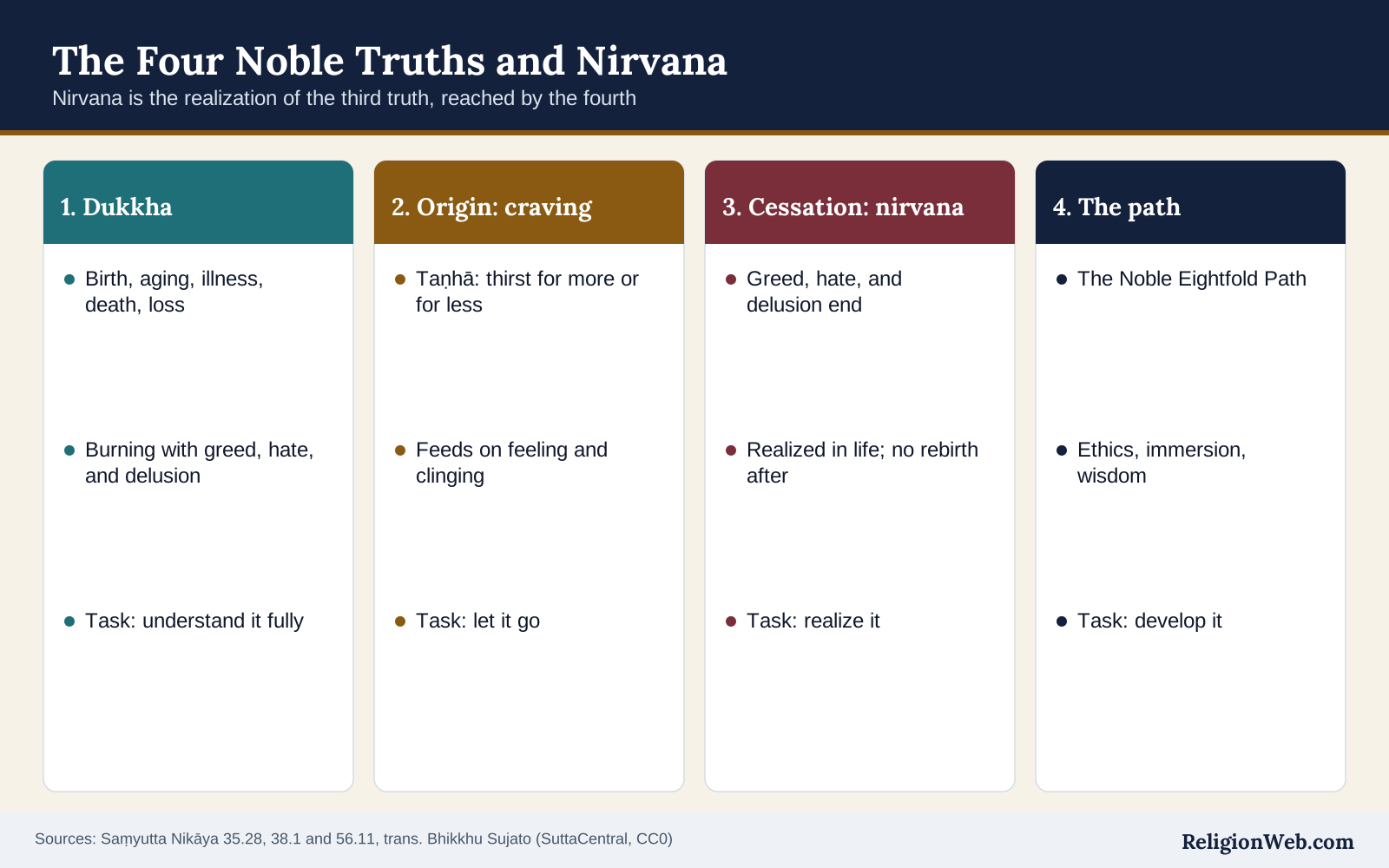
In the structure of Buddhist teaching, nirvana is the answer to a problem. The first of the Four Noble Truths describes the unsatisfactory character of conditioned existence, the second traces it to craving, the third declares that the ending of craving is possible, and the fourth lays out the way. Nirvana is the name tradition gives to the realization of the third truth. The path that leads to it is set out in the Noble Eightfold Path, which gathers ethical conduct, meditation, and wisdom into a single training.
The same logic connects nirvana to teachings about rebirth. In the Buddhist account, intentional action driven by greed, hate, and delusion generates karma, and karma sustains the round of rebirth. Nirvana is the ending of that driver, which is why it is described as freedom from rebirth. The relationship between action, consequence, and continued existence is the subject of karma and rebirth in Buddhism, and nirvana can only be understood against that background.
A goal for monastics, lay people, and bodhisattvas
Who aims at nirvana, and how directly, differs by tradition and by person. In the early texts the figure who has realized it is the arahant, and many of the accounts describe monks and nuns whose way of life was arranged to support the work. Buddhist monastic life grew up around that purpose, with the Vinaya providing a discipline of conduct that leaves time and mental space for training. Lay disciples are also depicted in the texts as reaching the earlier stages of awakening, and in many Buddhist societies lay practice emphasizes generosity, ethical conduct, and merit, with nirvana held as the ultimate horizon rather than the immediate expectation.
In Mahayana traditions the central ideal is the bodhisattva, a being who aspires to full buddhahood for the sake of all beings and who may be said to delay or refuse a narrowly personal nirvana in favor of continued compassionate activity. The bodhisattva ideal thus reshapes how nirvana is spoken about without removing it from view. The founder of the tradition is the starting point for all these discussions, and the life and awakening of the Buddha remain the model against which every later account of liberation is measured.
The Word Nirvana: Etymology, Fire, and Coolness
Where the Word Comes From
The Sanskrit root and the sense of going out
The Sanskrit noun nirvāṇa is built from the prefix nir, meaning “out” or “away,” and the root vā, “to blow,” which gives the sense of something blown out or ceasing to blow. The participle nirvāṇa or nirvṛta was used in ordinary Indian speech for fires and lamps that had gone out, and the Pali Text Society’s Pali–English Dictionary (Rhys Davids and Stede, 1921–1925) notes that forms of the verb were in use in the Vedic period, before Buddhism. The Buddhists inherited a word that already meant “extinguished” and gave it a specific meaning in the setting of their teaching. Indian religious literature outside Buddhism also uses the term, which shows that the word was part of a shared vocabulary of release rather than a coinage of the Buddha’s followers.
For most readers the literal picture is of a candle flame being blown out by a breath. That picture is natural, but it is only one of the images the texts use, and as the next section shows, the early sources are more interested in what happens to a fire when its fuel is exhausted than in how it is snuffed out.
Competing derivations in the Pali tradition
The Pali Text Society dictionary devotes a long entry to nibbāna and points out that the derivation from vā, “to blow,” is only one candidate. It argues that in Pali the form usually behaves as though it comes from the root vṛ, “to cover,” so that the governing image is a fire put out by being covered up or deprived of fuel, with the cognate adjective nibbuta meaning “extinguished” or “cooled.” The dictionary adds that the traditional Pali commentators never explained nibbāna by blowing at all. They derived it instead from nis plus vana, where vana is understood as craving (also the word for a thicket or forest), so that nibbāna means “departure from craving.” This is the explanation associated with the commentator Buddhaghosa in the fifth century CE.
These derivations differ, but they agree on the direction of the meaning: removal, cessation, release. The dictionary’s own summary of the senses of the word is useful. It lists the going out of a lamp or fire, bodily well-being as the passing of feverishness, the dying out in the heart of the three fires of passion, hate, and delusion, and the resulting spiritual well-being, security, and peace. The Buddhist technical meaning is the third; the others show the range of ordinary language from which it grew.
The Fire Image in the Early Texts
A fire that goes out when its fuel runs out
The most developed use of the fire image is in the Middle Discourses, where a wanderer named Vacchagotta presses the Buddha about what happens to an awakened person after death. Having been refused every one of the four standard answers, Vacchagotta is given a simile in return. The Buddha asks him what he would say about a fire that had been burning in front of him on grass and logs and has since gone out. Asked which direction the fire went, Vacchagotta replies:
“It doesn’t apply, worthy Gotama. The fire depended on grass and logs as fuel. When that runs out, and no more fuel is added, the fire is reckoned to have become quenched due to lack of fuel.”
Majjhima Nikāya 72, trans. Bhikkhu Sujato (SuttaCentral)
The simile does not assert that the fire has gone somewhere, nor that it has been annihilated by a force. It points out that the question “which direction?” has no application once the dependence on fuel has ended. The Buddha then says the same of a realized one, whose descriptions in terms of form, feeling, perception, choices, and consciousness have been abandoned. Interpreters inside Buddhism draw different lessons from this passage, and a later section sets out their disagreements, but the passage itself is clear that the image concerns a process coming to rest, not a thing being destroyed from outside.
The burning world in the Fire Sermon
The fire image also describes the problem that nirvana resolves. In the discourse called the Burning (Saṃyutta Nikāya 35.28), often known as the Fire Sermon, the Buddha tells a thousand monks that everything is burning: the eye, sights, eye consciousness, and the feelings that arise from contact. They burn, he says, “with the fires of greed, hate, and delusion” and with rebirth, old age, death, sorrow, and distress. A learned disciple who sees this grows disillusioned, desire fades, and the mind is freed. The text records that, while it was being spoken, the minds of the thousand monks were freed from defilements by not grasping.
Read together, the two passages set up a coherent picture. Ordinary experience, when it is driven by greed, hate, and delusion, is compared to something burning. Nibbāna is the condition in which those fires are out. That is why Sāriputta’s definition, the ending of the three, and the image of extinguishment say the same thing in two registers, one psychological and one pictorial.
Coolness, Peace, and Other Images
Cool, cooled, and the sense of relief
If the fire is a metaphor for suffering, its ending is coolness. The Pali adjective nibbuta, “extinguished,” is regularly paired with sītibhūta, “become cool,” and the dictionary cites passages in which the Buddha describes himself as one who is cooled and quenched. In the account of his search for awakening, the Buddha tells the ascetic Upaka that he alone is fully awakened, “cooled, quenched” (Majjhima Nikāya 26). The word “cool” in Indian languages carries a sense of relief from fever, and the dictionary notes that one meaning of nibbāna in everyday speech was health, the passing of feverishness and restlessness. For practitioners this is a significant part of how the word feels: nibbāna is the cessation of burning, and coolness is its natural counterpart.
Other epithets for what is realized
The texts supplement the fire image with a large family of other terms. Among those that the Pali Text Society dictionary lists are the unconditioned, the deathless, the far shore, the island amid the floods, the supreme sanctuary from the yoke, the peaceful, the secure, and the cessation of dukkha. Each emphasizes a different aspect: safety from danger, rest after a journey, a place to stand in a flood, or freedom from an old burden. As the translator and scholar Rhys Davids observed in a passage quoted in that entry, these are not simple synonyms, because each stresses a different phase of a many-sided concept.
Taken together, the images describe a goal that is approached through negation (ending, fading, cessation) and through relief (cool, safe, free). They do not describe a landscape. That fact prepares the ground for the next section, which looks at what the earliest texts actually say about nibbāna when they speak of it directly.
How Nibbāna Is Translated into English
Choices translators make
Because no single English word matches nibbāna, translators have chosen different strategies. Some leave the word untranslated and rely on explanation, which is the practice followed in most reference works. Others choose a rendering that reflects a particular reading of the fire image. Bhikkhu Sujato, whose translations of the Pali discourses are quoted in this article, uses “extinguishment,” and he renders the related verb as “be extinguished” or “become fully quenched.” Thanissaro Bhikkhu prefers “unbinding,” arguing that ancient Indian thought pictured a burning fire as clinging to its fuel, so that its going out was a release. Other translators have used “liberation,” “cessation,” or “the cool.” Each choice captures part of the original and loses part of it.
The effect on a reader is considerable. “Extinguishment” invites a physical picture of a flame, “liberation” invites a legal or political one, and “unbinding” suggests untying a knot. None of these is wrong, but a reader who compares translations will notice that the same Pali sentence can sound quite different. Treating the English as an approximation, and attending to the Pali terms for the underlying ideas, is the sound approach.
Common renderings and their limits
Outside the translation of the scriptures, the word has been glossed in many popular ways. The table below sets out the most frequent and indicates what each captures and what it misses. The misconceptions section later in the article returns to the three most consequential.
| Rendering | Where it is commonly found | What it captures | What it misses |
|---|---|---|---|
| Heaven or paradise | Popular writing and casual usage | The supreme value and happiness attached to the goal | Heavens are realms within samsara and are impermanent; nibbāna is the ending of rebirth |
| Annihilation or extinction | Nineteenth-century scholarship and popular accounts | The ending of rebirth and the image of a fire going out | Early texts reject annihilationism as a view and decline to say that the awakened “no longer exist” |
| Blown out | Popular etymology | The Sanskrit root vā, “to blow” | Pali commentators did not derive the word this way; early similes stress fuel running out |
| Bliss | English dictionaries and spiritual writing | The texts do call extinguishment happiness | Not a pleasant feeling; Sāriputta says it is blissful because nothing is felt |
| Enlightenment | Everyday usage | The close link between awakening and the ending of craving | Bodhi and nibbāna are separate terms, and many Mahayana works distinguish them |
| A calm state of mind | Mindfulness and wellness writing | Real psychological relief as greed, hate, and delusion weaken | The texts distinguish liberation from even the highest meditative attainments |
What the Early Texts Say Nibbāna Is
The Ending of Greed, Hate, and Delusion
The three roots and what their ending involves
Buddhist ethics and psychology give greed, hate, and delusion a central place. Greed, or passion, is the pull toward what is pleasant and the wish to possess and prolong it. Hate, or aversion, is the push away from what is unpleasant, extending from irritation to hostility. Delusion is the underlying failure to see how things are, including the habit of treating changing experiences as a stable self. In the Buddhist account, most unskillful intention flows from one or more of the three, which is why the texts call them roots, and why Sāriputta’s definition makes their ending the content of nibbāna.
The ending is described as thorough. A later passage in the same collection (Saṃyutta Nikāya 43, “Linked Discourses on the Unconditioned”) repeats the formula verbatim and attaches it to a different word, teaching that “the unconditioned” is the ending of greed, hate, and delusion. Across one chapter after another, the Buddha then names a long series of practices as the path leading to it, including mindfulness of the body, serenity, discernment, and several forms of immersion. The formula is stable while the routes to it are many, and this is a pattern readers will notice again and again in the early literature.
A goal that can be known in this life
Early Buddhist teaching insists that nibbāna is not postponed until death. In the Numbered Discourses (Aṅguttara Nikāya 3.55), a brahmin named Jānussoṇi asks in what sense extinguishment is “apparent in the present life, immediately effective, inviting inspection.” The Buddha answers with an observation about ordinary psychology. A greedy person, overcome by greed, intends to hurt themselves, others, or both and suffers mental pain and sadness as a result. When greed has been given up, that harmful intention and its pain do not arise. The same holds for hate and for delusion. “When you experience the ending of greed, hate, and delusion without remainder,” the Buddha concludes, that is how extinguishment is apparent in the present life.
This passage reveals how the early texts connect the grand-sounding goal to something that can be tested in experience. Lesser degrees of the same relief are available as greed, hate, and delusion weaken, and the discourse is often cited to show that the path pays dividends before it reaches its end. It does not, however, reduce nibbāna to those dividends. The passage defines extinguishment by the complete ending of the three roots, and a person who has merely become calmer or less irritable has not, in the language of the tradition, reached it.
The Unconditioned and the Deathless
The language of what is not made
Alongside these psychological descriptions the early collections contain verses that speak of nibbāna in a more ontological register. The Udāna, a collection of the Buddha’s “heartfelt sayings,” devotes its eighth chapter to extinguishment. In its first discourse the Buddha speaks of a dimension where there is no earth, water, fire, or wind, no coming or going or remaining or passing away or reappearing, no this world or other world, and he concludes: “Just this is the end of suffering.” In the third, in Sujato’s rendering, he says there is “freedom from rebirth, freedom from what has been produced, made, and conditioned.” Many translators render the underlying Pali, ajātaṁ abhūtaṁ akataṁ asaṅkhataṁ, as “unborn, unbecome, unmade, unconditioned,” and the choice of English affects how metaphysical the passage sounds.
The fourth discourse links the same vocabulary to a psychological account: for the dependent there is quivering, for the independent there is none, and when there is no quivering there is tranquility, and in the end no coming and going, no passing away and reappearing, and no this life or next. The reasoning moves from the mind’s dependence on grasping to the ending of rebirth, and it is the same movement found in the fire simile. Theravada tradition reads these verses as pointing to nibbāna as a reality distinct from the conditioned world; other readers emphasize that the passages deny every conditioned feature and so affirm no further description.
Happiness that does not depend on feeling
Two further texts qualify the idea that nibbāna is only a negation. In the Dhammapada, in verses that Sujato renders, extinguishment is called “the ultimate happiness” (Dhammapada 203–204). In the Numbered Discourses (Aṅguttara Nikāya 9.34), Sāriputta declares, “Extinguishment is bliss!” and the monk Udāyī objects that nothing is felt there. Sāriputta replies that the very absence of feeling is what is blissful, and he explains the point by walking through the stages of meditation, each of which carries a faint affliction that the next one leaves behind. The conversation shows the early community already aware of the paradox, and willing to answer it with a theory of happiness as the absence of affliction rather than the presence of pleasure.
That theory shapes the way later writers describe nirvana. Many speak of it as peace, or as the highest kind of ease, while being careful to say that it is not an exalted sensation of the kind a meditator might experience in an absorption. The distinction becomes important when the article turns to common misreadings.
A Reality Described by Refusal
Questions the Buddha left undeclared
The early collections preserve a group of questions the Buddha declined to answer, among them whether the cosmos is eternal, whether the soul and body are the same, and whether a realized one exists after death. In the Middle Discourses (Majjhima Nikāya 72), Vacchagotta runs through the possibilities for the last question: does an awakened one exist, not exist, both, or neither? The Buddha rejects all four as views. When Vacchagotta asks where a freed mind is reborn, the same pattern holds: “reborn,” “not reborn,” “both,” and “neither” do not apply. In Saṃyutta Nikāya 22.86 the monk Anurādha reaches a related conclusion by reasoning that no aggregate, and nothing apart from the aggregates, can be identified with a realized one in this very life, and the Buddha affirms: “what I describe is suffering and the cessation of suffering.”
The poetic form of the same teaching appears in the Questions of Upasīva in the Sutta Nipāta. After the Buddha answers questions about crossing the flood, Upasīva asks whether the freed one has ceased to exist or is free from disease forever. The Buddha replies:
“As a flame tossed by a gust of wind,” replied the Buddha, “comes to an end and cannot be reckoned; so too, a sage freed from the set of mental phenomena comes to an end and cannot be reckoned.”
Sutta Nipāta 5.7 (Questions of Upasīva), trans. Bhikkhu Sujato (SuttaCentral)
Translators render the verse in more than one way. The Pali verb behind “comes to an end” suggests going down, as the sun does, or going to rest, and the Pali Text Society dictionary quotes the same lines to illustrate a state for which “there is no measure.” Theravada teachers generally take the verse to say that the freed person cannot be defined by the categories of the world and that the question of continued existence does not apply. Sujato’s wording, “comes to an end,” leaves room for a reading in which the process of becoming simply stops, but the verses that follow resist both a simple “exists” and a simple “does not exist.” Upasīva asks whether the one who has disappeared does not exist, or is instead free from disease for eternity, and the Buddha replies that such a person cannot be defined, because when all things have been eradicated, “eradicated, too, are all ways of speech.” The passage is best read as a refusal to apply the usual labels, not as an assertion of annihilation.
A table of early descriptions
The following table collects the main early passages discussed in this section, with a short summary of each in paraphrase. It is meant as a map of where the early collections speak about nibbāna rather than as a complete list.
| Text and locator | What the passage says (paraphrase) | What it contributes |
|---|---|---|
| Saṃyutta Nikāya 38.1 | Sāriputta defines extinguishment as the ending of greed, hate, and delusion and names the Noble Eightfold Path as the way | The basic definition, tied directly to practice |
| Saṃyutta Nikāya 43.1 and 43.12 | The unconditioned is defined by the same formula; the path to it is mindfulness of the body, serenity, discernment, and several forms of immersion | Connects “unconditioned” with the ending of the three roots and shows many entry points |
| Aṅguttara Nikāya 3.55 | Extinguishment is visible in this life, immediately effective, and inviting inspection, as greed, hate, and delusion are given up | Present-tense, testable account of the goal |
| Aṅguttara Nikāya 9.34 | Sāriputta says extinguishment is bliss precisely because nothing is felt, and explains this through the stages of meditation | Reframes happiness as freedom from affliction |
| Udāna 8.1 to 8.4 | Speaks of a dimension without coming or going, and of freedom from the produced, made, and conditioned | The most direct claims that there is something realized |
| Itivuttaka 44 | Distinguishes extinguishment with residue from extinguishment with no residue | Source of the life and death distinction |
| Majjhima Nikāya 26 | The Buddha describes seeking what is free of rebirth, “the supreme sanctuary from the yoke, extinguishment,” and rejects his teachers’ attainments as not leading to it | Treats nibbāna as a goal beyond even refined meditative states |
| Majjhima Nikāya 72 and Saṃyutta Nikāya 44.9 | Uses the fire and its fuel to show why questions about where an awakened one goes do not apply | Basis for the refusal to describe the state after death |
| Sutta Nipāta 5.7 | Compares the freed sage to a flame that goes out and cannot be reckoned | Poetic statement of the same refusal |
| Dhammapada 203 and 204 | Calls extinguishment the ultimate happiness | Widely recited statement of its value |
Nirvana, Samsara, and the Four Noble Truths
Samsara as the Problem Nirvana Answers
Wandering on: what samsara means
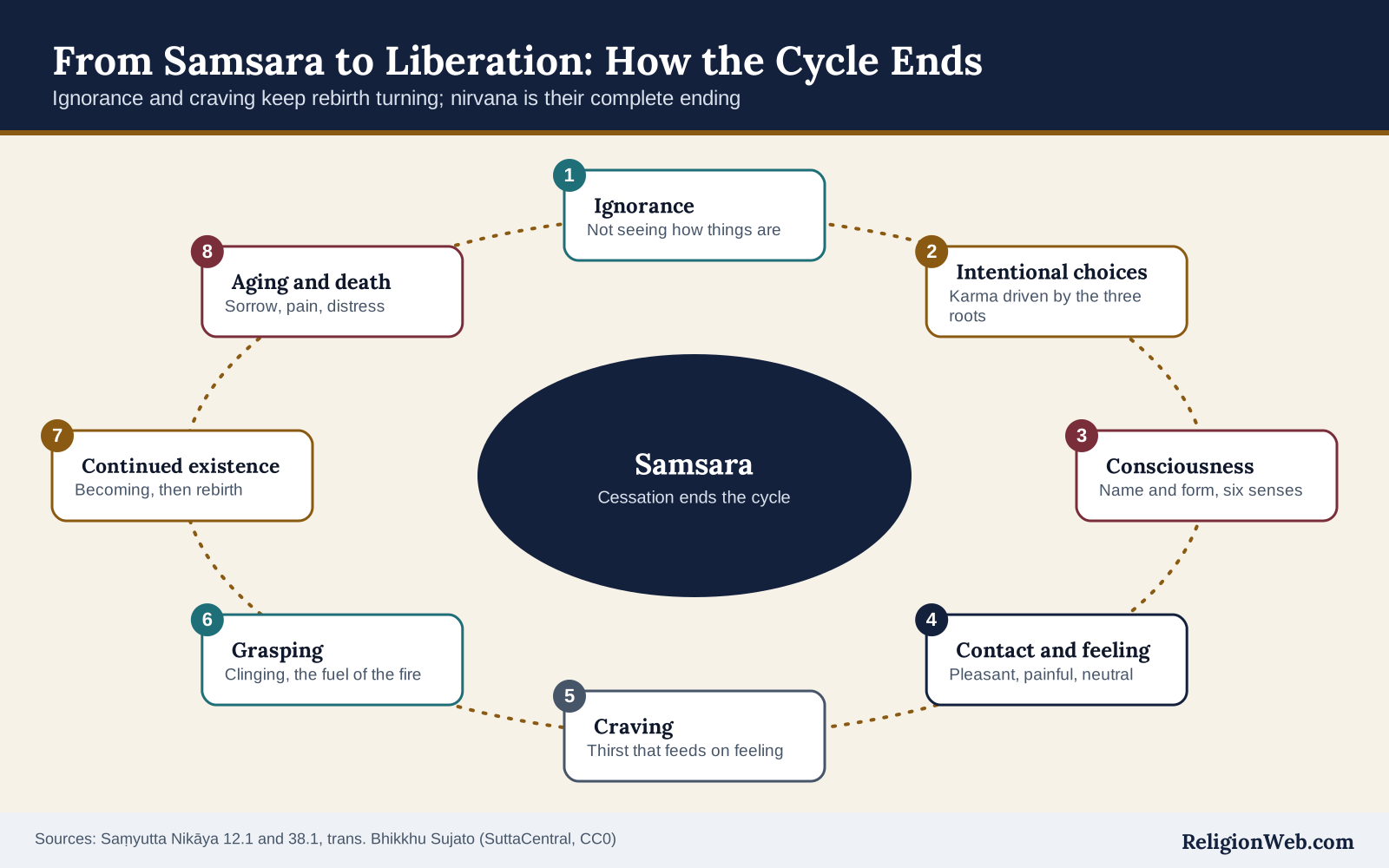
The word saṃsāra means “wandering on” and names the round of birth, aging, death, and renewed birth in which beings are understood to move among realms of existence. The early texts describe it as having no discoverable beginning, and they treat it not as a punishment imposed from outside but as the result of intentional action sustained by ignorance and craving. The realms through which beings wander include the human world, animal and ghostly existences, hell realms, and heavens in which gods live long and pleasant lives. Even the heavens are within the cycle, since the lifespan of a god, however long, ends and is followed by further rebirth. This matters for understanding nirvana, because the goal is defined as the end of the whole round, not as a better address within it.
The way karma operates within this cycle, and why intention rather than mere action is what matters, is the subject of karma and rebirth in Buddhism. For present purposes, it is enough to say that nirvana is spoken of as the point at which the engine of rebirth stops, because the ignorance and craving that drive it have been removed.
Dependent origination read backward
The early texts provide a compact formulation of the cycle called dependent origination. Saṃyutta Nikāya 12.1 states it in twelve links, from ignorance as a requirement for choices, through consciousness, name and form, the six sense fields, contact, feeling, craving, grasping, continued existence, and rebirth, to old age, death, sorrow, and distress. The second half of the same discourse runs the sequence in reverse: when ignorance fades away and ceases with no residue, choices cease, and so on, until “this entire mass of suffering ceases.” That reversed sequence is often taken as the textual picture of what nirvana does to the cycle.
The links on which tradition places the most weight are craving and ignorance. Craving, as the point where feeling turns into wanting, is the second noble truth, and ignorance is the root that is removed by wisdom. This is why the ending of greed, hate, and delusion can be said to be the ending of the whole sequence: removing the root fires cuts the dependence that allows each later link to arise.
Cessation as the Third Noble Truth
A truth to be realized
In the first sermon the four truths are paired with tasks: suffering is to be fully understood, its origin abandoned, its cessation realized, and the path developed. Nirvana is the realization of the third task. It is not described as something the practitioner produces, any more than the extinction of a fire is produced by building the fire. The practitioner removes what feeds the fire, and the result is described as the unconditioned. The Four Noble Truths sets out the wording of the first sermon and how each truth relates to its task, and this article takes that framework as given.
Pain, dukkha, and what actually ends
It would be easy to infer that nirvana means the end of all unpleasant experience, but the texts do not say this. The Itivuttaka passage that distinguishes two elements of extinguishment states that an arahant’s five sense faculties still remain, and that so long as the senses have not gone, the arahant continues to feel the agreeable and disagreeable, pleasure and pain. What ends is the reactive grasping that turns experience into suffering in the technical sense of dukkha: the craving, aversion, and delusion that add burning to events. Teachers in several traditions explain the difference with a familiar image from the discourses, in which a person struck by an arrow suffers further when struck by a second, and the second arrow is the mental reaction. The arahant’s body still ages and falls ill, but the added burning does not arise.
The Path That Leads There
The Noble Eightfold Path as the route
Sāriputta’s answer to Jambukhādaka names the eightfold path, which traditions usually divide into three trainings: ethics (right speech, right action, right livelihood), immersion or concentration (right effort, right mindfulness, right immersion), and wisdom (right view and right intention). The structure is not a ladder to be climbed once and left behind. Each factor supports the others, and wisdom, which sees the three characteristics of impermanence, dukkha, and non-self, is the faculty that finally cuts through delusion. The Noble Eightfold Path explains each factor in detail.
Many doorways to one ending
Alongside the eightfold path the early collections list other framings that lead to the same ending, including the practice of serenity and discernment together, and the three “doors” of emptiness, signlessness, and desirelessness. Saṃyutta Nikāya 43 includes “emptiness immersion,” “signless immersion,” and “undirected immersion” in its list of paths to the unconditioned. These three doors later became important in Mahayana literature, where they appear as the three gates of liberation. The multiplicity of routes should not be read as vagueness. It reflects the view that people come to the same freedom through different temperaments and practices, while the target, the ending of greed, hate, and delusion, remains stable.
Nirvana in This Life and Final Nirvana: Arahants and the Buddha’s Death
Two Elements of Extinguishment
Extinguishment with residue and with no residue
The distinction between nirvana realized in life and nirvana at death rests mainly on one short discourse, Itivuttaka 44. The Buddha speaks there of two “elements of extinguishment” (nibbāna-dhātu): the element with residue (saupādisesā) and the element with no residue (anupādisesā). Both are descriptions of an arahant, a perfected one whose defilements have ended. In the first, the arahant’s five sense faculties still remain, and so the arahant continues to experience the agreeable and disagreeable, pleasure and pain. The ending of greed, hate, and delusion in such a person is what the text calls the element with residue. In the second, the discourse says:
“For them, everything that’s felt, being no longer relished, will become cool right here.”
Itivuttaka 44, trans. Bhikkhu Sujato (SuttaCentral)
The verse that follows explains that the element with residue “pertains to this life,” while the element with no residue pertains to “what follows this life, where all states of existence cease.” The word upādi in the Pali compounds is related to upādāna, so that “with residue” can be taken to mean “with a remainder of the basis for clinging,” namely the living body and its sensations. Translators render these terms in various ways, including “with a residue remaining” and “without a residue remaining,” and the choice matters little provided the underlying contrast is clear. Nirvana in life is the ending of the three fires while the body continues. Nirvana with no residue is the ending of the body, feeling, and consciousness as well, with no further rebirth to follow.
Terminology: nirvana, parinirvana, and related words
English writing often uses “nirvana” for the first and “parinirvana” for the second, but Buddhist usage is looser than that. The prefix pari means “completely,” and the Pali Text Society dictionary notes that parinibbāna was used in two senses even within the Pali tradition: the complete extinction of the aggregates at the death of an arahant, and a release from craving and attachment within life that carries the assurance of final death. The Mahāparinibbāna Sutta itself says that the Realized One becomes fully extinguished “in the element of extinguishment with no residue,” which ties the Itivuttaka’s vocabulary directly to the Buddha’s death. The table below sets out the main terms and the way they are used.
| Term | Where it appears | Meaning | Note on usage |
|---|---|---|---|
| Nibbāna / nirvāṇa | Throughout the Pali and Sanskrit literature | The ending of greed, hate, and delusion; extinguishment | Applies to the goal in general, whether realized in life or at death |
| Saupādisesā nibbānadhātu | Itivuttaka 44 | Element of extinguishment with residue | Realized in life; senses and feelings continue |
| Anupādisesā nibbānadhātu | Itivuttaka 44 | Element of extinguishment with no residue | Associated with what follows the final life; all that is felt becomes cool |
| Parinibbāna / parinirvāṇa | Mahāparinibbāna Sutta (Dīgha Nikāya 16) and later usage | Complete or final extinguishment | Most often used of the death of the Buddha or an arahant; the Pali dictionary also records a sense for complete freedom in life |
| Parinibbuta / parinirvṛta | Dīgha Nikāya 16, Vinaya, and many later texts | Fully extinguished, fully quenched | Used of the Buddha and other arahants who have died, and sometimes of living arahants |
| Nirupadhiśeṣa-nirvāṇa | Sanskrit Buddhist literature | Nirvana without remainder | Parallel to the Pali “no residue”; the Chinese Diamond Sutra speaks of 無餘涅槃, nirvana without remainder |
| Nehan, Niepan | Japanese and Chinese Buddhist usage | Nirvana; also the Buddha’s passing | Used in names of the observances commemorating the Buddha’s death |
Stages of Awakening and the Arahant
The four stages and the fetters
Pali tradition describes awakening as occurring in four stages, each marked by the ending of some of the ten fetters that bind a person to the round of rebirth. The Mahāparinibbāna Sutta itself, in a passage about the fates of deceased disciples, uses the categories directly: a stream-enterer has ended three fetters and is “not liable to be reborn in the underworld, assured, destined for awakening”; a once-returner has ended three fetters and weakened greed, hate, and delusion and will come back to this world once only; a non-returner has ended the five lower fetters and, reborn spontaneously in a higher realm, “will be extinguished there.” The text names laymen and laywomen among those in each category, which suggests that the early community did not treat the earlier stages as the monastic preserve.
| Stage | Pali name | What is ended | Outlook for rebirth |
|---|---|---|---|
| Stream-enterer | sotāpanna | The first three fetters: self-view, doubt, and attachment to rules and observances | Not reborn in the lower realms; destined for awakening |
| Once-returner | sakadāgāmī | The first three fetters, with greed, hate, and delusion weakened | Returns to this world once only |
| Non-returner | anāgāmī | The five lower fetters, including sensual desire and ill will | Reborn spontaneously in a higher realm and extinguished there |
| Arahant | arahant | All ten fetters, including conceit, restlessness, and ignorance | No further rebirth; nibbāna with residue in life, without residue at death |
What an arahant’s life looks like
The picture that emerges from the early texts is not of an impassive figure. The arahant described in Itivuttaka 44 has finished the spiritual journey, done what had to be done, and laid down the burden, yet still feels pleasure and pain. The Buddha himself, in the Mahāparinibbāna account, falls severely ill during a rains residence and again after his last meal, “struck by dreadful pains, close to death,” and is shown enduring both with mindfulness. The difference lies in how experience is related to. Pain arises, but the extra layer of aversion, worry, and self-reference does not. This portrait also helps explain why the early community described the awakened as warm toward others: generosity and compassion are not removed together with greed and hate.
The communities who preserved these texts took arahantship as an attainable goal for monks, nuns, and, in some accounts, lay followers, and the question of how best to pursue it shaped the institutions of Buddhist monastic life. How the later Theravada commentarial tradition treats lay arahants is taken up in the FAQ, since it differs from the picture of the early discourses.
The Buddha’s Parinirvana
The last days at Kusinārā
The long discourse called the Mahāparinibbāna Sutta (Dīgha Nikāya 16), “The Great Discourse on the Buddha’s Extinguishment” in Sujato’s translation, tells the story of the Buddha’s final months. Māra, a tempter figure in the tradition, urges him to pass away, and the Buddha replies that he will not be fully extinguished until he has monk, nun, layman, and laywoman disciples who are learned and practicing. Later, at the Cāpāla Shrine, the text says he surrendered the life force, and he announces that in three months the Realized One will be fully extinguished. He eats his last meal, falls ill, and travels to Kusinārā, where he lies down between a pair of sal trees. To his attendants he gives his last words: “Conditions fall apart. Persist with diligence.”
The text then describes him entering the four absorptions and the formless dimensions in ascending order, reaching the cessation of perception and feeling, then moving back down through the same states and up again to the fourth absorption, from which he “immediately became fully extinguished.” When Ānanda asks whether the Buddha has become fully quenched, Anuruddha corrects him: not yet, he has entered the cessation of perception and feeling. After the passing, several beings speak verses. Anuruddha’s verse reads:
“The liberation of his heart was like the extinguishing of a lamp.”
Dīgha Nikāya 16, trans. Bhikkhu Sujato (SuttaCentral)
The sutta also records the verse spoken by Sakka, the king of the gods: “Conditions are impermanent, their nature is to rise and fall; having arisen, they cease; their settling is blissful.” Observances that commemorate the Buddha’s death, discussed later in this article and in the article on Vesak, rest on this account. The text also shows the monastic community in grief and equanimity side by side: some who had not yet freed themselves from desire lament, while those who had endure, thinking that conditions are impermanent and could not be otherwise.
What the texts say about an awakened one after death
The texts that describe the Buddha’s death do not claim to say where he went. In the language of the fire simile, the fire is out, and the question of its direction does not apply. The Buddha’s own handling of the issue, preserved in the Anurādha discourse and in the exchanges with Vacchagotta, is to decline each of the four positions that a questioner might offer and to redirect attention to the problem he came to solve: suffering and its cessation. For this reason, the traditions that follow him speak differently about what a Buddha is “after” parinirvana, a subject that Mahayana literature in particular took in new directions.
In the Theravada understanding, the Buddha and arahants who die in this condition are not reborn, and nothing further is predicated of them. For readers who wonder whether this amounts to nonexistence, the early texts supply the answer by refusing both “exists” and “does not exist,” and by describing the matter as one that is “deep, hard to see, hard to understand, peaceful, sublime, beyond the scope of logic.” The Mahayana traditions, discussed next, introduce further vocabulary, including the idea that a Buddha’s parinirvana is a skillful display rather than a literal ending.
How Buddhist Traditions Understand Nirvana
Theravada and the Pali Commentaries
Nibbāna as an unconditioned reality
In Theravada Buddhism, whose scriptures are the Pali Canon and whose interpretive framework comes from the Abhidhamma and the commentaries, nibbāna is usually described as an unconditioned reality realized by the arahant. The Abhidhamma analysis of experience sorts what is ultimately real into four kinds: consciousness, mental factors, material form, and nibbāna, and it classes nibbāna as the only one that is unconditioned. It is not produced by causes, though it is realized through a path that is. The Pali tradition also holds that nibbāna is not a self: a well-known line in the Dhammapada, which Theravada teachers read as including nibbāna, says that all phenomena (dhammā) are not-self, while conditioned things alone are impermanent. Nirvana is therefore neither a soul nor a deity nor a place in which one lives.
The fifth-century commentator Buddhaghosa, whose Visuddhimagga became the standard Theravada manual of practice, took up the question of the word’s meaning and, as the Pali Text Society dictionary reports, derived it from the absence of craving. His account of the path makes realization of nibbāna the culmination of a series of insight knowledges, in which the meditator sees the arising and passing of conditioned phenomena until the mind takes the unconditioned as its object and the fetters fall away in stages. The commentarial tradition thus gives the early discourses a systematic form, while the discourses themselves remain the reference point for debate.
Modern Theravada emphases
In the twentieth century, Theravada teachers in several countries presented nibbāna in ways that connected it with the practice of lay people as well as monastics. Burmese and Thai meditation lineages emphasize insight practice aimed at direct realization, while the Thai teacher Buddhadasa Bhikkhu (1906–1993) stressed that nibbāna as “coolness” can be experienced in the present, in the ending of the heat of selfish craving, and not only at the end of a long path. Such readings draw on texts like Aṅguttara Nikāya 3.55, which locate extinguishment in this life.
Modern Theravada has also produced internal debate. In Thailand, a dispute about whether it is legitimate to speak of nibbāna as a “true self” (attā) became part of a broader controversy surrounding the Dhammakaya movement in the 1990s and after, with critics holding that the language contradicts the canonical teaching of not-self. The movement’s own teachers have given their own account of what they mean, and the full story involves institutional and political questions beyond doctrine. For the purposes of this article, the point is that the question of what can be predicated of nibbāna remains live within Theravada communities and not only at the edges of the tradition.
Abhidharma Schools and Madhyamaka
Early Abhidharma debates over cessation
In the centuries after the Buddha, other Buddhist schools in India produced their own systematic treatises, known in Sanskrit as Abhidharma. A well-known school, the Sarvāstivāda, listed nirvana among the unconditioned dharmas and held that it is a real entity, attained through what is called “cessation through analysis.” Another current of thought, associated with the Sautrāntika, is usually described as treating the ending of defilements as a mere absence, with no separate entity needing to be posited. The disagreement concerns the ontological status of a cessation, and it should not be mistaken for a disagreement over whether liberation is the goal. Surviving evidence for the positions comes largely from later treatises, and scholars continue to reconstruct how the schools actually understood each other.
Nāgārjuna and the emptiness of nirvana
The Madhyamaka, or “Middle Way,” tradition associated with Nāgārjuna (usually dated to about the second or third century CE) took a more radical position. In the twenty-fifth chapter of his Mūlamadhyamakakārikā, Nāgārjuna examines nirvana and argues that it cannot be understood as an existent thing or as a non-existent one, since both categories depend on inherent existence, which he denies of all phenomena. In the Chinese translation of the text with its commentary, the chapter states that the limit of nirvana and the limit of the world are the same, with no slightest difference between them. Later Madhyamaka thinkers, including Candrakīrti and the Tibetan commentators who followed him, read this as a claim about emptiness: samsara and nirvana alike lack any inherent nature, so there is no ultimate gulf between them to cross.
This reading does not claim that ordinary life is already liberation. It claims that what keeps beings in samsara is a mistaken way of grasping things as inherently existent, and that nirvana is the removal of that mistake. A short echo appears in the Prajñāpāramitā literature. In the standard Chinese version of the Heart Sutra, the bodhisattva relying on the perfection of wisdom has no hindrance in the mind, is free from fear and inverted views, and reaches ultimate nirvana (究竟涅槃). The text also states, in paraphrase, that in emptiness there is no suffering, origin, cessation, or path, an apparent denial of the Four Noble Truths that the tradition reads as a statement about their ultimate emptiness and not as a rejection of them.
Mahayana Scriptures and Buddha-Nature
The Lotus Sutra: a resting place and a skillful display
Some Mahayana sutras recast the relationship between the goal of the disciple and the goal of a Buddha. In the Lotus Sutra, a parable in the seventh chapter tells of a guide who conjures a magic city for travelers exhausted on a long, dangerous road. When they rest there, he dissolves it and invites them to continue to the true destination. The sutra applies the image to nirvana: for the sake of resting, the Buddha teaches nirvana, and then tells those who have attained it that what they have gained is not extinction, urging them toward the omniscience of a Buddha. In paraphrase of the Chinese text, the guide declares that what they have attained is not true extinction (汝所得非滅).
In the sixteenth chapter the same sutra adds, in verse, that the Buddha manifests nirvana as a skillful means (方便現涅槃) though in truth he does not pass into extinction and abides always, teaching. On this view the death of the Buddha is a display adapted to beings who would otherwise grow complacent. Other Buddhist traditions do not share this reading, and Theravada teachers hold that the Buddha attained parinibbāna at Kusinārā and was not reborn. These are differences in how traditions speak of their own founder and are treated here as internal diversity, not as a contest. The Lotus Sutra’s account became the textual foundation for several East Asian traditions and for observances at the Buddha’s passing.
The Mahāparinibbāna Sūtra: permanence, bliss, self, and purity
A different Mahayana scripture, also called the Mahāparinirvāṇa Sūtra, uses the occasion of the Buddha’s death to teach the Great Nirvana. In the Chinese translation by Dharmakṣema (early fifth century CE), the Buddha tells the assembled monks, in paraphrase, that the world has its own permanence, bliss, self, and purity (常樂我淨) in name only, while the transcendent form of those qualities has both name and meaning. The sutra identifies the “self” with the Great Nirvana (大涅槃) and says the Middle Way is called buddha-nature (佛性). It teaches that all sentient beings have buddha-nature, a doctrine closely associated with the tathāgatagarbha, “womb” or “embryo” of the Buddha.
Because the sutra uses the word “self,” which early texts reject for the five aggregates, commentators have read it in several ways. Some treat “self” as a skillful way of speaking about the true nature of a Buddha, distinct from the notion of an individual soul; others, in the broader tathāgatagarbha tradition, take it as pointing to a naturally pure mind obscured by passing defilements. Not every Buddhist tradition accepts the sutra’s emphasis. Its influence in East Asian and Tibetan Buddhism, however, means that Mahayana discussions of nirvana cannot be summed up as a simple extension of the early texts.
Non-abiding nirvana and the bodhisattva
Mahayana thinkers also developed the idea of “non-abiding nirvana” (apratiṣṭhita-nirvāṇa). In the account associated with the Yogācāra school and its Chinese heirs, the tradition distinguishes several kinds of nirvana, including the intrinsically pure nature of all things, nirvana with remainder, nirvana without remainder, and the non-abiding nirvana of a Buddha, who is said to rest neither in samsara through ignorance nor in a solitary peace through lack of compassion. The bodhisattva path described in the article on the bodhisattva follows this logic. A bodhisattva vows to stay in the world for the sake of others, but does not do so as a victim of craving.
Many Mahayana works also distinguish two kinds of obstruction: the afflictive obstructions (kleśāvaraṇa), whose removal brings liberation from samsara, and the obstructions to knowledge (jñeyāvaraṇa), whose removal brings the omniscience of a Buddha. On this scheme, an arhat has removed the first but not the second. Theravada tradition does not use this distinction, and it holds that arahants and Buddhas have equally and fully realized nibbāna, differing in other respects. Seeing the difference as a difference of analytical scheme helps keep the discussion balanced.
East Asian and Tibetan Developments
Pure Land and Zen
Two East Asian traditions illustrate how nirvana can sit differently within practice. In Pure Land Buddhism, centered on the Buddha Amitābha (Chinese Amituo, Japanese Amida), devotees aim at rebirth in Sukhāvatī, the “Land of Bliss.” The sutras that describe it say that those born there are assured of reaching nirvana, and the tradition treats rebirth in the Pure Land less as a destination in its own right than as a favorable setting in which the work of liberation is completed. In the Japanese teaching of Shinran (1173–1263), the founder of Jōdo Shinshū, nirvana is attained upon birth in the Pure Land at death.
Chan and Zen teachers more often speak of awakening (Chinese wu, Japanese satori or kenshō) than of nirvana, and they draw on Madhyamaka and Mahāparinirvāṇa themes to insist that liberation is not located somewhere else. Dōgen (1200–1253), the founder of Sōtō Zen in Japan, taught that practice and realization are not two. For both traditions the vocabulary differs from that of the early texts, although the underlying concern with release from craving and delusion remains.
Vajrayana and the nature of mind
In Vajrayana Buddhism, which developed in India and flourished in Tibet, the tantric literature frames samsara and nirvana as two ways in which the same mind appears: the first when ignorance obscures its nature, the second when that nature is recognized. Practices such as deity yoga and the meditations of the Great Perfection and Mahāmudrā traditions aim to bring this recognition about, with buddhahood as the goal. Tibetan scholastic writers speak of a Buddha as established in non-abiding nirvana, and they describe the path in the three-fold structure of ground, path, and fruit. The language is distinctive, but the tradition situates itself within the Mahayana concern for the liberation of all beings.
A Summary of Tradition-Specific Emphases
Reading the table
The following table summarizes the typical emphases of the traditions discussed above. It is a map of tendencies within Buddhism and not a ranking, and each row is a simplification of a body of teaching that contains considerable internal variety. Where a tradition is described as stressing one aspect, it does not follow that other aspects are denied.
| Tradition or school | Typical emphasis | Main textual anchors | Note |
|---|---|---|---|
| Theravada | Nibbāna as the unconditioned reality realized by the arahant; two elements; not-self | Pali Canon, Abhidhamma, Buddhaghosa’s commentaries | Arahantship is the stated goal of monastic training |
| Sarvāstivāda and Sautrāntika | Debate over whether cessation is a real unconditioned dharma or a mere absence | Sanskrit Abhidharma treatises | Historical schools known mainly from later treatises |
| Madhyamaka | Nirvana is empty of inherent existence; no ultimate gulf from samsara | Nāgārjuna, Mūlamadhyamakakārikā, chapter 25 | Later commentators interpret the claim differently |
| Yogācāra | Several kinds of nirvana, including non-abiding nirvana | Indian Yogācāra treatises and their Chinese heirs | Distinguishes two kinds of obstruction |
| Tathāgatagarbha and the Mahāparinirvāṇa Sūtra | Great Nirvana with permanence, bliss, self, and purity; buddha-nature | Mahāparinirvāṇa Sūtra in Dharmakṣema’s Chinese translation | The word “self” is interpreted in more than one way |
| Lotus Sutra traditions | One vehicle; the arhat’s nirvana as a resting place; the Buddha’s passing as a skillful display | Lotus Sutra, chapters 7 and 16 | Foundation of several East Asian schools |
| Pure Land | Rebirth in Sukhāvatī as the assured route to nirvana | Sukhāvatī sutras; Shinran’s writings | Practice centered on Amitābha |
| Chan and Zen | Awakening not separate from ordinary activity; less technical nirvana language | Chan records; Dōgen | Emphasis on direct practice |
| Vajrayana (Tibetan) | Buddhahood as non-abiding nirvana; samsara and nirvana as aspects of mind | Tantras and Tibetan commentaries | Practice through deity yoga and related methods |
Cautions about generalizing
Summaries of this kind can mislead if they are read as describing rival religions or as an evolutionary story in which later ideas replace earlier ones. The traditions overlap, borrow from one another, and in many monasteries and temples, particularly in East Asia, draw on several of these strands at once. A Chinese or Korean monk might study Madhyamaka, recite the Heart Sutra, and practice according to the Pure Land or Chan lineage of the temple. For each tradition, the safest approach is to ask which texts it treats as authoritative and what questions it considers central, and to attribute claims to those sources.
Practicing Toward Nirvana: Ethics, Meditation, Wisdom, and Daily Life
The Three Trainings
Ethics as the foundation
Buddhist teaching divides the path into three trainings, and ethics comes first. The reasoning is practical. Actions driven by greed, hate, and delusion strengthen those very forces, and actions free of them weaken the forces. Refraining from killing, stealing, harmful speech, and intoxicants, and cultivating generosity and kindness, therefore reduces the agitation that makes the mind difficult to settle. The ethical life described by the precepts is thus a means of loosening the roots that Sāriputta’s definition says must end, as well as a good in its own right, and for lay people it is the main form that practice takes.
Meditation, calm, and insight
The second training develops a mind that is steady and clear. Tradition distinguishes serenity practices (samatha), which settle the mind and can lead to deep absorptions, from insight practices (vipassanā), which investigate experience until the three characteristics become evident. The relationship between them differs by teacher and school, and Buddhist meditation describes the main methods. The key point for understanding nirvana is that the early texts do not equate absorption with liberation. When the Buddha describes his own training under two teachers, he says that their attainments, which reach the dimension of nothingness and the dimension of neither perception nor non-perception, “only” lead as far as rebirth in those dimensions and not to extinguishment.
Intensive meditation can be demanding, and people with a history of trauma or a mental-health condition are often advised, including by experienced teachers, to seek guidance from qualified professionals before undertaking long retreats. Buddhist tradition itself does not present meditation as a replacement for medical or psychological care.
Wisdom and the three characteristics
The third training, wisdom, centers on seeing that conditioned things are impermanent, unsatisfactory, and not-self. In the Saṃyutta Nikāya the Buddha leads the monk Anurādha through the five aggregates, asking whether each is permanent or impermanent, whether what is impermanent is suffering or happiness, and whether it is fit to be regarded as “this is mine, I am this, this is my self.” This insight dissolves the delusion that supports craving, and with delusion goes the sense of a self to protect. In the language of the discourse on the Burning, the learned disciple grows disillusioned, desire fades, and the mind is freed.

Monastic and Lay Paths
Monks and nuns
Monastic life is organized to support the work of the three trainings. The Vinaya, the monastic code, regulates conduct in ways intended to reduce attachment and conflict, and it provides a daily schedule of meditation, study, almsgiving, and service. Many monks and nuns in Theravada countries take arahantship as their stated aim, while Mahayana monastics typically take the bodhisattva vows, so that their own liberation is held together with the liberation of others. Monastic communities also serve lay people through teaching, chanting, and ritual, a reciprocal relationship described further in the article on Buddhist monastic life.
Lay practice, merit, and good rebirth
Most lay Buddhists in most periods have prioritized generosity, keeping the precepts, and making merit, with a favorable rebirth as the nearer goal and nirvana as the distant one. Anthropologists of Theravada societies, notably Melford Spiro in his study of Burma, described this as a distinction between “nibbanic” Buddhism, which aims at liberation, and “kammatic” Buddhism, which aims at good rebirth through merit. Many lay Buddhists voice a wish that their acts of giving may be a condition for reaching nibbāna one day, so that even ordinary acts of generosity are placed within the horizon of the goal.
The picture is not a rigid divide. Lay people attend meditation retreats in large numbers, and in modern times movements in Burma, Thailand, and Sri Lanka have promoted lay meditation as a path to realization. In Mahayana societies, laypeople are encouraged to generate the aspiration to awaken for the benefit of all, which is the beginning of the bodhisattva path described earlier in this article.
Nirvana in Ritual and Remembrance
Observances of the Buddha’s parinirvana
The Buddha’s death is remembered in the Buddhist calendar. In Theravada countries the full-moon day of the month of Vesākha commemorates the birth, awakening, and final passing of the Buddha together, a festival explained in the Vesak article. In many East Asian Mahayana temples there is a separate observance for the parinirvana. In Japan it is known as Nehan-e and is commonly observed on February 15, and in Chinese Buddhist communities it is traditionally associated with the middle of the second lunar month, although local custom varies. Temples may display a painting of the Buddha lying between the sal trees, surrounded by disciples and animals, and recite scriptures including the Mahāparinirvāṇa Sūtra.
The exact dates of lunar festivals shift each year in relation to the solar calendar, because they follow lunisolar rules, and different countries calculate the month differently. The tradition’s reason for observing the parinirvana is not mourning alone. It is an occasion to reflect on impermanence, on the Buddha’s final instruction to practice with diligence, and on the possibility of the goal he described.
Funeral chants and the verse on impermanence
Funeral practice in many Buddhist countries draws on the texts about impermanence and release. In Theravada communities, monks commonly chant verses, including the verse of impermanence that the Mahāparinibbāna Sutta attributes to Sakka, at the death of a family member, and the merit of those rites is dedicated to the deceased. In Mahayana countries the Heart Sutra, the Amitābha invocation, or a chapter of the Lotus Sutra may be recited, depending on the tradition. These rites do not claim to guarantee a destination for the dead. They express the hope that the departed may meet a favorable rebirth and, in the longer view, move closer to the goal, and they give the living a structure in which to remember that every conditioned thing ends.
Common Misconceptions About Nirvana in Buddhism
Misconception 1: Nirvana is a Buddhist heaven
Where the misunderstanding comes from
The idea is natural for English speakers. Early Western accounts of Buddhism often looked for a Buddhist counterpart to a paradise after death, and “heaven,” “paradise,” and “bliss” were convenient glosses for the goal that Buddhists describe as supremely good. Everyday speech reinforces the habit: people say that a deceased monk has “entered nirvana,” and the phrase can sound like arrival at a destination. Buddhist literature gives the confusion some help, because it does describe heavens. There are celestial realms in the cosmology of the early texts, and in Pure Land traditions the Land of Bliss is described in lavish images of jeweled trees and lotus ponds.
Devotional language among lay Buddhists adds a further source. Wishes for the dead that they may “go to a good place” or may attain nirvana are often voiced together, and in many communities the two hopes are not carefully separated in everyday speech, although teachers and texts distinguish a favorable rebirth from the ending of rebirth.
What the evidence and tradition actually show
In the early texts the heavens are part of samsara. Beings born there are gods who live very long and very pleasantly, but they are still subject to death and rebirth, and the Pali Text Society dictionary cites a passage noting that even the king of the gods does not escape rebirth so long as he retains grasping. Nibbāna is defined as the ending of rebirth altogether. The Udāna describes it as a dimension where there is “no this world, no other world,” and the Noble Search discourse (Majjhima Nikāya 26) calls it “the supreme sanctuary from the yoke.” Neither description places it in a realm that can be visited.
Pure Land traditions give a more nuanced picture. Sukhāvatī is described as a Buddha-field in which beings are reborn, and the sutras present it as a place where conditions are ideal for completing the path, so that those born there are assured of nirvana. Many Pure Land teachers therefore describe rebirth there as a stage on the way to nirvana. Some, such as the Japanese teacher Shinran, speak of birth in the Pure Land and the attainment of nirvana as occurring together. Even so, the Pure Land is not simply a Buddhist version of paradise as a final reward, because its function in these accounts is to make awakening possible. The safest summary is that nirvana is the end of the cycle in which heavens are found, not one of its stations.
Misconception 2: Nirvana means total nonexistence in every Buddhist interpretation
Where the misunderstanding comes from
The word itself invites this reading. “Going out” and “extinguishment” sound like destruction, and in the nineteenth century a lively debate among European scholars asked whether nirvana was annihilation. The Pali Text Society dictionary notes that later scholastic developments pushed the concept in two directions, one toward treating nirvana as a definite state or sphere of existence and the other toward seeing it as a condition of utter annihilation, and it argues that the early sense was simpler. Popular accounts also point to the teaching that an arahant who dies is not reborn, and conclude that the arahant simply ceases to be.
The Buddhist teaching of non-self adds a further layer, because it removes the assumption of a lasting self that might survive, and some readers conclude that nothing is left. These strands combine into the familiar picture of nirvana as the snuffing out of a person.
What the evidence and tradition actually show
The earliest texts refuse this conclusion explicitly. The first discourse of the Long Discourses, the Brahmajāla, lists annihilationism, the view that a being is annihilated and nonexistent at death, among the wrong views that the Buddha rejects. In the Middle Discourses the Buddha declines to say that a realized one “no longer exists” after death, and also declines to say that a realized one still exists. The Sutta Nipāta verse about the flame that cannot be reckoned likewise resists both answers. What the texts affirm is the ending of greed, hate, and delusion, the ending of rebirth, and the unsuitability of the ordinary categories to what remains.
Later traditions go in different directions. Theravada teachers describe nibbāna as an unconditioned reality, and Mahayana scriptures such as the Mahāparinirvāṇa Sūtra describe a Great Nirvana with permanence and bliss, while Madhyamaka thinkers avoid saying nirvana either exists or does not exist. There is, however, a real internal debate on one point. Some interpreters within Buddhism hold that the early texts imply a complete cessation of the five aggregates at the death of an arahant, which is the end of the process of becoming without being the annihilation of a self. Others read the Udāna’s language of a “dimension” as pointing to something that is realized. Neither group describes nirvana as ordinary nonexistence, and the claim that nirvana means total nonexistence in every interpretation does not survive a reading of the sources.
Misconception 3: Nirvana is simply a peaceful emotional state
Where the misunderstanding comes from
Contemporary mindfulness and wellness culture has made “nirvana” a shorthand for deep calm, and the texts give some basis for the association. The Buddha describes nibbāna as peaceful and sublime, calls it cool, and teaches that it is visible in this life by the relief that comes when greed, hate, and delusion are given up. Meditators who experience stillness may reasonably feel they are catching a glimpse of what the tradition describes. The word’s adoption into advertising and popular culture for anything blissful has widened the drift.
What the evidence and tradition actually show
The tradition separates peace from liberation. In the Middle Discourses the Buddha reports that he mastered the dimension of nothingness and the dimension of neither perception nor non-perception under two teachers, both of which are profoundly refined states of calm, and he left each because it did not lead to “disillusionment, dispassion, cessation, peace, insight, awakening, and extinguishment.” Those states led only as far as rebirth in the corresponding dimension. Deep calm, however exalted, is therefore not nirvana in the texts’ own terms, because it does not uproot the three roots and can be followed by their return.
The definition also matters. Nirvana is described as the complete ending of greed, hate, and delusion, with the assurance, in the Buddha’s words in Majjhima Nikāya 26, that “now there’ll be no more future lives,” and its realization is traced through stages marked by the ending of specific fetters. Aṅguttara Nikāya 9.34 shows that its happiness is not a pleasant feeling: Sāriputta says it is blissful precisely because nothing is felt. Meanwhile an arahant still feels pleasure and pain, as Itivuttaka 44 states, so nirvana is not defined by the presence of any particular mood. A calmer, kinder, or less reactive person has moved in the direction the tradition praises, and the tradition values those changes, but it distinguishes them from the goal. Calming practices can be a helpful support for well-being; the tradition does not offer them, and this article does not suggest them, as a substitute for medical or mental-health care.
Misconception 4: Nirvana and enlightenment mean the same thing in every Buddhist tradition
Where the misunderstanding comes from
English speakers use “attaining nirvana” and “becoming enlightened” almost interchangeably, and translations of Buddhist texts often render both bodhi and nibbāna with the same word. The usage has a rationale, since in the early texts the awakened person is also the one in whom the fires have gone out. Popular accounts of “the Buddha’s enlightenment” often treat his awakening and his nirvana as a single event, and the identification feels natural.
The word “enlightenment” itself complicates matters. It became a common English translation for bodhi in the modern period, and it carries associations from European intellectual history that the Buddhist terms do not have. As a result, readers can import expectations about reason, insight, or sudden illumination into a concept that the texts explain chiefly through the ending of craving and the ending of rebirth.
What the evidence and tradition actually show
The Pali tradition keeps the terms distinct while linking them closely. Bodhi is awakening, the knowledge that sees the four truths, and nibbāna is the ending of greed, hate, and delusion that accompanies it. The Buddha tells Upaka that he alone is fully awakened and also that he is “cooled, quenched,” which names two aspects of one realization. The tradition also speaks of the awakening of arahants, who awaken through a Buddha’s teaching, and in Theravada thinking Buddhas and arahants share the same nibbāna.
Mahayana traditions draw the line differently. Indian Mahayana writers distinguished liberation from the afflictive obstructions from the omniscience of full buddhahood, and in many schemes the second goes beyond the first, while the Lotus Sutra speaks of a nirvana that is provisional and a Buddha’s knowledge that is final. Other Mahayana texts equate the two, and in tantric usage “nirvana” and “buddhahood” can be near synonyms. The relation between awakening and nirvana therefore depends on the tradition and the text, and a careful reader asks which tradition’s vocabulary is in use before treating the terms as interchangeable.
Frequently Asked Questions About Nirvana in Buddhism
Questions About Meaning and Terms
What does nirvana literally mean?
Literally, nirvana means “going out” or “blowing out,” and it was used in ordinary Indian speech for fires and lamps that had gone out. In the Buddhist context it names the ending of the fires of greed, hate, and delusion. The Pali Text Society dictionary notes that the older sources stress a fire going out for lack of fuel, and that the Pali commentators explained the word as a departure from craving, so the literal sense is best understood together with those explanations.
Are nirvana and nibbana the same thing?
They are the same word in two languages. Nibbāna is the Pali form used in the Theravada canon, and nirvāṇa is the Sanskrit form used in many Mahayana and Vajrayana texts. English writing uses both. Differences in meaning arise not from the spelling but from how each tradition’s teachers describe the concept, so “nirvana” in a Madhyamaka treatise and “nibbāna” in a Pali commentary overlap without being identical in every connotation.
Questions About Attainment
Can lay people attain nirvana?
Early Buddhist sources describe lay people reaching the earlier stages of awakening. The Mahāparinibbāna Sutta, for example, speaks of a layman who was a once-returner, a laywoman who was a stream-enterer, and many laymen who were non-returners. About full arahantship there is a difference of emphasis. A commentarial position associated with the Pali tradition, found in the Milindapañha, holds that a layperson who becomes an arahant either ordains or passes away within a short time. Mahayana traditions emphasize that lay people may take the bodhisattva path to buddhahood, and some Pure Land and Vajrayana lineages are practiced by lay people in large numbers.
How long does it take, and can it happen in one lifetime?
The texts give no single answer. The Satipaṭṭhāna Sutta (Majjhima Nikāya 10) says that anyone who develops the four establishments of mindfulness for seven years can expect one of two results, awakening in this life or, if some residue remains, non-return, and it then reduces the period to seven days. Such passages are generally taken as expressions of the potency of the practice rather than as schedules. Mahayana literature describes the bodhisattva path to full buddhahood as lasting for an immense number of lifetimes, while Vajrayana traditions claim that buddhahood can be reached in a single lifetime through tantric methods. Each claim is made within its own tradition’s framework.
Questions About the Self and the Buddha After Death
Who experiences nirvana if there is no self?
The question arises from the teaching of non-self, and the early texts answer it by treating the person as a stream of conditioned processes. Nirvana is realized in the course of that stream when the causes that sustain it are removed, so no permanent self is needed to realize it, any more than a permanent entity is needed for a fire to go out. In the Anurādha discourse the Buddha leads the monk to see that a realized one cannot be found apart from the aggregates or in them, and then returns to the point that what he describes is suffering and the cessation of suffering. Some historical Buddhist schools, notably those that taught a “person” (pudgala) neither identical to nor separate from the aggregates, answered differently, and other schools rejected their view.
Does the Buddha still exist after parinirvana?
The early texts decline to say yes or no. In the Middle Discourses they put aside all four possibilities as inapplicable, and in the Saṃyutta Nikāya the Buddha tells Anurādha that what he describes is suffering and its cessation. Theravada tradition therefore says the Buddha is not reborn and leaves the matter there. Lotus Sutra traditions teach that a Buddha’s lifespan is immeasurable and that the display of nirvana is a skillful means. For practicing Buddhists across traditions, a Buddha image or relic is a focus for veneration and remembrance, understood in terms of the tradition’s own teaching about what the Buddha was and is.
Conclusion: What Nirvana Means and How to Keep Exploring
What the Texts and Traditions Show
A goal defined by what ends
The earliest texts define nirvana by what ends: greed, hate, and delusion, and with them the cycle of rebirth. They add that it can be seen in this life, that it comes in two phases separated by the death of the arahant, and that its nature at death resists the ordinary categories of existence and nonexistence. That is a demanding formulation, but it is also a precise one, and it explains why the common translations of nirvana as heaven, oblivion, or calm all fall short.
Different language, shared concern
Later traditions developed this core in many directions. Theravada teachers describe an unconditioned reality realized by the arahant, Madhyamaka thinkers describe a nirvana as empty as samsara, Mahayana scriptures present non-abiding nirvana and a Great Nirvana of buddha-nature, and Vajrayana teachers speak of the recognition of mind’s nature. They share a concern with release from craving and ignorance, and they disagree about how best to describe the release. Taking the differences seriously, without ranking them, is the most faithful way to read the subject.
How to Keep Exploring
Reading further on ReligionWeb
Readers who wish to place nirvana in the larger structure of Buddhist teaching can continue with the Four Noble Truths, the Noble Eightfold Path, and karma and rebirth. The life of the Buddha and the annual commemoration described in Vesak show how the goal is remembered, and the overview of Buddhism offers the wider context.
Approaching texts and teachers with care
When reading translations, it helps to note which word the translator has chosen for nibbāna and why. When reading teachers, it helps to ask which tradition and which texts they draw on. A statement that is accurate within one tradition’s framework may be misleading when carried into another, and the best protection against that error is to attribute each claim to its source. The sources used for this article are listed in the table that follows.
Sources
The table below lists the principal external sources behind this article. Facts, dates and figures were checked against these and related primary, institutional and academic materials.
| # | Source | Publisher and type | Used for | Link |
|---|---|---|---|---|
| 1 | Saṃyutta Nikāya 38.1, A Question About Extinguishment (Nibbānapañhā), translated by Bhikkhu Sujato | SuttaCentral (Bilara Data repository), CC0 · Primary text | Sāriputta's definition of extinguishment as the ending of greed, hate, and delusion; quoted passage | raw.githubusercontent.com |
| 2 | Itivuttaka 44, Elements of Extinguishment, translated by Bhikkhu Sujato | SuttaCentral (Bilara Data repository), CC0 · Primary text | Extinguishment with and without residue; arahant still feels pleasure and pain; quoted passage | raw.githubusercontent.com |
| 3 | Majjhima Nikāya 72, With Vacchagotta on Fire, translated by Bhikkhu Sujato | SuttaCentral (Bilara Data repository), CC0 · Primary text | Fire-and-fuel simile; four undeclared positions on a realized one after death; quoted passage | raw.githubusercontent.com |
| 4 | Sutta Nipāta 5.7, The Questions of Upasīva, translated by Bhikkhu Sujato | SuttaCentral (Bilara Data repository), CC0 · Primary text | Flame tossed by the wind that cannot be reckoned; one who has disappeared cannot be defined; quoted passage | raw.githubusercontent.com |
| 5 | Dīgha Nikāya 16, The Great Discourse on the Buddha's Extinguishment, translated by Bhikkhu Sujato | SuttaCentral (Bilara Data repository), CC0 · Primary text | Buddha's last days, last words, parinirvana; lay disciples at stages of awakening; Anuruddha's verse (quoted) | raw.githubusercontent.com |
| 6 | Saṃyutta Nikāya 44.9, The Debating Hall (Kutūhalasālā), translated by Bhikkhu Sujato | SuttaCentral (Bilara Data repository), CC0 · Primary text | Fire burns only with fuel; rebirth described for one who grasps fuel; basis of the Fun Fact | raw.githubusercontent.com |
| 7 | Pali Text Society Pali–English Dictionary (Rhys Davids and Stede, 1921–1925): entries nibbāna, nibbuta, upādāna, parinibbāna | SuttaCentral sc-data repository (Pali Text Society dictionary data) · Academic reference | Etymology of nibbāna, fire and fuel imagery, upādāna as fuel and clinging, senses of parinibbāna | raw.githubusercontent.com |
| 8 | Zhong lun (中論), Taishō no. 1564, Madhyamaka verses of Nāgārjuna with commentary, Chinese translation by Kumārajīva | CBETA (Chinese Buddhist Electronic Text Association), Taishō Tripiṭaka TEI XML · Primary text | Chapter 25 on nirvana: no distinction between the limit of nirvana and the limit of the world | raw.githubusercontent.com |
| 9 | Da banniepan jing (大般涅槃經), Mahāparinirvāṇa Sūtra, Taishō no. 374, Chinese translation by Dharmakṣema | CBETA (Chinese Buddhist Electronic Text Association), Taishō Tripiṭaka TEI XML · Primary text | Great Nirvana, permanence-bliss-self-purity, buddha-nature as the Middle Way (paraphrased) | raw.githubusercontent.com |
| 10 | Miaofa lianhua jing (妙法蓮華經), Lotus Sutra, Taishō no. 262, Chinese translation by Kumārajīva | CBETA (Chinese Buddhist Electronic Text Association), Taishō Tripiṭaka TEI XML · Primary text | Chapter 7 magic-city parable and arhat's nirvana as a resting place; chapter 16 nirvana as skillful display (paraphrased) | raw.githubusercontent.com |
Last fact-check date: 2026-10-21.