

Pure Land Buddhism is a family of Mahayana Buddhist devotional traditions centered on Amitabha Buddha, also called Amitayus, and on his realm Sukhavati, the “Land of Bliss” or “Pure Land.” Its practitioners turn to Amitabha through recitation of his name, meditation, ritual offerings, and the aspiration to be reborn in his land, where, according to the scriptures, conditions are ideal for reaching full awakening. In Chinese the practice of calling the Buddha to mind is nianfo; in Japanese it is nembutsu. Both terms translate a very old Buddhist exercise, the recollection of the Buddha, and both have become the best-known signature of the tradition.
Pure Land devotion is not a single church or school. It runs through Mahayana Buddhism as a whole, appearing in Chinese monasteries that combine Chan meditation with name recitation, in Korean and Vietnamese temples where Amitabha’s name is chanted daily, in Tibetan prayers for rebirth in Sukhavati, and in independent Japanese denominations such as Jodo Shu and Jodo Shinshu. Those Japanese schools, founded in the twelfth and thirteenth centuries by Honen and his disciple Shinran, made Amitabha’s vows the center of their teaching, and they remain among the largest Buddhist organizations in Japan and in the Japanese diaspora.
This article explains the tradition on its own terms and in historical context. It begins with the basic ideas and vocabulary, then follows the story from the Indian and Central Asian sources through Buddhism‘s spread across East Asia. It examines the three principal scriptures, the doctrines of vow, faith, and aspiration, the practices of recitation and visualization, the differences among schools, and the lived rhythms of temple and household. A section on misconceptions addresses common confusions, including the idea that Sukhavati is simply a Buddhist version of heaven. Throughout, claims are attributed to the schools and texts that make them, because Pure Land teachers have disagreed with one another, sometimes sharply, about how the tradition should be understood.
Pure Land Buddhism at a Glance
Readers meeting the tradition for the first time usually need three things: a clear definition, a map of where it is practiced, and a short vocabulary. The sections below supply each in turn, before later parts of the article go deeper into history, scripture, doctrine, and practice.
What the Term “Pure Land” Means
A realm created by a buddha
In Mahayana thought a buddha is not only a teacher but also the maker of a “buddha-field” (Sanskrit buddhakshetra), a realm shaped by the merit and vows of that buddha’s earlier career as a bodhisattva. A “pure land” is a buddha-field in which obstacles to practice have been removed. The Chinese term is jingtu and the Japanese term is jodo; both mean “pure land” or “pure realm.” Many such realms appear in Mahayana sutras, but the western land of Amitabha, Sukhavati, became by far the most widely venerated in East Asia, as the Encyclopedia of Buddhism entry on Pure Land Buddhism observes.
The scriptures describe Sukhavati as a place free from the sufferings of the lower realms of rebirth, with bejeweled landscapes, lotus ponds, and the constant sound of the Dharma. Its purpose, however, is not pleasure. Within the tradition’s own account, the land exists so that beings can hear the teachings without distraction and proceed to buddhahood. The central claim is therefore about a path toward awakening rather than about a final resting place.
A set of practices and schools
The same phrase is also used for the devotional movement that grew up around Amitabha. In this second sense, “Pure Land Buddhism” names a cluster of practices, texts, and institutions: recollecting the Buddha by name or image, vowing to be born in Sukhavati, reciting the sutras, and, in the Japanese sectarian schools, relying on Amitabha’s vows alone. Scholars note that in most of Asia this devotion functioned as part of a larger Buddhist life rather than as a separate sect. The Japanese schools are the best-known exception, and Chinese, Korean, and Vietnamese practice often joined it to meditation and monastic study.
The Central Figures and Ideas
Amitabha and Amitayus
Amitabha means “Immeasurable Light” and Amitayus means “Immeasurable Life.” The Sanskrit scriptures treat them as names of the same buddha, and the Smaller Sukhavativyuha explains each name in turn, as the next section of this article shows. In Chinese he is Amituofo (or Emituofo), in Japanese Amida, in Korean Amita, in Vietnamese A Di Da, and in Tibetan Opame or Ö-pak-me. Many English-language writers use “Amida” for the Japanese schools and “Amitabha” for the wider tradition, a convention followed here, though the two names refer to one figure.
According to the Larger Sukhavativyuha, this buddha was once a monk named Dharmakara who made a series of vows before a previous buddha and, after long practice, fulfilled them by becoming Amitabha. The story is the basis of the tradition’s central teaching that the buddha’s vows are already accomplished and that beings may rely on them. The details of that story, and the debates about how the vows are numbered and interpreted, are taken up in the section on the sutras.
Rebirth, aspiration, and the role of the name
Three ideas recur in nearly every form of the tradition. The first is rebirth in Sukhavati, called ojo in Japanese and wangsheng in Chinese, which is understood to take place at death. The second is aspiration (Sanskrit pranidhana, Chinese yuan), the sincere desire to be born there. The third is the Buddha’s name, which carries Amitabha’s presence and virtue for those who call on it. How these three relate to one another, and how much weight each should carry, is the main subject of the tradition’s internal discussion. Some teachers stress strenuous visualization, some stress recitation, and some stress a gift of trust that arises through Amitabha’s power rather than the practitioner’s own effort.
Where the Tradition Is Found
East Asia and the Japanese diaspora
Pure Land devotion is pervasive in China, Taiwan, Korea, Vietnam, and Japan, and it has been carried by migrants to Hawaii, the Americas, Europe, and Australia. In Japan, two organizations supply the clearest institutional figures. Jodo Shu describes itself on its official history page as having about 7,000 temples, with its head temple at Chion-in in Kyoto and a small number of overseas temples in Hawaii, the continental United States, and Brazil. The Shinshu Otani-ha, headquartered at Higashi Honganji in Kyoto, reports more than 8,000 local temples in Japan and the Americas on its official history page, and the Jodo Shinshu Hongwanji-ha, headquartered at Nishi Hongwanji, is the other major Shin body.
Tibetan and Himalayan practice
In Tibetan Buddhism, Amitabha is one of the major buddhas of Vajrayana ritual and meditation, and aspiration prayers for rebirth in Sukhavati (Tibetan Dewachen) are widely recited. There is no separate Tibetan Pure Land school; the devotion is woven into the monastic and tantric curricula described in the article on Tibetan Buddhism.
| Feature | Summary |
|---|---|
| Central figure | Amitabha (Amitayus), the buddha of Immeasurable Light and Immeasurable Life |
| Central realm | Sukhavati, the “Land of Bliss,” located in the west in the scriptures’ cosmology |
| Principal scriptures | Larger Sukhavativyuha, Smaller Sukhavativyuha, and the Contemplation Sutra (Amitayurdhyana) |
| Core practice | Recollecting and calling the name (nianfo, nembutsu), alongside aspiration, visualization, and ritual |
| Doctrinal setting | Mahayana Buddhism; bodhisattva vows; rebirth as a step toward awakening |
| Main regions | China, Taiwan, Korea, Vietnam, Japan, with Tibetan Vajrayana prayer traditions and global diaspora communities |
| Independent schools | Japan: Jodo Shu, Jodo Shinshu, Yuzu Nembutsu, and Ji Shu, among others |
| Typical lay and clerical roles | Monastic, lay, and in Jodo Shinshu a married priesthood, depending on school |
A Short Vocabulary
Terms for the figure, the land, and the practice
The following table gathers the vocabulary that appears most often in English-language writing. Several terms exist in parallel forms in Sanskrit, Chinese, and Japanese, and readers who move between books on Chinese and Japanese Buddhism will meet both. The table gives them side by side so that the later sections can use simplified spellings without losing precision.
| Term | Language and form | Meaning in the tradition |
|---|---|---|
| Amitabha / Amitayus | Sanskrit; Chinese Amituofo; Japanese Amida | The buddha of Immeasurable Light and Immeasurable Life |
| Sukhavati | Sanskrit; Chinese Jile or Jingtu; Japanese Gokuraku Jodo | The “Land of Bliss,” Amitabha’s buddha-field |
| Dharmakara | Sanskrit; Chinese Fazang; Japanese Hozo | The bodhisattva-monk who made the vows and later became Amitabha |
| Nianfo / nembutsu | Chinese; Japanese | Recollecting the Buddha, especially by calling the name |
| Namo Amituofo / Namu Amida Butsu | Chinese; Japanese | “Homage to Amitabha Buddha,” the standard recited formula |
| Wangsheng / ojo | Chinese; Japanese | Going to be born in the Pure Land |
| Raigo | Japanese | The “welcoming approach” of Amida at the moment of death |
| Jiriki / tariki | Japanese | “Self-power” and “other-power,” the effort of the practitioner and the power of the Buddha’s vow |
| Shinjin | Japanese | In Jodo Shinshu, the settled mind of trust that is understood to come from Amida |
| Mappo | Japanese | The “latter age” of the Dharma, when ordinary beings are thought unable to complete the older paths |
Terms for faith, power, and time
The last four rows of the table belong together because they frame the main arguments among Pure Land teachers. Jiriki (“self-power”) and tariki (“other-power”) are Japanese terms for two ways of describing the cause of rebirth: the practitioner’s own striving, or the power of Amitabha’s vow. Chinese teachers, who generally did not treat the two as opposites, used related ideas of the Buddha’s “power of vow” (yuanli) alongside the practitioner’s effort. Shinjin, usually translated “true entrusting” or “settled trust,” is the technical term in Jodo Shinshu for the awakened confidence that Shinran taught arises from Amida rather than from the believer.
Mappo, the “latter age,” is the idea that the Buddha’s teaching passes through stages of decline after his death. In East Asia, the third and last stage was understood as a time when practice and attainment had faded and only the teaching remained. Japanese tradition widely reckoned the beginning of this period at 1052 CE, a date that gave added urgency to the devotional movements of the Heian and Kamakura periods. Not every Pure Land teacher built on this idea, but those who did argued that an age of weakened capacity called for reliance on Amitabha’s vow.
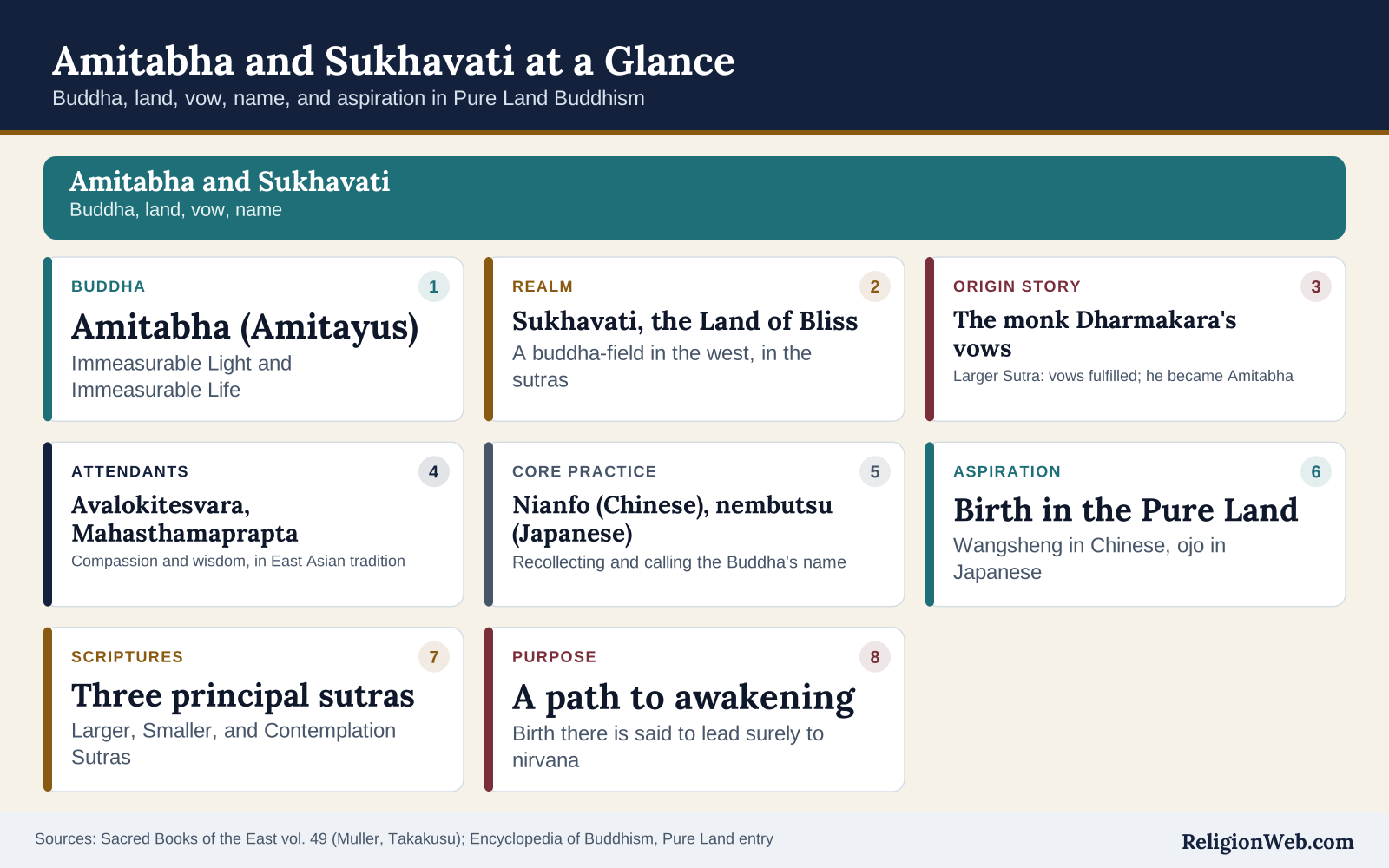
Origins of Pure Land Devotion in India and Central Asia
Because the Pure Land scriptures survive mainly in Sanskrit manuscripts and in Chinese translations, the Indian origins of the movement are reconstructed from fragments. Scholars agree that Amitabha devotion existed in northwestern India and Central Asia by the early centuries of the Common Era, and they disagree about how large it was and exactly where it began.
Recollection of the Buddha and the Idea of Many Buddhas
Buddhanusmriti in early Buddhism
The roots of nianfo lie in an early meditation practice, buddhanusmriti (Pali buddhanussati), “recollection of the Buddha.” In the early discourses it is listed among several recollections, including the Dharma and the Sangha, and the Encyclopedia of Buddhism article on Pure Land Buddhism notes that these roots are in early Buddhism itself. A practitioner calls to mind the Buddha’s qualities, such as being worthy, fully awakened, and well gone, as a way to steady the mind and increase confidence. The Pure Land tradition later reshaped this practice to bring the practitioner into proximity to a particular buddha through a vision or rebirth in his land.
Mahayana sources developed the idea further by teaching that many buddhas exist in many world systems at the same time. This differs from the teaching generally found in the Pali discourses, where only one buddha appears in a given world at a time, a point discussed in the article on Theravada Buddhism. In the Mahayana outlook, a practitioner can aspire to meet a living buddha elsewhere, and that aspiration became the logic of Pure Land devotion.
Buddha-fields and the rival east and west
Amitabha was not the only buddha with a realm. The Encyclopedia of Buddhism article observes that the Aksobhyavyuha sutra gave the buddha Aksobhya and his eastern field, Abhirati, significant early cultic status, and that Amitabha’s western realm later drew most attention in East Asia and, to a lesser degree, in Tibetan Vajrayana. The point is useful because it shows that Sukhavati grew within a general Mahayana interest in buddha-fields rather than in isolation. Other well-known realms include the Lapis Lazuli land of the Medicine Buddha and the Tushita heaven where Maitreya, the future buddha, is said to dwell.
Evidence for Early Amitabha Devotion
Gandhara, the Kushan period, and Chinese translations
The earliest dated evidence is both textual and material. Some scholars place the compilation of the Larger Sukhavativyuha in the Kushan period, in the first and second centuries CE, within communities of the northwest including Gandhara, though the evidence does not allow a certain date. Chinese tradition records that the sutra was translated many times, with one traditional count of twelve translations between 147 and 713 CE, of which five survive. Lokaksema, a translator from the Kushan realm who worked in China in the second century, is credited with the Pratyutpanna Samadhi Sutra, an early and influential text that describes seeing Amitabha in a visionary meditation.
An inscribed image base from Mathura dated to the Kushan period is often cited as the earliest dated Amitabha image. The scholar Gregory Schopen, who studied it, argued that Amitabha devotion in India was a relatively modest movement and that the size of the later East Asian tradition should not be read back into the Indian record. Other scholars point to the volume of Sukhavati references in Mahayana sutras and tantras and to the treatises attributed to Nagarjuna and Vasubandhu as evidence of broad familiarity. The most defensible summary is that Amitabha devotion was a recognized strand of northwestern Buddhism with strong later development elsewhere.
Texts in Central Asia and the Silk Road
The Sanskrit text of the Larger Sukhavativyuha survives in later Nepalese manuscripts, and F. Max Muller used that tradition for his 1894 English translation in the Sacred Books of the East. Fragments in Uighur, Khotanese, and Xixia show that the sutras traveled widely along the Silk Road. The Contemplation Sutra stands somewhat apart: the Encyclopedia of Buddhism article describes it as of non-Indian provenance, and its extant form is the Chinese text translated in the fifth century. Scholars have therefore treated it as a Central Asian or Chinese composition drawing on Indian ideas, a point revisited in the section on the scriptures.
The Indian Masters and the Shape of the Path
Nagarjuna, Vasubandhu, and the “easy path”
Later East Asian tradition looked back to two Indian masters. A chapter on the “easy practice” attributed to Nagarjuna in the commentary on the Dasabhumika, usually dated to roughly the second or third century CE, contrasts a difficult path of long bodhisattva striving with an easy path of calling on the buddhas, and Pure Land writers in China and Japan quoted it constantly. Vasubandhu, a fourth- or fifth-century master, is credited with a treatise on rebirth in the Pure Land that describes five gates of recollection: worship, praise, aspiration, contemplation, and dedication of merit. The scholar and Jodo Shinshu priest Aaron Proffitt, writing in Lion’s Roar in 2024, notes that treatises attributed to both masters deal with Pure Land teaching, which suggests that these ideas were part of mainstream Indian Mahayana discussion.
Attribution is worth handling with care. Modern scholars debate whether the Nagarjuna chapter was written by the same person as the Madhyamaka philosophical works. The tradition itself, however, counted both masters as patriarchs: Shinran later named seven masters, among them Nagarjuna and Vasubandhu, whose writings he regarded as transmitting the teaching.
Two currents: the bodhisattva’s land and the refuge
The Encyclopedia of Buddhism article identifies a tension that runs through the sources. On one side, the Pure Land is the product of a bodhisattva’s long cultivation, which invites emulation by effort. On the other, it is a refuge created by Amitabha’s vows and reachable through faith in his saving power. The article argues that both views coexisted for most of the tradition’s history, and that it would be a mistake to map them onto a simple split between monastic rigor and lay ease, since the arguments for an easier practice were often made by monastics themselves. A belief that the Dharma was declining and that ordinary people could no longer complete the older paths strengthened the second current. The same tension explains many of the later disagreements among the schools.
The Pure Land Sutras and Related Scriptures
Three scriptures are called the principal Pure Land sutras in East Asia: the Larger Sukhavativyuha, the Smaller Sukhavativyuha, and the Contemplation Sutra. They are known in Chinese as the Wuliangshou jing, the Amituo jing, and the Guan wuliangshou jing, and in Japanese as the Muryoju-kyo, the Amida-kyo, and the Kan muryoju-kyo. Together they supply the story of Amitabha, a description of his land, and the main lines of practice. The quotations in this article come from the English versions of these three sutras published in the Sacred Books of the East, a nineteenth-century series now in the public domain. They reflect the Sanskrit and Chinese texts as understood by the translators F. Max Muller and Junjiro Takakusu, and later scholarship has refined many of their readings.
The Larger Sukhavativyuha Sutra
The story of Dharmakara and Lokesvararaja
In Muller’s translation of the Sanskrit text, the Buddha is staying at Rajagriha, on Vulture Peak, with a very large assembly of monks and bodhisattvas. His disciple Ananda notices that the Buddha’s appearance is unusually serene and asks about it, and the Buddha replies by telling of the past. Long ago, under a buddha named Lokesvararaja, a monk named Dharmakara praised that buddha in verse and asked to learn the qualities of many buddha-fields. After being taught about them, he spent five kalpas reflecting on the vows he would make, in order to create the best possible field himself. The text then presents the vows and the practices by which Dharmakara fulfilled them, so that he became the buddha now called Amitabha or Amitayus.
The sutra says that Amitabha now teaches in the west, in a land called Sukhavati, at an immense distance described in the Sanskrit as a hundred thousand niyutas of kotis of buddha countries from our world. Such numbers are meant to convey scale rather than literal mileage. The narrative frame matters for doctrine: because Dharmakara’s vows have already been fulfilled, the sutra can say that beings who meet certain conditions will, in fact, be born there. This is the logic that Pure Land teachers later called the “accomplished” nature of the vow.
The vows and the problem of numbering
The central part of the Larger Sutra is a list of vows, each stating a condition under which Dharmakara declares he will not attain awakening. They include vows that no hells, animal births, or ghost realms will exist in his land, that the beings there will be established in certainty of final nirvana, that his light and life will be immeasurable, and that countless buddhas in other lands will praise his name. The most quoted vows concern those who hear his name and aspire to be born in his land. Muller’s version places the key statement in vow 19:
O Bhagavat, if those beings who in immeasurable and innumerable Buddha countries, after they have heard my name, when I shall have obtained Bodhi, should direct their thought to be born in that Buddha country of mine, … if these should not be born in that Buddha country, even those who have only ten times repeated the thought (of that Buddha country), … then may I not obtain the highest perfect knowledge.
Sukhâvatî-vyûha (Larger), trans. F. Max Müller, in Buddhist Mahâyâna Texts (Sacred Books of the East, vol. 49), § 8, vow 19 (ellipses mark omitted words)
Muller’s vow 19 also contains an exclusion, omitted above: it sets aside beings who have committed the five grave offenses (Sanskrit anantarya) or who have obstructed and abused the good Law. Later readers took that exclusion in different ways, and Shinran, for example, read it as a warning rather than a barrier, an interpretation described in the section on doctrine.
The numbering of the vows is a recurring source of confusion. The Japanese schools use the numbering of the Chinese versions, which have 48 vows, and in that scheme the foundational statement about sincere trust, desire to be born, and as few as ten recitations is the eighteenth. The Rev. Bunyiu Nanjio, who contributed a note to Muller’s volume, observed that the Chinese translations contain 48 vows while the Sanskrit text he was working with has 46, and argued that the Chinese eighteenth vow corresponds in part to the latter portion of Muller’s nineteenth. That is why Japanese writers speak of “the eighteenth vow” while a reader of the English Sanskrit translation will find the same idea in vow 19. Nanjio also records that Genku, the monastic name of Honen, called the eighteenth vow “the king of the Pranidhanas” (vows). When Pure Land writers speak of the “Primal Vow” (hongan), they usually mean this one.
Sukhavati and the beings born there
The sutra’s long descriptive passages portray Sukhavati as a luminous land of jeweled trees, ponds, fragrant breezes, and constant music, where birds and winds proclaim the Dharma. Beings there are born from lotus flowers and do not experience the pains of hunger, illness, or old age. The text insists that the beauty is a teaching device, because everything in the land leads the mind toward the Dharma. It also teaches that those born there are firmly established on the path to awakening and will not fall back into lower realms of rebirth. The Chinese versions, which the Japanese schools used, describe birth in three grades, according to the practitioner’s aspiration and practice.
Two bodhisattvas attend Amitabha in the Chinese and Japanese tradition: Avalokitesvara (Guanyin in Chinese, Kannon in Japanese), the bodhisattva of compassion, and Mahasthamaprapta (Shizhi, Seishi), associated with wisdom. They appear prominently in the Contemplation Sutra and in much East Asian art, flanking Amitabha in what is called the Amitabha triad. The article on the bodhisattva ideal explains the wider role of such figures in Mahayana devotion.
The Smaller Sukhavativyuha Sutra
Setting, structure, and the two names
The Smaller Sutra is much shorter. In Muller’s translation it is set at Jetavana, near Shravasti, and the Buddha addresses his disciple Shariputra directly, without being asked. It describes the land of Sukhavati, again in terms of lotus ponds, jewel trees, and heavenly music, and then turns to the question of the name. The Buddha asks why the Tathagata there is called Amitayus, and answers with a short statement that has become a touchstone for the tradition:
Now what do you think, O Sâriputra, for what reason is that Tathâgata called Amitâyus? The length of life (âyus), O Sâriputra, of that Tathâgata and of those men there is immeasurable (amita). Therefore is that Tathâgata called Amitâyus.
Smaller Sukhâvatî-vyûha, trans. F. Max Müller, in Buddhist Mahâyâna Texts (Sacred Books of the East, vol. 49), § 8
A parallel passage explains the name Amitabha as a reference to the Buddha’s unimpeded splendor over all buddha countries. Read together, the two paragraphs establish the principle that the name expresses the buddha’s nature. This is why East Asian writers could speak of the name as containing the buddha, and why reciting it came to be understood not as a mere label but as a way of invoking the qualities it names. The sutra is traditionally associated with the translation by Kumarajiva dated to about 402 CE, which became the standard text in East Asian chanting, along with a later Chinese version by Xuanzang.
Keeping the name in mind
The most consequential passage in the Smaller Sutra follows the statement that beings are not born in Amitabha’s land as a reward for good works performed in this present life alone. It continues:
No, whatever son or daughter of a family shall hear the name of the blessed Amitâyus, the Tathâgata, and having heard it, shall keep it in mind, and with thoughts undisturbed shall keep it in mind for one, two, three, four, five, six or seven nights, … will stand before them at their hour of death, and they will depart this life with tranquil minds.
Smaller Sukhâvatî-vyûha, trans. F. Max Müller, in Buddhist Mahâyâna Texts (Sacred Books of the East, vol. 49), § 10 (ellipsis marks omitted words)
The omitted words state that when the person dies, Amitayus, with an assembly of disciples and a host of bodhisattvas, will stand before them. The passage can support more than one reading. In the Chinese Chan and Tiantai milieu, “keeping the name in mind” was often read as a sustained, concentrated meditation lasting up to seven days, which is the origin of the Chinese Buddha-recitation retreats. Shandao and later Japanese writers read it as oral recitation. Shinran read the phrase through his understanding of the Larger Sutra, so that hearing and holding the name became the trust that Amida himself bestows. These readings are not identical, and each school believed it was following the sutra’s intention.
The Contemplation Sutra
Queen Vaidehi and the sixteen contemplations
The Contemplation Sutra begins with a family tragedy. According to its opening, Prince Ajatashatru imprisons his father, King Bimbisara, and then orders that Queen Vaidehi be confined in a hidden palace. From her confinement the queen appeals to the Buddha, who appears to her and displays many pure lands. She chooses the land of Amitabha, and the Buddha teaches her the means of seeing it. The Encyclopedia of Buddhism entry describes the main content as thirteen visualizations of the Buddha and his Pure Land, beginning with the setting sun and proceeding through water, ground, trees, lotus ponds, the throne, an image of the Buddha, the Buddha’s body, and his two attendant bodhisattvas.
The visualizations are demanding exercises in sustained attention, and the sutra assumes that most practitioners will not complete them. The setting sun, for instance, is an easily available starting point because it hangs in the west, and Chinese and Japanese devotees have taken that image as a first contemplation. This framing story and its graduated meditation made the sutra a staple of Pure Land preaching and painting, and its scenes were depicted in cave temples and woven tapestries across East Asia.
The nine grades and the ten recitations
After the thirteen visualizations, the sutra describes nine grades of birth, divided into three classes of three, from the highest to the lowest. Upper grades are for those who practice earnestly, keep precepts, and aspire to birth. Lower grades are for ordinary people, including some who have done grave wrong. The final section describes a person who has done evil and is dying, and who is advised by a good friend to call on the Buddha:
Let him do so serenely with his voice uninterrupted; let him be (continually) thinking of Buddha until he has completed ten times the thought, repeating (the formula), “Adoration to Buddha Amitâyus”
Amitâyur-dhyâna-sûtra, trans. J. Takakusu, in Buddhist Mahâyâna Texts (Sacred Books of the East, vol. 49), § 30
The passage is the textual basis for deathbed recitation, which became prominent in Chinese and Japanese Pure Land practice. The Encyclopedia of Buddhism entry notes that the sutra promises that ten uninterrupted thoughts on the Buddha lead to rebirth even for a person of evil karma. The Japanese reformer Honen cited Shandao’s reading of this passage as showing that calling the name is a practice open to every kind of person. Teachers within the tradition have also pointed out that the sutra places this lowest grade within a wider scheme of grades, and not all have regarded recitation as the whole of the path.
Questions of origin and authority
The Contemplation Sutra raises a question that scholars treat with care. The Encyclopedia of Buddhism entry describes the text as of non-Indian provenance, and no Sanskrit original is known. The English edition in the Sacred Books of the East cites a Chinese translation attributed to Kalayasas and dated to 424. Many scholars therefore conclude that the sutra was composed in Central Asia or China, drawing on Indian ideas, while traditional Pure Land writers have treated it as the word of the Buddha transmitted through a lost Indian original. Most modern historians treat this as an open question, and the distinction between the traditional and the historical view helps explain why academic and devotional accounts of the sutra can sound quite different.
Related Texts and a Table of Scriptures
The Pratyutpanna Samadhi Sutra and commentarial writings
Beyond the three principal sutras, the tradition draws on other texts. The Pratyutpanna Samadhi Sutra, translated into Chinese in the second century by Lokaksema, teaches a meditation in which the practitioner, by reciting and visualizing for a period traditionally given as seven days and nights, sees the buddha Amitabha standing before him. Huiyuan’s group at Mount Lu took this sutra as its principal basis. A series of Indian and Chinese treatises then interpreted the sutras, including the attributed writings of Nagarjuna and Vasubandhu and the Chinese commentaries of Tanluan, Daochuo, and Shandao.
The Japanese schools added further foundational works. Genshin’s Ojoyoshu (Essentials of Rebirth), composed in the late tenth century, collected scriptural passages on the Pure Land and the lower realms and shaped Heian-period devotion. Honen’s Senchaku hongan nembutsu shu, completed in 1198 at the request of the regent Kujo Kanezane, argued that calling Amida’s name is the practice chosen by the Primal Vow for all people. Shinran’s Kyogyoshinsho, traditionally dated to the 1220s, is the foundation of Jodo Shinshu doctrine, and the Tannisho, a record of Shinran’s sayings compiled by his disciple Yuien after his death, is among the most read Shin texts today. Rennyo’s pastoral letters, the Gobunsho, later brought Shinran’s teaching into the vernacular.
A summary of the major scriptures
The following table sets out the principal scriptures, with the names by which they are usually cited. It is a guide to the canon rather than a complete list, since Pure Land teachers regularly cite hundreds of sutras and treatises.
| Text | Also known as | Character and date | Role in the tradition |
|---|---|---|---|
| Larger Sukhavativyuha Sutra | Wuliangshou jing; Muryoju-kyo; Infinite Life Sutra | Indian composition, traditionally dated to the early centuries CE; five of twelve traditional Chinese translations survive | Tells the story of Dharmakara and presents the vows; the Primal Vow is found here |
| Smaller Sukhavativyuha Sutra | Amituo jing; Amida-kyo; Amitabha Sutra | Short Indian text; standard Chinese translation by Kumarajiva, about 402 CE | Describes Sukhavati and the benefit of keeping the name in mind; chanted daily in many East Asian temples |
| Contemplation Sutra | Guan wuliangshou jing; Kan muryoju-kyo; Amitayurdhyana | Of non-Indian provenance according to the Encyclopedia of Buddhism; Chinese version attributed to Kalayasas, 424 | Sixteen contemplations and nine grades of birth; frame story of Queen Vaidehi |
| Pratyutpanna Samadhi Sutra | Banzhou sanmei jing | Translated by Lokaksema in the second century CE | Early visionary meditation on Amitabha; basis of Huiyuan’s society |
| Treatise on Rebirth | Attributed to Vasubandhu; commentary by Tanluan | Indian treatise; Chinese commentary in the sixth century | Five gates of recollection; foundation of the Chinese systematic tradition |
| Ojoyoshu | Essentials of Rebirth, by Genshin | Japan, late tenth century | Anthology on the Pure Land and the lower realms; influenced Heian devotion |
| Senchaku hongan nembutsu shu | By Honen | Japan, 1198 | Argues for the exclusive nembutsu as the practice chosen by the Primal Vow |
| Kyogyoshinsho and Tannisho | By Shinran; record by Yuien | Japan, thirteenth century | Foundational and devotional texts of Jodo Shinshu |
Pure Land Buddhism in China
China is where Pure Land devotion first took organized form and where it has remained a living part of Buddhist life ever since. Most Chinese teachers did not found a distinct sect. Instead, they integrated recitation of Amitabha’s name with meditation, study, and monastic discipline. That integrated pattern is worth keeping in mind when reading about the more sectarian movements that later arose in Japan.
Early Devotion and the First Societies
Translators and early communities
The first Chinese texts on Amitabha appear in the translation work of the second and third centuries CE. Chinese catalogues and modern scholars attribute early versions of the Larger Sutra to Lokaksema or his circle and to Zhi Qian, though some of these attributions are disputed. These translators and their collaborators were often foreign monks working in Luoyang and later in the southern capital, and their output introduced Chinese readers to the Mahayana idea of living buddhas in other world systems. By the fifth century, the translation of the Contemplation Sutra and of Buddhabhadra and Baoyun’s version of the Larger Sutra supplied the standard texts of later practice, although the tradition has also attributed the Larger Sutra to Sanghavarman in 252, an attribution that modern scholars generally doubt.
Huiyuan and the Mount Lu society
Huiyuan (334 to 416) is traditionally honored as the first patriarch of Chinese Pure Land. In 402 CE, on Mount Lu in modern Jiangxi, he gathered 123 monks and lay gentry before an image of Amitabha, and, in the Encyclopedia of Buddhism’s account, they vowed that whoever reached the Pure Land first would help the others. Their core practice was the buddha-recollection of the Pratyutpanna Samadhi Sutra. The group later became known as the White Lotus Society, a name that was subsequently adopted by many devotional societies, some of them lay-led and numbering thousands of members during the Song dynasty. Huiyuan also stands in Chinese memory as the monk who argued that the sangha should not bow to the emperor, a position connected to the broader relation of Buddhism to the state.
The Great Systematizers: Tanluan, Daochuo, and Shandao
Tanluan and the name
Tanluan (traditionally 476 to about 542) was a learned monk who, according to the Encyclopedia of Buddhism, turned to Pure Land teaching at the urging of the Indian translator Bodhiruci. He wrote a commentary on Vasubandhu’s Treatise on Rebirth and developed the idea that the Buddha’s name carries the full reality of the Buddha. For Tanluan, the vows of Amitabha provided the “other power” that made rebirth possible for beings with ordinary capacity. Later Japanese Pure Land writers counted him among the seven masters of the tradition.
Daochuo and the latter age
Daochuo (562 to 645) built on Tanluan’s work and gave the movement a historical argument. In his Anle ji (Collection on the Land of Peace and Happiness), he taught that in the last age of the Dharma, the older paths of strenuous self-cultivation had become too difficult, so that calling the name of Amitabha was the effective practice for the time. He is also credited in the tradition with encouraging the use of counting devices such as beads to track recitations. This argument from historical decline later became a pillar of the Japanese schools.
Shandao and ordinary beings
Shandao (613 to 681) is regarded as the great systematizer. He taught that the Contemplation Sutra was addressed to ordinary people, not only to spiritual elites, and that the Buddha’s vow was meant for them. In his scheme, five types of practice were recognized: reciting the sutras, contemplating the Pure Land, worshiping Amitabha, calling his name, and offering praise and gifts. Of these, he assigned calling the name a special, central status as the practice that corresponds to the vow, a position summarized in the Encyclopedia of Buddhism entry. Honen later said that reading Shandao was the moment of his own conversion to the exclusive nembutsu.
Integration with Tiantai, Chan, and Huayan
Ritual forms and visualization halls
Pure Land practice was woven into other schools. Zhiyi (538 to 597), the founder of Tiantai, included a form of Pratyutpanna meditation in his four kinds of samadhi, in which practitioners circled an Amitabha image for ninety days. Tang dynasty teachers such as Chengyuan and Fazhao promoted the ninety-day retreat, and Fazhao created a melodic chanting ritual on Mount Wutai. In the Song dynasty, the Tiantai monk Zunshi (964 to 1032) developed rites of repentance and aspiration to be reborn. Song Tiantai temples built Sixteen Visualization Halls modeled on the Contemplation Sutra, with an image of Amitabha at the center and small cells for retreatants. The standard six-syllable Chinese formula, Na-mo A-mi-tuo Fo, is credited by modern writers to Fazhao’s era.
Chan and Pure Land together
The relation between Pure Land and Chan, the school known in Japan as Zen, was long a topic of discussion. Zongmi (780 to 841) ranked contemplative methods in ascending order, with name-recitation at the lowest level and contemplation of the dharma body at the highest. Yongming Yanshou (904 to 975), a Chan master, argued that Buddha and Pure Land are none other than one’s own mind, a “mind-only” interpretation, and promoted practicing meditation and recitation together. The Encyclopedia of Buddhism notes that some members of the Chan school used this view to argue for Chan’s superiority over rebirth aspirations, while others treated the two as complementary. In later centuries the combined practice became the norm in many Chinese monasteries. In its modern form, a monk may spend part of a day in seated meditation and part reciting the Buddha’s name, a pattern described in the article on Buddhist monastic life.
Ming, Qing, and Modern China
Lay societies and reformers
During the Ming and Qing dynasties, Pure Land recitation was supported by lay societies and by well-known monks such as Zhuhong (1535 to 1615) and Zhixu (1599 to 1655), who emphasized sustained name recitation and taught that faith, vow, and practice together make birth in Sukhavati possible. Scholars describe these figures as part of a broader late imperial effort to unify Buddhist schools around recitation, although the details of their lives and dates require checking against specialist biographies. By this time, Amitabha’s name was among the most widely recited Buddhist words in Chinese society, including in funeral services.
Yinguang and the twentieth century
The monk Yinguang (1861 to 1940) is regarded as the leading Pure Land teacher of the late Qing and Republican era. He taught that ordinary people, living in difficult times, could rely on recitation, and he promoted the keeping of moral precepts as the foundation of Pure Land practice. His writings were reprinted and widely read by later generations, including in Taiwan. Other twentieth-century reformers, including the monk Taixu, spoke of building a “Pure Land in the human world” (renjian jingtu), an interpretation that treats the Pure Land as a goal for social and ethical transformation as well as a destination after death. After the 1950s, Chinese Pure Land institutions flourished in Taiwan, Hong Kong, and overseas communities, while on the mainland the revival of monastic and lay Buddhism since the 1980s has included strong Pure Land elements.
Pure Land Buddhism in Japan: From Heian Devotion to Honen and Shinran
Japan is where Pure Land teaching became a set of independent denominations. The process took several centuries. Devotion to Amida first lived inside Tendai and other established schools, then, in the late twelfth and thirteenth centuries, reform movements around Honen and Shinran made the Primal Vow the center of an entire religious life. The result was one of the most consequential changes in the history of Japanese Buddhism.
Early Devotion Before Honen
Transmission, Tendai practice, and the first associations
Pure Land ideas reached Japan from the continent along with the earliest transmissions of Buddhism. Writing in Lion’s Roar, Aaron Proffitt notes that Eon, who studied in China and returned in the early seventh century, made Pure Land teaching the subject of his first lecture, and that early Japanese Buddhists dedicated merit to help their ancestors reach the Pure Land before the aspiration for one’s own rebirth became popular. The Tendai school, with its center on Mount Hiei, became the chief home of recitation practice. Ennin (794 to 864) and Genshin (942 to 1017), both Tendai monks of Mount Hiei, promoted nembutsu practice, and Genshin wrote the Ojoyoshu in the late tenth century. Genshin also took part in a devotional association called the Twenty-five Samadhi Assembly, whose members gathered for recitation and supported one another as they approached death.
Alongside the learned Tendai current ran a popular one. Kuya (903 to 972), a wandering holy man known as a hijiri, preached the vocal recitation of the Buddha’s name in the streets of the capital and in the provinces. The nobleman Yoshishige Yasutane, who died in 1002, compiled the first Japanese collection of biographies of people said to have been reborn in the Pure Land, and helped found associations for study and devotion. Aristocratic patronage also produced buildings: the Phoenix Hall of the Byodoin temple at Uji, completed in the mid-eleventh century, enshrines a large image of Amida and was designed to evoke the Pure Land in architecture.
Welcoming Amida and the fear of the latter age
In Heian practice, rebirth was bound up with the deathbed. The Encyclopedia of Buddhism entry describes how a dying person might hold a cord attached to the right hand of an Amida image, while companions recited the Buddha’s name and chanted sutras. Paintings called raigozu, “welcoming approach” pictures, show Amida and his attendant bodhisattvas descending on clouds to receive the dying, and a ceremony called mukaeko reenacted the approach. Signs such as dreams, fragrances, or an undecayed body were read as evidence of successful rebirth. Alongside these practices lay a deep concern that the age of the Dharma had run its course. Japanese reckoning widely placed the beginning of the latter age, or mappo, in 1052, and a series of civil conflicts and famines in the following century reinforced the sense that older paths were out of reach.
Honen and the Founding of Jodo Shu
Honen’s life and turn to the nembutsu
Honen (1133 to 1212) was born in Mimasaka Province, in present-day Okayama Prefecture, and received training as a Tendai monk on Mount Hiei. After years of study, he reached a turning point in 1175, at about the age of forty-two, when, according to the Jodo Shu account, he left Mount Hiei and began teaching in Higashiyama in Kyoto. Scholars report slightly different accounts of the circumstances. Some accounts hold that he was convinced by reading Shandao’s commentary, which he found in Genshin’s work, that the exclusive recitation of Amida’s name was the practice taught by the Buddha. Jodo Shu itself traces its beginning to 1175 and describes it as more of a spiritual beginning than an institutional one.
The Senchakushu and the exclusive nembutsu
At the request of the regent Kujo Kanezane, Honen composed the Senchaku hongan nembutsu shu in 1198. Its argument is that Amida, in the course of his vows, selected (senchaku) a single practice, the calling of his name, as the one by which all beings, regardless of learning or status, can be born in the Pure Land. Honen contrasted the Path of the Sages, which relies on one’s own difficult efforts, with the Pure Land path, which relies on the vow, and he advised setting aside other practices in favor of the nembutsu. This was a radical simplification, and it carried a social message. Women and men, nobles and fishermen, the learned and the unlearned were all equally addressed, and Honen’s followers included people of every rank.
Opposition, exile, and Honen’s legacy
The success of the new movement provoked reaction. In 1204 Tendai monks petitioned their abbot to suppress it, and Honen responded with a Seven-Article Pledge for his followers, asking them to avoid slandering other schools and to refrain from misconduct justified by the nembutsu. In 1205 the Kofukuji monastery in Nara presented a petition to the retired emperor listing a series of charges against the exclusive nembutsu. The conflict came to a head in 1206 and early 1207, when two of Honen’s disciples led a long night service that scandalized the court. Two disciples were executed, and the exclusive nembutsu was banned, with Honen sent into exile; sources vary about the number executed and the place of exile. He was pardoned in 1211, returned to Kyoto, and died in 1212. His last testament, the Ichimai kishomon (One-Sheet Document), was written for his disciple Genchi, and it is regarded as a concise statement of his teaching: that rebirth is settled by simply calling the name, without doubting the vow.
Chinzei and Seizan lines
Honen’s community did not form a single institution at his death. Jodo Shu’s official history states that it was more of an idea than an institution until the early fifteenth century, when its teachings and training system were systematized and it gained official approval. It identifies Ryochu (1199 to 1287), a student of Bencho, as the figure who set out the Chinzei transmission that most of the present school follows, while another line, the Seizan school, descends from Honen’s disciple Shoku. Jodo Shu notes that Shinran’s followers formed a separate order, Jodo Shinshu, and that only Jodo Shu claims Honen as its principal teacher. Tokugawa Ieyasu’s patronage, beginning in 1590, brought a period of prosperity. The head temple is Chion-in in Kyoto, and the school reports about 7,000 temples.
Shinran and the Development of Jodo Shinshu
Shinran’s life and writings
Shinran (1173 to 1262, or early 1263 by the Gregorian calendar) entered a Tendai monastery as a boy and later joined Honen’s circle. When the nembutsu was banned in 1207, he was among those defrocked and exiled, in his case to a region on the Sea of Japan. After his release he lived and taught in eastern Japan among farmers and local people, then returned to Kyoto in his later years. He married Eshinni, who supported his work, and their youngest daughter Kakushinni, according to the Higashi Honganji history, later built a memorial hall for him in Kyoto. His major work, the Kyogyoshinsho (traditionally dated to the 1220s), gathers scriptural passages to argue for the teaching of the Primal Vow. Jodo Shinshu priests today are not celibate, a feature that follows from Shinran’s decision to marry and to describe himself as neither monk nor layman.
The Hongwanji and Rennyo
In the Hongwanji tradition, the memorial hall that Kakushinni built became the origin of the Honganji, which was turned into a temple by Shinran’s descendant Kakunyo (1270 to 1351). The eighth head, Rennyo (1415 to 1499), is remembered as its great organizer. Using plain-language letters, he brought Shinran’s teaching to merchants, farmers, and small communities, and he expanded the community across several regions. In 1465 monks from Mount Hiei destroyed the main hall, and Rennyo settled at Yoshizaki, then at Yamashina, and finally at Ishiyama, the site that later became Osaka. The movement’s later armed conflicts with warlords, including a ten-year struggle with Oda Nobunaga that began in 1570, are recorded in the Higashi Honganji history. They show how large a social and political force the Shin communities had become.
Nishi and Higashi Honganji
Following the death of Kennyo in 1592, disputes over succession arose. The official histories of the two modern Hongwanji bodies agree on the broad outline: Toyotomi Hideyoshi supported one successor, and then Tokugawa Ieyasu donated land in Kyoto to Kennyo’s eldest son, Kyonyo, who founded a second temple around 1602 to 1603. The original temple became the Nishi (West) Honganji, now the headquarters of the Jodo Shinshu Hongwanji-ha, and the new one became the Higashi (East) Honganji, the headquarters of the Shinshu Otani-ha. The two organizations remain separate today and share the same founder and the same core scriptures. Other Shin branches also exist, formed at different times, and they are discussed in the section on schools.
Ippen, Esoteric Pure Land, and Other Japanese Currents
Ippen and the Ji school
Ippen (1239 to 1289), a wandering preacher, founded the Ji (Time) school. He distributed small slips of paper inscribed with the six-character name, and he and his followers traveled by foot, holding popular nembutsu gatherings that included “dancing nembutsu” (odori nembutsu). In the Encyclopedia of Buddhism’s account, Ippen inherited Honen’s teaching but advocated simple repetition of Amida’s name whether or not it was accompanied by faith, and the Ji school became the largest Pure Land group in the fourteenth and fifteenth centuries, according to modern surveys. Ji Shu continues today as a relatively small denomination.
Esoteric strands and the wider debate
Other Japanese thinkers combined Pure Land aspiration with esoteric Buddhism. Proffitt notes that Kakuban (1095 to 1143) and Dohan (1179 to 1252) taught that Amida is the breath of life of all beings and that rebirth in the Pure Land is equivalent to attaining buddhahood in this body. This current is the subject of his book Esoteric Pure Land Buddhism. Meanwhile, the Kamakura period was an age of vigorous debate among new movements. Nichiren (1222 to 1282), the founder of the tradition described in the article on Nichiren Buddhism, held the Lotus Sutra to be supreme and criticized the exclusive nembutsu, and Zen teachers likewise developed independent practices. Pure Land teachers answered in their own writings, and the exchanges form part of the history of all the schools involved.

Pure Land Devotion in Korea, Vietnam, and Tibet
Outside Japan, Pure Land devotion rarely formed an independent denomination. In Korea, Vietnam, and the Tibetan-speaking world, it entered established monastic traditions and became part of their daily liturgy. That integration is a feature of the tradition rather than a limitation, and it is one reason that the number of people who recite Amitabha’s name is much larger than the membership figures of the Japanese schools suggest.
Korea
Silla commentators and the three sutras
Korean scholar-monks wrote extensively on the Pure Land sutras from the Silla period (traditionally 57 BCE to 935 CE). Wonhyo and Gyeonghung are among the best-known commentators, though attributions and dates of individual works should be checked in specialist sources. In a 2010 article on the peculiarities of Korean Pure Land thought, the Dongguk University scholar Han Tae-shik identifies several features of the Silla commentaries: a balanced study of all three sutras, an emphasis on the forty-eight vows that made them part of Korean liturgy, attention to differing readings of the ten thoughts in the Larger and Contemplation Sutras, and a close link between Pure Land and Seon (Zen). He argues that the surviving evidence does not show a neglect of the Contemplation Sutra, only gaps in the source record.
Seon and Pure Land together
According to the same study, Pure Land teaching was absorbed into Seon after the Goryeo period, and the “mind-only” Pure Land of Yongming Yanshou shaped Korean Buddhism broadly. Korea never formed a distinct Pure Land sect, which Han suggests may reflect how pervasive the practice already was. In practice, a Korean temple that is administratively Seon will often include Amitabha halls, chant the Buddha’s name in services, and hold memorial rites invoking Amitabha. The Pure Land element is therefore best understood as a layer of Korean Buddhist practice rather than as a separate school.
Vietnam
Tinh Do and Thien in daily practice
Reference works describe Pure Land (Tinh Do) as the most widely practiced form of Buddhism among Vietnamese Buddhists. The practice of reciting “Nam mo A Di Da Phat” is common in homes, in temples, and at funerals. Vietnamese Buddhism has long been described as syncretic: according to a reference summary that cites scholars such as Charles Prebish, followers have no difficulty practicing Thien (Chan), Tiantai, Pure Land, and Vajrayana teachings at the same time, with Thien especially influential among monasteries and elites and Pure Land among ordinary people. The Thao Duong school incorporated Chinese nianfo techniques.
Lay associations and the modern period
In the twentieth century Vietnamese Pure Land developed lay associations that organized recitation and sutra study. The same entry reports that a Pure Land lay association was officially recognized in Vietnam in 2007. Vietnamese communities abroad, from the United States to France and Australia, continue to hold recitation retreats and to chant the Amitabha Sutra in the temples they have founded. Readers who want the full history should consult specialist work, since the reference sources available for this article are brief on these developments.
Tibet and the Himalayan World
Dewachen and the aspiration prayers
In Tibetan Buddhism Amitabha is one of the five buddhas of the mandala described in the article on the Buddhist mandala, and Sukhavati, known in Tibetan as Dewachen, is a frequent object of aspiration. Proffitt writes that many tantras are said to lead to rebirth in Sukhavati, and that Padmasambhava and the Panchen Lamas are regarded as emanations of Amitabha. The six-syllable mantra Om Mani Padme Hum, associated with Avalokitesvara and discussed in the article on the Buddhist prayer wheel, is likewise said to lead to birth there. The Dalai Lama is regarded by Tibetans as an emanation of Avalokitesvara, who in Tibetan iconography often bears an image of Amitabha on his crown.
Phowa and Amitabha sadhana
The Encyclopedia of Buddhism entry notes specifically Tibetan developments. Dam pa Bde gshegs (1122 to 1192), a Nyingma figure, developed a tantric practice for Amitabha. The Kagyu tradition emphasizes phowa, the transference of consciousness at death, and the Sakya tradition uses a “sleep exercise” in which the adept visualizes being dissolved into Amitabha before sleep. These practices share the general Pure Land goal of a favorable rebirth, but they use the visualization and yoga methods typical of Vajrayana, a tradition described more fully in the article on Vajrayana Buddhism.
Core Beliefs: Amitabha, Sukhavati, the Vows, Faith, and Aspiration
The history of the tradition is easier to follow once its basic ideas are clear. The following section presents the beliefs that most Pure Land schools hold in common and flags where the schools part ways. As elsewhere in this article, statements about the nature of the Buddha, the Pure Land, and rebirth describe what the texts and traditions teach, not conclusions drawn by the editors.
Amitabha as the Buddha of Light and Life
The meaning of the two names
As the Smaller Sutra explains, Amitayus means that the Buddha’s life is immeasurable, and Amitabha that his light is unimpeded. Pure Land teachers have understood these as expressions of the Buddha’s boundless compassion and wisdom. Light, in this reading, represents his wisdom, which illuminates the darkness of ignorance, and life represents his compassion, which endures until all beings are saved. The pairing of the two qualities is so common that Japanese writers sometimes call Amida the “Buddha of Infinite Light” and “Buddha of Infinite Life” in the same breath. The title of the Larger Sutra in Chinese, Wuliangshou jing, uses only the second name.
Buddha, vow, and dharma-body
How should the figure of Amitabha be understood, as a person in a distant land or as an expression of ultimate reality? The question was raised early. Tanluan distinguished, in his commentary on Vasubandhu’s treatise, between a dharma-body as true reality, which has no form, and a dharma-body as skillful means, which takes form to save beings. Pure Land writers have often used this distinction to hold together the picture of a particular buddha with a particular vow and the claim that the buddha is in truth the formless reality of awakening. Shinran made use of the same idea, writing that formless reality manifests as Amida in order to be known by ordinary people. Other teachers, such as Yongming Yanshou, emphasized that Amitabha and his land are not separate from the practitioner’s own mind. These approaches are not always compatible in detail, but they have been held together in many temples.
The vows as promise
The vows of Dharmakara function in the tradition as a binding promise. Because the sutra says that Dharmakara became Amitabha, the vows are understood to have been fulfilled, which makes them reliable. The most important is the one on hearing the name and aspiring to be born, which in Japan is called the Primal Vow (hongan), and which Honen’s circle called the king of the vows. For devotees the point is that the Buddha’s compassion is not merely general: it is expressed in a specific commitment that can be relied on at the moment of death.
Sukhavati: What Kind of Place Is It?
A realm for the sake of practice
Popular descriptions often present Sukhavati as a paradise, but the texts characterize it as a place designed to advance practice. In the Encyclopedia of Buddhism entry, rebirth in the Pure Land is taken to lead to enlightenment, and those born there attain nirvana without fail. The Larger Sutra’s eleventh vow, in Müller’s translation, states that the beings there will be established in certainty up to final nirvana. The land’s sights and sounds are described as helping the mind turn to the Dharma: the sound of the wind in the trees, for example, is said to proclaim the teachings. A person who is reborn there does not remain in comfort indefinitely; the expected course is to complete the bodhisattva path and, in many accounts, to return to the world to help others.
Literal, symbolic, and mind-only readings
Pure Land traditions have given different accounts of what kind of reality Sukhavati has. Many devotees, in China, Japan, and elsewhere, take it as a real buddha-field to which one is truly reborn after death. A contemplative reading, associated with Yongming Yanshou and widespread in Chinese Chan circles, holds that Buddha and Pure Land are none other than the mind. Proffitt writes that some practitioners aspire to rebirth there, while others see it as a symbol for nirvana present in this world. Twentieth-century reformers such as Taixu spoke of a Pure Land in the human world. These views are not always treated as exclusive. Many teachers hold that a Pure Land can be understood at several levels at once, and the question of how literally to read the sutras has been argued within the tradition for well over a thousand years.
Rebirth, karma, and liberation
Pure Land belief rests on the Buddhist understanding of rebirth, explained in the article on karma and rebirth in Buddhism, but it modifies it. The Smaller Sutra says that beings are not born in Amitabha’s land as a reward for good works performed in this life alone, which signals that ordinary karmic merit does not decide the matter. Birth in Sukhavati is described as a different kind of rebirth, one in which the being is no longer subject to falling back into lower realms. As the Encyclopedia of Buddhism entry states, rebirth there leads to enlightenment, and the goal remains the one described in the article on nirvana in Buddhism. The Pure Land is therefore best understood as a means to liberation rather than an alternative to it.
Faith, Aspiration, and Practice
Faith, vow, and practice in the Chinese tradition
Chinese teachers summarized the requirements of Pure Land birth in a short formula of three elements: faith (xin), aspiration or vow (yuan), and practice (xing). Faith means confidence that Amitabha and his land are real and that his vow is effective. Aspiration is the sincere wish to be born there. Practice is the actual recitation, visualization, or other disciplines undertaken. Zhixu, the Ming dynasty master, is often credited with presenting these as the three provisions. Shandao, earlier, spoke of three minds mentioned in the Contemplation Sutra: a sincere mind, a deep mind, and a mind that dedicates merit and wishes for rebirth. In both formulations, faith and practice support each other and neither is sufficient alone.
Self-power and other-power
The Japanese schools made the relation between the believer’s effort and the Buddha’s power the center of their reflection. Honen taught that calling the name is the practice chosen by the vow, and he distinguished the Pure Land path from the Path of the Sages. Shinran took the argument further. In Shin teaching, even the believing mind is a gift of Amida rather than the believer’s accomplishment, so that shinjin, the settled trust, is the working of other-power. Shinran is also said to have classified three vows in the Larger Sutra as three stages of the believer’s path: the nineteenth, concerning those who practice a variety of good acts; the twentieth, concerning those who recite the name by their own effort; and the eighteenth, in which trust is given by the Buddha. The Tannisho, the record of his sayings, reports him as saying that if even a good person can be reborn in the Pure Land, how much more so an evil person, a statement that Shin teachers explain as an expression of Amida’s vow being directed at those least able to save themselves.
This position is specific to Jodo Shinshu. Jodo Shu, in line with Honen, treats the nembutsu as the practice itself and encourages repeated recitation as a means of birth, while Chinese and Korean traditions, in general, regard faith and practice as mutually supportive rather than as a contrast between two powers. These differences are discussed again in the section on schools. They explain why a visitor to a Japanese Shin temple, a Chinese recitation hall, and a Jodo Shu service may hear the same words and receive different explanations of their meaning.
Assurance and the moment of birth
A further difference concerns when rebirth is assured. In the older and wider tradition, including much of Heian-period practice, assurance came near death, when Amida and his attendants were believed to come to welcome the dying, and practitioners prepared for that moment with recitation and mindfulness. Shinran’s school teaches that the person who has received shinjin is already settled among the group of those assured of birth, so that the moment of death is no longer the decisive point and no welcoming approach is required. Teachers in other traditions do not necessarily share this view. In Chinese practice, for example, the last moments of life remain important, and companions will often recite the Buddha’s name beside the dying. The same text, the Larger Sutra, therefore supports different emphases.
Practice: Nianfo, Nembutsu, Visualization, Retreats, and Deathbed Traditions
The practices of Pure Land Buddhism can be divided into the recitation of the name, visualization, liturgy and sutra chanting, ethical and merit-making practices, and retreats and rites around death. Which of these dominate depends on the school and the individual. A Chinese monk might spend several hours a day on recitation, a Shin layperson might attend a monthly service and recite at the household altar, and a Tibetan practitioner might perform a complex Amitabha sadhana. The next sections describe each kind of practice, noting where they diverge.
Reciting the Name: Nianfo and Nembutsu
Recitation in Chinese practice
In Chinese temples the standard formula is Namo Amituofo, “homage to Amitabha Buddha,” often shortened to Amituofo. It may be recited aloud, softly, or silently in the mind, and practitioners usually keep count with a string of beads, commonly of 108. Modern teachers distinguish several methods: loud recitation to focus the mind, silent recitation to deepen it, and a slow, melodic chanting often accompanied by the beat of a wooden fish. Fazhao, in the Tang dynasty, is credited in later histories with a five-stage melodic chanting method. Walking recitation, in which practitioners circle the hall, is traditional in retreats and links back to the circumambulation of Zhiyi’s four samadhis. Dedicated recitation halls are a feature of many large Chinese temples.
Recitation in Japanese schools
In Japan the formula is Namu Amida Butsu. In Jodo Shu, following Honen, recitation is the central practice, and members are encouraged to recite throughout life, using a double-looped rosary called a juzu and chanting in services in a measured, musical pace. The question of how many recitations are required, known as the debate between “once-calling” and “many-calling,” arose among Honen’s disciples and was resolved in different ways. In Jodo Shinshu the recitation is understood differently. Following Shinran, the Hongwanji-ha teaches that the nembutsu arises from trust and is an expression of gratitude for a salvation already assured, as a temple of the Buddhist Churches of America states in its introductory material, so that the number of recitations is of little importance. Ippen’s Ji school held that the recitation works regardless of the reciter’s state of mind.
Forms in Korea, Vietnam, and Tibet
Korean practitioners recite Namu Amita Bul, often in temples whose administrative lineage is Seon, and Vietnamese Buddhists recite Nam mo A Di Da Phat, a practice that many families keep at the household altar. In Tibetan Buddhism the mantra most associated with Amitabha is Om Amideva Hrih, while the Avalokitesvara mantra Om Mani Padme Hum is also said to lead to Sukhavati. These recitations have different forms but a common intent: to bring the practitioner into proximity to a buddha.
Visualization and Meditation
Contemplating the Buddha and the land
Visualization practices come from the Contemplation Sutra and the Pratyutpanna Samadhi Sutra. The sixteen contemplations begin with a simple object, the setting sun, and move step by step toward the image of Amitabha and his two attendants. The Encyclopedia of Buddhism entry lists a range of methods used in Pure Land practice: visualizing Amitabha, Avalokitesvara, Mahasthamaprapta, or the Land of Bliss; contemplating the formless dharma body; concentrating on the Buddha’s name; and vocal recitation. The practice could be carried out sitting, standing, walking, or lying down. Zongmi’s ranking, noted earlier, shows how Chinese teachers organized these practices from the simplest to the most subtle. The wider field of Buddhist concentration practice is described in the article on Buddhist meditation.
Recitation as meditation and the Chan question
In Chinese Chan-Pure Land practice, recitation is often treated as a form of meditation. The mind is collected on the Buddha’s name until it becomes steady, a state sometimes called nianfo samadhi. Some teachers adopted a question as a spur to practice, asking who it is that recites the name. This kind of inquiry belongs to the Chan tradition, and its blending with recitation is one of the best-known products of the combined school. Honen and Shinran, by contrast, did not require meditative attainment and saw the nembutsu as available to anyone, whatever their state of mind.
Liturgy, Sutra Chanting, and Merit
Daily liturgy and chanting
Pure Land temples include chanting of the Amitabha Sutra, the Buddha’s name, and verses of aspiration in their daily services. In many Chinese and Vietnamese temples, the Smaller Sutra is part of the morning and evening liturgy, and it is recited at funerals and memorial services. In Jodo Shinshu, services center on the chanting of scriptures and verses such as the Shoshinge, a hymn that Shinran included in the Kyogyoshinsho, along with a sermon, and the nembutsu is recited at the altar. In North America, Shin temples typically hold weekly services on Sundays, according to temple information from the Buddhist Churches of America, with Dharma schools for children. The Hongwanji-ha teaching, as presented there, is critical of petitionary prayer, magical rites, and astrology.
Precepts, merit, and ethical practice
Pure Land practice has never been separate from ethics. The Encyclopedia of Buddhism entry lists merit-making activities, including observing the precepts, copying scriptures, commissioning images, and bodhisattva deeds such as building bridges and digging wells. Many Chinese teachers, including Yinguang, taught that keeping the lay precepts described in the article on the five precepts is the foundation of Pure Land practice. In Jodo Shinshu, the ethical life is understood as the natural outcome of gratitude rather than as a requirement for birth, and Honen’s Seven-Article Pledge had already warned his followers against using the vow as a license for misconduct.
Retreats, Deathbed Care, and Funerals
Recitation retreats
Intensive retreats of several days are a feature of Chinese and Taiwanese Pure Land life. They are often organized in periods of seven days, which follows the number in the Smaller Sutra, and are sometimes called Buddha-recitation sevens. A typical day alternates sitting, walking, and chanting in the hall with brief periods of rest and a simple vegetarian diet. The Encyclopedia of Buddhism entry notes older models: Zhiyi’s ninety-day constant walking samadhi, and the Sixteen Visualization Halls of the Song dynasty. Today such retreats are held in Chinese, Vietnamese, and Korean temples and in Western centers.
Accompanying the dying and funerals
Support for the dying has long been one of the most visible forms of Pure Land practice. The Contemplation Sutra’s instruction to a dying person to call the Buddha’s name ten times is the textual basis for what is now called assisted recitation, in which companions chant beside a person at the end of life. The Heian-period custom of the cord attached to an Amida image, mentioned earlier, is a historical form. The tradition’s handling of death emphasizes calm, mindfulness, and avoiding anything that might disturb the dying person. As in every religious tradition, these customs complement rather than replace medical and palliative care, and Buddhist teachers themselves encourage families to follow professional guidance for the dying person’s physical needs. Funeral rites vary greatly: in Jodo Shu and Chinese practice, recitation to benefit the deceased is common, while in Jodo Shinshu the funeral is understood as an occasion for the living to hear the teaching, since the deceased is held to be already born in the Pure Land.
| Practice | Where it is found | How it is done | Meaning and purpose |
|---|---|---|---|
| Nianfo (Namo Amituofo) | China, Taiwan, Vietnam, Korea | Aloud or silently, with beads; seated or walking; sometimes with a wooden fish | Recollecting the Buddha; concentrating the mind; aspiring to rebirth in Sukhavati |
| Nembutsu in Jodo Shu | Japan and overseas Jodo Shu temples | Repeated recitation with a juzu, individually and in services | The practice chosen by Amida’s vow, according to Honen |
| Nembutsu in Jodo Shinshu | Japan and Shin temples worldwide | Recited at the altar and in services; no counting emphasized | Expression of gratitude for trust bestowed by Amida |
| Contemplation of Amitabha and Sukhavati | China and Japan, historically; Tiantai halls | Sixteen contemplations beginning with the setting sun | Seeing the Buddha and his land; preparing for rebirth |
| Recitation retreat | Chinese, Taiwanese, Vietnamese, and Korean temples | Periods of seven days alternating sitting, walking, and chanting | Sustained concentration, following the Smaller Sutra’s seven days |
| Deathbed recitation | China, Japan, and diaspora communities | Companions recite beside the dying person | Support for calm and mindfulness at death; rooted in the Contemplation Sutra |
| Dancing nembutsu | Ji school, from Ippen | Communal recitation with rhythmic movement | Joy in the Buddha’s name; participation of ordinary people |
| Transference of consciousness (phowa) | Tibetan traditions, especially Kagyu | Visualization practice; guided by a teacher | Directing consciousness toward Sukhavati at death |
Schools and Internal Diversity in Pure Land Buddhism
Pure Land Buddhism is not one organization, and its schools do not all describe themselves in the same way. In the sections that follow, each tradition is presented as it understands itself, and the differences are treated as questions on which sincere teachers have disagreed, not as rankings. The table below summarizes the main traditions, and the discussion that follows examines where they diverge.
The Main Traditions
Integrated devotion in China, Korea, and Vietnam
In China, Korea, and Vietnam, Pure Land recitation is typically practiced inside monasteries and temples that also teach Chan, Seon, or Thien meditation, Tiantai study, or other disciplines. Teachers in this stream rarely oppose recitation to other practices, and they often present it as the most dependable among them for the present age. A Chinese monk or nun will normally keep the monastic precepts described in the article on Buddhist monastic life while also reciting the Buddha’s name daily. Lay devotees join societies, take the five precepts, and attend recitation retreats. Such practice is sometimes described as “dual cultivation” of meditation and recitation.
Jodo Shu, Jodo Shinshu, and Ji Shu in Japan
In Japan the movement took the form of separate denominations. Jodo Shu, founded on the teaching of Honen, centers on exclusive recitation of the nembutsu and has its head temple at Chion-in in Kyoto. Jodo Shinshu, following Shinran, centers on shinjin and has two large Kyoto headquarters, Nishi Hongwanji and Higashi Honganji, with other branches. Ji Shu, descended from Ippen, is a smaller denomination known for its dancing nembutsu. Each school considers itself faithful to the Pure Land teaching, and the differences among them concern emphasis rather than the basic object of devotion, which is Amida in all three.
| Tradition | Region | Key figures | Distinctive emphases | Institutions and scale |
|---|---|---|---|---|
| Chinese Pure Land | China, Taiwan, Southeast Asia, diaspora | Huiyuan, Tanluan, Daochuo, Shandao, Yanshou, Zhuhong, Yinguang | Nianfo combined with Chan, Tiantai, and monastic discipline; faith, vow, and practice | Integrated into monasteries and lay societies; no single organization |
| Korean Pure Land | Korea | Silla commentators; later Seon teachers | Study of all three sutras; emphasis on the vows; mind-only Pure Land within Seon | No independent sect, according to Han Tae-shik |
| Vietnamese Tinh Do | Vietnam and diaspora | Thien-Tinh teachers and lay associations | Recitation of Nam mo A Di Da Phat alongside Thien practice | Lay association recognized in 2007, per reference summaries |
| Tibetan Amitabha devotion | Tibet, Himalayas, diaspora | Dam pa Bde gshegs and teachers of the Kagyu, Sakya, and Nyingma traditions | Sadhana, phowa, and aspiration prayers for Dewachen | Within monastic and tantric institutions |
| Jodo Shu | Japan, Hawaii, North and South America | Honen, Bencho, Ryochu | Exclusive recitation of the nembutsu as the practice chosen by the vow | About 7,000 temples; head temple Chion-in, Kyoto |
| Jodo Shinshu | Japan and worldwide | Shinran, Kakunyo, Rennyo | Shinjin as the gift of Amida; nembutsu as gratitude; married clergy | Hongwanji-ha (Nishi Hongwanji) and Otani-ha (Higashi Honganji, more than 8,000 temples), plus other branches |
| Ji Shu | Japan | Ippen | Rebirth assured by the name itself; dancing nembutsu; itinerant preaching | Smaller denomination today |
Branches within Jodo Shinshu
Jodo Shinshu itself is divided into several organizations. The two best known are the Hongwanji-ha and the Otani-ha, separated since the early seventeenth century, as recounted earlier. Both share the same founder, the same teaching of shinjin, and the same core scriptures, and differ in organization, ceremonial details, and administrative history. Other Shin branches formed in earlier centuries from the communities Shinran taught in eastern Japan and from the descendants of his disciples, and they maintain their own head temples. Overseas, the Buddhist Churches of America serves as the United States representative of the Hongwanji-ha, according to temple information, while Higashi Honganji maintains its own network of temples in North America.
Where Teachers Differ
What causes rebirth
The most basic difference concerns the cause of birth in the Pure Land. In Chinese and Korean tradition the answer is generally a combination: faith, aspiration, and practice, supported by the vow of Amitabha. In Jodo Shu, the nembutsu is the practice chosen by the vow, and recitation is the means of birth. In Jodo Shinshu, the cause is the trust bestowed by Amida, with the nembutsu as its natural expression. In Ji Shu, the Name itself is held to accomplish rebirth whatever the state of the reciter’s mind. These are real doctrinal differences, and the histories of the schools include serious arguments about them. Each tradition, however, claims the authority of the same sutras and the same Indian and Chinese masters.
Precepts, clergy, and lay life
Schools also differ about monastic discipline. Chinese, Korean, and Vietnamese Pure Land monastics follow the traditional vows of celibacy and renunciation. In Jodo Shinshu, Shinran married and presented himself as neither monk nor layman, and Shin priests today commonly marry and raise families, with temples often passing within families. Honen’s school ordained monks but its teaching accepted laypeople as full practitioners of the nembutsu. For lay followers, Chinese teachers often urged taking the five precepts, while Shin teaching holds that ethical conduct arises from gratitude and that no practice is required as a condition of birth. The article on the five precepts gives the background to the lay vows mentioned here.
Exclusivity and integration
Finally, schools differ in how they relate to other Buddhist practices. Honen advised setting other practices aside in favor of the nembutsu, a position called exclusive practice. Shinran’s school likewise does not combine the nembutsu with other practices as a path to birth. Chinese and Korean traditions, by contrast, generally combine recitation with meditation and study, and the Tibetan tradition places Amitabha practice among many others in its tantric system. Teachers who favor integration, such as Yongming Yanshou, have argued that there is no contradiction, while those who favor exclusivity have argued that mixed practice dilutes reliance on the vow. These disagreements have been carried on with considerable respect in many periods, and they do not prevent the schools from using the same sutras and the same name for Amitabha.
Observances, Temples, Images, and the Ritual Year
Pure Land communities mark the year with observances that commemorate founders, remember the dead, and reflect on the aspiration for the Pure Land. The best-documented calendars are those of the Japanese Shin organizations, whose official English pages list dates, and the observations below are drawn from them. Chinese, Korean, and Vietnamese communities follow lunar-calendar dates and local customs that differ from region to region.
The Annual Cycle
Memorial services for Shinran
The most important annual observance in Jodo Shinshu is Hoonko, the memorial service for Shinran. The two Kyoto headquarters follow different calendars. At Nishi Hongwanji, according to its official calendar, the Goshoki Hoonko runs for a week from January 9 to 16, culminating on January 16, the day the Hongwanji commemorates as Shinran’s memorial day. At Higashi Honganji, Hoonko is observed from November 21 to 28, with the final service on the morning of November 28, described on its website as the date of Shinran’s death anniversary. The difference reflects two ways of carrying the traditional lunar date of Shinran’s death forward to a modern calendar: January 16 matches the Gregorian date commonly given for his death in early 1263, while November 28 keeps the traditional “eleventh month, twenty-eighth day” numerically. The services consist of chanting, sermons, and the recitation of the nembutsu, and local temples around the world hold their own versions. Both Hongwanji bodies also observe a monthly Shinran’s Day on the sixteenth of each month.
Higan, Obon, and the wider Buddhist year
Pure Land temples take part in Japan’s Buddhist seasonal observances, with their own interpretations. Higan, a week centered on the spring and autumn equinoxes, takes its name from the “other shore” of nirvana, and Shin temples explain it as an occasion to reflect on the Pure Land. The Hongwanji calendar notes that this is a Japan-specific observance held twice a year. Obon (Urabon’e), observed on August 14 and 15 at Nishi Hongwanji, is based on the story of Maudgalyayana, who held gatherings of Dharma to help his mother in the realm of hungry ghosts, and in Shin temples it is called Kangi’e, a “gathering of joy,” emphasizing gratitude for the teaching rather than rites to rescue the dead. Hanamatsuri on April 8 marks the Buddha’s birth, as described in the article on Vesak. The Hongwanji also observes a founding anniversary on April 13 to 15, linked to the year 1224, which Shinran’s Kyogyoshinsho traditionally marks as the founding of the teaching, and the founder’s birthday on May 20 and 21.
Chinese and Vietnamese observances
In Chinese and Vietnamese communities, Pure Land practice follows the lunar calendar. Many temples observe a birthday of Amitabha, traditionally given as the seventeenth day of the eleventh lunar month, with extra recitation and offerings, though the date is not uniform across all regions. Retreats of seven days, called Buddha-recitation sevens, are often held in winter or around Buddhist festivals. For lunar-calendar dates in a given year, readers should consult the calendar of a local temple, since the Gregorian equivalent changes each year.
| Observance | When | Who observes it | What it commemorates |
|---|---|---|---|
| Goshoki Hoonko | January 9 to 16 (Nishi Hongwanji) | Jodo Shinshu Hongwanji-ha | Memorial for Shinran, culminating January 16 |
| Hoonko | November 21 to 28 (Higashi Honganji) | Shinshu Otani-ha | Gratitude to Shinran, ending on his death anniversary |
| Higan | Seven days around the spring and autumn equinoxes | Japanese Buddhist temples, including Shin | Reflection on the “other shore,” nirvana or the Pure Land |
| Hanamatsuri | April 8 | Japanese temples, including Hongwanji | The Buddha’s birth |
| Rikkyo Kaishu Kinen Hoyo | April 13 to 15 (Nishi Hongwanji) | Hongwanji-ha | Founding of the Jodo Shinshu teaching, marked by the year 1224 |
| Gotan’e | May 20 and 21 | Hongwanji-ha | Shinran’s birth on May 21, 1173 |
| Urabon’e (Obon) | August 14 and 15 (Nishi Hongwanji) | Japanese temples; Shin names it Kangi’e | Gatherings in remembrance of the dead and in gratitude for the teaching |
| Birthday of Amitabha | Seventeenth day of the eleventh lunar month (traditional) | Chinese and Vietnamese temples | The Buddha Amitabha; extra recitation and offerings |
Temples and Sacred Spaces
The layout of the temple
A Pure Land temple is normally organized around an image or symbol of Amitabha. In Chinese temples, the main hall may house a triad of Shakyamuni and two attendants, with a separate Amitabha hall or recitation hall nearby. In Japan, the main hall of a Jodo Shu temple holds an image of Amida, often accompanied by the image of Honen. The Nishi Hongwanji complex in Kyoto has two large halls side by side, the Amida Hall and the Founder’s Hall, where Shinran’s image is honored. A Shin hall is arranged to bring the congregation together for a service of chanting and a sermon rather than for individual meditation, and it may be furnished with benches or mats.
Visiting a temple
Visitors are generally welcome. Shin temples in North America, as described in temple materials, state that services and membership are open to all, with Sunday services and children’s Dharma schools. Etiquette is similar to that in other East Asian Buddhist temples: remove shoes where required, dress modestly, and keep a respectful quiet in the hall. Visitors are not expected to chant, though they are invited to join the recitation if they wish. The main points are to follow the lead of the community and to ask a member of the temple about local custom, since details differ among schools and countries.
Images, Art, and Household Objects
Amida in painting and sculpture
East Asian art offers many images of Amitabha. Standing or seated images show him with hands in characteristic gestures, often accompanied by Avalokitesvara and Mahasthamaprapta. Raigozu show him descending to welcome the dying. The Phoenix Hall at Byodoin in Uji, built in the mid-eleventh century, is the best-known example of Heian Pure Land architecture, and Pure Land paintings fill cave temples at Dunhuang in western China. Depictions of the Sukhavati paradise, with jeweled pavilions and lotus ponds, and diagrammatic mandalas based on the Contemplation Sutra, served both as objects of devotion and as aids to visualization. The article on the Buddhist mandala describes related sacred diagrams in Tibetan tradition.
The home altar and the rosary
In many households, devotion centers on a small altar with an image or scroll of Amitabha. In Jodo Shinshu homes, the central object is often an image of Amida or a scroll bearing the written name, with a place for incense, candles, flowers, and offerings of rice. A rosary, the juzu or mala, is held in the hands during recitation. In Chinese and Vietnamese homes, a similar altar serves for morning and evening recitation and for remembrance of deceased relatives. These domestic spaces are where much Pure Land devotion is carried out day to day.
Community, Ethics, and Daily Life in Pure Land Traditions
How people live as Pure Land Buddhists depends on tradition, but certain themes recur: a strong role for lay participation, an ethic rooted in gratitude and compassion, and a practice of remembering the dead that links the living to the Pure Land. This section looks at these themes in turn.
Clergy, Laity, and Community Organization
Monastics and lay associations
In China and Vietnam, laypeople have long formed societies for recitation, which trace their ancestry to Huiyuan’s group at Mount Lu. These societies sometimes numbered thousands of members in the Song dynasty and included women and people of modest means, as the Encyclopedia of Buddhism entry observes. They gather for recitation, support one another through illness and death, and fund temple activities. The entry also cautions against a simple opposition between strict monastics and easygoing laypeople, because the arguments for easier practice came from monastics themselves, and laypeople often imitated monastic disciplines.
Temple families and married priests
Jodo Shinshu has a distinctive social structure. Because Shinran married, the priesthood of the Shin denominations includes married men and women, and a temple often passes from one generation of a family to the next. The Higashi Honganji history records that the founder’s youngest daughter Kakushinni and her husband built the memorial hall that became the Honganji, and Proffitt notes that Shinran’s wife Eshinni supported his ministry. A Shin temple is typically a local community center in which families gather for services, memorials, and social events, and the temple has traditionally served as the center of village religious life.
Ethics and Daily Conduct
Gratitude and responsibility
Pure Land ethics do not rest on the idea that good conduct earns rebirth, and for that reason they are sometimes misunderstood. In Jodo Shinshu, ethical life is described as flowing from gratitude. A Buddhist Churches of America temple states that those who have entrusted themselves to Amida experience joy at receiving the assurance of buddhahood, and from this gratitude arises a desire to serve the community and humanity. Followers are encouraged to be mindful of words and deeds and to act as responsible citizens, while rejecting petitionary prayer, magic, and astrology. Compassion, a theme shared with the practice described in the article on metta meditation, is the expected fruit of the Buddha’s compassion received.
Precepts, diet, and merit in the Chinese tradition
In Chinese, Taiwanese, and Vietnamese communities, Pure Land lay practice usually includes the five precepts, and many devotees follow vegetarian diets, at least on certain days. The merit-making activities listed in the Encyclopedia of Buddhism, such as copying scriptures, commissioning images, and public works like bridges and wells, remain familiar. Teachers often connect these practices to the aspiration for rebirth by dedicating the resulting merit to birth in the Pure Land, a ritual called transference of merit.
Family, Women, and Memory
Women in the Pure Land tradition
Women have been central participants throughout the history of the tradition, from lay societies in Song China to the households of Heian and Kamakura Japan. Proffitt notes that Honen’s teaching was accessible regardless of gender or social standing, and that Shinran’s wife Eshinni and daughter Kakushinni were important to his legacy. The scriptures themselves contain a vow concerning women, which in Muller’s Sanskrit-based translation is numbered 34 and which is read as speaking of women’s future rebirths, a passage that modern teachers and scholars interpret in light of the gender assumptions of the ancient texts. The Hongwanji today notes the role of the Buddhist Women’s Association, whose founder it commemorates in February.
Remembering the dead
Memorial practice is central to family life. Chinese and Vietnamese families recite the Buddha’s name for deceased relatives and mark anniversaries of death. In Japan, Shin families hold memorial services at set intervals, which Shin teaching treats as occasions to hear the Dharma rather than as rites to improve the deceased’s condition, since the deceased is held to be already born in the Pure Land. In Jodo Shu, recitation for the benefit of the dead is customary. The family altar is the usual place of remembrance, and many families visit the temple for memorial services at Obon and Higan.
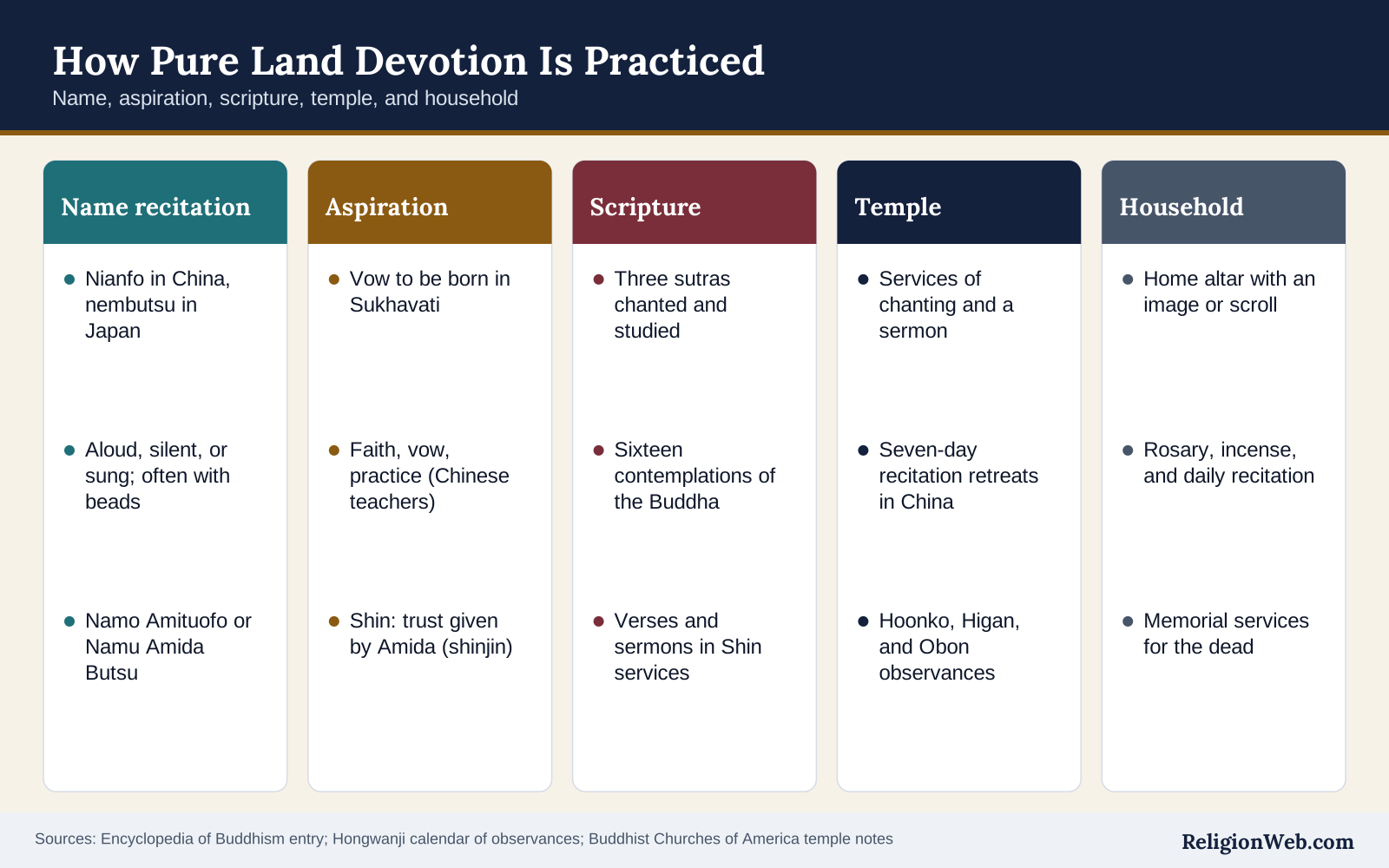
Pure Land Buddhism Today: Global Presence and Modern Developments
Reliable counts of Pure Land Buddhists are hard to obtain, because in most of Asia the devotion is not a membership category. A Chinese, Korean, or Vietnamese Buddhist who recites Amitabha’s name is usually counted simply as a Buddhist. Aaron Proffitt, a scholar and Jodo Shinshu priest, has written that Pure Land is arguably the most commonly practiced form of Buddhism worldwide, a judgment that reflects this broad diffusion rather than any census. The firm numbers that exist come mainly from the Japanese denominations, and even these are self-reported and not always dated.
Where Pure Land Buddhists Live
East Asia and Southeast Asia
Pure Land practice is pervasive in Chinese-speaking societies, including mainland China, Taiwan, Hong Kong, and Singapore, and in Korea, Vietnam, and Japan. Among the Japanese denominations, Jodo Shu reports about 7,000 temples, Higashi Honganji reports more than 8,000 local temples in Japan and the Americas, and Jodo Shinshu Hongwanji-ha has its headquarters at Nishi Hongwanji. Proffitt calls Jodo Shinshu Japan’s largest Buddhist school, a description that depends on how schools and subdivisions are counted. These figures are the organizations’ own and are best read as indications of scale.
The Americas and other diaspora communities
Pure Land Buddhism has been present in the Americas since the late nineteenth century. According to a Hongwanji-ha history, the Hongwanji began sending official ministers to Hawaii and the mainland United States in 1897 to serve Japanese immigrants. Their organizations grew into the Honpa Hongwanji Mission of Hawaii and the Buddhist Churches of America, the latter described as the United States representative of the Hongwanji-ha. Jodo Shu has nineteen overseas temples in Hawaii, the continental United States, and Brazil. Chinese, Vietnamese, and Korean immigrants have also founded temples across North America, Europe, and Australia, where Amitabha recitation is a regular practice. Proffitt calls Jodo Shinshu one of the oldest and largest Buddhist schools in the Americas.
Scholarship, Translation, and Modern Interpretation
Reassessing Pure Land in scholarship
For much of the twentieth century, Western scholars and many popular writers treated Pure Land Buddhism as a late and simplified form of the religion. Proffitt argues that nineteenth-century Orientalist scholars dismissed Pure Land teaching as a distortion of the Buddha’s message and that this attitude persisted in popular writing. More recent historians have emphasized that the tradition has Indian roots, that it was elaborated by learned monks as well as by laypeople, and that it deserves study in its own right. The Encyclopedia of Buddhism entry’s caution against a simple split between rigorous monastics and easy-going laypeople reflects this shift. A growing body of English-language translation, including of the writings of Shinran and of Chinese masters, has made primary sources available to non-specialists.
Modern re-readings and interfaith conversation
Modern teachers continue to reinterpret the tradition. Taixu’s idea of a Pure Land built in the human world, mentioned earlier, has inspired social service and educational work in Chinese Buddhism. Shin teachers in North America frame the nembutsu as gratitude and the Pure Land as an expression of boundless wisdom and compassion, and they take part in conversations among Buddhist traditions. Proffitt notes that scholars and practitioners are building bridges with other schools. Debates continue about topics such as the nature of the Pure Land, the status of the Contemplation Sutra, and the relation of Pure Land teaching to other forms of Buddhism, and the answers differ from teacher to teacher.
Common Misconceptions About Pure Land Buddhism
Pure Land Buddhism is often misdescribed, partly because its vocabulary is easily mistaken for the vocabulary of other traditions and partly because it has been described for generations by outsiders. The following five misconceptions are among the most common. Each is stated fairly, followed by an account of where it comes from and what the sources and the traditions themselves say.
Misconception 1: Pure Land Buddhism is simply belief in a heaven identical to Western popular ideas
Where the misunderstanding comes from
English-language translations often render Sukhavati as “Western Paradise” or “heaven,” and popular descriptions of its jeweled trees, golden ground, and lotus ponds invite the comparison. The word “Western” in the name refers to the direction in which the sutras locate the land, not to Western culture, but the two meanings sometimes blur in casual writing. A person who meets only the paradise imagery, and not the doctrinal setting, naturally assumes that the Pure Land is a destination of reward.
Scholars and teachers have also contributed to the confusion by using the shorthand “paradise” for convenience. The word is not entirely wrong, because the sutras do describe a place of great beauty and freedom from suffering. The difficulty lies in what the simple translation leaves out.
What the evidence and tradition actually show
According to the Larger Sutra, the land was created by the vows of Dharmakara so that beings could practice without hindrance and reach awakening. The Encyclopedia of Buddhism entry states that rebirth in the Pure Land was taken to lead to enlightenment and that those born there attain nirvana without fail. In the sutra’s own account, Amitabha is a buddha who teaches, not a creator of the world or a judge who weighs deeds, and rebirth is not described as a reward for good behavior. The Smaller Sutra says explicitly that beings are not born there as a reward and result of good works performed in this present life.
Within the tradition there are also readings that do not treat Sukhavati as a distant place at all. The Chan teacher Yongming Yanshou identified the Buddha and his land with one’s own mind, and Proffitt notes that some practitioners see the Pure Land as a symbol for nirvana present in this world. The most accurate summary is that the Pure Land is a buddha-field serving the path to awakening, understood by different teachers more literally or more symbolically, and that it is best compared with other Buddhist ideas such as buddha-fields and the bodhisattva path rather than with general ideas of an afterlife.
Misconception 2: Pure Land Buddhism has no meditation or ethical practice
Where the misunderstanding comes from
Because Pure Land teaching centers on calling a name and relying on a vow, outsiders sometimes conclude that it asks nothing more. The impression is reinforced by the Japanese reform movements, whose founders sharply simplified practice for the sake of ordinary people, and by the fact that Jodo Shinshu teaches that rebirth is not earned by effort. When teachers say that no practice is required as a condition of salvation, the statement is easily heard as a rejection of practice altogether.
What the evidence and tradition actually show
The scriptures themselves prescribe demanding meditation. The Contemplation Sutra sets out sixteen contemplations, and the Pratyutpanna Samadhi Sutra describes a seven-day meditation in which the practitioner sees Amitabha. The Encyclopedia of Buddhism entry lists methods that include visualizing the Buddha, contemplating the formless dharma body, and concentrating on the name, and notes that Pure Land practitioners also undertook precept observance, scripture copying, and acts of public service. In China, Pure Land recitation has been practiced for centuries by monks in meditation halls, and Chinese teachers regularly urge laypeople to keep the five precepts.
Even in Jodo Shinshu, ethics is not set aside. The Buddhist Churches of America describes the ethical life as the fruit of gratitude, with followers called to be mindful of words and deeds and to serve their communities. Honen’s Seven-Article Pledge warned his own followers against misusing the vow as an excuse for misconduct. The accurate statement is that the schools differ about whether practice causes rebirth, not about whether practice and ethical life matter.
It also helps to notice that the same practice can carry different meanings from school to school. A Chinese monk who recites for several hours a day regards recitation as a discipline that brings the mind to rest and prepares for rebirth. A Shin layperson who recites at the altar regards it as an answer to a gift already received. Both are practicing, and both are following ethical commitments, but the explanations they give are different.
Misconception 3: All Pure Land schools explain faith and practice identically
Where the misunderstanding comes from
Because the schools share the same sutras and the same recited name, observers often assume that they share the same doctrine. Introductory books sometimes speak of “Pure Land teaching” as a unit, and a visitor to a Chinese recitation hall and a Shin temple may hear similar words in similar rhythms. The shared vocabulary hides important differences in how the words are explained.
What the evidence and tradition actually show
The schools have disagreed about basic questions. In Jodo Shu, following Honen, recitation is the practice selected by the vow and is repeated throughout life. In Jodo Shinshu, following Shinran, shinjin is the gift of Amida, and the nembutsu is an expression of gratitude, so the number of recitations matters little. Ippen’s Ji school taught that the Name itself accomplishes rebirth whatever the reciter’s state of mind. Chinese and Korean teachers generally combine faith, aspiration, and practice, together with meditation. After Honen’s death his own disciples debated whether a single sincere recitation is enough or whether many are needed.
These disagreements are an ordinary feature of a long-lived tradition, and they were argued by people who respected one another’s sources. They do not mean that any school is outside the tradition, but they do mean that a statement about “what Pure Land Buddhists believe” should name the school. This article has tried to do so throughout.
Misconception 4: The nembutsu is a magic formula, or a license to do whatever one likes
Where the misunderstanding comes from
The idea that a short phrase can lead to rebirth in a Pure Land, even for someone who has done grave wrong, can sound like a spiritual loophole. The Contemplation Sutra’s account of the dying evildoer who calls the Buddha’s name ten times is often quoted in isolation, and so are passages such as the one in the Tannisho in which Shinran is reported to say that even a good person is reborn, how much more an evil person. Quoted without context, these lines suggest that conduct is irrelevant.
What the evidence and tradition actually show
The Contemplation Sutra places the dying evildoer within a longer scheme of nine grades, and the teaching about the lowest grade concerns the extent of the Buddha’s compassion, not the neglect of ethics. Honen addressed the worry directly in the Seven-Article Pledge of 1204, in which he urged his followers to avoid misconduct justified by the nembutsu. Shin teachers explain Shinran’s remark in the Tannisho as a statement about Amida’s vow being directed especially at those who cannot save themselves, and they distinguish this from encouraging wrongdoing. Jodo Shinshu teaching also rejects magic and petitionary prayer, as the Buddhist Churches of America states, so the nembutsu is not understood as a charm that produces results.
In Chinese tradition, where recitation is practiced alongside the precepts, the idea of using the name as a license would be seen as a misunderstanding of its purpose. The name is a way of recollecting the Buddha, and the Buddhist teachings on intention and consequence, described in the article on karma and rebirth, remain in force.
Misconception 5: Pure Land Buddhism is a Japanese tradition
Where the misunderstanding comes from
In English, the best-known Pure Land organizations are Japanese: the Buddhist Churches of America, the Honpa Hongwanji Mission of Hawaii, and Jodo Shu. Many books about Shin Buddhism are available in English, and many Western readers first meet Pure Land teaching through them. The impression follows that the tradition is a Japanese creation, or that the Japanese schools are its only form.
What the evidence and tradition actually show
The Japanese schools are a particular development of a much older and wider devotion. The scriptures are Indian in origin, with the exception of the Contemplation Sutra, which is described as of non-Indian provenance. The first organized society for Amitabha recitation was founded by Huiyuan in China in 402 CE, and the great systematizers Tanluan, Daochuo, and Shandao were Chinese. Korean scholars wrote commentaries on the Pure Land sutras, Vietnamese Buddhists regard Pure Land as widespread in their country, and Tibetan Buddhists pray for rebirth in Dewachen. Honen and Shinran themselves regarded the Chinese and Indian masters as their predecessors, and Shinran’s list of seven masters includes Nagarjuna, Vasubandhu, Tanluan, Daochuo, Shandao, Genshin, and Honen. It is accurate to say that Japan produced independent Pure Land denominations, but the devotion belongs to the whole Mahayana world.
The Indian and Central Asian background points the same way. The Larger Sutra survives in Sanskrit, fragments of it survive in Uighur, Khotanese, and Xixia, and the Chinese translations date from the second century CE onward. A Japanese reader who studies Honen or Shinran is therefore reading a late chapter of a long story that began elsewhere. For that reason, introductions to the tradition generally begin with the sutras and the Chinese teachers before turning to the Japanese schools, as this article has done.
Frequently Asked Questions About Pure Land Buddhism
The questions below are the ones readers ask most often. Each answer points back to the fuller discussion earlier in the article and names the school or text on which it relies.
Questions About Amitabha and the Pure Land
Who is Amitabha Buddha?
Amitabha, also called Amitayus, is a buddha described in Mahayana sutras as the teacher of the western buddha-field Sukhavati. His name means “Immeasurable Light,” and the alternative name Amitayus means “Immeasurable Life.” According to the Larger Sukhavativyuha, he was once a monk named Dharmakara who made vows, practiced for ages, and became a buddha, so that the vows are now fulfilled. Within the tradition, he is venerated as an embodiment of boundless compassion and wisdom and is invoked by name, not worshiped as a creator.
The Smaller Sutra explains both names as expressions of immeasurable life and unimpeded light. Historically, devotion to him is attested in northwestern India and Central Asia in the early centuries CE and spread to China, Korea, Vietnam, Tibet, and Japan. For the wider Buddhist background, see the articles on the Buddha and Mahayana Buddhism.
Where is the Pure Land, and is it a real place?
In the Larger Sutra, Sukhavati lies in the west, at a distance expressed as a hundred thousand niyutas of kotis of buddha countries from our world. Such figures convey immense scale. Whether the land is a place to which one literally travels after death is a question on which the tradition holds more than one view. Many devotees take rebirth there literally. Others, following teachers such as Yongming Yanshou, understand the Buddha and the land as none other than the mind, and some, as Proffitt notes, treat it as a symbol of nirvana present in this world. Teachers often say that the different levels of understanding are compatible.
Is rebirth in the Pure Land the same as nirvana?
Not exactly. According to the Encyclopedia of Buddhism entry, rebirth in the Pure Land was taken to lead to enlightenment, and those born there attain nirvana without fail. The Larger Sutra’s eleventh vow in Muller’s translation speaks of beings established in certainty until they reach final nirvana. Rebirth in Sukhavati is therefore understood as a favorable setting from which awakening is assured, rather than as the final state itself. In Jodo Shinshu, birth in the Pure Land and the attainment of buddhahood are described as occurring together.
Questions About Practice
What does “Namu Amida Butsu” mean, and how is it recited?
The phrase is the Japanese reading of the Chinese Namo Amituofo, a rendering of a Sanskrit homage to Amitabha. “Namu” is an expression of homage, taking refuge, or entrusting, “Amida” is the Buddha’s name, and “Butsu” means Buddha. Shin teachers often gloss it as an expression of trust and gratitude, while Jodo Shu and Chinese teachers emphasize it as the practice of recollecting the Buddha. It may be recited aloud or silently, with or without a rosary, alone or in a group, and the pace and melody vary by tradition.
Newcomers who wish to try the practice are best advised to visit a temple or recitation group and ask for guidance, since the school’s explanation of why one recites differs from place to place. For wider background on meditation and concentration, see Buddhist meditation.
Do you have to be a Buddhist to take part in a service?
Most temples welcome visitors. Shin temples in North America state that services and membership are open to all, and the usual guidance is to follow the lead of the congregation and ask about local customs. Formal membership, taking refuge, or receiving a Dharma name are separate steps handled by the individual temple. Visitors are not expected to chant, and they can sit quietly and listen. In Chinese and Vietnamese temples, laypeople often take refuge and the five precepts in a short ceremony, which the temple can explain.
Does Pure Land practice replace medical care or other help?
No. Pure Land teaching concerns liberation and the aspiration for rebirth, and while deathbed recitation and communal chanting are widely valued as comfort, the tradition does not present them as substitutes for medicine or professional care. Families and chaplains generally combine the two. A person facing serious illness or distress should seek qualified medical and mental-health help, and a Pure Land teacher can support the spiritual side of care alongside it.
Questions About Schools and History
What is the difference between Jodo Shu and Jodo Shinshu?
Both trace their teaching to Honen, and both center on Amida’s Primal Vow. Jodo Shu, which considers Honen its principal teacher, emphasizes the repeated recitation of the nembutsu as the practice chosen by the vow. Jodo Shinshu, founded on Shinran’s teaching, emphasizes shinjin, the trust that Shin teaching holds to be bestowed by Amida, with the nembutsu as an expression of gratitude. Jodo Shu’s official history notes that Shinran’s followers formed a separate order and that only Jodo Shu claims Honen as its principal teacher. Practical differences include the married priesthood in Jodo Shinshu and different ceremonial forms.
Who founded Pure Land Buddhism?
No single person did. Devotion to Amitabha developed gradually in India and Central Asia, and Chinese tradition honors Huiyuan, who gathered a society on Mount Lu in 402 CE, as the first patriarch. Tanluan, Daochuo, and Shandao shaped the doctrine, and in Japan Honen is regarded as the founder of Jodo Shu and Shinran of Jodo Shinshu. Ippen founded Ji Shu. Each school identifies its own founder, and the wider devotion has no single institutional origin.
How is Pure Land related to Zen and Nichiren Buddhism?
These are separate lineages with their own histories, sometimes in contact. In China, Chan teachers such as Yongming Yanshou combined meditation with recitation, and the combined practice was widespread, as the article on Zen Buddhism explains. In Kamakura Japan, the schools developed side by side, and Nichiren, described in the article on Nichiren Buddhism, criticized the exclusive nembutsu from his own Lotus Sutra perspective. Each school is best understood on its own terms.
Conclusion: What the History of Pure Land Buddhism Shows
Pure Land Buddhism began as a strand of Indian and Central Asian Mahayana devotion and became, across fifteen centuries, a central current of East Asian religious life. Its core figure, Amitabha, and his land Sukhavati offered a promise attractive to people of every rank: that awakening could be approached through a buddha’s vow, and that calling that buddha’s name could be a path in its own right. The schools that grew from this promise answered its implications in different ways, and that variety is part of the tradition’s history.
What the History Shows
Continuity across Asia
From Huiyuan’s society on Mount Lu to Honen’s movement in Kyoto, from Korean commentators to Tibetan aspiration prayers, the same three scriptures and the same name recur. Practice has always been local, whether in a Chinese recitation retreat, a Shin family’s evening at the altar, or a Vietnamese temple’s morning chant, but the underlying recollection of the Buddha has remained recognizable for nearly two thousand years.
Honest disagreement within one tradition
The schools disagree about the cause of rebirth, the weight of practice, and the nature of the Pure Land itself. Those disagreements are historical facts, not signs of decline, and a fair account lets each school state its own understanding. The article has attempted to do so, noting where evidence is thin and where reference works differ.
How to Keep Exploring
Reading the primary texts
Readers who wish to go further can start with the three sutras in modern translation, then read the writings of Shandao, Honen, and Shinran, and compare how each reads the same passages. Introductory essays by practitioner-scholars are helpful for understanding how living communities interpret them. The articles on Buddhism and Mahayana Buddhism supply the broader context.
Visiting a temple with respect
For a first-hand view, visit a local Pure Land temple or recitation group. Ask about the school, arrive a few minutes early, follow the community’s lead, and treat the visit as an opportunity to listen. Teachers are generally glad to explain their tradition on its own terms, and the encounter will teach things no book can.
Sources
The table below lists the principal external sources behind this article. Facts, dates and figures were checked against these and related primary, institutional and academic materials.
| # | Source | Publisher and type | Used for | Link |
|---|---|---|---|---|
| 1 | The Larger Sukhavati-vyuha (trans. F. Max Muller), Buddhist Mahayana Texts, Sacred Books of the East vol. 49 | Internet Sacred Text Archive (sacred-texts.com) · Primary text | Dharmakara story, vows, Sukhavati; quoted vow 19 (Muller numbering) | sacred-texts.com |
| 2 | The Smaller Sukhavati-vyuha (trans. F. Max Muller), Sacred Books of the East vol. 49 | Internet Sacred Text Archive (sacred-texts.com) · Primary text | Names Amitayus and Amitabha; passage on keeping the name in mind (sections 8 and 10) | sacred-texts.com |
| 3 | The Amitayur-dhyana-sutra (trans. J. Takakusu), Sacred Books of the East vol. 49 | Internet Sacred Text Archive (sacred-texts.com) · Primary text | Contemplation Sutra frame story, ten recitations (section 30); Kalayasas translation note | sacred-texts.com |
| 4 | Pure Land Buddhism (Encyclopedia of Buddhism entry) | Encyclopedia.com · Encyclopedia | Indian roots, buddha recollection, Chinese and Japanese development, Tibetan practice, deathbed rites | encyclopedia.com |
| 5 | Honen (encyclopedia entry) | Encyclopedia.com · Encyclopedia | Honen's life, the 1198 Senchakushu, 1204-1207 pressure and exile, disciples | encyclopedia.com |
| 6 | A Brief History of Pure Land Buddhism (Aaron Proffitt) | Lion's Roar · Academic reference | Overview by a scholar and Hongwanji-ha priest: India, China, Japan, Tibet, the West | lionsroar.com |
| 7 | History of Jodo Shu | Jodo Shu (official site) · Institutional | 1175 origin, Ryochu and Chinzei line, about 7,000 temples, overseas temples | jodo.or.jp |
| 8 | History of the Higashi Honganji | Higashi Honganji (Shinshu Otani-ha) · Institutional | Shinran, Kakushinni, Rennyo, Nobunaga war, Nishi and Higashi split, temple count | english.higashihonganji.or.jp |
| 9 | Calendar of Observances | Hongwanji (Jodo Shinshu Hongwanji-ha) · Institutional | Hoonko, Higan, Hanamatsuri, Gotan-e, Obon and other Hongwanji-ha observances | hongwanji.kyoto |
| 10 | Peculiarities of the Pure Land in Korean Buddhism (Han Tae-shik), Journal of Pure Land Buddhism Studies 13 (2010) | Digital Library and Museum of Buddhist Studies, National Taiwan University · Academic reference | Features of Korean Pure Land thought; no independent Pure Land sect in Korea | dlbs.liberal.ntu.edu.tw |
Last fact-check date: 2026-10-21.
